WO2024202917A1 - 電流遮断モジュール - Google Patents
電流遮断モジュール Download PDFInfo
- Publication number
- WO2024202917A1 WO2024202917A1 PCT/JP2024/007696 JP2024007696W WO2024202917A1 WO 2024202917 A1 WO2024202917 A1 WO 2024202917A1 JP 2024007696 W JP2024007696 W JP 2024007696W WO 2024202917 A1 WO2024202917 A1 WO 2024202917A1
- Authority
- WO
- WIPO (PCT)
- Prior art keywords
- current
- circuit
- state
- pyrofuse
- signal indicating
- Prior art date
- Legal status (The legal status is an assumption and is not a legal conclusion. Google has not performed a legal analysis and makes no representation as to the accuracy of the status listed.)
- Ceased
Links
Images



Classifications
-
- H—ELECTRICITY
- H01—ELECTRIC ELEMENTS
- H01H—ELECTRIC SWITCHES; RELAYS; SELECTORS; EMERGENCY PROTECTIVE DEVICES
- H01H39/00—Switching devices actuated by an explosion produced within the device and initiated by an electric current
Definitions
- This disclosure relates to a current interruption module.
- Patent document 1 discloses a technology that uses a signal line interruption means to electrically interrupt the power line when it is determined that an abnormality has occurred in the circuitry around the battery.
- a pyrofuse may be used as a signal line interrupting means.
- the technology disclosed in Patent Document 1 has the problem that it is difficult to determine the state of the pyrofuse (signal line interrupting means), such as whether an abnormality has occurred in the pyrofuse (signal line interrupting means) or whether the pyrofuse has already been activated.
- the present disclosure therefore provides a current interruption module that can determine the state of a pyrofuse.
- the current interruption module is a current interruption module that includes a gas generator and a bus bar, and is equipped with a pyro-fuse in which the bus bar is cut by the gas generator, an ignition circuit that activates the gas generator, and a state determination circuit that determines the state of the pyro-fuse by monitoring the resistance value of a resistor for generating gas that is included in the gas generator, and outputs a signal indicating the determination result of the state of the pyro-fuse to the outside of the current interruption module.
- the current interruption module can determine the state of the pyro-fuse.
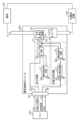
- FIG. 1 is a block diagram showing an example of a current interruption module according to a first embodiment
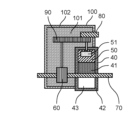
- 1 is a cross-sectional view showing an example of a current interruption module according to a first embodiment
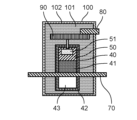
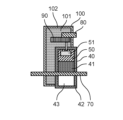
- 4 is a cross-sectional view showing another example of the current interruption module according to the first embodiment.
- FIG. FIG. 11 is a block diagram showing an example of a current interruption module according to a second embodiment.
- FIG. 11 is a block diagram showing an example of a current interruption module according to a third embodiment.
- FIG. 11 is a cross-sectional view showing an example of a current interruption module according to a third embodiment.
- 13 is a cross-sectional view showing another example of a current interruption module according to the third embodiment.
- FIG. 1 is a block diagram showing an example of a current interruption module 100 according to the first embodiment.
- FIG. 1 also shows an ECU (Electronic Control Unit) 200, a large current circuit 300, and a load 400.
- the current interruption module 100 is used in vehicles such as electric automobiles.
- FIG. 2A is a cross-sectional view showing an example of a current interruption module 100 according to embodiment 1.
- the bus bar 70 and the board 90 are insulated from each other.
- the case 102 of the current interruption module 100 contains a material that can keep the bus bar 70 and the connector 80 insulated from each other.
- the case 102 is structured so that the bus bar 70 exposed to the outside of the case 102 and the connector 80 exposed to the outside of the case 102 do not deform when the current is interrupted.
- the signal wiring coming out of the bus bar 70 and the board 90 may be structured so that they have a sufficient creepage distance.
- the signal wiring coming out of the bus bar 70 and the board 90 may be exposed to the atmosphere. It is preferable that the signal wiring coming out of the bus bar 70 and the board 90 is sealed with a mold or the like, since this shortens the insulation distance and allows for miniaturization.
- the pyrofuse 40 may be partially exposed from the current interruption module case 102.
- the case 42 of the pyrofuse 40 is made of a material or has a structure that insulates the bus bar 70 and the gas generator 50 from each other.
- the case 42 of the pyrofuse 40 is made of a material or has a structure that insulates the bus bar 70 and the gas generator 50 from each other when the current is interrupted and after the current is interrupted.
- the interior 43 of the pyrofuse 42 may be exposed to the atmosphere or may be filled with an inert gas such as nitrogen, as long as the structure insulates the bus bar 70 and the gas generator 50 from each other before, when, and after the current is interrupted.
- the high-current circuit 300 is, for example, a circuit that can apply a high voltage to the load 400.
- the high-current circuit 300 includes a battery and a switch circuit made of a relay or a power semiconductor.
- the battery is a main battery in a vehicle (for example, a lithium-ion high-current circuit).
- the load 400 is, for example, a motor and an inverter of a vehicle.
- the vehicle is driven by power being supplied from the high-current circuit 300 to the load 400.
- a high current may flow through the current path connecting the high-current circuit 300 and the load 400 due to a short circuit, which may cause the high-current circuit 300 to smoke or catch fire, and therefore the current interruption module 100 is used in the vehicle.
- the ECU 200 is an example of a device provided outside the current interruption module 100.
- the ECU 200 is a device for controlling the high current circuit 300, the load 400, and various other components (such as steering, various sensors, communication equipment, and IVI (In Vehicle Infotainment)) of the vehicle.
- one ECU 200 is shown, but the ECU 200 may be composed of multiple ECUs.
- the ECU 200 is connected to the high current circuit 300 and is capable of sending and receiving signals to and from the high current circuit 300, and can control the on and off of the application of voltage from the high current circuit 300 to the load 400.
- the ECU 200 is connected to the load 400 and is capable of sending and receiving signals to and from the load 400.
- the ECU 200 can recognize that an accident has occurred by acquiring a signal from a sensor as the load 400.
- the current interruption module 100 is a module for interrupting the current path connecting the high current circuit 300 and the load 400.
- the current path connecting the high current circuit 300 and the load 400 may be a path connecting the positive terminal of the battery of the high current circuit 300 and the positive terminal of the load 400, or a path connecting the negative terminal of the battery of the high current circuit 300 and the negative terminal of the load 400.
- the current interruption module 100 includes a pyrofuse 40, a sensor 60, a current determination circuit 10, an ignition circuit 20, and a state determination circuit 30.
- the pyrofuse 40 includes a gas generator 50 and a bus bar 70.
- the current interruption module 100 may also include a connector 80 for transmitting signals to and from the ECU 200, and a substrate 90 on which the current determination circuit 10, the ignition circuit 20, and the state determination circuit 30 are provided.
- the connector 80 is mounted on the substrate 90 and connected to the state determination circuit 30 on the substrate 90.
- the bus bar 70 is inserted into the current path so as to become part of the current path connecting the high current circuit 300 and the load 400.
- Pyro fuse 40 is a fuse for cutting off a current path when a large current flows through the current path connecting high current circuit 300 and load 400 due to a short circuit abnormality.
- gas generator 50 cuts bus bar 70, which is part of the current path.
- Gas generator 50 has resistor 51 and chemicals for generating gas. Resistor 51 generates heat when a relatively large current (for example, a current of about several A) flows through it, and generates gas through a chemical reaction of the chemicals caused by the heat. Resistor 51 has a resistance of about several ⁇ , for example.
- Pyro fuse 40 heats resistor 51 based on a signal from ignition circuit 20, causing a chemical reaction, and irreversibly cuts bus bar 70 by generating gas due to the chemical reaction.
- the pyrofuse 40 can continuously pass a current of 500 A or less. Also, for example, the pyrofuse 40 can interrupt a current path through which a voltage of 500 V or less flows and a current of 20,000 A or less flows when a voltage of 500 V or less is applied. In the pyrofuse 40, the bus bar 70 and the gas generator 50 are insulated from each other so that a high voltage is not applied to the gas generator 50.
- the sensor 60 is a sensor for detecting the current flowing through the bus bar 70.
- the sensor 60 may be a sensor such as a Hall element, or may be a shunt resistor.
- the sensor 60 may also be a temperature sensor, and may indirectly detect the current by detecting heat generated in the bus bar 70 due to an overcurrent.
- the current determination circuit 10, the ignition circuit 20, and the state determination circuit 30 are realized, for example, by a microcontroller unit (MCU) or discrete semiconductors.
- MCU microcontroller unit
- the current determination circuit 10, the ignition circuit 20, and the state determination circuit 30 may also be realized, for example, by an application specific integrated circuit (ASIC).
- ASIC application specific integrated circuit
- the current determination circuit 10 determines whether the current flowing through the busbar 70 detected by the sensor 60 is an overcurrent.
- the current determination circuit 10 has a comparison circuit 11.
- the comparison circuit 11 is a comparator that compares the current value (analog value) of the current detected by the sensor 60 with a preset value.
- the current determination circuit 10 may have an AD converter, and the comparison circuit 11 may compare the current value (digital value) of the current detected by the sensor 60 with a preset value. For example, if the current value of the current detected by the sensor 60 is greater than the preset value, the current determination circuit 10 determines that the current detected by the sensor 60 is an overcurrent. In this case, the comparison circuit 11 outputs a signal indicating that the current detected by the sensor 60 is an overcurrent to the ignition circuit 20.
- the signal may be, for example, a binary signal such as a High signal or a Low signal.
- the ignition circuit 20 is a circuit for starting the gas generator 50.
- the ignition circuit 20 has a charge supply circuit 21 and a switch circuit 22.
- the charge supply circuit 21 is a circuit for supplying charge to the gas generator 50, and includes, for example, a battery capable of supplying an instantaneous current capable of starting the gas generator 50, and a charging circuit for charging the battery. A capacitor may be used instead of the battery.
- the charge supply circuit 21 supplies charge to the gas generator 50 via the switch circuit 22. For example, if the resistance value of the resistor 51 is 2 ⁇ , and the instantaneous current required to cause a chemical reaction is 2 A, the charge supply circuit 21 must maintain a potential difference of about 4 V until the gas generator 50 starts up.
- the switch circuit 22 acquires a signal output from the current determination circuit 10 (comparison circuit 11) and switches on and off the supply of charge from the charge supply circuit 21 to the gas generator 50 in response to the signal.
- the switch circuit 22 includes, for example, an N-type MOSFET (Metal Oxide Semiconductor Field Effect Transistor), and the gate of the MOSFET is connected to the comparison circuit 11. For example, when the signal output from the comparison circuit 11 is a signal (for example, a High signal) indicating that the current detected by the sensor 60 is an overcurrent, the MOSFET is turned on and charge is supplied from the charge supply circuit 21 to the gas generator 50.
- a signal for example, a High signal
- the ignition circuit 20 may have a latch circuit, and the on state of the MOSFET may be maintained after the MOSFET is turned on.
- the ignition circuit 20 may also have a filter circuit provided between the switch circuit 22 and the comparison circuit 11. This prevents the switch circuit 22 from malfunctioning due to noise.
- the state determination circuit 30 is a circuit that determines the state of the pyrofuse 40 by monitoring the resistance value of the resistor 51 for generating gas that is included in the gas generator 50, and outputs a signal indicating the determination result of the state of the pyrofuse 40 to the outside of the current interruption module 100 (e.g., the ECU 200).
- the state determination circuit 30 has a resistance detection circuit 31 and a comparison circuit 32.
- the resistance detection circuit 31 is a circuit for detecting the resistance value of the resistor 51.
- the resistance detection circuit 31 has a power supply (low current power supply) and detects the resistance value of the resistor 51 from the current value of the current flowing from the power supply to the resistor 51 and the voltage generated in the resistor 51 at that time.
- the current flowing from the power supply to the resistor 51 is so small that the gas generator 50 does not start up.
- the resistance detection circuit 31 outputs the detection result of the resistance value of the resistor 51 to the comparison circuit 32. Since the voltage generated in the resistor 51 is minute, the resistance detection circuit 31 may have an amplifier circuit that amplifies the voltage.
- the comparison circuit 32 is, for example, a comparator.
- the comparison circuit 32 determines whether the resistance value of the resistor 51 is within a preset range, and if the resistance value is not within the preset range, outputs a determination signal (for example, an error signal) to the ECU 200 via the connector 80.
- state determination circuit 30 when the resistance value of resistor 51 is less than the first threshold value or greater than the second threshold value, state determination circuit 30 outputs a signal indicating that the state of pyrofuse 40 is not normal to the outside of current interruption module 100 as a signal indicating the determination result of the state of pyrofuse 40.
- state determination circuit 30 may output a signal indicating that the state of pyrofuse 40 is normal to the outside of current interruption module 100 as a signal indicating the determination result of the state of pyrofuse 40.
- the first threshold value and the second threshold value are set appropriately according to the resistance value of resistor 51 in a normal state.
- the state determination circuit 30 can output a signal indicating that the state of the pyrofuse 40 is not normal to the outside of the current interruption module 100.
- state determination circuit 30 may output a signal indicating a short circuit abnormality to the outside of current interruption module 100 as a signal indicating the result of the determination of the state of pyrofuse 40.
- the state determination circuit 30 can output a signal indicating that a short circuit has occurred in the pyrofuse 40 to the outside of the current interruption module 100, making it possible to take appropriate action in response to the short circuit.
- state determination circuit 30 may output a signal indicating an open circuit abnormality as a signal indicating the result of the determination of the state of pyrofuse 40, or a signal indicating that pyrofuse 40 has been activated.
- state determination circuit 30 can output a signal indicating that a wire break abnormality has occurred in the pyrofuse 40 or a signal indicating that the pyrofuse 40 has already been activated to the outside of current interruption module 100. This makes it possible to take measures according to the wire break abnormality or measures according to the fact that the pyrofuse 40 has already been activated.
- state determination circuit 30 may output a signal indicating that pyrofuse 40 has been activated as a signal indicating the determination result of the state of pyrofuse 40, and when the resistance value of resistor 51 is greater than the third threshold value, state determination circuit 30 may output a signal indicating an open circuit abnormality as a signal indicating the determination result of the state of pyrofuse 40.
- the third threshold value is set appropriately according to the resistance value of resistor 51 of an activated pyrofuse 40.
- the resistance value of resistor 51 is greater than the second threshold value and equal to or less than the third threshold value. Therefore, when the resistance value of resistor 51 is greater than the second threshold value and equal to or less than the third threshold value, state determination circuit 30 can output a signal indicating that pyrofuse 40 has been activated to the outside of current interruption module 100. Furthermore, when an open circuit abnormality has occurred in pyrofuse 40, the resistance value of resistor 51 is greater than the third threshold value. Therefore, when the resistance value of resistor 51 is greater than the third threshold value, state determination circuit 30 can output a signal indicating that an open circuit abnormality has occurred in pyrofuse 40 to the outside of current interruption module 100. This makes it possible to distinguish between an open circuit abnormality and pyrofuse 40 being activated, and to take measures according to the open circuit abnormality or measures according to pyrofuse 40 being activated.
- a wire breakage abnormality occurs in pyrofuse 40
- the resistance value of resistor 51 becomes large, and a current sufficient to cause resistor 51 to heat up cannot flow, and pyrofuse 40 cannot be activated.
- pyrofuse 40 cannot be activated again. For this reason, by outputting a signal indicating that a wire breakage abnormality has occurred in pyrofuse 40 or a signal indicating that pyrofuse 40 has already been activated, the user or manager of the vehicle can recognize that pyrofuse 40 is in a state in which it cannot be activated, and some kind of action can be taken.
- the ignition circuit 20 and the state determination circuit 30 may each be connected to both ends of a resistor 51, as shown in FIG. 1.
- the resistor 51 generates heat when a relatively large current flows through it, and generates gas through a chemical reaction of chemicals caused by the heat. Therefore, the ignition circuit 20 passes a large current through the resistor 51 to start the gas generator 50. If such a large current flows through the state determination circuit 30, the state determination circuit 30 may be destroyed. Therefore, the ignition circuit 20 and the state determination circuit 30 are each connected to both ends of the resistor 51 (i.e., the state determination circuit 30 is not connected in series between the ignition circuit 20 and the resistor 51), so that a large current does not flow through the state determination circuit 30, which has a higher impedance than the resistor 51.
- the resistance value of resistor 51 for generating gas in pyrofuse 40 varies depending on the state of pyrofuse 40, so the state of pyrofuse 40 can be determined by monitoring the resistance value of resistor 51.
- the resistance value of resistor 51 is about 10 times higher than the resistance value expected in normal operation (for example, a resistance value between a first threshold value and a second threshold value, hereinafter referred to as normal resistance value). This is because the resistance value of resistor 51 increases due to a chemical reaction of the gas generating chemicals present around resistor 51.
- a signal indicating the determination result of the state of pyrofuse 40 is output to the outside of current interruption module 100 (for example, ECU 200, etc.), so that it can be determined whether pyrofuse 40 can be used normally before driving the vehicle, and therefore whether the vehicle can be driven.
- current interruption module 100 for example, ECU 200, etc.
- the output of the large current circuit 300 can be turned off to prevent the vehicle from starting, and when the vehicle is running, the vehicle can be controlled to stop safely.
- the sensor 60, current determination circuit 10, ignition circuit 20, and pyrofuse 40 are provided within the current interruption module 100, if the current flowing through the busbar 70 is determined to be an overcurrent, a signal for starting the gas generator 50 can be immediately transmitted from the ignition circuit 20, which is arranged close to each other, to the pyrofuse 40. Therefore, if an overcurrent flows through the busbar 70, the busbar 70 can be immediately cut off.
- FIG. 3 is a block diagram showing an example of a current interruption module 100a according to the second embodiment.
- FIG. 3 also shows an ECU 200, a large current circuit 300, and a load 400.
- the current interruption module 100a is used in vehicles such as electric vehicles.
- a cross-sectional view of the current interruption module 100a is the same as that shown in FIG. 2A or FIG. 2B, and is therefore not shown.
- the current interruption module 100a according to the second embodiment differs from the current interruption module 100 according to the first embodiment in that it includes a current judgment circuit 10a instead of the current judgment circuit 10. The following will focus on the differences from the current interruption module 100 according to the first embodiment.
- the current determination circuit 10a has a comparison circuit 11 and an OR circuit 12.
- the function of the comparison circuit 11 is basically the same as that in the first embodiment, except that it outputs a signal indicating that the current detected by the sensor 60 is an overcurrent to the ignition circuit 20 via the OR circuit 12.
- the input terminal of the OR circuit 12 is connected to the output terminal of the comparison circuit 11 and the external input terminal of the connector 80, and the output terminal is connected to the switch circuit 22 (e.g., the gate of a MOSFET).
- the OR circuit 12 outputs a High signal to the switch circuit 22 when at least one of the signals from the outside (e.g., the ECU 200) and the signal from the comparison circuit 11 is a High signal. This allows the ignition circuit 20 to start the gas generator 50 based on the signal from the outside or the result of the determination by the current determination circuit 10a.
- the gas generator 50 can be started by a signal from outside (e.g., the ECU 200) even if no overcurrent is flowing through the bus bar 70.
- FIG. 4 is a block diagram showing an example of a current interruption module 100b according to the third embodiment.
- FIG. 4 also shows an ECU 200, a large current circuit 300, and a load 400.
- the current interruption module 100b is used in vehicles such as electric vehicles.
- FIG. 5A is a cross-sectional view showing an example of a current interruption module 100b according to embodiment 3.
- the current interruption module 100b according to the third embodiment differs from the current interruption module 100 according to the first embodiment in that it does not include a current determination circuit 10 and a sensor 60. The following will focus on the differences from the current interruption module 100 according to the first embodiment.
- the ignition circuit 20 is connected to the connector 80, and a signal from the outside (e.g., the ECU 200) is connected to the switch circuit 22 (e.g., the gate of a MOSFET).
- the current interruption module 100b does not include the current determination circuit 10 and the sensor 60, and therefore cannot detect an overcurrent flowing through the bus bar 70 and cannot start the gas generator 50 in response to the overcurrent.
- the gas generator 50 can be started by a signal from the outside (e.g., the ECU 200).
- the current determination circuit 10 and the sensor 60 are not essential components of the current interruption module 100b, and the gas generator 50 may be started by a signal from the outside.
- the pyrofuse 40 may be partially exposed from the current interruption module case 102.
- each component included in the current interruption module may be configured with dedicated hardware, or may be realized by executing a software program suitable for each component.
- Each component may be realized by a program execution unit such as a CPU or processor reading and executing a software program recorded on a recording medium such as a hard disk or semiconductor memory.
- LSI is an integrated circuit. These may be individually integrated into a single chip, or may be integrated into a single chip that includes some or all of the functions. Furthermore, the integrated circuit is not limited to an LSI, and may be realized using a dedicated circuit or a general-purpose processor.
- An FPGA Field Programmable Gate Array
- reconfigurable processor that can reconfigure the connections and settings of circuit cells inside the LSI may also be used.
- this disclosure also includes forms obtained by applying various modifications to the embodiments that a person skilled in the art may conceive, and forms realized by arbitrarily combining the components and functions of each embodiment within the scope that does not deviate from the spirit of this disclosure.
- a current interruption module comprising: a pyro-fuse including a gas generator and a bus bar, the bus bar being cut by the gas generator; an ignition circuit capable of starting the gas generator; and a state determination circuit that determines the state of the pyro-fuse by monitoring the resistance value of a resistor included in the gas generator for generating gas, and outputs a signal indicating the determination result of the state of the pyro-fuse to the outside of the current interruption module.
- the state of the pyrofuse can be determined by monitoring the resistance value of the resistor. For example, when the pyrofuse has been activated, the resistance value of the resistor is about 10 times higher than the resistance value expected in normal times (called the normal resistance value). This is because the resistance value of the resistor increases due to a chemical reaction of the gas generating chemicals present around the resistor. Also, when a short circuit occurs in the pyrofuse, the resistance value of the resistor becomes smaller than the normal resistance value, and when a disconnection occurs in the pyrofuse, the resistance value of the resistor becomes significantly larger than the normal resistance value.
- a signal indicating the determination result of the pyrofuse state is output to the outside of the current interruption module (e.g., an ECU, etc.), so that it can be determined whether the pyrofuse can be used normally before the vehicle is driven, and therefore whether the vehicle can be driven.
- the output of the large current circuit can be turned off to prevent the vehicle from starting, and when the vehicle is running, the vehicle can be controlled to be stopped safely.
- the current interruption module described in Technology 1 further includes a sensor for detecting the current flowing through the bus bar, and a current determination circuit for determining whether the current detected by the sensor is an overcurrent, and the ignition circuit activates the gas generator based on the determination result of the current determination circuit.
- a sensor, a current determination circuit, an ignition circuit, and a pyrofuse are provided within the current interruption module, so that if the current flowing through the busbar is determined to be an overcurrent, a signal to start the gas generator can be instantly transmitted from the ignition circuit, which is located close to each other, to the pyrofuse. Therefore, if an overcurrent flows through the busbar, the busbar can be instantly disconnected.
- the gas generator can be started by a signal from outside (e.g., the ECU) even when no overcurrent is flowing through the busbar.
- the resistor for generating gas generates heat when a relatively large current flows through it, and the heat causes a chemical reaction that generates gas, so the ignition circuit passes a large current through the resistor to start the gas generator. If such a large current flows through the status determination circuit, there is a risk that the status determination circuit will be destroyed. Therefore, the ignition circuit and the status determination circuit are each connected to both ends of the resistor for generating gas (in other words, the status determination circuit is not connected in series between the ignition circuit and the resistor), so that a large current does not flow through the status determination circuit, which has a higher impedance than the resistor for generating gas.
- the resistance value of the resistor will be less than the first threshold value or greater than the second threshold value. Therefore, by comparing the resistance value of the resistor with these threshold values, a signal indicating that the state of the pyrofuse is abnormal can be output to the outside of the current interruption module.
- the resistance value of the resistor for generating gas will be less than the first threshold value. Therefore, if the resistance value of the resistor is less than the first threshold value, a signal indicating that a short circuit has occurred in the pyrofuse can be output to the outside of the current interruption module, making it possible to take appropriate action in response to the short circuit.
- the resistance value of the resistor for generating gas becomes greater than the second threshold value. Therefore, if the resistance value of the resistor is greater than the second threshold value, a signal indicating that an open circuit abnormality has occurred in the pyrofuse, or a signal indicating that the pyrofuse has already been activated, can be output to the outside of the current interruption module. This makes it possible to take action in response to the open circuit abnormality, or in response to the fact that the pyrofuse has already been activated.
- the third threshold is greater than the second threshold, The current interruption module described in Technology 8, wherein the state determination circuit outputs a signal indicating that the pyro-fuse has been activated as a signal indicating a determination result of the state of the pyro-fuse when the resistance value is greater than the second threshold value and less than the third threshold value, and outputs a signal indicating an open circuit abnormality as a signal indicating a determination result of the state of the pyro-fuse when the resistance value is greater than the third threshold value.
- the resistance value of the resistor for generating gas is greater than the second threshold value and equal to or less than the third threshold value. Therefore, when the resistance value of the resistor is greater than the second threshold value and equal to or less than the third threshold value, a signal indicating that the pyrofuse has been activated can be output to the outside of the current interruption module. Furthermore, when an open circuit abnormality has occurred in the pyrofuse, the resistance value of the resistor for generating gas is greater than the third threshold value. Therefore, when the resistance value of the resistor is greater than the third threshold value, a signal indicating that an open circuit abnormality has occurred in the pyrofuse can be output to the outside of the current interruption module. This makes it possible to distinguish between an open circuit abnormality and the pyrofuse being activated, and to take measures according to the open circuit abnormality or measures according to the fact that the pyrofuse has been activated.
- This disclosure can be applied to systems that cut off a current path by activating a pyro-fuse.
Landscapes
- Emergency Protection Circuit Devices (AREA)
Priority Applications (1)
| Application Number | Priority Date | Filing Date | Title |
|---|---|---|---|
| JP2025510067A JPWO2024202917A1 (https=) | 2023-03-31 | 2024-03-01 |
Applications Claiming Priority (2)
| Application Number | Priority Date | Filing Date | Title |
|---|---|---|---|
| JP2023058758 | 2023-03-31 | ||
| JP2023-058758 | 2023-03-31 |
Publications (1)
| Publication Number | Publication Date |
|---|---|
| WO2024202917A1 true WO2024202917A1 (ja) | 2024-10-03 |
Family
ID=92905543
Family Applications (1)
| Application Number | Title | Priority Date | Filing Date |
|---|---|---|---|
| PCT/JP2024/007696 Ceased WO2024202917A1 (ja) | 2023-03-31 | 2024-03-01 | 電流遮断モジュール |
Country Status (2)
| Country | Link |
|---|---|
| JP (1) | JPWO2024202917A1 (https=) |
| WO (1) | WO2024202917A1 (https=) |
Citations (4)
| Publication number | Priority date | Publication date | Assignee | Title |
|---|---|---|---|---|
| JPH06171455A (ja) * | 1992-10-29 | 1994-06-21 | Fujitsu Ten Ltd | エアバッグの点火装置の試験装置 |
| JP2000225916A (ja) * | 1999-02-05 | 2000-08-15 | Nissan Motor Co Ltd | エアバッグ制御装置 |
| JP2012136197A (ja) * | 2010-12-27 | 2012-07-19 | Autoliv Development Ab | エアバッグ作動回路 |
| WO2022020526A1 (en) * | 2020-07-22 | 2022-01-27 | Gigavac, Llc | Levitation fuse device |
-
2024
- 2024-03-01 WO PCT/JP2024/007696 patent/WO2024202917A1/ja not_active Ceased
- 2024-03-01 JP JP2025510067A patent/JPWO2024202917A1/ja active Pending
Patent Citations (4)
| Publication number | Priority date | Publication date | Assignee | Title |
|---|---|---|---|---|
| JPH06171455A (ja) * | 1992-10-29 | 1994-06-21 | Fujitsu Ten Ltd | エアバッグの点火装置の試験装置 |
| JP2000225916A (ja) * | 1999-02-05 | 2000-08-15 | Nissan Motor Co Ltd | エアバッグ制御装置 |
| JP2012136197A (ja) * | 2010-12-27 | 2012-07-19 | Autoliv Development Ab | エアバッグ作動回路 |
| WO2022020526A1 (en) * | 2020-07-22 | 2022-01-27 | Gigavac, Llc | Levitation fuse device |
Also Published As
| Publication number | Publication date |
|---|---|
| JPWO2024202917A1 (https=) | 2024-10-03 |
Similar Documents
| Publication | Publication Date | Title |
|---|---|---|
| US10861663B2 (en) | Relay device and a method to detect open-circuit failures | |
| JP4643419B2 (ja) | 自己診断機能を備えた負荷駆動装置 | |
| US8891210B2 (en) | Electronic control unit including discharging circuit with plurality of resistors connected in series | |
| JP3206724B2 (ja) | 電源供給装置及びコネクタの接続不良検出方法 | |
| CN114079262B (zh) | 触发电路和包括该触发电路的电子保险丝装置 | |
| US10536025B2 (en) | Relay device | |
| CN106537712A (zh) | 用于监控电驱动车辆的高压车载电网发生过载的设备 | |
| CN107765073B (zh) | 过电流检测装置、蓄电装置以及电流检测方法 | |
| US10153632B2 (en) | Device and method for protecting an electrical system component of a vehicle electrical system | |
| JP7613247B2 (ja) | 車載用切替装置 | |
| JP2019515619A (ja) | 車両の少なくとも1つの負荷のためのヒューズシステム | |
| WO2020137452A1 (ja) | 保護システム | |
| CN113492779A (zh) | 用于对车载电网进行配置的方法 | |
| EP3878697B1 (en) | Current cutoff system | |
| JP2021045023A (ja) | 電力供給装置 | |
| KR20180116625A (ko) | 일체화 된 능동 퓨즈 모듈 및 이를 통한 과전압 방지 방법 | |
| CN115441530A (zh) | 控制装置和包括该控制装置的载具电力分配架构 | |
| JPH10336886A (ja) | 車両用配線系統過電流遮断装置 | |
| WO2024202917A1 (ja) | 電流遮断モジュール | |
| JP6533699B2 (ja) | 通電制御装置、通電制御方法および断線検知装置 | |
| JP7754757B2 (ja) | 車両用電力制御装置 | |
| CN113497609B (zh) | 用于配电开关的驱动器 | |
| CN119343734A (zh) | 直流短路保护装置 | |
| WO2025248904A1 (ja) | 遮断システムおよび遮断方法 | |
| JPH1159293A (ja) | 車両用電源装置及び車両用電源システム |
Legal Events
| Date | Code | Title | Description |
|---|---|---|---|
| 121 | Ep: the epo has been informed by wipo that ep was designated in this application |
Ref document number: 24779055 Country of ref document: EP Kind code of ref document: A1 |
|
| WWE | Wipo information: entry into national phase |
Ref document number: 2025510067 Country of ref document: JP |
|
| NENP | Non-entry into the national phase |
Ref country code: DE |
|
| 122 | Ep: pct application non-entry in european phase |
Ref document number: 24779055 Country of ref document: EP Kind code of ref document: A1 |