WO2024202779A1 - 電波反射装置および電波反射装置の駆動方法 - Google Patents
電波反射装置および電波反射装置の駆動方法 Download PDFInfo
- Publication number
- WO2024202779A1 WO2024202779A1 PCT/JP2024/006736 JP2024006736W WO2024202779A1 WO 2024202779 A1 WO2024202779 A1 WO 2024202779A1 JP 2024006736 W JP2024006736 W JP 2024006736W WO 2024202779 A1 WO2024202779 A1 WO 2024202779A1
- Authority
- WO
- WIPO (PCT)
- Prior art keywords
- radio wave
- wave reflecting
- electrode
- reflecting elements
- frame period
- Prior art date
- Legal status (The legal status is an assumption and is not a legal conclusion. Google has not performed a legal analysis and makes no representation as to the accuracy of the status listed.)
- Ceased
Links
Images










Classifications
-
- H—ELECTRICITY
- H01—ELECTRIC ELEMENTS
- H01Q—ANTENNAS, i.e. RADIO AERIALS
- H01Q3/00—Arrangements for changing or varying the orientation or the shape of the directional pattern of the waves radiated from an antenna or antenna system
- H01Q3/44—Arrangements for changing or varying the orientation or the shape of the directional pattern of the waves radiated from an antenna or antenna system varying the electric or magnetic characteristics of reflecting, refracting, or diffracting devices associated with the radiating element
- H01Q3/46—Active lenses or reflecting arrays
-
- H—ELECTRICITY
- H01—ELECTRIC ELEMENTS
- H01Q—ANTENNAS, i.e. RADIO AERIALS
- H01Q15/00—Devices for reflection, refraction, diffraction or polarisation of waves radiated from an antenna, e.g. quasi-optical devices
- H01Q15/14—Reflecting surfaces; Equivalent structures
- H01Q15/147—Reflecting surfaces; Equivalent structures provided with means for controlling or monitoring the shape of the reflecting surface
-
- G—PHYSICS
- G02—OPTICS
- G02F—OPTICAL DEVICES OR ARRANGEMENTS FOR THE CONTROL OF LIGHT BY MODIFICATION OF THE OPTICAL PROPERTIES OF THE MEDIA OF THE ELEMENTS INVOLVED THEREIN; NON-LINEAR OPTICS; FREQUENCY-CHANGING OF LIGHT; OPTICAL LOGIC ELEMENTS; OPTICAL ANALOGUE/DIGITAL CONVERTERS
- G02F1/00—Devices or arrangements for the control of the intensity, colour, phase, polarisation or direction of light arriving from an independent light source, e.g. switching, gating or modulating; Non-linear optics
- G02F1/01—Devices or arrangements for the control of the intensity, colour, phase, polarisation or direction of light arriving from an independent light source, e.g. switching, gating or modulating; Non-linear optics for the control of the intensity, phase, polarisation or colour
- G02F1/13—Devices or arrangements for the control of the intensity, colour, phase, polarisation or direction of light arriving from an independent light source, e.g. switching, gating or modulating; Non-linear optics for the control of the intensity, phase, polarisation or colour based on liquid crystals, e.g. single liquid crystal display cells
- G02F1/133—Constructional arrangements; Operation of liquid crystal cells; Circuit arrangements
-
- H—ELECTRICITY
- H01—ELECTRIC ELEMENTS
- H01Q—ANTENNAS, i.e. RADIO AERIALS
- H01Q15/00—Devices for reflection, refraction, diffraction or polarisation of waves radiated from an antenna, e.g. quasi-optical devices
- H01Q15/14—Reflecting surfaces; Equivalent structures
- H01Q15/148—Reflecting surfaces; Equivalent structures with means for varying the reflecting properties
Definitions
- One embodiment of the present invention relates to a radio wave reflecting device and a method for driving the same.
- the dielectric constant of the liquid crystal layer can be controlled by adjusting the electric field applied to the liquid crystal layer containing the liquid crystal molecules to control the orientation of the liquid crystal molecules.
- Metasurfaces that utilize this property and can control the reflection properties of the liquid crystal layer with respect to radio waves are known (see, for example, Patent Documents 1 and 2).
- An object of one embodiment of the present invention is to provide a radio wave reflecting device having a new structure and a method for driving the same.
- an object of one embodiment of the present invention is to provide a radio wave reflecting device with low manufacturing costs and low power consumption and a method for driving the same.
- the radio wave reflecting device includes a plurality of radio wave reflecting elements arranged in a matrix of m rows and n columns. Each of the plurality of radio wave reflecting elements has a first electrode, a liquid crystal layer on the first electrode, and an electrically floating second electrode on the liquid crystal layer.
- the driving method includes applying a control potential based on a reference potential to the first electrode during a first frame period without applying a potential to the second electrode. During the first frame period, the sum of the control potentials applied to the first electrodes of the plurality of radio wave reflecting elements is 0V.
- m and n are each independently selected from natural numbers equal to or greater than 6, and n is an even number.
- One embodiment of the present invention is a radio wave reflecting device.
- This radio wave reflecting device has a plurality of radio wave reflecting elements arranged in a matrix of m rows and n columns.
- Each of the plurality of radio wave reflecting elements has a first electrode, a liquid crystal layer on the first electrode, and an electrically floating second electrode on the liquid crystal layer.
- m and n are each independently selected from natural numbers equal to or greater than 6, and n is an even number.
- FIG. 1 is a schematic top view of a radio wave reflecting device according to an embodiment of the present invention
- 1 is a schematic end view of a radio wave reflecting device according to an embodiment of the present invention
- FIG. 2 is a schematic plan view of an opposing substrate of a radio wave reflecting device according to an embodiment of the present invention.
- FIG. 2 is a schematic end view of an opposing substrate of a radio wave reflecting device according to an embodiment of the present invention.
- 1 is a schematic top view of a radio wave reflecting device according to an embodiment of the present invention
- 5 is a timing chart showing a method of driving a radio wave reflecting device according to an embodiment of the present invention.
- 5A to 5C are schematic top views showing a method of driving a radio wave reflecting device according to an embodiment of the present invention.
- 5A to 5C are schematic diagrams illustrating a method of driving a radio wave reflecting device according to an embodiment of the present invention.
- 5A to 5C are schematic diagrams illustrating a method of driving a radio wave reflecting device according to an embodiment of the present invention.
- 5A to 5C are schematic diagrams illustrating a method of driving a radio wave reflecting device according to an embodiment of the present invention.
- 5A to 5C are schematic diagrams illustrating a method of driving a radio wave reflecting device according to an embodiment of the present invention.
- 5A to 5C are schematic diagrams illustrating a method of driving a radio wave reflecting device according to an embodiment of the present invention.
- 5A to 5C are schematic diagrams illustrating a method of driving a radio wave reflecting device according to an embodiment of the present invention.
- 5A to 5C are schematic diagrams illustrating a method of driving a radio wave reflecting device according to an embodiment of the present invention.
- 5A to 5C are schematic diagrams illustrating a method of driving a radio wave reflecting device according to an embodiment of the present invention.
- 5A to 5C are schematic diagrams illustrating a method of driving a radio wave reflecting device according to an embodiment of the present invention.
- 5A to 5C are schematic diagrams illustrating a method of driving a radio wave reflecting device according to an embodiment of the present invention.
- 5A to 5C are schematic diagrams illustrating a method of driving a radio wave reflecting device according to an embodiment of the present invention.
- 5A to 5C are schematic diagrams illustrating a method of driving a radio wave reflecting device according to an embodiment of the present invention.
- 5A to 5C are schematic diagrams illustrating a method of driving a radio wave reflecting device according to an embodiment of the present invention.
- 5A to 5C are schematic diagrams illustrating a method of driving a radio wave reflecting device according
- the term "on top” is used, unless otherwise specified, to include both a case in which another structure is placed directly on top of a structure so as to be in contact with the structure, and a case in which another structure is placed above a structure via yet another structure.
- This radio wave reflecting device is a so-called liquid crystal metasurface reflector, and is a device that utilizes the change in dielectric constant caused by the change in orientation of the liquid crystal layer due to an electric field to reflect the irradiated radio wave in any direction.
- There is no restriction on the frequency of the radio wave that can be reflected for example, in the range of 400 MHz to 50 GHz.
- this radio wave reflecting device can be used to reflect radio waves in the 400 MHz to 6.0 GHz band, the 2.5 GHz to 4.7 GHz band, and the 24 GHz to 50 GHz band.
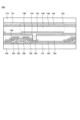
- the radio wave reflecting device 100 has a substrate 102 and an opposing substrate not shown in FIG. 1, and various patterned insulating films, semiconductor films, and conductive films are formed between them. By appropriately stacking these films, a plurality of radio wave reflecting elements 130 arranged in a matrix of m rows and n columns are formed.
- the radio wave reflecting device 100 has a gate line driving circuit 104 and a signal line driving circuit 106 for supplying various signals to the radio wave reflecting element 130.
- the gate line driving circuit 104 and the signal line driving circuit 106 may be formed of an insulating film, a semiconductor film, or a conductive film formed on the substrate 102, or may be formed by mounting an integrated circuit formed on a semiconductor substrate on the substrate 102.
- the gate line driving circuit 104 may be one or more. In the latter case, as shown in FIG. 1, two gate line driving circuits 104 may be arranged on the substrate 102 so as to sandwich the plurality of radio wave reflecting elements 130.
- the signal line driving circuit 106 is disposed on one side of the substrate 102.
- m and n are independently selected from natural numbers equal to or greater than 6, and n is an even number.
- a number of gate lines and a number of signal lines extend from the gate line driving circuit 104 and the signal line driving circuit 106, respectively, and are electrically connected to the radio wave reflecting element 130.
- a number of terminals 108 are further provided on the substrate 102, and various signals for driving the radio wave reflecting element 130 are supplied via the terminals 108 from an external circuit (not shown).
- the gate line driving circuit 104 and the signal line driving circuit 106 generate gate signals and control potentials based on the supplied signals and supply them to the radio wave reflecting element 130.
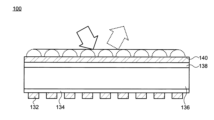
- FIG. 2 shows a schematic diagram of a part of an end surface of the radio wave reflecting device 100.
- Each of the radio wave reflecting elements 130 is connected to an element circuit including at least one transistor.
- Each element circuit may include multiple transistors and one or multiple capacitive elements.
- one transistor 150 and one radio wave reflecting element 130 connected thereto, and a part of an adjacent radio wave reflecting element 130 are shown.
- the element circuit and the radio wave reflecting element 130 are provided on the substrate 102 directly or via an undercoat 112 of any configuration.
- the transistor included in the element circuit is not limited in structure and may be a bottom-gate type transistor or a top-gate type transistor. Alternatively, the transistor may be a transistor having gate electrodes above and below a semiconductor film.
- the transistor illustrated in FIG. 2 is a bottom-gate type transistor, and is composed of a gate electrode 152, a gate insulating film 154 on the gate electrode 152, a semiconductor film 156 on the gate insulating film 154, and a pair of terminals 158, 160 on the semiconductor film 156.
- a planarization film 164 is provided on the transistor 150, and the radio wave reflecting element 130 is formed thereon.
- interlayer insulating films 162, 166 may be provided between the transistor 150 and the planarization film 164 or on the planarization film 164, respectively.
- the radio wave reflecting element 130 includes a first electrode (also called a patch electrode) 132, a first alignment film 134 on the first electrode 132, a liquid crystal layer 136 on the first alignment film 134, a second alignment film 138 on the liquid crystal layer 136, and a second electrode 140 on the second alignment film 138.
- the second electrode 140 is provided on the counter substrate 110 (below the counter substrate 110 in FIG. 2) directly or via an overcoat 114 of any configuration.
- the first electrode 132 is electrically connected to the transistor 150 via an opening provided in the interlayer insulating film 162 or the planarization film 164, etc., so that a control potential is supplied from the signal line driving circuit 106 to the radio wave reflecting element 130.
- the substrate 102 and the counter substrate 110 are provided to provide the radio wave reflecting device 100 with physical strength and to provide a surface for arranging the radio wave reflecting element 130.
- the substrate 102 and/or the counter substrate 110 may be flexible.
- the substrate 102 and the counter substrate 110 may contain inorganic insulators such as glass and quartz, semiconductors such as silicon, polymers such as polyimide, polycarbonate, and polyester, and metals such as aluminum, copper, and stainless steel.
- a film containing an insulator such as silicon oxide or silicon nitride as an undercoat 112 or an overcoat 114 on the surface on which the radio wave reflecting element 130 is provided, that is, the surface of the substrate 102 facing the counter substrate 110 and the surface of the counter substrate 110 facing the substrate 102.
- the substrate 102 and the counter substrate 110 may or may not transmit visible light.
- the gate electrode 152, gate insulating film 154, semiconductor film 156, terminals 158, 160, and interlayer insulating films 162, 166 and planarization film 164 that constitute the transistor 150 can be formed by appropriately applying known methods using known materials, and therefore detailed description will be omitted.
- the gate electrode 152 and terminals 158, 160 are formed by forming a film containing a metal such as tantalum, molybdenum, titanium, or aluminum using a sputtering method or a chemical vapor deposition (CVD) method, and appropriately patterning the film by a photolithography process.
- the semiconductor film 156 is formed as a film containing a group 14 element such as silicon, or a film containing an oxide of a group 13 element such as indium or gallium.
- the semiconductor film 156 may also be formed by applying a sputtering method or a CVD method.
- the gate insulating film 154 and the interlayer insulating films 162 and 166 contain silicon-containing inorganic compounds such as silicon oxide and silicon nitride, and are formed by applying a sputtering method or a CVD method.
- the planarizing film 164 contains polymers such as acrylic resin, epoxy resin, polyimide, polyamide, and silicon resin, and can be formed by appropriately using a wet film forming method such as a spin coat method, an inkjet method, or a printing method. By providing the planarizing film 164, the radio wave reflecting element 130 can be formed on a flat surface.
- the first electrode 132 of the radio wave reflecting element 130 includes, for example, a metal such as copper, aluminum, tungsten, molybdenum, or titanium, or an alloy including at least one of these metals.
- the first electrode 132 may include a conductive oxide having light-transmitting properties, such as indium zinc oxide (IZO) or indium tin oxide (ITO).
- the first electrode 132 may have a single-layer structure, or may have a laminated structure in which layers of different compositions are laminated. For example, a laminated structure of a layer including a conductive oxide and a layer including the above-mentioned metal or alloy may be adopted.
- the first electrode 132 may have a mesh-like shape.
- the first alignment film 134 provided on the multiple first electrodes 132 is provided to control the alignment of the liquid crystal molecules that make up the liquid crystal layer 136 provided thereon.
- the first alignment film 134 can be provided continuously across the multiple radio wave reflecting elements 130. In other words, it can be provided so as to be shared by all of the radio wave reflecting elements 130 without being separated between adjacent radio wave reflecting elements 130.
- the first alignment film 134 contains a polymer such as polyimide or polyester.
- the first alignment film 134 is formed by using a wet film formation method such as an inkjet method, a spin coating method, a printing method, or a dip coating method, and the surface is subjected to a rubbing treatment.
- the first alignment film 134 may be formed by a photoalignment treatment.
- the liquid crystal layer 136 contains liquid crystal molecules.
- the structure of the liquid crystal molecules is not limited. Therefore, the liquid crystal molecules may be nematic liquid crystal, or may be smectic liquid crystal, cholesteric liquid crystal, or chiral smectic liquid crystal.
- the thickness of the liquid crystal layer 136 is, for example, 20 ⁇ m to 50 ⁇ m, or 30 ⁇ m to 50 ⁇ m. Although not shown, spacers may be provided in the liquid crystal layer 136 to maintain this thickness throughout the entire radio wave reflection device 100. If the above-mentioned thickness of the liquid crystal layer 136 is adopted in a liquid crystal display device, the high responsiveness required for displaying moving images cannot be obtained, and it becomes extremely difficult to function as a liquid crystal display device.
- the second orientation film 138 is also provided to control the orientation of the liquid crystal molecules, and has a similar configuration to the first orientation film 134.
- the second orientation film 138 can also be formed so that it is continuous across adjacent radio wave reflecting elements 130 and shared by multiple radio wave reflecting elements 130.
- the first orientation film 134 and the second orientation film 138 are arranged so that the direction in which the first orientation film 134 orients the liquid crystal molecules is parallel to that of the second orientation film 138.
- the first orientation film 134 and the second orientation film 138 orient the liquid crystal molecules in a certain direction.
- the second electrode 140 may also contain a metal such as copper, aluminum, tungsten, molybdenum, or titanium, an alloy containing at least one of these metals, or a conductive oxide such as ITO or IZO.
- the second electrode 140 may also have a single-layer structure, or a laminated structure in which layers of different compositions are laminated.
- the second electrode 140 may also be formed by applying a sputtering method, a CVD method, or the like.
- the second electrode 140 may be provided for each radio wave reflecting element 130, or may be provided as a single electrode integrated across multiple radio wave reflecting elements 130 so as to be shared by multiple radio wave reflecting elements 130.
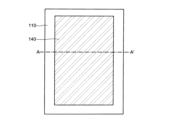
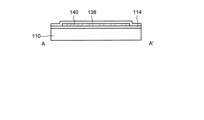
- the second electrode 140 is electrically floating and does not receive a signal or potential from an external circuit. Therefore, as shown in a schematic plan view of the opposing substrate 110 seen from the substrate 102 side (FIG. 3A) and a schematic view of the end surface along the dashed line A-A' (FIG. 3B), the second electrode 140 can be provided so that its entirety is sealed (hermetically sealed) between the opposing substrate 110 and the second alignment film 138. When the overcoat 114 is provided, the second electrode 140 can be provided so that its entirety is sealed (hermetically sealed) between the overcoat 114 and the second alignment film 138.
- FIG. 4 shows a schematic top view showing the arrangement of the radio wave reflecting elements 130 in the radio wave reflecting device 100.
- the multiple radio wave reflecting elements 130 are arranged in a matrix of m rows and n columns.
- Gate lines G1 to Gm extend from the gate line driving circuit 104 for supplying gate signals to the transistors Tr connected to the multiple radio wave reflecting elements 130 arranged in each row.
- source lines S1 to Sn extend from the signal line driving circuit 106 for supplying control potentials to the transistors Tr connected to the multiple radio wave reflecting elements 130 arranged in each column.
- the radio wave reflecting elements 130 located in each row are connected to the same gate line G via an element circuit, and the radio wave reflecting elements 130 located in each column are connected to the same source line S via an element circuit.
- 4 is a switching transistor that controls the on-off of each element circuit, and may be the transistor 150 (see FIG. 2) connected to the radio wave reflecting element 130, or may be a transistor different from the transistor 150. Therefore, the transistor Tr may be directly connected to the radio wave reflecting element 130, or may be connected to the radio wave reflecting element 130 via another transistor or a capacitive element.
- the element circuit is opened by supplying a gate potential to the gate of the transistor Tr via the gate line G, and a control potential is supplied to the first electrode 132 of the radio wave reflecting element 130 via the signal lines S1 to Sn .
- the first to m-th subframe periods SFP1 to SFPm progress in sequence in one frame period FP, and a gate signal is supplied to one gate line G in each subframe period SFP. That is, the potential of the gate line G changes from a potential that turns off the transistor Tr (hereinafter, for convenience, referred to as potential Low) to a voltage that turns on the transistor Tr (hereinafter, for convenience, referred to as potential High).
- the gate signal is supplied in the order of the first gate line G1 to the m-th gate line Gm .
- a control potential is supplied to the element circuit via signal lines S1 to Sn for the first electrodes 132 of the radio wave reflecting elements 130 arranged in that row, and is applied to the first electrodes 132.
- the magnitude of the control potential is determined by the reflection direction of the radio wave incident on the radio wave reflecting device 100, but when the magnitude of the control potential is defined relative to a reference potential of 0V, the radio wave reflecting device 100 is driven so that the sum of the control potentials of the first electrodes 132 to which writing is simultaneously performed in each subframe period SFP becomes 0V (or is substantially 0V, for example, ⁇ 0.1V or less, or ⁇ 0.2V or less. The same applies below).
- the radio wave reflecting device 100 is driven so that the sum of the control potentials supplied to the first electrodes 132 of the radio wave reflecting elements 130 arranged in each row in each frame period FP becomes 0V.
- the reference potential may be, for example, a ground potential or the potential of the second electrode 140.
- the potential of the gate line G 2 becomes High, and the signal line driving circuit 106 supplies the control potentials V(2,1) to V(2,n) via the signal lines S 1 to Sm .
- the sum of the control potentials V(2,1) to V(2,n) is 0V.
- some of the control potentials V (x ,1) to V(x,n) applied to the first electrodes 132 of the radio wave reflecting elements 130 arranged in the xth row in the xth subframe period SFPx are positive with respect to the reference potential, and the other parts are negative with respect to the reference potential, and the sum of these is 0V.
- the number of radio wave reflecting elements 130 with positive control potentials and the number of radio wave reflecting elements 130 with negative control potentials are the same. Therefore, in one frame period FP, the sum of the control potentials V(1,1) to V(m,n) applied to all the first electrodes 132 is also 0V. In addition, in each frame period FP, the sum of the control potentials applied to the first electrodes 132 of the radio wave reflecting elements 130 in each column (i.e., the sum of V(x,1) to V(x,m)) may be 0V or may not be 0V.
- the radio wave reflecting device 100 employs a so-called inversion drive, and if a small amount of ions are contained in the liquid crystal layer 136, the ion charges may accumulate and generate a bias component (DC component).
- DC component bias component
- the radio wave reflecting device 100 is driven so that the sum of the control potentials in each row becomes 0V, and the charges are cancelled in the electrically floating second electrode 140. Therefore, there is no need to supply a signal to the second electrode 140 to adjust its potential and eliminate the DC component. This contributes to simplifying the structure of the radio wave reflecting device 100 and reducing manufacturing costs.
- the burden on the external circuit during driving is reduced, and as a result, power consumption can be reduced.
- the first alignment film 134 and the second alignment film 138 align the liquid crystal molecules in the same direction, so that when no potential difference is applied between the first electrode 132 and the second electrode 140, no vertical electric field is generated in the liquid crystal layer 136, and the liquid crystal molecules are splay-aligned.
- the alignment of the liquid crystal layer 136 is the same between the radio wave reflecting elements 130, and therefore the dielectric constant is also constant in the liquid crystal layer 136. Therefore, as represented by the dotted arc in FIG. 7A, the spread (phase shift) of the reflected wave generated by the reflection of the radio wave (solid white arrow in FIG.
- the liquid crystal molecules rise and bend due to the generated vertical electric field.
- the dielectric constant of the liquid crystal layer 136 changes between the radio wave reflecting elements 130 depending on the strength of the vertical electric field.
- the phase shift of the reflected wave changes, and accordingly, the reflection direction of the incident radio wave (solid white arrow in Figure 7B) can be changed (see dotted white arrow in Figure 7B).
- the reflection direction can be controlled by changing the strength of the vertical electric field formed in the radio wave reflecting element 130.
- the orientation of the liquid crystal molecules contained in the liquid crystal layer 136 is controlled, and the dielectric constant of the liquid crystal layer 136 is periodically changed.
- the orientation of the liquid crystal molecules is determined by the absolute value of the control potential. Therefore, in each frame period FP, the absolute value of the control potential is continuously and periodically increased or decreased in the row direction and/or column direction.
- all of the radio wave reflecting elements 130 arranged in each row are divided into multiple element blocks each including the same number of radio wave reflecting elements 130 arranged consecutively.
- the number of element blocks is an even number.
- all of the radio wave reflecting elements 130 are divided into k element blocks each including j radio wave reflecting elements 130 arranged consecutively. j is a natural number greater than or equal to 1, k is an even natural number greater than or equal to 2, and the product of j and k is n.
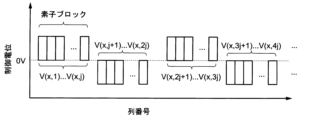
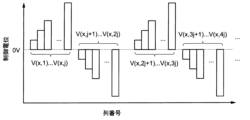
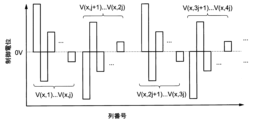
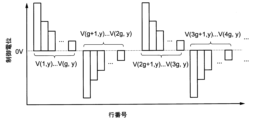
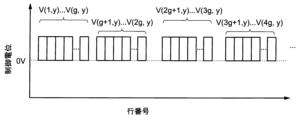
- FIGS. 8A to 11C are schematic diagrams showing the control potential applied to the first electrode 132 of the radio wave reflecting element 130 arranged in one row (xth row) or one column (yth column).
- the absolute value of the control potential is fixed in each element block (FIG. 8A), or the absolute value of the control potential is increased or decreased in sequence according to the order of the columns (FIGS. 8B, 8C).
- the absolute value of the control potential may be 0V, or may be greater or smaller than 0V.
- the positive and negative (polarity) of the control potential can be determined arbitrarily. Therefore, the polarity of the control potential in each element block may be the same as shown in FIGS.
- the radio wave reflecting device 100 is driven so that the sum of the control potentials in each row is 0 V.
- the magnitude and change of the control potential are the same between element blocks.
- the control potentials applied to the first electrodes 132 of the radio wave reflecting elements 130 selected for every jth column in each row have the same absolute value and alternate polarity with respect to the reference voltage.
- control potentials V(x,1), V(x,j+1), V(x,2j+1), and V(x,3j+1) in the 1st, j+1st, 2j+1st, and 3j+1st columns have the same absolute value, but the polarity alternates (i.e., the polarity is inverted in the order of columns).
- the absolute value of the control potential increases continuously, and as the radio wave reflecting elements 130 arranged continuously, for example, radio wave reflecting elements 130 to which control potentials V(x,1) to V(x,j) are applied, or radio wave reflecting elements 130 to which control potentials V(x,j+1) to V(x,2j) are applied can be selected.
- radio wave reflecting device 100 By driving the radio wave reflecting device 100 in this way, radio waves can be reflected in a direction rotated around an axis parallel to the row direction.
- FIG. 8A and FIG. 9A show the case where j is 1.
- the absolute value of the control potential is the same for each row, and the strength of the vertical electric field generated in the liquid crystal layer 136 is also constant, so the radio waves are specularly reflected when viewed from the row direction.
- each column all the radio wave reflecting elements 130 are divided into h element blocks, each having g radio wave reflecting elements 130 arranged in succession.
- g and h are each independently a natural number greater than or equal to 1, and the product of g and h is m.
- the number of element blocks h may be an even number or an odd number, but when the radio wave reflecting device 100 is driven so that the sum of the control potentials applied to the first electrodes 132 of the radio wave reflecting elements 130 arranged in each column in each frame period SF is 0V, the number of element blocks h is an even number.
- the absolute value of the control potential is fixed in each element block (FIG. 10A), or the absolute value of the control potential is increased or decreased in order according to the row order (FIGS. 10B, 10C).
- the polarity of the control potential can be determined arbitrarily in each element block.
- the polarity of the control potential in each element block may be the same as shown in FIGS. 10A to 10C, or the polarity of the control potential may be the same in all element blocks as shown in FIGS. 11A and 11B.
- the polarity of the control potential may be different in each element block as shown in FIG. 11C.
- h is an even number and the polarity of the control potential is inverted between adjacent element blocks (FIGS. 10A to 10C).
- the polarity of the control potential is different in each element block, it is preferable to alternate the polarity of the control potential for each row in each element block (FIG. 11C). This shortens the moving distance of the charge that causes the DC component, and the charge can be canceled more efficiently.
- the radio wave reflecting device 100 in order to make the reflection direction of radio waves uniform within the radio wave reflecting device 100, similar to the control in the row direction, it is preferable to drive the radio wave reflecting device 100 so that the absolute values of the control potentials applied to the first electrodes 132 of the radio wave reflecting elements 130 selected for every g rows in each column in each frame period are the same. In other words, it is preferable to drive the radio wave reflecting device 100 so that the absolute value of the control potential increases or decreases continuously in each column in each frame period FP, and g radio wave reflecting elements 130 arranged in succession can be selected.
- control potentials V(1,y), V(g+1,y), V(2g+1,y), and V(3g+1,y) in the 1st row, g+1st row, 2g+1st row, and 3g+1st row have the same absolute value.
- the polarity of these control potentials may alternate (i.e., the polarity is inverted in the row order) (FIG. 10B) or may be constant (FIG. 11B).
- the absolute value of the control potential increases continuously, and as the radio wave reflecting elements 130 arranged continuously, for example, radio wave reflecting elements 130 to which control potentials V(1,y) to V(g,y) are applied, or radio wave reflecting elements 130 to which control potentials V(g+1,y) to V(2g,y) are applied can be selected.
- radio wave reflecting device 100 By driving the radio wave reflecting device 100 in this way, radio waves can be reflected in a direction rotated around an axis parallel to the column direction.
- FIG. 10A and FIG. 11A show the case where g is 1.
- the control potential is the same for each column, and the strength of the vertical electric field generated in the liquid crystal layer 136 is constant, so the radio waves are specularly reflected when viewed from the row direction.
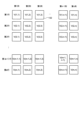
- Inversion driving the radio wave reflecting device 100 in order to prevent a phenomenon called burn-in, in which the orientation of liquid crystal molecules is temporarily fixed due to accumulation of ion components or polarization of liquid crystal molecules, so-called inversion driving is adopted. That is, the radio wave reflecting device 100 is driven so that the direction of the vertical electric field generated in the liquid crystal layer 136 is inverted for each frame period FP. Specifically, as shown in FIG. 5, the control potential given to each first electrode 132 in one frame period (first frame period FP 1 ) is inverted with respect to the reference potential in the following frame period (second frame period FP 2 ).
- the reference potential is 0V
- the potential of the potential V(x, y) given to the first electrode 132 of the radio wave reflecting element 130 in the xth row and yth column in the first frame period FP 1 is inverted in polarity to a potential ⁇ V(x, y) in the second frame period FP 2 .
- the radio wave reflecting device 100 in the multiple radio wave reflecting elements 130 arranged in m rows and n columns, the second electrodes 140 facing the patch electrodes (first electrodes 132) to which a control potential is applied are electrically floating.
- the radio wave reflecting device 100 in each frame period FP, the radio wave reflecting device 100 is driven so that the sum of the control potentials applied to the first electrodes 132 of the radio wave reflecting elements 130 in each row is 0 V. Therefore, the charge that causes the generation of a DC component is canceled in the electrically floating second electrodes 140, and potential adjustment of the second electrodes 140 is not required. Therefore, by applying the embodiment according to the present invention, a radio wave reflecting device having a simplified structure can be provided at low cost. In addition, a radio wave reflecting device that can be driven with low power consumption can be provided.
- radio wave reflecting device 100: radio wave reflecting device, 102: substrate, 104: gate line driving circuit, 106: signal line driving circuit, 108: terminal, 110: opposing substrate, 112: undercoat, 114: overcoat, 130: radio wave reflecting element, 132: first electrode, 134: first alignment film, 136: liquid crystal layer, 138: second alignment film, 140: second electrode, 150: transistor, 152: gate electrode, 154: gate insulating film, 156: semiconductor film, 158: terminal, 160: terminal, 162: interlayer insulating film, 164: planarization film, 166: interlayer insulating film
Landscapes
- Physics & Mathematics (AREA)
- Electromagnetism (AREA)
- Nonlinear Science (AREA)
- Mathematical Physics (AREA)
- Chemical & Material Sciences (AREA)
- Crystallography & Structural Chemistry (AREA)
- General Physics & Mathematics (AREA)
- Optics & Photonics (AREA)
- Aerials With Secondary Devices (AREA)
- Liquid Crystal (AREA)
Priority Applications (3)
| Application Number | Priority Date | Filing Date | Title |
|---|---|---|---|
| CN202480011943.6A CN120677595A (zh) | 2023-03-24 | 2024-02-26 | 电波反射器件及电波反射器件的驱动方法 |
| JP2025509982A JPWO2024202779A1 (https=) | 2023-03-24 | 2024-02-26 | |
| US19/313,923 US20250392053A1 (en) | 2023-03-24 | 2025-08-29 | Intelligent reflecting surface and method for driving the intelligent reflecting surface |
Applications Claiming Priority (2)
| Application Number | Priority Date | Filing Date | Title |
|---|---|---|---|
| JP2023048273 | 2023-03-24 | ||
| JP2023-048273 | 2023-03-24 |
Related Child Applications (1)
| Application Number | Title | Priority Date | Filing Date |
|---|---|---|---|
| US19/313,923 Continuation US20250392053A1 (en) | 2023-03-24 | 2025-08-29 | Intelligent reflecting surface and method for driving the intelligent reflecting surface |
Publications (1)
| Publication Number | Publication Date |
|---|---|
| WO2024202779A1 true WO2024202779A1 (ja) | 2024-10-03 |
Family
ID=92905243
Family Applications (1)
| Application Number | Title | Priority Date | Filing Date |
|---|---|---|---|
| PCT/JP2024/006736 Ceased WO2024202779A1 (ja) | 2023-03-24 | 2024-02-26 | 電波反射装置および電波反射装置の駆動方法 |
Country Status (4)
| Country | Link |
|---|---|
| US (1) | US20250392053A1 (https=) |
| JP (1) | JPWO2024202779A1 (https=) |
| CN (1) | CN120677595A (https=) |
| WO (1) | WO2024202779A1 (https=) |
Citations (2)
| Publication number | Priority date | Publication date | Assignee | Title |
|---|---|---|---|---|
| JPH02157815A (ja) * | 1988-12-12 | 1990-06-18 | Matsushita Electric Ind Co Ltd | 表示装置の駆動方法 |
| WO2022259790A1 (ja) * | 2021-06-09 | 2022-12-15 | 株式会社ジャパンディスプレイ | 電波反射板 |
-
2024
- 2024-02-26 WO PCT/JP2024/006736 patent/WO2024202779A1/ja not_active Ceased
- 2024-02-26 CN CN202480011943.6A patent/CN120677595A/zh active Pending
- 2024-02-26 JP JP2025509982A patent/JPWO2024202779A1/ja active Pending
-
2025
- 2025-08-29 US US19/313,923 patent/US20250392053A1/en active Pending
Patent Citations (2)
| Publication number | Priority date | Publication date | Assignee | Title |
|---|---|---|---|---|
| JPH02157815A (ja) * | 1988-12-12 | 1990-06-18 | Matsushita Electric Ind Co Ltd | 表示装置の駆動方法 |
| WO2022259790A1 (ja) * | 2021-06-09 | 2022-12-15 | 株式会社ジャパンディスプレイ | 電波反射板 |
Also Published As
| Publication number | Publication date |
|---|---|
| CN120677595A (zh) | 2025-09-19 |
| JPWO2024202779A1 (https=) | 2024-10-03 |
| US20250392053A1 (en) | 2025-12-25 |
Similar Documents
| Publication | Publication Date | Title |
|---|---|---|
| US8159429B2 (en) | Liquid crystal display and method thereof | |
| US7773180B2 (en) | Liquid crystal display device and method for fabricating the same | |
| US7760311B2 (en) | Liquid crystal display device and manufacturing method thereof | |
| JP3008928B2 (ja) | 液晶表示装置 | |
| US7920219B2 (en) | Liquid crystal display device and method of manufacturing the same | |
| US8174658B2 (en) | Thin film transistor substrate including a horizontal part passing through a central region between the gate lines and dividing each of the pixel regions into an upper half and a lower half | |
| US8482685B2 (en) | Liquid crystal display panel | |
| US7616283B2 (en) | In-plane switching mode LCD device | |
| US20090015741A1 (en) | Liquid crystal display and method of driving the same | |
| JP5486085B2 (ja) | アクティブマトリクス基板及び液晶表示装置 | |
| US7961265B2 (en) | Array substrate, display panel having the same and method of driving the same | |
| US7599036B2 (en) | In-plane switching active matrix liquid crystal display apparatus | |
| US20070138476A1 (en) | Thin film transistor array substrate and fabricating method thereof | |
| US20070002251A1 (en) | Thin film transistor array panel and method for manufacturing the same | |
| US20070024770A1 (en) | Liquid crystal display device and method of fabricating the same | |
| KR100311531B1 (ko) | 횡전계방식액정표시장치및그제조방법 | |
| US6456352B1 (en) | Liquid crystal display device | |
| WO2024202779A1 (ja) | 電波反射装置および電波反射装置の駆動方法 | |
| CN101201522B (zh) | 液晶显示设备及其制造方法 | |
| WO2024105980A1 (ja) | 電波反射装置の駆動方法 | |
| US20250372872A1 (en) | Intelligent reflecting surface and method for driving the intelligent reflecting surface | |
| KR100268008B1 (ko) | 액정표시 소자 | |
| US20260018800A1 (en) | Intelligent reflecting surface | |
| KR101163396B1 (ko) | 횡전계모드 액정표시소자 및 그 제조방법 | |
| WO2025033055A1 (ja) | 電波反射装置 |
Legal Events
| Date | Code | Title | Description |
|---|---|---|---|
| 121 | Ep: the epo has been informed by wipo that ep was designated in this application |
Ref document number: 24778922 Country of ref document: EP Kind code of ref document: A1 |
|
| ENP | Entry into the national phase |
Ref document number: 2025509982 Country of ref document: JP Kind code of ref document: A |
|
| WWE | Wipo information: entry into national phase |
Ref document number: 2025509982 Country of ref document: JP |
|
| WWE | Wipo information: entry into national phase |
Ref document number: 202480011943.6 Country of ref document: CN |
|
| WWP | Wipo information: published in national office |
Ref document number: 202480011943.6 Country of ref document: CN |
|
| NENP | Non-entry into the national phase |
Ref country code: DE |
|
| 122 | Ep: pct application non-entry in european phase |
Ref document number: 24778922 Country of ref document: EP Kind code of ref document: A1 |