WO2024202580A1 - 電池分析システム、電池分析方法、電池分析プログラムおよび電池分析プログラムが記載された記憶媒体 - Google Patents
電池分析システム、電池分析方法、電池分析プログラムおよび電池分析プログラムが記載された記憶媒体 Download PDFInfo
- Publication number
- WO2024202580A1 WO2024202580A1 PCT/JP2024/004387 JP2024004387W WO2024202580A1 WO 2024202580 A1 WO2024202580 A1 WO 2024202580A1 JP 2024004387 W JP2024004387 W JP 2024004387W WO 2024202580 A1 WO2024202580 A1 WO 2024202580A1
- Authority
- WO
- WIPO (PCT)
- Prior art keywords
- log
- section
- charge
- discharge
- battery
- Prior art date
- Legal status (The legal status is an assumption and is not a legal conclusion. Google has not performed a legal analysis and makes no representation as to the accuracy of the status listed.)
- Ceased
Links
Images


Classifications
-
- H—ELECTRICITY
- H01—ELECTRIC ELEMENTS
- H01M—PROCESSES OR MEANS, e.g. BATTERIES, FOR THE DIRECT CONVERSION OF CHEMICAL ENERGY INTO ELECTRICAL ENERGY
- H01M10/00—Secondary cells; Manufacture thereof
- H01M10/42—Methods or arrangements for servicing or maintenance of secondary cells or secondary half-cells
- H01M10/48—Accumulators combined with arrangements for measuring, testing or indicating the condition of cells, e.g. the level or density of the electrolyte
-
- G—PHYSICS
- G01—MEASURING; TESTING
- G01R—MEASURING ELECTRIC VARIABLES; MEASURING MAGNETIC VARIABLES
- G01R31/00—Arrangements for testing electric properties; Arrangements for locating electric faults; Arrangements for electrical testing characterised by what is being tested not provided for elsewhere
- G01R31/36—Arrangements for testing, measuring or monitoring the electrical condition of accumulators or electric batteries, e.g. capacity or state of charge [SoC]
- G01R31/367—Software therefor, e.g. for battery testing using modelling or look-up tables
-
- G—PHYSICS
- G01—MEASURING; TESTING
- G01R—MEASURING ELECTRIC VARIABLES; MEASURING MAGNETIC VARIABLES
- G01R31/00—Arrangements for testing electric properties; Arrangements for locating electric faults; Arrangements for electrical testing characterised by what is being tested not provided for elsewhere
- G01R31/36—Arrangements for testing, measuring or monitoring the electrical condition of accumulators or electric batteries, e.g. capacity or state of charge [SoC]
- G01R31/382—Arrangements for monitoring battery or accumulator variables, e.g. SoC
- G01R31/3828—Arrangements for monitoring battery or accumulator variables, e.g. SoC using current integration
-
- G—PHYSICS
- G01—MEASURING; TESTING
- G01R—MEASURING ELECTRIC VARIABLES; MEASURING MAGNETIC VARIABLES
- G01R31/00—Arrangements for testing electric properties; Arrangements for locating electric faults; Arrangements for electrical testing characterised by what is being tested not provided for elsewhere
- G01R31/36—Arrangements for testing, measuring or monitoring the electrical condition of accumulators or electric batteries, e.g. capacity or state of charge [SoC]
- G01R31/392—Determining battery ageing or deterioration, e.g. state of health
-
- H—ELECTRICITY
- H01—ELECTRIC ELEMENTS
- H01M—PROCESSES OR MEANS, e.g. BATTERIES, FOR THE DIRECT CONVERSION OF CHEMICAL ENERGY INTO ELECTRICAL ENERGY
- H01M10/00—Secondary cells; Manufacture thereof
- H01M10/42—Methods or arrangements for servicing or maintenance of secondary cells or secondary half-cells
- H01M10/425—Structural combination with electronic components, e.g. electronic circuits integrated to the outside of the casing
-
- H—ELECTRICITY
- H01—ELECTRIC ELEMENTS
- H01M—PROCESSES OR MEANS, e.g. BATTERIES, FOR THE DIRECT CONVERSION OF CHEMICAL ENERGY INTO ELECTRICAL ENERGY
- H01M10/00—Secondary cells; Manufacture thereof
- H01M10/42—Methods or arrangements for servicing or maintenance of secondary cells or secondary half-cells
- H01M10/44—Methods for charging or discharging
-
- H—ELECTRICITY
- H01—ELECTRIC ELEMENTS
- H01M—PROCESSES OR MEANS, e.g. BATTERIES, FOR THE DIRECT CONVERSION OF CHEMICAL ENERGY INTO ELECTRICAL ENERGY
- H01M10/00—Secondary cells; Manufacture thereof
- H01M10/42—Methods or arrangements for servicing or maintenance of secondary cells or secondary half-cells
- H01M10/48—Accumulators combined with arrangements for measuring, testing or indicating the condition of cells, e.g. the level or density of the electrolyte
- H01M10/486—Accumulators combined with arrangements for measuring, testing or indicating the condition of cells, e.g. the level or density of the electrolyte for measuring temperature
-
- H—ELECTRICITY
- H02—GENERATION; CONVERSION OR DISTRIBUTION OF ELECTRIC POWER
- H02J—ELECTRIC POWER NETWORKS; CIRCUIT ARRANGEMENTS OR SYSTEMS FOR SUPPLYING OR DISTRIBUTING ELECTRIC POWER; SYSTEMS FOR STORING ELECTRIC ENERGY
- H02J7/00—Circuit arrangements for charging or discharging batteries or for supplying loads from batteries
-
- H—ELECTRICITY
- H02—GENERATION; CONVERSION OR DISTRIBUTION OF ELECTRIC POWER
- H02J—ELECTRIC POWER NETWORKS; CIRCUIT ARRANGEMENTS OR SYSTEMS FOR SUPPLYING OR DISTRIBUTING ELECTRIC POWER; SYSTEMS FOR STORING ELECTRIC ENERGY
- H02J7/00—Circuit arrangements for charging or discharging batteries or for supplying loads from batteries
- H02J7/80—Circuit arrangements for charging or discharging batteries or for supplying loads from batteries including monitoring or indicating arrangements
-
- H—ELECTRICITY
- H02—GENERATION; CONVERSION OR DISTRIBUTION OF ELECTRIC POWER
- H02J—ELECTRIC POWER NETWORKS; CIRCUIT ARRANGEMENTS OR SYSTEMS FOR SUPPLYING OR DISTRIBUTING ELECTRIC POWER; SYSTEMS FOR STORING ELECTRIC ENERGY
- H02J7/00—Circuit arrangements for charging or discharging batteries or for supplying loads from batteries
- H02J7/80—Circuit arrangements for charging or discharging batteries or for supplying loads from batteries including monitoring or indicating arrangements
- H02J7/82—Control of state of charge [SOC]
-
- H—ELECTRICITY
- H02—GENERATION; CONVERSION OR DISTRIBUTION OF ELECTRIC POWER
- H02J—ELECTRIC POWER NETWORKS; CIRCUIT ARRANGEMENTS OR SYSTEMS FOR SUPPLYING OR DISTRIBUTING ELECTRIC POWER; SYSTEMS FOR STORING ELECTRIC ENERGY
- H02J7/00—Circuit arrangements for charging or discharging batteries or for supplying loads from batteries
- H02J7/80—Circuit arrangements for charging or discharging batteries or for supplying loads from batteries including monitoring or indicating arrangements
- H02J7/84—Control of state of health [SOH]
-
- H—ELECTRICITY
- H01—ELECTRIC ELEMENTS
- H01M—PROCESSES OR MEANS, e.g. BATTERIES, FOR THE DIRECT CONVERSION OF CHEMICAL ENERGY INTO ELECTRICAL ENERGY
- H01M10/00—Secondary cells; Manufacture thereof
- H01M10/42—Methods or arrangements for servicing or maintenance of secondary cells or secondary half-cells
- H01M10/425—Structural combination with electronic components, e.g. electronic circuits integrated to the outside of the casing
- H01M2010/4278—Systems for data transfer from batteries, e.g. transfer of battery parameters to a controller, data transferred between battery controller and main controller
-
- Y—GENERAL TAGGING OF NEW TECHNOLOGICAL DEVELOPMENTS; GENERAL TAGGING OF CROSS-SECTIONAL TECHNOLOGIES SPANNING OVER SEVERAL SECTIONS OF THE IPC; TECHNICAL SUBJECTS COVERED BY FORMER USPC CROSS-REFERENCE ART COLLECTIONS [XRACs] AND DIGESTS
- Y02—TECHNOLOGIES OR APPLICATIONS FOR MITIGATION OR ADAPTATION AGAINST CLIMATE CHANGE
- Y02E—REDUCTION OF GREENHOUSE GAS [GHG] EMISSIONS, RELATED TO ENERGY GENERATION, TRANSMISSION OR DISTRIBUTION
- Y02E60/00—Enabling technologies; Technologies with a potential or indirect contribution to GHG emissions mitigation
- Y02E60/10—Energy storage using batteries
Definitions
- This disclosure relates to a battery analysis system, a battery analysis method, and a battery analysis program that analyze secondary batteries based on battery data that includes missing sections.
- Patent Document 1 discloses a method of calculating cycle degradation and storage degradation values from the battery state based on a charge/discharge history including charge/discharge/rest, and estimating battery degradation based on their integrated values. If the battery state in the log-missing section is unknown, it becomes difficult to distinguish between cycle degradation and storage degradation, or to integrate the cycle degradation value or storage degradation value, making it difficult to estimate battery degradation using this method.
- Patent Document 2 also discloses a method of estimating the State of Charge from the post-charge SOC (State of Charge)-OCV (Open Circuit Voltage) curve after a large amount of charging, from the post-discharge SOC-OCV curve after a large amount of discharging, and from both the post-charge SOC-OCV curve and the post-discharge SOC-OCV curve otherwise. If the charge/discharge history in the log-missing section is unknown, it becomes difficult to determine whether it is after charging or discharging, making it difficult to distinguish between the post-charge SOC-OCV curve and the post-discharge SOC-OCV curve, which reduces the accuracy of the SOC estimation.
- SOC State of Charge
- OCV Open Circuit Voltage
- This disclosure has been made in light of these circumstances, and its purpose is to provide a technology that can estimate battery state with high accuracy from battery data that includes a large number of missing sections.
- a battery analysis system includes a data acquisition unit that acquires battery data of a secondary battery from at least one device via a network, and a log type determination unit that classifies the acquired battery data, including log missing sections, of a specific secondary battery in chronological order into log sections of uniform charging and discharging, log sections of overcharging, and log sections of overdischarging.
- FIG. 1 is a diagram illustrating an example of time-series data of SOC including a large number of log missing sections.
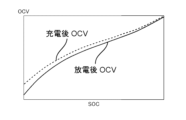
- FIG. 1 is a diagram showing an example of a post-charge SOC-OCV curve obtained by repeatedly charging and pausing a secondary battery after fully discharging it, and a post-discharge SOC-OCV curve obtained by repeatedly discharging and pausing a secondary battery after fully charging it;
- FIG. 1 is a diagram for explaining a battery analysis system according to an embodiment. 4 is a flowchart showing an overall flow of a battery analysis process performed by the battery analysis system according to the embodiment.
- FIG. 1 is a diagram illustrating an example of time-series data of SOC including a large number of log missing sections.
- FIG. 1 is a diagram showing an example of a post-charge SOC-OCV curve obtained by repeatedly charging and pausing a secondary battery after fully discharging it, and a post-discharge SOC-OCV curve obtained by repeatedly discharging and pausing a secondary battery
- FIG. 11 is a diagram showing an example of SOC transition of battery data for one uniform charge/discharge cycle, including definitions of variables.
- FIG. 13 is a diagram showing an example of SOC transition of battery data for one overcharged cycle, including definitions of variables;
- FIG. 13 is a diagram showing an example of SOC transition of battery data for one cycle of overdischarging, including definitions of variables.
- FIG. 13 is a diagram illustrating an example of division of a log section of a total charge amount.
- FIG. 13 is a diagram showing a specific example of ⁇ SOC_d/ ⁇ time_d in battery data of an overcharged battery.
- FIG. 13 is a graph plotting the relationship between ⁇ SOC_d/ ⁇ time_d and the true value of ⁇ resttime_d.
- FIG. 13 is a graph illustrating an example of a regression line with ⁇ SOC_d as an explanatory variable and ⁇ time_d as a response variable.
- FIG. 13 is a graph plotting the relationship between the estimated value of ⁇ resttime_d and the true value of ⁇ resttime_d.
- FIG. 13 is a graph showing an example of a result of complementing a total charge amount in a charge/discharge history.
- FIG. 13 is a graph showing an example of a result of complementing a total discharge amount in a charge/discharge history.
- FIG. 13 is a graph showing an example of the complementation result of the total downtime in the charge/discharge history.
- FIG. 13 is a diagram showing an example of post-discharge OCV determination in overcharged battery data.
- FIG. 13 is a diagram showing an example of post-charge OCV determination in overdischarged battery data.
- FIG. 13 is a diagram showing an example of OCV determination in uniform charge/discharge battery data.
- 11 is a diagram showing a specific example of an analysis result of battery data of a plurality of battery packs of the same model.
- Figure 1 shows an example of SOC time series data that includes a large number of log missing intervals.
- the SO time series data is interrupted multiple times, resulting in multiple log missing intervals.
- the charge/discharge state of each log missing interval is unknown, and the charge/discharge/rest ratio in each log missing interval is unknown. In this case, the estimation accuracy of cycle deterioration and storage deterioration of the secondary battery being analyzed decreases.
- Figure 2 shows an example of a post-charge SOC-OCV curve obtained by repeatedly charging and resting a secondary battery after fully discharging it, and a post-discharge SOC-OCV curve obtained by repeatedly discharging and resting a secondary battery after fully charging it.
- the SOC-OCV curve is the basis for estimating SOC and FCC (Full Charge Capacity). If the accuracy of the SOC-OCV curve is low, the accuracy of the SOC and FCC estimation will also decrease. If you aim to improve the accuracy of SOC and FCC estimation by using the post-charge SOC-OCV curve and the post-discharge SOC-OCV curve appropriately, it is important to generate highly accurate post-charge SOC-OCV curve and post-discharge SOC-OCV curve from the voltage and SOC contained in the battery data of the secondary battery.
- this embodiment focuses on the regularity of log deficiencies and presents a method for generating both a post-charge SOC-OCV curve and a post-discharge SOC-OCV curve with high accuracy, even in applications where only a charging log or a discharging log can be acquired.
- FIG. 3 is a diagram for explaining a battery analysis system 10 according to an embodiment.
- the battery analysis system 10 may be constructed, for example, on an in-house server installed in the in-house facility or data center of a business providing an analysis service for battery packs mounted on electric vehicles 20.
- the battery analysis system 10 may also be constructed on a cloud server used based on a cloud service.
- the battery analysis system 10 may also be constructed on multiple servers distributed and installed at multiple bases (data centers, in-house facilities).
- the multiple servers may be a combination of multiple in-house servers, a combination of multiple cloud servers, or a combination of an in-house server and a cloud server.
- the battery pack system 21 included in the battery pack mounted on the electric vehicle 20 supplies power to the drive motor (not shown).
- the battery pack system 21 includes multiple unit cells or multiple cell blocks connected in series.
- a cell block is composed of multiple unit cells connected in parallel.
- the cells can be lithium-ion battery cells, nickel-metal hydride battery cells, lead battery cells, etc. In the following description, an example using lithium-ion battery cells (nominal voltage: 3.6-3.7V) is assumed.
- the number of unit cells or cell blocks connected in series is determined according to the voltage of the drive motor.
- the voltage sensor 22 detects the voltage across each of the series-connected single cells or cell blocks.
- a shunt resistor is connected in series with the series-connected single cells or cell blocks.
- the current sensor 23 detects the current flowing through the series-connected single cells or cell blocks based on the voltage across the shunt resistor. Note that a Hall element may be used instead of the shunt resistor.
- Multiple temperature sensors 24 are installed in the battery pack including the assembled battery system 21. For example, a thermistor may be used as the temperature sensor 24. For example, one temperature sensor 24 may be installed for every 6 to 8 single cells or cell blocks.
- the control unit 25 is composed of a BMU (Battery Management Unit) and an ECU (Electronic Control Unit) working together.
- the BMU estimates the SOC by combining the OCV method and the current integration method.
- the OCV method is a method of estimating the SOC based on the measured cell OCV and the cell's SOC-OCV curve.
- the cell's SOC-OCV curve is created in advance by the battery manufacturer based on characteristic tests and is registered in the BMU at the time of shipment.
- the BMU estimates the SOC based on the OCV measured during a rest period during charging and the post-charge SOC-OCV curve.
- the BMU also estimates the SOC based on the OCV measured during a rest period during discharging and the post-discharge SOC-OCV curve. This makes it possible to improve the accuracy of estimating the SOC of cells with large hysteresis.
- the current integration method is a method of estimating the SOC based on the OCV at the start of charging/discharging the cell and the integrated value of the measured current.
- the current integration method With the current integration method, current measurement errors accumulate as the charging/discharging time becomes longer. Therefore, it is preferable to use a weighted average of the SOC estimated by the current integration method and the SOC estimated by the OCV method.
- the BMU periodically (e.g., every 10 seconds) transmits battery data including the voltage, current, temperature, and SOC of multiple single cells or cell blocks to the ECU via the in-vehicle network, and the ECU samples the battery data in chronological order.
- a CAN Controller Area Network
- LIN Local Interconnect Network
- the communication unit 26 has a function of performing communication signal processing with the communication unit 33 of the charging stand 30, and a function of performing wireless signal processing for connecting to the network 5.
- the communication unit 26 can access the network 5 using, for example, a mobile phone network (cellular network), a wireless LAN, V2I (Vehicle to Infrastructure), V2V (Vehicle to Vehicle), an ETC system (Electronic Toll Collection System), and DSRC (Dedicated Short Range Communications).
- a mobile phone network cellular network
- V2I Vehicle to Infrastructure
- V2V Vehicle to Vehicle
- ETC system Electronic Toll Collection System
- DSRC Dedicated Short Range Communications
- Network 5 is a general term for communication paths such as the Internet, dedicated lines, and VPNs (Virtual Private Networks), and the communication medium and protocol can be any.
- mobile phone networks, wireless LANs, wired LANs, optical fiber networks, ADSL networks, CATV networks, etc. can be used as communication media.
- TCP Transmission Control Protocol
- IP Internet Protocol
- UDP User Datagram Protocol
- Ethernet registered trademark
- the ECU may transmit the sampled battery data to the battery analysis system 10 each time, or may store the data in an internal memory and transmit the battery data stored in the memory to the battery analysis system 10 at a predetermined timing.
- the ECU may transmit the battery data stored in the memory to the battery analysis system 10 via the charging stand 30.
- the battery pack system 21 in the electric vehicle 20 can be charged externally by connecting the electric vehicle 20 to the charging stand 30 with a charging cable.
- the charging stand 30 is connected to the commercial power system 2 and charges the battery pack system 21.
- charging is performed with AC for normal charging and with DC for rapid charging.
- AC e.g., single-phase 100/200V
- the charging voltage or charging current is controlled by a charger (not shown) in the electric vehicle 20.
- DC the charging voltage or charging current is controlled by the power supply unit 31 of the charging stand 30.
- the power supply unit 31 includes a rectifier circuit, a filter, and a DC/DC converter, and generates DC power by full-wave rectifying the AC power supplied from the commercial power system 2 with the rectifier circuit and smoothing it with a filter.
- the DC/DC converter controls the voltage or current of the generated DC power.
- CHAdeMO registered trademark
- ChaoJi GB/T
- Combo Combined Charging System
- CHAdeMO, ChaoJi, and GB/T use CAN as the communication method.
- Combo uses PLC (Power Line Communication) as the communication method.
- a charging cable that uses the CAN method includes a communication line in addition to a power line.
- the control unit 25 of the electric vehicle 20 establishes a communication channel with the control unit 32 of the charging stand 30. Note that in a charging cable that uses the PLC method, communication signals are transmitted superimposed on the power line.
- the communication unit 33 of the charging stand 30 has a function of performing communication signal processing with the communication unit 26 of the electric vehicle 20, and a function of performing signal processing for connecting to the network 5.
- the communication unit 33 can access the network 5 using, for example, a wired LAN, a wireless LAN, or a mobile phone network.
- the control unit 32 of the charging station 30 may acquire battery data from the control unit 25 of the electric vehicle 20 via the charging cable while the battery pack system 21 is being charged, and transmit the acquired battery data in real time to the battery analysis system 10 via the network 5.
- the battery analysis system 10 includes a control unit 11, a memory unit 12, and a communication unit 13.
- the communication unit 13 is a communication interface (e.g., a NIC: Network Interface Card) for connecting to the network 5 via a wired or wireless connection.
- a communication interface e.g., a NIC: Network Interface Card
- the control unit 11 includes a data acquisition unit 111, a log type determination unit 112, a log division unit 113, a downtime estimation unit 114, a data complementation unit 115, and an OCV determination unit 116.
- the functions of the control unit 11 can be realized by a combination of hardware resources and software resources, or by hardware resources alone.
- hardware resources a CPU, ROM, RAM, GPU (Graphics Processing Unit), ASIC (Application Specific Integrated Circuit), FPGA (Field Programmable Gate Array), and other LSIs can be used.
- software resources programs such as an operating system and applications can be used.
- the storage unit 12 includes a non-volatile recording medium such as an HDD or SSD, and stores various data.
- the storage unit 12 includes a battery data holding unit 121.
- the data acquisition unit 111 acquires battery data of the battery pack including the battery assembly system 21 from at least one device via the network 5, and stores the acquired battery data in the battery data holding unit 121.
- the above program may also be recorded on a recording medium. By using this recording medium, the above program can be installed in, for example, the computer.
- the recording medium on which the above program is recorded may be a non-transient recording medium.
- the non-transient recording medium is not particularly limited, and may be, for example, a recording medium such as a CD-ROM.
- the data acquisition unit 111 may acquire battery data from both the electric vehicle 20 and the charging stand 30, or may acquire battery data from only one of them. If the electric vehicle 20 does not have a wireless communication function to connect to the network 5, the data acquisition unit 111 cannot acquire battery data from the electric vehicle 20. If the charging stand 30 does not have a communication function to connect to the network 5, the data acquisition unit 111 cannot acquire battery data from the charging stand 30.
- FIG. 4 is a flowchart showing the overall flow of the battery analysis process by the battery analysis system 10 according to the embodiment.
- the log type determination unit 112 classifies the battery data of the battery pack to be analyzed in chronological order into log sections of uniform charging and discharging, log sections of overcharging, and log sections of overdischarging (step S1). In this embodiment, it is assumed that the battery data includes log missing sections.
- Figure 5 shows an example of the transitions in the SOC and current integrated value of battery data with uniform charging and discharging.
- Figure 6 shows an example of the transitions in the SOC and current integrated value of battery data with overcharging.
- Figure 7 shows an example of the transitions in the SOC and current integrated value of battery data with overdischarging.
- Overcharged battery data occurs, for example, when the electric vehicle 20 is not equipped with a function for transmitting battery data to the battery analysis system 10 (hereinafter referred to as the battery data transmission function), but the charger for the electric vehicle 20 installed at a business office or at home is equipped with a battery data transmission function.
- the charger for the electric vehicle 20 may be, for example, a charging pole equipped with an AC 200V charging outlet. In this case, only the log of battery data during charging is periodically acquired.
- the overcharged battery data acquired from the charger does not generally include the discharge current.
- Over-discharged battery data occurs, for example, when the electric vehicle 20 is an electrically assisted bicycle or electric motorcycle, has a removable battery pack, and the battery pack and charger are not equipped with a battery data transmission function, but the vehicle itself is equipped with a battery data transmission function.
- Over-discharged battery data includes a small amount of charging current due to regenerative braking.
- the log type determination unit 112 calculates the accumulated charge current value and the accumulated discharge current value based on the battery data of the battery pack being analyzed.
- the initial values of the accumulated charge current value and the accumulated discharge current value are 0.
- the log type determination unit 112 determines that the log section from the initial position where the current accumulation started to the position that satisfies the condition is a log section of uniform charging and discharging.
- the log type determination unit 112 determines that the log section from the initial position where the current integration started to the position where the condition is satisfied is an overcharged log section.
- the log type determination unit 112 determines that the log section from the initial position where the current integration started to the position where the condition is satisfied is an excessive discharge log section.
- the log type determination unit 112 determines the log section, and when it has confirmed the log type for that log section, it resets the charge current integrated value and the discharge current integrated value to 0. This makes it possible to respond to changes in the log type.
- the heavy charge threshold and the light charge threshold, and the heavy discharge threshold and the light discharge threshold may be at least one charge/discharge cycle of the battery pack being analyzed.
- the heavy charge threshold and the heavy discharge threshold may be set as absolute values to a value of 2 times the rated capacity (Ah) of the battery pack being analyzed
- the light charge threshold and the light discharge threshold may be set as absolute values to a value of 0.5 times the rated capacity (Ah) of the battery pack.
- the current integrated value is one example of a parameter that indicates the amount of charge or discharge, and other parameters such as the power integrated value may also be used.
- the log type determination unit 112 may classify the battery data into either uniform charging/discharging, overcharging, or overdischarging, depending on the device that sent the data and is identified from the identification information.
- the log type determination unit 112 may classify the battery data into either uniform charging/discharging, overcharging, or overdischarging, depending on the content of the notification.
- FIG. 8 is a diagram showing an example of the transition of the SOC and current integrated value of battery data containing a mixture of multiple log types.
- the log type determination unit 112 determines the range in which the same log type continues until a different log type is determined as the section of the same log type, thereby making it possible to identify sections of the same log type even when multiple log types are mixed.
- the log type determination unit 112 may also group the battery data of the battery pack being analyzed into log sections of uniform charging and discharging, log sections of overcharging, and log sections of overdischarging.
- the log section (1) of overcharging is mixed with the log section (2) of uniform charging and discharging. If a log section (3) of overcharging occurs after that, the log section (1) of overcharging and the log section (3) of overcharging may be treated as a single log section of overcharging.
- An example of a log type mix-up would be when a state where overcharging battery data is acquired from the charging pole only for the charging period is switched to a state where uniform charging and discharging battery data is acquired from the electric vehicle 20 for the entire charging and discharging period is switched to.
- step S1a estimation process of the usage method of the battery pack (step S2-1), charge/discharge history estimation process (step S2-2), charge/discharge history complementation process (step S2-3), and post-charge OCV/post-discharge OCV estimation process (step S3). Note that for the log type of uniform charge/discharge, the charge/discharge history estimation process (step S2-2) is not executed.
- the long-term balance between the total charge amount and the total discharge amount of the battery pack being analyzed is nearly equal.
- the charge/discharge efficiency of a cell is nearly 100%, so the charge amount when the battery pack is charged from fully discharged to fully charged is nearly equal to the discharge amount when it is discharged from fully charged to fully discharged.
- any abnormality occurs, such as a side reaction such as the formation of a solid electrolyte interphase (SEI) film during the first charge, or micro-discharge inside the cell due to a micro-short circuit, the balance between the charge amount and the discharge amount will be disrupted.
- SEI solid electrolyte interphase
- the total charge amount, total discharge amount, and total downtime of the battery pack change linearly with the elapsed time. This is because it is assumed that the way in which the device in which the battery pack is installed is used (frequency of use, duration of use per session, power used per session, etc.) is roughly constant in the short term. The slope of the total charge amount, total discharge amount, and total downtime of the battery pack may change. This is because the way in which the device in which the battery pack is installed is sometimes changed.
- FIG. 9 shows an example of the trends in the total charge amount, total discharge amount, and total downtime of a battery pack.
- the total charge amount is calculated from the absolute value of the integrated charge current.
- the total discharge amount is calculated from the absolute value of the integrated discharge current.
- the total downtime is calculated from the integrated value of ⁇ downtime.
- the trends in the total charge amount, total discharge amount, and total downtime shown in FIG. 9 are based on battery data actually acquired from electric vehicles 20. Similar trends were observed in the battery data acquired from electric vehicles 20 of multiple vehicle types.
- step S2-1 the property that ⁇ SOC/ ⁇ time and ⁇ downtime/ ⁇ time are almost constant is utilized to execute a process of estimating the usage method of the battery pack (step S2-1), a process of estimating the charge/discharge history (step S2-2), and a process of complementing the charge/discharge history (step S2-3).
- FIG. 10 is a diagram showing an example of the SOC transition of one cycle of battery data with uniform charging and discharging, including the definition of variables.
- FIG. 11 is a diagram showing an example of the SOC transition of one cycle of battery data with overcharging, including the definition of variables.
- FIG. 12 is a diagram showing an example of the SOC transition of one cycle of battery data with overdischarging, including the definition of variables.
- the overcharging battery data shown in FIG. 11 the breakdown of the discharge log missing section is unknown, and in the overdischarging battery data shown in FIG. 12, the breakdown of the charge log missing section is unknown.
- the log missing section included in the overcharging log section is estimated to be the overdischarging log section.
- the log missing section included in the overdischarging log section is estimated to be the overcharging log section.
- c indicates the section from the start of charging to just before the start of discharging in the log section of uniform charging and discharging, indicates a non-log deficiency section in the log section of overcharging, and indicates a log deficiency section in the log section of overdischarging.
- d discharge indicates the section from the start of discharging to just before the start of charging in the log section of uniform charging and discharging, indicates a log deficiency section in the log section of overcharging, and indicates a non-log deficiency section in the log section of overdischarging.
- seq indicates one cycle of c (charge) ⁇ d (discharge).
- ⁇ SOC indicates the change in SOC
- ⁇ time indicates the change in time
- ⁇ chgtime indicates the change in charging time
- ⁇ dchgtime indicates the change in discharging time
- ⁇ resttime indicates the change in rest time.
- Each time change is defined as the sum of multiple intervals.
- j and i are natural numbers.
- the maximum value of j is the number of intervals that make up interval i.
- the log division unit 113 estimates the change in the slope of the total charge amount, the total discharge amount, and the total downtime of the battery pack, and determines whether the slope is Divide the battery data log into sections that are similar to each other. In the case of overcharging, divide the log section into sections based on the total charge amount only, and in the case of overdischarging, divide the log section into sections based on the total discharge amount only. In sections with missing logs, divide the log section into sections based on charge/discharge/rest. Since the log interval cannot be divided appropriately,
- the log division unit 113 calculates straight lines passing through the start and end points of the total charge amount, total discharge amount, and total downtime. At each point in time, the log division unit 113 calculates the difference (absolute value) between the trends in the total charge amount, total discharge amount, and total downtime and the straight lines passing through the start and end points. The log division unit 113 estimates the point in time at which the difference (absolute value) is maximum as the point of change in the usage method of the device in which the battery pack is installed, and divides the log section at that point of change.
- FIG. 13 is a diagram showing an example of dividing a log section of the total charge amount.
- the log section is divided into log section (1) and log section (2) at the point where the absolute value of the difference (a-b) obtained by subtracting the trend of the total charge amount b from the straight line a connecting the start point and end point of the total charge amount peaks.
- the point of change in the usage method of the device equipped with the battery pack may be estimated based on the derivative value of the total charge amount.
- the log division unit 113 When discharging occurs in the charging log section, the log division unit 113 corrects ⁇ SOC_c so that it is the correct charge amount for each sequence. Similarly, when charging occurs in the discharging log section, the log division unit 113 corrects ⁇ SOC_d so that it is the correct discharge amount for each sequence. For example, when regenerative charging occurs in the discharging log section in the battery data of the electric vehicle 20, the correction is made as follows.
- the downtime estimation unit 114 estimates, for each divided log section, the downtime of the discharge log missing section included in the overcharge log section in the battery data of the battery pack being analyzed, and the downtime of the charge log missing section included in the overdischarge log section in the battery data.
- the downtime can be estimated from the regularity of the log missing as follows:
- ⁇ SOC_c represents the charge amount, and represents the charge history in the section where the discharge log is missing.
- the charge amount may be represented by another parameter, such as the integrated charge current value.
- ⁇ SOC_d represents the discharge amount, and represents the discharge history in the section where the charge log is missing.
- the discharge amount may be represented by another parameter, such as the integrated discharge current value or the accumulated mileage of the electric vehicle 20.
- Figure 14 shows a specific example of ⁇ SOC_d/ ⁇ time_d in overcharged battery data.
- ⁇ resttime_d is unknown in the log missing section.
- the rest time estimation unit 114 calculates ⁇ SOC_d/ ⁇ time_d in each discharge log missing section included in the overcharged log section.
- is large, and the second
- suggests that ⁇ resttime_d is short, and a small
- the downtime estimation unit 114 extracts a predetermined number of discharge log missing sections that are the top of
- Figure 15 is a graph plotting the relationship between ⁇ SOC_d/ ⁇ time_d and the true value of ⁇ resttime_d. Discharge log missing sections where
- the downtime estimation unit 114 estimates the discharge rate based on the top predetermined number of extracted
- . Specifically, the downtime estimation unit 114 performs linear regression with ⁇ SOC_d as the explanatory variable and ⁇ time_d as the objective variable, and calculates the slope of the regression line (intercept 0).
- Figure 16 is a graph showing an example of a regression line with ⁇ SOC_d as the explanatory variable and ⁇ time_d as the objective variable. In the discharge log missing section where the discharge time is dominant, ⁇ SOC_d and ⁇ time_d are roughly proportional.
- the downtime estimation unit 114 estimates ⁇ dchgtime for each discharge log missing section by multiplying the slope of the regression line corresponding to the estimated discharge rate by ⁇ SOC_d for each discharge log missing section.
- the downtime estimation unit 114 estimates ⁇ resttime_d for each discharge log missing section by subtracting ⁇ dchgtime for each discharge log missing section from ⁇ time_d for each discharge log missing section.
- FIG. 17 is a graph plotting the relationship between the estimated value of ⁇ resttime_d and the true value of ⁇ resttime_d.
- the true value of ⁇ resttime_d shown in FIG. 17 was created from uniformly charged and discharged battery data actually acquired from the electric vehicle 20.
- the estimated value of ⁇ resttime_d was estimated from overcharged battery data obtained by deleting the discharge log section from the uniformly charged and discharged battery data.
- FIG. 17 shows that there is a high degree of agreement between the estimated value of ⁇ resttime_d obtained by this method and the true value.
- the downtime estimation unit 114 calculates ⁇ SOC_c/ ⁇ time_c for each charging log missing section included in the overdischarged log section.
- the downtime estimation unit 114 extracts a predetermined number of charging log missing sections with the highest
- the rest time estimation unit 114 estimates the charging speed based on the top predetermined number of extracted
- the rest time estimation unit 114 estimates ⁇ chgtime of each charging log missing section by multiplying the slope of a regression line with ⁇ SOC_c as the explanatory variable and ⁇ time_c as the objective variable, which corresponds to the estimated charging speed, by ⁇ SOC_c of each charging log missing section.
- the rest time estimation unit 114 estimates ⁇ resttime_c of each charging log missing section by subtracting ⁇ chgtime of each charging log missing section from ⁇ time_c of each charging log missing section.
- ⁇ resttime_d for each discharge log missing section and ⁇ resttime_c for each charge log missing section can be estimated, the accuracy of estimating storage deterioration of the battery pack will improve. Note that although the cycle deterioration of the battery pack depends on the integrated value of ⁇ SOC_d for each discharge log missing section and the integrated value of ⁇ SOC_c for each charge log missing section, it does not depend on ⁇ resttime_d and ⁇ resttime_c, so the estimation process of ⁇ resttime_d and ⁇ resttime_c does not affect the accuracy of estimating cycle deterioration.
- the data complementation unit 115 complements the discharge amount, charge amount, and downtime of the log missing section.
- the data complementation unit 115 calculates ⁇ SOC_c/ ⁇ time_seq and ( ⁇ resttime_c+ ⁇ resttime_d)/ ⁇ time_seq for each sequence (one charge/discharge cycle) in which ⁇ time_d included in the overcharged log section is less than a predetermined value (e.g., 100 hours).
- the data complement unit 115 calculates the median ⁇ _c of the multiple calculated ⁇ SOC_c/ ⁇ time_seq.
- the data complement unit 115 calculates the median ⁇ _re of the multiple calculated ( ⁇ resttime_c+ ⁇ resttime_d)/ ⁇ time_seq.
- the medians ⁇ _c and ⁇ _re are examples of statistical representative values, and instead of the median, the average value, the most frequent value, etc. may be used.
- ⁇ resttime_d a value estimated by the downtime estimation unit 114 is used.
- the data complement unit 115 replaces ⁇ SOC_c in that sequence with a value obtained by multiplying ⁇ time_seq by ⁇ _c.
- the data complement unit 115 estimates ⁇ SOC_d in that sequence by multiplying ⁇ time_seq by - ⁇ _c.
- the charge amount and discharge amount of the battery pack are the same value, so ⁇ SOC_d is estimated by multiplying by - ⁇ _c with the positive and negative reversed.
- the data complement unit 115 estimates ⁇ resttime_seq in that sequence by multiplying ⁇ time_seq by ⁇ _re.
- the data complementation unit 115 calculates ⁇ SOC_d/ ⁇ time_seq and ( ⁇ resttime_c+ ⁇ resttime_d)/ ⁇ time_seq for each sequence in which ⁇ time_c included in the log section of excessive discharge is less than a predetermined value (e.g., 100 hours).
- the data complement unit 115 calculates the median ⁇ _d of the multiple calculated ⁇ SOC_d/ ⁇ time_seq.
- the data complement unit 115 calculates the median ⁇ _re of the multiple calculated ( ⁇ resttime_c+ ⁇ resttime_d)/ ⁇ time_seq.
- the medians ⁇ _d and ⁇ _re are examples of statistical representative values, and instead of the median, the average value, the most frequent value, etc. may be used.
- ⁇ resttime_c a value estimated by the downtime estimation unit 114 is used.
- the data complement unit 115 replaces ⁇ SOC_d in that sequence with a value obtained by multiplying ⁇ time_seq by ⁇ _d.
- the data complement unit 115 estimates ⁇ SOC_c in that sequence by multiplying ⁇ time_seq by - ⁇ _d.
- the charge amount and discharge amount of the battery pack are the same value, so ⁇ SOC_c is estimated by multiplying by - ⁇ _d with the positive and negative reversed.
- the data complement unit 115 estimates ⁇ resttime_seq in that sequence by multiplying ⁇ time_seq by ⁇ _re.
- the data complementation unit 115 calculates ⁇ SOC_c/ ⁇ time_seq, ⁇ SOC_d/ ⁇ time_seq, and ⁇ resttime_seq/ ⁇ time_seq for each sequence in which ⁇ time_seq is less than a predetermined value (e.g., 100 hours) included in the uniform charge/discharge log section.
- a predetermined value e.g. 100 hours
- the data complement unit 115 calculates the median ⁇ _c of the multiple calculated ⁇ SOC_c/ ⁇ time_seq.
- the data complement unit 115 calculates the median ⁇ _d of the multiple calculated ⁇ SOC_d/ ⁇ time_seq.
- the data complement unit 115 calculates the median ⁇ _re of the multiple calculated ⁇ resttime_seq/ ⁇ time_seq. Note that the medians ⁇ _c, ⁇ _d, and ⁇ _re are examples of statistical representative values, and instead of the median, the average value, the mode, etc. may be used.
- the data complement unit 115 replaces ⁇ SOC_c in the sequence with the value obtained by multiplying ⁇ time_seq by ⁇ _c.
- the data complement unit 115 replaces ⁇ SOC_d in the sequence with the value obtained by multiplying ⁇ time_seq by ⁇ _d.
- the data complement unit 115 replaces ⁇ resttime_seq in the sequence with the value obtained by multiplying ⁇ time_seq by ⁇ _re.
- FIG. 18 is a graph showing an example of the result of complementing the total charge amount in the charge/discharge history.
- FIG. 19 is a graph showing an example of the result of complementing the total discharge amount in the charge/discharge history.
- FIG. 20 is a graph showing an example of the result of complementing the total downtime in the charge/discharge history.
- the total charge amount is calculated from the absolute value of the integrated value of SOC_c during charging.
- the total discharge amount is calculated from the absolute value of the integrated value of SOC_d during discharging.
- the total downtime is calculated from the integrated value of ⁇ downtime.
- the true values of the total charge amount, total discharge amount, and total downtime are values calculated from battery data with few gaps and uniform charging and discharging actually obtained from the electric vehicle 20.
- the estimated values of the total charge amount, total discharge amount, and total downtime (before interpolation) are values calculated from battery data with half of the data missing, created based on the battery data by deleting the last 5 sequences out of every 10 sequences. Therefore, the estimated values of the total charge amount, total discharge amount, and total downtime (before interpolation) are about half the true values of the total charge amount, total discharge amount, and total downtime.
- Figures 18 to 20 show that the estimated values of the total charge amount, total discharge amount, and total downtime obtained by this method (after interpolation) are highly consistent with the true values of the total charge amount, total discharge amount, and total downtime.
- the OCV determination unit 116 determines that the OCV is the post-discharge OCV.
- a long log deficit section in an overcharge log section is estimated to be an overdischarge log section. It is expected that the system will be suspended from before the end of the log deficit section estimated to be overdischarge before the start of charging, and the suspension period after the end of the log deficit section (a certain period during which the OCV at the end of the log deficit section continues) may be allowed to be short.
- the suspension period after the end of the log missing section can be set to be short.
- the OCV determination unit 116 determines that the OCV is the post-charge OCV.
- a long log deficit section in an over-discharging log section is estimated to be an over-charging log section.
- the suspension period after the end of the log missing section can be set to be short.
- a usage method in which the electric vehicle 20 is likely to start traveling immediately after charging is completed for example, a usage method in which charging is performed using a quick charger
- the OCV determination unit 116 determines the OCV immediately before charging/discharging or immediately before a long log missing section after a pause of a predetermined time (e.g., 30 minutes) or more in the log section of overcharging or overdischarging as the other OCV.
- the OCV determination unit 116 determines whether the other OCV is the post-charge OCV or the post-discharge OCV using an existing method that uses the charge/discharge history, etc.
- the OCV determination unit 116 does not perform OCV determination in log sections with uniform charging and discharging because it is not possible to estimate the charging and discharging history of long-term log missing sections with high accuracy.
- FIG. 21 is a diagram showing an example of post-discharge OCV determination in overcharged battery data.
- FIG. 22 is a diagram showing an example of post-discharge OCV determination in overdischarged battery data.
- FIG. 23 is a diagram showing an example of OCV determination in uniformly charged and discharged battery data. It is possible to more accurately estimate the charge and discharge history of log-missing sections for each log type.
- FCC is calculated based on the difference ( ⁇ SOC) between the SOC corresponding to the OCV at the start of charging and the SOC corresponding to the OCV at the end of charging, and the integrated current value ⁇ I during the charging period.
- SOH is defined as the ratio of the current FCC to the initial FCC, and the lower the value (closer to 0%), the more deterioration has progressed.
- Figure 24 shows a specific example of the results of analyzing battery data for multiple battery packs of the same model.
- the total charge amount is a factor in cycle deterioration, and the total downtime is a factor in storage deterioration.
- Cycle degradation is degradation that progresses as the number of charge/discharge cycles increases. It mainly occurs due to cracking or peeling caused by the expansion or contraction of the active material. Cycle degradation depends on the SOC range, temperature, and current rate used. In general, the wider the SOC range used, the higher the temperature, and the higher the current rate, the faster the cycle degradation rate.
- Storage deterioration progresses over time depending on the temperature of the battery pack at each point in time and the SOC at each point in time. It progresses over time regardless of whether charging or discharging is in progress. Storage deterioration occurs mainly due to the formation of a coating (SEI film) on the negative electrode. Storage deterioration depends on the SOC and temperature at each point in time. In general, the higher the SOC at each point in time and the higher the temperature at each point in time, the faster the storage deterioration rate.
- SEI film coating
- the charge and discharge history of the battery pack shown in the graph on the right of Figure 24 is similar to the charge and discharge history of the battery pack shown in the graph in the upper left, so it is predicted to follow a SOH trend similar to the SOH trend of the battery pack shown in the graph in the upper left. Note that if the temperature, current rate, and SOC are entered, the SOH trend can be predicted with even greater accuracy.
- the estimated battery state, FCC, and SOH may be transmitted to a display terminal (not shown) of the battery analysis system 10 to display a highly accurate FCC and SOH, or the estimated battery state, FCC, and SOH may be transmitted to another system (not shown) or device connected to the network 5.
- a four-wheeled electric vehicle is assumed as the electric vehicle 20.
- it may be an electric motorcycle (electric scooter), an electric bicycle, or an electric kick scooter.
- electric vehicles include not only full-standard electric vehicles, but also low-speed electric vehicles such as golf carts and land cars.
- the device in which the assembled battery system 21 is mounted is not limited to the electric vehicle 20. Devices in which the assembled battery system 21 is mounted also include electric vehicles such as electric ships, railway vehicles, and multicopters (drones), stationary power storage systems, and consumer electronic devices (smartphones, notebook PCs, etc.).
- a battery analysis system (10) comprising:
- the battery state of the secondary battery (21) can be estimated with high accuracy from battery data that includes a large number of missing sections.
- the log type determination unit (112) Calculating an integrated charging current value and an integrated discharging current value based on battery data of the secondary battery (21); When the absolute value of the charge current integrated value is equal to or greater than a low-volume charge threshold and the absolute value of the discharge current integrated value is equal to or greater than a low-volume discharge threshold, a log section from an initial position of the current integration start to a position where the conditions are satisfied is determined to be the log section of uniform charge and discharge; When the absolute value of the charge current integrated value is equal to or greater than the large charge threshold value and the absolute value of the discharge current integrated value is less than the small discharge threshold value, the log section from the initial position of the current integration start to the position where the condition is satisfied is determined to be the overcharged log section, When the absolute value of the charge current integrated value is less than a low-charge threshold and the absolute value of the discharge current integrated value is equal to or greater than a high-discharge threshold, a log section from an initial position of the current integration start to a position where
- the battery analysis system (10) according to any one of items 1 to 3, further comprising a log division unit (113) that identifies trends in a total charge amount, a total discharge amount, and a total downtime of the secondary battery (21) based on battery data of the secondary battery (21), estimates changes in slopes of the total charge amount, the total discharge amount, and the total downtime of the secondary battery (21), and divides a log of the battery data for each section in which the slopes are similar.
- a log division unit (113) that identifies trends in a total charge amount, a total discharge amount, and a total downtime of the secondary battery (21) based on battery data of the secondary battery (21), estimates changes in slopes of the total charge amount, the total discharge amount, and the total downtime of the secondary battery (21), and divides a log of the battery data for each section in which the slopes are similar.
- a pause time estimation unit (114) for estimating a pause time of a discharge log missing section included in the log section of the overcharge of the battery data and a pause time of a charge log missing section included in the log section of the overdischarge of the battery data for each divided log section,
- the downtime estimation unit (114) Calculating a ratio of a discharge amount to a time in each discharge log missing section included in the overcharge log section, and estimating a discharge rate based on a top predetermined number of absolute values of the ratio of the discharge amount to the time; Multiplying the discharge rate by the discharge amount of each discharge log missing section to estimate the discharge time of each discharge log missing section;
- the discharge time of each discharge log missing section is subtracted from the time of each discharge log missing section to estimate the downtime of each discharge log missing section; Calculating a ratio of a charging amount to a time in each of the charging log missing sections included in the excessive discharge log section, and estimating a charging speed based on a top predetermined number of absolute values
- the device further includes a data complementation unit (115) that complements the discharge amount, charge amount, and downtime of a log-missing section,
- the data complementation unit (115) Calculating a ratio of a charge amount to a total time in each charge/discharge cycle section included in the log section of the overcharging, and statistically calculating a representative value of the ratio of the charge amount to the total time as a first representative value; Calculate a ratio of the total time to the rest time of the charging section and the rest time of the estimated discharge log missing section in each charge/discharge cycle section included in the overcharge log section, and statistically calculate a representative value of the ratio of the total time to the rest time as a second representative value; In a charge/discharge cycle section in which the time of the discharge log missing section is equal to or longer than a predetermined value, The charge amount in the charge/discharge cycle section is replaced with a value obtained by multiplying the entire time of the charge/discharge cycle section by the first representative value; Estimating
- the data complementation unit (115) Calculating a ratio of a charge amount to a total time in each charge/discharge cycle section included in the uniform charge/discharge log section, and statistically calculating a representative value of the ratio of the charge amount to the total time as a fifth representative value; Calculating a ratio of a discharge amount to a total time in each charge/discharge cycle section included in the uniform charge/discharge log section, and statistically calculating a representative value of the ratio of the discharge amount to the total time as a sixth representative value; Calculating a ratio of a pause time to a total time in each charge/discharge cycle section included in the uniform charge/discharge log section, and statistically calculating a representative value of the ratio of the pause time to the total time as a seventh representative value; In a charge/discharge cycle section in which the time of the log loss section is equal to or longer than a predetermined value, The charge amount in the charge/discharge cycle section is replaced with a value obtained by
- the battery analysis system (10) according to any one of claims 1 to 3, further comprising an OCV determination unit (116) that determines an OCV (Open Circuit Voltage) at an end of a log deficit section in which an SOC has decreased for a predetermined time or more in the overcharged log section as a post-discharge OCV if the OCV continues for a certain period of time, and determines an OCV at an end of a log deficit section in which an SOC has increased for a predetermined time or more in the overdischarged log section as a post-charge OCV if the OCV continues for a certain period of time.
- OCV Open Circuit Voltage
- a battery analysis method comprising the steps of:
- the battery state of the secondary battery (21) can be estimated with high accuracy from battery data that includes a large number of missing sections.
- the battery state of the secondary battery (21) can be estimated with high accuracy from battery data that includes a large number of missing sections.
Landscapes
- Engineering & Computer Science (AREA)
- General Chemical & Material Sciences (AREA)
- Manufacturing & Machinery (AREA)
- Chemical & Material Sciences (AREA)
- Chemical Kinetics & Catalysis (AREA)
- Electrochemistry (AREA)
- Power Engineering (AREA)
- Physics & Mathematics (AREA)
- General Physics & Mathematics (AREA)
- Microelectronics & Electronic Packaging (AREA)
- Charge And Discharge Circuits For Batteries Or The Like (AREA)
- Secondary Cells (AREA)
- Tests Of Electric Status Of Batteries (AREA)
Priority Applications (3)
| Application Number | Priority Date | Filing Date | Title |
|---|---|---|---|
| CN202480023523.XA CN120981726A (zh) | 2023-03-29 | 2024-02-08 | 电池分析系统、电池分析方法、电池分析程序以及记载有电池分析程序的存储介质 |
| JP2025509853A JPWO2024202580A1 (https=) | 2023-03-29 | 2024-02-08 | |
| EP24778725.2A EP4692813A1 (en) | 2023-03-29 | 2024-02-08 | Battery analysis system, battery analysis method, battery analysis program, and storage medium in which battery analysis program is stored |
Applications Claiming Priority (2)
| Application Number | Priority Date | Filing Date | Title |
|---|---|---|---|
| JP2023-053410 | 2023-03-29 | ||
| JP2023053410 | 2023-03-29 |
Publications (1)
| Publication Number | Publication Date |
|---|---|
| WO2024202580A1 true WO2024202580A1 (ja) | 2024-10-03 |
Family
ID=92904144
Family Applications (1)
| Application Number | Title | Priority Date | Filing Date |
|---|---|---|---|
| PCT/JP2024/004387 Ceased WO2024202580A1 (ja) | 2023-03-29 | 2024-02-08 | 電池分析システム、電池分析方法、電池分析プログラムおよび電池分析プログラムが記載された記憶媒体 |
Country Status (4)
| Country | Link |
|---|---|
| EP (1) | EP4692813A1 (https=) |
| JP (1) | JPWO2024202580A1 (https=) |
| CN (1) | CN120981726A (https=) |
| WO (1) | WO2024202580A1 (https=) |
Cited By (1)
| Publication number | Priority date | Publication date | Assignee | Title |
|---|---|---|---|---|
| CN120999159A (zh) * | 2025-07-28 | 2025-11-21 | 黄山学院 | 一种用于锂电池的动态充电方法、装置及存储介质 |
Citations (7)
| Publication number | Priority date | Publication date | Assignee | Title |
|---|---|---|---|---|
| JP2013501326A (ja) * | 2009-08-04 | 2013-01-10 | リ−テック・バッテリー・ゲーエムベーハー | バッテリを制御する方法、及び本方法を実施するための装置 |
| JP2016085166A (ja) * | 2014-10-28 | 2016-05-19 | 株式会社東芝 | 蓄電池評価装置及び方法 |
| WO2016092811A1 (ja) * | 2014-12-10 | 2016-06-16 | 株式会社Gsユアサ | 蓄電素子状態推定装置及び蓄電素子状態推定方法 |
| JP2019105521A (ja) | 2017-12-12 | 2019-06-27 | トヨタ自動車株式会社 | 二次電池システムおよび二次電池のsoc推定方法 |
| JP2019105520A (ja) * | 2017-12-12 | 2019-06-27 | トヨタ自動車株式会社 | 二次電池システムおよび二次電池のsoc推定方法 |
| KR102079875B1 (ko) * | 2018-10-10 | 2020-02-19 | 한국전력공사 | 배터리의 열화 모듈 또는 열화 셀 검출장치 및 방법 |
| JP2022131396A (ja) * | 2021-02-26 | 2022-09-07 | 東京瓦斯株式会社 | 充電時間管理システム、およびプログラム |
-
2024
- 2024-02-08 JP JP2025509853A patent/JPWO2024202580A1/ja active Pending
- 2024-02-08 EP EP24778725.2A patent/EP4692813A1/en active Pending
- 2024-02-08 CN CN202480023523.XA patent/CN120981726A/zh active Pending
- 2024-02-08 WO PCT/JP2024/004387 patent/WO2024202580A1/ja not_active Ceased
Patent Citations (8)
| Publication number | Priority date | Publication date | Assignee | Title |
|---|---|---|---|---|
| JP2013501326A (ja) * | 2009-08-04 | 2013-01-10 | リ−テック・バッテリー・ゲーエムベーハー | バッテリを制御する方法、及び本方法を実施するための装置 |
| JP2016085166A (ja) * | 2014-10-28 | 2016-05-19 | 株式会社東芝 | 蓄電池評価装置及び方法 |
| WO2016092811A1 (ja) * | 2014-12-10 | 2016-06-16 | 株式会社Gsユアサ | 蓄電素子状態推定装置及び蓄電素子状態推定方法 |
| JP2020042036A (ja) | 2014-12-10 | 2020-03-19 | 株式会社Gsユアサ | 蓄電素子状態推定装置及び蓄電素子状態推定方法 |
| JP2019105521A (ja) | 2017-12-12 | 2019-06-27 | トヨタ自動車株式会社 | 二次電池システムおよび二次電池のsoc推定方法 |
| JP2019105520A (ja) * | 2017-12-12 | 2019-06-27 | トヨタ自動車株式会社 | 二次電池システムおよび二次電池のsoc推定方法 |
| KR102079875B1 (ko) * | 2018-10-10 | 2020-02-19 | 한국전력공사 | 배터리의 열화 모듈 또는 열화 셀 검출장치 및 방법 |
| JP2022131396A (ja) * | 2021-02-26 | 2022-09-07 | 東京瓦斯株式会社 | 充電時間管理システム、およびプログラム |
Non-Patent Citations (1)
| Title |
|---|
| See also references of EP4692813A1 |
Cited By (1)
| Publication number | Priority date | Publication date | Assignee | Title |
|---|---|---|---|---|
| CN120999159A (zh) * | 2025-07-28 | 2025-11-21 | 黄山学院 | 一种用于锂电池的动态充电方法、装置及存储介质 |
Also Published As
| Publication number | Publication date |
|---|---|
| JPWO2024202580A1 (https=) | 2024-10-03 |
| CN120981726A (zh) | 2025-11-18 |
| EP4692813A1 (en) | 2026-02-11 |
Similar Documents
| Publication | Publication Date | Title |
|---|---|---|
| US11124072B2 (en) | Battery control device and electric motor vehicle system | |
| CN113396503B (zh) | 电池控制装置 | |
| JP7839970B2 (ja) | 劣化判定システム、劣化判定方法、および劣化判定プログラム | |
| CN106662620A (zh) | 电池状态探测装置、二次电池系统、程序产品、电池状态探测方法 | |
| EP4350941A1 (en) | Battery abnormality prediction system, battery abnormality prediction method, and battery abnormality prediction program | |
| US20250076403A1 (en) | Battery abnormality detection system, battery abnormality detection method, and battery abnormality detection program | |
| EP4675888A1 (en) | Battery analysis system, battery analysis method, battery analysis program, and storage medium with battery analysis program recorded therein | |
| EP4586447A1 (en) | Deterioration inhibition control system, deterioration inhibition control method and deterioration inhibition control program, and recording medium having deterioration inhibition control program described thereon | |
| WO2024202580A1 (ja) | 電池分析システム、電池分析方法、電池分析プログラムおよび電池分析プログラムが記載された記憶媒体 | |
| CN120051697A (zh) | 数据插补系统、数据插补方法、以及数据插补程序产品 | |
| US20250199076A1 (en) | Battery state analysis system, battery state analysis method, and non-transitory computer-readable recording medium | |
| EP4693593A1 (en) | Battery analysis system, battery analysis method, battery analysis program, and storage medium having battery analysis program recorded thereon | |
| US20250216470A1 (en) | Battery analysis system, battery analysis method, and non-transitory computer-readable recording medium | |
| WO2023095674A1 (ja) | 電池異常検知システム、電池異常検知方法、および電池異常検知プログラム | |
| EP4653899A1 (en) | Battery abnormality detection system, battery abnormality detection method, battery abnormality detection program, and recording medium having battery abnormality detection program recorded thereon | |
| EP4632409A1 (en) | Battery analysis system, battery analysis method, battery analysis program, and storage medium containing battery analysis program | |
| EP4660647A1 (en) | Battery analysis system, battery analysis method, battery analysis program, and recording medium containing battery analysis program | |
| CN120051698A (zh) | 数据插补系统、数据插补方法、以及数据插补程序产品 | |
| WO2026048524A1 (ja) | 電池分析システム、電池分析方法および電池分析プログラム | |
| WO2023145407A1 (ja) | 電池異常検出システム、電池異常検出方法、及び電池異常検出プログラム | |
| WO2025150422A1 (ja) | 電池分析システム、電池分析方法および電池分析プログラム | |
| WO2026048525A1 (ja) | 電池分析システム、電池分析方法および電池分析プログラム | |
| CN118068215A (zh) | 电池包的性能评价方法、装置和车辆 |
Legal Events
| Date | Code | Title | Description |
|---|---|---|---|
| 121 | Ep: the epo has been informed by wipo that ep was designated in this application |
Ref document number: 24778725 Country of ref document: EP Kind code of ref document: A1 |
|
| WWE | Wipo information: entry into national phase |
Ref document number: 2025509853 Country of ref document: JP |
|
| WWE | Wipo information: entry into national phase |
Ref document number: 2024778725 Country of ref document: EP |
|
| NENP | Non-entry into the national phase |
Ref country code: DE |
|
| ENP | Entry into the national phase |
Ref document number: 2024778725 Country of ref document: EP Effective date: 20251029 |
|
| ENP | Entry into the national phase |
Ref document number: 2024778725 Country of ref document: EP Effective date: 20251029 |
|
| ENP | Entry into the national phase |
Ref document number: 2024778725 Country of ref document: EP Effective date: 20251029 |
|
| ENP | Entry into the national phase |
Ref document number: 2024778725 Country of ref document: EP Effective date: 20251029 |
|
| ENP | Entry into the national phase |
Ref document number: 2024778725 Country of ref document: EP Effective date: 20251029 |
|
| ENP | Entry into the national phase |
Ref document number: 2024778725 Country of ref document: EP Effective date: 20251029 |
|
| ENP | Entry into the national phase |
Ref document number: 2024778725 Country of ref document: EP Effective date: 20251029 |
|
| ENP | Entry into the national phase |
Ref document number: 2024778725 Country of ref document: EP Effective date: 20251029 |
|
| WWP | Wipo information: published in national office |
Ref document number: 2024778725 Country of ref document: EP |