WO2024202258A1 - マイクロニードルデバイス、及び、薬剤投与・反応物吸引方法 - Google Patents
マイクロニードルデバイス、及び、薬剤投与・反応物吸引方法 Download PDFInfo
- Publication number
- WO2024202258A1 WO2024202258A1 PCT/JP2023/043642 JP2023043642W WO2024202258A1 WO 2024202258 A1 WO2024202258 A1 WO 2024202258A1 JP 2023043642 W JP2023043642 W JP 2023043642W WO 2024202258 A1 WO2024202258 A1 WO 2024202258A1
- Authority
- WO
- WIPO (PCT)
- Prior art keywords
- microneedle
- drug
- reactant
- attachment surface
- substrate
- Prior art date
- Legal status (The legal status is an assumption and is not a legal conclusion. Google has not performed a legal analysis and makes no representation as to the accuracy of the status listed.)
- Ceased
Links
Images



Classifications
-
- A—HUMAN NECESSITIES
- A61—MEDICAL OR VETERINARY SCIENCE; HYGIENE
- A61M—DEVICES FOR INTRODUCING MEDIA INTO, OR ONTO, THE BODY; DEVICES FOR TRANSDUCING BODY MEDIA OR FOR TAKING MEDIA FROM THE BODY; DEVICES FOR PRODUCING OR ENDING SLEEP OR STUPOR
- A61M37/00—Other apparatus for introducing media into the body; Percutany, i.e. introducing medicines into the body by diffusion through the skin
- A61M37/0015—Other apparatus for introducing media into the body; Percutany, i.e. introducing medicines into the body by diffusion through the skin by using microneedles
-
- A—HUMAN NECESSITIES
- A61—MEDICAL OR VETERINARY SCIENCE; HYGIENE
- A61M—DEVICES FOR INTRODUCING MEDIA INTO, OR ONTO, THE BODY; DEVICES FOR TRANSDUCING BODY MEDIA OR FOR TAKING MEDIA FROM THE BODY; DEVICES FOR PRODUCING OR ENDING SLEEP OR STUPOR
- A61M37/00—Other apparatus for introducing media into the body; Percutany, i.e. introducing medicines into the body by diffusion through the skin
-
- A—HUMAN NECESSITIES
- A61—MEDICAL OR VETERINARY SCIENCE; HYGIENE
- A61M—DEVICES FOR INTRODUCING MEDIA INTO, OR ONTO, THE BODY; DEVICES FOR TRANSDUCING BODY MEDIA OR FOR TAKING MEDIA FROM THE BODY; DEVICES FOR PRODUCING OR ENDING SLEEP OR STUPOR
- A61M37/00—Other apparatus for introducing media into the body; Percutany, i.e. introducing medicines into the body by diffusion through the skin
- A61M37/0015—Other apparatus for introducing media into the body; Percutany, i.e. introducing medicines into the body by diffusion through the skin by using microneedles
- A61M2037/0023—Drug applicators using microneedles
-
- A—HUMAN NECESSITIES
- A61—MEDICAL OR VETERINARY SCIENCE; HYGIENE
- A61M—DEVICES FOR INTRODUCING MEDIA INTO, OR ONTO, THE BODY; DEVICES FOR TRANSDUCING BODY MEDIA OR FOR TAKING MEDIA FROM THE BODY; DEVICES FOR PRODUCING OR ENDING SLEEP OR STUPOR
- A61M37/00—Other apparatus for introducing media into the body; Percutany, i.e. introducing medicines into the body by diffusion through the skin
- A61M37/0015—Other apparatus for introducing media into the body; Percutany, i.e. introducing medicines into the body by diffusion through the skin by using microneedles
- A61M2037/003—Other apparatus for introducing media into the body; Percutany, i.e. introducing medicines into the body by diffusion through the skin by using microneedles having a lumen
-
- A—HUMAN NECESSITIES
- A61—MEDICAL OR VETERINARY SCIENCE; HYGIENE
- A61M—DEVICES FOR INTRODUCING MEDIA INTO, OR ONTO, THE BODY; DEVICES FOR TRANSDUCING BODY MEDIA OR FOR TAKING MEDIA FROM THE BODY; DEVICES FOR PRODUCING OR ENDING SLEEP OR STUPOR
- A61M37/00—Other apparatus for introducing media into the body; Percutany, i.e. introducing medicines into the body by diffusion through the skin
- A61M37/0015—Other apparatus for introducing media into the body; Percutany, i.e. introducing medicines into the body by diffusion through the skin by using microneedles
- A61M2037/0046—Solid microneedles
-
- A—HUMAN NECESSITIES
- A61—MEDICAL OR VETERINARY SCIENCE; HYGIENE
- A61M—DEVICES FOR INTRODUCING MEDIA INTO, OR ONTO, THE BODY; DEVICES FOR TRANSDUCING BODY MEDIA OR FOR TAKING MEDIA FROM THE BODY; DEVICES FOR PRODUCING OR ENDING SLEEP OR STUPOR
- A61M37/00—Other apparatus for introducing media into the body; Percutany, i.e. introducing medicines into the body by diffusion through the skin
- A61M37/0015—Other apparatus for introducing media into the body; Percutany, i.e. introducing medicines into the body by diffusion through the skin by using microneedles
- A61M2037/0053—Methods for producing microneedles
-
- A—HUMAN NECESSITIES
- A61—MEDICAL OR VETERINARY SCIENCE; HYGIENE
- A61M—DEVICES FOR INTRODUCING MEDIA INTO, OR ONTO, THE BODY; DEVICES FOR TRANSDUCING BODY MEDIA OR FOR TAKING MEDIA FROM THE BODY; DEVICES FOR PRODUCING OR ENDING SLEEP OR STUPOR
- A61M37/00—Other apparatus for introducing media into the body; Percutany, i.e. introducing medicines into the body by diffusion through the skin
- A61M37/0015—Other apparatus for introducing media into the body; Percutany, i.e. introducing medicines into the body by diffusion through the skin by using microneedles
- A61M2037/0061—Methods for using microneedles
Definitions
- the device used in Patent Document 1 is equipped with a dissolving liquid reservoir that contains a dissolving liquid for dissolving drugs, and the reservoir is opened by pressing the reservoir to supply the dissolving liquid, which dissolves the dried drug placed in the microneedle or the like.
- the microneedle is then used to perforate the skin while supplying the dissolving liquid, and the drug dissolved in the dissolving liquid is administered transdermally via the microneedle.
- Patent Document 1 focuses on "administration" of a drug by transdermal administration via a microneedle, but does not consider the function of sucking up substances present in the body.
- the inventors considered developing a device that uses microneedles to administer a drug subcutaneously and aspirates the reaction products that result from the drug's reaction inside the body.
- the reaction products that result from the administration of the drug are to be aspirated, it is necessary to administer the drug first, and then aspirate the reaction products.
- the functions required are different from those of a device that is premised on administering a drug and aspirating substances present in the body at the same time.
- the present invention was made in consideration of the above-mentioned current situation, and aims to provide a device that can administer a drug subcutaneously and aspirate the reaction product that is generated when the drug reacts with the body, with a time lag.
- the microneedle device of the present invention comprises a substrate and microneedles provided on an attachment surface on the surface of the substrate, and administers a drug subcutaneously by attaching the attachment surface including the microneedles to a living body, and aspirates a reaction product produced by administering the drug subcutaneously.
- the drug administration/reactant suction method of the present invention involves preparing a microneedle device comprising a substrate and microneedles provided on an attachment surface on the surface of the substrate, administering a drug subcutaneously by attaching the attachment surface comprising the microneedles to a living body, and aspirating reactants produced by the subcutaneous administration of the drug.
- the present invention provides a device that can administer a drug subcutaneously and aspirate the reaction product that is generated when the drug reacts with the body, with a time lag.
- FIG. 7 is a cross-sectional view that illustrates an example of a procedure for administering a drug and suctioning a reactant in the fourth embodiment of the microneedle device.
- FIG. 8 is a cross-sectional view that illustrates an example of a procedure for administering a drug and aspirating a reactant in the fourth embodiment of the microneedle device.
- FIG. 9 is a cross-sectional view that illustrates an example of a procedure for administering a drug and suctioning a reactant in the fourth embodiment of the microneedle device.
- FIG. 10 is a perspective view that illustrates an example of a procedure for administering a drug and suctioning a reactant in the fifth embodiment of the microneedle device.
- FIG. 11 is a perspective view that illustrates an example of a procedure for administering a drug and aspirating a reactant in the fifth embodiment of the microneedle device.
- FIG. 12 is a perspective view that illustrates an example of a procedure for administering a drug and aspirating a reactant in the fifth embodiment of the microneedle device.
- FIG. 13 is a cross-sectional view illustrating an example of an embodiment of a microneedle device.
- FIG. 14 is a cross-sectional view illustrating an example of an embodiment of a microneedle device.
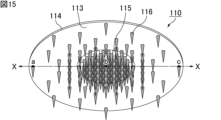
- FIG. 15 is a perspective view illustrating an example of an embodiment of a microneedle device.
- FIG. 16 is a graph showing a schematic distribution of reactant concentration along the axis indicated by line XX in FIG.
- microneedle device and the drug administration/reactant suction method of the present invention will be described below.
- the present invention is not limited to the following configurations, and can be appropriately modified and applied within the scope of the present invention.
- the present invention also includes a combination of two or more of the individual preferred configurations of the present invention described below.
- FIG. 1 is a diagram showing an example of the microneedle device of the present invention when in use.
- the microneedle device 1 includes microneedles 5 provided on an attachment surface 3 on the surface of a substrate 4. When a user presses the microneedles 5 against the user's skin, the microneedles 5 penetrate the skin.
- a reactant-using section 2 which is a device that operates using the aspirated reactant, is provided on the surface of the microneedle device 1 opposite to the microneedle 5.
- An example of the device of the reactant-using section 2 is a battery section.
- a lipolysis device in which a lipolysis enzyme is administered subcutaneously as a drug, fat is broken down by the lipolysis enzyme, and the glycerol produced is aspirated as a reactant, and the aspirated glycerol is used to generate electricity.
- FIG. 2 is a schematic cross-sectional view of the lipolysis device and skin tissue during use of the lipolysis device.
- the microneedle device 1 which is a lipolysis device, includes a substrate 4 and a microneedle 5 provided on an attachment surface 3 of the substrate 4.
- an anode (glycerol oxidation section) 6 is disposed so as to contact the substrate 4, a separator 8 and a cathode 7 are laminated thereon in this order, and the anode 6 and the cathode 7 are connected by an external circuit 9.
- the microneedle 5 is inserted into the skin, and lipolysis enzyme 10 diffuses from the microneedle 5 into the skin tissue 14.
- the lipolysis enzyme 10 reaches the fat cells 15 by diffusion and decomposes fat.
- glycerol 13 generated by the decomposition of fat reaches the anode 6 through the microneedle 5, it is oxidized by the glycerol oxidase 11 possessed by the anode 6. This produces electrons and protons, which move to the cathode 7 via the external circuit 9 and the separator 8, respectively.
- oxygen is reduced by the oxygen reductase 12, generating electrical energy, and the device functions as a battery.
- the microneedle device of the present invention like the lipolysis device of the above example, subcutaneously administers a drug (lipolysis enzyme) and aspirates a reactant (glycerol) produced by the drug reacting in the body.
- the drug is administered subcutaneously first, and the reactant is aspirated later.
- the microneedle device of the present invention is a device that administers a drug subcutaneously and aspirates a reactant with a time lag.
- microneedle device of the present invention The general configuration of the microneedle device of the present invention will be described below. Unless otherwise specified in the description of each embodiment of the microneedle device of the present invention, the general configurations of the drug, reactant, microneedle and substrate described below can be commonly applied.
- composition of reagents and reactants examples include lipolytic enzymes, activators of lipolytic enzymes, and substances that indirectly promote lipolysis.
- Reactants include glycerol, fatty acids, and the like.
- the agent is a lipolytic enzyme or a peptide compound having an equivalent activity, and the reactant is glycerol.
- the lipolytic enzyme or a peptide compound having an activity equivalent thereto is not particularly limited as long as it can decompose fat into glycerol and fatty acids.
- Specific examples of lipolytic enzymes include lipase and its analogs.
- the peptide compound preferably has an enzymatic activity of 50 or more and 120 or less, relative to the enzymatic activity of lipase, which is 100.
- the lipolytic enzyme is preferably lipase or a lipase analog.
- analogues of lipolytic enzymes there are no particular limitations on the analogues of lipolytic enzymes as long as they are capable of decomposing fats into glycerol and fatty acids, and examples of such analogues include chemically modified lipases.
- examples of chemically modified lipases include lipases to which cell membrane-permeable peptides or the like are bound.
- the lipolytic enzyme etc. preferably has an average molecular weight of 2000 or more and 100,000 or less. This improves the permeability of the lipolytic enzyme etc. to fat cells.
- the average molecular weight is preferably 5000 or more and 80,000 or less, and more preferably 10,000 or more and 70,000 or less.
- the average molecular weight of the lipolytic enzyme or the like can be measured by ultracentrifugal analysis.
- An example of an activator of a lipolytic enzyme is a factor that activates lipase.
- Substances that indirectly promote fat breakdown include adrenaline and noradrenaline.
- the microneedle is preferably a porous body and/or a hollow body. More preferably, it is a porous body.
- the reactant can be absorbed by the capillary force of the porous body in addition to diffusion based on the concentration gradient of the reactant in the body fluid, so that the introduction efficiency of the reactant is improved.
- the adsorption of the drug to the microneedle is also improved by the microneedle being a porous body.
- the microneedle preferably has a hydrophilic surface.
- the affinity with a highly hydrophilic reactant such as glycerol is increased, and the efficiency of suction of the hydrophilic reactant is improved.
- the microneedle is porous and has a highly hydrophilic surface, in addition to diffusion based on the concentration gradient of the reactants in the body fluid, the capillary force of the porous body can selectively attract highly hydrophilic reactants such as glycerol over hydrophobic reactants such as fatty acids, thereby further improving the suction efficiency of hydrophilic reactants.
- An example of a method for hydrophilizing the surface of the microneedle is a method for imparting hydroxyl groups to the surface of the microneedle using plasma or the like.
- the shape of the microneedle is not particularly limited as long as it can be inserted into the skin, but it is preferable that the shape is conical or pyramidal. More preferably, it is conical.
- the length of the microneedle is not particularly limited as long as it can be inserted into the skin, but it is preferably 100 ⁇ m or more and 3000 ⁇ m or less. This allows the drug to be diffused more thoroughly to the subcutaneous tissue with less invasiveness.
- the length of the microneedle is more preferably 150 ⁇ m or more and 1500 ⁇ m or less, even more preferably 150 ⁇ m or more and 1000 ⁇ m or less, and particularly preferably 200 ⁇ m or more and 800 ⁇ m or less.
- the diameter of the base of the microneedle (maximum diameter of the microneedle) is preferably 50 ⁇ m or more and 1000 ⁇ m or less. This allows the skin to be pierced with less invasiveness.
- the diameter of the base of the microneedle is more preferably 100 ⁇ m or more and 800 ⁇ m or less.
- the number of microneedles provided in a microneedle device is not particularly limited, but is preferably 25 or more and 250,000 or less. More preferably, it is 2,500 or more and 50,000 or less.
- the density of the microneedles is not particularly limited, but is preferably 1 needle/cm2 or more and 10,000 needles/cm2 or less , and more preferably 100 needles/ cm2 or more and 2,000 needles/cm2 or less.
- the method for producing the microneedles is not particularly limited, but examples include a method in which the material forming the microneedles is injection molded.
- microneedle device of the present invention subcutaneous administration of a drug and suction of a reactant may be performed using the same microneedle, or the microneedle for subcutaneous administration of a drug and the microneedle for suction of a reactant may be different. That is, the type of microneedle may be one type, or two or more types.
- each embodiment of the microneedle device of the present invention will be described below.
- the configuration of the reactant-using portion is not particularly limited, and therefore illustration and description of the configuration of the reactant-using portion are omitted in the drawings and descriptions of each embodiment.
- the microneedle comprises a needle base material which is a porous material, and a drug layer containing the drug provided on the surface of the needle base material, and the drug contained in the drug layer is administered subcutaneously and the reactant is aspirated from the needle base material.
- FIG. 3 is a cross-sectional view illustrating an example of an embodiment of a microneedle device.
- microneedles 25 are provided on an attachment surface 23 of a substrate 24 .
- the microneedle 25 includes a needle base material 26 made of a porous material, and a drug layer 27 provided on the surface of the needle base material 26.
- the needle base material is made of a porous material, the reactant can be sucked from the surface of the needle base material.
- the drug layer 27 contains a drug to be administered subcutaneously.
- the drug layer may contain components other than the drug, such as sugars (lactose, raffinose, trehalose, sucrose, etc.), human albumin, polyglutamic acid, polyaspartic acid, polyhistidine, pentacid, polylactic acid, hyaluronic acid, collagen, polyamino acid, hydroxypropyl methylcellulose, hydroxypropyl cellulose, dextran, polyvinyl alcohol, polyvinylpyrrolidone, polyethylene oxide, and chondroitin. It is preferable that the entire drug layer is made of a highly biodegradable material.
- the drug layer preferably has a thickness of 1 ⁇ m or more and 100 ⁇ m or less.
- the microneedle device of this embodiment functions as a device that administers a drug subcutaneously and aspirates a reactant with a time lag.
- the surface of the needle substrate is coated with a hydrophilic material layer
- the drug layer is provided on the hydrophilic material layer
- the drug is preferably a hydrophobic material
- FIG. 4 is a cross-sectional view that illustrates an example of an embodiment of a microneedle device.
- the microneedle device 21 shown in Figure 4 has a configuration similar to that of the microneedle device 20 shown in Figure 3, but the surface of the needle substrate 26 is covered with a hydrophilic material layer 28, and a drug layer 27 is provided on the hydrophilic material layer 28.
- the surface of the hydrophilic material layer 28 is exposed.
- the affinity with the hydrophilic reactant is improved, and the hydrophilic reactant is easily attracted.
- glycerol which is the reactant to be sucked, is a hydrophilic substance, so that the attraction of the reactant glycerol can be improved by providing a hydrophilic material layer. That is, when the reactant to be sucked is a hydrophilic substance, the ability to suck the reactant can be increased by providing a hydrophilic material layer.
- the hydrophilic material layer may be a layer consisting of only hydrophilic material, or may contain components that are not hydrophilic materials.
- the drug is a hydrophobic material. If the drug is a hydrophobic material, it has a low affinity with the surface of the hydrophilic material layer, so that the administered drug is prevented from being re-absorbed into the microneedle and the drug is easily transferred to the living body. Lipase or its analogs as fat-decomposing enzymes are hydrophobic materials.
- the hydrophobicity and hydrophilicity of materials can be determined by calculating the hydropathy of proteins and peptides from their amino acid sequences. They can also be determined based on their solubility in water. For lipases, they can be determined based on the grand average of hydropathy (GRAVY) value.
- GRAVY grand average of hydropathy
- the microneedle has a tip portion and a base portion, the tip portion contains the drug, and the base portion sucks up the reactant.
- FIG. 5 is a cross-sectional view illustrating an example of an embodiment of a microneedle device.
- microneedles 35 are provided on an attachment surface 33 of a substrate 34 .
- the microneedle 35 is divided into a tip portion 37 and a base portion 36.
- the tip portion 37 contains a drug, and when the microneedle 35 is inserted into the skin, the drug is administered subcutaneously from the tip portion 37.
- the drug reacts in the living body to produce a reactant.
- the tip portion 37 is preferably made of a material that dissolves in the body, and preferably releases the drug by dissolving the tip portion.
- the tip contains a drug to be administered subcutaneously.
- the tip contains the drug and may contain a biosoluble component that can be molded into the shape of the tip of the microneedle, such as sugars (lactose, raffinose, trehalose, sucrose, etc.), human albumin, polyglutamic acid, polyaspartic acid, polyhistidine, pentonic acid, polylactic acid, hyaluronic acid, collagen, polyamino acids, hydroxypropylmethylcellulose, hydroxypropylcellulose, dextran, polyvinyl alcohol, polyvinylpyrrolidone, polyethylene oxide, chondroitin, etc., to make the tip soluble.
- a biosoluble component that can be molded into the shape of the tip of the microneedle, such as sugars (lactose, raffinose, trehalose, sucrose, etc.), human albumin, polyglutamic acid, polyaspartic acid, polyhistidine, pentonic acid
- the root portion 36 is preferably a porous material.
- the material of the base portion which is a porous material, can be any of the materials described above as the general configuration of microneedles, but it is preferable to use a material that is less biodegradable than the tip portion, and it is preferable to prevent the base portion from decomposing at the stage of administering the drug from the tip portion.
- the base portion may be made of the same material as that of the needle base material of the first embodiment of the microneedle device.
- This specification describes an invention for a microneedle device that includes a substrate and a microneedle provided on the attachment surface of the substrate, the microneedle having a tip and a base, the tip containing a drug, and the base sucking up a reaction product produced when the drug is administered subcutaneously.
- the present specification also describes an invention for a drug administration/reactant suction method, in which the microneedle device is used to attach the attachment surface having the microneedles to a living body, thereby administering the drug contained in the tip portion subcutaneously, and aspirating a reactant generated by the drug being administered subcutaneously from the base portion.
- the microneedle comprises a first microneedle and a second microneedle, the first microneedle being a microneedle for subcutaneously administering the drug, and the second microneedle being a microneedle for aspirating the reactant.
- the microneedle for administering a drug is the first microneedle
- the microneedle for drawing in a reactant is the second microneedle.
- the first microneedle may be a microneedle that dissolves itself to release the drug.
- the first microneedle may contain a component that is biosoluble and can be molded into the shape of the first microneedle, such as a sugar (lactose, raffinose, trehalose, sucrose, etc.), human albumin, polyglutamic acid, polyaspartic acid, polyhistidine, pentonic acid, polylactic acid, hyaluronic acid, collagen, polyamino acids, hydroxypropylmethylcellulose, hydroxypropylcellulose, dextran, polyvinyl alcohol, polyvinylpyrrolidone, polyethylene oxide, chondroitin, etc., to contain the drug and to make it a soluble portion.
- a sugar lactose, raffinose, trehalose, sucrose, etc.
- human albumin polyglutamic acid
- polyaspartic acid polyhistidine
- pentonic acid polylactic acid
- the first microneedle may be a needle substrate carrying a drug, or may have a drug layer containing a drug provided on the surface of the needle substrate.
- the length of the first microneedle is greater than the length of the second microneedle.
- the first microneedle 45 is longer than the second microneedle 46 . Furthermore, the ratio of the numbers of the first microneedles to the second microneedles is not particularly limited. Moreover, it is preferable that the thickness of the first microneedle 45 is thinner than the thickness of the second microneedle 46 . The thickness of the first microneedle and the thickness of the second microneedle are compared based on the diameter of the base of the microneedle (maximum diameter of the microneedle).
- the aspect ratio (microneedle length/microneedle thickness (diameter of base)), which is the ratio of the microneedle length to the microneedle thickness, it is preferable that the aspect ratio of the first microneedle 45 is greater than the aspect ratio of the second microneedle 46.
- a reactant is generated by administering a drug to a deep subcutaneous region from the first microneedle 45. Then, the second microneedle 46 exerts a function of sucking up the reactant. That is, the microneedle device of this embodiment functions as a device that administers a drug subcutaneously and aspirates a reactant with a time lag.
- a microneedle device comprising a substrate and a microneedle provided on an attachment surface of the substrate, the microneedle comprising a first microneedle and a second microneedle, the first microneedle being a microneedle for administering the drug subcutaneously, the second microneedle being a microneedle for sucking up the reactant, and the length of the first microneedle being longer than the length of the second microneedle.
- the present specification also describes an invention for a drug administration/reactant suction method, in which the drug is administered subcutaneously from the first microneedle by attaching the attachment surface to a living body using the microneedle device, and a reactant generated by the subcutaneous administration of the drug is aspirated from the second microneedle.
- a fourth embodiment of the microneedle device of the present invention has a first device which includes the first microneedle and can be peeled off after releasing the drug, and a second device which includes the second microneedle and can suck up the reactant by inserting the second microneedle into the location where the first device has been peeled off.
- FIG. 7 shows a state in which the first device 60 is attached to a living body (skin tissue 14).
- the first device 60 includes a base material 64 and a first microneedle 65 provided on an attachment surface 63 of the base material 64.
- the first microneedle 65 is made of a biosoluble material and is separable from the base material 64.
- the drug 62 released from the first microneedles 65 accumulates subcutaneously and the reaction progresses, and the first microneedles 65 dissolve and disappear.
- the first device is attached to the living body for a predetermined period of time, the drug is released from the first microneedles, and then both the first microneedles and the substrate, i.e., the entire first device, are peeled off.
- a first device having a first microneedle is attached to administer a drug subcutaneously to generate a reactant, and after the first device is peeled off, a second device having a second microneedle is attached to suck up the reactant. That is, the microneedle device of this embodiment functions as a device that administers a drug subcutaneously and aspirates a reactant with a time lag.
- a microneedle device invention comprising a substrate and a second device that comprises a second microneedle for drawing a reactant.
- the present specification also describes an invention for a drug administration/reactant suction method, which uses the microneedle device to administer a drug subcutaneously from the first microneedle by attaching the first device having the first microneedle to a living body, peel off the first device, and attach the second device having the second microneedle to the position of the living body where the first device was peeled off, thereby suctioning the reactant produced by the drug being administered subcutaneously.
- a fifth embodiment of the microneedle device of the present invention comprises a third device having the first microneedle on the application surface and a peel-off portion that can be cut out in the center of the application surface, and a fourth device having the second microneedle and capable of sucking up the reactant by inserting the peel-off portion into the cut-out space and piercing the second microneedle.
- 10, 11, and 12 are perspective views that show a schematic example of a procedure for administering a drug and suctioning a reactant in the fifth embodiment of the microneedle device. 10, 11, and 12 show the shape as seen from the side opposite to the application surface.
- the third device 80 comprises a substrate 84 and first microneedles 85 provided on an attachment surface 83 of the substrate 84.
- the first microneedles 85 are provided over the entire attachment surface 83 from the center to the periphery of the attachment surface 83.
- the third device 80 has a removable peel-off portion 82 in the center of its application surface 83. In Fig. 10, the range of the removable portion is indicated by a circle surrounded by a dashed line.
- the third device 80 is depicted as having a circular shape in plan view, the shape in plan view is not limited to being circular, and may be other shapes such as a polygon or an ellipse.
- the fourth device may also be integrated with a reactant use section, in which the reactant sucked in by the second microneedle can be used immediately.
- This specification provides a third device comprising a substrate, a first microneedle for subcutaneously administering a drug, the first microneedle being provided on an attachment surface of the substrate, and having a tearable peelable portion in the center of the attachment surface;
- the invention describes a microneedle device comprising: a substrate; a second microneedle for sucking up a reactant; and a fourth device capable of sucking up the reactant by inserting the second microneedle into the space cut out from the peel-off portion and piercing it.
- a water absorbing layer 102 is provided on a surface 103b opposite to the attachment surface of the base material.
- the water absorbing layer 102 stores the reactant 108 sucked by the second microneedle 106, and concentrates the reactant 108.
- the water absorption layer 102 is removable from the microneedle device, and by attaching the water absorption layer 102 to a reactant usage section (not shown), the reactant 108 concentrated in the water absorption layer 102 can be used in the reactant usage section.
- the thickness and size of the water-absorbing layer are not particularly limited.
- FIG. 14 is a cross-sectional view illustrating an example of an embodiment of a microneedle device.
- an evaporation promotion layer 109 is provided on the outer side of the water absorption layer 102 .
- the evaporation-promoting layer is provided on the outside of the water-absorbing layer, water from the components accumulated in the water-absorbing layer is absorbed into the evaporation-promoting layer and evaporated and removed from the evaporation-promoting layer, thereby further increasing the concentration of the reactants accumulated in the water-absorbing layer.
- Examples of the material of the evaporation promotion layer include graphene, etc.
- the thickness and size of the evaporation promotion layer are not particularly limited.
- This specification describes an invention for a microneedle device that includes a substrate, a second microneedle provided at the center of the attachment surface of the substrate, a first microneedle provided at the periphery of the attachment surface of the substrate, and a water-absorbing layer provided on the surface of the substrate opposite the attachment surface at the center position.
- the present specification also describes an invention for a drug administration/reactant suction method, in which the drug is administered subcutaneously from the first microneedle by attaching the attachment surface to a living body using the microneedle device, and a reactant generated by the subcutaneous administration of the drug is sucked up from the second microneedle, and the reactant is further accumulated in a water absorption layer.
- the first microneedle is provided in the center of the application surface, and the second microneedle is provided over the entire application surface, and the density of the second microneedles on the application surface is high in the center and low in the peripheral portion.
- FIG. 15 is a perspective view illustrating an example of an embodiment of a microneedle device.
- FIG. 15 shows the shape of the microneedle device as viewed from the application surface.
- Fig. 16 is a graph showing a schematic distribution of reactant concentration along the axis shown by line X-X in Fig. 15.
- the left point a in Fig. 15 corresponds to the left side of the horizontal axis
- the central point b corresponds to the center of the horizontal axis
- the right point c corresponds to the right side of the horizontal axis.
- a first microneedle 115 is provided in the center of the attachment surface 113 of the substrate 114, and a second microneedle 116 is provided over the entire attachment surface 113 of the substrate 114.
- a drug is administered subcutaneously from the first microneedle 115.
- the administration of the drug from the first microneedle 115 is performed from the center of the attachment surface 113.
- the drug administered from the center of the attachment surface 113 reacts subcutaneously to generate a reactant.
- the concentration of the reactant is high directly below the center of the attachment surface (point b on the X-X axis) and low directly below the periphery of the attachment surface (points a and c on the X-X axis).
- Figure 16 shows the concentration distribution of the reactant when the reactant is generated.
- the density of the second microneedles 116 for attracting the reactants is made high in the central part of the application surface 113. Since the concentration of the reactants is low in the peripheral part of the application surface 113, the density of the second microneedles 116 is low.
- the density of the second microneedles may also be gradually decreased from the center to the periphery.
- the drug is administered subcutaneously from the first microneedle first, followed by the suction of the reactant by the second microneedle, so the microneedle device of this embodiment functions as a device that administers the drug subcutaneously and suctions the reactant with a time lag.
- This specification describes an invention for a microneedle device that includes a substrate, a first microneedle provided in the center of an attachment surface on the surface of the substrate, and a second microneedle provided in the peripheral portion of the attachment surface on the surface of the substrate, in which the density of the second microneedles on the attachment surface is high in the center and low in the peripheral portion.
- the present specification also describes an invention for a drug administration/reactant suction method, in which the drug is administered subcutaneously from the first microneedle by attaching the attachment surface to a living body using the microneedle device, and a reactant generated by the subcutaneous administration of the drug is aspirated from the second microneedle.
- the drug administration/reactant suction method of the present invention is a drug administration/reactant suction method which includes preparing a microneedle device comprising a base material and microneedles provided on an attachment surface on the surface of the base material, administering a drug subcutaneously by attaching the attachment surface comprising the microneedles to a living body, and aspirating reactants produced by the subcutaneous administration of the drug.
- the drug administration/reactant suction method of the present invention can be carried out, in which a drug is administered and a reactant is aspirated.
- the present disclosure (1) is a microneedle device that includes a substrate and microneedles provided on an attachment surface on the surface of the substrate, and that administers a drug subcutaneously by attaching the attachment surface including the microneedles to a living body, and aspirates a reaction product produced by the subcutaneous administration of the drug.
- the present disclosure (2) is the microneedle device described in the present disclosure (1), in which the drug is a lipolytic enzyme or a peptide compound having an activity equivalent thereto, and the reactant is glycerol.
- the present disclosure (3) is a microneedle device according to the present disclosure (1) or (2), in which the microneedle includes a needle base material that is a porous material, and a drug layer that includes the drug and is provided on the surface of the needle base material, and the drug included in the drug layer is administered subcutaneously, and the reactant is aspirated from the needle base material.
- the present disclosure (4) is a microneedle device according to the present disclosure (3), in which the surface of the needle substrate is coated with a hydrophilic material layer, the drug layer is provided on the hydrophilic material layer, and the drug is a hydrophobic material.
- the present disclosure (5) is a microneedle device according to the present disclosure (1) or (2), in which the microneedle has a tip portion and a base portion, the tip portion contains the drug, and the reactant is sucked from the base portion.
- the present disclosure (6) is a microneedle device according to the present disclosure (5), in which the tip dissolves to release the drug.
- the present disclosure (7) is a microneedle device according to the present disclosure (5) or (6), in which the base portion is made of a porous material.
- the present disclosure (8) is the microneedle device according to the present disclosure (1) or (2), in which the microneedle includes a first microneedle and a second microneedle, the first microneedle being a microneedle for subcutaneously administering the drug, and the second microneedle being a microneedle for sucking up the reactant.
- the present disclosure (9) is the microneedle device described in the present disclosure (8), in which the first microneedle is a microneedle that dissolves itself to release the drug.
- the present disclosure (10) is a microneedle device according to the present disclosure (8) or (9), in which the length of the first microneedle is longer than the length of the second microneedle.
- the present disclosure (11) is a microneedle device according to any one of the present disclosures (8) to (10), in which the thickness of the first microneedle is thinner than the thickness of the second microneedle.
- the present disclosure (12) is a microneedle device according to any one of the present disclosures (8) to (11), comprising a first device that includes the first microneedle and can be peeled off after releasing the drug, and a second device that includes the second microneedle and can suck up the reactant by inserting the second microneedle into the location where the first device is peeled off.
- the present disclosure (13) is a microneedle device according to any one of the present disclosures (8) to (11), comprising: a third device having the first microneedle on the attachment surface and a peelable portion in the center of the attachment surface that can be cut out; and a fourth device having the second microneedle and capable of sucking in the reactant by inserting the peelable portion into the cut-out space and piercing the second microneedle.
- the present disclosure (14) is a microneedle device according to any one of the present disclosures (8) to (11), which comprises the second microneedle in the center of the attachment surface, the first microneedle in the periphery, and a water-absorbing layer on the surface opposite the attachment surface at the center of the base material.
- the present disclosure is a microneedle device according to the present disclosure (14), in which an evaporation promotion layer is provided on the outside of the water absorption layer.
- the present disclosure (16) is a microneedle device according to any one of the present disclosures (8) to (11), comprising the first microneedles in the center of the attachment surface and the second microneedles over the entire attachment surface, and the density of the second microneedles on the attachment surface is high in the center and low in the peripheral area.
- the present disclosure (17) is a drug administration/reactant suction method that includes preparing a microneedle device including a substrate and microneedles provided on an attachment surface of the substrate, administering a drug subcutaneously by attaching the attachment surface including the microneedles to a living body, and aspirating a reactant produced by the subcutaneous administration of the drug.
Landscapes
- Health & Medical Sciences (AREA)
- Engineering & Computer Science (AREA)
- Dermatology (AREA)
- Medical Informatics (AREA)
- Anesthesiology (AREA)
- Biomedical Technology (AREA)
- Heart & Thoracic Surgery (AREA)
- Hematology (AREA)
- Life Sciences & Earth Sciences (AREA)
- Animal Behavior & Ethology (AREA)
- General Health & Medical Sciences (AREA)
- Public Health (AREA)
- Veterinary Medicine (AREA)
- Media Introduction/Drainage Providing Device (AREA)
Priority Applications (3)
| Application Number | Priority Date | Filing Date | Title |
|---|---|---|---|
| CN202380096748.3A CN120897774A (zh) | 2023-03-30 | 2023-12-06 | 微针装置以及给药/反应物抽吸方法 |
| JP2025509714A JPWO2024202258A1 (https=) | 2023-03-30 | 2023-12-06 | |
| US19/334,067 US20260014360A1 (en) | 2023-03-30 | 2025-09-19 | Microneedle device and medicine administration/reaction product withdrawal method |
Applications Claiming Priority (2)
| Application Number | Priority Date | Filing Date | Title |
|---|---|---|---|
| JP2023055948 | 2023-03-30 | ||
| JP2023-055948 | 2023-03-30 |
Related Child Applications (1)
| Application Number | Title | Priority Date | Filing Date |
|---|---|---|---|
| US19/334,067 Continuation US20260014360A1 (en) | 2023-03-30 | 2025-09-19 | Microneedle device and medicine administration/reaction product withdrawal method |
Publications (1)
| Publication Number | Publication Date |
|---|---|
| WO2024202258A1 true WO2024202258A1 (ja) | 2024-10-03 |
Family
ID=92903892
Family Applications (1)
| Application Number | Title | Priority Date | Filing Date |
|---|---|---|---|
| PCT/JP2023/043642 Ceased WO2024202258A1 (ja) | 2023-03-30 | 2023-12-06 | マイクロニードルデバイス、及び、薬剤投与・反応物吸引方法 |
Country Status (4)
| Country | Link |
|---|---|
| US (1) | US20260014360A1 (https=) |
| JP (1) | JPWO2024202258A1 (https=) |
| CN (1) | CN120897774A (https=) |
| WO (1) | WO2024202258A1 (https=) |
Citations (6)
| Publication number | Priority date | Publication date | Assignee | Title |
|---|---|---|---|---|
| JP2014514022A (ja) * | 2011-03-07 | 2014-06-19 | スリーエム イノベイティブ プロパティズ カンパニー | マイクロニードルデバイス及び方法 |
| JP2019532037A (ja) * | 2016-08-31 | 2019-11-07 | プサン ナショナル ユニバーシティ インダストリー−ユニバーシティ コーポレーション ファウンデーション | 部分肥満治療用組成物及びこれを含むマイクロニードル |
| WO2021241486A1 (ja) * | 2020-05-25 | 2021-12-02 | コスメディ製薬株式会社 | 高性能マイクロニードルアレイ |
| WO2021246301A1 (ja) * | 2020-06-01 | 2021-12-09 | コスメディ製薬株式会社 | 美容用マイクロニードルアレイ |
| JP2022014362A (ja) * | 2020-07-06 | 2022-01-19 | 国立大学法人東北大学 | マイクロニードル、マイクロニードルアレイ、パッチ、方法 |
| WO2022211059A1 (ja) * | 2021-03-31 | 2022-10-06 | リンテック株式会社 | マイクロニードル構造体及びその製造方法 |
-
2023
- 2023-12-06 JP JP2025509714A patent/JPWO2024202258A1/ja active Pending
- 2023-12-06 WO PCT/JP2023/043642 patent/WO2024202258A1/ja not_active Ceased
- 2023-12-06 CN CN202380096748.3A patent/CN120897774A/zh active Pending
-
2025
- 2025-09-19 US US19/334,067 patent/US20260014360A1/en active Pending
Patent Citations (6)
| Publication number | Priority date | Publication date | Assignee | Title |
|---|---|---|---|---|
| JP2014514022A (ja) * | 2011-03-07 | 2014-06-19 | スリーエム イノベイティブ プロパティズ カンパニー | マイクロニードルデバイス及び方法 |
| JP2019532037A (ja) * | 2016-08-31 | 2019-11-07 | プサン ナショナル ユニバーシティ インダストリー−ユニバーシティ コーポレーション ファウンデーション | 部分肥満治療用組成物及びこれを含むマイクロニードル |
| WO2021241486A1 (ja) * | 2020-05-25 | 2021-12-02 | コスメディ製薬株式会社 | 高性能マイクロニードルアレイ |
| WO2021246301A1 (ja) * | 2020-06-01 | 2021-12-09 | コスメディ製薬株式会社 | 美容用マイクロニードルアレイ |
| JP2022014362A (ja) * | 2020-07-06 | 2022-01-19 | 国立大学法人東北大学 | マイクロニードル、マイクロニードルアレイ、パッチ、方法 |
| WO2022211059A1 (ja) * | 2021-03-31 | 2022-10-06 | リンテック株式会社 | マイクロニードル構造体及びその製造方法 |
Also Published As
| Publication number | Publication date |
|---|---|
| US20260014360A1 (en) | 2026-01-15 |
| CN120897774A (zh) | 2025-11-04 |
| JPWO2024202258A1 (https=) | 2024-10-03 |
Similar Documents
| Publication | Publication Date | Title |
|---|---|---|
| US8419708B2 (en) | Transdermal drug administration apparatus having microneedles | |
| US10391290B2 (en) | Microneedle injection apparatus comprising a dual cover | |
| JP5709137B2 (ja) | 剣山型マイクロニードルのアプリケーター | |
| US9789299B2 (en) | Force-controlled applicator for applying a microneedle device to skin | |
| EP1590034B1 (en) | Microneedle array patch | |
| CA2330207C (en) | Microneedle devices and methods of manufacture and use thereof | |
| JP5472771B1 (ja) | 段差に薬物を保持したマイクロニードル | |
| EP2906285A1 (en) | Applicator and method for applying a microneedle device to skin | |
| WO2024202258A1 (ja) | マイクロニードルデバイス、及び、薬剤投与・反応物吸引方法 | |
| CN113143890A (zh) | 一种电协同水解供氧创面修复贴片及其制备方法 | |
| KR102535229B1 (ko) | 광치료용 니들 패치 및 이의 제조 방법 | |
| CN210494885U (zh) | 金属储药微针贴片 | |
| US12208228B2 (en) | Microneedle array comprising a heat-producing element | |
| JPWO2024202258A5 (https=) | ||
| CN114558241A (zh) | 一种基于聚合物可溶性微针的给药式内窥镜装置 | |
| JP4935391B2 (ja) | 薬物輸送デバイス | |
| KR200499729Y1 (ko) | 마이크로니들 패치 및 이를 이용한 피부미용 마사지기 | |
| CN221181379U (zh) | 纹身淡化微针贴 | |
| CN121490261A (zh) | 复合膜结构 |
Legal Events
| Date | Code | Title | Description |
|---|---|---|---|
| 121 | Ep: the epo has been informed by wipo that ep was designated in this application |
Ref document number: 23930883 Country of ref document: EP Kind code of ref document: A1 |
|
| ENP | Entry into the national phase |
Ref document number: 2025509714 Country of ref document: JP Kind code of ref document: A |
|
| WWE | Wipo information: entry into national phase |
Ref document number: 2025509714 Country of ref document: JP |
|
| WWE | Wipo information: entry into national phase |
Ref document number: 202380096748.3 Country of ref document: CN |
|
| NENP | Non-entry into the national phase |
Ref country code: DE |
|
| WWP | Wipo information: published in national office |
Ref document number: 202380096748.3 Country of ref document: CN |
|
| 122 | Ep: pct application non-entry in european phase |
Ref document number: 23930883 Country of ref document: EP Kind code of ref document: A1 |