WO2024202055A1 - エアロゾル生成装置 - Google Patents
エアロゾル生成装置 Download PDFInfo
- Publication number
- WO2024202055A1 WO2024202055A1 PCT/JP2023/013685 JP2023013685W WO2024202055A1 WO 2024202055 A1 WO2024202055 A1 WO 2024202055A1 JP 2023013685 W JP2023013685 W JP 2023013685W WO 2024202055 A1 WO2024202055 A1 WO 2024202055A1
- Authority
- WO
- WIPO (PCT)
- Prior art keywords
- tobacco
- aerosol generating
- aerosol
- less
- heating element
- Prior art date
- Legal status (The legal status is an assumption and is not a legal conclusion. Google has not performed a legal analysis and makes no representation as to the accuracy of the status listed.)
- Ceased
Links
Images




Classifications
-
- A—HUMAN NECESSITIES
- A24—TOBACCO; CIGARS; CIGARETTES; SIMULATED SMOKING DEVICES; SMOKERS' REQUISITES
- A24F—SMOKERS' REQUISITES; MATCH BOXES; SIMULATED SMOKING DEVICES
- A24F40/00—Electrically operated smoking devices; Component parts thereof; Manufacture thereof; Maintenance or testing thereof; Charging means specially adapted therefor
- A24F40/40—Constructional details, e.g. connection of cartridges and battery parts
- A24F40/46—Shape or structure of electric heating means
-
- A—HUMAN NECESSITIES
- A24—TOBACCO; CIGARS; CIGARETTES; SIMULATED SMOKING DEVICES; SMOKERS' REQUISITES
- A24F—SMOKERS' REQUISITES; MATCH BOXES; SIMULATED SMOKING DEVICES
- A24F40/00—Electrically operated smoking devices; Component parts thereof; Manufacture thereof; Maintenance or testing thereof; Charging means specially adapted therefor
- A24F40/20—Devices using solid inhalable precursors
Definitions
- the present invention relates to an aerosol generating device.
- Aerosol generating devices are portable and have built-in batteries, so there is a demand for power saving so that they can be used for as long as possible. Therefore, even in heating methods using electromagnetic waves (microwaves), from the perspective of power saving, it is desirable to use electromagnetic waves to efficiently heat the aerosol-generating item.
- electromagnetic waves microwaves
- the present invention aims to provide an aerosol generating device that can efficiently heat an aerosol product using electromagnetic waves.
- an aerosol generating device is an aerosol generating device into which an aerosol generating article including an aerosol source is inserted, and is characterized by comprising an antenna that emits electromagnetic waves, and a heating element that generates heat by absorbing the electromagnetic waves emitted from the antenna and heats the aerosol generating article.
- the present invention provides, for example, an aerosol generating device capable of efficiently heating an aerosol product using electromagnetic waves.
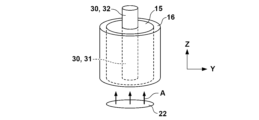
- FIG. 1 is a perspective view showing the configuration/arrangement of a tobacco stick, an antenna, a heating element, and a heat storage body in Example 1.
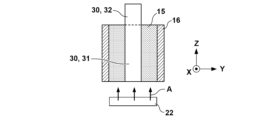
- FIG. 1 is a cross-sectional view showing the configuration/arrangement of a tobacco stick, an antenna, a heating element, and a heat storage body in Example 1.
- 13A and 13B are diagrams showing modified configurations/arrangements of the tobacco stick, antenna, heating element, and heat storage body;
- FIG. 11 is a perspective view showing the configuration/arrangement of a tobacco stick, an antenna, a heating element, and a heat storage body in Example 2.
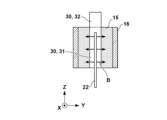
- FIG. 11 is a cross-sectional view showing the configuration/arrangement of a tobacco stick, an antenna, a heating element, and a heat storage body in Example 2.
- FIG. 13 is a perspective view showing the configuration/arrangement of a tobacco stick, an antenna, a heating element, and a heat storage body in Example 3.
- FIG. 11 is a cross-sectional view showing the configuration/arrangement of a tobacco stick, an antenna, a heating element, and a heat storage body in Example 3.
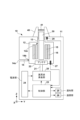
- FIGs. 1 and 2 are schematic diagrams showing an example of the configuration of the aerosol generating device 10 of this embodiment.
- Fig. 1 is a diagram showing the aerosol generating device 10 before an aerosol-generating article 30 and a mouthpiece 40 are attached
- Fig. 2 is a diagram showing the aerosol generating device 10 after the aerosol-generating article 30 and the mouthpiece 40 are attached.
- Figs. 1 and 2 show directions in an XYZ coordinate system in which the insertion direction of the tobacco stick 30 into the aerosol generating device 10 is the -Z direction.
- the aerosol generating device 10 is configured to heat the aerosol-generating article 30 in response to an action (also called an atomization request) that requests atomization of the aerosol source, such as an inhalation action by a user, and to provide the user with a gas containing an aerosol, or a gas containing an aerosol and a flavoring substance.
- the aerosol generating device 10 is sometimes called an inhaler (atomizer), and in the following description, the aerosol generating device 10 may be referred to as "inhaler 10.”
- the aerosol-generating article 30 is an article including an aerosol source that generates an aerosol when heated, and is detachably (insertable) attached to the inhaler 10.
- the aerosol-generating article 30 may include a flavor source that generates a flavor substance when heated.
- the flavor source may be a plant other than tobacco, such as mint, Chinese medicine, herbs, etc.
- the aerosol-generating article 30 is configured as a tobacco stick having a roughly cylindrical rod shape, but it does not have to be in a stick shape and may be in a capsule shape or cartridge shape.
- the aerosol-generating article 30 may be referred to as a "tobacco stick 30".
- the tobacco stick 30 may include, for example, a tobacco filling section 31 (tobacco rod section), a mouthpiece section 32, and tipping paper 33 that connects them together.
- the tobacco filling section 31 has a tobacco filler that has an aerosol source and a flavor source.
- the mouthpiece section 32 is connected coaxially to the tobacco filling section 31 by being wrapped around the tobacco filling section 31 with tipping paper 33.
- the tobacco stick 30 has a substantially constant diameter over its entire length in the Z-axis direction (longitudinal direction).
- the tobacco stick 30 may be provided with a filter at the end upstream of the tobacco filling section 31 to prevent the tobacco filler from falling out.
- the configuration of the tobacco packing section 31 is not particularly limited and may be of a general form.
- the tobacco packing section 31 may be a tobacco packing wrapped in cigarette paper.
- the tobacco filling includes, as a flavor source, for example, tobacco leaves, tobacco leaf extracts, and processed products thereof.
- the tobacco filling includes tobacco shreds.
- the material of the tobacco shreds included in the tobacco filling is not particularly limited, and known materials such as lamina and backbone can be used.
- the tobacco filling may be a shredded product (hereinafter simply referred to as a homogenized sheet) made by crushing dried tobacco leaves to an average particle size of 20 ⁇ m or more and 200 ⁇ m or less to obtain tobacco shreds, which are homogenized and processed into a sheet.
- the homogenized sheet having a length approximately equal to the longitudinal direction of the tobacco rod may be shredded approximately horizontally to the longitudinal direction of the tobacco rod and filled into the tobacco rod, which is a so-called strand type, or may be a product of extrusion molding or tablet molding of tobacco shreds.
- the width of the tobacco shreds is preferably 0.5 mm or more and 2.0 mm or less when filling the tobacco filling section 31.
- the content of dried tobacco leaves contained in the tobacco filling section 31 is not particularly limited, but may be 200 mg/rod or more and 800 mg/rod or less, and preferably 250 mg/rod or more and 600 mg/rod or less.
- This range is particularly suitable for a tobacco filling section 31 having a circumference of 22 mm and a length of 20 mm.
- a liquid mixture of glycerin, nicotine, flavoring, etc., or a glass fiber nonwoven fabric impregnated with such a liquid may be used as the tobacco filling material.
- Various types of tobacco can be used for the tobacco leaves used in the production of shredded tobacco and homogenized sheets. Examples include flue-cured tobacco, burley, orient, native tobacco, other Nicotiana tabacum varieties, Nicotiana rustica varieties, and mixtures of these. As for mixtures, the above varieties can be appropriately blended to achieve the desired flavor. Details of the above tobacco varieties are disclosed in "Encyclopedia of Tobacco, Tobacco Research Center, March 31, 2009." There are several conventional methods for producing the homogenized sheets, that is, methods for grinding tobacco leaves and processing them into homogenized sheets. The first method is to produce a paper-making sheet using a papermaking process.
- the second method is to mix a suitable solvent such as water with ground tobacco leaves to homogenize them, and then cast the homogenized material thinly on a metal plate or metal plate belt and dry it to produce a cast sheet.
- the third method is to mix a suitable solvent such as water with ground tobacco leaves to homogenize them, and extrude them into a sheet to produce a rolled sheet. Details of the types of homogenizing sheets mentioned above are disclosed in the "Encyclopedia of Tobacco, Tobacco Research Center, March 31, 2009."
- the moisture content of the tobacco filling can be 10% by weight or more and 15% by weight or less, and preferably 11% by weight or more and 13% by weight or less, based on the total amount of the tobacco filling. Such a moisture content suppresses the occurrence of stains on the roll and improves the suitability of the tobacco filling section 31 for rolling during production.
- dried tobacco leaves may be crushed to an average particle size of about 20 ⁇ m to 200 ⁇ m, homogenized, processed into a sheet, and then shredded to a width of 0.5 mm or more and 2.0 mm or less may be used.
- the tobacco filling contains an aerosol base material that generates aerosol smoke.
- the type of the aerosol base material is not particularly limited, and various extracts from natural products and/or their constituents can be selected depending on the application.
- the aerosol base material include water, glycerin, propylene glycol, triacetin, 1,3-butanediol, and mixtures thereof.
- the content of the aerosol base material in the tobacco filling is not particularly limited, and from the viewpoint of generating sufficient aerosol and imparting a good flavor, it is usually 5% by weight or more, preferably 10% by weight or more, and usually 50% by weight or less, preferably 15% by weight or more and 25% by weight or less, based on the total amount of the tobacco filling.
- the tobacco filling may contain a flavoring.
- the type of flavoring is not particularly limited, and from the viewpoint of imparting a good flavor, the following flavorings may be used: acetanisole, acetophenone, acetylpyrazine, 2-acetylthiazole, alfalfa extract, amyl alcohol, amyl butyrate, trans-anethole, star anise oil, apple juice, Peru balsam oil, beeswax absolute, benzaldehyde, benzoin resinoid, benzyl alcohol, benzyl benzoate, benzyl phenylacetate, benzyl propionate, 2,3-butanedione, 2-butanol, butyl butyrate, butyric acid, caramel, cardamom oil, carob absolute, ⁇ -Carotene, carrot juice, L-carvone, ⁇ -caryophyllene, cassia bark oil, cedarwood oil, celery seed
- the content of flavoring in the tobacco filling is not particularly limited, but from the viewpoint of imparting a good flavor, it is usually 10,000 ppm or more, preferably 20,000 ppm or more, more preferably 25,000 ppm or more, and usually 70,000 ppm or less, preferably 50,000 ppm or less, more preferably 40,000 ppm or less, and even more preferably 33,000 ppm or less.
- the cigarette paper is a sheet material for wrapping tobacco filler, and its composition is not particularly limited, and general materials can be used.
- the base paper used for the cigarette paper can be cellulose fiber paper, and more specifically, hemp or wood or a mixture thereof.
- the basis weight of the base paper in the cigarette paper is, for example, usually 20 gsm or more, and preferably 25 gsm or more. On the other hand, the basis weight is usually 65 gsm or less, preferably 50 gsm or less, and more preferably 45 gsm or less.
- the thickness of the cigarette paper having the above characteristics is not particularly limited, and from the viewpoints of rigidity, breathability, and ease of adjustment during papermaking, it is usually 10 ⁇ m or more, preferably 20 ⁇ m or more, and more preferably 30 ⁇ m or more, and also usually 100 ⁇ m or less, preferably 75 ⁇ m or less, and more preferably 50 ⁇ m or less.
- the shape of the wrapping paper for the tobacco filling section 31 can be square or rectangular.
- the length of one side can be about 6 mm to 70 mm
- the length of the other side can be 15 mm to 28 mm
- the preferred length of the other side can be 22 mm to 24 mm, with an even more preferred length being about 23 mm.
- the wrapping paper may contain a filler.
- the content of the filler may be 10% by weight or more and less than 60% by weight, preferably 15% by weight or more and 45% by weight or less, based on the total weight of the wrapping paper.
- the filler is preferably 15% by weight or more and 45% by weight or less.
- the filler when the basis weight is 25 gsm or more and 35 gsm or less, the filler is preferably 15% by weight or more and 45% by weight or less, and when the basis weight is more than 35 gsm and 45 gsm or less, the filler is preferably 25% by weight or more and 45% by weight or less.
- the filler calcium carbonate, titanium dioxide, kaolin, etc. can be used, but calcium carbonate is preferably used from the viewpoint of enhancing flavor and whiteness, etc.
- auxiliary agents other than the base paper and fillers may be added to the wrapping paper.
- a water resistance improver may be added to improve water resistance.
- Water resistance improvers include wet strength agents (WS agents) and sizing agents.
- wet strength agents include urea formaldehyde resin, melamine formaldehyde resin, polyamide epichlorohydrin (PAE), etc.
- sizing agents include rosin soap, alkyl ketene dimer (AKD), alkenyl succinic anhydride (ASA), highly saponified polyvinyl alcohol with a saponification degree of 90% or more, etc.
- a paper strength agent may be added as an auxiliary agent, such as polyacrylamide, cationic starch, oxidized starch, CMC, polyamide epichlorohydrin resin, polyvinyl alcohol, etc.
- auxiliary agent such as polyacrylamide, cationic starch, oxidized starch, CMC, polyamide epichlorohydrin resin, polyvinyl alcohol, etc.
- oxidized starch improves air permeability (for example, JP 2017-218699 A).
- the wrapping paper may also be appropriately coated.
- a coating agent may be added to at least one of the two surfaces of the wrapping paper, the front and back.
- a coating agent that can form a film on the surface of the paper and reduce liquid permeability is preferred.
- examples include alginic acid and its salts (e.g., sodium salts), polysaccharides such as pectin, cellulose derivatives such as ethyl cellulose, methyl cellulose, carboxymethyl cellulose, and nitrocellulose, starch and its derivatives (e.g., ether derivatives such as carboxymethyl starch, hydroxyalkyl starch, and cationic starch, and ester derivatives such as starch acetate, starch phosphate, and starch octenyl succinate).
- alginic acid and its salts e.g., sodium salts
- polysaccharides such as pectin
- cellulose derivatives such as ethyl cellulose, methyl cellulose, carboxymethyl cellulose, and nitrocellulose
- the length of the tobacco filling section 31 in the Z-axis direction can be changed as appropriate to suit the size of the product, but is, for example, 5 mm or more, preferably 10 mm or more, more preferably 12 mm or more, even more preferably 18 mm or more, and is usually 70 mm or less, preferably 50 mm or less, more preferably 30 mm or less, even more preferably 25 mm or less.
- the configuration of the mouthpiece 32 is not particularly limited and may be a general embodiment.
- the mouthpiece 32 may be configured to include two segments (sections) consisting of a cooling segment and a filter segment.
- the cooling segment and the filter segment are arranged along the Z-axis direction (longitudinal direction) so that the cooling segment is located closer to the tobacco-packing section 31 than the filter segment. That is, the cooling segment is disposed so as to be sandwiched between the tobacco-packing section 31 and the filter segment in the Z-axis direction.
- the mouthpiece 32 may be configured so that the cooling segment abuts against the tobacco-packing section 31 and the filter segment, or so that a gap is formed between the tobacco-packing section 31 and the cooling segment, and between the cooling segment and the filter segment 122.
- the mouthpiece 32 may also be formed from a single segment.
- the configuration of the cooling segment of the mouthpiece 32 is not particularly limited as long as it has the function of cooling the mainstream tobacco smoke, and an example is a cardboard processed into a cylindrical shape.
- the inside of the cylinder is hollow, and the vapor containing the aerosol base material and the tobacco flavor components is cooled by contacting the air inside the cavity.
- the cooling segment may be a paper tube formed by processing a single sheet of paper or a sheet of paper laminated together into a cylindrical shape.
- the paper tube has holes for introducing outside air around it. That is, the cooling segment is provided with vents, which are openings for taking in air from the outside.
- the number of vents in the cooling segment is not particularly limited. In this embodiment, a plurality of vents are arranged at regular intervals in the circumferential direction of the cooling segment.
- the group of vents arranged in the circumferential direction of the cooling segment may be formed in multiple stages along the Z-axis direction of the cooling segment.
- the vents in the cooling segment By providing the vents in the cooling segment, when the tobacco stick 30 is sucked, low-temperature air flows into the cooling segment from the outside, and the temperature of the volatile components and air flowing in from the tobacco filling section 31 can be reduced.
- the steam containing the aerosol base material and the tobacco flavor components is condensed by being cooled by the low-temperature air introduced into the cooling segment through the vents. This promotes the generation of aerosols and allows the size of the aerosol particles to be controlled.
- a polymer coating such as polyvinyl alcohol or a polysaccharide coating such as pectin
- the cooling effect can be increased by utilizing the heat absorption of the coating or the heat of dissolution associated with the phase change.
- the airflow resistance of this cylindrical cooling segment is zero mmH2O .
- the total surface area of the cooling segment is not particularly limited, and may be, for example, 300 mm2 /mm or more and 1000 mm2 /mm or less. This surface area is the surface area per mm of the length of the cooling segment in the air passage direction.
- the total surface area of the cooling segment is preferably 400 mm2 /mm or more, more preferably 450 mm2 /mm or more, while it is preferably 600 mm2 /mm or less, and more preferably 550 mm2 /mm or less.
- the cooling segment may be formed by a thin sheet of material that is wrinkled to form channels, and then pleated, gathered, and folded. The more folds or pleats within a given volume of the element, the greater the total surface area of the cooling segment.
- the thickness of the constituent material of the cooling segment is not particularly limited and may be, for example, 5 ⁇ m or more and 500 ⁇ m or less, and 10 ⁇ m or more and 250 ⁇ m or less.
- the paper as a material for the cooling sheet member desirably has a basis weight of 30 to 100 g/m 2 and a thickness of 20 to 100 ⁇ m. From the viewpoint of reducing the removal of flavor source components and aerosol base components in the cooling segment, it is desirable for the paper as a material for the cooling sheet to have low air permeability, and the air permeability is preferably 10 Coresta or less.
- the cooling effect can be increased by utilizing the heat of dissolution associated with the heat absorption or phase change of the coating.
- the ventilation holes in the cooling segment are located at a position 4 mm or more away from the boundary between the cooling segment and the filter segment. This not only improves the cooling capacity of the cooling segment, but also suppresses the retention of components generated by heating in the cooling segment, thereby improving the delivery amount of the components. It is preferable that the tipping paper 33 has an opening directly above the ventilation holes provided in the cooling segment (a position where they overlap vertically).
- the ventilation holes (openings) in the cooling segment are arranged so that the air inflow rate from the ventilation holes when inhaling at 17.5 ml/sec with an automatic smoking machine (the volumetric rate of air inflowing from the ventilation holes when the volumetric rate of air inhaled from the mouth end is 100% by volume) is 10 to 90% by volume, preferably 50 to 80% by volume, and more preferably 55 to 75% by volume.
- the number of ventilation holes per ventilation hole group can be selected from the range of 5 to 50, and the diameter of the ventilation hole can be selected from the range of 0.1 to 0.5 mm, and a combination of these selections can be achieved.
- the air inflow ratio can be measured by a method conforming to ISO9512 using an automatic smoking machine (for example, a single-cigarette automatic smoking machine manufactured by Borgwaldt).
- the length of the cooling segment in the Z-axis direction is not particularly limited, but is usually 10 mm or more, preferably 15 mm or more, and usually 40 mm or less, preferably 35 mm or less, and more preferably 30 mm or less. It is particularly preferable that the length of the cooling segment in the Z-axis direction is 20 mm.
- the length of the cooling segment in the Z-axis direction is usually 10 mm or more, preferably 15 mm or more, and usually 40 mm or less, preferably 35 mm or less, and more preferably 30 mm or less. It is particularly preferable that the length of the cooling segment in the Z-axis direction is 20 mm.
- the filter segment When the filter segment is formed by filling the cellulose acetate tow, 5 to 10% by weight of triacetin may be added to the cellulose acetate tow to improve the filter hardness.
- the filter segment may be composed of a single segment or multiple segments.
- a hollow segment such as a center hole is arranged on the upstream side (tobacco-filled section 31 side), and an acetate filter with a mouth-end cross section filled with cellulose acetate tow is arranged as a downstream segment (mouth end side). This prevents unnecessary loss of the generated aerosol, and improves the appearance of the tobacco stick 30.
- an acetate filter may be arranged on the upstream side (tobacco-filled section 31 side), and a hollow segment such as a center hole may be arranged on the downstream side (mouth end side).
- the filter segment may be arranged using other alternative filter materials, such as a paper filter filled with sheet-like pulp paper, instead of an acetate filter.
- filters in the filter segment include, for example, adjusting the amount of air mixed in when inhaling aerosols, reducing flavors, and reducing nicotine and tar, but it is not necessary for a filter to have all of these functions. Also, in electrically heated tobacco products, which tend to produce fewer components and have a lower tobacco filler filling rate compared to cigarette products, another important function is to prevent the tobacco filler from falling out while suppressing the filtering function.
- the cross-sectional shape of the filter segment is substantially circular, and the diameter of the circle can be changed as appropriate according to the size of the product, but is usually 4.0 mm or more and 9.0 mm or less, preferably 4.5 mm or more and 8.5 mm or less, and more preferably 5.0 mm or more and 8.0 mm or less. If the cross section is not circular, the above diameter applies to a circle having the same area as the cross section.
- the perimeter of the filter segment can be changed as appropriate according to the size of the product, but is usually 14.0 mm or more and 27.0 mm or less, preferably 15.0 mm or more and 26.0 mm or less, and more preferably 16.0 mm or more and 25.0 mm or less.
- the airflow resistance of the filter segment per 120 mm of length in the Z-axis direction is not particularly limited, but is usually 40 mmH 2 O or more and 300 mmH 2 O or less, preferably 70 mmH 2 O or more and 280 mmH 2 O or less, and more preferably 90 mmH 2 O or more and 260 mmH 2 O or less.
- the above airflow resistance is measured according to the ISO standard method (ISO6565), for example, using a filter airflow resistance measuring device manufactured by Cerulean Co., Ltd.
- the airflow resistance of the filter segment refers to the air pressure difference between the first end face and the second end face when air is flowed at a predetermined air flow rate (17.5 cc/min) from one end face (first end face) to the other end face (second end face) in a state in which air does not pass through the side face of the filter segment.
- the unit of airflow resistance can generally be expressed in mmH 2 O. It is known that the relationship between the airflow resistance of a filter segment and the length of the filter segment is proportional within the length range typically used (5 mm to 200 mm), and if the length of a filter segment is doubled, the airflow resistance also doubles.
- the density of the filter medium in the filter segment is not particularly limited, but is usually 0.10 g/cm 3 or more and 0.25 g/cm 3 or less, preferably 0.11 g/cm 3 or more and 0.24 g/cm 3 or less, and more preferably 0.12 g/cm 3 or more and 0.23 g/cm 3 or less.
- the filter segment may be provided with a winding paper (filter plug winding paper) for winding the filter medium and the like from the viewpoint of improving the strength and structural rigidity.
- the mode of the winding paper is not particularly limited, and may include one or more rows of seams containing adhesive.
- the adhesive may include a hot melt adhesive, and the hot melt adhesive may further include polyvinyl alcohol.
- the filter segment is composed of two or more segments, it is preferable that the winding paper winds these two or more segments together.
- the material of the winding paper in the filter segment is not particularly limited, and a known material can be used, and may also include a filler such as calcium carbonate.
- the thickness of the roll paper is not particularly limited, and is usually 20 ⁇ m or more and 140 ⁇ m or less, preferably 30 ⁇ m or more and 130 ⁇ m or less, and more preferably 30 ⁇ m or more and 120 ⁇ m or less.
- the basis weight of the roll paper is not particularly limited, and is usually 20 gsm or more and 100 gsm or less, preferably 22 gsm or more and 95 gsm or less, and more preferably 23 gsm or more and 90 gsm or less.
- the roll paper may be coated or uncoated, but from the viewpoint of imparting functions other than strength and structural rigidity, it is preferable that it is coated with a desired material.
- the flavoring agent may be, for example, menthol, spearmint, peppermint, fenugreek, or clove, medium chain triglyceride (MCT), or a combination thereof.
- MCT medium chain triglyceride
- one or more materials that help filter smoke may be added as an additive.
- the form of the additive is not particularly limited and is usually a liquid or solid.
- the use of capsules containing additives is well known in the art.
- Frangible capsules and methods for their manufacture are well known in the art.
- the filter segment includes a filter medium, and activated carbon may be added to at least a part of the filter medium.
- the amount of activated carbon added to the filter medium may be 15.0 m 2 / cm 2 or more and 80.0 m 2 /cm 2 or less in one tobacco stick 30 as a value of the specific surface area of activated carbon ⁇ the weight of activated carbon / the cross-sectional area in the direction perpendicular to the airflow direction of the filter medium.
- the above-mentioned "specific surface area of activated carbon ⁇ the weight of activated carbon / the cross-sectional area in the direction perpendicular to the airflow direction of the filter medium” may be expressed as "the surface area of activated carbon per unit cross-sectional area".
- activated carbon examples include those made from wood, bamboo, coconut shells, walnut shells, and coal.
- the activated carbon may have a BET specific surface area of 1100 m 2 /g or more and 1600 m 2 /g or less, preferably 1200 m 2 /g or more and 1500 m 2 /g or less, and more preferably 1250 m 2 /g or more and 1380 m 2 /g or less.
- the BET specific surface area can be determined by a nitrogen gas adsorption method (BET multipoint method).
- the activated carbon particles preferably have a cumulative 10% by volume particle diameter (particle diameter D10) of 250 ⁇ m or more and 1200 ⁇ m or less.
- the activated carbon particles preferably have a cumulative 50% by volume particle diameter (particle diameter D50) of 350 ⁇ m or more and 1500 ⁇ m or less.
- the particle diameters D10 and D50 can be measured by a laser diffraction scattering method.
- An example of an apparatus suitable for this measurement is the laser diffraction/scattering type particle size distribution measuring apparatus "LA-950" manufactured by Horiba, Ltd.
- the powder is poured into the cell of this apparatus together with pure water, and the particle diameter is detected based on the light scattering information of the particles.
- the measurement conditions using the above measuring apparatus are as follows.
- the chip paper 33 may contain fillers other than the above-mentioned pulp, such as metal carbonates such as calcium carbonate and magnesium carbonate, metal oxides such as titanium oxide, titanium dioxide and aluminum oxide, metal sulfates such as barium sulfate and calcium sulfate, metal sulfides such as zinc sulfide, quartz, kaolin, talc, diatomaceous earth, gypsum, etc., and it is particularly preferable that the chip paper 33 contains calcium carbonate from the viewpoint of improving whiteness and opacity and increasing the heating rate. Furthermore, these fillers may be used alone or in combination of two or more types.
- the chip paper 33 may contain a water resistance improver to improve water resistance.
- Water resistance improvers include wet strength agents (WS agents) and sizing agents.
- wet strength agents include urea formaldehyde resin, melamine formaldehyde resin, polyamide epichlorohydrin (PAE), etc.
- sizing agents include rosin soap, alkyl ketene dimer (AKD), alkenyl succinic anhydride (ASA), and highly saponified polyvinyl alcohol with a saponification degree of 90% or more.
- the method for manufacturing the tip paper 33 is not particularly limited, and general methods can be applied.
- a method can be used in which the texture is adjusted and made uniform during the papermaking process using a Fourdrinier papermaking machine, a cylinder papermaking machine, a combined cylinder and short-circuit papermaking machine, etc. using pulp.
- a wet strength agent can be added to impart water resistance to the wrapping paper, or a sizing agent can be added to adjust the printing condition of the wrapping paper.
- the microwave shield of the tobacco stick 30 may be attached to the filter segment of the mouthpiece 32 or may be disposed adjacent to the filter segment of the mouthpiece 32.
- the microwave shield of the tobacco stick 30 may also be disposed at the upstream or downstream end of another filter segment provided adjacent to the cooling segment of the mouthpiece 32.
- the microwave shield of the tobacco stick 30 may be configured by placing a preformed shielding member at a predetermined position on the tobacco stick 30, or may be configured by printing on the filter segment of the mouthpiece 32. Note that, as described below, when a mouthpiece 40 equipped with a microwave shield 41 is attached to the inhaler 10, the tobacco stick 30 does not need to be provided with a microwave shield.
- the aperture ratio of the microwave shield of the tobacco stick 30 is designed in consideration of the blocking of microwaves and the airflow resistance, the aperture ratio is, for example, 10% or more, preferably 30% or more, and more preferably 50% or more.
- the aperture ratio is 90% or less, preferably 80% or less, and more preferably 70% or less.
- the overall airflow resistance of the inhaler 10 and the tobacco stick 30 is 8 mmH 2 O or more, preferably 10 mmH 2 O or more, more preferably 12 mmH 2 O or more, and 100 mmH 2 O or less, preferably 80 mmH 2 O or less, and more preferably 60 mmH 2 O or less.
- the airflow resistance is measured based on the ISO standard method (ISO6565) as described above.
- the tobacco stick 30 configured as described above may be configured such that a part of the outer surface of the tipping paper 33 is covered with a lip release material.
- the lip release material refers to a material configured to assist in the easy separation of the contact between the lips and the tipping paper 33 without substantial adhesion when the user holds the mouthpiece portion 32 of the tobacco stick 30 in the mouth.
- the lip release material may contain, for example, ethyl cellulose, methyl cellulose, etc.
- the outer surface of the tipping paper 33 may be coated with the lip release material by applying an ethyl cellulose-based or methyl cellulose-based ink to the outer surface of the tipping paper 33.
- the airflow resistance in the Z-axis direction per tobacco stick 30 configured as above is not particularly limited, but from the viewpoint of ease of smoking, it is usually 8 mmH2O or more, preferably 10 mmH2O or more, more preferably 12 mmH2O or more, and usually 100 mmH2O or less, preferably 80 mmH2O or less, more preferably 60 mmH2O or less.
- the airflow resistance is measured, for example, using a filter airflow resistance meter manufactured by Cerulean Co., Ltd., in accordance with the ISO standard method (ISO6565:2015).
- the airflow resistance refers to the air pressure difference between the first end face and the second end face when air is flowed at a predetermined air flow rate (17.5 cc/min) from one end face (first end face) to the other end face (second end face) in a state in which air does not pass through the side face of the tobacco stick 30.
- the unit is generally expressed in mmH2O . It is known that the relationship between the airflow resistance and the tobacco stick 30 is proportional within the normally used length range (length 5 mm to 200 mm), and if the length of the tobacco stick 30 is doubled, the airflow resistance also doubles.
- the rod-shaped tobacco stick 30 preferably has a columnar shape that satisfies the requirement that the aspect ratio, defined as follows, be 1 or greater.
- Aspect ratio h/w
- w is the width of the tip of the tobacco stick 30
- h is the length in the Z-axis direction, and it is preferable that h ⁇ w.
- the cross-sectional shape of the tobacco stick 30 is not particularly limited, and may be polygonal, rounded polygonal, circular, or elliptical.
- the width w of the tobacco stick 30 is the diameter when the cross-sectional shape of the tobacco stick 30 is circular, the major axis when the cross-sectional shape is elliptical, and the diameter of the circumscribed circle or the major axis of the circumscribed ellipse when the cross-sectional shape is polygonal or rounded polygonal.
- the length h of the tobacco stick 30 in the Z-axis direction is not particularly limited, and is, for example, usually 40 mm or more, preferably 45 mm or more, and more preferably 50 mm or more. Also, it is usually 100 mm or less, preferably 90 mm or less, and more preferably 80 mm or less.
- the width w of the tip of the tobacco stick 30 is not particularly limited, and is, for example, usually 5 mm or more, and preferably 5.5 mm or more. Also, it is usually 10 mm or less, preferably 9 mm or less, and more preferably 8 mm or less.
- the cooling effect By setting the ratio of the length of the cooling segment and the filter segment of the mouthpiece 32 within the above range, the cooling effect, the effect of suppressing losses due to the adhesion of the generated steam and aerosol to the inner wall of the cooling segment, and the function of adjusting the air volume and flavor of the filter are balanced, and a good flavor and flavor intensity can be achieved.
- the inhaler 10 includes a case 11 in which various components described later are mounted.
- the case 11 includes a storage section 12 capable of storing a part of a tobacco stick 30 inserted from an opening 12a, a guide section 13 for guiding the insertion of the tobacco stick 30 from the opening 12a of the storage section 12, and an air flow path 14 communicating with the storage section 12 and capable of introducing air into the storage section 12.
- the storage section 12 may have an inner surface made of metal or the like in order to confine microwaves (electromagnetic waves) within the storage section 12.
- the air flow path 14 has an air intake 14a provided on the exterior of the case 11, and is provided so as to introduce air into the storage section 12 from the air intake 14a.
- the air flow path 14 may include a microwave shield 14b that allows air to pass through but blocks microwaves.
- the air flow path 14 is not limited to being provided on the side surface of the storage section 12 as shown in FIG. 1, but may be provided on the bottom or top surface of the storage section 12.
- the high-frequency oscillator 20 includes, for example, a semiconductor (solid state) oscillator, and generates a high-frequency electromagnetic field (electromagnetic waves) of a predetermined frequency.
- the semiconductor oscillator is an oscillator configured with semiconductor elements such as, for example, an LDMOS transistor, a GaAs FET, a SiC MESFET, or a GaN HFET.
- the high-frequency electromagnetic field (electromagnetic waves) refers to an electromagnetic field between 3 Hz and 3 THz, including microwaves between 300 MHz and 300 GHz.
- the high-frequency oscillator 20 can generate microwaves with a frequency (for example, 2.40 to 2.50 GHz) suitable for heating the tobacco stick 30 (aerosol source).
- the high-frequency oscillator 20 generates microwaves with a frequency of 2.45 GHz.
- the high-frequency oscillator 20 may also include an amplifier for amplifying the high-frequency electromagnetic field.
- the semiconductor oscillator itself may have the function of an amplifier, or an amplifier configured as an electronic component separate from the semiconductor oscillator may be provided.
- the microwaves generated by the high frequency oscillator 20 are guided to the antenna 22 through the waveguide 21.
- the waveguide 21 connects the high frequency oscillator 20 and the antenna 22, and guides the microwaves generated by the high frequency oscillator 20 to the antenna 22 to heat the tobacco stick 30 (aerosol source).
- a waveguide or a coaxial cable can be used as the waveguide 21.
- the waveguide 21 may be omitted.
- the antenna 22 also emits (radiates) the microwaves guided through the waveguide 21 into the storage section 12.
- the antenna 22 is provided on the bottom surface of the storage section 12, but this is not limited thereto, and the antenna 22 may be provided on the side or top surface of the storage section 12.
- the waveguide 21 may be provided with an isolator for absorbing reflected waves returning to the high frequency oscillator 20 via the antenna 22.
- the waveguide 21 may also be provided with a power monitor that detects the power of the incident wave from the high frequency oscillator 20 and the power of the reflected wave from the antenna 22, and/or an impedance matching section that matches the impedance of the high frequency oscillator 20 with the impedance of the antenna 22 in a state in which the tobacco stick 30 is placed, thereby reducing the power of the reflected wave.
- the power supply unit 24 supplies power to the high-frequency oscillator unit 20 based on the control by the control unit 23.
- the power supply unit 24 is configured, for example, by a rechargeable battery such as a lithium-ion secondary battery. By providing such a power supply unit 24, the inhaler 10 can be configured to be portable.
- the notification unit 25 notifies the user of information based on the control by the control unit 23.
- Examples of information notified to the user include information indicating the detection of the insertion of the tobacco stick 30 into the storage unit 12, information indicating the start of heating the tobacco stick 30 by microwaves, information indicating the transition to a state in which the aerosol can be inhaled, error information, and remaining charge information of the power supply unit 24 (remaining battery charge information).
- the notification unit 25 may be composed of a light-emitting element such as an LED (Light Emitting Diode), a vibration element such as a vibration motor, or a sound output element.
- the notification unit 25 may be composed of a display element (display) such as an LCD (Liquid Crystal Display).
- the notification unit 25 may be a combination of two or more elements of a light-emitting element, a vibration element, a sound output element, and a display element.
- the communication unit 26 is an interface for acquiring information regarding the usage status of the suction device 10 and transmitting it to an external data server or a user's mobile terminal device, etc. (hereinafter referred to as a data server, etc.), and for receiving data from a data server, etc.
- the communication unit 26 can communicate with a data server, etc., for example, by Bluetooth (registered trademark), which is a short-range wireless communication, or LPWA (Low Power Wide Area), which is a long-range wireless communication.
- the communication between the communication unit 26 and a data server, etc. is not limited to the wireless communication described above, and may be another form of wireless communication or wired communication.
- the object detection unit 27 detects the presence or absence of a tobacco stick 30 in the storage unit 12.
- the control unit 23 can thus determine whether or not the tobacco stick 30 is stored (inserted) in the storage unit 12 based on the detection result of the object detection unit 27, and control the emission of microwaves from the antenna 22 according to the determination result. For example, when the control unit 23 determines based on the detection result of the object detection unit 27 that the tobacco stick 30 is not stored in the storage unit 12, it prohibits the emission of microwaves from the antenna 22. On the other hand, when the control unit 23 determines based on the detection result of the object detection unit 27 that the tobacco stick 30 is stored (inserted) in the storage unit 12, it enables the emission of microwaves from the antenna 22.
- the object detection unit 27 can be configured, for example, as a capacitance-type proximity sensor, but is not limited thereto, and may be configured as a contact-type sensor (e.g., a pressure sensor) or a photoelectric sensor.
- the item detection unit 27 is provided on the bottom surface (the inner surface on the -Z direction side) of the storage unit 12, but it may be provided on the side or top surface of the storage unit 12, or on the guide unit 13.
- the inhaler 10 of this embodiment may be fitted with a mouthpiece 40 that the user holds in their mouth to inhale gas (gas containing aerosol) from the storage section 12.
- the mouthpiece 40 may be attached to the guide section 13 of the inhaler 10 so as to cover the portion (mouthpiece section 32) of the tobacco stick 30 that protrudes from the inhaler 10 (storage section 12).
- the mouthpiece 40 is provided with a microwave shield 41 for blocking microwaves leaking out from the storage section 12 to the outside through the opening 12a and the guide section 13.
- the microwave shield 41 may be made of a metal mesh or the like so as to allow gas to pass through while blocking microwaves.
- the inhaler 10 may be provided with a mouthpiece detection unit 28 that detects whether the mouthpiece 40 is attached or not.
- a mouthpiece detection unit 28 that detects whether the mouthpiece 40 is attached or not. This allows the control unit 23 to control the emission of microwaves from the antenna 22 based on the detection result of the mouthpiece detection unit 28. For example, when the control unit 23 determines that the mouthpiece 40 is not attached based on the detection result of the mouthpiece detection unit 28, it prohibits the emission of microwaves from the antenna 22. On the other hand, when the control unit 23 determines that the mouthpiece 40 is attached based on the detection result of the mouthpiece detection unit 28, it enables the emission of microwaves from the antenna 22.
- the inhaler 10 may be configured so that the user directly applies the mouthpiece 32 of the tobacco stick 30 without using the mouthpiece 40.
- a microwave shield made of a metal mesh or the like to block microwaves may be provided on the mouthpiece 32 of the tobacco stick 30.
- a heating element 15 that absorbs microwaves emitted from the antenna 22 to generate heat and heat the tobacco stick 30, and a heat storage element 16 that stores heat and gradually releases the heat, are provided inside the storage part 12.
- This configuration of providing the heating element 15 and the heat storage element 16 improves the energy conversion efficiency of converting the microwaves emitted from the antenna 22 into heat, making it possible to efficiently heat the tobacco stick 30.
- a portion of the microwaves emitted from the antenna 22 may be directly irradiated to the tobacco stick 30 without being absorbed by the heating element 15 (i.e., the tobacco stick 30 may be directly heated without passing through the heating element 15).
- the configuration/arrangement of the heating element 15 and the heat storage element 16 are described.
- examples are described in which both the heating element 15 and the heat storage element 16 are provided inside the storage section 12, but a configuration in which only the heating element 15 is provided inside the storage section 12 is also possible.
- the heat storage element 16 does not have to be provided inside the storage section 12. Even when only the heating element 15 is provided inside the storage section 12, it is possible to heat the tobacco stick 30 using microwaves more efficiently than when the heating element 15 is not provided inside the storage section 12.
- Figures 3A and 3B are diagrams showing the configuration/arrangement of the tobacco stick 30, antenna 22, heating element 15, and heat storage body 16 in Example 1.
- Figure 3A shows a perspective view
- Figure 3B shows a cross-sectional view.
- the direction in which microwaves are emitted from the antenna 22 is indicated by arrow A.
- the heating element 15 is preferably arranged so as to contact at least a part of the tobacco stick (tobacco filling section 31) contained in the storage section 12 of the inhaler 10. This allows the heat generated by the heating element 15 to be efficiently transferred to the tobacco stick 30, and the tobacco stick 30 can be efficiently heated.
- the heating element 15 is preferably configured to guide the insertion of the tobacco stick 30 into the storage section 12 of the inhaler 10 and to hold the tobacco stick 30 inserted in the storage section 12.
- the heating element 15 may be configured as a cylindrical member that holds the tobacco stick 30.
- the cylindrical member may have a shape that has a bottom surface against which the tip of the tobacco stick 30 abuts, or may have a shape that does not have a bottom surface. This eliminates the need to provide a member separate from the heating element 15 for guiding the insertion of the tobacco stick into the storage section 12 or for holding the tobacco stick 30 in the storage section 12, which can be advantageous for simplifying the device configuration and reducing costs.
- the heating element 15 is provided so as to cover (surround) the entire outer periphery of the tobacco filling portion 31 in the circumferential direction of the tobacco stick 30 (the direction of rotation around the Z axis) for at least a portion of the tobacco stick 30 (tobacco filling portion 31) in the Z direction.
- the heating element 15 may also be provided so as to partially cover (surround) the outer periphery of the tobacco filling portion 31 in the circumferential direction of the tobacco stick 30 for at least a portion of the tobacco stick 30 (tobacco filling portion 31) in the Z direction.
- the heat storage body 16 is a member that stores heat and gradually releases the heat, and may be made of, for example, a ceramic material.
- the heat storage body 16 is disposed in the vicinity of the heating body 15 inside the storage section 12 of the inhaler 10, and temporarily stores the heat generated by the heating body 15.
- the heat storage body 16 may be disposed on the outer periphery of the heating body 15 in the circumferential direction of the tobacco stick 30.
- the heat storage body 16 may be made of a material that stores heat for a longer period of time and gradually releases the stored heat compared to the heating body 15.
- the heat storage body 16 may be made of a material that stores a larger amount of heat per unit volume compared to the heating body 15.
- the heat generated by the heating body 15 can be efficiently stored.
- the tobacco stick 30 can be heated or kept warm by the heat emitted from the heat storage body 16. This provides benefits such as power saving by reducing the microwave emission time, and shortening the time it takes for the tobacco stick 30 to reach a target temperature (e.g., the temperature at which aerosols are generated) after the microwaves are re-emitted (re-oscillated).
- a target temperature e.g., the temperature at which aerosols are generated
- the heat storage body 16 is not limited to the outer periphery of the heating element 15, and may be provided on a portion of the outer periphery of the tobacco stick 30 where the heating element 15 is not provided.
- the heating element 15 and the heat storage body 16 may be arranged alternately in the circumferential direction of the tobacco stick 30. This configuration also makes it possible to efficiently generate heat in the heating element 15 and store/dissipate heat in the heat storage body 16.
- the entire outer periphery of the tobacco filling section 31 may be covered (surrounded) by the heating element 15, and the heating element 15 may be partially covered by the heat storage body 16.
- the heat storage body 16 may be arranged inside the heating element 15 (i.e., between the tobacco stick 30 and the heating element 15).
- the heat storage body 16 may be configured as a cylindrical member that accommodates the tobacco stick 30.
- the cylindrical member may have a shape that has a bottom surface against which the tip of the tobacco stick 30 abuts, or may have a shape that does not have a bottom surface.
- the antenna 22 may be configured as a planar antenna (e.g., a patch antenna) arranged on the inner surface of the storage section 12 so as to emit microwaves into the storage section 12.
- the antenna 22 is arranged on the bottom surface of the storage section 12 so as to emit microwaves toward the tobacco stick 30 (tobacco filling section 31) and the heating element 15.
- the bottom surface of the storage section 12 is the surface on the -Z direction side among the surfaces constituting the storage section 12, that is, the surface facing the tip of the tobacco stick 30 (tobacco filling section 31) inserted into the storage section 12.
- the antenna 22 By arranging the antenna 22 in this way, it is possible to efficiently irradiate microwaves to the tobacco stick 30 (tobacco filling section 31) and the heating element 15. In other words, it is possible to heat the aerosol source in the tobacco stick 30 by directly irradiating the aerosol source with microwaves, and to heat the aerosol source via the heat generated by the heating element 15 by irradiating the heating element 15 with microwaves.
- FIGS 5A and 5B are diagrams showing the configuration/arrangement of the tobacco stick 30, antenna 22, heating element 15, and heat storage body 16 in Example 2.
- Figure 5A shows a perspective view
- Figure 5B shows a cross-sectional view.
- the direction in which microwaves are emitted from the antenna 22 is indicated by arrow B. Note that matters other than those mentioned in Example 2 may follow those of Example 1.
- Example 2 the configuration/arrangement of the heating element 15 and the heat storage element 16 is similar to that of Example 1, but the configuration of the antenna 22 is different.
- the antenna 22 in Example 2 is configured to be inserted into the tobacco stick 30 (tobacco loading section 31) when the tobacco stick 30 is inserted into the inhaler 10 (container section 12).
- the antenna 22 is configured as a rod-shaped vertical antenna (e.g., a monopole antenna) and emits microwaves radially outward.
- the aerosol source in the tobacco stick 30 is directly irradiated with microwaves to heat the aerosol source, and the microwaves leaking out of the tobacco stick 30 can be absorbed by the heating element 15 to generate heat.
- the microwaves not used to heat the aerosol source in the tobacco stick 30 are used to generate heat from the heating element 15, so that the tobacco stick 30 can be efficiently heated using microwaves.
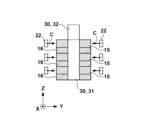
- FIGS 6A and 6B are diagrams showing the configuration/arrangement of the tobacco stick 30, antenna 22, heating element 15, and heat storage body 16 in Example 3.
- Figure 6A shows a perspective view
- Figure 6B shows a cross-sectional view.
- the direction in which microwaves are emitted from the antenna 22 is indicated by arrow C. Note that matters other than those mentioned in Example 3 may follow those of Example 1.
- Example 3 as shown in Figs. 6A to 6B, the heating elements 15 and the heat storage elements 16 are alternately arranged along the insertion direction (-Z direction) of the tobacco stick 30 on the outside (surrounding) of the tobacco stick 30 (tobacco loading section 31) inserted into the inhaler 10 (container 12).
- the antenna 22 is provided individually for each of the heating elements 15 so that microwaves can be irradiated individually to each of the heating elements 15.
- the antenna 22 can be arranged on the inner surface (surface on the ⁇ Y direction side) of the container 12 so as to irradiate microwaves to the side surface (surface on the ⁇ Y direction side) of each heating element 15.
- the number of heating elements 15 and the number of heat storage elements 16 are not limited to three and can be set arbitrarily depending on the control accuracy of the heating distribution of the tobacco stick 30 in the Z direction.
- an antenna 22 is provided individually for each of the multiple heating elements 15, but this is not limited thereto and a common antenna 22 may be provided for the multiple heating elements 15. In this case, although it is difficult to individually control the heat generation of each heating element 15, it is possible to uniformize the heating distribution of the tobacco stick 30 in the Z direction.
- the inhaler 10 of this embodiment is provided with a heating element 15 that generates heat by absorbing microwaves, and a heat storage element 16 that stores heat and gradually releases the heat, in the storage section 12 into which the tobacco stick 30 (tobacco loading section 31) is inserted.
- a heating element 15 that generates heat by absorbing microwaves
- a heat storage element 16 that stores heat and gradually releases the heat, in the storage section 12 into which the tobacco stick 30 (tobacco loading section 31) is inserted.
- This allows the tobacco stick 30 to be efficiently heated using microwaves, which can be advantageous in terms of reducing the power consumption of the inhaler 10.
- ⁇ Other embodiments> an example (microwave heating method) has been described in which the tobacco stick 30 and/or the heating element 15 in the storage unit 12 are heated by emitting electromagnetic waves (microwaves) generated by the high-frequency oscillator 20 from the antenna 22 into the storage unit 12.
- the present invention is not limited to this, and may be, for example, a method in which the tobacco stick 30, the heating element 15 and/or the heat storage body 16 are dielectrically heated by changing the electromagnetic field (electromagnetic field intensity) generated in the storage unit 12 by controlling the electromagnetic waves irradiated from the antenna 22.
Landscapes
- Cigarettes, Filters, And Manufacturing Of Filters (AREA)
Priority Applications (3)
| Application Number | Priority Date | Filing Date | Title |
|---|---|---|---|
| EP23930689.7A EP4656076A1 (en) | 2023-03-31 | 2023-03-31 | Aerosol generation device |
| JP2025509634A JPWO2024202055A1 (https=) | 2023-03-31 | 2023-03-31 | |
| PCT/JP2023/013685 WO2024202055A1 (ja) | 2023-03-31 | 2023-03-31 | エアロゾル生成装置 |
Applications Claiming Priority (1)
| Application Number | Priority Date | Filing Date | Title |
|---|---|---|---|
| PCT/JP2023/013685 WO2024202055A1 (ja) | 2023-03-31 | 2023-03-31 | エアロゾル生成装置 |
Publications (1)
| Publication Number | Publication Date |
|---|---|
| WO2024202055A1 true WO2024202055A1 (ja) | 2024-10-03 |
Family
ID=92904555
Family Applications (1)
| Application Number | Title | Priority Date | Filing Date |
|---|---|---|---|
| PCT/JP2023/013685 Ceased WO2024202055A1 (ja) | 2023-03-31 | 2023-03-31 | エアロゾル生成装置 |
Country Status (3)
| Country | Link |
|---|---|
| EP (1) | EP4656076A1 (https=) |
| JP (1) | JPWO2024202055A1 (https=) |
| WO (1) | WO2024202055A1 (https=) |
Cited By (1)
| Publication number | Priority date | Publication date | Assignee | Title |
|---|---|---|---|---|
| CN119970215A (zh) * | 2024-12-25 | 2025-05-13 | 广州信筑医疗技术有限公司 | 一种点阵激光手具及1470nm半导体激光治疗仪 |
Citations (4)
| Publication number | Priority date | Publication date | Assignee | Title |
|---|---|---|---|---|
| CN104366697A (zh) * | 2014-11-10 | 2015-02-25 | 云南中烟工业有限责任公司 | 一种带有储热部件的吸烟装置和组合式吸烟系统 |
| CN110859321A (zh) * | 2018-08-08 | 2020-03-06 | 北京航天雷特机电工程有限公司 | 一种烟弹及电子烟 |
| CN113397222A (zh) * | 2021-05-20 | 2021-09-17 | 惠州市沛格斯科技有限公司 | 加热模组及包括该加热模组的发烟装置 |
| KR20210123839A (ko) * | 2020-04-06 | 2021-10-14 | 주식회사 케이티앤지 | 에어로졸 생성 장치 |
Family Cites Families (2)
| Publication number | Priority date | Publication date | Assignee | Title |
|---|---|---|---|---|
| JP2017218699A (ja) | 2016-06-09 | 2017-12-14 | 日本製紙パピリア株式会社 | 喫煙物品用巻紙 |
| PL3998878T3 (pl) | 2019-07-19 | 2024-12-02 | Philip Morris Products S.A. | Układ wytwarzania aerozolu i sposób zastosowania ogrzewania dielektrycznego |
-
2023
- 2023-03-31 EP EP23930689.7A patent/EP4656076A1/en active Pending
- 2023-03-31 WO PCT/JP2023/013685 patent/WO2024202055A1/ja not_active Ceased
- 2023-03-31 JP JP2025509634A patent/JPWO2024202055A1/ja active Pending
Patent Citations (4)
| Publication number | Priority date | Publication date | Assignee | Title |
|---|---|---|---|---|
| CN104366697A (zh) * | 2014-11-10 | 2015-02-25 | 云南中烟工业有限责任公司 | 一种带有储热部件的吸烟装置和组合式吸烟系统 |
| CN110859321A (zh) * | 2018-08-08 | 2020-03-06 | 北京航天雷特机电工程有限公司 | 一种烟弹及电子烟 |
| KR20210123839A (ko) * | 2020-04-06 | 2021-10-14 | 주식회사 케이티앤지 | 에어로졸 생성 장치 |
| CN113397222A (zh) * | 2021-05-20 | 2021-09-17 | 惠州市沛格斯科技有限公司 | 加热模组及包括该加热模组的发烟装置 |
Non-Patent Citations (1)
| Title |
|---|
| See also references of EP4656076A1 * |
Cited By (1)
| Publication number | Priority date | Publication date | Assignee | Title |
|---|---|---|---|---|
| CN119970215A (zh) * | 2024-12-25 | 2025-05-13 | 广州信筑医疗技术有限公司 | 一种点阵激光手具及1470nm半导体激光治疗仪 |
Also Published As
| Publication number | Publication date |
|---|---|
| EP4656076A1 (en) | 2025-12-03 |
| JPWO2024202055A1 (https=) | 2024-10-03 |
Similar Documents
| Publication | Publication Date | Title |
|---|---|---|
| JP7627800B2 (ja) | 非燃焼加熱式たばこ製品 | |
| JP7685074B2 (ja) | エアロゾル生成装置、及びエアロゾル生成システム | |
| US20240349815A1 (en) | Non-combustion-type flavor inhaler | |
| US20230380493A1 (en) | Heat-not-burn tobacco product and heat-not-burn tobacco stick | |
| WO2024202055A1 (ja) | エアロゾル生成装置 | |
| WO2023112327A1 (ja) | 非燃焼型香味吸引デバイス | |
| US20240341360A1 (en) | Aerosol generation system, and aerosol-forming product | |
| US20240349819A1 (en) | Non-combustion flavor inhaler | |
| WO2024009358A1 (ja) | エアロゾル生成装置、及びエアロゾル生成システム | |
| JP7660227B2 (ja) | エアロゾル生成装置、及びエアロゾル生成システム | |
| WO2024202054A1 (ja) | エアロゾル生成装置 | |
| WO2025052636A1 (ja) | エアロゾル生成装置 | |
| WO2023021565A1 (ja) | 香味スティック及び非燃焼型香味吸引システム | |
| WO2025126308A1 (ja) | 香味発生物品 | |
| WO2024189732A1 (ja) | 香味スティック及び非燃焼型香味吸引システム | |
| WO2025052613A1 (ja) | 香味発生物品および香味発生システム | |
| WO2025052612A1 (ja) | 香味発生物品および香味発生システム | |
| WO2025052611A1 (ja) | 香味発生物品および香味発生システム | |
| WO2025126307A1 (ja) | 香味発生システム | |
| WO2024201782A1 (ja) | 非燃焼型香味吸引物品及び非燃焼型香味吸引システム |
Legal Events
| Date | Code | Title | Description |
|---|---|---|---|
| 121 | Ep: the epo has been informed by wipo that ep was designated in this application |
Ref document number: 23930689 Country of ref document: EP Kind code of ref document: A1 |
|
| ENP | Entry into the national phase |
Ref document number: 2025509634 Country of ref document: JP Kind code of ref document: A |
|
| WWE | Wipo information: entry into national phase |
Ref document number: 2025509634 Country of ref document: JP |
|
| NENP | Non-entry into the national phase |
Ref country code: DE |
|
| WWP | Wipo information: published in national office |
Ref document number: 2023930689 Country of ref document: EP |