WO2024195644A1 - 光照射剥離用の剥離剤組成物、積層体、及び加工された半導体基板の製造方法 - Google Patents
光照射剥離用の剥離剤組成物、積層体、及び加工された半導体基板の製造方法 Download PDFInfo
- Publication number
- WO2024195644A1 WO2024195644A1 PCT/JP2024/009720 JP2024009720W WO2024195644A1 WO 2024195644 A1 WO2024195644 A1 WO 2024195644A1 JP 2024009720 W JP2024009720 W JP 2024009720W WO 2024195644 A1 WO2024195644 A1 WO 2024195644A1
- Authority
- WO
- WIPO (PCT)
- Prior art keywords
- group
- formula
- carbon atoms
- release agent
- layer
- Prior art date
- Legal status (The legal status is an assumption and is not a legal conclusion. Google has not performed a legal analysis and makes no representation as to the accuracy of the status listed.)
- Ceased
Links
Images







Classifications
-
- C—CHEMISTRY; METALLURGY
- C09—DYES; PAINTS; POLISHES; NATURAL RESINS; ADHESIVES; COMPOSITIONS NOT OTHERWISE PROVIDED FOR; APPLICATIONS OF MATERIALS NOT OTHERWISE PROVIDED FOR
- C09J—ADHESIVES; NON-MECHANICAL ASPECTS OF ADHESIVE PROCESSES IN GENERAL; ADHESIVE PROCESSES NOT PROVIDED FOR ELSEWHERE; USE OF MATERIALS AS ADHESIVES
- C09J163/00—Adhesives based on epoxy resins; Adhesives based on derivatives of epoxy resins
-
- H—ELECTRICITY
- H10—SEMICONDUCTOR DEVICES; ELECTRIC SOLID-STATE DEVICES NOT OTHERWISE PROVIDED FOR
- H10P—GENERIC PROCESSES OR APPARATUS FOR THE MANUFACTURE OR TREATMENT OF DEVICES COVERED BY CLASS H10
- H10P70/00—Cleaning of wafers, substrates or parts of devices
- H10P70/20—Cleaning during device manufacture
-
- C—CHEMISTRY; METALLURGY
- C08—ORGANIC MACROMOLECULAR COMPOUNDS; THEIR PREPARATION OR CHEMICAL WORKING-UP; COMPOSITIONS BASED THEREON
- C08G—MACROMOLECULAR COMPOUNDS OBTAINED OTHERWISE THAN BY REACTIONS ONLY INVOLVING UNSATURATED CARBON-TO-CARBON BONDS
- C08G59/00—Polycondensates containing more than one epoxy group per molecule; Macromolecules obtained by polymerising compounds containing more than one epoxy group per molecule using curing agents or catalysts which react with the epoxy groups
- C08G59/18—Macromolecules obtained by polymerising compounds containing more than one epoxy group per molecule using curing agents or catalysts which react with the epoxy groups ; e.g. general methods of curing
- C08G59/20—Macromolecules obtained by polymerising compounds containing more than one epoxy group per molecule using curing agents or catalysts which react with the epoxy groups ; e.g. general methods of curing characterised by the epoxy compounds used
- C08G59/22—Di-epoxy compounds
- C08G59/26—Di-epoxy compounds heterocyclic
-
- C—CHEMISTRY; METALLURGY
- C08—ORGANIC MACROMOLECULAR COMPOUNDS; THEIR PREPARATION OR CHEMICAL WORKING-UP; COMPOSITIONS BASED THEREON
- C08G—MACROMOLECULAR COMPOUNDS OBTAINED OTHERWISE THAN BY REACTIONS ONLY INVOLVING UNSATURATED CARBON-TO-CARBON BONDS
- C08G59/00—Polycondensates containing more than one epoxy group per molecule; Macromolecules obtained by polymerising compounds containing more than one epoxy group per molecule using curing agents or catalysts which react with the epoxy groups
- C08G59/18—Macromolecules obtained by polymerising compounds containing more than one epoxy group per molecule using curing agents or catalysts which react with the epoxy groups ; e.g. general methods of curing
- C08G59/20—Macromolecules obtained by polymerising compounds containing more than one epoxy group per molecule using curing agents or catalysts which react with the epoxy groups ; e.g. general methods of curing characterised by the epoxy compounds used
- C08G59/22—Di-epoxy compounds
- C08G59/30—Di-epoxy compounds containing atoms other than carbon, hydrogen, oxygen and nitrogen
- C08G59/306—Di-epoxy compounds containing atoms other than carbon, hydrogen, oxygen and nitrogen containing silicon
-
- C—CHEMISTRY; METALLURGY
- C08—ORGANIC MACROMOLECULAR COMPOUNDS; THEIR PREPARATION OR CHEMICAL WORKING-UP; COMPOSITIONS BASED THEREON
- C08G—MACROMOLECULAR COMPOUNDS OBTAINED OTHERWISE THAN BY REACTIONS ONLY INVOLVING UNSATURATED CARBON-TO-CARBON BONDS
- C08G59/00—Polycondensates containing more than one epoxy group per molecule; Macromolecules obtained by polymerising compounds containing more than one epoxy group per molecule using curing agents or catalysts which react with the epoxy groups
- C08G59/18—Macromolecules obtained by polymerising compounds containing more than one epoxy group per molecule using curing agents or catalysts which react with the epoxy groups ; e.g. general methods of curing
- C08G59/40—Macromolecules obtained by polymerising compounds containing more than one epoxy group per molecule using curing agents or catalysts which react with the epoxy groups ; e.g. general methods of curing characterised by the curing agents used
- C08G59/62—Alcohols or phenols
- C08G59/621—Phenols
-
- C—CHEMISTRY; METALLURGY
- C09—DYES; PAINTS; POLISHES; NATURAL RESINS; ADHESIVES; COMPOSITIONS NOT OTHERWISE PROVIDED FOR; APPLICATIONS OF MATERIALS NOT OTHERWISE PROVIDED FOR
- C09D—COATING COMPOSITIONS, e.g. PAINTS, VARNISHES OR LACQUERS; FILLING PASTES; CHEMICAL PAINT OR INK REMOVERS; INKS; CORRECTING FLUIDS; WOODSTAINS; PASTES OR SOLIDS FOR COLOURING OR PRINTING; USE OF MATERIALS THEREFOR
- C09D5/00—Coating compositions, e.g. paints, varnishes or lacquers, characterised by their physical nature or the effects produced; Filling pastes
- C09D5/20—Coating compositions, e.g. paints, varnishes or lacquers, characterised by their physical nature or the effects produced; Filling pastes for coatings strippable as coherent films, e.g. temporary coatings strippable as coherent films
-
- C—CHEMISTRY; METALLURGY
- C09—DYES; PAINTS; POLISHES; NATURAL RESINS; ADHESIVES; COMPOSITIONS NOT OTHERWISE PROVIDED FOR; APPLICATIONS OF MATERIALS NOT OTHERWISE PROVIDED FOR
- C09J—ADHESIVES; NON-MECHANICAL ASPECTS OF ADHESIVE PROCESSES IN GENERAL; ADHESIVE PROCESSES NOT PROVIDED FOR ELSEWHERE; USE OF MATERIALS AS ADHESIVES
- C09J5/00—Adhesive processes in general; Adhesive processes not provided for elsewhere, e.g. relating to primers
- C09J5/02—Adhesive processes in general; Adhesive processes not provided for elsewhere, e.g. relating to primers involving pretreatment of the surfaces to be joined
-
- H—ELECTRICITY
- H10—SEMICONDUCTOR DEVICES; ELECTRIC SOLID-STATE DEVICES NOT OTHERWISE PROVIDED FOR
- H10P—GENERIC PROCESSES OR APPARATUS FOR THE MANUFACTURE OR TREATMENT OF DEVICES COVERED BY CLASS H10
- H10P72/00—Handling or holding of wafers, substrates or devices during manufacture or treatment thereof
- H10P72/70—Handling or holding of wafers, substrates or devices during manufacture or treatment thereof for supporting or gripping
- H10P72/74—Handling or holding of wafers, substrates or devices during manufacture or treatment thereof for supporting or gripping using temporarily an auxiliary support
-
- H—ELECTRICITY
- H10—SEMICONDUCTOR DEVICES; ELECTRIC SOLID-STATE DEVICES NOT OTHERWISE PROVIDED FOR
- H10P—GENERIC PROCESSES OR APPARATUS FOR THE MANUFACTURE OR TREATMENT OF DEVICES COVERED BY CLASS H10
- H10P72/00—Handling or holding of wafers, substrates or devices during manufacture or treatment thereof
- H10P72/70—Handling or holding of wafers, substrates or devices during manufacture or treatment thereof for supporting or gripping
- H10P72/74—Handling or holding of wafers, substrates or devices during manufacture or treatment thereof for supporting or gripping using temporarily an auxiliary support
- H10P72/7412—Handling or holding of wafers, substrates or devices during manufacture or treatment thereof for supporting or gripping using temporarily an auxiliary support the auxiliary support including means facilitating the separation of a device or wafer from the auxiliary support
-
- H—ELECTRICITY
- H10—SEMICONDUCTOR DEVICES; ELECTRIC SOLID-STATE DEVICES NOT OTHERWISE PROVIDED FOR
- H10P—GENERIC PROCESSES OR APPARATUS FOR THE MANUFACTURE OR TREATMENT OF DEVICES COVERED BY CLASS H10
- H10P72/00—Handling or holding of wafers, substrates or devices during manufacture or treatment thereof
- H10P72/70—Handling or holding of wafers, substrates or devices during manufacture or treatment thereof for supporting or gripping
- H10P72/74—Handling or holding of wafers, substrates or devices during manufacture or treatment thereof for supporting or gripping using temporarily an auxiliary support
- H10P72/744—Details of chemical or physical process used for separating the auxiliary support from a device or a wafer
-
- C—CHEMISTRY; METALLURGY
- C09—DYES; PAINTS; POLISHES; NATURAL RESINS; ADHESIVES; COMPOSITIONS NOT OTHERWISE PROVIDED FOR; APPLICATIONS OF MATERIALS NOT OTHERWISE PROVIDED FOR
- C09J—ADHESIVES; NON-MECHANICAL ASPECTS OF ADHESIVE PROCESSES IN GENERAL; ADHESIVE PROCESSES NOT PROVIDED FOR ELSEWHERE; USE OF MATERIALS AS ADHESIVES
- C09J2203/00—Applications of adhesives in processes or use of adhesives in the form of films or foils
- C09J2203/326—Applications of adhesives in processes or use of adhesives in the form of films or foils for bonding electronic components such as wafers, chips or semiconductors
-
- C—CHEMISTRY; METALLURGY
- C09—DYES; PAINTS; POLISHES; NATURAL RESINS; ADHESIVES; COMPOSITIONS NOT OTHERWISE PROVIDED FOR; APPLICATIONS OF MATERIALS NOT OTHERWISE PROVIDED FOR
- C09J—ADHESIVES; NON-MECHANICAL ASPECTS OF ADHESIVE PROCESSES IN GENERAL; ADHESIVE PROCESSES NOT PROVIDED FOR ELSEWHERE; USE OF MATERIALS AS ADHESIVES
- C09J2463/00—Presence of epoxy resin
- C09J2463/008—Presence of epoxy resin in the pretreated surface to be joined
-
- H—ELECTRICITY
- H10—SEMICONDUCTOR DEVICES; ELECTRIC SOLID-STATE DEVICES NOT OTHERWISE PROVIDED FOR
- H10P—GENERIC PROCESSES OR APPARATUS FOR THE MANUFACTURE OR TREATMENT OF DEVICES COVERED BY CLASS H10
- H10P50/00—Etching of wafers, substrates or parts of devices
- H10P50/60—Wet etching
- H10P50/68—Wet etching of insulating materials
- H10P50/683—Wet etching of insulating materials of inorganic materials
-
- H—ELECTRICITY
- H10—SEMICONDUCTOR DEVICES; ELECTRIC SOLID-STATE DEVICES NOT OTHERWISE PROVIDED FOR
- H10P—GENERIC PROCESSES OR APPARATUS FOR THE MANUFACTURE OR TREATMENT OF DEVICES COVERED BY CLASS H10
- H10P72/00—Handling or holding of wafers, substrates or devices during manufacture or treatment thereof
- H10P72/70—Handling or holding of wafers, substrates or devices during manufacture or treatment thereof for supporting or gripping
- H10P72/74—Handling or holding of wafers, substrates or devices during manufacture or treatment thereof for supporting or gripping using temporarily an auxiliary support
- H10P72/7416—Handling or holding of wafers, substrates or devices during manufacture or treatment thereof for supporting or gripping using temporarily an auxiliary support used during dicing or grinding
-
- H—ELECTRICITY
- H10—SEMICONDUCTOR DEVICES; ELECTRIC SOLID-STATE DEVICES NOT OTHERWISE PROVIDED FOR
- H10W—GENERIC PACKAGES, INTERCONNECTIONS, CONNECTORS OR OTHER CONSTRUCTIONAL DETAILS OF DEVICES COVERED BY CLASS H10
- H10W74/00—Encapsulations, e.g. protective coatings
- H10W74/01—Manufacture or treatment
- H10W74/019—Manufacture or treatment using temporary auxiliary substrates
Definitions
- the present invention relates to a stripping agent composition for light irradiation stripping, a laminate, and a method for producing a processed semiconductor substrate.
- Unthinned semiconductor wafers (here simply referred to as wafers) are attached to a support in order to be polished with a polishing device.
- the adhesive used in this process is called temporary adhesive because it must be easily peeled off after polishing.
- This temporary adhesive must be easily removed from the support, and applying a large force to remove it can cause the thinned semiconductor wafer to break or deform, so it is easily removed to prevent this from happening.
- the material is required to have high stress (strong adhesive strength) in the planar direction during polishing and low stress (weak adhesive strength) in the vertical direction during removal.
- Methods using laser irradiation have been disclosed for such bonding and separation processes (see, for example, Patent Documents 1 and 2).
- Patent Documents 1 and 2 show that new techniques relating to peeling by irradiation with light such as a laser are constantly in demand.
- the applicant has proposed a laminate for processing a workpiece having an intermediate layer releasably adhered between a support and the workpiece, the intermediate layer including at least a release layer in contact with the support side, the release layer including a novolac resin that absorbs and changes properties when light having a wavelength of 190 nm to 600 nm is irradiated through the support (see Patent Document 3).
- the release agent layer is altered by light irradiation, making it easier to peel the semiconductor substrate from the support substrate. Since foreign matter such as an adhesive layer, a release agent layer, and their residues may adhere to the surface of the semiconductor substrate/or support substrate after peeling, the semiconductor substrate and/or support substrate are cleaned. However, depending on the type of release agent layer, it may be difficult to remove the foreign matter on the semiconductor substrate and support substrate, making cleaning difficult.
- the present invention has been made in consideration of the above circumstances, and aims to provide a release agent composition for light irradiation stripping that can form a release agent layer that has excellent releasability as well as excellent cleanability, as well as a method for producing a laminate using the release agent composition and a processed semiconductor substrate.
- a stripping composition for light irradiation stripping comprising: A polymer and a solvent are included, the polymer has a first structure, a second structure, and a third structure; the first structure has a structure that absorbs light and imparts releasability to a release agent layer formed from the release agent composition, the second structure has a -Si-O-Si- structure in the main chain of the polymer, the third structure has at least one of an aromatic hydrocarbon ring and a hetero ring; Stripper composition.
- m1 and m2 each independently represent 0 or 1.
- R 1 and R 2 each independently represent a halogen atom or a monovalent group.
- n1 and n2 each independently represent an integer of 0 to 4.
- m represents an integer of 0 or 1 or more.
- p and q each independently represent 0 or 1.
- * represents a bond.
- X21 represents a divalent group having at least one of an aromatic hydrocarbon ring and a hetero ring.
- a 11 , A 12 , A 13 , A 14 , A 15 and A 16 each independently represent a hydrogen atom, a methyl group or an ethyl group.
- R 21 to R 23 each independently represent a halogen atom, a hydroxy group, an alkyl group having 1 to 6 carbon atoms, an alkenyl group having 2 to 6 carbon atoms, an alkynyl group having 2 to 6 carbon atoms, an alkoxy group having 1 to 6 carbon atoms, an alkenyloxy group having 2 to 6 carbon atoms, an alkynyloxy group having 2 to 6 carbon atoms, an acyl group having 2 to 6 carbon atoms, an aryloxy group having 6 to 12 carbon atoms, an arylcarbonyl group having 7 to 13 carbon atoms, or an aralkyl group having 7 to 13 carbon atoms.
- n3 represents 0 or 1.
- n11 represents an integer of 0 to 4.
- n11 represents an integer of 0 to 6.
- R 21 is 2 or more, the two or more R 21 may be the same or different.
- Z 11 represents a single bond or an alkylene group having 1 to 6 carbon atoms.
- n12 and n13 each independently represent an integer of 0 to 4.
- R 22 is 2 or more, two or more R 22 may be the same or different.
- R 23 is 2 or more, two or more R 23 may be the same or different.
- R 1 to R 5 each independently represent a hydrogen atom, an alkyl group having 1 to 10 carbon atoms which may be interrupted by an oxygen atom or a sulfur atom, an alkenyl group having 2 to 10 carbon atoms which may be interrupted by an oxygen atom or a sulfur atom, an alkynyl group having 2 to 10 carbon atoms which may be interrupted by an oxygen atom or a sulfur atom, a benzyl group, or a phenyl group, and the phenyl group may be substituted with at least one monovalent group selected from the group consisting of an alkyl group having 1 to 6 carbon atoms, a halogen atom, an alkoxy group having 1 to 6 carbon atoms, a nitro group, a cyano group, and an alkylthio group having 1 to 6 carbon atoms.
- R 1 and R 2 may be bonded to each other to form a ring having 3 to 6 carbon atoms.
- R 3 and R 4 may be bonded to each other to form a ring having 3 to 6 carbon atoms.
- * represents a bond.
- *1 represents a bond bonded to a carbon atom in formula (3-2).
- *2 represents a bond bonded to a nitrogen atom in formula (3-2).
- m1 is an integer of 0 to 4
- m2 is 0 or 1
- m3 is 0 or 1
- m4 is an integer of 0 to 2.
- *3 represents a bond bonded to the nitrogen atom in formula (3-2).
- a semiconductor substrate or an electronic device layer A light-transmitting supporting substrate; a release agent layer provided between the semiconductor substrate or the electronic device layer and the support substrate;
- the release agent layer is a laminate formed from the release agent composition according to any one of [1] to [6].
- a method for producing a processed semiconductor substrate or electronic device layer comprising the steps of: A step 5A in which the semiconductor substrate of the laminate according to [7] or [8] is processed, or a step 5B in which the electronic device layer of the laminate according to [7] or [8] is processed; a 6A step in which the semiconductor substrate processed in the 5A step is separated from the support substrate, or a 6B step in which the electronic device layer processed in the 5B step is separated from the support substrate; 2.
- a method for producing a processed semiconductor substrate or electronic device layer comprising: [10] The method for producing a processed semiconductor substrate or electronic device layer according to [9], wherein the step 6A or the step 6B includes a step of irradiating the laminate with a laser from the supporting substrate side.
- the present invention provides a release agent composition for light irradiation stripping that can form a release agent layer that has excellent stripping properties and also has excellent cleanability, as well as a method for producing a laminate and a processed semiconductor substrate that use the release agent composition.
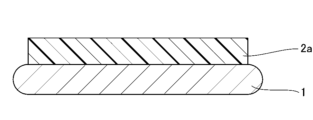
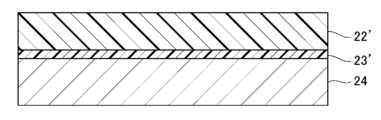
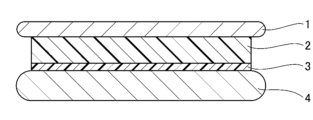
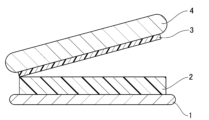
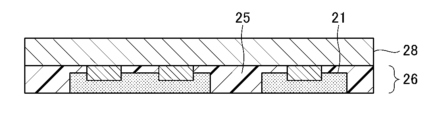
- FIG. 1 is a schematic cross-sectional view of an example of a laminate according to the first embodiment.
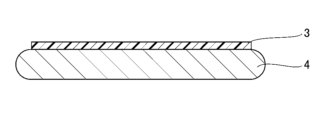
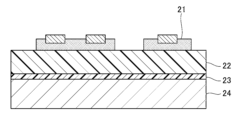
- FIG. 2A is a schematic cross-sectional view (part 1) illustrating a method for producing a laminate showing one example of the first embodiment.
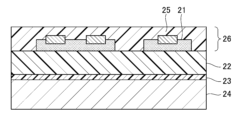
- FIG. 2B is a schematic cross-sectional view (part 2) illustrating an example of a method for producing a laminate according to the first embodiment.
- FIG. 2C is a schematic cross-sectional view (part 3) illustrating an example of a method for producing a laminate according to the first embodiment.
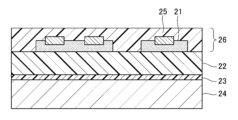
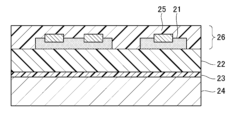
- FIG. 3 is a schematic cross-sectional view of an example of a laminate according to the second embodiment.
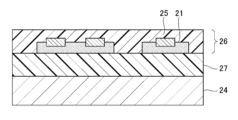
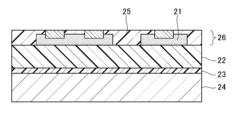
- FIG. 4 is a schematic cross-sectional view of another example of the laminate in the second embodiment.
- FIG. 1 is a schematic cross-sectional view of an example of a laminate according to the first embodiment.
- FIG. 2A is a schematic cross-sectional view (part 1) illustrating a method for producing a laminate showing one example of the first embodiment.
- FIG. 5A is a schematic cross-sectional view (part 1) illustrating an example of a method for producing a laminate according to the second embodiment.
- FIG. 5B is a schematic cross-sectional view (part 2) illustrating an example of the method for producing a laminate according to the second embodiment.
- FIG. 5C is a schematic cross-sectional view (part 3) illustrating an example of the method for producing a laminate according to the second embodiment.
- FIG. 5D is a schematic cross-sectional view (part 4) illustrating an example of a method for producing a laminate according to the second embodiment.
- FIG. 6A is a schematic cross-sectional view (part 1) illustrating a method for processing a laminate showing one example of the first embodiment.
- FIG. 6A is a schematic cross-sectional view (part 1) illustrating a method for processing a laminate showing one example of the first embodiment.
- FIG. 6B is a schematic cross-sectional view (part 2) illustrating a method for processing a laminate showing one example of the first embodiment.
- FIG. 6C is a schematic cross-sectional view (part 3) illustrating a method for processing a laminate showing one example of the first embodiment.
- FIG. 6D is a schematic cross-sectional view (part 4) illustrating a method for processing a laminate showing one example of the first embodiment.
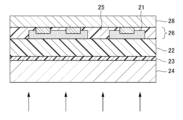
- FIG. 7A is a schematic cross-sectional view (part 1) illustrating a method for processing a laminate showing one example of the second embodiment.
- FIG. 7B is a schematic cross-sectional view (part 2) illustrating a method for processing a laminate showing one example of the second embodiment.
- FIG. 7C is a schematic cross-sectional view (part 3) illustrating a method for processing a laminate showing one example of the second embodiment.
- FIG. 7D is a schematic cross-sectional view (part 4) illustrating a method for processing a laminate showing one example of the second embodiment.
- FIG. 7E is a schematic cross-sectional view (part 5) illustrating a method for processing a laminate showing an example of the second embodiment.
- FIG. 7F is a schematic cross-sectional view (part 6) illustrating a method for processing a laminate showing one example of the second embodiment.
- the stripping agent composition for photo-exposure stripping of the present invention contains a polymer and a solvent.
- the stripping composition for stripping by light irradiation may contain other components.
- the polymer has a first structure, a second structure, and a third structure.
- the first structure has a structure that absorbs light and imparts releasability to the release agent layer formed from the release agent composition.
- the second structure has a --Si--O--Si-- structure in the main chain of the polymer.
- the third structure has at least one of an aromatic hydrocarbon ring and a hetero ring. The first structure, the second structure, and the third structure are different from each other.
- the first structure is not particularly limited as long as it has a structure that absorbs light and imparts releasability to a release agent layer formed from the release agent composition.
- the wavelength of the light used for peeling is, for example, preferably 250 to 600 nm, more preferably 250 to 370 nm. More preferred wavelengths are 308 nm, 343 nm, 355 nm, 365 nm, or 532 nm.
- the amount of light required for peeling is an amount that can cause suitable alteration, for example decomposition, of the first structure.
- the light used for the peeling may be laser light or non-laser light emitted from a light source such as an ultraviolet lamp.
- the first structure is preferably a repeating unit represented by the following formula (1).
- m1 and m2 each independently represent 0 or 1.
- R 1 and R 2 each independently represent a halogen atom or a monovalent group.
- n1 and n2 each independently represent an integer of 0 to 4. When R 1 is 2 or more, the two or more R 1 may be the same or different. When R2 is 2 or more, the 2 or more R2 may be the same or different.
- X 1 in formula (1) is preferably --CO-- or --NR a --.
- Examples of the substituent in the optionally substituted alkyl group for R a in -NR a - in formula (1) include a halogen atom, a hydroxy group, a carboxy group, and an alkoxy group having 1 to 6 carbon atoms.
- the number of carbon atoms in the "alkyl group" in the optionally substituted alkyl group for R a is, for example, preferably 1 to 6.
- the optionally substituted alkyl group represented by R a is preferably an alkyl group having 1 to 6 carbon atoms, and more preferably an alkyl group having 1 to 4 carbon atoms.
- examples of the halogen atom include a fluorine atom, a chlorine atom, a bromine atom, and an iodine atom.
- Examples of the substituent in the optionally substituted aryl group for R a in -NR a - in formula (1) include a halogen atom, a hydroxy group, a carboxy group, an alkyl group having 1 to 6 carbon atoms, and an alkoxy group having 1 to 6 carbon atoms.
- the aromatic ring in the optionally substituted aryl group represented by R a may be an aromatic hydrocarbon ring or an aromatic heterocyclic ring, and is preferably an aromatic hydrocarbon ring, such as a benzene ring, a naphthalene ring, or an anthracene ring.
- the optionally substituted aryl group represented by R a is preferably an optionally substituted phenyl group.
- Examples of the monovalent group for R1 and R2 in formula (1) include a halogen atom, a hydroxy group, a carboxy group, an optionally substituted alkyl group, an optionally substituted alkoxy group, and an optionally substituted aryl group.
- Examples of the substituent in the optionally substituted alkyl group represented by R 1 and R 2 include a halogen atom, a hydroxy group, a carboxy group, and an alkoxy group having 1 to 6 carbon atoms.
- the optionally substituted alkyl group represented by R 1 and R 2 is preferably an alkyl group having 1 to 6 carbon atoms, more preferably an alkyl group having 1 to 4 carbon atoms.
- Examples of the substituent in the optionally substituted alkoxy group represented by R 1 and R 2 include a halogen atom, a hydroxy group, a carboxy group, and the like.
- the optionally substituted alkoxy group represented by R 1 and R 2 is preferably an alkoxy group having 1 to 6 carbon atoms, more preferably an alkoxy group having 1 to 4 carbon atoms.
- Examples of the substituent in the optionally substituted aryl group represented by R1 and R2 include a halogen atom, a hydroxy group, a carboxy group, an alkyl group having 1 to 6 carbon atoms, and an alkoxy group having 1 to 6 carbon atoms.
- the aromatic ring in the optionally substituted aryl group represented by R1 and R2 may be an aromatic hydrocarbon ring or an aromatic heterocycle, with an aromatic hydrocarbon ring being preferred.
- the aromatic hydrocarbon ring include a benzene ring, a naphthalene ring, and an anthracene ring.
- an optionally substituted aryl group represented by R 1 and R 2 an optionally substituted phenyl group is preferable.
- n1 and m2 each independently represent 0 or 1, but it is preferable that both m1 and m2 are 0.
- the bonding position to the benzene ring is not particularly limited, but the repeating unit represented by formula (1) is preferably a repeating unit represented by the following formula (1-1).
- formula (1-1) X 1 , R 1 , R 2 , m1, m2, n1, and n2 are respectively defined as X 1 , R 1 , R 2 , m1, m2, n1, and n2 in formula (1).
- repeating unit represented by formula (1) examples include the following repeating units.
- the second structure is not particularly limited as long as it has a --Si--O--Si-- structure in the main chain of the polymer.
- the polymer has the second structure, which imparts washability to the release agent layer formed from the release agent composition.
- the second structure is preferably a repeating unit represented by the following formula (2-1) or (2-2).
- X11 represents a divalent group having a —Si—O—Si— structure.
- a 1 , A 2 , A 3 , A 4 , A 5 and A 6 each independently represent a hydrogen atom, a methyl group or an ethyl group.
- X12 represents a divalent group having a -Si-O-Si- structure. *1 and *1' represent bonds. Bond *1 is bonded to carbon atom *2 or carbon atom *3. Bond *1' is bonded to carbon atom *2' or carbon atom *3'.
- a 1 , A 2 , A 3 , A 4 , A 5 and A 6 are preferably a hydrogen atom.
- X 11 in formula (2-1) and X 12 in formula (2-2) preferably have a structure represented by the following formula (S).
- R 101 to R 106 each independently represent a substituted or unsubstituted alkyl group, a substituted or unsubstituted alkenyl group, or a substituted or unsubstituted aryl group.
- Y1 and Y2 each independently represent an alkylene group having 1 to 10 carbon atoms.
- m represents an integer of 0 or 1 or more.
- p and q each independently represent 0 or 1. When m is 2 or more, two or more R 103 and two or more R 104 may be the same or different. * represents a bond.
- the "alkyl group" in the "substituted or unsubstituted alkyl group” of R 101 to R 106 in formula (S) is preferably an alkyl group having 1 to 10 carbon atoms.
- Examples of the "alkyl group” include a methyl group, an ethyl group, a propyl group, an isopropyl group, a butyl group, an isobutyl group, a sec-butyl group, a tert-butyl group, a pentyl group, an isopentyl group, a neopentyl group, a sec-pentyl group, a tert-pentyl group, a cyclopentyl group, a cyclohexyl group, a cyclopentylmethyl group, a 2-cyclohexylmethyl group, a 2-cyclopentylethyl group, and a 2-cyclohexylethyl group.
- alkenyl group in the "substituted or unsubstituted alkenyl group” of R 101 to R 106 in formula (S) is preferably an alkenyl group having 2 to 10 carbon atoms.
- alkenyl group include a vinyl group, a 1-propenyl group, a 2-propenyl group, a 2-methyl-1-propenyl group, a 1-butenyl group, a 2-butenyl group, a 3-butenyl group, a 3-methyl-2-butenyl group, a 1-pentenyl group, a 2-pentenyl group, a 3-pentenyl group, a 4-pentenyl group, a 4-methyl-3-pentenyl group, a 1-hexenyl group, a 3-hexenyl group, a 5-hexenyl group, and a 2-cyclohexenyl group.
- the substituents of the alkyl group in the "substituted or unsubstituted alkyl group" of R 101 to R 106 in formula (S) and the substituents of the alkenyl group in the "substituted or unsubstituted alkenyl group” are not particularly limited, and examples thereof include a halogen atom, a cyano group, a nitro group, an alkyl-oxy group, an alkyl-carbonyl group, an alkyl-oxy-carbonyl group, an alkyl-carbonyl-oxy group, an alkenyl-oxy group, an alkenyl-carbonyl group, an alkenyl-oxy-carbonyl group, an alkenyl-carbonyl-oxy group, an alkenyl-carbonyl-oxy group, an aryl group, an aryl-oxy group, an aryl-carbonyl group, an aryl-oxy-carbonyl group, an aryl-carbonyl-oxy group,
- the "aryl group” in the "substituted or unsubstituted aryl group” of R 101 to R 106 in formula (S) is preferably an aryl group having 6 to 14 carbon atoms.
- Examples of the "aryl group” include a phenyl group, a 1-naphthyl group, and a 2-naphthyl group.
- the substituent of the aryl group in the "substituted or unsubstituted aryl group" of R 101 to R 106 is not particularly limited, and examples thereof include a halogen atom, a cyano group, a nitro group, an alkyl group, an alkyl-oxy group, an alkyl-carbonyl group, an alkyl-oxy-carbonyl group, an alkyl-carbonyl-oxy group, an alkenyl group, an alkenyl-oxy group, an alkenyl-carbonyl group, an alkenyl-oxy-carbonyl group, an alkenyl-carbonyl-oxy group, an aryl group, an aryl-alkyl group, an aryl-alkenyl group, an aryl-oxy group, an aryl-carbonyl group, an aryl-oxy-carbonyl group, an aryl-carbonyl-oxy group, and the like, or a combination thereof.
- R 101 to R 106 are preferably a substituted or unsubstituted alkyl group or a substituted or unsubstituted aryl group, more preferably an (unsubstituted) alkyl group or an (unsubstituted) aryl group, further more preferably a methyl group, an ethyl group, a propyl group, an isopropyl group or a phenyl group, and particularly preferably a methyl group or a phenyl group.
- Y 1 and Y 2 are alkylene groups having 1 to 10 carbon atoms, and preferably alkylene groups having 1 to 6 carbon atoms.
- Examples of the formula (S) as X 11 in the formula (2-1) include the following structures.
- Y 1 and Y 2 are defined the same as Y 1 and Y 2 in formula (S), respectively.
- m represents an integer of 1 or more.
- * represents a bond.
- Examples of the formula (S) as X 12 in the formula (2-2) include the following structures. (In the formula, * represents a bond.)
- the third structure is not particularly limited as long as it has at least one of an aromatic hydrocarbon ring and a hetero ring.
- the aromatic hydrocarbon ring include a benzene ring, a naphthalene ring, and an anthracene ring.
- the heteroatom contained in the hetero ring include an oxygen atom and a nitrogen atom.
- the number of members of the heterocycle may be, for example, 5 to 7.
- the third structure is preferably a repeating unit represented by the following formula (3).
- X21 represents a divalent group having at least one of an aromatic hydrocarbon ring and a hetero ring.
- a 11 , A 12 , A 13 , A 14 , A 15 and A 16 each independently represent a hydrogen atom, a methyl group or an ethyl group.
- X 21 in the formula (3) is either a structure represented by the following formula (3-1) or a structure represented by the following formula (3-2).
- Q1 represents a divalent organic group represented by formula (3-1-1) below, or a divalent organic group represented by formula (3-1-2) below.
- n1 and n2 each independently represent 0 or 1. * represents a bond.
- X31 represents a divalent group represented by any one of the following formulas (3-2-1) to (3-2-3).
- Z1 and Z2 each independently represent a single bond or a divalent group represented by the following formula (3-2-4). * represents a bond.
- R 21 to R 23 each independently represent a halogen atom, a hydroxy group, an alkyl group having 1 to 6 carbon atoms, an alkenyl group having 2 to 6 carbon atoms, an alkynyl group having 2 to 6 carbon atoms, an alkoxy group having 1 to 6 carbon atoms, an alkenyloxy group having 2 to 6 carbon atoms, an alkynyloxy group having 2 to 6 carbon atoms, an acyl group having 2 to 6 carbon atoms, an aryloxy group having 6 to 12 carbon atoms, an arylcarbonyl group having 7 to 13 carbon atoms, or an aralkyl group having 7 to 13 carbon atoms.
- n3 represents 0 or 1.
- n11 represents an integer of 0 to 4.
- n11 represents an integer of 0 to 6.
- R 21 is 2 or more, the two or more R 21 may be the same or different.
- Z 11 represents a single bond or an alkylene group having 1 to 6 carbon atoms.
- n12 and n13 each independently represent an integer of 0 to 4.
- R 22 is 2 or more, two or more R 22 may be the same or different.
- R 23 is 2 or more, two or more R 23 may be the same or different.
- R 1 to R 5 each independently represent a hydrogen atom, an alkyl group having 1 to 10 carbon atoms which may be interrupted by an oxygen atom or a sulfur atom, an alkenyl group having 2 to 10 carbon atoms which may be interrupted by an oxygen atom or a sulfur atom, an alkynyl group having 2 to 10 carbon atoms which may be interrupted by an oxygen atom or a sulfur atom, a benzyl group, or a phenyl group, and the phenyl group may be substituted with at least one monovalent group selected from the group consisting of an alkyl group having 1 to 6 carbon atoms, a halogen atom, an alkoxy group having 1 to 6 carbon atoms, a nitro group, a cyano group, and an alkylthio group having 1 to 6 carbon atoms.
- R 1 and R 2 may be bonded to each other to form a ring having 3 to 6 carbon atoms.
- R 3 and R 4 may be bonded to each other to form a ring having 3 to 6 carbon atoms.
- * represents a bond.
- *1 represents a bond bonded to a carbon atom in formula (3-2).
- *2 represents a bond bonded to a nitrogen atom in formula (3-2).
- m1 is an integer of 0 to 4
- m2 is 0 or 1
- m3 is 0 or 1
- m4 is an integer of 0 to 2.
- *3 represents a bond bonded to the nitrogen atom in formula (3-2).
- *4 represents a bond.
- the alkyl group is not limited to being linear, but may be branched or cyclic.
- linear or branched alkyl groups include a methyl group, an ethyl group, an isopropyl group, a tert-butyl group, and an n-hexyl group.
- cyclic alkyl groups include a cyclobutyl group, a cyclopentyl group, and a cyclohexyl group.
- examples of an alkoxy group include a methoxy group, an ethoxy group, an n-pentyloxy group, and an isopropoxy group.
- examples of the alkylthio group include a methylthio group, an ethylthio group, an n-pentylthio group, an isopropylthio group and the like.
- examples of the alkenyl group include an ethenyl group, a 1-propenyl group, a 2-propenyl group, a 1-methyl-1-ethenyl group, a 1-butenyl group, a 2-butenyl group, a 3-butenyl group, a 2-methyl-1-propenyl group, and a 2-methyl-2-propenyl group.
- examples of the alkynyl group include the above-mentioned "alkenyl groups" in which the double bond is replaced with a triple bond.
- examples of the alkenyloxy group include a vinyloxy group, a 1-propenyloxy group, a 2-n-propenyloxy group (allyloxy group), a 1-n-butenyloxy group, and a prenyloxy group.
- examples of the alkynyloxy group include a 2-propynyloxy group, a 1-methyl-2-propynyloxy group, a 2-methyl-2-propynyloxy group, a 2-butynyloxy group, and a 3-butynyloxy group.
- examples of the acyl group include an acetyl group and a propionyl group.
- examples of an aryloxy group include a phenoxy group, naphthyloxy group, and the like.
- examples of the arylcarbonyl group include a phenylcarbonyl group.
- examples of the aralkyl group include a benzyl group and a phenethyl group.
- examples of the alkylene group include a methylene group, an ethylene group, a 1,3-propylene group, a 2,2-propylene group, a 1-methylethylene group, a 1,4-butylene group, a 1-ethylethylene group, a 1-methylpropylene group, a 2-methylpropylene group, a 1,5-pentylene group, a 1-methylbutylene group, a 2-methylbutylene group, a 1,1-dimethylpropylene group, a 1,2-dimethylpropylene group, a 1-ethylpropylene group, a 2-ethylpropylene group, a 1,6-hexylene group, a 1,4-cyclohexylene group, a 1,8-octylene group, a 2-ethyloctylene group, a 1,9-nonylene group, and a 1,10-decylene group.
- Examples of the alkyl group having 1 to 10 carbon atoms which may be interrupted by an oxygen atom or a sulfur atom in R 1 to R 5 of formulas (3-2-1) to (3-2-3) include an alkyl group having 1 to 10 carbon atoms, an alkoxy group having 1 to 10 carbon atoms, an alkoxyalkyl group having 2 to 10 carbon atoms, an alkoxyalkoxyalkyl group having 3 to 10 carbon atoms, an alkylthio group having 1 to 10 carbon atoms, and an alkylthioalkyl group having 2 to 10 carbon atoms.
- the alkyl group having 1 to 10 carbon atoms which may be interrupted by an oxygen atom or a sulfur atom may contain two or more oxygen atoms or sulfur atoms.
- Examples of the structure represented by formula (3-1) include the structures shown below. (* represents a bond.)
- Examples of the structure represented by formula (3-2) include the following structures.
- the polymer has, for example, a repeating unit represented by the following formula (X-2-1) as a repeating unit obtained by combining a repeating unit represented by the formula (1) and a repeating unit represented by the formula (2-1).
- the polymer has, for example, a repeating unit represented by the following formula (X-2-2) as a repeating unit obtained by combining a repeating unit represented by the formula (1) and a repeating unit represented by the formula (2-2).
- the polymer has, for example, a repeating unit represented by the following formula (X-3) as a repeating unit obtained by combining a repeating unit represented by the formula (1) and a repeating unit represented by the formula (3).
- X 1 , R 1 , R 2 , m1, m2, n1, and n2 are respectively defined as X 1 , R 1 , R 2 , m1, m2, n1, and n2 in formula (1).
- X 11 , A 1 , A 2 , A 3 , A 4 , A 5 and A 6 have the same definitions as X 11 , A 1 , A 2 , A 3 , A 4 , A 5 and A 6 in formula (2-1), respectively.
- X 12 has the same meaning as X 12 in formula (2-2).
- X 21 , A 11 , A 12 , A 13 , A 14 , A 15 and A 16 have the same meanings as X 21 , A 11 , A 12 , A 13 , A 14 , A 15 and A 16 in formula (3), respectively.
- the polymer has, for example, a repeating unit represented by formula (X-2-1) and a repeating unit represented by formula (X-3).
- the polymer has, for example, a repeating unit represented by formula (X-2-2) and a repeating unit represented by formula (X-3).
- the molar ratio [(X-2):(X-3)] of the sum (X-2) of the repeating units (X-2-1) represented by formula (X-2-1) and the repeating units (X-2-2) represented by formula (X-2-2) in the polymer to the repeating units (X-3) represented by formula (X-3) is not particularly limited, but is preferably 10:90 to 80:20, more preferably 20:80 to 70:30, and particularly preferably 30:70 to 60:40.
- the molar ratio of the repeating unit (X-2-1) represented by formula (X-2-1) to the repeating unit (X-3) represented by formula (X-3) in the polymer [(X-2-1):(X-3)] is not particularly limited, but is preferably 10:90 to 80:20, more preferably 20:80 to 70:30, and particularly preferably 30:70 to 60:40.
- the molar ratio of the repeating unit (X-2-2) represented by formula (X-2-2) to the repeating unit (X-3) represented by formula (X-3) in the polymer [(X-2-2):(X-3)] is not particularly limited, but is preferably 10:90 to 80:20, more preferably 20:80 to 70:30, and particularly preferably 30:70 to 60:40.
- the weight average molecular weight of the polymer is, for example, 300 to 100,000, preferably 800 to 50,000, more preferably 1,000 to 10,000, and particularly preferably 1,200 to 5,000.
- An example of a method for producing a polymer will be described.
- An example of the polymer can be obtained, for example, by the following reaction (I).
- X 11 , A 1 , A 2 , A 3 , A 4 , A 5 and A 6 have the same definitions as X 11 , A 1 , A 2 , A 3 , A 4 , A 5 and A 6 in formula (2-1), respectively.
- X 12 has the same meaning as X 12 in formula (2-2).
- X21 , A11 , A12, A13 , A14, A15 and A16 have the same meanings as X21 , A11 , A12 , A13 , A14 , A15 and A16 in formula ( 3 ) , respectively.
- Examples of the compound represented by formula (1X) include the following compounds.
- Examples of the compound represented by formula (2-1X) include the following compounds.
- the compounds also include polymer compounds.
- Examples of the compound represented by formula (2-2X) include the following compounds.
- Examples of the compound represented by formula (3X) include the following compounds.
- Reaction (I) may be carried out, for example, in the presence of a catalyst.
- the catalyst is, for example, a quaternary phosphonium salt such as tetrabutylphosphonium bromide or ethyltriphenylphosphonium bromide, or a quaternary ammonium salt such as benzyltriethylammonium chloride.
- the amount of catalyst used may be selected from the range of 0.1 to 10% by mass based on the total mass of the reaction raw materials used in the reaction.
- the optimum reaction temperature and time may be selected from the ranges of, for example, 80 to 160°C and 2 to 50 hours.
- the content of the polymer in the stripping composition is not particularly limited, but is preferably 60% by mass to 100% by mass, more preferably 70% by mass to 100% by mass, and particularly preferably 80% by mass to 100% by mass, based on the film-constituting components in the stripping composition.
- the film constituent components refer to the components other than the solvent in the stripper composition.
- the stripper composition may include a crosslinker.
- the crosslinking agent may undergo a crosslinking reaction by self-condensation, but when crosslinkable substituents are present in the above-mentioned polymer, the crosslinking agent can undergo a crosslinking reaction with the crosslinkable substituents.
- crosslinking agent examples include phenol-based crosslinking agents, melamine-based crosslinking agents, urea-based crosslinking agents, and thiourea-based crosslinking agents, each of which has a crosslinking-forming group in the molecule, such as an alkoxymethyl group (e.g., a hydroxymethyl group, a methoxymethyl group, or a butoxymethyl group), and these may be low molecular weight compounds or high molecular weight compounds.
- the crosslinking agent contained in the release agent composition usually has two or more crosslinking groups.
- the number of crosslinking groups contained in the compound that is the crosslinking agent is preferably 2 to 10, more preferably 2 to 6.
- the crosslinking agent contained in the release agent composition preferably has an aromatic ring (e.g., a benzene ring, a naphthalene ring) in the molecule, and a typical example of such a crosslinking agent includes, but is not limited to, a phenol-based crosslinking agent.
- a phenol-based crosslinking agent having a crosslinking group is a compound having a crosslinking group bonded to an aromatic ring and having at least one of a phenolic hydroxy group and an alkoxy group derived from a phenolic hydroxy group.
- alkoxy group derived from such a phenolic hydroxy group include, but are not limited to, a methoxy group and a butoxy group.
- the aromatic ring to which the cross-linking group is bonded and the aromatic ring to which the phenolic hydroxy group and/or the alkoxy group derived from the phenolic hydroxy group is bonded are not limited to non-condensed aromatic rings such as a benzene ring, but may also be condensed aromatic rings such as a naphthalene ring, anthracene ring, etc.
- the crosslinking group, the phenolic hydroxy group, and the alkoxy group derived from the phenolic hydroxy group may be bonded to the same aromatic ring or different aromatic rings in the molecule.
- the aromatic ring to which the crosslinking group, the phenolic hydroxy group, or the alkoxy group derived from the phenolic hydroxy group is bonded may be further substituted with a hydrocarbon group such as an alkyl group (e.g., methyl, ethyl, butyl, etc.) or an aryl group (e.g., phenyl, etc.) or a halogen atom (e.g., fluorine, etc.).
- a hydrocarbon group such as an alkyl group (e.g., methyl, ethyl, butyl, etc.) or an aryl group (e.g., phenyl, etc.) or a halogen atom (e.g., fluorine, etc.).
- phenol-based crosslinking agents having a crosslinking group include compounds represented by any of formulas (L1) to (L4).
- each R' independently represents a fluorine atom, an aryl group, or an alkyl group
- each R'' independently represents a hydrogen atom or an alkyl group
- each L1 and L2 independently represent a single bond, a methylene group, or a propane-2,2-diyl group
- L 3 is determined according to q1 and represents a single bond, a methylene group, a propane-2,2-diyl group, a methanetriyl group, or an ethane-1,1,1-triyl group
- t11, t12, and t13 are integers that satisfy 2 ⁇ t11 ⁇ 5, 1 ⁇ t12 ⁇ 4, 0 ⁇ t13 ⁇ 3, and t11+t12+t13 ⁇ 6
- t21, t22, and t23 are integers that satisfy 2 ⁇ t21 ⁇ 4, 1 ⁇ t22 ⁇ 3, 0 ⁇ t23 ⁇ 2, and t21+t22+t23 ⁇ 5
- t24, t25, and t26
- the melamine-based crosslinking agent having a crosslinking group is a melamine derivative, a 2,4-diamino-1,3,5-triazine derivative or a 2-amino-1,3,5-triazine derivative in which at least one hydrogen atom of an amino group bonded to the triazine ring is substituted with a crosslinking group, and the triazine ring may further have a substituent such as an aryl group such as a phenyl group.
- melamine-based crosslinking agents having a crosslinking group include mono-, bis-, tris-, tetrakis-, pentakis- or hexakisalkoxymethylmelamines such as N,N,N',N',N",N"-hexakis(methoxymethyl)melamine and N,N,N',N',N",N"-hexakis(butoxymethyl)melamine; mono-, bis-, tris- or tetrakisalkoxymethylbenzoguanamines such as N,N,N',N'-tetrakis(methoxymethyl)benzoguanamine and N,N,N',N'-tetrakis(butoxymethyl)benzoguanamine, but are not limited to these.
- the urea-based crosslinking agent having a crosslinking group is a derivative of a compound containing a urea bond, and has a structure in which at least one hydrogen atom of an NH group constituting a urea bond is substituted with a crosslinking group.
- urea-based crosslinking agents having a crosslinking group include mono-, bis-, tris-, or tetrakisalkoxymethylglycolurils such as 1,3,4,6-tetrakis(methoxymethyl)glycoluril and 1,3,4,6-tetrakis(butoxymethyl)glycoluril; and mono-, bis-, tris-, or tetrakisalkoxymethylureas such as 1,3-bis(methoxymethyl)urea and 1,1,3,3-tetrakismethoxymethylurea, but are not limited to these.
- a thiourea-based crosslinking agent having a crosslinking group is a derivative of a compound containing a thiourea bond, and has a structure in which at least one hydrogen atom of an NH group constituting a thiourea bond is substituted with a crosslinking group.
- Specific examples of thiourea-based crosslinking agents having a crosslinking group include mono-, bis-, tris-, or tetrakis-alkoxymethylthioureas such as 1,3-bis(methoxymethyl)thiourea and 1,1,3,3-tetrakismethoxymethylthiourea, but are not limited to these.
- the amount of crosslinking agent optionally contained in the release agent composition cannot be generally defined because it varies depending on the coating method employed, the desired film thickness, etc., but is usually 0.01 to 50% by mass relative to the polymer. From the viewpoint of achieving suitable curing and reproducibly obtaining a laminate in which the semiconductor substrate or electronic device layer and the support substrate can be easily separated, the amount is preferably 0.1% by mass or more, more preferably 1% by mass or more, even more preferably 3% by mass or more, even more preferably 5% by mass or more, and is preferably 45% by mass or less, more preferably 40% by mass or less, even more preferably 35% by mass or less, and even more preferably 30% by mass or less.
- the stripping composition may contain an acid generator or an acid.
- the acid generator examples include a thermal acid generator and a photoacid generator.
- the thermal acid generator is not particularly limited as long as it generates an acid by heat, and specific examples thereof include 2,4,4,6-tetrabromocyclohexadienone, benzoin tosylate, 2-nitrobenzyl tosylate, K-PURE (registered trademark) CXC-1612, CXC-1614, TAG-2172, TAG-2179, TAG-2678, TAG2689, and TAG2700 (manufactured by King Industries), and SI-45, SI-60, SI-80, SI-100, SI-110, and SI-150 (manufactured by Sanshin Chemical Industry Co., Ltd.), and other organic sulfonic acid alkyl esters, but are not limited thereto.
- photoacid generators examples include onium salt compounds, sulfonimide compounds, and disulfonyldiazomethane compounds.
- onium salt compounds include iodonium salt compounds such as diphenyliodonium hexafluorophosphate, diphenyliodonium trifluoromethanesulfonate, diphenyliodonium nonafluoronormal butanesulfonate, diphenyliodonium perfluoronormal octanesulfonate, diphenyliodonium camphorsulfonate, bis(4-tert-butylphenyl)iodonium camphorsulfonate, and bis(4-tert-butylphenyl)iodonium trifluoromethanesulfonate; and sulfonium salt compounds such as triphenylsulfonium nitrate, triphenylsulfonium hexafluoroantimonate, triphenylsulfonium nonafluoronormal butanesulfonate, triphenylsulfonium camphorsul
- sulfonimide compounds include, but are not limited to, N-(trifluoromethanesulfonyloxy)succinimide, N-(nonafluoronormalbutanesulfonyloxy)succinimide, N-(camphorsulfonyloxy)succinimide, and N-(trifluoromethanesulfonyloxy)naphthalimide.
- disulfonyldiazomethane compounds include, but are not limited to, bis(trifluoromethylsulfonyl)diazomethane, bis(cyclohexylsulfonyl)diazomethane, bis(phenylsulfonyl)diazomethane, bis(p-toluenesulfonyl)diazomethane, bis(2,4-dimethylbenzenesulfonyl)diazomethane, methylsulfonyl-p-toluenesulfonyldiazomethane, etc.
- acids include arylsulfonic acids and pyridinium salts such as p-toluenesulfonic acid, pyridinium p-toluenesulfonate, pyridinium trifluoromethanesulfonate, pyridinium phenolsulfonic acid, 5-sulfosalicylic acid, 4-phenolsulfonic acid, 4-chlorobenzenesulfonic acid, benzenedisulfonic acid, and 1-naphthalenesulfonic acid, salicylic acid, benzoic acid, hydroxybenzoic acid, and naphthalenecarboxylic acid, arylcarboxylic acids and salts thereof, trifluoromethanesulfonic acid, camphorsulfonic acid, and other linear or cyclic alkylsulfonic acids and salts thereof, and citric acid and other linear or cyclic alkylcarboxylic acids and salts thereof, but are not limited to these.
- the amount of acid generator and acid contained in the stripper composition cannot be generally determined because both vary depending on the type of crosslinker that is optionally used and the heating temperature when forming the film, but is usually 0.01 to 5% by mass based on the film components.
- the stripping agent composition may contain a surfactant for the purposes of adjusting the liquid properties of the composition itself and the film properties of the resulting film, and for the purpose of preparing a highly uniform stripping agent composition with good reproducibility.
- the surfactant include polyoxyethylene alkyl ethers such as polyoxyethylene lauryl ether, polyoxyethylene stearyl ether, polyoxyethylene cetyl ether, and polyoxyethylene oleyl ether; polyoxyethylene alkyl allyl ethers such as polyoxyethylene octyl phenol ether and polyoxyethylene nonyl phenol ether; polyoxyethylene-polyoxypropylene block copolymers; sorbitan fatty acid esters such as sorbitan monolaurate, sorbitan monopalmitate, sorbitan monostearate, sorbitan monooleate, sorbitan trioleate, and sorbitan tristearate; polyoxyethylene sorbitan monolaurate, polyoxyethylene sorbitan monolaurate
- the stripper composition includes a solvent.
- a solvent for example, a high polarity solvent capable of dissolving the above-mentioned film constituent components such as the polymer and the crosslinking agent well can be used, and a low polarity solvent may be used as necessary for the purpose of adjusting the viscosity, surface tension, etc.
- a low polarity solvent is defined as a solvent having a relative dielectric constant of less than 7 at a frequency of 100 kHz
- a high polarity solvent is defined as a solvent having a relative dielectric constant of 7 or more at a frequency of 100 kHz.
- the solvent may be used alone or in combination of two or more.
- highly polar solvents include amide-based solvents such as N,N-dimethylformamide, N,N-dimethylacetamide, N,N-dimethylisobutyramide, N-methylpyrrolidone, and 1,3-dimethyl-2-imidazolidinone; ketone-based solvents such as ethyl methyl ketone, isophorone, and cyclohexanone; cyano-based solvents such as acetonitrile and 3-methoxypropionitrile; polyhydric alcohol-based solvents such as ethylene glycol, diethylene glycol, triethylene glycol, dipropylene glycol, 1,3-butanediol, and 2,3-butanediol; Examples of the solvent include monohydric alcohol solvents other than aliphatic alcohols, such as propylene glycol monomethyl ether, diethylene glycol monomethyl ether, diethylene glycol monophenyl ether, triethylene glycol monomethyl ether, dipropylene
- low polarity solvents include chlorine-based solvents such as chloroform and chlorobenzene; aromatic hydrocarbon-based solvents such as alkylbenzenes such as toluene, xylene, tetralin, cyclohexylbenzene, and decylbenzene; aliphatic alcohol-based solvents such as 1-octanol, 1-nonanol, and 1-decanol; ether-based solvents such as tetrahydrofuran, dioxane, anisole, 4-methoxytoluene, 3-phenoxytoluene, dibenzyl ether, diethylene glycol dimethyl ether, diethylene glycol butyl methyl ether, triethylene glycol dimethyl ether, and triethylene glycol butyl methyl ether; and ester-based solvents such as methyl benzoate, ethyl benzoate, butyl benzoate, isoamyl benzoate, bis(2-ethyl
- the amount of solvent is appropriately determined taking into consideration the viscosity of the desired composition, the coating method to be used, the thickness of the film to be produced, etc., but is 99% by mass or less of the entire composition, preferably 70 to 99% by mass, and more preferably 85 to 97% by mass of the entire composition; in other words, the amount of the film components in this case is preferably 1 to 30% by mass, and more preferably 3 to 15% by mass of the entire composition.
- the viscosity and surface tension of the stripping composition are adjusted appropriately by changing the types of solvents used, their ratios, the concentrations of the film components, etc., taking into consideration various factors such as the coating method used and the desired film thickness.
- the stripping agent composition contains a glycol-based solvent from the viewpoint of reproducibly obtaining a highly uniform composition, a highly storage stable composition, and a composition that gives a highly uniform film.
- glycol-based solvent here is a general term for glycols, glycol monoethers, glycol diethers, glycol monoesters, glycol diesters, and glycol ester ethers.
- R G1 each independently represents a linear or branched alkylene group having 2 to 4 carbon atoms
- R G2 and R G3 each independently represent a hydrogen atom, a linear or branched alkyl group having 1 to 8 carbon atoms, or an alkylacyl group in which the alkyl portion is a linear or branched alkyl group having 1 to 8 carbon atoms
- n g is an integer from 1 to 6.
- linear or branched alkylene group having 2 to 4 carbon atoms include, but are not limited to, an ethylene group, a trimethylene group, a 1-methylethylene group, a tetramethylene group, a 2-methylpropane-1,3-diyl group, a pentamethylene group, and a hexamethylene group.
- a linear or branched alkylene group having 2 to 3 carbon atoms is preferred, and a linear or branched alkylene group having 3 carbon atoms is more preferred.
- linear or branched alkyl group having 1 to 8 carbon atoms include a methyl group, an ethyl group, an n-propyl group, an i-propyl group, an n-butyl group, an i-butyl group, an s-butyl group, a tertiary butyl group, an n-pentyl group, a 1-methyl-n-butyl group, a 2-methyl-n-butyl group, a 3-methyl-n-butyl group, a 1,1-dimethyl-n-propyl group, a 1,2-dimethyl-n-propyl group, a 2,2-dimethyl-n-propyl group, a 1-ethyl-n-propyl group, an n-hexyl group, a 1-methyl-n-pentyl group, a 2-methyl-n-pentyl group, a 3-methyl
- dimethyl-n-butyl groups include, but are
- a methyl group and an ethyl group are preferred, and a methyl group is more preferred.
- linear or branched alkyl group having 1 to 8 carbon atoms in the alkyl acyl group in which the alkyl portion is a linear or branched alkyl group having 1 to 8 carbon atoms are the same as those mentioned above.
- a methylcarbonyl group and an ethylcarbonyl group are preferred, and a methylcarbonyl group is more preferred.
- n g is preferably 4 or less, more preferably 3 or less, even more preferably 2 or less, and most preferably 1.
- R G2 and R G3 are a linear or branched alkyl group having 1 to 8 carbon atoms, and more preferably, one of R G2 and R G3 is a linear or branched alkyl group having 1 to 8 carbon atoms, and the other is a hydrogen atom or an alkyl acyl group in which the alkyl moiety is a linear or branched alkyl group having 1 to 8 carbon atoms.
- the content of the glycol-based solvent is preferably 50% by mass or more, more preferably 70% by mass or more, even more preferably 80% by mass or more, even more preferably 90% by mass or more, and even more preferably 95% by mass or more, based on the solvent contained in the stripping agent composition.
- the film constituent components are uniformly dispersed or dissolved in the solvent, and preferably dissolved.
- the solvents, solutions, etc. used may be filtered using a filter during the production of the stripping composition or after all the components have been mixed.
- the laminate according to the present invention comprises a semiconductor substrate or an electronic device layer, a supporting substrate, and a release agent layer for peeling by light irradiation.
- the laminate according to the present invention preferably further comprises an adhesive layer, and has a configuration comprising a semiconductor substrate or electronic device layer, a supporting substrate, a release agent layer for peeling by light irradiation, and an adhesive layer.
- the laminate may be formed of a single-layer structure of the release agent layer having adhesive performance, rather than a two-layer structure of the release agent layer and the adhesive layer.
- the supporting substrate is optically transparent.
- the release agent layer for light irradiation peeling is provided between the semiconductor substrate or electronic device layer and the supporting substrate.
- the laminate is used in such a manner that the semiconductor substrate or electronic device layer and the supporting substrate are peeled off after the release agent layer absorbs light irradiated from the supporting substrate side.
- the release agent layer for peeling off by light irradiation is a layer formed from the above-mentioned release agent composition for peeling off by light irradiation of the present invention.
- the laminate of the present invention is used for temporary bonding for processing a semiconductor substrate or an electronic device layer, and can be suitably used for processing such as thinning a semiconductor substrate or an electronic device layer.
- the semiconductor substrate is supported by the support substrate.
- the release agent layer is irradiated with light, and then the support substrate and the semiconductor substrate are separated. Due to the polymer contained in the release agent composition, in the release agent layer formed from the release agent composition, the polymer (particularly the first structure) absorbs light (e.g., laser light) and alters (e.g., separates or decomposes) the release agent layer.
- the release agent layer is irradiated with light
- the semiconductor substrate and the support substrate are easily peeled off.
- the electronic device layer is supported by the support substrate.
- the release agent layer is irradiated with light, and then the support substrate and the electronic device layer are separated from each other.
- the release agent layer according to the present invention facilitates peeling of the semiconductor substrate or electronic device layer from the supporting substrate after irradiation with light.
- residues of the release agent layer or adhesive layer remaining on the semiconductor substrate, electronic device layer, or supporting substrate after the semiconductor substrate or electronic device layer is peeled from the supporting substrate can be removed, for example, with a cleaning composition for cleaning semiconductor substrates and the like.
- the wavelength of the light used for peeling is, for example, preferably 250 to 600 nm, more preferably 250 to 370 nm. More preferred wavelengths are 308 nm, 343 nm, 355 nm, 365 nm, or 532 nm.
- the amount of light required for peeling is an amount that can cause suitable alteration, for example decomposition, of the first structure in the release agent layer.
- the light used for the peeling may be laser light or non-laser light emitted from a light source such as an ultraviolet lamp.
- the laminated body will be described in detail below, with respect to the case where the laminated body includes a semiconductor substrate and the case where the laminated body includes an electronic device layer.
- the case where the laminate has a semiconductor substrate will be described below in the ⁇ First embodiment>, and the case where the laminate has an electronic device layer will be described below in the ⁇ Second embodiment>.
- the laminate having the semiconductor substrate is used for processing the semiconductor substrate. During the processing of the semiconductor substrate, the semiconductor substrate is adhered to the support substrate. After the processing of the semiconductor substrate, the release agent layer is irradiated with light, and then the semiconductor substrate is separated from the support substrate.
- the main material constituting the entire semiconductor substrate is not particularly limited as long as it is used for this type of application, but examples thereof include silicon, silicon carbide, and compound semiconductors.
- the shape of the semiconductor substrate is not particularly limited, but may be, for example, a disk shape. Note that the disk-shaped semiconductor substrate does not need to have a perfectly circular surface, and for example, the outer periphery of the semiconductor substrate may have a straight line portion called an orientation flat, or may have a cut called a notch.
- the thickness of the disk-shaped semiconductor substrate may be appropriately determined depending on the intended use of the semiconductor substrate, and is not particularly limited, but is, for example, 500 to 1,000 ⁇ m.
- the diameter of the disk-shaped semiconductor substrate may be appropriately determined depending on the intended use of the semiconductor substrate, and is not particularly limited, but is, for example, 100 to 1,000 mm.
- the semiconductor substrate may have bumps, which are protruding terminals.
- the semiconductor substrate when the semiconductor substrate has bumps, the semiconductor substrate has the bumps on the supporting substrate side.
- bumps are usually formed on a surface on which a circuit is formed.
- the circuit may be a single layer or a multilayer.
- the surface opposite to the surface having the bumps (back surface) is the surface to be processed.
- the material, size, shape, structure, and density of the bumps on the semiconductor substrate are not particularly limited. Examples of the bump include a ball bump, a printed bump, a stud bump, and a plated bump.
- the height, radius and pitch of the bumps are appropriately determined based on the conditions of a bump height of about 1 to 200 ⁇ m, a bump radius of 1 to 200 ⁇ m and a bump pitch of 1 to 500 ⁇ m.
- materials for the bump include low melting point solder, high melting point solder, tin, indium, gold, silver, copper, etc.
- the bump may be composed of only a single component, or may be composed of multiple components. More specifically, examples of the bump include alloy plating mainly composed of Sn, such as SnAg bump, SnBi bump, Sn bump, and AuSn bump.
- the bump may have a laminated structure including a metal layer made of at least one of these components.
- An example of a semiconductor substrate is a silicon wafer with a diameter of approximately 300 mm and a thickness of approximately 770 ⁇ m.
- the supporting substrate is not particularly limited as long as it is optically transparent to the light irradiated onto the release agent layer and is capable of supporting the semiconductor substrate when the semiconductor substrate is processed.
- a glass supporting substrate can be used.
- the shape of the support substrate is not particularly limited, but may be, for example, a disk shape.
- the thickness of the disk-shaped support substrate may be appropriately determined depending on the size of the semiconductor substrate, and is not particularly limited, but is, for example, 500 to 1,000 ⁇ m.
- the diameter of the disk-shaped support substrate may be appropriately determined depending on the size of the semiconductor substrate, and is not particularly limited, but is, for example, 100 to 1,000 mm.
- An example of a support substrate is a glass wafer with a diameter of about 300 mm and a thickness of about 700 ⁇ m.
- the release agent layer is a layer formed from a release agent composition.
- the release agent layer is provided between the semiconductor substrate and the supporting substrate.
- the release agent layer may be in contact with either the supporting substrate or the semiconductor substrate.
- the release agent layer is formed using the above-mentioned release agent composition for photo-exposure peeling of the present invention.
- the release agent composition of the present invention can be suitably used for forming a release agent layer of a laminate having a semiconductor substrate, a support substrate, and a release agent layer provided between the semiconductor substrate and the support substrate.
- the laminate is used in such a manner that the semiconductor substrate and the support substrate are peeled off after the release agent layer absorbs light irradiated from the support substrate side.
- One of the features of the release agent layer obtained from the release agent composition of the present invention is that the semiconductor substrate and the supporting substrate can be easily peeled off after irradiation with light.
- the thickness of the release agent layer is not particularly limited, but is usually 0.01 to 10 ⁇ m. From the viewpoint of maintaining the film strength, the thickness is preferably 0.03 ⁇ m or more, more preferably 0.05 ⁇ m or more, and even more preferably 0.1 ⁇ m or more. From the viewpoint of avoiding non-uniformity due to a thick film, the thickness is preferably 8 ⁇ m or less, more preferably 5 ⁇ m or less, even more preferably 2 ⁇ m or less, and even more preferably 1 ⁇ m or less.
- the method for forming the release agent layer from the release agent composition will be described in detail in the description of ⁇ An example of a method for producing the laminate in the first embodiment>> below.
- the adhesive layer is provided between the support substrate and the semiconductor substrate.
- the adhesive layer may be in contact with, for example, a semiconductor substrate.
- the adhesive layer may be in contact with, for example, a support substrate.
- the adhesive layer is not particularly limited, but is preferably a layer formed from an adhesive composition.
- Adhesive compositions include, but are not limited to, polysiloxane-based adhesives, acrylic resin-based adhesives, epoxy resin-based adhesives, polyamide-based adhesives, polystyrene-based adhesives, polyimide adhesives, and phenolic resin-based adhesives.
- polysiloxane-based adhesives are preferred as the adhesive composition, because they exhibit suitable adhesive performance during processing of semiconductor substrates and the like, can be easily peeled off after processing, have excellent heat resistance, and can be easily removed by a cleaning composition.
- the adhesive composition contains a polyorganosiloxane. In another preferred embodiment, the adhesive composition includes a component that cures via a hydrosilylation reaction.
- the adhesive composition used in the present invention contains a curable component (A) that becomes an adhesive component.
- the adhesive composition used in the present invention may contain a curable component (A) that becomes an adhesive component and a component (B) that does not undergo a curing reaction.
- an example of the component (B) that does not undergo a curing reaction is polyorganosiloxane.
- "does not cause a curing reaction” does not mean that any curing reaction does not occur, but means that the curing reaction occurring in the curable component (A) does not occur.
- component (A) may be a component that cures by a hydrosilylation reaction, or may be a polyorganosiloxane component (A') that cures by a hydrosilylation reaction.
- component (A) contains, for example, polyorganosiloxane (a1) having an alkenyl group having 2 to 40 carbon atoms bonded to a silicon atom as an example of component (A'), polyorganosiloxane (a2) having a Si-H group, and platinum group metal catalyst (A2).
- the alkenyl group having 2 to 40 carbon atoms may be substituted.
- the substituent include a halogen atom, a nitro group, a cyano group, an amino group, a hydroxyl group, a carboxyl group, an aryl group, and a heteroaryl group.
- the polyorganosiloxane component (A') that cures by a hydrosilylation reaction comprises a polysiloxane (A1) containing one or more units selected from the group consisting of siloxane units represented by SiO2 (Q units), siloxane units represented by R1R2R3SiO1/2 ( M units ) , siloxane units represented by R4R5SiO2 /2 ( D units), and siloxane units represented by R6SiO3 / 2 ( T units ), and a platinum group metal catalyst ( A2 ) .
- R 1 to R 6 are groups or atoms bonded to the silicon atom, and each independently represents an optionally substituted alkyl group, an optionally substituted alkenyl group, or a hydrogen atom.
- substituents include a halogen atom, a nitro group, a cyano group, an amino group, a hydroxyl group, a carboxyl group, an aryl group, and a heteroaryl group.
- R 1 ' to R 6 ' are groups bonded to a silicon atom and each independently represents an optionally substituted alkyl group or an optionally substituted alkenyl group, with at least one of R 1 ' to R 6 ' being an optionally substituted alkenyl group.
- substituents include a halogen atom, a nitro group, a cyano group, an amino group, a hydroxyl group, a carboxyl group, an aryl group, and a heteroaryl group.
- R 1 ′′ to R 6 ′′ are groups or atoms bonded to the silicon atom and each independently represents an optionally substituted alkyl group or a hydrogen atom, with at least one of R 1 ′′ to R 6 ′′ being a hydrogen atom.
- substituents include a halogen atom, a nitro group, a cyano group, an amino group, a hydroxyl group, a carboxyl group, an aryl group, and a heteroaryl group.
- the alkyl group may be linear, branched, or cyclic, but linear or branched alkyl groups are preferred, and the number of carbon atoms is not particularly limited, but is usually 1 to 40, preferably 30 or less, more preferably 20 or less, and even more preferably 10 or less.
- optionally substituted straight-chain or branched-chain alkyl groups include methyl, ethyl, n-propyl, i-propyl, n-butyl, i-butyl, s-butyl, tertiary butyl, n-pentyl, 1-methyl-n-butyl, 2-methyl-n-butyl, 3-methyl-n-butyl, 1,1-dimethyl-n-propyl, 1,2-dimethyl-n-propyl, 2,2-dimethyl-n-propyl, 1-ethyl-n-propyl, n-hexyl, 1-methyl-n-pentyl, 2-methyl-n-pentyl, 3-methyl-n-pentyl, 4-methyl-n-pentyl, and 5-methyl-n-pentyl.
- alkyl group examples include, but are not limited to, 1,1-dimethyl-n-butyl, 1,2-dimethyl-n-butyl, 1,3-dimethyl-n-butyl, 2,2-dimethyl-n-butyl, 2,3-dimethyl-n-butyl, 3,3-dimethyl-n-butyl, 1-ethyl-n-butyl, 2-ethyl-n-butyl, 1,1,2-trimethyl-n-propyl, 1,2,2-trimethyl-n-propyl, 1-ethyl-1-methyl-n-propyl, and 1-ethyl-2-methyl-n-propyl groups.
- the number of carbon atoms is usually 1 to 14, preferably 1 to 10, and more preferably 1 to 6.
- the methyl group is particularly preferred.
- optionally substituted cyclic alkyl groups include cyclopropyl, cyclobutyl, 1-methylcyclopropyl, 2-methylcyclopropyl, cyclopentyl, 1-methylcyclobutyl, 2-methylcyclobutyl, 3-methylcyclobutyl, 1,2-dimethylcyclopropyl, 2,3-dimethylcyclopropyl, 1-ethylcyclopropyl, 2-ethylcyclopropyl, cyclohexyl, 1-methylcyclopentyl, 2-methylcyclopentyl, 3-methylcyclopentyl, 1-ethylcyclobutyl, 2-ethylcyclobutyl, 3-ethylcyclobutyl, 1,2-dimethylcyclobutyl, 1,3-dimethylcyclobutyl, 2,2-dimethylcyclobutyl, 2,3-dimethylcyclobutyl, 2,4-dimethylcyclobutyl, 3,3-dimethylcyclobutyl, 3,
- the alkenyl group may be either linear or branched, and the number of carbon atoms is not particularly limited, but is usually 2 to 40, preferably 30 or less, more preferably 20 or less, and even more preferably 10 or less.
- the optionally substituted linear or branched alkenyl group include, but are not limited to, a vinyl group, an allyl group, a butenyl group, a pentenyl group, and the like, and the number of carbon atoms is usually 2 to 14, preferably 2 to 10, and more preferably 1 to 6. Among these, an ethenyl group and a 2-propenyl group are particularly preferred.
- Specific examples of the optionally substituted cyclic alkenyl group include, but are not limited to, cyclopentenyl, cyclohexenyl, and the like, and the number of carbon atoms is usually 4 to 14, preferably 5 to 10, and more preferably 5 to 6.
- polysiloxane (A1) contains polyorganosiloxane (a1') and polyorganosiloxane (a2'), and the alkenyl groups contained in polyorganosiloxane (a1') and the hydrogen atoms (Si-H groups) contained in polyorganosiloxane (a2') form a crosslinked structure through a hydrosilylation reaction caused by a platinum group metal catalyst (A2), and the crosslinked structure hardens. As a result, a hardened film is formed.
- Polyorganosiloxane (a1') contains one or more units selected from the group consisting of Q' units, M' units, D' units, and T' units, and also contains at least one unit selected from the group consisting of M' units, D' units, and T' units.
- polyorganosiloxane (a1') a combination of two or more polyorganosiloxanes satisfying such conditions may be used.
- Q' units, M' units, D' units and T' units include, but are not limited to, (Q' units and M' units), (D' units and M' units), (T' units and M' units), and (Q' units, T' units and M' units).
- the polyorganosiloxane (a1') contains two or more types of polyorganosiloxane, combinations of (Q' units and M' units) and (D' units and M' units), combinations of (T' units and M' units) and (D' units and M' units), and combinations of (Q' units, T' units and M' units) and (T' units and M' units) are preferred, but are not limited to these.
- Polyorganosiloxane (a2') contains one or more units selected from the group consisting of Q" units, M" units, D" units, and T" units, and also contains at least one unit selected from the group consisting of M" units, D" units, and T" units.
- polyorganosiloxane (a2') a combination of two or more polyorganosiloxanes satisfying these conditions may be used.
- Preferred combinations of two or more selected from the group consisting of Q" units, M" units, D" units and T" units include, but are not limited to, (M" units and D" units), (Q" units and M” units), and (Q" units, T" units and M” units).
- the polyorganosiloxane (a1') is composed of siloxane units having alkyl and/or alkenyl groups bonded to the silicon atoms thereof, and the proportion of alkenyl groups in all the substituents represented by R 1 ' to R 6 ' is preferably 0.1 to 50.0 mol %, more preferably 0.5 to 30.0 mol %, and the remaining R 1 ' to R 6 ' can be alkyl groups.
- the polyorganosiloxane (a2') is composed of siloxane units in which alkyl groups and/or hydrogen atoms are bonded to the silicon atoms, and the proportion of hydrogen atoms in all the substituents and substituted atoms represented by R 1 "to R 6 " is preferably 0.1 to 50.0 mol %, more preferably 10.0 to 40.0 mol %, and the remaining R 1 "to R 6 " can be alkyl groups.
- component (A) contains (a1) and (a2)
- the molar ratio of the alkenyl groups contained in polyorganosiloxane (a1) to the hydrogen atoms constituting the Si-H bonds contained in polyorganosiloxane (a2) is in the range of 1.0:0.5 to 1.0:0.66.
- the weight average molecular weight of polysiloxanes such as polyorganosiloxane (a1) and polyorganosiloxane (a2) is not particularly limited, but is usually 500 to 1,000,000, and from the viewpoint of realizing the effects of the present invention with good reproducibility, it is preferably 5,000 to 50,000.
- the weight average molecular weight, number average molecular weight and dispersity of polyorganosiloxane can be measured using, for example, a GPC apparatus (EcoSEC, HLC-8320GPC manufactured by Tosoh Corporation) and a GPC column (TSKgel SuperMultiporeHZ-N, TSKgel SuperMultiporeHZ-H manufactured by Tosoh Corporation), a column temperature of 40 ° C., tetrahydrofuran as an eluent (elution solvent), a flow rate (flow rate) of 0.35 mL / min, and polystyrene (Shodex, manufactured by Showa Denko K.K.) as a standard sample.
- a GPC apparatus EuSEC, HLC-8320GPC manufactured by Tosoh Corporation
- GPC column TSKgel SuperMultiporeHZ-N, TSKgel SuperMultiporeHZ-H manufactured by Tosoh Corporation
- a column temperature 40 ° C.
- tetrahydrofuran
- the viscosities of polyorganosiloxane (a1) and polyorganosiloxane (a2) are not particularly limited, but are usually 10 to 1,000,000 (mPa ⁇ s), and from the viewpoint of realizing the effects of the present invention with good reproducibility, are preferably 50 to 10,000 (mPa ⁇ s).
- the viscosities of polyorganosiloxane (a1) and polyorganosiloxane (a2) are values measured with an E-type rotational viscometer at 25°C.
- Polyorganosiloxane (a1) and polyorganosiloxane (a2) react with each other to form a film by a hydrosilylation reaction.
- the mechanism of curing is therefore different from that via, for example, silanol groups, and therefore neither siloxane needs to contain a silanol group or a functional group that forms a silanol group by hydrolysis, such as an alkyloxy group.
- the adhesive composition contains a platinum group metal catalyst (A2) together with the polyorganosiloxane component (A').
- a platinum-based metal catalyst is a catalyst for promoting the hydrosilylation reaction between the alkenyl groups of the polyorganosiloxane (a1) and the Si-H groups of the polyorganosiloxane (a2).
- platinum-based metal catalysts include platinum black, platinic chloride, chloroplatinic acid, a reaction product of chloroplatinic acid with a monohydric alcohol, a complex of chloroplatinic acid with an olefin, platinum bisacetoacetate, and other platinum-based catalysts, but are not limited to these.
- An example of a complex of platinum with an olefin is, but is not limited to, a complex of divinyltetramethyldisiloxane with platinum.
- the amount of the platinum group metal catalyst (A2) is not particularly limited, but is usually in the range of 1.0 to 50.0 ppm based on the total amount of the polyorganosiloxane (a1) and the polyorganosiloxane (a2).
- the polyorganosiloxane component (A') may contain a polymerization inhibitor (A3) for the purpose of inhibiting the progress of the hydrosilylation reaction.
- the polymerization inhibitor is not particularly limited as long as it can inhibit the progress of the hydrosilylation reaction. Specific examples include alkynyl alcohols such as 1-ethynyl-1-cyclohexanol and 1,1-diphenyl-2-propyn-1-ol.
- the amount of the polymerization inhibitor is not particularly limited, but is usually 1000.0 ppm or more based on the total amount of polyorganosiloxane (a1) and polyorganosiloxane (a2) from the viewpoint of obtaining the effect, and 10000.0 ppm or less from the viewpoint of preventing excessive inhibition of the hydrosilylation reaction.
- An example of the adhesive composition used in the present invention may contain a component (B) that does not undergo a curing reaction to become a release agent component together with the curable component (A).
- a component (B) that does not undergo a curing reaction to become a release agent component together with the curable component (A).
- the resulting adhesive layer can be suitably peeled off with good reproducibility.
- component (B) is a non-curable polyorganosiloxane.
- Specific examples thereof include, but are not limited to, epoxy group-containing polyorganosiloxanes, methyl group-containing polyorganosiloxanes, and phenyl group-containing polyorganosiloxanes.
- the component (B) may be polydimethylsiloxane. The polydimethylsiloxane may be modified.
- polydimethylsiloxane examples include, but are not limited to, epoxy group-containing polydimethylsiloxane, unmodified polydimethylsiloxane, and phenyl group-containing polydimethylsiloxane.
- Preferred examples of the polyorganosiloxane of component (B) include, but are not limited to, epoxy group-containing polyorganosiloxane, methyl group-containing polyorganosiloxane, and phenyl group-containing polyorganosiloxane.
- the weight average molecular weight of the polyorganosiloxane, which is component (B), is not particularly limited, but is usually 100,000 to 2,000,000, and from the viewpoint of reproducibly realizing the effects of the present invention, it is preferably 200,000 to 1,200,000, more preferably 300,000 to 900,000.
- the dispersity is not particularly limited, but is usually 1.0 to 10.0, and from the viewpoint of reproducibly realizing suitable peeling, it is preferably 1.5 to 5.0, more preferably 2.0 to 3.0.
- the weight average molecular weight and dispersity can be measured by the above-mentioned method for polyorganosiloxane.
- the viscosity of the polyorganosiloxane, which is component (B), is not particularly limited, but is usually 1,000 to 2,000,000 mm 2 /s.
- An example of the epoxy group-containing polyorganosiloxane is one containing a siloxane unit ( D10 unit) represented by R 11 R 12 SiO 2/2 .
- R 11 is a group bonded to a silicon atom and represents an alkyl group
- R 12 is a group bonded to a silicon atom and represents an epoxy group or an organic group containing an epoxy group
- specific examples of the alkyl group include those mentioned above.
- the epoxy group in the epoxy group-containing organic group may be an independent epoxy group that is not condensed with other rings, or may be an epoxy group that forms a condensed ring with other rings, such as a 1,2-epoxycyclohexyl group.
- Specific examples of organic groups containing an epoxy group include, but are not limited to, 3-glycidoxypropyl and 2-(3,4-epoxycyclohexyl)ethyl.
- a preferred example of the epoxy group-containing polyorganosiloxane is epoxy group-containing polydimethylsiloxane, but is not limited thereto.
- the epoxy group-containing polyorganosiloxane contains the above-mentioned siloxane units ( D10 units), and may contain Q units, M units and/or T units in addition to the D10 units.
- specific examples of the epoxy group-containing polyorganosiloxane include a polyorganosiloxane consisting of only D10 units, a polyorganosiloxane containing D10 units and Q units, a polyorganosiloxane containing D10 units and M units, a polyorganosiloxane containing D10 units and T units, a polyorganosiloxane containing D10 units, Q units and M units, a polyorganosiloxane containing D10 units, M units and T units, a polyorganosiloxane containing D10 units, Q units, M units and T units, and a polyorganosiloxane containing D10 units, Q units, M units and T units, and a polyorganosiloxane containing
- the epoxy group-containing polyorganosiloxane is preferably an epoxy group-containing polydimethylsiloxane having an epoxy value of 0.1 to 5.
- the weight average molecular weight is not particularly limited, but is usually 1,500 to 500,000, and from the viewpoint of suppressing precipitation in the composition, is preferably 100,000 or less.
- epoxy group-containing polyorganosiloxanes include, but are not limited to, those represented by formulas (E1) to (E3).
- Examples of the methyl group-containing polyorganosiloxane include those containing siloxane units (D 200 units) represented by R 210 R 220 SiO 2/2 , preferably those containing siloxane units (D 20 units) represented by R 21 R 21 SiO 2/2 .
- R 210 and R 220 are groups bonded to a silicon atom, and each independently represents an alkyl group, with at least one being a methyl group. Specific examples of the alkyl group include those listed above.
- R21 is a group bonded to a silicon atom and represents an alkyl group, specific examples of which include those mentioned above, with a methyl group being preferred as R21 .
- a preferred example of the methyl group-containing polyorganosiloxane is polydimethylsiloxane, but is not limited thereto.
- the methyl group-containing polyorganosiloxane contains the above-mentioned siloxane units (D 200 units or D 20 units), but may contain Q units, M units and/or T units in addition to the D 200 units and D 20 units.
- methyl group-containing polyorganosiloxane examples include a polyorganosiloxane consisting of only D 200 units, a polyorganosiloxane containing D 200 units and Q units, a polyorganosiloxane containing D 200 units and M units, a polyorganosiloxane containing D 200 units and T units, a polyorganosiloxane containing D 200 units, Q units and M units, a polyorganosiloxane containing D 200 units, M units and T units, and a polyorganosiloxane containing D 200 units, Q units, M units and T units.
- methyl group-containing polyorganosiloxane examples include a polyorganosiloxane consisting only of D20 units, a polyorganosiloxane containing D20 units and Q units, a polyorganosiloxane containing D20 units and M units, a polyorganosiloxane containing D20 units and T units, a polyorganosiloxane containing D20 units, Q units and M units, a polyorganosiloxane containing D20 units , M units and T units, and a polyorganosiloxane containing D20 units, Q units, M units and T units.
- methyl group-containing polyorganosiloxanes include, but are not limited to, those represented by formula (M1).
- n4 indicates the number of repeating units and is a positive integer.
- phenyl group-containing polyorganosiloxane is one containing a siloxane unit ( D30 unit) represented by R 31 R 32 SiO 2/2 .
- R 31 is a group bonded to a silicon atom and represents a phenyl group or an alkyl group.
- R 32 is a group bonded to a silicon atom and represents a phenyl group. Specific examples of the alkyl group include those mentioned above, but a methyl group is preferred.
- the phenyl group-containing polyorganosiloxane contains the above-mentioned siloxane units ( D30 units), and may contain Q units, M units and/or T units in addition to the D30 units.
- phenyl group-containing polyorganosiloxane examples include a polyorganosiloxane consisting of only D30 units, a polyorganosiloxane containing D30 units and Q units, a polyorganosiloxane containing D30 units and M units, a polyorganosiloxane containing D30 units and T units, a polyorganosiloxane containing D30 units, Q units and M units, a polyorganosiloxane containing D30 units, M units and T units, and a polyorganosiloxane containing D30 units, Q units, M units and T units.
- phenyl-containing polyorganosiloxanes include, but are not limited to, those represented by formula (P1) or (P2).
- the polyorganosiloxane which is the release agent component (B) may be a commercially available product or may be synthesized.
- Commercially available polyorganosiloxanes include, for example, WACKERSILICONE FLUID AK series (AK50, AK 350, AK 1000, AK 10000, AK 1000000) and GENIOPLAST GUM, which are products of Wacker Chemical Co., Ltd., dimethyl silicone oil (KF-96L, KF-96A, KF-96, KF-96H, KF-69, KF-965, KF-968), and cyclic dimethyl silicone oil (KF-995) manufactured by Shin-Etsu Chemical Co., Ltd.; epoxy group-containing polyorganosiloxane (product name CMS-227, ECMS-327) manufactured by Gelest Co., Ltd., and cyclic dimethyl silicone oil (KF-995) manufactured by Shin-Etsu Chemical Co., Ltd.
- Epoxy group-containing polyorganosiloxanes (KF-101, KF-1001, KF-1005, X-22-343), epoxy group-containing polyorganosiloxane (BY16-839) manufactured by Dow Corning; phenyl group-containing polyorganosiloxanes (PMM-1043, PMM-1025, PDM-0421, PDM-0821) manufactured by Gelest, phenyl group-containing polyorganosiloxane (KF50-3000CS) manufactured by Shin-Etsu Chemical Co., Ltd., phenyl group-containing polyorganosiloxanes (TSF431, TSF433) manufactured by MOMENTIVE, and the like can be mentioned, but are not limited thereto.
- the adhesive composition used in the present invention contains a component (A) that cures and a component (B) that does not undergo a curing reaction, and in another embodiment, component (B) contains a polyorganosiloxane.
- the adhesive composition used in the present invention can contain component (A) and component (B) in any ratio.
- the ratio of component (A) to component (B) in terms of mass ratio [(A):(B)] is preferably 99.995:0.005 to 30:70, and more preferably 99.9:0.1 to 75:25. That is, when a polyorganosiloxane component (A') that cures by a hydrosilylation reaction is included, the ratio of component (A') to component (B) is, in mass ratio [(A'):(B)], preferably 99.995:0.005 to 30:70, more preferably 99.9:0.1 to 75:25.
- the viscosity of the adhesive composition used in the present invention is not particularly limited, but is usually 500 to 20,000 mPa ⁇ s at 25°C, and preferably 1,000 to 1,0000 mPa ⁇ s.
- An example of an adhesive composition for use in the present invention can be prepared by mixing component (A) and, if used, component (B) and a solvent.
- the mixing order is not particularly limited, but examples of a method for easily and reproducibly producing an adhesive composition include, but are not limited to, a method of dissolving component (A) and component (B) in a solvent, or a method of dissolving a part of component (A) and component (B) in a solvent and the rest in a solvent, and mixing the obtained solutions.
- heating may be performed appropriately within a range that does not cause the components to decompose or deteriorate.
- the solvent, solution, etc. used may be filtered using a filter during the production of the adhesive composition or after all of the components have been mixed.
- the thickness of the adhesive layer in the laminate of the present invention is not particularly limited, but is usually 5 to 500 ⁇ m, and from the viewpoint of maintaining film strength, it is preferably 10 ⁇ m or more, more preferably 20 ⁇ m or more, and even more preferably 30 ⁇ m or more, and from the viewpoint of avoiding non-uniformity due to a thick film, it is preferably 200 ⁇ m or less, more preferably 150 ⁇ m or less, even more preferably 120 ⁇ m or less, and even more preferably 70 ⁇ m or less.
- the laminate in FIG. 1 includes a semiconductor substrate 1, an adhesive layer 2, a release agent layer 3, and a support substrate 4 in this order.
- the adhesive layer 2 and the release agent layer 3 are provided between the semiconductor substrate 1 and the support substrate 4.
- the adhesive layer 2 is in contact with the semiconductor substrate 1.
- the release agent layer 3 is in contact with the adhesive layer 2 and the support substrate 4.
- An example of the laminate of the present invention can be produced, for example, by a method including the following first to third steps.
- First step a step of applying an adhesive composition onto a semiconductor substrate to form an adhesive coating layer.
- Second step a step of applying a release agent composition onto a supporting substrate to form a release agent layer.
- Third step a step of heating the adhesive coating layer while the adhesive coating layer and the release agent layer are in contact with each other to form an adhesive layer.
- the method for applying the adhesive composition is not particularly limited, but is usually a spin coating method. Alternatively, a method may be adopted in which a coating film is formed by a separate spin coating method or the like to form a sheet-like coating film, and the sheet-like coating film is attached as an adhesive coating layer.
- the heating temperature of the applied adhesive composition cannot be generally specified because it varies depending on the type and amount of adhesive components contained in the adhesive composition, whether or not a solvent is contained, the boiling point of the solvent used, the desired thickness of the adhesive layer, etc., but is usually 80 to 150°C, and the heating time is usually 30 seconds to 5 minutes.
- the applied adhesive composition is usually heated.
- the thickness of the adhesive coating layer obtained by applying the adhesive composition and heating it if necessary is usually about 5 to 500 ⁇ m, and is appropriately determined so that the final thickness of the adhesive layer falls within the above-mentioned range.
- the method for applying the release agent composition is not particularly limited, but is usually a spin coating method.
- the heating temperature of the applied release agent composition cannot be generally specified because it varies depending on the type and amount of the release agent component contained in the release agent composition, the desired thickness of the release agent layer, etc., but from the viewpoint of realizing a suitable release agent layer with good reproducibility, it is 80°C or higher and 300°C or lower, and the heating time is appropriately determined usually within the range of 10 seconds to 10 minutes depending on the heating temperature.
- the heating temperature is preferably 100°C or higher and 280°C or lower, more preferably 150°C or higher and 250°C or lower.
- the heating time is preferably 30 seconds or higher and 8 minutes or lower, more preferably 1 minute or higher and 5 minutes or lower. Heating can be carried out using a hot plate, an oven, or the like.
- the thickness of the release agent film obtained by applying the release agent composition and, if necessary, heating it is usually about 5 nm to 100 ⁇ m.
- such coating layers are placed together so that they are in contact with each other, and while performing a heat treatment or a decompression treatment or both, a load is applied in the thickness direction of the semiconductor substrate and the support substrate to adhere the two layers, and then a post-heat treatment is performed, thereby obtaining the laminate of the present invention.
- the choice of treatment conditions to be adopted, whether heat treatment, decompression treatment, or a combination of both, is appropriately determined taking into consideration various factors such as the type of adhesive composition, the specific composition of the release agent composition, the compatibility of the films obtained from the two compositions, the film thickness, and the desired adhesive strength.
- the heating temperature is usually determined appropriately from the range of 20 to 150°C from the viewpoint of removing the solvent from the composition, softening the adhesive coating layer to realize suitable bonding with the release agent layer, etc.
- it is preferably 130°C or less, more preferably 90°C or less
- the heating time is determined appropriately depending on the heating temperature and the type of adhesive, but from the viewpoint of reliably achieving suitable adhesion, it is usually 30 seconds or more, preferably 1 minute or more, but from the viewpoint of suppressing deterioration of the adhesive layer and other members, it is usually 10 minutes or less, preferably 5 minutes or less.
- the reduced pressure treatment can be carried out by exposing the adhesive coating layer and the release agent layer, which are in contact with each other, to an air pressure of 10 to 10,000 Pa.
- the reduced pressure treatment time is usually 1 to 30 minutes.
- the two layers that contact each other are preferably bonded together by a vacuum treatment, more preferably by a combination of a heat treatment and a vacuum treatment.
- the load applied in the thickness direction of the semiconductor substrate and the support substrate is not particularly limited as long as it does not adversely affect the semiconductor substrate and the support substrate or the two layers between them and can firmly adhere them to each other, but is usually within the range of 10 to 1000 N.
- the post-heating temperature is preferably 120° C. or higher from the viewpoint of realizing a sufficient curing speed, and is preferably 260° C. or lower from the viewpoint of preventing deterioration of the substrate and each layer.
- the post-heating time is usually 1 minute or more, and preferably 5 minutes or more, from the viewpoint of achieving suitable bonding of the substrates and layers constituting the laminate, and is usually 180 minutes or less, and preferably 120 minutes or less, from the viewpoint of suppressing or avoiding adverse effects on each layer due to excessive heating. Heating can be performed using a hot plate, an oven, etc.
- post-heating When post-heating is performed using a hot plate, either the semiconductor substrate or the support substrate of the laminate may be placed face down, but from the viewpoint of achieving suitable peeling with good reproducibility, post-heating is preferably performed with the semiconductor substrate placed face down.
- One purpose of the post-heat treatment is to realize an adhesive layer and a release agent layer that are more suitable as self-supporting films, and in particular to realize favorable hardening by a hydrosilylation reaction.
- FIGS. 2A to 2C are diagrams for explaining one embodiment of manufacturing a laminate.
- a laminate is prepared in which an adhesive coating layer 2a is formed on a semiconductor substrate 1 (FIG. 2A).
- This laminate can be obtained, for example, by coating an adhesive composition on the semiconductor substrate 1 and heating it.
- a laminate in which a release agent layer 3 is formed on a supporting substrate 4 is prepared ( FIG. 2B ).
- This laminate can be obtained, for example, by applying a release agent composition onto the supporting substrate 4 and heating it.
- 2A and 2B are bonded together so that the adhesive coating layer 2a contacts the release agent layer 3.
- a laminate is obtained by the steps shown in FIGS. 2A to 2C.
- the laminate is formed by stacking the semiconductor substrate 1, the adhesive layer 2, the release agent layer 3, and the support substrate 4 in this order, and therefore the above-mentioned manufacturing method is taken as an example.
- the laminate can be manufactured by a method including a first step of applying a release agent composition to the surface of the semiconductor substrate and, if necessary, heating it to form a release agent layer, a second step of applying a release agent composition to the surface of the support substrate and, if necessary, heating it to form an adhesive coating layer, and a third step of bonding the release agent layer of the semiconductor substrate and the adhesive coating layer of the support substrate by applying a load in the thickness direction of the semiconductor substrate and the support substrate while carrying out at least one of a heat treatment and a decompression treatment, and then carrying out a post-heat treatment to form a laminate.
- the laminate having the electronic device layer is used for processing the electronic device layer.
- the electronic device layer is adhered to a supporting substrate.
- the release agent layer is irradiated with light, and then the electronic device layer is separated from the supporting substrate.
- the electronic device layer refers to a layer having an electronic device, and in the present invention, refers to a layer in which a plurality of semiconductor chip substrates are embedded in a sealing resin, that is, a layer consisting of a plurality of semiconductor chip substrates and sealing resin disposed between the semiconductor chip substrates.
- “electronic device” means a member constituting at least a part of an electronic component.
- the electronic device is not particularly limited, and may be a semiconductor substrate having various mechanical structures or circuits formed on the surface thereof.
- the electronic device is preferably a composite of a member made of a metal or semiconductor and a resin that seals or insulates the member.
- the electronic device may be a redistribution layer described later and/or a semiconductor element or other element sealed or insulated with a sealing material or insulating material, and may have a single-layer or multi-layer structure.
- Examples of the supporting substrate include those described in the section "Supporting Substrate" in the first embodiment.
- the release agent layer is formed using the above-mentioned release agent composition for photo-exposure peeling of the present invention.
- the detailed description of the release agent layer is as described in the section "Release Agent Layer” in the "First Embodiment” above.
- Adhesive Layer>> The adhesive layer is formed using the adhesive composition described above. The detailed description of the adhesive layer is as described above in the section "Adhesive Layer" of the first embodiment.
- the laminate may be formed of a single layer structure of a release agent layer having adhesive properties, rather than a two-layer structure of a release agent layer and an adhesive layer.
- FIG. 4 shows a schematic cross-sectional view of another example of the laminate.
- the laminate of FIG. 4 includes, in order, a support substrate 24, a release agent layer 27 having adhesive properties, and an electronic device layer 26.
- the release agent layer 27 having adhesive properties is provided between the support substrate 24 and the electronic device layer 26.
- the release agent layer 27 having adhesive properties can be prepared by mixing the components of a release agent composition that forms a release agent and the components of an adhesive composition that forms an adhesive layer.
- a method for producing a laminate will be described below by taking the laminate shown in FIG. 3 as an example among the laminates in the second embodiment.
- the laminate of the present invention can be produced, for example, by a method including the following first to fifth steps.
- First step a step of applying a release agent composition to the surface of the support substrate to form a release agent coating layer (if necessary, further heating to form a release agent layer);
- Second step a step of applying an adhesive composition to the surface of the release agent coating layer or release agent layer to form an adhesive coating layer (if necessary, further heating to form an adhesive layer);
- Third step a step of placing a semiconductor chip substrate on the adhesive coating layer or adhesive layer, and bonding the semiconductor chip substrate to the adhesive coating layer or adhesive layer while carrying out at least one of a heat treatment and a decompression treatment;
- Fourth step a step of curing the adhesive coating layer by post-heating to form an adhesive layer;
- Fifth step a step of sealing the semiconductor chip substrate fixed on the adhesive layer using a sealing resin.
- step of the embodiment (i) there can be mentioned the step of the embodiment (i) below.
- step (i) A semiconductor chip substrate is placed on the adhesive coating layer or adhesive layer, and while performing at least one of a heat treatment and a decompression treatment, a load is applied in the thickness direction of the semiconductor chip substrate and the support substrate to bring them into close contact, thereby bonding the semiconductor chip substrate to the adhesive coating layer or adhesive layer.
- the fourth step may be performed after bonding the semiconductor chip substrate to the adhesive coating layer in the third step, or may be performed together with the third step.
- the semiconductor chip substrate may be placed on the adhesive coating layer, and the adhesive coating layer may be heated and cured while applying a load in the thickness direction of the semiconductor chip substrate and the support substrate, thereby bonding the adhesive layer to the semiconductor chip substrate and the adhesive coating layer together and curing the adhesive coating layer to the adhesive layer.
- the fourth step may be performed before the third step, and the semiconductor chip substrate may be placed on the adhesive layer, and the adhesive layer and the semiconductor chip substrate may be bonded together while applying a load in the thickness direction of the semiconductor chip substrate and the support substrate.
- the application method, the heating temperature of the applied release agent composition or adhesive composition, the heating means, etc. are as described in the above ⁇ Example of the manufacturing method of the laminate in the first embodiment>> of the above ⁇ First embodiment>>.
- a release agent coating layer 23' made of a release agent composition is formed on a supporting substrate 24. At that time, the release agent coating layer 23' may be heated to form the release agent layer 23.
- an adhesive coating layer 22' made of an adhesive composition is formed on the release agent coating layer 23' or the release agent layer 23. At that time, the adhesive coating layer 22' may be heated to form the adhesive layer 22.
- the semiconductor chip substrate 21 is placed on the adhesive layer 22 or the adhesive coating layer 22', and while performing at least one of a heating treatment and a decompression treatment, a load is applied in the thickness direction of the semiconductor chip substrate 21 and the support substrate 24 to bring them into close contact, and the semiconductor chip substrate 21 is bonded to the adhesive layer 22 or the adhesive coating layer 22'.
- the adhesive coating layer 22' is post-heated to harden it into the adhesive layer 22, and the semiconductor chip substrate 21 is fixed to the adhesive layer 22.
- the release agent coating layer 23' may also be post-heat-treated at the same time, thereby forming the release agent layer 23.
- the semiconductor chip substrate 21 fixed on the adhesive layer 22 is sealed with sealing resin 25.
- the multiple semiconductor chip substrates 21 temporarily bonded onto the support substrate 24 via the adhesive layer 22 are sealed with sealing resin 25.
- An electronic device layer 26 having the semiconductor chip substrates 21 and the sealing resin 25 disposed between the semiconductor chip substrates 21 is formed on the adhesive layer 22. In this manner, the electronic device layer 26 is a base material layer in which the multiple semiconductor chip substrates are embedded in the sealing resin.
- the semiconductor chip substrate 21 is sealed with a sealing material.
- a sealing material for sealing the semiconductor chip substrate 21 a material capable of insulating or sealing a member made of a metal or a semiconductor is used.
- a resin composition encapsulating resin
- the sealing material may contain other components such as a filler in addition to the resin component. Examples of the filler include spherical silica particles.
- the sealing resin heated to, for example, 130 to 170° C. is supplied onto the adhesive layer 22 while maintaining a high viscosity so as to cover the semiconductor chip substrate 21, and is compression molded. In this way, a layer made of the sealing resin 25 is formed on the adhesive layer 22.
- the temperature condition is, for example, 130 to 170° C.
- the pressure applied to the semiconductor chip substrate 21 is, for example, 50 to 500 N/ cm2 .
- the laminate according to the invention can be used to provide a method for producing a processed semiconductor substrate or a processed electronic device layer.
- the "method of manufacturing a processed semiconductor substrate” uses the laminate described in the "First embodiment” section of the (Laminate) above.
- the “method of manufacturing a processed electronic device layer” uses the laminate described in the "Second embodiment” section of the (Laminate) above.
- the “method for producing a processed semiconductor substrate” will be described in the ⁇ Third embodiment> below, and the "method for producing a processed electronic device layer” will be described in the ⁇ Fourth embodiment> below.
- the method for producing a processed semiconductor substrate of the present invention includes the following step 5A and step 6A.
- the method for producing a processed electronic device layer may further include the following step 7A.
- step 5A is a step of processing the semiconductor substrate in the laminate described in the above section ⁇ First embodiment>.
- Step 6A is a step of separating the semiconductor substrate processed in step 5A from the supporting substrate.
- Step 7A is a step of cleaning the processed semiconductor substrate after step 6A.
- the processing performed on the semiconductor substrate in the 5A step is, for example, processing of the side opposite to the circuit surface of the wafer, and includes thinning the wafer by polishing the back surface of the wafer. After that, for example, through-silicon vias (TSVs) are formed, and then the thinned wafer is peeled off from the support substrate to form a wafer stack, which is then three-dimensionally mounted. In addition, for example, wafer back electrodes are formed before and after that. During the wafer thinning and TSV process, heat of about 250 to 350° C. is applied while the wafer is attached to the support substrate.
- the laminate of the present invention, including the adhesive layer is usually heat-resistant to the load.
- the processing performed on the semiconductor substrate in step 5A may be a step of dicing (dividing) the semiconductor substrate.
- the processing is not limited to the above, and also includes, for example, the implementation of a mounting process for semiconductor components when a base material for mounting semiconductor components is temporarily bonded to a support substrate to support the base material.
- the method of separating (peeling) the semiconductor substrate and the support substrate may be, after irradiating the release agent layer with light, mechanical peeling using a tool having a sharp part, peeling by pulling between the support and the semiconductor wafer, or the like, but is not limited to these.
- the release agent layer is altered (e.g., separated or decomposed) as described above, and then, for example, one of the substrates can be pulled up to easily separate the semiconductor substrate and the supporting substrate.
- the light irradiation to the release agent layer does not necessarily have to be performed on the entire area of the release agent layer. Even if the light-irradiated area and the non-irradiated area are mixed, as long as the peeling ability of the release agent layer as a whole is sufficiently improved, the semiconductor substrate and the support substrate can be separated by a slight external force such as pulling up the support substrate.
- the ratio and positional relationship between the light-irradiated area and the non-irradiated area vary depending on the type and specific composition of the adhesive used, the thickness of the adhesive layer, the thickness of the adhesive layer, the thickness of the release agent layer, the intensity of the light irradiated, etc., but a person skilled in the art can set the conditions appropriately without requiring excessive testing.
- the manufacturing method of the processed semiconductor substrate of the present invention for example, when the support substrate of the laminate used has light transparency, it is possible to shorten the light irradiation time when peeling by light irradiation from the support substrate side, and as a result, not only can the throughput be improved, but also the physical stress for peeling can be avoided, and the semiconductor substrate and the support substrate can be easily and efficiently separated only by light irradiation.
- the amount of light irradiation for peeling is 50 to 3,000 mJ/cm 2.
- the irradiation time is appropriately determined depending on the wavelength and the amount of irradiation.
- the wavelength of the light used for peeling is, for example, preferably 250 to 600 nm, more preferably 250 to 370 nm. More preferred wavelengths are 308 nm, 343 nm, 355 nm, 365 nm, or 532 nm.
- the amount of light required for peeling is an amount that can cause suitable alteration, for example decomposition, of the first structure in the release agent layer.
- the light used for the peeling may be laser light or non-laser light emitted from a light source such as an ultraviolet lamp.
- the substrates can be cleaned by spraying the cleaning composition onto at least one of the surfaces of the separated semiconductor substrate and the supporting substrate, or by immersing the separated semiconductor substrate or the supporting substrate in the cleaning composition.
- the surface of the processed semiconductor substrate or the like may be cleaned using a removal tape or the like.
- a step 7A of cleaning the processed semiconductor substrate may be performed after the step 6A.
- the cleaning composition used for cleaning include the following.
- the cleaning composition typically contains a solvent.
- the cleaning composition may contain a salt.
- a suitable example of the cleaning composition is a cleaning composition containing a quaternary ammonium salt and a solvent.
- the quaternary ammonium salt is composed of a quaternary ammonium cation and an anion, and is not particularly limited as long as it is used for this type of application.
- Such quaternary ammonium cations typically include tetra(hydrocarbon)ammonium cations, while their counter anions include, but are not limited to, hydroxide ion (OH ⁇ ), halogen ions such as fluoride ion (F ⁇ ), chloride ion (Cl ⁇ ), bromide ion (Br ⁇ ), and iodide ion (I ⁇ ), tetrafluoroborate ion (BF 4 ⁇ ), and hexafluorophosphate ion (PF 6 ⁇ ).
- hydroxide ion OH ⁇
- halogen ions such as fluoride ion (F ⁇ ), chloride ion (Cl ⁇ ), bromide ion (Br ⁇ ), and iodide ion (I ⁇ ), tetrafluoroborate ion (BF 4 ⁇ ), and hexafluorophosphate i
- the quaternary ammonium salt is preferably a halogen-containing quaternary ammonium salt, and more preferably a fluorine-containing quaternary ammonium salt.
- the halogen atom may be contained in either the cation or the anion, but is preferably contained in the anion.
- the fluorine-containing quaternary ammonium salt is a tetra(hydrocarbon)ammonium fluoride.
- the hydrocarbon group in tetra(hydrocarbon)ammonium fluoride include an alkyl group having 1 to 20 carbon atoms, an alkenyl group having 2 to 20 carbon atoms, an alkynyl group having 2 to 20 carbon atoms, and an aryl group having 6 to 20 carbon atoms.
- the tetra(hydrocarbon)ammonium fluoride comprises a tetraalkylammonium fluoride.
- tetraalkylammonium fluoride examples include, but are not limited to, tetramethylammonium fluoride, tetraethylammonium fluoride, tetrapropylammonium fluoride, tetrabutylammonium fluoride (also called tetrabutylammonium fluoride), etc. Among these, tetrabutylammonium fluoride is preferred.
- the quaternary ammonium salts such as tetra(hydrocarbon)ammonium fluoride may be used in the form of a hydrate.
- the quaternary ammonium salts such as tetra(hydrocarbon)ammonium fluoride may be used alone or in combination of two or more.
- the amount of the quaternary ammonium salt is not particularly limited as long as it dissolves in the solvent contained in the cleaning composition, but it is usually 0.1 to 30% by mass based on the cleaning composition.
- the solvent contained in the cleaning composition is not particularly limited as long as it is used for this type of application and dissolves salts such as quaternary ammonium salts.
- the cleaning composition preferably contains one or more amide solvents.
- a suitable example of the amide solvent is an acid amide derivative represented by the formula (Z).
- R 0 represents an ethyl group, a propyl group, or an isopropyl group, preferably an ethyl group or an isopropyl group, and more preferably an ethyl group.
- R A and R B each independently represent an alkyl group having 1 to 4 carbon atoms.
- the alkyl group having 1 to 4 carbon atoms may be linear, branched, or cyclic, and specific examples thereof include a methyl group, an ethyl group, a propyl group, an isopropyl group, a cyclopropyl group, an n-butyl group, an isobutyl group, an s-butyl group, a t-butyl group, and a cyclobutyl group.
- R A and R B are preferably a methyl group or an ethyl group, more preferably both are a methyl group or an ethyl group, and even more preferably both are a methyl group.
- the acid amide derivatives represented by formula (Z) include N,N-dimethylpropionamide, N,N-diethylpropionamide, N-ethyl-N-methylpropionamide, N,N-dimethylbutyric acid amide, N,N-diethylbutyric acid amide, N-ethyl-N-methylbutyric acid amide, N,N-dimethylisobutyric acid amide, N,N-diethylisobutyric acid amide, N-ethyl-N-methylisobutyric acid amide, etc.
- N,N-dimethylpropionamide and N,N-dimethylisobutyric acid amide are particularly preferred, and N,N-dimethylpropionamide is more preferred.
- the acid amide derivative represented by formula (Z) may be synthesized by a substitution reaction between the corresponding carboxylic acid ester and an amine, or a commercially available product may be used.
- Another example of a preferred amide solvent is a lactam compound represented by the formula (Y).
- R 101 represents a hydrogen atom or an alkyl group having 1 to 6 carbon atoms
- R 102 represents an alkylene group having 1 to 6 carbon atoms.
- Specific examples of the alkyl group having 1 to 6 carbon atoms include a methyl group, an ethyl group, an n-propyl group, and an n-butyl group
- specific examples of the alkylene group having 1 to 6 carbon atoms include, but are not limited to, a methylene group, an ethylene group, a trimethylene group, a tetramethylene group, a pentamethylene group, and a hexamethylene group.
- lactam compounds represented by formula (Y) include ⁇ -lactam compounds, ⁇ -lactam compounds, ⁇ -lactam compounds, ⁇ -lactam compounds, etc., which can be used alone or in combination of two or more.
- the lactam compound represented by formula (Y) includes 1-alkyl-2-pyrrolidone (N-alkyl- ⁇ -butyrolactam), in a more preferred embodiment, it includes N-methylpyrrolidone (NMP) or N-ethylpyrrolidone (NEP), and in an even more preferred embodiment, it includes N-methylpyrrolidone (NMP).
- the cleaning composition may contain one or more other organic solvents different from the above-mentioned amide compound.
- Such other organic solvents are not particularly limited as long as they are used for this type of application and are compatible with the above-mentioned amide compound.
- Preferred other solvents include, but are not limited to, alkylene glycol dialkyl ethers, aromatic hydrocarbon compounds, cyclic structure-containing ether compounds, and the like.
- the amount of the organic solvent other than the above-mentioned amide compound is appropriately determined so that the amount is usually 95 mass % or less of the solvent contained in the cleaning composition, as long as the quaternary ammonium salt contained in the cleaning composition does not precipitate or separate and is uniformly mixed with the above-mentioned amide compound.
- the cleaning composition may contain water as a solvent, but from the viewpoint of avoiding corrosion of the substrate, etc., usually, only an organic solvent is intentionally used as the solvent. In this case, it is not denied that the hydration water of the salt or a trace amount of water contained in the organic solvent may be contained in the cleaning composition.
- the water content of the cleaning composition is usually 5 mass% or less.
- the constituent elements and methodological elements of the above-described steps of the method for producing a processed semiconductor substrate of the present invention may be modified in various ways without departing from the spirit and scope of the present invention.
- the method for producing a processed semiconductor substrate of the present invention may include steps other than those described above.
- the semiconductor substrate and the supporting substrate of the laminate of the present invention are separated by irradiating the release agent layer with light from the semiconductor substrate side or the supporting substrate side.
- the semiconductor substrate and the support substrate are temporarily bonded by the adhesive layer and the release agent layer in a suitably peelable manner, so that, for example, when the support substrate has optical transparency, the semiconductor substrate and the support substrate can be easily separated by irradiating the release agent layer with light from the support substrate side of the laminate.
- the peeling is performed after the semiconductor substrate of the laminate has been processed.
- FIG. 6A This laminate is the same as the laminate shown in FIGS. 1 and 2C.
- a polishing device (not shown) is used to polish the surface of the semiconductor substrate 1 opposite to the surface in contact with the adhesive layer 2, thereby thinning the semiconductor substrate 1 ( FIG. 6B ).
- the thinned semiconductor substrate 1 may be subjected to formation of a through electrode or the like.
- the release agent layer 3 is irradiated with light from the support substrate 4 side, and then the thinned semiconductor substrate 1 and the support substrate 4 are separated using a peeling device (not shown) (FIG. 6C). A thinned semiconductor substrate 1 is then obtained (FIG. 6D).
- residues of the adhesive layer 2 and the release agent layer 3 may remain on the thinned semiconductor substrate 1. Therefore, it is preferable to clean the thinned semiconductor substrate 1 with a cleaning agent composition to remove the residues of the adhesive layer 2 and the release agent layer 3 from the semiconductor substrate 1.
- the method for producing a processed electronic device layer of the present invention includes the following step 5B and step 6B.
- the method for producing a processed electronic device layer may further include the following step 7B.
- step 5B is a step of processing the electronic device layer in the laminate described in the section ⁇ Second embodiment> above.
- Step 6B is a step of separating the electronic device layer processed in step 5B from the supporting substrate.
- Step 7B is a step of cleaning the processed electronic device layer after step 6B.
- the processing performed on the electronic device layer in step 5B includes, for example, a grinding process and a wiring layer formation process.
- the grinding step is a step of grinding away the resin portion of the sealing resin 25 in the electronic device layer 26 so that a part of the semiconductor chip substrate 21 is exposed. Grinding of the sealing resin portion is performed, for example, as shown in Fig. 7B, by grinding the layer of sealing resin 25 of the stack shown in Fig. 7A until it has a thickness substantially equal to that of the semiconductor chip substrate 21.
- the stack shown in Fig. 7A is the same stack as the stacks shown in Figs. 3 and 5D.
- the wiring layer forming step is a step of forming a wiring layer on the semiconductor chip substrate 21 exposed after the grinding step.
- a wiring layer 28 is formed on an electronic device layer 26 made up of a semiconductor chip substrate 21 and a layer of sealing resin 25 .
- the wiring layer 28 is also called an RDL (Redistribution Layer), and is a thin-film wiring body that constitutes wiring connected to a substrate, and may have a single-layer or multi-layer structure.
- a conductive material e.g., metals such as aluminum, copper, titanium, nickel, gold, and silver, and alloys such as silver-tin alloys
- a conductive material e.g., silicon oxide (SiO x ), photosensitive resin such as photosensitive epoxy, etc.
- the wiring layer 28 may be formed, for example, by the following method. First, a dielectric layer made of silicon oxide (SiO x ), photosensitive resin, or the like is formed on the layer of sealing resin 25.
- the dielectric layer made of silicon oxide is formed by, for example, a sputtering method, a vacuum deposition method, or the like.
- the dielectric layer made of a photosensitive resin can be formed by applying a photosensitive resin onto the layer of the sealing resin 25 by a method such as spin coating, dipping, roller blade, spray coating, or slit coating. It can be formed.
- wiring is formed on the dielectric layer using a conductor such as metal.
- the wiring can be formed by known semiconductor process techniques such as lithography such as photolithography (resist lithography) and etching. Examples of such lithography processing include lithography processing using a positive resist material and lithography processing using a negative resist material.
- bumps can be formed or elements can be mounted on the wiring layer 28.
- the mounting of elements on the wiring layer 28 can be performed, for example, by forming a chip. This can be done using a mounter or the like.
- the laminate according to the fourth embodiment may be a laminate produced in a process based on a fan-out technology in which a terminal provided on a semiconductor chip substrate is mounted on a wiring layer extending outside the chip area. .
- the method for separating (peeling) the electronic device layer from the support substrate can be, after irradiating the release agent layer with light, mechanical peeling using a material having a sharp part, or peeling by pulling the support and the electronic device layer apart, but is not limited to these.
- the release agent layer is altered (e.g., separated or decomposed) as described above, and then, for example, one of the substrates can be pulled up to easily separate the electronic device layer from the supporting substrate.
- FIG. 7D to 7E are schematic cross-sectional views for explaining a method for separating the stack
- Fig. 7F is a schematic cross-sectional view for explaining a cleaning method after separation of the stack.
- Fig. 7D to Fig. 7F can explain one embodiment of a method for manufacturing a semiconductor package (electronic component).
- the step of separating the laminate is a step of irradiating release agent layer 23 with light (arrow) through support substrate 24 as shown in FIG. 7D to alter release agent layer 23, thereby separating electronic device layer 26 from support substrate 24.
- Release agent layer 23 is irradiated with light (arrow) to modify release agent layer 23, and then support substrate 24 is separated from electronic device layer 26 as shown in FIG. 7E.
- the conditions and method of irradiating the adhesive layer with light are as explained in the section of ⁇ Third embodiment> above.
- the substrate can be cleaned by spraying the cleaning composition onto at least one of the surfaces of the separated electronic device layer and the supporting substrate, or by immersing the separated electronic device layer or the supporting substrate in the cleaning composition.
- the surface of the processed electronic device layer or the like may be cleaned using a removal tape or the like.
- the adhesive layer 22 and the release agent layer 23 are attached to the electronic device layer 26, but the adhesive layer 22 and the release agent layer 23 can be removed by decomposing the adhesive layer 22 and the release agent layer 23 using a cleaning composition such as an acid or an alkali.
- a processed electronic device layer electroactive component
- the electronic device layer and the support substrate are temporarily bonded by the adhesive layer in a manner that allows them to be suitably peeled off.
- the support substrate is optically transparent, the electronic device layer and the support substrate can be easily separated by irradiating the release agent layer with light from the support substrate side of the laminate. Peeling is usually performed after the electronic device layer of the laminate has been processed.
- the weight average molecular weight of the resin composition was measured using a GPC apparatus (HLC-8320GPC, manufactured by Tosoh Corporation) and a GPC column (TSKgel Super-MultiporeHZ-N (2 columns)), with a column temperature of 40° C., THF (tetrahydrofuran) as an eluent (elution solvent), a flow rate (flow velocity) of 0.35 mL/min, and polystyrene (Shodex, manufactured by Showa Denko K.K.) as a standard sample.
- the ion exchange resin was removed by filtration, and a solution containing the reaction product was obtained as a filtrate.
- the amount of the cation exchange resin and the amount of the anion exchange resin were each the same mass as the solid matter of the raw material mixture prepared at the beginning.
- the obtained reaction product corresponds to the following formula (A-2), and as a result of measurement by the above-mentioned method, its weight average molecular weight was 15,283.
- Comparative Example 1-1 The release agent composition obtained in Comparative Preparation Example 1 was spin-coated onto a 4-inch bare silicon wafer so as to give a final film thickness of 250 nm, and heated at 230° C. for 30 minutes to form a film on the bare silicon wafer. Substrates on which films were formed were prepared in the number required for evaluation.
- a glass wafer (EAGLE-SG, Corning, thickness 700 ⁇ m) and a silicon wafer were bonded together so as to sandwich the release agent coating layer and the adhesive coating layer, and then a post-heat treatment was performed for 10 minutes at 200° C. to produce a laminate.
- the bonding was performed at a temperature of 23° C., a reduced pressure of 1,000 Pa, and a load of 30 N.
- the obtained laminate was heat-treated for 2 hours at 300° C. or for 1 hour at 350° C.
- the obtained laminate was cut into 4 cm squares using a dicing device.
- Comparative Example 1-2 The release agent composition obtained in Comparative Preparation Example 2 was spin-coated onto a 4-inch bare silicon wafer so as to give a final film thickness of 250 nm, and heated at 230° C. for 30 minutes to form a film on the bare silicon wafer. Substrates on which films were formed were prepared in the number required for evaluation.
- Comparative Example 1-3 The release agent composition obtained in Comparative Preparation Example 3 was spin-coated onto a 4-inch bare silicon wafer so as to give a final film thickness of 250 nm, and heated at 230° C. for 30 minutes to form a film on the bare silicon wafer. Substrates on which films were formed were prepared in the number required for evaluation.
- the adhesive composition obtained in Preparation Example 1 was spin-coated onto a 300 mm silicon wafer (thickness 775 ⁇ m) as a device side substrate so that the film thickness in the final laminate was 65 ⁇ m, forming an adhesive coating layer on the silicon wafer as a semiconductor substrate. Then, using a lamination device, the glass wafer and the silicon wafer were laminated together so as to sandwich the release agent coating layer and the adhesive coating layer, and then a post-heat treatment was performed for 10 minutes at 200° C. A laminate was produced by applying a load of 30 N at a temperature of 23° C. and a reduced pressure of 1,000 Pa. The obtained laminate was cut into 4 cm squares using a dicing device.
- the stripping composition of the present invention exhibits good cleaning properties due to the inclusion of a siloxane structure. Furthermore, it was confirmed that the inclusion of a crosslinking agent provides solvent resistance to common organic solvents and is soluble in the cleaning composition, making it cleanable. It was also confirmed that the stripping composition has a light absorbing site, making it easy to strip the substrate after irradiating the stripping composition with light.
Landscapes
- Chemical & Material Sciences (AREA)
- Organic Chemistry (AREA)
- Polymers & Plastics (AREA)
- Health & Medical Sciences (AREA)
- Chemical Kinetics & Catalysis (AREA)
- Medicinal Chemistry (AREA)
- Materials Engineering (AREA)
- Wood Science & Technology (AREA)
- Engineering & Computer Science (AREA)
- Life Sciences & Earth Sciences (AREA)
- Addition Polymer Or Copolymer, Post-Treatments, Or Chemical Modifications (AREA)
- Photosensitive Polymer And Photoresist Processing (AREA)
- Cleaning Or Drying Semiconductors (AREA)
Priority Applications (4)
| Application Number | Priority Date | Filing Date | Title |
|---|---|---|---|
| JP2025508351A JPWO2024195644A1 (https=) | 2023-03-23 | 2024-03-13 | |
| KR1020257033187A KR20250168273A (ko) | 2023-03-23 | 2024-03-13 | 광조사 박리용 박리제 조성물, 적층체 및 가공된 반도체 기판의 제조 방법 |
| CN202480021189.4A CN120883331A (zh) | 2023-03-23 | 2024-03-13 | 光照射剥离用的剥离剂组合物、层叠体以及经加工的半导体基板的制造方法 |
| EP24774783.5A EP4685840A1 (en) | 2023-03-23 | 2024-03-13 | Release agent composition for photoirradiation release, layered product, and method for producing processed semiconductor substrate |
Applications Claiming Priority (2)
| Application Number | Priority Date | Filing Date | Title |
|---|---|---|---|
| JP2023-046679 | 2023-03-23 | ||
| JP2023046679 | 2023-03-23 |
Publications (1)
| Publication Number | Publication Date |
|---|---|
| WO2024195644A1 true WO2024195644A1 (ja) | 2024-09-26 |
Family
ID=92841498
Family Applications (1)
| Application Number | Title | Priority Date | Filing Date |
|---|---|---|---|
| PCT/JP2024/009720 Ceased WO2024195644A1 (ja) | 2023-03-23 | 2024-03-13 | 光照射剥離用の剥離剤組成物、積層体、及び加工された半導体基板の製造方法 |
Country Status (6)
| Country | Link |
|---|---|
| EP (1) | EP4685840A1 (https=) |
| JP (1) | JPWO2024195644A1 (https=) |
| KR (1) | KR20250168273A (https=) |
| CN (1) | CN120883331A (https=) |
| TW (1) | TW202442738A (https=) |
| WO (1) | WO2024195644A1 (https=) |
Citations (6)
| Publication number | Priority date | Publication date | Assignee | Title |
|---|---|---|---|---|
| JP2004064040A (ja) | 2002-06-03 | 2004-02-26 | Three M Innovative Properties Co | 被研削基材を含む積層体、その製造方法並びに積層体を用いた極薄基材の製造方法及びそのための装置 |
| JP2012106486A (ja) | 2010-10-29 | 2012-06-07 | Tokyo Ohka Kogyo Co Ltd | 積層体、およびその積層体の分離方法 |
| WO2019088103A1 (ja) | 2017-11-01 | 2019-05-09 | 日産化学株式会社 | ノボラック樹脂を剥離層として含む積層体 |
| WO2020138240A1 (ja) * | 2018-12-27 | 2020-07-02 | 日産化学株式会社 | 光照射剥離用接着剤組成物及び積層体並びに積層体の製造方法及び剥離方法 |
| WO2022210241A1 (ja) * | 2021-03-31 | 2022-10-06 | 日産化学株式会社 | 積層体、剥離剤組成物及び加工された半導体基板の製造方法 |
| WO2022210238A1 (ja) * | 2021-03-31 | 2022-10-06 | 日産化学株式会社 | 積層体、剥離剤組成物及び加工された半導体基板の製造方法 |
-
2024
- 2024-03-13 JP JP2025508351A patent/JPWO2024195644A1/ja active Pending
- 2024-03-13 WO PCT/JP2024/009720 patent/WO2024195644A1/ja not_active Ceased
- 2024-03-13 KR KR1020257033187A patent/KR20250168273A/ko active Pending
- 2024-03-13 CN CN202480021189.4A patent/CN120883331A/zh active Pending
- 2024-03-13 EP EP24774783.5A patent/EP4685840A1/en active Pending
- 2024-03-14 TW TW113109468A patent/TW202442738A/zh unknown
Patent Citations (6)
| Publication number | Priority date | Publication date | Assignee | Title |
|---|---|---|---|---|
| JP2004064040A (ja) | 2002-06-03 | 2004-02-26 | Three M Innovative Properties Co | 被研削基材を含む積層体、その製造方法並びに積層体を用いた極薄基材の製造方法及びそのための装置 |
| JP2012106486A (ja) | 2010-10-29 | 2012-06-07 | Tokyo Ohka Kogyo Co Ltd | 積層体、およびその積層体の分離方法 |
| WO2019088103A1 (ja) | 2017-11-01 | 2019-05-09 | 日産化学株式会社 | ノボラック樹脂を剥離層として含む積層体 |
| WO2020138240A1 (ja) * | 2018-12-27 | 2020-07-02 | 日産化学株式会社 | 光照射剥離用接着剤組成物及び積層体並びに積層体の製造方法及び剥離方法 |
| WO2022210241A1 (ja) * | 2021-03-31 | 2022-10-06 | 日産化学株式会社 | 積層体、剥離剤組成物及び加工された半導体基板の製造方法 |
| WO2022210238A1 (ja) * | 2021-03-31 | 2022-10-06 | 日産化学株式会社 | 積層体、剥離剤組成物及び加工された半導体基板の製造方法 |
Also Published As
| Publication number | Publication date |
|---|---|
| KR20250168273A (ko) | 2025-12-02 |
| CN120883331A (zh) | 2025-10-31 |
| JPWO2024195644A1 (https=) | 2024-09-26 |
| EP4685840A1 (en) | 2026-01-28 |
| TW202442738A (zh) | 2024-11-01 |
Similar Documents
| Publication | Publication Date | Title |
|---|---|---|
| WO2023132229A1 (ja) | 接着剤組成物、積層体、積層体の製造方法、及び加工された基板の製造方法 | |
| EP4583149A1 (en) | Release agent composition for photoirradiation release, laminate, and method for producing processed semiconductor substrate | |
| WO2024195644A1 (ja) | 光照射剥離用の剥離剤組成物、積層体、及び加工された半導体基板の製造方法 | |
| EP4571813A1 (en) | Remover composition for light irradiation removal, multilayer body, and method for producing processed semiconductor substrate | |
| EP4678708A1 (en) | Adhesive composition, laminate, and method for producing processed semiconductor substrate | |
| EP4678709A1 (en) | Adhesive composition, laminate, and method for producing processed semiconductor substrate | |
| EP4636051A1 (en) | Releaser composition for photoirradiation release, and adhesive composition for photoirradiation release | |
| EP4653507A1 (en) | Adhesive composition, laminate, and method for producing processed semiconductor substrate | |
| WO2026009830A1 (ja) | 剥離剤組成物、積層体、及び加工された半導体基板の製造方法 | |
| JP2024135070A (ja) | 剥離剤組成物、積層体、及び加工された半導体基板又は電子デバイス層の製造方法 | |
| TW202523796A (zh) | 接著劑組成物、積層體、及加工後之半導體基板之製造方法 | |
| WO2025094864A1 (ja) | 接着剤組成物、積層体、及び加工された半導体基板の製造方法 | |
| TW202530365A (zh) | 接著劑組成物、積層體、及加工後之半導體基板之製造方法 | |
| WO2025057891A1 (ja) | 接着剤組成物、積層体、及び加工された半導体基板の製造方法 | |
| WO2024154409A1 (ja) | 接着剤組成物、積層体、及び加工された半導体基板の製造方法 | |
| WO2025094880A1 (ja) | 接着剤組成物、積層体、及び加工された半導体基板の製造方法 | |
| WO2025205932A1 (ja) | 接着剤組成物、積層体、及び加工された半導体基板の製造方法 | |
| WO2025205963A1 (ja) | 積層体、及び加工された半導体基板の製造方法 | |
| WO2025205909A1 (ja) | 接着剤組成物、積層体、及び加工された半導体基板の製造方法 | |
| TW202611252A (zh) | 接著劑組成物、積層體、及加工後之半導體基板之製造方法 | |
| WO2025249286A1 (ja) | 光照射剥離用の剥離剤組成物 | |
| WO2025198034A1 (ja) | 加工された半導体基板の製造方法 |
Legal Events
| Date | Code | Title | Description |
|---|---|---|---|
| 121 | Ep: the epo has been informed by wipo that ep was designated in this application |
Ref document number: 24774783 Country of ref document: EP Kind code of ref document: A1 |
|
| ENP | Entry into the national phase |
Ref document number: 2025508351 Country of ref document: JP Kind code of ref document: A |
|
| WWE | Wipo information: entry into national phase |
Ref document number: 2025508351 Country of ref document: JP |
|
| WWE | Wipo information: entry into national phase |
Ref document number: 202480021189.4 Country of ref document: CN |
|
| ENP | Entry into the national phase |
Ref document number: 1020257033187 Country of ref document: KR Free format text: ST27 STATUS EVENT CODE: A-0-1-A10-A15-NAP-PA0105 (AS PROVIDED BY THE NATIONAL OFFICE) |
|
| WWE | Wipo information: entry into national phase |
Ref document number: 1020257033187 Country of ref document: KR Ref document number: KR1020257033187 Country of ref document: KR |
|
| WWE | Wipo information: entry into national phase |
Ref document number: 2024774783 Country of ref document: EP |
|
| NENP | Non-entry into the national phase |
Ref country code: DE |
|
| WWE | Wipo information: entry into national phase |
Ref document number: 11202506330Q Country of ref document: SG |
|
| WWP | Wipo information: published in national office |
Ref document number: 11202506330Q Country of ref document: SG Ref document number: 202480021189.4 Country of ref document: CN |
|
| ENP | Entry into the national phase |
Ref document number: 2024774783 Country of ref document: EP Effective date: 20251023 |
|
| ENP | Entry into the national phase |
Ref document number: 2024774783 Country of ref document: EP Effective date: 20251023 |
|
| ENP | Entry into the national phase |
Ref document number: 2024774783 Country of ref document: EP Effective date: 20251023 |
|
| WWP | Wipo information: published in national office |
Ref document number: 1020257033187 Country of ref document: KR |
|
| ENP | Entry into the national phase |
Ref document number: 2024774783 Country of ref document: EP Effective date: 20251023 |
|
| ENP | Entry into the national phase |
Ref document number: 2024774783 Country of ref document: EP Effective date: 20251023 |
|
| ENP | Entry into the national phase |
Ref document number: 2024774783 Country of ref document: EP Effective date: 20251023 |