WO2024190495A1 - 切開装置 - Google Patents
切開装置 Download PDFInfo
- Publication number
- WO2024190495A1 WO2024190495A1 PCT/JP2024/008043 JP2024008043W WO2024190495A1 WO 2024190495 A1 WO2024190495 A1 WO 2024190495A1 JP 2024008043 W JP2024008043 W JP 2024008043W WO 2024190495 A1 WO2024190495 A1 WO 2024190495A1
- Authority
- WO
- WIPO (PCT)
- Prior art keywords
- distal
- region
- conductive wire
- shaft
- opening
- Prior art date
- Legal status (The legal status is an assumption and is not a legal conclusion. Google has not performed a legal analysis and makes no representation as to the accuracy of the status listed.)
- Ceased
Links
Images







Classifications
-
- A—HUMAN NECESSITIES
- A61—MEDICAL OR VETERINARY SCIENCE; HYGIENE
- A61B—DIAGNOSIS; SURGERY; IDENTIFICATION
- A61B18/00—Surgical instruments, devices or methods for transferring non-mechanical forms of energy to or from the body
- A61B18/04—Surgical instruments, devices or methods for transferring non-mechanical forms of energy to or from the body by heating
- A61B18/12—Surgical instruments, devices or methods for transferring non-mechanical forms of energy to or from the body by heating by passing a current through the tissue to be heated, e.g. high-frequency current
- A61B18/14—Probes or electrodes therefor
Definitions
- the present invention relates to an incision device.
- Patent Document 1 discloses such an incision device in which a plurality of internal cavities extending in the axial direction are formed in a sheath body of an electrically insulating sheath that can be inserted into a treatment tool insertion channel of an endoscope, one internal cavity forms a conductive wire lumen through which a conductive wire is inserted, and at least one other internal cavity forms a reinforcing lumen provided with a reinforcing member for reinforcing the sheath body, and the conductive wire is led out to the outside of the sheath body from a wire lead-out port formed on the outer circumferential surface near the tip of the sheath body, and a knife section for high-frequency incision is formed by an exposed portion of the conductive wire on the outside of the sheath body.
- the reinforcing member is provided in a range from the vicinity of the base end
- An incision device comprising: a shaft extending in a longitudinal direction, the shaft having a first lumen extending in the longitudinal direction, and a first opening on an outer surface of a distal portion that communicates with the first lumen; a conductive wire having a base end and a tip end fixed to a portion of the shaft distal to the first opening, the conductive wire having a first region located distal to the base end and disposed in the first lumen, and a second region located distal to the first region and exposed from the first opening; and a handle to which the base end of the conductive wire is fixed, the conductive wire having a conductive wire and an insulating film covering the conductive wire, wherein when the second region of the conductive wire is bent by operating the handle to protrude away from the shaft to form a mountain-shaped portion, the distal end of the insulating film is located distal to the apex of the mountain-shaped portion
- the bent conductive wire will form a mountain-shaped portion that may become too large, causing the operator to incise areas other than the intended incision area.
- the conductive wire is covered with an insulating film that is positioned so that its distal end is located distal to the apex of the mountain-shaped portion, making it easier to avoid incising areas other than the intended incision area even if the conductive wire is pushed too far. As a result, safety during incision can be improved.
- the incision device is preferably any one of the following [2] to [14].
- the insulating film includes an extrusion molding.
- the present invention provides a cutting device with excellent safety.
- FIG. 1 is a plan view of an incision device according to an embodiment.
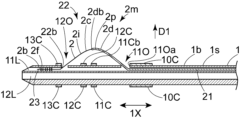
- 2 is a longitudinal plan view of the distal portion of the shaft of FIG. 1.
- FIG. 3 is a cross-sectional view of the conductive wire of FIG. 2 when it is pressed and bent.
- FIG. 4 is a cross-sectional view of the conductive wire of FIG. 3 when it is further pressed in and the length of the second region becomes the longest.
- FIG. 5 is a cross-sectional view of the distal portion of the shaft of FIG. 2 when the conductive wire is pulled.
- FIG. 6 is a plan view of the distal portion of the shaft of the variation of FIG.
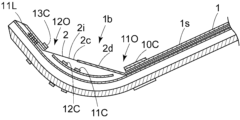
- FIG. 7 is a plan view of the distal portion of the shaft of FIG. 1 when curved and turned.
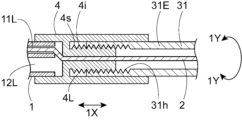
- FIG. 8 is a longitudinal cross-sectional view of the connecting member and its vicinity in FIG. 1.
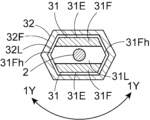
- FIG. 9 is a cross-sectional view taken along line AA of FIG.
- FIG. 10 is a cross-sectional view taken along line BB of FIG. 11 is a plan view of an extension of a first member in the handle of FIG. 1.
- FIG. 9 is a cross-sectional view taken along line AA of FIG.
- FIG. 10 is a cross-sectional view taken along line BB of FIG. 11 is a plan view of an extension of a first member in the handle of FIG. 1.
- the incision device includes a shaft extending in the longitudinal direction, the shaft having a first lumen extending in the longitudinal direction, and a first opening on the outer surface of the distal portion that communicates with the first lumen; a conductive wire having a base end and a tip end fixed to a portion of the shaft distal to the first opening, the conductive wire having a first region located distal to the base end and disposed in the first lumen, and a second region located distal to the first region and exposed from the first opening; and a handle to which the base end of the conductive wire is fixed.
- the conductive wire includes a conductive wire and an insulating film covering the conductive wire, and when the second region of the conductive wire is bent by operating the handle to protrude away from the shaft to form a mountain-shaped portion, the distal end of the insulating film is located distal to the apex of the mountain-shaped portion and proximal to the distal end of the second region.
- the bent conductive wire will form a mountain-shaped portion that may become too large, causing the operator to incise areas other than the intended incision area.
- the conductive wire is covered with an insulating film that is positioned so that its distal end is located distal to the apex of the mountain-shaped portion, making it easier to avoid incising areas other than the intended incision area even if the conductive wire is pushed too far. As a result, safety during incision can be improved.
- Fig. 1 is a plan view of the incision device according to the embodiment.
- Fig. 2 is a plan view in the longitudinal direction of the distal part of the shaft of Fig. 1.
- Fig. 3 is a cross-sectional view of the conductive wire of Fig. 2 when it is pushed in and curved.
- Fig. 4 is a cross-sectional view of the conductive wire of Fig. 3 when it is further pushed in and the length of the second region is at its longest.
- Fig. 5 is a cross-sectional view of the conductive wire of Fig. 2 when it is pulled and the distal part of the shaft is curved.
- Fig. 1 is a plan view of the incision device according to the embodiment.
- Fig. 2 is a plan view in the longitudinal direction of the distal part of the shaft of Fig. 1.
- Fig. 3 is a cross-sectional view of the conductive wire of Fig. 2 when it is pushed in and curved.
- Fig. 4 is
- FIG. 6 is a plan view of the distal part of the shaft of the modified example of Fig. 1.
- Fig. 7 is a plan view of the distal part of the shaft of Fig. 1 when it is curved and changed in direction.
- Fig. 8 is a cross-sectional view of the connecting member of Fig. 1 and its vicinity in the longitudinal direction.
- Fig. 9 is a cross-sectional view of A-A of Fig. 1.
- Fig. 10 is a cross-sectional view of B-B of Fig. 1.
- Fig. 11 is a plan view of the extension part of the first member in the handle of Fig. 1.
- the incision device 91 has a shaft 1, a conductive wire 2, and a handle 3.
- the shaft 1 extends in the longitudinal direction 1X.
- the shaft 1 has a first lumen 11L extending in the longitudinal direction 1X, and a first opening 11O communicating with the first lumen 11L is provided on the outer surface 1s of the distal portion 1b.
- the conductive wire 2 is exposed to the outside of the shaft 1 from the first opening 11O, and a current is passed through the conductive wire 2, thereby allowing the biological tissue to be incised.
- the conductive wire 2 is preferably one capable of incising biological tissue by passing a high-frequency current through it.
- the frequency of the high-frequency current is preferably 100 kHz or more and 20 MHz or less, more preferably 200 kHz or more and 5 MHz or less, and even more preferably 300 kHz or more and 1 MHz or less.
- the conductive wire 2 has a base end 2a, a tip end 2b, a first region 21, and a second region 22. It is preferable that the conductive wire 2 has the base end 2a, the first region 21, the second region 22, and the tip end 2b in this order from the proximal side to the distal side.
- the tip 2b of the conductive wire 2 is fixed to a portion of the shaft 1 distal to the first opening 11O.
- the conductive wire 2 can be curved in a mountain shape in the direction D1 away from the shaft 1.
- the conductive wire 2 can be made into a knife portion like a bowstring.
- the first region 21 of the conductive wire 2 is located closer to the tip than the base end 2a and is disposed in the first lumen 11L. This allows the first region 21 to be protected by the shaft 1.
- the second region 22 of the conductive wire 2 is located closer to the tip than the first region 21 and is exposed from the first opening 11O.
- Examples of the exposed state include a state in which at least a part of the second region 22 is located outside the shaft 1 relative to the first opening 11O as shown in FIG. 3, and a state in which the second region 22 inside the shaft 1 can be seen from the outside of the shaft 1 through the first opening 11O.
- the base end 2a of the conductive wire 2 is fixed to the handle 3.
- the base end 2a is preferably directly fixed to the handle 3, but may also be indirectly fixed to the handle 3 via another member.
- the distal portion 1b of the shaft 1 may be configured to have high rigidity so that only the conductive wire 2 can be bent by operating the handle 3, without bending the distal portion 1b of the shaft 1.
- the conductive wire 2 has a conductive wire 2c and an insulating film 2d that covers the conductive wire 2c.
- the insulating film 2d makes it easier to avoid cutting areas other than the planned cutting area.
- the mountain-shaped portion 2m is formed by bending the second region 22 so that the length of the second region 22 is at its longest.
- the insulating film 2d is arranged so as to extend beyond the apex 2p, which makes it easier to avoid incising parts other than the planned incision site.
- the conductive wire 2 can be pushed to its limit distally by operating the handle 3 to bend it, thereby making the length of the second region 22 the longest.
- the conductive wire 2 when the second region 22 is bent so that the length of the second region 22 is at its longest is referred to as the conductive wire 2 when it is bent to its maximum.
- the distance from the apex 2p of the mountain-shaped portion 2m to the distal end 2db of the insulating film 2d is preferably at least 1/10 of the distance from the distal end 2db of the insulating film 2d to the distal end 22b of the second region 22, more preferably at least 2/10, and even more preferably at least 3/10.
- the magnification is preferably at most 9/10, more preferably at most 8/10, and even more preferably at most 7/10. This makes incision easier.
- the shortest radial distance from the apex 2p of the conductive wire 2 at maximum bending to the outer surface 1s of the shaft 1 may be, for example, at least two, at least three, or at least four times the outer diameter of the shaft 1, or may be at most 16, at most 14, or at most 12 times. It is preferable that the outer diameter of the shaft 1 is the outer diameter of the shaft 1 at the portion closest to the apex 2p.
- the distance from the apex 2p of the mountain-shaped portion 2m of the conductive wire 2 at maximum bending to the distal end 2db of the insulating film 2d is preferably greater than the outer diameter of the shaft 1 at the distal end 22b of the second region 22. This makes it easier to avoid incising parts other than the planned incision site. It is more preferable that the distance is at least twice the outer diameter of the shaft 1 at the distal end 22b of the second region 22. On the other hand, it is preferable that the distance is no more than five times, and more preferably no more than three times, the outer diameter of the shaft 1 at the distal end 22b of the second region 22. This makes incision easier.
- the radius of curvature of the portion from the distal end 2db of the insulating film 2d to the distal end 22b of the second region 22 is larger than the radius of curvature of the portion from the apex 2p of the peak 2m to the distal end 2db of the insulating film 2d. This makes it easier to bring the portion of the conductive wire 2 distally away from the apex 2p into contact with biological tissue.
- the distal end 2db of the insulating film 2d is preferably located distal to the apex 2p of the mountain-shaped portion 2m.
- the distal end 2db of the insulating film 2d may be located at the apex 2p of the mountain-shaped portion 2m, or may be located proximal to the apex 2p of the mountain-shaped portion 2m.
- the proximal end of the insulating film 2d is preferably located closer to the proximal side than the apex 2p of the mountain-shaped portion 2m, and more preferably located in the first region 21. This makes it even easier to avoid incising areas other than the intended incision site.
- the conductive wire 2c included in the conductive wire 2 preferably contains a metal, and more preferably is made of a metal. This makes it easier for the conductive wire 2c to pass high-frequency current.
- a metal for example, nickel-titanium alloy, stainless steel, gold, silver, copper, platinum, nickel, iron, titanium, aluminum, tin, zinc, tungsten, or alloys thereof are preferred, and nickel-titanium alloy or stainless steel is more preferred.
- stainless steel include SUS303, SUS304, SUS316, etc.
- the conductive wire 2c may be a single wire, or may be a twisted wire in which multiple single wires are twisted together.
- the diameter of the single wire is preferably 0.1 mm or more and 1.5 mm or less. This makes it easier to bend the conductive wire 2c while maintaining its strength.
- the conductive wire 2c may have a structure in which multiple wires are joined together in the longitudinal direction 1X.
- the radial cross-sectional shape of the conductive wire 2c is preferably elliptical or circular, and more preferably circular. This makes it easier to cauterize biological tissue and to manipulate the conductive wire 2.
- the insulating film 2d preferably includes an extrusion molding.
- An example of an extrusion molding is an insulating tube.
- the extrusion molding can improve the durability of the insulating film 2d and increase safety.
- the conductive wire 2c can be covered with the insulating film 2d by inserting the conductive wire 2c into the inner cavity of an insulating tube of a desired length produced by extrusion molding.
- the insulating tube and the conductive wire 2c may also be bonded with an adhesive or the like.
- the insulating film 2d may be formed by attaching an insulating resin to the surface of the conductive wire 2c.
- the insulating film 2d preferably contains a resin, and more preferably is made of a resin. This makes it easier to insulate.
- a resin polyamide-based resin, polyester-based resin, polyurethane-based resin, polyolefin-based resin, fluorine-based resin, vinyl chloride-based resin, silicone-based resin, natural rubber, or a mixture of these is preferable, and polyamide-based resin, fluorine-based resin, or a mixture of these is more preferable.
- the shaft 1 preferably has a second opening 12O on the outer surface 1s distal to the first opening 11O.
- the second region 22 is preferably exposed between the first opening 11O and the second opening 12O. This makes it easier to bring the second region 22 of the conductive wire 2 into contact with biological tissue.
- the second region 22 of the conductive wire 2 before the formation of the mountain-shaped portion 2m preferably has a portion that extends linearly in the longitudinal direction 1X on the outside of the shaft 1. This makes it easier to insert the shaft 1 into the body.
- At least a portion of the second region 22 of the conductive wire 2 before the mountain-shaped portion 2m is formed is in contact with the outer surface 1s between the first opening 11O and the second opening 12O.
- at least a portion of the second region 22 of the conductive wire 2 so as to be aligned with the outer surface 1s between the two openings, it becomes easier to insert the shaft 1 into the body.
- the shapes of the first opening 11O and the second opening 12O on the outer surface 1s of the shaft 1 are preferably a circle, an ellipse, a polygon, or a rounded polygon, respectively, more preferably an ellipse, a square, or a rounded square, and even more preferably an ellipse, a rectangle, or a rounded rectangle.
- the first opening 11O and the second opening 12O on the outer surface 1s of the shaft 1 each extend in the longitudinal direction 1X.
- the shaft 1 may have only the first opening 11O, without the second opening 12O, as an opening for exposing the conductive wire 2 to the outside of the shaft 1.
- the conductive wire 2 can be curved in a mountain shape in the direction D1 away from the shaft 1 as shown in FIG. 3, and the distal portion 1b of the shaft 1 can be bent as shown in FIG. 5, making the conductive wire 2 into a knife portion like a bowstring.
- the shaft 1 preferably has a proximal colored portion 10C in a portion adjacent to the proximal end 11Oa of the first opening 11O. Furthermore, it is preferable that the shaft 1 has a plurality of colored portions 14C distal to the proximal end 11Oa of the first opening 11O.
- the proximal colored portion 10C can be used as a marker for the portion where the conductive wire 2 begins to be exposed to the outside of the shaft 1. Therefore, it is preferable that the proximal colored portion 10C is located proximal to the proximal end 11Oa of the first opening 11O.
- the plurality of colored portions 14C can be used as markers for the start point, center point, end point, etc. of the incision portion 2i of the conductive wire 2 described later.
- Each of the plurality of colored portions 14C preferably extends in the circumferential direction 1Y, and more preferably extends over the entire circumference of the circumferential direction 1Y.
- the proximal colored portion 10C has a lower lightness L * in the CIE 1976 color space than the multiple colored portions 14C.
- L * is used in the CIE 1976 (L * , a * , b * ) color space.
- the insulating film 2d has a lower lightness L * in the CIE 1976 color space than the plurality of colored portions 14C.
- the conductive wire 2 is prone to halation due to illumination from the endoscope, but the insulating film 2d has a low lightness L * , which makes it easier to prevent halation. Therefore, it is more preferable that the insulating film 2d has a lower lightness L * in the CIE 1976 color space than all of the plurality of colored portions 14C.
- the absolute value of the difference in lightness L * in the CIE 1976 color space between the insulating film 2d and the proximal side colored portion 10C is equal to or less than 10. If the lightness L * values of the insulating film 2d and the proximal side colored portion 10C are close to each other in this way, the multiple colored portions 14C can be easily visually recognized in the endoscope.
- the multiple colored portions 14C preferably include a first colored portion 11C, a second colored portion 12C, and a third colored portion 13C. These can be used as markers for each point in the cut portion 2i of the conductive wire 2, which will be described later.
- the first colored portion 11C is located distal to the proximal end 11Oa of the first opening 11O and proximal to the distal end 22b of the second region 22. Furthermore, it is more preferable that the first colored portion 11C is located distal to the distal end of the first opening 11O and proximal to the proximal end of the second opening 12O. This makes it easier for the first colored portion 11C to function as a marker for the start point of the incision portion 2i of the conductive wire 2, which will be described later.
- the second colored portion 12C is located distal to the distal end 11Cb of the first colored portion 11C and proximal to the distal end 22b of the second region 22. Furthermore, it is more preferable that the second colored portion 12C is located proximal to the proximal end of the second opening 12O. This makes it easier for the second colored portion 12C to function as a marker for the midpoint of the incision portion 2i of the conductive wire 2.
- the third colored portion 13C is preferably located distal to the distal end 22b of the second region 22. Furthermore, it is more preferable that the third colored portion 13C is adjacent to the distal end of the second opening 12O. This makes it easier for the third colored portion 13C to function as a marker for the end point of the incision portion 2i of the conductive wire 2.
- the insulating film 2d, the proximal colored portion 10C, and the multiple colored portions 14C each preferably contain a colorant.
- the colorant is preferably a pigment, a dye, or a mixture thereof, and more preferably a pigment.
- the pigment is preferably an organic pigment, an inorganic pigment, or a mixture thereof.
- the insulating film 2d and the proximal colored portion 10C preferably contain a brown colorant, a purple colorant, a black colorant, or a mixture of these, and more preferably contain a black colorant. This makes it easier to prevent halation.
- the multiple colored portions 14C each preferably contain a green colorant, a yellow colorant, a blue colorant, a brown colorant, a purple colorant, a black colorant, or a mixture thereof, and more preferably contain a green colorant, a blue colorant, or a mixture thereof. This makes it easier to visually recognize the multiple colored portions 14C in vivo.
- the insulating film 2d, the proximal colored portion 10C, and the multiple colored portions 14C may each contain a brown colorant, a purple colorant, a black colorant, or a mixture of these, or may contain a black colorant. This makes it easier to prevent halation in each portion, for example, when using an endoscope with strong illumination intensity.
- Green colorants, yellow colorants, blue colorants, brown colorants, purple colorants, and black colorants include, for example, colorants whose hues are green, yellow, blue, brown, violet, and black according to the color index names.
- colorants may be attached to the outer surface 1s of the shaft 1, or may be mixed into the tube that constitutes the shaft 1. These colorants may also be mixed with a binder resin and attached to the outer surface 1s of the shaft 1.
- the conductive wire 2 is preferably located in a region distal to the distal end 2db of the insulating film 2d, and has an incision 2i where the conductive wire 2c is not covered by the insulating film 2d.
- the surface roughness Ra (arithmetic mean roughness) of the incision 2i is preferably greater than the surface roughness Ra of the insulating film 2d.
- the surface roughness Ra of the conductive wire 2 and the insulating film 2d may be measured in the longitudinal direction 1X, for example, based on JIS B 0601:2013.
- the surface roughness Ra of the conductive wire 2 can be increased, for example, by roughening.
- the surface roughness Ra can also be increased by omitting the polishing process after manufacturing the conductive wire 2.
- the conductive wire 2 preferably further has a third region 23 located distal to the second region 22 and disposed in the first lumen 11L.
- the third region 23 is a region that is not exposed from the first opening 11O. It is preferable that at least a portion of such a third region 23 is fixed to the inner surface of the shaft 1. Specifically, it is more preferable that the distal end of the third region 23 is fixed to the inner surface that constitutes the first lumen 11L of the shaft 1. This makes it easier to form the mountain-shaped portion 2m by operating the handle 3.
- the fixation may be direct fixation or indirect fixation.
- Direct fixing may be achieved by at least a portion of the third region 23 being fixed to the inner surface of the shaft 1 by welding, adhesion, brazing, or the like. Indirect fixing may be achieved by at least a portion of the third region 23 being fixed to the inner surface, for example, via a fixture 2f.
- the tip 2b of the conductive wire 2 is fixed inside the fixture 2f, and the fixture 2f is fixed to the inner surface of the shaft 1.
- the fixture 2f may be fixed to the inner surface by welding, adhesion, brazing, or the like.
- the fixture 2f may also be fixed so as to bite into the inner surface.
- the fixture 2f includes a polygonal column, a pyramid, a cone, or a shape connected in the axial direction.
- the fixture 2f has one or more such blocks, which allows one or more protrusions to be formed, making it easier to bite into the inner surface of the shaft 1.
- the fixture 2f may include a cylinder.
- Fixing device 2f preferably contains resin and/or metal, and more preferably contains metal. Examples of metals include stainless steel such as SUS304 and SUS316, platinum, nickel, cobalt, chromium, titanium, tungsten, gold, Ni-Ti alloys, Co-Cr alloys, etc. These may be used alone or in combination of two or more types.
- the shaft 1 preferably further has a second lumen 12L extending in the longitudinal direction 1X.
- the distal end of the second lumen 12L is preferably located at the distal end of the shaft 1. This makes it easier to insert the shaft 1 into the body by inserting a guidewire into the second lumen 12L. Liquids such as contrast agents and medicines may also be supplied to the body via the second lumen 12L.
- the diameter of the first lumen 11L is preferably smaller than the diameter of the second lumen 12L. This makes it easier to perform operations such as bending, since the conductive wire 2 placed in the first lumen 11L is less likely to shake during each operation.
- the diameter of the first lumen 11L is smaller than the diameter of the second lumen 12L at the proximal end of the second region 22 of the conductive wire 2, the distal end of the second region 22, or both of these ends.
- the outer surface 1s of the shaft 1 preferably has a proximal opening that communicates with the second lumen 12L and is located proximal to the center of the shaft 1 in the longitudinal direction 1X.
- a guidewire or the like can be inserted through the proximal opening.
- the proximal opening may be located at the proximal end of the shaft 1, or may be located distal to the proximal end of the shaft 1.
- the shaft 1 preferably contains a resin and/or a metal.
- the resin include polyamide resin, polyester resin, polyurethane resin, polyolefin resin, fluorine resin, vinyl chloride resin, silicone resin, and natural rubber. These may be used alone or in combination of two or more.
- the metal include stainless steel such as SUS304 and SUS316, platinum, nickel, cobalt, chromium, titanium, tungsten, gold, Ni-Ti alloy, and Co-Cr alloy. These may be used alone or in combination of two or more.
- the shaft 1 preferably has a tube containing a resin.
- the shaft 1 may also have a laminated structure made of different materials or the same material.
- the shaft 1 may have, for example, a tube made of metal with a resin coated on its surface.
- the shaft 1 may also have a structure in which multiple tubes are joined in the longitudinal direction 1X. In this case, the multiple tubes may have different outer diameters, and the end of one tube may be placed in the lumen of the other tube.
- the shaft 1 may also have a structure in which multiple tubes are joined in the radial direction.
- the shaft 1 may also have a branched structure, for example, at the proximal end.
- One of the openings that communicate with the inner cavity of the branched structure may be a proximal opening into which the above-mentioned guide wire or the like can be inserted.
- the handle 3 preferably has a first member 31 and a second member 32.
- the first member 31 is preferably capable of moving in the longitudinal direction 1X while rotating in the circumferential direction 1Y relative to the shaft 1.
- the first member 31 can move in the longitudinal direction 1X while rotating in the circumferential direction 1Y, for example, like a screw. This allows the first member 31 to distribute a part of the force applied in the circumferential direction 1Y to the longitudinal direction 1X, so that the rotation speed in the circumferential direction 1Y is appropriately limited.
- a torsional force can be directly or indirectly applied to the conductive wire 2, and as a result, for example, as shown in FIG.
- the distal portion 1b of the shaft 1 can be bent toward the direction D2 by the tip portion 2b of the conductive wire 2, thereby changing the direction of the distal portion 1b.
- the distal portion 1b can be bent in the direction D3 opposite to the direction D2, changing the direction of the distal portion 1b.
- the first member 31 moving in the longitudinal direction 1X while rotating in the circumferential direction 1Y, when the second member 32 is linked to the first member 31, the amount of movement of the second member 32 in the longitudinal direction 1X when bending the conductive wire 2 outside the shaft 1 can be reduced.
- the first member 31 can move from the proximal side to the distal side while rotating in the circumferential direction 1Y relative to the shaft 1, and can move from the distal side to the proximal side while rotating in the circumferential direction 1Y relative to the shaft 1.
- the distal portion 1b of the shaft 1 can be curved, for example, in both directions D2 and D3 in FIG. 7, and the orientation of the distal portion 1b of the shaft 1 can be changed in both directions.
- the first member 31 preferably has a threaded portion or threaded hole portion extending in the longitudinal direction 1X. This allows the threaded hole portion 31h of the first member 31 to be fitted into the threaded portion 4i of the connecting member 4 described below, as shown in FIG. 8, for example, and as a result, the first member 31 can be moved in the longitudinal direction 1X while being rotated in the circumferential direction 1Y.
- the first member 31 preferably has the threaded portion or threaded hole portion in its distal portion, and more preferably in its distal end portion.
- the second member 32 is preferably capable of moving in the longitudinal direction 1X without rotating in the circumferential direction 1Y relative to the shaft 1.
- the distal portion 1b of the conductive wire 2 or the shaft 1 can be curved as shown in Figures 3 and 5 by moving the second member 32 in the longitudinal direction 1X.
- the second member 32 is preferably capable of moving from the proximal side to the distal side without rotating in the circumferential direction 1Y relative to the shaft 1, and from the distal side to the proximal side without rotating in the circumferential direction 1Y relative to the shaft 1. This allows, for example, when the base end 2a of the conductive wire 2 is fixed to the second member 32, the conductive wire 2 and the distal portion 1b of the shaft 1 to be curved as shown in Figures 3 and 5.
- the base end 2a of the conductive wire 2 is preferably fixed to the first member 31 or the second member 32, and more preferably fixed to the second member 32.
- the distal portion 1b of the conductive wire 2 or the shaft 1 can be curved as shown in Figures 3 and 5 by moving the second member 32 in the longitudinal direction 1X.
- the distal portion 1b of the shaft 1 can be curved and the orientation of the distal portion 1b of the shaft 1 can be changed by rotating the second member 32 together with the first member 31 in the circumferential direction 1Y, as shown in Figure 7.
- the second member 32 when the base end 2a of the conductive wire 2 is fixed to the second member 32, the second member 32 preferably has a connection terminal 3c connected to the base end 2a of the conductive wire 2. By exposing at least a portion of the connection terminal 3c from the second member 32, the high frequency power source and the conductive wire 2 can be connected via the connection terminal 3c.
- the connection terminal 3c preferably contains a metal, and more preferably is made of a metal.
- the connection terminal 3c is preferably rod-shaped.
- the first member 31 preferably has an extension portion 31E extending in the longitudinal direction 1X.
- the second member 32 preferably has an inner cavity 32L extending in the longitudinal direction 1X.
- a portion of the extension portion 31E is preferably disposed in the inner cavity 32L of the second member 32.
- the extension portion 31E of the first member 31 preferably has a first fitting portion 31F, which will be described later, more preferably has the first fitting portion 31F and an expanded diameter portion 31H, which will be described later, and even more preferably has the first fitting portion 31F, an expanded diameter portion 31H, and a columnar portion 31G, which will be described later.
- the first member 31 preferably has a first fitting portion 31F extending in the longitudinal direction 1X.
- the second member 32 preferably has a second fitting portion 32F that slidably fits into the first fitting portion 31F in the longitudinal direction 1X. This makes it easier to move the second member 32 in the longitudinal direction 1X without rotating in the circumferential direction 1Y.
- the second fitting portion 32F has an inner cavity 32L extending in the longitudinal direction 1X, and it is preferable that a portion of the first fitting portion 31F is disposed within the inner cavity 32L. This makes it easier for the second fitting portion 32F to slide along the first fitting portion 31F.
- the radial length of the gap between the inner surface of the second fitting portion 32F and the outer surface of the first fitting portion 31F is preferably 0.1 mm or more and 2.0 mm or less, and more preferably 0.2 mm or more and 1.0 mm or less. This makes it even easier for the second fitting portion 32F to slide along the first fitting portion 31F.
- the shape of the outer edge of the first fitting portion 31F and the shape of the outer edge of the inner cavity 32L of the second fitting portion 32F are similar at least in the radial cross section at the distal end, proximal end, or distal and proximal ends of the first fitting portion 31F. This makes it easier for the second fitting portion 32F to slide along the first fitting portion 31F.
- the first fitting portion 31F and the second fitting portion 32F may each have a rail, a bolt, a nut, a roller, a bearing, a rack, a pinion, or a combination of these. These may form a sliding mechanism to slide the second fitting portion 32F in the longitudinal direction 1X relative to the first fitting portion 31F.
- the first fitting portion 31F may also be disposed outside the second fitting portion 32F.
- the first fitting portion 31F preferably has a through hole 31Fh.
- the through hole 31Fh preferably penetrates the side wall constituting the first fitting portion 31F in the radial direction. This allows the conductive wire 2 to be fixed to the second member 32 via the through hole 31Fh.
- the through hole 31Fh preferably extends in the longitudinal direction 1X. In this case, the through hole 31Fh is preferably located in a region distal to the proximal end of the first fitting portion 31F and proximal to the distal end.
- the second fitting portion 32F is preferably fitted into the first fitting portion 31F so that the first member 31 can rotate in the circumferential direction 1Y in conjunction with the rotation of the second member 32 in the circumferential direction 1Y.
- the first member 31 rotates in the circumferential direction 1Y in conjunction with the second member 32, so that the first member 31 can be rotated in the circumferential direction 1Y by operating the second member 32.
- FIG. 9 when the second member 32 is rotated in the circumferential direction 1Y, the inner surface of the second fitting portion 32F comes into contact with the outer surface of the first fitting portion 31F, causing the first fitting portion 31F to rotate, and as a result, the first member 31 can be rotated in the circumferential direction 1Y.
- the first member 31 may be rotated in the circumferential direction 1Y by directly applying a force to the first member 31 in the circumferential direction 1Y.
- the first fitting portion 31F preferably has a polygonal prism extending in the longitudinal direction 1X.
- a polygonal prism a tetragonal prism, a pentagonal prism, a hexagonal prism, a heptagonal prism, or an octagonal prism is preferable, and a hexagonal prism or an octagonal prism is more preferable.
- polygonal prisms also include polygonal prisms with rounded corners.
- the polygonal prism preferably has an inner cavity 31L extending in the longitudinal direction 1X.
- the conductive wire 2 can be placed in the inner cavity 31L.
- the polygonal prism may also have a through hole 31Fh that penetrates radially through the side wall that constitutes the polygonal prism.
- the second fitting portion 32F preferably has an inner cavity 32L extending in the longitudinal direction 1X.
- the radial cross-sectional shape of the inner cavity 32L is preferably a square, pentagon, hexagon, heptagon, or octagon, and more preferably a hexagon or octagon. This makes it easier for the second member 32 to fit with the first member 31.
- polygons also include polygons with rounded corners.
- the second fitting portion 32F In the radial cross section of the first fitting portion 31F, it is preferable that at least two points on the inner surface of the second fitting portion 32F are located within the circumscribing circle of the first fitting portion 31F. As a result, as the second member 32 rotates in the circumferential direction 1Y, two or more points on the inner surface of the second member 32 come into contact with the outer surface of the first member 31, making it easier for the first member 31 to rotate in the circumferential direction 1Y.
- the first member 31 preferably has an enlarged diameter portion 31H having a diameter larger than that of the first fitting portion 31F at a portion adjacent to the distal end and distal to the distal end.
- an enlarged diameter portion 31H can function as a stopper at the distal end when the second member 32 is slid from the proximal side to the distal side.
- the enlarged diameter portion 31H is disposed on the rear side of the second member 32, and when the second member 32 moves from the front to the rear side, the second member 32 comes into contact with the enlarged diameter portion 31H and cannot move further rearward than the enlarged diameter portion 31H.
- the enlarged diameter portion 31H may have a tapered portion inclined in the longitudinal direction 1X.
- the enlarged diameter portion 31H may also have a step portion perpendicular to the longitudinal direction 1X.
- the first member 31 is preferably located distal to the first fitting portion 31F and has a columnar portion 31G extending in the longitudinal direction 1X.
- the columnar portion 31G is preferably a cylinder, an elliptical cylinder, or a combination thereof, and is more preferably a cylinder. This allows the columnar portion 31G to rotate easily within another member such as the connecting member 4.
- the threaded portion or threaded hole portion of the first member 31 described above is preferably provided in the columnar portion 31G.
- the columnar portion 31G preferably has an inner cavity 31L extending in the longitudinal direction 1X.
- the conductive wire 2 can be placed in the inner cavity 31L.
- the second member 32 preferably has a locking portion 32s that stops sliding in the longitudinal direction 1X relative to the first member 31.
- the locking portion 32s preferably has a screw.
- the first member 31 preferably has a finger passage portion 31D.
- the finger passage portion 31D preferably has a ring-shaped portion.
- the thumb can be passed through a through hole in the center of the ring.
- the second member 32 preferably has a finger passage portion 32D.
- the finger passage portion 32D preferably has two or more through holes that penetrate in the thickness direction.
- the index finger and middle finger can be passed through the two through holes.
- the incision device 91 preferably further includes a connecting member 4 that connects the shaft 1 and the handle 3 and has an inner cavity 4L extending in the longitudinal direction 1X.
- the connecting member 4 preferably has a threaded portion 4i on the inner surface 4s that engages with a threaded hole portion 31h of the first member 31. This allows the connecting member 4 to connect the shaft 1 and the first member 31 such that the first member 31 can move in the longitudinal direction 1X while rotating in the circumferential direction 1Y relative to the shaft 1.
- the connecting member 4 may have a threaded hole portion on the inner cavity 4L side that engages with the threaded portion of the first member 31. Even with this configuration, the connecting member 4 can connect the shaft 1 and the first member 31 so that the first member 31 can move in the longitudinal direction 1X while rotating in the circumferential direction 1Y relative to the shaft 1.
- the connecting member 4 has a groove or a protrusion extending in the longitudinal direction 1X.
- the first member 31 has a protrusion or a groove extending in the longitudinal direction 1X on the outer surface 31Es of the distal end 31Eb of the extending portion 31E that fits into the groove or protrusion.
- Such a protrusion of the connecting member 4 or the first member 31 can function as a temporary stopper when the first member 31 is rotated in the circumferential direction 1Y. For example, as shown in FIG.
- the number of grooves 4g is not limited to two, and may be one or more, three or more, ten or less, or six or less. When the number of grooves 4g is two or more, it is preferable that the grooves 4g are arranged at equal intervals in the circumferential direction 1Y.
- the grooves 4g are preferably U-shaped grooves.
- the protrusions 31p are hemispherical or semi-elliptical protrusions. This makes it easier to restart rotation after it has been temporarily stopped. Although not shown, rotation can also be temporarily stopped when the first member 31 has a groove extending in the longitudinal direction 1X and the connecting member 4 has a protrusion.
- the extension 31E of the first member 31 has a plurality of scales 31Em on the outer surface 31Es spaced apart in the longitudinal direction 1X.
- the plurality of scales 31Em are arranged so as to be successively exposed from the connecting member 4 according to the number of rotations, the operator can easily grasp the number of rotations.
- the first member 31 when the first member 31 is moved from the proximal side to the distal side while rotating in the circumferential direction 1Y, the first member 31 is accommodated within the connecting member 4 and the plurality of scales 31Em are successively hidden according to the number of rotations, which also makes it easier for the operator to grasp the number of rotations.
- the extension portion 31E of the first member 31 has a plurality of scales 31Em on the outer surface 31Es that are spaced apart in the extension direction 31X, and it is preferable that the protrusion or groove of the extension portion 31E is positioned so as to contact the scale 31En that is located most distal among the plurality of scales 31Em.
- the protrusion 31p of the extension portion 31E fits into the groove 4g of the connecting member 4, as shown in FIG. 10, for example, making it easier to prevent the first member 31 from falling off the connecting member 4 due to excessive rotation of the first member 31.
- the first member 31, the second member 32, and the connecting member 4 each preferably include a molded body.
- the molded body preferably includes a resin, and is preferably made of a resin. This makes it easier to prevent electric leakage.
- the first member 31 may be capable of rotating in the circumferential direction 1Y relative to the shaft 1, but not capable of moving in the longitudinal direction 1X relative to the shaft 1.
- a configuration may be one in which the connecting member 4 has a groove or protrusion extending in the circumferential direction 1Y, and the extending portion 31E of the first member 31 has a protrusion that fits into the groove or protrusion, or a groove extending in the circumferential direction 1Y.
- the second member 32 is capable of moving in the longitudinal direction 1X without rotating in the circumferential direction 1Y relative to the shaft 1.
- the first member 31 may be unable to rotate in the circumferential direction 1Y relative to the shaft 1. Furthermore, the first member 31 may be unable to move in the longitudinal direction 1X relative to the shaft 1.
- An example of such a configuration is one in which the distal end of the first member 31 is directly or indirectly fixed to the shaft 1. In these cases, it is preferable that the second member 32 is able to move in the longitudinal direction 1X without rotating in the circumferential direction 1Y relative to the shaft 1. In this way, the handle 3 may be able to slide in the longitudinal direction 1X but unable to rotate in the circumferential direction 1Y.
- the incision device 91 can be suitably used in endoscopic surgeries such as endoscopic sphincterotomy (EST), incision of cancer, polyps, etc.
- endoscopic surgeries such as endoscopic sphincterotomy (EST), incision of cancer, polyps, etc.
Landscapes
- Health & Medical Sciences (AREA)
- Surgery (AREA)
- Engineering & Computer Science (AREA)
- Life Sciences & Earth Sciences (AREA)
- Biomedical Technology (AREA)
- Otolaryngology (AREA)
- Nuclear Medicine, Radiotherapy & Molecular Imaging (AREA)
- Plasma & Fusion (AREA)
- Physics & Mathematics (AREA)
- Heart & Thoracic Surgery (AREA)
- Medical Informatics (AREA)
- Molecular Biology (AREA)
- Animal Behavior & Ethology (AREA)
- General Health & Medical Sciences (AREA)
- Public Health (AREA)
- Veterinary Medicine (AREA)
- Surgical Instruments (AREA)
Priority Applications (1)
| Application Number | Priority Date | Filing Date | Title |
|---|---|---|---|
| JP2025506727A JPWO2024190495A1 (https=) | 2023-03-10 | 2024-03-04 |
Applications Claiming Priority (2)
| Application Number | Priority Date | Filing Date | Title |
|---|---|---|---|
| JP2023-038066 | 2023-03-10 | ||
| JP2023038066 | 2023-03-10 |
Publications (1)
| Publication Number | Publication Date |
|---|---|
| WO2024190495A1 true WO2024190495A1 (ja) | 2024-09-19 |
Family
ID=92755071
Family Applications (1)
| Application Number | Title | Priority Date | Filing Date |
|---|---|---|---|
| PCT/JP2024/008043 Ceased WO2024190495A1 (ja) | 2023-03-10 | 2024-03-04 | 切開装置 |
Country Status (2)
| Country | Link |
|---|---|
| JP (1) | JPWO2024190495A1 (https=) |
| WO (1) | WO2024190495A1 (https=) |
Citations (3)
| Publication number | Priority date | Publication date | Assignee | Title |
|---|---|---|---|---|
| JPH07299078A (ja) * | 1994-05-09 | 1995-11-14 | Olympus Optical Co Ltd | 内視鏡用電気切開装置 |
| JPH1133033A (ja) * | 1997-07-22 | 1999-02-09 | Olympus Optical Co Ltd | 高周波切開装置 |
| JP2010531712A (ja) * | 2007-06-28 | 2010-09-30 | ウィルソン−クック・メディカル・インコーポレーテッド | 括約筋切開器カッティングワイヤの改良 |
-
2024
- 2024-03-04 JP JP2025506727A patent/JPWO2024190495A1/ja active Pending
- 2024-03-04 WO PCT/JP2024/008043 patent/WO2024190495A1/ja not_active Ceased
Patent Citations (3)
| Publication number | Priority date | Publication date | Assignee | Title |
|---|---|---|---|---|
| JPH07299078A (ja) * | 1994-05-09 | 1995-11-14 | Olympus Optical Co Ltd | 内視鏡用電気切開装置 |
| JPH1133033A (ja) * | 1997-07-22 | 1999-02-09 | Olympus Optical Co Ltd | 高周波切開装置 |
| JP2010531712A (ja) * | 2007-06-28 | 2010-09-30 | ウィルソン−クック・メディカル・インコーポレーテッド | 括約筋切開器カッティングワイヤの改良 |
Also Published As
| Publication number | Publication date |
|---|---|
| JPWO2024190495A1 (https=) | 2024-09-19 |
Similar Documents
| Publication | Publication Date | Title |
|---|---|---|
| US12336687B2 (en) | Steering system with locking mechanism | |
| CN113873955B (zh) | 包括带有开槽结构的铰链的可转向器械 | |
| US5487757A (en) | Multicurve deflectable catheter | |
| US20080255595A1 (en) | Valvulotome | |
| EP3544531B1 (en) | Endoscopic ultrasound guided access device | |
| JP2001517474A (ja) | 操向可能な手術器具 | |
| US6471702B1 (en) | Endoscopic high-frequency knife | |
| JP4794564B2 (ja) | 内視鏡用処置具 | |
| US20250375099A1 (en) | Braking mechanisms for steerable medical devices and related methods | |
| WO2024190496A1 (ja) | 切開装置 | |
| WO2024190495A1 (ja) | 切開装置 | |
| WO2025074807A1 (ja) | 切開装置 | |
| JP7626634B2 (ja) | 高周波処置具 | |
| US5827280A (en) | Device for locking a protective endoscopic electrode sleeve | |
| WO2024190494A1 (ja) | 切開装置 | |
| CN110536652B (zh) | 内窥镜用高频处置仪 | |
| US20230233065A1 (en) | Endoscope with keyed orientation feature | |
| US20240390658A1 (en) | Medical systems, devices, and methods for delivering one or more fluids | |
| JP2024136427A (ja) | カテーテルハンドルおよびそれを備えたカテーテル | |
| JPH0310731Y2 (https=) | ||
| JP2025006325A (ja) | カテーテルハンドルおよびそれを備えたカテーテル | |
| JP2005204995A (ja) | 内視鏡用処置具及び内視鏡用処置装置並びに内視鏡処置具システム |
Legal Events
| Date | Code | Title | Description |
|---|---|---|---|
| 121 | Ep: the epo has been informed by wipo that ep was designated in this application |
Ref document number: 24770606 Country of ref document: EP Kind code of ref document: A1 |
|
| WWE | Wipo information: entry into national phase |
Ref document number: 2025506727 Country of ref document: JP |
|
| NENP | Non-entry into the national phase |
Ref country code: DE |
|
| 122 | Ep: pct application non-entry in european phase |
Ref document number: 24770606 Country of ref document: EP Kind code of ref document: A1 |