WO2024190386A1 - 感放射線性組成物、レジストパターン形成方法、重合体及び化合物 - Google Patents
感放射線性組成物、レジストパターン形成方法、重合体及び化合物 Download PDFInfo
- Publication number
- WO2024190386A1 WO2024190386A1 PCT/JP2024/006854 JP2024006854W WO2024190386A1 WO 2024190386 A1 WO2024190386 A1 WO 2024190386A1 JP 2024006854 W JP2024006854 W JP 2024006854W WO 2024190386 A1 WO2024190386 A1 WO 2024190386A1
- Authority
- WO
- WIPO (PCT)
- Prior art keywords
- group
- radiation
- formula
- bonded
- structural unit
- Prior art date
- Legal status (The legal status is an assumption and is not a legal conclusion. Google has not performed a legal analysis and makes no representation as to the accuracy of the status listed.)
- Ceased
Links
Classifications
-
- G—PHYSICS
- G03—PHOTOGRAPHY; CINEMATOGRAPHY; ANALOGOUS TECHNIQUES USING WAVES OTHER THAN OPTICAL WAVES; ELECTROGRAPHY; HOLOGRAPHY
- G03F—PHOTOMECHANICAL PRODUCTION OF TEXTURED OR PATTERNED SURFACES, e.g. FOR PRINTING, FOR PROCESSING OF SEMICONDUCTOR DEVICES; MATERIALS THEREFOR; ORIGINALS THEREFOR; APPARATUS SPECIALLY ADAPTED THEREFOR
- G03F7/00—Photomechanical, e.g. photolithographic, production of textured or patterned surfaces, e.g. printing surfaces; Materials therefor, e.g. comprising photoresists; Apparatus specially adapted therefor
- G03F7/004—Photosensitive materials
- G03F7/039—Macromolecular compounds which are photodegradable, e.g. positive electron resists
- G03F7/0392—Macromolecular compounds which are photodegradable, e.g. positive electron resists the macromolecular compound being present in a chemically amplified positive photoresist composition
-
- C—CHEMISTRY; METALLURGY
- C07—ORGANIC CHEMISTRY
- C07C—ACYCLIC OR CARBOCYCLIC COMPOUNDS
- C07C25/00—Compounds containing at least one halogen atom bound to a six-membered aromatic ring
- C07C25/18—Polycyclic aromatic halogenated hydrocarbons
-
- C—CHEMISTRY; METALLURGY
- C07—ORGANIC CHEMISTRY
- C07C—ACYCLIC OR CARBOCYCLIC COMPOUNDS
- C07C309/00—Sulfonic acids; Halides, esters, or anhydrides thereof
- C07C309/01—Sulfonic acids
- C07C309/02—Sulfonic acids having sulfo groups bound to acyclic carbon atoms
- C07C309/03—Sulfonic acids having sulfo groups bound to acyclic carbon atoms of an acyclic saturated carbon skeleton
- C07C309/07—Sulfonic acids having sulfo groups bound to acyclic carbon atoms of an acyclic saturated carbon skeleton containing oxygen atoms bound to the carbon skeleton
- C07C309/12—Sulfonic acids having sulfo groups bound to acyclic carbon atoms of an acyclic saturated carbon skeleton containing oxygen atoms bound to the carbon skeleton containing esterified hydroxy groups bound to the carbon skeleton
-
- C—CHEMISTRY; METALLURGY
- C07—ORGANIC CHEMISTRY
- C07C—ACYCLIC OR CARBOCYCLIC COMPOUNDS
- C07C309/00—Sulfonic acids; Halides, esters, or anhydrides thereof
- C07C309/01—Sulfonic acids
- C07C309/02—Sulfonic acids having sulfo groups bound to acyclic carbon atoms
- C07C309/03—Sulfonic acids having sulfo groups bound to acyclic carbon atoms of an acyclic saturated carbon skeleton
- C07C309/17—Sulfonic acids having sulfo groups bound to acyclic carbon atoms of an acyclic saturated carbon skeleton containing carboxyl groups bound to the carbon skeleton
-
- C—CHEMISTRY; METALLURGY
- C07—ORGANIC CHEMISTRY
- C07C—ACYCLIC OR CARBOCYCLIC COMPOUNDS
- C07C381/00—Compounds containing carbon and sulfur and having functional groups not covered by groups C07C301/00 - C07C337/00
- C07C381/12—Sulfonium compounds
-
- C—CHEMISTRY; METALLURGY
- C07—ORGANIC CHEMISTRY
- C07D—HETEROCYCLIC COMPOUNDS
- C07D317/00—Heterocyclic compounds containing five-membered rings having two oxygen atoms as the only ring hetero atoms
- C07D317/08—Heterocyclic compounds containing five-membered rings having two oxygen atoms as the only ring hetero atoms having the hetero atoms in positions 1 and 3
-
- C—CHEMISTRY; METALLURGY
- C07—ORGANIC CHEMISTRY
- C07D—HETEROCYCLIC COMPOUNDS
- C07D407/00—Heterocyclic compounds containing two or more hetero rings, at least one ring having oxygen atoms as the only ring hetero atoms, not provided for by group C07D405/00
- C07D407/02—Heterocyclic compounds containing two or more hetero rings, at least one ring having oxygen atoms as the only ring hetero atoms, not provided for by group C07D405/00 containing two hetero rings
- C07D407/04—Heterocyclic compounds containing two or more hetero rings, at least one ring having oxygen atoms as the only ring hetero atoms, not provided for by group C07D405/00 containing two hetero rings directly linked by a ring-member-to-ring-member bond
-
- C—CHEMISTRY; METALLURGY
- C08—ORGANIC MACROMOLECULAR COMPOUNDS; THEIR PREPARATION OR CHEMICAL WORKING-UP; COMPOSITIONS BASED THEREON
- C08F—MACROMOLECULAR COMPOUNDS OBTAINED BY REACTIONS ONLY INVOLVING CARBON-TO-CARBON UNSATURATED BONDS
- C08F12/00—Homopolymers and copolymers of compounds having one or more unsaturated aliphatic radicals, each having only one carbon-to-carbon double bond, and at least one being terminated by an aromatic carbocyclic ring
- C08F12/02—Monomers containing only one unsaturated aliphatic radical
- C08F12/04—Monomers containing only one unsaturated aliphatic radical containing one ring
- C08F12/14—Monomers containing only one unsaturated aliphatic radical containing one ring substituted by hetero atoms or groups containing heteroatoms
- C08F12/30—Sulfur
-
- C—CHEMISTRY; METALLURGY
- C08—ORGANIC MACROMOLECULAR COMPOUNDS; THEIR PREPARATION OR CHEMICAL WORKING-UP; COMPOSITIONS BASED THEREON
- C08F—MACROMOLECULAR COMPOUNDS OBTAINED BY REACTIONS ONLY INVOLVING CARBON-TO-CARBON UNSATURATED BONDS
- C08F20/00—Homopolymers and copolymers of compounds having one or more unsaturated aliphatic radicals, each having only one carbon-to-carbon double bond, and only one being terminated by only one carboxyl radical or a salt, anhydride, ester, amide, imide or nitrile thereof
- C08F20/02—Monocarboxylic acids having less than ten carbon atoms, Derivatives thereof
- C08F20/10—Esters
- C08F20/38—Esters containing sulfur
-
- G—PHYSICS
- G03—PHOTOGRAPHY; CINEMATOGRAPHY; ANALOGOUS TECHNIQUES USING WAVES OTHER THAN OPTICAL WAVES; ELECTROGRAPHY; HOLOGRAPHY
- G03F—PHOTOMECHANICAL PRODUCTION OF TEXTURED OR PATTERNED SURFACES, e.g. FOR PRINTING, FOR PROCESSING OF SEMICONDUCTOR DEVICES; MATERIALS THEREFOR; ORIGINALS THEREFOR; APPARATUS SPECIALLY ADAPTED THEREFOR
- G03F7/00—Photomechanical, e.g. photolithographic, production of textured or patterned surfaces, e.g. printing surfaces; Materials therefor, e.g. comprising photoresists; Apparatus specially adapted therefor
- G03F7/004—Photosensitive materials
-
- G—PHYSICS
- G03—PHOTOGRAPHY; CINEMATOGRAPHY; ANALOGOUS TECHNIQUES USING WAVES OTHER THAN OPTICAL WAVES; ELECTROGRAPHY; HOLOGRAPHY
- G03F—PHOTOMECHANICAL PRODUCTION OF TEXTURED OR PATTERNED SURFACES, e.g. FOR PRINTING, FOR PROCESSING OF SEMICONDUCTOR DEVICES; MATERIALS THEREFOR; ORIGINALS THEREFOR; APPARATUS SPECIALLY ADAPTED THEREFOR
- G03F7/00—Photomechanical, e.g. photolithographic, production of textured or patterned surfaces, e.g. printing surfaces; Materials therefor, e.g. comprising photoresists; Apparatus specially adapted therefor
- G03F7/004—Photosensitive materials
- G03F7/039—Macromolecular compounds which are photodegradable, e.g. positive electron resists
-
- G—PHYSICS
- G03—PHOTOGRAPHY; CINEMATOGRAPHY; ANALOGOUS TECHNIQUES USING WAVES OTHER THAN OPTICAL WAVES; ELECTROGRAPHY; HOLOGRAPHY
- G03F—PHOTOMECHANICAL PRODUCTION OF TEXTURED OR PATTERNED SURFACES, e.g. FOR PRINTING, FOR PROCESSING OF SEMICONDUCTOR DEVICES; MATERIALS THEREFOR; ORIGINALS THEREFOR; APPARATUS SPECIALLY ADAPTED THEREFOR
- G03F7/00—Photomechanical, e.g. photolithographic, production of textured or patterned surfaces, e.g. printing surfaces; Materials therefor, e.g. comprising photoresists; Apparatus specially adapted therefor
- G03F7/20—Exposure; Apparatus therefor
Definitions
- a radiation-sensitive composition is irradiated with far ultraviolet light (such as an ArF excimer laser), extreme ultraviolet light (EUV), electron beams, etc. to generate acid in the exposed areas, and a chemical reaction involving this acid creates a difference in the dissolution rate in the developer between the exposed and unexposed areas, forming a resist pattern on the substrate.
- far ultraviolet light such as an ArF excimer laser
- EUV extreme ultraviolet light
- electron beams etc.
- Patent Document 1 discloses that a radiation-sensitive composition contains a resin having a repeating unit that decomposes to generate acid when irradiated with actinic rays or radiation.
- the present disclosure has been made in consideration of the above problems, and its purpose is to provide a radiation-sensitive composition and a method for forming a resist pattern that are highly sensitive, have good LWR performance, and have a sufficiently wide process margin during pattern formation.
- a radiation-sensitive composition containing a polymer including a structural unit represented by the following formula (1):
- R 1 is a hydrogen atom, a fluorine atom, a methyl group or a trifluoromethyl group.
- X 1 is a single bond, * 1 -COO-, * 1 -CONH- or a divalent aromatic ring group.
- “* 1 " represents a bond to the carbon atom to which R 1 is bonded.
- W 1 is an organic group having a valence of (r+2).
- X 2 is * 3 -COO- or -O-.
- “* 3 " represents a bond to W 1.
- G 1 is an acid dissociable group.
- r is 1 or 2.
- R 2 and R 3 are each independently a fluorine atom or a fluoroalkyl group.
- M a+ is an a-valent cation. a is 1 or 2.
- the present disclosure provides a method for forming a resist pattern, comprising the steps of forming a resist film on a substrate using the radiation-sensitive composition, exposing the resist film to light, and developing the exposed resist film.
- a polymer including a structural unit represented by the above formula (1).
- a compound represented by the following formula (2) (In formula (2), R 1 is a hydrogen atom, a fluorine atom, a methyl group or a trifluoromethyl group.
- X 1 is a single bond, * 1 -COO-, * 1 -CONH- or a divalent aromatic ring group.
- “* 1 " represents a bond to the carbon atom to which R 1 is bonded.
- W 1 is an organic group having a valence of (r+2).
- X 2 is * 3 -COO- or -O-.
- "* 3 " represents a bond to W 1.
- G 1 is an acid dissociable group.
- r is 1 or 2.
- R 2 and R 3 are each independently a fluorine atom or a fluoroalkyl group.
- M a+ is an a-valent cation.
- a is 1 or 2.
- the radiation-sensitive composition of the present disclosure has high sensitivity, and therefore can form a good resist pattern with a small amount of exposure.
- the radiation-sensitive composition of the present disclosure has good LWR performance and can ensure a wide process margin during pattern formation.
- the radiation-sensitive composition of the present disclosure (hereinafter also referred to as "the composition") contains a polymer (A).
- the composition further contains, as optional components, an acid diffusion controller (Z), [B] a radiation-sensitive acid generator (excluding the polymer [A]), [D] a solvent, and [F] a high fluorine content polymer may be contained.
- an acid diffusion controller Z
- [B] a radiation-sensitive acid generator excluding the polymer [A]
- [D] a solvent a solvent
- [F] a high fluorine content polymer may be contained.
- hydrocarbon group includes linear hydrocarbon groups, alicyclic hydrocarbon groups, and aromatic hydrocarbon groups.
- linear hydrocarbon group refers to linear and branched hydrocarbon groups that do not contain a cyclic structure and are composed only of a linear structure. However, the linear hydrocarbon group may be saturated or unsaturated.
- alicyclic hydrocarbon group refers to a hydrocarbon group that contains only an alicyclic hydrocarbon structure as a ring structure and does not contain an aromatic ring structure. However, the alicyclic hydrocarbon group does not have to be composed only of an alicyclic hydrocarbon structure and also includes those that have a linear structure as part of it.
- aromatic hydrocarbon group refers to a hydrocarbon group that contains an aromatic ring structure as a ring structure. However, the aromatic hydrocarbon group does not have to be composed only of an aromatic ring structure and may contain a linear structure or an alicyclic hydrocarbon structure as part of it.
- aromatic ring group refers to an n-valent group obtained by removing n hydrogen atoms (where n is an integer of 1 or more) from the ring portion of a substituted or unsubstituted aromatic ring.
- An “organic group” is an atomic group formed by removing any hydrogen atom from a compound containing carbon (i.e., an organic compound).
- aromatic ring is intended to include aromatic hydrocarbon rings and aromatic heterocycles.
- substituted or unsubstituted p-valent hydrocarbon group (where p is an integer of 1 or more) includes p-valent hydrocarbon groups (i.e., unsubstituted p-valent hydrocarbon groups) and groups in which p hydrogen atoms have been removed from the hydrocarbon structural portion of a substituted hydrocarbon group.
- fluoroalkyl groups are “substituted monovalent hydrocarbon groups” and fluoroalkanediyl groups are “substituted divalent hydrocarbon groups.” The same applies to other groups to which "substituted or unsubstituted” is added.
- (Meth)acrylate is a term that includes “acrylate” and “methacrylate.”
- the polymer (A) is a polymer including a structural unit represented by the following formula (1) (hereinafter also referred to as a “first structural unit”).
- R 1 is a hydrogen atom, a fluorine atom, a methyl group or a trifluoromethyl group.
- X 1 is a single bond, * 1 -COO-, * 1 -CONH- or a divalent aromatic ring group.
- “* 1 " represents a bond to the carbon atom to which R 1 is bonded.
- W 1 is an organic group having a valence of (r+2).
- X 2 is * 3 -COO- or -O-.
- “* 3 " represents a bond to W 1.
- G 1 is an acid dissociable group.
- r is 1 or 2.
- R 2 and R 3 are each independently a fluorine atom or a fluoroalkyl group.
- M a+ is an a-valent cation.
- a is 1 or 2.
- R 1 is preferably a hydrogen atom or a methyl group from the viewpoint of copolymerizability of the monomer that provides the first structural unit.
- the divalent aromatic ring group represented by X 1 includes a group in which two hydrogen atoms have been removed from the ring portion of a substituted or unsubstituted aromatic ring.
- the aromatic ring may be a single ring or a condensed ring.
- Examples of the aromatic ring include a benzene ring, a naphthalene ring, an anthracene ring, and a phenanthrene ring. From the viewpoint of ease of synthesis of a monomer that provides the first structural unit, among these, a benzene ring or a naphthalene ring is preferred, and a benzene ring is more preferred.
- the divalent aromatic ring group represented by X 1 has a substituent
- substituents include an alkyl group having 1 to 5 carbon atoms, an alkoxy group having 1 to 5 carbon atoms, and a halogen atom (e.g., a fluorine atom, a chlorine atom, a bromine atom, and an iodine atom).
- the number of the substituents is not particularly limited, and is, for example, 0 to 4, and preferably 0 to 2.
- G1 is a group that substitutes a hydrogen atom of a carboxy group or a hydroxy group, and is a group that dissociates under the action of an acid.
- G1 is dissociated by the generated acid to generate a carboxy group or a hydroxy group. This is thought to increase the change in solubility of the polymer [A] in the developer, thereby improving the contrast of the resist film formed by the present composition.
- the group represented by "-X 2 -G 1 " in the first structural unit preferably has an ester structure when X 2 is -COO-, and preferably has an ester structure or an acetal structure when X 2 is -O-.
- Examples of the acid-dissociable group represented by G1 include groups represented by the following formula (G-1).
- R 4 is a substituted or unsubstituted monovalent hydrocarbon group having 1 to 20 carbon atoms.
- R 5 and R 6 are each independently a substituted or unsubstituted monovalent hydrocarbon group having 1 to 20 carbon atoms, or R 5 and R 6 taken together represent an alicyclic hydrocarbon structure having 3 to 20 carbon atoms formed together with the carbon atom to which R 5 and R 6 are bonded.
- "*" represents a bond.
- examples of the monovalent hydrocarbon group having 1 to 20 carbon atoms represented by R 4 , R 5 or R 6 include monovalent chain hydrocarbon groups having 1 to 20 carbon atoms, monovalent alicyclic hydrocarbon groups having 3 to 20 carbon atoms, and monovalent aromatic hydrocarbon groups having 6 to 20 carbon atoms.
- Examples of the monovalent chain hydrocarbon group having 1 to 20 carbon atoms include alkyl groups such as methyl, ethyl, n-propyl, i-propyl, n-butyl, and t-butyl; alkenyl groups such as ethenyl, propenyl, and butenyl; and alkynyl groups such as ethynyl, propynyl, and butynyl.
- the monovalent chain hydrocarbon group having 1 to 20 carbon atoms represented by R 4 , R 5 or R 6 is preferably an alkyl group, and more preferably an alkyl group having 1 to 4 carbon atoms.
- Examples of monovalent alicyclic hydrocarbon groups having 3 to 20 carbon atoms include monovalent monocyclic alicyclic saturated hydrocarbon groups such as cyclopentyl, cyclohexyl, methylcyclopentyl, ethylcyclopentyl, methylcyclohexyl, and ethylcyclohexyl groups; monovalent monocyclic unsaturated hydrocarbon groups such as cyclopentenyl, cyclohexenyl, methylcyclopentenyl, and methylcyclohexenyl groups; monovalent polycyclic saturated alicyclic hydrocarbon groups such as norbornyl, adamantyl, and tricyclodecyl groups; and monovalent polycyclic unsaturated alicyclic hydrocarbon groups such as norbornenyl, tricyclodecenyl, and indanyl groups.
- monovalent monocyclic alicyclic saturated hydrocarbon groups such as cyclopentyl, cyclohexyl, methylcyclopen
- Examples of monovalent aromatic hydrocarbon groups having 6 to 20 carbon atoms include aryl groups such as phenyl, tolyl, xylyl, mesityl, naphthyl, methylnaphthyl, anthryl, methylanthryl, and indenyl; and aralkyl groups such as benzyl, phenethyl, naphthylmethyl, and anthrylmethyl.
- Examples of the alicyclic hydrocarbon structure having 3 to 20 carbon atoms constituted by combining R5 and R6 with the carbon atom to which R5 and R6 are bonded include monocyclic saturated alicyclic hydrocarbon structures such as a cyclopropane structure, a cyclobutane structure, a cyclopentane structure, a cyclohexane structure, a cycloheptane structure, and a cyclooctane structure; monocyclic unsaturated alicyclic hydrocarbon structures such as a cyclopentene structure and a cyclohexene structure; and polycyclic alicyclic hydrocarbon structures such as a norbornane structure, an adamantane structure, a tricyclodecane structure, and a tetracyclododecane structure.
- monocyclic saturated alicyclic hydrocarbon structures such as a cyclopropane structure, a cyclobutane structure, a cyclopent
- R 4 , R 5 or R 6 has a substituent
- substituents include a halogen atom (such as a fluorine atom, bromine atom, chlorine atom or iodine atom), a hydroxyl group, and an alkoxy group having 1 to 3 carbon atoms.
- halogen atom such as a fluorine atom, bromine atom, chlorine atom or iodine atom
- a hydroxyl group such as a fluorine atom, bromine atom, chlorine atom or iodine atom
- alkoxy group having 1 to 3 carbon atoms.
- examples of the acid dissociable group represented by G1 include, in addition to the group represented by the above formula (G-1), a group represented by the following formula (G-2).
- R 7 is a hydrogen atom or a substituted or unsubstituted monovalent hydrocarbon group having 1 to 20 carbon atoms.
- R 8 and R 9 may be such that R 8 is a hydrogen atom or a substituted or unsubstituted monovalent hydrocarbon group having 1 to 20 carbon atoms and R 9 is a substituted or unsubstituted monovalent hydrocarbon group having 1 to 20 carbon atoms, or R 8 and R 9 may be combined with each other to form a ring together with the carbon atom to which R 8 is bonded and the oxygen atom to which R 9 is bonded. "*" represents a bond.)
- examples of the monovalent hydrocarbon group represented by R 7 , R 8 or R 9 include a monovalent chain hydrocarbon group having 1 to 20 carbon atoms, a monovalent alicyclic hydrocarbon group having 3 to 20 carbon atoms, and a monovalent aromatic hydrocarbon group having 6 to 20 carbon atoms. Specific examples of these include the same groups as those exemplified in the explanation of R 4 , R 5 and R 6 in the above formula (G-1).
- R 7 , R 8 or R 9 has a substituent
- substituents include a halogen atom (such as a fluorine atom, a chlorine atom, a bromine atom or an iodine atom), a hydroxyl group, and an alkoxy group having 1 to 3 carbon atoms.
- G 1 is a group represented by the above formula (G-2)
- G-2 specific examples when G 1 is a group represented by the above formula (G-2) include groups represented by the following formulas. (In the formula, "*" represents a bond.)
- Examples of the (r+2)-valent organic group represented by W1 include substituted or unsubstituted hydrocarbon groups having 1 to 30 carbon atoms, groups having 1 to 30 carbon atoms in which a methylene group contained in a hydrocarbon group is replaced with a heteroatom-containing group (e.g., -O-, -S-, -CO-, -COO-, -NH-, -NHCO-, -SO 2 -) (hereinafter referred to as "group R B "), and groups in which at least one hydrogen atom of group R B has been substituted.
- group R B groups in which at least one hydrogen atom of group R B has been substituted.
- substituents of the substituted hydrocarbon group and the substituted group R B include halogen atoms (fluorine atom, chlorine atom, bromine atom, iodine atom, etc.), hydroxyl group, aldehyde group, acetyl group, ester group, etc.
- the group represented by "-X 2 -G 1 " may be bonded to a chain structure in W 1 or may be bonded to a ring in W 1.
- W 1 has a partial structure in which a group represented by "-X 2 -G 1 " is bonded to a carbon atom included in the chain structure.
- the group represented by "-X 2 -G 1 " may substitute a hydrogen atom of an alkanediyl group having one or more carbon atoms, or may substitute a hydrogen atom of an alkyl group having one or more carbon atoms.
- examples of the ring to which the group represented by "-X 2 -G 1 " is bonded include an aliphatic hydrocarbon ring having 3 to 20 carbon atoms, an aliphatic heterocycle having 3 to 20 carbon atoms, an aromatic hydrocarbon ring having 6 to 20 carbon atoms, and an aromatic heterocycle having 5 to 20 carbon atoms. These rings may have a substituent.
- substituents examples include an alkoxy group, an alkoxycarbonyl group, a halogen atom (such as a fluorine atom, a chlorine atom, a bromine atom, or an iodine atom), a hydroxyl group, and a cyano group.
- the aliphatic hydrocarbon ring having 3 to 20 carbon atoms may be a monocyclic or polycyclic ring, and may be a saturated or unsaturated hydrocarbon ring.
- Examples of the saturated hydrocarbon ring among the monocyclic aliphatic hydrocarbon rings include a cyclopentane ring, a cyclohexane ring, a cycloheptane ring, and a cyclooctane ring.
- Examples of the unsaturated hydrocarbon ring among the monocyclic aliphatic hydrocarbon rings include a cyclopentene ring, a cyclohexene ring, a cycloheptene ring, a cyclooctene ring, and a cyclodecene ring.
- the polycyclic aliphatic hydrocarbon ring may be either a bridged alicyclic hydrocarbon structure or a condensed alicyclic hydrocarbon structure.
- the polycyclic aliphatic hydrocarbon ring is preferably a bridged alicyclic saturated hydrocarbon ring, and preferably has a bicyclo[2.2.1]heptane structure, a bicyclo[2.2.2]octane structure, or a tricyclo[3.3.1.1 3,7 ]decane structure.
- Aliphatic heterocycles having 3 to 20 carbon atoms include rings having a cyclic ether structure, a cyclic acetal structure, a lactone structure, a cyclic carbonate structure, a sultone structure, or a thioxane structure.
- the aliphatic heterocycle may be either a monocycle or a polycycle, and may have either a bridged structure, a condensed ring structure, or a spiro ring structure.
- the aliphatic heterocycle may also be a combination of two or more of a bridged structure, a condensed ring structure, and a spiro ring structure.
- Aromatic hydrocarbon rings having 6 to 20 carbon atoms include a benzene ring, a naphthalene ring, an anthracene ring, an indene ring, and a fluorene ring.
- Aromatic heterocycles having 5 to 20 carbon atoms include a furan ring and a thiophene ring.
- W 1 preferably has a cyclic structure, and more preferably has at least one ring selected from the group consisting of an aromatic hydrocarbon ring, an aliphatic hydrocarbon ring, and an aliphatic heterocycle, and has a partial structure in which a group represented by "-X 2 -G 1 " is bonded to the ring, or has a chain structure, a group represented by "-X 2 -G 1 " is bonded to the chain structure, and has at least one ring selected from the group consisting of an aromatic ring, an aliphatic hydrocarbon ring, and an aliphatic heterocycle.
- W 1 has a partial structure in which a group represented by "-X 2 -G 1 " is bonded to a chain structure
- examples of the ring that W 1 has include the same rings as those exemplified as specific examples of the ring in which a group represented by "-X 2 -G 1 " is bonded to the ring.
- r is preferably 1.
- a divalent group formed by bonding a group represented by "-X 2 -G 1 " to W 1 that is, a group represented by the following formula:
- Specific examples of the divalent group represented by the following formula (w-1) include groups represented by the following formula (w-1): (In formula (w-1), R 20 is a single bond or a divalent linking group.
- R 21 is a divalent group represented by the following formula (r3-1) or formula (r3-2).
- R 22 is a divalent linking group.
- R 26 and R 27 are each independently a hydrogen atom, a fluorine atom, an alkyl group having 1 to 3 carbon atoms, or a fluoroalkyl group having 1 to 3 carbon atoms.
- m is 0 or 1.
- R 23 is a trivalent aromatic hydrocarbon ring group, a trivalent aliphatic hydrocarbon ring group, or a trivalent aliphatic heterocyclic group.
- R 24 is a single bond or an alkanediyl group having 1 to 3 carbon atoms.
- R 25 is a hydrogen atom or an alkyl group having 1 to 3 carbon atoms.
- X 2 is * 4 -COO- or -O-.
- G 1 is an acid dissociable group.
- “*” represents a bond.
- examples of the divalent linking group represented by R 20 or R 22 include groups having 1 to 20 carbon atoms among the groups exemplified as the (r+2)-valent organic group represented by W 1 , -COO-, -O-, etc. From the viewpoint of sensitivity, it is preferable that R 20 does not have a fluorine atom.
- R 21 is a group represented by the above formula (r3-2)
- R 22 has at least one ring selected from the group consisting of an aromatic ring, an aliphatic ring, and a heterocyclic ring.
- the fluoroalkyl group represented by R 2 or R 3 preferably has 1 to 10 carbon atoms, and examples thereof include a trifluoromethyl group, a 2,2,2-trifluoroethyl group, a perfluoroethyl group, a 2,2,3,3,3-pentafluoropropyl group, a 2,2,2-trifluoro-1-(trifluoromethyl)ethyl group, a perfluoro n-propyl group, a perfluoroisopropyl group, a perfluoro n-butyl group, a perfluoroisobutyl group, a perfluoro t-butyl group, a 2,2,3,3,4,4,5,5-octafluoropentyl group, a perfluorohexyl group, etc.
- a group having 1 to 5 carbon atoms is preferred, a trifluoromethyl group, a 2,2,2-trifluoroethyl group, or a perfluoroethyl group is more preferred, and a trifluoromethyl group is even more preferred.
- R 2 and R 3 are preferably a fluorine atom, a trifluoromethyl group, a 2,2,2-trifluoroethyl group or a perfluoroethyl group, and more preferably a fluorine atom or a trifluoromethyl group.
- the a-valent cation represented by M a+ is preferably an organic cation.
- M a+ is preferably a sulfonium cation, an iodonium cation, or an ammonium cation, and more preferably a sulfonium cation or an iodonium cation.
- M a+ examples include a cation represented by the following formula (7), a cation represented by the following formula (8), and a cation represented by the following formula (9).
- R 1a and R 2a are each independently a monovalent substituent, or R 1a and R 2a taken together represent a single bond or a divalent group connecting the rings to which they are bonded.
- R 3a is a monovalent substituent.
- a1 and a2 are each independently an integer of 0 to 5.
- a3 is an integer of 0 to (2 ⁇ r+5).
- r is 0 or 1.
- R 4a and R 5a are each independently a monovalent substituent, and a4 and a5 are each independently an integer of 0 to 5.
- a6 is an integer of 0 to 7.
- R 6a is a monovalent organic group having 1 to 20 carbon atoms, a hydroxyl group, a nitro group, or a halogen group.
- the multiple R 6a are the same or different and are a monovalent organic group having 1 to 20 carbon atoms, a hydroxyl group, a nitro group, or a halogen group, or two of the multiple R 6a are combined with each other to represent a ring structure having 4 to 20 ring members together with the carbon atom to which they are bonded.
- a7 is an integer of 0 to 6. When a7 is 1, R 7a is a monovalent organic group having 1 to 20 carbon atoms, a hydroxyl group, a nitro group, or a halogen group.
- the multiple R 7a are the same or different and are a monovalent organic group having 1 to 20 carbon atoms, a hydroxyl group, a nitro group, or a halogen group, or two of the multiple R 7a are combined with each other to represent a ring structure having 3 to 20 ring members formed together with the carbon atom to which they are bonded.
- t1 is an integer of 0 to 3.
- R 8a is a single bond or a divalent organic group having 1 to 20 carbon atoms.
- t2 is 0 or 1.
- examples of the monovalent substituents represented by R 1a , R 2a , R 3a , R 4a and R 5a include a fluorine atom, a chlorine atom, a bromine atom, an iodine atom, a substituted or unsubstituted alkyl group, a substituted or unsubstituted alkoxy group, a substituted or unsubstituted cycloalkyl group, a substituted or unsubstituted cycloalkyloxy group, an ester group, an alkylsulfonyl group, a cycloalkylsulfonyl group, a hydroxyl group, a carboxy group, a cyano group, a nitro group, and the like.
- the alkyl groups represented by R 1a to R 5a may be linear or branched.
- the alkyl groups preferably have 1 to 10 carbon atoms.
- the alkyl groups represented by R 1a to R 5a preferably have 1 to 5 carbon atoms, and are more preferably a methyl group, an ethyl group, an n-butyl group, or a t-butyl group.
- Specific examples of when R 1a to R 5a are alkoxy groups include groups having the alkyl groups exemplified above in the alkyl group moiety constituting the alkoxy group.
- the alkoxy group is preferably a methoxy group, an ethoxy group, an n-propoxy group, or an n-butoxy group.
- the cycloalkyl group represented by R 1a to R 5a may be either monocyclic or polycyclic.
- monocyclic cycloalkyl groups include cyclopropyl, cyclobutyl, cyclopentyl, cyclohexyl, and cyclooctyl groups.
- polycyclic cycloalkyl groups include norbornyl, adamantyl, tricyclodecyl, and tetracyclododecyl groups.
- Specific examples of the cycloalkyloxy group represented by R 1a to R 5a include the cycloalkyl group exemplified above in the cycloalkyl group moiety constituting the cycloalkyloxy group.
- the cycloalkyloxy group represented by R 1a to R 5a is preferably a cyclopentyloxy group or a cyclohexyloxy group.
- R 1a to R 5a have a substituent
- substituents include a fluorine atom, a chlorine atom, a bromine atom, an iodine atom, a hydroxyl group, a carboxy group, a cyano group, a nitro group, and an alkoxy group having 1 to 5 carbon atoms.
- R 1a to R 5a are ester groups (-COOR)
- examples of the hydrocarbon portion (R) of the ester group include the above-mentioned substituted or unsubstituted alkyl groups or substituted or unsubstituted cycloalkyl groups.
- R 1a to R 5a are ester groups
- R 1a to R 5a are preferably a methoxycarbonyl group, an ethoxycarbonyl group, or an n-butoxycarbonyl group.
- examples of the alkyl group portion constituting the alkylsulfonium group include the above-mentioned substituted or unsubstituted alkyl groups.
- R 1a to R 5a are cycloalkylsulfonyl groups
- alkyl group portion constituting the cycloalkylsulfonium group include the above-mentioned substituted or unsubstituted cycloalkyl groups.
- R 1a and R 2a are taken together to represent a divalent group linking the rings to which they are bonded
- examples of the divalent group include -COO-, -OCO-, -CO-, -O-, -SO-, -SO 2 -, -S-, an alkanediyl group having 1 to 3 carbon atoms, an alkenediyl group having 2 or 3 carbon atoms, and a group having -O-, -S-, -COO-, -OCO-, -CO-, -SO-, or -SO 2 - between the carbon-carbon bonds of an ethylene group.
- R 1a and R 2a are a single bond linking the rings, or form -O- or -S-.
- a1 is preferably an integer of 0 to 2.
- at least one of R 1a in the above formula (7) is preferably a fluorine atom, an iodine atom, or a trifluoromethyl group.
- a2 is preferably an integer of 0 to 2.
- at least one of R 2a in the above formula (7) is preferably a fluorine atom, an iodine atom, or a trifluoromethyl group.
- a3 is preferably an integer of 0 to 2.
- At least one of R 3a in the above formula (7) is preferably a fluorine atom, an iodine atom, or a trifluoromethyl group.
- all of a1, a2, and a3 are independently an integer of 0 to 2, and it is more preferable that all of a1, a2, and a3 are independently 1 or 2
- at least one of R 1a , at least one of R 2a , and at least one of R 3a in the above formula (7) are each a fluorine atom, an iodine atom, or a trifluoromethyl group.
- a4 is preferably an integer of 0 to 2.
- at least one of R 4a in the above formula (8) is preferably a fluorine atom, an iodine atom, or a trifluoromethyl group.
- a5 is preferably an integer of 0 to 2.
- at least one of R 5a in the above formula (8) is preferably a fluorine atom, an iodine atom, or a trifluoromethyl group.
- both a4 and a5 are preferably integers of 0 to 2
- both a4 and a5 are preferably 1 or 2
- at least one R 4a and at least one R 4a in the above formula (8) are each preferably a fluorine atom, an iodine atom, or a trifluoromethyl group.
- examples of the monovalent organic group having 1 to 20 carbon atoms represented by R 6a and R 7a include substituted or unsubstituted monovalent hydrocarbon groups having 1 to 20 carbon atoms, -OR k , -COOR k , -O-CO-R k , -O-R kk -COOR k , -R kk -CO-R k , -OSO 2 -R k or -SO 2 -R k .
- R k is a monovalent hydrocarbon group having 1 to 10 carbon atoms.
- R kk is a single bond or a divalent hydrocarbon group having 1 to 10 carbon atoms.
- Examples of the monovalent hydrocarbon group having 1 to 20 carbon atoms include the same groups as those exemplified as the monovalent hydrocarbon groups represented by R 4 to R 6 in the above formula (G-1).
- examples of the substituent substituting the hydrogen atom of the hydrocarbon group include the same groups as those exemplified as the substituents of the groups represented by R 1a to R 5a above.
- examples of the divalent organic group represented by R 8a include groups in which one hydrogen atom has been removed from the monovalent organic groups having 1 to 20 carbon atoms exemplified as R 6a and R 7a .
- R 6a and R 7a are preferably a linear or branched monovalent alkyl group, a monovalent fluoroalkyl group, a monovalent aromatic hydrocarbon group, -OSO 2 -R k or -SO 2 -R k .
- a6 is preferably an integer of 0 to 2, more preferably 0 or 1.
- a7 is preferably an integer of 0 to 2, more preferably 0 or 1.
- t2 is preferably 0.
- t1 is preferably 2 or 3.
- a is preferably 1.
- M a+ examples include cations represented by the following formulae. However, M a+ is not limited to these.
- first structural unit examples include structural units represented by the following formulas, etc.
- first structural unit is not limited to the following specific examples.
- M a+ is a cation having a valence of a. a is 1 or 2.
- the content of the first structural unit is preferably 1 mol % or more, more preferably 2 mol % or more, and even more preferably 5 mol % or more, based on the total structural units constituting the polymer [A].
- the content of the first structural unit is preferably 50 mol % or less, more preferably 40 mol % or less, and even more preferably 30 mol % or less, based on the total structural units constituting the polymer [A].
- the polymer (A) may further include, in addition to the first structural unit, a structural unit different from the first structural unit (hereinafter also referred to as "other structural units").
- other structural units include the second to fifth structural units shown below.
- the polymer [A] may further include a structural unit having an aromatic ring and a hydroxyl group bonded to the aromatic ring (excluding the structural unit corresponding to the first structural unit. This is referred to as the "second structural unit").
- the polymer [A] further includes the second structural unit, which is preferable in that the lithography properties such as the LWR performance and CDU (Critical Dimension Uniformity) performance of the composition can be further improved, and the effect of suppressing dissolution of the unexposed area into the developer is high, and development defects can be sufficiently reduced.
- the polymer including the second structural unit can be preferably applied in pattern formation using exposure to radiation having a wavelength of 50 nm or less, such as electron beams or EUV. When applied to pattern formation using exposure to radiation having a wavelength of 50 nm or less, the polymer [A] preferably includes the second structural unit.
- the aromatic ring to which the hydroxyl group is bonded examples include a benzene ring, a naphthalene ring, an anthracene ring, and a phenanthrene ring. Of these, a benzene ring or a naphthalene ring is preferred, and a benzene ring is more preferred.
- the number of hydroxyl groups bonded to the aromatic ring is not particularly limited. The number of hydroxyl groups bonded to the aromatic ring in the second structural unit is preferably 1 to 3, and more preferably 1 or 2.
- An example of the second structural unit is a structural unit represented by the following formula (ii).
- R 11 is a hydrogen atom, a fluoro group, a methyl group, or a trifluoromethyl group.
- L 2 is a single bond, an ether bond, a carbonyl group, an ester bond, or an amide bond.
- Y 1 is a monovalent group having a hydroxyl group bonded to an aromatic ring.
- R 11 is preferably a hydrogen atom or a methyl group from the viewpoint of copolymerizability of the monomer that provides the second structural unit, and L 2 is preferably a single bond or an ester bond.
- R 11 is a hydrogen atom, a fluoro group, a methyl group, or a trifluoromethyl group.
- the content of the second structural unit is preferably 5 mol% or more, more preferably 10 mol% or more, and even more preferably 15 mol% or more, based on all structural units constituting the polymer [A].
- the content of the second structural unit is preferably 90 mol% or less, more preferably 80 mol% or less, and even more preferably 60 mol% or less, based on all structural units constituting the polymer [A].
- the polymer [A] may contain a polymer containing a second structural unit in addition to the polymer containing the first structural unit. From the viewpoint of obtaining a radiation-sensitive composition having excellent lithography properties (such as LWR (Line Width Roughness) performance and CDU performance) and defect suppression properties, it is preferable that the present composition contains, as the polymer [A], a polymer having the first structural unit and the second structural unit in the same molecule.
- the polymer [A] may further contain a structural unit (hereinafter referred to as the "third structural unit") that has an acid dissociable group and does not have an onium salt structure.
- the acid dissociable group of the third structural unit is preferably a group that replaces a hydrogen atom of an acid group such as a carboxyl group or a hydroxyl group, and is a group that dissociates under the action of an acid.
- the acid dissociable group in the third structural unit is dissociated by the acid generated by exposure of the composition to light to generate an acid group, which changes the solubility of the polymer [A] in a developer, thereby imparting good lithography properties to the composition.
- Examples of the third structural unit include a structural unit represented by the following formula (iii-1) (hereinafter also referred to as “structural unit (III-1)”), a structural unit represented by the following formula (iii-2) (hereinafter also referred to as “structural unit (III-2)”), and a structural unit represented by the following formula (iii-3) (hereinafter also referred to as “structural unit (III-3)").
- R 12 is a hydrogen atom, a fluorine atom, a methyl group, or a trifluoromethyl group.
- R 13 is a hydrogen atom or a substituted or unsubstituted monovalent hydrocarbon group having 1 to 20 carbon atoms.
- R 14 and R 15 are each independently a substituted or unsubstituted monovalent hydrocarbon group or aromatic heterocyclic group having 1 to 20 carbon atoms, or R 14 and R 15 taken together represent an alicyclic hydrocarbon structure having 3 to 20 carbon atoms together with the carbon atoms to which R 14 and R 15 are bonded.
- R 13 is a hydrogen atom
- R 14 and R 15 are a monovalent unsaturated hydrocarbon group or aromatic heterocyclic group
- R 14 and R 15 taken together represent an unsaturated alicyclic hydrocarbon structure having 3 to 20 carbon atoms together with the carbon atoms to which R 14 and R 15 are bonded.
- R 16 is a hydrogen atom, a fluorine atom, a methyl group or a trifluoromethyl group.
- L 3 is a single bond, -COO- or -CONH-.
- R 17 , R 18 and R 19 are each independently a hydrogen atom, a substituted or unsubstituted monovalent hydrocarbon group having 1 to 20 carbon atoms, or a substituted or unsubstituted monovalent oxyhydrocarbon group having 1 to 20 carbon atoms.
- R 35 is a monovalent substituent.
- g1 is an integer from 0 to 4.
- R 31 is a hydrogen atom, a fluorine atom, a methyl group, or a trifluoromethyl group.
- L 4 is a single bond, -COO-, or -CONH-.
- R 32 , R 33 , and R 34 are each independently a hydrogen atom, a substituted or unsubstituted monovalent hydrocarbon group having 1 to 20 carbon atoms, or a substituted or unsubstituted monovalent oxyhydrocarbon group having 1 to 20 carbon atoms.
- R 33 and R 34 are each independently a hydrogen atom, a substituted or unsubstituted monovalent hydrocarbon group having 1 to 20 carbon atoms, or a substituted or unsubstituted monovalent oxyhydrocarbon group having 1 to 20 carbon atoms, or R 33 and R 34 taken together represent an alicyclic hydrocarbon structure having 3 to 20 carbon atoms, which is constituted together with the carbon atom to which R 33 and R 34 are bonded.
- R 36 is a monovalent substituent.
- g2 is an integer of 0 to 4.
- R 12 is preferably a hydrogen atom or a methyl group, more preferably a methyl group, from the viewpoint of copolymerizability of the monomer that gives the structural unit (III-1).
- R 16 is preferably a hydrogen atom, from the viewpoint of copolymerizability of the monomer that gives the structural unit (III-2).
- R 31 in the above formula (iii-3) is preferably a hydrogen atom.
- Examples of the monovalent hydrocarbon group having 1 to 20 carbon atoms represented by R 13 to R 15 , R 17 to R 19 and R 32 to R 34 include a monovalent chain hydrocarbon group having 1 to 20 carbon atoms, a monovalent alicyclic hydrocarbon group having 3 to 20 carbon atoms, and a monovalent aromatic hydrocarbon group having 6 to 20 carbon atoms. Specific examples of these include the same groups as those exemplified as the monovalent hydrocarbon group represented by R 4 to R 6 in formula (G-1) above.
- alicyclic hydrocarbon structure having 3 to 20 carbon atoms formed by combining R 14 and R 15 together with the carbon atoms to which R 14 and R 15 are bonded and the alicyclic hydrocarbon structure having 3 to 20 carbon atoms formed by combining R 33 and R 34 together with the carbon atoms to which R 33 and R 34 are bonded, include the same structures as those exemplified in the description of R 5 and R 6 in formula (G-1) above.
- Examples of the monovalent oxyhydrocarbon group having 1 to 20 carbon atoms represented by R 17 to R 19 and R 32 to R 34 include groups containing an oxygen atom at the bond-side terminal of the above-mentioned examples of the monovalent hydrocarbon group having 1 to 20 carbon atoms represented by R 13 to R 15 , R 17 to R 19 and R 32 to R 34.
- the monovalent oxyhydrocarbon group represented by R 17 to R 19 and R 32 to R 34 is preferably an alkoxy group, a cycloalkoxy group or a cycloalkylalkoxy group.
- examples of the substituent include a halogen atom, a hydroxyl group, and an alkoxy group having 1 to 3 carbon atoms.
- R 14 and R 15 are combined with each other to form an alicyclic hydrocarbon structure having 3 to 20 carbon atoms together with the carbon atom to which R 14 and R 15 are bonded, or when R 33 and R 34 are combined with each other to form an alicyclic hydrocarbon structure having 3 to 20 carbon atoms together with the carbon atom to which R 33 and R 34 are bonded, the above-exemplified substituents or alkyl groups may be bonded to the ring.
- Examples of the monovalent substituent represented by R 35 and R 36 include an alkyl group having 1 to 3 carbon atoms, an alkoxy group having 1 to 3 carbon atoms, a hydroxyl group, a halogen atom (for example, a fluorine atom, a chlorine atom, a bromine atom, an iodine atom), etc.
- g1 and g2 are preferably 0 to 2, and more preferably 0 or 1.
- structural unit (III-1) include structural units represented by the following formulas: (In the formula, R 12 is a hydrogen atom, a fluorine atom, a methyl group, or a trifluoromethyl group.)
- structural unit (III-2) include structural units represented by the following formulas: (In the formula, R 16 is a hydrogen atom, a fluorine atom, a methyl group, or a trifluoromethyl group.)
- structural unit (III-3) include structural units represented by the following formulas: (In the formula, R 31 is a hydrogen atom, a fluorine atom, a methyl group, or a trifluoromethyl group.)
- the content of the third structural unit is preferably 20 mol% or more, more preferably 25 mol% or more, and even more preferably 30 mol% or more, based on all structural units constituting the polymer [A].
- the content of the third structural unit is preferably 80 mol% or less, more preferably 75 mol% or less, and even more preferably 70 mol% or less, based on all structural units constituting the polymer [A].
- the polymer [A] may contain a structural unit in which an acid-dissociable group and a hydroxyl group are bonded to the same or different aromatic rings.
- a structural unit in which an acid-dissociable group and a hydroxyl group are bonded to the same or different aromatic rings is classified as a third structural unit.
- the polymer [A] may further contain a structural unit having a lactone structure, a cyclic carbonate structure, a sultone structure, or a ring structure combining two or more of these (however, excluding the structural units corresponding to the first to third structural units; this is referred to as the "fourth structural unit").
- the fourth structural unit in the polymer [A] the solubility in a developer can be adjusted, and as a result, the lithography properties of the present composition can be further improved, which is preferable.
- the adhesion between a resist film obtained by using the present composition and a substrate can be improved.
- Examples of the fourth structural unit include a structural unit represented by the following formula. (In the formula, R L1 is a hydrogen atom, a fluorine atom, a methyl group, or a trifluoromethyl group.)
- the proportion of the fourth structural unit is preferably 1 mol % or more, more preferably 3 mol % or more, and even more preferably 5 mol % or more, based on all structural units constituting the polymer [A].
- the proportion of the fourth structural unit is preferably 50 mol % or less, more preferably 30 mol % or less, and even more preferably 15 mol % or less, based on all structural units constituting the polymer [A].
- the polymer [A] may further have a structural unit having an alcoholic hydroxyl group (excluding the structural units corresponding to the first to fourth structural units; this is referred to as the "fifth structural unit").
- the "alcoholic hydroxyl group” refers to a group having a structure in which a hydroxyl group is directly bonded to an aliphatic hydrocarbon group.
- the aliphatic hydrocarbon group may be a chain hydrocarbon group or an alicyclic hydrocarbon group.
- the fifth structural unit is preferably a structural unit derived from an unsaturated monomer having an alcoholic hydroxyl group.
- the unsaturated monomer is not particularly limited, but examples include 3-hydroxyadamantan-1-yl (meth)acrylate, 2-hydroxyethyl (meth)acrylate, etc.
- the proportion of the fifth structural unit is preferably 1 mol% or more, and more preferably 3 mol% or more, based on all structural units constituting the polymer [A].
- the proportion of the fifth structural unit is preferably 30 mol% or less, and more preferably 20 mol% or less, based on all structural units constituting the polymer [A].
- Other structural units include, in addition to those mentioned above, structural units containing a cyano group, a nitro group, or a sulfonamide group (specifically, a structural unit derived from 2-cyanomethyladamantan-2-yl (meth)acrylate, etc.), and structural units containing a non-acid-dissociable hydrocarbon group (specifically, a structural unit derived from styrene, a structural unit derived from vinylnaphthalene, a structural unit derived from n-pentyl (meth)acrylate, etc.).
- the content ratio of these structural units can be set appropriately according to each structural unit within a range that does not impair the effects of the present disclosure.
- the content of the polymer [A] is preferably 50% by mass or more, more preferably 70% by mass or more, and even more preferably 85% by mass or more, based on the total amount of solids contained in the composition.
- the content of the polymer [A] is preferably 99% by mass or less, more preferably 98% by mass or less, and even more preferably 95% by mass or less, based on the total amount of solids contained in the composition.
- the polymer [A] preferably constitutes the base resin of the present composition.
- base resin means a polymer component that accounts for 50% by mass or more of the total amount of solids contained in the composition.
- the present composition may contain only one type of polymer [A], or may contain two or more types.
- the weight average molecular weight (Mw) of the polymer [A] in terms of polystyrene by gel permeation chromatography (GPC) is preferably 1,000 or more, more preferably 2,000 or more, even more preferably 3,000 or more, and even more preferably 4,000 or more.
- Mw is preferably 50,000 or less, more preferably 30,000 or less, even more preferably 20,000 or less, and even more preferably 15,000 or less.
- the ratio of Mw to the polystyrene equivalent number average molecular weight (Mn) of the polymer [A] by GPC is preferably 5.0 or less, more preferably 3.0 or less, even more preferably 2.0 or less, and even more preferably 1.8 or less. Furthermore, Mw/Mn is usually 1 or more, and preferably 1.3 or more.
- the polymer [A] can be synthesized, for example, by polymerizing monomers that provide each structural unit in an appropriate solvent using a known radical polymerization initiator, etc.
- the monomer that provides the first structure (hereinafter, also referred to as "compound (M)”) is represented by the following formula (2).
- R 1 is a hydrogen atom, a fluorine atom, a methyl group or a trifluoromethyl group.
- X 1 is a single bond, * 1 -COO-, * 1 -CONH- or a divalent aromatic ring group.
- “* 1 " represents a bond to the carbon atom to which R 1 is bonded.
- W 1 is an organic group having a valence of (r+2).
- X 2 is * 3 -COO- or -O-.
- “* 3 " represents a bond to W 1.
- G 1 is an acid dissociable group.
- r is 1 or 2.
- R 2 and R 3 are each independently a fluorine atom or a fluoroalkyl group.
- M a+ is an a-valent cation.
- a is 1 or 2.
- R 1 , X 1 , W 1 , X 2 , G 1 , r, R 2 , R 3 and M a+ are the same as those described for R 1 , X 1 , W 1 , X 2 , G 1 , r, R 2 , R 3 and M a+ in the above formula (1).
- the compound (M) can be synthesized by appropriately combining standard methods in organic chemistry. For example, there is a method of reacting an aldehyde compound or ketone compound having a partial structure represented by "H 2 C ⁇ C(R 1 )-X 1 -W 1 (-(X 2 -G 1 ) r )-" with a diol compound having a partial structure represented by "-C(R 2 )(R 3 )-SO 3 - " in a suitable organic solvent, if necessary in the presence of a catalyst; a method of reacting a carboxylic acid having a partial structure represented by "H 2 C ⁇ C(R 1 )-X 1 -W 1 (-(X 2 -G 1 ) r )- " with a hydroxyl group-containing compound having a partial structure represented by "-C( R 2 )(R 3 ) -SO 3 - " in a suitable organic solvent, if necessary in the presence of a catalyst ; a method of reacting
- the acid diffusion controller is a component capable of suppressing the diffusion of the acid generated in the resist film by the exposure of the composition in the resist film, thereby suppressing the chemical reaction caused by the acid in the unexposed area.
- the acid diffusion controller By blending the acid diffusion controller in the composition, the lithography properties (LWR performance and CDU performance) of the composition can be improved. Furthermore, the change in line width of the resist pattern due to the fluctuation of the delay time from exposure to development processing can be suppressed, and a radiation-sensitive composition with excellent process stability can be obtained.
- the acid diffusion controller include a nitrogen-containing compound and a photodegradable base.
- nitrogen-containing compounds As the nitrogen-containing compound, a known nitrogen-containing compound used in resist pattern formation can be used. Specific examples of the nitrogen-containing compound include amino group-containing compounds (alkylamines, aromatic amines, polyamines, etc.), amide group-containing compounds, urea compounds, nitrogen-containing heterocyclic compounds (N-(undecane-1-ylcarbonyloxyethyl)morpholine, etc.), and nitrogen-containing compounds having an acid dissociable group (N-(t-butoxycarbonyl)di-n-octylamine, N-t-butoxycarbonyl-4-hydroxypiperidine, etc.). As the nitrogen-containing compound, one type may be used alone, or two or more types may be used in combination.
- Photodegradable base As the photodegradable base, a compound (hereinafter, also referred to as "compound (z)”) that generates an acid having a lower acidity than the acid generated by the polymer [A] upon exposure can be preferably used.
- the acidity can be evaluated by the acid dissociation constant (pKa).
- the acid dissociation constant of the acid generated by the photodegradable base is usually -3 or more, preferably -1 ⁇ pKa ⁇ 7, and more preferably 0 ⁇ pKa ⁇ 5.
- the acid generated by the photodegradable base is a weak acid that does not induce dissociation of an acid dissociable group under normal conditions.
- the "normal conditions” referred to here refer to conditions in which post-exposure baking (PEB) is performed at 110° C. for 60 seconds.
- an onium salt consisting of a cation (more specifically, a radiation-sensitive onium cation) and an organic anion can be preferably used.
- the compound (z) is preferably an onium salt that generates a carboxylic acid, a sulfonic acid, or a sulfonamide upon exposure.
- an onium salt having a sulfonium cation structure or an iodonium cation structure can be preferably used as the compound (z).
- one type may be used alone, or two or more types may be used in combination.
- the compound (z) include the following compounds (z1) and (z2).
- Compound (z1) Onium salt composed of an organic anion having an iodine atom and a cation
- Compound (z2) Onium salt composed of a cation having a fluorine atom and an organic anion
- the organic anion (hereinafter also referred to as "iodine-containing anion") contained in the compound (z1) may have one or more iodine atoms, and its structure is not particularly limited.
- the iodine-containing anion include a sulfonate anion structure, an imide anion structure, a methyl anion structure, and a carboxylate anion structure.
- the iodine-containing anion preferably has a sulfonate anion structure or a carboxylate anion structure, and more preferably has a carboxylate anion structure.
- the number of iodine atoms in the iodine-containing anion is preferably 2 or more, and more preferably 3 or more. Furthermore, from the viewpoint of balancing the effect of expanding the process margin during pattern formation with the ease of synthesis of compound (z1), the number of iodine atoms in the iodine-containing anion is preferably 10 or less, and more preferably 8 or less.
- the bonding position of the iodine atom in the iodine-containing anion is not particularly limited.
- the iodine-containing anion preferably has an aromatic ring and has a structure in which an iodine atom is bonded to the aromatic ring, and more preferably, two or more iodine atoms are bonded to the aromatic ring.
- the iodine-containing anion has two or more iodine atoms
- the two or more iodine atoms may be bonded to the same aromatic ring in the iodine-containing anion, or may be bonded to different aromatic rings.
- the aromatic ring to which the iodine atom is bonded is preferably a benzene ring or a naphthalene ring, and more preferably a benzene ring.
- iodine-containing anion examples include anions represented by the following formulas (z1-1) to (z1-7).
- X's are each independently a hydrogen atom, a halogen atom, a hydroxyl group, an alkyl group having 1 to 3 carbon atoms, an amino group, or an amino group protected by an acid-dissociable group.
- at least one of the multiple X's in each formula is an iodine atom.
- R 71 is an alkanediyl group having 1 to 6 carbon atoms or a fluoroalkanediyl group having 1 to 6 carbon atoms.
- R 72 is a fluorinated divalent cyclic group.
- R 73 is an alkanediyl group having 1 to 6 carbon atoms.
- T 5 is an alkyl group or a cycloalkyl group.
- the fluoroalkanediyl group having 1 to 6 carbon atoms represented by R 71 preferably has 1 to 4 carbon atoms, and specific examples thereof include -CF 2 -, -CF 2 -CF 2 -, -CH(CF 3 )-CF 2 -, -CH 2 -CF 2 -, -CF 2 -CH 2 -, -C(CF 3 ) 2 -CH 2 -, -CH 2 -C(CF 3 ) 2 -, etc.
- the alkanediyl group having 1 to 6 carbon atoms represented by R 71 preferably has 1 to 3 carbon atoms, and is more preferably a methylene group or an ethylene group.
- Examples of the fluorinated divalent cyclic group represented by R72 include monovalent alicyclic hydrocarbon groups having 3 to 20 carbon atoms or monovalent aromatic hydrocarbon groups having 6 to 20 carbon atoms in which one or more hydrogen atoms have been substituted with fluorine atoms.
- Specific examples of the alicyclic hydrocarbon groups and aromatic hydrocarbon groups include the same groups as those exemplified as the monovalent hydrocarbon groups having 1 to 20 carbon atoms represented by R4 to R6 in formula (G-1) above.
- iodine-containing anion examples include organic anions represented by the following formulas: However, the iodine-containing anion is not limited to the following structures.
- the cation contained in the compound (z1) preferably has a sulfonium cation structure or an iodonium cation structure, more preferably a triarylsulfonium cation structure or a diaryliodonium cation structure.
- Specific examples of the cation contained in the compound (z1) include the same cations as those exemplified as the cation (M a+ ) contained in the first structural unit.
- the cation contained in the compound (z1) may have a fluorine atom.
- compound (z1) include onium salts formed by any combination of the iodine-containing anions and cations exemplified above. Further specific examples of these include onium salts formed by a cation represented by any one of the above formulas (7) to (9) and an organic anion represented by any one of the above formulas (z1-1) to (z1-7).
- the cation (hereinafter also referred to as "fluorine-containing cation") contained in compound (z2) may have one or more fluorine atoms, and its structure is not particularly limited. From the viewpoint of sensitivity, the fluorine-containing cation preferably has at least one group (hereinafter also referred to as "group Rf 1 ”) selected from the group consisting of a fluoroalkyl group and a fluoro group (excluding the fluoro group in the fluoroalkyl group).
- group Rf 1 group selected from the group consisting of a fluoroalkyl group and a fluoro group (excluding the fluoro group in the fluoroalkyl group).
- the fluoroalkyl group may be linear or branched.
- Specific examples of the fluoroalkyl group include the same groups as those exemplified as the fluoroalkyl group represented by R2 or R3 in the above formula (1).
- the group Rf1 is preferably a fluoro group, a trifluoromethyl group, a 2,2,2-trifluoroethyl group or a perfluoroethyl group, and more preferably a fluoro group or a trifluoromethyl group.
- the number of groups Rf1 is preferably 2 or more, and more preferably 3 or more, from the viewpoint of further improving the sensitivity and LWR performance of the present composition.
- the number of groups Rf1 is preferably 10 or less, more preferably 8 or less, even more preferably 7 or less, and even more preferably 6 or less.
- the number of fluoroalkyl groups in the fluorine-containing cation is the number of groups Rf 1 that the fluorine-containing cation has. Therefore, for example, when the fluorine-containing cation has two trifluoromethyl groups (-CF 3 ), the number of groups Rf 1 that the fluorine atom cation has is two. In addition, when the fluorine-containing cation has one fluoro group (-F) and two trifluoromethyl groups (-CF 3 ) bonded to an aromatic ring, the number of groups Rf 1 that the fluorine-containing cation has is three.
- the bonding position of the group Rf 1 in the fluorine-containing cation is not particularly limited. In terms of the high effect of improving the sensitivity of the present composition, it is preferable that one or more of the groups Rf 1 are directly bonded to the aromatic ring contained in the fluorine-containing cation, and it is more preferable that two or more groups Rf 1 are directly bonded to the aromatic ring. In addition, when the fluorine-containing cation has two or more groups Rf 1 , the two or more groups Rf 1 may be bonded to the same aromatic ring in the fluorine-containing cation or may be bonded to different aromatic rings.
- the fluorine-containing cation has one or more aromatic rings (hereinafter also referred to as "aromatic ring R A ”) that are bonded to the sulfonium cation or iodonium cation, and it is preferable that the group Rf 1 is directly bonded to the aromatic ring R A.
- aromatic ring R A aromatic rings
- the aromatic ring R A examples include a benzene ring, a naphthalene ring, an anthracene ring, and a phenanthrene ring.
- the aromatic ring R A is preferably a benzene ring or a naphthalene ring, and particularly preferably a benzene ring.
- the total number of groups Rf 1 bonded to the aromatic ring R A is preferably 2 or more, more preferably 3 or more.
- the total number of groups Rf 1 bonded to the aromatic ring R A is preferably 10 or less, more preferably 8 or less, even more preferably 7 or less, and even more preferably 6 or less.
- the groups Rf 1 may be bonded to the same aromatic ring in the fluorine-containing cation, or may be bonded to different aromatic rings.
- the fluorine-containing cation preferably has a triarylsulfonium cation structure or a diaryliodonium cation structure.
- preferred examples of the fluorine-containing cation include a cation in which one or more of R 1a , R 2a and R 3a in the above formula (7) are Rf 1 groups, a cation in which one or more of R 4a and R 5a in the above formula (8) are Rf 1 groups, and a cation in which R 6a in the above formula (9) is Rf 1 groups.
- fluorine-containing cation examples include cations having a group Rf 1 among the cations exemplified as specific examples of M a+ in the first structural unit.
- the fluorine-containing cation is not limited to the above structure.
- the organic anion contained in compound (z2) may, for example, be an anion having a sulfonate anion structure, an imide anion structure, a methyl anion structure, or a carboxylate anion structure.
- the organic anion contained in compound (z2) preferably has a sulfonate anion structure or a carboxylate anion structure, and more preferably has a carboxylate anion structure.
- the organic anion contained in compound (z2) may have an iodine atom.
- organic anion contained in the compound (z2) examples include organic anions represented by the following formulas and organic anions exemplified as the iodine-containing anion, etc.
- organic anion contained in the compound (z2) is not limited to these structures.
- the compound (z2) include onium salts formed by any combination of the fluorine-containing cations and organic anions exemplified above. Further specific examples of these include onium salts formed by a cation in which one or more of R 1a , R 2a and R 3a in the above formula (7) are group Rf 1 , a cation in which one or more of R 4a and R 5a in the above formula (8) are group Rf 1 , or a cation in which R 6a in the above formula (9) is group Rf 1 and an organic anion exemplified above.
- photodegradable base a compound different from compound (z1) and compound (z2) (hereinafter also referred to as "other photodegradable bases”) may be used.
- other photodegradable bases include onium salts consisting of a cation having no fluorine atom among those exemplified as the cations constituting compound (z1) and compound (z2) and an anion having no iodine atom among those exemplified as the anions constituting compound (z1) and compound (z2), and compounds in which a group having an anion structure is bonded to an aryl group in a triarylsulfonium cation structure or diaryliodonium cation structure (for example, compounds represented by each of the following formulas (z3-1) to (z3-3)).
- the acid diffusion control agent to be blended in the present composition is preferably a photodegradable base among the above, and more preferably at least one selected from the group consisting of compound (z1) and compound (z2), in that it can improve sensitivity, LWR performance, and process margin during pattern formation in a well-balanced manner.
- the content ratio of the acid diffusion control agent in the composition is preferably 1 molar part or more, more preferably 2 molar parts or more, and even more preferably 5 molar parts or more, relative to 100 molar parts of the total amount of the monomer (compound (M)) that gives the first structural unit in the polymer [A] and the radiation-sensitive acid generator [B] contained in the composition.
- the content ratio of the acid diffusion control agent is preferably 150 molar parts or less, more preferably 140 molar parts or less, and even more preferably 135 molar parts or less, relative to 100 molar parts of the total amount of the monomer that gives the first structural unit in the polymer [A] and the radiation-sensitive acid generator [B] contained in the composition.
- the content ratio of the acid diffusion control agent in the above range, the LWR performance of the composition can be further improved.
- the acid diffusion control agent one type may be used alone, or two or more types may be used in combination.
- the radiation-sensitive acid generator is not particularly limited, and a known radiation-sensitive acid generator used in resist pattern formation can be appropriately used.
- the radiation-sensitive acid generator to be mixed in the present composition is, for example, an onium salt consisting of a radiation-sensitive onium cation and an organic anion.
- the radiation-sensitive acid generator is typically a compound that induces dissociation of an acid-dissociable group under the above-mentioned normal conditions, and generates an acid (preferably a strong acid such as a sulfonic acid, an imide acid, or a methide acid) in the composition that has a higher acidity than the acid generated by the photodegradable base.
- the onium cation contained in the radiation-sensitive acid generator is preferably a sulfonium cation or an iodonium cation, and among these, a triarylsulfonium cation or a diaryliodonium cation is preferred. Specific examples of these include the same cations as those exemplified as the cations represented by the above formula (7) and formula (8).
- the organic anion possessed by the radiation-sensitive acid generator is not particularly limited as long as it is a compound that generates an acid upon exposure of the present composition.
- a sulfonate anion, an imide anion, or a methide anion is preferred.
- organic anion constituting the radiation-sensitive acid generator examples include anions represented by the following formulas, but the organic anion constituting the radiation-sensitive acid generator is not limited to the following structures.
- the content of the radiation-sensitive acid generator is preferably 1 part by mass or more, and more preferably 2 parts by mass or more, per 100 parts by mass of the polymer [A].
- the content of the radiation-sensitive acid generator is preferably 30 parts by mass or less, more preferably 20 parts by mass or less, and even more preferably 15 parts by mass or less, per 100 parts by mass of the polymer [A].
- the radiation-sensitive acid generator can be used alone or in combination of two or more types.
- the solvent (D) is not particularly limited as long as it is capable of dissolving or dispersing the components to be blended in the composition.
- Examples of the solvent (D) include alcohols, ethers, ketones, amides, esters, and hydrocarbons.
- alcohols examples include aliphatic monoalcohols having 1 to 18 carbon atoms, such as 4-methyl-2-pentanol and n-hexanol; alicyclic monoalcohols having 3 to 18 carbon atoms, such as cyclohexanol; polyhydric alcohols having 2 to 18 carbon atoms, such as 1,2-propylene glycol; and partial ethers of polyhydric alcohols having 3 to 19 carbon atoms, such as propylene glycol monomethyl ether.
- ethers examples include dialkyl ethers, such as diethyl ether, dipropyl ether, dibutyl ether, dipentyl ether, diisoamyl ether, dihexyl ether, and diheptyl ether; cyclic ethers, such as tetrahydrofuran and tetrahydropyran; and aromatic ring-containing ethers, such as diphenyl ether and anisole.
- dialkyl ethers such as diethyl ether, dipropyl ether, dibutyl ether, dipentyl ether, diisoamyl ether, dihexyl ether, and diheptyl ether
- cyclic ethers such as tetrahydrofuran and tetrahydropyran
- aromatic ring-containing ethers such as diphenyl ether and anisole.
- Ketones include chain ketones such as acetone, methyl ethyl ketone, methyl n-propyl ketone, methyl n-butyl ketone, diethyl ketone, methyl iso-butyl ketone, 2-heptanone, ethyl n-butyl ketone, methyl n-hexyl ketone, di-iso-butyl ketone, and trimethylnonanone; cyclic ketones such as cyclopentanone, cyclohexanone, cycloheptanone, cyclooctanone, and methylcyclohexanone; 2,4-pentanedione, acetonylacetone, acetophenone, and diacetone alcohol.
- chain ketones such as acetone, methyl ethyl ketone, methyl n-propyl ketone, methyl n-butyl ketone, diethyl ket
- Amides include cyclic amides such as N,N'-dimethylimidazolidinone and N-methylpyrrolidone; and chain amides such as N-methylformamide, N,N-dimethylformamide, N,N-diethylformamide, acetamide, N-methylacetamide, N,N-dimethylacetamide, and N-methylpropionamide.
- Esters include monocarboxylic acid esters such as n-butyl acetate, ethyl lactate, and methyl 2-hydroxyisobutyrate; polyhydric alcohol carboxylates such as propylene glycol diacetate; polyhydric alcohol partial ether carboxylates such as propylene glycol monomethyl ether acetate; polycarboxylic acid diesters such as diethyl oxalate; carbonates such as dimethyl carbonate and diethyl carbonate; and cyclic esters such as gamma-butyrolactone.
- Hydrocarbons include aliphatic hydrocarbons with 5 to 12 carbon atoms such as n-pentane and n-hexane; and aromatic hydrocarbons with 6 to 16 carbon atoms such as toluene and xylene.
- the solvent [D] preferably contains at least one selected from the group consisting of esters and ketones, and more preferably contains at least one selected from the group consisting of polyhydric alcohol partial ether carboxylates and cyclic ketones.
- One or more types of solvent [D] can be used.
- the high fluorine content polymer [F] (hereinafter also referred to as “polymer [F]”) is a polymer having a higher mass content of fluorine atoms than polymer [A]. Polymer [F] is contained in the present composition, for example, as a water repellent additive.
- the fluorine atom content of the polymer [F] is not particularly limited as long as it is larger than that of the polymer [A].
- the fluorine atom content of the polymer [F] is preferably 1% by mass or more, more preferably 4% by mass or more, and particularly preferably 7% by mass or more.
- the fluorine atom content of the polymer [F] is preferably 60% by mass or less, more preferably 40% by mass or less.
- the fluorine atom content (mass%) of the polymer can be calculated from the structure of the polymer determined by 13C -NMR spectrum measurement or the like.
- the content of the [F] polymer in the composition is preferably 0.05 parts by mass or more, more preferably 0.1 parts by mass or more, and even more preferably 0.5 parts by mass or more, per 100 parts by mass of the [A] polymer.
- the content of the [F] polymer is preferably 10 parts by mass or less, more preferably 5 parts by mass or less, and even more preferably 3 parts by mass or less, per 100 parts by mass of the [A] polymer.
- the composition may contain only one type of [F] polymer, or may contain two or more types.
- the present composition may further contain a component (hereinafter also referred to as "other optional components") different from the above-mentioned [A] polymer, [Z] acid diffusion controller, [B] radiation-sensitive acid generator, [D] solvent, and [F] high fluorine content polymer.
- other optional components include surfactants, alicyclic skeleton-containing compounds (e.g., 1-adamantanecarboxylic acid, 2-adamantanone, t-butyl deoxycholate, etc.), sensitizers, uneven distribution promoters, nitrogen-containing compounds, etc.
- the content of the other optional components in the present composition can be appropriately selected depending on each component, within a range that does not impair the effects of the present disclosure.
- the composition can be produced, for example, by mixing the polymer [A] and, if necessary, the solvent [D] and other components in a desired ratio, and filtering the resulting mixture, preferably using a filter (e.g., a filter with a pore size of about 0.2 ⁇ m).
- the solid content concentration of the composition is preferably 0.1% by mass or more, more preferably 0.5% by mass or more, and even more preferably 1% by mass or more.
- the solid content concentration of the composition is preferably 50% by mass or less, more preferably 20% by mass or less, and even more preferably 5% by mass or less.
- composition thus obtained can be used as a positive pattern-forming composition in which a pattern is formed using an alkaline developer, or as a negative pattern-forming composition in which a developer containing an organic solvent is used.
- the method for forming a resist pattern in the present disclosure includes a step of applying the present composition to one side of a substrate (hereinafter also referred to as a "coating step"), a step of exposing the resist film obtained by the coating step (hereinafter also referred to as an "exposure step”), and a step of developing the resist film exposed by the exposure step (hereinafter also referred to as a "development step”).
- a coating step a step of exposing the resist film obtained by the coating step
- an exposure step a step of developing the resist film exposed by the exposure step
- Examples of patterns formed by the method for forming a resist pattern in the present disclosure include a line and space pattern and a hole pattern.
- the resist film is formed using the present composition, so that a resist pattern having good sensitivity, good lithography properties, and few development defects can be formed. Each step will be described below.
- the composition is applied to one side of a substrate to form a resist film on the substrate.
- substrates can be used for forming the resist film, such as silicon wafers, silicon dioxide, and aluminum-coated wafers.
- an organic or inorganic anti-reflective film disclosed in, for example, JP-A-59-93448 may be formed on the substrate and used.
- the coating method of the composition include rotary coating (spin coating), casting coating, and roll coating.
- soft baking SB, also called pre-baking
- the SB temperature is preferably 60° C. or higher, more preferably 80° C. or higher.
- the SB temperature is preferably 140° C. or lower, more preferably 120° C. or lower.
- the SB time is preferably 5 seconds or longer, more preferably 10 seconds or longer.
- the SB time is preferably 600 seconds or shorter, more preferably 300 seconds or shorter.
- the average thickness of the resist film formed is preferably from 10 to 1,000 nm, and more preferably from 20 to 500 nm.
- the resist film obtained by the coating step is exposed.
- This exposure is performed by irradiating the resist film with radiation through a photomask, or in some cases through an immersion medium such as water.
- radiation include electromagnetic waves such as visible light, ultraviolet light, far ultraviolet light, extreme ultraviolet light (EUV), X-rays, and gamma rays; charged particle beams such as electron beams and alpha rays, etc., depending on the line width of the target pattern.
- the radiation irradiated to the resist film formed using the present composition is preferably far ultraviolet light, EUV, or electron beam, more preferably ArF excimer laser light (wavelength 193 nm), KrF excimer laser light (wavelength 248 nm), EUV, or electron beam, even more preferably ArF excimer laser light, EUV, or electron beam, even more preferably EUV or electron beam, and particularly preferably EUV.
- PEB post-exposure bake
- the PEB temperature is preferably 50°C or higher, and more preferably 80°C or higher.
- the PEB temperature is preferably 180°C or lower, and more preferably 130°C or lower.
- the PEB time is preferably 5 seconds or longer, and more preferably 10 seconds or longer.
- the PEB time is preferably 600 seconds or shorter, and more preferably 300 seconds or shorter.
- the exposed resist film is developed. This allows a desired resist pattern to be formed.
- the resist film is generally washed with a rinse liquid such as water or alcohol, and then dried.
- the development method in the development step may be alkaline development or organic solvent development.
- examples of the developer used for development include an alkaline aqueous solution in which at least one of the following alkaline compounds is dissolved: sodium hydroxide, potassium hydroxide, sodium carbonate, sodium silicate, sodium metasilicate, aqueous ammonia, ethylamine, n-propylamine, diethylamine, di-n-propylamine, triethylamine, methyldiethylamine, ethyldimethylamine, triethanolamine, tetramethylammonium hydroxide (TMAH), pyrrole, piperidine, choline, 1,8-diazabicyclo-[5.4.0]-7-undecene, 1,5-diazabicyclo-[4.3.0]-5-nonene, etc.
- TMAH tetramethylammonium hydroxide
- the developer may be one or more of organic solvents such as hydrocarbons, ethers, esters, ketones, and alcohols, or solvents containing the above organic solvents.
- organic solvents used as the developer include the solvents listed as [E] in the description of this composition.
- esters and ketones are preferred.
- esters acetate esters are preferred, and n-butyl acetate is more preferred.
- ketones chain ketones are preferred, and 2-heptanone is more preferred.
- the content of the organic solvent is preferably 80% by mass or more, more preferably 90% by mass or more, even more preferably 95% by mass or more, and particularly preferably 99% by mass or more.
- components other than the organic solvent in the developer include water, silicone oil, etc.
- Development methods include, for example, a method in which the substrate is immersed in a tank filled with developer for a certain period of time (dip method), a method in which developer is piled up on the substrate surface by surface tension and left to stand for a certain period of time (paddle method), a method in which developer is sprayed onto the substrate surface (spray method), and a method in which developer is continuously dispensed while scanning a developer dispense nozzle at a constant speed onto a substrate rotating at a constant speed (dynamic dispense method).
- dip method a method in which the substrate is immersed in a tank filled with developer for a certain period of time
- paddle method a method in which developer is piled up on the substrate surface by surface tension and left to stand for a certain period of time
- spray method a method in which developer is sprayed onto the substrate surface
- dynamic dispense method a method in which developer is continuously dispensed while scanning a developer dispense nozzle at a constant speed onto a substrate rotating at
- Weight average molecular weight (Mw) and number average molecular weight (Mn) of polymer The weight average molecular weight (Mw) and number average molecular weight (Mn) of the polymer were measured by gel permeation chromatography (GPC) using Tosoh GPC columns (two "G2000HXL", one "G3000HXL", and one "G4000HXL”) under the following conditions.
- Eluent Tetrahydrofuran (Wako Pure Chemical Industries, Ltd.)
- Flow rate 1.0 mL/min
- Sample concentration 1.0 mass%
- Sample injection volume 100 ⁇ L
- a reaction vessel was charged with 30 mmol of (ppM-15), 39 mmol of methacrylic acid, 39 mmol of EDC (1-(3-dimethylaminopropyl)-3-ethylcarbodiimide), 6 mmol of DMAP, and 40 mL of DCM (dichloromethane), and the mixture was stirred at room temperature for 2 hours. 20 mL of 2 M hydrochloric acid was added to separate the organic layer. The mixture was washed twice with 40 mL of saturated aqueous sodium bicarbonate solution, and then once with 40 mL of ultrapure water to obtain (pM-15).
- a reaction vessel was charged with 20 mmol of the compound represented by the above formula (S-1), 21 mmol of (pM-15), 4 mmol of pTsOH (p-toluenesulfonic acid), and 100 mL of toluene.
- a Dean-Stark tube was placed in the reaction vessel, and the mixture was stirred under reflux for 4 hours.
- 50 mL of a saturated aqueous solution of sodium bicarbonate was added, and the organic layer was separated. The organic layer was dried over sodium sulfate, and the solvent was removed.
- the mixture was purified by silica gel chromatography to obtain a monomer (M-15).
- a reaction vessel was charged with 13 mmol of (pM-19), 10 mmol of the compound represented by the above formula (S-4), 13 mmol of EDC, 2 mmol of DMAP, and 20 mL of dichloromethane, and the mixture was stirred at room temperature for 2 hours. 20 mL of 2 M hydrochloric acid was added to separate the organic layer. The mixture was washed twice with 20 mL of saturated aqueous sodium bicarbonate solution, and then once with 20 mL of ultrapure water. The mixture was purified by silica gel column chromatography to obtain a monomer (M-19).
- a reaction vessel was charged with 20 mmol of the compound represented by the above formula (S-5), 21 mmol of (pM-20), 4 mmol of pTsOH, and 100 mL of toluene.
- a Dean-Stark tube was placed in the reaction vessel, and the mixture was heated and stirred under reflux conditions for 4 hours.
- 50 mL of a saturated aqueous solution of sodium bicarbonate was added to separate the organic layer.
- the organic layer was dried over sodium sulfate, and the solvent was removed.
- the monomer (M-20) was obtained by purifying the mixture by silica gel chromatography.
- a reaction vessel was charged with 29.74 mmol of the compound represented by the above formula (S-7), 148.7 mmol of potassium carbonate, and 100 mL of acetone. After stirring for 1 hour, 59.47 mmol of tert-butyl 4-chloroacetoacetate was added dropwise, and the mixture was heated and stirred under reflux conditions for 5 hours. After cooling to room temperature, the precipitated solid was filtered, and the filtrate was concentrated. The mixture was purified by silica gel column chromatography to obtain (pM-22). A reaction vessel was charged with 20 mmol of (pM-22), 100 mmol of sodium tert-butoxide, and 80 mL of acetonitrile.
- a reaction vessel was charged with 20 mmol of the compound represented by the above formula (S-8), 21 mmol of (pM-25), 4 mmol of pTsOH, and 100 mL of toluene.
- a Dean-Stark tube was placed in the reaction vessel, and the mixture was heated and stirred under reflux conditions for 4 hours.
- 50 mL of a saturated aqueous sodium bicarbonate solution was added to separate the organic layer.
- the organic layer was dried over sodium sulfate, and the solvent was removed.
- the monomer (M-25) was obtained by purifying the mixture by silica gel chromatography.
- a reaction vessel was charged with 29.74 mmol of tert-butyl 5-vinylsalicylate, 148.7 mmol of potassium carbonate, and 100 mL of acetone. After stirring for 1 hour, 59.47 mmol of the compound represented by the above formula (S-12) was added, and the mixture was heated and stirred under reflux conditions for 5 hours. After cooling to room temperature, the precipitated solid was filtered, and the filtrate was concentrated. The mixture was purified by silica gel column chromatography to obtain (pM-28).
- a reaction vessel was charged with 20 mmol of the compound represented by the above formula (S-13), 21 mmol of (pM-28), 4 mmol of pTsOH, and 100 mL of toluene.
- a Dean-Stark tube was placed in the reaction vessel, and the mixture was heated and stirred under reflux conditions for 4 hours.
- 50 mL of a saturated aqueous solution of sodium bicarbonate was added to separate the organic layer.
- the organic layer was dried over sodium sulfate, and the solvent was removed.
- the monomer (M-28) was obtained by purifying the mixture by silica gel chromatography.
- the monomer (M-31) was obtained by purifying the mixture by silica gel column chromatography.
- a reaction vessel was charged with 20 mmol of the compound represented by the above formula (S-16), 21 mmol of (pM-32), 4 mmol of pTsOH, and 100 mL of toluene.
- a Dean-Stark tube was placed in the reaction vessel, and the mixture was heated and stirred under reflux conditions for 4 hours.
- 50 mL of a saturated aqueous solution of sodium bicarbonate was added to separate the organic layer.
- the organic layer was dried over sodium sulfate, and the solvent was removed.
- the monomer (M-32) was obtained by purifying the mixture by silica gel chromatography.
- the monomers used in the polymerization are shown below.
- a radiation-sensitive composition (R-1) was prepared by blending 100 parts by mass of polymer (A-1) as a base resin [A], compound (Z-1) as an acid diffusion inhibitor in an amount of 20 mol % relative to the amount of the monomer providing the first structural unit contained in 100 parts by mass of polymer (A-1), and 2,000 parts by mass of compound (D-1) and 4,800 parts by mass of compound (D-2) as solvents [D].
- the resist film was subjected to PEB at 110°C for 60 seconds.
- development was performed using a 2.38% by weight aqueous solution of TMAH at 23° C. for 30 seconds to form a positive type 32 nm line and space pattern.
- the resist patterns thus formed were measured according to the following methods to evaluate the sensitivity, LWR performance, and process margin of each radiation-sensitive composition.
- a scanning electron microscope (Hitachi High-Technologies Corporation's "CG-4100") was used to measure the length of the resist patterns. The evaluation results are shown in Table 3 below.
- the exposure dose required to form a 32 nm line and space pattern was determined as the optimum exposure dose, and this optimum exposure dose was determined as the sensitivity (mJ/cm 2 ).
- LWR performance The resist pattern formed above was observed from above using the scanning electron microscope. The line width was measured at 50 arbitrary points, and the 3 sigma value was calculated from the distribution of the measured values, which was defined as the LWR (unit: nm). The smaller the LWR value, the smaller the line wobble and the better the LWR performance.
- Min CD Minimum line width at which the line was not broken or collapsed
- the radiation-sensitive compositions of Examples 1 to 40 all had better sensitivity, LWR performance, and process margins than the radiation-sensitive compositions of Comparative Examples 1 and 2.
- the radiation-sensitive composition of the present disclosure which contains a polymer containing a structural unit represented by the above formula (1), has good sensitivity to exposure light, a wide process margin, and excellent LWR performance. Therefore, the radiation-sensitive composition of the present disclosure and the resist pattern formation method of the present disclosure using the same are suitable for the processing of semiconductor devices, which are expected to become even more miniaturized in the future.
Landscapes
- Chemical & Material Sciences (AREA)
- Organic Chemistry (AREA)
- Physics & Mathematics (AREA)
- General Physics & Mathematics (AREA)
- Health & Medical Sciences (AREA)
- Chemical Kinetics & Catalysis (AREA)
- Medicinal Chemistry (AREA)
- Polymers & Plastics (AREA)
- Spectroscopy & Molecular Physics (AREA)
- Addition Polymer Or Copolymer, Post-Treatments, Or Chemical Modifications (AREA)
- Materials For Photolithography (AREA)
- Exposure And Positioning Against Photoresist Photosensitive Materials (AREA)
Abstract
Description
本出願は、2023年3月16日に出願された日本特許出願番号2023-42261号に基づく優先権を主張し、その全体が参照により本明細書に組み込まれる。
本開示は、感放射線性組成物、レジストパターン形成方法、重合体及び化合物に関する。
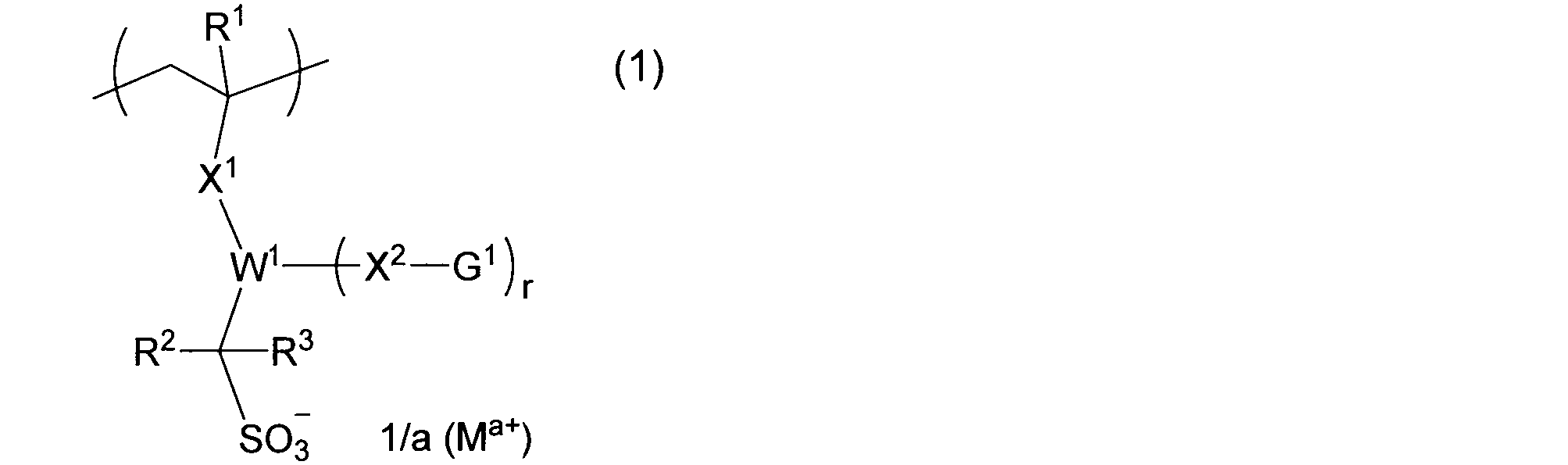

本開示の感放射線性組成物(以下、「本組成物」ともいう)は、[A]重合体を含有する。また、本組成物は、任意成分として更に、[Z]酸拡散制御剤、[B]感放射線性酸発生剤(ただし、[A]重合体を除く。)、[D]溶剤及び[F]高フッ素含有量重合体のうち1種以上を含有していてもよい。以下、各成分について詳細に説明する。
[A]重合体は、下記式(1)で表される構造単位(以下、「第1構造単位」ともいう)を含む重合体である。
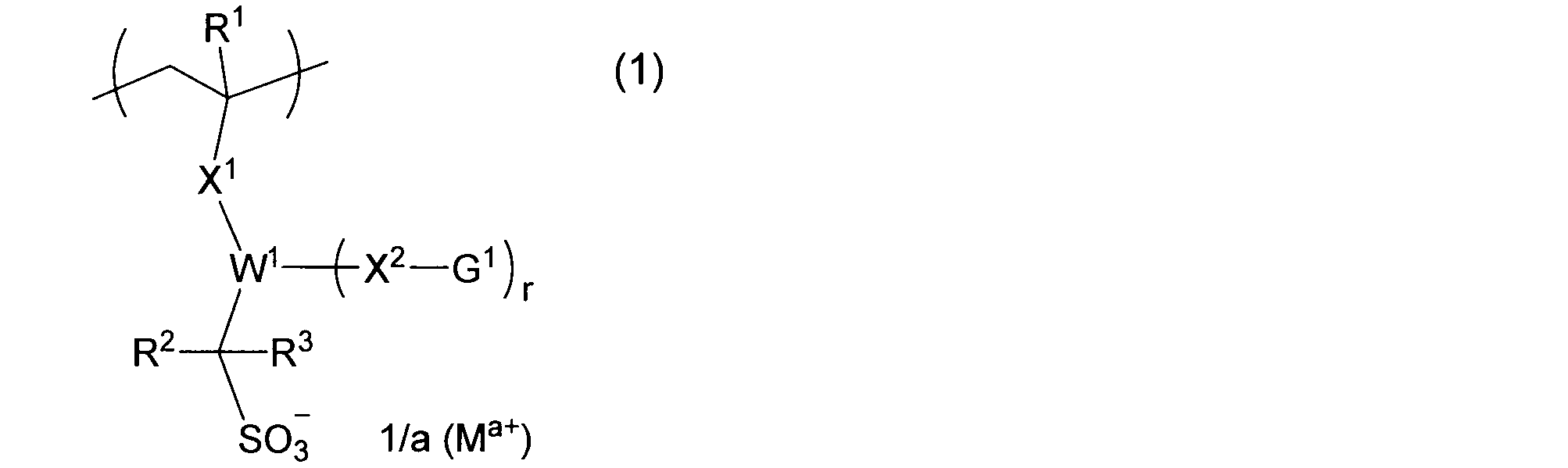
上記式(1)において、R1は、第1構造単位を与える単量体の共重合性の観点から、水素原子又はメチル基が好ましい。

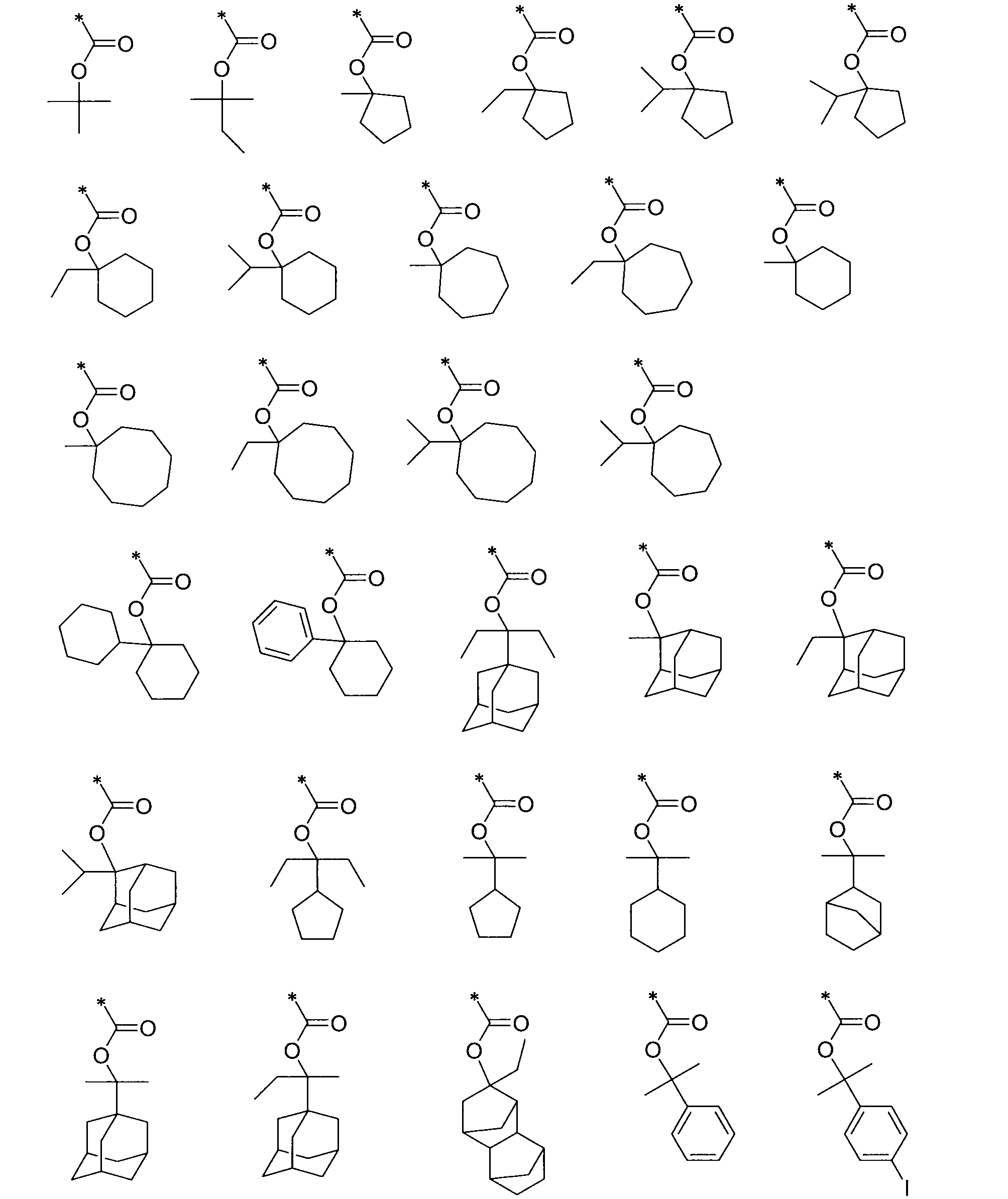
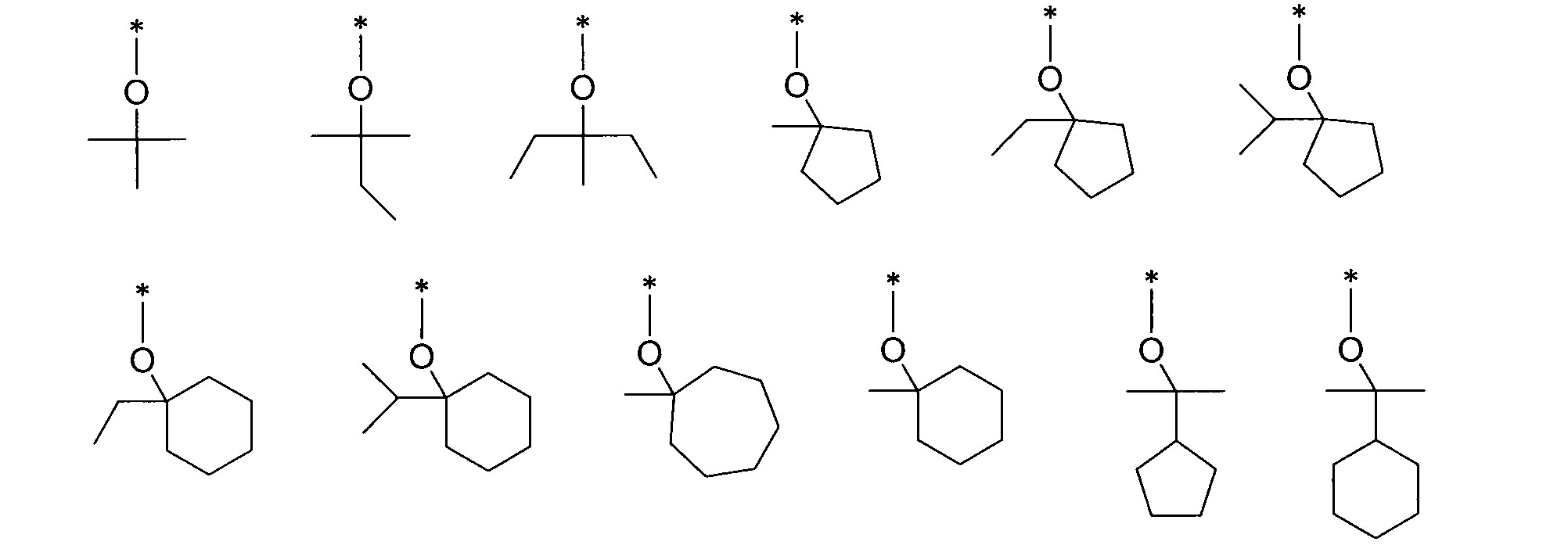


rは、合成容易性の観点から1が好ましい。



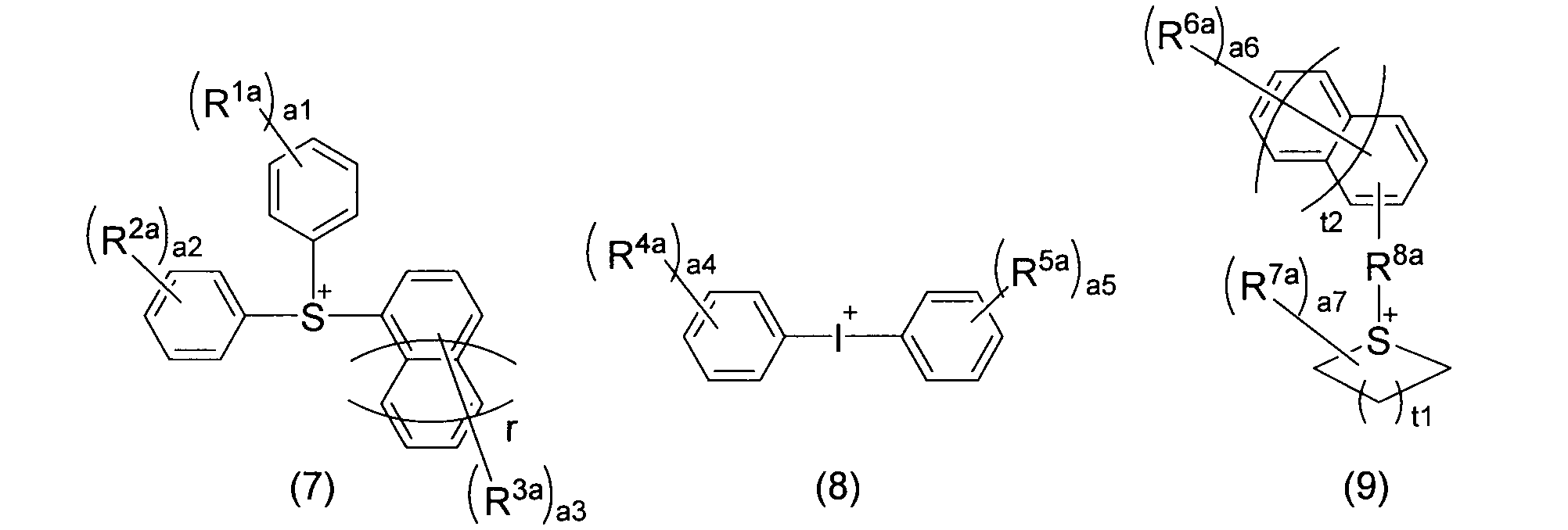
式(8)中、R4a及びR5aは、互いに独立して1価の置換基である。a4及びa5は、互いに独立して0~5の整数である。
式(9)中、a6は0~7の整数である。a6が1の場合、R6aは、炭素数1~20の1価の有機基、水酸基、ニトロ基又はハロゲン基である。a6が2以上の場合、複数のR6aは同一又は異なり、炭素数1~20の1価の有機基、水酸基、ニトロ基若しくはハロゲン基であるか、又は複数のR6aのうち2個が互いに合わせられこれらが結合する炭素原子と共に構成される環員数4~20の環構造を表す。a7は0~6の整数である。a7が1の場合、R7aは、炭素数1~20の1価の有機基、水酸基、ニトロ基又はハロゲン基である。a7が2以上の場合、複数のR7aは、同一又は異なり、炭素数1~20の1価の有機基、水酸基、ニトロ基若しくはハロゲン基であるか、又は複数のR7aのうちの2個が互いに合わせられこれらが結合する炭素原子と共に構成される環員数3~20の環構造を表す。t1は0~3の整数である。R8aは、単結合又は炭素数1~20の2価の有機基である。t2は0又は1である。)
R8aで表される2価の有機基としては、例えば、R6a及びR7aとして例示した炭素数1~20の1価の有機基から1個の水素原子を除いた基等が挙げられる。
上記式(1)中のaは1が好ましい。


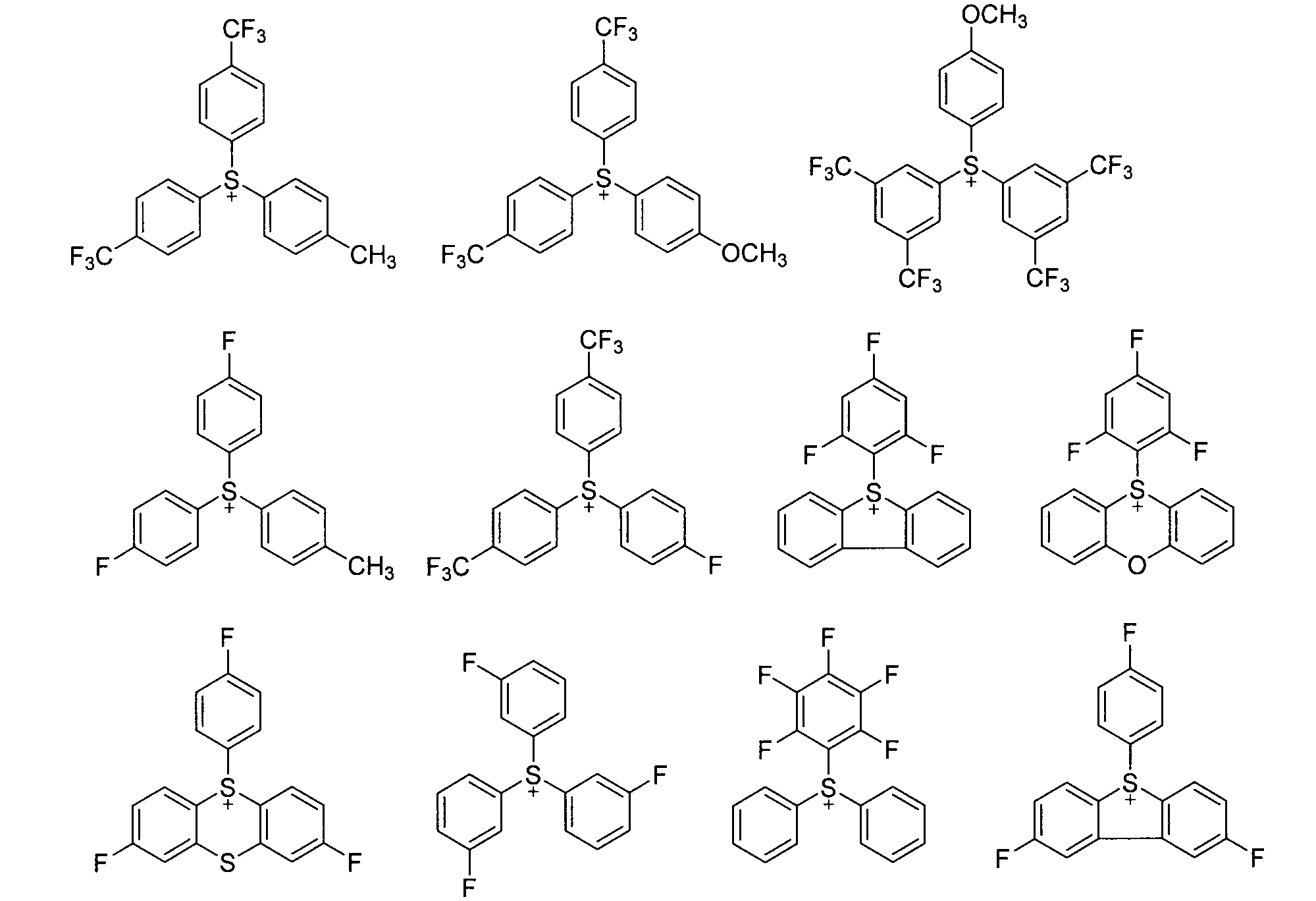
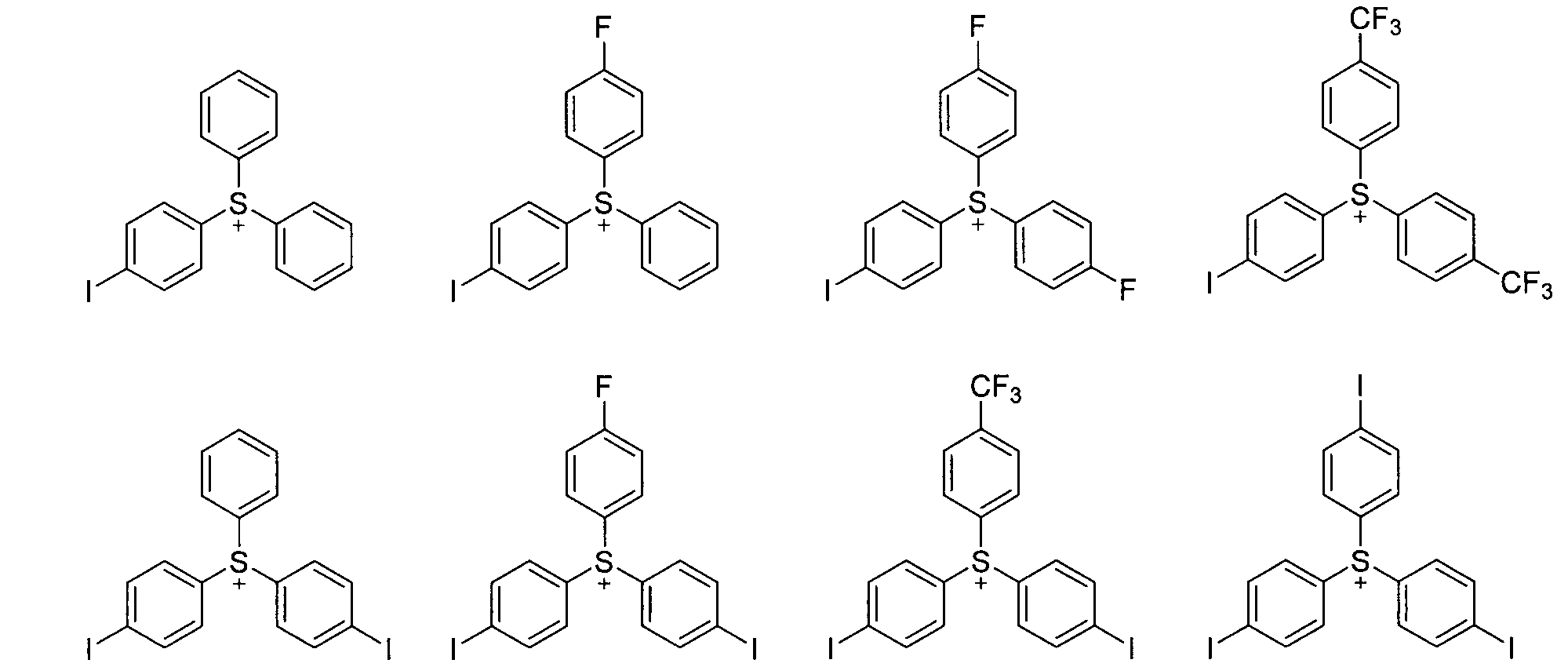
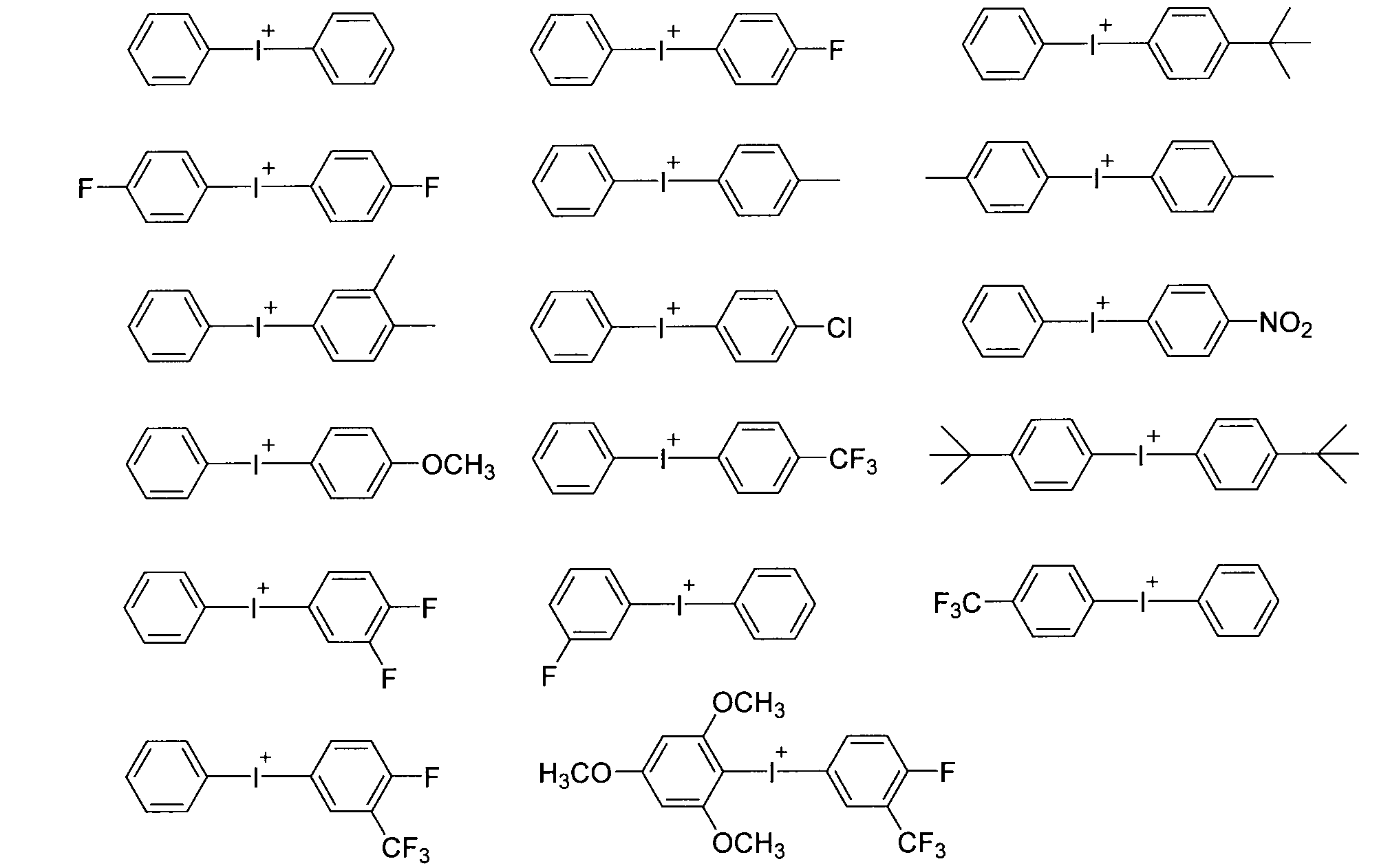


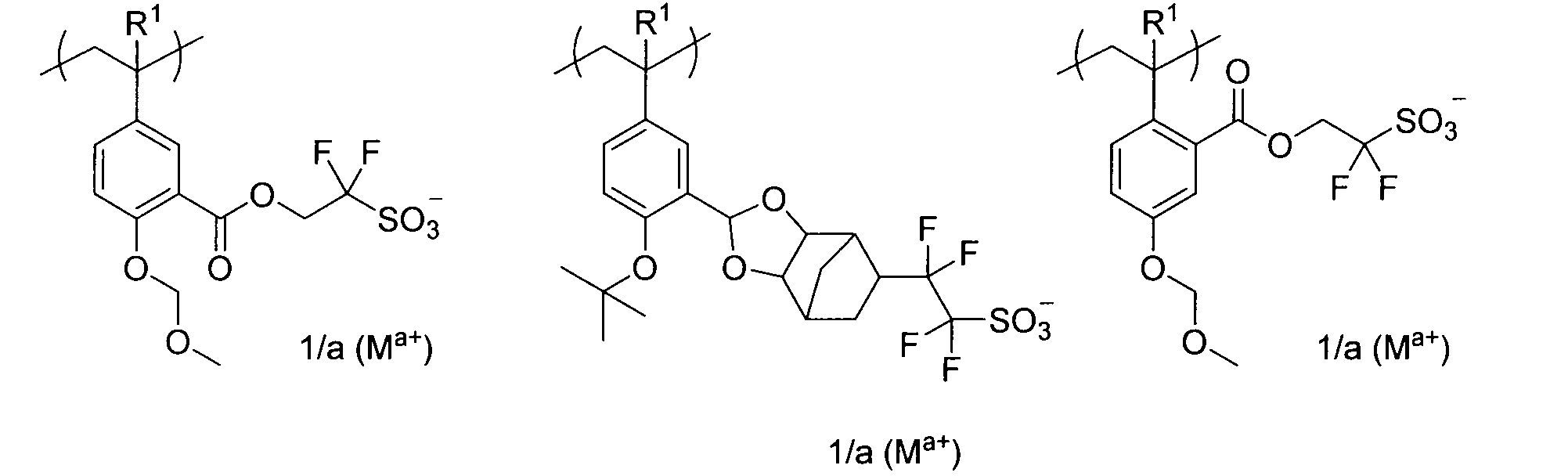
[A]重合体は、第1構造単位と共に、第1構造単位とは異なる構造単位(以下、「その他の構造単位」ともいう)を更に含んでいてもよい。その他の構造単位としては、例えば、下記に示す第2構造単位~第5構造単位が挙げられる。
[A]重合体は、芳香環と、当該芳香環に結合する水酸基とを有する構造単位(ただし、第1構造単位に該当する構造単位を除く。これを「第2構造単位」とする。)を更に含んでいてもよい。[A]重合体が第2構造単位を更に含むことにより、本組成物のLWR性能及びCDU(Critical Dimension Uniformity)性能等のリソグラフィー特性をより向上できる点、並びに、未露光部の現像液への溶け出し抑制の効果が高く、現像欠陥を十分に低減できる点で好適である。特に、電子線やEUVといった、波長50nm以下の放射線による露光を用いるパターン形成において、第2構造単位を含む重合体を好ましく適用することができる。波長50nm以下の放射線による露光を用いるパターン形成に適用する場合、[A]重合体は第2構造単位を含むことが好ましい。


[A]重合体は、酸解離性基を有し、かつオニウム塩構造を有しない構造単位(これを「第3構造単位」とする。)を更に含んでいてもよい。第3構造単位が有する酸解離性基は、カルボキシ基、水酸基等の酸基が有する水素原子を置換する基であって、酸の作用により解離する基であることが好ましい。[A]重合体が第3構造単位を更に含むことにより、本組成物に対する露光により発生した酸によって、第3構造単位中の酸解離性基が解離して酸基を生じ、[A]重合体の現像液への溶解性が変化し、これにより本組成物に良好なリソグラフィー特性を付与することができる。

式(iii-2)中、R16は、水素原子、フッ素原子、メチル基又はトリフルオロメチル基である。L3は、単結合、-COO-又は-CONH-である。R17、R18及びR19は、それぞれ独立して、水素原子、炭素数1~20の置換若しくは無置換の1価の炭化水素基、又は炭素数1~20の置換若しくは無置換の1価のオキシ炭化水素基である。R35は1価の置換基である。g1は0~4の整数である。
式(iii-3)中、R31は、水素原子、フッ素原子、メチル基又はトリフルオロメチル基である。L4は、単結合、-COO-又は-CONH-である。R32、R33及びR34は、互いに独立して、水素原子、炭素数1~20の置換若しくは無置換の1価の炭化水素基、又は炭素数1~20の置換若しくは無置換の1価のオキシ炭化水素基である。R33及びR34は、互いに独立して、水素原子、炭素数1~20の置換若しくは無置換の1価の炭化水素基、又は炭素数1~20の置換若しくは無置換の1価のオキシ炭化水素基であるか、又は、R33及びR34が互いに合わせられR33及びR34が結合する炭素原子と共に構成される炭素数3~20の脂環式炭化水素構造を表す。R36は1価の置換基である。g2は0~4の整数である。)
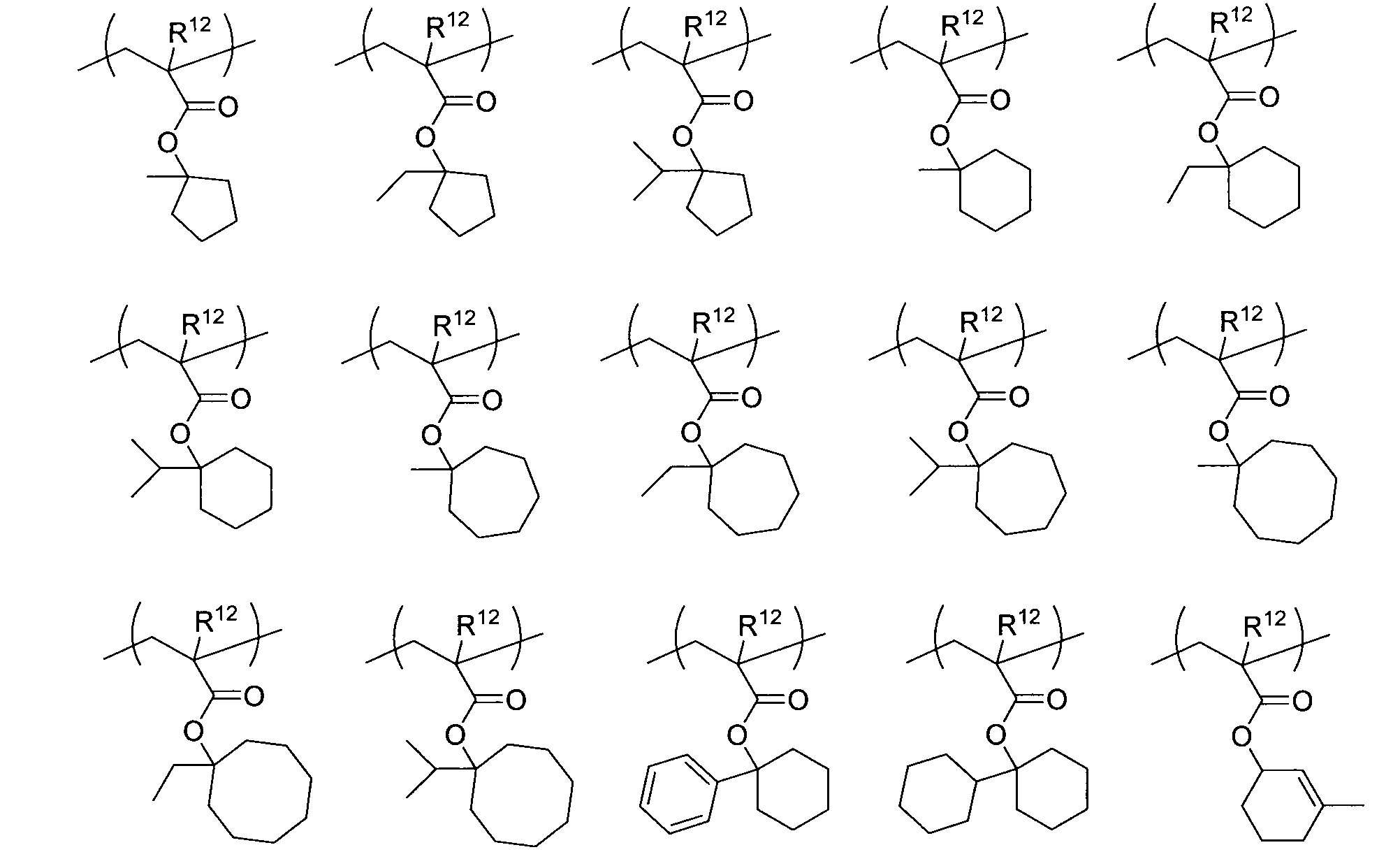

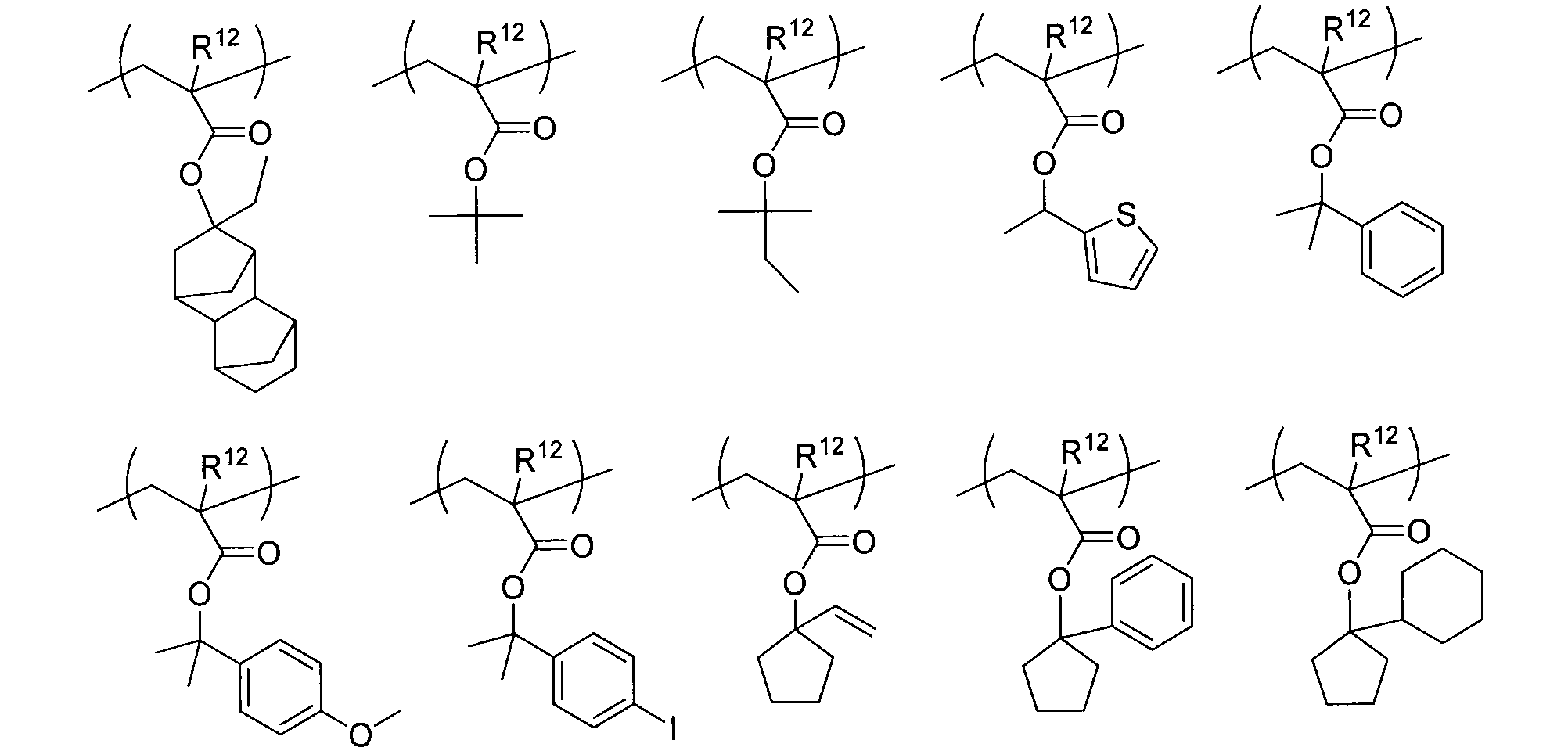
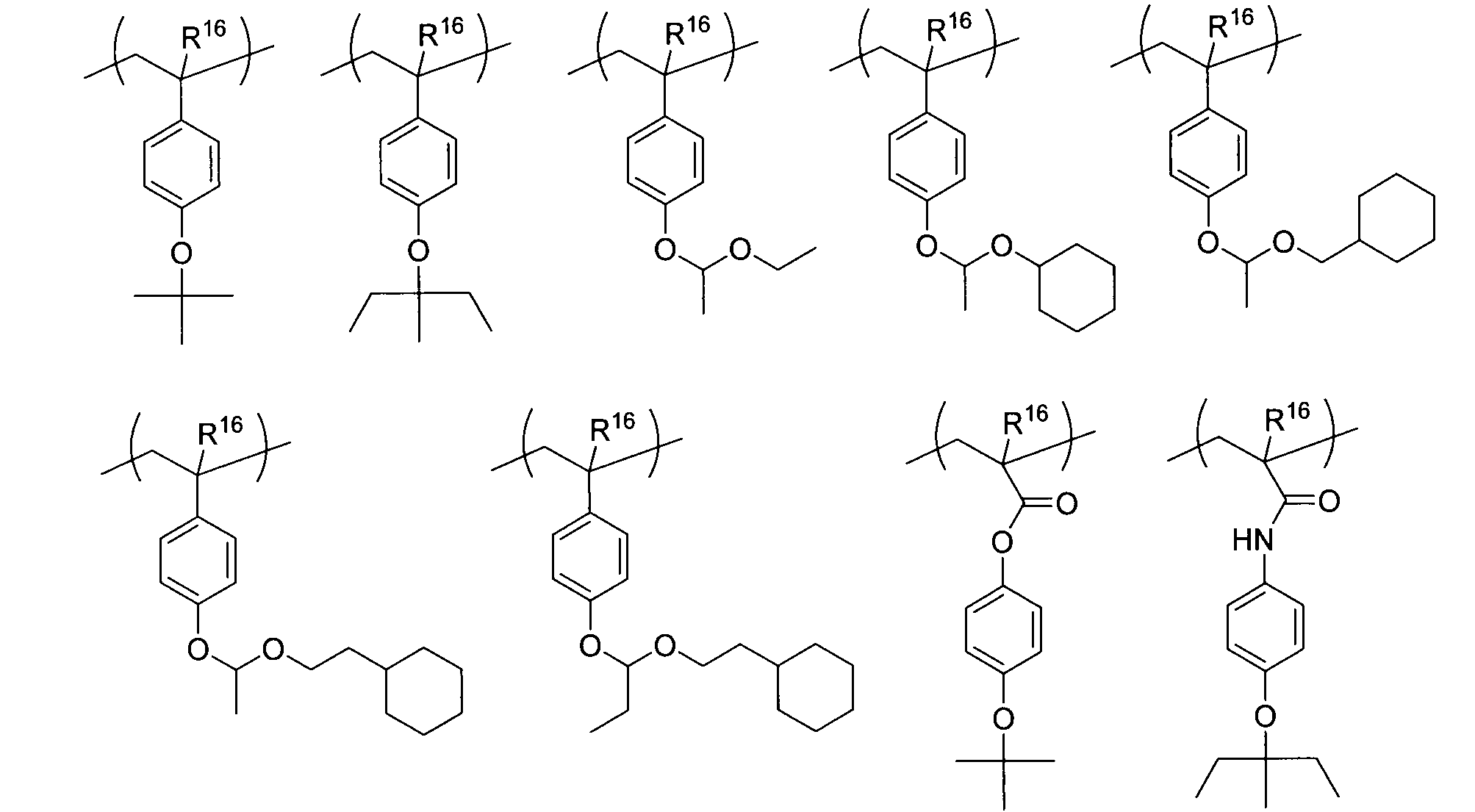

[A]重合体は、ラクトン構造、環状カーボネート構造、スルトン構造、又はこれらのうちの2種以上を組み合わせた環構造を有する構造単位(ただし、第1構造単位~第3構造単位に該当する構造単位を除く。これを「第4構造単位」とする。)を更に含んでいてもよい。[A]重合体が第4構造単位を含むことにより、現像液への溶解性を調整でき、その結果、本組成物のリソグラフィー特性を更に良化できる点で好適である。また、[A]重合体が第4構造単位を含むことにより、本組成物を用いて得られるレジスト膜と基板との密着性の改善を図ることができる。

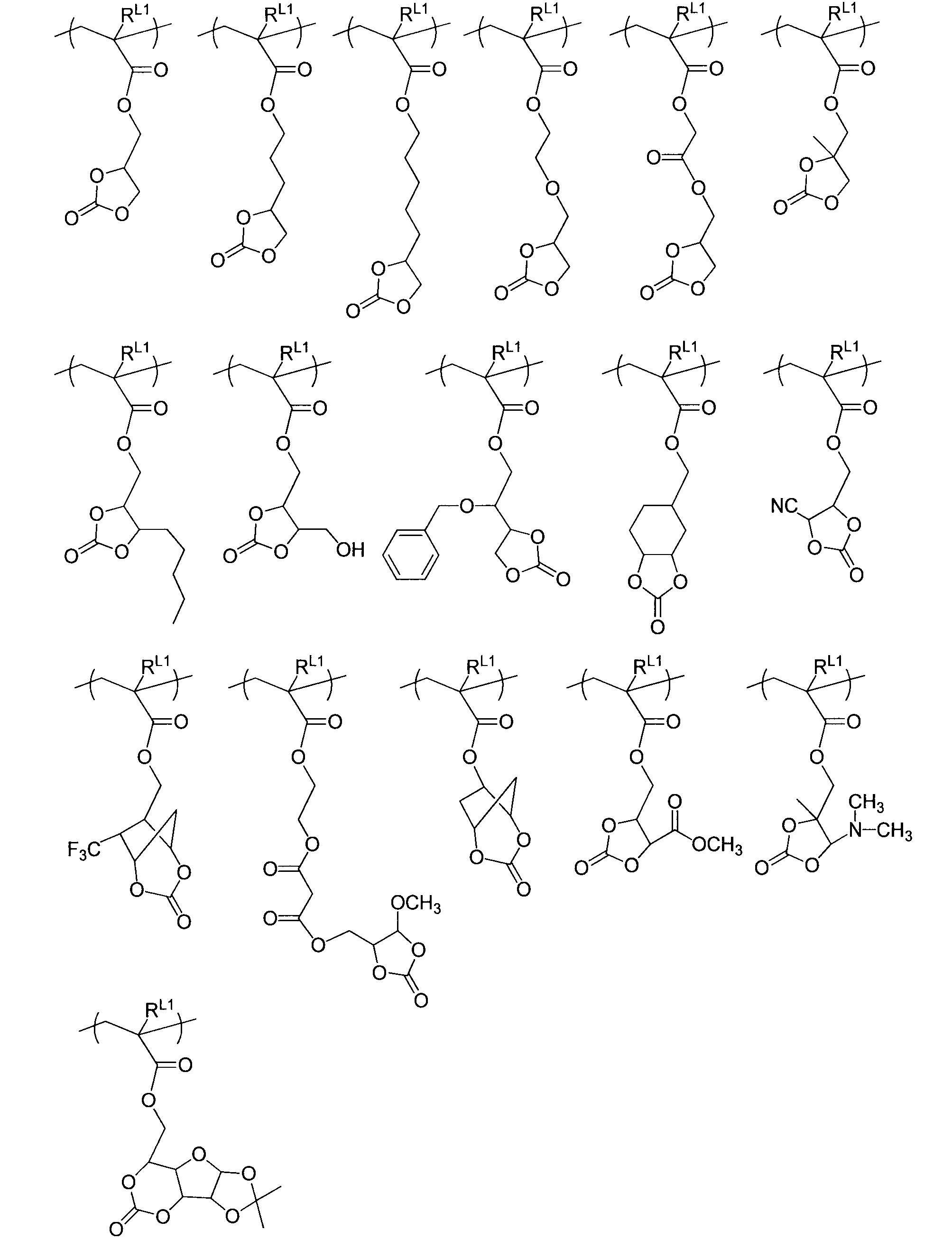
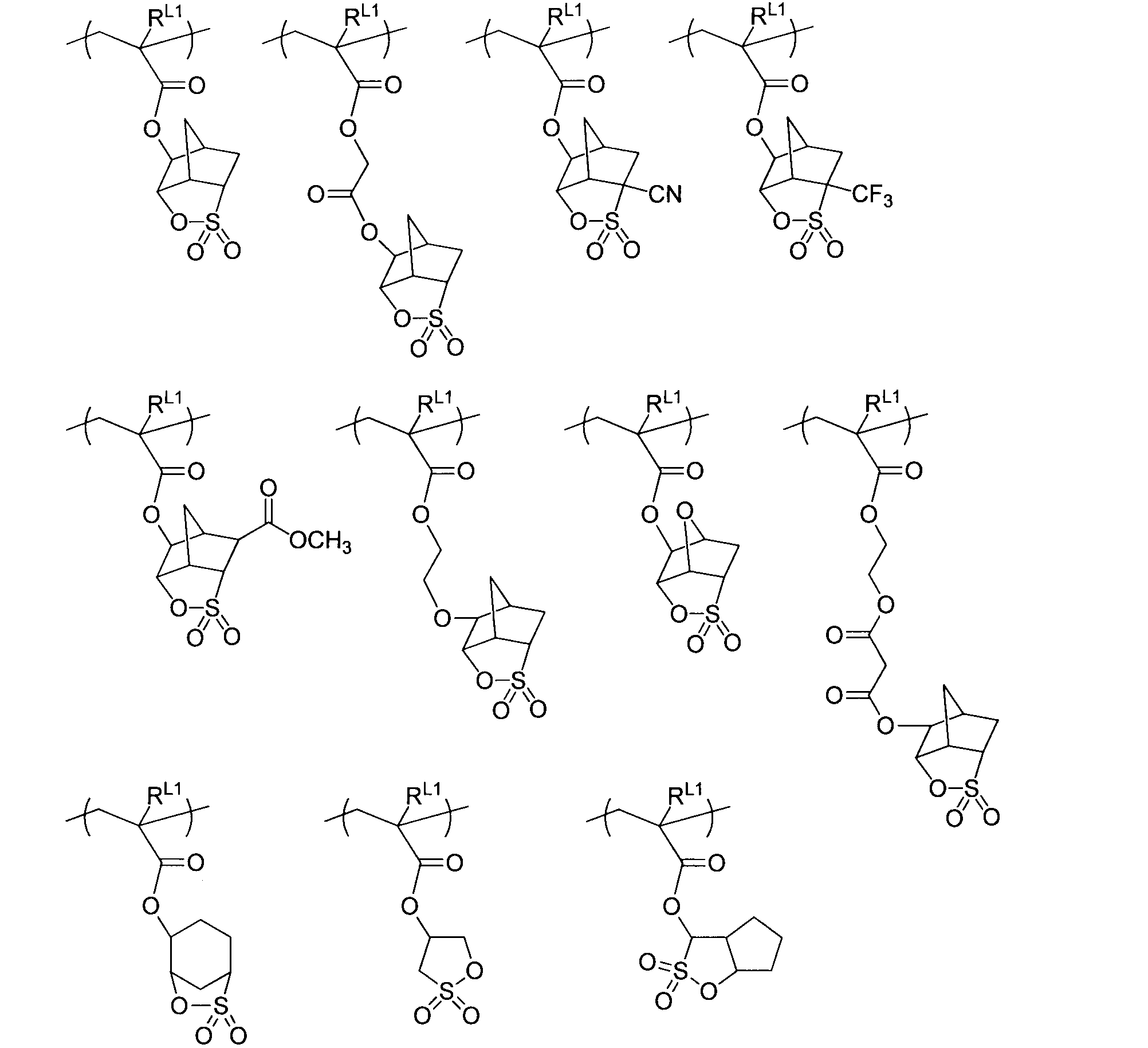
[A]重合体は、アルコール性水酸基を有する構造単位(ただし、第1構造単位~第4構造単位に該当する構造単位を除く。これを「第5構造単位」とする。)を更に有していてもよい。ここで、本明細書において「アルコール性水酸基」とは、脂肪族炭化水素基に水酸基が直接結合した構造を有する基である。当該脂肪族炭化水素基は、鎖状炭化水素基でもよく、脂環式炭化水素基でもよい。[A]重合体が第5構造単位を更に含むことにより、現像液への溶解性を改善でき、その結果、本組成物のリソグラフィー特性の改善を図ることが可能である。
第1構造を与える単量体(以下、「化合物(M)」ともいう)は、下記式(2)で表される。
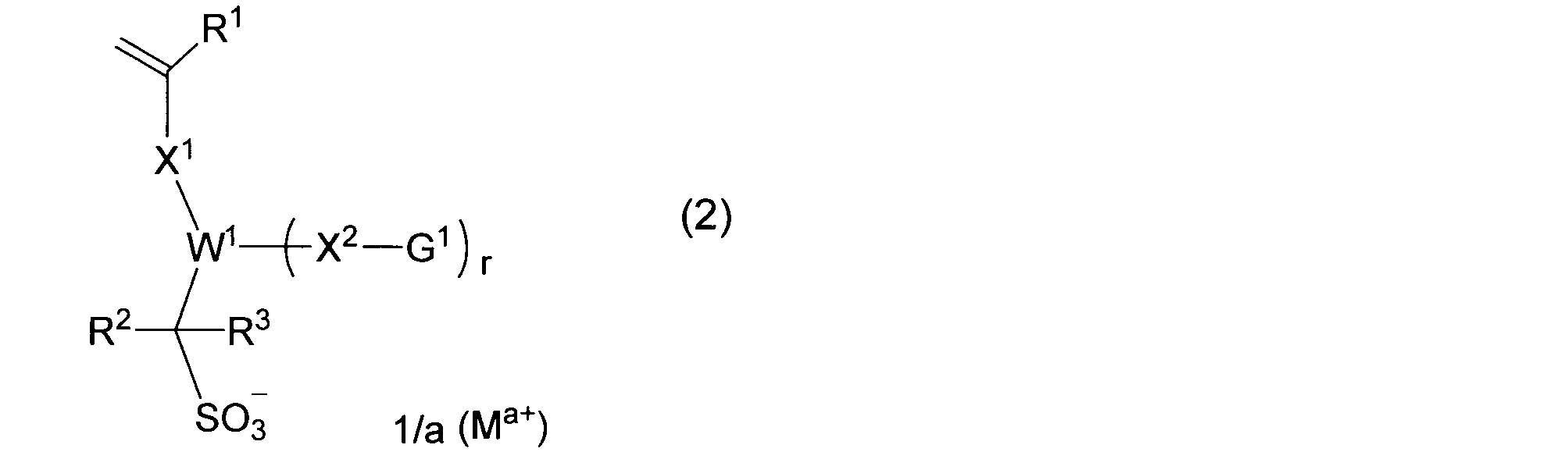
酸拡散制御剤は、本組成物の露光によりレジスト膜中に生じた酸がレジスト膜中で拡散することを抑制することによって、未露光部での酸による化学反応を抑制可能な成分である。酸拡散制御剤を本組成物に配合することにより、本組成物のリソグラフィー特性(LWR性能やCDU性能)を向上させることができる。さらに、露光から現像処理までの引き置き時間の変動によるレジストパターンの線幅変化を抑えることができ、プロセス安定性に優れた感放射線性組成物を得ることができる。酸拡散制御剤としては、窒素含有化合物及び光崩壊性塩基を挙げることができる。
窒素含有化合物としては、レジストパターン形成に用いられる公知の窒素含有化合物を使用することができる。窒素含有化合物の具体例としては、アミノ基含有化合物(アルキルアミン、芳香族アミン、ポリアミン等)、アミド基含有化合物、ウレア化合物、含窒素複素環化合物(N-(ウンデカン-1-イルカルボニルオキシエチル)モルホリン等)、酸解離性基を有する含窒素化合物(N-(t-ブトキシカルボニル)ジ-n-オクチルアミン、N-t-ブトキシカルボニル-4-ヒドロキシピペリジン等)等が挙げられる。窒素含有化合物としては、1種を単独で使用してもよく、2種以上を組み合わせて使用してもよい。
光崩壊性塩基としては、露光により[A]重合体が発生する酸よりも酸性度が低い酸を発生する化合物(以下、「化合物(z)」ともいう)を好ましく使用することができる。なお、酸性度の大小は酸解離定数(pKa)により評価することができる。光崩壊性塩基が発生する酸の酸解離定数は、通常-3以上であり、好ましくは-1≦pKa≦7であり、より好ましくは0≦pKa≦5である。光崩壊性塩基が発生する酸は、通常の条件では酸解離性基の解離を誘発しない弱酸である。なお、ここでいう「通常の条件」とは、110℃で60秒間ポストエクスポージャーベーク(PEB)を行う条件をいう。
化合物(z1):ヨウ素原子を有する有機アニオンと、カチオンとからなるオニウム塩
化合物(z2):フッ素原子を有するカチオンと、有機アニオンとからなるオニウム塩
以下、各化合物の詳細について説明する。
化合物(z1)が有する有機アニオン(以下、「ヨウ素含有アニオン」ともいう)は、ヨウ素原子を1個以上有していればよく、その構造は特に限定されない。ヨウ素含有アニオンとしては、例えば、スルホネートアニオン構造、イミドアニオン構造、メチルアニオン構造、カルボキシレートアニオン構造等が挙げられる。これらのうち、ヨウ素含有アニオンは、スルホネートアニオン構造又はカルボキシレートアニオン構造を有することが好ましく、カルボキシレートアニオン構造を有することがより好ましい。


化合物(z2)が有するカチオン(以下、「フッ素含有カチオン」ともいう)は、フッ素原子を1個以上有していればよく、その構造は特に限定されない。感度の観点から、フッ素含有カチオンは、フルオロアルキル基及びフルオロ基(ただし、フルオロアルキル基中のフルオロ基を除く。)よりなる群から選択される少なくとも1種の基(以下、「基Rf1」ともいう)を有することが好ましい。


感放射線性酸発生剤は特に限定されず、レジストパターン形成において用いられる公知の感放射線性酸発生剤を適宜使用することができる。本組成物に配合させる感放射線性酸発生剤は、例えば、感放射線性オニウムカチオンと有機アニオンとからなるオニウム塩である。感放射線性酸発生剤は、典型的には、上記通常の条件により酸解離性基の解離を誘発して、光崩壊性塩基が発生する酸よりも酸性度が高い酸(好ましくは、スルホン酸、イミド酸、メチド酸等の強酸)を組成物中に発生させる化合物である。


[D]溶剤は、本組成物に配合される成分を溶解又は分散可能な溶媒であれば特に限定されない。[D]溶剤としては、アルコール類、エーテル類、ケトン類、アミド類、エステル類、炭化水素類等が挙げられる。
[F]高フッ素含有量重合体(以下、「[F]重合体」ともいう)は、[A]重合体よりもフッ素原子の質量含有率が大きい重合体である。[F]重合体は、例えば撥水性添加剤として本組成物に含有される。
本組成物は、上記の[A]重合体、[Z]酸拡散制御剤、[B]感放射線性酸発生剤、[D]溶剤及び[F]高フッ素含有量重合体とは異なる成分(以下、「その他の任意成分」ともいう)を更に含有していてもよい。その他の任意成分としては、界面活性剤、脂環式骨格含有化合物(例えば、1-アダマンタンカルボン酸、2-アダマンタノン、デオキシコール酸t-ブチル等)、増感剤、偏在化促進剤、窒素含有化合物等が挙げられる。本組成物におけるその他の任意成分の含有量は、本開示の効果を損なわない範囲において、各成分に応じて適宜選択することができる。
本組成物は、例えば、[A]重合体のほか、必要に応じて[D]溶剤等の成分を所望の割合で混合し、得られた混合物を、好ましくはフィルター(例えば、孔径0.2μm程度のフィルター)等を用いてろ過することにより製造することができる。本組成物の固形分濃度は、0.1質量%以上が好ましく、0.5質量%以上がより好ましく、1質量%以上が更に好ましい。また、本組成物の固形分濃度は、50質量%以下が好ましく、20質量%以下がより好ましく、5質量%以下が更に好ましい。本組成物の固形分濃度を上記範囲とすることにより、塗布性を良好にでき、レジストパターンの形状を良好にできる点で好適である。
本開示におけるレジストパターン形成方法は、基板の一方の面に本組成物を塗工する工程(以下、「塗工工程」ともいう)と、塗工工程により得られるレジスト膜を露光する工程(以下、「露光工程」ともいう)と、露光工程により露光されたレジスト膜を現像する工程(以下、「現像工程」ともいう)とを含む。本開示のレジストパターン形成方法により形成されるパターンとしては、例えば、ラインアンドスペースパターン、ホールパターン等が挙げられる。本開示のレジストパターン形成方法では本組成物を用いてレジスト膜を形成していることから、感度が良好であり、リソグラフィー特性が良好であり、かつ現像欠陥の少ないレジストパターンを形成することができる。以下、各工程について説明する。
塗工工程では、基板の一方の面に本組成物を塗工することにより基板上にレジスト膜を形成する。レジスト膜を形成する基板としては従来公知のものを使用でき、例えば、シリコンウエハ、二酸化シリコン、アルミニウムで被覆されたウエハ等が挙げられる。また、例えば、特開昭59-93448号公報等に開示されている有機系又は無機系の反射防止膜を基板上に形成して使用してもよい。本組成物の塗工方法としては、例えば、回転塗工(スピンコーティング)、流延塗工、ロール塗工等が挙げられる。塗工後には、塗膜中の溶媒を揮発させるためにソフトベーク(SB、プレベークとも称される)を行ってもよい。SBの温度は、60℃以上が好ましく、80℃以上がより好ましい。また、SBの温度は、140℃以下が好ましく、120℃以下がより好ましい。SBの時間は、5秒以上が好ましく、10秒以上がより好ましい。また、SBの時間は、600秒以下が好ましく、300秒以下がより好ましい。形成されるレジスト膜の平均厚さは、10~1,000nmが好ましく、20~500nmがより好ましい。
露光工程では、上記塗工工程により得られるレジスト膜を露光する。この露光は、フォトマスクを介して、場合によっては水等の液浸媒体を介して、レジスト膜に対して放射線を照射することにより行う。放射線としては、目的とするパターンの線幅に応じて、例えば可視光線、紫外線、遠紫外線、極端紫外線(EUV)、X線、γ線等の電磁波;電子線、α線等の荷電粒子線、等が挙げられる。これらのうち、本組成物を用いて形成されたレジスト膜に対し照射する放射線は、遠紫外線、EUV又は電子線が好ましく、ArFエキシマレーザー光(波長193nm)、KrFエキシマレーザー光(波長248nm)、EUV又は電子線がより好ましく、ArFエキシマレーザー光、EUV又は電子線が更に好ましく、EUV又は電子線がより更に好ましく、EUVが特に好ましい。
現像工程では、上記露光されたレジスト膜を現像する。これにより、所望のレジストパターンを形成することができる。現像後は、水又はアルコール等のリンス液で洗浄し、乾燥することが一般的である。現像工程における現像方法は、アルカリ現像であってもよく、有機溶媒現像であってもよい。
重合体の重量平均分子量(Mw)及び数平均分子量(Mn)は、ゲルパーミエーションクロマトグラフィー(GPC)により東ソー社のGPCカラム(「G2000HXL」2 本、「G3000HXL」1本、及び「G4000HXL」1本)を使用し、以下の条件により測定した。
溶離液:テトラヒドロフラン(和光純薬工業社)
流量:1.0mL/分
試料濃度:1.0質量%
試料注入量:100μL
カラム温度:40℃
検出器:示差屈折計
標準物質:単分散ポリスチレン
[合成例1-1](単量体(M-15)の合成)
下記反応スキームにしたがって、単量体(M-15)を合成した。
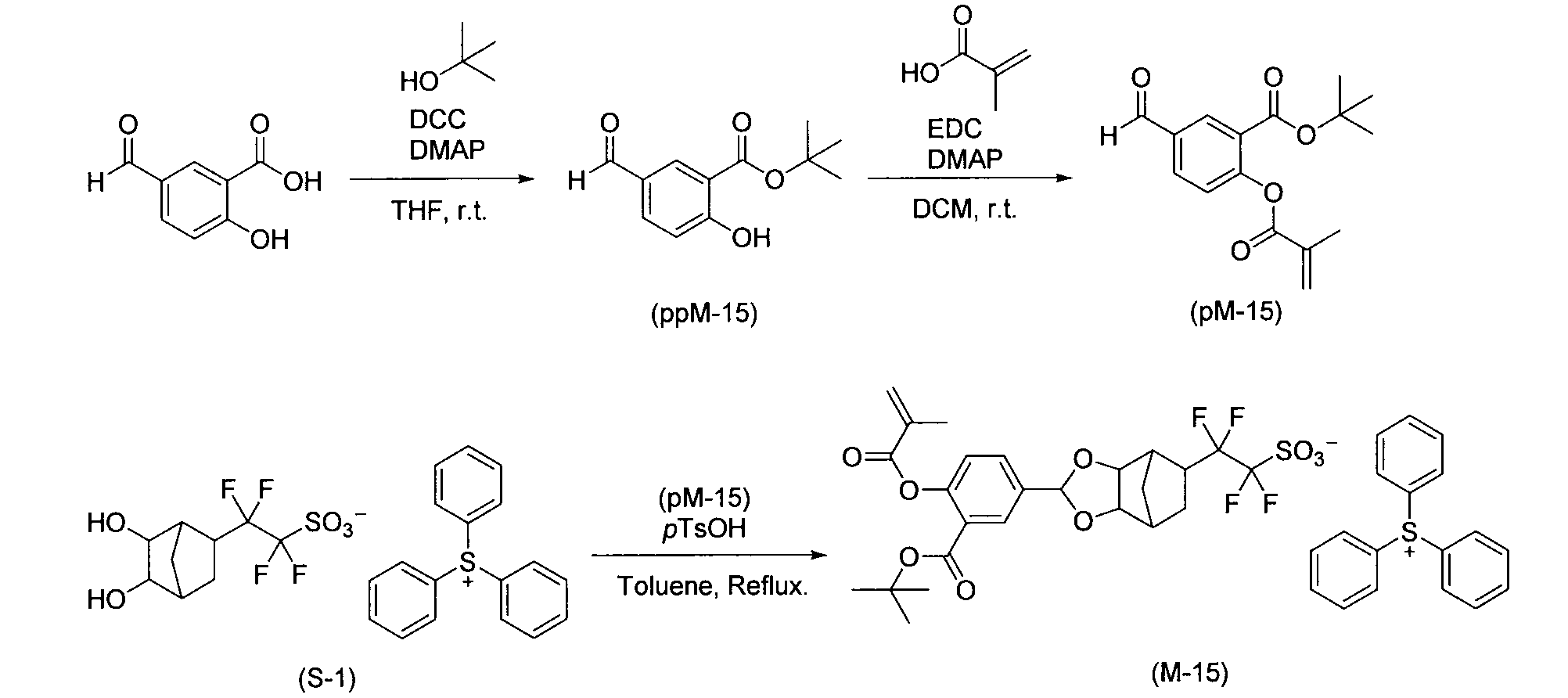
反応容器に(ppM-15)30mmol、メタクリル酸39mmol、EDC(1-(3-ジメチルアミノプロピル)-3-エチルカルボジイミド)39mmol、DMAP6mmol、DCM(ジクロロメタン)40mLを加え、室温で2時間撹拌した。2M塩酸20mLを加えて有機層を分離した。飽和炭酸水素ナトリウム水溶液40mLで2回洗浄後、超純水40mLで1回洗浄して(pM-15)を得た。
反応容器に上記式(S-1)で表される化合物20mmol、(pM-15)21mmol、pTsOH(p-トルエンスルホン酸)4mmol、トルエン100mLを加えた。上記反応容器にディーン・スターク管を設置し、還流条件下で4時間撹拌した。飽和炭酸水素ナトリウム水溶液50mLを加え、有機層を分離した。有機層を硫酸ナトリウムで乾燥後、溶媒を除去した。シリカゲルクロマトグラフィーで精製し、単量体(M-15)を得た。
合成例1-1において、用いる基質を適切に選択した以外は合成例1-1と同様にして単量体(M-16)を合成した。

下記反応スキームにしたがって、単量体(M-17)を合成した。

反応容器に2-フェニル-2-プロパノール30mmol、炭酸カリウム30mmol、(ppM-17)20mmol、アセトン100mLを加え、還流条件下で5時間撹拌した。室温まで冷却後、析出した固体をろ過し、ろ液を濃縮した。シリカゲルカラムクロマトグラフィーで精製し、(pM-17)を得た。
反応容器に(pM-17)13mmol、上記式(S-2)で表される化合物10mmol、EDC13mmol、DMAP2mmol、ジクロロメタン40mLを加え、2時間撹拌した。2M塩酸40mLを加えて有機層を分離し、飽和炭酸水素ナトリウム水溶液40mLで2回洗浄後、超純水40mLで1回洗浄した。シリカゲルカラムクロマトグラフィーで精製し、単量体(M-17)を得た。
下記反応スキームにしたがって、単量体(M-18)を合成した。

反応容器に(pppM-18)30mmol、メタクリル酸39mmol、EDC39mmol、DMAP6mmol、ジクロロメタン50mLを加え、室温で2時間撹拌した。2M塩酸50mLを加えて有機層を分離した。飽和炭酸水素ナトリウム水溶液50mLで2回洗浄後、超純水50mLで1回洗浄して(ppM-18)を得た。
反応容器に(ppM-18)20mmol、テトラヒドロフラン40mLを加え、0℃で30分撹拌した。水素化ホウ素ナトリウムを加えて0℃で1時間撹拌した。飽和塩化アンモニウム水溶液40mLを加え、酢酸エチル100mLで抽出し、(pM-18)を得た。
反応容器に(pM-18)13mmol、上記式(S-3)で表される化合物10mmol、EDC13mmol、DMAP2mmol、ジクロロメタン20mLを加え、室温で2時間撹拌した。2M塩酸20mLを加えて有機層を分離した。飽和炭酸水素ナトリウム水溶液20mLで2回洗浄後、超純水20mLで1回洗浄した。シリカゲルカラムクロマトグラフィーで精製して単量体(M-18)を得た。
下記反応スキームにしたがって、単量体(M-19)を合成した。
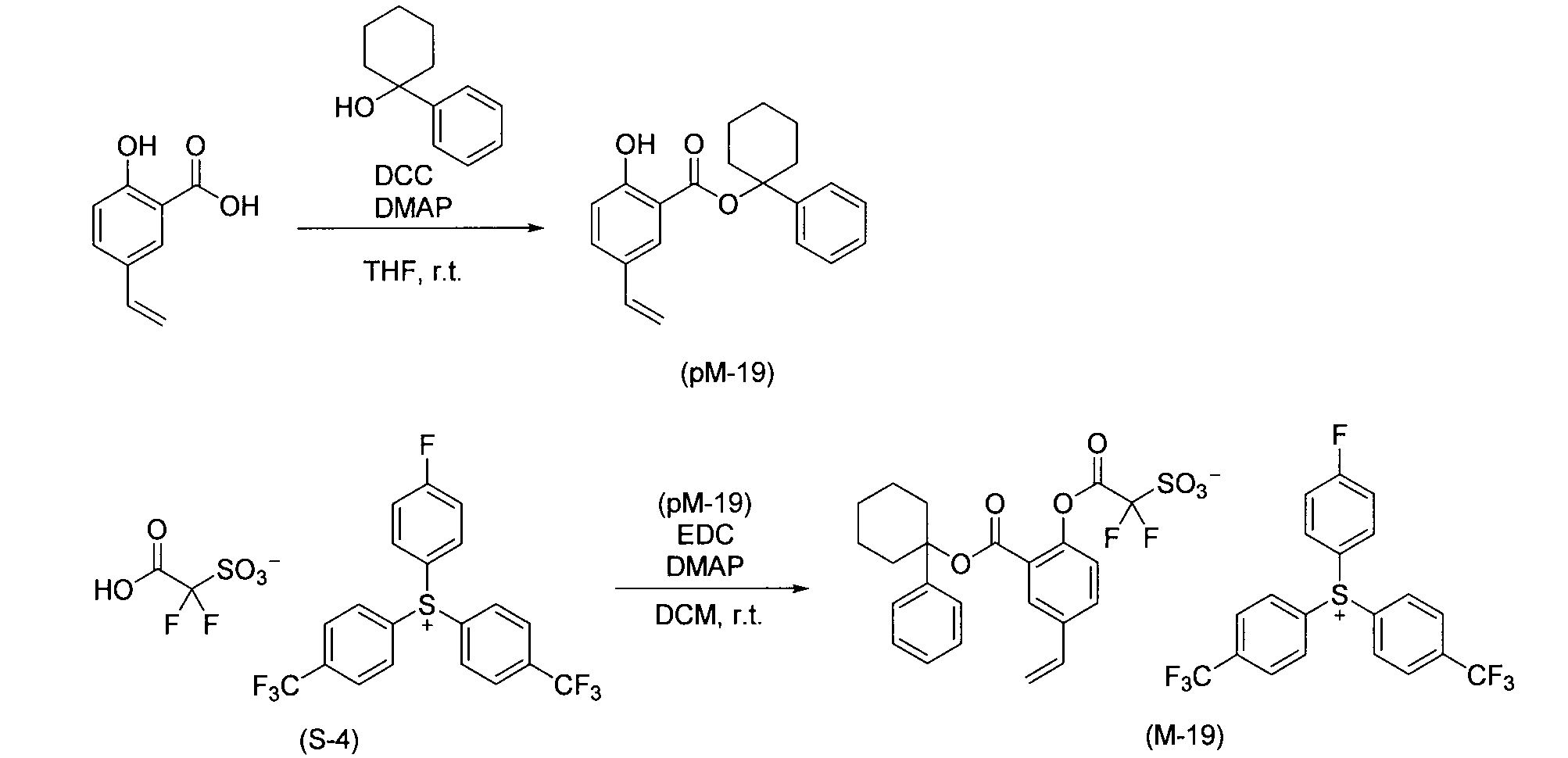
反応容器に(pM-19)13mmol、上記式(S-4)で表される化合物10mmol、EDC13mmol、DMAP2mmol、ジクロロメタン20mLを加え、室温で2時間撹拌した。2M塩酸20mLを加えて有機層を分離した。飽和炭酸水素ナトリウム水溶液20mLで2回洗浄後、超純水20mLで1回洗浄した。シリカゲルカラムクロマトグラフィーで精製して単量体(M-19)を得た。
下記反応スキームにしたがって、単量体(M-20)を合成した。

反応容器に(ppM-20)20mmol、テトラヒドロフラン40mL、N,N-ジメチルホルムアミド0.1mLを加えて撹拌し、塩化オキサリル40mmolを滴下した。室温で1時間撹拌後、アセト酢酸tert-ブチル30mmol、ナトリウムtert-ブトキシド30mmolをアセトニトリル40mLに溶かした溶液を滴下した。飽和塩化アンモニウム水溶液50mLを加えて有機層を分離後、超純水50mLで洗浄した。シリカゲルカラムクロマトグラフィーで精製して(pM-20)を得た。
反応容器に上記式(S-5)で表される化合物20mmol、(pM-20)21mmol、pTsOH4mmol、トルエン100mLを加えた。上記反応容器にディーン・スターク管を設置し、還流条件下で4時間加熱撹拌した。飽和炭酸水素ナトリウム水溶液50mLを加えて有機層を分離した。有機層を硫酸ナトリウムで乾燥後、溶媒を除去した。シリカゲルクロマトグラフィーで精製して単量体(M-20)を得た。
下記反応スキームにしたがって、単量体(M-21)を合成した。
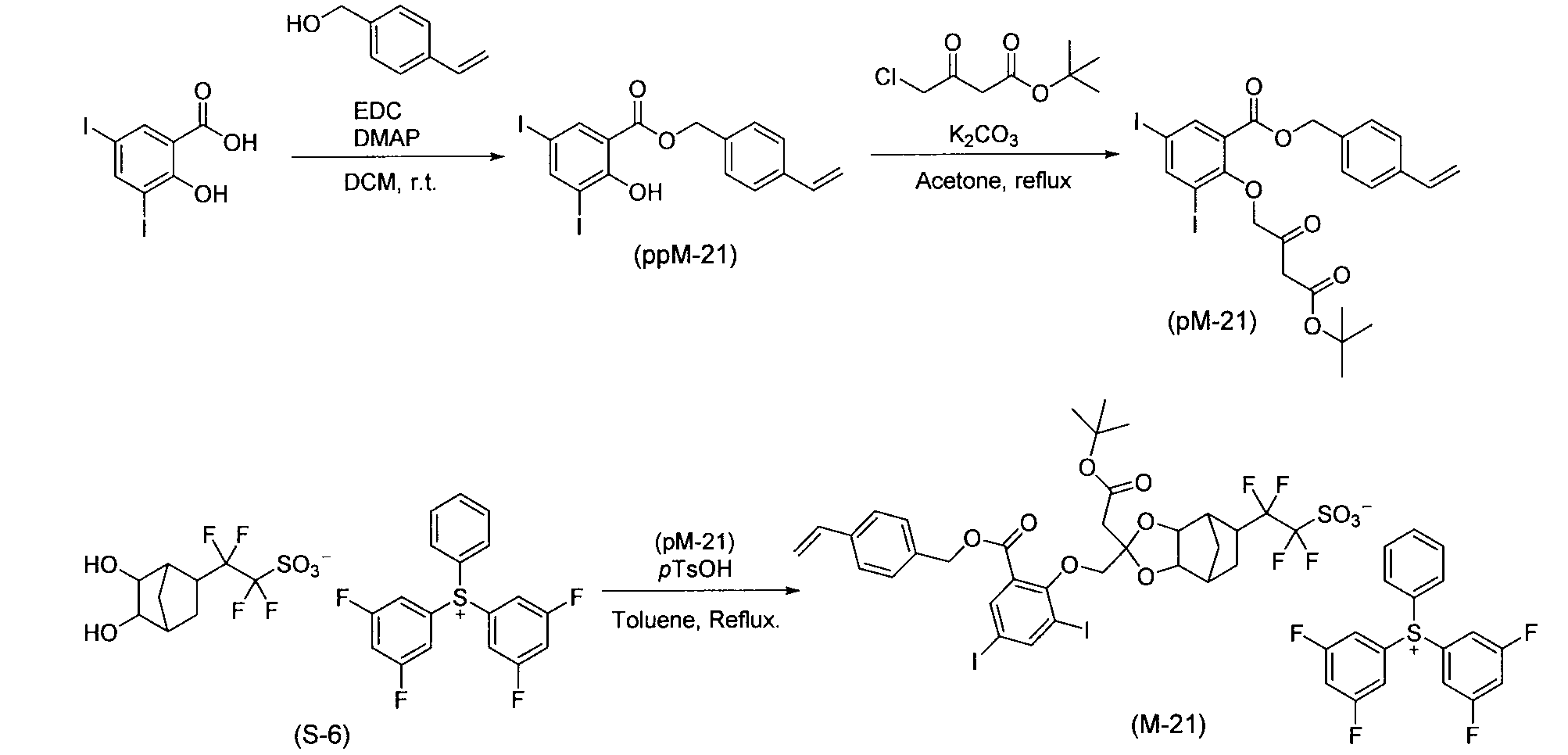
反応容器に(ppM-21)29.74mmol、炭酸カリウム148.7mmol、アセトン100mLを加えた。1時間撹拌後、4-クロロアセト酢酸tert-ブチル59.47mmolを滴下し、還流条件下で5時間加熱撹拌した。室温まで冷却後、析出した固体をろ過し、ろ液を濃縮した。シリカゲルカラムクロマトグラフィーで精製して(pM-21)を得た。
反応容器に上記式(S-6)で表される化合物20mmol、(pM-21)21mmol、pTsOH4mmol、トルエン100mLを加えた。上記反応容器にディーン・スターク管を設置し、還流条件下で4時間加熱撹拌した。飽和炭酸水素ナトリウム水溶液50mLを加えて有機層を分離した。有機層を硫酸ナトリウムで乾燥後、溶媒を除去した。シリカゲルクロマトグラフィーで精製して単量体(M-21)を得た。
下記反応スキームにしたがって、単量体(M-22)を合成した。

反応容器に(pM-22)20mmol、ナトリウムtert-ブトキシド100mmol、アセトニトリル80mLを加えた。1時間撹拌後、4-(クロロメチル)スチレン40mmolを滴下し、60℃で5時間加熱撹拌した。室温まで冷却後、析出した固体をろ過し、ろ液を濃縮した。シリカゲルカラムクロマトグラフィーで精製して単量体(M-22)を得た。
合成例1-8において、用いる基質を適切に選択した以外は合成例1-8と同様にして単量体(M-23)、単量体(M-24)を合成した。

下記反応スキームにしたがって、単量体(M-25)を合成した。
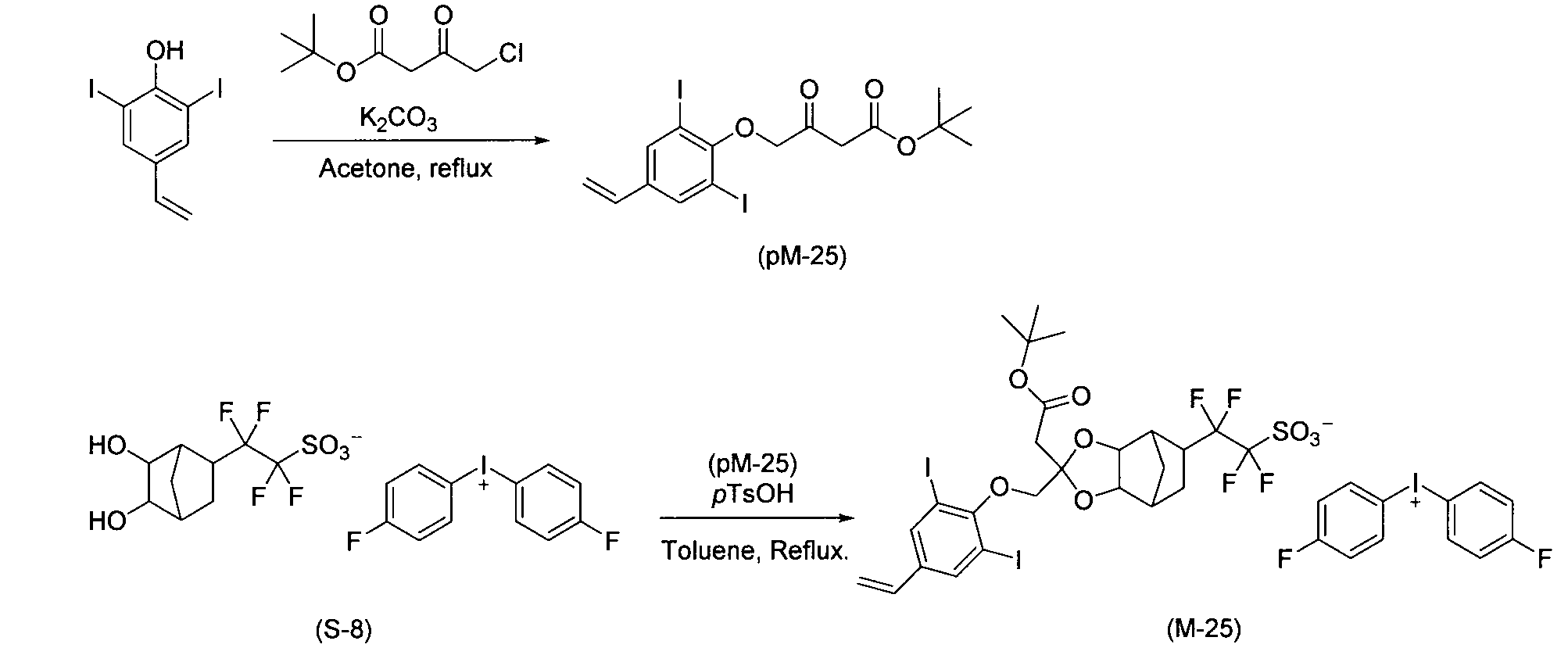
反応容器に上記式(S-8)で表される化合物20mmol、(pM-25)21mmol、pTsOH4mmol、トルエン100mLを加えた。上記反応容器にディーン・スターク管を設置し、還流条件下で4時間加熱撹拌した。飽和炭酸水素ナトリウム水溶液50mLを加えて有機層を分離した。有機層を硫酸ナトリウムで乾燥後、溶媒を除去した。シリカゲルクロマトグラフィーで精製して単量体(M-25)を得た。
下記反応スキームにしたがって、単量体(M-26)を合成した。

反応容器に(ppM-26)30mmol、メタクリル酸39mmol、EDC39mmol、DMAP6mmol、ジクロロメタン20mLを加え、室温で2時間撹拌した。2M塩酸20mLを加えて有機層を分離した。飽和炭酸水素ナトリウム水溶液20mLで2回洗浄後、超純水20mLで1回洗浄して(pM-26)を得た。
反応容器に(pM-26)13mmol、上記式(S-10)で表される化合物10mmol、EDC13mmol、DMAP2mmol、ジクロロメタン20mLを加え、室温で2時間撹拌した。2M塩酸20mLを加えて有機層を分離した。飽和炭酸水素ナトリウム水溶液20mLで2回洗浄後、超純水20mLで1回洗浄した。シリカゲルカラムクロマトグラフィーで精製して単量体(M-26)を得た。
合成例1-12において、用いる基質を適切に選択した以外は合成例1-12と同様にして単量体(M-27)を合成した。
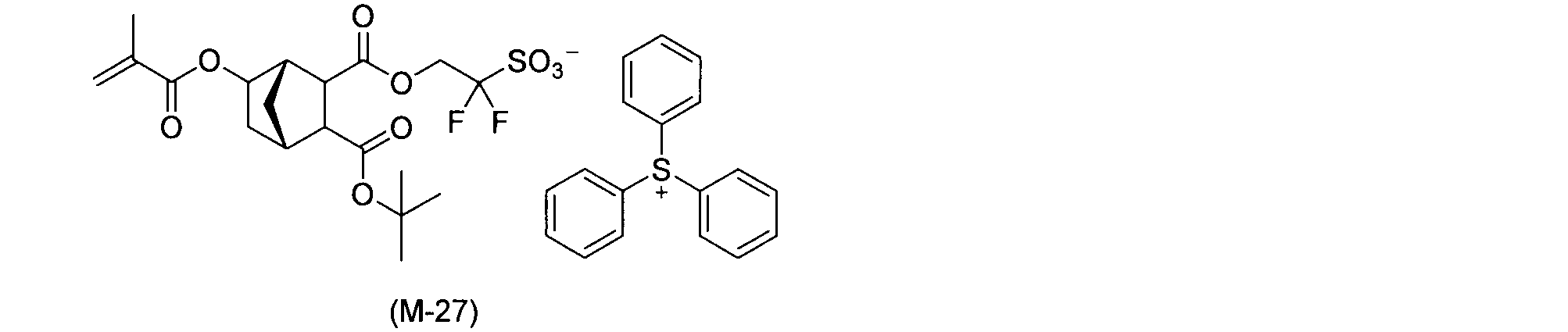
下記反応スキームにしたがって、単量体(M-28)を合成した。
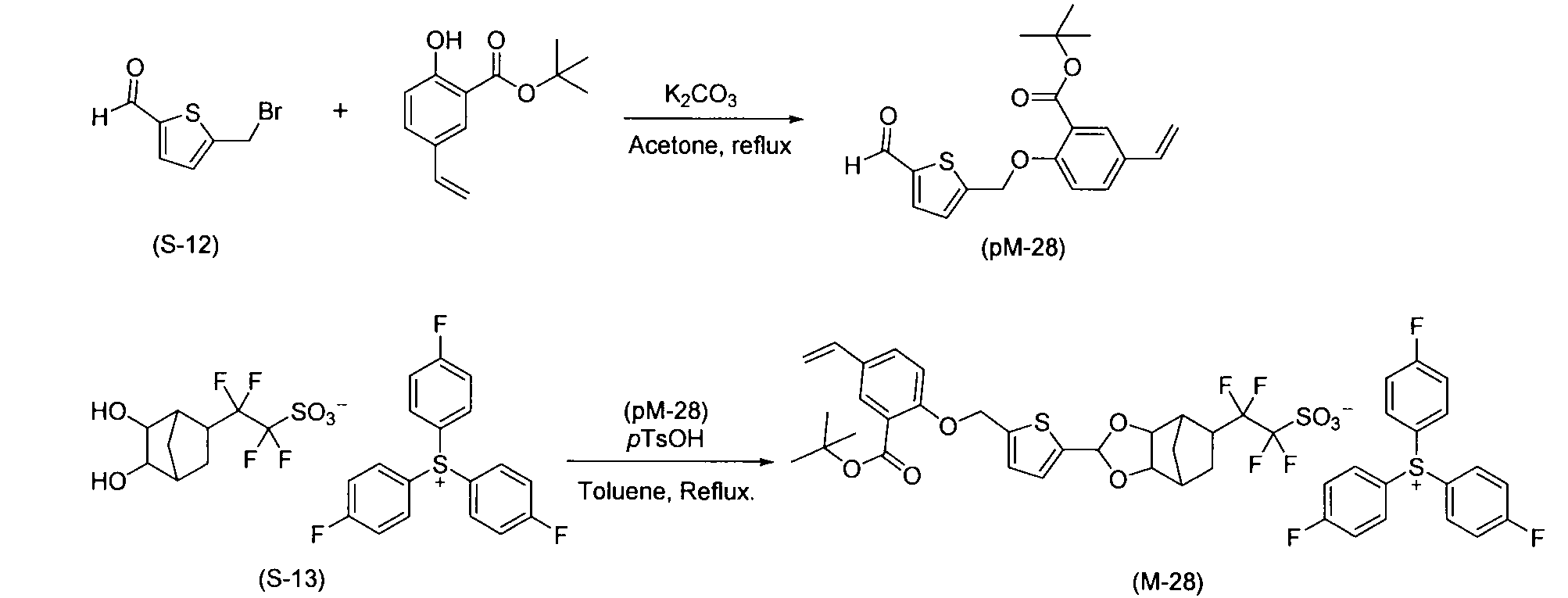
反応容器に上記式(S-13)で表される化合物20mmol、(pM-28)21mmol、pTsOH4mmol、トルエン100mLを加えた。上記反応容器にディーン・スターク管を設置し、還流条件下で4時間加熱撹拌した。飽和炭酸水素ナトリウム水溶液50mLを加えて有機層を分離した。有機層を硫酸ナトリウムで乾燥後、溶媒を除去した。シリカゲルクロマトグラフィーで精製して単量体(M-28)を得た。
合成例1-14において、用いる基質を適切に選択した以外は合成例1-14と同様にして単量体(M-29)を合成した。

下記反応スキームにしたがって、単量体(M-30)を合成した。

反応容器に(ppM-30)29.74mmol、炭酸カリウム148.7mmol、アセトン100mLを加えた。1時間撹拌後、4-クロロアセト酢酸tert-ブチル59.47mmolを滴下し、還流条件下で5時間加熱撹拌した。室温まで冷却後、析出した固体をろ過し、ろ液を濃縮した。シリカゲルカラムクロマトグラフィーで精製して(pM-30)を得た。
反応容器に上記式(S-14)で表される化合物20mmol、(pM-30)21mmol、pTsOH4mmol、トルエン100mLを加えた。上記反応容器にディーン・スターク管を設置し、還流条件下で4時間加熱撹拌した。飽和炭酸水素ナトリウム水溶液50mLを加えて有機層を分離した。有機層を硫酸ナトリウムで乾燥後、溶媒を除去した。シリカゲルクロマトグラフィーで精製して単量体(M-30)を得た。
下記反応スキームにしたがって、単量体(M-31)を合成した。

反応容器に(pM-31)29.74mmol、炭酸カリウム148.7mmol、アセトン100mLを加えた。1時間撹拌後、クロロメチルメチルエーテル59.47mmolを加え、還流条件下で5時間加熱撹拌した。室温まで冷却後、析出した固体をろ過し、ろ液を濃縮した。シリカゲルカラムクロマトグラフィーで精製して単量体(M-31)を得た。
下記反応スキームにしたがって、単量体(M-32)を合成した。

反応容器に上記式(S-16)で表される化合物20mmol、(pM-32)21mmol、pTsOH4mmol、トルエン100mLを加えた。上記反応容器にディーン・スターク管を設置し、還流条件下で4時間加熱撹拌した。飽和炭酸水素ナトリウム水溶液50mLを加えて有機層を分離した。有機層を硫酸ナトリウムで乾燥後、溶媒を除去した。シリカゲルクロマトグラフィーで精製して単量体(M-32)を得た。
[合成例2-1~2-35]ベース樹脂の合成
下記表1に示す組成で各々のモノマーを組み合わせ、テトラヒドロフラン(THF)溶剤下で共重合反応を行った。メタノールに晶出し、更にヘキサンで洗浄を繰り返した後に単離、乾燥して、ベース樹脂としてA-1~A-35を得た。樹脂のMw及び分散度(Mw/Mn)は、ゲルパーミエーションクロマトグラフィー(GPC)により東ソー社製のGPCカラム(「G2000HXL」2本、「G3000HXL」1本、「G4000HXL」1本)を使用し、以下の条件により測定した。
溶離液:テトラヒドロフラン(和光純薬工業社製)
流量:1.0mL/分
試料濃度:1.0質量%
試料注入量:100μL
カラム温度:40℃
検出器:示差屈折計
標準物質:単分散ポリスチレン


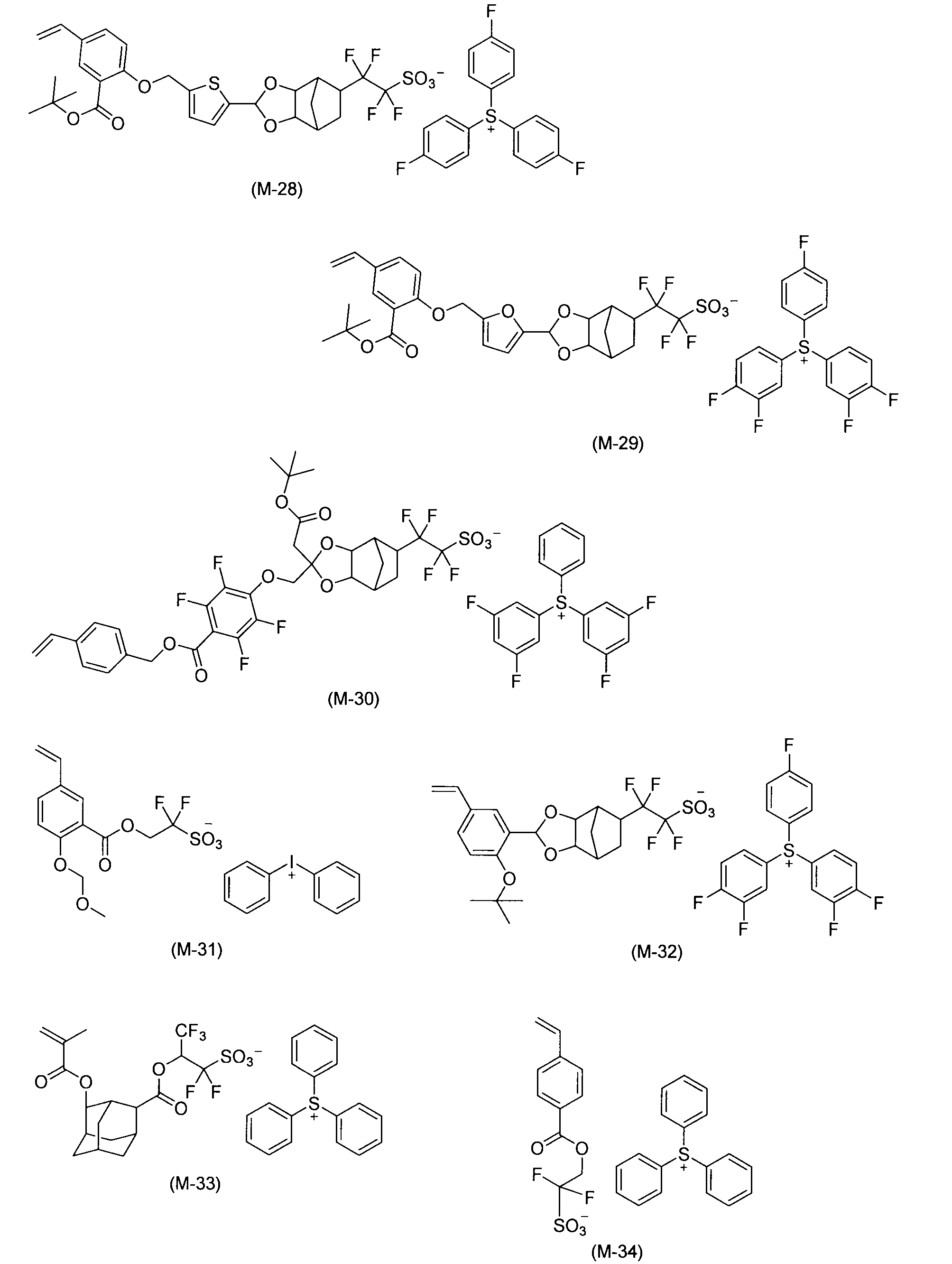
感放射線性樹脂組成物の調製に用いた化合物を以下に示す。
<[A]ベース樹脂>
A-1~A-35:合成例2-1~合成例2-35により得られた重合体
B-1~B-4:下記式(B-1)~式(B-4)のそれぞれで表される化合物
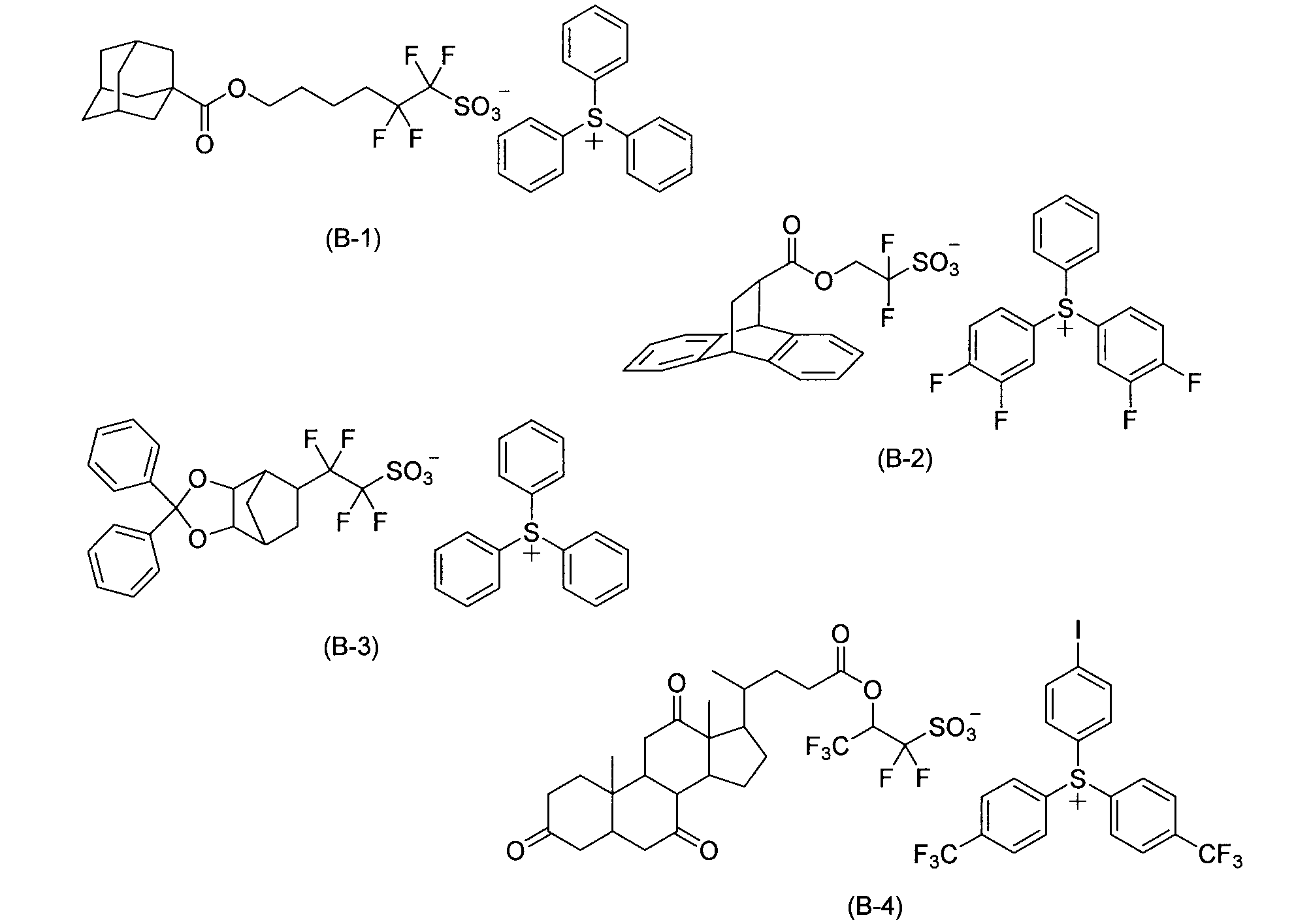
Z-1~Z-4:下記式(Z-1)~式(Z-4)のそれぞれで表される化合物
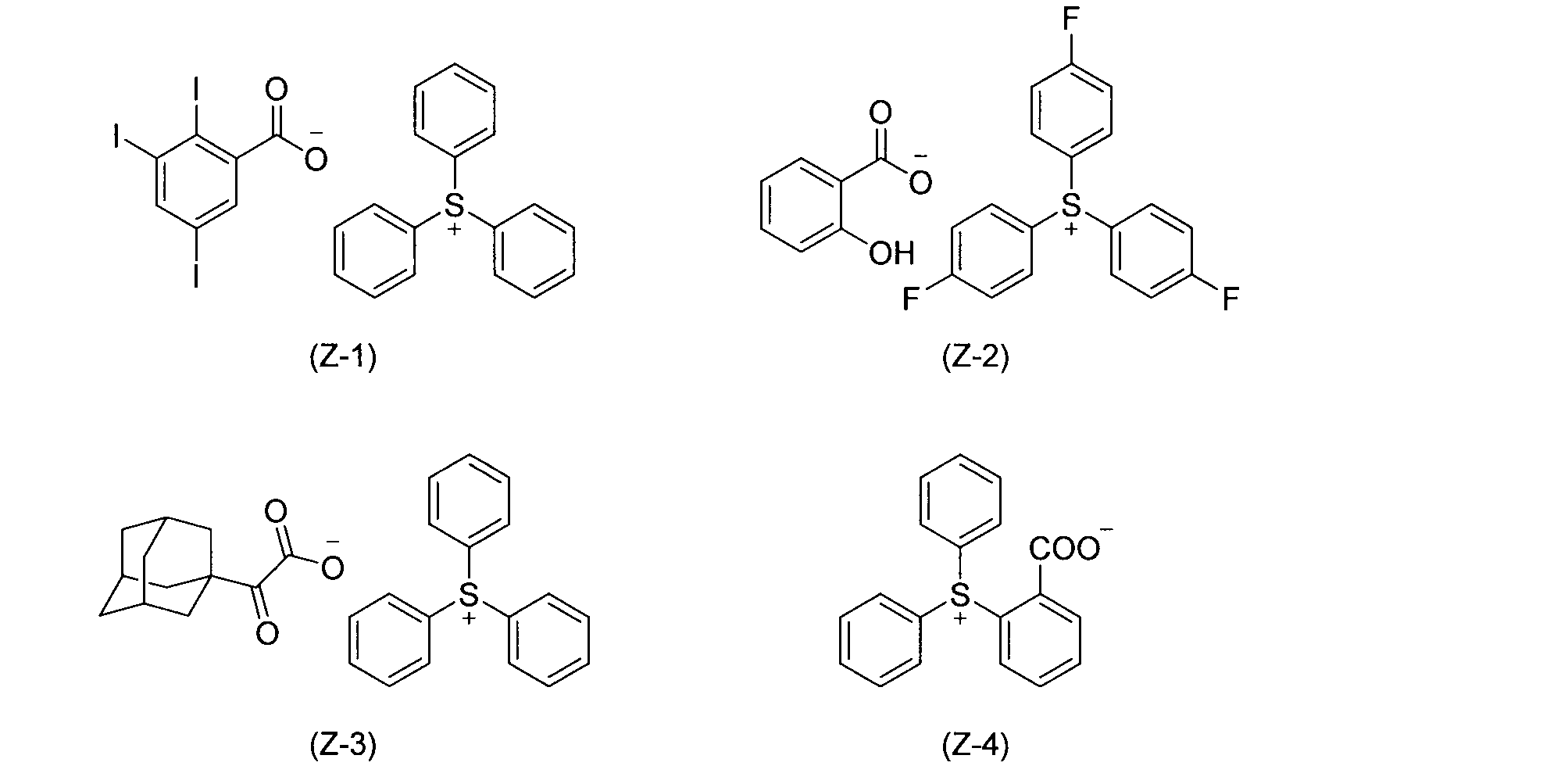
D-1:酢酸プロピレングリコールモノメチルエーテル
D-2:プロピレングリコール1-モノメチルエーテル
[実施例1]
[A]ベース樹脂として重合体(A-1)を100質量部、[Z]酸拡散抑制剤として化合物(Z-1)を、重合体(A-1)100質量部に含まれる第1構造単位を与える単量体の量に対して20モル%、並びに[D]溶剤として化合物(D-1)2,000質量部及び化合物(D-2)4,800質量部を配合して感放射線性組成物(R-1)を調製した。
下記表2に示す種類及び配合量の各成分を用いた以外は、実施例1と同様に操作して、感放射線性組成物(R-2)~(R-40)及び(CR-1)、(CR-2)をそれぞれ調製した。なお、実施例34~37では、[Z]酸拡散抑制剤の量が、[A]ベース樹脂100質量部に含まれる第1構造単位を与える単量体の量と[B]感放射線性酸発生剤の量の合計に対して20モル%となるように[Z]酸拡散制御剤を配合した。

膜厚40nmの下層膜(AL412(Brewer Science社製))が形成された12インチのシリコンウエハ表面に、スピンコーター(CLEAN TRACK ACT12、東京エレクトロン社製)を使用して、上記で調製した各感放射線性組成物を塗布した。130℃で60秒間ソフトベークを行った後、23℃で30秒間冷却して、膜厚50nmのレジスト膜を形成した。次に、このレジスト膜に、EUV露光機(型式「NXE3300」、ASML社製、NA=0.33、照明条件:Conventional s=0.89、マスク:imecDEFECT32FFR02)を用いてEUV光を照射した。その後、レジスト膜に対し110℃で60秒間PEBを行った。次いで、2.38質量%のTMAH水溶液を用い、23℃で30秒間現像してポジ型の32nmラインアンドスペースパターンを形成した。
上記により形成した各レジストパターンについて、下記の方法に従い測定することにより、各感放射線性組成物の感度、LWR性能及びプロセスマージンを評価した。なお、レジストパターンの測長には、走査型電子顕微鏡(日立ハイテクノロジーズ社の「CG-4100」)を用いた。評価結果を下記表3に示す。
上記レジストパターンの形成において、32nmラインアンドスペースパターンを形成する露光量を最適露光量とし、この最適露光量を感度(mJ/cm2)とした。感度の値が小さいほど、より少ない露光量によって所望のレジストパターンを形成でき、良好である。
上記走査型電子顕微鏡を用いて、上記形成されたレジストパターンを上部から観察した。線幅を任意の箇所で計50点測定し、その測定値の分布から3シグマ値を求め、これをLWR(単位:nm)とした。LWR性能は、LWRの値が小さいほどラインのがたつきが小さく、良好である。
上記レジストパターンの形成において、露光量を小さくしながらラインの線幅を測定し、ラインが断線又は倒壊しない最小の線幅をMin CD(単位:nm)とした。Min CDの値が小さいほど、ラインを形成するプロセスマージンが広く、良好である。
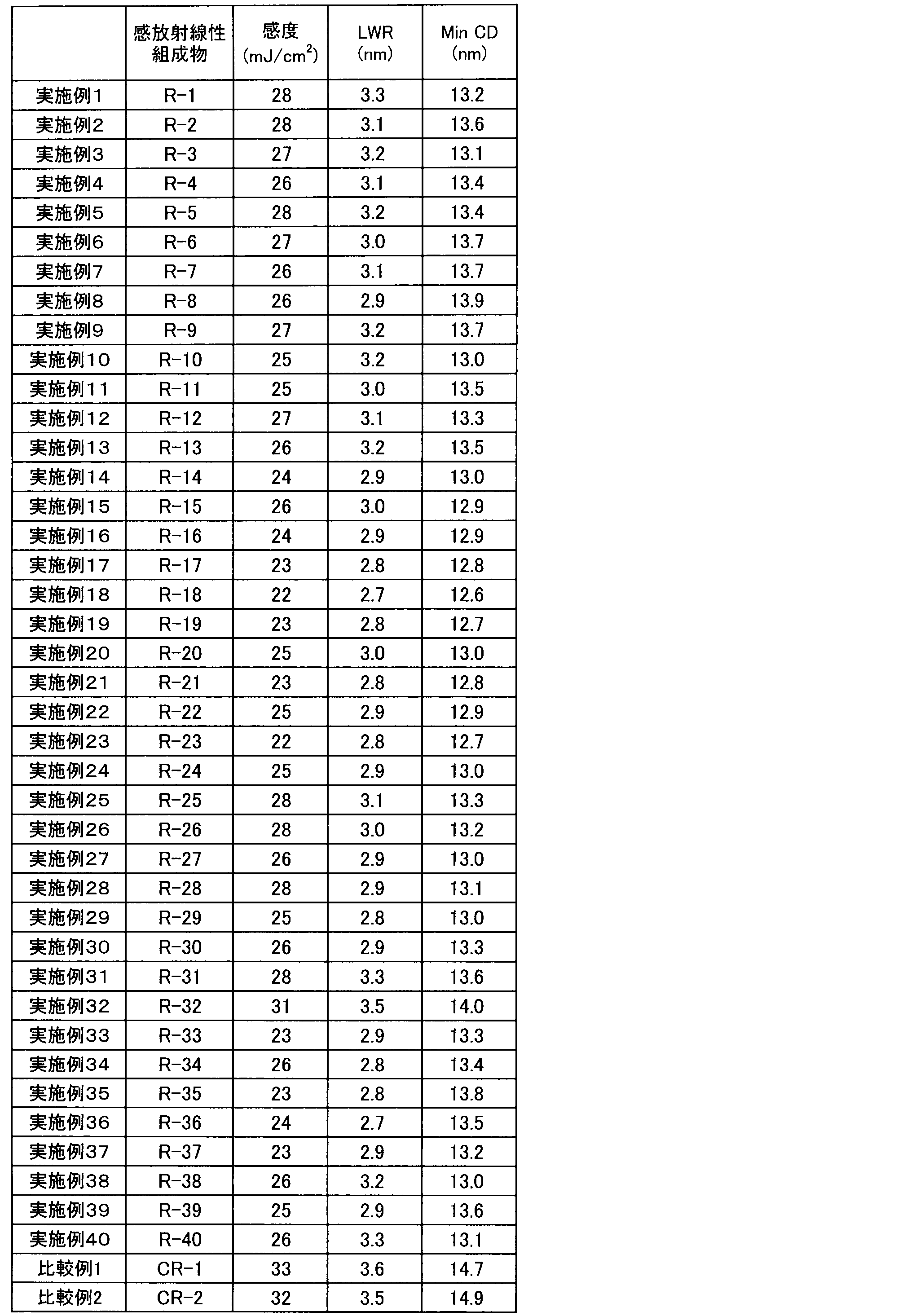
Claims (13)
- 下記式(1)で表される構造単位を含む重合体を含有する、感放射線性組成物。

- 露光により前記重合体が発生する酸よりも酸性度が低い酸を発生する化合物(z)を更に含有する、請求項1に記載の感放射線性組成物。
- 前記化合物(z)として、ヨウ素原子を有する有機アニオンと、カチオンとからなるオニウム塩を含む、請求項2に記載の感放射線性組成物。
- 前記有機アニオンは、芳香環と、当該芳香環に結合するヨウ素原子とを有する、請求項3に記載の感放射線性組成物。
- 前記化合物(z)として、フッ素原子を有するカチオンと、有機アニオンとからなるオニウム塩を含む、請求項2に記載の感放射線性組成物。
- 前記化合物(z)中のカチオンは、スルホニウムカチオン又はヨードニウムカチオンに結合する芳香環RAを有し、
前記芳香環RAに、フルオロアルキル基及びフルオロ基(ただし、フルオロアルキル基中のフルオロ基を除く。)よりなる群から選択される少なくとも1種の基が結合している、請求項5に記載の感放射線性組成物。 - 上記式(1)中のW1は芳香族炭化水素環、脂肪族炭化水素環及び脂肪族複素環よりなる群から選択される少なくとも1種の環を有し、当該環に「-X2-G1」で表される基が結合している、請求項1に記載の感放射線性組成物。
- 上記式(1)中のW1は鎖状構造を有し、当該鎖状構造に「-X2-G1」で表される基が結合している、請求項1に記載の感放射線性組成物。
- 前記重合体は、芳香環と、当該芳香環に結合する水酸基とを有する構造単位を更に含む、請求項1に記載の感放射線性組成物。
- 前記重合体は、酸解離性基を有し、かつオニウム塩構造を有しない構造単位を更に含む、請求項1に記載の感放射線性組成物。
- 請求項1~10のいずれか一項に記載の感放射線性組成物を用いて、基板上にレジスト膜を形成する工程と、
前記レジスト膜を露光する工程と、
露光された前記レジスト膜を現像する工程と、
を含む、レジストパターン形成方法。 - 下記式(1)で表される構造単位を含む重合体。

- 下記式(2)で表される化合物。
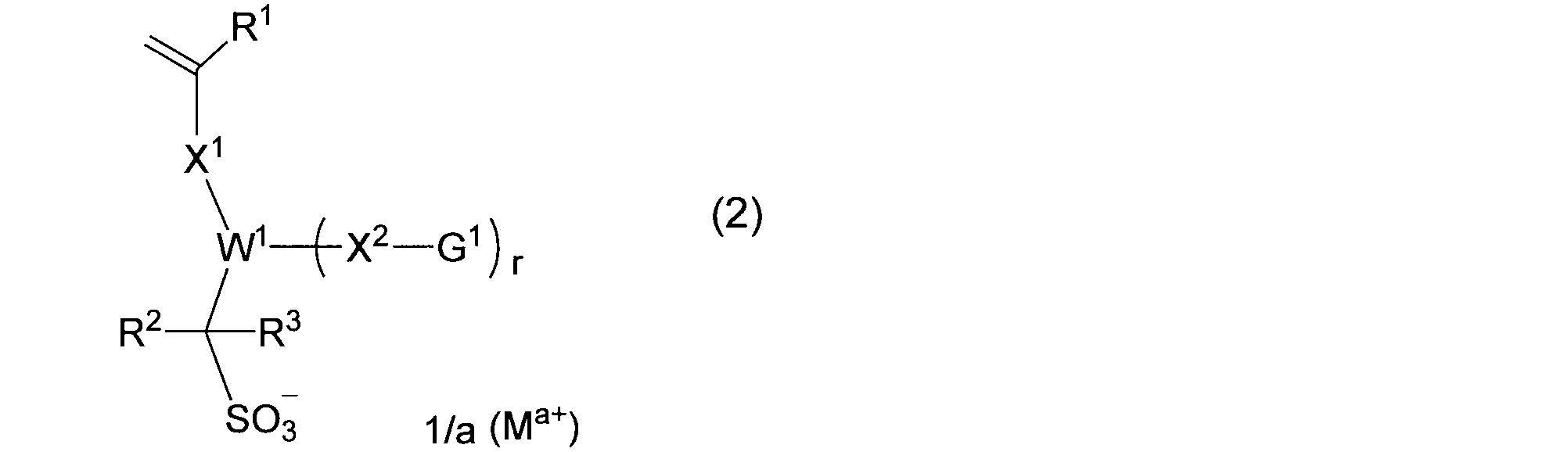
Priority Applications (3)
| Application Number | Priority Date | Filing Date | Title |
|---|---|---|---|
| CN202480007950.9A CN120604171A (zh) | 2023-03-16 | 2024-02-26 | 感放射线性组合物、抗蚀剂图案形成方法、聚合物及化合物 |
| JP2025506665A JPWO2024190386A1 (ja) | 2023-03-16 | 2024-02-26 | |
| KR1020257030011A KR20250162784A (ko) | 2023-03-16 | 2024-02-26 | 감방사선성 조성물, 레지스트 패턴 형성 방법, 중합체 및 화합물 |
Applications Claiming Priority (2)
| Application Number | Priority Date | Filing Date | Title |
|---|---|---|---|
| JP2023-042261 | 2023-03-16 | ||
| JP2023042261 | 2023-03-16 |
Publications (1)
| Publication Number | Publication Date |
|---|---|
| WO2024190386A1 true WO2024190386A1 (ja) | 2024-09-19 |
Family
ID=92754902
Family Applications (1)
| Application Number | Title | Priority Date | Filing Date |
|---|---|---|---|
| PCT/JP2024/006854 Ceased WO2024190386A1 (ja) | 2023-03-16 | 2024-02-26 | 感放射線性組成物、レジストパターン形成方法、重合体及び化合物 |
Country Status (5)
| Country | Link |
|---|---|
| JP (1) | JPWO2024190386A1 (ja) |
| KR (1) | KR20250162784A (ja) |
| CN (1) | CN120604171A (ja) |
| TW (1) | TW202438483A (ja) |
| WO (1) | WO2024190386A1 (ja) |
Cited By (1)
| Publication number | Priority date | Publication date | Assignee | Title |
|---|---|---|---|---|
| WO2026048575A1 (ja) * | 2024-08-28 | 2026-03-05 | 東京応化工業株式会社 | レジスト組成物、レジストパターン形成方法、高分子化合物、及び化合物 |
Citations (3)
| Publication number | Priority date | Publication date | Assignee | Title |
|---|---|---|---|---|
| JP2014152122A (ja) * | 2013-02-05 | 2014-08-25 | Tokyo Ohka Kogyo Co Ltd | 化合物、高分子化合物、レジスト組成物、レジストパターン形成方法 |
| JP2019085396A (ja) * | 2017-11-09 | 2019-06-06 | 住友化学株式会社 | 塩、酸発生剤、レジスト組成物及びレジストパターンの製造方法 |
| WO2021199789A1 (ja) * | 2020-03-31 | 2021-10-07 | 富士フイルム株式会社 | パターン形成方法、感活性光線性又は感放射線性組成物、電子デバイスの製造方法 |
Family Cites Families (1)
| Publication number | Priority date | Publication date | Assignee | Title |
|---|---|---|---|---|
| JP5572404B2 (ja) | 2010-01-27 | 2014-08-13 | 富士フイルム株式会社 | 感活性光線性又は感放射線性樹脂組成物及びそれを用いたパターン形成方法 |
-
2024
- 2024-02-26 WO PCT/JP2024/006854 patent/WO2024190386A1/ja not_active Ceased
- 2024-02-26 KR KR1020257030011A patent/KR20250162784A/ko active Pending
- 2024-02-26 CN CN202480007950.9A patent/CN120604171A/zh active Pending
- 2024-02-26 JP JP2025506665A patent/JPWO2024190386A1/ja active Pending
- 2024-03-01 TW TW113107334A patent/TW202438483A/zh unknown
Patent Citations (3)
| Publication number | Priority date | Publication date | Assignee | Title |
|---|---|---|---|---|
| JP2014152122A (ja) * | 2013-02-05 | 2014-08-25 | Tokyo Ohka Kogyo Co Ltd | 化合物、高分子化合物、レジスト組成物、レジストパターン形成方法 |
| JP2019085396A (ja) * | 2017-11-09 | 2019-06-06 | 住友化学株式会社 | 塩、酸発生剤、レジスト組成物及びレジストパターンの製造方法 |
| WO2021199789A1 (ja) * | 2020-03-31 | 2021-10-07 | 富士フイルム株式会社 | パターン形成方法、感活性光線性又は感放射線性組成物、電子デバイスの製造方法 |
Cited By (1)
| Publication number | Priority date | Publication date | Assignee | Title |
|---|---|---|---|---|
| WO2026048575A1 (ja) * | 2024-08-28 | 2026-03-05 | 東京応化工業株式会社 | レジスト組成物、レジストパターン形成方法、高分子化合物、及び化合物 |
Also Published As
| Publication number | Publication date |
|---|---|
| KR20250162784A (ko) | 2025-11-19 |
| JPWO2024190386A1 (ja) | 2024-09-19 |
| CN120604171A (zh) | 2025-09-05 |
| TW202438483A (zh) | 2024-10-01 |
Similar Documents
| Publication | Publication Date | Title |
|---|---|---|
| JP6243608B2 (ja) | 化合物、高分子化合物、レジスト組成物、レジストパターン形成方法 | |
| WO2023189502A1 (ja) | 感放射線性組成物、パターン形成方法及び光崩壊性塩基 | |
| KR102437123B1 (ko) | 감방사선성 수지 조성물 및 레지스트 패턴 형성 방법 | |
| WO2024057701A1 (ja) | 感放射線性組成物、レジストパターン形成方法、感放射線性酸発生体及び重合体 | |
| CN119173815A (zh) | 感放射线性组合物、抗蚀剂图案形成方法及感放射线性酸产生剂 | |
| WO2024232181A1 (ja) | 感放射線性組成物、レジストパターン形成方法及び重合体 | |
| JP6606926B2 (ja) | 感放射線性樹脂組成物、レジストパターン形成方法及び化合物 | |
| JP7823650B2 (ja) | 感放射線性樹脂組成物及びパターン形成方法 | |
| WO2023157455A1 (ja) | 感放射線性組成物及びレジストパターン形成方法 | |
| WO2023119910A1 (ja) | 感放射線性組成物、レジストパターン形成方法、酸発生体及び化合物 | |
| WO2024203352A1 (ja) | 感放射線性組成物、レジストパターン形成方法及び感放射線性酸発生体 | |
| JP7709990B2 (ja) | 感放射線性組成物及びレジストパターン形成方法 | |
| TWI462900B (zh) | 高分子化合物、光阻材料及圖案形成方法 | |
| WO2025205681A1 (ja) | 感放射線性組成物、レジストパターン形成方法及び化合物 | |
| KR20250162784A (ko) | 감방사선성 조성물, 레지스트 패턴 형성 방법, 중합체 및 화합물 | |
| WO2025009429A1 (ja) | 感放射線性組成物、レジストパターン形成方法、重合体及びその製造方法、並びに化合物 | |
| JP7816482B2 (ja) | 感放射線性組成物及びレジストパターン形成方法 | |
| JP2023025514A (ja) | アルカリ現像用感放射線性組成物及びパターン形成方法 | |
| US20200393761A1 (en) | Radiation-sensitive resin composition and resist pattern-forming method | |
| WO2025142242A1 (ja) | 感放射線性組成物、レジストパターン形成方法、重合体及び化合物 | |
| WO2026053667A1 (ja) | 感放射線性組成物、レジストパターン形成方法、重合体及び化合物 | |
| WO2026053783A1 (ja) | 感放射線性組成物、レジストパターン形成方法、感放射線性酸発生剤及び化合物 | |
| WO2025249330A1 (ja) | 感放射線性組成物及びレジストパターン形成方法 | |
| JP2025123174A (ja) | 感放射線性組成物、レジストパターン形成方法、重合体及び化合物 | |
| WO2025204295A1 (ja) | 感放射線性組成物及びレジストパターン形成方法 |
Legal Events
| Date | Code | Title | Description |
|---|---|---|---|
| 121 | Ep: the epo has been informed by wipo that ep was designated in this application |
Ref document number: 24770498 Country of ref document: EP Kind code of ref document: A1 |
|
| WWE | Wipo information: entry into national phase |
Ref document number: 2025506665 Country of ref document: JP |
|
| WWE | Wipo information: entry into national phase |
Ref document number: 202480007950.9 Country of ref document: CN |
|
| WWP | Wipo information: published in national office |
Ref document number: 202480007950.9 Country of ref document: CN |
|
| ENP | Entry into the national phase |
Ref document number: 1020257030011 Country of ref document: KR Free format text: ST27 STATUS EVENT CODE: A-0-1-A10-A15-NAP-PA0105 (AS PROVIDED BY THE NATIONAL OFFICE) |
|
| NENP | Non-entry into the national phase |
Ref country code: DE |
|
| 122 | Ep: pct application non-entry in european phase |
Ref document number: 24770498 Country of ref document: EP Kind code of ref document: A1 |