WO2024185894A1 - 蓄電装置 - Google Patents
蓄電装置 Download PDFInfo
- Publication number
- WO2024185894A1 WO2024185894A1 PCT/JP2024/009158 JP2024009158W WO2024185894A1 WO 2024185894 A1 WO2024185894 A1 WO 2024185894A1 JP 2024009158 W JP2024009158 W JP 2024009158W WO 2024185894 A1 WO2024185894 A1 WO 2024185894A1
- Authority
- WO
- WIPO (PCT)
- Prior art keywords
- axis direction
- energy storage
- storage element
- duct
- main body
- Prior art date
- Legal status (The legal status is an assumption and is not a legal conclusion. Google has not performed a legal analysis and makes no representation as to the accuracy of the status listed.)
- Ceased
Links
Images





Classifications
-
- H—ELECTRICITY
- H01—ELECTRIC ELEMENTS
- H01G—CAPACITORS; CAPACITORS, RECTIFIERS, DETECTORS, SWITCHING DEVICES, LIGHT-SENSITIVE OR TEMPERATURE-SENSITIVE DEVICES OF THE ELECTROLYTIC TYPE
- H01G11/00—Hybrid capacitors, i.e. capacitors having different positive and negative electrodes; Electric double-layer [EDL] capacitors; Processes for the manufacture thereof or of parts thereof
- H01G11/10—Multiple hybrid or EDL capacitors, e.g. arrays or modules
- H01G11/12—Stacked hybrid or EDL capacitors
-
- H—ELECTRICITY
- H01—ELECTRIC ELEMENTS
- H01G—CAPACITORS; CAPACITORS, RECTIFIERS, DETECTORS, SWITCHING DEVICES, LIGHT-SENSITIVE OR TEMPERATURE-SENSITIVE DEVICES OF THE ELECTROLYTIC TYPE
- H01G11/00—Hybrid capacitors, i.e. capacitors having different positive and negative electrodes; Electric double-layer [EDL] capacitors; Processes for the manufacture thereof or of parts thereof
- H01G11/14—Arrangements or processes for adjusting or protecting hybrid or EDL capacitors
-
- H—ELECTRICITY
- H01—ELECTRIC ELEMENTS
- H01G—CAPACITORS; CAPACITORS, RECTIFIERS, DETECTORS, SWITCHING DEVICES, LIGHT-SENSITIVE OR TEMPERATURE-SENSITIVE DEVICES OF THE ELECTROLYTIC TYPE
- H01G11/00—Hybrid capacitors, i.e. capacitors having different positive and negative electrodes; Electric double-layer [EDL] capacitors; Processes for the manufacture thereof or of parts thereof
- H01G11/78—Cases; Housings; Encapsulations; Mountings
-
- H—ELECTRICITY
- H01—ELECTRIC ELEMENTS
- H01M—PROCESSES OR MEANS, e.g. BATTERIES, FOR THE DIRECT CONVERSION OF CHEMICAL ENERGY INTO ELECTRICAL ENERGY
- H01M50/00—Constructional details or processes of manufacture of the non-active parts of electrochemical cells other than fuel cells, e.g. hybrid cells
- H01M50/20—Mountings; Secondary casings or frames; Racks, modules or packs; Suspension devices; Shock absorbers; Transport or carrying devices; Holders
- H01M50/204—Racks, modules or packs for multiple batteries or multiple cells
- H01M50/207—Racks, modules or packs for multiple batteries or multiple cells characterised by their shape
- H01M50/209—Racks, modules or packs for multiple batteries or multiple cells characterised by their shape adapted for prismatic or rectangular cells
-
- H—ELECTRICITY
- H01—ELECTRIC ELEMENTS
- H01M—PROCESSES OR MEANS, e.g. BATTERIES, FOR THE DIRECT CONVERSION OF CHEMICAL ENERGY INTO ELECTRICAL ENERGY
- H01M50/00—Constructional details or processes of manufacture of the non-active parts of electrochemical cells other than fuel cells, e.g. hybrid cells
- H01M50/30—Arrangements for facilitating escape of gases
- H01M50/342—Non-re-sealable arrangements
-
- H—ELECTRICITY
- H01—ELECTRIC ELEMENTS
- H01M—PROCESSES OR MEANS, e.g. BATTERIES, FOR THE DIRECT CONVERSION OF CHEMICAL ENERGY INTO ELECTRICAL ENERGY
- H01M50/00—Constructional details or processes of manufacture of the non-active parts of electrochemical cells other than fuel cells, e.g. hybrid cells
- H01M50/30—Arrangements for facilitating escape of gases
- H01M50/35—Gas exhaust passages comprising elongated, tortuous or labyrinth-shaped exhaust passages
-
- H—ELECTRICITY
- H01—ELECTRIC ELEMENTS
- H01M—PROCESSES OR MEANS, e.g. BATTERIES, FOR THE DIRECT CONVERSION OF CHEMICAL ENERGY INTO ELECTRICAL ENERGY
- H01M50/00—Constructional details or processes of manufacture of the non-active parts of electrochemical cells other than fuel cells, e.g. hybrid cells
- H01M50/30—Arrangements for facilitating escape of gases
- H01M50/35—Gas exhaust passages comprising elongated, tortuous or labyrinth-shaped exhaust passages
- H01M50/358—External gas exhaust passages located on the battery cover or case
-
- Y—GENERAL TAGGING OF NEW TECHNOLOGICAL DEVELOPMENTS; GENERAL TAGGING OF CROSS-SECTIONAL TECHNOLOGIES SPANNING OVER SEVERAL SECTIONS OF THE IPC; TECHNICAL SUBJECTS COVERED BY FORMER USPC CROSS-REFERENCE ART COLLECTIONS [XRACs] AND DIGESTS
- Y02—TECHNOLOGIES OR APPLICATIONS FOR MITIGATION OR ADAPTATION AGAINST CLIMATE CHANGE
- Y02E—REDUCTION OF GREENHOUSE GAS [GHG] EMISSIONS, RELATED TO ENERGY GENERATION, TRANSMISSION OR DISTRIBUTION
- Y02E60/00—Enabling technologies; Technologies with a potential or indirect contribution to GHG emissions mitigation
- Y02E60/10—Energy storage using batteries
Definitions
- the present invention relates to an energy storage device equipped with an energy storage element.
- a battery pack 500 includes at least a predetermined number of module cases 501, battery modules 502 housed in the module cases 501, and a bus bar case 504 supporting a bus bar 503.
- the battery module 502 has multiple battery cells 520 arranged in the cell stacking direction, and all of the battery cells 520 that make up the battery module 502 are connected in series or parallel to be electrically connected.
- the busbar case 504 is a connecting case member that is attached to the module case 501 so as to cover the battery module 502 together with the module case 501.
- the multiple battery cells 520 are also single cells, and have an exterior case 521 that forms the outer shell of, for example, an aluminum can, and have an electrode terminal 522a that is a positive terminal and an electrode terminal 522b that is a negative terminal, which are arranged on one end surface 521a of the rectangular exterior case 521.
- each battery cell 520 is provided with a safety valve 523.
- Each safety valve 523 is located between electrode terminal 522a and electrode terminal 522b, and is set to break when the internal pressure of the battery cell 520 becomes abnormal.
- This safety valve 523 is configured, for example, by attaching a thin metal film to a hole opened in the end face 521a of the exterior case 521 of the battery cell 520 to close it. In this case, when the internal pressure of the battery cell 520 becomes abnormal, the metal film breaks and the hole in the exterior case 521 is opened, and the gas inside the battery cell 520 is released to the outside of the exterior case 521, thereby reducing the pressure inside the cell and preventing the battery cell 520 itself from bursting.
- the module case 501 is a deep box-shaped member capable of housing each battery cell 520 in its entirety.
- the module case 501 has storage chambers, each of which houses a battery cell 520, in the same number as the number of battery cells 520 it houses.
- the module case 501 has an opening at one end, the upper end, surrounded by four side panels.
- the electrode terminals 522a and 522b of the battery cells 520 installed in each storage chamber are arranged to be exposed in this opening.
- the busbar case 504 has a duct portion 506 that forms a smoke exhaust passage S1 for directing the gas ejected from the safety valve 523 to a specified location (see Figure 18).
- the duct portion 506 is pressed against the upper surface 521a of each battery cell 520 so that the portion of each battery cell 520 where the safety valve 523 is provided communicates with the internal smoke exhaust passage S1, and the smoke exhaust passage S1 is blocked off from the outside by a sealing structure.
- a sealing member such as rubber may be disposed between the duct portion 506 and the upper surface 521a of the battery cell 520.
- This duct portion 506 extends along the cell stacking direction over the entire length of the busbar case 504 in the cell stacking direction.
- the sealing member is pushed out (i.e., deformed) in the width direction of the battery cell 520 (left and right direction in FIG. 18) by the gas pressure when a sealing member such as rubber is disposed between the duct portion 506 and the upper surface 521a of the battery cell 520.
- a sealing member such as rubber
- the power storage device is An electricity storage element having a gas exhaust valve; a duct portion disposed along a second direction perpendicular to the first direction while facing the gas exhaust valve in a first direction, the duct portion having a guide space capable of guiding gas exhausted from the gas exhaust valve; a seal portion disposed between the duct portion and the energy storage element to suppress leakage of the gas from between the duct portion and the energy storage element, and having a communication hole that communicates the gas exhaust valve with the guide space;
- the sealing portion is provided with a restricting portion adjacent to the sealing portion in a third direction perpendicular to both the first direction and the second direction, at a position corresponding to a portion of the communication hole in the second direction.
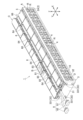
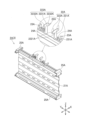
- FIG. 1 is a perspective view of the electricity storage device according to the present embodiment.
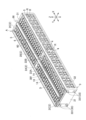
- FIG. 2 is a perspective view of the device body with the duct portion attached.
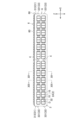
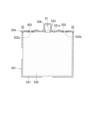
- FIG. 3 is a view of the device body with the duct portion attached, as viewed from the Y-axis direction.
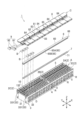
- FIG. 4 is an exploded perspective view of the electricity storage device.
- FIG. 5 is an exploded perspective view of the device main body.
- FIG. 6 is a perspective view of a first adjacent member included in the device body.
- FIG. 7 is a perspective view of a second adjacent member included in the device body.
- FIG. 8 is a view of the duct portion as viewed from the Y-axis direction.
- FIG. 9 is a view of the duct portion as viewed from the other side in the Z-axis direction.
- FIG. 1 is a perspective view of the electricity storage device according to the present embodiment.
- FIG. 2 is a perspective view of the device body with the duct portion attached.
- FIG. 3 is
- FIG. 10 is a cross-sectional view of the duct portion taken along the line XX in FIG.
- FIG. 11 is a cross-sectional view of the duct portion taken along the line XI-XI of FIG.
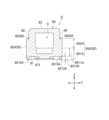
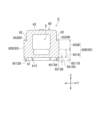
- FIG. 12 is a cross-sectional view of the duct portion taken along the line XII-XII in FIG.
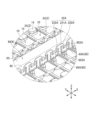
- FIG. 13 is a perspective view of the center of the duct portion.
- FIG. 14 is an enlarged view of the area indicated by XIV in FIG.
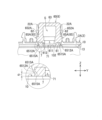
- FIG. 15 is an enlarged view of the duct portion and its surroundings in a cross section taken along the line XV-XV in FIG.
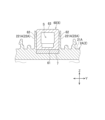
- FIG. 16 is an enlarged view of the duct portion and its surroundings in a cross section taken along the line XVI-XVI in FIG.
- FIG. 17 is a perspective view of a conventional battery pack.
- FIG. 18 is a vertical end view of the battery pack.
- the power storage device comprises: An electricity storage element having a gas exhaust valve; a duct portion disposed along a second direction perpendicular to the first direction while facing the gas exhaust valve in a first direction, the duct portion having a guide space capable of guiding gas exhausted from the gas exhaust valve; a seal portion disposed between the duct portion and the energy storage element to suppress leakage of the gas from between the duct portion and the energy storage element, and having a communication hole that communicates the gas exhaust valve with the guide space;
- the sealing portion is provided with a restricting portion adjacent to the sealing portion in a third direction perpendicular to both the first direction and the second direction, at a position corresponding to a portion of the communication hole in the second direction.
- the duct portion and the restricting portion may be integral with each other.
- the storage element is provided in plurality, The plurality of energy storage elements are aligned in the second direction, the duct portion extends along the plurality of energy storage elements from an energy storage element at one end in the second direction to an energy storage element at the other end,
- the restricting portion is arranged in plurality, The plurality of restricting portions may be arranged at intervals in a direction in which the duct portion extends.
- the storage element is provided in plurality, The plurality of energy storage elements are aligned in the second direction, the duct portion extends along the plurality of energy storage elements from an energy storage element at one end in the second direction to an energy storage element at the other end, The restricting portion may extend from one end to the other end of the duct portion.
- the restricting portion prevents the seal portion from expanding (deforming) in the third direction at a position facing the communication hole from one end of the duct portion to the other end in the second direction.
- a gap may be formed between the restricting portion and the energy storage element in the first direction.
- the energy storage device 1 comprises an energy storage element 10 having a gas exhaust valve 132, a duct portion 6 having a guide space S (see Figures 11 to 12) capable of guiding gas exhausted from the gas exhaust valve 132, a seal portion 7 disposed between the duct portion 6 and the energy storage element 10 to suppress gas leakage from between the duct portion 6 and the energy storage element 10, and a restricting portion adjacent to the seal portion 7.
- the restricting portion is a portion or member disposed adjacent to the seal portion 7 and restricts the expansion of the seal portion 7 in the direction of alignment with the restricting portion, thereby suppressing deformation of the seal portion 7.
- the energy storage device 1 of this embodiment includes a plurality of energy storage elements 10 arranged in a predetermined direction (second direction).
- the energy storage device 1 of this embodiment includes a plurality of regulating portions, and the duct portion 6 and the plurality of regulating portions are integrated. That is, the regulating portions of this embodiment are formed by portions 6512A, 6512B of the duct portion 6 (see Figures 11 to 13 and Figure 15).
- the energy storage device 1 comprises an apparatus main body A including a plurality of energy storage elements 10, a duct portion 6 attached to the apparatus main body A, and a plate portion C that is overlaid on the portion of the apparatus main body A where the duct portion 6 is attached.
- the predetermined direction (second direction) in which the energy storage elements 10 are arranged is defined as the X-axis direction of a Cartesian coordinate system
- the direction (first direction) in which the apparatus main body A and the plate portion C are arranged is defined as the Z-axis direction of the Cartesian coordinate system
- the direction (third direction) perpendicular to both the X-axis direction and the Z-axis direction is defined as the Y-axis direction of the Cartesian coordinate system.
- the device body A includes a stack D having a plurality of storage elements 10 and a plurality of adjacent members 2, with the storage elements 10 and the adjacent members 2 arranged alternately in the X-axis direction, and a holding portion 3 that holds the stack D.
- the device body A includes a first fixing portion 4 that fixes the adjacent members 2 to the holding portion 3, and an insulator 5 that provides insulation between the stack D and the holding portion 3.
- the energy storage element 10 is a primary battery, a secondary battery, a capacitor, etc.
- the energy storage element 10 of this embodiment is a non-aqueous electrolyte secondary battery that can be charged and discharged. More specifically, the energy storage element 10 is a lithium ion secondary battery that utilizes the electron transfer that occurs with the movement of lithium ions.
- the energy storage element 10 comprises an electrode body, a case 11 that houses the electrode body together with an electrolyte, a terminal 14 partially exposed to the outside of the case 11, and a current collector that connects the electrode body and the terminal 14.
- the energy storage element 10 of this embodiment comprises a pair of terminals 14.
- the pair of terminals 14 are arranged at a distance in the Y-axis direction at an end of the energy storage element 10 on one side in the Z-axis direction (the upper side in FIG. 5).
- positive and negative plates are stacked alternately with separators between them.
- the energy storage element 10 is charged and discharged as lithium ions move between the positive and negative plates in the electrode body.
- the case 11 has a case body 12 with an opening at one end in the Z-axis direction, and a plate-shaped cover plate 13 that covers (closes) the opening of the case body 12.
- the case body 12 has a square tube shape (square tube shape with a bottom) with a closed end at the other end in the Z-axis direction (the lower side in FIG. 5), and the case 11 has a rectangular parallelepiped shape (six-sided shape).
- the case body 12 comprises a plate-shaped blocking portion 121 and a cylindrical body portion (peripheral wall) 122 extending from the periphery of the blocking portion 121.
- the blocking portion 121 is a portion that is located at the bottom end of the case body 12 when the case body 12 is placed with the opening facing upwards (i.e., it becomes the bottom wall of the case body 12 when the opening faces upwards).
- the blocking portion 121 is a rectangle that is elongated in the Y-axis direction.
- the body 122 has a rectangular cylindrical shape, more specifically, a flattened rectangular cylindrical shape.
- the body 122 has a pair of long wall portions 123 extending from the long sides at the periphery of the blocking portion 121, and a pair of short wall portions 124 extending from the short sides at the periphery of the blocking portion 121.
- the short wall portions 124 connect the ends of the pair of long wall portions 123 that face each other in the X-axis direction, thereby forming the rectangular cylindrical body 122.
- the cover plate 13 is a plate-shaped member that closes the opening of the case body 12.
- the cover plate 13 has a cover plate body 131 that is a long rectangular plate in the Y-axis direction, and a gas exhaust valve 132 that is arranged on the cover plate body 131.
- the gas exhaust valve 132 exhausts gas to the outside when gas is generated inside the case 11 and the pressure inside the case 11 exceeds a predetermined value.
- the gas exhaust valve 132 is disposed in the center of the cover plate main body 131 in the Y-axis direction. In this embodiment, the gas exhaust valve 132 is circular when viewed in the Z-axis direction.
- the cover plate 13 thus configured is joined to the case body 12 with the peripheral portion of the cover plate 13 overlapping the peripheral portion of the opening of the case body 12, thereby forming the case 11.
- the pair of terminals 14 are electrically connected to the terminals 14 of other energy storage elements 10 or to external devices.
- the terminals 14 are made of a conductive material.
- the terminals 14 are made of an aluminum-based metal material such as aluminum or an aluminum alloy, a copper-based metal material such as copper or a copper alloy, etc.
- the pair of terminals 14 are disposed at both ends of the cover plate 13 in the Y-axis direction. In other words, the pair of terminals 14 are disposed at a position on the cover plate 13 that sandwiches the gas exhaust valve 132 therebetween.
- the above energy storage element 10 has a flat rectangular parallelepiped shape.
- the multiple energy storage elements 10 are lined up in the X-axis direction with the wide faces (long wall portions 123) of the case 11 facing each other with adjacent members 2 between them.
- the gas exhaust valves 132 of the multiple energy storage elements 10 are lined up in a row in the X-axis direction.
- the terminals 14 on one side and the terminals 14 on the other side of the energy storage elements 10 are lined up in the X-axis direction with the gas exhaust valve 132 sandwiched between them.
- the multiple adjacent members 2 are insulating and are arranged between the energy storage elements 10 lined up in the X-axis direction, or between the energy storage element 10 and a member lined up in the X-axis direction relative to the energy storage element 10 (in this embodiment, a part of the holding portion 3).
- the adjacent members 2 are made of resin.
- the adjacent members 2 form flow paths R between adjacent energy storage elements 10, through which a temperature-regulating fluid (in this embodiment, a gas such as air) can flow.
- the multiple adjacent members 2 include multiple types of adjacent members 2A, 2B, 2C.
- the multiple adjacent members 2 include a first adjacent member 2A, a second adjacent member 2B, and a third adjacent member 2C.
- the first adjacent member 2A is disposed between two adjacent energy storage elements 10.
- the second adjacent member B is disposed between two adjacent energy storage elements 10 and fixed to the holding portion 3.
- the third adjacent member 2C is disposed adjacent to the energy storage element 10 between the holding portion 3 and the energy storage element 10 at the end of the X-axis direction.
- the energy storage device 1 may include a first adjacent member 2A, a second adjacent member 2B, and a third adjacent member 2C as the adjacent members 2.
- the energy storage device 1 of this embodiment includes multiple first adjacent members 2A, one second adjacent member 2B, and two (a pair) third adjacent members 2C.
- the multiple first adjacent members 2A are disposed between the multiple energy storage elements 10 except between the energy storage elements 10 between which the second adjacent members 2B are disposed.
- the multiple first adjacent members 2A have a first main body portion 21A located between the energy storage elements 10, and a first locking piece 22A that locks the duct portion 6 to the first main body portion 21A.
- locking means that two parts abut (contact) with each other, so that one suppresses the movement of the other.
- the first locking piece 22A which will be described later, fixes the duct portion 6 by abutting (contacting) the locked portion 65 of the duct portion 6 so as to engage with it by hooking or the like.
- the first adjacent member 2A has a first main body portion 21A that extends in a planar direction perpendicular to the X-axis direction between adjacent energy storage elements 10 in the X-axis direction, and a first locking piece 22A that extends (protrudes) from the first main body portion 21A toward one side in the Z-axis direction.
- the first locking piece 22A locks the duct portion 6 to the first main body portion 21A.
- the first adjacent member 2A has a first locking portion 23A, a positioning protrusion 24A, and a first regulating portion 25A.
- the first locking portion 23A extends (protrudes) from the first main body portion 21A toward one side in the Z-axis direction to lock the plate portion C.
- the positioning protrusion 24A extends (protrudes) from the first main body portion 21A toward one side in the Z-axis direction to position the plate portion C.
- the first regulating portion 25A regulates the movement of the energy storage element 10 adjacent to the first main body portion 21A relative to the first main body portion 21A.
- the first adjacent member 2A in this embodiment has two (a pair) first locking pieces 22A, two (a pair) first locking portions 23A, and two (a pair) positioning protrusions 24A.
- the first body portion 21A is a portion that faces the long wall portion 123 of the case 11 of the energy storage element 10 with a portion of the body abutting against it.
- the first body portion 21A cooperates with an adjacent energy storage element 10 to form a flow path R between the energy storage element 10 and the energy storage element 10 through which a temperature-regulating fluid can flow.
- the first body portion 21A in this embodiment is a rectangular plate of the same size as the energy storage element 10 when viewed from the X-axis direction, and has a cross-sectional shape along the X-Z plane (a plane including the X-axis direction and the Z-axis direction) that is a rectangular waveform.
- the two first locking pieces 22A extend from positions spaced apart in the Y-axis direction at one end of the first main body portion 21A in the Z-axis direction.
- the distance between the two first locking pieces 22A in the Y-axis direction is equal to the dimension of the duct portion 6 in the Y-axis direction.
- the two first locking pieces 22A are plate-shaped with the Y-axis direction as the thickness direction (in other words, plate-shaped along the X-Z plane).
- the two first locking pieces 22A have a locking piece main body 221A extending from the first main body portion 21A in the Z-axis direction (the opposing direction of the gas exhaust valve 132 and the duct portion 6), and a locking portion 222A that engages with the duct portion 6 (more specifically, the duct portion main body 60 described below).
- the two first locking pieces 22A have an inviting surface 223A at the tip portion that approaches the duct portion 6 as it moves from the tip of the first locking piece 22A toward the base portion.
- the tip portion is the portion where the locking portion 222A is provided.
- the tip portion of the locking piece main body 221A is in the range from the point of the locking piece main body 221A farthest from the first main body portion 21A in the Z-axis direction to the end of the locked portion 65 on the opposite side to the energy storage element 10 (one side in the Z-axis direction).
- the locking piece main body 221A is a strip-shaped portion that extends straight in the Z-axis direction from the first main body portion 21A.
- the locking piece main body 221A is strip-shaped with a constant dimension in the X-axis direction in the Z-axis direction.
- the locking portion 222A is a portion of the first main body portion 21A of the locking piece main body 221A that extends in the X-axis direction (the direction in which the duct portion 6 extends) from a position spaced apart on one side in the Z-axis direction.
- the locking portion 222A extends from the locking piece main body 221A to one side and the other side in the X-axis direction.
- the first locking piece 22A has two locking portions 222A.
- the locking portion 222A When viewed from the Y-axis direction, the locking portion 222A has an inclined portion 2221A that moves away from the locking piece main body 221A as it approaches the first main body portion 21A from the tip of the first locking piece 22A.
- the inviting surface 223A is formed in an area spanning the locking piece main body 221A and the two locking portions 222A.
- the locking piece main body 221A has a first inviting surface 2231A, and the two locking portions 222A have second inviting surfaces 2232A.
- the first inviting surface 2231A and the two second inviting surfaces 2232A are connected to form a single flat inclined surface (inviting surface) 223A.
- the two first locking portions 23A extend from positions spaced apart in the Y-axis direction at one end of the first main body portion 21A in the Z-axis direction.
- the two first locking portions 23A are arranged spaced apart in the Y-axis direction with the two first locking pieces 22A positioned between them.
- the first locking portion 23A and the first locking piece 22A are arranged at a predetermined distance in the Y-axis direction.
- the two first locking portions 23A When viewed from the X-axis direction, the two first locking portions 23A have hook portions 231A at their tips, whose dimensions in the Y-axis direction increase outward as they approach the first main body portion 21A.
- the hook portions 231A are hooked onto predetermined portions of the plate portion C, and the plate portion C is fixed to the device main body A.
- the two positioning protrusions 24A extend from positions spaced apart in the Y-axis direction at one end of the first main body portion 21A in the Z-axis direction.
- the positioning protrusions 24A are disposed between the first locking piece 22A and the first locking portion 23A.
- the positioning protrusions 24A are inserted into corresponding holes in the plate portion C to position the plate portion C relative to the device main body A.
- the first regulating portion 25A extends in the X-axis direction from a corner of the rectangular first body portion 21A and abuts against the energy storage element 10 (more specifically, the case 11) adjacent to the first body portion 21A from the outside in the Y-Z plane direction, thereby regulating the relative movement of the energy storage element 10 in the Y-Z plane direction with respect to the first body portion 21A.
- the first regulating portion 25A extends from the first body portion 21A toward one side and the other side in the X-axis direction.
- the second adjacent member 2B has a second body portion 21B located between the energy storage elements 10 and a second locking piece 22B that locks the duct portion 6 to the second body portion 21B.
- the second adjacent member 2B has a second main body portion 21B that extends in a direction perpendicular to the X-axis direction between adjacent energy storage elements 10 in the X-axis direction, and a second locking piece 22B that extends (protrudes) from the second main body portion 21B toward one side in the Z-axis direction to lock the duct portion 6 to the second main body portion 21B.
- the second adjacent member 2B has a second engagement portion 23B that extends (protrudes) from the second main body portion 21B toward one side in the Z-axis direction and engages the plate portion C, a second restriction portion 25B that restricts the movement of the energy storage element 10 adjacent to the second main body portion 21B relative to the second main body portion 21B, and a second fixing portion 26B that is used to fix the second adjacent member 2B to the holding portion 3.
- the second adjacent member 2B in this embodiment has two (a pair) second locking pieces 22B and two (a pair) second locking portions 23B.
- the second body portion 21B is a portion that faces the long wall portion 123 of the case 11 of the energy storage element 10 with a portion of the long wall portion 123 abutting against it.
- the second body portion 21B cooperates with the adjacent energy storage element 10 to form a flow path R through which a temperature-regulating fluid can flow between the energy storage element 10 and the second body portion 21B.
- the dimension in the X-axis direction of the second body portion 21B is larger than the dimension in the X-axis direction of the first body portion 21A (i.e., it is thick).
- the second body portion 21B is a rectangular plate of the same size as the energy storage element 10 when viewed from the X-axis direction.
- the second body portion 21B has a plurality of ridges 211B that extend in the Y-axis direction and are spaced apart in the Z-axis direction.
- the plurality of ridges 211B protrude from the surface 212B of the second body portion 21B that faces the energy storage element 10.
- the two second locking pieces 22B extend from one end of the second main body portion 21B in the Z-axis direction at a position spaced apart in the Y-axis direction.
- the distance between the two second locking pieces 22B in the Y-axis direction is equal to the dimension of the duct portion 6 in the Y-axis direction, similar to the two first locking pieces 22A of the first adjacent member 2A.
- the configuration of the two second locking pieces 22B is the same as that of the first locking piece 22A. That is, the second locking piece 22B has a locking piece main body 221B and a locking portion 222B.
- the second locking piece 22B has an inviting surface 223B (first inviting surface 2231B, second inviting surface 2232B) at the tip.
- the tip is the portion where the locking portion 222B is provided.
- the tip of the locking piece main body 221A is the range in the Z-axis direction from the point of the locking piece main body 221B farthest from the first main body portion 21B to the end of the locked portion 65 on the opposite side to the energy storage element 10 (one side in the Z-axis direction).
- the two second locking portions 23B extend from positions spaced apart in the Y-axis direction at one end of the second main body portion 21B in the Z-axis direction.
- the two second locking portions 23B are arranged spaced apart in the Y-axis direction with the two second locking pieces 22B positioned between them, similar to the two first locking portions 23A of the first adjacent member 2A.
- the configuration of the second locking portions 23B is the same as the configuration of the first locking portions 23A.
- the second locking portion 23B has a hook portion 231B at its tip.
- the second restricting portion 25B extends in the X-axis direction from a corner of the rectangular second body portion 21B and contacts the energy storage element 10 (more specifically, the case 11) adjacent to the second body portion 21B from the outside in the Y-Z plane direction, thereby restricting the relative movement of the energy storage element 10 in the Y-Z plane direction with respect to the second body portion 21B.
- the second restricting portion 25B extends from the second body portion 21B toward one side and the other side in the X-axis direction.
- the second fixing portion 26B is disposed at the end of the second main body portion 21B in the Y-axis direction.
- the second fixing portion 26B engages with the first fixing portion 4 to fix the second adjacent member 2B to the holding portion 3.
- the second fixing portion 26B is an insert nut.
- the first fixing portion 4 in this embodiment is a bolt. The first fixing portion 4 is inserted through the holding portion 3 and screws into the second fixing portion 26B to fix the second adjacent member 2B to the holding portion 3.
- the two third adjacent members 2C have a third main body portion 21C that extends in a direction perpendicular to the X-axis direction between the adjacent energy storage elements 10 in the X-axis direction and a terminal end portion 31 that is part of the holding portion 3, and a third restricting portion 25C that restricts the movement of the adjacent energy storage elements 10 relative to the third main body portion 21C.
- the third body portion 21C is a portion that faces the long wall portion 123 of the energy storage element 10 with a portion of the long wall portion 123 abutting against it. Like the first body portion 21A of the first adjacent member 2A and the second body portion 21B of the second adjacent member 2B, the third body portion 21C cooperates with the adjacent energy storage element 10 to form a flow path R through which a temperature-regulating fluid can flow between the energy storage element 10 and the third body portion 21C in this embodiment.
- the third body portion 21C is a rectangular plate of the same size as the energy storage element 10 when viewed from the X-axis direction.
- the third body portion 21C has a plurality of ridges 211C that extend in the Y-axis direction and are spaced apart in the Z-axis direction.
- the plurality of ridges 211C protrude from a surface 212C of the third body portion 21C that faces the energy storage element 10.
- the third restricting portion 25C extends in the X-axis direction from a corner of the rectangular third main body portion 21C and abuts against the energy storage element 10 (more specifically, the case 11) adjacent to the third main body portion 21C from the outside in the Y-Z plane direction, thereby restricting the relative movement of the energy storage element 10 in the Y-Z plane direction with respect to the third main body portion 21C.
- the third restricting portion 25C extends from the third main body portion 21C in a direction toward the energy storage element 10 in the X-axis direction.
- the holding portion 3 holds the stack D by surrounding the stack D.
- the holding portion 3 holds the multiple energy storage elements 10 and the adjacent member 2 together by surrounding the multiple energy storage elements 10 and the adjacent member 2.
- the holding portion 3 is made of a conductive material such as a metal.
- the pair of end portions 31 are arranged so as to sandwich the third adjacent member 2C between them and the energy storage element 10 arranged at the end in the X-axis direction.
- the pair of end portions 31 have an end portion main body 311 that extends along the Y-Z plane direction, and a flange portion 313 that extends from the end portion main body 311 in a direction away from the energy storage element 10 in the X-axis direction.
- the terminal body 311 is rectangular and of the same size as the energy storage element 10 when viewed in the X-axis direction.
- the terminal body 311 is rectangular and elongated in the Y-axis direction, and has a number of through holes 312 spaced apart in the Z-axis direction at both ends in the Y-axis direction.
- the flange portion 313 extends in the X-axis direction and the Y-axis direction from one end of the terminal body 311 in the Z-axis direction.
- the pair of extension parts 32 have an extension part body 320, a first piece 321, a second piece 322, and a third piece 323.
- the extension part body 320 faces the short wall parts 124 of the multiple storage elements 10.
- the first piece 321 extends from one end of the extension part body 320 in the Z axis direction along the cover plate 13 of the multiple storage elements 10 in the Y axis direction and in the X axis direction.
- the second piece 322 extends from the other end of the extension part body 320 in the Z axis direction along the blocking part 121 of each storage element 10 in the Y axis direction and in the X axis direction.
- the third piece 323 extends from each end of the extension part body 320 in the X axis direction along the terminal part 31 in the Y axis direction and in the Z axis direction.
- the extension portion main body 320 is a plate-like portion that extends along the short wall portions 124 of the multiple energy storage elements 10.
- the extension portion main body 320 has multiple ventilation holes 3201 and multiple first fixing holes 3202.
- the ventilation holes 3201 are holes that penetrate in the Y-axis direction so that a temperature adjustment fluid can flow in and out of the flow path R.
- the first fixing hole 3202 is a hole that penetrates in the Y-axis direction at a position facing the second fixing portion 26B of the second adjacent member 2B.
- the first fixing portion 4 is inserted into the first fixing hole 3202.
- the first piece 321 is a strip-shaped portion that is long in the X-axis direction
- the second piece 322 is also strip-shaped that is long in the X-axis direction.
- the width of the second piece 322 excluding both ends in the X-axis direction (dimension in the Y-axis direction) is greater than the width of the first piece 321.
- the pair of third pieces 323 have a number of second fixing holes 3231 that are spaced apart in the Z-axis direction.
- the second fixing holes 3231 are located opposite the through holes 312 of the terminal portion 31.
- the multiple connecting portions 33 are inserted through the through hole 312 of the terminal portion 31 and the second fixing hole 3231 of the extension portion 32 (more specifically, the third arm portion 323) to fix the terminal portion 31 and the extension portion 32 together.
- the connecting portions 33 in this embodiment are formed by bolts 331 and nuts 332.
- the insulator 5 has insulating properties.
- the insulator 5 is disposed between the extension portion 32 and the laminate D.
- the energy storage device 1 includes a pair of insulators 5.
- the insulator 5 covers the area of the extension portion 32 that faces the multiple energy storage elements 10. As a result, the insulator 5 provides insulation between the extension portion 32 and the multiple energy storage elements 10.
- the insulator 5 has a ventilation area 51 of the same size and shape as each ventilation hole 3201 of the extension portion main body 320 at a position facing the ventilation hole 3201 of the extension portion main body 320.
- the seal portion 7 is a portion or member disposed between the device main body A and the duct portion 6 to suppress gas leakage from between the device main body A and the duct portion 6, and has a seal portion communication hole 71 that communicates between the gas exhaust valve 132 and the guide space S. As shown in FIG. 4, the seal portion 7 extends in the X-axis direction at a position facing the gas exhaust valve 132 in the Y-axis direction at one end of the device main body A in the Z-axis direction.
- the seal portion 7 in this embodiment is formed from a foam such as a fluorine-based, silicone-based, or urethane-based resin, and seals between the device main body A and the duct portion 6.
- the width (dimension in the Y-axis direction) of the seal portion 7 in this embodiment is the same as that of the duct portion 6.
- the seal portion communication hole 71 has the same shape and size as the gas exhaust valve 132.
- the seal portion communication hole 71 in this embodiment is a circular hole with a diameter that is the same or approximately the same as the diameter of the gas exhaust valve 132.
- the duct portion 6 is disposed along the X-axis direction, facing the gas exhaust valve 132 in the Z-axis direction. As shown in Figures 1 to 4, the duct portion 6 in this embodiment extends along the multiple storage elements 10 from the storage element 10 at one end in the X-axis direction to the storage element 10 at the other end.
- the duct portion 6 has a duct portion main body 60 that guides gas when it is discharged from the gas discharge valve 132 of the energy storage element 10, and an engaged portion 65 that engages with the engaging pieces 22A, 22B (more specifically, the engaging portions 222A, 222B of the engaging pieces 22A, 22B) of the adjacent member 2.
- the duct portion 6 has a joint portion 66 to which another member is connected and which can release gas within the duct portion main body 60 to the other member.
- the duct portion 6 of this embodiment is made of resin such as polybutylene terephthalate or glass fiber blended resin (polybutylene terephthalate-glass fiber).
- the duct section main body 60 is a hollow cylindrical section that extends in the X-axis direction and has a guide space S inside.
- the duct section main body 60 extends from one end of the device main body A in the X-axis direction (the left side in Figure 1) to the other end (the right side in Figure 1), with one end closed.
- the duct section main body 60 is positioned so as to overlap the gas exhaust valve 132 of each storage element 10.
- the duct body 60 has a bottom wall 61 that faces the device body A (multiple energy storage elements 10), a pair of side wall portions 62 that extend from both ends of the bottom wall portion 61 in the Y-axis direction to one side in the Z-axis direction, and a top wall portion 63 that connects the ends of the pair of side wall portions 62 on one side in the Z-axis direction.
- the space surrounded by the bottom wall portion 61, the pair of side wall portions 62, and the top wall portion 63 constitutes a guide space S that can guide gas discharged from the gas discharge valve 132 to the joint portion 66.
- the bottom wall portion 61 is a band-shaped portion whose width direction is the Y-axis direction and whose length direction is the X-axis direction, and is the portion of the duct portion main body 60 that sandwiches the seal portion 7 between itself and the device main body A.
- the bottom wall portion 61 has a duct portion communication hole 611 that communicates the seal portion communication hole 71 with the guide space S at a position corresponding to the seal portion communication hole 71 of the seal portion 7 (a position facing the gas exhaust valve 132 of the energy storage element 10).
- the bottom wall portion 61 of this embodiment has multiple duct portion communication holes 611.
- the multiple duct portion communication holes 611 are arranged in a row at intervals in the X-axis direction on the bottom wall portion 61.
- the bottom wall portion 61 has an annular protrusion 612 that protrudes from the periphery of the duct portion communication hole 611 to the other side in the Z-axis direction and extends annularly along the periphery.
- the bottom wall portion 61 has the same number of annular protrusions 612 as the number of duct portion communication holes 611.
- the annular protrusions 612 have an outer diameter that fits into the opposing seal portion communication hole 71 in the seal portion 7.
- the inner diameter of the duct portion communication hole 611 in the bottom wall portion 61 is smaller than the inner diameter of the seal portion communication hole 71 in the seal portion 7.
- the pair of side wall portions 62 are band-shaped portions that extend in the X-Z plane direction, with the Z axis direction as the width direction and the X axis direction as the length direction.
- a plurality of interlocking portions 65 are arranged on the pair of side wall portions 62 so as to protrude outward in the Y axis direction.
- the multiple interlocking portions 65 are portions that the interlocking pieces 22A, 22B of the adjacent members 2A, 2B abut against (are hooked onto in this embodiment) in order to fix the duct portion 6 to the adjacent members 2A, 2B (i.e., the device main body A), and are arranged at intervals in the X axis direction.
- the interlocking portions 65 are arranged at positions in the X axis direction where the duct portion communication holes 611 of the bottom wall portion 61 are present.
- the multiple interlocking portions 65 in this embodiment include two types of interlocking portions (first interlocking portions 65A and second interlocking portions 65B).
- the first engaged portion 65A has a first portion 651A that protrudes from the side wall portion 62 of the duct portion 6 to the other side in the Z-axis direction, and a second portion 652A that extends from the first portion 651A to one side in the Z-axis direction, and is a portion that protrudes in the Y-axis direction from the side wall portion 62 (outer surface 62a).
- the first engaged portion 65A has two second portions 652A.
- the two second portions 652A are arranged with a gap in the X-axis direction.
- the first portion 651A has a base 6511A that protrudes from the side wall portion 62 in the Y-axis direction, and a protruding portion (regulating portion) 6512A that is connected to the other side of the base 6511A in the Z-axis direction and protrudes from the side wall portion 62 to the other side in the Z-axis direction.
- the first portion 651A in this embodiment is a rectangular portion when viewed from the Y-axis direction, and has two inclined surfaces 6513A at the end on the other side in the Z-axis direction.
- the two inclined surfaces 6513A are arranged at a distance from each other at both ends of the first portion 651A in the X-axis direction.
- the two inclined surfaces 6513A are inclined surfaces that are positioned inward in the Y-axis direction (towards the center of the duct portion main body 60) as they move to the other side in the Z-axis direction.
- the two inclined surfaces 6513A are arranged in the Z-axis direction in a range from the other end of the base 6511A to the other edge of the protruding portion 6512A.
- the protruding portion 6512A has a restricting surface 6515A that faces inward in the Y-axis direction.
- the protruding portion 6512A is positioned so that a gap (gap in the Z-axis direction) is formed between the tip of the protruding portion 6512A in the protruding direction (the other end in the Z-axis direction) and the energy storage element 10.
- the restricting surface 6515A restricts the expansion of the seal portion 7 in the Y-axis direction by contacting the seal portion 7.
- the restricting surface 6515A is a surface that contacts (or faces with a small gap) the end of the seal portion 7 in the Y-axis direction, and expands in the X-Z plane direction.
- the restricting surface 6515A is a smooth surface that is rectangular and elongated in the X-axis direction when viewed from the Y-axis direction.
- the protruding portion 6512A is disposed in a position adjacent (opposing) to the sealing portion 7 in the Y-axis direction. More specifically, the protruding portion 6512A is disposed in a position adjacent to the sealing portion 7 in the Y-axis direction, and opposed to a portion of the communication hole 71 of the sealing portion 7 in the X-axis direction.
- the multiple protruding portions 6512A constitute a restricting portion that restricts the expansion of the sealing portion 7 in the Y-axis direction, thereby suppressing deformation of the sealing portion 7.
- the two second portions 652A extend in the Z-axis direction from both ends of the first portion 651A in the X-axis direction.
- the two second portions 652A extend straight toward one side in the Z-axis direction.
- the end faces (abutment surfaces) 6520A on one side in the Z-axis direction of the two second portions 652A are the surfaces with which the locking pieces 22A, 22B (more specifically, locking portions 222A, 222B) of the adjacent members 2A, 2B abut.
- the abutment surfaces 6520A are inclined toward the other side in the Z-axis direction (the direction approaching the device main body A) as they approach the duct portion main body 60 (side wall portion 62).
- the first engaging portion 65A configured in this manner is positioned on the side wall portion 62 at a position in the X-axis direction corresponding to the plurality of energy storage elements 10 other than the energy storage element 10 adjacent to the second adjacent member 2B.
- the first engaging portion 65A positioned on the side wall portion 62 is positioned in a position facing the gas exhaust valves 132 of the plurality of energy storage elements 10 other than the energy storage element 10 adjacent to the second adjacent member 2B in the X-axis direction.
- the second locked portion 65B has the same configuration as the first locked portion 65A.
- the second locked portion 65B has a first portion 651B having a base 6511B and a protruding portion (regulating portion) 6512B, and two second portions 652B each having an abutment surface 6520B and extending from the first portion 651B.
- the protruding portion 6512B of the first portion 651B has a regulating surface 6515B, similar to the protruding portion 6512A of the first locked portion 65A.
- the second locked portion 65B also has two inclined surfaces 6513B. In the second locked portion 65B, the dimension in the X-axis direction of the first portion 651B is greater than the dimension in the X-axis direction of the first portion 651A of the first locked portion 65A.
- the protruding portion 6512B of the second engaged portion 65B is also positioned adjacent (opposing) to the seal portion 7 in the Y-axis direction. More specifically, the protruding portion 6512B is positioned adjacent to the seal portion 7 in the Y-axis direction at a position opposing a portion of the communication hole 71 of the seal portion 7 in the X-axis direction.
- the protruding portion 6512B constitutes a restricting portion that restricts the expansion of the seal portion 7 in the Y-axis direction, thereby suppressing deformation of the seal portion 7.
- the second engaging portion 65B configured in this manner is disposed on the side wall portion 62 at a position in the X-axis direction corresponding to the energy storage element 10 adjacent to the second adjacent member 2B.
- the second engaging portion 65B disposed on the side wall portion 62 is disposed at a position facing the gas exhaust valve 132 of the energy storage element 10 adjacent to the second adjacent member 2B in the X-axis direction.
- the joint portion 66 is a portion that extends in the X-axis direction from the other end of the duct body 60 in the X-axis direction.
- the joint portion 66 is cylindrical and connects the guide space S to the external space.
- the duct portion 6 is attached to the device main body A with the seal portion 7 sandwiched between the duct portion 6 and the device main body A.
- the locking piece bodies 221A, 221B of the adjacent members 2A, 2B are positioned between the adjacent locked portions 65 (first locked portion 65A, second locked portion 65B) spaced apart in the X-axis direction.
- the locking portions 222A, 222B extending from the locking piece bodies 221A, 221B abut (engage) with the abutment surfaces (tip surfaces of the second portions 652A, 652B) 6520A, 6520B of the locked portions 65 adjacent to the locking piece bodies 221A, 221B in the X-axis direction from one side in the Z-axis direction. This causes the duct portion 6 to be locked to the device main body A (adjacent members 2A, 2B).
- the protruding portions 6512A and 6512B (specifically, the restricting surfaces 6515A and 6515B) of the engaging portion 65 are disposed at the position where the engaging portion 65 is disposed in the X-axis direction.
- the protruding portions 6512A and 6512B face the edge (end face) of the sealing portion 7 in the Y-axis direction.
- the protruding portions 6512A and 6512B abut against the edge of the sealing portion 7 in the Y-axis direction from the outside in the Y-axis direction.
- a gap ⁇ is formed between the tips of the protruding portions 6512A and 6512B in the Z-axis direction in the protruding direction and the energy storage element 10 (see the partially enlarged portion in FIG. 15).
- the locking pieces 22A, 22B (more specifically, the locking piece main bodies 221A, 221B) of the adjacent members 2A, 2B abut against the side wall portion 62 of the duct portion main body 60 from the outside in the Y-axis direction (see Figure 16).
- the plate portion C includes a plurality of bus bars B, a plate portion main body 8 that houses the plurality of bus bars B, and a harness 9 having a plurality of electric wires connected to the bus bars B.
- a harness 9 having a plurality of electric wires connected to the bus bars B.
- the bus bar B is a plate-like member having electrical conductivity, such as metal, and connects the terminals 14 of different energy storage elements 10.
- the bus bar B connects the terminals 14 of adjacent energy storage elements 10, thereby providing electrical conductivity between them.
- the bus bar B is welded to the terminals 14.
- the harness 9 has a cable portion 91 having multiple electric wires, and a connector 92 arranged at the end of the cable portion 91.
- One end of the electric wires is connected to a bus bar B or the like, and the other end of the electric wires is connected to the connector 92.
- the cable portion 91 is formed by bundling at least a portion of a plurality of electric wires, one end of which is connected to a bus bar B or the like.
- the cable portion 91 is disposed on the plate portion main body 8 with one end protruding from the plate portion main body 8 in the X-axis direction.
- a connector 92 is attached to the tip of the cable portion 91 in the protruding direction.
- the connector 92 in this embodiment is a multi-core connector, and two connectors are disposed.
- the plate body 8 is made of an insulating material such as resin, and is a plate-shaped part or member that covers the surface of the device body A on which the terminals 14 are arranged.
- the plate body 8 is a plate-shaped member whose dimension in the Z-axis direction is smaller than the dimensions in the X-axis direction and the Y-axis direction. In this embodiment, the plate body 8 is rectangular in size to cover the device body A when viewed from the Z-axis direction.
- the plate body 8 has a bus bar accommodating section 81 that accommodates the bus bar B connected to the terminals 14 of the storage element 10, an electric wire arrangement section 82 in which the harness 9 is arranged, and multiple lid sections 83.
- the plate body 8 has a duct arrangement section 85 in which a part of the laminate D (in this embodiment, the gas exhaust valve 132 of the storage element 10) is exposed when the storage device 1 with the duct section 6 removed is viewed in a direction from the plate section C toward the device body A (when viewed from one side to the other side in the Z-axis direction).
- the plate body 8 of this embodiment has two bus bar accommodating sections 81 arranged on either side of the duct arrangement section 85 in the Y-axis direction, and multiple connection sections 84 that extend in the Y-axis direction and connect the two bus bar accommodating sections 81, and the multiple connection sections 84 are arranged at intervals in the X-axis direction.
- the two bus bar accommodating sections 81 accommodate multiple bus bars B, with at least one bus bar B (two in this embodiment) surrounded by a wall.
- the electric wire placement section 82 is a groove-shaped portion in the plate body 8, and the cable section 91 of the harness 9 is placed inside.
- the lid portion 83 is a plate-like portion that can be opened and closed to cover an end opening on one side in the Z-axis direction of the wall surrounding the bus bar B in the bus bar accommodating portion 81.
- the lid portion 83 is a rectangular plate-like portion that is connected to part of the periphery and part of the wall surrounding the bus bar B.
- the energy storage device 1 of this embodiment configured as described above includes an energy storage element 10 having a gas exhaust valve 132, a duct portion 6 arranged along the X-axis direction facing the gas exhaust valve 132 in the Z-axis direction and having a guide space S capable of guiding gas exhausted from the gas exhaust valve 132, a seal portion 7 arranged between the duct portion 6 and the energy storage element 10 to suppress gas leakage from between the duct portion 6 and the energy storage element 10 and having a seal portion communication hole 71 that communicates between the gas exhaust valve 132 and the guide space S, and restriction portions (in this embodiment, protruding portions of the duct portion 6) 6512A, 6512B adjacent to the seal portion 7 in the Y-axis direction at a position where a portion of the seal portion communication hole 71 exists in the X-axis direction.
- restriction portions in this embodiment, protruding portions of the duct portion 6
- the duct portion 6 and the regulating portion are integrated. That is, parts (protruding portions) 6512A, 6512bB of the duct portion 6 form the regulating portion.
- parts (protruding portions) 6512A, 6512bB of the duct portion 6 form the regulating portion.
- the energy storage device 1 of this embodiment includes a plurality of energy storage elements 10.
- the plurality of energy storage elements 10 are arranged in the X-axis direction.
- the duct portion 6 extends along the plurality of energy storage elements 10 from the energy storage element 10 at one end in the X-axis direction to the energy storage element 10 at the other end.
- a plurality of restricting portions (protruding portions) 6512A, 6512B are arranged.
- the plurality of restricting portions 6512A, 6512B are arranged at intervals in the extension direction of the duct portion 6.
- a gap is formed in the Z-axis direction between the restricting portions (protruding portions) 6512A, 6512B and the energy storage element 10.
- the energy storage device of the present invention is not limited to the above-described embodiment, and various modifications can be made without departing from the spirit of the present invention.
- the configuration of one embodiment can be added to the configuration of another embodiment. Part of the configuration of one embodiment can be replaced with the configuration of another embodiment. Part of the configuration of one embodiment can be deleted.
- the restricting portion (a portion or member that is disposed adjacent to the sealing portion 7 in the Y-axis direction and that restricts the expansion of the sealing portion 7 in the Y-axis direction, thereby suppressing deformation of the sealing portion 7) is configured integrally with the duct portion 6.
- a portion of the duct portion 6 protruding portions 6512A, 6512B
- the restricting portion may be separate from the duct portion 6.
- the seal part communication hole 71 of the seal part 7 is provided at a position facing the gas exhaust valve 132 of the energy storage element 10.
- the seal part communication hole 71 and the gas exhaust valve 132 are arranged in a one-to-one relationship, but are not limited to this configuration.
- one seal part communication hole 71 (a seal part communication hole large enough to include multiple gas exhaust valves 132 in the X-axis direction) may be arranged for multiple gas exhaust valves 132.
- the energy storage device 1 of the above embodiment multiple energy storage elements 10 are arranged, but this configuration is not limited.
- the energy storage device 1 may also be configured with one energy storage element 10 arranged.
- a gap is formed in the Z-axis direction between the protruding portions 6512A, 6512B and the energy storage element 10 that faces the protruding portions 6512A, 6512B, but this configuration is not limited.
- the protruding portions 6512A, 6512B may be in contact with the energy storage element 10 that faces the protruding portions 6512A, 6512B.
- the same number of interlocking portions 65 are arranged at the same positions in the X-axis direction on one side wall portion 62 and the other side wall portion 62 of a pair of side wall portions 62, but this configuration is not limited.
- the positions and number of the interlocking portions 65 on one side wall portion 62 may be different from the positions and number of the interlocking portions 65 on the other side wall portion 62.
- protruding portions 6512A, 6512B engaged portions 65 are arranged at intervals on the side wall portion 62 in the X-axis direction, but this configuration is not limited to this.
- the protruding portions 6512A, 6512B having the regulating surfaces 6515A, 6515B may extend from one end of the duct portion 6 in the X-axis direction to the other end.
- the energy storage device 1 may include multiple energy storage elements 10 arranged in the X-axis direction, the duct portion 6 may extend along the multiple energy storage elements 10 from the energy storage element 10 at one end in the X-axis direction to the energy storage element 10 at the other end, and the protruding portions 6512A, 6512B may extend from one end of the duct portion 6 to the other end.
- the protruding portions 6512A, 6512B may extend from one end of the duct portion 6 to the other end.
- the storage element is described as being used as a chargeable and dischargeable non-aqueous electrolyte secondary battery (lithium ion secondary battery), but the type and size (capacity) of the storage element are arbitrary.
- the present invention is also applicable to storage elements of various secondary batteries, as well as other primary batteries and capacitors such as electric double layer capacitors.
- SYMBOLS 1 Power storage device, 2... Adjacent member, 2A... First adjacent member, 21A... First main body part, 22A... First locking piece, 221A... Locking piece main body, 222A... Locking part, 2221A...
- Inclined part 223A...Guiding surface, 2231A...First guiding surface, 2232A...Second guiding surface, 23A...First locking part, 231A...Hooking part, 24A...Positioning convex part, 25A...First regulating part, 2B...Second adjacent part Member, 21B...Second body part, 211B...Convex strip, 212B...Opposing surface, 22B...Second locking piece, 221B...Latching piece main body, 222B...Locking part, 223B...Guiding surface, 2231B...First guide Surface, 2232B...Second invitation surface, 23B...Second locking part, 231B...Hooking part, 25B...
- duct portion main body 61... bottom wall portion, 611... duct portion communication hole, 612... annular protrusion portion, 62... side wall portion, 62a...Outer surface, 63...Top wall part, 65...Locked part, 65A...First locked part, 651A...First part, 6511A...Base, 6512A...Protruding part (regulating part), 6513A...Slanted surface, 6515A...Restriction surface, 652A...Second part, 6520A...Abutment surface, 65B...Second locked part, 651B...First part, 6511B...Base, 6512B...Protrusion part (control part), 6513B...Slanted surface, 6515B...Restriction surface, 652B...Second part, 6520B...Abutment surface, 66...Joint part, 7...Seal part, 71...Seal part communication hole, 8...Plate part main body, 81...Bus bar accommodation part, 82...Wir
Landscapes
- Engineering & Computer Science (AREA)
- Power Engineering (AREA)
- Chemical & Material Sciences (AREA)
- Chemical Kinetics & Catalysis (AREA)
- Electrochemistry (AREA)
- General Chemical & Material Sciences (AREA)
- Microelectronics & Electronic Packaging (AREA)
- Battery Mounting, Suspending (AREA)
- Gas Exhaust Devices For Batteries (AREA)
Priority Applications (2)
| Application Number | Priority Date | Filing Date | Title |
|---|---|---|---|
| JP2025505694A JPWO2024185894A1 (https=) | 2023-03-08 | 2024-03-08 | |
| CN202480015303.2A CN120712683A (zh) | 2023-03-08 | 2024-03-08 | 蓄电装置 |
Applications Claiming Priority (2)
| Application Number | Priority Date | Filing Date | Title |
|---|---|---|---|
| JP2023-035320 | 2023-03-08 | ||
| JP2023035320 | 2023-03-08 |
Publications (1)
| Publication Number | Publication Date |
|---|---|
| WO2024185894A1 true WO2024185894A1 (ja) | 2024-09-12 |
Family
ID=92675303
Family Applications (1)
| Application Number | Title | Priority Date | Filing Date |
|---|---|---|---|
| PCT/JP2024/009158 Ceased WO2024185894A1 (ja) | 2023-03-08 | 2024-03-08 | 蓄電装置 |
Country Status (3)
| Country | Link |
|---|---|
| JP (1) | JPWO2024185894A1 (https=) |
| CN (1) | CN120712683A (https=) |
| WO (1) | WO2024185894A1 (https=) |
Cited By (1)
| Publication number | Priority date | Publication date | Assignee | Title |
|---|---|---|---|---|
| DE102024127189A1 (de) | 2024-09-20 | 2026-03-26 | Audi Aktiengesellschaft | Batteriemodul mit verbessertem Nachbarzellenschutz sowie Kraftfahrzeug |
Citations (4)
| Publication number | Priority date | Publication date | Assignee | Title |
|---|---|---|---|---|
| JP2010277735A (ja) * | 2009-05-26 | 2010-12-09 | Sanyo Electric Co Ltd | 電源装置及びこれを備える車両 |
| JP2011014321A (ja) * | 2009-06-30 | 2011-01-20 | Sanyo Electric Co Ltd | バッテリシステム |
| WO2012147150A1 (ja) * | 2011-04-25 | 2012-11-01 | 日立ビークルエナジー株式会社 | 組電池および単電池 |
| JP2021192358A (ja) * | 2020-06-05 | 2021-12-16 | 株式会社Gsユアサ | 蓄電装置 |
-
2024
- 2024-03-08 JP JP2025505694A patent/JPWO2024185894A1/ja active Pending
- 2024-03-08 CN CN202480015303.2A patent/CN120712683A/zh active Pending
- 2024-03-08 WO PCT/JP2024/009158 patent/WO2024185894A1/ja not_active Ceased
Patent Citations (4)
| Publication number | Priority date | Publication date | Assignee | Title |
|---|---|---|---|---|
| JP2010277735A (ja) * | 2009-05-26 | 2010-12-09 | Sanyo Electric Co Ltd | 電源装置及びこれを備える車両 |
| JP2011014321A (ja) * | 2009-06-30 | 2011-01-20 | Sanyo Electric Co Ltd | バッテリシステム |
| WO2012147150A1 (ja) * | 2011-04-25 | 2012-11-01 | 日立ビークルエナジー株式会社 | 組電池および単電池 |
| JP2021192358A (ja) * | 2020-06-05 | 2021-12-16 | 株式会社Gsユアサ | 蓄電装置 |
Cited By (1)
| Publication number | Priority date | Publication date | Assignee | Title |
|---|---|---|---|---|
| DE102024127189A1 (de) | 2024-09-20 | 2026-03-26 | Audi Aktiengesellschaft | Batteriemodul mit verbessertem Nachbarzellenschutz sowie Kraftfahrzeug |
Also Published As
| Publication number | Publication date |
|---|---|
| JPWO2024185894A1 (https=) | 2024-09-12 |
| CN120712683A (zh) | 2025-09-26 |
Similar Documents
| Publication | Publication Date | Title |
|---|---|---|
| EP3944357B1 (en) | Battery module | |
| KR102821598B1 (ko) | 전지 팩 및 운송 장비 | |
| CN113991231B (zh) | 电池组 | |
| US11177523B2 (en) | Energy storage apparatus | |
| US20220158294A1 (en) | Battery module | |
| US10903475B2 (en) | Energy storage apparatus | |
| US20240258640A1 (en) | Battery module comprising venting hole and battery pack comprising the same | |
| US20250372805A1 (en) | Energy storage apparatus | |
| WO2024185894A1 (ja) | 蓄電装置 | |
| WO2024185893A1 (ja) | 蓄電装置 | |
| JP2023534854A (ja) | バッテリーモジュール及びそれを含むバッテリーパック | |
| US20240274973A1 (en) | Battery device | |
| JP6634977B2 (ja) | 電池パック | |
| JP2024126736A (ja) | 蓄電装置 | |
| WO2025105402A1 (ja) | 蓄電装置 | |
| JP2025070562A (ja) | 蓄電装置 | |
| WO2024185895A1 (ja) | 蓄電装置 | |
| US20260038895A1 (en) | Battery module and battery pack comprising the same | |
| US20260066479A1 (en) | Battery assembly and battery pack | |
| US20260128428A1 (en) | Cap assembly and battery cell comprising the same | |
| KR20140089979A (ko) | 전지 모듈 | |
| WO2024185866A1 (ja) | 蓄電装置 | |
| US20250279529A1 (en) | Battery Module Including Module Case and Battery Pack Including Battery Module | |
| US20250132439A1 (en) | Rechargeable battery module | |
| KR20260043853A (ko) | 배터리 모듈 및 이를 포함하는 배터리 팩 |
Legal Events
| Date | Code | Title | Description |
|---|---|---|---|
| 121 | Ep: the epo has been informed by wipo that ep was designated in this application |
Ref document number: 24767259 Country of ref document: EP Kind code of ref document: A1 |
|
| WWE | Wipo information: entry into national phase |
Ref document number: 2025505694 Country of ref document: JP |
|
| NENP | Non-entry into the national phase |
Ref country code: DE |
|
| 122 | Ep: pct application non-entry in european phase |
Ref document number: 24767259 Country of ref document: EP Kind code of ref document: A1 |