WO2024181213A1 - 電解コンデンサおよびその製造方法 - Google Patents
電解コンデンサおよびその製造方法 Download PDFInfo
- Publication number
- WO2024181213A1 WO2024181213A1 PCT/JP2024/005848 JP2024005848W WO2024181213A1 WO 2024181213 A1 WO2024181213 A1 WO 2024181213A1 JP 2024005848 W JP2024005848 W JP 2024005848W WO 2024181213 A1 WO2024181213 A1 WO 2024181213A1
- Authority
- WO
- WIPO (PCT)
- Prior art keywords
- electrolytic capacitor
- group
- carbon atom
- compound
- inorganic acid
- Prior art date
- Legal status (The legal status is an assumption and is not a legal conclusion. Google has not performed a legal analysis and makes no representation as to the accuracy of the status listed.)
- Ceased
Links
Images

Classifications
-
- H—ELECTRICITY
- H01—ELECTRIC ELEMENTS
- H01G—CAPACITORS; CAPACITORS, RECTIFIERS, DETECTORS, SWITCHING DEVICES, LIGHT-SENSITIVE OR TEMPERATURE-SENSITIVE DEVICES OF THE ELECTROLYTIC TYPE
- H01G9/00—Electrolytic capacitors, rectifiers, detectors, switching devices, light-sensitive or temperature-sensitive devices; Processes of their manufacture
-
- H—ELECTRICITY
- H01—ELECTRIC ELEMENTS
- H01G—CAPACITORS; CAPACITORS, RECTIFIERS, DETECTORS, SWITCHING DEVICES, LIGHT-SENSITIVE OR TEMPERATURE-SENSITIVE DEVICES OF THE ELECTROLYTIC TYPE
- H01G9/00—Electrolytic capacitors, rectifiers, detectors, switching devices, light-sensitive or temperature-sensitive devices; Processes of their manufacture
- H01G9/004—Details
- H01G9/022—Electrolytes; Absorbents
- H01G9/035—Liquid electrolytes, e.g. impregnating materials
-
- H—ELECTRICITY
- H01—ELECTRIC ELEMENTS
- H01G—CAPACITORS; CAPACITORS, RECTIFIERS, DETECTORS, SWITCHING DEVICES, LIGHT-SENSITIVE OR TEMPERATURE-SENSITIVE DEVICES OF THE ELECTROLYTIC TYPE
- H01G9/00—Electrolytic capacitors, rectifiers, detectors, switching devices, light-sensitive or temperature-sensitive devices; Processes of their manufacture
- H01G9/145—Liquid electrolytic capacitors
-
- H—ELECTRICITY
- H01—ELECTRIC ELEMENTS
- H01G—CAPACITORS; CAPACITORS, RECTIFIERS, DETECTORS, SWITCHING DEVICES, LIGHT-SENSITIVE OR TEMPERATURE-SENSITIVE DEVICES OF THE ELECTROLYTIC TYPE
- H01G9/00—Electrolytic capacitors, rectifiers, detectors, switching devices, light-sensitive or temperature-sensitive devices; Processes of their manufacture
- H01G9/15—Solid electrolytic capacitors
Definitions
- This disclosure relates to an electrolytic capacitor and a method for manufacturing the same.
- Patent Document 1 proposes "an electrolytic capacitor having a capacitor element formed by winding an anode electrode foil on which a dielectric oxide film is formed and a cathode electrode foil with a separator interposed therebetween, the electrolytic capacitor having a conductive polymer layer formed on the dielectric oxide film and an electrolyte impregnated in the capacitor element, the electrolyte containing a first solvent selected from gamma-valerolactone, gamma-butyrolactone, delta-valerolactone, and alpha-methyl-gamma-butyrolactone, a second solvent selected from polyalkylene glycols having a number average molecular weight of 100 to 250 and derivatives thereof, and a third solvent selected from polyalkylene glycols having a number average molecular weight of 500 to 2000 and derivatives thereof.”
- triethylamine borate is used for the electrolyte.
- Patent Document 2 proposes "an electrolyte for use in an electrolytic capacitor having an anode and a cathode with a dielectric oxide film, a separator disposed between the anode and the cathode, and a conductive polymer and electrolyte held by the separator, the electrolyte including a first solvent containing lactone and a second solvent.”
- the second solvent is "1,3-propylene glycol, 1,4-butanediol, 1,5-pentanediol, 1,6-hexanediol, and derivatives thereof, as well as at least one of 1,3-butanediol, 2-methyl-1,3-propanediol, 3-methyl-1,5-pentanediol, 2-methylpentane-2,4-diol, 2,4-diethyl-1,5-pentanediol, and derivatives thereof.”
- boric acid and phosphorous acid are used.
- Patent Document 3 proposes an electrolytic capacitor that includes an anode body having a dielectric layer and a solid electrolyte layer, the solid electrolyte layer including a conductive polymer containing a polyanion, an anion, and a cation, the anion being an anion corresponding to a phosphorus-containing oxoacid, and the cation being a nitrogen-containing cation.
- the electrolytic capacitor includes a capacitor element and a liquid component.
- the capacitor element includes an anode body having a dielectric layer on a surface thereof, and a conductive polymer covering a part of the dielectric layer.
- the liquid component includes a solvent, an inorganic acid, and an organic oxy compound. The amount of the organic oxy compound per mole of the inorganic acid is greater than 0.5 moles.
- the organic oxy compound includes at least one of the following (A) to (D): (A) Two adjacent first carbon atoms; (B) Two adjacent second carbon atoms; (C) A first carbon atom and a second carbon atom adjacent to each other; (D) One or more second carbon atoms.
- the first carbon atom is a carbon atom having only one group selected from an OH group and a COOH group bonded thereto
- the second carbon atom is a carbon atom having two or more groups selected from an OH group and a COOH group bonded thereto.
- Another aspect of the present disclosure relates to a method for producing the electrolytic capacitor.
- the method includes a step of dissolving the inorganic acid salt and the organic oxy compound in the solvent to prepare the liquid component.
- the increase in ESR of electrolytic capacitors is suppressed during high-temperature reliability testing.
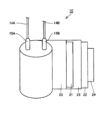
- FIG. 1 is a schematic cross-sectional view of an electrolytic capacitor according to an embodiment of the present disclosure.
- FIG. 2 is a schematic diagram for explaining the configuration of the capacitor element of FIG. 1 .
- the embodiments of the present disclosure are described using examples, but the present disclosure is not limited to the examples described below.
- specific numerical values and materials may be exemplified, but other numerical values and materials may be applied as long as the effects of the present disclosure are obtained.
- the expression "numerical value A to numerical value B" includes numerical value A and numerical value B and can be read as "numerical value A or more and numerical value B or less.”
- any of the exemplified lower limits and any of the exemplified upper limits can be arbitrarily combined as long as the lower limit is not equal to or greater than the upper limit.
- one of the materials may be selected and used alone, or two or more of the materials may be used in combination.
- Electrolytic capacitor may be read as “solid electrolytic capacitor” or “solid-liquid hybrid electrolytic capacitor”
- capacitor may be read as “capacitor”.
- the "conductive polymer” forms at least a part of the solid electrolyte layer.
- An electrolytic capacitor according to one embodiment of the present disclosure (hereinafter also referred to as “electrolytic capacitor (HV)”) includes a capacitor element and a liquid component.
- the capacitor element includes an anode body having a dielectric layer on its surface, and a conductive polymer that covers a portion of the dielectric layer.
- electrolytic capacitors are exposed to reflow temperatures after being mounted on circuit components. Furthermore, electrolytic capacitors are required to function normally even at high temperatures due to heat generated by ripple current. In other words, electrolytic capacitors are required to have high heat resistance.
- an electrolytic capacitor contains a liquid component
- the liquid component contains an inorganic acid
- the pH of the electrolyte may increase during high-temperature reliability testing due to a reduction in the inorganic acid.
- dedoping of the conductive polymer may be induced, the conductivity of the conductive polymer may decrease, and the ESR may increase.
- the solvent of the liquid component contains a polyhydric alcohol
- an esterification reaction between the solvent and the inorganic acid proceeds, making it easy for the acid component to decrease or disappear.
- liquid component (BA)" possessed by the electrolytic capacitor (HV) according to the present disclosure includes a solvent, an inorganic acid, and an organic oxy compound.
- the organic oxy compound and the inorganic acid are dissolved in the solvent.
- the amount of the organic oxy compound per mole of the inorganic acid is more than 0.5 moles.
- the liquid component (BA) contains a solvent, an inorganic acid, and an organic oxy compound having a specific characteristic, and the amount of the organic oxy compound per 1 mole of the inorganic acid is more than 0.5 moles.
- the organic oxy compound having the specific characteristic is present in a sufficient amount relative to the inorganic acid, an increase in the ESR of the electrolytic capacitor is significantly suppressed in a high-temperature reliability test. This is believed to be because an increase in pH due to a decrease or disappearance of the inorganic acid and dedoping of the conductive polymer are suppressed.
- the liquid component (BA) may further contain a base compound.
- the base compound improves the stability of the inorganic acid in a high-temperature environment, inhibits the volatilization of the liquid component (BA) at high temperatures, and enhances the repairability of the dielectric layer.
- the base compound may be a conjugate base of an inorganic acid salt.
- organic Oxy Compound The organic oxy compound has at least one of the following (A) to (D):
- the first carbon atom is a carbon atom to which only one group selected from an OH group and a COOH group is bonded.
- the second carbon atom is a carbon atom to which two or more groups selected from an OH group and a COOH group are bonded.
- a liquid component (BA) containing an organic oxy compound having the above characteristics (hereinafter also referred to as "organic oxy compound (OH)")
- organic oxy compound (OH) an organic oxy compound having the above characteristics
- the pH is less likely to rise in a high-temperature reliability test.
- the organic oxy compound (OH) is present in a ratio equal to or greater than a certain ratio relative to the inorganic acid, the first and second carbon atoms satisfying the above (A) to (D) are considered to exert an effect of suppressing the rise in pH of the liquid component (BA).
- the organic oxy compound (OH) may be dissolved in a solvent in the liquid component (BA), and may be a solid at 25°C when isolated. However, from the viewpoint of reducing the viscosity of the liquid component (BA), it is preferable to control the molecular weight of the organic oxy compound (OH) to 100 or more and 350 or less.
- the first carbon atom may be a carbon atom constituting an aromatic ring.
- the organic oxy compound (OH) may be an organic aromatic compound having a total of two or more OH groups or COOH groups directly bonded to the aromatic ring.
- the molecular weight of such an organic aromatic compound may be, for example, 125 to 350.
- the aromatic ring may be a benzene ring, a heterocycle, a monocyclic aromatic ring, or a polycyclic aromatic ring.
- an organic aromatic compound having a monocyclic aromatic ring is preferable.
- Examples of such organic oxy compounds (OH) include pyrogallol, pyrocatechol, salicylic acid, o-phthalic acid, 3,4-dihydroxybenzoic acid, 4-t-butylpyrocatechol, and gallic acid.
- the aromatic ring does not have a bulky substituent, and for example, an alkyl group may not be bonded. Furthermore, when a carboxyl group is bonded to the first carbon atom of the organic oxy compound (OH), the organic oxy compound (OH) may have only two first carbon atoms.
- organic aromatic compounds having a monocyclic aromatic ring pyrogallol, pyrocatechol, salicylic acid, o-phthalic acid, etc. are preferred.
- the second carbon atom may be a carbon atom constituting a sugar compound. That is, the organic oxy compound (OH) may be a compound included in the category of sugar compounds.
- the sugar compound may be a polysaccharide, but from the viewpoint of reducing the viscosity of the liquid component (BA), a monosaccharide or disaccharide is preferable.
- the molecular weight of such a sugar compound may be, for example, 140 or more and 200 or less.
- the second carbon atom may have two or more OH groups, or may have two or more COOH groups. From the viewpoint of promoting interaction with inorganic acids, it is preferable that the second carbon atom has one OH group and one COOH group.
- the sugar compound may be an aldose, a ketose, or a sugar alcohol.
- sugar alcohols include tetritol, pentitol, hexitol, heptitol, and octitol. More specifically, mannitol, sorbitol, erythritol, and the like are preferred.
- the organic oxy compound (OH) is at least one selected from the group consisting of pyrogallol, pyrocatechol, salicylic acid, o-phthalic acid, 3,4-dihydroxybenzoic acid, 4-t-butylpyrocatechol, tartaric acid, quinic acid, and citric acid.
- Inorganic acids are expected to have the effect of suppressing the deterioration of conductive polymers and enhancing the repairability of dielectric layers.
- inorganic acids oxoacids exhibiting moderate acidity are preferable.
- Such oxoacids may be, for example, oxoacids containing at least one element selected from the group consisting of phosphorus, boron, aluminum, and silicon.
- at least one of oxoacids containing phosphorus and oxoacids containing boric acid is preferable, and oxoacids containing boron are particularly preferable.
- the inorganic acid may, for example, contain at least one of phosphoric acid and boric acid, or may contain boric acid.
- the oxoacid does not necessarily have to be present in the liquid component (BA) in a typical structure.
- the boron-containing oxoacid does not necessarily have to be present in the form of boric acid B ( OH) 3 or the anion H2BO3- , HBO32- or BO33- .
- the presence of two or more ( preferably three or more ) B-O bonds per boron atom may be judged to indicate the presence of a boron-containing oxoacid.
- the presence of two or more (preferably three or more) P-O bonds per phosphorus atom may be judged to indicate the presence of a phosphorus-containing oxoacid.
- the content of the inorganic acid in the liquid component (BA) may be selected from the range of 3% by mass or more and 12% by mass or less, or may be selected from the range of 3% by mass or more and 10% by mass or less. However, the content of the inorganic acid is selected so that the amount of the organic oxy compound per mole of inorganic acid is more than 0.5 moles.
- the amount of the organic oxy compound per mole of inorganic acid may be 0.6 moles or more, 0.7 moles or more, 0.8 moles or 1 mole or more.
- the inorganic acid is an oxoacid containing at least one element selected from the group consisting of phosphorus, boron, aluminum, and silicon (hereinafter also referred to as the "central element")
- "per mole of inorganic acid” may be read as “per mole of central element.”
- the inorganic acid is an oxoacid containing boron
- "per mole of inorganic acid (oxoacid containing boron)” may be read as “per mole of boron.”
- the inorganic acid is an oxoacid containing phosphorus
- “per mole of inorganic acid (oxoacid containing phosphorus)” may be read as "per mole of phosphorus.”
- the solvent is not particularly limited.
- the solvent is usually liquid at 25°C.
- the solvent may be a protic solvent or an aprotic solvent.
- polyhydric alcohols, lactone compounds, sulfone compounds, carbonate compounds, etc. may be used as the solvent. Among them, at least one selected from the group consisting of polyhydric alcohols, lactone compounds, and sulfone compounds is preferable.
- the solvent is preferably liquid even at 10°C.
- Polyhydric alcohols have high dielectric layer repairability. Polyhydric alcohols preferably have two or more hydroxyl groups. Polyhydric alcohols are also preferable for improving the orientation of conductive polymers and for increasing the conductivity of the conductive polymers.
- the polyhydric alcohol may be a dihydric alcohol (e.g., a glycol compound) or a trihydric alcohol (e.g., a glycerin compound).
- the polyhydric alcohol may be an alcohol that does not have a heteroatom other than an oxygen atom (such as a sulfur atom, a boron atom, a phosphorus atom, or a nitrogen atom).
- the polyhydric alcohol may be an alcohol that does not have a carbonyl group.
- the polyhydric alcohol may be a sugar compound other than an organic oxy compound (OH).
- the polyhydric alcohol preferably contains at least one selected from the group consisting of glycol compounds and glycerin compounds.
- glycol compounds include ethylene glycol, propylene glycol, diethylene glycol, triethylene glycol, polyalkylene glycol (e.g., polyethylene glycol with a molecular weight of 2000 or less), polyoxyethylene polyoxypropylene glycol (ethylene oxide-propylene oxide copolymer), and the like.
- examples of glycerin compounds include glycerin and polyglycerin. As polyglycerin, diglycerin, triglycerin, and the like are preferred. Of these, ethylene glycol is preferred, and ethylene glycol may account for 10% by mass or more of the solvent.
- Sulfone compounds include sulfolane, dimethyl sulfoxide, diethyl sulfoxide, etc. Among these, sulfolane is preferred, and sulfolane may account for 10% by mass or more of the solvent.
- lactone compounds examples include ⁇ -butyrolactone and ⁇ -valerolactone.
- ⁇ -butyrolactone is preferred, and ⁇ -butyrolactone may account for 10% by mass or more of the solvent.
- Carbonate compounds include dimethyl carbonate, diethyl carbonate, ethyl methyl carbonate, ethylene carbonate, propylene carbonate, and fluoroethylene carbonate.
- the content of the solvent in the liquid component (BA) is, for example, 30% by mass or more, may be 50% by mass or more, and preferably 60% by mass or more. This allows the viscosity of the liquid component (BA) to be kept as low as possible.
- the content of the solvent in the liquid component (BA) is, for example, 95% by mass or less, preferably 90% by mass or less, may be 85% by mass or less, 80% by mass or less, 75% by mass or less, or 70% by mass or less. In this case, thermal degradation of the electrolytic capacitor in a high-temperature environment can be more effectively suppressed.
- the liquid component (BA) may further include a basic compound.
- the basic compound is not particularly limited, and may be, for example, a primary amine, a secondary amine, a tertiary amine, a quaternary ammonium compound, an amidinium compound, or the like.
- the basic compound at least one first basic compound selected from the group consisting of an aliphatic amine, an alicyclic amine, an aromatic amine, a heterocyclic amine, and an onium ion of these amines may be used.
- the first basic compound may account for 80% by mass or more of the basic compound, or may account for 100% by mass.
- examples of basic compounds include methylamine, dimethylamine, trimethylamine, ethylamine, diethylamine, triethylamine, ethyldimethylamine, ethylenediamine, N,N-diisopropylethylamine, aniline, pyrrolidine, phenethylamine, toluidine, imidazole (1,2,3,4-tetramethylimidazolinium, 1,3-dimethyl-2-ethylimidazole, etc.), 4-dimethylaminopyridine, etc.
- the base compound may be a salt of a base compound and an inorganic acid (inorganic acid salt).
- the base compound may be derived only from an inorganic acid salt, or a part of the base compound may not be derived from an inorganic acid salt.
- the amine described above may be used as the base compound constituting the inorganic acid salt.
- a salt of a first base compound and an inorganic acid described above may be used.
- the salt of a base compound and an inorganic acid (inorganic acid salt) may be a salt composed of a base compound, an inorganic acid, and an organic oxy compound (OH).
- the inorganic acid salt may be, for example, an oxo acid salt containing boron, an oxo acid salt containing phosphorus, etc.
- oxo acid salts include diethylamine borate and triethylamine borodisalicylate.
- the amount of the base compound per mole of inorganic acid may be 0.8 moles or more and 1.2 moles or less, 0.9 moles or more and 1.1 moles or less, or even 1 mole.
- the content of the base compound contained in the liquid component (BA) may be, for example, 10 parts by mass or more and 100 parts by mass or less, or 20 parts by mass or more and 80 parts by mass or less, relative to 100 parts by mass of inorganic acid.
- the pH of the liquid component (BA) is preferably 4 or less, more preferably 3.8 or less, and even more preferably 3.6 or less. By setting the pH of the liquid component (BA) to 4 or less, deterioration of the conductive polymer is further suppressed. In addition, the pH is preferably 2 or more.
- the electrolytic capacitor (HV) includes a capacitor element and a liquid component (BA).
- the capacitor element includes an anode body having a dielectric layer on a surface thereof, and a conductive polymer covering a part of the dielectric layer.
- the electrolytic capacitor (HV) may include a bottomed case that houses the capacitor element, a sealing member that seals an opening of the bottomed case, and an external terminal that penetrates the sealing member.
- the capacitor element includes at least an anode body having a dielectric layer on a surface thereof, and a conductive polymer component covering a portion of the dielectric layer.
- the capacitor element may include a wound body.
- the wound body may include an anode body, a cathode body, and a separator interposed therebetween.
- the separator may be, for example, a known separator used in electrolytic capacitors.
- the conductive polymer may not only cover at least a portion of the dielectric layer on the surface of the anode body, but may also adhere to the separator and the cathode body.
- the anode body may contain a valve metal, an alloy containing a valve metal, a compound containing a valve metal, etc. These materials may be used alone or in combination of two or more. For example, aluminum, tantalum, niobium, and titanium are preferably used as the valve metal.
- An anode body having a porous surface can be obtained by roughening the surface of a base material (such as a foil-shaped or plate-shaped base material) containing a valve metal, for example, by etching.
- the anode body may also be a molded body of particles containing a valve metal or a sintered body thereof. The sintered body has a porous structure.
- the dielectric layer is formed by anodizing the valve metal on the surface of the anode body by chemical conversion treatment or the like.
- the dielectric layer may be formed so as to cover at least a part of the anode body.
- the dielectric layer is usually formed on the surface of the anode body. Since the dielectric layer is formed on the porous surface of the anode body, it is formed along the inner wall surfaces of holes and depressions (pits) on the surface of the anode body.
- the dielectric layer contains an oxide of a valve metal.
- the dielectric layer contains Ta2O5
- aluminum is used as the valve metal
- the dielectric layer contains Al2O3 .
- the dielectric layer is not limited to this, and may be any material that functions as a dielectric.
- the dielectric layer is formed along the surface of the anode body (including the inner wall surface of the hole).
- the conductive polymer includes, for example, a conductive polymer and a dopant.
- the conductive polymer is attached so as to cover a part of the dielectric layer.
- the conductive polymer attached to the surface of the dielectric layer may constitute a conductive polymer layer.
- the conductive polymer layer is sometimes called a solid electrolyte layer.
- the conductive polymer constitutes at least a part of the cathode body in the electrolytic capacitor.
- Conductive polymers include, for example, ⁇ -conjugated polymers.
- Examples of conductive polymers include polypyrrole, polythiophene, polyfuran, polyaniline, polyacetylene, polyphenylene, polyphenylenevinylene, polyacene, and polythiophenevinylene. These may be used alone or in combination of two or more types, or may be copolymers of two or more types of monomers.
- polypyrrole, polythiophene, polyfuran, polyaniline, etc. refer to polymers whose basic skeleton is polypyrrole, polythiophene, polyfuran, polyaniline, etc., respectively. Therefore, polypyrrole, polythiophene, polyfuran, polyaniline, etc. may also include their respective derivatives.
- polythiophene includes poly(3,4-ethylenedioxythiophene), etc.
- the dopant can be selected according to the ⁇ -conjugated polymer, and known dopants may be used.
- dopants include compounds capable of generating anions (e.g., aromatic sulfonic acids (naphthalenesulfonic acid, p-toluenesulfonic acid, etc.) or salts thereof), polyanions (e.g., polymer-type polyanions (polystyrenesulfonic acid, etc.)), etc.
- solid electrolytes include polypyrrole doped with aromatic sulfonic acids, and poly(3,4-ethylenedioxythiophene) (PEDOT) doped with polystyrenesulfonic acid (PSS).
- the conductive polymer layer can be formed, for example, by chemically or electrolytically polymerizing a raw material monomer on the dielectric layer. Alternatively, it can be formed by contacting a solution in which a conductive polymer is dissolved or a dispersion in which a conductive polymer is dispersed with the dielectric layer.
- the conductive polymer layer may be formed so as to cover at least a portion of the dielectric layer.
- a metal foil may be used for the cathode body.
- a valve metal such as aluminum, tantalum, or niobium, or an alloy containing a valve metal. If necessary, the surface of the metal foil may be roughened.
- the surface of the metal foil may be provided with a chemical conversion coating, or may be provided with a coating of a metal (heterogeneous metal) different from the metal constituting the metal foil, or a nonmetal. Examples of heterogeneous metals and nonmetals include metals such as titanium and nonmetals such as carbon.
- a separator When a metal foil is used for the cathode body, a separator may be disposed between the metal foil and the anode body.
- the separator is not particularly limited, and may be, for example, a nonwoven fabric containing fibers of cellulose, polyethylene terephthalate, vinylon, or polyamide (e.g., aliphatic polyamide, aromatic polyamide such as aramid).
- electrolytic capacitor of the present disclosure will be described in more detail below based on an embodiment. However, the electrolytic capacitor of the present disclosure is not limited to the following embodiment.
- FIG. 1 is a schematic cross-sectional view of an electrolytic capacitor according to this embodiment
- FIG. 2 is a schematic exploded view of a portion of a capacitor element of the electrolytic capacitor.
- the electrolytic capacitor shown in Figure 1 comprises a capacitor element 10, a bottomed case 11 that houses the capacitor element 10, a sealing member 12 that closes the opening of the bottomed case 11, a seat plate 13 that covers the sealing member 12, lead wires 14A, 14B that extend from the sealing member 12 and pass through the seat plate 13, lead tabs 15A, 15B that connect the lead wires to the electrodes of the capacitor element 10, and a liquid component (not shown).
- the open end of the bottomed case 11 is curled so as to be crimped to the sealing member 12.
- Capacitor element 10 is made from a wound body as shown in Figure 2.
- a wound body is a semi-finished product of capacitor element 10 in which a conductive polymer is not disposed between anode body 21 and cathode body 22 having a dielectric layer on the surface.
- the wound body is made by winding anode body 21 connected to lead tab 15A and cathode body 22 connected to lead tab 15B with separator 23 interposed therebetween.
- the outermost periphery of the wound body is fixed with stop tape 24. Note that Figure 2 shows a state in which a part of the wound body is unfolded before the outermost periphery is fixed.
- the anode body 21 comprises a metal foil with a roughened surface, and a dielectric layer is formed on the roughened surface.
- a conductive polymer is attached to at least a portion of the surface of the dielectric layer to form the capacitor element 10.
- the capacitor element 10 is housed in an exterior case together with a liquid component (BA) not shown.
- the electrolytic capacitor may be a chip type or a multilayer type.
- the configuration of the capacitor element can be selected according to the type of electrolytic capacitor.
- An electrolytic capacitor may have at least one capacitor element, but may also have multiple capacitor elements.
- the number of capacitor elements included in an electrolytic capacitor may be determined according to the application.
- Step of preparing anode body 21 and cathode body 22 having a dielectric layer Metal foil made of a valve metal is used as the raw material for anode body 21 and cathode body 22.
- the surface of the metal foil is roughened by etching or the like to form a plurality of projections and recesses on the surface of the metal foil.
- a dielectric layer is formed on the roughened surface of the metal foil by chemical conversion or the like. If necessary, the surface of cathode body 22 may be roughened.
- the anode body 21 and the cathode body 22 are wound with the separator 23 interposed therebetween to prepare a wound body.
- the separator 23 may be a nonwoven fabric mainly composed of synthetic cellulose or the like.
- a stop tape 24 is placed on the outer surface of the cathode body 22 located in the outermost layer of the wound body, and an end of the cathode body 22 is fixed. If necessary, the wound body is further subjected to a chemical conversion treatment.
- Step of forming capacitor element 10 For example, a liquid polymer dispersion is impregnated into the dielectric layer to form a conductive polymer film covering at least a part of the dielectric layer. This results in a capacitor element 10 in which a conductive polymer is disposed between the anode body 21 and the cathode body 22. The step of applying the polymer dispersion to the surface of the dielectric layer may be repeated two or more times. Thereafter, the capacitor element 10 may be impregnated with a liquid component (BA). This results in an electrolytic capacitor comprising a conductive polymer and a liquid component (BA).
- BA liquid component
- the liquid component (BA) may be prepared by dissolving an inorganic acid salt and an organic oxy compound in a solvent. That is, a salt with a basic compound may be used as the inorganic acid.
- the inorganic acid is derived from the inorganic acid salt.
- the basic compound may be an amine as described above. For example, at least one first basic compound selected from the group consisting of aliphatic amines, alicyclic amines, aromatic amines, and heterocyclic amines may be used.
- Capacitor element 10 is housed in bottomed case 11 together with liquid component (BA) so that lead wires 14A and 14B are located on the opening side of bottomed case 11.
- the opening of bottomed case 11 is sealed with sealing member 12 through which each lead wire passes, and the opening end is crimped to sealing member 12 and curled, and seat plate 13 is placed on the curled portion to complete the electrolytic capacitor as shown in FIG.
- a wound-type electrolytic capacitor was described, but the scope of application of the present invention is not limited to the above, and it can also be applied to other electrolytic capacitors, such as chip-type electrolytic capacitors that use a metal sintered body as the anode body, and stacked-type electrolytic capacitors that use a metal plate as the anode body.
- a capacitor element and a liquid component includes an anode body having a dielectric layer on a surface thereof, and a conductive polymer covering a portion of the dielectric layer;
- the liquid component includes a solvent, an inorganic acid, and an organic oxy compound; the amount of said organic oxy compound per mole of said inorganic acid is greater than 0.5 moles;
- the organic oxy compound has at least one of the following (A) to (D): (A) two adjacent first carbon atoms; (B) two adjacent second carbon atoms; (C) a first carbon atom and a second carbon atom adjacent to each other; (D) one or more second carbon atoms.
- the first carbon atom is a carbon atom to which only one group selected from an OH group and a COOH group is bonded
- the second carbon atom is a carbon atom to which two or more groups selected from an OH group and a COOH group are bonded.
- the organic oxy compound is at least one selected from the group consisting of pyrogallol, pyrocatechol, salicylic acid, o-phthalic acid, 3,4-dihydroxybenzoic acid, 4-t-butylpyrocatechol, gallic acid, tartaric acid, quinic acid, and citric acid.
- the inorganic acid forms a salt with a base compound
- the base compound includes at least one first base compound selected from the group consisting of an aliphatic amine, an alicyclic amine, an aromatic amine, and a heterocyclic amine.
- Electrolytic capacitors A1 to A9 and B1 to B4 A wound electrolytic capacitor ( ⁇ (diameter) 10 mm ⁇ L (length) 10 mm) having a rated voltage of 25 V and a rated capacitance of 330 ⁇ F was fabricated. A specific method for fabricating the electrolytic capacitor will be described below.
- An aluminum foil having a thickness of 100 ⁇ m was subjected to an etching treatment to roughen the surface of the aluminum foil. Then, a dielectric layer was formed on the surface of the aluminum foil by chemical conversion treatment. The chemical conversion treatment was performed by immersing the aluminum foil in an ammonium adipate solution and applying a voltage thereto. Then, the aluminum foil was cut to prepare an anode body.
- An anode lead tab and a cathode lead tab were connected to the anode body and the cathode body, and the anode body and the cathode body were wound with the lead tabs interposed between them.
- An anode lead wire and a cathode lead wire were connected to the ends of the lead tabs protruding from the wound body, respectively.
- the wound body thus produced was subjected to a chemical conversion treatment again, and a dielectric layer was formed on the cut ends of the anode body. Next, the ends of the outer surface of the wound body were fixed with a winding stop tape to produce the wound body.
- the wound body was immersed in a polymer dispersion contained in a specified container in a reduced pressure atmosphere (40 kPa) for 5 minutes, and then the wound body was pulled out from the polymer dispersion. Next, the wound body impregnated with the polymer dispersion was dried in a drying oven at 150° C. for 20 minutes to form a solid electrolyte layer containing a conductive polymer that covers at least a part of the dielectric layer. In this way, a capacitor element was formed.
- a liquid component (BA) containing a solvent, an inorganic acid, a base compound, and an organic oxy compound (OH) was prepared.
- Ethylene glycol (EG) was used as the solvent.
- Diethylamine borate (BADEA), which is a salt of an inorganic acid and a base compound, was dissolved in the solvent at a content of 3 mass% or triethylamine borodisalicylate (BSTEA) was dissolved in the solvent at a content of 8 mass%.
- BSTEA triethylamine borodisalicylate
- 2 moles of an organic oxy compound (OH) shown in Table 1 or an additive similar thereto was dissolved per mole of boron. No additive was dissolved in the liquid components of electrolytic capacitors B1 and B2.
- ESR2 High temperature reliability
- the liquid components of electrolytic capacitors A1 to A6 contain an organic aromatic compound (OH) having a monocyclic aromatic ring with a total of two or more first carbon atoms.
- the organic oxy compound (OH) of electrolytic capacitors A1 to A6 has two first carbon atoms (A) adjacent to each other.
- Electrolytic capacitors A1 to A6 have small ESR1 and ESR2 and excellent heat resistance. Furthermore, when no alkyl group is bonded to the aromatic ring of the organic oxy compound (OH), better heat resistance is obtained.
- the liquid components of electrolytic capacitors A7 to A9 contain organic aromatic compounds (OH) that are sugar compounds with a secondary carbon atom.
- the organic oxy compounds (OH) of electrolytic capacitors A7 to A9 have a secondary carbon atom to which one OH group and one COOH group are bonded.
- Electrolytic capacitors A7 to A9 have small ESR1 and ESR2 and excellent heat resistance.
- electrolytic capacitors B3 and B4 are organic aromatic compounds having a monocyclic aromatic ring with two first carbon atoms, but because they do not have two adjacent first carbon atoms (A), they have inferior heat resistance compared to electrolytic capacitors A1 to A6. Electrolytic capacitors B1 and B2 also have inferior heat resistance compared to electrolytic capacitors A1 to A9, whose liquid components contain an organic aromatic compound (OH).
- Electrolytic capacitors A10 to A21 and B5 to B7 In preparing the liquid components, diethylamine borate (BADEA) or diethylamine phosphate (PADEA) was dissolved in a solvent at the content shown in Table 2, and further, an organic oxy compound (OH) was dissolved in the number of moles shown in Table 2 per mole of boron or phosphorus. No additive was dissolved in the liquid component of electrolytic capacitor B7. Otherwise, electrolytic capacitors were produced and evaluated in the same manner as in the above examples. The results are shown in Table 2.
- BADEA diethylamine borate
- PADEA diethylamine phosphate
- the electrolytic capacitor disclosed herein can be used as a hybrid electrolytic capacitor that has a solid electrolyte layer containing a conductive polymer and a liquid component or electrolyte. Electrolytic capacitors are particularly suitable for applications that require high heat resistance. However, the applications of electrolytic capacitors are not limited to these.
- Capacitor element 11 Case with bottom 12: Sealing member 13: Seat plate 14A, 14B: Lead wires 15A, 15B: Lead tab 21: Anode body 22: Cathode body 23: Separator 24: Winding tape
Landscapes
- Engineering & Computer Science (AREA)
- Power Engineering (AREA)
- Microelectronics & Electronic Packaging (AREA)
- Chemical & Material Sciences (AREA)
- Chemical Kinetics & Catalysis (AREA)
- Electrochemistry (AREA)
- Fixed Capacitors And Capacitor Manufacturing Machines (AREA)
Priority Applications (2)
| Application Number | Priority Date | Filing Date | Title |
|---|---|---|---|
| JP2025503796A JPWO2024181213A1 (https=) | 2023-02-28 | 2024-02-19 | |
| CN202480013056.2A CN120642016A (zh) | 2023-02-28 | 2024-02-19 | 电解电容器及其制造方法 |
Applications Claiming Priority (2)
| Application Number | Priority Date | Filing Date | Title |
|---|---|---|---|
| JP2023030127 | 2023-02-28 | ||
| JP2023-030127 | 2023-02-28 |
Publications (1)
| Publication Number | Publication Date |
|---|---|
| WO2024181213A1 true WO2024181213A1 (ja) | 2024-09-06 |
Family
ID=92590484
Family Applications (1)
| Application Number | Title | Priority Date | Filing Date |
|---|---|---|---|
| PCT/JP2024/005848 Ceased WO2024181213A1 (ja) | 2023-02-28 | 2024-02-19 | 電解コンデンサおよびその製造方法 |
Country Status (3)
| Country | Link |
|---|---|
| JP (1) | JPWO2024181213A1 (https=) |
| CN (1) | CN120642016A (https=) |
| WO (1) | WO2024181213A1 (https=) |
Citations (4)
| Publication number | Priority date | Publication date | Assignee | Title |
|---|---|---|---|---|
| WO2007091656A1 (ja) * | 2006-02-09 | 2007-08-16 | Shin-Etsu Polymer Co., Ltd. | 導電性高分子溶液、導電性塗膜、コンデンサ及びコンデンサの製造方法 |
| WO2011099261A1 (ja) * | 2010-02-15 | 2011-08-18 | パナソニック株式会社 | 電解コンデンサ |
| WO2021153751A1 (ja) * | 2020-01-30 | 2021-08-05 | パナソニックIpマネジメント株式会社 | 電解コンデンサ |
| WO2022065434A1 (ja) * | 2020-09-25 | 2022-03-31 | パナソニックIpマネジメント株式会社 | 電解コンデンサ |
-
2024
- 2024-02-19 JP JP2025503796A patent/JPWO2024181213A1/ja active Pending
- 2024-02-19 CN CN202480013056.2A patent/CN120642016A/zh active Pending
- 2024-02-19 WO PCT/JP2024/005848 patent/WO2024181213A1/ja not_active Ceased
Patent Citations (4)
| Publication number | Priority date | Publication date | Assignee | Title |
|---|---|---|---|---|
| WO2007091656A1 (ja) * | 2006-02-09 | 2007-08-16 | Shin-Etsu Polymer Co., Ltd. | 導電性高分子溶液、導電性塗膜、コンデンサ及びコンデンサの製造方法 |
| WO2011099261A1 (ja) * | 2010-02-15 | 2011-08-18 | パナソニック株式会社 | 電解コンデンサ |
| WO2021153751A1 (ja) * | 2020-01-30 | 2021-08-05 | パナソニックIpマネジメント株式会社 | 電解コンデンサ |
| WO2022065434A1 (ja) * | 2020-09-25 | 2022-03-31 | パナソニックIpマネジメント株式会社 | 電解コンデンサ |
Also Published As
| Publication number | Publication date |
|---|---|
| JPWO2024181213A1 (https=) | 2024-09-06 |
| CN120642016A (zh) | 2025-09-12 |
Similar Documents
| Publication | Publication Date | Title |
|---|---|---|
| JP7706068B2 (ja) | 電解コンデンサ | |
| JP7531108B2 (ja) | 電解コンデンサ | |
| JP7702648B2 (ja) | 電解コンデンサ | |
| JP7689321B2 (ja) | 電解コンデンサおよびその製造方法 | |
| JP7607227B2 (ja) | 電解コンデンサ | |
| US12183519B2 (en) | Electrolytic capacitor and production method therefor | |
| US20260011508A1 (en) | Electrolytic capacitor and production method therefor | |
| JP7836953B2 (ja) | 電解コンデンサ | |
| US12266482B2 (en) | Electrolytic capacitor and method for producing same | |
| US20250166929A1 (en) | Electrolytic capacitor | |
| US20250174410A1 (en) | Electrolytic capacitor and manufacturing method therefor | |
| WO2024181213A1 (ja) | 電解コンデンサおよびその製造方法 | |
| US20250182976A1 (en) | Electrolytic capacitor and method for producing electrolytic capacitor | |
| US12562317B2 (en) | Electrolytic capacitor and liquid component for electrolytic capacitor | |
| JP7850938B2 (ja) | 電解コンデンサおよびその製造方法 | |
| WO2025047356A1 (ja) | 電解コンデンサおよび電解コンデンサ用液状成分 | |
| JP7565510B2 (ja) | 電解コンデンサ | |
| WO2025115898A1 (ja) | 電解コンデンサ | |
| WO2025047373A1 (ja) | 電解コンデンサおよび電解コンデンサ用液状成分 | |
| WO2025028056A1 (ja) | 電解コンデンサおよび電解コンデンサの製造方法 |
Legal Events
| Date | Code | Title | Description |
|---|---|---|---|
| 121 | Ep: the epo has been informed by wipo that ep was designated in this application |
Ref document number: 24763694 Country of ref document: EP Kind code of ref document: A1 |
|
| ENP | Entry into the national phase |
Ref document number: 2025503796 Country of ref document: JP Kind code of ref document: A |
|
| WWE | Wipo information: entry into national phase |
Ref document number: 2025503796 Country of ref document: JP |
|
| WWE | Wipo information: entry into national phase |
Ref document number: 202480013056.2 Country of ref document: CN |
|
| WWP | Wipo information: published in national office |
Ref document number: 202480013056.2 Country of ref document: CN |
|
| NENP | Non-entry into the national phase |
Ref country code: DE |
|
| 122 | Ep: pct application non-entry in european phase |
Ref document number: 24763694 Country of ref document: EP Kind code of ref document: A1 |