WO2024180598A1 - 無線通信システム、無線通信方法、信号処理装置、及び信号処理プログラム - Google Patents
無線通信システム、無線通信方法、信号処理装置、及び信号処理プログラム Download PDFInfo
- Publication number
- WO2024180598A1 WO2024180598A1 PCT/JP2023/007027 JP2023007027W WO2024180598A1 WO 2024180598 A1 WO2024180598 A1 WO 2024180598A1 JP 2023007027 W JP2023007027 W JP 2023007027W WO 2024180598 A1 WO2024180598 A1 WO 2024180598A1
- Authority
- WO
- WIPO (PCT)
- Prior art keywords
- sub
- cooperative
- base station
- station
- stations
- Prior art date
- Legal status (The legal status is an assumption and is not a legal conclusion. Google has not performed a legal analysis and makes no representation as to the accuracy of the status listed.)
- Ceased
Links
Images








Classifications
-
- H—ELECTRICITY
- H04—ELECTRIC COMMUNICATION TECHNIQUE
- H04B—TRANSMISSION
- H04B7/00—Radio transmission systems, i.e. using radiation field
- H04B7/02—Diversity systems; Multi-antenna system, i.e. transmission or reception using multiple antennas
- H04B7/022—Site diversity; Macro-diversity
- H04B7/024—Co-operative use of antennas of several sites, e.g. in co-ordinated multipoint or co-operative multiple-input multiple-output [MIMO] systems
Definitions
- This disclosure relates to a wireless communication system, a wireless communication method, a signal processing device, and a signal processing program.
- Non-terrestrial networks are expected to support many wireless communication use cases, including direct accommodation of terrestrial mobile terminals, mobile backhaul, and accommodation of IoT terminals, and are expected to increase transmission capacity compared to existing satellite communication services. For this reason, there is a demand to increase the capacity of feeder links, which are the backbone lines connecting airborne platforms and terrestrial gateway stations.
- Non-Patent Document 1 An example of a technology for increasing the capacity of feeder links is disclosed in Non-Patent Document 1.
- the technology disclosed in Non-Patent Document 1 is a MIMO technology that performs spatial multiplexing by installing multiple antennas on an airborne platform and multiple terrestrial gateway antennas on the ground. With this technology, an increase in transmission capacity can be expected by installing multiple antennas for transmission and reception and increasing the number of spatial multiplexes.
- the NTN will be an environment in which there will be many airborne platforms such as HAPS and LEO satellites, and in order for these to communicate with each other on the ground, the installation of more terrestrial antennas will be required.
- HAPS and LEO satellites As disclosed in Non-Patent Document 2, line-of-sight MIMO communication will be used between the ground and airborne platforms, and the movement of the airborne platforms will cause fluctuations in transmission capacity, creating stability issues, so the installation of more terrestrial antennas will be required.
- Non-Patent Document 3 discloses the use of small antennas as terrestrial gateway antennas, with multiple antennas aggregated at a base station to virtually operate as a large-aperture array antenna.
- the use of small antennas eases restrictions on installation, making it possible to install a large number of antennas.
- MIMO transmission can be realized for all NTN systems by arranging a large number of antennas over a wide area to transmit signals to a base station, which then aggregates and processes the signals.
- This disclosure has been made in consideration of the problems described above.
- the purpose of this disclosure is to provide technology that can stably obtain high transmission capacity while reducing the amount of calculations and transmission delays involved in MIMO demodulation processing in NTNs where communication areas change at various altitudes and with various mobility.
- the present disclosure provides a wireless communication system for achieving the above object.
- the wireless communication system of the present disclosure includes a mobile station and a base station.
- the mobile station includes multiple antennas and has a MIMO processing function for transmitting/separating multiple signals in parallel.
- the base station includes multiple base station antennas that are distributed over the same range as the communication area of the mobile station or a wider range, and has a MIMO processing function.
- the base station is also configured to select multiple base station antennas to be used for MIMO processing from the multiple base station antennas according to the location and range of the communication area of the mobile station.
- the base station includes a plurality of sub-base stations each having a plurality of base station antennas.
- the base station groups a plurality of sub-base stations included in a communication area into one or more groups, and generates a virtual cooperative sub-base station by coordinating the grouped sub-base stations.
- the grouping may be performed based on the distance between adjacent sub-base stations.
- some sub-base stations may overlap between the groups.
- the base station regroups the plurality of cooperative sub-base stations into one or more groups, and generates a new cooperative sub-base station by coordinating the regrouped cooperative sub-base stations. In the regrouping, some cooperative sub-base stations may overlap between the groups.
- the base station When a plurality of cooperative sub-base stations are generated by regrouping, the base station repeats the regrouping until only one cooperative sub-base station is generated. Then, when only one cooperative sub-base station is generated, the base station performs MIMO processing using only that one cooperative sub-base station.
- the base station has a hierarchical structure.
- the hierarchical structure includes a plurality of sub-base stations belonging to the highest hierarchy and equipped with a plurality of antennas, and a plurality of cooperative stations belonging to a second hierarchy or lower hierarchy.
- Each of the plurality of sub-base stations is connected to a plurality of cooperative stations belonging to the second hierarchy.
- Each of the plurality of cooperative stations is connected to a plurality of sub-base stations or cooperative stations belonging to the immediately higher hierarchy and a plurality of cooperative stations belonging to the immediately lower hierarchy.
- the mobile station is configured to generate determination information for determining which sub-base station has received the transmission signal from the mobile station, and to transmit the transmission signal together with the determination information to the base station.
- the base station is configured to execute the following four processes.
- the first process is to determine which sub-base station received the transmission signal based on the determination information.
- the second process is to perform MIMO demodulation processing on the received signal received at one sub-base station when the transmission signal is received by only one sub-base station.
- the third process is to gradually aggregate the received signals acquired from each of the multiple sub-base stations that received the transmission signal using a hierarchical structure when the transmission signal is received by multiple sub-base stations.
- the fourth process is to perform MIMO demodulation processing on the received signals aggregated using the hierarchical structure.
- the present disclosure provides a wireless communication method for achieving the above object.
- the wireless communication method of the present disclosure is a method for performing wireless communication between a mobile station and a base station.
- the mobile station is equipped with multiple antennas, and has a MIMO processing function for transmitting/separating multiple signals in parallel.
- the base station is equipped with multiple base station antennas that are distributed over the same range as the communication area of the mobile station or a wider range, and has a MIMO processing function.
- multiple base station antennas to be used for MIMO processing are selected from the multiple base station antennas according to the position and range of the communication area of the mobile station.
- the base station includes a plurality of sub-base stations each having a plurality of base station antennas
- the wireless communication method includes the following four steps.
- the first step is a step of grouping a plurality of sub-base stations included in a communication area into one or more groups, and generating a virtual cooperative sub-base station by coordinating the grouped sub-base stations.
- the second step is a step of regrouping the plurality of cooperative sub-base stations into one or more groups when a plurality of cooperative sub-base stations are generated by grouping, and generating a new cooperative sub-base station by coordinating the regrouped cooperative sub-base stations.
- the third step is a step of repeating regrouping when a plurality of cooperative sub-base stations are generated by regrouping until only one cooperative sub-base station is generated.
- the fourth step is a step of performing MIMO processing by only one cooperative sub-base station when only one cooperative sub-base station is generated.
- the base station has a hierarchical structure.
- the hierarchical structure includes a plurality of sub-base stations belonging to the highest hierarchy and equipped with a plurality of antennas, and a plurality of cooperative stations belonging to a second hierarchy or lower hierarchy.
- Each of the plurality of sub-base stations is connected to a plurality of cooperative stations belonging to the second hierarchy.
- Each of the plurality of cooperative stations is connected to a plurality of sub-base stations or cooperative stations belonging to the immediately higher hierarchy and a plurality of cooperative stations belonging to the immediately lower hierarchy.
- the wireless communication method includes the following six steps.
- the first step is a step of generating determination information for determining a sub-base station that has received a transmission signal from a mobile station.
- the second step is a step of transmitting the transmission signal together with the determination information to a base station.
- the third step is a step of determining the sub-base station that has received the transmission signal based on the determination information.
- the fourth step is a step of performing MIMO demodulation processing on the received signal received at one sub-base station when the transmission signal is received by one sub-base station.
- the fifth step is a step of gradually aggregating the received signals obtained from each of the multiple sub-base stations that have received the transmission signal by a hierarchical structure when the transmission signal is received by multiple sub-base stations.
- the sixth step is a step of performing MIMO demodulation processing on the received signals aggregated by the hierarchical structure.
- the present disclosure provides a first signal processing device for achieving the above object.
- the first signal processing device of the present disclosure is a device provided in a base station.
- the base station has a hierarchical structure, and performs wireless communication with a mobile station equipped with multiple antennas.
- the hierarchical structure includes multiple sub-base stations belonging to the highest hierarchy and equipped with multiple antennas, and multiple cooperative stations belonging to a hierarchy below the second hierarchy.
- Each of the multiple sub-base stations is connected to multiple cooperative stations belonging to the second hierarchy.
- Each of the multiple cooperative stations is connected to multiple sub-base stations or cooperative stations belonging to the hierarchy immediately above, and multiple cooperative stations belonging to the hierarchy immediately below.
- the first signal processing device of the present disclosure is mounted in each of the multiple cooperative stations.
- the first signal processing device of the present disclosure is configured to execute the following three processes.
- the first process is to determine whether or not there is a cooperative station in the same layer that has received a signal derived from a transmission signal from a mobile station other than the cooperative station in which the signal processing device is installed, based on the determination information received from the multiple sub-base stations or cooperative stations in the immediately higher layer.
- the second process is to perform MIMO demodulation processing on the received signal received from the multiple sub-base stations or cooperative stations in the immediately higher layer, when there is no cooperative station in the same layer that has received a signal derived from a transmission signal other than the cooperative station in which the signal processing device is installed.
- the third process is to transmit the received signal received from the multiple sub-base stations or cooperative stations in the immediately higher layer together with the determination information to the multiple cooperative stations in the immediately lower layer, when there is a cooperative station in the same layer that has received a signal derived from a transmission signal other than the cooperative station in which the signal processing device is installed.
- the present disclosure provides a first signal processing program for achieving the above object.
- the first signal processing program of the present disclosure is a program including a plurality of instructions for operating a signal processing device provided in a base station.
- the base station has a hierarchical structure, and performs wireless communication with a mobile station equipped with a plurality of antennas.
- the hierarchical structure includes a plurality of sub-base stations belonging to the highest hierarchy and equipped with a plurality of antennas, and a plurality of cooperative stations belonging to a hierarchy below the second hierarchy.
- Each of the plurality of sub-base stations is connected to a plurality of cooperative stations belonging to the second hierarchy.
- Each of the plurality of cooperative stations is connected to a plurality of sub-base stations or cooperative stations belonging to the hierarchy immediately above, and a plurality of cooperative stations belonging to the hierarchy immediately below.
- the signal processing device is mounted in each of the plurality of cooperative stations.
- the instructions included in the first signal processing program of the present disclosure are configured to cause the signal processing device to execute the following three processes.
- the first process is to determine whether or not there is a cooperative station in the same layer that has received a signal derived from a transmission signal from a mobile station other than the cooperative station in which the signal processing device is installed, based on the determination information received from the multiple sub-base stations or cooperative stations in the immediately higher layer.
- the second process is to perform MIMO demodulation processing on the received signal received from the multiple sub-base stations or cooperative stations in the immediately higher layer, when there is no cooperative station in the same layer that has received a signal derived from a transmission signal other than the cooperative station in which the signal processing device is installed.
- the third process is to transmit the received signal received from the multiple sub-base stations or cooperative stations in the immediately higher layer together with the determination information to the multiple cooperative stations in the immediately lower layer, when there is a cooperative station in the same layer that has received a signal derived from a transmission signal other than the cooperative station in which the signal processing device is installed.
- the first signal processing program of the present disclosure may be stored in a computer-readable non-transitory storage medium or provided via a network.
- the present disclosure provides a second signal processing device for achieving the above object.
- the second signal processing device of the present disclosure is a device provided in a base station.
- the base station has a hierarchical structure and performs wireless communication with a mobile station equipped with multiple antennas.
- the hierarchical structure includes multiple sub-base stations belonging to the highest hierarchy and equipped with multiple antennas, and multiple cooperative stations belonging to a hierarchy below the second hierarchy.
- Each of the multiple sub-base stations is connected to multiple cooperative stations belonging to the second hierarchy.
- Each of the multiple cooperative stations is connected to multiple sub-base stations or cooperative stations belonging to the hierarchy immediately above, and multiple cooperative stations belonging to the hierarchy immediately below.
- the second signal processing device of the present disclosure is mounted in each of the multiple sub-base stations.
- the second signal processing device of the present disclosure is configured to execute the following three processes.
- the first process is to determine whether or not there is a sub-base station that has received a transmission signal other than the sub-base station in which the signal processing device is installed, based on the determination information received together with the transmission signal from the mobile station.
- the second process is to perform MIMO demodulation processing on the received signal received by the sub-base station in which the signal processing device is installed, when there is no sub-base station that has received a transmission signal other than the sub-base station in which the signal processing device is installed.
- the third process is to transmit the received signal received by the sub-base station in which the signal processing device is installed, together with the determination information, to multiple cooperative stations belonging to the second layer, when there is a sub-base station that has received a transmission signal other than the sub-base station in which the signal processing device is installed.
- the present disclosure provides a second signal processing program for achieving the above object.
- the second signal processing program of the present disclosure is a program including a plurality of instructions for operating a signal processing device provided in a base station.
- the base station has a hierarchical structure, and performs wireless communication with a mobile station equipped with a plurality of antennas.
- the hierarchical structure includes a plurality of sub-base stations belonging to the highest hierarchy and equipped with a plurality of antennas, and a plurality of cooperative stations belonging to a hierarchy below the second hierarchy.
- Each of the plurality of sub-base stations is connected to a plurality of cooperative stations belonging to the second hierarchy.
- Each of the plurality of cooperative stations is connected to a plurality of sub-base stations or cooperative stations belonging to the hierarchy immediately above, and a plurality of cooperative stations belonging to the hierarchy immediately below.
- the signal processing device is mounted in each of the plurality of sub-base stations.
- the multiple instructions included in the second signal processing program of the present disclosure are configured to cause the signal processing device to execute the following three processes.
- the first process is to determine whether or not there is a sub-base station that has received a transmission signal other than the sub-base station in which the signal processing device is installed, based on the determination information received together with the transmission signal from the mobile station.
- the second process is to perform MIMO demodulation processing on the received signal received by the sub-base station in which the signal processing device is installed, when there is no sub-base station that has received a transmission signal other than the sub-base station in which the signal processing device is installed.
- the third process is to transmit the received signal received by the sub-base station in which the signal processing device is installed, together with the determination information, to multiple cooperative stations belonging to the second layer, when there is a sub-base station that has received a transmission signal other than the sub-base station in which the signal processing device is installed.
- the second signal processing program of the present disclosure may be stored in a computer-readable non-transitory storage medium, or may be provided via a network.
- the present disclosure provides a receiving system for achieving the above object.
- the receiving system of the present disclosure is a system for receiving a transmission signal from a mobile station equipped with multiple antennas.
- the receiving system of the present disclosure has a hierarchical structure.
- the hierarchical structure includes multiple sub-base stations belonging to the highest hierarchy and equipped with multiple antennas, and multiple cooperative stations belonging to a hierarchy below the second hierarchy.
- Each of the multiple sub-base stations is connected to multiple cooperative stations belonging to the second hierarchy.
- Each of the multiple cooperative stations is connected to multiple sub-base stations or cooperative stations belonging to the hierarchy immediately above, and multiple cooperative stations belonging to the hierarchy immediately below.
- the receiving system of the present disclosure is configured to execute the following four processes.
- the first process is to determine the sub-base station that received the transmission signal based on the determination information attached to the transmission signal.
- the second process is to perform MIMO demodulation processing on the received signal received at one sub-base station when the transmission signal is received by only one sub-base station.
- the third process is to gradually aggregate the received signals acquired from each of the multiple sub-base stations that received the transmission signal using a hierarchical structure when the transmission signal is received by multiple sub-base stations.
- the fourth process is to perform MIMO demodulation processing on the received signals aggregated using the hierarchical structure.
- the base station antenna to be used for MIMO demodulation processing is selected according to the location and range of the communication area of the mobile station, so that in NTNs with various altitudes and mobility and changing communication areas, it is possible to stably obtain high transmission capacity while reducing the amount of calculations and transmission delays involved in the MIMO demodulation processing.
- the hierarchy for performing MIMO demodulation processing can be adaptively selected according to the location and number of sub-base stations within the communication area of the mobile station.
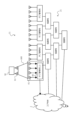
- FIG. 1 is a diagram illustrating an example of a configuration of a wireless communication system according to a first embodiment.
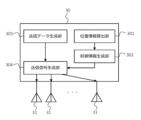
- FIG. 2 is a diagram illustrating functions of a mobile station according to the first embodiment.
- FIG. 2 is a diagram illustrating an example of a hardware configuration of a mobile station according to the first embodiment.
- FIG. 2 is a diagram illustrating functions of a sub-base station according to the first embodiment.
- FIG. 2 is a diagram illustrating an example of a hardware configuration of a sub-base station according to the first embodiment.
- FIG. 2 is a diagram illustrating functions of a cooperative station according to the first embodiment.
- FIG. 2 is a diagram illustrating an example of a hardware configuration of a cooperative station according to the first embodiment.
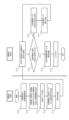
- FIG. 2 is a flow diagram of the operation of the wireless communication system according to the first embodiment.
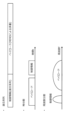
- FIG. 2 illustrates an example of a transmission signal.
- FIG. 2 is a diagram showing a specific example of the operation of the wireless communication system according to the first embodiment.
- FIG. 2 is a diagram showing a specific example of the operation of the wireless communication system according to the first embodiment.
- FIG. 2 is a diagram showing a specific example of the operation of the wireless communication system according to the first embodiment.
- FIG. 11 is a diagram illustrating an example of a configuration of a wireless communication system according to a second embodiment.
- FIG. 11 is a diagram illustrating functions of a mobile station according to a second embodiment.
- FIG. 11 is a diagram illustrating functions of a sub-base station according to the second embodiment.
- FIG. 11 is a diagram illustrating functions of a cooperative station according to the second embodiment.
- FIG. 11 is a flow diagram of the operation of the wireless communication system according to the second embodiment.
- FIG. 11 is a diagram showing a specific example of the operation of the wireless communication system according to the second embodiment.
- FIG. 11 is a diagram showing a specific example of the operation of the wireless communication system according to the second embodiment.
- FIG. 11 is a diagram showing a specific example of the operation of the wireless communication system according to the second embodiment.
- FIG. 11 is a diagram showing a specific example of the operation of the wireless communication system according to the second embodiment.
- FIG. 1 is a diagram showing an example of the configuration of a wireless communication system according to the first embodiment.
- a wireless communication system 11 is composed of a mobile station 30 moving in the sky and a base station (also called a receiving system) 21 installed on the ground.
- the base station 21 has a MIMO processing function (at least a MIMO receiving function) and includes a plurality of sub-base stations (hereinafter simply called sub-base stations) 40 distributed on the ground.
- the sub-base station 40 includes a plurality of antennas 41 (hereinafter called base station antennas).
- the mobile station 30 is, for example, a HAPS or LEO satellite.
- the mobile station 30 includes a plurality of antennas 31 and a MIMO processing function (at least a MIMO transmitting function) that transmits/separates a plurality of signals in parallel.
- a MIMO processing function at least a MIMO transmitting function
- the base station antennas 41 are distributed and arranged in the same range as the communication area of the mobile station 30 or a wider range. For example, if the mobile station 30 is a HAPS with a low altitude, the communication area will cover only one sub-base station 40. If the mobile station 30 is a LEO satellite with a higher altitude than the HAPS, the communication area will span multiple sub-base stations 40.
- the mobile station 30 performs wireless MIMO communication with the sub-base stations 40 within the communication area.
- the base station 21 has a hierarchical structure. A plurality of stations are provided in each layer of the hierarchical structure.
- the sub-base station 40 is a station provided in the highest layer, i.e., the first layer.
- a plurality of cooperative stations 50 are provided in each layer from the second layer onwards.
- An identification number is assigned to each sub-base station 40 and cooperative station 50. In the example shown in FIG. 1, an identification number represented by "x, y" is assigned to each sub-base station 40 and cooperative station 50. "x" in this identification number represents the layer, and "y" represents the order in the layer.
- sub-base station 1,1 means that it is the first station in the first layer
- sub-base station 1,N means that it is the Nth station in the first layer.
- cooperative station 2,1 means that it is the first station in the second layer
- cooperative station M,N-M+1 means that it is the N-M+1th station in the Mth layer.
- the number of layers is the same as the number of sub-base stations 40, but this is merely an example, and the number of layers may be less than the number of sub-base stations 40.
- the sub-base stations 40 and cooperative stations 50 are interconnected between layers by communication lines 26 such as optical lines or wireless lines.
- the sub-base stations 40 are connected to multiple cooperative stations 50 belonging to the second layer.
- the sub-base station 40 is connected to two cooperative stations 50 belonging to the second layer.
- sub-base stations 1 and 2 are connected to cooperative stations 2 and 1 and cooperative stations 2 and 2 in the second layer.
- some sub-base stations 40 for example, sub-base stations 1 and 1 appear to be connected to only one cooperative station 50 belonging to the second layer, but this is because FIG. 1 shows only a portion of the base station 21.
- a cooperative station 50 is connected to multiple sub-base stations 40 or cooperative stations 50 belonging to the immediately higher hierarchy, and multiple cooperative stations 50 belonging to the immediately lower hierarchy.
- a cooperative station 50 belonging to the second hierarchy is connected to two sub-base stations 40 belonging to the first hierarchy and two cooperative stations 50 belonging to the third hierarchy.
- a cooperative station 50 in the i-th hierarchy (i is an integer of 3 or more) is connected to two sub-base stations 40 belonging to the i-1-th hierarchy and two cooperative stations 50 belonging to the i+1-th hierarchy.
- some cooperative stations 50 for example cooperative stations 2 and 1, appear to be connected to only one cooperative station 50 belonging to the immediately lower hierarchy, but this is because FIG. 1 shows only a portion of base station 21.
- the base station 21 performs MIMO communication by coordinating the sub-base stations 40 using multiple cooperative stations 50 that are interconnected with the sub-base stations 40 in a hierarchical structure.
- Each of the sub-base stations 40 and cooperative stations 50 is provided with a MIMO demodulation function, as will be described in detail later.
- MIMO communication is performed with the mobile station 30, the MIMO demodulation process is performed in one of the sub-base stations 40 or cooperative stations 50 in the hierarchical structure.
- Each of the sub-base stations 40 and cooperative stations 50 is connected to the core network 2 by a communication line 27 such as an optical line or a wireless line.
- the signal demodulated by the MIMO demodulation process is transmitted to the core network 2.
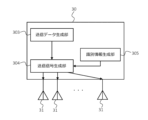
- the mobile station 30 includes a position information calculation unit 301, a control information generation unit 302, a transmission data generation unit 303, and a transmission signal generation unit 304.
- the location information calculation unit 301 calculates the location information of the local station 30, for example, using GPS.
- the location information of the local station 30 is information necessary for the base station 21 to determine which stations 40 and 50 will process the signals.
- the control information generator 302 calculates control information as information for determination.
- the control information is information for determining at which hierarchical level of the base station 21 a sub-base station 40 or cooperative station 50 should perform the MIMO demodulation process.
- the control information generator 302 calculates the target sub-base station 40 that is within the communication area based on the position information of the own station 30 and the communication area formed by the own station 30.
- the control information generator 302 also calculates the hierarchical level at which the MIMO demodulation process should be performed based on the hierarchical structure of the base station 21.
- the control information includes information that identifies the target sub-base station 40 and the hierarchical order of the hierarchical level at which the MIMO demodulation process should be performed. However, if the control information includes at least information that identifies the target sub-base station 40, the hierarchical level at which the MIMO demodulation process should be performed can also be calculated by the base station 21.
- the transmission data generation unit 303 generates transmission data that includes the payload and control information required for communication.
- the transmission signal generating unit 304 adds the control information generated by the control information generating unit 302 to the transmission data generated by the transmission data generating unit 303.
- the transmission signal generating unit 304 performs processing such as modulation and frequency conversion on the transmission data to which the control information has been added, and radiates the transmission signal generated by this processing from the antenna 31.
- FIG. 3 is a diagram showing an example of the hardware configuration of a mobile station 30.
- the mobile station 30 is equipped with a signal processing device that includes a processor 32, a program memory 33, an information memory 35, and a wireless communication interface 36 for MIMO communication.
- a signal processing device that includes a processor 32, a program memory 33, an information memory 35, and a wireless communication interface 36 for MIMO communication.
- the processor 32 may be a CPU, RISC, DSP, FPGA, ASIC, PLD, or another processing unit, or may be a combination of two or more of these, or may be a dedicated processor for the wireless communication system according to this embodiment.
- the processor 32 may also be communicatively coupled to the program memory 33 and the information memory 35, or may incorporate the program memory 33 and the information memory 35.
- the program memory 33 stores a plurality of instructions 34 executable by the processor 32.
- a program consisting of the plurality of instructions 34 may be stored in a computer-readable non-transitory storage medium, or may be provided via a network. At least some of the plurality of instructions 34 are configured to cause the processor 32 to operate as the above-mentioned position information calculation unit 301, control information generation unit 302, transmission data generation unit 303, and transmission signal generation unit 304.
- the information memory 25 stores various information such as payload, control information for communication, position information of the station 30, and communication area.
- the sub-base station 40 includes a signal receiving unit 401, a processing layer determining unit 402, a signal transmission method determining unit 403, a signal transmitting unit 404, and a MIMO demodulating unit 405.
- the signal receiving unit 401 receives a transmission signal from the mobile station 30 at the base station antenna 41 and performs processing such as frequency conversion on the received signal.
- the signal receiving unit 401 outputs the processed signal to the processing hierarchy determination unit 402.
- the processing hierarchy determination unit 402 extracts control information for processing hierarchy determination attached to the signal. Based on the control information, the processing hierarchy determination unit 402 determines whether to perform MIMO demodulation processing at the own station or to transmit the signal to the cooperative station 50 in the second layer. If the control information indicates that the own station is the only sub-base station 40 that has received the transmission signal from the mobile station 30, the processing hierarchy determination unit 402 determines that the own station will perform MIMO demodulation processing. If the control information indicates that there is another sub-base station 40 that has received the transmission signal from the mobile station 30 other than the own station, the processing hierarchy determination unit 402 determines that the signal will be transmitted to the cooperative station 50 in the second layer.
- control information includes the hierarchical order of the layer that performs MIMO demodulation processing
- the processing hierarchy determination unit 402 determines whether the own station is the only sub-base station 40 that has received the transmission signal from the hierarchical order. If it is determined that the own station will perform MIMO demodulation processing, the processing hierarchy determination unit 402 outputs the signal to the MIMO demodulation unit 405. If it is determined that a signal should be transmitted to the cooperative station 50, the processing hierarchy determination unit 402 outputs the signal to the signal transmission method determination unit 403.
- the MIMO demodulation unit 405 performs signal separation on the signals acquired from the processing hierarchy determination unit 402 by carrying out general MIMO processing such as timing synchronization, frequency synchronization, and channel estimation.
- the MIMO demodulation unit 405 demodulates the separated signals and transmits the demodulated signals to the core network 2.
- the signal transmission method determination unit 403 determines the method of transmitting signals to the cooperative station 50 based on a predetermined algorithm.
- the transmission method be a method that reduces the number of signals output from the local station compared to the number of signals input to the local station. For example, a method of transmitting only signals with power exceeding a threshold value, or transmitting signals with the number of signals reduced by maximum ratio combining may be used.
- the signal transmission unit 404 performs signal processing using the method determined by the signal transmission method determination unit 403, and transmits the processed signal to the cooperative station 50 in the second layer.
- the cooperative station 50 to which the signal is transmitted is the cooperative station 50 that belongs to the second layer and is directly connected to the cooperative station 50 via the communication line 26.
- FIG. 5 is a diagram showing an example of the hardware configuration of sub-base station 40.
- Sub-base station 40 is equipped with a signal processing device including a processor 42, a program memory 43, an information memory 45, a wireless communication interface 46 for MIMO communication, and a communication interface 47.
- Communication interface 47 is a communication interface for communicating between communication line 26 and communication line 27.
- the processor 42 may be a CPU, RISC, DSP, FPGA, ASIC, PLD, or another processing unit, or may be a combination of two or more of these, or may be a dedicated processor for the wireless communication system according to this embodiment.
- the processor 42 may also be communicatively coupled to the program memory 43 and the information memory 45, or may incorporate the program memory 43 and the information memory 45.
- the program memory 43 stores a plurality of instructions 44 executable by the processor 42.
- a program consisting of the plurality of instructions 44 may be stored in a computer-readable non-transitory storage medium, or may be provided via a network. At least some of the plurality of instructions 44 are configured to cause the processor 42 to operate as the above-mentioned signal receiving unit 401, processing hierarchy determining unit 402, signal transmission method determining unit 403, signal transmitting unit 404, and MIMO demodulating unit 405.
- the information memory 45 stores, for example, control information.
- the cooperative station 50 includes a signal receiving unit 501, a processing layer determining unit 502, a signal transmission method determining unit 503, a signal transmitting unit 504, and a MIMO demodulating unit 505.
- the signal receiving unit 501 receives signals from multiple cooperative stations 50 in the immediately higher hierarchy.
- the received signal is a transmission signal from the mobile station 30 that has been processed at the time of signal transmission in the sub-base station 40 or a cooperative station 50 in the immediately higher hierarchy (hereinafter, this signal is also referred to as a signal derived from the transmission signal).
- the source of the received signal is one of the cooperative stations 50 belonging to the immediately higher hierarchy that is directly connected to the own station via the communication line 26.
- the signal receiving unit 501 outputs the received signal to the processing hierarchy determination unit 502.
- the processing layer determination unit 502 extracts control information for processing layer determination attached to the signal. Based on the control information, the processing layer determination unit 502 determines whether to perform MIMO demodulation processing at the own station or to transmit the signal to the cooperative station 50 in the immediately lower layer. If the control information indicates that the cooperative station 50 that has received the signal derived from the transmission signal is the own station only in the same layer, the processing layer determination unit 502 determines that the MIMO demodulation processing is to be performed at the own station. If the control information indicates that there is another cooperative station 50 in the same layer that has received a signal requested by the transmission signal other than the own station, the processing layer determination unit 502 determines that the signal is to be transmitted to the cooperative station 50.
- control information includes the layer order of the layer that performs MIMO demodulation processing
- the processing layer determination unit 502 determines from the layer order whether the cooperative station 50 that has received the signal derived from the transmission signal is the only one in the same layer that receives the signal. If it is determined that the MIMO demodulation processing is to be performed at the own station, the processing layer determination unit 502 outputs the signal to the MIMO demodulation unit 505. If it is determined that a signal should be transmitted to the cooperative station 50 in the immediately lower layer, the processing layer determination unit 502 outputs the signal to the signal transmission method determination unit 503.
- the MIMO demodulation unit 505 performs general MIMO processing such as timing synchronization, frequency synchronization, and channel estimation on the signals acquired from the processing hierarchy determination unit 502 to separate the signals.
- the MIMO demodulation unit 505 demodulates the separated signals and transmits the demodulated signals to the core network 2.
- the signal transmission method determination unit 503 determines the method of transmitting signals to the cooperative station 50 in the immediately lower layer based on a predetermined algorithm.
- the transmission method be a method that reduces the number of signals output from the own station compared to the number of signals input to the own station. For example, a method of transmitting only signals with power exceeding a threshold value, or a method of transmitting signals with the number of signals reduced by maximum ratio combining may be used.
- the signal transmission unit 504 performs signal processing using the method determined by the signal transmission method determination unit 503, and transmits the processed signal to the cooperative station 50 in the immediately lower hierarchical layer.
- the cooperative station 50 to which the signal is transmitted is the cooperative station 50 that belongs to the immediately lower hierarchical layer and is directly connected to the cooperative station 50 via the communication line 26.
- FIG. 7 is a diagram showing an example of the hardware configuration of a cooperative station 50.
- the cooperative station 50 is equipped with a signal processing device including a processor 51, a program memory 52, an information memory 54, and a communication interface 55.
- the communication interface 55 is a communication interface for communicating with the communication line 26 and the communication line 27.
- the processor 51 may be a CPU, RISC, DSP, FPGA, ASIC, PLD, or another processing unit, or may be a combination of two or more of these, or may be a dedicated processor for the wireless communication system according to this embodiment.
- the processor 51 may also be communicatively coupled to the program memory 52 and the information memory 54, or may incorporate the program memory 52 and the information memory 54.
- the program memory 52 stores a plurality of instructions 53 executable by the processor 51.
- a program consisting of the plurality of instructions 53 may be stored in a computer-readable non-transitory storage medium, or may be provided via a network. At least some of the plurality of instructions 53 are configured to cause the processor 51 to operate as the above-mentioned signal receiving unit 501, processing hierarchy determining unit 502, signal transmission method determining unit 503, signal transmitting unit 504, and MIMO demodulating unit 505.
- the information memory 54 stores, for example, control information.
- Fig. 8 is a flow diagram of the operation of the wireless communication system 11, more specifically, the operation of the mobile station 30 and the base station 21 that constitute the wireless communication system 11.
- the mobile station 30 acquires its own location information, for example, using GPS.
- the mobile station 30 determines a sub-base station (target sub-base station) 40 that can receive a signal transmitted from its own station, based on its own location information acquired in step S111 and known information about the size of the communication area formed by its own station.
- the mobile station 30 determines a hierarchical layer (hereinafter referred to as a processing hierarchical layer) at which to perform MIMO demodulation processing, based on the determination result.
- the mobile station 30 then generates control information including information about the target sub-base station and information about the processing hierarchical layer.
- the processing hierarchy will be described. Although it differs depending on the hierarchical configuration of the base station 21, for example, if the communication area spans two sub-base stations 40, the second hierarchy, which is one level lower and allows coordination between the two stations, is determined as the processing hierarchy. Also, if the communication area spans three sub-base stations 40, the third hierarchy, which is two levels lower and allows coordination between the three stations, is determined as the processing hierarchy. Information for distinguishing the hierarchy information determined in this way is included in the control information.
- a number indicating the hierarchy order such as "1" if the processing hierarchy is the first hierarchy and "2" if the processing hierarchy is the second hierarchy, may be included in the control information so that it can be identified on the base station 21 side.
- a method can be adopted in which the transmission capacity of each hierarchy is calculated using channel information between the mobile station 30 and the sub-base station 40, and the processing hierarchy is determined based on the calculated values.
- step S113 the mobile station 30 generates transmission data including a payload. Then, in step S114, the mobile station 30 adds the control information generated in step S112 to the transmission data generated in step S113, and performs processing such as modulation and frequency conversion to generate a transmission signal.
- step S115 the mobile station 30 radiates the transmission signal generated in step S114 from the antenna 31.
- the base station 21 needs to extract control information from the transmission signal to determine the processing layer.
- the transmission signal has a form as shown in any of the embodiments in FIG. 9.
- the payload is the subject of MIMO multiplexing transmission, and the control information can be extracted without MIMO demodulation processing.
- the control information is an orthogonal sequence such as a Gold sequence, and is inserted before or after the payload frame.
- the control information is divided into the payload and the time axis.
- the control information is divided into the payload and the frequency axis.
- Step S211 is initially executed by the sub-base station 40.
- the sub-base station 40 receives the transmission signal from the mobile station 30 at the base station antenna 41, and performs processing such as frequency conversion on the received signal.
- step S212 the sub-base station 40 extracts control information for determining the processing layer assigned to the signal.
- the extraction of the control information is performed by a method corresponding to the form of the transmission signal. For example, a correlator is used when an orthogonal sequence is used, and a filter is used when frequency division.
- the sub-base station 40 determines whether to perform MIMO demodulation processing at its own station, or to transmit the signal to the cooperative station 50 in the immediately lower layer.
- step S215 the sub-base station 40 performs MIMO processing such as timing synchronization, frequency synchronization, channel estimation, etc. on the acquired signal to separate the signals and demodulate the separated signals.
- step S216 the sub-base station 40 transmits the demodulated signals to the core network 2. This ends the processing at the base station 21.
- step S213 the sub-base station 40 determines the method of transmitting the signal to the cooperative station 50 in the immediately lower layer based on the set algorithm. For example, if the number of input signals exceeds a threshold, a method of reducing the number of signals and transmitting the signal may be selected, and if the number of input signals does not exceed the threshold, a method of transmitting the signal as is may be selected.
- a signal transmission method for reducing the number of signals for example, a method of transmitting only signals with power exceeding a threshold or a method of transmitting signals by maximum ratio combining may be used.
- multiple signal transmission patterns may be prepared in advance for each sub-base station 40 and cooperative station 50.
- information specifying the transmission method is included in the control information added to the transmission signal in the mobile station 30, and the sub-base station 40 and cooperative station 50 extract the information from the control information and select the specified transmission method.
- step S214 the sub-base station 40 processes the received signal based on the signal transmission method determined in step S213.
- the sub-base station 40 transmits the processed signal to the cooperative station 50 in the immediately lower layer.
- Step S211 When the sub-base station 40 transmits a signal to the cooperative station 50 in the immediately lower hierarchical layer, the flow returns to step S211.
- Steps S211 to S216 are executed by the cooperative station 50 from the second time onwards.
- the cooperative station 50 receives a signal from a station in the immediately higher hierarchical layer.
- step S212 the cooperative station 50 extracts control information for determining the processing layer assigned to the signal, and determines, based on the control information, whether to perform MIMO demodulation processing at the own station or to transmit the signal to the cooperative station 50 in the immediately lower hierarchical layer.
- step S213 If the cooperative station 50 transmits a signal to a cooperative station 50 in the immediately lower hierarchical layer, the flow proceeds to step S213.
- the operations of steps S213, S214, S211, and S212 are repeated until the cooperative station 50 determines in step S212 that it will perform MIMO demodulation processing. However, each time the flow returns to step S211, the cooperative station 50 in operation is switched to the cooperative station 50 in the immediately lower hierarchical layer.
- step S215 the cooperative station 50 performs MIMO demodulation processing on the acquired signal.
- step S216 the cooperative station 50 transmits the demodulated signal to the core network 2. This ends the processing at the base station 21.
- the hierarchical layer for performing MIMO demodulation processing can be adaptively selected by utilizing the location information of the mobile station 30. This allows efficient use of only the necessary sub-base stations 40, and allows MIMO demodulation processing to be performed in locations close to the base station antenna 41, realizing low latency and large capacity. Furthermore, even in an environment with a wide communication area where many base station antennas 41 are used, the number of signals can be reduced when transmitting signals to lower-level stations, realizing a reduction in the amount of calculation required for MIMO demodulation processing.
- FIGS. 10 to 12 are diagrams showing specific examples of the operation of the wireless communication system 11.
- the communication area 300 of the mobile station 30 is small compared to the sub-base stations 40 that are widely arranged, and that signals reach only some of the ground stations 40.
- the mobile station 30 is a LEO satellite whose communication area varies over time.
- the mobile station 30 has two antennas 31, each sub-base station 40 has four base station antennas 41, and spatial multiplexing of two signals is possible between the mobile station 30 and each sub-base station 40.
- the mobile station 30 is located above the sub-base station 40 with the identification number "1,1".
- the sub-base station 40 with the identification number "i,j” will be referred to as the sub-base station 40(i,j)
- the cooperative station 50 with the identification number "i,j” will be referred to as the cooperative station 50(i,j).
- the mobile station 30 determines that the communication area 300 extends only to the sub-base station 40(1,1), and adds control information to the transmission signal specifying the processing hierarchy as the first hierarchy.
- the sub-base station 40(1,1) that receives the signal determines that it will perform MIMO demodulation processing at its own station based on the control information.
- the sub-base station 40(1,1) immediately performs MIMO demodulation processing and transmits the demodulated signal to the core network 2. In this way, the MIMO demodulation processing is performed at a location close to the base station antenna 41, so that the transmission delay can be shortened and the capacity expansion effect of MIMO can be expected.
- Figure 11 shows a case where the mobile station 30's communication area 300 spans sub-base station 40 (1,1) and sub-base station 40 (1,2) due to the movement of the mobile station 30.
- it is possible to perform demodulation at the sub-base station 40 in the first hierarchical layer to shorten the transmission delay.
- the first is deterioration of gain due to a decrease in the number of signals arriving at one sub-base station 40.
- the second is deterioration due to an increase in spatial correlation between one sub-base station 40 and the mobile station 30.
- the mobile station 30 adds control information to the transmitted signal that instructs MIMO demodulation processing in the second hierarchical layer.
- the sub-base station 40 (1, 1) that receives the signal transmits the signal with the control information to the second-layer cooperative station 50 (2, 1) to which the sub-base station 40 (1, 1) is connected in accordance with the control information. Also, the sub-base station 40 (1, 2) that receives the signal transmits the signal with the control information to the second-layer cooperative station 50 (2, 1) and cooperative station 50 (2, 2) to which the sub-base station 40 (1, 2) is connected in accordance with the control information.
- the cooperative station 50 (2,1) acquires signals to which control information is assigned from both the sub-base station 40 (1,1) and the sub-base station (1,2) to which the cooperative station 50 (2,1) is connected.
- the cooperative station 50 (2,2) acquires signals to which control information is assigned only from the sub-base station 40 (1,2) among the sub-base station 40 (1,2) and the sub-base station (1,3) to which the cooperative station 50 (2,2) is connected.
- the cooperative station 50 (2,1) performs MIMO demodulation processing on the signals acquired from the sub-base station 40 (1,1) and the sub-base station (1,2) and transmits the demodulated signals to the core network 2.
- the cooperative station 50 (2,2) does not perform MIMO demodulation processing and does not transmit signals to lower layers because the conditions for processing the signals are not met.
- the number of signals is reduced in the sub-base station 40. If the sub-base station 40 transmits the signals received by the base station antenna 41 as is, the cooperative station 50 in the second layer will need to perform MIMO demodulation processing using 8x8 matrix processing. In contrast, for example, when maximum ratio combining is performed on two signals transmitted by each sub-base station 40, since there are two signals output from each sub-base station 40, the cooperative station 50 in the second layer will only need MIMO demodulation processing using 4x4 matrix processing. By appropriately reducing the number of signals in this way, it is possible to reduce the amount of calculations involved in the MIMO demodulation processing.
- FIG. 12 shows a case where the mobile station 30 moves so that its communication area 300 spans only the sub-base station 40 (1, 2).
- the mobile station 30 adds control information to the transmitted signal that specifies the processing hierarchy as the first hierarchy.
- the sub-base station 40 (1, 2) that receives the signal determines that it will perform MIMO demodulation processing based on the control information.
- the sub-base station 40 (1, 2) immediately performs MIMO demodulation processing and transmits the demodulated signal to the core network 2.
- the wireless communication system 11 when there are multiple sub-base stations 40 within the communication area 300 of the mobile station 30, the received signals acquired from each of the sub-base stations 40 within the communication area 300 are gradually aggregated using a hierarchical structure.
- This makes it possible to perform MIMO demodulation processing at a layer adaptively selected according to the position and number of sub-base stations 40 within the communication area 300 of the mobile station 30. Therefore, the wireless communication system 11 makes it possible to stably obtain high transmission capacity while reducing the amount of calculation and transmission delay involved in MIMO demodulation processing in an NTN with various altitudes and mobility and changing communication areas.
- the process shown in FIG. 11 is also a process of grouping sub-base station 40(1,1) and sub-base station 40(1,2) and coordinating sub-base station 40(1,1) and sub-base station 40(1,2) using cooperative station 50(2,1) to generate a virtual cooperative sub-base station.
- the generated cooperative sub-base station is the only cooperative sub-base station consisting of sub-base station 40(1,1), sub-base station 40(1,2), and cooperative station 50(2,1), so that only one cooperative sub-base station performs the MIMO demodulation process.
- the communication area 300 of the mobile station 30 spans the area from the sub-base station 40(1,1) to the sub-base station 40(1,3).
- the sub-base station 40(1,1) and the sub-base station 40(1,2) are grouped, and the sub-base station 40(1,2) and the sub-base station 40(1,3) are grouped.
- the sub-base station 40(1,1) and the sub-base station 40(1,2) are coordinated using the cooperative station 50(2,1) to form a first cooperative sub-base station, and the sub-base station 40(1,2) and the sub-base station 40(1,3) are coordinated using the cooperative station 50(2,2) to form a second cooperative sub-base station.
- the third cooperative sub-base station is composed of sub-base station 40(1,1), sub-base station 40(1,2), sub-base station 40(1,3), cooperative station 50(2,1), cooperative station 50(2,2), and cooperative station 50(3,1). Since the third cooperative sub-base station is the only cooperative sub-base station, the MIMO demodulation process is performed by the third cooperative sub-base station.
- FIG. 13 is a diagram showing an example of the configuration of a wireless communication system according to the second embodiment.
- the wireless communication system 12 according to this embodiment includes a base station 22 having a different configuration from the base station 21 included in the wireless communication system 11 according to the first embodiment shown in Fig. 1.
- the base station 22 according to this embodiment differs from the base station 21 according to the first embodiment in that a communication line 28 is newly provided.
- the communication line 28 is provided for each layer, and interconnects adjacent sub-base stations 40 and adjacent cooperative stations 50 within the same layer.
- an optical line or a wireless line is used as the communication line 28.
- the wireless communication system 12 according to this embodiment also differs from the wireless communication system 11 according to the first embodiment in the configurations of the mobile station 30, the sub-base station 40, and the cooperative station 50.
- the configurations of the mobile station 30, the sub-base station 40, and the cooperative station 50 that are unique to the second embodiment will be described below.
- Fig. 14 is a functional block diagram showing the configuration of a mobile station 30 according to the second embodiment.
- the mobile station 30 includes an identification information generating unit 305, a transmission data generating unit 303, and a transmission signal generating unit 304.
- the function of the transmission data generating unit 303 is the same as in the first embodiment.
- the identification information generating unit 305 calculates identification information as information for determination.
- the identification information is information for identifying that the signals are the same and transmitted from the same mobile station 30.
- the identification information generating unit 305 generates the identification information using a predetermined algorithm so that there is no duplication between the own station and other mobile stations.
- the transmission signal generating unit 304 assigns the identification information generated by the identification information generating unit 305 to the transmission data generated by the transmission data generating unit 303.
- the transmission signal generating unit 304 performs processing such as modulation and frequency conversion on the transmission data to which the identification information has been assigned, and radiates the transmission signal generated by this processing from the antenna 31.
- the hardware configuration of the mobile station 30 according to the second embodiment is shown in FIG. 3, similar to the first embodiment. However, at least some of the instructions 34 according to the second embodiment are configured to cause the processor 32 to operate as an identification information generating unit 305, a transmission data generating unit 303, and a transmission signal generating unit 304.
- FIG. 15 is a functional block diagram showing the configuration of a sub-base station 40 according to the second embodiment.
- the sub-base station 40 includes a signal receiving unit 401, an adjacent station transmitting/receiving unit 406, a processing hierarchy determining unit 407, a signal transmission method determining unit 403, a signal transmitting unit 404, and a MIMO demodulating unit 405.
- the functions of the signal receiving unit 401, the signal transmission method determining unit 403, the signal transmitting unit 404, and the MIMO demodulating unit 405 are the same as those in the first embodiment.
- the adjacent station transmitting/receiving unit 406 extracts identification information from the signal received by the signal receiving unit 401.
- the adjacent station transmitting/receiving unit 406 transmits the extracted signal to the adjacent sub-base station 40, and acquires from the adjacent sub-base station 40 the identification information assigned to the signal received by the adjacent sub-base station 40.
- the adjacent station transmitting/receiving unit 406 outputs the received signal, as well as the identification information acquired by its own station and the identification information acquired by the adjacent sub-base station 40, to the processing hierarchy determination unit 407.
- the processing hierarchy determination unit 407 compares the identification information acquired by the local station with the identification information acquired by the adjacent sub-base station 40. If the identification information does not match with the identification information acquired by the other sub-base station 40, it means that there is no sub-base station 40 other than the local station that has received the transmission signal. Therefore, if the identification information acquired by none of the adjacent sub-base stations 40 matches the identification information acquired by the local station, the processing hierarchy determination unit 407 determines that the local station will perform MIMO demodulation processing. If the identification information acquired by any of the adjacent sub-base stations 40 matches the identification information acquired by the local station, the processing hierarchy determination unit 407 determines that the signal will be transmitted to the cooperative station 50 in the second hierarchy.
- the processing hierarchy determination unit 407 outputs the signal to the MIMO demodulation unit 405. If it is determined that the signal will be transmitted to the cooperative station 50, the processing hierarchy determination unit 407 outputs the signal to the signal transmission method determination unit 403.
- the hardware configuration of the sub-base station 40 according to the second embodiment is shown in FIG. 5, similar to the first embodiment. However, at least some of the instructions 44 according to the second embodiment are configured to cause the processor 42 to operate as a signal receiving unit 401, an adjacent station transmitting/receiving unit 406, a processing hierarchy determining unit 407, a signal transmission method determining unit 403, a signal transmitting unit 404, and a MIMO demodulating unit 405.
- the cooperative station 50 includes a signal receiving unit 501, an adjacent station transmitting/receiving unit 506, a processing layer determining unit 507, a signal transmission method determining unit 503, a signal transmitting unit 504, and a MIMO demodulating unit 505.
- the functions of the signal receiving unit 501, the signal transmission method determining unit 503, the signal transmitting unit 504, and the MIMO demodulating unit 505 are the same as those in the first embodiment.
- the adjacent station transmitting/receiving unit 506 extracts identification information from the signal received by the signal receiving unit 501.
- the adjacent station transmitting/receiving unit 506 transmits the extracted signal to an adjacent cooperative station 50 in the same hierarchical layer, and acquires from the adjacent cooperative station 50 the identification information assigned to the signal received by the adjacent cooperative station 50.
- the adjacent station transmitting/receiving unit 506 outputs the received signal, as well as the identification information acquired by the local station and the identification information acquired by the adjacent cooperative station 50, to the processing hierarchical layer determination unit 507.
- the processing hierarchy determination unit 507 compares the identification information acquired by the local station with the identification information acquired by the adjacent cooperative station 50. If the identification information does not match with other cooperative stations 50 belonging to the same hierarchy, it means that there is no cooperative station 50 in the same hierarchy that has received a signal derived from the transmission signal other than the local station. Therefore, if the identification information acquired by none of the adjacent cooperative stations 50 matches the identification information acquired by the local station, the processing hierarchy determination unit 507 determines that the local station will perform MIMO demodulation processing. If the identification information acquired by any of the adjacent cooperative stations 50 matches the identification information acquired by the local station, the processing hierarchy determination unit 507 determines that the signal will be transmitted to the cooperative station 50 in the immediately lower hierarchy.
- the processing hierarchy determination unit 507 outputs the signal to the MIMO demodulation unit 505. If it is determined that the signal will be transmitted to the cooperative station 50 in the immediately lower hierarchy, the processing hierarchy determination unit 507 outputs the signal to the signal transmission method determination unit 503.
- the hardware configuration of the cooperative station 50 according to the second embodiment is shown in FIG. 7, similar to the first embodiment. However, at least some of the multiple instructions 53 according to the second embodiment are configured to cause the processor 51 to operate as a signal receiving unit 501, an adjacent station transmitting/receiving unit 506, a processing hierarchy determining unit 507, a signal transmission method determining unit 503, a signal transmitting unit 504, and a MIMO demodulating unit 505.
- Fig. 17 is a flow diagram of the operation of the wireless communication system 12, more specifically, the operation of the mobile station 30 and the base station 22 that constitute the wireless communication system 12. Note that, among the operations of the wireless communication system 12, operations common to the operation of the wireless communication system 11 according to the first embodiment will be described in a simplified manner.
- step S121 the mobile station 30 generates identification information.
- step S122 the mobile station 30 generates transmission data including a payload.
- step S123 the mobile station 30 assigns the identification information generated in step S121 to the transmission data generated in step S122, and performs processing such as modulation and frequency conversion to generate a transmission signal.
- step S124 the mobile station 30 radiates the transmission signal generated in step S123 from the antenna 31.
- the transmission signal radiated from the antenna 31 has a form shown in any of the examples in Figure 9, as in the first embodiment. That is, the payload is MIMO multiplexed, and the identification information can be extracted without MIMO demodulation by using an orthogonal sequence, time division, or frequency division.
- Step S221 is initially executed by the sub-base station 40.
- the sub-base station 40 receives a transmission signal from the mobile station 30 at the base station antenna 41, and performs processing such as frequency conversion on the received signal.
- step S222 the sub-base station 40 extracts the identification information assigned to the signal, and shares the identification information with adjacent sub-base stations 40.
- step S223 the sub-base station 40 determines whether the identification information acquired by itself matches the identification information acquired by the adjacent sub-base station 40.
- step S226 the sub-base station 40 performs MIMO demodulation processing on the acquired signal. Then, in step S227, the sub-base station 40 transmits the demodulated signal to the core network 2. This ends the processing in the base station 22.
- step S224 a method of transmitting a signal to the cooperative station 50 in the immediately lower layer is determined, and in step S224, the signal is transmitted to the cooperative station 50 in the immediately lower layer using the transmission method determined in step S224.
- the content of step S224 is the same as step S213 in the first embodiment, and the content of step S225 is the same as step S214 in the first embodiment.
- Step S221 to S227 are executed by the cooperative station 50 from the second time onwards.
- the cooperative station 50 receives a signal from a station in the immediately higher hierarchical layer.
- the cooperative station 50 extracts the identification information assigned to the signal, and shares the identification information with adjacent cooperative stations 50 in the same hierarchical layer.
- the cooperative station 50 determines whether the identification information acquired by itself matches the identification information acquired by the adjacent cooperative station 50.
- steps S224, S225, S211, S212, and S223 are repeated until the identification information acquired by the station itself in step S223 does not match the identification information acquired by the adjacent cooperative station 50. However, each time the flow returns to step S221, the cooperative station 50 in operation transitions to the cooperative station 50 in the immediately lower hierarchical layer.
- step S226 the cooperative station 50 performs MIMO demodulation processing on the acquired signal. Then, in step S227, the cooperative station 50 transmits the demodulated signal to the core network 2. This ends the processing in the base station 22.
- the wireless communication system 12 can obtain the same effect as the wireless communication system 11 according to the first embodiment. Furthermore, the wireless communication system 12 can determine which sub-base station 40 has received the transmission signal from the mobile station 30 by mutually sharing identification information between adjacent sub-base stations 40 or between adjacent cooperative stations 50. This makes it possible to adaptively select the layer in which the MIMO demodulation process is performed.
- FIGS. 18 to 20 are diagrams showing specific examples of the operation of the wireless communication system 12.
- the assumptions of the mobile station 30 and the sub-base station 40 in the following specific examples are the same as those in the specific examples described in the first embodiment.
- the mobile station 30 is located above the sub-base station 40 (1, 1). Unlike the first embodiment, the mobile station 30 only adds identification information to the transmission signal without determining the processing hierarchy.
- the sub-base station 40 (1, 1) that receives the signal shares the identification information with the adjacent sub-base station 40 (1, 2).
- the sub-base station 40 (1, 2) does not receive the signal and does not possess the identification information. Therefore, the identification information does not match between the sub-base station 40 (1, 1) and the sub-base station 40 (1, 2).
- the sub-base station 40 (1, 1) determines that the communication area extends only to its own station, and immediately performs MIMO demodulation processing and transmits the demodulated signal to the core network 2.
- FIG. 19 shows a case where the mobile station 30 moves such that its communication area 300 spans sub-base station 40(1,1) and sub-base station 40(1,2).
- Sub-base station 40(1,1) and sub-base station 40(1,2) receive a signal and share the identification information obtained from the signal.
- the identification information matches between sub-base station 40(1,1) and sub-base station 40(1,2). Therefore, both sub-base station 40(1,1) and sub-base station 40(1,2) transmit signals to the second layer cooperative station 50.
- the sub-base station 40 (1,1) transmits a signal with identification information to the cooperative station 50 (2,1) in the second layer to which the sub-base station 40 (1,1) is connected.
- the sub-base station 40 (1,2) transmits a signal with identification information to the cooperative station 50 (2,1) and cooperative station 50 (2,2) in the second layer to which the sub-base station 40 (1,2) is connected.
- the identification information is treated as identification information acquired by the station.
- the cooperative station 50 (2,1) receives signals with identification information from both the sub-base station 40 (1,1) and the sub-base station (1,2) to which the cooperative station 50 (2,1) is connected. Since the identification information of both stations matches, the identification information is treated as identification information acquired by the cooperative station 50 (2,1).
- the cooperative station 50 (2,2) adjacent to the cooperative station 50 (2,1) in the same hierarchical layer receives signals with identification information only from the sub-base station 40 (1,2) of the sub-base station 40 (1,2) and the sub-base station 40 (1,3) to which the cooperative station 50 (2,2) is connected. Therefore, the cooperative station 50 (2,2) is treated as not possessing identification information, and the identification information does not match between the cooperative station 50 (2,1) and the cooperative station 50 (2,2). As a result, the cooperative station 50 (2, 1) determines that it will perform MIMO demodulation processing, performs MIMO demodulation processing on the received signal, and transmits the demodulated signal to the core network 2.
- FIG. 20 shows a case where the mobile station 30 moves so that its communication area 300 spans only the sub-base station 40(1,2).
- the sub-base station 40(1,2) that receives the signal shares identification information with the adjacent sub-base stations 40(1,1) and 40(1,3).
- neither the sub-base station 40(1,1) nor the sub-base station 40(1,3) receives a signal and therefore does not possess identification information. Therefore, the identification information does not match between the sub-base station 40(1,2) and the sub-base station 40(1,1) and the sub-base station 40(1,3).
- the sub-base station 40(1,2) immediately performs MIMO demodulation processing and transmits the demodulated signal to the core network 2.
- the wireless communication system 12 similar to the wireless communication system 11 according to the first embodiment, when there are multiple sub-base stations 40 within the communication area 300 of the mobile station 30, the received signals acquired from each of the sub-base stations 40 within the communication area 300 are gradually aggregated using a hierarchical structure.
- the wireless communication system 12 similar to the wireless communication system 11 according to the first embodiment, in an NTN with various altitudes and mobility and changing communication areas, it is possible to stably obtain high transmission capacity while reducing the amount of calculation and transmission delay involved in the MIMO demodulation process.
Landscapes
- Engineering & Computer Science (AREA)
- Computer Networks & Wireless Communication (AREA)
- Signal Processing (AREA)
- Mobile Radio Communication Systems (AREA)
- Radio Transmission System (AREA)
Priority Applications (2)
| Application Number | Priority Date | Filing Date | Title |
|---|---|---|---|
| JP2025503234A JPWO2024180598A1 (https=) | 2023-02-27 | 2023-02-27 | |
| PCT/JP2023/007027 WO2024180598A1 (ja) | 2023-02-27 | 2023-02-27 | 無線通信システム、無線通信方法、信号処理装置、及び信号処理プログラム |
Applications Claiming Priority (1)
| Application Number | Priority Date | Filing Date | Title |
|---|---|---|---|
| PCT/JP2023/007027 WO2024180598A1 (ja) | 2023-02-27 | 2023-02-27 | 無線通信システム、無線通信方法、信号処理装置、及び信号処理プログラム |
Publications (1)
| Publication Number | Publication Date |
|---|---|
| WO2024180598A1 true WO2024180598A1 (ja) | 2024-09-06 |
Family
ID=92589423
Family Applications (1)
| Application Number | Title | Priority Date | Filing Date |
|---|---|---|---|
| PCT/JP2023/007027 Ceased WO2024180598A1 (ja) | 2023-02-27 | 2023-02-27 | 無線通信システム、無線通信方法、信号処理装置、及び信号処理プログラム |
Country Status (2)
| Country | Link |
|---|---|
| JP (1) | JPWO2024180598A1 (https=) |
| WO (1) | WO2024180598A1 (https=) |
Citations (4)
| Publication number | Priority date | Publication date | Assignee | Title |
|---|---|---|---|---|
| JP2010193189A (ja) * | 2009-02-18 | 2010-09-02 | Nippon Telegr & Teleph Corp <Ntt> | 分散アンテナシステムおよび分散アンテナ制御方法 |
| JP2014532376A (ja) * | 2011-10-14 | 2014-12-04 | クゥアルコム・インコーポレイテッドQualcomm Incorporated | ダウンリンク送信のサイマルキャストおよびデサイマルキャストを円滑にするための、ワイヤレス通信の分散アンテナシステムおよび方法 |
| JP2017028438A (ja) * | 2015-07-21 | 2017-02-02 | 日本電信電話株式会社 | 無線通信方法および無線通信システム |
| WO2021090596A1 (ja) * | 2019-11-07 | 2021-05-14 | ソニー株式会社 | 端末装置、基地局装置、端末装置の制御方法および基地局装置の制御方法 |
-
2023
- 2023-02-27 WO PCT/JP2023/007027 patent/WO2024180598A1/ja not_active Ceased
- 2023-02-27 JP JP2025503234A patent/JPWO2024180598A1/ja active Pending
Patent Citations (4)
| Publication number | Priority date | Publication date | Assignee | Title |
|---|---|---|---|---|
| JP2010193189A (ja) * | 2009-02-18 | 2010-09-02 | Nippon Telegr & Teleph Corp <Ntt> | 分散アンテナシステムおよび分散アンテナ制御方法 |
| JP2014532376A (ja) * | 2011-10-14 | 2014-12-04 | クゥアルコム・インコーポレイテッドQualcomm Incorporated | ダウンリンク送信のサイマルキャストおよびデサイマルキャストを円滑にするための、ワイヤレス通信の分散アンテナシステムおよび方法 |
| JP2017028438A (ja) * | 2015-07-21 | 2017-02-02 | 日本電信電話株式会社 | 無線通信方法および無線通信システム |
| WO2021090596A1 (ja) * | 2019-11-07 | 2021-05-14 | ソニー株式会社 | 端末装置、基地局装置、端末装置の制御方法および基地局装置の制御方法 |
Also Published As
| Publication number | Publication date |
|---|---|
| JPWO2024180598A1 (https=) | 2024-09-06 |
Similar Documents
| Publication | Publication Date | Title |
|---|---|---|
| CN107070532B (zh) | 用于在机载无线蜂窝网络中提供高速通信服务的系统 | |
| US12526650B2 (en) | Central cloud server and edge devices assisted high speed low-latency wireless connectivity | |
| RU2153226C2 (ru) | Система управления средствами разнесенной передачи сигналов через спутниковые ретрансляторы | |
| EP1881635B1 (en) | Hierarchical networks utilizing frame transmissions pipelining | |
| JPH11513203A (ja) | 高効率軌道外高高度遠隔通信システム | |
| CN112994782A (zh) | 空时频三重复用与带宽自适应相结合的卫星移动通信方法 | |
| CN110753354B (zh) | 基于无人机协作星地联合noma通信系统位置部署方法 | |
| CN115001560B (zh) | 一种基于功率域非正交多址接入的星地融合中继网络传输方法 | |
| KR20230076784A (ko) | 비-지상 네트워크에서 동기 신호 블록 생성 및 송신 방법과 그 장치 | |
| CN117674958A (zh) | 一种面向空天地一体化网络的网络资源优化方法及装置 | |
| CN118971942A (zh) | 一种跳波束资源分配方法及系统 | |
| JP7203357B2 (ja) | 送信機および送信方法 | |
| CN120302303B (zh) | 空地无线网络部署方法、装置、设备、介质和程序产品 | |
| WO2024180598A1 (ja) | 無線通信システム、無線通信方法、信号処理装置、及び信号処理プログラム | |
| CN111446991B (zh) | 大规模mimo卫星通信sc-ofdma下行链路自适应资源调度方法 | |
| US12088397B2 (en) | Service cell selection | |
| CN113364513B (zh) | 基于无人机机阵的分布式多天线基站 | |
| CN108282165B (zh) | 一种无线通信系统架构 | |
| KR100679397B1 (ko) | 위상 변조 송신 다이버시티 기능을 갖는 광 중계 장치 및방법 | |
| CN116248159B (zh) | 车联网环境下基于智能反射表面的分集接收方法 | |
| Jiang et al. | Emergency communication service solution based on UAV swarm | |
| KR101004000B1 (ko) | 디코딩 후 전달 릴레이 시스템에서 처리율 향상 방법 | |
| Fujisawa et al. | Research on the optimization of mm-wave uav-bss by using irss | |
| WO2025257904A1 (ja) | 無線通信システム、無線通信装置、無線通信方法および無線通信用プログラム装置 | |
| CN120264406A (zh) | 一种通信方法及通信装置 |
Legal Events
| Date | Code | Title | Description |
|---|---|---|---|
| 121 | Ep: the epo has been informed by wipo that ep was designated in this application |
Ref document number: 23925156 Country of ref document: EP Kind code of ref document: A1 |
|
| WWE | Wipo information: entry into national phase |
Ref document number: 2025503234 Country of ref document: JP |
|
| NENP | Non-entry into the national phase |
Ref country code: DE |
|
| 122 | Ep: pct application non-entry in european phase |
Ref document number: 23925156 Country of ref document: EP Kind code of ref document: A1 |