WO2024176758A1 - 吸水性樹脂組成物 - Google Patents
吸水性樹脂組成物 Download PDFInfo
- Publication number
- WO2024176758A1 WO2024176758A1 PCT/JP2024/003048 JP2024003048W WO2024176758A1 WO 2024176758 A1 WO2024176758 A1 WO 2024176758A1 JP 2024003048 W JP2024003048 W JP 2024003048W WO 2024176758 A1 WO2024176758 A1 WO 2024176758A1
- Authority
- WO
- WIPO (PCT)
- Prior art keywords
- mass
- water
- deodorant
- resin composition
- antibacterial metal
- Prior art date
- Legal status (The legal status is an assumption and is not a legal conclusion. Google has not performed a legal analysis and makes no representation as to the accuracy of the status listed.)
- Ceased
Links
Classifications
-
- A—HUMAN NECESSITIES
- A61—MEDICAL OR VETERINARY SCIENCE; HYGIENE
- A61L—METHODS OR APPARATUS FOR STERILISING MATERIALS OR OBJECTS IN GENERAL; DISINFECTION, STERILISATION OR DEODORISATION OF AIR; CHEMICAL ASPECTS OF BANDAGES, DRESSINGS, ABSORBENT PADS OR SURGICAL ARTICLES; MATERIALS FOR BANDAGES, DRESSINGS, ABSORBENT PADS OR SURGICAL ARTICLES
- A61L9/00—Disinfection, sterilisation or deodorisation of air
- A61L9/01—Deodorant compositions
- A61L9/014—Deodorant compositions containing sorbent material, e.g. activated carbon
-
- A—HUMAN NECESSITIES
- A61—MEDICAL OR VETERINARY SCIENCE; HYGIENE
- A61L—METHODS OR APPARATUS FOR STERILISING MATERIALS OR OBJECTS IN GENERAL; DISINFECTION, STERILISATION OR DEODORISATION OF AIR; CHEMICAL ASPECTS OF BANDAGES, DRESSINGS, ABSORBENT PADS OR SURGICAL ARTICLES; MATERIALS FOR BANDAGES, DRESSINGS, ABSORBENT PADS OR SURGICAL ARTICLES
- A61L9/00—Disinfection, sterilisation or deodorisation of air
- A61L9/01—Deodorant compositions
-
- B—PERFORMING OPERATIONS; TRANSPORTING
- B01—PHYSICAL OR CHEMICAL PROCESSES OR APPARATUS IN GENERAL
- B01J—CHEMICAL OR PHYSICAL PROCESSES, e.g. CATALYSIS OR COLLOID CHEMISTRY; THEIR RELEVANT APPARATUS
- B01J20/00—Solid sorbent compositions or filter aid compositions; Sorbents for chromatography; Processes for preparing, regenerating or reactivating thereof
- B01J20/02—Solid sorbent compositions or filter aid compositions; Sorbents for chromatography; Processes for preparing, regenerating or reactivating thereof comprising inorganic material
- B01J20/20—Solid sorbent compositions or filter aid compositions; Sorbents for chromatography; Processes for preparing, regenerating or reactivating thereof comprising inorganic material comprising free carbon; comprising carbon obtained by carbonising processes
-
- B—PERFORMING OPERATIONS; TRANSPORTING
- B01—PHYSICAL OR CHEMICAL PROCESSES OR APPARATUS IN GENERAL
- B01J—CHEMICAL OR PHYSICAL PROCESSES, e.g. CATALYSIS OR COLLOID CHEMISTRY; THEIR RELEVANT APPARATUS
- B01J20/00—Solid sorbent compositions or filter aid compositions; Sorbents for chromatography; Processes for preparing, regenerating or reactivating thereof
- B01J20/22—Solid sorbent compositions or filter aid compositions; Sorbents for chromatography; Processes for preparing, regenerating or reactivating thereof comprising organic material
- B01J20/26—Synthetic macromolecular compounds
-
- C—CHEMISTRY; METALLURGY
- C08—ORGANIC MACROMOLECULAR COMPOUNDS; THEIR PREPARATION OR CHEMICAL WORKING-UP; COMPOSITIONS BASED THEREON
- C08K—Use of inorganic or non-macromolecular organic substances as compounding ingredients
- C08K3/00—Use of inorganic substances as compounding ingredients
- C08K3/01—Use of inorganic substances as compounding ingredients characterized by their specific function
- C08K3/015—Biocides
-
- C—CHEMISTRY; METALLURGY
- C08—ORGANIC MACROMOLECULAR COMPOUNDS; THEIR PREPARATION OR CHEMICAL WORKING-UP; COMPOSITIONS BASED THEREON
- C08K—Use of inorganic or non-macromolecular organic substances as compounding ingredients
- C08K3/00—Use of inorganic substances as compounding ingredients
- C08K3/02—Elements
- C08K3/04—Carbon
-
- C—CHEMISTRY; METALLURGY
- C08—ORGANIC MACROMOLECULAR COMPOUNDS; THEIR PREPARATION OR CHEMICAL WORKING-UP; COMPOSITIONS BASED THEREON
- C08K—Use of inorganic or non-macromolecular organic substances as compounding ingredients
- C08K3/00—Use of inorganic substances as compounding ingredients
- C08K3/34—Silicon-containing compounds
-
- C—CHEMISTRY; METALLURGY
- C08—ORGANIC MACROMOLECULAR COMPOUNDS; THEIR PREPARATION OR CHEMICAL WORKING-UP; COMPOSITIONS BASED THEREON
- C08K—Use of inorganic or non-macromolecular organic substances as compounding ingredients
- C08K7/00—Use of ingredients characterised by shape
- C08K7/22—Expanded, porous or hollow particles
-
- C—CHEMISTRY; METALLURGY
- C08—ORGANIC MACROMOLECULAR COMPOUNDS; THEIR PREPARATION OR CHEMICAL WORKING-UP; COMPOSITIONS BASED THEREON
- C08L—COMPOSITIONS OF MACROMOLECULAR COMPOUNDS
- C08L101/00—Compositions of unspecified macromolecular compounds
- C08L101/12—Compositions of unspecified macromolecular compounds characterised by physical features, e.g. anisotropy, viscosity or electrical conductivity
- C08L101/14—Compositions of unspecified macromolecular compounds characterised by physical features, e.g. anisotropy, viscosity or electrical conductivity the macromolecular compounds being water soluble or water swellable, e.g. aqueous gels
Definitions
- the present invention relates to a water-absorbent resin composition, and more specifically to a water-absorbent resin composition that constitutes an absorbent material suitable for use in sanitary materials such as disposable diapers, sanitary napkins, and incontinence pads.
- water-absorbent resins have been widely used in the field of sanitary materials such as disposable diapers, sanitary napkins, and incontinence pads.
- cross-linked polymers of partially neutralized acrylic acid salts have excellent water-absorbing properties, and because the raw material, acrylic acid, is easily available industrially, they can be produced at low cost with consistent quality, and are less susceptible to spoilage or deterioration, making them a preferred water-absorbent resin.
- Absorbent articles such as disposable diapers, sanitary napkins, and incontinence pads are mainly composed of an absorbent body located in the center that absorbs and retains bodily fluids such as urine and menstrual blood excreted from the body, a liquid-permeable surface sheet (top sheet) located on the side that comes into contact with the body, and a liquid-impermeable back sheet (back sheet) located on the opposite side that comes into contact with the body.
- the absorbent body is usually composed of hydrophilic fibers such as pulp and water-absorbent resin.
- absorbents When such absorbents are used, for example, as sanitary materials, they may emit unpleasant odors such as ammonia after absorbing bodily fluids, particularly urine, blood, sweat, etc.
- the inventor attempted to inhibit the decomposition reaction of urea by urease and suppress the generation of ammonia by inactivating urease using a deodorant containing an antibacterial metal such as silver.
- a deodorant containing an antibacterial metal such as silver.
- the inventor discovered a problem in that when a large amount of L-cystine (a sulfur-containing amino acid) is present in urine, such as in the urine of a patient with cystinuria, the antibacterial metal binds to L-cystine, weakening the antibacterial metal's ability to inactivate urease, and the deodorant effect is not fully exerted.
- L-cystine a sulfur-containing amino acid
- the main objective of the present invention is to provide a water-absorbent resin composition that has an excellent deodorizing effect on urine that contains a large amount of L-cystine.
- the present inventors have conducted extensive research to solve the above problems. As a result, they have found that, in a water-absorbent resin composition containing water-absorbent polymer particles, by combining an antibacterial metal-containing deodorant and a porous deodorant, and further setting the ratio (X/Y) of the content X (parts by mass) of the porous deodorant to the content Y (parts by mass) of the antibacterial metal-containing deodorant to a predetermined ratio or more, and further setting the sum (x+y) of the content x (% by mass) of the porous deodorant and the content y (% by mass) of the antibacterial metal-containing deodorant in the entire water-absorbent resin composition to a predetermined ratio or more, the water-absorbent resin composition exhibits a high deodorizing function against ammonia and the like even when urine containing a large amount of L-cystine is absorbed.
- a water-absorbing resin composition comprising an antibacterial metal-containing deodorant, a porous deodorant, and water-absorbing polymer particles, the ratio (X/Y) of the content X (parts by mass) of the porous deodorant to the content Y (parts by mass) of the antibacterial metal-containing deodorant is 0.8 or more;
- a water absorbent resin composition wherein the sum (x+y) of a content rate x (mass%) of the porous deodorant and a content rate y (mass%) of the antibacterial metal-containing deodorant in the entire water absorbent resin composition is 0.10 mass% or more.
- the water-absorbing resin composition according to Item 1 wherein the sum (x+y) of the content x (% by mass) and the content y (% by mass) is 0.50% by mass or less.
- Item 3 The water absorbent resin composition according to Item 1 or 2, wherein the antibacterial metal contained in the antibacterial metal-containing deodorant contains at least one selected from the group consisting of silver, copper, zinc, bismuth, cobalt, aluminum, and nickel.
- the antibacterial metal-containing deodorant comprises at least one selected from the group consisting of silver powder, silver chloride (I), silver oxide (I), and a substance carrying at least one metal ion selected from the group consisting of silver ions and zinc ions.
- the porous deodorant comprises at least one selected from the group consisting of activated carbon, silicon dioxide, and silicates.
- the water absorbent resin composition according to any one of Items 1 to 5, wherein the antibacterial metal-containing deodorant has a median particle diameter of 0.1 ⁇ m to 100 ⁇ m, and the porous deodorant has a median particle diameter of 1 ⁇ m to 100 ⁇ m.
- An absorbent article comprising an antibacterial metal-containing deodorant, a porous deodorant, and water-absorbing polymer particles, the ratio (X/Y) of the content X (parts by mass) of the porous deodorant to the content Y (parts by mass) of the antibacterial metal-containing deodorant is 0.8 or more;
- the sum (x+y) of the content x (mass%) of the porous deodorant and the content y (mass%) of the antibacterial metal-containing deodorant based on the total amount of the antibacterial metal-containing deodorant, the porous deodorant, and the water-absorbent polymer particles is 0.10 mass% or more.
- the present invention provides a water-absorbent resin composition that has an excellent deodorizing effect on urine that contains a large amount of L-cystine.
- FIG. 4 is a schematic diagram of a device for measuring the amount of physiological saline solution absorbed under a load of 4.14 kPa.
- water-soluble refers to a solubility of 5% by mass or more in water at 25°C.
- a numerical value connected with “ ⁇ ” means a numerical range that includes the numerical values before and after " ⁇ " as the lower and upper limits.
- the water-absorbent resin composition of the present invention is a water-absorbent resin composition containing an antibacterial metal-containing deodorant, a porous deodorant, and water-absorbent polymer particles, characterized in that the ratio (X/Y) of the content X (parts by mass) of the porous deodorant to the content Y (parts by mass) of the antibacterial metal-containing deodorant is 0.8 or more, and the sum (x+y) of the content x (% by mass) of the porous deodorant and the content y (% by mass) of the antibacterial metal-containing deodorant in the entire water-absorbent resin composition is 0.10% by mass or more.
- the water-absorbent resin composition of the present invention having such characteristics exerts an excellent deodorizing effect on urine containing a large amount of L-cystine.
- the water-absorbent resin composition of the present invention will be described in detail below.
- the inventor attempted to inhibit the decomposition reaction of urea by urease and suppress the generation of ammonia by inactivating urease using a deodorant containing an antibacterial metal such as silver.
- a deodorant containing an antibacterial metal such as silver.
- the inventor's investigation revealed the problem that when a large amount of L-cystine (a sulfur-containing amino acid) is present in urine, such as in the urine of patients with cystinuria, the antibacterial metal tends to bind to L-cystine, weakening the urease inactivation effect of the antibacterial metal and preventing the deodorant effect from being fully exerted.
- L-cystine a sulfur-containing amino acid
- the present inventors have found that, in a water absorbent resin composition containing water absorbent polymer particles, an antibacterial metal-containing deodorant and a porous deodorant are used in combination, the ratio (X/Y) of the content X (parts by mass) of the porous deodorant to the content Y (parts by mass) of the antibacterial metal-containing deodorant is set to 0.8 or more, and further, the sum (x+y) of the content x (% by mass) of the porous deodorant and the content y (% by mass) of the antibacterial metal-containing deodorant in the entire water absorbent resin composition is set to 0.10% by mass or more, whereby the antibacterial metal-containing deodorant and the porous deodorant function synergistically, and the water absorbent resin composition exhibits a high deodorizing function against ammonia even when absorbing urine containing a large amount of L-cystine.
- the porous deodorant adsorbs L-cystine in urine, preventing L-cystine from inhibiting the urease inactivation action of the antibacterial metal-containing deodorant, allowing the urease inactivation action of the antibacterial metal-containing deodorant to be optimally exerted, allowing the water absorbent resin composition to exert a high deodorizing function against ammonia, etc.
- At least a portion of the antibacterial metal-containing deodorant e.g., 20% by mass to 100% by mass, 50% by mass to 100% by mass, 80% by mass to 100% by mass, 90% by mass to 100% by mass, 95% by mass to 100% by mass, or 100% by mass
- the antibacterial metal-containing deodorant may be disposed on the surface of the water absorbent polymer particle, and at least a portion of the antibacterial metal-containing deodorant may permeate the inside of the water absorbent polymer particle.
- the porous deodorant e.g., 20% by mass to 100% by mass, 50% by mass to 100% by mass, 80% by mass to 100% by mass, 90% by mass to 100% by mass, 95% by mass to 100% by mass, or 100% by mass
- the entire antibacterial metal-containing deodorant may be disposed on the surface of the water absorbent polymer particle.
- at least a portion of the antibacterial metal-containing deodorant and at least a portion of the porous deodorant may be disposed on the surface of the water-absorbent polymer particles.
- the antibacterial metal-containing deodorant is a deodorant containing an antibacterial metal.
- the antibacterial metal is preferably a metal that exerts an inactivating effect on urease.
- the "antibacterial metal” is at least one selected from the group consisting of gold, silver, copper, platinum, zinc, bismuth, titanium, tungsten, nickel, iron, tin, mercury, lead, palladium, aluminum, cobalt, molybdenum, chromium, vanadium, and zirconium.
- the "antibacterial metal-containing deodorant” is a deodorant containing an antibacterial metal to a degree that exerts a substantial antibacterial effect, for example, a deodorant containing 1 mass % or more of antibacterial metal (when two or more kinds of antibacterial metals are contained, the total amount is used as the basis).
- the antibacterial metal-containing deodorant is, for example, contained in the water absorbent resin composition in the form of particles.
- the antibacterial metal may include at least one selected from the group consisting of silver, copper, zinc, bismuth, cobalt, aluminum, and nickel, may include at least one selected from the group consisting of silver, copper, and zinc, or may include at least one of silver and zinc.
- Antibacterial metal-containing deodorants include, for example, at least one selected from the group consisting of silver powder, silver chloride (I), silver oxide (I), and materials carrying at least one of the metal ions silver ions and zinc ions.
- the material on which the metal ions are carried may be, for example, a porous material.
- the porous material may include, for example, at least one selected from the group consisting of zeolite, activated carbon, silicon dioxide, silicate, titania, alumina, aluminum hydroxide, and magnesium hydroxide, may include at least one selected from the group consisting of zeolite, activated carbon, and silicon dioxide, or may include zeolite.
- silver zinc zeolite is suitable as a porous material carrying silver ions and zinc ions.
- the porous substance when the substance that carries the metal ions is a porous substance, the porous substance may be a substance that can function as a deodorant by itself.
- the porous substance and the porous deodorant described below may be substances with the same chemical composition or different substances.
- the median particle diameter (D50 (median diameter), volume basis) of the antibacterial metal-containing deodorant is 0.1 ⁇ m to 100 ⁇ m, 0.1 ⁇ m to 50 ⁇ m, 0.1 ⁇ m to 10 ⁇ m, 0.1 ⁇ m to 5 ⁇ m, 0.1 ⁇ m to 3 ⁇ m, 0.5 ⁇ m to 1 00 ⁇ m, 0.5 ⁇ m to 50 ⁇ m, 0.5 ⁇ m to 10 ⁇ m, 0.5 ⁇ m to 5 ⁇ m, 0.5 ⁇ m to 3 ⁇ m, 0.8 ⁇ m to 100 ⁇ m, 0.8 ⁇ m to 50 ⁇ m, 0.8 ⁇ m to 10 ⁇ m, 0.8 ⁇ m to 5 ⁇ m, 0.8 ⁇ m to 3 ⁇ m, 1 ⁇ m to 100 ⁇ m, 1 ⁇ m to 50 ⁇ m,
- the BET specific surface area of the antibacterial metal-containing deodorant is large, the frequency of contact between the antibacterial metal and urease increases, while the frequency of contact between the antibacterial metal and L-cystine also increases. Also, if the BET specific surface area of the antibacterial metal-containing deodorant is too large, there is a possibility that the degree of dust generation increases.
- the BET specific surface area of the porous deodorant is preferably 100 m 2 /g to 2000 m 2 /g, 100 m 2 /g to 1500 m 2 /g, 100 m 2 /g to 1000 m 2 /g, 100 m 2 /g to 800 m 2 /g, 300 m 2 /g to 2000 m 2 /g, 300 m 2 /g to 1500 m 2 /g, 300 m 2 /g to 1000 m 2 /g, 300 m 2 /g to 800 m 2 /g, 500 m 2 /g to 2000 m 2 /g, 500 m 2 /g to 1500 m 2 /g, 500 m 2 /g to 1000 m 2 /g or 500 m 2 /g to 800 m 2 /g.
- the BET specific surface area of the antibacterial metal-containing deodorant can be measured using a specific surface area measuring device, and specifically, is a value measured by the method described in the Examples.
- the sum (x+y) of the content x (mass%) of the porous deodorant and the content y (mass%) of the antibacterial metal-containing deodorant is 0.10 mass% or more.
- the sum (x+y) is 0.10 mass% to 0.80 mass%, 0.10 mass% to 0.60 mass%, 0.10 mass% to 0.50 mass%, 0.10 mass% to 0.40 mass%, 0.10 mass% to 0.35 mass%, 0.10 mass% to 0.30 mass%, 0.13 mass% to 0.80 mass%, 0.13 mass% to 0.60 mass%, 0.
- the dust generation rate increases, which may reduce the handleability of the water absorbent resin composition.
- the sum (x+y) is preferably 0.50% by mass or less.
- the content y (mass%) of the antibacterial metal-containing deodorant in the entire water absorbent resin composition of the present invention is 0.020 mass% to 0.12 mass%, 0.020 mass% to 0.08 mass%, 0.020 mass% to 0.06 mass%, 0.020 mass% to 0.04 mass%, 0.024 mass% to 0.12 mass%, 0.024 mass% to 0.
- the ratio (X/Y) of the content X (parts by mass) of the porous deodorant to the content Y (parts by mass) of the antibacterial metal-containing deodorant is 0.8 or more.
- the ratio (X/Y) may be 0.8 to 15.0, 0.8 to 12.0, 0.8 to 10.0, 0.8 to 8.0, 0.8 to 5.0, 1.0 to 15.0, 1.0 to 12.0, 1.0 to 10.0, 1.0 to 8.0, 1.0 to 5.0, 2.0 to 15.0, 2.0 to 12.0, 2.0 to 10.0, 2.0 to 8.0, 2.0 to 5.0, 3.0 to 15.0, 3.0 to 12.0, 3.0 to 10.0, 3.0 to 8.0, or 3.0 to 5.0.
- the antibacterial metal-containing deodorant may be disposed on the surface of the water-absorbent polymer particles (i.e., the antibacterial metal-containing deodorant is present on the surface of the water-absorbent polymer particles).
- the antibacterial metal-containing deodorant adheres to the surface of the water-absorbent polymer particles, and the antibacterial metal-containing deodorant can be disposed on the surface of the water-absorbent polymer particles.
- the porous deodorant is a deodorant that is porous and does not substantially contain the above-mentioned antibacterial metal.
- the term "deodorant that does not substantially contain antibacterial metal” includes deodorants that contain antibacterial metal to an extent that they do not exhibit substantial antibacterial properties and deodorants that do not contain antibacterial metal at all, for example, a deodorant that contains less than 1 mass % of antibacterial metal.
- the porous deodorant may contain at least one selected from the group consisting of activated carbon, silicon dioxide, and silicates, or may contain at least one of activated carbon and silicon dioxide.
- the porous deodorant contains at least activated carbon, and the proportion (mass %) is, for example, 80% to 100% by mass, 90% to 100% by mass, or 95% to 100% by mass.
- the median particle size of the porous deodorant may be 1 ⁇ m to 100 ⁇ m, 1 ⁇ m to 80 ⁇ m, 1 ⁇ m to 60 ⁇ m, 10 ⁇ m to 100 ⁇ m, 10 ⁇ m to 80 ⁇ m, 10 ⁇ m to 60 ⁇ m, 15 ⁇ m to 100 ⁇ m, 15 ⁇ m to 80 ⁇ m, 15 ⁇ m to 60 ⁇ m, 20 ⁇ m to 100 ⁇ m, 20 ⁇ m to 80 ⁇ m, or 20 ⁇ m to 60 ⁇ m.
- the median particle size (D50 (median size), volume basis) of the porous deodorant can be measured using a laser diffraction particle size distribution measuring device, and specifically, is a value measured by the method described in the Examples.
- the shape of the porous deodorant is preferably crushed or cylindrical, and more preferably crushed.
- the BET specific surface area of the porous deodorant is preferably 100 m 2 /g to 3000 m 2 /g, 100 m 2 /g to 2500 m 2 /g, 100 m 2 /g to 2000 m 2 /g, 100 m 2 /g to 1500 m 2 /g, 500 m 2 /g to 3000 m 2 /g, 500 m 2 /g to 2500 m 2 /g, 500 m 2 /g to 2000 m 2 /g, 500 m 2 /g to 1500 m 2 /g, 1000 m 2 /g to 3000 m 2 /g, 1000 m 2 / g to 2500 m 2 /g, 1000 m 2
- the BET specific surface area may be from 1000 m 2 /g to 2000 m 2 /g or from 1000 m 2 /g to 1500 m 2 /g.
- the BET specific surface area of the porous deodorant is large, it can efficiently adsorb L-cystine contained in urine.
- the BET specific surface area of the porous deodorant is too large, the strength of the porous deodorant decreases due to the individual pores becoming finer, and there is a possibility that the above-mentioned dust generation rate increases, so that the upper limit of the BET specific surface area is preferably 2000 m 2 /g.
- the BET specific surface area of the porous deodorant can be measured using a specific surface area measuring device, and specifically, is a value measured by the method described in the Examples.
- the activated carbon used as the porous deodorant is activated carbon having a polar functional group (hydrophilic functional group) on the surface (i.e., hydrophilic activated carbon).
- polar functional groups include hydroxyl groups, carboxyl groups, and phenol groups.
- Activated carbon having polar functional groups on the surface is commercially available, for example, as activated carbon for liquid phase and activated carbon for water treatment.
- Sources of activated carbon include, for example, coconut shells, infusible or carbonized organic materials, and infusible resins such as phenolic resins.
- organic materials include polyacrylonitrile, pitch, polyvinyl alcohol, and cellulose. Of these, it is preferable that activated carbon is derived from wood (sawdust), coconut shells, and pitch (for example, coal pitch).
- the content x (mass%) of the porous deodorant in the water absorbent resin composition of the present invention is, for example, 0.05 mass% to 0.40 mass%, 0.05 mass% to 0.35 mass%, 0.05 mass% to 0.30 mass%, 0.08 mass% to 0.40 mass%, 0.08 mass% to 0.35 mass%, 0.08 mass% to 0.30 mass%, 0.10 mass% to 0.4 ...
- % to 0.35 mass% 0.10 mass% to 0.30 mass%, 0.15 mass% to 0.40 mass%, 0.15 mass% to 0.35 mass%, 0.15 mass% to 0.30 mass%, 0.20 mass% to 0.40 mass%, 0.20 mass% to 0.35 mass%, 0.20 mass% to 0.30 mass%, 0.25 mass% to 0.40 mass% , 0.25% to 0.35% by weight, or 0.25% to 0.30% by weight.
- the iodine adsorption amount of the porous deodorant may be, for example, 100 mg/g to 3000 mg/g, 100 mg/g to 2000 mg/g, 500 mg/g to 3000 mg/g, or 500 mg/g to 2000 mg/g.
- the iodine adsorption capacity of activated carbon here is a value measured in accordance with JIS K1474:2014.
- the drying loss of a porous deodorant When the drying loss of a porous deodorant is low (in other words, the purity of the porous deodorant is high), it is easier to exert a deodorizing effect, but it also tends to generate dust. Taking this into consideration, the drying loss of the porous deodorant may be, for example, 0.1% to 15.0%, 0.1% to 10.0%, 0.1% to 5.0%, 0.5% to 15.0%, 0.5% to 10.0%, 0.5% to 5.0%, 1.0% to 15.0%, 1.0% to 10.0%, or 1.0% to 5.0%.
- the loss on drying of the porous deodorant here is the value measured in accordance with JIS K1474:2014.
- the pH of the porous deodorant may be, for example, 3.0 to 12.0, 3.0 to 11.0, 3.0 to 8.0, 3.0 to 5.0, 4.0 to 12.0, 4.0 to 11.0, 4.0 to 8.0, or 4.0 to 5.0.
- the pH of the porous deodorant here is the value measured in accordance with JIS K1474:2014.
- the porous deodorant may be disposed on the surface of the water-absorbent polymer particles (i.e., the porous deodorant may be present on the surface of the water-absorbent polymer particles).
- the porous deodorant may be attached to the surface of the water-absorbent polymer particles, and the porous deodorant can be disposed on the surface of the water-absorbent polymer particles.
- water-absorbent polymer particles contained in the water-absorbent resin composition of the present invention will be described in detail.
- the water-absorbent polymer particles contained in the water-absorbent resin composition of the present invention are crosslinked polymers of water-soluble ethylenically unsaturated monomers, i.e., structural units derived from water-soluble ethylenically unsaturated monomers.
- the polymer is composed of a crosslinked polymer having the following structure:
- the water-absorbent polymer particles' water-absorption speed by the Vortex method may be, for example, 10 to 80 seconds, 10 to 60 seconds, 10 to 40 seconds, 20 to 80 seconds, 20 to 60 seconds, 20 to 40 seconds, 30 to 80 seconds, 30 to 60 seconds, or 30 to 40 seconds.
- the water absorption rate of water-absorbent polymer particles using the Vortex method is a value measured using the method described in the Examples.
- the saline water retention capacity of the water-absorbent polymer particles may be, for example, 20 g/g to 60 g/g, 20 g/g to 55 g/g, 20 g/g to 50 g/g, 25 g/g to 60 g/g, 25 g/g to 55 g/g, 25 g/g to 50 g/g, 30 g/g to 60 g/g, 30 g/g to 55 g/g, or 30 g/g to 50 g/g.
- the physiological saline water absorption capacity of the water-absorbent polymer particles under a load of 4.14 kPa may be, for example, 10 mL/g to 40 mL/g, 10 mL/g to 35 mL/g, 10 mL/g to 30 mL/g, 13 mL/g to 40 mL/g, 13 mL/g to 35 mL/g, 13 mL/g to 30 mL/g, 15 mL/g to 40 mL/g, 15 mL/g to 35 mL/g, or 15 mL/g to 30 mL/g.
- the saline water retention capacity of the water-absorbent polymer particles and the saline water absorption capacity under a load of 4.14 kPa were each measured using the method described in the Examples.
- the median particle size of the water-absorbing polymer particles is, for example, 150 ⁇ m to 850 ⁇ m, 150 ⁇ m to 600 ⁇ m, 150 ⁇ m to 550 ⁇ m, 150 ⁇ m to 500 ⁇ m, 150 ⁇ m to 450 ⁇ m, 150 ⁇ m to 400 ⁇ m, 200 ⁇ m to 850 ⁇ m, 200 ⁇ m to 600 ⁇ m, 200 ⁇ m to 550 ⁇ m, 200 ⁇ m to 500 ⁇ m, 200 ⁇ m to 450 ⁇ m, 200 ⁇ m to 400 ⁇ m, 240 ⁇ m to 850 ⁇ m, 240 ⁇ m to 600 ⁇ m, 240 ⁇ m to 550 ⁇ m, 240 ⁇ m to 500 ⁇ m, 240 ⁇ m to 450 ⁇ m, 240 ⁇ m It may be up to 400 ⁇ m, 260 ⁇ m to 850 ⁇ m, 260 ⁇ m to 600 ⁇ m, 260 ⁇ m to 550 ⁇ m, 260 ⁇ m to 500 ⁇ m, 260 ⁇ m to 450 ⁇ m, 260 ⁇ m to 400 ⁇ m, 280 ⁇
- the water-absorbing polymer particles may be in a form consisting of a single particle, or in a form consisting of an aggregate of fine particles (primary particles) (secondary particles).
- primary particles fine particles
- secondary particles examples of the shape of the primary particles include an approximately spherical shape, an irregularly crushed shape, a plate shape, etc.
- examples of the shape include an approximately spherical single particle shape having a smooth surface shape such as a perfect sphere or an oval sphere.
- the median particle size of the water-absorbent polymer particles can be measured using a JIS standard sieve, and specifically, is the value measured by the method described in the examples.
- the typical polymerization methods used for polymerizing water-soluble ethylenically unsaturated monomers include aqueous solution polymerization, emulsion polymerization, and reversed-phase suspension polymerization.
- aqueous solution polymerization method polymerization is carried out by heating an aqueous solution of the water-soluble ethylenically unsaturated monomer, with stirring as necessary.
- reversed-phase suspension polymerization method polymerization is carried out by heating the water-soluble ethylenically unsaturated monomer in a hydrocarbon dispersion medium, with stirring.
- a specific example of a method for producing water-absorbent polymer particles is a method for producing water-absorbent polymer particles by reverse phase suspension polymerization of a water-soluble ethylenically unsaturated monomer in a hydrocarbon dispersion medium, which includes a step of carrying out polymerization in the presence of a radical polymerization initiator and a step of surface cross-linking the hydrogel-like material obtained by polymerization in the presence of a surface cross-linking agent.
- an internal cross-linking agent may be added to the water-soluble ethylenically unsaturated monomer as necessary to form a hydrogel-like material having an internal cross-linking structure.
- water-soluble ethylenically unsaturated monomers include (meth)acrylic acid (in the present specification, "acrylic” and “methacrylic” are collectively referred to as “(meth)acrylic", the same applies below) and salts thereof; 2-(meth)acrylamido-2-methylpropanesulfonic acid and salts thereof; nonionic monomers such as (meth)acrylamide, N,N-dimethyl(meth)acrylamide, 2-hydroxyethyl(meth)acrylate, N-methylol(meth)acrylamide, and polyethylene glycol mono(meth)acrylate; and amino group-containing unsaturated monomers and quaternized products thereof such as N,N-diethylaminoethyl(meth)acrylate, N,N-diethylaminopropyl(meth)acrylate, and diethylaminopropyl(meth)
- water-soluble ethylenically unsaturated monomers from the viewpoint of industrial ease of availability, etc., (meth)acrylic acid or a salt thereof, (meth)acrylamide, and N,N-dimethylacrylamide are preferred, and (meth)acrylic acid and a salt thereof are more preferred.
- These water-soluble ethylenically unsaturated monomers may be used alone or in combination of two or more kinds.
- acrylic acid and its salts are widely used as raw materials for water-absorbent polymer particles, and these acrylic acid and/or its salts may be copolymerized with the other water-soluble ethylenically unsaturated monomers mentioned above.
- acrylic acid and/or its salts are used as the main water-soluble ethylenically unsaturated monomer in an amount of 70 to 100 mol % based on the total water-soluble ethylenically unsaturated monomers.
- the water-soluble ethylenically unsaturated monomer may be dispersed in a hydrocarbon dispersion medium in the form of an aqueous solution and subjected to reversed-phase suspension polymerization.
- a hydrocarbon dispersion medium in the form of an aqueous solution
- the concentration of the water-soluble ethylenically unsaturated monomer in this aqueous solution is preferably in the range of 20% by mass to the saturated concentration or less.
- the concentration of the water-soluble ethylenically unsaturated monomer is more preferably 55% by mass or less, even more preferably 50% by mass or less, and even more preferably 45% by mass or less.
- the concentration of the water-soluble ethylenically unsaturated monomer is more preferably 25% by mass or more, even more preferably 28% by mass or more, and even more preferably 30% by mass or more.
- the acid group may be neutralized in advance with an alkaline neutralizing agent, if necessary.
- alkaline neutralizing agents include alkali metal salts such as sodium hydroxide, sodium carbonate, sodium hydrogencarbonate, potassium hydroxide, potassium carbonate, etc.; ammonia, etc.
- alkaline neutralizing agents may be used in the form of an aqueous solution to simplify the neutralization operation.
- the alkaline neutralizing agents described above may be used alone or in combination of two or more types.
- the degree of neutralization of the water-soluble ethylenically unsaturated monomer by the alkaline neutralizing agent is preferably 10 to 100 mol%, more preferably 30 to 90 mol%, even more preferably 40 to 85 mol%, and even more preferably 50 to 80 mol%, in terms of the degree of neutralization of all acid groups possessed by the water-soluble ethylenically unsaturated monomer.
- radical polymerization initiator examples include persulfates such as potassium persulfate, ammonium persulfate, and sodium persulfate, peroxides such as methyl ethyl ketone peroxide, methyl isobutyl ketone peroxide, di-t-butyl peroxide, t-butyl cumyl peroxide, t-butyl peroxyacetate, t-butyl peroxyisobutyrate, t-butyl peroxypivalate, and hydrogen peroxide, as well as 2,2'-azobis(2-amidinopropane) dihydrochloride and 2,2'-azobis[2-(N-phenylenediamine)-2-methylpropane].
- persulfates such as potassium persulfate, ammonium persulfate, and sodium persulfate
- peroxides such as methyl ethyl ketone peroxide, methyl isobutyl ketone per
- azo compounds examples include 2,2'-azobis[2-(N-allylamidino)propane] dihydrochloride, 2,2'-azobis ⁇ 2-[1-(2-hydroxyethyl)-2-imidazolin-2-yl]propane ⁇ dihydrochloride, 2,2'-azobis ⁇ 2-methyl-N-[1,1-bis(hydroxymethyl)-2-hydroxyethyl]propionamide ⁇ , 2,2'-azobis[2-methyl-N-(2-hydroxyethyl)-propionamide], and 4,4'-azobis(4-cyanovaleric acid).
- radical polymerization initiators potassium persulfate, ammonium persulfate, sodium persulfate, and 2,2'-azobis(2-amidinopropane) dihydrochloride are preferred from the viewpoint of easy availability and ease of handling.
- These radical polymerization initiators may be used alone or in combination of two or more.
- the radical polymerization initiator can also be used as a redox polymerization initiator in combination with a reducing agent such as sodium sulfite, sodium hydrogen sulfite, ferrous sulfate, or L-ascorbic acid.
- the amount of radical polymerization initiator used is, for example, 0.00005 to 0.01 mole per mole of water-soluble ethylenically unsaturated monomer. By using such an amount, it is possible to avoid a sudden polymerization reaction and to complete the polymerization reaction within an appropriate time.
- the internal crosslinking agent may be one capable of crosslinking the polymer of the water-soluble ethylenically unsaturated monomer used, such as (poly)ethylene glycol (the term “(poly)” refers to the case where the "poly" prefix is used or not).
- unsaturated polyesters obtained by reacting polyols such as diols and triols, such as (poly)propylene glycol, 1,4-butanediol, 1,6-hexanediol, trimethylolpropane, and (poly)glycerin, with unsaturated acids, such as (meth)acrylic acid, maleic acid, and fumaric acid; bisacrylamides such as N,N-methylenebisacrylamide; di(meth)acrylic acid esters or tri(meth)acrylic acid esters obtained by reacting polyepoxides with (meth)acrylic acid; di(meth)acrylic acid carbamyl esters obtained by reacting polyisocyanates, such as tolylene diisocyanate and hexamethylene diisocyanate, with hydroxyethyl (meth)acrylate; allylated starch, allylated cellulose, diallyl phthalate, N,N',N''-
- a polyglycidyl compound more preferably a diglycidyl ether compound, and it is preferable to use (poly)ethylene glycol diglycidyl ether, (poly)propylene glycol diglycidyl ether, or (poly)glycerin diglycidyl ether.
- These internal cross-linking agents may be used alone or in combination of two or more kinds.
- the amount of the internal crosslinking agent used is preferably 0.000001 to 0.02 mol, more preferably 0.00001 to 0.01 mol, even more preferably 0.00001 to 0.005 mol, and even more preferably 0.00005 to 0.002 mol per mol of the water-soluble ethylenically unsaturated monomer.
- hydrocarbon dispersion medium examples include aliphatic hydrocarbons having 6 to 8 carbon atoms, such as n-hexane, n-heptane, 2-methylhexane, 3-methylhexane, 2,3-dimethylpentane, 3-ethylpentane, and n-octane; alicyclic hydrocarbons, such as cyclohexane, methylcyclohexane, cyclopentane, methylcyclopentane, trans-1,2-dimethylcyclopentane, cis-1,3-dimethylcyclopentane, and trans-1,3-dimethylcyclopentane; and aromatic hydrocarbons, such as benzene, toluene, and xylene.
- aliphatic hydrocarbons having 6 to 8 carbon atoms such as n-hexane, n-heptane, 2-methylhexane, 3-methylhexane, 2,3-dimethylp
- hydrocarbon dispersion media n-hexane, n-heptane, and cyclohexane are particularly preferred because they are easily available industrially, have stable quality, and are inexpensive.
- These hydrocarbon dispersion media may be used alone or in combination of two or more types.
- a commercially available product such as Exxol Heptane (manufactured by Exxon Mobil Corp.: contains 75 to 85% by mass of heptane and its isomers) can also be used to obtain favorable results.
- the amount of the hydrocarbon dispersion medium used is preferably 100 to 1500 parts by mass, and more preferably 200 to 1400 parts by mass, per 100 parts by mass of the water-soluble ethylenically unsaturated monomer in the first stage, from the viewpoint of uniformly dispersing the water-soluble ethylenically unsaturated monomer and facilitating control of the polymerization temperature.
- reversed-phase suspension polymerization is carried out in one stage (single stage) or in multiple stages of two or more stages, and the above-mentioned first stage polymerization refers to the polymerization reaction in a single stage or in a multiple stage polymerization (the same applies below).
- a dispersion stabilizer In the reversed-phase suspension polymerization, a dispersion stabilizer can be used to improve the dispersion stability of the water-soluble ethylenically unsaturated monomer in the hydrocarbon dispersion medium. As the dispersion stabilizer, a surfactant can be used.
- Surfactants that can be used include, for example, sucrose fatty acid esters, polyglycerin fatty acid esters, sorbitan fatty acid esters, polyoxyethylene sorbitan fatty acid esters, polyoxyethylene glycerin fatty acid esters, sorbitol fatty acid esters, polyoxyethylene sorbitol fatty acid esters, polyoxyethylene alkyl ethers, polyoxyethylene alkylphenyl ethers, polyoxyethylene castor oil, polyoxyethylene hydrogenated castor oil, alkylarylformaldehyde condensed polyoxyethylene ethers, polyoxyethylene polyoxypropylene block copolymers, polyoxyethylene polyoxypropyl alkyl ethers, polyethylene glycol fatty acid esters, alkyl glucosides, N-alkyl gluconamides, polyoxyethylene fatty acid amides, polyoxyethylene alkylamines, phosphate esters of polyoxyethylene alkyl ethers, and phosphate esters of poly
- surfactants it is particularly preferable to use sorbitan fatty acid esters, polyglycerin fatty acid esters, and sucrose fatty acid esters from the standpoint of dispersion stability of the monomer. These surfactants may be used alone or in combination of two or more.
- the amount of surfactant used is preferably 0.1 to 30 parts by mass, and more preferably 0.3 to 20 parts by mass, per 100 parts by mass of the first stage water-soluble ethylenically unsaturated monomer.
- a polymeric dispersant As the dispersion stabilizer used in the reversed phase suspension polymerization, a polymeric dispersant may be used in combination with the above-mentioned surfactant.
- polymeric dispersants include maleic anhydride modified polyethylene, maleic anhydride modified polypropylene, maleic anhydride modified ethylene-propylene copolymer, maleic anhydride modified EPDM (ethylene-propylene-diene terpolymer), maleic anhydride modified polybutadiene, maleic anhydride-ethylene copolymer, maleic anhydride-propylene copolymer, maleic anhydride-ethylene-propylene copolymer, maleic anhydride-butadiene copolymer, polyethylene, polypropylene, ethylene-propylene copolymer, oxidized polyethylene, oxidized polypropylene, oxidized ethylene-propylene copolymer, ethylene-acrylic acid copolymer, ethyl cellulose, ethylhydroxyethyl cellulose, etc.
- polymeric dispersants it is particularly preferable to use maleic anhydride-modified polyethylene, maleic anhydride-modified polypropylene, maleic anhydride-modified ethylene-propylene copolymer, maleic anhydride-ethylene copolymer, maleic anhydride-propylene copolymer, maleic anhydride-ethylene-propylene copolymer, polyethylene, polypropylene, ethylene-propylene copolymer, oxidized polyethylene, oxidized polypropylene, and oxidized ethylene-propylene copolymer, from the viewpoint of dispersion stability of the monomer.
- These polymeric dispersants may be used alone or in combination of two or more kinds.
- the amount of polymeric dispersant used is preferably 0.1 to 30 parts by mass, and more preferably 0.3 to 20 parts by mass, per 100 parts by mass of the first stage water-soluble ethylenically unsaturated monomer.
- a thickener can be added to an aqueous solution containing a water-soluble ethylenically unsaturated monomer to carry out reverse suspension polymerization.
- a thickener in this way to adjust the viscosity of the aqueous solution, it is possible to control the median particle size obtained in reverse suspension polymerization.
- thickeners for example, hydroxyethyl cellulose, hydroxypropyl cellulose, methyl cellulose, carboxymethyl cellulose, polyacrylic acid, partially neutralized polyacrylic acid, polyethylene glycol, polyacrylamide, polyethyleneimine, dextrin, sodium alginate, polyvinyl alcohol, polyvinylpyrrolidone, polyethylene oxide, etc. can be used. Note that, if the stirring speed during polymerization is the same, the higher the viscosity of the water-soluble ethylenically unsaturated monomer aqueous solution, the larger the primary particles and/or secondary particles obtained tend to be.
- aqueous monomer solution containing a water-soluble ethylenically unsaturated monomer is dispersed in a hydrocarbon dispersion medium in the presence of a dispersion stabilizer.
- the dispersion stabilizer surfactant or polymeric dispersant
- the dispersion stabilizer may be added either before or after the addition of the aqueous monomer solution, so long as it is before the start of the polymerization reaction.
- Such reverse phase suspension polymerization can be carried out in one stage or in multiple stages (two or more stages). From the viewpoint of increasing productivity, it is preferable to carry out the polymerization in two to three stages.
- the water-soluble ethylenically unsaturated monomer is added to the reaction mixture obtained in the first stage of polymerization reaction and mixed, and the second and subsequent stages of reversed-phase suspension polymerization can be performed in the same manner as the first stage.
- the reaction temperature for the polymerization reaction is preferably 20 to 110°C, and more preferably 40 to 90°C, from the viewpoints of promoting rapid polymerization and shortening the polymerization time, thereby improving economy, and of easily removing the heat of polymerization to allow the reaction to proceed smoothly.
- the water-absorbent polymer particles of the present invention are obtained by adding a surface crosslinking agent to the hydrogel having an internal crosslinked structure obtained by polymerizing a water-soluble ethylenically unsaturated monomer to crosslink (surface crosslinking reaction).
- This surface crosslinking reaction is preferably carried out in the presence of a surface crosslinking agent after the polymerization of the water-soluble ethylenically unsaturated monomer.
- the crosslinking density near the surface of the water-absorbent polymer particles can be increased, and water-absorbent polymer particles with improved performance such as water absorption capacity under load can be obtained.
- Examples of surface cross-linking agents include compounds having two or more reactive functional groups.
- polyols such as ethylene glycol, propylene glycol, 1,4-butanediol, diethylene glycol, triethylene glycol, trimethylolpropane, glycerin, polyoxyethylene glycol, polyoxypropylene glycol, and polyglycerin
- polyglycidyl compounds such as (poly)ethylene glycol diglycidyl ether, (poly)glycerin diglycidyl ether, (poly)glycerin triglycidyl ether, trimethylolpropane triglycidyl ether, (poly)propylene glycol polyglycidyl ether, and (poly)glycerol polyglycidyl ether
- haloepoxy compounds such as epichlorohydrin, epibromohydrin, and ⁇ -methylepichlorohydrin
- isocyanate compounds such as 2,4-to
- polyglycidyl compounds such as (poly)ethylene glycol diglycidyl ether, (poly)glycerin diglycidyl ether, (poly)glycerin triglycidyl ether, trimethylolpropane triglycidyl ether, (poly)propylene glycol polyglycidyl ether, and (poly)glycerol polyglycidyl ether are preferred.
- These surface crosslinking agents may be used alone or in combination of two or more.
- the amount of the surface cross-linking agent used is preferably 0.00001 to 0.01 mol, more preferably 0.00005 to 0.005 mol, and even more preferably 0.0001 to 0.002 mol, per mol of the total amount of water-soluble ethylenically unsaturated monomers used in the polymerization.
- the surface cross-linking agent may be added as it is or as an aqueous solution, but if necessary, it may be added as a solution using a hydrophilic organic solvent as a solvent.
- hydrophilic organic solvents include lower alcohols such as methyl alcohol, ethyl alcohol, n-propyl alcohol, isopropyl alcohol, etc.; ketones such as acetone and methyl ethyl ketone; ethers such as diethyl ether, dioxane, tetrahydrofuran, etc.; amides such as N,N-dimethylformamide; sulfoxides such as dimethyl sulfoxide, etc.
- These hydrophilic organic solvents may be used alone, in combination of two or more types, or as a mixed solvent with water.
- the timing of adding the surface cross-linking agent may be after the polymerization reaction of the water-soluble ethylenically unsaturated monomer has been almost completely completed. It is preferable to add the agent in the presence of moisture in the range of 1 to 400 parts by mass, more preferably in the range of 5 to 200 parts by mass, even more preferably in the range of 10 to 100 parts by mass, and even more preferably in the range of 20 to 60 parts by mass, relative to 100 parts by mass of the water-soluble ethylenically unsaturated monomer.
- the amount of moisture means the total amount of moisture contained in the reaction system and the moisture used as necessary when adding the surface cross-linking agent.
- the reaction temperature in the surface cross-linking reaction is preferably 50 to 250°C, more preferably 60 to 180°C, even more preferably 60 to 140°C, and even more preferably 70 to 120°C.
- the reaction time in the surface cross-linking reaction is preferably 1 to 300 minutes, and more preferably 5 to 200 minutes.
- a drying step may be included in which water, the hydrocarbon dispersion medium, and the like are removed by distillation by adding energy such as heat from the outside.
- the system in which the hydrogel is dispersed in the hydrocarbon dispersion medium is heated, and the water and the hydrocarbon dispersion medium are once distilled out of the system by azeotropic distillation. At this time, if only the distilled hydrocarbon dispersion medium is returned to the system, continuous azeotropic distillation is possible.
- the temperature in the system during drying is maintained below the azeotropic temperature with the hydrocarbon dispersion medium, which is preferable from the viewpoint of the resin being less likely to deteriorate.
- the water and the hydrocarbon dispersion medium are distilled off to obtain water-absorbing polymer particles.
- the drying process by distillation may be performed under normal pressure or under reduced pressure. From the viewpoint of increasing the drying efficiency, it may also be performed under a stream of nitrogen or the like.
- the drying temperature is preferably 70 to 250°C, more preferably 80 to 180°C, even more preferably 80 to 140°C, and even more preferably 90 to 130°C.
- the drying temperature is preferably 40 to 160°C, and more preferably 50 to 110°C.
- a surface cross-linking step using a surface cross-linking agent is carried out after polymerization of monomers by reversed-phase suspension polymerization
- the above-mentioned drying step by distillation is carried out after the surface cross-linking step is completed.
- the surface cross-linking step and the drying step may be carried out simultaneously.
- the water-absorbent resin composition of the present invention may contain additives according to the purpose.
- additives include inorganic powders, surfactants, oxidizing agents, reducing agents, metal chelating agents, radical chain inhibitors, antioxidants, antibacterial agents, and the like.
- the fluidity of the water-absorbent resin composition can be further improved by adding 0.05 to 5 parts by mass of amorphous silica as inorganic powder per 100 parts by mass of water-absorbent polymer particles.
- the additives are preferably hydrophilic or water-soluble.
- the content of water-absorbent polymer particles is preferably 70% by mass or more, more preferably 80% by mass or more, and even more preferably 90% by mass or more.
- the water-absorbent resin composition of the present invention can be produced, for example, by mixing water-absorbent polymer particles, a particulate antibacterial metal-containing deodorant, and a porous deodorant in a solid phase.
- the water-absorbing resin composition of the present invention is preferably used for absorbent articles such as sanitary napkins and paper diapers.
- the absorbent article of the present invention is an absorbent article containing an antibacterial metal-containing deodorant, a porous deodorant, and water-absorbing polymer particles, and the ratio (X/Y) of the content X (parts by mass) of the porous deodorant to the content Y (parts by mass) of the antibacterial metal-containing deodorant is 0.8 or more, and the sum (x+y) of the content x (% by mass) of the porous deodorant and the content y (% by mass) of the antibacterial metal-containing deodorant based on the total amount of the antibacterial metal-containing deodorant, the porous deodorant, and the water-absorbing polymer particles is 0.10% by mass or more.
- the more detailed configuration of the absorbent article of the present invention can be set in the same manner as the above-mentioned water-absorbing resin composition.
- the absorbent using the water-absorbing resin composition of the present invention includes the particulate water-absorbing resin composition of the present invention.
- the absorbent may further include hydrophilic fibers.
- Examples of the absorbent configuration include a sheet-like structure in which water-absorbing polymer particles are fixed on a nonwoven fabric or between multiple nonwoven fabrics, a mixed dispersion obtained by mixing the particulate water-absorbing resin composition and hydrophilic fibers to a uniform composition, a sandwich structure in which the particulate water-absorbing resin composition is sandwiched between layered hydrophilic fibers, and a structure in which the particulate water-absorbing resin composition and hydrophilic fibers are wrapped in tissue.
- the absorbent may also contain other components, such as adhesive binders such as heat-fusible synthetic fibers, hot melt adhesives, and adhesive emulsions, in order to improve the shape retention of the absorbent.
- the content of the water-absorbent resin composition in the absorbent is preferably 5 to 100% by mass, more preferably 10 to 95% by mass, even more preferably 20 to 90% by mass, and even more preferably 30 to 80% by mass.
- Hydrophilic fibers include cellulose fibers such as cotton-like pulp obtained from wood, mechanical pulp, chemical pulp, and semi-chemical pulp, artificial cellulose fibers such as rayon and acetate, and fibers made of synthetic resins such as polyamide, polyester, and polyolefin that have been hydrophilically treated.
- the average fiber length of hydrophilic fibers is usually 0.1 to 10 mm, or may be 0.5 to 5 mm.
- the absorbent article of the present invention can be produced by holding an absorbent using the particulate water-absorbent resin composition of the present invention between a liquid-permeable sheet (top sheet) through which liquid can pass and a liquid-impermeable sheet (back sheet) through which liquid cannot pass.
- the liquid-permeable sheet is placed on the side that comes into contact with the body, and the liquid-impermeable sheet is placed on the opposite side that comes into contact with the body.
- Liquid-permeable sheets include nonwoven fabrics such as air-through, spunbond, chemical bond, and needle-punch types made of fibers such as polyethylene, polypropylene, and polyester, as well as porous synthetic resin sheets.
- Liquid-impermeable sheets include synthetic resin films made of resins such as polyethylene, polypropylene, and polyvinyl chloride.
- a water-absorbent resin composition comprising an antibacterial metal-containing deodorant, a porous deodorant, and water-absorbent polymer particles, wherein a ratio (X/Y) of a content X (parts by mass) of the porous deodorant to a content Y (parts by mass) of the antibacterial metal-containing deodorant is 0.8 or more, and a sum (x+y) of a content x (% by mass) of the porous deodorant and a content y (% by mass) of the antibacterial metal-containing deodorant in the entire water-absorbent resin composition is 0.10% by mass or more.
- the sum (x+y) of the content x (mass%) and the content y (mass%) is 0.10 mass% to 0.80 mass%, 0.10 mass% to 0.60 mass%, 0.10 mass% to 0.50 mass%, 0.10 mass% to 0.40 mass%, 0.10 mass% to 0.35 mass%, 0.10 mass% to 0.30 mass%, 0.13 mass% to 0.80 mass% %, 0.13% by mass to 0.60% by mass, 0.13% by mass % to 0.50 mass%, 0.13 mass% to 0.40 mass%, 0.13 mass% to 0.35 mass%, 0.13 mass% to 0.30 mass%, 0.18 mass% to 0.80 mass%, 0.18 mass% to 0.60 mass%, 0.18 mass% to 0.50 mass%, 0.18 mass% to 0.40 mass%, 0.18 mass% to 0.35 mass%, 0.18% by mass to 0.30% by mass, 0.20% by mass to 0.8 0 mass%, 0.20 mass% to 0.60 mass%, 0.20 mass% to 0.50 mass%, 0.20 mass% to 0.
- the water absorbent resin composition according to (1) above which has a content of 40% by mass.
- the porous deodorant comprises at least one selected from the group consisting of activated carbon, silicon dioxide, and silicates.
- the water-absorbing polymer particles have a water-absorbing speed measured by a Vortex method of 10 seconds to 80 seconds, 10 seconds to 60 seconds, 10 seconds to 40 seconds, 20 seconds to 80 seconds, 20 seconds to 60 seconds, 20 seconds to 40 seconds, 30 seconds to 80 seconds, 30 seconds to 60 seconds, or 30 seconds to 40 seconds.
- the water-absorbing resin composition according to any one of (1) to (7) above.
- An absorbent article comprising an antibacterial metal-containing deodorant, a porous deodorant, and water-absorbent polymer particles, wherein a ratio (X/Y) of a content X (parts by mass) of the porous deodorant to a content Y (parts by mass) of the antibacterial metal-containing deodorant is 0.8 or more, and a sum (x+y) of a content x (% by mass) of the porous deodorant and a content y (% by mass) of the antibacterial metal-containing deodorant based on a total amount of the antibacterial metal-containing deodorant, the porous deodorant, and the water-absorbent polymer particles is 0.10% by mass or more.
- the sum (x+y) of the content x (mass%) and the content y (mass%) is 0.10 mass% to 0.50 mass%, 0.10 mass% to 0.40 mass%, 0.10 mass% to 0.35 mass%, 0.10 mass% to 0.30 mass%, 0.18 mass% to 0.50 mass%, 0.18 mass% to 0.40 mass%, 0.18 mass% to 0.35 mass% %, 0.18% by mass to 0.30% by mass, 0.30% by mass to 0.50% by mass, or 0.30% by mass to 0.40% by mass.
- the absorbent article according to (9) or (10) above, wherein the ratio (X/Y) of the content X (parts by mass) of the porous deodorant to the content Y (parts by mass) of the antibacterial metal-containing deodorant is 0.8 to 15.0, 0.8 to 12.0, 0.8 to 10.0, 0.8 to 8.0, 0.8 to 5.0, 1.0 to 15.0, 1.0 to 12.0, 1.0 to 10.0, 1.0 to 8.0, 1.0 to 5.0, 2.0 to 15.0, 2.0 to 12.0, 2.0 to 10.0, 2.0 to 8.0, 2.0 to 5.0, 3.0 to 15.0, 3.0 to 12.0, 3.0 to 10.0, 3.0 to 8.0, or 3.0 to 5.0.
- the porous deodorant comprises at least one selected from the group consisting of activated carbon, silicon dioxide, and silicates.
- the water absorption speed of the water-absorbent polymer particles by the Vortex method is 10 seconds to 80 seconds, 10 seconds to 60 seconds, 10 seconds to 40 seconds, 20 seconds to 80 seconds, 20 seconds to 60 seconds, 20 seconds to 40 seconds, 30 seconds to 80 seconds, 30 seconds to 60 seconds, or 30 seconds to 40 seconds.
- the absorbent article according to any one of (9) to (13).
- water-absorbent polymer particles, activated carbon as a porous deodorant, and water-absorbent resin compositions obtained in the examples and comparative examples were evaluated by the following various tests. Unless otherwise specified, measurements were performed in an environment with a temperature of 25 ⁇ 2°C and a humidity of 50 ⁇ 10%.
- the aqueous liquid prepared above was added to a separable flask and stirred for 10 minutes.
- a surfactant solution prepared by heating and dissolving 0.736 g of sucrose stearate with an HLB of 3 (Ryoto Sugar Ester S-370, Mitsubishi Chemical Foods Corporation) in 6.62 g of n-heptane as a surfactant in a 20 mL vial was then added.
- the system was thoroughly purged with nitrogen while stirring at a stirrer speed of 550 rpm, and the flask was immersed in a water bath at 70° C. to raise the temperature, and polymerization was carried out for 60 minutes to obtain a first-stage polymerization slurry.
- the contents of the separable flask system were cooled to 25°C while stirring at a stirrer speed of 1000 rpm, and then the entire amount of the second-stage aqueous liquid was added to the first-stage polymerization slurry liquid, and the system was replaced with nitrogen for 30 minutes. After that, the flask was again immersed in a 70°C water bath to raise the temperature, and the polymerization reaction was carried out for 60 minutes to obtain a hydrous gel polymer.
- the flask was immersed in an oil bath set at 125°C, and 259.9 g of water was extracted from the system by azeotropic distillation of n-heptane and water while refluxing n-heptane. Then, 4.42 g (0.507 mmol) of a 2% by mass aqueous solution of ethylene glycol diglycidyl ether was added to the flask as a surface crosslinking agent, and the flask was kept at 83°C for 2 hours.
- the n-heptane was evaporated at 125°C to dry the particles, and the particles were passed through a sieve with 850 ⁇ m mesh to obtain 226.1 g of water-absorbent polymer particles.
- the saline water retention capacity of the water-absorbent polymer particles was 42 g/g
- the water absorption speed was 39 seconds
- the median particle size was 360 ⁇ m
- the saline water absorption capacity under a load of 4.14 kPa was 20 ml/g.
- the cotton bag was dehydrated for 1 minute using a dehydrator (Kokusan Co., Ltd., product number: H-122) set to a centrifugal force of 167 G, and the mass Wd (g) of the cotton bag containing the swollen gel after dehydration was measured.
- the same operation was performed without adding the water-absorbent polymer particles, the empty mass We (g) of the cotton bag when wet was measured, and the physiological saline water retention was calculated from the following formula.
- Saline water retention capacity (g/g) [Wd-We]/2.0
- the mass of the water-absorbing polymer particles remaining on each sieve was calculated as a mass percentage relative to the total amount to obtain the particle size distribution.
- the particle size distribution was calculated by accumulating the particles remaining on the sieve in order of particle size from the largest to the smallest, and the relationship between the sieve opening and the accumulated value of the mass percentage of the water-absorbent polymer particles remaining on the sieve was plotted on a logarithmic probability paper.
- the particle size corresponding to an accumulated mass percentage of 50% by mass was determined as the median particle size by connecting the plots on the probability paper with a straight line.
- the measuring device includes a burette part 1, a clamp 3, a conduit 5, a stand 11, a measurement table 13, and a measurement part 4 placed on the measurement table 13.
- the burette part 1 has a burette tube 21 with a scale, a rubber plug 23 that seals the opening at the top of the burette tube 21, a cock 22 connected to the tip of the bottom of the burette tube 21, and an air introduction tube 25 and a cock 24 connected to the bottom of the burette tube 21.
- the burette part 1 is fixed with a clamp 3.
- the flat measurement table 13 has a through hole 13a with a diameter of 2 mm formed in its center, and is supported by a height-variable stand 11.
- the through hole 13a of the measuring table 13 and the cock 22 of the burette part 1 are connected by a conduit 5.
- the inside diameter of the conduit 5 is 6 mm.
- the measuring section 4 has a Plexiglas cylinder 31, a polyamide mesh 32 attached to one opening of the cylinder 31, and a weight 33 that can move up and down inside the cylinder 31.
- the cylinder 31 is placed on the measuring table 13 via the polyamide mesh 32.
- the inner diameter of the cylinder 31 is 20 mm.
- the opening of the polyamide mesh 32 is 75 ⁇ m (200 mesh).
- the weight 33 has a diameter of 19 mm and a mass of 119.6 g, and can apply a load of 4.14 kPa (0.6 psi) to the water-absorbent polymer particles 10a that are uniformly arranged on the polyamide mesh 32 as described below.
- the stopcocks 22 and 24 of the burette part 1 were closed, and 0.9% by mass physiological saline adjusted to 25°C was poured into the burette tube 21 through the opening at the top of the burette tube 21.
- the top opening of the burette tube 21 was sealed with a rubber stopper 23, and then the stopcocks 22 and 24 were opened.
- the inside of the conduit 5 was filled with 0.9% by mass saline 50 to prevent air bubbles from entering.
- the height of the measurement table 13 was adjusted so that the height of the water surface of the 0.9% by mass saline solution 50 that reached the through hole 13a was the same as the height of the upper surface of the measurement table 13. After the adjustment, the height of the water surface of the 0.9% by mass saline solution 50 in the burette tube 21 was read on the scale of the burette tube 21, and this position was set as the zero point (the reading at 0 seconds).
- Activated carbon (Carborafine-6, manufactured by Osaka Gas Chemicals Co., Ltd.) having a BET specific surface area of 1345 m 2 /g, a median particle size of 46 ⁇ m, an ignition residue of 0.4%, a loss on drying of 3.2%, a pH of 4.9 and a crushed shape was prepared.
- Example 1 To 100 parts by mass of the water-absorbent polymer particles obtained in the manufacturing example, 0.03 parts by mass of silver-zinc zeolite (Zeomic HD10N, manufactured by Sinanen Zeomic Co., Ltd., median particle size 2.1 ⁇ m, BET specific surface area 653 m2 /g) was added as an antibacterial metal-containing deodorant, and 0.10 parts by mass of the above-mentioned activated carbon was added as a porous deodorant, and these were mixed by rotating them for 30 minutes under conditions of a rotation speed of 50 rpm and a revolution speed of 50 rpm using a cross rotary mixer manufactured by Meiwa Kogyo Co., Ltd., to obtain a water-absorbent resin composition. The median particle size and BET specific surface area of the antibacterial metal-containing deodorant were measured by the same measuring method as that for the activated carbon described above.
- Example 2 A water-absorbent resin composition was obtained in the same manner as in Example 1, except that the amount of activated carbon added was changed to 0.30 parts by mass.
- Example 3 A water-absorbent resin composition was obtained in the same manner as in Example 1, except that the amount of silver-zinc zeolite added was changed to 0.10 parts by mass.
- Example 4 A water-absorbent resin composition was obtained in the same manner as in Example 1, except that the amount of silver-zinc zeolite added was 0.10 parts by mass and the amount of activated carbon added was 0.30 parts by mass.
- Example 5 A water-absorbent resin composition was obtained in the same manner as in Example 1, except that the amount of silver-zinc zeolite added was 0.06 parts by mass and the amount of activated carbon added was 0.20 parts by mass.
- Example 1 A water-absorbent resin composition was obtained in the same manner as in Example 1, except that the amount of silver-zinc zeolite added was 0.015 parts by mass and the amount of activated carbon added was 0.05 parts by mass.
- Example 2 A water-absorbent resin composition was obtained in the same manner as in Example 1, except that the amount of silver-zinc zeolite added was 0.06 parts by mass and the amount of activated carbon added was 0.03 parts by mass.
- Example 3 A water-absorbent resin composition was obtained in the same manner as in Example 1, except that the amount of silver-zinc zeolite added was 0.015 parts by mass and no activated carbon was added.
- Example 4 A water-absorbent resin composition was obtained in the same manner as in Example 1, except that the amount of silver-zinc zeolite added was 0.03 parts by mass and no activated carbon was added.
- Example 5 A water-absorbent resin composition was obtained in the same manner as in Example 1, except that the amount of silver-zinc zeolite added was 0.06 parts by mass and no activated carbon was added.
- Example 6 A water-absorbent resin composition was obtained in the same manner as in Example 1, except that the amount of silver-zinc zeolite added was 0.10 parts by mass and no activated carbon was added.
- Example 7 A water-absorbent resin composition was obtained in the same manner as in Example 1, except that the silver-zinc zeolite was not added and the amount of activated carbon added was 0.03 parts by mass.
- Example 8 A water-absorbent resin composition was obtained in the same manner as in Example 1, except that the silver-zinc zeolite was not added and the amount of activated carbon added was 0.05 parts by mass.
- Example 9 A water-absorbent resin composition was obtained in the same manner as in Example 1, except that the silver-zinc zeolite was not added and the amount of activated carbon added was 0.10 parts by mass.
- Example 10 A water-absorbent resin composition was obtained in the same manner as in Example 1, except that the silver-zinc zeolite was not added and the amount of activated carbon added was 0.20 parts by mass.
- Example 11 A water-absorbent resin composition was obtained in the same manner as in Example 1, except that the silver-zinc zeolite was not added and the amount of activated carbon added was 0.30 parts by mass.
- Deodorization rate (%) [(ammonia concentration in Reference Example 1 - ammonia concentration in Examples or Comparative Examples) / ammonia concentration in Reference Example 1] x 100
- a glass suction bottle with a capacity of 500 mL was prepared.
- a SUS hopper (upper inner diameter 88 mm x foot inner diameter 18 mm) was set so that the height from the bottom of the suction bottle to the outlet of the hopper was 180 mm, and the suction port of the suction bottle and a dust generation meter (manufactured by Shibata Scientific Co., Ltd., digital indicator LD-5R type) were connected with a glass tube (inner diameter 7.7 mm x length 300 mm).
- the deodorizing rate of Comparative Example 9 in which the content x of the porous deodorant in the water absorbent resin composition is 0.10 mass%, is 20%, and the deodorizing rate of Comparative Example 6, in which the content y of the antibacterial metal-containing deodorant in the water absorbent resin composition is 0.10 mass%, is 60%.
- Example 3 in which the content x of the porous deodorant in the water absorbent resin composition is 0.10 mass% and the content y of the antibacterial metal-containing deodorant is 0.10 mass%, is extremely high at 98%, and it can be seen that a synergistic effect between the antibacterial metal-containing deodorant and the porous deodorant is exerted, which cannot be predicted from the results of Comparative Examples 6 and 9 (the sum of the deodorizing rates of Comparative Examples 6 and 9 is 80%).
- the synergistic effect of the deodorizing rate of the water-absorbent resin composition shown in Table 2 is the deodorizing rate of the example divided by the sum of the deodorizing rates of the comparative examples in which each deodorant was used alone.
- the synergistic effect of Example 3 is a value calculated by deodorizing rate of Example 3 (98) / (deodorizing rate of Comparative Example 9 (20) + deodorizing rate of Comparative Example 6 (60)). If the standard value exceeds 1.00, it can be said that a synergistic effect is being exerted.
Landscapes
- Chemical & Material Sciences (AREA)
- Health & Medical Sciences (AREA)
- Chemical Kinetics & Catalysis (AREA)
- Organic Chemistry (AREA)
- Medicinal Chemistry (AREA)
- Polymers & Plastics (AREA)
- Analytical Chemistry (AREA)
- Animal Behavior & Ethology (AREA)
- Epidemiology (AREA)
- Life Sciences & Earth Sciences (AREA)
- General Health & Medical Sciences (AREA)
- Public Health (AREA)
- Veterinary Medicine (AREA)
- Engineering & Computer Science (AREA)
- Materials Engineering (AREA)
- Inorganic Chemistry (AREA)
- Dispersion Chemistry (AREA)
- Absorbent Articles And Supports Therefor (AREA)
Abstract
Description
項1. 抗菌性金属含有消臭剤、多孔性消臭剤、及び吸水性重合体粒子を含む、吸水性樹脂組成物であって、
前記多孔性消臭剤の含有量X(質量部)と、前記抗菌性金属含有消臭剤の含有量Y(質量部)の比率(X/Y)が、0.8以上であり、
前記吸水性樹脂組成物全体における、前記多孔性消臭剤の含有率x(質量%)と前記抗菌性金属含有消臭剤の含有率y(質量%)の和(x+y)が、0.10質量%以上である、吸水性樹脂組成物。
項2. 前記含有率x(質量%)と前記含有率y(質量%)の和(x+y)が0.50質量%以下である、項1に記載の吸水性樹脂組成物。
項3. 前記抗菌性金属含有消臭剤に含まれる抗菌性金属が、銀、銅、亜鉛、ビスマス、コバルト、アルミニウム及びニッケルからなる群より選択される少なくとも1種を含む、項1又は2に記載の吸水性樹脂組成物。
項4. 前記抗菌性金属含有消臭剤が、銀粉、塩化銀(I)、酸化銀(I)、並びに銀イオン及び亜鉛イオンのうち少なくとも一方の金属イオンが担持された物質からなる群より選択される少なくとも1種を含む、項1~3のいずれか1項に記載の吸水性樹脂組成物。
項5. 前記多孔性消臭剤が活性炭、二酸化ケイ素及びケイ酸塩からなる群より選択される少なくとも1種を含む、項1~4のいずれか1項に記載の吸水性樹脂組成物。
項6. 前記抗菌性金属含有消臭剤の中位粒子径が、0.1μm~100μmであり、前記多孔性消臭剤の中位粒子径が1μm~100μmである、項1~5のいずれか1項に記載の吸水性樹脂組成物。
項7. 抗菌性金属含有消臭剤、多孔性消臭剤、及び吸水性重合体粒子を含む、吸収性物品であって、
前記多孔性消臭剤の含有量X(質量部)と、前記抗菌性金属含有消臭剤の含有量Y(質量部)の比率(X/Y)が、0.8以上であり、
前記抗菌性金属含有消臭剤、前記多孔性消臭剤、及び前記吸水性重合体粒子の総量を基準とする前記多孔性消臭剤の含有率x(質量%)と前記抗菌性金属含有消臭剤の含有率y(質量%)の和(x+y)が、0.10質量%以上である、吸収性物品。
本発明の吸水性樹脂組成物は、抗菌性金属含有消臭剤、多孔性消臭剤、及び吸水性重合体粒子を含む、吸水性樹脂組成物であって、多孔性消臭剤の含有量X(質量部)と、抗菌性金属含有消臭剤の含有量Y(質量部)の比率(X/Y)が、0.8以上であり、かつ、吸水性樹脂組成物全体における、多孔性消臭剤の含有率x(質量%)と抗菌性金属含有消臭剤の含有率y(質量%)の和(x+y)が、0.10質量%以上であることを特徴とする。このような特徴を備える本発明の吸水性樹脂組成物は、L-シスチンを多く含む尿に対し優れた消臭効果を発揮する。以下、本発明の吸水性樹脂組成物について詳述する。
抗菌性金属含有消臭剤は、抗菌性金属を含む消臭剤である。抗菌性金属は、ウレアーゼの不活性化作用を発揮する金属であることが好ましい。ここで、「抗菌性金属」とは、金、銀、銅、白金、亜鉛、ビスマス、チタン、タングステン,ニッケル、鉄、錫、水銀、鉛、パラジウム、アルミニウム、コバルト、モリブデン、クロム、バナジウム及びジルコニウムから成る群より選択される少なくとも1種である。また、「抗菌性金属を含む消臭剤」は、実質的な抗菌効果を奏する程度に抗菌性金属を含む消臭剤であり、例えば、1質量%以上の抗菌性金属(抗菌性金属を2種以上含む場合はその総量を基準とする)を含む消臭剤である。抗菌性金属含有消臭剤は、例えば、粒子状で吸水性樹脂組成物に含まれている。
多孔性消臭剤は、多孔性かつ上述した抗菌性金属を実質的に含まない消臭剤である。ここで、「抗菌性金属を実質的に含まない消臭剤」は、実質的な抗菌性を奏さない程度に抗菌性金属を含む消臭剤および抗菌性金属を全く含まない消臭剤を包含しており、例えば、抗菌性金属の含有量が1質量%未満の消臭剤である。
本発明の吸水性樹脂組成物に含まれる吸水性重合体粒子は、水溶性エチレン性不飽和単量体の重合物を架橋したもの、すなわち水溶性エチレン性不飽和単量体に由来する構造単位を有する架橋重合体により構成されている。
[水溶性エチレン性不飽和単量体]
水溶性エチレン性不飽和単量体としては、例えば、(メタ)アクリル酸(本明細書においては、「アクリル」及び「メタクリル」を合わせて「(メタ)アクリル」と表記する。以下同様)及びその塩;2-(メタ)アクリルアミド-2-メチルプロパンスルホン酸及びその塩;(メタ)アクリルアミド、N,N-ジメチル(メタ)アクリルアミド、2-ヒドロキシエチル(メタ)アクリレート、N-メチロール(メタ)アクリルアミド、ポリエチレングリコールモノ(メタ)アクリレート等の非イオン性単量体;N,N-ジエチルアミノエチル(メタ)アクリレート、N,N-ジエチルアミノプロピル(メタ)アクリレート、ジエチルアミノプロピル(メタ)アクリルアミド等のアミノ基含有不飽和単量体及びその4級化物等が挙げられる。これらの水溶性エチレン性不飽和単量体の中でも、工業的に入手が容易であること等の観点から、(メタ)アクリル酸又はその塩、(メタ)アクリルアミド、N,N-ジメチルアクリルアミドが好ましく、(メタ)アクリル酸及びその塩がより好ましい。なお、これらの水溶性エチレン性不飽和単量体は、単独で用いてもよく、2種類以上を組み合わせて用いてもよい。
当該重合工程に添加されるラジカル重合開始剤としては、例えば、過硫酸カリウム、過硫酸アンモニウム、過硫酸ナトリウム等の過硫酸塩類、メチルエチルケトンパーオキシド、メチルイソブチルケトンパーオキシド、ジ-t-ブチルパーオキシド、t-ブチルクミルパーオキシド、t-ブチルパーオキシアセテート、t-ブチルパーオキシイソブチレート、t-ブチルパーオキシピバレート、過酸化水素等の過酸化物類、並びに、2,2’-アゾビス(2-アミジノプロパン)2塩酸塩、2,2’-アゾビス〔2-(N-フェニルアミジノ)プロパン〕2塩酸塩、2,2’-アゾビス〔2-(N-アリルアミジノ)プロパン〕2塩酸塩、2,2’-アゾビス{2-〔1-(2-ヒドロキシエチル)-2-イミダゾリン-2-イル〕プロパン}2塩酸塩、2,2’-アゾビス{2-メチル-N-〔1,1-ビス(ヒドロキシメチル)-2-ヒドロキシエチル〕プロピオンアミド}、2,2’-アゾビス〔2-メチル-N-(2-ヒドロキシエチル)-プロピオンアミド〕、4,4’-アゾビス(4-シアノ吉草酸)等のアゾ化合物等を挙げることができる。これらのラジカル重合開始剤の中でも、入手が容易で取り扱いやすいという観点から、好ましくは、過硫酸カリウム、過硫酸アンモニウム、過硫酸ナトリウム及び2,2’-アゾビス(2-アミジノプロパン)2塩酸塩が挙げられる。これらラジカル重合開始剤は、単独で用いても、2種以上を組み合わせて用いてもよい。また、前記ラジカル重合開始剤は、亜硫酸ナトリウム、亜硫酸水素ナトリウム、硫酸第一鉄、及びL-アスコルビン酸等の還元剤と併用して、レドックス重合開始剤として用いることもできる。
内部架橋剤としては、使用する水溶性エチレン性不飽和単量体の重合体を架橋できるものが挙げられ、例えば、(ポリ)エチレングリコール〔「(ポリ)」とは「ポリ」の接頭語がある場合とない場合を意味する。以下同様〕、(ポリ)プロピレングリコール、1,4-ブタンジオール、1,6-ヘキサンジオール、トリメチロールプロパン、(ポリ)グリセリン等のジオール、トリオール等のポリオール類と(メタ)アクリル酸、マレイン酸、フマル酸等の不飽和酸とを反応させて得られる不飽和ポリエステル類;N,N-メチレンビスアクリルアミド等のビスアクリルアミド類;ポリエポキシドと(メタ)アクリル酸とを反応させて得られるジ(メタ)アクリル酸エステル類又はトリ(メタ)アクリル酸エステル類;トリレンジイソシアネート、ヘキサメチレンジイソシアネート等のポリイソシアネートと(メタ)アクリル酸ヒドロキシエチルとを反応させて得られるジ(メタ)アクリル酸カルバミルエステル類;アリル化澱粉、アリル化セルロース、ジアリルフタレート、N,N’,N’’-トリアリルイソシアヌレート、ジビニルベンゼン等の重合性不飽和基を2個以上有する化合物;(ポリ)エチレングリコールジグリシジルエーテル、(ポリ)プロピレングリコールジグリシジルエーテル、(ポリ)グリセリンジグリシジルエーテル等のジグリシジル化合物、トリグリシジル化合物等のポリグリシジル化合物;エピクロルヒドリン、エピブロムヒドリン、α-メチルエピクロルヒドリン等のエピハロヒドリン化合物;2,4-トリレンジイソシアネート、ヘキサメチレンジイソシアネート等のイソシアネート化合物等の反応性官能基を2個以上有する化合物;3-メチル-3-オキセタンメタノール、3-エチル-3-オキセタンメタノール、3-ブチル-3-オキセタンメタノール、3-メチル-3-オキセタンエタノール、3-エチル-3-オキセタンエタノール、3-ブチル-3-オキセタンエタノール等のオキセタン化合物等が挙げられる。これらの内部架橋剤の中でも、ポリグリシジル化合物を用いることが好ましく、ジグリシジルエーテル化合物を用いることがより好ましく、(ポリ)エチレングリコールジグリシジルエーテル、(ポリ)プロピレングリコールジグリシジルエーテル、(ポリ)グリセリンジグリシジルエーテルを用いることが好ましい。これらの内部架橋剤は、単独で用いてもよく、2種類以上を組み合わせて用いてもよい。
炭化水素分散媒としては、例えば、n-ヘキサン、n-ヘプタン、2-メチルヘキサン、3-メチルヘキサン、2,3-ジメチルペンタン、3-エチルペンタン、n-オクタン等の炭素数6~8の脂肪族炭化水素;シクロヘキサン、メチルシクロヘキサン、シクロペンタン、メチルシクロペンタン、trans-1,2-ジメチルシクロペンタン、cis-1,3-ジメチルシクロペンタン、trans-1,3-ジメチルシクロペンタン等の脂環族炭化水素;ベンゼン、トルエン、キシレン等の芳香族炭化水素等が挙げられる。これらの炭化水素分散媒の中でも、特に、工業的に入手が容易であり、品質が安定しており且つ安価である点で、n-ヘキサン、n-ヘプタン、シクロヘキサンが好適に用いられる。これらの炭化水素分散媒は、単独で用いてもよく、2種類以上を組み合わせて用いてもよい。なお、炭化水素分散媒の混合物の例としては、エクソールヘプタン(エクソンモービル社製:ヘプタン及びその異性体の炭化水素75~85質量%含有)等の市販品を用いても好適な結果を得ることができる。
(界面活性剤)
逆相懸濁重合では、水溶性エチレン性不飽和単量体の炭化水素分散媒中での分散安定性を向上させるために、分散安定剤を用いることもできる。その分散安定剤としては、界面活性剤を用いることができる。
また、逆相懸濁重合で用いられる分散安定剤としては、上述した界面活性剤と共に、高分子系分散剤を併せて用いてもよい。
吸水性重合体粒子の製造方法において、所望によりその他の成分を、水溶性エチレン性不飽和単量体を含む水溶液に添加して逆相懸濁重合を行うようにしてもよい。その他の成分としては、増粘剤、連鎖移動剤等の各種の添加剤を添加することができる。
逆相懸濁重合を行うにあたっては、例えば、分散安定剤の存在下に、水溶性エチレン性不飽和単量体を含む単量体水溶液を、炭化水素分散媒に分散させる。このとき、重合反応を開始する前であれば、分散安定剤(界面活性剤や高分子系分散剤)の添加時期は、単量体水溶液添加の前後どちらであってもよい。
次に、本発明の吸水性重合体粒子は、水溶性エチレン性不飽和単量体を重合して得られた内部架橋構造を有する含水ゲル状物に対して、表面架橋剤を添加して架橋すること(表面架橋反応)で得られる。この表面架橋反応は、水溶性エチレン性不飽和単量体の重合後以降に表面架橋剤の存在下に行うことが好ましい。このように、重合後以降に、内部架橋構造を有する含水ゲル状物に対して表面架橋反応を施すことによって、吸水性重合体粒子の表面近傍の架橋密度を高めて、荷重下吸水能等の諸性能を高めた吸水性重合体粒子を得ることができる。
上述した逆相懸濁重合を行った後、熱等のエネルギーを外部から加えることで、水、炭化水素分散媒等を蒸留により除去する乾燥工程を含んでいてもよい。逆相懸濁重合後の含水ゲルから脱水を行う場合、炭化水素分散媒中に含水ゲルが分散している系を加熱することで、水と炭化水素分散媒を共沸蒸留により系外に一旦留去する。このとき、留去した炭化水素分散媒のみを系内へ返送すると、連続的な共沸蒸留が可能となる。その場合、乾燥中の系内の温度が、炭化水素分散媒との共沸温度以下に維持されるため、樹脂が劣化しにくい等の観点から好ましい。引き続き、水及び炭化水素分散媒を留去することにより、吸水性重合体粒子が得られる。この重合後における乾燥工程の処理条件を制御して脱水量を調整することにより、得られる吸水性重合体粒子の諸性能を制御することが可能である。
本発明の吸水性樹脂組成物は、例えば、生理用品、紙オムツ等の吸収性物品に用いられる吸収体に好適に用いられる。本発明の吸収性物品は、抗菌性金属含有消臭剤、多孔性消臭剤、及び吸水性重合体粒子を含む、吸収性物品であって、多孔性消臭剤の含有量X(質量部)と、抗菌性金属含有消臭剤の含有量Y(質量部)の比率(X/Y)が、0.8以上であり、抗菌性金属含有消臭剤、多孔性消臭剤、及び吸水性重合体粒子の総量を基準とする多孔性消臭剤の含有率x(質量%)と抗菌性金属含有消臭剤の含有率y(質量%)の和(x+y)が、0.10質量%以上である。本発明の吸収性物品のより詳細な構成は、上述した吸水性樹脂組成物と同様に設定することができる。
本明細書は、少なくとも下記(1)~(14)に示す発明を含んでいる。
(1)
抗菌性金属含有消臭剤、多孔性消臭剤、及び吸水性重合体粒子を含む、吸水性樹脂組成物であって、前記多孔性消臭剤の含有量X(質量部)と、前記抗菌性金属含有消臭剤の含有量Y(質量部)の比率(X/Y)が、0.8以上であり、前記吸水性樹脂組成物全体における、前記多孔性消臭剤の含有率x(質量%)と前記抗菌性金属含有消臭剤の含有率y(質量%)の和(x+y)が、0.10質量%以上である、吸水性樹脂組成物。
(2)
前記含有率x(質量%)と前記含有率y(質量%)の和(x+y)が0.10質量%~0.80質量%、0.10質量%~0.60質量%、0.10質量%~0.50質量%、0.10質量%~0.40質量%、0.10質量%~0.35質量%、0.10質量%~0.30質量%、0.13質量%~0.80質量%、0.13質量%~0.60質量%、0.13質量%~0.50質量%、0.13質量%~0.40質量%、0.13質量%~0.35質量%、0.13質量%~0.30質量%、0.18質量%~0.80質量%、0.18質量%~0.60質量%、0.18質量%~0.50質量%、0.18質量%~0.40質量%、0.18質量%~0.35質量%、0.18質量%~0.30質量%、0.20質量%~0.80質量%、0.20質量%~0.60質量%、0.20質量%~0.50質量%、0.20質量%~0.40質量%、0.20質量%~0.35質量%、0.20質量%~0.30質量%、0.25質量%~0.80質量%、0.25質量%~0.60質量%、0.25質量%~0.50質量%、0.25質量%~0.40質量%、0.25質量%~0.35質量%、0.25質量%~0.30質量%、0.30質量%~0.80質量%、0.30質量%~0.60質量%、0.30質量%~0.50質量%、0.30質量%~0.40質量%、0.35質量%~0.80質量%、0.35質量%~0.60質量%、0.35質量%~0.50質量%又は0.35質量%~0.40質量%である、上記(1)に記載の吸水性樹脂組成物。
(3)
前記抗菌性金属含有消臭剤に含まれる抗菌性金属が、銀、銅、亜鉛、ビスマス、コバルト、アルミニウム及びニッケルからなる群より選択される少なくとも1種を含む、上記(1)又は(2)に記載の吸水性樹脂組成物。
(4)
前記抗菌性金属含有消臭剤が、銀粉、塩化銀(I)、酸化銀(I)、並びに銀イオン及び亜鉛イオンのうち少なくとも一方の金属イオンが担持された物質からなる群より選択される少なくとも1種を含む、上記(1)~(3)の何れかに記載の吸水性樹脂組成物。
(5)
前記多孔性消臭剤が活性炭、二酸化ケイ素及びケイ酸塩からなる群より選択される少なくとも1種を含む、上記(1)~(4)の何れかに記載の吸水性樹脂組成物。
(6)
前記抗菌性金属含有消臭剤の中位粒子径が、0.1μm~100μmであり、前記多孔性消臭剤の中位粒子径が1μm~100μmである、上記(1)~(5)の何れかに記載の吸水性樹脂組成物。
(7)
前記多孔性消臭剤の含有量X(質量部)と、前記抗菌性金属含有消臭剤の含有量Y(質量部)の比率(X/Y)が、0.8~15.0、0.8~12.0、0.8~10.0、0.8~8.0、0.8~5.0、1.0~15.0、1.0~12.0、1.0~10.0、1.0~8.0、1.0~5.0、2.0~15.0、2.0~12.0、2.0~10.0、2.0~8.0、2.0~5.0、3.0~15.0、3.0~12.0、3.0~10.0、3.0~8.0又は3.0~5.0である、上記(1)~(6)の何れかに記載の吸水性樹脂組成物。
(8)
前記吸水性重合体粒子のVortex法による吸水速度が、10秒~80秒、10秒~60秒、10秒~40秒、20秒~80秒、20秒~60秒、20秒~40秒、30秒~80秒、30秒~60秒又は30秒~40秒である、上記(1)~(7)の何れかに記載の吸水性樹脂組成物。
(9)
抗菌性金属含有消臭剤、多孔性消臭剤、及び吸水性重合体粒子を含む、吸収性物品であって、前記多孔性消臭剤の含有量X(質量部)と、前記抗菌性金属含有消臭剤の含有量Y(質量部)の比率(X/Y)が、0.8以上であり、前記抗菌性金属含有消臭剤、前記多孔性消臭剤、及び前記吸水性重合体粒子の総量を基準とする前記多孔性消臭剤の含有率x(質量%)と前記抗菌性金属含有消臭剤の含有率y(質量%)の和(x+y)が、0.10質量%以上である、吸収性物品。
(10)
前記含有率x(質量%)と前記含有率y(質量%)の和(x+y)が0.10質量%~0.50質量%、0.10質量%~0.40質量%、0.10質量%~0.35質量%、0.10質量%~0.30質量%、0.18質量%~0.50質量%、0.18質量%~0.40質量%、0.18質量%~0.35質量%、0.18質量%~0.30質量%、0.30質量%~0.50質量%、又は0.30質量%~0.40質量%である、上記(9)に記載の吸収性物品。
(11)
前記多孔性消臭剤の含有量X(質量部)と、前記抗菌性金属含有消臭剤の含有量Y(質量部)の比率(X/Y)が、0.8~15.0、0.8~12.0、0.8~10.0、0.8~8.0、0.8~5.0、1.0~15.0、1.0~12.0、1.0~10.0、1.0~8.0、1.0~5.0、2.0~15.0、2.0~12.0、2.0~10.0、2.0~8.0、2.0~5.0、3.0~15.0、3.0~12.0、3.0~10.0、3.0~8.0又は3.0~5.0である、上記(9)又は(10)に記載の吸収性物品。
(12)
前記抗菌性金属含有消臭剤が、銀粉、塩化銀(I)、酸化銀(I)、並びに銀イオン及び亜鉛イオンのうち少なくとも一方の金属イオンが担持された物質からなる群より選択される少なくとも1種を含む、上記(9)~(11)の何れかに記載の吸収性物品。
(13)
前記多孔性消臭剤が活性炭、二酸化ケイ素及びケイ酸塩からなる群より選択される少なくとも1種を含む、上記(9)~(12)の何れかに記載の吸収性物品。
(14)
前記吸水性重合体粒子のVortex法による吸水速度が、10秒~80秒、10秒~60秒、10秒~40秒、20秒~80秒、20秒~60秒、20秒~40秒、30秒~80秒、30秒~60秒又は30秒~40秒である、上記(9)~(13)の何れかに記載の吸収性物品。
還流冷却器、滴下ロート、窒素ガス導入管、並びに、攪拌機として、翼径5cmの4枚傾斜パドル翼を2段で有する攪拌翼を備えた内径11cm、2L容の丸底円筒型セパラブルフラスコを準備した。このフラスコに、炭化水素分散媒としてn-ヘプタン293gをとり、高分子系分散剤として無水マレイン酸変性エチレン・プロピレン共重合体(三井化学株式会社、ハイワックス1105A)0.736gを添加し、攪拌しつつ80℃まで昇温して分散剤を溶解した後、50℃まで冷却した。一方、内容積300mLのビーカーに、水溶性エチレン性不飽和単量体として80.5質量%のアクリル酸水溶液92.0g(1.03モル)をとり、氷水で冷却しつつ、20.9質量%の水酸化ナトリウム水溶液147.7gを滴下して75モル%の中和を行った後、増粘剤としてヒドロキシルエチルセルロース0.092g(住友精化株式会社、HEC AW-15F)、水溶性ラジカル重合剤として過硫酸カリウム0.0736g(0.272ミリモル)、内部架橋剤としてエチレングリコールジグリシジルエーテル0.010g(0.057ミリモル)を加えて溶解し、第1段目の水性液を調製した。そして、上記にて調製した水性液をセパラブルフラスコに添加して、10分間攪拌した後、20mL-バイアル瓶中において、n-ヘプタン6.62gに界面活性剤としてHLB3のショ糖ステアリン酸エステル(三菱化学フーズ株式会社、リョートーシュガーエステルS-370)0.736gを加熱溶解した界面活性剤溶液を、さらに添加して、撹拌機の回転数を550rpmとして攪拌しながら系内を窒素で十分に置換した後、フラスコを70℃の水浴に浸漬して昇温し、重合を60分間行うことにより、第1段目の重合スラリー液を得た。
<生理食塩水保水量>
吸水性重合体粒子2.0gを量り取った綿袋(メンブロード60番、横100mm×縦200mm)を500ml容のビーカー内に設置した。吸水性重合体粒子の入った綿袋中に0.9質量%塩化ナトリウム水溶液(生理食塩水)500gをママコができないように一度に注ぎ込み、綿袋の上部を輪ゴムで縛り、30分静置させることで吸水性重合体粒子を膨潤させた。30分経過後の綿袋を、遠心力が167Gとなるよう設定した脱水機(株式会社コクサン、品番:H-122)を用いて1分間脱水し、脱水後の膨潤ゲルを含んだ綿袋の質量Wd(g)を測定した。吸水性重合体粒子を添加せずに同様の操作を行い、綿袋の湿潤時の空質量We(g)を測定し、以下の式から生理食塩水保水量を算出した。
生理食塩水保水量(g/g)=[Wd-We]/2.0
恒温水槽にて25±0.2℃の温度に調整した生理食塩水50±0.1gを100mlビーカーに測りとり、マグネチックスターラーバー(8mmφ×30mmのリング無し)で攪拌して、回転数600rpmで渦を発生させた。吸水性重合体粒子2.0±0.002gを、上記生理食塩水中に一度に添加し、吸水性重合体粒子の添加後から液面の渦が収束する時点までの時間(秒)を測定し、当該時間を吸水性重合体粒子の吸水速度とした。この吸水速度はVortex法又は渦時間とも表現される。
吸水性重合体粒子50gを中位粒子径(粒度分布)測定用に用いた。JIS標準篩を上から、目開き850μmの篩、目開き500μmの篩、目開き425μmの篩、目開き300μmの篩、目開き250μmの篩、目開き180μmの篩、目開き150μmの篩、及び受け皿の順に組み合わせた。組み合わせた最上の篩に、吸水性重合体粒子を入れ、ロータップ式振とう器を用いて20分間振とうさせて分級した。分級後、各篩上に残った吸水性重合体粒子の質量を全量に対する質量百分率として算出し粒度分布を求めた。この粒度分布に関して粒子径の大きい方から順に篩上を積算することにより、篩の目開きと篩上に残った吸水性重合体粒子の質量百分率の積算値との関係を対数確率紙にプロットした。確率紙上のプロットを直線で結ぶことにより、積算質量百分率50質量%に相当する粒子径を中位粒子径とした。
4.14kPa荷重下での生理食塩水吸水量(荷重下吸水量)は、図1に概略を示す測定装置を用いて測定した。測定は、1種の吸水性重合体粒子について2回行い、平均値を求めた。測定装置は、ビュレット部1、クランプ3、導管5、架台11、測定台13、及び測定台13上に置かれた測定部4を備えている。ビュレット部1は、目盛が記載されたビュレット管21と、ビュレット管21の上部の開口を密栓するゴム栓23と、ビュレット管21の下部の先端に連結されたコック22と、ビュレット管21の下部に連結された空気導入管25及びコック24とを有する。ビュレット部1はクランプ3で固定されている。平板状の測定台13は、その中央部に形成された直径2mmの貫通孔13aを有しており、高さが可変の架台11によって支持されている。測定台13の貫通孔13aとビュレット部1のコック22とが導管5によって連結されている。導管5の内径は6mmである。
4.14kPa荷重下の生理食塩水吸水能(ml/g)=Wc(ml)/吸水性重合体粒子の質量(g)
BET比表面積が1345m2/g、中位粒子径が46μm、強熱残分0.4%、乾燥減量3.2%、pHが4.9、形状が破砕状である、活性炭(大阪ガスケミカル株式会社製、カルボラフィン-6)を準備した。
<活性炭の中位粒子径(レーザー回折)>
使用した活性炭の中位粒子径(D50(メジアン径)、体積基準)は、レーザー回折式粒度分布測定装置(株式会社島津製作所、SALD2300)にて測定した。
測定する活性炭0.1gを前処理装置(MicrotracBel社、BELPREP VAC II)を用いて60℃、24時間加熱真空排気の脱気条件で乾燥した。その後、比表面積測定装置(MicrotracBel社、BELSORP MINI II)により、吸着ガスとして窒素ガスを用いる方法で温度77Kにて吸着等温線を測定し、多点BETプロットから比表面積を求め、活性炭のBET比表面積とした。
<実施例1>
製造例で得られた吸水性重合体粒子100質量部に対して、抗菌性金属含有消臭剤として銀亜鉛ゼオライト(株式会社シナネンゼオミック製、ゼオミックHD10N、中位粒子径2.1μm、BET比表面積653m2/g)を0.03質量部、多孔性消臭剤として上述の活性炭を0.10質量部加え、明和工業株式会社製のクロスロータリー混合機を用いて、自転回転数50rpm及び公転回転数50rpmの条件で30分間回転させてこれらを混合し、吸水性樹脂組成物を得た。
なお、抗菌性金属含有消臭剤の中位粒子径とBET比表面積は上述の活性炭と同様の測定方法によって測定した。
実施例1の活性炭の添加量を0.30質量部とした以外は同様の方法で吸水性樹脂組成物を得た。
実施例1の銀亜鉛ゼオライトの添加量を0.10質量部とした以外は同様の方法で吸水性樹脂組成物を得た。
実施例1の銀亜鉛ゼオライトの添加量を0.10質量部、活性炭の添加量を0.30質量部とした以外は同様の方法で吸水性樹脂組成物を得た。
実施例1の銀亜鉛ゼオライトの添加量を0.06質量部、活性炭の添加量を0.20質量部とした以外は同様の方法で吸水性樹脂組成物を得た。
実施例1の銀亜鉛ゼオライトの添加量を0.015質量部、活性炭の添加量を0.05質量部とした以外は同様の方法で吸水性樹脂組成物を得た。
実施例1の銀亜鉛ゼオライトの添加量を0.06質量部、活性炭の添加量を0.03質量部とした以外は同様の方法で吸水性樹脂組成物を得た。
実施例1の銀亜鉛ゼオライトの添加量を0.015質量部、活性炭を無添加とした以外は同様の方法で吸水性樹脂組成物を得た。
実施例1の銀亜鉛ゼオライトの添加量を0.03質量部、活性炭を無添加とした以外は同様の方法で吸水性樹脂組成物を得た。
実施例1の銀亜鉛ゼオライトの添加量を0.06質量部、活性炭を無添加とした以外は同様の方法で吸水性樹脂組成物を得た。
実施例1の銀亜鉛ゼオライトの添加量を0.10質量部、活性炭を無添加とした以外は同様の方法で吸水性樹脂組成物を得た。
実施例1の銀亜鉛ゼオライトを無添加とし、活性炭の添加量を0.03質量部とした以外は同様の方法で吸水性樹脂組成物を得た。
実施例1の銀亜鉛ゼオライトを無添加とし、活性炭の添加量を0.05質量部とした以外は同様の方法で吸水性樹脂組成物を得た。
実施例1の銀亜鉛ゼオライトを無添加とし、活性炭の添加量を0.10質量部とした以外は同様の方法で吸水性樹脂組成物を得た。
実施例1の銀亜鉛ゼオライトを無添加とし、活性炭の添加量を0.20質量部とした以外は同様の方法で吸水性樹脂組成物を得た。
実施例1の銀亜鉛ゼオライトを無添加とし、活性炭の添加量を0.30質量部とした以外は同様の方法で吸水性樹脂組成物を得た。
製造例で得られた吸水性重合体粒子を参考例1として用いた。
<アンモニア発生抑制試験>
蒸留水958.1gに尿素25.0g、塩化ナトリウム9.0g、硫酸マグネシウム・7水和物0.6g、乳酸カルシウム0.7g、硫酸カリウム4.0g、硫酸アンモニウム2.5g、L-シスチン0.1gを溶解して人工尿を調製した。また、ウレアーゼ(MERCK社製、タチナタ豆由来50%グリセリン溶液1000U/mL)を、2U/mLとなるように蒸留水で希釈してウレアーゼ溶液を調製した。吸水性樹脂組成物あるいは吸水性重合体粒子0.500gを滅菌シャーレ(直径88mm、高さ17mm)に入れ、試験液(上述の人工尿30.0mLとウレアーゼ溶液1.0mLを混合して作製)を添加して、試料を膨潤させた。試験液を添加後、試料をポリエステル製2Lサンプリングバッグ(GLサイエンス株式会社製、PAAAK2)に封入し、バッグ内の空気を抜いて代わりに乾燥空気900mLをバッグ内に加えた。次いで35℃で保存し、24時間後にガス検知管(株式会社ガステック社製、アンモニア3L,3La,3M)を用いてアンモニア濃度を計測した。この計測値及び以下の式1より算出した消臭率を表1に示す。
式1:消臭率(%)=[(参考例1のアンモニア濃度-実施例又は比較例のアンモニア濃度)/参考例1のアンモニア濃度]×100
容量500mLのガラス製吸引瓶を用意した。吸引瓶の底からホッパーの排出口までの高さが180mmとなるように、SUS製ホッパー(上部内径88mm×足部内径18mm)をセットし、吸引瓶の吸引口と発塵計(柴田科学社製、デジタルインジケーターLD-5R型)とをガラス管(内径7.7mm×長さ300mm)で接続した。試料として吸水性樹脂組成物3.0g±0.1gをホッパーに投入し、ホッパーのダンパーを引き抜くと同時に発塵計のスタートボタンを押し、1分後のカウンター(試料に対するカウンター(A))を記録した。試料を測定する前に空試験を実施して空試験時のカウンター(B)を求め、発塵度を次式により算出した。
発塵度(cpm)=A-B
式中、Aは試料に対するカウンター(cpm)を表し、Bは空試験時のカウンター(cpm)を表す。
一種類の試料に対し、上記発塵度の測定を3度実施し、その平均値を当該試料の発塵度とし手採用した。結果を表2に示す。

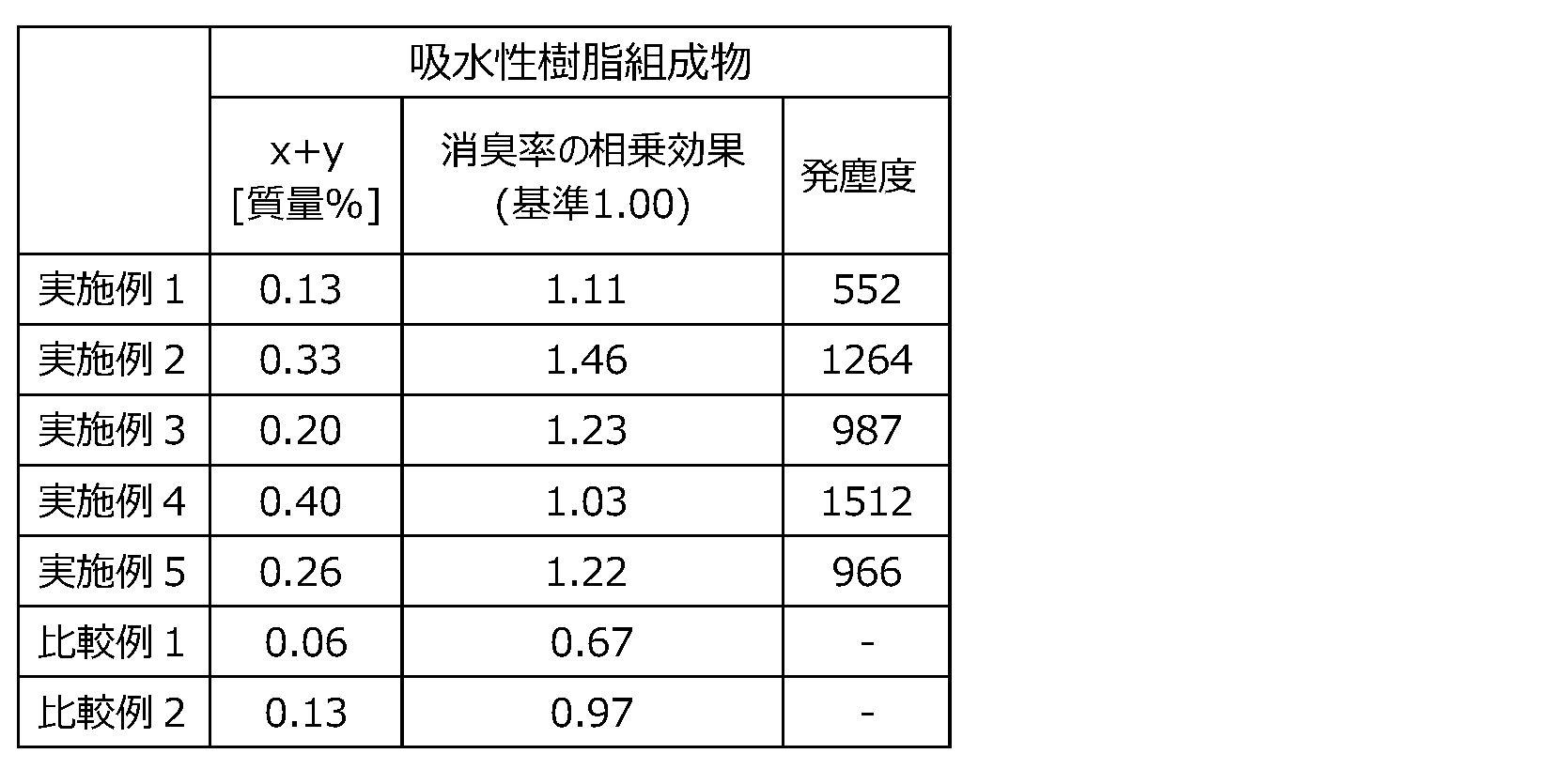
3 クランプ
4 測定部
5 導管
10a 吸水性重合体粒子
11 架台
13 測定台
13a 貫通孔
21 ビュレット管
22 コック
23 ゴム栓
24 コック
25 空気導入管
31 円筒
32 ポリアミドメッシュ
33 重り
50 食塩水
Claims (7)
- 抗菌性金属含有消臭剤、多孔性消臭剤、及び吸水性重合体粒子を含む、吸水性樹脂組成物であって、
前記多孔性消臭剤の含有量X(質量部)と、前記抗菌性金属含有消臭剤の含有量Y(質量部)の比率(X/Y)が、0.8以上であり、
前記吸水性樹脂組成物全体における、前記多孔性消臭剤の含有率x(質量%)と前記抗菌性金属含有消臭剤の含有率y(質量%)の和(x+y)が、0.10質量%以上である、吸水性樹脂組成物。 - 前記含有率x(質量%)と前記含有率y(質量%)の和(x+y)が0.50質量%以下である、請求項1に記載の吸水性樹脂組成物。
- 前記抗菌性金属含有消臭剤に含まれる抗菌性金属が、銀、銅、亜鉛、ビスマス、コバルト、アルミニウム及びニッケルからなる群より選択される少なくとも1種を含む、請求項1又は2に記載の吸水性樹脂組成物。
- 前記抗菌性金属含有消臭剤が、銀粉、塩化銀(I)、酸化銀(I)、並びに銀イオン及び亜鉛イオンのうち少なくとも一方の金属イオンが担持された物質からなる群より選択される少なくとも1種を含む、請求項1又は2に記載の吸水性樹脂組成物。
- 前記多孔性消臭剤が活性炭、二酸化ケイ素及びケイ酸塩からなる群より選択される少なくとも1種を含む、請求項1又は2に記載の吸水性樹脂組成物。
- 前記抗菌性金属含有消臭剤の中位粒子径が、0.1μm~100μmであり、前記多孔性消臭剤の中位粒子径が1μm~100μmである、請求項1又は2に記載の吸水性樹脂組成物。
- 抗菌性金属含有消臭剤、多孔性消臭剤、及び吸水性重合体粒子を含む、吸収性物品であって、
前記多孔性消臭剤の含有量X(質量部)と、前記抗菌性金属含有消臭剤の含有量Y(質量部)の比率(X/Y)が、0.8以上であり、
前記抗菌性金属含有消臭剤、前記多孔性消臭剤、及び前記吸水性重合体粒子の総量を基準とする前記多孔性消臭剤の含有率x(質量%)と前記抗菌性金属含有消臭剤の含有率y(質量%)の和(x+y)が、0.10質量%以上である、吸収性物品。
Priority Applications (3)
| Application Number | Priority Date | Filing Date | Title |
|---|---|---|---|
| CN202480012604.XA CN120641214A (zh) | 2023-02-22 | 2024-01-31 | 吸水性树脂组合物 |
| JP2025502215A JPWO2024176758A1 (ja) | 2023-02-22 | 2024-01-31 | |
| KR1020257027154A KR20250152583A (ko) | 2023-02-22 | 2024-01-31 | 흡수성 수지 조성물 |
Applications Claiming Priority (2)
| Application Number | Priority Date | Filing Date | Title |
|---|---|---|---|
| JP2023-026373 | 2023-02-22 | ||
| JP2023026373 | 2023-02-22 |
Publications (1)
| Publication Number | Publication Date |
|---|---|
| WO2024176758A1 true WO2024176758A1 (ja) | 2024-08-29 |
Family
ID=92501023
Family Applications (1)
| Application Number | Title | Priority Date | Filing Date |
|---|---|---|---|
| PCT/JP2024/003048 Ceased WO2024176758A1 (ja) | 2023-02-22 | 2024-01-31 | 吸水性樹脂組成物 |
Country Status (4)
| Country | Link |
|---|---|
| JP (1) | JPWO2024176758A1 (ja) |
| KR (1) | KR20250152583A (ja) |
| CN (1) | CN120641214A (ja) |
| WO (1) | WO2024176758A1 (ja) |
Citations (2)
| Publication number | Priority date | Publication date | Assignee | Title |
|---|---|---|---|---|
| JPH0411948A (ja) * | 1990-04-27 | 1992-01-16 | Hagiwara Giken:Kk | 抗菌性吸水性成形体 |
| JPH0810616A (ja) * | 1994-06-30 | 1996-01-16 | Hokuriku Fine Chem:Kk | 吸水性組成物およびその製造方法 |
Family Cites Families (1)
| Publication number | Priority date | Publication date | Assignee | Title |
|---|---|---|---|---|
| JP2001323155A (ja) | 2000-05-11 | 2001-11-20 | Sanyo Chem Ind Ltd | 化粧材用調湿材およびそれを用いた化粧材 |
-
2024
- 2024-01-31 JP JP2025502215A patent/JPWO2024176758A1/ja active Pending
- 2024-01-31 WO PCT/JP2024/003048 patent/WO2024176758A1/ja not_active Ceased
- 2024-01-31 CN CN202480012604.XA patent/CN120641214A/zh active Pending
- 2024-01-31 KR KR1020257027154A patent/KR20250152583A/ko active Pending
Patent Citations (2)
| Publication number | Priority date | Publication date | Assignee | Title |
|---|---|---|---|---|
| JPH0411948A (ja) * | 1990-04-27 | 1992-01-16 | Hagiwara Giken:Kk | 抗菌性吸水性成形体 |
| JPH0810616A (ja) * | 1994-06-30 | 1996-01-16 | Hokuriku Fine Chem:Kk | 吸水性組成物およびその製造方法 |
Also Published As
| Publication number | Publication date |
|---|---|
| CN120641214A (zh) | 2025-09-12 |
| KR20250152583A (ko) | 2025-10-23 |
| JPWO2024176758A1 (ja) | 2024-08-29 |
Similar Documents
| Publication | Publication Date | Title |
|---|---|---|
| WO2013018571A1 (ja) | 吸水性樹脂粒子、吸水性樹脂粒子を製造する方法、吸収体、吸収性物品及び止水材 | |
| JPWO2018180864A1 (ja) | 吸水性樹脂 | |
| JP7811844B2 (ja) | 吸水性樹脂粒子、吸収性物品、吸水性樹脂粒子を製造する方法、及び吸収体への生理食塩水の浸透速度を速める方法 | |
| WO2024214752A1 (ja) | 吸水性樹脂粒子の製造方法、吸水性樹脂粒子、吸収体及び吸収性物品 | |
| US20250001393A1 (en) | Water-absorbent resin composition, absorbent material and absorbent article | |
| EP4424779A1 (en) | Water-absorbing resin composition, absorber, absorbent article, and method for separation processing of water-absorbing resin particles from absorbent article | |
| WO2024071258A1 (ja) | 吸水性樹脂粒子の製造方法 | |
| JP7818507B2 (ja) | 粒子状吸水性樹脂組成物、吸収体、及び吸収性物品 | |
| WO2024176759A1 (ja) | 吸水性樹脂組成物 | |
| EP4424777A1 (en) | Water-absorbent resin composition, absorber, and water-absorbent article | |
| EP4424780A1 (en) | Water-absorbing resin composition, absorbent, and absorbent article | |
| KR20250152583A (ko) | 흡수성 수지 조성물 | |
| JP7769631B2 (ja) | 吸水性樹脂、吸収体及び吸収性物品 | |
| WO2024262592A1 (ja) | 消臭剤組成物 | |
| WO2025004971A1 (ja) | 吸水性樹脂粒子の製造方法、吸水性樹脂粒子、吸収体及び吸収性物品 | |
| CN115443312B (zh) | 吸水性树脂组合物、吸收体和吸收性物品 | |
| WO2026034250A1 (ja) | 吸水性樹脂粒子の製造方法 | |
| WO2025204969A1 (ja) | 吸水性樹脂粒子、吸収体及び吸収性物品 | |
| WO2025164342A1 (ja) | 吸水性樹脂粒子、吸収体及び吸収性物品 | |
| WO2026070548A1 (ja) | 吸水性樹脂粒子の製造方法 |
Legal Events
| Date | Code | Title | Description |
|---|---|---|---|
| 121 | Ep: the epo has been informed by wipo that ep was designated in this application |
Ref document number: 24760065 Country of ref document: EP Kind code of ref document: A1 |
|
| ENP | Entry into the national phase |
Ref document number: 1020257027154 Country of ref document: KR Free format text: ST27 STATUS EVENT CODE: A-0-1-A10-A15-NAP-PA0105 (AS PROVIDED BY THE NATIONAL OFFICE) |
|
| WWE | Wipo information: entry into national phase |
Ref document number: 202480012604.X Country of ref document: CN |
|
| ENP | Entry into the national phase |
Ref document number: 2025502215 Country of ref document: JP Kind code of ref document: A |
|
| WWE | Wipo information: entry into national phase |
Ref document number: 2025502215 Country of ref document: JP |
|
| WWE | Wipo information: entry into national phase |
Ref document number: 202517081692 Country of ref document: IN |
|
| WWP | Wipo information: published in national office |
Ref document number: 202480012604.X Country of ref document: CN |
|
| WWP | Wipo information: published in national office |
Ref document number: 202517081692 Country of ref document: IN |
|
| NENP | Non-entry into the national phase |
Ref country code: DE |
|
| WWP | Wipo information: published in national office |
Ref document number: 1020257027154 Country of ref document: KR |
|
| 122 | Ep: pct application non-entry in european phase |
Ref document number: 24760065 Country of ref document: EP Kind code of ref document: A1 |