WO2024157810A1 - 情報処理方法及び情報処理装置 - Google Patents
情報処理方法及び情報処理装置 Download PDFInfo
- Publication number
- WO2024157810A1 WO2024157810A1 PCT/JP2024/000709 JP2024000709W WO2024157810A1 WO 2024157810 A1 WO2024157810 A1 WO 2024157810A1 JP 2024000709 W JP2024000709 W JP 2024000709W WO 2024157810 A1 WO2024157810 A1 WO 2024157810A1
- Authority
- WO
- WIPO (PCT)
- Prior art keywords
- user
- information
- virtual space
- candidate
- space
- Prior art date
- Legal status (The legal status is an assumption and is not a legal conclusion. Google has not performed a legal analysis and makes no representation as to the accuracy of the status listed.)
- Ceased
Links
Images







Classifications
-
- G—PHYSICS
- G06—COMPUTING OR CALCULATING; COUNTING
- G06T—IMAGE DATA PROCESSING OR GENERATION, IN GENERAL
- G06T17/00—Three-dimensional [3D] modelling for computer graphics
-
- G—PHYSICS
- G06—COMPUTING OR CALCULATING; COUNTING
- G06T—IMAGE DATA PROCESSING OR GENERATION, IN GENERAL
- G06T19/00—Manipulating three-dimensional [3D] models or images for computer graphics
- G06T19/003—Navigation within 3D models or images
-
- G—PHYSICS
- G06—COMPUTING OR CALCULATING; COUNTING
- G06F—ELECTRIC DIGITAL DATA PROCESSING
- G06F3/00—Input arrangements for transferring data to be processed into a form capable of being handled by the computer; Output arrangements for transferring data from processing unit to output unit, e.g. interface arrangements
- G06F3/01—Input arrangements or combined input and output arrangements for interaction between user and computer
- G06F3/011—Arrangements for interaction with the human body, e.g. for user immersion in virtual reality
-
- G—PHYSICS
- G06—COMPUTING OR CALCULATING; COUNTING
- G06T—IMAGE DATA PROCESSING OR GENERATION, IN GENERAL
- G06T2219/00—Indexing scheme for manipulating 3D models or images for computer graphics
- G06T2219/024—Multi-user, collaborative environment
Definitions
- This disclosure relates to information processing methods, etc.
- Patent Document 1 proposes a content control device that improves the realism of content that allows users to experience things including movement in a virtual space.
- presenting all of the various movable spaces and various three-dimensional objects in a virtual space may not necessarily be appropriate for the usage situation. Furthermore, presenting various movable spaces and various three-dimensional objects may increase the processing load.
- the present disclosure therefore provides an information processing method etc. that can contribute to the efficient presentation of a virtual space appropriate to the usage situation etc.
- An information processing method determines whether a movable space candidate, which is a candidate space to which a user can move in a virtual space, satisfies a condition, and controls whether or not to present the movable space candidate in the virtual space according to the result of the determination of whether the movable space candidate satisfies the condition.
- the information processing method can contribute to the efficient presentation of a virtual space appropriate to the usage situation, etc.
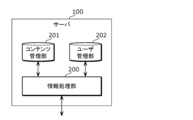
- FIG. 1 is a block diagram showing an example of the configuration of a virtual space system according to an embodiment.
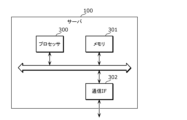
- FIG. 2 is a block diagram showing a first configuration example of a server according to an embodiment.
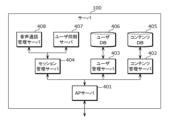
- FIG. 13 is a block diagram showing a second configuration example of the server in the embodiment.
- FIG. 13 is a block diagram showing a third configuration example of a server in an embodiment.
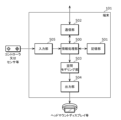
- FIG. 2 is a block diagram showing a first configuration example of a terminal according to an embodiment.
- FIG. 13 is a block diagram showing a second configuration example of the terminal in the embodiment.
- 1 is a block diagram showing a configuration example of a virtual space collaboration system according to an embodiment.
- FIG. 2 is a block diagram showing a configuration example of a first server in the embodiment.
- FIG. 13 is a flowchart illustrating an example of a display control process of movable space candidates in the embodiment.
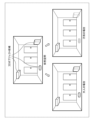
- 11A and 11B are conceptual diagrams showing a display example of movable space candidates in the embodiment.
- 10 is a flowchart illustrating an example of a display control process for a 3D object candidate according to an embodiment.
- 11A and 11B are conceptual diagrams illustrating a display example of 3D object candidates in the embodiment.
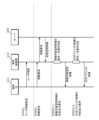
- 11 is a sequence diagram showing an example of an operation when a terminal performs a display control process in the embodiment.
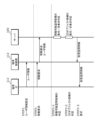
- FIG. 11 is a sequence diagram showing an example of an operation when a server performs a display control process in the embodiment.
- FIG. 11 is a sequence diagram showing an example of an operation when a server in an embodiment performs display control processing for multiple users.
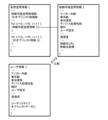
- FIG. 11 is a syntax diagram showing an example of a syntax element related to a display control process of a movable space candidate in the embodiment.
- FIG. 11 is a syntax diagram showing an example of syntax elements related to a display control process for a 3D object candidate in the embodiment.
- FIG. 11 is a syntax diagram showing an example of syntax elements related to users and avatars in an embodiment.
- FIG. 1 is a block diagram showing a configuration example of an information processing device according to an embodiment. 1 is a flowchart showing a first operation example of the information processing device in the embodiment. 11 is a flowchart showing a second operation example of the information processing device in the embodiment.
- the virtual space is represented by three-dimensional shape data that indicates, for example, the topography of the space or the three-dimensional shapes of objects such as buildings arranged in the space.
- a user can operate an avatar, which is a representation of the user in the virtual space, to explore the space, participate in any activity, or communicate with other users.
- the virtual space can be used to simulate physical phenomena that occur virtually in the virtual space, or to control home appliances or electronic devices placed in the real space based on the results of the simulation.
- Patent Document 1 proposes a content control device that improves the realism of content that allows users to experience things including movement in a virtual space.
- presenting all of the various movable spaces and various three-dimensional objects, etc. in a virtual space may not necessarily be appropriate for the usage situation, etc.
- presenting movable spaces or three-dimensional objects, etc. that are inappropriate for the usage situation, etc. may result in a decrease in the sense of realism.
- presenting various movable spaces and various three-dimensional objects, etc. may cause an increase in the processing load.
- the information processing method of Example 1 therefore determines whether a movable space candidate, which is a candidate space in a virtual space through which a user can move, satisfies a condition, and controls whether or not to present the movable space candidate in the virtual space according to the result of the determination of whether the movable space candidate satisfies the condition.
- the information processing method of Example 2 may be the information processing method of Example 1, in which virtual attributes of the user in the virtual space are used to determine whether the movable space candidate satisfies the condition.
- the information processing method of Example 3 may be the information processing method of Example 2, in which the virtual attribute of the user is the virtual age of the user.
- the information processing method of Example 4 may be any of the information processing methods of Examples 1 to 3, and may use real attributes of the user in the real world to determine whether the candidate movable space satisfies the condition.
- the information processing method of Example 5 may be the information processing method of Example 4, in which the real attribute of the user is the real age of the user.
- the information processing method of Example 6 may be the information processing method of Example 1, in which one attribute is selected from the virtual attributes of the user in the virtual space and the real attributes of the user in the real world, and the selected attribute is used to determine whether the movable space candidate satisfies the condition.
- This may make it possible to switch between the user's virtual attributes and the user's real attributes depending on the usage situation, etc., to determine whether the conditions are met, and to provide a virtual space that suits the conditions. Therefore, it may be possible to switch between a virtual space that suits the user's virtual attributes and a virtual space that suits the user's real attributes depending on the usage situation, etc.
- the information processing method of Example 7 may be any of the information processing methods of Examples 1 to 6, and may determine whether the movable space candidates satisfy the conditions for a plurality of users including the user, and control whether to present the movable space candidates.
- This may make it possible to switch between presenting and not presenting candidate movable spaces for multiple users at a time. This may therefore make it possible to provide a common virtual space for multiple users.
- the information processing method of Example 8 may be any of the information processing methods of Examples 1 to 7, and may acquire movable space candidate information indicating the movable space candidate, to which condition information indicating the condition is added, and determine whether the movable space candidate satisfies the condition according to the condition information added to the movable space candidate information.
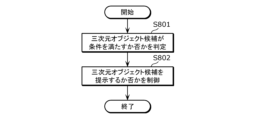
- the information processing method of Example 9 determines whether a three-dimensional object candidate, which is a candidate for a three-dimensional object to be presented to a user in a virtual space, satisfies a condition, and controls whether or not to present the three-dimensional object candidate in the virtual space according to the result of the determination of whether the three-dimensional object candidate satisfies the condition.
- the information processing method of Example 10 may be the information processing method of Example 9, in which virtual attributes of the user in the virtual space are used to determine whether the three-dimensional object candidate satisfies the condition.
- the information processing method of Example 11 may be the information processing method of Example 10, in which the virtual attribute of the user is the virtual age of the user.
- the information processing method of Example 12 may be any of the information processing methods of Examples 9 to 11, in which real attributes of the user in the real world are used to determine whether the three-dimensional object candidate satisfies the condition.
- the information processing method of Example 13 may be the information processing method of Example 12, in which the real attribute of the user is the real age of the user.
- the information processing method of Example 14 may be any of the information processing methods of Examples 9 to 13, in which one attribute is selected from the virtual attributes of the user in the virtual space and the real attributes of the user in the real world, and the selected attribute is used to determine whether the three-dimensional object candidate satisfies the condition.
- This may make it possible to switch between the user's virtual attributes and the user's real attributes depending on the usage situation, etc., to determine whether the conditions are met, and to provide a virtual space that suits the conditions. Therefore, it may be possible to switch between a virtual space that suits the user's virtual attributes and a virtual space that suits the user's real attributes depending on the usage situation, etc.
- the information processing method of Example 15 may be any of the information processing methods of Examples 9 to 14, which determines whether the three-dimensional object candidates satisfy the conditions for each of a plurality of users including the user, and controls whether to present the three-dimensional object candidates.
- This may make it possible to switch between presenting and not presenting 3D object candidates for multiple users. This may therefore make it possible to provide a common virtual space for multiple users.
- the information processing method of Example 16 may be any of the information processing methods of Examples 9 to 15, in which one unit is selected from the unit of the user and the unit of a plurality of users including the user, and in the selected unit, it is determined whether the three-dimensional object candidate satisfies the condition, and whether or not to present the three-dimensional object candidate is controlled.
- This may make it possible to switch between a user unit and a multiple-user unit depending on the usage situation, etc., to determine whether a three-dimensional object candidate satisfies a condition, and to control whether or not to present the three-dimensional object candidate. Therefore, it may be possible to switch between providing an individual virtual space to each user and providing a common virtual space to multiple users depending on the usage situation, etc.
- the information processing method of Example 17 may be any of the information processing methods of Examples 9 to 16, which obtains three-dimensional object candidate information indicating the three-dimensional object candidate, to which condition information indicating the condition is added, and determines whether the three-dimensional object candidate satisfies the condition according to the condition information added to the three-dimensional object candidate information.
- the information processing method of Example 18 may be any of the information processing methods of Examples 9 to 17, and may control whether or not to present the three-dimensional object candidate in the virtual space in a first manner according to the determination result, and if it is determined that the three-dimensional object candidate satisfies the condition, present the three-dimensional object candidate in the virtual space in the first manner, and if it is determined that the three-dimensional object candidate does not satisfy the condition, present the three-dimensional object candidate in the virtual space in a second manner different from the first manner without presenting the three-dimensional object candidate in the virtual space.
- This may make it possible to present three-dimensional object candidates that satisfy the conditions in a virtual space in a first manner, and to present three-dimensional object candidates that do not satisfy the conditions in a second manner. Therefore, it may be possible to provide a virtual space that is appropriate for the conditions.
- the information processing device of Example 19 includes one or more processors and one or more memories accessible from the one or more processors, and in operation, the one or more processors determine whether or not a movable space candidate, which is a candidate space in a virtual space through which a user can move, satisfies a condition, and controls whether or not to present the movable space candidate in the virtual space according to the result of the determination of whether or not the movable space candidate satisfies the condition.
- the information processing device of Example 20 includes one or more processors and one or more memories accessible from the one or more processors, and in operation, the one or more processors determine whether or not a three-dimensional object candidate, which is a candidate for a three-dimensional object to be presented to a user in a virtual space, satisfies a condition, and controls whether or not to present the three-dimensional object candidate in the virtual space according to the determination result of whether or not the three-dimensional object candidate satisfies the condition.
- information and data may be interpreted as interchangeable.
- an operation performed by a system or device may be performed by any component included in the system or device.
- FIG. 1 is a block diagram showing an example of the configuration of a virtual space system in this embodiment.
- the virtual space system in FIG. 1 includes a server 100 and a terminal 101, and provides a virtual space.
- the virtual space system may be expressed as a virtual space providing system.
- a display format, an encoding method, a data format, and the like are specified.
- the server 100 and the terminal 101 communicate with each other. Although only one terminal 101 is shown in FIG. 1, multiple terminals 101 may communicate with the server 100. That is, multiple users may simultaneously participate in the virtual space via multiple terminals 101, respectively.
- the server 100 is a server device that holds virtual space data (virtual space information) and transmits the virtual space data to the terminal 101 in response to a request from the terminal 101.
- the server 100 also holds user data (user information) of the user using the terminal 101 and other users, and transmits the user data of other users to the terminal 101.
- the server 100 may transmit the user data of the user using the terminal 101 to the terminal 101 in addition to the user data of other users.
- User data is data associated with a user, and includes, for example, image data or three-dimensional model data of an avatar that represents the user in virtual space.
- User data may also include data on items the user owns in virtual space, attribute data indicating the user's attributes, and data related to the user's behavioral history.
- User data may also include data indicating parameters such as the in-game level, strength, or skill of a character object that the user controls in virtual space.
- an avatar representing a user in a virtual space and a character object operated by the user in the virtual space may be considered as an example of an item owned by the user in the virtual space.
- an avatar representing a user in a virtual space and a character object operated by the user in the virtual space may be expressed as a user in the virtual space.
- the data associated with the user may be data associated with the user ID.
- User data may include not only information used in the virtual space, but also personal information that can identify who the user is. However, if user data includes personal information in addition to data used in the virtual space, information shared with other users and information not shared with other users may be managed separately so that the personal information is not visible to other users. Furthermore, the information shared with other users may be set by each user.
- the user data may directly include data such as values or text related to the user.
- the user data may also include parameters or indexes for identifying the data related to the user.
- the data related to the user may be obtained by referencing a predefined table or a table obtained from an external source such as another server based on the parameters or indexes.
- the user data may include a storage location of the data, such as an address on another server, or may indirectly indicate the data by the storage location.
- the server 100 or the terminal 101 retrieves data such as a value or text related to the user from the storage location specified by the address.
- the address is described as a URI (Uniform Resource Identifier), such as a URL (Uniform Resource Locator) or a URN (Uniform Resource Name).
- URI Uniform Resource Identifier
- URL Uniform Resource Locator
- URN Uniform Resource Name
- the user data may also include information indicating the type and format of the data to be obtained from the address. User data will be described in detail in FIG. 8.
- the terminal 101 is a terminal device that receives virtual space data (virtual space information) from the server 100. Based on the virtual space data received from the server 100, the terminal 101 displays an image of the virtual space on a display device provided in the terminal 101 or connected to the terminal 101. The terminal 101 also acquires input data corresponding to a user's input operation and transmits the input data to the server 100.
- virtual space data virtual space information
- the input data corresponds to movement information of an avatar in a virtual space.
- the server 100 notifies each user's terminal 101 of the input data.
- Each user's terminal 101 moves the avatar in the virtual space based on the 3D model downloaded in advance and the input data notified from the server 100.
- the server 100 may determine whether or not an avatar placed in the virtual space has performed an action such as movement or a gesture based on the input data, and notify each user's terminal 101 of the determination result that an action has been performed. In this way, the server 100 may move the avatar in the virtual space displayed on each user's terminal 101.
- the input data may also include text data, audio data, video data, etc. used for communication with other users.
- FIG. 2 is a block diagram showing a first configuration example of the server 100.
- the server 100 includes an information processing unit 200, a content management unit 201, and a user management unit 202.
- the information processing unit 200 communicates with the terminal 101. For example, the information processing unit 200 obtains data requested by the terminal 101 from the content management unit 201 or the user management unit 202 and transmits it to the terminal 101. The information processing unit 200 may also perform processing requested by the terminal 101 on the data received from the terminal 101, and transmit the processing results to the terminal 101 or store them in the content management unit 201 or the user management unit 202.
- the information processing unit 200 may also perform processing requested by the terminal 101 on the data acquired from the content management unit 201 and the user management unit 202. The information processing unit 200 may then transmit the processing results to the terminal 101, or store them in the content management unit 201 or the user management unit 202.
- the content management unit 201 manages content data, which is data related to the content that constitutes the virtual space.
- the user management unit 202 manages user data, which is data related to users. Details of the content data and user data will be described later.
- FIG. 3 is a block diagram showing a second configuration example of the server 100.
- the components of the server 100 shown in FIG. 2 may be implemented by the components of the server 100 shown in FIG. 3.
- the server 100 includes a processor 300, a memory 301, and a communication IF (InterFace) 302.
- IF InterFace
- Processor 300 is composed of, for example, a CPU (Central Processing Unit).
- Processor 300 may be composed of multiple CPUs, or may include a circuit specialized for a specific process such as image processing or AI processing, such as a GPU (Graphics Processing Unit).
- a CPU Central Processing Unit
- Processor 300 may be composed of multiple CPUs, or may include a circuit specialized for a specific process such as image processing or AI processing, such as a GPU (Graphics Processing Unit).
- Memory 301 is composed of, for example, RAM (Random Access Memory) and ROM (Read Only Memory).
- Memory 301 may include a magnetic storage medium such as a hard disk, or a semiconductor memory such as an SSD (Solid State Drive).
- Memory 301 may also be an internal memory built into the CPU or GPU.
- the communication IF 302 is composed of circuits that provide communication corresponding to, for example, cellular communication, wireless LAN, wired LAN, or short-range wireless communication.
- the cellular communication corresponds to LTE (registered trademark) (Long Term Evolution) and the like.
- the wireless LAN corresponds to WiFi (registered trademark) (IEEE 802.11 and its revised standards) and the like.
- the wired LAN corresponds to Ethernet (registered trademark) and the like.
- the short-range wireless communication corresponds to Bluetooth (registered trademark) and the like.
- the communication IF 302 may also include a terminal for connecting an antenna for wireless communication or a cable for wired communication.
- the processor 300 of the server 100 uses the memory 301 to execute the programs stored in the memory 301 and perform processing related to providing the virtual space.
- the communication IF 302 performs wireless or wired communication. Specifically, the communication IF 302 communicates with the terminal 101 via any network, such as the Internet or a CDN (Content Distribution Network).
- the Internet or a CDN is described as an example of a network, but other networks may also be used.
- the network connecting the server 100 and the terminal 101 may be only direct wireless communication between the AP or base station.
- the server 100 may be included in the AP or base station, or may be located together with the AP or base station and connected to the AP or base station by wired or wireless communication.
- the communication IF 302 may also use HTTP (HyperText Transfer Protocol) to send and receive data between the server 100 (content providing device) and the terminal 101 (content reproducing device) corresponding to the client.
- HTTP HyperText Transfer Protocol
- HTTP is used as an example of a protocol used for communication, but other communication protocols may also be used.
- data may be sent and received using FTP (File Transfer Protocol) or RTP (Real-time Transport Protocol).
- FTP File Transfer Protocol
- RTP Real-time Transport Protocol
- FIG. 4 is a block diagram showing a third configuration example of the server 100.
- the server 100 shown in FIG. 2 may be configured by multiple servers shown in FIG. 4 that operate in cooperation with each other.
- the server 100 includes an application server (AP server) 401, a content management server 402, a user management server 403, a session management server 404, a content database (content DB) 405, a user database (user DB) 406, a user synchronization server 407, and a voice call management server 408.
- AP server application server
- content management server a content management server 402
- user management server 403 a session management server 404
- content database (content DB) 405 a user database (user DB) 406
- user synchronization server 407 a user synchronization server 407
- voice call management server 408 the server 100 includes an application server (AP server) 401, a content management server 402, a user management server 403, a session management server 404, a content database (content DB) 405, a user database (user DB) 406, a user synchronization server 407, and a voice call management server 408.
- server group shown in FIG. 4 is merely an example, and the role or name of each server may be different.
- one server in FIG. 4 may be made up of multiple servers, or the multiple servers in FIG. 4 may make up one server.
- processing performed by any server may be performed by another server instead of that server.
- the AP server 401 transmits data requested by the terminal 101 to the terminal 101.
- the AP server 401 may also carry out processing requested by the terminal 101 and transmit the results to the terminal 101.
- the content management server 402 is a server that manages content data related to the content that constitutes the virtual space.
- the content DB 405 is a database in which the content data is stored.
- the content management server 402 acquires content data from the content DB 405 in response to a request notified from the terminal 101 via the AP server 401, and transmits the content data to the terminal 101 via the AP server 401.
- the content management server 402 also updates the content data stored in the content DB 405 in response to a request notified from the terminal 101 via the AP server 401.
- the content management server 402 accepts a request notified from the terminal 101 via the AP server 401.
- the content management server 402 may also accept a request made by the AP server 401. More specifically, the content management server 402 may accept a request made by the AP server 401 that processes the request notified from the terminal 101.
- the content management server 402 may store address information indicating the storage location of the data itself in the content DB 405.
- the user management server 403 is a server that manages user data related to users participating in the virtual space.
- the user DB 406 is a database in which the user data is stored.
- the user management server 403 acquires user data from the user DB 406 in response to a request notified from the terminal 101 via the AP server 401, and transmits the user data to the terminal 101 via the AP server 401.
- the user management server 403 also updates the user data stored in the user DB 406 in response to a request notified from the terminal 101 via the AP server 401.
- the user management server 403 accepts a request notified from the terminal 101 via the AP server 401.
- the user management server 403 may also accept a request made by the AP server 401. More specifically, the user management server 403 may accept a request made by the AP server 401 that processes the request notified from the terminal 101.
- the user management server 403 may store address information indicating the storage location of the data itself in the user DB 406.
- the session management server 404 manages the session between the server 100 and the terminal 101 corresponding to the client.
- the session management server 404 identifies which client a request sent from the client, i.e., the terminal 101, came from and manages the status of the client. This allows the AP server 401 to respond to requests sent from the client, i.e., the terminal 101, in accordance with the status of the client.
- the user synchronization server 407 manages information about the actions of each user that affect the position and movement direction of the user's avatar, and maintains synchronization between users.
- the user synchronization server 407 may perform synchronization on a frame-by-frame basis, or on a multiple-frame basis.
- the user synchronization server 407 prevents discrepancies in the actions of users to be displayed, specifically, users whose corresponding avatars exist within the display area, from occurring by transmitting information about the actions of the users to the terminal 101 and sharing the information.
- the voice call management server 408 manages the sending and receiving of voice data between multiple terminals 101 when voice calls are made between users.
- communication between users is not limited to voice calls, and video calls may also be used for communication between users.
- video data is sent and received simultaneously with voice data.
- a video call management server that manages video calls may be provided.
- a single call management server for managing both voice calls and video calls may be provided.
- communication between users may be carried out not only through real-time calls, but also using pre-generated audio and video files.
- each of the multiple servers that operate in cooperation with each other may have the configuration shown in FIG. 3.
- the communication IF 302 of the AP server 401 communicates directly with the terminal 101, and also communicates with the communication IF 302 of each of the other servers, such as the content management server 402, the user management server 403, and the session management server 404.
- FIG. 5 is a block diagram showing a first configuration example of the terminal 101.
- the terminal 101 includes an information processing unit 500, a storage unit 501, a communication unit 502, a spatial modeling unit 503, an output unit 504, and an input unit 505.
- the information processing unit 500 executes application software corresponding to the virtual space provided by the server 100, and controls the memory unit 501, communication unit 502, spatial modeling unit 503, output unit 504, and input unit 505.
- the storage unit 501 stores the software programs executed by the information processing unit 500, data received from the server 100, data resulting from calculations performed by the information processing unit 500, and input data acquired via the input unit 505.
- the communication unit 502 communicates with the server 100.
- the space modeling unit 503 generates images to be displayed as a two-dimensional or three-dimensional virtual space, and sounds to be heard in the virtual space, based on content data, which is data related to the virtual space.
- the output unit 504 presents images and sounds via the display and sound output device by outputting the images and sounds generated by the spatial modeling unit 503 to the display and sound output device.
- the display and sound output device may be provided in the terminal 101, or may be connected to the terminal 101 via wired or wireless communication.
- the display may be a stationary or portable display, a head-mounted display, or AR glasses.
- the sound output device may be a speaker, headphones, or earphones.
- the information processing unit 500 requests content data, which is data related to the virtual space, from the server 100 via the communication unit 502, and acquires the content data from the server 100.
- the information processing unit 500 also transmits input data acquired from the input unit 505 to the server 100 via the communication unit 502. At this time, the input data acquired from the input unit 505 may be transmitted to the server 100 as is, or the input data acquired from the input unit 505 may be subjected to signal processing and the result transmitted to the server 100.
- the processing performed on the input data acquired from the input unit 505 may be, for example, a process of converting the input data, which is operation information input by the user via a controller or the like, into a command that can be implemented in a virtual space.
- the processing performed on the input data may be image processing such as recognition processing performed on the input data, which is image data acquired from a camera.
- the processing performed on the input data may be image processing to generate information indicating the posture or movement of the photographed person, or information indicating that the photographed person has made a specified gesture.
- FIG. 6 is a block diagram showing a second configuration example of the terminal 101.
- the components shown in FIG. 5 may be implemented by the components shown in FIG. 6.
- the terminal 101 includes a processor 600, a memory 601, a communication IF 602, an input IF 603, a video signal processing unit 604, an audio signal processing unit 605, and a sensor 606.
- Processor 600 is composed of, for example, a CPU (Central Processing Unit).
- Processor 600 may be composed of multiple CPUs, or may include a circuit specialized for a specific process such as image processing or AI processing, such as a GPU (Graphics Processing Unit).
- a CPU Central Processing Unit
- Processor 600 may be composed of multiple CPUs, or may include a circuit specialized for a specific process such as image processing or AI processing, such as a GPU (Graphics Processing Unit).
- Memory 601 is composed of, for example, RAM (Random Access Memory) and ROM (Read Only Memory).
- Memory 601 may include a magnetic storage medium such as a hard disk, or a semiconductor memory such as an SSD (Solid State Drive).
- Memory 601 may also be an internal memory built into the CPU or GPU.
- the communication IF 602 is composed of circuits that provide communication such as cellular communication, wireless LAN, wired LAN, or short-range wireless communication.
- the cellular communication corresponds to LTE (registered trademark) (Long Term Evolution) and the like.
- the wireless LAN corresponds to WiFi (registered trademark) (IEEE 802.11 and its revised standards) and the like.
- the wired LAN corresponds to Ethernet (registered trademark) and the like.
- the short-range wireless communication corresponds to Bluetooth (registered trademark) and the like.
- the communication IF 602 may also include a terminal for connecting an antenna for wireless communication or a cable for wired communication.
- the input IF 603 may include, for example, a touch panel and buttons provided on the terminal 101, or may include a communication IF with a peripheral device connected to the terminal 101 via wireless or wired communication.
- a USB Universal Serial Bus
- the above-mentioned Wi-Fi or Bluetooth may be used.
- the above-mentioned communication IF 602 may also be used as the communication IF with the peripheral device.
- the processor 600 of the terminal 101 uses the memory 601 to execute the programs stored in the memory 601 and perform processing related to providing the virtual space.
- the memory 601 stores programs, data, etc.
- the memory 601 may store a program executed by the processor 600, may store data to be processed by the processor 600, or may store data processed by the processor 600.
- the memory 601 may also store data transmitted from the communication IF 602, may store data received by the communication IF 602, or may store data input from the input IF 603.
- the memory 601 may store data to be processed by the video signal processing unit 604, or may store data processed by the video signal processing unit 604.
- the memory 601 may store data to be processed by the audio signal processing unit 605, or may store data processed by the audio signal processing unit 605, or may store data acquired by the sensor 606.
- the writing and reading of data to and from memory 601 is performed based on, for example, instructions from processor 600, but is not limited to this.
- data received by communication IF 602 may be written directly to memory 601.
- data to be transmitted from communication IF 602 may be read from memory 601 and input directly to communication IF 602.
- the communication IF 602 performs wireless or wired communication. Specifically, the communication IF 602 communicates with the server 100 via any network such as the Internet or a CDN. The method by which the communication IF 602 communicates with the server 100 is the same as the method by which the communication IF 302 of the server 100 communicates with the terminal 101. Note that the communication IF 602 may communicate not only with the server 100, but also with devices used together with the terminal 101.
- the input IF 603 detects operations performed by the user via a touch panel or the like provided in the terminal 101, and acquires the detected operations as input data. Furthermore, the operation input received by the input IF 603 is not limited to operation input by the user via a device built into the terminal 101. For example, the input may be received from the user via an external controller connected via wired or wireless communication.
- Video signal processing unit 604 performs signal processing on the video signal displayed by terminal 101 and the video signal captured by the camera.
- the signal processing performed by video signal processing unit 604 includes, for example, encoding processing for compressing the video signal and decoding processing for expanding the compressed video signal.
- Video signal processing unit 604 may output the processing result as an image from a display provided in terminal 101 or a display connected to terminal 101 via wired or wireless communication.
- the image may be a video.
- the audio signal processing unit 605 performs signal processing on the audio signal presented by the terminal 101 and the audio signal picked up by the microphone.
- the signal processing performed by the audio signal processing unit 605 may include, for example, an encoding process for compressing the audio signal and a decoding process for expanding the compressed audio signal.
- the audio signal processing unit 605 may output the processing result as sound from a sound output device provided in the terminal 101 or a sound output device connected to the terminal 101 via wired or wireless communication.
- the sensor 606 is a sensor provided in the terminal 101.
- the sensor 606 may be composed of, for example, one or more of a camera, a LiDAR (Light Detection and Ranging), a microphone, a touch panel, a GPS (Global Positioning System), an acceleration sensor, a gyro sensor, and a temperature sensor.
- the sensing data acquired by the sensor 606 may be detected by the input IF 603 as a user operation, or may be transmitted to the server 100 as a detection result of the surrounding environment of the terminal 101.
- the virtual space in the present disclosure is represented by spatial data including, for example, three-dimensional shape data indicating the topography in the space or the three-dimensional shape of objects such as buildings arranged in the space.
- the virtual space does not have to be a three-dimensional space.
- the virtual space may be a two-dimensional plane.
- the spatial data includes, for example, two-dimensional shape data indicating an area in which the user can move.
- the spatial data may include image data.
- the data representing the virtual space is expressed as spatial data in the above, other expressions may be used.
- the data representing the virtual space may be expressed as map data, topographical data, or content data.
- the spatial data may include data on buildings arranged in the space.
- the data on buildings arranged in the space may be managed as object data, separate from the spatial data.
- the object data of an object placed in a virtual space may include metadata associated with the object in addition to three-dimensional shape data.
- the metadata indicates attributes of the object or information specific to the object.
- the metadata may include information indicating whether an object placed in the space is a building or not. Note that, although data such as attributes associated with an object is referred to as metadata here, other expressions may be used.
- the virtual space may include not only visible objects, i.e., objects that are displayed on the screen, but also invisible objects, i.e., objects that are not displayed on the screen.
- Invisible objects may be objects related to any phenomenon, such as the flow of air or water in a space, and may be objects represented by vectors that indicate the direction and magnitude of movement or acceleration.
- an invisible object may be an object that indicates characteristics of a space, such as the temperature, humidity, odor, fine particles contained, or the type or concentration of a chemical substance in an area within the space.
- the data of the invisible object may include three-dimensional shape data, or may include position data or area data that indicates the position or area in the virtual space where the invisible object exists.
- the position data indicates, for example, coordinate values in a coordinate system of the virtual space. Furthermore, when the virtual space is associated with the real space, the position data may indicate coordinate values in a coordinate system capable of expressing a position in the real space. The position data may indicate relative position information or rotation information that indicates the correspondence between the coordinate system in the virtual space and the coordinate system in the real space.
- the position data may indicate an index value of the corresponding unit space. Furthermore, if a position that can be used as a reference position is defined in the virtual space, the position data may indicate a position as a difference from the reference position. Furthermore, the coordinate system that represents a position in the virtual space is not limited to a Cartesian coordinate system. The coordinate system that represents a position in the virtual space may be, for example, a polar coordinate system.
- Area data includes, for example, information indicating a representative position within the area and information indicating the size of the area.
- the representative position of the area may be, for example, the position of the center of the area, or if the area is shaped like a rectangular parallelepiped, it may be the position of the vertex with the smallest coordinate value along each of the three axes.
- the representative position of the area is not limited to these positions. Any position within or outside the area may be used as the representative position depending on the predetermined description specifications of the area.
- the size of the region is, for example, the size of the region in the three axial directions in a coordinate system representing the virtual space.
- the size in the three axial directions is, for example, the height, width, and depth of the region.
- the size of the region is not limited to the size in the three axial directions.
- the region is represented as a sphere, the value of the diameter or radius of the region may be used.
- the region has the shape of an ellipsoid, the diameter or radius of the ellipsoid in the major axis direction, the diameter or radius in the minor axis direction, and the diameter or radius in a direction perpendicular to both the major axis direction and the minor axis direction may be used.
- the position and size of the area are determined by the minimum and maximum values of the area for each of the three axes.
- the position and size of the area can be determined by the coordinate values of the vertex closest to the origin and the vertex farthest from the origin among the eight vertices of a rectangular parallelepiped representing the area.
- the coordinate values of one vertex may be used as the representative position described above, and the coordinate values of the other vertex may be used as information indicating the size of the area.
- the virtual space may consist only of virtual objects generated by the administrator or users of the virtual space.
- the virtual space may include virtual objects generated based on data obtained by sensing the real world with a sensor such as a camera or LiDAR (Light Detection and Ranging). That is, the virtual space may include virtual objects that are copies of objects in the real space. Furthermore, all objects in the virtual space may be composed only of virtual objects that correspond to objects in the real space.
- a sensor such as a camera or LiDAR (Light Detection and Ranging). That is, the virtual space may include virtual objects that are copies of objects in the real space. Furthermore, all objects in the virtual space may be composed only of virtual objects that correspond to objects in the real space.
- a virtual object that corresponds to an object in real space is not limited to being generated based on data obtained by sensing the real world.
- a virtual object may be generated based on drawing data or CAD (Computer-Aided Design) data for any object, such as a building constructed in real space, or an image, device, or equipment placed in real space.
- CAD Computer-Aided Design
- a virtual object may be generated based on data obtained by performing signal processing on sensing data obtained by sensing the real world.
- the signal processing performed on the sensing data may be an extraction process that selects only a portion of the sensing data for generating a virtual object, or it may be an interpolation process on discretely obtained sensing data.
- the signal processing may be other processing.
- the signal processing may include object estimation processing. Specifically, in the estimation processing, the degree of match between the sensing data and object candidate data such as a three-dimensional model or image registered in a database may be evaluated. Then, the object candidate corresponding to the object candidate data with a high evaluated degree of match may be estimated to be the object corresponding to the sensing data.
- the sensing data or the three-dimensional shape model generated from the sensing data may be subjected to processing such as data simplification, meshing, voxelization, or deformation.
- the data of the virtual object may include attribute information such as color or reflectance obtained by photographing the object in real space with a camera or LiDAR, in addition to shape data generated based on the object in real space.
- the attribute information of the virtual object may be generated from the shape and attribute information of the object in real space.
- the device used for sensing may be a camera, LiDAR, a radio transceiver, or an ultrasonic sonar.
- the virtual object may be generated by combining multiple pieces of sensing data obtained from multiple sensing devices.
- the object data of an object corresponding to real space may include information indicating the size of the object in real space.
- the information indicating the size of the object in real space may include a value of the size of the object in real space, or may include a value of the scale ratio between the size of the object in virtual space and the size of the object in real space.
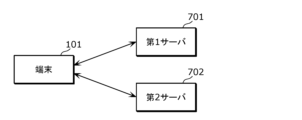
- FIG. 7 is a diagram showing an example of the configuration of a virtual space collaboration system.
- the virtual space collaboration system includes a terminal 101, a first server 701, and a second server 702.
- the first server 701 is a server device that provides a first virtual space.
- the second server 702 is a server device that provides a second virtual space.
- the virtual space collaboration system includes multiple virtual space systems and provides multiple virtual spaces. Each virtual space system corresponds to the virtual space system shown in FIG. 1.
- the virtual space collaboration system includes a first virtual space system that provides a first virtual space, and a second virtual space system that provides a second virtual space.
- the first server 701 is a server device of the first virtual space system that provides the first virtual space.
- the second server 702 is a server device of the second virtual space system that provides the second virtual space.
- the terminal 101 is included in both the first virtual space system and the second virtual space system.
- the first virtual space system and the second virtual space system can operate independently of each other, have different specifications, and are managed by different administrators.
- the terminal 101 in FIG. 7 corresponds to the terminal 101 in FIG. 1 and includes, for example, multiple components shown in FIG. 5 or FIG. 6.
- each of the first server 701 and the second server 702 in FIG. 7 corresponds to the server 100 in FIG. 1 and includes, for example, multiple components shown in any of FIG. 2 to FIG. 4.
- Each of the terminal 101, the first server 701, and the second server 702 in FIG. 7 may further include additional components and may perform additional processing.
- the terminal 101 communicates through the communication IF 602 with a first server 701 that provides a first virtual space and a second server 702 that provides a second virtual space. Specifically, when the terminal 101 receives a request from the user to operate in the first virtual space, it communicates with the first server 701. Furthermore, when the terminal 101 receives a request from the user to move from the first virtual space to the second virtual space, it communicates with the second server 702.
- the terminal 101 communicates with the first server 701 or the second server 702 in response to a communication request from the user.
- the terminal 101 may communicate with the first server 701 or the second server 702 at any timing, regardless of a communication request from the user.
- the virtual space collaboration system may also include even more servers that provide even more virtual spaces.
- the terminal 101 may then communicate with yet another server.
- the first server 701, the second server 702, and other servers may also communicate with each other.
- a user can move between multiple virtual spaces by, for example, changing the virtual space in which the user wants to participate from a first virtual space to a second virtual space.
- the movement of a user between multiple virtual spaces corresponds, for example, to the movement of a user in a first virtual space to a second virtual space.
- the movement of a user between multiple virtual spaces corresponds, for example, to the movement of an avatar representing the user in the first virtual space, or a character object operated by the user in the first virtual space, to the second virtual space.
- the movement of a user between multiple virtual spaces corresponds to the movement of an item between multiple virtual spaces.
- the movement of a user between multiple virtual spaces corresponds to the movement of a user between multiple virtual space systems, and corresponds to the movement of items between multiple virtual space systems.
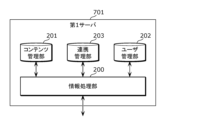
- FIG. 8 is a block diagram showing an example configuration of the first server 701.
- the second server 702 may have the same components as the first server 701.
- the first server 701 includes an information processing unit 200, a content management unit 201, a user management unit 202, and a cooperation management unit 203.
- the information processing unit 200 connects to the content management unit 201, the user management unit 202, and the cooperation management unit 203, and acquires necessary data as appropriate. The use of data when a user moves between virtual spaces will be described later.
- the multiple components shown in FIG. 8 may be implemented by the multiple components shown in FIG. 3, or may be implemented by the multiple components shown in FIG. 4.
- the first server 701 may further include a collaboration management server and a collaboration DB corresponding to the collaboration management unit 203, in addition to the multiple components shown in FIG. 4.
- the content data is data related to the content contained in the virtual space.
- the content data includes one or more of three-dimensional model information, two-dimensional model information, invisible information, etc.
- the content data corresponds to virtual space information for displaying the virtual space.
- the three-dimensional model information is data related to a three-dimensional model of the content included in the virtual space.
- the three-dimensional model information includes one or more of space information, object information, and avatar information.
- the space information is three-dimensional shape data of the background of the virtual space (i.e., the virtual space itself).
- the spatial information may be shape data from the user's first-person perspective or third-person perspective.
- the spatial information may include not only three-dimensional shape data, but also metadata indicating attributes of objects placed in the space.
- the object information indicates the topography of a space or the shape of objects such as buildings placed within a space, and is represented by three-dimensional shape data.
- Objects are not limited to visible objects such as buildings, people other than users, animals, or characters, but may also be invisible objects.
- the three-dimensional shape data may be a point cloud or polygon data of polygonal shapes such as a mesh.
- Avatar information is three-dimensional shape data of an avatar that represents the operating user.
- the avatar may correspond to, for example, a person, an animal, or a character.
- this content data may be static data that does not change over time, or dynamic data that changes over time.
- the two-dimensional model information is data related to a two-dimensional model of the content included in the virtual space.
- the two-dimensional model information differs from the three-dimensional model information in that it does not have depth information.
- the two-dimensional model information may be, for example, a still image, a moving image, or a 360-degree image.
- the spatial information, the object information, and the avatar information are included in the three-dimensional model information, but may also be included in the two-dimensional model information.
- the invisible information includes information on the content included in the virtual space that is related to a sense other than vision, and additional information that is not included in either the two-dimensional model or the three-dimensional model.
- the invisible information includes, for example, text information, audio information, and attribute information.
- the attribute information is, for example, information about the abilities or characteristics of the avatar.
- the abilities are obtained, for example, according to the user's operations in the first virtual space or the login time.
- the abilities may be expressed as skills or as level values.
- the characteristics may be, for example, the gender and age of the avatar, or may be attributes unique to the character.
- User data is data related to a user who uses a virtual space.
- One set of user data is set for one user.
- the user data includes, for example, one or more of a user identifier, personal information, virtual space item information, and space movement information.
- the user identifier is the identifier of a user registered for each virtual space. In other words, it is information linking a user to an index. Alternatively, it may be a user identifier that can be commonly used in multiple virtual spaces where linkage is implemented.
- Personal information refers to the user's personal information, including, for example, name, age, and date of birth.
- Virtual space item information is set for each virtual space used by a user.
- Virtual space item information is information about items used within that virtual space.
- An item is a general term for a tool that a user (or avatar, etc.) uses in a virtual space.
- An avatar may be an example of an item.
- Items include objects that a user can obtain in some way in a virtual space, such as avatars, avatar animations, clothing that an avatar can wear, equipment, possessions, virtual space currency, and other objects. Items may also include invisible objects.
- Spatial motion information is information about the motion of a user (or avatar, etc.).
- Motion information includes, for example, position information, animation, motion, motion direction, and speed of a user (or avatar, etc.) acquired in real time.
- the link data is content data or metadata used for a user's movement between multiple virtual spaces.
- the link data is predetermined between multiple virtual spaces in which the link is implemented, and is defined in a syntax, description method, and format that can be analyzed in each of the multiple virtual spaces.
- the link data includes one or more of a virtual space identifier, a group identifier, a movement permission level, currency information, and a predetermined rule in the virtual space.
- the virtual space identifier is a pre-assigned identifier that uniquely identifies the virtual space in which the collaboration will be performed.
- the group identifier is a pre-assigned identifier for uniquely identifying a group of multiple virtual spaces.
- the group identifier may be used, for example, to assign the same identifier to multiple virtual spaces that have common rules, currency information, etc.
- the movement permission level is, for example, a level assigned to each virtual space with regard to compatibility in movement between multiple virtual spaces. It may be defined that movement from a higher level virtual space to a lower level virtual space is permitted, but movement from a lower level virtual space to a higher level virtual space is not permitted.
- virtual space A is assigned a level of 1
- virtual space B is assigned a level of 2. In this case, a user of virtual space A can move to virtual space B, but a user of virtual space B cannot move to virtual space A.
- a user of virtual space B cannot move to virtual space A, but if a user of virtual space A moves to virtual space B, they may be able to return to virtual space A.
- Currency information is information about parameters used as currency in a virtual space.
- Currency information may include an exchange rate against a base value common to multiple virtual spaces.
- the predetermined rule is, for example, a rule for movement between multiple virtual spaces.
- object information or coordinate information for presenting in a virtual space an entrance and exit for movement between multiple virtual spaces may be specified as the predetermined rule.
- Presenting all of the various movable spaces and various three-dimensional objects in a virtual space may not necessarily be appropriate for the usage situation, etc.
- presenting movable spaces or three-dimensional objects that are inappropriate for the usage situation, etc. may cause a decrease in the sense of realism.
- presenting various movable spaces and various three-dimensional objects may cause an increase in the processing load.
- the user in the virtual space may be a virtual user in the virtual space, and more specifically, may be an avatar of the user.
- the movement of the user in the virtual space may be the movement of the user's avatar in the virtual space.
- the virtual space may include multiple virtual spaces provided by multiple virtual space systems.
- display and presentation may be interpreted as interchangeable.
- a three-dimensional object may also be expressed as a 3D object or a 3D asset.
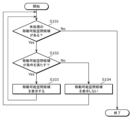
- FIG. 9 is a flowchart showing an example of a display control process for movable space candidates in this embodiment.
- a display control process is performed for each of a plurality of movable space candidates.
- the display control process may be performed by any of the terminal 101, the server 100, the first server 701, and the second server 702.
- a movable space candidate is a candidate for a space in which a user can move in a virtual space.
- the multiple movable space candidates may correspond to multiple virtual spaces provided by multiple virtual space systems, or may be multiple spaces partitioned in a single virtual space provided by a single virtual space system.
- the multiple movable space candidates may correspond to multiple rooms, multiple floors, or multiple worlds.
- an unprocessed movable space candidate is a movable space candidate for which a display/non-display determination has not been made, and which may be provided to the user.
- a determination has not been made as to whether to display or hide the movable space candidate it may be determined that there is an unprocessed movable space candidate.
- a determination has not been made as to whether to display or hide the movable space candidate it may be determined that there is an unprocessed movable space candidate.
- the conditions may correspond to age (avatar age, actual age), eligibility to participate, device processing performance, preferences, user settings, or a combination of one or more of these.
- the conditions may be that age (avatar age, actual age), eligibility to participate, device processing performance, preferences, user settings, or a combination of one or more of these meet certain standards.
- the movable space candidate is displayed in the virtual space (S103).
- processing may be performed so that the movable space candidate is displayed.
- the display position of the movable space candidate may be adjusted to a position that is visible to the user.
- displaying the movable space candidate may be displaying an entrance for moving to a destination corresponding to the movable space candidate.
- the movable space candidate is not displayed in the virtual space (S104).
- processing may be performed so that the movable space candidate is not displayed.
- the display position of the movable space candidate may be adjusted to a position that is not visible to the user.
- a notification may be given that going to the candidate movable space is not permitted. For example, a message may be displayed indicating that the door to the candidate movable space is broken or locked. Alternatively, other information that can be displayed may be presented. For example, an advertisement that can be displayed may be presented. This reduces wasted space in the virtual space and makes effective use of the space.
- the above process is performed for each of the multiple movable space candidates. This makes it possible to display a virtual space that matches the conditions. It also makes it possible to reduce the number of movable space candidates to be displayed, making it possible to display the movable space candidates efficiently.
- FIG. 10 is a conceptual diagram showing an example of the display of movable space candidates in this embodiment.
- this display example there are three movable space candidates. If the user is an adult, the three movable space candidates are displayed. Specifically, the entrances of each of the three movable space candidates are displayed as movable space candidates. On the other hand, if the user is a child, only one of the three movable space candidates is displayed. This makes it possible to display virtual spaces suitable for both adults and children.
- the user may be notified that the door is an entrance to a virtual space of another platform (a candidate for a movable space). Specifically, the appearance of the entrance to the virtual space of the other platform may be changed. Furthermore, a notification may be given that, in order to proceed beyond this door, a change in the avatar will occur. This makes it possible to prompt the user to decide whether or not to proceed before moving.
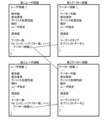
- user setting information and authenticated information may be set for the user.
- the user setting information is information that can be freely set in the virtual space.
- the user setting information may be avatar information of an avatar set by the user, and may include, for example, the age, height, weight, sex, and items of the avatar.
- the user setting information indicates the virtual attributes of the user.
- Authenticated information is not a value set by the user, but information that has been authenticated as being correct.
- authenticated information indicates the real attributes of the user.
- the real attributes of the user can also be expressed as the user's original attributes or the user's actual attributes, etc.
- the information used for authentication may be not only official identification (driver's license, My Number card, insurance card, student ID, passport, etc.), but also credit card, employee ID, business card, airline mileage, etc.
- the authenticated information is, for example, information authenticated based on such information used for authentication, and may be actual age, date of birth, name, ID identifying the user, occupation, place of employment, gender, educational background, company rank, annual income, criminal history, etc. This increases the degree of freedom in determining movement into movable spaces.
- An example of user setting information is avatar age
- an example of authenticated information is real age.
- Avatar age is, for example, the age of the avatar used by the user in a virtual space.
- Real age represents the user's age in the real world. Real age and avatar age do not necessarily have to match. Specifically, for a user whose real age is 10 years old in the real world, the avatar age in the virtual space may be set to 30 years old. Conversely, for a user whose real age is 30 years old in the real world, the avatar age in the virtual space may be set to 10 years old.
- the actual age information may be obtained using information authenticated in the real world.
- the information authenticated in the real world may be obtained from any information. For example, information such as a driver's license, passport, or credit card may be input by the user, and the information authenticated in the real world may be obtained from that information.
- parental approval may be required to input the actual age. This allows the user's correct actual age to be obtained.
- avatar age is an example of user-set information
- actual age is an example of authenticated information.
- User-set information and authenticated information are not limited to these.
- the actual age may be obtained as user-set information based on, for example, input of the date of birth.
- the avatar's age will be displayed on the screen, and the user will be able to live as that avatar.
- the condition for the above-mentioned movable space candidates may be used to determine whether to display or not. This allows movable space candidates suitable for a 10-year-old user to be displayed. Therefore, a virtual space that can protect the user can be provided.
- This display control process may be performed as an initial setting each time a user moves to a candidate movable space. This makes it possible to apply common processing to each user, simplifying the initialization process.
- the above conditions may be conditions determined in the virtual space system from which the user moves, or may be conditions determined in the virtual space system of the destination. In the latter case, the virtual space system from which the user moves may ask the virtual space system of the destination whether it is OK to present the user with information such as doors to move to the destination. This makes it possible to present appropriate candidate movable spaces that also reflect the situation in the virtual space system of the destination.
- common original spatial information may be transmitted from the server 100 to the terminal 101, and the display contents may be selected in the terminal 101 according to the user information.
- the server 100 may select the data to be transmitted in accordance with the user information of the terminal 101. This makes it possible for the terminal 101 to display the received data as is, making it possible to reduce the amount of processing.
- user information may be sent from the terminal 101 to the server 100 in advance. This allows the server 100 to generate information appropriate for the user.
- information set for the user such as actual age, date of birth, sex, height, weight, and sex
- information set for the avatar such as the avatar's age, height, weight, and sex
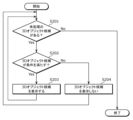
- FIG. 11 is a flowchart showing an example of a display control process for 3D object candidates in this embodiment.
- a display control process is performed for each of a plurality of 3D object candidates.
- the display control process may be performed by any of the terminal 101, the server 100, the first server 701, and the second server 702.
- the 3D object candidate is a candidate for a 3D object that is presented to the user in the virtual space.
- the 3D object may be an entrance door for a candidate movable space, or may be some other object.
- the 3D object may also be an object that is displayed three-dimensionally on a two-dimensional plane.
- the 3D object may be an object that is displayed by being projected onto a two-dimensional plane.
- the 3D object may be an object that is displayed three-dimensionally by parallax.
- an unprocessed 3D object candidate is a 3D object candidate for which a display/non-display determination has not been made, and which may be presented to the user.
- a determination has not been made as to whether to display or hide the 3D object candidate it may be determined that there is an unprocessed 3D object candidate.
- a determination has not been made as to whether to display or hide the 3D object candidate it may be determined that there is an unprocessed 3D object candidate.
- the conditions may correspond to age (avatar age, actual age), eligibility to participate, device processing performance, preferences, user settings, or a combination of one or more of these.
- the conditions may be that age (avatar age, actual age), eligibility to participate, device processing performance, preferences, user settings, or a combination of one or more of these meet certain standards.
- the 3D object candidate is displayed in the virtual space (S203).
- processing may be performed so that the 3D object candidate is displayed.
- the display position of the 3D object candidate may be adjusted to a position that is visible to the user.
- the 3D object candidate is not displayed in the virtual space (S204).
- processing may be performed so that the 3D object candidate is not displayed.
- the display position of the 3D object candidate may be adjusted to a position that is not visible to the user.
- the 3D object candidate may be notified that the 3D object candidate will not be displayed in the virtual space.
- the 3D object candidate may be displayed in a blurred manner.
- an advertisement that can be displayed may be presented. This reduces wasted space in the virtual space and makes effective use of the space.
- FIG. 12 is a conceptual diagram showing an example of the display of 3D object candidates in this embodiment.
- this display example there are three 3D object candidates. If the user is an adult, the three 3D object candidates are displayed. On the other hand, if the user is a child, only one of the three 3D object candidates is displayed. This makes it possible to display virtual spaces suitable for both adults and children.
- the user may also be notified that a 3D object candidate is not displayed. For example, the appearance may be changed. This makes it possible to notify the user of the information indicating the existence of a 3D object candidate that is not displayed.
- the avatar's age will be displayed on the screen, and the user will be able to live as that avatar.
- the condition for the above 3D object candidates may be used to determine whether or not to display them, based on the user's actual age. This allows 3D object candidates suitable for a 10-year-old user to be displayed. Therefore, a virtual space capable of protecting the user can be provided.
- Information such as the avatar age or real age that can display the 3D object candidate may be added to the 3D object candidate as metadata. This allows for switching between display and non-display so that, for example, if the user's real age is equal to or greater than the target real age added to the 3D object candidate, the 3D object candidate is displayed, and if not, the 3D object candidate is not displayed.
- the displayed 3D object candidates may also be switched depending on the user's actual age. For example, as a 3D drink object, an alcoholic drink may be displayed to a user whose actual age is 20 or older, and a soft drink may be displayed to other users. This allows a 3D object appropriate to the user's actual age to be displayed.
- the displayed 3D object candidates may be switched according to the user's preferences. For example, the 3D object candidates may be switched so that, in the same position in the virtual space, if the user likes dogs, dogs are displayed, and if the user likes cats, cats are displayed. This allows 3D objects suited to the user's preferences to be displayed.
- each 3D object candidate information on the same shape may be prepared, and information on multiple textures that are mapped (applied) to that shape may be prepared.
- the texture to be applied may then be switched according to the user's preferences. This makes it possible to reduce the amount of data compared to a method in which multiple 3D object candidates are prepared for each texture.
- the texture information may be generated or changed based on the user's preferences using AI techniques such as a diffusion model. This allows 3D object candidates with textures that suit the user's preferences to be displayed.
- This display control process may be performed as an initial setting each time a user moves to a candidate movable space. This makes it possible to apply common processing to each user, simplifying the initialization process.
- common original spatial information may be transmitted from the server 100 to the terminal 101, and the display contents may be selected in the terminal 101 according to the user information.
- the server 100 may select the data to be transmitted in accordance with the user information of the terminal 101. This makes it possible for the terminal 101 to display the received data as is, making it possible to reduce the amount of processing.
- user information may be sent from the terminal 101 to the server 100 in advance. This allows the server 100 to generate information appropriate for the user.
- the user information used in the judgment criteria may be determined from multiple pieces of user information of all or some of the participants, such as the avatar age or real age of the participants (users). The display method may then be switched depending on the determined user information.
- the minimum actual age of multiple users participating in the same virtual space may be calculated. Then, the movable space candidates and 3D object candidates displayed in the virtual space may be switched based on the minimum actual age. This allows the movable space candidates and 3D object candidates displayed according to the information of the multiple users participating in the virtual space to be appropriately switched. Therefore, for example, it becomes possible to provide an appropriate virtual space to multiple participants (multiple users) in a timely manner.
- the display or non-display determination it is not necessary for the display or non-display determination to be made for all movable space candidates and 3D object candidates based on information from multiple users.
- the information used for the determination may be switched so that the display or non-display determination for movable space candidates (such as doors) is based on information from multiple users, and the display or non-display determination for advertising information, etc. is based on information for each user.
- display control is performed for content that should be commonly displayed in the virtual space based on information from multiple users, thereby controlling whether to display or hide the content commonly for multiple users.
- display control is performed for content that should be individually displayed based on information from individual users, thereby controlling whether to display or hide the content appropriately for each individual user. Therefore, the display or hide can be appropriately controlled for content that should be presented commonly and content that should be presented individually.
- multiple users may be integrated into multiple groups, and display or non-display may be unified for each group.
- a group that shares a virtual space may be created, multiple users may be linked to the group, and the display or non-display of movable space candidates or 3D object candidates may be switched based on the information of the group.
- the information of the group may be calculated from the information of multiple users belonging to the group.
- the minimum actual age of multiple users belonging to a group may be used as the actual age corresponding to the group to switch between displaying and hiding movable space candidates or 3D object candidates. This allows the display or hiding of content in the virtual space to be appropriately controlled for each group. For example, while the displayed content differs between groups, the displayed content is standardized and shared within the group.
- Groups may be created before a user enters the virtual space and may be preselectable by the user. Alternatively, groups may be freely created in the virtual space by the user after the user enters the virtual space.
- Groups may be generated automatically based on user information. For example, a group may be created for avatars whose age is 20 or older, and users who meet this condition may be automatically included in that group. This may automate the process of setting groups for each user.
- Groups may be created with a specific intention. For example, a group may be created for the purpose of carrying out a certain activity. Then, the user may select whether or not to join that group. This makes it possible to provide the user with a group that has been created with a specific intention.
- group control in which display or non-display is controlled on a group basis.
- group control may be possible to switch whether or not to perform group control depending on the space. More specifically, in a lobby space within the virtual space, group control may be set to off. And in a space in which advertising content exists, group control may be set to on. In this way, in a space in which it is appropriate to switch between display and non-display on a group basis, content can be appropriately switched between display and non-display on a group basis.
- group control may be performed based on time. More specifically, group control may be set to off during time period A, and group control may be set to on during time period B. This allows content to be appropriately switched on and off for each group during times when group control is appropriate.
- Information on multiple participants may also be aggregated in the server 100. Then, the results of a determination based on that information may be fed back to the terminal 101 of each participant, and the content displayed on the terminal 101 of each participant may be switched. This allows the display method and appearance of the virtual space to be changed depending on an increase or decrease in the number of participants.
- the method of expressing the avatar's age is not limited to displaying the avatar's age in text, but may be a method of changing the appearance of clothing according to the avatar's age.
- the avatar's age may be expressed by the color of the hat, tie, or shoes. This makes it possible for participants to apply information that allows them to judge the avatar ages of other participants by appearance.
- the avatar age and the actual age may be switched between the avatar age and the actual age. For example, if a user whose actual age is 10 sets their avatar age to 30, the avatar age will be displayed on the screen, and the user will be able to live as that avatar. However, only advertisements permitted for those under 10 years of age may be displayed. For example, advertisements for alcohol, tobacco, etc. may not be displayed. This makes it possible to provide a virtual space appropriate to the actual age.
- the avatar age instead of the actual age as a judgment criterion.
- permission or approval it may be possible to use the avatar age instead of the actual age as a judgment criterion.
- parental approval it may be possible to use the avatar age instead of the actual age as a judgment criterion. This makes it possible to provide an experience in the virtual space that is appropriate for the avatar age.
- the avatar height in the virtual space and the actual height in the real world may be set as user information. Then, in the virtual space, the avatar height and the actual height may be switched as the judgment conditions for display control, thereby switching the field of view seen at the avatar height and the field of view seen at the actual height. This makes it possible to provide the user with the experience of, for example, what it would look like if they were taller.
- the display and non-display of movable space candidates or 3D object candidates are switched according to conditions. Switching (changing) based on conditions is not limited to this example, and the user's action may be switched depending on the conditions.
- the range of movement or actions that a user can take in the virtual space may be switched. More specifically, permission to shop in the virtual space may be switched based on the actual age in the user information. Or, permission to drive a car in the virtual space may be granted based on the avatar's age. This allows the user's actions in the virtual space to be appropriately controlled according to the user information.
- switching between displaying and hiding content depending on conditions may be combined with switching an operation depending on conditions. For example, permission to drive a car may be determined based on the avatar's age, and advertisements may be displayed based on the actual age. As another example, a decision as to whether or not to display a casino as a possible movable space may be made based on the avatar's age, and a decision as to whether or not gambling can be performed at the casino may be made based on the actual age.
- the display and non-display of the movable space candidates are switched according to conditions. Switching based on conditions is not limited to this example. For example, the same door may have different destinations for people under 20 years old and others. Specifically, the floor that is the user's destination may be automatically switched. Also, the destination corresponding to the movable space candidates may be switched based on user information such as the user's preferences.
- the method of changing the destination is not limited to switching URLs like on the Web, but may also be to switch the location information of the destination in virtual space for each user. This makes it possible to automatically switch the destination while displaying the same candidate movable spaces to the user.
- the location in virtual space prior to movement may be set as a favorite location. This makes it possible to provide the user with a method of instantly returning from the destination to the location prior to movement.
- the user information may also include information such as the user's reliability, experience points, rank, items held, and shape. This makes it possible to appropriately switch between displaying and hiding movable space candidates or 3D object candidates, or to appropriately switch the user's actions, based on the user information.
- FIG. 13 is a sequence diagram showing an example of the operation of the terminal 101 in this embodiment when performing display control processing.
- the terminal 101 includes a terminal IF 111 and a terminal control unit 112.
- the terminal IF 111 may correspond to the input unit 505 and the output unit 504.
- the terminal control unit 112 may correspond to the information processing unit 500, the storage unit 501, the communication unit 502, and the spatial modeling unit 503.
- the server 100 may be the first server 701 or the second server 702.
- user information is set. Specifically, user information such as actual age and avatar age is input to the terminal IF 111, and is notified from the terminal IF 111 to the terminal control unit 112.
- movement is requested. Specifically, a movement request to move to the virtual space is input to the terminal IF 111, and is notified from the terminal IF 111 to the terminal control unit 112. In response to the movement request, the terminal control unit 112 transmits an information request to the server 100 for requesting virtual space information. In response to the information request, the server 100 transmits virtual space information to the terminal control unit 112.
- the movable space candidates are determined and displayed. Specifically, the terminal control unit 112 determines whether to display or not display each of the multiple movable space candidates in the virtual space based on the user information and virtual space information. Then, the terminal control unit 112 notifies the terminal IF 111 of the movable space candidates to be displayed. Then, the terminal IF 111 displays the movable space candidates to be displayed.
- the 3D object candidates are determined and displayed. Specifically, the terminal control unit 112 determines whether to display or not display each of the multiple 3D object candidates in the virtual space based on the user information and the virtual space information. Then, the terminal control unit 112 notifies the terminal IF 111 of the 3D object candidates to be displayed. Then, the terminal IF 111 displays the 3D object candidates to be displayed.
- Either determining and displaying movable space candidates (STEP 3-1) or determining and displaying 3D object candidates (STEP 3-2) can be performed first.
- the display or non-display decision is made on the user's terminal 101.
- the server 100 can transmit the same information to each of the terminals 101 of multiple users who use the virtual space. Furthermore, each user's terminal 101 can optimize the display information.
- the determination and display of 3D object candidates may be performed even if there is no request to move to the virtual space.
- the movement request (STEP 2) and the determination and display of movable space candidates (STEP 3-1) may be skipped.
- user information may be transmitted from another device to the terminal 101.
- the display optimization on each user's terminal 101 can be determined using the user's own user information, without using user information of other users in the virtual space.
- the determination may be made using the information of the multiple users described above.
- the server 100 may acquire the user information of each user and transmit the user information of each user to the terminal 101 as appropriate, or the server 100 may generate information of multiple users and transmit it to each terminal 101. This allows a common display on multiple terminals 101 of multiple users.
- the data received from the server 100 may include a flag indicating that the processing will be performed by the terminal 101.
- the terminal 101 also includes a processor and a memory. User information and the like are stored in the memory.
- the processor performs determination processing and the like based on the user information stored in the memory.
- FIG. 14 is a sequence diagram showing an example of the operation of the server 100 in this embodiment when performing display control processing.
- the terminal IF 111, the terminal control unit 112, and the server 100 in the example of FIG. 14 are the same components as those in the example of FIG. 13.
- user information is set. Specifically, user information such as actual age and avatar age is input to the terminal IF 111, and is notified from the terminal IF 111 to the terminal control unit 112.
- movement is requested. Specifically, a movement request to move to the virtual space is input to the terminal IF 111, and is notified from the terminal IF 111 to the terminal control unit 112. In response to the movement request, the terminal control unit 112 transmits an information request to the server 100 to request virtual space information. At that time, the terminal control unit 112 transmits user information to the server 100 together with the information request.
- movable space candidates and 3D object candidates are displayed.
- the server 100 transmits virtual space information reflecting the movable space candidates to be displayed and the 3D object candidates to be displayed to the terminal control unit 112.
- the terminal control unit 112 then notifies the terminal IF 111 of the virtual space information reflecting the movable space candidates to be displayed and the 3D object candidates to be displayed.
- the terminal IF 111 displays the virtual space in which the movable space candidates to be displayed and the 3D object candidates to be displayed are reflected. In this way, the terminal IF 111 displays the movable space candidates to be displayed and the 3D object candidates to be displayed.
- the server 100 determines whether to display or not.
- the server 100 can transmit individual data to each of the terminals 101 of multiple users who use the virtual space. This makes it possible to reduce the amount of communication.
- the determination of 3D object candidates may be performed even if there is no request to move to the virtual space.
- the movement request (STEP 2) and the determination of movable space candidates (STEP 3-1) may be skipped.
- the 3D object candidates may be determined (STEP 3-2).
- a determination process may be performed for each of the multiple 3D object candidates contained in that space. Then, after the process is completed, it may be possible to move to that space.
- the server 100 includes a processor and a memory.
- User information and the like are stored in the memory.
- the processor performs determination processing and the like based on the user information stored in the memory.
- FIG. 15 is a sequence diagram showing an example of the operation of the server 100 in this embodiment when performing display control processing for multiple users.
- the terminal IF 111, terminal control unit 112, and server 100 in the example of FIG. 15 are the same components as those in the example of FIG. 14.
- the terminal IF 121 and terminal control unit 122 are equivalent components to the terminal IF 111 and terminal control unit 112, respectively.
- the terminal IF 111 and the terminal control unit 112 are components of the terminal 101 of the first user.
- the terminal IF 121 and the terminal control unit 122 are components of the terminal 101 of the second user.
- user information is set. Specifically, user information such as the first user's actual age and avatar age is input to terminal IF 111, and is notified from terminal IF 111 to terminal control unit 112. Similarly, user information such as the second user's actual age and avatar age is input to terminal IF 121, and is notified from terminal IF 121 to terminal control unit 122.
- movement is requested. Specifically, a movement request for the first user to move to the virtual space is input to the terminal IF 111, and is notified from the terminal IF 111 to the terminal control unit 112. In response to the movement request, the terminal control unit 112 transmits an information request to the server 100 to request virtual space information. At that time, the terminal control unit 112 transmits user information together with the information request to the server 100.
- a movement request for the second user to move to the virtual space is input to the terminal IF 121, and is notified from the terminal IF 121 to the terminal control unit 122.
- the terminal control unit 122 transmits an information request to the server 100 to request virtual space information.
- the terminal control unit 122 transmits user information together with the information request to the server 100.
- the movable space candidates and 3D object candidates are displayed.
- the server 100 transmits virtual space information reflecting the movable space candidates to be displayed and the 3D object candidates to be displayed to the terminal control units 112 and 122.
- the terminal control unit 112 notifies the terminal IF 111 of virtual space information including the movable space candidates to be displayed and the 3D object candidates to be displayed.
- the terminal IF 111 displays the virtual space reflecting the movable space candidates to be displayed and the 3D object candidates to be displayed.
- the terminal IF 111 displays the movable space candidates to be displayed and the 3D object candidates to be displayed.
- the terminal control unit 122 also notifies the terminal IF 121 of virtual space information including the movable space candidates to be displayed and the 3D object candidates to be displayed.
- the terminal IF 121 displays the virtual space reflecting the movable space candidates to be displayed and the 3D object candidates to be displayed.
- the terminal IF 121 displays the movable space candidates to be displayed and the 3D object candidates to be displayed.
- FIG. 16 is a syntax diagram showing an example of syntax elements related to the display control process of movable space candidates in this embodiment. Specifically, FIG. 16 shows multiple syntax elements included in the virtual space information, movable space information, and user information.
- the virtual space information is information indicating the virtual space, and may include movable space information.
- the movable space information indicates movable space candidates that may be displayed in the virtual space.
- the movable space information may be expressed as movable space candidate information.
- the user information is information indicating the user, and may include user setting information and authenticated information.
- the movable space information may be compared with user information to switch between displaying and hiding movable space candidates. This allows an appropriate movable space to be provided for each user.
- the movable space information may also include information such as avatar age, actual age, eligibility to participate, device processing performance, preferences, user settings, transparency, destination URL, and destination coordinates.
- Avatar age corresponds to the virtual age of the user, and is information that can be used to switch between displaying and hiding movable space candidates.
- movable space candidates may be controlled so that they are displayed if the avatar age in the user information is equal to or greater than the avatar age in the movable space information, and are not displayed if not. This allows movable space candidates to be presented appropriately according to the user's avatar age.
- the actual age corresponds to the user's actual age, and is information that can be used to switch between displaying and hiding the movable space candidates.
- the movable space candidates may be controlled so that they are displayed if the actual age in the user information is equal to or greater than the actual age in the movable space information, and are not displayed if they are not. This allows the movable space candidates to be presented appropriately according to the user's actual age.
- the avatar age and the actual age may be switched depending on the location in the virtual space. Specifically, for example, if a user is staying in a hotel in the virtual space, the display or hide of the movable space candidates may be determined based on the avatar age in general areas of the hotel. And in areas such as the casino in the hotel, the display or hide of the movable space candidates may be determined based on the actual age.
- the decision as to whether to display or hide the candidate movable spaces may be made by switching between referring to the avatar age or the actual age. This makes it possible to provide a virtual space that can protect the user.
- Eligibility to participate is a qualification given to a user, and is information that can be used to switch between displaying and hiding movable space candidates.
- movable space candidates may be controlled so that they are displayed if the participation qualification of the user information is included in the participation qualification of the movable space information, and are not displayed if not.
- the display of the candidate movable spaces may be switched depending on whether the user has purchased a ticket to move to that candidate movable space and is eligible to participate. This allows the candidate movable spaces to be presented appropriately according to the user's eligibility to participate.
- the eligibility to participate may be a virtually given qualification as a virtual attribute of the user in the virtual space, or a real qualification as a real attribute of the user in the real world.
- the device processing performance is the processing performance of the user's terminal 101, etc., and is information that can be used to switch between displaying and not displaying the movable space candidates.
- the movable space candidates may be controlled so that they are displayed if the device processing performance of the user information is equal to or greater than the device processing performance of the movable space information, and are not displayed if not. More specifically, the display of the movable space candidates may be switched depending on the user's device processing performance.
- the processing performance of the device can correspond to the user's actual attributes in the real world.
- Preferences are the preferences of the user, and are information that can be used to switch between displaying and hiding movable space candidates.
- movable space candidates may be controlled so that they are displayed if the preferences of the user information are included in the preferences of the movable space information, and are not displayed if they are not.
- the display of movable space candidates may be switched depending on whether the user is interested in the movable space candidates.
- the preferences may be the user's virtual preferences in the virtual space, or the user's real preferences in the real world.
- User settings are settings made by the user, and are information that can be used to switch between displaying and hiding movable space candidates.
- movable space candidates may be controlled so that they are displayed if the user settings of the user information are included in the user settings of the movable space information, and are not displayed if they are not.
- the movable space candidates that the user allows or prohibits from being displayed are set in advance as user settings.
- the movable space candidates that the user allows to be displayed are then controlled to be displayed, and the movable space candidates that the user prohibits from being displayed are controlled not to be displayed.
- This allows the display of the movable space candidates to be switched according to the user settings. This therefore allows the movable space candidates to be presented appropriately according to the user settings.
- user settings may be information that is set as the user's virtual attributes in a virtual space, or information that is set as the user's real attributes in the real world.
- Transparency is information that can be used to display movable space candidates.
- the transparency value may be a number between 0 and 99, with a transparency value of 0 indicating no transparency and a transparency value of 99 indicating full transparency. This means that, for example, when movable space candidates are displayed, the transparency value is set to 0, and when movable space candidates are not displayed, the transparency value is set to 99. This makes it possible to switch between displaying and hiding movable space candidates.
- the destination URL is a URL that indicates a destination corresponding to a movable space candidate. For example, when a door corresponding to a movable space candidate is opened when the user moves to the movable space candidate, virtual space information after the move may be obtained from the destination URL, and the virtual space may be displayed. This makes it possible to move efficiently through the virtual space according to the destination URL.
- Destination coordinates are coordinates that indicate a destination corresponding to a movable space candidate. For example, when a door corresponding to a movable space candidate is opened as the user moves to the movable space candidate, the user's position may move (warp) to the destination coordinate position, and the field of view as seen from that position may be displayed. This makes it possible to efficiently move around the virtual space according to the destination coordinates.
- the movable space candidate Using the user information and the movable space information, it is determined whether the movable space candidate satisfies the conditions. If the movable space candidate satisfies the conditions, a 3D object for movement is displayed to the user, and if the movable space candidate does not satisfy the conditions, a 3D object for movement may not be displayed to the user.
- movable space information e.g., avatar age
- user information e.g., avatar age
- condition being satisfied may mean that all of a plurality of conditions corresponding to a plurality of items included in the movable space information are satisfied, or it may mean that at least one of the plurality of conditions is satisfied.
- the determination process may determine whether or not the movable space information has a condition. If the movable space information has a condition, the movable space information may be compared with user information to determine whether or not the condition is satisfied. If the movable space information does not have a condition, the user information may not be referenced and it may be determined that the condition is satisfied.
- items that can take any value may not have conditions.
- items in the movable space information that have no value set may indicate that there are no conditions.
- items that have no conditions may have a value set that indicates that there are no conditions.
- FIG. 17 is a syntax diagram showing examples of syntax elements related to the display control process for 3D object candidates in this embodiment.
- the 3D object information may be compared with user information to switch between displaying and hiding the 3D object candidates. This allows appropriate 3D objects to be provided for each user.
- the 3D object information may also include information such as avatar age, real age, eligibility to participate, device processing performance, preferences, user settings, transparency, content type, and object data (3D object data).
- the 3D object information may be expressed as 3D object candidate information, three-dimensional object candidate information, etc.
- Avatar age corresponds to the virtual age of the user, and is information that can be used to switch between displaying and hiding 3D object candidates.
- 3D object candidates may be controlled so that they are displayed if the avatar age in the user information is equal to or greater than the avatar age in the 3D object information, and are not displayed if they are not. This allows 3D object candidates to be presented appropriately according to the user's avatar age.
- the actual age corresponds to the user's real age, and is information that can be used to switch between displaying and hiding 3D object candidates.
- the 3D object candidates may be controlled so that they are displayed if the actual age of the user information is equal to or greater than the actual age of the 3D object information, and are not displayed if they are not. This allows 3D object candidates to be presented appropriately according to the user's actual age.
- the avatar age and the actual age may be switched depending on the type of 3D object candidate.
- the display or non-display of general 3D object candidates such as buildings or fixtures in a virtual space may be determined according to the avatar age
- the display or non-display of 3D object candidates related to advertisements may be determined according to the actual age.
- the system may be able to switch between referring to the avatar age or the actual age when determining whether to display or hide the 3D object candidates. This can provide a virtual space that can protect the user.
- the participation qualifications are qualifications given to a user, and are information that can be used to switch between displaying and hiding 3D object candidates.
- the 3D object candidates may be controlled so that they are displayed if the participation qualifications of the user information are included in the participation qualifications of the 3D object information, and are not displayed if they are not.
- the display of the 3D object candidates may be switched depending on whether the user has purchased a ticket to view the 3D object candidates and is eligible to participate. This allows the 3D object candidates to be presented appropriately depending on the user's eligibility to participate.
- the eligibility to participate may be a virtually given qualification as a virtual attribute of the user in the virtual space, or a real qualification as a real attribute of the user in the real world.
- the device processing performance is the processing performance of the user's terminal 101, etc., and is information that can be used to switch between displaying and not displaying 3D object candidates.
- the 3D object candidates may be controlled so that they are displayed if the device processing performance of the user information is equal to or greater than the device processing performance of the 3D object information, and are not displayed if not. More specifically, the display of the 3D object candidates may be switched depending on the user's device processing performance.
- 3D object candidates to be presented appropriately according to the processing performance of the user's device.
- processing to display 3D object candidates that have an amount of information that is difficult for the user's device to process, such as processing to decode the 3D object candidates can be suppressed.
- the device processing performance can correspond to the user's actual attributes in the real world.
- Preferences are user preferences, and are information that can be used to switch between displaying and hiding 3D object candidates.
- 3D object candidates may be controlled so that they are displayed if the preferences of the user information are included in the preferences of the 3D object information, and are not displayed otherwise.
- the display of 3D object candidates may be switched depending on whether the user is interested in the 3D object candidates.
- the preferences may be the user's virtual preferences in a virtual space, or the user's real preferences in the real world.
- the user settings are settings made by the user, and are information that can be used to switch between displaying and hiding 3D object candidates.
- the 3D object candidates may be controlled so that they are displayed if the user settings of the user information are included in the user settings of the 3D object information, and are not displayed otherwise.
- 3D object candidates that are permitted or prohibited from being displayed are set in advance by the user as user settings. Then, control is performed so that 3D object candidates permitted to be displayed by the user are displayed, and 3D object candidates prohibited from being displayed by the user are controlled so that they are not displayed. This allows the display of 3D object candidates to be switched according to the user settings. Therefore, this allows 3D object candidates to be presented appropriately according to the user settings.
- user settings may be information that is set as the user's virtual attributes in a virtual space, or information that is set as the user's real attributes in the real world.
- Transparency is information that can be used to display 3D object candidates.
- the transparency value may be a number between 0 and 99, with a transparency value of 0 indicating no transparency and a transparency value of 99 indicating full transparency. This allows, for example, the transparency value to be set to 0 when a 3D object candidate is to be displayed, and the transparency value to 99 when a 3D object candidate is not to be displayed. This allows the display and non-display of 3D object candidates to be switched.
- the codec type may indicate the encoding method of the object data of the 3D object candidate. For example, it may indicate an encoding standard such as MPEG. This allows the server 100 or the terminal 101 to determine whether or not the data of the 3D object candidate can be decoded by referring to the codec type. Then, if the 3D object candidate can be decoded, it is decoded, and if not, it does not have to be decoded. This can reduce the amount of processing.
- Object data is data for candidate 3D objects.
- Object data may be data encoded using an encoding standard such as MPEG, or may be uncompressed data.
- MPEG encoding standard
- the object data is stored as encoded data, and when there is a need to preserve data close to the original data, the object data is stored as uncompressed data. This makes it possible to strike a balance between capacity and accuracy.
- the 3D object candidate satisfies the conditions. Then, if the 3D object candidate satisfies the conditions, the object data of the 3D object candidate is decoded and the 3D object candidate is displayed. On the other hand, if the 3D object candidate does not satisfy the conditions, the object data of the 3D object candidate does not need to be decoded.
- 3D object information e.g., avatar age
- user information e.g., avatar age
- 3D object information e.g., avatar age
- the user information indicates a value within the range set in the 3D object information
- it may be determined that the condition is satisfied if the user information indicates a value outside the range set in the 3D object information, it may be determined that the condition is not satisfied. This can reduce the amount of processing required to decode object data of a 3D object candidate.
- a condition being satisfied may mean that all of a plurality of conditions corresponding to a plurality of items included in the 3D object information are satisfied, or may mean that at least one of the plurality of conditions is satisfied.
- the determination process it may be determined whether or not there is a condition in the 3D object information. If there is a condition in the 3D object information, the 3D object information may be compared with the user information to determine whether or not the condition is satisfied. If there is no condition in the 3D object information, it may be determined that the condition is satisfied without referring to the user information.
- items that can take any value may not have conditions.
- items in the 3D object information for which no value is set may indicate that there are no conditions.
- items for which there are no conditions may be set with a value indicating that there are no conditions.
- the object data may be decoded before the determination process. If the condition is not met, the transparency of the 3D object information may be set to 100% (full transparency), so that the 3D object candidate is not visible to the user. On the other hand, if the condition is met, the object data has already been decoded, so the display processing time may be reduced.
- the 3D object candidate may be controlled not to be transmitted to the user's terminal 101. This can reduce the communication bandwidth. Further, if the condition is satisfied, the object data may be controlled to be received from the server 100. This can reduce the communication bandwidth. In other words, the communication bandwidth can be reduced by transmitting and receiving only 3D object candidates that satisfy the condition.
- 3D object candidates related to advertisements may be controlled so that they are displayed if the avatar age in the user information is equal to or greater than the avatar age in the 3D object information, and are not displayed if they are not. This allows advertisements to be presented appropriately according to the user's avatar age.
- the avatar age may be used in the determination process for advertisements related to fashion, and the actual age may be used in the determination process for advertisements related to alcohol. This allows for the presentation of advertisements that can protect the user.
- 3D object candidates such as advertisements
- 3D object candidates for avatars and 3D object candidates for actual people may be defined, and each of these 3D object candidates may be identified by an identifier.
- information about the avatar and information about the actual person may be added to the user information.
- the user's avatar information may be used to determine whether to display candidate 3D objects such as advertisements for the avatar.
- the user's actual person information may be used to determine whether to display candidate 3D objects such as advertisements for the real person.
- FIG. 18 is a syntax diagram showing an example of syntax elements related to users and avatars in this embodiment.
- user information and avatar information may be managed separately.
- multiple avatars may be used by the same user.
- the same avatar may be reused by multiple users.
- the first user information is associated with the first avatar information and the second avatar information. Therefore, the first user can use the first avatar and the second avatar. This also eliminates the need to store user information for each avatar, and the amount of data can be reduced.
- the second avatar information is associated with the first user information and the second user information. Therefore, the first user and the second user can use the second avatar. This also eliminates the need to store avatar information for each user, and the amount of data can be reduced.
- a 3D object candidate such as an advertisement
- the 3D object candidate is displayed in the same way for the first user and the second user.
- the display or non-display of a 3D object candidate such as an advertisement is determined using the actual age, even if the same second avatar is used, a 3D object candidate that matches the actual age of each of the first user and the second user may be displayed.
- a 3D object candidate such as an advertisement
- the display will differ depending on whether the first user is using the first avatar or the second avatar.
- a 3D object candidate that matches the actual age of the first user may be displayed regardless of which avatar the first user uses.
- an example is shown in which the display of movable space candidates and 3D object candidates is switched based on the avatar age or actual age of the user information.
- the display switching is not necessarily limited to this example, and the display may be switched based on, for example, both the avatar age and the actual age.
- 3D object candidates may be controlled so that they are displayed when the user's avatar age is equal to or greater than the avatar age in the 3D object information and the user's actual age is equal to or greater than the actual age in the 3D object information, and are not displayed otherwise.
- 3D object candidates such as advertisements to be presented appropriately according to the user's avatar age and actual age.
- the display determination process may be switched between using avatar age, actual age, or both depending on the type of advertisement.
- the display may be determined using avatar age for advertisements related to fashion, actual age for advertisements related to alcohol, and both avatar age and actual age for a movable space candidate that is a casino.
- the conditions may be switched using information set for either or both of the actual age and avatar age in the 3D object information.
- usage information indicating whether the actual age or the avatar age is to be used may be added to the 3D object information. Then, the actual age and/or the avatar age may be used based on the usage information. This may allow 3D object candidates or movable space candidates appropriate for the user's actual age, avatar age, or both, to be presented.
- a method in which authenticated information and information set by the user are acquired, it is determined whether a condition is satisfied, and the display or processing is switched based on the determination result. In determining whether a condition is satisfied, it may be possible to switch between the authenticated information and the information set by the user to be used.
- the actual age and avatar age of the user in the virtual space are obtained. It is also determined whether a condition indicating an age restriction is met. Then, based on the determination result, the display or processing is switched. In addition, in determining whether a condition is met, it is also possible to switch between using the actual age of the user and the avatar age.
- user information of a user using a virtual space and information of multiple users using the virtual space are acquired. Then, it is determined whether a condition is satisfied. Then, the display or processing is switched based on the determination result. In addition, in determining whether a condition is satisfied, it is possible to switch between using the user information of a user using a virtual space and information of multiple users using the virtual space.
- the display may be switched, for example, so that when a condition is met, the first object is displayed, and when the condition is not met, the first object is not displayed.
- the display may be switched, for example, so that when a condition is met, the first object is displayed, and when the condition is not met, the second object is displayed.
- Switching processes may include switching whether movement is possible, switching the action to be performed, switching the destination, or changing the transparency of an object.
- multiple display modes may be switched, multiple processing modes may be switched, or both multiple display modes and multiple processing modes may be switched.
- a first parameter of the user's avatar and a second parameter of the user himself are acquired. Then, a switch is made between using the first parameter and the second parameter in the determination.
- the first parameter and the second parameter are, for example, the same type of information. Furthermore, the range of values that can be set for the first parameter and the second parameter may overlap at least partially. Furthermore, the first parameter and the second parameter may be parameters whose index values are set according to the same table. Furthermore, the first parameter may indicate the age set for the avatar, and the second parameter may indicate the age of the user.
- the first parameter and the second parameter correspond to the same attribute or the same type of attribute, have the same format, and have, for example, similar values. Therefore, it is possible to appropriately switch between which parameter to use in the determination.
- the parameters used for the judgment may be switched depending on the arguments input when calling the function. For example, if avatar information, such as the age set for the avatar, is used as an argument for a function including a judgment, the judgment may be made using a first parameter. Also, if the user's own information is used as an argument for a function including a judgment, the judgment may be made using a second parameter.
- the above operation makes it possible to standardize the judgment function while switching between using the first parameter or the second parameter for the judgment.
- the information used as an argument of the above-mentioned function may be included in and saved as control information or attribute information corresponding to each object. This makes it possible for an administrator or creator who generates an object to set whether the first parameter or the second parameter is to be used to determine the display and processing of the object.
- the display method of the object may be switched based on the result of the determination. Also, whether or not to execute the specified process may be switched based on the result of the determination.
- the first parameter is an avatar parameter
- the second parameter is a user's own parameter.
- the first parameter and the second parameter may be a combination of other parameters.
- the first parameter may be a parameter of a first user for joining a specific virtual space.
- the second parameter may be a parameter of a second user in each of a plurality of virtual spaces.
- the second user may be, for example, a user in another service used to authenticate the first user.
- Fig. 19 is a block diagram showing a configuration example of an information processing device in this embodiment.
- the information processing device 800 shown in Fig. 19 includes one or more processors 801 and one or more memories 802.
- the information processing device 800 may be a single device or may be composed of multiple devices.
- the information processing device 800 may be expressed as an information processing system.
- the information processing device 800 may be included in the terminal 101, the server 100, the first server 701, or the second server 702.
- the information processing device 800 may include the terminal 101, the server 100, the first server 701, or the second server 702.
- Each of the one or more processors 801 is a circuit that performs information processing.
- the processor 801 may correspond to a processor included in any of the terminal 101, the server 100, the first server 701, and the second server 702.
- the operations performed by one or more processors 801 are performed by at least one of the one or more processors 801.
- the operations performed by one or more processors 801 may be performed by one processor 801, may be performed by multiple processors 801 in cooperation with each other, or may be performed by each of the multiple processors 801.
- Each of the one or more memories 802 is a volatile or non-volatile memory that stores information.
- the processor 801 may correspond to a memory included in any of the terminal 101, the server 100, the first server 701, and the second server 702.
- the information stored by one or more memories 802 is stored by at least one of the one or more memories 802.
- the information stored by one or more memories 802 may be stored by one memory 802, may be stored by multiple memories 802 working together, or may be stored by each of the multiple memories 802.
- One or more processors 801 can access one or more memories 802. That is, at least one processor 801 can access at least one memory 802. The one or more processors 801 perform operations using one or more memories 802. The one or more memories 802 store information for the one or more processors 801 to perform operations.
- one or more memories 802 may store programs for one or more processors 801 to perform operations. Further, one or more memories 802 may store information to which information processing is applied by one or more processors 801, or may store information to which information processing is applied by one or more processors 801.
- FIG. 20 is a flowchart showing a first operation example of the information processing device 800. Specifically, one or more processors 801 of the information processing device 800 perform the operation shown in FIG. 20.
- the one or more processors 801 determine whether or not a movable space candidate, which is a candidate space in the virtual space through which the user can move, satisfies a condition (S701). Then, the one or more processors 801 control whether or not to present the movable space candidate in the virtual space according to the result of the determination of whether or not the movable space candidate satisfies the condition (S702).
- one or more processors 801 may use the virtual attributes of the user in the virtual space to determine whether the movable space candidates satisfy the conditions. This may make it possible to present movable space candidates that are suitable for the user's virtual attributes, without presenting movable space candidates that are not suitable for the user's virtual attributes. Thus, it may be possible to provide a virtual space that is suitable for the user's virtual attributes.
- the user's virtual attribute may be the user's virtual age. This may make it possible to present movable space candidates that are appropriate for the user's virtual age, without presenting movable space candidates that are inappropriate for the user's virtual age. Thus, it may be possible to provide a virtual space that is appropriate for the user's virtual age.
- one or more processors 801 may use the user's real attributes in the real world to determine whether or not a movable space candidate satisfies a condition. This may make it possible to present a movable space candidate that is suitable for the user's real attributes, without presenting a movable space candidate that is not suitable for the user's real attributes. Thus, it may be possible to provide a virtual space that is suitable for the user's real attributes.
- the user's real attribute may be the user's real age. This may make it possible to present movable space candidates that are appropriate for the user's real age, without presenting movable space candidates that are inappropriate for the user's real age. Thus, it may be possible to provide a virtual space that is appropriate for the user's real age.
- the one or more processors 801 may select one attribute from the virtual attributes of the user in the virtual space and the real attributes of the user in the real world. Then, the one or more processors 801 may use the selected attribute to determine whether the candidate movable space satisfies the conditions.
- This may make it possible to switch between the user's virtual attributes and the user's real attributes depending on the usage situation, etc., to determine whether the conditions are met, and to provide a virtual space that suits the conditions. Therefore, it may be possible to switch between a virtual space that suits the user's virtual attributes and a virtual space that suits the user's real attributes depending on the usage situation, etc.
- one or more processors 801 may determine whether or not the movable space candidates satisfy the conditions for each of a plurality of users including the user, and control whether or not to present the movable space candidates. This may make it possible to switch whether or not to present the movable space candidates for each of a plurality of users. Therefore, it may be possible to provide a common virtual space to a plurality of users.
- one or more processors 801 may acquire movable space candidate information indicating movable space candidates, to which condition information indicating conditions is added. Then, one or more processors 801 may determine whether the movable space candidate satisfies the conditions according to the condition information added to the movable space candidate information. This may make it possible to efficiently determine whether the movable space candidate satisfies the conditions and efficiently present the movable space candidates.
- FIG. 21 is a flowchart showing a second operation example of the information processing device 800. Specifically, one or more processors 801 of the information processing device 800 perform the operation shown in FIG. 21.
- the one or more processors 801 determine whether or not a three-dimensional object candidate, which is a candidate for a three-dimensional object to be presented to a user in a virtual space, satisfies a condition (S801). Then, the one or more processors 801 control whether or not to present the three-dimensional object candidate in the virtual space according to the result of the determination of whether or not the three-dimensional object candidate satisfies the condition (S802).
- one or more processors 801 may use the virtual attributes of a user in a virtual space to determine whether a three-dimensional object candidate satisfies a condition. This may make it possible to present three-dimensional object candidates that are suitable for the user's virtual attributes, without presenting three-dimensional object candidates that are not suitable for the user's virtual attributes. Thus, it may be possible to provide a virtual space that is suitable for the user's virtual attributes.
- the user's virtual attribute may be the user's virtual age. This may make it possible to present three-dimensional object candidates that are appropriate for the user's virtual age, without presenting three-dimensional object candidates that are inappropriate for the user's virtual age. Thus, it may be possible to provide a virtual space that is appropriate for the user's virtual age.
- one or more processors 801 may use the real attributes of the user in the real world to determine whether or not a three-dimensional object candidate satisfies a condition. This may make it possible to present three-dimensional object candidates that are suitable for the user's real attributes, without presenting three-dimensional object candidates that are not suitable for the user's real attributes. Thus, it may be possible to provide a virtual space that is suitable for the user's real attributes.
- the user's real attribute may be the user's real age. This may make it possible to present three-dimensional object candidates that are appropriate for the user's real age, without presenting three-dimensional object candidates that are inappropriate for the user's real age. Thus, it may be possible to provide a virtual space that is appropriate for the user's real age.
- the one or more processors 801 may select one attribute from among the virtual attributes of the user in the virtual space and the real attributes of the user in the real world.
- the one or more processors 801 may use the selected attribute to determine whether the three-dimensional object candidate satisfies a condition.
- This may make it possible to switch between the user's virtual attributes and the user's real attributes depending on the usage situation, etc., to determine whether the conditions are met, and to provide a virtual space that suits the conditions. Therefore, it may be possible to switch between a virtual space that suits the user's virtual attributes and a virtual space that suits the user's real attributes depending on the usage situation, etc.
- one or more processors 801 may determine whether or not a three-dimensional object candidate satisfies a condition for each of a plurality of users including the user, and control whether or not to present the three-dimensional object candidate. This may make it possible to switch whether or not to present a three-dimensional object candidate for each of a plurality of users. Therefore, it may be possible to provide a common virtual space for a plurality of users.
- the one or more processors 801 may select one of a user unit and a multiple user unit including the user. Then, the one or more processors 801 may determine whether or not a three-dimensional object candidate satisfies a condition in the one selected unit, and control whether or not to present the three-dimensional object candidate.
- This may make it possible to switch between a user unit and a multiple-user unit depending on the usage situation, etc., to determine whether a three-dimensional object candidate satisfies a condition, and to control whether or not to present the three-dimensional object candidate. Therefore, it may be possible to switch between providing an individual virtual space to each user and providing a common virtual space to multiple users depending on the usage situation, etc.
- the one or more processors 801 may acquire three-dimensional object candidate information indicating a three-dimensional object candidate, to which condition information indicating a condition is added. Then, the one or more processors 801 may determine whether or not the three-dimensional object candidate satisfies the condition according to the condition information added to the three-dimensional object candidate information.
- one or more processors 801 may control whether or not to present the three-dimensional object candidate in the virtual space in the first manner according to the determination result.
- the one or more processors 801 may present the three-dimensional object candidate in the virtual space in a first manner. Also, if it is determined that the three-dimensional object candidate does not satisfy the condition, the one or more processors 801 may present the three-dimensional object candidate in the virtual space in a second manner different from the first manner, rather than presenting the three-dimensional object candidate in the virtual space in the first manner.
- This may make it possible to present three-dimensional object candidates that satisfy the conditions in a virtual space in a first manner, and to present three-dimensional object candidates that do not satisfy the conditions in a second manner. Therefore, it may be possible to provide a virtual space that is appropriate for the conditions.
- one or more processors 801 may perform the operations described above as the operations of the terminal 101, the server 100, the first server 701, or the second server 702.
- the information processing device 800 may be included in the terminal 101. Then, the one or more processors 801 may acquire movable space candidate information indicating movable space candidates, or three-dimensional object candidate information indicating three-dimensional object candidates, from the server 100. Then, the one or more processors 801 may determine whether the movable space candidates or three-dimensional object candidates satisfy a condition. Then, the one or more processors 801 may present the movable space candidates or three-dimensional object candidates when the condition is satisfied.
- the information processing device 800 may be included in the server 100. Then, the one or more processors 801 may determine whether the movable space candidates or three-dimensional object candidates satisfy a condition. Then, if the condition is satisfied, the one or more processors 801 may present the movable space candidates or three-dimensional object candidates via the terminal 101.
- the user's virtual attributes and real attributes may also be simply referred to as user attributes.
- the user's attributes may be physical attributes such as the user's age and height.
- the user's attributes may also be attributes related to the user's possessions or attributes related to the user's career.
- Application software for executing processes related to the terminal and server of the present disclosure may be provided by a software distribution server. Then, the application software may be installed in the terminal and server. Then, the terminal and server may perform the roles described in the present disclosure by executing the processes related to the terminal and server of the present disclosure in accordance with the application software.
- the application software may be provided to the terminal and server via other devices by connecting the other devices to a software distribution server via a network.
- aspects of the system, device, and method are not limited to the above description, and the aspects of the system, device, and method in the above description may be implemented with modifications from the above description.
- at least a portion of each aspect may be implemented by software, by dedicated hardware, or by a combination of hardware and software.
- a program for executing the various processes described in this disclosure may be stored in advance in a ROM (Read Only Memory). Then, the process may be performed by executing the program by the CPU.
- ROM Read Only Memory
- a program for executing the various processes described in this disclosure may be stored in a computer-readable storage medium.
- the program stored in the storage medium may be read into the computer's RAM (Random Access Memory). The computer may then operate according to the program.
- each of the above configurations may be realized as an LSI (Large Scale Integration), which is typically an integrated circuit. These may be individually integrated into a single chip, or may be integrated into a single chip that includes all or part of the configuration of each aspect.
- LSI Large Scale Integration
- IC Integrated Circuit
- system LSI super LSI
- ultra LSI ultra LSI
- the method of integration is not limited to LSI, but may be realized by a dedicated circuit or a general-purpose processor.
- a PLD Programmable Logic Device
- FPGA Field-Programmable Gate Array
- a reconfigurable processor that can reconfigure the connections and settings of circuit cells inside the LSI may be used.
- At least one of the FPGA and the CPU may acquire and execute all or part of the software for executing the method described in this disclosure via wireless or wired communication.
- the terminal or server described in this disclosure may be equipped with at least one of an FPGA and a CPU, and may be equipped with a communication IF for obtaining software from the outside for operating at least one of the FPGA and the CPU.
- the method described in this disclosure may be realized by having the terminal or server equipped with a memory unit for storing software obtained from the outside, and having at least one of the FPGA and the CPU operate based on the stored software.
- a process performed by a specific component may be executed by another component instead of the specific component.
- the order of multiple processes may be changed, or multiple processes may be executed in parallel.
- the ordinal numbers such as first and second used in the description may be changed, removed, or newly added as appropriate. These ordinal numbers do not necessarily correspond to a meaningful order, and may be used to identify elements.
- an expression "at least one (or more than one) of a first element, a second element, and a third element” corresponds to a first element, a second element, a third element, or any combination thereof.
- each component may be configured with dedicated hardware, or may be realized by executing a software program suitable for each component.
- Each component may be realized by a program execution unit such as a CPU or processor reading and executing a software program recorded on a recording medium such as a hard disk or semiconductor memory.
- the above program executes an information processing method that determines whether a movable space candidate, which is a candidate space in a virtual space through which a user can move, satisfies a condition, and controls whether or not to present the movable space candidate in the virtual space according to the result of the determination of whether the movable space candidate satisfies the condition.
- the above program may cause a computer to execute an information processing method that determines whether a three-dimensional object candidate, which is a candidate for a three-dimensional object to be presented to a user in a virtual space, satisfies a condition, and controls whether or not to present the three-dimensional object candidate in the virtual space according to the result of the determination of whether the three-dimensional object candidate satisfies the condition.
- This disclosure may be applicable to, for example, one or more of servers, terminals, communication devices, sensor devices, home appliances, and electronic devices involved in providing virtual spaces.
Landscapes
- Engineering & Computer Science (AREA)
- Physics & Mathematics (AREA)
- Theoretical Computer Science (AREA)
- Software Systems (AREA)
- General Physics & Mathematics (AREA)
- General Engineering & Computer Science (AREA)
- Computer Graphics (AREA)
- Geometry (AREA)
- Remote Sensing (AREA)
- Radar, Positioning & Navigation (AREA)
- Human Computer Interaction (AREA)
- Computer Hardware Design (AREA)
- Processing Or Creating Images (AREA)
- Information Transfer Between Computers (AREA)
Priority Applications (4)
| Application Number | Priority Date | Filing Date | Title |
|---|---|---|---|
| JP2024572973A JPWO2024157810A1 (https=) | 2023-01-25 | 2024-01-12 | |
| CN202480008183.3A CN120937053A (zh) | 2023-01-25 | 2024-01-12 | 信息处理方法及信息处理装置 |
| EP24747141.0A EP4657382A4 (en) | 2023-01-25 | 2024-01-12 | INFORMATION PROCESSING METHOD AND INFORMATION PROCESSING DEVICE |
| US19/270,871 US20250342659A1 (en) | 2023-01-25 | 2025-07-16 | Information processing method and information processing device |
Applications Claiming Priority (2)
| Application Number | Priority Date | Filing Date | Title |
|---|---|---|---|
| US202363440992P | 2023-01-25 | 2023-01-25 | |
| US63/440,992 | 2023-01-25 |
Related Child Applications (1)
| Application Number | Title | Priority Date | Filing Date |
|---|---|---|---|
| US19/270,871 Continuation US20250342659A1 (en) | 2023-01-25 | 2025-07-16 | Information processing method and information processing device |
Publications (1)
| Publication Number | Publication Date |
|---|---|
| WO2024157810A1 true WO2024157810A1 (ja) | 2024-08-02 |
Family
ID=91970454
Family Applications (1)
| Application Number | Title | Priority Date | Filing Date |
|---|---|---|---|
| PCT/JP2024/000709 Ceased WO2024157810A1 (ja) | 2023-01-25 | 2024-01-12 | 情報処理方法及び情報処理装置 |
Country Status (5)
| Country | Link |
|---|---|
| US (1) | US20250342659A1 (https=) |
| EP (1) | EP4657382A4 (https=) |
| JP (1) | JPWO2024157810A1 (https=) |
| CN (1) | CN120937053A (https=) |
| WO (1) | WO2024157810A1 (https=) |
Citations (4)
| Publication number | Priority date | Publication date | Assignee | Title |
|---|---|---|---|---|
| WO2014136466A1 (ja) * | 2013-03-08 | 2014-09-12 | ソニー株式会社 | 情報処理装置、システム、情報処理方法およびプログラム |
| JP2014529792A (ja) * | 2011-08-18 | 2014-11-13 | アザーヴァース デジタル インコーポレーテッドUtherverse Digital, Inc. | 仮想世界の相互作用のシステムおよび方法 |
| JP2022177643A (ja) | 2021-05-18 | 2022-12-01 | 本田技研工業株式会社 | コンテンツ制御装置、コンテンツ制御方法、プログラム、およびコンテンツ提供システム |
| JP2023004507A (ja) * | 2021-06-28 | 2023-01-17 | グリー株式会社 | 情報処理システム、情報処理方法、情報処理プログラム |
Family Cites Families (1)
| Publication number | Priority date | Publication date | Assignee | Title |
|---|---|---|---|---|
| US8245283B2 (en) * | 2009-03-03 | 2012-08-14 | International Business Machines Corporation | Region access authorization in a virtual environment |
-
2024
- 2024-01-12 JP JP2024572973A patent/JPWO2024157810A1/ja active Pending
- 2024-01-12 CN CN202480008183.3A patent/CN120937053A/zh active Pending
- 2024-01-12 WO PCT/JP2024/000709 patent/WO2024157810A1/ja not_active Ceased
- 2024-01-12 EP EP24747141.0A patent/EP4657382A4/en active Pending
-
2025
- 2025-07-16 US US19/270,871 patent/US20250342659A1/en active Pending
Patent Citations (4)
| Publication number | Priority date | Publication date | Assignee | Title |
|---|---|---|---|---|
| JP2014529792A (ja) * | 2011-08-18 | 2014-11-13 | アザーヴァース デジタル インコーポレーテッドUtherverse Digital, Inc. | 仮想世界の相互作用のシステムおよび方法 |
| WO2014136466A1 (ja) * | 2013-03-08 | 2014-09-12 | ソニー株式会社 | 情報処理装置、システム、情報処理方法およびプログラム |
| JP2022177643A (ja) | 2021-05-18 | 2022-12-01 | 本田技研工業株式会社 | コンテンツ制御装置、コンテンツ制御方法、プログラム、およびコンテンツ提供システム |
| JP2023004507A (ja) * | 2021-06-28 | 2023-01-17 | グリー株式会社 | 情報処理システム、情報処理方法、情報処理プログラム |
Non-Patent Citations (1)
| Title |
|---|
| See also references of EP4657382A1 |
Also Published As
| Publication number | Publication date |
|---|---|
| US20250342659A1 (en) | 2025-11-06 |
| CN120937053A (zh) | 2025-11-11 |
| JPWO2024157810A1 (https=) | 2024-08-02 |
| EP4657382A1 (en) | 2025-12-03 |
| EP4657382A4 (en) | 2026-04-29 |
Similar Documents
| Publication | Publication Date | Title |
|---|---|---|
| US12511010B2 (en) | Systems and methods for augmented reality with precise tracking | |
| CN112104593B (zh) | 融合现实现场事件管理系统和方法 | |
| US9117193B2 (en) | Method and system for dynamic detection of affinity between virtual entities | |
| US20220404949A1 (en) | Systems and methods for augmented reality with precise tracking | |
| US9256896B2 (en) | Virtual universe rendering based on prioritized metadata terms | |
| US9724610B2 (en) | Creation and prioritization of multiple virtual universe teleports in response to an event | |
| US8638332B2 (en) | Teleport preview provisioning in virtual environments | |
| CN113941147B (zh) | 画面生成方法、装置、设备及介质 | |
| CN116917012A (zh) | 禁止的游戏内容的自动检测 | |
| US8938681B2 (en) | Method and system for filtering movements between virtual environments | |
| US20250339777A1 (en) | Optimized player positioning system in virtual experiences | |
| KR20230148777A (ko) | 암호화 디지털 자산 관리 시스템 | |
| CN116563496A (zh) | 社交互动方法及相关设备 | |
| JP2023167004A (ja) | レイヤ分割された仮想世界システム | |
| US9894145B2 (en) | Method and system for filtering movements between virtual environments | |
| WO2024157810A1 (ja) | 情報処理方法及び情報処理装置 | |
| US20250182395A1 (en) | Virtual space control method, virtual space control device, and virtual space control system | |
| KR20230101861A (ko) | 레이턴시 탄력적 클라우드 렌더링 | |
| US20250191319A1 (en) | Method and system for enabling users to experience an extended reality-based social multiverse | |
| JP7632488B2 (ja) | サーバ装置、および、ネットワーク制御方法 |
Legal Events
| Date | Code | Title | Description |
|---|---|---|---|
| 121 | Ep: the epo has been informed by wipo that ep was designated in this application |
Ref document number: 24747141 Country of ref document: EP Kind code of ref document: A1 |
|
| ENP | Entry into the national phase |
Ref document number: 2024572973 Country of ref document: JP Kind code of ref document: A |
|
| WWE | Wipo information: entry into national phase |
Ref document number: 2024572973 Country of ref document: JP |
|
| NENP | Non-entry into the national phase |
Ref country code: DE |
|
| WWP | Wipo information: published in national office |
Ref document number: 2024747141 Country of ref document: EP |