WO2024156447A1 - Mineral-fortified food product - Google Patents
Mineral-fortified food product Download PDFInfo
- Publication number
- WO2024156447A1 WO2024156447A1 PCT/EP2023/086971 EP2023086971W WO2024156447A1 WO 2024156447 A1 WO2024156447 A1 WO 2024156447A1 EP 2023086971 W EP2023086971 W EP 2023086971W WO 2024156447 A1 WO2024156447 A1 WO 2024156447A1
- Authority
- WO
- WIPO (PCT)
- Prior art keywords
- food product
- iron
- concentrate
- salt
- particles
- Prior art date
- Legal status (The legal status is an assumption and is not a legal conclusion. Google has not performed a legal analysis and makes no representation as to the accuracy of the status listed.)
- Ceased
Links
Classifications
-
- A—HUMAN NECESSITIES
- A23—FOODS OR FOODSTUFFS; TREATMENT THEREOF, NOT COVERED BY OTHER CLASSES
- A23L—FOODS, FOODSTUFFS OR NON-ALCOHOLIC BEVERAGES, NOT OTHERWISE PROVIDED FOR; PREPARATION OR TREATMENT THEREOF
- A23L33/00—Modifying nutritive qualities of foods; Dietetic products; Preparation or treatment thereof
- A23L33/10—Modifying nutritive qualities of foods; Dietetic products; Preparation or treatment thereof using additives
- A23L33/13—Nucleic acids or derivatives thereof
-
- A—HUMAN NECESSITIES
- A23—FOODS OR FOODSTUFFS; TREATMENT THEREOF, NOT COVERED BY OTHER CLASSES
- A23C—DAIRY PRODUCTS, e.g. MILK, BUTTER OR CHEESE; MILK OR CHEESE SUBSTITUTES; PREPARATION THEREOF
- A23C9/00—Milk preparations; Milk powder or milk powder preparations
- A23C9/152—Milk preparations; Milk powder or milk powder preparations containing additives
- A23C9/1522—Inorganic additives, e.g. minerals, trace elements; Chlorination or fluoridation of milk; Organic salts or complexes of metals other than natrium or kalium; Calcium enrichment of milk
-
- A—HUMAN NECESSITIES
- A23—FOODS OR FOODSTUFFS; TREATMENT THEREOF, NOT COVERED BY OTHER CLASSES
- A23C—DAIRY PRODUCTS, e.g. MILK, BUTTER OR CHEESE; MILK OR CHEESE SUBSTITUTES; PREPARATION THEREOF
- A23C9/00—Milk preparations; Milk powder or milk powder preparations
- A23C9/152—Milk preparations; Milk powder or milk powder preparations containing additives
- A23C9/1526—Amino acids; Peptides; Protein hydrolysates; Nucleic acids; Derivatives thereof
-
- A—HUMAN NECESSITIES
- A23—FOODS OR FOODSTUFFS; TREATMENT THEREOF, NOT COVERED BY OTHER CLASSES
- A23L—FOODS, FOODSTUFFS OR NON-ALCOHOLIC BEVERAGES, NOT OTHERWISE PROVIDED FOR; PREPARATION OR TREATMENT THEREOF
- A23L2/00—Non-alcoholic beverages; Dry compositions or concentrates therefor; Preparation or treatment thereof
- A23L2/52—Adding ingredients
-
- A—HUMAN NECESSITIES
- A23—FOODS OR FOODSTUFFS; TREATMENT THEREOF, NOT COVERED BY OTHER CLASSES
- A23L—FOODS, FOODSTUFFS OR NON-ALCOHOLIC BEVERAGES, NOT OTHERWISE PROVIDED FOR; PREPARATION OR TREATMENT THEREOF
- A23L23/00—Soups; Sauces; Preparation or treatment thereof
- A23L23/10—Soup concentrates, e.g. powders or cakes
-
- A—HUMAN NECESSITIES
- A23—FOODS OR FOODSTUFFS; TREATMENT THEREOF, NOT COVERED BY OTHER CLASSES
- A23L—FOODS, FOODSTUFFS OR NON-ALCOHOLIC BEVERAGES, NOT OTHERWISE PROVIDED FOR; PREPARATION OR TREATMENT THEREOF
- A23L27/00—Spices; Flavouring agents or condiments; Artificial sweetening agents; Table salts; Dietetic salt substitutes; Preparation or treatment thereof
- A23L27/20—Synthetic spices, flavouring agents or condiments
- A23L27/23—Synthetic spices, flavouring agents or condiments containing nucleotides
-
- A—HUMAN NECESSITIES
- A23—FOODS OR FOODSTUFFS; TREATMENT THEREOF, NOT COVERED BY OTHER CLASSES
- A23L—FOODS, FOODSTUFFS OR NON-ALCOHOLIC BEVERAGES, NOT OTHERWISE PROVIDED FOR; PREPARATION OR TREATMENT THEREOF
- A23L29/00—Foods or foodstuffs containing additives; Preparation or treatment thereof
- A23L29/20—Foods or foodstuffs containing additives; Preparation or treatment thereof containing gelling or thickening agents
- A23L29/294—Inorganic additives, e.g. silica
-
- A—HUMAN NECESSITIES
- A23—FOODS OR FOODSTUFFS; TREATMENT THEREOF, NOT COVERED BY OTHER CLASSES
- A23L—FOODS, FOODSTUFFS OR NON-ALCOHOLIC BEVERAGES, NOT OTHERWISE PROVIDED FOR; PREPARATION OR TREATMENT THEREOF
- A23L33/00—Modifying nutritive qualities of foods; Dietetic products; Preparation or treatment thereof
- A23L33/10—Modifying nutritive qualities of foods; Dietetic products; Preparation or treatment thereof using additives
- A23L33/16—Inorganic salts, minerals or trace elements
- A23L33/165—Complexes or chelates
Definitions
- the present invention relates to a food product comprising iron salts of nucleotides.
- Certain metals that form multivalent cations are essential elements for life and the correct functioning of the human body.
- Such metals include, amongst others, iron and zinc.
- Iron deficiency is the most common and widespread nutritional disorder in the world and is a public health problem in almost all countries. Iron deficiency is the result of a long-term negative iron balance; in its more severe stages, iron deficiency causes anaemia. Anaemia is defined as a low blood haemoglobin concentration. Haemoglobin cut-off values that indicate anaemia vary with physiological status (e.g. age, sex) and have been defined for various population groups by WHO.
- Iron fortification of food is a methodology utilised worldwide to address iron deficiency.
- iron is the most challenging micronutrient to add to foods, because the iron compounds that have the best bioavailability tend to be those that interact most strongly with food constituents to produce undesirable organoleptic changes.
- the overall objective is to find the one that has the greatest absorbability, yet at the same time does not cause unacceptable changes to the sensory properties (i.e. taste, colour, texture) of the food vehicle.
- iron compounds are currently used as food fortificants. These can be broadly divided into three categories:
- the water-soluble iron compounds Being highly soluble in gastric juices, the water-soluble iron compounds have the highest relative bioavailability of all iron fortificants. However, water soluble iron compounds are also the most likely to have adverse effects on the organoleptic qualities of foods, in particular, on the colour and flavour. Unwanted colour changes typically include a green or bluish colouration in cereals, a greying of chocolate and cocoa, and darkening of salt to yellow or red/brown. During prolonged storage, the presence of fortificant iron in oil containing foods can cause rancidity and subsequent off flavours.
- Ferrous sulfate is the most frequently used water-soluble iron fortificant.
- Other water-soluble iron compounds that have been used for iron fortification are ferrous gluconate, ferrous lactate, ferrous bisglycinate, ferric ammonium citrate and sodium iron EDTA.
- Ferrous sulfate and ferrous fumarate are available commercially in encapsulated form and are currently used in dry infant formulas and in infant cereals, predominantly in industrialised countries.
- the main purpose of encapsulation is to separate the iron from the other food components, thereby mitigating sensory changes.
- iron compounds are usually encapsulated with hydrogenated vegetable oils, but mono- and diglycerides and ethyl cellulose, have also been used.
- WO 2010/086192 A discloses a dry savoury food concentrate comprising: a) from 30 percent wt. to 70 percent wt. of NaCI; b) from 0.05 percent wt. to 2 percent wt of an iron ion selected from the group consisting of Fe 2+ and Fe 3+ and mixtures thereof, which iron ion is derived from an added iron compound which is dissolvable in an aqueous solution, c) from 0.35 percent wt.
- an acid compound selected from the group consisting of citric acid, ascorbic acid, malic acid, tartaric acid, lactic acid and mixtures thereof, all weight percent based on the weight of the total dry savoury food concentrate, and wherein the ratio of acid ions to iron ions on molecular level is between 1 :1 and 10:1 , and wherein the concentrate is a concentrate selected from the group of concentrates consisting of a bouillon concentrate, a soup concentrate, a sauce concentrate and a gravy concentrate
- WO 2014/135387 A discloses a savoury food concentrate comprising sodium chloride, glutamate, an iron salt, and further non-iron phosphate salt.
- WO 2017/108351 A discloses a savoury concentrate containing: • 30-80 weight percent of salt particles, including at least 0.002 weight percent of iron-containing salt particles comprising: 0.03-30 mole percent of iron cation selected from Fe 2+ , Fe 3+ and combinations thereof; 10-49.97 mole percent of non-iron cations selected from Na + , K + , Ca 2+ , NH 4+ and combinations thereof; 16-70.2 mole percent of Cl'; 0-30 mole percent of anions selected from SO 4 2 ', citrate, fumarate and combinations thereof; • at least 3 weight percent of taste imparting components selected from glutamate, sugars, pieces of plant material and combinations thereof; • 0-30 weight percent of oil; and • 0-10 weight percent water.
- JP H09 234014 A discloses a process to produce a seasoning preparation by granulating and coating slightly water-soluble 5'-ribonucleotide salt, whose moisture and particle size are specified, with oil or fat and/or wax.
- US 4,806,370 discloses a seasoning composition that is produced with a method, which comprises coating fine particles of sparingly water-soluble 5'- ribonucleotides having a total water content of 12 to 20 weight percent and a particle diameter not exceeding about 150 micron with an oil/fat and/or a wax melting at a temperature between about 55 degrees C to about 90 degrees C.
- WO 2016/060411 A and its family member KR 102 156 746 B1 each disclose a method for producing an organic mineral and nucleic acid composite, comprising the step of: mixing a nucleic acid monomer containing a purine base, or a powdery salt thereof, with a water-soluble powdery mineral having a negative enthalpy of solution and then reacting the resulting mixture by mixing same with water; or mixing a nucleic acid monomer containing a purine base, or a powdery salt thereof, with water, dissolving same, and then reacting the resulting aqueous solution by mixing same with a water-soluble powdery mineral having a negative enthalpy of solution.
- the present inventors have recognised a need for a new vehicle for fortification of foodstuffs with multivalent iron cations, which can be readily synthesised, ameliorate problems with stability and/or afford good bioavailability.
- the present invention provides a food product comprising particles of a nucleotide salt, wherein the nucleotide salt comprises one or more multivalent iron cations.
- the particles for use in the present invention comprise anions of one or more nucleotides.
- the use of the specified anions provides that the particles have low water solubility except when they reach the very low pH environment of the gastric juices, or the very high pH of the intestine.
- the present invention also provides the use of the nucleotide salt for mineral fortification of a food product.
- the present invention provides a food product comprising particles of a nucleotide salt, wherein the nucleotide salt comprises one or more multivalent iron cations.
- the present inventors have found that multivalent iron salts of nucleotides have low solubility at pH values typical of food products but good solubility at the very acidic pH of gastric juices and/or the very high pH of the intestine.
- solubility at gastric pH this is reflected by the solubility of the iron cations in the particles at pH 2.0.
- This can conveniently be determined by the methods given in Example 1 and, in particular, by measuring the amount of iron solubilised in a 10 mg/ml dispersion of the particles in deionised water titrated with 0.1 M HCI and incubated at 23 °C for 2 hours. It is preferred that at least 3% by weight of the multivalent iron in the particles is soluble in water at pH 2.0 and 23 °C, more preferably at least 5%, more preferably still at least 10% and most preferably from 15 to 100%.
- solubility of the iron cations in the particles at pH 8.0 is reflected by the solubility of the iron cations in the particles at pH 8.0.
- This can conveniently be determined by the methods given in Example 1 and, in particular, by measuring the amount of the iron solubilised in a 10 mg/ml dispersion of the particles in deionised water titrated with 0.1 M NaOH and incubated at 23 °C for 2 hours. It is preferred that at least 3% by weight of the multivalent iron in the particles is soluble in water at pH 8.0 and 23 °C, more preferably at least 5%, more preferably still at least 10% and most preferably from 15 to 100%.
- solubility of the multivalent iron cations in the particles at pH 6.0 is reflected by the solubility of the multivalent iron cations in the particles at pH 6.0.
- This can conveniently be determined by the methods given in Example 1 and, in particular, by measuring the amount of the iron solubilised in a 10 mg/ml dispersion of the particles in deionised water titrated with 0.1 M HCI and incubated at 23 °C for 2 hours. It is preferred that less than 3% by weight of the multivalent iron in the particles is soluble in water at pH 6.0 and 23 °C, more preferably less than 2%, more preferably still less than 1%, even more preferably less than 0.5% and most preferably from 0 to 0.2%.
- the salts for use in the present invention are salts of nucleotides.
- Nucleotides are organic molecules consisting of a nucleoside and a phosphate. They are thus composed of three subunit molecules: a nucleobase, a five-carbon sugar (ribose or deoxyribose), and a phosphate group consisting of one to three phosphates.
- the preferred nucleotides for use in the present invention are mono-phosphates (i.e. comprising only one phosphate). Most preferred are IMP, GMP or a combination thereof.
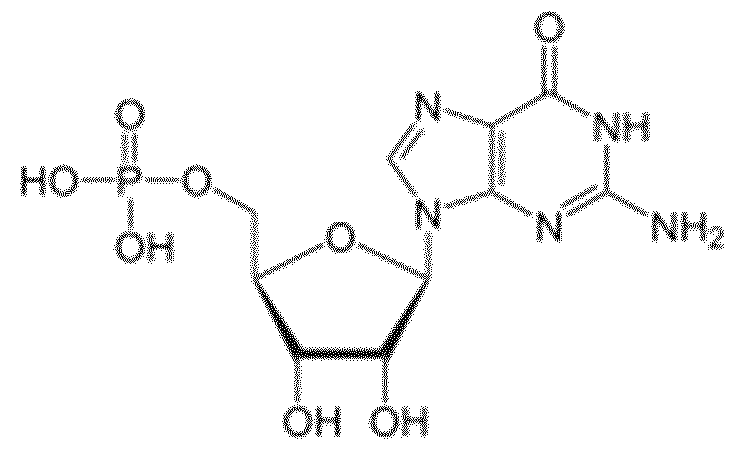
- IMP is the common abbreviation for inosine monophosphate. IMP is also known as 5'-inosinic acid or Hypoxanthine ribotide. IMP has the molecular formula C10H13N4O8P and the following structural formula: GMP is the common abbreviation for Guanosine monophosphate. GMP is also known as 5 - guanidylic acid or guanylic acid. GMP has the molecular formula C HuNsOsP and the following structural formula:
- IMP and GMP have been used as flavour enhancers in certain foods and their disodium salts are available as a mixture known as disodium 5'-ribonucleotides, with E number E635.
- the multivalent metal that provides the cations of the salt is iron, owing to the widespread need for its fortification and the difficulties in formulating in food products using its conventional salts.
- the multivalent iron cations are selected from Fe 3+ , Fe 2+ and combinations thereof, most preferably the salt is a salt of Fe 3+ (i.e. an iron(lll) salt).
- the salt is preferably of general formula M1 w M2xM3 y M4zL a , wherein
- M3 is selected from H + , Na + , K + , NF * and combinations thereof,
- M4 is selected from Ca 2+ , Mg 2+ , Mn 2+ , and combinations thereof,
- L is one or more nucleotide dianions
- the mole fraction of iron (M1 +M2) in the cations of the salt is at least 0.5, more preferably at least 0.7, more preferably still at least 0.8, and most preferably from 0.9 to 1.
- the nucleotide dianion is preferably selected from IMP 2- , GMP 2- and combinations thereof. More preferably the salt is an iron(lll) salt of IMP, GMP or a combination thereof. Most preferably the salt is selected from a salt having the molecular formula Fe2(CioHiiN40sP)3. Fe2(CioHi2N50sP)3 or a combination thereof.
- At least 3% by weight of the iron (M1 + M2) in the particles is soluble in water at pH 2.0 and 23 °C.
- At least 3% by weight of the iron (M1 + M2) in the particles is soluble in water at pH 8.0 and 23 °C.
- less than 3% by weight of the iron (M1 + M2) in the particles is soluble in water at pH 6.0 and 23 °C.
- the term “food product” means foodstuffs for human consumption (including but not limited to spreads, dressings, seasonings, bouillons, soups, sauces, frozen foods, dairy products, confectionery, ice cream, side dishes, premixes intended to be frozen and consumed as ice cream or frozen confectionery), and beverages (including drinks, tea), that are ingested and assimilated to produce energy, stimulate growth, and/or maintain life.
- This definition also includes edible unit dose formats, ready to use meals, meal solutions, including any precursors (including concentrates) and components for the same.
- the food product preferably has a pH at 23°C of at least 3.0 to prevent that the multivalent iron in the particles is excessively soluble in the food product. More preferably the pH of the food product is at least 3.5, more preferably still at least 4.0, even more preferably at least 4.5 and most preferably at least 5.0.
- the food product preferably has a pH at 23°C of no more than 8.0 to prevent that the multivalent iron in the particles is excessively soluble in the food product. More preferably the pH of the food product is no more than 7.5, more preferably still no more than 7.0, even more preferably no more than 6.5 and most preferably no more tan 6.0.
- tea beverages means beverages that contain tea and/or herbal infusions, and precursors for the same including tea and/or herbs in infusion packages (such as tea bags), loose leaf tea and tea-based powders such as milk tea powders.
- tea refers to material from the leaves and/or stem of Camellia sinensis var. sinensis and/or Camellia sinensis var. assamica.
- “cereal-based beverages” means beverages that contain cereal material and precursors for the same including powders.
- “cereal material” is meant material derived from a cereal plant, especially a cereal plant selected from one or more of wheat, barley, rye, maize, rice, sorghum, millet and oats.
- dressings means food products for serving with other meal components or for mixing with salad, and includes mayonnaise and light mayonnaise at all fat levels, cold sauces, ketchup, mustard, salad dressings, and vinaigrettes.
- frozen confections means food products that are generally served for consumption in frozen form, and that usually contain water and sugar, and may contain dairy ingredients, oils and/or fats, fruit, fruit juice, fruit extracts, flavours, and other ingredients like nuts and chocolate; and includes ice cream, frozen dairy desserts, sorbets, water-ices, slushes, frozen drinks, non-dairy ice cream analogues, premixes, intermediaries and final products associated with the same.
- the term also encompasses composite frozen confections that include components for such as chocolate, and wafers.
- flavoury products means food products that generally contain table salt at a level of at least 0.5 wt% in a prepared product or are formulated to provide an equivalent salty taste, and include bouillons, seasonings, meal makers, hot and cold soups, sauces, gravies, meals and sides, cooking aids and concentrates (such as cubes or powders) for preparing any of the foregoing.
- concentrate refers to a dry composition (i.e. comprising no more than 20% water by weight of the concentrate) that can be used in the preparation of a foodstuff, or can be added to meal components as a seasoning.
- the food product of the present invention may be a savoury concentrate and can suitably be used in the preparation of e.g. sauces, soups, gravies etc., or it can be added to meal components as a seasoning.
- Sauces and seasonings have several advantages as vehicles for fortification with essential multivalent metals. They are traditionally part of the daily diet in most countries, widely consumed, reach vulnerable populations, and can be added to all kinds of foods.
- the food product of the present invention may be a beverage precursor, suitable for combination with water, milk or other edible liquid to prepare a beverage.
- the food product of the present invention offers the advantage that the iron contained therein is readily ingestible and preferably highly bioavailable. Furthermore, at least in some embodiments, the nucleotide salt particles contained in the food product do not give rise to unacceptable colour changes.
- the amount of the nucleotide salt particles in the food product will vary depending on the type and amount of iron in the particles, the size of a single serving of the food product and the recommended daily allowance of the multivalent iron for the person consuming the food product.
- One unit of the food product typically contains at least 0.01 mmol, more preferably from 0.02 to 0.2 mmol and most preferably 0.025 to 0.1 mmol of iron provided by the nucleotide salt.
- unit refers to the amount of food product that is provided in a single packaging unit and/or serving. In case multiple packaging units are packaged together (e.g. a plurality of wrapped bouillon blocks in a single box), the term “unit” refers to the amount of food product contained in the smallest packaging unit.
- the food product comprises the nucleotide salt particles in an amount of at least 0.002% by weight of the food product, more preferably at least 0.005% by weight, most preferably from 0.01% to 2% by weight.
- the concentrate preferably comprises from 0.01 to 70% of the nucleotide salt particles by weight of the concentrate, more preferably from 0.05 to 20% and most preferably from 0.1 to 5%.
- the nucleotide salt particles in the concentrate typically have a mass-weighted average diameter in the range of 0.1 to 5,000 pm, more preferably 1 to 1 ,000 pm and most preferably of 3 to 300 m.
- Particle size and particle size distribution measurement can be suitably done by using light scattering methods, such as static light scattering (e.g. using MastersizerTM by Malvern Panalytica), dynamic light scattering (e.g. Zetasizer NanoTM by Malvern Panalytica), and/or microscopy based methods such as scanning electron microscopy (e.g. MerlinTM by Carl Zeiss) or transmission electron microscopy (e.g. TECNAI-20TM by Philips), or a combination thereof if the particle size is very polydisperse.
- light scattering methods such as static light scattering (e.g. using MastersizerTM by Malvern Panalytica), dynamic light scattering (e.g. Zetasizer NanoTM by Malvern Panalytica), and/or microscopy
- the iron nucleotide salt particles are preferably prepared by a method involving wet chemical precipitation, also known as co-precipitation.
- Co-precipitation is a well-established process to produce various mixed organic and inorganic composite particles (see, for example, Moslehi et al. Journal of Functional Foods., 2022, 92, 105066. https://doi.org/10.1016/jjff.2022.105066, the disclosure of which is hereby incorporated by reference in its entirety).
- one or more soluble metal salts wherein at least one comprises the multivalent iron cations are dissolved together in water and mixed with an aqueous solution of a soluble salt comprising the nucleotide anions. Upon mixing, a chemical reaction take place leading to a precipitation of the multivalent iron nucleotide salt.
- the particles can be separated from the mixture and purified, for example by washing with water.
- the particles may be made from the soluble iron salts and the soluble nucleotide-containing salt by mixing solutions of them at very low or very high pH, and then adjusting the pH by addition of strong base or strong acid to a pH at which the multivalent iron nucleotide salt particles precipitate.
- the precipitation can be done using inverted emulsion or microemulsion methods. Additionally, or alternatively, the precipitation can be conducting under shear or/and sonication. Additionally, or alternatively, the precipitation can be done in the presence of a stabilising polymer as described, for example, in WO 2007/009536 A, the disclosure of which is hereby incorporated by reference in its entirety.
- the composition of the precipitated particles can be determined by using conventional methods for elemental analysis such as X-ray fluorescence (XRF), atomic absorption spectroscopy (AAS), and/or inductively coupled plasma (ICP) techniques: ICP-optical emission spectroscopy (ICP- OES), ICP-mass spectrometry (ICP-MS), Energy-Dispersive X-ray spectroscopy (EDXS), or combination of them.
- XRF X-ray fluorescence
- AAS atomic absorption spectroscopy
- ICP inductively coupled plasma
- ICP- OES ICP-optical emission spectroscopy
- ICP-MS ICP-mass spectrometry
- EDXS Energy-Dispersive X-ray spectroscopy
- the particles have to be separated from the reaction mixture and washed with water, or other solvent suitable for selectively solubilising the unreacted salts, to remove any unreacted soluble salts.
- EDXS is preferably used
- the food product typically comprises taste-imparting components.
- Taste-imparting components are preferably selected from amino acids, sugars, pieces of plant material and combinations thereof.
- the taste-imparting components are preferably contained in the concentrate in a concentration of at least 3% by weight of the concentrate, preferably 5% by weight of the concentrate, more preferably in a concentration of at least 10% and most preferably in a concentration of from 12 to 50%.
- the concentrate comprises at least 0.5% amino acids by weight of the concentrate. More preferably, the concentrate comprises from 1 to 35% amino acids, most preferably 5 to 30% amino acids.
- the amino acids can be selected from one or more tasteimparting amino acid or salt thereof. Particularly preferred are one or more amino acids selected from alanine, aspartate, glutamate, glycine, histidine, isoleucine, leucine, lysine, methionine, phenylalanine, proline, serine, theanine, tyrosine, tryptophan, and valine.
- glutamate owing to its ability to impart a umami taste.
- the pieces of plant material are preferably in the form of leaves, slices, florets, dices or other pieces.
- the concentrate preferably comprises 0 to 30%, more preferably 0.1 to 20% and even more preferably 1 to 10% by weight of the concentrate of the pieces of plant material.
- the pieces are pieces of plants selected from vegetables, herbs, spices and combinations thereof. Examples of sources of plant material include parsley, dill, basil, chamomile, chives, sage, rosemary, thyme, oregano, ginger, leek, garlic, onion, mushrooms, broccoli, cauliflower, tea, tomato, courgette, asparagus, bell pepper, egg plant, cucumber, carrot and coconut flesh.
- the concentrate is a beverage precursor
- the plant material may be tea material.
- the concentrate is a beverage precursor comprising tea material
- the concentrate preferably comprises at least 50% tea material by weight of the concentrate, more preferably at least 70% and most preferably from 90 to 99%.
- the sugars that can be used as taste-imparting component are preferably selected from monosaccharides, disaccharides and combinations thereof. More preferably the sugars are selected from sucrose, glucose, fructose, maltose, lactose and mixtures thereof. More preferably still the sugars are selected from sucrose, glucose, fructose and mixtures thereof. Most preferably the sugars comprise sucrose.
- the sugars may be included in the concentrate in substantially refined form and/or may be present as part of more complex ingredients of the concentrate such as, for example, cereal materials, maltodextrins, glucose syrups, milk powders and the like.
- the concentrate comprises the sugars in an amount of from 1 to 50% by weight of the concentrate, more preferably from 2 to 40%, more preferably still from 3 to 30% and most preferably from 4 to 20%.
- fat refers to fatty acid glycerol ester selected from triglycerides, diglycerides, monoglycerides, phosphoglycerides and combinations thereof.
- the concentrate of the present invention preferably contains at least 1 % fat by weight of the concentrate. More preferably, the concentrate contains 3 to 40% fat, most preferably 5 to 35% fat.
- the fat contained in the concentrate may be liquid, semi solid or solid.
- the fat contained in food concentrate has a solid fat content at 20°C (N20) of from 0 to 95%. Even more preferably, the fat has a N20 of at least 10% and most preferably the fat has a N20 of 25 to 90%.
- the solid fat content of the fat can suitably be determined using the method described in Animal and vegetable fats and oils -- Determination of solid fat content by pulsed NMR -- Part 1 : Direct method - ISO 8292-1 :2008.
- the fat comprises palm oil, palm kernel oil, fractionated palm oil, palm oil stearin, fully hydrogenated palm oil, shea oil, shea butter, shea oil stearin, coconut fat, cacao butter, tallow, chicken fat, butter fat, sunflower oil, rapeseed oil, soybean oil, linseed oil, olive oil or combinations of two or more thereof.
- the concentrate of the present invention preferably comprises at least 1 % polysaccharide by weight of the concentrate. More preferably, the concentrate contains 3 to 60% polysaccharide, most preferably 5 to 50% polysaccharide
- the polysaccharide may be a substantially refined polysaccharide such as a gum (e.g. guar gum, locust bean gum, xanthan gum, tara gum, gelan and mixtures thereof) and/or starch. Additionally or alternatively the polysaccharide may be part of a complex ingredient of the concentrate such as, for example, flour.
- the concentrates of the present invention are dry, wherein “dry” means that they comprise no more than 20% water by weight of the concentrate.
- the water content of the concentrate preferably does not exceed 10% by weight of the concentrate, more preferably does not exceed 8% and even more preferably the water content is from 0.01 to 6% by weight of the concentrate.
- the water activity (at 20 °C) of the concentrate is preferably in the range of 0.1 to 0.6. More preferably, the water activity is in the range of 0.15 to 0.4, most preferably in the range of 0.1 to 0.2.
- the water content of the concentrate and of salt particles, including the nucleotide salt particles, unless indicated otherwise, is determined by oven drying, e.g. using an EcocellTM drying oven without the continuous air function at 90 °C (3 days). It should be understood that the nucleotide salt particles for use in the present invention may contain small amounts of water (e.g. water of crystallisation) but where referring to any concentration or amount of a component of the particles (or salt), this is of the dry content of the particles. In contrast for the concentrate, amounts are by total weight of the concentrate (unless specified otherwise) including any water therein.
- the concentrate preferably comprises a table salt in addition to the nucleotide salt particles.
- table salt is meant salt comprising NaCI, KCI and mixtures thereof, most preferred is NaCI.
- the amount of table salt in the concentrate is at least 3% by weight of the concentrate, more preferably at least 5%, even more preferably at least 8%, still more preferably at least 10%, yet more preferably at least 15%, and even still more preferably at least 20%.
- the amount of table salt is at most 70% by weight of the concentrate, more preferably at most 60%, even more preferably at most 50%, and still more preferably at most 40%.
- the amount of NaCI in the savoury concentrate is at least 3% by weight of the concentrate, more preferably at least 5%, even more preferably at least 10%, still more preferably at least 15% and preferably at most 60%, more preferably at most 55%, and still more preferably at most 50%.
- the polysaccharide in the concentrate preferably comprise a starch component selected from native (ungelatinised) starch, pregelatinised starch, maltodextrin, modified starch and combinations thereof.
- the starch component is preferably present in the savoury concentrate in a concentration of 3 to 50% by weight of the concentrate, more preferably of 4 to 30% and most preferably of 5 to 25%.
- the starch component is preferably selected from native starch, maltodextrin, pregelatinised starch and combinations thereof. Even more preferably, the starch is selected from native starch, pregelatinised starch and combinations thereof.
- the starch component is native starch.
- the starch component typically has a mass weighted mean diameter in the range of 5-200 pm, more preferably of 10-100 pm, most preferably of 12-60 pm.
- the savoury concentrate comprises:
- the total inorganic salt comprises nucleotide salt particles.
- the inorganic salt preferably comprises, consists essentially of or consists of a mixture of table salt and the nucleotide salt particles.
- the inorganic salt comprises table salt in an amount of at least 50% by weight of the inorganic salt, more preferably at least 70%, more preferably still at least 85%, even more preferably at least 90% and most preferably from 95 to 99%.
- the savoury concentrate may be formulated to provide a savoury taste without containing substantial amounts of table salt.
- the savoury concentrate comprises:
- oligosaccharide-containing material selected from dry glucose syrup, maltodextrin and combinations thereof.
- the concentrate may be a beverage precursor.
- tea-beverage precursors or cereal-based beverage precursors Particularly preferred are precursors of cerealbased beverages as cereal-based beverages have good opacity and strong flavour that forms a robust base for masking any organoleptic effects of the nucleotide salt particles.
- the preferred beverage precursors comprise 20 to 80% cereal material by weight of the concentrate.
- the material may be flour, starch, extract or a mixture thereof.
- at least part of the cereal material is malted.
- malted wheat, barley or a mixture thereof Cereal material typically contributes a significant amount of polysaccharide to the concentrate and so the beverage precursor may contain at least 10% polysaccharide by weight of the concentrate, preferably at least 20% and most preferably 30 to 60% polysaccharide by weight of the concentrate.
- the concentrate can come in several forms or shapes: typical forms are free-flowing powders, granulates, shaped concentrates and pastes.
- the concentrate of the present invention is a shaped article, notably a shaped solid article.
- shaped solid articles include concentrates in the form of cubes, tablets or granules.
- the shaped article preferably has a mass in the range of 1 to 50 g, more preferably in the range of 2.5 to 30 g and most preferably of 3.2 to 24 g.
- the shaped concentrate article can suitably be provided in different forms.
- the article is provided in the form of a cuboid, more preferably in the form of a rectangular cuboid and most preferably in the form of a cube.
- the concentrate of the present invention preferably is a packaged concentrate.
- the concentrate is a savoury concentrate in the form of a shaped article, it is preferred that the article is packaged in a wrapper.
- Another aspect of the invention relates to a process for manufacturing the concentrate.
- the process comprises the steps of:
- the process preferably includes the addition of fat to the mixture in step (i).
- Other components that may suitably be added during step (i) include thickening agents, colouring and combinations thereof.
- the process preferably includes the addition of cereal material to the mixture in step (i).
- Other components that may suitably be added during step (i) include protein isolates, milk solids, cocoa powder, flavourings, food acids, colours, anti-caking agents, vitamins and combinations thereof.
- the mixture is shaped prior to packaging.
- the concentrate is preferably shaped by allowing the concentrate to solidify in a mould or by pressing the concentrate into a predefined shape (e.g. by extrusion or tabletting).
- the shaping preferably comprises a technique selected from the group consisting of compression, extrusion, roller compacting, granulation, agglomeration and combinations thereof.
- the invention also relates to a method for preparing a food product comprising dissolving and/or dispersing the food concentrate in an aqueous medium.
- the concentrate is a savoury concentrate
- the food product is a bouillon, a soup, a sauce, a gravy or a seasoned dish.
- the concentrate is a beverage precursor
- the food product is a beverage.
- the aqueous medium will be hot (greater than 60 °C) water but in some instances may be a semi-finished dish comprising water and other ingredients, or may be another aqueous liquid such as milk.
- the food concentrate is preferably dissolved and/or dispersed in the aqueous medium in a weight ratio of concentrate to aqueous medium of from 1 :2000 to 1 :4, more preferably from 1 :1000 to 1 :5 and most preferably 1 :500 to 1 :7.
- the term “comprising” encompasses the terms “consisting essentially of” and “consisting of”. Where the term “comprising” is used, the listed steps or options need not be exhaustive. Except in the examples and comparative experiments, or where otherwise explicitly indicated, all numbers are to be understood as modified by the word “about”. As used herein, the indefinite article “a” or “an” and its corresponding definite article “the” means at least one, or one or more, unless specified otherwise.
- This example demonstrates preparation and properties of multivalent iron nucleotide salt particles and their properties.
- Inosine 5'-monophosphate disodium salt hydrate (CioHiiN40sPNa2 xH20, IMP, >99 wt%), guanosine 5'-monophosphate disodium salt hydrate (CioHi2N50sPNa2 xH20, GMP, >99 wt%), Iron(lll) chloride (>97 wt%), hydrochloric acid (HCI) and sodium hydroxide (NaOH) were obtained from Merck Millipore (Billerica, MA, USA).
- the reactions were performed at room temperature mixing the stoichiometric ratios of the reactants: 3.1 :2 for FeIMP and FeGMP. Because FeC is the limiting solution, a small excess IMP and GMP solution was added, i.e., 3.1 times instead of 3.
- IMP and GMP solutions 2.07 mmol FeC in 250 ml deionised water (i.e. 8.30 mM) were prepared. Consequently, they were quickly added to solutions of 3.22 mmol IMP or GMP in 500 mL of deionised water (i.e. 6.43 mM) while stirring at 500 rpm. A turbid dispersion formed during addition of the FeC solution after a couple of seconds.
- XRD X-ray diffraction
- the precipitates were not dried but measured as dispersions in deionized water.
- Dispersions (5 pl) were added to a 400 mesh formvar/carbon grid (after discharging the grid) and incubated for 2 min at room temperature. The grid was washed with 5 pl deionized water and after 2 min the excess of water was removed with a blotting paper.
- the sample was negatively stained with 5 pL of 2% uranyl acetate, after 30 sec the excess was removed with a blotting paper and air-dried prior to measurement using a JEM-1400Plus (JEOL, MA, USA), operating at 120 kV.
- JEM-1400Plus JEOL, MA, USA
- the particle size distribution was obtained by analysis of TEM images using the Imaged software (Version 1.53t, Wayne Rasband, National Institutes of Health, USA).
- the dried salts were applied to a carbon adhesive tab attached to a sample holder and the excess powder was removed with compressed air.
- the sample was sputter-coated with 12 nm tungsten using a Leica SCD 500 (Vienna, Austria).
- SEM analysis was performed on FEI Magellan 400 (FEI, Eindhoven, The Netherlands), operating at 2 kV and 13 pA.
- Energy dispersive X-ray (EDX) analysis was performed using a SEM equipped with an EDX system (SEM-EDX). The measurements were performed on the thick powder sediments to obtain information about the homogeneity and the elemental composition.
- Elemental analysis of the particles was performed as follows: Carbon, nitrogen, and hydrogen were measured in duplicate using a Thermo Flash 2000 CHNS elemental analyzer based on the modified Dumas method. Phosphorus and iron were determined by ICP-AES analysis (Agilent 5110 VDV; Agilent Technologies, Tokyo, Japan), using scandium as an internal standard. The limit of detection (LCD) values of iron and phosphorus were respectively 0.05 and 0.20 mg/l, the limit of quantification (LOQ) values were 0.15 and 0.61 mg/l, respectively. The amount of iron dissolved from the particles as a function of pH was determined as follows: The FeIMP, and FeGMP salts were separately dispersed in deionised water to obtain final concentrations of 10 mg/ml.
- the pH of the dispersions was adjusted by automatic titration with 0.1 M HCI or 0.1 M NaOH in a pH-stat device (Metrohm, Herisau, Switzerland).
- the dispersions were incubated at 1000 rpm using an Eppendorf Thermomixer® F1.5 (Eppendorf, Hamburg, Germany) at pH values ranging from one to eleven (steps of one), for 2 hours at 23 °C. After incubation, the pH of each sample was measured again to determine the final pH.
- the samples were centrifuged at 15000 g for 10 min using an Eppendorf Centrifuge 5415 R and supernatants were isolated to measure the dissolved iron concentrations.
- the total iron in solution was quantified using a ferrozine-based colorimetric assay (Stookey, 1970). Binding of ferrous iron to 3-(2-pyridyl)-5-6-(bis(4-phenylsulfonic acid)-1 ,2,4-triazine (/.e. ferrozine) results in formation of a complex with absorbance A m ax at 565 nm. To ensure the reduction of ferric iron to ferrous state, an excess of ascorbic acid (50 pL, 100 mM) was added to 50 pl sample (isolated supernatant). After 30 min incubation, ferrozine (50 pl, 40 mM) was added.
- ascorbic acid 50 pL, 100 mM
- the dried salts showed different colors: FeIMP was yellow, and FeGMP orange.
- XRD analysis of the starting reagents i.e. sodium salt of IMP and GMP
- the XRD spectra only show noise, indicative for amorphous materials.
- the amorphous nature of these salts is suggested to be a result of the valence mismatch between iron (Fe 3+ ) and IMP (C HuIX OsP 2 '), and GMP (C H ⁇ NsOsP 2 '). Because of the valence mismatch a more complicated stoichiometry is required to reach neutrality, resulting in an amorphous matrix in a fast coprecipitation process.
- TEM analysis showed amorphous particles for both salts although different types of shapes and particle sizes were observed.
- FeIMP showed spherical particles ranging with an average size of about 100 nm, whereas FeGMP showed less spherical primary particles with an average diameter of about 50 nm that were more elongated, which is an indication for interactions between the particles.
- SEM-EDX was performed on the particle sediment to yield a qualitative idea of the elemental ratios. With SEM-EDX we confirmed homogeneous distribution of the elements O, P, C, N, and Fe for both FeIMP and FeGMP. However, because of the sample preparation technique, the samples show a rough surface. Therefore, SEM-EDX cannot be considered quantitative and we also performed elemental analysis by ICP-AES (Fe, P) and the elemental analyzer (H, C, N, S). Results of the elemental composition as determined by the elemental analyzer and ICP-AES are displayed in Table 1.
- the data in Table 3 shows that for FeIMP, significant dissolution of the particles was observed at pH ⁇ 3 and at pH > 6.
- the data in Table 4 similarly shows for FeGMP significant dissolution of iron at pH ⁇ 3 and at pH > 6.5.
- the low amount of soluble iron for FeGMP and FeIMP at pH 3-7 make them desirable as a fortification salt for food, as it could potentially lead to reduced iron- mediated reactivity in the food products.
- the increased iron solubility of the FeIMP and FeGMP salts in the gastric pH range (1-3) are indicative of better bio-accessibility in the gastric environment.
- a fortified seasoning cube composition and a comparative composition (without iron) are given in Table 5 where all amounts are % by weight.
- the amount of nucleotide salt from Example 1 (FeIMP or FeGMP), m, is selected to deliver 2.1 mg iron in each 4 g seasoning cube and depends on the exact composition of the nucleotide salt.
- the weight % of NaCI in the cube is adjusted to balance the amount of nucleotide salt.
- Test procedure - Off-colour formation is analysed in an accelerated off-colour test.
- Two cubes are put on a plastic holder and placed in a 100 ml glass jar. 1 g of water is added in the jar in such a way that the cube does not come into direct contact with the water.
- This procedure simulates typical storage conditions of commercial products, where the water content of seasoning cubes increases over time, but in an accelerated fashion.
- the jars are closed with a lid and placed in an oven at 40°C for the accelerated test. Colour is measured after 3 weeks.
- Colour measurements - Off-colour formation is analysed by a colour measurement as known in the art.
- a DigiEye Imaging system from VeriVide Ltd is preferably used for the measurements. From photographs under controlled and calibrated conditions the L*a*b* values are determined.
- a fortified low-sodium bouillon cube composition and a comparative composition (without iron) are given in Table 6 where all amounts are % by weight.
- the amount of nucleotide salt from Example 1 (FeIMP or FerGMP), n is selected to deliver 2.1 mg iron in each 8 g seasoning cube and depends on the exact composition of the nucleotide salt.
- the weight % of native starch in the cube is adjusted to balance the amount of nucleotide salt.
- compositions are prepared by combining sucrose, soybean oil, and colourants in a vessel with a mixer and mixing for 1 minute at 30 rpm. Subsequently tapioca starch, maltodextrin and other dry ingredients are added, and the mixture is mixed for 30 seconds at 60 rpm. Then the palm oil is liquified by heating, subsequently partly pre-crystallised in a votator, and added to the mixture. Finally the dried herbs and spices and vegetables and flavours, along with the nucleotide salt are added. The mixture is mixed for 3 minutes at 60 rpm. The resulting paste is extruded on paper packaging material, and subsequently mechanically wrapped into single bouillon cubes. The cubes are pasty, and have a weight of about 8 gram.
- a fortified cereal-based beverage precursor is prepared from a powder of malted barley, wheat flour, milk solids, sucrose, wheat gluten, table salt, soy protein isolate, acidity regulators and vitamins.
- To the powder is added an amount of nucleotide salt from Example 1 (FeIMP or FeGMP) selected to deliver 2.1 mg iron in each 20 g serving of the powder.
- the nucleotide salt particles are mixed into the powder to give a visibly homogenous mixture.
- 20 g of the beverage precursor is stirred into 200 ml of hot milk.
Landscapes
- Chemical & Material Sciences (AREA)
- Life Sciences & Earth Sciences (AREA)
- Food Science & Technology (AREA)
- Health & Medical Sciences (AREA)
- Polymers & Plastics (AREA)
- Engineering & Computer Science (AREA)
- Nutrition Science (AREA)
- Inorganic Chemistry (AREA)
- Proteomics, Peptides & Aminoacids (AREA)
- Molecular Biology (AREA)
- Biochemistry (AREA)
- Mycology (AREA)
- Dispersion Chemistry (AREA)
- Coloring Foods And Improving Nutritive Qualities (AREA)
Abstract
Description



Claims
Applications Claiming Priority (2)
| Application Number | Priority Date | Filing Date | Title |
|---|---|---|---|
| EP23153405 | 2023-01-26 | ||
| EP23153405.8 | 2023-01-26 |
Publications (1)
| Publication Number | Publication Date |
|---|---|
| WO2024156447A1 true WO2024156447A1 (en) | 2024-08-02 |
Family
ID=85121914
Family Applications (1)
| Application Number | Title | Priority Date | Filing Date |
|---|---|---|---|
| PCT/EP2023/086971 Ceased WO2024156447A1 (en) | 2023-01-26 | 2023-12-20 | Mineral-fortified food product |
Country Status (1)
| Country | Link |
|---|---|
| WO (1) | WO2024156447A1 (en) |
Citations (8)
| Publication number | Priority date | Publication date | Assignee | Title |
|---|---|---|---|---|
| US4806370A (en) | 1987-07-08 | 1989-02-21 | Takeda Chemical Industries, Ltd. | 5'-nucleotide seasoning composition and production thereof |
| JPH09234014A (en) | 1996-03-04 | 1997-09-09 | Takeda Chem Ind Ltd | Production of seasoning preparation |
| WO2007009536A1 (en) | 2005-07-15 | 2007-01-25 | Unilever N.V. | Iron fortified food product and additive |
| WO2010086192A1 (en) | 2009-01-27 | 2010-08-05 | Unilever Nv | Savoury food concentrate comprising a source of iron ions |
| WO2014135387A2 (en) | 2013-03-05 | 2014-09-12 | Unilever N.V. | Fortified savoury food concentrate |
| WO2016060411A1 (en) | 2014-10-13 | 2016-04-21 | 조향현 | Method for producing organic mineral and nucleic acid composite |
| WO2017108351A1 (en) | 2015-12-21 | 2017-06-29 | Unilever N.V. | Iron-fortified savoury concentrate |
| KR102156746B1 (en) | 2014-10-13 | 2020-09-16 | (주)비티엔 | Method for enlarging production efficiency of organic mineral using calcium as a catalyst |
-
2023
- 2023-12-20 WO PCT/EP2023/086971 patent/WO2024156447A1/en not_active Ceased
Patent Citations (8)
| Publication number | Priority date | Publication date | Assignee | Title |
|---|---|---|---|---|
| US4806370A (en) | 1987-07-08 | 1989-02-21 | Takeda Chemical Industries, Ltd. | 5'-nucleotide seasoning composition and production thereof |
| JPH09234014A (en) | 1996-03-04 | 1997-09-09 | Takeda Chem Ind Ltd | Production of seasoning preparation |
| WO2007009536A1 (en) | 2005-07-15 | 2007-01-25 | Unilever N.V. | Iron fortified food product and additive |
| WO2010086192A1 (en) | 2009-01-27 | 2010-08-05 | Unilever Nv | Savoury food concentrate comprising a source of iron ions |
| WO2014135387A2 (en) | 2013-03-05 | 2014-09-12 | Unilever N.V. | Fortified savoury food concentrate |
| WO2016060411A1 (en) | 2014-10-13 | 2016-04-21 | 조향현 | Method for producing organic mineral and nucleic acid composite |
| KR102156746B1 (en) | 2014-10-13 | 2020-09-16 | (주)비티엔 | Method for enlarging production efficiency of organic mineral using calcium as a catalyst |
| WO2017108351A1 (en) | 2015-12-21 | 2017-06-29 | Unilever N.V. | Iron-fortified savoury concentrate |
Non-Patent Citations (3)
| Title |
|---|
| KUSUMOTO KEN-ICHI ET AL.: "Japanese Traditional Miso and Koji Making", JOURNAL OF FUNGI, vol. 7, 2021, pages 579 |
| KUSUMOTO KEN-ICHI ET AL: "Japanese Traditional Miso and Koji Making", JOURNAL OF FUNGI, vol. 7, no. 7, 20 July 2021 (2021-07-20), pages 579, XP093061663, DOI: 10.3390/jof7070579 * |
| MOSLEHI ET AL., JOURNAL OF FUNCTIONAL FOODS., vol. 92, 2022, pages 105066, Retrieved from the Internet <URL:hftps://doi.org/10.1016/j.jff.2022.105066).> |
Similar Documents
| Publication | Publication Date | Title |
|---|---|---|
| Hurrell | How to ensure adequate iron absorption from iron-fortified food | |
| Hurrell et al. | Enhancing the absorption of fortification iron: A SUSTAIN task force report | |
| CN1236700C (en) | Food fortified with iron | |
| JPS62502655A (en) | Seasoning composition and its manufacturing method | |
| CA3000665C (en) | Iron-fortified tea preparations | |
| WO2013167506A1 (en) | Iron supplementation of rice kernels | |
| CN102366076A (en) | Fungus essence and manufacturing method thereof | |
| WO2017108351A1 (en) | Iron-fortified savoury concentrate | |
| US11278044B2 (en) | Iron supplementation of a bouillon concentrate | |
| EP0969747A1 (en) | Color stable iron fortified dry drink mixes, ready-to-drink beverages and foods other than beverages that optionally contain zinc | |
| KR20080069240A (en) | Salts of mineral nutrients stabilized with amino acids and / or ammonium salts, products and food supplements containing them and methods of obtaining them | |
| WO2003032741A1 (en) | Tea fortified with iron | |
| EP3048903B1 (en) | Iron supplementation of a bouillon concentrate | |
| Majeed et al. | Microencapsulation Can Be a Novel Tool in Wheat Flour with Micronutrients Fortification: Current Trends and Future Applications--a Review. | |
| EP3344053B1 (en) | Iron-fortified food composition | |
| EP3307091B1 (en) | Food compostion comprising iron nicotinate complex and phenolic chromophore compounds | |
| WO2004071218A2 (en) | Preparation and food product comprising an active phytase | |
| WO2013092336A1 (en) | Iron or zinc fortified food composition containing phytic acid | |
| WO2022048873A1 (en) | Iron-fortified food concentrate | |
| WO2022048952A1 (en) | Iron-fortified food product | |
| KR101721323B1 (en) | Method for producing grain tea using unpolished rice and rice bran and grain tea produced by same method | |
| EP2842434A1 (en) | Iron supplementation of a bouillon concentrate | |
| JP2004065016A (en) | Mineral-containing liquid, method for producing the same, and product using the same | |
| WO2023117292A1 (en) | Plant-derived iron-fortifying agent | |
| WO2023117291A1 (en) | Plant-derived iron-fortifying agent |
Legal Events
| Date | Code | Title | Description |
|---|---|---|---|
| 121 | Ep: the epo has been informed by wipo that ep was designated in this application |
Ref document number: 23837241 Country of ref document: EP Kind code of ref document: A1 |
|
| DPE1 | Request for preliminary examination filed after expiration of 19th month from priority date (pct application filed from 20040101) | ||
| WWE | Wipo information: entry into national phase |
Ref document number: 2501004879 Country of ref document: TH |
|
| WWE | Wipo information: entry into national phase |
Ref document number: 202537074723 Country of ref document: IN |
|
| WWP | Wipo information: published in national office |
Ref document number: 202537074723 Country of ref document: IN |
|
| NENP | Non-entry into the national phase |
Ref country code: DE |
|
| 122 | Ep: pct application non-entry in european phase |
Ref document number: 23837241 Country of ref document: EP Kind code of ref document: A1 |