WO2024150791A1 - 画像変換装置、画像変換方法及び画像変換プログラム - Google Patents
画像変換装置、画像変換方法及び画像変換プログラム Download PDFInfo
- Publication number
- WO2024150791A1 WO2024150791A1 PCT/JP2024/000419 JP2024000419W WO2024150791A1 WO 2024150791 A1 WO2024150791 A1 WO 2024150791A1 JP 2024000419 W JP2024000419 W JP 2024000419W WO 2024150791 A1 WO2024150791 A1 WO 2024150791A1
- Authority
- WO
- WIPO (PCT)
- Prior art keywords
- image
- nuclear medicine
- medicine examination
- pseudo
- examination
- Prior art date
- Legal status (The legal status is an assumption and is not a legal conclusion. Google has not performed a legal analysis and makes no representation as to the accuracy of the status listed.)
- Ceased
Links
Images


Classifications
-
- G—PHYSICS
- G01—MEASURING; TESTING
- G01T—MEASUREMENT OF NUCLEAR OR X-RADIATION
- G01T1/00—Measuring X-radiation, gamma radiation, corpuscular radiation, or cosmic radiation
- G01T1/16—Measuring radiation intensity
- G01T1/161—Applications in the field of nuclear medicine, e.g. in vivo counting
-
- G—PHYSICS
- G01—MEASURING; TESTING
- G01T—MEASUREMENT OF NUCLEAR OR X-RADIATION
- G01T1/00—Measuring X-radiation, gamma radiation, corpuscular radiation, or cosmic radiation
- G01T1/16—Measuring radiation intensity
- G01T1/161—Applications in the field of nuclear medicine, e.g. in vivo counting
- G01T1/164—Scintigraphy
-
- G—PHYSICS
- G06—COMPUTING OR CALCULATING; COUNTING
- G06T—IMAGE DATA PROCESSING OR GENERATION, IN GENERAL
- G06T1/00—General purpose image data processing
-
- G—PHYSICS
- G06—COMPUTING OR CALCULATING; COUNTING
- G06T—IMAGE DATA PROCESSING OR GENERATION, IN GENERAL
- G06T7/00—Image analysis
-
- G—PHYSICS
- G06—COMPUTING OR CALCULATING; COUNTING
- G06V—IMAGE OR VIDEO RECOGNITION OR UNDERSTANDING
- G06V10/00—Arrangements for image or video recognition or understanding
- G06V10/70—Arrangements for image or video recognition or understanding using pattern recognition or machine learning
Definitions
- This disclosure relates to an image conversion device, an image conversion method, and an image conversion program.
- Nuclear medicine tests are known as a diagnostic imaging method.
- nuclear medicine tests used to diagnose myocardial ischemia include SPECT (Single Photon Emission Computed Tomography) and PET (Positron Emission Tomography).
- Patent Document 1 describes a technology that targets the brain and estimates pseudo-images such as PET, which uses drugs, from images such as MRI (Magnetic Resonance Imaging), which does not use drugs.
- PET has limited detection sensitivity because radiation attenuates deep inside the body.
- PET has superior detection sensitivity compared to SPECT, but the cost of equipment is high, making it less versatile.
- This disclosure provides technology that can assist in diagnosis in nuclear medicine examinations.
- An image conversion device includes a memory unit that stores a model for generating a pseudo output image as it would be obtained by the second nuclear medicine test from an input image obtained by the first nuclear medicine test, the model being created by machine learning using a dataset including a first training image obtained by a first nuclear medicine test in which a radioactive substance is administered into the body, and a second training image obtained by a second nuclear medicine test in which a radioactive substance is administered into the body and which is different from the first nuclear medicine test, an acquisition unit that acquires an original image of a patient's organ obtained by the first nuclear medicine test, an image generation unit that generates a pseudo image of a patient's organ as it would be obtained by the second nuclear medicine test by inputting the original image into the model, and an output unit that outputs the pseudo image.
- An image conversion method includes obtaining an original image of a patient's organ obtained by a first nuclear medicine examination in which a radioactive substance is administered into the body, and using a dataset including a first training image obtained by the first nuclear medicine examination and a second training image obtained by a second nuclear medicine examination different from the first nuclear medicine examination in which a radioactive substance is administered into the body, generating a pseudo image of the patient's organ as if it were obtained by a second nuclear medicine examination by inputting the original image into a model for generating a pseudo output image as if it were obtained by a second nuclear medicine examination from an input image obtained by the first nuclear medicine examination, and outputting the pseudo image.
- An image conversion program is an image conversion program for causing a computer to function as an image conversion device, and causes a computer to execute the following operations: obtain an original image of a patient's organ obtained by a first nuclear medicine test in which a radioactive substance is administered into the body; use a dataset including a first learning image obtained by the first nuclear medicine test and a second learning image obtained by a second nuclear medicine test different from the first nuclear medicine test in which a radioactive substance is administered into the body; generate a pseudo image of the patient's organ as if it were obtained by a second nuclear medicine test by inputting the original image into a model for generating a pseudo output image as if it were obtained by a second nuclear medicine test from an input image obtained by the first nuclear medicine test; and output the pseudo image.
- a model is prepared for generating a pseudo output image obtained by a second nuclear medicine examination from an input image obtained by a first nuclear medicine examination, which is created by machine learning using a data set including a first learning image and a second learning image. Then, by inputting an original image obtained by the first nuclear medicine examination into the model, a pseudo image of the patient's organs as obtained by the second nuclear medicine examination is generated, and the pseudo image is output.
- the pseudo image is not obtained by the second nuclear medicine examination. In other words, a pseudo result of the second nuclear medicine examination can be obtained without performing the second nuclear medicine examination.
- the pseudo image can be used as an aid to diagnosis by doctors and the like.
- the patient can obtain a pseudo image simply by undergoing the first nuclear medicine examination, the burden of the examination on the patient can be reduced. As a result, diagnosis in nuclear medicine examinations can be supported.
- the dataset may include a first training image and a second training image showing organs of the same patient. This allows a dataset including the first training image and the second training image obtained from the same patient to be used for machine learning. As a result, the accuracy of the image conversion of the model is improved.
- the model may generate an output image that compensates for partial brightness reduction that occurs in the input image due to the influence of surrounding areas of the organ. In this case, the reduction in the amount of information in the output image is suppressed. As a result, the pseudo image generated as the output image can be effectively used as an aid to diagnosis by doctors and others.
- the model may generate an output image with a higher resolution than the input image. In this case, the amount of information in the output image is increased. As a result, the pseudo-image generated as the output image can be effectively used as an aid to diagnosis by doctors and others.
- the model may generate an output image with a wider field of view than the field of view of the input image. In this case, the amount of information in the output image is increased. As a result, the pseudo-image generated as the output image can be effectively used as an aid to diagnosis by doctors and others.
- the intensity of radiation used by the first nuclear medicine test may be different from the intensity of radiation used by the second nuclear medicine test. Even if the test methods are difficult to combine due to differences in radiation intensity, a pseudo image can be obtained based on the original image.
- the radioactive material used in the first nuclear medicine test may be different from the radioactive material used in the second nuclear medicine test. Even if the test methods are difficult to combine due to differences in radioactive materials, a pseudo image can be obtained based on the original image.
- the first nuclear medicine examination may be SPECT.
- the second nuclear medicine examination may be PET.
- SPECT image an original image obtained by SPECT.
- devices for performing SPECT are widely used, whereas devices for performing PET are not widely used due to their high cost.
- the diagnostic accuracy using PET images can be improved compared to the diagnostic accuracy using SPECT images.
- the diagnostic accuracy in nuclear medicine examinations can be improved.
- the organ may be the heart.
- the model may generate an output image that compensates for partial brightness loss that occurs in the area of the input image close to the liver. In this case, the amount of information in the output image is increased. As a result, the pseudo image generated as the output image can be effectively used as an aid to diagnosis by doctors and others.
- the image conversion device may further include a learning unit that creates a model through machine learning based on a dataset. If the environment allows for the preparation of a dataset, the process can be completed consistently from model creation to output image generation. As a result, the computational costs associated with machine learning can be reduced.
- This disclosure provides technology that can assist in diagnosis during nuclear medicine examinations.
- FIG. 1 is a block diagram illustrating the configuration of an image conversion device.
- FIG. 2 is a flowchart showing an example of the operation of the image conversion device.
- FIG. 3 is a diagram illustrating an example of the first learning image.
- FIG. 4 is a diagram illustrating an example of the second learning image.
- FIG. 5 is a diagram illustrating a SPECT image.
- FIG. 6 is a diagram illustrating a pseudo PET image.
- FIG. 7 is a diagram illustrating a PET image.
- FIG. 8 is a diagram illustrating an example of a hardware configuration of an image conversion device.
- FIG. 9 shows the SCS under myocardial loading conditions.
- FIG. 10 shows SCS in the resting state of the myocardium.
- FIG. 11 is a diagram showing the total score under myocardial stress conditions.
- FIG. 12 shows the total score in the resting state of the myocardium.
- the image conversion system is a computer system that supports the diagnosis of nuclear medicine examinations.
- Nuclear medicine examinations are examinations that image the accumulation of radioisotopes administered into the body in organs.
- the image conversion system generates a pseudo image in which a specific organ of a patient is pseudo-imaged from an original image in which the specific organ of the patient is imaged.
- the specific organ is the organ to be diagnosed. In this embodiment, the specific organ is described as the heart, which is to be diagnosed for ischemia.
- the original image is an image obtained by a first nuclear medicine examination.
- the pseudo image is a pseudo image that would be obtained by a second nuclear medicine examination that is different from the first nuclear medicine examination.
- the image conversion system provides the pseudo image to a terminal of a doctor, etc. The pseudo image can be used to assist the doctor, etc. in diagnosis.
- FIG. 1 is a block diagram illustrating the configuration of an image conversion system 1 according to an embodiment.
- the image conversion system 1 includes a first inspection device 2, a second inspection device 3, a terminal 4, and an image conversion device 10.
- the image conversion device 10 is connected to the first inspection device 2, the second inspection device 3, and the terminal 4 so as to be able to communicate with them.
- the first examination device 2 is a device that performs a first nuclear medicine examination in which a radioactive substance is administered into the body.
- the first examination device 2 is, for example, a device for performing SPECT.
- the first examination device 2 transmits images of the patient's organs obtained by the first nuclear medicine examination to the image conversion device 10.
- the second examination device 3 is a device that performs a second nuclear medicine examination in which a radioactive substance is administered into the body.
- the second examination device 3 is, for example, a device for performing PET.
- the second examination device 3 transmits images of the patient's organs obtained by the second nuclear medicine examination to the image conversion device 10.
- the first nuclear medicine study and the second nuclear medicine study are different from each other.
- the intensity of radiation used by the first nuclear medicine study is different from the intensity of radiation used by the second nuclear medicine study.
- the radioactive material used by the first nuclear medicine study is different from the radioactive material used by the second nuclear medicine study.
- the terminal 4 is a computer used by a medical professional such as a doctor.
- the terminal 4 is capable of displaying images on a display device, for example, and accepting input from a doctor or the like.
- the terminal 4 is a desktop personal computer, a laptop personal computer, a tablet terminal, or the like, but is not limited to these.
- the image conversion device 10 is a device that generates a pseudo image of a patient's organs from an original image of the patient's organs.
- the image conversion device 10 may be the same device as the terminal 4.
- the image conversion device 10 includes an image set acquisition unit 11, a data set creation unit 12, a learning unit 13, a memory unit 14, an acquisition unit 15, an image generation unit 16, and an output unit 17.
- the image set acquisition unit 11 is a functional element that acquires images from the first examination device 2 and the second examination device 3.
- the image set acquisition unit 11 acquires an image set including a first learning image obtained by a first nuclear medicine examination and a second learning image obtained by a second nuclear medicine examination for an organ of the same patient.
- the image set includes a plurality of first learning images and a plurality of second learning images.
- the dataset creation unit 12 is a functional element that creates a dataset based on an image set.
- the dataset creation unit 12 causes the terminal 4 to display an image set.
- the terminal 4 accepts an operation to select the same part of a patient's organ from the image set.
- the terminal 4 accepts an operation to select a first learning image showing the apex of the heart and a second learning image showing the apex of the heart at a position corresponding to the first learning image.
- the dataset creation unit 12 acquires information indicating the selection of the same part from the terminal 4.
- the dataset creation unit 12 creates a dataset including a pair of the first learning image and the second learning image showing the same part based on the information indicating the selection of the same part.
- the learning unit 13 is a functional element that creates a model for generating a pseudo output image obtained by the second nuclear medicine examination from an input image obtained by the first nuclear medicine examination, by machine learning using a data set.
- An example of a machine learning method is deep learning.
- the memory unit 14 is a non-transitory storage medium or storage device that stores the model created by the learning unit 13.
- the memory unit 14 may store images and the like acquired from the first inspection device 2 and the second inspection device 3.
- the memory unit 14 may be constructed as a single database or may be a collection of multiple databases. The location where the memory unit 14 is installed is not limited. For example, the memory unit 14 may be provided in a computer system separate from the image conversion system 1.
- the acquisition unit 15 is a functional element that acquires an original image of a patient's organ obtained by a first nuclear medicine examination from the first examination device 2.
- the first examination device 2 that acquired the original image may be the same as the device that acquired the first learning image, or it may be different.
- the image generating unit 16 is a functional element that generates a new image based on the original image and the model stored in the memory unit 14. For example, the image generating unit 16 inputs the original image into the model to generate a pseudo-image of the patient's organs as they would be obtained by the second nuclear medicine examination.
- the output unit 17 is a functional element that outputs the pseudo image to the terminal 4.
- the output unit 17 may output the original image together with the pseudo image to the terminal 4.
- the output destination of the output unit 17 may be a display device provided in the image conversion device 10, an external device, etc.
- Figure 2 is a flowchart showing an example of the operation of the image conversion device 10.
- the image conversion device 10 acquires an image set of the same patient.
- the image set acquisition unit 11 acquires an image set including a first learning image obtained by a first nuclear medicine examination and a second learning image obtained by a second nuclear medicine examination for the organs of the same patient.
- the image set acquisition unit 11 acquires an image set including a first learning image obtained by SPECT and a second learning image obtained by PET for the heart of the same patient.
- the number of patients and the number of image sets are not limited.
- the image set acquisition unit 11 may acquire image sets of 1,022 first learning images and 1,022 second learning images for 54 patients. The number of patients may be the number of cases.
- FIG. 3 is a diagram illustrating an example of a first training image.
- FIG. 3 shows three first training images L11, L12, and L13.
- the first training images L11, L12, and L13 show examples of cross-sectional views obtained by SPECT of the heart of the same patient.
- the first training image L11 shows the apex of the heart.
- the first training image L12 shows the mid-heart.
- the first training image L13 shows the base of the heart.
- FIG. 4 is a diagram illustrating an example of a second learning image.
- FIG. 4 shows three second learning images L21, L22, and L23.
- Second learning images L21, L22, and L23 show examples of cross-sectional views obtained by PET of the heart of the same patient.
- second learning image L21 shows the apex of the heart.
- Second learning image L22 shows the mid-heart.
- Second learning image L23 shows the base of the heart.
- the patient shown in the second learning images L21, L22, and L23 is the same patient as the patient shown in the first learning images L11, L12, and L13. Furthermore, the case shown in the second learning images L21, L22, and L23 is the same case as the case shown in the first learning images L11, L12, and L13. Furthermore, the parts shown in the second learning images L21, L22, and L23 are parts at positions corresponding to the first learning images L11, L12, and L13.
- the image conversion device 10 creates a dataset based on the image set.
- the dataset creation unit 12 displays the image set on the terminal 4.
- the terminal 4 accepts an operation to select the same part of the patient's organ from the image set.
- the terminal 4 accepts an operation to select a first learning image L11 showing the apex of the heart and a second learning image L21 showing the apex of the heart at a position corresponding to the first learning image.
- the terminal 4 also accepts an operation to select a first learning image L12 showing the mid-heart and a second learning image L22 showing the mid-heart at a position corresponding to the first learning image.
- the terminal 4 accepts an operation to select a first learning image L13 showing the base of the heart and a second learning image L23 showing the base of the heart at a position corresponding to the first learning image.
- the dataset creation unit 12 acquires information indicating the selection of the same part from the terminal 4. Based on the information indicating the selection of the same part, the dataset creation unit 12 creates a dataset including pairs of a first training image and a second training image showing the same part.
- the dataset includes a pair of a first training image L11 and a second training image L21, a pair of a first training image L12 and a second training image L22, and a pair of a first training image L13 and a second training image L23.
- the dataset includes 1022 pairs showing the same part of the heart for 54 patients.
- step S3 the image conversion device 10 performs machine learning using the dataset.
- the learning unit 13 creates a model for generating a pseudo output image obtained by the second nuclear medicine examination from an input image obtained by the first nuclear medicine examination, by machine learning using the dataset.
- the learning unit 13 performs deep learning using a dataset of 34 people (approximately 700 pairs) out of a dataset of 54 people (1022 pairs) as training data.
- the learning unit 13 stores the created model in the memory unit 14.
- step S4 the image conversion device 10 acquires an original image.
- the acquisition unit 15 acquires an original image of the patient's organ obtained by a first nuclear medicine examination from the first examination device 2.
- the acquisition unit 15 acquires a SPECT image of the patient's heart obtained by SPECT from the first examination device 2.
- FIG. 5 is a diagram illustrating a SPECT image.
- the SPECT image P1 shows a cross-sectional view of the heart obtained by SPECT.
- the SPECT image P1 includes a field of view V11, which is a circular region, and a region V12 outside the field of view.
- the left ventricle P11 appears in an annular shape in the SPECT image P1.
- the left ventricle P11 appears with a particularly high brightness.
- a region R1 is a region close to the liver.
- radiation is attenuated by the liver, etc.
- the brightness of the left ventricle P11 is lower than the brightness of other regions.
- the SPECT image P1 when used to diagnose myocardial ischemia, it is difficult to diagnose the region R1 because the brightness of the region R1 is low. As a result, there is a possibility that the region R1 will result in a false positive of myocardial ischemia.
- the right ventricle P12 overlapping with the left ventricle P11 appears as a C-shape in the SPECT image P1. The brightness of the right ventricle P12 is lower than the brightness of the left ventricle P11.
- the image conversion device 10 generates a pseudo image.
- the image generation unit 16 generates a new image based on the original image and the model stored in the memory unit 14.
- the image generation unit 16 generates a pseudo image of the patient's organs as if they were obtained by a second nuclear medicine examination by inputting the original image into the model.
- the pseudo image is not obtained by the second nuclear medicine examination.
- the image generation unit 16 generates a pseudo PET image of the patient's heart as if they were obtained by PET by inputting a SPECT image into the model.
- FIG. 6 is a diagram illustrating a pseudo PET image.
- the pseudo PET image P2 shows a cross-sectional view of a pseudo heart generated by the image conversion device 10.
- the left ventricle P21 appears in a circular ring shape.
- the left ventricle P21 appears with a particularly high brightness.
- Region R2 is a region corresponding to region R1 shown in FIG. 5. Of the brightness of the left ventricle P21, the brightness of region R2 is equivalent to the brightness of the other regions.
- the right ventricle P22 overlapping with the left ventricle P21 appears in a C-shape. The brightness of the right ventricle P22 is lower than the brightness of the left ventricle P21.
- SPECT image P1 obtained by SPECT
- pseudo PET image P2 generated in a pseudo manner
- the SPECT image P1 and the pseudo PET image P2 differ from each other in terms of, for example, brightness, resolution, and field of view.
- the brightness of the pseudo PET image P2 is higher than that of the SPECT image P1.
- the brightness of the left ventricle P21 is higher than that of the left ventricle P11.
- the brightness of region R2 is higher than that of region R1. That is, the model generates an output image that compensates for the partial brightness reduction that occurs in the input image due to the influence of surrounding areas of the organ. More specifically, the model generates an output image (pseudo PET image P2) that compensates for the partial brightness reduction that occurs in region R1, which is close to the liver, of the input image (SPECT image P1).
- the brightness of the right ventricle P22 is higher than that of the right ventricle P12.
- the resolution of the pseudo PET image P2 is higher than the resolution of the SPECT image P1.
- the edges of the left ventricle P21 are more clearly visible than the edges of the left ventricle P11. That is, the model generates an output image with a higher resolution than the input image.
- the field of view of the pseudo PET image P2 is wider than the field of view of the SPECT image P1.
- the field of view of the pseudo PET image P2 appears wider than the field of view V11 of the SPECT image P1. That is, the model generates an output image with a wider field of view than the field of view of the input image.
- the image conversion device 10 outputs the pseudo PET image to the terminal 4.
- the output unit 17 outputs the pseudo PET image P2 to the terminal 4.
- the output unit 17 may output the SPECT image P1 together with the pseudo PET image P2 to the terminal 4.
- the pseudo PET image P2 can be used as an aid to the diagnosis of a doctor or the like.
- a doctor can refer to the pseudo PET image P2 along with the SPECT image P1.
- FIG. 7 is a diagram illustrating a PET image.
- PET image P3 shows a cross-section of the heart obtained by PET.
- the left ventricle P31 appears in a circular ring shape.
- Region R3 corresponds to region R1 shown in FIG. 5.
- the brightness of region R3 is equivalent to the brightness of the other regions.
- the right ventricle P32 overlapping with the left ventricle P31 appears in a C-shape.
- the positions of the left ventricle P21 and the right ventricle P22 in the pseudo PET image P2 are similar to the positions of the left ventricle P31 and the right ventricle P22 in the PET image P3.
- the brightness of the pseudo PET image P2 is equivalent to the brightness of the PET image P3.
- the brightness of the left ventricle P21 is equivalent to the brightness of the left ventricle P31.
- the brightness of the region R2 is equivalent to the brightness of the region R3.
- the brightness of the right ventricle P22 is equivalent to the brightness of the right ventricle P32.
- the resolution of the pseudo PET image P2 is equivalent to the resolution of the PET image P3.
- the field of view of the pseudo PET image P2 is equivalent to the field of view of the PET image P3. Therefore, it can be said that the pseudo PET image P2 is similar to the PET image P3.
- the image conversion device 10 is realized by any combination of hardware and/or software. Each function may be realized by a single device that is physically and/or logically coupled, or may be realized by two or more devices that are physically and/or logically separated and directly and/or indirectly connected to each other and then realized by these multiple devices.
- FIG. 8 is a diagram showing an example of the hardware configuration of the image conversion device 10.
- the image conversion device 10 may be physically configured as a computer device including a processor 1001, a memory 1002, a storage 1003, a communication device 1004, an input device 1005, an output device 1006, a bus 1007, etc.
- Each function of the image conversion device 10 is realized by loading a specific software (program) onto hardware such as the processor 1001 and memory 1002, causing the processor 1001 to perform calculations and control communications via the communication device 1004 and the reading and/or writing of data in the memory 1002 and storage 1003.
- a specific software program
- the processor 1001 to perform calculations and control communications via the communication device 1004 and the reading and/or writing of data in the memory 1002 and storage 1003.
- the processor 1001 operates an operating system to control the entire computer.
- the processor 1001 may be configured as a central processing unit (CPU).
- various processes of the image conversion device 10 may be realized by the processor 1001.
- the processor 1001 also reads programs (program codes), software modules, and data from the storage 1003 and/or the communication device 1004 into the memory 1002, and executes various processes according to these.
- the function of executing various processes of the image conversion device 10 may be realized by a control program (image conversion program) stored in the memory 1002 and operated by the processor 1001, and may be similarly realized for other functional blocks. Note that various processes in the image conversion device 10 may be executed by one processor 1001, or may be executed simultaneously or sequentially by two or more processors 1001.
- Memory 1002 is a computer-readable recording medium and may be composed of at least one of, for example, ROM (Read Only Memory), EPROM (Erasable Programmable ROM), EEPROM (Electrically Erasable Programmable ROM), RAM (Random Access Memory), etc.
- ROM Read Only Memory
- EPROM Erasable Programmable ROM
- EEPROM Electrically Erasable Programmable ROM
- RAM Random Access Memory
- Storage 1003 is a computer-readable recording medium.
- Storage 1003 may be composed of at least one of a hard disk drive, a flexible disk, a magneto-optical disk, an optical disk such as a CD-ROM (Compact Disc ROM), etc.
- the above-mentioned storage medium may be, for example, a database including memory 1002 and/or storage 1003, a server, or other suitable medium.
- the communication device 1004 is a device for communicating between computers via a wired and/or wireless network. For example, some of the various processes of the image conversion device 10 may be realized by the communication device 1004.
- the input device 1005 is an input device (e.g., a keyboard, etc.) that accepts input from the outside.
- the output device 1006 is an output device (e.g., a display, etc.) that outputs to the outside.
- the above devices are connected by a bus 1007 for communicating information.
- the bus 1007 may be configured as a single bus, or may be configured with different buses between the devices.
- the first evaluation of the degree of correction of the pseudo PET image will be described with reference to Figures 9 and 10.
- the degree of correction of the pseudo PET image can be evaluated, for example, based on whether the pseudo PET image is more similar to the PET image than the SPECT image.
- the first evaluation uses visual scoring of myocardial ischemia by three physicians using SPECT images, pseudo PET images, and PET images from 20 cases.
- the first evaluation calculates the average value of the scoring results using the SPECT image, the pseudo PET image, and the PET image.
- the first evaluation determines a correction score indicating the degree of correction based on the average value of the scoring results.
- the first evaluation determines a correction score based on the closeness of the score of the SPECT image and the score of the pseudo PET image to the score of the PET image as a standard.
- the correction score is set to 1 (Good correction). In one example, if the score of the pseudo PET image is 3, the score of the SPECT image is 0, and the score of the PET image is 2, the correction score is set to 1.
- the correction score is set to -1 (bad correction). In one example, if the score of the pseudo-PET image is 0, the score of the SPECT image is 3, and the score of the PET image is 2, the correction score is set to -1.
- the correction score is set to 0 (Fare correction). In one example, if the score of the pseudo PET image is 3, the score of the SPECT image is 3, and the score of the PET image is 2, the correction score is set to 0.
- the first evaluation involves calculating a summed correction score (SCS), which is the sum of the correction scores for the 20 cases.
- SCS summed correction score
- Figure 9 shows the SCS when the myocardium is in a stressed state.
- Figure 10 shows the SCS when the myocardium is in a resting state.
- Figures 9 and 10 show the scaled SCS corresponding to the position of the heart modeled using polar coordinates.
- Figures 9 and 10 show the anterior wall H1, anterior wall H2, inferior wall H3, inferior wall H4, inferior septum H5, and anterior septum H6.
- the SCS values are high in the inferior wall H4, inferior septum H5, and anterior septum H6.
- the inferior wall H4, inferior septum H5, and anterior septum H6 have been corrected to be closer to the PET image.
- the second evaluation for diagnosing myocardial ischemia using SPECT images, pseudo-PET images, and PET images will be described with reference to Figures 11 and 12.
- the second evaluation uses visual scoring of myocardial ischemia using SPECT images, pseudo-PET images, and PET images from 20 cases by three doctors. For example, the second evaluation calculates a total score, which is the sum of the scoring results using the SPECT images, pseudo-PET images, and PET images. A high total score indicates a diagnosis of ischemia.
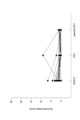
- FIG. 11 is a diagram showing the total score under myocardial stress conditions.
- FIG. 11 is a graph plotting the total scores of 20 cases.
- the horizontal axis indicates the type of image, and the vertical axis indicates the total score value.
- Diagnoses using PET images include high total scores. That is, diagnoses using PET images include cases diagnosed as ischemia.
- diagnoses using SPECT images and pseudo-PET images do not include cases that achieved a high total score with PET images.
- pseudo-PET images are generated based on SPECT images. Therefore, cases that do not achieve a high total score in diagnoses using SPECT images are unlikely to achieve a high total score in diagnoses using pseudo-PET images either.
- FIG. 12 is a diagram showing the total score in the resting state of the myocardium.
- FIG. 12 is a graph plotting the total scores of 20 cases.
- the horizontal axis indicates the type of image
- the vertical axis indicates the total score value.
- a high total score included in the diagnosis using SPECT images corresponds to a low total score included in the diagnosis using PET images. That is, the diagnosis using SPECT images includes cases in which ischemia is diagnosed, but not ischemia is diagnosed using PET images. In general, the diagnostic accuracy using PET images is higher than that using SPECT images. Therefore, a false positive may occur in a diagnosis using SPECT images. For this case, a diagnosis using pseudo-PET images results in a low total score. That is, for this case, a diagnosis using pseudo-PET images may not result in ischemia. Therefore, it can be said that a diagnosis using pseudo-PET images can improve specificity more than a diagnosis using SPECT images.
- the image conversion device 10 includes a memory unit 14 that stores a model for generating a pseudo output image obtained by the second nuclear medicine examination from an input image obtained by the first nuclear medicine examination, the model being created by machine learning using a dataset including a first training image obtained by a first nuclear medicine examination in which a radioactive substance is administered into the body, and a second training image obtained by a second nuclear medicine examination in which a radioactive substance is administered into the body and which is different from the first nuclear medicine examination, an acquisition unit 15 that acquires an original image obtained by the first nuclear medicine examination for a patient's organ, an image generation unit 16 that generates a pseudo image of the patient's organ as if it were obtained by the second nuclear medicine examination by inputting the original image into the model, and an output unit 17 that outputs the pseudo image.
- a memory unit 14 that stores a model for generating a pseudo output image obtained by the second nuclear medicine examination from an input image obtained by the first nuclear medicine examination, the model being created by machine learning using a dataset including a first training image obtained by
- An image conversion method includes obtaining an original image of a patient's organ obtained by a first nuclear medicine examination in which a radioactive substance is administered into the body, and using a dataset including a first training image obtained by the first nuclear medicine examination and a second training image obtained by a second nuclear medicine examination different from the first nuclear medicine examination in which a radioactive substance is administered into the body, generating a pseudo image of the patient's organ as if it were obtained by a second nuclear medicine examination by inputting the original image into a model for generating a pseudo output image as if it were obtained by a second nuclear medicine examination from an input image obtained by the first nuclear medicine examination, and outputting the pseudo image.
- An image conversion program is an image conversion program for causing a computer to function as an image conversion device 10, and causes a computer to execute the following operations: obtain an original image of a patient's organ obtained by a first nuclear medicine test in which a radioactive substance is administered into the body; use a dataset including a first learning image obtained by the first nuclear medicine test and a second learning image obtained by a second nuclear medicine test different from the first nuclear medicine test in which a radioactive substance is administered into the body; generate a pseudo image of the patient's organ as if it were obtained by a second nuclear medicine test by inputting the original image into a model for generating a pseudo output image as if it were obtained by a second nuclear medicine test from an input image obtained by the first nuclear medicine test; and output the pseudo image.
- a model is prepared for generating a pseudo output image obtained by the second nuclear medicine examination from an input image obtained by the first nuclear medicine examination, which is created by machine learning using a data set including a first learning image and a second learning image. Then, by inputting the original image obtained by the first nuclear medicine examination into the model, a pseudo image of the patient's organs as obtained by the second nuclear medicine examination is generated, and the pseudo image is output.
- the pseudo image is not obtained by the second nuclear medicine examination. In other words, a pseudo result of the second nuclear medicine examination can be obtained without performing the second nuclear medicine examination.
- the pseudo image can be used as an aid to diagnosis by a doctor or the like.
- the burden of the examination on the patient can be reduced. As a result, diagnosis in the nuclear medicine examination can be supported.
- the dataset includes a first training image and a second training image showing organs of the same patient. This allows the dataset including the first training image and the second training image obtained from the same patient to be used for machine learning. As a result, the accuracy of the image conversion of the model is improved.
- the model generates an output image that compensates for partial brightness reductions that occur in the input image due to the influence of areas surrounding the organ. In this way, the reduction in the amount of information in the output image is suppressed. This allows the pseudo-image generated as the output image to be effectively used as an aid to diagnoses by doctors and others.
- the model generates an output image with a higher resolution than the input image. In this case, the amount of information in the output image is increased. As a result, the pseudo-image generated as the output image can be effectively used as an aid to diagnosis by doctors and others.
- the model generates an output image with a wider field of view than the input image. In this case, the amount of information in the output image is increased. As a result, the pseudo-image generated as the output image can be effectively used as an aid to diagnosis by doctors and others.
- the intensity of radiation used by the first nuclear medicine test is different from the intensity of radiation used by the second nuclear medicine test. Even if the test methods are difficult to combine due to the difference in radiation intensity, a pseudo image can be obtained based on the original image.
- the radioactive material used in the first nuclear medicine test is different from the radioactive material used in the second nuclear medicine test. Even if the test methods are difficult to combine due to the difference in radioactive materials, a pseudo image can be obtained based on the original image.
- the first nuclear medicine examination is SPECT.
- the second nuclear medicine examination is PET.
- SPECT image an original image obtained by SPECT.
- devices for performing SPECT are widely used, whereas devices for performing PET are not widely used due to their high cost.
- the diagnostic accuracy using PET images can be improved compared to the diagnostic accuracy using SPECT images.
- the diagnostic accuracy in nuclear medicine examinations can be improved.
- the organ is the heart.
- the model generates an output image that compensates for the partial decrease in brightness that occurs in the area of the input image close to the liver. In this case, the amount of information in the output image is improved. As a result, the pseudo image generated as the output image can be effectively used as an aid to diagnosis by doctors and others.
- the image conversion device 10 further includes a learning unit 13 that creates a model by machine learning based on a dataset. If the environment allows for the preparation of a dataset, the process can be completed consistently from model creation to output image generation. As a result, the computational costs associated with machine learning can be reduced.
- the pseudo image is used to diagnose myocardial ischemia, but the pseudo image may be used, for example, to diagnose various cardiac diseases.
- the expression "transmitting data or information from a first computer to a second computer” refers to transmission for the purpose of ultimately delivering the data or information to the second computer.
- the above expression includes cases where another computer or communication device relays the data or information.
- a storage unit that stores a model for generating a pseudo output image, which is generated by machine learning using a dataset including a first learning image obtained by a first nuclear medicine examination in which a radioactive substance is administered into the body, and a second learning image obtained by a second nuclear medicine examination in which a radioactive substance is administered into the body and is different from the first nuclear medicine examination, from an input image obtained by the first nuclear medicine examination; and an acquisition unit that acquires an original image obtained by the first nuclear medicine examination of an organ of a patient; an image generating unit that generates a pseudo image of the patient's organ when obtained by the second nuclear medicine examination by inputting the original image into the model; an output unit that outputs the pseudo image;
- An image conversion device comprising:
- An image conversion device in which the model generates the output image with a wider field of view than the field of view of the input image.
- the first nuclear medicine examination is a SPECT
- the second nuclear medicine examination is a PET.
- Image conversion device Image conversion device according to (1) to (7).
- the organ is a heart
- the model generates the output image that compensates for partial brightness reduction occurring in a region of the input image adjacent to the liver.
- Image conversion device according to (1) to (8).
- An image conversion device according to any one of (1) to (9), further comprising a learning unit that creates the model by machine learning based on the dataset.
- (11) acquiring an original image of a patient's organ obtained by a first nuclear medicine examination in which a radioactive substance is administered into the body; using a data set including a first learning image obtained by the first nuclear medicine examination and a second learning image obtained by administering a radioactive substance into a body and performing a second nuclear medicine examination different from the first nuclear medicine examination, inputting the original image into a model for generating a pseudo output image when obtained by the second nuclear medicine examination from the input image obtained by the first nuclear medicine examination, thereby generating a pseudo image of the patient's organ when obtained by the second nuclear medicine examination; and outputting the pseudo image.
- Image conversion methods are used to convert images of an original image of a patient's organ obtained by a first nuclear medicine examination in which a radioactive substance is administered into the body; using a data set including a first learning image obtained by the first nuclear medicine examination and a second learning image obtained by administering a radioactive substance into a body and performing a second nuclear medicine examination different from the first nuclear medicine examination, inputting the original
- An image conversion program for causing a computer to function as an image conversion device, comprising: Obtaining an original image of a patient's organ obtained by a first nuclear medicine examination in which a radioactive substance is administered into the body; using a data set including a first learning image obtained by the first nuclear medicine examination and a second learning image obtained by administering a radioactive substance into a body and performing a second nuclear medicine examination different from the first nuclear medicine examination, inputting the original image into a model for generating a pseudo output image when obtained by the second nuclear medicine examination from the input image obtained by the first nuclear medicine examination, thereby generating a pseudo image of the patient's organ when obtained by the second nuclear medicine examination; outputting the pseudo-image.
- Image conversion program for causing a computer to function as an image conversion device, comprising: Obtaining an original image of a patient's organ obtained by a first nuclear medicine examination in which a radioactive substance is administered into the body; using a data set including a first learning image obtained by the first nuclear medicine examination and a second learning
- 1...image conversion system 2...first inspection device, 3...second inspection device, 4...terminal, 10...image conversion device, 11...image set acquisition unit, 12...data set creation unit, 13...learning unit, 14...memory unit, 15...acquisition unit, 16...image generation unit, 17...output unit.
Landscapes
- Engineering & Computer Science (AREA)
- Physics & Mathematics (AREA)
- General Physics & Mathematics (AREA)
- Health & Medical Sciences (AREA)
- Theoretical Computer Science (AREA)
- General Health & Medical Sciences (AREA)
- Medical Informatics (AREA)
- High Energy & Nuclear Physics (AREA)
- Computer Vision & Pattern Recognition (AREA)
- Optics & Photonics (AREA)
- Nuclear Medicine, Radiotherapy & Molecular Imaging (AREA)
- Molecular Biology (AREA)
- Spectroscopy & Molecular Physics (AREA)
- Biomedical Technology (AREA)
- Life Sciences & Earth Sciences (AREA)
- Artificial Intelligence (AREA)
- Computing Systems (AREA)
- Databases & Information Systems (AREA)
- Evolutionary Computation (AREA)
- Software Systems (AREA)
- Multimedia (AREA)
- Image Processing (AREA)
Priority Applications (1)
| Application Number | Priority Date | Filing Date | Title |
|---|---|---|---|
| JP2024570213A JPWO2024150791A1 (https=) | 2023-01-11 | 2024-01-11 |
Applications Claiming Priority (2)
| Application Number | Priority Date | Filing Date | Title |
|---|---|---|---|
| JP2023002460 | 2023-01-11 | ||
| JP2023-002460 | 2023-01-11 |
Publications (1)
| Publication Number | Publication Date |
|---|---|
| WO2024150791A1 true WO2024150791A1 (ja) | 2024-07-18 |
Family
ID=91896946
Family Applications (1)
| Application Number | Title | Priority Date | Filing Date |
|---|---|---|---|
| PCT/JP2024/000419 Ceased WO2024150791A1 (ja) | 2023-01-11 | 2024-01-11 | 画像変換装置、画像変換方法及び画像変換プログラム |
Country Status (2)
| Country | Link |
|---|---|
| JP (1) | JPWO2024150791A1 (https=) |
| WO (1) | WO2024150791A1 (https=) |
Citations (6)
| Publication number | Priority date | Publication date | Assignee | Title |
|---|---|---|---|---|
| JP2020060514A (ja) * | 2018-10-12 | 2020-04-16 | キヤノンメディカルシステムズ株式会社 | 医用画像処理装置及び医用画像処理方法 |
| JP2020091232A (ja) * | 2018-12-06 | 2020-06-11 | キヤノンメディカルシステムズ株式会社 | 医用画像処理装置、核医学診断装置、医用画像処理方法、および学習装置 |
| JP2020517946A (ja) * | 2017-04-25 | 2020-06-18 | ザ ボード オブ トラスティーズ オブ ザ レランド スタンフォード ジュニア ユニバーシティー | ディープ畳み込みニューラルネットワークを使用した医用画像化のための線量低減 |
| JP2021163493A (ja) * | 2020-03-31 | 2021-10-11 | カリフォルニア大学The Regents of the University of California | データ処理システム及び訓練済み機械学習ベースシステム作成方法 |
| WO2021260928A1 (ja) * | 2020-06-26 | 2021-12-30 | 株式会社島津製作所 | 吸収係数画像生成方法、核医学診断装置および学習済みモデルの作成方法 |
| WO2022245214A1 (en) * | 2021-05-21 | 2022-11-24 | Universiteit Maastricht | Method of performing radiomics analysis on image data |
-
2024
- 2024-01-11 JP JP2024570213A patent/JPWO2024150791A1/ja active Pending
- 2024-01-11 WO PCT/JP2024/000419 patent/WO2024150791A1/ja not_active Ceased
Patent Citations (6)
| Publication number | Priority date | Publication date | Assignee | Title |
|---|---|---|---|---|
| JP2020517946A (ja) * | 2017-04-25 | 2020-06-18 | ザ ボード オブ トラスティーズ オブ ザ レランド スタンフォード ジュニア ユニバーシティー | ディープ畳み込みニューラルネットワークを使用した医用画像化のための線量低減 |
| JP2020060514A (ja) * | 2018-10-12 | 2020-04-16 | キヤノンメディカルシステムズ株式会社 | 医用画像処理装置及び医用画像処理方法 |
| JP2020091232A (ja) * | 2018-12-06 | 2020-06-11 | キヤノンメディカルシステムズ株式会社 | 医用画像処理装置、核医学診断装置、医用画像処理方法、および学習装置 |
| JP2021163493A (ja) * | 2020-03-31 | 2021-10-11 | カリフォルニア大学The Regents of the University of California | データ処理システム及び訓練済み機械学習ベースシステム作成方法 |
| WO2021260928A1 (ja) * | 2020-06-26 | 2021-12-30 | 株式会社島津製作所 | 吸収係数画像生成方法、核医学診断装置および学習済みモデルの作成方法 |
| WO2022245214A1 (en) * | 2021-05-21 | 2022-11-24 | Universiteit Maastricht | Method of performing radiomics analysis on image data |
Also Published As
| Publication number | Publication date |
|---|---|
| JPWO2024150791A1 (https=) | 2024-07-18 |
Similar Documents
| Publication | Publication Date | Title |
|---|---|---|
| US11941812B2 (en) | Diagnosis support apparatus and X-ray CT apparatus | |
| US9275451B2 (en) | Method, a system, and an apparatus for using and processing multidimensional data | |
| JP4884528B2 (ja) | 腔部の画像を評定する方法、装置ならびにコンピュータプログラム製品 | |
| US20210166391A1 (en) | Method and system for identifying pathological changes in follow-up medical images | |
| CN105051784B (zh) | 对模拟准确度和性能的图像质量评估 | |
| US20110075900A1 (en) | Diagnosis assisting system, computer readable recording medium having diagnosis assisting program recorded thereon, and diagnosis assisting method | |
| CN108876794A (zh) | 体积图像数据中的动脉瘤与载瘤血管的隔离 | |
| CN114762057A (zh) | 医学成像系统中的自动化方案拟定 | |
| JP7568423B2 (ja) | 診断支援装置 | |
| Kara et al. | Quantitative assessment of left ventricular function and myocardial mass: a comparison of coronary CT angiography with cardiac MRI and echocardiography | |
| Ugurlu et al. | Cardiac digital twins at Scale from MRI: open tools and representative models from~ 55000 UK Biobank participants | |
| JP7626589B2 (ja) | 医用情報処理装置及び医用情報処理プログラム | |
| Shanbhag et al. | General purpose deep learning attenuation correction improves diagnostic accuracy of SPECT MPI: a multicenter study | |
| WO2024150791A1 (ja) | 画像変換装置、画像変換方法及び画像変換プログラム | |
| US20240395409A1 (en) | Information processing system, information processing method, and information processing program | |
| EP4358022B1 (en) | Medical image diagnostic system, medical image diagnostic method, and program | |
| US20230083134A1 (en) | Generating a temporary image | |
| JP2021175454A (ja) | 医用画像処理装置、方法およびプログラム | |
| Miller et al. | Current status and future directions in artificial intelligence for nuclear cardiology | |
| EP4497105A1 (en) | Deep learning-based medical image motion artifact correction | |
| US11645767B2 (en) | Capturing a misalignment | |
| CN113538395A (zh) | 图像处理方法、装置、设备、可读存储介质 | |
| Malin et al. | Library of realistic 4D digital beating heart models based on patient CT data | |
| Kar et al. | Comprehensive enhanced methodology of an MRI-based automated left-ventricular chamber quantification algorithm and validation in chemotherapy-related cardiotoxicity | |
| US20260024168A1 (en) | Imaging based on a set of medical-imaging modalities |
Legal Events
| Date | Code | Title | Description |
|---|---|---|---|
| 121 | Ep: the epo has been informed by wipo that ep was designated in this application |
Ref document number: 24741563 Country of ref document: EP Kind code of ref document: A1 |
|
| WWE | Wipo information: entry into national phase |
Ref document number: 2024570213 Country of ref document: JP |
|
| NENP | Non-entry into the national phase |
Ref country code: DE |
|
| 122 | Ep: pct application non-entry in european phase |
Ref document number: 24741563 Country of ref document: EP Kind code of ref document: A1 |