WO2024142854A1 - リアクトル、コンバータ、および電力変換装置 - Google Patents
リアクトル、コンバータ、および電力変換装置 Download PDFInfo
- Publication number
- WO2024142854A1 WO2024142854A1 PCT/JP2023/044031 JP2023044031W WO2024142854A1 WO 2024142854 A1 WO2024142854 A1 WO 2024142854A1 JP 2023044031 W JP2023044031 W JP 2023044031W WO 2024142854 A1 WO2024142854 A1 WO 2024142854A1
- Authority
- WO
- WIPO (PCT)
- Prior art keywords
- core portion
- core
- coil
- reactor
- distance
- Prior art date
- Legal status (The legal status is an assumption and is not a legal conclusion. Google has not performed a legal analysis and makes no representation as to the accuracy of the status listed.)
- Ceased
Links
Images





Classifications
-
- H—ELECTRICITY
- H01—ELECTRIC ELEMENTS
- H01F—MAGNETS; INDUCTANCES; TRANSFORMERS; SELECTION OF MATERIALS FOR THEIR MAGNETIC PROPERTIES
- H01F27/00—Details of transformers or inductances, in general
- H01F27/24—Magnetic cores
-
- H—ELECTRICITY
- H01—ELECTRIC ELEMENTS
- H01F—MAGNETS; INDUCTANCES; TRANSFORMERS; SELECTION OF MATERIALS FOR THEIR MAGNETIC PROPERTIES
- H01F27/00—Details of transformers or inductances, in general
- H01F27/24—Magnetic cores
- H01F27/255—Magnetic cores made from particles
-
- H—ELECTRICITY
- H01—ELECTRIC ELEMENTS
- H01F—MAGNETS; INDUCTANCES; TRANSFORMERS; SELECTION OF MATERIALS FOR THEIR MAGNETIC PROPERTIES
- H01F37/00—Fixed inductances not covered by group H01F17/00
Definitions
- FIG. 1 is a schematic perspective view showing a reactor according to a first embodiment.
- FIG. 2 is a schematic plan view showing the reactor according to the first embodiment.
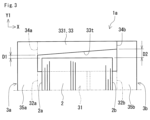
- FIG. 3 is a schematic plan view showing half of the reactor shown in FIG.
- FIG. 4 is a schematic plan view showing a reactor according to the second embodiment.
- FIG. 5 is a schematic plan view showing half of the reactor shown in FIG.
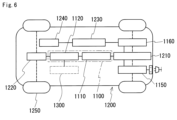
- FIG. 6 is a schematic diagram showing the power supply system of a hybrid vehicle.
- FIG. 7 is a circuit diagram showing a schematic diagram of a power conversion device including a converter.
- the magnetic properties of the first core and second core can be adjusted.
- the relative permeability of the first core lower than that of the second core, it is easier to obtain a specified inductance.
- the first core may be formed of a molded body of a composite material in which soft magnetic powder is dispersed in a resin.
- the second core may have a relative magnetic permeability of 100 or more and 500 or less.
- the second core may be formed of a powder compact.
- the converter of the present disclosure comprises: The reactor includes the reactor according to any one of (1) to (9) above.
- the reactor 1a includes a coil 2 and a magnetic core 3.
- the magnetic core 3 includes a first core 3a and a second core 3b. As shown in Fig. 2, the magnetic core 3 is configured by combining the first core 3a and the second core 3b.
- the magnetic core 3 is formed in a ⁇ shape by a middle core portion 31, a side core portion 33, and an end core portion 35.
- Fig. 1 is a perspective view of the reactor 1a seen from above.
- Fig. 2 is a plan view of the reactor 1a seen from above.
- Fig. 3 is a partial plan view showing only half of the reactor 1a shown in Fig. 2.
- the reactor 1a can reduce the loss in the coil 2 by making the second distance D2 larger than the first distance D1.
- the ratio D1/D2 of the first distance D1 to the second distance D2 equal to or greater than 0.32 and equal to or less than 0.70, the loss in the coil 2 can be effectively reduced while suppressing the decrease in inductance.
- the configuration of the reactor 1a will be described in detail below.
- the X-axis direction is along the axis of the coil 2, and is the direction from the first end face 2a to the second end face 2b.
- the Y-axis direction is the direction in which the middle core portion 31 and the side core portion 33 are arranged side by side, and is the direction from the middle core portion 31 to the side core portion 33.
- the Y-axis direction is perpendicular to the X-axis direction.
- the direction from the middle core portion 31 to the first side core portion 331 is the Y1 direction.
- the direction from the middle core portion 31 to the second side core portion 332 is the Y2 direction.
- the magnetic core 3 forms a closed magnetic circuit in a ⁇ shape.
- the magnetic flux generated by the coil 2 flows from the middle core portion 31, through the end core portion 35 and the side core portion 33, and back to the middle core portion 31.
- the dashed arrows in Figure 2 indicate the flow of magnetic flux. This is also the case in Figure 4, which will be described later.
- first middle core portion 31a and the first end core portion 35a are each separate and independent parts, for example, the first end 32a may be bonded to the first end core portion 35a, or at least a portion of the first middle core portion 31a and the first end core portion 35a may be integrated by being covered with a resin mold.
- the second middle core portion 31b and the second end core portion 35b may be molded integrally.
- the second middle core portion 31b and the second end core portion 35b are each independent separate parts, for example, the second end 32b may be bonded to the second end core portion 35b, or the second middle core portion 31b and the second end core portion 35b may be integrated by being at least partially covered with a resin mold.
- the resin mold is a molded member formed in a continuous manner so as to cover at least a portion of each of the first core 3a and the second core 3b.
- the first middle core portion 31a and the first end core portion 35a are molded integrally.
- the second middle core portion 31b and the second end core portion 35b are molded integrally.
- the length of each of the first middle core portion 31a and the second middle core portion 31b can be set as appropriate. In this embodiment, the length of the first middle core portion 31a is different from the length of the second middle core portion 31b.
- the first middle core portion 31a may be longer than the second middle core portion 31b.
- the length of the first middle core portion 31a may be shorter than the second middle core portion 31b.
- the length of the first middle core portion 31a may be the same as the length of the second middle core portion 31b.
- the middle core portion 31 has a gap portion 31g.
- the gap portion 31g is provided between the first middle core portion 31a and the second middle core portion 31b.
- the middle core portion 31 has the gap portion 31g, so that the inductance can be adjusted.
- the gap portion 31g is located within the coil 2.
- the leakage magnetic flux from the gap portion 31g is reduced compared to when the gap portion 31g is exposed from the coil 2. Therefore, it is easier to suppress the leakage magnetic flux from the gap portion 31g from interlinking with the coil 2.
- the loss caused by the leakage magnetic flux from the gap portion 31g can be reduced.
- the length of the gap portion 31g is appropriately set so as to obtain a predetermined inductance.
- the length of the gap portion 31g is, for example, 0.1 mm or more and 3 mm or less, 0.3 mm or more and 2.5 mm or less, or further 0.5 mm or more and 2 mm or less.
- the gap portion 31g may be an air gap.
- the gap portion 31g may be made of a non-magnetic material such as resin or ceramics.
- the length of the middle core portion 31 is the total length of the first middle core portion 31a, the length of the second middle core portion 31b, and the length of the gap portion 31g.
- the gap portion 31g may be omitted.
- the first middle core portion 31a and the second middle core portion 31b are in contact with each other, and there is substantially no gap between the first middle core portion 31a and the second middle core portion 31b.
- the end core portion 35 is disposed outside the coil 2.
- the end core portion 35 is disposed so as to face both end faces of the coil 2.
- the number of end core portions 35 is two.
- the end core portion 35 has a first end core portion 35a and a second end core portion 35b.
- the first end core portion 35a and the second end core portion 35b are disposed at an interval in the X-axis direction.
- the first end core portion 35a and the second end core portion 35b each have an inner surface facing each other.
- the first end core portion 35a faces the first end surface 2a of the coil 2.
- the first end core portion 35a is coupled to the first end core portion 35a.
- the second end core portion 35b faces the second end surface 2b of the coil 2.
- the second end core portion 35b is coupled to the second end core portion 32b of the middle core portion 31.
- the side core portion 33 has a first side core portion 331 and a second side core portion 332.
- the first side core portion 331 and the second side core portion 332 are arranged with a gap in the Y axis direction.
- the first side core portion 331 is arranged away from the middle core portion 31 in the Y1 direction.
- the second side core portion 332 is arranged away from the middle core portion 31 in the Y2 direction.
- the first side core portion 331 and the second side core portion 332 are arranged symmetrically with respect to the center line of the middle core portion 31.
- the side core portion 33 and the first end core portion 35a are integrally molded.
- the side core portion 33 and the first end core portion 35a may each be separate independent parts.
- the first end 34a may be bonded to the first end core portion 35a, or the side core portion 33 and the first end core portion 35a may be integrated by at least a portion of each being covered with a resin mold.
- the side core portion 33 and the second end core portion 35b are each separate independent parts.
- the side core portion 33 and the second end core portion 35b are integrated by a resin mold (not shown).
- the second end 34b of the side core portion 33 may be bonded to the second end core portion 35b.
- the interval between the first side core portion 331 and the coil 2 and the interval between the second side core portion 332 and the coil 2 are not constant along the X-axis direction.
- the interval between the side core portion 33 and the coil 2 is not constant along the entire length of the side core portion 33.
- the interval between the side core portion 33 and the coil 2 increases from the first end 34a toward the second end 34b.
- the interval between the side core portion 33 and the coil 2 refers to the interval between the inner surface of the side core portion 33 and the outer peripheral surface of the coil 2.
- the inner surface of the side core portion 33 is the surface that faces the outer peripheral surface of the coil 2.
- FIG. 3 shows only one half of the reactor 1a shown in FIG. 2, which is divided into two parts by the center line of the middle core portion 31, including the first side core portion 331.
- the interval between the first side core portion 331 and the coil 2 will be described with reference to FIG. 3, but the interval between the second side core portion 332 and the coil 2 is similar.
- the interval between the first side core portion 331 and the coil 2 is larger at the second end 34b than at the first end 34a.
- the first interval D1 refers to the interval between the inner surface located at the first end 34a among the inner surfaces of the first side core portion 331 and a virtual surface extending the outer circumferential surface of the coil 2.
- the second distance D2 refers to the distance between the inner surface located at the second end 34b of the inner surface of the first side core portion 331 and an imaginary plane extending from the outer circumferential surface of the coil 2. If the corner between the end face of the second end 34b and the inner surface is chamfered, it is considered that there is no chamfering. In other words, the distance between the corner between the extended surface of the end face of the second end 34b and the extended surface of the inner surface and the imaginary plane is considered to be the second distance D2.
- the ratio D1/D2 is 0.70 or less, the leakage flux to the coil 2 is sufficiently suppressed, so the loss of the coil 2 can be effectively reduced. If the ratio D1/D2 is too small, that is, if the second interval D2 is too large, there is a risk that the inductance will decrease, and it may be difficult to obtain a specified inductance. By having the ratio D1/D2 be 0.32 or more, it is easy to suppress the decrease in inductance.
- the ratio D1/D2 may further be 0.35 or more and 0.70 or less, or 0.40 or more and 0.60 or less.
- the side core portion 33 has a shape in which the width of the side core portion 33 narrows from the first end 34a to the second end 34b.
- the side core portion 33 only needs to have a width of the second end 34b narrower than the width of the first end 34a.
- the side core portion 33 only needs to have a narrower width at least in a portion between the first end 34a and the second end 34b, and may have a constant width in a portion between the first end 34a and the second end 34b.
- the width of the side core portion 33 is the dimension of the side core portion 33 in the Y-axis direction.
- the shape of the first side core portion 331 and the shape of the second side core portion 332 are symmetrical with respect to the center line of the middle core portion 31.
- the first side core portion 331 has a tapered shape.
- a tapered shape refers to a shape having a portion whose width continuously narrows from the first end 34a to the second end 34b.
- the first side core portion 331 is formed in a tapered shape over its entire length.
- the inner surface of the first side core portion 331 has an inclined surface 33t that is inclined with respect to the outer peripheral surface of the coil 2.
- the inclined surface 33t is inclined from the first end 34a to the second end 34b so as to move away from the outer peripheral surface of the coil 2.
- the angle of the inclined surface 33t with respect to the outer peripheral surface of the coil 2 is appropriately set so that the ratio of the first interval D1 to the second interval D2 satisfies a predetermined range.
- the angle of the inclined surface 33t refers to the angle between the inclined surface 33t and the outer peripheral surface of the coil 2.
- the outer peripheral surface of the coil 2 is parallel to the X-axis.
- the angle of the inclined surface 33t can be set appropriately depending on the length of the first side core portion 331.
- the angle of the inclined surface 33t is, for example, greater than or equal to 1° and less than 5°, and further greater than or equal to 2° and less than or equal to 4°.
- the magnetic core 3 is composed of a first core 3a and a second core 3b.
- the first core 3a has an E-shape
- the second core 3b has a T-shape.
- the magnetic core 3 is an E-T type composed of the E-shaped first core 3a and the T-shaped second core 3b.
- the first core 3a includes a first end core portion 35a and a side core portion 33.
- the first core 3a has a first end core portion 35a, a first middle core portion 31a, a first side core portion 331, and a second side core portion 332.
- the first middle core portion 31a, the first end core portion 35a, the first side core portion 331, and the second side core portion 332 are integrally molded. Since the first core 3a is an integrally molded product, the core portions constituting the first core 3a are made of the same material. That is, the magnetic properties of the core portions constituting the first core 3a are substantially the same.
- the shape of the first core 3a is E-shaped in a plan view.
- the second core 3b includes a second end core portion 35b.
- the second core 3b has a second end core portion 35b and a second middle core portion 31b.
- the second end core portion 35b and the second middle core portion 31b are integrally molded. Since the second core 3b is an integrally molded product, the core portions constituting the second core 3b are made of the same material. That is, the magnetic properties of the core portions constituting the second core 3b are substantially the same.
- the shape of the second core 3b is T-shaped in a plan view.
- At least one of the first core 3a and the second core 3b includes at least a portion of the middle core portion 31.
- the first core 3a may have the entire middle core portion 31.
- the second core 3b has only the second end core portion 35b.
- the shape of the second core 3b is I-shaped in plan view.
- the second core 3b may have the entire middle core portion 31.
- the first core 3a is composed of the first end core portion 35a, the first side core portion 331, and the second side core portion 332. In this case, the shape of the first core 3a is U-shaped in plan view.
- the relative permeability of the first core 3a is lower than that of the second core 3b. That is, in the magnetic core 3, the relative permeability of the side core portion 33 is lower than that of the second end core portion 35b.
- the relative permeability of each of the first core 3a and the second core 3b is appropriately set so as to obtain a predetermined inductance while satisfying the above relationship.
- the relative permeability of the first core 3a is, for example, 5 or more and 50 or less.
- the relative permeability of the second core 3b is, for example, 50 or more and 500 or less.
- the relative permeability of the first core 3a is in the range of 5 or more and 50 or less, and the relative permeability of the second core 3b is in the range of 50 or more and 500 or less, a predetermined inductance is easily obtained.
- the relative permeability of the first core 3a may be 10 or more and 45 or less, or even 15 or more and 40 or less.
- the relative permeability of the second core 3b may be 100 or more and 450 or less, or even 150 or more and 400 or less.
- the difference between the relative permeability of the first core 3a and the relative permeability of the second core 3b is, for example, not less than 50.
- the difference between the relative permeability of the first core 3a and the relative permeability of the second core 3b may be not less than 50 and not more than 450, or further not less than 100 and not more than 400.
- the relative permeability can be found as follows. A ring-shaped measurement sample is cut out from each of the first core 3a and the second core 3b. Each measurement sample is wound with 300 turns on the primary side and 20 turns on the secondary side.
- the magnetization curve referred to here is what is known as a DC magnetization curve.
- the first core 3a and the second core 3b are each composed of a molded body of a soft magnetic material.
- the molded body is, for example, a powder compact or a composite material compact.
- the first core 3a and the second core 3b are composed of molded bodies of different materials.
- the different materials include not only the case where the materials of the individual components are different in each molded body constituting the first core 3a and the second core 3b, but also the case where the materials of the individual components are the same but the contents of the components are different.
- the powder compact is formed by compressing and molding raw powder containing soft magnetic powder.
- the powder compact contains a larger amount of soft magnetic powder than the composite material compact. Therefore, the powder compact has higher magnetic properties than the composite material compact.
- the magnetic properties are, for example, the relative permeability and the saturation magnetic flux density.
- the powder compact may contain, for example, at least one of a binder resin and a molding aid.
- the soft magnetic powder content in the powder compact is, for example, 85% by volume or more and 99.99% by volume or less, when the powder compact is taken as 100% by volume.
- the particles constituting the soft magnetic powder are at least one type selected from the group consisting of soft magnetic metal particles, coated particles with an insulating coating on the outer periphery of soft magnetic metal particles, and soft magnetic nonmetal particles.
- the soft magnetic metal is, for example, pure iron or an iron-based alloy.
- the iron-based alloy is, for example, an Fe (iron)-Si (silicon) alloy or an Fe-Ni (nickel) alloy.
- the insulating coating is, for example, a phosphate.
- the soft magnetic nonmetal is, for example, a ferrite.
- the first core 3a is made of a composite material molded body.
- the second core 3b is made of a powder compact.
- the magnetic properties of the entire magnetic core 3 can be adjusted by making the first core 3a of a composite material molded body and the second core 3b of a powder compact.
- the relative permeability of the first core 3a is likely to be 5 or more and 50 or less.
- the relative permeability of the second core 3b is likely to be 100 or more and 500 or less.
- the side core portion 33 has a stepped shape.
- the stepped shape refers to a shape having a portion whose width gradually narrows from the first end 34a to the second end 34b.
- the inner surface of the first side core portion 331 has a step portion 33s.
- the step portion 33s is located at the center of the length of the first side core portion 331.
- the first side core portion 331 is divided into two regions by one step portion 33s. The region from the first end 34a to the step portion 33s is the first region 341. The region from the step portion 33s to the second end 34b is the second region 342.
- the width of the second region 342 is narrower than the width of the first region 341.
- the inner surfaces of the first region 341 and the second region 342 are each parallel to the outer circumferential surface of the coil 2.
- the distance between the inner surface of the second region 342 and the outer peripheral surface of the coil 2 is larger than the distance between the inner surface of the first region 341 and the outer peripheral surface of the coil 2.
- the width of the step 33s is appropriately set so that the ratio of the first distance D1 to the second distance D2 satisfies a predetermined range.
- the width of the step 33s corresponds to the distance along the Y-axis direction of the step 33s.
- the width of the step 33s is equal to the difference between the distance from the outer peripheral surface of the coil 2 to the inner surface of the second region 342 and the distance from the outer peripheral surface of the coil 2 to the inner surface of the first region 341.
- the width of the step 33s is represented by D2-D1.
- the width of the step 33s is, for example, 1 mm or more and less than 5 mm, and further 1.25 mm or more and 4 mm or less.
- the number of step portions 33s is one, but there may be multiple step portions 33s.
- the number of step portions 33s is n
- the number of regions constituting the side core portion 33 is n+1.
- the n+1th region is closer to the second end 34b than the nth region, and the width of the n+1th region is narrower than the width of the nth region. The width gradually narrows from the first region toward the n+1th region.
- the reactor of the embodiment can be used in applications that satisfy the following energization conditions: a maximum DC current of about 100 A to 1000 A, an average voltage of about 100 V to 1000 V, and an operating frequency of about 5 kHz to 100 kHz.
- the reactor of the embodiment can be used as a component of a converter mounted on a vehicle such as an electric vehicle or a hybrid vehicle, and as a component of a power conversion device including the converter.
- Magnetic core size Length L of magnetic core 3: 80 mm Width W of magnetic core 3: 65 mm Height H of magnetic core 3: 25 mm 1, the length L is the dimension of the magnetic core 3 in the X-axis direction, the width W is the dimension of the magnetic core 3 in the Y-axis direction, and the height H is the dimension of the magnetic core 3 in the Z-axis direction.
- each core portion 31 Length of middle core portion 31: 53 mm Width of middle core portion 31: 25 mm Length of each of the first side core portion 331 and the second side core portion 332: 53 mm Width of each of the first side core portion 331 and the second side core portion 332: 9 mm Length of each of the first end core portion 35a and the second end core portion 35b: 13.5 mm Width of each of the first end core portion 35a and the second end core portion 35b: 65 mm Length of gap portion 31g: 2 mm
- the length of each core portion is the dimension in the X-axis direction.
- the width of each core portion is the dimension in the Y-axis direction.
- the height of each core portion i.e., the dimension in the Z-axis direction, is 25 mm.
- the angles of the inclined surfaces in Samples No. 1-0 to 1-7 are shown in Table 1.
- the first distance D1, the second distance D2, and the ratio (D1/D2) of the first distance D1 to the second distance D2 for each sample are also shown in Table 1.
- the angle of the inclined surface 33t is 0°
- the distance between the side core portion 33 and the coil 2 is constant over the entire length of the side core portion 33.
- the ratio of the first distance D1 to the second distance D2 is 1.
- the first distance D1 and the second distance D2 in Sample No. 1-0 are each 2 mm.
- Table 2 shows the width of the step in the reactors of samples No. 2-0 to No. 2-4.
- Table 1 also shows the first distance D1, the second distance D2, and the ratio (D1/D2) of the first distance D1 to the second distance D2 for each sample.
- the width of the step 33s is 0 mm
- the distance between the side core portion 33 and the coil 2 is constant over the entire length of the side core portion 33.
- the ratio of the first distance D1 to the second distance D2 is 1.
- the first distance D1 and the second distance D2 are each 2 mm.
Landscapes
- Engineering & Computer Science (AREA)
- Power Engineering (AREA)
- Coils Or Transformers For Communication (AREA)
- Dc-Dc Converters (AREA)
Priority Applications (1)
| Application Number | Priority Date | Filing Date | Title |
|---|---|---|---|
| CN202380085002.2A CN120345044A (zh) | 2022-12-26 | 2023-12-08 | 电抗器、转换器及电力变换装置 |
Applications Claiming Priority (2)
| Application Number | Priority Date | Filing Date | Title |
|---|---|---|---|
| JP2022-208307 | 2022-12-26 | ||
| JP2022208307A JP7838470B2 (ja) | 2022-12-26 | 2022-12-26 | リアクトル、コンバータ、および電力変換装置 |
Publications (1)
| Publication Number | Publication Date |
|---|---|
| WO2024142854A1 true WO2024142854A1 (ja) | 2024-07-04 |
Family
ID=91717582
Family Applications (1)
| Application Number | Title | Priority Date | Filing Date |
|---|---|---|---|
| PCT/JP2023/044031 Ceased WO2024142854A1 (ja) | 2022-12-26 | 2023-12-08 | リアクトル、コンバータ、および電力変換装置 |
Country Status (3)
| Country | Link |
|---|---|
| JP (1) | JP7838470B2 (https=) |
| CN (1) | CN120345044A (https=) |
| WO (1) | WO2024142854A1 (https=) |
Citations (4)
| Publication number | Priority date | Publication date | Assignee | Title |
|---|---|---|---|---|
| JP2004031647A (ja) * | 2002-06-26 | 2004-01-29 | Sumida Corporation | インバータトランス |
| JP2006186195A (ja) * | 2004-12-28 | 2006-07-13 | Jfe Steel Kk | 磁気素子 |
| JP2012023090A (ja) * | 2010-07-12 | 2012-02-02 | Toyota Central R&D Labs Inc | リアクトル |
| JP2021141122A (ja) * | 2020-03-02 | 2021-09-16 | 株式会社オートネットワーク技術研究所 | リアクトル、コンバータ、及び電力変換装置 |
-
2022
- 2022-12-26 JP JP2022208307A patent/JP7838470B2/ja active Active
-
2023
- 2023-12-08 CN CN202380085002.2A patent/CN120345044A/zh active Pending
- 2023-12-08 WO PCT/JP2023/044031 patent/WO2024142854A1/ja not_active Ceased
Patent Citations (4)
| Publication number | Priority date | Publication date | Assignee | Title |
|---|---|---|---|---|
| JP2004031647A (ja) * | 2002-06-26 | 2004-01-29 | Sumida Corporation | インバータトランス |
| JP2006186195A (ja) * | 2004-12-28 | 2006-07-13 | Jfe Steel Kk | 磁気素子 |
| JP2012023090A (ja) * | 2010-07-12 | 2012-02-02 | Toyota Central R&D Labs Inc | リアクトル |
| JP2021141122A (ja) * | 2020-03-02 | 2021-09-16 | 株式会社オートネットワーク技術研究所 | リアクトル、コンバータ、及び電力変換装置 |
Also Published As
| Publication number | Publication date |
|---|---|
| JP7838470B2 (ja) | 2026-04-01 |
| CN120345044A (zh) | 2025-07-18 |
| JP2024092404A (ja) | 2024-07-08 |
Similar Documents
| Publication | Publication Date | Title |
|---|---|---|
| CN104969314B (zh) | 电抗器、转换器以及电力转换装置 | |
| CN115335932A (zh) | 电抗器、转换器以及电力变换装置 | |
| WO2013168538A1 (ja) | リアクトル、コンバータ、電力変換装置、および樹脂コア片の製造方法 | |
| CN116097379A (zh) | 电抗器、转换器以及电力转换装置 | |
| JP7566245B2 (ja) | リアクトル、コンバータ、及び電力変換装置 | |
| WO2024142854A1 (ja) | リアクトル、コンバータ、および電力変換装置 | |
| WO2024142855A1 (ja) | リアクトル、コンバータ、および電力変換装置 | |
| JP7698243B2 (ja) | リアクトル、コンバータ、及び電力変換装置 | |
| JP7630774B2 (ja) | リアクトル、コンバータ、及び電力変換装置 | |
| WO2023048104A1 (ja) | リアクトル、コンバータ、及び電力変換装置 | |
| JP7567740B2 (ja) | リアクトル、コンバータ、及び電力変換装置 | |
| WO2025028175A1 (ja) | リアクトル、コンバータ、および電力変換装置 | |
| WO2024190463A1 (ja) | コア片、リアクトル、コンバータ、および電力変換装置 | |
| JP2024178546A (ja) | コア片、リアクトル、コンバータ、および電力変換装置 | |
| JP7630773B2 (ja) | リアクトル、コンバータ、及び電力変換装置 | |
| WO2013141016A1 (ja) | リアクトル、コア部材、コア部材の製造方法、コンバータ、及び電力変換装置 | |
| US20240258025A1 (en) | Reactor, converter, and power converter device | |
| JP2026048824A (ja) | リアクトル、分割片、コンバータ、及び電力変換装置 | |
| WO2025182594A1 (ja) | リアクトル、コンバータ、および電力変換装置 | |
| WO2021193784A1 (ja) | リアクトル、コンバータ、及び電力変換装置 | |
| WO2024122509A1 (ja) | リアクトル、コンバータ、および電力変換装置 |
Legal Events
| Date | Code | Title | Description |
|---|---|---|---|
| 121 | Ep: the epo has been informed by wipo that ep was designated in this application |
Ref document number: 23911635 Country of ref document: EP Kind code of ref document: A1 |
|
| WWE | Wipo information: entry into national phase |
Ref document number: 202380085002.2 Country of ref document: CN |
|
| WWP | Wipo information: published in national office |
Ref document number: 202380085002.2 Country of ref document: CN |
|
| NENP | Non-entry into the national phase |
Ref country code: DE |
|
| 122 | Ep: pct application non-entry in european phase |
Ref document number: 23911635 Country of ref document: EP Kind code of ref document: A1 |