WO2024142460A1 - 眼鏡レンズの製造方法、眼鏡レンズ発注装置、眼鏡レンズ受注装置、および眼鏡レンズ受発注システム - Google Patents
眼鏡レンズの製造方法、眼鏡レンズ発注装置、眼鏡レンズ受注装置、および眼鏡レンズ受発注システム Download PDFInfo
- Publication number
- WO2024142460A1 WO2024142460A1 PCT/JP2023/029216 JP2023029216W WO2024142460A1 WO 2024142460 A1 WO2024142460 A1 WO 2024142460A1 JP 2023029216 W JP2023029216 W JP 2023029216W WO 2024142460 A1 WO2024142460 A1 WO 2024142460A1
- Authority
- WO
- WIPO (PCT)
- Prior art keywords
- contrast sensitivity
- optotype
- eyeglass lens
- wearer
- measurement
- Prior art date
- Legal status (The legal status is an assumption and is not a legal conclusion. Google has not performed a legal analysis and makes no representation as to the accuracy of the status listed.)
- Ceased
Links
Images









Classifications
-
- G—PHYSICS
- G02—OPTICS
- G02C—SPECTACLES; SUNGLASSES OR GOGGLES INSOFAR AS THEY HAVE THE SAME FEATURES AS SPECTACLES; CONTACT LENSES
- G02C7/00—Optical parts
- G02C7/02—Lenses; Lens systems ; Methods of designing lenses
- G02C7/06—Lenses; Lens systems ; Methods of designing lenses bifocal; multifocal ; progressive
-
- A—HUMAN NECESSITIES
- A61—MEDICAL OR VETERINARY SCIENCE; HYGIENE
- A61B—DIAGNOSIS; SURGERY; IDENTIFICATION
- A61B3/00—Apparatus for testing the eyes; Instruments for examining the eyes
- A61B3/02—Subjective types, i.e. testing apparatus requiring the active assistance of the patient
- A61B3/028—Subjective types, i.e. testing apparatus requiring the active assistance of the patient for testing visual acuity; for determination of refraction, e.g. phoropters
-
- A—HUMAN NECESSITIES
- A61—MEDICAL OR VETERINARY SCIENCE; HYGIENE
- A61B—DIAGNOSIS; SURGERY; IDENTIFICATION
- A61B3/00—Apparatus for testing the eyes; Instruments for examining the eyes
- A61B3/02—Subjective types, i.e. testing apparatus requiring the active assistance of the patient
- A61B3/022—Subjective types, i.e. testing apparatus requiring the active assistance of the patient for testing contrast sensitivity
-
- A—HUMAN NECESSITIES
- A61—MEDICAL OR VETERINARY SCIENCE; HYGIENE
- A61B—DIAGNOSIS; SURGERY; IDENTIFICATION
- A61B3/00—Apparatus for testing the eyes; Instruments for examining the eyes
- A61B3/02—Subjective types, i.e. testing apparatus requiring the active assistance of the patient
- A61B3/028—Subjective types, i.e. testing apparatus requiring the active assistance of the patient for testing visual acuity; for determination of refraction, e.g. phoropters
- A61B3/032—Devices for presenting test symbols or characters, e.g. test chart projectors
-
- A—HUMAN NECESSITIES
- A61—MEDICAL OR VETERINARY SCIENCE; HYGIENE
- A61B—DIAGNOSIS; SURGERY; IDENTIFICATION
- A61B3/00—Apparatus for testing the eyes; Instruments for examining the eyes
- A61B3/02—Subjective types, i.e. testing apparatus requiring the active assistance of the patient
- A61B3/028—Subjective types, i.e. testing apparatus requiring the active assistance of the patient for testing visual acuity; for determination of refraction, e.g. phoropters
- A61B3/04—Trial frames; Sets of lenses for use therewith
-
- G—PHYSICS
- G02—OPTICS
- G02C—SPECTACLES; SUNGLASSES OR GOGGLES INSOFAR AS THEY HAVE THE SAME FEATURES AS SPECTACLES; CONTACT LENSES
- G02C13/00—Assembling; Repairing; Cleaning
-
- G—PHYSICS
- G02—OPTICS
- G02C—SPECTACLES; SUNGLASSES OR GOGGLES INSOFAR AS THEY HAVE THE SAME FEATURES AS SPECTACLES; CONTACT LENSES
- G02C7/00—Optical parts
- G02C7/02—Lenses; Lens systems ; Methods of designing lenses
- G02C7/024—Methods of designing ophthalmic lenses
- G02C7/027—Methods of designing ophthalmic lenses considering wearer's parameters
-
- G—PHYSICS
- G02—OPTICS
- G02C—SPECTACLES; SUNGLASSES OR GOGGLES INSOFAR AS THEY HAVE THE SAME FEATURES AS SPECTACLES; CONTACT LENSES
- G02C7/00—Optical parts
- G02C7/02—Lenses; Lens systems ; Methods of designing lenses
- G02C7/06—Lenses; Lens systems ; Methods of designing lenses bifocal; multifocal ; progressive
- G02C7/061—Spectacle lenses with progressively varying focal power
-
- G—PHYSICS
- G02—OPTICS
- G02C—SPECTACLES; SUNGLASSES OR GOGGLES INSOFAR AS THEY HAVE THE SAME FEATURES AS SPECTACLES; CONTACT LENSES
- G02C7/00—Optical parts
- G02C7/02—Lenses; Lens systems ; Methods of designing lenses
- G02C7/06—Lenses; Lens systems ; Methods of designing lenses bifocal; multifocal ; progressive
- G02C7/061—Spectacle lenses with progressively varying focal power
- G02C7/063—Shape of the progressive surface
- G02C7/065—Properties on the principal line
-
- G—PHYSICS
- G02—OPTICS
- G02C—SPECTACLES; SUNGLASSES OR GOGGLES INSOFAR AS THEY HAVE THE SAME FEATURES AS SPECTACLES; CONTACT LENSES
- G02C2202/00—Generic optical aspects applicable to one or more of the subgroups of G02C7/00
- G02C2202/06—Special ophthalmologic or optometric aspects
Definitions
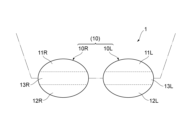
- the right eye spectacle lens 10R has a right eye distance portion 11R, a right eye near portion 12R formed at a position different from the right eye distance portion 11R, and a right eye progressive portion 13R formed between the right eye distance portion 11R and the right eye near portion 12R.
- the right eye distance portion 11R is formed at the top of the right eye spectacle lens 10R
- the right eye near portion 12R is formed at the bottom of the right eye spectacle lens 10R
- the right eye progressive portion 13R is formed in the middle of the right eye spectacle lens 10R.
- the right eye distance portion 11R has a refractive power suitable for distance vision.
- the right eye near portion 12R has a refractive power suitable for near vision.
- the right eye progressive portion 13R is designed so that the refractive power changes continuously from a refractive power suitable for far vision to a refractive power suitable for near vision as it moves from the side closer to the right eye distance portion 11R to the side closer to the right eye near portion 12R.
- power unit: diopter [D]
- prescribed power The power specified by the prescription value.
- additional power The power change relative to the distance power (refractive power suitable for far vision) is referred to as "addition power.”
- the left eye spectacle lens 10L has a left eye distance portion 11L, a left eye near portion 12L formed at a position different from the left eye distance portion 11L, and a left eye progressive portion 13L formed between the left eye distance portion 11L and the left eye near portion 12L.
- the left eye distance portion 11L is formed at the top of the left eye spectacle lens 10L
- the left eye near portion 12L is formed at the bottom of the left eye spectacle lens 10L
- the left eye progressive portion 13L is formed in the middle of the left eye spectacle lens 10L.
- the left eye distance portion 11L has a refractive power suitable for distance vision.
- the left eye near portion 12L has a refractive power suitable for near vision.
- multiple reference points are set on the spectacle lens 10.
- multiple reference points such as an optical center CL, a distance reference point FL, and a near reference point NL are set on the left-eye spectacle lens 10L.
- the optical center CL is the reference point that is the center of the design.
- the distance reference point FL is the measurement reference point when measuring the distance power (refractive power suitable for far vision) in the distance portion 11L for the left eye.
- the near reference point NL is the measurement reference point when measuring the near power (refractive power suitable for near vision) in the near portion 12L for the left eye.
- multiple reference points such as an optical center, a distance reference point, and a near reference point are set on the right-eye spectacle lens 10R, similar to the left-eye spectacle lens 10L.
- a distance portion having a refractive power suitable for far vision is formed in the upper part of the spectacle lens 10
- a near portion having a refractive power suitable for near vision is formed in the lower part of the spectacle lens 10.
- the spatial frequency is the number of cycles of a sine wave grating contained in an angular range of 1° centered on the position of the eye (e.g., the eye point or the center of rotation).
- the width of the lines constituting the characters is regarded as half the wavelength of the sine wave, and the spatial frequency of the visual target is calculated. Note that in Snellen letters, Sloan letters, the letter “E” on an E chart, and the letter “C” on a Landolt ring, the width of the lines constituting the characters and the spacing between the lines have constant values.
- the contrast sensitivity to a visual target varies depending on the spatial frequency of the visual target.
- the contrast C of the visual target can be expressed, for example, by the following formula (1).
- a target with black characters drawn on a white background if the luminance of the black part (minimum luminance Lmin) is 0, the contrast C of the target is 1 according to formula (1).
- the contrast C of the target is 0.75 according to formula (1). Note that the luminance is expressed as a gradation value of 256 gradations as an example.
- the minimum contrast of the target that can be recognized by the wearer is called the contrast threshold.
- Contrast sensitivity is the reciprocal of the contrast threshold. For example, if the contrast threshold is 0.1, the contrast sensitivity is 10. In addition, the contrast sensitivity is a different value depending on the spatial frequency of the target. Generally, if the spatial frequency of the target is 8 [cycles/deg] or more, the lower the spatial frequency, the higher the contrast sensitivity. It is also known that there are individual differences in contrast sensitivity to a specific spatial frequency and in differences in contrast sensitivity to multiple spatial frequencies.
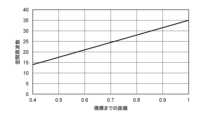
- the spatial frequency decreases as the distance to the optotype decreases. If a spectacle lens wearer has a higher contrast sensitivity to an optotype with a low spatial frequency compared to the contrast sensitivity to an optotype with a high spatial frequency, and can clearly see a closer object (visual object) through the spectacle lens, the contrast sensitivity to the visual object will be higher, and higher visibility will be possible.
- the add power at a specified position in the progressive portion between the distance portion and the near portion is designed to be higher than the standard add power. With this design, a closer visual object can be clearly seen through the progressive portion of the spectacle lens, and the contrast sensitivity to the visual object will be higher, and higher visibility will be possible. Therefore, by changing the distribution of the add power in the progressive portion of the spectacle lens according to the change in the wearer's contrast sensitivity corresponding to the change in the spatial frequency of the visual object, an appropriate spectacle lens can be designed.
- FIG. 4 shows an eyeglass lens ordering system 50.
- this eyeglass lens ordering system 50 is configured to have an ordering device 60 installed at an eyeglass store (orderer side), an order receiving device 70 installed at a lens manufacturer, a processing machine control device 80, and an eyeglass lens processing machine 85.
- the ordering device 60 and the order receiving device 70 are connected to be able to communicate with each other via a network 90 such as the Internet.
- the order receiving device 70 is also connected to the processing machine control device 80, and the processing machine control device 80 is connected to the eyeglass lens processing machine 85. Note that, for convenience of illustration, only one ordering device 60 is shown in FIG. 4, but in reality, multiple ordering devices 60 installed at multiple eyeglass stores are connected to the order receiving device 70.
- the order receiving device 70 is a computer that performs order processing and design processing for the eyeglass lenses 10, calculation processing of optical performance, etc.
- the order receiving device 70 is configured with a control unit 71, a memory unit 75, a communication unit 76, a display unit 77, and an input unit 78.
- the control unit 71 controls the order receiving device 70 by executing a program stored in the memory unit 75.
- the control unit 71 has an order processing unit 72 that performs order processing for the eyeglass lenses 10, and a design unit 73 that performs design processing for the eyeglass lenses 10.
- the memory unit 75 stores various data for eyeglass lens design in a readable manner.
- the communication unit 76 communicates with the ordering device 60 via the network 90.
- the communication unit 76 also communicates with the processing machine control device 80.
- the display unit 77 is configured with a display device such as a CRT or liquid crystal display.
- the display unit 77 displays the design results of the eyeglass lenses 10, etc.
- the input unit 78 is configured with a mouse, keyboard, etc.
- the display unit 77 and the input unit 78 may be integrated into one unit such as a touch panel.
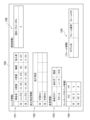
- FIG. 6 shows an example of an order screen 100.
- items related to the lens order power such as the product name of the lens to be ordered, spherical power (S power), cylindrical power (C power), cylindrical axis power, and add power, are input.
- the processing specification information field 102 is used to specify the outer diameter of the lens to be ordered or the thickness at an arbitrary point.
- the dyeing information field 103 is used to specify the color of the lens.
- the fitting point (FP) information 104 is used to input the position information of the wearer's eyes.
- PD represents the interpupillary distance.
- the frame information field 105 the frame model name, frame type, etc. are input.
- a numerical value indicating the design parameter Pc obtained based on the measurement result of the wearer's contrast sensitivity in the previous step S11 is input as information regarding the contrast sensitivity of the wearer.
- the design parameter Pc is expressed by a numerical value on a 10-level scale as an example (as a specific example, the case where the design parameter Pc is "4" is shown).
- the design parameter Pc will be described in detail later.
- the design parameter Pc may be set to an integer value between “-5" and “5", or may be set to an integer value between “0” and “10".
- the design parameter Pc is not limited to a numerical value, and may be classified using labels such as "A", "B", and "C”.
- Numeric values indicating the design parameters Pc corresponding to the right and left eyes may be input into the sensitivity information item 106.
- the sensitivity information item 106 may be input with information regarding the contrast sensitivity of the wearer, not limited to the design parameter Pc, but also with a numerical value indicating the contrast sensitivity of the wearer obtained when measuring the contrast sensitivity of the wearer, i.e., information regarding the contrast measurement results of the wearer.
- the process of receiving order information from the ordering device 60, the process of designing eyeglass lenses based on the received order information, and the process of outputting the design data for the eyeglass lenses to the processing machine control device 80 are performed by the control unit 71 of the order receiving device 70 executing a predetermined program pre-installed in the memory unit 75.
- At least two predetermined spatial frequencies may be used as the spatial frequency of the optotype used to measure contrast sensitivity.
- a black and white optotype i.e., an optotype with a contrast of 1
- the spatial frequency of the optotype used to measure contrast sensitivity may be set based on the size of the optotype.
- a black and white optotype (optotype with a contrast of 1) is referred to as a reference optotype.
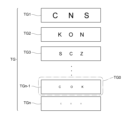
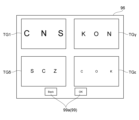
- FIG. 8 shows an example of a reference optotype. In the example shown in FIG. 8, letters such as the alphabet are used as the reference optotype TG. As mentioned above, the reference optotype TG is not limited to letters, and pictures, Landolt rings, Gabor patches, etc. may also be used. In this embodiment, multiple reference optotypes TG with different spatial frequencies may be referred to as reference optotypes TG1 to TGn (n is an integer of 2 or more).
- Contrast sensitivity varies depending on the spatial frequency of the visual target. It is known that under typical conditions, contrast sensitivity is maximized when the spatial frequency of the visual target is approximately 2 to 8 [cycles/deg].
- the first and second measurements of contrast sensitivity are performed using a visual target having a spatial frequency that is lower than the spatial frequency corresponding to the wearer's visual acuity and higher than the spatial frequency at which contrast sensitivity is maximized. Therefore, the coefficients ⁇ and ⁇ are adjusted so that the second spatial frequency f2 (and the first spatial frequency f1) is higher than 8 [cycles/deg].
- VA1 ⁇ x VA0
- VA2 ⁇ x VA1.
- the reference visual acuity VA0, the first visual acuity VA1, and the second visual acuity VA2 are expressed using decimal visual acuity.
- the reference visual acuity VA0, the first visual acuity VA1, and the second visual acuity VA2 may be expressed not only using decimal visual acuity, but also using fractional visual acuity or logarithmic visual acuity (LogMar: Logarithm of the Minimum angle of resolution).
- the contrast sensitivity based on the contrast of the first optotype TA0 having the minimum contrast that the wearer can view that is, the contrast sensitivity measured using the first optotypes TA1 to TAm, may be referred to as the first contrast sensitivity CSF1.
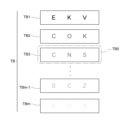
- the second visual targets TB1 to TB3 indicate the second visual target TB1 with the highest contrast, the second visual target TB2 with the second highest contrast, and the second visual target TB3 with the lowest contrast.
- the second targets TB1 to TBm indicate the second target TB1 with the greatest contrast, ... and the second target TBm with the smallest contrast.
- the display control unit 97 may also perform control to simultaneously display a plurality (e.g., four) of the reference optotypes TG1 to TGn, as shown in FIG. 12, for example. Specifically, the display control unit 97 may perform control to display on the screen of the display device 96 the reference optotype TG1 with the lowest spatial frequency, the reference optotype TG ⁇ with a higher spatial frequency than the reference optotype TG1, the reference optotype TG ⁇ with a higher spatial frequency than the reference optotype TG ⁇ , and the reference optotype TG ⁇ with a higher spatial frequency than the reference optotype TG ⁇ .
- the display control unit 97 may perform control to display on the screen of the display device 96 the reference optotype TG1 with the lowest spatial frequency, the reference optotype TG ⁇ with a higher spatial frequency than the reference optotype TG1, the reference optotype TG ⁇ with a higher spatial frequency than the reference optotype TG ⁇ , and the reference optotype TG ⁇ with a higher
- the display control unit 97 may perform control to display the second optotypes TB1 to TBm one by one in order of increasing contrast, or may perform control to display the second optotypes TB1 to TBm one by one in random order.
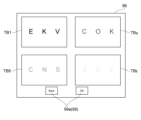
- the display control unit 97 may perform control to display a second optotype with a lower contrast than the second optotype when the wearer can see the second optotype displayed on the display device 96, and to display a second optotype with a higher contrast than the second optotype when the wearer cannot see the second optotype displayed on the display device 96.
- the display control unit 97 may also perform control to simultaneously display a plurality (e.g., four) of the second optotypes TB1 to TBm, as shown in FIG. 14, for example. Specifically, the display control unit 97 may perform control to display on the screen of the display device 96 the second optotype TB1 having the highest contrast, the second optotype TB ⁇ having a lower contrast than the second optotype TB1, the second optotype TB ⁇ having a lower contrast than the second optotype TB ⁇ , and the second optotype TB ⁇ having a lower contrast than the second optotype TB ⁇ .
- the display control unit 97 may perform control to display on the screen of the display device 96 the second optotype TB1 having the highest contrast, the second optotype TB ⁇ having a lower contrast than the second optotype TB1, the second optotype TB ⁇ having a lower contrast than the second optotype TB ⁇ , and the second optotype TB ⁇ having a lower contrast than the second optotype
- the measurement parameter B obtained using formula (3) is converted to the design parameter Pc.
- the design parameter Pc is a simple numerical parameter used in designing eyeglass lenses, which is set based on the change in contrast sensitivity (i.e., the measurement parameter B) previously measured for multiple wearers.
- the design parameter Pc may be set to an integer value between "-5" and "5", with 0 being the standard setting based on the average value of the change in contrast sensitivity previously measured for multiple wearers (i.e., the average value of the measurement parameter B).
- the design parameter Pc may be set to an integer value between "0" and "10" depending on the range of the measurement parameter B that can be measured in actual human vision in the relationship between the spatial frequency and contrast sensitivity approximated by formula (2).
- the measurement parameter B and the design parameter Pc may be calculated by a calculation unit (not shown) of the measurement device 95.
- the value of the coefficient A may be added to the calculation.
- a large value of the design parameter Pc means that the change in contrast sensitivity with respect to the change in the spatial frequency of the optotype is large.
- the design of the eyeglass lens 10 is optimized using a design parameter Pc based on the contrast sensitivity of the wearer.
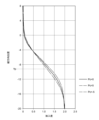
- a position (vertical position) Yp at which the value of the add power is changed in the eyeglass lens 10 is set.
- the vertical axis of the graph in FIG. 17 indicates the above-mentioned vertical position [mm] in the eyeglass lens 10.
- the horizontal axis of the graph in FIG. 17 indicates the add power [D] at each vertical position in the eyeglass lens 10.
- the position Yp at which the value of the add power is changed in the eyeglass lens 10 may be referred to as the add power changing position Yp.
- the add power change position Yp is set at a position between a position (vertical position) Yn at which the eyeglass lens 10 has the prescription power (add power) for near vision and a position (vertical position) Ye at which the line of sight passes on the eyeglass lens 10 when the eyeglasses are worn and the eye is looking horizontally.
- the position Yn at which the eyeglass lens 10 has the prescription power (add power) for near vision may be the position (vertical position) of the near reference point of the eyeglass lens 10.
- the position Ye at which the line of sight passes on the eyeglass lens 10 when the eyeglasses are worn and the eye is looking horizontally may be set at the coordinate position of the origin, or may be the position (vertical position) of the optical center of the eyeglass lens 10.
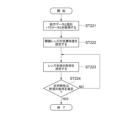
- the order receiving device 70 determines the overall lens shape of the eyeglass lens (step ST223). After determining the overall lens shape of the eyeglass lens, the order receiving device 70 judges whether the optical characteristics of the eyeglass lens, such as the refractive power and astigmatism, satisfy the desired conditions (step ST224). If the optical characteristics do not satisfy the desired conditions, i.e., if the judgment in step ST224 is NO, the process returns to the previous step ST223. If the optical characteristics satisfy the desired conditions, i.e., if the judgment in step ST224 is YES, the eyeglass lens design process ends. Once each process for designing the eyeglass lens (steps ST221 to ST224) is completed, the process for processing the eyeglass lens (step ST23) proceeds.
- the optical characteristics of the eyeglass lens such as the refractive power and astigmatism
- the first measurement of contrast sensitivity is performed using the first optotype TA
- the second measurement of contrast sensitivity is performed using the second optotype TB
- the third measurement of contrast sensitivity may be performed using a third optotype having a third spatial frequency different from the spatial frequencies of the first optotype TA and the second optotype TB, and it is sufficient to perform the measurement of contrast sensitivity using at least two optotypes having mutually different spatial frequencies.
Landscapes
- Health & Medical Sciences (AREA)
- Physics & Mathematics (AREA)
- Ophthalmology & Optometry (AREA)
- Life Sciences & Earth Sciences (AREA)
- General Health & Medical Sciences (AREA)
- General Physics & Mathematics (AREA)
- Optics & Photonics (AREA)
- Heart & Thoracic Surgery (AREA)
- Engineering & Computer Science (AREA)
- Biomedical Technology (AREA)
- Biophysics (AREA)
- Medical Informatics (AREA)
- Molecular Biology (AREA)
- Surgery (AREA)
- Animal Behavior & Ethology (AREA)
- Public Health (AREA)
- Veterinary Medicine (AREA)
- Eyeglasses (AREA)
- Eye Examination Apparatus (AREA)
- Testing Of Optical Devices Or Fibers (AREA)
Priority Applications (4)
| Application Number | Priority Date | Filing Date | Title |
|---|---|---|---|
| CN202380088408.6A CN120417827A (zh) | 2022-12-26 | 2023-08-10 | 眼镜镜片的制造方法、眼镜镜片订货装置、眼镜镜片接受订货装置以及眼镜镜片订货和接受订货系统 |
| JP2024567198A JPWO2024142460A1 (https=) | 2022-12-26 | 2023-08-10 | |
| EP23911244.4A EP4643760A1 (en) | 2022-12-26 | 2023-08-10 | Eyeglass lens production method, eyeglass lens ordering device, eyeglass lens order receiving device, and eyeglass lens ordering and order receiving system |
| US19/247,343 US20250321438A1 (en) | 2022-12-26 | 2025-06-24 | Eyeglass lens production method, eyeglass lens ordering device, eyeglass lens order receiving device, and eyeglass lens ordering and order receiving system |
Applications Claiming Priority (2)
| Application Number | Priority Date | Filing Date | Title |
|---|---|---|---|
| JP2022-207725 | 2022-12-26 | ||
| JP2022207725 | 2022-12-26 |
Related Child Applications (1)
| Application Number | Title | Priority Date | Filing Date |
|---|---|---|---|
| US19/247,343 Continuation US20250321438A1 (en) | 2022-12-26 | 2025-06-24 | Eyeglass lens production method, eyeglass lens ordering device, eyeglass lens order receiving device, and eyeglass lens ordering and order receiving system |
Publications (1)
| Publication Number | Publication Date |
|---|---|
| WO2024142460A1 true WO2024142460A1 (ja) | 2024-07-04 |
Family
ID=91717234
Family Applications (1)
| Application Number | Title | Priority Date | Filing Date |
|---|---|---|---|
| PCT/JP2023/029216 Ceased WO2024142460A1 (ja) | 2022-12-26 | 2023-08-10 | 眼鏡レンズの製造方法、眼鏡レンズ発注装置、眼鏡レンズ受注装置、および眼鏡レンズ受発注システム |
Country Status (5)
| Country | Link |
|---|---|
| US (1) | US20250321438A1 (https=) |
| EP (1) | EP4643760A1 (https=) |
| JP (1) | JPWO2024142460A1 (https=) |
| CN (1) | CN120417827A (https=) |
| WO (1) | WO2024142460A1 (https=) |
Citations (2)
| Publication number | Priority date | Publication date | Assignee | Title |
|---|---|---|---|---|
| JP3210575U (ja) * | 2017-02-28 | 2017-06-01 | 冴子 内田 | コントラストチャート |
| WO2021157001A1 (ja) | 2020-02-06 | 2021-08-12 | 株式会社ニコン・エシロール | 感受性の評価方法、眼鏡レンズの設計方法、眼鏡レンズの製造方法、眼鏡レンズ、眼鏡レンズ発注装置、眼鏡レンズ受注装置および眼鏡レンズ受発注システム |
-
2023
- 2023-08-10 EP EP23911244.4A patent/EP4643760A1/en active Pending
- 2023-08-10 CN CN202380088408.6A patent/CN120417827A/zh active Pending
- 2023-08-10 JP JP2024567198A patent/JPWO2024142460A1/ja active Pending
- 2023-08-10 WO PCT/JP2023/029216 patent/WO2024142460A1/ja not_active Ceased
-
2025
- 2025-06-24 US US19/247,343 patent/US20250321438A1/en active Pending
Patent Citations (2)
| Publication number | Priority date | Publication date | Assignee | Title |
|---|---|---|---|---|
| JP3210575U (ja) * | 2017-02-28 | 2017-06-01 | 冴子 内田 | コントラストチャート |
| WO2021157001A1 (ja) | 2020-02-06 | 2021-08-12 | 株式会社ニコン・エシロール | 感受性の評価方法、眼鏡レンズの設計方法、眼鏡レンズの製造方法、眼鏡レンズ、眼鏡レンズ発注装置、眼鏡レンズ受注装置および眼鏡レンズ受発注システム |
Non-Patent Citations (1)
| Title |
|---|
| See also references of EP4643760A1 |
Also Published As
| Publication number | Publication date |
|---|---|
| CN120417827A (zh) | 2025-08-01 |
| EP4643760A1 (en) | 2025-11-05 |
| JPWO2024142460A1 (https=) | 2024-07-04 |
| US20250321438A1 (en) | 2025-10-16 |
Similar Documents
| Publication | Publication Date | Title |
|---|---|---|
| JP6947480B2 (ja) | 人の矯正レンズ処方を決定するためのシステム及び装置 | |
| US12504647B2 (en) | Sensitivity evaluation method, ophthalmic lens design method, ophthalmic lens manufacturing method, ophthalmic lens, ophthalmic lens ordering device, ophthalmic lens order receiving device, and ophthalmic lens order receiving/ordering system | |
| US11428953B2 (en) | Method for designing spectacle lens, method for manufacturing spectacle lens, spectacle lens order sending device, spectacle lens order receiving device, spectacle lens order sending/receiving system, progressive power lens, and single focus lens | |
| EP1199553B1 (en) | A method, apparatus and memory medium for evaluating ocular optical lens | |
| US11754856B2 (en) | Method for designing eyeglass lens, method for manufacturing eyeglass lens, eyeglass lens, eyeglass lens ordering device, eyeglass lens order receiving device, and eyeglass lens ordering and order receiving system | |
| US20250110350A1 (en) | Sensitivity evaluation method and method for manufacturing one pair of eyeglass lenses | |
| JP2019109313A (ja) | 三次元顔画像の基準正面の設定方法、それを用いた眼鏡の選定方法及びそれを用いたカルテの作成方法 | |
| WO2024142460A1 (ja) | 眼鏡レンズの製造方法、眼鏡レンズ発注装置、眼鏡レンズ受注装置、および眼鏡レンズ受発注システム | |
| JP6311004B2 (ja) | 眼鏡レンズ供給システム、そのプログラム、プリズム量決定装置、プリズム量決定方法および眼鏡レンズの製造方法 | |
| WO2015125848A1 (ja) | 眼鏡レンズの供給システム、眼鏡レンズの供給方法、眼鏡レンズの供給プログラム、眼鏡レンズ推奨タイプ提示装置および眼鏡レンズの製造方法 | |
| EP4675343A1 (en) | System for determining an updated value of at least one characteristic of a head-mountable device | |
| JP2025031571A (ja) | 視線追跡較正と視力検査の同時実行 | |
| CN120225946A (zh) | 渐进多焦点镜片的确定方法 |
Legal Events
| Date | Code | Title | Description |
|---|---|---|---|
| 121 | Ep: the epo has been informed by wipo that ep was designated in this application |
Ref document number: 23911244 Country of ref document: EP Kind code of ref document: A1 |
|
| WWE | Wipo information: entry into national phase |
Ref document number: 2024567198 Country of ref document: JP |
|
| WWE | Wipo information: entry into national phase |
Ref document number: 202380088408.6 Country of ref document: CN |
|
| WWE | Wipo information: entry into national phase |
Ref document number: 2023911244 Country of ref document: EP |
|
| NENP | Non-entry into the national phase |
Ref country code: DE |
|
| WWP | Wipo information: published in national office |
Ref document number: 202380088408.6 Country of ref document: CN |
|
| ENP | Entry into the national phase |
Ref document number: 2023911244 Country of ref document: EP Effective date: 20250728 |
|
| ENP | Entry into the national phase |
Ref document number: 2023911244 Country of ref document: EP Effective date: 20250728 |
|
| WWP | Wipo information: published in national office |
Ref document number: 2023911244 Country of ref document: EP |