WO2024135207A1 - 光ファイバ着色被覆用の樹脂組成物、光ファイバおよび光ファイバリボン - Google Patents
光ファイバ着色被覆用の樹脂組成物、光ファイバおよび光ファイバリボン Download PDFInfo
- Publication number
- WO2024135207A1 WO2024135207A1 PCT/JP2023/041878 JP2023041878W WO2024135207A1 WO 2024135207 A1 WO2024135207 A1 WO 2024135207A1 JP 2023041878 W JP2023041878 W JP 2023041878W WO 2024135207 A1 WO2024135207 A1 WO 2024135207A1
- Authority
- WO
- WIPO (PCT)
- Prior art keywords
- meth
- resin layer
- optical fiber
- mass
- acrylate
- Prior art date
- Legal status (The legal status is an assumption and is not a legal conclusion. Google has not performed a legal analysis and makes no representation as to the accuracy of the status listed.)
- Ceased
Links
Images


Classifications
-
- C—CHEMISTRY; METALLURGY
- C09—DYES; PAINTS; POLISHES; NATURAL RESINS; ADHESIVES; COMPOSITIONS NOT OTHERWISE PROVIDED FOR; APPLICATIONS OF MATERIALS NOT OTHERWISE PROVIDED FOR
- C09D—COATING COMPOSITIONS, e.g. PAINTS, VARNISHES OR LACQUERS; FILLING PASTES; CHEMICAL PAINT OR INK REMOVERS; INKS; CORRECTING FLUIDS; WOODSTAINS; PASTES OR SOLIDS FOR COLOURING OR PRINTING; USE OF MATERIALS THEREFOR
- C09D7/00—Features of coating compositions, not provided for in group C09D5/00; Processes for incorporating ingredients in coating compositions
- C09D7/40—Additives
- C09D7/41—Organic pigments; Organic dyes
-
- C—CHEMISTRY; METALLURGY
- C03—GLASS; MINERAL OR SLAG WOOL
- C03C—CHEMICAL COMPOSITION OF GLASSES, GLAZES OR VITREOUS ENAMELS; SURFACE TREATMENT OF GLASS; SURFACE TREATMENT OF FIBRES OR FILAMENTS MADE FROM GLASS, MINERALS OR SLAGS; JOINING GLASS TO GLASS OR OTHER MATERIALS
- C03C25/00—Surface treatment of fibres or filaments made from glass, minerals or slags
- C03C25/10—Coating
- C03C25/104—Coating to obtain optical fibres
- C03C25/1065—Multiple coatings
-
- C—CHEMISTRY; METALLURGY
- C03—GLASS; MINERAL OR SLAG WOOL
- C03C—CHEMICAL COMPOSITION OF GLASSES, GLAZES OR VITREOUS ENAMELS; SURFACE TREATMENT OF GLASS; SURFACE TREATMENT OF FIBRES OR FILAMENTS MADE FROM GLASS, MINERALS OR SLAGS; JOINING GLASS TO GLASS OR OTHER MATERIALS
- C03C25/00—Surface treatment of fibres or filaments made from glass, minerals or slags
- C03C25/10—Coating
- C03C25/24—Coatings containing organic materials
-
- C—CHEMISTRY; METALLURGY
- C03—GLASS; MINERAL OR SLAG WOOL
- C03C—CHEMICAL COMPOSITION OF GLASSES, GLAZES OR VITREOUS ENAMELS; SURFACE TREATMENT OF GLASS; SURFACE TREATMENT OF FIBRES OR FILAMENTS MADE FROM GLASS, MINERALS OR SLAGS; JOINING GLASS TO GLASS OR OTHER MATERIALS
- C03C25/00—Surface treatment of fibres or filaments made from glass, minerals or slags
- C03C25/10—Coating
- C03C25/24—Coatings containing organic materials
- C03C25/26—Macromolecular compounds or prepolymers
- C03C25/28—Macromolecular compounds or prepolymers obtained by reactions involving only carbon-to-carbon unsaturated bonds
- C03C25/285—Acrylic resins
-
- C—CHEMISTRY; METALLURGY
- C03—GLASS; MINERAL OR SLAG WOOL
- C03C—CHEMICAL COMPOSITION OF GLASSES, GLAZES OR VITREOUS ENAMELS; SURFACE TREATMENT OF GLASS; SURFACE TREATMENT OF FIBRES OR FILAMENTS MADE FROM GLASS, MINERALS OR SLAGS; JOINING GLASS TO GLASS OR OTHER MATERIALS
- C03C25/00—Surface treatment of fibres or filaments made from glass, minerals or slags
- C03C25/10—Coating
- C03C25/465—Coatings containing composite materials
- C03C25/475—Coatings containing composite materials containing colouring agents
-
- C—CHEMISTRY; METALLURGY
- C03—GLASS; MINERAL OR SLAG WOOL
- C03C—CHEMICAL COMPOSITION OF GLASSES, GLAZES OR VITREOUS ENAMELS; SURFACE TREATMENT OF GLASS; SURFACE TREATMENT OF FIBRES OR FILAMENTS MADE FROM GLASS, MINERALS OR SLAGS; JOINING GLASS TO GLASS OR OTHER MATERIALS
- C03C25/00—Surface treatment of fibres or filaments made from glass, minerals or slags
- C03C25/10—Coating
- C03C25/48—Coating with two or more coatings having different compositions
- C03C25/50—Coatings containing organic materials only
-
- C—CHEMISTRY; METALLURGY
- C03—GLASS; MINERAL OR SLAG WOOL
- C03C—CHEMICAL COMPOSITION OF GLASSES, GLAZES OR VITREOUS ENAMELS; SURFACE TREATMENT OF GLASS; SURFACE TREATMENT OF FIBRES OR FILAMENTS MADE FROM GLASS, MINERALS OR SLAGS; JOINING GLASS TO GLASS OR OTHER MATERIALS
- C03C25/00—Surface treatment of fibres or filaments made from glass, minerals or slags
- C03C25/62—Surface treatment of fibres or filaments made from glass, minerals or slags by application of electric or wave energy; by particle radiation or ion implantation
- C03C25/6206—Electromagnetic waves
- C03C25/6226—Ultraviolet
-
- C—CHEMISTRY; METALLURGY
- C09—DYES; PAINTS; POLISHES; NATURAL RESINS; ADHESIVES; COMPOSITIONS NOT OTHERWISE PROVIDED FOR; APPLICATIONS OF MATERIALS NOT OTHERWISE PROVIDED FOR
- C09D—COATING COMPOSITIONS, e.g. PAINTS, VARNISHES OR LACQUERS; FILLING PASTES; CHEMICAL PAINT OR INK REMOVERS; INKS; CORRECTING FLUIDS; WOODSTAINS; PASTES OR SOLIDS FOR COLOURING OR PRINTING; USE OF MATERIALS THEREFOR
- C09D7/00—Features of coating compositions, not provided for in group C09D5/00; Processes for incorporating ingredients in coating compositions
- C09D7/40—Additives
- C09D7/60—Additives non-macromolecular
- C09D7/61—Additives non-macromolecular inorganic
-
- C—CHEMISTRY; METALLURGY
- C09—DYES; PAINTS; POLISHES; NATURAL RESINS; ADHESIVES; COMPOSITIONS NOT OTHERWISE PROVIDED FOR; APPLICATIONS OF MATERIALS NOT OTHERWISE PROVIDED FOR
- C09D—COATING COMPOSITIONS, e.g. PAINTS, VARNISHES OR LACQUERS; FILLING PASTES; CHEMICAL PAINT OR INK REMOVERS; INKS; CORRECTING FLUIDS; WOODSTAINS; PASTES OR SOLIDS FOR COLOURING OR PRINTING; USE OF MATERIALS THEREFOR
- C09D7/00—Features of coating compositions, not provided for in group C09D5/00; Processes for incorporating ingredients in coating compositions
- C09D7/40—Additives
- C09D7/60—Additives non-macromolecular
- C09D7/63—Additives non-macromolecular organic
-
- G—PHYSICS
- G02—OPTICS
- G02B—OPTICAL ELEMENTS, SYSTEMS OR APPARATUS
- G02B6/00—Light guides; Structural details of arrangements comprising light guides and other optical elements, e.g. couplings
- G02B6/02—Optical fibres with cladding with or without a coating
- G02B6/02395—Glass optical fibre with a protective coating, e.g. two layer polymer coating deposited directly on a silica cladding surface during fibre manufacture
-
- G—PHYSICS
- G02—OPTICS
- G02B—OPTICAL ELEMENTS, SYSTEMS OR APPARATUS
- G02B6/00—Light guides; Structural details of arrangements comprising light guides and other optical elements, e.g. couplings
- G02B6/44—Mechanical structures for providing tensile strength and external protection for fibres, e.g. optical transmission cables
-
- G—PHYSICS
- G02—OPTICS
- G02B—OPTICAL ELEMENTS, SYSTEMS OR APPARATUS
- G02B6/00—Light guides; Structural details of arrangements comprising light guides and other optical elements, e.g. couplings
- G02B6/44—Mechanical structures for providing tensile strength and external protection for fibres, e.g. optical transmission cables
- G02B6/4479—Manufacturing methods of optical cables
- G02B6/4482—Code or colour marking
Definitions
- the present disclosure relates to a resin composition for coloring and coating an optical fiber, an optical fiber, and an optical fiber ribbon.
- optical fibers have a coating resin layer to protect the glass fiber that transmits light.
- the coating resin layer has, for example, a primary resin layer and a secondary resin layer.
- the outermost layer of the coating resin layer is composed of a colored resin layer for identifying the optical fiber (see, for example, Patent Documents 1 to 3).
- the resin composition for optical fiber coloring coating contains a photopolymerizable compound, a photopolymerization initiator, a photosensitizer, and an organic pigment
- the photosensitizer includes at least one selected from the group consisting of anthracene-based photosensitizers and naphthalene-based photosensitizers
- the content of the photosensitizer is 0.01 parts by mass or more and less than 3.00 parts by mass per 100 parts by mass of the total amount of the photopolymerizable compound.
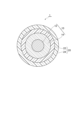
- FIG. 1 is a schematic cross-sectional view showing an example of an optical fiber according to the present embodiment.
- FIG. 2 is a schematic cross-sectional view showing an example of the optical fiber according to the present embodiment.
- FIG. 3 is a schematic cross-sectional view showing an example of an optical fiber ribbon according to the present embodiment.
- Optical fibers are sometimes used in the form of an optical fiber ribbon in which a plurality of optical fibers are arranged and integrated with a ribbon resin.
- the colored resin layer may peel off from the optical fiber, i.e., the so-called "color peeling" may occur.
- color peeling is likely to occur.
- An object of the present disclosure is to provide a resin composition for coloring coating of optical fibers, which can produce optical fibers that are resistant to color peeling even in the presence of organic pigments, as well as an optical fiber and an optical fiber ribbon.
- the present disclosure provides a resin composition for colored coating of optical fiber, an optical fiber, and an optical fiber ribbon that can produce optical fiber that is resistant to color peeling even in the presence of organic pigments.
- a resin composition for coloring and coating an optical fiber according to one embodiment of the present disclosure contains a photopolymerizable compound, a photopolymerization initiator, a photosensitizer, and an organic pigment, the photosensitizer includes at least one selected from the group consisting of anthracene-based photosensitizers and naphthalene-based photosensitizers, and the content of the photosensitizer is 0.01 parts by mass or more and less than 3.00 parts by mass per 100 parts by mass of the total amount of the photopolymerizable compound.
- the anthracene-based photosensitizer may contain at least one selected from the group consisting of 9,10-diethoxyanthracene, 9,10-dibutoxyanthracene, and 9,10-bis(octanoyloxy)anthracene.
- the naphthalene-based photosensitizer may contain 1,4-diethoxynaphthalene in order to prevent color peeling.
- the organic pigment may contain at least one pigment selected from the group consisting of phthalocyanine pigments and azo pigments, in order to prevent color peeling.
- titanium oxide may be further contained in order to color the resin layer.
- An optical fiber comprises a glass fiber including a core and a cladding, a primary resin layer that contacts the glass fiber and coats the glass fiber, a secondary resin layer that coats the primary resin layer, and a colored resin layer that coats the secondary resin layer, the colored resin layer containing a cured product of the resin composition described in any one of (1) to (5) above.
- Such an optical fiber is less susceptible to color peeling by applying the resin composition to the colored resin layer.
- An optical fiber according to one embodiment of the present disclosure comprises a glass fiber including a core and a cladding, a primary resin layer that contacts the glass fiber and covers the glass fiber, and a secondary resin layer that covers the primary resin layer, the secondary resin layer containing a cured product of the resin composition described in any one of (1) to (5) above.
- an optical fiber ribbon In an optical fiber ribbon according to one aspect of the present disclosure, a plurality of optical fibers as described in (6) or (7) above are arranged in parallel and coated with a ribbon resin. Such an optical fiber ribbon is less likely to suffer from color peeling when the optical fibers are removed.
- the resin composition for optical fiber coloring coating according to the present embodiment contains a photopolymerizable compound, a photopolymerization initiator, a photosensitizer, and an organic pigment, the photosensitizer includes at least one selected from the group consisting of anthracene-based photosensitizers and naphthalene-based photosensitizers, and the content of the photosensitizer is 0.01 parts by mass or more and less than 3.00 parts by mass per 100 parts by mass of the total amount of the photopolymerizable compound.
- the resin composition for optical fiber coloring coating according to the present embodiment is an ultraviolet-curable resin composition.
- Organic pigments have a light absorption range mainly in the visible region, and this light absorption range extends to the near ultraviolet region.
- a resin composition containing an organic pigment is cured by irradiation with ultraviolet light or other light to form a colored resin layer of an optical fiber, poor curing of the surface of the resin layer is likely to occur. This makes it easy for the color of the optical fiber to peel off when removing the ribbon material from the optical fiber ribbon to take out the optical fiber.
- Anthracene-based photosensitizers and naphthalene-based photosensitizers are photosensitizers that have an absorption wavelength in the vicinity of 300 to 400 nm, and by using specific amounts of such specific photosensitizers, the resin layer can be cured well even in the presence of organic materials, and an optical fiber that is less likely to peel off can be formed.
- the photopolymerizable compound is not particularly limited, but may contain at least one (meth)acrylate selected from the group consisting of urethane (meth)acrylate and epoxy (meth)acrylate in order to adjust the Young's modulus of the resin layer.
- the photopolymerizable compound according to this embodiment is distinguished from a polydimethylsiloxane compound having a (meth)acryloyl group, which will be described later, in that it does not have a dimethylsiloxane skeleton.
- urethane (meth)acrylate for example, a urethane oligomer obtained by reacting a polyol compound, a polyisocyanate compound, and a hydroxyl group-containing (meth)acrylate compound can be used.
- the urethane (meth)acrylate may be used alone or in combination of two or more types.
- polyol compounds include polytetramethylene glycol, polypropylene glycol, and bisphenol A-ethylene oxide addition diol.
- polyisocyanate compounds include 2,4-tolylene diisocyanate, 2,6-tolylene diisocyanate, isophorone diisocyanate, and dicyclohexylmethane 4,4'-diisocyanate.
- hydroxyl group-containing (meth)acrylate compounds include 2-hydroxyethyl (meth)acrylate, 2-hydroxybutyl (meth)acrylate, 1,6-hexanediol mono(meth)acrylate, pentaerythritol tri(meth)acrylate, 2-hydroxypropyl (meth)acrylate, and tripropylene glycol mono(meth)acrylate.
- the number average molecular weight (Mn) of the polyol compound may be 300 or more and 3000 or less, 400 or more and 3000 or less, or 500 or more and 2500 or less.
- Organotin compounds are generally used as catalysts in the synthesis of urethane (meth)acrylates.
- organotin compounds include dibutyltin dilaurate, dibutyltin diacetate, dibutyltin maleate, dibutyltin bis(2-ethylhexyl mercaptoacetate), dibutyltin bis(isooctyl mercaptoacetate) and dibutyltin oxide. From the standpoint of easy availability or catalytic performance, dibutyltin dilaurate or dibutyltin diacetate may be used as the catalyst.
- a lower alcohol having 5 or less carbon atoms may be used.
- lower alcohols include methanol, ethanol, 1-propanol, 2-propanol, 1-butanol, 2-butanol, 2-methyl-2-propanol, 1-pentanol, 2-pentanol, 3-pentanol, 2-methyl-1-butanol, 3-methyl-1-butanol, 2-methyl-2-butanol, 3-methyl-2-butanol, and 2,2-dimethyl-1-propanol.
- epoxy (meth)acrylates examples include aliphatic epoxy (meth)acrylates and aromatic epoxy (meth)acrylates.
- Aliphatic epoxy (meth)acrylates refer to epoxy (meth)acrylates that do not have an aromatic ring
- aromatic epoxy (meth)acrylates refer to epoxy (meth)acrylates that have an aromatic ring.
- the epoxy (meth)acrylates may be used alone or in combination of two or more.
- an aliphatic epoxy (meth)acrylate for example, a reaction product of an aliphatic epoxy compound having two or more glycidyl groups and a compound having a (meth)acryloyl group, such as (meth)acrylic acid, can be used.
- the aliphatic epoxy (meth)acrylate may have an ethylene oxide group or a propylene oxide group.
- the aliphatic epoxy (meth)acrylate include a (meth)acrylic acid adduct of propylene glycol diglycidyl ether, a (meth)acrylic acid adduct of polypropylene glycol diglycidyl ether, a (meth)acrylic acid adduct of ethylene glycol diglycidyl ether, and a (meth)acrylic acid adduct of polyethylene glycol diglycidyl ether.
- aromatic epoxy (meth)acrylate for example, a reaction product of an aromatic epoxy compound having two or more glycidyl groups and a compound having a (meth)acryloyl group, such as (meth)acrylic acid, can be used.
- aromatic epoxy (meth)acrylate for example, a (meth)acrylic acid adduct of bisphenol A diglycidyl ether can be used.
- the content of epoxy (meth)acrylate may be 10% by mass or more and 75% by mass or less, 20% by mass or more and 70% by mass or less, 30% by mass or more and 65% by mass or less, or 40% by mass or more and 60% by mass or less, based on the total amount of the photopolymerizable compound.
- the photopolymerizable compound may include a photopolymerizable compound (hereinafter referred to as "monomer”) other than urethane (meth)acrylate and epoxy (meth)acrylate.
- a monofunctional monomer having one polymerizable group or a polyfunctional monomer having two or more polymerizable groups can be used.
- the monomer may be used alone or in combination of two or more types.
- monofunctional monomers examples include methyl (meth)acrylate, ethyl (meth)acrylate, propyl (meth)acrylate, n-butyl (meth)acrylate, s-butyl (meth)acrylate, tert-butyl (meth)acrylate, isobutyl (meth)acrylate, n-pentyl (meth)acrylate, isopentyl (meth)acrylate, hexyl (meth)acrylate, heptyl (meth)acrylate, isoamyl (meth)acrylate, 2-ethylhexyl (meth)acrylate, n-octyl (meth)acrylate, isooctyl (meth)acrylate, isodecyl (meth)acrylate, lauryl (meth)acrylate, 2-phenoxyethyl (meth)acrylate, 3-phenoxybenzene (meth)acrylate monomers such as tetrahydr
- Amide monomers such as N-methyl(meth)acrylamide, N-ethyl(meth)acrylamide, N-butyl(meth)acrylamide, N-methylol(meth)acrylamide, and N-methylolpropane(meth)acrylamide; aminoalkyl(meth)acrylate monomers such as aminoethyl(meth)acrylate, aminopropyl(meth)acrylate, N,N-dimethylaminoethyl(meth)acrylate, and tert-butylaminoethyl(meth)acrylate; and succinimide monomers such as N-(meth)acryloyloxymethylenesuccinimide, N-(meth)acryloyl-6-oxyhexamethylenesuccinimide, and N-(meth)acryloyl-8-oxyoctamethylenesuccinimide.
- polyfunctional monomers include ethylene glycol di(meth)acrylate, polyethylene glycol di(meth)acrylate, polypropylene glycol di(meth)acrylate, neopentyl glycol di(meth)acrylate, tripropylene glycol di(meth)acrylate, di(meth)acrylate of alkylene oxide adduct of bisphenol A, tetraethylene glycol di(meth)acrylate, hydroxypivalic acid neopentyl glycol di(meth)acrylate, 1,4 -butanediol di(meth)acrylate, 1,6-hexanediol di(meth)acrylate, 1,9-nonanediol di(meth)acrylate, 1,12-dodecanediol di(meth)acrylate, 1,14-tetradecanediol di(meth)acrylate, 1,16-hexadecanediol di(meth)acrylate, 1,20
- the photopolymerization initiator can be appropriately selected from known radical photopolymerization initiators.
- photopolymerization initiators include 1-hydroxycyclohexyl phenyl ketone (Omnirad 184, manufactured by IGM Resins), 2,2-dimethoxy-2-phenylacetophenone, 1-(4-isopropylphenyl)-2-hydroxy-2-methylpropan-1-one, bis(2,6-dimethoxybenzoyl)-2,4,4-trimethylpentylphosphine oxide, 2-methyl-1-[4- (methylthio)phenyl]-2-morpholino-propan-1-one (Omnirad 907, manufactured by IGM Resins), 2,4,6-trimethylbenzoyldiphenylphosphine oxide (Omnirad TPO, manufactured by IGM Resins), and bis(2,4,6-trimethylbenzoyl)phenylphosphine oxide (Omnirad 819, manufactured by IGM Resins
- the content of the photopolymerization initiator may be 1 part by mass or more and 10 parts by mass or less, 2 parts by mass or more and 8 parts by mass or less, or 3 parts by mass or more and 7 parts by mass or less, relative to 100 parts by mass of the total amount of the photopolymerizable compounds.
- the photosensitizer includes at least one photosensitizer selected from the group consisting of anthracene-based photosensitizers and naphthalene-based photosensitizers.
- the anthracene-based photosensitizer is not particularly limited, but from the viewpoint of being less susceptible to color peeling, it may be an anthracene compound having a substituent in which one or more hydrogen atoms of the anthracene ring are replaced with other groups.
- the number of substituents may be one or more, and when there are multiple substituents, they may be the same or different.
- Examples of the substituent include an alkoxy group and an alkylcarbonyloxy group.
- the number of carbon atoms of the alkoxy group may be 1 to 10, 2 to 8, 2 to 6, or 2 to 4.
- the alkoxy group may be linear or branched.
- alkoxy group examples include an ethoxy group, a propoxy group, a butoxy group, and a 2-ethylhexyloxy group.
- the number of carbon atoms of the alkyl group in the alkylcarbonyloxy group may be 1 to 10 or 2 to 8.
- the alkyl group in the alkylcarbonyloxy group may be linear or branched.
- Specific examples of the alkylcarbonyloxy group include an octanoyloxy group, etc.
- the naphthalene-based photosensitizer is not particularly limited, but from the viewpoint of being less susceptible to color peeling, it may be a naphthalene compound having a substituent in which one or more hydrogen atoms on the naphthalene ring are replaced with other groups.
- the number of substituents may be one or more, and when there are multiple substituents, they may be the same or different.
- Examples of the substituent include an alkoxy group.
- the number of carbon atoms in the alkoxy group may be 1 to 10, 2 to 8, 2 to 6, or 2 to 4.
- the alkoxy group may be linear or branched. Specific examples of the alkoxy group include an ethoxy group, a propoxy group, and a butoxy group.
- the anthracene-based photosensitizer may contain a 9,10-disubstituted product, and examples of the 9,10-disubstituted product include 9,10-dialkoxyanthracenes such as 9,10-diethoxyanthracene and 9,10-dibutoxyanthracene, and 9,10-dialkylcarbonyloxyanthracenes such as 9,10-bis(octanoyloxy)anthracene.
- the naphthalene-based photosensitizer may contain a 1,4-disubstituted product, and examples of the 1,4-disubstituted product include 1,4-dialkoxynaphthalenes such as 1,4-diethoxynaphthalene.
- the photosensitizers may be used alone or in combination of two or more.
- the content of the photosensitizer is 0.01 parts by mass or more and less than 3.00 parts by mass with respect to 100 parts by mass of the total amount of the photopolymerizable compound from the viewpoint of preventing color peeling.
- the content of the photosensitizer is within the above range, poor curing of the resin layer due to the presence of the organic pigment can be suppressed, and excessive light absorption by the photosensitizer can be suppressed. This allows the resin layer to be cured well, and color peeling of the optical fiber can be suppressed.
- the content of the photosensitizer may be 0.03 parts by mass or more, 0.05 parts by mass or more, 0.07 parts by mass or more, 0.09 parts by mass or more, or 0.10 parts by mass or more with respect to 100 parts by mass of the total amount of the photopolymerizable compound, and may be 2.90 parts by mass or less, 2.80 parts by mass or less, 2.70 parts by mass or less, 2.60 parts by mass or less, or 2.50 parts by mass or less.
- the content of the photosensitizer may be 0.03 parts by mass or more and 2.90 parts by mass or less, 0.05 parts by mass or more and 2.80 parts by mass or less, 0.07 parts by mass or more and 2.70 parts by mass or less, 0.09 parts by mass or more and 2.60 parts by mass or less, or 0.10 parts by mass or more and 2.50 parts by mass or less, relative to 100 parts by mass of the total amount of the photopolymerizable compounds.
- the organic pigment is not particularly limited as long as it is an organic pigment used for coloring optical fibers.
- organic pigments include phthalocyanine pigments and azo pigments.
- the organic pigment may include at least one type selected from the group consisting of phthalocyanine pigments and azo pigments.
- phthalocyanine pigments include copper phthalocyanine pigments.
- azo pigments include insoluble azo pigments and condensed azo pigments, and examples of insoluble azo pigments include monoazo pigments and disazo pigments.
- the organic pigment may be subjected to various surface modification treatments, composite pigment formation, etc. The organic pigments may be used alone or in combination of two or more types.
- the content of the organic pigment may be 0.1 parts by mass or more and 10.0 parts by mass or less, 0.5 parts by mass or more and 8.0 parts by mass or less, or 1.0 parts by mass or more and 5.0 parts by mass or less, relative to 100 parts by mass of the total amount of the photopolymerizable compound.
- the resin composition according to this embodiment may further contain titanium oxide particles from the viewpoint of coloring the resin layer.
- Surface-treated titanium oxide particles may be used as the titanium oxide particles.
- the surface-treated titanium oxide particles are particles in which the surface of titanium oxide has been treated with an inorganic substance, and have excellent dispersibility in the resin composition.
- Examples of inorganic substances used for surface treatment include aluminum oxide, silicon dioxide, and zirconium dioxide.
- the surface-treated titanium oxide particles have a surface treatment layer containing at least one selected from the group consisting of aluminum oxide, silicon dioxide, and zirconium dioxide, dispersibility can be further improved.
- the surface treatment layer may be formed on at least a portion of the surface of the titanium oxide particles, or may be formed on the entire surface of the titanium oxide particles.
- the surface treatment layer is formed by surface treatment of the titanium oxide particles.
- the amount of the surface treatment layer in the surface-treated titanium oxide particles may be 1 mass % or more, 1.5 mass % or more, or 2 mass % or more from the viewpoint of improving dispersibility, and may be 10 mass % or less, 9 mass % or less, or 8 mass % or less from the viewpoint of increasing hiding power.
- the amount of the surface treatment layer can be calculated by measuring the amount of titanium element and inorganic elements other than titanium contained in the surface-treated titanium oxide particles using inductively coupled mass spectrometry (ICP-MS).
- the average primary particle size of the surface-treated titanium oxide particles may be 300 nm or less, 295 nm or less, or 290 nm or less, from the viewpoint of improving the lateral pressure resistance of the coating resin layer.
- the average primary particle size of the surface-treated titanium oxide particles may be 100 nm or more, 150 nm or more, or 200 nm or more, from the viewpoint of increasing the hiding power.
- the average primary particle size of the surface-treated titanium oxide particles may be 200 nm or more and 300 nm or less.
- the average primary particle size can be measured, for example, by image analysis of electron microscope photographs, light scattering method, BET method, etc.
- the content of the surface-treated titanium oxide particles may be 0.6 mass% or more, 1.0 mass% or more, 2.0 mass% or more, or 3.0 mass% or more based on the total amount of the resin composition, from the viewpoint of improving the visibility of the resin layer.
- the content of the surface-treated titanium oxide particles may be 20.0 mass% or less, 15.0 mass% or less, 10.0 mass% or less, or 8.0 mass% or less based on the total amount of the resin composition, from the viewpoint of improving the curability of the resin composition.
- the resin composition according to the present embodiment may further contain a polydimethylsiloxane compound from the viewpoint of preventing color peeling from occurring.
- the polydimethylsiloxane compound is a compound having a dimethylsiloxane skeleton (-Si(CH 3 ) 2 O-) as a repeating unit in the main chain, which is composed of two methyl groups bonded to silicon atoms and an oxygen atom.
- the amount of silicon atoms (Si) contained in the polydimethylsiloxane compound may be 5% by mass or more and 40% by mass or less.
- the amount of Si contained in the polydimethylsiloxane compound can be measured by inductively coupled plasma optical emission spectroscopy (ICP-OES) of the polydimethylsiloxane compound.
- ICP-OES inductively coupled plasma optical emission spectroscopy
- the amount of Si may be 8% by mass or more, 10% by mass or more, or 14% by mass or more.
- the amount of Si may be 38% by mass or less, 36% by mass or less, or 34% by mass or less.
- the polydimethylsiloxane compound may have a (meth)acryloyl group.
- the polydimethylsiloxane compound may have a (meth)acryloyl group on a side chain or at an end.
- the polydimethylsiloxane compound having a (meth)acryloyl group can be copolymerized with a photopolymerizable compound.
- the polydimethylsiloxane compound having a (meth)acryloyl group is not included in the photopolymerizable compound.
- the number of (meth)acryloyl groups possessed by the polydimethylsiloxane compound may be 1 or more, 2 or more, or 10 or less, 8 or less, 6 or less, or 4 or less.
- the polydimethylsiloxane compound may have alkylene oxide units in the side chain or at the end.
- alkylene oxides include ethylene oxide (EO) and propylene oxide (PO).
- the amount of dimethylsiloxane units (hereinafter referred to as “DMS units”) and alkylene oxide units (hereinafter referred to as “RO units”) contained in the polydimethylsiloxane compound can be calculated by measuring 1H NMR of the polydimethylsiloxane compound. From the viewpoint of storage stability of the resin composition, the molar ratio of the DMS units may be 14 mol% or more, 16 mol% or more, or 20 mol% or more based on the total amount of the DMS units and the RO units.
- the molar ratio of the DMS units may be 70 mol% or less, 60 mol% or less, or 50 mol% or less based on the total amount of the DMS units and the RO units.
- the content of the polydimethylsiloxane compound may be 0.5 parts by mass or more, 1.0 parts by mass or more, or 1.5 parts by mass or more, and may be 10.0 parts by mass or less, 8.0 parts by mass or less, or 6.0 parts by mass or less, relative to 100 parts by mass of the total amount of the photopolymerizable compounds.
- the resin composition according to this embodiment may further contain a silane coupling agent, a leveling agent, an antifoaming agent, an antioxidant, etc.
- silane coupling agent is not particularly limited as long as it does not interfere with the curing of the resin composition.
- silane coupling agents include tetramethyl silicate, tetraethyl silicate, mercaptopropyltrimethoxysilane, vinyltrichlorosilane, vinyltriethoxysilane, vinyltris( ⁇ -methoxy-ethoxy)silane, ⁇ -(3,4-epoxycyclohexyl)-ethyltrimethoxysilane, dimethoxydimethylsilane, diethoxydimethylsilane, 3-acryloxypropyltrimethoxysilane, ⁇ -glycidoxypropyltrimethoxysilane, ⁇ -glycidoxypropylmethyldiethoxysilane, ⁇ -methacryloxypropyltrimethoxysilane, N-( ⁇ -aminoethyl)- ⁇ -aminopropyltrimethoxysilane, N
- the viscosity of the resin composition may be 800 mPa ⁇ s or more, 1000 mPa ⁇ s or more, or 1500 mPa ⁇ s or more at 25°C from the viewpoint of storage stability, and may be less than 10,000 mPa ⁇ s, 9,000 mPa ⁇ s or less, or 8,500 mPa ⁇ s or less from the viewpoint of coatability.
- the Young's modulus of the resin layer may be 400 MPa or more, 450 MPa or more, or 500 MPa or more at 23°C. From the viewpoint of forming a resin layer with excellent toughness, the Young's modulus of the resin layer may be 1500 MPa or less, 1200 MPa or less, or 1000 MPa or less at 23°C.
- the resin composition according to this embodiment can be suitably used as a colored coating material for optical fibers.
- a colored coating material containing the resin composition according to this embodiment it is possible to produce an optical fiber that is less susceptible to color peeling.
- FIG. 1 is a schematic cross-sectional view showing the configuration of an optical fiber according to one embodiment.
- an optical fiber 1A includes a glass fiber 10 and a coating resin layer 20 that contacts the glass fiber 10 and covers the outer periphery of the glass fiber 10.
- the coating resin layer 20 includes a primary resin layer 22, a secondary resin layer 24, and a colored resin layer 26.
- the glass fiber 10 is a light-conducting optical transmission body that transmits light introduced into the optical fiber 1A.
- the glass fiber 10 is a glass member, and is configured, for example, with silica (SiO 2 ) glass as a base material (main component).
- the glass fiber 10 includes a core 12 and a clad 14 that covers the core 12.
- the core 12 is provided, for example, in a region that includes the central axis of the glass fiber 10.
- the core 12 is made of, for example, pure SiO 2 glass, or SiO 2 glass containing germanium dioxide (GeO 2 ) and/or fluorine element.
- the clad 14 is provided in a region that surrounds the core 12.
- the clad 14 has a refractive index lower than that of the core 12.
- the clad 14 is made of, for example, pure SiO 2 glass, or SiO 2 glass to which fluorine element is added.
- the outer diameter of the glass fiber 10 is about 100 ⁇ m to 125 ⁇ m, and the diameter of the core 12 constituting the glass fiber 10 is about 7 ⁇ m to 15 ⁇ m.
- the coating resin layer 20 is an ultraviolet-curable resin layer that covers the clad 14.
- the coating resin layer 20 includes a primary resin layer 22 that coats the outer circumference of the glass fiber 10, a secondary resin layer 24 that coats the outer circumference of the primary resin layer 22, and a colored resin layer 26 that coats the outer circumference of the secondary resin layer 24.
- the primary resin layer 22 is in contact with the outer circumference of the clad 14 and coats the entire clad 14.
- the secondary resin layer 24 is in contact with the outer circumference of the primary resin layer 22 and coats the entire primary resin layer 22.
- the colored resin layer 26 is in contact with the outer circumference of the secondary resin layer 24 and coats the entire secondary resin layer 24.
- the thickness of the primary resin layer 22 is, for example, 10 ⁇ m or more and 50 ⁇ m or less.
- the thickness of the secondary resin layer 24 is, for example, 10 ⁇ m or more and 40 ⁇ m or less.
- the thickness of the colored resin layer 26 is, for example, 3 ⁇ m or more and 10 ⁇ m or less.
- the primary resin layer 22 can be formed using a resin composition for a primary resin layer that is conventionally known.
- the secondary resin layer 24 can be formed using a resin composition for a secondary resin layer that is conventionally known.
- the colored resin layer 26 can be formed by curing the resin composition according to this embodiment. By including the cured product of the resin composition according to this embodiment, the colored resin layer 26 can produce an optical fiber that is less susceptible to color peeling.
- the resin composition according to this embodiment can be applied to the secondary resin layer 24.
- the optical fiber 1 includes a glass fiber 10 and a coating resin layer 20 that contacts the glass fiber 10 and covers the outer periphery of the glass fiber 10.
- the coating resin layer 20 includes a primary resin layer 22 and a secondary resin layer 24.
- the secondary resin layer 24 can be formed by curing the resin composition according to this embodiment.
- an optical fiber that is less likely to peel off can be manufactured.
- the secondary resin layer 24 is less likely to peel off from the optical fiber when the ribbon material is removed to remove the optical fiber.
- optical fiber ribbon The optical fiber according to this embodiment can be used to fabricate an optical fiber ribbon, which is made up of a plurality of the optical fibers arranged in parallel and coated with a ribbon resin.
- FIG. 3 is a schematic cross-sectional view showing an optical fiber ribbon according to this embodiment.
- the optical fiber ribbon 100 has a plurality of optical fibers 1A and a connecting resin layer 40 in which the optical fibers 1A are coated and connected with a ribbon resin.
- the connecting resin layer 40 is formed from a ribbon resin.
- four optical fibers are shown as an example, but the number is not particularly limited.
- the ribbon resin resin materials generally known as ribbon materials can be used.
- the ribbon resin may contain a thermosetting resin such as silicone resin, epoxy resin, or urethane resin, or an ultraviolet-curing resin such as epoxy acrylate, urethane acrylate, or polyester acrylate.
- the optical fiber ribbon of this embodiment uses the above optical fiber, so color peeling is less likely to occur when removing the connecting resin layer from the optical fiber ribbon to extract the optical fiber.
- epoxy acrylate which is an acrylic acid adduct of bisphenol A diglycidyl ether, tripropylene glycol diacrylate (TPGDA), EO-modified trimethylolpropane triacrylate (TMP(EO) 3TA , TMP(EO) 15TA ), and EO-modified bisphenol A diacrylate (BPA(EO) 30DA ) were prepared.
- 1-Hydroxycyclohexyl phenyl ketone (Omnirad 184) and 2,4,6-trimethylbenzoyldiphenylphosphine oxide (Omnirad TPO) were prepared as photopolymerization initiators.
- 9,10-dibutoxyanthracene and 1,4-diethoxynaphthalene were prepared as photosensitizers.
- organic pigments blue phthalocyanine pigments, red azo pigments, and yellow azo pigments were prepared.
- titanium oxide particles surface-treated titanium oxide particles having a surface treatment layer containing aluminum oxide (Al 2 O 3 ) were prepared.
- the average primary particle size of the surface-treated titanium oxide particles was 200 to 300 nm, and the amount of Al 2 O 3 calculated by ICP-MS measurement was 2.5 mass %.
- a polydimethylsiloxane compound having a (meth)acryloyl group (number of (meth)acryloyl groups: 2; amount of Si: 21% by mass) was prepared.
- the amount of Si contained in the polydimethylsiloxane compound was measured by ICP-OES in the following procedure. First, 2 mL of hydrofluoric acid and 6 mL of nitric acid were added to 0.1 g of the polydimethylsiloxane compound, and the mixture was heated to 200°C in 30 minutes using a microwave decomposition device, held for 20 minutes, and then cooled to room temperature to obtain a decomposition solution of the polydimethylsiloxane compound.
- the decomposition solution was diluted 50 times with ultrapure water to prepare a sample.
- the amount of Si contained in the polydimethylsiloxane compound was calculated by quantifying the amount of Si in the sample using an ICP emission spectrometer ("iCAP6300" manufactured by Thermo Fisher Scientific Co., Ltd.).
- the photopolymerizable compound, photopolymerization initiator, photosensitizer, organic pigment, and polydimethylsiloxane compound were mixed in the amounts (parts by mass) shown in Tables 1 and 2, and then mixed so that the content of surface-treated titanium oxide particles in the resin composition was 5.00% by mass to prepare a resin composition.
- Test Examples 1 to 9 correspond to working examples, and Test Examples 10 and 11 correspond to comparative examples.
- the resin composition was applied onto a polyethylene terephthalate (PET) film using a spin coater, and then cured using an electrodeless UV lamp system (Heraeus's "VPS600 (D bulb)") at 1000 ⁇ 100 mJ/ cm2 to form a resin layer with a thickness of 50 ⁇ 5 ⁇ m on the PET film.
- the resin layer was peeled off from the PET film to obtain a resin film.
- the resin film was punched out into a dumbbell shape conforming to JIS K 7127 Type 5, and pulled using a tensile tester at 23 ⁇ 2°C, 50 ⁇ 10% RH, with a pulling speed of 1 mm/min and a gauge distance of 25 mm, to obtain a stress-strain curve.
- the Young's modulus was calculated using the 2.5% secant line.
- viscosity The viscosity of the resin composition at 25° C. was measured using a rheometer ("MCR-102" manufactured by Anton Paar) under conditions of cone plate CP25-2 and a shear rate of 10 s ⁇ 1 .
- Resin composition P was prepared by mixing 75 parts by mass of a urethane acrylate oligomer which is a reaction product of polypropylene glycol having a molecular weight of 4000, isophorone diisocyanate, 2-hydroxyethyl acrylate, and methanol, 12 parts by mass of nonylphenol EO-modified acrylate, 6 parts by mass of N-vinyl caprolactam, 2 parts by mass of 1,6-hexanediol diacrylate, 1 part by mass of Omnirad TPO, and 1 part by mass of 3-mercaptopropyltrimethoxysilane.
- a urethane acrylate oligomer which is a reaction product of polypropylene glycol having a molecular weight of 4000, isophorone diisocyanate, 2-hydroxyethyl acrylate, and methanol
- 12 parts by mass of nonylphenol EO-modified acrylate 6 parts by mass of N-vinyl caprolact
- Resin composition S was prepared by mixing 40 parts by weight of a urethane acrylate oligomer which is a reaction product of polypropylene glycol having a molecular weight of 600, 2,4-tolylene diisocyanate, and 2-hydroxyethyl acrylate, 35 parts by weight of isobornyl acrylate, 24 parts by weight of epoxy acrylate which is an acrylic acid adduct of bisphenol A diglycidyl ether, 1 part by weight of Omnirad TPO, and 1 part by weight of Omnirad 184.
- a urethane acrylate oligomer which is a reaction product of polypropylene glycol having a molecular weight of 600, 2,4-tolylene diisocyanate, and 2-hydroxyethyl acrylate
- isobornyl acrylate 35 parts by weight of isobornyl acrylate
- epoxy acrylate which is an acrylic acid adduct of bisphenol A diglycidyl ether
- Omnirad TPO 1 part
- Resin composition R was prepared by mixing 18 parts by weight of urethane acrylate, which is a reaction product of bisphenol A-ethylene oxide adduct diol, tolylene diisocyanate, and hydroxyethyl acrylate, 10 parts by weight of urethane acrylate, which is a reaction product of polytetramethylene glycol, tolylene diisocyanate, and hydroxyethyl acrylate, 15 parts by weight of tricyclodecane dimethanol diacrylate, 10 parts by weight of N-vinylpyrrolidone, 10 parts by weight of isobornyl acrylate, 5 parts by weight of bisphenol A-ethylene oxide adduct diol diacrylate, 0.7 parts by weight of 2-methyl-1-[4-(methylthio)phenyl]-2-morpholino-propan-1-one (Omnirad 907), and 1.3 parts by weight of Omnirad TPO.
- urethane acrylate which is a reaction product of bisphenol A-
- a primary resin layer having a thickness of 17.5 ⁇ m was formed on the outer circumference of a glass fiber having a diameter of 125 ⁇ m, which was composed of a core and a clad, using resin composition P, and a secondary resin layer having a thickness of 15 ⁇ m was further formed on the outer circumference of the primary resin layer using resin composition S, to produce an optical fiber.
- a colored resin layer having a thickness of 5 ⁇ m was formed on the outer circumference of the secondary resin layer using the resin compositions of Test Examples 1 to 11 while the optical fiber was reeled out using a coloring machine, thereby producing an optical fiber having a diameter of 200 ⁇ m and a colored resin layer (hereinafter referred to as "colored optical fiber").
- the linear speed when forming each resin layer was 1500 m/min.
- the optical fiber ribbon was immersed in a thermo-hygrostat set at 85°C and 85% RH for 60 days to conduct the wet heat test.
- the transmission loss of the optical fiber ribbon at a wavelength of 1.55 ⁇ m before and after the wet heat test was measured by the OTDR (Optical Time Domain Reflectometer) method.
- OTDR Optical Time Domain Reflectometer
Landscapes
- Chemical & Material Sciences (AREA)
- Life Sciences & Earth Sciences (AREA)
- Engineering & Computer Science (AREA)
- Materials Engineering (AREA)
- Organic Chemistry (AREA)
- Physics & Mathematics (AREA)
- Wood Science & Technology (AREA)
- General Life Sciences & Earth Sciences (AREA)
- Chemical Kinetics & Catalysis (AREA)
- General Chemical & Material Sciences (AREA)
- Geochemistry & Mineralogy (AREA)
- Optics & Photonics (AREA)
- General Physics & Mathematics (AREA)
- Inorganic Chemistry (AREA)
- Manufacturing & Machinery (AREA)
- Electromagnetism (AREA)
- Composite Materials (AREA)
- Paints Or Removers (AREA)
Priority Applications (2)
| Application Number | Priority Date | Filing Date | Title |
|---|---|---|---|
| US18/724,261 US20250258353A1 (en) | 2022-12-21 | 2023-11-21 | Resin composition for colored coating on optical fiber, optical fiber, and optical fiber ribbon |
| JP2024565695A JPWO2024135207A1 (https=) | 2022-12-21 | 2023-11-21 |
Applications Claiming Priority (2)
| Application Number | Priority Date | Filing Date | Title |
|---|---|---|---|
| JP2022204166 | 2022-12-21 | ||
| JP2022-204166 | 2022-12-21 |
Publications (1)
| Publication Number | Publication Date |
|---|---|
| WO2024135207A1 true WO2024135207A1 (ja) | 2024-06-27 |
Family
ID=91588589
Family Applications (1)
| Application Number | Title | Priority Date | Filing Date |
|---|---|---|---|
| PCT/JP2023/041878 Ceased WO2024135207A1 (ja) | 2022-12-21 | 2023-11-21 | 光ファイバ着色被覆用の樹脂組成物、光ファイバおよび光ファイバリボン |
Country Status (4)
| Country | Link |
|---|---|
| US (1) | US20250258353A1 (https=) |
| JP (1) | JPWO2024135207A1 (https=) |
| TW (1) | TW202432495A (https=) |
| WO (1) | WO2024135207A1 (https=) |
Citations (5)
| Publication number | Priority date | Publication date | Assignee | Title |
|---|---|---|---|---|
| JPH09142889A (ja) * | 1995-11-20 | 1997-06-03 | Japan Synthetic Rubber Co Ltd | 着色硬化塗膜の形成方法 |
| JP2001294449A (ja) * | 2000-04-11 | 2001-10-23 | Shin Etsu Chem Co Ltd | 光ファイバ用電子線硬化性着色被覆材組成物及び光ファイバの着色方法 |
| JP2016070966A (ja) * | 2014-09-26 | 2016-05-09 | 住友電気工業株式会社 | 光ファイバ心線及び光ファイバテープ心線 |
| JP2022533793A (ja) * | 2019-05-24 | 2022-07-25 | コベストロ (ネザーランズ) ビー.ヴィー. | 強化された高速加工性を備えた光ファイバーをコーティングするための放射線硬化性組成物 |
| WO2022190693A1 (ja) * | 2021-03-11 | 2022-09-15 | 住友電気工業株式会社 | 光ファイバ及び光ファイバリボン |
-
2023
- 2023-11-21 JP JP2024565695A patent/JPWO2024135207A1/ja active Pending
- 2023-11-21 US US18/724,261 patent/US20250258353A1/en active Pending
- 2023-11-21 WO PCT/JP2023/041878 patent/WO2024135207A1/ja not_active Ceased
- 2023-12-06 TW TW112147441A patent/TW202432495A/zh unknown
Patent Citations (5)
| Publication number | Priority date | Publication date | Assignee | Title |
|---|---|---|---|---|
| JPH09142889A (ja) * | 1995-11-20 | 1997-06-03 | Japan Synthetic Rubber Co Ltd | 着色硬化塗膜の形成方法 |
| JP2001294449A (ja) * | 2000-04-11 | 2001-10-23 | Shin Etsu Chem Co Ltd | 光ファイバ用電子線硬化性着色被覆材組成物及び光ファイバの着色方法 |
| JP2016070966A (ja) * | 2014-09-26 | 2016-05-09 | 住友電気工業株式会社 | 光ファイバ心線及び光ファイバテープ心線 |
| JP2022533793A (ja) * | 2019-05-24 | 2022-07-25 | コベストロ (ネザーランズ) ビー.ヴィー. | 強化された高速加工性を備えた光ファイバーをコーティングするための放射線硬化性組成物 |
| WO2022190693A1 (ja) * | 2021-03-11 | 2022-09-15 | 住友電気工業株式会社 | 光ファイバ及び光ファイバリボン |
Also Published As
| Publication number | Publication date |
|---|---|
| US20250258353A1 (en) | 2025-08-14 |
| TW202432495A (zh) | 2024-08-16 |
| JPWO2024135207A1 (https=) | 2024-06-27 |
Similar Documents
| Publication | Publication Date | Title |
|---|---|---|
| JP7509147B2 (ja) | 光ファイバリボン及び光ファイバケーブル | |
| JP7513028B2 (ja) | 樹脂組成物、光ファイバのセカンダリ被覆材料、光ファイバ及び光ファイバの製造方法 | |
| JP7552594B2 (ja) | 樹脂組成物、光ファイバ及び光ファイバの製造方法 | |
| JP7609066B2 (ja) | 樹脂組成物、光ファイバ及び光ファイバの製造方法 | |
| US20250216596A1 (en) | Resin composition for optical fiber coating, colored coating material for optical fiber, optical fiber, and optical fiber ribbon | |
| US20240409773A1 (en) | Resin composition for optical fiber coating, colored coating material for optical fiber, and optical fiber | |
| JP7567789B2 (ja) | 樹脂組成物、光ファイバのセカンダリ被覆材料、光ファイバ及び光ファイバの製造方法 | |
| WO2024135207A1 (ja) | 光ファイバ着色被覆用の樹脂組成物、光ファイバおよび光ファイバリボン | |
| US20240392155A1 (en) | Resin composition for optical fiber coating, colored coating material for optical fiber, and optical fiber | |
| JP2024121142A (ja) | 光ファイバおよび光ファイバリボン | |
| JP7841432B2 (ja) | 樹脂組成物、光ファイバのセカンダリ被覆材料、光ファイバ及び光ファイバの製造方法 | |
| WO2024135280A1 (ja) | 光ファイバ着色被覆用の樹脂組成物、光ファイバおよび光ファイバリボン | |
| JP2024121143A (ja) | 光ファイバおよび光ファイバリボン | |
| JP7544044B2 (ja) | 樹脂組成物、光ファイバ及び光ファイバの製造方法 | |
| US20250237808A1 (en) | Resin composition for optical fiber coating, colored coating material for optical fiber, optical fiber, and optical fiber ribbon | |
| WO2025037582A1 (ja) | 光ファイバ被覆用の樹脂組成物、光ファイバの着色被覆材料、光ファイバ、および光ファイバリボン | |
| WO2025018129A1 (ja) | 光ファイバ着色被覆用の樹脂組成物、光ファイバおよび光ファイバリボン | |
| WO2024154414A1 (ja) | 光ファイバ着色被覆用の樹脂組成物、光ファイバ、および光ファイバリボン | |
| WO2024219126A1 (ja) | 光ファイバおよび光ファイバリボン | |
| WO2024043060A1 (ja) | 光ファイバ着色被覆用の樹脂組成物、光ファイバ、及び光ファイバリボン | |
| WO2024043059A1 (ja) | 光ファイバ着色被覆用の樹脂組成物、光ファイバ、及び光ファイバリボン | |
| WO2025041663A1 (ja) | 光ファイバ |
Legal Events
| Date | Code | Title | Description |
|---|---|---|---|
| WWE | Wipo information: entry into national phase |
Ref document number: 18724261 Country of ref document: US |
|
| 121 | Ep: the epo has been informed by wipo that ep was designated in this application |
Ref document number: 23906576 Country of ref document: EP Kind code of ref document: A1 |
|
| WWE | Wipo information: entry into national phase |
Ref document number: 2024565695 Country of ref document: JP |
|
| NENP | Non-entry into the national phase |
Ref country code: DE |
|
| WWP | Wipo information: published in national office |
Ref document number: 18724261 Country of ref document: US |
|
| 122 | Ep: pct application non-entry in european phase |
Ref document number: 23906576 Country of ref document: EP Kind code of ref document: A1 |