WO2024134822A1 - 雪駄型シューズ - Google Patents
雪駄型シューズ Download PDFInfo
- Publication number
- WO2024134822A1 WO2024134822A1 PCT/JP2022/047322 JP2022047322W WO2024134822A1 WO 2024134822 A1 WO2024134822 A1 WO 2024134822A1 JP 2022047322 W JP2022047322 W JP 2022047322W WO 2024134822 A1 WO2024134822 A1 WO 2024134822A1
- Authority
- WO
- WIPO (PCT)
- Prior art keywords
- toe
- geta
- separating member
- midsole
- toe separating
- Prior art date
- Legal status (The legal status is an assumption and is not a legal conclusion. Google has not performed a legal analysis and makes no representation as to the accuracy of the status listed.)
- Ceased
Links
Images







Classifications
-
- A—HUMAN NECESSITIES
- A43—FOOTWEAR
- A43B—CHARACTERISTIC FEATURES OF FOOTWEAR; PARTS OF FOOTWEAR
- A43B13/00—Soles; Sole-and-heel integral units
- A43B13/14—Soles; Sole-and-heel integral units characterised by the constructive form
-
- A—HUMAN NECESSITIES
- A43—FOOTWEAR
- A43B—CHARACTERISTIC FEATURES OF FOOTWEAR; PARTS OF FOOTWEAR
- A43B23/00—Uppers; Boot legs; Stiffeners; Other single parts of footwear
- A43B23/02—Uppers; Boot legs
-
- A—HUMAN NECESSITIES
- A43—FOOTWEAR
- A43B—CHARACTERISTIC FEATURES OF FOOTWEAR; PARTS OF FOOTWEAR
- A43B7/00—Footwear with health or hygienic arrangements
- A43B7/14—Footwear with health or hygienic arrangements with foot-supporting parts
- A43B7/26—Footwear with health or hygienic arrangements with foot-supporting parts with toe-spacers or toe-spreaders
Definitions
- the present invention relates to shoes, and in particular to geta-style shoes that allow the wearer to walk with a cushioned (stretchable, flexible) rod-shaped member between the toes, thereby ensuring that the toes are spread apart and improving health.
- shoes with various structures and manufacturing methods have been devised and are widely used.
- shoe structures for example, shoes consist of an upper and a sole material consisting of a midsole and an outsole, and the upper is made of natural leather, synthetic leather, or artificial leather, and the sole material is made of a leather sole or a synthetic sole.
- shoes with the various structures described above and shoes with further ingenuity in the various elements that make up the shoe have been developed and manufactured.
- Japanese Utility Model Application Publication No. 6-84902 discloses technology relating to sports shoes that allow the big toe to move freely, including tabi-style sports shoes in which the toe section of the sports shoes is bifurcated like tabi socks, a notch is provided at the base of the big toe in the sole, and a slit cover is glued over the top of the toe section.
- JP 2019-47940 A discloses technology relating to shoe insoles, which have an insole section smaller than the size of the sole of the foot, a thong section rising upward from the insole section and inserted between the big toe and index toe, and a thong section provided on the top of the thong section, the insole section further having an insole swirl section formed of spiral-shaped irregularities roughly centered on the lower end of the thong section, and the thong section exhibiting a spiral shape of irregularities twisted in a spiral shape.
- this configuration makes it possible for the irregularities of the swirl section, insole swirl section, and thong section to constantly stimulate the thumb valley and the like when wearing shoes with this insole in them, making it possible to effectively have a favorable effect on the user's brain and body.
- This technology does indeed make it possible to spread the big toe and index toe while wearing the shoes, but because it is a separate component from the upper and sole, it is not possible to always fix the thong in a stable position, which creates the problem of making it difficult to walk.
- the present invention aims to provide a geta-style shoe that allows the wearer to walk with a cushioned (stretchable and flexible) rod-shaped member between the toes, thereby ensuring that the toes are spread apart and improving health.
- the geta-type shoes of the present invention are comprised of a sole part formed by stacking and fixing an outsole and a midsole of approximately the same shape as the outsole, and an upper that encases the foot and is fixed on top of the sole part.
- the geta-type shoes are equipped with a vertically elongated toe separator member implanted on the toe side at a position corresponding to the crotch between the big toe and the index toe, and the toe separator member is configured to penetrate vertically through a midsole through hole provided in the midsole and an upper through hole provided in the upper.
- the geta-type shoes of the present invention are comprised of a sole part formed by stacking and fixing an outsole and a midsole of approximately the same shape as the outsole, and an upper that encases the foot and is fixed on top of the sole part.
- the geta-type shoes are equipped with a plurality of elongated toe separators that are planted vertically at positions on the toe side that correspond to the multiple crotches between the toes, and the toe separators are configured to penetrate vertically through a plurality of midsole through-holes that are formed through the midsole and a plurality of upper through-holes that are formed through the upper, with any number of the toe separators being inserted vertically.
- the geta-type shoes of the present invention are comprised of at least a sole portion made of an outer sole, and an upper formed in a bag shape that encases the foot and is fixed on top of the sole portion, and the geta-type shoes are equipped with a vertically elongated toe separator member implanted at a position on the toe side corresponding to the crotch between the big toe and the index toe, and the toe separator member is configured to be installed vertically through a lower through-hole that penetrates the bottom surface of the upper and an upper through-hole that penetrates the upper part of the upper.
- the geta-type shoes of the present invention are comprised of at least a sole portion made of an outer sole, and an upper formed in a bag shape that encases the foot and is fixed on top of the sole portion, and the geta-type shoes are equipped with a plurality of elongated toe separating members that are planted vertically at positions on the toe side corresponding to the multiple crotches between the toes, and the toe separating members are configured to penetrate vertically through a plurality of lower through-holes that are formed through the bottom surface of the upper and a plurality of upper through-holes that are formed through the upper part of the upper, with any number of the toe separating members being inserted vertically.
- one end of the toe separating member that is installed through each through hole is fixed to the bottom part that is the opposite surface of the insole, and the other end of the toe separating member is fixed by forming a loop toward the outside of the upper.
- one end of the toe separating member that is installed through each through hole is fixed to the bottom of the bag-shaped upper, and the other end of the toe separating member is fixed by forming a loop toward the outside of the upper part.
- the toe separating member is made of a string-like member made of one or a combination of leather, synthetic leather, fiber material, and polyvinyl chloride.
- the toe separating member is made of a tubular member made of one or more of the following materials: silicone, rubber, leather, synthetic leather, fiber material, or polyvinyl chloride, and is fixedly installed from the upper side and the midsole side by one or more rivet-like members through the one or more midsole through-holes and the one or more upper through-holes.
- the toe separation member is a tubular member made of one or more of the following materials: silicon, rubber, leather, synthetic leather, fiber material, or polyvinyl chloride, and is fixed to the outside of the upper part and the bottom side of the bag-shaped upper by one or more rivet-like members through the one or more lower through-holes and the one or more upper through-holes.
- the midsole is also configured to have midsole protrusions near the midsole through holes and along the joints of the toes, with which the toe joints engage.
- the sole is configured such that a curved portion is provided in which the bottom surface of the sole curves upward from the vicinity of the base of the toes to the tip.
- the toe separating members that are installed through each through hole are made up of two string-like members, one end of which is fixed to the bottom of the insole, which is the opposite surface of the insole, and the other end of which is configured as two string-like members that extend outward from the upper so that they can be used as shoelaces.
- the toe separating members that are installed through each through hole are made up of two string-like members, one end of which is fixed to the bottom of the bag-shaped upper, and the other end of which is configured as two string-like members that extend outward from the top of the upper so that it can be used as a shoelace.
- the tabi and geta-type shoes of the present invention are comprised of a sole part formed by stacking and fixing an outer sole and a midsole of substantially the same shape as the outer sole, and an upper that is fixed and placed on top of the sole part to encase the foot.
- the geta-type shoes are equipped with a vertically elongated toe separator at a position corresponding to the crotch between the big toe and the index toe on the toe side of the midsole, and the toe separator is fixedly attached to the left and right ends of the midsole so as to extend in both left and right directions and encase the instep, and the upper is also configured to be placed on the outer sole so as to encase the midsole equipped with the toe separator.
- the toe separating member is configured to include loop-shaped toe separating auxiliary members extending inward and outward directions of the foot and fixedly attached to the inner and outer ends of the midsole to encase the toes.
- the toe separating member is provided with a loop-shaped toe separating auxiliary member that extends outwardly of the foot and is fixedly attached to the outer end of the midsole to enclose the toes.
- the toe separating member is configured to include loop-shaped toe separating auxiliary members that extend inward and outward of the foot and are fixedly attached to the inner and outer ends of the upper bottom surface to encase the toes.
- the toe separating member is configured to include a loop-shaped toe separating auxiliary member that extends outwardly of the foot and is fixedly attached to the outer end of the bottom surface of the upper to enclose the toes.
- the toe separating member is configured so that the toe separating auxiliary member extending in the outward direction is fixed to the insole at positions corresponding to the spaces between the toes so as to envelop each of the toes from the index toe to the little toe, forming a plurality of loops.
- the toe separating member is configured so that the toe separating auxiliary member extending in the outward direction is fixed to the bottom surface of the upper at positions corresponding to the spaces between the toes so as to envelop each of the toes from the index toe to the little toe, forming a plurality of loops.
- the toe separating member is implanted at a position corresponding to the crotch between the big toe and the index toe, extends inward of the foot, and is fixed to the inner end of the midsole to enclose the big toe, and is provided with a loop-shaped toe separating auxiliary member. Furthermore, the toe separating member is implanted at a position corresponding to the crotch between the big toe and the index toe, and extends inward of the foot. The toe separating member is also fixed to the inner end of the bottom surface of the upper to enclose the big toe, and is configured to have a loop-shaped toe separating auxiliary member.
- the present invention has the configuration as described above in detail and thus has the following effects.
- the toe separating member is implanted at a position corresponding to the space between the big toe and the index toe, so it is possible to improve health by ensuring a wide space between the big toe and the index toe while maintaining the design of the shoe.
- the toe separator is installed at a position corresponding to the crotch between the big toe and the index toe of the shoe, which is made up of a sole and a bag-shaped upper, it is possible to apply the same structure to sneakers and athletic shoes. 4. Since a plurality of toe separating members are provided on a shoe that is made up of a sole and a pouch-shaped upper, it is possible to obtain high health benefits even when wearing sneakers or athletic shoes.
- One end of the toe separating member is fixed to the bottom, and the other end is fixed to the outside of the upper by forming a loop, which makes it possible to put on the shoes by passing the shoelaces through the loop, making it possible to provide stylish shoes with excellent design as well as functionality. 6. Since one end of each of the toe separating members is fixed to the bottom and the other end is fixed to the outside of the upper to form a loop, it is possible to put on the shoes by passing the shoelaces through all or selected loops, making it possible to provide stylish shoes.
- the toe separating member is made of leather, synthetic leather, fiber material or polyvinyl chloride, so that it is soft to the touch and does not put any strain on the toes, and it is possible to improve the design.
- the toe separating member is a tubular member that is fixed from the upper side and the insole side by one or more rivet-like members, so that it is possible to make the shoe into an ordinary shoe in which the presence or absence of the toe separating member cannot be visually confirmed from the outside.
- the toe separating member is a tubular member that is fixed to the outside of the upper part and the bottom side of the bag-shaped upper with one or more rivet-like members, so that it is possible to construct ordinary sneakers or athletic shoes in which the presence or absence of the toe separating member cannot be visually confirmed from the outside.
- the provision of a convex part on the midsole makes it easier to put pressure on the toes when walking, which can provide significant health benefits.
- the curved bottom of the sole increases the pushing force and allows the toes to move more, resulting in greater health benefits.
- the two string-like members constituting the toe separating member are configured to extend toward the outside of the upper, so that the toe separating member can be used as a shoelace.
- the two string-like members constituting the toe separating member are configured to extend toward the outside of the upper, so that the toe separating member can be used as shoelaces even in geta-type shoes that do not use an insole.
- the insole is provided with a covering member that extends laterally from the crotch between the big toe and the index toe, so that the geta-type shoes of the present invention can be constructed simply by placing the upper over footwear that has a structure similar to geta or sandals.
- the toe separating member is configured to include a loop-shaped toe separating auxiliary member extending inward and outward of the foot, so that the toes are held in place better when wearing the geta-type shoes, making walking easier and providing health benefits.
- the toe separating member is configured to include a loop-shaped toe separating auxiliary member that extends outward from the foot, so that the toes feel more secure when wearing the geta-style shoes, and the freedom of movement of the big toe increases, making it easier to walk and providing health benefits.
- the toe separating member used in the geta-type shoes without insoles is configured to have a loop-shaped toe separating auxiliary member extending inward and outward of the foot, so that even in the geta-type shoes without insoles, the toes are held in place better when the shoes are worn, making it easier to walk and providing health benefits.
- the toe separating member used in the geta-type shoes without insoles is configured to have a loop-shaped toe separating auxiliary member extending toward the outside of the foot, so that even in the geta-type shoes without insoles, the toes feel more secure when wearing the shoes and the freedom of movement of the big toe increases, making it easier to walk and providing health benefits.
- the toe separation assisting member extending outward forms a plurality of loops that enclose each of the toes from the index to the little toe, so that the toes are more firmly held when wearing the geta-style shoes, and it is possible to obtain a greater health effect.
- the toe separation assisting member extending outward forms a plurality of loops that enclose each toe from the index to the little toe, so that even if the shoes are geta-style shoes without an insole, the toes are held more firmly when the shoes are worn, and it is possible to obtain a greater health effect.
- the toe separating member is implanted at a position corresponding to the crotch between the big toe and the index toe, and is extended toward the inside of the foot in a loop shape, so that the big toe is held more firmly, and a higher health effect can be obtained.
- the toe separating member is implanted at a position corresponding to the crotch between the big toe and the index toe, and is extended toward the inside of the foot in a loop shape, so that even if the shoes are setta-style shoes without an insole, the big toe is held in place better, and it is possible to obtain a higher health effect.
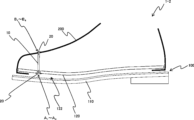
- Fig. 1a is a side cross-sectional view of the geta-type shoes according to the present invention
- Fig. 1b is a perspective view of the insole with the toe separating members planted.
- Fig. 2a is a front cross-sectional view of the geta-type shoes
- Fig. 2b is a front cross-sectional view of the geta-type shoes with multiple toe separating members.
- Fig. 2c is a perspective view of the insole with multiple toe separating members
- Fig. 3a is a front cross-sectional view of the geta-type shoes made by the Strobel method.
- Fig. 1a is a side cross-sectional view of the geta-type shoes according to the present invention
- Fig. 1b is a perspective view of the insole with the toe separating members planted.
- Fig. 2a is a front cross-sectional view of the geta-type shoes
- Fig. 2b is a front cross-sectional view of the get
- FIG. 3b is a front cross-sectional view of the geta-type shoes made by the Strobel method with multiple toe separating members
- Fig. 4a is a side cross-sectional view of the geta-type shoes in which the toe separating members are fixed with rivet-like members
- Fig. 4b is a side cross-sectional view of the geta-type shoes made by the Strobel method in which the toe separating members are fixed with rivet-like members.
- Fig. 5 is a side cross-sectional view of a geta-type shoe with a convex midsole
- Fig. 6 is a side cross-sectional view of a geta-type shoe with a curved portion.
- Fig. 7a is a perspective view of a geta-type shoe with two string-like members
- Fig. 7b is a perspective view showing an example of use of a geta-type shoe with two string-like members.
- Fig. 8 is a perspective view showing an embodiment of a geta-type shoe
- Fig. 9 is a perspective view showing another embodiment of a geta-type shoe.
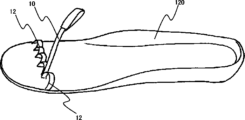
- Fig. 10 is a perspective view of a midsole with a toe separation assist member
- Fig. 11 is a perspective view of a midsole with a toe separation assist member
- Figs. 12 and 13 are perspective views of a midsole with multiple loop-shaped toe separation assist members
- Fig. 14 is a perspective view of a midsole with a loop-shaped toe separation assist member in the inward direction.
- the geta-style shoes of the present invention are made up of a sole 100, an upper 200, and a toe separator 10, and are geta-style shoes that allow the wearer to walk with a cushioned (stretchable, flexible) rod-shaped member between the toes.
- the sole part 100 is a laminated member that constitutes the bottom part of the shoe, and as shown in Figures 1a and 2a, it is made up of at least an outsole 110 and a midsole 120, which are laminated and fixed together to form the sole part 100, but it may also be configured to further include a heel (not shown) and a midsole (not shown) laminated thereon.
- the outsole 110 is the component that forms the bottom of the shoe, and is the outermost component that directly touches the ground among the components that make up the shoe. Since the outsole 110 is the component that directly touches the ground, it is required to have sufficient rigidity, and it is desirable that it is made of a material that reduces the load when walking.
- leather or synthetic leather material is used as the material, but it is not limited to this, and other materials such as reinforced rubber that has rigidity and flexibility can also be used.
- the midsole 120 is the inner sole component of the shoe that is layered on top of the outsole 110, and is a component that is installed mainly to improve the comfort of the shoe.
- the midsole 120 has approximately the same shape as the outsole 110 and is made of leather, but is not limited to this and other materials such as rubber, soft urethane foam, felt, etc. can be appropriately selected and used.
- the upper 200 is a member that is fixedly installed on the sole 100 and constitutes the part that encases the foot.
- the upper 200 is formed to have a shape that fits the shape of the foot, encasing the toes and heels.
- the geta-type shoes 1 of the present invention are configured to be equipped with a toe separating member 10 as shown in Figures 1a, 1b and 2a.
- the toe separating member 10 is a member that is equipped on the toe side at a position corresponding to the crotch between the big toe and index toe, and is made of a vertically elongated member.
- the toe separating member 10 is configured to be installed vertically through the midsole through-hole A1 provided in the midsole 120 and the upper through-hole B1 provided in the upper 200. With this configuration, it is possible to reliably fix the toe separating member 10 inside the shoe, and it is possible to reliably spread the space between the big toe and the index toe when the user wears the geta-type shoes 1.
- geta-type shoes 2 are configured with multiple toe separators 10 implanted at positions on the toe side corresponding to the multiple spaces between the toes, as shown in Figures 2b and 2c.
- the toe separating members 10 are configured to be installed in any number of vertical directions through a plurality of midsole through-holes (A 1 to A 4 ) provided in the midsole 120 and a plurality of upper through-holes (B 1 to B 4 ) provided in the upper 200.
- a 1 to A 4 midsole through-holes
- B 1 to B 4 upper through-holes
- the geta-type shoes 3 can be configured as shown in FIG. 3a, consisting of at least a sole 100 made of an outsole 110, and an upper 200 formed in a bag shape to encase the foot and fixed on the sole 100.
- the geta-type shoes 3 are manufactured by the Strobel method, and the midsole 120 is not incorporated into the shoe, but the upper 200 formed in a bag shape is fixed directly to the sole 100. This configuration makes it possible to apply the structure of implanting the toe separating members 10 to sneakers and sneakers.
- the geta-type shoes 3 are configured with a vertically elongated toe separator 10 implanted on the toe side at a position corresponding to the crotch between the big toe and index toe.
- a vertically elongated toe separator 10 implanted on the toe side at a position corresponding to the crotch between the big toe and index toe.
- the toe separating member 10 is configured to be installed vertically through a lower through-hole C1 provided in the bottom surface of the upper 200 and an upper through-hole D1 provided in the upper part of the upper 200.
- the toe separating member 10 can be securely fixed and installed inside the shoe, and when the user wears the geta-type shoes 3 such as sneakers, the space between the big toe and the index toe can be reliably spread.
- the geta-type shoes 4 can be configured as shown in FIG. 3b, with a sole 100 made of an outsole 110, and an upper 200 fixed on the sole 100 in a bag-like shape that encases the foot, manufactured by the Strobel method, with a plurality of toe separators 10 planted in the shoe.
- the toe separators 10 are planted vertically in positions corresponding to the crotch spaces between the toes on the toe side.
- the toe separating member 10 is configured to be installed vertically in any number through a plurality of lower through-holes ( C1 to C4 ) provided through the bottom surface of the upper 200 and a plurality of upper through-holes ( D1 to D4 ) provided through the upper part of the upper 200.
- the toe separating member 10 can be securely fixed and installed inside the shoe, and the toe separating member 10 can be arranged between each toe, so that the user can reliably spread the space between each toe when wearing the setta-type shoe 4 such as a sneaker.
- the geta-type shoes 1 and geta-type shoes 2 of this embodiment are configured such that one end of the toe separating member 10, which is installed by passing through each through-hole, is fixed to the bottom 122, which is the opposite surface of the midsole 120, as shown in Figures 2a and 2b, and the other end of the toe separating member 10 is fixed to the outside of the upper 200 by forming a loop L.
- this configuration it is possible to firmly attach the shoe to the foot by passing the shoelace through the loop L like a normal shoe with leather laces, and it is possible to provide stylish shoes that are excellent in design as well as functionality.
- the geta-type shoes 3 and geta-type shoes 4 of this embodiment are configured such that one end of the toe separating member 10, which is installed by passing through each through-hole, is fixed to the bottom 210 of the bag-shaped upper 200 as shown in Figures 3a and 3b, and the other end of the toe separating member 10 is fixed to the outside of the upper upper part 220, forming a loop L.
- geta-type shoes 3 and 4 such as sneakers, it is possible to firmly attach the shoes to the feet by passing shoelaces through the loop L like normal lace-up shoes, making it possible to provide stylish shoes that are both functional and stylish in design.
- the toe separating member 10 is made of a string-like member, and can be made of any one or more of the following materials: leather, synthetic leather, fiber material, or polyvinyl chloride. This configuration allows for a soft feel that does not put strain on the toes, and also improves the design.
- the toe separating member 10 is configured as a tubular member as shown in Fig. 4a, and furthermore, as its material, any one or a plurality of materials selected from silicon, rubber, leather, synthetic leather, fiber material, and polyvinyl chloride can be used.
- the toe separating member 10 is configured to be fixed and installed from the upper side and the midsole side by one or a plurality of rivet-like members 20 through one or a plurality of midsole through-holes ( A1 - A4 ) and one or a plurality of upper through-holes ( B1 - B4 ).
- the toe separating member 10 is made of a cylindrical member as shown in FIG. 4b, and can be made of any one or more of silicon, rubber, leather, synthetic leather, fiber material, or vinyl chloride.
- the toe separating member 10 is fixed and installed by one or more rivet-like members 20 from the outside of the upper upper part 220 and the bottom part 210 of the bag-shaped upper through one or more lower through holes (C 1 to C 4 ) and one or more upper through holes (D 1 to D 4 ).
- the toe separating member 10 is a setta-type shoe 3 or 4 such as a sneaker, it can be made to be soft to the touch and not to put a burden between the toes, and it can be made into an ordinary sneaker or athletic shoe in which the presence or absence of the toe separating member 10 cannot be visually confirmed from the outside.
- the midsole 120 can be configured to have a protruding midsole convex portion 124 as shown in FIG. 5.
- the midsole convex portion 124 is a member provided in a position near the midsole through-hole and along the joints of each toe, and when the user wears the geta-type shoes 1 or 2, the toe joints engage with it, enabling the user to kick firmly with the toes when walking. This configuration makes it easier to apply force to the toes when walking, making it possible to obtain high health benefits.
- the outsole 100 can be configured to have a curved portion 112.
- the curved portion 112 is a curve provided on the bottom surface of the outsole 100, and is provided so that the bottom surface of the outsole 100 curves upward from near the base of the toes to the tip of the outsole 100.
- This configuration increases the pushing force and allows the toes to move more, making it possible to obtain greater health benefits.
- the outsole 100 can be made thicker and the curved portion 112 can be cut so that a curve is formed at the tip of the outsole 100, but this configuration is not limited to this.
- the toe separating member 10 can be configured to consist of two string-like members, as shown in FIG. 7a.
- One end of the toe separating member 10 can be fixed to the bottom 122, which is the opposite surface of the midsole 120, and the other end of the toe separating member 10 can be configured to have two string-like members extending outward from the upper 200, as shown in FIG. 7b.
- one end of the toe separating member 10 can be fixed to the bottom 210 of the bag-shaped upper 200, and the other end of the toe separating member 10 can be configured to have two string-like members extending outward from the upper upper part 220, as shown in FIG. 7b.
- This configuration allows the toe separating member 10 to be used as a shoelace, making it possible to provide geta-type shoes 1 and 3 with a high level of design.
- geta-type shoes 5 are configured as shown in FIG. 8, with a vertically elongated toe separator 10 implanted at the toe side of the insole 120 in a position corresponding to the crotch between the big toe and the index toe, and the toe separator is fixedly attached to the left and right ends of the insole 120 so as to extend in both the left and right directions and encase the instep.
- the upper 200 is configured to be attached to the sole 110 so as to encase the midsole 120 equipped with the toe separating member 10.
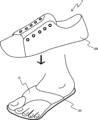
- the geta-type shoes of the present invention simply by placing the upper over footwear with a structure similar to geta or sandals.
- the geta-type shoes of the present invention can be configured with five curved members on the midsole 120 to encase each toe, or with four partitions at the tip of the toe portion of the upper 200, with each toe fitting into each of the partitioned spaces. Either configuration allows the toes to be spread apart, resulting in greater health benefits.
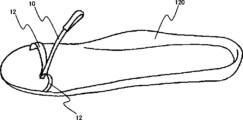
- the toe separating member 10 can be configured to include a toe separating auxiliary member 12, as shown in FIG. 10.
- the toe separating auxiliary member 12 is a member connected to the toe separating member 10, extends inward and outward of the foot, and is a loop-shaped member that is fixed to the inner and outer ends of the midsole 120 to encase the toes, and is made of a string or band-like elongated member. With this configuration, the toes feel better held when wearing geta-type shoes, making walking easier, and thus providing health benefits.
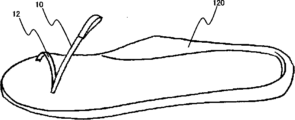
- the toe separating member 10 can be configured such that the toe separating auxiliary member 12, which is made of a string or strip-like elongated member connected to the toe separating member 10, extends only in the lateral direction of the foot and is fixed to the outer end of the midsole 120 to encase the toes and form a loop.
- This configuration improves the sense of hold on the toes when wearing geta-type shoes, and increases the freedom of movement of the big toe, making it easier to walk, and providing health benefits.
- the toe separating member 10 can be configured such that the toe separating auxiliary member 12, which is made of a string or strip-like elongated member connected to the toe separating member 10, extends inward and outward directions of the foot and is fixed to the inner and outer ends of the bottom surface of the upper 200 to encase the toes and form loops.
- the toe separating auxiliary member 12 which is made of a string or strip-like elongated member connected to the toe separating member 10
- the toes feel better held when worn, making walking easier and providing health benefits.
- the toe separating member 10 can be configured such that the toe separating auxiliary member 12, which is made of a string or strip-like elongated member connected to the toe separating member 10, is extended outward from the foot and fixed to the outer end of the bottom surface of the upper 200 to form a loop that envelops the toes.
- the toe separating auxiliary member 12 which is made of a string or strip-like elongated member connected to the toe separating member 10
- the toes feel more held when worn and the freedom of movement of the big toe increases, making it easier to walk and providing health benefits.
- the toe separating member 10 can also be configured so that the toe separating auxiliary member 12 extending outward is fixed to the bottom surface of the upper 200 at positions corresponding to the spaces between the toes, forming multiple loops.
- the toe separating auxiliary member 12 can be formed to encase each of the toes from the index to the little toe, providing an even better feeling of support for the toes when wearing geta-type shoes, and making it possible to obtain greater health benefits.
- the toe separation member 10 implanted at a position corresponding to the crotch between the big toe and the index toe can be extended inwardly of the foot and fixed to the inner end of the midsole 120 to form a loop that envelops the big toe.
- the big toe feels better held when wearing geta-type shoes, making it possible to obtain greater health benefits.
- the toe separation member 10 implanted at a position corresponding to the crotch between the big toe and the index toe can be extended inwardly of the foot and fixed to the inner end of the bottom surface of the upper 200 to form a loop that envelops the big toe.
- a side cross-sectional view of a geta-style shoe according to the present invention A perspective view of a midsole with a toe separator.
- Front cross-section of geta-style shoes A front cross-sectional view of a geta-style shoe with multiple toe separators FIG.
- FIG. 1 is a perspective view of an insole provided with a plurality of toe separating members
- Front cross-section of a setta-style shoe made using the Strobel method A front cross-sectional view of a setta-style shoe made using the Strobel method with multiple toe separators
- a side cross-sectional view of a geta-style shoe with a convex midsole A side cross-sectional view of a geta-style shoe with a curved section
- FIG. 1 is a perspective view of a geta-style shoe provided with two string-like members;
- FIG. 13 is a perspective view showing an example of using geta-type shoes provided with two string-like members;
- FIG. 1 is a perspective view showing an embodiment of geta-style shoes;
- FIG. 13 is a perspective view showing another embodiment of the geta-type shoes.
- FIG. 1 is a perspective view of an insole provided with a toe separation support member
- FIG. 1 is a perspective view of an insole provided with a toe separation support member
- FIG. 1 is a perspective view of a midsole having a plurality of loop-shaped toe separation support members;
- FIG. 1 is a perspective view of a midsole having a plurality of loop-shaped toe separation support members;
- FIG. 1 is a perspective view of a midsole having a loop-shaped toe separation support member on the inside.
Landscapes
- Health & Medical Sciences (AREA)
- Epidemiology (AREA)
- General Health & Medical Sciences (AREA)
- Public Health (AREA)
- Footwear And Its Accessory, Manufacturing Method And Apparatuses (AREA)
Priority Applications (3)
| Application Number | Priority Date | Filing Date | Title |
|---|---|---|---|
| PCT/JP2022/047322 WO2024134822A1 (ja) | 2022-12-22 | 2022-12-22 | 雪駄型シューズ |
| PCT/JP2023/032076 WO2024135003A1 (ja) | 2022-12-22 | 2023-09-01 | 雪駄型シューズ |
| JP2023580712A JP7594694B2 (ja) | 2022-12-22 | 2023-09-01 | 雪駄型シューズ |
Applications Claiming Priority (1)
| Application Number | Priority Date | Filing Date | Title |
|---|---|---|---|
| PCT/JP2022/047322 WO2024134822A1 (ja) | 2022-12-22 | 2022-12-22 | 雪駄型シューズ |
Publications (1)
| Publication Number | Publication Date |
|---|---|
| WO2024134822A1 true WO2024134822A1 (ja) | 2024-06-27 |
Family
ID=91588064
Family Applications (2)
| Application Number | Title | Priority Date | Filing Date |
|---|---|---|---|
| PCT/JP2022/047322 Ceased WO2024134822A1 (ja) | 2022-12-22 | 2022-12-22 | 雪駄型シューズ |
| PCT/JP2023/032076 Ceased WO2024135003A1 (ja) | 2022-12-22 | 2023-09-01 | 雪駄型シューズ |
Family Applications After (1)
| Application Number | Title | Priority Date | Filing Date |
|---|---|---|---|
| PCT/JP2023/032076 Ceased WO2024135003A1 (ja) | 2022-12-22 | 2023-09-01 | 雪駄型シューズ |
Country Status (2)
| Country | Link |
|---|---|
| JP (1) | JP7594694B2 (https=) |
| WO (2) | WO2024134822A1 (https=) |
Citations (7)
| Publication number | Priority date | Publication date | Assignee | Title |
|---|---|---|---|---|
| JPH0445407U (https=) * | 1990-08-17 | 1992-04-17 | ||
| JPH0923901A (ja) * | 1995-07-10 | 1997-01-28 | Shunichi Yamane | 健康サンダル |
| JPH10234410A (ja) * | 1997-02-28 | 1998-09-08 | Shuichiro Shimomura | シューズ |
| JPH10262703A (ja) * | 1997-03-26 | 1998-10-06 | Yukio Yoshikawa | 健康履物 |
| JP2001346607A (ja) * | 2000-06-12 | 2001-12-18 | Mizuno Corp | 指股隔壁を有する靴 |
| JP3082857U (ja) * | 2001-06-21 | 2002-01-11 | 洋造 皆上 | 足指滑り止め付きスポーツシューズ |
| JP7152826B1 (ja) * | 2021-09-10 | 2022-10-13 | 株式会社鹿浜製作所 | 足裏接触体 |
Family Cites Families (6)
| Publication number | Priority date | Publication date | Assignee | Title |
|---|---|---|---|---|
| JPH0510647Y2 (https=) * | 1989-06-09 | 1993-03-16 | ||
| JPH0648403U (ja) * | 1992-12-15 | 1994-07-05 | 聡 小池 | 履き物 |
| JPH1132805A (ja) * | 1997-05-22 | 1999-02-09 | Moon Star Co | 指股リブを有する靴の製法及びその靴 |
| JP2013081741A (ja) * | 2011-10-11 | 2013-05-09 | Crescent:Kk | 履物 |
| JP2015136378A (ja) * | 2014-01-20 | 2015-07-30 | 学校法人神戸学院 | 歩行補助具およびそれを備えた靴 |
| JP7057484B2 (ja) * | 2020-08-26 | 2022-04-20 | 有限会社丸越商事 | 草履・下駄・サンダルの鼻緒 |
-
2022
- 2022-12-22 WO PCT/JP2022/047322 patent/WO2024134822A1/ja not_active Ceased
-
2023
- 2023-09-01 WO PCT/JP2023/032076 patent/WO2024135003A1/ja not_active Ceased
- 2023-09-01 JP JP2023580712A patent/JP7594694B2/ja active Active
Patent Citations (7)
| Publication number | Priority date | Publication date | Assignee | Title |
|---|---|---|---|---|
| JPH0445407U (https=) * | 1990-08-17 | 1992-04-17 | ||
| JPH0923901A (ja) * | 1995-07-10 | 1997-01-28 | Shunichi Yamane | 健康サンダル |
| JPH10234410A (ja) * | 1997-02-28 | 1998-09-08 | Shuichiro Shimomura | シューズ |
| JPH10262703A (ja) * | 1997-03-26 | 1998-10-06 | Yukio Yoshikawa | 健康履物 |
| JP2001346607A (ja) * | 2000-06-12 | 2001-12-18 | Mizuno Corp | 指股隔壁を有する靴 |
| JP3082857U (ja) * | 2001-06-21 | 2002-01-11 | 洋造 皆上 | 足指滑り止め付きスポーツシューズ |
| JP7152826B1 (ja) * | 2021-09-10 | 2022-10-13 | 株式会社鹿浜製作所 | 足裏接触体 |
Also Published As
| Publication number | Publication date |
|---|---|
| JPWO2024135003A1 (https=) | 2024-06-27 |
| JP7594694B2 (ja) | 2024-12-04 |
| WO2024135003A1 (ja) | 2024-06-27 |
Similar Documents
| Publication | Publication Date | Title |
|---|---|---|
| KR102810764B1 (ko) | 가변 반사 신발류 기술 | |
| US11918078B2 (en) | Foot support members that provide dynamically transformative properties | |
| US8732982B2 (en) | Footwear | |
| US8959796B2 (en) | Footwear | |
| US8667713B2 (en) | Footwear with a foot stabilizer | |
| US9003677B2 (en) | System and method for toning footwear | |
| US9414638B2 (en) | Golf shoe with natural motion structures | |
| CN102762121B (zh) | 具有跟靠补足条带的鞋 | |
| CN102883632A (zh) | 具有高脚部移动性的鞋 | |
| CN106572720A (zh) | 具有带弧形下侧腔的鞋底夹层的鞋类物品 | |
| KR100796160B1 (ko) | 뒷굽이 높은 신발용 기능성 안창 | |
| CN117440763A (zh) | 用于鞋类制品的在加固罩架中具有中足空隙和前足囊的鞋底结构 | |
| KR102013672B1 (ko) | 족저근막염 통증완화 및 치료용 신발 | |
| WO2012079646A1 (en) | Multi-layered sole for heeled footwear | |
| US10349701B2 (en) | Footwear having a sole formed with a cavity receiving a highly viscous gel | |
| KR20130001401A (ko) | 기능성 신발 | |
| JP7594694B2 (ja) | 雪駄型シューズ | |
| JP2023023063A (ja) | 雪駄型シューズ | |
| JP2024128700A (ja) | 履物 | |
| KR102162450B1 (ko) | 중창 및 이를 포함하는 신발 | |
| JP2018183636A (ja) | 履物底構造 | |
| JP3068110U (ja) | 指圧用履物底 | |
| KR20140093872A (ko) | 기능성 신발깔창 및 샌달용 깔창 | |
| KR101709953B1 (ko) | 보행 안정감이 향상된 신발 | |
| KR20130005940U (ko) | 신발 깔창 |
Legal Events
| Date | Code | Title | Description |
|---|---|---|---|
| 121 | Ep: the epo has been informed by wipo that ep was designated in this application |
Ref document number: 22969208 Country of ref document: EP Kind code of ref document: A1 |
|
| NENP | Non-entry into the national phase |
Ref country code: DE |
|
| 122 | Ep: pct application non-entry in european phase |
Ref document number: 22969208 Country of ref document: EP Kind code of ref document: A1 |
|
| NENP | Non-entry into the national phase |
Ref country code: JP |