WO2024122136A1 - タイヤ用ポリエチレンテレフタレートコード及びタイヤ - Google Patents
タイヤ用ポリエチレンテレフタレートコード及びタイヤ Download PDFInfo
- Publication number
- WO2024122136A1 WO2024122136A1 PCT/JP2023/032246 JP2023032246W WO2024122136A1 WO 2024122136 A1 WO2024122136 A1 WO 2024122136A1 JP 2023032246 W JP2023032246 W JP 2023032246W WO 2024122136 A1 WO2024122136 A1 WO 2024122136A1
- Authority
- WO
- WIPO (PCT)
- Prior art keywords
- pet
- cord
- polyethylene terephthalate
- tire
- crystallinity
- Prior art date
- Legal status (The legal status is an assumption and is not a legal conclusion. Google has not performed a legal analysis and makes no representation as to the accuracy of the status listed.)
- Ceased
Links
Images
Classifications
-
- B—PERFORMING OPERATIONS; TRANSPORTING
- B60—VEHICLES IN GENERAL
- B60C—VEHICLE TYRES; TYRE INFLATION; TYRE CHANGING; CONNECTING VALVES TO INFLATABLE ELASTIC BODIES IN GENERAL; DEVICES OR ARRANGEMENTS RELATED TO TYRES
- B60C9/00—Reinforcements or ply arrangement of pneumatic tyres
-
- B—PERFORMING OPERATIONS; TRANSPORTING
- B60—VEHICLES IN GENERAL
- B60C—VEHICLE TYRES; TYRE INFLATION; TYRE CHANGING; CONNECTING VALVES TO INFLATABLE ELASTIC BODIES IN GENERAL; DEVICES OR ARRANGEMENTS RELATED TO TYRES
- B60C9/00—Reinforcements or ply arrangement of pneumatic tyres
- B60C9/18—Structure or arrangement of belts or breakers, crown-reinforcing or cushioning layers
- B60C9/20—Structure or arrangement of belts or breakers, crown-reinforcing or cushioning layers built-up from rubberised plies each having all cords arranged substantially parallel
- B60C9/22—Structure or arrangement of belts or breakers, crown-reinforcing or cushioning layers built-up from rubberised plies each having all cords arranged substantially parallel the plies being arranged with all cords disposed along the circumference of the tyre
-
- D—TEXTILES; PAPER
- D02—YARNS; MECHANICAL FINISHING OF YARNS OR ROPES; WARPING OR BEAMING
- D02G—CRIMPING OR CURLING FIBRES, FILAMENTS, THREADS, OR YARNS; YARNS OR THREADS
- D02G3/00—Yarns or threads, e.g. fancy yarns; Processes or apparatus for the production thereof, not otherwise provided for
- D02G3/02—Yarns or threads characterised by the material or by the materials from which they are made
- D02G3/04—Blended or other yarns or threads containing components made from different materials
-
- D—TEXTILES; PAPER
- D02—YARNS; MECHANICAL FINISHING OF YARNS OR ROPES; WARPING OR BEAMING
- D02G—CRIMPING OR CURLING FIBRES, FILAMENTS, THREADS, OR YARNS; YARNS OR THREADS
- D02G3/00—Yarns or threads, e.g. fancy yarns; Processes or apparatus for the production thereof, not otherwise provided for
- D02G3/44—Yarns or threads characterised by the purpose for which they are designed
- D02G3/48—Tyre cords
Definitions
- the present invention relates to polyethylene terephthalate cord for tires and tires.
- the belt reinforcing layer In order to improve the high-speed durability of tires, it is known to provide a belt reinforcing layer on the outer periphery of the belt arranged in the tread portion, in which organic fiber cords are arranged substantially parallel to the tire circumferential direction.
- the belt reinforcing layer contributes to improving high-speed durability and can also contribute to reducing noise during driving.
- nylon fibers such as nylon 66 and nylon 6 have generally been used as the material for the organic fiber cords that make up the belt reinforcing layer.
- nylon fiber cords such as nylon 66 and nylon 6
- polyethylene terephthalate cords which are more elastic and less expensive than nylon fiber cords (see, for example, Patent Document 1).
- an object of the present invention is to solve the above-mentioned problems of the conventional technology and to provide a polyethylene terephthalate cord which, when used as a tire component, can further reduce noise during running while maintaining high tire durability.
- Another object of the present invention is to provide a tire which maintains high durability while further reducing noise during running.
- the gist of the present invention which solves the above problems, is as follows:
- a polyethylene terephthalate cord for a tire comprising: At least two types of polyethylene terephthalate drawn yarns having different crystallinity, Of the two types of polyethylene terephthalate drawn yarns, the one with a lower crystallinity is designated PET drawn yarn A, and the one with a higher crystallinity is designated PET drawn yarn B,
- PET drawn yarn A has a crystallinity of less than 45.0%
- PET drawn yarn B has a crystallinity of 40.0% or more
- a polyethylene terephthalate cord characterized in that a constituent ratio of the PET drawn yarn A in the cord is 1 mass % or more and 99 mass % or less.
- a polyethylene terephthalate cord for a tire comprising: At least two types of polyethylene terephthalate drawn yarns having different terminal carboxyl group concentrations (CEG), Of the two types of polyethylene terephthalate drawn yarns, the one with a higher terminal carboxyl group concentration is designated PET drawn yarn A, and the one with a lower terminal carboxyl group concentration is designated PET drawn yarn B,
- the PET drawn yarn A has a crystallinity of less than 45.0%
- the PET drawn yarn B has a crystallinity of 40.0% or more
- a polyethylene terephthalate cord characterized in that a constituent ratio of the PET drawn yarn A in the cord is 1 mass % or more and 99 mass % or less.
- [4] A polyethylene terephthalate cord according to any one of [1] to [3], in which the composition ratio of the PET stretched yarn A in the cord is 25% by mass or more and 75% by mass or less.
- a polyethylene terephthalate cord which, when used in a tire component, can further reduce noise during running while maintaining high tire durability.
- a tire which maintains high durability while further reducing noise during running.
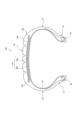
- FIG. 1 is a cross-sectional view of a tire according to one embodiment of the present invention.
- the present invention will be described in detail below with reference to the embodiments.
- the compounds described in this specification may be derived partially or entirely from fossil resources, from biological resources such as plant resources, or from recycled resources such as used tires, or may be derived from a mixture of two or more of fossil resources, biological resources, and recycled resources.
- the polyethylene terephthalate cord according to the first embodiment of the present invention is A polyethylene terephthalate cord for tires, comprising: At least two types of polyethylene terephthalate drawn yarns having different crystallinity, Of the two types of polyethylene terephthalate drawn yarns, the one with a lower crystallinity is designated PET drawn yarn A, and the one with a higher crystallinity is designated PET drawn yarn B,
- PET drawn yarn A has a crystallinity of less than 45.0%
- the PET drawn yarn B has a crystallinity of 40.0% or more
- the cord is characterized in that a constituent ratio of the PET drawn yarn A in the cord is 1% by mass or more and 99% by mass or less.
- the polyethylene terephthalate cord of the second embodiment of the present invention is A polyethylene terephthalate cord for tires, comprising: At least two types of polyethylene terephthalate drawn yarns having different terminal carboxyl group concentrations (CEG), Of the two types of polyethylene terephthalate drawn yarns, the one with a higher terminal carboxyl group concentration is designated PET drawn yarn A, and the one with a lower terminal carboxyl group concentration is designated PET drawn yarn B.
- the PET drawn yarn A has a crystallinity of less than 45.0%
- the PET drawn yarn B has a crystallinity of 40.0% or more
- the cord is characterized in that a constituent ratio of the PET drawn yarn A in the cord is 1% by mass or more and 99% by mass or less.
- the present invention relates to a polyethylene terephthalate cord (hereinafter, sometimes referred to as a "PET cord”) using at least two kinds of PET drawn yarns differing in crystallinity or terminal carboxyl group concentration (CEG), and one of the key features of the present invention is that the crystallinity of these at least two kinds of PET drawn yarns is optimized. Since the PET cord of the present invention has been optimized as described above, when used in a tire component, it is possible to reduce noise during running while maintaining tire durability.
- CEG terminal carboxyl group concentration
- PET cord of the present invention reduces noise during running while maintaining tire durability. That is, in fibers with low crystallinity, the presence of amorphous parts creates a damping effect, and noise reduction is expected, but the presence of amorphous parts can cause decomposition and destruction, resulting in insufficient durability. Therefore, by combining fibers with low and high crystallinity and optimizing the crystallinity values of each, it is believed that it is possible to reduce noise during running while maintaining tire durability.
- the PET cord of the present invention may be composed of only two types of PET drawn yarns, or may be composed of these two types of PET drawn yarns and an additional type of drawn yarn.
- the PET cord is composed of three or more types of PET drawn yarns, two types of PET drawn yarns with different crystallinity or terminal carboxyl group concentration (CEG) can be arbitrarily selected and one can be regarded as drawn yarn A and the other as drawn yarn B, as appropriate.
- CEG terminal carboxyl group concentration
- the PET drawn yarn constituting the PET cord of the present invention may be made of recycled PET resin.
- Methods for recycling PET products include a chemical recycling method in which PET products such as PET bottles and clothing are depolymerized into monomers or intermediates and then polymerized again into a high-purity PET resin, and a mechanical recycling method in which the PET products are crushed, melted, and recycled.
- PET resins recycled by the mechanical recycling method are low in production cost and relatively easy to obtain.
- the PET drawn yarns using the mechanically recycled PET resins tend to have a lower crystallinity and/or a higher terminal carboxyl group concentration (CEG) than other PET drawn yarns.
- CEG carboxyl group concentration
- the PET resin which is the constituent material of the PET drawn yarn, by paying attention to its origin and production conditions.
- the crystallinity of the PET drawn yarn can be adjusted, for example, by appropriately changing the conditions during production (drawing), such as the drawing speed, temperature, time, etc.
- the terminal carboxyl group concentration (CEG) of the PET drawn yarn can be adjusted, for example, by appropriately changing the conditions during polymerization, such as the catalyst type, temperature, time, etc.
- the present invention can be expected to use a certain amount of recycled PET resin, particularly mechanically recycled PET resin, which can be advantageous from the standpoint of production costs and environmental protection.
- the terminal carboxyl group concentration (CEG) of PET oriented yarn can be measured by the titration method described in Analytic. Chem., 26, 1614 (1954).
- PET drawn yarn A is the drawn yarn having a lower crystallinity or a higher terminal carboxyl group concentration among (at least) two kinds of PET drawn yarns constituting the PET cord.
- the PET drawn yarn A may be drawn, and the draw ratio is not particularly limited.
- the crystallinity of PET stretched yarn A must be less than 45.0%. Even if the crystallinity of PET stretched yarn A is relatively low or the terminal carboxyl group concentration is relatively high, if the crystallinity of PET stretched yarn A is 45.0% or more, the raw materials or manufacturing methods for the PET resin will be limited, the options will be fewer, and there is a risk of restrictions on the use of recycled PET. In addition, from the viewpoint of further reducing noise during tire running, it is preferable that the crystallinity of PET stretched yarn A is less than 40.0%. On the other hand, the lower limit of the crystallinity of PET stretched yarn A is not particularly limited, but from the viewpoint of suppressing excessive performance deterioration, it is preferable that it is 35.0% or more.
- the PET stretched yarn A preferably has a terminal carboxyl group concentration (CEG) of 21 eq/ton or more. If the CEG of the PET stretched yarn A is 21 eq/ton or more, noise during running can be reduced more effectively.
- the upper limit of the CEG of the PET stretched yarn A is not particularly limited, but from the viewpoint of obtaining a good balance between tire durability and noise during running, it is preferably 30 eq/ton or less.
- the PET resin constituting PET stretched yarn A may be mechanically recycled PET resin, chemically recycled PET resin, or biomass PET resin. Also, part of the PET resin constituting PET stretched yarn A may be mechanically recycled PET resin, chemically recycled PET resin, or biomass PET resin (PET resin derived from biomass raw materials). In particular, it is preferable that part or all of the PET resin constituting PET stretched yarn A is mechanically recycled PET resin.
- the PET drawn yarn A preferably has a fineness of 200 to 3000 dtex. If the fineness of the PET drawn yarn A is 200 dtex or more, sufficient strength can be ensured, and if it is 3000 dtex or less, the effect of weight increase due to larger diameter can be sufficiently suppressed.
- the composition ratio of PET stretched yarn A is 1% by mass or more and 99% by mass or less. If the composition ratio is less than 1% by mass or more than 99% by mass, there is a risk that at least one of the tire durability and running noise may deteriorate. Furthermore, from the viewpoint of obtaining a better balance between tire durability and running noise, the composition ratio of PET stretched yarn A in the PET cord is preferably 25% by mass or more, 30% by mass or more, 40% by mass or more, or 45% by mass or more, and is preferably 75% by mass or less, 60% by mass or less, or 55% by mass or less.
- PET stretched yarn B The PET drawn yarn B is the drawn yarn having a higher crystallinity or a lower terminal carboxyl group concentration among (at least) two kinds of PET drawn yarns constituting the PET cord.
- the PET drawn yarn B may be drawn, and the draw ratio is not particularly limited.
- the crystallinity of PET stretched yarn B must be 40.0% or more. Even if the crystallinity of PET stretched yarn B is relatively high or the terminal carboxyl group concentration is relatively low, if the crystallinity of PET stretched yarn B is less than 40.0%, the durability of the tire may deteriorate. From the viewpoint of further improving the durability of the tire, the crystallinity of PET stretched yarn B is preferably 40.5% or more. On the other hand, the upper limit of the crystallinity of PET stretched yarn B is not particularly limited, but from the viewpoint of avoiding an excessive increase in manufacturing costs, it is preferably 45.0% or less.
- the terminal carboxyl group concentration (CEG) of PET stretched yarn B is 20 eq/ton or less.
- the lower limit of the CEG of PET stretched yarn B is not particularly limited, but from the viewpoint of productivity, it is preferable that it is 10 eq/ton or more.
- the PET resin constituting PET stretched yarn B may be non-recycled PET resin (petroleum-derived PET resin, PET resin derived from normal manufacturing methods), mechanically recycled PET resin, chemically recycled PET resin, or biomass PET resin. Also, part of the PET resin constituting PET stretched yarn B may be mechanically recycled PET resin, chemically recycled PET resin, or biomass PET resin. In particular, it is preferable that part or all of the PET resin constituting PET stretched yarn B is chemically recycled PET resin.
- the PET stretched yarn B preferably has a fineness of 200 to 3000 dtex. If the fineness of the PET stretched yarn B is 200 dtex or more, sufficient strength can be ensured, and if it is 3000 dtex or less, the effect of weight increase due to larger diameter can be sufficiently suppressed.
- the composition ratio of PET stretched yarn B is essentially required to be 99% by mass or less, and is preferably 1% by mass or more. If the composition ratio is 1% by mass or more, a better balance between tire durability and running noise can be achieved. From the same viewpoint, the composition ratio of PET stretched yarn B in the PET cord is more preferably 25% by mass or more, 30% by mass or more, 40% by mass or more, or 45% by mass or more, and is preferably 75% by mass or less, 60% by mass or less, or 55% by mass or less.
- the method for producing the PET cord of the present invention is not particularly limited.
- a plurality of drawn filaments X made of PET
- a plurality of drawn filaments Y made of PET
- a crystallinity or CEG different from the drawn filaments X are prepared, and these are bundled to obtain one PET drawn yarn Y.
- a plurality of drawn filaments Z made of PET
- the PET cord of the present invention can be obtained by twisting together these PET drawn yarns in a number ratio that gives a predetermined composition ratio.
- the above-mentioned PET drawn yarn X may be obtained by bundling drawn filaments X having a predetermined crystallinity or CEG with other drawn filaments.
- the crystallinity/CEG of the PET drawn yarn X may be different from the crystallinity/CEG of the drawn filaments X.
- the PET cord may have a single twist structure or a twisted structure (such as a double twist structure).
- a single twist structure for example, a twisted cord can be obtained by aligning specific PET stretched yarns and twisting them in one direction.
- a double twist structure for example, a twisted cord can be obtained by first twisting specific PET stretched yarns, then combining multiple of these yarns and twisting them in the opposite direction.
- the PET cord preferably has a total fineness of 1000 to 3500 dtex. If the total fineness of the PET cord is 1000 dtex or more, when used in a tire, particularly in the belt reinforcing layer, it can exhibit a sufficient elastic modulus to improve durability against protrusion input and to suppress the protrusion of the belt. Furthermore, if the total fineness of the PET cord is 3500 dtex or less, when used in a tire, particularly in the belt reinforcing layer, it can be densely packed and sufficient rigidity per unit width can be ensured.
- the PET cord is preferably treated with an adhesive composition.
- the adhesive composition may, for example, be an adhesive composition that contains a thermoplastic polymer (A) that has at least one crosslinkable functional group as a pendant group and that does not substantially contain addition-reactive carbon-carbon double bonds in its main chain structure, a heat-reactive water-based urethane resin (B), and an epoxy compound (C), and optionally further contains a rubber latex (D).
- A thermoplastic polymer
- B heat-reactive water-based urethane resin
- C epoxy compound
- D rubber latex
- RFL resin a resin made by mixing resorcin, formaldehyde, and latex.
- RFL resin a resin made by mixing resorcin, formaldehyde, and latex.
- RFL resin can exhibit sufficient cord-elastomer adhesive strength at room temperature, but the adhesive strength can be extremely reduced at high temperatures of 130°C or higher.
- thermoplastic polymer (A) that has at least one functional group with crosslinkability as a pendant group and does not substantially contain an addition-reactive carbon-carbon double bond in its main chain structure, a thermally reactive water-based urethane resin (B), and an epoxy compound (C), it is possible to sufficiently ensure adhesion to the elastomer (coating rubber) without hardening the organic fiber cord, even at high temperatures of 180°C or higher.
- the main chain of the thermoplastic polymer (A) is mainly a linear structure, and examples of the main chain include ethylenic addition polymers such as acrylic polymers, vinyl acetate polymers, and vinyl acetate-ethylene polymers; urethane polymers; etc.
- the thermoplastic polymer (A) is not limited to the above-mentioned ethylenic addition polymers and urethane polymers as long as it has the function of suppressing the resin fluidity at high temperatures and ensuring the fracture strength of the resin by crosslinking the functional groups of the pendant groups.
- the functional group of the pendant group of the thermoplastic polymer (A) is preferably an oxazolin group, a bismaleimide group, a (blocked)isocyanate group, an aziridine group, a carbodiimide group, a hydrazino group, an epoxy group, an epithio group, or the like.
- thermoplastic polymer (A), heat-reactive water-based urethane resin (B), epoxy compound (C), and rubber latex (D) can be those described in Japanese Patent Application No. 2023-040157 and Japanese Patent Application No. 2023-030762, respectively.
- thermoplastic polymer (A), heat-reactive aqueous urethane resin (B), and epoxy compound (C) it is preferable to use a mixture (adhesive composition) of the thermoplastic polymer (A), heat-reactive aqueous urethane resin (B), and epoxy compound (C) as the first bath treatment liquid, and to use a normal RFL resin liquid as the second bath treatment liquid.
- the proportion (dry mass ratio) of the thermoplastic polymer (A) is preferably 2 to 75%
- the proportion (dry mass ratio) of the heat-reactive aqueous urethane resin (B) is preferably 15 to 87%
- the proportion (dry mass ratio) of the epoxy compound (C) is preferably 11 to 70%
- the proportion (dry mass ratio) of the rubber latex (D) is preferably 20% or less.
- dip treatment liquid that does not contain resorcinol and formalin as an adhesive composition for PET cords.
- dip treatment liquids include a composition that contains a rubber latex (a) having an unsaturated diene, and one or more compounds (b) selected from a compound having a polyether skeleton structure and an amine functional group, a compound having an acrylamide structure, a polypeptide, a polylysine, and a carbodiimide.
- dip treatment liquids include a composition that contains, in addition to the rubber latex (a) having an unsaturated diene and the compound (b), one or more compounds selected from an aqueous compound (c) having a (thermally dissociable blocked) isocyanate group, a polyphenol (d), and a polyvalent metal salt (e).
- compositions that contain polyphenols (I) and aldehydes (II).
- such compositions may further contain at least one of an isocyanate compound (III) and a rubber latex (IV).
- the adhesive composition used to treat (coat) the PET cord contains polyphenols (I) and aldehydes (II), so that good adhesive properties can be achieved even when resorcin is not used due to environmental considerations.
- the adhesive composition contains polyphenols (I) as a resin component, and thus the adhesiveness to the PET cord can be improved.
- the polyphenols (I) are typically water-soluble polyphenols, and are not particularly limited as long as they are polyphenols other than resorcin (resorcinol).
- the number of aromatic rings or the number of hydroxyl groups can be appropriately selected.
- the polyphenols (I) preferably have two or more hydroxyl groups, and more preferably have three or more hydroxyl groups.
- the polyphenol or polyphenol condensate is water-soluble in the adhesive composition (dip treatment liquid) containing moisture. This allows the polyphenols to be uniformly distributed in the adhesive composition, thereby realizing better adhesion.
- the polyphenols (I) are polyphenols containing multiple (two or more) aromatic rings, the aromatic rings each have two or three hydroxyl groups at the ortho, meta, or para positions.
- polyphenols (I) for example, those described as polyphenol compounds in WO2022/130879 can be used. These polyphenols (I) may be used alone or in combination of two or more.
- the adhesive composition contains aldehydes (II) as a resin component in addition to the polyphenols (I), and thus can achieve high adhesion together with the polyphenols (I).
- the aldehydes (II) are not particularly limited and can be appropriately selected according to the required performance. In this specification, the aldehydes (II) also include derivatives of aldehydes that are generated from aldehydes.
- the aldehydes (II) include, for example, monoaldehydes such as formaldehyde, acetaldehyde, butylaldehyde, acrolein, propionaldehyde, chloral, butylaldehyde, caproaldehyde, and allylaldehyde, aliphatic dialdehydes such as glyoxal, malonaldehyde, succinaldehyde, glutaraldehyde, and adipaldehyde, aldehydes having an aromatic ring, and dialdehyde starch. These aldehydes (II) may be used alone or in combination of two or more.
- the aldehydes (II) are preferably aldehydes having an aromatic ring or contain aldehydes having an aromatic ring. This is because better adhesion can be obtained.
- the aldehydes (II) are preferably free of formaldehyde.
- "free of formaldehyde” means, for example, that the formaldehyde content in the total mass of the aldehydes is less than 0.5 mass%.
- polyphenols (I) and aldehydes (II) are in a condensed state, and the mass ratio of polyphenols to aldehydes having aromatic rings (content of aldehydes having aromatic rings/content of polyphenols) is preferably 0.1 or more and 3 or less.
- the hardness and adhesiveness of the resin which is the product of the condensation reaction between polyphenols and aldehydes having aromatic rings, become more suitable.
- the mass ratio of polyphenols to aldehydes having aromatic rings in the adhesive composition is more preferably 0.25 or more, and more preferably 2.5 or less.
- the above mass ratio is the mass of the dried product (solid content ratio).
- the total content of the polyphenols (I) and the aldehydes (II) in the adhesive composition is preferably 3 to 30% by mass. In this case, better adhesion can be ensured without deteriorating workability, etc. From the same viewpoint, the total content of the polyphenols (I) and the aldehydes (II) in the adhesive composition is more preferably 5% by mass or more and more preferably 25% by mass or less. The total content is the mass of the dry matter (solid content ratio).
- the adhesive composition preferably further contains an isocyanate compound (III) in addition to the polyphenols (I) and aldehydes (II) described above.
- the adhesive composition can have a further improved adhesiveness due to a synergistic effect with the polyphenols (I) and the aldehydes (II).
- the isocyanate compound (III) is a compound that has the effect of promoting adhesion to the resin material (e.g., phenol/aldehyde resin obtained by condensing polyphenols (I) and aldehydes (II)) that is the adherend of the adhesive composition, and is a compound that has an isocyanate group as a polar functional group.
- the resin material e.g., phenol/aldehyde resin obtained by condensing polyphenols (I) and aldehydes (II)
- These isocyanate compounds (III) may be used alone or in combination of two or more types.
- the isocyanate compound (III) is not particularly limited, but from the viewpoint of further improving adhesion, it is preferable that the isocyanate compound (III) contains a (blocked) isocyanate group-containing aromatic compound.
- the adhesive composition contains a (blocked) isocyanate group-containing aromatic compound
- the (blocked) isocyanate group-containing aromatic compound is distributed in a position near the interface between the PET cord and the adhesive composition, resulting in a further adhesion promoting effect, and this effect can further enhance the adhesion of the adhesive composition to the PET cord.
- the content of the isocyanate compound (III) in the adhesive composition is not particularly limited, but from the viewpoint of more reliably ensuring excellent adhesion, it is preferably 5 to 65 mass %. From the same viewpoint, the content of the isocyanate compound (III) in the adhesive composition is more preferably 10 mass % or more and more preferably 45 mass % or less. The above content is the mass of the dry matter (solid content ratio).
- the adhesive composition may further contain substantially a rubber latex (IV) in addition to the polyphenols (I), aldehydes (II) and isocyanate compound (III), which allows the adhesive composition to have higher adhesion to rubber members.
- the rubber latex (IV) is not particularly limited, and examples thereof include natural rubber (NR), as well as synthetic rubbers such as polyisoprene rubber (IR), styrene-butadiene copolymer rubber (SBR), polybutadiene rubber (BR), ethylene-propylene-diene rubber (EPDM), chloroprene rubber (CR), halogenated butyl rubber, acrylonitrile-butadiene rubber (NBR), and vinylpyridine-styrene-butadiene copolymer rubber (Vp). These rubber latexes (IV) may be used alone or in combination of two or more.
- synthetic rubbers such as polyisoprene rubber (IR), styrene-butadiene copolymer rubber (SBR), polybutadiene rubber (BR), ethylene-propylene-diene rubber (EPDM), chloroprene rubber (CR), halogenated butyl rubber, acrylonitrile-butadiene rubber (NBR), and
- the content of rubber latex (IV) in the adhesive composition is preferably 20% by mass or more, more preferably 25% by mass or more, and is preferably 70% by mass or less, more preferably 60% by mass or less.
- the method for producing the adhesive composition is not particularly limited, but examples thereof include a method of mixing raw materials such as polyphenols (I), aldehydes (II), and rubber latex (IV) and maturing them, or a method of mixing polyphenols (I) and aldehydes (II) and maturing them, and then adding rubber latex (IV) and maturing them.
- the method for producing the adhesive composition may be a method of adding rubber latex (IV), maturing them, and then adding the isocyanate compound (III).
- the PET cord is for tires, i.e., can be applied to tire components.
- tire components include, but are not limited to, carcasses, belt reinforcing layers, bead reinforcing layers, and side reinforcing layers.
- the PET cord is preferably used in the belt reinforcing layer of a tire from the viewpoint of more reliably reducing noise during running while sufficiently suppressing the influence on the durability of the tire.
- the belt reinforcing layer will be described in detail below.
- the tire of the present invention comprises a belt disposed in a tread portion, and a belt reinforcing layer for reinforcing the belt, and the above-mentioned PET cord is used in the belt reinforcing layer.
- FIG. 1 is a cross-sectional view of a tire according to one embodiment of the present invention.
- the tire 100 shown in FIG. 1 includes a pair of bead portions 10, a pair of sidewall portions 20, a tread portion 30, a carcass 50 extending in a toroidal shape between bead cores 40 embedded in the bead portions 10, a belt 60 disposed in the tread portion 30 (more specifically, disposed on the tire radial outer side of the crown portion of the carcass 50), a belt reinforcing layer (also called a "cap layer”) 70A disposed on the tire radial outer side of the belt 60 so as to cover the entire belt 60, and a pair of belt reinforcing layers (also called “layer layers”) 70B disposed so as to cover only both ends of the belt reinforcing layer 70A.
- the tire according to this embodiment uses the above-mentioned PET cord for one or both of the belt reinforcing layers 70A and 70B.
- the belt reinforcing layers 70A and 70B are formed by coating organic fiber cords (reinforcing material) arranged substantially parallel to the tire circumferential direction (for example, at an angle of 0 to 5° to the tire circumferential direction) with an elastomer.
- the belt reinforcing layers 70A and 70B are formed by continuously winding narrow strips prepared by coating organic fiber cords with an elastomer in a spiral shape in the tire circumferential direction.
- the tire of this embodiment uses the above-mentioned PET cord as such an organic fiber cord.
- the tire of the present invention is not particularly limited other than using the above-mentioned PET cord in the belt reinforcing layer, and can be manufactured according to a conventional method.
- the belt 60 is configured of two belt layers 60A and 60B, but the tire of the present invention is not limited to this, and the belt 60 may be configured of a single belt layer.
- the tire 100 shown in FIG. 1 includes the belt reinforcing layer 70A and the belt reinforcing layer 70B, the tire of the present invention is not limited to this, and either the belt reinforcing layer 70A or the belt reinforcing layer 70B may be omitted.
- the belt reinforcing layer 70A is configured as a single layer, but the tire of the present invention is not limited to this, and the belt reinforcing layer 70A may be configured as two or more layers.
- the belt reinforcing layer 70B is configured as a single layer, but the tire of the present invention is not limited to this, and the belt reinforcing layer 70B may be configured as two or more layers.
- the PET cord When the PET cord is coated with an elastomer to produce a belt reinforcing layer, it is preferable to first dip the PET cord under high tension (adhesive treatment). This increases the elasticity of the cord and further improves the durability of the tire.
- the adhesive treatment can be composed of dry treatment, hot treatment, normalization treatment, etc., and can be carried out by adjusting the cord tension, temperature, and time as appropriate.
- the adhesive treatment can be either one-bath treatment or two-bath treatment, but two-bath treatment is preferable.
- the dip treatment liquid used in the above dip treatment may be, for example, an RFL (resorcinol-formalin-latex) adhesive containing resorcinol, formalin, rubber latex, and the like.
- RFL resorcinol-formalin-latex
- a dip treatment liquid that does not contain resorcinol and formalin.
- Such a dip treatment liquid can be, for example, a composition containing (a) a rubber latex having an unsaturated diene, and (b) a compound having a skeleton structure made of polyether and an amine functional group.
- such a dip treatment liquid can be, for example, a composition containing, in addition to the above-mentioned (a) component and the above-mentioned (b) component, (c) an aqueous compound having a (thermally dissociable blocked) isocyanate group, (d) a polyphenol, and (e) one or more compounds selected from a polyvalent metal salt.
- the density of the PET cords in the belt reinforcement layer is preferably 20 cords/50 mm or more and 70 cords/50 mm or less. In this case, it is possible to maintain the internal pressure and appropriately control the rigidity.
- the PET drawn yarn shown in Table 1 was prepared.
- Example 2 The above PET stretched yarns were twisted together in the composition ratio shown in Table 2 to produce a PET cord. Specifically, in Example 1, one PET stretched yarn 3 and one PET stretched yarn 4 were twisted together to produce a PET cord, and in the other examples, two PET stretched yarns of the same type were twisted together to produce a PET cord. The PET cord was then dipped in a dipping liquid. The total fineness of the PET cord after dipping is also shown in Table 2.
- the breaking strength of the obtained PET cords was measured using a tensile tester.
- the PET cords other than Conventional Example 1 were covered with an elastomer, vulcanized at 160°C for 90 minutes, and then the breaking strength after thermal degradation was measured using a tensile tester in the same manner as above. Note that, since the PET cord of Conventional Example 1 is made of drawn yarn with the same physical properties as the PET cord of Conventional Example 2, calculations were made based on the measured values of Conventional Example 2. These results are also shown in Table 2.
- the PET cords of Conventional Example 1, Comparative Example 1, and Example 1 were covered with an elastomer to prepare belt reinforcing layers 70A and 70B (see FIG. 1), and a tire (size 195/65R15) having the structure shown in FIG. 1 was manufactured.
- the cord placement density in the belt reinforcing layer was as shown in Table 2.
- the following evaluations were carried out using the produced tires. The results are shown in Table 2.
- the tires were stored for 28 days at 70° C. under an air pressure of 350 kPa. After storage, the tires were subjected to a drum test at a speed of 120 km/h under an air pressure of 220 kPa and a load of 525 kg. For each example, if the tire was able to run 10,000 km without failure, it was evaluated as "completed,” and if not, it was evaluated as "not completed.”
- a polyethylene terephthalate cord which, when used in a tire component, can further reduce noise during running while maintaining high tire durability.
- a tire which maintains high durability while further reducing noise during running.
Landscapes
- Engineering & Computer Science (AREA)
- Mechanical Engineering (AREA)
- Textile Engineering (AREA)
- Tires In General (AREA)
Priority Applications (1)
| Application Number | Priority Date | Filing Date | Title |
|---|---|---|---|
| JP2024562588A JPWO2024122136A1 (https=) | 2022-12-08 | 2023-09-04 |
Applications Claiming Priority (2)
| Application Number | Priority Date | Filing Date | Title |
|---|---|---|---|
| JP2022196644 | 2022-12-08 | ||
| JP2022-196644 | 2022-12-08 |
Publications (1)
| Publication Number | Publication Date |
|---|---|
| WO2024122136A1 true WO2024122136A1 (ja) | 2024-06-13 |
Family
ID=91378732
Family Applications (1)
| Application Number | Title | Priority Date | Filing Date |
|---|---|---|---|
| PCT/JP2023/032246 Ceased WO2024122136A1 (ja) | 2022-12-08 | 2023-09-04 | タイヤ用ポリエチレンテレフタレートコード及びタイヤ |
Country Status (2)
| Country | Link |
|---|---|
| JP (1) | JPWO2024122136A1 (https=) |
| WO (1) | WO2024122136A1 (https=) |
Citations (4)
| Publication number | Priority date | Publication date | Assignee | Title |
|---|---|---|---|---|
| JPS57191103A (en) * | 1981-05-20 | 1982-11-24 | Bridgestone Corp | Radial tire |
| US20110024016A1 (en) * | 2008-03-31 | 2011-02-03 | Kolon Industries Inc. | Undrawn polyethylene terephthalate (pet) fiber, drawn pet fiber, and tire-cord comprising the same |
| WO2022111927A1 (de) * | 2020-11-25 | 2022-06-02 | Continental Reifen Deutschland Gmbh | Gummierter festigkeitsträger für elastomere erzeugnisse, insbesondere fahrzeugreifen, wobei der festigkeitsträger wenigstens ein erstes garn aufweist, verfahren zur herstellung des gummierten festigkeitsträgers und fahrzeugreifen aufweisend wenigstens einen gummierten festigkeitsträger |
| JP2022540380A (ja) * | 2019-07-05 | 2022-09-15 | コーロン インダストリーズ インク | タイヤコード用原糸およびタイヤコード |
-
2023
- 2023-09-04 WO PCT/JP2023/032246 patent/WO2024122136A1/ja not_active Ceased
- 2023-09-04 JP JP2024562588A patent/JPWO2024122136A1/ja active Pending
Patent Citations (4)
| Publication number | Priority date | Publication date | Assignee | Title |
|---|---|---|---|---|
| JPS57191103A (en) * | 1981-05-20 | 1982-11-24 | Bridgestone Corp | Radial tire |
| US20110024016A1 (en) * | 2008-03-31 | 2011-02-03 | Kolon Industries Inc. | Undrawn polyethylene terephthalate (pet) fiber, drawn pet fiber, and tire-cord comprising the same |
| JP2022540380A (ja) * | 2019-07-05 | 2022-09-15 | コーロン インダストリーズ インク | タイヤコード用原糸およびタイヤコード |
| WO2022111927A1 (de) * | 2020-11-25 | 2022-06-02 | Continental Reifen Deutschland Gmbh | Gummierter festigkeitsträger für elastomere erzeugnisse, insbesondere fahrzeugreifen, wobei der festigkeitsträger wenigstens ein erstes garn aufweist, verfahren zur herstellung des gummierten festigkeitsträgers und fahrzeugreifen aufweisend wenigstens einen gummierten festigkeitsträger |
Also Published As
| Publication number | Publication date |
|---|---|
| JPWO2024122136A1 (https=) | 2024-06-13 |
Similar Documents
| Publication | Publication Date | Title |
|---|---|---|
| CN107207833B (zh) | 高刚性的橡胶组合物 | |
| EP4434766A1 (en) | Pneumatic tire | |
| CN100491141C (zh) | 充气子午线轮胎 | |
| JP2015020741A (ja) | 空気入りタイヤ | |
| JPWO2008010531A1 (ja) | 空気入りタイヤ | |
| KR20050002580A (ko) | 폴리에스터 코드 및 런플랫 타이어에서의 그의 용도 | |
| CN121340825A (zh) | 用于充气车辆轮胎、优选地用于充气车辆轮胎的带束箍带层的加强层 | |
| JP2011218982A (ja) | 空気入りラジアルタイヤ | |
| JP2004308027A (ja) | ゴム補強用ポリケトン繊維コード及びそれを用いたタイヤ | |
| CA2121668A1 (en) | Rubber/polyester cord composite and tire with component thereof | |
| US5291930A (en) | Pneumatic radial tires including fiber/resin belt cords having elliptical or rectangular cross-sectional shape | |
| WO2024122136A1 (ja) | タイヤ用ポリエチレンテレフタレートコード及びタイヤ | |
| JPH04110208A (ja) | 空気入りラジアルタイヤ | |
| CN120813739A (zh) | 钢丝、镀覆钢丝、轮胎的带束层用增强帘线和轮胎 | |
| EP4579012A1 (en) | Hybrid cord, rubber-fiber composite, and tire | |
| US20260070374A1 (en) | Hybrid cord, rubber-fiber composite, and tire | |
| WO2024043136A1 (ja) | ポリアミド繊維コード、ゴム-繊維複合体、及びタイヤ | |
| JP2025127915A (ja) | 空気入りタイヤ | |
| JP2025127921A (ja) | タイヤ | |
| WO2024180857A1 (ja) | タイヤ | |
| WO2024070779A1 (ja) | Pet繊維-ゴム複合体及びタイヤ | |
| JP2025127918A (ja) | タイヤ | |
| JP2025127925A (ja) | タイヤ | |
| EP4313626B1 (en) | Tyre for vehicle wheels | |
| WO2024219007A1 (ja) | タイヤ補強層用有機繊維コードおよびそれを用いた航空機タイヤ |
Legal Events
| Date | Code | Title | Description |
|---|---|---|---|
| 121 | Ep: the epo has been informed by wipo that ep was designated in this application |
Ref document number: 23900262 Country of ref document: EP Kind code of ref document: A1 |
|
| WWE | Wipo information: entry into national phase |
Ref document number: 2024562588 Country of ref document: JP |
|
| NENP | Non-entry into the national phase |
Ref country code: DE |
|
| 122 | Ep: pct application non-entry in european phase |
Ref document number: 23900262 Country of ref document: EP Kind code of ref document: A1 |