WO2024121683A1 - 半導体装置 - Google Patents
半導体装置 Download PDFInfo
- Publication number
- WO2024121683A1 WO2024121683A1 PCT/IB2023/062041 IB2023062041W WO2024121683A1 WO 2024121683 A1 WO2024121683 A1 WO 2024121683A1 IB 2023062041 W IB2023062041 W IB 2023062041W WO 2024121683 A1 WO2024121683 A1 WO 2024121683A1
- Authority
- WO
- WIPO (PCT)
- Prior art keywords
- insulating layer
- layer
- transistor
- conductive layer
- semiconductor
- Prior art date
- Legal status (The legal status is an assumption and is not a legal conclusion. Google has not performed a legal analysis and makes no representation as to the accuracy of the status listed.)
- Ceased
Links
Images























































Classifications
-
- H—ELECTRICITY
- H10—SEMICONDUCTOR DEVICES; ELECTRIC SOLID-STATE DEVICES NOT OTHERWISE PROVIDED FOR
- H10D—INORGANIC ELECTRIC SEMICONDUCTOR DEVICES
- H10D86/00—Integrated devices formed in or on insulating or conducting substrates, e.g. formed in silicon-on-insulator [SOI] substrates or on stainless steel or glass substrates
- H10D86/40—Integrated devices formed in or on insulating or conducting substrates, e.g. formed in silicon-on-insulator [SOI] substrates or on stainless steel or glass substrates characterised by multiple TFTs
- H10D86/421—Integrated devices formed in or on insulating or conducting substrates, e.g. formed in silicon-on-insulator [SOI] substrates or on stainless steel or glass substrates characterised by multiple TFTs having a particular composition, shape or crystalline structure of the active layer
-
- H—ELECTRICITY
- H10—SEMICONDUCTOR DEVICES; ELECTRIC SOLID-STATE DEVICES NOT OTHERWISE PROVIDED FOR
- H10D—INORGANIC ELECTRIC SEMICONDUCTOR DEVICES
- H10D30/00—Field-effect transistors [FET]
- H10D30/60—Insulated-gate field-effect transistors [IGFET]
- H10D30/67—Thin-film transistors [TFT]
- H10D30/6728—Vertical TFTs
-
- G—PHYSICS
- G09—EDUCATION; CRYPTOGRAPHY; DISPLAY; ADVERTISING; SEALS
- G09F—DISPLAYING; ADVERTISING; SIGNS; LABELS OR NAME-PLATES; SEALS
- G09F9/00—Indicating arrangements for variable information in which the information is built-up on a support by selection or combination of individual elements
- G09F9/30—Indicating arrangements for variable information in which the information is built-up on a support by selection or combination of individual elements in which the desired character or characters are formed by combining individual elements
-
- H—ELECTRICITY
- H05—ELECTRIC TECHNIQUES NOT OTHERWISE PROVIDED FOR
- H05B—ELECTRIC HEATING; ELECTRIC LIGHT SOURCES NOT OTHERWISE PROVIDED FOR; CIRCUIT ARRANGEMENTS FOR ELECTRIC LIGHT SOURCES, IN GENERAL
- H05B33/00—Electroluminescent light sources
- H05B33/02—Details
-
- H—ELECTRICITY
- H05—ELECTRIC TECHNIQUES NOT OTHERWISE PROVIDED FOR
- H05B—ELECTRIC HEATING; ELECTRIC LIGHT SOURCES NOT OTHERWISE PROVIDED FOR; CIRCUIT ARRANGEMENTS FOR ELECTRIC LIGHT SOURCES, IN GENERAL
- H05B33/00—Electroluminescent light sources
- H05B33/12—Light sources with substantially two-dimensional [2D] radiating surfaces
- H05B33/14—Light sources with substantially two-dimensional [2D] radiating surfaces characterised by the chemical or physical composition or the arrangement of the electroluminescent material, or by the simultaneous addition of the electroluminescent material in or onto the light source
-
- H—ELECTRICITY
- H10—SEMICONDUCTOR DEVICES; ELECTRIC SOLID-STATE DEVICES NOT OTHERWISE PROVIDED FOR
- H10B—ELECTRONIC MEMORY DEVICES
- H10B12/00—Dynamic random access memory [DRAM] devices
-
- H—ELECTRICITY
- H10—SEMICONDUCTOR DEVICES; ELECTRIC SOLID-STATE DEVICES NOT OTHERWISE PROVIDED FOR
- H10D—INORGANIC ELECTRIC SEMICONDUCTOR DEVICES
- H10D30/00—Field-effect transistors [FET]
- H10D30/01—Manufacture or treatment
- H10D30/021—Manufacture or treatment of FETs having insulated gates [IGFET]
-
- H—ELECTRICITY
- H10—SEMICONDUCTOR DEVICES; ELECTRIC SOLID-STATE DEVICES NOT OTHERWISE PROVIDED FOR
- H10D—INORGANIC ELECTRIC SEMICONDUCTOR DEVICES
- H10D30/00—Field-effect transistors [FET]
- H10D30/60—Insulated-gate field-effect transistors [IGFET]
- H10D30/67—Thin-film transistors [TFT]
-
- H—ELECTRICITY
- H10—SEMICONDUCTOR DEVICES; ELECTRIC SOLID-STATE DEVICES NOT OTHERWISE PROVIDED FOR
- H10D—INORGANIC ELECTRIC SEMICONDUCTOR DEVICES
- H10D30/00—Field-effect transistors [FET]
- H10D30/60—Insulated-gate field-effect transistors [IGFET]
- H10D30/67—Thin-film transistors [TFT]
- H10D30/6729—Thin-film transistors [TFT] characterised by the electrodes
- H10D30/673—Thin-film transistors [TFT] characterised by the electrodes characterised by the shapes, relative sizes or dispositions of the gate electrodes
-
- H—ELECTRICITY
- H10—SEMICONDUCTOR DEVICES; ELECTRIC SOLID-STATE DEVICES NOT OTHERWISE PROVIDED FOR
- H10D—INORGANIC ELECTRIC SEMICONDUCTOR DEVICES
- H10D30/00—Field-effect transistors [FET]
- H10D30/60—Insulated-gate field-effect transistors [IGFET]
- H10D30/67—Thin-film transistors [TFT]
- H10D30/6729—Thin-film transistors [TFT] characterised by the electrodes
- H10D30/673—Thin-film transistors [TFT] characterised by the electrodes characterised by the shapes, relative sizes or dispositions of the gate electrodes
- H10D30/6731—Top-gate only TFTs
-
- H—ELECTRICITY
- H10—SEMICONDUCTOR DEVICES; ELECTRIC SOLID-STATE DEVICES NOT OTHERWISE PROVIDED FOR
- H10D—INORGANIC ELECTRIC SEMICONDUCTOR DEVICES
- H10D30/00—Field-effect transistors [FET]
- H10D30/60—Insulated-gate field-effect transistors [IGFET]
- H10D30/67—Thin-film transistors [TFT]
- H10D30/6757—Thin-film transistors [TFT] characterised by the structure of the channel, e.g. transverse or longitudinal shape or doping profile
-
- H—ELECTRICITY
- H10—SEMICONDUCTOR DEVICES; ELECTRIC SOLID-STATE DEVICES NOT OTHERWISE PROVIDED FOR
- H10D—INORGANIC ELECTRIC SEMICONDUCTOR DEVICES
- H10D84/00—Integrated devices formed in or on semiconductor substrates that comprise only semiconducting layers, e.g. on Si wafers or on GaAs-on-Si wafers
-
- H—ELECTRICITY
- H10—SEMICONDUCTOR DEVICES; ELECTRIC SOLID-STATE DEVICES NOT OTHERWISE PROVIDED FOR
- H10D—INORGANIC ELECTRIC SEMICONDUCTOR DEVICES
- H10D84/00—Integrated devices formed in or on semiconductor substrates that comprise only semiconducting layers, e.g. on Si wafers or on GaAs-on-Si wafers
- H10D84/01—Manufacture or treatment
- H10D84/0123—Integrating together multiple components covered by H10D12/00 or H10D30/00, e.g. integrating multiple IGBTs
- H10D84/0126—Integrating together multiple components covered by H10D12/00 or H10D30/00, e.g. integrating multiple IGBTs the components including insulated gates, e.g. IGFETs
-
- H—ELECTRICITY
- H10—SEMICONDUCTOR DEVICES; ELECTRIC SOLID-STATE DEVICES NOT OTHERWISE PROVIDED FOR
- H10D—INORGANIC ELECTRIC SEMICONDUCTOR DEVICES
- H10D84/00—Integrated devices formed in or on semiconductor substrates that comprise only semiconducting layers, e.g. on Si wafers or on GaAs-on-Si wafers
- H10D84/01—Manufacture or treatment
- H10D84/02—Manufacture or treatment characterised by using material-based technologies
- H10D84/03—Manufacture or treatment characterised by using material-based technologies using Group IV technology, e.g. silicon technology or silicon-carbide [SiC] technology
- H10D84/038—Manufacture or treatment characterised by using material-based technologies using Group IV technology, e.g. silicon technology or silicon-carbide [SiC] technology using silicon technology, e.g. SiGe
-
- H—ELECTRICITY
- H10—SEMICONDUCTOR DEVICES; ELECTRIC SOLID-STATE DEVICES NOT OTHERWISE PROVIDED FOR
- H10D—INORGANIC ELECTRIC SEMICONDUCTOR DEVICES
- H10D86/00—Integrated devices formed in or on insulating or conducting substrates, e.g. formed in silicon-on-insulator [SOI] substrates or on stainless steel or glass substrates
- H10D86/01—Manufacture or treatment
- H10D86/021—Manufacture or treatment of multiple TFTs
- H10D86/0221—Manufacture or treatment of multiple TFTs comprising manufacture, treatment or patterning of TFT semiconductor bodies
-
- H—ELECTRICITY
- H10—SEMICONDUCTOR DEVICES; ELECTRIC SOLID-STATE DEVICES NOT OTHERWISE PROVIDED FOR
- H10D—INORGANIC ELECTRIC SEMICONDUCTOR DEVICES
- H10D86/00—Integrated devices formed in or on insulating or conducting substrates, e.g. formed in silicon-on-insulator [SOI] substrates or on stainless steel or glass substrates
- H10D86/40—Integrated devices formed in or on insulating or conducting substrates, e.g. formed in silicon-on-insulator [SOI] substrates or on stainless steel or glass substrates characterised by multiple TFTs
- H10D86/431—Integrated devices formed in or on insulating or conducting substrates, e.g. formed in silicon-on-insulator [SOI] substrates or on stainless steel or glass substrates characterised by multiple TFTs having different compositions, shapes, layouts or thicknesses of gate insulators in different TFTs
-
- H—ELECTRICITY
- H10—SEMICONDUCTOR DEVICES; ELECTRIC SOLID-STATE DEVICES NOT OTHERWISE PROVIDED FOR
- H10D—INORGANIC ELECTRIC SEMICONDUCTOR DEVICES
- H10D86/00—Integrated devices formed in or on insulating or conducting substrates, e.g. formed in silicon-on-insulator [SOI] substrates or on stainless steel or glass substrates
- H10D86/40—Integrated devices formed in or on insulating or conducting substrates, e.g. formed in silicon-on-insulator [SOI] substrates or on stainless steel or glass substrates characterised by multiple TFTs
- H10D86/441—Interconnections, e.g. scanning lines
-
- H—ELECTRICITY
- H10—SEMICONDUCTOR DEVICES; ELECTRIC SOLID-STATE DEVICES NOT OTHERWISE PROVIDED FOR
- H10D—INORGANIC ELECTRIC SEMICONDUCTOR DEVICES
- H10D86/00—Integrated devices formed in or on insulating or conducting substrates, e.g. formed in silicon-on-insulator [SOI] substrates or on stainless steel or glass substrates
- H10D86/40—Integrated devices formed in or on insulating or conducting substrates, e.g. formed in silicon-on-insulator [SOI] substrates or on stainless steel or glass substrates characterised by multiple TFTs
- H10D86/451—Integrated devices formed in or on insulating or conducting substrates, e.g. formed in silicon-on-insulator [SOI] substrates or on stainless steel or glass substrates characterised by multiple TFTs characterised by the compositions or shapes of the interlayer dielectrics
-
- H—ELECTRICITY
- H10—SEMICONDUCTOR DEVICES; ELECTRIC SOLID-STATE DEVICES NOT OTHERWISE PROVIDED FOR
- H10D—INORGANIC ELECTRIC SEMICONDUCTOR DEVICES
- H10D86/00—Integrated devices formed in or on insulating or conducting substrates, e.g. formed in silicon-on-insulator [SOI] substrates or on stainless steel or glass substrates
- H10D86/40—Integrated devices formed in or on insulating or conducting substrates, e.g. formed in silicon-on-insulator [SOI] substrates or on stainless steel or glass substrates characterised by multiple TFTs
- H10D86/60—Integrated devices formed in or on insulating or conducting substrates, e.g. formed in silicon-on-insulator [SOI] substrates or on stainless steel or glass substrates characterised by multiple TFTs wherein the TFTs are in active matrices
-
- H—ELECTRICITY
- H10—SEMICONDUCTOR DEVICES; ELECTRIC SOLID-STATE DEVICES NOT OTHERWISE PROVIDED FOR
- H10K—ORGANIC ELECTRIC SOLID-STATE DEVICES
- H10K50/00—Organic light-emitting devices
- H10K50/80—Constructional details
- H10K50/84—Passivation; Containers; Encapsulations
-
- H—ELECTRICITY
- H10—SEMICONDUCTOR DEVICES; ELECTRIC SOLID-STATE DEVICES NOT OTHERWISE PROVIDED FOR
- H10K—ORGANIC ELECTRIC SOLID-STATE DEVICES
- H10K59/00—Integrated devices, or assemblies of multiple devices, comprising at least one organic light-emitting element covered by group H10K50/00
- H10K59/10—OLED displays
- H10K59/12—Active-matrix OLED [AMOLED] displays
-
- H—ELECTRICITY
- H10—SEMICONDUCTOR DEVICES; ELECTRIC SOLID-STATE DEVICES NOT OTHERWISE PROVIDED FOR
- H10K—ORGANIC ELECTRIC SOLID-STATE DEVICES
- H10K59/00—Integrated devices, or assemblies of multiple devices, comprising at least one organic light-emitting element covered by group H10K50/00
- H10K59/10—OLED displays
- H10K59/12—Active-matrix OLED [AMOLED] displays
- H10K59/124—Insulating layers formed between TFT elements and OLED elements
Definitions
- One aspect of the present invention relates to a semiconductor device and a manufacturing method thereof.
- One aspect of the present invention relates to a transistor and a manufacturing method thereof.
- One aspect of the present invention relates to a display device having a semiconductor device.
- one embodiment of the present invention is not limited to the above technical field.
- Examples of technical fields of one embodiment of the present invention include semiconductor devices, display devices, light-emitting devices, power storage devices, memory devices, electronic devices, lighting devices, input devices (e.g., touch sensors), input/output devices (e.g., touch panels), driving methods thereof, or manufacturing methods thereof.
- a semiconductor device is a device that utilizes semiconductor characteristics, and refers to a circuit including a semiconductor element (transistor, diode, photodiode, etc.), a device having such a circuit, etc. Also, it refers to any device that can function by utilizing semiconductor characteristics. For example, an integrated circuit, a chip including an integrated circuit, and an electronic component that houses a chip in a package are examples of semiconductor devices. Also, memory devices, display devices, light-emitting devices, lighting devices, and electronic devices may themselves be semiconductor devices and each may have a semiconductor device.
- Display devices are used in, for example, mobile information terminals, television devices (also called television receivers), digital signage, and public information displays (PIDs).
- display devices include display devices having organic electroluminescence (EL) elements or light-emitting diodes (LEDs), display devices having liquid crystal elements, and electronic paper that displays using an electrophoretic method.
- EL organic electroluminescence
- LEDs light-emitting diodes
- the pixel size can be reduced and the resolution can be increased.
- the aperture ratio can be increased. For these reasons, there is a demand for miniaturized transistors.
- Devices requiring high-definition display devices such as those for virtual reality (VR), augmented reality (AR), substitute reality (SR), and mixed reality (MR), are being actively developed.
- VR virtual reality
- AR augmented reality
- SR substitute reality
- MR mixed reality
- Patent document 1 discloses a high-definition display device that uses organic EL elements.
- One aspect of the present invention has an object to provide a transistor with a fine size. Another object is to provide a transistor with a long channel length. Another object is to provide a transistor with a long channel length and a transistor with a short channel length. Another object is to provide a transistor with good electrical characteristics. Another object is to provide a semiconductor device with a small occupation area. Another object is to provide a semiconductor device with low wiring resistance. Another object is to provide a semiconductor device or display device with low power consumption. Another object is to provide a highly reliable transistor, semiconductor device, or display device. Another object is to provide a high-definition display device. Another object is to provide a method for manufacturing a semiconductor device or display device with high productivity. Another object is to provide a new transistor, semiconductor device, or display device, or a manufacturing method thereof.
- One aspect of the present invention is a semiconductor device having a first insulating layer, a second insulating layer, and a transistor.
- the transistor is provided on the first insulating layer.
- the transistor has a semiconductor layer, a gate insulating layer, a first gate electrode, a source electrode, and a drain electrode.
- the second insulating layer has an opening that reaches the first insulating layer.
- the source electrode and the drain electrode are provided on the second insulating layer.
- the semiconductor layer is provided in contact with the side surface of the opening of the second insulating layer and the side surfaces of the source electrode and the drain electrode.
- the gate insulating layer is located on the semiconductor layer, the source electrode, and the drain electrode.
- the first gate electrode overlaps with the opening and is located on the gate insulating layer.
- One aspect of the present invention is a semiconductor device having a first insulating layer, a second insulating layer, and a transistor.
- the transistor is provided on the first insulating layer.
- the transistor has a semiconductor layer, a gate insulating layer, a first gate electrode, a source electrode, and a drain electrode.
- the second insulating layer has an opening that reaches the first insulating layer.
- the source electrode and the drain electrode are provided on the second insulating layer.
- the semiconductor layer has a first region that contacts a side surface of the second insulating layer in the opening, a second region that contacts a side surface of the source electrode, and a third region that contacts a side surface of the drain electrode. In the semiconductor layer, the first region is located between the second region and the third region.
- the gate insulating layer is located on the semiconductor layer, the source electrode, and the drain electrode. The first gate electrode overlaps the opening and is located on the gate insulating layer.
- One aspect of the present invention is a semiconductor device having a first insulating layer, a second insulating layer, and a transistor.
- the transistor is provided on the first insulating layer and has a semiconductor layer, a gate insulating layer, a first gate electrode, a source electrode, and a drain electrode.
- the second insulating layer has an opening that reaches the first insulating layer.
- the source electrode and the drain electrode are provided on the second insulating layer.
- the semiconductor layer is provided in contact with the side surface of the opening of the second insulating layer, the top surface of the opening of the first insulating layer, and the side surfaces of the source electrode and the drain electrode.
- the gate insulating layer is located on the semiconductor layer, the source electrode, and the drain electrode.
- the first gate electrode overlaps the opening and is located on the gate insulating layer.
- the semiconductor layer contacts one or both of the upper surface of the source electrode and the upper surface of the drain electrode.
- the first insulating layer and the gate insulating layer have a portion that contacts the bottom of the opening.
- the semiconductor layer has a portion that contacts the upper surface of the second insulating layer.
- the second gate electrode is preferably covered with a second insulating layer. A part of the second insulating layer is preferably located between a side surface of the second gate electrode and the semiconductor layer.
- the semiconductor device it is preferable to have a third insulating layer between the first insulating layer and the second gate electrode.
- the contour shape of the opening is a circle, an ellipse, a rectangle with rounded corners, a regular polygon, a polygon other than a regular polygon, a concave polygon, an ellipse, a polygon with rounded corners, or a closed curve that combines straight lines and curves.
- the opening preferably has a plurality of extensions and at least one bent portion.
- the extensions preferably have a shape that extends in one direction when viewed from above.
- One of the extensions is preferably connected to another of the extensions via a bent portion.
- One aspect of the present invention is a semiconductor device having a first insulating layer, a second insulating layer, a first transistor, and a second transistor.
- the first transistor is provided on the first insulating layer and has a first semiconductor layer, a gate insulating layer, a first gate electrode, a first source electrode, and a first drain electrode.
- the second insulating layer has a first opening that reaches the first insulating layer.
- the first source electrode and the first drain electrode are provided on the second insulating layer.
- the first semiconductor layer is provided in contact with a side surface of the first opening of the second insulating layer, an upper surface of the first opening of the first insulating layer, and side surfaces of the first source electrode and the first drain electrode.
- the gate insulating layer is located on the first semiconductor layer, the first source electrode, and the first drain electrode.
- the first gate electrode overlaps the first opening and is located on the gate insulating layer.
- the second transistor has a second semiconductor layer, a gate insulating layer, a second gate electrode, a second source electrode, and a second drain electrode.
- the second source electrode and the second drain electrode are located at different heights.
- the second insulating layer has a second opening that reaches one of the second source electrode and the second drain electrode. The other of the second source electrode and the second drain electrode is provided on the second insulating layer.
- the second semiconductor layer is provided in contact with the side of the second opening of the second insulating layer, the upper surface of one of the second source electrode and the second drain electrode, and the other side of the second source electrode and the second drain electrode.
- the gate insulating layer is located on the second semiconductor layer, the second source electrode, and the second drain electrode.
- the second gate electrode overlaps the second opening and is located on the gate insulating layer.
- the first semiconductor layer contacts one or both of the upper surface of the first source electrode and the upper surface of the first drain electrode.
- the first insulating layer and the gate insulating layer have a portion that contacts the bottom of the first opening.
- the first semiconductor layer has a portion that contacts the upper surface of the second insulating layer.
- the contour shape of the first opening is any one of a circle, an ellipse, a rectangle with rounded corners, a regular polygon, a polygon other than a regular polygon, a concave polygon, an ellipse, a polygon with rounded corners, or a closed curve that combines straight lines and curves.
- the first opening preferably has a plurality of extensions and at least one bent portion.
- the extensions preferably have a shape that extends in one direction when viewed from above.
- One of the extensions is preferably connected to the other extension via a bent portion.
- One embodiment of the present invention can provide a transistor with a fine size.
- a transistor with a long channel length can be provided.
- a transistor with a long channel length and a transistor with a short channel length can be provided.
- a transistor with good electrical characteristics can be provided.
- a semiconductor device with a small occupation area can be provided.
- a semiconductor device with low wiring resistance can be provided.
- a semiconductor device or display device with low power consumption can be provided.
- a highly reliable transistor, semiconductor device, or display device can be provided.
- a high-definition display device can be provided.
- a method for manufacturing a semiconductor device or display device with high productivity can be provided.
- a new transistor, semiconductor device, or display device, or a manufacturing method thereof can be provided.
- 1A and 1B are schematic perspective and cross-sectional views of a transistor.
- 2A and 2B are perspective schematic diagrams of a transistor.
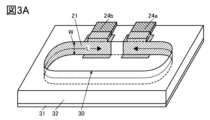
- 3A to 3C are schematic perspective views of a transistor.
- 4A and 4B are perspective schematic diagrams of a transistor.
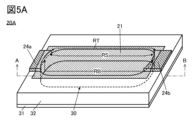
- 5A and 5B are schematic perspective and cross-sectional views of a transistor.
- FIG. 6 is a schematic perspective view of a transistor.
- 7A and 7B are schematic perspective views of a transistor.
- 8A and 8B are perspective schematic diagrams of a transistor.
- 9A and 9B are schematic top and cross-sectional views of a transistor.
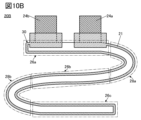
- 10A and 10B are schematic perspective and top views of a transistor.
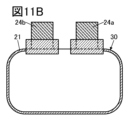
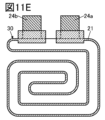
- 11A-11E are schematic top views of a transistor.
- FIG 12A is a top view illustrating an example of a semiconductor device
- FIG 12B is a cross-sectional view illustrating the example of the semiconductor device
- 13A is a top view illustrating an example of a semiconductor device
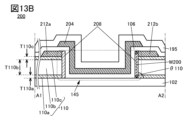
- FIG 13B is a cross-sectional view illustrating the example of the semiconductor device
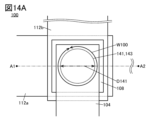
- 14A is a top view illustrating an example of a semiconductor device
- FIG 14B is a cross-sectional view illustrating the example of the semiconductor device
- 15A is a top view illustrating an example of a semiconductor device
- FIG 15B is a cross-sectional view illustrating the example of the semiconductor device
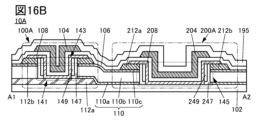
- 16A and 16B are a top view and a cross-sectional view illustrating an example of a semiconductor device.
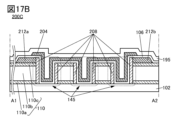
- 17A and 17B are a top view and a cross-sectional view illustrating an example of a semiconductor device.
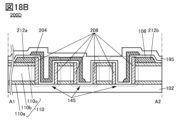
- 18A and 18B are a top view and a cross-sectional view illustrating an example of a semiconductor device.
- 19A and 19B are cross-sectional views showing an example of a semiconductor device.
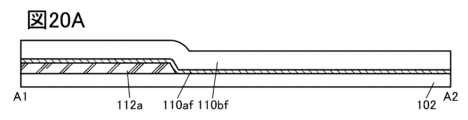
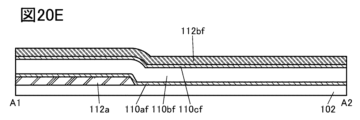
- 20A to 20E are cross-sectional views showing an example of a method for manufacturing a semiconductor device.
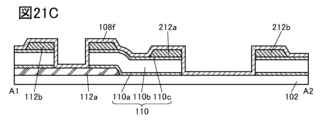
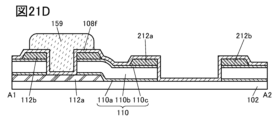
- 21A to 21D are cross-sectional views showing an example of a method for manufacturing a semiconductor device.
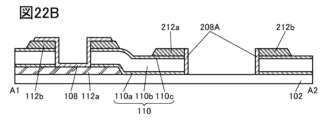
- 22A to 22D are cross-sectional views showing an example of a method for manufacturing a semiconductor device.
- 23A and 23B are cross-sectional views illustrating an example of a method for manufacturing a semiconductor device.
- 24A and 24B are top views illustrating an example of a method for manufacturing a semiconductor device.
- 25A and 25B are top views illustrating an example of a method for manufacturing a semiconductor device.
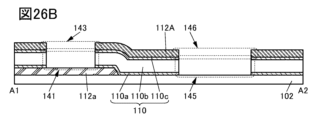
- 26A to 26D are cross-sectional views showing an example of a method for manufacturing a semiconductor device.
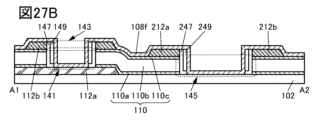
- 27A to 27D are cross-sectional views showing an example of a method for manufacturing a semiconductor device.
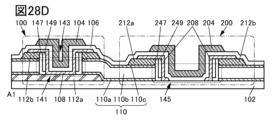
- 28A to 28D are cross-sectional views showing an example of a method for manufacturing a semiconductor device.
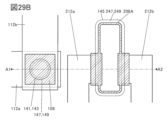
- 29A and 29B are top views illustrating an example of a method for manufacturing a semiconductor device.
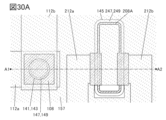
- 30A and 30B are top views illustrating an example of a method for manufacturing a semiconductor device.
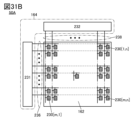
- 31A and 31B are perspective and block diagrams illustrating an example of a display device. Fig.
- FIG. 32A is a circuit diagram of a latch circuit
- Fig. 32B is a circuit diagram of an inverter circuit
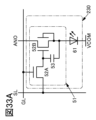
- 33A and 33B are circuit diagrams of a pixel circuit
- Fig. 33C is a cross-sectional view showing an example of a pixel circuit
- FIG. 34 is a cross-sectional view showing an example of a pixel circuit
- FIG. 35 is a schematic cross-sectional view showing a configuration example of a display device.
- 36A and 36B are diagrams illustrating a configuration example of an electronic device.
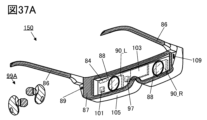
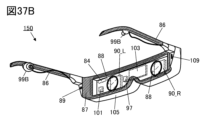
- 37A and 37B are diagrams illustrating a configuration example of an electronic device.
- 38A and 38B are diagrams illustrating a configuration example of a display device.
- 39 is a diagram illustrating an example of the configuration of a display device.
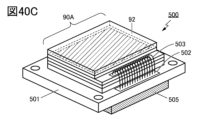
- 40A to 40C are perspective views of a display module.
- 41A and 41B are diagrams illustrating a configuration example of a display device.
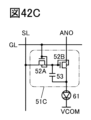
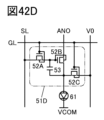
- 42A to 42D are diagrams for explaining a configuration example of a display device.
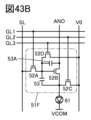
- 43A to 43D are diagrams for explaining a configuration example of a display device.
- 44A and 44B are diagrams illustrating a configuration example of a display device.
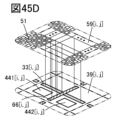
- 45A to 45D are diagrams for explaining a configuration example of a display device.
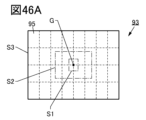
- 46A to 46C are diagrams for explaining a configuration example of a display device.
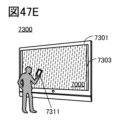
- 47A to 47F are diagrams showing an example of an electronic device.
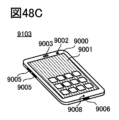
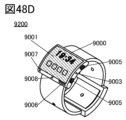
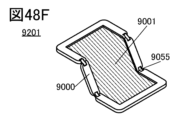
- 48A to 48G are diagrams showing an example of an electronic device.
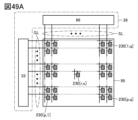
- 49A is a diagram for explaining a sub-display section
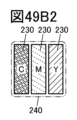
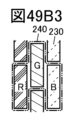
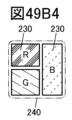
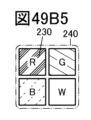
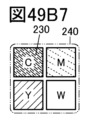
- Fig. 49B1 to Fig. 49B7 are diagrams for explaining examples of pixel configurations
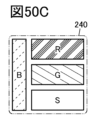
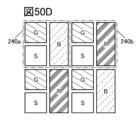
- 50A to 50G are diagrams for explaining examples of pixel configurations
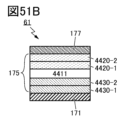
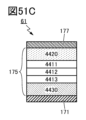
- 51A to 51D are diagrams illustrating configuration examples of a light-emitting device.
- an identification reference number such as “_1”, “[n]”, “[m,n]” may be added to the reference number.
- an identification reference number such as “_1”, “[n]”, “[m,n]” is added to a reference number in a drawing, etc., when it is not necessary to distinguish between them in this specification, the identification reference number may not be added.
- ordinal numbers “first” and “second” are used for convenience and do not limit the number of components or the order of the components (e.g., process order or stacking order).
- an ordinal number attached to a component in one place in this specification may not match an ordinal number attached to the same component in another place in this specification or in the claims.
- film and “layer” can be interchanged depending on the circumstances.
- conductive layer can be changed to the term “conductive film.”
- insulating film can be changed to the term “insulating layer.”
- a transistor is a type of semiconductor element that can perform functions such as amplifying current or voltage, and switching operations that control conduction or non-conduction.
- transistor includes IGFETs (Insulated Gate Field Effect Transistors) and thin film transistors (TFTs).
- source and drain may be interchangeable when transistors of different polarity are used, or when the direction of current changes during circuit operation. For this reason, in this specification and elsewhere, the terms “source” and “drain” may be used interchangeably.
- the source and drain of a transistor may be referred to as the source terminal and drain terminal, or the source electrode and drain electrode, or other appropriate terms depending on the situation.
- Gate and backgate can be used interchangeably. For this reason, in this specification and the like, the terms “gate” and “backgate” can be used interchangeably. Note that the names of the gate and backgate of a transistor can be appropriately changed depending on the situation, such as gate electrode and backgate electrode.
- electrically connected includes cases where the connection is made via "something that has some kind of electrical action.”
- something that has some kind of electrical action is not particularly limited as long as it allows the transmission and reception of electrical signals between the connected objects.
- something that has some kind of electrical action includes electrodes or wiring, as well as switching elements such as transistors, resistive elements, coils, and other elements with various functions.
- the off-state current refers to a leakage current between the source and drain when a transistor is in an off state (also referred to as a non-conducting state or a cut-off state).
- the off-state refers to a state in which the voltage Vgs between the gate and source of an n-channel transistor is lower than the threshold voltage Vth (higher than Vth for a p-channel transistor).
- top surface shapes roughly match means that at least a portion of the contours of the stacked layers overlap. For example, this includes cases where the upper and lower layers are processed using the same mask pattern, or where parts of the mask pattern are the same. However, strictly speaking, the contours may not overlap, and the upper layer may be located inside the lower layer, or outside the lower layer, in which case it may also be said that “top surface shapes roughly match.” Furthermore, when the top surface shapes match or roughly match, it can also be said that the edges are aligned or roughly aligned.
- a tapered shape refers to a shape in which at least a portion of the side of the structure is inclined with respect to the substrate surface or the surface to be formed.
- the side of the structure, the substrate surface, and the surface to be formed do not necessarily need to be completely flat, and may be approximately planar with a slight curvature, or approximately planar with fine irregularities.
- a device manufactured using a metal mask or an FMM may be referred to as a device with an MM (metal mask) structure.
- a device manufactured without using a metal mask or an FMM may be referred to as a device with an MML (metal maskless) structure.
- devices with an MML structure can be manufactured without using a metal mask, they can exceed the upper limit of fineness resulting from the alignment accuracy of the metal mask.
- devices with an MML structure can eliminate the need for equipment related to the manufacturing of metal masks and the process of cleaning the metal masks.
- devices with an MML structure are suitable for mass production because they make it possible to keep manufacturing costs low.
- SBS Side By Side
- the SBS structure allows the materials and configuration to be optimized for each light-emitting device, which increases the freedom of material and configuration selection and makes it easier to improve brightness and reliability.
- holes or electrons may be referred to as "carriers".
- the hole injection layer or electron injection layer may be referred to as the "carrier injection layer”
- the hole transport layer or electron transport layer may be referred to as the “carrier transport layer”
- the hole block layer or electron block layer may be referred to as the "carrier block layer”.
- the above-mentioned carrier injection layer, carrier transport layer, and carrier block layer may not be clearly distinguishable from each other due to their cross-sectional shapes or characteristics.
- one layer may have two or three functions among the carrier injection layer, carrier transport layer, and carrier block layer.
- a light-emitting device has an EL layer between a pair of electrodes.
- the EL layer has at least a light-emitting layer.
- layers also called functional layers
- a light-receiving element also called a light-receiving device
- one of the pair of electrodes may be referred to as a pixel electrode, and the other as a common electrode.
- the sacrificial layer (which may also be referred to as a mask layer) is located at least above the light-emitting layer (more specifically, the layer that is processed into an island shape among the layers that make up the EL layer) and has the function of protecting the light-emitting layer during the manufacturing process.
- step discontinuity refers to the phenomenon in which a layer, film, or electrode is separated due to the shape of the surface on which it is formed (e.g., a step, etc.).
- FIG. 1A A perspective schematic view of the transistor 20 is shown in Fig. 1A.
- FIG. 1B A cross-sectional schematic view of a cut surface taken along dashed line A-B in Fig. 1A is shown in Fig. 1B.
- FIG. 11A A top schematic view (also referred to as a plan schematic view) of the transistor 20 is shown in Fig. 11A. Note that some components (such as the gate electrode 23 and the gate insulating layer 22) are omitted in Fig. 1A and Fig. 11A.
- the transistor 20 is provided on an insulating layer 31 and has a semiconductor layer 21, a gate insulating layer 22, a gate electrode 23, a source electrode 24a, and a drain electrode 24b.
- An insulating layer 32 is provided on an insulating layer 31, and the insulating layer 32 has an opening 30 that reaches the insulating layer 31.
- a source electrode 24a and a drain electrode 24b are provided on the insulating layer 32.
- the semiconductor layer 21 is provided in contact with the side surface of the insulating layer 32 at the opening 30.
- the gate insulating layer 22 is provided to cover the semiconductor layer 21, the insulating layer 31, the source electrode 24a, the drain electrode 24b, etc.
- the gate electrode 23 overlaps the opening 30 and is provided to cover the gate insulating layer 22.
- the semiconductor layer 21 is provided in contact with each of the source electrode 24a and the drain electrode 24b.
- an example is shown in which the semiconductor layer 21 is provided in contact with the side surface and part of the top surface of the source electrode 24a and the drain electrode 24b.
- the semiconductor layer 21 is provided along the sidewall of the opening 30 (sometimes referring to the side surface of the opening 30, or the side surface of the insulating layer 32 in the opening 30).
- the semiconductor layer 21 can also be said to be provided in a sidewall shape along the sidewall of the opening 30.
- the channel length L of the transistor 20 corresponds to the distance between the source electrode 24a and the drain electrode 24b along the sidewall of the opening 30.
- the channel length L is indicated by a double-headed arrow.
- the channel width W of the transistor 20 is the width of the semiconductor layer 21 along the depth direction of the opening 30.
- the channel width W can be controlled by the thickness of the insulating layer 32 and the depth of the opening 30, a transistor with an extremely short channel width can be realized.
- a transistor with an extremely small channel width that could not be realized by a mass-production exposure apparatus can be realized.
- a transistor with a channel width of less than 10 nm can be realized without using an extremely expensive exposure apparatus used in cutting-edge LSI technology.
- the channel width W is indicated by a double-headed arrow.
- the contour shape of the opening 30 is a rectangle with rounded corners, but it is not limited to this and can be a variety of shapes.
- it can be a circle, an ellipse, a square with rounded corners, etc.
- It can also be a regular polygon such as an equilateral triangle, square, or regular pentagon, or a polygon other than a regular polygon.
- the channel length L can be longer if it is a concave polygon, such as a star-shaped polygon, which is a polygon with at least one interior angle exceeding 180 degrees.
- it can be an ellipse, a polygon with rounded corners, or a closed curve that combines straight lines and curves.
- the channel width W of the transistor can be precisely controlled by the thickness of the insulating layer 32, so that the variation in the channel width W can be made extremely small. Furthermore, a transistor with an extremely small channel width W can be realized.
- the ratio of channel width W to channel length L may be used as an index of transistor characteristics.
- the minimum values of channel length and channel width depend on the exposure limit of an exposure device, so that in order to reduce the W/L ratio, it is necessary to increase L, resulting in a problem of an increase in the area occupied by the transistor.
- the channel width W can be made smaller than the exposure limit of an exposure device, so that a transistor with an extremely small W/L ratio can be realized without increasing the area occupied by the transistor.
- FIG. 2A shows an example in which the semiconductor layer 21 is provided not only on the sidewall of the opening 30, but also on the top surface of the insulating layer 32 and the top surface of the insulating layer 31 located within the opening 30.
- the channel width W of the transistor is the sum of the width of the portion of the semiconductor layer 21 located on the sidewall of the opening 30, the width of the portion located on the insulating layer 32, and the width of the portion located on the top surface of the insulating layer 31.
- FIGS. 1A, 1B, and 2A show a configuration in which the semiconductor layer 21 covers both the source electrode 24a and the drain electrode 24b, and the semiconductor layer 21 is in contact with the upper surface of the source electrode 24a and the upper surface of the drain electrode 24b
- the present invention is not limited to this.
- the semiconductor layer 21 may be configured to cover one of the source electrode 24a and the drain electrode 24b, and to be in contact with one of the upper surfaces of the source electrode 24a and the drain electrode 24b.
- the semiconductor layer 21 may not cover the source electrode 24a and the drain electrode 24b, and may not be in contact with the upper surface of the source electrode 24a and the upper surface of the drain electrode 24b.
- FIG. 2B shows an example in which the semiconductor layer 21 contacts the side of the source electrode 24a and the side of the drain electrode 24b, but does not contact the top surface of the source electrode 24a or the top surface of the drain electrode 24b.
- an anisotropic etching method can be used to form the semiconductor layer 21 along the side wall of the opening 30.
- FIG. 3A shows an example in which the source electrode 24a and the drain electrode 24b are provided next to each other.
- a top view schematic is shown in FIG. 11B.
- the channel length L of the transistor can be made close to the perimeter of the opening 30, and a transistor with a long channel length L can be realized.
- the channel length L is 70% or more, further 80% or more, and further 90% or more of the perimeter of the opening 30.
- FIG. 3B shows an example in which two transistors are arranged in one opening 30.
- semiconductor layers 21a and 21b are provided along the sidewall of the opening 30 without contacting each other.
- transistor 20a having semiconductor layer 21a and transistor 20b having semiconductor layer 21b are provided so as to share one opening 30.
- Transistors 20a and 20b have the same channel width W.
- transistors 20a and 20b may have different channel lengths L. Note that although an example in which two transistors are provided in one opening 30 is shown here, three or more transistors may be provided.
- FIG. 3C shows an example in which a ring-shaped semiconductor layer 21 is provided over the entire side wall of the opening 30.
- a top view schematic is shown in FIG. 11C.
- a source electrode 24a is provided in contact with one part of the ring-shaped semiconductor layer 21, and a drain electrode 24b is provided in contact with the other part.
- FIGS. 4A and 4B show an example configuration in which the shape of the opening 30 is different from that described above.
- FIG. 4A shows an example in which part of the contour of the opening 30 is wavy. This allows the channel length L to be increased without increasing the area occupied by the opening 30.
- FIG. 4B shows an example in which the contour shape of the opening 30 is approximately circular. This allows the area occupied by the transistor to be reduced. In addition, because the shape of the opening 30 is simple, the variation in shape can be reduced, thereby suppressing the variation in the electrical characteristics of the transistor.
- FIGS. 4A and 4B show an example in which the source electrode 24a and the drain electrode 24b are embedded in the upper part of the insulating layer 32, and their upper surfaces are located on the same plane as the upper surface of the insulating layer 32.
- Fig. 5A and 5B show a configuration example different from configuration example 1.
- Fig. 5A is a perspective view of a transistor 20A
- Fig. 5B is a schematic cross-sectional view of a cut surface taken along dashed line A-B shown in Fig. 5A.
- Transistor 20A differs from the transistor shown in configuration example 1 mainly in that semiconductor layer 21 is also provided at the bottom of opening 30.
- the semiconductor layer 21 is provided in contact with the side surfaces and top surface of the insulating layer 32 within the opening 30, as well as the top surface of the insulating layer 32 outside the opening 30.
- path RB that runs from source electrode 24a to the drain electrode, passing through a portion located on the side wall of opening 30 in semiconductor layer 21, a portion located at the bottom of opening 30, and a portion located on the side wall of opening 30 in that order.
- path RS that runs from source electrode 24a to the drain electrode, passing through a portion located on the side wall of opening 30 in semiconductor layer 21.
- path RT that runs from source electrode 24a to drain electrode 24b, passing through a portion located on insulating layer 32 of semiconductor layer 21.
- the path through which current flows most easily varies depending on the shape and thickness of each component. More specifically, of the three paths mentioned above, the path with the shortest distance allows current to flow more easily, and the current density increases.
- the depth of opening 30 is increased to increase the distance of path RB, and the width of source electrode 24a and drain electrode 24b is made smaller than the width of opening 30 to increase the distance of path RT.
- the configuration of the semiconductor layer 21 shown here can also be applied to other configuration examples.
- FIG. 6 shows an example in which two transistors are arranged in one opening 30.
- semiconductor layer 21a and semiconductor layer 21b are provided without contacting each other, in contact with the sidewalls and bottom of opening 30 and the upper surface of insulating layer 32.
- Semiconductor layer 21a and semiconductor layer 21b can be formed using the same semiconductor film. Note that although an example in which two transistors are provided in one opening 30 is shown here, three or more transistors may be provided.
- Figures 7A and 7B show an example in which the shape of the opening 30 is different from that described above.
- FIG. 7A shows an example in which part of the contour of the opening 30 is wavy, similar to FIG. 4A above. This makes it possible to increase the channel length.
- FIG. 7B shows an example in which the opening 30 is made substantially circular, similar to FIG. 4B above. This allows the area occupied by the transistor to be reduced. Furthermore, because the shape of the opening 30 is simple, the variation in shape can be reduced, thereby suppressing the variation in the electrical characteristics of the transistor.
- the configuration of the opening 30 shown here can also be applied to other configuration examples.
- FIG. 8A, 8B, 9A, and 9B Configuration examples different from Configuration Example 1 are shown in Figures 8A, 8B, 9A, and 9B.
- Figures 8A and 8B are schematic perspective views of a transistor 20B
- Figure 9A is a schematic top view of the transistor 20B.
- Figure 9B is a schematic cross-sectional view of a cut surface taken along dashed line A-B shown in Figures 8A, 8B, and 9A. Note that some components (such as the gate electrode 23 and the gate insulating layer 22) are omitted in Figures 8A, 8B, and 9A.
- the insulating layer 32 is shown transparently, with its contour indicated by a dashed line.
- transistor 20B is different from transistor 20 shown in configuration example 1 mainly in that opening 30 has a contour shape that has an extension portion and a bend portion.
- the contour shape of opening 30 formed by combining an extension portion and a bend portion can be called a serpentine shape, a roundabout shape, a meandering shape, or a meandering shape.
- the opening 30 has extension portion 26a, extension portion 26b, extension portion 26c, bend portion 28a, and bend portion 28b.
- the contour shape of the opening 30 can be considered to be a shape in which extension portion 26a and extension portion 26b are connected via bend portion 28a, and extension portion 26b and extension portion 26c are connected via bend portion 28b.
- the semiconductor layer 21 is provided along the side of the insulating layer 32 in the opening 30. Furthermore, the semiconductor layer 21 has a region in contact with the source electrode 24a and a region in contact with the drain electrode 24b. Furthermore, within the opening 30, the semiconductor layer 21 is provided facing the gate electrode 23 via the gate insulating layer 22.
- the semiconductor layer 21 contacts the source electrode 24a at the extension 26a and contacts the drain electrode 24b at the extension 26c.
- the semiconductor layer 21 may also be configured to contact the source electrode 24a or the drain electrode 24b at the bent portion.
- the semiconductor layer 21 may be configured to contact the source electrode 24a at the bent portion 28a and contact the drain electrode 24b at the bent portion 28b.
- a folded structure By connecting two extensions with one bent portion, a folded structure can be formed in the opening 30.
- the length of the opening 30 can be made significantly longer than the distance between the source electrode 24a and the drain electrode 24b. Therefore, the channel length L can be made longer without increasing the area occupied by the transistor.
- a transistor with high saturation properties can be obtained.
- a transistor with an extremely small ratio of the channel width W to the channel length L (W/L ratio) can be realized.
- high saturation may be used to refer to a small change in current in the saturation region in the Id-Vd characteristics of a transistor.
- the configuration of the opening 30 shown here can also be applied to other configuration examples.
- FIGS. 10A and 10B show an example of a configuration in which the semiconductor layer 21 is not provided on a portion of the sidewall of the opening 30.
- FIG. 10A is a schematic perspective view of a transistor 20B
- FIG. 10B is a schematic top view.
- 10A and 10B show an example of a configuration in which the source electrode 24a and the drain electrode 24b are provided adjacent to each other, and further, the semiconductor layer 21 is not provided on the sidewall of the opening 30 between the source electrode 24a and the drain electrode 24b.
- the channel length L of the transistor can be made closer to the perimeter of the opening 30, and the channel length L can be made longer.
- the semiconductor layer 21 contacts the source electrode 24a and the drain electrode 24b at the extension portion 26a, but this is not a limitation of one aspect of the present invention.
- the semiconductor layer 21 may be configured to contact the source electrode 24a and the drain electrode 24b at the bent portion.
- the semiconductor layer 21 may be configured to contact one of the source electrode 24a and the drain electrode 24b at the bent portion and to contact the other at the extension portion.
- the opening 30 has the extensions 26a, 26b, 26c, bends 28a, and 28b, but the present invention is not limited to this.
- the opening 30 may have multiple extensions and at least one bend. Here, it is preferable that the number of bends is one less than the number of extensions. For example, as shown in FIG. 11D, the opening 30 may have two extensions and one bend. Also, for example, the opening 30 may have four or more extensions and three or more bends.
- the contour shape of the opening 30 may be a roll shape, as shown in FIG. 11E.
- the contour shape of the opening 30 is shown with rounded corners, but this is not a limitation of one aspect of the present invention, and the corners of the extension and bend parts may be angular. In this case, the contour shape of the opening 30 may be called a zigzag shape.
- the configuration of the semiconductor layer 21 shown here can also be applied to other configuration examples.
- This embodiment can be implemented by combining at least a portion of it with other embodiments described in this specification.
- FIG. 12A A top view (also referred to as a plan view) of the semiconductor device 10 is shown in Fig. 12A.
- FIG. 12B A cross-sectional view taken along dashed dotted line A1-A2 shown in Fig. 12A is shown in Fig. 12B. Note that some of the components of the semiconductor device 10 (insulating layers, etc.) are omitted in Fig. 12A. As with Fig. 12A, some of the components are omitted in the top views of the semiconductor device in the following drawings.
- the semiconductor device 10 has a transistor 100, a transistor 200, and an insulating layer 110.
- the transistor 100, the transistor 200, and the insulating layer 110 are provided on a substrate 102.
- an insulating layer serving as a base film may be provided on the substrate 102.
- the transistor 100, the transistor 200, and the insulating layer 110 are provided on the insulating layer serving as a base film. Therefore, hereinafter, the top surface of the substrate 102 also includes the top surface of the insulating layer serving as a base film on the substrate 102.
- Transistor 100 and transistor 200 have different structures. Transistor 100 and transistor 200 can be formed by sharing some of the steps.
- transistor 100 When semiconductor device 10 is applied to a display device, it is preferable to use transistor 100 as a pixel selection transistor and transistor 200 as a driving transistor. More specifically, since it is preferable for the driving transistor to have high saturation, transistor 200 with a long channel length can be preferably used. In this way, the semiconductor device of one embodiment of the present invention has an excellent effect that transistors with different channel lengths can be freely designed on the same substrate by changing the thickness of the insulating layer and pattern formation.
- transistor 200 The configuration of transistor 200 will be explained. Here, an example is shown in which the configuration of transistor 20 described above is applied to transistor 200.
- the transistor 200 has a conductive layer 204, a conductive layer 212a, a conductive layer 212b, an insulating layer 106, and a semiconductor layer 208.
- the conductive layer 204 functions as a gate electrode
- a part of the insulating layer 106 functions as a gate insulating layer.
- the conductive layer 212a functions as one of a source electrode and a drain electrode
- the conductive layer 212b functions as the other.
- Each layer constituting the transistor 200 may have a single-layer structure or a stacked structure.
- the above-mentioned descriptions regarding the gate electrode 23, the source electrode 24a, the drain electrode 24b, the gate insulating layer 22, and the semiconductor layer 21 can be referred to.
- the insulating layer 110 has an opening 145.
- a conductive layer 212a and a conductive layer 212b are provided on the insulating layer 110. It is preferable that some ends of the conductive layer 212a and the conductive layer 212b are aligned with the end of the insulating layer 110 on the opening 145 side.
- the conductive layer 212a and the conductive layer 212b can be made of the same material.
- the conductive layer 212a and the conductive layer 212b can be formed in the same process.
- the conductive layer 212a and the conductive layer 212b can be formed by forming a film that will become the conductive layer 212a and the conductive layer 212b and processing the film. Note that the insulating layer 110 and the opening 145 can be described in the above description of the insulating layer 32 and the opening 30.
- the semiconductor layer 208 is provided in a sidewall shape in contact with the sidewall of the opening 145 (which may refer to the side surface of the opening 145 or the side surface of the insulating layer 110 in the opening 145).
- the semiconductor layer 208 is provided in contact with the side surface of the conductive layer 212a, the side surface of the conductive layer 212b, and the side surface of the insulating layer 110.
- the lower surface of the semiconductor layer 208 may be in contact with the upper surface of the substrate 102.
- the semiconductor layer 208 is not provided so as to cover the substrate 102 at the bottom of the opening 145. In other words, an area where the semiconductor layer 208 is not formed is provided at the bottom of the opening 145, and in this area, the upper surface of the substrate 102 and the insulating layer 106 are in contact with each other.
- the region of the semiconductor layer 208 in contact with the conductive layer 212a functions as one of the source region and the drain region, and the region in contact with the conductive layer 212b functions as the other.
- a channel formation region is provided between the source region and the drain region.
- the insulating layer 106 is provided so as to cover the opening 145.
- the insulating layer 106 is provided on the semiconductor layer 208, the conductive layer 212a, the conductive layer 212b, and the insulating layer 110.
- the insulating layer 106 has an area in contact with the upper surface and side surfaces of the semiconductor layer 208, the upper surface and side surfaces of the conductive layer 212a, the upper surface and side surfaces of the conductive layer 212b, the side surfaces of the insulating layer 110, and the upper surface of the substrate 102.
- the insulating layer 106 has a shape that follows the shapes of the upper surface and side surfaces of the semiconductor layer 208, the upper surface and side surfaces of the conductive layer 212a, the upper surface and side surfaces of the conductive layer 212b, the side surfaces of the insulating layer 110, and the upper surface of the substrate 102.
- the conductive layer 204 is provided on the insulating layer 106 and has a region in contact with the upper surface of the insulating layer 106.
- the conductive layer 204 has a region that overlaps with the semiconductor layer 208 via the insulating layer 106.
- the conductive layer 204 has a shape that follows the shape of the upper surface and side surfaces of the insulating layer 106.
- the transistor 100 has a conductive layer 104, an insulating layer 106, a semiconductor layer 108, a conductive layer 112a, and a conductive layer 112b.
- the conductive layer 104 functions as a gate electrode (also referred to as a first gate electrode), and a part of the insulating layer 106 functions as a gate insulating layer (also referred to as a first gate insulating layer).
- the conductive layer 112a functions as one of a source electrode and a drain electrode, and the conductive layer 112b functions as the other.
- Each layer constituting the transistor 100 may have a single-layer structure or a stacked structure.
- a conductive layer 112a is provided on the substrate 102, and an insulating layer 110 is provided on the conductive layer 112a.
- the insulating layer 110 is provided so as to cover the upper and side surfaces of the conductive layer 112a.
- the insulating layer 110 has an opening 141 that reaches the conductive layer 112a. It can also be said that the conductive layer 112a is exposed in the opening 141.
- the conductive layer 112b is provided on the insulating layer 110.
- the conductive layer 112b has a region overlapping with the conductive layer 112a through the insulating layer 110.
- the conductive layer 112b has an opening 143 in the region overlapping with the conductive layer 112a.
- the opening 143 is provided in the region overlapping with the opening 141.
- the conductive layer 112b can be made of the same material as the conductive layer 212a and the conductive layer 212b.
- the conductive layer 112b can be formed in the same process as the conductive layer 212a and the conductive layer 212b.
- the conductive layer 112b, the conductive layer 212a, and the conductive layer 212b can be formed by forming a film that will become the conductive layer 112b, the conductive layer 212a, and the conductive layer 212b, and processing the film.
- the semiconductor layer 108 is provided so as to cover the openings 141 and 143.
- the same material as the semiconductor layer 208 can be used for the semiconductor layer 108.
- the semiconductor layer 108 can be formed in the same process as the semiconductor layer 208.
- the semiconductor layer 108 and the semiconductor layer 208 can be formed by forming a film that will become the semiconductor layer 108 and the semiconductor layer 208 and processing the film.
- the semiconductor layer 108 has a region in contact with the upper surface and side surfaces of the conductive layer 112b, the side surfaces of the insulating layer 110, and the upper surface of the conductive layer 112a.
- the semiconductor layer 108 is electrically connected to the conductive layer 112a through the openings 141 and 143.
- the semiconductor layer 108 has a shape that conforms to the shapes of the upper surface and side surfaces of the conductive layer 112b, the side surfaces of the insulating layer 110, and the upper surface of the conductive layer 112a.
- the semiconductor layer 108 has a region that overlaps with the conductive layer 112a through the insulating layer 110. It can also be said that the insulating layer 110 has a region sandwiched between the conductive layer 112a and the semiconductor layer 108.
- the region of the semiconductor layer 108 in contact with the conductive layer 112a functions as one of the source region and the drain region, and the region in contact with the conductive layer 112b functions as the other.
- a channel formation region is provided between the source region and the drain region.
- the insulating layer 106 is provided so as to cover the openings 141 and 143.
- the insulating layer 106 is provided on the semiconductor layer 108, the conductive layer 112b, and the insulating layer 110.
- the insulating layer 106 has an area that contacts the upper surface and side surfaces of the semiconductor layer 108, the upper surface and side surfaces of the conductive layer 112b, and the upper surface of the insulating layer 110.
- the insulating layer 106 has a shape that follows the shapes of the upper surface and side surfaces of the semiconductor layer 108, the upper surface and side surfaces of the conductive layer 112b, and the upper surface of the insulating layer 110.
- the conductive layer 104 is provided on the insulating layer 106 and has a region in contact with the upper surface of the insulating layer 106.
- the conductive layer 104 has a region that overlaps with the semiconductor layer 108 through the insulating layer 106.
- the conductive layer 104 has a shape that matches the shapes of the upper surface and side surface of the insulating layer 106.
- the conductive layer 104 can be formed using the same material as the conductive layer 204.
- the conductive layer 104 can be formed in the same process as the conductive layer 204.
- the conductive layer 104 and the conductive layer 204 can be formed by forming a film that will become the conductive layer 104 and the conductive layer 204 and processing the film.
- the transistor 100 is a so-called top-gate transistor having a gate electrode above the semiconductor layer 108. Furthermore, since the bottom surface of the semiconductor layer 108 is in contact with the conductive layer 112a and the conductive layer 112b that function as a source electrode and a drain electrode, the transistor 100 can be called a TGBC (Top Gate Bottom Contact) type transistor.
- the source electrode and the drain electrode of the transistor 100 are located at different heights with respect to the surface of the substrate 102, which is the surface on which the transistor 100 is formed, and the drain current flows in a direction perpendicular to or approximately perpendicular to the surface of the substrate 102. It can also be said that the drain current flows in the vertical direction or approximately vertical direction in the transistor 100.
- the transistor that is one embodiment of the present invention can be called a vertical channel transistor or a VFET (Vertical Field Effect Transistor).
- transistor 200 is configured to allow current to flow both vertically and horizontally, it can be called a VLFET (Vertical Lateral Field Effect Transistor).
- the channel length of the transistor 100 can be controlled by the thickness of the insulating layer 110 (specifically, the insulating layer 110b) provided between the conductive layer 112a and the conductive layer 112b. Therefore, a transistor having a channel length shorter than the limit resolution of an exposure device used to manufacture the transistor can be manufactured with high precision.
- the characteristic variation between multiple transistors 100 is also reduced. This makes it possible to stabilize the operation of a semiconductor device including the transistor 100 and to increase its reliability.
- the reduced characteristic variation increases the degree of freedom in circuit design and allows the operating voltage of the semiconductor device to be reduced. This allows the power consumption of the semiconductor device to be reduced.
- the transistor 100 can have a source electrode, a layer having a channel formation region, and a drain electrode stacked vertically, so the area it occupies can be significantly reduced compared to a so-called planar transistor in which the layer having the channel formation region is arranged in a flat plane.
- the conductive layer 112a, the conductive layer 112b, and the conductive layer 104 can each function as wiring, and the transistor 100 can be provided in a region where these wirings overlap. That is, in a circuit having the transistor 100 and the wiring, the area occupied by the transistor 100 and the wiring can be reduced. Therefore, the area occupied by the circuit can be reduced, and a small-sized semiconductor device can be obtained.
- the transistor 100 with a short channel length and the transistor 200 with a long channel length can be formed on the same substrate by sharing some of the processes.
- a high-performance semiconductor device can be obtained by applying the transistor 100 to a transistor that requires a large on-state current and the transistor 200 to a transistor that requires high saturation.
- the conductive layer 112a and the conductive layer 112b functioning as the source electrode and the drain electrode of the transistor 100 are provided on different surfaces. Specifically, the conductive layer 112a is provided on the substrate 102, the conductive layer 112b is provided on the insulating layer 110, and the insulating layer 110 is sandwiched between the conductive layer 112a and the conductive layer 112b.
- the conductive layer 212a and the conductive layer 212b functioning as the source electrode and the drain electrode of the transistor 200 are provided on the same surface. Specifically, the conductive layer 212a and the conductive layer 212b are provided on the insulating layer 110. It can also be said that one of the source electrode and the drain electrode of the transistor 100 is provided on a surface different from the source electrode and the drain electrode of the transistor 200, and the other is provided on the same surface as the source electrode and the drain electrode of the transistor 200.
- a semiconductor device of one embodiment of the present invention when a semiconductor device of one embodiment of the present invention is applied to a pixel circuit of a display device, the area occupied by the pixel circuit can be reduced, and a high-definition display device can be obtained.
- a semiconductor device of one embodiment of the present invention when a semiconductor device of one embodiment of the present invention is applied to a driver circuit of a display device (e.g., one or both of a gate line driver circuit and a source line driver circuit), the area occupied by the driver circuit can be reduced, and a display device with a narrow frame can be obtained.
- An insulating layer 195 is provided to cover the transistors 100 and 200.
- the insulating layer 195 functions as a protective layer for the transistors 100 and 200.
- transistor 100 and transistor 200 Next, the detailed configuration of transistor 100 and transistor 200 will be described.
- the semiconductor material used for the semiconductor layer 108 and the semiconductor layer 208 is not particularly limited.
- a semiconductor made of a single element or a compound semiconductor can be used.
- semiconductors made of a single element include silicon and germanium.
- compound semiconductors include gallium arsenide and silicon germanium.
- Other examples of compound semiconductors include organic semiconductors, nitride semiconductors, and oxide semiconductors (OS: oxide semiconductor). Note that these semiconductor materials may contain impurities as dopants.
- the crystallinity of the semiconductor material used for the semiconductor layer 108 and the semiconductor layer 208 is not particularly limited, and any of an amorphous semiconductor, a single crystalline semiconductor, and a semiconductor having crystallinity other than single crystal (a microcrystalline semiconductor, a polycrystalline semiconductor, or a semiconductor having a crystalline region in part) may be used.
- the use of a single crystalline semiconductor or a semiconductor having crystallinity is preferable because it can suppress deterioration of the transistor characteristics.
- the semiconductor layer 108 and the semiconductor layer 208 can each be made of silicon.
- silicon examples include single crystal silicon, polycrystalline silicon, microcrystalline silicon, and amorphous silicon.
- polycrystalline silicon examples include low temperature polysilicon (LTPS).
- Transistors using amorphous silicon in the channel formation region can be formed on a large glass substrate and can be manufactured at low cost. Transistors using polycrystalline silicon in the channel formation region have high field effect mobility and can operate at high speed. Furthermore, transistors using microcrystalline silicon in the channel formation region have higher field effect mobility and can operate at high speed than transistors using amorphous silicon.
- the semiconductor layer 108 and the semiconductor layer 208 each have a metal oxide (also called an oxide semiconductor) that exhibits semiconductor properties.
- a metal oxide also called an oxide semiconductor
- the band gap of the metal oxide used in the semiconductor layer 108 and the semiconductor layer 208 is preferably 2.0 eV or more, and more preferably 2.5 eV or more.
- OS transistors have extremely high field-effect mobility compared to transistors using amorphous silicon.
- OS transistors have an extremely small off-state current and can hold charge accumulated in a capacitor connected in series with the transistor for a long period of time.
- the use of OS transistors can reduce the power consumption of a semiconductor device.
- the insulating layer 110 preferably has one or more inorganic insulating films.
- materials that can be used for the inorganic insulating film include oxides, nitrides, oxynitrides, and nitride oxides.
- oxides include silicon oxide, aluminum oxide, magnesium oxide, gallium oxide, germanium oxide, yttrium oxide, zirconium oxide, lanthanum oxide, neodymium oxide, hafnium oxide, tantalum oxide, cerium oxide, gallium zinc oxide, and hafnium aluminate.
- nitrides include silicon nitride and aluminum nitride.
- Examples of oxynitrides include silicon oxynitride, aluminum oxynitride, gallium oxynitride, yttrium oxynitride, and hafnium oxynitride.
- Examples of nitride oxides include silicon nitride oxide and aluminum nitride oxide.
- an oxynitride refers to a material whose composition contains more oxygen than nitrogen.
- a nitride oxide refers to a material whose composition contains more nitrogen than oxygen.
- silicon oxynitride refers to a material whose composition contains more oxygen than nitrogen
- silicon nitride oxide refers to a material whose composition contains more nitrogen than oxygen.
- the region of the semiconductor layer 208 in contact with the insulating layer 110 functions as a channel formation region.
- the region of the semiconductor layer 108 in contact with the insulating layer 110 functions as a channel formation region.
- the region of the insulating layer 110 in contact with the channel formation region of the semiconductor layer 108 and the region in contact with the channel formation region of the semiconductor layer 208 contain oxygen.
- One or more of an oxide and an oxynitride can be suitably used for the region of the insulating layer 110 in contact with the channel formation region of the semiconductor layer 108 and the region in contact with the channel formation region of the semiconductor layer 208.
- the insulating layer 110 preferably has a laminated structure.
- Figure 12B etc. shows an example in which the insulating layer 110 has an insulating layer 110a, an insulating layer 110b on insulating layer 110a, and an insulating layer 110c on insulating layer 110b.
- FIGS. 13A and 13B show enlarged views of the transistor 200 shown in FIG. 12A and FIG. 12B.
- FIGS. 14A and 14B show enlarged views of the transistor 100.
- the insulating layer 110b preferably contains oxygen, and preferably uses one or more of the oxides and oxynitrides described above. Specifically, one or both of silicon oxide and silicon oxynitride can be preferably used for the insulating layer 110b. Thus, at least the region of the semiconductor layer 208 in contact with the insulating layer 110b and the region of the semiconductor layer 108 in contact with the insulating layer 110b can each function as a channel formation region.
- a film that releases oxygen when heated for the insulating layer 110b It is more preferable to use a film that releases oxygen when heated for the insulating layer 110b.
- the insulating layer 110b releases oxygen, so that oxygen can be supplied to the semiconductor layer 108.
- oxygen vacancies (V O ) are repaired, and the oxygen vacancies (V O ) can be reduced.
- defects in which hydrogen has entered the oxygen vacancies (V O ) (hereinafter also referred to as V O H) can be reduced by supplying oxygen. Therefore, a transistor exhibits favorable electrical characteristics and is highly reliable.
- oxygen can be supplied to the insulating layer 110b by performing heat treatment in an oxygen-containing atmosphere or plasma treatment in an oxygen-containing atmosphere.
- oxygen may be supplied to the insulating layer 110b by forming an oxide film in an oxygen-containing atmosphere on the upper surface of the insulating layer 110b by a sputtering method. The oxide film may then be removed. Note that in the third embodiment described later, an example in which oxygen is supplied to the insulating layer 110b by forming a metal oxide layer 137 is shown.
- the insulating layer 110b is preferably formed by a deposition method such as a sputtering method or a plasma enhanced chemical vapor deposition (PECVD) method.
- a deposition method such as a sputtering method or a plasma enhanced chemical vapor deposition (PECVD) method.
- PECVD plasma enhanced chemical vapor deposition
- the insulating layer 110b it is preferable that substances (e.g., atoms, molecules, and ions) diffuse easily. It can also be said that it is preferable that the diffusion coefficient of the substance in the insulating layer 110b is large. In particular, it is preferable that oxygen diffuses easily in the insulating layer 110b. In other words, it is preferable that the diffusion coefficient of oxygen in the insulating layer 110b is large.
- the oxygen contained in the insulating layer 110b diffuses through the insulating layer 110b and is supplied to the semiconductor layer 108 via the interface between the insulating layer 110b and the semiconductor layer 108, and is also supplied to the semiconductor layer 208 via the interface between the insulating layer 110b and the semiconductor layer 208.
- V O oxygen vacancies
- V O H increases due to an increase in oxygen vacancies (V O ) in the channel formation region, which may shift the threshold voltage of the transistor and increase the drain current (hereinafter also referred to as cutoff current) that flows when the gate voltage is 0 V.
- cutoff current may increase due to a shift in the threshold voltage to the negative side.
- oxygen is supplied to at least the region of the semiconductor layer 108 that is in contact with the insulating layer 110b and the region of the semiconductor layer 208 that is in contact with the insulating layer 110b, that is, the channel formation regions of the transistors 100 and 200, and the oxygen vacancies (V O ) and V O H in the channel formation regions can be reduced.
- V O oxygen vacancies
- V O H oxygen vacancies
- the region of the semiconductor layer 108 in contact with the conductive layer 112a functions as one of the source and drain regions of the transistor 100, and the region in contact with the conductive layer 112b functions as the other.
- the source and drain regions are regions with lower electrical resistance than the channel formation region.
- the source and drain regions can also be said to be regions with a higher carrier concentration and a higher oxygen defect density than the channel formation region.
- the insulating layer 110a is provided between the insulating layer 110b and the conductive layer 112a.
- the insulating layer 110c is provided between the insulating layer 110b and the conductive layer 112b. It is preferable that the insulating layer 110a and the insulating layer 110c each release a small amount of impurities (e.g., hydrogen and water) and are difficult for impurities to permeate. This can prevent the impurities contained in the insulating layer 110a and the insulating layer 110c from diffusing into the channel formation region. Therefore, a transistor that exhibits good electrical characteristics and is highly reliable can be obtained.
- impurities e.g., hydrogen and water
- the insulating layer 110a and the insulating layer 110c are preferably made of a film that is difficult for oxygen to permeate. This can suppress the oxygen contained in the insulating layer 110b from diffusing to the conductive layer 112a through the insulating layer 110a. Similarly, the oxygen contained in the insulating layer 110b can be suppressed from diffusing to the conductive layer 112b through the insulating layer 110c. This can suppress the conductive layer 112a and the conductive layer 112b from being oxidized and their electrical resistance from increasing.
- the oxygen contained in the insulating layer 110b is suppressed from diffusing to the insulating layer 110a side and the insulating layer 110c side, so that the amount of oxygen supplied from the insulating layer 110b to the channel formation region is increased, and oxygen vacancies (V O ) and V O H in the channel formation region can be reduced.
- oxygen can be effectively supplied from the insulating layer 110b to the channel formation region.
- a configuration in which one or both of the insulating layers 110a and 110c are not provided may also be used.
- the insulating layer 110a and the insulating layer 110c each preferably contain nitrogen, and preferably use one or more of the above-mentioned nitrides and nitride oxides.
- silicon nitride or silicon nitride oxide may be preferably used for the insulating layer 110a and the insulating layer 110c.
- one or both of the insulating layer 110a and the insulating layer 110c may use one or more of an oxide and an oxynitride.
- aluminum oxide may be preferably used for the insulating layer 110a and the insulating layer 110c.
- the insulating layer 110a may use the same material as the insulating layer 110c, or a different material.
- different materials refer to materials in which some or all of the constituent elements are different, or materials in which the constituent elements are the same but the composition is different.
- the thickness T110a of the insulating layer 110a can be, for example, 3 nm or more, 5 nm or more, 10 nm or more, 20 nm or more, 50 nm or more, or 70 nm or more, and can be less than 1 ⁇ m, 500 nm or less, 400 nm or less, 300 nm or less, 200 nm or less, 150 nm or less, or 120 nm or less. As shown in FIG. 14B, the thickness T110a can be the shortest distance between the surface on which the insulating layer 110a is formed (here, the upper surface of the conductive layer 112a) and the upper surface of the insulating layer 110a in a cross-sectional view.
- the thickness T110a of the insulating layer 110a When the thickness T110a of the insulating layer 110a is large, the amount of impurities released from the insulating layer 110a increases, and the amount of impurities diffusing into the channel formation region may increase. On the other hand, when the thickness T110a is small, oxygen contained in the insulating layer 110b may diffuse to the conductive layer 112a side through the insulating layer 110a, and the amount of oxygen supplied to the channel formation region may decrease. By setting the thickness T110a within the above range, oxygen vacancies (V O ) and V O H in the channel formation region can be reduced. In addition, the conductive layer 112a is oxidized by the oxygen contained in the insulating layer 110b, and the electrical resistance of the conductive layer 112a can be prevented from increasing.
- the thickness T110c of the insulating layer 110c can be, for example, 3 nm or more, 5 nm or more, 10 nm or more, 15 nm or more, or 20 nm or more, and can be 1 ⁇ m or less, 500 nm or less, 300 nm or less, 200 nm or less, 150 nm or less, 120 nm or less, or 100 nm or less. As shown in FIG. 14B, the thickness T110c can be the shortest distance between the surface on which the insulating layer 110c is formed (here, the upper surface of the insulating layer 110b) and the upper surface of the insulating layer 110c in a cross-sectional view.
- the thickness T110c of the insulating layer 110c When the thickness T110c of the insulating layer 110c is large, the amount of impurities released from the insulating layer 110c increases, and the amount of impurities diffusing into the channel formation region may increase. On the other hand, when the thickness T110c is small, oxygen contained in the insulating layer 110b may diffuse to the conductive layer 112b side through the insulating layer 110c, and the amount of oxygen supplied to the channel formation region may decrease. By setting the thickness T110c within the above range, oxygen vacancies (V O ) and V O H in the channel formation region can be reduced. In addition, the conductive layer 112b is oxidized by the oxygen contained in the insulating layer 110b, and the electrical resistance of the conductive layer 112b can be prevented from increasing.
- At least one of the region of the semiconductor layer 108 in contact with the insulating layer 110a and the region of the semiconductor layer 108 in contact with the insulating layer 110c may be a region having a lower electrical resistance than the channel formation region (hereinafter, also referred to as a low-resistance region).
- the region may be a region having a higher carrier concentration or a higher oxygen defect density than the channel formation region.
- the semiconductor layer 108 can be configured to have a low-resistance region between the region in contact with the conductive layer 112a (one of the source region and the drain region) and the channel formation region. Similarly, by using a material that releases impurities in the insulating layer 110c, the region of the semiconductor layer 108 in contact with the insulating layer 110c can be a low-resistance region.
- the semiconductor layer 108 can be configured to have a low-resistance region between the region in contact with the conductive layer 112b (the other of the source region and the drain region) and the channel formation region.
- the low resistance regions can function as buffer regions to reduce the drain electric field. These low resistance regions may also function as source or drain regions.
- the conductive layer 112a functions as a drain electrode and the conductive layer 112b functions as a source electrode, by making the region of the semiconductor layer 108 in contact with the insulating layer 110a into a low resistance region, a high electric field is unlikely to occur near the drain region, the generation of hot carriers is suppressed, and deterioration of the transistor can be suppressed.
- the conductive layer 112a functions as a source electrode and the conductive layer 112b functions as a drain electrode, by making the region of the semiconductor layer 108 in contact with the insulating layer 110c into a low resistance region, a high electric field is unlikely to occur near the drain region, the generation of hot carriers is suppressed, and deterioration of the transistor can be suppressed.
- the amount of impurities released from the insulating layers 110a and 110c is too large, the impurities may diffuse into the channel formation region. Even if a material that releases impurities is used for the insulating layers 110a and 110c, it is preferable that the amount of released impurities is small.
- the insulating layer 110 has at least the insulating layer 110b.
- the insulating layer 110 may not have one or both of the insulating layer 110a and the insulating layer 110c.
- the insulating layer 110 may have a stacked structure of two layers, four or more layers, or a single layer structure.
- the top surface shapes of the openings 145, 141, and 143 are not limited, and may be, for example, a circle, an ellipse, a triangle, a quadrangle (including a rectangle, a diamond, and a square), a pentagon, or other polygonal shape, or a shape with rounded corners of these polygons.
- the polygon may be either a concave polygon (a polygon with at least one interior angle exceeding 180 degrees) or a convex polygon (a polygon with all interior angles less than 180 degrees).
- it is preferable that the top surface shapes of the openings 141 and 143 are each circular. By making the top surface shapes of the openings circular, the processing accuracy when forming the openings can be improved, and openings of a fine size can be formed.
- a circle is not limited to a perfect circle.
- the top surface shape of opening 145 refers to the shape of the top surface end portion of insulating layer 110 on the opening 145 side.
- the top surface shape of opening 141 refers to the shape of the top surface end portion of insulating layer 110 on the opening 141 side.
- the top surface shape of opening 143 refers to the shape of the bottom surface end portion of conductive layer 112b on the opening 143 side.
- the top surface shapes of openings 141 and 143 can be made to match or roughly match each other.
- the bottom surface end of conductive layer 112b on the opening 143 side match or roughly match the top surface end of insulating layer 110 on the opening 141 side.
- the bottom surface of conductive layer 112b refers to the surface on the insulating layer 110 side.
- the top surface of insulating layer 110 refers to the surface on the conductive layer 112b side.
- openings 141 and 143 do not have to be the same. Furthermore, when the top surface shapes of openings 141 and 143 are circular, openings 141 and 143 may or may not be concentric.
- transistor 200 The channel length and channel width of transistor 200 are explained using Figures 13A and 13B.
- the channel length L200 of the transistor 200 is indicated by a solid double-headed arrow.
- the channel length L200 corresponds to the distance between the conductive layers 212a and 212b along the sidewall of the opening 145.
- the channel width W200 of the transistor 200 is indicated by a dashed double-headed arrow.
- the channel width W200 is the width of the semiconductor layer 208 along the depth direction of the opening 145.
- the channel length L100 of the transistor 100 is indicated by a double-headed dashed arrow.
- the channel length L100 of the transistor 100 corresponds to the length of the side of the insulating layer 110b on the opening 141 side in a cross-sectional view.
- the channel length L100 is determined by the thickness T110b of the insulating layer 110b and the angle ⁇ 110 between the side of the insulating layer 110b on the opening 141 side and the surface on which the insulating layer 110b is to be formed (here, the upper surface of the insulating layer 110a). Therefore, the channel length L100 can be set to a value smaller than the limit resolution of the exposure device, and a transistor of a fine size can be realized.
- a transistor with an extremely short channel length that could not be realized with a conventional exposure device for mass production of flat panel displays (for example, a minimum line width of about 2 ⁇ m or 1.5 ⁇ m).
- a transistor with a channel length of less than 10 nm without using an extremely expensive exposure device used in cutting-edge LSI technology.
- the channel length L100 can be, for example, 5 nm or more, 7 nm or more, or 10 nm or more, and less than 3 ⁇ m, 2.5 ⁇ m or less, 2 ⁇ m or less, 1.5 ⁇ m or less, 1.2 ⁇ m or less, 1 ⁇ m or less, 500 nm or less, 300 nm or less, 200 nm or less, 100 nm or less, 50 nm or less, 30 nm or less, or 20 nm or less.
- the channel length L100 can be 100 nm or more and 1 ⁇ m or less.
- the on-state current of the transistor 100 can be increased.
- the transistor 100 By using the transistor 100, a circuit capable of high-speed operation can be manufactured. Furthermore, the area occupied by the circuit can be reduced. Therefore, a small-sized semiconductor device can be obtained. For example, when the semiconductor device of one embodiment of the present invention is applied to a large display device or a high-definition display device, even if the number of wirings is increased, signal delay in each wiring can be reduced and display unevenness can be suppressed. Furthermore, since the area occupied by the circuit can be reduced, the frame of the display device can be narrowed.
- the channel length L100 can be controlled by adjusting the thickness T110b and angle ⁇ 110 of the insulating layer 110b. Note that in FIG. 14B, the thickness T110b of the insulating layer 110b is indicated by a dashed double-headed arrow.
- the thickness T110b of the insulating layer 110b can be, for example, 5 nm or more, 7 nm or more, or 10 nm or more, and can be less than 3 ⁇ m, 2.5 ⁇ m or less, 2 ⁇ m or less, 1.5 ⁇ m or less, 1.2 ⁇ m or less, 1 ⁇ m or less, 500 nm or less, 300 nm or less, 200 nm or less, 100 nm or less, 50 nm or less, 30 nm or less, or 20 nm or less.
- the side of the insulating layer 110 on the opening 141 side is preferably vertical or tapered.
- the angle ⁇ 110 is preferably 90 degrees or less. By reducing the angle ⁇ 110, the coverage of the layer (e.g., the semiconductor layer 108) formed on the insulating layer 110 can be improved. Furthermore, the smaller the angle ⁇ 110, the longer the channel length L100 can be, and the larger the angle ⁇ 110, the shorter the channel length L100 can be.
- the angle ⁇ 110 can be, for example, 30 degrees or more, 35 degrees or more, 40 degrees or more, 45 degrees or more, 50 degrees or more, 55 degrees or more, 60 degrees or more, 65 degrees or more, or 70 degrees or more, and 90 degrees or less, 85 degrees or less, or 80 degrees or less.
- the angle ⁇ 110 may also be 75 degrees or less, 70 degrees or less, 65 degrees or less, or 60 degrees or less.
- the shape of the side of the insulating layer 110 on the opening 141 side is shown as straight lines in cross section, but this is not a limitation of one embodiment of the present invention. In cross section, the shape of the side of the insulating layer 110 on the opening 141 side may be curved, or the side may have both straight and curved regions.
- the conductive layer 112b is not provided inside the opening 141. Specifically, it is preferable that the conductive layer 112b does not have a region that is in contact with the side surface of the insulating layer 110 on the opening 141 side. If the conductive layer 112b is also provided inside the opening 141, the channel length L100 of the transistor 100 becomes shorter than the length of the side surface of the insulating layer 110b, which may make it difficult to control the channel length L100. Therefore, it is preferable that the top shape of the opening 143 matches the top shape of the opening 141, or that the opening 143 encompasses the opening 141 in a top view (also referred to as a plan view).
- the width D141 of opening 141 is indicated by a double-headed arrow with a two-dot chain line.
- Figure 14A shows an example in which the top surface shape of opening 141 is circular.
- width D141 corresponds to the diameter of the circle
- channel width W100 of transistor 100 is the length of the circumference of the circle.
- channel width W100 is ⁇ x D141. In this way, when the top surface shape of opening 141 is circular, a transistor with a smaller channel width W100 can be realized compared to other shapes.
- the width D141 of the opening 141 may vary in the depth direction.
- the average value of the diameter at the highest point of the insulating layer 110b (or insulating layer 110) in a cross-sectional view, the diameter at the lowest point, and the diameter at the midpoint between these three diameters may be used as the width D141 of the opening 141.
- the diameter of the opening 141 may be any one of the diameters at the highest point of the insulating layer 110b (or insulating layer 110) in a cross-sectional view, the diameter at the lowest point, and the diameter at the midpoint between these two diameters.
- the width D141 of the opening 141 is equal to or greater than the limit resolution of the exposure device.
- the width D141 can be, for example, 200 nm or more, 300 nm or more, 400 nm or more, or 500 nm or more, and less than 5 ⁇ m, 4.5 ⁇ m or less, 4 ⁇ m or less, 3.5 ⁇ m or less, 3 ⁇ m or less, 2.5 ⁇ m or less, 2 ⁇ m or less, 1.5 ⁇ m or less, or 1 ⁇ m or less.
- the insulating layer 110a and the insulating layer 110c are made of a material that releases less hydrogen from themselves.
- the insulating layer 110a and the insulating layer 110c are made of a material that releases even a small amount of hydrogen, it is preferable that the thicknesses of these layers are thin.
- the thickness T110a of the insulating layer 110a and the thickness T110c of the insulating layer 110c are 1 nm or more, 3 nm or more, or 5 nm or more, and preferably 50 nm or less, 40 nm or less, 30 nm or less, 20 nm or less, 15 nm or less, or 10 nm or less. This makes it possible to reduce the amount of impurities that diffuse into the channel formation region, and to provide a transistor that exhibits good electrical characteristics and is highly reliable even when the channel length L100 is short.
- the region of the semiconductor layer 108 in contact with the insulating layer 110b functions as a channel formation region
- one embodiment of the present invention is not limited to this.
- the region of the semiconductor layer 108 in contact with the insulating layer 110a may also function as a channel formation region.
- the region in contact with the insulating layer 110c may also function as a channel formation region.
- a step may be formed between the insulating layer 110 and the conductive layer 112a, and the semiconductor layer 108, the insulating layer 106, and the conductive layer 104 may be provided along the step.
- Figures 13A and 13B are enlarged views of the transistor 200 shown in Figures 12A and 12B.
- the channel length L100 of the transistor 100 can be set to a value smaller than the limit resolution of the exposure device, and the channel length L200 of the transistor 200 can be set to a value equal to or greater than the limit resolution of the exposure device.
- the transistors 100 and 200 can be formed by sharing some of the steps. Specifically, the semiconductor layer 108 and the semiconductor layer 208 can be formed in the same step.
- a part of the insulating layer 106 functions as a gate insulating layer of the transistor 100, and another part of the insulating layer 106 functions as a gate insulating layer of the transistor 200.
- the conductive layer 104 and the conductive layer 204 can be formed in the same step.
- the conductive layer 112b, the conductive layer 212a, and the conductive layer 212b can be formed in the same step. Therefore, the productivity of the semiconductor device 10 can be increased and the manufacturing cost can be reduced.
- Metal oxides that can be used for the semiconductor layer 108 and the semiconductor layer 208 will be specifically described.
- metal oxides include indium oxide, gallium oxide, and zinc oxide.
- the metal oxide preferably contains at least indium or zinc.
- the metal oxide preferably contains two or three elements selected from indium, element M, and zinc.
- the element M is a metal element or semimetal element having a high bond energy with oxygen, for example, a metal element or semimetal element having a bond energy with oxygen higher than that of indium.
- the element M include aluminum, gallium, tin, yttrium, titanium, vanadium, chromium, manganese, iron, cobalt, nickel, zirconium, molybdenum, hafnium, tantalum, tungsten, lanthanum, cerium, neodymium, magnesium, calcium, strontium, barium, boron, silicon, germanium, and antimony.
- the element M of the metal oxide is preferably one or more of the above elements, more preferably one or more selected from aluminum, gallium, tin, and yttrium, and even more preferably one or more of gallium and tin.
- metal elements and metalloid elements may be collectively referred to as "metal elements", and the "metal element" described in this specification may include metalloid elements.
- the semiconductor layer 108 and the semiconductor layer 208 may each be, for example, indium zinc oxide (In-Zn oxide), indium tin oxide (In-Sn oxide, also written as ITO), indium titanium oxide (In-Ti oxide), indium gallium oxide (In-Ga oxide), indium tungsten oxide (In-W oxide, also written as IWO), indium gallium aluminum oxide (In-Ga-Al oxide), indium gallium tin oxide (In-Ga-Sn oxide), gallium zinc oxide (Ga-Zn oxide, also written as GZO), aluminum zinc oxide (Al-Zn oxide, AZO), or the like.
- ITO indium zinc oxide
- In-Ti oxide indium titanium oxide
- In-Ga oxide indium gallium oxide
- In-W oxide also written as IWO
- IWO indium gallium aluminum oxide
- In-Ga-Sn oxide indium gallium tin oxide
- Ga-Zn oxide also written as GZO
- Al-Zn oxide aluminum zinc oxide
- Indium aluminum zinc oxide (In-Al-Zn oxide, also referred to as IAZO), indium tin zinc oxide (In-Sn-Zn oxide, also referred to as ITZO (registered trademark)), indium titanium zinc oxide (In-Ti-Zn oxide), indium gallium zinc oxide (In-Ga-Zn oxide, also referred to as IGZO), indium gallium tin zinc oxide (In-Ga-Sn-Zn oxide, also referred to as IGZTO), indium gallium aluminum zinc oxide (In-Ga-Al-Zn oxide, also referred to as IGAZO, IGZAO, or IAGZO), etc.
- indium tin oxide containing silicon also referred to as ITSO
- gallium tin oxide Ga-Sn oxide
- aluminum tin oxide Al-Sn oxide
- the field effect mobility of the transistor can be increased.
- a transistor with a large on-current can be realized.
- the metal oxide may contain one or more metal elements having a high period number in the periodic table.
- metal elements having a high period number include metal elements belonging to the fifth period and metal elements belonging to the sixth period.
- Specific examples of the metal elements include yttrium, zirconium, silver, cadmium, tin, antimony, barium, lead, bismuth, lanthanum, cerium, praseodymium, neodymium, promethium, samarium, and europium. Lanthanum, cerium, praseodymium, neodymium, promethium, samarium, and europium are called light rare earth elements.
- the metal oxide may contain one or more nonmetallic elements.
- the carrier concentration increases or the band gap decreases, which may increase the field effect mobility of the transistor.
- nonmetallic elements include carbon, nitrogen, phosphorus, sulfur, selenium, fluorine, chlorine, bromine, and hydrogen.
- the metal oxide becomes highly crystalline and the diffusion of impurities in the metal oxide can be suppressed. This suppresses fluctuations in the electrical characteristics of the transistor and increases its reliability.
- the electrical characteristics and reliability of the transistors vary depending on the composition of the metal oxide applied to the semiconductor layer 108 and the semiconductor layer 208. Therefore, by varying the composition of the metal oxide depending on the electrical characteristics and reliability required of the transistor, a semiconductor device that combines excellent electrical characteristics and high reliability can be obtained.
- the metal oxide is an In-M-Zn oxide
- the atomic ratio of In in the In-M-Zn oxide is equal to or greater than the atomic ratio of element M.
- the atomic ratio of In in the In-M-Zn oxide may be less than the atomic ratio of element M.
- element M contains multiple metal elements
- the total proportion of the atomic numbers of the metal elements can be regarded as the proportion of the atomic number of element M.
- the ratio of the number of indium atoms to the sum of the numbers of atoms of all metal elements contained may be referred to as the indium content. The same applies to other metal elements.
- the on-state current or field effect mobility of the transistor can be increased. Furthermore, by having the element M, the generation of oxygen vacancies (V 2 O 3 ) can be suppressed.
- the element M is preferably one or more of the above elements, and more preferably one or more selected from aluminum, gallium, tin, and yttrium.
- In:Al:Zn 40:1:10 and metal oxides in the vicinity thereof can be preferably used.
- a metal oxide having a polycrystalline structure is used for the semiconductor layer 108 and the semiconductor layer 208, the grain boundaries become the recombination centers, and carriers are captured, which may reduce the on-current of the transistor.
- a metal oxide having a composition that is likely to form a polycrystalline structure it is preferable to include an element that inhibits crystallization.
- ITO indium tin oxide
- ITSO indium tin oxide containing silicon
- the silicon content (the ratio of the number of silicon atoms to the sum of the number of atoms of all metal elements contained) is preferably 1% or more and 20% or less, more preferably 3% or more and 20% or less, even more preferably 3% or more and 15% or less, and even more preferably 5% or more and 15% or less.
- the composition of the semiconductor layer 108 and the semiconductor layer 208 can be analyzed using, for example, energy dispersive X-ray spectrometry (EDX), X-ray photoelectron spectrometry (XPS), inductively coupled plasma mass spectrometry (ICP-MS), or inductively coupled plasma-atomic emission spectrometry (ICP-AES).
- EDX energy dispersive X-ray spectrometry
- XPS X-ray photoelectron spectrometry
- ICP-MS inductively coupled plasma mass spectrometry
- ICP-AES inductively coupled plasma-atomic emission spectrometry
- a combination of these techniques may be used for the analysis.
- the actual content may differ from the content obtained by analysis due to the influence of analytical accuracy. For example, if the content of element M is low, the content of element M obtained by analysis may be lower than the actual content.
- the metal oxide can be formed preferably by sputtering or atomic layer deposition (ALD).
- ALD atomic layer deposition
- the composition of the formed metal oxide may differ from the composition of the sputtering target.
- the zinc content in the formed metal oxide may decrease to about 50% compared to the sputtering target.
- the semiconductor layer 108 and the semiconductor layer 208 may each have a stacked structure having two or more metal oxide layers.
- the compositions of the two or more metal oxide layers in the semiconductor layer 108 and the semiconductor layer 208 may be the same or approximately the same.
- a stacked structure of metal oxide layers with the same composition for example, they can be formed using the same sputtering target, thereby reducing manufacturing costs.
- compositions of the two or more metal oxide layers in each of the semiconductor layer 108 and the semiconductor layer 208 may be different from each other.
- gallium, aluminum, or tin as the element M.
- the element M in the first metal oxide layer and the second metal oxide layer may be the same or different from each other.
- the first metal oxide layer and the second metal oxide layer may be IGZO layers having different compositions from each other.
- a laminated structure of any one selected from indium oxide, indium gallium oxide, and IGZO and any one selected from IAZO, IAGZO, and ITZO (registered trademark) may be used.
- the boundary (interface) between the first metal oxide layer and the second metal oxide layer may not be clearly identified.
- the semiconductor layer 108 and the semiconductor layer 208 are preferably made of a crystalline metal oxide.
- a crystalline metal oxide examples include a CAAC (c-axis aligned crystal) structure, a polycrystalline structure, and a nanocrystalline (nc: nano-crystal) structure.
- the semiconductor layer 108 and the semiconductor layer 208 each use CAAC-OS or nc-OS.
- CAAC-OS has multiple layered crystals.
- the c-axes of the crystals are oriented in the normal direction of the surface on which they are formed.
- Each of the semiconductor layer 108 and the semiconductor layer 208 preferably has layered crystals parallel or approximately parallel to the surface on which they are formed.
- the semiconductor layer 108 preferably has layered crystals parallel or approximately parallel to the top surface in a region in contact with the top surface of the conductive layer 112b, and has layered crystals parallel or approximately parallel to the side surface in a region in contact with the side surface of the conductive layer 112b.
- the semiconductor layer 108 preferably has layered crystals parallel or approximately parallel to the side surface of the insulating layer 110, which is the surface on which they are formed, in the opening 141.
- the layered crystals of the semiconductor layer 108 are formed approximately parallel to the channel length direction of the transistor 100, and therefore the transistor can have a large on-current.
- the semiconductor layer 208 preferably has layered crystals that are parallel or approximately parallel to the surface on which it is formed (here, the side of the insulating layer 110, the side of the conductive layer 212a, and the side of the conductive layer 212b).
- the semiconductor layer 208 preferably has layered crystals that are parallel or approximately parallel to the side of the insulating layer 110, which is the surface on which it is formed, in the region that overlaps with the conductive layer 204.
- the density of defect states in the channel formation region can be reduced.
- a metal oxide with low crystallinity a transistor capable of passing a large current can be realized.
- the substrate temperature during formation can be adjusted, for example, by the temperature of the stage on which the substrate is placed during formation.
- the crystallinity of the semiconductor layer 108 and the semiconductor layer 208 can be analyzed, for example, by X-ray diffraction (XRD), a transmission electron microscope (TEM), or electron diffraction (ED). Alternatively, the analysis may be performed by combining a plurality of these techniques.
- XRD X-ray diffraction
- TEM transmission electron microscope
- ED electron diffraction
- VOH When a metal oxide is used for the semiconductor layer 108 and the semiconductor layer 208, it is preferable to reduce VOH in the channel formation region as much as possible to make it highly pure or substantially highly pure.
- it is important to remove impurities such as water and hydrogen in the metal oxide (sometimes referred to as dehydration or dehydrogenation treatment) and to supply oxygen to the metal oxide to repair oxygen vacancies ( VOH ).
- impurities such as water and hydrogen in the metal oxide
- VOH repair oxygen vacancies
- supplying oxygen to a metal oxide to repair oxygen vacancies ( VOH ) may be referred to as oxygen addition treatment.
- the carrier concentration of the channel formation region is preferably 1 ⁇ 10 18 cm ⁇ 3 or less, more preferably less than 1 ⁇ 10 17 cm ⁇ 3 , further preferably less than 1 ⁇ 10 16 cm ⁇ 3 , further preferably less than 1 ⁇ 10 13 cm ⁇ 3 , and further preferably less than 1 ⁇ 10 12 cm ⁇ 3 .
- the carrier concentration of the channel formation region can be, for example, 1 ⁇ 10 ⁇ 9 cm ⁇ 3 .
- OS transistors have small variations in electrical characteristics due to radiation exposure, i.e., they have high resistance to radiation, and therefore can be suitably used in environments where radiation may be present. It can also be said that OS transistors have high reliability against radiation.
- OS transistors can be suitably used in pixel circuits of X-ray flat panel detectors.
- OS transistors can also be suitably used in semiconductor devices used in outer space.
- radiation include electromagnetic radiation (e.g., X-rays and gamma rays) and particle radiation (e.g., alpha rays, beta rays, proton rays, and neutron rays).
- the semiconductor layer 108 and the semiconductor layer 208 may each have a layered material that functions as a semiconductor.
- a layered material is a general term for a group of materials that have a layered crystal structure.
- a layered crystal structure is a structure in which layers formed by covalent bonds or ionic bonds are stacked via bonds weaker than covalent bonds or ionic bonds, such as van der Waals bonds.
- a layered material has high electrical conductivity within a unit layer, that is, high two-dimensional electrical conductivity.
- Examples of the layered material include graphene, silicene, and chalcogenides.
- Chalcogenides are compounds containing chalcogen (an element belonging to Group 16).
- Examples of the chalcogenides include transition metal chalcogenides and Group 13 chalcogenides.
- the conductive layer 112a, the conductive layer 112b, the conductive layer 104, the conductive layer 204, the conductive layer 212a, conductive layer 212b may each have a single layer structure or a laminated structure of two or more layers.
- Examples of materials that can be used for the conductive layer 112a, the conductive layer 112b, the conductive layer 104, the conductive layer 204, the conductive layer 212a, and the conductive layer 212b include, for example, one or more of chromium, copper, aluminum, gold, silver, zinc, tantalum, titanium, tungsten, manganese, nickel, iron, cobalt, molybdenum, and niobium, and alloys containing one or more of the above-mentioned metals.
- the conductive layer 112a, the conductive layer 112b, the conductive layer 104, the conductive layer 204, the conductive layer 212a, and the conductive layer 212b can each be preferably made of a low-resistance conductive material containing one or more of copper, silver, gold, and aluminum. In particular, copper or aluminum is preferable because of its excellent mass productivity.
- the conductive layer 112a, the conductive layer 112b, the conductive layer 104, the conductive layer 204, the conductive layer 212a, and the conductive layer 212b can each be made of a metal oxide (oxide conductor) having electrical conductivity.
- oxide conductors include indium oxide, zinc oxide, In-Sn oxide (ITO), In-Zn oxide, In-W oxide, In-W-Zn oxide, In-Ti oxide, In-Ti-Sn oxide, In-Sn-Si oxide (also called ITO containing silicon, ITSO), zinc oxide with added gallium, and In-Ga-Zn oxide.
- oxide conductors containing indium are preferred because of their high electrical conductivity.
- a metal oxide that has become a conductor can be called an oxide conductor.
- the conductive layer 112a, the conductive layer 112b, the conductive layer 104, the conductive layer 204, the conductive layer 212a, and the conductive layer 212b may each have a stacked structure of a conductive film containing the oxide conductor (metal oxide) described above and a conductive film containing a metal or an alloy.
- a conductive film containing a metal or an alloy By using a conductive film containing a metal or an alloy, the wiring resistance can be reduced.
- the conductive layers 112a, 112b, 104, 204, 212a, and 212b may each be a Cu-X alloy film (X is Mn, Ni, Cr, Fe, Co, Mo, Ta, or Ti).
- X is Mn, Ni, Cr, Fe, Co, Mo, Ta, or Ti.
- the conductive layer 112a, the conductive layer 112b, the conductive layer 104, the conductive layer 204, the conductive layer 212a, and the conductive layer 212b may be made of the same material or different materials.
- the conductive layer 112a and the conductive layer 112b have a region in contact with the semiconductor layer 108.
- the conductive layer 212a and the conductive layer 212b have a region in contact with the semiconductor layer 208.
- a metal oxide is used as the semiconductor layer 108
- an insulating oxide e.g., aluminum oxide
- a metal oxide is used as the semiconductor layer 208
- a metal that is easily oxidized is used for the conductive layer 212a and the conductive layer 212b
- an insulating oxide may be formed between the conductive layer 212a and the semiconductor layer 208 and between the conductive layer 212b and the semiconductor layer 208, which may hinder the conduction between them. Therefore, it is preferable to use a conductive material that is not easily oxidized, a conductive material that maintains low electrical resistance even when oxidized, or an oxide conductor for the conductive layers 112a, 112b, 212a, and 212b.
- conductive layer 112a, conductive layer 112b, conductive layer 112a, and conductive layer 112b it is preferable to use, for example, titanium, tantalum nitride, titanium nitride, nitride containing titanium and aluminum, nitride containing tantalum and aluminum, ruthenium, ruthenium oxide, ruthenium nitride, oxide containing strontium and ruthenium, and oxide containing lanthanum and nickel, respectively. These are preferable because they are conductive materials that are difficult to oxidize, or materials that maintain low electrical resistance even when oxidized.
- oxide conductors can be used for the conductive layers 112a, 112b, 212a, and 212b.
- oxide conductors such as indium oxide, zinc oxide, ITO, In-Zn oxide, In-W oxide, In-W-Zn oxide, In-Ti oxide, In-Ti-Sn oxide, In-Sn oxide containing silicon, and zinc oxide doped with gallium can be used.
- the conductive layers 112a, 112b, 212a, and 212b may each be made of a nitride conductor.
- nitride conductors include tantalum nitride and titanium nitride.
- the conductive layer 112a, the conductive layer 112b, the conductive layer 104, the conductive layer 212a, the conductive layer 212b, and the conductive layer 204 may each have a stacked structure.
- In-Sn-Si oxide for the region in contact with the semiconductor layer 108 and the region in contact with the semiconductor layer 208, and copper or tungsten for the region not in contact with either the semiconductor layer 108 or the semiconductor layer 208.
- the insulating layer 106 may have a single-layer structure or a stacked structure of two or more layers.
- the insulating layer 106 preferably has one or more inorganic insulating films. Examples of materials that can be used for the inorganic insulating film include oxides, nitrides, oxynitrides, and nitride oxides.
- the insulating layer 106 can be made of any of the materials that can be used for the insulating layer 110.
- the insulating layer 106 has a region in contact with the semiconductor layer 108 and the semiconductor layer 208.
- a metal oxide is used for the semiconductor layer 108 and the semiconductor layer 208, it is preferable to use either the oxide or the oxynitride described above for at least the film that is in contact with the semiconductor layer 108 and the semiconductor layer 208 among the films that constitute the insulating layer 106. It is more preferable to use a film that releases oxygen when heated for the insulating layer 106.
- the insulating layer 106 has a single-layer structure, it is preferable to use an oxide or an oxynitride for the insulating layer 106. Specifically, silicon oxide or silicon oxynitride can be suitably used for the insulating layer 106.
- the insulating film on the side in contact with the semiconductor layer 108 and the semiconductor layer 208 has an oxide or an oxynitride
- the insulating film on the side in contact with the conductive layer 104 and the conductive layer 204 has a nitride or a nitride oxide.
- the oxide or oxynitride for example, silicon oxide or silicon oxynitride can be preferably used.
- silicon nitride or silicon nitride oxide can be preferably used.
- Silicon nitride and silicon nitride oxide are suitable for use as the insulating layer 106 because they release a small amount of impurities (e.g., water and hydrogen) and are less permeable to oxygen and hydrogen. By preventing impurities from diffusing from the insulating layer 106 to the semiconductor layer 108 and the semiconductor layer 208, the electrical characteristics of the transistor can be improved and the reliability can be increased.
- impurities e.g., water and hydrogen
- the thickness of the gate insulating layer becomes thin, the leakage current may become large.
- a material with a high relative dielectric constant also called a high-k material
- high-k materials that can be used for the insulating layer 106 include gallium oxide, hafnium oxide, zirconium oxide, oxides containing aluminum and hafnium, oxynitrides containing aluminum and hafnium, oxides containing silicon and hafnium, oxynitrides containing silicon and hafnium, and nitrides containing silicon and hafnium.
- the insulating layer 195 which functions as a protective layer for the transistors 100 and 200, is preferably made of a material through which impurities do not easily diffuse. By providing the insulating layer 195, diffusion of impurities from the outside into the transistors can be effectively suppressed, and the reliability of the semiconductor device can be improved. Examples of impurities include water and hydrogen.
- the insulating layer 195 can be an insulating layer having an inorganic material or an insulating layer having an organic material.
- an inorganic material such as oxide, oxynitride, nitride oxide, or nitride can be suitably used for the insulating layer 195.
- silicon nitride, silicon nitride oxide, silicon oxynitride, aluminum oxide, aluminum oxynitride, aluminum nitride, hafnium oxide, and hafnium aluminate can be used.
- one or more of acrylic resin and polyimide resin can be used as the organic material.
- a photosensitive material may be used as the organic material. Two or more of the above insulating films may be stacked.
- the insulating layer 195 may have a stacked structure of an insulating layer having an inorganic material and an insulating layer having an organic material.
- the substrate 102 has at least a heat resistance sufficient to withstand subsequent heat treatment.
- a single crystal semiconductor substrate made of silicon or silicon carbide, a polycrystalline semiconductor substrate, a compound semiconductor substrate such as silicon germanium, an SOI substrate, a glass substrate, a quartz substrate, a sapphire substrate, a ceramic substrate, or an organic resin substrate may be used as the substrate 102.
- a semiconductor element may be provided on the substrate 102.
- the shape of the semiconductor substrate and the insulating substrate may be circular or rectangular.
- a flexible substrate may be used as the substrate 102, and the transistors 100 and the like may be formed directly on the flexible substrate.
- a peeling layer may be provided between the substrate 102 and the transistors 100 and the like. By providing a peeling layer, after a semiconductor device is partially or entirely completed on the substrate, it can be separated from the substrate 102 and transferred to another substrate. In this case, the transistors 100 and the like can also be transferred to a substrate with poor heat resistance or a flexible substrate.
- the substrate 102 may be the above-mentioned substrate with an insulating layer laminated on it.
- FIG 15A is a top view of a semiconductor device 10A according to one embodiment of the present invention
- FIG 15B is a cross-sectional view taken along dashed dotted line A1-A2 in FIG 15A.
- the semiconductor device 10A has a transistor 100A, a transistor 200A, and an insulating layer 110.
- the transistor 100A differs mainly from the transistor 100 shown in FIG. 12A etc. in that it has an insulating layer 147 and an insulating layer 149.
- the transistor 200A differs mainly from the transistor 200 shown in FIG. 12A etc. in that it has an insulating layer 247 and an insulating layer 249.
- the insulating layer 247 and the insulating layer 249 are provided between the insulating layer 110 and the semiconductor layer 208, between the conductive layer 212a and the semiconductor layer 208, and between the conductive layer 212b and the semiconductor layer 208.
- Insulating layer 247 contacts the side of insulating layer 110, the side of conductive layer 212a, the side of conductive layer 212b, the upper surface of substrate 102, the side and lower surface of semiconductor layer 208, and the side and lower surface of insulating layer 249. As shown in FIG. 15B, in a cross-sectional view, a protrusion is formed in a portion of insulating layer 247 that contacts the upper surface of substrate 102. At the end of the protrusion, insulating layer 247 contacts semiconductor layer 208. The protrusion of insulating layer 247 protrudes toward the center of opening 145 more than other portions.
- the insulating layer 247 preferably has a barrier property against hydrogen, and in particular, preferably has a high ability to suppress the diffusion of hydrogen.
- a barrier property against hydrogen for example, one or more of aluminum oxide, magnesium oxide, hafnium oxide, gallium oxide, indium gallium zinc oxide, silicon nitride, and silicon nitride oxide can be used as the insulating layer 247.
- silicon nitride can be preferably used as the insulating layer 247.
- carrier property refers to one or both of the following: a function to make it difficult for the target substance to diffuse, thereby suppressing the permeation of the target substance (also called low permeability), and a function to capture or fix the target substance (also called gettering).
- Insulating layer 249 contacts the side surface and upper surface of the protruding portion of insulating layer 247, and the side surface and lower surface of semiconductor layer 208. As shown in FIG. 15B, in a cross-sectional view, the side surface of insulating layer 249 may be flush with the side end portion of the protruding portion of insulating layer 247.
- the insulating layer 249 preferably has a barrier property against hydrogen, and in particular, preferably has a high ability to capture or fix (also called gettering) hydrogen.
- a barrier property against hydrogen for example, one or more of an oxide containing magnesium, or an oxide containing one or both of aluminum and hafnium can be used as the insulating layer 249.
- these oxides have an amorphous structure.
- oxygen atoms have dangling bonds, and the dangling bonds may have the property of capturing or fixing hydrogen.
- these metal oxides preferably have an amorphous structure, but may have a crystalline region formed in a part of them.
- hafnium oxide can be suitably used as the insulating layer 249.
- the semiconductor layer 208 is provided in contact with the upper surface of the conductive layer 212a, the upper surface of the conductive layer 212b, the upper surface and side surface of the insulating layer 247, and the upper surface and side surface of the insulating layer 249. As shown in FIG. 15B, the lower surface of the semiconductor layer 208 may be in contact with the upper surface of the substrate 102.
- transistor 200A By providing insulating layer 247 and insulating layer 249 in transistor 200A, when an oxide semiconductor is used for semiconductor layer 208, hydrogen, water, and the like that may be mixed into the oxide semiconductor can be removed, thereby realizing a highly reliable semiconductor device.
- the insulating layer 147 and the insulating layer 149 are provided between the insulating layer 110 and the semiconductor layer 108, and between the conductive layer 112b and the semiconductor layer 108.
- Insulating layer 147 contacts the side of insulating layer 110, the side of conductive layer 112b, the top surface of conductive layer 112a, the side and bottom surface of semiconductor layer 108, and the side and bottom surface of insulating layer 149.
- a protrusion is formed in a portion of insulating layer 147 that contacts the top surface of conductive layer 112a.
- insulating layer 147 contacts semiconductor layer 108. The protrusion of insulating layer 147 protrudes toward the center of opening 141 more than other portions.
- the insulating layer 147 can be made of a material that can be used for the insulating layer 247.
- the insulating layer 147 can be formed in the same process as the insulating layer 247.
- a film that will become the insulating layer 247 and the insulating layer 147 can be formed by forming and processing the film to become the insulating layer 247 and the insulating layer 147.
- Insulating layer 149 contacts the side surface and upper surface of the protruding portion of insulating layer 147, and the side surface and lower surface of semiconductor layer 108. As shown in FIG. 15B, in a cross-sectional view, the side surface of insulating layer 149 may be flush with the side end portion of the protruding portion of insulating layer 147.
- the insulating layer 149 can be made of a material that can be used for the insulating layer 249.
- the insulating layer 149 can be formed in the same process as the insulating layer 249.
- a film that will become the insulating layer 249 and the insulating layer 149 can be formed by forming and processing the film.
- the semiconductor layer 108 is provided in contact with the upper surface of the conductive layer 112a, the upper surface of the conductive layer 112b, the upper surface and side surface of the insulating layer 147, and the upper surface and side surface of the insulating layer 149.
- insulating layer 147, insulating layer 149, insulating layer 247, insulating layer 249, semiconductor layer 108, and semiconductor layer 208 shown here can also be applied to other configuration examples.
- FIG 16A is a top view of a semiconductor device 10B according to one embodiment of the present invention, and FIG 16B is a cross-sectional view taken along dashed dotted line A1-A2 in FIG 16A.
- the semiconductor device 10B has a transistor 100A, a transistor 200B, and an insulating layer 110.
- the transistor 200B differs from the transistor 200A shown in FIG. 15A etc. mainly in that the semiconductor layer 208 is also provided at the bottom of the opening 145.
- the transistor 200B uses the configuration of the transistor 20A described above.
- the configuration of the semiconductor layer 208 shown here can also be applied to other configuration examples.
- FIG 17A is a top view of a transistor 200C according to one embodiment of the present invention
- FIG 17B is a cross-sectional view taken along dashed dotted line A1-A2 in FIG 17A.
- Transistor 200C differs from transistor 200 shown in FIG. 12A etc. mainly in that opening 145 has an extension and a bend.
- the top surface shape of opening 145 formed by combining the extension and bend can be called a serpentine shape, a roundabout shape, a meandering shape, or a meandering shape.
- the opening 145 has an extension 146a, an extension 146b, an extension 146c, a bend 148a, and a bend 148b.
- the top surface shape of the opening 145 can be considered as a shape in which the extensions 146a and 146b are connected via the bend 148a, and the extensions 146b and 146c are connected via the bend 148b.
- a semiconductor layer 208 is provided in contact with the side surface of the opening 145. In the opening 145, the semiconductor layer 208 is provided opposite the conductive layer 204 via the insulating layer 106. Here, the semiconductor layer 208 is in contact with the conductive layer 212a at the extension 146a, and in contact with the conductive layer 212b at the extension 146b.
- Extending portion 146a, extending portion 146b, and extending portion 146c have a shape that extends in one direction (in FIG. 17A, a direction perpendicular to dashed line A1-A2) when viewed from above.
- bending portion 148a and bending portion 148b are provided such that one end is bent relative to the other end when viewed from above.
- a folded structure can be formed in the opening 145.
- the length of the opening 145 can be significantly longer than the distance between the conductive layers 212a and 212b. This significantly increases the channel length of the transistor 200C, and increases the saturation of the transistor 200C.
- the opening 145 has extensions 146a, 146b, 146c, bends 148a, and 148b, but the present invention is not limited to this.
- the opening 145 only needs to have multiple extensions and at least one bend.
- it is preferable that the number of bends is one less than the number of extensions.
- the opening 145 may have two extensions and one bend.
- the opening 145 may have four or more extensions and three or more bends.
- the top surface shape of the opening 145 is shown with rounded corners, but the present invention is not limited to this, and the corners of the extension and bent parts may be angular. In this case, the top surface shape of the opening 145 may be called a zigzag shape.
- FIG. 17A shows a structure in which the conductive layer 204 covers the entire opening 145
- the present invention is not limited to this.
- a structure in which the conductive layer 204 overlaps part of the opening 145 may be used, as in the transistor 200D shown in FIGS. 18A and 18B.
- the semiconductor layer 208 connecting the conductive layer 212a and the conductive layer 212b has two types of paths: a path represented by dashed dotted line C1-C2 and a path represented by dashed dotted line D1-D2.
- the path represented by dashed dotted line C1-C2 is covered with the conductive layer 204, but the path represented by dashed dotted line D1-D2 is exposed from the conductive layer 204.
- the insulating layer 195 contacts the upper surface of the insulating layer 106. With this configuration, the layout area of the conductive layer 204 can be reduced, and the transistor 200D can be arranged at a high density.
- transistor 200D only the semiconductor layer 208 in the path represented by dashed line C1-C2 functions as a channel formation region. Therefore, compared to transistor 200C shown in FIG. 17A, the effective channel width can be considered to be about half. Therefore, transistor 200D shown in FIG. 18A has a smaller channel width and can therefore have higher saturation.
- the configuration of the opening 145 shown here can also be applied to other configuration examples.
- FIG 19A is a cross-sectional view of a transistor 200E which is one embodiment of the present invention
- FIG 19B is a cross-sectional view of a transistor 100B which is one embodiment of the present invention.
- Transistor 200E differs from transistor 200 mainly in that it has conductive layers 216 between substrate 102 and conductive layer 212a and between substrate 102 and conductive layer 212b, and in that insulating layer 110 has a six-layer structure.
- the insulating layer 110 includes an insulating layer 110a on the substrate 102, an insulating layer 110b1 on the insulating layer 110a, an insulating layer 110d1 on the insulating layer 110b1, an insulating layer 110d2 on the insulating layer 110d1 and the conductive layer 216, an insulating layer 110b2 on the insulating layer 110d2, and an insulating layer 110c on the insulating layer 110b2.
- the conductive layer 216 functions as a backgate electrode (also referred to as a second gate electrode) of the transistor 200E.
- the conductive layer 216 is preferably located on the insulating layer 110d1.
- the conductive layers 212a and 212b are electrically insulated from the conductive layer 216 by the insulating layers 110c, 110b2, and 110d2.
- the conductive layer 216 preferably has an opening, and an opening 145 is preferably provided inside the opening.
- the conductive layer 216 may be electrically connected to the conductive layer 212a or the conductive layer 212b.
- the conductive layer 212a and the conductive layer 216 may be in contact with each other through openings provided in the insulating layer 110d2, the insulating layer 110b2, and the insulating layer 110c.
- FIG. 19A shows a configuration in which the cross-sectional shape of the conductive layer 216 is tapered
- the cross-sectional shape of the conductive layer 216 may be vertical.
- the side surface of the conductive layer 216 and the surface of the semiconductor layer 208 in contact with the insulating layer 110 become parallel. This is preferable because the potential given to the conductive layer 216 can be efficiently applied to the semiconductor layer 208.
- the conductive layer 216 may have a single layer structure or a stacked structure of two or more layers.
- the conductive layer 216 may be made of any of the materials that can be used for the conductive layer 212a, the conductive layer 212b, and the conductive layer 204.
- the insulating layer 110d2 covers the upper and side surfaces of the conductive layer 216.
- the insulating layer 110d2 is provided so as to cover a portion of the opening of the conductive layer 216. It is preferable that the insulating layer 110d2 contacts the insulating layer 110d1 through the opening.
- the insulating layer 110d1 and the insulating layer 110d2 have the same configuration as the insulating layers 110a and 110c. Specifically, it is preferable that the insulating layer 110d1 and the insulating layer 110d2 are made of a film into which oxygen does not easily diffuse. It is also preferable that the insulating layer 110d1 and the insulating layer 110d2 are made of a film into which hydrogen does not easily diffuse. By providing such insulating layer 110d1 and insulating layer 110d2, it is possible to prevent the conductive layer 216 from being oxidized. It is also possible to prevent the hydrogen contained in the conductive layer 216 from diffusing into the semiconductor layer 208.
- FIG. 19A shows an example in which the thickness of insulating layer 110d1 is uniform regardless of location, the present invention is not limited to this.
- insulating layer 110d1 may have different thicknesses in areas that overlap with conductive layer 216 and areas that do not overlap. For example, when processing the film that will become conductive layer 216, parts of insulating layer 110d1 that do not overlap with conductive layer 216 may be removed, resulting in a thinner thickness.
- the insulating layer 110b2 preferably covers the upper and side surfaces of the conductive layer 216 via the insulating layer 110d2.
- the insulating layer 110b2 is preferably provided so as to cover a portion of the opening of the conductive layer 216 via the insulating layer 110d2.
- the insulating layer 110b1 and the insulating layer 110b2 can each have a configuration similar to that applicable to the insulating layer 110b. Specifically, it is preferable to use a layer containing oxygen for the insulating layer 110b1 and the insulating layer 110b2, and it is preferable to have a region with a higher oxygen content than at least one of the insulating layers 110a, 110c, 110d1, and 110d2.
- the structure of the insulating layer 110 can be made symmetrical above and below the conductive layer 216.
- oxygen can be supplied to the semiconductor layer 208 from both the insulating layers 110b1 and 110b2, improving the characteristics of the transistor.
- the present invention is not limited to the above, and for example, it is also possible to have a configuration in which the insulating layer 110b1 is not provided. It is also possible to have a configuration in which the insulating layer 110d1 and the insulating layer 110d2 are not provided.
- the semiconductor layer 208 has a region that overlaps with the conductive layer 204 through the insulating layer 106 and with the conductive layer 216 through a part of the insulating layer 110 (particularly, the insulating layer 110b2 and the insulating layer 110d2).
- a part of the semiconductor layer 208 is sandwiched between the side of the conductive layer 204 and the side of the conductive layer 216, a part of the insulating layer 110 (particularly, the insulating layer 110b2 and the insulating layer 110d2) is provided between at least a part of the semiconductor layer 208 and the side of the conductive layer 204, and the insulating layer 106 is provided between at least a part of the semiconductor layer 208 and the side of the conductive layer 216.
- a part of the insulating layer 110 functions as a backgate insulating layer (also referred to as a second gate insulating layer) of the transistor 200C.
- the transistor 200E has a back gate electrode, the potential of the back gate side (also called the back channel) of the semiconductor layer 208 can be fixed. Therefore, the saturation of the Id-Vd characteristics of the transistor 200E can be further improved.
- the transistor 200E has a back gate electrode, the potential of the back channel of the semiconductor layer 208 can be fixed, and a negative shift in the threshold voltage can be suppressed. This makes it possible to realize a transistor with normally-off characteristics (i.e., a threshold voltage of a positive value).
- Transistor 200E has a region in which conductive layer 216, insulating layer 110, semiconductor layer 208, insulating layer 106, and conductive layer 204 overlap in this order in one direction without any other layers in between. By widening this region, the electric field of the back channel of semiconductor layer 208 can be more reliably controlled.
- the shortest distance between the conductive layer 216 and the semiconductor layer 208 may differ on the left and right sides of the opening in the insulating layer 110.
- the transistor 100 may be provided with a back gate.
- the transistor 100B shown in FIG. 19B is different from the transistor 100 mainly in that the transistor 100B has a conductive layer 116 between the conductive layer 112a and the conductive layer 112b, and in that the insulating layer 110 has a six-layer structure.
- the cross-sectional shape of the conductive layer 116 in FIG. 19B is illustrated as having a tapered shape, the present invention is not limited to this.
- the conductive layer 116 may be disposed so that its cross-sectional shape is vertical. With this arrangement, the side surface of the conductive layer 116 and the surface of the semiconductor layer 208 in contact with the insulating layer 110 are parallel to each other. With this arrangement, the potential given to the conductive layer 116 can be efficiently applied to the semiconductor layer 208, which is preferable.
- the conductive layer 116 corresponds to the conductive layer 216 described above, and the description of the conductive layer 216 can be referred to. That is, the conductive layer 116 functions as a backgate electrode of the transistor 100B.
- the insulating layer 110 has the same structure as the insulating layer 110 shown in FIG. 19A. That is, a part of the insulating layer 110 functions as a backgate insulating layer of the transistor 100B.
- the transistor 100B there is a region in the semiconductor layer 108 that overlaps with the conductive layer 104 via the insulating layer 106 and overlaps with the conductive layer 116 via a portion of the insulating layer 110 (particularly, the insulating layer 110b2 and the insulating layer 110d2).
- the semiconductor layer 108 is sandwiched between the side of the conductive layer 104 and the side of the conductive layer 116, a portion of the insulating layer 110 (particularly, the insulating layer 110b2 and the insulating layer 110d2) is provided between at least a portion of the semiconductor layer 108 and the side of the conductive layer 104, and the insulating layer 106 is provided between at least a portion of the semiconductor layer 108 and the side of the conductive layer 116.
- the transistor 100B has a backgate electrode, the potential of the backgate side (also called the backchannel) of the semiconductor layer 108 can be fixed. Therefore, the saturation of the Id-Vd characteristics of the transistor 200B can be further improved.
- the transistor 100B has a back gate electrode, the potential of the back channel of the semiconductor layer 108 can be fixed, and a negative shift in the threshold voltage can be suppressed. This makes it possible to realize a transistor with normally-off characteristics (i.e., a threshold voltage of a positive value).
- the thin films (insulating films, semiconductor films, conductive films, etc.) that make up semiconductor devices can be formed using methods such as sputtering, chemical vapor deposition (CVD), vacuum deposition, pulsed laser deposition (PLD), ALD, and molecular beam epitaxy (MBE).
- CVD methods include PECVD and thermal CVD.
- thermal CVD method is metal organic chemical vapor deposition (MOCVD).
- the thin films (insulating films, semiconductor films, conductive films, etc.) that make up semiconductor devices can be formed by wet film formation methods such as spin coating, dipping, spray coating, inkjet, dispensing, screen printing, offset printing, doctor knife method, slit coating, roll coating, curtain coating, or knife coating.
- the thin film When processing the thin film that constitutes the semiconductor device, a photolithography method or the like can be used.
- the thin film may be processed using a nanoimprint method, a sandblasting method, a lift-off method, or the like.
- island-shaped thin films may be directly formed using a film formation method that uses a shielding mask such as a metal mask.
- the light used for exposure can be, for example, i-line (wavelength 365 nm), g-line (wavelength 436 nm), h-line (wavelength 405 nm), or a mixture of these.
- ultraviolet light, KrF laser light, ArF laser light, etc. can also be used.
- Exposure can also be performed by immersion exposure technology.
- Extreme ultraviolet (EUV) light or X-rays can also be used as the light used for exposure.
- Electron beams can also be used instead of the light used for exposure. Extreme ultraviolet light, X-rays, or electron beams are preferable because they enable extremely fine processing. When exposure is performed by scanning a beam such as an electron beam, a photomask is not required.
- etching the thin film one or more of the following methods can be used: dry etching, wet etching, and sandblasting.
- Fig. 20A to Fig. 23B show cross-sectional views taken along dashed line A1-A2 shown in Fig. 12A.
- Fig. 24A to Fig. 25B show top views.
- a film that will become the conductive layer 112a is formed on the substrate 102, and then the film is processed to form the conductive layer 112a.
- the film can be preferably formed by a sputtering method.
- an insulating film 110af that will become the insulating layer 110a, and an insulating film 110bf that will become the insulating layer 110b are formed on the substrate 102 and the conductive layer 112a ( Figure 20A).
- the insulating films 110af and 110bf can be preferably formed by sputtering or PECVD. After forming the insulating film 110af, it is preferable to continuously form the insulating film 110bf in a vacuum without exposing the surface of the insulating film 110af to the atmosphere. By continuously forming the insulating films 110af and 110bf, it is possible to prevent impurities derived from the atmosphere from adhering to the surface of the insulating film 110af. Examples of such impurities include water and organic matter.
- the substrate temperature during the formation of the insulating film 110af and the insulating film 110bf is preferably 180°C or higher and 450°C or lower, more preferably 200°C or higher and 450°C or lower, even more preferably 250°C or higher and 450°C or lower, even more preferably 300°C or higher and 450°C or lower, even more preferably 300°C or higher and 400°C or lower, even more preferably 350°C or higher and 400°C or lower.
- the substrate temperature during the formation of the insulating film 110af and the insulating film 110bf within the above-mentioned range, it is possible to reduce the release of impurities (e.g., water and hydrogen) from the insulating film 110af and the insulating film 110bf, and to suppress the diffusion of impurities into the semiconductor layer 108. Therefore, it is possible to obtain a transistor that exhibits good electrical characteristics and is highly reliable.
- impurities e.g., water and hydrogen
- the insulating films 110af and 110bf are formed before the semiconductor layers 108 and 208, there is no need to worry about oxygen being desorbed from the semiconductor layers 108 and 208 due to the heat applied during the formation of the insulating films 110af and 110bf.
- oxygen may be supplied to the insulating film 110bf.
- an ion implantation method, an ion doping method, a plasma immersion ion implantation method, or a plasma treatment can be used as a method for supplying oxygen.
- an apparatus that converts oxygen gas into plasma by high-frequency power can be suitably used.
- a PECVD apparatus, a plasma etching apparatus, and a plasma ashing apparatus can be given as an apparatus that converts gas into plasma by high-frequency power.
- the plasma treatment is preferably performed in an atmosphere containing oxygen.
- the plasma treatment is preferably performed in an atmosphere containing one or more of oxygen, nitrous oxide (N 2 O), nitrogen dioxide (NO 2 ), carbon monoxide, and carbon dioxide.
- the plasma treatment may be performed continuously in a vacuum without exposing the surface of the insulating film 110bf to the atmosphere.
- a PECVD apparatus is used to form the insulating film 110bf, it is preferable to perform the plasma treatment in the PECVD apparatus. This can increase productivity.
- an N 2 O plasma treatment can be performed continuously in a vacuum.
- a metal oxide layer 137 on the insulating film 110bf ( Figure 20B). By forming the metal oxide layer 137, oxygen can be supplied to the insulating film 110bf.
- the conductivity of the metal oxide layer 137 does not matter.
- At least one of an insulating film, a semiconductor film, and a conductive film can be used as the metal oxide layer 137.
- aluminum oxide, hafnium oxide, hafnium aluminate, indium oxide, indium tin oxide (ITO), or indium tin oxide containing silicon (ITSO) can be used as the metal oxide layer 137.
- the metal oxide layer 137 it is preferable to use an oxide material that contains one or more of the same elements as the semiconductor layer 108 and the semiconductor layer 208. In particular, it is preferable to use a metal oxide material that can be applied to the semiconductor layer 108 and the semiconductor layer 208.
- the oxygen flow ratio or oxygen partial pressure is, for example, 50% or more and 100% or less, preferably 65% or more and 100% or less, more preferably 80% or more and 100% or less, and even more preferably 90% or more and 100% or less. In particular, it is preferable to set the oxygen flow ratio to 100% and the oxygen partial pressure as close to 100% as possible.
- oxygen can be supplied to the insulating film 110bf during the formation of the metal oxide layer 137, and oxygen can be prevented from being released from the insulating film 110bf.
- a large amount of oxygen can be trapped in the insulating film 110bf.
- a large amount of oxygen can be supplied to the semiconductor layer 108 by subsequent heat treatment.
- oxygen vacancies and VOH in the semiconductor layer 108 can be reduced, and a transistor with good electrical characteristics and high reliability can be obtained.
- a heat treatment may be performed. By performing a heat treatment after forming the metal oxide layer 137, oxygen can be effectively supplied from the metal oxide layer 137 to the insulating film 110bf.
- the temperature of the heat treatment is preferably 150°C or more, 200°C or more, 230°C or more, or 250°C or more, and is less than the distortion point of the substrate, 450°C or less, 400°C or less, 350°C or less, or 300°C or less.
- the heat treatment can be performed in an atmosphere containing one or more of a noble gas, nitrogen, or oxygen.
- a noble gas nitrogen, or oxygen.
- dry air CODA: Clean Dry Air
- It is preferable that the content of hydrogen, water, and the like in the atmosphere is as small as possible.
- As the atmosphere it is preferable to use a high-purity gas with a dew point of -60°C or less, preferably -100°C or less.
- an atmosphere containing as little hydrogen, water, and the like it is possible to prevent hydrogen, water, and the like from being taken into the insulating film 110af and the insulating film 110bf as much as possible.
- an oven a rapid heating (RTA: Rapid Thermal Annealing) device, and the like can be used. Using an RTA device can shorten the heating process time.
- RTA Rapid Thermal Annealing
- oxygen may be further supplied to the insulating film 110bf through the metal oxide layer 137.
- a method for supplying oxygen for example, an ion implantation method, an ion doping method, a plasma immersion ion implantation method, or a plasma treatment can be used.
- the plasma treatment the above description can be referred to, and therefore a detailed description will be omitted.
- the metal oxide layer 137 is removed.
- a wet etching method can be preferably used. By using the wet etching method, etching of the insulating film 110bf can be suppressed when removing the metal oxide layer 137. This can suppress the thickness of the insulating film 110bf from becoming thin, and the thickness of the insulating layer 110b can be made uniform.
- oxygen may be further supplied to the insulating film 110bf.
- the above description can be referred to for the method of supplying oxygen.
- a film 139 may be formed on the insulating film 110bf, and oxygen may be supplied to the insulating film 110bf through the film 139.
- a plasma treatment in an atmosphere containing oxygen can be used.
- FIG. 20C shows a schematic diagram of the supply of oxygen to the insulating film 110bf using arrows.
- the film 139 is preferably a conductive film or a semiconductor film.
- the film 139 can be a metal oxide film, a metal film, or an alloy film. It is preferable to use a metal oxide as the film 139 and form it by a sputtering method or the like in an atmosphere containing oxygen, because oxygen can be supplied to the insulating film 110bf even during the formation of the film 139.
- the thickness of film 139 is preferably thin. Specifically, the thickness of film 139 is preferably 1 nm or more, 2 nm or more, or 3 nm or more, and 20 nm or less, 15 nm or less, or 10 nm or less. Typically, the thickness can be about 5 nm.
- the substrate temperature during the formation of film 139 is preferably 350°C or less, more preferably 340°C or less, even more preferably 330°C or less, and even more preferably 300°C or less. This allows a large amount of oxygen to be supplied to insulating film 110bf.
- a dry etching apparatus As the processing apparatus for supplying oxygen, a dry etching apparatus, an ashing apparatus, or a PECVD apparatus can be suitably used. In particular, it is preferable to use an ashing apparatus.
- the bias voltage When a bias voltage is applied between a pair of electrodes of the processing apparatus, the bias voltage may be set to, for example, 10 V or more and 1 kV or less. Alternatively, the power density of the bias may be set to, for example, 1 W/cm 2 or more and 5 W/cm 2 or less.
- a wet etching method can be suitably used to remove the film 139.
- the process of supplying oxygen to the insulating film 110bf is not limited to the above-mentioned method.
- oxygen radicals, oxygen atoms, oxygen atomic ions, or oxygen molecular ions may be supplied to the insulating film 110bf by ion doping, ion implantation, or plasma treatment.
- a film that suppresses oxygen desorption may be formed on the insulating film 110bf, and then oxygen may be supplied to the insulating film 110bf through the film. The film is preferably removed after oxygen is supplied.
- a conductive film or a semiconductor film containing one or more of indium, zinc, gallium, tin, aluminum, chromium, tantalum, titanium, molybdenum, nickel, iron, cobalt, and tungsten can be used.
- insulating film 110cf which will become insulating layer 110c, is formed on insulating film 110bf (FIG. 20D).
- the description of the formation of insulating film 110af and insulating film 110bf can be referenced for the formation of insulating film 110cf, so a detailed description will be omitted.
- a conductive film 112bf that will become the conductive layer 112b, the conductive layer 212a, and the conductive layer 212b is formed on the insulating film 110cf (FIG. 20E).
- the conductive film 112bf can be formed, for example, by a sputtering method.
- the conductive film 112bf is processed to form the conductive layer 112b, the conductive layer 212a, and the conductive layer 212b (FIG. 21A).
- the conductive layer 112b, the conductive layer 212a, and the conductive layer 212b can be preferably formed by, for example, wet etching.
- insulating films 110af, 110bf, and 110cf are partially removed to form insulating layer 110 having openings 141 and 145 (FIG. 21B). Opening 141 is provided in an area overlapping opening 143. The conductive layer 112a is exposed by forming opening 141, and substrate 102 is exposed by forming opening 145.
- dry etching can be suitably used to form insulating layer 110.
- the opening 141 when forming the opening 141 or after forming the opening 141, a part of the conductive layer 112a in the area overlapping the opening 141 may be removed.
- the thickness of the area of the conductive layer 112a in contact with the bottom surface of the semiconductor layer 108 thinner than the thickness of the area not in contact with the semiconductor layer 108, the electric field of the gate electrode applied to the channel formation area near the conductive layer 112a can be strengthened, and the on-current of the transistor can be increased.
- metal oxide film 108f that will become semiconductor layer 108 and semiconductor layer 208 is formed so as to cover openings 141, 143, and 145 (FIG. 21C).
- Metal oxide film 108f is provided in contact with the upper and side surfaces of conductive layer 112b, the upper and side surfaces of insulating layer 110, the upper surface of conductive layer 112a, the upper and side surfaces of conductive layer 212a, the upper and side surfaces of conductive layer 212b, and the upper surface of substrate 102.
- the metal oxide film 108f is preferably formed by a sputtering method using a metal oxide target.
- the metal oxide film 108f is preferably formed by an ALD method.
- the ALD method has high coverage and can be suitably used to form the metal oxide film 108f that covers the openings 141, 143, and 145.
- a metal oxide film can be formed with high coverage on the side surfaces of the insulating layer 110.
- the ALD method makes it easy to control the film formation speed, so a thin film can be formed with good yield.
- the metal oxide film 108f is preferably a dense film with as few defects as possible.
- the metal oxide film 108f is preferably a high-purity film with as few impurities, including hydrogen, as possible reduced.
- oxygen gas oxygen can be suitably supplied into the insulating layer 110.
- oxygen gas oxygen can be suitably supplied into the insulating layer 110b.
- oxygen is supplied to the channel formation regions of the semiconductor layer 108 and the semiconductor layer 208 in a later step, and oxygen vacancies and VOH in these channel formation regions can be reduced.
- oxygen gas may be mixed with an inert gas (e.g., helium gas, argon gas, xenon gas, etc.).
- an inert gas e.g., helium gas, argon gas, xenon gas, etc.
- the higher the oxygen flow ratio or the oxygen partial pressure in the processing chamber when forming the metal oxide film the higher the crystallinity of the metal oxide film can be, and a highly reliable transistor can be realized.
- the lower the oxygen flow ratio or the oxygen partial pressure the lower the crystallinity and the higher the electrical conductivity of the metal oxide film can be, and the larger the on-current of the transistor can be.
- the metal oxide film may become polycrystalline.
- the grain boundaries become the recombination center, and carriers may be captured, resulting in a small on-current of the transistor. Therefore, it is preferable to adjust the oxygen flow ratio or oxygen partial pressure so that the metal oxide film 108f does not become polycrystalline. Since the ease with which the metal oxide film becomes polycrystalline differs depending on the composition of the metal oxide film, the oxygen flow ratio or oxygen partial pressure can be adjusted according to the composition of the metal oxide film 108f.
- the higher the substrate temperature when forming the metal oxide film the higher the crystallinity and the denser the metal oxide film will be.
- the lower the substrate temperature the lower the crystallinity and the higher the electrical conductivity of the metal oxide film will be.
- the substrate temperature during the formation of the metal oxide film 108f is preferably from room temperature to 250°C, more preferably from room temperature to 200°C, and even more preferably from room temperature to 140°C.
- a substrate temperature of from room temperature to 140°C is preferable because it increases productivity.
- the crystallinity can be reduced.
- the metal oxide film may become polycrystalline. It is preferable to adjust the substrate temperature so that the metal oxide film 108f does not become polycrystalline.
- the substrate temperature can be adjusted according to the composition to be applied to the metal oxide film 108f.
- the ALD method it is preferable to use a film formation method such as thermal ALD or PEALD (Plasma Enhanced ALD).
- a film formation method such as thermal ALD or PEALD (Plasma Enhanced ALD).
- the thermal ALD method is preferable because it shows extremely high coating properties.
- the PEALD method is preferable because it shows high coating properties and allows low-temperature film formation.
- the metal oxide film can be formed, for example, by the ALD method using a precursor containing the constituent metal elements and an oxidizing agent.
- three precursors can be used: a precursor containing indium, a precursor containing gallium, and a precursor containing zinc.
- two precursors can be used: a precursor containing indium, and a precursor containing gallium and zinc.
- precursors containing indium include triethylindium, tris(2,2,6,6-tetramethyl-3,5-heptanedionate)indium, cyclopentadienylindium, indium(III) chloride, and (3-(dimethylamino)propyl)dimethylindium.
- precursors containing gallium include trimethylgallium, triethylgallium, tris(dimethylamido)gallium(III), gallium(III) acetylacetonate, tris(2,2,6,6-tetramethyl-3,5-heptanedionate)gallium, dimethylchlorogallium, diethylchlorogallium, and gallium(III) chloride.
- Examples of zinc-containing precursors include dimethylzinc, diethylzinc, zinc bis(2,2,6,6-tetramethyl-3,5-heptanedionate), and zinc chloride.
- Oxidizing agents include, for example, ozone, oxygen, and water.
- Methods for controlling the composition of the resulting film include adjusting one or more of the type of raw material gas, the flow rate ratio of the raw material gas, the time for which the raw material gas is flowed, and the order in which the raw material gas is flowed. By adjusting these, the composition of the metal oxide film 108f can be controlled. In addition, by adjusting these, a film whose composition changes continuously can be formed. The composition of the metal oxide film 108f may be configured to change continuously.
- a treatment for removing water, hydrogen, organic substances, and the like adsorbed on the surface of the insulating layer 110 it is preferable to perform at least one of a treatment for removing water, hydrogen, organic substances, and the like adsorbed on the surface of the insulating layer 110 and a treatment for supplying oxygen into the insulating layer 110.
- a heat treatment can be performed at a temperature of 70° C. or higher and 200° C. or lower in a reduced pressure atmosphere.
- a plasma treatment in an atmosphere containing oxygen may be performed.
- oxygen may be supplied to the insulating layer 110 by a plasma treatment in an atmosphere containing an oxidizing gas such as nitrous oxide ( N 2 O).
- oxygen can be supplied while the organic substances on the surface of the insulating layer 110 are suitably removed. After such a treatment, it is preferable to continuously form the metal oxide film 108f without exposing the surface of the insulating layer 110 to the air.
- the semiconductor layer 108 and the semiconductor layer 208 have a laminated structure, it is preferable to deposit the next metal oxide film in succession after depositing the first metal oxide film without exposing the surface to the air.
- all layers constituting the semiconductor layer 108 and the semiconductor layer 208 may be formed by the same film formation method (e.g., sputtering or ALD), or different film formation methods may be used for each layer.
- the first metal oxide layer may be formed by sputtering
- the second metal oxide layer may be formed by ALD.
- a resist mask 159 is formed on the metal oxide film 108f (FIGS. 21D and 24A).
- the resist mask 159 is provided in the region where the semiconductor layer 108 is to be formed, and is provided so as to cover at least the openings 141 and 143. Note that in FIG. 24A, the metal oxide film 108f and the resist mask 159 are hatched. Also, to make it easier to understand the configuration below the metal oxide film 108f, the hatching of the metal oxide film 108f is shown transparently.
- the metal oxide film 108f is processed into an island shape to form the semiconductor layer 108 and the semiconductor layer 208A that will become the semiconductor layer 208 (FIGS. 22A and 24B).
- the semiconductor layer 108 and the semiconductor layer 208A can be preferably formed by dry etching.
- the semiconductor layer 108 and the semiconductor layer 208A can be preferably formed by anisotropic dry etching.
- the semiconductor layer 108 is formed in the region of the metal oxide film 108f that is covered by the resist mask 159, and the semiconductor layer 208A is formed in the region that contacts the side of the opening 145. Note that the resist mask 159 and the semiconductor layer 208A are hatched in FIG. 24B.
- a resist mask 157 is formed on the semiconductor layer 108, the semiconductor layer 208A, the conductive layer 112b, the conductive layer 212a, the conductive layer 212b, the insulating layer 110, and the substrate 102 (FIGS. 22C and 25A).
- the resist mask 157 is provided so as to cover at least the semiconductor layer 108 and the semiconductor layer 208A in the region that will become the semiconductor layer 208. At this time, the semiconductor layer 208A in the region where the semiconductor layer 208 is not provided is exposed. Note that in FIG. 25A, the semiconductor layer 108, the semiconductor layer 208A, and the resist mask 157 are hatched. Also, to make it easier to understand the configuration below the resist mask 157, the hatching of the resist mask 157 is shown transparently.
- the semiconductor layer 208A in the area not covered by the resist mask 157 is removed to form the semiconductor layer 208.
- the semiconductor layer 208 can be formed by using one or both of a wet etching method and a dry etching method.
- the dry etching method can be preferably used.
- the resist mask 157 is removed (FIGS. 22D and 25B). Note that in FIG. 25B, the semiconductor layer 108 and the semiconductor layer 208 are hatched.
- the heat treatment can remove hydrogen and water contained in the metal oxide film 108f or the semiconductor layer 108 and the semiconductor layer 208 or adsorbed on the surface.
- the heat treatment can also improve the film quality of the metal oxide film 108f or the semiconductor layer 108 and the semiconductor layer 208 (for example, defects are reduced or crystallinity is improved).
- oxygen can also be supplied from the insulating layer 110b to the metal oxide film 108f or the semiconductor layer 108. This can reduce oxygen vacancies ( VO ) and VOH in the channel formation region. At this time, it is more preferable to perform the heat treatment before processing the metal oxide film 108f into the semiconductor layer 108 and the semiconductor layer 208.
- the above description can be referred to for the heat treatment, and detailed description thereof will be omitted. Note that the heat treatment is not limited to this, and oxygen may also be supplied to the channel formation region in a step in which heat is applied after the formation of the metal oxide film 108f (for example, a step of forming the insulating layer 106).
- this heat treatment does not have to be performed if it is not necessary. Also, instead of performing the heat treatment here, it may be performed in a later process. Also, a process in a later process in which heat is applied (e.g., a film formation process) may also serve as the heat treatment.
- a process in a later process in which heat is applied e.g., a film formation process
- the insulating layer 106 is formed to cover the semiconductor layer 108, the semiconductor layer 208, the insulating layer 110, and the substrate 102 (FIG. 23A).
- the insulating layer 106 can be formed preferably by, for example, the PECVD method or the ALD method.
- the insulating layer 106 When a metal oxide is used for the semiconductor layer 108 and the semiconductor layer 208, the insulating layer 106 preferably functions as a barrier film that suppresses oxygen diffusion.
- the insulating layer 106 has a function of suppressing oxygen diffusion, which suppresses oxygen contained in the semiconductor layer 108 and the semiconductor layer 208 from diffusing above the insulating layer 106, and can suppress an increase in oxygen vacancies ( VO ) in the semiconductor layer 108 and the semiconductor layer 208. As a result, a transistor having favorable electrical characteristics and high reliability can be obtained.
- a barrier film refers to a film that has barrier properties.
- an insulating layer that has barrier properties can be called a barrier insulating layer.
- the substrate temperature during the formation of the insulating layer 106 is preferably 180° C. to 450° C., more preferably 200° C. to 450° C., more preferably 250° C. to 450° C., even more preferably 300° C. to 450° C., and even more preferably 300° C. to 400° C.
- the substrate temperature during the formation of the insulating layer 106 By setting the substrate temperature during the formation of the insulating layer 106 within the above range, defects in the insulating layer 106 can be reduced and oxygen can be prevented from being released from the semiconductor layer 108 and the semiconductor layer 208. Therefore, a transistor exhibiting good electrical characteristics and high reliability can be obtained.
- a plasma treatment may be performed on the surfaces of the semiconductor layer 108 and the semiconductor layer 208.
- the plasma treatment can reduce impurities such as water adsorbed on the surfaces of the semiconductor layer 108 and the semiconductor layer 208. Therefore, impurities at the interface between the semiconductor layer 108 and the insulating layer 106 and the interface between the semiconductor layer 208 and the insulating layer 106 can be reduced, and a highly reliable transistor can be realized. This is particularly suitable for the case where the surfaces of the semiconductor layer 108 and the semiconductor layer 208 are exposed to the air between the formation of the semiconductor layer 108 and the semiconductor layer 208 and the formation of the insulating layer 106.
- the plasma treatment can be performed in an atmosphere of oxygen, ozone, nitrogen, nitrous oxide, argon, or the like. In addition, it is preferable that the plasma treatment and the formation of the insulating layer 106 are performed successively without exposure to the air.
- a film that will become the conductive layer 104 and the conductive layer 204 is formed on the insulating layer 106, and the film is processed to form the conductive layer 104 and the conductive layer 204 (FIG. 23B).
- the film can be formed by, for example, a sputtering method, a thermal CVD method (including an MOCVD method), or an ALD method.
- insulating layer 195 is formed to cover conductive layer 104, conductive layer 204, and insulating layer 106 (FIG. 12B).
- the insulating layer 195 can be preferably formed by the PECVD method.
- a heat treatment may be performed. Note that this heat treatment does not have to be performed. Also, the heat treatment may not be performed here, and may serve as a heat treatment performed in a later step. Also, if there is a process in a later step in which heat is applied (such as a film formation process), this may serve as the heat treatment.
- a semiconductor device according to one embodiment of the present invention can be manufactured.
- FIG. 15A and 15B show cross-sectional views taken along dashed line A1-A2 shown in Figure 15A.
- Figures 29A to 30B show top views. Note that a description of parts that overlap with the above-described manufacturing method example 1 will be omitted, and only different parts will be described.
- the conductive film 112bf is formed in the same manner as in Fabrication Method Example 1 (see Figures 20A to 20E).
- the conductive film 112bf is processed to form the conductive layer 112A (FIG. 26A).
- the conductive layer 112A will later become the conductive layer 112b, the conductive layer 212a, and the conductive layer 212b.
- the conductive layer 112A also has an opening 143 and an opening 146.
- the opening 143 is formed in a region overlapping with the opening 141, and the opening 146 is formed in a region overlapping with the opening 145.
- insulating film 110af, insulating film 110bf, and insulating film 110cf are removed to form insulating layer 110 having openings 141 and 145 ( Figure 26B).
- insulating film 147f which will become insulating layer 147 and insulating layer 247, is formed to cover openings 141, 143, 145, and 146, and insulating film 149f, which will become insulating layer 149 and insulating layer 249, is formed on insulating film 147f ( Figure 26C).
- the insulating film 147f is preferably formed in contact with the sidewall of the opening 145.
- the insulating film 149f is preferably formed in contact with the recess of the insulating film 147f formed to reflect the shape of the opening 145. Therefore, the insulating films 147f and 149f are preferably formed by a film formation method with good coverage, and the CVD method or the ALD method can be preferably used.
- the insulating film 147f is formed, it is preferable to form the insulating film 149f continuously in a vacuum without exposing the surface of the insulating film 147f to the atmosphere.
- impurities include water and organic matter.
- insulating films 149f and 147f are processed to form insulating layers 149 and 249, as well as insulating layers 147 and 247 (FIG. 26D).
- the upper surface of conductive layer 112a is exposed in opening 141, and the upper surface of substrate 102 is exposed in opening 145, as well as the upper surface of conductive layer 112A.
- Anisotropic dry etching can be suitably used to form insulating layers 147 and 247, respectively.
- conductive layer 112A is processed to form conductive layer 112b, conductive layer 212a, and conductive layer 212b ( Figure 27A).
- a metal oxide film 108f that will become the semiconductor layer 108 and the semiconductor layer 208 is formed (FIG. 27B).
- the metal oxide film 108f is provided in contact with the upper and side surfaces of the conductive layer 112b, the upper and side surfaces of the insulating layer 147, the upper and side surfaces of the insulating layer 149, the upper and side surfaces of the insulating layer 247, the upper and side surfaces of the insulating layer 249, the upper surface of the insulating layer 110, the upper surface of the conductive layer 112a, the upper and side surfaces of the conductive layer 212a, the upper and side surfaces of the conductive layer 212b, and the upper surface of the substrate 102.
- a resist mask 159, a resist mask 159a, and a resist mask 159b are formed on the metal oxide film 108f (FIGS. 27C and 29A).
- the resist mask 159 is provided in the region where the semiconductor layer 108 is formed, and is provided so as to cover at least the openings 141 and 143.
- the resist mask 159a is provided in at least the region where the conductive layer 212a and the semiconductor layer 208 are in contact.
- the resist mask 159b is provided in at least the region where the conductive layer 212b and the semiconductor layer 208 are in contact. Note that in FIG. 29A, the metal oxide film 108f, the resist mask 159, the resist mask 159a, and the resist mask 159b are hatched. In addition, the hatching of the metal oxide film 108f is shown transparently to make it easier to understand the configuration below the metal oxide film 108f.
- the metal oxide film 108f is processed into an island shape to form the semiconductor layer 108 and the semiconductor layer 208A that will become the semiconductor layer 208 (FIGS. 27D and 29B).
- the semiconductor layer 108 is formed in the region of the metal oxide film 108f that is covered by the resist mask 159, and the semiconductor layer 208A is formed in the region that is covered by the resist mask 159a, the region that is covered by the resist mask 159b, and the region that contacts the side of the opening 145. Note that the semiconductor layer 108 and the semiconductor layer 208A are hatched in FIG. 29B.
- resist mask 159, resist mask 159a, and resist mask 159b are removed.
- a resist mask 157 is formed on the semiconductor layer 108, the semiconductor layer 208A, the conductive layer 112b, the conductive layer 212a, the conductive layer 212b, the insulating layer 110, and the substrate 102 (FIGS. 28A and 30A).
- the resist mask 157 is provided so as to cover at least the semiconductor layer 108 and the semiconductor layer 208A in the region that will become the semiconductor layer 208. At this time, the semiconductor layer 208A in the region where the semiconductor layer 208 is not provided is exposed. Note that in FIG. 30A, the semiconductor layer 108, the semiconductor layer 208A, and the resist mask 157 are hatched. Also, to make it easier to understand the configuration below the resist mask 157, the hatching of the resist mask 157 is shown transparently.
- the semiconductor layer 208A in the areas not covered by the resist mask 157 is removed to form the semiconductor layer 208.
- the resist mask 157 is removed (FIGS. 28B and 30B). Note that in FIG. 30B, the semiconductor layer 108 and the semiconductor layer 208 are hatched.
- insulating layer 106 is formed to cover semiconductor layer 108, semiconductor layer 208, insulating layer 110 and substrate 102 ( Figure 28C).
- a film that will become conductive layer 104 and conductive layer 204 is formed on insulating layer 106, and the film is processed to form conductive layer 104 and conductive layer 204 ( Figure 28D).
- insulating layer 195 is formed to cover conductive layer 104, conductive layer 204 and insulating layer 106 ( Figure 15B).
- a semiconductor device according to one embodiment of the present invention can be manufactured.
- the display device of this embodiment can be a high-resolution display device or a large display device. Therefore, the display device of this embodiment can be used in electronic devices with relatively large screens, such as television devices, desktop or notebook computers, computer monitors, digital signage, and large game machines such as pachinko machines, as well as in the display units of digital cameras, digital video cameras, digital photo frames, mobile phones, portable game machines, personal digital assistants, and audio playback devices.
- electronic devices with relatively large screens such as television devices, desktop or notebook computers, computer monitors, digital signage, and large game machines such as pachinko machines, as well as in the display units of digital cameras, digital video cameras, digital photo frames, mobile phones, portable game machines, personal digital assistants, and audio playback devices.
- the display device of this embodiment can be a high-definition display device. Therefore, the display device of this embodiment can be used, for example, in the display section of a wristwatch-type or bracelet-type information terminal (wearable device), as well as in the display section of a wearable device that can be worn on the head, such as a head-mounted display (HMD) or other VR device, or a glasses-type AR device.
- a wearable device such as a head-mounted display (HMD) or other VR device, or a glasses-type AR device.
- HMD head-mounted display
- AR device glasses-type AR device
- the semiconductor device of one embodiment of the present invention can be used for a display device or a module having the display device.
- the module having the display device include a module in which a connector such as a flexible printed circuit (hereinafter, referred to as FPC) or a TCP (Tape Carrier Package) is attached to the display device, and a module in which an integrated circuit (IC) is mounted by a COG (chip on glass) method, a COF (chip on film) method, or the like.
- FPC flexible printed circuit
- TCP Transmission Carrier Package
- the display device of this embodiment may have a function as a touch panel.
- various detection elements also called sensor elements
- various detection elements that can detect the proximity or contact of a detectable object such as a finger can be applied to the display device.
- Sensor types include, for example, capacitive type, resistive film type, surface acoustic wave type, infrared type, optical type, and pressure sensitive type.
- Examples of the capacitance type include the surface capacitance type and the projected capacitance type.
- Examples of the projected capacitance type include the self-capacitance type and the mutual capacitance type.
- the mutual capacitance type is preferable because it allows simultaneous multi-point detection.
- touch panels examples include out-cell, on-cell, and in-cell types.
- an in-cell touch panel is one in which electrodes constituting a sensing element are provided on one or both of a substrate supporting a display element (also called a display device) and an opposing substrate.
- FIG. 31A shows a perspective view of a display device 50A.
- Display device 50A has a configuration in which substrate 152 and substrate 151 are bonded together.
- substrate 152 is indicated by a dashed line.
- the display device 50A has a display section 162, a connection section 140, a circuit section 164, a conductive layer 165, etc.
- FIG. 31A shows an example in which an IC 173 and an FPC 172 are mounted on the display device 50A. Therefore, the configuration shown in FIG. 31A can also be said to be a display module having the display device 50A, an IC, and an FPC.
- connection portion 140 is provided on the outside of the display portion 162.
- the connection portion 140 can be provided along one or more sides of the display portion 162. There may be one or more connection portions 140.
- FIG. 31A shows an example in which the connection portion 140 is provided so as to surround the four sides of the display portion.
- the connection portion 140 electrically connects the common electrode of the display element and the conductive layer, and can supply a potential to the common electrode.
- the circuit portion 164 has, for example, a scanning line driver circuit (also called a gate driver).
- the circuit portion 164 may also have both a scanning line driver circuit and a signal line driver circuit (also called a source driver).
- the conductive layer 165 has a function of supplying signals and power to the display portion 162 and the circuit portion 164.
- the signals and power are input to the conductive layer 165 from the outside via the FPC 172, or are input to the conductive layer 165 from the IC 173.
- FIG. 31A shows an example in which an IC 173 is provided on a substrate 151 by a COG method, a COF method, or the like.
- an IC having one or both of a scanning line driver circuit and a signal line driver circuit can be used as the IC 173.
- the display device 50A and the display module may be configured without an IC.
- the IC may be mounted on an FPC by a COF method, or the like.
- the semiconductor device of one embodiment of the present invention can be applied to, for example, one or both of the display portion 162 and the circuit portion 164 of the display device 50A.
- An oxide semiconductor (OS) can be preferably used for a channel formation region of a transistor included in the display device.
- OS oxide semiconductor
- the semiconductor device of one embodiment of the present invention can be used for both the display portion 162 and the circuit portion 164, that is, all the transistors included in the display device can be OS transistors. By using OS transistors for all the transistors included in the display device in this manner, an effect of keeping manufacturing costs low can be obtained.
- the semiconductor device of one embodiment of the present invention when the semiconductor device of one embodiment of the present invention is applied to a pixel circuit of a display device, the area occupied by the pixel circuit can be reduced, and a high-definition display device can be obtained. Furthermore, when the semiconductor device of one embodiment of the present invention is applied to a driver circuit of a display device (e.g., one or both of a gate line driver circuit and a source line driver circuit), the area occupied by the driver circuit can be reduced, and a display device with a narrow frame can be obtained. Furthermore, since the semiconductor device of one embodiment of the present invention has good electrical characteristics, the reliability of the display device can be improved by using it in a display device.
- a driver circuit of a display device e.g., one or both of a gate line driver circuit and a source line driver circuit
- the display unit 162 is an area in the display device 50A that displays an image, and has a number of periodically arranged pixels 210.
- Figure 31A shows an enlarged view of one pixel 210.
- pixel arrangements there are no particular limitations on the pixel arrangement in the display device of this embodiment, and various methods can be applied. Examples of pixel arrangements include a stripe arrangement, an S-stripe arrangement, a matrix arrangement, a delta arrangement, a Bayer arrangement, and a Pentile arrangement.
- the pixel 210 shown in FIG. 31A has a pixel 230R that emits red light, a pixel 230G that emits green light, and a pixel 230B that emits blue light.
- a full-color display can be realized by configuring one pixel 210 with pixels 230R, 230G, and 230B.
- Each of pixels 230R, 230G, and 230B functions as a subpixel.
- the display device 50A shown in FIG. 31A shows an example in which pixels 230 that function as subpixels are arranged in a stripe array.
- the number of subpixels that configure one pixel 210 is not limited to three, and may be four or more.
- the pixel 210 may have four subpixels that emit R, G, B, and white (W) light.
- the pixel 210 may have four subpixels that emit R, G, B, and Y light.
- Pixel 230R, pixel 230G, and pixel 230B each have a display element and a circuit that controls the driving of the display element.
- Various elements can be used as display elements, such as liquid crystal elements (also called liquid crystal devices) and light-emitting devices.
- Other elements that can be used include shutter-type or optical interference-type MEMS (Micro Electro Mechanical Systems) elements, display elements that use microcapsules, electrophoresis, electrowetting, or electronic liquid powder (registered trademark) methods, etc.
- QLEDs Quantum-dot LEDs that use a light source and color conversion technology using quantum dot materials.
- Display devices using liquid crystal elements include, for example, transmissive liquid crystal display devices, reflective liquid crystal display devices, and semi-transmissive liquid crystal display devices.
- Modes that can be used in displays using liquid crystal elements include, for example, vertical alignment (VA) mode, FFS (Fringe Field Switching) mode, IPS (In-Plane Switching) mode, TN (Twisted Nematic) mode, and ASM (Axially Symmetrically aligned Micro-cell) mode.
- VA mode include the MVA (Multi-Domain Vertical Alignment) mode, the PVA (Patterned Vertical Alignment) mode, and the ASV (Advanced Super View) mode.
- Liquid crystal materials that can be used in liquid crystal elements include, for example, thermotropic liquid crystal, low molecular weight liquid crystal, polymer liquid crystal, polymer dispersed liquid crystal (PDLC: Polymer Dispersed Liquid Crystal), polymer network liquid crystal (PNLC: Polymer Network Liquid Crystal), ferroelectric liquid crystal, and antiferroelectric liquid crystal.
- thermotropic liquid crystal low molecular weight liquid crystal
- polymer liquid crystal polymer dispersed liquid crystal
- PNLC Polymer Network liquid crystal
- ferroelectric liquid crystal and antiferroelectric liquid crystal.
- these liquid crystal materials can exhibit cholesteric phase, smectic phase, cubic phase, chiral nematic phase, isotropic phase, blue phase, etc.
- either positive type liquid crystal or negative type liquid crystal can be used as the liquid crystal material, and can be selected according to the mode or design to be applied.
- Light-emitting devices include, for example, self-emitting light-emitting devices such as LEDs (Light Emitting Diodes), OLEDs (Organic LEDs), and semiconductor lasers. LEDs can include, for example, mini LEDs and micro LEDs.
- Light-emitting materials that light-emitting devices have include, for example, materials that emit fluorescence (fluorescent materials), materials that emit phosphorescence (phosphorescent materials), materials that exhibit thermally activated delayed fluorescence (thermally activated delayed fluorescence (TADF) materials), and inorganic compounds (quantum dot materials, etc.).
- fluorescent materials materials that emit fluorescence
- phosphorescent materials materials that emit phosphorescence
- TADF thermally activated delayed fluorescence
- inorganic compounds quantum dot materials, etc.
- the light emitting device can emit light of infrared, red, green, blue, cyan, magenta, yellow, or white.
- the color purity can be increased by providing the light emitting device with a microcavity structure.
- one electrode functions as an anode and the other electrode functions as a cathode.
- the display device of one embodiment of the present invention may be a top emission type that emits light in the direction opposite to the substrate on which the light emitting device is formed, a bottom emission type that emits light toward the substrate on which the light emitting device is formed, or a dual emission type that emits light on both sides.
- FIG. 31B is a block diagram illustrating the display device 50A.
- the display device 50A has a display unit 162 and a circuit unit 164.
- the display unit 162 has a plurality of periodically arranged pixels 230 (pixels 230[1,1] to 230[m,n], where m and n are each independently an integer of 2 or more).
- the circuit unit 164 has a first drive circuit unit 231 and a second drive circuit unit 232.
- the circuit included in the first drive circuit unit 231 functions, for example, as a scanning line drive circuit.
- the circuit included in the second drive circuit unit 232 functions, for example, as a signal line drive circuit. Note that some kind of circuit may be provided at a position facing the first drive circuit unit 231 across the display unit 162. Some kind of circuit may be provided at a position facing the second drive circuit unit 232 across the display unit 162.
- the circuit portion 164 may include various circuits such as a shift register circuit, a level shifter circuit, an inverter circuit, a latch circuit, an analog switch circuit, a demultiplexer circuit, and a logic circuit.
- the circuit portion 164 may include transistors and capacitor elements. The transistors in the circuit portion 164 may be formed in the same process as the transistors included in the pixel 230.
- Display device 50A has wiring 236 that are arranged approximately in parallel and whose potential is controlled by a circuit included in first drive circuit section 231, and wiring 238 that are arranged approximately in parallel and whose potential is controlled by a circuit included in second drive circuit section 232.
- FIG. 31B shows an example in which wiring 236 and wiring 238 are connected to pixel 230.
- wiring 236 and wiring 238 are just an example, and wirings connected to pixel 230 are not limited to wiring 236 and wiring 238.
- a VFET having a channel length of submicron size and a large on-state current and a VLFET having a long channel length and high saturation can be formed by sharing some of the steps.
- An oxide semiconductor (OS) can be preferably used for the channel formation region of these transistors, and the transistors can have a small off-state current.
- the semiconductor device according to one embodiment of the present invention can be preferably used for one or both of the display portion 162 and the circuit portion 164.
- the semiconductor device according to one embodiment of the present invention can be used for both the display portion 162 and the circuit portion 164, that is, all the transistors included in the display device can be OS transistors. By using OS transistors for all the transistors included in the display device in this way, it is possible to achieve an effect of keeping the manufacturing cost low.
- FIG. 32A is a circuit diagram showing an example of the configuration of a latch circuit LAT.
- the latch circuit LAT shown in FIG. 32A has transistors Tr31, Tr33, Tr35, Tr36, a capacitance element C31, and an inverter circuit INV.
- a node to which one of the source and drain of transistor Tr33, the gate of transistor Tr35, and one electrode of the capacitance element C31 are electrically connected is referred to as node N.
- the transistor Tr33 when a high potential signal is input to the terminal SMP, the transistor Tr33 is turned on. As a result, the potential of the node N becomes a potential corresponding to the potential of the terminal ROUT, and data corresponding to the signal input from the terminal ROUT to the latch circuit LAT is written to the latch circuit LAT. After the data is written to the latch circuit LAT, if the potential of the terminal SMP is set to a low potential, the transistor Tr33 is turned off. As a result, the potential of the node N is held, and the data written to the latch circuit LAT is held.
- transistor Tr33 It is preferable to use a transistor with a small off-state current as the transistor Tr33.
- An OS transistor can be suitably used as the transistor Tr33. This allows the latch circuit LAT to hold data for a long period of time. This reduces the frequency with which data is rewritten to the latch circuit LAT.
- writing data to the latch circuit LAT such that the signal input from terminal SP2 is output to terminal LIN may be simply referred to as "writing data to the latch circuit LAT.”
- writing data with a value of "1" to the latch circuit LAT may be simply referred to as "writing data to the latch circuit LAT.”
- a semiconductor device can be suitably used in the latch circuit LAT.
- the transistor 100 or the transistor 200 shown in FIG. 12B or the like can be used as one or more of the transistors Tr31, Tr33, Tr35, and Tr36.
- the inverter circuit INV has transistors Tr41, Tr43, Tr45, Tr47, and a capacitance element C41.
- all the transistors in the latch circuit LAT can be transistors of the same polarity, for example, n-channel transistors. This allows, for example, transistor Tr33 as well as transistors Tr31, Tr35, Tr36, Tr41, Tr43, Tr45, and Tr47 to be OS transistors. Therefore, all the transistors in the latch circuit LAT can be manufactured in the same process.
- a semiconductor device can be preferably used for the inverter circuit INV.
- the transistor 100 or the transistor 200 shown in FIG. 12B or the like can be used for one or more of the transistors Tr41, Tr43, Tr45, and Tr47.
- one or more of the transistors 20 to 20B and the transistors 200 to 200E can be preferably used. Furthermore, as a transistor that requires a large on-state current, one or more of the transistors 100 to 100B can be preferably used. This makes it possible to provide a high-performance display device. Furthermore, the occupied area can be reduced, making it possible to provide a display device with a narrow frame.
- the pixel 230 includes a pixel circuit 51 and a light-emitting device 61.
- the pixel circuit 51 shown in FIG. 33A has a transistor 52A, a transistor 52B, and a capacitor 53.
- the pixel circuit 51 is a 2Tr1C type pixel circuit having two transistors and one capacitor. Note that there is no particular limitation on the pixel circuit that can be applied to the display device of one embodiment of the present invention.
- the anode of the light-emitting device 61 is electrically connected to one of the source and drain of the transistor 52B and one electrode of the capacitance element 53.
- the other of the source and drain of the transistor 52B is electrically connected to the wiring ANO.
- the gate of the transistor 52B is electrically connected to one of the source and drain of the transistor 52A and the other electrode of the capacitance element 53.
- the other of the source and drain of the transistor 52A is electrically connected to the wiring GL.
- the gate of the transistor 52A is electrically connected to the wiring GL.
- the cathode of the light-emitting device 61 is electrically connected to the wiring VCOM.
- the wiring GL corresponds to the wiring 236, and the wiring SL corresponds to the wiring 238.
- the wiring VCOM is a wiring that provides a potential for supplying a current to the light-emitting device 61.
- the transistor 52A has a function of controlling the conductive state or non-conductive state between the wiring SL and the gate of the transistor 52B based on the potential of the wiring GL. For example, VDD is supplied to the wiring ANO, and VSS is supplied to the wiring VCOM.
- Transistor 52B has the function of controlling the amount of current flowing through light-emitting device 61.
- Capacitive element 53 has the function of maintaining the gate potential of transistor 52B. The intensity of the light emitted by light-emitting device 61 is controlled according to an image signal supplied to the gate of transistor 52B.
- a backgate may be provided for some or all of the transistors included in the pixel circuit 51.
- the pixel circuit 51 shown in FIG. 33A shows a configuration in which the transistor 52B has a backgate, and the backgate is electrically connected to one of the source and drain of the transistor 52B. Note that the backgate of the transistor 52B may be electrically connected to the gate of the transistor 52B.
- the above-mentioned semiconductor device can be suitably used in the pixel circuit 51.
- the transistor 52B functioning as a drive transistor for controlling the current flowing through the light-emitting device 61 preferably has high saturation.
- the transistors 20 to 20B and the transistors 200 to 200E having a long channel length as the transistor 52B a highly reliable display device can be obtained.
- the transistors 100 to 100B as the transistor 52A the area occupied by the pixel circuit 51A can be reduced, and a high-definition display device can be obtained.
- the transistor 100 may also be used as the transistor 52B.
- a transistor with a short channel length as the transistor 52B, a display device with high brightness can be obtained.
- the area occupied by the pixel circuit 51 can be reduced, and a high-definition display device can be obtained.
- FIG. 33B shows an example of a configuration different from that of pixel 230 shown in FIG. 33A.
- Pixel 230 has a pixel circuit 51A and a light-emitting device 61.
- Pixel circuit 51A shown in FIG. 33B differs from pixel circuit 51 shown in FIG. 33A mainly in that it has transistor 52C.
- Pixel circuit 51A has transistor 52A, transistor 52B, transistor 52C, and capacitance element 53.
- Pixel circuit 51A is a 3Tr1C type pixel circuit having three transistors and one capacitance element.
- One of the source and drain of transistor 52C is electrically connected to one of the source and drain of transistor 52B.
- the other of the source and drain of transistor 52C is electrically connected to wiring V0.
- a reference potential is supplied to wiring V0.
- the gate of transistor 52C is electrically connected to wiring GL.
- Transistor 52C has a function of controlling the conductive or non-conductive state between one of the source and drain electrodes of transistor 52B and wiring V0 based on the potential of wiring GL.
- the reference potential of wiring V0 provided via transistor 52C can suppress variations in the gate-source potential of transistor 52B.
- the wiring V0 can be used to obtain a current value that can be used to set pixel parameters.
- the wiring V0 can function as a monitor line for outputting the current flowing through the transistor 52B or the current flowing through the light-emitting device 61 to the outside.
- the current output to the wiring V0 can be converted to a voltage by a source follower circuit and output to the outside. Alternatively, it can be converted to a digital signal by an AD converter and output to the outside.
- the above-mentioned semiconductor device can be suitably used in the pixel circuit 51A.
- the transistors 20 to 20B and the transistors 200 to 200E having a long channel length as the transistor 52B a highly reliable display device can be obtained.
- the transistors 100 to 100B as the transistors 52A and 52C, the area occupied by the pixel circuit 51A can be reduced, and a high-definition display device can be obtained.
- one of the transistors 100 to 100B may also be used for the transistor 52B.
- FIG. 33C is a cross-sectional view of pixel circuit 51.
- FIG. 33C shows an excerpt of pixel electrodes of transistor 52A, transistor 52B, and light-emitting device 61. Note that the electrical connection between transistor 52A and transistor 52B is omitted.
- Transistor 52A has a conductive layer 104, an insulating layer 106, a semiconductor layer 108, a conductive layer 112a, and a conductive layer 112b.
- Transistor 52B has an insulating layer 106, a semiconductor layer 208, a conductive layer 204, a conductive layer 212a, and a conductive layer 212b.
- the above description can be referred to for transistors 52A and 52B, so detailed description is omitted.
- Transistor 52A and transistor 52B are provided on a substrate 102.
- Figure 33C shows a configuration in which insulating layers 121 and 123 are provided between transistor 52A and transistor 52B and substrate 102. Note that the semiconductor layer 108 of transistor 52A is provided on conductive layer 112a, and the semiconductor layer 208 of transistor 52B is provided on insulating layer 123. In this way, by providing the semiconductor layers of the two transistors on different layers, transistors with different configurations can be easily manufactured on the same substrate.
- the insulating layer 121 preferably has a barrier property against hydrogen, and in particular has a high ability to capture or fix (getter) hydrogen.
- the insulating layer 121 can be preferably made of a material that can be used for the insulating layer 149 and the insulating layer 249.
- hafnium oxide can be preferably used for the insulating layer 121.
- the insulating layer 123 provided on the insulating layer 121 can be preferably made of a material that can be used for the insulating layer 110.
- silicon oxide can be preferably used for the insulating layer 123.
- An insulating layer 195 is provided to cover the transistor 52A, the transistor 52B, and the capacitor 53, an insulating layer 233 is provided to cover the insulating layer 195, and an insulating layer 235 is provided to cover the insulating layer 233.
- a light-emitting device 61 can be provided on the insulating layer 235.
- FIG. 33C shows a pixel electrode 111 that functions as one electrode of the light-emitting device 61.
- the insulating layer 195 and the insulating layer 233 have a first opening that reaches the conductive layer 212a, and a conductive layer 234 is provided to cover the first opening.
- the conductive layer 234 is electrically connected to the conductive layer 212a through the first opening.
- the insulating layer 235 has a second opening that reaches the conductive layer 234, and a pixel electrode 111 is provided to cover the second opening.
- the pixel electrode 111 is electrically connected to the conductive layer 234 through the second opening.
- the insulating layer 195 can be described above, so a detailed description will be omitted.
- the insulating layer 233 and the insulating layer 235 have the function of reducing unevenness caused by the transistor 52A, the transistor 52B, and the transistor 52C, and making the surface on which the light-emitting device 61 is formed more flat. Note that in this specification and the like, the insulating layer 233 and the insulating layer 235 may each be referred to as a flattening layer.
- the insulating layer 233 and the insulating layer 235 are preferably organic insulating films.
- Examples of materials that can be used for the organic insulating film include acrylic resin, polyimide resin, epoxy resin, polyamide resin, polyimideamide resin, siloxane resin, benzocyclobutene resin, phenol resin, and precursors of these resins.
- the insulating layer 235 may have a laminated structure of an organic insulating film and an inorganic insulating film. It is preferable that the insulating layer 235 has a laminated structure of an organic insulating film and an inorganic insulating film on the organic insulating film. This allows the inorganic insulating film to function as an etching protection layer when forming the light-emitting device 61.
- the insulating layer 233 may have a laminated structure of an organic insulating film and an inorganic insulating film.
- the transistor 200 shown in FIG. 12A and the like is used as the transistor 52B, but one embodiment of the present invention is not limited to this. As shown in FIG. 34, the transistor 200A shown in FIG. 15A and the like may be used as the transistor 52B.
- the display device 50B has a configuration in which a pixel circuit, a driver circuit, and the like are provided on a substrate 310.
- the display device 50B has an element layer 71, an element layer 73, an element layer 75, and a wiring layer 77.
- the wiring layer 77 is a layer in which wirings are provided.
- the element layer 71 has a substrate 310, and a transistor 300 is formed on the substrate 310.
- a wiring layer 77 is provided above the transistor 300, and wiring layer 77 has wiring that electrically connects the transistor 300, the transistor MTCK, the light-emitting device 130R, the light-emitting device 130G, and the light-emitting device 130B.
- An element layer 73 and an element layer 75 are provided above the wiring layer 77, and the element layer 73 has the transistor MTCK and the like.
- the element layer 75 has the light-emitting device 130 (in FIG. 35, the light-emitting device 130R, the light-emitting device 130G, and the light-emitting device 130B) and the like.
- Transistor 300 can be a transistor included in element layer 71.
- Transistor MTCK can be a transistor included in element layer 73.
- Light-emitting device 130 can be a light-emitting device included in element layer 75.
- transistor MTCK As the transistor MTCK, one of the transistors 20 to 20B and the transistors 200 to 200E described above can be preferably used. Alternatively, one of the transistors 100 to 100B can be used as the transistor MTCK.
- a semiconductor substrate for example, a single crystal substrate made of silicon or germanium
- a semiconductor substrate for example, an SOI (Silicon On Insulator) substrate, a glass substrate, a quartz substrate, a plastic substrate, a sapphire glass substrate, a metal substrate, a stainless steel substrate, a substrate having stainless steel foil, a tungsten substrate, a substrate having tungsten foil, a flexible substrate, a laminated film, paper containing a fibrous material, or a base film
- the substrate 310 is described as a semiconductor substrate having silicon as a material. Therefore, the transistor included in the element layer 71 can be a transistor having silicon (also called a Si transistor).
- the transistor 300 includes an element isolation layer 312, a conductive layer 316, an insulating layer 315, an insulating layer 317, a semiconductor region 313 formed of a part of the substrate 310, and a low-resistance region 314a and a low-resistance region 314b that function as a source region or a drain region. Therefore, the transistor 300 is a Si transistor. Note that although FIG. 35 shows a configuration in which one of the source and drain of the transistor 300 is electrically connected to the conductive layer 330, the conductive layer 356, and the conductive layer 514 via the conductive layer 328, the electrical connection configuration of the display device of one embodiment of the present invention is not limited thereto.
- the display device of one embodiment of the present invention may have a configuration in which, for example, the gate of the transistor 300 is electrically connected to the conductive layer 514 via the conductive layer 328.
- the transistor 300 can be made into a Fin type by, for example, configuring the upper surface and the side surface in the channel width direction of the semiconductor region 313 to be covered by the conductive layer 316 via the insulating layer 315 that functions as a gate insulating layer.
- the effective channel width can be increased, and the on characteristics of the transistor 300 can be improved.
- the contribution of the electric field of the gate electrode can be increased, and therefore the off characteristics of the transistor 300 can be improved.
- the transistor 300 may be a planar type instead of a Fin type.
- the transistor 300 may be either a p-channel type or an n-channel type. Alternatively, multiple transistors 300 may be provided, and both p-channel and n-channel types may be used.
- the region in which the channel of the semiconductor region 313 is formed, the region nearby, and the low resistance region 314a and low resistance region 314b that become the source region or drain region preferably contain a silicon-based semiconductor, specifically, single crystal silicon.
- each of the above-mentioned regions may be formed using, for example, germanium, silicon germanium, gallium arsenide, aluminum gallium arsenide, or gallium nitride.
- a configuration using silicon in which the effective mass is controlled by applying stress to the crystal lattice and changing the lattice spacing may also be used.
- the transistor 300 may be, for example, a HEMT (High Electron Mobility Transistor) using gallium arsenide and aluminum gallium arsenide.
- HEMT High Electron Mobility Transistor
- the conductive layer 316 which functions as a gate electrode, can be made of a semiconductor material such as silicon containing an element that imparts n-type conductivity, such as arsenic or phosphorus, or an element that imparts p-type conductivity, such as boron or aluminum.
- the conductive layer 316 can be made of a conductive material such as a metal material, an alloy material, or a metal oxide material.
- the work function is determined by the material of the conductor, so the threshold voltage of the transistor can be adjusted by selecting the material of the conductor. Specifically, it is preferable to use one or both of titanium nitride and tantalum nitride as the conductor. Furthermore, in order to achieve both conductivity and embeddability, it is preferable to use one or both of tungsten and aluminum as a laminated material for the conductor, and in particular, it is preferable to use tungsten in terms of heat resistance.
- the element isolation layer 312 is provided to isolate multiple transistors formed on the substrate 310 from each other.
- the element isolation layer can be formed, for example, by using a LOCOS (Local Oxidation of Silicon) method, a STI (Shallow Trench Isolation) method, or a mesa isolation method.
- LOCOS Local Oxidation of Silicon
- STI Shallow Trench Isolation
- an insulating layer 320 and an insulating layer 322 are stacked in this order from the substrate 310 side.
- Insulating layer 320 and insulating layer 322 may be made of, for example, one or more selected from silicon oxide, silicon oxynitride, silicon nitride oxide, silicon nitride, aluminum oxide, aluminum oxynitride, aluminum nitride oxide, and aluminum nitride.
- the insulating layer 322 may function as a planarizing film that flattens steps caused by the insulating layer 320 and the transistor 300 covered by the insulating layer 322.
- the top surface of the insulating layer 322 may be planarized by a planarization process using a chemical mechanical polishing (CMP) method to improve flatness.
- CMP chemical mechanical polishing
- a conductive layer 328 is embedded in the insulating layer 320 and the insulating layer 322, and connects to the transistor MTCK and the like that are provided above the insulating layer 322.
- the conductive layer 328 functions as a plug or wiring.
- the conductive layer 328 can be made of a material that can be used for the conductive layer MPG.
- a wiring layer 77 is provided on the transistor 300.
- the wiring layer 77 includes, for example, an insulating layer 324, an insulating layer 326, a conductive layer 330, an insulating layer 350, an insulating layer 352, an insulating layer 354, and a conductive layer 356.
- Insulating layer 324 and insulating layer 326 are laminated in this order on insulating layer 322 and conductive layer 328.
- an opening is formed in insulating layer 324 and insulating layer 326 in the area overlapping conductive layer 328.
- conductive layer 330 is embedded in the opening.
- Insulating layer 350, insulating layer 352, and insulating layer 354 are laminated in this order on insulating layer 326 and conductive layer 330. In addition, in the region overlapping conductive layer 330, openings are formed in insulating layer 350, insulating layer 352, and insulating layer 354. Conductive layer 356 is embedded in the opening.
- the conductive layer 330 and the conductive layer 356 function as a plug or wiring that connects to the transistor 300. Note that the conductive layer 330 and the conductive layer 356 can be formed using a material similar to that of the conductive layer 328 or the conductive layer 596 described above.
- insulating layer 324 and insulating layer 350 use an insulator having a barrier property against one or more selected from hydrogen, oxygen, and water. It is also preferable that insulating layer 326, insulating layer 352, and insulating layer 354 use an insulator having a relatively low dielectric constant, as with insulating layer 594, in order to reduce parasitic capacitance occurring between wirings. Insulating layer 326, insulating layer 352, and insulating layer 354 function as an interlayer insulating film and a planarizing film. It is also preferable that conductive layer 330 and conductive layer 356 include a conductor having a barrier property against one or more selected from hydrogen, oxygen, and water.
- tantalum nitride As a conductor having a barrier property against hydrogen, for example, tantalum nitride may be used.
- tantalum nitride and highly conductive tungsten it is possible to suppress the diffusion of hydrogen from the transistor 300 while maintaining the conductivity of the wiring.
- the tantalum nitride layer having a barrier property against hydrogen be in contact with the insulating layer 350 having a barrier property against hydrogen.
- An insulating layer 512 is provided above the insulating layer 354 and the conductive layer 356.
- An insulating layer IS1 is provided on the insulating layer 512, and an insulating layer IS2 is provided on the insulating layer IS1.
- a conductive layer 514 that functions as a plug or wiring is embedded in the insulating layer IS2, the insulating layer IS1, and the insulating layer 512. This electrically connects one of the source and drain of the transistor MTCK to one of the source and drain of the transistor 300.
- the conductive layer 514 can be made of, for example, a material that can be used for the conductive layer MPG.
- the transistor MTCK is provided on the insulating layer IS1 and the conductive layer 514.
- An insulating layer 574 is formed on the transistor MTCK, and an insulating layer 581 is formed on the insulating layer 574.
- a conductive layer MPG that functions as a plug or wiring is embedded in the insulating layer IS3, the insulating layer 574, and the insulating layer 581. Note that the insulating layers, conductive layers, and semiconductor layers around the transistor MTCK refer to the second embodiment.
- An insulating layer IS3 is formed above the transistor MTCK.
- insulating layers 574 and 581 are stacked in this order on the insulating layer IS3.
- the insulating layer 574 preferably has a function of suppressing the diffusion of impurities such as water and hydrogen (e.g., hydrogen atoms and/or hydrogen molecules).
- the insulating layer 574 preferably functions as a barrier insulating film that suppresses the impurities from being mixed into the transistor MTCK.
- the insulating layer 574 also preferably has a function of suppressing the diffusion of oxygen (e.g., oxygen atoms and/or oxygen molecules).
- the insulating layer 574 preferably has lower oxygen permeability than the insulating layer IS2 and the insulating layer IS3.
- the insulating layer 574 preferably functions as a barrier insulating film that suppresses the diffusion of impurities such as water and hydrogen. Therefore, the insulating layer 574 is preferably made of an insulating material that has a function of suppressing the diffusion of impurities such as hydrogen atoms, hydrogen molecules, water molecules, nitrogen atoms, nitrogen molecules, nitrogen oxide molecules (e.g., N2O , NO, and NO2 ), and copper atoms (through which the above impurities are unlikely to permeate). Alternatively, it is preferable to use an insulating material that has a function of suppressing the diffusion of oxygen (e.g., one or both of oxygen atoms and oxygen molecules) (through which the above oxygen is unlikely to permeate).
- oxygen e.g., one or both of oxygen atoms and oxygen molecules
- an insulator having a function of suppressing the permeation of impurities such as water and hydrogen and oxygen for example, an insulator containing one or more selected from boron, carbon, nitrogen, oxygen, fluorine, magnesium, aluminum, silicon, phosphorus, chlorine, argon, gallium, germanium, yttrium, zirconium, lanthanum, neodymium, hafnium, and tantalum may be used in a single layer or in a laminated form.
- an insulator having a function of suppressing the permeation of impurities such as water and hydrogen and oxygen for example, metal oxides such as aluminum oxide, magnesium oxide, gallium oxide, germanium oxide, yttrium oxide, zirconium oxide, lanthanum oxide, neodymium oxide, hafnium oxide, and tantalum oxide can be mentioned.
- an oxide containing aluminum and hafnium (hafnium aluminate) can be mentioned as an oxide containing aluminum and hafnium (hafnium aluminate).
- Examples of insulators that have the function of suppressing the permeation of impurities such as water and hydrogen, and oxygen include metal nitrides such as aluminum nitride, aluminum titanium nitride, titanium nitride, silicon oxynitride, and silicon nitride.
- the insulating layer 574 it is preferable to use aluminum oxide or silicon nitride for the insulating layer 574. This can prevent impurities such as water and hydrogen from diffusing from above the insulating layer 574 to the transistor MTCK. Alternatively, it can prevent oxygen contained in the insulating layer IS3, etc. from diffusing above the insulating layer 574.
- the insulating layer 581 is a film that functions as an interlayer film, and preferably has a lower dielectric constant than the insulating layer 574.
- the relative dielectric constant of the insulating layer 581 is preferably less than 4, and more preferably less than 3.
- the relative dielectric constant of the insulating layer 581 is preferably 0.7 times or less the relative dielectric constant of the insulating layer 574, and more preferably 0.6 times or less.
- the insulating layer 581 preferably has a reduced concentration of impurities such as water and hydrogen in the film.
- the insulating layer 581 can be made of, for example, silicon oxide, silicon oxynitride, silicon nitride oxide, or silicon nitride.
- the insulating layer 581 can be made of, for example, silicon oxide to which fluorine has been added, silicon oxide to which carbon has been added, silicon oxide to which carbon and nitrogen have been added, or silicon oxide having vacancies.
- silicon oxide and silicon oxynitride are preferred because they are thermally stable.
- materials such as silicon oxide, silicon oxynitride, and silicon oxide having vacancies are preferred because they can easily form a region containing oxygen that is released by heating.
- the insulating layer 581 can be made of resin.
- the material that can be used for the insulating layer 581 may be a combination of the above-mentioned materials.
- Insulating layer 592 and insulating layer 594 are laminated in this order on insulating layer 574 and insulating layer 581.
- an insulating film (referred to as a barrier insulating film) having a barrier property that prevents impurities such as water and hydrogen from diffusing from the substrate 310 and the transistor MTCK to a region above the insulating layer 592 (for example, a region where the light emitting device 130R, the light emitting device 130G, and the light emitting device 130B are provided). Therefore, it is preferable to use an insulating material for the insulating layer 592 that has a function of suppressing the diffusion of impurities such as hydrogen atoms, hydrogen molecules, and water molecules (the impurities are unlikely to permeate through the insulating material).
- an insulating material for the insulating layer 592 that has a function of suppressing the diffusion of impurities such as nitrogen atoms, nitrogen molecules, nitrogen oxide molecules (for example, N 2 O, NO, and NO 2 ), and copper atoms (the oxygen is unlikely to permeate through the insulating material).
- impurities such as nitrogen atoms, nitrogen molecules, nitrogen oxide molecules (for example, N 2 O, NO, and NO 2 ), and copper atoms (the oxygen is unlikely to permeate through the insulating material).
- it is preferable to have a function of suppressing the diffusion of oxygen for example, one or both of oxygen atoms and oxygen molecules).
- silicon nitride formed by the CVD method can be used as a film with barrier properties against hydrogen.
- the amount of desorption of hydrogen can be analyzed, for example, by thermal desorption spectrometry (TDS).
- TDS thermal desorption spectrometry
- the amount of desorption of hydrogen from the insulating layer 324 may be 10 ⁇ 10 15 atoms/cm 2 or less, preferably 5 ⁇ 10 15 atoms/cm 2 or less, calculated per area of the insulating layer 324, when the film surface temperature is in the range of 50° C. to 500 ° C., as calculated in terms of hydrogen atoms, in TDS .
- insulating layer 594 is preferably an interlayer film with a low dielectric constant. For this reason, materials that can be used for insulating layer 581 can be used for insulating layer 594.
- the insulating layer 594 has a lower dielectric constant than the insulating layer 592.
- the relative dielectric constant of the insulating layer 594 is preferably less than 4, and more preferably less than 3.
- the relative dielectric constant of the insulating layer 594 is preferably 0.7 times or less, and more preferably 0.6 times or less, the relative dielectric constant of the insulating layer 592.
- a conductive layer MPG that functions as a plug or wiring is embedded in the insulating layer GI1 and the insulating layer IS3, and a conductive layer 596 that functions as a plug or wiring is embedded in the insulating layer 592 and the insulating layer 594.
- the conductive layer MPG and the conductive layer 596 are electrically connected to a light-emitting device or the like that is provided above the insulating layer 594.
- a conductive layer that functions as a plug or wiring may be given the same reference symbol as a group of multiple structures.
- the wiring and the plug that connects to the wiring may be one body. That is, there are cases where a part of the conductive layer functions as the wiring, and cases where a part of the conductive layer functions as the plug.
- each plug and wiring e.g., conductive layer MPG and conductive layer 596
- one or more conductive materials selected from metal materials, alloy materials, metal nitride materials, and metal oxide materials can be used in a single layer or in a laminated form. It is preferable to use a high melting point material such as tungsten or molybdenum that has both heat resistance and conductivity, and tungsten is preferably used. Alternatively, it is preferable to form the wiring from a low resistance conductive material such as aluminum or copper. By using a low resistance conductive material, the wiring resistance can be reduced.
- Insulating layer 598 and insulating layer 599 are formed in order on insulating layer 594 and conductive layer 596.
- insulating layer 598 is preferably made of an insulator having barrier properties against one or more of hydrogen, oxygen, and water.
- insulating layer 599 is preferably made of an insulator having a relatively low dielectric constant in order to reduce parasitic capacitance between wirings. Insulating layer 599 also functions as an interlayer insulating film and a planarizing film.
- the light-emitting device 130 and the connection portion 140 are formed on the insulating layer 599.
- connection portion 140 may be called a cathode contact portion, and is electrically connected to the cathode electrodes of the light-emitting devices 130R, 130G, and 130B.
- the connection portion 140 has one or more conductive layers selected from the conductive layers 182a to 182c, at least one conductive layer from the conductive layers 126a to 126c, one or more conductive layers selected from the conductive layers 129a to 129c, the common layer 114, and the common electrode 115.
- connection portion 140 may be provided so as to surround the four sides of the display portion in a plan view, or may be provided within the display portion (e.g., between adjacent light-emitting devices 130) (not shown).
- Light-emitting device 130R has conductive layer 182a, conductive layer 126a on conductive layer 182a, and conductive layer 129a on conductive layer 126a. All of conductive layer 182a, conductive layer 126a, and conductive layer 129a can be called pixel electrodes, or some of them can be called pixel electrodes.
- Light-emitting device 130G has conductive layer 182b, conductive layer 126b on conductive layer 182b, and conductive layer 129b on conductive layer 126b. As with light-emitting device 130R, all of conductive layer 182b, conductive layer 126b, and conductive layer 129b can be called pixel electrodes, or some of them can be called pixel electrodes.
- Light-emitting device 130B has conductive layer 182c, conductive layer 126c on conductive layer 182c, and conductive layer 129c on conductive layer 126c.
- conductive layer 182c, conductive layer 126c, and conductive layer 129c can all be referred to as pixel electrodes, or only some of them can be referred to as pixel electrodes.
- the conductive layers 182a to 182c and the conductive layers 126a to 126c may be, for example, conductive layers that function as reflective electrodes.
- conductive layers that function as reflective electrodes for example, silver, aluminum, or an alloy film of silver (Ag), palladium (Pd), and copper (Cu) (Ag-Pd-Cu (APC) film) may be used as a conductive layer with high reflectivity to visible light.
- the conductive layers 182a to 182c and the conductive layers 126a to 126c may be a stacked film of aluminum sandwiched between a pair of titanium (a stacked film of Ti, Al, and Ti in this order), or a stacked film of silver sandwiched between a pair of indium tin oxide (a stacked film of ITO, Ag, and ITO in this order).
- a conductive layer that functions as a reflective electrode may be used for the conductive layers 182a to 182c, and a material having high light-transmitting properties may be used for the conductive layers 126a to 126c.
- materials having high light-transmitting properties include an alloy of silver and magnesium and indium tin oxide.
- the conductive layers 129a to 129c can be, for example, a conductive layer that functions as a transparent electrode.
- the conductive layer that functions as a transparent electrode can be, for example, the conductive layer with high light transmittance described above.
- a microcavity structure may be provided in the light-emitting device 130, which will be described in detail later.
- the microcavity structure refers to a structure in which the distance between the bottom surface of the light-emitting layer and the top surface of the lower electrode is set to a thickness that corresponds to the wavelength of the color of light emitted by the light-emitting layer.
- a conductive material that is light-transmitting and light-reflective for the conductive layers 129a to 129c which are the upper electrodes (common electrodes)
- a conductive material that is light-reflective for the conductive layers 182a to 182c which are the lower electrodes (pixel electrodes)
- the conductive layers 126a to 126c it is preferable to use a conductive material that is light-transmitting and light-reflective for the conductive layers 129a to 129c, which are the upper electrodes (common electrodes), and to use a conductive material that is light-reflective for the conductive layers 182a to 182c, which are the lower electrodes (pixel electrodes), and the conductive layers 126a to 126c.
- the microcavity structure refers to a structure in which the optical distance between the lower electrode and the light-emitting layer is adjusted to (2n-1) ⁇ /4 (where n is an integer equal to or greater than 1, and ⁇ is the wavelength of the light emission to be amplified).
- n an integer equal to or greater than 1
- ⁇ the wavelength of the light emission to be amplified.
- the conductive layer 182a is connected to the conductive layer 596 embedded in the insulating layer 594 through an opening provided in the insulating layer 599.
- the end of the conductive layer 126a is located outside the end of the conductive layer 182a.
- the end of the conductive layer 126a and the end of the conductive layer 129a are aligned or approximately aligned.
- the conductive layer 182b, conductive layer 126b, and conductive layer 129b in the light-emitting device 130G, and the conductive layer 182c, conductive layer 126c, and conductive layer 129c in the light-emitting device 130B are similar to the conductive layer 182a, conductive layer 126a, and conductive layer 129a in the light-emitting device 130R, so detailed description will be omitted.
- Conductive layers 182a, 182b, and 182c have recesses formed therein so as to cover the openings provided in insulating layer 599.
- Layer 128 is embedded in the recesses.
- the layer 128 has a function of planarizing the recesses of the conductive layers 182a to 182c.
- the conductive layers 126a to 126c are provided on the conductive layers 182a to 182c and on the layer 128, and are electrically connected to the conductive layers 182a to 182c. Therefore, the regions overlapping with the recesses of the conductive layers 182a to 182c can also be used as light-emitting regions, and the aperture ratio of the pixel can be increased.
- Layer 128 may be an insulating layer or a conductive layer.
- Various inorganic insulating materials, organic insulating materials, and conductive materials can be used as appropriate for layer 128.
- layer 128 is preferably formed using an insulating material.
- an insulating layer containing an organic material can be suitably used.
- acrylic resin, polyimide resin, epoxy resin, polyamide resin, polyimideamide resin, siloxane resin, benzocyclobutene resin, phenolic resin, or precursors of these resins can be applied to layer 128.
- a photosensitive resin can be used for layer 128. Examples of photosensitive resins include positive-type materials and negative-type materials.
- layer 128 By using a photosensitive resin, layer 128 can be manufactured only through the steps of exposure and development, and the influence of dry etching or wet etching on the surfaces of conductive layers 182a, 182b, and 182c can be reduced. In addition, by forming layer 128 using a negative photosensitive resin, layer 128 can sometimes be formed using the same photomask (exposure mask) as that used to form the opening in insulating layer 599.
- Light-emitting device 130R has a first layer 113a, a common layer 114 on the first layer 113a, and a common electrode 115 on the common layer 114.
- Light-emitting device 130G has a second layer 113b, a common layer 114 on the second layer 113b, and a common electrode 115 on the common layer 114.
- Light-emitting device 130B has a third layer 113c, a common layer 114 on the third layer 113c, and a common electrode 115 on the common layer 114.
- the first layer 113a is formed so as to cover the upper and side surfaces of the conductive layer 126a and the conductive layer 129a.
- the second layer 113b is formed so as to cover the upper and side surfaces of the conductive layer 126b and the conductive layer 129b.
- the third layer 113c is formed so as to cover the upper and side surfaces of the conductive layer 126c and the conductive layer 129c. Therefore, the entire area where the conductive layers 126a, 126b, and 126c are provided can be used as the light-emitting area of the light-emitting device 130R, the light-emitting device 130G, and the light-emitting device 130B, thereby increasing the aperture ratio of the pixel.
- first layer 113a and common layer 114 can be collectively referred to as the EL layer.
- second layer 113b and common layer 114 can be collectively referred to as the EL layer.
- third layer 113c and common layer 114 can be collectively referred to as the EL layer.
- the configuration of the light-emitting device of this embodiment may be a single structure or a tandem structure.
- the first layer 113a, the second layer 113b, and the third layer 113c are processed into an island shape by photolithography. Therefore, the angle between the top surface and the side surface of each of the first layer 113a, the second layer 113b, and the third layer 113c is close to 90 degrees at the end.
- an organic film formed using FMM Fine Metal Mask
- the top surface is formed in a slope shape over a range of 1 ⁇ m to 10 ⁇ m, for example, making it difficult to distinguish between the top surface and the side surface.
- the first layer 113a, the second layer 113b, and the third layer 113c have a clear distinction between the top and side surfaces.
- one side surface of the first layer 113a and one side surface of the second layer 113b are arranged opposite each other. This is the same for any combination of the first layer 113a, the second layer 113b, and the third layer 113c.
- the first layer 113a, the second layer 113b, and the third layer 113c each have at least a light-emitting layer.
- the first layer 113a has a light-emitting layer that emits red light
- the second layer 113b has a light-emitting layer that emits green light
- the third layer 113c has a light-emitting layer that emits blue light.
- each light-emitting layer can be of a color other than the above, such as cyan, magenta, yellow, or white.
- the first layer 113a, the second layer 113b, and the third layer 113c preferably have a light-emitting layer and a carrier transport layer (electron transport layer or hole transport layer) on the light-emitting layer.
- the surfaces of the first layer 113a, the second layer 113b, and the third layer 113c may be exposed during the manufacturing process of the display device, so by providing the carrier transport layer on the light-emitting layer, it is possible to prevent the light-emitting layer from being exposed to the outermost surface and reduce damage to the light-emitting layer. This can improve the reliability of the light-emitting device.
- the common layer 114 has, for example, an electron injection layer or a hole injection layer.
- the common layer 114 may have an electron transport layer and an electron injection layer stacked together, or a hole transport layer and a hole injection layer stacked together.
- the common layer 114 is shared by the light-emitting devices 130R, 130G, and 130B.
- the common electrode 115 is shared by the light-emitting devices 130R, 130G, and 130B. As shown in FIG. 35, the common electrode 115 shared by the multiple light-emitting devices is electrically connected to a conductive layer included in the connection portion 140.
- the insulating layer 125 preferably has a function as a barrier insulating layer against water and/or oxygen.
- the insulating layer 125 preferably has a function of suppressing the diffusion of water and/or oxygen.
- the insulating layer 125 preferably has a function of capturing or fixing (also called gettering) water and/or oxygen.
- the insulating layer 125 has a function as a barrier insulating layer or a gettering function, so that the insulating layer 125 can suppress the intrusion of impurities (typically, water and/or oxygen) that may diffuse from the outside into each light-emitting device. This configuration makes it possible to provide a highly reliable light-emitting device and further a highly reliable display panel.
- the insulating layer 125 preferably has a low impurity concentration. This can prevent impurities from entering the EL layer from the insulating layer 125 and causing deterioration of the EL layer. In addition, by lowering the impurity concentration in the insulating layer 125, the barrier properties against water and/or oxygen can be improved. For example, it is desirable that the insulating layer 125 has a sufficiently low hydrogen concentration or a sufficiently low carbon concentration, or preferably both.
- an insulating layer containing an organic material can be suitably used.
- the organic material it is preferable to use a photosensitive organic resin, for example, a photosensitive resin composition containing an acrylic resin.
- the viscosity of the material of the insulating layer 127 may be 1 cP or more and 1500 cP or less, and preferably 1 cP or more and 12 cP or less. By setting the viscosity of the material of the insulating layer 127 within the above range, the insulating layer 127 having a tapered shape can be formed relatively easily.
- acrylic resin does not only refer to polymethacrylic acid ester or methacrylic resin, but may refer to all acrylic polymers in a broad sense.
- a tapered shape refers to a shape in which at least a portion of the side of the structure is inclined with respect to the substrate surface.
- the structure it is preferable for the structure to have a region in which the angle between the inclined side and the substrate surface (also called the taper angle) is less than 90°.
- the insulating layer 127 may have a tapered shape on the side, and the organic material that can be used for the insulating layer 127 is not limited to the above.
- the insulating layer 127 may be made of acrylic resin, polyimide resin, epoxy resin, imide resin, polyamide resin, polyimideamide resin, silicone resin, siloxane resin, benzocyclobutene resin, phenol resin, or precursors of these resins.
- the insulating layer 127 may be made of organic materials such as polyvinyl alcohol (PVA), polyvinyl butyral (PVB), polyvinylpyrrolidone, polyethylene glycol, polyglycerin, pullulan, water-soluble cellulose, or alcohol-soluble polyamide resin.
- the insulating layer 127 may be made of a photoresist, for example, as a photosensitive resin.
- the photosensitive resin may be a positive material or a negative material.
- the insulating layer 127 may be made of a material that absorbs visible light. By having the insulating layer 127 absorb the light emitted from the light-emitting device, it is possible to suppress leakage of light from the light-emitting device to an adjacent light-emitting device through the insulating layer 127 (stray light). This makes it possible to improve the display quality of the display panel. In addition, since the display quality can be improved without using a polarizing plate in the display panel, it is possible to make the display panel lighter and thinner.
- Materials that absorb visible light include materials containing pigments such as black, materials containing dyes, resin materials with light absorbing properties (e.g., polyimide), and resin materials that can be used in color filters (color filter materials).
- resin materials with light absorbing properties e.g., polyimide
- color filter materials resin materials that can be used in color filters
- by mixing three or more colors of color filter materials it is possible to create a resin layer that is black or close to black.
- the insulating layer 127 can be formed using a wet film formation method such as spin coating, dipping, spray coating, inkjet, dispensing, screen printing, offset printing, doctor knife method, slit coating, roll coating, curtain coating, or knife coating.
- a wet film formation method such as spin coating, dipping, spray coating, inkjet, dispensing, screen printing, offset printing, doctor knife method, slit coating, roll coating, curtain coating, or knife coating.
- the insulating layer 127 is formed at a temperature lower than the heat resistance temperature of the EL layer.
- the substrate temperature when forming the insulating layer 127 is typically 200°C or less, preferably 180°C or less, more preferably 160°C or less, more preferably 150°C or less, and more preferably 140°C or less.
- the structure of the insulating layer 127 and other components will be described using the structure of the insulating layer 127 between the light-emitting device 130R and the light-emitting device 130G as an example. The same can be said about the insulating layer 127 between the light-emitting device 130G and the light-emitting device 130B, and the insulating layer 127 between the light-emitting device 130B and the light-emitting device 130R.
- the following may be described using the end of the insulating layer 127 on the second layer 113b as an example, but the same can be said about the end of the insulating layer 127 on the first layer 113a and the end of the insulating layer 127 on the third layer 113c.
- the insulating layer 127 preferably has a tapered shape with a taper angle ⁇ 1 on the side.
- the taper angle ⁇ 1 is the angle between the side of the insulating layer 127 and the substrate surface.
- it is not limited to the substrate surface, and may be the angle between the top surface of the flat portion of the insulating layer 125 or the top surface of the flat portion of the second layer 113b and the side of the insulating layer 127.
- the side of the insulating layer 125 and the side of the mask layer 118a may also be tapered.
- the taper angle ⁇ 1 of the insulating layer 127 is less than 90°, preferably 60° or less, and more preferably 45° or less.
- the upper surface of the insulating layer 127 preferably has a convex curved shape.
- the convex curved shape of the upper surface of the insulating layer 127 is preferably a shape that bulges gently toward the center.
- the convex curved portion at the center of the upper surface of the insulating layer 127 is preferably a shape that is continuously connected to the tapered portion at the side edge.
- the insulating layer 127 is formed in the region between the two EL layers (e.g., the region between the first layer 113a and the second layer 113b). At this time, a part of the insulating layer 127 is disposed in a position sandwiched between a side edge of one EL layer (e.g., the first layer 113a) and a side edge of the other EL layer (e.g., the second layer 113b).
- one end of the insulating layer 127 overlaps with the conductive layer 126a that functions as a pixel electrode, and the other end of the insulating layer 127 overlaps with the conductive layer 126b that functions as a pixel electrode.
- the end of the insulating layer 127 can be formed on a roughly flat region of the first layer 113a (second layer 113b). Therefore, it is relatively easy to process the tapered shape of the insulating layer 127 as described above.
- the insulating layer 127 As described above, by providing the insulating layer 127, etc., it is possible to prevent the formation of discontinuities and locally thin areas in the common layer 114 and common electrode 115 from the roughly flat area of the first layer 113a to the roughly flat area of the second layer 113b. This makes it possible to prevent connection failures caused by discontinuities and increases in electrical resistance caused by locally thin areas in the common layer 114 and common electrode 115 between the light-emitting devices.
- the display device of this embodiment can narrow the distance between light-emitting devices.
- the distance between light-emitting devices, between EL layers, or between pixel electrodes can be less than 10 ⁇ m, 8 ⁇ m or less, 5 ⁇ m or less, 3 ⁇ m or less, 2 ⁇ m or less, 1 ⁇ m or less, 500 nm or less, 200 nm or less, 100 nm or less, 90 nm or less, 70 nm or less, 50 nm or less, 30 nm or less, 20 nm or less, 15 nm or less, or 10 nm or less.
- the display device of this embodiment has an area where the distance between two adjacent island-shaped EL layers is 1 ⁇ m or less, preferably an area where the distance is 0.5 ⁇ m (500 nm) or less, and more preferably an area where the distance is 100 nm or less. In this way, by narrowing the distance between each light-emitting device, a display device with high definition and large aperture ratio can be provided.
- a protective layer 131 is provided on the light-emitting device 130.
- the protective layer 131 is a film that functions as a passivation film that protects the light-emitting device 130.
- impurities such as water and oxygen
- aluminum oxide, silicon nitride, or silicon oxynitride can be used for the protective layer 131.
- the protective layer 131 and the substrate 119 are bonded via an adhesive layer 107.
- a solid sealing structure or a hollow sealing structure can be applied to seal the light-emitting device.
- the space between the substrate 310 and the substrate 119 is filled with an adhesive layer 107, and a solid sealing structure is applied.
- the space may be filled with an inert gas (such as nitrogen or argon), and a hollow sealing structure may be applied.
- the adhesive layer 107 may be provided so as not to overlap with the light-emitting device.
- the space may also be filled with a resin different from the adhesive layer 107 provided in a frame shape.
- various types of curing adhesives can be used, such as ultraviolet-curing photocuring adhesives, reaction-curing adhesives, heat-curing adhesives, and anaerobic adhesives.
- these adhesives include epoxy resins, acrylic resins, silicone resins, phenolic resins, polyimide resins, imide resins, PVC (polyvinyl chloride) resins, PVB (polyvinyl butyral) resins, and EVA (ethylene vinyl acetate) resins.
- epoxy resins with low moisture permeability are preferred.
- Two-part mixed resins may also be used.
- An adhesive sheet may also be used.
- Display device 50B is a top emission type. Light emitted by the light emitting device is emitted towards substrate 119. For this reason, it is preferable to use a material that is highly transparent to visible light for substrate 119. For example, a substrate that is highly transparent to visible light may be selected for substrate 119 from among the substrates that can be used for substrate 310.
- the pixel electrode contains a material that reflects visible light
- the opposing electrode (common electrode 115) contains a material that transmits visible light.
- the display device of one embodiment of the present invention may be a bottom emission type in which light emitted from the light-emitting device is emitted toward the substrate 310, rather than a top emission type.
- a substrate that has high transparency to visible light may be selected as the substrate 310.
- a display device By applying one of the configuration examples described above to a display device, it may be possible to realize a display device with high resolution and high definition. Specifically, it may be possible to realize a display device with a resolution of, for example, HD (1280 x 720 pixels), FHD (1920 x 1080 pixels), WQHD (2560 x 1440 pixels), WQXGA (2560 x 1600 pixels), 4K (3840 x 2160 pixels), or 8K (7680 x 4320 pixels).
- HD 1280 x 720 pixels
- FHD (1920 x 1080 pixels
- WQHD 2560 x 1440 pixels
- WQXGA 2560 x 1600 pixels
- 4K 3840 x 2160 pixels
- 8K 8K
- a display device with a resolution of, for example, 100 ppi or more, 300 ppi or more, 500 ppi or more, 1000 ppi or more, 2000 ppi or more, 3000 ppi or more, 5000 ppi or more, or 6000 ppi or more.
- Embodiment 5 an electronic device and a display device according to an embodiment of the present invention will be described.
- the embodiment of the present invention can be suitably used for a wearable electronic device for VR or AR use, for example.
- Fig. 36A shows a perspective view of a glasses-type electronic device 150 as an example of a wearable electronic device.
- a pair of display devices 90 display device 90_L and display device 90_R
- a motion detection unit 101 motion detection unit 101
- a gaze detection unit 84 motion detection unit 84
- a calculation unit 103 calculation unit 103
- a communication unit 85 communication unit 85
- FIG. 36B is a block diagram of the electronic device 150 of FIG. 36A.
- the electronic device 150 has a display device 90_L, a display device 90_R, a motion detection unit 101, a gaze detection unit 84, a calculation unit 103, and a communication unit 85, and transmits and receives various signals between them via bus wiring BW.
- the display device 90_L and the display device 90_R each have a plurality of pixels 230, a drive circuit 65, and a function circuit 40.
- One pixel 230 includes one light-emitting device 61 and one pixel circuit 51.
- the display device 90_L and the display device 90_R each include a plurality of light-emitting devices 61 and a plurality of pixel circuits 51.
- the motion detection unit 101 has a function of detecting the movement of the housing 105, that is, the movement of the head of the user wearing the electronic device 150.
- the motion detection unit 101 may use, for example, a motion sensor using MEMS technology.
- a motion sensor using MEMS technology.
- a three-axis motion sensor or a six-axis motion sensor may be used.
- Information regarding the movement of the housing 105 detected by the motion detection unit 101 may be referred to as first information or motion information.
- the gaze detection unit 84 has a function of acquiring information about the user's gaze. Specifically, it has a function of detecting the user's gaze.
- the user's gaze may be acquired, for example, by an eye tracking method such as the Pupil Center Corneal Reflection method or the Bright/Dark Pupil Effect method. Alternatively, it may be acquired by an eye tracking method using a laser or ultrasound.
- the calculation unit 103 has a function of calculating the user's gaze point using the gaze detection result in the gaze detection unit 84. In other words, it is possible to know which object the user is gazing at in the images displayed on the display devices 90_L and 90_R. It is also possible to know whether the user is gazing at a part other than the screen. Note that the information regarding the user's gaze obtained by the gaze detection unit 84 (gaze detection result) may be referred to as second information, gaze information, etc.
- the calculation unit 103 has a function of performing drawing processing (calculation processing of image data) according to the movement of the housing 105.
- drawing processing according to the movement of the housing 105 is performed using the first information and image data input from the outside via the communication unit 85.
- 360-degree omnidirectional image data can be used as the image data.
- the 360-degree omnidirectional image data may be, for example, image data captured by an omnidirectional camera (omnidirectional camera, 360° camera), or may be image data generated by computer graphics or the like.
- the calculation unit 103 has a function of converting the 360-degree omnidirectional image data according to the first information into image data that can be displayed on the display device 90_L and the display device 90_R.
- the calculation unit 103 has a function of using the second information to determine the size and shape of multiple areas to be set on the display unit of each of the display devices 90_L and 90_R. Specifically, the calculation unit 103 calculates a gaze point on the display unit according to the second information, and sets the first area S1 to the third area S3, etc. on the display unit based on the gaze point.
- calculation unit 103 in addition to a central processing unit (CPU: Central Processing Unit), other microprocessors such as a DSP (Digital Signal Processor) and a GPU (Graphics Processing Unit) can be used alone or in combination. These microprocessors may also be realized by a PLD (Programmable Logic Device) such as an FPGA (Field Programmable Gate Array) or an FPAA (Field Programmable Analog Array).
- CPU Central Processing Unit
- DSP Digital Signal Processor
- GPU Graphics Processing Unit
- PLD Programmable Logic Device
- FPGA Field Programmable Gate Array
- FPAA Field Programmable Analog Array
- the calculation unit 103 performs various data processing and program control by interpreting and executing commands from various programs using the processor.
- the programs that can be executed by the processor may be stored in a memory area of the processor, or may be stored in a separately provided storage unit.
- the storage unit for example, a storage device using non-volatile storage elements such as flash memory, MRAM (Magnetoresistive Random Access Memory), PRAM (Phase change RAM), ReRAM (Resistive RAM), and FeRAM (Ferroelectric RAM), or a storage device using volatile storage elements such as DRAM (Dynamic RAM) and SRAM (Static RAM) may be used.
- the communication unit 85 has the function of communicating with external devices wirelessly or via wired connections to obtain various data such as image data.
- the communication unit 85 may be provided with, for example, a high-frequency circuit (RF circuit) for transmitting and receiving RF signals.
- the high-frequency circuit is a circuit that converts between electromagnetic signals and electrical signals in a frequency band determined by the legislation of each country, and uses the electromagnetic signals to communicate wirelessly with other communication devices.
- communication standards such as LTE (Long Term Evolution), GSM (Global System for Mobile Communication: registered trademark), EDGE (Enhanced Data Rates for GSM Evolution), CDMA2000 (Code Division Multiple Access 2000), WCDMA (Wideband Code Division Multiple Access: registered trademark), or IEEE communication standard specifications such as Wi-Fi (registered trademark), Bluetooth (registered trademark), and ZigBee (registered trademark) can be used as communication protocols or communication technologies.
- LTE Long Term Evolution
- GSM Global System for Mobile Communication: registered trademark
- EDGE Enhanced Data Rates for GSM Evolution
- CDMA2000 Code Division Multiple Access 2000
- WCDMA Wideband Code Division Multiple Access: registered trademark
- IEEE communication standard specifications such as Wi-Fi (registered trademark), Bluetooth (registered trademark), and ZigBee (registered trademark)
- 3G third generation mobile communication system
- 4G fourth generation mobile communication system
- 5G fifth generation mobile communication system defined by the International Telecommunications Union (ITU)
- ITU International Telecommunications Union
- the communication unit 85 may have external ports such as a terminal for connecting to a LAN (Local Area Network), a terminal for receiving digital broadcasts, and a terminal for connecting an AC adapter.
- a terminal for connecting to a LAN Local Area Network
- a terminal for receiving digital broadcasts and a terminal for connecting an AC adapter.
- Each of the display devices 90_L and 90_R has a plurality of light-emitting devices 61, a plurality of pixel circuits 51, a drive circuit 65, and a function circuit 40.
- the pixel circuit 51 has a function of controlling the light emission of the light-emitting devices 61.
- the drive circuit 65 has a function of controlling the pixel circuit 51.
- the information on the multiple areas in the display unit of the display device determined by the calculation unit 103 is used for driving the display unit to have different resolutions for each area.
- the functional circuit 40 has a function of controlling the drive circuit 65 to perform a high-resolution display in areas close to the gaze point, and to control the drive circuit 65 to perform a low-resolution display in areas far from the gaze point.
- a lower resolution display can be achieved by rewriting image data every other pixel or every few pixels. Reducing the number of pixels for which image data is rewritten can reduce the power consumption of the display device.
- the electronic device 150 may be provided with a sensor 97.
- the sensor 97 may have a function of acquiring information on one or more of the user's vision, hearing, touch, taste, and smell. More specifically, the sensor 97 may have a function of detecting or measuring information on one or more of the following: force, displacement, position, speed, acceleration, angular velocity, rotation speed, distance, light, magnetism, temperature, sound, time, electric field, current, voltage, power, radiation, humidity, gradient, vibration, odor, and infrared light.
- the electronic device 150 may be provided with one or more sensors 97.
- the sensor 97 may be used to measure the surrounding temperature, humidity, illuminance, odor, etc.
- the sensor 97 may also be used to obtain information for personal authentication using, for example, a fingerprint, palm print, iris, retina, pulse shape (including vein shape and artery shape), or face.
- the sensor 97 may also be used to measure the number of times the user blinks, eyelid behavior, pupil size, body temperature, pulse rate, or oxygen saturation in the blood, and detect the user's fatigue level and health condition, etc.
- the electronic device 150 may detect the user's fatigue level and health condition, etc., and display a warning, etc. on the display device 90.
- the operation of electronic device 150 may be controlled by detecting the movement of the user's eyes and eyelids. Since the user does not need to touch electronic device 150 to operate it, input operations can be performed without holding anything in both hands (both hands are free).
- FIG. 37A is a perspective view showing electronic device 150.
- housing 105 of electronic device 150 has a pair of display devices 90_L, display device 90_R, and calculation unit 103, as well as, for example, a mounting portion 86, a cushioning member 87, and a pair of lenses 88.
- the pair of display devices 90_L and 90_R are each provided in a position inside housing 105 that can be viewed through lens 88.
- the housing 105 shown in FIG. 37A is provided with an input terminal 109 and an output terminal 89.
- the input terminal 109 can be connected to a cable that supplies an image signal (image data) from a video output device or the like, or power for charging a battery (not shown) provided within the housing 105.
- the output terminal 89 functions as, for example, an audio output terminal, and can be connected to earphones, headphones, etc.
- the housing 105 preferably has a mechanism that allows the left-right positions of the lens 88 and the display devices 90_L and 90_R to be adjusted so that they are optimally positioned according to the position of the user's eyes. It is also preferable that the housing 105 has a mechanism that allows the focus to be adjusted by changing the distance between the lens 88 and the display devices 90_L and 90_R.
- the cushioning member 87 is the part that comes into contact with the user's face (forehead, cheeks, etc.).
- the cushioning member 87 comes into close contact with the user's face, preventing external light from entering (light leakage), and enhancing the sense of immersion.
- the cushioning member 87 is made of a soft material so that it comes into close contact with the user's face when the user wears the electronic device 150. Using such a material is preferable because it feels good on the skin and does not make the user feel cold when worn in cold seasons, etc.
- the members that come into contact with the user's skin, such as the cushioning member 87 or the attachment part 86 are removable, as this makes cleaning or replacement easier.
- the electronic device of one embodiment of the present invention may further include an earphone 99A.
- the earphone 99A has a communication unit (not shown) and has a wireless communication function.
- the earphone 99A can output audio data using the wireless communication function.
- the earphone 99A may also have a vibration mechanism that functions as a bone conduction earphone.
- the earphone 99A can be configured to be connected directly to the mounting portion 86 or connected via a wire, like the earphone 99B shown in FIG. 37B.
- the earphone 99B and the mounting portion 86 may also have a magnet. This allows the earphone 99B to be fixed to the mounting portion 86 by magnetic force, which is preferable as it makes storage easier.
- Example of the configuration of the display device The configuration of a display device 90A that can be applied to the display device 90_L and the display device 90_R shown in FIGS. 36A and 36B will be described with reference to FIGS. 38A, 38B, and 39.
- FIG. 38A is a perspective view of a display device 90A that can be used with the display devices 90_L and 90_R shown in FIGS. 36A and 36B.
- Display device 90A has substrate 91 and substrate 92.
- Display device 90A has a display section 93 provided between substrate 91 and substrate 92.
- Display section 93 has a plurality of pixels 230.
- Pixel 230 has pixel circuit 51 and light-emitting device 61.
- Display section 93 is an area in display device 90A that displays an image.
- a display unit 93 capable of displaying at a resolution of so-called full high vision (also called “2K resolution”, “2K1K”, or “2K”).
- a display unit 93 capable of displaying at a resolution of so-called ultra high vision (also called “4K resolution”, “4K2K”, or “4K”).
- a display unit 93 capable of displaying at a resolution of so-called super high vision (also called “8K resolution”, “8K4K”, or “8K”).
- the pixel density (resolution) of the display unit 93 is preferably 1000 ppi or more and 10000 ppi or less. For example, it may be 2000 ppi or more and 6000 ppi or less, or 3000 ppi or more and 5000 ppi or less.
- the display unit 93 can support various screen ratios, such as 1:1 (square), 4:3, 16:9, and 16:10.
- a display element may sometimes be replaced with “device.”
- a display element, a light-emitting device, and a liquid crystal element may be replaced with, for example, a display device, a light-emitting device, and a liquid crystal device.
- the display device 90A receives various signals and power supply potentials from the outside via the terminal section 94, and can display images using the display elements provided in the display section 93.
- Various elements can be used as the display elements. Representative examples include light-emitting devices that have the function of emitting light, such as organic EL elements and LED elements, liquid crystal elements, and MEMS (Micro Electro Mechanical Systems) elements.
- a number of layers are provided between substrate 91 and substrate 92, and each layer is provided with transistors for performing circuit operations or display elements for emitting light.
- pixel circuits having the function of controlling the operation of the display elements
- drive circuits having the function of controlling the pixel circuits
- functional circuits having the function of controlling the drive circuits, etc. are provided.
- Figure 38B shows a perspective view that illustrates the configuration of each layer provided between substrate 91 and substrate 92.
- a layer 62 is provided on the substrate 91.
- the layer 62 has a driving circuit 65, a functional circuit 40, and an input/output circuit 80.
- the layer 62 has a transistor 63 having silicon in a channel formation region 64.
- a silicon substrate can be used for the substrate 91.
- a silicon substrate is preferable because it has higher thermal conductivity than a glass substrate.
- the transistor 63 can be, for example, a transistor having single crystal silicon in the channel formation region (also called a "c-Si transistor").
- a transistor having single crystal silicon in the channel formation region is used as the transistor provided in the layer 62, the on-state current of the transistor can be increased. This is preferable because the circuit in the layer 62 can be driven at high speed.
- a Si transistor can be formed by microfabrication so that the channel length is 3 nm or more and 10 nm or less, it can be used as the display device 90A in which an accelerator such as a CPU or GPU, an application processor, etc. are provided integrally with the display unit.
- a transistor having polycrystalline silicon in a channel formation region may be provided in layer 62.
- Low temperature polysilicon LTPS: Low Temperature Poly Silicon
- LTPS transistor a transistor having LTPS in a channel formation region
- an OS transistor may be provided in layer 62 as necessary.
- the driving circuit 65 has, for example, a gate driver circuit, a source driver circuit, and the like. In addition, it may have an arithmetic circuit, a memory circuit, a power supply circuit, and the like.
- the width of the non-display area (also called the frame) present on the periphery of the display unit 93 of the display device 90A can be made extremely narrow compared to the case where these circuits and the display unit 93 are arranged side by side, and the display device 90A can be made smaller.
- the functional circuit 40 has, for example, the function of an application processor for controlling each circuit in the display device 90A and generating signals for controlling each circuit.
- the functional circuit 40 may also have a circuit for correcting image data such as an accelerator such as a CPU or GPU.
- the functional circuit 40 may also have an LVDS (Low Voltage Differential Signaling) circuit that functions as an interface for receiving image data from outside the display device 90A, a MIPI (Mobile Industry Processor Interface) circuit, and a D/A (Digital to Analog) conversion circuit.
- the functional circuit 40 may also have a circuit for compressing and expanding image data, a power supply circuit, etc.
- a layer 83 is provided on the layer 62.
- the layer 83 has a pixel circuit group 55 including a plurality of pixel circuits 51.
- the layer 83 may include an OS transistor.
- the pixel circuit 51 may include an OS transistor.
- the layer 83 may be stacked on the layer 62.
- Si transistors may be provided in layer 83.
- pixel circuit 51 may be configured to include transistors having single crystal silicon or polycrystalline silicon in the channel formation region.
- LTPS may be used as the polycrystalline silicon.
- layer 83 may be formed on a separate substrate and bonded to layer 62.
- the pixel circuit 51 may be composed of multiple types of transistors using different semiconductor materials.
- the transistors may be provided in different layers for each type of transistor.
- the Si transistors and the OS transistors may be provided in a stacked state. By providing the transistors in a stacked state, the area occupied by the pixel circuit 51 is reduced. This makes it possible to improve the resolution of the display device 90A.
- LTPO a configuration in which LTPS transistors and OS transistors are combined may be referred to as LTPO.
- the transistor 52 which is an OS transistor
- Such an OS transistor has a characteristic of having a very low off-state current. Therefore, it is preferable to use an OS transistor as a transistor provided in a pixel circuit, in particular, because analog data written to the pixel circuit can be retained for a long period of time.
- Layer 81 is provided on layer 83.
- Substrate 92 is provided on layer 81.
- Substrate 92 is preferably a light-transmitting substrate or a layer made of a light-transmitting material.
- Layer 81 is provided with a plurality of light-emitting devices 61.
- layer 81 can be configured to be stacked on layer 83.
- organic electroluminescence elements also called organic EL elements
- light-emitting devices 61 are not limited to this, and for example, inorganic EL elements made of inorganic materials can be used.
- “organic EL elements” and “inorganic EL elements” may be collectively referred to as "EL elements”.
- Light-emitting devices 61 may have inorganic compounds such as quantum dots.
- quantum dots can be used in the light-emitting layer to function as light-emitting materials.
- the display device 90A can have a stacked structure of the light-emitting device 61, the pixel circuit 51, the driver circuit 65, and the functional circuit 40, and therefore the aperture ratio (effective display area ratio) of the pixel can be extremely high.
- the aperture ratio of the pixel can be 40% or more and less than 100%, preferably 50% or more and 95% or less, and more preferably 60% or more and 95% or less.
- the pixel circuits 51 can be arranged at an extremely high density, and the resolution of the pixel can be extremely high.
- the display portion 93 (the region where the pixel circuits 51 and the light-emitting device 61 are stacked) of the display device 90A
- pixels with a resolution of 2000 ppi or more, preferably 3000 ppi or more, more preferably 5000 ppi or more, and even more preferably 6000 ppi or more, and 20000 ppi or less, or 30000 ppi or less.
- Such a display device 90A has extremely high resolution, it can be suitably used in VR devices such as head-mounted displays, or in glasses-type AR devices. For example, even in a configuration in which the display unit of the display device 90A is viewed through an optical component such as a lens, the display device 90A has an extremely high-resolution display unit, so that even if the display unit is enlarged with a lens, the pixels are not visible, allowing for a highly immersive display.
- the diagonal size of the display unit 93 can be 0.1 inches or more and 5.0 inches or less, preferably 0.5 inches or more and 2.0 inches or less, and more preferably 1 inch or more and 1.7 inches or less.
- the diagonal size of the display unit 93 may be 1.5 inches or close to 1.5 inches.
- the display device 90A can be applied to devices other than wearable electronic devices.
- the diagonal size of the display unit 93 may exceed 2.0 inches.
- the configuration of the transistors used in the pixel circuit 51 may be appropriately selected according to the diagonal size of the display unit 93.
- the diagonal size of the display unit 93 is preferably 0.1 inches or more and 3 inches or less.
- the diagonal size of the display unit 93 is preferably 0.1 inches or more and 30 inches or less, and more preferably 1 inch or more and 30 inches or less.
- the diagonal size of the display unit 93 is preferably 0.1 inches or more and 50 inches or less, and more preferably 1 inch or more and 50 inches or less.
- the diagonal size of the display section 93 is preferably 0.1 inches or more and 200 inches or less, and more preferably 50 inches or more and 100 inches or less.
- LTPS transistors are not restricted by the use of a laser crystallization device in the manufacturing process, and can be manufactured at a relatively low process temperature (typically 450°C or lower), so they can accommodate display devices with a relatively large area (typically 50 inches or more and 100 inches or less in diagonal size).
- LTPO can be applied to the diagonal size of the display area in the area between when LTPS transistors are used and when OS transistors are used (typically 1 inch or more and 50 inches or less).
- FIG. 39 is a block diagram showing the configuration of the display device 90A, and shows the pixel circuits 51, the multiple wirings connecting the drive circuit 65 and the functional circuit 40, and the bus wiring within the display device 90A.
- the layer 83 has a plurality of pixel circuits 51 arranged in a matrix.
- the layer 62 includes a drive circuit 65, a function circuit 40, and an input/output circuit 80.
- the drive circuit 65 includes, as an example, a source driver circuit 66, a digital-to-analog converter (DAC) 32, a gate driver circuit 33, a level shifter 34, an amplifier circuit 35, an inspection circuit 36, an image generation circuit 37, and an image distribution circuit 38.
- the function circuit 40 includes, as an example, a storage device 41, a GPU 42, an EL correction circuit 43, a timing controller 44, a CPU 45, a sensor controller 46, a power supply circuit 47, a temperature sensor 48, and a brightness correction circuit 49.
- the function circuit 40 has the function of an application processor.
- the GPU that performs the calculations of artificial intelligence is sometimes called an AI accelerator.
- the input/output circuit 80 supports transmission methods such as LVDS (Low Voltage Differential Signaling), and has a function of distributing control signals and image data input via a terminal unit 94 to the drive circuit 65 and the function circuit 40.
- the input/output circuit 80 also has a function of outputting information from the display device 90A to the outside via the terminal unit 94.
- the display device 90A in FIG. 39 illustrates a configuration in which the circuits included in the drive circuit 65, the circuits included in the functional circuit 40, and the input/output circuit 80 are each electrically connected to the bus wiring BSL.
- the source driver circuit 66 has a function of transmitting image data to the pixel circuit 51 of the pixel 230. Therefore, the source driver circuit 66 is electrically connected to the pixel circuit 51 via the wiring SL. Note that multiple source driver circuits 66 may be provided.
- the digital-to-analog conversion circuit 67 has a function of converting image data that has been digitally processed by, for example, a GPU, a correction circuit, etc., into analog data.
- the image data converted into analog data is amplified by an amplifier circuit 35 such as an operational amplifier, and transmitted to the pixel circuit 51 via the source driver circuit 66. Note that the image data may be transmitted in the order of the source driver circuit 66, the digital-to-analog conversion circuit 67, and the pixel circuit 51.
- the digital-to-analog conversion circuit 67 and the amplifier circuit 35 may also be included in the source driver circuit 66.
- the gate driver circuit 33 has a function of selecting a pixel circuit in the pixel circuit 51 to which image data is to be sent. Therefore, the gate driver circuit 33 is electrically connected to the pixel circuit 51 via the wiring GL. Note that multiple gate driver circuits 33 may be provided in correspondence with the source driver circuits 66.
- the level shifter 34 has the function of converting signals input to the source driver circuit 66, the digital-to-analog conversion circuit 67, the gate driver circuit 33, etc., to an appropriate level, for example.
- the storage device 41 has a function of storing image data to be displayed on the pixel circuit 51.
- the storage device 41 can be configured to store image data as digital data or analog data.
- the storage device 41 When storing image data in the storage device 41, it is preferable that the storage device 41 is a non-volatile memory. In this case, for example, a NAND type memory can be used for the storage device 41.
- the storage device 41 When storing temporary data generated by the GPU 42, EL correction circuit 43, CPU 45, etc. in the storage device 41, it is preferable that the storage device 41 is a volatile memory. In this case, for example, SRAM (Static Random Access Memory), DRAM (Dynamic Random Access Memory), etc. can be used for the storage device 41.
- SRAM Static Random Access Memory
- DRAM Dynamic Random Access Memory
- the GPU 42 has a function of performing processing to output image data read from the storage device 41 to the pixel circuit 51.
- the GPU 42 is configured to perform pipeline processing in parallel, so that the image data to be output to the pixel circuit 51 can be processed at high speed.
- the GPU 42 can also function as a decoder for restoring an encoded image.
- the functional circuit 40 may include a plurality of circuits capable of improving the display quality of the display device 90A.
- such circuits may include a correction circuit (color adjustment, dimming) that detects color unevenness in the displayed image and corrects the color unevenness to create an optimal image.
- the functional circuit 40 may include an EL correction circuit that corrects image data according to the characteristics of the light-emitting device.
- the functional circuit 40 includes an EL correction circuit 43.
- Artificial intelligence may be used for the image correction described above.
- the current flowing through the pixel circuit (or the voltage applied to the pixel circuit) may be monitored and acquired, and the displayed image may be acquired by an image sensor or the like, and the current (or voltage) and the image may be treated as input data for an artificial intelligence calculation (e.g., an artificial neural network), and the output result may be used to determine whether or not the image needs to be corrected.
- an artificial intelligence calculation e.g., an artificial neural network
- Video intelligence calculations can be applied not only to image correction, but also to up-conversion processing that increases the resolution of image data.
- the GPU 42 in Figure 39 shows blocks for performing various correction calculations (color unevenness correction 42a, up-conversion 42b, etc.).
- the algorithm for upconverting image data can be selected from the Nearest Neighbor method, Bilinear method, Bicubic method, RAISR (Rapid and Accurate Image Super-Resolution) method, ANR (Anchored Neighborhood Regression) method, A+ method, SRCNN (Super-Resolution Convolutional Neural Network) method, etc.
- the upconversion process may be configured to use a different algorithm for each area determined according to the gaze point. For example, upconversion process for the gaze point and areas near the gaze point may be performed using an algorithm with a slow processing speed but high accuracy, and upconversion process for areas other than the gaze point may be performed using an algorithm with a fast processing speed but low accuracy. With this configuration, the time required for upconversion process can be shortened. Also, the power consumption required for upconversion process can be reduced.
- down-conversion processing may be performed to reduce the resolution of image data. If the resolution of the image data is greater than the resolution of the display unit 93, a portion of the image data may not be displayed on the display unit 93. In such a case, down-conversion processing can be performed to display the entire image data on the display unit 93.
- the timing controller 44 has a function of controlling the drive frequency (frame frequency, frame rate, refresh rate, etc.) for displaying an image. For example, when display device 90A displays a still image, the power consumption of display device 90A can be reduced by lowering the drive frequency using the timing controller 44.
- the CPU 45 has a function for performing general-purpose processing, such as, for example, running an operating system, controlling data, performing various calculations, and running programs.
- the CPU 45 has a role for issuing commands such as writing or reading image data in the storage device 41, correcting image data, and operating the sensor described below.
- the CPU 45 may have a function for transmitting control signals to at least one of the circuits included in the functional circuit 40.
- the sensor controller 46 has, as an example, a function for controlling the sensor. Also, in FIG. 39, wiring SNCL is illustrated as wiring for electrically connecting to the sensor.
- the sensor can be, for example, a touch sensor that can be provided in the display unit.
- the sensor can be, for example, an illuminance sensor.
- the power supply circuit 47 has a function of generating a voltage to be supplied to the pixel circuits 51, the drive circuit 65, and the circuits included in the functional circuit 40, for example.
- the power supply circuit 47 may also have a function of selecting the circuit to which the voltage is to be supplied. For example, the power supply circuit 47 can reduce the power consumption of the entire display device 90A by stopping the supply of voltage to the CPU 45, GPU 42, etc. during the period when a still image is being displayed.
- the display device can have a stacked structure of a display element, a pixel circuit, a driver circuit, and a functional circuit 40.
- the driver circuit and the functional circuit which are peripheral circuits, can be arranged to overlap with the pixel circuit, and the frame width can be made extremely narrow, so that a display device with a small size can be obtained.
- the display device according to one embodiment of the present invention can have a stacked structure, so that wiring connecting the circuits can be shortened, and therefore a display device with a reduced weight can be obtained.
- the display device according to one embodiment of the present invention can have a display portion with improved pixel resolution, so that a display device with excellent display quality can be obtained.
- FIGS. 40A to 40C are perspective views of a display module 500.
- the display module 500 has a structure in which an FPC 504 (Flexible Printed Circuits) is provided on the terminal portion 94 of the display device 90A.
- the FPC 504 has a structure in which wiring is provided on a film made of an insulating material.
- the FPC 504 is flexible.
- the FPC 504 functions as wiring for supplying video signals, control signals, power supply potential, and the like from the outside to the display device 90A.
- An IC may also be mounted on the FPC 504.
- the display module 500 shown in FIG. 40B has a configuration in which a display device 90A is provided on a printed wiring board 501.
- the printed wiring board 501 has a structure in which wiring is provided inside or on the surface, or both inside and on the surface, of a substrate made of an insulating material.
- the terminal portion 94 of the display device 90A and the terminal portion 502 of the printed wiring board 501 are electrically connected via a wire 503.
- the wire 503 can be formed by wire bonding. Also, ball bonding or wedge bonding can be used as the wire bonding.
- the electrical connection between the display device 90A and the printed wiring board 501 may be achieved by a method other than wire bonding.
- the electrical connection between the display device 90A and the printed wiring board 501 may be achieved by an anisotropic conductive adhesive or bumps.
- the terminal portion 502 of the printed wiring board 501 is electrically connected to the FPC 504.
- the terminal portion 94 and the FPC 504 may be electrically connected via the printed wiring board 501.
- the spacing (pitch) of the multiple electrodes in the terminal portion 94 can be converted to the spacing of the multiple electrodes in the terminal portion 502 using wiring formed on the printed wiring board 501. In other words, even if the pitch of the electrodes in the terminal portion 94 is different from the pitch of the electrodes in the FPC 504, electrical connection between the two electrodes can be achieved.
- the printed wiring board 501 can be provided with various elements such as resistor elements, capacitor elements, and semiconductor elements.
- the terminal portion 502 may be electrically connected to a connection portion 505 provided on the underside of the printed wiring board 501 (the side on which the display device 90A is not provided).
- a connection portion 505 provided on the underside of the printed wiring board 501 (the side on which the display device 90A is not provided).
- the connection portion 505 a socket-type connection portion, the display module 500 can be easily attached to and detached from other devices.
- ⁇ Example of pixel circuit configuration> 41A and 41B show a configuration example of a pixel circuit 51 and a light-emitting device 61 connected to the pixel circuit 51.
- Fig. 41A is a diagram showing the connections of the various elements
- Fig. 41B is a diagram showing a schematic hierarchical relationship between a layer 62 including a drive circuit, a layer 83 including a plurality of transistors included in the pixel circuit, and a layer 81 including a light-emitting device.
- the pixel circuit 51 shown as an example in FIG. 41A and FIG. 41B includes a transistor 52A, a transistor 52B, a transistor 52C, and a capacitor 53.
- the transistors 52A, 52B, and 52C can be OS transistors.
- Each of the OS transistors 52A, 52B, and 52C preferably includes a backgate electrode.
- the backgate electrode can be configured to receive the same signal as the gate electrode, or the backgate electrode can be configured to receive a signal different from the gate electrode.
- Transistor 52B has a gate electrode electrically connected to transistor 52A, a first electrode electrically connected to light-emitting device 61, and a second electrode electrically connected to wiring ANO.
- Wiring ANO is a wiring for providing a potential for supplying a current to light-emitting device 61.
- Transistor 52A has a first terminal electrically connected to the gate electrode of transistor 52B, a second terminal electrically connected to the wiring SL that functions as a source line, and a gate electrode that has the function of controlling the conductive state or non-conductive state based on the potential of the wiring GL1 that functions as a gate line.
- Transistor 52C has a first terminal electrically connected to wiring V0, a second terminal electrically connected to light-emitting device 61, and a gate electrode that has a function of controlling a conductive state or a non-conductive state based on the potential of wiring GL2 that functions as a gate line.
- Wiring V0 is a wiring for providing a reference potential and a wiring for outputting a current flowing through pixel circuit 51 to drive circuit 65 or function circuit 40.
- the capacitive element 53 includes a conductive film electrically connected to the gate electrode of the transistor 52B and a conductive film electrically connected to the second electrode of the transistor 52C.
- the light-emitting device 61 has a first electrode electrically connected to the first electrode of the transistor 52B, and a second electrode electrically connected to the wiring VCOM.
- the wiring VCOM is a wiring for providing a potential for supplying a current to the light-emitting device 61.
- the intensity of the light emitted by the light-emitting device 61 to be controlled according to the image signal applied to the gate electrode of transistor 52B.
- the reference potential of the wiring V0 applied via transistor 52C can suppress variations in the gate-source voltage of transistor 52B.
- a current value that can be used to set pixel parameters can be output from the wiring V0. More specifically, the wiring V0 can function as a monitor line for outputting to the outside the current flowing through the transistor 52B or the current flowing through the light-emitting device 61.
- the current output to the wiring V0 is converted to a voltage by a source follower circuit or the like and output to the outside. Alternatively, it can be converted to a digital signal by an A-D converter or the like and output to the functional circuit 40, etc.
- the light-emitting device described in one embodiment of the present invention refers to a self-emitting display element such as an organic EL element (also called an OLED (Organic Light Emitting Diode)).
- the light-emitting device electrically connected to the pixel circuit can be a self-emitting light-emitting device such as an LED (Light Emitting Diode), a micro LED, a QLED (Quantum-dot Light Emitting Diode), a semiconductor laser, etc.
- the wiring electrically connecting the pixel circuits 51 and the drive circuit 65 can be shortened, and the wiring resistance of the wiring can be reduced. Therefore, data can be written at high speed, and the display device 90A can be driven at high speed. As a result, even if the display device 90A has a large number of pixel circuits 51, a sufficient frame period can be secured, and the pixel density of the display device 90A can be increased. In addition, by increasing the pixel density of the display device 90A, the resolution of the image displayed by the display device 90A can be increased. For example, the pixel density of the display device 90A can be 1000 ppi or more, or 5000 ppi or more, or 7000 ppi or more. Therefore, the display device 90A can be used as a display device for AR or VR, for example, and can be suitably applied to electronic devices such as HMDs in which the display unit is close to the user.
- FIG. 41A and FIG. 41B show an example of pixel circuit 51 having a total of three transistors, one embodiment of the present invention is not limited to this. Below, an example of the configuration of a pixel circuit that can be applied to pixel circuit 51 and an example of a driving method will be described.
- the pixel circuit 51A shown in FIG. 42A includes a transistor 52A, a transistor 52B, and a capacitance element 53.
- FIG. 42A also illustrates a light-emitting device 61 connected to the pixel circuit 51A.
- the pixel circuit 51A is electrically connected to a wiring SL, a wiring GL, a wiring ANO, and a wiring VCOM.
- the pixel circuit 51A has a configuration in which the transistor 52C is removed from the pixel circuit 51 shown in FIG. 41A, and the wiring GL1 and the wiring GL2 are replaced with a wiring GL.
- the gate of transistor 52A is electrically connected to wiring GL, one of the source and drain is electrically connected to wiring SL, and the other is electrically connected to the gate of transistor 52B and one electrode of capacitor 53.
- One of the source and drain of transistor 52B is electrically connected to wiring ANO, and the other is electrically connected to the anode of light-emitting device 61.
- the other electrode of capacitor 53 is electrically connected to the anode of light-emitting device 61.
- the cathode of light-emitting device 61 is electrically connected to wiring VCOM.
- the pixel circuit 51B shown in FIG. 42B has a configuration in which a transistor 52C is added to the pixel circuit 51A. In addition, the pixel circuit 51B is electrically connected to the wiring V0.
- Pixel circuit 51C shown in FIG. 42C is an example in which transistors having a pair of gates electrically connected are used as transistors 52A and 52B of pixel circuit 51A.
- Pixel circuit 51D shown in FIG. 42D is an example in which the same transistor is used in pixel circuit 51B. This can increase the current that the transistor can pass. Note that, although transistors having a pair of gates electrically connected are used for all transistors here, this is not limited to this. Furthermore, transistors having a pair of gates that are electrically connected to different wirings may also be used. For example, reliability can be improved by using a transistor in which one of the gates is electrically connected to the source.
- the pixel circuit 51E shown in FIG. 43A has a configuration in which a transistor 52D is added to the above-mentioned 51B.
- the pixel circuit 51E is electrically connected to wirings GL1, GL2, and GL3 that function as gate lines.
- the wirings GL1, GL2, and GL3 may be collectively referred to as wirings GL. Therefore, the number of wirings GL is not limited to one, and may be multiple.
- the gate of transistor 52D is electrically connected to wiring GL3, one of the source and drain is electrically connected to the gate of transistor 52B, and the other is electrically connected to wiring V0.
- the gate of transistor 52A is electrically connected to wiring GL1, and the gate of transistor 52C is electrically connected to wiring GL2.
- transistor 52B By simultaneously turning on transistors 52C and 52D, the source and gate of transistor 52B are at the same potential, and transistor 52B can be turned off. This makes it possible to forcibly cut off the current flowing through light-emitting device 61.
- This type of pixel circuit is suitable for use in a display method that alternates between display periods and off periods.
- the pixel circuit 51F shown in FIG. 43B is an example in which a capacitive element 53A is added to the pixel circuit 51E.
- the capacitive element 53A functions as a storage capacitor.
- Pixel circuit 51G shown in FIG. 43C and pixel circuit 51H shown in FIG. 43D are examples in which a transistor having a pair of gates is applied to pixel circuit 51E or pixel circuit 51F, respectively.
- Transistors 52A, 52C, and 52D are transistors in which a pair of gates are electrically connected, and transistor 52B is a transistor in which one gate is electrically connected to its source.
- ⁇ Modification 1> 44A and 44B are perspective views of a display device 90B, which is a modification of the display device 90A.
- Fig. 44B is a perspective view for explaining the configuration of each layer of the display device 90B. In order to reduce repetition of explanation, differences from the display device 90A will be mainly explained.
- the display device 90B has a pixel circuit group 55 including a plurality of pixel circuits 51 and a drive circuit 65 stacked on top of each other.
- the pixel circuit group 55 is divided into a plurality of sections 59
- the drive circuit 65 is divided into a plurality of sections 39.
- Each of the plurality of sections 39 has a source driver circuit 66 and a gate driver circuit 33.
- FIG. 45A shows an example of the configuration of pixel circuit group 55 of display device 90B.
- FIG. 45B shows an example of the configuration of drive circuit 65 of display device 90B.
- Partitions 59 and partitions 39 are arranged in a matrix of m rows and n columns (m and n are integers of 1 or more).
- partition 59 in the first row and first column is indicated as partition 59[1,1]
- partition 59 in the mth row and nth column is indicated as partition 59[m,n].
- partition 39 in the first row and first column is indicated as partition 39[1,1]
- partition 39 in the mth row and nth column is indicated as partition 39[m,n].
- FIGS. 45A and 45B show the case where m is 4 and n is 8. That is, pixel circuit group 55 and drive circuit 65 are each divided into 32.
- Each of the multiple sections 59 has multiple pixel circuits 51, multiple wirings SL, and multiple wirings GL.
- one of the multiple pixel circuits 51 is electrically connected to at least one of the multiple wirings SL and at least one of the multiple wirings GL.
- partition 59[i,j] (i is an integer between 1 and m, and j is an integer between 1 and n) and partition 39[i,j] are provided to overlap.
- the source driver circuit 66[i,j] of partition 39[i,j] is electrically connected to the wiring SL of partition 59[i,j].
- the gate driver circuit 33[i,j] of partition 39[i,j] is electrically connected to the wiring GL of partition 59[i,j].
- the source driver circuit 66[i,j] and the gate driver circuit 33[i,j] have the function of controlling the multiple pixel circuits 51 of partition 59[i,j].
- connection distance (wiring length) between the pixel circuit 51 in section 59[i,j] and the source driver circuit 66 and gate driver circuit 33 in section 39[i,j] can be made extremely short.
- wiring resistance and parasitic capacitance are reduced, so the time required for charging and discharging is shortened, enabling high-speed driving to be achieved. Also, power consumption can be reduced. Also, a smaller and lighter device can be achieved.
- the display device 90B has a configuration in which each section 39 has a source driver circuit 66 and a gate driver circuit 33. Therefore, the display unit 93 can be divided into sections 59 corresponding to the sections 39, and images can be rewritten. For example, it is possible to rewrite image data only in sections of the display unit 93 where changes have occurred in the image, and to retain image data in sections where no changes have occurred, thereby reducing power consumption.
- one of the display units 93 divided into sections 59 is called a sub-display unit 95. Therefore, the sub-display unit 95 is also one of the display units 93 divided into sections 39.
- the display unit 93 has multiple sub-display units 95. It can also be said that the display unit 93 is composed of multiple sub-display units 95.
- the display unit 93 is divided into 32 sub-display units 95 (see Figure 44A).
- the sub-display unit 95 includes multiple pixels 230 shown in Figure 41 and the like.
- one sub-display unit 95 includes one of the sections 59 including multiple pixel circuits 51 and multiple light-emitting devices 61.
- one section 39 has the function of controlling the multiple pixels 230 included in one sub-display unit 95.
- the display device 90B can arbitrarily set the drive frequency for image display for each sub-display unit 95 by using the timing controller 44 of the functional circuit 40.
- the functional circuit 40 has a function of controlling the operation of each of the multiple sections 39 and the multiple sections 59. In other words, the functional circuit 40 has a function of controlling the drive frequency and operation timing of each of the multiple sub-display units 95 arranged in a matrix.
- the functional circuit 40 also has a function of adjusting synchronization between the sub-display units.
- a timing controller 441 and an input/output circuit 442 may be provided for each partition 39 (see FIG. 45D).
- an I2C (Inter-Integrated Circuit) interface may be used as the input/output circuit 442.
- the timing controller 441 in partition 39[i,j] is shown as timing controller 441[i,j].
- the input/output circuit 442 in partition 39[i,j] is shown as input/output circuit 442[i,j].
- the functional circuit 40 supplies to the input/output circuit 442[i,j] operation parameters such as setting signals for the scanning direction and drive frequency of the gate driver circuit 33[i,j], and the number of pixels to be thinned out of the image data when reducing the resolution (the number of pixels that are not rewritten when the image data is rewritten).
- the source driver circuit 66[i,j] and the gate driver circuit 33[i,j] operate according to the operation parameters.
- the input/output circuit 442 outputs the information photoelectrically converted by the light receiving element to the functional circuit 40.
- the display device 90B in the electronic device according to one embodiment of the present invention has pixel circuits 51 and drive circuits 65 stacked together, and can achieve low power consumption by varying the drive frequency of each sub-display section 95 in response to the movement of the user's line of sight.
- FIG. 46A shows a display unit 93 having sub-display units 95 arranged in 4 rows and 8 columns.
- FIG. 46A also shows a first region S1 to a third region S3 centered on a gaze point G.
- the calculation unit 103 assigns each of the sub-display units 95 to either a first region 29A overlapping with the first region S1 or the second region S2, or a second region 29B overlapping with the third region S3. That is, the calculation unit 103 assigns each of the multiple sections 39 to either the first region 29A or the second region 29B.
- the first region 29A overlapping with the first region S1 and the second region S2 includes a region overlapping with the gaze point G.
- the second region 29B includes a sub-display unit 95 located outside the first region 29A. (See FIG. 46B)
- the second area 29B is an area that overlaps with the third area S3, which includes the stable fixation field, the induced field, and the auxiliary field, and is an area where the user's ability to distinguish is low. Therefore, even if the number of times image data is rewritten per unit time (hereinafter also referred to as the "number of times image is rewritten") is less in the second area 29B than in the first area 29A during image display, the actual display quality (hereinafter also referred to as the "actual display quality”) perceived by the user is less degraded.
- the driving frequency (also referred to as the "second driving frequency”) of the sub-display unit 95 included in the second area 29B is lower than the driving frequency (also referred to as the "first driving frequency") of the sub-display unit 95 included in the first area 29A, the actual display quality is less degraded.
- Lowering the drive frequency can reduce the power consumption of the display device.
- lowering the drive frequency also reduces the display quality.
- the display quality when displaying moving images is reduced.
- by making the second drive frequency lower than the first drive frequency it is possible to reduce the power consumption in areas where the user's visibility is low, while suppressing the substantial degradation of the display quality.
- the first drive frequency may be 30 Hz or more and 500 Hz or less, preferably 60 Hz or more and 500 Hz or less.
- the second drive frequency is preferably equal to or less than the first drive frequency, more preferably equal to or less than 1/2 the first drive frequency, and even more preferably equal to or less than 1/5 the first drive frequency.
- a third region 29C may be set outside the second region 29B (see FIG. 46C), and the drive frequency (also referred to as the "third drive frequency") of the sub-display units 95 included in the third region 29C may be lower than that of the second region 29B.
- the third drive frequency is preferably equal to or lower than the second drive frequency, more preferably equal to or lower than 1/2 the second drive frequency, and even more preferably equal to or lower than 1/5 the second drive frequency.
- a transistor with an extremely low off-state current As the transistor that constitutes pixel circuit 51.
- an OS transistor is preferable as the transistor that constitutes pixel circuit 51. Since OS transistors have an extremely low off-state current, image data supplied to pixel circuit 51 can be retained for a long period of time.
- an OS transistor as transistor 52A.
- the image in areas other than the first area 29A may be rewritten at the same drive frequency as the first area 29A, and if it is determined that the amount of change is within the certain amount, the drive frequency in areas other than the first area 29A may be reduced. Also, if it is determined that the amount of change in the gaze point G is small, the drive frequency in areas other than the first area 29A may be further reduced.
- the second drive frequency and the third drive frequency must both be an integer fraction of the first drive frequency.
- the second drive frequency and the third drive frequency can be set to any value, not limited to an integer division of the first drive frequency.
- the degree of freedom in setting the drive frequency can be increased. Therefore, the actual deterioration of the display quality can be reduced.
- the areas set on the display unit 93 are not limited to the three areas of the first area 29A, the second area 29B, and the third area 29C. Four or more areas may be set on the display unit 93. By setting multiple areas on the display unit 93 and gradually lowering the drive frequency, it is possible to further reduce the actual degradation of the display quality.
- the above-mentioned upconversion process may be performed on the image to be displayed in the first area 29A. By displaying an upconverted image in the first area 29A, the display quality can be improved.
- the above-mentioned upconversion process may also be performed on the image to be displayed in areas other than the first area 29A. By displaying an upconverted image in areas other than the first area 29A, the actual decrease in display quality when the drive frequency in areas other than the first area 29A is reduced can be reduced.
- down-conversion processing may be performed on the images displayed in areas other than the first area 29A depending on the purpose. For example, high-speed rewriting and reduced power consumption can be achieved by rewriting the images displayed in areas other than the first area 29A every few rows, every few columns, or every few pixels.
- the load during video signal generation is reduced.
- This type of processing is also called “foveated rendering.”
- foveated rendering By combining foveated rendering with a reduction in the drive frequency of areas other than the first area 29A, it is possible to further reduce power consumption while minimizing degradation in display quality.
- High-speed rewriting can be achieved by simultaneously rewriting image data for each sub-display section 95 on all sub-display sections 95.
- high-speed rewriting can be achieved by simultaneously rewriting image data for each section 39 on all sections 39.
- the source driver circuit writes image data to all pixels in one row simultaneously while the gate driver circuit selects the pixels in one row.
- the source driver circuit needs to write image data to 4000 pixels while the gate driver circuit selects the pixels in one row.
- the frame frequency is 120 Hz
- the time for one frame is approximately 8.3 msec. Therefore, the gate driver needs to select 2000 rows in approximately 8.3 msec, and the time for selecting one gate line, that is, the time for writing image data per pixel, is approximately 4.17 ⁇ sec.
- the higher the resolution of the display section and the higher the frame frequency the more difficult it becomes to ensure sufficient time for rewriting image data.
- the display section 93 is divided into four in the row direction. Therefore, in one sub-display section 95, the time it takes to write image data per pixel can be four times longer than when the display section 93 is not divided. According to one aspect of the present invention, even when the frame frequency is set to 240 Hz or even 360 Hz, it is easy to ensure the time required to rewrite image data, thereby realizing a display device with high display quality.
- the display section 93 is divided into four in the row direction, so the length of the wiring SL that electrically connects the source driver circuit and the pixel circuit is reduced to one-fourth. As a result, the resistance value and parasitic capacitance of the wiring SL are each reduced to one-fourth, and the time required to write (rewrite) image data can be shortened.
- the display unit 93 is divided into eight in the column direction, so the length of the wiring GL that electrically connects the gate driver circuit and the pixel circuit is reduced to one-eighth.
- the resistance value and parasitic capacitance of the wiring GL are each reduced to one-eighth, improving signal degradation and delay and making it easier to ensure the time required for rewriting image data.
- the display device 90B With the display device 90B according to one embodiment of the present invention, it is easy to ensure sufficient time for writing image data, and therefore high-speed rewriting of the displayed image can be realized. This makes it possible to realize a display device with high display quality. In particular, it makes it possible to realize a display device that excels in displaying moving images.
- the application of the display device 90 according to one embodiment of the present invention to a thin client will be described.
- thin clients that perform the main arithmetic processing on the server side and only limited processing on the client side have been attracting attention.
- execution methods for thin clients the network boot method, server-based method, blade PC method, and virtual desktop interface (VDI) method have been proposed.
- a thin client transmits a large amount of data from the server to the client, resulting in a large amount of power consumption during data transmission.
- the display unit 93 is divided into 32 sub-display units 95.
- the display device 90B according to one embodiment of the present invention is not limited to 32 divisions, and may be divided into 16, 64, or 128 divisions, for example. Increasing the number of divisions of the display unit 93 can reduce the actual decrease in display quality felt by the user.
- the electronic device of this embodiment has a display device of one embodiment of the present invention in a display portion.
- the display device of one embodiment of the present invention can easily achieve high definition and high resolution. Therefore, it can be used in the display portion of various electronic devices.
- the semiconductor device of one embodiment of the present invention can be applied to parts other than the display part of an electronic device.
- the semiconductor device of one embodiment of the present invention in a control part of an electronic device, it is possible to reduce power consumption, which is preferable.
- Electronic devices include, for example, electronic devices with relatively large screens such as television sets, desktop or notebook personal computers, computer monitors, digital signage, large game machines such as pachinko machines, as well as digital cameras, digital video cameras, digital photo frames, mobile phones, portable game machines, personal digital assistants, and audio playback devices.
- the display device of one embodiment of the present invention can be used favorably in electronic devices having a relatively small display area because it is possible to increase the resolution.
- electronic devices include wristwatch-type and bracelet-type information terminals (wearable devices), as well as wearable devices that can be worn on the head, such as VR devices such as head-mounted displays, AR glasses-type devices, and MR devices.
- the display device of one embodiment of the present invention preferably has an extremely high resolution such as HD (1280 x 720 pixels), FHD (1920 x 1080 pixels), WQHD (2560 x 1440 pixels), WQXGA (2560 x 1600 pixels), 4K (3840 x 2160 pixels), or 8K (7680 x 4320 pixels).
- an extremely high resolution such as HD (1280 x 720 pixels), FHD (1920 x 1080 pixels), WQHD (2560 x 1440 pixels), WQXGA (2560 x 1600 pixels), 4K (3840 x 2160 pixels), or 8K (7680 x 4320 pixels).
- HD 1280 x 720 pixels
- FHD (1920 x 1080 pixels
- WQHD 2560 x 1440 pixels
- WQXGA 2560 x 1600 pixels
- 4K 3840 x 2160 pixels
- 8K 8K
- the pixel density (resolution) of the display device of one embodiment of the present invention is preferably 100 ppi or more, preferably 300 ppi or more, more preferably 500 ppi or more, more preferably 1000 ppi or more, more preferably 2000 ppi or more, more preferably 3000 ppi or more, more preferably 5000 ppi or more, and even more preferably 7000 ppi or more.
- the display device can support various screen ratios such as 1:1 (square), 4:3, 16:9, and 16:10.
- the electronic device of this embodiment may have a sensor (including the function of sensing, detecting, or measuring force, displacement, position, velocity, acceleration, angular velocity, rotation speed, distance, light, liquid, magnetism, temperature, chemicals, sound, time, hardness, electric field, current, voltage, power, radiation, flow rate, humidity, gradient, vibration, odor, or infrared light).
- a sensor including the function of sensing, detecting, or measuring force, displacement, position, velocity, acceleration, angular velocity, rotation speed, distance, light, liquid, magnetism, temperature, chemicals, sound, time, hardness, electric field, current, voltage, power, radiation, flow rate, humidity, gradient, vibration, odor, or infrared light).
- the electronic device of this embodiment can have various functions. For example, it can have a function to display various information (still images, videos, text images, etc.) on the display unit, a touch panel function, a function to display a calendar, date or time, etc., a function to execute various software (programs), a wireless communication function, a function to read out programs or data recorded on a recording medium, etc.
- a function to display various information still images, videos, text images, etc.
- a touch panel function a function to display a calendar, date or time, etc.
- a function to execute various software (programs) a wireless communication function
- a function to read out programs or data recorded on a recording medium etc.
- the electronic device 6500 shown in FIG. 47A is a portable information terminal that can be used as a smartphone.
- the electronic device 6500 includes a housing 6501, a display portion 6502, a power button 6503, a button 6504, a speaker 6505, a microphone 6506, a camera 6507, a light source 6508, and the like.
- the display portion 6502 has a touch panel function.
- the display device of one embodiment of the present invention can be applied to the display portion 6502.
- FIG. 47B is a schematic cross-sectional view including the end of the housing 6501 on the microphone 6506 side.
- a translucent protective member 6510 is provided on the display surface side of the housing 6501, and a display panel 6511, optical members 6512, a touch sensor panel 6513, a printed circuit board 6517, a battery 6518, etc. are arranged in the space surrounded by the housing 6501 and the protective member 6510.
- the display panel 6511, the optical member 6512, and the touch sensor panel 6513 are fixed to the protective member 6510 by an adhesive layer (not shown).
- a part of the display panel 6511 is folded back in the area outside the display unit 6502, and the FPC 6515 is connected to the folded back part.
- An IC 6516 is mounted on the FPC 6515.
- the FPC 6515 is connected to a terminal provided on a printed circuit board 6517.
- the flexible display of one embodiment of the present invention can be applied to the display panel 6511. Therefore, an extremely lightweight electronic device can be realized.
- the display panel 6511 is extremely thin, a large-capacity battery 6518 can be mounted thereon while keeping the thickness of the electronic device small.
- a connection portion with the FPC 6515 on the back side of the pixel portion, an electronic device with a narrow frame can be realized.
- FIG 47C shows an example of a television device.
- a television device 7100 has a display unit 7000 built into a housing 7101. Here, the housing 7101 is supported by a stand 7103.
- a display device can be applied to the display portion 7000.
- the television device 7100 shown in FIG. 47C can be operated using operation switches provided on the housing 7101 and a separate remote control 7111.
- the display unit 7000 may be provided with a touch sensor, and the television device 7100 may be operated by touching the display unit 7000 with a finger or the like.
- the remote control 7111 may have a display unit that displays information output from the remote control 7111.
- the channel and volume can be operated using operation keys or a touch panel provided on the remote control 7111, and the image displayed on the display unit 7000 can be operated.
- the television device 7100 is configured to include a receiver and a modem.
- the receiver can receive general television broadcasts.
- by connecting to a wired or wireless communication network via the modem it is also possible to carry out one-way (from sender to receiver) or two-way (between sender and receiver, or between receivers, etc.) information communication.
- FIG 47D shows an example of a notebook personal computer.
- the notebook personal computer 7200 has a housing 7211, a keyboard 7212, a pointing device 7213, an external connection port 7214, etc.
- the display unit 7000 is built into the housing 7211.
- a display device can be applied to the display portion 7000.
- Figures 47E and 47F show an example of digital signage.
- the digital signage 7300 shown in FIG. 47E has a housing 7301, a display unit 7000, and a speaker 7303. It can also have LED lamps, operation keys (including a power switch or an operation switch), connection terminals, various sensors, a microphone, etc.
- Figure 47F shows digital signage 7400 attached to a cylindrical pole 7401.
- Digital signage 7400 has a display unit 7000 that is provided along the curved surface of pole 7401.
- a display device according to one embodiment of the present invention can be applied to the display portion 7000.
- the larger the display unit 7000 the more information can be provided at one time. Also, the larger the display unit 7000, the more easily it catches people's attention, which can increase the advertising effectiveness of an advertisement, for example.
- a touch panel By applying a touch panel to the display unit 7000, not only can images or videos be displayed on the display unit 7000, but the user can also intuitively operate it, which is preferable. Furthermore, when used to provide information such as route information or traffic information, the intuitive operation can improve usability.
- the digital signage 7300 or the digital signage 7400 can be linked via wireless communication with an information terminal 7311 or an information terminal 7411 such as a smartphone carried by a user.
- advertising information displayed on the display unit 7000 can be displayed on the screen of the information terminal 7311 or the information terminal 7411.
- the display on the display unit 7000 can be switched by operating the information terminal 7311 or the information terminal 7411.
- the digital signage 7300 or the digital signage 7400 can also be made to run a game using the screen of the information terminal 7311 or the information terminal 7411 as an operating means (controller). This allows an unspecified number of users to participate in and enjoy the game at the same time.
- the electronic device shown in Figures 48A to 48G has a housing 9000, a display unit 9001, a speaker 9003, operation keys 9005 (including a power switch or an operation switch), a connection terminal 9006, a sensor 9007 (including a function to sense, detect, or measure force, displacement, position, speed, acceleration, angular velocity, rotation speed, distance, light, liquid, magnetism, temperature, chemical substance, sound, time, hardness, electric field, current, voltage, power, radiation, flow rate, humidity, gradient, vibration, odor, or infrared light), a microphone 9008, etc.
- a display device of one embodiment of the present invention can be applied to the display portion 9001.
- the electronic devices shown in Figures 48A to 48G have various functions. For example, they can have a function to display various information (still images, videos, text images, etc.) on the display unit, a touch panel function, a function to display a calendar, date or time, etc., a function to control processing by various software (programs), a wireless communication function, a function to read and process programs or data recorded on a recording medium, etc.
- the functions of the electronic devices are not limited to these, and they can have various functions.
- the electronic devices may have multiple display units.
- the electronic devices may have a function to provide a camera or the like, capture still images or videos, and store them on a recording medium (external or built into the camera), display the captured images on the display unit, etc.
- FIG. 48A is a perspective view showing a mobile information terminal 9101.
- the mobile information terminal 9101 can be used as a smartphone, for example.
- the mobile information terminal 9101 may be provided with a speaker 9003, a connection terminal 9006, a sensor 9007, and the like.
- the mobile information terminal 9101 can display text and image information on multiple surfaces.
- FIG. 48A shows an example in which three icons 9050 are displayed.
- Information 9051 shown in a dashed rectangle can also be displayed on another surface of the display unit 9001. Examples of the information 9051 include notifications of incoming e-mail, SNS, telephone calls, etc., the title of e-mail or SNS, the sender's name, the date and time, the remaining battery level, and radio wave strength.
- an icon 9050 or the like may be displayed at the position where the information 9051 is displayed.
- Figure 48B is a perspective view showing a mobile information terminal 9102.
- the mobile information terminal 9102 has a function of displaying information on three or more sides of the display unit 9001.
- information 9052, information 9053, and information 9054 are each displayed on different sides.
- a user can check information 9053 displayed in a position that can be observed from above the mobile information terminal 9102 while the mobile information terminal 9102 is stored in a breast pocket of clothes. The user can check the display without taking the mobile information terminal 9102 out of the pocket and decide, for example, whether or not to answer a call.
- FIG. 48C is a perspective view showing a tablet terminal 9103.
- the tablet terminal 9103 is capable of executing various applications such as mobile phone calls, e-mail, text browsing and creation, music playback, Internet communication, and computer games, for example.
- the tablet terminal 9103 has a display unit 9001, a camera 9002, a microphone 9008, and a speaker 9003 on the front side of the housing 9000, operation keys 9005 as operation buttons on the side of the housing 9000, and a connection terminal 9006 on the bottom.
- FIG. 48D is a perspective view showing a wristwatch-type mobile information terminal 9200.
- the mobile information terminal 9200 can be used, for example, as a smart watch (registered trademark).
- the display surface of the display unit 9001 is curved, and display can be performed along the curved display surface.
- the mobile information terminal 9200 can also make hands-free calls by communicating with, for example, a headset capable of wireless communication.
- the mobile information terminal 9200 can also transmit data to and from other information terminals and charge itself via a connection terminal 9006. Charging may be performed by wireless power supply.
- FIGS. 48E to 48G are perspective views showing a foldable mobile information terminal 9201.
- FIG. 48E is a perspective view of the mobile information terminal 9201 in an unfolded state
- FIG. 48G is a perspective view of the mobile information terminal 9201 in a folded state
- FIG. 48F is a perspective view of a state in the middle of changing from one of FIG. 48E and FIG. 48G to the other.
- the mobile information terminal 9201 is highly portable when folded, and is highly viewable due to a seamless, wide display area when unfolded.
- the display unit 9001 of the mobile information terminal 9201 is supported by three housings 9000 connected by hinges 9055.
- the display unit 9001 can be bent with a radius of curvature of 0.1 mm or more and 150 mm or less.
- a configuration example of a sub-display section 95 having a plurality of pixels 230 arranged in a matrix of p rows and q columns (p and q are each an integer of 2 or more) will be described.
- Fig. 49A is a block diagram illustrating the sub-display section 95.
- the sub-display section 95 is electrically connected to a source driver circuit 66 and a gate driver circuit 33 provided in a section 39.
- pixel 230 in row p, column 1 is indicated as pixel 230[p,1]
- pixel 230 in row 1 is indicated as pixel 230[p,1]
- column q is indicated as pixel 230[1,q]
- pixel 230 in row p, column q is indicated as pixel 230[p,q].
- the circuit included in the gate driver circuit 33 functions, for example, as a scanning line driving circuit.
- the circuit included in the source driver circuit 66 functions, for example, as a signal line driving circuit.
- an OS transistor may be used as the transistor constituting the pixel 230, and a Si transistor may be used as the transistor constituting the driver circuit.
- OS transistors have a small off-state current, and therefore power consumption can be reduced.
- Si transistors have a higher operating speed than OS transistors, and therefore are suitable for use in the driver circuit.
- OS transistors may be used as both the transistor constituting the pixel 230 and the transistor constituting the driver circuit.
- Si transistors may be used as both the transistor constituting the pixel 230 and the transistor constituting the driver circuit.
- Si transistors may be used as the transistor constituting the pixel 230, and OS transistors may be used as the transistor constituting the driver circuit.
- Both Si transistors and OS transistors may be used for the transistors that make up the pixel 230.
- both Si transistors and OS transistors may be used for the transistors that make up the driver circuit.
- the pixel 230 arranged in the rth row (r is an arbitrary number, and in this embodiment, etc., is an integer between 1 and p) is electrically connected to the gate driver circuit 33 via the line GL in the rth row.
- the pixel 230 arranged in the sth column (s is an arbitrary number, and in this embodiment, etc., is an integer between 1 and q) is electrically connected to the source driver circuit 66 via the line SL in the sth column.
- the pixel 230 in the rth row and sth column is shown as pixel 230[r,s].
- the number of wirings GL electrically connected to the pixels 230 included in one row is not limited to one.
- the number of wirings SL electrically connected to the pixels 230 included in one column is not limited to one.
- the wirings GL and SL are just examples, and the wirings connected to the pixels 230 are not limited to the wirings GL and SL.
- a full-color display can be realized by arranging a pixel 230 that controls red light, a pixel 230 that controls green light, and a pixel 230 that controls blue light in a striped pattern, collectively functioning as one pixel 240, and controlling the amount of light emitted by each pixel 230 (light emission brightness).
- each of the three pixels 230 functions as a sub-pixel. That is, each of the three sub-pixels controls the amount of light emitted, etc., of red light, green light, or blue light (see FIG. 49B1).
- the color of light controlled by each of the three sub-pixels is not limited to a combination of red (R), green (G), and blue (B), but may also be cyan (C), magenta (M), and yellow (Y) (see FIG. 49B2).
- a display unit 93 capable of full-color display at so-called 2K resolution can be realized.
- a display unit 93 capable of full-color display at so-called 4K resolution can be realized.
- a display unit 93 capable of full-color display at so-called 8K resolution can be realized.
- the three pixels 230 constituting one pixel 240 may be arranged in a delta arrangement (see FIG. 49B3). Specifically, the three pixels 230 constituting one pixel 240 may be arranged so that a line connecting the center points of each of them forms a triangle. Note that the arrangement of the pixels 230 is not limited to a stripe arrangement or a delta arrangement. The arrangement of the pixels 230 may be a zigzag arrangement, an S-stripe arrangement, a Bayer arrangement, or a Pentile arrangement.
- each of the three sub-pixels does not have to be the same. If the luminous efficiency and reliability differ depending on the luminous color, the area of the sub-pixel may be changed for each luminous color (see Figure 49B4).
- a subpixel that controls white light may be added to three subpixels that control red, green, and blue light respectively (see FIG. 49B5).
- a subpixel that controls white light By adding a subpixel that controls white light, the brightness of the display area can be increased.
- a subpixel that controls yellow light may be added to three subpixels that control red, green, and blue light respectively (see FIG. 49B6).
- a subpixel that controls white light may be added to three subpixels that control cyan, magenta, and yellow light respectively (see FIG. 49B7).
- a display device can reproduce color gamuts of various standards.
- the PAL Phase Alternating Line
- NTSC National Television System Committee
- sRGB standard RGB
- Adobe RGB Adobe RGB standard widely used in display devices for electronic devices such as personal computers, digital cameras, and printers
- ITU-R BT the color gamut of the International Telecommunication Union Radiocommunication Sector Broadcasting Service (Television) 709 (International Telecommunication Union Radiocommunication Sector Broadcasting Service (Television) 709) standard, the Digital Cinema Initiatives P3 (DCI-P3) standard used in digital cinema projection, and the ITU-R BT. 2020 (REC. 2020 (Recommendation 2020)) standard used in UHDTV (Ultra High Definition Television, also known as Super Hi-Vision).
- a pixel 237 including a light receiving element may be provided in one pixel 240.
- a pixel 230 (G) that emits green light, a pixel 230 (B) that emits blue light, a pixel 230 (R) that emits red light, and a pixel 237 (S) that has a light receiving element are arranged in a stripe pattern. Note that in this specification and elsewhere, pixel 237 is also referred to as an "imaging pixel.”
- the light receiving element of pixel 237 is preferably an element that detects visible light, and is preferably an element that detects one or more of the following colors: blue, purple, blue-purple, green, yellow-green, yellow, orange, red, etc.
- the light receiving element of pixel 237 may also be an element that detects infrared light.
- the pixel 240 shown in FIG. 50A has a stripe arrangement.
- the pixel 240 shown in FIG. 50B has three pixels 230 and one pixel 237 arranged in a matrix.
- FIG. 50B shows an example in which a pixel 230 that emits red light is adjacent to a pixel 237 having a light receiving element in the row direction, and a pixel 230 that emits blue light and a pixel 230 that emits green light are adjacent to each other in the row direction, but is not limited to this.
- the pixel 240 shown in FIG. 50C has a configuration in which pixel 237 is added to the S stripe arrangement.
- the pixel 240 in FIG. 50C has one vertically elongated pixel 230, two horizontally elongated pixels 230, and one horizontally elongated pixel 237.
- the vertically elongated pixel 230 may be any of R, G, and S, and there is no limitation on the order in which the horizontally elongated sub-pixels are arranged.
- FIG. 50D shows an example in which pixels 240a and pixels 240b are arranged alternately.
- Pixel 240a has pixel 230 that exhibits blue light, pixel 230 that exhibits green light, and pixel 237 that has a light receiving element.
- Pixel 240b has pixel 230 that exhibits red light, pixel 230 that exhibits green light, and pixel 237 that has a light receiving element.
- Pixels 240a and 240b function together as one pixel 240.
- both pixels 240a and 240b have pixel 230 that exhibits green light and pixel 237, but this is not limited to this.
- the definition of the imaging pixel can be increased.
- FIG. 50E The layout shown in FIG. 50E is preferable because it increases the aperture ratio of each subpixel. Also, FIG. 50F shows an example in which the top surface shape of pixel 230 and pixel 237 is hexagonal.
- the pixel 240 shown in FIG. 50F is an example in which pixels 230 are arranged in a single horizontal row, with pixel 237 arranged below them.
- the pixel 240 shown in FIG. 50G is an example in which pixel 230 and pixel 230X are arranged in a single horizontal row, with pixel 237 arranged below them.
- pixel 230 that emits infrared light can be applied to pixel 230X. That is, pixel 230X has a light-emitting device 61 that emits infrared light (IR).
- pixel 237 preferably has a light-receiving element that detects infrared light. For example, while an image is displayed by pixel 230 that emits visible light, reflected infrared light emitted by sub-pixel X can be detected by pixel 237.
- a single pixel 240 may have multiple pixels 237.
- the wavelength range of light detected by the multiple pixels 237 may be the same or different.
- some of the multiple pixels 237 may detect visible light, and other parts may detect infrared light.
- Pixel 237 does not have to be provided in all pixels 240. Pixels 240 including pixel 237 may be provided for every certain number of pixels.
- the pixel 237 By using the pixel 237, or by using the pixel 237 and the sensor 97 described above, it is possible to detect information for personal authentication using, for example, a fingerprint, palm print, iris, retina, pulse shape (including vein shape and artery shape), or face.
- a fingerprint a fingerprint, palm print, iris, retina, pulse shape (including vein shape and artery shape), or face.
- the pixel 237, or the pixel 237 and the sensor 97 it is possible to measure the number of times the user blinks, eyelid behavior, pupil size, body temperature, pulse rate, oxygen saturation in the blood, etc., and detect the user's degree of fatigue and health condition, etc.
- the movement of the user's eyes, the number of blinks, the blinking rhythm, and the like can be used to operate an electronic device.
- information such as the movement of the user's eyes, the number of blinks, and the blinking rhythm can be detected, and one or more combinations of this information can be used as an operation signal for the electronic device.
- blinking can be replaced with a mouse click action.
- the plurality of imaging pixels can be used as the gaze detection unit 84. This allows the number of components of the electronic device to be reduced. This allows the electronic device to be made lighter, more productive, and less expensive.
- the light-emitting device 61 includes an EL layer 175 between a pair of electrodes (conductive layer 171, conductive layer 177).
- the EL layer 175 can be composed of multiple layers, such as a layer 4420, a light-emitting layer 4411, and a layer 4430.
- the layer 4420 can include, for example, a layer including a substance with high electron injection properties (electron injection layer) and a layer including a substance with high electron transport properties (electron transport layer).
- the light-emitting layer 4411 includes, for example, a light-emitting compound.
- the layer 4430 can include, for example, a layer including a substance with high hole injection properties (hole injection layer) and a layer including a substance with high hole transport properties (hole transport layer).
- a structure including layer 4420, light-emitting layer 4411, and layer 4430 disposed between a pair of electrodes can function as a single light-emitting unit, and in this specification and elsewhere, the structure in FIG. 51A is referred to as a single structure.
- the light-emitting device 61 shown in FIG. 51B includes a layer 4430-1 on the conductive layer 171, a layer 4430-2 on the layer 4430-1, a light-emitting layer 4411 on the layer 4430-2, a layer 4420-1 on the light-emitting layer 4411, a layer 4420-2 on the layer 4420-1, and a conductive layer 177 on the layer 4420-2.
- the layer 4430-1 functions as a hole injection layer
- the layer 4430-2 functions as a hole transport layer
- the layer 4420-1 functions as an electron transport layer
- the layer 4420-2 functions as an electron injection layer
- the conductive layer 171 is a cathode and the conductive layer 177 is an anode
- the layer 4430-1 functions as an electron injection layer
- the layer 4430-2 functions as an electron transport layer
- the layer 4420-1 functions as a hole transport layer
- the layer 4420-2 functions as a hole injection layer.
- tandem structure As shown in FIG. 51D, a configuration in which multiple light-emitting units (EL layer 175a, EL layer 175b) are connected in series via an intermediate layer (charge generating layer) 4440 is referred to as a tandem structure or stack structure in this specification. Note that a tandem structure can be used to realize a light-emitting device capable of emitting light with high brightness.
- the luminescent color of the EL layer 175a and the EL layer 175b may be the same.
- the luminescent color of the EL layer 175a and the EL layer 175b may both be green.
- a full-color display can be realized by using a light-emitting device 61 that emits red light (R), a light-emitting device 61 that emits green light (G), and a light-emitting device 61 that emits blue light (B) as sub-pixels and configuring one pixel with these three sub-pixels.
- the display unit 93 includes three types of sub-pixels, R, G, and B, the light-emitting devices may be in a tandem structure.
- the EL layer 175a and the EL layer 175b of the R sub-pixel each have a material capable of emitting red light
- the EL layer 175a and the EL layer 175b of the G sub-pixel each have a material capable of emitting green light
- the EL layer 175a and the EL layer 175b of the B sub-pixel each have a material capable of emitting blue light.
- the material of the light-emitting layer 4411 and the light-emitting layer 4412 may be the same.
- the light emission color of the light emitting device can be red, green, blue, cyan, magenta, yellow, or white, depending on the material that constitutes the EL layer 175.
- the color purity can be further improved by providing the light emitting device with a microcavity structure.
- the light-emitting layer may contain two or more types of luminescent materials that emit light of R (red), G (green), B (blue), Y (yellow), O (orange), etc.
- Light-emitting devices that emit white light preferably have a configuration in which the light-emitting layer contains two or more types of luminescent materials. To obtain white light emission, it is sufficient to select luminescent materials that produce white light when the respective emissions of the two or more luminescent materials are mixed. For example, by making the luminescent color of the first luminescent layer and the luminescent color of the second luminescent layer complementary to each other, a light-emitting device that emits white light as a whole can be obtained. The same applies to light-emitting devices that have three or more luminescent layers.
- the light-emitting layer preferably contains two or more types of luminescent materials that emit light of R (red), G (green), B (blue), Y (yellow), O (orange), etc.
- the light-emitting layer contains two or more types of luminescent materials, and the light emitted by each luminescent material contains spectral components of two or more colors of R, G, and B.
- a material that emits near-infrared light can also be used as the luminescent material.
- Light-emitting substances include substances that emit fluorescence (fluorescent materials), substances that emit phosphorescence (phosphorescent materials), and substances that exhibit thermally activated delayed fluorescence (thermally activated delayed fluorescence (TADF) materials). Not only organic compounds but also inorganic compounds (such as quantum dot materials) can be used as light-emitting substances.
- ANO wiring, BSL: bus wiring, BW: bus wiring, C31: capacitance element, C41: capacitance element, GL: wiring, INV: inverter circuit, LAT: latch circuit, LIN: terminal, MPG: conductive layer, MTCK: transistor, ROUT: terminal, SL: wiring, SMP: terminal, SNCL: wiring, Tr31: transistor, Tr33: transistor, Tr35: transistor, Tr36: transistor, Tr41: transistor, Tr43: transistor transistor, Tr45: transistor, Tr47: transistor, VCOM: wiring, 10A: semiconductor device, 10B: semiconductor device, 10: semiconductor device, 20A: transistor, 20a: transistor, 20B: transistor, 20b: transistor, 20: transistor, 21a: semiconductor layer, 21b: semiconductor layer, 21: semiconductor layer, 22: gate insulating layer, 23: gate electrode, 24a: source electrode, 24b: drain electrode, 26a: extension portion , 26b: extension portion, 26c: extension portion, 28a: bent portion, 28b: bent portion, 29A: first
Landscapes
- Engineering & Computer Science (AREA)
- Physics & Mathematics (AREA)
- Microelectronics & Electronic Packaging (AREA)
- Optics & Photonics (AREA)
- General Physics & Mathematics (AREA)
- Theoretical Computer Science (AREA)
- Thin Film Transistor (AREA)
Priority Applications (4)
| Application Number | Priority Date | Filing Date | Title |
|---|---|---|---|
| KR1020257019181A KR20250120294A (ko) | 2022-12-07 | 2023-11-30 | 반도체 장치 |
| US19/133,268 US20260075945A1 (en) | 2022-12-07 | 2023-11-30 | Semiconductor device |
| CN202380083266.4A CN120359824A (zh) | 2022-12-07 | 2023-11-30 | 半导体装置 |
| JP2024562383A JPWO2024121683A1 (https=) | 2022-12-07 | 2023-11-30 |
Applications Claiming Priority (6)
| Application Number | Priority Date | Filing Date | Title |
|---|---|---|---|
| JP2022195942 | 2022-12-07 | ||
| JP2022-195942 | 2022-12-07 | ||
| JP2022197420 | 2022-12-09 | ||
| JP2022-197420 | 2022-12-09 | ||
| JP2023-007442 | 2023-01-20 | ||
| JP2023007442 | 2023-01-20 |
Publications (1)
| Publication Number | Publication Date |
|---|---|
| WO2024121683A1 true WO2024121683A1 (ja) | 2024-06-13 |
Family
ID=91378639
Family Applications (1)
| Application Number | Title | Priority Date | Filing Date |
|---|---|---|---|
| PCT/IB2023/062041 Ceased WO2024121683A1 (ja) | 2022-12-07 | 2023-11-30 | 半導体装置 |
Country Status (5)
| Country | Link |
|---|---|
| US (1) | US20260075945A1 (https=) |
| JP (1) | JPWO2024121683A1 (https=) |
| KR (1) | KR20250120294A (https=) |
| CN (1) | CN120359824A (https=) |
| WO (1) | WO2024121683A1 (https=) |
Citations (3)
| Publication number | Priority date | Publication date | Assignee | Title |
|---|---|---|---|---|
| JP2012195574A (ja) * | 2011-03-03 | 2012-10-11 | Semiconductor Energy Lab Co Ltd | 半導体記憶装置およびその作製方法 |
| JP2015005738A (ja) * | 2013-05-20 | 2015-01-08 | 株式会社半導体エネルギー研究所 | 半導体装置およびその作製方法 |
| JP2017167452A (ja) * | 2016-03-18 | 2017-09-21 | 株式会社ジャパンディスプレイ | 表示装置 |
Family Cites Families (1)
| Publication number | Priority date | Publication date | Assignee | Title |
|---|---|---|---|---|
| KR20250028505A (ko) | 2014-09-12 | 2025-02-28 | 가부시키가이샤 한도오따이 에네루기 켄큐쇼 | 표시 장치 |
-
2023
- 2023-11-30 JP JP2024562383A patent/JPWO2024121683A1/ja active Pending
- 2023-11-30 WO PCT/IB2023/062041 patent/WO2024121683A1/ja not_active Ceased
- 2023-11-30 KR KR1020257019181A patent/KR20250120294A/ko active Pending
- 2023-11-30 CN CN202380083266.4A patent/CN120359824A/zh active Pending
- 2023-11-30 US US19/133,268 patent/US20260075945A1/en active Pending
Patent Citations (3)
| Publication number | Priority date | Publication date | Assignee | Title |
|---|---|---|---|---|
| JP2012195574A (ja) * | 2011-03-03 | 2012-10-11 | Semiconductor Energy Lab Co Ltd | 半導体記憶装置およびその作製方法 |
| JP2015005738A (ja) * | 2013-05-20 | 2015-01-08 | 株式会社半導体エネルギー研究所 | 半導体装置およびその作製方法 |
| JP2017167452A (ja) * | 2016-03-18 | 2017-09-21 | 株式会社ジャパンディスプレイ | 表示装置 |
Also Published As
| Publication number | Publication date |
|---|---|
| US20260075945A1 (en) | 2026-03-12 |
| CN120359824A (zh) | 2025-07-22 |
| JPWO2024121683A1 (https=) | 2024-06-13 |
| KR20250120294A (ko) | 2025-08-08 |
Similar Documents
| Publication | Publication Date | Title |
|---|---|---|
| WO2023203425A1 (ja) | 半導体装置及び半導体装置の作製方法 | |
| WO2023209493A1 (ja) | 半導体装置及び半導体装置の作製方法 | |
| WO2024141887A1 (ja) | 半導体装置 | |
| WO2023218280A1 (ja) | 半導体装置、及び、半導体装置の作製方法 | |
| WO2024042408A1 (ja) | 半導体装置 | |
| WO2024201262A1 (ja) | 半導体装置及び半導体装置の作製方法 | |
| WO2024141879A1 (ja) | 半導体装置 | |
| JP2024158715A (ja) | 半導体装置、及び、半導体装置の作製方法 | |
| WO2024141883A1 (ja) | 半導体装置 | |
| WO2024134441A1 (ja) | 半導体装置 | |
| WO2023199153A1 (ja) | 半導体装置 | |
| WO2024121683A1 (ja) | 半導体装置 | |
| WO2024161260A1 (ja) | 半導体装置、及び、半導体装置の作製方法 | |
| WO2024141865A1 (ja) | 半導体装置、及び、半導体装置の作製方法 | |
| WO2022153146A1 (ja) | 表示装置および電子機器 | |
| WO2024165961A1 (ja) | 半導体装置、及びその作製方法 | |
| WO2024150098A1 (ja) | 半導体装置、及びその作製方法 | |
| WO2024033737A1 (ja) | タッチパネル、及びタッチパネルの作製方法 | |
| WO2025078929A1 (ja) | 半導体装置、及びその作製方法 | |
| WO2024201263A1 (ja) | 半導体装置、及び半導体装置の作製方法 | |
| WO2024246718A1 (ja) | 半導体装置、及び、半導体装置の作製方法 | |
| WO2024134442A1 (ja) | 半導体装置 | |
| WO2025062255A1 (ja) | 半導体装置 | |
| WO2025094000A1 (ja) | 半導体装置 | |
| WO2023228004A1 (ja) | 半導体装置 |
Legal Events
| Date | Code | Title | Description |
|---|---|---|---|
| 121 | Ep: the epo has been informed by wipo that ep was designated in this application |
Ref document number: 23900142 Country of ref document: EP Kind code of ref document: A1 |
|
| WWE | Wipo information: entry into national phase |
Ref document number: 2024562383 Country of ref document: JP |
|
| WWE | Wipo information: entry into national phase |
Ref document number: 202380083266.4 Country of ref document: CN |
|
| NENP | Non-entry into the national phase |
Ref country code: DE |
|
| WWP | Wipo information: published in national office |
Ref document number: 202380083266.4 Country of ref document: CN |
|
| WWP | Wipo information: published in national office |
Ref document number: 1020257019181 Country of ref document: KR |
|
| 122 | Ep: pct application non-entry in european phase |
Ref document number: 23900142 Country of ref document: EP Kind code of ref document: A1 |