WO2024111426A1 - コネクタ、コネクタユニットおよびコネクタセット - Google Patents
コネクタ、コネクタユニットおよびコネクタセット Download PDFInfo
- Publication number
- WO2024111426A1 WO2024111426A1 PCT/JP2023/040427 JP2023040427W WO2024111426A1 WO 2024111426 A1 WO2024111426 A1 WO 2024111426A1 JP 2023040427 W JP2023040427 W JP 2023040427W WO 2024111426 A1 WO2024111426 A1 WO 2024111426A1
- Authority
- WO
- WIPO (PCT)
- Prior art keywords
- connector
- housing
- plug
- terminal
- axis
- Prior art date
- Legal status (The legal status is an assumption and is not a legal conclusion. Google has not performed a legal analysis and makes no representation as to the accuracy of the status listed.)
- Ceased
Links
Images











Classifications
-
- H—ELECTRICITY
- H01—ELECTRIC ELEMENTS
- H01R—ELECTRICALLY-CONDUCTIVE CONNECTIONS; STRUCTURAL ASSOCIATIONS OF A PLURALITY OF MUTUALLY-INSULATED ELECTRICAL CONNECTING ELEMENTS; COUPLING DEVICES; CURRENT COLLECTORS
- H01R12/00—Structural associations of a plurality of mutually-insulated electrical connecting elements, specially adapted for printed circuits, e.g. printed circuit boards [PCB], flat or ribbon cables, or like generally planar structures, e.g. terminal strips, terminal blocks; Coupling devices specially adapted for printed circuits, flat or ribbon cables, or like generally planar structures; Terminals specially adapted for contact with, or insertion into, printed circuits, flat or ribbon cables, or like generally planar structures
- H01R12/70—Coupling devices
- H01R12/77—Coupling devices for flexible printed circuits, flat or ribbon cables or like structures
- H01R12/79—Coupling devices for flexible printed circuits, flat or ribbon cables or like structures connecting to rigid printed circuits or like structures
-
- H—ELECTRICITY
- H01—ELECTRIC ELEMENTS
- H01R—ELECTRICALLY-CONDUCTIVE CONNECTIONS; STRUCTURAL ASSOCIATIONS OF A PLURALITY OF MUTUALLY-INSULATED ELECTRICAL CONNECTING ELEMENTS; COUPLING DEVICES; CURRENT COLLECTORS
- H01R12/00—Structural associations of a plurality of mutually-insulated electrical connecting elements, specially adapted for printed circuits, e.g. printed circuit boards [PCB], flat or ribbon cables, or like generally planar structures, e.g. terminal strips, terminal blocks; Coupling devices specially adapted for printed circuits, flat or ribbon cables, or like generally planar structures; Terminals specially adapted for contact with, or insertion into, printed circuits, flat or ribbon cables, or like generally planar structures
- H01R12/70—Coupling devices
- H01R12/7005—Guiding, mounting, polarizing or locking means; Extractors
- H01R12/7011—Locking or fixing a connector to a PCB
-
- H—ELECTRICITY
- H01—ELECTRIC ELEMENTS
- H01R—ELECTRICALLY-CONDUCTIVE CONNECTIONS; STRUCTURAL ASSOCIATIONS OF A PLURALITY OF MUTUALLY-INSULATED ELECTRICAL CONNECTING ELEMENTS; COUPLING DEVICES; CURRENT COLLECTORS
- H01R12/00—Structural associations of a plurality of mutually-insulated electrical connecting elements, specially adapted for printed circuits, e.g. printed circuit boards [PCB], flat or ribbon cables, or like generally planar structures, e.g. terminal strips, terminal blocks; Coupling devices specially adapted for printed circuits, flat or ribbon cables, or like generally planar structures; Terminals specially adapted for contact with, or insertion into, printed circuits, flat or ribbon cables, or like generally planar structures
- H01R12/70—Coupling devices
- H01R12/7005—Guiding, mounting, polarizing or locking means; Extractors
- H01R12/7011—Locking or fixing a connector to a PCB
- H01R12/707—Soldering or welding
-
- H—ELECTRICITY
- H01—ELECTRIC ELEMENTS
- H01R—ELECTRICALLY-CONDUCTIVE CONNECTIONS; STRUCTURAL ASSOCIATIONS OF A PLURALITY OF MUTUALLY-INSULATED ELECTRICAL CONNECTING ELEMENTS; COUPLING DEVICES; CURRENT COLLECTORS
- H01R12/00—Structural associations of a plurality of mutually-insulated electrical connecting elements, specially adapted for printed circuits, e.g. printed circuit boards [PCB], flat or ribbon cables, or like generally planar structures, e.g. terminal strips, terminal blocks; Coupling devices specially adapted for printed circuits, flat or ribbon cables, or like generally planar structures; Terminals specially adapted for contact with, or insertion into, printed circuits, flat or ribbon cables, or like generally planar structures
- H01R12/70—Coupling devices
- H01R12/77—Coupling devices for flexible printed circuits, flat or ribbon cables or like structures
- H01R12/778—Coupling parts carrying sockets, clips or analogous counter-contacts
-
- H—ELECTRICITY
- H01—ELECTRIC ELEMENTS
- H01R—ELECTRICALLY-CONDUCTIVE CONNECTIONS; STRUCTURAL ASSOCIATIONS OF A PLURALITY OF MUTUALLY-INSULATED ELECTRICAL CONNECTING ELEMENTS; COUPLING DEVICES; CURRENT COLLECTORS
- H01R12/00—Structural associations of a plurality of mutually-insulated electrical connecting elements, specially adapted for printed circuits, e.g. printed circuit boards [PCB], flat or ribbon cables, or like generally planar structures, e.g. terminal strips, terminal blocks; Coupling devices specially adapted for printed circuits, flat or ribbon cables, or like generally planar structures; Terminals specially adapted for contact with, or insertion into, printed circuits, flat or ribbon cables, or like generally planar structures
- H01R12/50—Fixed connections
- H01R12/51—Fixed connections for rigid printed circuits or like structures
- H01R12/55—Fixed connections for rigid printed circuits or like structures characterised by the terminals
- H01R12/57—Fixed connections for rigid printed circuits or like structures characterised by the terminals surface mounting terminals
Definitions
- This disclosure relates to a connector, a connector unit, and a connector set.
- a connector that includes a housing and terminals that are held in the housing and mounted on a connected member such as a cable, as disclosed in the following Patent Document 1.
- the connector is configured so that it can be fitted to the mating connector by being moved relative to the mating connector. Furthermore, the connector is configured so that a connected member can be connected. Then, by fitting the connector to which the connected member is connected into the mating connector, or by connecting the connected member to the connector fitted into the mating connector, the mating terminal of the mating connector and the conductor of the connected member are electrically connected via the terminal of the connector.
- the present disclosure therefore aims to provide a connector, connector unit, and connector set that can further improve the connection reliability with the connected member.
- the connector according to the present disclosure is capable of electrically connecting a mating terminal of a mating connector and a conductor of a connected member, and includes a terminal capable of electrically connecting with the mating terminal, a housing having a housing body with an internal space capable of accommodating the terminal, and a fixed terminal that can be held by the housing body and fixed to the connected member, the terminal having a contact portion capable of electrically connecting with a mating contact portion of the mating terminal and a terminal connection portion capable of electrically connecting with the conductor of the connected member, the fixed terminal having a base portion disposed along a side surface of the housing body when held by the housing body, and a connection fixing portion connected to the base and capable of being connected to a connection surface of the connected member, the connection fixing portion being connected to the base so as to protrude in a direction away from the side surface, and the housing has a protective wall formed to cover at least a portion of the connection fixing portion when the housing is viewed along the direction in which the connection fixing portion protrudes.
- the connector unit disclosed herein comprises the connector and a connected member that is connected to the connector.
- the connector set disclosed herein comprises the connector and a mating connector that mates with the connector.
- This disclosure makes it possible to obtain a connector, connector unit, and connector set that can further improve the connection reliability with the connected member.
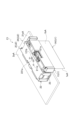
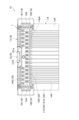
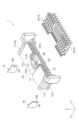
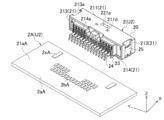
- FIG. 1 is a diagram showing an example of a connector set and a connector unit, and is an exploded perspective view showing a plug connector mounted on a cable and a receptacle connector mounted on a circuit board.
- FIG. 2 is a diagram showing an example of a connector set and a connector unit, and is a perspective view showing a state in which a plug connector mounted on a cable and a receptacle connector mounted on a circuit board are mated with each other.
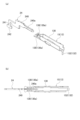
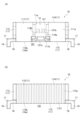
- Figure 3 is a diagram showing the plug terminal and receptacle terminal of a connector set, where (a) is an oblique view showing the state before the plug terminal and the upper receptacle terminal come into contact, and (b) is a plan view showing the contact state between the plug terminal and the upper receptacle terminal.
- Figure 4 is a diagram showing the plug terminal and receptacle terminal of a connector set, where (a) is an oblique view showing the state before the plug terminal and the lower receptacle terminal come into contact, and (b) is a rear view showing the contact state between the plug terminal and the lower receptacle terminal.
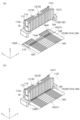
- 5A and 5B are diagrams illustrating how to mount a plug connector on a cable, where FIG.
- FIG. 5A is an oblique view of the cable before mounting as viewed from the front side
- FIG. 5B is an oblique view of the cable after mounting as viewed from the front side
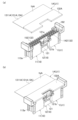
- 6A and 6B are diagrams illustrating how to mount a plug connector on a cable, where FIG. 6A is an oblique view of the cable before mounting as viewed from the back side, and FIG. 6B is an oblique view of the cable after mounting as viewed from the back side.
- FIG. 7 is a front view showing the connector unit.
- FIG. 8 is a rear view showing the connector unit.
- FIG. 9 is an exploded perspective view showing the plug connectors included in the connector set and the connector unit.
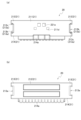
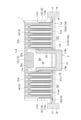
- FIG. 10A and 10B are diagrams showing a plug housing provided in a plug connector, in which FIG. 10A is a plan view and FIG. 10B is a rear view.
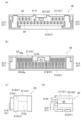
- FIG. 11 is a diagram showing a plug housing provided in a plug connector, where (a) is a front view, (b) is a rear view, (c) is a side view, and (d) is a cross-sectional side view.
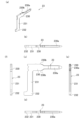
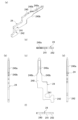
- 12A to 12F are diagrams showing a plug terminal provided in a plug connector, where (a) is an oblique view, (b) is a plan view, (c) is a side view, (d) is a rear view, (e) is a front view, and (f) is a rear view.
- FIG. 10A and 10B are diagrams showing a plug housing provided in a plug connector, in which FIG. 10A is a plan view and FIG. 10B is a rear view.
- FIG. 11 is a diagram showing a plug housing provided in a plug connector,
- FIG. 13 is a perspective view showing a state before the receptacle connector included in the connector set is mounted on a circuit board.
- FIG. 14 is an exploded perspective view showing the connector set and the receptacle connector included in the mating connector unit.
- FIG. 15 is a diagram showing a receptacle housing provided in a receptacle connector, where (a) is a plan view and (b) is a rear view.
- FIG. 16 is a diagram showing a receptacle housing provided in a receptacle connector, where (a) is a front view, (b) is a rear view, (c) is a side view, and (d) is a cross-sectional side view.
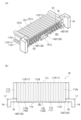
- Figure 17 is a diagram showing an upper receptacle terminal provided in a receptacle connector, where (a) is an oblique view, (b) is a plan view, (c) is a side view, (d) is a rear view, (e) is a front view, and (f) is a back view.
- Figure 18 is a diagram showing a lower receptacle terminal provided in a receptacle connector, where (a) is an oblique view, (b) is a plan view, (c) is a side view, (d) is a rear view, (e) is a front view, and (f) is a back view.
- FIG. 19A and 19B are diagrams showing a plug connector provided in a connector set and a connector unit, where FIG. 19A is a perspective view of the plug connector as viewed from the rear, and FIG. 19B is a rear view of the plug connector.
- 20A and 20B are diagrams showing a plug connector provided in a connector set and a connector unit, where FIG. 20A is a front view of the plug connector, and FIG. 20B is a front view showing a part of the plug connector in an enlarged manner.
- FIG. 21 is a perspective view of a cable included in the connector unit as viewed from the front side.
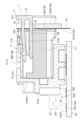
- 22A and 22B are diagrams showing a connector unit, in which FIG. 22A is a perspective view showing the connector unit with a part cut away, and FIG.
- FIG. 22B is a side cross-sectional view of the connector unit.
- Figure 23 is a diagram explaining the positional relationship between the locking portion of the plug connector and the cable, where (a) is a rear view showing the locking portion of the plug connector alone, and (b) is a rear view showing the locking portion with the cable mounted on the plug connector.
- Figure 24 is a diagram showing another example of a connector set, and is an exploded perspective view showing a plug connector mounted on a cable and a receptacle connector mounted on a circuit board mated together, and a slide member.
- FIG. 25 is a diagram showing an example of a sliding member, where (a) is a perspective view, (b) is a plan view, (c) is a side view, (d) is a rear view, (e) is a front view, and (f) is a back view.
- FIG. 26 is a horizontal cross-sectional view showing a state in which the slide member is temporarily held in the plug connector.
- FIG. 27 is a diagram for explaining how the plug connector and the receptacle connector are locked by the slide member, and is a side cross-sectional view showing the state before the plug connector, with the slide member temporarily held, is mated with the receptacle connector.
- FIG. 28 is a diagram for explaining how the plug connector and the receptacle connector are locked by the slide member, and is a side cross-sectional view showing the state in which the plug connector, temporarily held by the slide member, is fitted into the receptacle connector.
- FIG. 29 is a diagram for explaining how the plug connector and the receptacle connector are locked with a slide member, and is a side cross-sectional view showing a state in which the plug connector is mated with the receptacle connector and locked with the slide member.
- Figure 30 is a diagram explaining the positional relationship between the plug housing and the retaining fittings provided in the plug connector, where (a) is an oblique view of the periphery of the retaining fittings viewed from the front side, and (b) is an oblique view of the periphery of the retaining fittings viewed from the rear side.
- Figure 31 is a diagram explaining the positional relationship between a plug housing and a retaining metal fitting provided in a plug connector, where (a) is a front view showing the periphery of the retaining metal fitting, and (b) is a rear view showing the periphery of the retaining metal fitting.
- FIG. 32 is a diagram showing another example of use of the connector set, and is an exploded perspective view showing a plug connector mounted on a cable and a receptacle connector mounted on a circuit board.
- FIG. 33 is a diagram showing a modified example of the connector set, and is an exploded perspective view showing a plug connector mounted on a cable and a receptacle connector mounted on a circuit board.
- Figure 34 is a diagram explaining the positional relationship between a plug housing and a retaining fitting provided in a plug connector of a connector set according to a modified example, where (a) is a front view showing the periphery of the retaining fitting, and (b) is a rear view showing the periphery of the retaining fitting.
- FIG. 35 is a diagram showing another example of use of the connector set according to the modified example, and is an exploded perspective view showing a plug connector mounted on a cable and a receptacle connector mounted on a circuit board.
- a plug connector 1 that is mounted (connected) to a flexible sheet-like cable (connected member) 1A is shown as an example connector.
- a receptacle connector 2 that is mounted (connected) to a rigid sheet-like circuit board (connected member) 2A is shown as an example mating connector with which the plug connector 1 fits.
- the up-down axis, front-back axis, and width axis of the plug connector 1 are defined with the plug housing 10 positioned above the sheet-like cable (connected member) 1A.
- the up-down axis, front-back axis, and width axis are defined merely for the sake of convenience in explaining each configuration, and do not define the actual arrangement state of the plug connector 1.
- the up-down axis, front-back axis, and width axis are imaginary configurations, and do not mean that the plug connector 1, etc., actually has an axial portion such as the up-down axis.
- the direction in which the terminals are inserted into the housing of each connector coincides with the front-to-rear axis
- the longitudinal direction of the housing of each connector when viewed along the front-to-rear axis coincides with the width axis of the connector.
- the transverse direction of the housing of each connector when viewed along the front-to-rear axis coincides with the up-down axis of the connector.
- the axis extending along the X-axis in the three-dimensional Cartesian coordinate system is the front-rear axis (first axis)
- the axis extending along the Z-axis is the up-down axis (second axis)
- the axis extending along the Y-axis is the width axis (third axis).
- the axis perpendicular to the front-rear axis (first axis: direction extending along the X-axis) is the up-down axis (second axis: direction extending along the Z-axis).
- first axis direction extending along the X-axis
- second axis direction extending along the Z-axis
- width axis third axis: direction extending along the Y-axis
- the side that faces the mating connector when the connectors are mated is defined as the front on the front-to-back axis (second side of the first axis), and the side opposite the side that faces the mating connector on the front-to-back axis is defined as the rear on the front-to-back axis (first side of the first axis).
- the upper side on the vertical axis is defined as the first side of the second axis, and the lower side on the vertical axis is defined as the second side of the second axis.
- a plug connector (connector) 1 according to this embodiment is used in a connector set C1 shown in Figs. 1 and 2 and the like.
- the connector set C1 includes the plug connector 1 described above and a receptacle connector 2 into which the plug connector 1 can be mated.
- the plug connector 1 is formed so that it can be mounted (connected) to a cable (connected member) 1A such as an FPC or FFC.
- a cable (connected member) 1A such as an FPC or FFC.
- the mounting piece (terminal connection portion) 132 of the plug terminal (terminal) 13 provided on the plug connector 1 is mounted to the conductor exposed portion 14aA of the cable 1A, electrically connecting the mounting piece (terminal connection portion) 132 to the conductor portion (conductor) 14A, so that the plug connector 1 can be mounted (connected) to the cable 1A.
- the connector unit U1 is formed by mounting (connecting) the cable 1A to the plug connector 1.
- the receptacle connector 2 is formed so that it can be mounted (connected) to a circuit board (mating connected member) 2A.
- the mounting pieces (mating terminal connection parts) 232, 242 of the receptacle terminals (mating terminals) 23, 24 provided on the receptacle connector 2 are electrically connected (mounted) to the conductor part (mating conductor) 2bA of the circuit board 2A, so that the receptacle connector 2 is mounted (connected) to the circuit board 2A.
- the mating connector unit U2 is formed by mounting (connecting) the circuit board 2A to the receptacle connector 2.
- the plug connector 1 (connector unit U1), in which the plug terminal 13 is held in the plug housing 10 and the mounting piece 132 is mounted on the cable 1A, is fitted into the receptacle connector (mating connector) 2. In this way, the plug terminal 13 is electrically connected to the receptacle terminals (mating terminals) 23, 24 of the receptacle connector 2.
- the connector set C1 is configured to fit the plug connector 1 into the receptacle connector 2 to electrically connect the plug terminal 13 to the receptacle terminals 23, 24.
- the cable 1A of the connector unit U1 is electrically connected to the circuit board 2A of the mating connector unit U2 (see Figures 2 to 4).
- the plug connector (connector) 1 is configured so that it can be mated with the receptacle connector (mating connector) 2 by moving it relative to the receptacle connector (mating connector) 2 along the front-to-rear axis (first axis). Furthermore, the plug connector (connector) 1 is configured so that it can connect a cable (connected member) 1A.
- This plug connector (connector) 1 is capable of electrically connecting the receptacle terminals (mating terminals) 23, 24 of the receptacle connector (mating connector) 2 to the conductor portion (conductor) 14A of the cable (connected member) 1A.
- the cable 1A is in the form of a sheet (flat plate) with a front surface (one side: first sheet surface) 1aA and a back surface (other side: second sheet surface) 1bA, and the plug connector 1 is mounted on the front surface 1aA.
- the cable 1A is flexible, so that the cable 1A can be bent (curved) in the cable thickness direction.
- the plug connector 1 is mounted on a partial area of the surface 1aA of the flexible cable 1A, and the area of the cable 1A where the plug connector 1 is mounted is the connection area 11A used for connecting with the plug connector 1. Therefore, in this embodiment, the surface 1aA of the connection area 11A of the cable 1A is the mounting surface (connection surface) 11aA where the plug connector 1 is mounted.
- the cable 1A has the connection area 11A used for connecting with the plug connector 1.
- the cable 1A has an extension area 12A where the conductor portion 14A extends for wiring with another circuit.
- the cable 1A is formed so that the connection region 11A is located at one end side of the extension region 12A (above on the vertical axis: first side of the second axis). Then, when the plug connector 1 to which the connection region 11A is connected is fitted into the receptacle connector 2, the cable 1A is located on the opposite side of the receptacle connector 2, i.e., rearward of the receptacle connector 2 on the front-rear axis (first side of the first axis). At this time, the cable 1A is connected to the plug connector 1 with the extension region 12A pulled out downward on the vertical axis (second side of the second axis).
- a vertical type connector unit U1 (a type in which the connection surface 11aA of the connected member 1A is approximately perpendicular to the mating direction of the connector set C1) is exemplified as the connector unit.
- the direction perpendicular to the plane including the mounting surface 11aA coincides with the front-rear axis (X-axis) of the plug connector 1.
- the direction in which the plug terminals (terminals) 13 housed in the plug housing (housing) 10 of the plug connector 1 are arranged side by side is the width axis (Y-axis).
- the cable 1A has a multi-layer structure and includes a base material 1311A, a conductor portion 14A laminated on the base material 1311A, and a coating portion 1312A laminated on the base material 1311A so as to cover the conductor portion 14A.
- the base material 1311A and the coating portion 1312A are made of an insulating film and cover the conductor portion 14A.
- the conductor portion 14A is a conductor film printed on the insulating film constituting the coating portion 1312A, and has a plurality of wiring patterns corresponding to a plurality of plug terminals 13 (terminals: first terminal 14 and second terminal 15) described later.
- the cable 1A includes a flexible sheet 131A having the base material 1311A and the coating portion 1312A, and a conductor portion 14A formed on the flexible sheet 131A.
- the flexible sheet 131A constitutes at least a part of the base body 13A.
- a plurality of conductor exposed portions 14aA which are conductor portions 14A exposed from the covering portion 1312A, are formed on the surface of the connecting region 11A.
- the plurality of conductor exposed portions 14aA are formed in two rows on the vertical axis (Z axis), and the conductor exposed portions 14aA in each row are formed so as to be aligned at a predetermined pitch on the width axis (extension direction of the Y axis).
- the plurality of conductor exposed portions 14aA are formed so as to be staggered in a front view (when the mounting surface 11aA is viewed along the normal direction of the mounting surface 11aA).
- This type of structure can be formed, for example, by printing multiple conductive films on the base material 1311A to form the conductor portion 14A, and then covering the conductor portion 14A with the covering portion 1312A. At this time, if a through hole is provided in the covering portion 1312A so that the tip of the conductor portion 14A is not covered, a cable 1A is formed in which the tip of the conductor portion 14A is exposed on one side (forward on the front-to-rear axis: second side of the first axis).
- the method for forming cable 1A is not limited to the above method, and it can be formed in various ways.
- a fixing portion 15A is formed to which a retaining metal fitting 16 of the plug connector 1, which will be described later, is fixed.
- a pair of fixing portions 15A are formed on the outer side on the width axis (on both sides of the third axis) of the conductor exposed portion 14aA.
- the fixing portions 15A can be formed in the same manner as the conductor portion 14A, for example, during the printing process of the conductor portion 14A.
- the cable 1A is provided with a reinforcing plate (base) 132A.
- This reinforcing plate 132A is made of glass epoxy resin, stainless steel, or the like, and is used to reinforce the connection region 11A of the cable 1A by sandwiching the connection region 11A of the cable 1A between the plug connector 1 and the reinforcing plate 132A.
- the reinforcing plate 132A has a shape that corresponds to the shape of the connection region 11A of the cable 1A. That is, the outline shape of the reinforcing plate 132A when viewed from the front (when viewed along the normal direction of the mounting surface 11aA) is substantially the same as the outline shape of the connection region 11A.
- the reinforcing plate 132A is attached (fixed) to the back surface 1bA side of the connection region 11A with an adhesive or the like.
- the entire conductor exposed portion 14aA overlaps with the reinforcing plate 132A when viewed from the front (viewed along the normal direction of the mounting surface 11aA). In this way, the entire conductor exposed portion 14aA is supported by the reinforcing plate 132A, which prevents the conductor exposed portion 14aA from bending along the front-to-rear axis (forward or backward: extension direction of the X-axis) or warping along the width axis (rightward or leftward: extension direction of the Y-axis).
- the cable 1A includes the base 13A and a conductor portion (conductor) 14A formed on the base 13A.
- the base 13A includes the flexible sheet 131A on which the conductor portion (conductor) 14A is formed and which is connected to the plug connector (connector) 1, and the reinforcing plate (base) 132A which is fixed to the flexible sheet 131A and which suppresses deformation of the flexible sheet 131A.
- the plug connector (connector) 1 includes a plug housing (housing) 10 and a plug terminal (terminal) 13 held by the plug housing 10.
- the plug connector (connector) 1 also includes a retaining metal fitting 16 held by the plug housing 10.
- the plug terminals 13 held in the plug housing 10 are mounted (electrically connected) to the exposed conductor portion 14aA of the cable 1A arranged on the outside of the plug housing 10. In this way, the plug connector 1 is mounted to the cable 1A as the connected member.
- the plug terminals 13 are mounted (electrically connected) to the exposed conductor portion 14aA by soldering or the like.
- the retaining metal fittings 16 are fixed to the fixed portion 15A of the cable 1A by soldering or the like while held in the plug housing 10, thereby fixing the plug housing 10 to the cable 1A.
- the housing body 11 also has a locking portion 12 that holds the plug housing 10 and the receptacle housing 20 of the receptacle connector 2 in a mated state or releases the mated state.
- the plug housing 10 includes a housing body 11 and a locking portion 12 formed on the housing body 11.
- the housing body 11 includes a top wall 111, a bottom wall 112, and a pair of side walls 113 that connect both ends of the width axis (extension direction of the Y-axis) of the top wall 111 and the bottom wall 112.
- the housing body 11 also includes a front wall 114 that connects to the front ends of the top wall 111, the bottom wall 112, and the side walls 113, 113, and a rear wall 115 that connects to the rear ends of the top wall 111, the bottom wall 112, and the side walls 113, 113.
- the housing body 11 also includes a partition wall 116 that is connected to the pair of side walls 113, the front wall 114, and the rear wall 115 and divides the space defined by the top wall 111, the bottom wall 112, the side walls 113, 113, the front wall 114, and the rear wall 115 into upper and lower sections.
- the housing body 11 has a plurality of upper partitions 117 connected to the top wall 111, the partition wall 116, the front wall 114, and the rear wall 115, and the upper space separated by the partition wall 116 is divided into a plurality of spaces by the upper partitions 117.
- the housing body 11 also has a plurality of lower partitions 118 connected to the bottom wall 112, the partition wall 116, the front wall 114, and the rear wall 115, and the lower space separated by the partition wall 116 is divided into a plurality of spaces by the lower partitions 118.
- the locking portion 12 is formed in the center of the width axis of the upper part of the housing main body 11.
- the top walls 111 are formed on both sides of the width axis, and intermediate walls 119 are connected to the inside of each top wall 111 in the width axis.
- the housing main body 11 has a recessed shape in the center of the width axis when viewed along the insertion direction (front-rear axis; extension direction of the X-axis).
- the locking portion 12 is formed in the recess 11a formed in the center of the width axis of the housing main body 11.
- the pair of intermediate walls 119 also function as upper partitions 117 that divide the upper space into multiple spaces.
- the locking portion 12 is provided with a lever portion 121 that is connected to the front end of the partition wall 116 and extends rearward.
- the rear side of this lever portion 121 is designed to be able to move relative to the partition wall 116 (housing main body 11) along the vertical axis.
- An operating portion 121a that operates the lever portion 121 is formed at the rear end of the lever portion 121, and an engaging protrusion 121b that engages with an engaging hole (engaging portion) 221a formed in the receptacle connector 2 is formed at the center of the front-rear axis of the lever portion 121.
- the engagement protrusion 121b engages with the engagement hole 221a, allowing the housings of the connectors to be locked together (maintained in a mated state).
- the engagement protrusion 121b also moves downward, disengaging from the engagement hole 221a, allowing the housings of the connectors to be released from their mated state.
- a movement space S6 is formed that allows the lever portion 121 to move downward (movement relative to the housing body 11).
- the plug connector (connector) 1 is provided with a locking portion 12 that can restrict the relative movement of the plug connector (connector) 1 with respect to the receptacle connector (mating connector) 2 along the front-rear axis (first axis) when the receptacle connector (mating connector) 2 and the plug connector (connector) 1 are engaged with each other.
- the locking portion 12 also has an operating portion 121a that can unlock the receptacle connector (mating connector) 2 and the plug connector (connector) 1 by moving it from the upper side of the vertical axis (the first side of the second axis that intersects with the front-rear axis) to the lower side of the vertical axis (the second side of the second axis that intersects with the front-rear axis).
- the plug housing (housing) 10 has a movement space S6 that allows movement of the operating part 121a downward (to the second side of the second axis).
- the front wall 114 is formed with through holes 114a so as to communicate with the multiple spaces partitioned by the partition wall 116, the upper partition wall 117, and the lower partition wall 118.
- the rear wall 115 is formed with through holes 115a so as to communicate with the multiple spaces partitioned by the partition wall 116, the upper partition wall 117, and the lower partition wall 118.
- the housing body 11 is formed with a plurality of spaces that penetrate along the front-rear axis.
- the plug terminals 13 are press-fitted (inserted) into each of the spaces that penetrate along the front-rear axis.
- the plug connector (connector) 1 includes a plug housing (housing) 10 having a housing body 11 with an internal space capable of accommodating the plug terminals (terminals) 13.
- the housing body 11 is configured so that two levels of spaces are formed on the up-down axis (extension direction of the Z axis) in which multiple spaces are arranged side by side on the width axis (extension direction of the Y axis). Furthermore, when the housing body 11 is viewed from the rear of the front-to-rear axis, multiple spaces are formed in a staggered pattern. This makes it possible to reduce the size of the width axis of the plug connector 1.
- a plurality of spaces defined by the top wall 111, the partition wall 116, and the upper bulkhead 117 are arranged side by side on the width axis (extension direction of the Y axis) on the upper side of the housing body 11.
- the space formed on the upper side of the housing body 11 is the upper space (first space: internal space) S1 into which the plug terminal 13 is press-fitted (inserted).
- a plurality of spaces defined by the bottom wall 112, the partition wall 116, and the lower bulkhead 118 are arranged side by side along the width axis (extension direction of the Y axis).
- the space formed on the lower side of the housing body 11 is the lower space (second space: internal space) S2 into which the plug terminal 13 is press-fitted (inserted).
- 14 lower spaces (second spaces) S2 are arranged side by side on the width axis on the lower side of the housing body 11.
- five upper spaces (first spaces) S1 are arranged side by side on one side of the width axis of the locking portion 12 (right side in the left-right direction)
- five upper spaces (first spaces) S1 are arranged side by side on the other side of the width axis of the locking portion 12 (left side in the left-right direction).
- ten spaces (upper spaces S1) are arranged side by side on the width axis, sandwiching the locking portion 12. This makes it possible to reduce the height of the housing body 11.
- the upper partition 117 and the lower partition 118 are formed at positions offset on the width axis. That is, the first space S1 and the second space S2 are formed so as to overlap partially in a plan view. In other words, when the plug housing 10 is viewed along the up-down axis (second axis) with the plug terminal 13 held in the plug housing 10, the first space S1 and the second space S2 overlap.
- the plug terminal 13 is pressed (inserted) forward from the opening at the rear end of the first space S1, and this opening at the rear end of the first space S1 serves as the insertion port S1a.
- the opening at the front end of the first space S1 is smaller than the insertion port S1a so that the plug terminal 13 does not fall out.
- the front wall 114 restricts the forward movement of the plug terminal 13 pressed (inserted) from the insertion port S1a.
- the opening at the front end of the first space S1 serves as an introduction port S1b for introducing the contact portion 230a of the upper receptacle terminal 23 of the receptacle connector 2 described later into the first space S1.
- the periphery of this introduction port S1b is tapered so that the contact portion 230a of the upper receptacle terminal 23 can be easily introduced.
- the plug terminal 13 is pressed (inserted) forward from the opening at the rear end of the second space S2, and this opening at the rear end of the second space S2 serves as the insertion port S2a.
- the opening at the front end of the second space S2 is smaller than the insertion port S2a so that the plug terminal 13 does not fall out.
- the front wall 114 restricts the forward movement of the plug terminal 13 pressed (inserted) from the insertion port S2a.
- the opening at the front end of the second space S2 also serves as an introduction port S2b for introducing the contact portion 240a of the lower receptacle terminal 24 of the receptacle connector 2 described later into the second space S2.
- the periphery of this introduction port S2b is also tapered so that the contact portion 240a of the lower receptacle terminal 24 can be easily introduced.
- plug terminals 13 of the same shape are inserted into the first space S1 and the second space S2, respectively.
- the plug terminal 13 inserted into the first space S1 is inserted into the first space S1 in a state in which it is upside down relative to the plug terminal 13 inserted into the second space S2.
- the plug terminal 13 inserted into the second space S2 is rotated 180 degrees around the front-to-rear axis, and in this state is moved relatively along the front-to-rear axis so that the plug terminal 13 is inserted into the first space S1.
- a groove 116a that opens rearward and upward is formed at the upper part of the rear end of the partition wall 116 so as to communicate with the first space S1.
- the groove 116a is formed on both sides of the width axis of the first space S1, and the tip of the side wall 134 of the plug terminal 13 described below is inserted into this groove 116a.
- the groove 116a is formed so that the groove width (length of the width axis) is slightly wider than the plate thickness of the side wall 134.
- a groove 116b that opens rearward and downward is formed in the lower part of the rear end of the partition wall 116 so as to communicate with the second space S2.
- the groove 116b is also formed on both sides of the width axis of the second space S2, and the tip of the side wall 134 of the plug terminal 13 is also inserted into the groove 116b.
- the groove width (length of the width axis) of this groove 116b is also formed to be slightly wider than the plate thickness of the side wall 134.
- a pair of side walls 113, 113 are each formed with a retaining bracket mounting portion 1131, 1131 on which the retaining bracket 16 is held.
- the retaining bracket mounting portion 1131 has a recess 1131a that opens forward on the front-to-rear axis and outward on the width axis.
- the retaining bracket mounting portion 1131 also has a pair of slits 1131b, 1131b that are connected to both sides of the vertical axis of the recess 1131a and into which the side portions (ends of the vertical axis) of the main body portion (base portion) 161 of the retaining bracket 16 are inserted.
- connection fixing part 162 connected to the lower end (rear end of the front-to-rear axis) of the main body part 161 is fixed to the fixing part 15A formed on the mounting surface (connection surface) 11aA of the cable 1A, thereby fixing the plug housing 10 to the cable 1A.
- the fixing piece 162 is formed at the lower end of the body portion 161, which is substantially flat, so as to protrude to one side along the plate thickness of the body portion 161.
- the retaining metal fitting 16 is then inserted into the retaining metal fitting attachment portion 1131 from the front of the front-rear axis (the sides of the body portion 161 are inserted into the pair of slits 1131b, 1131b, respectively), so that the retaining metal fitting 16 is held by the plug housing 10.
- the body portion 161 is moved relatively rearward along the front-rear axis while aligning with the side surface 113a of the housing body 11.
- the body portion 161 of the retaining metal fitting 16 is arranged along the side surface 113a of the housing body 11, and the fixing piece 162 protrudes in a direction away from the side surface 113a of the housing body 11.
- the plug connector (connector) 1 is provided with a retaining metal fitting (fixed terminal) 16 that can be held by the housing body 11 and fixed to the cable (connected member) 1A.
- the retaining metal fitting (fixed terminal) 16 has a main body portion (base) 161 that is arranged along the side surface 113a of the housing body 11 while held by the housing body 11.
- the retaining metal fitting (fixed terminal) 16 has a fixed piece (connection fixed portion) 162 that is connected to the main body portion (base) 161 so as to protrude in a direction away from the side surface 113a of the housing body 11 (outside the width axis) and can be mounted (connected) to the mounting surface (connection surface) 11aA of the cable (connected member) 1A.
- the plug terminal (terminal) 13 includes a main body 130 that is press-fitted (inserted) into the internal space (first space S1 or second space S2) formed in the plug housing 10, and a mounting piece (terminal connection portion) 132 that extends from the main body 130 toward the mounting surface 1aA of the cable 1A when the plug terminal 13 is mounted on the cable (connected member) 1A, and can be mounted on the cable 1A.
- the mounting piece (terminal connection portion) 132 is formed so as to protrude outward on the vertical axis beyond the rear wall 115 when held in the plug housing (housing) 10.
- the plug terminals 13 are conductive and are arranged in a row along the width axis (extension direction of the Y-axis) of the plug housing 10.
- the plug terminals 13 are formed by bending a strip-shaped metal member in the thickness direction, and are generally U-shaped when viewed along the insertion direction (front-rear axis; extension direction of the X-axis) (see FIG. 12(e) and FIG. 12(f)).
- Such plug terminals 13 can be formed, for example, by bending a strip-shaped metal member that has been punched out to have a predetermined shape.
- the main body 130 has a bottom wall 133 and side walls 134 connected to both ends of the width axis (extension direction of the Y axis) of the bottom wall 133.
- the bottom wall 133 comprises a bottom wall main body 135 to which the lower end of the side wall 134 is connected, and a contact protection part 136 that is connected to the front end of the bottom wall main body 135 and protrudes forward.
- This contact protection part 136 prevents the contact part 130a of the plug terminal 13 from coming into contact with the housing main body 11 when the main body part 130 is pressed (inserted) into the internal space (first space S1 or second space S2).
- the bottom wall body 135 and the contact protection portion 136 are each formed with restricting pieces 135a, 136a that protrude outward from both ends of the width axis (extension direction of the Y axis). These restricting pieces 135a, 136a prevent the body portion 130 from being pressed (inserted) at an angle when the body portion 130 is pressed (inserted) into the internal space (first space S1 or second space S2).
- the side wall 134 has a side wall body 137 whose lower end is connected to the bottom wall body 135, and a contact piece 138 that is connected to the front end of the side wall body 137 in an elastically deformable manner and comes into contact with the contact portion of the receptacle connector.
- a restricting protrusion 137a is formed on the upper end of the sidewall main body 137, and this restricting protrusion 137a prevents the main body portion 130 from floating up when the main body portion 130 is pressed (inserted) into the internal space (first space S1 or second space S2).
- the contact piece 138 also includes an inner bent piece 138a connected to the front end of the sidewall body 137 so as to bend inward along the width axis, and an outer bent piece 138b connected to the front end of the inner bent piece 138a so as to bend outward along the width axis.
- the contact pieces 138 are connected to each of the pair of side wall bodies 137, 137, and are formed to be approximately linearly symmetrical in a plan view. That is, the pair of contact pieces 138, 138 have inner bent pieces 138a, 138a that are bent in a direction that approaches each other as they move forward, and outer bent pieces 138b, 138b that are bent in a direction that moves away from each other as they move forward.
- the pair of contact pieces 138, 138 are arranged to clamp the contact portions 230a, 240a of the receptacle connector 2 at the location where they are closest to each other (the joint between the inner bent piece 138a and the outer bent piece 138b) (see Figures 3(b) and 4(b)).
- the pair of contact pieces 138, 138 function as the contact portion 130a of the plug terminal 13.
- the pair of outer bent pieces 138b function as guide portions for more smoothly introducing the contact portions 230a, 240a of the receptacle connector 2.
- a press-fit protrusion 137b is formed at the upper end of the rear portion of one of the pair of side wall bodies 137, 137. Then, by making this press-fit protrusion 137b bite into the housing body 11, the main body portion 130 is press-fit into the internal space (the first space S1 or the second space S2).
- the mounting piece (terminal connection portion) 132 extends downward from the rear end of the bottom wall body 135 (the side opposite to the side to which the side wall 134 extends).
- the plug terminal (terminal) 13 has a contact portion 130a that can be electrically connected to the contact portions (mating contact portions) 230a, 240a of the receptacle terminals (mating terminals) 23, 24.
- the plug terminal (terminal) 13 also has a mounting piece (terminal connection portion) 132 that can be electrically connected to the conductor portion (conductor) 14A of the cable (connected member) 1A.
- the plug terminal 13 inserted into the first space S1 is inserted into the first space S1 in a state in which it is upside down relative to the plug terminal 13 inserted into the second space S2.
- the plug terminal 13 located on the upper side is press-fitted (inserted) into the upper space S1 through the insertion opening S1a with the mounting piece (terminal connection portion) 132 positioned on the rear side of the front-to-rear axis (first side of the first axis) and the tip of the mounting piece (terminal connection portion) 132 facing the upper side of the up-down axis (first side of the second axis).
- the plug terminal 13 located on the lower side is press-fitted (inserted) into the lower space S2 through the insertion opening S2a with the mounting piece (terminal connection part) 132 positioned on the rear side of the front-to-rear axis (first side of the first axis) and the tip of the mounting piece (terminal connection part) 132 facing downward on the up-down axis (second side of the second axis).
- the tip of the mounting piece (terminal connection portion) 132 of the plug terminal 13 arranged on the upper side is made to protrude above the top surface (surface on the first end side of the second shaft) 111a of the top wall 111 of the housing main body 11.
- the tip of the mounting piece (terminal connection portion) 132 of the plug terminal 13 arranged on the lower side is made to protrude downward from the bottom surface (surface on the second end side of the second shaft) 112a of the bottom wall 112 of the housing body 11.
- the mounting piece (terminal connection portion) 132 of the plug terminal 13 arranged on the upper side is a first mounting piece (first terminal connection portion) 142 that protrudes upward from the upper end of the vertical axis of the plug housing (housing) 10 (protrudes outward from the first end of the second axis that intersects with the first axis).
- the plug terminal 13 arranged on the upper side is a first plug terminal (first terminal) 14 having a first mounting piece (first terminal connection portion) 142.
- the mounting piece (terminal connection portion) 132 of the plug terminal 13 located on the lower side is a second mounting piece (second terminal connection portion) 152 that protrudes downward from the lower end of the vertical axis of the plug housing (housing) 10 (protruding outward from a second end located on the opposite side of the second axis from the first end of the second axis that intersects with the first axis).
- the plug terminal 13 located on the lower side is a second plug terminal (second terminal) 15 that has a second mounting piece (second terminal connection portion) 152.
- the plug terminal (terminal) 13 has a first plug terminal (first terminal) 14 having a first mounting piece (first terminal connection portion) 142 that protrudes above the upper end of the vertical axis of the plug housing (housing) 10 (protrudes outward from the first end of the second axis that intersects with the first axis).
- the plug terminal (terminal) 13 has a second plug terminal (second terminal) 15 having a second mounting piece (second terminal connection portion) 152 that protrudes downward from the lower end of the vertical axis of the plug housing (housing) 10 (protruding outward from a second end located on the opposite side of the second axis from the first end of the second axis that intersects with the first axis).
- the receptacle connector 2 has a receptacle housing (mating housing) 20. Furthermore, the receptacle connector 2 has receptacle terminals (mating terminals: upper receptacle terminal 23 and lower receptacle terminal 24) held in the receptacle housing 20. The receptacle connector 2 also has retaining fittings (mating retaining fittings) 25 held in the receptacle housing 20.
- the receptacle terminals 23, 24 held in the receptacle housing 20 are mounted on the conductor portion 2bA of the circuit board 2A arranged on the outside of the receptacle housing 20. This allows the receptacle connector 2 to be mounted on the circuit board 2A as the mating connected member.
- the receptacle terminals 23, 24 are also mounted on the conductor portion 2bA by soldering or the like.
- the retaining metal fittings 25 are fixed to the fixing portion 2cA of the circuit board 2A by soldering or the like while held in the receptacle housing 20, thereby fixing the receptacle housing 20 to the circuit board 2A.
- the circuit board 2A has a generally rectangular plate shape and includes a board body 2aA formed of a resin material or the like having rigidity and insulating properties.
- the conductor portion 2bA and the fixing portion 2cA are formed so as to be exposed on the surface 21aA of the board body 2aA.
- the surface 21aA of the board body 2aA serves as the mounting surface.
- the receptacle housing 20 has a rigid housing body 21, and the receptacle housing 20 can be formed, for example, using an insulating resin material.
- the upper part of the housing body 21 is formed with a locking part insertion part 22 into which the locking part 12 is inserted, which holds the plug housing 10 and the receptacle housing 20 in the mated state and releases the mated state.
- the receptacle housing 20 includes a housing body 21 and a locking portion insertion portion 22 formed in the housing body 21.
- the housing body 21 includes a top wall 211, a bottom wall 212, a pair of side walls 213 that connect both ends of the width axis (extension direction of the Y-axis) of the top wall 211 and the bottom wall 212, and a rear wall 214 that connects to the rear ends of the top wall 211, the bottom wall 212, and the side walls 213, 213.
- the locking portion insertion portion 22 is formed in the center of the width axis of the top wall 211. Specifically, the locking portion insertion portion 22 is formed below the center of the width axis of the top wall 211, and has a storage portion 221 that stores the lever portion 121. An engagement hole (engagement portion) 221a that engages with the engagement protrusion 121b of the locking portion 12 is formed in the center of the front-rear axis of this storage portion 221.
- the rear wall 214 is also formed with multiple spaces that penetrate along the front-to-rear axis.
- multiple spaces arranged side by side along the width axis are formed in two stages along the up-down axis (extension direction of the Z axis).
- the multiple spaces are formed in a staggered pattern. This allows the receptacle connector 2 to be smaller along the width axis.
- the upper receptacle terminal 23 and the lower receptacle terminal 24 are each press-fit (inserted) into the space that passes through the front-rear axis.
- the space formed on the upper side of the housing body 21 is the first space S3 into which the upper receptacle terminal 23 is press-fitted (inserted).
- the space formed on the lower side of the housing body 21 (closer to the mounting surface 21aA side than the first space S3) is the second space S4 into which the lower receptacle terminal 24 is press-fitted (inserted).
- the upper receptacle terminal 23 is press-fitted (inserted) forward from the opening at the rear end of the first space S3, which opening at the rear end of the first space S3 serves as the insertion port S3a.
- the lower receptacle terminal 24 is press-fitted (inserted) forward from the opening at the rear end of the second space S4, which opening at the rear end of the second space S4 serves as the insertion port S4a.
- the housing body 21 also has a mating space S5 that opens forward (towards the plug connector 1).
- This mating space S5 is the space into which the housing body 11 of the plug housing 10 is inserted and mated, and is defined by a top wall 211, a bottom wall 212, a pair of side walls 213, 213, and a rear wall 214. Therefore, the first space S3 and the second space S4 are each formed to communicate with the mating space S5.
- a portion of the mating space S5 is used as the accommodation portion 221 for the locking portion insertion portion 22.
- a protrusion 214a that protrudes rearward is provided at the rear end of the rear wall 214.
- the pair of side walls 213, 213 are each formed with a retaining bracket mounting portion 213a, 213a on which the retaining bracket 25 is held.
- the retaining bracket attachment portion 213a has a recess 213b that opens outward on the up-down axis and width axis, and slits 213c, 213c that are connected to the inside of the width axis of the recess 213b and into which both ends of the front-rear axis of the main body portion 251 of the retaining bracket 25 are inserted. Then, with the retaining bracket 25 held in the receptacle housing 20, the fixing piece 252 connected to the lower end of the main body portion 251 is fixed to the fixing portion 2cA of the circuit board 2A, thereby fixing the receptacle housing 20 to the circuit board 2A.
- the receptacle terminal has a main body portion that is inserted into a space formed in the receptacle housing 20, a leg portion that extends from the main body portion toward the mounting surface 21aA of the circuit board (connected member) 2A when the receptacle terminal is mounted on the circuit board 2A, and a connection portion that is connected to the leg portion and can be mounted on the circuit board 2A.
- the receptacle terminal has an upper receptacle terminal 23 that is pressed (inserted) into a first space S3 formed on the upper side of the housing body 21 (at a position farther from the mounting surface 21aA). Furthermore, the receptacle terminal has a lower receptacle terminal 24 that is pressed (inserted) into a second space S4 formed on the lower side of the housing body 21 (closer to the mounting surface 21aA than the first space S3).
- the upper receptacle terminals 23 are conductive and are arranged in multiple rows along the width axis (extension direction of the Y axis) of the receptacle housing 20. As shown in FIG. 17, the upper receptacle terminals 23 are formed in a thin plate shape and are pressed (inserted) from the rear into the first space S3 formed in the housing body 21 with the plate thickness roughly coinciding with the width axis (extension direction of the Y axis). Such upper receptacle terminals 23 can be formed, for example, by punching a thin metal plate.
- the upper receptacle terminal 23 also has a first body portion (mating body portion) 230 that is press-fitted (inserted) into the first space S3. Furthermore, the upper receptacle terminal 23 also has a first leg portion (mating leg portion) 231 that extends from the first body portion 230 toward the mounting surface 21aA when the upper receptacle terminal 23 is mounted on the circuit board (connected member) 2A. The upper receptacle terminal 23 also has a first mounting piece (mating connection portion) 232 that is connected to the first leg portion 231 and can be mounted on the circuit board 2A.
- a generally rod-shaped contact portion (mating contact portion) 230a is formed so as to protrude forward.
- press-fit protrusions 230b are formed, and the first main body portion 230 is press-fitted into the first space S3 by forcing the press-fit protrusions 230b into the housing main body 21. Then, with the first main body portion 230 pressed (inserted) into the first space S3, the contact portion 230a is arranged within the mating space S5.
- the first leg 231 extends downward (to the circuit board 2A: the connected member) from the rear end of the first body 230. Specifically, the first leg 231 extends in a substantially straight line from the rear end of the first body 230 downward (to the circuit board 2A: the connected member). Thus, in this embodiment, the first leg 231 extends in the housing thickness direction (vertical axis) from the first body 230 in a state in which it is pressed (inserted) into the first space S3. The length dimension of the vertical axis of this first leg 231 is longer than that of the second leg 241. The first mounting piece 232 is connected to the lower end of this first leg 231.
- the lower receptacle terminals 24 are also conductive and are arranged in multiple rows along the width axis (extension direction of the Y axis) of the receptacle housing 20. As shown in FIG. 18, these lower receptacle terminals 24 are formed in a thin plate shape and are pressed (inserted) from behind into the second space S4 formed in the housing body 21 with the plate thickness roughly coinciding with the width axis (extension direction of the Y axis). Such lower receptacle terminals 24 can also be formed, for example, by punching a thin metal plate.
- the lower receptacle terminal 24 also has a second body portion (mating body portion) 240 that is press-fitted (inserted) into the second space S4.
- the lower receptacle terminal 24 also has a second leg portion (mating leg portion) 241 that extends from the second body portion 240 toward the mounting surface 21aA when the lower receptacle terminal 24 is mounted on the circuit board (connected member) 2A, and a second mounting piece (mating connection portion) 242 that is connected to the second leg portion 241 and can be mounted on the circuit board 2A.
- a generally rod-shaped contact portion (mating contact portion) 240a is formed at the front end of the second main body portion 240 so as to protrude forward.
- Press-fit protrusions 240b are formed at the upper and lower ends of the second main body portion 240, and the second main body portion 240 is pressed into the second space S4 by forcing the press-fit protrusions 240b into the housing main body 21.
- the contact portion 240a is arranged within the mating space S5.
- the second leg 241 is bent like a crank, and its lower end is located rearward of the second main body 240.
- the first mounting piece 232 is connected to the lower end of the first leg 231.
- connection portions first mounting piece 232 and second mounting piece 242 are arranged in a staggered pattern.
- the locking portion 12 of the plug housing 10 is inserted into the locking portion insertion portion 22 of the receptacle housing 20, and the housing body 11 is inserted into the mating space S5.
- the engaging protrusion 121b of the lever portion 121 is pressed downward by the top wall 211 of the receptacle housing 20.
- the rear end portion (operating portion 121a) of the lever portion 121 elastically deforms so as to move downward, and the engaging protrusion 121b can move to the rear side of the locking portion insertion portion 22.
- the engaging protrusion 121b When the engaging protrusion 121b is moved to the rear of the locking portion insertion portion 22, the downward pressure on the engaging protrusion 121b by the top wall 211 is released, and the engaging protrusion 121b moves upward due to the elastic restoring force of the lever portion 121. As the engaging protrusion 121b moves upward, it engages with the engaging hole 221a formed in the receptacle connector 2, and the plug connector 1 and the receptacle connector 2 are locked in the mated state.
- the tip of the contact portion 230a of the upper receptacle terminal 23 is introduced from the introduction port S1b into the first space S1 formed in the plug housing 10 and comes into contact with the contact portion 130a of the plug terminal 13 (first plug terminal 14: first terminal) arranged above.
- the approximately rod-shaped contact portion 230a is inserted between the pair of contact pieces 138, 138 and is clamped by the pair of contact pieces 138, 138, thereby electrically connecting the plug terminal 13 (first plug terminal 14: first terminal) arranged above to the upper receptacle terminal 23.
- the tip of the contact portion 240a of the lower receptacle terminal 24 is introduced from the inlet S2b into the second space S2 formed in the plug housing 10 and comes into contact with the contact portion 130a of the plug terminal 13 (second plug terminal 15: second terminal) arranged below.
- the approximately rod-shaped contact portion 240a is inserted between the pair of contact pieces 138, 138 and is clamped by the pair of contact pieces 138, 138, thereby electrically connecting the plug terminal 13 (second plug terminal 15: second terminal) arranged below to the lower receptacle terminal 24.
- a connector set C1 is formed that electrically connects the cable 1A and the circuit board 2A.
- the operating portion 121a of the lever portion 121 is pressed down to move the lever portion 121 downward. This also moves the engaging protrusion 121b downward, and the engagement between the engaging protrusion 121b and the engaging hole 221a is released. Then, when the plug connector 1 is pulled in the removal direction relative to the receptacle connector 2 with the engagement between the engaging protrusion 121b and the engaging hole 221a released, the plug connector 1 moves relative to the receptacle connector 2 in the removal direction.
- the plug housing (housing) 10 is configured to be removably inserted and fitted into the receptacle housing (mating housing) 20 of the receptacle connector (mating connector) 2.
- the plug terminal 13 has a first plug terminal 14 having a first mounting piece 142 that protrudes upward beyond the upper end of the vertical axis of the plug housing 10 (protrudes outward from the first end of the second axis). And, the plug terminal 13 has a second plug terminal 15 having a second mounting piece 152 that protrudes downward beyond the lower end of the vertical axis of the plug housing 10 (protrudes outward from the second end of the second axis).
- the tips (at least a portion) of the first mounting piece 142 and the second mounting piece 152 which are the portions of the plug terminal 13 that are mounted (connected) to the cable 1A, are protruded outward from the plug housing 10. This allows the mounting pieces 132 (first mounting piece 142, second mounting piece 152) of the plug terminal 13 to be visible even when the cable 1A is mounted (connected) to the plug connector 1.
- connection state e.g., the formation state of the solder fillet, etc.
- connector set C1 plug connector 1 and receptacle connector 2
- connector set C1 plug connector 1 and receptacle connector 2
- the amount by which mounting piece (terminal connection portion) 132 protrudes from plug housing (housing) 10 becomes smaller, making it difficult to check the connection status between mounting piece (terminal connection portion) 132 and conductor portion (conductor) 14A of cable (connected member) 1A.
- the rear end 11b of the front-rear axis (first axis) of the housing body 11 (plug housing 10) is the first end of the housing body 11 (plug housing 10).
- the front end 11c of the front-rear axis (first axis) of the housing body 11 (plug housing 10) is the second end of the housing body 11 (plug housing 10).
- the plug housing (housing) 10 has a rear end (first end) 11b of the front-rear axis (first axis) from which the mounting piece (terminal connection portion) 132 protrudes when the plug terminal (terminal) 13 is accommodated in the internal space (first space S1 and second space S2), and a front end (second end) 11c located on the opposite side of the front-rear axis (first axis) from the rear end (first end) 11b.
- a wider range of the mounting piece (terminal connection portion) 132 can be seen through the opening. This makes it easier to check the connection state between the mounting piece (terminal connection portion) 132 and the conductor portion (conductor) 14A, even when the plug connector (connector) 1 is made smaller.
- a wider range of the mounting piece (terminal connection portion) 132 can be seen without thinning the entire plug housing (housing) 10. This also makes it possible to prevent the strength of the plug housing (housing) 10 from decreasing.
- this embodiment ensures the enclosure strength of the plug housing (housing) 10 while making it easier to check the connection state between the plug connector (connector) 1 and the cable (connected member) 1A.
- this opening is formed in at least one of the top surface (surface on the first end 11b side of the second shaft) 111a and the bottom surface (surface on the second end 11c side of the second shaft) 112a of the housing main body 11 (plug housing 10: housing), that is, the bottom surface 112a.
- the downward protrusion of the second mounting piece (second terminal connection portion) 152 is smaller than the upward protrusion of the first mounting piece (first terminal connection portion) 142. Therefore, an opening is formed only on the bottom surface 112a of the top surface 111a and bottom surface 112a of the housing main body 11 (plug housing 10: housing).
- the protrusion of either the first mounting piece (first terminal connection portion) 142 or the second mounting piece (second terminal connection portion) 152 is smaller than the other mounting piece, it is also possible to provide openings on both the top surface 111a and bottom surface 112a of the housing main body 11 (plug housing 10: housing).
- a groove 1121 extending along the front-rear axis (first axis) is formed in the housing body 11 (plug housing 10: housing), and this groove 1121 functions as an opening through which the mounting piece (terminal connection portion) 132 can be viewed.
- a groove 1121 is formed so as to penetrate the front-rear axis (first axis) from the rear end (first end) 11b to the front end (second end) 11c of the housing body 11 (plug housing 10: housing).
- this groove 1121 is also open downward (outside the up-down axis (second axis) that intersects with the front-rear axis (first axis)).
- the second mounting piece 152 (mounting piece 132) to be seen even by looking diagonally into the groove 1121 from the front and outside of the connector unit U1, making it easier and more reliable to see the second mounting piece 152 (mounting piece 132). Furthermore, it allows the thickness dimension of the vertical axis (second axis) of the wall of the plug housing (housing) 10 to be reduced, allowing for even greater miniaturization of the plug housing (housing) 10 on the vertical axis (second axis).
- the groove 1121 is formed in the housing main body 11 (plug housing 10: housing) with three openings, front, back, and bottom.
- the groove 1121 is defined by the back surface 1121a, which is a plane located inside the vertical axis and perpendicular to the vertical axis, and a pair of inner surfaces 1121b, which are planes connected to both ends of the width axis of the back surface 1121a and perpendicular to the width axis (see FIG. 20(b)).
- the plug terminal (terminal) 13 is accommodated in the internal space (first space S1 and second space S2) of the housing main body 11 (plug housing 10: housing) with the second mounting piece 152 (mounting piece 132) facing the lower opening of the groove 1121.
- the groove 1121 is, for example, open downward but not forward, when visually checking the second mounting piece 152 (mounting piece 132), it is necessary to look diagonally into the groove 1121 from the front and outside of the connector unit U1.
- the plug housing (housing) 10 is configured to be inserted and fitted into the receptacle housing (mating housing) 20 of the receptacle connector (mating connector) 2.
- the groove (opening) 1121 is formed to penetrate the front-rear axis (first axis) from the rear end (first end) 11b to the front end (second end) 11c of the housing body 11 (plug housing 10: housing).
- the groove (opening) 1121 is formed to penetrate along the front-rear axis (first axis) which is the axis along which the plug housing (housing) 10 moves relative to the receptacle housing (mating housing) 20 when the plug housing (housing) 10 is inserted and fitted into the receptacle housing (mating housing) 20. Furthermore, the groove (opening) 1121 is formed to open downward, so that when the plug housing (housing) 10 is inserted and fitted into the receptacle housing (mating housing) 20, the back surface 1121a faces the inner surface of the receptacle housing (mating housing) 20 (the upper surface of the bottom wall 212).
- the groove (opening) 1121 is formed so that it is open on the side facing the innermost surface (the front surface of the rear wall 214) that defines the mating space S5 of the receptacle housing (mating housing) 20, and on the side facing the inner surface (the upper surface of the bottom wall 212) that defines the mating space S5 of the receptacle housing (mating housing) 20.
- the groove (opening) 1121 for visually checking the mounting piece (terminal connection portion) 132 can also be used as a guide portion for guiding the insertion and fitting of the plug housing (housing) 10 into the receptacle housing (mating housing) 20, making it possible to suppress rattling when the plug housing (housing) 10 and the receptacle housing (mating housing) 20 are fitted together.
- the plug housing (housing) 10 has a convex wall 19 that extends rearward (outward) of the front-rear axis (first axis) beyond the rear end (first end) 11b from which the mounting piece (terminal connection portion) 132 protrudes.
- a pair of convex walls 19 are formed on both sides of the width axis of the plug housing (housing) 10, and the pair of convex walls 19 are formed so as to be positioned outside the housing body 11 on the width axis.
- the pair of convex walls 19 are connected to the housing body 11 via a protective wall 17 and a connecting wall 18 described below, so that the pair of convex walls 19 are positioned outside the housing body 11 on the width axis.
- the housing body 11 has a groove wall 1122 that forms a groove (opening) 1121, and the pair of convex walls 19 are formed to protrude downward on the vertical axis further than the groove wall 1122.
- the pair of convex walls 19 are formed to protrude downward further than the entire bottom surface 112a of the housing body 11.
- the pair of convex walls 19 are formed to protrude upward further than the entire top surface 111a of the housing body 11.
- the pair of convex walls 19 are formed so as to protrude downward on the up-down axis beyond the tip of the second mounting piece 152 (mounting piece 132), and are formed so as to protrude upward beyond the first mounting piece 142 (mounting piece 132).
- the multiple grooves (openings) 1121, the multiple mounting pieces 132 (the multiple first mounting pieces 142 and the multiple second mounting pieces 152), and the multiple internal spaces (the first space S1 and the second space S2) are positioned between a pair of convex walls 19.
- a housing section 191 is formed at the rear of the plug housing (housing) 10, the housing section 191 being defined by the inner surface of the width axis of the pair of protruding walls 19 and the rear surface 115b of the housing body 11.
- the pair of protruding walls 19 can be used as handles to be gripped by hand. This makes it easier to perform operations such as fitting the plug connector (connector) 1 into the receptacle connector (mating connector) 2.
- the plug connector (connector) 1 when the plug connector (connector) 1 is fitted to the receptacle connector (mating connector) 2 and viewed along the front-rear axis, the outer ends of the pair of protruding walls 19 are positioned outside the receptacle housing (mating housing) 20 on the width axis.
- both sides of the width axis of the plug housing (housing) 10 are positioned outside the receptacle housing (mating housing) 20 on the width axis.
- the connector unit is exemplified as a vertical type connector unit U1 (a type in which the connection surface 11aA of the connected member 1A is approximately perpendicular to the mating direction of the connector set C1).
- a recess 11a is formed in the center of the width axis of the housing main body 11, and a locking portion 12 is formed in this recess 11a, thereby making the plug connector (connector) 1 lower in height.
- the locking portion 12 also has an operating portion 121a that can be moved from the upper side (first side) to the lower side (second side) of a vertical axis (second axis) that intersects with the front-rear axis (first axis) to release the lock between the receptacle connector (mating connector) 2 and the plug connector (connector) 1. Furthermore, a movement space S6 is formed in the plug housing (housing) 10, which allows the operating portion 121a to move downward (second side) of the vertical axis (second axis).
- a recess 13aA is formed in the base 13A of the cable (connected member) 1A, which penetrates the front-rear axis (first axis) and opens to the upper side (first side) of the up-down axis (second axis) when the cable (connected member) 1A is connected to the plug connector (connector) 1.
- the recess 13aA is connected to the movement space S6 via the front-rear axis (first axis).
- the movement space S6 is prevented from being blocked by the cable (connected member) 1A when the cable (connected member) 1A is connected to the plug connector (connector) 1. This also makes it possible to more effectively use the movement space S6 that allows the operation unit 121a to move downward (to the second side) on the up-down axis (second axis).
- the base 13A has a flexible sheet 131A on which a conductor portion (conductor) 14A is formed and which is connected to the plug connector (connector) 1, and a reinforcing plate (base) 132A which is fixed to the flexible sheet 131A and suppresses deformation of the flexible sheet 131A. Therefore, in this embodiment, the recess 13aA is composed of a sheet-side recess 131aA formed in the flexible sheet 131A and a base-side recess 132aA formed in the reinforcing plate (base) 132A (see FIG. 21).
- the reinforcing plate (base) 132A can further improve the reliability of the connection of the cable (connected member) 1A to the plug connector (connector) 1, while making it easier to release the lock between the receptacle connector (mating connector) 2 and the plug connector (connector) 1.
- the plug housing (housing) 10 has a mounting surface 10a that faces the mounting surface (connecting surface) 11aA of the cable (connected member) 1A when the cable (connected member) 1A is connected to the plug connector (connector) 1, and a pair of convex walls 19 that protrude from the mounting surface 10a and, together with the mounting surface 10a, define a storage section 191 in which the cable (connected member) 1A is stored.
- the recess 13aA is positioned between a pair of protruding walls 19.
- the plug terminals (terminals) 13 arranged on the upper side of the housing body 11 are arranged to be aligned with the movement space S6 along the width axis (third axis). Specifically, five plug terminals (terminals) 13 are arranged to be aligned along the width axis (third axis) on one side (right side in the left-right direction) of the width axis of the movement space S6. In addition, five plug terminals (terminals) 13 are arranged to be aligned along the width axis (third axis) on the other side (left side in the left-right direction) of the width axis of the movement space S6.
- the plug terminal (terminal) 13 is provided with a first plug terminal (first terminal) 14 that is arranged in line with the movement space S6 along the width axis (third axis) that intersects with the front-rear axis (first axis) and the up-down axis (second axis).
- the first plug terminals (first terminals) 14 are arranged on both sides of the width axis of the moving space S6, but the first plug terminals (first terminals) 14 may be arranged on only one side of the width axis of the moving space S6. Furthermore, when the first plug terminals (first terminals) 14 are arranged on both sides of the width axis of the moving space S6, it is also possible to arrange the number of terminals arranged on one side and the other side of the width axis to be different.
- the connector unit U1 can be made versatile. Specifically, the connector unit U1 can be made to be capable of confirming completion of mating between the plug connector (connector) 1 and the receptacle connector (mating connector) 2 without replacing parts.
- the plug connector (connector) 1 is configured to be able to slidably hold the slide member 3 (see Figure 24).
- This slide member 3 is slidably attached to the plug connector 1 so that the sliding movement from the initial position as the first position to the sliding completed position as the second position is restricted when the plug connector 1 is not completely mated with the receptacle connector 2.
- the first position and the second position can be set as appropriate. The specific positions in this embodiment will be described later.
- the connector unit U1 is configured so that the sliding member 3 is allowed to slide from the initial position to the complete sliding position when the plug connector 1 has been completely mated with the receptacle connector 2. With this configuration, the completion of mating between the plug connector 1 and the receptacle connector 2 can be confirmed by the sliding of the sliding member 3 from the initial position to the complete sliding position.
- the connector set C1 can also have a Connector Position Assurance (CPA) function.
- CPA Connector Position Assurance
- the slide member 3 functions as a CPA member.
- the movement space S6 formed in the plug housing (housing) 10 is formed directly below the operating portion 121a, and has a deflection allowance space S61 that allows the lever portion 121 to deflect downward.
- the movement space S6 is formed on both outsides of the width axis of the recess 11a (parts in the recess 11a that are located outside the width axis of the lever portion 121), and has an insertion space S62 into which the slide member 3 is inserted. This insertion space S62 is formed so as to communicate with the deflection allowance space S61 via the width axis (third axis).
- the rear of the top wall 111 is formed with a restricting protrusion (slide restricting portion) 111b that is roughly L-shaped in a plan view.
- This restricting protrusion 111b restricts the sliding member 3 from sliding from the initial position to the complete sliding position when the mating of the plug housing 10 with the receptacle housing 20 is not complete.
- the insertion space S62 and the second space S2 overlap. This makes it possible to keep the height of the plug housing 10, in which the slide member 3 is held, low.
- the plug housing (housing) 10 to which the cable (connected member) 1A is connected is viewed from behind along the front-rear axis, the entire or at least a part of the movement space S6 (flexibility space S61 and insertion space S62) is connected to the recess 13aA along the front-rear axis (first axis).
- the plug housing (housing) 10 to which the cable (connected member) 1A is connected is viewed from behind along the front-rear axis, the entire or at least a part of the movement space S6 (flexibility space S61 and insertion space S62) is exposed from the cable (connected member) 1A (see FIG. 23).
- the pair of restricting protrusions 111b are also exposed from the cable (connected member) 1A when the plug housing (housing) 10 to which the cable (connected member) 1A is connected is viewed from behind along the front-rear axis.
- the slide member 3 has a body portion 31 that is substantially rectangular and has a handle 31a formed on the upper portion of the body portion 31.
- a pair of lower arm portions 32 are connected to both sides of the width axis at the bottom of the main body portion 31 so as to extend forward of the front-rear axis.
- the pair of lower arm portions 32 are connected to the main body portion 31 in a cantilevered state and are formed so as to be elastically deformable along the width axis.
- a locking protrusion (anti-slip portion) 32a is formed at the tip (front end) of the lower arm portion 32 so as to protrude outward from the width axis.
- a pair of upper arm portions 33 are connected to both sides of the width axis at the top of the main body portion 31 so as to extend forward on the front-to-rear axis.
- the pair of upper arm portions 33 are connected to the main body portion 31 in a cantilevered state, and are formed so as to be elastically deformable on the up-down axis (the axis that intersects with the insertion direction of the terminal).
- the pair of upper arm portions 33 are formed so that the base side (the side connected to the main body portion 31) is wider.
- an engagement protrusion (engagement portion) 33b is formed at the tip (front end) of the upper arm portion 33 so as to protrude upward.
- a protrusion 33a that protrudes upward is formed at approximately the center of the front-rear axis of the upper arm portion 33.
- the lower part of the main body 31 is formed with a restricting protrusion (restricting portion) 31b that extends forward and upward.
- a restricting protrusion (restricting portion) 31b that extends forward and upward.
- each end of the width axis of the restricting protrusion (restricting portion) 31b is connected to the inner surface of the lower arm 32.
- the main body 31 of the slide member 3 is arranged in the vicinity of the operating portion 121a of the lever portion 121.
- the main body 31 is formed with a recess 31c that is recessed in the operating direction of the operating unit 121a (downward on the vertical axis), thereby preventing the operator's fingers from hitting the main body 31.
- the slide member 3 when the slide member 3 is held in one of the housings (plug housing 10) and viewed along the front-to-rear axis (X-axis: sliding direction of the slide member 3), a portion of the main body 31 overlaps with the operating portion 121a of the lever portion 121.
- the slide member 3 is held in one of the housings (plug housing 10) so that a portion of the main body 31 overlaps with the operating portion 121a when viewed along the front-to-rear axis.
- the main body 31 when the slide member 3 is held in one of the housings (plug housing 10) and viewed along the front-rear axis (X-axis: sliding direction of slide member 3), the main body 31 is positioned so that the handle 31a extends beyond the operating portion 121a.
- a recess 31c is formed in the center of the width axis of the upper part of the main body 31. It is preferable that the recess 31c is formed to be large enough to allow the operator's finger to be inserted from above.
- the main body 31 is held in the plug housing 10 with both ends of the width axis protruding outward beyond the operating portion 121a of the lever portion 121.
- a recess 31c is formed in the center of the width axis of the upper part of the main body 31, and handles 31a are formed on the upper part of both sides of the width axis of the recess 31c.
- each of the pair of handles 31a protrudes outward from the width axis beyond the operating portion 121a of the lever portion 121. This makes it possible to more reliably hold the handle 31a located near the operating portion 121a with the fingers or to hook the fingers thereon.
- the depth of the recess 31c (the amount of recession of the vertical axis) is deep enough that the operator's finger does not come into contact with it when the operating portion 121a is pressed down and the engagement between the engagement protrusion 121b and the engagement hole 221a is released. This makes it possible to more reliably release the engagement between the engagement protrusion 121b and the engagement hole 221a without being hindered by the main body portion 31.
- the protrusion 32b protruding upward is formed on the lower arm portion 32 along the direction in which the lower arm portion 32 extends.
- the protrusion 32b is formed so as to extend from the root side to the tip side of the lower arm portion 32, and is formed so as to be elongated in the direction in which the lower arm portion 32 extends.
- the protrusion 32b is not formed directly below the portion where the engagement protrusion (engagement portion) 33b of the upper arm portion 33 is formed.
- the protrusion 32b is formed so that the tip is located closer to the front side (root side) than the engagement protrusion (engagement portion) 33b of the upper arm portion 33. This makes it possible to suppress the protrusion 32b from interfering with the elastic deformation of the upper arm portion 33 to the vertical axis.
- the gap (shortest distance of the vertical axis) between the lower arm portion 32 and the upper arm portion 33 at the location where the protrusion 32b is formed is made smaller than the thickness of the vertical axis of the lower arm portion 32 and the thickness of the vertical axis of the upper arm portion 33.
- the lower arm portion 32 which is at least one of the lower arm portion 32 and the upper arm portion 33, is formed with a protrusion 32b extending from the base side to the tip side, which reduces the gap between the lower arm portion 32 and the upper arm portion 33.
- the gap between the lower arm portion 32 and the upper arm portion 33 at the location where the protrusion 33b is formed is made smaller than the thickness of the lower arm portion 32 and the thickness of the upper arm portion 33.
- the width of the tip end of the lower arm portion 32 and the width of the tip end of the upper arm portion 33 are also made larger than the gap (shortest distance between the vertical axis) between the lower arm portion 32 and the upper arm portion 33 at the location where the protrusion 32b is formed.
- the slide member 3 shown in this embodiment is configured to prevent the arm portions from becoming entangled without interfering with the elastic deformation of the upper arm portion 33 about the up and down axis.
- the insertion space S62 is divided into a space into which the lower arm portion 32 of the sliding member 3 is inserted and a space into which the upper arm portion 33 is inserted by a protruding wall 119a formed to protrude along the width axis from the intermediate wall 119 that defines the recess 11a.
- a step 119b is formed in the center of the front-rear axis below the protruding wall 119a of the intermediate wall 119 that defines the recess 11a, so that the space into which the lower arm portion 32 is inserted is wider at the front in plan view (see FIG. 26). Then, by engaging the locking protrusion 32a formed at the tip (front end) of the lower arm portion 32 so as to protrude outward from the width axis, with the step 119b, the sliding member 3 is prevented from coming off the housing main body 11.
- the slide member 3 functions as a CPA member. That is, the slide member 3 is slidably attached to the plug housing 10 so that sliding movement from the initial position (first position) to the sliding completion position (second position) is restricted when the plug housing 10 is not fully mated with the receptacle housing 20. Then, when the plug housing 10 is fully mated with the receptacle housing 20, sliding movement from the initial position to the sliding completion position is permitted.
- the slide member 3 is inserted into the insertion space S62 with the tip of the lower arm portion 32 bent inwardly along the width axis. At this time, the tip of the upper arm portion 33 is also inserted into the insertion space S62.
- the tip of the lower arm portion 32 moves forward of the step 119b formed in the intermediate wall 119 that defines the recess 11a.
- the tip of the lower arm portion 32 moves forward of the step 119b in this way, the lower arm portion 32 moves in a direction that opens away from each other (outside the width axis) due to the elastic restoring force, and the locking protrusion 32a of the lower arm portion 32 locks into the step 119b.
- the slide member 3 is slidably held (temporarily held) in the plug housing 10 while being prevented from coming off the housing main body 11 (see FIG. 26).
- the upper arm portion 33 When the locking protrusion 32a of the lower arm portion 32 is locked to the step portion 119b, the upper arm portion 33 is positioned so that the protrusion 33a faces the restricting protrusion (slide restricting portion) 111b, rearward of the restricting protrusion (slide restricting portion) 111b (see FIG. 27).
- this configuration prevents the slide member 3 from sliding from the initial position to the complete sliding position when the plug housing 10 has not been completely mated with the receptacle housing 20.
- the initial position of the slide member 3 is when the locking protrusion 32a of the lower arm portion 32 is locked with the step portion 119b.
- the engaging protrusion 33b of the upper arm portion 33 comes into contact with the protrusion 211c of the top wall 211 and is pushed downward between the start and completion of fitting.
- the tip of the engaging protrusion 33b comes into contact with the underside of the protrusion 211c, causing the upper arm portion 33 to bend downward.
- the protrusion 33a of the upper arm portion 33 also moves downward and is positioned below the restricting protrusion (slide restricting portion) 111b (see FIG. 28).
- the restriction on the forward movement of the protrusion 33a by the restricting protrusion 111b is released, allowing the slide member 3 to slide forward.
- the upper arm portion 33 which is elastically deformable up and down, and the protrusion 33a formed on this upper arm portion 33 so as to be able to abut against the restricting protrusion 111b function as a slide lock mechanism.
- the slide member 3 is slid forward so that the engaging protrusion 33b of the upper arm portion 33 engages with the engaging hole 211d formed in the rear end (rear end) of the protrusion 211c of the top wall 211.
- the plug housing 10 and the receptacle housing 20 are locked in the mated state by the slide member 3 as well (see FIG. 29).
- the state in which the engaging protrusion 33b of the upper arm portion 33 engages with the engaging hole 211d formed in the rear end of the protrusion 211c of the top wall 211 is the sliding completion position of the slide member 3 (completion position: second position).
- the restricting protrusion (restricting portion) 31b is inserted into the deflection allowable space S61.
- the downward movement of the lever portion 121 is restricted by the restricting protrusion 31b inserted into the deflection allowable space S61.
- the slide member 3 When releasing the engagement of the connector set C1 that is doubly locked by the lever portion 121 and the slide member 3, the slide member 3, which is in the complete sliding position, is first slid to the initial position.
- the engagement between the engagement protrusion 33b and the protrusion 211c is released by strongly pulling the slide member 3 backward (towards the initial position). Therefore, for example, if an operator grasps the handle 31a and strongly pulls the slide member 3 backward, the slide member 3 will slide to the initial position.
- a recess 31c is formed at the upper end of the main body 31 of the slide member 3. This prevents the operator's fingers from hitting the main body 31 (slide member 3) when the lever 121 moves downward, and allows the lock by the lever 121 to be released more reliably.
- the plug connector 1 is removed from the receptacle connector 2.
- the entire exposed conductor portion 14aA of the cable 1A to which the mounting piece (connection terminal portion) 132 of the plug terminal 13 is connected is supported by the reinforcing plate 132A.
- connection terminal portion This prevents the mounting piece (connection terminal portion) 132 of the plug terminal 13 from being deformed or the connection between the mounting piece (connection terminal portion) 132 and the exposed conductor portion 14aA from being deteriorated when the cable 1A is blown away and moves away from the reinforcing plate 132A. In other words, it protects the mounting portion of the plug terminal 13 and the cable 1A from being blown away by the cable 1A.
- the housing body 11 (plug housing 10: housing) has a protective wall 17 formed to cover at least a portion of the fixing piece (connection fixing portion) 162.
- the protective wall 17 prevents fingers or the like from touching the fixed piece (connection fixed portion) 162 or the connection portion between the fixed piece (connection fixed portion) 162 and the cable (connected member) 1A.
- the protective wall 17 prevents fingers and the like from touching the fixed piece (connection fixed portion) 162 or the connection portion between the fixed piece (connection fixed portion) 162 and the cable (connected member) 1A. This prevents the connection state between the cable (connected member) 1A and the plug connector (connector) 1 from deteriorating, thereby further improving the connection reliability between the plug connector (connector) 1 and the cable (connected member) 1A.
- the protective wall 17 has an outer end 171 in the direction in which the fixed piece (connection fixed part) 162 protrudes (outside the width axis).
- the cable (connected member) 1A has an outer end 1cA on the width axis in the direction in which the fixed piece (connection fixed part) 162 protrudes at the part where the fixed piece (connection fixed part) 162 is connected.
- the outer end 171 of the protective wall 17 is positioned outside the outer end 1cA of the cable (connected member) 1A (see FIG. 31).
- the fixed piece (connection and fixing part) 162 protrudes outward from the width axis while the retaining metal fitting (fixed terminal) 16 is held by the housing body 11.
- the retaining metal fitting (fixed terminal) 16 is held by the housing body 11 with the plate thickness of the fixed piece (connection and fixing part) 162 approximately coinciding with the front-rear axis.
- the lower surface 162a of the fixed piece (connection and fixing part) 162 (the rear surface when the fixed terminal 16 is held by the housing body 11) is mounted (connected) to the fixing part 15A, thereby fixing the housing body 11 (plug housing 10: housing) to the cable (connected member) 1A.
- the bottom surface 162a of the fixed piece (connection fixed portion) 162 is the first surface that faces the mounting surface (connection surface) 11aA of the cable (connected member) 1A.
- the top surface (front surface when the fixed terminal 16 is held in the housing body 11) 162b of the fixed piece (connection fixed portion) 162 is the second surface that faces the bottom surface (first surface) 162a on the opposite side to the mounting surface (connection surface) 11aA.
- the fixed piece (connection fixed portion) 162 has a bottom surface (first surface) 162a that faces the mounting surface (connection surface) 11aA of the cable (connected member) 1A, and a top surface (second surface) 162b that faces the bottom surface (first surface) 162a on the opposite side to the mounting surface (connection surface) 11aA.
- the portion of the tip of the fixing piece (connecting and fixing part) 162 that extends from one end to the other end of the vertical axis faces the protective wall 17 on the width axis.
- the entire tip of the fixing piece (connecting and fixing part) 162 is positioned between one end and the other end of the vertical axis of the protective wall 17, separated from the protective wall 17 on the width axis.
- the protective wall 17 has a rod-like shape that is elongated along the up-down axis when viewed along the front-to-rear axis, and is arranged so that its inner surface along the width axis faces the side surface of the tip of the fixing piece (connection fixing part) 162 along the width axis.
- the protective wall 17 is connected to the side surface 113a of the housing body 11 by the connecting wall 18.
- the protective wall 17 and the housing body 11 are integrated. This makes it possible to reduce the size of the plug connector (connector) 1 while further improving the connection reliability between the plug connector (connector) 1 and the cable (connected member) 1A.
- one end of the vertical axis of the protective wall 17 is connected to one end of the vertical axis on the side surface 113a of the housing body 11 by a connecting wall 18 extending in the width axis.
- the other end of the vertical axis of the protective wall 17 is connected to the other end of the vertical axis on the side surface 113a of the housing body 11 by another connecting wall 18 extending in the width axis.
- connection fixing part 162 faces the connecting wall 18 in the vertical axis while being spaced apart from the vertical axis
- the other end of the vertical axis of the fixed piece (connection fixing part) 162 faces the other connecting wall 18 in the vertical axis while being spaced apart from the vertical axis.
- a substantially rectangular through hole 10b is formed in the plug housing (housing) 10, which is defined by the side surface 113a of the housing body 11, the inner surface of the width axis of the protective wall 17, and the inner surfaces of the vertical axes of the pair of connecting walls 18 and penetrates in the front-to-rear axis.
- the bottom surface (first surface) 162a of the fixed piece (connection fixing portion) 162 can be seen from the rear of the front-rear axis (the side of the first surface 162a in the direction in which the first surface 162a and the second surface 162b of the connection fixing portion 162 face each other).
- the retaining fitting (fixed terminal) 16 is held in the housing body 11 in a state where at least a portion of the periphery 1621 of the fixing piece (connection fixing portion) 162 is visible when viewed from the front of the front-rear axis (the second surface side of the connection fixing portion 162).
- connection state for example, the state of formation of the solder fillet
- the plug connector (connector) 1 is provided with a pair of retaining fittings (fixed terminals) 16 that are respectively held by side surfaces 113a of the housing body 11 that face each other along the width axis.
- the plug connector (connector) 1 is also provided with a pair of protective walls 17 that are respectively positioned outside the width axis of the fixing pieces (connection fixing parts) 162 of the pair of retaining fittings (fixed terminals) 16.
- the mounting piece (terminal connection portion) 132 is located between the pair of protective walls 17.
- the plug terminals (terminals) 13 are configured to be accommodated in the internal spaces (first space S1 and second space S2) by being inserted through insertion ports (terminal openings) S1a, S2a formed in the internal spaces (first space S1 and second space S2).
- the plug connector (connector) 1 is viewed from the rear of the front-rear axis (the side of the first surface 162a of the connection fixing portion 162), the insertion ports (terminal openings) S1a, S2a are located between the pair of protective walls 17.
- the plug housing (housing) 10 has a convex wall 19 that extends rearward (outward) on the front-rear axis (first axis) beyond the rear end (first end) 11b from which the mounting piece (terminal connection portion) 132 protrudes.
- This convex wall 19 is connected to the rear end of the protective wall 17.
- the convex wall 19 is connected to the housing main body 11 via the protective wall 17 and the connecting wall 18, and the convex wall 19 is formed outside the housing main body 11 on the width axis.
- the plug housing (housing) 10 has a shape in which the rear end of the protective wall 17 protrudes further rearward when viewed along the up-down axis, and the portion that protrudes further rearward than the protective wall 17 forms the convex wall 19.
- a convex wall 19 is provided adjacent to each of the pair of protective walls 17.
- the placement surface 10a facing the mounting surface (connection surface) 11aA of the cable (member to be connected) 1A and the pair of convex walls 19 protruding rearward from the placement surface 10a define a storage section 191 in which the cable (member to be connected) 1A is stored.
- the pair of convex walls 19 protruding outward on the width axis and rearward on the front-rear axis can be pinched by hand, allowing the connector unit U1 to be grasped without touching the cable (member to be connected) 1A.
- the convex wall 19 that defines the accommodating portion 191 is integrated with the protective wall 17, thereby making it possible to reduce the size of the plug connector (connector) 1 while increasing the connection reliability between the plug connector (connector) 1 and the cable (connected member) 1A.
- the plug connector (connector) 1 and connector unit U1 of this embodiment can also be used as part of the connector set C1 shown in FIG. 32.
- the plug connector (connector) 1 and connector unit U1 can also be fitted into the receptacle connector (mating connector) 2 shown in FIG. 32.
- the receptacle connector (mating connector) 2 is mounted (connected) to the circuit board (mating connected member) 2A with the mating space S5 opening in the normal direction of the surface (mounting surface) 21aA of the board main body 2aA.
- the plug connector (connector) 1 and the connector unit U1 are then moved relatively along the normal direction of the surface (mounting surface) 21aA of the board main body 2aA, so that the plug connector (connector) 1 and the connector unit U1 are mated with the receptacle connector (mating connector) 2.
- the above embodiment also exemplifies a vertical type connector unit U1 (a type in which the connection surface 11aA of the connected member 1A is approximately perpendicular to the mating direction of the connector set C1). That is, the plug housing (housing) 10 has a mounting surface 10a that faces the mounting surface (connection surface) 11aA when the cable (connected member) 1A is connected, and is configured to be mated with the receptacle connector (mating connector) 2 by moving the plug housing (housing) 10 along the normal to the mounting surface 10a.
- the present disclosure can also be applied to a horizontal type connector unit U1.
- the horizontal type connector unit U1 refers to a type of connector set in which the extension direction of the connection surface 11aA is approximately parallel to the mating direction of the connector set C1. That is, the plug housing (housing) 10 has a mounting surface 10a that faces the mounting surface (connection surface) 11aA in a state in which the cable (connected member) 1A is connected, and is configured to be mated with the receptacle connector (mating connector) 2 by moving the plug housing (housing) 10 along the mounting surface 10a.
- the bottom surface of the housing body 11 is the mounting surface that faces the mounting surface (connection surface) of the cable (connected member) 1A in a state in which the cable (connected member) 1A is connected to the plug connector (connector) 1.
- the housing main body 11 (plug housing 10: housing) has a protective wall 17 formed to cover at least a portion of the fixing piece (connection fixing portion) 162.
- the protective wall 17 prevents fingers or the like from touching the fixed piece (connection fixed portion) 162 or the connection portion between the fixed piece (connection fixed portion) 162 and the cable (connected member) 1A.
- the horizontal type plug connector (connector) 1 and connector unit U1 can also be mated with a receptacle connector (mating connector) 2 whose mating direction is normal to the surface (mounting surface) 21aA of the board main body 2aA.
- a plug connector (connector) 1 is capable of electrically connecting receptacle terminals (mating terminals) 23, 24 provided on a receptacle connector (mating connector) 2 and a conductor portion (conductor) 14A provided on a cable (connected member) 1A.
- the plug connector (connector) 1 comprises a plug terminal (terminal) 13 that can be electrically connected to receptacle terminals (mating terminals) 23, 24, a plug housing (housing) 10 having a housing main body 11 in which an internal space (first space S1 and second space S2) capable of accommodating the plug terminal (terminal) 13 is formed, and a retaining metal fitting (fixed terminal) 16 that can be held by the housing main body 11 and fixed to a cable (connected member) 1A.
- the plug terminal (terminal) 13 also has a contact portion 130a that can be electrically connected to the contact portions (mating contact portions) 230a, 240a of the receptacle terminals (mating terminals) 23, 24, and a mounting piece (terminal connection portion) 132 that can be electrically connected to the conductor portion (conductor) 14A of the cable (connected member) 1A.
- the retaining metal fitting (fixed terminal) 16 has a main body portion (base portion) 161 that is arranged along the side surface 113a of the housing main body 11 while being held by the housing main body 11, and a fixed piece (connection fixed portion) 162 that is connected to the main body portion (base portion) 161 and can be connected to the mounting surface (connection surface) 11aA of the cable (connected member) 1A.
- the fixing piece (connection fixing part) 162 is connected to the main body part (base part) 161 so as to protrude in a direction away from the side surface 113a (outside the width axis).
- the plug housing (housing) 10 has a protective wall 17 that is formed to cover at least a portion of the fixed piece (connection fixing part) 162 when the plug housing (housing) 10 is viewed along the width axis, which is the direction in which the fixed piece (connection fixing part) 162 protrudes.
- the protective wall 17 can prevent the operator's fingers from touching the fixed piece (connection fixed portion) 162, specifically the connection portion between the fixed piece (connection fixed portion) 162 and the cable (connected member) 1A. As a result, it is possible to prevent the connection state between the cable (connected member) 1A and the plug connector (connector) 1 from deteriorating, and it is possible to further improve the connection reliability between the plug connector (connector) 1 and the cable (connected member) 1A.
- plug housing (housing) 10 with a protective wall 17 that protects the connection site between the fixed piece (connection fixed portion) 162 and the cable (connected member) 1A, it is possible to obtain a plug connector (connector) 1 that can further improve the connection reliability with the cable (connected member) 1A.
- the protective wall 17 may have an outer end 171 in the direction (outside the width axis) in which the fixed piece (connection fixed part) 162 protrudes.
- the cable (connected member) 1A may have an outer end 1cA on the width axis in the direction in which the fixed piece (connection fixed part) 162 protrudes at the part where the fixed piece (connection fixed part) 162 is connected.
- the outer end 171 of the protective wall 17 may be located outside the outer end 1cA of the cable (connected member) 1A.
- the fixed piece (connection fixed part) 162 may have a lower surface (first surface) 162a that faces the mounting surface (connection surface) 11aA of the cable (connected member) 1A, and an upper surface (second surface) 162b that faces the lower surface (first surface) 162a on the opposite side to the mounting surface (connection surface) 11aA, and the retaining metal fitting (fixed terminal) 16 may be held in the housing main body 11 in a state in which at least a portion of the periphery 1621 of the fixed piece (connection fixed part) 162 is visible when viewed from the upper surface (second surface) 162b side.
- connection state e.g., the state of formation of the solder fillet
- connection state e.g., the state of formation of the solder fillet
- the protective wall 17 may be connected to the side surface 113a of the housing body 11 by a connecting wall 18.
- the plug housing (housing) 10 has a mounting surface 10a that faces the mounting surface (connecting surface) 11aA when the cable (connected member) 1A is connected, and a convex wall 19 that protrudes from the mounting surface 10a and defines, together with the mounting surface 10a, a housing section 191 in which the cable (connected member) 1A is housed, and the protective wall 17 may be connected to the convex wall 19.
- the plug connector (connector) 1 may have a pair of retaining metal fittings (fixed terminals) 16 held by the opposing side surfaces 113a of the housing body 11, and a pair of protective walls 17 arranged on the outside of the fixing pieces (connection fixing parts) 162 of the pair of retaining metal fittings (fixed terminals) 16.
- the fixing pieces (connection fixing parts) 162 may have a lower surface (first surface) 162a facing the mounting surface (connection surface) 11aA of the cable (connected member) 1A, and an upper surface (second surface) 162b facing the lower surface (first surface) 162a on the opposite side to the mounting surface (connection surface) 11aA.
- the mounting pieces (terminal connection parts) 132 may be present between the pair of protective walls 17 when the plug connector (connector) 1 is viewed from the rear of the front-rear axis (the first surface 162a side of the connection fixing parts 162).
- the plug connector (connector) 1 may include a pair of retaining fittings (fixed terminals) 16 that are respectively held on opposing side surfaces 113a of the housing body 11, and a pair of protective walls 17 that are respectively arranged on the outside of fixed pieces (connection fixing portions) 162 of the pair of retaining fittings (fixed terminals) 16.
- the plug terminals (terminals) 13 may be configured to be accommodated in the internal spaces (first space S1 and second space S2) by being inserted through insertion openings (terminal openings) S1a, S2a formed in the internal spaces (first space S1 and second space S2).
- the fixed piece (connection fixing part) 162 may have a lower surface (first surface) 162a that faces the mounting surface (connection surface) 11aA of the cable (connected member) 1A, and an upper surface (second surface) 162b that faces the lower surface (first surface) 162a on the opposite side to the mounting surface (connection surface) 11aA.
- the plug housing (housing) 10 may have a mounting surface 10a that faces the mounting surface (connection surface) 11aA when the cable (connected member) 1A is connected, and may be configured to mate with the receptacle connector (mating connector) 2 by moving the plug housing (housing) 10 along the normal to the mounting surface 10a.
- the connector unit U1 may also include a plug connector (connector) 1 as shown in any one of the above (Technology 1) to (Technology 8), and a cable (connected member) 1A connected to the plug connector (connector) 1.
- the connector set C1 may also include a plug connector (connector) 1 as shown in any one of the above (Technology 1) to (Technology 9), and a receptacle connector (mating connector) 2 that mates with the plug connector (connector) 1.
- multiple terminals are arranged in two tiers, one above the other, but it is also possible to have a connector in which multiple terminals are arranged in only one tier, or in which terminals are arranged in three or more tiers.
- the present disclosure may also be applied to connectors (plug connectors and receptacle connectors) that electrically connect boards to boards or cables to boards. Furthermore, the present disclosure may also be applied to connectors (plug connectors and receptacle connectors) that electrically connect electric wires to boards, or connectors (plug connectors and receptacle connectors) that electrically connect electric wires to cables.
- housing, terminals, and other detailed specifications can be changed as appropriate.
- This disclosure makes it possible to obtain a connector, connector unit, and connector set that can further improve the connection reliability with the connected member.
Landscapes
- Details Of Connecting Devices For Male And Female Coupling (AREA)
Priority Applications (3)
| Application Number | Priority Date | Filing Date | Title |
|---|---|---|---|
| CN202380080072.9A CN120202599A (zh) | 2022-11-25 | 2023-11-09 | 连接器、连接器单元以及连接器套件 |
| EP23894435.9A EP4625712A4 (en) | 2022-11-25 | 2023-11-09 | CONNECTOR, CONNECTOR UNIT, AND CONNECTOR ASSEMBLY |
| JP2024560066A JPWO2024111426A1 (https=) | 2022-11-25 | 2023-11-09 |
Applications Claiming Priority (2)
| Application Number | Priority Date | Filing Date | Title |
|---|---|---|---|
| JP2022188702 | 2022-11-25 | ||
| JP2022-188702 | 2022-11-25 |
Publications (1)
| Publication Number | Publication Date |
|---|---|
| WO2024111426A1 true WO2024111426A1 (ja) | 2024-05-30 |
Family
ID=91195546
Family Applications (1)
| Application Number | Title | Priority Date | Filing Date |
|---|---|---|---|
| PCT/JP2023/040427 Ceased WO2024111426A1 (ja) | 2022-11-25 | 2023-11-09 | コネクタ、コネクタユニットおよびコネクタセット |
Country Status (4)
| Country | Link |
|---|---|
| EP (1) | EP4625712A4 (https=) |
| JP (1) | JPWO2024111426A1 (https=) |
| CN (1) | CN120202599A (https=) |
| WO (1) | WO2024111426A1 (https=) |
Citations (7)
| Publication number | Priority date | Publication date | Assignee | Title |
|---|---|---|---|---|
| JP2010140687A (ja) * | 2008-12-10 | 2010-06-24 | Kyocera Elco Corp | 着脱式信号伝送装置 |
| JP2016110994A (ja) | 2014-12-05 | 2016-06-20 | パナソニックIpマネジメント株式会社 | プラグコネクタ及びコネクタセット |
| WO2019108506A1 (en) * | 2017-11-28 | 2019-06-06 | Molex, Llc | Connector for high speed signal transmission |
| JP2019192612A (ja) * | 2018-04-27 | 2019-10-31 | パナソニックIpマネジメント株式会社 | コネクタ |
| WO2020241456A1 (ja) * | 2019-05-30 | 2020-12-03 | パナソニックIpマネジメント株式会社 | プラグハウジングおよびプラグコネクタ |
| JP2022121938A (ja) * | 2021-02-09 | 2022-08-22 | I-Pex株式会社 | コネクタ及びコネクタユニット |
| JP2022188702A (ja) | 2021-06-09 | 2022-12-21 | 日立Astemo株式会社 | 半導体装置および半導体装置の製造方法 |
Family Cites Families (2)
| Publication number | Priority date | Publication date | Assignee | Title |
|---|---|---|---|---|
| JP3656192B2 (ja) * | 2002-01-16 | 2005-06-08 | 日本航空電子工業株式会社 | コネクタ |
| US12095214B2 (en) * | 2020-12-11 | 2024-09-17 | Yazaki Corporation | Connector and terminal fitting |
-
2023
- 2023-11-09 WO PCT/JP2023/040427 patent/WO2024111426A1/ja not_active Ceased
- 2023-11-09 EP EP23894435.9A patent/EP4625712A4/en active Pending
- 2023-11-09 CN CN202380080072.9A patent/CN120202599A/zh active Pending
- 2023-11-09 JP JP2024560066A patent/JPWO2024111426A1/ja active Pending
Patent Citations (7)
| Publication number | Priority date | Publication date | Assignee | Title |
|---|---|---|---|---|
| JP2010140687A (ja) * | 2008-12-10 | 2010-06-24 | Kyocera Elco Corp | 着脱式信号伝送装置 |
| JP2016110994A (ja) | 2014-12-05 | 2016-06-20 | パナソニックIpマネジメント株式会社 | プラグコネクタ及びコネクタセット |
| WO2019108506A1 (en) * | 2017-11-28 | 2019-06-06 | Molex, Llc | Connector for high speed signal transmission |
| JP2019192612A (ja) * | 2018-04-27 | 2019-10-31 | パナソニックIpマネジメント株式会社 | コネクタ |
| WO2020241456A1 (ja) * | 2019-05-30 | 2020-12-03 | パナソニックIpマネジメント株式会社 | プラグハウジングおよびプラグコネクタ |
| JP2022121938A (ja) * | 2021-02-09 | 2022-08-22 | I-Pex株式会社 | コネクタ及びコネクタユニット |
| JP2022188702A (ja) | 2021-06-09 | 2022-12-21 | 日立Astemo株式会社 | 半導体装置および半導体装置の製造方法 |
Non-Patent Citations (1)
| Title |
|---|
| See also references of EP4625712A1 |
Also Published As
| Publication number | Publication date |
|---|---|
| EP4625712A1 (en) | 2025-10-01 |
| CN120202599A (zh) | 2025-06-24 |
| EP4625712A4 (en) | 2026-03-11 |
| JPWO2024111426A1 (https=) | 2024-05-30 |
Similar Documents
| Publication | Publication Date | Title |
|---|---|---|
| JP7486078B2 (ja) | プラグハウジングおよびプラグコネクタ | |
| JP3929763B2 (ja) | フラット配線材用コネクタ | |
| JP7554999B2 (ja) | コネクタセットおよびコネクタ | |
| CN110416823B (zh) | 连接器组以及连接器 | |
| CN110416824B (zh) | 连接器组以及连接器 | |
| CN111224251B (zh) | 连接器 | |
| CN110416769B (zh) | 连接器以及该连接器所具备的连接器用端子 | |
| JP7117485B2 (ja) | コネクタ | |
| WO2024111426A1 (ja) | コネクタ、コネクタユニットおよびコネクタセット | |
| WO2024111427A1 (ja) | コネクタユニット | |
| WO2024111421A1 (ja) | コネクタ | |
| JP7432900B2 (ja) | コネクタセット | |
| JP7122540B2 (ja) | コネクタ | |
| JP7122534B2 (ja) | コネクタセットおよびコネクタ | |
| JP7199023B2 (ja) | コネクタセットおよびコネクタ | |
| JP7595279B2 (ja) | コネクタ | |
| WO2025142065A1 (ja) | コネクタ装置およびプラグコネクタ | |
| WO2026088611A1 (ja) | コネクタ装置、コネクタ装置で用いられるレセプタクルコネクタおよびプラグ側接続モジュール | |
| WO2026079015A1 (ja) | コネクタ及び接続モジュール | |
| CN120657488A (zh) | 电连接器 |
Legal Events
| Date | Code | Title | Description |
|---|---|---|---|
| 121 | Ep: the epo has been informed by wipo that ep was designated in this application |
Ref document number: 23894435 Country of ref document: EP Kind code of ref document: A1 |
|
| WWE | Wipo information: entry into national phase |
Ref document number: 2024560066 Country of ref document: JP |
|
| WWE | Wipo information: entry into national phase |
Ref document number: CN2023800800729 Country of ref document: CN Ref document number: 202380080072.9 Country of ref document: CN |
|
| WWP | Wipo information: published in national office |
Ref document number: 202380080072.9 Country of ref document: CN |
|
| WWE | Wipo information: entry into national phase |
Ref document number: 2023894435 Country of ref document: EP |
|
| NENP | Non-entry into the national phase |
Ref country code: DE |
|
| ENP | Entry into the national phase |
Ref document number: 2023894435 Country of ref document: EP Effective date: 20250625 |
|
| WWP | Wipo information: published in national office |
Ref document number: 2023894435 Country of ref document: EP |