WO2024095750A1 - 電波伝送システム、及び、電波伝送方法 - Google Patents
電波伝送システム、及び、電波伝送方法 Download PDFInfo
- Publication number
- WO2024095750A1 WO2024095750A1 PCT/JP2023/037430 JP2023037430W WO2024095750A1 WO 2024095750 A1 WO2024095750 A1 WO 2024095750A1 JP 2023037430 W JP2023037430 W JP 2023037430W WO 2024095750 A1 WO2024095750 A1 WO 2024095750A1
- Authority
- WO
- WIPO (PCT)
- Prior art keywords
- reflector
- phase distribution
- radio wave
- antenna
- incident
- Prior art date
- Legal status (The legal status is an assumption and is not a legal conclusion. Google has not performed a legal analysis and makes no representation as to the accuracy of the status listed.)
- Ceased
Links
Images






Classifications
-
- H—ELECTRICITY
- H01—ELECTRIC ELEMENTS
- H01Q—ANTENNAS, i.e. RADIO AERIALS
- H01Q15/00—Devices for reflection, refraction, diffraction or polarisation of waves radiated from an antenna, e.g. quasi-optical devices
- H01Q15/14—Reflecting surfaces; Equivalent structures
-
- H—ELECTRICITY
- H04—ELECTRIC COMMUNICATION TECHNIQUE
- H04W—WIRELESS COMMUNICATION NETWORKS
- H04W24/00—Supervisory, monitoring or testing arrangements
- H04W24/02—Arrangements for optimising operational condition
Definitions
- This disclosure relates to a radio wave transmission system and a radio wave transmission method.
- a reflection direction control system that includes one or more reflectors equipped with multiple reflecting elements that can dynamically change the phase characteristics when reflecting radio waves, an arrival direction estimation unit that estimates the arrival direction of radio waves transmitted from a wireless terminal to the reflector, a phase control unit that controls the phase of radio waves reflected by each of the multiple reflecting elements so that the reflector reflects in a predetermined direction the radio waves transmitted from the arrival direction estimated by the arrival direction estimation unit, and a switching unit that switches between an antenna mode in which the reflector receives the radio waves whose arrival direction is estimated by the arrival direction estimation unit, and a reflection mode in which the reflector reflects the radio waves according to the control of the phase control unit (see, for example, Patent Document 1).
- adjusting the direction in which radio waves from a wireless terminal (wave source) enter the reflector and the direction in which the reflector reflects the radio waves to a target in a specified direction is a very time-consuming task.
- highly directional radio waves such as Sub-6 or millimeter wave radio waves
- the tolerance for adjusting the direction of incidence and reflection is small, and if the angle of the direction of incidence or reflection is off by a few degrees, the strength of the radio waves reaching the target drops significantly.
- the objective is to provide a radio wave transmission system and radio wave transmission method that allows the incident direction and reflection direction of the reflector to be easily adjusted.
- the radio wave transmission system of the embodiment of the present disclosure includes a reflector capable of scanning the reflection direction, a control unit that controls the reflection direction of the reflector, an antenna that is installed at a fixed position relative to the reflector and is capable of receiving radio waves reflected by the reflector, and a storage unit, the control unit adjusts the reflection direction of the reflector so as to increase the received power at the antenna, stores in the storage unit an incident phase distribution obtained based on a total phase distribution that represents the distribution of the phase change amount that the reflector imparts to the incident wave and a first reflection phase distribution that is determined by the positional relationship between the antenna and the reflector, and calculates a target total phase distribution realized by the incident phase distribution and a second reflection phase distribution that corresponds to the positional relationship between the reflector and a target terminal that is located in a predetermined reflection direction relative to the reflector.
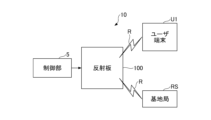
- FIG. 2 is an explanatory diagram of the operation of the radio wave transmission system according to an embodiment of the present disclosure.
- 1 is a block diagram showing an example of a configuration of a radio wave transmission system according to an embodiment;
- FIG. 1 is a diagram illustrating an example of a state in which the radio wave transmission system according to the embodiment is attached to a wall.
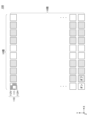
- FIG. 4 is a diagram showing an example of an arrangement of a plurality of cells of a reflector according to an embodiment.
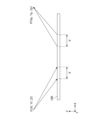
- 5A to 5C are diagrams illustrating an example of the principle of adjustment of the reflection angle of the reflector of the embodiment.
- 5A to 5C are diagrams illustrating an example of the principle of adjustment of the reflection angle of the reflector of the embodiment.
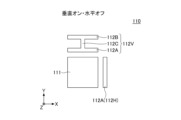
- FIG. 2 is a diagram showing an example of a configuration of a cell of a reflector according to an embodiment.
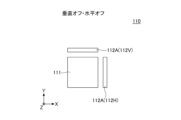
- 13 is a diagram showing an example of the coupling state of a resonant element in a cell by turning on and off a PIN diode of the resonant element.
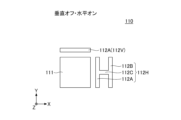
- FIG. 13 is a diagram showing an example of a coupling state of a resonant element in a cell by turning on and off a PIN diode of the resonant element.
- FIG. 13 is a diagram showing an example of a coupling state of a resonant element in a cell by turning on and off a PIN diode of the resonant element.
- FIG. 13 is a diagram showing an example of a coupling state of a resonant element in a cell by turning on and off a PIN diode of the resonant element.
- FIG. 13 is a diagram showing an example of a coupling state of a resonant element in a cell by turning on and off a PIN diode of the resonant element.
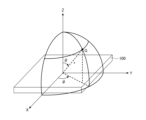
- FIG. FIG. 2 is a diagram showing the zenith angle ⁇ and the azimuth angle ⁇ in a polar coordinate system.
- FIG. 1 is a diagram illustrating an example of an overall configuration of a radio wave transmission system.
- 1A to 1C are diagrams illustrating an example of an incident phase distribution, a first reflected phase distribution, and a total phase distribution obtained by a radio wave transmission system.
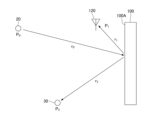
- FIG. 13 is a diagram showing an example of experimental results for comparison. 1 is a diagram for explaining how to calculate the maximum distance between a reflector 100 and a target terminal.
- FIG. 2 is a diagram illustrating the Fresnel radius between a wave source and an antenna.
- FIG. 2 is a diagram illustrating the Fresnel radius between a wave source and an antenna.
- 4 is a flowchart showing an example of a process executed by a control unit 5.
- the following defines and explains the XYZ coordinate system.
- the direction parallel to the X axis (X direction), the direction parallel to the Y axis (Y direction), and the direction parallel to the Z axis (Z direction) are mutually perpendicular.
- the -Z direction may be referred to as the lower side or bottom
- the +Z direction may be referred to as the upper side or top.
- Planar view refers to viewing from the XY plane.
- the length, width, thickness, etc. of each part may be exaggerated to make the configuration easier to understand. Words such as parallel, right angle, orthogonal, horizontal, vertical, up and down, etc., are permitted to be misaligned to the extent that they do not impair the effects of the embodiment.
- radio waves refers to a type of electromagnetic wave, and generally, electromagnetic waves below 3 THz are called radio waves.
- electromagnetic waves emitted from outdoor base stations or relay stations will be called “radio waves”, and electromagnetic waves in general will be called “electromagnetic waves”.
- millimeter waves or “millimeter wave band” we mean not only the frequency band of 30 GHz to 300 GHz, but also the quasi-millimeter wave band of 24 GHz to 30 GHz.
- the radio waves reflected by the reflector included in the radio wave transmission system of the embodiment are preferably radio waves in the millimeter wave band such as the fifth generation mobile communication system (5G) or in the frequency band of 1 GHz to 30 GHz including Sub-6.
- the radio waves reflected by the reflector included in the radio wave transmission system of the embodiment may be LTE (Long Term Evolution), LTE-A (LTE-Advanced), or UMB (Ultra Mobile Broadband).
- the radio waves reflected by the reflector included in the radio wave transmission system of the embodiment may be IEEE802.11 (Wi-Fi (registered trademark)), IEEE802.16 (WiMAX (registered trademark)), IEEE802.20, UWB (Ultra-Wideband), Bluetooth (registered trademark), LPWA (Low Power Wide Area), etc.
- Wi-Fi registered trademark
- WiMAX registered trademark
- IEEE802.20 UWB (Ultra-Wideband)
- Bluetooth registered trademark
- LPWA Low Power Wide Area
- FIG. 1 is a diagram illustrating the operation of a radio wave transmission system 10 according to an embodiment of the present disclosure.
- the radio wave transmission system 10 of the present disclosure is placed, for example, on a wall or window of an outdoor building BD.
- the radio wave transmission system 10 has a reflector 100 (see FIG. 2), and the reflector 100 of the present disclosure is a directional control array called a RIS (Reconfigurable Intelligent Surface) that can adjust the directionality of a beam.
- RIS Reconfigurable Intelligent Surface
- the type of building BD in which the radio wave transmission system 10 is installed is arbitrary, but for example, it may be a building in an area with many high-rise buildings. In areas with many high-rise buildings, blind spots (areas or spaces with poor communication environments, also called “dead zones”) where radio waves do not reach normally tend to occur.
- the radio wave transmission system 10 disclosed herein delivers radio waves to blind spots by controlling the direction of the reflected radio wave beam.
- FIG. 1 shows a schematic diagram of the radiation patterns of radio waves transmitted from a radio base station BS and radio waves R reflected from a radio wave transmission system 10.
- a radio base station BS may be provided to perform wireless communication.
- the radio base station BS converts a signal from a network (not shown) such as the Internet into a radio signal and transmits radio waves R, which are received by a receiving terminal.
- the radio base station BS also receives radio waves R transmitted by a receiving terminal, allowing the receiving terminal to access a network such as the Internet.
- the radio base station BS may be provided in the vicinity of the radio wave transmission system 10, approximately several tens of centimeters to several meters, or may be provided away from the radio wave transmission system 10, approximately several tens of meters to several kilometers.
- the radio wave transmission system 10 of the present disclosure delivers radio waves to blind areas blocked by buildings BD by redirecting the incoming radio waves R and reflecting the beam in a specific direction or by forming multiple beams.
- the radio waves will be described as plane waves.
- the radio wave transmission system 10 allows the selection of an outdoor receiving terminal U1, U2, or U3 for Internet communication. Specifically, for example, radio waves R transmitted from a wireless base station BS at a certain time are reflected by the radio wave transmission system 10 and received by an outdoor receiving terminal U1, thereby enabling wireless communication at the receiving terminal U1. Radio waves R transmitted from a wireless base station BS at a different time are reflected by the radio wave transmission system 10 and received by an outdoor receiving terminal U2, thereby enabling wireless communication at the receiving terminal U2.
- the receiving terminal U3 is similar to the receiving terminals U1 and U2.
- the radio base station BS receives the radio waves R reflected by the radio wave transmission system 10.
- FIG. 1 shows an example in which radio waves coming from a radio base station BS are reflected by a reflector 100, but radio waves coming from a radio relay station or the like may also be reflected by the reflector 100.
- the receiving terminals U1, U2, and U3 are smartphones carried by users, but they may also be fixed receiving terminals that are fixed to a building or the like and do not move.
- FIG. 2 is a block diagram showing an example of the configuration of the radio wave transmission system 10.
- FIG. 3 is a diagram showing an example of the radio wave transmission system 10 attached to a wall 1.
- FIG. 2 shows a state in which the reflector 100 reflects radio waves arriving from the wireless base station BS directly toward the receiving terminal U1.
- the receiving terminal U1 has an antenna for communication.
- the radio wave transmission system 10 has a reflector 100 and a control unit 5.
- the radio wave transmission method of this embodiment is realized by processing executed by the control unit 5 of the radio wave transmission system 10.
- the radio wave transmission system 10 includes an antenna used to set a total phase distribution that represents the distribution of multiple phase change amounts that change the phase of radio waves when multiple cells of the reflector 100 reflect radio waves as incident waves, but the antenna is omitted in Figures 2 and 3.
- the total phase distribution represents the distribution of multiple phase change amounts that change the phase of radio waves when all multiple cells included in the reflector 100 reflect radio waves as incident waves.
- the antenna of the radio wave transmission system 10 is removable, and is therefore shown removed in Figs. 2 and 3.
- the total phase distribution of the reflector 100 is set appropriately, so that the reflector 100 reflects radio waves R transmitted from the base station RS as a wave source, and the reflected radio waves R reach the user terminal U1.
- the configuration of the radio wave transmission system 10 including the antenna, and the process of setting the total phase distribution will be described later.
- the control unit 5 is realized, for example, by an MCU (Micro Controller Unit) and includes a CPU (Central Processing Unit), RAM (Random Access Memory), ROM (Read Only Memory), an input/output interface, and an internal bus.
- the control unit 5 operates based on a power supply voltage generated by a power supply generation unit (not shown).
- the radio waves used for communication between the user terminal U1 and the wireless base station BS may be, for example, LTE, LTE-A, UMB, IEEE802.11 (Wi-Fi (registered trademark)), IEEE802.16 (WiMAX (registered trademark)), IEEE802.20, UWB, Bluetooth (registered trademark), or LPWA.
- the radio wave transmission system 10 (reflector 100 and control unit 5) is provided on the wall 1.
- the height from the ground when the radio wave transmission system 10 is provided on the wall 1 of the building BD is preferably 1 m to 14 m, and particularly preferably 2 m to 10 m, in terms of radio wave efficiency.
- FIG. 3 shows an example in which the radio wave transmission system 10 is disposed on a wall 1
- the reflector 100 in the radio wave transmission system 10 may be disposed on the main surface of a window glass.
- the reflector substrate and resonant element included in the reflector 100 are made of a transparent material with a visual transmittance of 50% or more.
- the control unit 5 may be disposed away from the reflector 100 in another location, such as a wall portion adjacent to the window glass or the frame portion of the window glass.
- the radio wave transmission system 10 of the present disclosure may be installed on an indoor wall or window glass. In this case, it contributes to reducing blind zones indoors.
- the height above the floor is preferably 0.5 m to 3 m, and particularly preferably 1 m to 2 m, in terms of radio wave efficiency.
- FIG. 4 is a diagram showing an example of an arrangement of multiple cells of the reflector 100.
- FIG. 4 a case where vertically polarized radio waves are reflected is described, but the same applies to horizontally polarized waves.
- the reflector 100 has a number of cells 110 arranged in a regular pattern.
- the cells 110 are an example of a reflecting portion.
- the cells 110 are configured as repeating units, and for example, in FIG. 4, ten cells 110 are arranged in each of the X and Y directions.
- the reflector 100 can adjust the reflection angle of the radio waves reflected by the reflector 100 to an angle other than specular reflection or to the angle of specular reflection by controlling the amount of phase change (phase change amount) when the radio waves are reflected by each cell 110.
- the reflection angle of the reflected wave can be adjusted by arranging 10 cells 110 in each of the X and Y directions.
- the amount of phase change of each cell 110 of the reflector 100 can be controlled in a binary manner or in a multi-value manner that is greater than two values.
- the reflector 100 reflects radio waves in the desired reflection direction by controlling the amount of phase change of each cell 110 and adjusting the reflection angle at which the reflector 100 reflects radio waves. Note that here, a case where the phase of radio waves is controlled in a binary manner will be described.
- the arrangement of the multiple cells 110 is not limited to the array shown in FIG. 4, but may be arranged randomly (irregularly) without any regularity. At least 10 cells 110 are arranged in the X and Y directions, and the number of cells arranged in the X and Y directions is preferably 130 or less, and more preferably 100 or less.
- each cell 110 has a resonant element 111 and resonant elements 112H and 112V.
- the cell 110 is an example of a reflecting element
- the resonant element 111 is an example of a first resonant element
- the resonant elements 112H and 112V are each an example of a second resonant element.
- the resonant element 112H is used when changing the amount of phase change imparted to horizontally polarized radio waves
- the resonant element 112V is used when changing the amount of phase change imparted to vertically polarized radio waves.
- the resonant element 111 is a resonant element that can resonate independently at a predetermined resonant frequency.
- the resonant elements 112H and 112V have a switching element that can switch the resonant frequency in the horizontal and vertical directions to the first resonant frequency or the second resonant frequency by electrical control, but this is omitted in FIG. 4.
- the details of the cell 110 will be described later with reference to FIG. 6.
- each cell 110 may have a configuration in which it has resonant element 111 and either one of resonant elements 112H and 112V.
- the resonant frequency in the horizontal direction is the first resonant frequency
- the resonant frequency in the horizontal direction is the second resonant frequency
- the resonant frequency in the vertical direction is the first resonant frequency
- the resonant frequency in the vertical direction is the second resonant frequency. Note that the first resonant frequency in the horizontal direction and the vertical direction may be different, and the first resonant frequency in the horizontal direction and the vertical direction may be different.
- switching the switching element of resonant element 112H on and off is referred to as turning cell 110 on or off in the horizontal direction
- switching the switching element of resonant element 112V on and off is referred to as turning cell 110 on or off in the vertical direction.
- switching the switching element of either resonant element 112H or 112V on and off is referred to as turning cell 110 on or off.
- the angle at which the reflector 100 reflects the incident radio waves can be set to the desired horizontal or vertical direction. Details of turning the cells 110 on and off will be described later with reference to Figures 6 and 7A to 7D.
- an on cell 110 is shown in white, and an off cell is shown with a filled-in dot.
- the cells 110 are active cells whose on/off state is controlled by the control unit 5.
- phase shifter is an example of a phase adjustment unit. It is preferable to use liquid crystal or a ferroelectric material as the phase shifter.
- the phase shifter can change the phase of the radio wave to any value among continuous values, so it is suitable for multi-value control.
- FIGS. 5A and 5B are diagrams illustrating an example of the principle of adjusting the reflection angle at the reflector 100.
- the reflector 100 is an array called a RIS (Reconfigurable Intelligent Surface) that can adjust the beam directionality.
- d is the pitch in the X direction of adjacent cells 110.
- Figs. 5A and 5B in order to easily understand the incidence and reflection of horizontally polarized radio waves in adjacent cells 110 in the XZ plane, the position where the radio waves enter the reflecting surface (the surface on the +Z direction side) of the reflector 100 and the position where the radio waves exit from the reflecting surface are shown separately, shifted in the X direction.
- the reflector 100 changes the phase of radio waves when reflecting them from each of the multiple cells 110 arranged in an array, thereby adjusting the propagation direction of the reflected wave beam.
- the amount of phase change (phase change amount) by which the cell 110 changes the phase when reflecting radio waves is set for each cell 110, taking into account the spacing between the cells 110 in the X and Y directions, for radio waves incident on the reflective surface (surface on the +Z direction side) of the reflector 100, making it possible to adjust the direction in which the radio waves are reflected by all the cells 110 included in one reflector 100.
- the direction in which the radio waves are reflected by all the cells 110 is synonymous with the reflection angle of the reflector 100 as a whole.
- the reflection direction is changed by adding a phase to each cell 110.
- the reflection direction of the radio waves can be changed by adding a phase to each location X on the reflector 100.
- the coordinates (Xp, Yp, Zp) are called the focus because they are the point where radio waves are gathered to receive them.
- equation (1) the distribution of the phase ⁇ (X, Y) added to the radio wave on the reflecting surface of reflector 100 is nonlinear with respect to position X. If points F and P are sufficiently far apart, equation (1) can be approximated to a linear equation with respect to the coordinates X and Y on the reflecting surface.
- FIG. 5B also shows radio waves incident on adjacent cells 110 at pitch d in the X and Y directions at zenith angle ⁇ in and azimuth angle ⁇ in, and radio waves reflected by reflector 100 in the direction of zenith angle ⁇ out and azimuth angle ⁇ out, as viewed on the XZ plane.
- the zenith angle and azimuth angle are represented by the zenith angle ⁇ and azimuth angle ⁇ in FIG. 8, which will be described later.
- the radio waves incident on adjacent cells 110 at pitch d are parallel, with both angles of incidence being zenith angle ⁇ in and azimuth angle ⁇ in, and the radio waves reflected by the reflecting surface of reflector 100 are also parallel, with both angles of reflection being zenith angle ⁇ out and azimuth angle ⁇ out.
- the phase difference between the radio waves incident on adjacent cells 110 at pitch d is, for example, d ⁇ sin ⁇ in ⁇ cos ⁇ in in the X direction
- the phase difference between the radio waves reflected by adjacent cells 110 at pitch d is d ⁇ sin ⁇ out ⁇ cos ⁇ out.
- the phase difference between the radio waves incident on adjacent cells 110 at pitch d is, for example, d ⁇ sin ⁇ in ⁇ sin ⁇ in in the Y direction, and the phase difference between the radio waves reflected by adjacent cells 110 at pitch d is d ⁇ sin ⁇ out ⁇ sin ⁇ out.
- cell 110 which can control the amount of phase change during reflection with two values by turning the voltage on and off, it is possible to approximately realize the phase ⁇ (X, Y), and change the reflection direction at reflector 100.
- phase ⁇ (X,Y) In order to add a phase ⁇ (X,Y) to radio waves in each cell 110 that can switch between an on state and an off state, it is sufficient to ensure a phase difference of approximately 180 degrees when reflected in the on state and the off state. For example, if the phase ⁇ (X,Y) is between -90° and 90°, it will be in the off state, and if it is between -180° and -90° or 90° and 180°, it will be in the on state, thereby roughly realizing the phase ⁇ (X,Y). As a result, it is possible to change the reflection direction in each cell 110. This holds true in both cases of formula (1) and formula (2).
- the on and off states may be selected within a range of 180° that do not overlap with each other.
- the off state may be from 20° to 180° or from -180° to -160°
- the on state may be from -160° to 20°.
- the radio wave transmission system 10 can change the direction of the beam of radio waves emitted from a 5G base station, etc., and direct the beam in various directions or in a desired direction, or even create multiple beams.
- Figures 5A and 5B show radio waves reflected in the XZ plane, as described above, the reflector 100 can also reflect radio waves in the YZ plane, or in a plane that includes the Z axis and has an angle with respect to the XZ and YZ planes. Therefore, the reflector 100 is a reflector that can set the reflection angle to an angle other than specular reflection.
- Figure 4 shows, as an example, a state in which the on/off state of all cells 110 changes in the X direction within each row when reflecting vertically polarized radio waves, and the 10 cells 110 arranged in the Y direction within each column are unified to be on or off. This corresponds to the case in which the on and off states are determined based on formula (2).
- the arrangement of cells 110 in the reflector 100 shown in FIG. 4 is just one example, and the number of cells 110 provided in the array may range from several tens to several thousands.
- FIG. 6 is a diagram showing an example of the configuration of the cell 110.
- the cell 110 is a cell that controls the amount of phase change in the horizontal or vertical direction with two values of on and off, and has a resonant element 111 and resonant elements 112H and 112V adjacent to the resonant element 111.
- FIG. 6 also shows a substrate 101.
- the substrate 101 is the substrate 101 of the reflector 100 (see FIG. 4), and as an example, one reflector 100 includes one substrate 101.
- the size of the substrate 101 in a plan view is the size shown as the reflector 100 in FIG. 4.
- a ground layer is provided on the surface of the substrate 101 on the -Z direction side.
- the reflector 100 includes a plurality of cells 110.
- FIG. 6 shows a portion of the entire substrate 101 that corresponds to one cell 110.
- one reflector 100 may include a plurality of substrates 101. That is, in one reflector 100, one substrate 101 may be provided for one or a plurality of cells 110.
- the substrate 101 is, for example, a rectangular substrate in a plan view.
- the substrate 101 is, for example, a flexible substrate made of resin in the form of a thin film having flexibility, or a rigid substrate having no flexibility. Flexibility is the property of an object bending without breaking to an extent that is visible from the outside.
- the substrate 101 is a flexible substrate, it can be made of a flexible resin material such as fluorine, COP (Cyclo-Olefin Polymer), PET (Polyethylene terephthalate), PEN (polyethylene naphthalate), polyimide, Peek (polyether ether ketone), LCP (Liquid Crystal Polymer), or other composite materials.
- the substrate 101 is a rigid substrate, it can be made of, for example, a substrate formed by bonding a core material to a prepreg made of glass cloth impregnated with epoxy resin or the like.
- the substrate 101 may be formed of any material that is transparent to radio waves radiated from an outdoor base station or the like.
- Transparent to the radiated radio waves means, for example, that the transmission loss is 10 dB or less.
- Substrate 101 is transparent to the radiated radio waves means that the transmission loss of substrate 101 is 10 dB or less, preferably 6 dB or less, more preferably 3 dB or less, and even more preferably 1 dB or less.
- the substrate 101 may also be transparent to visible light.
- Transparent to visible light means that the visual transmittance is at least 40%, preferably 60% or more, more preferably 70% or more, and even more preferably 80% or more.
- a resin substrate (resin film) may be used as the substrate 101.
- resin materials that satisfy the above conditions include acrylic resins such as polymethyl methacrylate, cycloolefin resins, polycarbonate resins, polyethylene terephthalate (PET), and the like.
- PET polyethylene terephthalate
- a glass plate may be used as the substrate 101. Examples of glass plates that satisfy the above conditions include soda-lime glass, alkali-free glass, Pyrex (registered trademark) glass, and quartz glass.
- the resonator elements 111, 112H, and 112V are formed of a metal layer.
- the metal layer can be formed of a metal thin film such as copper, nickel, or gold.
- the metal layer is desirably formed of a transparent conductive film such as zinc oxide (ZnO), tin oxide (SnO 2 ), tin-doped indium oxide (ITO), indium oxide-tin oxide (IZO), metal nitride such as titanium nitride (TiN) or chromium nitride (CrN), or a Low-e film for Low-e (low emissivity) glass.
- the metal layer may be formed of a mesh-shaped metal thin film such as copper, nickel, or gold.
- the resonant element 111 is a square conductor in a plan view.
- the resonant element 111 has an end side 111A extending along the X direction on the +Y direction side.
- Resonant elements 112H and 112V are parasitic on the resonant element 111. Since the resonant elements 112H and 112V are coupled to the resonant element 111 by electromagnetic field coupling and are parasitic, the resonant element 111 may be regarded as the main resonant element and the resonant elements 112H and 112V as parasitic resonant elements.
- the resonant element 112H is for horizontal polarization and the resonant element 112V is for vertical polarization.
- the resonant elements 112H and 112V are positioned 90 degrees apart from each other with respect to the resonant element 111 being located on the +X direction side of the resonant element 111 and the resonant element 112V being located on the +Y direction side of the resonant element 111, but have the same configuration.
- the resonator element 112V has linear elements 112A and 112B and a PIN (p-intrinsic-n) diode 112C.
- the PIN diode 112C is an example of a switching element.
- the linear elements 112A and 112B extend parallel to the X direction.
- the linear element 112A is disposed on the +Y direction side of the end edge 111A of the resonator element 111, and the linear element 112B is disposed on the +Y direction side of the linear element 112A.
- the PIN diode 112C is provided between the linear elements 112A and 112B.
- the cathode of the PIN diode is connected to the linear element 112A
- the anode of the PIN diode 112C is connected to the linear element 112B.
- RF chokes 113, 114 are provided at the ends of linear elements 112A and 112B on the -X direction side.
- RF choke 113 is connected to a ground layer at ground potential (GND) on the rear surface of substrate 101, and RF choke 114 is connected to a control terminal to which control voltage BV is applied.
- Control voltage BV is applied from control unit 5 (see FIG. 2).
- the distance between the end edge 111A of the resonant element 111 and the linear element 112A is preferably, for example, ⁇ e/10 or less, and more preferably about ⁇ e/30.
- ⁇ e is the electrical length of the wavelength at the frequency of the radio waves reflected by the reflector 100.
- the resonant element 112H Similar to the resonant element 112V, the resonant element 112H has linear elements 112A and 112B and a PIN (p-intrinsic-n) diode 112C. The operation of the resonant element 112H is similar to that of the resonant element 112V, so details are omitted here.
- the length in the X-direction and Y-direction in a planar view of the area in one cell 110 where the resonant element 111 and the resonant elements 112H and 112V are provided is 2 ⁇ or less.
- FIG. 6 shows a square-shaped resonant element 111, but if the dimensions in the X-direction and Y-direction are not constant, for example, when the resonant element 111 is elliptical, it is sufficient that the maximum length in the X-direction and the maximum length in the Y-direction in a planar view of the area in one cell 110 where the resonant element 111 and the resonant elements 112H and 112V are provided are 2 ⁇ or less.
- FIGS. 7A to 7D are diagrams showing an example of the coupling state of the linear elements 112A and 112B of the resonant elements 112H and 112V to the resonant element 111 in the cell 110 by turning on and off the PIN diodes 112C of the resonant elements 112H and 112V.
- FIG. 7A to 7B show the linear element 112A or the linear elements 112A and 112B coupled to the resonant element 111, and omit other configurations.
- FIG. 7A shows the coupling state when the PIN diode 112C (see FIG. 6) of the resonant element 112V is turned on by the control voltage BV applied from the control unit 5 (see FIG. 2), and the PIN diode 112C (see FIG. 6) of the resonant element 112H is turned off by the control voltage BV. Therefore, the linear element 112B is connected to the linear element 112A of the resonant element 112V, and the linear element 112B is not connected to the linear element 112A of the resonant element 112H. As a result, as shown in FIG. 7A, the linear elements 112A and 112B of the resonant element 112V and the linear element 112A of the resonant element 112H are coupled to the resonant element 111.
- FIG. 7B shows the coupling state when the PIN diodes 112C (see FIG. 6) of the resonant elements 112V and 112H are turned off by the control voltage BV applied from the control unit 5 (see FIG. 2). Therefore, the linear element 112B is not connected to the linear element 112A of the resonant element 112V, and the linear element 112B is not connected to the linear element 112A of the resonant element 112H. As a result, as shown in FIG. 7B, the linear element 112A of the resonant element 112V and the linear element 112A of the resonant element 112H are coupled to each other in the resonant element 111.
- FIG. 7C shows the coupling state when the PIN diode 112C (see FIG. 6) of the resonant element 112V is turned off by the control voltage BV applied from the control unit 5 (see FIG. 2), and the PIN diode 112C (see FIG. 6) of the resonant element 112H is turned on by the control voltage BV. Therefore, the linear element 112B is not connected to the linear element 112A of the resonant element 112V, and the linear element 112B is connected to the linear element 112A of the resonant element 112H. As a result, as shown in FIG. 7C, the linear element 112A of the resonant element 112V and the linear elements 112A and 112B of the resonant element 112H are coupled to each other in the resonant element 111.
- Figure 7D shows the coupling state when the PIN diodes 112C (see Figure 6) of the resonant elements 112V and 112H are both turned on by the control voltage BV applied from the control unit 5 (see Figure 2). Therefore, the linear element 112B is connected to the linear element 112A of the resonant element 112V, and the linear element 112B is connected to the linear element 112A of the resonant element 112H. As a result, as shown in Figure 7D, the linear elements 112A and 112B of the resonant element 112V and the linear elements 112A and 112B of the resonant element 112H are coupled to the resonant element 111.
- FIG. 7A and 7B the difference is that in FIG. 7A, the linear elements 112A and 112B of the resonant element 112V are coupled to the resonant element 111, whereas in FIG. 7B, only the linear element 112A of the resonant element 112V is coupled to the resonant element 111. Comparing the coupled states of FIG. 7A and 7B, the length of the resonant element 112V is longer in the coupled state of FIG. 7A, and the shape of the resonant element 112V is changed. Therefore, when the PIN diode 112C (see FIG. 6) of the resonant element 112V is turned on as in the coupled state shown in FIG.
- the resonant frequency of the resonant element 112V is lowered to the first resonant frequency than when the PIN diode 112C of the resonant element 112V is off as in the coupled state shown in FIG. 7B.
- the PIN diode 112C see FIG. 6
- the resonant frequency of the resonant element 112V increases to the second resonant frequency compared to the state in which the PIN diode 112C of the resonant element 112V is on as in the coupled state shown in FIG. 7A.
- the size of the resonant element 111 and the linear elements 112A and 112B of the resonant element 112V are set so that the difference in the absolute value of the phase change given to the vertically polarized incident wave radio wave when the PIN diode 112C of the resonant element 112V is off and on is about 180 degrees.
- about 180 degrees means a value within the range of 180 degrees ⁇ 45 degrees. Since the resonant elements 111 and 112V are made of conductors, there may be cases where an error occurs in the phase change due to manufacturing errors, etc.
- the phase change given to the vertically polarized incident wave can be changed by about 180 degrees (180 degrees ⁇ 45 degrees) by switching the PIN diode 112C of the resonant element 112V on and off
- the reflection angle of the vertically polarized radio wave of the reflector 100 as a whole can be adjusted to an angle other than specular reflection.
- Specular reflection is regular reflection, which means that light is reflected in a direction that creates an equiphase surface due to normal reflection from metals, etc.
- the resonant elements 112H and 112V have the same linear elements 112A and 112B, and operate in the same way, with only the angle differing by 90 degrees in plan view. That is, the size of the resonant element 111 and the linear elements 112A and 112B of the resonant element 112H are set so that the absolute difference in the amount of phase change given to the horizontally polarized incident wave is about 180 degrees when the PIN diode 112C of the resonant element 112H is off and on.
- the amount of phase change given to the horizontally polarized incident wave can be changed by about 180 degrees (180 degrees ⁇ 45 degrees) by switching the PIN diode 112C of the resonant element 112H on and off, the reflection angle of the horizontally polarized radio wave of the reflector 100 as a whole can be adjusted to an angle other than specular reflection.
- the reflector 100 can switch the reflection angle (reflection direction) of the vertically polarized wave or the vertically polarized incident wave at the reflector 100 as a collection of all the cells 110 by switching on and off the PIN diode 112C of the resonant element 112H or 112V of each cell 110.
- the reflector 100 can control the amount of phase change in the horizontal or vertical direction in a binary manner by the control unit 5 switching on and off the PIN diode 112C of the resonant element 112H or 112V of each cell 110, and can adjust the reflection angle to an angle other than specular reflection.
- Specular reflection means regular reflection, which is reflection in a direction that generates an equal phase surface due to reflection by normal metal reflection or the like.
- the reflector 100 can also adjust the reflection angle to the angle of specular reflection.
- the phase change amount of the cell 110 can be controlled in a binary manner so that the phase change amount of the cell 110 when the PIN diode 112C of the resonant element 112V is turned off is 30 degrees, and the phase change amount of the cell 110 when the PIN diode 112C is turned on is 210 degrees.
- the phase change amount of 30 degrees is an example of a first value
- the phase change amount of 210 degrees is an example of a second value.
- the difference between the phase change amount when the PIN diode 112C of the resonant element 112V is turned off and the phase change amount when it is turned on is 120 degrees to 240 degrees in absolute value.
- the difference between the first value and the second value of the phase change amount is 180 ⁇ 60 degrees in absolute value.
- the phase change amount can be controlled in a binary manner while taking into account variations due to manufacturing errors, etc., and the reflection angle can be adjusted to an angle other than specular reflection.
- the difference in the phase change amount (for example, 30 degrees and 210 degrees) of all cells 110 is 180 degrees. In reality, there is some variation, so the difference in the phase change amount is about 180 degrees.
- the resonant element 111 is square-shaped, and the resonant elements 112H and 112V have a PIN diode 112C between the two linear elements 112A and 112B.
- the shape of the resonant element 111 is not limited to a square shape, and may be any planar shape as long as it is capable of reflecting radio waves.
- the resonant elements 112H and 112V may have different configurations.
- the resonant elements 112H and 112V may have any configuration as long as their shape and length can be changed by being switched by the control unit 5.
- the resonant elements are not limited to the PIN diode 112C, and may be a MEMS (Micro Electro Mechanical Systems) switch, a varactor, or a transistor such as a FET (Field effect transistor).
- ⁇ Polar coordinate system> 8 is a diagram showing the zenith angle ⁇ and the azimuth angle ⁇ in the polar coordinate system.
- the reflector 100 is located at the origin of the XYZ coordinate system. More specifically, the origin of the XYZ coordinate system is located at the center of the reflecting surface of the reflector 100.
- the zenith angle ⁇ is an angle with respect to the +Z direction, and the angle downward from the +Z direction is positive as shown by the arrow.
- the azimuth angle ⁇ is an azimuth angle with respect to the +X direction in the XY plane, and the angle from the +X direction toward the +Y direction is positive as shown by the arrow.
- r is a radius vector, and is the distance from the origin to the receiving point G where the receiving terminal U1 is located.
- the reflection angle of the reflector 100 is represented by the zenith angle ⁇ and the azimuth angle ⁇ .
- Fig. 9 is a diagram showing an example of the overall configuration of the radio wave transmission system 10.
- the radio wave transmission system 10 includes a reflector 100, a control unit 5, an antenna 120, a stay 125, a power meter 130, and a cable 135.
- Fig. 9 also shows a base station RS.
- Fig. 9 also shows a memory 5A included in the control unit 5.
- the memory 5A is an example of a storage unit.
- the antenna 120 is an antenna capable of receiving radio waves reflected by the reflector 100, and is connected to the power meter 130.
- the antenna 120 is installed at a fixed position relative to the reflector 100 by a stay 125.
- the positional relationship between the reflector 100 and the antenna 120 is fixed, and the position of the antenna 120 relative to the reflector 100 is known.
- the position of the antenna 120 relative to the reflector 100 is expressed by a radius vector r1, a zenith angle ⁇ 1, and an azimuth angle ⁇ 1 in a polar coordinate system with the center of the reflecting surface 100A of the reflector 100 as the origin.
- the center of the reflecting surface 100A is the center of the reflecting surface 100A in the X and Y directions.
- the antenna 120 is located on the +Z side of the reflector 100. It is preferable that the antenna 120 has directivity in the -Z direction and does not have directivity in the direction in which the radio base station BS is located. This is because it is preferable that the antenna 120 does not receive power from the radio base station BS. As an example of such an antenna 120, a horn antenna or the like is preferable.
- the antenna 120 which is fixed to the reflector 100 by the stay 125, is positioned on a normal line passing through the center of the reflecting surface 100A of the reflector 100. This is because the antenna 120 positioned on the normal line of the reflecting surface 100A is more likely to receive radio waves reflected in various directions by the reflector 100.
- the antenna 120 and the stay 125 can be attached and detached freely from the reflector 100.
- the portion where the stay 125 to which the antenna 120 is attached is attached to the housing of the reflector 100 is an example of a fixing portion that fixes the antenna 120 to the reflector 100.
- the antenna 120 and stay 125 may be fixedly attached to the reflector 100 rather than being detachable.
- the stay 125 is a fixture for attaching the antenna 120 to the reflector 100, and may be of any shape or size as long as it is configured to suppress the impact on the incidence and reflection of radio waves at the reflector 100 and on the reception of radio waves at the antenna 120.
- the power meter 130 is connected to the antenna 120 and measures the power received by the antenna 120.
- the power meter 130 may be fixed to the antenna 120 or to the stay 125.
- the power meter 130 is connected to the control unit 5 via a cable 135 and transmits (feeds back) data representing the measured power to the control unit 5 via the cable 135.
- the power meter 130 may be configured to be detachable from the reflector 100 together with the antenna 120 and the stay 125, as an example.
- the cable 135 is provided to transmit data representing the power measured by the power meter 130 to the control unit 5.
- the cable 135 may be configured to be detachable from the control unit 5, for example.
- the antenna 120, the stay 125, the power meter 130, and the cable 135 can be removed, leaving the reflector 100 and the control unit 5.
- data representing the power measured by the power meter 130 may be transmitted to the control unit 5 by, for example, short-range wireless communication between the power meter 130 and the control unit 5.
- the user terminal U1 will be referred to as the target terminal
- the base station RS will be referred to as the wave source.
- the target terminal is not limited to a terminal used by a user such as the user terminal U1, but may be any receiver that receives radio waves reflected by the reflector 100.
- the wave source is not limited to the base station RS, but may be any device that radiates or reflects radio waves that can be reflected by the reflector 100.
- the total phase distribution represents the distribution of multiple phase changes that all of the multiple cells 110 included in the reflector 100 cause when they reflect radio waves as incident waves.
- the total phase distribution can be divided into an incident phase distribution and a reflected phase distribution.
- the total phase distribution is a phase distribution that combines the incident phase distribution and the reflected phase distribution.
- the reflection phase distribution is a phase distribution on the reflection side that is determined by the positional relationship between the reflector 100 and the receiving unit that receives the radio waves reflected by the reflector 100.
- the receiving unit is, for example, the antenna 120 or a target terminal.
- the positional relationship between the reflector 100 and the receiving unit can be expressed in XYZ coordinates or in polar coordinates with the radius vector r, zenith angle ⁇ , and azimuth angle ⁇ .
- the incident phase distribution can be obtained by subtracting the reflected phase distribution from the total phase distribution.
- the incident phase distribution is the phase distribution on the incident side that is determined by the positional relationship between the incident wave and the reflector 100.
- the positional relationship between the incident wave and the reflector 100 can be expressed in XYZ coordinates or in polar coordinates with the radius vector r, zenith angle ⁇ , and azimuth angle ⁇ , so the incident phase distribution can be obtained without subtracting the reflected phase distribution from the total phase distribution.
- Incoming waves on the reflector 100 include direct path incoming waves that arrive directly from the base station RS without being reflected by walls or the like, and multipath incoming waves that are reflected by walls or the like. There may also be cases where an incoming wave that is a composite of a direct path incoming wave and one or more multipath incoming waves is incident on the reflector 100.
- the incoming waves that determine the incident phase distribution are direct path incoming waves, multipath incoming waves, or composite waves of a direct path incoming wave and one or more multipath incoming waves that may be incident on the reflector 100.
- the position of the reflector 100 is fixed. In other words, the position of the reflector 100 relative to the wave source is fixed. Although the position of the wave source is unknown, by fixing the position of the reflector 100, the position of the reflector 100 relative to the wave source, whose position is unknown, is fixed.
- the predetermined total phase distribution is the total phase distribution for reflecting the radio waves arriving from the wave source toward the target terminal by the reflector 100.
- the control unit 5 adjusts the total phase distribution of the reflector 100 to obtain the total phase distribution that maximizes the received power at the antenna 120.
- the total phase distribution is adjusted so that the reflector 100 reflects toward the antenna 120, thereby searching for the direction of arrival of the radio wave coming from the wave source (the direction of arrival including multipath).
- the incident phase distribution is determined based on the first reflected phase distribution determined by the positional relationship between the antenna 120 and the reflector 100 and the determined total phase distribution, and is stored in memory 5A.
- the incident phase distribution can be determined by subtracting the first reflected phase distribution from the determined total phase distribution.
- the incident phase distribution obtained with the position of the reflector 100 fixed is the incident phase distribution at the reflector 100 whose position is fixed relative to the wave source whose position is unknown, and therefore remains unchanged even if the reflection direction of the reflector 100 changes. Therefore, by combining the incident phase distribution obtained in this manner with the second reflection phase distribution determined by the positional relationship between the reflector 100 and the target terminal, it is possible to obtain a predetermined total phase distribution for reflecting the radio wave arriving from the wave source toward the target terminal by the reflector 100.
- the positional relationship between the reflector 100 and the target terminal can be expressed by the XYZ coordinates or the radial coordinate r, zenith angle ⁇ , and azimuth angle ⁇ of the polar coordinates, so that the second reflection phase distribution can be calculated.
- 10A is a diagram showing an example of an incident phase distribution, a first reflection phase distribution, and a total phase distribution obtained by the radio wave transmission system 10.
- FIG. 10A shows an example of a result of a simulation performed using the radio wave transmission system 10.
- Incident phase distribution, (2) first reflected phase distribution, (3) total phase distribution, and (4) total phase distribution show the distribution of phases at positions corresponding to each cell in the reflector 100, in which 40 cells 110 are arranged in each of the X and Y directions.
- incident phase distribution, (2) first reflected phase distribution, and (3) total phase distribution the position of 0 degrees phase is shown in white, the position of 359 degrees phase is shown in black, and the range between 0 degrees phase and 359 degrees phase is shown in monotone gradation.
- Total phase distribution shows the distribution of on and off obtained by binarization. White indicates on cells 110, and black indicates off cells 110.
- Incident phase distribution, (2) first reflected phase distribution, (3) total phase distribution, and (4) total phase distribution (2 values) in FIG. 10A are obtained by the control unit 5 of the radio wave transmission system 10 when the position of the wave source is unknown.
- the position of the wave source is unknown, the positional relationship between the incident wave and the reflector 100 is unknown.
- the incident phase distribution when radio waves coming from a certain direction are incident is generated, and (2) the first reflected phase distribution is added to obtain (3) the total phase distribution.
- the incident phase distribution when radio waves coming from a certain direction are incident is an incident phase distribution that is determined by the positional relationship between the incident wave and the reflector 100 when a radio wave (incident wave) from a certain incident direction is incident on the reflector 100.
- the first reflection phase distribution can be calculated based on the known positional relationship between the reflector 100 and the antenna 120.
- the first reflection phase distribution may be calculated by the control unit 5 based on the known positional relationship between the reflector 100 and the antenna 120, or may be calculated in advance and stored in the memory 5A of the control unit 5.
- an incident phase distribution (1) corresponding to the incident direction is generated, and the total phase distribution (3) obtained by adding the first reflected phase distribution (2) to the incident phase distribution (1) is binarized to obtain a total phase distribution (4) (binary). Then, the on/off distribution of each cell 110 of the reflector 100 is set in the total phase distribution (binary) (4), and the received power of the antenna 120 is measured by the power meter 130.
- the (4) total phase distribution (2 values) when the received power of antenna 120 is at its maximum may be calculated as follows. That is, first, the (3) total phase distribution that realizes the (4) total phase distribution (2 values) when the received power of antenna 120 is at its maximum is calculated, and then the (2) first reflected phase distribution is subtracted from the (3) total phase distribution to calculate the (1) incident phase distribution.
- This calculation method can also be used to calculate the (1) incident phase distribution, (2) first reflected phase distribution, (3) total phase distribution, and (4) total phase distribution (2 values) shown in FIG. 10A.
- FIG. 10B is a diagram showing an example of a simulation result for comparison. As with FIG. 10A, FIG. 10B shows (1) incident phase distribution, (2) first reflection phase distribution, (3) total phase distribution, and (4) total phase distribution (binary).
- the incident phase distribution can be calculated based on the positional relationship between the incident wave and the reflector 100.
- the calculated incident phase distribution is shown in FIG. 10B (1).
- the incident phase distribution in FIG. 10A (1) is very similar to the incident phase distribution in FIG. 10B (1).
- the first reflection phase distribution is calculated based on the positional relationship between the reflector 100 and the antenna 120, and is therefore substantially the same as the first reflection phase distribution shown in (2) in FIG. 10A.
- the (3) total phase distribution is obtained by adding up the (1) incident phase distribution and the (2) first reflected phase distribution.
- the (3) total phase distribution shown in FIG. 10B is a phase distribution obtained using the incident phase distribution calculated when the positional relationship between the incident wave and the reflector 100 is known. Compared to the (3) total phase distribution shown in FIG. 10A, it can be seen that the (3) total phase distribution shown in FIG. 10A is very similar to the (3) total phase distribution shown in FIG. 10B.
- the incident phase distribution included in the total phase distribution (2 values) shown in (4) of FIG. 10B was calculated under the condition that the zenith angle ⁇ of the incident wave on the reflector 100 is 30.0 degrees and the azimuth angle ⁇ is 45.0 degrees.
- the incident angle of the incident wave on the reflector 100 represented by the incident phase distribution included in the total phase distribution (2 values) shown in (4) of Figure 10A was a zenith angle ⁇ of 30.0 degrees and an azimuth angle ⁇ of 44.0 degrees.
- the zenith angle ⁇ calculated by the radio wave transmission system 10 was the same as the theoretical value (30.0 degrees), and the deviation of the azimuth angle ⁇ from the theoretical value (45.0 degrees) was 1 degree.
- the radio wave transmission system 10 can obtain the incident phase distribution with extremely high accuracy.
- the control unit 5 determines the maximum distance between the reflector 100 and the target terminal at which the target terminal can receive the radio waves reflected by the reflector 100 with the minimum reception power, based on the radiation power at the wave source, the distance between the wave source and the reflector 100, the distance between the reflector 100 and the antenna 120, the reception power at the antenna 120, and the minimum reception power required at the target terminal.
- FIG. 11 is a diagram explaining how to find the maximum distance between the reflector 100 and the target terminal. In addition to the reflector 100 and antenna 120, FIG. 11 also shows the wave source 20 and the target terminal 30.
- the radiation power P0 of the wave source 20 the distance r0 between the wave source 20 and the reflector 100, the received power P1 at the antenna 120 when the total phase distribution that maximizes the received power at the antenna 120 is obtained, the distance r1 between the reflector 100 and the antenna 120, and the minimum received power P2 required at the target terminal 30 are known, it is possible to obtain the maximum distance r2 between the reflector 100 and the target terminal 30 at which the target terminal 30 can receive the radio waves reflected by the reflector 100 with the minimum received power. Specifically, this is as follows.
- the distance r0 between the wave source 20 and the reflector 100 can be calculated using the following formula (4).
- Formula (4) takes into account the radar cross section RCS.
- G0 is the gain of the wave source 20
- G1 is the gain of the antenna 120
- ⁇ is the wavelength of the radio wave
- ⁇ 1 is a coefficient expressing efficiency including reflection loss and angle factor, etc.
- A is the area of the reflecting surface 100A of the reflector 100.
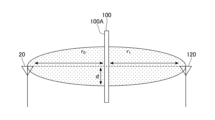
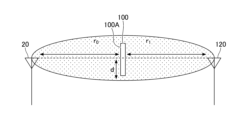
- Figures 12A and 12B are diagrams for explaining an example of the relationship between the Fresnel radius d between the wave source 20 and the antenna 120 and the size of the reflecting surface 100A of the reflector 100.
- Figures 12A and 12B show a straight line representing the path from the wave source 20 through the reflector 100 to the antenna 120, and the first Fresnel region surrounded by the Fresnel radius d is shown by dots.
- the Fresnel radius d between the wave source 20 and the antenna 120 is expressed by the following equation (5).
- FIG. 12A and 12B show the Fresnel radius d between the wave source 20 and the antenna 120.
- the reflecting surface 100A of the reflector 100 is larger than a circle whose diameter is twice the Fresnel radius d (2d)
- the reflecting surface 100A of the reflector 100 is smaller than a circle whose diameter is twice the Fresnel radius d (2d).
- the reflector 100 when the reflecting surface 100A of the reflector 100 is larger than a circle whose diameter is twice the Fresnel radius d (2d), the reflector 100 can reflect all of the radio waves arriving from the wave source 20 toward the antenna 120. In contrast, when the reflecting surface 100A of the reflector 100 is smaller than a circle whose diameter is twice the Fresnel radius d (2d), the reflector 100 will only reflect a portion of the components of the central part of the Fresnel radius d of the radio waves arriving from the wave source 20 toward the antenna 120.
- the distance r0 between the wave source 20 and the reflector 100 may be calculated using formula (3).
- the distance r0 between the wave source 20 and the reflector 100 may be calculated using formula (4).
- the maximum distance r2 between the reflector 100 and the target terminal 30 at which the target terminal 30 can receive the radio waves reflected by the reflector 100 with the minimum received power can be calculated using the distance r0 calculated based on equation (3) or (4) in accordance with the following equation (6).
- G 0 is the gain of the wave source 20
- G 2 is the gain of the target terminal 30
- ⁇ 2 is a coefficient representing efficiency including return loss, angle factor, and the like.
- Equation (7) takes into account the radar cross section RCS.
- G0 is the gain of the wave source 20
- G2 is the gain of the target terminal 30
- ⁇ is the wavelength of the radio wave
- ⁇ 2 is a coefficient expressing efficiency including reflection loss and angle factor, etc.
- A is the area of the reflecting surface 100A of the reflector 100.
- the Fresnel radius between the wave source 20 and the target terminal 30 is obtained by replacing r1 with r2 in equation (5) expressing the Fresnel radius d between the wave source 20 and the antenna 120.
- ⁇ Flowchart> 13 is a flowchart showing an example of processing executed by the control unit 5.
- the control unit 5 starts the processing in a state in which the reflector 100 is fixed in a known position and the antenna 120 is attached to the reflector 100.
- the control unit 5 sets the incident phase distribution to search for the direction of arrival of the incident wave on the reflector 100 (step S1).
- the incident phase distribution can be set to its initial value.
- the control unit 5 binarizes the total phase distribution obtained by adding the reflected phase distribution to the incident phase distribution, and sets the on/off state of each cell 110 of the reflector 100 (step S2).
- the control unit 5 causes the power meter 130 to measure the received power at the antenna 120 (step S3).
- the control unit 5 determines whether all incident directions have been searched (step S4).
- the maximum incident direction may be determined in advance as a range of the zenith angle ⁇ and the azimuth angle ⁇ , and the zenith angle ⁇ and the azimuth angle ⁇ may be changed in steps S1 by a predetermined angle (e.g., 0.5 degrees) while performing the processes of steps S1 to S4 to determine whether all incident directions have been searched.
- control unit 5 determines that all incident directions have not been searched (S4: NO), it returns the flow to step S1. As a result, the processes of steps S1 to S4 are repeated.
- control unit 5 determines in step S4 that all incident directions have been searched (S4: YES), it extracts the incident phase distribution included in the total phase distribution in which the received power is maximized and stores it in memory 5A (step S5).
- the incident phase distribution corresponding to the maximum received power can be extracted from the received power of the antenna 120 obtained by repeatedly performing the processes of steps S1 to S4.
- the control unit 5 determines the maximum distance between the reflector 100 and the target terminal 30 (step S6).
- the maximum distance between the reflector 100 and the target terminal 30 is the maximum distance between the reflector 100 and the target terminal 30 at which the target terminal 30 can receive radio waves reflected by the reflector 100 with the minimum reception power.
- control unit 5 may determine whether the distance between the reflector 100 and the target terminal 30 is equal to or less than the maximum distance. In this process, data representing the distance between the reflector 100 and the target terminal 30 may be input to the control unit 5.
- the control unit 5 determines a target total phase distribution by combining the second reflected phase distribution according to the positional relationship between the reflector 100 and the target terminal 30 and the incident phase distribution stored in the memory 5A (step S7).
- the control unit 5 generates a target total phase distribution (2-value) by binarizing the target total phase distribution (step S8).
- a target total phase distribution (2-value) By setting the on or off state of each cell 110 of the reflector 100 according to the target total phase distribution (2-value), it is possible to reflect radio waves arriving at the reflector 100 from the wave source 20 to the target terminal 30, and to maximize the received power at the target terminal 30.
- step S6 This completes the series of processes (END). Note that, although the above describes a form in which the maximum distance between the reflector 100 and the target terminal 30 is found in step S6, the series of processes does not have to include step S6.
- the radio wave transmission system 10 is installed at a fixed position relative to the reflector 100, includes the antenna 120 capable of receiving radio waves reflected by the reflector 100, and determines the incident phase distribution in a state in which the reflection direction of the reflector 100 is adjusted so that the received power at the antenna 120 is increased.
- the incident phase distribution is the phase distribution on the incident side determined by the positional relationship between the incident wave and the reflector 100, and is therefore a fixed phase distribution that is uniquely determined if the position of the reflector 100 is fixed.
- the radio waves incident on the reflector 100 include direct path incident waves that arrive directly from the wave source 20, and multipath incident waves that are reflected by walls, etc., so it is not easy to calculate the incident phase distribution. This is because various types of incident waves can exist, and it is not easy to calculate the positional relationship between the incident wave and the reflector 100.
- the reflection phase distribution can be calculated because it is determined by the positional relationship between the reflector 100 and the target terminal 30.
- the radio wave transmission system 10 when setting the reflection direction from the reflector 100, whose position is fixed, to the target terminal 30, the radio wave transmission system 10 obtains the incident phase distribution by adjusting the reflection direction of the reflector 100 using the antenna 120, which is placed at a fixed position relative to the reflector 100.
- the radio wave transmission system 10 also calculates the reflection phase distribution based on the positional relationship between the reflector 100 and the target terminal 30. Then, by combining the incident phase distribution and the reflection phase distribution, the radio wave transmission system 10 easily obtains the target total phase distribution that maximizes the received power at the target terminal 30.
- radio wave transmission system 10 the reflection phase distribution can be calculated from the relative positions of reflector 100 and target terminal 30, and the incident phase distribution can be obtained by adjusting the reflection direction of reflector 100 using antenna 120. Therefore, the target total phase distribution can be easily obtained by simply combining the incident phase distribution and the reflection phase distribution. Because radio wave transmission system 10 can use calculated values for the reflection phase distribution, the effort required for adjustment is about half that of conventional adjustment methods.
- the radio wave transmission system 10 uses the antenna 120 to determine the incident phase distribution that maximizes the received power at the antenna 120, so the possibility of falling into a local solution is significantly reduced.
- the radio wave transmission system 10 includes a reflector 100 capable of scanning the reflection direction, a control unit 5 that controls the reflection direction of the reflector 100, an antenna 120 that is installed at a fixed position relative to the reflector 100 and can receive radio waves reflected by the reflector 100, and a memory 5A.
- the control unit 5 adjusts the reflection direction of the reflector 100 so that the received power at the antenna 120 is increased, stores in the memory 5A an incident phase distribution obtained based on a total phase distribution that represents the distribution of phase change amounts that the reflector 100 imparts to the incident wave and a first reflection phase distribution determined by the positional relationship between the antenna 120 and the reflector 100, and calculates a target total phase distribution realized by the incident phase distribution and a second reflection phase distribution that corresponds to the positional relationship between the reflector 100 and a target terminal located in a predetermined reflection direction relative to the reflector 100.
- the reflected phase distribution can be calculated from the relative positions of the reflector 100 and the target terminal 30, and the radio wave transmission system 10 can determine the incident phase distribution, so the target total phase distribution can be easily determined simply by combining the incident phase distribution and the reflected phase distribution.
- the antenna 120 can be freely attached and detached from the fixing portion that fixes the antenna 120 to the reflector 100. Since the antenna 120 is no longer necessary after the incident phase distribution is obtained, the reflector 100 can be used with unnecessary parts removed. Furthermore, the degree of freedom in selecting the reflection direction of the radio waves is improved when obtaining the target total phase distribution.
- the antenna 120 is positioned in the normal direction to the reflecting surface of the reflector 100, making it easier to receive radio waves reflected in various directions by the reflector 100.
- the control unit 5 also adjusts the reflection direction by controlling the total phase distribution of the reflector 100 so that the received power at the antenna 120 is increased, and determines the total phase distribution that maximizes the received power at the antenna 120. This makes it possible to determine the incident phase distribution in the state in which the received power at the antenna 120 is maximized, and to easily determine the target total phase distribution that maximizes the received power at the target terminal 30.
- control unit 5 obtains the maximum distance r2 between the reflector 100 and the target terminal 30 at which the target terminal 30 can receive the radio wave reflected by the reflector 100 with the minimum reception power P2 based on the radiation power P0 of the wave source 20 that radiates or reflects the radio wave, the distance r0 between the wave source 20 and the reflector 100, the distance r1 between the reflector 100 and the antenna 120, the reception power P1 at the antenna 120, and the minimum reception power P2 required at the target terminal 30. Therefore, the position of the target terminal 30 relative to the reflector 100 can be set in consideration of the maximum distance r2 . In addition, the position of the reflector 100 relative to the target terminal 30 can be set in consideration of the maximum distance r2 , and the location where the reflector 100 is installed can be determined according to the position of the target terminal 30.
- control unit 5 determines whether the distance between the reflector 100 and the target terminal 30 is less than or equal to the maximum distance r2 , and can therefore determine whether the positional relationship between the reflector 100 and the target terminal 30 is appropriate based on the maximum distance r2 .
- the reflector 100 has multiple cells 110, and the control unit 5 electrically controls the amount of phase change that changes the phase of the radio waves in each of the multiple cells 110, so that the amount of phase change in the reflector 100 can be changed to any value among continuous values, and the amount of phase change can be controlled in multiple values.
- the reflector 100 has a plurality of cells 110, and the control unit 5 sets the reflection phase of each of the plurality of cells 110 to one of two values. Therefore, by controlling the amount of phase change in a binary manner, it is possible to adjust the reflection angle to an angle other than specular reflection.
- the difference between the first and second values is 120 degrees to 240 degrees, so by controlling the amount of phase change in two values, taking into account variations due to manufacturing errors, etc., it is possible to adjust the reflection angle to an angle other than specular reflection.
- radio waves are Sub-6 or millimeter wave band radio waves
- the radio wave transmission method is a radio wave transmission system including a reflector 100 capable of scanning the reflection direction, a control unit 5 that controls the reflection direction of the reflector 100, an antenna 120 that is installed at a fixed position relative to the reflector 100 and can receive radio waves reflected by the reflector 100, and a memory 5A, in which the control unit 5 adjusts the reflection direction of the reflector 100 so that the received power at the antenna 120 is increased, stores in the memory 5A an incident phase distribution obtained based on a total phase distribution that represents the distribution of the phase change amount that the reflector 100 imparts to the incident wave and a first reflection phase distribution determined by the positional relationship between the antenna 120 and the reflector 100, obtained in the adjusted state, and a second reflection phase distribution according to the positional relationship between the reflector 100 and a target terminal located in a predetermined reflection direction relative to the reflector 100, and the incident phase distribution.
- the radio wave transmission method can obtain the incident phase distribution, so the target total phase distribution can be easily obtained by simply combining the reflected phase distribution, which can be calculated based on the positional relationship between the reflector 100 and the target terminal 30, with the incident phase distribution.
Landscapes
- Engineering & Computer Science (AREA)
- Computer Networks & Wireless Communication (AREA)
- Signal Processing (AREA)
- Physics & Mathematics (AREA)
- Electromagnetism (AREA)
- Aerials With Secondary Devices (AREA)
Priority Applications (1)
| Application Number | Priority Date | Filing Date | Title |
|---|---|---|---|
| JP2024554374A JPWO2024095750A1 (https=) | 2022-11-04 | 2023-10-16 |
Applications Claiming Priority (2)
| Application Number | Priority Date | Filing Date | Title |
|---|---|---|---|
| JP2022-176904 | 2022-11-04 | ||
| JP2022176904 | 2022-11-04 |
Publications (1)
| Publication Number | Publication Date |
|---|---|
| WO2024095750A1 true WO2024095750A1 (ja) | 2024-05-10 |
Family
ID=90930294
Family Applications (1)
| Application Number | Title | Priority Date | Filing Date |
|---|---|---|---|
| PCT/JP2023/037430 Ceased WO2024095750A1 (ja) | 2022-11-04 | 2023-10-16 | 電波伝送システム、及び、電波伝送方法 |
Country Status (2)
| Country | Link |
|---|---|
| JP (1) | JPWO2024095750A1 (https=) |
| WO (1) | WO2024095750A1 (https=) |
Cited By (1)
| Publication number | Priority date | Publication date | Assignee | Title |
|---|---|---|---|---|
| TWI887029B (zh) * | 2024-07-09 | 2025-06-11 | 國立中正大學 | 可重構智慧面射頻模型的建立方法及建立系統、以及具可重構智慧面的模擬電磁場域之接收功率分佈建構方法 |
Citations (2)
| Publication number | Priority date | Publication date | Assignee | Title |
|---|---|---|---|---|
| JP2016020899A (ja) * | 2014-07-14 | 2016-02-04 | パロ アルト リサーチ センター インコーポレイテッド | メタマテリアルベースの物体検出システム |
| WO2023282299A1 (ja) * | 2021-07-09 | 2023-01-12 | Agc株式会社 | リフレクトアレイおよび無線通信用装置 |
-
2023
- 2023-10-16 JP JP2024554374A patent/JPWO2024095750A1/ja active Pending
- 2023-10-16 WO PCT/JP2023/037430 patent/WO2024095750A1/ja not_active Ceased
Patent Citations (2)
| Publication number | Priority date | Publication date | Assignee | Title |
|---|---|---|---|---|
| JP2016020899A (ja) * | 2014-07-14 | 2016-02-04 | パロ アルト リサーチ センター インコーポレイテッド | メタマテリアルベースの物体検出システム |
| WO2023282299A1 (ja) * | 2021-07-09 | 2023-01-12 | Agc株式会社 | リフレクトアレイおよび無線通信用装置 |
Non-Patent Citations (1)
| Title |
|---|
| OMOTO, KEISUKE ET AL.: "Proof-of-Concept on Misalignment Compensation for 5.8-GHz- Band Reflectarray Antennas by Varactor Diodes", IEEE ACCESS, vol. 9, 2021, pages 54101 - 54108, XP011849658, DOI: 10.1109/ACCESS.2021.3071090 * |
Cited By (2)
| Publication number | Priority date | Publication date | Assignee | Title |
|---|---|---|---|---|
| TWI887029B (zh) * | 2024-07-09 | 2025-06-11 | 國立中正大學 | 可重構智慧面射頻模型的建立方法及建立系統、以及具可重構智慧面的模擬電磁場域之接收功率分佈建構方法 |
| US12526013B1 (en) | 2024-07-09 | 2026-01-13 | National Chung Cheng University | Establishing method and establishing system of reconfigurable intelligent surface radio frequency model, and receiving power distribution constructing method of simulated electromagnetic field with reconfigurable intelligent surface |
Also Published As
| Publication number | Publication date |
|---|---|
| JPWO2024095750A1 (https=) | 2024-05-10 |
Similar Documents
| Publication | Publication Date | Title |
|---|---|---|
| Rana et al. | Review paper on hardware of reconfigurable intelligent surfaces | |
| Qian et al. | MilliMirror: 3D printed reflecting surface for millimeter-wave coverage expansion | |
| Wan et al. | Reconfigurable sum and difference beams based on a binary programmable metasurface | |
| Bilotti et al. | Reconfigurable intelligent surfaces as the key-enabling technology for smart electromagnetic environments | |
| US20230077482A1 (en) | Reflectarray antenna for enhanced wireless communication coverage area | |
| CN110120585A (zh) | 圆极化液晶电控扫描反射阵天线 | |
| Martinez-de-Rioja et al. | Dual-band electromagnetic skin with independent reflection performance at 28 GHz and 39 GHz for 5G millimeter-wave communications | |
| Martinez-De-Rioja et al. | A simple beamforming technique for intelligent reflecting surfaces in 5G scenarios | |
| WO2024095750A1 (ja) | 電波伝送システム、及び、電波伝送方法 | |
| ALRikabi et al. | A dumbbell shape reconfigurable intelligent surface for mm-wave 5G application | |
| US10574358B2 (en) | High-frequency signal transmission/reception device | |
| CN116584005A (zh) | 反射阵列及其方法 | |
| CN109904592B (zh) | 一种天线结构及通信终端 | |
| Kumar et al. | A metasurface antenna with beam steering capabilities for radio frequency energy harvesting | |
| WO2024090287A1 (ja) | 再構成可能なアクティブリフレクター | |
| Chandrakapure et al. | A multi-state reconfigurable intelligent surface based on anomalous reflectors for communication and radar applications | |
| Vovchuk et al. | Dual-band electro-optically steerable antenna | |
| CN110249483B (zh) | 高频信号发射/接收设备 | |
| Imaz-Lueje et al. | Design of Electromagnetic Skins Based on Multi-Faceted Reflectarrays for Millimeter-Wave Coverage Improvement | |
| Hao et al. | A 1-bit passive reconfigurable metasurface for wide-angle scanning and broad-beam reflection | |
| JP2024058174A (ja) | 電波伝送方法、及び、電波伝送システム | |
| JP2024066474A (ja) | 電波伝送システム、及び、電波伝送方法 | |
| WO2025100310A1 (ja) | リフレクトアレイ | |
| WO2023223896A1 (ja) | 反射器 | |
| WO2023223895A1 (ja) | 電波伝送システム、及び、受信端末の探索方法 |
Legal Events
| Date | Code | Title | Description |
|---|---|---|---|
| 121 | Ep: the epo has been informed by wipo that ep was designated in this application |
Ref document number: 23885512 Country of ref document: EP Kind code of ref document: A1 |
|
| WWE | Wipo information: entry into national phase |
Ref document number: 2024554374 Country of ref document: JP |
|
| NENP | Non-entry into the national phase |
Ref country code: DE |
|
| 122 | Ep: pct application non-entry in european phase |
Ref document number: 23885512 Country of ref document: EP Kind code of ref document: A1 |