WO2024075627A1 - リチウムバナジウム酸化物結晶体の製造方法、リチウムバナジウム酸化物結晶体、電極材料及び蓄電デバイス - Google Patents
リチウムバナジウム酸化物結晶体の製造方法、リチウムバナジウム酸化物結晶体、電極材料及び蓄電デバイス Download PDFInfo
- Publication number
- WO2024075627A1 WO2024075627A1 PCT/JP2023/035394 JP2023035394W WO2024075627A1 WO 2024075627 A1 WO2024075627 A1 WO 2024075627A1 JP 2023035394 W JP2023035394 W JP 2023035394W WO 2024075627 A1 WO2024075627 A1 WO 2024075627A1
- Authority
- WO
- WIPO (PCT)
- Prior art keywords
- vanadium oxide
- lithium
- lithium vanadium
- oxide crystals
- peak
- Prior art date
- Legal status (The legal status is an assumption and is not a legal conclusion. Google has not performed a legal analysis and makes no representation as to the accuracy of the status listed.)
- Ceased
Links
Images




Classifications
-
- C—CHEMISTRY; METALLURGY
- C01—INORGANIC CHEMISTRY
- C01G—COMPOUNDS CONTAINING METALS NOT COVERED BY SUBCLASSES C01D OR C01F
- C01G31/00—Compounds of vanadium
-
- H—ELECTRICITY
- H01—ELECTRIC ELEMENTS
- H01G—CAPACITORS; CAPACITORS, RECTIFIERS, DETECTORS, SWITCHING DEVICES, LIGHT-SENSITIVE OR TEMPERATURE-SENSITIVE DEVICES OF THE ELECTROLYTIC TYPE
- H01G11/00—Hybrid capacitors, i.e. capacitors having different positive and negative electrodes; Electric double-layer [EDL] capacitors; Processes for the manufacture thereof or of parts thereof
- H01G11/22—Electrodes
- H01G11/30—Electrodes characterised by their material
- H01G11/46—Metal oxides
-
- H—ELECTRICITY
- H01—ELECTRIC ELEMENTS
- H01G—CAPACITORS; CAPACITORS, RECTIFIERS, DETECTORS, SWITCHING DEVICES, LIGHT-SENSITIVE OR TEMPERATURE-SENSITIVE DEVICES OF THE ELECTROLYTIC TYPE
- H01G11/00—Hybrid capacitors, i.e. capacitors having different positive and negative electrodes; Electric double-layer [EDL] capacitors; Processes for the manufacture thereof or of parts thereof
- H01G11/84—Processes for the manufacture of hybrid or EDL capacitors, or components thereof
- H01G11/86—Processes for the manufacture of hybrid or EDL capacitors, or components thereof specially adapted for electrodes
-
- H—ELECTRICITY
- H01—ELECTRIC ELEMENTS
- H01M—PROCESSES OR MEANS, e.g. BATTERIES, FOR THE DIRECT CONVERSION OF CHEMICAL ENERGY INTO ELECTRICAL ENERGY
- H01M4/00—Electrodes
- H01M4/02—Electrodes composed of, or comprising, active material
- H01M4/36—Selection of substances as active materials, active masses, active liquids
- H01M4/48—Selection of substances as active materials, active masses, active liquids of inorganic oxides or hydroxides
- H01M4/485—Selection of substances as active materials, active masses, active liquids of inorganic oxides or hydroxides of mixed oxides or hydroxides for inserting or intercalating light metals, e.g. LiTi2O4 or LiTi2OxFy
-
- Y—GENERAL TAGGING OF NEW TECHNOLOGICAL DEVELOPMENTS; GENERAL TAGGING OF CROSS-SECTIONAL TECHNOLOGIES SPANNING OVER SEVERAL SECTIONS OF THE IPC; TECHNICAL SUBJECTS COVERED BY FORMER USPC CROSS-REFERENCE ART COLLECTIONS [XRACs] AND DIGESTS
- Y02—TECHNOLOGIES OR APPLICATIONS FOR MITIGATION OR ADAPTATION AGAINST CLIMATE CHANGE
- Y02E—REDUCTION OF GREENHOUSE GAS [GHG] EMISSIONS, RELATED TO ENERGY GENERATION, TRANSMISSION OR DISTRIBUTION
- Y02E60/00—Enabling technologies; Technologies with a potential or indirect contribution to GHG emissions mitigation
- Y02E60/10—Energy storage using batteries
Definitions
- the present invention relates to lithium vanadium oxide crystals and their manufacturing method, an electrode material containing this lithium vanadium oxide crystal, and an electricity storage device using this electrode material in the positive or negative electrode.
- Lithium vanadium oxide typified by lithium vanadate with the chemical formula Li3VO4 , has a lower charge/discharge potential (V vs Li / Li + ) than lithium titanate ( Li4Ti5O12 ) and B-type titanium oxide ( TiO2 (B)). Moreover, lithium vanadium oxide has a higher charge/discharge potential (V vs Li/Li+) than graphite. Therefore, a power storage device using this lithium vanadium oxide as the negative electrode material is expected to have a high energy density and high safety.
- lithium vanadium oxide crystals are being researched for use in various power storage devices.
- power storage devices include lithium ion secondary batteries, which use metal compound particles for the positive and negative electrodes, and hybrid capacitors, which use activated carbon for the positive electrode and a material that can reversibly adsorb and desorb lithium ions for the negative electrode.
- the following method is generally known as a method for producing lithium vanadium oxide crystals. That is, a lithium source and a vanadium source are mixed together by a solid-phase method or a liquid-phase method. Then, crystallization and crystal growth are caused by firing at 600°C or higher (see, for example, Non-Patent Document 1).
- lithium vanadium oxide crystals usually have a ⁇ -phase crystal structure.
- the ⁇ -phase crystal structure is a wurtzite type, and the space group is Pnm2 1.
- An energy storage device using a lithium vanadium oxide crystal having a ⁇ -phase crystal structure as an electrode material has a problem with rate characteristics. Specifically, when the C rate is increased, the input and output characteristics are rapidly deteriorated. Alternatively, when the charge and discharge density is increased, the charge capacity that can be charged and the discharge capacity that can be discharged are reduced.
- Lithium vanadium oxide crystals having a ⁇ -phase crystal structure have a tetrahedral LiO4 coordination structure and a tetrahedral VO4 coordination structure as their basic skeletons, and an octahedral LiO6 coordination structure.
- lithium vanadium oxide crystals that have undergone a phase transition to the gamma phase are used as an electrode material, the rate characteristics of the energy storage device are improved. In other words, a large charge capacity and a large discharge capacity can be achieved at a high charge/discharge density.
- a sintering process at 770°C or higher must be introduced into the manufacturing process.
- the object of the present invention is to provide an energy-saving method for producing lithium vanadium oxide crystals having good rate characteristics, lithium vanadium oxide crystals having good rate characteristics, an electrode material, and an electricity storage device.
- the method for producing lithium vanadium oxide crystals of this embodiment includes the steps of preparing water or a mixed liquid containing water, preparing an aqueous solution in which a vanadium source and a lithium source are dissolved in water or a mixed liquid containing water and adjusted to a pH of 5 or higher, and drying the aqueous solution by vaporizing the liquid therefrom to precipitate lithium vanadium oxide crystals.
- the step of preparing the aqueous solution may include a pH adjustment step of adjusting the pH of the water or the mixed liquid to 5 or more, and a vanadium dissolving step of dissolving a vanadium source in the water or the mixed liquid after the pH has been adjusted to 5 or more or before the pH has been adjusted to 5 or more.
- the pH may be adjusted to 10 or higher.
- the drying process may include drying with an evaporation rate of 1.67 ml/min or more.
- the drying process may be spray drying or reduced pressure drying at 40°C or higher and 60°C or lower.
- the liquid may be evaporated and then immediately stored in a dry environment.
- the reduced pressure drying may be used so that the drying process continues even after the liquid has been evaporated.
- the drying process may be reduced pressure drying at a temperature of 60°C or higher and 80°C or lower.
- the lithium vanadium oxide crystal of this embodiment is a granule that has primary particles with a diameter of 50 nm or less and pores with a peak of 10 nm or less in the pore distribution, in which the primary particles are aggregated and the pores are present between the primary particles.
- the crystal structure has a disordered cation structure, and the crystal structure represented by the results of X-ray diffraction may have a peak at an incident angle 2 ⁇ of approximately 32.2 degrees, and may have no peaks in a range of angles lower than the peak at approximately 32.2 degrees, or may have peaks, but the diffraction intensity of all peaks in a range of angles lower than the peak at approximately 32.2 degrees is smaller than the diffraction intensity of the peak at approximately 32.2 degrees.
- the diffraction intensity of the peak appearing in a lower angle range than the peak near 32.2 degrees may be 50 or less, assuming that the diffraction intensity of the peak near 32.2 degrees is 100.
- An electrode material containing this lithium vanadium oxide crystal is also an aspect of the present invention.
- an electricity storage device using this electrode material in the positive electrode or negative electrode is also an aspect of the present invention.
- the present invention makes it possible to produce lithium vanadium oxide crystals with good rate characteristics in an energy-saving manner.
- FIG. 1 is a graph showing X-ray diffraction spectra of lithium vanadium oxide crystals by powder X-ray diffraction analysis, in which (a) shows the X-ray diffraction spectrum of a cation-disordered crystal structure, (b) shows the X-ray diffraction spectrum of a lithium vanadium crystal structure with long-range order obtained by this production method, and (c) shows the X-ray diffraction spectrum of a lithium vanadium oxide crystal having a ⁇ -phase crystal structure obtained through a firing step.
- FIG. 1 is a schematic diagram showing a lithium vanadium oxide crystal having a cation-disordered crystal structure.
- 1 is a graph showing charge/discharge curves of a lithium vanadium oxide crystal having a cation-disordered crystal structure.
- 1 is a graph showing charge/discharge curves of a lithium vanadium oxide crystal having a crystal structure with long-range order.
- 1 shows spectra showing the results of 51 V-NMR analysis of solution samples, where (a) shows Example 1 and (b) shows Comparative Example 1.
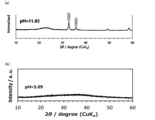
- 1 shows spectra showing the results of powder X-ray diffraction analysis, where (a) shows Example 1 and (b) shows Comparative Example 1.
- 1 is a SEM image of the surface of the lithium vanadium crystal of Example 1 at a magnification of 10,000 times.
- 1 is a 100,000-times magnification SEM image of the surface of the lithium vanadium crystal of Example 1.
- 1 shows differential pore volume distributions of Example 1 and Comparative Example 1.
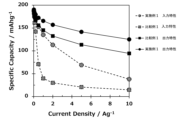
- 1 is a graph showing the relationship between current density and charge capacity during charging, and the relationship between current density and discharge capacity during discharging, in Example 1 and Comparative Example 1.
- 1 is a spectrum showing the results of powder X-ray diffraction analysis of Example 2.
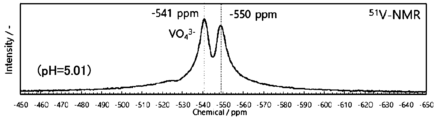
- 1 is a spectrum showing the results of 51 V-NMR analysis of the solution sample of Example 3.
- 1 is a SEM image of the surface of the lithium vanadium crystal of Example 4 at a magnification of 10,000 times.
- 1 is a SEM image of the lithium vanadium crystal of Example 4 at a magnification of 100,000 times.
- Example 1 is a graph showing the relationship between current density and charge capacity during charging, and the relationship between current density and charge capacity during discharging, in Example 1, Example 4, and Comparative Example 1.
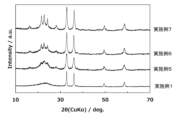
- 1 is a spectrum showing the results of powder X-ray diffraction analysis of Examples 5 to 7.
- 1 is a powder X-ray diffraction spectrum of Examples 8 and 9.
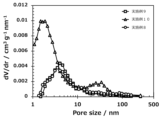
- 1 is a differential pore volume distribution of Examples 8 to 10.
- vaporization refers to the change of a substance from a liquid state to a gaseous state.
- the lithium vanadium oxide crystal is represented by the chemical formula Li 3 VO 4 , and when lithium ions are inserted as an electrode material, the composition formula becomes Li 3+b VO 4 , where b is the inserted lithium ion.
- This lithium vanadium oxide crystal is a material into which lithium ions can be reversibly inserted and removed.
- the lithium vanadium oxide crystal is suitable for use as an electrode material for power storage devices. Examples of power storage devices include lithium ion secondary batteries and lithium ion hybrid capacitors.
- the positive electrode has an active material layer containing a lithium metal compound
- the negative electrode has an active material layer containing lithium vanadium oxide crystals
- the positive electrode and negative electrode are Faraday reaction electrodes into which lithium ions are reversibly inserted and desorbed.
- the positive electrode is a polarizable electrode having, for example, activated carbon, and utilizes the charge storage effect of the electric double layer formed at the interface between the activated carbon and the electrolyte
- the negative electrode has an active material layer containing the lithium vanadium oxide crystals, and is a Faraday reaction electrode into which lithium ions are reversibly inserted and desorbed.
- This lithium vanadium oxide crystal is produced as follows. First, it is necessary to dissolve a vanadium source in water whose pH has been adjusted, or to adjust the pH of an aqueous solution in which a vanadium source is dissolved. From the vanadium source dissolved in water, reversible reactions of ionization, protonation, and deprotonation occur unevenly depending on the pH, generating VO 4 3- ions or anions containing VO 4 in their structure. Anions containing VO 4 in their structure have four oxygen ions bonded around vanadium, and some of the oxygen ions are hydroxylated. For example, this anion is an HVO 4 2- ion or an H 2 VO 4 - ion.
- VO 4 3- ions and anions containing VO 4 in their structure are collectively referred to as VO 4 units.
- a lithium source is also dissolved in the aqueous solution containing the VO 4 units.
- the lithium source may be dissolved prior to the vanadium source.
- the lithium source is an ion-dissociable lithium-containing compound that is soluble in water. Then, water is vaporized in the presence of lithium ions and the VO 4 units. The water is evaporated to a concentration above saturation, and the VO 4 units crystallize while incorporating lithium ions, resulting in the precipitation of lithium vanadium oxide crystals.
- the lithium vanadium oxide crystal is produced through a vanadium source dissolving step, a pH adjusting step, a lithium dissolving step, and a drying step.
- the order of the steps can be freely changed as long as the VO4 unit is generated in the aqueous solution by adjusting the pH, and the lithium vanadium oxide crystal is precipitated by vaporizing the water.
- the lithium source can also serve as a pH adjuster, and the pH adjusting step and the lithium dissolving step may be the same or overlapping steps.
- the solvent for dissolving the lithium source and vanadium source is water, such as ion-exchanged water or distilled water, or a mixed liquid mainly consisting of water.
- water needs to account for 50 wt% or more of the solvent. Therefore, an alcohol may be added to the mixed liquid as a solvent to increase the solubility of the lithium source and vanadium source.
- an alcohol may be added to the mixed liquid as a solvent to increase the solubility of the lithium source and vanadium source.
- methanol, ethanol, butanol, isopropyl alcohol, etc. are preferably used.
- the liquid component consisting of the solvent mixed with water should be vaporized.
- the vanadium source is a vanadium acetate, sulfate, nitrate, halogen compound, or chelating agent.
- the vanadium source is a metavanadate, vanadium oxide, vanadium (III) acetylacetonate, vanadium (IV) oxyacetylacetonate, vanadium oxytrichloride, vanadium tetrachloride, vanadium trichloride, polyvanadate, or a combination thereof .
- the metavanadate is, for example, NH4VO3 , NaVO3 , KVO3 , etc.
- the vanadium oxide is, for example, V2O5 , V2O4 , V2O3 , V3O4 , etc.
- the aqueous solution in which the vanadium source is dissolved is adjusted to at least pH 5 or higher.
- the aqueous solution in which the vanadium source is dissolved is adjusted to pH 10 or higher.
- the proportion of VO4 units in the vanadium oxide ions generated in the aqueous phase increases.
- the aqueous solution has a pH of 10 or higher HVO4 2- decreases and the proportion of VO4 3- ions increases.
- the aqueous solution in which the vanadium source is dissolved has a pH of less than 5, no VO4 units are generated.
- lithium source examples include lithium hydroxide, lithium hydroxide hydrate, lithium acetate, lithium nitrate, lithium carbonate, lithium chloride, and lithium lactate.
- the vanadium source and the lithium source are added to the aqueous phase according to the stoichiometric ratio of lithium vanadium oxide. In the case of Li 3 VO 4 , the vanadium source and the lithium source are added so that the molar amount of lithium is three times that of vanadium. When lithium hydroxide and vanadium pentoxide are added, the ratio is 1 mole of vanadium pentoxide to 6 moles of lithium hydroxide.
- the lithium source is preferably lithium hydroxide or lithium hydroxide hydrate.
- Lithium hydroxide or lithium hydroxide hydrate is a strong base and can easily adjust the pH of the aqueous solution in which the vanadium source is dissolved. In other words, impurities other than the material source of lithium vanadium oxide are not contained in the aqueous solution.
- other pH adjusters can be used without any particular restrictions as long as they are poorly reactive with the lithium source or vanadium compound.
- Other pH adjusters include hydroxides such as citric acid, ammonia, dimethylamine, trimethylamine, and sodium hydroxide, and the pH can also be adjusted by their concentrations.
- the aqueous solution to which the lithium source, vanadium source and pH adjuster have been added may be stirred using a stirring means such as a magnetic stirrer, an electric motor stirrer or an air motor stirrer until the solution becomes colorless and transparent.
- a stirring means such as a magnetic stirrer, an electric motor stirrer or an air motor stirrer until the solution becomes colorless and transparent.
- the change of the aqueous solution to colorless and transparent indicates the complete dissolution of the lithium source and vanadium source.
- the method of crystallization by drying is not particularly limited as long as it can sufficiently volatilize water from the aqueous solution in which the lithium source and vanadium source are dissolved, and lithium vanadium oxide crystals with excellent rate characteristics can be obtained even if the drying is performed in a low-temperature environment of 40°C or higher and 80°C or lower. Therefore, the heating temperature applied in the drying process is preferably 40°C or higher and 80°C or lower. Compared to a manufacturing method that adds baking at 770°C or higher to cause a phase transition of the crystal structure to the ⁇ phase, the thermal energy required in this manufacturing process is smaller.
- the drying step is reduced pressure drying, and moisture is evaporated at a vaporization rate of 1.67 ml/min or more in a temperature environment of 40° C. to 60° C.
- the drying step is spray drying, and moisture is evaporated at a vaporization rate of 1.67 ml/min or more.
- the aqueous solution in which lithium ions and VO4 units are produced is sprayed into hot air, and moisture is instantly evaporated. The water vapor is carried by the hot air and instantly separated from the lithium vanadium oxide crystals.
- the lithium vanadium oxide crystals initially have a cationic disordered crystal structure in which the long-range order described below is broken.
- a vaporization rate of 1.67 ml/min or more it is possible to prevent water from coming into contact with the lithium vanadium oxide crystals having a cationic disordered crystal structure again, and to prevent the long-range order of the lithium vanadium oxide crystals from being restored.
- the water vapor can be sufficiently cooled by the cooler.
- the lithium vanadium oxide crystals which have a cationic disordered crystal structure, and the water are precisely isolated. Therefore, changes that would cause arrangement regularity to appear in the long-range order of the crystal structure are unlikely to occur.
- spray drying the water vapor is instantly separated from the lithium vanadium oxide by the hot air, allowing the lithium vanadium oxide crystals to maintain a cationic disordered crystal structure.
- the moisture content In order to keep it isolated from moisture, it is preferable to control the moisture content by sealing the lithium vanadium oxide in a sealed container, even after drying under reduced pressure so that the evaporation rate is 1.67 ml/min or more in a temperature environment of 40°C to 60°C, or spray drying so that the evaporation rate is 1.67 ml/min or more.
- the lithium vanadium oxide crystals After drying under reduced pressure or spray drying, the lithium vanadium oxide crystals may be vacuum-dried before being sealed in a sealed container to further remove moisture.
- the primary particles of the lithium vanadium oxide crystals have a small particle size, and many pores smaller than mesopores are formed. Therefore, even if the crystal structure changes from cationic disorder to a crystal structure with long-range order and arrangement regularity, the lithium vanadium oxide crystals have high-speed charge/discharge performance.
- the material source of metal species M may be dissolved in an aqueous solution together with the lithium source and the vanadium source, and may be mixed according to the stoichiometric ratio of the chemical formula Li x V y M a O z .
- the material source of metal species M a metal containing Mo, W, Si, Cr or Ti, or a compound containing Mo, W, Si, Cr or Ti, which dissolves in an aqueous solution together with the lithium source and the vanadium source, is used.
- alkali metals and alkaline earth metals may be used as the material source of metal species M.
- the alkali metals used as metal species M are Na, K, Rb, and Cs, and the alkaline earth metals are Ca, Sr, Ba, and Ra.
- the material source of the metal species M may be selected so as to include one metal species selected from Mo, W, Si, Cr, Ti, alkali metals Na, K, Rb, Cs, and alkaline earth metals Ca, Sr, Ba, and Ra. Also, a plurality of material sources of the metal species M may be selected so that the metal species M is one or more metal species.
- a granulated body in which primary particles of lithium vanadium oxide crystals are aggregated can be obtained.
- the average particle size of the primary particles is 50 nm or less.
- the lithium vanadium oxide crystals have an improved lithium ion diffusion coefficient due to the miniaturization of the primary particles. Therefore, the lithium vanadium oxide crystals have high-speed charge/discharge performance.
- pores are formed by the aggregation of fine primary particles into granules.
- the pores are defined between the primary particles and lead to the inside of the granules.
- the pore distribution has a peak at 10 nm or less. This pore distribution makes it easy for lithium ions to diffuse inside the granules, and the lithium vanadium oxide crystals have high-speed charge and discharge performance.
- the lithium vanadium oxide crystals When dried under reduced pressure in a temperature environment of 40°C to 60°C, in which the water vaporizes at a vaporization rate of 1.67 ml/min or more, or spray-dried in which the water vaporizes at a vaporization rate of 1.67 ml/min or more, the lithium vanadium oxide crystals have a cationic disordered crystal structure.
- Figure 1 is a graph showing the results of analysis of lithium vanadium oxide crystals in terms of X-ray diffraction spectrum based on simulation and X-ray diffraction spectrum by powder X-ray diffraction measurement.
- Figure 1(c) shows the X-ray diffraction spectrum of a lithium vanadium oxide crystal having a ⁇ -phase crystal structure obtained through a firing process.
- Figure 1(a) is the X-ray diffraction spectrum of a lithium vanadium oxide crystal having a cation-disordered crystal structure obtained by powder X-ray diffraction.
- Figure 1(b) is the X-ray diffraction spectrum of a lithium vanadium oxide crystal having long-range order obtained by powder X-ray diffraction measurement.
- the lithium vanadium oxide having a cation-disordered crystal structure, the lithium vanadium oxide having a long-range ordered crystal structure, and the present lithium vanadium oxide having a ⁇ -phase crystal structure obtained by the firing process all have a sharp peak at an incident angle 2 ⁇ of about 32.2 degrees.
- the sharp peak at about 32.2 degrees means 32.2 ⁇ 0.7 degrees.
- the sharp peak at about 32.2 degrees indicates that the crystal structure of the lithium vanadium oxide crystal has an arrangement order of LiO4 coordination structure and VO4 coordination structure with a periodic interplanar distance of 2.72 ⁇ on the 020 plane.
- the crystal structure of the ⁇ phase has five diffraction peaks in the range of angles lower than the diffraction peak near 32.2 degrees.
- the five diffraction peaks are one in the range of 25 degrees to 30 degrees, three in the range of 20 degrees to 25 degrees, and one in the range of 15 degrees to 20 degrees.
- the 111, 011, 101, 110, and 010 planes show the existence of an arrangement rule of the LiO4 coordination structure and the VO4 coordination structure with periodic interplanar distances of 3.17 ⁇ , 3.66 ⁇ , 3.90 ⁇ , 4.13 ⁇ , and 5.45 ⁇ .
- the crystal structure of lithium vanadium oxide crystals with long-range order has five diffraction peaks in the lower angle range than the diffraction peak near 32.2 degrees as shown in Figure 1(c). Of the five diffraction peaks, one appears in the range from 25 degrees to 30 degrees, three in the range from 20 degrees to 25 degrees, and one in the range from 15 degrees to 20 degrees.
- the repeating pattern of the arrangement in a long range by the LiO4 coordination structure and the VO4 coordination structure shown by these five diffraction peaks is called long-range order. That is, lithium vanadate crystals having a ⁇ -phase crystal structure have five types of long-range order in the range of angles lower than the incidence angle 2 ⁇ of about 32.2 degrees.
- the coordination structure of V5 + is tetrahedral coordination.
- the "average" structure of the lithium vanadium oxide crystal is a hexahedral structure with VO5 , which has an oxidation number of 5+, and the vanadium ion is located at the center of the crystal lattice.
- the lithium vanadium oxide crystal may have a tetrahedral VO4 coordination structure remaining in part.
- the LiO5 coordination structure with the lithium ion at the center also has a hexahedral structure.
- the “average” structure is the structure when the crystal is viewed as a whole when focusing on the lithium vanadium oxide crystal.
- the crystal structure of the lithium vanadium oxide crystal having a cation-disordered coordination structure is different from the long-range order of the lithium vanadium oxide crystal having a ⁇ -phase crystal structure, and the central metal Li or V in the LiO 4 tetrahedron or VO 4 tetrahedron approaches one face side (bottom face) of the tetrahedron, and LiO 4 or VO 4 away from the center of the tetrahedron forms a "short-range order".
- This short-range order has a period of about 8 ⁇ .
- This hexahedral structure is shown in Figure 2.
- the larger spheres in Figure 2 represent oxygen atoms, and the smaller spheres represent lithium or vanadium atoms.
- the lithium and vanadium atoms exist in a ratio of 3 lithium atoms to 1 vanadium atom.
- Short-range order can be formed by a structure that incorporates vanadium or lithium atoms into a hexahedral lattice composed of oxygen atoms, as in the structure shown in Figure 2.
- vanadium ions form a VO4 coordination structure.
- lithium ions exist as Li+ in the aqueous solution.
- the aqueous solution containing vanadium ions with a VO4 coordination structure and lithium ions in the aqueous solution approaches a saturated state. Vanadium ions with a VO4 coordination structure that exceed the saturation amount and lithium ions consisting of Li+ begin to precipitate while forming extremely small crystal nuclei in the drying process.
- VO 5 having a hexahedral structure is formed while being coordinated with other VO 4 around it from a coordination structure having vanadium ions at the tetrahedral center of VO 4 , and crystal nuclei begin to form in a hexagonal close-packed structure.
- a hexahedral coordination structure of LiO 5 is formed while lithium ions are taken into some of the gaps formed by the VO 5.
- the structure of the lithium vanadium oxide crystal is such that the arrangement of the VO5 coordination structure and the LiO5 coordination structure is random, with all or part of the various long-range orders appearing in the range of angles lower than the peak around 32.2 degrees being lost.
- the order of the arrangement of the VO5 coordination structure and the LiO5 coordination structure in the distance appearing in the range of angles lower than the peak around 32.2 degrees is lost, or the proportion of the arrangement following the order is reduced.
- the lithium vanadium oxide crystal having a cation-disordered crystal structure has an arrangement order (hereinafter referred to as standard order) of the LiO4 coordination structure and the VO4 coordination structure with a periodic interplanar distance of 2.72 ⁇ on the 020 plane.
- standard order arrangement order
- the ratio of the arrangement order of the LiO4 coordination structure and the VO4 coordination structure with a periodic interplanar distance of 3.17 ⁇ , 3.66 ⁇ , 3.90 ⁇ , 4.13 ⁇ , and 5.45 ⁇ on the 111, 011, 101, 110, and 010 planes is smaller than the standard order, or the long-range order is lost.
- the diffraction intensity of the peak appearing in the range of lower angles than the peak near 32.2 degrees is 50 or less when the diffraction intensity of the peak near 32.2 degrees is 100, and the nature of the cation-disordered crystal structure is prominently exhibited.
- the long-distance arrangement regularity of the LiO5 coordination structure and the VO5 coordination structure is already disordered. Therefore, the long-distance arrangement of the LiO5 coordination structure and the VO5 coordination structure does not change before and after the insertion and desorption of lithium ions. If the long-distance arrangement does not change, the energy required for the insertion and desorption of lithium ions is small, and the diffusion coefficient of lithium ions is improved. Therefore, the lithium vanadium oxide crystal having a cation-disordered crystal structure improves the rate characteristics of the power storage device.
- the drying method and moisture management may be used to select whether to produce lithium vanadium oxide crystals with long-range order or to maintain a cation-disordered crystal structure, depending on the type of power storage device.
- Figure 3 is a graph showing the charge/discharge curves of lithium vanadium oxide crystals with a cation-disordered crystal structure
- Figure 4 is a graph showing the charge/discharge curves of lithium vanadium oxide crystals with long-range order. Note that Figures 3 and 4 are graphs showing the results of four charge/discharge cycles, and the two charge/discharge curves shown in the darkest black and extending to the largest capacity charge/discharge region are the results of the first charge/discharge. From the second to the fourth charge/discharge cycles, the charge/discharge curves were obtained so that they overlapped, with the irreversible capacity decreasing from the results of the first charge/discharge.
- the charge/discharge curve for lithium vanadium oxide crystals having a cation-disordered crystal structure has a gentle slope without a plateau region near 1 V. Therefore, when used as an electrode material for a capacitor such as a lithium ion capacitor, it is possible to produce lithium ion oxide crystals that maintain the cation-disordered crystal structure.
- the charge/discharge curve for lithium vanadium crystals with long-range order has a plateau region near 1 V. Therefore, when used as an electrode material for batteries such as lithium ion secondary batteries, it is possible to produce lithium ion oxide crystals with long-range order.
- Example 1 Lithium vanadium oxide crystals were produced by the production method of Example 1.
- the material source of the lithium vanadium oxide crystals was dissolved in an aqueous solution of pH 11.82 under indoor humidity, room temperature and atmospheric conditions, and then dried under reduced pressure using a rotary evaporator, and the process immediately moved to vacuum drying and management of the dried powder.
- lithium hydroxide monohydrate represented by LiOH LiOH (Fujifilm Wako Pure Chemical Industries, Ltd.: 126-01211) was dissolved in ion-exchanged water (H 2 O).
- the LiOH aqueous solution was stirred for 5 minutes with a magnetic stirrer until it became colorless and transparent.
- vanadium pentoxide represented by V 2 O 5 (Kanto Chemical Co., Ltd.: 44017-00) was dissolved in the LiOH aqueous solution.
- the solution was stirred for 5 minutes with a magnetic stirrer until it became very light orange or colorless and transparent.
- Lithium hydroxide was added in an amount of 1.2588 g per 100 mL of ion-exchanged water, and vanadium pentoxide was added in an amount of 0.9094 g per 100 mL of ion-exchanged water.
- 30 mmol of lithium hydroxide and 5 mmol of vanadium pentoxide were dissolved in 100 mL of ion-exchanged water.
- the aqueous solution contained lithium and vanadium in a ratio of 3:1 according to the stoichiometric ratio of Li 3 VO 4.
- the pH of this aqueous solution was confirmed to be 11.82.
- a rotary evaporator (Tokyo Rikakikai Co., Ltd., N-1110) and a diaphragm-type dry vacuum pump (ULVAC, DTC41) were prepared, and an aqueous solution with a pH of 11.82 was dried under reduced pressure.
- lithium vanadium oxide crystals were produced by the manufacturing method of Comparative Example 1.
- the manufacturing method of Comparative Example 1 is the same as the manufacturing method of Example 1 in that the material source of the lithium vanadium oxide crystals was dissolved in an aqueous solution under indoor humidity, room temperature and atmospheric conditions, then dried under reduced pressure using a rotary evaporator, and immediately transferred to a vacuum drying and management process of the dried powder.
- V2O5 was dissolved in an aqueous solution adjusted to pH 3.09 with citric acid.
- peaks are generated at -535 ppm and -560 ppm in Example 1.
- the peak at -535 ppm indicates the presence of HVO 4 2-
- the peak at -560 ppm indicates the presence of H 2 VO 4 - . That is, it can be seen that in the production method of Example 1, VO 4 units are generated by adjusting the pH to 11.82.
- a peak occurs at -545 ppm in Comparative Example 1.
- the peak at -545 ppm indicates the presence of [ VO2 ( H2O ) 4 ] + . That is, in the manufacturing method of Comparative Example 1, it can be seen that the aqueous solution in which V2O5 is dissolved has a pH of 3.09, which is below pH 5, and therefore no VO4 units are produced.
- Example 1 The precipitates of Example 1 and Comparative Example 1 were taken out of the glove box and analyzed by powder X-ray diffraction analysis at room temperature and humidity. In the powder X-ray diffraction analysis, a SmartLab from the equipment manufacturer Rigaku was used to measure the range of 15°-40° at 1.5°min ⁇ 1 . The results are shown in FIG. 6.
- FIG. 6(a) shows the powder X-ray diffraction spectrum of Example 1
- FIG. 6(b) shows the powder X-ray diffraction spectrum of Comparative Example 1.
- Li3VO4 is composed of stacks of LiO4 tetrahedrons and VO4 tetrahedrons.
- the LiO4 tetrahedron is a tetrahedron in which four oxygen atoms are point-shared around a lithium atom
- the VO4 tetrahedron is a tetrahedron in which four oxygen atoms are point-shared around a vanadium atom. That is, it can be confirmed that the precipitate in Example 1 is a lithium vanadium oxide crystal.
- Example 1 in Example 1, five peaks that should appear in the range of angles lower than the peak at an incident angle 2 ⁇ of about 32.2 degrees have disappeared. Specifically, the long-range order of the LiO4 coordination structure and the VO4 coordination structure with periodic interplanar distances of 3.17 ⁇ , 3.66 ⁇ , 3.90 ⁇ , 4.13 ⁇ , and 5.45 ⁇ has disappeared on the 111, 011, 101, 110, and 010 faces. Therefore, it can be confirmed that the lithium vanadium oxide crystal of Example 1 has a cation-disordered crystal structure.
- Comparative Example 1 in Comparative Example 1, there is not even a peak at an incident angle 2 ⁇ of around 32.2 degrees, and the incident angle 2 ⁇ is broad over at least the range of 10 degrees to 60 degrees. As a result, it can be confirmed that the precipitate in Comparative Example 1 is in an amorphous state, and that the precipitate in Comparative Example 1 does not contain any specific crystals. In other words, it can be confirmed that lithium vanadium oxide crystals cannot be obtained even if a vanadium source is dissolved in an aqueous solution with a pH of less than 5 and dried under reduced pressure at 40°C.
- lithium vanadium oxide crystals can be produced even by drying at a low temperature of 40°C. It was also confirmed that this lithium vanadium oxide crystal has a cation-disordered crystal structure.
- Fig. 7 is a surface SEM image of the lithium vanadium crystal of Example 1 at a magnification of 10,000 times
- Fig. 8 is a SEM image of the lithium vanadium crystal of Example 1 at a magnification of 100,000 times.
- the granules of lithium vanadium oxide crystals were approximately 5 ⁇ m in size. As shown in Figure 8, it was confirmed that the granules were formed by agglomeration of primary particles, and that the particle size of the primary particles was reduced to an average of 50 nm or less. The particle size of the primary particles was obtained by randomly selecting primary particles from 20 locations on the SEM image and averaging them.
- Example 1 and Comparative Example 1 the pore distribution was measured.
- the nitrogen gas adsorption measurement method was used to measure the pore distribution. Specifically, nitrogen gas was introduced into the surface of the lithium vanadium oxide crystal and into the pores formed inside the crystal and connected to the surface, and the amount of nitrogen gas adsorbed was determined. Next, the pressure of the introduced nitrogen gas was gradually increased, and the amount of nitrogen gas adsorbed for each equilibrium pressure was plotted to obtain an adsorption isotherm.
- the measurement was performed using a high-precision gas/vapor adsorption measurement device (BELSORP-max-N, manufactured by BEL Japan Co., Ltd.).
- Fig. 9 is a differential pore volume distribution in which the horizontal axis represents pore diameter and the vertical axis represents the increase in pore volume between measurement points, with the circle plot representing Example 1 and the square plot representing Comparative Example 1.
- the lithium vanadium oxide crystal granules of Example 1 have a peak in the pore distribution at 10 nm or less, and a value of 0.003 cm3 g -1 mm -1 or more was obtained. In other words, it was confirmed that the lithium oxide crystal granules have many pores with diameters of 10 nm or less.
- the granules of the lithium vanadium oxide lithium crystals of Example 1 had a specific surface area of 12.64 m 2 /g.
- the granules of the lithium vanadium oxide lithium crystals of Comparative Example 1 had a specific surface area of 10.05 m 2 /g.
- Rate characteristics of Example 1 The rate characteristics were evaluated for the lithium vanadium oxide crystal of Example 1.
- half cells were fabricated using the lithium vanadium oxide crystals of Example 1 and Comparative Example 1 as electrode materials. The half cells were 2032-type coin cells.
- the lithium vanadium oxide crystals of Example 1 and Comparative Example 1 were mixed with multi-walled carbon nanotubes (AMC, UBE Corporation) as a conductive additive.
- AMC multi-walled carbon nanotubes
- 0.2 g of multi-walled carbon nanotubes was mixed with 0.8 g of lithium vanadium oxide crystals.
- Mixing was performed at 300 rpm for 12 hours using a planetary ball mill (Fritch Corporation, PL-7).
- the ball mill container and balls used were a zirconia planetary ball mill container with a volume of 20 mL and zirconia balls with a diameter of 1 mm and weight of 30 g.
- the composite was mixed with sodium carboxymethylcellulose and styrene butadiene rubber to form a slurry.
- the composite, sodium carboxymethylcellulose, and styrene butadiene rubber were mixed in a weight ratio of 95:2.5:2.5.
- the slurry was applied onto a copper foil collector to form an electrode active material layer on the collector, which was then vacuum dried at 80°C for 12 hours and rolled.
- the thickness of the electrode was 20 ⁇ m, and the lamination density of the electrode active material layer was 1.20 mg/ cm2 . This electrode was used as a working electrode W.E. and punched out to a diameter of 14 mm.
- the counter electrode was a lithium metal with a diameter of 16.5 mm, and was attached to the bottom cover of a 2032-type coin cell.
- a polypropylene separator (Celgard 2400), working electrode W.E, and top cover were placed on the counter electrode C.E in this order, and the cell was prepared by crimping.
- the solvent of the electrolyte was a mixture of ethylene carbonate (EC) and dimethyl carbonate (DEC) in a volume ratio of 1:1, and the solute was 1.0 M lithium hexafluorophosphate (manufactured by Kishida Chemical Co., Ltd.) represented by LiPF6 .
- the potential range (V vs Li/Li+) of the working electrode W.E. was 0.1-2.5 V.
- the desorption of lithium ions was fixed at 0.1 Ag -1 per weight of lithium vanadate, and the current for insertion of lithium ions was varied up to 10 Ag -1 .
- FIG. 10 is a graph showing the relationship between current density and capacity during charging and discharging.
- the solid line in FIG. 10 is a graph showing the relationship between current density during discharging and discharge capacity.
- the dotted line in FIG. 10 is a graph showing the relationship between current density during charging and charge capacity.
- the horizontal axis represents current density (Ag ⁇ 1 )
- the vertical axis represents charge capacity (mAhg ⁇ 1 ).
- the circle plots show Example 1
- the square plots show Comparative Example 1. Note that, for the plots of Example 1 and Comparative Example 1, the plots during discharging are shown in darker black than the plots during charging.
- the lithium ion secondary battery can discharge a large capacity at each current density. Also, as shown by the relationship during charge in Figure 10, when the lithium vanadium oxide crystal of Example 1 is used as an electrode material, the lithium ion secondary battery can charge a large capacity at each current density. Moreover, when the lithium vanadium oxide crystal of Example 1 is used as an electrode material, the lithium ion secondary battery showed a gradual drop in charging capacity even when the current density was increased.
- lithium vanadium oxide crystals that improve the rate characteristics of electricity storage devices can be manufactured by dissolving a vanadium source in an aqueous solution with a pH of 5 or higher and precipitating lithium vanadium oxide crystals by drying. Moreover, lithium vanadium oxide crystals can be manufactured by drying with heat at 40°C, reducing the energy required for manufacturing. In addition, electrochemical characteristics with no plateau region in the charge/discharge curve can be obtained, making them particularly suitable for lithium ion capacitors.
- this manufacturing method produces lithium vanadium oxide crystals with primary particles having a diameter of 50 nm or less and pores with a peak of 10 nm or less in the pore distribution. It was confirmed that this lithium vanadium oxide crystal improves the rate characteristics of electricity storage devices.
- the lithium vanadium oxide crystals have a cationic disordered crystal structure. As a result, it has been confirmed that this lithium vanadium oxide crystal further improves the rate characteristics of the power storage device.
- Example 2 Furthermore, lithium vanadium oxide crystals were produced by the following production method of Example 2.
- the production method of Example 2 differs from the production method of Example 1 in the pH of the aqueous solution in which V2O5 is dissolved.
- citric acid was added to adjust the pH to 10.
- the production method of Example 2 is the same as the production method of Example 1 in all respects except for the pH.
- Example 2 (Powder XRD of Example 2) The precipitate of Example 2 was taken out of the glove box and analyzed by powder X-ray diffraction analysis at room temperature and humidity. The measurement conditions for the powder X-ray diffraction analysis were the same as those of Example 1 and Comparative Example 1. The analysis results are shown in Figure 11.
- Figure 11 shows the powder X-ray diffraction spectrum of Example 2, which has a pH of 10, together with Comparative Example 1, which has a pH of 3.09, and Example 1, which has a pH of 11.82.
- Example 2 As shown in Figure 11, in Example 2 as well, a sharp peak appears at an incidence angle 2 ⁇ of approximately 32.2 degrees. Also, as shown in Figure 11, in Example 2 as well, five peaks that should appear in a lower angle range than the peak at an incidence angle 2 ⁇ of approximately 32.2 degrees have disappeared. In this way, it can be confirmed that the precipitate in Example 2 is also a lithium vanadium oxide crystal having a cation-disordered crystal structure.
- Example 3 Furthermore, lithium vanadium oxide crystals were produced by the manufacturing method of Example 3 below.
- the manufacturing method of Example 3 differs from the manufacturing method of Example 1 in the pH of the aqueous solution in which V2O5 is dissolved.
- citric acid was added to adjust the pH to 5.01.
- the manufacturing method of Example 3 is the same as the manufacturing method of Example 1 in all respects except for the pH.
- Example 3 LiOH and V 2 O 5 were dissolved, and the aqueous solution before drying under reduced pressure was used to perform 51 V-NMR analysis of the solution sample by nuclear magnetic resonance spectroscopy (NMR).
- the solution NMR spectrum of Example 3 is shown in FIG. 12. As shown in FIG. 12, it can be confirmed that peaks are generated at ⁇ 541 ppm and ⁇ 550 ppm in Example 3. The peak at ⁇ 541 ppm indicates the presence of VO 4 3- . In other words, it can be confirmed that VO 4 units are generated by adjusting the aqueous solution in which V 2 O 5 is dissolved to pH 5 or more.
- Example 3 it was confirmed by Example 3 that VO4 units are generated by dissolving a vanadium source in an aqueous solution with a pH of 5 or more. Therefore, it was confirmed that lithium vanadium oxide crystals that improve the rate characteristics of electricity storage devices can be produced by dissolving a vanadium source in an aqueous solution with a pH of 5 or more and precipitating lithium vanadium oxide crystals by drying.
- Example 4 Lithium vanadium oxide crystals were produced by the manufacturing method of Example 4 below.
- the material source of the lithium vanadium oxide crystals was dissolved in an aqueous solution of pH 11.82 under indoor temperature and humidity, normal temperature and atmospheric conditions, and then dried under reduced pressure using a rotary evaporator.
- the difference from Example 1 is that a time was provided between the reduced pressure drying and the moisture control step.
- Example 1 approximately one hour after reduced pressure drying under the same conditions as in Example 1, it was confirmed by visual inspection that all water had evaporated, and then drying was continued for another hour with the rotary evaporator without changing the conditions. After one hour, nitrogen gas was introduced through the Leacock capillary tube to return the system to normal pressure, and the precipitate in the sample flask was placed in a vacuum dryer and dried for one hour. After drying in the vacuum dryer, it was moved to a glove box and stored in the same manner as in Example 1.
- FIG. 13 is a surface SEM image of the lithium vanadium crystal of Example 4 at a magnification of 10,000 times
- Fig. 14 is a SEM image of the lithium vanadium crystal of Example 4 at a magnification of 100,000 times.
- the granules of lithium vanadium oxide crystals were approximately 5 ⁇ m in size.
- the granules were formed by agglomeration of primary particles, and that the particle size of the primary particles was reduced to an average of 50 nm or less.
- the particle size of the primary particles was obtained by randomly selecting primary particles from 20 locations on the SEM image and averaging them.
- Example 4 had a peak at 10 nm or less, and a value of 0.003 cm3 g -1 mm -1 or more was obtained.
- Example 4 (Powder XRD of Example 4) The precipitate of Example 4 was taken out of the glove box and analyzed by powder X-ray diffraction analysis under the same conditions as in Example 1. As a result, the powder X-ray diffraction spectrum of Example 4 was obtained.
- Example 4 the strongest peak was obtained at an incident angle 2 ⁇ of 32.8 degrees, and a sharp peak appeared near 32.2 degrees.
- This peak indicates that the canonical order of the LiO4 coordination structure and the VO4 coordination structure, which are cyclically spaced at an interplanar distance of 2.72 ⁇ on the 020 plane, exists in the intermediate. That is, it can be confirmed that the precipitate in Example 4 is a lithium vanadium oxide crystal.
- five peaks appeared at angles lower than the peak at an incident angle 2 ⁇ of 32.2 degrees. Specifically, peaks were obtained at 16.4 degrees, 21.6 degrees, 22.8 degrees, 24.2 degrees, and 28.2 degrees from the low angle side of the incident angle 2 ⁇ .
- LiO4 coordination structures and VO4 coordination structures Long-range order of LiO4 coordination structures and VO4 coordination structures is established on the 111, 011, 101, 110 and 010 faces with periodic interplanar distances of 3.16 ⁇ , 3.68 ⁇ , 3.90 ⁇ , 4.11 ⁇ and 5.41 ⁇ .
- the lithium vanadium oxide crystals of Example 4 changed from a cationic disorder to a crystal structure with long-range order by being left in the rotary evaporator system between the reduced pressure drying and moisture control steps.
- the lithium vanadium oxide crystals with a cationic disordered crystal structure changed from a cationic disorder to a crystal structure with long-range order by coming into contact with water vapor in the rotary evaporator.
- FIG. 15 is a graph showing the relationship between the current density and the capacity during charging and discharging.
- the graph shown by the solid line in FIG. 15 is a graph showing the relationship between the current density during discharging and the discharge capacity.
- the graph shown by the dotted line in FIG. 15 is a graph showing the relationship between the current density during charging and the charge capacity.
- the horizontal axis represents the current density (Ag ⁇ 1 )
- the vertical axis represents the charge capacity (mAhg ⁇ 1 ).
- the plots with black circles indicate Example 1
- the plots with square marks indicate Comparative Example 1
- the plots with white circles indicate Example 4. Note that, for the plots of Example 1 and Comparative Example 1, the plots during discharging are shown in darker black than the plots during charging.
- the lithium ion secondary battery when focusing on the output characteristics of Comparative Example 1 and Example 4 during discharge, when the lithium vanadium oxide crystal of Example 4 is used as the electrode material, the lithium ion secondary battery can discharge a large capacity at each current density compared to Comparative Example 1. Also, as shown by the dotted line graph in FIG. 15, when focusing on the charging characteristics of Comparative Example 1 and Example 4 during charging, when the lithium vanadium oxide crystal of Example 4 is used as the electrode material, the lithium ion secondary battery can charge a large capacity at each current density compared to Comparative Example 1. However, when the lithium vanadium oxide crystal of Example 1 is used as the electrode material, it was confirmed that the discharge capacity is the best at each current density, and the charge capacity does not drop at each current density, making it particularly excellent.
- lithium vanadium oxide crystals that improve the rate characteristics of electricity storage devices can be manufactured by dissolving a vanadium source in an aqueous solution with a pH of 5 or higher and precipitating lithium vanadium oxide crystals by drying. It was also confirmed that contact with moisture by leaving the material after the drying process changes the crystal structure to one with long-range order.
- This lithium vanadium oxide crystal with a crystal structure with long-range order has a plateau region near 1 V in the charge/discharge curve, making it particularly suitable for lithium-ion secondary batteries.
- the lithium vanadium oxide crystal changes to a crystal structure with long-range order, it has primary particles with a diameter of 50 nm or less and pores with a peak at 10 nm or less in the pore distribution. It was confirmed that this lithium vanadium oxide crystal improves the rate characteristics of electricity storage devices.
- Examples 5 to 7 Lithium vanadium oxide crystals were produced by the manufacturing methods of the following Examples 5 to 7. In these manufacturing methods, the source material for the lithium vanadium oxide crystals was dissolved in an aqueous solution of pH 11.82 under indoor humidity, room temperature and atmospheric conditions, and then dried under reduced pressure using a rotary evaporator. The difference from Example 1 is that after drying under reduced pressure, the lithium vanadium oxide crystals were left in an environment of 30% humidity at room temperature.
- Example 5 was left in an environment with a humidity of 30% at room temperature for 12 hours.
- Example 6 was left in an environment with a humidity of 30% at room temperature for 24 hours.
- Example 7 was left in an environment with a humidity of 30% at room temperature for 36 hours.
- Powder XRD of Examples 5-7 The lithium vanadium oxide crystals of Examples 5 to 7 were analyzed by powder X-ray diffraction analysis under the same conditions as in Example 1. The results are shown in Figure 16 together with those of Example 1. Figure 16 shows the powder X-ray diffraction spectra of Examples 5 to 7.
- Examples 5 to 7 have a sharp peak at an incidence angle 2 ⁇ of approximately 32.2 degrees, confirming that they are lithium vanadium oxide crystals. However, in Example 5, five peaks at angles lower than the peak at an incidence angle 2 ⁇ of approximately 32.2 degrees begin to appear, and in Example 7, five peaks at angles lower than the peak at an incidence angle 2 ⁇ of approximately 32.2 degrees are clearly visible.
- the lithium vanadium oxide crystals can be transformed from cationic disorder to a crystal structure with long-range order by leaving them in an environment in which moisture is present after drying under reduced pressure.
- Examples 8-9 Lithium vanadium oxide crystals were produced by the manufacturing methods of Examples 8 and 9.
- the material source of the lithium vanadium oxide crystals was dissolved in an aqueous solution of pH 11.82 under room temperature and humidity, normal temperature and atmospheric conditions, and then dried under reduced pressure using a rotary evaporator. After drying under reduced pressure, nitrogen gas was immediately introduced from the Leacock capillary tube to return the system to normal pressure, and the precipitate in the sample flask was placed in a vacuum dryer and dried for 1 hour. After drying in the vacuum dryer, it was transferred to a glove box and stored in the same manner as in Example 1.
- Example 8 the water temperature of the thermostatic water tank of the rotary evaporator is different from that of Example 1.
- the water temperature of the thermostatic water tank is set to 60°C
- Example 9 the water temperature of the thermostatic water tank is set to 70°C.
- Powder XRD of Examples 8-9 The lithium vanadium oxide crystals of Examples 8 and 9 below were analyzed by powder X-ray diffraction analysis under the same conditions as in Example 1. The results are shown in Figure 17.
- Figure 17 shows the powder X-ray diffraction spectra of Examples 8 and 9.
- Examples 8 and 9 have a sharp peak at an incident angle 2 ⁇ of approximately 32.2 degrees, confirming that they are lithium vanadium oxide crystals. However, Example 9 has five clear peaks at lower angles than the peak at an incident angle 2 ⁇ of approximately 32.2 degrees, confirming that lithium vanadium oxide crystals with a crystal structure having long-range order have been produced.
- Example 8 five peaks begin to appear at angles lower than the peak at an incidence angle 2 ⁇ of approximately 32.2 degrees. This confirms that 60°C during reduced pressure drying is the turning point at which the cationic disordered crystal structure begins to change into a crystal structure with long-range order. In other words, it was confirmed that the cationic disordered structure can be changed into a crystal structure with long-range order by drying under reduced pressure at a temperature of 60°C or higher.
- FIG. 18 shows a differential pore volume distribution in which the horizontal axis represents the pore size and the vertical axis represents the increase in pore volume between measurement points.
- the circle plot shows Example 8, and the square plot shows Example 9.
- the granules of lithium vanadium oxide crystal of Examples 8 and 9 have a peak in the pore size distribution at 10 nm or less, similar to Example 1.
- the value of this peak is 0.003 cm3 ⁇ g -1 ⁇ mm -1 for Example 8 dried under reduced pressure at 60°C, and 0.004 cm3 ⁇ g- 1 ⁇ mm -1 for Example 9 dried under reduced pressure at 70°C.
- the specific surface area of the granules of Example 8 dried under reduced pressure at 60°C was 12.76 m2 /g
- the specific surface area of the granules of Example 9 dried under reduced pressure at 70°C was 12.46 m2 /g.
- the granules have primary particles of 50 nm or less and a peak of 10 nm or less, just like in Example 1.
- Example 10 A lithium vanadium oxide crystal was produced by the manufacturing method of Example 10 below. 0.9969 g of lithium hydroxide monohydrate (Fujifilm Wako Pure Chemical Industries, Ltd.: 126-01211) was added to 100 mL of ion-exchanged water and dissolved by stirring for 5 minutes with a magnetic stirrer. 0.6859 g of vanadium pentoxide (Kanto Chemical Co., Ltd.: 44017-00) was added to the obtained aqueous solution and dissolved by stirring for 5 minutes with a magnetic stirrer. The aqueous solution was adjusted to pH 11.82 with citric acid. Spray drying was used in the drying process. After spray drying, the precipitate was placed in a vacuum dryer and dried for 1 hour, and then transferred to a glove box and stored in the same manner as in Example 1.
- a spray dryer (BUCHI, Mini Spray Dryer B-290 (spray dryer) was used to vaporize water from an aqueous solution of vanadium pentoxide and lithium hydroxide at pH 11.82 at a vaporization rate of 1.67 ml/min or more.
- the inlet temperature was 160°C to 180°C
- the drying air velocity was 38 m3 /h
- the raw material supply flow rate (pump speed) was 7.5 mL/min (device display: 25%)
- the spraying nitrogen gas flow rate was 473 L/h (device display: 40 mm).
- Example 10 The precipitate of Example 10 was taken out of the glove box and analyzed by powder X-ray diffraction analysis at room temperature and humidity.
- the measurement conditions of the powder X-ray diffraction analysis were the same as those of Example 1 and Comparative Example 1.
- the largest and sharpest peak was obtained at 32.7 degrees in the X-ray diffraction spectrum of Example 10 in the range of incident angle 2 ⁇ of 70 degrees or less.
- the second largest peak in the X-ray diffraction spectrum of Example 10 was obtained at 35.8 degrees, and the third largest peak was obtained at 58.4 degrees.
- the five peaks that should appear in the range of angles lower than the diffraction peak near 32.2 degrees were not obtained.
- Example 10 There was no difference in the powder X-ray diffraction spectrum of Example 10 spray-dried at inlet temperatures of 160 ° C, 170 ° C, and 180 ° C, and similar X-ray diffraction spectra were obtained in the range of 160 ° C to 180 ° C.
- Example 10 where spray drying was used, it can be seen that a sharp peak appears near an incidence angle 2 ⁇ of 32.2 degrees. Furthermore, regardless of the inlet temperature, five peaks that should appear in a range lower than the peak near an incidence angle 2 ⁇ of 32.2 degrees disappear. In this way, it can be seen that lithium vanadium oxide crystals having a cation-disordered crystal structure can be obtained even when spray drying is used as the drying process.
- Example 10 (Pore distribution of Example 10) In Example 10, the pore size distribution was measured. The method for measuring the pore size distribution was the same as in Example 1. The plot of triangle marks in FIG.
- the granules of lithium vanadium oxide crystals of Example 10 had a peak in the pore distribution at 10 nm or less, and a value of 0.010 cm3 ⁇ g -1 ⁇ mm -1 or more was obtained, similarly to Example 1.
- the specific surface area of the granules of Example 10 was 31.30 m2 /g.
- lithium vanadium oxide crystals could be produced by spray drying, and that the produced lithium vanadium oxide crystals had a cationic disordered crystal structure.
- the granulated lithium oxide crystals had primary particles of 50 nm or less and a peak of 10 nm or less, just like in Example 1.
Landscapes
- Engineering & Computer Science (AREA)
- Chemical & Material Sciences (AREA)
- Power Engineering (AREA)
- Organic Chemistry (AREA)
- Microelectronics & Electronic Packaging (AREA)
- Inorganic Chemistry (AREA)
- Materials Engineering (AREA)
- Chemical Kinetics & Catalysis (AREA)
- Electrochemistry (AREA)
- General Chemical & Material Sciences (AREA)
- Manufacturing & Machinery (AREA)
- Inorganic Compounds Of Heavy Metals (AREA)
- Electric Double-Layer Capacitors Or The Like (AREA)
- Battery Electrode And Active Subsutance (AREA)
Abstract
省エネルギーで良好なレート特性を有するリチウムバナジウム酸化物結晶体の製造方法、良好なレート特性を有するリチウムバナジウム酸化物結晶体、電極材料及び蓄電デバイスを提供する。水又は水を含む混合液を用意する工程と、水または水を含む混合液にバナジウム源とリチウム源が溶解され、pH5以上に調整された水溶液を用意する工程と、水溶液から液体を気化させ、リチウムバナジウム酸化物結晶体を析出させる乾燥工程を含む。析出する結晶体は、直径が50nm以下の一次粒子と、細孔分布で10nm以下にピークを有する細孔と、を備える。
Description
本発明は、リチウムバナジウム酸化物結晶体及びその製造方法、このリチウムバナジウム酸化物結晶体を含む電極材料、及びこの電極材料を正極又は負極に用いた蓄電デバイスに関する。
化学式Li3VO4のバナジン酸リチウムに代表されるリチウムバナジウム酸化物は、チタン酸リチウム(Li4Ti5O12)及びB型酸化チタン(TiO2(B))よりも低充放電電位(V vs Li/Li+)である。しかも、リチウムバナジウム酸化物は、グラファイトよりも高充放電電位(V vs Li/Li+)である。従って、このリチウムバナジウム酸化物を負極材料に適用した蓄電デバイスには、高エネルギー密度と高い安全性が期待できる。
また、リチウムバナジウム酸化物を負極材料として用いたキャパシタの理論容量は、チタン酸リチウムと比べると2倍以上になるとの報告がある。サイクル特性においても、リチウムバナジウム酸化物を負極材料として用いたキャパシタは、高い容量維持率及び高い充放電効率を維持する。
そのため、このリチウムバナジウム酸化物の結晶体は、各種蓄電デバイスの用途が想定されて研究されている。蓄電デバイスとしては、正極及び負極にそれぞれ金属化合物粒子を用いたリチウムイオン二次電池、及び正極に活性炭、負極にリチウムイオンを可逆的に吸着/脱着可能な材料を用いたハイブリッドキャパシタが挙げられる。
リチウムバナジウム酸化物結晶体の製造方法としては、次の方法が一般的に知られている。即ち、固相法又は液相法によってリチウム源とバナジウム源を混ぜ合わせる。そして、600℃以上の焼成によって結晶化及び結晶成長させる(例えば、非特許文献1参照)。
但し、リチウムバナジウム酸化物結晶体は、通常はβ相の結晶構造を有する。β相の結晶構造は、ウルツ鉱型であり、空間群がPnm21である。β相の結晶構造を有するリチウムバナジウム酸化物結晶体を電極材料として用いた蓄電デバイスには、レート特性に問題を有する。具体的には、Cレートを上げると急激に入力特性及び出力特性が悪化する。または、充放電密度を上げると、充電できる充電容量及び放電できる放電容量が少なくなる。
そこで、770℃以上の焼成によって、β相からγ相へリチウムバナジウム酸化物結晶体の構造を相転移させる方法が提案されている(例えば、非特許文献2参照。)。γ相の結晶構造は、所謂LISICON(Lithium Super Ionic CONductor)型であり、Pnma結晶構造である。γ相の結晶構造を有するリチウムバナジウム酸化物結晶体は、四面体のLiO4配位構造及び四面体のVO4配位構造を基本骨格とし、八面体のLiO6配位構造を有する。
Zhiyong Liang, et al., Journal of Power Sources, 2014, Volume 252, Pages 244-247.https://doi.org/10.1016/j.jpowsour.2013.12.019
Chaoyi Liao, et al.,ADVANCED ENERGY MATERIALS, 2018, Vol.8, Issue.9, 1701621.https://doi.org/10.1002/aenm.201701621
γ相に相転移させたリチウムバナジウム酸化物結晶体が電極材料であると、蓄電デバイスのレート特性は良好になる。即ち、高い充放電密度で大充電容量及び大放電容量を達成できる。しかしながら、γ相に相転移させるには、製造工程中に770℃以上の焼成工程を導入しなければならない。
昨今の地球環境保全の高まりに関連し、770℃以上の焼成工程は高エネルギー消費工程である。従って、γ相に相転移させるという、現状のリチウムバナジウム酸化物結晶体のレート特性向上策は、地球環境保全の観点で課題を有する。
本発明の目的は、良好なレート特性を有するリチウムバナジウム酸化物結晶体を省エネルギーで製造する製造方法、良好なレート特性を有するリチウムバナジウム酸化物結晶体、電極材料及び蓄電デバイスを提供することにある。
前記の目的を達成するため、本実施形態のリチウムバナジウム酸化物結晶体の製造方法は、リチウムバナジウム酸化物結晶体の製造方法であって、水又は水を含む混合液を用意する工程と、水または水を含む混合液にバナジウム源とリチウム源が溶解され、pH5以上に調整された水溶液を用意する工程と、前記水溶液から液体を気化させ、リチウムバナジウム酸化物結晶体を析出させる乾燥工程と、を含む。
前記水溶液を用意する工程が、前記水又は前記混合液をpH5以上に調整するpH調整工程と、pH5以上に調整された後、又はpHの5以上に調整される前の前記水又は前記混合液に、バナジウム源を溶解させるバナジウム溶解工程と、を含むようにしてもよい。
前記pH調整工程では、pH10以上に調整するようにしてもよい。
前記乾燥工程は1.67ml/min以上の気化速度による乾燥を含むようにしてもよい。
前記乾燥工程は、噴霧乾燥又は40℃以上60℃以下での減圧乾燥であるようにしてもよい。
前記乾燥工程を経て、液体を気化させた後、直ちに乾燥環境下で管理するようにしてもよい。
前記減圧乾燥を用い、液体を気化させた後も前記乾燥工程を継続するようにしてもよい。
前記乾燥工程は、60℃以上80℃以下での減圧乾燥であるようにしてもよい。
また、前記の目的を達成するため、本実施形態のリチウムバナジウム酸化物結晶体は、直径が50nm以下の一次粒子と、細孔分布で10nm以下にピークを有する細孔と、を備え、前記一次粒子が凝集し、前記一次粒子間に前記細孔を有する造粒体である。
このリチウムバナジウム酸化物結晶体は、化学式LixVyMaOzで表されるようにしてもよい。但し、x=0.1~5、y=0.1~5、z=0.1~5、a=0~2であり、Mは、リチウムバナジウム酸化物結晶体にドープされたMo、W、Si、Cr又はTiである。
カチオンがディスオーダー化された結晶構造を有し、X線回折の結果で表される結晶構造は、入射角2θが32.2度付近にピークが現れ、更に当該32.2度付近のピークよりも低角の範囲にはピークが無いか、またはピークがあっても、当該32.2度付近のピークよりも低角の範囲に存在する全てのピークの回折強度は当該32.2度付近のピークの回折強度よりも小さいようにしてもよい。
前記32.2度付近のピークよりも低角の範囲に現われるピークの回折強度は、前記32.2度付近のピークの回折強度を100とすると50以下であるようにしてもよい。
このリチウムバナジウム酸化物結晶体を含む電極材料も本発明の一態様である。また、この電極材料を正極又は負極に用いた蓄電デバイスも本発明の一態様である。
本発明によれば、良好なレート特性を有するリチウムバナジウム酸化物結晶体を省エネルギーで製造できる。
以下、本発明を実施する形態について説明する。なお、本発明は、以下に説明する実施形態に限定されるものでない。本発明において気化とは、物質が液体状態から気体状態に変化することを表す。
(産業上の利用可能性)
リチウムバナジウム酸化物結晶体は、化学式LixVyMaOzで表される。x=0.1~5、y=0.1~5、z=0.1~5、a=0~2であり、Mは、リチウムバナジウム酸化物結晶体にドープされたMo、W、Si、Cr又はTiであるが、これらがドープされていなくともよい。代表的には、リチウムバナジウム酸化物結晶体は化学式Li3VO4で表され、電極材料としてリチウムイオンの挿入時には組成式Li3+bVO4となる。bは挿入されたリチウムイオンである。
リチウムバナジウム酸化物結晶体は、化学式LixVyMaOzで表される。x=0.1~5、y=0.1~5、z=0.1~5、a=0~2であり、Mは、リチウムバナジウム酸化物結晶体にドープされたMo、W、Si、Cr又はTiであるが、これらがドープされていなくともよい。代表的には、リチウムバナジウム酸化物結晶体は化学式Li3VO4で表され、電極材料としてリチウムイオンの挿入時には組成式Li3+bVO4となる。bは挿入されたリチウムイオンである。
このリチウムバナジウム酸化物結晶体は、リチウムイオンが可逆的に挿入及び脱離可能な材料である。リチウムバナジウム酸化物結晶体は、蓄電デバイスの電極材料としての用途に好適である。蓄電デバイスとしては、リチウムイオン二次電池やリチウムイオンハイブリッドキャパシタが挙げられる。
リチウムイオン二次電池において、正極はリチウム金属化合物を含む活物質層を有し、負極はリチウムバナジウム酸化物結晶体を含む活物質層を有し、正極及び負極はリチウムイオンが可逆的に挿入及び脱離されるファラデー反応電極となる。リチウムイオンハイブリッドキャパシタにおいて、正極は例えば活性炭を有する分極性電極であり、活性炭と電解質との境界面に形成される電気二重層の蓄電作用を利用し、負極は本リチウムバナジウム酸化物結晶体を含む活物質層を有し、リチウムイオンが可逆的に挿入及び脱離されるファラデー反応電極である。
(リチウムバナジウム酸化物結晶体の製造方法)
このリチウムバナジウム酸化物結晶体は、次の通り製造される。まず必要なことは、pHが調整された水にバナジウム源を溶解させ、又はバナジウム源を溶解させた水溶液のpHを調整することである。水に溶解したバナジウム源からは、電離、プロトン化及び脱プロトン化の可逆反応がpHに応じて偏って発生することで、VO4 3-イオン又はVO4を構造中に含む陰イオンが生じる。VO4を構造中に含む陰イオンは、バナジウムの周囲に4個の酸素イオンが結合し、酸素イオンの一部が水酸化している。例えば、この陰イオンはHVO4 2-イオン又はH2VO4 -イオンである。以下、VO4 3-イオン及びVO4を構造中に含む陰イオンを総称してVO4ユニットという。
このリチウムバナジウム酸化物結晶体は、次の通り製造される。まず必要なことは、pHが調整された水にバナジウム源を溶解させ、又はバナジウム源を溶解させた水溶液のpHを調整することである。水に溶解したバナジウム源からは、電離、プロトン化及び脱プロトン化の可逆反応がpHに応じて偏って発生することで、VO4 3-イオン又はVO4を構造中に含む陰イオンが生じる。VO4を構造中に含む陰イオンは、バナジウムの周囲に4個の酸素イオンが結合し、酸素イオンの一部が水酸化している。例えば、この陰イオンはHVO4 2-イオン又はH2VO4 -イオンである。以下、VO4 3-イオン及びVO4を構造中に含む陰イオンを総称してVO4ユニットという。
VO4ユニットを含む水溶液には、リチウム源も溶解させる。バナジウム源に先立ってリチウム源を溶解させてもよい。リチウム源は、水に対して可溶なイオン解離性のリチウム含有化合物である。そして、リチウムイオン及びVO4ユニットの存在下で水分を気化させる。水分の揮散によって飽和濃度以上に濃縮され、VO4ユニットがリチウムイオンを取り込みつつ結晶化し、リチウムバナジウム酸化物結晶体が析出する。
即ち、このリチウムバナジウム酸化物結晶体は、バナジウム源溶解工程、pH調整工程、リチウム溶解工程及び乾燥工程を経て製造される。pHを調整することで水溶液中にVO4ユニットが生成され、水分の気化によりリチウムバナジウム酸化物結晶体を析出させればよく、工程の順序は変更自在である。リチウム源はpH調整剤を兼ねることができ、pH調整工程とリチウム溶解工程とを同一又は重複する工程としてもよい。
リチウム源及びバナジウム源を溶解させる溶媒は、イオン交換水若しくは蒸留水等の水、又は水を主とする混合液である。混合液中、水が溶媒中の50wt%以上を占めていればよい。そこで、混合液に、リチウム源やバナジウム源の溶解性を高めるためのアルコールを、溶媒として追加してもよい。アルコールは、メタノール、エタノール、ブタノール及びイソプロピルアルコール等が好適に使用される。混合液を用いた場合には、水分と混合した溶媒からなる液体成分が気化するようにすればよい。
バナジウム源は、バナジウムの酢酸塩、硫酸塩、硝酸塩、ハロゲン化合物、又はキレート化剤である。具体的には、バナジウム源は、メタバナジン酸塩、酸化バナジウム、バナジウム(III)アセチルアセトナート、バナジウム(IV)オキシアセチルアセトナート、オキシ三塩化バナジウム、四塩化バナジウム、三塩化バナジウム、ポリバナジン酸塩、又はこれらの複数種である。メタバナジン酸塩は、例えばNH4VO3、NaVO3、KVO3等である。酸化バナジウムは、例えばV2O5、V2O4、V2O3、V3O4等である。
バナジウム源を溶解させた水溶液は、少なくともpH5以上に調整する。好ましくは、バナジウム源を溶解させた水溶液は、pH10以上に調整される。水溶液がpH5以上であると、水相内に生成されるバナジウム酸化物イオン中、VO4ユニットの割合が大きくなる。水溶液がpH10以上であると、HVO4
2-が減少し、VO4
3-イオンの割合が増加する。一方、バナジウム源を溶解させた水溶液がpH5未満であると、VO4ユニットが生成されない。
リチウム源としては、水酸化リチウム、水酸化リチウム水和物、酢酸リチウム、硝酸リチウム、炭酸リチウム、塩化リチウム及び乳酸リチウム等が挙げられる。バナジウム源とリチウム源は、リチウムバナジウム酸化物の化学量論比に従って水相中に投入される。Li3VO4の場合、バナジウムに対してリチウムが3倍のモル量となるように、バナジウム源とリチウム源を添加する。水酸化リチウムと五酸化バナジウムを添加する場合には、6モルの水酸化リチウムに対して1モルの五酸化バナジウムの割合で添加する。
リチウム源は、好ましくは、水酸化リチウム又は水酸化リチウム水和物である。水酸化リチウム又は水酸化リチウム水和物は、強塩基であり、バナジウム源が溶解した水溶液のpHを調整し易い。即ち、リチウムバナジウム酸化物の材料源以外の不純物が水溶液に含まれずに済む。もっとも、他のpH調整剤は、リチウム源又はバナジウム化合物との反応性に乏しければ、特に限定されずに使用できる。他のpH調整剤としては、クエン酸、アンモニア、ジメチルアミン、トリメチルアミン及び水酸化ナトリウム等の水酸化物が挙げられ、これらの濃度によっても調整できる。
リチウム源、バナジウム源及びpH調整剤が添加された水溶液は、マグネティックスターラー、電気モータ式撹拌機、エアモータ式撹拌機等の撹拌手段を用いて無色透明になるまで攪拌すればよい。水溶液の無色透明への変化は、リチウム源とバナジウム源の完全な溶解を示す。
乾燥による結晶析出の方法は、リチウム源とバナジウム源が溶解した水溶液から十分に水分を揮散できれば、特に限定されず、40℃以上80℃以下という低温度環境下で乾燥させても、レート特性に優れたリチウムバナジウム酸化物結晶体が得られる。そこで、乾燥工程において適用される加熱温度は、好ましくは40℃以上80℃以下である。γ相に結晶構造を相転移させる770℃以上の焼成を追加する製法と比べ、この製造工程中で必要な熱エネルギーは小さくなる。
更に好ましくは、乾燥工程は減圧乾燥とし、40℃以上60℃以下の温度環境下で、1.67ml/min以上の気化速度で水分を気化させる。または、更に好ましくは、乾燥工程は噴霧乾燥とし、1.67ml/min以上の気化速度で水分を気化させる。噴霧乾燥では、リチウムイオンとVO4ユニットが生成された水溶液を熱風中に噴霧し、瞬時に水分を気化させる。水蒸気は、熱風に載ってリチウムバナジウム酸化物結晶体から瞬時に離隔する。
この製造方法では、リチウムバナジウム酸化物結晶体は、原始的には後述の長距離秩序が崩れたカチオンディスオーダーの結晶構造を採る。1.67ml/min以上の気化速度で水分を気化させることで、カチオンディスオーダーの結晶構造を有するリチウムバナジウム酸化物結晶体に水分が再接触するのを阻止でき、リチウムバナジウム酸化物結晶体の長距離秩序が回復することを防ぐことができる。
但し、ロータリーエバポレータの恒温水槽が60℃以上80℃以下の温度範囲である場合、1.67ml/min以上の気化速度で水分を気化させたとしても、冷却器の水蒸気冷却能力の限界により系内に水分が残留してしまう。そのため、リチウムバナジウム酸化物結晶体に水分が再接触し、リチウムバナジウム酸化物結晶体の結晶構造に経時的に長距離秩序の配列規則性が現れる。
ロータリーエバポレータの恒温水槽が40℃以上60℃以下の温度範囲であれば、冷却器による水蒸気の冷却は十分である。即ち、カチオンディスオーダーの結晶構造を採るリチウムバナジウム酸化物結晶体と水分とは、精度良く隔離される。そのため、結晶構造の長距離秩序に配列規則性が現れる変化は起り難い。また、噴霧乾燥では、熱風に乗せて水蒸気がリチウムバナジウム酸化物から瞬時に離隔されるため、リチウムバナジウム酸化物結晶体には、カチオンディスオーダーの結晶構造を維持できる。
尚、水分から隔離し続けるため、40℃以上60℃以下の温度環境下で1.67ml/min以上の気化速度になるように減圧乾燥し、また1.67ml/min以上の気化速度になるように噴霧乾燥した後であっても、リチウムバナジウム酸化物を密閉容器に封入する等の水分管理が好ましい。減圧乾燥又は噴霧乾燥の後は、密閉容器に封入する前に、本リチウムバナジウム酸化物結晶体を真空乾燥し、水分の除去に更に努めてもよい。
もっとも、この製造方法によれば、リチウムバナジウム酸化物結晶体の一次粒子は小粒径となり、またメソ孔以下の大きさの細孔が多く形成される。そのため、結晶構造がカチオンディスオーダーから配列規則性を有する長距離秩序の結晶構造に変化しても、リチウムバナジウム酸化物結晶体は高速充放電性能を有する。
本リチウムバナジウム酸化物結晶体に金属種Mをドープし、Li3VO4とLi4MO4の固溶体にする場合、金属種Mの材料源は、リチウム源とバナジウム源とともに水溶液に溶解させればよく、化学式LixVyMaOzの化学量論比に従って混合すればよい。金属種Mの材料源として、リチウム源とバナジウム源とともに水溶液に溶解するMo、W、Si、Cr又はTiを含む金属、またはMo、W、Si、Cr又はTiを含む化合物が用いられる。また、金属種Mの材料源として、アルカリ金属類、アルカリ土類金属を用いてもよい。金属種Mとして用いられるアルカリ金属はNa、K、Rb、Csであり、アルカリ土類金属はCa、Sr、Ba、Raである。金属種MはMo、W、Si、Cr、Ti、アルカリ金属であるNa、K、Rb、Cs、又は、アルカリ土類金属であるCa、Sr、Ba、Raから選ばれる一種の金属種を含むように金属種の材料源を選択してもよい。また、金属種Mが1以上の金属種となるように金属種Mの材料源を複数選択してもよい。
(析出物)
この製造方法によれば、リチウムバナジウム酸化物結晶体の一次粒子が凝集した造粒体が得られる。一次粒子の粒子径は平均50nm以下である。リチウムバナジウム酸化物結晶体は、この一次粒子の微小化によって、リチウムイオンの拡散係数が向上する。そのため、リチウムバナジウム酸化物結晶体は高速充放電性能を有する。
この製造方法によれば、リチウムバナジウム酸化物結晶体の一次粒子が凝集した造粒体が得られる。一次粒子の粒子径は平均50nm以下である。リチウムバナジウム酸化物結晶体は、この一次粒子の微小化によって、リチウムイオンの拡散係数が向上する。そのため、リチウムバナジウム酸化物結晶体は高速充放電性能を有する。
造粒体には、微細な一次粒子が粒状に凝集することで細孔が形成されている。細孔は、一次粒子間に画成され、造粒体内部に通じる。細孔分布は、10nm以下にピークを有する。この細孔分布により、造粒体の内部にリチウムイオンが拡散し易く、リチウムバナジウム酸化物結晶体は高速充放電性能を有する。
40℃以上60℃以下の温度環境下で、1.67ml/min以上の気化速度で水分を気化させる減圧乾燥し、または、1.67ml/min以上の気化速度で水分を気化させる噴霧乾燥した場合、リチウムバナジウム酸化物結晶体は、カチオンディスオーダーの結晶構造を有する。
図1は、リチウムバナジウム酸化物結晶体をシミュレーションに基づくX線回折スペクトルと粉末X線回折測定によるX線回折スペクトルについて分析した結果を示すグラフである。図1の(c)は、焼成工程を経て得られたβ相の結晶構造を有するリチウムバナジウム酸化物結晶体の粉末X線回折のX線回折スペクトルを示す。図1の(a)は、粉末X線回折によって得られたカチオンディスオーダーの結晶構造を有するリチウムバナジウム酸化物結晶体のX線回折スペクトルである。また、図1の(b)は、粉末X線回折測定によって得られた長距離秩序のあるリチウムバナジウム酸化物結晶体のX線回折スペクトルである。
図1の(a)乃至(c)に示すように、カチオンディスオーダーの結晶構造を有するリチウムバナジウム酸化物、長距離秩序のある結晶構造を有するリチウムバナジウム酸化物、及び焼成工程によって得られたβ相の結晶構造を有する本リチウムバナジウム酸化物は、何れも、入射角2θが32.2度付近に鋭敏なピークが現れる点は同じである。尚、32.2度付近とは32.2±0.7度をいう。32.2度付近の鋭敏なピークは、リチウムバナジウム酸化物結晶体の結晶構造には、020面に2.72Åの面間距離を周期にしたLiO4配位構造とVO4配位構造の配列規則があることを示している。
図1の(c)に示すように、β相の結晶構造は、32.2度付近の回折ピークよりも低角の範囲にも5本の回折ピークを有する。5本の回折ピークは、25度から30度の範囲に1本、20度から25度の範囲に3本、15度から20度の範囲に1本現われる。角度の大きいほうから順番に、111面、011面、101面、110面及び010面に3.17Å、3.66Å、3.90Å、4.13Å及び5.45Åの面間距離を周期にしたLiO4配位構造とVO4配位構造の配列規則の存在を示している。
図1の(b)に示すように、長距離秩序を有するリチウムバナジウム酸化物結晶体の結晶構造は、図1の(c)に示したような32.2度付近の回折ピークよりも低角の範囲にも5本の回折ピークを有する。5本の回折ピークは、25度から30度の範囲に1本、20度から25度の範囲に3本、15度から20度の範囲に1本現われた。
この5本の回折ピークが示すLiO4配位構造とVO4配位構造による長距離な範囲での配列の繰り返しパターンを長距離秩序という。即ち、β相の結晶構造を有するバナジン酸リチウム結晶体は、入射角2θが32.2度付近よりも低角の範囲に5種類の長距離秩序を有する。また、V5+の配位構造は四面体配位である。
図1の(a)に示すように、カチオンディスオーダーの結晶構造を採ると、32.2度付近の回折ピークよりも低角の範囲に存在する全ての回折ピークは、32.2度付近の回折ピークよりも回折強度が小さくなっている。好ましくは、図1の(a)に示すように、32.2度付近のピークよりも低角の範囲に回折ピークが消失している。
このX線回折の結果より、カチオンディスオーダー化したリチウムバナジウム酸化物結晶体の結晶構造は、次の構造となる。
リチウムバナジウム酸化物結晶体の“平均”構造として、バナジウムの配位構造は、酸化数5+のVO5による六面体構造であり、バナジウムイオンが結晶格子中心に据えられている。なお、リチウムバナジウム酸化物結晶体に四面体構造によるVO4配位構造が一部に残っていてもよい。更に、リチウムイオンを中心とするLiO5配位構造も六面体構造を有している。
“平均”構造とは、リチウムバナジウム酸化物結晶体に着目したときに結晶を全体的に見たときの構造である。局所的に結晶を見ると、カチオンディスオーダー化した配位構造を有するリチウムバナジウム酸化物結晶体の結晶構造は、β相の結晶構造を有するリチウムバナジウム酸化物結晶体のような長距離秩序とは異なり、LiO4四面体の中あるいはVO4四面体の中の中心金属であるLiやVは、四面体の一つの面側(底面)に近づき、四面体の中心から離れたLiO4やVO4が「短距離秩序」を成す。この短距離秩序は、約8Åごとの周期を有する。非常に短距離の間で秩序が形成されるため、X線回折のような分析では、平均化された結晶構造が確認される。例えば、完全に逆方向を向いたユニットが隣接した場合、X線回折の結果として、バナジウムやリチウムの座標は底面を共有する四面体同士の中心、つまり六面体構造をとる。
この六面体構造を図2に示す。図2中の大きい方の球は酸素原子を表し、小さい方の球はリチウム原子またはバナジウム原子を表す。なお、リチウム原子とバナジウム原子は、リチウム原子が3に対しバナジウム原子が1の比率で存在する。短距離的秩序は、図2に示す構造のように、酸素原子で構成された六面体の格子内にバナジウム原子又はリチウム原子を取り込んだ構造によって形成され得る。
酸化数5+のVO5による六面体構造をとり、カチオンディスオーダーの結晶構造を有するリチウムバナジウム酸化物結晶体が生成された理由として次の理由が考えられる。なお、この理由はあくまで推論であり、この理由に縛られるものではない。
即ち、pH5以上に調整された水溶液中ではバナジウムイオンはVO4の配位構造が形成されている。また、水溶液中ではリチウムイオンはLi+として存在する。乾燥工程によって水溶液から液体を気化させる中で、水溶液中のVO4の配位構造を備えるバナジウムイオンとリチウムイオンが含まれる水溶液は、飽和状態に近づく。飽和量を超えたVO4の配位構造を有するバナジウムイオンとLi+からなるリチウムイオンは、乾燥工程によって急激に極微小な結晶核を形成しながら析出が始まる。
この急激な析出によって、細密な構造をとるため、VO4の四面体中心にバナジウムイオンを有する配位構造から、周囲の他のVO4と配位しながら六面体構造を有するVO5を形成し、六方最密構造に結晶核が形成され始める。VO5の配位構造として結晶核が形成される中で、VO5同士が形成する隙間の一部にリチウムイオンを取り込みながらLiO5の六面体の配位構造が形成されてゆく。急激な析出によって、六面体構造への配位構造の変化をしながら、細密に原子が充填された六方最密構造としてリチウムバナジウム酸化物結晶体が得られたと推測される。また、この急激な析出によって、リチウムイオンを取り込む極微小な結晶は不規則にリチウムイオン取り込みながら一次粒子として成長したと考えられる。
そのため、六面体構造を有するVO5の配置と六面体構造を有するLiO5の配置が一部不規則的につながった部分が存在すると考えられる。この不規則なつながりによってリチウムイオンの配置の乱れ、ディスオーダー化が生じたと考えられる。
リチウムバナジウム酸化物結晶体の構造は、VO5配位構造とLiO5配位構造の配列は、32.2度付近のピークよりも低角の範囲に現れる各種長距離秩序の全て又は一部が崩れてランダムになっている。換言すると、32.2度付近のピークよりも低角の範囲に現われる距離でのVO5配位構造とLiO5配位構造の配列の規則性が失われているか、規則性に従う割合が少なくなっている。
より具体的には、カチオンディスオーダーの結晶構造を有するリチウムバナジウム酸化物結晶体は、020面に2.72Åの面間距離を周期にしたLiO4配位構造とVO4配位構造の配列規則(以下、基準秩序という)がある。一方、111面、011面、101面、110面及び010面に3.17Å、3.66Å、3.90Å、4.13Å及び5.45Åの面間距離を周期にしたLiO4配位構造とVO4配位構造の配列規則を保つ割合が、基準秩序よりも小さくなっているか、または長距離秩序は無くなっている。好ましくは、32.2度付近のピークよりも低角の範囲に現われるピークの回折強度は、32.2度付近のピークの回折強度を100とすると50以下であり、これにより、カチオンディスオーダーの結晶構造の性質が顕著に現れる。
カチオンディスオーダー化されたリチウムバナジウム酸化物結晶体は、LiO5配位構造とVO5配位構造の長距離の配列規則性が既に乱れている。そのため、リチウムイオンの挿入前後及び脱離前後で、LiO5配位構造とVO5配位構造の長距離の配列が様変わりすることはない。長距離の配列が様変わりしなければ、リチウムイオンの挿入及び脱離に要するエネルギーは少なくて済み、リチウムイオンの拡散係数は向上する。従って、カチオンディスオーダーの結晶構造を有するリチウムバナジウム酸化物結晶体は、蓄電デバイスのレート特性を向上させるものである。
乾燥方法及び水分管理によって、長距離秩序のあるリチウムバナジウム酸化物結晶体を生成するか、カチオンディスオーダーの結晶構造を維持させるかの選択は、蓄電デバイスの種類の応じるようにしてもよい。図3は、カチオンディスオーダーの結晶構造を有するリチウムバナジウム酸化物結晶体の充放電カーブを示すグラフであり、図4は、長距離秩序のあるリチウムバナジウム酸化物結晶体の充放電カーブを示すグラフである。なお、図3及び図4はそれぞれ充放電を4回行ったときの結果を表すグラフであり、一番濃い黒で表され、最も大容量の充放電領域まで延びている充放電の両カーブが1回目の充放電結果である。2回目から4回目にかけて、1回目の充放電結果から不可逆容量が減少した充放電カーブが重なるように得られた。
図3に示すように、カチオンディスオーダーの結晶構造を有するリチウムバナジウム酸化物結晶体に係る充放電カーブは、1V付近のプラトー領域がなく、緩やかに傾斜している。従って、リチウムイオンキャパシタ等のキャパシタの電極材料に用いる場合には、カチオンディスオーダーの結晶構造を維持したリチウムイオン酸化物結晶体を生成するようにしてもよい。
一方、図4に示すように、長距離秩序のあるリチウムバナジウム結晶体に係る充放電カーブは、1V付近にプラトー領域が存在している。従って、リチウムイオン二次電池等の電池の電極材料に用いる場合には、長距離秩序のあるリチウムイオン酸化物結晶体を生成するようにしてもよい。
以下、リチウムバナジウム酸化物結晶体に係る実施例をさらに詳細に説明する。なお、本発明は下記実施例に限定されるものではない。
(実施例1)
実施例1の製造方法により、リチウムバナジウム酸化物結晶体を作製した。この実施例1の製造方法では、室内の湿度、常温及び大気環境下にて、リチウムバナジウム酸化物結晶体の材料源をpH11.82の水溶液に溶解した後、ロータリーエバポレータを用いて減圧乾燥し、直ちに乾燥粉末の真空乾燥と管理工程に移った。
実施例1の製造方法により、リチウムバナジウム酸化物結晶体を作製した。この実施例1の製造方法では、室内の湿度、常温及び大気環境下にて、リチウムバナジウム酸化物結晶体の材料源をpH11.82の水溶液に溶解した後、ロータリーエバポレータを用いて減圧乾燥し、直ちに乾燥粉末の真空乾燥と管理工程に移った。
即ち、LiOHで表される水酸化リチウム一水和物(富士フィルム和光純薬工業株式会社:126-01211)をイオン交換水(H2O)に溶解させた。LiOH水溶液が無色透明になるまで、マグネティックスターラーにより5分間攪拌した。次に、V2O5で表される五酸化バナジウム(関東化学株式会社:44017-00)を、LiOH水溶液に溶解させた。水溶液が非常に薄いオレンジ色又は無色透明になるまで、マグネティックスターラーにより5分間攪拌した。
水酸化リチウムは、100mLのイオン交換水に対して1.2588gが投入され、五酸化バナジウムは、100mLのイオン交換水に対して0.9094gが投入された。30mmolの水酸化リチウムと5mmolの五酸化バナジウムが100mLのイオン交換水に溶解したことになる。水溶液には、リチウムとバナジウムとがLi3VO4の化学量論比に従って3:1の割合で含まれる。この水溶液は、pHを確認したところpH11.82にであった。
ロータリーエバポレータ(東京理化器械株式会社,N-1110)とダイアフラム型ドライ真空ポンプ(ULVAC,DTC41)を準備し、pH11.82の水溶液を減圧乾燥した。試料フラスコに、LiOHとV2O5を溶解した、pHが11.82の水溶液を収容し、恒温水槽の水温は40℃に設定し、系内は7kPaに減圧した。これにより、この減圧乾燥では、水分を1.67ml/minの気化速度で気化させた。
減圧乾燥から約1時間後、目視により水分が気化し切ったことを確認し、直ちに、リーコック・キャピラリー管から窒素ガスを流入させて系内を常圧に戻した。更に、常圧に戻した後、直ちに、試料フラスコ内の析出物を、真空乾燥機に入れて1時間乾燥させた。真空乾燥機で乾燥させた後、析出物を温度27℃(常温)、水分濃度1ppm以下及び不活性雰囲気のグローブボックス内に移して保管した。
次に、比較例1の製造方法によりリチウムバナジウム酸化物結晶体を作製した。比較例1の製造方法は、室内の湿度、常温及び大気環境下にて、リチウムバナジウム酸化物結晶体の材料源を水溶液に溶解した後、ロータリーエバポレータを用いて減圧乾燥し、直ちに乾燥粉末の真空乾燥と管理工程に移した点で、実施例1の製造方法と同じである。但し、クエン酸によりpH3.09に調整された水溶液にV2O5を溶解させた点で、実施例1と異なる。
(実施例1のNMR)
LiOHとV2O5を溶解させ、減圧乾燥前の水溶液を用い、核磁気共鳴分光法(NMR)によって、溶液試料に対する51V-NMR分析を行った。その結果を、図5に示す。図5の(a)は実施例1の溶液NMRのスペクトルを示し、(b)は比較例1の溶液NMRのスペクトルを示す。
LiOHとV2O5を溶解させ、減圧乾燥前の水溶液を用い、核磁気共鳴分光法(NMR)によって、溶液試料に対する51V-NMR分析を行った。その結果を、図5に示す。図5の(a)は実施例1の溶液NMRのスペクトルを示し、(b)は比較例1の溶液NMRのスペクトルを示す。
図5の(a)に示すように、実施例1では-535ppmと-560ppmにピークが生じていることが確認できる。-535ppmのピークはHVO4
2-の存在を示し、-560ppmのピークはH2VO4
-の存在を示す。即ち、実施例1の製造方法では、pH11.82に調整することによって、VO4ユニットが生成されていることが確認できる。
一方、図5の(b)に示すように、比較例1では-545ppmにピークが生じていることが確認できる。-545ppmのピークは[VO2(H2O)4]+の存在を示す。即ち、比較例1の製造方法では、V2O5を溶解させた水溶液がpH3.09であり、pH5を下回っているために、VO4ユニットが生成されていないことが確認できる。
(実施例1の粉末XRD)
実施例1及び比較例1の析出物をグローブボックスから取り出し、室内の温湿度で粉末X線回折解析により分析した。粉末X線回折分析では、装置メーカRigakuのSmartLabを用い、15°-40°の範囲を1.5°min-1で測定して得られた。その結果を図6に示す。図6の(a)は実施例1の粉末X線回折のスペクトルを示し、(b)は比較例1の粉末X線回折のスペクトルを示す。
実施例1及び比較例1の析出物をグローブボックスから取り出し、室内の温湿度で粉末X線回折解析により分析した。粉末X線回折分析では、装置メーカRigakuのSmartLabを用い、15°-40°の範囲を1.5°min-1で測定して得られた。その結果を図6に示す。図6の(a)は実施例1の粉末X線回折のスペクトルを示し、(b)は比較例1の粉末X線回折のスペクトルを示す。
図6の(a)に示すように、実施例1では、入射角2θが32.2度付近に鋭敏なピークが現れている。このピークは、020面に2.72Åの面間距離を周期にしたLiO4配位構造とVO4配位構造の基準秩序が中間体に存在することを示している。Li3VO4は、LiO4四面体とVO4四面体の積み重ねで構成されている。LiO4四面体は、リチウム原子を中心に4個の酸素原子を点共有する四面体であり、VO4四面体は、バナジウム原子を中心に4個の酸素原子を点共有する四面体である。即ち、実施例1の析出物は、リチウムバナジウム酸化物結晶体であることが確認できる。
しかも、図6の(a)に示すように、実施例1では、入射角2θが32.2度付近のピークよりも低角の範囲に現れるはずの5本のピークが消失している。具体的には、111面、011面、101面、110面及び010面に3.17Å、3.66Å、3.90Å、4.13Å及び5.45Åの面間距離を周期にしたLiO4配位構造とVO4配位構造の長距離秩序が無くなっている。従って、実施例1のリチウムバナジウム酸化物結晶体は、カチオンディスオーダーの結晶構造を有することが確認できる。
一方、図6の(b)に示すように、比較例1では、入射角2θが32.2度付近のピークすら無く、入射角2θが少なくとも10度から60度の範囲に亘ってブロードになっている。この結果、比較例1の析出物はアモルファスの状態であり、比較例1の析出物には特定の結晶体が含有していないことが確認できる。即ち、pH5未満の水溶液にバナジウム源を溶解させ、40℃で減圧乾燥しても、リチウムバナジウム酸化物結晶体は得られないことが確認できる。
換言すれば、pH5以上の水溶液にバナジウム源を溶解させることで、40℃という低温下での乾燥によっても、リチウムバナジウム酸化物結晶体を生成できることが確認された。そして、このリチウムバナジウム酸化物結晶体は、カチオンディスオーダーの結晶構造を有することが確認された。
(実施例1の粒子構造)
実施例1のリチウムバナジウム酸化物結晶体の造粒体の表面を走査電子顕微鏡で観察した。図7は、実施例1のリチウムバナジウム結晶体の倍率1万倍の表面SEM像であり、図8は、実施例1のリチウムバナジウム結晶体の倍率10万倍のSEM像である。
実施例1のリチウムバナジウム酸化物結晶体の造粒体の表面を走査電子顕微鏡で観察した。図7は、実施例1のリチウムバナジウム結晶体の倍率1万倍の表面SEM像であり、図8は、実施例1のリチウムバナジウム結晶体の倍率10万倍のSEM像である。
図7に示すように、リチウムバナジウム酸化物結晶体の造粒体は、5μm前後であった。そして、図8に示すように、この造粒体は一次粒子が凝集して成り、一次粒子の粒子径は平均50nm以下に微小化されていることが確認された。尚、一次粒子の粒子径は、SEM像から20箇所の一次粒子をランダムに選び出して平均して得た。
図8に示すように、一次粒子間には細孔の存在が確認できる。実施例1及び比較例1において、細孔分布を測定した。細孔分布の測定方法としては、窒素ガス吸着測定法を用いた。具体的には、リチウムバナジウム酸化物結晶体の表面及び表面と連通した内部に形成された細孔に窒素ガスを導入し、窒素ガスの吸着量を求めた。次いで、導入する窒素ガスの圧力を徐々に増加させ、各平衡圧に対する窒素ガスの吸着量をプロットし、吸着等温曲線を得る。実施例1及び比較例1では、高精度ガス/蒸気吸着量測定装置(日本ベル株式会社製、BELSORP―max―N)を用いて測定した。
図9は、横軸に細孔径を取り、測定ポイント間の細孔容積の増加分を縦軸に取った差分細孔容積分布であり、丸印のプロットは実施例1を示し、四角印のプロットは比較例1を示す。図9から分かるように、実施例1のリチウムバナジウム酸化物結晶体の造粒体は、細孔分布の10nm以下にピークを有し、0.003cm3・g-1・mm-1以上の値が得られている。即ち、このリチウム酸化物結晶体の造粒体は、10nm以下の径の細孔を多く有することが確認された。
また、実施例1のリチウムバナジウム酸化物リチウム結晶体の造粒体は、12.64m2/gの比表面積を有することが確認された。比較例1のリチウムバナジウム酸化物リチウム結晶体の造粒体の比表面積は、10.05m2/gであった。
(実施例1のレート特性)
実施例1のリチウムバナジウム酸化物結晶体のレート特性を評価した。レート特性の評価に際し、実施例1及び比較例1のリチウムバナジウム酸化物結晶体を電極材料としてハーフセルを作製した。ハーフセルは2032型コインセルとした。
実施例1のリチウムバナジウム酸化物結晶体のレート特性を評価した。レート特性の評価に際し、実施例1及び比較例1のリチウムバナジウム酸化物結晶体を電極材料としてハーフセルを作製した。ハーフセルは2032型コインセルとした。
電極材料として、実施例1及び比較例1のリチウムバナジウム酸化物結晶体には、マルチウォールカーボンナノチューブ(AMC、UBE株式会社)を導電助剤として混合した。0.8gのリチウムバナジウム酸化物結晶体に対して、0.2gのマルチウォールカーボンナノチューブを混合した。混合は遊星ボールミル(Fritch株式会社、PL―7)によって300rpmで12時間行った。ボールミル容器とボールには、20mLの容積を有し、ジルコニア製の遊星ボールミル容器と、直径1mm及び重量30gのジルコニアボールを使用した。
複合体に対し、カルボキシメチルセルロースナトリウムとスチレンブタジエンゴムとを混合してスラリー状にした。複合体とカルボキシメチルセルロースナトリウムとスチレンブタジエンゴムとは、重量比で95:2.5:2.5の割合で混合した。このスラリーを銅箔の集電体上に塗布することで、集電体上に電極活物質層を形成した後、80℃で12時間真空乾燥し、圧延処理を行った。電極の厚みは20μmであり、電極活物質層の積層密度は、1.20mg/cm2であった。この電極を作用電極W.E.とし、直径14mmの大きさに打ち抜いた。
対極は直径16.5mmのリチウム金属とし、2032型コインセルの下蓋に貼り付けた。対極C.Eの上にポリプロピレン製のセパレータ(Celgard2400)、作用電極W.E、上蓋の順に載せ、加締めてセルを作製した。電解液の溶媒は、炭酸エチレン(EC)と炭酸ジメチル(DEC)を1:1の体積比で混合した混合液とし、溶質はLiPF6で表される1.0M六フッ化リン酸リチウム(キシダ化学株式会社製)とした。
作用電極W.E.の電位範囲(V vs Li/Li+)は0.1-2.5Vとした。出力及び入力の試験の際は、リチウムイオンの脱離を、リチウムバナジン酸リチウムの重量当たり0.1Ag-1で固定し、リチウムイオンの挿入の電流を10Ag-1まで変化させている。
図10は、充電時と放電時の電流密度と容量との関係を示すグラフである。図10の実線で示すグラフは、放電時の電流密度と放電容量との関係を示すグラフである。図10の点線で示すグラフは、充電時の電流密度と充電容量との関係を示すグラフである。図10は、横軸に電流密度(Ag-1)をとり、縦軸に充電容量(mAhg-1)をとった。図10中、丸印のプロットは実施例1を示し、四角印のプロットは比較例1を示す。なお、実施例1と比較例1のプロットについて、放電時のプロットの方が、充電時のプロットに対し濃い黒色で示す。
図10の放電時の関係から示されるように、実施例1のリチウムバナジウム酸化物結晶体を電極材料とした場合、リチウムイオン二次電池は、各電流密度において大容量を放電できる。また、図10の充電時の関係から示されるように、実施例1のリチウムバナジウム酸化物結晶体を電極材料とした場合、リチウムイオン二次電池は、各電流密度において大容量を充電できる。しかも、実施例1のリチウムバナジウム酸化物結晶体を電極材料とした場合、リチウムイオン二次電池は、電流密度を上げても充電容量の落ち込みが緩やかであった。
このように、pH5以上の水溶液にバナジウム源を溶解し、乾燥によってリチウムバナジウム酸化物結晶体を析出させることで、蓄電デバイスのレート特性を向上させるリチウムバナジウム酸化物結晶体を製造できることが確認された。しかも、40℃の熱を加える乾燥によってリチウムバナジウム酸化物結晶体が製造でき、製造に必要なエネルギーを低減できる。また、充放電カーブにおいてプラトー領域がない電気化学特性を獲得でき、リチウムイオンキャパシタに特に好適となる。
また、この製造方法により、リチウムバナジウム酸化物結晶体は、直径が50nm以下の一次粒子と、細孔分布で10nm以下にピークを有する細孔を備えることが確認された。このリチウムバナジウム酸化物結晶体は、蓄電デバイスのレート特性を向上させることが確認された。
しかも、40℃という低温度で乾燥させ、水分を管理することで、リチウムバナジウム酸化物結晶体は、カチオンディスオーダーの結晶構造を有する。これにより、このリチウムバナジウム酸化物結晶体は、蓄電デバイスのレート特性を更に向上させることが確認された。
(実施例2)
更に、以下の実施例2の製造方法により、リチウムバナジウム酸化物結晶体を作製した。実施例2の製造方法は、V2O5を溶解させた水溶液のpHが実施例1の製造方法と異なる。実施例2の製造方法では、クエン酸を添加してpHを10に調整した。実施例2の製造方法は、pH以外の他の点につき実施例1の製造方法と同じである。
更に、以下の実施例2の製造方法により、リチウムバナジウム酸化物結晶体を作製した。実施例2の製造方法は、V2O5を溶解させた水溶液のpHが実施例1の製造方法と異なる。実施例2の製造方法では、クエン酸を添加してpHを10に調整した。実施例2の製造方法は、pH以外の他の点につき実施例1の製造方法と同じである。
(実施例2の粉末XRD)
実施例2の析出物をグローブボックスから取り出し、室内の温湿度で粉末X線回折解析により分析した。粉末X線回折分析の測定条件は実施例1及び比較例1と同じである。分析結果を図11に示す。図11は、pH10である実施例2の粉末X線回折のスペクトルを、pH3.09である比較例1とpH11.82である実施例1と共に示してある。
実施例2の析出物をグローブボックスから取り出し、室内の温湿度で粉末X線回折解析により分析した。粉末X線回折分析の測定条件は実施例1及び比較例1と同じである。分析結果を図11に示す。図11は、pH10である実施例2の粉末X線回折のスペクトルを、pH3.09である比較例1とpH11.82である実施例1と共に示してある。
図11に示すように、実施例2についても、入射角2θが32.2度付近に鋭敏なピークが現れている。また、図11に示すように、実施例2についても、入射角2θが32.2度付近のピークよりも低角の範囲に現れるはずの5本のピークが消失している。このように、実施例2の析出物についても、カチオンディスオーダーの結晶構造を有するリチウムバナジウム酸化物結晶体であることが確認できる。
(実施例3)
更に、以下の実施例3の製造方法により、リチウムバナジウム酸化物結晶体を作製した。実施例3の製造方法は、V2O5を溶解させた水溶液のpHが実施例1の製造方法と異なる。実施例3の製造方法では、クエン酸を添加してpHを5.01に調整した。実施例3の製造方法は、pH以外の他の点につき実施例1の製造方法と同じである。
更に、以下の実施例3の製造方法により、リチウムバナジウム酸化物結晶体を作製した。実施例3の製造方法は、V2O5を溶解させた水溶液のpHが実施例1の製造方法と異なる。実施例3の製造方法では、クエン酸を添加してpHを5.01に調整した。実施例3の製造方法は、pH以外の他の点につき実施例1の製造方法と同じである。
(実施例3のNMR)
LiOHとV2O5を溶解させ、減圧乾燥前の水溶液を用い、核磁気共鳴分光法(NMR)によって、溶液試料に対する51V-NMR分析を行った。実施例3の溶液NMRのスペクトルを図12に示す。図12に示すように、図12に示すように、実施例3では-541ppmと-550ppmにピークが生じていることが確認できる。-541ppmのピークはVO4 3-の存在を示す。即ち、V2O5を溶解させた水溶液をpH5以上に調整することによって、VO4ユニットが生成されていることが確認できる。
LiOHとV2O5を溶解させ、減圧乾燥前の水溶液を用い、核磁気共鳴分光法(NMR)によって、溶液試料に対する51V-NMR分析を行った。実施例3の溶液NMRのスペクトルを図12に示す。図12に示すように、図12に示すように、実施例3では-541ppmと-550ppmにピークが生じていることが確認できる。-541ppmのピークはVO4 3-の存在を示す。即ち、V2O5を溶解させた水溶液をpH5以上に調整することによって、VO4ユニットが生成されていることが確認できる。
従って、実施例3によって、pH5以上の水溶液にバナジウム源を溶解することで、VO4ユニットが生成されることが確認された。そのため、pH5以上の水溶液にバナジウム源を溶解し、乾燥によってリチウムバナジウム酸化物結晶体を析出させることで、蓄電デバイスのレート特性を向上させるリチウムバナジウム酸化物結晶体を製造できることが確認された。
(実施例4)
以下の実施例4の製造方法により、リチウムバナジウム酸化物結晶体を作製した。この実施例4の製造方法では、室内の温湿度、常温及び大気環境下にて、リチウムバナジウム酸化物結晶体の材料源をpH11.82の水溶液に溶解した後、ロータリーエバポレータを用いて減圧乾燥している。実施例1と異なる点は、減圧乾燥と水分管理工程との間に時間をおいた点である。
以下の実施例4の製造方法により、リチウムバナジウム酸化物結晶体を作製した。この実施例4の製造方法では、室内の温湿度、常温及び大気環境下にて、リチウムバナジウム酸化物結晶体の材料源をpH11.82の水溶液に溶解した後、ロータリーエバポレータを用いて減圧乾燥している。実施例1と異なる点は、減圧乾燥と水分管理工程との間に時間をおいた点である。
即ち、実施例1と同一条件の減圧乾燥から約1時間後、目視により水分が気化し切ったことを確認した後、更にロータリーエバポレータで条件を変えずに1時間乾燥を続けた。1時間後、リーコック・キャピラリー管から窒素ガスを流入させて系内を常圧に戻し、試料フラスコ内の析出物を、真空乾燥機に入れて1時間乾燥させた。真空乾燥機で乾燥させた後、実施例1と同じくグローブボックス内に移して保管した。
(実施例4の粒子構造)
実施例4のリチウムバナジウム酸化物結晶体の造粒体の表面を走査電子顕微鏡で観察した。図13は、実施例4のリチウムバナジウム結晶体の倍率1万倍の表面SEM像であり、図14は、実施例4のリチウムバナジウム結晶体の倍率10万倍のSEM像である。
実施例4のリチウムバナジウム酸化物結晶体の造粒体の表面を走査電子顕微鏡で観察した。図13は、実施例4のリチウムバナジウム結晶体の倍率1万倍の表面SEM像であり、図14は、実施例4のリチウムバナジウム結晶体の倍率10万倍のSEM像である。
図13に示すように、リチウムバナジウム酸化物結晶体の造粒体は、5μm前後であった。そして、図14に示すように、この造粒体は一次粒子が凝集して成り、一次粒子の粒子径は平均50nm以下に微小化されていることが確認された。尚、一次粒子の粒子径は、SEM像から20箇所の一次粒子をランダムに選び出して平均して得た。
このように、リチウム源とバナジウム源を溶解させた水溶液の水分が気化し切った後も1時間多く、ロータリーエバポレータの系内に析出物を放置した場合であっても、リチウムバナジウム酸化物結晶体の造粒体の構造及び大きさは、実施例1と変化なかった。細孔分布においても、実施例4は、10nm以下にピークを有し、0.003cm3・g-1・mm-1以上の値が得られた。
(実施例4の粉末XRD)
実施例4の析出物をグローブボックスから取り出し、実施例1と同一条件で粉末X線回折解析により分析した。その結果、実施例4の粉末X線回折のスペクトルが得られた。
実施例4の析出物をグローブボックスから取り出し、実施例1と同一条件で粉末X線回折解析により分析した。その結果、実施例4の粉末X線回折のスペクトルが得られた。
実施例4では、入射角2θが32.8度において一番強度の強いピークが得られ、32.2度付近に鋭敏なピークが現れている。このピークは、020面に2.72Åの面間距離を周期にしたLiO4配位構造とVO4配位構造の基準秩序が中間体に存在することを示している。即ち、実施例4の析出物は、リチウムバナジウム酸化物結晶体であることが確認できる。但し、入射角2θが32.2度付近のピークよりも低角の5本のピークが現れている。具体的には、入射角2θの低角側から16.4度、21.6度、22.8度、24.2度、28.2度にピークが得られた。111面、011面、101面、110面及び010面に3.16Å、3.68Å、3.90Å、4.11Å及び5.41Åの面間距離を周期にしたLiO4配位構造とVO4配位構造の長距離秩序が成り立っている。
従って、実施例4のリチウムバナジウム酸化物結晶体は、実施例1と異なり、減圧乾燥と水分管理工程との間において、ロータリーエバポレータの系内に置き続けたことで、カチオンディスオーダーから長距離秩序を有する結晶構造に変化したことが確認できる。カチオンディスオーダーの結晶構造を有するリチウムバナジウム酸化物結晶体がロータリーエバポレータ内で水蒸気と接触することで、カチオンディスオーダーから長距離秩序を有する結晶構造に変化したものである。
(実施例4のレート特性)
実施例4のリチウムバナジウム酸化物結晶体のレート特性を評価した。レート特性の評価のために作製したハーフセルは、実施例1及び比較例1と同一であり、出力及び入力の試験は、実施例1及び比較例1と同一である。
実施例4のリチウムバナジウム酸化物結晶体のレート特性を評価した。レート特性の評価のために作製したハーフセルは、実施例1及び比較例1と同一であり、出力及び入力の試験は、実施例1及び比較例1と同一である。
図15は、充電時と放電時の電流密度と容量との関係を示すグラフである。図15の実線で示すグラフは、放電時の電流密度と放電容量との関係を示すグラフである。図15の点線で示すグラフは、充電時の電流密度と充電容量との関係を示すグラフである。図15は、横軸に電流密度(Ag-1)をとり、縦軸に充電容量(mAhg-1)をとった。図15中、黒丸印のプロットは実施例1を示し、四角印のプロットは比較例1を示し、白丸印のプロットは実施例4を示す。なお、実施例1と比較例1のプロットについて、放電時のプロットの方が、充電時のプロットに対し濃い黒色で示す。
図15に実線のグラフで示すように、放電時の比較例1、実施例4の出力特性に着目すると、実施例4のリチウムバナジウム酸化物結晶体を電極材料とした場合、リチウムイオン二次電池は、比較例1と比べて各電流密度において大容量を放電できる。また、図15に点線のグラフで示すように、充電時の比較例1、実施例4の充電特性に着目すると、実施例4のリチウムバナジウム酸化物結晶体を電極材料とした場合、リチウムイオン二次電池は、比較例1と比べて各電流密度において大容量を充電できる。もっとも、実施例1のリチウムバナジウム酸化物結晶体を電極材料とした場合、各電流密度において放電容量が最も優れており、また各電流密度において充電容量が落ち込むことなく、特に優れていることが確認された。
このように、pH5以上の水溶液にバナジウム源を溶解し、乾燥によってリチウムバナジウム酸化物結晶体を析出させることで、蓄電デバイスのレート特性を向上させるリチウムバナジウム酸化物結晶体を製造できることが確認された。また、乾燥工程後の放置によって水分と接触させることで、長距離秩序を有する結晶構造に変化させることが確認された。この長距離秩序を有する結晶構造のリチウムバナジウム酸化物結晶体は、充放電カーブにおいて1V付近にプラトー領域を有し、リチウムイオン二次電池に特に好適となる。
また、長距離秩序を有する結晶構造に変化しても、リチウムバナジウム酸化物結晶体は、直径が50nm以下の一次粒子と、細孔分布で10nm以下にピークを有する細孔を備えることが確認された。このリチウムバナジウム酸化物結晶体は、蓄電デバイスのレート特性を向上させることが確認された。
(実施例5-7)
以下の実施例5乃至7の製造方法により、リチウムバナジウム酸化物結晶体を作製した。この実施例5乃至7の製造方法では、室内の湿度、常温及び大気環境下にて、リチウムバナジウム酸化物結晶体の材料源をpH11.82の水溶液に溶解した後、ロータリーエバポレータを用いて減圧乾燥している。実施例1と異なる点は、減圧乾燥の後、リチウムバナジウム酸化物結晶体を室温における湿度30%の環境下に放置した点である。
以下の実施例5乃至7の製造方法により、リチウムバナジウム酸化物結晶体を作製した。この実施例5乃至7の製造方法では、室内の湿度、常温及び大気環境下にて、リチウムバナジウム酸化物結晶体の材料源をpH11.82の水溶液に溶解した後、ロータリーエバポレータを用いて減圧乾燥している。実施例1と異なる点は、減圧乾燥の後、リチウムバナジウム酸化物結晶体を室温における湿度30%の環境下に放置した点である。
即ち、実施例1と同一条件の減圧乾燥から約1時間後、目視により水分が気化し切ったことを確認した後、直ちにリーコック・キャピラリー管から窒素ガスを流入させて系内を常圧に戻し、試料フラスコ内の析出物を、真空乾燥機に入れて1時間乾燥させた。真空乾燥機で乾燥させた後、実施例1とは異なり、実施例5は室温における湿度30%の環境下に12時間放置した。実施例6は室温における湿度30%の環境下に24時間放置した。実施例7は室温における湿度30%の環境下に36時間放置した。
(実施例5-7の粉末XRD)
実施例5乃至7のリチウムバナジウム酸化物結晶体を、実施例1と同一条件で粉末X線回折解析により分析した。その結果を、実施例1と共に図16に示す。図16は実施例5乃至7の粉末X線回折のスペクトルを示す。
実施例5乃至7のリチウムバナジウム酸化物結晶体を、実施例1と同一条件で粉末X線回折解析により分析した。その結果を、実施例1と共に図16に示す。図16は実施例5乃至7の粉末X線回折のスペクトルを示す。
図16に示すように、実施例5乃至7は、入射角2θが32.2度付近に鋭敏なピークを有しており、リチウムバナジウム酸化物結晶体であることが確認できる。但し、実施例5には、入射角2θが32.2度付近のピークよりも低角の5本のピークが現れ始め、実施例7では、入射角2θが32.2度付近のピークよりも低角の5本のピークが明確になっている。
従って、減圧乾燥の後、リチウムバナジウム酸化物結晶体を水分が存在する環境下に放置することによっても、カチオンディスオーダーから長距離秩序を有する結晶構造に変化させることができると確認された。
(実施例8-9)
実施例8及び9の製造方法により、リチウムバナジウム酸化物結晶体を作製した。この実施例8乃至9の製造方法では、室内の温湿度、常温及び大気環境下にて、リチウムバナジウム酸化物結晶体の材料源をpH11.82の水溶液に溶解した後、ロータリーエバポレータを用いて減圧乾燥している。また、減圧乾燥の後、直ちにリーコック・キャピラリー管から窒素ガスを流入させて系内を常圧に戻し、試料フラスコ内の析出物を、真空乾燥機に入れて1時間乾燥させた。そして、真空乾燥機で乾燥させた後、実施例1と同じくグローブボックス内に移して保管した。
実施例8及び9の製造方法により、リチウムバナジウム酸化物結晶体を作製した。この実施例8乃至9の製造方法では、室内の温湿度、常温及び大気環境下にて、リチウムバナジウム酸化物結晶体の材料源をpH11.82の水溶液に溶解した後、ロータリーエバポレータを用いて減圧乾燥している。また、減圧乾燥の後、直ちにリーコック・キャピラリー管から窒素ガスを流入させて系内を常圧に戻し、試料フラスコ内の析出物を、真空乾燥機に入れて1時間乾燥させた。そして、真空乾燥機で乾燥させた後、実施例1と同じくグローブボックス内に移して保管した。
この実施例8及び9の製造方法では、ロータリーエバポレータの恒温水槽の水温が実施例1と異なる。実施例8では恒温水槽の水温を60℃に設定し、実施例9では恒温水槽の水温を70℃に設定した。もっとも、実施例8及び9の減圧乾燥によっても、水分が1.67ml/min以上の気化速度で気化する。
(実施例8-9の粉末XRD)
以下の実施例8及び9のリチウムバナジウム酸化物結晶体を、実施例1と同一条件で粉末X線回折解析により分析した。その結果を図17に示す。図17は実施例8及び9の粉末X線回折のスペクトルを示す。
以下の実施例8及び9のリチウムバナジウム酸化物結晶体を、実施例1と同一条件で粉末X線回折解析により分析した。その結果を図17に示す。図17は実施例8及び9の粉末X線回折のスペクトルを示す。
図17に示すように、実施例8及び9は、入射角2θが32.2度付近に鋭敏なピークを有しており、リチウムバナジウム酸化物結晶体であることが確認できる。但し、実施例9では、入射角2θが32.2度付近のピークよりも低角の5本のピークが明確になっており、長距離秩序を有する結晶構造のリチウムバナジウム酸化物結晶体が生成されていることが確認できる。
一方、実施例8では、入射角2θが32.2度付近のピークよりも低角の5本のピークが現れ始めている。そのため、減圧乾燥において60℃が、カチオンディスオーダーの結晶構造が長距離秩序を有する結晶構造に変化し始める変化点であることが確認できる。即ち、60℃以上で減圧乾燥させることによっても、カチオンディスオーダーから長距離秩序を有する結晶構造に変化させることができると確認された。
(実施例8-9の細孔分布)
実施例8及び9において、細孔分布を測定した。細孔分布の測定方法は実施例1と同一である。図18は、横軸に細孔径を取り、測定ポイント間の細孔容積の増加分を縦軸に取った差分細孔容積分布であり、丸印のプロットは実施例8を示し、四角印のプロットは実施例9を示す。
実施例8及び9において、細孔分布を測定した。細孔分布の測定方法は実施例1と同一である。図18は、横軸に細孔径を取り、測定ポイント間の細孔容積の増加分を縦軸に取った差分細孔容積分布であり、丸印のプロットは実施例8を示し、四角印のプロットは実施例9を示す。
図18から分かるように、実施例8及び実施例9のリチウムバナジウム酸化物結晶体の造粒体は、実施例1と同じく、細孔分布の10nm以下にピークを有する。このピークの値は、60℃で減圧乾燥した実施例8が0.003cm3・g-1・mm-1であり、70℃で減圧乾燥した実施例9が0.004cm3・g-1・mm-1である。また、60℃で減圧乾燥した実施例8の造粒体の比表面積は、12.76m2/gであり、70℃で減圧乾燥した実施例9の造粒体の比表面積は、12.46m2/gであった。
このように、減圧乾燥で温度を60℃以上にすることで、長距離秩序の結晶構造を有するリチウムバナジウム酸化物結晶体を製造した場合であっても、造粒体は実施例1と同じく50nm以下の一次粒子と、10nm以下のピークを有するものである。
(実施例10)
以下の実施例10の製造方法により、リチウムバナジウム酸化物結晶体を作製した。0.9969gの水酸化リチウム一水和物(富士フィルム和光純薬工業株式会社:126-01211)をイオン交換水100mLに投入し、マグネティックスターラーによって5分攪拌することで溶解させた。得られた水溶液に、0.6859gの五酸化バナジウム(関東化学株式会社:44017-00)を投入し、マグネティックスターラーによって5分攪拌することで溶解させた。水溶液は、クエン酸によりpH11.82に調整された。乾燥工程において噴霧乾燥を用いている。噴霧乾燥の後は、析出物を真空乾燥機に入れて1時間乾燥させ、実施例1と同じくグローブボックス内に移して保管した。
以下の実施例10の製造方法により、リチウムバナジウム酸化物結晶体を作製した。0.9969gの水酸化リチウム一水和物(富士フィルム和光純薬工業株式会社:126-01211)をイオン交換水100mLに投入し、マグネティックスターラーによって5分攪拌することで溶解させた。得られた水溶液に、0.6859gの五酸化バナジウム(関東化学株式会社:44017-00)を投入し、マグネティックスターラーによって5分攪拌することで溶解させた。水溶液は、クエン酸によりpH11.82に調整された。乾燥工程において噴霧乾燥を用いている。噴霧乾燥の後は、析出物を真空乾燥機に入れて1時間乾燥させ、実施例1と同じくグローブボックス内に移して保管した。
噴霧乾燥では、スプレードライヤ(BUCHI、ミニスプレードライヤーB-290(噴霧乾燥器))を用い、五酸化バナジウムと水酸化リチウムを溶解させたpH11.82の水溶液から水分を1.67ml/min以上の気化速度で気化させた。入口温度は160℃~180℃、乾燥空気速度(アスピレータ流速)は装置最大値の38m3/h、原料供給流速(ポンプ速度)7.5mL/min(装置表示:25%)、噴霧用窒素ガス流量473L/h(装置表示:40mm)とした。
(実施例10の粉末XRD)
実施例10の析出物をグローブボックスから取り出し、室内の温湿度で粉末X線回折解析により分析した。粉末X線回折分析の測定条件は実施例1及び比較例1と同じである。分析結果として、実施例10のX線回折スペクトルの中で入射角2θが70度以下の範囲において、32.7度に最も大きく鋭敏なピークが得られた。また、実施例10のX線回折スペクトルの内2番目に大きいピークを35.8度に、3番目に大きいピークを58.4度に得た。32.2度付近の回折ピークよりも低角の範囲に現れるはずの5本のピークは得られなかった。入り口温度が160℃、170℃及び180℃で噴霧乾燥した実施例10の粉末X線回折のスペクトルに差異はなく、160℃から180℃の範囲で同様のX線回折スペクトルが得られた。
実施例10の析出物をグローブボックスから取り出し、室内の温湿度で粉末X線回折解析により分析した。粉末X線回折分析の測定条件は実施例1及び比較例1と同じである。分析結果として、実施例10のX線回折スペクトルの中で入射角2θが70度以下の範囲において、32.7度に最も大きく鋭敏なピークが得られた。また、実施例10のX線回折スペクトルの内2番目に大きいピークを35.8度に、3番目に大きいピークを58.4度に得た。32.2度付近の回折ピークよりも低角の範囲に現れるはずの5本のピークは得られなかった。入り口温度が160℃、170℃及び180℃で噴霧乾燥した実施例10の粉末X線回折のスペクトルに差異はなく、160℃から180℃の範囲で同様のX線回折スペクトルが得られた。
噴霧乾燥を用いた実施例10であっても、入射角2θが32.2度付近に鋭敏なピークが現れていることが確認できる。また、何れの入口温度であっても、入射角2θが32.2度付近のピークよりも低角の範囲に現れるはずの5本のピークが消失している。このように、乾燥工程として噴霧乾燥を用いた場合であっても、カチオンディスオーダーの結晶構造を有するリチウムバナジウム酸化物結晶体が得られることが確認できる。
(実施例10の細孔分布)
実施例10において、細孔分布を測定した。細孔分布の測定方法は実施例1と同一である。図18の三角印のプロットが実施例10を示す。
実施例10において、細孔分布を測定した。細孔分布の測定方法は実施例1と同一である。図18の三角印のプロットが実施例10を示す。
図18から分かるように、実施例10のリチウムバナジウム酸化物結晶体の造粒体は、実施例1と同じく、細孔分布の10nm以下にピークを有し、0.010cm3・g-1・mm-1以上の値が得られる。また、実施例10の造粒体の比表面積は、31.30m2/gであった。
このように、噴霧乾燥でリチウムバナジウム酸化物結晶体を製造することができ、製造されたリチウムバナジウム酸化物結晶体は、カチオンディスオーダーの結晶構造を有することが確認された。また、このリチウム酸化物結晶体の造粒体は、実施例1と同じく50nm以下の一次粒子と、10nm以下のピークを有するものである。
Claims (14)
- リチウムバナジウム酸化物結晶体の製造方法であって、
水又は水を含む混合液を用意する工程と、
水または水を含む混合液にバナジウム源とリチウム源が溶解され、pH5以上に調整された水溶液を用意する工程と、
前記水溶液から液体を気化させ、リチウムバナジウム酸化物結晶体を析出させる乾燥工程と、
を含むこと、
を特徴とするリチウムバナジウム酸化物結晶体の製造方法。 - 前記水溶液を用意する工程が、
前記水又は前記混合液をpH5以上に調整するpH調整工程と、
pH5以上に調整された後、又はpH5以上に調整される前の前記水又は前記混合液に、バナジウム源を溶解させるバナジウム溶解工程と、
を含むこと、
を特徴とする請求項1記載のリチウムバナジウム酸化物結晶体の製造方法。 - 前記pH調整工程では、pH10以上に調整すること、
を特徴とする請求項2記載のリチウムバナジウム酸化物結晶体の製造方法。 - 前記乾燥工程は1.67ml/min以上の気化速度による乾燥を含むこと、
を特徴とする請求項1乃至3の何れかに記載のリチウムバナジウム酸化物結晶体の製造方法。 - 前記乾燥工程は、噴霧乾燥又は40℃以上60℃以下での減圧乾燥を含むこと、
を特徴とする請求項4記載のリチウムバナジウム酸化物結晶体の製造方法。 - 前記乾燥工程を経て、液体を気化させた後、直ちに乾燥環境下で管理すること、
を特徴とする請求項5記載のリチウムバナジウム酸化物結晶体の製造方法。 - 前記減圧乾燥を用い、液体を気化させた後も前記乾燥工程を継続すること、
を特徴とする請求項5記載のリチウムバナジウム酸化物結晶体の製造方法。 - 前記乾燥工程は、60℃以上80℃以下での減圧乾燥を含むこと、
を特徴とする請求項4記載のリチウムバナジウム酸化物結晶体の製造方法。 - 直径の平均が50nm以下の一次粒子と、
細孔分布で10nm以下にピークを有する細孔と、
を備え、
前記一次粒子が凝集し、前記一次粒子間に前記細孔を有する造粒体であること、
を特徴とするリチウムバナジウム酸化物結晶体。 - 化学式LixVyMaOzで表されること、
を特徴とする請求項9記載のリチウムバナジウム酸化物結晶体。
但し、x=0.1~5、y=0.1~5、z=0.1~5、a=0~2であり、Mは、リチウムバナジウム酸化物結晶体にドープされたMo、W、Si、Cr又はTiであること。 - カチオンがディスオーダー化された結晶構造を有し、
X線回折の結果で表される結晶構造は、
入射角2θが32.2度付近にピークが現れ、
更に当該32.2度付近のピークよりも低角の範囲にはピークが無いか、
またはピークがあっても、当該32.2度付近のピークよりも低角の範囲に存在する全てのピークの回折強度は当該32.2度付近のピークの回折強度よりも小さいこと、
を特徴とする請求項9記載のリチウムバナジウム酸化物結晶体。 - 前記32.2度付近のピークよりも低角の範囲に現われるピークの回折強度は、前記32.2度付近のピークの回折強度を100とすると50以下であること、
を特徴とする請求項11記載のリチウムバナジウム酸化物結晶体。 - 請求項9乃至12の何れかに記載のリチウムバナジウム酸化物結晶体を含むことを特徴とする電極材料。
- 請求項13記載の電極材料を正極又は負極に用いたこと、
を特徴とする蓄電デバイス。
Applications Claiming Priority (2)
| Application Number | Priority Date | Filing Date | Title |
|---|---|---|---|
| JP2022162152A JP2024055325A (ja) | 2022-10-07 | 2022-10-07 | リチウムバナジウム酸化物結晶体の製造方法、リチウムバナジウム酸化物結晶体、電極材料及び蓄電デバイス |
| JP2022-162152 | 2022-10-07 |
Publications (1)
| Publication Number | Publication Date |
|---|---|
| WO2024075627A1 true WO2024075627A1 (ja) | 2024-04-11 |
Family
ID=90607721
Family Applications (1)
| Application Number | Title | Priority Date | Filing Date |
|---|---|---|---|
| PCT/JP2023/035394 Ceased WO2024075627A1 (ja) | 2022-10-07 | 2023-09-28 | リチウムバナジウム酸化物結晶体の製造方法、リチウムバナジウム酸化物結晶体、電極材料及び蓄電デバイス |
Country Status (2)
| Country | Link |
|---|---|
| JP (1) | JP2024055325A (ja) |
| WO (1) | WO2024075627A1 (ja) |
Families Citing this family (1)
| Publication number | Priority date | Publication date | Assignee | Title |
|---|---|---|---|---|
| JP7832610B1 (ja) * | 2025-03-01 | 2026-03-18 | 株式会社物質科学研究所 | 非電気化学的トポタクティック反応工程を備えたリチウム脱離型β相Li x V 2 O 5 (x<0.22)およびリチウム挿入型β’相Li x V 2 O 5 (x>0.49)の製造方法、熱電変換物質、ならびに正極活物質 |
Citations (8)
| Publication number | Priority date | Publication date | Assignee | Title |
|---|---|---|---|---|
| JP2003142096A (ja) * | 1996-07-11 | 2003-05-16 | Telecordia Technologies Inc | 非水性2次電池 |
| JP2008516885A (ja) * | 2004-10-22 | 2008-05-22 | バッツキャップ | リチウム・バナジウム酸化物およびその製造方法 |
| JP2009146613A (ja) * | 2007-12-11 | 2009-07-02 | Samsung Sdi Co Ltd | 非水系二次電池用負極材料の製造方法 |
| CN101503213A (zh) * | 2009-03-17 | 2009-08-12 | 天津巴莫科技股份有限公司 | 一种长寿命钒酸锂的低温合成方法 |
| JP2011523614A (ja) * | 2008-05-30 | 2011-08-18 | ビーエーエスエフ ソシエタス・ヨーロピア | リチウムバナジウム酸化物の製造方法及びリチウムバナジウム酸化物を正極材料として使用する方法 |
| KR20140084814A (ko) * | 2012-12-27 | 2014-07-07 | 경북대학교 산학협력단 | 리튬-바나듐 산화물을 포함하는 리튬 이차 전지용 음극 재료 및 이의 제조 방법 |
| CN105990574A (zh) * | 2015-02-11 | 2016-10-05 | 微宏动力系统(湖州)有限公司 | 一种包覆型富锂负极材料及其制备方法 |
| WO2019093513A1 (ja) * | 2017-11-12 | 2019-05-16 | 日本ケミコン株式会社 | リチウムバナジウム酸化物結晶体、電極材料及び蓄電デバイス |
-
2022
- 2022-10-07 JP JP2022162152A patent/JP2024055325A/ja active Pending
-
2023
- 2023-09-28 WO PCT/JP2023/035394 patent/WO2024075627A1/ja not_active Ceased
Patent Citations (8)
| Publication number | Priority date | Publication date | Assignee | Title |
|---|---|---|---|---|
| JP2003142096A (ja) * | 1996-07-11 | 2003-05-16 | Telecordia Technologies Inc | 非水性2次電池 |
| JP2008516885A (ja) * | 2004-10-22 | 2008-05-22 | バッツキャップ | リチウム・バナジウム酸化物およびその製造方法 |
| JP2009146613A (ja) * | 2007-12-11 | 2009-07-02 | Samsung Sdi Co Ltd | 非水系二次電池用負極材料の製造方法 |
| JP2011523614A (ja) * | 2008-05-30 | 2011-08-18 | ビーエーエスエフ ソシエタス・ヨーロピア | リチウムバナジウム酸化物の製造方法及びリチウムバナジウム酸化物を正極材料として使用する方法 |
| CN101503213A (zh) * | 2009-03-17 | 2009-08-12 | 天津巴莫科技股份有限公司 | 一种长寿命钒酸锂的低温合成方法 |
| KR20140084814A (ko) * | 2012-12-27 | 2014-07-07 | 경북대학교 산학협력단 | 리튬-바나듐 산화물을 포함하는 리튬 이차 전지용 음극 재료 및 이의 제조 방법 |
| CN105990574A (zh) * | 2015-02-11 | 2016-10-05 | 微宏动力系统(湖州)有限公司 | 一种包覆型富锂负极材料及其制备方法 |
| WO2019093513A1 (ja) * | 2017-11-12 | 2019-05-16 | 日本ケミコン株式会社 | リチウムバナジウム酸化物結晶体、電極材料及び蓄電デバイス |
Also Published As
| Publication number | Publication date |
|---|---|
| JP2024055325A (ja) | 2024-04-18 |
Similar Documents
| Publication | Publication Date | Title |
|---|---|---|
| Li et al. | Hydrothermal self-assembly of hierarchical flower-like ZnO nanospheres with nanosheets and their application in Li-ion batteries | |
| KR101718918B1 (ko) | 인산제2철 함수물 입자 분말 및 그의 제조법, 올리빈형 인산철리튬 입자 분말 및 그의 제조법 및 비수전해질 이차 전지 | |
| CN114256446B (zh) | 一种聚阴离子型正极材料及其制备方法和应用 | |
| CN110289415B (zh) | 一种阴阳离子共掺杂的类单晶三元正极材料及其制备方法 | |
| Qiao et al. | Synthesis of plate-like Li3V2 (PO4) 3/C as a cathode material for Li-ion batteries | |
| Liu et al. | Boosting cycle stability of NCM811 cathode material via 2D Mg-Al-LDO nanosheet coating for lithium-ion battery | |
| CN111224093A (zh) | 具有锰浓度梯度的电极材料及其制备方法和钠离子电池 | |
| RU2683259C1 (ru) | Способ получения материала сульфидного твердого электролита | |
| TW201311545A (zh) | 用於高能量鋰離子電池之介孔性正電極材料的噴霧熱製解合成法 | |
| Yang et al. | High-rate and long-life performance of a truncated spinel cathode material with off-stoichiometric composition at elevated temperature | |
| CN108963202A (zh) | 一种高温型三元层状正极材料及其制备和应用 | |
| CN116281922A (zh) | 富钠型氟掺杂焦磷酸磷酸铁钠复合材料及制备方法和应用 | |
| Wang et al. | Improving electrochemical performance of spherical LiMn2O4 cathode materials for lithium ion batteries by Al-F codoping and AlF3 surface coating | |
| CN104037410B (zh) | 一种锂离子电池正极材料LiFePO4/C的制备方法 | |
| Li et al. | Glucose-assisted combustion synthesis of Li 1.2 Ni 0.13 Co 0.13 Mn 0.54 O 2 cathode materials with superior electrochemical performance for lithium-ion batteries | |
| WO2024075627A1 (ja) | リチウムバナジウム酸化物結晶体の製造方法、リチウムバナジウム酸化物結晶体、電極材料及び蓄電デバイス | |
| TW201803803A (zh) | 磷酸釩鋰的製造方法 | |
| US20160043432A1 (en) | Method of preparing lithium phosphate-based solid electrolyte | |
| CN105529450A (zh) | 一种循环稳定的锂离子电池负极材料氟掺杂钒酸锂的制备方法 | |
| Li et al. | Large-scale preparation of Mg doped LiFePO 4@ C for lithium ion batteries via carbon thermal reduction combined with aqueous rheological phase technology | |
| WO2015130228A1 (en) | Cathode materials containing olivine structured nanocomposites | |
| JP7217514B2 (ja) | チタン酸化物、チタン酸化物の製造方法、およびチタン酸化物を含む電極活物質を用いたリチウム二次電池 | |
| Du et al. | Additives to disturb LiMn0. 8Fe0. 2PO4 growth and their influence on performance | |
| Deng et al. | The enhancement of rate and cycle performance of LiMn2O4 at elevated temperatures by the synergistic roles of porous structure and dual-cation doping | |
| CN110649261A (zh) | 正极活性材料、正极极片及钠离子二次电池 |
Legal Events
| Date | Code | Title | Description |
|---|---|---|---|
| 121 | Ep: the epo has been informed by wipo that ep was designated in this application |
Ref document number: 23874754 Country of ref document: EP Kind code of ref document: A1 |
|
| NENP | Non-entry into the national phase |
Ref country code: DE |
|
| 122 | Ep: pct application non-entry in european phase |
Ref document number: 23874754 Country of ref document: EP Kind code of ref document: A1 |