WO2024071184A1 - 電磁波制御用素子 - Google Patents
電磁波制御用素子 Download PDFInfo
- Publication number
- WO2024071184A1 WO2024071184A1 PCT/JP2023/035121 JP2023035121W WO2024071184A1 WO 2024071184 A1 WO2024071184 A1 WO 2024071184A1 JP 2023035121 W JP2023035121 W JP 2023035121W WO 2024071184 A1 WO2024071184 A1 WO 2024071184A1
- Authority
- WO
- WIPO (PCT)
- Prior art keywords
- electromagnetic wave
- liquid crystal
- control element
- wave control
- electrode
- Prior art date
- Legal status (The legal status is an assumption and is not a legal conclusion. Google has not performed a legal analysis and makes no representation as to the accuracy of the status listed.)
- Ceased
Links
Images







Classifications
-
- H—ELECTRICITY
- H01—ELECTRIC ELEMENTS
- H01Q—ANTENNAS, i.e. RADIO AERIALS
- H01Q1/00—Details of, or arrangements associated with, antennas
- H01Q1/36—Structural form of radiating elements, e.g. cone, spiral, umbrella; Particular materials used therewith
- H01Q1/364—Structural form of radiating elements, e.g. cone, spiral, umbrella; Particular materials used therewith using a particular conducting material, e.g. superconductor
-
- H—ELECTRICITY
- H01—ELECTRIC ELEMENTS
- H01Q—ANTENNAS, i.e. RADIO AERIALS
- H01Q15/00—Devices for reflection, refraction, diffraction or polarisation of waves radiated from an antenna, e.g. quasi-optical devices
- H01Q15/14—Reflecting surfaces; Equivalent structures
-
- H—ELECTRICITY
- H01—ELECTRIC ELEMENTS
- H01Q—ANTENNAS, i.e. RADIO AERIALS
- H01Q3/00—Arrangements for changing or varying the orientation or the shape of the directional pattern of the waves radiated from an antenna or antenna system
- H01Q3/44—Arrangements for changing or varying the orientation or the shape of the directional pattern of the waves radiated from an antenna or antenna system varying the electric or magnetic characteristics of reflecting, refracting, or diffracting devices associated with the radiating element
-
- H—ELECTRICITY
- H01—ELECTRIC ELEMENTS
- H01Q—ANTENNAS, i.e. RADIO AERIALS
- H01Q3/00—Arrangements for changing or varying the orientation or the shape of the directional pattern of the waves radiated from an antenna or antenna system
- H01Q3/44—Arrangements for changing or varying the orientation or the shape of the directional pattern of the waves radiated from an antenna or antenna system varying the electric or magnetic characteristics of reflecting, refracting, or diffracting devices associated with the radiating element
- H01Q3/46—Active lenses or reflecting arrays
Definitions
- the present invention relates to an electromagnetic wave control element that uses a metasurface structure.
- the high-frequency radio waves (millimeter waves, terahertz waves) required for high-capacity wireless communication tend to travel in a very directional direction. Therefore, in order to deliver radio waves to the entire area of a room, for example, a reflector that can be attached to a wall or other surface and bend the radio waves in any direction is required.
- a typical reflector is a regular reflector, and the angle of incidence and the angle of emission are equal, so there is a problem that radio waves have difficulty reaching places such as the back of a room.
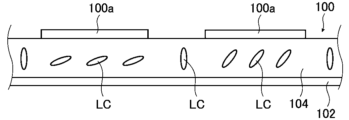
- non-patent document 1 describes an electromagnetic wave control element (beam steering element) consisting of a metasurface structure 100 and an electrode layer 102 sandwiching a liquid crystal layer 104, as conceptually shown in Figure 29.
- electromagnetic wave control element beam steering element
- the metasurface structure 100 is formed by arranging microstructures 100a which serve as resonators, similar to known metasurface structures.
- each of the microstructures 100a constituting the metasurface structure 100 acts not only as a reflector but also as an electrode. That is, the microstructures 100a and the electrode layer 102 form an electrode pair.
- the electrode layer 102 also acts as a reflective layer for incident electromagnetic waves.
- the liquid crystal layer 104 is formed by aligning a liquid crystal compound LC, for example. In the example shown in Fig. 29, the liquid crystal compound LC is, for example, a rod-shaped liquid crystal compound.
- the liquid crystal compound LC when no voltage is applied between the microstructure 100a and the electrode layer 102, the liquid crystal compound LC is oriented with its longitudinal direction, i.e., the direction of its optical axis, coinciding with the thickness direction.
- the alignment state of the liquid crystal compound LC changes according to the magnitude of the applied voltage.
- the liquid crystal compound LC tilts in the thickness direction in accordance with the magnitude of the voltage applied between the microstructure 100 a and the electrode layer 102 .
- a high voltage is applied to the microstructure 100a on the left side of the figure
- a low voltage is applied to the microstructure 100a on the right side of the figure.
- the liquid crystal compound LC located in the region of the microstructure 100a on the left side of the figure is greatly tilted, and the longitudinal direction is at an angle close to the main surface of the liquid crystal layer 104.
- the liquid crystal compound LC located in the region of the microstructure 100a on the right side of the figure is slightly tilted, and the longitudinal direction is at an angle close to the thickness direction of the liquid crystal layer 104.
- the refractive index of the liquid crystal layer 104 increases as the inclination of the liquid crystal compound LC increases, i.e., as the angle of the longitudinal direction of the liquid crystal compound LC approaches the surface of the liquid crystal layer 104. Conversely, the refractive index of the liquid crystal layer 104 decreases as the inclination of the liquid crystal compound LC decreases, i.e., as the angle of the longitudinal direction of the liquid crystal compound LC approaches the thickness direction of the liquid crystal layer 104.
- the refractive index of the liquid crystal layer 104 is large in the region of the microstructure 100a on the left side of the figure where the tilt of the liquid crystal compound LC is large, and is small in the region of the microstructure 100a on the right side of the figure where the tilt of the liquid crystal compound LC is small.
- the phase of the incident electromagnetic wave changes more than in the region of the microstructure 100a on the right side of the drawing, which has a smaller refractive index.
- the optical path of the electromagnetic wave appears longer in the region of the microstructure 100a on the left side of the figure than in the region of the microstructure 100a on the right side of the figure.
- the alignment state of the liquid crystal compound LC is changed by applying a voltage between the microstructure 100a constituting the metasurface structure 100 and the electrode layer 102.
- the change in the alignment state differs depending on the voltage applied to the microstructure 100a. Therefore, by controlling the voltage applied to each microstructure 100a, it is possible to reflect the incident electromagnetic wave in a desired direction. That is, an electromagnetic wave control element using a metasurface structure and a liquid crystal layer can switch the reflection angle of an incident electromagnetic wave by changing the voltage applied to each microstructure 100a.
- the object of the present invention is to solve the problems of the conventional technology and to provide an electromagnetic wave control element that uses a metasurface structure and a liquid crystal layer to control the direction of propagation of electromagnetic waves, and that can switch the direction of propagation of electromagnetic waves with frequencies of 0.1 to 0.3 THz in a short period of time.
- the present invention has the following configuration.
- a first electrode a liquid crystal layer in which the alignment state of liquid crystal compounds changes depending on a voltage;
- a metasurface structure having a plurality of microstructures arranged thereon,
- An electromagnetic wave control element which acts on electromagnetic waves having a frequency of 0.1 to 0.3 THz and in which the liquid crystal layer contains an azo compound.
- the electromagnetic wave control element according to any one of [1] to [6], wherein the first electrode reflects an electromagnetic wave having a frequency of 0.1 to 0.3 THz.
- the electromagnetic wave control element according to any one of [1] to [8], wherein the microstructure contains a metal.
- the electromagnetic wave control element of the present invention makes it possible to quickly switch the direction of propagation of electromagnetic waves with frequencies between 0.1 and 0.3 THz.
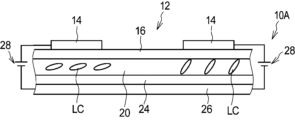
- FIG. 1 is a diagram conceptually showing an example of an electromagnetic wave control element of the present invention.
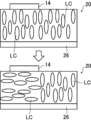
- FIG. 2 is a diagram conceptually showing an example of a liquid crystal alignment pattern in the electromagnetic wave control element of the present invention.
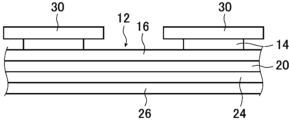
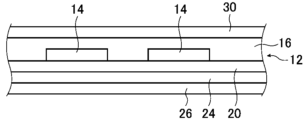
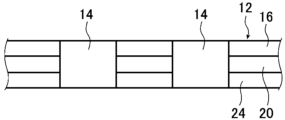
- FIG. 3 is a diagram conceptually showing another example of the electromagnetic wave control element of the present invention.
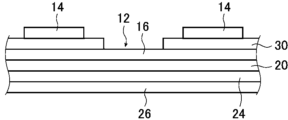
- FIG. 4 is a diagram conceptually showing another example of the electromagnetic wave control element of the present invention.
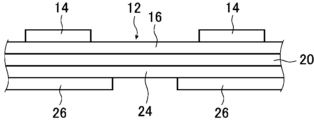
- FIG. 5 is a diagram conceptually showing another example of the electromagnetic wave control element of the present invention.
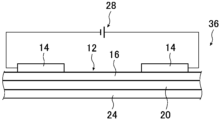
- FIG. 6 is a diagram conceptually showing another example of the electromagnetic wave control element of the present invention.
- FIG. 7 is a diagram conceptually showing another example of the electromagnetic wave control element of the present invention.
- FIG. 8 is a diagram conceptually showing another example of the electromagnetic wave control element of the present invention.
- FIG. 9 is a diagram conceptually showing another example of the electromagnetic wave control element of the present invention.
- FIG. 10 is a diagram conceptually showing another example of the electromagnetic wave control element of the present invention.
- FIG. 11 is a diagram conceptually showing another example of the electromagnetic wave control element of the present invention.
- FIG. 12 is a diagram conceptually showing another example of the electromagnetic wave control element of the present invention.
- FIG. 13 is a diagram conceptually showing another example of the electromagnetic wave control element of the present invention.
- FIG. 14 is a diagram conceptually showing another example of the electromagnetic wave control element of the present invention.
- FIG. 15 is a diagram conceptually showing another example of the electromagnetic wave control element of the present invention.
- FIG. 16 is a diagram conceptually showing another example of the electromagnetic wave control element of the present invention.
- FIG. 17 is a diagram conceptually showing another example of the electromagnetic wave control element of the present invention.
- FIG. 18 is a diagram conceptually showing another example of the electromagnetic wave control element of the present invention.
- FIG. 19 is a diagram conceptually showing another example of the electromagnetic wave control element of the present invention.
- FIG. 20 is a diagram conceptually showing another example of the electromagnetic wave control element of the present invention.
- FIG. 21 is a diagram conceptually showing another example of a liquid crystal alignment pattern in an electromagnetic wave control element of the present invention.
- FIG. 22 is a diagram conceptually showing another example of a liquid crystal alignment pattern in the electromagnetic wave control element of the present invention.
- FIG. 23 is a diagram conceptually showing another example of a liquid crystal orientation pattern in the electromagnetic wave control element of the present invention.
- FIG. 24 is a diagram conceptually showing another example of a liquid crystal orientation pattern in the electromagnetic wave control element of the present invention.
- FIG. 25 is a diagram conceptually showing another example of a liquid crystal alignment pattern in an electromagnetic wave control element of the present invention.
- FIG. 26 is a diagram conceptually showing another example of the electromagnetic wave control element of the present invention.
- FIG. 27 is a schematic perspective view of the electromagnetic wave control element shown in FIG.
- FIG. 28 is a conceptual diagram for explaining an embodiment of the present invention.
- FIG. 29 is a conceptual diagram showing an example of a conventional electromagnetic wave control element.
- a numerical range expressed using “to” means a range that includes the numerical values before and after “to” as the lower and upper limits.
- the term “same” includes a margin of error generally accepted in the technical field.
- FIG. 1 conceptually shows an example of an electromagnetic wave control element of the present invention.
- the electromagnetic wave control element 10 of the present invention is a reflective electromagnetic wave control element that utilizes a reflective metasurface structure and a liquid crystal layer to redirect the propagation direction of electromagnetic waves to a desired direction.
- the electromagnetic wave control element of the present invention reflects electromagnetic waves having a frequency of 0.1 to 0.3 THz in a desired direction. That is, the electromagnetic wave control element of the present invention reflects electromagnetic waves having a wavelength of 1 to 3 mm in a desired direction.
- an electromagnetic wave control element 10 of the present invention has, from the bottom in the figure, a first electrode layer 26, a liquid crystal layer 20, and a metasurface structure 12, in this order.
- the metasurface structure 12 is formed by two-dimensionally arranging microstructures 14 serving as resonators on a support 16.
- the liquid crystal layer 20 is provided on a support 24.
- the first electrode layer 26 is provided so as to entirely cover the surface of the support 24 opposite the liquid crystal layer 20 .
- the first electrode layer 26 and the support 24, and the liquid crystal layer 20 and the support 16 (metasurface structure 12) are attached using an adhesive (adhesive, adhesive) as necessary.
- an adhesive adhesive, adhesive
- OCA Optical Clear Adhesive
- the microstructures 14 are made of a conductive material and serve as electrodes that form an electrode pair with the first electrode layer 26.
- a power source 28 is connected to each microstructure 14 to apply a voltage between the microstructure 14 and the first electrode layer 26.
- the liquid crystal layer 20 changes the alignment state of the liquid crystal compound by application of a voltage. Therefore, by supplying power to each microstructure 14, a voltage is applied to the liquid crystal layer 20 between the microstructure 14 and the first electrode layer 26, changing the alignment state of the liquid crystal compound LC. In addition, by adjusting the power supplied to each microstructure 14, the voltage applied to the region of the liquid crystal layer 20 corresponding to the microstructure 14 can be adjusted, thereby adjusting the alignment state of the liquid crystal compound LC between the microstructure 14 and the first electrode layer 26.
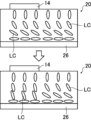
- the liquid crystal compound LC when no voltage is applied, the liquid crystal compound LC is aligned in the thickness direction of the liquid crystal layer 20, as conceptually shown in the upper part of Fig. 2.
- this alignment state is also referred to as "vertical alignment”.
- the alignment state of the liquid crystal compound LC in the region corresponding to the microstructures 14 changes in accordance with the strength of the applied voltage and is tilted with respect to the thickness direction of the liquid crystal layer 20.
- the liquid crystal compound LC is aligned at maximum in a direction parallel to the main surface of the liquid crystal layer 20.
- this alignment state is also referred to as "horizontal alignment".
- FIG. 2 in order to simplify the drawing, only the liquid crystal layer 20, the microstructures that serve as electrodes, and the first electrode layer 26 are shown.
- the thickness direction is the direction in which the first electrode layer 26 , the support 24 , the liquid crystal layer 20 and the support 16 are stacked.
- the main surface means the largest surface of a sheet-like material (film, plate, layer), and usually means both surfaces in the thickness direction of the sheet-like material.
- the normal direction is a direction perpendicular to a surface such as a main surface.
- the electromagnetic wave control element 10 shown in FIG. 1 uses a reflective metasurface structure, and the first electrode layer 26 also serves as a reflective layer for electromagnetic waves.
- the electromagnetic wave When an electromagnetic wave is incident on the electromagnetic wave control element 10 of the present invention having such a configuration, the electromagnetic wave has its phase modulated by resonance with the microstructure 14 (unit cell) as it passes through the metasurface structure 12, and the phase is further modulated as it passes through the liquid crystal layer 20.
- the electromagnetic waves are then reflected by the first electrode layer 26, which also serves as a reflective layer.
- the electromagnetic wave reflected by the first electrode layer 26 is again phase-modulated by passing through the liquid crystal layer 20, and then further phase-modulated by the metasurface structure 12, and is emitted from the electromagnetic wave control element 10 as a reflected electromagnetic wave.
- the alignment state i.e., the refractive index
- the refractive index of the liquid crystal layer 20 is smallest when the liquid crystal compound LC is vertically aligned, increases as the inclination of the liquid crystal compound LC with respect to the thickness direction increases, and is largest when the liquid crystal compound LC is horizontally aligned.
- the liquid crystal compound LC in the liquid crystal layer 20 When no voltage is applied to the liquid crystal layer 20, the liquid crystal compound LC in the liquid crystal layer 20 is vertically aligned. When a voltage is applied to the liquid crystal layer 20, the liquid crystal compound LC in the regions corresponding to the microstructures 14 is aligned with an inclination with respect to the thickness direction. In the electromagnetic wave control element 10, the greater the voltage applied to the liquid crystal layer 20, the closer the liquid crystal compound LC becomes to a horizontal alignment, and the greater the refractive index in that region of the liquid crystal layer 20. That is, in the liquid crystal layer 20, the refractive index of the region corresponding to the microstructure 14, i.e., the phase difference given to the transmitted electromagnetic wave, can be changed according to the voltage applied to the microstructure 14.
- the electromagnetic wave control element 10 of the present invention by adjusting the power supplied to each microstructure 14 and adjusting the voltage applied to the corresponding region, it is possible to generate regions with different refractive indices in the plane direction of the liquid crystal layer 20.
- the incident electromagnetic wave can be reflected in a direction different from the specular reflection, similar to the electromagnetic wave control element (beam steering element) of Non-Patent Document 1 described with reference to Fig. 29.
- the electromagnetic wave is incident from the normal direction of the liquid crystal layer 20
- the electromagnetic wave is reflected not in the normal direction but in a direction inclined with respect to the normal direction.
- the refractive index at each position in the surface direction can be changed, thereby switching the reflection direction of the incident electromagnetic wave.
- the reflected electromagnetic waves may be focused or diffused, and the degree of focus and diffusion of the reflected electromagnetic waves may be switched.
- the metasurface structure 12 is formed by two-dimensionally arranging microstructures 14 , which are microstructures, on a support 16 .
- the microstructures 14 are two-dimensionally arranged at equal intervals in the x-direction and y-direction, which are orthogonal to each other.
- all of the microstructures 14 are the same.
- the support 16 there are no limitations on the support 16, and any known sheet-like material can be used as long as it can support the microstructure 14 and can transmit electromagnetic waves with a frequency of 0.1 to 0.3 THz that are the target of the electromagnetic wave control element 10.
- the support 16 include a metal substrate having an oxide insulating layer such as a silicon substrate having silicon oxide, a support made of an oxide such as silicon oxide, a support made of a semiconductor such as germanium and chalcogenide glass, a polyacrylic resin film such as polymethyl methacrylate, a cellulose resin film such as cellulose triacetate, a cycloolefin polymer film, a polyethylene terephthalate (PET) film, a resin film such as a polycarbonate film and a polyvinyl chloride film, and a glass plate, etc.
- the cycloolefin polymer film include "Arton” manufactured by JSR Corporation and "ZEONOR” manufactured by Zeon Corporation.
- the thickness of the support 16 there is no limit to the thickness of the support 16, and it is sufficient to support the microstructure 14, to have sufficient transparency to electromagnetic waves with a frequency of 0.1 to 0.3 THz, and to have sufficient strength depending on the application of the electromagnetic wave control element 10, so the thickness can be set appropriately depending on the material from which the support 16 is made.
- the metasurface structure 12 is not limited to having the support 16 . That is, in the electromagnetic wave control element of the present invention, if possible, the microstructures 14 may be arranged directly on the surface of the liquid crystal layer 20 to form the metasurface structure 12 .
- the microstructures 14 are arranged on one surface of the support 16. In this way, the metasurface structure 12 is formed.
- the metasurface structure 12 is composed of microstructures 14, which are microscopic structures, arranged two-dimensionally on a plane at intervals, and is basically composed of an arrangement of unit cells formed by one microstructure 14 and the space surrounding the microstructure 14.
- the metasurface structure is basically a known metasurface structure (metamaterial). Therefore, in the electromagnetic wave control element 10 of the present invention, various known metasurface structures can be used. That is, in the present invention, there are no limitations on the shape and material of the microstructures 14, the arrangement of the microstructures 14, the interval (pitch) between the microstructures 14, and the like.
- the metasurface structure 12 may be designed by a known method according to the electromagnetic wave reflection characteristics of the electromagnetic wave control element 10 of the present invention.
- the amplitude and phase of the electromagnetic wave reflected by the microstructures 14 used may be calculated using commercially available simulation software, and the arrangement of the microstructures 14 may be set so as to obtain the desired distribution of phase modulation amount, i.e., phase delay amount (refractive index).
- the electromagnetic wave control element 10 of the present invention is intended for electromagnetic waves with frequencies of 0.1 to 0.3 THz. Therefore, in the metasurface structure 12, the microstructures 14 are selected so as to give a desired phase difference to the electromagnetic wave of this frequency, and further, the arrangement of the microstructures, etc. is set.
- the metasurface structure 12 is basically composed of an arrangement of unit cells formed by one microstructure 14 and the space surrounding the microstructure 14.
- the metasurface structure 12 uses the arrangement of unit cells to modulate the phase of an incident electromagnetic wave by utilizing resonance caused by the microstructure 14.
- the number of microstructures 14 in one unit cell is basically one, but the present invention is not limited to this. That is, in the electromagnetic wave control element of the present invention, one unit cell may have multiple microstructures 14 as necessary depending on the desired optical characteristics, the size, material and shape of the microstructures 14, and the size of the unit cell. In this case, one unit cell may have different microstructures 14. However, when one unit cell has multiple microstructures 14, the amount of phase modulation in the space in which each microstructure of the unit cell exists is basically equal.
- the material for forming the microstructures 14 that make up the metasurface structure 12 there are no restrictions on the material for forming the microstructures 14 that make up the metasurface structure 12, and various materials used as microstructures in known metasurface structures can be used.
- materials for forming the microstructure 14 include metals and dielectrics.
- metals preferred examples include copper, gold, and silver, which have low optical loss.
- composites made of metal particles and binders, and oxide semiconductors can also be used as materials for forming the microstructure 14.
- preferred examples of dielectrics include silicon, titanium oxide, and germanium, which have a large refractive index and can provide large phase modulation.
- the microstructure 14 when the microstructure 14 also serves as an electrode forming an electrode pair with the first electrode layer 26, the microstructure 14 is made of a conductor.
- microstructures 14 that make up the metasurface structure 12
- various shapes used as microstructures in known metasurface structures can be used. Examples include a cross-shaped solid like a crossed rectangular prism, a rectangular prism, a cylindrical shape, a V-shaped solid like a rectangular prism connected at its ends as shown in JP 2018-046395 A, an approximately H-shaped solid like an H-beam, and an approximately C-shaped solid like a C-channel.
- the V-shaped solid and the cross-shaped solid can be made in various shapes by adjusting the angle between the two rectangular parallelepipeds.
- solids having a bottom shape such as that shown in Figure 5 of "Appl. Sci. 2018, 8(9), 1689; https://doi.org/10.3390/app8091689" can also be used.
- microstructures 14 In the metasurface structure 12, only one of such microstructures 14 may be used, or multiple types may be used in combination.
- the same microstructures 14 may be arranged in the same direction as shown in FIG. 2, or in different directions, or the same and different directions may be mixed.
- the metasurface structure 12 has identical microstructures 14, all of which have the same structure, arranged two-dimensionally at equal intervals in the x and y directions which are perpendicular to each other.
- the present invention is not limited to this, and multiple types of microstructures may be used in combination as described above, and the arrangement intervals and arrangement of the microstructures 14 may also differ in the surface direction of the support 16.
- the metasurface structure 12 uses all the same microstructures 14.
- the metasurface structure 12 has the same microstructures 14 arranged two-dimensionally at equal intervals, and it is even more preferable that the metasurface structure 12 has the same microstructures 14 arranged two-dimensionally at equal intervals in the orthogonal x-direction and y-direction.
- the liquid crystal layer 20 is a layer in which the liquid crystal compound LC is aligned in a predetermined state, and as described above, the alignment state of the liquid crystal compound LC changes when a voltage is applied.
- the liquid crystal compound LC is vertically aligned when no voltage is applied.
- the liquid crystal compound LC is aligned at an angle to the thickness direction in response to the voltage, and reaches a maximum horizontal alignment.
- the change in the alignment of the liquid crystal compound LC is not limited to a change from vertical alignment to horizontal alignment or vice versa, but may be a change from a state tilted with respect to the thickness direction to a horizontal or vertical alignment, a change from a horizontal or vertical alignment to a state tilted with respect to the thickness direction, or a change in angle from a state tilted with respect to the thickness direction to a state tilted with respect to the thickness direction.
- the liquid crystal layer 20 may be formed by a known method, for example, on the surface of an alignment film described below.
- the liquid crystal layer 20 contains an azo compound.
- the response is improved and the reflection direction of an incident electromagnetic wave having a frequency of 0.1 to 0.3 THz can be switched in a short time.
- the liquid crystal layer 20 is formed on a support 24 .
- the support 24 is essentially the same as the support 16 described above.
- the support 24 on which the liquid crystal layer 20 is formed may further have an alignment film for orienting the liquid crystal compound LC in a predetermined state on the surface of the main body on which the liquid crystal layer 20 is formed, with the above-mentioned support 16 as the main body.
- Various known alignment films can be used, including, for example, a rubbed film made of an organic compound such as a polymer, an obliquely evaporated film of an inorganic compound, a film having microgrooves, and a film formed by accumulating LB (Langmuir-Blodgett) films made of organic compounds such as ⁇ -tricosanoic acid, dioctadecylmethylammonium chloride, and methyl stearate by the Langmuir-Blodgett method.
- LB Lightmuir-Blodgett
- a so-called photo-alignment film can also be used, which is formed by irradiating a photo-alignment material with polarized or non-polarized light to form an alignment film.
- These alignment films may be formed by a known method according to the material from which the main body is formed.
- the surface of the support 24 that forms the liquid crystal layer 20 opposite the liquid crystal layer 20 is entirely covered with a first electrode layer 26 .
- the first electrode layer 26 is an electrode that changes the orientation of the liquid crystal compound LC in the liquid crystal layer 20, and also acts as a reflective layer that reflects electromagnetic waves with a frequency of 0.1 to 0.3 THz incident from the metasurface structure 12 side, as described above.
- the first electrode layer 26 there are no limitations on the first electrode layer 26, and any sheet-like material made of various known materials can be used as long as it has sufficient conductivity and can reflect electromagnetic waves with a frequency of 0.1 to 0.3 THz.
- the first electrode layer 26 include a metal layer such as copper, aluminum, gold, or silver, an inorganic conductive material such as ITO (tin-doped indium oxide), an organic conductive material such as polythiophene represented by PEDOT (poly 3,4-ethylenedioxythiophene), and graphene, etc.
- ITO in-doped indium oxide
- PEDOT poly 3,4-ethylenedioxythiophene
- graphene graphene
- Inorganic conductive materials, organic conductive materials, graphene, etc. are transparent to visible light, but act as a reflective layer for electromagnetic waves of the above frequencies.
- the thickness of the first electrode layer 26 can be set appropriately depending on the material from which the first electrode layer 26 is formed so that the target electromagnetic waves can be reflected with the required reflectance.
- the electromagnetic wave control element 10 of the present invention is a reflective type electromagnetic wave control element having the metasurface structure 12 and the liquid crystal layer 20.
- the electromagnetic wave control element 10 power is supplied to each microstructure 14 to change the orientation state of the liquid crystal compound LC in the corresponding region of the liquid crystal layer 20, thereby forming an area with a different refractive index in the plane direction, and thereby reflecting incident electromagnetic waves with a frequency of 0.1 to 0.3 THz in the desired direction.
- the power supplied to each microstructure 14 that is, the voltage applied to the liquid crystal layer 20
- the reflection direction of the incident electromagnetic wave can be switched.
- a conventional electromagnetic wave control element (beam steering element) using a metasurface structure and a liquid crystal layer as shown in Non-Patent Document 1 takes time to switch the reflection direction of the electromagnetic wave.
- the electromagnetic wave control element 10 of the present invention ensures high responsiveness by having the liquid crystal layer 20 contain an azo compound, preferably by having the liquid crystal layer 20 contain a liquid crystal compound having an azo structure, and more preferably by having the liquid crystal layer 20 be made of a liquid crystal compound having an azo structure, and is therefore capable of switching the reflection direction of the incident electromagnetic wave in a short period of time.
- the liquid crystal layer 20 contains an azo compound, so that the ⁇ n (birefringence) of the liquid crystal layer can be increased. Therefore, in the present invention, the thickness of the liquid crystal layer required to give the electromagnetic wave the necessary refractive index, i.e., the necessary phase difference, can be reduced. By reducing the thickness of the liquid crystal layer, the orientation of the liquid crystal compound LC changes quickly when the applied voltage is changed. As a result, the electromagnetic wave control element 10 of the present invention can increase the response speed to changes in the voltage applied to the liquid crystal layer 20, thereby enabling the reflection direction of the incident electromagnetic wave to be switched in a short period of time.
- the number of azo structures in the azo compound is not particularly limited as long as it is 1 or more, and preferably 2 or more.
- the upper limit of the number of azo structures is not particularly limited, but it is often 5 or less, and more often 3 or less.
- the azo compound may be a compound exhibiting liquid crystallinity or may not exhibit liquid crystallinity, and is preferably a compound exhibiting liquid crystallinity, i.e., the azo compound is preferably a liquid crystal compound having an azo structure.
- the azo compound is preferably a compound represented by formula (1).
- Ar 1 represents an aromatic ring having a valence of (m1+1).
- the (m1+1)-valent aromatic ring may be a monocyclic ring or a condensed ring of two or more rings, or may be a ring in which a plurality of monocyclic rings are bonded together via single bonds (e.g., a biphenyl ring, a terphenyl ring).
- the (m1+1)-valent aromatic ring includes an aromatic hydrocarbon ring or an aromatic heterocycle.
- Examples of the aromatic hydrocarbon ring include a benzene ring, a naphthalene ring, an azulene ring, a fluorene ring, a biphenyl ring, and an anthracene ring. Of these, a benzene ring is preferable.
- Examples of the aromatic heterocycle include a pyridine ring, a thiophene ring, a furan ring, a quinoline ring, an isoquinoline ring, a thiazole ring, a thienothiophene ring, and a thienothiazole ring.
- Ar1 represents a divalent aromatic ring.
- Ar2 represents an aromatic ring having a valence of (m2+2).
- the (m2+1)-valent aromatic ring may be a monocyclic ring or a condensed ring of two or more rings, or may be a ring in which a plurality of monocyclic rings are bonded together via single bonds (e.g., a biphenyl ring, a terphenyl ring).
- the (m2+1)-valent aromatic ring includes an aromatic hydrocarbon ring or an aromatic heterocycle.
- Examples of the aromatic hydrocarbon ring include a benzene ring, a naphthalene ring, an azulene ring, a fluorene ring, a biphenyl ring, and an anthracene ring. Of these, a benzene ring is preferable.
- Examples of the aromatic heterocycle include a pyridine ring, a thiophene ring, a furan ring, a quinoline ring, an isoquinoline ring, a thiazole ring, a thienothiophene ring, and a thienothiazole ring.
- Ar2 represents a trivalent aromatic ring.
- Ar3 represents an aromatic ring having a valence of (m3+1).
- the (m+1)-valent aromatic ring may be a monocyclic ring or a condensed ring of two or more rings, or may be a ring in which a plurality of monocyclic rings are bonded together via single bonds (e.g., a biphenyl ring, a terphenyl ring).
- the (m3+1)-valent aromatic ring includes an aromatic hydrocarbon ring or an aromatic heterocycle.
- Examples of the aromatic hydrocarbon ring include a benzene ring, a naphthalene ring, an azulene ring, a fluorene ring, a biphenyl ring, and an anthracene ring. Of these, a benzene ring is preferable.
- Examples of the aromatic heterocycle include a pyridine ring, a thiophene ring, a furan ring, a quinoline ring, an isoquinoline ring, a thiazole ring, a thienothiophene ring, and a thienothiazole ring.
- Ar3 represents a divalent aromatic ring.
- R 1 , R 2 and R 3 each independently represent a substituent.
- R 1 , R 2 and R 3 each independently represent a substituent.
- the above-mentioned substituent is a monovalent substituent, and examples thereof include alkyl group, alkenyl group, aralkyl group, aryl group, heterocyclic group, halogen atom, cyano group, nitro group, mercapto group, hydroxy group, alkoxy group, aryloxy group, alkylthio group, arylthio group, acyloxy group, amino group, alkylamino group, dialkylamino group, carbonamido group, sulfonamido group, sulfamoylamino group, oxycarbonylamino group, oxysulfonylamino group, ureido group, thioureido group, acyl group, oxycarbonyl group, carbamoyl group, sulfonyl group, sulfinyl group, sulfamoyl group, carboxy group (including salt), sulfo group (including salt), and groups that
- m1, m2 and m3 each independently represent an integer of 0 to 5.
- m1 is preferably an integer of 1 to 3
- m2 is preferably an integer of 0 to 1
- m3 is preferably an integer of 1 to 3.
- n1 represents an integer of 1 to 4, preferably 1 to 3, and more preferably 2 or 3.
- the ⁇ n of the liquid crystal layer 20 is not limited, but it is preferable that it is large.
- the ⁇ n of the liquid crystal layer 20 is preferably 0.35 or more. By setting the ⁇ n of the liquid crystal layer 20 to 0.35 or more, the liquid crystal layer 20 can be made thinner, which is preferable in that the reflection direction of the electromagnetic wave can be switched more quickly.
- the thickness of the liquid crystal layer 20 there is also no limitation on the thickness of the liquid crystal layer 20, and the thickness may be appropriately set according to the material from which the liquid crystal layer 20 is formed, so that the necessary phase difference can be imparted to the electromagnetic waves.
- the thickness of the liquid crystal layer 20 is preferably 20 ⁇ m or less, more preferably 150 ⁇ m or less, and further preferably 100 ⁇ m or less. By setting the thickness of the liquid crystal layer 20 to 200 ⁇ m or less, it is preferable in that the reflection direction of the electromagnetic wave can be switched more quickly.
- the reflection type electromagnetic wave control element is not limited to the configuration shown in FIG. 1, and various configurations are possible.
- the microstructure 14 constituting the metasurface structure 12 also functions as an electrode.
- the present invention is not limited to this, and a second electrode 30 constituting an electrode pair with the first electrode layer 26 may be provided in correspondence with the microstructure 14.
- the second electrode 30 may be formed of the same material as the first electrode layer 26.
- a power source 28 is connected to each electrode or to the microstructure 14 serving as an electrode, in the same manner as in the example shown in FIG.
- FIG. 3 a configuration in which a second electrode 30 is provided on the microstructure 14 is exemplified.
- the second electrode 30 may be provided between the microstructure 14 and the support 16 .
- the first electrode layer 26 in the configuration shown in Fig. 1 is patterned to form a pattern electrode, and the pattern electrode is provided only in the region corresponding to the microstructure 14. In this configuration, the electromagnetic wave incident on the region where the first electrode layer 26 is not present is transmitted.
- the reflective electromagnetic wave control element may have a microstructure 14 provided adjacent to the liquid crystal layer 20, and a metasurface structure 12 provided between layered electrodes.
- the microstructure 14 may be provided on the liquid crystal layer 20 side of the support 16, and a layered (planar) second electrode 30 may be provided on the opposite side of the support 16 to the liquid crystal layer 20.
- the second electrode 30 is patterned to have a plurality of openings to form a patterned electrode, allowing electromagnetic waves to pass through the second electrode 30.
- the microstructures 14 may also be arranged on the support 24 , and the metasurface structure 12 may be provided on both sides of the liquid crystal layer 20 .
- the electromagnetic wave control element of the present invention described above is a reflection type electromagnetic wave control element that reflects incident electromagnetic waves with a frequency of 0.1 to 0.3 THz and causes them to travel in a desired direction, but the present invention is not limited to this. That is, the electromagnetic wave control element of the present invention may be a transmission type electromagnetic wave control element that refracts and transmits incident electromagnetic waves having a frequency of 0.1 to 0.3 THz, thereby allowing them to travel in a desired direction.
- electromagnetic waves refer to electromagnetic waves with a frequency of 0.1 to 0.3 THz.
- FIG. 8 conceptually shows an example of a transmission type electromagnetic wave control element.
- the transmission type electromagnetic wave control element of the present invention described below is basically the same as the reflection type electromagnetic wave control element described above, except that it does not have the first electrode layer 26 that serves as a reflective layer, and the functions of each component are also the same. Therefore, the same components are given the same reference numerals, and the description will mainly focus on the different parts.
- the transmission type electromagnetic wave control element 36 shown in FIG. 8 has the same configuration as the reflection type electromagnetic wave control element 10 shown in FIG. That is, the electromagnetic wave control element 36 has a metasurface structure 12 and a liquid crystal layer 20.
- the metasurface structure 12 is formed by two-dimensionally arranging microstructures 14 serving as resonators on a support 16, and the liquid crystal layer 20 is formed on a support 24. 8, the microstructures 14 function as both the first electrode and the second electrode. That is, in the electromagnetic wave control element 36, the power source 28 is provided by connecting adjacent microstructures 14.
- this electromagnetic wave control element 36 by supplying power from the power source 28 to the microstructures 14 , a voltage is applied in the plane direction to the liquid crystal layer 20 between adjacent microstructures 14 .
- the alignment state of the liquid crystal compound LC in the liquid crystal layer 20 in this region changes in response to the applied voltage, and the refractive index changes.
- the power supplied to each microstructure 14, i.e., the voltage applied to the corresponding region it is possible to form a region having a different refractive index in the plane direction.
- the phase of the electromagnetic wave is modulated by resonance with the microstructure 14 (unit cell) as it passes through the metasurface structure 12, and the phase is further modulated as it passes through the liquid crystal layer 20. Since the electromagnetic wave control element 36 does not have the first electrode layer 26 that serves as a reflective layer, the electromagnetic wave passes through the liquid crystal layer 20 and is emitted from the electromagnetic wave control element 36 as a transmitted electromagnetic wave. As described above, the liquid crystal layer 20 has different refractive indices in the plane direction, and therefore the phase difference given to the electromagnetic wave passing through the liquid crystal layer 20 differs depending on each region in the plane direction.
- the electromagnetic wave has a different apparent optical path length depending on the phase difference given depending on the incidence region, and the electromagnetic wave that has passed through a region with a long optical path length exits the liquid crystal layer 20 later than the electromagnetic wave that has passed through a region with a short optical path length.
- the electromagnetic wave incident on and transmitted through the electromagnetic wave control element 36 is not transmitted linearly, but is refracted to align the wavefront before being transmitted.
- an electromagnetic wave incident from the normal direction is not transmitted in the normal direction, but is transmitted in a direction inclined with respect to the normal.
- the power supplied to each microstructure 14, that is, the voltage applied to the liquid crystal layer 20 it is possible to switch the refractive index of the transmitted electromagnetic wave, that is, the emission direction of the electromagnetic wave.
- the electromagnetic waves transmitted therethrough may be focused or diffused, and it is also possible to switch the degree of focus and diffusion of the electromagnetic waves transmitted therethrough.
- the liquid crystal layer 20 in the electromagnetic wave control element 36 also contains an azo compound, the refractive index, that is, the refraction direction (travel direction) of transmitted light can be quickly switched.
- the ⁇ n of the liquid crystal layer 20 is not limited, but it is preferable that it is large.
- the ⁇ n of the liquid crystal layer 20 is preferably 0.2 or more, more preferably 0.3 or more, and even more preferably 0.4 or more.
- the thickness of the liquid crystal layer 20 there is also no limitation on the thickness of the liquid crystal layer 20, and the thickness may be appropriately set according to the material from which the liquid crystal layer 20 is formed, so that the necessary phase difference can be imparted to the electromagnetic waves.
- the electromagnetic waves that are the subject of the present invention are those with a frequency of 0.1 to 0.3 THz, that is, those with a wavelength of 1 to 3 mm.
- the thickness of the liquid crystal layer 20 in the transmission type electromagnetic wave control element 36 is preferably 500 ⁇ m or less, more preferably 300 ⁇ m or less, and even more preferably 200 ⁇ m or less. By setting the thickness of the liquid crystal layer 20 to 500 ⁇ m or less, it is preferable in that the reflection direction of the electromagnetic wave can be switched more quickly.
- the transmission type electromagnetic wave control element is not limited to the electromagnetic wave control element 36 shown in Fig. 8, and various configurations are possible.
- a power source 28 is connected to each electrode or to the microstructure 14 serving as an electrode, in the same manner as in the example shown in Fig. 8.
- the microstructure 14 constituting the metasurface structure 12 also functions as an electrode.
- the present invention is not limited to this, and a first electrode 32 and a second electrode 30 may be provided corresponding to the microstructure 14.
- a configuration in which a first electrode 32 is provided on one of two adjacent microstructures 14 and a second electrode 30 is provided on the other microstructure 14 is exemplified.
- a first electrode 32 may be provided between one microstructure 14 and the support 16
- a second electrode 30 may be provided between the other microstructure 14 and the support 16.
- the transmission type electromagnetic wave control element may have a plurality of metasurface structures.
- the microstructures 14 may be arranged on the surface of the support 24 opposite to the liquid crystal layer 20 to form a metasurface structure 12.
- the microstructures 14 facing each other with the liquid crystal layer 20 sandwiched therebetween act as an electrode pair, i.e., a first electrode and a second electrode.
- a first electrode 32 and a second electrode 30 may be provided in correspondence with the microstructure 14 .
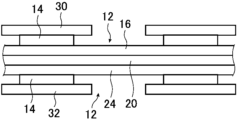
- this configuration is a configuration in which two microstructures 14 form an electrode pair facing each other across a liquid crystal layer 20, with a first electrode 32 provided on the surface of one of the microstructures 14 and a second electrode 30 provided on the surface of the other microstructure 14, as conceptually shown in Figure 12.
- a first electrode 32 may be provided between one microstructure 14 and the support 16
- a second electrode 30 may be provided between the other microstructure 14 and the support 16.
- a transmission-type electromagnetic wave control element having a plurality of metasurface structures may be one in which the microstructures 14 constituting the metasurface structure 12 are arranged offset in the planar direction, as conceptually shown in Fig. 14.
- the microstructures 14 facing each other with the liquid crystal layer 20 interposed therebetween act as an electrode pair, i.e., a first electrode and a second electrode.
- a first electrode 32 and a second electrode 30 may be provided in correspondence with the microstructure 14 .
- this configuration is a configuration in which two microstructures 14 form an electrode pair facing each other across a liquid crystal layer 20, with a first electrode 32 provided on the surface of one of the microstructures 14 and a second electrode 30 provided on the surface of the other microstructure 14, as conceptually shown in Figure 15.
- a first electrode 32 may be provided between one microstructure 14 and the support 16
- a second electrode 30 may be provided between the other microstructure 14 and the support 16.
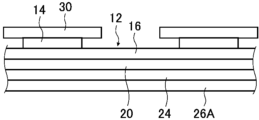
- a first electrode layer 26A may be provided to entirely cover the surface of the support 24 opposite the liquid crystal layer 20, and an electrode pair may be formed by the microstructure 14 and the first electrode layer 26A.
- the first electrode layer 26A may be a patterned electrode patterned to have a plurality of openings, allowing the electromagnetic wave to pass through.
- a second electrode 30 may be provided on the microstructure 14, as conceptually shown in Figure 18, and the first electrode layer 26A and the second electrode 30 may form an electrode pair.
- microstructures 14 may be provided penetrating the electromagnetic wave control element in the thickness direction, as conceptually shown in Fig. 19.
- the microstructures 14 may also serve as electrodes, or a first electrode and/or a second electrode may be disposed corresponding to each microstructure 14.
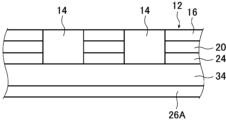
- a dielectric layer 34 may be provided on the side of the support 24 opposite the liquid crystal layer 20
- a first electrode layer 26A patterned to have a plurality of openings through which electromagnetic waves can pass may be provided on the side of the dielectric layer 34 opposite the support 24.
- the electromagnetic wave control element reflects electromagnetic waves and controls the reflection direction of the electromagnetic waves.
- the electromagnetic wave control element of the present invention is not limited to this.
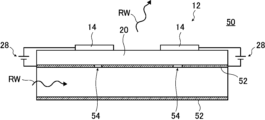
- FIG. 26 is a conceptual diagram showing another example of an electromagnetic wave control element of the present invention. Also, FIG. 27 is a schematic perspective view of the electromagnetic wave control element shown in FIG. 26.
- the electromagnetic wave control element 50 shown in Figures 26 and 27 has, from the bottom in the figure, a waveguide 52, a liquid crystal layer 20, and a metasurface structure 12 (microstructure 14), in that order.
- the liquid crystal layer 20 is provided on a portion of the outer surface of the waveguide 52.
- the waveguide 52 is a waveguide made of a conductor such as metal, and the waveguide 52 also serves as the first electrode (first electrode layer) in the present invention.
- the same components as those in the electromagnetic wave control element 10 shown in FIG. 1 are denoted by the same reference numerals, and the following description will mainly focus on the different components. Further, although the electromagnetic wave control element 50 shown in FIG. 26 and FIG. 27 does not have the support 16 and the support 24, the element may also have the support 16 and/or the support 24 as necessary in this example.
- the waveguide 52 is a tubular member having a rectangular cross section, and is a metallic waveguide that guides the electromagnetic wave RW within the hollow portion.
- the electromagnetic wave RW propagates through the waveguide 52 while forming an electromagnetic field according to the shape and dimensions of the waveguide 52, the wavelength (frequency) of the electromagnetic wave RW, and the like.
- the waveguide 52 has a plurality of openings 54 that connect the hollow portion with the outside, on the wall portion on the side where the liquid crystal layer 20 and the microstructure 14 are laminated, i.e., the surface that faces the microstructure 14 and acts as a first electrode.
- the openings 54 are provided at positions corresponding to the unit cells (i.e., the microstructures 14).
- the electromagnetic wave control element 50 can control the traveling direction of the electromagnetic wave RW by performing phase modulation, i.e., controlling the amount of phase delay, for each unit cell. That is, the electromagnetic wave control element 50 can control the emission direction of the electromagnetic wave RW. Also, by actively changing the amount of phase delay in each unit cell, it becomes possible to actively change the emission direction of the electromagnetic wave RW.
- the cross-sectional shape of the waveguide 52 is rectangular, but this is not limited to this and can be various shapes such as square, circular, and polygonal.
- the dimensions of the waveguide 52 are not particularly limited.
- the length of the waveguide 52 is preferably 1 to 10,000 mm, and more preferably 3 to 3,000 mm.
- the waveguide 52 when the waveguide 52 also serves as the first electrode, the waveguide 52 can be formed from the same material (conductor) as the material used to form the first electrode described above.
- the waveguide 52 also serves as the first electrode, but the present invention is not limited to this, and the waveguide and the first electrode may be separate bodies.
- the waveguide 52 and the first electrode are separate, the waveguide 52 is disposed on the surface of the first electrode opposite to the liquid crystal layer 20. Even when the waveguide and the first electrode are separate, the first electrode has an opening through which the electromagnetic wave RW passes, at a position corresponding to each cell unit.
- the waveguide is provided with an emission portion that emits the electromagnetic wave RW, at a position corresponding to the opening of the first electrode.
- the waveguide may be a waveguide made of the above-mentioned conductor, or a conventionally known waveguide capable of guiding electromagnetic waves, such as a stripline line, a microstripline line, or a coplanar line.
- the size of the opening formed in the first electrode is preferably 0.01 to 100,000 mm 2 , more preferably 0.02 to 80,000 mm 2 , and even more preferably 0.05 to 50,000 mm 2 .
- the opening formed in the first electrode is configured to be one for each unit cell, but this is not limited to this, and two or more openings may be provided for each unit cell.
- the orientation pattern of the liquid crystal compound LC in the liquid crystal layer 20 is such that when no voltage is applied, the liquid crystal compound LC is vertically aligned, and when a voltage is applied, the angle with respect to the thickness direction increases depending on the applied voltage, and finally the liquid crystal orientation pattern becomes horizontally aligned.
- the present invention is not limited to this, and various liquid crystal alignment patterns can be used. An example is shown below. In the example shown below, similarly to FIG. 2, in order to simplify the operation, only the liquid crystal layer 20, the microstructure 14, and the first electrode layer 26 are shown.
- microstructure 14 and the first electrode layer 26 are shown as an example of the electrodes, but the present invention is not limited thereto, and the liquid crystal alignment pattern shown below can be used in all the configurations shown in Figure 1 and Figures 3 to 20. This also applies to Figure 2.
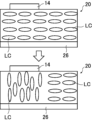
- the liquid crystal orientation pattern of the liquid crystal layer 20 can be a liquid crystal orientation pattern in which, when no voltage is applied, the liquid crystal compound LC is horizontally aligned, and when a voltage is applied, the angle with respect to the principal surface of the liquid crystal layer 20 increases depending on the applied voltage, ultimately resulting in a vertical alignment, as conceptually shown in Figure 21.
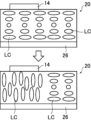
- liquid crystal orientation pattern for the liquid crystal layer 20 As a liquid crystal orientation pattern for the liquid crystal layer 20, as conceptually shown in Figure 22, when no voltage is applied, the liquid crystal compound LC is horizontally aligned and is helically twisted in the thickness direction, and when a voltage is applied, the angle with respect to the main surface of the liquid crystal layer 20 increases depending on the applied voltage, and a liquid crystal orientation pattern can also be used that ultimately becomes vertically aligned. Furthermore, as the liquid crystal orientation pattern of the liquid crystal layer 20, a hybrid orientation in which the orientation of the liquid crystal compound LC changes from a horizontal orientation to a vertical orientation in the thickness direction can also be used, as conceptually shown in Fig. 23. In the case of this liquid crystal orientation pattern, as an example, as shown in Fig. 23, when a voltage is applied from a state in which no voltage is applied, the orientation of the liquid crystal compound LC approaches a vertical orientation depending on the applied voltage.
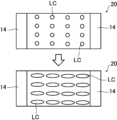
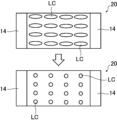
- a voltage may be applied in the plane direction of the liquid crystal layer 20 as shown in FIGS.
- the liquid crystal compound LC when no voltage is applied, the liquid crystal compound LC is horizontally aligned with its longitudinal direction coinciding with the direction perpendicular to the paper surface, and when a voltage is applied, a liquid crystal alignment pattern can also be used in which the liquid crystal compound LC rotates in the plane direction according to the applied voltage, and finally the liquid crystal compound LC is horizontally aligned with its longitudinal direction coinciding with the horizontal direction in the figure.
- a liquid crystal alignment pattern can also be used in which, when no voltage is applied, the liquid crystal compound LC is horizontally aligned with its longitudinal direction coinciding with the horizontal direction in the figure, and when a voltage is applied, it rotates in the plane direction in response to the applied voltage, and finally becomes horizontally aligned with its longitudinal direction coinciding with the direction perpendicular to the paper surface.
- the electromagnetic wave may be unpolarized, linearly polarized, circularly polarized, or elliptically polarized.
- the electromagnetic wave when the electromagnetic wave is linearly polarized and the microstructure 14 is arranged two-dimensionally in the orthogonal x and y directions, it is preferable to input the electromagnetic wave so that the polarization direction of the electromagnetic wave coincides with the x or y direction.
- the electromagnetic wave control element to be modeled has a structure in which a first electrode layer 26, a liquid crystal layer 20, and a microstructure 14 (metasurface structure 12) are layered in this order.
- the size of one unit cell is 1.1 mm x 1.1 mm, and the unit cells are arranged infinitely in the in-plane direction by applying periodic boundary conditions.
- the first electrode layer 26 and the microstructure 14 are made of copper and have a thickness of 2 ⁇ m.
- Each microstructure 14 is a square measuring 0.8 mm x 0.8 mm, and is positioned approximately at the center of the unit cell in the in-plane direction.
- the liquid crystal layer 20 was formed using a liquid crystal composition in which the following compound 1 (liquid crystal compound 1) and compound 2 (liquid crystal compound 2) were mixed in a 50%:50% ratio.
- the ⁇ n of the liquid crystal composition of the examples was measured by the following method. First, a liquid crystal composition was sealed in a glass cell (10 mm x 10 mm, thickness 1.0 mm) in which a tin oxide ( SnO2 ) film was formed as an electrode by a sputtering method, and then a transmission type terahertz spectroscopy optical system was fabricated and the time waveform of the optical field was measured in an environment of a temperature of 100°C and a humidity of 10% RH. From the change in the time waveform of the optical field before and after the application of a voltage, the ⁇ n of the liquid crystal composition sealed in the glass cell was measured. The ⁇ n of the liquid crystal composition was 0.35.
- Example 2 A model was made of an electromagnetic wave control element similar to that of Example 1, except that the liquid crystal compound used in the liquid crystal composition forming the liquid crystal layer was changed to 4'-pentyl-4-biphenylcarbonitrile (5CB).
- CB 4'-pentyl-4-biphenylcarbonitrile
- a transmission type terahertz spectroscopy optical system was fabricated in the same manner as in the example, and the time waveform of the optical field was measured in an environment of a temperature of 25° C. and a humidity of 10% RH. From the change in the time waveform of the optical field before and after the application of a voltage, the ⁇ n of the liquid crystal composition sealed in the glass cell was measured. The ⁇ n was 0.2.
- the reflection phase of a 100 GHz electromagnetic wave was calculated when a 100 GHz electromagnetic wave was incident on and reflected from the models of the electromagnetic wave control elements of the above examples and comparative examples.
- the difference in the reflection phase due to the application of a voltage was calculated for each of the cases where the liquid crystal compound LC was horizontally aligned with no voltage applied and where the liquid crystal compound LC was vertically aligned with the application of a voltage.
- the calculation was performed for each of the cases where the liquid crystal layer had a thickness of 10 to 300 ⁇ m, and the minimum thickness at which the difference in the reflection phase due to the application of a voltage was 180° was calculated.
- Electromagnetic wave control element 12 Metasurface structure 14, 100a Microstructure 16, 24 Support 20, 104 Liquid crystal layer 26, 26A First electrode layer 28 Power source 30 Second electrode 32 First electrode 34 Dielectric layer LC Liquid crystal compound
Landscapes
- Physics & Mathematics (AREA)
- Electromagnetism (AREA)
- Liquid Crystal (AREA)
Priority Applications (3)
| Application Number | Priority Date | Filing Date | Title |
|---|---|---|---|
| JP2024550386A JPWO2024071184A1 (https=) | 2022-09-27 | 2023-09-27 | |
| CN202380063573.6A CN119817002A (zh) | 2022-09-27 | 2023-09-27 | 电磁波控制用元件 |
| US19/077,839 US20250210862A1 (en) | 2022-09-27 | 2025-03-12 | Electromagnetic wave control element |
Applications Claiming Priority (2)
| Application Number | Priority Date | Filing Date | Title |
|---|---|---|---|
| JP2022-153479 | 2022-09-27 | ||
| JP2022153479 | 2022-09-27 |
Related Child Applications (1)
| Application Number | Title | Priority Date | Filing Date |
|---|---|---|---|
| US19/077,839 Continuation US20250210862A1 (en) | 2022-09-27 | 2025-03-12 | Electromagnetic wave control element |
Publications (1)
| Publication Number | Publication Date |
|---|---|
| WO2024071184A1 true WO2024071184A1 (ja) | 2024-04-04 |
Family
ID=90477842
Family Applications (1)
| Application Number | Title | Priority Date | Filing Date |
|---|---|---|---|
| PCT/JP2023/035121 Ceased WO2024071184A1 (ja) | 2022-09-27 | 2023-09-27 | 電磁波制御用素子 |
Country Status (4)
| Country | Link |
|---|---|
| US (1) | US20250210862A1 (https=) |
| JP (1) | JPWO2024071184A1 (https=) |
| CN (1) | CN119817002A (https=) |
| WO (1) | WO2024071184A1 (https=) |
Cited By (1)
| Publication number | Priority date | Publication date | Assignee | Title |
|---|---|---|---|---|
| WO2026042515A1 (ja) * | 2024-08-20 | 2026-02-26 | 富士フイルム株式会社 | 電波用反射板 |
Citations (4)
| Publication number | Priority date | Publication date | Assignee | Title |
|---|---|---|---|---|
| JP2002223116A (ja) * | 2001-01-25 | 2002-08-09 | Asahi Glass Co Ltd | 電波収束・偏向体およびアンテナ装置 |
| JP2006013405A (ja) * | 2004-06-29 | 2006-01-12 | Canon Inc | 電磁波発生・検出素子およびその製造方法 |
| JP2019530387A (ja) * | 2016-09-22 | 2019-10-17 | 華為技術有限公司Huawei Technologies Co.,Ltd. | ビーム・ステアリング・アンテナのための液晶調整可能メタサーフェス |
| WO2021060485A1 (ja) * | 2019-09-27 | 2021-04-01 | 富士フイルム株式会社 | 光学素子の製造方法 |
-
2023
- 2023-09-27 JP JP2024550386A patent/JPWO2024071184A1/ja active Pending
- 2023-09-27 CN CN202380063573.6A patent/CN119817002A/zh active Pending
- 2023-09-27 WO PCT/JP2023/035121 patent/WO2024071184A1/ja not_active Ceased
-
2025
- 2025-03-12 US US19/077,839 patent/US20250210862A1/en active Pending
Patent Citations (4)
| Publication number | Priority date | Publication date | Assignee | Title |
|---|---|---|---|---|
| JP2002223116A (ja) * | 2001-01-25 | 2002-08-09 | Asahi Glass Co Ltd | 電波収束・偏向体およびアンテナ装置 |
| JP2006013405A (ja) * | 2004-06-29 | 2006-01-12 | Canon Inc | 電磁波発生・検出素子およびその製造方法 |
| JP2019530387A (ja) * | 2016-09-22 | 2019-10-17 | 華為技術有限公司Huawei Technologies Co.,Ltd. | ビーム・ステアリング・アンテナのための液晶調整可能メタサーフェス |
| WO2021060485A1 (ja) * | 2019-09-27 | 2021-04-01 | 富士フイルム株式会社 | 光学素子の製造方法 |
Cited By (1)
| Publication number | Priority date | Publication date | Assignee | Title |
|---|---|---|---|---|
| WO2026042515A1 (ja) * | 2024-08-20 | 2026-02-26 | 富士フイルム株式会社 | 電波用反射板 |
Also Published As
| Publication number | Publication date |
|---|---|
| CN119817002A (zh) | 2025-04-11 |
| JPWO2024071184A1 (https=) | 2024-04-04 |
| US20250210862A1 (en) | 2025-06-26 |
Similar Documents
| Publication | Publication Date | Title |
|---|---|---|
| US10627571B1 (en) | Plasmonic surface-scattering elements and metasurfaces for optical beam steering | |
| US20210356838A1 (en) | Non-moving optical beam steering using non-pixelated liquid crystal optical phased arrays | |
| Wu et al. | An Ultrathin, Fast‐Response, Large‐Scale Liquid‐Crystal‐Facilitated Multi‐Functional Reconfigurable Metasurface for Comprehensive Wavefront Modulation | |
| US20120242918A1 (en) | Cholesteric liquid crystal structure | |
| EP2208111B1 (en) | Beam shaping device | |
| Fritzsch et al. | 77‐1: Invited Paper: Liquid Crystals beyond Displays: Smart Antennas and Digital Optics | |
| Jing et al. | Optically transparent coding metasurfaces based on indium tin oxide films | |
| US20250210862A1 (en) | Electromagnetic wave control element | |
| Song et al. | Electro-optic beam-steering device based on a lanthanum-modified lead zirconate titanate ceramic wafer | |
| Zhang et al. | Manipulation of sub-terahertz waves using digital coding metasurfaces based on liquid crystals | |
| CN110249255A (zh) | 用于光束反射式液晶装置的动态可变电控制的方法和装置 | |
| US6958843B2 (en) | Wide-range and high-resolution variable optical delay | |
| WO2024162004A1 (ja) | 電磁波制御用素子 | |
| RU2625636C1 (ru) | Модулятор терагерцевого излучения | |
| Jiang et al. | Ultrawide tunable terahertz phase shifter based on a double-layer liquid crystal–dielectric grating | |
| Tanaka et al. | Millimeter-wave deflection properties of liquid crystal prism cells with stack-layered structure | |
| Kabanava et al. | Nematic liquid crystal waveguides for spatial control of linearly polarized light waves | |
| CN121925761A (zh) | 电波控制元件 | |
| TWI804124B (zh) | 液晶裝置 | |
| Yuan et al. | Proposal of an electrically controlled terahertz switch based on liquid-crystal-filled dual-metallic grating structures | |
| Li et al. | Controlling asymmetric absorption of metasurfaces via non-Hermitian doping | |
| WO2025070263A1 (ja) | 電波制御素子 | |
| WO2024071070A1 (ja) | 電磁波制御用素子 | |
| WO2026042515A1 (ja) | 電波用反射板 | |
| PL234439B1 (pl) | Sposób całkowicie optycznego przełączania sygnału optycznego w homogenicznej komórce ciekłokrystalicznej o zmiennej orientacji molekuł wypełnionej nematycznym ciekłym kryształem |
Legal Events
| Date | Code | Title | Description |
|---|---|---|---|
| 121 | Ep: the epo has been informed by wipo that ep was designated in this application |
Ref document number: 23872406 Country of ref document: EP Kind code of ref document: A1 |
|
| WWE | Wipo information: entry into national phase |
Ref document number: 2024550386 Country of ref document: JP Ref document number: 202380063573.6 Country of ref document: CN |
|
| WWP | Wipo information: published in national office |
Ref document number: 202380063573.6 Country of ref document: CN |
|
| NENP | Non-entry into the national phase |
Ref country code: DE |
|
| 122 | Ep: pct application non-entry in european phase |
Ref document number: 23872406 Country of ref document: EP Kind code of ref document: A1 |