WO2024070649A1 - 人工皮革 - Google Patents
人工皮革 Download PDFInfo
- Publication number
- WO2024070649A1 WO2024070649A1 PCT/JP2023/033136 JP2023033136W WO2024070649A1 WO 2024070649 A1 WO2024070649 A1 WO 2024070649A1 JP 2023033136 W JP2023033136 W JP 2023033136W WO 2024070649 A1 WO2024070649 A1 WO 2024070649A1
- Authority
- WO
- WIPO (PCT)
- Prior art keywords
- fiber
- fibers
- artificial leather
- less
- ultrafine
- Prior art date
- Legal status (The legal status is an assumption and is not a legal conclusion. Google has not performed a legal analysis and makes no representation as to the accuracy of the status listed.)
- Ceased
Links
Classifications
-
- D—TEXTILES; PAPER
- D06—TREATMENT OF TEXTILES OR THE LIKE; LAUNDERING; FLEXIBLE MATERIALS NOT OTHERWISE PROVIDED FOR
- D06N—WALL, FLOOR, OR LIKE COVERING MATERIALS, e.g. LINOLEUM, OILCLOTH, ARTIFICIAL LEATHER, ROOFING FELT, CONSISTING OF A FIBROUS WEB COATED WITH A LAYER OF MACROMOLECULAR MATERIAL; FLEXIBLE SHEET MATERIAL NOT OTHERWISE PROVIDED FOR
- D06N3/00—Artificial leather, oilcloth or other material obtained by covering fibrous webs with macromolecular material, e.g. resins, rubber or derivatives thereof
- D06N3/12—Artificial leather, oilcloth or other material obtained by covering fibrous webs with macromolecular material, e.g. resins, rubber or derivatives thereof with macromolecular compounds obtained otherwise than by reactions only involving carbon-to-carbon unsaturated bonds, e.g. gelatine proteins
- D06N3/14—Artificial leather, oilcloth or other material obtained by covering fibrous webs with macromolecular material, e.g. resins, rubber or derivatives thereof with macromolecular compounds obtained otherwise than by reactions only involving carbon-to-carbon unsaturated bonds, e.g. gelatine proteins with polyurethanes
Definitions
- the present invention relates to artificial leather that combines elegant appearance and high strength.
- Suede-like artificial leather which contains nonwoven fabric mainly made of ultrafine fibers as a component, has a good appearance and is used in a wide range of fields such as automobile interior materials, furniture, miscellaneous goods, and clothing applications, and efforts are being made to improve its physical properties such as strength.
- Patent Document 1 proposes a fibrous sheet-like material consisting of a fiber-entangled nonwoven fabric in which ultrafine fibers (A) and high-strength fibers (B) are mixed in a certain ratio and three-dimensionally entangled, and an elastic polymer that exists in the interstitial spaces between the fibers.
- Patent Document 2 also proposes a nonwoven fabric that is a sheet-like material made of ultrafine fibers, in which a distribution of ultrafine fiber diameters created in increments of 0.1 ⁇ m has two or more different peaks, the center value of the peak located on the larger diameter side is greater than the center value of the peak adjacent to the smaller diameter side by a certain amount, and the total number of fibers present within a range of ⁇ 30% of the center value of each peak accounts for 90% or more of the total number of fibers.
- the artificial leather obtained by the method disclosed in Patent Document 1 can achieve a certain degree of strength by blending ultrafine fibers with high-strength, thick fibers.
- the artificial leather obtained by the method disclosed in Patent Document 2 uses a specially designed spinneret to simultaneously spin fine and thick fibers, achieving a uniform blend.
- the uniformity of the appearance quality is impaired when the thick fibers are exposed on the surface of the artificial leather.
- the present invention was made in consideration of the above circumstances, and its purpose is to provide artificial leather that combines high strength with the elegant appearance characteristic of artificial leather.
- An artificial leather having a fiber-entangled body containing a nonwoven fabric as a component and a polymeric elastomer,
- the nonwoven fabric is Ultrafine fibers A having a single fiber diameter of 1.0 ⁇ m or more and 8.0 ⁇ m or less; and fiber B having a single fiber diameter of 10.0 ⁇ m or more and 50.0 ⁇ m or less,
- the fiber B is composed of at least two types of thermoplastic resins, At least one surface of the artificial leather has nap, The proportion of fiber B in the cross section of the artificial leather is 1% or more and 20% or less.
- Artificial leather is a fiber-entangled body containing a nonwoven fabric as a component and a polymeric elastomer,
- the nonwoven fabric is Ultrafine fibers A having a single fiber diameter of 1.0 ⁇ m or more and 8.0 ⁇ m or less; and fiber B having a single fiber diameter of 10.0 ⁇ m or more and 50.0 ⁇ m or less,
- the fiber B is composed of at least two types of
- a step of forming a fiber-entangled body including a nonwoven fabric composed of ultrafine fiber-developing fibers as a component (2) A step of immersing the fiber-entangled body in an alkaline aqueous solution and then heating it in a steam atmosphere at 90° C. or more and 100° C.
- a method for producing an artificial leather comprising a step of performing a nap raising treatment on at least one surface of the polymer elastomer-applied sheet on which the ultrafine fibers A and the fibers B are developed, to form a napped sheet having nap on the surface.
- ultrafine fibers are formed on the surface of the fiber entanglement by immersion and heat treatment while ultrafine fibers and thick fibers are simultaneously formed inside, resulting in a state in which fibers with different finenesses are mixed, and the nonwoven fabric constituting the artificial leather is made to contain ultrafine fibers A with a single fiber diameter of 1.0 ⁇ m to 8.0 ⁇ m and fibers B composed of at least two types of thermoplastic resins and with a single fiber diameter of 10.0 ⁇ m to 50.0 ⁇ m, and raised nap is provided on at least one surface of the artificial leather, and the proportion of fibers B in the cross section is 1% to 20%.
- the artificial leather of the present invention can be used widely, from furniture, chairs, and vehicle interior materials to clothing applications, but since it has high strength as described above, it is particularly suitable for use in vehicle interior materials.
- FIG. 1 is a cross-sectional view of an artificial leather for illustrating and explaining the nap length of the artificial leather of the present invention.
- the artificial leather of the present invention is an artificial leather having a fiber entanglement containing a nonwoven fabric as a component, and a polymeric elastomer, the nonwoven fabric containing ultrafine fibers A with a single fiber diameter of 1.0 ⁇ m to 8.0 ⁇ m and fibers B with a single fiber diameter of 10.0 ⁇ m to 50.0 ⁇ m, the fibers B being composed of at least two types of thermoplastic resins. At least one surface of the artificial leather has nap, and the proportion of fibers B in the cross section of the artificial leather is 1% to 20%.
- the components are described in detail below, but the present invention is not limited to the scope described below as long as it does not exceed the gist of the invention, and various modifications are possible within the scope of the invention.
- the artificial leather of the present invention has a fiber-entangled body containing a nonwoven fabric as a component, and thus the artificial leather has a uniform nap on the surface and an elegant appearance.
- nonwoven fabrics examples include short fiber nonwoven fabrics obtained by forming short fibers with a fiber length of approximately 100 mm or less into a laminated fiber web using a card or cross wrapper, and then needle punching or water jet punching the web; short fiber nonwoven fabrics obtained by subjecting the short fibers to a papermaking process; and long fiber nonwoven fabrics obtained by the spunbonding process or meltblowing process.
- the nonwoven fabric contains ultrafine fibers A with a single fiber diameter of 1.0 ⁇ m or more and 8.0 ⁇ m or less, and fibers B with a single fiber diameter of 10.0 ⁇ m or more and 50.0 ⁇ m or less.
- the lower limit of the range of the single fiber diameter of ultrafine fiber A By setting the lower limit of the range of the single fiber diameter of ultrafine fiber A to 1.0 ⁇ m or more, and preferably 1.5 ⁇ m or more, it is possible to obtain artificial leather with excellent light fastness and friction fastness.
- the upper limit of the range of the single fiber diameter of ultrafine fiber A to 8.0 ⁇ m or less, and preferably 5.0 ⁇ m or less, it is possible to obtain artificial leather that is dense, has a soft surface feel, and has excellent surface quality.
- the inclusion of ultrafine fibers A is determined by the following method. (1) Photographs of ten random locations on a cross section of the artificial leather in the thickness direction are taken at 2000x magnification using a scanning electron microscope (SEM: Keyence Corporation's "VHX-D500/D510 type"). (2) For each image, randomly select 10 circular or nearly circular elliptical fibers, measure the single fiber diameter, and round off to the nearest tenth. (However, when fibers with a modified cross section are used, the cross-sectional area of the single fiber is first measured, and the diameter (equivalent circle diameter) of the cross section as if it were a circle is calculated to obtain the single fiber diameter.) (3) The single fiber diameter is measured for all images. If there is at least one fiber that falls within the range of single fiber diameters of ultrafine fiber A, it is determined that the image contains ultrafine fiber A whose single fiber diameter falls within the range.
- the ultrafine fibers A are preferably made of a thermoplastic resin.
- the thermoplastic resin is preferably a polymer such as polyester, polyamide, polyolefin, or polyphenylene sulfide.
- polyester or polyamide is more preferable from the viewpoint of strength, dimensional stability, and heat resistance.
- Specific examples of polyester include polyethylene terephthalate, polybutylene terephthalate, polytrimethylene terephthalate, and polylactic acid.
- Specific examples of polyamide include polyamide 6, polyamide 66, and polyamide 12.
- thermoplastic resin used for the ultrafine fibers A can contain inorganic particles such as titanium oxide, lubricants, heat stabilizers, UV absorbers, conductive agents, heat storage agents, antibacterial agents, etc., depending on the purpose, as long as the purpose of the present invention is not hindered.
- the ultrafine fibers A are preferably formed into fiber bundles. This makes it possible to create voids inside the fiber bundles that are free of polymeric elastomers, resulting in an artificial leather with a good texture.
- "ultrafine fibers A form fiber bundles” refers to a state in which, in the cross section of the artificial leather, three or more ultrafine fibers A are oriented in the same direction, and the spacing between adjacent ultrafine fibers is within 1/5 of the fiber diameter, forming an aggregate.
- whether the ultrafine fibers A form fiber bundles is determined by the following method. (1) Photographs of ten random locations on a cross section of the artificial leather in the thickness direction are taken at 2000x magnification using a scanning electron microscope (SEM: Keyence Corporation's "VHX-D500/D510 type"). (2) For each image, randomly select 10 circular or nearly circular elliptical fibers, measure the single fiber diameter, and round off to the nearest tenth.
- the cross-sectional area of the single fiber is first measured, and the diameter (equivalent circle diameter) of the cross section as if it were a circle is calculated to obtain the single fiber diameter.
- the 10 fibers count the number of fibers (hereinafter sometimes referred to as reference fibers) that satisfy the range of the single fiber diameter of the ultrafine fiber A, that are oriented in the same direction as the reference fiber, that have an interval between the reference fiber and an adjacent fiber that is within 1/5 of the single fiber diameter, and that further satisfy the range of the single fiber diameter of the ultrafine fiber A.
- the "interval” referred to here means the shortest distance between the outer periphery of the reference fiber and the outer periphery of the fiber adjacent to the reference fiber.
- the CV value of the diameter of a single fiber in the fiber bundle is 0.0% or more and 10.0% or less.
- the upper limit of the range of the CV value of the diameter of a single fiber in the fiber bundle is 10.0% or less, and preferably 8.0% or less, the appearance of the raised nap on the artificial leather surface can be made elegant and the dyeing can be made uniform and good.
- the CV value of the single fiber diameter of the fiber bundle of the ultrafine fibers A refers to the coefficient of variation of the single fiber diameter measured and calculated by the following method.
- the average ( ⁇ m) and standard deviation ( ⁇ m) of the single fiber diameter of the fibers that are determined to be "fibers that satisfy the range of the single fiber diameter of the ultrafine fibers A" are calculated.
- the standard deviation ( ⁇ m) is divided by the average value ( ⁇ m), expressed as a percentage (%), and the value is rounded off to one decimal place to calculate the coefficient of variation of the single fiber diameter.
- the CV value of the single fiber diameter of the fiber bundle of the ultrafine fiber A can be adjusted to the above range by adjusting the hole diameter of the nozzle hole of the spinneret, the spinning speed, etc.
- the nonwoven fabric for the artificial leather of the present invention contains fiber B having a single fiber diameter of 10.0 ⁇ m or more and 50.0 ⁇ m or less.
- the fiber B is composed of at least two types of thermoplastic resins.
- fiber B is composed of at least two types of thermoplastic resins.
- At least one of the thermoplastic resins is preferably a thermoplastic resin similar to that of ultrafine fiber A, for example, a polymer such as polyester, polyamide, polyolefin, and polyphenylene sulfide.
- polyester and polyamide are more preferable from the viewpoint of strength, dimensional stability, and heat resistance.
- Specific examples of polyester include polyethylene terephthalate, polybutylene terephthalate, polytrimethylene terephthalate, and polylactic acid.
- Specific examples of polyamide include polyamide 6, polyamide 66, and polyamide 12.
- at least one of the thermoplastic resins used in fiber B can be the same thermoplastic resin as that used in ultrafine fiber A.
- the thermoplastic resin different from the thermoplastic resin used in ultrafine fiber A is preferably a polymer such as a copolymer polyester copolymerized with polyethylene, polystyrene, sodium sulfoisophthalate, polyethylene glycol, etc., polylactic acid, and copolymerized polyvinyl alcohol.
- polystyrene and copolymer polyester are more preferable from the viewpoint of the strength and heat resistance of the artificial leather.
- these resins are preferably used as one type of thermoplastic resin used in fiber B, even if at least one of the thermoplastic resins used in fiber B is a thermoplastic resin different from the thermoplastic resin used in ultrafine fiber A.
- the inclusion of fiber B is determined by the following method.
- (1) For example, using an ultramicrotome "MT6000” manufactured by Sorvall, the artificial leather is cut in the thickness direction to produce five ultrathin slices with a thickness of 0.40 ⁇ m.
- (2) Using a nanoscale infrared spectroscopic analyzer (AFM-IR, for example, "NanoIR1” manufactured by Anasys Instruments) equipped with an atomic force microscope (AFM), an AFM image is obtained from the ultrathin section prepared in (1) within an area of 80 ⁇ m square, and 10 fibers in the AFM image are randomly selected to measure the single fiber diameter ( ⁇ m), and the value is rounded off to one decimal place.
- AFM-IR nanoscale infrared spectroscopic analyzer
- the cross-sectional area of the single fiber is first measured, and the diameter (circle equivalent diameter) when the cross section is regarded as a circle is calculated to determine the diameter of the single fiber.
- AFM-IR spectrum measurement is performed for each component at the interface between the multiple components in the fiber cross section. If the interface between the multiple components cannot be confirmed, the fiber is determined to be not fiber B.
- the components of the thermoplastic resin constituting the fiber are identified from the AFM-IR spectrum, and if at least two types of thermoplastic resin are detected, the fiber is determined to be fiber B.
- the fiber is composed of two types of thermoplastic resins, polyethylene terephthalate and copolymerized polyethylene terephthalate.
- (5) (2) to (4) are carried out for all ultrathin sections, and if any ultrathin section contains at least one fiber that satisfies the range of single fiber diameter of fiber B and is made of at least two types of thermoplastic resin, it is deemed to contain fiber B whose single fiber diameter falls within the range and is made of at least two types of thermoplastic resin.
- Thermoplastic resin used in fiber B can also contain inorganic particles such as titanium oxide, lubricants, heat stabilizers, UV absorbers, conductive agents, heat storage agents, antibacterial agents, etc., depending on various purposes, as long as the purpose of the present invention is not hindered.
- the nonwoven fabric contains ultrafine fiber A and fiber B, and is not, for example, a nonwoven fabric made only of ultrafine fiber A, into which a woven or knitted fabric made of fiber B is inserted, layered, or backed.
- the polymeric elastomer constituting the artificial leather of the present invention is a binder that holds the fibers constituting the artificial leather.
- examples of the polymeric elastomer that can be used include polyurethane, silicone, styrene-butadiene rubber (SBR), acrylonitrile-butadiene rubber (NBR), acrylic resins such as ethylene-vinyl acetate resin, and polyester-based, polyamide-based, and polyolefin-based elastomer resins.
- SBR styrene-butadiene rubber
- NBR acrylonitrile-butadiene rubber
- acrylic resins such as ethylene-vinyl acetate resin
- polyester-based, polyamide-based, and polyolefin-based elastomer resins it is preferable to use polyurethane as the main component.
- main component means that the mass of polyurethane is more than 50% by mass with respect to the mass of the entire polymeric elastomer.
- Polyurethanes include those obtained by reacting a polymer diol, a diisocyanate, and a chain extender in a predetermined molar ratio, or modified products thereof.
- polymer diols include polyester diols, polyether diols, polycarbonate diols, and mixtures thereof, each having an average molecular weight of 500 to 3000.
- diisocyanates include aromatic diisocyanates such as 4,4'-diphenylmethane diisocyanate, alicyclic diisocyanates such as isophorone diisocyanate and dicyclohexylmethane diisocyanate, and aliphatic diisocyanates such as hexamethylene diisocyanate, or mixtures thereof.
- chain extenders include low molecular weight compounds having two or more active hydrogen atoms, such as ethylene glycol, butanediol, ethylenediamine, and 4,4'-diaminodiphenylmethane, or mixtures thereof.
- polyurethane When polyurethane is used in the present invention, either organic solvent-based polyurethane, which is used in a dissolved state in an organic solvent, or water-dispersed polyurethane, which is used in a dispersed state in water, can be used.
- the polymer elastomer may contain various additives according to various purposes, within the scope of the present invention, such as pigments such as carbon black, flame retardants such as "phosphorus-based, halogen-based and inorganic" antioxidants such as "phenol-based, sulfur-based and phosphorus-based” antioxidants, ultraviolet absorbers such as "benzotriazole-based, benzophenone-based, salicylate-based, cyanoacrylate-based and oxalic acid anilide-based” light stabilizers such as "hindered amine-based and benzoate-based” hydrolysis-resistant stabilizers such as polycarbodiimide, plasticizers, antistatic agents, surfactants, coagulation regulators, dispersants, softeners, antibacterial agents, deodorants and dyes.
- additives such as carbon black
- flame retardants such as "phosphorus-based, halogen-based and inorganic” antioxidants such as "phenol-based, sulfur-based and phosphorus-based” antioxidants
- the content of the polymer elastomer in the artificial leather can be adjusted as appropriate taking into consideration the type of polymer elastomer used, the manufacturing method of the polymer elastomer, and the texture and strength, but in the present invention, the content of the polymer elastomer is preferably 15% by mass or more and 50% by mass or less relative to the mass of the artificial leather.
- the lower limit of the polymer elastomer content range to 15% by mass or more, and more preferably 20% by mass or more, the bonds between the fibers by the polymer elastomer can be strengthened, and the abrasion resistance of the artificial leather can be improved.
- the upper limit of the polymer elastomer content range to 50% by mass or less, and more preferably 45% by mass or less, the artificial leather can be made more flexible.
- the artificial leather of the present invention is an artificial leather having the fiber entanglement and the polymeric elastomer as described above, at least one surface of which has nap, and the proportion of fiber B in the cross section of the artificial leather is 1% or more and 20% or less.
- the proportion is preferably 3% or more and 15% or less, more preferably 5% or more and 10% or less.
- the tensile strength of the artificial leather is improved by setting the lower limit of the range of the proportion of fiber B to 1% or more, preferably 3% or more, and more preferably 5% or more.
- the upper limit of the range of the proportion of fiber B to 20% or less, preferably 15% or less, and more preferably 10% or less makes the artificial leather softer to the touch.
- cross section of the artificial leather refers to a cross section in the thickness direction.
- the proportion of fiber B in the artificial leather refers to a value measured and calculated by the following procedure. (1) For example, using an ultramicrotome "MT6000" manufactured by Sorvall, the artificial leather is cut in the thickness direction to produce five ultrathin slices with a thickness of 0.40 ⁇ m.
- AFM-IR spectrum measurement is performed for each component at the interface between the multiple components in the fiber cross section. If the interface between the multiple components cannot be confirmed, the fiber is determined to be not fiber B.
- the components of the thermoplastic resin constituting the fiber are identified from the AFM-IR spectrum. If at least two types of thermoplastic resin are detected, the fiber is determined to be fiber B.
- the cross-sectional area is measured using, for example, a "VW-9000 Album" manufactured by Keyence Corporation, and the total cross-sectional area ( ⁇ m 2 ) is divided by the cross-sectional area ( ⁇ m 2 ) of the entire artificial leather in the AFM image to obtain a percentage, thereby calculating the proportion of fiber B in the cross section of the artificial leather.
- (6) Repeat steps (2) to (5) for all ultrathin sections, calculate the arithmetic mean of the occupancy ratios (%) for the five sections, and round off to the nearest whole number.
- the proportion of fiber B in the cross section of the artificial leather can be adjusted to the above range by adjusting the impregnation time when the ultrafine fiber-expressing fiber entanglement body described below is immersed in a solvent, the temperature of the solvent, the concentration of the solute dissolved in the solvent, etc.
- the surface having the nap has an area coverage rate (hereinafter, sometimes simply referred to as area coverage rate) of fibers having a fiber diameter of 8.0 ⁇ m or less of 90% or more and 100% or less.
- area coverage rate an area coverage rate of fibers having a fiber diameter of 8.0 ⁇ m or less of 90% or more and 100% or less.
- the above-mentioned area coverage rate refers to a value measured and calculated by the following procedure: When both surfaces have nap, both surfaces are measured, and the arithmetic average value is regarded as the area coverage rate for the artificial leather.
- Photographs of the napped surface of the artificial leather are taken at 10 random locations using a scanning electron microscope (SEM: for example, Keyence Corporation's "VHX-D500/D510 type") at 800x magnification.
- SEM scanning electron microscope
- the surface area of all fibers having a fiber diameter of more than 8.0 ⁇ m is measured, and the area coverage rate (%) of fibers having a fiber diameter of 8.0 ⁇ m or less is calculated from the area coverage rate (%) of the fibers in the entire image using the following formula.
- Area coverage rate (%) of fibers having a fiber diameter of 8.0 ⁇ m or less 100 - (area coverage rate (%) of all fibers having a diameter of more than 8.0 ⁇ m) (3) Calculate the arithmetic average of the 10 sheets and round off to the first decimal place.
- the area coverage rate can be adjusted to the above range by adjusting the impregnation time when the fiber entanglement is immersed in the solvent, the temperature of the solvent, the concentration of the solute dissolved in the solvent, etc.
- the artificial leather of the present invention has nap on at least one surface.
- the nap shape preferably has a nap length and directional flexibility to the extent that a mark is left when the nap direction changes when the leather is traced with a finger, that is, a so-called finger mark is left.
- the nap length on the surface is preferably 100 ⁇ m or more and 400 ⁇ m or less.
- the lower limit of the nap length range is preferably 100 ⁇ m or more, more preferably 150 ⁇ m or more, and even more preferably 200 ⁇ m or more, so that the artificial leather has an elegant appearance and quality.
- the upper limit of the nap length range is preferably 400 ⁇ m or less, more preferably 350 ⁇ m or less, so that the artificial leather has high durability against friction.
- the nap length refers to a value measured and calculated by the following method.
- the nap is made to stand up using a lint brush or the like.
- SEM scanning electron microscope
- a layer consisting only of fibers oriented in the thickness direction is defined as a napped portion 2
- the length from a line 3 connecting the intersection of the fibers oriented in the thickness direction and the fibers oriented in the surface direction of the artificial leather to the tip of the nap is defined as a nap length 4
- 10 points are measured.
- the weight per unit area of the artificial leather of the present invention is preferably 100 g/ m2 or more and 500 g/ m2 or less.
- the lower limit of the weight per unit area is preferably 100 g/ m2 or more, more preferably 150 g/ m2 or more, so that sufficient shape stability and dimensional stability can be obtained.
- the upper limit of the weight per unit area is preferably 500 g/ m2 or less, more preferably 300 g/ m2 or less, so that sufficient flexibility and texture can be obtained.
- the basis weight refers to a value obtained by randomly taking five 250 mm x 250 mm test pieces from the artificial leather, measuring them in accordance with "6.2 Mass per unit area (ISO method)" of JIS L1913:2010 "General nonwoven fabric testing methods", and rounding off the calculated value to the first decimal place.
- ISO method 6.2 Mass per unit area
- JIS L1913:2010 General nonwoven fabric testing methods
- the artificial leather of the present invention preferably has a thickness of 0.1 mm or more and 10.0 mm or less.
- the lower limit of the thickness range preferably 0.1 mm or more, and more preferably 0.3 mm or more, sufficient shape stability and dimensional stability can be obtained.
- the upper limit of the thickness range preferably 10.0 mm or less, and more preferably 5.0 mm or less, sufficient flexibility and texture can be obtained.
- the thickness refers to the value obtained by randomly taking five 50 mm x 50 mm test pieces from the artificial leather, measuring the thickness using a thickness measuring device (such as the dial thickness gauge “H20” manufactured by Ozaki Manufacturing Co., Ltd.) in accordance with "6.1 Thickness (ISO method)" "6.1.1 A method” of JIS L1913:2010 “General nonwoven fabric test methods”, and rounding the calculated value to the nearest tenth.
- a thickness measuring device such as the dial thickness gauge "H20” manufactured by Ozaki Manufacturing Co., Ltd.
- the artificial leather of the present invention can be laminated with woven or knitted fabrics for the purpose of adjusting the thickness, etc.
- woven fabrics plain weave, twill weave, and satin weave are examples, with plain weave being preferred due to its good dimensional stability.
- plain weave being preferred due to its good dimensional stability.
- knitted fabrics circular knit, tricot knit, and russell knit are examples.
- the average single fiber diameter of the fibers constituting such woven or knitted fabrics is preferably about 0.3 ⁇ m to 10 ⁇ m.
- the artificial leather of the present invention has high strength and an elegant appearance, so it can be used for a wide range of applications, from furniture, chairs, and vehicle interior materials to clothing, but it is particularly suitable for use in vehicle interior materials because it has high tensile strength.
- the method for producing the artificial leather of the present invention preferably includes the following steps (1) to (4) or (1) to (5).
- a step of performing post-processing on the napped sheet is carried out, the napped sheet becomes artificial leather.
- an entangled body is formed from ultrafine fiber-developing fibers containing two or more types of thermoplastic resins having different solubilities in a solvent.
- the ultrafine fiber-developing fibers for example, it is preferable to use islands-in-sea composite fibers in which thermoplastic resins having different solubilities in a solvent are used as a sea portion (easily soluble polymer) and an island portion (hardly soluble polymer), and the sea portion can be dissolved and removed using a solvent or the like.
- the sea portion is not completely removed but is removed to a certain extent to be left, thereby making it possible to obtain fibers having a larger diameter than the island portion when the sea portion is completely removed, and to form voids between the remaining island portions. Therefore, by subjecting the entangled body made of such ultrafine fiber-developing fibers to an appropriate dissolution treatment, ultrafine fibers A and fibers B having different finenesses can be simultaneously formed inside the fiber-entangled body, and appropriate voids can be provided between the ultrafine fibers A on the surface of the fiber-entangled body, which is preferable from the viewpoint of the texture and surface quality of the artificial leather.
- a method for spinning ultrafine fiber-producing fibers having an island-in-sea composite structure a method using a polymer mutual alignment body in which the sea and island parts are mutually aligned and spun using an island-in-sea composite spinneret is preferred from the viewpoint of obtaining ultrafine fibers with uniform single fiber fineness and a dense appearance.
- the polymers described above in relation to ultrafine fiber A can be used.
- polyester, polyamide, polyolefin, polyphenylene sulfide, etc. can be used.
- polyester and polyamide are preferably used from the viewpoints of strength, dimensional stability, and heat resistance.
- the above-mentioned easily soluble polymer can be a polymer described as "a thermoplastic resin different from the thermoplastic resin used in ultrafine fiber A" in the description of fiber B.
- a thermoplastic resin different from the thermoplastic resin used in ultrafine fiber A in the description of fiber B.
- polyethylene, polystyrene, copolymer polyesters copolymerized with sodium sulfoisophthalic acid or polyethylene glycol, polylactic acid, copolymer polyvinyl alcohol, etc. can be used.
- polystyrene and copolymer polyesters are preferably used from the viewpoint of spinnability and easy elution.
- Polystyrene is easily soluble in, for example, trichloroethylene, tetrahydrofuran, N,N-dimethylformamide, etc., and copolymer polyesters are easily soluble in hot water or alkaline aqueous solutions.
- hot water refers to water heated to 90°C to 100°C.
- the hole diameter of the nozzle outlet hole when spinning ultrafine fiber-producing fibers having an islands-in-sea composite structure is preferably 0.5 mm or more and 1.0 mm or less. More preferably, it is 0.6 mm or more and 0.8 mm or less.
- the spinning speed is preferably 500 m/min or more and 2000 m/min or less. More preferably, it is 1000 m/min or more and 1500 m/min or less.
- the formed ultrafine fiber-developing fibers prefferably subjected to a crimping process.
- the ultrafine fiber-developing fibers are efficiently entangled with each other in the process of forming the fiber entanglement, and an artificial leather with a fine appearance and quality can be obtained.
- the crimping process can be performed by a known method.
- an ultrafine fiber-developing fiber entanglement is formed, containing a nonwoven fabric made of the ultrafine fiber-developing fibers as a component.
- the nonwoven fabric may be in the form of a single fiber nonwoven fabric or a long fiber nonwoven fabric.
- a short fiber nonwoven fabric obtained by cutting the ultrafine fiber-developing fibers to a fiber length of approximately 100 mm or less, forming the short fibers into a laminated fiber web using a card or cross wrapper, and then subjecting the short fibers to needle punching or water jet punching, or a short fiber nonwoven fabric obtained by subjecting the short fibers to a papermaking method.
- the ultrafine fiber-expressing fiber entanglement may be made of such a nonwoven fabric alone, or may be made by adding another fiber base material to the laminated fiber web and entangling it by needle punching or water jet punching, but it is more preferable to make the ultrafine fiber-entanglement only from a nonwoven fabric made of ultrafine fiber-expressing fibers without including woven fabrics, knitted fabrics, etc.
- ultrafine fibers A having a single fiber diameter of 1.0 ⁇ m or more and 8.0 ⁇ m or less and fibers B composed of at least two types of thermoplastic resins and having a single fiber diameter of 10.0 ⁇ m or more and 50.0 ⁇ m or less are expressed from the ultrafine fiber-expressing fiber-entangled body to form a fiber-entangled body containing, as a component, a nonwoven fabric containing the ultrafine fibers A and fibers B.
- the ultrafine fiber-entangled fiber body can be immersed and treated in an organic solvent or an alkaline aqueous solution under specific conditions.
- the easily soluble polymer in the ultrafine fiber-producing fiber is a polymer that is easily dissolved in an organic solvent such as polyethylene or polystyrene
- the ultrafine fiber-producing fiber entanglement is immersed in a solvent such as trichloroethylene, tetrahydrofuran, or N,N-dimethylformamide at a solvent temperature below the boiling point of each solvent for 3 to 5 minutes.
- a solvent such as trichloroethylene, tetrahydrofuran, or N,N-dimethylformamide
- an alkaline aqueous solution in which sodium hydroxide or the like is dissolved is used as the solvent.
- the ultrafine fiber-producing fiber entanglement is immersed in an alkaline aqueous solution with a sodium hydroxide concentration of 1.0 g/L for 1 to 2 minutes, and then is pulled out and heated in a steam atmosphere.
- the temperature of the steam at this time is preferably 90°C to 100°C, and the time for leaving in the steam atmosphere is preferably 5 to 20 minutes, more preferably 10 to 15 minutes.
- a hot water-soluble inhibitor that can inhibit adhesion between the ultrafine fibers A and B and the polymeric elastomer can be added.
- the adhesion between the fibers and the polymeric elastomer can be reduced and a soft texture can be achieved, which is preferable.
- polyvinyl alcohol (hereinafter sometimes abbreviated as PVA) is preferably used because it has a high reinforcing effect on the fiber entanglement and is not easily dissolved in water.
- PVA polyvinyl alcohol
- high saponification degree refers to a saponification degree of 95% or more and 100% or less.
- PVA polystyrene-maleic anhydride copolymer
- PVA with a high degree of saponification it is preferable to use PVA with a degree of saponification of 98% or more and 100% or less.
- the degree of polymerization of PVA is preferably 500 or more and 3500 or less, and more preferably 500 or more and 2000 or less.
- the degree of polymerization of PVA 500 or more it is possible to suppress the dissolution of PVA when applying the water-dispersed polyurethane liquid.
- the degree of polymerization of PVA 3500 or less the viscosity of the PVA solution does not become too high, and PVA can be applied stably to the fibrous substrate.
- the amount of PVA added to the ultrafine fiber-expressing fiber entanglement, or to the fiber entanglement after ultrafine fiber A and fiber B are expressed is 0.1% by mass or more and 50% by mass or less, and preferably 1% by mass or more and 45% by mass or less, based on the fiber mass of the ultrafine fiber-entanglement.
- Step of obtaining sheet provided with polymeric elastomer> a polymer elastomer is applied to the fiber-entangled body to obtain a sheet with the polymer elastomer applied thereto either before or after the ultrafine fibers A and fibers B are developed.
- Methods for impregnating the fiber-entangled body with the polymer elastomer and solidifying it include a wet coagulation method in which the fiber-entangled body is impregnated with a solution of the polymer elastomer and then immersed in a coagulation bath to fix it, and a dry coagulation method in which the fiber-entangled body is impregnated with a solution of the polymer elastomer and then dried and fixed by applying hot air to the fiber-entangled body, and these methods can be appropriately selected depending on the type of polymer elastomer to be applied.
- Preferred solvents for applying polyurethane as a polymeric elastomer include N,N'-dimethylformamide and dimethylsulfoxide.
- a water-dispersed polyurethane liquid in which polyurethane is dispersed in water as an emulsion may also be used.
- Step of forming napped sheet> at least one surface of the polymeric elastomer-imparted sheet is subjected to a nap raising treatment to form naps on the surface, thereby forming a napped sheet.
- a nap raising treatment to form naps on the surface, thereby forming a napped sheet.
- Methods for forming nap include grinding at least one surface of the polymer elastomer-imparted sheet using sandpaper or a roll sander. Naturally, nap can be formed on only one surface of the polymer elastomer-imparted sheet, or on both surfaces.
- the leather is cut in half, it is preferable to form nap on the surface opposite to the surface that was cut in half. This makes it possible to obtain artificial leather with a uniform and elegant appearance.
- a lubricant such as a silicone emulsion can be applied to the surface of the polymer elastomer-applied sheet before the nap-forming process. Also, by applying an antistatic agent to the surface of the polymer elastomer-applied sheet before forming the nap, grinding dust generated from the polymer elastomer-applied sheet during grinding is less likely to accumulate on the surface of sandpaper or other materials used for grinding.
- the polymeric elastomer may be applied to the entangled fiber body before the ultrafine fibers A and fibers B are developed, but the nap raising process is performed on the sheet to which the polymeric elastomer has been applied and in which the ultrafine fibers A and fibers B are developed.
- the napped sheet can be subjected to a dyeing process.
- the dyeing process include flow dyeing using a jigger dyeing machine or a flow dyeing machine, immersion dyeing such as thermosol dyeing using a continuous dyeing machine, or printing of the napped surface by roller printing, screen printing, inkjet printing, sublimation printing, vacuum sublimation printing, etc.
- a flow dyeing machine which provides a soft texture and is superior in terms of quality and grade.
- various resin finishing processes can be performed after dyeing, if necessary.
- the surface of the napped sheet or the napped sheet that has been dyed can be given a design depending on the desired form of artificial leather.
- post-processing such as perforation, embossing, laser processing, pinsonic processing, and printing can be performed.
- the artificial leather of the present invention will be described in more detail using examples. However, the present invention is not limited to these examples. However, in the measurement of each physical property, unless otherwise specified, the measurement was performed according to the method described above.
- Pile length ( ⁇ m) In measuring the nap length, a scanning electron microscope (SEM) "VHX-D500/D510 type" manufactured by Keyence Corporation was used, and the measurement and calculation were performed according to the above-mentioned method.
- Appearance quality of artificial leather A total of 20 people, 10 healthy adult males and 10 healthy adult females, were used as evaluators to make the following visual and tactile judgments, and the average of the 20 evaluations was rounded off to the first decimal place to determine the appearance quality of the artificial leather.
- a good level in the present invention was set to "3 or higher.”
- ⁇ 5 An appearance quality in which the density of the standing pile is very uniform and the ground is not visible (ground area is less than 2%).
- ⁇ 4 An appearance quality in which the density of the standing pile is uniform and the ground is almost invisible (ground area is 2% to 10%).
- ⁇ 3 An appearance quality in which the density of the standing pile varies slightly and the ground is visible in some areas (ground area is 10% to 30%).
- ⁇ 2 An appearance quality in which the standing pile is not dense and the ground is visible in many areas (ground area is 30% to 50%).
- ⁇ 1 An appearance quality in which there is no standing pile and the ground is visible (ground area is more than 50%).
- Example 1 ⁇ (1) Step of forming ultrafine fiber-entangled body> First, an islands-in-sea type composite fiber consisting of island parts and sea parts was melt spun under the following conditions.
- Island component Polyethylene terephthalate A (PET) with an intrinsic viscosity (IV value) of 0.73
- Sea component Polyethylene terephthalate copolymerized with 8 mol% sodium 5-sulfoisophthalate (copolymerized PET)
- Spinneret A spinneret for islands-in-the-sea composite fibers with 16 islands/hole and a discharge hole diameter of 0.7 mm.
- the islands-in-the-sea composite fiber obtained as described above was subjected to a crimping process using a push-in crimping machine, and then cut to a length of 51 mm to form islands-in-the-sea composite fiber raw cotton with a single fiber fineness of 4.2 dtex.
- a laminated fiber web (nonwoven fabric) was formed using a card and a cross wrapper, and needle punching was performed to obtain a fiber entanglement that develops ultrafine fibers.
- the shrunk fiber entanglement was impregnated with an aqueous solution of polyvinyl alcohol (PVA) with a degree of saponification of 98% and a degree of polymerization of 550, which had been adjusted to a concentration of 12% by mass.
- PVA polyvinyl alcohol
- the fiber entanglement was then squeezed with a roll, heated and dried with hot air at a temperature of 140°C for 10 minutes, and then heated at a temperature of 160°C for 5 minutes to obtain a sheet with PVA in which the mass of PVA relative to the mass of the nonwoven fabric was 25% by mass.
- the sheet with PVA obtained as described above was immersed in a 1.0 g/L aqueous sodium hydroxide solution for 1 minute, then removed and heated in a steam atmosphere at 95°C for 10 minutes. It was then washed with water and dried at 120°C for 5 minutes to partially remove the sea component of the islands-in-the-sea composite fiber, forming a fiber entanglement containing a nonwoven fabric containing ultrafine fiber A and fiber B as its constituent elements.
- the fiber entanglement obtained was immersed in hot water at 95° C. for 10 minutes to remove the PVA, and then dried by blowing hot air at a temperature of 120° C. for 10 minutes to obtain a polymer elastomer-applied sheet in which the mass ratio of polyurethane in the artificial leather was 30 mass%.
- Example 2 In (1) the step of forming an ultrafine fiber-entangled body, an artificial leather was obtained in the same manner as in Example 1, except that a spinneret for islands-in-sea type composite fiber having an island number of 16 islands/hole and an outlet hole diameter of 0.7 mm was used instead of a spinneret for islands-in-sea type composite fiber having an island number of 32 islands/hole and an outlet hole diameter of 0.7 mm. The results are shown in Table 1.
- Example 3 In (1) the step of forming an ultrafine fiber-entangled body, an artificial leather was obtained in the same manner as in Example 1, except that a spinneret for islands-in-sea type composite fiber having an island number of 16 islands/hole and an outlet hole diameter of 0.7 mm was used instead of the spinneret for islands-in-sea type composite fiber having an island number of 8 islands/hole and an outlet hole diameter of 0.7 mm. The results are shown in Table 1.
- Example 4 An artificial leather was obtained in the same manner as in Example 1, except that in ⁇ (1) Step of forming ultrafine fiber-entangled body>, the discharge amount was changed from 1.2 g/(min. hole) and the mass ratio of island component/sea component was changed from 80/20 to 1.1 g/(min. hole) and 90/10. The results are shown in Table 1.
- Example 5 An artificial leather was obtained in the same manner as in Example 1, except that in ⁇ (1) Step of forming ultrafine fiber-entangled body>, the discharge amount was 1.2 g/(min. hole) and the mass ratio of island component/sea component was 80/20, but was changed to 2.4 g/(min. hole) and 40/60. The results are shown in Table 1.
- Example 6 An artificial leather was obtained in the same manner as in Example 1, except that in the step (2) of forming a fiber-entangled body including, as a component, a nonwoven fabric containing ultrafine fibers A and fibers B, the time for which the PVA-attached sheet was placed in a steam atmosphere was changed from 10 minutes to 20 minutes. The results are shown in Table 1.
- Example 7 An artificial leather was obtained in the same manner as in Example 1, except that in the step (2) of forming a fiber-entangled body including, as a component, a nonwoven fabric containing ultrafine fibers A and fibers B, the time for which the PVA-attached sheet was placed in a steam atmosphere was changed from 10 minutes to 5 minutes. The results are shown in Table 2.
- Example 8 In the step (1) of forming an ultrafine fiber-entangled body, the sea component was polyethylene terephthalate copolymerized with 8 mol% sodium 5-sulfoisophthalate, but the sea component was changed to polystyrene (PST).
- the step (2) of forming a fiber-entangled body including a nonwoven fabric containing ultrafine fibers A and fibers B as components the fiber was immersed in a sodium hydroxide aqueous solution having a concentration of 1.0 g/L for 1 minute, then pulled out and placed in a steam atmosphere at 95°C for 10 minutes, and then washed with water and dried at 120°C for 5 minutes. However, the procedure was changed to immersing the fiber in trichloroethylene at room temperature for 5 minutes and then drying at 100°C for 3 minutes. Except for these, an artificial leather was obtained in the same manner as in Example 1. The results are shown in Table 2.
- Example 9 In the step (1) of forming an ultrafine fiber-entangled body, the island component was polyethylene terephthalate A and the sea component was polyethylene terephthalate copolymerized with 8 mol % of sodium 5-sulfoisophthalate, but the island component was changed to polyamide 6 (PA6) and the sea component to polystyrene (PST).
- PA6 polyamide 6
- PST polystyrene
- the step (2) of forming a fiber-entangled body including a nonwoven fabric containing ultrafine fibers A and fibers B as components the fabric was immersed in a 1.0 g/L sodium hydroxide aqueous solution for 1 minute, then removed and placed in a steam atmosphere at 95°C for 10 minutes, and then washed with water and dried at 120°C for 5 minutes. Except for this, an artificial leather was obtained in the same manner as in Example 1. The results are shown in Table 2.
- Example 10 In the step (4) of forming a napped sheet, the nap-raising treatment was applied to the surface (non-cut surface) opposite to the surface (cut surface) obtained by cutting in half, but instead, the nap-raising treatment was applied to the surface (cut surface) obtained by cutting in half.
- An artificial leather was obtained in the same manner as in Example 1. The results are shown in Table 2.
- Example 11 In ⁇ (1) Step of forming ultrafine fiber-entangled body> of Example 1, a spinneret for islands-in-sea type composite fiber having 16 islands/hole and a discharge hole diameter of 0.7 mm was used and the spinning speed was 1,100 m/min, but in this example, a spinneret for islands-in-sea type composite fiber having 16 islands/hole and a discharge hole diameter of 0.8 mm was used and the spinning speed was 900 m/min, respectively, and an artificial leather was obtained in the same manner as in Example 1. The results are shown in Table 2.
- Example 12 An artificial leather was obtained in the same manner as in Example 1, except that the order of ⁇ (2) the step of forming a fiber-entangled body containing, as a component, a nonwoven fabric containing ultrafine fibers A and fibers B> and ⁇ (3) the step of obtaining a sheet with polymeric elastomer> in Example 1 was reversed, and the step of shrinking with hot water and the step of applying PVA were omitted in ⁇ (2) the step of forming a fiber-entangled body containing, as a component, a nonwoven fabric containing ultrafine fibers A and fibers B>. The results are shown in Table 2.
- Example 1 An artificial leather was obtained in the same manner as in Example 1, except that in ⁇ (1) Step of forming an ultrafine fiber-entangled body> of Example 1, a spinneret for islands-in-sea type composite fiber with 16 islands/hole and an outlet hole diameter of 0.7 mm was used instead of the spinneret for islands-in-sea type composite fiber with 64 islands/hole and an outlet hole diameter of 0.7 mm.
- the results are shown in Table 3.
- the fiber diameter of the ultrafine fibers A was reduced, the strength of the fiber-entangled body was reduced, and the obtained artificial leather was inferior in tensile strength.
- Example 3 An artificial leather was obtained in the same manner as in Example 1, except that in ⁇ (1) Step of forming an ultrafine fiber-entangled body>, the discharge amount was 1.2 g/(min.hole) and the mass ratio of island component/sea component was 80/20, but was changed to 1.0 g/(min.hole) and the mass ratio of island component/sea component was 95/5. The results are shown in Table 3. When the fiber diameter of fiber B was reduced, the strength of the fiber-entangled body was reduced, and the obtained artificial leather had poor tensile strength.
- Example 4 An artificial leather was obtained in the same manner as in Example 1, except that in ⁇ (1) Step of forming ultrafine fiber-entangled body>, the discharge amount was 1.2 g/(min.hole) and the mass ratio of island component/sea component was 80/20, but was changed to 3.0 g/(min.hole) and 30/70. The results are shown in Table 3. When the fiber diameter of fiber B was increased, the area of fiber B exposed to the surface was increased, and the obtained artificial leather had poor appearance quality.
- Example 5 An artificial leather was obtained in the same manner as in Example 1, except that in ⁇ (2) Step of forming a fiber-entangled body including, as a component, a nonwoven fabric containing ultrafine fiber A and fiber B>, the time for which the PVA-attached sheet was placed in a steam atmosphere was changed from 10 minutes to 25 minutes. The results are shown in Table 3. When the occupancy rate of fiber B in the cross section was reduced, the strength of the fiber-entangled body was reduced, and the obtained artificial leather had inferior tensile strength.
- Example 6 An artificial leather was obtained in the same manner as in Example 1, except that in the step (2) of forming a fiber-entangled body including a nonwoven fabric containing ultrafine fiber A and fiber B as a component, the time for which the PVA-attached sheet was placed in a steam atmosphere was changed from 10 minutes to 2 minutes. The results are shown in Table 3. When the occupancy rate of fiber B in the cross section was increased, the proportion of fiber B in the entirety increased, and as a result, the proportion of fiber B exposed to the surface increased, and the obtained artificial leather had inferior appearance quality.
- Example 7 An artificial leather was obtained in the same manner as in Example 1, except that in ⁇ (2) step of forming a fiber-entangled body including a nonwoven fabric containing ultrafine fiber A and fiber B as a component> of Example 1, the sheet with PVA was immersed in an aqueous sodium hydroxide solution having a concentration of 4.0 g/L instead of immersed in an aqueous sodium hydroxide solution having a concentration of 1.0 g/L. The results are shown in Table 4. In the absence of fiber B, the strength of the fiber-entangled body was low, and the obtained artificial leather had poor tensile strength.
- Example 8 An artificial leather was obtained in the same manner as in Example 1, except that the step (2) of forming a fiber-entangled body including a nonwoven fabric containing ultrafine fibers A and fibers B as a component was not performed. The results are shown in Table 4. In the absence of ultrafine fibers A, the fiber diameter of the fibers exposed to the surface was large, and the obtained artificial leather had poor appearance quality.
- Comparative Example 9 The ⁇ (1) step of forming an ultrafine fiber-entangled fiber body> in Example 1 was changed to the following ⁇ (1') step of forming an ultrafine fiber-entangled fiber body>.
- the time for which the sheet with PVA was placed in a steam atmosphere was changed from 10 minutes to 30 minutes. Except for these changes, artificial leather was obtained in the same manner as in Example 1.
- polyethylene terephthalate fibers with single fiber diameters of 18.7 ⁇ m to 20.7 ⁇ m were confirmed (however, this was not fiber B because it was composed of one type of thermoplastic resin).
- Table 4 Note that in this comparative example only, "fiber B" in Table 4 was changed to "fiber with a single fiber diameter of 10.0 ⁇ m to 50.0 ⁇ m" and the corresponding part was marked with an asterisk.
- a first islands-in-sea type composite fiber consisting of island parts and a sea part was melt spun under the following conditions.
- Island component Polyethylene terephthalate A (PET) with an intrinsic viscosity (IV value) of 0.73
- Sea component Polyethylene terephthalate copolymerized with 8 mol% sodium 5-sulfoisophthalate (copolymerized PET)
- Spinneret A spinneret for islands-in-the-sea composite fibers with 16 islands/hole and a discharge hole diameter of 0.7 mm.
- a second islands-in-sea type composite fiber consisting of island parts and sea parts was melt spun under the following conditions.
- Island component Polyethylene terephthalate A (PET) with an intrinsic viscosity (IV value) of 0.73
- Sea component Polyethylene terephthalate copolymerized with 8 mol% sodium 5-sulfoisophthalate (copolymerized PET)
- Spinneret A spinneret for islands-in-the-sea composite fibers with 8 islands per hole and a discharge hole diameter of 0.7 mm.
- Spinning temperature 285°C Island/sea mass ratio: 80/20 Discharge rate: 1.5g/min (whole) Spinning speed: 1100 m/min.
- the islands-in-sea type composite fiber was then stretched 2.1 times in a steam box at 150° C.
- the second islands-in-sea type composite fiber thus obtained was then subjected to a crimping process using a push-in crimper and then cut to a length of 51 mm to obtain an islands-in-sea type composite fiber having a single fiber fineness of 14.6 dtex.
- the cut first sea-island type composite fiber and the cut second sea-island type composite fiber obtained above were mixed in a blender at a mass ratio of 90/10 to form a sea-island type composite fiber raw cotton.
- a laminated fiber web (nonwoven fabric) was formed using a card and a cross wrapper, and needle punching was performed to obtain a fiber entanglement that develops ultrafine fibers.
- the artificial leathers of Examples 1 to 11 are able to form fibers of different fineness simultaneously during the formation of ultrafine fibers, making it possible to create a uniform cotton blend. Furthermore, when carrying out the above-mentioned ultrafine fiber formation process, the fiber entanglement is immersed in the treatment liquid and then heated, which creates a difference in treatment speed between the surface and the interior, forming uniform ultrafine fibers on the surface while allowing ultrafine and thick fibers to be mixed inside, resulting in a product that has both an elegant appearance and high strength.
Landscapes
- Engineering & Computer Science (AREA)
- Textile Engineering (AREA)
- Chemical & Material Sciences (AREA)
- Chemical Kinetics & Catalysis (AREA)
- Dispersion Chemistry (AREA)
- Synthetic Leather, Interior Materials Or Flexible Sheet Materials (AREA)
Abstract
人工皮革特有の優美な外観品位を有しながら、高強度を両立した人工皮革を提供するため、不織布を構成要素として含む繊維絡合体と、高分子弾性体とを有する人工皮革であって、前記不織布は、単繊維直径が1.0μm以上8.0μm以下の極細繊維Aと、単繊維直径が10.0μm以上50.0μm以下の繊維Bと、を含み、前記繊維Bは、少なくとも2種の熱可塑性樹脂で構成されてなり、前記人工皮革の少なくとも一方の表面は立毛を有する表面であって、前記人工皮革の断面における繊維Bの占有割合が1%以上20%以下である、人工皮革とする。
Description
本発明は、優美な外観品位と高強度を両立した人工皮革に関するものである。
主として極細繊維からなる不織布を構成要素として含むスエード調の人工皮革は、良好な外観品位を有することから、自動車内装材、家具、雑貨、衣料用途など幅広い分野で使用されており、さらに強度などの物理特性を優れたものとすることが試みられている。
例えば、特許文献1では、極細繊維(A)および高強力繊維(B)とが一定の比率で混合され三次元絡合してなる繊維絡合不織布と、その絡合空間に存在する弾性重合体と、からなる繊維質シート状物が提案されている。
また、特許文献2では、極細繊維で構成されたシート状物であって、極細繊維の直径の0.1μm刻みで作成した分布が互いに異なる2つ以上のピークを有し、より大径側に位置するピークの中心値は、その小径側に隣接するピークの中心値よりも一定以上大きく、かつ、各ピークの中心値±30%の範囲内に存在する繊維本数の合計は、総繊維本数の90%以上を占めることを特徴とする、不織布が提案されている。
特許文献1に開示されるような方法で得られる人工皮革は、極細繊維に高強度の太繊度の繊維を混綿することで、人工皮革の高強度化をある程度達成できる。しかしながら、極細繊維に変性し得る極細繊維発生型繊維を、それとは別に紡糸される前記太繊度の繊維と均一に混綿することは難しく、人工皮革の面方向において強度にムラが生じたり、太繊度の繊維が表面に露出することによって外観品位の均一性が損なわれるという課題がある。
また、特許文献2に開示されるような方法で得られる人工皮革は、特殊な設計の口金を使用することで細繊度と太繊度の繊維を同時に紡糸し、均一な混綿を達成している。しかしながら、人工皮革表面に太繊度繊維が露出することで、外観品位の均一性が損なわれる課題がある。
そこで本発明は、上記の事情に鑑みてなされたものであって、その目的は、人工皮革特有の優美な外観品位を有しながら、高強度を両立した人工皮革を提供することにある。
上記の目的を達成すべく本発明者らが検討を重ねた結果、極細繊維発生型繊維から極細繊維を形成する時に、極細繊維とは繊度が大きく異なる繊維も同時に形成することによって、極細繊維とそれとは繊度が大きく異なる繊維とを均一な混綿状態とすることが可能であることが判明した。さらに検討を進めることで、極細繊維形成処理を施す際、処理液に繊維絡合体を浸漬させた後、加熱処理を加えることにより、繊維絡合体の表面と内部で処理速度に差をつけ、表面では均一な極細繊維を形成する一方で、内部では繊度の異なる繊維を混綿(混合)することができ、優美な外観品位を有しながらも、高強度を両立させた人工皮革を得ることが可能であることも見出した。
本発明はこれら知見に基づいて完成に至ったものであり、以下の発明が提供される。
[1] 不織布を構成要素として含む繊維絡合体と、高分子弾性体とを有する人工皮革であって、
前記不織布は、
単繊維直径が1.0μm以上8.0μm以下の極細繊維Aと、
単繊維直径が10.0μm以上50.0μm以下の繊維Bと、を含み、
前記繊維Bは、少なくとも2種の熱可塑性樹脂で構成されてなり、
前記人工皮革の少なくとも一方の表面は立毛を有する表面であって、
前記人工皮革の断面における繊維Bの占有割合が1%以上20%以下である、
人工皮革。
前記不織布は、
単繊維直径が1.0μm以上8.0μm以下の極細繊維Aと、
単繊維直径が10.0μm以上50.0μm以下の繊維Bと、を含み、
前記繊維Bは、少なくとも2種の熱可塑性樹脂で構成されてなり、
前記人工皮革の少なくとも一方の表面は立毛を有する表面であって、
前記人工皮革の断面における繊維Bの占有割合が1%以上20%以下である、
人工皮革。
[2] 前記立毛を有する表面において、繊維径が8.0μm以下の繊維の面積被覆率が90%以上100%以下である、前記[1]に記載の人工皮革。
[3] 前記極細繊維Aが繊維束を形成してなり、該繊維束内の単繊維直径のCV値が0.0%以上10.0%以下である、前記[1]または[2]に記載の人工皮革。
[4] (1)極細繊維発現型繊維で構成されてなる不織布を構成要素として含む繊維絡合体を形成する工程、
(2)前記繊維絡合体をアルカリ水溶液に浸漬させた後90℃以上100℃以下のスチーム雰囲気下において5分以上20分以下加熱すること、もしくは、前記繊維絡合体を有機溶剤に3分以上5分以下浸漬することで、前記繊維絡合体に、1.0μm以上8.0μm以下の極細繊維Aと、少なくとも2種の熱可塑性樹脂で構成されてなり、かつ、単繊維直径が10.0μm以上50.0μm以下の繊維Bと、を発現せしめる工程、
(3)前記極細繊維Aおよび前記繊維Bが発現した前記繊維絡合体に高分子弾性体を付与することで、高分子弾性体付与シートを形成する工程、および
(4)前記高分子弾性体付与シートの少なくとも一方の表面に対して起毛処理を行うことで、表面に立毛を有する立毛シートを形成する工程
を含む、人工皮革の製造方法。
[5] (1)極細繊維発現型繊維で構成されてなる不織布を構成要素として含む繊維絡合体を形成する工程、
(2)前記繊維絡合体に高分子弾性体を付与することで、高分子弾性体付与シートを形成する工程、
(3)前記高分子弾性体付与シートをアルカリ水溶液に浸漬させた後90℃以上100℃以下のスチーム雰囲気下において5分以上20分以下加熱すること、もしくは、前記高分子弾性体付与シートを有機溶剤に3分以上5分以下浸漬することで、前記高分子弾性体付与シートに、1.0μm以上8.0μm以下の極細繊維Aと、少なくとも2種の熱可塑性樹脂で構成されてなり、かつ、単繊維直径が10.0μm以上50.0μm以下の繊維Bと、を発現せしめる工程、
(4)前記極細繊維Aおよび前記繊維Bが発現した前記高分子弾性体付与シートの少なくとも一方の表面に対して起毛処理を行うことで、表面に立毛を有する立毛シートを形成する工程
を含む、人工皮革の製造方法。
本発明においては、例えば極細繊維発現型繊維を含む繊維絡合体から極細繊維を形成する時に、浸漬・加熱処理にて繊維絡合体表面に極細繊維を形成しながら内部に極細繊維と太繊維とを同時に形成し、互いに繊度の異なる繊維が混合した状態とすることなどで、人工皮革を構成する不織布を、単繊維直径が1.0μm以上8.0μm以下の極細繊維Aと、少なくとも2種の熱可塑性樹脂で構成された、単繊維直径が10.0μm以上50.0μm以下の繊維Bとを含む形態とし、かつ、人工皮革の少なくとも一方の表面には立毛を設け、断面における繊維Bの占有割合を1%以上20%以下とする。かかる構成によれば、優美な外観品位を有しながらも、高強度を併せ持つ人工皮革を得ることが可能となる。そして、本発明の人工皮革は、家具、椅子および車両内装材から衣料用途まで幅広く用いることができるが、上記のとおり高強度であることから、特に車両内装材に好適に用いることができる。
本発明の人工皮革は、不織布を構成要素として含む繊維絡合体と、高分子弾性体とを有する人工皮革であって、前記不織布は、単繊維直径が1.0μm以上8.0μm以下の極細繊維Aと、単繊維直径が10.0μm以上50.0μm以下の繊維Bと、を含み、前記繊維Bは、少なくとも2種の熱可塑性樹脂で構成されてなる。そして、前記人工皮革は、少なくとも一方の表面が立毛を有する表面であって、前記人工皮革の断面に占める繊維Bの占有割合が1%以上20%以下である。以下に、その構成要素について詳細に説明するが、本発明はその要旨を超えない限り、以下に説明する範囲に何ら限定されるものではなく、そして、本発明の要旨を逸脱しない範囲で種々の変更が可能である。
[繊維絡合体]
まず、本発明の人工皮革は、不織布を構成要素として含む繊維絡合体を有する。このようにすることで、表面の立毛が均一で優美な外観を有する人工皮革とすることができる。
まず、本発明の人工皮革は、不織布を構成要素として含む繊維絡合体を有する。このようにすることで、表面の立毛が均一で優美な外観を有する人工皮革とすることができる。
この不織布としては、繊維長が概ね100mm以下の短繊維をカードやクロスラッパーを用いて積層繊維ウェブに形成した後に、ニードルパンチやウォータージェットパンチを施して得られる短繊維不織布、前記短繊維に抄紙法を施して得られる短繊維不織布、スパンボンド法やメルトブロー法などから得られる長繊維不織布などが挙げられる。
そして、この不織布は、単繊維直径が1.0μm以上8.0μm以下の極細繊維Aと、単繊維直径が10.0μm以上50.0μm以下の繊維Bと、を含む。この2種の繊維群を含むことによって、優美な外観品位を有しながらも、高強度を両立させた人工皮革とすることができる。
極細繊維Aの単繊維直径について、その範囲の下限が1.0μm以上、好ましくは1.5μm以上であることにより、耐光堅牢度および摩擦堅牢度に優れた人工皮革を得ることができる。一方、極細繊維Aの単繊維直径について、その範囲の上限が8.0μm以下、好ましくは5.0μm以下であることにより、緻密で表面触感の柔らかい、表面品位に優れた人工皮革を得ることができる。
なお、本発明において、極細繊維Aを含むことは、以下の方法によって判断するものとする。
(1)人工皮革の厚み方向の断面について、走査型電子顕微鏡(SEM:株式会社キーエンス製「VHX-D500/D510型」)写真を2000倍にてランダムに10カ所撮影する。
(2)各画像について、円形または円形に近い楕円形の繊維をランダムに10本選び、単繊維直径を測定して、小数点以下第二位を四捨五入する。
(ただし、異型断面の繊維を採用した場合には、まず単繊維の断面積を測定し、当該断面を円形と見立てた場合の直径(円相当径)を算出することによって単繊維直径を求めるものとする。)
(3)全ての画像について単繊維直径を測定し、少なくとも1本、前記極細繊維Aの単繊維直径の範囲を満たす繊維があるならば、単繊維直径が前記範囲の極細繊維Aを含むとする。
極細繊維Aは、熱可塑性樹脂で構成されてなることが好ましい。熱可塑性樹脂とは、例えば、ポリエステル、ポリアミド、ポリオレフィン、およびポリフェニレンスルフィド等のポリマーであることが好ましい。中でも、強度や寸法安定性、耐熱性の観点から、ポリエステルやポリアミドであることがより好ましい。ポリエステルの具体例としては、ポリエチレンテレフタレート、ポリブチレンテレフタレート、ポチトリメチレンテレフタレート、ポリ乳酸などを挙げることができる。また、ポリアミドの具体例としては、ポリアミド6、ポリアミド66、ポリアミド12などを挙げることができる。
前記極細繊維Aに用いられる熱可塑性樹脂には、種々の目的に応じ、本発明の目的を阻害しない範囲で、酸化チタン等の無機粒子、潤滑剤、熱安定剤、紫外線吸収剤、導電剤、蓄熱剤および抗菌剤等を添加することができる。
そして、極細繊維Aは、繊維束を形成してなることが好ましい。このようにすることで、繊維束内部に高分子弾性体の存在しない空隙を作ることができるため、良好な風合いを有する人工皮革とすることができる。なお、本発明において、「極細繊維Aが繊維束を形成してなる」とは、人工皮革の断面において、3本以上の極細繊維Aが同一の方向を向いていて、かつ、隣接する極細繊維同士の間隔が、繊維径の1/5以内にあると見なせる集合体を形成している状態のことを指す。
なお、本発明において、極細繊維Aが繊維束を形成してなることは、以下の方法によって判断するものとする。
(1)人工皮革の厚み方向の断面について、走査型電子顕微鏡(SEM:株式会社キーエンス製「VHX-D500/D510型」)写真を2000倍にてランダムに10カ所撮影する。
(2)各画像について、円形または円形に近い楕円形の繊維をランダムに10本選び、単繊維直径を測定して、小数点以下第二位を四捨五入する。
(ただし、異型断面の繊維を採用した場合には、まず単繊維の断面積を測定し、当該断面を円形と見立てた場合の直径(円相当径)を算出することによって単繊維直径を求めるものとする。)
(3)10本の繊維のうち、前記極細繊維Aの単繊維直径の範囲を満たす繊維(以降、基準繊維と記載することがある)について、その基準繊維と同一の方向を向いていて、基準繊維と隣接する繊維との間隔が単繊維直径の1/5以内にあり、さらに、前記極細繊維Aの単繊維直径の範囲を満たす繊維の本数を数える。なお、ここで言う「間隔」とは、基準繊維の外周と基準繊維と隣接する繊維の外周との間の最短距離のことを指す。
(4)(3)で数えられた繊維の本数が2本以上であれば、基準繊維含め3本以上の極細繊維Aが同一の方向を向いていて、かつ、隣接する極細繊維同士の間隔が、繊維径の1/5以内にあると見なせる集合体を形成していると判断できるので、その集合体を極細繊維Aの繊維束とする。
(5)残り9枚全ての画像について(2)~(4)を繰り返し、10枚すべての画像において極細繊維Aの繊維束が確認されたならば、その人工皮革において、極細繊維Aが繊維束を形成してなるとする。
この極細繊維Aが繊維束を形成してなる場合において、該繊維束内の単繊維直径のCV値が0.0%以上10.0%以下であることが好ましい。繊維束内の単繊維直径のCV値について、その範囲の上限が10.0%以下、好ましくは8.0%以下であることにより、人工皮革表面の立毛の外観が優美で、また染色も均質で良好なものとすることができる。
なお、本発明において、極細繊維Aの繊維束の単繊維直径のCV値とは、以下の方法によって測定、算出される、単繊維直径の変動係数のことを指す。
(1)前記極細繊維Aを含むことについての判断方法の(3)において、「前記極細繊維Aの単繊維直径の範囲を満たす繊維」とした繊維の単繊維直径について、その平均値(μm)、標準偏差(μm)を求める。
(2)上記の標準偏差(μm)を平均値(μm)で割った値を百分率(%)で表し、その値の小数点以下第2位を四捨五入して、単繊維直径の変動係数を算出する。
(1)前記極細繊維Aを含むことについての判断方法の(3)において、「前記極細繊維Aの単繊維直径の範囲を満たす繊維」とした繊維の単繊維直径について、その平均値(μm)、標準偏差(μm)を求める。
(2)上記の標準偏差(μm)を平均値(μm)で割った値を百分率(%)で表し、その値の小数点以下第2位を四捨五入して、単繊維直径の変動係数を算出する。
また、前記極細繊維Aの繊維束の単繊維直径のCV値は、口金の吐出孔の孔径や紡糸速度などを調整することによって、上記の範囲とすることができる。
次に、本発明の人工皮革に係る不織布は、単繊維直径が10.0μm以上50.0μm以下の繊維Bを含む。また、本発明において、前記繊維Bは、少なくとも2種の熱可塑性樹脂で構成されてなる。
まず、繊維Bの単繊維直径について、その範囲の下限が10.0μm以上、好ましくは15.0μm以上であることにより、引張強度に優れた人工皮革を得ることができる。一方、繊維Bの単繊維直径について、その範囲の上限が50.0μm以下、好ましくは30.0μm以下であることにより、表面触感の柔らかい、表面品位に優れた人工皮革を得ることができる。
次に、繊維Bは、少なくとも2種の熱可塑性樹脂で構成されてなる。熱可塑性樹脂のうち、少なくとも1種は、極細繊維Aのそれと同様の熱可塑性樹脂であること、例えば、ポリエステル、ポリアミド、ポリオレフィン、およびポリフェニレンスルフィド等のポリマーであることが好ましい。中でも、強度や寸法安定性、耐熱性の観点から、ポリエステルやポリアミドであることがより好ましい。ポリエステルの具体例としては、ポリエチレンテレフタレート、ポリブチレンテレフタレート、ポチトリメチレンテレフタレート、ポリ乳酸などを挙げることができる。また、ポリアミドの具体例としては、ポリアミド6、ポリアミド66、ポリアミド12などを挙げることができる。特に、繊維Bに用いられる熱可塑性樹脂の少なくとも1種は極細繊維Aに用いられる熱可塑性樹脂と同一の熱可塑性樹脂とすることもできる。そして、その場合、極細繊維Aに用いられる熱可塑性樹脂と異なる熱可塑性樹脂は、例えば、ポリエチレン、ポリスチレン、スルホイソフタル酸ナトリウムやポリエチレングリコールなどを共重合した共重合ポリエステル、ポリ乳酸、および共重合ポリビニルアルコール等のポリマーであることが好ましい。中でも、人工皮革の強度や耐熱性の観点から、ポリスチレンや共重合ポリエステルであることがより好ましい。もちろん、これらの樹脂は、繊維Bに用いられる熱可塑性樹脂の少なくとも1種が極細繊維Aに用いられる熱可塑性樹脂と異なる熱可塑性樹脂であったとしても、繊維Bに用いられる熱可塑性樹脂の1種として、好ましく用いられる。
本発明において、繊維Bを含むことは、以下の方法によって判断するものとする。
(1)例えば、Sorvall社製ウルトラミクロトーム「MT6000型」などを用いて、人工皮革を厚み方向に切断して薄片化し、厚み0.40μmの超薄切片を5枚作製する。
(2)原子間力顕微鏡(AFM)を備えたナノスケール赤外分光分析装置(AFM-IR、例えば、Anasys Instruments社製「NanoIR1」など)を用い、(1)で作製した超薄切片から80μm四方の範囲でAFM像を取得し、AFM像内の繊維をランダムに10本選んで単繊維直径(μm)を測定し、小数点以下第二位を四捨五入する。異型断面の繊維の場合には、まず単繊維の断面積を測定し、当該断面を円形と見立てた場合の直径(円相当径)を算出することによって単繊維の直径を求めるものとする。
(3)上記測定を実施した繊維の中で繊維Bの要件である単繊維直径の範囲を満たす繊維について、その繊維断面における複数成分の界面を境として、それぞれの成分のAFM-IRスペクトル測定を行う。複数成分の界面が確認できない場合は、その繊維は繊維Bではないとする。
(4)AFM-IRスペクトルから、繊維を構成する熱可塑性樹脂の成分を判別し、少なくとも2種の熱可塑性樹脂を検出したならば、その繊維が繊維Bであるとする。例えば、一方の成分からポリエチレンテレフタレートに由来するIRスペクトルが得られ、他方の成分から共重合ポリエチレンテレフタレートに由来するIRスペクトルが得られたならば、ポリエチレンテレフタレートと共重合ポリエチレンテレフタレートの2種の熱可塑性樹脂で構成されてなると判別することができる。
(5)全ての超薄切片について(2)~(4)を行い、いずれかの超薄切片において、前記繊維Bの単繊維直径の範囲を満たし、かつ、少なくとも2種の熱可塑性樹脂からなる繊維が少なくとも1本あったならば、単繊維直径が前記範囲であって、少なくとも2種類の熱可塑性樹脂で構成されてなる繊維Bを含むとする。
前記繊維Bに用いられる熱可塑性樹脂にも、種々の目的に応じ、本発明の目的を阻害しない範囲で、酸化チタン等の無機粒子、潤滑剤、熱安定剤、紫外線吸収剤、導電剤、蓄熱剤および抗菌剤等を添加することができる。
なお、本発明の人工皮革においては、前記不織布が極細繊維Aと繊維Bとを含むのであって、例えば極細繊維Aのみで構成される不織布に、繊維Bで構成された織物や編物を挿入したり、積層したり、または、裏貼りしたりするものではない。
[高分子弾性体]
本発明の人工皮革を構成する高分子弾性体は、人工皮革を構成する繊維を把持するバインダーである。人工皮革の柔軟な風合いを考慮すると、用いられる高分子弾性体としては、ポリウレタン、シリコーン、スチレン・ブタジエンゴム(SBR)、アクリロニトリル・ブタジエンゴム(NBR)、エチレン-酢酸ビニル樹脂などのアクリル樹脂、ポリエステル系やポリアミド系およびポリオレフィン系などのエラストマー樹脂等が挙げられる。中でも、ポリウレタンを主成分として用いることが好ましい態様である。ポリウレタンを用いることにより、充実感のある触感、皮革様の外観および実使用に耐える強度を備えた人工皮革を得ることができる。なお、本発明でいう「主成分である」とは、高分子弾性体全体の質量に対してポリウレタンの質量が50質量%より多いことをいう。
本発明の人工皮革を構成する高分子弾性体は、人工皮革を構成する繊維を把持するバインダーである。人工皮革の柔軟な風合いを考慮すると、用いられる高分子弾性体としては、ポリウレタン、シリコーン、スチレン・ブタジエンゴム(SBR)、アクリロニトリル・ブタジエンゴム(NBR)、エチレン-酢酸ビニル樹脂などのアクリル樹脂、ポリエステル系やポリアミド系およびポリオレフィン系などのエラストマー樹脂等が挙げられる。中でも、ポリウレタンを主成分として用いることが好ましい態様である。ポリウレタンを用いることにより、充実感のある触感、皮革様の外観および実使用に耐える強度を備えた人工皮革を得ることができる。なお、本発明でいう「主成分である」とは、高分子弾性体全体の質量に対してポリウレタンの質量が50質量%より多いことをいう。
ポリウレタンとしては、ポリマージオールと、ジイソシアネートと、鎖伸長剤とを所定のモル比で反応させて得られたもの、あるいは、その変性物が挙げられる。そして、ポリマージオールとしては、例えば、平均分子量500以上3000以下のポリエステルジオール、ポリエーテルジオール、ポリカーボネートジオール、あるいは、これらの混合物などが挙げられ、ジイソシアネートとしては、例えば、4,4’-ジフェニルメタンジイソシアネート等の芳香族系のジイソシアネート、イソホロンジイソシアネート、ジシクロヘキシルメタンジイソシアネート等の脂環族系のジイソシアネート、および、ヘキサメチレンジイソシアネート等の脂肪族系のジイソシアネート、あるいは、これらの混合物などが挙げられ、鎖伸長剤としては、例えば、エチレングリコール、ブタンジオール、エチレンジアミンおよび4,4’-ジアミノジフェニルメタン等の2個以上の活性水素原子を有する低分子化合物、あるいはその混合物が挙げられる。
本発明においてポリウレタンを用いる場合には、有機溶剤に溶解した状態で使用する有機溶剤系ポリウレタンと、水に分散した状態で使用する水分散型ポリウレタンのどちらも採用することができる。
また、高分子弾性体には、種々の目的に応じて、本発明の目的を阻害しない範囲で、各種の添加剤、例えば、カーボンブラックなどの顔料、「リン系、ハロゲン系および無機系」などの難燃剤、「フェノール系、イオウ系およびリン系」などの酸化防止剤、「ベンゾトリアゾール系、ベンゾフェノン系、サリシレート系、シアノアクリレート系およびオキザリックアシッドアニリド系」などの紫外線吸収剤、「ヒンダードアミン系やベンゾエート系」などの光安定剤、ポリカルボジイミドなどの耐加水分解安定剤、可塑剤、帯電防止剤、界面活性剤、凝固調整剤、分散剤、柔軟剤、抗菌剤、防臭剤および染料などを含有させることができる。
一般に、人工皮革における高分子弾性体の含有量は、使用する高分子弾性体の種類、高分子弾性体の製造方法および風合や強度を考慮して、適宜調整することができるが、本発明においては、高分子弾性体の含有量は、人工皮革の質量に対して15質量%以上50質量%以下とすることが好ましい。高分子弾性体の含有量について、その範囲の下限が15質量%以上、より好ましくは20質量%以上であることで、繊維間の高分子弾性体による結合を強めることができ、人工皮革の耐摩耗性を向上させることができる。一方、高分子弾性体の含有量について、その範囲の上限が50質量%以下、より好ましくは45質量%以下であることで、人工皮革をより柔軟性の高いものとすることができる。
[人工皮革]
本発明の人工皮革は、前記のような繊維絡合体と高分子弾性体とを有する人工皮革であって、その少なくとも一方の表面が立毛を有し、前記人工皮革の断面に占める繊維Bの占有割合が1%以上20%以下である。かかる占有割合は、好ましくは3%以上15%以下であり、より好ましくは5%以上10%以下である。繊維Bの占有割合について、その範囲の下限が1%以上、好ましくは3%以上、さらに好ましくは5%以上であることにより、人工皮革の引張強度が向上する。一方、繊維Bの占有割合について、その範囲の上限が20%以下、好ましくは15%以下、さらに好ましくは10%以下であることにより、人工皮革の触感がより柔軟なものとなる。
本発明の人工皮革は、前記のような繊維絡合体と高分子弾性体とを有する人工皮革であって、その少なくとも一方の表面が立毛を有し、前記人工皮革の断面に占める繊維Bの占有割合が1%以上20%以下である。かかる占有割合は、好ましくは3%以上15%以下であり、より好ましくは5%以上10%以下である。繊維Bの占有割合について、その範囲の下限が1%以上、好ましくは3%以上、さらに好ましくは5%以上であることにより、人工皮革の引張強度が向上する。一方、繊維Bの占有割合について、その範囲の上限が20%以下、好ましくは15%以下、さらに好ましくは10%以下であることにより、人工皮革の触感がより柔軟なものとなる。
なお、「人工皮革の断面」とは厚み方向の断面のことをいう。また、前記人工皮革に占める繊維Bの占有割合は、以下の手順によって測定、算出される値のことを指す。
(1)例えば、Sorvall社製ウルトラミクロトーム「MT6000型」などを用いて、人工皮革を厚み方向に切断して薄片化し、厚み0.40μmの超薄切片を5枚作製する。
(2)原子間力顕微鏡(AFM)を備えたナノスケール赤外分光分析装置(AFM-IR、例えば、Anasys Instruments社製「NanoIR1」など)を用い、(1)で作製した超薄切片から80μm四方の範囲でAFM像を取得し、AFM像内の全ての繊維の単繊維直径(μm)を測定し、小数点以下第二位を四捨五入する。異型断面の繊維の場合には、まず単繊維の断面積を測定し、当該断面を円形と見立てた場合の直径(円相当径)を算出することによって単繊維の直径を求めるものとする。
(3)上記測定を実施した全ての繊維の中で繊維Bの要件である単繊維直径の範囲を満たす繊維について、その繊維断面における複数成分の界面を境として、それぞれの成分のAFM-IRスペクトル測定を行う。複数成分の界面が確認できない場合は、その繊維は繊維Bではないとする。
(4)AFM-IRスペクトルから、繊維を構成する熱可塑性樹脂の成分を判別し、少なくとも2種の熱可塑性樹脂を検出したならば、その繊維が繊維Bであるとする。
(5)前記繊維Bと判別した全ての繊維について、その断面積を例えば株式会社キーエンス製「VW-9000 Album」などで測定し、その断面積の合計(μm2)をAFM画像中の人工皮革全体の断面積(μm2)で除して百分率とし、人工皮革断面に占める繊維Bの占有割合を算出する。
(6)すべての超薄切片について(2)~(5)を行い、5枚の占有割合(%)の算術平均値を計算して、小数点第1位以下を四捨五入する。
また、前記人工皮革の断面に占める繊維Bの占有割合は、後述する極細繊維発現型繊維絡合体を溶剤へ浸漬する際の含浸時間や溶剤の温度、当該溶剤に溶解させる溶質の濃度などを調整することによって、上記の範囲とすることができる。
さらに、本発明の人工皮革は、前記立毛を有する表面において、繊維径が8.0μm以下の繊維の面積被覆率(以降、単に面積被覆率と記載することがある)が90%以上100%以下であることが好ましい。面積被覆率の範囲について、その下限が好ましくは90%以上、より好ましくは95%以上であることにより、繊維Bの表面への露出が抑制されるため、外観品位が向上する。
なお、前記面積被覆率は、以下の手順によって測定、算出される値のことを指す。なお、両側の表面が立毛を有する表面である場合には、どちらの表面も測定し、その算術平均値をその人工皮革についての面積被覆率とする。
(1)人工皮革の立毛を有する表面の走査型電子顕微鏡(SEM:例えば、株式会社キーエンス製「VHX-D500/D510型」など)写真を800倍にてランダムに10カ所撮影する。
(2)各画像について、繊維径が8.0μmを超える全ての繊維について、その表面積を測定し、画像全体に占める当該繊維の面積被覆率(%)から以下の式を用いて、繊維径が8.0μm以下の繊維の面積被覆率(%)を算出する。
繊維径が8.0μm以下の繊維の面積被覆率(%)=100-(8.0μmを超える全ての繊維の面積被覆率(%))
(3)10枚の算術平均値を計算して、小数点第1位以下を四捨五入する。
(1)人工皮革の立毛を有する表面の走査型電子顕微鏡(SEM:例えば、株式会社キーエンス製「VHX-D500/D510型」など)写真を800倍にてランダムに10カ所撮影する。
(2)各画像について、繊維径が8.0μmを超える全ての繊維について、その表面積を測定し、画像全体に占める当該繊維の面積被覆率(%)から以下の式を用いて、繊維径が8.0μm以下の繊維の面積被覆率(%)を算出する。
繊維径が8.0μm以下の繊維の面積被覆率(%)=100-(8.0μmを超える全ての繊維の面積被覆率(%))
(3)10枚の算術平均値を計算して、小数点第1位以下を四捨五入する。
また、前記面積被覆率は、前記繊維絡合体を溶剤へ浸漬する際の含浸時間や溶剤の温度、当該溶剤に溶解させる溶質の濃度などを調整することによって、上記の範囲とすることができる。
そして、本発明の人工皮革は、少なくとも一方の表面が立毛を有する。立毛の形態は、意匠効果の観点から指でなぞったときに立毛の方向が変わることで跡が残る、いわゆるフィンガーマークが発する程度の立毛長と方向柔軟性を備えていることが好ましい。より具体的には、その表面の立毛の長さ(立毛長)は100μm以上400μm以下であることが好ましい。立毛長について、その範囲の下限が好ましくは100μm以上、より好ましくは150μm以上、さらに好ましくは200μm以上であることで、優美な外観品位を有する人工皮革とすることができる。一方、立毛長について、その範囲の上限が好ましくは400μm以下、より好ましくは350μm以下であることで、摩擦に対する耐久性の高い人工皮革とすることができる。
なお、本発明において前記立毛長は、以下の方法によって測定、算出される値のことを指す。
(1)立毛を有する表面について、リントブラシ等を用いてその立毛を逆立てる。
(2)立毛が逆立てられた状態で、人工皮革の厚み方向の断面を走査型電子顕微鏡(SEM:例えば、株式会社キーエンス製「VHX-D500/D510型」など)を用い倍率120倍で2枚撮影する。
(3)図1に例示するように、断面のうち、厚さ方向に配向する繊維のみからなる層を立毛部2とし、厚さ方向に配向する繊維と人工皮革の面方向に配向する繊維との交点を結んだ線3から立毛の先端までの長さを立毛長4として、それを10点測定する。
(4)全ての断面について(3)を繰り返し、前記立毛長(μm)の算術平均値を算出し、小数点以下第1位で四捨五入する。
また、本発明の人工皮革の目付は、100g/m2以上500g/m2以下であることが好ましい。目付について、その範囲の下限が好ましくは100g/m2以上、より好ましくは150g/m2以上であることにより、十分な形態安定性と寸法安定性が得られる。一方、目付について、その範囲の上限が好ましくは500g/m2以下、より好ましくは300g/m2以下であることにより、十分な柔軟性と風合いが得られる。
なお、本発明において前記目付は、250mm×250mmの試験片を人工皮革からランダムに5枚採取し、JIS L1913:2010「一般不織布試験方法」の「6.2 単位面積当たりの質量(ISO法)」に準じて測定し、算出した値を小数点以下第1位で四捨五入した値のことを指す。ここで、250mm×250mmの試験片を採取できない場合には、採取できる最大の正方形で試験片を採取し、その試験片の質量、寸法を測定して、単位面積当たりの質量(g/m2)を算出して得られる値を、前記目付とする。
本発明の人工皮革は、その厚みが、0.1mm以上10.0mm以下であることが好ましい。厚さについて、その範囲の下限が好ましくは0.1mm以上、より好ましくは0.3mm以上であることにより、十分な形態安定性と寸法安定性が得られる。一方、厚さについて、その範囲の上限が好ましくは10.0mm以下、より好ましくは5.0mm以下であることにより、十分な柔軟性と風合いが得られる。
なお、本発明において前記厚みは、50mm×50mmの試験片を人工皮革からランダムに5枚採取し、JIS L1913:2010「一般不織布試験方法」の「6.1 厚さ(ISO法)」の「6.1.1 A法」に準じて、厚み測定器(例えば、株式会社尾崎製作所製ダイヤルシックネスゲージ「H20」など)を用いて測定し、算出した値を小数点以下第2位で四捨五入した値のことを指す。ここで、50mm×50mmの試験片を採取できない場合には、採取できる最大の正方形で試験片を採取し測定される値を、前記厚みとする。
本発明の人工皮革は、厚み調整等の目的で、織物や編物を貼り合わせることができる。例えば、織物の場合、平織、綾織および朱子織等が挙げられ、寸法安定性が良好なことから平織が好ましく用いられる。また、編物の場合は、丸編、トリコット編およびラッセル編等が挙げられる。このような織物や編物を構成する繊維の平均単繊維直径は、0.3μm~10μm程度であることが好ましい。
本発明の人工皮革は、高強度を有し、優美な外観を併せ持つことから、家具、椅子および車両内装材から衣料用途まで幅広く用いることができるが、特に高い引張強度を有することから、車両内装材に好適に用いられる。
[人工皮革の製造方法]
本発明の人工皮革の製造方法は、以下の工程の(1)~(4)または(1)~(5)を含むことが好ましい。
(1) 溶剤に対する溶解性が互いに異なる2種類以上の熱可塑性樹脂を用いて極細繊維発現型繊維を形成し、該極細繊維発現型繊維で構成されてなる不織布を構成要素として含む極細繊維発現型繊維絡合体を形成する工程
(2) 前記極細繊維発現型繊維絡合体から単繊維直径が1.0μm以上8.0μm以下の極細繊維Aと、少なくとも2種の熱可塑性樹脂で構成されてなり、かつ、単繊維直径が10.0μm以上50.0μm以下の繊維Bと、を発現させて、該極細繊維Aと繊維Bとを含む不織布を構成要素として含む繊維絡合体を形成する工程
(3) 前記繊維絡合体に高分子弾性体を付与し、高分子弾性体付与シートを得る工程
(4) 前記高分子弾性体付与シートの少なくとも一方の表面に対して起毛処理を行って表面に立毛を形成し、人工皮革の断面における繊維Bの占有割合が1%以上20%以下である、立毛シートを形成する工程
(5) 前記立毛シートに後加工を行う工程
なお、上記の(4)までの工程を行う場合には、前記立毛シートが人工皮革となるものである。そして、(5)までの工程を経て得られるものが人工皮革となることは言うまでもない。
以下に、各工程の詳細について説明する。
<(1)極細繊維発現型繊維絡合体を形成する工程>
本工程においては、溶剤に対する溶解性が互いに異なる2種類以上の熱可塑性樹脂を含む極細繊維発現型繊維からなる絡合体を形成する。この極細繊維発現型繊維としては、例えば、溶剤に対する溶解性が互いに異なる熱可塑性樹脂を海部(易溶解性ポリマー)と島部(難溶解性ポリマー)とし、前記の海部を、溶剤などを用いて溶解除去することができる、海島型複合繊維を用いることが好ましい。海島型複合繊維を用いる場合、海部を完全に除去するのではなくある程度残すように除去することで、海部を完全に除去した場合の島部の径よりも大きな繊維とすることができるとともに、残された島部同士の間に空隙を形成することができる。そのため、かかる極細繊維発現型繊維からなる絡合体に適度な溶解処理を施すことで、繊維絡合体内部には、繊度の異なる極細繊維Aと繊維Bとを同時に形成することができるとともに、繊維絡合体表面における極細繊維A同士の間に適度な空隙を付与することができ、人工皮革の風合いや表面品位の観点から好ましい。
本工程においては、溶剤に対する溶解性が互いに異なる2種類以上の熱可塑性樹脂を含む極細繊維発現型繊維からなる絡合体を形成する。この極細繊維発現型繊維としては、例えば、溶剤に対する溶解性が互いに異なる熱可塑性樹脂を海部(易溶解性ポリマー)と島部(難溶解性ポリマー)とし、前記の海部を、溶剤などを用いて溶解除去することができる、海島型複合繊維を用いることが好ましい。海島型複合繊維を用いる場合、海部を完全に除去するのではなくある程度残すように除去することで、海部を完全に除去した場合の島部の径よりも大きな繊維とすることができるとともに、残された島部同士の間に空隙を形成することができる。そのため、かかる極細繊維発現型繊維からなる絡合体に適度な溶解処理を施すことで、繊維絡合体内部には、繊度の異なる極細繊維Aと繊維Bとを同時に形成することができるとともに、繊維絡合体表面における極細繊維A同士の間に適度な空隙を付与することができ、人工皮革の風合いや表面品位の観点から好ましい。
海島型複合構造を有する極細繊維発現型繊維を紡糸する方法としては、海島型複合用口金を用い、海部と島部を相互配列して紡糸する高分子相互配列体を用いる方式が、均一な単繊維繊度の極細繊維を得て緻密な外観が得られるという観点から好ましい。
上記の難溶解性ポリマーとしては、前記極細繊維Aに関して説明したポリマーを用いることができる。例えばポリエステル、ポリアミド、ポリオレフィン、およびポリフェニレンスルフィドなどを用いることができる。その中でも、強度や寸法安定性、耐熱性の観点から、ポリエステルやポリアミドが好ましく用いられる。
一方、上記の易溶解性ポリマーとしては、前記繊維Bに関する説明において「極細繊維Aに用いられる熱可塑性樹脂と異なる熱可塑性樹脂」として説明したポリマーを用いることができる。例えば、ポリエチレン、ポリスチレン、ナトリウムスルホイソフタル酸やポリエチレングリコールなどを共重合した共重合ポリエステル、およびポリ乳酸、共重合ポリビニルアルコールなどを用いることができる。その中でも、製糸性や易溶出性等の観点から、ポリスチレンや共重合ポリエステルが好ましく用いられる。ポリスチレンは、例えば、トリクロロエチレン、テトラヒドロフラン、N,N-ジメチルホルムアミド等に対して溶解しやすく、共重合ポリエステルは熱水やアルカリ水溶液に対して溶解しやすい。なお、本発明において、「熱水」とは、90℃~100℃に加熱された水のことを指す。
海島型複合構造を有する極細繊維発現型繊維を紡糸する際の口金の吐出孔の孔径は、0.5mm以上1.0mm以下であることが好ましい。より好ましくは0.6mm以上0.8mm以下である。また、紡糸速度は500m/min以上2000m/min以下であることが好ましい。より好ましくは1000m/min以上1500m/min以下である。口金の吐出孔の孔径および紡糸速度を前記範囲とすることで、紡糸時の繊度ムラを抑制することができ、繊維束内の単繊維径のCV値上限を10.0%以下とすることができる。
また、形成した極細繊維発現型繊維に捲縮加工を施すことも好ましい。このようにすることで、繊維絡合体を形成する工程において極細繊維発現型繊維同士の絡合が効率的に進み、緻密な外観品位を有する人工皮革を得ることができる。なお、捲縮加工は、公知の方法を用いることができる。
次に、前記極細繊維発現型繊維で構成されてなる不織布を構成要素として含む極細繊維発現型繊維絡合体を形成する。この不織布の形態としては、前記のように、単繊維不織布であっても、長繊維不織布であってもよいが、極細繊維発現型繊維を繊維長が概ね100mm以下となるようにカット加工して短繊維を形成し、この短繊維をカードやクロスラッパーを用いて積層繊維ウェブに形成した後に、ニードルパンチやウォータージェットパンチを施して得られる短繊維不織布や、前記短繊維に抄紙法を施して得られる短繊維不織布がより好ましい。このように短繊維不織布とすることで、人工皮革の厚さ方向を向く繊維がより多くなり、立毛の緻密感を得ることができる。
また、前記極細繊維発現型繊維絡合体は、このような不織布のみで構成してもよいし、前記積層繊維ウェブに他の繊維基材を付与して、ニードルパンチやウォータージェットパンチを施すなどして絡合させたものとしてもよいが、織物や編物等を含まず極細繊維発現型繊維で構成されてなる不織布のみで極細繊維発現型繊維絡合体を構成する態様がより好ましい。
<(2)極細繊維Aと繊維Bとを含む不織布を構成要素として含む繊維絡合体を形成する工程>
本工程においては、前記極細繊維発現型繊維絡合体から単繊維直径が1.0μm以上8.0μm以下の極細繊維Aと、少なくとも2種の熱可塑性樹脂で構成されてなり、かつ、単繊維直径が10.0μm以上50.0μm以下の繊維Bと、を発現させて、該極細繊維Aと繊維Bとを含む不織布を構成要素として含む繊維絡合体を形成する。前記極細繊維発現型繊維絡合体から、極細繊維Aと繊維Bとを発現させ、さらに、後工程を経て、人工皮革の断面における繊維Bの占有割合が1%以上20%以下とするには、前記極細繊維発現型繊維絡合体を有機溶剤やアルカリ水溶液に特定の条件で浸漬・処理することで行うことができる。
本工程においては、前記極細繊維発現型繊維絡合体から単繊維直径が1.0μm以上8.0μm以下の極細繊維Aと、少なくとも2種の熱可塑性樹脂で構成されてなり、かつ、単繊維直径が10.0μm以上50.0μm以下の繊維Bと、を発現させて、該極細繊維Aと繊維Bとを含む不織布を構成要素として含む繊維絡合体を形成する。前記極細繊維発現型繊維絡合体から、極細繊維Aと繊維Bとを発現させ、さらに、後工程を経て、人工皮革の断面における繊維Bの占有割合が1%以上20%以下とするには、前記極細繊維発現型繊維絡合体を有機溶剤やアルカリ水溶液に特定の条件で浸漬・処理することで行うことができる。
例えば、前記極細繊維発現型繊維において、易溶解性ポリマーとしてポリエチレンやポリスチレンなどの有機溶剤に溶解しやすいポリマーが用いられた場合には、溶剤としてトリクロロエチレン、テトラヒドロフラン、N,N-ジメチルホルムアミド等を用い、溶剤温度を各溶剤の沸点以下の温度として、3分以上5分以下という条件で極細繊維発現型繊維絡合体を浸漬する。一方、前記極細繊維発現型繊維において、易溶解性ポリマーが共重合ポリエステルやポリ乳酸などの場合には、溶剤として水酸化ナトリウムなどを溶解させたアルカリ水溶液を用い、例えば、水酸化ナトリウムの濃度を1.0g/Lとしたアルカリ水溶液に前記の極細繊維発現型繊維絡合体を1分~2分浸漬させた後、引き上げてからスチーム雰囲気下において加熱する。このときのスチームの温度は90℃~100℃であることが好ましく、スチーム雰囲気下におく時間は好ましくは5分以上20分以下、より好ましくは10分以上15分以下である。なお、このようにアルカリ水溶液を用いた場合には、スチーム雰囲気下において加熱した後、水洗してこのアルカリ水溶液とともに、分解した易溶解性ポリマーを除去することが好ましい。
本工程において、極細繊維発現型繊維絡合体から、極細繊維Aと繊維Bとを発現させる前、または、後のいずれかで、極細繊維Aや繊維Bと、高分子弾性体とが密着することを阻害できる、熱水に可溶な阻害剤を付与することができる。この阻害剤を付与した後に高分子弾性体を付与することにより、繊維と高分子弾性体の密着性を下げることができ、柔軟な風合いを達成することができ、好ましい。
前記阻害剤としては、繊維絡合体の補強効果が高く、水に溶出しにくいことから、ポリビニルアルコール(以下、PVAと略記することがある。)が好ましく用いられる。PVAの中でも、高分子弾性体として、水分散型ポリウレタンを付与する時に阻害剤が溶出しにくく、かつ、より極細繊維と高分子弾性体の密着を阻害できるという観点から、より水に難溶性である、高鹸化度のPVA(以降、単に高鹸化度PVAと略記することがある。)を適用することが、より好ましい態様である。なお、ここで言う「高鹸化度」とは、鹸化度が95%以上100%以下であることを指す。
水分散型ポリウレタン液の付与時のPVA溶出をより抑制するためには、前記のように鹸化度が95%以上100%以下であるPVAを用いることが好ましく、すなわち、高鹸化度PVAを用いることが好ましく、鹸化度が98%以上100%以下であるPVAを用いることがより好ましい。
PVAの重合度は、500以上3500以下であることが好ましく、さらに好ましくは500以上2000以下である。PVAの重合度を500以上にすることにより、水分散型ポリウレタン液の付与時のPVAの溶出を抑制することができる。また、PVAの重合度を3500以下にすることにより、PVA溶液の粘度が高くなりすぎず、安定して繊維質基材にPVAを付与することができる。
極細繊維発現型繊維絡合体、あるいは、極細繊維Aと繊維Bとが発現した後の繊維絡合体へのPVAの付与量は、極細繊維発現型繊維絡合体の繊維質量に対し、0.1質量%以上50質量%以下であり、好ましくは1質量%以上45質量%以下である。PVAの付与量を0.1質量%以上とすることにより、柔軟性と風合いの良好な人工皮革が得られ、PVAの付与量を50質量%以下とすることにより、加工性が良く、耐摩耗性等の物理特性がより良好な人工皮革が得られる。
<(3)高分子弾性体付与シートを得る工程>
本工程においては、極細繊維Aと繊維Bとを発現させる前、または、後のいずれかで、繊維絡合体に高分子弾性体を付与し、高分子弾性体付与シートを得る。高分子弾性体を繊維絡合体に含浸し固化する方法としては、高分子弾性体の溶液を繊維絡合体に含浸させた後、凝固浴中に浸漬させて固定する湿式凝固法、または、高分子弾性体の溶液を繊維絡合体に含浸させた後、その繊維絡合体に熱風を当てることで乾燥させて固定する乾式凝固法があり、付与する高分子弾性体の種類により適宜これらの方法を選択することができる。
本工程においては、極細繊維Aと繊維Bとを発現させる前、または、後のいずれかで、繊維絡合体に高分子弾性体を付与し、高分子弾性体付与シートを得る。高分子弾性体を繊維絡合体に含浸し固化する方法としては、高分子弾性体の溶液を繊維絡合体に含浸させた後、凝固浴中に浸漬させて固定する湿式凝固法、または、高分子弾性体の溶液を繊維絡合体に含浸させた後、その繊維絡合体に熱風を当てることで乾燥させて固定する乾式凝固法があり、付与する高分子弾性体の種類により適宜これらの方法を選択することができる。
高分子弾性体としてポリウレタンを付与させる際に用いられる溶媒としては、N,N’-ジメチルホルムアミドやジメチルスルホキシド等が好ましく用いられる。また、ポリウレタンを水中にエマルジョンとして分散させた水分散型ポリウレタン液を用いてもよい。
<(4)立毛シートを形成する工程>
本工程においては、前記高分子弾性体付与シートの少なくとも一方の表面に対して起毛処理を行って表面に立毛を形成し、立毛シートを形成する。この際、生産効率を向上させる観点から、厚み方向に中央で分割して(半裁して)2枚のシートとなるようにすることも好ましい態様である。
本工程においては、前記高分子弾性体付与シートの少なくとも一方の表面に対して起毛処理を行って表面に立毛を形成し、立毛シートを形成する。この際、生産効率を向上させる観点から、厚み方向に中央で分割して(半裁して)2枚のシートとなるようにすることも好ましい態様である。
立毛を形成する方法としては、サンドペーパーやロールサンダーなどを用いて、高分子弾性体付与シートの少なくとも一方の表面を研削する方法などが挙げられる。もちろん、立毛の形成は、高分子弾性体付与シートの片側表面のみに施しても、両面に施すこともできる。
また、半裁を行った場合には、その半裁されてできた表面とは反対側の表面に立毛を形成することが好ましい。このようにすることで、均一で優美な外観品位を有する人工皮革を得ることができる。
立毛を形成する際には、その形成処理の前に、シリコーンエマルジョンなどの滑剤を高分子弾性体付与シートの表面へ付与することができる。また、立毛を形成する前に、帯電防止剤を高分子弾性体付与シートの表面に付与することで、研削によって高分子弾性体付与シートから発生した研削粉が研削に使用するサンドペーパーなどの表面に堆積しにくくなる。
なお、高分子弾性体の付与は極細繊維Aと繊維Bとを発現せしめる前の繊維絡合体に対し行ってもよいが、起毛処理は、高分子弾性体が付与され、しかも極細繊維Aと繊維Bとが発現した状態のシートに対して行う。
<(5)後加工を行う工程>
さらに、前記立毛シートに後加工を行うことも好ましい。
さらに、前記立毛シートに後加工を行うことも好ましい。
例えば、前記立毛シートに対し、染色処理を施すことができる。この染色処理としては、例えば、ジッガー染色機や液流染色機を用いた液流染色処理、連続染色機を用いたサーモゾル染色処理等の浸染処理、あるいはローラー捺染、スクリーン捺染、インクジェット方式捺染、昇華捺染および真空昇華捺染等による立毛面への捺染処理等を用いることができる。中でも、柔軟な風合いが得られるとともに、品質や品位面の観点から液流染色機を用いることが好ましい。また、必要に応じて、染色後に各種の樹脂仕上げ加工を施すことができる。
加えて、前記立毛シート、あるいは、染色処理のなされた立毛シートに対して、所望の人工皮革の態様に応じてその表面に意匠性を施すこともできる。例えば、パーフォレーション等の穴開け加工、エンボス加工、レーザー加工、ピンソニック加工、およびプリント加工等の後加工処理を施すことができる。
次に、実施例を用いて本発明の人工皮革についてさらに具体的に説明する。ただし、本発明はこれらの実施例のみに限定されるものではない。ただし、各物性の測定において、特段の記載がないものは、前述の方法に基づいて測定を行ったものである。
[測定方法]
(1)極細繊維Aの単繊維直径(μm)、極細繊維Aが繊維束を形成してなることの判断、極細繊維Aが繊維束を形成してなる場合における、該繊維束内の単繊維直径のCV値(%):
極細繊維Aの単繊維直径の測定、極細繊維Aが繊維束を形成してなることの判断、そして、極細繊維Aが繊維束を形成してなる場合における、該繊維束内の単繊維直径のCV値の測定において、走査型電子顕微鏡(SEM)には、株式会社キーエンス製「VHX-D500/D510型」走査型電子顕微鏡を用い、前述の方法によって判断、あるいは、測定、算出した。なお、表1~表4において、極細繊維Aの単繊維直径は、測定された最小値と最大値とを「最小値~最大値」の形で表記した。
(2)繊維Bを含むことの判断(繊維Bの成分分析)、繊維Bの単繊維直径(μm):
繊維Bを含むことの判断に係る、繊維Bの成分分析、および、繊維Bの単繊維直径の測定において、人工皮革の薄片化には、Sorvall社製ウルトラミクロトーム「MT6000型」を、原子間力顕微鏡(AFM)を備えたナノスケール赤外分光分析装置(AFM-IR)には、Anasys Instruments社製「NanoIR1」を用い、前述の方法によって分析、評価、あるいは、測定、算出した。なお、表1~表4において、繊維Bの単繊維直径は、測定された最小値と最大値とを「最小値~最大値」の形で表記した。
繊維Bを含むことの判断に係る、繊維Bの成分分析、および、繊維Bの単繊維直径の測定において、人工皮革の薄片化には、Sorvall社製ウルトラミクロトーム「MT6000型」を、原子間力顕微鏡(AFM)を備えたナノスケール赤外分光分析装置(AFM-IR)には、Anasys Instruments社製「NanoIR1」を用い、前述の方法によって分析、評価、あるいは、測定、算出した。なお、表1~表4において、繊維Bの単繊維直径は、測定された最小値と最大値とを「最小値~最大値」の形で表記した。
(3)人工皮革の断面に占める繊維Bの占有割合(%):
人工皮革の断面に占める繊維Bの占有割合については、人工皮革の薄片化には、Sorvall社製ウルトラミクロトーム「MT6000型」を、原子間力顕微鏡(AFM)を備えたナノスケール赤外分光分析装置(AFM-IR)には、Anasys Instruments社製「NanoIR1」を、断面積の測定には株式会社キーエンス製「VW-9000 Album」を用い、前述の方法によって測定、算出した。
人工皮革の断面に占める繊維Bの占有割合については、人工皮革の薄片化には、Sorvall社製ウルトラミクロトーム「MT6000型」を、原子間力顕微鏡(AFM)を備えたナノスケール赤外分光分析装置(AFM-IR)には、Anasys Instruments社製「NanoIR1」を、断面積の測定には株式会社キーエンス製「VW-9000 Album」を用い、前述の方法によって測定、算出した。
(4)立毛を有する表面における、繊維径が8.0μm以下の繊維の面積被覆率(%):
立毛を有する表面における、繊維径が8.0μm以下の繊維の面積被覆率の測定において、走査型電子顕微鏡(SEM)には、株式会社キーエンス製「VHX-D500/D510型」走査型電子顕微鏡を用い、前述の方法によって測定、算出した。
立毛を有する表面における、繊維径が8.0μm以下の繊維の面積被覆率の測定において、走査型電子顕微鏡(SEM)には、株式会社キーエンス製「VHX-D500/D510型」走査型電子顕微鏡を用い、前述の方法によって測定、算出した。
(5)立毛長(μm):
立毛長の測定において、走査型電子顕微鏡(SEM)には、株式会社キーエンス製「VHX-D500/D510型」走査型電子顕微鏡を用い、前述の方法によって測定、算出した。
立毛長の測定において、走査型電子顕微鏡(SEM)には、株式会社キーエンス製「VHX-D500/D510型」走査型電子顕微鏡を用い、前述の方法によって測定、算出した。
(6)人工皮革の目付(g/m2)、厚み(mm)
人工皮革の目付は、前述の方法によって測定、算出した。また、人工皮革の厚みの測定には、株式会社尾崎製作所製ダイヤルシックネスゲージ「H20」を用い、前述の方法によって測定、算出した。
人工皮革の目付は、前述の方法によって測定、算出した。また、人工皮革の厚みの測定には、株式会社尾崎製作所製ダイヤルシックネスゲージ「H20」を用い、前述の方法によって測定、算出した。
(7)引張強度(N/cm):
引張試験機としてインストロン社製「型式:3343」を用い、JIS L1913:2010「一般不織布試験方法」の「6.3.1 引張強さ及び伸び率(ISO法)」に準じて、人工皮革の立毛を寝かせた状態で、その立毛方向(立毛を寝かせたときに各立毛と平行な方向)、および、その立毛方向に対して人工皮革の面内で垂直な方向に各々2回測定し、計4点の数値の平均値(N/cm)を小数点以下第1位で四捨五入して、その人工皮革の引張強度とした。
引張試験機としてインストロン社製「型式:3343」を用い、JIS L1913:2010「一般不織布試験方法」の「6.3.1 引張強さ及び伸び率(ISO法)」に準じて、人工皮革の立毛を寝かせた状態で、その立毛方向(立毛を寝かせたときに各立毛と平行な方向)、および、その立毛方向に対して人工皮革の面内で垂直な方向に各々2回測定し、計4点の数値の平均値(N/cm)を小数点以下第1位で四捨五入して、その人工皮革の引張強度とした。
(8)人工皮革の外観品位:
健康な成人男性と成人女性各10名ずつ、計20名を評価者として、下記の評価を視覚、触覚で判別を行い、20名の評価値を平均し小数点以下第一位を四捨五入した値を人工皮革の外観品位とした。本発明の良好なレベルは「3以上」とした。
・5:立毛の緻密感が非常に均一で、地が見えない(地の部分が2%未満)外観品位である
・4:立毛の緻密感が均一で、地はほとんど見えない(地の部分が2%~10%)外観品位である
・3:立毛の緻密感にややバラツキがあり、一部に地が見える部分がある(地の部分が10%~30%)外観品位である
・2:立毛の緻密感がなく、地が見える部分が多い(地の部分が30%~50%)外観品位である
・1:立毛がなく、地が見える(地の部分が50%超)外観品位である。
[実施例1]
<(1)極細繊維発現型繊維絡合体を形成する工程>
まず、島成分と海成分とからなる海島型複合繊維を、以下の条件で溶融紡糸した。
・島成分: 固有粘度(IV値)が0.73のポリエチレンテレフタレートA(PET)
・海成分: 5-スルホイソフタル酸ナトリウムを8モル%共重合したポリエチレンテレフタレート(共重合PET)
・口金: 島数が16島/ホール、吐出孔の孔径が0.7mmの海島型複合繊維用口金
・紡糸温度: 285℃
・島成分/海成分 質量比率: 80/20
・吐出量: 1.2g/(分・ホール)
・紡糸速度: 1100m/分
次いで、150℃としたスチームボックス中で海島型複合繊維を2.7倍に延伸した。
前述のようにして得られた海島型複合繊維を、押し込み型捲縮機を用いて捲縮加工処理した後、51mmの長さにカットし、単繊維繊度が4.2dtexの海島型複合繊維原綿を形成した。
そして、上記のようにして得られた海島型複合繊維原綿を用いて、カードおよびクロスラッパーを用いて積層繊維ウェブ(不織布)を形成し、ニードルパンチを施して極細繊維発現型繊維絡合体を得た。
<(2)極細繊維Aと繊維Bとを含む不織布を構成要素として含む繊維絡合体を形成する工程>
上記のようにして得られた極細繊維発現型繊維絡合体を96℃に加熱した水で収縮処理した。
上記のようにして得られた極細繊維発現型繊維絡合体を96℃に加熱した水で収縮処理した。
その後、濃度が12質量%となるように調製した、鹸化度98%、重合度550のポリビニルアルコール(PVA)水溶液を、前記収縮処理した繊維絡合体に含浸させた。さらにこれをロールで絞り、温度140℃の熱風で10分間加熱乾燥後、160℃の温度で5分間加熱処理を行い、不織布の質量に対するPVA質量が25質量%となるようにしたPVA付シートを得た。
上記のようにして得られたPVA付きシートを、濃度1.0g/Lの水酸化ナトリウム水溶液に1分浸漬させた後、引き上げてから95℃のスチーム雰囲気下に10分間おくことで加熱した。その後、水洗して120℃で5分間乾燥することで、海島型複合繊維の海成分を部分的に除去し、極細繊維Aと繊維Bとを含む不織布を構成要素として含む繊維絡合体を形成させた。
<(3)高分子弾性体付与シートを得る工程>
上記のようにして得られた繊維絡合体に、ポリカーボネート系水分散型ポリウレタン(ポリカーボネートジオールに平均分子量2000のポリヘキサメチレンカーボネートジオール、イソシアネートにジシクロヘキシルメタンジイソシアネート、鎖伸長剤にエチレンジアミンを適用)を主成分とする、固形分の濃度が20質量%となるように調製した、水分散型ポリウレタン液に浸漬させ、温度120℃の熱風を10分間当てることで乾燥させ、続いて、温度150℃の熱風を2分間当てることで乾燥させて、乾式凝固法により高分子弾性体を固定した。次いで、95℃の熱水に10分間浸漬してPVAを除去し、温度120℃の熱風を10分間当てて乾燥することで、人工皮革に占めるポリウレタンの質量比が30質量%である高分子弾性体付与シートを得た。
上記のようにして得られた繊維絡合体に、ポリカーボネート系水分散型ポリウレタン(ポリカーボネートジオールに平均分子量2000のポリヘキサメチレンカーボネートジオール、イソシアネートにジシクロヘキシルメタンジイソシアネート、鎖伸長剤にエチレンジアミンを適用)を主成分とする、固形分の濃度が20質量%となるように調製した、水分散型ポリウレタン液に浸漬させ、温度120℃の熱風を10分間当てることで乾燥させ、続いて、温度150℃の熱風を2分間当てることで乾燥させて、乾式凝固法により高分子弾性体を固定した。次いで、95℃の熱水に10分間浸漬してPVAを除去し、温度120℃の熱風を10分間当てて乾燥することで、人工皮革に占めるポリウレタンの質量比が30質量%である高分子弾性体付与シートを得た。
<(4)立毛シートを形成する工程>
上記のようにして得られた高分子弾性体付与シートを、厚み方向にちょうど中央で分割して(半裁して)2枚のシートとなるようにした。その半裁されてできた表面(半裁面)とは反対側の表面(非半裁面)に対して、サンドペーパー番手が240番のエンドレスサンドペーパーで起毛処理を行い、厚み0.7mmの立毛シートを得た。
上記のようにして得られた高分子弾性体付与シートを、厚み方向にちょうど中央で分割して(半裁して)2枚のシートとなるようにした。その半裁されてできた表面(半裁面)とは反対側の表面(非半裁面)に対して、サンドペーパー番手が240番のエンドレスサンドペーパーで起毛処理を行い、厚み0.7mmの立毛シートを得た。
<(5)後加工を行う工程>
上記のようにして得られた立毛シートを、液流染色機を用いて染色した。その後、100℃で7分間、乾燥処理を行って人工皮革を得た。得られた人工皮革は優れた外観品位を有していた。結果を表1に示す。
上記のようにして得られた立毛シートを、液流染色機を用いて染色した。その後、100℃で7分間、乾燥処理を行って人工皮革を得た。得られた人工皮革は優れた外観品位を有していた。結果を表1に示す。
[実施例2]
実施例1の<(1)極細繊維発現型繊維絡合体を形成する工程>において、島数が16島/ホール、吐出孔の孔径が0.7mmの海島型複合繊維用口金を用いていたところ、島数が32島/ホール、吐出孔の孔径が0.7mmの海島型複合繊維用口金に変えたこと以外は、実施例1と同様にして人工皮革を得た。結果を表1に示す。
実施例1の<(1)極細繊維発現型繊維絡合体を形成する工程>において、島数が16島/ホール、吐出孔の孔径が0.7mmの海島型複合繊維用口金を用いていたところ、島数が32島/ホール、吐出孔の孔径が0.7mmの海島型複合繊維用口金に変えたこと以外は、実施例1と同様にして人工皮革を得た。結果を表1に示す。
[実施例3]
実施例1の<(1)極細繊維発現型繊維絡合体を形成する工程>において、島数が16島/ホール、吐出孔の孔径が0.7mmの海島型複合繊維用口金を用いていたところ、口金の島数が8島/ホール、吐出孔の孔径が0.7mmの海島型複合繊維用口金に変えたこと以外は、実施例1と同様にして人工皮革を得た。結果を表1に示す。
実施例1の<(1)極細繊維発現型繊維絡合体を形成する工程>において、島数が16島/ホール、吐出孔の孔径が0.7mmの海島型複合繊維用口金を用いていたところ、口金の島数が8島/ホール、吐出孔の孔径が0.7mmの海島型複合繊維用口金に変えたこと以外は、実施例1と同様にして人工皮革を得た。結果を表1に示す。
[実施例4]
実施例1の<(1)極細繊維発現型繊維絡合体を形成する工程>において、吐出量が1.2g/(分・ホール)、島成分/海成分の質量比率が80/20であったところ、吐出量が1.1g/(分・ホール)、島成分/海成分の質量比率が90/10に変えたこと以外は、実施例1と同様にして人工皮革を得た。結果を表1に示す。
実施例1の<(1)極細繊維発現型繊維絡合体を形成する工程>において、吐出量が1.2g/(分・ホール)、島成分/海成分の質量比率が80/20であったところ、吐出量が1.1g/(分・ホール)、島成分/海成分の質量比率が90/10に変えたこと以外は、実施例1と同様にして人工皮革を得た。結果を表1に示す。
[実施例5]
実施例1の<(1)極細繊維発現型繊維絡合体を形成する工程>において、吐出量が1.2g/(分・ホール)、島成分/海成分の質量比率が80/20であったところ、吐出量が2.4g/(分・ホール)であり、島成分/海成分の質量比率が40/60に変えたこと以外は、実施例1と同様にして人工皮革を得た。結果を表1に示す。
実施例1の<(1)極細繊維発現型繊維絡合体を形成する工程>において、吐出量が1.2g/(分・ホール)、島成分/海成分の質量比率が80/20であったところ、吐出量が2.4g/(分・ホール)であり、島成分/海成分の質量比率が40/60に変えたこと以外は、実施例1と同様にして人工皮革を得た。結果を表1に示す。
[実施例6]
実施例1の<(2)極細繊維Aと繊維Bとを含む不織布を構成要素として含む繊維絡合体を形成する工程>において、PVA付きシートを、スチーム雰囲気下においた時間が10分間であったところ、20分間に変えたこと以外は、実施例1と同様にして人工皮革を得た。結果を表1に示す。
実施例1の<(2)極細繊維Aと繊維Bとを含む不織布を構成要素として含む繊維絡合体を形成する工程>において、PVA付きシートを、スチーム雰囲気下においた時間が10分間であったところ、20分間に変えたこと以外は、実施例1と同様にして人工皮革を得た。結果を表1に示す。

[実施例7]
実施例1の<(2)極細繊維Aと繊維Bとを含む不織布を構成要素として含む繊維絡合体を形成する工程>において、PVA付きシートを、スチーム雰囲気下においた時間が10分間であったところ、5分間に変えたこと以外は、実施例1と同様にして人工皮革を得た。結果を表2に示す。
実施例1の<(2)極細繊維Aと繊維Bとを含む不織布を構成要素として含む繊維絡合体を形成する工程>において、PVA付きシートを、スチーム雰囲気下においた時間が10分間であったところ、5分間に変えたこと以外は、実施例1と同様にして人工皮革を得た。結果を表2に示す。
[実施例8]
実施例1の<(1)極細繊維発現型繊維絡合体を形成する工程>において、海成分が5-スルホイソフタル酸ナトリウムを8モル%共重合したポリエチレンテレフタレートであったところ、海成分をポリスチレン(PST)に変えた。また、<(2)極細繊維Aと繊維Bとを含む不織布を構成要素として含む繊維絡合体を形成する工程>において、濃度1.0g/Lの水酸化ナトリウム水溶液に1分浸漬させた後、引き上げてから95℃のスチーム雰囲気下においた時間が10分間であり、その後、水洗して120℃で5分間乾燥していたところ、常温のトリクロロエチレンに5分間浸漬した後、100℃で3分間乾燥することに変えた。これらのこと以外は、実施例1と同様にして人工皮革を得た。結果を表2に示す。
実施例1の<(1)極細繊維発現型繊維絡合体を形成する工程>において、海成分が5-スルホイソフタル酸ナトリウムを8モル%共重合したポリエチレンテレフタレートであったところ、海成分をポリスチレン(PST)に変えた。また、<(2)極細繊維Aと繊維Bとを含む不織布を構成要素として含む繊維絡合体を形成する工程>において、濃度1.0g/Lの水酸化ナトリウム水溶液に1分浸漬させた後、引き上げてから95℃のスチーム雰囲気下においた時間が10分間であり、その後、水洗して120℃で5分間乾燥していたところ、常温のトリクロロエチレンに5分間浸漬した後、100℃で3分間乾燥することに変えた。これらのこと以外は、実施例1と同様にして人工皮革を得た。結果を表2に示す。
[実施例9]
実施例1の<(1)極細繊維発現型繊維絡合体を形成する工程>において、島成分がポリエチレンテレフタレートA、海成分が5-スルホイソフタル酸ナトリウムを8モル%共重合したポリエチレンテレフタレートであったところ、島成分をポリアミド6(PA6)、海成分をポリスチレン(PST)に変えた。また<(2)極細繊維Aと繊維Bとを含む不織布を構成要素として含む繊維絡合体を形成する工程>において、濃度1.0g/Lの水酸化ナトリウム水溶液に1分浸漬させた後、引き上げてから95℃のスチーム雰囲気下においた時間が10分間であり、その後、水洗して120℃で5分間乾燥していたところ、常温のトリクロロエチレンに5分間浸漬して、100℃で3分間乾燥することに変えたこと以外は、実施例1と同様にして人工皮革を得た。結果を表2に示す。
実施例1の<(1)極細繊維発現型繊維絡合体を形成する工程>において、島成分がポリエチレンテレフタレートA、海成分が5-スルホイソフタル酸ナトリウムを8モル%共重合したポリエチレンテレフタレートであったところ、島成分をポリアミド6(PA6)、海成分をポリスチレン(PST)に変えた。また<(2)極細繊維Aと繊維Bとを含む不織布を構成要素として含む繊維絡合体を形成する工程>において、濃度1.0g/Lの水酸化ナトリウム水溶液に1分浸漬させた後、引き上げてから95℃のスチーム雰囲気下においた時間が10分間であり、その後、水洗して120℃で5分間乾燥していたところ、常温のトリクロロエチレンに5分間浸漬して、100℃で3分間乾燥することに変えたこと以外は、実施例1と同様にして人工皮革を得た。結果を表2に示す。
[実施例10]
実施例1の<(4)立毛シートを形成する工程>において、半裁されてできた表面(半裁面)とは反対側の表面(非半裁面)に対して起毛処理を行っていたところ、半裁されてできた表面(半裁面)に対して起毛処理を行うことに変えたこと以外は、実施例1と同様にして人工皮革を得た。結果を表2に示す。
実施例1の<(4)立毛シートを形成する工程>において、半裁されてできた表面(半裁面)とは反対側の表面(非半裁面)に対して起毛処理を行っていたところ、半裁されてできた表面(半裁面)に対して起毛処理を行うことに変えたこと以外は、実施例1と同様にして人工皮革を得た。結果を表2に示す。
[実施例11]
実施例1の<(1)極細繊維発現型繊維絡合体を形成する工程>において、島数が16島/ホール、吐出孔の孔径が0.7mmの海島型複合繊維用口金を用いており、紡糸速度が1100m/分であったところ、島数が16島/ホール、吐出孔の孔径が0.8mmの海島型複合繊維用口金を用いて、紡糸速度を900m/分に変えたこと以外は、実施例1と同様にして人工皮革を得た。結果を表2に示す。
実施例1の<(1)極細繊維発現型繊維絡合体を形成する工程>において、島数が16島/ホール、吐出孔の孔径が0.7mmの海島型複合繊維用口金を用いており、紡糸速度が1100m/分であったところ、島数が16島/ホール、吐出孔の孔径が0.8mmの海島型複合繊維用口金を用いて、紡糸速度を900m/分に変えたこと以外は、実施例1と同様にして人工皮革を得た。結果を表2に示す。
[実施例12]
実施例1の<(2)極細繊維Aと繊維Bとを含む不織布を構成要素として含む繊維絡合体を形成する工程>と、<(3)高分子弾性体付与シートを得る工程>との順序を入れ替え、また、<(2)極細繊維Aと繊維Bとを含む不織布を構成要素として含む繊維絡合体を形成する工程>において、熱水により収縮処理をする工程と、PVAを付与する工程を省略したこと以外は、実施例1と同様にして人工皮革を得た。結果を表2に示す。
実施例1の<(2)極細繊維Aと繊維Bとを含む不織布を構成要素として含む繊維絡合体を形成する工程>と、<(3)高分子弾性体付与シートを得る工程>との順序を入れ替え、また、<(2)極細繊維Aと繊維Bとを含む不織布を構成要素として含む繊維絡合体を形成する工程>において、熱水により収縮処理をする工程と、PVAを付与する工程を省略したこと以外は、実施例1と同様にして人工皮革を得た。結果を表2に示す。
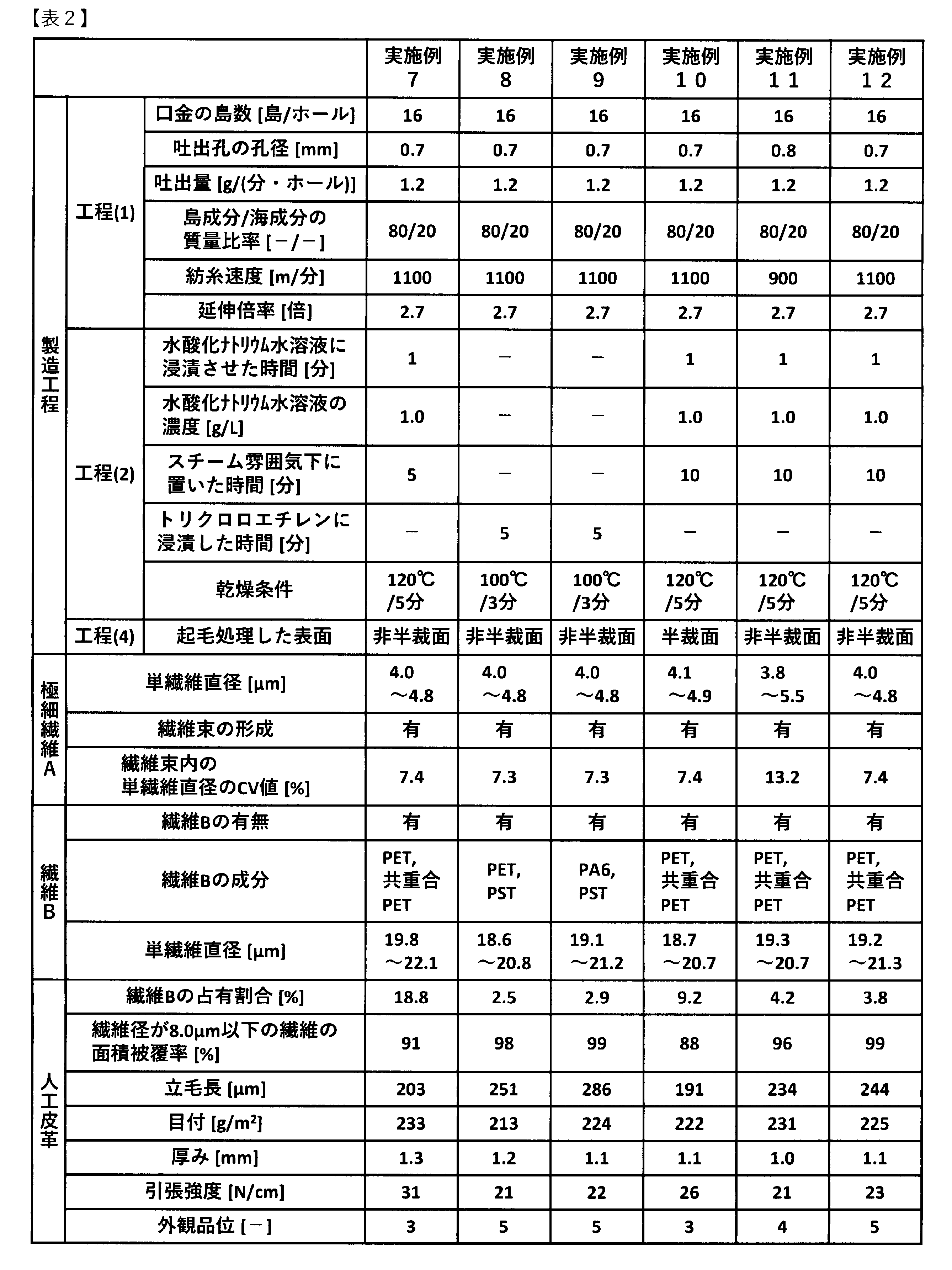
[比較例1]
実施例1の<(1)極細繊維発現型繊維絡合体を形成する工程>において、島数が16島/ホール、吐出孔の孔径が0.7mmの海島型複合繊維用口金を用いていたところ、口金の島数が64島/ホール、吐出孔の孔径が0.7mmの海島型複合繊維用口金に変えたこと以外は、実施例1と同様にして人工皮革を得た。結果を表3に示す。極細繊維Aの繊維径を小さくした場合、繊維絡合体の強力が低くなることから、得られる人工皮革は引張強度に劣るものとなった。
実施例1の<(1)極細繊維発現型繊維絡合体を形成する工程>において、島数が16島/ホール、吐出孔の孔径が0.7mmの海島型複合繊維用口金を用いていたところ、口金の島数が64島/ホール、吐出孔の孔径が0.7mmの海島型複合繊維用口金に変えたこと以外は、実施例1と同様にして人工皮革を得た。結果を表3に示す。極細繊維Aの繊維径を小さくした場合、繊維絡合体の強力が低くなることから、得られる人工皮革は引張強度に劣るものとなった。
[比較例2]
実施例1の<(1)極細繊維発現型繊維絡合体を形成する工程>において、島数が16島/ホール、吐出孔の孔径が0.7mmの海島型複合繊維用口金を用いており、延伸倍率が2.7倍であったところ、口金の島数が8島/ホール、吐出孔の孔径が0.7mmの海島型複合繊維用口金を用いて、延伸倍率を2.5倍に変えたこと以外は、実施例1と同様にして人工皮革を得た。結果を表3に示す。極細繊維Aの繊維径を大きくした場合、表面を被覆する繊維の繊維径が大きくなるため、得られる人工皮革は外観品位に劣るものとなった。
実施例1の<(1)極細繊維発現型繊維絡合体を形成する工程>において、島数が16島/ホール、吐出孔の孔径が0.7mmの海島型複合繊維用口金を用いており、延伸倍率が2.7倍であったところ、口金の島数が8島/ホール、吐出孔の孔径が0.7mmの海島型複合繊維用口金を用いて、延伸倍率を2.5倍に変えたこと以外は、実施例1と同様にして人工皮革を得た。結果を表3に示す。極細繊維Aの繊維径を大きくした場合、表面を被覆する繊維の繊維径が大きくなるため、得られる人工皮革は外観品位に劣るものとなった。
[比較例3]
実施例1の<(1)極細繊維発現型繊維絡合体を形成する工程>において、吐出量が1.2g/(分・ホール)、島成分/海成分の質量比率が80/20であったところ、吐出量が1.0g/(分・ホール)であり、島成分/海成分の質量比率が95/5に変えたこと以外は、実施例1と同様にして人工皮革を得た。結果を表3に示す。繊維Bの繊維径を小さくした場合、繊維絡合体の強力が低くなることから、得られる人工皮革は引張強度に劣るものとなった。
実施例1の<(1)極細繊維発現型繊維絡合体を形成する工程>において、吐出量が1.2g/(分・ホール)、島成分/海成分の質量比率が80/20であったところ、吐出量が1.0g/(分・ホール)であり、島成分/海成分の質量比率が95/5に変えたこと以外は、実施例1と同様にして人工皮革を得た。結果を表3に示す。繊維Bの繊維径を小さくした場合、繊維絡合体の強力が低くなることから、得られる人工皮革は引張強度に劣るものとなった。
[比較例4]
実施例1の<(1)極細繊維発現型繊維絡合体を形成する工程>において、吐出量が1.2g/(分・ホール)、島成分/海成分の質量比率が80/20であったところ、吐出量が3.0g/(分・ホール)であり、島成分/海成分の質量比率が30/70に変えたこと以外は、実施例1と同様にして人工皮革を得た。結果を表3に示す。繊維Bの繊維径を大きくした場合、表面に露出する繊維Bの面積が大きくなるため、得られる人工皮革は外観品位に劣るものとなった。
実施例1の<(1)極細繊維発現型繊維絡合体を形成する工程>において、吐出量が1.2g/(分・ホール)、島成分/海成分の質量比率が80/20であったところ、吐出量が3.0g/(分・ホール)であり、島成分/海成分の質量比率が30/70に変えたこと以外は、実施例1と同様にして人工皮革を得た。結果を表3に示す。繊維Bの繊維径を大きくした場合、表面に露出する繊維Bの面積が大きくなるため、得られる人工皮革は外観品位に劣るものとなった。
[比較例5]
実施例1の<(2)極細繊維Aと繊維Bとを含む不織布を構成要素として含む繊維絡合体を形成する工程>において、PVA付きシートを、スチーム雰囲気下においた時間が10分間であったところ、25分間に変えたこと以外は、実施例1と同様にして人工皮革を得た。結果を表3に示す。断面における繊維Bの占有割合を低くした場合、繊維絡合体の強力が低くなることから、得られる人工皮革は引張強度に劣るものとなった。
実施例1の<(2)極細繊維Aと繊維Bとを含む不織布を構成要素として含む繊維絡合体を形成する工程>において、PVA付きシートを、スチーム雰囲気下においた時間が10分間であったところ、25分間に変えたこと以外は、実施例1と同様にして人工皮革を得た。結果を表3に示す。断面における繊維Bの占有割合を低くした場合、繊維絡合体の強力が低くなることから、得られる人工皮革は引張強度に劣るものとなった。
[比較例6]
実施例1の<(2)極細繊維Aと繊維Bとを含む不織布を構成要素として含む繊維絡合体を形成する工程>において、PVA付きシートを、スチーム雰囲気下においた時間が10分間であったところ、2分間に変えたこと以外は、実施例1と同様にして人工皮革を得た。結果を表3に示す。断面における繊維Bの占有割合を高くした場合、全体に占める繊維Bの割合が増加し、結果表面に露出する繊維Bの割合が増加するため、得られる人工皮革は外観品位に劣るものとなった。
実施例1の<(2)極細繊維Aと繊維Bとを含む不織布を構成要素として含む繊維絡合体を形成する工程>において、PVA付きシートを、スチーム雰囲気下においた時間が10分間であったところ、2分間に変えたこと以外は、実施例1と同様にして人工皮革を得た。結果を表3に示す。断面における繊維Bの占有割合を高くした場合、全体に占める繊維Bの割合が増加し、結果表面に露出する繊維Bの割合が増加するため、得られる人工皮革は外観品位に劣るものとなった。
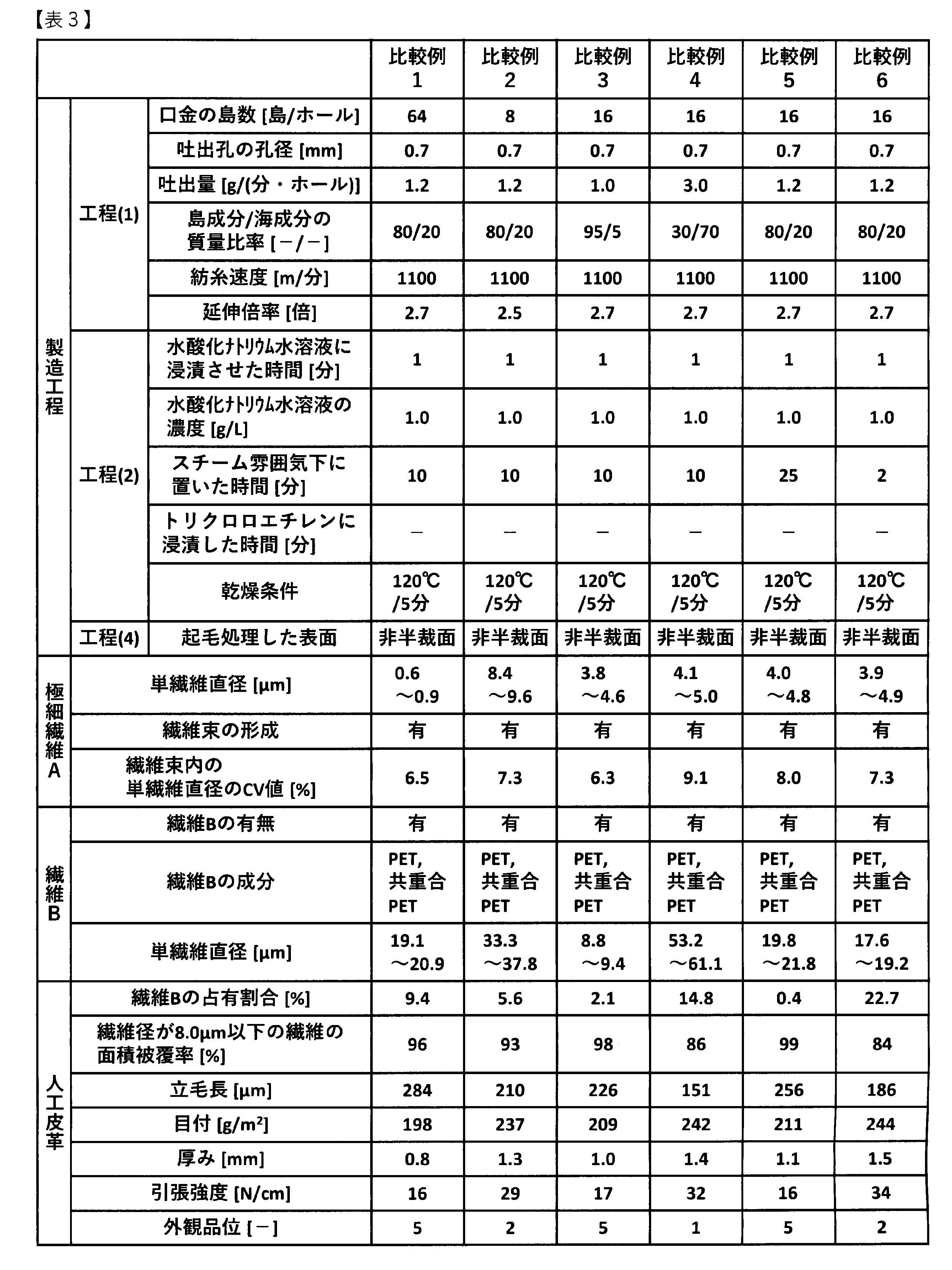
[比較例7]
実施例1の<(2)極細繊維Aと繊維Bとを含む不織布を構成要素として含む繊維絡合体を形成する工程>において、PVA付きシートを、濃度1.0g/Lの水酸化ナトリウム水溶液に浸漬していたところ、濃度4.0g/Lの水酸化ナトリウム水溶液に浸漬することに変えたこと以外は、実施例1と同様にして人工皮革を得た。結果を表4に示す。繊維Bが存在しない場合、繊維絡合体の強力が低くなることから、得られる人工皮革は引張強度に劣るものとなった。
実施例1の<(2)極細繊維Aと繊維Bとを含む不織布を構成要素として含む繊維絡合体を形成する工程>において、PVA付きシートを、濃度1.0g/Lの水酸化ナトリウム水溶液に浸漬していたところ、濃度4.0g/Lの水酸化ナトリウム水溶液に浸漬することに変えたこと以外は、実施例1と同様にして人工皮革を得た。結果を表4に示す。繊維Bが存在しない場合、繊維絡合体の強力が低くなることから、得られる人工皮革は引張強度に劣るものとなった。
[比較例8]
実施例1において、<(2)極細繊維Aと繊維Bとを含む不織布を構成要素として含む繊維絡合体を形成する工程>を行わない以外は、実施例1と同様にして人工皮革を得た。結果を表4に示す。極細繊維Aが存在しない場合、表面に露出する繊維の繊維径が大きくなるため、得られる人工皮革は外観品位の劣るものとなった。
実施例1において、<(2)極細繊維Aと繊維Bとを含む不織布を構成要素として含む繊維絡合体を形成する工程>を行わない以外は、実施例1と同様にして人工皮革を得た。結果を表4に示す。極細繊維Aが存在しない場合、表面に露出する繊維の繊維径が大きくなるため、得られる人工皮革は外観品位の劣るものとなった。
[比較例9] 実施例1の<(1)極細繊維発現型繊維絡合体を形成する工程>を以下の<(1’)極細繊維発現型繊維絡合体を形成する工程>のとおりとした。また<(2)極細繊維Aと繊維Bとを含む不織布を構成要素として含む繊維絡合体を形成する工程>において、PVA付きシートを、スチーム雰囲気下においた時間が10分間であったところ、30分間に変えた。これらのこと以外は、実施例1と同様にして人工皮革を得た。このとき、極細繊維Aの他に、単繊維直径が18.7μm~20.7μmのポリエチレンテレフタレート繊維を確認した(ただし、これは1種の熱可塑性樹脂で構成されているため、繊維Bではない)。結果を表4に示す。なお、本比較例のみ、表4において「繊維B」とあるところは、「単繊維直径が10.0μm以上50.0μm以下の繊維」と読み替えることとし、該当箇所に※印を付した。
繊維径の異なる繊維を混綿させる場合、表面に露出する繊維径の大きな繊維の割合が増加するため、得られる人工皮革は外観品位に劣るものとなった。
<(1’)極細繊維発現型繊維絡合体を形成する工程>
まず、島成分と海成分とからなる第1の海島型複合繊維を、以下の条件で溶融紡糸した。
・島成分: 固有粘度(IV値)が0.73のポリエチレンテレフタレートA(PET)
・海成分: 5-スルホイソフタル酸ナトリウムを8モル%共重合したポリエチレンテレフタレート(共重合PET)
・口金: 島数が16島/ホール、吐出孔の孔径が0.7mmの海島型複合繊維用口金
・紡糸温度: 285℃
・島成分/海成分 質量比率: 80/20
・吐出量: 1.2g/(分・ホール)
・紡糸速度: 1100m/分
次いで、150℃としたスチームボックス中で海島型複合繊維を2.7倍に延伸した。そして、前記で得られた第1の海島型複合繊維を、押し込み型捲縮機を用いて捲縮加工処理した後、51mmの長さにカットし、単繊維繊度が4.2dtexの海島型複合繊維を得た。
また、島成分と海成分とからなる第2の海島型複合繊維を、以下の条件で溶融紡糸した。
・島成分: 固有粘度(IV値)が0.73のポリエチレンテレフタレートA(PET)
・海成分: 5-スルホイソフタル酸ナトリウムを8モル%共重合したポリエチレンテレフタレート(共重合PET)
・口金: 島数が8島/ホール、吐出孔の孔径が0.7mmの海島型複合繊維用口金
・紡糸温度: 285℃
・島成分/海成分 質量比率: 80/20
・吐出量: 1.5g/(分・ホール)
・紡糸速度: 1100m/分
次いで、150℃としたスチームボックス中で海島型複合繊維を2.1倍に延伸した。そして、前記で得られた第2の海島型複合繊維を、押し込み型捲縮機を用いて捲縮加工処理した後、51mmの長さにカットし、単繊維繊度が14.6dtexの海島型複合繊維を得た。
前記で得られた、カットされた第1の海島型複合繊維とカットされた第2の海島型複合繊維とを、ブレンダーにて質量比90/10となるように混綿し、海島型複合繊維原綿を形成した。
そして、上記のようにして得られた海島型複合繊維原綿を用いて、カードおよびクロスラッパーを用いて積層繊維ウェブ(不織布)を形成し、ニードルパンチを施して極細繊維発現型繊維絡合体を得た。
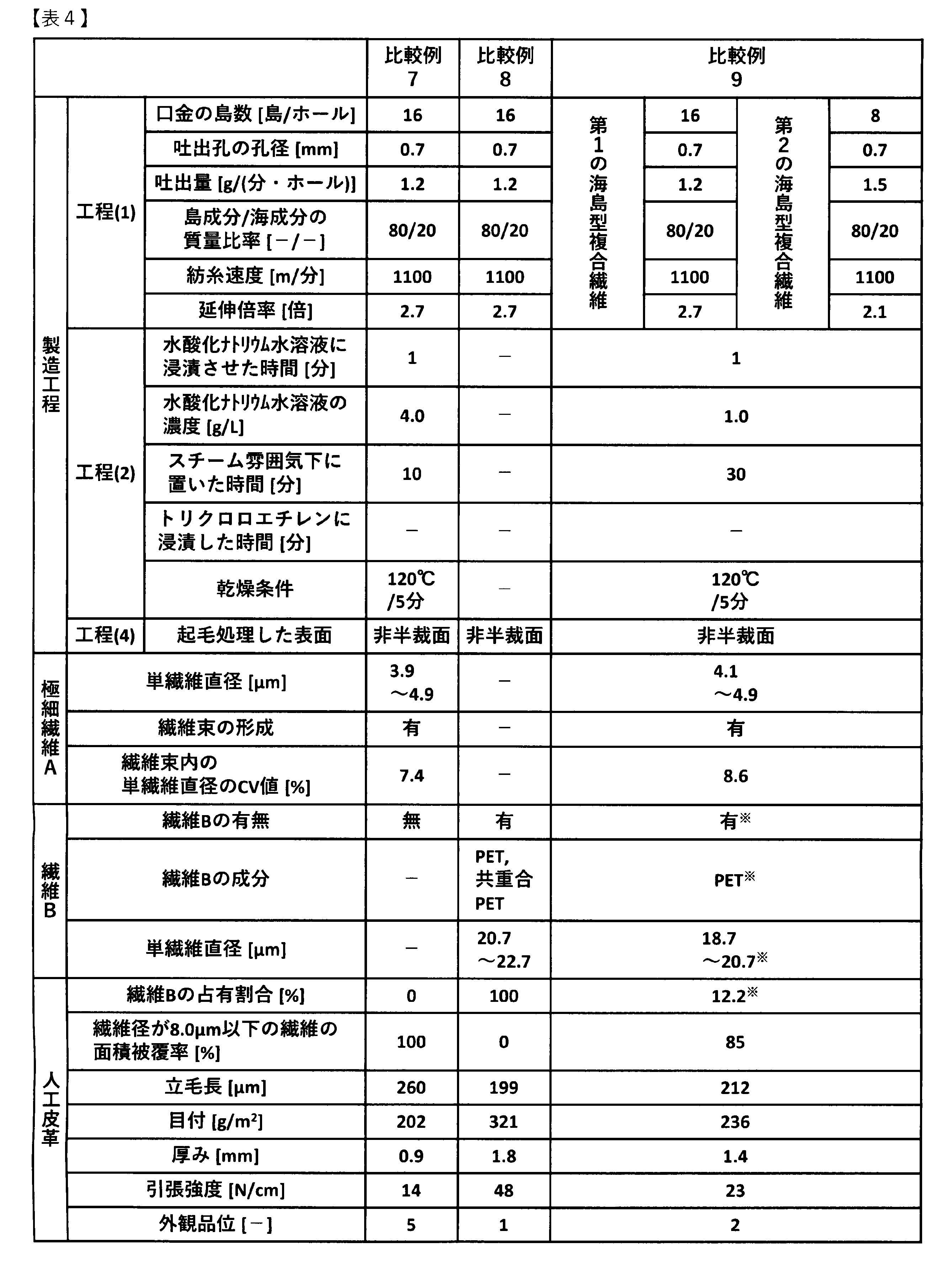
表1、表2に示すように、実施例1~11の人工皮革は、極細繊維形成時に繊度の異なる繊維を同時に形成することによって、均一な混綿状態とすることが可能であり、さらに上記の極細繊維形成処理を施す際、処理液に繊維絡合体を浸漬させた後、加熱処理を加えることにより、表面と内部で処理速度に差をつけ、表面で均一な極細繊維を形成する一方で、内部では極細繊維と太繊維とを混合することができ、優美な外観品位を有しながらも、高強度を両立させたものとなる。
1:人工皮革
2:立毛部
3:立毛部とそれ以外の部分との境界線(厚さ方向に配向する繊維と人工皮革の面方向に配向する繊維との交点を結んだ線)
4:立毛長
2:立毛部
3:立毛部とそれ以外の部分との境界線(厚さ方向に配向する繊維と人工皮革の面方向に配向する繊維との交点を結んだ線)
4:立毛長
Claims (5)
- 不織布を構成要素として含む繊維絡合体と、高分子弾性体とを有する人工皮革であって、
前記不織布は、
単繊維直径が1.0μm以上8.0μm以下の極細繊維Aと、
単繊維直径が10.0μm以上50.0μm以下の繊維Bと、を含み、
前記繊維Bは、少なくとも2種の熱可塑性樹脂で構成されてなり、
前記人工皮革の少なくとも一方の表面は立毛を有する表面であって、
前記人工皮革の断面における繊維Bの占有割合が1%以上20%以下である、
人工皮革。 - 前記立毛を有する表面において、繊維径が8.0μm以下の繊維の面積被覆率が90%以上100%以下である、請求項1に記載の人工皮革。
- 前記極細繊維Aが繊維束を形成してなり、該繊維束内の単繊維直径のCV値が0.0%以上10.0%以下である、請求項1または2に記載の人工皮革。
- (1)極細繊維発現型繊維で構成されてなる不織布を構成要素として含む繊維絡合体を形成する工程、
(2)前記繊維絡合体をアルカリ水溶液に浸漬させた後90℃以上100℃以下のスチーム雰囲気下において5分以上20分以下加熱すること、もしくは、前記繊維絡合体を有機溶剤に3分以上5分以下浸漬することで、前記繊維絡合体に、1.0μm以上8.0μm以下の極細繊維Aと、少なくとも2種の熱可塑性樹脂で構成されてなり、かつ、単繊維直径が10.0μm以上50.0μm以下の繊維Bと、を発現せしめる工程、
(3)前記極細繊維Aおよび前記繊維Bが発現した前記繊維絡合体に高分子弾性体を付与することで、高分子弾性体付与シートを形成する工程、および
(4)前記高分子弾性体付与シートの少なくとも一方の表面に対して起毛処理を行うことで、表面に立毛を有する立毛シートを形成する工程
を含む、人工皮革の製造方法。 - (1)極細繊維発現型繊維で構成されてなる不織布を構成要素として含む繊維絡合体を形成する工程、
(2)前記繊維絡合体に高分子弾性体を付与することで、高分子弾性体付与シートを形成する工程、
(3)前記高分子弾性体付与シートをアルカリ水溶液に浸漬させた後90℃以上100℃以下のスチーム雰囲気下において5分以上20分以下加熱すること、もしくは、前記高分子弾性体付与シートを有機溶剤に3分以上5分以下浸漬することで、前記高分子弾性体付与シートに、1.0μm以上8.0μm以下の極細繊維Aと、少なくとも2種の熱可塑性樹脂で構成されてなり、かつ、単繊維直径が10.0μm以上50.0μm以下の繊維Bと、を発現せしめる工程、
(4)前記極細繊維Aおよび前記繊維Bが発現した前記高分子弾性体付与シートの少なくとも一方の表面に対して起毛処理を行うことで、表面に立毛を有する立毛シートを形成する工程
を含む、人工皮革の製造方法。
Priority Applications (1)
| Application Number | Priority Date | Filing Date | Title |
|---|---|---|---|
| JP2023558752A JPWO2024070649A1 (ja) | 2022-09-28 | 2023-09-12 |
Applications Claiming Priority (2)
| Application Number | Priority Date | Filing Date | Title |
|---|---|---|---|
| JP2022-154558 | 2022-09-28 | ||
| JP2022154558 | 2022-09-28 |
Publications (1)
| Publication Number | Publication Date |
|---|---|
| WO2024070649A1 true WO2024070649A1 (ja) | 2024-04-04 |
Family
ID=90477538
Family Applications (1)
| Application Number | Title | Priority Date | Filing Date |
|---|---|---|---|
| PCT/JP2023/033136 Ceased WO2024070649A1 (ja) | 2022-09-28 | 2023-09-12 | 人工皮革 |
Country Status (2)
| Country | Link |
|---|---|
| JP (1) | JPWO2024070649A1 (ja) |
| WO (1) | WO2024070649A1 (ja) |
Citations (6)
| Publication number | Priority date | Publication date | Assignee | Title |
|---|---|---|---|---|
| JPH11269775A (ja) * | 1998-03-18 | 1999-10-05 | Kuraray Co Ltd | スエード調人工皮革およびその製造法 |
| JP2007177382A (ja) * | 2005-11-30 | 2007-07-12 | Toray Ind Inc | 皮革様シート状物、その製造方法、並びにそれを用いてなる内装材、衣料用資材及び工業用資材 |
| JP2008285807A (ja) * | 2006-01-26 | 2008-11-27 | Toray Ind Inc | 皮革様シート状物の製造方法 |
| JP2008297673A (ja) * | 2007-06-01 | 2008-12-11 | Kuraray Co Ltd | 長繊維不織布および人工皮革用基材の製造方法 |
| JP2014019983A (ja) * | 2012-07-20 | 2014-02-03 | Toray Ind Inc | シート状物およびその製造方法 |
| WO2021085427A1 (ja) * | 2019-10-30 | 2021-05-06 | 旭化成株式会社 | 人工皮革及びその製法 |
-
2023
- 2023-09-12 WO PCT/JP2023/033136 patent/WO2024070649A1/ja not_active Ceased
- 2023-09-12 JP JP2023558752A patent/JPWO2024070649A1/ja active Pending
Patent Citations (6)
| Publication number | Priority date | Publication date | Assignee | Title |
|---|---|---|---|---|
| JPH11269775A (ja) * | 1998-03-18 | 1999-10-05 | Kuraray Co Ltd | スエード調人工皮革およびその製造法 |
| JP2007177382A (ja) * | 2005-11-30 | 2007-07-12 | Toray Ind Inc | 皮革様シート状物、その製造方法、並びにそれを用いてなる内装材、衣料用資材及び工業用資材 |
| JP2008285807A (ja) * | 2006-01-26 | 2008-11-27 | Toray Ind Inc | 皮革様シート状物の製造方法 |
| JP2008297673A (ja) * | 2007-06-01 | 2008-12-11 | Kuraray Co Ltd | 長繊維不織布および人工皮革用基材の製造方法 |
| JP2014019983A (ja) * | 2012-07-20 | 2014-02-03 | Toray Ind Inc | シート状物およびその製造方法 |
| WO2021085427A1 (ja) * | 2019-10-30 | 2021-05-06 | 旭化成株式会社 | 人工皮革及びその製法 |
Also Published As
| Publication number | Publication date |
|---|---|
| JPWO2024070649A1 (ja) | 2024-04-04 |
Similar Documents
| Publication | Publication Date | Title |
|---|---|---|
| JP6733673B2 (ja) | 皮革様布帛 | |
| EP3816343B1 (en) | Artificial leather and production method therefor | |
| EP3816342B1 (en) | Artificial leather and production method therefor | |
| EP3128071B1 (en) | Artificial leather | |
| WO2020054256A1 (ja) | 人工皮革、及び、その製造方法 | |
| KR102903335B1 (ko) | 인공 피혁 및 그 제법 | |
| CN113597485B (zh) | 片状物 | |
| JP7819313B2 (ja) | 人工皮革及びその製法 | |
| JP6838602B2 (ja) | シート状物およびその製造方法 | |
| JP2024052600A (ja) | 人工皮革 | |
| EP3187655B1 (en) | Sheet material and manufacturing method thereof | |
| JP7567300B2 (ja) | 人工皮革 | |
| TW202016394A (zh) | 片狀物 | |
| JP2024099270A (ja) | 人工皮革及びその製法 | |
| JP2022140326A (ja) | 人工皮革 | |
| JP2024129273A (ja) | 人工皮革およびその製造方法 | |
| JP7631708B2 (ja) | 人工皮革およびその製造方法 | |
| JP2024128360A (ja) | 人工皮革およびその製造方法ならびに乗物用内装材 | |
| TW202603249A (zh) | 複合體以及包含其的交通工具用內飾材、交通工具用零件、座位 | |
| WO2024095846A1 (ja) | 人工皮革およびその製造方法 | |
| CN118679291A (zh) | 人造皮革及其制造方法、复合人造皮革 | |
| WO2023189269A1 (ja) | 人工皮革およびその製造方法、複合人工皮革 | |
| WO2024029215A1 (ja) | 人工皮革およびその製造方法、ならびに、乗物用内装材、座席 | |
| JP2024065002A (ja) | 人工皮革 | |
| WO2025070191A1 (ja) | 人工皮革およびその製造方法、乗物内装材、乗物部品、雑貨ならびに家具 |
Legal Events
| Date | Code | Title | Description |
|---|---|---|---|
| ENP | Entry into the national phase |
Ref document number: 2023558752 Country of ref document: JP Kind code of ref document: A |
|
| 121 | Ep: the epo has been informed by wipo that ep was designated in this application |
Ref document number: 23871884 Country of ref document: EP Kind code of ref document: A1 |
|
| NENP | Non-entry into the national phase |
Ref country code: DE |
|
| 122 | Ep: pct application non-entry in european phase |
Ref document number: 23871884 Country of ref document: EP Kind code of ref document: A1 |