WO2024070233A1 - 学習装置、情報処理装置、基板処理装置、基板処理システム、学習方法および処理条件決定方法 - Google Patents
学習装置、情報処理装置、基板処理装置、基板処理システム、学習方法および処理条件決定方法 Download PDFInfo
- Publication number
- WO2024070233A1 WO2024070233A1 PCT/JP2023/028655 JP2023028655W WO2024070233A1 WO 2024070233 A1 WO2024070233 A1 WO 2024070233A1 JP 2023028655 W JP2023028655 W JP 2023028655W WO 2024070233 A1 WO2024070233 A1 WO 2024070233A1
- Authority
- WO
- WIPO (PCT)
- Prior art keywords
- processing
- substrate
- learning
- coating
- conditions
- Prior art date
- Legal status (The legal status is an assumption and is not a legal conclusion. Google has not performed a legal analysis and makes no representation as to the accuracy of the status listed.)
- Ceased
Links
Images



Classifications
-
- H—ELECTRICITY
- H10—SEMICONDUCTOR DEVICES; ELECTRIC SOLID-STATE DEVICES NOT OTHERWISE PROVIDED FOR
- H10P—GENERIC PROCESSES OR APPARATUS FOR THE MANUFACTURE OR TREATMENT OF DEVICES COVERED BY CLASS H10
- H10P72/00—Handling or holding of wafers, substrates or devices during manufacture or treatment thereof
- H10P72/06—Apparatus for monitoring, sorting, marking, testing or measuring
- H10P72/0604—Process monitoring, e.g. flow or thickness monitoring
-
- G—PHYSICS
- G06—COMPUTING OR CALCULATING; COUNTING
- G06N—COMPUTING ARRANGEMENTS BASED ON SPECIFIC COMPUTATIONAL MODELS
- G06N3/00—Computing arrangements based on biological models
- G06N3/02—Neural networks
- G06N3/04—Architecture, e.g. interconnection topology
- G06N3/0464—Convolutional networks [CNN, ConvNet]
-
- G—PHYSICS
- G06—COMPUTING OR CALCULATING; COUNTING
- G06N—COMPUTING ARRANGEMENTS BASED ON SPECIFIC COMPUTATIONAL MODELS
- G06N20/00—Machine learning
-
- G—PHYSICS
- G06—COMPUTING OR CALCULATING; COUNTING
- G06N—COMPUTING ARRANGEMENTS BASED ON SPECIFIC COMPUTATIONAL MODELS
- G06N3/00—Computing arrangements based on biological models
- G06N3/02—Neural networks
- G06N3/04—Architecture, e.g. interconnection topology
- G06N3/045—Combinations of networks
-
- G—PHYSICS
- G06—COMPUTING OR CALCULATING; COUNTING
- G06N—COMPUTING ARRANGEMENTS BASED ON SPECIFIC COMPUTATIONAL MODELS
- G06N3/00—Computing arrangements based on biological models
- G06N3/02—Neural networks
- G06N3/08—Learning methods
-
- H—ELECTRICITY
- H10—SEMICONDUCTOR DEVICES; ELECTRIC SOLID-STATE DEVICES NOT OTHERWISE PROVIDED FOR
- H10P—GENERIC PROCESSES OR APPARATUS FOR THE MANUFACTURE OR TREATMENT OF DEVICES COVERED BY CLASS H10
- H10P50/00—Etching of wafers, substrates or parts of devices
-
- H—ELECTRICITY
- H10—SEMICONDUCTOR DEVICES; ELECTRIC SOLID-STATE DEVICES NOT OTHERWISE PROVIDED FOR
- H10P—GENERIC PROCESSES OR APPARATUS FOR THE MANUFACTURE OR TREATMENT OF DEVICES COVERED BY CLASS H10
- H10P72/00—Handling or holding of wafers, substrates or devices during manufacture or treatment thereof
- H10P72/04—Apparatus for manufacture or treatment
- H10P72/0402—Apparatus for fluid treatment
- H10P72/0418—Apparatus for fluid treatment for etching
- H10P72/0422—Apparatus for fluid treatment for etching for wet etching
- H10P72/0424—Apparatus for fluid treatment for etching for wet etching using mainly spraying means, e.g. nozzles
Definitions
- the present invention relates to a learning device, an information processing device, a substrate processing device, a substrate processing system, a learning method, and a processing condition determination method, and to a learning device that generates a learning model that simulates processing according to processing conditions by a substrate processing device, an information processing device that determines processing conditions using the learning model, a substrate processing device equipped with the information processing device, a substrate processing system equipped with the information processing device and a learning device, a learning method executed by the learning device, and a processing condition determination method executed by the information processing device.
- Semiconductor manufacturing processes include a cleaning process.
- the thickness of the film formed on the substrate is adjusted by an etching process in which a chemical solution is supplied to the substrate.
- a chemical solution is supplied to the substrate.
- the nozzle When ejecting the etching solution from a nozzle onto part of the substrate, the nozzle must be moved radially relative to the substrate.
- Patent Document 1 describes a liquid processing device capable of etching a substrate by ejecting an etching liquid from a nozzle onto the substrate.
- Patent Document 1 describes an example in which, while etching the central region of the substrate, the etching liquid is ejected by repeatedly moving the etching nozzle back and forth between a first position on the central side where the ejected etching liquid passes through the center of the wafer, and a second position closer to the periphery of the wafer than the central position, in order to make the in-plane temperature distribution of the wafer uniform.
- Etching is a complex process in which the amount of coating processed varies depending on the movement of the nozzle. Furthermore, the amount of coating processed by the etching process is determined after the substrate is processed. For this reason, setting the movement of the nozzle requires trial and error by engineers. It takes a great deal of time and money to determine the optimal nozzle movement.
- the nozzle movement is time-series data that indicates the position that changes over time.
- the sampling interval becomes shorter, and the number of dimensions of the time-series data increases.
- the number of dimensions of the learning data increases, the amount of data required for machine learning increases exponentially. For this reason, as the number of dimensions of the learning data increases, it becomes difficult to optimize the learning model obtained by machine learning.
- etching is a complex process, there is not necessarily one nozzle movement that is suitable for the target processing volume, and there may be multiple nozzle movements.
- One of the objects of the present invention is to provide a learning device, a learning method, and a substrate processing system suitable for machine learning of conditions that change over time for processing a substrate.
- Another object of the present invention is to provide an information processing device, a substrate processing device, a substrate processing system, and a processing condition determination method that are capable of presenting multiple processing conditions for the processing results of a complex process for processing a substrate.
- a learning device includes an experimental data acquisition unit that acquires a first processing amount indicating a difference in film thickness before and after the coating processing, after the substrate processing apparatus that processes the coating by supplying a processing liquid to the substrate on which the coating is formed is operated under processing conditions including variable conditions that vary over time, and a model generation unit that machine-learns learning data including the variable conditions and the first processing amount corresponding to the processing conditions to generate a learning model that estimates a second processing amount indicating a difference in film thickness before and after the coating processing for the coating formed on the substrate before the coating processing by the substrate processing apparatus, the learning model including a first convolutional neural network.
- An information processing apparatus is an information processing apparatus that manages a substrate processing apparatus, the substrate processing apparatus processes a coating by supplying a processing liquid to a substrate on which a coating has been formed under processing conditions including variable conditions that vary over time, and includes a processing condition determination unit that determines processing conditions for driving the substrate processing apparatus using a learning model that estimates a second processing amount that indicates a difference in film thickness before and after the coating processing of the coating formed on the substrate before the coating processing by the substrate processing apparatus, the learning model includes a first convolutional neural network, and is an inference model that machine-learns learning data that includes variable conditions included in the processing conditions under which the substrate processing apparatus processed the coating and a first processing amount that indicates a difference in film thickness before and after the coating processing of the substrate that has been processed by the substrate processing apparatus, and the processing condition determination unit provides the learning model with tentative variable conditions, and when the second processing amount estimated by the learning model satisfies an allowable condition, determines the processing conditions including the tentative variable conditions as the processing conditions
- a substrate processing system is a substrate processing system that manages a substrate processing apparatus, and includes a learning device and an information processing device.
- the substrate processing apparatus processes a coating by supplying a processing liquid to a substrate on which a coating is formed under processing conditions including variable conditions that vary over time.
- the learning device includes an experimental data acquisition unit that acquires a first processing amount indicating a difference in film thickness before and after the coating processing after driving the substrate processing apparatus under the processing conditions and processing the coating formed on the substrate, and a model generation unit that machine-learns learning data including the variable conditions and the first processing amount corresponding to the processing conditions to generate a learning model that estimates a second processing amount indicating a difference in film thickness before and after the coating processing for the coating formed on the substrate before the coating processing by the substrate processing apparatus, the learning model including a first convolutional neural network, and the information processing device includes a processing condition determination unit that uses the learning model generated by the learning device to determine processing conditions for driving the substrate processing apparatus, and the processing condition determination unit provides a tentative variable condition to the learning model generated by the learning apparatus, and when the second processing amount estimated by the learning model satisfies the allowable condition, determines the processing conditions including the tentative variable condition as the processing conditions for driving the substrate processing apparatus.
- a learning method causes a computer to execute the following steps: after a substrate processing apparatus that processes a coating by supplying a processing liquid to a substrate on which a coating has been formed is operated under processing conditions including variable conditions that vary over time to process the coating, a first processing amount indicating a difference in film thickness before and after the coating processing is performed; and, after machine learning of learning data including the variable conditions and the first processing amount corresponding to the processing conditions, a learning model is generated that estimates a second processing amount indicating a difference in film thickness before and after the coating processing for a coating formed on a substrate before the coating processing is performed by the substrate processing apparatus, the learning model including a first convolutional neural network.
- a processing condition determination method is a processing condition determination method executed by a computer that manages a substrate processing apparatus, in which the substrate processing apparatus processes a coating by supplying a processing liquid to a substrate on which a coating has been formed under processing conditions including variable conditions that vary over time, and includes a process of determining processing conditions for driving the substrate processing apparatus using a learning model that estimates a second processing amount indicating a difference in film thickness before and after the coating processing for a coating formed on a substrate before the coating processing by the substrate processing apparatus, the learning model including a first convolutional neural network, is an inference model that machine-learns learning data including variable conditions included in the processing conditions under which the substrate processing apparatus processed the coating and a first processing amount indicating a difference in film thickness before and after the coating processing on a substrate that has been processed by the substrate processing apparatus, and the process of determining processing conditions includes a process of providing tentative variable conditions to the learning model, and determining the processing conditions including the tentative variable conditions as processing conditions for driving the substrate processing
- FIG. 1 is a diagram for explaining the configuration of a substrate processing system according to an embodiment of the present invention.
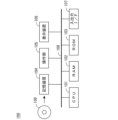
- FIG. 2 is a diagram illustrating an example of the configuration of an information processing device.
- FIG. 3 is a diagram illustrating an example of the configuration of a learning device.
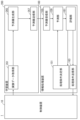
- FIG. 4 is a diagram showing an example of a functional configuration of the substrate processing system.
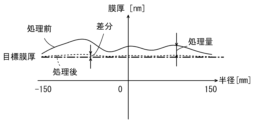
- FIG. 5 is a diagram showing an example of film thickness characteristics.
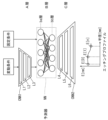
- FIG. 6 is a diagram for explaining the learning model.
- FIG. 7 is a flowchart showing an example of the flow of the learning process.
- FIG. 8 is a flowchart showing an example of the flow of the processing condition determination process.
- FIG. 9 is a flowchart showing an example of the flow of the additional learning process.
- FIG. 10 is a first diagram for explaining a learning model according to another embodiment.
- FIG. 11 is a second diagram for explaining the learning model according to another embodiment.
- substrate refers to a semiconductor substrate (semiconductor wafer), a substrate for an FPD (Flat Panel Display) such as a liquid crystal display device or an organic EL (Electro Luminescence) display device, a substrate for an optical disk, a substrate for a magnetic disk, a substrate for a magneto-optical disk, a substrate for a photomask, a ceramic substrate, or a substrate for a solar cell, etc.
- FPD Fluor Panel Display
- an organic EL Electro Luminescence
- the substrate processing system 1 in Fig. 1 includes an information processing device 100, a learning device 200, and a substrate processing device 300.
- the learning device 200 is, for example, a server
- the information processing device 100 is, for example, a personal computer.
- the learning device 200 and the information processing device 100 are used to manage the substrate processing device 300.
- the number of substrate processing devices 300 managed by the learning device 200 and the information processing device 100 is not limited to one, and multiple substrate processing devices 300 may be managed.
- the information processing device 100, the learning device 200, and the substrate processing device 300 are connected to each other by a wired or wireless communication line or a communication line network.
- the information processing device 100, the learning device 200, and the substrate processing device 300 are each connected to a network and can transmit and receive data to and from each other.
- the network may be, for example, a local area network (LAN) or a wide area network (WAN).
- the network may also be the Internet.
- the information processing device 100 and the substrate processing device 300 may also be connected by a dedicated communication line network.
- the network may be connected in a wired or wireless manner.
- the learning device 200 does not necessarily need to be connected to the substrate processing device 300 and the information processing device 100 via a communication line or a communication network.
- data generated by the substrate processing device 300 may be passed to the learning device 200 via a recording medium.
- data generated by the learning device 200 may be passed to the information processing device 100 via a recording medium.
- the substrate processing apparatus 300 is provided with a display device, an audio output device, and an operation unit, none of which are shown.
- the substrate processing apparatus 300 is operated according to the processing conditions (processing recipe) that are predetermined for the substrate processing apparatus 300.
- the substrate processing apparatus 300 includes a control device 10 and a plurality of substrate processing units WU.
- the control device 10 controls the plurality of substrate processing units WU.
- the plurality of substrate processing units WU processes the substrate by supplying a processing liquid to the substrate W on which a coating film is formed.
- the processing liquid includes an etching liquid, and the substrate processing units WU perform an etching process.
- the etching liquid is a chemical liquid.
- the etching liquid is, for example, hydrofluoric nitric acid (a mixture of hydrofluoric acid (HF) and nitric acid (HNO3)), hydrofluoric acid, buffered hydrofluoric acid (BHF), ammonium fluoride, HFEG (a mixture of hydrofluoric acid and ethylene glycol), or phosphoric acid (H3PO4).
- hydrofluoric nitric acid a mixture of hydrofluoric acid (HF) and nitric acid (HNO3)
- hydrofluoric acid hydrofluoric acid
- BHF buffered hydrofluoric acid
- ammonium fluoride HFEG (a mixture of hydrofluoric acid and ethylene glycol)
- HFEG a mixture of hydrofluoric acid and ethylene glycol
- H3PO4 phosphoric acid
- the substrate processing unit WU includes a spin chuck SC, a spin motor SM, a nozzle 311, and a nozzle moving mechanism 301.
- the spin chuck SC holds the substrate W horizontally.
- the spin motor SM has a first rotation axis AX1.
- the first rotation axis AX1 extends in the vertical direction.
- the spin chuck SC is attached to the upper end of the first rotation axis AX1 of the spin motor SM.
- the spin motor SM rotates, the spin chuck SC rotates around the first rotation axis AX1.
- the spin motor SM is a stepping motor.
- the substrate W held by the spin chuck SC rotates around the first rotation axis AX1. Therefore, the rotation speed of the substrate W is the same as the rotation speed of the stepping motor.
- the rotation speed of the substrate W may be obtained from the rotation speed signal generated by the encoder.
- the spin motor may be a motor other than a stepping motor.
- the nozzle 311 supplies the etching liquid to the substrate W.
- the nozzle 311 receives the etching liquid from an etching liquid supply unit (not shown) and ejects the etching liquid toward the rotating substrate W.
- the nozzle movement mechanism 301 moves the nozzle 311 in a substantially horizontal direction.
- the nozzle movement mechanism 301 has a nozzle motor 303 having a second rotation axis AX2, and a nozzle arm 305.
- the nozzle motor 303 is arranged so that the second rotation axis AX2 is aligned in a substantially vertical direction.
- the nozzle arm 305 has a longitudinal shape that extends in a straight line.
- One end of the nozzle arm 305 is attached to the upper end of the second rotation axis AX2 so that the longitudinal direction of the nozzle arm 305 is in a different direction from the second rotation axis AX2.
- the nozzle 311 is attached to the other end of the nozzle arm 305 so that its outlet faces downward.
- the nozzle arm 305 rotates in a horizontal plane around the second rotation axis AX2. This causes the nozzle 311 attached to the other end of the nozzle arm 305 to move (pivot) horizontally around the second rotation axis AX2. While moving horizontally, the nozzle 311 ejects the etching liquid towards the substrate W.
- the nozzle motor 303 is, for example, a stepping motor.
- the control device 10 includes a CPU (central processing unit) and memory, and the CPU executes a program stored in the memory to control the entire substrate processing device 300.
- the control device 10 controls the spin motor SM and the nozzle motor 303.
- the learning device 200 receives experimental data from the substrate processing device 300, uses the experimental data to machine-learn a learning model, and outputs the learned learning model to the information processing device 100.
- the information processing device 100 uses the trained learning model to determine the processing conditions for processing the substrates that the substrate processing device 300 is going to process.
- the information processing device 100 outputs the determined processing conditions to the substrate processing device 300.
- FIG. 2 is a diagram showing an example of the configuration of an information processing device.
- the information processing device 100 is composed of a CPU 101, a RAM (random access memory) 102, a ROM (read only memory) 103, a storage device 104, an operation unit 105, a display device 106, and an input/output I/F (interface) 107.
- the CPU 101, RAM 102, ROM 103, storage device 104, operation unit 105, display device 106, and input/output I/F 107 are connected to a bus 108.
- RAM 102 is used as a working area for CPU 101.
- ROM 103 stores system programs.
- Storage device 104 includes a storage medium such as a hard disk or semiconductor memory, and stores programs. The programs may be stored in ROM 103 or other external storage devices.
- the CD-ROM 109 is detachably attached to the storage device 104.
- the recording medium for storing the program executed by the CPU 101 is not limited to the CD-ROM 109, but may be an optical disk (MO (Magnetic Optical Disc)/MD (Mini Disc)/DVD (Digital Versatile Disc)), IC card, optical card, mask ROM, EPROM (Erasable Programmable ROM), or other semiconductor memory medium.
- the CPU 101 may download a program from a computer connected to the network and store it in the storage device 104, or the computer connected to the network may write a program to the storage device 104, and the program stored in the storage device 104 may be loaded into the RAM 102 and executed by the CPU 101.
- the program here includes not only programs that can be executed directly by the CPU 101, but also source programs, compressed programs, encrypted programs, etc.
- the operation unit 105 is an input device such as a keyboard, a mouse, or a touch panel. A user can give specific instructions to the information processing device 100 by operating the operation unit 105.
- the display device 106 is a display device such as a liquid crystal display device, and displays a GUI (Graphical User Interface) for receiving instructions from the user.
- the input/output I/F 107 is connected to a network.
- FIG. 3 is a diagram showing an example of the configuration of a learning device.
- the learning device 200 is composed of a CPU 201, a RAM 202, a ROM 203, a storage device 204, an operation unit 205, a display device 206, and an input/output I/F 207.
- the CPU 201, the RAM 202, the ROM 203, the storage device 204, the operation unit 205, the display device 206, and the input/output I/F 207 are connected to a bus 208.
- RAM 202 is used as a working area for CPU 201.
- ROM 203 stores system programs.
- Storage device 204 includes a storage medium such as a hard disk or semiconductor memory, and stores programs. The programs may be stored in ROM 203 or other external storage devices.
- a CD-ROM 209 is detachably attached to storage device 204.
- the operation unit 205 is an input device such as a keyboard, mouse, or touch panel.
- the input/output I/F 207 is connected to a network.
- Fig. 4 is a diagram showing an example of the functional configuration of the substrate processing system.
- the control device 10 included in the substrate processing apparatus 300 controls the substrate processing unit WU to process the substrate W in accordance with the processing conditions.
- the processing conditions are conditions for processing the substrate W for a predetermined processing time.
- the processing time is a time determined for processing the substrate. In this embodiment, the processing time is the time during which the nozzle 311 ejects the etching liquid onto the substrate W.
- the processing conditions include the temperature of the etching solution, the concentration of the etching solution, the flow rate of the etching solution, the rotation speed of the substrate W, and the relative position of the nozzle 311 and the substrate W.
- the processing conditions include variable conditions that change over time.
- the variable condition is the relative position of the nozzle 311 and the substrate W.
- the relative position is indicated by the rotation angle of the nozzle motor 303.
- the processing conditions include fixed conditions that do not change over time. In this embodiment, the fixed conditions are the temperature of the etching solution, the concentration of the etching solution, the flow rate of the etching solution, and the rotation speed of the substrate W.
- the learning device 200 trains the learning model with the learning data to generate an inference model that predicts the etching profile from the processing conditions.
- the inference model generated by the learning device 200 is referred to as a predictor.
- the learning device 200 includes an experimental data acquisition unit 261, a predictor generation unit 265, and a predictor transmission unit 267.
- the functions of the learning device 200 are realized by the CPU 201 of the learning device 200 as the CPU 201 executes a learning program stored in the RAM 202.
- the experimental data acquisition unit 261 acquires experimental data from the substrate processing apparatus 300.
- the experimental data includes the processing conditions used when the substrate processing apparatus 300 actually processes the substrate W, and the film thickness characteristics before and after processing of the coating formed on the substrate W.
- the film thickness characteristics are represented by the film thickness of the coating formed on the substrate W at each of a number of different positions in the radial direction of the substrate W.
- FIG. 5 is a diagram showing an example of film thickness characteristics.
- the horizontal axis indicates the radial position of the substrate, and the vertical axis indicates the film thickness.
- the origin of the horizontal axis indicates the center of the substrate.
- the solid line indicates the film thickness of the film formed on the substrate W before it is processed by the substrate processing apparatus 300.
- the substrate processing apparatus 300 performs a process of supplying an etching solution according to processing conditions, thereby adjusting the film thickness of the film formed on the substrate W.
- the dotted line indicates the film thickness of the film formed on the substrate W after it has been processed by the substrate processing apparatus 300.
- the difference between the thickness of the coating formed on the substrate W before processing by the substrate processing apparatus 300 and the thickness of the coating formed on the substrate W after processing by the substrate processing apparatus 300 is the processing amount (etching amount).
- the processing amount indicates the thickness of the film reduced by the processing of supplying an etching solution by the substrate processing apparatus 300.
- the radial distribution of the processing amount is called the etching profile.
- the etching profile is indicated by the processing amount at each of multiple different positions in the radial direction of the substrate W.
- the film thickness formed by the substrate processing apparatus 300 be uniform over the entire surface of the substrate W.
- a target film thickness is set for the processing performed by the substrate processing apparatus 300.
- the target film thickness is indicated by a dashed dotted line.
- the deviation characteristic is the difference between the film thickness of the film formed on the substrate W after processing by the substrate processing apparatus 300 and the target film thickness.
- the deviation characteristic includes the difference at each of multiple positions in the radial direction of the substrate W.
- the predictor generation unit 265 receives experimental data from the experimental data acquisition unit 261.
- the predictor generation unit 265 generates a predictor by performing supervised learning using the learning data in the neural network.
- the learning data includes input data and correct answer data.
- the input data includes variable conditions included in the processing conditions of the experimental data and fixed conditions other than the variable conditions of the processing conditions included in the experimental data.
- the correct answer data includes an etching profile.
- the etching profile is the difference between the film thickness characteristics of the coating before processing included in the experimental data and the film thickness characteristics of the coating after processing included in the experimental data.
- the etching profile included in the correct answer data is an example of a first processing amount.
- the predictor generation unit 265 inputs the input data into a learning model that is the basis of the predictor, and determines the parameters of the learning model so that the difference between the output of the learning model and the correct answer data is small.
- the predictor generation unit 265 generates a learned model that incorporates the parameters set in the learned learning model as a predictor.
- the predictor is an inference program that incorporates the parameters set in the learned model.
- the predictor generation unit 265 transmits the predictor to the information processing device 100.
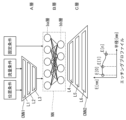
- FIG. 6 is a diagram explaining the learning model.
- layers A to C are arranged in this order from the input side to the output side (from upper layer to lower layer).
- Layer A is provided with a first convolutional neural network CNN1
- layer B is provided with a fully connected neural network NN
- layer C is provided with a second convolutional neural network CNN2.
- variable conditions are input to the first convolutional neural network CNN1.
- the output of the first convolutional neural network CNN1 and the fixed conditions are input to the fully connected neural network NN.
- the output of the fully connected neural network NN is input to the second convolutional neural network CNN2.
- the first convolutional neural network CNN1 includes multiple layers.
- the first convolutional neural network CNN1 includes three layers.
- a first layer L1, a second layer L2, and a third layer L3 are provided in this order from the input side (upper layer side) to the output side (lower layer side). Note that, in this embodiment, a case in which three layers are included as multiple layers will be described, but three or more layers may be included.
- Each of the first layer L1, the second layer L2, and the third layer L3 includes a convolution layer and a pooling layer.
- the convolution layer has multiple filters. In the convolution layer, multiple filters are applied.
- the pooling layer compresses the output of the convolution layer.
- the number of filters in the convolution layer of the second layer L2 is set to twice the number of filters in the convolution layer of the first layer L1.
- the number of filters in the convolution layer of the third layer L3 is set to twice the number of filters in the convolution layer of the second layer L2. This makes it possible to extract as many features as possible from the variation conditions.
- the variation conditions include the relative position of the nozzle with respect to the substrate W, which varies over time.
- the first convolutional neural network CNN1 extracts features using multiple filters, and therefore extracts more features that include a time element regarding the change in the relative position of the nozzle with respect to the substrate W.
- the number of filters in the convolutional layer of the second layer L2 is set to twice the number of filters in the convolutional layer of the first layer L1, it does not have to be twice as many.
- the number of filters in the convolutional layer of the second layer L2 only needs to be greater than the number of filters in the convolutional layer of the first layer L1.
- the number of filters in the convolutional layer of the third layer L3 does not have to be twice as many as the number of filters in the convolutional layer of the second layer L2.
- the number of filters in the convolutional layer of the third layer L3 only needs to be greater than the number of filters in the convolutional layer of the second layer L2.
- the fully connected neural network NN has multiple layers.
- the fully connected neural network NN has two layers, a ba layer on the input side and a bb layer on the output side.
- each layer includes multiple nodes.
- five nodes are shown in the ba layer and four nodes in the bb layer, but the number of nodes is not limited to this.
- the number of nodes in the ba layer is set to be equal to the sum of the number of nodes on the output side of the first convolutional neural network CNN1 and the number of fixed conditions.
- the number of nodes in the bb layer is set to be equal to the number of nodes on the input side of the second convolutional neural network CNN2.
- the output of the node in the ba layer is connected to the input of the node in the bb layer.
- the parameters include a coefficient that weights the output of the node in the ba layer.
- One or more intermediate layers may be provided between the ba layer and the bb layer.
- the second convolutional neural network CNN2 includes multiple layers.
- the second convolutional neural network CNN2 includes three layers.
- a fourth layer L4, a fifth layer L5, and a sixth layer L6 are provided in this order from the input side (upper layer side) to the output side (lower layer side). Note that, in this embodiment, a case in which three layers are included as multiple layers will be described, but three or more layers may be included.
- Each of the fourth layer L4, the fifth layer L5, and the sixth layer L6 includes a convolution layer and a pooling layer.
- the convolution layer has a plurality of filters. In the convolution layer, a plurality of filters are applied.
- the pooling layer compresses the output of the convolution layer.
- the number of filters in the convolution layer of the fifth layer L5 is set to 1/2 the number of filters in the convolution layer of the fourth layer L4.
- the number of filters in the convolution layer of the sixth layer L6 is set to 1/2 the number of filters in the convolution layer of the fifth layer L5. Therefore, it is possible to extract as many features as possible from the etching profile.
- the etching profile is represented by the difference E[n] in the film thickness before and after processing at each of a plurality of positions P[n] (n is an integer of 1 or more) in the radial direction of the substrate W. Therefore, the plurality of processing amounts in the etching profile vary with the change in the position in the radial direction of the substrate W.
- the second convolutional neural network CNN2 extracts features using multiple filters, and therefore extracts more features including the element of the radial position of the substrate W with respect to the change in the processing amount.
- the number of filters in the convolutional layer of the fifth layer L5 is set to 1/2 the number of filters in the convolutional layer of the fourth layer L4, but it does not have to be 1/2.
- the number of filters in the convolutional layer of the fifth layer L5 may be any number less than the number of filters in the convolutional layer of the fourth layer L4. Furthermore, the number of filters in the convolutional layer of the sixth layer L6 may not be any number less than the number of filters in the convolutional layer of the fifth layer L5. The number of filters in the convolutional layer of the sixth layer L6 may be any number less than the number of filters in the convolutional layer of the fifth layer L5.
- the learning model estimates an etching profile.
- the etching profile estimated by this learning model is an example of a second processing amount.
- the difference between the etching profile estimated by the learning model and the etching profile file, which is the correct data, is calculated as an error.
- the learning model then learns to reduce this error. For example, the learning model uses the error backpropagation method to update the values of the multiple filters in the first convolutional neural network CNN1, the weight parameters determined by the multiple nodes in the fully connected neural network NN, and the multiple filters in the second convolutional neural network CNN2.
- the information processing device 100 includes a processing condition determination unit 151, a predictor receiving unit 155, a prediction unit 159, an evaluation unit 161, and a processing condition transmission unit 163.
- the functions of the information processing device 100 are realized by the CPU 101 of the information processing device 100 as the CPU 101 executes a processing condition determination program stored in the RAM 102.
- the predictor receiving unit 155 receives a predictor transmitted from the learning device 200, and outputs the received predictor to the prediction unit 159.
- the processing condition determination unit 151 determines processing conditions for the substrate W to be processed by the substrate processing apparatus 300, and outputs the variable conditions included in the processing conditions and the fixed conditions included in the processing conditions to the prediction unit 159.
- the prediction unit 159 estimates the etching profile from the variable conditions and the fixed conditions. Specifically, the prediction unit 159 inputs the variable conditions and the fixed conditions input from the processing condition determination unit 151 to a predictor, and outputs the etching profile output by the predictor to the evaluation unit 161.
- the evaluation unit 161 evaluates the etching profile input from the prediction unit 159 and outputs the evaluation result to the processing condition determination unit 151.
- the evaluation unit 161 acquires the film thickness characteristic before processing of the substrate W to be processed by the substrate processing apparatus 300.
- the evaluation unit 161 calculates the film thickness characteristic predicted after the etching process from the etching profile input from the prediction unit 159 and the film thickness characteristic before processing of the substrate W, and compares it with the target film thickness characteristic. If the result of the comparison satisfies the evaluation criterion, the evaluation unit 161 outputs the processing conditions determined by the processing condition determination unit 151 to the processing condition transmission unit 163.
- the evaluation unit 161 calculates the deviation characteristic and judges whether or not the deviation characteristic satisfies the evaluation criterion.
- the deviation characteristic is the difference between the film thickness characteristic of the substrate W after the etching process and the target film thickness characteristic.
- the evaluation criterion can be set arbitrarily.
- the evaluation criterion may be that the maximum value of the difference in the deviation characteristic is equal to or less than a threshold value, or that the average of the difference is equal to or less than a threshold value.
- the processing condition transmission unit 163 transmits the processing conditions determined by the processing condition determination unit 151 to the control device 10 of the substrate processing apparatus 300.
- the substrate processing apparatus 300 processes the substrate W according to the processing conditions.
- the evaluation unit 161 If the evaluation result does not satisfy the evaluation criteria, the evaluation unit 161 outputs the evaluation result to the processing condition determination unit 151.
- the evaluation result includes the film thickness characteristic predicted after the etching process or the difference between the film thickness characteristic predicted after the etching process and the target film thickness characteristic.
- the processing condition determination unit 151 determines new processing conditions for the prediction unit 159 to infer in response to the evaluation results input from the evaluation unit 161.
- the processing condition determination unit 151 uses an experimental design method, a pairwise method, or Bayesian estimation to select one from a plurality of variable conditions prepared in advance, and determines the processing conditions including the selected variable condition and fixed conditions as the new processing conditions for the prediction unit 159 to infer.
- the processing condition determination unit 151 may search for processing conditions using Bayesian estimation. When multiple evaluation results are output by the evaluation unit 161, there will be multiple pairs of processing conditions and evaluation results. From the tendency of the etching profile in each of the multiple pairs, the processing condition that will result in a uniform film thickness or the processing condition that will minimize the difference between the film thickness characteristics predicted after the etching process and the target film thickness characteristics is searched for.
- the processing condition determination unit 151 searches for processing conditions so as to minimize an objective function.
- the objective function is a function indicating the uniformity of the film thickness or a function indicating the agreement between the film thickness characteristics of the film and the target film thickness characteristics.
- the objective function is a function indicating, by a parameter, the difference between the film thickness characteristics predicted after the etching process and the target film thickness characteristics.
- the parameter here is the corresponding variable condition.
- the corresponding variable condition is the variable condition used by the predictor to estimate the etching profile.
- the processing condition determination unit 151 selects a variable condition, which is a parameter determined by the search, from among the multiple variable conditions, and determines new processing conditions including the selected variable condition and fixed conditions.
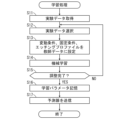
- FIG. 7 is a flowchart showing an example of the flow of the learning process.
- the learning process is executed by the CPU 201 of the learning device 200 as the CPU 201 executes a learning program stored in the RAM 202.
- the CPU 201 included in the learning device 200 acquires experimental data.
- the CPU 201 controls the input/output I/F 107 to acquire the experimental data from the substrate processing device 300 (step S11).
- the experimental data may be acquired by reading experimental data recorded on a recording medium such as a CD-ROM 209 with the storage device 104.
- the experimental data acquired here is multiple.
- the experimental data includes processing conditions and film thickness characteristics of the coating formed on the substrate W before and after processing.
- the film thickness characteristics are represented by the film thickness of the coating formed on the substrate W at each of multiple different positions in the radial direction of the substrate W.
- step S12 the experimental data to be processed is selected, and the process proceeds to step S13.
- step S13 the variable conditions, fixed conditions, and etching profile contained in the experimental data are set as the learning data.
- the etching profile is the difference between the film thickness characteristics of the coating before processing contained in the experimental data and the film thickness characteristics of the coating after processing contained in the experimental data.
- the learning data includes input data and correct answer data.
- the variable conditions and fixed conditions contained in the experimental data are set as the input data, and the etching profile is set as the correct answer data.
- step S14 the CPU 201 trains the learning model by machine learning, and proceeds to step S15.
- Input data is input to the learning model, and a filter and parameters are determined so as to reduce the error between the output of the learning model and the correct data. This adjusts the filter and parameters of the learning model.
- step S15 it is determined whether the adjustment is complete.
- Learning data to be used for evaluating the learning model is prepared in advance, and the performance of the learning model is evaluated using the learning data for evaluation. Adjustment is determined to be complete when the evaluation result satisfies the predetermined evaluation criteria. If the evaluation result does not satisfy the evaluation criteria (NO in step S15), the process returns to step S12, but if the evaluation result satisfies the evaluation criteria (YES in step S15), the process proceeds to step S16.
- step S12 When the process returns to step S12, in step S12, experimental data that has not been selected as the processing target is selected from the experimental data acquired in step S11.
- the CPU 201 machine-trains a learning model using multiple pieces of learning data. This adjusts the filter and parameters of the learning model to appropriate values.
- step S16 the learning parameters of the trained model are stored.
- step S17 the trained model is set in the predictor, the predictor is transmitted to the information processing device 100, and the process ends.
- the CPU 201 controls the input/output I/F 107 to transmit the predictor to the information processing device 100.
- FIG. 8 is a flowchart showing an example of the flow of the processing condition determination process.
- the processing condition determination process is executed by the CPU 101 of the information processing device 100 as the CPU 101 executes a processing condition determination program stored in the RAM 102.
- the CPU 101 of the information processing device 100 selects one of a plurality of pre-prepared variable conditions (step S21), and proceeds to step S22.
- One of a plurality of pre-prepared variable conditions is selected using an experimental design method, a pairwise method, Bayesian estimation, or the like.
- step S22 a predictor is used to estimate an etching profile from the variable and fixed conditions, and processing proceeds to step S23.
- the variable and fixed conditions are input to the predictor, and the etching profile output by the predictor is obtained.
- step S23 the film thickness characteristic after processing is compared with the target film thickness characteristic.
- the film thickness characteristic after processing the substrate W is calculated from the film thickness characteristic before processing of the substrate W to be processed by the substrate processing apparatus 300 and the etching profile estimated in step S22.
- the film thickness characteristic after processing is then compared with the target film thickness characteristic.
- the difference between the film thickness characteristic after processing the substrate W and the target film thickness characteristic is calculated.
- step S24 it is determined whether the comparison result satisfies the evaluation criteria. If the comparison result satisfies the evaluation criteria (YES in step S24), the process proceeds to step S25, but if not, the process returns to step S21. For example, if the maximum value of the differences is equal to or less than a threshold, it is determined that the evaluation criteria is met. Also, if the average of the differences is equal to or less than a threshold, it is determined that the evaluation criteria is met.
- step S25 processing conditions including the variable conditions selected in step S21 are set as candidates for processing conditions for driving the substrate processing apparatus 300, and the process proceeds to step S26.
- step S26 it is determined whether an instruction to end the search has been accepted. If an instruction to end the search has been accepted by the user operating the information processing apparatus 100, the process proceeds to step S27, but if not, the process returns to step S21. Note that instead of an instruction to end the search being input by the user, it may be determined whether a predetermined number of processing conditions have been set as candidates.
- step S27 one of the one or more processing conditions set as candidates is determined, and processing proceeds to step S28.
- the user operating the information processing device 100 may select one of the one or more processing conditions set as candidates. This widens the range of selection available to the user.
- a variable condition with the simplest nozzle operation may be automatically selected from among the variable conditions included in the multiple processing conditions.
- the variable condition with the simplest nozzle operation may be, for example, a variable condition with the smallest number of speed change points. This makes it possible to present multiple variable conditions for processing results for complex nozzle operations that process the substrate W. Selecting a variable condition with which nozzle control is easy from among the multiple variable conditions makes it easier to control the substrate processing device 300.
- step S28 the processing conditions including the variable conditions determined in step S28 are sent to the substrate processing apparatus 300, and the processing ends.
- the CPU 101 controls the input/output I/F 107 to send the processing conditions to the substrate processing apparatus 300.
- the substrate processing apparatus 300 receives the processing conditions from the information processing apparatus 100, it processes the substrate W according to the processing conditions.
- the variable condition is time series data sampled at a sampling interval of 0.01 seconds with a processing time of the nozzle operation of 60 seconds.
- the variable condition is composed of 6001 values. Therefore, the variable condition can express complex nozzle operation.
- the variable condition can accurately express nozzle operation with a relatively large number of speed change points at which the nozzle movement speed is changed.
- overfitting may occur when the time series data of the variable condition is machine-learned into a fully connected neural network model.
- the predictor generating unit 265 in this embodiment uses a learning model including the convolutional neural network shown in FIG. 6 to machine-learn the variable conditions and fixed conditions.
- the inventors have discovered through experiments that the desired results can be obtained as an etching profile predicted by a predictor that has been trained on the learning model shown in FIG. 6 to learn variable conditions and fixed conditions consisting of 6001 values that indicate complex nozzle operation.
- processing condition determination unit 151 when the processing condition determination unit 151 searches for processing conditions, processing conditions corresponding to different etching profiles are searched for, and processing conditions corresponding to multiple different etching profiles are selected. Therefore, the processing condition determination unit 151 can efficiently search for processing conditions that predict a target etching profile from among multiple processing conditions.
- sampling interval is not limited to this. It may be a longer or shorter sampling interval.
- the sampling interval may be 0.1 seconds or 0.005 seconds.
- the learning device 200 generates a predictor based on learning data.
- the learning device 200 may additionally learn the predictor. After the predictor is generated, the learning device 200 acquires the film thickness characteristics and processing conditions of the coating before and after processing of the substrate W processed by the substrate processing device 300. The learning device 200 then generates learning data from the film thickness characteristics and processing conditions of the coating before and after processing, and additionally learns the predictor by machine learning. The additional learning does not change the configuration of the neural network that constitutes the predictor, but adjusts the parameters.
- the predictor is machine-trained using information obtained as a result of the substrate W actually being processed by the substrate processing apparatus 300, thereby improving the accuracy of the predictor.
- the amount of learning data used to generate the predictor can be reduced as much as possible.
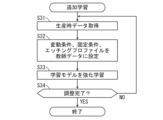
- FIG. 9 is a flowchart showing an example of the flow of the additional learning process.
- the additional learning process is a process that is executed by the CPU 201 of the learning device 200 as the CPU 201 executes an additional learning program stored in the RAM 202.
- the additional learning program is part of the learning program.
- the CPU 201 included in the learning device 200 acquires production data (step S31) and proceeds to step S32.
- the production data includes the processing conditions when the substrate processing device 300 processes the substrate W after the predictor is generated, and the film thickness characteristics of the coating before and after the processing.
- the CPU 201 controls the input/output I/F 107 to acquire the production data from the substrate processing device 300.
- the production data may be acquired by reading experimental data recorded on a recording medium such as a CD-ROM 209 with the storage device 104.
- step S32 the variable conditions, the fixed conditions included in the processing conditions of the production data, and the etching profile are set in the learning data.
- the etching profile is the difference between the film thickness characteristics of the coating before processing included in the production data and the film thickness characteristics of the coating after processing included in the production data.
- the variable conditions and the fixed conditions included in the processing conditions are set in the input data.
- the etching profile is set in the correct data.
- step S33 the CPU 201 performs additional learning on the predictor and proceeds to step S34.
- Input data is input to the predictor, and a filter and parameters are determined so that the difference between the output of the predictor and the correct data is reduced. This further adjusts the filter and parameters of the predictor.
- step S34 it is determined whether the adjustment is complete.
- the performance of the predictor is evaluated using the learning data for evaluation.
- the adjustment is determined to be complete when the evaluation result satisfies the predetermined evaluation criteria for additional learning.
- the evaluation criteria for additional learning are higher than the evaluation criteria used when the predictor was generated. If the evaluation result does not satisfy the evaluation criteria for additional learning (NO in step S34), the process returns to step S31, but if the evaluation result satisfies the evaluation criteria for additional learning (YES in step S34), the process ends.
- the learning device 200 may generate a distillation model by machine learning a new learning model using distillation data including processing conditions determined by the information processing device 100 and an etching profile estimated by a predictor from the processing conditions. This makes it easier to prepare data for training a new learning model.
- the input data in the learning data used to generate a predictor includes variable conditions and fixed conditions.
- the present invention is not limited to this.
- the input data may include only variable conditions and may not include fixed conditions.
- the relative position between the nozzle 311 and the substrate W is shown as an example of a variable condition, but the present invention is not limited to this. If at least one of the temperature of the etching solution, the concentration of the etching solution, the flow rate of the etching solution, and the rotation speed of the substrate W varies over time, these may be set as variable conditions.
- the variable condition is not limited to one type, and may include a combination of multiple types.
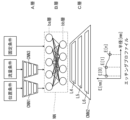
- FIG. 10 is a first diagram for explaining a learning model according to another embodiment.
- the variation condition includes the flow rate of the etching liquid that varies over time.
- the learning model shown in FIG. 10 is used.
- the learning model shown in FIG. 10 differs from the learning model shown in FIG. 6 in that the variation condition input to the first convolutional neural network CNN1 includes a position condition indicating the relative position of the nozzle with respect to the substrate that varies over time, and a flow rate condition indicating the flow rate of the etching liquid that varies over time. For this reason, the first convolutional neural network CNN1 performs two-channel convolution processing.
- the position condition and the flow rate condition each indicate the relative position of the nozzle with respect to the substrate and the flow rate of the etching liquid at the same time. Therefore, when learning the position condition and the flow rate condition, the position condition and the flow rate condition can be learned while retaining the time information. In addition, since a single first convolutional neural network CNN1 is used, the number of learning parameters can be reduced, and overfitting can be suppressed.
- FIG. 11 is a second diagram for explaining a learning model according to another embodiment.
- a first convolutional neural network CNN1 that processes the nozzle condition and a third convolutional neural network CNN3 that processes the flow rate condition are provided on the input side of the fully connected neural network NN.
- the learning model includes the first convolutional neural network CNN1, the fully connected neural network NN, and the second convolutional neural network CNN2, but the present invention is not limited to this.
- the predictor may not include either or both of the fully connected neural network NN and the second convolutional neural network CNN2.
- the present invention is not limited to this.
- the information processing device 100 may be incorporated into the substrate processing device 300.
- the information processing device 100 and the learning device 200 may be incorporated into the substrate processing device 300.
- the information processing device 100 and the learning device 200 have been described as separate devices, they may be configured as an integrated device.
- variable condition is a value that varies over time
- first convolutional neural network CNN1 it is possible to extract features that take into account the time factor by using the first convolutional neural network CNN1.
- first convolutional neural network CNN1 learn, it is possible to reduce the number of learning parameters, thereby improving the generalization performance of the learning model.
- the processing amount is determined for each of a plurality of different positions in the radial direction of the substrate, by having the second convolutional neural network CNN2 learn the processing amount, features that take into account the element of the radial position of the substrate are extracted.
- the number of learning parameters can be reduced, and the generalization performance of the learning model can be improved.
- a fully connected neural network NN is provided between the first convolutional neural network CNN1 and the second convolutional neural network CNN2.
- the number of outputs of the first convolutional neural network CNN1 and the number of inputs of the second convolutional neural network CNN2 can be adjusted by the fully connected neural network NN.
- machine learning can be carried out well even if the number of outputs of the first convolutional neural network CNN1 and the number of inputs of the second convolutional neural network CNN2 are not matched.
- the number of filters increases from the upper layer to the lower layer, making it possible to extract many features of variable conditions.
- the number of filters decreases from the upper layer to the lower layer, making it possible to extract many features that take into account the positions of each of the multiple processing amounts. As a result, it becomes possible to improve the generalization performance of the learning device 200.
- the learning model includes the first convolutional neural network CNN1, it is possible to generate a learning model with improved generalization performance even when the amount of data for variable conditions is large.
- the substrate W is an example of a substrate
- the etching liquid is an example of a processing liquid
- the substrate processing apparatus 300 is an example of a substrate processing apparatus
- the experimental data acquisition unit 261 is an example of an experimental data acquisition unit
- the predictor is an example of a learning model
- the predictor generation unit 265 is an example of a model generation unit.
- the information processing apparatus 100 is an example of an information processing apparatus
- the variable condition generation unit 251 is an example of a variable condition generation unit
- the nozzle 311 is an example of a nozzle that supplies a processing liquid to a substrate
- the nozzle movement mechanism 301 is an example of a movement unit
- the prediction unit 159, the evaluation unit 161, and the processing condition determination unit 151 are examples of a processing condition determination unit.
- a learning device includes: an experimental data acquisition unit that acquires a first processing amount indicating a difference in film thickness before and after the coating is processed by operating a substrate processing apparatus that processes the coating by supplying a processing liquid to a substrate on which a coating is formed under processing conditions including variable conditions that vary over time; a model generation unit that performs machine learning on learning data including the variable condition and the first processing amount corresponding to the processing condition to generate a learning model that estimates a second processing amount indicating a difference in film thickness before and after the coating processing of the coating formed on the substrate before the coating processing is performed by the substrate processing apparatus,
- the learning model includes a first convolutional neural network.
- variable conditions are values that change over time
- the use of a convolutional neural network makes it possible to extract features that take the time factor into account.
- the use of a convolutional neural network makes it possible to reduce the number of learning parameters, thereby improving the generalization performance of the learning model. As a result, it is possible to provide a learning device that is suitable for machine learning conditions that change over time for processing substrates.
- the first processing amount and the second processing amount are differences in film thickness before and after the coating processing at a plurality of different positions in a radial direction of the substrate
- the learning model may further include a second convolutional neural network that outputs the first process quantity or the second process quantity.
- the first and second processing amounts are determined for a plurality of different positions in the radial direction of the substrate, and by having a convolutional neural network learn the first or second processing amount, features that take into account the element of the radial position of the substrate are extracted.
- the number of learning parameters can be reduced, improving the generalization performance of the learning model.
- the learning model further includes a fully-connected neural network to which an output of the first convolutional neural network and fixed conditions other than the variable conditions among the processing conditions are input,
- the second convolutional neural network may receive an output from the fully connected neural network.
- a fully connected neural network is provided between the first convolutional neural network and the second convolutional neural network. In this case, it becomes possible to adjust the number of features output from the first convolutional neural network and the number of features input to the second convolutional neural network by using the fully connected neural network.
- the number of filters used in each of the layers of the first convolutional neural network is twice as many as the number of filters used in the layer above it;
- the number of filters used in each of the multiple layers of the second convolutional neural network may be such that the number of filters used in a lower layer is half the number of filters used in an upper layer.
- the substrate processing apparatus supplies the processing liquid to the substrate by moving a nozzle that supplies the processing liquid to the substrate;
- the variation condition may include a nozzle movement condition that indicates a relative position of the nozzle with respect to the substrate that varies over time.
- the nozzle movement conditions are input to the first convolutional neural network. Therefore, even when there is a large amount of data on the nozzle movement conditions, a learning model with improved generalization performance can be generated.
- variable condition may further include a discharge flow rate condition indicating a flow rate of the treatment liquid discharged from the nozzle that changes over time.
- the learning device described in paragraph 6 can generate a learning model with improved generalization performance even when there is a large amount of data on discharge flow rate conditions.
- An information processing device comprises: An information processing device for managing a substrate processing device, the substrate processing apparatus processes the coating by supplying a processing liquid to the substrate on which the coating is formed under processing conditions including variable conditions that vary over time; a processing condition determination unit that determines processing conditions for driving the substrate processing apparatus by using a learning model that estimates a second processing amount indicating a difference in film thickness before and after the coating formed on the substrate before the coating is processed by the substrate processing apparatus, the learning model includes a first convolutional neural network, and is an inference model that machine-learns learning data including the variable condition included in the processing conditions under which the substrate processing apparatus processed the coating and a first processing amount indicating a difference in film thickness before and after the processing of the coating formed on the substrate that has been processed by the substrate processing apparatus,
- the processing condition determination unit provides a tentative variable condition to the learning model, and if the second processing amount predicted by the learning model satisfies an allowable condition, determines the processing condition including the tentative variable condition as the processing condition for
- the processing conditions including the tentative variable conditions are determined as the processing conditions for driving the substrate processing device. Therefore, multiple tentative variable conditions can be determined for a processing volume that satisfies the tolerance condition. As a result, it becomes possible to present multiple processing conditions for the processing results of a complex process for processing substrates.
- the substrate processing apparatus may include the information processing apparatus described in 7.
- the substrate processing apparatus described in paragraph 8 makes it possible to present multiple processing conditions for the processing results of a complex process for processing a substrate.
- a substrate processing system includes: A substrate processing system for managing a substrate processing apparatus, comprising: A learning device and an information processing device are provided, the substrate processing apparatus processes the coating by supplying a processing liquid to the substrate on which the coating is formed under processing conditions including variable conditions that vary over time; the learning device includes an experimental data acquisition unit that acquires a first processing amount indicating a difference in film thickness before and after the processing of the coating formed on the substrate by operating the substrate processing apparatus under the processing conditions; and a model generation unit that performs machine learning on learning data including the variable condition and the first processing amount corresponding to the processing condition to generate a learning model that estimates a second processing amount indicating a difference in film thickness before and after the coating processing of the coating formed on the substrate before the coating processing is performed by the substrate processing apparatus, the learning model includes a first convolutional neural network; the information processing device includes a processing condition determination unit that determines processing conditions for driving the substrate processing device by using the learning model generated by the learning device, The processing condition determination unit provides
- the substrate processing system described in paragraph 9 is suitable for machine learning of conditions that change over time for processing substrates, and is capable of presenting multiple processing conditions for the processing results of a complex process for processing substrates.
- a learning method comprises: a process of operating a substrate processing apparatus that processes a coating by supplying a processing liquid to a substrate on which a coating is formed under processing conditions including variable conditions that vary over time to process the coating, and then acquiring a first processing amount that indicates a difference in film thickness before and after the coating is processed; a process of generating a learning model that estimates a second processing amount indicating a difference in thickness of the coating formed on the substrate before the coating is processed by the substrate processing apparatus by machine learning learning data including the variable condition and the first processing amount corresponding to the processing condition, and
- the learning model includes a first convolutional neural network.
- the learning model includes a convolutional neural network. This makes it possible to provide a learning method suitable for machine learning of conditions that change over time for processing a substrate.
- a processing condition determination method includes: A processing condition determination method executed by a computer that manages a substrate processing apparatus, comprising: the substrate processing apparatus processes the coating by supplying a processing liquid to the substrate on which the coating is formed under processing conditions including variable conditions that vary over time; determining processing conditions for driving the substrate processing apparatus using a learning model that estimates a second processing amount indicating a difference in film thickness before and after the coating formed on the substrate before the coating is processed by the substrate processing apparatus; the learning model includes a first convolutional neural network, and is an inference model that machine-learns learning data including the variable condition included in the processing conditions under which the substrate processing apparatus processed the coating, and a first processing amount indicating a difference in film thickness before and after the processing of the coating formed on the substrate that has been processed by the substrate processing apparatus,
- the process of determining the processing conditions includes a process of providing a tentative variable condition to the learning model and determining the processing conditions including the tentative variable condition as the processing conditions for driving the substrate processing apparatus if
Landscapes
- Engineering & Computer Science (AREA)
- Theoretical Computer Science (AREA)
- Physics & Mathematics (AREA)
- Software Systems (AREA)
- Computing Systems (AREA)
- Artificial Intelligence (AREA)
- Mathematical Physics (AREA)
- General Physics & Mathematics (AREA)
- Data Mining & Analysis (AREA)
- Evolutionary Computation (AREA)
- General Engineering & Computer Science (AREA)
- Biophysics (AREA)
- Molecular Biology (AREA)
- General Health & Medical Sciences (AREA)
- Computational Linguistics (AREA)
- Biomedical Technology (AREA)
- Life Sciences & Earth Sciences (AREA)
- Health & Medical Sciences (AREA)
- Computer Vision & Pattern Recognition (AREA)
- Medical Informatics (AREA)
- Weting (AREA)
- Drying Of Semiconductors (AREA)
- Feedback Control In General (AREA)
- Exposure Of Semiconductors, Excluding Electron Or Ion Beam Exposure (AREA)
Abstract
Description
図1は、本発明の一実施の形態に係る基板処理システムの構成を説明するための図である。図1の基板処理システム1は、情報処理装置100、学習装置200および基板処理装置300を含む。学習装置200は、例えばサーバであり、情報処理装置100は、例えばパーソナルコンピューターである。
基板処理装置300は、制御装置10と、複数の基板処理ユニットWUを備える。制御装置10は、複数の基板処理ユニットWUを制御する。複数の基板処理ユニットWUは、被膜が形成された基板Wに処理液を供給することにより基板を処理する。処理液はエッチング液を含み、基板処理ユニットWUはエッチング処理を実行する。エッチング液は、薬液である。エッチング液は、例えば、フッ硝酸(フッ酸(HF)と硝酸(HNO3)との混合液)、フッ酸、バファードフッ酸(BHF)、フッ化アンモニウム、HFEG(フッ酸とエチレングリコールとの混合液)、又は、燐酸(H3PO4)である。
図4は、基板処理システムの機能的な構成の一例を示す図である。図4を参照して、基板処理装置300が備える制御装置10は、基板処理ユニットWUを制御して、処理条件に従って基板Wを処理する。処理条件は、予め定められた処理時間の間に基板Wを処理する条件である。処理時間は、基板に対する処理に対して定められる時間である。本実施の形態において、処理時間は、基板Wにノズル311がエッチング液を吐出している間の時間である。
本実施の形態においては、変動条件は、ノズル動作の処理時間が60秒、サンプリング間隔0.01秒でサンプリングした時系列データである。変動条件は、6001個の値で構成される。このため、変動条件は、複雑なノズル動作を表現することが可能である。特に、ノズルの移動速度を変更する変速点の数を比較的多くしたノズル動作を変動条件で正確に表現することができる。その反面、変動条件の次元数が多いため、変動条件の時系列データを全結合ニューラルネットワークのモデルに機械学習させた場合、オーバーフィッティングが発生することがある。
(1)上述した実施の形態においては、学習装置200は、学習用データに基づいて、予測器を生成する。学習装置200は、予測器を追加学習するようにしてもよい。学習装置200は、予測器が生成された後に、基板処理装置300により処理された基板Wの処理の前後それぞれにおける被膜の膜厚特性および処理条件を取得する。そして、学習装置200は、処理前後それぞれにおける被膜の膜厚特性および処理条件から学習用データを生成し、予測器を機械学習させることにより、予測器を追加学習する。追加学習によって、予測器を構成するニューラルネットワークの構成は変更されないが、パラメータが調整される。
上記実施の形態の学習装置200においては、変動条件が時間の経過に伴って変動する値なので、第1畳み込みニューラルネットワークCNN1を用いることにより、時間の要素を考慮した特徴を抽出することができる。また、第1畳み込みニューラルネットワークCNN1に学習させることにより、学習パラメータの数を抑えることができるので、学習モデルの汎化性能を向上させることができる。
基板Wが基板の一例であり、エッチング液が処理液の一例であり、基板処理装置300が基板処理装置の一例であり、実験データ取得部261が実験データ取得部の一例であり、予測器が学習モデルの一例であり、予測器生成部265がモデル生成部の一例である。また、情報処理装置100が情報処理装置の一例であり、変動条件生成部251が変動条件生成部の一例であり、ノズル311が基板に処理液を供給するノズルの一例であり、ノズル移動機構301が移動部の一例であり、予測部159、評価部161および処理条件決定部151が処理条件決定部の一例である。
(第1項)本発明の一態様に係る学習装置は、
被膜が形成された基板に処理液を供給することにより前記被膜の処理をする基板処理装置を時間の経過に伴って変動する変動条件を含む処理条件で駆動して前記被膜の処理を行った後に、前記被膜の処理の前後の膜厚の差を示す第一処理量を取得する実験データ取得部と、
前記変動条件と前記処理条件に対応する前記第一処理量とを含む学習用データを機械学習して前記基板処理装置により前記被膜の処理をされる前の前記基板に形成された前記被膜について前記被膜の処理の前後の膜厚の差を示す第二処理量を推測する学習モデルを生成するモデル生成部と、を備え、
前記学習モデルは、第1畳み込みニューラルネットワークを含む。
前記第一処理量と前記第二処理量とは、基板の径方向に異なる複数の位置それぞれにおける、前記被膜の処理の前後の膜厚の差であり、
前記学習モデルは、前記第一処理量または前記第二処理量を出力する第2畳み込みニューラルネットワークをさらに含んでもよい。
前記学習モデルは、前記第1畳み込みニューラルネットワークの出力と前記処理条件のうち前記変動条件以外の固定条件が入力される全結合ニューラルネットワークを、さらに含み、
前記第2畳み込みニューラルネットワークは、前記全結合ニューラルネットワークの出力が入力されてもよい。
前記第1畳み込みニューラルネットワークが有する複数層でそれぞれ用いられるフィルター数は、下層で用いられるフィルタ数がその上層で用いられるフィルタ数の倍であり、
前記第2畳み込みニューラルネットワークが有する複数層でそれぞれ用いられるフィルター数は、下層で用いられるフィルタ数がその上層で用いられるフィルタ数の1/2倍であってもよい。
前記基板処理装置は、基板に処理液を供給するノズルを移動させることにより基板に前記処理液を供給し、
前記変動条件は、時間の経過に伴って変動する前記ノズルの基板に対する相対位置を示すノズル移動条件を含んでもよい。
前記変動条件は、時間の経過に伴って変化する前記ノズルから吐出される処理液の流量を示す吐出流量条件をさらに含んでもよい。
基板処理装置を管理する情報処理装置であって、
前記基板処理装置は、時間の経過に伴って変動する変動条件を含む処理条件で、被膜が形成された基板に処理液を供給することにより、前記被膜の処理をし、
前記基板処理装置により前記被膜の処理をされる前の前記基板に形成された前記被膜について前記被膜の処理の前後の膜厚の差を示す第二処理量を推測する学習モデルを用いて、前記基板処理装置を駆動するための処理条件を決定する処理条件決定部と、を備え、
前記学習モデルは、第1畳み込みニューラルネットワークを含み、前記基板処理装置が前記被膜の処理をした前記処理条件に含まれる前記変動条件と前記基板処理装置により前記被膜の処理をされた前記基板に形成された前記被膜の処理の前後の膜厚の差を示す第一処理量とを含む学習用データを機械学習した推論モデルであり、
前記処理条件決定部は、仮の変動条件を前記学習モデルに与えて前記学習モデルにより推測される前記第二処理量が許容条件を満たす場合に前記仮の変動条件を含む処理条件を、前記基板処理装置を駆動するための処理条件に決定する。
基板処理装置を管理する基板処理システムであって、
学習装置と情報処理装置とを備え、
前記基板処理装置は、時間の経過に伴って変動する変動条件を含む処理条件で、被膜が形成された基板に処理液を供給することにより、前記被膜の処理をし、
前記学習装置は、前記基板処理装置を前記処理条件で駆動して前記基板に形成された前記被膜の処理を行った後に、前記被膜の処理の前後の膜厚の差を示す第一処理量を取得する実験データ取得部と、
前記変動条件と前記処理条件に対応する前記第一処理量とを含む学習用データを機械学習して前記基板処理装置により前記被膜の処理をされる前の前記基板に形成された前記被膜について前記被膜の処理の前後の膜厚の差を示す第二処理量を推測する学習モデルを生成するモデル生成部と、を備え、
前記学習モデルは、第1畳み込みニューラルネットワークを含み、
前記情報処理装置は、前記学習装置により生成された前記学習モデルを用いて、前記基板処理装置を駆動するための処理条件を決定する処理条件決定部と、を備え、
前記処理条件決定部は、前記学習装置により生成された前記学習モデルに仮の変動条件を与えて前記学習モデルにより推測される前記第二処理量が許容条件を満たす場合に前記仮の変動条件を含む処理条件を、前記基板処理装置を駆動するための処理条件に決定する。
被膜が形成された基板に処理液を供給することにより前記被膜の処理をする基板処理装置を時間の経過に伴って変動する変動条件を含む処理条件で駆動して前記被膜の処理を行った後に、前記被膜の処理の前後の膜厚の差を示す第一処理量を取得する処理と、
前記変動条件と前記処理条件に対応する前記第一処理量とを含む学習用データを機械学習して前記基板処理装置により前記被膜の処理をされる前の前記基板に形成された前記被膜について前記被膜の処理の前後の膜厚の差を示す第二処理量を推測する学習モデルを生成する処理と、をコンピューターに実行させ、
前記学習モデルは、第1畳み込みニューラルネットワークを含む。
基板処理装置を管理するコンピューターで実行される処理条件決定方法であって、
前記基板処理装置は、時間の経過に伴って変動する変動条件を含む処理条件で、被膜が形成された基板に処理液を供給することにより、前記被膜の処理をし、
前記基板処理装置により前記被膜の処理をされる前の前記基板に形成された前記被膜について前記被膜の処理の前後の膜厚の差を示す第二処理量を推測する学習モデルを用いて、前記基板処理装置を駆動するための処理条件を決定する処理と、を含み、
前記学習モデルは、第1畳み込みニューラルネットワークを含み、前記基板処理装置が前記被膜の処理をした前記処理条件に含まれる前記変動条件と前記基板処理装置により前記被膜の処理をされた前記基板に形成された前記被膜の処理の前後の膜厚の差を示す第一処理量とを含む学習用データを機械学習した推論モデルであり、
前記処理条件を決定する処理は、仮の変動条件を前記学習モデルに与えて前記学習モデルにより推測される前記第二処理量が許容条件を満たす場合に前記仮の変動条件を含む処理条件を、前記基板処理装置を駆動するための処理条件に決定する処理を含む。
Claims (11)
- 被膜が形成された基板に処理液を供給することにより前記被膜の処理をする基板処理装置を時間の経過に伴って変動する変動条件を含む処理条件で駆動して前記被膜の処理を行った後に、前記被膜の処理の前後の膜厚の差を示す第一処理量を取得する実験データ取得部と、
前記変動条件と前記処理条件に対応する前記第一処理量とを含む学習用データを機械学習して前記基板処理装置により前記被膜の処理をされる前の前記基板に形成された前記被膜について前記被膜の処理の前後の膜厚の差を示す第二処理量を推測する学習モデルを生成するモデル生成部と、を備え、
前記学習モデルは、第1畳み込みニューラルネットワークを含む学習装置。 - 前記第一処理量と前記第二処理量とは、基板の径方向に異なる複数の位置それぞれにおける、前記被膜の処理の前後の膜厚の差であり、
前記学習モデルは、前記第一処理量または前記第二処理量を出力する第2畳み込みニューラルネットワークをさらに含む、請求項1に記載の学習装置。 - 前記学習モデルは、前記第1畳み込みニューラルネットワークの出力と前記処理条件のうち前記変動条件以外の固定条件が入力される全結合ニューラルネットワークを、さらに含み、
前記第2畳み込みニューラルネットワークは、前記全結合ニューラルネットワークの出力が入力される、請求項2に記載の学習装置。 - 前記第1畳み込みニューラルネットワークが有する複数層でそれぞれ用いられるフィルタ数は、下層で用いられるフィルタ数がその上層で用いられるフィルタ数の倍であり、
前記第2畳み込みニューラルネットワークが有する複数層でそれぞれ用いられるフィルタ数は、下層で用いられるフィルタ数がその上層で用いられるフィルタ数の1/2倍である、請求項2または3に記載の学習装置。 - 前記基板処理装置は、基板に処理液を供給するノズルを移動させることにより基板に前記処理液を供給し、
前記変動条件は、時間の経過に伴って変動する前記ノズルの基板に対する相対位置を示すノズル移動条件を含む、請求項1~4のいずれか一項に記載の学習装置。 - 前記変動条件は、時間の経過に伴って変化する前記ノズルから吐出される処理液の流量を示す吐出流量条件をさらに含む、請求項5に記載の学習装置。
- 基板処理装置を管理する情報処理装置であって、
前記基板処理装置は、時間の経過に伴って変動する変動条件を含む処理条件で、被膜が形成された基板に処理液を供給することにより、前記被膜の処理をし、
前記基板処理装置により前記被膜の処理をされる前の前記基板に形成された前記被膜について前記被膜の処理の前後の膜厚の差を示す第二処理量を推測する学習モデルを用いて、前記基板処理装置を駆動するための処理条件を決定する処理条件決定部と、を備え、
前記学習モデルは、第1畳み込みニューラルネットワークを含み、前記基板処理装置が前記被膜の処理をした前記処理条件に含まれる前記変動条件と前記基板処理装置により前記被膜の処理をされた前記基板に形成された前記被膜の処理の前後の膜厚の差を示す第一処理量とを含む学習用データを機械学習した推論モデルであり、
前記処理条件決定部は、仮の変動条件を前記学習モデルに与えて前記学習モデルにより推測される前記第二処理量が許容条件を満たす場合に前記仮の変動条件を含む処理条件を、前記基板処理装置を駆動するための処理条件に決定する、情報処理装置。 - 請求項7に記載の情報処理装置を備えた基板処理装置。
- 基板処理装置を管理する基板処理システムであって、
学習装置と情報処理装置とを備え、
前記基板処理装置は、時間の経過に伴って変動する変動条件を含む処理条件で、被膜が形成された基板に処理液を供給することにより、前記被膜の処理をし、
前記学習装置は、前記基板処理装置を前記処理条件で駆動して前記基板に形成された前記被膜の処理を行った後に、前記被膜の処理の前後の膜厚の差を示す第一処理量を取得する実験データ取得部と、
前記変動条件と前記処理条件に対応する前記第一処理量とを含む学習用データを機械学習して前記基板処理装置により前記被膜の処理をされる前の前記基板に形成された前記被膜について前記被膜の処理の前後の膜厚の差を示す第二処理量を推測する学習モデルを生成するモデル生成部と、を備え、
前記学習モデルは、第1畳み込みニューラルネットワークを含み、
前記情報処理装置は、前記学習装置により生成された前記学習モデルを用いて、前記基板処理装置を駆動するための処理条件を決定する処理条件決定部と、を備え、
前記処理条件決定部は、前記学習装置により生成された前記学習モデルに仮の変動条件を与えて前記学習モデルにより推測される前記第二処理量が許容条件を満たす場合に前記仮の変動条件を含む処理条件を、前記基板処理装置を駆動するための処理条件に決定する、基板処理システム。 - 被膜が形成された基板に処理液を供給することにより前記被膜の処理をする基板処理装置を時間の経過に伴って変動する変動条件を含む処理条件で駆動して前記被膜の処理を行った後に、前記被膜の処理の前後の膜厚の差を示す第一処理量を取得する処理と、
前記変動条件と前記処理条件に対応する前記第一処理量とを含む学習用データを機械学習して前記基板処理装置により前記被膜の処理をされる前の前記基板に形成された前記被膜について前記被膜の処理の前後の膜厚の差を示す第二処理量を推測する学習モデルを生成する処理と、をコンピューターに実行させ、
前記学習モデルは、第1畳み込みニューラルネットワークを含む、学習方法。 - 基板処理装置を管理するコンピューターで実行される処理条件決定方法であって、
前記基板処理装置は、時間の経過に伴って変動する変動条件を含む処理条件で、被膜が形成された基板に処理液を供給することにより、前記被膜の処理をし、
前記基板処理装置により前記被膜の処理をされる前の前記基板に形成された前記被膜について前記被膜の処理の前後の膜厚の差を示す第二処理量を推測する学習モデルを用いて、前記基板処理装置を駆動するための処理条件を決定する処理と、を含み、
前記学習モデルは、第1畳み込みニューラルネットワークを含み、前記基板処理装置が前記被膜の処理をした前記処理条件に含まれる前記変動条件と前記基板処理装置により前記被膜の処理をされた前記基板に形成された前記被膜の処理の前後の膜厚の差を示す第一処理量とを含む学習用データを機械学習した推論モデルであり、
前記処理条件を決定する処理は、仮の変動条件を前記学習モデルに与えて前記学習モデルにより推測される前記第二処理量が許容条件を満たす場合に前記仮の変動条件を含む処理条件を、前記基板処理装置を駆動するための処理条件に決定する処理を含む、処理条件決定方法。
Priority Applications (3)
| Application Number | Priority Date | Filing Date | Title |
|---|---|---|---|
| US19/110,056 US20260080219A1 (en) | 2022-09-26 | 2023-08-04 | Training device, information processing apparatus, substrate processing apparatus, substrate processing system, training method and processing condition determining method |
| KR1020257008321A KR20250053106A (ko) | 2022-09-26 | 2023-08-04 | 학습 장치, 정보 처리 장치, 기판 처리 장치, 기판 처리 시스템, 학습 방법 및 처리 조건 결정 방법 |
| CN202380068624.4A CN119948605A (zh) | 2022-09-26 | 2023-08-04 | 学习装置、信息处理装置、基板处理装置、基板处理系统、学习方法以及处理条件决定方法 |
Applications Claiming Priority (2)
| Application Number | Priority Date | Filing Date | Title |
|---|---|---|---|
| JP2022-153151 | 2022-09-26 | ||
| JP2022153151A JP2024047495A (ja) | 2022-09-26 | 2022-09-26 | 学習装置、情報処理装置、基板処理装置、基板処理システム、学習方法および処理条件決定方法 |
Publications (1)
| Publication Number | Publication Date |
|---|---|
| WO2024070233A1 true WO2024070233A1 (ja) | 2024-04-04 |
Family
ID=90477132
Family Applications (1)
| Application Number | Title | Priority Date | Filing Date |
|---|---|---|---|
| PCT/JP2023/028655 Ceased WO2024070233A1 (ja) | 2022-09-26 | 2023-08-04 | 学習装置、情報処理装置、基板処理装置、基板処理システム、学習方法および処理条件決定方法 |
Country Status (6)
| Country | Link |
|---|---|
| US (1) | US20260080219A1 (ja) |
| JP (1) | JP2024047495A (ja) |
| KR (1) | KR20250053106A (ja) |
| CN (1) | CN119948605A (ja) |
| TW (1) | TWI891045B (ja) |
| WO (1) | WO2024070233A1 (ja) |
Families Citing this family (1)
| Publication number | Priority date | Publication date | Assignee | Title |
|---|---|---|---|---|
| US20260017815A1 (en) * | 2024-07-09 | 2026-01-15 | Disney Enterprises, Inc. | Machine Learning Model-Based 2-D Pose Prediction and Correction |
Citations (6)
| Publication number | Priority date | Publication date | Assignee | Title |
|---|---|---|---|---|
| WO2020049974A1 (ja) * | 2018-09-03 | 2020-03-12 | 株式会社Preferred Networks | 学習装置、推論装置、学習モデルの生成方法及び推論方法 |
| JP2021108367A (ja) * | 2019-12-27 | 2021-07-29 | 株式会社Screenホールディングス | 基板処理装置、基板処理方法、基板処理システム、及び学習用データの生成方法 |
| JP2021152762A (ja) * | 2020-03-24 | 2021-09-30 | 株式会社Screenホールディングス | 学習済みモデル生成方法、学習済みモデル、異常要因推定装置、基板処理装置、異常要因推定方法、学習方法、学習装置、及び、学習データ作成方法 |
| JP2022501207A (ja) * | 2018-09-24 | 2022-01-06 | アプライド マテリアルズ インコーポレイテッドApplied Materials, Incorporated | Cmpプロセス制御アルゴリズムへの入力としてのマシンビジョン |
| US20220083721A1 (en) * | 2020-09-16 | 2022-03-17 | Center For Deep Learning In Electronics Manufacturing, Inc. | Methods and systems for generating shape data for electronic designs |
| JP2022525197A (ja) * | 2019-03-15 | 2022-05-11 | 東京エレクトロン株式会社 | 機械学習を用いた半導体製造データ取得機器における拡張された分解能 |
Family Cites Families (2)
| Publication number | Priority date | Publication date | Assignee | Title |
|---|---|---|---|---|
| JP6064875B2 (ja) | 2013-11-25 | 2017-01-25 | 東京エレクトロン株式会社 | 液処理装置、液処理方法及び記憶媒体 |
| JP7419163B2 (ja) * | 2020-05-29 | 2024-01-22 | 株式会社Screenホールディングス | 基板処理装置、基板処理方法、学習用データの生成方法、学習方法、学習装置、学習済モデルの生成方法、および、学習済モデル |
-
2022
- 2022-09-26 JP JP2022153151A patent/JP2024047495A/ja active Pending
-
2023
- 2023-08-04 WO PCT/JP2023/028655 patent/WO2024070233A1/ja not_active Ceased
- 2023-08-04 CN CN202380068624.4A patent/CN119948605A/zh active Pending
- 2023-08-04 KR KR1020257008321A patent/KR20250053106A/ko active Pending
- 2023-08-04 US US19/110,056 patent/US20260080219A1/en active Pending
- 2023-08-17 TW TW112130932A patent/TWI891045B/zh active
Patent Citations (6)
| Publication number | Priority date | Publication date | Assignee | Title |
|---|---|---|---|---|
| WO2020049974A1 (ja) * | 2018-09-03 | 2020-03-12 | 株式会社Preferred Networks | 学習装置、推論装置、学習モデルの生成方法及び推論方法 |
| JP2022501207A (ja) * | 2018-09-24 | 2022-01-06 | アプライド マテリアルズ インコーポレイテッドApplied Materials, Incorporated | Cmpプロセス制御アルゴリズムへの入力としてのマシンビジョン |
| JP2022525197A (ja) * | 2019-03-15 | 2022-05-11 | 東京エレクトロン株式会社 | 機械学習を用いた半導体製造データ取得機器における拡張された分解能 |
| JP2021108367A (ja) * | 2019-12-27 | 2021-07-29 | 株式会社Screenホールディングス | 基板処理装置、基板処理方法、基板処理システム、及び学習用データの生成方法 |
| JP2021152762A (ja) * | 2020-03-24 | 2021-09-30 | 株式会社Screenホールディングス | 学習済みモデル生成方法、学習済みモデル、異常要因推定装置、基板処理装置、異常要因推定方法、学習方法、学習装置、及び、学習データ作成方法 |
| US20220083721A1 (en) * | 2020-09-16 | 2022-03-17 | Center For Deep Learning In Electronics Manufacturing, Inc. | Methods and systems for generating shape data for electronic designs |
Also Published As
| Publication number | Publication date |
|---|---|
| TWI891045B (zh) | 2025-07-21 |
| KR20250053106A (ko) | 2025-04-21 |
| TW202414282A (zh) | 2024-04-01 |
| CN119948605A (zh) | 2025-05-06 |
| JP2024047495A (ja) | 2024-04-05 |
| US20260080219A1 (en) | 2026-03-19 |
Similar Documents
| Publication | Publication Date | Title |
|---|---|---|
| KR102952365B1 (ko) | 프로세스 제어 노브 추정 | |
| KR20240122510A (ko) | 예방 유지보수-후 챔버 조건 모니터링 및 시뮬레이션 | |
| Kim et al. | A run-to-run controller for a chemical mechanical planarization process using least squares generative adversarial networks | |
| JP2022162994A (ja) | 製造システムにおける多変量時系列データの予測方法およびシステム | |
| JP2024047495A (ja) | 学習装置、情報処理装置、基板処理装置、基板処理システム、学習方法および処理条件決定方法 | |
| JP7761515B2 (ja) | 学習装置、情報処理装置、基板処理装置、基板処理システム、学習方法および処理条件決定方法 | |
| WO2024070055A1 (ja) | 学習装置、情報処理装置、基板処理装置、基板処理システム、学習方法および処理条件決定方法 | |
| WO2024070390A1 (ja) | 学習装置、情報処理装置、基板処理装置、基板処理システム、学習方法および処理条件決定方法 | |
| TWI897188B (zh) | 預測模型生成裝置、資訊處理裝置、基板處理裝置、預測模型生成方法以及處理條件決定方法 | |
| JP2024136166A (ja) | 情報処理装置、基板処理装置および処理条件決定方法 | |
| JP2024124092A (ja) | 学習装置、情報処理装置、基板処理装置、学習モデル生成方法および処理条件決定方法 | |
| JP2024165967A (ja) | 予測アルゴリズム生成装置、情報処理装置、基板処理装置、予測アルゴリズム生成方法、予測アルゴリズム生成プログラム、処理条件決定方法、処理条件決定プログラムおよび予測アルゴリズム | |
| WO2024202361A1 (ja) | 予測アルゴリズム生成装置、情報処理装置、基板処理装置、予測アルゴリズム生成方法および処理条件決定方法 | |
| KR20250164285A (ko) | 학습 장치, 정보 처리 장치, 기판 처리 장치, 학습 방법 및 처리 조건 결정 방법 | |
| TWI876290B (zh) | 用於在評估系統與製造系統之間進行介接的通訊節點和方法以及包括該通訊節點的電子元件製造系統 | |
| WO2024202369A1 (ja) | 予測アルゴリズム生成装置、情報処理装置、予測アルゴリズム生成方法および処理条件決定方法 | |
| TW202414132A (zh) | 用於防止機器學習模型性能的波動的方法和機制 |
Legal Events
| Date | Code | Title | Description |
|---|---|---|---|
| 121 | Ep: the epo has been informed by wipo that ep was designated in this application |
Ref document number: 23871475 Country of ref document: EP Kind code of ref document: A1 |
|
| ENP | Entry into the national phase |
Ref document number: 20257008321 Country of ref document: KR Kind code of ref document: A |
|
| WWE | Wipo information: entry into national phase |
Ref document number: 1020257008321 Country of ref document: KR |
|
| WWE | Wipo information: entry into national phase |
Ref document number: 202380068624.4 Country of ref document: CN |
|
| WWP | Wipo information: published in national office |
Ref document number: 1020257008321 Country of ref document: KR |
|
| NENP | Non-entry into the national phase |
Ref country code: DE |
|
| WWP | Wipo information: published in national office |
Ref document number: 202380068624.4 Country of ref document: CN |
|
| 122 | Ep: pct application non-entry in european phase |
Ref document number: 23871475 Country of ref document: EP Kind code of ref document: A1 |