WO2024062780A1 - 表示パネル一体型電波反射装置 - Google Patents
表示パネル一体型電波反射装置 Download PDFInfo
- Publication number
- WO2024062780A1 WO2024062780A1 PCT/JP2023/028266 JP2023028266W WO2024062780A1 WO 2024062780 A1 WO2024062780 A1 WO 2024062780A1 JP 2023028266 W JP2023028266 W JP 2023028266W WO 2024062780 A1 WO2024062780 A1 WO 2024062780A1
- Authority
- WO
- WIPO (PCT)
- Prior art keywords
- electrode
- display panel
- radio wave
- patch
- layer
- Prior art date
- Legal status (The legal status is an assumption and is not a legal conclusion. Google has not performed a legal analysis and makes no representation as to the accuracy of the status listed.)
- Ceased
Links
Images









Classifications
-
- G—PHYSICS
- G02—OPTICS
- G02F—OPTICAL DEVICES OR ARRANGEMENTS FOR THE CONTROL OF LIGHT BY MODIFICATION OF THE OPTICAL PROPERTIES OF THE MEDIA OF THE ELEMENTS INVOLVED THEREIN; NON-LINEAR OPTICS; FREQUENCY-CHANGING OF LIGHT; OPTICAL LOGIC ELEMENTS; OPTICAL ANALOGUE/DIGITAL CONVERTERS
- G02F1/00—Devices or arrangements for the control of the intensity, colour, phase, polarisation or direction of light arriving from an independent light source, e.g. switching, gating or modulating; Non-linear optics
- G02F1/01—Devices or arrangements for the control of the intensity, colour, phase, polarisation or direction of light arriving from an independent light source, e.g. switching, gating or modulating; Non-linear optics for the control of the intensity, phase, polarisation or colour
- G02F1/13—Devices or arrangements for the control of the intensity, colour, phase, polarisation or direction of light arriving from an independent light source, e.g. switching, gating or modulating; Non-linear optics for the control of the intensity, phase, polarisation or colour based on liquid crystals, e.g. single liquid crystal display cells
- G02F1/133—Constructional arrangements; Operation of liquid crystal cells; Circuit arrangements
- G02F1/1333—Constructional arrangements; Manufacturing methods
- G02F1/1343—Electrodes
- G02F1/134309—Electrodes characterised by their geometrical arrangement
-
- G—PHYSICS
- G02—OPTICS
- G02F—OPTICAL DEVICES OR ARRANGEMENTS FOR THE CONTROL OF LIGHT BY MODIFICATION OF THE OPTICAL PROPERTIES OF THE MEDIA OF THE ELEMENTS INVOLVED THEREIN; NON-LINEAR OPTICS; FREQUENCY-CHANGING OF LIGHT; OPTICAL LOGIC ELEMENTS; OPTICAL ANALOGUE/DIGITAL CONVERTERS
- G02F1/00—Devices or arrangements for the control of the intensity, colour, phase, polarisation or direction of light arriving from an independent light source, e.g. switching, gating or modulating; Non-linear optics
- G02F1/01—Devices or arrangements for the control of the intensity, colour, phase, polarisation or direction of light arriving from an independent light source, e.g. switching, gating or modulating; Non-linear optics for the control of the intensity, phase, polarisation or colour
- G02F1/13—Devices or arrangements for the control of the intensity, colour, phase, polarisation or direction of light arriving from an independent light source, e.g. switching, gating or modulating; Non-linear optics for the control of the intensity, phase, polarisation or colour based on liquid crystals, e.g. single liquid crystal display cells
-
- G—PHYSICS
- G02—OPTICS
- G02F—OPTICAL DEVICES OR ARRANGEMENTS FOR THE CONTROL OF LIGHT BY MODIFICATION OF THE OPTICAL PROPERTIES OF THE MEDIA OF THE ELEMENTS INVOLVED THEREIN; NON-LINEAR OPTICS; FREQUENCY-CHANGING OF LIGHT; OPTICAL LOGIC ELEMENTS; OPTICAL ANALOGUE/DIGITAL CONVERTERS
- G02F1/00—Devices or arrangements for the control of the intensity, colour, phase, polarisation or direction of light arriving from an independent light source, e.g. switching, gating or modulating; Non-linear optics
- G02F1/01—Devices or arrangements for the control of the intensity, colour, phase, polarisation or direction of light arriving from an independent light source, e.g. switching, gating or modulating; Non-linear optics for the control of the intensity, phase, polarisation or colour
- G02F1/13—Devices or arrangements for the control of the intensity, colour, phase, polarisation or direction of light arriving from an independent light source, e.g. switching, gating or modulating; Non-linear optics for the control of the intensity, phase, polarisation or colour based on liquid crystals, e.g. single liquid crystal display cells
- G02F1/133—Constructional arrangements; Operation of liquid crystal cells; Circuit arrangements
- G02F1/1333—Constructional arrangements; Manufacturing methods
-
- G—PHYSICS
- G02—OPTICS
- G02F—OPTICAL DEVICES OR ARRANGEMENTS FOR THE CONTROL OF LIGHT BY MODIFICATION OF THE OPTICAL PROPERTIES OF THE MEDIA OF THE ELEMENTS INVOLVED THEREIN; NON-LINEAR OPTICS; FREQUENCY-CHANGING OF LIGHT; OPTICAL LOGIC ELEMENTS; OPTICAL ANALOGUE/DIGITAL CONVERTERS
- G02F1/00—Devices or arrangements for the control of the intensity, colour, phase, polarisation or direction of light arriving from an independent light source, e.g. switching, gating or modulating; Non-linear optics
- G02F1/01—Devices or arrangements for the control of the intensity, colour, phase, polarisation or direction of light arriving from an independent light source, e.g. switching, gating or modulating; Non-linear optics for the control of the intensity, phase, polarisation or colour
- G02F1/13—Devices or arrangements for the control of the intensity, colour, phase, polarisation or direction of light arriving from an independent light source, e.g. switching, gating or modulating; Non-linear optics for the control of the intensity, phase, polarisation or colour based on liquid crystals, e.g. single liquid crystal display cells
- G02F1/133—Constructional arrangements; Operation of liquid crystal cells; Circuit arrangements
- G02F1/1333—Constructional arrangements; Manufacturing methods
- G02F1/1335—Structural association of cells with optical devices, e.g. polarisers or reflectors
- G02F1/133553—Reflecting elements
-
- G—PHYSICS
- G02—OPTICS
- G02F—OPTICAL DEVICES OR ARRANGEMENTS FOR THE CONTROL OF LIGHT BY MODIFICATION OF THE OPTICAL PROPERTIES OF THE MEDIA OF THE ELEMENTS INVOLVED THEREIN; NON-LINEAR OPTICS; FREQUENCY-CHANGING OF LIGHT; OPTICAL LOGIC ELEMENTS; OPTICAL ANALOGUE/DIGITAL CONVERTERS
- G02F1/00—Devices or arrangements for the control of the intensity, colour, phase, polarisation or direction of light arriving from an independent light source, e.g. switching, gating or modulating; Non-linear optics
- G02F1/01—Devices or arrangements for the control of the intensity, colour, phase, polarisation or direction of light arriving from an independent light source, e.g. switching, gating or modulating; Non-linear optics for the control of the intensity, phase, polarisation or colour
- G02F1/13—Devices or arrangements for the control of the intensity, colour, phase, polarisation or direction of light arriving from an independent light source, e.g. switching, gating or modulating; Non-linear optics for the control of the intensity, phase, polarisation or colour based on liquid crystals, e.g. single liquid crystal display cells
- G02F1/133—Constructional arrangements; Operation of liquid crystal cells; Circuit arrangements
- G02F1/1333—Constructional arrangements; Manufacturing methods
- G02F1/1347—Arrangement of liquid crystal layers or cells in which the final condition of one light beam is achieved by the addition of the effects of two or more layers or cells
- G02F1/13478—Arrangement of liquid crystal layers or cells in which the final condition of one light beam is achieved by the addition of the effects of two or more layers or cells based on selective reflection
-
- H—ELECTRICITY
- H01—ELECTRIC ELEMENTS
- H01Q—ANTENNAS, i.e. RADIO AERIALS
- H01Q15/00—Devices for reflection, refraction, diffraction or polarisation of waves radiated from an antenna, e.g. quasi-optical devices
- H01Q15/14—Reflecting surfaces; Equivalent structures
-
- G—PHYSICS
- G02—OPTICS
- G02F—OPTICAL DEVICES OR ARRANGEMENTS FOR THE CONTROL OF LIGHT BY MODIFICATION OF THE OPTICAL PROPERTIES OF THE MEDIA OF THE ELEMENTS INVOLVED THEREIN; NON-LINEAR OPTICS; FREQUENCY-CHANGING OF LIGHT; OPTICAL LOGIC ELEMENTS; OPTICAL ANALOGUE/DIGITAL CONVERTERS
- G02F2203/00—Function characteristic
- G02F2203/02—Function characteristic reflective
Definitions
- One embodiment of the present invention relates to a display panel-integrated radio wave reflection device that can display images and control the traveling direction of reflected radio waves.
- 5G fifth generation communications standard
- This communication standard employs frequencies in the millimeter wave band (26 GHz or higher, for example 26 GHz to 29 GHz).
- Communication based on the 5G standard can achieve extremely high throughput by using frequencies in the millimeter wave band, making it possible to transmit over a wide bandwidth.
- a phased array antenna device includes a plurality of antenna elements arranged in a planar manner, and each of the plurality of antenna elements is fixed by adjusting the amplitude and phase of a high frequency signal applied to each of the plurality of antenna elements.
- the directivity of the antenna can be controlled in this state.
- Patent Document 1 discloses a phased array antenna device that adjusts the amplitude and phase of a high-frequency signal applied to each of a plurality of antenna elements and utilizes changes in dielectric constant depending on the alignment state of liquid crystal.
- a metasurface reflector includes multiple structures (metasurfaces) that are sufficiently smaller than the wavelength of electromagnetic waves, and can control the directivity of the antenna by adjusting the amplitude and phase of the high-frequency signal applied to the metasurfaces. Can be done.
- Patent Document 2 discloses a metasurface reflector that utilizes changes in the alignment state of liquid crystal.
- signage represented by electronic signage, or digital signage has become popular in all places, including outdoor and indoor public spaces such as streets, stations, commercial facilities, small stores, and storefronts such as hotels.
- reflective display devices are beginning to be used as outdoor electronic signboards because they do not require a backlight source, have high visibility using external light such as sunlight as a light source, and consume low power.
- Radio wave reflecting devices including phased array antenna devices and metasurface reflectors, and electronic signs, including reflective display devices, are placed in locations where there are many users of radio waves and electronic signs, such as station plazas, public spaces, and waiting rooms. In station plazas, public spaces, waiting rooms, and other locations, the areas in which radio wave reflecting devices and electronic signs can be placed are limited, so there is competition for areas in which radio wave reflecting devices and electronic signs can be placed, and this may limit the number of radio wave reflecting devices and electronic signs that can be placed.
- radio wave reflecting devices to be placed For example, if the number of radio wave reflecting devices to be placed is limited, it will be difficult to communicate while avoiding obstacles, and there is a possibility that radio wave dead zones (places where radio waves cannot reach) cannot be resolved. Furthermore, for example, if the number of electronic signboards to be placed is limited, there is a possibility that users will not be able to obtain desired information.
- one embodiment of the present invention aims to provide a display panel-integrated radio wave reflecting device that integrates a display panel and a radio wave reflecting device.
- a display panel-integrated radio wave reflection device includes: a plurality of first patch electrodes; a plurality of second patch electrodes facing and spaced apart from the plurality of first patch electrodes; an electrode layer facing and spaced apart from the plurality of second patch electrodes on a side opposite to the side where the plurality of first patch electrodes are provided with respect to the plurality of second patch electrodes; a first liquid crystal layer provided between the first patch electrodes and the plurality of second patch electrodes; a first substrate provided between the plurality of second patch electrodes and the electrode layer;
- the liquid crystal display device includes an array substrate that is provided on the opposite side to the side where the first substrate is provided and includes a plurality of transistors, and a second liquid crystal layer that is provided between the array substrate and the electrode layer.
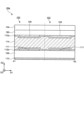
- FIG. 1 is a cross-sectional view showing the configuration of a display panel integrated radio wave reflection device according to a first embodiment of the present invention.
- FIG. 2 is a plan view showing a reflector unit cell used in the display panel integrated radio wave reflection device according to the first embodiment of the present invention.
- FIG. 2 is a cross-sectional view taken along line A1-A2 shown in FIG. 1;
- FIG. 3 is a diagram showing a state in which no voltage is applied between a patch electrode and a ground electrode in the reflector unit cell used in the display panel-integrated radio wave reflection device according to the first embodiment of the present invention.
- FIG. 1 is a cross-sectional view showing the configuration of a display panel integrated radio wave reflection device according to a first embodiment of the present invention.
- FIG. 2 is a plan view showing a reflector unit cell used in the display panel integrated radio wave reflection device according to the first embodiment of the present invention.
- FIG. 2 is a cross-sectional view taken along line A1-A2 shown in FIG
- FIG. 3 is a diagram showing a state in which a voltage is applied between a patch electrode and a ground electrode in the reflector unit cell used in the display panel-integrated radio wave reflection device according to the first embodiment of the present invention.
- FIG. 3 is a diagram schematically showing that the traveling direction of reflected waves changes by the display panel-integrated radio wave reflection device according to the first embodiment of the present invention.
- FIG. 2 is a plan view showing the configuration of a radio wave reflecting section according to the first embodiment of the present invention.
- FIG. 8 is a plan view showing the configuration of a reflector unit cell shown in FIG. 7 .
- 9 is a sectional view showing a cut surface of the reflector unit cell shown in FIG. 8.
- FIG. 1 is a plan view showing the configuration of a display panel section according to a first embodiment of the present invention.
- FIG. 1 is a plan view showing the configuration of a display panel section according to a first embodiment of the present invention.
- 1 is a circuit diagram showing a circuit configuration of a pixel according to a first embodiment of the present invention.
- FIG. 11 is a cross-sectional view showing the cross-sectional structure of the pixel 300 along the line B1-B2 shown in FIG. 10.
- FIG. 11 is a cross-sectional view showing the cross-sectional structure of the pixel shown in FIG. 10.
- FIG. FIG. 1 is a perspective view showing an example of use of the display panel integrated radio wave reflection device according to the first embodiment of the present invention.
- FIG. 3 shows the configuration of a display panel integrated radio wave reflection device according to a second embodiment of the present invention.
- FIG. 7 is a plan view showing a reflector unit cell used in a display panel integrated radio wave reflection device according to a second embodiment of the present invention.
- FIG. 18 is a cross-sectional view taken along the line C1-C2 shown in FIG. 17;
- a member or region when a member or region is said to be “above (or below)" another member or region, it means that it is directly above (or directly below) the other member or region unless otherwise specified. This includes not only the case where the item is located above (or below) another member or area, that is, the case where another component is included in between above (or below) the other member or area. .
- the D1 direction intersects the D2 direction
- the D3 direction intersects the D1 direction and the D2 direction (D1D2 plane).
- the D1 direction is referred to as a first direction
- the D2 direction is referred to as a second direction
- the D3 direction is referred to as a third direction.
- a display panel-integrated radio wave reflecting device 10 including a radio wave reflecting portion 20a capable of two-axis reflection control will be described with reference to FIGS.
- FIG. 1 is a sectional view showing the configuration of a display panel integrated radio wave reflection device 10. As shown in FIG. 1, the display panel integrated radio wave reflection device 10 includes a radio wave reflection section 20a and a display panel section 30.
- the radio wave reflecting section 20a has the function of reflecting radio waves.
- the radio wave reflecting section 20a includes a dielectric substrate 104, an array layer 180, a plurality of first patch electrodes 108, a first alignment film 112a, a liquid crystal layer 114, a sealant 128, a second alignment film 112b, a plurality of second patch electrodes 111, an opposing substrate 106, and an electrode layer 110.
- the display panel section 30 has a function of displaying images.
- the display panel section 30 includes an array substrate 270, a third alignment film 212a, a liquid crystal layer 214, a sealant 228, a fourth alignment film 212b, an electrode layer 110, and a counter substrate 106.
- the radio wave reflecting section 20a and the display panel section 30 share the counter substrate 106 and the electrode layer 110.
- the radio wave reflecting section 20a uses the electrode layer 110 to reflect radio waves corresponding to 5G standard communication in the traveling direction of reflected waves relative to the traveling direction of incident waves, for example, as shown in FIG.
- the display panel section 30 uses the electrode layer 110 to reflect visible light in the traveling direction of reflected light relative to the traveling direction of visible light, as shown in FIG. 1, for example.
- the radio wave reflection section 20a and the display panel section 30 share the counter substrate 106 and the electrode layer 110, and the electrode layer 110 reflects radio waves compatible with communication of the 5G standard. It has two functions: 1. Function and 2. Function of reflecting visible light.
- a display panel section having a function of displaying an image and a radio wave reflecting section having a function of reflecting radio waves are manufactured separately and a device including the display panel section and a radio wave reflecting section is assembled, at least the electrode layer and the electrode layer are fabricated separately.
- a substrate including the above is required for both the display panel section and the radio wave reflection section, which increases the manufacturing cost of the device including the display panel section and the radio wave reflection section.
- the radio wave reflecting section 20a and the display panel section 30 can share the opposing substrate 106 and the electrode layer 110, and can also form the radio wave reflecting section 20a and the display panel section 30 integrally.
- the display panel integrated radio wave reflecting device 10 can reduce manufacturing costs compared to a device in which the display panel section and the radio wave reflecting section are manufactured separately and assembled together.
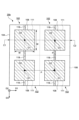
- FIG. 2 is a plan view of the four reflector unit cells 102 when viewed from above (the side where radio waves are incident).
- FIG. 3 is a cross-sectional view taken along line A1-A2 shown in FIG.
- the radio wave reflection section 20a includes a dielectric substrate 104, an array layer 180, a plurality of first patch electrodes 108, a first It includes an alignment film 112a, a liquid crystal layer 114, a sealant 128, a second alignment film 112b, a plurality of second patch electrodes 111, a counter substrate 106, and an electrode layer 110.
- the radio wave reflecting section 20a includes a plurality of reflector unit cells 102.
- One reflector unit cell 102 includes a dielectric substrate 104, an array layer 180, one first patch electrode 108, a first alignment film 112a, a liquid crystal layer 114, a sealant 128, a second alignment film 112b, and one second It includes a patch electrode 111, a counter substrate 106, and an electrode layer 110.
- the plurality of reflector unit cells 102 share the dielectric substrate 104. Therefore, the dielectric substrate 104 can also be regarded as a dielectric layer as one layer. Therefore, the dielectric substrate 104 is sometimes referred to as a dielectric layer.
- the array layer 180 includes a switching element 134 (see FIG. 8) that is electrically connected to the first patch electrode 108.
- the plurality of first patch electrodes 108 are arranged in the D1 direction (first direction) and the D3 direction (third direction) intersecting the D1 direction. direction) in a matrix.
- the distance between the center O1 of the first patch electrode 108 and the center O1 of the adjacent first patch electrode 108 parallel to the D1 direction is a distance P.
- the distance between the center O1 of the first patch electrode 108 and the center O1 of the adjacent first patch electrode 108 parallel to the D3 direction is a distance P. That is, the plurality of first patch electrodes 108 are arranged at the same pitch (distance P) in the D1 direction and the D3 direction.
- the shape of the first patch electrode 108 is a square.
- the length of one side parallel to the D1 direction is the same as the length of one side parallel to the D2 direction, and the length is the length W.
- the second patch electrode 111 and the first patch electrode 108 overlap.
- the plurality of second patch electrodes 111 have the same configuration as the plurality of first patch electrodes 108. Therefore, the plurality of second patch electrodes 111 are arranged in a matrix in the D1 direction and the D3 direction.
- the distance between the center O2 of the second patch electrode 111 and the center O2 of the adjacent second patch electrode 111 parallel to the D1 direction is a distance P. Further, the distance between the center O2 of the second patch electrode 111 and the center O2 of the adjacent second patch electrode 111 parallel to the D3 direction is a distance P.
- the plurality of second patch electrodes 111 are arranged at the same pitch (distance P) in the D1 direction and the D3 direction. Also.
- the shape of the second patch electrode 111 is square.
- the length of one side parallel to the D1 direction is the same as the length of one side parallel to the D2 direction, and the length is the length W.
- the distance W can be selected, for example, from a range of 2.5 mm or more and 3.0 mm or more, and the distance P can be selected, for example, from a range of 3.5 mm or more and 4.0 mm or less.
- the square is a shape that has four-fold rotational symmetry with respect to each of the center O1 of the first patch electrode 108 and the center O2 of the second patch electrode 111.
- the first patch electrode 108 and the second patch electrode 111 have the same configuration, the first patch electrode 108 overlaps the second patch electrode 111, and the first patch electrode 108 is centered at the center O1.
- the second patch electrode 111 has rotational symmetry with respect to the center O2
- the anisotropy regarding the reflection of the radio wave with respect to the vertically polarized wave and the horizontally polarized wave of the incident radio wave is suppressed. Can be made smaller. That is, it is possible to suppress the polarization of vertically polarized waves and horizontally polarized waves in the XY plane in FIGS. 1, 5, and 6, and to uniformly reflect the vertically polarized waves and horizontally polarized waves.
- the shapes of the first patch electrode 108 and the second patch electrode 111 are not limited to square.
- the shapes of the first patch electrode 108 and the second patch electrode 111 may be a rhombus, a rectangle with chamfered vertices, or a rectangle with rounded vertices.
- the shapes of the first patch electrode 108 and the second patch electrode 111 may have four-fold rotational symmetry with respect to the center O1 of the first patch electrode 108 and the center O2 of the second patch electrode 111, respectively.
- the shape of the electrode layer 110 is not limited.
- the shape of the electrode layer 110 may be any shape as long as it has a larger area than the first patch electrode 108 and the second patch electrode 111.
- the electrode layer 110 is disposed on the entire or substantially entire surface of the first main surface 101A of the counter substrate 106. Note that in the display panel-integrated radio wave reflection device 10, the electrode layer 110 is grounded, and therefore may be referred to as a ground electrode.
- first patch electrode 108 the second patch electrode 111, and the electrode layer 110 are formed using a conductive metal or metal oxide.
- a first wiring 118 may be provided on the dielectric substrate 104.
- the first wiring 118 connects a plurality of first patch electrodes 108 arranged in the same column.
- a first wiring 218 may be provided on the counter substrate 106.
- the first wiring 218 connects the plurality of second patch electrodes 111 arranged in the same column.
- the first wiring 118 and the first wiring 218 can be used when applying a control signal to the first patch electrode 108 and the second patch electrode 111.
- the reflector unit cell 102 is used as a reflector 120 that reflects radio waves in a predetermined direction. For this reason, it is preferable that the reflector unit cell 102 attenuates the amplitude of the reflected radio waves as little as possible. As is clear from the structures shown in Figures 1 and 3, when radio waves propagating through the air are reflected by the reflector unit cell 102, the radio waves pass through the dielectric substrate 104 twice.
- the dielectric substrate 104 is preferably formed of a dielectric material such as glass or resin.
- An array layer 180 is provided on the dielectric substrate 104.
- a plurality of first patch electrodes 108 are provided on the array layer 180.
- a first alignment film 112a is provided to cover the plurality of first patch electrodes 108.
- An electrode layer 110 is provided on the first main surface 101A of the opposing substrate 106.
- a plurality of second patch electrodes 111 are provided on the second main surface 101B of the opposing substrate 106.
- a second alignment film 112b is provided to cover the plurality of second patch electrodes 111.
- the first patch electrode 108 is disposed to face the second patch electrode 111 and the electrode layer 110.
- the second patch electrode 111 is disposed to face the first patch electrode 108 and the electrode layer 110.
- a liquid crystal layer 114 is provided between the first patch electrode 108 and the second patch electrode 111.
- a first alignment film 112a is interposed between the first patch electrode 108 and the liquid crystal layer 114.
- a second alignment film 112b is interposed between the second patch electrode 111 and the liquid crystal layer 114.
- the dielectric substrate 104 is bonded to the counter substrate 106 using a sealant 128.
- the dielectric substrate 104 is arranged to face the counter substrate 106 such that a gap is included between the dielectric substrate 104 and the counter substrate 106.
- the array layer 180 and the liquid crystal layer 114 are provided in a region surrounded by the sealant 128.
- a first patch electrode 108, a first alignment film 112a, a second alignment film 112b, and a second patch electrode 111 are provided between the dielectric substrate 104 and the counter substrate 106.
- the thickness of the liquid crystal layer 114 is the gap between the first alignment film 112a and the second alignment film 112b provided on each of the dielectric substrate 104 and the counter substrate 106.
- the thickness of the liquid crystal layer 114 is, for example, 50 ⁇ m.
- a spacer may be provided between the dielectric substrate 104 and the counter substrate 106 in order to keep the distance constant.
- a control signal that controls the orientation of liquid crystal molecules in the liquid crystal layer 114 is applied to the first patch electrode 108.
- the control signal is a DC voltage signal or a polarity inversion signal in which a positive DC voltage and a negative DC voltage are alternately inverted.
- a ground voltage or an intermediate level voltage of a polarity inversion signal is applied to the second patch electrode 111 and the electrode layer 110.
- the dielectric constant of the liquid crystal layer 114 having dielectric anisotropy changes due to changes in the alignment state of liquid crystal molecules.
- the reflector unit cell 102 can change the dielectric constant of the liquid crystal layer 114 by changing the alignment state of liquid crystal molecules contained in the liquid crystal layer 114 in response to a control signal applied to the first patch electrode 108 .
- the ground voltage may be, for example, a ground voltage (GND voltage), or may be a voltage of 0V.
- the frequency bands of radio waves reflected by the reflector unit cell 102 include a very high frequency (VHF) band, an ultra-high frequency (UHF) band, and a microwave (SHF: super high frequency) band. band, submillimeter wave ( These are the THF (tremendously high frequency) and millimeter wave (EHF: extra high frequency) bands.
- millimeter waves refer to a frequency band of 30 GHz to 300 GHz.
- the frequency band of the fifth generation communication standard called 5G includes the 26 GHz band to 29 GHz band, and frequencies above the 26 GHz band are sometimes collectively called millimeter waves.
- the reflector unit cell 102 can control the phase of the reflected radio waves without being affected by the incident radio waves.
- FIG. 4 shows a state in which no voltage is applied between the first patch electrode 108, the second patch electrode 111, and the electrode layer 110 (referred to as a "first state").
- FIG. 4 shows a case where the first alignment film 112a and the second alignment film 112b are horizontal alignment films. The long axes of the liquid crystal molecules 116 in the first state are aligned horizontally with respect to the surfaces of the first patch electrode 108 and the second patch electrode 111 by the first alignment film 112a and the second alignment film 112b.
- FIG. 5 shows a state in which a control signal (voltage signal) is applied to the first patch electrode 108 (referred to as a "second state").
- the long axes of the liquid crystal molecules 116 are aligned perpendicular to the surfaces of the first patch electrode 108 and the second patch electrode 111 under the action of the electric field.
- the angle at which the long axis of the liquid crystal molecules 116 is oriented depends on the magnitude of the control signal applied to the first patch electrode 108 (the magnitude of the voltage between the first patch electrode 108 and the second patch electrode 111). It can also be oriented in a direction intermediate between the vertical direction and the vertical direction.
- the liquid crystal layer 114 having dielectric anisotropy can also be regarded as a variable dielectric layer.
- the reflector unit cell 102 can be controlled to delay (or not delay) the phase of the reflected wave by utilizing the dielectric anisotropy of the liquid crystal layer 114.
- FIG. 6 schematically shows that the traveling direction of reflected waves changes depending on an arbitrary reflector unit cell 102 and a reflector unit cell 102 adjacent to an arbitrary reflector unit cell 102.
- Any reflector unit cell 102 and reflector unit cells 102 adjacent to any reflector unit cell 102 are adjacent in the X direction.
- any first patch electrode 108 and the first patch electrode 108 adjacent to any first patch electrode 108 are connected to different first wirings 118.
- any second patch electrode 111 and the second patch electrode 111 adjacent to any second patch electrode 111 are connected to different first wirings 218 .
- the first wiring 218 connected to the electrode layer 111 and the electrode layer 110 are electrically connected.
- the phase of the reflected wave R1 reflected by any reflector unit cell 102 is different from the phase of the reflected wave R2 reflected by the adjacent reflector unit cell 102 (in FIG. 6, the phase of the reflected wave R2 is different from the phase of the reflected wave R2). (leading the phase of R1), the traveling direction of the reflected wave apparently changes to an oblique direction.
- the plurality of reflector unit cells 102 are arranged adjacent to each other in a matrix in the D1 direction and the D3 direction. It is preferable that the reflection plate unit cell 102 is arranged so as to have two-fold rotational symmetry or four-fold rotational symmetry with respect to the center of the reflector unit cell 102 (the center O1 of the first patch electrode 108 and the center O2 of the second patch electrode 111). . By arranging the reflector unit cell 102 so as to have two-fold rotational symmetry or four-fold rotational symmetry, symmetry can be achieved with respect to vertically polarized waves and horizontally polarized waves.
- the first patch electrode 108 and the second patch electrode 111 are formed using a transparent conductive film, and the liquid crystal layer 114 is translucent, so that radio waves can be reflected without impairing natural lighting. Therefore, the display panel integrated radio wave reflecting device 10 can be installed in the windows of a high-rise building. As a result, it is possible to reflect highly directional radio waves in a specified direction at a high altitude where there are relatively few obstacles. Therefore, the display panel integrated radio wave reflecting device 10 can be used to eliminate radio wave blind zones (places where radio waves cannot reach) in urban areas.
- FIG. 7 is a plan view showing the configuration of the display panel integrated radio wave reflection device 10.
- FIG. 8 is an enlarged plan view of the reflector unit cell 102 shown in FIG. 7.
- FIG. 9 is a cross-sectional view showing a cut surface of the reflector unit cell 102.
- Descriptions of configurations that are the same as or similar to those in FIGS. 1 to 6 will be omitted here.
- the reflector 120 has a structure in which a plurality of reflector unit cells 102 are integrated.
- the plurality of reflector unit cells 102 are arranged in a matrix in the D1 direction and the D3 direction.
- the first patch electrode 108 and the second patch electrode 111 are arranged so as to face the radio wave incident surface.
- the electrode layer 110 has a flat plate shape.
- the plurality of first patch electrodes 108 and the plurality of second patch electrodes 111 are arranged in a matrix within the plane of the flat electrode layer 110 and inside the sealing material 128 .
- a plurality of first wirings 118 extending in the D3 direction are arranged on the dielectric substrate 104.
- a plurality of first wirings 218 extending in the D3 direction are arranged on the counter substrate 106.
- the first wiring 118 and the first wiring 218 are stacked in the D2 direction and overlap each other. Further, the plurality of overlapping first wirings 118 and first wirings 218 are arranged in the D1 direction.
- the reflective plate 120 has a configuration in which a plurality of patch electrode arrays in one row connected by the superimposed first wires 118 and one row of patch electrode arrays connected by the first wires 218 are arranged in the Y direction.
- the area other than where the reflection plate 120 is provided is referred to as a peripheral area 122.
- a first drive circuit 124 and a terminal section 126 are provided in the peripheral region 122.
- the terminal portion 126 is an area that forms a connection with an external circuit, and for example, a flexible printed circuit (not shown) is connected to the terminal portion 126.
- a signal for controlling the first drive circuit 124 is inputted to the terminal section 126 from the flexible printed circuit.
- the plurality of first wirings 118 arranged on the dielectric substrate 104 extend in the Y direction, extend into the peripheral region 122, and are connected to the first drive circuit 124.
- a plurality of first wirings 218 disposed on the counter substrate 106 extend in the Y direction and are connected to a ground wiring 219 disposed on the opposite side from the terminal portion 126.
- the ground wiring 219 is electrically connected to the ground wiring 217 disposed on the dielectric substrate 104 via the connection portion 215.
- the ground wiring 217 extends to the peripheral region 122 and is connected to the first drive circuit 124 .
- the first drive circuit 124 outputs a control signal to the first patch electrode 108 via the first wiring 118.
- the first drive circuit 124 outputs a control signal to the second patch electrode 111 via the first wiring 218, the ground wiring 217, the connecting portion 215, and the ground wiring 219.
- the first drive circuit 124 can output control signals of different voltage levels to each of the plurality of first wirings 118 and the plurality of first wirings 218.
- the control signals at different voltage levels are, for example, a control signal at a first voltage level and a control signal at a second voltage level.
- the second voltage level control signal is, for example, a ground voltage.
- a plurality of second wirings 132 arranged on the reflection plate 120 and extending in the X direction extend in the X direction and are connected to the second drive circuit 130.
- the second drive circuit 130 outputs a scanning signal to the plurality of second wirings 132.
- FIG. 8 shows an enlarged view of the arrangement of the first patch electrode 108, the first wiring 118, and the second wiring 132.
- a switching element 134 is provided on the first patch electrode 108 . Switching (on and off) of the switching element 134 is controlled by a scanning signal applied to the second wiring 132.
- the first patch electrode 108 whose switching element 134 is turned on is brought into conduction with the first wiring 118 and a control signal is applied thereto.
- the first patch electrode 108 whose switching element 134 is turned on is brought into conduction with the first wiring 118 and a control signal is applied thereto.
- the switching element 134 is formed of, for example, a thin film transistor. According to such a configuration, it is possible to select each row of the plurality of first patch electrodes 108 arranged in the D1 direction, and to apply a control signal of a different voltage level to each row.
- the radio wave reflecting section 20a can control the propagation direction of the reflected waves in the horizontal direction of the drawing centering on the reflection axis VR parallel to the Y direction, as well as the propagation direction of the radio waves incident on the reflection plate 120 in parallel to the X direction.
- the traveling direction of the reflected waves can also be controlled in the vertical direction of the drawing with the reflection axis HR as the center. That is, the radio wave reflecting section 20a includes a reflection axis VR parallel to the Y direction and a reflection axis VH parallel to the The reflection angle can be controlled.
- FIG. 9 shows an example of a cross-sectional structure of the reflector unit cell 102 in which the switching element 134 is connected to the first patch electrode 108.
- a switching element 134 is provided on the dielectric substrate 104.
- Switching element 134 is a transistor.
- the switching element 134 includes a structure in which a first gate electrode 138, a second gate insulating layer 146, a semiconductor layer 142, a second gate insulating layer 146, and a second gate electrode 148 are stacked.
- An undercoat layer 136 may be provided between the first gate electrode 138 and the dielectric substrate 104.
- a first wiring 118 is provided between the first gate insulating layer 140 and the second gate insulating layer 146.
- the first wiring 118 is provided so as to be in contact with the semiconductor layer 142. Further, the first connection wiring 144 is provided in the same conductive layer as the conductive layer forming the first wiring 118 . The first connection wiring 144 is provided so as to be in contact with the semiconductor layer 142.
- the connection structure of the first wiring 118 and the first connection wiring 144 to the semiconductor layer 142 shows a structure in which one wiring is connected to the source of the transistor and the other wiring is connected to the drain.
- a first interlayer insulating layer 150 is provided to cover the switching element 134.
- a second wiring 132 is provided on the first interlayer insulating layer 150.
- the second wiring 132 is connected to the second gate electrode 148 through a contact hole formed in the first interlayer insulating layer 150.
- the first gate electrode 138 and the second gate electrode 148 are electrically connected to each other in a region that does not overlap with the semiconductor layer 142.
- a second connection wiring 152 is provided on the first interlayer insulating layer 150 using the same conductive layer as the second wiring 132 .
- the second connection wiring 152 is connected to the first connection wiring 144 through a contact hole formed in the first interlayer insulating layer 150.
- a second interlayer insulating layer 154 is provided to cover the second wiring 132 and the second connection wiring 152. Furthermore, a planarization layer 156 is provided to fill in the level difference caused by the formation of the switching element 134. By providing the planarizing layer 156, the steps of the switching element 134 can be filled, so that the surface of the planarizing layer 156 becomes flat. Therefore, the first patch electrode 108 can be formed on the flat surface (surface) of the planarization layer 156 without being affected by the difference in level of the switching element 134.
- a passivation layer 158 is provided on the planar surface of planarization layer 156.
- the array layer 180 includes, for example, an undercoat layer 136, a conductive layer including a first gate electrode 138, a first gate insulating layer 140, a semiconductor layer 142, and a first connection wiring 144.
- the array layer 180 may include a passivation layer 158 , a planarization layer 156 , and a conductive layer forming a first patch electrode 108 provided in a contact hole passing through the second interlayer insulating layer 154 .
- the first patch electrode 108 is provided on the passivation layer 158.
- the first patch electrode 108 is connected to the second connection wiring 152 through a contact hole penetrating the passivation layer 158, the planarization layer 156, and the second interlayer insulating layer 154.
- a first alignment film 112a is provided on the first patch electrode 108.
- a second patch electrode 111 and a second alignment film 112b are provided on the second main surface 101B of the counter substrate 106, similar to the structure of the cut surface shown in FIGS. 1 and 3.
- An electrode layer 110 is provided on the first main surface 101A of the counter substrate 106, similar to the structure of the cut plane shown in FIGS. 1 and 3.
- the surface of the dielectric substrate 104 on which the switching element 134 and the first patch electrode 108 are provided is arranged so as to face the surface on which the second patch electrode 111 and the second alignment film 112b of the counter substrate 106 are provided,
- a liquid crystal layer 114 is provided between the surface where the switching element 134 and the first patch electrode 108 are provided and the surface where the second patch electrode 111 is provided.
- the undercoat layer 136 is formed of, for example, a silicon oxide film.
- the first gate insulating layer 140 and the second gate insulating layer 146 are formed of, for example, a silicon oxide film or a laminated structure of a silicon oxide film and a silicon nitride film.
- the semiconductor layer is formed of a silicon semiconductor such as amorphous silicon or polycrystalline silicon, or an oxide semiconductor containing a metal oxide such as indium oxide, zinc oxide, or gallium oxide.
- the first gate electrode 138 and the second gate electrode 148 may be made of, for example, molybdenum (Mo), tungsten (W), or an alloy thereof.
- the first wiring 118, the second wiring 132, the first connection wiring 144, and the second connection wiring 152 are formed using a metal material such as titanium (Ti), aluminum (Al), or molybdenum (Mo).
- a metal material such as titanium (Ti), aluminum (Al), or molybdenum (Mo).
- it may have a laminated structure of titanium (Ti)/aluminum (Al)/titanium (Ti) or a laminated structure of molybdenum (Mo)/aluminum (Al)/molybdenum (Mo).
- the planarization layer 156 is made of a resin material such as acrylic or polyimide.
- the passivation layer 158 is formed of, for example, a silicon nitride film.
- the first patch electrode 108, the second patch electrode 111, and the electrode layer 110 are formed of a metal film such as aluminum (Al) or copper (Cu), or a transparent conductive film such as indium
- the second wiring 132 is connected to the gate of the transistor used as the switching element 134
- the first wiring 118 is connected to one of the source and drain of the transistor
- the first patch electrode 108 is connected to the source and drain of the transistor.
- a predetermined patch electrode can be selected from among the plurality of first patch electrodes 108 arranged in a matrix and a control signal can be applied thereto.
- a control voltage can be applied to each first patch electrode 108 arranged in a row. For example, when the reflection plate 120 is upright, the direction of reflection of the reflected waves can be controlled in the horizontal and vertical directions.
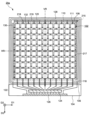
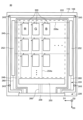
- FIG. 10 and 11 are top views showing the configuration of the display panel section 30.
- FIG. 12 is a circuit diagram showing the circuit configuration of the pixel 300 of the display panel section 30.
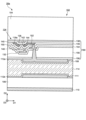
- FIG. 13 is a cross-sectional view showing the cross-sectional structure of the pixel 300 along the line B1-B2 shown in FIG.
- FIG. 14 is a cross-sectional view showing the cross-sectional structure of the pixel 300 shown in FIG. 10.
- the display panel section 30 includes an array substrate 270, a third alignment film 212a, a liquid crystal layer 214, a sealant 228, a fourth alignment film 212b, an electrode layer 110, and an opposing substrate 106.
- the display panel section 30 includes an array substrate 270, a seal section 240, a counter substrate 106, a flexible printed circuit board 244 (FPC 244), and a control circuit 247.
- the array substrate 270 and the counter substrate 106 are bonded together by a seal portion 240.
- a plurality of pixels 300 are arranged in a matrix in the D1 and D2 directions.
- the display area 222 is an area that overlaps a liquid crystal layer 214, which will be described later, in plan view.
- the peripheral area 221 includes a seal area 224 and a terminal area 226.
- the peripheral area 221 surrounds the display area 222 and is an area around the display area 222.
- the seal area 224 is an area around the display area 222 that overlaps the seal portion 240 in plan view.
- the terminal area 226 is an area where the array substrate 270 is exposed from the counter substrate 106 and is provided outside the seal area 224. Note that the outside of the seal area 224 means the outside of the area surrounded by the seal portion 240.
- FPC 244 is provided in terminal area 226.
- the control circuit 247 is provided on the FPC 244. The control circuit 247 supplies control signals for driving each pixel 300.
- a source driver circuit 250 is provided parallel to the direction D1 of the display region 222 in which the pixels 300 are arranged, and a gate driver circuit 252 is provided parallel to the direction D2.
- the source driver circuit 250 and the gate driver circuit 252 are provided in the sealing region 224.
- the pixels 300 are arranged, for example, in a stripe array.
- Each of the pixels 300 may correspond to, for example, sub-pixel R, sub-pixel G, and sub-pixel B. Three sub-pixels may form one pixel.
- the pixel 300 is the smallest unit that constitutes part of an image reproduced in the display region 222.
- Each sub-pixel is provided with one display element.
- the display element is a liquid crystal element 335.
- the color to which the sub-pixel corresponds is determined by the characteristics of the liquid crystal element 335 or a color filter (not shown) provided in the sub-pixel.
- subpixel R, subpixel G, and subpixel B can be configured to give different colors to each other.
- subpixel R, subpixel G, and subpixel B can each be provided with color filters that emit the three primary colors of red, green, and blue.
- subpixel R includes a red color filter 213R (see FIG. 13) that emits red
- subpixel G includes a green color filter 213G (see FIG. 13) that emits green
- subpixel B includes a blue color filter 213R (see FIG. 13). It may include a blue color filter 213B (see FIG. 13) that emits a blue color.
- An arbitrary voltage or current is supplied to each of the three subpixels, and the display panel section 30 can display an image.
- the WBs may be the same or different.
- the distance WR, the distance WG, and the distance WB can be selected, for example, from a range of 200 ⁇ m or more and 500 ⁇ m or less.
- the distance WR, the distance WG, and the distance WB may be referred to as, for example, a pixel pitch.
- the distance WR, the distance WG, and the distance WB (pixel pitch) are smaller than the pitch of the reflector unit cell 102.
- a signal line 254a extends from the source driver circuit 250 in the D2 direction and is connected to the plurality of pixels 300 arranged in the D2 direction.
- a scanning line 256a extends from the gate driver circuit 252 in the D1 direction and is connected to a plurality of pixels 300 arranged in the D1 direction.
- a terminal portion 258 is provided in the terminal area 226.
- the terminal portion 258 and the source driver circuit 250 are connected by a connection wiring 260.
- the terminal portion 258 and the gate driver circuit 252 are connected by a connection wiring 260.
- an external device connected to the FPC 244 and the display panel section 30 are connected, and a signal from the external device is transmitted to, for example, the control circuit 247, the source driver circuit 250, and the gate driver circuit. 252 and each pixel 300.
- the display panel section 30 controls each pixel 300 provided in the display panel section 30 using signals from external equipment and control signals generated by the control circuit 247, source driver circuit 250, and gate driver circuit 252. Drive.
- FIG. 12 is a circuit diagram showing the circuit configuration of the pixel 300.
- FIG. 13 is a cross-sectional view showing the cross-sectional structure of the pixel 300 along the line B1-B2 shown in FIG.
- FIG. 14 is a cross-sectional view showing the cross-sectional structure of the pixel 300. Descriptions of configurations that are the same as or similar to those in FIGS. 1 to 11 may be omitted.
- the pixel 300 includes, for example, a transistor Tr, a liquid crystal element 335, and a capacitor 360.
- Transistor Tr includes a gate electrode 251, a source electrode 254b, and a drain electrode 254c.
- Gate electrode 251 is electrically connected to scanning line 256a.
- Source electrode 254b is electrically connected to signal line 254a.
- the drain electrode 254c is electrically connected to the pixel electrode 342a.
- the capacitive element 360 is electrically connected between the pixel electrode 342a (drain electrode 254c) and the capacitive wiring 246.
- the liquid crystal element 335 includes a pixel electrode 342a (drain electrode 254c), a common electrode 110a, and a liquid crystal layer 214.
- the common electrode 110a is electrically connected to the common wiring 245.
- the electrode layer 110 includes a common electrode 110a.
- the capacitor wiring 246 and the common wiring 245 are supplied with a common voltage VCOM from the control circuit 247, for example. Since the common wiring 245 is electrically connected to the electrode layer 110 via the plurality of connections 243, the liquid crystal element 335 is electrically connected to the electrode layer 110.
- the display panel unit 30 can change the alignment state of liquid crystal molecules (not shown) included in the liquid crystal element 335 by supplying current or voltage to each of the pixel electrode 342a and the electrode layer 110. As a result, the display panel section 30 can display images.
- the control circuit 247 supplies the common voltage VCOM to the electrode layer 110 via the common wiring 245 and the plurality of connections 243.
- the common voltage VCOM may be, for example, a ground voltage (GND voltage) similarly to the ground voltage, or may be a voltage of 0V. Therefore, the display panel section 30 can supply the common voltage VCOM to the electrode layer 110 for the display panel section 30, and can also supply the ground voltage to the electrode layer 110 for the radio wave reflecting section 20a. That is, in the display panel integrated radio wave reflecting device 10, since the radio wave reflecting section 20a and the display panel section 30 share the electrode layer 110, the display panel section 30, not both the radio wave reflecting section 20a and the display panel section 30, A voltage can be supplied to the electrode layer 110 from one side.
- the number of paths for supplying voltage to the electrode layer 110 can be combined into one instead of two.
- the configuration of the display panel integrated radio wave reflecting device 10 can be simplified compared to the case where voltage is supplied to the electrode layer 110 from both the radio wave reflecting section 20a and the display panel section 30. At the same time, manufacturing costs can be reduced.
- the substrate 280 includes a first main surface 280A and a second main surface 280B.
- a first conductive layer 256, an insulating layer 322, a semiconductor layer 324, and a second conductive layer 254 are disposed in this order on the second main surface 280B of the substrate 280.
- the first conductive layer 256 includes a scanning line 256a (see FIG. 11) and a first conductive film 256b.
- the semiconductor layer 324 includes a semiconductor film 324a.
- the second conductive layer 254 includes a signal line 254a, a source electrode 254b, and a drain electrode 254c.
- a transistor Tr is provided on the second main surface 280B.
- the transistor Tr includes a semiconductor film 324a provided facing the first conductive film 256b, an insulating layer 322 provided between the semiconductor film 324a, and a source electrode 254b and a drain electrode provided on the semiconductor film 324a. 254c.
- the insulating layer 322 provided between the semiconductor films 324a functions as a gate insulating film of the transistor Tr.
- the first conductive film 256b is electrically connected to the scanning line 256a and functions as the gate electrode 251.
- the source electrode 254b is electrically connected to the signal line 254a and functions as a source electrode.
- the region where the semiconductor film 324a overlaps the first conductive film 256b (gate electrode) is the channel region of the transistor Tr.
- the semiconductor film 324a may have a source region and a drain region sandwiching the channel region. The source or drain region may form a source or drain electrode.
- the third conductive layer 330 includes a third conductive film 330a.
- the third conductive film 330a is disposed on the insulating layer 328 at a position facing the semiconductor film 324a.
- the third conductive film 330a functions as a back gate electrode.
- the transistor Tr has a bottom gate type configuration.
- the transistor Tr is not limited to a bottom gate type configuration, and may have a top gate type configuration or a dual gate type configuration.
- An insulating layer 332 is disposed on the third conductive layer 330 and the insulating layer 328.
- the display panel section 30 is a reflective liquid crystal display panel using the same liquid crystal as the liquid crystal layer 114.
- the insulating layer 332 is preferably removed.
- the area other than the opening area includes wiring such as the signal line 254a, the scanning line 256a, and the capacitor wiring 246, and is referred to as a wiring area.
- a transparent conductive layer 334 and a fourth conductive layer 336 are arranged in this order on the insulating layer 332 and the insulating layer 328.
- the transparent conductive layer 334 includes a transparent conductive film 334a
- the fourth conductive layer 336 includes a fourth conductive film 336a.
- the transparent conductive film 334a and the fourth conductive film 336a are electrically connected to the capacitor wiring 246 (see FIG. 11 or 12) in the display area 222 and the peripheral area 221.
- the fourth conductive film 336a is formed in contact with the transparent conductive film 334a.
- An insulating layer 338 is disposed on the transparent conductive layer 334 and the fourth conductive layer 336.
- a pixel electrode layer 342 is disposed on the insulating layer 338.
- a color filter layer 213 is disposed on the insulating layer 338 and the pixel electrode layer 342.
- the color filter layer 213 includes, for example, a red color filter 213R, a green color filter 213G, and a blue color filter 213B.
- a third alignment film 212a is disposed on the color filter layer 213.
- the pixel electrode layer 342 includes a pixel electrode 342a.
- the pixel electrode 342a is electrically connected to the drain electrode 254c via an opening 340 that penetrates the insulating layer 328 and the insulating layer 338.
- the counter substrate 106 includes a first main surface 101A and a second main surface 101B.
- the counter substrate 106 is arranged to face the substrate 280.
- the second main surface 101B of the counter substrate 106 is arranged to face the second main surface 280B of the substrate 280.
- the second main surface 101B of the counter substrate 106 is provided with an electrode layer 110 and a black matrix 348. Black matrix 348 is formed in contact with electrode layer 110.
- a fourth alignment film 212b is disposed on the electrode layer 110 and the black matrix 348.
- the electrode layer 110 is arranged over the entire second main surface 101B.
- the electrode layer 110 is electrically connected to the common wiring 245 in the peripheral region 221 via a plurality of connection parts 243 (see FIG. 11).
- the black matrix 348 is arranged in a grid pattern in the display area 222 and the peripheral area 221.
- the liquid crystal layer 214 is sandwiched between the substrate 280 and the counter substrate 106, and is sealed by a seal portion 240 (see FIG. 2).
- the thickness between the substrate 280 and the counter substrate 106 is the thickness of the liquid crystal layer 214.
- the liquid crystal element 335 includes a pixel electrode layer 342, a liquid crystal layer 214, and an electrode layer 110.
- the thickness of the liquid crystal layer 214 is, for example, 2.0 ⁇ m or more and 5 ⁇ m or less.
- Examples of materials for forming the first conductive layer 256, the second conductive layer 254, the third conductive layer 330, the fourth conductive layer 336, and the electrode layer 110 include aluminum (Al), titanium (Ti), and molybdenum (Mo). , copper (Cu), or tungsten (W), or an alloy thereof. Further, the first conductive layer 256, the second conductive layer 254, the third conductive layer 330, the fourth conductive layer 336, and the electrode layer 110 can be a single layer or a stacked layer.
- the electrode layer 110 reflects radio waves and functions as a ground electrode for the radio wave reflection section 20a. Further, the electrode layer 110 reflects light and functions as a common electrode for the display panel section 30. Therefore, the material forming the electrode layer 110 is preferably a material with high reflectance and low resistivity.
- the insulating layer 322 separates the semiconductor layer 324 and the first conductive layer 256 from each other, and can prevent short-circuiting between the semiconductor layer 324 and the first conductive layer 256.
- an inorganic insulating material such as silicon oxide (SiO x ), silicon oxynitride (SiO x N y ), silicon nitride (SiN x ), or silicon nitride oxide (SiN x O y ) is used.
- SiO x N y is a silicon compound containing less nitrogen (N) than oxygen (O).
- SiN x O y is a silicon compound containing less oxygen than nitrogen.
- the insulating layer 332 is placed over the unevenness caused by the transistor Tr and other semiconductor elements, and has the function of forming a flat surface.
- an organic compound material selected from acrylic, polyimide, etc., which has excellent film surface flatness, can be used as a material for forming the insulating layer 332.
- the insulating layer 328 can separate the semiconductor layer 324, the second conductive layer 254, and the third conductive layer 330, and can prevent short circuit between the semiconductor layer 324, the second conductive layer 254, and the third conductive layer 330.
- Examples of the material for forming the insulating layer 328 include the same material as the insulating layer 322, aluminum oxide (AlO x ), aluminum oxynitride (AlO x N y ), aluminum nitride oxide (AlN x O y ), or aluminum nitride ( An inorganic insulating material such as AlNx) can be used.
- AlO x N y is an aluminum compound containing less nitrogen (N) than oxygen (O).
- AlN x O y is an aluminum compound containing less oxygen than nitrogen.
- each inorganic insulating material may be used alone, or these materials may be stacked.
- the insulating layer 338 separates the transparent conductive layer 334 and the fourth conductive layer 336 from the pixel electrode layer 342, and can prevent short circuit between the transparent conductive layer 334 and the fourth conductive layer 336 and the pixel electrode layer 342. .
- the insulating layer 338 is formed using the same material as the insulating layer 328 and has a similar configuration.
- a transparent conductive material such as indium tin oxide (ITO) or indium zinc oxide (IZO) can be used, for example.
- a black resin or metal material can be used as the material for forming the black matrix 348.
- the metal material chromium, molybdenum, or titanium, which has a relatively low reflectance compared to aluminum, can be used.
- the common electrode is formed of the black matrix 348 and the electrode layer 110. As a result, in the common electrode of the display panel section 30, the black matrix 348 can function as an auxiliary electrode with low resistance loss.
- the array substrate 290 includes a substrate 280, a first conductive layer 256, an insulating layer 322, a semiconductor layer 324, a second conductive layer 254, an insulating layer 328, a third conductive layer 330, an insulating layer 332, a transparent conductive layer 334, and a fourth conductive layer. It includes a layer 336, an insulating layer 338, and a pixel electrode layer 342.
- the array substrate 290 may include a color filter layer 213 and a third alignment layer 212a.
- the substrate 190 includes the counter substrate 106, the electrode layer 110, the black matrix 348, and the fourth alignment film 212b.
- the substrate 190 is sometimes referred to as a counter substrate.
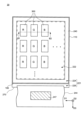
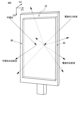
- FIG. 15 is a perspective view showing an example of use of the display panel integrated radio wave reflection device 10 in an electronic signboard 400. Descriptions of structures that are the same as or similar to those in FIGS. 1 to 14 may be omitted.
- the electronic signboard 400 includes a display panel integrated radio wave reflecting device 10 that includes a radio wave reflecting section 20a and a display panel section 30.
- the display panel integrated radio wave reflecting device 10 is attached to the electronic signboard 400 such that the display panel section 30 is located on the front side of the electronic signboard 400, and the radio wave reflecting section 20a is located on the back side of the electronic signboard 400.
- radio waves corresponding to 5G standard communications are reflected in the direction of travel of the reflected wave relative to the direction of travel of the incident wave.
- visible light is reflected in the direction of travel of the reflected light relative to the direction of travel of the visible light.
- Visible light is, for example, electromagnetic waves that are visible to the human eye as light, and includes light in the wavelength range of 380 nm to 810 nm. Visible light may include, for example, wavelengths in the range of 430 nm to 490 nm that exhibit blue, wavelengths in the range of 490 nm to 550 nm that exhibit green, and wavelengths in the range of 640 nm to 810 nm that exhibit red.
- a plurality of electronic signboards 400 can be installed so that radio waves are reflected at a meeting place for people who own information terminals, and images are displayed on the side where people are passing by. can.
- the display panel integrated radio wave reflection device 10 includes the display panel section 30 and the radio wave reflection section 20a integrally, so that the display panel section 30 and the radio wave reflection section 20a can be installed even in places where the display panel section 30 and the radio wave reflection section 20a conflict with each other.
- the radio wave reflecting section 20a can be installed at the same location.
- a display panel-integrated radio wave reflecting device 10 including a radio wave reflecting section 20b capable of uniaxial reflection control will be described.
- the reflection axis RY of the radio wave reflection section 20b is uniaxial.
- the reflection angle can be controlled in a direction with the reflection axis RY as the rotation axis.
- the display panel integrated radio wave reflecting device 10 according to the second embodiment is a device in which the radio wave reflecting section 20a of the display panel integrated radio wave reflecting device 10 according to the first embodiment is replaced with a radio wave reflecting section 20b.
- the display panel integrated radio wave reflection device 10 has at least an array layer 180, a plurality of second wirings 132, and a display panel integrated radio wave reflection device 10 according to the first embodiment. , does not include the second drive circuit 130. In the second embodiment, differences from the first embodiment will be mainly explained using FIGS. 16 to 18.
- FIG. 16 is a plan view showing the configuration of the radio wave reflecting section 20b according to the second embodiment.
- FIG. 17 is a plan view showing a reflector unit cell 102b used in the radio wave reflector 20b.
- FIG. 18 is a cross-sectional view taken along the line C1-C2 shown in FIG. 17. Descriptions of configurations that are the same as or similar to those in FIGS. 1 to 5 will be omitted here.
- the reflector 120 according to the second embodiment includes a plurality of reflector unit cells 102b.
- the reflector 120 according to the second embodiment includes a configuration in which the plurality of reflector unit cells 102 of the reflector 120 according to the first embodiment are replaced with a plurality of reflector unit cells 102b.
- the reflector 120 according to the second embodiment is provided between the dielectric substrate 104 and the opposing substrate 106. As shown in Figures 16 and 17, the reflector 120 according to the second embodiment has a structure in which multiple reflector unit cells 102b are integrated.
Landscapes
- Physics & Mathematics (AREA)
- Nonlinear Science (AREA)
- Chemical & Material Sciences (AREA)
- Crystallography & Structural Chemistry (AREA)
- General Physics & Mathematics (AREA)
- Optics & Photonics (AREA)
- Mathematical Physics (AREA)
- Geometry (AREA)
- Electromagnetism (AREA)
- Aerials With Secondary Devices (AREA)
Priority Applications (3)
| Application Number | Priority Date | Filing Date | Title |
|---|---|---|---|
| CN202380067733.4A CN119948701A (zh) | 2022-09-22 | 2023-08-02 | 显示面板一体型电波反射装置 |
| JP2024548121A JPWO2024062780A1 (https=) | 2022-09-22 | 2023-08-02 | |
| US19/081,002 US20250216728A1 (en) | 2022-09-22 | 2025-03-17 | Intelligent reflecting surface having integrated display part |
Applications Claiming Priority (2)
| Application Number | Priority Date | Filing Date | Title |
|---|---|---|---|
| JP2022151875 | 2022-09-22 | ||
| JP2022-151875 | 2022-09-22 |
Related Child Applications (1)
| Application Number | Title | Priority Date | Filing Date |
|---|---|---|---|
| US19/081,002 Continuation US20250216728A1 (en) | 2022-09-22 | 2025-03-17 | Intelligent reflecting surface having integrated display part |
Publications (1)
| Publication Number | Publication Date |
|---|---|
| WO2024062780A1 true WO2024062780A1 (ja) | 2024-03-28 |
Family
ID=90454085
Family Applications (1)
| Application Number | Title | Priority Date | Filing Date |
|---|---|---|---|
| PCT/JP2023/028266 Ceased WO2024062780A1 (ja) | 2022-09-22 | 2023-08-02 | 表示パネル一体型電波反射装置 |
Country Status (4)
| Country | Link |
|---|---|
| US (1) | US20250216728A1 (https=) |
| JP (1) | JPWO2024062780A1 (https=) |
| CN (1) | CN119948701A (https=) |
| WO (1) | WO2024062780A1 (https=) |
Cited By (2)
| Publication number | Priority date | Publication date | Assignee | Title |
|---|---|---|---|---|
| WO2025142112A1 (ja) * | 2023-12-28 | 2025-07-03 | 株式会社ジャパンディスプレイ | 電波反射装置 |
| WO2026042515A1 (ja) * | 2024-08-20 | 2026-02-26 | 富士フイルム株式会社 | 電波用反射板 |
Citations (2)
| Publication number | Priority date | Publication date | Assignee | Title |
|---|---|---|---|---|
| WO2021251169A1 (ja) * | 2020-06-12 | 2021-12-16 | Agc株式会社 | ディスプレイモジュール |
| WO2023140243A1 (ja) * | 2022-01-24 | 2023-07-27 | 株式会社ジャパンディスプレイ | リフレクトアレイ |
-
2023
- 2023-08-02 WO PCT/JP2023/028266 patent/WO2024062780A1/ja not_active Ceased
- 2023-08-02 CN CN202380067733.4A patent/CN119948701A/zh active Pending
- 2023-08-02 JP JP2024548121A patent/JPWO2024062780A1/ja active Pending
-
2025
- 2025-03-17 US US19/081,002 patent/US20250216728A1/en active Pending
Patent Citations (2)
| Publication number | Priority date | Publication date | Assignee | Title |
|---|---|---|---|---|
| WO2021251169A1 (ja) * | 2020-06-12 | 2021-12-16 | Agc株式会社 | ディスプレイモジュール |
| WO2023140243A1 (ja) * | 2022-01-24 | 2023-07-27 | 株式会社ジャパンディスプレイ | リフレクトアレイ |
Cited By (2)
| Publication number | Priority date | Publication date | Assignee | Title |
|---|---|---|---|---|
| WO2025142112A1 (ja) * | 2023-12-28 | 2025-07-03 | 株式会社ジャパンディスプレイ | 電波反射装置 |
| WO2026042515A1 (ja) * | 2024-08-20 | 2026-02-26 | 富士フイルム株式会社 | 電波用反射板 |
Also Published As
| Publication number | Publication date |
|---|---|
| US20250216728A1 (en) | 2025-07-03 |
| CN119948701A (zh) | 2025-05-06 |
| JPWO2024062780A1 (https=) | 2024-03-28 |
Similar Documents
| Publication | Publication Date | Title |
|---|---|---|
| TWI323379B (en) | Liquid crystal display | |
| US6067134A (en) | Stacked cell liquid crystal display device with connectors piercing though upper cells | |
| US6636286B1 (en) | Transflective liquid crystal display device having reflective and transparent pixel electrodes | |
| US20250216728A1 (en) | Intelligent reflecting surface having integrated display part | |
| US20040021804A1 (en) | Liquid crystal display | |
| KR101913244B1 (ko) | 표시 장치 | |
| CN211426986U (zh) | 一种显示装置 | |
| CN116931306B (zh) | 显示面板和显示装置 | |
| US12066719B2 (en) | Display device | |
| CN100476558C (zh) | 薄膜晶体管阵列面板和包含该面板的液晶显示器 | |
| US20050062687A1 (en) | Display device | |
| CN114200698A (zh) | 显示面板及显示装置 | |
| JP3290379B2 (ja) | 表示装置及びその製造方法 | |
| US8780025B2 (en) | Display device | |
| KR20040097508A (ko) | 칼라 필터 및 이를 이용한 투과형 액정 표시 장치 | |
| KR102522531B1 (ko) | 미러 디스플레이 패널 | |
| KR100989165B1 (ko) | 횡전계 방식 액정표시장치 및 제조 방법 | |
| KR20050115633A (ko) | 횡전계형 액정 표시 장치 | |
| CN100520548C (zh) | 液晶显示面板、液晶显示像素结构、液晶显示阵列基板 | |
| WO2025142112A1 (ja) | 電波反射装置 | |
| US20260003234A1 (en) | Intelligent reflecting surface | |
| US11934065B1 (en) | Display device | |
| TWI916168B (zh) | 顯示裝置 | |
| KR101587427B1 (ko) | 반사형 액정표시장치 및 반사투과형 액정표시장치 | |
| KR101107705B1 (ko) | 반사형 액정표시소자 |
Legal Events
| Date | Code | Title | Description |
|---|---|---|---|
| 121 | Ep: the epo has been informed by wipo that ep was designated in this application |
Ref document number: 23867906 Country of ref document: EP Kind code of ref document: A1 |
|
| WWE | Wipo information: entry into national phase |
Ref document number: 2024548121 Country of ref document: JP |
|
| WWE | Wipo information: entry into national phase |
Ref document number: 202380067733.4 Country of ref document: CN |
|
| NENP | Non-entry into the national phase |
Ref country code: DE |
|
| WWP | Wipo information: published in national office |
Ref document number: 202380067733.4 Country of ref document: CN |
|
| 122 | Ep: pct application non-entry in european phase |
Ref document number: 23867906 Country of ref document: EP Kind code of ref document: A1 |