WO2024057387A1 - 棚割りデータ生成装置、棚割りデータ生成システム、棚割りデータ生成方法および記憶媒体 - Google Patents
棚割りデータ生成装置、棚割りデータ生成システム、棚割りデータ生成方法および記憶媒体 Download PDFInfo
- Publication number
- WO2024057387A1 WO2024057387A1 PCT/JP2022/034166 JP2022034166W WO2024057387A1 WO 2024057387 A1 WO2024057387 A1 WO 2024057387A1 JP 2022034166 W JP2022034166 W JP 2022034166W WO 2024057387 A1 WO2024057387 A1 WO 2024057387A1
- Authority
- WO
- WIPO (PCT)
- Prior art keywords
- product
- stock
- image
- planogram data
- area
- Prior art date
- Legal status (The legal status is an assumption and is not a legal conclusion. Google has not performed a legal analysis and makes no representation as to the accuracy of the status listed.)
- Ceased
Links
Images



Classifications
-
- G—PHYSICS
- G06—COMPUTING OR CALCULATING; COUNTING
- G06Q—INFORMATION AND COMMUNICATION TECHNOLOGY [ICT] SPECIALLY ADAPTED FOR ADMINISTRATIVE, COMMERCIAL, FINANCIAL, MANAGERIAL OR SUPERVISORY PURPOSES; SYSTEMS OR METHODS SPECIALLY ADAPTED FOR ADMINISTRATIVE, COMMERCIAL, FINANCIAL, MANAGERIAL OR SUPERVISORY PURPOSES, NOT OTHERWISE PROVIDED FOR
- G06Q30/00—Commerce
- G06Q30/06—Buying, selling or leasing transactions
- G06Q30/0601—Electronic shopping [e-shopping]
- G06Q30/0623—Electronic shopping [e-shopping] by investigating goods or services
- G06Q30/0625—Electronic shopping [e-shopping] by investigating goods or services by formulating product or service queries, e.g. using keywords or predefined options
- G06Q30/0629—Electronic shopping [e-shopping] by investigating goods or services by formulating product or service queries, e.g. using keywords or predefined options by pre-processing results, e.g. ranking or ordering results
-
- G—PHYSICS
- G06—COMPUTING OR CALCULATING; COUNTING
- G06Q—INFORMATION AND COMMUNICATION TECHNOLOGY [ICT] SPECIALLY ADAPTED FOR ADMINISTRATIVE, COMMERCIAL, FINANCIAL, MANAGERIAL OR SUPERVISORY PURPOSES; SYSTEMS OR METHODS SPECIALLY ADAPTED FOR ADMINISTRATIVE, COMMERCIAL, FINANCIAL, MANAGERIAL OR SUPERVISORY PURPOSES, NOT OTHERWISE PROVIDED FOR
- G06Q10/00—Administration; Management
- G06Q10/08—Logistics, e.g. warehousing, loading or distribution; Inventory or stock management
- G06Q10/087—Inventory or stock management, e.g. order filling, procurement or balancing against orders
-
- G—PHYSICS
- G06—COMPUTING OR CALCULATING; COUNTING
- G06Q—INFORMATION AND COMMUNICATION TECHNOLOGY [ICT] SPECIALLY ADAPTED FOR ADMINISTRATIVE, COMMERCIAL, FINANCIAL, MANAGERIAL OR SUPERVISORY PURPOSES; SYSTEMS OR METHODS SPECIALLY ADAPTED FOR ADMINISTRATIVE, COMMERCIAL, FINANCIAL, MANAGERIAL OR SUPERVISORY PURPOSES, NOT OTHERWISE PROVIDED FOR
- G06Q30/00—Commerce
- G06Q30/06—Buying, selling or leasing transactions
-
- G—PHYSICS
- G06—COMPUTING OR CALCULATING; COUNTING
- G06Q—INFORMATION AND COMMUNICATION TECHNOLOGY [ICT] SPECIALLY ADAPTED FOR ADMINISTRATIVE, COMMERCIAL, FINANCIAL, MANAGERIAL OR SUPERVISORY PURPOSES; SYSTEMS OR METHODS SPECIALLY ADAPTED FOR ADMINISTRATIVE, COMMERCIAL, FINANCIAL, MANAGERIAL OR SUPERVISORY PURPOSES, NOT OTHERWISE PROVIDED FOR
- G06Q30/00—Commerce
- G06Q30/06—Buying, selling or leasing transactions
- G06Q30/0601—Electronic shopping [e-shopping]
- G06Q30/0623—Electronic shopping [e-shopping] by investigating goods or services
- G06Q30/0625—Electronic shopping [e-shopping] by investigating goods or services by formulating product or service queries, e.g. using keywords or predefined options
- G06Q30/0627—Electronic shopping [e-shopping] by investigating goods or services by formulating product or service queries, e.g. using keywords or predefined options by specifying product or service characteristics, e.g. product dimensions
-
- G—PHYSICS
- G06—COMPUTING OR CALCULATING; COUNTING
- G06V—IMAGE OR VIDEO RECOGNITION OR UNDERSTANDING
- G06V10/00—Arrangements for image or video recognition or understanding
- G06V10/20—Image preprocessing
- G06V10/25—Determination of region of interest [ROI] or a volume of interest [VOI]
-
- G—PHYSICS
- G06—COMPUTING OR CALCULATING; COUNTING
- G06V—IMAGE OR VIDEO RECOGNITION OR UNDERSTANDING
- G06V20/00—Scenes; Scene-specific elements
- G06V20/50—Context or environment of the image
- G06V20/52—Surveillance or monitoring of activities, e.g. for recognising suspicious objects
Definitions
- the present invention relates to a planogram data generation device, a planogram data generation system, a planogram data generation method, and a storage medium.
- shelf layout data which is a digitalized version of where each product should be displayed, is one piece of information required for store operations.
- One technology for generating this shelf layout data involves taking pictures of the shelves on which products are displayed and analyzing the images to generate the shelf layout data.
- each product displayed on a sales floor is identified from a digital image of a sales floor photo, and a product master with product information is placed at a corresponding position on a fixture model based on the identification result.
- a technique for reproducing planograms is disclosed.
- planogram data When generating planogram data by image recognition of an image that includes product shelves, it is desirable to generate the planogram data by taking into account missing parts.
- one of the objects of the present invention is to provide a planogram data generation device and a planogram data generation system that are capable of generating planogram data that takes stockouts into account based on images including product shelves on which products are displayed.
- An object of the present invention is to provide a planogram data generation method and a storage medium.
- planogram data generation device of the present invention includes an image acquisition unit that acquires a first image including a product shelf on which products are displayed, and an out-of-stock area of the product shelf included in the first image.
- the product includes a specifying unit, and a generating unit that determines a second image from the plurality of first images based on the out-of-stock area, and generates planogram data of the product shelf based on the second image.
- planogram data generation system of the present invention includes an image acquisition unit that acquires a first image including a product shelf on which products are displayed, and identifies an out-of-stock area of the product shelf included in the first image.
- the product includes a specifying unit, and a generating unit that determines a second image from the plurality of first images based on the out-of-stock area, and generates planogram data of the product shelf based on the second image.
- One aspect of the planogram data generation method of the present invention is to acquire a first image including a product shelf on which products are displayed, identify an out-of-stock area of the product shelf included in the first image, and A second image is determined from the plurality of first images based on the area, and planogram data of the product shelf is generated based on the second image.
- One embodiment of a computer-readable storage medium that stores the program of the present invention acquires a first image including a product shelf on which products are displayed, and identifies an out-of-stock area of the product shelf included in the first image. specifying the out-of-stock area, determining a second image from the plurality of first images based on the out-of-stock area, and generating planogram data for the product shelf based on the second image.
- FIG. 1 is a block diagram showing an example of the configuration of a planogram data generation device according to the first and second embodiments. 1 is a flowchart illustrating an example of the operation of the planogram data generation device according to the first embodiment.
- FIG. 7 is a block diagram showing an example of the configuration of a planogram data generation device according to a third embodiment. An example of a product database. 7 is a flowchart illustrating an example of the operation of the planogram data generation device according to the third embodiment.
- FIG. 7 is a block diagram showing an example of the configuration of a planogram data generation device according to a fourth embodiment. 7 is a flowchart illustrating an example of the operation of the planogram data generation device according to the fourth embodiment.
- FIG. 2 is a block diagram illustrating a hardware configuration of an information processing device that can configure each planogram data generation device in each embodiment.
- FIG. 1 shows a configuration example of a planogram data generation device 100 according to a first embodiment of the present invention.
- the planogram data generation device 100 includes an image acquisition means 110, a specification means 120, and a generation means 130.
- the image acquisition means 110 acquires a first image that includes a product shelf for which planogram data is to be generated. Products are displayed on the product shelves.
- the specifying means 120 specifies the out-of-stock area of the product shelf included in the first image.
- the out-of-stock area is an area where no products are displayed.
- the generating means 130 generates shelf allocation data for the product shelf based on the second image.
- the second image is an image determined from the plurality of first images based on the out-of-stock area.
- each block included in the planogram data generation device 100 shows the configuration of a functional unit. Therefore, each block included in the planogram data generation device 100 shown in FIG. 1 may be implemented in a single device, or may be separately implemented in a plurality of devices and configured as a planogram data generation system.
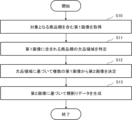
- FIG. 2 is a flowchart showing a planogram data generation method used in the planogram data generation device 100 according to the first embodiment.
- the shelf allocation data generation device 100 operates according to this flowchart.
- the image acquisition unit 110 acquires a first image including the product shelf for which planogram data is to be generated (step S10), and the identification unit 120 identifies an out-of-stock area of the product shelf included in the first image. (Step S11). Then, a second image is determined from the plurality of first images based on the out-of-stock area (step S12). However, the determination of the second image may be performed by the identifying means 120 or the generating means 130. Further, the second image may be determined by a determining means (not shown). After that, the generation unit 130 generates shelf allocation data of the product shelf based on the second image (step S13), and the shelf allocation data generation device ends the process.
- the planogram data generation device generates planogram data for product shelves from images determined based on out-of-stock areas. This makes it possible to generate planogram data that takes stockouts into account.
- planogram data generation device 100 is the same as that in FIG. 1.
- the image acquisition means 110 acquires a first image that includes a product shelf for which planogram data is to be generated.
- images acquired by the image acquisition means 110 include images taken by a terminal owned by a store clerk or a customer, images taken by an in-store patrol robot, and images taken by an in-store camera. Not limited to these.
- the image acquisition unit 110 may acquire the image directly from the terminal that took the image, or may acquire the image via a network or the like. Alternatively, a configuration may be adopted in which images stored in a storage such as a cloud are acquired.
- the image acquisition means 110 may acquire an image each time an image is taken, or may acquire a plurality of images at once.
- the identifying means 120 identifies an area where products are not displayed (out-of-stock area) by processing the first image. Furthermore, the specifying means 120 may specify an area where products are displayed (product area). The identifying means 120 may, for example, use existing image recognition technology to recognize the object in the first image and identify an area where the object cannot be recognized as an out-of-stock area. At this time, the identifying means 120 only needs to be able to recognize the presence or absence of an object, and does not need to recognize which product the recognized object is. Further, the specifying means 120 may, for example, store the background of the product shelf and specify an area where the background cannot be recognized as a product area and an area where the background can be recognized as an out-of-stock area.
- the specifying means 120 may specify how many types of products are displayed in the specified out-of-stock area.
- the identifying means 120 may recognize shelf labels in addition to out-of-stock areas. In this case, it is possible to specify how many types of products will be displayed in the specified out-of-stock area based on how many shelf labels are attached to the out-of-stock area. As an example, if three shelf labels are attached to one specified out-of-stock area, it can be specified that three types of products are displayed in that out-of-stock area.
- the specifying means 120 may specify how many types of products will be displayed in the specified out-of-stock area based on the display status around the out-of-stock area.
- the specifying means 120 can recognize products surrounding the specified out-of-stock area and specify how many types of products will be displayed in the specified out-of-stock area based on the display widths of the surrounding items. Specifically, if the display width of surrounding products is constant, dividing the width of the specified out-of-stock area by the display width of the surrounding products calculates how many types of products will be displayed in the specified out-of-stock area. can be specified. As an example, consider a case where the specified out-of-stock area is 90 cm and the display width of surrounding products is constant at 30 cm.
- the width of the specified out-of-stock area is divided by the average display width of surrounding products to determine how many types of products will be displayed in the specified out-of-stock area. can do. For example, consider a case where the identified out-of-stock area is 80 cm, and the display widths of surrounding products are 15 cm, 17 cm, 23 cm, and 25 cm. In this case, by dividing the width of the specified out-of-stock area (80 cm) by the average display width of surrounding products (20 cm), it can be determined that four types of products will be displayed in the specified out-of-stock area. Can be done.
- the specifying means 120 may specify how many types of products will be displayed in the specified out-of-stock area based on the display width of the specific peripheral product. Specifically, by dividing the width of the identified out-of-stock area by the display width of specific peripheral products, it is possible to specify how many types of products will be displayed in the specified out-of-stock area.
- the specific peripheral product is one peripheral product that has a predetermined positional relationship with the specified out-of-stock area.
- the specific peripheral product may be, for example, a product adjacent to the specified out-of-stock area, or a product located above or below the specified out-of-stock area, but is not limited to these.
- the generating means 130 generates shelf allocation data for the product shelf based on the second image.
- the generation unit 130 uses, for example, existing image recognition technology to recognize the products included in the second image and generates shelf allocation data for the product shelves.
- the second image is an image determined from the plurality of first images based on the out-of-stock area.
- the determination of the second image may be performed by the identifying means 120 or the generating means 130. Further, the second image may be determined by a determining means (not shown).
- a method for determining the second image for example, among the plurality of first images, an image having fewer out-of-stock areas than a predetermined threshold value may be determined as the second image. Specifically, if the area of the out-of-stock area is less than or equal to a predetermined value, or if the number of pixels in the out-of-stock area is less than or equal to a predetermined value, it may be determined that the out-of-stock area is smaller than a predetermined threshold.
- the number of out-of-stock areas is less than or equal to a predetermined value, it may be determined that the number of out-of-stock areas is less than a predetermined threshold.
- the number of out-of-stock areas may be the number of product types displayed in the out-of-stock areas.
- the number of product types displayed in the out-of-stock area can be specified using the method described above.
- the image with the latest photographed date and time among the images may be used as the second image.
- the image with the least number of out-of-stock areas among the plurality of first images may be used as the second image.
- the image with the smallest area of the out-of-stock area as the second image, or to set the image with the smallest number of pixels in the out-of-stock area as the second image. It will be done.
- the image with the least number of out-of-stock areas among the plurality of first images may be used as the second image.
- planogram data generation device 100 The operation of the planogram data generation device 100 according to the second embodiment of the present invention is similar to that in FIG. 2.
- the shelf allocation data generation device generates shelf allocation data for product shelves from images determined based on out-of-stock areas. This makes it possible to generate planogram data that takes stockouts into consideration.
- planogram data can be generated using images with fewer out-of-stock areas. Therefore, the accuracy of the generated planogram data can be improved. Furthermore, since the out-of-stock area included in the second image is always below a predetermined threshold, it is possible to maintain high accuracy of the generated planogram data.
- planogram data can be generated using images with fewer out-of-stock areas. Therefore, the accuracy of the generated planogram data can be improved. Furthermore, by using the image with the smallest out-of-stock area among the first images, planogram data can be generated with the best accuracy.
- the planogram data generation device 200 according to the third embodiment differs from the planogram data generation device 100 according to the second embodiment in that it includes an estimating means 140.
- the same configuration and the same operation as in the second embodiment will be denoted by the same reference numerals, and the description of the same parts will be omitted.
- FIG. 3 shows a configuration example of a planogram data generation device 200 according to a third embodiment of the present invention.
- the planogram data generation device 200 includes an image acquisition means 110, a specification means 120, a generation means 130, and an estimation means 140.
- the estimating means 140 identifies out-of-stock product candidates by comparing the displayed products included in the second image with the products handled at the store. Specifically, the displayed products and the handled products are compared, and the products that are included in the handled products but not included in the displayed products are identified as out-of-stock product candidates.
- the displayed products are the products displayed on the product shelf included in the second image. Displayed products are recognized using, for example, existing image recognition technology. Recognition of displayed products may be performed by the identifying means 120 or the estimating means 140. Further, the displayed products may be recognized by a recognition means (not shown).
- Products handled are products handled at the store. Information on products handled is stored in a storage means (not shown) as a database of products handled.
- FIG. 4 shows an example of the product database 300.
- the product database 300 includes product name, product ID (Identification), display area, sales quantity, size, weight, price, and handling period.
- the information included in the product database 300 shown in FIG. 4 is an example, and the information is not limited to this.
- the product database 300 may further store product categories.
- the product name is the name of each product.
- the product ID is identification information assigned to each product so that it can be identified.
- the product ID is an arbitrary character string, a numerical sequence, a combination of characters and numbers, or the like.
- the display area indicates the area where each product is displayed.
- the display area may be a product shelf ID indicating a product shelf on which products are displayed. Alternatively, it may be a designation indicating a sales area for each product category, such as a "beverage area” or a "sweets area”.
- the number of sales indicates the number of sales of each product.
- the number of sales stored in the product database may be the number of sales on the current day or the total number of sales over a predetermined period.
- the size indicates the size of each product.
- the size includes at least one of the width, height, and depth of the product.
- the area of the front surface when the product is displayed may be stored as the size.
- the volume of the product may be stored as the size.
- Weight indicates the weight of each product.
- the price indicates the selling price of each product.
- the handling period indicates the handling period of each product at the store. As the handling period, either the handling start time or the handling end time may be stored, or the handling period may be stored from the handling start time to the handling end time.
- the estimating means 140 may perform a comparison with all the products included in the product database 300, or may compare with a part of the products included in the product database 300. For example, among the products included in the product database 300, products for which the area included in the second image is a display area may be compared with the displayed products included in the second image. Specifically, the displayed products included in the second image are compared with the handled products for which the area included in the second image is the display area, and the displayed products are included in the handled products but are not included in the displayed products. A product may be identified as an out-of-stock product candidate.
- the estimating means 140 may compare products included in the product database 300 that are in the same category as the product included in the second image with the displayed products included in the second image. Specifically, the displayed products included in the second image are compared with the products in the same category as the displayed products included in the second image, and the displayed products are included in the handled products but are not included in the displayed products. A product may be identified as an out-of-stock product candidate.
- the estimating means 140 may compare products included in the product database 300 whose time of comparison is included in the sales period with the displayed products included in the second image. Specifically, the displayed products included in the second image are compared with the handled products that are included in the handling period at the time of comparison, and the products that are included in the handled products but not included in the displayed products are determined to be out of stock. It may also be specified as a product candidate. In addition, the estimating means 140 compares the displayed products included in the second image with respect to the products included in the handled product database 300 whose price matches the price range of the products displayed in the area included in the second image. You can compare.
- the displayed products included in the second image are compared with the products on sale whose price matches the price range of the products displayed in the area included in the second image, and the products that are included in the products on display but are not on display are compared. Products that are not included in the list of products may be identified as out-of-stock product candidates.
- the estimating means 140 estimates the out-of-stock product whose display location is the out-of-stock area from among the out-of-stock product candidates. For example, if there is one out-of-stock product candidate, the out-of-stock product candidate is estimated to be the out-of-stock product. Furthermore, if the number of out-of-stock areas and the number of out-of-stock product candidates match, the out-of-stock product candidates may be estimated to be out-of-stock products. Furthermore, if there are multiple out-of-stock product candidates, the out-of-stock product may be estimated using a method described later.
- the estimating means 140 may estimate the product displayed adjacent to the out-of-stock area as the out-of-stock item whose display location is the out-of-stock area. .
- a product displayed above or below the out-of-stock area may be estimated as an out-of-stock item whose display location is the out-of-stock area.
- the generating means 130 generates shelf allocation data for the product shelf based on the second image and the out-of-stock products estimated by the estimating means 140.
- FIG. 5 is a flowchart showing an example of the operation of the planogram data generation device according to the third embodiment.
- Steps S10 to S12 are the same as those in FIG. 2, so their explanation will be omitted.
- the estimating means 140 identifies out-of-stock product candidates by comparing the displayed products included in the second image with the available products (step S31). Then, out-of-stock products whose display locations are in the out-of-stock area are estimated from among the out-of-stock product candidates (step S32). Thereafter, the generating means 130 generates shelf allocation data for the product shelf based on the second image and the out-of-stock products estimated by the estimating means 140 (step S33).
- the shelf allocation data generation device generates shelf allocation data for product shelves from images determined based on out-of-stock areas. This makes it possible to generate planogram data that takes stockouts into account.
- out-of-stock items are estimated, and shelf allocation data for product shelves is generated based on the image and the estimated out-of-stock items.
- planogram data for the out-of-stock area it is possible to generate planogram data that takes stock-out items into consideration.
- planogram data can be generated with high accuracy.
- the planogram data generation device 400 in the fourth embodiment differs from the planogram data generation device 200 in the third embodiment in that it includes a product information acquisition means 150.
- the same configuration and the same operation as in the third embodiment will be denoted by the same reference numerals, and the description of the same parts will be omitted.
- FIG. 6 shows a configuration example of a planogram data generation device 400 according to the fourth embodiment of the present invention.
- the planogram data generation device 400 includes an image acquisition means 110, a specification means 120, a generation means 130, an estimation means 140, and a product information acquisition means 150.
- the estimating means 140 identifies out-of-stock product candidates by comparing the displayed products included in the second image with the products handled at the store.
- Out-of-stock product candidates may be identified using the method described in the third embodiment.
- products displayed adjacent to the out-of-stock area may be added to the out-of-stock product candidates.
- products displayed in the upper or lower row of the out-of-stock area may be added to the out-of-stock product candidates.
- the product information acquisition means 150 acquires product information including at least one of the sales quantity, size, weight, and price of the out-of-stock product candidate.
- the product information acquisition means 150 acquires product information from the product database 300.
- product information may be obtained from a POS (Point of Sales) terminal or a store computer.
- the estimating unit 140 estimates the out-of-stock product whose display location is the out-of-stock area from among the out-of-stock product candidates.
- the product information acquisition means 150 acquires the sales quantity of the out-of-stock product candidate as the product information.
- the product information acquisition means 150 may further acquire the sales numbers of all the products handled, or the sales numbers of some of the products handled. The higher the number of sales, the more likely the product has been removed from the shelves, which increases the possibility that the product is out of stock. Therefore, the estimating means 140 estimates out-of-stock product candidates that have a large number of sales as out-of-stock products.
- out-of-stock product candidate A1 15 items
- out-of-stock item candidate B1 7 items
- the estimating means 140 estimates the out-of-stock item candidate A1 as an out-of-stock item.
- the estimation means 140 estimates the out-of-stock product candidate with the largest number of sales as the out-of-stock product. Furthermore, if there are multiple out-of-stock areas, the out-of-stock items may be estimated in descending order of sales volume.
- the product information acquisition means 150 acquires the weight of an out-of-stock product candidate as product information.
- the product information acquisition means 150 may further acquire the weights of all the products handled, or the weights of some of the products handled. Products that are heavy are more likely to be placed at the bottom of the product shelf. Therefore, the estimating unit 140 estimates the out-of-stock product based on the positional relationship of the out-of-stock area and the weight of the out-of-stock product candidate.
- Out-of-stock product candidate A2 1kg
- Out-of-stock product candidate B2 0.5kg
- the estimating means 140 estimates the out-of-stock product whose display location is in the out-of-stock area Y1 as an out-of-stock product candidate A2, and the out-of-stock product whose display location is in the out-of-stock area X1 as an out-of-stock product candidate B2.
- the estimating unit 140 may estimate out-of-stock products in descending order of weight of out-of-stock product candidates so that they correspond to out-of-stock areas near the bottom of the product shelf.
- the product information acquisition means 150 acquires the number of sales of out-of-stock product candidates as product information.
- the product information acquisition means 150 may further acquire the sales numbers of all the products handled, or the sales numbers of some of the products handled.
- the number of products sold may change depending on the display position of the product. As an example, products that are displayed at a height that makes it easier for customers to pick up the product may sell more. Therefore, the estimating unit 140 estimates the out-of-stock product based on the positional relationship of the out-of-stock area and the number of sales of the out-of-stock product candidate.
- out-of-stock area X2 is an area where the number of sales is high.
- An area where the number of sales is high may be set in advance.
- the number of sales of each out-of-stock product candidate acquired by the product information acquisition means 150 is as follows.
- Out-of-stock product candidate A3 15 items
- Out-of-stock product candidate B3 7 items
- the estimating means 140 selects the out-of-stock item candidate A3 whose display location is the out-of-stock area X2, and the out-of-stock item candidate A3 whose display location is the out-of-stock area Y2.
- the out-of-stock product is estimated as the out-of-stock product candidate B3.
- the product information acquisition means 150 acquires the size of an out-of-stock product candidate as product information.
- the product information acquisition means 150 may further acquire the sizes of all the products handled, or the sizes of some of the products handled. Large products cannot be displayed in a narrow out-of-stock area. Therefore, the estimation means 140 estimates the out-of-stock product based on the width of the out-of-stock area and the size of the out-of-stock product candidate.
- each out-of-stock product candidate acquired by the product information acquisition means 150 is as follows. Out of stock product candidate A4: 15cm Out of stock product candidate B4: 5cm At this time, the estimating means 140 estimates the out-of-stock product candidate B4 as an out-of-stock product.
- the estimating means 140 may estimate out-of-stock items in descending order of the size of out-of-stock item candidates so as to correspond to wide out-of-stock areas.
- the product information acquisition means 150 acquires the number of sales of out-of-stock product candidates as product information.
- the product information acquisition means 150 may further acquire the sales numbers of all the products handled, or the sales numbers of some of the products handled.
- the size of the display area may change depending on the number of products sold. As an example, products that sell well may be displayed over a large area. Therefore, the estimating means 140 estimates the out-of-stock product based on the size of the out-of-stock area and the number of sales of the out-of-stock product candidate.
- Out-of-stock product candidate A5 15 items
- Out-of-stock product candidate B5 7 items
- the estimating means 140 selects the out-of-stock item candidate A5 whose display location is the out-of-stock area X3, and the out-of-stock item candidate A5 whose display location is the out-of-stock area Y3.
- the out-of-stock product is estimated as the out-of-stock product candidate B5.
- the estimating means 140 identifies N out-of-stock product candidates in descending order of the number of sales, based on the sales number of each out-of-stock product candidate acquired by the product information acquisition means 150. Then, the out-of-stock product is estimated from the N out-of-stock product candidates based on the positional relationship of the out-of-stock area and/or the size of the out-of-stock area. In this way, by combining the above-described specific examples, it is possible to accurately estimate out-of-stock products whose display locations are in each out-of-stock area.
- the estimating means 140 identifies out-of-stock product candidates whose size is less than or equal to the width of the out-of-stock area, based on the size of each out-of-stock product candidate acquired by the product information acquisition means 150. Then, based on the number of sales of the out-of-stock product candidates and/or the positional relationship of the out-of-stock area, out-of-stock products are estimated from out-of-stock product candidates whose width is less than or equal to the width of the out-of-stock area. Even in this example, it is possible to accurately estimate out-of-stock products whose display locations are in each out-of-stock area.
- the product information acquired by the product information acquisition means 150 may be product information for all products handled, or product information for some products handled. For example, you may obtain product information for a product whose display area is the area included in the second image, or obtain product information for a product in the same category as the product category included in the second image. Good too. Further, product information on products handled within the handling period at which the out-of-stock products are estimated may be acquired. Additionally, product information on products whose prices match the price range of products displayed in the area included in the second image may be acquired. In this way, when acquiring product information for some of the products handled, the amount of processing can be reduced compared to when acquiring product information for all the products handled.
- FIG. 7 is a flowchart showing an example of the operation of the planogram data generation device according to the fourth embodiment.
- Steps S10 to S12 are the same as those in FIG. 2, and steps S31 and S33 are the same as those in FIG. 5, so their description will be omitted.
- the product information acquisition means 150 acquires product information of out-of-stock product candidates (step S41). Then, based on the product information, out-of-stock products whose display locations are in the out-of-stock areas are estimated from out of the out-of-stock product candidates (step S42). After that, the process advances to step S33.
- the shelf allocation data generation device generates shelf allocation data for product shelves from images determined based on out-of-stock areas. This makes it possible to generate planogram data that takes stockouts into account.
- out-of-stock items are estimated, and shelf allocation data for product shelves is generated based on the image and the estimated out-of-stock items.
- planogram data for the out-of-stock area it is possible to generate planogram data that takes stock-out items into consideration.
- planogram data can be generated with high accuracy.
- product information including at least one of the sales quantity, size, weight, and price of the out-of-stock product candidate is acquired, and the out-of-stock product is estimated based on the product information.
- the product with the highest number of sales is estimated as the out-of-stock product. This makes it possible to generate planogram data that takes stockouts into account. Furthermore, the accuracy of estimating products in out-of-stock areas is improved, and planogram data can be generated with high accuracy.
- the out-of-stock items are estimated based on the positional relationship of the out-of-stock areas. This makes it possible to generate planogram data that takes stockouts into account. Furthermore, even if there are multiple out-of-stock areas, the accuracy of estimating the product in the out-of-stock area is improved, and planogram data can be generated with high accuracy.
- the product with the largest weight is estimated as the out-of-stock product in the out-of-stock area closest to the bottom of the product shelf. This makes it possible to generate planogram data that takes stockouts into account. Furthermore, the accuracy of estimating products in out-of-stock areas is improved, and planogram data can be generated with high accuracy.
- out-of-stock items are estimated based on the size of the out-of-stock area. This makes it possible to generate planogram data that takes stockouts into consideration. Furthermore, even if there are multiple out-of-stock areas, the accuracy of estimating the product in the out-of-stock area is improved, and planogram data can be generated with high accuracy.
- each planogram data generation device is realized by a combination of hardware and a program.
- FIG. 8 is a block diagram illustrating the hardware configuration of the information processing device 1000 that can configure each planogram data generation device in each embodiment.
- the information processing apparatus 1000 includes a processor 1001, a memory 1002, a network interface 1003, an input/output interface 1004, and a storage device 1005, and each component of the information processing apparatus 1000 is communicably connected by a bus 1006.
- the processor 1001 is implemented by a CPU (Central Processing Unit), a GPU (Graphics Processing Unit), or the like.
- the memory 1002 is a main storage device implemented by RAM (Random Access Memory) or the like.
- the network interface 1003 is an interface for connecting to a network.
- the network is a LAN (Local Area Network) or a WAN (Wide Area Network).
- the input/output interface 1004 is an interface for connecting to various input/output devices.
- the storage device 1005 is an auxiliary storage device realized by a hard disk drive (HDD), a solid state drive (SSD), a memory card, a read only memory (ROM), or the like.
- the storage device 1005 may store a program for realizing the functions of each shelf allocation data generating device in each embodiment.
- the processor 1001 realizes the functions of each planogram data generation device by reading a program stored in the storage device 1005 into the memory 1002 and executing it. Further, the program may be supplied from a network via the network interface 1003. In addition, the program may be stored in advance in a storage medium (not shown) and supplied by reading the program.
- this program can display its processing results, including intermediate states, step by step via a display device as necessary, or can communicate with the outside via the network interface 1003. Further, this program can be recorded on a computer-readable (non-transitory) recording medium.
- image acquisition means for acquiring a first image including a product shelf on which products are displayed; identification means for identifying an out-of-stock area of the product shelf included in the first image; generation means for determining a second image from the plurality of first images based on the out-of-stock area and generating planogram data for the product shelf based on the second image;
- a planogram data generation device comprising: [Additional note 2] The second image is an image in which the out-of-stock area is less than a threshold value among the plurality of first images.
- the planogram data generation device according to appendix 1.
- the second image is an image in which the out-of-stock area is least among the plurality of first images;
- the planogram data generation device according to appendix 1.
- the generating means generates planogram data for the product shelf based on the second image and the estimated out-of-stock item.
- the planogram data generation device according to appendix 2 or 3.
- [Additional note 5] further comprising a product information acquisition means for acquiring product information including at least one of sales quantity, size, weight, and price of the out-of-stock product candidate; The estimation means further estimates the out-of-stock product based on the product information.
- the planogram data generation device according to appendix 4.
- the product information acquisition means acquires the sales number as the product information, The estimating means estimates the product with the highest number of sales among the out-of-stock product candidates as the out-of-stock product.
- the planogram data generation device according to appendix 5.
- the estimating means further estimates the out-of-stock product based on the positional relationship of the out-of-stock area.
- the planogram data generation device according to appendix 5 or 6.
- the product information acquisition means acquires the weight as the product information
- the estimating means estimates the product with the largest weight among the out-of-stock product candidates as the out-of-stock product in the out-of-stock area closest to the lower tier of the product shelf;
- the planogram data generation device according to any one of Supplementary Notes 5 to 7.
- the estimating means further estimates the out-of-stock product based on the size of the out-of-stock area.
- the planogram data generation device according to any one of Supplementary Notes 5 to 8.
- the product information acquisition means acquires the size as the product information,
- the estimating means estimates a product whose size is less than or equal to the width of the out-of-stock area as the out-of-stock product.
- the planogram data generation device according to any one of Supplementary Notes 5 to 9.
- image acquisition means for acquiring a first image including a product shelf on which products are displayed; identification means for identifying an out-of-stock area of the product shelf included in the first image; generation means for determining a second image from the plurality of first images based on the out-of-stock area and generating planogram data for the product shelf based on the second image;
- a planogram data generation system equipped with [Additional note 12] Obtaining a first image including a product shelf on which products are displayed; identifying an out-of-stock area of the product shelf included in the first image; determining a second image from a plurality of first images based on the out-of-stock area, and generating planogram data for the product shelf based on the second image; How to generate planogram data.
- Planogram data generation device 110 Image acquisition means 120 Specification means 130 Generation means 140 Estimation means 150 Product information acquisition means 300 Product database 1000 Information processing device 1001 Processor 1002 Memory 1003 Network interface 1004 Input/output interface 1005 Storage device 1006 bus
Landscapes
- Business, Economics & Management (AREA)
- Engineering & Computer Science (AREA)
- Accounting & Taxation (AREA)
- Finance (AREA)
- Theoretical Computer Science (AREA)
- General Physics & Mathematics (AREA)
- Physics & Mathematics (AREA)
- Economics (AREA)
- General Business, Economics & Management (AREA)
- Strategic Management (AREA)
- Marketing (AREA)
- Development Economics (AREA)
- Multimedia (AREA)
- Entrepreneurship & Innovation (AREA)
- Human Resources & Organizations (AREA)
- Operations Research (AREA)
- Quality & Reliability (AREA)
- Tourism & Hospitality (AREA)
- Management, Administration, Business Operations System, And Electronic Commerce (AREA)
Priority Applications (4)
| Application Number | Priority Date | Filing Date | Title |
|---|---|---|---|
| US18/853,515 US20250225477A1 (en) | 2022-09-13 | 2022-09-13 | Planogram data generation device, planogram data generation method, and storage medium |
| PCT/JP2022/034166 WO2024057387A1 (ja) | 2022-09-13 | 2022-09-13 | 棚割りデータ生成装置、棚割りデータ生成システム、棚割りデータ生成方法および記憶媒体 |
| JP2024546544A JP7798202B2 (ja) | 2022-09-13 | 2022-09-13 | 棚割りデータ生成装置、棚割りデータ生成システム、棚割りデータ生成方法およびプログラム |
| JP2025200949A JP2026015570A (ja) | 2022-09-13 | 2025-11-20 | 棚割りデータ生成システム、棚割りデータ生成方法およびプログラム |
Applications Claiming Priority (1)
| Application Number | Priority Date | Filing Date | Title |
|---|---|---|---|
| PCT/JP2022/034166 WO2024057387A1 (ja) | 2022-09-13 | 2022-09-13 | 棚割りデータ生成装置、棚割りデータ生成システム、棚割りデータ生成方法および記憶媒体 |
Publications (1)
| Publication Number | Publication Date |
|---|---|
| WO2024057387A1 true WO2024057387A1 (ja) | 2024-03-21 |
Family
ID=90274427
Family Applications (1)
| Application Number | Title | Priority Date | Filing Date |
|---|---|---|---|
| PCT/JP2022/034166 Ceased WO2024057387A1 (ja) | 2022-09-13 | 2022-09-13 | 棚割りデータ生成装置、棚割りデータ生成システム、棚割りデータ生成方法および記憶媒体 |
Country Status (3)
| Country | Link |
|---|---|
| US (1) | US20250225477A1 (https=) |
| JP (2) | JP7798202B2 (https=) |
| WO (1) | WO2024057387A1 (https=) |
Citations (3)
| Publication number | Priority date | Publication date | Assignee | Title |
|---|---|---|---|---|
| WO2016199405A1 (ja) * | 2015-06-09 | 2016-12-15 | 日本電気株式会社 | 棚割支援装置、棚割支援システム、棚割支援方法、および、記録媒体 |
| WO2022024341A1 (ja) * | 2020-07-31 | 2022-02-03 | 日本電気株式会社 | 商品検知装置、商品検知システム、商品検知方法および記録媒体 |
| WO2022065282A1 (ja) * | 2020-09-28 | 2022-03-31 | 日本電気株式会社 | 情報処理装置、システム、情報処理方法、および記録媒体 |
-
2022
- 2022-09-13 WO PCT/JP2022/034166 patent/WO2024057387A1/ja not_active Ceased
- 2022-09-13 US US18/853,515 patent/US20250225477A1/en active Pending
- 2022-09-13 JP JP2024546544A patent/JP7798202B2/ja active Active
-
2025
- 2025-11-20 JP JP2025200949A patent/JP2026015570A/ja active Pending
Patent Citations (3)
| Publication number | Priority date | Publication date | Assignee | Title |
|---|---|---|---|---|
| WO2016199405A1 (ja) * | 2015-06-09 | 2016-12-15 | 日本電気株式会社 | 棚割支援装置、棚割支援システム、棚割支援方法、および、記録媒体 |
| WO2022024341A1 (ja) * | 2020-07-31 | 2022-02-03 | 日本電気株式会社 | 商品検知装置、商品検知システム、商品検知方法および記録媒体 |
| WO2022065282A1 (ja) * | 2020-09-28 | 2022-03-31 | 日本電気株式会社 | 情報処理装置、システム、情報処理方法、および記録媒体 |
Also Published As
| Publication number | Publication date |
|---|---|
| JPWO2024057387A1 (https=) | 2024-03-21 |
| JP2026015570A (ja) | 2026-01-29 |
| JP7798202B2 (ja) | 2026-01-14 |
| US20250225477A1 (en) | 2025-07-10 |
Similar Documents
| Publication | Publication Date | Title |
|---|---|---|
| US20240144340A1 (en) | Remote SKU On-Boarding of Products for Subsequent Video Identification and Sale | |
| JP7205565B2 (ja) | 棚割支援装置、棚割支援システム、棚割支援方法、および、記録媒体 | |
| US9135491B2 (en) | Digital point-of-sale analyzer | |
| JP7435587B2 (ja) | 物品推定装置、物品推定方法、及びプログラム | |
| EP2375365A1 (en) | Digital point-of-sale analyzer | |
| JP6209717B1 (ja) | 情報処理システム、情報処理方法、及びプログラム | |
| US20200311659A1 (en) | Information processing apparatus, information processing method, and program | |
| CN107131940A (zh) | 计量系统 | |
| JP2013250647A (ja) | 商品陳列情報集計方法とデータ構造およびそれを記録した記録媒体 | |
| KR20210042568A (ko) | 영상 기반 선반 상품 재고 모니터링 시스템 및 방법 | |
| JP2024118986A (ja) | 棚割最適化方法、プログラム、及び棚割最適化システム | |
| WO2024057387A1 (ja) | 棚割りデータ生成装置、棚割りデータ生成システム、棚割りデータ生成方法および記憶媒体 | |
| JP7342943B2 (ja) | 販売管理システム、店舗装置、販売管理方法、およびプログラム | |
| JP7619427B2 (ja) | 処理装置、処理方法及びプログラム | |
| WO2021060032A1 (ja) | 画像処理装置、画像処理方法、及びプログラム | |
| JP7622632B2 (ja) | 商品管理システム、商品管理方法、コンピュータプログラム及び記録媒体 | |
| JP7503744B2 (ja) | 発注管理装置及び発注管理方法 | |
| JP7484887B2 (ja) | 情報処理装置、処理方法とプログラム | |
| US20230027388A1 (en) | Price information determination apparatus, price information determination method, and non-transitory computer readable medium | |
| JP7697587B2 (ja) | 商品数特定装置、商品数特定方法、及びプログラム | |
| US20250157016A1 (en) | Product quantity determination apparatus, product quantity determination method, and non-transitory computer-readable medium | |
| WO2025196922A1 (ja) | 施策特定装置、施策特定方法、および記録媒体 | |
| JPWO2024057387A5 (ja) | 棚割りデータ生成装置、棚割りデータ生成システム、棚割りデータ生成方法およびプログラム | |
| JP7568098B2 (ja) | 情報処理装置、死に筋商品判定支援方法およびプログラム | |
| JP7544269B2 (ja) | 欠品検出装置、欠品検出方法、及びプログラム |
Legal Events
| Date | Code | Title | Description |
|---|---|---|---|
| 121 | Ep: the epo has been informed by wipo that ep was designated in this application |
Ref document number: 22958721 Country of ref document: EP Kind code of ref document: A1 |
|
| WWE | Wipo information: entry into national phase |
Ref document number: 18853515 Country of ref document: US |
|
| WWE | Wipo information: entry into national phase |
Ref document number: 2024546544 Country of ref document: JP |
|
| NENP | Non-entry into the national phase |
Ref country code: DE |
|
| WWP | Wipo information: published in national office |
Ref document number: 18853515 Country of ref document: US |
|
| 122 | Ep: pct application non-entry in european phase |
Ref document number: 22958721 Country of ref document: EP Kind code of ref document: A1 |