WO2024048139A1 - 情報処理プログラム、情報処理方法およびゲーム装置 - Google Patents
情報処理プログラム、情報処理方法およびゲーム装置 Download PDFInfo
- Publication number
- WO2024048139A1 WO2024048139A1 PCT/JP2023/027239 JP2023027239W WO2024048139A1 WO 2024048139 A1 WO2024048139 A1 WO 2024048139A1 JP 2023027239 W JP2023027239 W JP 2023027239W WO 2024048139 A1 WO2024048139 A1 WO 2024048139A1
- Authority
- WO
- WIPO (PCT)
- Prior art keywords
- card
- specific
- player
- game
- performance
- Prior art date
- Legal status (The legal status is an assumption and is not a legal conclusion. Google has not performed a legal analysis and makes no representation as to the accuracy of the status listed.)
- Ceased
Links
Images








Classifications
-
- A—HUMAN NECESSITIES
- A63—SPORTS; GAMES; AMUSEMENTS
- A63F—CARD, BOARD, OR ROULETTE GAMES; INDOOR GAMES USING SMALL MOVING PLAYING BODIES; VIDEO GAMES; GAMES NOT OTHERWISE PROVIDED FOR
- A63F13/00—Video games, i.e. games using an electronically generated display having two or more dimensions
- A63F13/50—Controlling the output signals based on the game progress
- A63F13/52—Controlling the output signals based on the game progress involving aspects of the displayed game scene
-
- A—HUMAN NECESSITIES
- A63—SPORTS; GAMES; AMUSEMENTS
- A63F—CARD, BOARD, OR ROULETTE GAMES; INDOOR GAMES USING SMALL MOVING PLAYING BODIES; VIDEO GAMES; GAMES NOT OTHERWISE PROVIDED FOR
- A63F13/00—Video games, i.e. games using an electronically generated display having two or more dimensions
- A63F13/80—Special adaptations for executing a specific game genre or game mode
Definitions
- the present invention relates to an information processing program, an information processing method, and a game device.
- An object of the present invention is to provide an information processing system, an information processing method, and an information processing program that can improve strategy.
- the information processing program A process of displaying a player's game medium and an opponent's game medium in an identifiable manner in a placement area among a plurality of game mediums whose display modes and performances are linked; A process of proceeding with the game based on an operation input to the game medium displayed at least in the placement area; Among the plurality of game media, a specific game media associated with a specific display mode and specific performance is displayed in the placement area, and a predetermined operation input is performed on the specific game media. If the specific condition set in advance is not satisfied, either or both of the specific display mode and the specific performance are changed to the display mode or performance set in advance, and the specific condition is changed. If the conditions are met, a process of changing either or both of the specific display mode and the specific performance to one of a plurality of display modes or performances; Let the computer carry out the task.
- the plurality of game media include a plurality of special game media that differ from the specific game media in one or both of display mode and performance, The process of changing the display mode or performance is If the specific conditions are met, the specific game content may be changed to any one of the plurality of special game content.
- either or both of the display mode and performance of the special game medium may be different from the preset display mode or performance that changes when the specific condition is not satisfied.
- the progress of the game during a predetermined period satisfies a preset condition, it may be determined that the specific condition is satisfied.
- the information processing method is An information processing method performed by one or more computers, the method comprising: A process of displaying a player's game medium and an opponent's game medium in an identifiable manner in a placement area among a plurality of game mediums whose display modes and performances are linked; A process of proceeding with the game based on an operation input to the game medium displayed at least in the placement area; Among the plurality of game media, a specific game media associated with a specific display mode and specific performance is displayed in the placement area, and a predetermined operation input is performed on the specific game media. If the specific condition set in advance is not satisfied, either or both of the specific display mode and the specific performance are changed to the display mode or performance set in advance, and the specific condition is changed. If the conditions are met, a process of changing either or both of the specific display mode and the specific performance to one of a plurality of display modes or performances; including.
- the game device comprising one or more computers;
- the computer A process of displaying a player's game medium and an opponent's game medium in an identifiable manner in a placement area among a plurality of game mediums whose display modes and performances are linked; A process of proceeding with the game based on an operation input to the game medium displayed at least in the placement area;
- a specific game media associated with a specific display mode and specific performance is displayed in the placement area, and a predetermined operation input is performed on the specific game media. If the specific condition set in advance is not satisfied, either or both of the specific display mode and the specific performance are changed to the display mode or performance set in advance, and the specific condition is set in advance. If the conditions are met, changing either or both of the specific display mode and the specific performance to one of a plurality of display modes or performances; carry out.
- FIG. 1 is an explanatory diagram showing a schematic configuration of an information processing system.
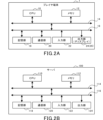
- FIG. 2A is a diagram illustrating the hardware configuration of the player terminal.
- FIG. 2B is a diagram illustrating the hardware configuration of the server.
- FIG. 3A is a diagram showing an example of a home screen.
- FIG. 3B is a diagram illustrating an example of a card setting screen.
- FIG. 3C is a diagram illustrating an example of a deck selection screen.
- FIG. 3D is a diagram illustrating an example of a deck organization screen in an initial state.
- FIG. 4A is a diagram illustrating an example of a deck formation screen during formation.
- FIG. 4B is a diagram illustrating an example of a card list screen.
- FIG. 4C is a diagram illustrating an example of a card generation screen.
- FIG. 4D is a diagram illustrating an example of a card details screen.
- FIG. 5 is a diagram illustrating an example of a card battle game screen.
- FIG. 6A is a diagram illustrating an example of a follower card.
- FIG. 6B is a diagram illustrating an example of a spell card.
- FIG. 6C is a diagram illustrating an example of an amulet card.
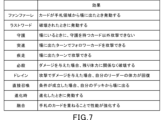
- FIG. 7 is a diagram illustrating an example of the ability.
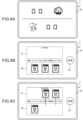
- FIG. 8A is a first diagram illustrating an example of the transition of the card battle screen.
- FIG. 8B is a second diagram illustrating an example of the transition of the card battle screen.
- FIG. 8C is a third diagram illustrating an example of the transition of the card battle screen.
- FIG. 8A is a first diagram illustrating an example of the transition of the card battle screen.
- FIG. 8B is a second diagram illustrating an example of the transition of the card battle screen.
- FIG. 8C is a third diagram illustrating an
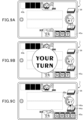
- FIG. 9A is a fourth diagram illustrating an example of the transition of the card battle screen.
- FIG. 9B is a fifth diagram illustrating an example of the transition of the card battle screen.
- FIG. 9C is a sixth diagram illustrating an example of the transition of the card battle screen.
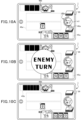
- FIG. 10A is a seventh diagram illustrating an example of the transition of the card battle screen.
- FIG. 10B is an eighth diagram illustrating an example of the transition of the card battle screen.
- FIG. 10C is a ninth diagram illustrating an example of the transition of the card battle screen.
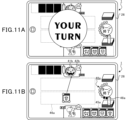
- FIG. 11A is a tenth diagram illustrating an example of the transition of the card battle screen.
- FIG. 11B is an eleventh diagram illustrating an example of the transition of the card battle screen.
- FIG. 12A is a first diagram illustrating an example of a battle screen during evolution.
- FIG. 12B is a second diagram illustrating an example of a battle screen during evolution.
- FIG. 13 is a diagram illustrating an example of a card details tab.
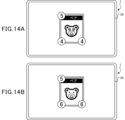
- FIG. 14A is a first diagram illustrating an example of an evolution animation.
- FIG. 14B is a second diagram illustrating an example of an evolution animation.
- FIG. 15 is a diagram illustrating an example of a specific card and a special card.
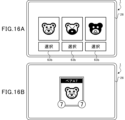
- FIG. 16A is a diagram illustrating an example of a special card selection screen.
- FIG. 16B is a third diagram illustrating an example of an evolution animation.
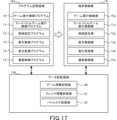
- FIG. 17 is a functional block diagram of the player terminal.
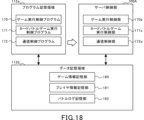
- FIG. 18 is a functional block diagram of the server.
- FIG. 18 is a functional block diagram of the server.
- FIG. 19 is a sequence diagram illustrating the processing of the player terminal and the server.
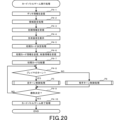
- FIG. 20 is a flowchart illustrating an example of card battle game execution processing at the player terminal.
- FIG. 21 is a first flowchart illustrating an example of own turn control processing at the player terminal.
- FIG. 22 is a second flowchart illustrating an example of own turn control processing at the player terminal.
- FIG. 23 is a flowchart illustrating an example of opponent turn control processing at the player terminal.
- FIG. 24 is a flowchart illustrating an example of card battle game execution processing in the server.
- FIG. 1 is an explanatory diagram showing a schematic configuration of an information processing system S.
- the information processing system S is a so-called client server system including a player terminal 1, a server 100, and a communication network 200 having a communication base station 200a.
- the player terminal 1 can establish communication with the server 100 via the communication network 200.
- the player terminal 1 broadly includes electronic devices that can be connected to the server 100 for wireless or wired communication. Examples of the player terminal 1 include a smartphone, a mobile phone, a tablet device, a personal computer, and a game device. In this embodiment, a case where a smartphone is used as the player terminal 1 will be described.
- the server 100 is communicatively connected to a plurality of player terminals 1.
- the server 100 accumulates various types of information (player information) for each player who plays the game. Furthermore, the server 100 updates the stored information and controls the progress of the game based on operations input from the player terminal 1.
- the communication base station 200a is connected to the communication network 200 and transmits and receives information to and from the player terminal 1 wirelessly.
- the communication network 200 is composed of a mobile phone network, an Internet network, a LAN (Local Area Network), a dedicated line, etc., and realizes a wireless or wired communication connection between the player terminal 1 and the server 100.
- the player terminal 1 and the server 100 function as a game device G.
- the player terminal 1 and the server 100 are each assigned the role of controlling the progress of the game, and the game can progress through cooperation between the player terminal 1 and the server 100.
- FIG. 2A is a diagram illustrating the hardware configuration of the player terminal 1.
- FIG. 2B is a diagram illustrating the hardware configuration of the server 100.
- the player terminal 1 includes a CPU (Central Processing Unit) 10, a memory 12, a bus 14, an input/output interface 16, a storage section 18, a communication section 20, an input section 22, and an output section 24. be done.
- CPU Central Processing Unit
- the server 100 includes a CPU 110, a memory 112, a bus 114, an input/output interface 116, a storage section 118, a communication section 120, an input section 122, and an output section 124.
- the configurations and functions of the CPU 110, memory 112, bus 114, input/output interface 116, storage section 118, communication section 120, input section 122, and output section 124 of the server 100 are the same as those of the CPU 10, memory 12, and output section of the player terminal 1, respectively.
- the bus 14, input/output interface 16, storage section 18, communication section 20, input section 22, and output section 24 are substantially the same. Therefore, below, the hardware configuration of the player terminal 1 will be explained, and the explanation of the server 100 will be omitted.
- the CPU 10 operates a program stored in the memory 12 and controls the progress of the game.
- the memory 12 is composed of a ROM (Read Only Memory) or a RAM (Random Access Memory), and stores programs and various data necessary for controlling the progress of the game.
- Memory 12 is connected to CPU 10 via bus 14.
- An input/output interface 16 is connected to the bus 14.
- a storage section 18 , a communication section 20 , an input section 22 , and an output section 24 are connected to the input/output interface 16 .
- the storage unit 18 is composed of a semiconductor memory such as DRAM (Dynamic Random Access Memory), and stores various programs and data.
- DRAM Dynamic Random Access Memory
- programs and data stored in the storage unit 18 are loaded into the memory 12 (RAM) by the CPU 10.
- the communication unit 20 is wirelessly connected to the communication base station 200a and sends and receives information such as various data and programs to and from the server 100 via the communication network 200.
- programs and the like received from the server 100 are stored in the memory 12 or the storage unit 18.
- the input unit 22 includes, for example, a touch panel into which player operations are input (accepts operations), buttons, a keyboard, a mouse, a cross key, an analog controller, and the like. Further, the input unit 22 may be a dedicated controller provided in the player terminal 1 or connected (externally attached) to the player terminal 1. Furthermore, the input unit 22 may be configured with an acceleration sensor that detects the tilt or movement of the player terminal 1, or a microphone that detects the player's voice. That is, the input unit 22 broadly includes devices that can input the player's intention in a discernible manner.
- the output unit 24 includes a display device and a speaker. Note that the output unit 24 may be a device connected (externally attached) to the player terminal 1.
- the player terminal 1 includes a display 26 as the output section 24 and a touch panel provided to overlap the display 26 as the input section 22.
- Game content Next, the content of the game provided by the information processing system S (game device G) of this embodiment will be explained using an example.
- the game of this embodiment is a so-called digital card game.
- Players acquire and possess multiple types of digital cards (game media, hereinafter simply referred to as cards) provided by the operator through a lottery, etc., and use the cards they own to play against the computer or other players. You can play battle games.
- game content of this embodiment will be explained in detail.
- FIG. 3A is a diagram showing an example of the home screen.
- FIG. 3B is a diagram illustrating an example of a card setting screen.
- FIG. 3C is a diagram illustrating an example of a deck selection screen.
- FIG. 3D is a diagram illustrating an example of a deck organization screen in an initial state.
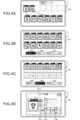
- FIG. 4A is a diagram illustrating an example of a deck formation screen during formation.
- FIG. 4B is a diagram illustrating an example of a card list screen.
- FIG. 4C is a diagram illustrating an example of a card generation screen.
- FIG. 4D is a diagram illustrating an example of a card details screen.
- the application for this game is started on the player terminal 1, communication between the player terminal 1 and the server 100 is started, a login state is established, and the game is started.
- various game screens are displayed on the display 26 of the player terminal 1.
- the game screen is roughly divided into a normal screen and a battle screen.
- the normal screen is mainly a screen for the player to make various settings and check information.
- the battle screen is a screen displayed on the display 26 from the start to the end of the card battle game.
- all screens other than the battle screen become normal screens.
- the normal screen includes a plurality of screens such as a home screen shown in FIG. 3A, a card setting screen shown in FIG. 3B, a shop screen (not shown), and a menu screen.
- the home screen shown in FIG. 3A is the first screen displayed after logging in.
- a menu bar 30 is displayed at the bottom of the display 26 on the home screen.
- the menu bar 30 is provided with a plurality of operation units that can be operated (tapped) by the player.
- the menu bar 30 includes a home screen selection operation section 30a labeled "Home,” a solo play selection operation section 30b labeled “Solo Play,” a multiplayer selection operation section 30c labeled "Battle,” and a "Card.”
- a card setting screen selection operation section 30d labeled "Shop”, a shop screen selection operation section 30e labeled "Others”, and a menu screen selection operation section 30f labeled "Others” are provided.
- the home screen selection operation section 30a When the home screen selection operation section 30a is tapped, the home screen shown in FIG. 3A is displayed on the display 26. Further, when the solo play selection operation section 30b is tapped, various setting screens are displayed, and when settings are made on the setting screen, a card battle game based on a computer battle is started. When the multiplayer selection operation section 30c is tapped, various setting screens are displayed, and when settings are made on the setting screen, a card battle game by communication battle with other players is started.
- the card setting screen selection operation section 30d When the card setting screen selection operation section 30d is tapped, the card setting screen shown in FIG. 3B is displayed on the display 26, and it is possible to organize a deck, display a list of cards, disassemble and generate cards, etc., which will be described later. Furthermore, when the shop screen selection operation section 30e is tapped, the shop screen is displayed on the display 26, and cards can be won by lottery by consuming in-game currency and items. Further, when the menu screen selection operation section 30f is tapped, a menu screen is displayed on the display 26, and game settings and various information can be confirmed. In addition, in the menu bar 30, the operation unit corresponding to each screen is highlighted so that the screen currently displayed on the display 26 can be identified.
- a header display area 31 is provided at the upper left of the home screen shown in FIG. 3A.
- the header display area 31 displays the player name, player icon, and battle points (BP) associated with the player ID. Note that battle points can be earned when winning a card battle game played through communication with another player, and are deducted when losing a card battle game played through communication play against another player.
- BP battle points
- a home menu 32 is displayed on the right end of the home screen.
- the home menu 32 includes a gift screen selection operation section 32a labeled "Gift,” an information screen selection operation section 32b labeled “Information,” a mission screen selection operation section 32c labeled “Mission,” and a “Guild” screen selection operation section 32c labeled “Mission.” ”
- a guild screen selection operation section 32d is provided.
- an information screen (not shown) that displays update information, maintenance information, etc. is displayed on the display 26.
- a mission screen (not shown) displaying a preset mission is displayed on the display 26.
- a guild screen related to a guild (group) made up of a plurality of players is displayed on the display 26.
- the card setting screen shown in FIG. 3B is displayed on the display 26 by tapping the card setting screen selection operation section 30d.
- a deck organization tab 33a and a card list generation tab 33b are displayed on the card setting screen.
- a deck selection screen shown in FIG. 3C is displayed.
- a list of decks created by the player is displayed on the deck selection screen. The player can name the deck when assembling the deck.
- the deck name is displayed on the icon corresponding to each deck.
- a deck creation tab 34 labeled "New Creation” is displayed on the deck selection screen.
- a deck creation screen shown in FIG. 3D is displayed on the display 26, and a new deck can be created.
- the deck composition screen On the deck composition screen, multiple blank columns are displayed in the upper row, and cards owned by the player (hereinafter referred to as owned cards) are displayed in the lower row. Then, on the deck composition screen, as shown in FIG. 4A, by sliding the owned cards displayed in the lower row to the upper row, the slid owned cards are arranged in the blank space in the upper row. In this way, on the deck composition screen, the cards placed in the upper row are provisionally registered.
- the deck information is stored.
- This deck information is given a deck ID, and card group information that allows identification of all temporarily registered owned cards is stored in association with the deck ID.
- a screen for editing the deck name is displayed, and when editing of the deck name is completed, the deck name and deck selection screen are displayed along with the card group information.
- the icon to be displayed is stored in association with the deck ID.
- a deck organization screen is displayed as shown in FIG. 4A.
- the cards constituting the deck selected on the deck selection screen are displayed in the upper row, and the owned cards are displayed in the lower row.
- the card displayed in the upper row can be changed to the owned card displayed in the lower row.
- deck information including card group information for the specified number of cards is usually stored by tapping the save tab 35 after a specified number of owned cards are temporarily registered by the player's operation. That will happen.
- the number of temporarily registered cards is less than the specified number or exceeds the specified number, it is possible to save the deck information, but the deck information cannot be saved in the card battle game. cannot be used in
- a card list screen shown in FIG. 4B is displayed on the display 26.
- This card list screen is provided with a possessed card tab 36a, a generation mode tab 36b, and a possessed coin display column 36c at the bottom of the display 26.
- the possession card tab 36a and the generation mode tab 36b are configured to accept tap operations from the player.
- the possession card tab 36a and the generation mode tab 36b are also displayed on the card generation screen, and when the possession card tab 36a is tapped, the card list screen shown in FIG. 4B is displayed, and when the generation mode tab 36b is tapped, the card list screen shown in FIG. 4B is displayed. , the card generation screen shown in FIG. 4C is displayed.
- the number of coins (the number of owned coins), which are in-game currency, owned by the player is displayed in the owned coin display column 36c.
- the card list screen displays the cards owned by the player and the number of cards owned. Note that cards that the player does not possess may be displayed on the card list screen.
- the card generation screen displays all provided cards, regardless of whether the player owns them or not. However, cards that the player owns are displayed in color, whereas cards that the player does not own are displayed in gray out (indicated by a broken line in FIG. 4C). This allows the player to easily identify whether or not the card is in his or her possession.
- a card details screen is displayed as shown in FIG. 4D.
- various information related to the tapped card is displayed, and a disassembly tab 37a and a generation tab 37b are provided.
- the number of earned coins is displayed on the decomposition tab 37a.
- the disassembly tab 37a is tapped, the currently selected card is disassembled, and the player can earn the number of earned coins displayed on the disassembly tab 37a. Note that when a card is disassembled, the number of cards in possession decreases.
- the number of consumed coins is displayed on the generation tab 37b.
- the generation tab 37b is tapped, the selected card can be generated by consuming the number of consumed coins displayed on the generation tab 37b.
- the number of cards in possession increases.
- the player can exchange the coins he/she has for cards.
- Such a card generation function can be executed regardless of whether the player has a card or not. That is, the player can generate cards for both cards that he owns and cards that he does not own.
- the provided cards may include cards that can be generated and cards that cannot be generated, or all cards may be generated. Furthermore, a card may be included in which a time when generation is possible and a time when generation is not possible are set.
- a first button 37c and a second button 37d are provided on the card details screen.
- the first button 37c is enabled.
- the details of the evolved card are displayed on the card details screen.
- cards that can evolve include specific cards that will be described later. Multiple types of special cards are linked to the specific card as cards after evolution. In a card battle game, a player can select any one of a plurality of types of special cards as an evolved card if specific conditions are met. Note that if the specific conditions are not met, the card evolves into a predetermined card like other evolveable cards.
- the second button 37d is enabled.
- the details of the special card linked to the specific card are displayed on the card details screen.
- a plurality of types of special cards are displayed in a switchable manner on the card details screen.
- the first button 37c is tapped on the card details screen for a specific card, details of the card that evolves if the specific conditions are not met are displayed.
- card details screen is displayed both during the card battle game and outside the card battle game.
- a card detail screen can be displayed not only for the player's own cards but also for the opponent's cards. Therefore, during the card battle game, the player can understand what kind of card the opponent can evolve into.
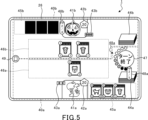
- FIG. 5 is a diagram illustrating an example of a card battle game screen.
- the multiplayer selection operation section 30c of the menu bar 30 is tapped, various setting screens are displayed, and when settings are made on the setting screen, a card battle game is started. While the card battle game is being executed, a battle screen shown in FIG. 5 is displayed on the display 26.
- the battle screen is divided into a player display area 40a where the player's cards, information, etc. are displayed, and an opponent display area 40b where the opponent's cards, information, etc. are displayed.
- a player leader 41a is displayed in the lower center of the player display area 40a, and the physical strength 42a and evolution points 43a of the player leader 41a are displayed near the player leader 41a.
- the opponent leader 41b is displayed in the upper center of the opponent display area 40b, and the physical strength 42b and evolution points 43b of the opponent leader 41b are displayed near the opponent leader 41b.
- the physical strength 42a of the player's leader 41a and the physical strength 42b of the opponent's leader 41b are set to 20 as initial values.
- a player's deck area 44a is provided at the right end, a player's hand area 45a is provided at the lower right, and a player's field 46a is provided at the center.
- the deck area 44a cards of unused players are placed face down, that is, in an unidentifiable state.
- the hand area 45a cards in the player's hand are arranged so that they can be identified by the player.
- the field 46a cards etc. taken out from the hand area 45a are arranged so that they can be identified by the player.
- the opponent's deck area 44b is provided at the right end
- the opponent's hand area 45b is provided at the upper left
- the opponent's field 46b is provided at the center.
- the opponent's unused cards are placed face down in the deck area 44b.
- the cards in the opponent's hand are arranged in such a way that they cannot be identified by the player, that is, they are placed face down.
- cards etc. taken out from the hand area 45b are arranged so that they can be identified by the player.
- a turn end button 47 that accepts taps from the player and a play point display section 48a that displays the player's play points (PP) are provided.
- the play point display section 48a displays the maximum play point in the current turn as the denominator and the available play points as the numerator.
- the maximum play point and the usable play point are displayed in the play point display section 48a in a manner that allows identification of the maximum play point and the usable play point.
- a play point display section 48b that displays the opponent's play points is provided near the leader 41b in the opponent display area 40b.
- a battle log button 49 is provided at the left end of the battle screen.
- the battle log button 49 is provided so as to be able to accept tap operations from the player. When the battle log button 49 is tapped, the battle log is displayed superimposed on the battle screen.
- the card battle game in this embodiment is a two-player battle type, and cards that become the player's hand are randomly distributed from a deck selected by the player. Similarly, the opponent's hand is randomly dealt a card from the deck selected by the opponent. Furthermore, in a card battle game, the player's turn and the opponent's turn are repeated alternately. Each turn, a randomly selected card from the deck is added to your hand.
- the player selects a follower card or amulet card, which will be described later, from among the cards placed in the player's hand area 45a and places it on the field 46a, according to predetermined rules, or uses a spell card to Activate a predetermined effect.
- follower cards or amulet cards placed in the hand areas 45a and 45b are placed on the field 46a and 46b, and spell cards placed in the hand areas 45a and 45b are used to activate a predetermined effect.
- the act of moving the cards placed in the hand areas 45a and 45b to another area is called "play.”
- the player's leader 41a and the opponent's leader 41b have physical strength 42a and 42b, respectively, and the player who first reduces the opponent's physical strength 42a and 42b to 0 by attacking with cards, etc. wins. .
- the player's leader 41a and the opponent's leader 41b have physical strength 42a and 42b, respectively, and the player who first reduces the opponent's physical strength 42a and 42b to 0 by attacking with cards, etc. wins. .
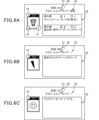
- FIG. 6A is a diagram illustrating an example of a follower card.
- FIG. 6B is a diagram illustrating an example of a spell card.
- FIG. 6C is a diagram illustrating an example of an amulet card. Cards used in the card battle game of this embodiment are classified into one of the following card types: follower cards, spell cards, and amulet cards.
- a name 51, class 52, type 53, and cost 54 are set for each card, regardless of the card type.
- the name 51 is uniquely set for each card. That is, the name 51 can also be said to be a card name.
- a plurality of classes 52 are provided, and each card is classified into one of the classes.
- a plurality of types 53 are provided, and each card may be classified into one of the types or not classified into any type.
- the cost 54 indicates the play points required to play the card, and by consuming the play points equivalent to the cost, the card becomes playable.
- the follower card shown in FIG. 6A is a card that can attack the opponent's leader 41b and the follower cards placed on the opponent's field 46b in the card battle game.
- the follower card has a name 51, class 52, type 53, cost 54, ability 55, attack power 56, and physical strength 57.
- the attack power 56 indicates the amount of damage inflicted on the opponent's leader 41b targeted for attack or the follower card placed on the opponent's field 46b when the follower card attacks.
- physical strength 57 decreases by the amount of damage received, and when it reaches 0, the follower card is destroyed. Note that the destroyed card is hidden from the field 46a and sent to a graveyard (not shown). However, unlike destruction, there is also a state in which the object is hidden from the field 46b, such as extinction, in which it is not sent to the graveyard.
- the follower card can evolve by consuming evolution points 43a and 43b.
- the evolved follower card has increased attack power 56 and physical strength 57, or has a predetermined ability 55 added to it. That is, by evolving a follower card, its performance (ability 55, attack power 56, physical strength 57) is enhanced.
- the spell card shown in FIG. 6B has a name 51, a class 52, a type 53, a cost 54, and an ability 55.
- ability 55 effect
- the spell card is destroyed. That is, a spell card is a card that cannot be put into play 46a or 46b.
- the amulet card shown in FIG. 6C has a name 51, a class 52, a type 53, a cost 54, and an ability 55.
- the amulet card is a card that, when played, remains in the field 46a and activates the ability 55.
- FIG. 7 is a diagram illustrating an example of the capability 55. Note that the abilities 55 shown in FIG. 7 are just an example, and other abilities 55 may be provided, or some abilities 55 may not be provided. Further, although the explanation here assumes that the card is the player's card, the same applies to the opponent's card.
- the abilities 55 include fanfare, last word, protection, charge, dash, special attack, drain, direct summon, evolution, fusion, etc.
- Fanfare is an ability that activates the effect written after "Fanfare" when a card is put out from the hand area 45a to the field 46a (when the card is played).
- Fanfare is an ability that activates the effect written after "Fanfare" when a card is put out from the hand area 45a to the field 46a (when the card is played).
- Fanfare is an ability that activates the effect written after "Fanfare" when a card is put out from the hand area 45a to the field 46a (when the card is played).
- the effect of "draw one card” is activated, and one card is drawn from among the cards placed in the deck area 44a.
- a card is determined by lottery, and the determined card is placed in the hand area 45a.
- Last Word is an ability that activates the effect written after "Last Word" when a card is destroyed.
- Guardianship is an ability that, when a card with guardianship set is placed on the field 46a, makes it impossible for the opponent to attack cards other than the card with guardianship set.
- Charge is an ability that allows you to attack your opponent's follower card in the turn it is played on the field 46a.
- Dash is an ability that allows you to attack your opponent's follower card and leader 41b during the turn it is played on the field 46a.
- Special ability is an ability that allows you to destroy your opponent's follower card, regardless of the physical strength of your opponent's follower card, if you attack and inflict damage on your opponent's follower card.
- Drain is an ability that, when a player deals damage to an opponent's follower card or leader 41b during a player's turn, recovers the physical strength 42a of one's own leader 41a by the amount of damage dealt.
- Direct summoning is an ability in which a card is directly issued from the deck area 44a to the field 46a when a preset condition is met.
- evolved is an ability that activates the effect listed after "when evolved" when a follower card evolves.
- Fusion is an ability that is given to a base card that is a fusion source, and is an ability that strengthens a card by fusing a card placed in the hand area 45a that meets preset conditions as a material card. . Note that in one card, a plurality of abilities 55 may be set overlappingly, or even one ability 55 may not be set.
- a deck is formed by combining follower cards, spell cards, and amulet cards, and a card battle game is played using the formed deck. Below, details of the card battle game will be explained.
- FIG. 8A is a first diagram illustrating an example of the transition of the card battle screen.
- FIG. 8B is a second diagram illustrating an example of the transition of the card battle screen.
- FIG. 8C is a third diagram illustrating an example of the transition of the card battle screen.
- FIG. 9A is a fourth diagram illustrating an example of the transition of the card battle screen.
- FIG. 9B is a fifth diagram illustrating an example of the transition of the card battle screen.
- FIG. 9C is a sixth diagram illustrating an example of the transition of the card battle screen.
- FIG. 10A is a seventh diagram illustrating an example of the transition of the card battle screen.
- FIG. 10B is an eighth diagram illustrating an example of the transition of the card battle screen.
- FIG. 10A is a seventh diagram illustrating an example of the transition of the card battle screen.
- FIG. 10B is an eighth diagram illustrating an example of the transition of the card battle screen.
- FIG. 10C is a ninth diagram illustrating an example of the transition of the card battle screen.
- FIG. 11A is a tenth diagram illustrating an example of the transition of the card battle screen.
- FIG. 11B is an eleventh diagram illustrating an example of the transition of the card battle screen.
- the deck information to be used is transmitted from the player terminal 1 to the server 100.
- deck information is also transmitted from the opponent's player terminal 1 to the server 100.
- the server 100 randomly determines who plays first and who plays second, and randomly assigns an index (for example, a number from 1 to 40) to all cards shown in the deck information. Furthermore, the server 100 determines three initial candidate cards and three replacement candidate cards from among the cards shown in the deck information.
- the server 100 transmits to the player terminal 1 initial information including first-player and second-player information indicating whether the player plays first or second, index information indicating the index of the player's card, and exchange information indicating the initial card and exchange candidate cards. do.
- initial information including first-player and second-player information indicating whether the player plays first or second, index information indicating the index of the player's card, and exchange information indicating the initial card and exchange candidate cards.
- the player terminal 1 when a card battle game is started, as shown in FIG. 8A, whether the player plays first or plays second is displayed on the display 26 based on the information on the player playing first or playing second. Thereafter, as shown in FIG. 8B, the player terminal 1 arranges three initial candidate cards in the initial card display area 60 based on the exchange information, and displays an exchange display area 61 for arranging cards to be exchanged. 26.
- the player moves the card that he wants to exchange to the exchange display area 61 by a slide operation. Then, when the enter button 62 is tapped by the player, the cards moved to the exchange display area 61 are returned to the deck area 44a, and the initial candidate cards that have not been exchanged and the initial candidate cards that have been exchanged are exchanged.
- a candidate card is determined as an initial card, and initial card information indicating the determined initial card is transmitted to the server 100.
- the server 100 also receives initial card information from the opponent's player terminal 1. Upon receiving the initial card information from both parties, the server 100 transmits to the player terminal 1 of the player number information indicating only the number of cards included in the opponent's initial card information. Similarly, upon receiving initial card information from both parties, the server 100 transmits to the player terminal 1 of the other party, number information indicating only the number of cards included in the player's initial card information.
- the player terminal 1 Upon receiving the number information, the player terminal 1 displays a battle screen on the display 26, as shown in FIG. 9A. At this time, the determined initial card is identifiably arranged in the hand area 45a, and three cards are indistinguishably arranged in the hand area 45b based on the received opponent's number of cards information.
- the player terminal 1 displays an image labeled "YOUR TURN" on the display 26, indicating that it is the player's turn, and then displays the image on the deck area 44a, as shown in FIG. 9B.
- One index of a certain card is determined by lottery. That is, here, one card in the deck area 44a is drawn.
- the player terminal 1 places the card determined by the lottery in the hand area 45a, and transmits the card information to the server 100. Further, the player terminal 1 adds 1 to the play point and updates and displays the play point display section 48a (here, the play point is set to 1).
- the play point is subtracted by 1.
- the play point display section 48a is updated and displayed.
- the follower card placed on the field 46a has the ability 55 and the activation condition is met, the ability 55 for which the activation condition is satisfied is activated.
- the player terminal 1 transmits card information indicating the card played on the field 46a to the server 100.
- the server 100 Upon receiving the card information, the server 100 transmits the received card information to the player terminal 1 of the other party.
- the opponent's player terminal 1 the card indicated by the card information is placed on the opponent's field 46b, and the opponent's play point display section 48b is updated and displayed.
- the player terminal 1 transmits turn end information indicating that the turn has ended to the server 100.
- the player terminal 1 when a card whose ability 55 is activated under the condition that the turn ends is on the field 46a, 46b, the ability 55 of that card is activated.
- the server 100 receives the turn end information, the server 100 transmits turn start information to the opponent's player terminal 1 to indicate that the player's turn has ended and to start the opponent's turn. Let it start.
- the player's player terminal 1 displays an image labeled "ENEMY TURN" on the display 26, indicating that it is the opponent's turn.
- the card information of the card determined by lottery at the opponent's player terminal 1 is transmitted to the server 100, and when the number information is received from the server 100, the player terminal 1, as shown in FIG. 10C, based on the number information, Cards are arranged indiscernibly in the hand area 45b. Note that at the start of a turn, one card is normally decided by drawing lots, but only in the first turn of the second player, two cards are decided by drawing lots. Furthermore, the player terminal 1 adds 1 to the opponent's play point and updates the play point display section 48b.
- the player terminal 1 displays a message indicating that it is the player's turn, as shown in FIG. 11A.
- the player terminal 1 After displaying an image labeled "YOUR TURN" on the display 26, one index of the card in the deck area 44a is determined by lottery. Then, the card determined by the lottery is placed in the hand area 45a, and the card information of the determined card is transmitted to the server 100. Further, the player terminal 1 adds 1 to the play point and updates and displays the play point display section 48a (here, the play point is set to 2).
- the player terminal 1 transmits attack information indicating the attacked follower card and the attacked follower card or leader 41b to the server 100. Upon receiving the attack information, the server 100 transmits the attack information to the opponent player terminal 1.
- the player's turn and the opponent's turn are repeated alternately, and each time the player and the opponent play a card or attack, the information is transmitted to the server 100, so that a card battle is possible.
- the game progresses.
- the winner or loser is determined and the card battle game ends.
- the follower cards can be evolved by consuming the evolution points 43a and 43b on and after the fifth turn of the player who plays first and after the fourth turn of the player who plays second. It should be noted that the evolution points 43a and 43b are given 2 points if the player goes first, and 3 points if the player goes second.
- FIG. 12A is a first diagram illustrating an example of a battle screen during evolution.
- FIG. 12B is a second diagram illustrating an example of a battle screen during evolution.
- FIG. 12A assume that an unevolved follower card is placed on the field 46a on the fifth turn of the first player. At this time, when the follower card placed in the field 46a is tapped, a card details tab 63 is displayed on the display 26.
- FIG. 13 is a diagram illustrating an example of the card details tab 63.
- the card details tab 63 displays the ability 55 of the tapped card and an evolution button 63a.
- the evolution button 63a is displayed only on the card details tab 63 of the follower card, and the evolution button 63a is not displayed on the card details tab 63 of spell cards and amulet cards.
- the evolution button 63a functions as an operation unit that accepts a tap from the player when evolution is possible. Therefore, in this embodiment, only follower cards are set as evolvable cards.
- the ability 55 before evolution is displayed at the top of the card details tab 63, as shown in FIG. Furthermore, the evolved ability 55 is displayed at the bottom of the card details tab 63.
- FIG. 14A is a first diagram illustrating an example of an evolution animation.
- FIG. 14B is a second diagram illustrating an example of an evolution animation.
- an evolution animation is displayed.
- an animation image (not shown) in which the card changes is displayed.
- the evolved card is displayed.
- the evolution point 43a is subtracted and displayed, and the evolved card is displayed on the field 46a, as shown in FIG. 12B.
- the evolved card's attack power 56 and physical strength 57 increase.
- the player terminal 1 transmits evolution information indicating the evolved follower card to the server 100.
- the server 100 Upon receiving the evolution information, the server 100 transmits the evolution information to the opponent player terminal 1. The received evolution information allows the opponent's player terminal 1 to understand that the card has evolved and the evolved card.
- the specific card is included in the plurality of types of cards.
- the specific card is a follower card that can be evolved, and is a card to which multiple types of special cards are linked as cards after evolution. This specific card allows the player to select any one special card from among a plurality of types of special cards as an evolved card if specific conditions are met.
- FIG. 15 is a diagram illustrating an example of a specific card and a special card.
- all cards are associated with performance information indicating the performance of the card, such as card ID, card name, illustration, and ability 55.
- performance information indicating the performance of the card, such as card ID, card name, illustration, and ability 55.
- a specific card with a card ID of "126441010” and a card name of "Bear" is provided.
- This particular card is a card that can evolve.
- An evolvable card is associated with an illustration before evolution and an illustration after evolution.
- the performance information linked to the specific card includes the ability 55 before evolution and the ability 55 after evolution.
- the card details tab 63 that is displayed when a specific card before evolution is tapped, the ability 55 before evolution linked to the specific card is displayed in the upper row, and the ability 55 after evolution linked to the specific card is displayed in the upper row. Displayed at the bottom.
- three types of special cards are provided, each with card names of "Bare AT Mode,” “Bare DF Mode,” and “Bare BS Mode.” These special cards are linked to specific cards, and the first three digits of the card ID are "910" indicating that they are special cards. Furthermore, the values of the fourth to sixth digits of the card ID of all special cards are the same as the values of the fourth to sixth digits of the card ID of the specific card. In this way, by making the values of the fourth to sixth digits of the card ID equal, a specific card and a special card are linked. Note that when a plurality of specific cards are provided, the special cards linked to each specific card are different for all the specific cards.
- the three special cards have the same illustrations as the specific cards linked to them as illustrations before evolution. On the other hand, the three special cards are associated with illustrations that differ in display form from the specific cards as post-evolved illustrations. Additionally, the evolved illustrations linked to each of the three special cards also have different display modes.
- each of the three special cards is linked with performance information including 55 abilities after evolution.
- Performance information linked to a special card is different from performance information linked to a specific card.
- the performance information linked to each of the three special cards also has different contents. However, either the illustration or the performance information after evolution may be the same between the special cards.
- the illustration and performance information before evolution and the illustration and performance information after evolution are linked to a specific card.
- the illustrations and performance information tied to a specific card are different before and after evolution.
- a plurality of special cards are linked to one specific card. Each special card is associated with an evolved illustration and performance information that is different from the corresponding specific card.
- specific conditions regarding evolution are set in advance for the specific card.
- it is set as a specific condition that a predetermined card is displayed (arranged) in the field 46a.
- the predetermined cards are cards other than the specific cards, and here are some cards among all the cards.
- the specific conditions are not met, that is, when the predetermined card is not displayed in the field 46a, when the evolution button 63a of the card details tab 63 of the specific card is tapped, the illustration and performance of the specific card evolve. . Specifically, in this case, the specific card is not changed to another card, but the illustration and performance of the same specific card are changed from before evolution to after evolution due to evolution.
- a specific condition that is, if a predetermined card is displayed on the field 46a, and the evolution button 63a of the card details tab 63 of the specific card is tapped, the player can receive three special cards. You can select one of them.
- FIG. 16A is a diagram illustrating an example of the special card selection screen.
- FIG. 16B is a third diagram illustrating an example of an evolution animation. If the evolution button 63a of the card details tab 63 of a specific card is tapped when the specific conditions are met, a special card selection screen shown in FIG. 16A is displayed. On the special card selection screen, three special cards linked to a specific card are displayed in an identifiable manner. Further, a selection operation section 63b is displayed for each special card.
- the specific card is evolved (changed) into the special card selected by the player.
- an evolution animation is displayed, and as shown in FIG. 16B, it is reported that the specific card has evolved into the special card selected by the player.
- the player can evolve a specific card into a special card. Therefore, in order to evolve a specific card into a special card, the player needs to proceed with the game to meet specific conditions, and is required to be strategic. Additionally, there are multiple special cards, each with different performance. Therefore, it is necessary to decide which special card to evolve into while keeping an eye on the battle situation, which requires a higher level of strategy. In this way, according to the present embodiment, a higher level of strategy is required, and the game becomes more interesting.
- pre-evolution and post-evolution illustrations and performance information are linked to a specific card.
- the illustration and performance information before evolution are linked to the specific card, and the illustration and performance information after evolution do not need to be linked.
- a dedicated post-evolved card to which the post-evolved illustration and performance information are linked may be provided. If the specific conditions are not met, the specific card may be changed to a dedicated evolved card.
- both the illustration displayed on the card and the performance change before and after the evolution of a specific card.
- only either the illustration displayed on the card or the performance may change.
- the specific condition is that a predetermined card is displayed on the field 46a.
- the specific conditions are not limited to this.
- the player or the opponent has a predetermined card
- the predetermined card has been destroyed
- the predetermined card is displayed on the opponent's field 46b
- the opponent has the predetermined card, etc.
- One or more of these conditions may be set as the specific conditions, such as that the number of cards remaining is below or above a predetermined number.
- it may be set as a specific condition that a predetermined number or more of the player's follower cards have left the field 46a during the card battle game. In this case, the fact that the card is destroyed and sent to the graveyard and/or the card disappears are included in "leaving the field 46a".
- predetermined cards that are not follower cards may be included in the counting of cards that have left the field 46a, which is used to determine whether or not the specific condition is met.
- the specific condition may be the number of times the player or the opponent performs a predetermined operation, the content, etc. during the card battle game or during one turn. That is, if the player's or opponent's operation input during a predetermined period or the progress of the card battle game satisfies a preset condition, it may be determined that the specific condition is satisfied.
- the illustration and performance after evolution when the specific condition is not met are different from the illustration and performance after evolution when the specific condition is met.
- the illustration and performance after evolution will be completely different depending on whether the specific conditions are met or not.
- either or both of the display mode and performance of the special card may be different from a preset display mode or performance that changes when specific conditions are not satisfied. Note that a part of the illustration or performance after evolution may be the same depending on whether the specific conditions are met or not.
- cards that can be selected when a specific condition is met may include cards that are selected when the specific condition is not met.
- the player can select the card that would be selected if the specific condition is not met, regardless of whether the specific condition is met.
- a special card is provided separately from a specific card, and the card itself is changed from the specific card to the special card when specific conditions are met.
- the player can select any one special card from among a plurality of special cards.
- the evolved special card may be determined, for example, by lottery.
- the evolved special card may be determined based on the number, type, predetermined parameters, etc. of cards displayed and placed in the fields 46a, 46b at that time.
- a specific game media (specific card) associated with a specific display mode and specific performance is displayed in the arrangement area (field 46a), and
- a predetermined operation input tap on the evolution button 63a
- a preset specific condition a predetermined card is displayed on the field 46a
- both may be changed to one of a plurality of display modes or performances.
- FIG. 17 is a functional block diagram of the player terminal 1.
- the memory 12 of the player terminal 1 is provided with a program storage area 12a and a data storage area 12b.
- the CPU 10 stores a terminal-side game control program (module) in the program storage area 12a.
- the terminal side game control program includes a game execution control program 70, a card battle game execution control program 71, an area setting program 72, a display control program 73, an evolution processing program 74, and a communication control program 75. Note that the programs listed in FIG. 17 are just examples, and the terminal-side game control program includes many other programs.
- the CPU 10 operates each program stored in the program storage area 12a and updates the data in each storage section of the data storage area 12b. Then, the CPU 10 causes the player terminal 1 (computer) to function as the terminal control unit 1A by operating each program stored in the program storage area 12a.
- the terminal control section 1A includes a game execution control section 70a, a card battle game execution control section 71a, an area setting section 72a, a display control section 73a, an evolution processing section 74a, and a communication control section 75a.
- the CPU 10 operates the game execution control program 70 and causes the computer to function as the game execution control section 70a.
- the CPU 10 operates a card battle game execution control program 71, an area setting program 72, a display control program 73, an evolution processing program 74, and a communication control program 75, respectively.
- a display control section 73a, an evolution processing section 74a, and a communication control section 75a are examples of the communication control section 75a.
- the data storage area 12b is provided with a game information storage section 80, a player information storage section 81, and a battle log storage section 82 as storage sections for storing data. Note that each of the storage units described above is an example, and the data storage area 12b is provided with many other storage units.
- the game information storage unit 80 stores, for each card ID, status such as name 51, class 52, type 53, cost 54, ability 55, attack power 56, physical strength 57, and information regarding illustrations. has been done.
- the game execution control unit 70a controls the progress of the entire game.
- the game execution control unit 70a for example, logs into the game in response to a player's operation, or determines whether the game information for the entire game has been updated.
- the card battle game execution control unit 71a is in charge of control for executing the card battle game.
- the card battle game execution control unit 71a controls the progress of the card battle game based on operations input to the player terminal 1, and stores a battle log in the battle log storage unit 82.
- the area setting unit 72a sets the area where cards are placed in the card battle game. For example, the area setting unit 72a sets deck areas 44a and 44b where unused cards are placed, hand areas 45a and 45b as areas where hand cards are placed, and field 46a and 46b as areas where played cards are placed. 46b.
- the display control unit 73a controls the display of images displayed on the display 26 according to the player's operations and the progress of the game.
- the evolution processing unit 74a performs a process of evolving a card in the card battle game based on the operation of the evolution button 63a or the selection operation unit 63b.
- the communication control unit 75a sends and receives information to and from the server 100.
- FIG. 18 is a functional block diagram of the server 100.
- the memory 112 of the server 100 is provided with a program storage area 112a and a data storage area 112b.
- the program storage area 112a stores a game execution control program 170, a card battle game execution control program 171, and a communication control program 172 as server-side game control programs. Note that the programs listed in FIG. 18 are just examples, and the server-side game control program includes many other programs.
- the CPU 110 operates each program stored in the program storage area 112a and updates the data in each storage section of the data storage area 112b. Then, the CPU 110 causes the server 100 (computer) to function as the server control unit 100A by operating each program stored in the program storage area 112a.
- the server control unit 100A includes a game execution control unit 170a, a card battle game execution control unit 171a, and a communication control unit 172a.
- the CPU 110 operates the game execution control program 170 to cause the computer to function as the game execution control section 170a.
- the CPU 110 operates a card battle game execution control program 171 and a communication control program 172 to function as a card battle game execution control section 171a and a communication control section 172a, respectively.
- the data storage area 112b is provided with a game information storage section 180, a player information storage section 181, and a battle log storage section 182 as storage sections for storing data. Note that each of the storage units described above is an example, and the data storage area 112b is provided with many other storage units.
- the game execution control unit 170a controls the progress of the entire game. For example, upon receiving login information from the player terminal 1, the game execution control unit 170a transfers the player information (deck information, BP, etc.) stored in the player information storage unit 181 to the player terminal 1 via the communication control unit 172a. Send. Furthermore, when the game information for the entire game is updated, the game execution control section 170a reads the updated game information from the game information storage section 180 and transmits it to the player terminal 1 via the communication control section 172a.
- the card battle game execution control unit 171a is responsible for controlling the execution of the card battle game, and stores the battle log in the battle log storage unit 182.
- the communication control unit 172a transmits and receives information to and from the player terminal 1.
- FIG. 19 is a sequence diagram illustrating the processing of the player terminal 1 and the server 100. Note that in the following explanation, the processing at the player terminal 1 will be referred to as Pn (n is an arbitrary integer). Further, processing in the server 100 is denoted by Sn (n is an arbitrary integer).
- Pn n is an arbitrary integer
- Sn n is an arbitrary integer
- login information is transmitted to the server 100 via the communication control unit 75a under the control of the game execution control unit 70a (P1).
- the game execution control unit 170a of the server 100 receives the login information via the communication control unit 172a, it specifies the player ID associated with the login information and executes the login process (S1).
- the game execution control section 170a reads player information corresponding to the identified player ID from the player information storage section 181, and transmits it to the player terminal 1 via the communication control section 172a.
- the game execution control unit 70a of the player terminal 1 saves the deck information to the player when the save tab 35 is tapped after the cards in the player's possession have been temporarily registered via the deck composition screen shown in FIGS. 3D and 4A.
- the information is stored in the information storage section 81.
- the communication control unit 75a transmits deck information to the server 100 (P2).
- the game execution control unit 170a of the server 100 receives the deck information via the communication control unit 172a, it executes a deck information storage process of associating the received deck information with the player ID and storing it in the player information storage unit 181 (S2 ).
- the game execution control unit 70a of the player terminal 1 displays generated or disassembled card information via the card list screen shown in FIG. 4B or the card generation screen shown in FIG. 4C. , generation and decomposition information including the updated number of coins, possession card information, etc. is stored in the player information storage unit 81. Furthermore, the game execution control section 70a executes a card generation and disassembly process of transmitting generation and disassembly information to the server 100 via the communication control section 75a (P3).
- the game execution control unit 170a of the server 100 receives the generation and decomposition information via the communication control unit 172a, the game execution control unit 170a selects the player associated with the player ID stored in the player information storage unit 181 based on the received generation and decomposition information. Card information storage processing for updating information is executed (S3).
- the card battle game execution control section 71a transmits start information from the player terminal 1 to the server 100 via the communication control section 75a, and executes the card battle game execution process (P4).
- the card battle game execution control unit 171a of the server 100 determines the opponent and executes the card battle game execution process (S4).
- FIG. 20 is a flowchart illustrating an example of the card battle game execution process (P4) in the player terminal 1.
- the card battle game execution control section 71a transmits deck information used in the card battle game to the server 100 via the communication control section 75a (P4-1).
- the area setting unit 72a executes area setting processing to set an area in which cards are placed on the battle screen (P4-2).
- the area setting section 72a includes, for example, deck areas 44a and 44b where unused cards are placed, hand areas 45a and 45b where hands are placed, cards played from among the cards displayed in the hand area 45b, etc. 46a and 46b are set. Note that the area setting unit 72a also sets areas other than areas where cards are placed on the battle screen.
- the display control unit 73a displays on the display 26 whether the player is the first player or the second player, as shown in FIG. 8A, based on the initial information (first player, second player information) transmitted from the server 100 ( P4-4). Thereafter, the card battle game execution control unit 71a executes an initial card determination process to determine an initial card based on the initial information (exchange information) (P4-5). Here, the display control unit 73a arranges three initial candidate cards in the initial card display area 60, as well as a card to be exchanged, as shown in FIG. 8B, based on the initial information (first player/second player information). A replacement display area 61 for the purpose is displayed on the display 26.
- the card battle game execution control unit 71a returns the cards moved to the exchange display area 61 to the deck area 44a, and removes the cards that have not been exchanged.
- the initial candidate card and replacement candidate cards corresponding to the number of exchanged initial candidate cards are determined as initial cards.
- the card battle game execution control unit 71a transmits initial card information indicating the initial card to the server 100 via the communication control unit 75a, and receives information on the number of cards of the opponent (P4-6).
- the display control unit 73a Based on the area set in P4-2, the display control unit 73a displays the battle screen on the display 26 as shown in FIG. 9A, and arranges the determined initial card in the hand area 45a so that it can be identified. . Further, the display control unit 73a arranges three cards indistinguishably in the hand area 45b based on the received opponent's number-of-cards information (P4-7).
- the card battle game execution control unit 71a determines whether it is the player's turn based on the first-attack-second-attack information or the turn start information transmitted from the server 100 (P4-8). Then, if it is the player's turn (YES at P4-8), the card battle game execution control unit 71a executes own turn control processing (P5). On the other hand, if it is not the player's turn, that is, it is the opponent's turn (NO in P4-8), the card battle game execution control unit 71a executes the opponent's turn control process (P6).
- the card battle game execution control unit 71a returns the process to P4-8 if the winner or loser has not been determined (NO in P4-9), and if the winner or loser has been determined (YES in P4-9), the card battle game execution control unit 71a returns the process to P4-8.
- a card battle game end process is executed to end the battle game (P4-10), and the card battle game execution process is ended.
- FIG. 21 is a first flowchart illustrating an example of the own turn control process (P5) in the player terminal 1.
- FIG. 22 is a second flowchart illustrating an example of the own turn control process (P5) in the player terminal 1.
- the display control unit 73a displays an image labeled "YOUR TURN" indicating that it is the player's turn on the display 26, as shown in FIG. 9B (P5-1).
- the card battle game execution control unit 71a determines one card in the deck area 44a by lottery (P5-2). Further, the display control unit 73a arranges the determined card in the hand area 45a so that it can be identified. Furthermore, the communication control unit 75a transmits the card information of the determined card to the server 100 (P5-3). Further, the card battle game execution control unit 71a adds 1 to the play point (P5-4). Further, the display control section 73a updates and displays the play point display section 48a.
- the card battle game execution control unit 71a also checks whether there is an ability 55 that is activated at the start of the player's turn, and if there is an ability 55 that is activated at the start of the player's turn, performs a situation confirmation process to activate the ability 55. Execute (P5-5). Then, the card battle game execution control unit 71a determines whether the physical strength 42a of the player's leader 41a or the physical strength 42b of the opponent's leader 41b has become 0, that is, whether the winner or loser has been determined, through the situation confirmation process ( P5-6). If the winner or loser has been determined (YES at P5-6), the own turn control process ends, and if the winner or loser has not been determined (NO at P5-6), the process moves to P5-7.
- the card battle game execution control unit 71a executes the following actions as shown in FIG. 10A: Subtract play points only for the cost 54 of the card played on the field 46a (P5-8). Further, the display control section 73a updates and displays the play point display section 48a.
- the display control unit 73a displays that card on the field 46a (P5-9). Further, the card battle game execution control unit 71a checks the ability 55 of the played card, and if there is an ability 55 (fanfare) to be activated when it is put on the field 46a, activates the ability 55 (P5 -10). The communication control unit 75a transmits the card information of the played card to the server 100 (P5-11). Then, the card battle game execution control unit 71a determines whether the winner or loser has been determined (P5-12). If the winner or loser has been determined (YES at P5-12), the own turn control process ends, and if the winner or loser has not been determined (NO at P5-12), the process moves to P5-13.
- the card battle game execution control unit 71a executes attack determination processing. (P5-14). In the attack determination process, the physical strength of the attacked opponent's follower card or leader 41b is subtracted, or the physical strength of the attacked follower card is subtracted. Further, the display control unit 73a executes an effect when attacking.
- the communication control unit 75a transmits attack information indicating the attacked follower card and the target follower card or leader 41b to the server 100 (P5-15). Then, the card battle game execution control unit 71a determines whether the winner or loser has been determined (P5-16). If the winner or loser is determined (YES at P5-16), the own turn control process ends, and if the winner or loser is not determined (NO at P5-16), the process moves to P5-21 in Figure 22. .
- the card battle game execution control unit 71a determines whether the card displayed on the field 46a has been tapped (P5-21). When the card is tapped (YES at P5-21), the display control unit 73a displays the card details tab 63 shown in FIGS. 12A and 13. Here, when a card that can be evolved is tapped, the display control unit 73a displays the card details tab 63 by referring to the performance information before and after evolution linked to the card.
- the display control unit 73a refers to the performance information of the corresponding specific card before evolution and the current performance information of the special card.
- the card details tab 63 is displayed. That is, even when the special card displayed in the field 46a is tapped, the card details tab 63 displays performance information before evolution and performance information after evolution.
- the content displayed on the card details tab 63 is not particularly limited. For example, only performance information after evolution may be displayed on the card details tab 63 of a special card.
- the card battle game execution control unit 71a enables the evolution button 63a. (P5-25).
- the display control unit 73a displays an evolution button 63a on the card details tab 63.
- the card battle game execution control unit 71a determines whether the evolution button 63a displayed on the card details tab 63 and enabled has been tapped (P5-26). Further, when the evolution button 63a is tapped (YES at P5-26), the card battle game execution control unit 71a determines whether the tapped card is a specific card (P5-27). If the tapped card is a specific card (YES on P5-27), the card battle game execution control unit 71a determines whether the specific condition is satisfied, that is, whether a predetermined card is displayed on the field 46a. (P5-28). If the specific condition is satisfied (YES at P5-28), the display control unit 73a displays a special card selection screen on the display 26 (P5-29).
- the communication control unit 75a transmits evolution information indicating the card to be evolved to the server 100. (P5-31).
- the evolution processing unit 74a subtracts 1 from the evolution point 43a (P5-32). Further, the evolution processing unit 74a increases and updates the performance (eg, attack power and physical strength) of the card to be evolved (P5-33).
- the performance is updated to the evolved performance of the special card corresponding to the tapped selection operation section 63b.
- the evolution button 63a is tapped, the performance of the card selected by the player after evolution is updated.
- the display control unit 73a displays an evolution animation.
- the evolution processing unit 74a checks the ability 55 of the evolved card, and if there is an ability 55 to be activated when evolved (at the time of evolution), activates that ability 55 (P5-34). Then, the evolution processing unit 74a determines whether the winner or loser has been determined (P5-35). If the winner or loser has been determined (YES at P5-35), the own turn control process ends, and if the winner or loser has not been determined (NO at P5-35), the process moves to P5-36.
- the card battle game execution control unit 71a determines whether the player's turn has ended in response to the player's operation of the turn end button 47 (P5-36). Then, if the player's turn has not ended (NO at P5-36), the card battle game execution control unit 71a moves the process to P5-7, and if the player's turn has ended (YES at P5-36). , execute turn end processing (P5-37). Here, the ability 55 of the card placed on the field 46a is confirmed, and if there is an ability 55 to be activated at the end of the player's turn, that ability 55 is activated and the outcome is confirmed. Furthermore, the communication control unit 75a transmits turn end information indicating that the player's turn has ended to the server 100.
- the communication control unit 75a sends the win/loss information indicating that the winner or loser has been determined to the server 100. Send.
- FIG. 23 is a flowchart illustrating an example of the opponent's turn control process (P6) in the player terminal 1.
- the display control unit 73a displays an image labeled "EMEMY TURN" indicating that it is the opponent's turn on the display 26, as shown in FIG. 10B (P6-1).
- the card battle game execution control unit 71a adds 1 to the opponent's play point (P6-2).
- the display control section 73a updates and displays the play point display section 48b.
- the display control unit 73a determines whether the number of sheets information has been received via the communication control unit 75a (P6-3). If the number information is received (YES at P6-3), the display control unit 73a arranges the cards indistinguishably in the hand area 45b based on the number information (P6-4).
- the card battle game execution control unit 71a determines whether play information has been received via the communication control unit 75a (P6-5). When the play information is received (YES at P6-5), the card battle game execution control unit 71a subtracts play points by the cost of the played card, 53 (P6-6). Furthermore, the display control section 73a updates and displays the play point display section 48b.
- the display control unit 73a displays the card in an identifiable manner on the field 46b (P6-7).
- the card battle game execution control unit 71a also checks the ability 55 of the played card, and if there is an ability 55 to be activated, activates that ability 55 (P6-8). Then, the card battle game execution control unit 71a determines whether the winner or loser has been determined (P6-9). If the winner or loser is determined (YES at P6-9), the processing of the opponent's turn ends, and if the winner or loser is not determined (NO at P6-9), the process moves to P6-10.
- the card battle game execution control unit 71a determines whether attack information has been received via the communication control unit 75a (P6-10). If attack information is received (YES at P6-10), the card battle game execution control unit 71a executes attack determination processing (P6-11). In the attack determination process, the physical strength of the attacked player's follower card or the leader 41a is subtracted, or the physical strength of the attacked follower card is subtracted. Further, the display control unit 73a executes an effect when attacking.
- the card battle game execution control unit 71a determines whether the winner or loser has been determined (P6-12). If the winner or loser is determined (YES at P6-12), the processing of the opponent's turn ends, and if the winner or loser is not determined (NO at P6-12), the process moves to P6-13.
- the evolution processing unit 74a determines whether evolution information has been received via the communication control unit 75a (P6-13). Then, when evolution information is received (YES at P6-13), the evolution processing unit 74a subtracts the evolution point 43b (P6-14). Further, the display control unit 73a updates and displays the evolution point 43b. Further, the evolution processing unit 74a increases and updates the performance (eg, attack power and physical strength) of the follower card to be evolved (P6-15). Further, the evolution processing unit 74a checks the ability 55 of the evolved card, and if there is an ability 55 to be activated, activates the ability 55 (P6-16). Then, the evolution processing unit 74a determines whether the winner or loser has been determined (P6-17). If the winner or loser is determined (YES at P6-17), the processing of the opponent's turn ends, and if the winner or loser is not determined (NO at P6-17), the process moves to P6-18.
- the performance eg, attack power and physical strength
- the card battle game execution control unit 71a determines whether turn end information has been received via the communication control unit 75a (P6-18). When the turn end information is received (YES at P6-18), the card battle game execution control unit 71a executes turn end processing (P5-19). Here, the card battle game execution control unit 71a confirms the ability 55 of the card placed on the field 46b. Then, if there is an ability 55 that is activated at the end of the opponent's turn, that ability 55 is activated and the outcome is confirmed.
- the communication control unit 75a sends the win/loss information indicating that the winner or loser has been determined to the server 100. Send.
- FIG. 24 is a flowchart illustrating an example of the card battle game execution process (S4) in the server 100.
- the communication control unit 172a receives deck information from the player's and the opponent's player terminals 1 (S4-1). Then, the card battle game execution control unit 171a determines who goes first and who goes last (S4-2), adds an index to the cards included in the deck information (S4-3), and transfers the initial information to the player and the opponent's player terminal. 1 to receive it (S4-4).
- the card battle game execution control unit 171a determines whether card information has been received via the communication control unit 172a (S4-5). If the card information is received (YES in S4-5), the communication control unit 172a causes the other player terminal 1, which is different from the player terminal 1 that received the card information, to receive the number-of-cards information (P4-6).
- the card battle game execution control unit 171a determines whether play information has been received via the communication control unit 172a (S4-7). When the play information is received (YES in S4-7), the communication control unit 172a causes the other player terminal 1, which is different from the player terminal 1 that received the play information, to receive the play information (S4-8).
- the card battle game execution control unit 171a determines whether attack information has been received via the communication control unit 172a (S4-9). If the attack information is received (S4-9: YES), the communication control unit 172a causes the opponent player terminal 1, which is different from the player terminal 1 that received the attack information, to receive the attack information (S4-10).
- the card battle game execution control unit 171a determines whether evolution information has been received via the communication control unit 172a (S4-11). When the evolution information is received (YES in S4-11), the communication control unit 172a causes the other player terminal 1, which is different from the player terminal 1 that received the evolution information, to receive the evolution information (S4-12).
- the card battle game execution control unit 171a determines whether turn end information has been received via the communication control unit 172a (S4-13). When the turn end information is received (YES in S4-13), the communication control unit 172a transmits the turn end information and turn start information to the opponent player terminal 1, which is different from the player terminal 1 that received the turn end information. (S4-14).
- the card battle game execution control unit 171a determines whether win/loss information has been received via the communication control unit 172a (S4-15). When winning/losing information is received (YES in S4-15), the card battle game execution control unit 171a executes a winning/losing check process to check whether the winning/losing is correct based on the information received so far (S4-16). ). If it is determined that the win or loss is correct in the win or loss check process, the card battle game execution control unit 171a calculates the battle points of the player and the opponent (S4-17). Furthermore, the communication control unit 172a causes the player terminal 1 to receive the battle points, and ends the card battle game execution process.
- the genre and content of the game such as a simulation game, are not particularly limited.
- any competitive game using game media may be used, and the opponent is not limited to a person but may be a computer. Therefore, the game medium is not limited to a digital card, and may be any game medium provided in a game, such as a character, a unit, a piece, or the like.
- the information processing system S which is a client server system, performs each of the above information processes.
- the functions of the server 100 in the above embodiment may be provided in the player terminal 1.
- the functions of the player terminal 1 in the above embodiment may be provided in the server 100.
- the communication function is not essential, and, for example, the game device G may be capable of playing against a computer or playing against a plurality of players.
- the information processing program preferably causes the computer to perform the following processing.
- a linked specific game medium in the embodiment, for example, a card with the card name "Bear" is displayed in the arrangement area, and a predetermined operation input for the specific game medium (in the embodiment, for example, a card with the card name "Bear") is displayed in the arrangement area.
- a tap on the card displayed on the field 46a is made, and a preset specific condition (in the embodiment, as an example, a predetermined card is displayed on the field 46a) is not satisfied.
- one or both of a specific display mode and a specific performance may be set in a preset display mode (in the embodiment, as an example, the illustration after evolution at the top of FIG. 15) or performance (in the embodiment, As an example, if the evolved ability shown in the top row of FIG. 15) or performance (in the embodiment, as an example, the ability after evolution in the 2nd to 4th stages in FIG. 15). As an example, P5-33).
- the plurality of game media includes a plurality of special game media (in the embodiment, as an example, special cards) that are different in display mode and/or performance from the specific game media, and satisfy specific conditions.
- a particular game medium may be changed to any one of a plurality of specialized game contents.
- the computer may further perform a process (in the embodiment, as an example, P5-29) of having the player select one of a plurality of special game media.
- the specific game content may be changed to a special game content selected by the player.
- either or both of the display mode and performance of the special game medium may be different from a preset display mode or performance that changes when specific conditions are not met.
- the player's operation input during a predetermined period satisfies a preset condition, it may be determined that the specific condition is satisfied.
- special cards linked to a specific card may be added or changed by, for example, an update.
- a plurality of special cards may be linked to a specific card in advance, and special cards selectable by the player may be automatically added at a predetermined date and time. At this time, for example, a new card may be added or changed to the card database stored in the server 100. Also, for example, special cards may be added or changed manually by the operator.
- the program in the above embodiment may be stored in a computer-readable non-temporary storage medium and provided as the storage medium. Furthermore, it may be provided as a game terminal device or an information processing system including this storage medium. Further, the above embodiment may be an information processing method that implements each function and the steps shown in the flowchart.
Landscapes
- Engineering & Computer Science (AREA)
- Multimedia (AREA)
- Management, Administration, Business Operations System, And Electronic Commerce (AREA)
- User Interface Of Digital Computer (AREA)
Priority Applications (2)
| Application Number | Priority Date | Filing Date | Title |
|---|---|---|---|
| CN202380062177.1A CN119816346A (zh) | 2022-08-31 | 2023-07-25 | 信息处理程序、信息处理方法以及游戏装置 |
| US19/061,425 US20250235783A1 (en) | 2022-08-31 | 2025-02-24 | Non-transitory computer readable medium, information processing method, and game apparatus |
Applications Claiming Priority (2)
| Application Number | Priority Date | Filing Date | Title |
|---|---|---|---|
| JP2022-138372 | 2022-08-31 | ||
| JP2022138372A JP7238196B1 (ja) | 2022-08-31 | 2022-08-31 | 情報処理プログラム、情報処理方法およびゲーム装置 |
Related Child Applications (1)
| Application Number | Title | Priority Date | Filing Date |
|---|---|---|---|
| US19/061,425 Continuation US20250235783A1 (en) | 2022-08-31 | 2025-02-24 | Non-transitory computer readable medium, information processing method, and game apparatus |
Publications (1)
| Publication Number | Publication Date |
|---|---|
| WO2024048139A1 true WO2024048139A1 (ja) | 2024-03-07 |
Family
ID=85513829
Family Applications (1)
| Application Number | Title | Priority Date | Filing Date |
|---|---|---|---|
| PCT/JP2023/027239 Ceased WO2024048139A1 (ja) | 2022-08-31 | 2023-07-25 | 情報処理プログラム、情報処理方法およびゲーム装置 |
Country Status (4)
| Country | Link |
|---|---|
| US (1) | US20250235783A1 (enExample) |
| JP (2) | JP7238196B1 (enExample) |
| CN (1) | CN119816346A (enExample) |
| WO (1) | WO2024048139A1 (enExample) |
Citations (3)
| Publication number | Priority date | Publication date | Assignee | Title |
|---|---|---|---|---|
| JP2017055996A (ja) * | 2015-09-16 | 2017-03-23 | 株式会社バンダイナムコエンターテインメント | プログラム、ゲーム装置及びサーバシステム |
| JP6804675B1 (ja) * | 2020-03-12 | 2020-12-23 | 株式会社Cygames | 情報処理システム、情報処理方法および情報処理プログラム |
| JP2021003557A (ja) * | 2019-06-25 | 2021-01-14 | 株式会社セガ | 情報処理装置及びプログラム |
-
2022
- 2022-08-31 JP JP2022138372A patent/JP7238196B1/ja active Active
-
2023
- 2023-03-01 JP JP2023030947A patent/JP2024035035A/ja active Pending
- 2023-07-25 CN CN202380062177.1A patent/CN119816346A/zh active Pending
- 2023-07-25 WO PCT/JP2023/027239 patent/WO2024048139A1/ja not_active Ceased
-
2025
- 2025-02-24 US US19/061,425 patent/US20250235783A1/en active Pending
Patent Citations (3)
| Publication number | Priority date | Publication date | Assignee | Title |
|---|---|---|---|---|
| JP2017055996A (ja) * | 2015-09-16 | 2017-03-23 | 株式会社バンダイナムコエンターテインメント | プログラム、ゲーム装置及びサーバシステム |
| JP2021003557A (ja) * | 2019-06-25 | 2021-01-14 | 株式会社セガ | 情報処理装置及びプログラム |
| JP6804675B1 (ja) * | 2020-03-12 | 2020-12-23 | 株式会社Cygames | 情報処理システム、情報処理方法および情報処理プログラム |
Non-Patent Citations (1)
| Title |
|---|
| ANONYMOUS 、: "hadowverse: Dawnbreak, Nightedge - Analyzing Two New Cards for Vampy, the Dark Princess.", AIIRONO SHADOWVERSE ANALYSIS BLOG, 4 March 2018 (2018-03-04), XP093143671, Retrieved from the Internet <URL: https://aiirono-shadowverse.com/card-kousatsu/new-pack/vampy-garua> [retrieved on 20240320] * |
Also Published As
| Publication number | Publication date |
|---|---|
| JP2024034251A (ja) | 2024-03-13 |
| CN119816346A (zh) | 2025-04-11 |
| JP7238196B1 (ja) | 2023-03-13 |
| US20250235783A1 (en) | 2025-07-24 |
| JP2024035035A (ja) | 2024-03-13 |
Similar Documents
| Publication | Publication Date | Title |
|---|---|---|
| CN115279471B (zh) | 信息处理系统、信息处理方法和信息处理程序 | |
| CN114080261A (zh) | 信息处理程序、信息处理装置和信息处理系统 | |
| JP5323626B2 (ja) | サーバ装置及びプログラム | |
| JP7686124B2 (ja) | 情報処理プログラム、情報処理方法、ゲーム装置および情報処理システム | |
| JP2020081315A (ja) | プログラム、ゲーム装置及びサーバ装置 | |
| JP7238196B1 (ja) | 情報処理プログラム、情報処理方法およびゲーム装置 | |
| JP7450101B1 (ja) | 情報処理プログラム、情報処理方法および情報処理システム | |
| JP2007185315A (ja) | 携帯ゲーム機、携帯ゲーム機用プログラム、ゲームサーバ及び遊技システム | |
| JP2022031510A (ja) | ゲーム制御方法、コンピュータ及び制御プログラム | |
| JP7557027B1 (ja) | 情報処理プログラム、情報処理方法および情報処理システム | |
| JP7669559B1 (ja) | 情報処理プログラム、情報処理方法、情報処理システムおよびゲーム装置 | |
| HK40074299A (en) | Information processing system, information processing method, and information processing program | |
| JP7535155B1 (ja) | 情報処理システム、情報処理方法および情報処理プログラム | |
| JP7721476B2 (ja) | 情報処理プログラム、情報処理方法および情報処理システム | |
| JP7765591B1 (ja) | 情報処理プログラム、情報処理方法、情報処理システムおよびゲーム装置 | |
| JP2020073156A (ja) | プログラム及び制御方法 | |
| JP7716462B2 (ja) | 情報処理システム、情報処理方法および情報処理プログラム | |
| JP7793098B1 (ja) | 情報処理システム、情報処理方法、情報処理プログラムおよびゲーム装置 | |
| JP7002509B2 (ja) | ゲーム制御方法、コンピュータ及び制御プログラム | |
| JP2022031511A (ja) | ゲーム制御方法、コンピュータ及び制御プログラム | |
| HK40061288A (en) | Information processing program, information processing device, and information processing system | |
| JP2007098105A (ja) | 遊技システム及びそれに用いるゲームサーバ | |
| JP2007275246A (ja) | 遊技システムおよび遊技サーバ | |
| HK1085415A1 (zh) | 游戏装置 | |
| HK1085415B (en) | Game device |
Legal Events
| Date | Code | Title | Description |
|---|---|---|---|
| 121 | Ep: the epo has been informed by wipo that ep was designated in this application |
Ref document number: 23859908 Country of ref document: EP Kind code of ref document: A1 |
|
| WWE | Wipo information: entry into national phase |
Ref document number: 202380062177.1 Country of ref document: CN |
|
| NENP | Non-entry into the national phase |
Ref country code: DE |
|
| WWP | Wipo information: published in national office |
Ref document number: 202380062177.1 Country of ref document: CN |
|
| 122 | Ep: pct application non-entry in european phase |
Ref document number: 23859908 Country of ref document: EP Kind code of ref document: A1 |