WO2024029290A1 - 排ガス処理用システム - Google Patents
排ガス処理用システム Download PDFInfo
- Publication number
- WO2024029290A1 WO2024029290A1 PCT/JP2023/025626 JP2023025626W WO2024029290A1 WO 2024029290 A1 WO2024029290 A1 WO 2024029290A1 JP 2023025626 W JP2023025626 W JP 2023025626W WO 2024029290 A1 WO2024029290 A1 WO 2024029290A1
- Authority
- WO
- WIPO (PCT)
- Prior art keywords
- catalyst
- exhaust gas
- region
- flow path
- gas flow
- Prior art date
- Legal status (The legal status is an assumption and is not a legal conclusion. Google has not performed a legal analysis and makes no representation as to the accuracy of the status listed.)
- Ceased
Links
Images

Classifications
-
- B—PERFORMING OPERATIONS; TRANSPORTING
- B01—PHYSICAL OR CHEMICAL PROCESSES OR APPARATUS IN GENERAL
- B01D—SEPARATION
- B01D53/00—Separation of gases or vapours; Recovering vapours of volatile solvents from gases; Chemical or biological purification of waste gases, e.g. engine exhaust gases, smoke, fumes, flue gases, aerosols
- B01D53/34—Chemical or biological purification of waste gases
- B01D53/92—Chemical or biological purification of waste gases of engine exhaust gases
- B01D53/94—Chemical or biological purification of waste gases of engine exhaust gases by catalytic processes
-
- B—PERFORMING OPERATIONS; TRANSPORTING
- B01—PHYSICAL OR CHEMICAL PROCESSES OR APPARATUS IN GENERAL
- B01J—CHEMICAL OR PHYSICAL PROCESSES, e.g. CATALYSIS OR COLLOID CHEMISTRY; THEIR RELEVANT APPARATUS
- B01J29/00—Catalysts comprising molecular sieves
- B01J29/04—Catalysts comprising molecular sieves having base-exchange properties, e.g. crystalline zeolites
- B01J29/06—Crystalline aluminosilicate zeolites; Isomorphous compounds thereof
- B01J29/70—Crystalline aluminosilicate zeolites; Isomorphous compounds thereof of types characterised by their specific structure not provided for in groups B01J29/08 - B01J29/65
- B01J29/72—Crystalline aluminosilicate zeolites; Isomorphous compounds thereof of types characterised by their specific structure not provided for in groups B01J29/08 - B01J29/65 containing iron group metals, noble metals or copper
- B01J29/76—Iron group metals or copper
-
- F—MECHANICAL ENGINEERING; LIGHTING; HEATING; WEAPONS; BLASTING
- F01—MACHINES OR ENGINES IN GENERAL; ENGINE PLANTS IN GENERAL; STEAM ENGINES
- F01N—GAS-FLOW SILENCERS OR EXHAUST APPARATUS FOR MACHINES OR ENGINES IN GENERAL; GAS-FLOW SILENCERS OR EXHAUST APPARATUS FOR INTERNAL-COMBUSTION ENGINES
- F01N3/00—Exhaust or silencing apparatus having means for purifying, rendering innocuous, or otherwise treating exhaust
- F01N3/02—Exhaust or silencing apparatus having means for purifying, rendering innocuous, or otherwise treating exhaust for cooling, or for removing solid constituents of, exhaust
- F01N3/021—Exhaust or silencing apparatus having means for purifying, rendering innocuous, or otherwise treating exhaust for cooling, or for removing solid constituents of, exhaust by means of filters
- F01N3/022—Exhaust or silencing apparatus having means for purifying, rendering innocuous, or otherwise treating exhaust for cooling, or for removing solid constituents of, exhaust by means of filters characterised by specially adapted filtering structure, e.g. honeycomb, mesh or fibrous
-
- F—MECHANICAL ENGINEERING; LIGHTING; HEATING; WEAPONS; BLASTING
- F01—MACHINES OR ENGINES IN GENERAL; ENGINE PLANTS IN GENERAL; STEAM ENGINES
- F01N—GAS-FLOW SILENCERS OR EXHAUST APPARATUS FOR MACHINES OR ENGINES IN GENERAL; GAS-FLOW SILENCERS OR EXHAUST APPARATUS FOR INTERNAL-COMBUSTION ENGINES
- F01N3/00—Exhaust or silencing apparatus having means for purifying, rendering innocuous, or otherwise treating exhaust
- F01N3/02—Exhaust or silencing apparatus having means for purifying, rendering innocuous, or otherwise treating exhaust for cooling, or for removing solid constituents of, exhaust
- F01N3/021—Exhaust or silencing apparatus having means for purifying, rendering innocuous, or otherwise treating exhaust for cooling, or for removing solid constituents of, exhaust by means of filters
- F01N3/033—Exhaust or silencing apparatus having means for purifying, rendering innocuous, or otherwise treating exhaust for cooling, or for removing solid constituents of, exhaust by means of filters in combination with other devices
- F01N3/035—Exhaust or silencing apparatus having means for purifying, rendering innocuous, or otherwise treating exhaust for cooling, or for removing solid constituents of, exhaust by means of filters in combination with other devices with catalytic reactors
-
- F—MECHANICAL ENGINEERING; LIGHTING; HEATING; WEAPONS; BLASTING
- F01—MACHINES OR ENGINES IN GENERAL; ENGINE PLANTS IN GENERAL; STEAM ENGINES
- F01N—GAS-FLOW SILENCERS OR EXHAUST APPARATUS FOR MACHINES OR ENGINES IN GENERAL; GAS-FLOW SILENCERS OR EXHAUST APPARATUS FOR INTERNAL-COMBUSTION ENGINES
- F01N3/00—Exhaust or silencing apparatus having means for purifying, rendering innocuous, or otherwise treating exhaust
- F01N3/08—Exhaust or silencing apparatus having means for purifying, rendering innocuous, or otherwise treating exhaust for rendering innocuous
- F01N3/10—Exhaust or silencing apparatus having means for purifying, rendering innocuous, or otherwise treating exhaust for rendering innocuous by thermal or catalytic conversion of noxious components of exhaust
- F01N3/24—Exhaust or silencing apparatus having means for purifying, rendering innocuous, or otherwise treating exhaust for rendering innocuous by thermal or catalytic conversion of noxious components of exhaust characterised by constructional aspects of converting apparatus
- F01N3/28—Construction of catalytic reactors
Definitions
- the present disclosure relates to an exhaust gas treatment system including a selective catalytic reduction catalyst.
- DOC diesel oxidation catalysts
- HC hydrocarbons
- NOx nitrogen oxides
- DPF diesel particulate filter
- a catalyst slurry is coated on the DPF and a catalyst slurry is applied on the DPF, and a catalyst slurry is coated on the DPF and a catalyst layer is formed on the DPF.
- Catalyst-coated DPFs in which a catalyst layer is provided have also been proposed.
- urea SCR Selective Catalytic Reduction
- This urea SCR system employs an SCR catalyst that adsorbs ammonia produced by hydrolysis of urea.
- SCR catalyst used in a urea SCR system for example, zeolite on which transition metals such as iron and copper are supported (transition metal supported zeolite) is used in the urea SCR system because it is easy to obtain relatively high NOx purification performance. Widely used in systems.
- NOx is purified into nitrogen and water by chemically reacting NOx with ammonia on such an SCR catalyst.
- NOx is finally reduced to N 2 mainly by reaction formulas [1] to [3] shown below. 4NO+4NH 3 +O 2 ⁇ 4N 2 +6H 2 O ... [1] 6NO 2 +8NH 3 ⁇ 7N 2 +12H 2 O ... [2] NO+NO 2 +2NH 3 ⁇ 2N 2 +3H 2 O ... [3]
- N 2 O may be produced as a byproduct of the urea SCR reaction described above.
- Patent Document 1 includes an iron-supported zeolite in which iron is supported on a medium-pore or large-pore molecular sieve such as a zeolite having a BEA-type skeleton structure.
- Patent Document 2 describes a base material and an SCR catalyst layer on the base material.
- An exhaust gas purification catalyst device comprising: the base material includes catalytic noble metal particles directly supported on the base material; the catalytic noble metal particles contain Pt and Pd; and the average particle diameter of the catalytic noble metal particles is is from 30 nm to 120 nm, and the SCR catalyst layer includes a zeolite doped with Cu or Fe.
- Patent Document 1 and Patent Document 2 cannot be said to be practically sufficient.
- an object of the present disclosure is to provide an exhaust gas treatment system and the like that can achieve improved NOx and N 2 O purification performance.
- the present inventors have made extensive studies to solve the above problems. As a result, we discovered that the above problems can be solved by arranging a predetermined SCR catalyst and AMOX catalyst (Ammonia Oxidation Catalyst) upstream of the DOC catalyst and CSF catalyst, and we have completed the exhaust gas treatment system of the present disclosure. It's arrived.
- AMOX catalyst Ammonia Oxidation Catalyst
- An exhaust gas treatment system comprising a catalyst disposed in an exhaust gas flow path to purify exhaust gas passing through the exhaust gas flow path, the system comprising: one or more catalyst carriers; and one or more catalyst carriers provided on the catalyst carrier.
- the catalyst region includes a first SCR catalyst region disposed upstream of the exhaust gas flow path and having a catalyst length Ls in the flow direction of the exhaust gas flow path; a first AMOX catalyst region having a catalyst length La in the flow direction of the exhaust gas flow path, the first AMOX catalyst region being disposed on the downstream side of the exhaust gas flow path than the SCR catalyst region;
- An exhaust gas treatment system in which a catalyst length La satisfies the following formula (1) and the following formula (2). 0.30*(Ls+La) ⁇ Ls ⁇ 0.90*(Ls+La)...(1) 0.10*(Ls+La) ⁇ La ⁇ 0.70*(Ls+La)...(2)
- the catalyst carrier has a first catalyst carrier, and the first SCR catalyst region and the first AMOX catalyst region are provided on the first catalyst carrier.
- the catalyst carrier has a first catalyst carrier and a second catalyst carrier, the first SCR catalyst region is provided on the first catalyst carrier, and the first AMOX catalyst region is provided on the second catalyst carrier, the exhaust gas treatment system according to ⁇ 1> or ⁇ 2>.
- the length of the first catalyst carrier in the exhaust gas flow direction is within a range of 1.0 to 1.2*Ls with respect to the catalyst length Ls
- the catalyst region includes a DOC catalyst region located downstream of the exhaust gas flow path from the first AMOX catalyst region, and a DOC catalyst region located downstream of the exhaust gas flow path from the DOC catalyst region.
- the exhaust gas treatment system according to any one of ⁇ 1> to ⁇ 5>, further comprising a CSF catalyst region.
- the catalyst region includes a DOC catalyst region located downstream of the exhaust gas flow path from the first AMOX catalyst region, and a DOC catalyst region located downstream of the exhaust gas flow path from the DOC catalyst region. a CSF catalyst region, a second SCR catalyst region disposed downstream of the exhaust gas flow path from the DOC catalyst region and the CSF catalyst region, and a second SCR catalyst region located downstream of the exhaust gas flow path from the second SCR catalyst region.
- the exhaust gas treatment system according to any one of ⁇ 1> to ⁇ 5>, further comprising a second AMOX catalyst region disposed on the side.
- ⁇ 8> The exhaust gas treatment system according to any one of ⁇ 1> to ⁇ 7>, wherein the exhaust gas flow path is an exhaust gas flow path of a diesel engine.
- the first AMOX catalyst region has a laminated structure including a lower catalyst layer and an upper catalyst layer, and the lower catalyst layer includes base material particles and Pt supported on the base material particles.
- the exhaust gas treatment system according to any one of ⁇ 1> to ⁇ 8>, wherein the upper catalyst layer contains at least zeolite.
- the upper catalyst layer contains one or more transition metal-supported zeolites selected from the group consisting of Cu-supported zeolite and Fe-supported zeolite.
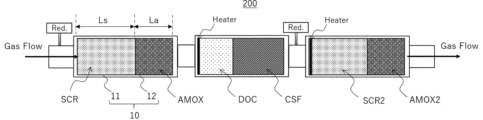
- FIG. 1 is a schematic diagram showing an exhaust gas treatment system 100 according to one aspect of the embodiment.
- FIG. 2 is a schematic diagram showing an exhaust gas treatment system 200 according to another aspect of the embodiment.
- the “average particle diameter D50” refers to the particle diameter when the cumulative value from small particle diameters reaches 50% of the total in the volume-based cumulative distribution of particle diameters, and is the so-called particle diameter.
- Median diameter means a value measured with a laser diffraction particle size distribution measuring device (for example, laser diffraction particle size distribution measuring device SALD-3100 manufactured by Shimadzu Corporation).
- the “average particle diameter D 90” refers to the particle diameter when the integrated value from small particle diameters reaches 90% of the total in the volume-based cumulative distribution of particle diameters.
- BET specific surface area refers to a specific surface area/pore distribution measuring device (product name: BELSORP-mini II, manufactured by Microtrack Bell Co., Ltd.) and analysis software (product name: BEL_Master, micro (manufactured by Track Bell Co., Ltd.), and is the value determined by the BET single point method.
- FIG. 1 is a schematic diagram showing an exhaust gas treatment system 100 of this embodiment.
- the exhaust gas treatment system 100 of this embodiment includes a catalyst that is disposed in an exhaust gas flow path (Gas Flow) and purifies the exhaust gas that passes through the exhaust gas flow path.
- This exhaust gas treatment system 100 includes one or more catalyst carriers 10 (catalyst carriers 11, 12) and a plurality of catalyst regions provided on the catalyst carrier 10, and the catalyst regions are arranged upstream of the exhaust gas flow path.
- the exhaust gas flow path also includes at least a first AMOX catalyst region (AMOX) having a catalyst length La in the flow path direction of the exhaust gas flow path.
- AMOX AMOX catalyst region
- the exhaust gas treatment system 100 of this embodiment is preferably used, for example, for purifying exhaust gas discharged from a lean burn engine such as a diesel engine.
- this exhaust gas treatment system 100 includes reducing agent supply means Red. further comprising this reducing agent supply means Red.
- Ammonia if the reducing agent is a urea component, ammonia generated by thermal decomposition of the urea component
- Ammonia resulting from the reducing agent supplied from the SCR catalyst region is adsorbed in the first SCR catalyst region, and the ammonia and NOx are brought into contact with each other. At the same time, excess ammonia is oxidized in the first AMOX catalyst region.
- the catalyst carrier 10 for example, a honeycomb structure widely used in automobile exhaust gas applications is preferably used.
- honeycomb structures include ceramic monolith carriers such as cordierite, silicon carbide, and silicon nitride, metal honeycomb carriers made of stainless steel, wire mesh carriers made of stainless steel, and steel wool-like knit wire carriers.
- the shape is not particularly limited, and any shape such as a prismatic shape, a cylindrical shape, a spherical shape, a honeycomb shape, a sheet shape, etc. can be selected. These can be used alone or in an appropriate combination of two or more.
- Honeycomb structures for automobile exhaust gas applications include flow-through type honeycomb structures in which gas channels are connected, and gas channels in which a portion of the end face is sealed and gas can flow through the wall surface of the gas channel.
- a wall flow type honeycomb structure is widely known, and any of these can be applied. Note that from the viewpoint of suppressing an excessive increase in pressure loss, a flow-through type honeycomb structure is preferably used.
- the catalyst carrier 10 A first SCR catalyst region is provided on the catalyst carrier 11, and a first AMOX catalyst region is provided on the catalyst carrier 12.
- the first SCR catalyst region means a region in which a catalyst material is provided on the catalyst carrier 11 in the flow direction of exhaust gas (the length direction of each catalyst carrier 11).
- the first AMOX catalyst region means a region in which a catalyst material is provided on the catalyst carrier 12 in the flow direction of exhaust gas (the length direction of each catalyst carrier 12). Therefore, the catalyst region provided on the catalyst carrier 10 can be understood as a set of two catalyst regions (the first SCR catalyst region and the first AMOX catalyst region).
- the total length of the catalyst region provided on the catalyst carrier 10 can be understood as the sum of the catalyst length Ls of the first SCR catalyst region and the catalyst length La of the first AMOX catalyst region in the exhaust gas flow direction.
- the capacity (size) of the catalyst carrier 10 (catalyst carriers 11, 12) and the amount of each catalyst material supported should be determined by taking into consideration the type and displacement of the lean-burn engine to be applied, and the amount of catalyst required. It can be adjusted as appropriate depending on the amount, purification performance, etc., and is not particularly limited.
- diesel engines range from small cars with a displacement of about 1L to heavy-duty diesel engines with a displacement of over 50L, and NOx and N2 are contained in the exhaust gas emitted from these diesel engines. O varies greatly depending on its operating state and combustion control method.
- the exhaust gas treatment system 100 of this embodiment which is used to purify NOx and N2O in the exhaust gas emitted from these lean-burn engines, can also be applied to a variety of diesel engine displacements from about 1L to over 50L. You can choose according to your gender. For example, by increasing or decreasing the diameter and length of the catalyst carrier used, the type and blending ratio of the catalyst material used, the amount supported in each catalyst region (first SCR catalyst region and first AMOX catalyst region), etc. , can be adjusted as appropriate.
- a catalyst material containing at least zeolite is used as the catalyst material constituting the first SCR catalyst region (hereinafter sometimes referred to as "zeolite-based catalyst material").
- zeolite-based catalyst material various zeolites conventionally used in this type of exhaust gas purification catalyst can be used without particular limitation.
- Specific examples of zeolite include Y type, A type, L type, mordenite type, ZSM-5 type, ferrierite type, mordenite type, CHA type, AEI type, AFX type, KFI type, SFW type, MFI type.
- zeolites as well as crystalline metal aluminophosphates such as SAPO and ALPO, but are not particularly limited thereto.
- These zeolites can be used alone or in any combination and ratio of two or more.
- Many zeolites of various grades are commercially available from domestic and foreign manufacturers, and commercially available products of various grades can be used depending on the required performance. Moreover, it can also be manufactured by a method known in the art.
- the skeletal structure of zeolite is compiled into a database by the International Zeolite Association (hereinafter sometimes abbreviated as "IZA"), and its IUPAC structural code (hereinafter also simply referred to as "structural code”) ) is referred to.
- IZA International Zeolite Association
- structural code hereinafter also simply referred to as "structural code”
- XRD powder X-ray diffraction
- the Si/Al ratio of the zeolite used is preferably from 1 to 500, more preferably from 1 to 100, even more preferably from 1 to 50.
- the average particle diameter D50 of the zeolite can be appropriately set depending on the desired performance and is not particularly limited. From the viewpoint of maintaining a large specific surface area, increasing heat resistance, and increasing the number of its own catalytic active sites, the average particle diameter D 50 of zeolite is preferably 0.5 ⁇ m to 100 ⁇ m, and preferably 0.5 ⁇ m to 50 ⁇ m. The thickness is more preferably 0.5 ⁇ m to 30 ⁇ m.
- the BET specific surface area of the zeolite can be set as appropriate depending on the desired performance, and is not particularly limited, but from the viewpoint of maintaining a large specific surface area and increasing the catalytic activity, the BET specific surface area by the BET single point method is It is preferably 10 m 2 /g to 1000 m 2 /g, more preferably 50 m 2 /g to 1000 m 2 /g, even more preferably 100 m 2 /g to 1000 m 2 /g.
- cations exist as counter ions in zeolites as solid acid sites, and the cations are generally ammonium ions and protons.
- the zeolite it is preferable to use the zeolite as a transition metal element ion-exchanged zeolite in which the cation sites of this zeolite are ion-exchanged with these transition metal elements.
- the transition metal element may be dispersed and held in the zeolite, but is preferably supported on the surface of the zeolite. Examples of transition metal elements include nickel (Ni), cobalt (Co), copper (Cu), iron (Fe), manganese (Mn), rhenium (Re), etc., but are not particularly limited thereto.
- the ion exchange rate of the zeolite is preferably 1% to 100%, more preferably 10% to 95%, even more preferably 30% to 90%. Note that when the ion exchange rate is 100%, it means that all the cation species in the zeolite have been ion-exchanged with transition metal element ions. Further, the amount of the transition metal element added to the zeolite is preferably 0.1% by mass to 10% by mass, more preferably 1% to 10% by mass, and 2% by mass in terms of oxide (CuO or Fe 2 O 3 ).
- the transition metal elements added as ion-exchange species may be ion-exchanged, but some of them may be present in the form of oxides such as copper oxide and iron oxide.
- the first SCR catalyst region uses CHA type, AEI type, AFX type, KFI type, SFW type, MFI type, It is preferable to contain at least an iron- and/or copper-supported zeolite containing a zeolite having a skeleton structure selected from the group consisting of and BEA type, and iron and/or copper supported on the zeolite.
- zeolites having a skeleton structure of one or more types selected from the group consisting of CHA, AEI, AFX, and AFT are preferred.
- iron and/or copper-supported zeolite containing iron and/or copper supported on the zeolite is more preferred.
- the amount supported in the first SCR catalyst region can be appropriately set depending on the desired performance, and is not particularly limited, but from the viewpoint of catalyst performance and balance of pressure loss, etc.
- the amount is preferably 10 g/L to 500 g/L, more preferably 20 g/L to 400 g/L, and even more preferably 30 g/L to 300 g/L.
- the amount of Fe added to the zeolite is preferably 0.1% by mass to 10% by mass, and 1.0% by mass to 8.0% by mass in terms of oxide (Fe 2 O 3 ). % is more preferable, and 1.5% to 7.0% by weight is even more preferable.
- the amount of Cu added to the zeolite is preferably 0.1% by mass to 10% by mass in terms of oxide (CuO), more preferably 1.0% by mass to 8.0% by mass. It is preferably 1.5% by mass to 7.0% by mass, more preferably 1.5% by mass to 7.0% by mass.
- CuO oxide
- all of the transition metal elements added as ion-exchange species may be ion-exchanged, or a part of them may exist in the form of an oxide such as iron oxide.
- the formation range of the first SCR catalyst region is not particularly limited, but it may be formed over the entire length of the catalyst carrier 11 in the flow direction of exhaust gas, or may be formed only in a part of the catalyst carrier 11. good.
- the length (total length) of the catalyst carrier 11 in the direction of the exhaust gas flow path is within the range of 1.0 to 1.2*Ls relative to the catalyst length Ls. It is preferably within the range of 1.0 to 1.1*Ls, and more preferably within the range of 1.0 to 1.1*Ls.
- the first SCR catalyst region may be formed offset on the upstream side of the catalyst carrier 11 in the flow direction of exhaust gas. Alternatively, it may be formed offset on the downstream side of the catalyst carrier 11.
- the first SCR catalyst region not only has excellent oxygen storage capacity but also relatively excellent heat resistance, as long as the effect of the exhaust gas treatment system of the present disclosure is not excessively inhibited. It may also contain oxygen storage/release materials such as ceria-based oxides and ceria-zirconia-based composite oxides, and other base material particles conventionally used in this type of exhaust gas purification catalyst.
- base particles include inorganic compounds known in the art, such as aluminum oxide (alumina: Al 2 O 3 ) such as ⁇ -alumina, ⁇ -alumina, ⁇ -alumina, ⁇ -alumina, and ⁇ -alumina; Examples include oxides such as zirconium oxide (zirconia: ZrO 2 ), silicon oxide (silica: SiO 2 ), titanium oxide (titania: TiO 2 ), and composite oxides based on these oxides. The type is not particularly limited. These may be composite oxides or solid solutions to which rare earth elements such as lanthanum and yttrium, transition metal elements, and alkaline earth metal elements are added. Note that these oxygen storage/release materials and other base material particles can be used singly or in any combination and ratio of two or more.
- aluminum oxide alumina: Al 2 O 3
- oxides such as zirconium oxide (zirconia: ZrO 2 ), silicon oxide (silica: SiO 2 ), titanium oxide (titania: TiO 2 ), and composite oxide
- the first SCR catalyst region may also contain various other catalyst materials, co-catalysts, and various additives known in the art.
- various sols such as boehmite, alumina sol, titania sol, silica sol, and zirconia sol; binders such as soluble salts such as aluminum nitrate, aluminum acetate, titanium nitrate, titanium acetate, zirconium nitrate, and zirconium acetate may be included. good.
- the first SCR catalyst region may further contain a Ba-containing compound in addition to the above-mentioned components.
- the first SCR catalyst region may contain a dispersion stabilizer such as a nonionic surfactant or anionic surfactant; a pH adjuster; a viscosity adjuster, and the like.
- a dispersion stabilizer such as a nonionic surfactant or anionic surfactant
- a pH adjuster such as sodium bicarbonate
- a viscosity adjuster such as sodium bicarbonate
- the thickener is not particularly limited, and examples thereof include polysaccharides such as sucrose, polyethylene glycol, carboxymethyl cellulose, and hydroxymethyl cellulose.
- the first SCR catalyst region contains alkaline earth metal elements such as Ca and Mg, as well as catalytic active components such as rhodium (Rh), ruthenium (Ru), palladium (Pd), platinum (Pt), and iridium (Ir). ), and noble metal elements such as gold (Au) and silver (Ag).
- alkaline earth metal elements such as Ca and Mg
- catalytic active components such as rhodium (Rh), ruthenium (Ru), palladium (Pd), platinum (Pt), and iridium (Ir).
- noble metal elements such as gold (Au) and silver (Ag).
- the platinum group elements and noble metal elements can be used singly or in any combination and ratio of two or more. However, since platinum group elements and noble metal elements oxidize the ammonia component and generate NOx, it is preferable that they are substantially not included.
- the content of platinum group elements and noble metal elements in the first SCR catalyst region is preferably less than 3 g/L, more preferably less than 1 g/L, in terms of metal amount per 1 L of catalyst carrier 11. It is more preferably less than 0.5 g/L, particularly preferably less than 0.001 g/L.
- the first SCR catalyst region may be placed directly on the catalyst carrier 11, or may be provided via a binder layer, a base layer, or the like.
- binder layers, underlayers, etc. those known in the art can be used, and their types are not particularly limited.
- oxygen storage/release materials such as cerium oxide (ceria: CeO 2 ), ceria-zirconia composite oxide (CZ composite oxide), ⁇ -alumina, ⁇ -alumina, ⁇ -alumina, ⁇ -alumina, ⁇ - Oxides such as aluminum oxide (alumina: Al 2 O 3 ) such as alumina, zirconium oxide (zirconia: ZrO 3 ), silicon oxide (silica: SiO 2 ), titanium oxide (titania: TiO 2 ), and their oxides Composite oxides containing as a main component, etc. can be used.
- the coating amount of the binder layer, base layer, etc. is not particularly limited, but is preferably 1 g/L to 150 g/L, more preferably 10 g/L to 100 g/L, per 1 L of catalyst carrier 11.
- a first AMOX catalyst region is provided on the catalyst carrier 12 located downstream of the exhaust gas flow path of the catalyst carrier 11 (first SCR catalyst region).
- This first AMOX catalyst region is connected to the reducing agent supply means Red.
- the excess ammonia that has passed through the first SCR catalyst region is removed. Oxidize.
- any catalyst material known in the art as a catalyst material for oxidizing ammonia can be used, and its type is not particularly limited.
- AMOX Ammonia oxidation catalyst
- an ammonia oxidation catalyst AMOX is additionally used downstream of the exhaust gas flow path of the SCR catalyst.
- Such an ammonia oxidation catalyst AMOX includes not only a catalyst having an NH 3 oxidation function but also a catalyst component having a NOx purification function.
- platinum group elements selected from platinum, palladium, rhodium, etc. are used as noble metal components, and an inorganic material (base material particle) consisting of one or more types of alumina, silica, titania, zirconia, etc. ) is widely known. It is also known to use inorganic materials whose heat resistance has been improved by adding promoters such as rare earth metals, alkali metals, and alkaline earth metals. On the other hand, platinum and palladium as platinum group elements exhibit excellent oxidation activity.
- ammonia oxidation catalyst AMOX are determined in consideration of the type and displacement of the engine to which the exhaust gas treatment system 100 of this embodiment is applied, and also the required amount of catalyst, purification performance, etc. It can be adjusted as appropriate and is not particularly limited.
- the first AMOX catalyst region used in this embodiment has a laminated structure including a lower catalyst layer and an upper catalyst layer, and the lower catalyst layer preferably includes base particles and a platinum group element supported on the base particles, and the upper catalyst layer preferably includes at least zeolite.
- the zeolite contained in the upper catalyst layer is preferably a zeolite having a skeleton structure selected from the group consisting of CHA, AEI, AFX, KFI, SFW, MFI, and BEA.
- the above-mentioned transition metal element ion exchange zeolite is more preferable, and the above-mentioned Cu-supported zeolite and Fe-supported zeolite are even more preferable.
- the lower catalyst layer is a composite material in which one or more platinum group elements selected from platinum, palladium, rhodium, etc. are supported on an inorganic material (base material particle) consisting of one or more types of alumina, silica, titania, zirconia, etc.
- a catalyst is used.
- the capacity (size) of the first AMOX catalyst region, the coating amount of the catalyst material, etc. are determined by taking into account the type and displacement of the engine to which the exhaust gas treatment system 100 of this embodiment is applied, and depending on the requirements. It can be adjusted as appropriate depending on the amount of catalyst used, purification performance, etc., and is not particularly limited.
- the amount supported on the lower catalyst layer of the first AMOX catalyst region can be appropriately set depending on the desired performance, and is not particularly limited.
- the amount of platinum group element metal per liter is preferably from 0.01 g/L to 5.0 g/L, more preferably from 0.02 g/L to 3.0 g/L, and from 0.03 g/L to 1.0 g. /L is more preferable.
- the supported amount of the upper catalyst layer in the first AMOX catalyst region is preferably 10 g/L to 500 g/L or less, more preferably 20 g/L to 400 g/L, in terms of zeolite per 1 L of the catalyst carrier 12. More preferably 30 g/L to 300 g/L.
- the amount of Fe added to the zeolite is preferably 0.1% by mass to 10% by mass in terms of oxide (Fe 2 O 3 ), and 1.0% by mass. It is more preferably 8.0% by weight, and even more preferably 1.5% by weight to 7.0% by weight.
- the amount of Cu added to the zeolite is preferably 0.1% by mass to 10% by mass, and 1.0% by mass to 8.0% by mass in terms of oxide (CuO). It is more preferably 1.5% by mass to 7.0% by mass.
- all of the transition metal elements added as ion-exchange species may be ion-exchanged, or a part of them may exist in the form of an oxide such as iron oxide.
- the formation range of the first AMOX catalyst region is not particularly limited, but it may be formed over the entire length of the catalyst carrier 12 in the flow direction of exhaust gas, or may be formed only in a part of the catalyst carrier 12. good.
- the length (total length) of the catalyst carrier 12 in the direction of the exhaust gas flow path is within the range of 1.0 to 1.2*La with respect to the catalyst length La. It is preferably within the range of 1.0 to 1.1*La, and more preferably within the range of 1.0 to 1.1*La.
- the first AMOX catalyst region when the first AMOX catalyst region is formed only in a part of the catalyst carrier 12, the first AMOX catalyst region may be formed offset on the upstream side of the catalyst carrier 12 in the flow direction of exhaust gas. Alternatively, it may be formed offset on the downstream side of the catalyst carrier 12.
- the first AMOX catalyst region not only has excellent oxygen storage capacity but also relatively excellent heat resistance, as long as the effect of the exhaust gas treatment system of the present disclosure is not excessively inhibited. It may also contain oxygen storage/release materials such as ceria-based oxides and ceria-zirconia-based composite oxides, and other base material particles conventionally used in this type of exhaust gas purification catalyst.
- base particles include inorganic compounds known in the art, such as aluminum oxide (alumina: Al 2 O 3 ) such as ⁇ -alumina, ⁇ -alumina, ⁇ -alumina, ⁇ -alumina, and ⁇ -alumina; Examples include oxides such as zirconium oxide (zirconia: ZrO 2 ), silicon oxide (silica: SiO 2 ), titanium oxide (titania: TiO 2 ), and composite oxides based on these oxides. The type is not particularly limited. These may be composite oxides or solid solutions to which rare earth elements such as lanthanum and yttrium, transition metal elements, and alkaline earth metal elements are added. Note that these oxygen storage/release materials and other base material particles can be used singly or in any combination and ratio of two or more.
- aluminum oxide alumina: Al 2 O 3
- oxides such as zirconium oxide (zirconia: ZrO 2 ), silicon oxide (silica: SiO 2 ), titanium oxide (titania: TiO 2 ), and composite oxide
- the first AMOX catalyst region may contain various other catalyst materials, promoters, and various additives known in the art.
- various sols such as boehmite, alumina sol, titania sol, silica sol, and zirconia sol; binders such as soluble salts such as aluminum nitrate, aluminum acetate, titanium nitrate, titanium acetate, zirconium nitrate, and zirconium acetate may be included. good.
- the first AMOX catalyst region may further contain a Ba-containing compound in addition to the above-mentioned components.
- the first AMOX catalyst region may contain a dispersion stabilizer such as a nonionic surfactant or anionic surfactant; a pH adjuster; a viscosity adjuster, and the like.
- a dispersion stabilizer such as a nonionic surfactant or anionic surfactant
- a pH adjuster such as a pH adjuster
- a viscosity adjuster such as a viscosity adjuster, and the like.
- the thickener is not particularly limited, and examples thereof include polysaccharides such as sucrose, polyethylene glycol, carboxymethyl cellulose, and hydroxymethyl cellulose.
- the first AMOX catalyst region contains alkaline earth metal elements such as Ca and Mg, as well as rhodium (Rh), ruthenium (Ru), palladium (Pd), platinum (Pt), and iridium (Ir) as catalyst active components. ), and noble metal elements such as gold (Au) and silver (Ag).
- alkaline earth metal elements such as Ca and Mg, as well as rhodium (Rh), ruthenium (Ru), palladium (Pd), platinum (Pt), and iridium (Ir) as catalyst active components.
- noble metal elements such as gold (Au) and silver (Ag).
- the platinum group elements and noble metal elements can be used singly or in any combination and ratio of two or more.
- the first AMOX catalyst region may be placed directly on the catalyst carrier 12, or may be provided via a binder layer, a base layer, or the like.
- binder layers, underlayers, etc. those known in the art can be used, and their types are not particularly limited.
- oxygen storage/release materials such as cerium oxide (ceria: CeO 2 ), ceria-zirconia composite oxide (CZ composite oxide), ⁇ -alumina, ⁇ -alumina, ⁇ -alumina, ⁇ -alumina, ⁇ - Oxides such as aluminum oxide (alumina: Al 2 O 3 ) such as alumina, zirconium oxide (zirconia: ZrO 3 ), silicon oxide (silica: SiO 2 ), titanium oxide (titania: TiO 2 ), and their oxides Composite oxides containing as a main component, etc. can be used.
- the coating amount of the binder layer, base layer, etc. is not particularly limited, but is preferably 1 g/L to 150 g/L, more preferably 10 g/L to 100 g/L, per 1 L of the catalyst carrier 12.
- the catalyst length Ls of the first SCR catalyst region and the catalyst length La of the first AMOX catalyst region described above are expressed by the following formula (1) and the following formula (2). ) is preferably satisfied.
- the exhaust gas treatment system 100 configured in this manner suppresses the generation of NOx caused by NH3 slip and the generation of N2O caused by oxidation of NH3 , and suppresses the generation of NOx and N2O . Purification performance is further improved. 0.30*(Ls+La) ⁇ Ls ⁇ 0.90*(Ls+La)...(1) 0.10*(Ls+La) ⁇ La ⁇ 0.70*(Ls+La)...(2)
- the catalyst length Ls of the first SCR catalyst region and the catalyst length La of the first AMOX catalyst region satisfy the following formula (1a) and the following formula (2a). 0.36*(Ls+La) ⁇ Ls ⁇ 0.86*(Ls+La)...(1a) 0.14*(Ls+La) ⁇ La ⁇ 0.64*(Ls+La)...(2a)
- the catalyst length Ls of the first SCR catalyst region and the catalyst length La of the first AMOX catalyst region satisfy the following formula (1b) and the following formula (2b). 0.30*(Ls+La) ⁇ Ls ⁇ 0.64*(Ls+La)...(1b) 0.36*(Ls+La) ⁇ La ⁇ 0.70*(Ls+La)...(2b)
- the first SCR catalyst region and the first AMOX catalyst region were provided separately on the two catalyst carriers 11 and 12, but the first SCR catalyst region
- the first SCR catalyst region and the first AMOX catalyst region are zone-coated on one catalyst carrier 11 in a predetermined ratio as long as they are arranged upstream of the exhaust gas flow path with respect to the first AMOX catalyst region.
- It can also be implemented as a zone coat SCR/AMOX.
- the zone coat is not particularly limited as long as the surface of one catalyst carrier is coated with multiple catalyst layers divided into sections, but for example, the zone coat As such, it is known to paint the central part and the outer peripheral part concentrically, or to paint the honeycomb structure differently in the depth direction of the through holes.
- zone coats varies depending on the composition, flow rate, temperature, etc. of the harmful components to be purified, and the optimum combination is set as appropriate.
- the ingredients are applied thinly.
- zone coating when a honeycomb structure is coated with catalyst components in multiple layers, one layer may be coated with a thick lower layer and a thin upper layer, and the other layer may be coated with a thin lower layer and a thick upper layer.
- the types of catalysts that can be painted differently include changing the combination of oxidation catalyst and reduction catalyst, and even for the same type of catalyst, the composition, concentration of active species, amount of coating on the honeycomb structure, etc. may be changed. .
- the installation locations of the first SCR catalyst region and the first AMOX catalyst region described above are as long as the first SCR catalyst region is arranged on the upstream side of the exhaust gas flow path with respect to the first AMOX catalyst region.
- it is preferably located directly below the exhaust system, that is, in the case of a lean burn engine such as a diesel engine, directly below the engine.
- a position directly below the engine means a position near the downstream side of the exhaust gas flow path with respect to the engine, and into which exhaust gas from the engine flows without passing through another catalyst.
- the first SCR catalyst region and the first AMOX catalyst region are provided directly below the engine, which means that there is another space between the engine and the first SCR catalyst region and the first AMOX catalyst region. means an embodiment in which no catalyst is involved.
- the reducing agent supply means Red. is for supplying one or more reducing agents selected from the group consisting of a urea component and an ammonia component into the exhaust gas flow path.
- Reducing agent supply means Red Those known in the art can be used, and the type thereof is not particularly limited.
- a tank is used that consists of a reducing agent storage tank, piping connected to the tank, and a spray nozzle attached to the tip of the piping (not shown).
- Reducing agent supply means Red The spray nozzle is installed upstream of the first SCR catalyst region described above.
- the above-mentioned catalyst regions first SCR catalyst region, first AMOX catalyst region
- reducing agent supply means Red it is preferable that the spray nozzle is arranged. Note that when other SCRs other than the first SCR catalyst region are used in combination and these are arranged apart from each other, the reducing agent supply means Red.
- the spray nozzles may be provided at multiple locations.
- the reducing component is selected from urea components and ammonia components.
- urea component a standardized aqueous urea solution with a concentration of 31.8% by mass to 33.3% by mass, such as the product name Adblue, can be used, and if it is an ammonia component, in addition to ammonia water, ammonia Gas etc. can also be used.
- NH3 which is a reducing component, has harmful effects such as a pungent odor in itself, so rather than using NH3 as a reducing component, it is preferable to add urea water from the upstream side of the exhaust gas treatment system 100.
- NH 3 is generated by thermal decomposition or hydrolysis, and this is used as a reducing agent.
- the exhaust gas treatment system 100 of the present embodiment includes a DOC catalyst region (DOC) arranged downstream of the first AMOX catalyst region in the exhaust gas flow path, and a DOC catalyst region (DOC) located downstream of the DOC catalyst region in the exhaust gas flow path. and a laterally disposed CSF catalytic region (CSF). That is, this exhaust gas treatment system 100 is disposed in an exhaust gas flow path and treats at least one type selected from the group consisting of CO, HC, NO, and NH3 in exhaust gas discharged from a lean burn engine such as a diesel engine.
- DOC DOC catalyst region
- DOC DOC catalyst region located downstream of the DOC catalyst region in the exhaust gas flow path.
- CSF CSF catalytic region
- the exhaust gas includes at least one DOC catalyst region that oxidizes PM, and a CSF catalyst region that is disposed in the exhaust gas flow path and that collects and burns or oxidizes and removes particulate component PM in the exhaust gas.
- a plasma generator Pl. etc. may be provided. Each component will be explained in detail below.
- the DOC catalyst region is a catalyst that is disposed in the exhaust gas flow path and oxidizes at least one selected from the group consisting of CO, HC, NO, and NH3 in the exhaust gas discharged from a lean burn engine such as a diesel engine.
- the DOC catalyst region refers to a diesel oxidation catalyst (DOC: Lean NOx storage catalyst (LNT: Diesel Oxidation Catalyst), which stores NOx under lean conditions and releases NOx under rich conditions, oxidizes CO and HC to CO2 and H2O , and reduces NOx to N2 .
- DOC Lean NOx storage catalyst
- LNT Diesel Oxidation Catalyst
- This concept includes Lean NOx Trap) and catalyst-coated PF (cPF) in which these are coated on PF.
- the DOC catalyst region of the exhaust gas treatment system 100 includes base material particles such as metal oxides such as alumina, zirconia, and ceria and zeolite, and platinum group elements (PGM) as catalyst active components supported on this carrier. Composite particles with metal) are commonly used. Various types of these oxidation catalysts are known in the art, and these various oxidation catalysts can be used alone or in any combination as appropriate for the DOC catalyst region.
- base material particles such as metal oxides such as alumina, zirconia, and ceria and zeolite, and platinum group elements (PGM) as catalyst active components supported on this carrier. Composite particles with metal) are commonly used.
- PGM platinum group elements
- the DOC catalyst region is a catalyst layer containing base material particles of inorganic fine particles and a platinum group element-supported catalyst material in which a platinum group element is supported on the base material particles on an integrally structured catalyst carrier such as a honeycomb structure. Those provided with this are preferably used.
- inorganic compounds conventionally used in this type of exhaust gas purification catalyst can be considered.
- oxygen storage/release materials such as zeolite, cerium oxide (ceria: CeO 2 ), ceria-zirconia composite oxide (CZ composite oxide), ⁇ -alumina, ⁇ -alumina, ⁇ -alumina, ⁇ -alumina , aluminum oxide (alumina: Al 2 O 3 ) such as ⁇ -alumina, zirconium oxide (zirconia: ZrO 2 ), silicon oxide (silica: SiO 2 ), titanium oxide (titania: TiO 2 ), and their oxides.
- OSC oxygen storage/release materials
- zeolite such as zeolite, cerium oxide (ceria: CeO 2 ), ceria-zirconia composite oxide (CZ composite oxide), ⁇ -alumina, ⁇ -alumina, ⁇ -alumina, ⁇ -alumina , aluminum oxide (alumina: Al 2 O 3 ) such as ⁇ -alumina, zirconium oxide (zi
- Examples include composite oxides containing oxides as a main component, but the type thereof is not particularly limited. Moreover, these may be composite oxides or solid solutions to which rare earth elements such as lanthanum and yttrium, transition metal elements, and alkaline earth metal elements are added. These inorganic fine particles can be used alone or in any combination and ratio of two or more.
- the oxygen storage/release material means a material that stores or releases oxygen depending on the external environment.
- the average particle diameter D50 of the base material particles in the DOC catalyst region can be appropriately set according to desired performance and is not particularly limited. From the viewpoint of maintaining a large specific surface area, increasing heat resistance, and increasing the number of its own catalytic active sites, the average particle diameter D 50 of the base material particles is preferably 0.5 ⁇ m to 100 ⁇ m, and 1 ⁇ m to 100 ⁇ m. The thickness is more preferably 1 ⁇ m to 50 ⁇ m.
- the BET specific surface area of the base material particles can be appropriately set depending on the desired performance, and is not particularly limited, but from the viewpoint of maintaining a large specific surface area and increasing the catalytic activity,
- the surface area is preferably 10 m 2 /g to 500 m 2 /g, more preferably 20 m 2 /g to 300 m 2 /g, even more preferably 30 m 2 /g to 200 m 2 /g.
- Many materials of various grades are commercially available from domestic and foreign manufacturers, and various grades of commercially available materials can be used as the base particles depending on the required performance. Moreover, it can also be manufactured by a method known in the art.
- platinum group elements examples include platinum (Pt), palladium (Pd), rhodium (Rh), ruthenium (Ru), iridium (Ir), and osmium (Os).
- the platinum group elements can be used alone or in any combination and ratio of two or more. From the viewpoint of improving exhaust gas purification performance and suppressing the progress of grain growth (sintering) of platinum group elements on base material particles, the content ratio of platinum group elements in the DOC catalyst area (per liter of monolithic catalyst carrier)
- the platinum group element mass is usually preferably 0.1 g/L to 20 g/L, more preferably 0.2 g/L to 15 g/L, even more preferably 0.3 g/L to 10 g/L. be.
- the DOC catalyst region may contain various other catalyst materials, promoters, and various additives known in the art.
- various sols such as boehmite, alumina sol, titania sol, silica sol, and zirconia sol; binders such as soluble salts such as aluminum nitrate, aluminum acetate, titanium nitrate, titanium acetate, zirconium nitrate, and zirconium acetate may be included.
- the DOC catalyst region may further contain a Ba-containing compound in addition to the above-mentioned components. By blending a Ba-containing compound, improvement in heat resistance and activation of catalyst performance can be expected.
- the Ba-containing compound examples include sulfates, carbonates, composite oxides, oxides, etc., but are not particularly limited thereto. More specifically, BaO, Ba(CH 3 COO) 2 , BaO 2 , BaSO 4 , BaCO 3 , BaZrO 3 , BaAl 2 O 4 and the like can be mentioned. Furthermore, the DOC catalyst region may contain a dispersion stabilizer such as a nonionic surfactant or anionic surfactant; a pH adjuster; a viscosity adjuster, and the like.
- a dispersion stabilizer such as a nonionic surfactant or anionic surfactant
- honeycomb structure widely used in automobile exhaust gas applications is preferably used.
- honeycomb structures include ceramic monolith carriers such as cordierite, silicon carbide, and silicon nitride, metal honeycomb carriers made of stainless steel, wire mesh carriers made of stainless steel, and steel wool-like knit wire carriers.
- shape is not particularly limited, and any shape such as a prismatic shape, a cylindrical shape, a spherical shape, a honeycomb shape, a sheet shape, etc. can be selected. These can be used alone or in an appropriate combination of two or more.
- Honeycomb structures for automotive exhaust gas applications include two types: a flow-through type structure in which the gas flow path is connected, and a flow-through structure in which a portion of the end face of the gas flow path is sealed and gas can flow through the wall surface of the gas flow path.
- a wall flow type structure is widely known, and any of these can be applied.
- the total coverage of the above-mentioned catalyst layer is not particularly limited, but from the viewpoint of catalyst performance and pressure drop balance, etc., it is 1 g/L to 500 g/L per liter of monolithic catalyst carrier. It is preferably 2 g/L to 450 g/L, more preferably 2 g/L to 80 g/L in the case of a wall-flow type catalyst carrier, and even more preferably 50 g/L to 300 g/L in the case of a flow-through type catalyst carrier.
- the DOC catalyst region may be placed directly on the monolithic catalyst carrier, or may be provided on the monolithic catalyst carrier via a binder layer, a base layer, or the like.
- a binder layer a base layer, or the like.
- the binder layer, base layer, etc. those known in the art can be used, and the types thereof are not particularly limited.
- oxygen storage/release materials such as zeolite, cerium oxide (ceria: CeO 2 ), ceria-zirconia composite oxide (CZ composite oxide), ⁇ -alumina, ⁇ -alumina, ⁇ -alumina, ⁇ -alumina , aluminum oxide (alumina: Al 2 O 3 ) such as ⁇ -alumina, zirconium oxide (zirconia: ZrO 2 ), silicon oxide (silica: SiO 2 ), titanium oxide (titania: TiO 2 ), and their oxides.
- a composite oxide containing an oxide as a main component can be used.
- the coating amount of the binder layer, base layer, etc. is not particularly limited, but is preferably 1 g/L to 150 g/L, more preferably 10 g/L to 100 g/L, per 1 L of the monolithic catalyst carrier.
- each DOC catalyst region is provided in the exhaust gas flow path of the exhaust gas treatment system 100, but a plurality (for example, 2 to 5) may be provided depending on the required performance, etc. You can.
- each DOC catalyst region may be the same type of oxidation catalyst or may be a different type of oxidation catalyst. It is also possible to use a zone-coated oxidation catalyst zDOC obtained by zone-coating two types of oxidation catalyst materials on one catalyst carrier.
- the zone coat is not particularly limited as long as the surface of one catalyst carrier is coated with multiple catalyst layers divided into sections, but for example, the zone coat As such, it is known to paint the central part and the outer peripheral part concentrically, or to paint the honeycomb structure differently in the depth direction of the through holes.
- the application of zone coats varies depending on the composition, flow rate, temperature, etc. of the harmful components to be purified, and the optimum combination is set as appropriate. For example, in the purification of automobile exhaust gas, when painting the front stage and the rear stage separately, one coats one with more types of catalyst components and the other with fewer types of catalyst components, and one coats with more precious metal components and the other with precious metals. There are cases where the ingredients are applied thinly.
- one layer may be coated with a thick lower layer and a thin upper layer, and the other layer may be coated with a thin lower layer and a thick upper layer.
- the types of catalysts that can be painted differently include changing the combination of oxidation catalyst and reduction catalyst, and even for the same type of catalyst, the composition, concentration of active species, amount of coating on the honeycomb structure, etc. may be changed. .
- each DOC catalyst region may be arranged adjacent to each other, and the CSF catalyst region and the reducing agent supply means Red. , heating device Heater, plasma generator Pl. They may be spaced apart from each other in the exhaust gas flow path.
- a CSF catalyst region is provided downstream of the DOC catalyst region described above.
- a catalyzed combustion filter CSF: Catalyzed Soot Filter
- This CSF catalyst region traps particulate components (PM) such as soot in the exhaust gas discharged from the lean fuel engine, and periodically sprays unburned light oil as necessary to burn or oxidize them and remove them.
- PM particulate components
- Such CSF catalyst regions are widely known in the art as particulate filters PF, catalyst-coated particulate filters cPF, catalyst-coated diesel particulate filters cDPF, and the like.
- an electric heating device Heater (catalyst heating heater) is provided in the exhaust gas flow path downstream of the first AMOX catalyst region and upstream of the DOC catalyst region. It is being This heating device is electrically connected to an ECU and an on-vehicle power source (not shown), and by controlling the output of these devices, the temperature of the heating device Heater and, by extension, the temperature of the exhaust gas in the exhaust gas flow path can be controlled.
- the catalytic performance of the DOC catalytic region can be promoted by heating the DOC catalytic region with a heater on the upstream side of the DOC catalytic region at the time of a cold start.
- the exhaust gas flow path is provided with temperature sensors, NOx sensors, etc. electrically connected to the ECU at various locations, and the NOx concentration and exhaust gas temperature of the exhaust gas are monitored at any time.
- the heating device Heater is composed of a metal honeycomb, a jacket-type electric heater attached to the outer periphery of the metal honeycomb, and a coil-type electric heater attached so as to be partially buried inside the metal honeycomb body. (not shown).
- This metal honeycomb can be electrically heated under the control of the control unit ECU, and the temperature of the exhaust gas passing through the exhaust gas flow path can be controlled by the heat generated by the metal honeycomb.
- a heat insulating material is provided on the outer periphery of the exhaust gas flow path over the entire length (not shown).
- the heat insulating material can be appropriately selected from those known in the art and is not particularly limited, but for example, materials using cellulose fibers, rock wool, etc. are preferably used.
- the heating device Heater used here may be, for example, only a jacket type electric heater, or may be an EHC (Electrically Heated Catalyst) in which an SCR catalyst is supported on a metal honeycomb body. Further, the metal honeycomb can also be heated by directly generating heat in the metal honeycomb itself by supplying electricity to the metal honeycomb body. In this case, the temperature of the metal honeycomb and, by extension, the temperature of the exhaust gas in the exhaust gas flow path can be controlled by connecting the metal honeycomb to an on-vehicle power source and controlling its output using the control unit ECU.
- EHC Electrical Heated Catalyst
- Plasma generator Pl. is a so-called atmospheric pressure plasma generator (plasma reactor) that generates low-temperature plasma with low electron energy obtained by atmospheric discharge or the like (not shown).
- Plasma generator Pl. As such, those known in the art can be used, and the type thereof is not particularly limited.
- This plasma generator Pl. The exhaust gas passing through the exhaust gas flow path is treated by the plasma generated by the exhaust gas flow path, thereby making it possible to further reduce the NOx concentration (so-called plasma assisted SCR).
- the SCR catalyst region having a predetermined catalyst length Ls and the AMOX catalyst region having a predetermined catalyst length La are arranged directly under the engine, a large amount of NH Even if 3 is used, NH 3 slip can be relatively reduced, and excessive N 2 O production caused by oxidation of NH 3 that has slipped can be suppressed. Coupled with the arranged DOC catalyst region and CSF catalyst region, the system as a whole can exhibit high NOx and N 2 O purification performance.
- FIG. 2 is a schematic diagram showing the exhaust gas treatment system 200 of this embodiment.
- the exhaust gas treatment system 200 of the present embodiment has a second structure in the exhaust gas treatment system 100 that adsorbs ammonia and reduces it by bringing it into contact with NOx, on the downstream side of the exhaust gas flow path than the DOC catalyst region and the CSF catalyst region.
- An SCR catalyst region (SCR2) and a second AMOX catalyst region (AMOX2) for oxidizing and removing excess ammonia are further provided.
- one or more reducing agents selected from the group consisting of a urea component and an ammonia component are added to the exhaust gas flow path downstream of the CSF catalyst region and upstream of the second SCR catalyst region.
- the above-mentioned reducing agent supply means Red. is supplied into the exhaust gas flow path. is further provided. Further, the above-mentioned electric heating device Heater (catalyst heating heater) is further provided in the exhaust gas flow path downstream of the CSF catalyst region and upstream of the second SCR catalyst region.
- the catalyst material constituting the second SCR catalyst region can be any one known in the art and is not particularly limited.
- the catalyst material constituting the second AMOX catalyst region can be any one known in the art and is not particularly limited.
- a catalyst carrier for example, as explained in the section of the first AMOX catalyst region, a catalyst carrier, a catalyst having an NH 3 oxidation function, a catalyst component having a NOx purification function, an oxygen storage/release material, base material particles, various types known in the art, etc.
- Other catalyst materials, co-catalysts, catalytically active components, various additives, etc. can be preferably used. Therefore, redundant explanation here will be omitted.
- this second AMOX catalyst region is similar to each catalyst region used as an essential component in the exhaust gas treatment system 200 (first SCR catalyst region, first AMOX catalyst region, DOC catalyst region, CSF catalyst region, first In the exhaust gas flow path including the second SCR catalyst region and the second AMOX catalyst region, it is preferably provided at the most downstream position.
- a second SCR catalyst region and a second AMOX catalyst region are further provided. Since the catalyst region is provided, higher NOx and N 2 O purification performance can be achieved as a whole system.
- the SCR catalyst region having the predetermined catalyst length Ls and the AMOX catalyst region having the predetermined catalyst length La are arranged directly under the engine, the NH3 slip amount , NOx purification performance, and N 2 O purification performance can be overcome, and higher NOx and N 2 O purification performance can be achieved as a whole system. Therefore, it can be particularly preferably used as a device for purifying exhaust gas generated from an internal combustion engine such as a diesel engine equipped with a urea SCR system, and can be used as a catalyst for purifying exhaust gas of internal combustion engines such as diesel engines, especially as an exhaust gas purifying device for diesel automobiles. It is useful as
- Pt was supported on a granular silica-alumina composite oxide (BET specific surface area: 100 m 2 /g) consisting of 1.5% by mass of SiO 2 and 98.5% by mass of Al 2 O 3 to obtain Pt-supported silica-alumina. (Contains 0.2% by mass in terms of Pt).
- This Pt-supported silica-alumina was mixed with predetermined amounts of a binder, a surfactant, and deionized water, and milled using a ball mill to obtain catalyst slurry 2 for the AMOX lower layer.
- Example 1 First, the catalyst slurry 1 was applied to a honeycomb flow-through type cordierite catalyst carrier 11 (400 cpsi/4 mil, diameter 144 mm x length 152 mm), which is a monolithic catalyst carrier, from the end to 100% of the length by a wash coating method. After drying, it was fired at 550° C. for 30 minutes in an air atmosphere to form an SCR catalyst region on the catalyst carrier 11. At this time, the amount of SCR catalyst region supported per liter of catalyst carrier was set to 198 g/L.
- the catalyst slurry 2 was applied from the downstream side of the exhaust gas flow path of the honeycomb flow-through type cordierite catalyst carrier 12 (400 cpsi/4 mil, diameter 144 mm x length 152 mm), which is a monolithic catalyst carrier, to a length of 28% of the catalyst carrier.
- the area was coated using the wash coat method and dried.
- the catalyst slurry 3 was zone-coated from the downstream side of the exhaust gas flow path of the catalyst carrier 12 to 28% of the length of the catalyst carrier by a wash coating method, and dried.
- the catalyst slurry 1 was zone coated on the catalyst carrier 12 from the upstream side of the exhaust gas flow path to 72% of the length of the catalyst carrier by a wash coating method, and dried.
- the catalyst slurry 1 is poured into a honeycomb flow-through type cordierite catalyst carrier 11 (400 cpsi/4 mil, diameter 144 mm x length 152 mm), which is a monolithic catalyst carrier, from the upstream side of the exhaust gas flow path to a length of 72% of the catalyst carrier. The area was coated using the wash coat method and dried.
- the catalyst slurry 2 is zone coated from the downstream side of the exhaust gas flow path of the catalyst carrier 11 to 28% of the length of the catalyst carrier by a wash coating method, and after drying, the catalyst slurry 3 is applied to the downstream side of the exhaust gas flow path of the catalyst carrier 11.
- Zone coating was applied from the side up to 28% of the length of the catalyst carrier by a wash coating method and dried. Thereafter, it was fired at 550° C. for 30 minutes in the air to form an SCR catalyst region and an AMOX catalyst region on the catalyst carrier 11. At this time, the amount of SCR catalyst region supported per liter of catalyst carrier was 198 g/L, and the amount of supported amount of AMOX catalyst region was 229 g/L.
- the catalyst slurry 2 is applied to a honeycomb flow-through type cordierite catalyst carrier 12 (400 cpsi/4 mil, diameter 144 mm x length 152 mm), which is a monolithic catalyst carrier, from the downstream side of the exhaust gas flow path to 100% of the catalyst carrier.
- catalyst slurry 3 was zone coated by a wash coat method from the downstream side of the exhaust gas flow path of the catalyst carrier 12 to 100% of the length of the catalyst carrier, and then dried. Thereafter, it was fired at 550° C. for 30 minutes in an air atmosphere to form an AMOX catalyst region on the catalyst carrier 12. At this time, the amount of AMOX catalyst region supported per liter of catalyst carrier was set to 229 g/L.
- DOC a composite supported catalyst in which Pt and Pd are supported on an alumina support is applied to a honeycomb flow-through type cordierite catalyst support (300 cpsi/5 mil, diameter 229 mm x length 102 mm) by a wash coating method.
- DOC was placed in an electric furnace and fired at 550°C for 30 minutes in an air atmosphere, followed by durability treatment at 750°C for 100 hours in an air atmosphere (catalyst).
- Coating amount per liter of carrier 133 g/L
- Pt coating amount in metal terms 1.08 g/L
- Pd coating amount in metal terms 0.36 g/L).
- a composite supported catalyst in which Pt and Pd are supported on an alumina support is applied to a honeycomb wall flow type support (diameter 229 mm x length 203 mm) by a wash coating method, and after drying, it is placed in an electric furnace.
- CSF was used after durability treatment, which was baked at 550°C for 30 minutes in an air atmosphere, and then subjected to durability treatment at 750°C for 100 hours in an air atmosphere (coating amount per liter of catalyst carrier). : 15 g/L, Pt coating amount in terms of metal: 0.44 g/L, Pd coating amount in terms of metal: 0.22 g/L).
- the exhaust gas treatment system of the present disclosure has excellent NOx and N 2 O purification performance, it can be widely and effectively used as an exhaust gas purification device for lean-burn internal combustion engines, and in particular can be used for exhaust gas from lean-burn gasoline vehicles and diesel vehicles. It can be used particularly effectively in purification equipment.
- Exhaust gas treatment system 10 ... Catalyst carrier 11
- Catalyst carrier 12 ... Catalyst carrier
- SCR First SCR catalyst region AMOX... First AMOX catalyst region
- DOC DOC catalyst area
- CSF CSF catalyst area Red... Reducing agent supply means Heater... Heating device 200
- Exhaust gas treatment system SCR2 Second SCR catalyst area AMOX2... Second AMOX catalyst area
Landscapes
- Chemical & Material Sciences (AREA)
- Engineering & Computer Science (AREA)
- Chemical Kinetics & Catalysis (AREA)
- Combustion & Propulsion (AREA)
- Mechanical Engineering (AREA)
- General Engineering & Computer Science (AREA)
- Health & Medical Sciences (AREA)
- Analytical Chemistry (AREA)
- Environmental & Geological Engineering (AREA)
- General Chemical & Material Sciences (AREA)
- Oil, Petroleum & Natural Gas (AREA)
- Biomedical Technology (AREA)
- Crystallography & Structural Chemistry (AREA)
- Materials Engineering (AREA)
- Organic Chemistry (AREA)
- Toxicology (AREA)
- Catalysts (AREA)
- Exhaust Gas After Treatment (AREA)
Priority Applications (1)
| Application Number | Priority Date | Filing Date | Title |
|---|---|---|---|
| JP2024538892A JPWO2024029290A1 (https=) | 2022-08-04 | 2023-07-11 |
Applications Claiming Priority (2)
| Application Number | Priority Date | Filing Date | Title |
|---|---|---|---|
| JP2022-124491 | 2022-08-04 | ||
| JP2022124491 | 2022-08-04 |
Publications (1)
| Publication Number | Publication Date |
|---|---|
| WO2024029290A1 true WO2024029290A1 (ja) | 2024-02-08 |
Family
ID=89849208
Family Applications (1)
| Application Number | Title | Priority Date | Filing Date |
|---|---|---|---|
| PCT/JP2023/025626 Ceased WO2024029290A1 (ja) | 2022-08-04 | 2023-07-11 | 排ガス処理用システム |
Country Status (2)
| Country | Link |
|---|---|
| JP (1) | JPWO2024029290A1 (https=) |
| WO (1) | WO2024029290A1 (https=) |
Citations (5)
| Publication number | Priority date | Publication date | Assignee | Title |
|---|---|---|---|---|
| JP2012507662A (ja) * | 2008-11-03 | 2012-03-29 | ビー・エイ・エス・エフ、コーポレーション | Scrおよびamoxを統合した触媒システム |
| JP2013525109A (ja) * | 2010-05-05 | 2013-06-20 | ビー・エイ・エス・エフ、コーポレーション | 一体型scrおよびamox触媒システム |
| JP2018527162A (ja) * | 2015-06-18 | 2018-09-20 | ジョンソン、マッセイ、パブリック、リミテッド、カンパニーJohnson Matthey Public Limited Company | ゾーン化排気システム |
| WO2020196628A1 (ja) * | 2019-03-27 | 2020-10-01 | エヌ・イーケムキャット株式会社 | ディーゼル用選択的還元触媒及びディーゼル排ガス浄化装置 |
| JP2021514447A (ja) * | 2018-02-19 | 2021-06-10 | ビーエーエスエフ コーポレーション | 上流scr触媒を有する排気ガス処理システム |
-
2023
- 2023-07-11 WO PCT/JP2023/025626 patent/WO2024029290A1/ja not_active Ceased
- 2023-07-11 JP JP2024538892A patent/JPWO2024029290A1/ja active Pending
Patent Citations (5)
| Publication number | Priority date | Publication date | Assignee | Title |
|---|---|---|---|---|
| JP2012507662A (ja) * | 2008-11-03 | 2012-03-29 | ビー・エイ・エス・エフ、コーポレーション | Scrおよびamoxを統合した触媒システム |
| JP2013525109A (ja) * | 2010-05-05 | 2013-06-20 | ビー・エイ・エス・エフ、コーポレーション | 一体型scrおよびamox触媒システム |
| JP2018527162A (ja) * | 2015-06-18 | 2018-09-20 | ジョンソン、マッセイ、パブリック、リミテッド、カンパニーJohnson Matthey Public Limited Company | ゾーン化排気システム |
| JP2021514447A (ja) * | 2018-02-19 | 2021-06-10 | ビーエーエスエフ コーポレーション | 上流scr触媒を有する排気ガス処理システム |
| WO2020196628A1 (ja) * | 2019-03-27 | 2020-10-01 | エヌ・イーケムキャット株式会社 | ディーゼル用選択的還元触媒及びディーゼル排ガス浄化装置 |
Also Published As
| Publication number | Publication date |
|---|---|
| JPWO2024029290A1 (https=) | 2024-02-08 |
Similar Documents
| Publication | Publication Date | Title |
|---|---|---|
| CN103442805B (zh) | 氨氧化催化剂以及使用了其的废气净化装置和废气净化方法 | |
| JP6007306B2 (ja) | アンモニア酸化触媒、および排気ガス浄化装置並びに排気ガス浄化方法 | |
| CN102612403B (zh) | 氨scr催化剂及其使用方法 | |
| JP5769708B2 (ja) | 選択還元型触媒を用いた排気ガス浄化装置及び排気ガス浄化方法 | |
| JP6289797B2 (ja) | 選択的アンモニア酸化のための二元金属触媒 | |
| JP5769732B2 (ja) | 選択還元型触媒、およびそれを用いた排気ガス浄化装置並びに排気ガス浄化方法 | |
| JP7378295B2 (ja) | フィルター基材のための触媒結合剤 | |
| JP7426945B2 (ja) | 排ガス浄化装置 | |
| CN110099732A (zh) | 含有氧化钒和含有铁的分子筛的scr催化剂装置 | |
| EP4039356B1 (en) | Exhaust gas purification device | |
| JP7634475B2 (ja) | ディーゼル用選択的還元触媒及びディーゼル排ガス浄化装置 | |
| EP4566710A1 (en) | Selective catalytic reduction system for exhaust gas treatment, and exhaust gas purification device for lean-burn engine using same | |
| WO2024029290A1 (ja) | 排ガス処理用システム | |
| HK1173999B (en) | Ammonia scr catalyst and method of using the catalyst |
Legal Events
| Date | Code | Title | Description |
|---|---|---|---|
| WWE | Wipo information: entry into national phase |
Ref document number: 2024538892 Country of ref document: JP |
|
| NENP | Non-entry into the national phase |
Ref country code: DE |
|
| 122 | Ep: pct application non-entry in european phase |
Ref document number: 23849849 Country of ref document: EP Kind code of ref document: A1 |