WO2024024500A1 - コンテンツ配信システム、コンテンツ配信方法、およびコンテンツ配信プログラム - Google Patents
コンテンツ配信システム、コンテンツ配信方法、およびコンテンツ配信プログラム Download PDFInfo
- Publication number
- WO2024024500A1 WO2024024500A1 PCT/JP2023/025621 JP2023025621W WO2024024500A1 WO 2024024500 A1 WO2024024500 A1 WO 2024024500A1 JP 2023025621 W JP2023025621 W JP 2023025621W WO 2024024500 A1 WO2024024500 A1 WO 2024024500A1
- Authority
- WO
- WIPO (PCT)
- Prior art keywords
- content
- line
- sight
- effect
- area
- Prior art date
- Legal status (The legal status is an assumption and is not a legal conclusion. Google has not performed a legal analysis and makes no representation as to the accuracy of the status listed.)
- Ceased
Links
Images


Classifications
-
- H—ELECTRICITY
- H04—ELECTRIC COMMUNICATION TECHNIQUE
- H04N—PICTORIAL COMMUNICATION, e.g. TELEVISION
- H04N21/00—Selective content distribution, e.g. interactive television or video on demand [VOD]
- H04N21/40—Client devices specifically adapted for the reception of or interaction with content, e.g. set-top-box [STB]; Operations thereof
- H04N21/43—Processing of content or additional data, e.g. demultiplexing additional data from a digital video stream; Elementary client operations, e.g. monitoring of home network or synchronising decoder's clock; Client middleware
- H04N21/442—Monitoring of processes or resources, e.g. detecting the failure of a recording device, monitoring the downstream bandwidth, the number of times a movie has been viewed, the storage space available from the internal hard disk
- H04N21/44213—Monitoring of end-user related data
- H04N21/44218—Detecting physical presence or behaviour of the user, e.g. using sensors to detect if the user is leaving the room or changes his face expression during a TV programme
-
- H—ELECTRICITY
- H04—ELECTRIC COMMUNICATION TECHNIQUE
- H04L—TRANSMISSION OF DIGITAL INFORMATION, e.g. TELEGRAPHIC COMMUNICATION
- H04L67/00—Network arrangements or protocols for supporting network services or applications
-
- H—ELECTRICITY
- H04—ELECTRIC COMMUNICATION TECHNIQUE
- H04N—PICTORIAL COMMUNICATION, e.g. TELEVISION
- H04N21/00—Selective content distribution, e.g. interactive television or video on demand [VOD]
- H04N21/20—Servers specifically adapted for the distribution of content, e.g. VOD servers; Operations thereof
- H04N21/23—Processing of content or additional data; Elementary server operations; Server middleware
- H04N21/234—Processing of video elementary streams, e.g. splicing of video streams or manipulating encoded video stream scene graphs
-
- H—ELECTRICITY
- H04—ELECTRIC COMMUNICATION TECHNIQUE
- H04N—PICTORIAL COMMUNICATION, e.g. TELEVISION
- H04N21/00—Selective content distribution, e.g. interactive television or video on demand [VOD]
- H04N21/20—Servers specifically adapted for the distribution of content, e.g. VOD servers; Operations thereof
- H04N21/23—Processing of content or additional data; Elementary server operations; Server middleware
- H04N21/234—Processing of video elementary streams, e.g. splicing of video streams or manipulating encoded video stream scene graphs
- H04N21/2343—Processing of video elementary streams, e.g. splicing of video streams or manipulating encoded video stream scene graphs involving reformatting operations of video signals for distribution or compliance with end-user requests or end-user device requirements
-
- H—ELECTRICITY
- H04—ELECTRIC COMMUNICATION TECHNIQUE
- H04N—PICTORIAL COMMUNICATION, e.g. TELEVISION
- H04N21/00—Selective content distribution, e.g. interactive television or video on demand [VOD]
- H04N21/20—Servers specifically adapted for the distribution of content, e.g. VOD servers; Operations thereof
- H04N21/23—Processing of content or additional data; Elementary server operations; Server middleware
- H04N21/235—Processing of additional data, e.g. scrambling of additional data or processing content descriptors
-
- H—ELECTRICITY
- H04—ELECTRIC COMMUNICATION TECHNIQUE
- H04N—PICTORIAL COMMUNICATION, e.g. TELEVISION
- H04N21/00—Selective content distribution, e.g. interactive television or video on demand [VOD]
- H04N21/20—Servers specifically adapted for the distribution of content, e.g. VOD servers; Operations thereof
- H04N21/23—Processing of content or additional data; Elementary server operations; Server middleware
- H04N21/238—Interfacing the downstream path of the transmission network, e.g. adapting the transmission rate of a video stream to network bandwidth; Processing of multiplex streams
-
- H—ELECTRICITY
- H04—ELECTRIC COMMUNICATION TECHNIQUE
- H04N—PICTORIAL COMMUNICATION, e.g. TELEVISION
- H04N21/00—Selective content distribution, e.g. interactive television or video on demand [VOD]
- H04N21/20—Servers specifically adapted for the distribution of content, e.g. VOD servers; Operations thereof
- H04N21/23—Processing of content or additional data; Elementary server operations; Server middleware
- H04N21/239—Interfacing the upstream path of the transmission network, e.g. prioritizing client content requests
-
- H—ELECTRICITY
- H04—ELECTRIC COMMUNICATION TECHNIQUE
- H04N—PICTORIAL COMMUNICATION, e.g. TELEVISION
- H04N21/00—Selective content distribution, e.g. interactive television or video on demand [VOD]
- H04N21/20—Servers specifically adapted for the distribution of content, e.g. VOD servers; Operations thereof
- H04N21/25—Management operations performed by the server for facilitating the content distribution or administrating data related to end-users or client devices, e.g. end-user or client device authentication, learning user preferences for recommending movies
- H04N21/258—Client or end-user data management, e.g. managing client capabilities, user preferences or demographics, processing of multiple end-users preferences to derive collaborative data
-
- H—ELECTRICITY
- H04—ELECTRIC COMMUNICATION TECHNIQUE
- H04N—PICTORIAL COMMUNICATION, e.g. TELEVISION
- H04N21/00—Selective content distribution, e.g. interactive television or video on demand [VOD]
- H04N21/40—Client devices specifically adapted for the reception of or interaction with content, e.g. set-top-box [STB]; Operations thereof
- H04N21/43—Processing of content or additional data, e.g. demultiplexing additional data from a digital video stream; Elementary client operations, e.g. monitoring of home network or synchronising decoder's clock; Client middleware
- H04N21/431—Generation of visual interfaces for content selection or interaction; Content or additional data rendering
- H04N21/4312—Generation of visual interfaces for content selection or interaction; Content or additional data rendering involving specific graphical features, e.g. screen layout, special fonts or colors, blinking icons, highlights or animations
- H04N21/4316—Generation of visual interfaces for content selection or interaction; Content or additional data rendering involving specific graphical features, e.g. screen layout, special fonts or colors, blinking icons, highlights or animations for displaying supplemental content in a region of the screen, e.g. an advertisement in a separate window
Definitions
- One aspect of the present disclosure relates to a content distribution system, a content distribution method, and a content distribution program.
- Patent Document 1 transmits a video based on material data for generating the video, acquires event information related to the line of sight from the viewer of the video while the video is being played, and collects event information. Perform operations on the material data accordingly.
- Patent Documents 2 and 3 also describe techniques for distributing content using information regarding the viewer's line of sight.
- a system that can increase the appeal of content to viewers is desired.
- a content distribution system includes at least one processor.
- the at least one processor displays content on a plurality of user terminals, acquires line-of-sight data indicating the line-of-sight position of a user who views the content from two or more of the plurality of user terminals, and
- the above gaze data is analyzed to calculate the distribution of the gaze positions of two or more users in the content, and based on the calculated distribution, the content displayed on at least one target terminal among the multiple user terminals is Determine how the effect will be applied.
- two or more pieces of line-of-sight data are analyzed to obtain a distribution of the line-of-sight positions of two or more users in the content, and based on this distribution, the manner in which effects are applied to the content is determined.
- the manner in which effects are applied is determined based on the reactions of a plurality of viewers to the content, so it is possible to increase the appeal of the content to the viewers.
- FIG. 1 is a diagram illustrating an example of application of a content distribution system according to an embodiment.
- 1 is a diagram illustrating an example of a hardware configuration related to a content distribution system according to an embodiment.
- FIG. 1 is a diagram illustrating an example of a functional configuration related to a content distribution system according to an embodiment.
- FIG. 2 is a sequence diagram illustrating an example of content distribution processing.
- FIG. 3 is a diagram illustrating an example of content before an effect is applied.
- FIG. 2 is a diagram illustrating an example of content to which effects have been added.
- FIG. 7 is a diagram illustrating another example of content to which effects have been added.
- the content distribution system is a computer system that distributes content to users.
- Content refers to human-perceivable information provided by a computer or computer system.
- Electronic data indicating content is called content data.
- the expression format of the content is not limited, and the content may be expressed as an image (for example, a photograph, a video, etc.).
- Content can be used for various types of information transmission or communication, such as news, education, medical care, games, chat, business transactions, lectures, seminars, training, concerts, surveys, etc. can be done.
- Content distribution refers to a process performed to provide content to a user, for example, a process of transmitting information to a user via a communication network.
- the content distribution system provides content to users by transmitting content data to user terminals.
- the content is provided by a distributor.
- a distributor is a person who intends to provide information to viewers through a content distribution system, and is a content sender.
- a viewer is a person who seeks to obtain information through a content distribution system, and is a content user.
- the content distribution system transmits content data provided from a distributor terminal to a viewer terminal.
- the viewer terminal processes the content data and displays the content on the screen.
- distributors and viewers may be collectively referred to as users, and distributor terminals and viewer terminals may be collectively referred to as user terminals.
- the content distribution method is not limited.
- the content distribution system may perform real-time distribution.
- the distributor terminal processes the captured video to generate content data, and transmits the content data to the content distribution system in real time.
- the content distribution system transmits the received content data to viewer terminals in real time.
- This is one aspect of Internet live broadcasting.
- Content data may be generated in a content distribution system. That is, the content distribution system may generate content data by processing real-time video provided from a distributor terminal, and transmit the content data to a viewer terminal in real time.
- the content distribution system may be used for time-shifting, allowing content to be viewed in a given period of time after real-time distribution.
- the content distribution system may perform on-demand distribution that allows viewers to view content at any timing.
- the content distribution system may store content data generated by processing videos shot in the past in a storage device such as a database.
- the content distribution system may transmit stored content data to a viewer terminal in response to a viewer's request.
- the content distribution system acquires line-of-sight data indicating the line-of-sight position of a user who views content from two or more user terminals.
- the user's line of sight position is the position where the user is looking on the screen of the user terminal.
- Gaze data is acquired by an eye tracking system.
- the eye tracking system may be installed in the user terminal, or may be installed in another computer different from the user terminal. Alternatively, the tracking system may be realized by a user terminal and another computer working together.
- the content distribution system calculates the distribution of gaze positions of two or more users in the content.
- the distribution of gaze positions is information indicating where each user's gaze is located in the content, and indicates, for example, the degree of concentration of the user's gaze. This distribution can represent how many viewers are paying attention to each area in the content.
- the distribution system analyzes two or more pieces of line-of-sight data and calculates a distribution of line-of-sight positions of two or more users.
- the number of line-of-sight data used to calculate the distribution of line-of-sight positions may be 2 or more, and 100 or more or 1000 or more pieces of line-of-sight data may be used.
- the content distribution system can identify a first area in the content where the user's line of sight is focused, and a second area where the user's line of sight is less focused than the first area, based on the distribution of line of sight positions.
- the first area can be said to be an area that includes a relatively large amount of the user's line of sight (line of sight position), or an area that is viewed by many users.
- the second area can be said to be an area where the user's line of sight (line of sight position) is less than the first area, or an area that is not often seen by the user.
- the content distribution system determines the manner in which effects are applied to the content based on the distribution of gaze positions.
- An effect is an audiovisual effect that occurs on a user terminal.
- the effects include an audiovisual effect for guiding the user's line of sight to a specific area of the content displayed on the user terminal, or an audiovisual effect depending on the degree of concentration of the user's line of sight.
- the manner in which an effect is applied is information necessary to generate an effect in the user terminal, and includes, for example, the configuration of the effect, the display position of the effect in the content, the volume of the effect, the output timing of the effect, and the like.
- the configuration of the effect includes a visual configuration (display configuration) and an auditory configuration (sound configuration) of the effect.
- Electronic data indicating how effects are applied is referred to as effect data.
- a user terminal to which an effect is applied is referred to as a target terminal. That is, the content distribution system determines the manner in which effects are applied to the content displayed on the target terminal.
- FIG. 1 is a diagram illustrating an example of application of the content distribution system 1 according to the embodiment.
- the content distribution system 1 includes a server 10.
- the server 10 is a computer that distributes content data.
- the server 10 is connected to a plurality of viewer terminals 20 and a distributor terminal 30 via a communication network N.
- the number of viewer terminals 20 is not limited as long as it is two or more.
- the number of distributor terminals 30 is not limited as long as it is one or more.
- the server 10 is also connected to a user database 40 via a communication network N.
- the configuration of the communication network N is not limited.
- the communication network N may include the Internet or may include an intranet.
- the viewer terminal 20 is a computer used by the viewer.
- the viewer terminal 20 has a function of accessing the content distribution system 1 to receive and display content data.
- the type and configuration of the viewer terminal 20 are not limited.
- the viewer terminal 20 may be a mobile terminal such as a high-performance mobile phone (smartphone), a tablet terminal, a wearable terminal (for example, a head-mounted display (HMD), smart glasses, etc.), a laptop personal computer, or a mobile phone.
- the viewer terminal 20 may be a stationary terminal such as a desktop personal computer.
- the distributor terminal 30 is a computer used by a distributor.
- the distributor terminal 30 has a function of photographing a video, and a function of accessing the content distribution system 1 and transmitting electronic data (video data) representing the video.
- the type and configuration of the distributor terminal 30 are not limited.
- the distributor terminal 30 may be a shooting system that has functions for shooting, recording, and transmitting video.
- the distributor terminal 30 may be a mobile terminal such as a high-performance mobile phone (smartphone), a tablet terminal, a wearable terminal (for example, a head-mounted display (HMD), smart glasses, etc.), a laptop personal computer, or a mobile phone.
- the distributor terminal 30 may be a stationary terminal such as a desktop personal computer.
- the viewer operates the viewer terminal 20 to log in to the content distribution system 1, thereby allowing the viewer to view the content.
- a distributor can operate the distributor terminal 30 to log into the content distribution system 1, thereby providing content to viewers.
- the viewers and distributors of the content distribution system 1 have already logged in. It is not necessary for the viewer to log in to the content distribution system 1. That is, the content distribution system 1 can transmit content data to the viewer terminals 20 of general viewers who are not logged in. In this case, general viewers who are not logged in can also view the content.
- the user database 40 is a non-temporary storage device that stores data used by the content distribution system 1.
- the user database 40 stores attribute information of users (eg, viewers) who use the content distribution system 1.
- the attribute information is various types of information regarding the user, and may include, for example, the user's identifier (user ID), age, gender, the identifier of the content viewed by the user (content ID), and the number of times the content has been viewed.
- the attribute information may include information arbitrarily selected or set by the user.
- the attribute information may include information regarding a favorite person or character selected by the user, an image color associated with the person or character, and the like.
- the attribute information may be stored in an area other than the user database 40.
- the attribute information may be stored in a cookie area of a browser on the viewer terminal 20.
- the attribute information may include information indicating whether or not the user is logged into the content distribution system 1.
- the user database 40 may be constructed as a single database or may be a collection of multiple databases.
- the installation location of the user database 40 is not limited.
- the user database 40 may be provided in a computer system separate from the content distribution system 1.
- FIG. 2 is a diagram showing an example of a hardware configuration related to the content distribution system 1.
- FIG. 2 shows a server computer 100 functioning as the server 10 and a terminal computer 200 functioning as the viewer terminal 20 or the distributor terminal 30.
- the server computer 100 includes a processor 101, a main storage section 102, an auxiliary storage section 103, and a communication section 104 as hardware components.
- the processor 101 is an arithmetic device that executes an operating system and application programs, and is, for example, a CPU (Central Processing Unit) or a GPU (Graphics Processing Unit).
- the main storage unit 102 is a device that stores programs to be executed, calculation results, etc., and is configured of, for example, ROM (Read Only Memory) or RAM (Random Access Memory).
- the auxiliary storage unit 103 is generally a device capable of storing a larger amount of data than the main storage unit 102, and is configured with a nonvolatile storage medium such as a hard disk or flash memory.
- the auxiliary storage unit 103 stores a server program P1 and various data for causing the server computer 100 to function as the server 10.
- the communication unit 104 is a device that performs data communication with other computers via the communication network N, and is configured by, for example, a network card or a wireless communication module.
- the content distribution program is implemented as a server program P1.
- Each functional element of the server 10 is realized by loading a server program P1 onto the processor 101 or the main storage unit 102 and causing the processor 101 to execute the program.
- the server program P1 includes codes for realizing each functional element of the server 10.
- the processor 101 operates the communication unit 104 according to the server program P1 to read and write data in the main storage unit 102 or the auxiliary storage unit 103.
- the server 10 may be composed of one or more computers. When a plurality of computers are used, these computers are connected to each other via the communication network N to logically configure one server 10.
- the terminal computer 200 includes a processor 201, a main storage section 202, an auxiliary storage section 203, a communication section 204, an input interface 205, an output interface 206, and an imaging section 207 as hardware components.
- Processor 201 is an arithmetic device that executes an operating system and application programs, and is, for example, a CPU or GPU.
- the main storage unit 202 is a device that stores programs to be executed, calculation results, etc., and is configured of, for example, ROM or RAM.
- the auxiliary storage unit 203 is generally a device capable of storing a larger amount of data than the main storage unit 202, and is configured with a nonvolatile storage medium such as a hard disk or flash memory.
- the auxiliary storage unit 203 stores a client program P2 and various data for causing the terminal computer 200 to function as the viewer terminal 20 or the distributor terminal 30.
- the communication unit 204 is a device that performs data communication with other computers via the communication network N, and is configured by, for example, a network card or a wireless communication module.
- the input interface 205 is a device that receives data based on a user's operation or action, and includes, for example, at least one of a keyboard, an operation button, a pointing device, a touch panel, a microphone, a sensor, and a camera.
- the output interface 206 is a device that outputs data processed by the terminal computer 200, and includes, for example, a display device such as a monitor, a touch panel, and an HMD.
- the image capturing unit 207 is a device that captures an image (video or photograph) of the real world, and is, for example, a camera.
- the imaging unit 207 can also function as an input interface 205.
- Each functional element of the viewer terminal 20 or the distributor terminal 30 is realized by loading the corresponding client program P2 into the processor 201 or the main storage unit 202 and causing the processor 201 to execute the program.
- the client program P2 includes codes for realizing each functional element of the viewer terminal 20 or the distributor terminal 30.
- the processor 201 operates the communication unit 204, input interface 205, output interface 206, or imaging unit 207 according to the client program P2, and reads and writes data in the main storage unit 202 or the auxiliary storage unit 203.
- At least one of the server program P1 and the client program P2 may be provided after being recorded non-temporarily on a tangible recording medium such as a CD-ROM, DVD-ROM, or semiconductor memory.
- a tangible recording medium such as a CD-ROM, DVD-ROM, or semiconductor memory.
- at least one of these programs may be provided via the communication network N as a data signal superimposed on a carrier wave. These programs may be provided separately or together.
- FIG. 3 is a diagram showing an example of a functional configuration related to the content distribution system 1.
- the server 10 includes a content transfer section 11, an acquisition section 12, a calculation section 13, a specification section 14, a determination section 15, and an effect transmission section 16 as functional elements.
- the content transfer unit 11 is a functional element that receives content data transmitted from the distributor terminal 30 and transmits the content data to the viewer terminal 20.
- the acquisition unit 12 is a functional element that acquires line-of-sight data from the viewer terminal 20.
- the calculation unit 13 is a functional element that analyzes the line-of-sight data acquired by the acquisition unit 12 and calculates the distribution of line-of-sight positions.
- the identifying unit 14 has a function of identifying a first area in the content where the user's line of sight is concentrated and a second area where the user's line of sight is less concentrated than the first area, based on the distribution of line of sight positions calculated by the calculation unit 13. is an element.
- the determining unit 15 is a functional element that determines the manner in which effects are applied based on the distribution of gaze positions.
- the effect transmitter 16 is a functional element that transmits effect data to the viewer terminal 20.
- the viewer terminal 20 includes a content receiving section 21, a line-of-sight specifying section 22, a line-of-sight data transmitting section 23, an effect receiving section 24, and a display control section 25 as functional elements.
- the content receiving unit 21 is a functional element that receives content data from the server 10.
- the line-of-sight specifying unit 22 is a functional element that specifies the line-of-sight position based on the movement of the viewer's eyes. In this embodiment, the line of sight identifying unit 22 constitutes an eye tracking system.
- the line-of-sight data transmitter 23 is a functional element that transmits line-of-sight data indicating the line-of-sight position to the server 10.
- the effect receiving unit 24 is a functional element that receives effect data from the server 10.
- the display control unit 25 is a functional element that controls the display of the screen of the viewer terminal 20.
- the distributor terminal 30 includes a content transmitter 31 as a functional element.
- the content transmitter 31 is a functional element that transmits content data to the server 10.
- FIG. 4 is a sequence diagram showing an example of content distribution processing as a processing flow S1.
- step S101 the content transmitter 31 transmits content data to the server 10.
- the content transmitter 31 transmits content data to the server 10 in response to the operation.
- the content transfer unit 11 receives content data transmitted from the content transmission unit 31.
- the content transfer unit 11 transmits content data to the plurality of viewer terminals 20.
- the content transfer unit 11 transmits content data in response to a content request from the viewer terminal 20.
- the content request is a data signal for requesting the server 10 to reproduce content.
- the viewer terminal 20 when a viewer operates the viewer terminal 20 to start playing a desired content, the viewer terminal 20 generates a content request in response to the operation and transmits it to the server 10.
- the content transfer unit 11 transmits content data in response to the content request.
- the content reception unit 21 receives content data transmitted from the content transfer unit 11.
- step S103 the viewer terminal 20 displays the content.
- the display control unit 25 processes the content data and displays the content on the screen.
- the viewer terminal 20 may output audio from a speaker in accordance with the display of the content.
- the line-of-sight specifying unit 22 specifies the line-of-sight position of the viewer.
- the line-of-sight specifying unit 22 specifies the line-of-sight position on the screen of the viewer terminal 20 based on the movement of the viewer's eyes.
- the method of specifying the line-of-sight position by the line-of-sight specifying unit 22 is not limited.
- the line-of-sight identifying unit 22 captures an image around the viewer's eyes using the imaging unit 207 of the viewer terminal 20, and identifies the line-of-sight position based on the position of the iris with the inner corner of the user's eye as a reference point. Good too.
- the line-of-sight specifying unit 22 may specify the position of the viewer's line-of-sight using a corneal reflex method (PCR).
- PCR corneal reflex method
- the viewer terminal 20 may be equipped with an infrared emitting device and an infrared camera as a hardware configuration.
- the line-of-sight position may be expressed, for example, using a two-dimensional coordinate system that can uniquely identify the position on the screen of the viewer terminal 20.
- the line-of-sight data transmission unit 23 transmits line-of-sight data indicating the line-of-sight position to the server 10.
- the line-of-sight data indicating the line-of-sight position is not limited to data indicating the coordinate position of the line-of-sight on the screen.
- the viewer terminal 20 acquires data indicating that the viewer is viewing a specific area in the content (for example, a specific object included in the content) as gaze data, and the gaze data transmitter 23 acquires the data.
- the gaze data thus obtained may be transmitted to the server 10.
- the acquisition unit 12 receives (acquires) the line-of-sight data transmitted by the line-of-sight data transmitting unit 23.
- the acquisition unit 12 acquires line-of-sight data from two or more of the plurality of viewer terminals 20 . That is, the acquisition unit 12 acquires two or more line-of-sight data.
- the calculation unit 13 calculates the distribution of gaze positions of two or more viewers in the content.
- the calculation unit 13 analyzes the two or more pieces of line-of-sight data acquired by the acquisition unit 12 and calculates the distribution of line-of-sight positions.
- the method of calculating the distribution of gaze positions by the calculation unit 13 is not limited.
- the calculation unit 13 may divide the content into a plurality of small areas, and calculate the number of lines of sight located in each small area as the distribution of line-of-sight positions based on the acquired line-of-sight data.
- step S107 the specifying unit 14 specifies a first area in the content where the viewer's line of sight is focused, and a second area where the viewer's line of sight is less focused than the first area.
- the identifying unit 14 identifies the first area and the second area based on the distribution of gaze positions calculated by the calculating unit 13.
- the method of identifying the first area and the second area by the identifying unit 14 is not limited.
- the specifying unit 14 divides the content into a plurality of small areas.
- the specifying unit 14 may specify the small area as the first area if the number of lines of sight located within the small area is greater than or equal to a predetermined first threshold.
- the specifying unit 14 may specify the small area as the second area if the number of lines of sight located within the small area is equal to or less than a predetermined second threshold that is smaller than the first threshold.
- the identification unit 14 may identify these plurality of small regions collectively as one first region.
- the identification unit 14 may collectively identify the plurality of small regions as one second region.
- the shapes and sizes of the first region and the second region are not limited.
- the first region and the second region may have a polygonal shape, a circular shape, or an irregular shape without symmetry.
- step S108 the determining unit 15 determines the manner in which effects are applied to the content based on the distribution of gaze positions.
- the determining unit 15 determines the manner in which the effect is applied, such as the configuration of the effect, the display position of the effect in the content, the volume of the effect, or the output timing of the effect.
- the configuration of the effect may be, for example, changing the display mode of a part of the content.
- the display mode may be changed by adding a pattern (for example, a star, a heart, or a face mark) or a character string to a part of the content, or by enclosing a part of the content with a frame. It may be something.
- Changing the display mode may be to display part of the content brighter or darker than other parts.
- Changing the display mode may include displaying a part of the content in an enlarged or reduced form.
- Changing the display mode may be to display the content in such a way that a part of the content moves in a predetermined manner (for example, vibrates or rotates).
- the configuration of the effect may be to change the display mode of comments included in the content.
- the comments may be comments posted by multiple viewers via the viewer terminals 20.
- the content distribution system 1 includes a comment posted from a certain viewer terminal 20 in the content and displays the comment on other viewer terminals 20 as well. Therefore, viewers can view not only comments posted by themselves but also comments provided by other viewers.
- Changing the display mode of comments may include adding a pattern to the target comment, changing the color of the target comment to a specific color, or specifying the font of the target comment. It may be possible to change the font to Changing the comment display mode may be to display the target comment larger than other comments. Changing the display mode of comments is included in changing the display mode of part of the content described above.
- the configuration of the effect may be to generate a sound related to the content.
- the configuration of the effect may be to generate the sound of a person or character included in the content, or a sound related to an object included in the content (for example, an engine sound if the content includes a car). It may be to generate a message, or it may be to generate a voice that reads out a comment included in the content.
- the determining unit 15 determines the manner in which the effect is applied based on the distribution of gaze positions.
- the determining unit 15 may determine the manner in which the effect is applied using information indicating the first region and the second region identified based on the distribution of gaze positions.
- the determining unit 15 may determine changing the display mode of the first area as the effect application mode.
- the configuration of the effect may be to add a pattern or a character string to the first area, or to display a comment located in the first area larger than other comments.
- the configuration of the effect may be to display information indicating the number or percentage of viewers viewing the first area. Information indicating the number or percentage of viewers is not limited to specific numerical values.
- an icon or the like included in the first area may be displayed with a predetermined movement (for example, vibration or rotation) indicating that a large number or percentage of viewers view the first area.
- the number or percentage of viewers viewing the first area is calculated based on the distribution of gaze positions.
- the determining unit 15 may determine that the effect is to be applied by generating a sound related to the first area.
- the configuration of the effect is to generate the voice of a person or character located in the first area, to generate a sound related to an object located in the first area, or to generate a voice that reads out a comment located in the first area. It may also be possible to generate such information.
- the line of sight is further focused on the first area where the line of sight is already focused. That is, the above-mentioned effect can be said to be an audiovisual effect for guiding the viewer's line of sight to the first area in the content.
- the above-mentioned effect is an effect related to the first area where the viewer's line of sight is focused, and can also be said to be an audiovisual effect depending on the degree of concentration of the viewer's line of sight.
- the determining unit 15 may decide to change the display mode of the second area as the effect application mode.
- the configuration of the effect in this case is the same as that in the case of changing the display mode of the first area. That is, for example, the configuration of the effect may be adding a pattern or a character string to the second area, or displaying a comment located in the second area larger than other comments. good.
- the configuration of the effect may be to display information indicating the number or percentage of viewers viewing the second area.
- the determining unit 15 may determine that the effect is to be applied by generating a sound related to the second area.
- the configuration of the effect in this case is the same as that in the case of generating the sound related to the first area. That is, for example, the configuration of the effect is to generate the voice of a person or character located in the second area, to generate a sound related to an object located in the second area, or to generate a sound that reads out a comment located in the second area. It may also be to generate.
- the line of sight is focused on the second area where the line of sight is not focused. That is, the above-mentioned effect can be said to be an audiovisual effect for guiding the viewer's line of sight to the second area in the content.
- the above-mentioned effect is an effect related to the second area where the viewer's line of sight is not focused, and can also be said to be an audiovisual effect depending on the degree of concentration of the viewer's line of sight.
- step S109 the effect transmitter 16 transmits effect data indicating how the effect is applied to the viewer terminal 20.
- the effect transmitter 16 does not have to transmit the effect data to all viewer terminals 20, and may transmit the effect data only to the target viewer terminals 20 (target terminals) to which the effect is applied. good.
- the effect receiving unit 24 of the viewer terminal 20 to which the effect data has been transmitted receives the effect data.
- step S110 the viewer terminal 20 adds an effect to the content. If the effect is a visual effect, the display control unit 25 processes the effect data and displays the effect on the screen. If the effect is an auditory effect, the viewer terminal 20 outputs the effect from the speaker.
- FIG. 5 is a diagram illustrating an example of content before effects are applied.
- FIG. 6 is a diagram showing an example of content to which effects have been added.
- the viewer terminal 20 displays a video of two singers performing a live concert as content C1.
- Content C1 includes comments posted by multiple viewers. In this example, comments such as "Wave your hand!, “Good luck!, and "Cute! are displayed.
- the identifying unit 14 identifies a first area in the content C1 where viewers' gazes are concentrated and a second area where viewers' gazes are less concentrated than the first area, based on the distribution of gaze positions. do.
- the identifying unit 14 identifies the area A1 where the comment “Wave your hand!” and the area A3 where one of the singers is displayed as the first area, and “Give it your best!”
- the area A2 in which the comment "A" is displayed and the area A4 in which the other singer is displayed are specified as the second area.
- the determining unit 15 determines the manner in which the effect is applied based on the distribution of line-of-sight positions.
- the determining unit 15 displays the comment included in the area A2 specified as the second area larger than other comments, adds a star mark to the comment, and displays the comment included in the area A2 specified as the second area.
- the manner in which the effect is applied is determined to be to add a star and a heart mark to the area A4.
- the determining unit 15 determines that the effect is to be applied by generating the voice of the singer located in the area A4 specified as the second area (for example, a voice such as "Look at me!).
- the effect transmitting unit 16 transmits effect data indicating the manner in which the effect determined by the determining unit 15 is applied to the viewer terminal 20 (target terminal).
- the effect receiving unit 24 receives the effect data, and the viewer terminal 20 processes the effect data to generate an effect.
- the display control unit 25 displays the comment included in area A2 larger than other comments, and adds marks such as stars to area A2 and area A4.
- the viewer terminal 20 generates the voice of the singer located in the area A4 from the speaker.
- FIG. 7 is a diagram showing another example of content to which effects have been added.
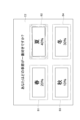
- the viewer terminal 20 inputs the character string that constitutes the question "Which season do you like the most?" and the questions "Spring,” “Summer,” “Autumn,” and “Winter.”
- a questionnaire video including four icons each forming a choice is displayed as content C2.
- the identifying unit 14 identifies a first area in the content C2 where viewers' gazes are concentrated and a second area where viewers' gazes are less concentrated than the first area, based on the distribution of gaze positions. do.
- the specifying unit 14 specifies area B2 including the "summer” icon as the first area, and areas B1, B3, and B4 including the "spring", "autumn", and "winter” icons, respectively. Specify as 2 areas.
- the determining unit 15 determines the manner in which the effect is applied based on the distribution of line-of-sight positions.
- the determining unit 15 displays the "summer" icon included in region B2 specified as the first region in a vibrating manner, and determines the proportion of line of sight located in each region B1 to B4. Deciding that the effect is to be displayed on the icon is the manner in which the effect is applied. That is, in this example, an icon that particularly attracts the attention of the viewer (attention is focused on it) is displayed so as to vibrate. Additionally, in this example, the degree of attention from the viewer (percentage of line of sight) for each icon is displayed as a numerical value.
- the line-of-sight ratio is calculated from the distribution of line-of-sight positions.
- the character string "20%” indicating the percentage of line of sight located in area B1 is displayed on the "Spring” icon
- the character string "40%” indicating the proportion of line of sight located in area B2. is displayed on the "summer” icon
- the character string "10%” indicating the proportion of gaze located in area B3 is displayed on the "autumn” icon
- "30%” indicating the proportion of gaze located in area B4 is displayed.
- %” is displayed on the “Winter” icon.
- the effect transmitting unit 16 transmits effect data indicating the manner in which the effect determined by the determining unit 15 is applied to the viewer terminal 20 (target terminal).
- the effect receiving unit 24 receives the effect data, and the viewer terminal 20 processes the effect data to generate an effect.
- the display control unit 25 displays the "summer" icon included in area B2 so as to vibrate, and displays a character string indicating the percentage of line of sight on the corresponding icon.
- the content distribution system 1 may transmit content data not only to the viewer terminal 20 but also to the distributor terminal 30.
- the distributor terminal 30 processes the content data and displays the content on the screen.
- the content distribution system 1 may also transmit the effect data to the distributor terminal 30.
- the distributor terminal 30 processes the effect data and adds effects to the content. That is, the distributor terminal 30 can also function as the viewer terminal 20 (target terminal).
- the manner in which effects are applied is not limited to the example described above.
- the determining unit 15 may determine the manner in which the effect is applied based on the viewer's attribute information.
- the determining unit 15 may determine the manner in which the effect is applied based on attribute information such as age or gender, for example. Specifically, the determining unit 15 determines that the effect is to be applied by displaying comments included in the first area where the eyes of elderly viewers are focused, larger than other comments and in a color that stands out. Good too.
- the calculating unit 13 classifies the viewers into a plurality of groups based on the attribute information, and calculates the distribution of gaze positions for each group. may be calculated. For example, the calculation unit 13 may calculate the distribution of gaze positions for each age group or gender of viewers.
- the calculation unit 13 may weight the gaze data based on the viewer's attribute information. For example, the calculation unit 13 may calculate the distribution of gaze positions using a value obtained by multiplying the number of gazes of viewers of a specific age group or gender by a predetermined coefficient.
- the determining unit 15 may determine the manner in which the effect is applied based on the attribute information of the viewer (hereinafter referred to as the target person) who uses the target terminal. Specifically, when the attribute information includes information about a favorite person or character selected by the subject and an image color associated with the person or character, the determining unit 15 selects the sound to be generated as an effect. may be the voice of a person or character selected by the subject, or the color of a design added to the content as an effect may be an image color associated with the person or character.
- the determining unit 15 displays only a predetermined number of comments from among the plurality of comments that have attracted the most attention, and does not display other comments. This may be determined as the manner in which the effect is applied. At this time, the determining unit 15 identifies comments that attract many gazes based on the distribution of gaze positions.
- the determining unit 15 may decide to display the distribution of gaze positions on the screen of the user terminal in a format that can be visually recognized by the user, such as a heat map, as the manner in which the effect is applied. In this case, the determining unit 15 may determine the manner in which the effect is applied without the identifying unit 14 identifying the first area and the second area.
- the acquisition unit 12 acquires line-of-sight data each time a content is viewed by each viewer, and stores the acquired line-of-sight data in a database.
- the calculation unit 13 may calculate the distribution of gaze positions by analyzing two or more pieces of accumulated gaze data. That is, the timing at which the acquisition unit 12 acquires the line-of-sight data from each viewer terminal 20 does not necessarily have to be simultaneous, and may be different.
- the content distribution system 1 When the content distribution system 1 is used for on-demand distribution, the content distribution system 1 accumulates data indicating the history of comments posted by a certain viewer in a database, and when other viewers view the content. Additionally, comments may be included in the content and displayed based on the data.
- the viewer terminal 20 displays data indicating the time when the gaze data was acquired (for example, data indicating the progress of the content) as well as the gaze data. ) may be sent to the server 10.
- the case where there is a difference in the timing at which the content is displayed on each viewer terminal 20 means, for example, when the content distribution system 1 is used for on-demand distribution, or when there is a delay (lag) in the timing at which the content is displayed. This is the case when the situation occurs.
- the calculation unit 13 of the server 10 can calculate the distribution of gaze positions for each scene included in the content based on the gaze data and data indicating the time when the gaze data is acquired.
- the viewer terminal 20 does not need to transmit data indicating the time when the line-of-sight data was acquired to the server 10.
- the case where there is no difference in the timing at which content is displayed on each viewer terminal 20 means, for example, when the content distribution system 1 is used for real-time distribution, or when there is a delay (lag) in the timing at which the content is displayed. For example, if you have not done so.
- the process of adding effects may be performed by the server 10.
- the server 10 changes the configuration of the content based on the effect application mode determined by the determining unit 15 (such as changing the content to a partially highlighted content), and views and listens to content data indicating the changed content.
- the information may also be transmitted to the user terminal 20.
- the display control unit 25 of the viewer terminal 20 processes the content data and displays the content, so that the content to which the effect has been added is displayed on the screen.
- the concept includes a case where the executing entity (that is, the processor) of n processes from the first process to the nth process changes midway. That is, this expression indicates a concept that includes both a case in which all of the n processes are executed by the same processor, and a case in which the processors in the n processes are changed according to an arbitrary policy.
- the processing procedure of the method executed by at least one processor is not limited to the example in the above embodiment. For example, some of the steps described above may be omitted, or each step may be performed in a different order. Furthermore, any two or more of the steps described above may be combined, or some of the steps may be modified or deleted. Alternatively, other steps may be performed in addition to each of the above steps.
- any part or all of the functional units described in this specification may be realized by a program.
- the programs mentioned in this specification may be distributed by being recorded non-temporarily on a computer-readable recording medium, or may be distributed via communication lines (including wireless communication) such as the Internet. , it may be distributed as being installed on any terminal.
- a configuration described in this specification as one device (or member; the same applies hereinafter) may be realized by multiple devices. good.
- configurations described herein as multiple devices may be implemented by a single device.
- some or all of the means or functions included in a certain device for example, a server
- may be included in another device for example, a user terminal.
- the present disclosure includes the following aspects.
- (Additional note 1) comprising at least one processor; the at least one processor, Display content on multiple user terminals, Obtaining line-of-sight data indicating the line-of-sight position of a user viewing the content from two or more user terminals among the plurality of user terminals; Analyzing the acquired two or more pieces of line-of-sight data to calculate the distribution of line-of-sight positions of two or more users in the content, A content distribution system that determines, based on the calculated distribution, a mode of applying an effect to the content displayed on at least one target terminal among the plurality of user terminals.
- the at least one processor Based on the distribution, identify a first area in the content where the line of sight of the two or more users is concentrated, and a second area where the line of sight of the two or more users is less concentrated than the first area;
- the content distribution system according to supplementary note 1, wherein changing the display mode of the first area of the content displayed on the at least one target terminal is determined as the mode of applying the effect.
- the at least one processor Based on the distribution, identify a first area in the content where the line of sight of the two or more users is concentrated, and a second area where the line of sight of the two or more users is less concentrated than the first area;
- the content distribution system according to supplementary note 1, wherein changing the display mode of the second area of the content displayed on the at least one target terminal is determined as the mode of applying the effect.
- the plurality of user terminals include a distributor terminal that distributes the content and a plurality of viewer terminals, The content distribution system according to any one of appendices 1 to 3, wherein the content is content distributed in real time from the distributor terminal to the plurality of viewer terminals.
- the plurality of user terminals include a plurality of viewer terminals, The content distribution system according to any one of appendices 1 to 3, wherein the content is content distributed on-demand to the plurality of viewer terminals.
- a content distribution method performed by a content distribution system comprising at least one processor, the method comprising: displaying the content on multiple user terminals; acquiring line-of-sight data indicating the line-of-sight position of a user viewing the content from two or more user terminals among the plurality of user terminals; analyzing the acquired two or more pieces of the line-of-sight data to calculate a distribution of line-of-sight positions of the two or more users in the content;
- a content distribution method comprising the step of determining, based on the calculated distribution, a mode of applying an effect to the content displayed on at least one target terminal among the plurality of user terminals.
- (Appendix 8) displaying the content on multiple user terminals; acquiring line-of-sight data indicating the line-of-sight position of a user viewing the content from two or more user terminals among the plurality of user terminals; analyzing the acquired two or more pieces of the line-of-sight data to calculate a distribution of line-of-sight positions of the two or more users in the content;
- a content distribution program that causes a computer to execute a step of determining, based on the calculated distribution, a mode of applying an effect to the content displayed on at least one target terminal among the plurality of user terminals.
- two or more pieces of line-of-sight data are analyzed to obtain a distribution of the line-of-sight positions of two or more users in the content, and the mode of applying effects to the content is determined based on this distribution. It is determined.
- the manner in which effects are applied is determined based on the reactions of a plurality of viewers to the content, so it is possible to increase the appeal of the content to the viewers.
- this mechanism reflects viewer reactions in the content and provides interactive content, which can facilitate communication between viewers and distributors and between viewers.
- the display mode of the first area where the user's line of sight is focused is changed.
- the display mode of the second area, where the user's line of sight is less focused than the first area is changed. This makes it possible, for example, to add an effect to guide the viewer's line of sight to the second area, dispersing the line of sight that is omnipresent in the first area and drawing the line of sight to the second area as well. be able to.
- SYMBOLS 1 Content distribution system, 10... Server, 11... Content transfer part, 12... Acquisition part, 13... Calculation part, 14... Specification part, 15... Determination part, 16... Effect transmission part, 20... Viewer terminal, 21... Content reception section, 22... Gaze identification section, 23... Gaze data transmission section, 24... Effect reception section, 25... Display control section, 30... Distributor terminal, 31... Content transmission section, 40... User database, A1, A2, A3, A4, B1, B1, B2, B3, B4...area, C1, C2...content, P1...server program, P2...client program.
Landscapes
- Engineering & Computer Science (AREA)
- Signal Processing (AREA)
- Multimedia (AREA)
- General Health & Medical Sciences (AREA)
- Health & Medical Sciences (AREA)
- Social Psychology (AREA)
- Databases & Information Systems (AREA)
- Computer Networks & Wireless Communication (AREA)
- Marketing (AREA)
- Business, Economics & Management (AREA)
- Computer Graphics (AREA)
- Two-Way Televisions, Distribution Of Moving Picture Or The Like (AREA)
- Information Transfer Between Computers (AREA)
Priority Applications (2)
| Application Number | Priority Date | Filing Date | Title |
|---|---|---|---|
| CN202380042688.7A CN119256550A (zh) | 2022-07-29 | 2023-07-11 | 内容发布系统、内容发布方法以及内容发布程序 |
| US18/998,302 US20260046478A1 (en) | 2022-07-29 | 2023-07-11 | Content distribution system, content distribution method, and content distribution program |
Applications Claiming Priority (2)
| Application Number | Priority Date | Filing Date | Title |
|---|---|---|---|
| JP2022122059A JP7171964B1 (ja) | 2022-07-29 | 2022-07-29 | コンテンツ配信システム、コンテンツ配信方法、およびコンテンツ配信プログラム |
| JP2022-122059 | 2022-07-29 |
Publications (1)
| Publication Number | Publication Date |
|---|---|
| WO2024024500A1 true WO2024024500A1 (ja) | 2024-02-01 |
Family
ID=84046004
Family Applications (1)
| Application Number | Title | Priority Date | Filing Date |
|---|---|---|---|
| PCT/JP2023/025621 Ceased WO2024024500A1 (ja) | 2022-07-29 | 2023-07-11 | コンテンツ配信システム、コンテンツ配信方法、およびコンテンツ配信プログラム |
Country Status (4)
| Country | Link |
|---|---|
| US (1) | US20260046478A1 (https=) |
| JP (2) | JP7171964B1 (https=) |
| CN (1) | CN119256550A (https=) |
| WO (1) | WO2024024500A1 (https=) |
Citations (8)
| Publication number | Priority date | Publication date | Assignee | Title |
|---|---|---|---|---|
| JP2016046730A (ja) * | 2014-08-25 | 2016-04-04 | 学校法人早稲田大学 | 視聴者注目情報提供システム、時空間マーカ設定装置及びそのプログラム、並びに、情報提供装置及びそのプログラム |
| JP2017028402A (ja) * | 2015-07-17 | 2017-02-02 | 日本放送協会 | 映像評価装置、及びプログラム |
| JP2017216667A (ja) * | 2016-05-31 | 2017-12-07 | フォーブ インコーポレーテッド | 画像提供システム |
| WO2018079166A1 (ja) * | 2016-10-26 | 2018-05-03 | ソニー株式会社 | 情報処理装置、情報処理システム、および情報処理方法、並びにプログラム |
| JP2020052986A (ja) * | 2018-09-26 | 2020-04-02 | 株式会社ドワンゴ | サーバシステム、アプリケーションプログラム配信サーバ、閲覧用端末、コンテンツ閲覧方法、アプリケーションプログラム、配信方法、アプリケーションプログラム配信方法 |
| WO2020184021A1 (ja) * | 2019-03-12 | 2020-09-17 | ソニー株式会社 | 情報処理装置、情報処理方法、およびプログラム |
| JP2021180474A (ja) * | 2020-05-15 | 2021-11-18 | 株式会社ドワンゴ | 動画配信装置、動画配信方法、および、動画配信プログラム |
| JP2022097475A (ja) * | 2020-12-18 | 2022-06-30 | グリー株式会社 | 情報処理システム、情報処理方法およびコンピュータプログラム |
Family Cites Families (2)
| Publication number | Priority date | Publication date | Assignee | Title |
|---|---|---|---|---|
| US10264211B2 (en) * | 2014-03-14 | 2019-04-16 | Comcast Cable Communications, Llc | Adaptive resolution in software applications based on dynamic eye tracking |
| JP6944132B2 (ja) * | 2016-03-16 | 2021-10-06 | ソニーグループ株式会社 | 情報処理装置、情報処理方法、プログラム、動画像配信システム |
-
2022
- 2022-07-29 JP JP2022122059A patent/JP7171964B1/ja active Active
- 2022-11-02 JP JP2022176404A patent/JP2024018844A/ja active Pending
-
2023
- 2023-07-11 CN CN202380042688.7A patent/CN119256550A/zh active Pending
- 2023-07-11 WO PCT/JP2023/025621 patent/WO2024024500A1/ja not_active Ceased
- 2023-07-11 US US18/998,302 patent/US20260046478A1/en active Pending
Patent Citations (8)
| Publication number | Priority date | Publication date | Assignee | Title |
|---|---|---|---|---|
| JP2016046730A (ja) * | 2014-08-25 | 2016-04-04 | 学校法人早稲田大学 | 視聴者注目情報提供システム、時空間マーカ設定装置及びそのプログラム、並びに、情報提供装置及びそのプログラム |
| JP2017028402A (ja) * | 2015-07-17 | 2017-02-02 | 日本放送協会 | 映像評価装置、及びプログラム |
| JP2017216667A (ja) * | 2016-05-31 | 2017-12-07 | フォーブ インコーポレーテッド | 画像提供システム |
| WO2018079166A1 (ja) * | 2016-10-26 | 2018-05-03 | ソニー株式会社 | 情報処理装置、情報処理システム、および情報処理方法、並びにプログラム |
| JP2020052986A (ja) * | 2018-09-26 | 2020-04-02 | 株式会社ドワンゴ | サーバシステム、アプリケーションプログラム配信サーバ、閲覧用端末、コンテンツ閲覧方法、アプリケーションプログラム、配信方法、アプリケーションプログラム配信方法 |
| WO2020184021A1 (ja) * | 2019-03-12 | 2020-09-17 | ソニー株式会社 | 情報処理装置、情報処理方法、およびプログラム |
| JP2021180474A (ja) * | 2020-05-15 | 2021-11-18 | 株式会社ドワンゴ | 動画配信装置、動画配信方法、および、動画配信プログラム |
| JP2022097475A (ja) * | 2020-12-18 | 2022-06-30 | グリー株式会社 | 情報処理システム、情報処理方法およびコンピュータプログラム |
Also Published As
| Publication number | Publication date |
|---|---|
| US20260046478A1 (en) | 2026-02-12 |
| JP2024018622A (ja) | 2024-02-08 |
| CN119256550A (zh) | 2025-01-03 |
| JP7171964B1 (ja) | 2022-11-15 |
| JP2024018844A (ja) | 2024-02-08 |
Similar Documents
| Publication | Publication Date | Title |
|---|---|---|
| US10699482B2 (en) | Real-time immersive mediated reality experiences | |
| US9367864B2 (en) | Experience sharing with commenting | |
| US10897637B1 (en) | Synchronize and present multiple live content streams | |
| US10037077B2 (en) | Systems and methods of generating augmented reality experiences | |
| US20140129343A1 (en) | Dynamic targeted advertising avatar | |
| CN103092902B (zh) | 信息处理设备、信息处理方法及程序 | |
| WO2021065928A1 (ja) | コンテンツ配信システム、コンテンツ配信方法、及びコンテンツ配信プログラム | |
| JP7496558B2 (ja) | コンピュータプログラム、サーバ装置、端末装置、及び方法 | |
| WO2022180973A1 (ja) | コメントアート管理システム、コメントアート管理方法、コメントアート管理プログラム、およびコンピュータ読取可能な記録媒体 | |
| JP7469536B1 (ja) | コンテンツ管理システム、コンテンツ管理方法、コンテンツ管理プログラム、およびユーザ端末 | |
| JP7171964B1 (ja) | コンテンツ配信システム、コンテンツ配信方法、およびコンテンツ配信プログラム | |
| US11095945B2 (en) | Information processing device, method, and program | |
| JP7548785B2 (ja) | コンテンツ配信システム、コンテンツ配信方法及びコンテンツ配信プログラム | |
| JP7367258B1 (ja) | 情報処理システム、情報処理方法、情報処理プログラム、および配信者端末 | |
| JP7549116B1 (ja) | タイトル作成システム、タイトル作成方法、タイトル作成プログラム、および配信者端末 | |
| JP2023519608A (ja) | ユーザデバイスからデータを収集するシステム及び方法 | |
| JP7520264B1 (ja) | ユーザ端末、リアクション制御方法、およびリアクション制御プログラム、および配信システム | |
| JP7697159B1 (ja) | 情報処理装置、情報処理方法及びプログラム | |
| US20240378802A1 (en) | Information processing method, server, and information processing system | |
| CN120935392A (zh) | 信息显示方法、装置、设备及存储介质 | |
| KR20250139384A (ko) | 시선 기반 공존성 시스템 | |
| KR20150100975A (ko) | 온라인 이벤트 참여 방법, 온라인 이벤트 참여 방법을 수행하는 프로그램을 저장한 다운로드 서버 및 컴퓨터 판독 가능 저장 매체 |
Legal Events
| Date | Code | Title | Description |
|---|---|---|---|
| 121 | Ep: the epo has been informed by wipo that ep was designated in this application |
Ref document number: 23846231 Country of ref document: EP Kind code of ref document: A1 |
|
| WWE | Wipo information: entry into national phase |
Ref document number: 202380042688.7 Country of ref document: CN |
|
| WWP | Wipo information: published in national office |
Ref document number: 202380042688.7 Country of ref document: CN |
|
| WWE | Wipo information: entry into national phase |
Ref document number: 18998302 Country of ref document: US |
|
| NENP | Non-entry into the national phase |
Ref country code: DE |
|
| 122 | Ep: pct application non-entry in european phase |
Ref document number: 23846231 Country of ref document: EP Kind code of ref document: A1 |
|
| WWP | Wipo information: published in national office |
Ref document number: 18998302 Country of ref document: US |