WO2024019156A1 - 粘着シート、粘着シート付き光学フィルム、並びに、粘着シート及び粘着シート付き光学フィルムの製造方法 - Google Patents
粘着シート、粘着シート付き光学フィルム、並びに、粘着シート及び粘着シート付き光学フィルムの製造方法 Download PDFInfo
- Publication number
- WO2024019156A1 WO2024019156A1 PCT/JP2023/026817 JP2023026817W WO2024019156A1 WO 2024019156 A1 WO2024019156 A1 WO 2024019156A1 JP 2023026817 W JP2023026817 W JP 2023026817W WO 2024019156 A1 WO2024019156 A1 WO 2024019156A1
- Authority
- WO
- WIPO (PCT)
- Prior art keywords
- adhesive sheet
- weight
- less
- pressure
- release liner
- Prior art date
- Legal status (The legal status is an assumption and is not a legal conclusion. Google has not performed a legal analysis and makes no representation as to the accuracy of the status listed.)
- Ceased
Links
Images





Classifications
-
- C—CHEMISTRY; METALLURGY
- C09—DYES; PAINTS; POLISHES; NATURAL RESINS; ADHESIVES; COMPOSITIONS NOT OTHERWISE PROVIDED FOR; APPLICATIONS OF MATERIALS NOT OTHERWISE PROVIDED FOR
- C09J—ADHESIVES; NON-MECHANICAL ASPECTS OF ADHESIVE PROCESSES IN GENERAL; ADHESIVE PROCESSES NOT PROVIDED FOR ELSEWHERE; USE OF MATERIALS AS ADHESIVES
- C09J7/00—Adhesives in the form of films or foils
- C09J7/30—Adhesives in the form of films or foils characterised by the adhesive composition
- C09J7/38—Pressure-sensitive adhesives [PSA]
- C09J7/381—Pressure-sensitive adhesives [PSA] based on macromolecular compounds obtained by reactions involving only carbon-to-carbon unsaturated bonds
- C09J7/385—Acrylic polymers
-
- B—PERFORMING OPERATIONS; TRANSPORTING
- B32—LAYERED PRODUCTS
- B32B—LAYERED PRODUCTS, i.e. PRODUCTS BUILT-UP OF STRATA OF FLAT OR NON-FLAT, e.g. CELLULAR OR HONEYCOMB, FORM
- B32B27/00—Layered products comprising a layer of synthetic resin
-
- B—PERFORMING OPERATIONS; TRANSPORTING
- B32—LAYERED PRODUCTS
- B32B—LAYERED PRODUCTS, i.e. PRODUCTS BUILT-UP OF STRATA OF FLAT OR NON-FLAT, e.g. CELLULAR OR HONEYCOMB, FORM
- B32B27/00—Layered products comprising a layer of synthetic resin
- B32B27/18—Layered products comprising a layer of synthetic resin characterised by the use of special additives
-
- B—PERFORMING OPERATIONS; TRANSPORTING
- B32—LAYERED PRODUCTS
- B32B—LAYERED PRODUCTS, i.e. PRODUCTS BUILT-UP OF STRATA OF FLAT OR NON-FLAT, e.g. CELLULAR OR HONEYCOMB, FORM
- B32B27/00—Layered products comprising a layer of synthetic resin
- B32B27/30—Layered products comprising a layer of synthetic resin comprising vinyl (co)polymers; comprising acrylic (co)polymers
-
- C—CHEMISTRY; METALLURGY
- C08—ORGANIC MACROMOLECULAR COMPOUNDS; THEIR PREPARATION OR CHEMICAL WORKING-UP; COMPOSITIONS BASED THEREON
- C08F—MACROMOLECULAR COMPOUNDS OBTAINED BY REACTIONS ONLY INVOLVING CARBON-TO-CARBON UNSATURATED BONDS
- C08F220/00—Copolymers of compounds having one or more unsaturated aliphatic radicals, each having only one carbon-to-carbon double bond, and only one being terminated by only one carboxyl radical or a salt, anhydride ester, amide, imide or nitrile thereof
- C08F220/02—Monocarboxylic acids having less than ten carbon atoms; Derivatives thereof
- C08F220/04—Acids; Metal salts or ammonium salts thereof
- C08F220/06—Acrylic acid; Methacrylic acid; Metal salts or ammonium salts thereof
-
- C—CHEMISTRY; METALLURGY
- C08—ORGANIC MACROMOLECULAR COMPOUNDS; THEIR PREPARATION OR CHEMICAL WORKING-UP; COMPOSITIONS BASED THEREON
- C08F—MACROMOLECULAR COMPOUNDS OBTAINED BY REACTIONS ONLY INVOLVING CARBON-TO-CARBON UNSATURATED BONDS
- C08F220/00—Copolymers of compounds having one or more unsaturated aliphatic radicals, each having only one carbon-to-carbon double bond, and only one being terminated by only one carboxyl radical or a salt, anhydride ester, amide, imide or nitrile thereof
- C08F220/02—Monocarboxylic acids having less than ten carbon atoms; Derivatives thereof
- C08F220/10—Esters
- C08F220/12—Esters of monohydric alcohols or phenols
- C08F220/16—Esters of monohydric alcohols or phenols of phenols or of alcohols containing two or more carbon atoms
- C08F220/18—Esters of monohydric alcohols or phenols of phenols or of alcohols containing two or more carbon atoms with acrylic or methacrylic acids
- C08F220/1804—C4-(meth)acrylate, e.g. butyl (meth)acrylate, isobutyl (meth)acrylate or tert-butyl (meth)acrylate
-
- C—CHEMISTRY; METALLURGY
- C08—ORGANIC MACROMOLECULAR COMPOUNDS; THEIR PREPARATION OR CHEMICAL WORKING-UP; COMPOSITIONS BASED THEREON
- C08F—MACROMOLECULAR COMPOUNDS OBTAINED BY REACTIONS ONLY INVOLVING CARBON-TO-CARBON UNSATURATED BONDS
- C08F220/00—Copolymers of compounds having one or more unsaturated aliphatic radicals, each having only one carbon-to-carbon double bond, and only one being terminated by only one carboxyl radical or a salt, anhydride ester, amide, imide or nitrile thereof
- C08F220/02—Monocarboxylic acids having less than ten carbon atoms; Derivatives thereof
- C08F220/10—Esters
- C08F220/20—Esters of polyhydric alcohols or phenols, e.g. 2-hydroxyethyl (meth)acrylate or glycerol mono-(meth)acrylate
-
- C—CHEMISTRY; METALLURGY
- C08—ORGANIC MACROMOLECULAR COMPOUNDS; THEIR PREPARATION OR CHEMICAL WORKING-UP; COMPOSITIONS BASED THEREON
- C08K—Use of inorganic or non-macromolecular organic substances as compounding ingredients
- C08K5/00—Use of organic ingredients
- C08K5/0008—Organic ingredients according to more than one of the "one dot" groups of C08K5/01 - C08K5/59
- C08K5/005—Stabilisers against oxidation, heat, light, ozone
-
- C—CHEMISTRY; METALLURGY
- C08—ORGANIC MACROMOLECULAR COMPOUNDS; THEIR PREPARATION OR CHEMICAL WORKING-UP; COMPOSITIONS BASED THEREON
- C08K—Use of inorganic or non-macromolecular organic substances as compounding ingredients
- C08K5/00—Use of organic ingredients
- C08K5/04—Oxygen-containing compounds
- C08K5/10—Esters; Ether-esters
- C08K5/101—Esters; Ether-esters of monocarboxylic acids
- C08K5/105—Esters; Ether-esters of monocarboxylic acids with phenols
-
- C—CHEMISTRY; METALLURGY
- C09—DYES; PAINTS; POLISHES; NATURAL RESINS; ADHESIVES; COMPOSITIONS NOT OTHERWISE PROVIDED FOR; APPLICATIONS OF MATERIALS NOT OTHERWISE PROVIDED FOR
- C09J—ADHESIVES; NON-MECHANICAL ASPECTS OF ADHESIVE PROCESSES IN GENERAL; ADHESIVE PROCESSES NOT PROVIDED FOR ELSEWHERE; USE OF MATERIALS AS ADHESIVES
- C09J11/00—Features of adhesives not provided for in group C09J9/00, e.g. additives
- C09J11/02—Non-macromolecular additives
- C09J11/06—Non-macromolecular additives organic
-
- C—CHEMISTRY; METALLURGY
- C09—DYES; PAINTS; POLISHES; NATURAL RESINS; ADHESIVES; COMPOSITIONS NOT OTHERWISE PROVIDED FOR; APPLICATIONS OF MATERIALS NOT OTHERWISE PROVIDED FOR
- C09J—ADHESIVES; NON-MECHANICAL ASPECTS OF ADHESIVE PROCESSES IN GENERAL; ADHESIVE PROCESSES NOT PROVIDED FOR ELSEWHERE; USE OF MATERIALS AS ADHESIVES
- C09J133/00—Adhesives based on homopolymers or copolymers of compounds having one or more unsaturated aliphatic radicals, each having only one carbon-to-carbon double bond, and at least one being terminated by only one carboxyl radical, or of salts, anhydrides, esters, amides, imides, or nitriles thereof; Adhesives based on derivatives of such polymers
-
- C—CHEMISTRY; METALLURGY
- C09—DYES; PAINTS; POLISHES; NATURAL RESINS; ADHESIVES; COMPOSITIONS NOT OTHERWISE PROVIDED FOR; APPLICATIONS OF MATERIALS NOT OTHERWISE PROVIDED FOR
- C09J—ADHESIVES; NON-MECHANICAL ASPECTS OF ADHESIVE PROCESSES IN GENERAL; ADHESIVE PROCESSES NOT PROVIDED FOR ELSEWHERE; USE OF MATERIALS AS ADHESIVES
- C09J133/00—Adhesives based on homopolymers or copolymers of compounds having one or more unsaturated aliphatic radicals, each having only one carbon-to-carbon double bond, and at least one being terminated by only one carboxyl radical, or of salts, anhydrides, esters, amides, imides, or nitriles thereof; Adhesives based on derivatives of such polymers
- C09J133/04—Homopolymers or copolymers of esters
- C09J133/06—Homopolymers or copolymers of esters of esters containing only carbon, hydrogen and oxygen, the oxygen atom being present only as part of the carboxyl radical
- C09J133/062—Copolymers with monomers not covered by C09J133/06
- C09J133/066—Copolymers with monomers not covered by C09J133/06 containing -OH groups
-
- C—CHEMISTRY; METALLURGY
- C09—DYES; PAINTS; POLISHES; NATURAL RESINS; ADHESIVES; COMPOSITIONS NOT OTHERWISE PROVIDED FOR; APPLICATIONS OF MATERIALS NOT OTHERWISE PROVIDED FOR
- C09J—ADHESIVES; NON-MECHANICAL ASPECTS OF ADHESIVE PROCESSES IN GENERAL; ADHESIVE PROCESSES NOT PROVIDED FOR ELSEWHERE; USE OF MATERIALS AS ADHESIVES
- C09J4/00—Adhesives based on organic non-macromolecular compounds having at least one polymerisable carbon-to-carbon unsaturated bond ; adhesives, based on monomers of macromolecular compounds of groups C09J183/00 - C09J183/16
-
- C—CHEMISTRY; METALLURGY
- C09—DYES; PAINTS; POLISHES; NATURAL RESINS; ADHESIVES; COMPOSITIONS NOT OTHERWISE PROVIDED FOR; APPLICATIONS OF MATERIALS NOT OTHERWISE PROVIDED FOR
- C09J—ADHESIVES; NON-MECHANICAL ASPECTS OF ADHESIVE PROCESSES IN GENERAL; ADHESIVE PROCESSES NOT PROVIDED FOR ELSEWHERE; USE OF MATERIALS AS ADHESIVES
- C09J5/00—Adhesive processes in general; Adhesive processes not provided for elsewhere, e.g. relating to primers
-
- C—CHEMISTRY; METALLURGY
- C09—DYES; PAINTS; POLISHES; NATURAL RESINS; ADHESIVES; COMPOSITIONS NOT OTHERWISE PROVIDED FOR; APPLICATIONS OF MATERIALS NOT OTHERWISE PROVIDED FOR
- C09J—ADHESIVES; NON-MECHANICAL ASPECTS OF ADHESIVE PROCESSES IN GENERAL; ADHESIVE PROCESSES NOT PROVIDED FOR ELSEWHERE; USE OF MATERIALS AS ADHESIVES
- C09J7/00—Adhesives in the form of films or foils
- C09J7/30—Adhesives in the form of films or foils characterised by the adhesive composition
- C09J7/38—Pressure-sensitive adhesives [PSA]
-
- G—PHYSICS
- G02—OPTICS
- G02B—OPTICAL ELEMENTS, SYSTEMS OR APPARATUS
- G02B5/00—Optical elements other than lenses
- G02B5/30—Polarising elements
-
- H—ELECTRICITY
- H05—ELECTRIC TECHNIQUES NOT OTHERWISE PROVIDED FOR
- H05B—ELECTRIC HEATING; ELECTRIC LIGHT SOURCES NOT OTHERWISE PROVIDED FOR; CIRCUIT ARRANGEMENTS FOR ELECTRIC LIGHT SOURCES, IN GENERAL
- H05B33/00—Electroluminescent light sources
- H05B33/02—Details
-
- H—ELECTRICITY
- H10—SEMICONDUCTOR DEVICES; ELECTRIC SOLID-STATE DEVICES NOT OTHERWISE PROVIDED FOR
- H10K—ORGANIC ELECTRIC SOLID-STATE DEVICES
- H10K50/00—Organic light-emitting devices
- H10K50/10—OLEDs or polymer light-emitting diodes [PLED]
Definitions
- the present invention relates to an adhesive sheet, an optical film with an adhesive sheet, and a method for producing an adhesive sheet and an optical film with an adhesive sheet.
- Various image display devices typified by liquid crystal display devices and electroluminescent (EL) display devices, generally include an optical laminate that includes an optical film such as a polarizing film and an adhesive sheet.
- Adhesive sheets are usually used for bonding between optical films included in an optical laminate and for bonding an optical laminate and an image display panel.
- a typical pressure-sensitive adhesive sheet is a sheet obtained by curing a group of monomers including acrylic monomers, silicone monomers, etc. by polymerization and crosslinking.
- Patent Document 1 discloses an example of an adhesive sheet.
- a pressure-sensitive adhesive sheet is produced by irradiating a coating layer of a pressure-sensitive adhesive composition placed between two release liners with light.
- Forming a pressure-sensitive adhesive sheet by curing usually requires energy such as heat or light.
- energy such as heat or light.
- the energy required to form an adhesive sheet is lower than, for example, a method of thermally curing a coating layer containing an adhesive composition and a solvent in an oven (thermal curing method).
- the amount can be reduced.
- it is insufficient to focus only on the amount of energy required to cure the coating layer.
- an object of the present invention is to provide a pressure-sensitive adhesive sheet that can be manufactured with a low environmental impact by reducing the amount of discarded release liner necessary for manufacturing the pressure-sensitive adhesive sheet.
- the present invention A pressure-sensitive adhesive sheet formed from a photocurable adhesive composition containing a monomer group containing a (meth)acrylic monomer and/or a partial polymer of the monomer group, and a photopolymerization initiator. There it is, The thickness of the adhesive sheet is 5 to 100 ⁇ m,
- the adhesive composition further includes an antioxidant,
- the present invention provides a pressure-sensitive adhesive sheet in which the antioxidant contains at least one selected from the group consisting of a hindered phenol compound, a hindered amine compound, and a phosphorus compound, and has a molecular weight of 1000 or less.
- the present invention A method for manufacturing the above-mentioned adhesive sheet,
- the manufacturing method includes: Step A of irradiating a laminate including a base sheet, a coating layer containing the adhesive composition, and a release liner in this order with light to form the adhesive sheet having a thickness of 5 to 100 ⁇ m from the coating layer; , Step B of peeling off the release liner from the adhesive sheet; including;
- the present invention provides a method for producing a pressure-sensitive adhesive sheet, in which the release liner peeled off in the step B is used to repeatedly perform the step A and the step B to reuse the release liner.
- a method for producing an optical film with a pressure-sensitive adhesive sheet includes laminating the pressure-sensitive adhesive sheet formed by the above-described production method and an optical film to form an optical film with a pressure-sensitive adhesive sheet.
- FIG. 1 is a cross-sectional view schematically showing an example of a pressure-sensitive adhesive sheet of the present invention.
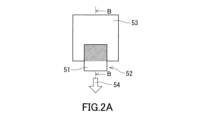
- FIG. 3 is a schematic diagram for explaining a method for measuring the amount of creep on a pressure-sensitive adhesive sheet.
- FIG. 3 is a schematic diagram for explaining a method for measuring the amount of creep on a pressure-sensitive adhesive sheet.
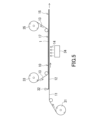
- FIG. 1 is a schematic diagram for explaining an example of a method for manufacturing a pressure-sensitive adhesive sheet of the present invention.
- 1 is a cross-sectional view schematically showing an example of a release liner that can be used in the method for producing a pressure-sensitive adhesive sheet of the present invention.
- BRIEF DESCRIPTION OF THE DRAWINGS FIG.
- FIG. 1 is a schematic diagram for explaining an example of a method for manufacturing a pressure-sensitive adhesive sheet of the present invention. BRIEF DESCRIPTION OF THE DRAWINGS FIG. 1 is a schematic diagram for explaining an example of a method for manufacturing a pressure-sensitive adhesive sheet of the present invention.
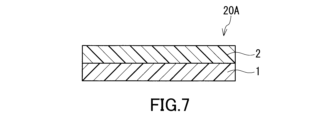
- FIG. 1 is a cross-sectional view schematically showing an example of an optical film with an adhesive sheet of the present invention.
- FIG. 1 is a cross-sectional view schematically showing an example of an optical film with an adhesive sheet of the present invention.
- the adhesive sheet according to the first aspect of the present invention is A pressure-sensitive adhesive sheet formed from a photocurable adhesive composition containing a monomer group containing a (meth)acrylic monomer and/or a partial polymer of the monomer group, and a photopolymerization initiator. There it is, The thickness of the adhesive sheet is 5 to 100 ⁇ m,
- the adhesive composition further includes an antioxidant, The antioxidant contains at least one selected from the group consisting of hindered phenol compounds, hindered amine compounds, and phosphorus compounds, and has a molecular weight of 1000 or less.
- the antioxidant includes a hindered phenol compound.
- the molecular weight of the antioxidant is 500 or less.
- the amount of the hydroxy group-containing monomer is 5 parts by weight out of 100 parts by weight of the monomer group. less than 100%.
- the monomer group includes a carboxyl group-containing monomer.
- the content of the solvent in the adhesive composition is 5% by weight or less.
- the optical film with a pressure-sensitive adhesive sheet according to the seventh aspect of the present invention includes: An adhesive sheet according to any one of the first to sixth aspects, optical film, Equipped with.
- the optical film is a film containing at least one selected from the group consisting of a polarizing film and a retardation film.
- the method for producing a pressure-sensitive adhesive sheet according to the ninth aspect of the present invention includes: A method for producing a pressure-sensitive adhesive sheet according to any one of the first to sixth aspects, comprising: The manufacturing method includes: Step A of irradiating a laminate including a base sheet, a coating layer containing the adhesive composition, and a release liner in this order with light to form the adhesive sheet having a thickness of 5 to 100 ⁇ m from the coating layer; , Step B of peeling off the release liner from the adhesive sheet; including; Using the release liner peeled off in step B, the steps A and B are repeated to reuse the release liner.
- the method for producing an optical film with a pressure-sensitive adhesive sheet according to the tenth aspect of the present invention includes: The method includes laminating an optical film and an adhesive sheet formed by the manufacturing method according to the ninth aspect to form an optical film with an adhesive sheet.
- the present inventors came up with the idea of further reducing the environmental load in the manufacturing process of pressure-sensitive adhesive sheets by reusing the release liner, which had been discarded immediately after peeling. Based on this idea, the inventors conducted studies and invented the present invention. completed.
- the adhesive sheet 1 in FIG. 1 is formed from an adhesive composition.
- the adhesive composition contains a monomer group containing a (meth)acrylic monomer and/or a partial polymer of the monomer group, and a photopolymerization initiator.
- the adhesive composition is a photocurable adhesive composition that is cured by irradiation with light.
- a photocurable adhesive composition may be referred to as a photocurable composition.
- the adhesive composition further contains an antioxidant D.
- the antioxidant D contained in the adhesive composition contains at least one selected from the group consisting of hindered phenol compounds, hindered amine compounds, and phosphorus compounds, and has a molecular weight of 1000 or less. According to the pressure-sensitive adhesive composition containing antioxidant D, an increase in the peeling force of the release liner against the pressure-sensitive adhesive sheet 1 during production of the pressure-sensitive adhesive sheet 1 tends to be suppressed. Therefore, the release liner can be used repeatedly. Thereby, the amount of waste release liner can be reduced, and the adhesive sheet 1 can be repeatedly manufactured with low environmental impact.
- the thickness of the adhesive sheet 1 is 5 to 100 ⁇ m, preferably 5 to 50 ⁇ m, more preferably 5 to 25 ⁇ m, and even more preferably 5 to 20 ⁇ m. Since the adhesive sheet 1 has a thickness of 100 ⁇ m or less, the absolute amount of residual monomer tends to be smaller than that of a pressure-sensitive adhesive sheet having a thickness of more than 100 ⁇ m. Therefore, during the production of the adhesive sheet 1, the surface of the release liner is less likely to be contaminated with residual monomer, and an increase in the peeling force of the release liner with respect to the adhesive sheet 1 tends to be further suppressed.
- the pressure-sensitive adhesive sheet 1 Since the pressure-sensitive adhesive sheet 1 has a thickness of 100 ⁇ m or less, even if the optical film shrinks while being laminated with an optical film such as a polarizing film, it tends not to shift easily at the end portions. Therefore, in an optical film with a pressure-sensitive adhesive sheet using the pressure-sensitive adhesive sheet 1, appearance defects such as light leakage due to shrinkage of the optical film are unlikely to occur even in a high-temperature environment of about 85° C. or higher, for example.
- the adhesive sheet 1 may be laminated with the base sheet or release liner used during its production.
- the adhesive composition of the present embodiment includes a monomer group containing a (meth)acrylic monomer and/or a partial polymer of the monomer group.
- the content of the (meth)acrylic component in the adhesive composition is 50% by weight or more, 60% by weight or more, 70% by weight or more, and even 80% by weight or more. It may be % by weight or more, and in this case, an acrylic pressure-sensitive adhesive sheet containing a (meth)acrylic polymer and a crosslinked product thereof as main components can be formed.
- (meth)acrylic means acrylic and methacryl.
- (Meth)acrylate means acrylate and methacrylate.
- An example of the (meth)acrylic monomer is a (meth)acrylic acid alkyl ester having an alkyl group having 1 to 20 carbon atoms in the side chain.
- the number of carbon atoms in the alkyl group may be 7 or less, 6 or less, 5 or less, or even 4 or less.
- the alkyl group may be linear or branched.
- Examples of (meth)acrylic acid alkyl esters are methyl (meth)acrylate, ethyl (meth)acrylate, propyl (meth)acrylate, isopropyl (meth)acrylate, n-butyl (meth)acrylate, s-butyl (meth)acrylate.
- t-butyl (meth)acrylate isobutyl (meth)acrylate, n-pentyl (meth)acrylate, isopentyl (meth)acrylate, n-hexyl (meth)acrylate, isohexyl (meth)acrylate, isoheptyl (meth)acrylate, 2-ethylhexyl (meth)acrylate, n-octyl (meth)acrylate, isooctyl (meth)acrylate, n-nonyl (meth)acrylate, isononyl (meth)acrylate, n-decyl (meth)acrylate, isodecyl (meth)acrylate, n-dodecyl (meth)acrylate (lauryl (meth)acrylate), n-tridecyl (meth)acrylate, n-tetradecyl (meth)acrylate, pentadecyl
- the content of (meth)acrylic acid alkyl ester in the monomer group is, for example, 40% by weight or more, 50% by weight or more, 60% by weight or more, 70% by weight or more, 80% by weight or more, 85% by weight or more, It may be 90% by weight or more, or even 95% by weight or more.
- the weight of the partially polymerized product is converted to the weight of each monomer before polymerization.
- the monomer group may include a carboxyl group-containing monomer.
- the carboxyl group-containing monomer may be a (meth)acrylic monomer, or in other words, the (meth)acrylic monomer may include a carboxyl group-containing monomer.
- Examples of carboxyl group-containing monomers are (meth)acrylic acid, carboxyethyl (meth)acrylate, carboxypentyl (meth)acrylate, itaconic acid, maleic acid, fumaric acid and crotonic acid.
- the content of the carboxyl group-containing monomer in the monomer group is, for example, 10% by weight or less, 9% by weight or less, 8% by weight or less, 7% by weight or less, 6% by weight or less, 5.5% by weight or less. , and further may be 5% by weight or less.
- the lower limit of the content may be, for example, 0.1% by weight or more, 0.5% by weight or more, or even 1% by weight or more.
- the monomer group does not need to contain carboxyl group-containing monomers.
- the monomer group may include a hydroxy group-containing monomer.
- the hydroxy group-containing monomer may be a (meth)acrylic monomer, or in other words, the (meth)acrylic monomer may include a hydroxy group-containing monomer.
- the hydroxy group-containing monomer can contribute to improving the cohesive force of the pressure-sensitive adhesive sheet.
- hydroxy group-containing monomers examples include 2-hydroxyethyl (meth)acrylate, 2-hydroxypropyl (meth)acrylate, 4-hydroxybutyl (meth)acrylate, 6-hydroxyhexyl (meth)acrylate, They are 8-hydroxyoctyl (meth)acrylate, 10-hydroxydecyl (meth)acrylate, 12-hydroxylauryl (meth)acrylate, and (4-hydroxymethylcyclohexyl)-methyl acrylate.
- the hydroxy group-containing monomer is preferably 2-hydroxyethyl (meth)acrylate or 4-hydroxybutyl (meth)acrylate.
- the content of the hydroxy group-containing monomer in the monomer group is, for example, 10% by weight or less, 5% by weight or less, 4% by weight or less, 3% by weight or less, 2% by weight or less, 1% by weight or less, 0% by weight or less. It may be 0.8% by weight or less, 0.5% by weight or less, 0.3% by weight or less, 0.2% by weight or less, or even 0.1% by weight or less.
- the lower limit of the content may be, for example, 0.01% by weight or more, 0.03% by weight or more, and even 0.05% by weight or more.
- the monomer group does not need to contain hydroxy group-containing monomers.
- the amount of the hydroxy group-containing monomer is preferably less than 5 parts by weight.
- the blending amount of the hydroxy group-containing monomer is more preferably 4 parts by weight or less, and may be 3 parts by weight or less, 2 parts by weight or less, and even 1 part by weight or less.
- the lower limit of the blending amount may be, for example, 0.01 part by weight or more, 0.03 part by weight or more, and even 0.05 part by weight or more.
- each of the above-mentioned monomers may be included as a partially polymerized product.
- the partial polymer may be either a homopolymer or a copolymer.
- the partial polymer can contribute to stable formation of the coating layer by appropriately increasing the viscosity of the pressure-sensitive adhesive composition.
- the adhesive composition further includes a photopolymerization initiator.
- a photopolymerization initiator is a photoradical generator that generates radicals using visible light and/or ultraviolet light having a wavelength shorter than 450 nm.
- photopolymerization initiators include benzoin ethers such as benzoin methyl ether, benzoin isopropyl ether, and benzyl dimethyl ketal; substituted benzoin ethers such as anisole methyl ether; 2,2-diethoxyacetophenone, 2,2-dimethoxy-2- Substituted acetophenones such as phenylacetophenone; ⁇ -hydroxyalkylphenones such as 1-hydroxycyclohexyl-phenylketone; substituted alphaketols such as 2-methyl-2-hydroxypropiophenone; aromatic sulfonyl chlorides such as 2-naphthalenesulfonyl chloride; Photoactive oximes such as 1-phenyl-1,1-propanedione-2-(o-ethoxycarbonyl)-oxime; benzophenone, benzoylbenzoic acid, methyl benzoylbenzoate, 4-phenylbenzophenone, hydroxybenzophenone
- the amount of the photopolymerization initiator in the adhesive composition is, for example, 0.02 to 10 parts by weight, and 0.05 to 5 parts by weight, based on a total of 100 parts by weight of the monomer group and its partial polymer. It may be.
- the adhesive composition further contains antioxidant D.
- Antioxidant D contains at least one selected from the group consisting of hindered phenol compounds, hindered amine compounds, and phosphorus compounds.
- the antioxidant D preferably contains at least one selected from the group consisting of hindered phenol compounds and hindered amine compounds, and particularly preferably contains a hindered phenol compound. It is preferable that the compound contained in antioxidant D does not contain a sulfur atom.
- the adhesive composition may contain one or more antioxidants D.
- the molecular weight of antioxidant D is 1000 or less.
- the molecular weight of antioxidant D is preferably 800 or less, may be 500 or less, and even may be 400 or less.
- the antioxidant D is preferably liquid at room temperature (25° C.) due to its small molecular weight.
- the lower limit of the molecular weight of antioxidant D is not particularly limited, and may be, for example, 100 or more, 200 or more, or even 300 or more.
- hindered phenol compounds include dibutylhydroxytoluene (BHT), octadecyl-3-(3,5-di-tert-butyl-4-hydroxyphenyl)propionate (“Irganox 1076” manufactured by BASF), isooctyl-3 -(3,5-di-tert-butyl-4-hydroxyphenyl)propionate (BASF "Irganox 1135"), 3,3',3'',5,5',5'''-hexa-tert-butyl -a,a',a''-(mesitylene-2,4,6-triyl)tri-p-cresol (BASF "Irganox 1330"), 1,3,5-tris(3,5-di-tert) -butyl-4-hydroxybenzyl)-1,3,5-triazine-2,4,6(1H,3H,5H)-trione (“Irganox 3114” manufactured by BASF), 3,
- hindered amine compounds include bis-(1-octyloxy-2,2,6,6-tetramethyl-4-piperidyl) sebacate (“Tinuvin123” manufactured by BASF), tetrakis (1,2,2,6,6- Pentamethyl-4-piperidyl)butane-1,2,3,4-tetracarboxylate (ADEKA "ADEKA STAB LA-52"), Tetrakis(2,2,6,6-tetramethyl-4-piperidyl)butane- 1,2,3,4-tetracarboxylate (“ADEKA STAB LA-57” manufactured by ADEKA), bis(1,2,2,6,6-pentamethyl-4-piperidyl) sebacate (“ADEKA STAB LA-57” manufactured by ADEKA) 72”), bis-(2,2,6,6-tetramethyl-4-piperidyl) sebacate (“ADEKA STAB LA-77Y”), bis(2,2,6,6-tetramethyl-4- bis(1-undecanoxy-2,2,6,
- Phosphorous compounds include trioctyl phosphite, trilauryl phosphite, tristridecyl phosphite, trisisodecyl phosphite, phenyl diisooctyl phosphite, phenyl diisodecyl phosphite, phenyl di(tridecyl) phosphite, diphenyl isooctyl Phosphite, diphenylisodecylphosphite, diphenyltridecylphosphite, triphenylphosphite, tris(nonylphenyl)phosphite, tris(2,4-di-t-butylphenyl)phosphite, tris(butoxyethyl)phosphite phyto, tris(biphenyl)phosphite, tris(3,5-di-
- the blending amount of the antioxidant is, for example, 0.01 part by weight or more, 0.05 part by weight or more, 0.1 part by weight or more, based on a total of 100 parts by weight of the monomer group and its partial polymer. Furthermore, the amount may be 0.3 parts by weight or more.
- the upper limit of the blending amount of the antioxidant is, for example, 5 parts by weight or less, and may be 3 parts by weight or less, 2 parts by weight or less, 1 part by weight or less, and even 0.5 parts by weight or less.
- the adhesive composition may contain a crosslinking agent.
- a crosslinking agent is a polyfunctional monomer having two or more polymerizable functional groups in one molecule.
- the polyfunctional monomer may be a (meth)acrylic monomer.
- the polyfunctional monomer is preferably a monomer having two or more C ⁇ C bonds in one molecule.
- crosslinking agents are (poly)ethylene glycol di(meth)acrylate, (poly)propylene glycol di(meth)acrylate, neopentyl glycol di(meth)acrylate, pentaerythritol di(meth)acrylate, pentaerythritol tri(meth)acrylate, ) acrylate, dipentaerythritol hexa(meth)acrylate, 1,2-ethylene glycol di(meth)acrylate, 1,6-hexanediol di(meth)acrylate, 1,9-nonanediol diacrylate (NDDA), 1, Polyfunctional acrylates (ester compounds of polyhydric alcohol and (meth)acrylic acid, etc.) such as 12-dodecanediol di(meth)acrylate, trimethylolpropane tri(meth)acrylate, and tetramethylolmethane tri(meth)acrylate; allyl (meth)acryl
- the polyfunctional monomer is preferably a polyfunctional acrylate, more preferably trimethylolpropane tri(meth)acrylate, hexanediol di(meth)acrylate, or dipentaerythritol hexa(meth)acrylate.
- the blending amount of the crosslinking agent varies depending on the molecular weight, the number of functional groups, etc., but is, for example, 5 parts by weight or less, 3 parts by weight or less, 2 parts by weight or less, based on a total of 100 parts by weight of the monomer group and its partial polymer. Below, the amount may be 1 part by weight or less, or even 0.5 part by weight or less. The lower limit of the blending amount is, for example, 0.01 part by weight or more, and may even be 0.05 part by weight or more.
- the adhesive composition may contain additives other than those mentioned above.
- additives are chain transfer agents, silane coupling agents, viscosity modifiers, tackifiers, plasticizers, softeners, anti-aging agents, fillers, colorants, surfactants, antistatic agents and UV absorbers. It is.
- the content of the solvent in the adhesive composition is, for example, 5% by weight or less, 4% by weight or less, 3% by weight or less, 2% by weight or less, 1% by weight or less, and even 0.5% by weight or less. Good too.
- the adhesive composition may be substantially free of solvent. "Substantially free of solvent” means that the content of solvents derived from additives etc. is, for example, 0.1% by weight or less, preferably 0.05% by weight or less, more preferably 0.01% by weight or less. The intention is to allow it.
- the viscosity of the adhesive composition is preferably 5 to 100 poise.
- An adhesive composition having a viscosity within the above range is particularly suitable for forming a coating layer.
- the polymerization rate of the monomer group in the adhesive sheet 1 is preferably 90% or more.
- the polymerization rate may be 95% or more, 98% or more, or even 99% or more.
- the gel fraction of the adhesive sheet 1 is, for example, 50% or more, and may be 75% or more, 80% or more, or even 85% or more.
- the creep amount of the adhesive sheet 1 is, for example, 180 ⁇ m or less, and may be 160 ⁇ m or less.
- the lower limit of the creep amount is, for example, 5 ⁇ m or more, and may be 10 ⁇ m or more.
- the amount of creep of the adhesive sheet 1 can be evaluated as follows (see FIGS. 2A and 2B).
- a test piece 52 is obtained by cutting a laminate of the adhesive sheet 1 and the support film 51 to be evaluated into a strip of 10 mm x 50 mm.
- the support film 51 is disposed for the purpose of suppressing deformation of the load-applied portion of the pressure-sensitive adhesive sheet 1 during a test, and thereby measuring the amount of creep with higher accuracy.
- a resin film such as a polyethylene terephthalate (PET) film can be used.
- PET polyethylene terephthalate
- the support film 51 may be an optical film or a laminate including an optical film.
- the thickness of the support film 51 may be such that it does not deform itself under the above load, and is, for example, 20 to 200 ⁇ m.
- the test piece 52 is attached to the surface of the stainless steel test plate 53 using the adhesive sheet 1 at a joint surface measuring 10 mm in length and 10 mm in width.
- FIG. 2B is a cross section BB in FIG. 2A.
- the test piece 52 is attached to the test plate 53 so that air bubbles are not mixed between the test plate 53 and the adhesive sheet 1.
- the test plate 53 and the adhesive sheet 1 are placed in an autoclave at 50° C. and 5 atm (absolute pressure) for 15 minutes to homogenize the bond between the test plate 53 and the adhesive sheet 1.
- test plate 53 and the test piece 52 are held vertically with the test plate 53 facing upward and left in an atmosphere of 25°C for at least 5 minutes.
- a weight with a mass of 500 g is fixed at the center of the lower end, and a load 54 of 500 gf is applied vertically downward.
- the amount of creep (deviation amount) of the adhesive sheet 1 with respect to the test plate 53 at the time point 3600 seconds after the start of applying the load 54 is measured as the amount of fall of the weight.
- a laser displacement meter can be used to measure the amount of weight fall.
- the adhesive sheet 1 can be manufactured, for example, using the above-mentioned adhesive composition by the following method. First, as shown in FIG. 3, a first laminate 10 including a base sheet 11, a coating layer 12 containing an adhesive composition, and a release liner 13 in this order is irradiated with light 14, so that the coating layer 12 is separated from the coating layer 12. , an adhesive sheet 1 having a thickness of 5 to 100 ⁇ m is formed (Step A). Irradiation of the light 14 is typically performed from the side of the base sheet 11. The light 14 passes through the base sheet 11, reaches the coating layer 12, and cures the coating layer 12.
- the irradiation with the light 14 may be performed from the release liner 13 side, or from both sides of the release liner 13 and the base sheet 11.
- the formed adhesive sheet 1 is sandwiched between the base sheet 11 and the release liner 13 and constitutes a part of the second laminate 17 until the release liner 13 is peeled off.
- the release liner 13 is peeled off from the adhesive sheet 1 (step B).
- steps A and B are repeatedly performed. Thereby, the release liner 13 is reused.
- step A using the released release liner 13 a first laminate 10 including the base sheet 11, the coating layer 12, and the released release liner 13 in this order is formed, and the formed first laminate is 10 is irradiated with light 14.
- the adhesive composition contains the antioxidant D, an increase in the peeling force of the release liner 13 with respect to the adhesive sheet 1 during production of the adhesive sheet 1 tends to be suppressed.
- a chemical bond is generated between the release liner 13 and the adhesive sheet 1 by irradiation with the light 14, and a part of the chemical bond or a functional group formed by decomposition of the bond is transferred to the adhesive sheet 1. may remain on the surface of the release liner 13 even after removal.
- the peeling force of the release liner 13 with respect to the adhesive sheet 1 tends to increase more than before carrying out the process.
- the antioxidant D there is a tendency that chemical bonding between the release liner 13 and the pressure-sensitive adhesive sheet 1 can be suppressed. Furthermore, the antioxidant D tends to suppress the surface of the release liner 13 from being contaminated with the material of the adhesive sheet 1, regardless of the manufacturing conditions of the adhesive sheet 1 (light irradiation time, etc.).
- the release liner 13 can be peeled off from the adhesive sheet 1.
- the increase in force tends to be suppressed. Since the release liner 13 can be used repeatedly, the amount of waste of the release liner 13 can be reduced, and the adhesive sheet 1 can be manufactured with low environmental impact.
- Liner base material An example of the base material of the release liner 13 (hereinafter referred to as "liner base material”) is a resin film.
- resins that can be included in the liner base material are polyesters such as polyethylene terephthalate and polyethylene naphthalate, acetate resins, polyether sulfones, polycarbonates, polyamides, polyimides, polyolefins, (meth)acrylic resins, polyvinyl chloride, polyvinylidene chloride. , polystyrene, polyvinyl alcohol, polyarylate, and polyphenylene sulfide.
- the resin is preferably a polyester such as polyethylene terephthalate.
- the release liner 13 may have transparency to the light 14 irradiated in step A, or may have the same level of transparency to the light 14 as the base sheet 11.
- the thickness of the release liner 13 is, for example, 10 to 200 ⁇ m, and may be 25 to 150 ⁇ m.
- the release liner 13 may include layers other than the liner base material.
- the release liner 13 may include a release layer.
- the release liner 13 in FIG. 4 includes a liner base material 131 and a release layer 132 formed on one surface of the liner base material 131.
- the release liner 13 shown in FIG. 4 can be used so that the release layer 132 is on the coating layer 12 side.
- the mold release layer 132 is typically a cured layer of a mold release agent composition containing a mold release agent.
- Various mold release agents can be used as the mold release agent, such as a silicone mold release agent, a fluorine mold release agent, a long chain alkyl mold release agent, a fatty acid amide mold release agent, and silica powder.
- the release liner 13 may include a cured layer of a release agent composition containing a silicone release agent as a main component (hereinafter referred to as "silicone release layer").
- the silicone release layer is particularly suitable for achieving both adhesion and releasability to the pressure-sensitive adhesive sheet 1.
- the main component means the component with the largest content rate.
- the silicone mold release agent is, for example, various types of curable silicone materials such as addition reaction type, condensation reaction type, ultraviolet curable type, electron beam curable type, and solvent-free type, with addition reaction curable silicone materials being preferred.
- the addition reaction-curable silicone material is particularly suitable for forming a release layer that has both adhesion and releasability to the pressure-sensitive adhesive sheet 1.
- the curable silicone material may be a silicone-modified resin in which reactive silicone is introduced into an organic resin such as urethane, epoxy, or alkyd resin by graft polymerization or the like.
- An example of an addition reaction-curable silicone material is a polyorganosiloxane having a vinyl group or an alkenyl group in the molecule.
- the addition reaction curable silicone material does not need to have a hydrosilyl group.
- alkenyl groups are 3-butenyl, 4-pentenyl, 5-hexenyl, 6-heptenyl, 7-octenyl, 8-nonenyl, 9-decenyl, 10-undecenyl, and 11-dodecenyl. It is the basis.
- polyorganosiloxanes examples include polyalkylalkylsiloxanes such as polydimethylsiloxane, polydiethylsiloxane, and polymethylethylsiloxane, polyalkylarylsiloxanes, and a plurality of Si atom-containing monomers such as poly(dimethylsiloxane-diethylsiloxane). It is a copolymer.
- the polyorganosiloxane is preferably polydimethylsiloxane.
- a mold release agent composition containing a silicone mold release agent as a main component usually contains a crosslinking agent.
- crosslinking agents are polyorganosiloxanes containing hydrosilyl groups.
- the crosslinking agent may have two or more hydrosilyl groups in one molecule.
- the silicone mold release agent composition may contain a curing catalyst.
- a curing catalyst is a platinum-based catalyst.
- platinum-based catalysts are chloroplatinic acid, olefin complexes of platinum, and olefin complexes of chloroplatinic acid.
- the amount of platinum-based catalyst used is, for example, 10 to 1000 ppm (by weight, in terms of platinum) based on the total solid content of the composition.
- the silicone mold release agent composition may contain additives.
- additives are release control agents and adhesion promoters.
- release control agents are unreacted silicone resins, and more specific examples are organosiloxanes such as octamethylcyclotetrasiloxane, and MQ resins.
- the total amount of the peel control agent and adhesion improver used is, for example, 1 to 30% by weight based on the total solid content of the composition.
- Further examples of additives are fillers, antistatic agents, antioxidants, UV absorbers, plasticizers and colorants.
- the amount of further additives used is, for example, up to 10% by weight in total, based on the total solids content of the composition.
- the silicone mold release agent composition may contain an organic solvent.
- organic solvents include hydrocarbon solvents such as cyclohexane, n-hexane, and n-heptane; aromatic solvents such as toluene and xylene; ester solvents such as ethyl acetate and methyl acetate; ketone solvents such as acetone and methyl ethyl ketone.
- Solvent Alcohol solvent such as methanol, ethanol, butanol. Two or more types of organic solvents may be included. The amount of organic solvent used is preferably 80 to 99.9% by weight of the silicone mold release agent composition.
- the release layer 132 can be formed, for example, by heating and drying a coating film containing a release agent composition formed on the liner base material 131.
- Application of the release agent composition includes roll coating, kiss roll coating, gravure coating, reverse coating, roll brushing, spray coating, dip roll coating, bar coating, knife coating, air knife coating, curtain coating, lip coating, and die coating.
- Various coating methods can be applied. For example, hot air drying can be used for heating and drying.
- the heating temperature and time vary depending on the heat resistance of the liner base material, but are usually about 80 to 150°C and about 10 seconds to 10 minutes. If necessary, irradiation with active energy rays such as ultraviolet rays may be used in combination.
- the thickness of the release layer 132 is, for example, 10 to 300 nm.
- the upper limit of the thickness may be 200 nm or less, 150 nm or less, 120 nm or less, 110 nm or less, 100 nm or less, less than 100 nm, 90 nm or less, 80 nm or less, 70 nm or less, less than 70 nm, or even 65 nm or less.
- the lower limit of the thickness may be 15 nm or more, 20 nm or more, 25 nm or more, 30 nm or more, 35 nm or more, 40 nm or more, 45 nm or more, or even 50 nm or more.
- the thickness of the release layer 132 may be 110 nm or less; in other words, the release liner 13 may include the release layer 132 on the surface facing the coating layer 12, and the thickness of the release layer 132 may be 110 nm or less. There may be.
- the release liner 13 may be sheet-like or elongated.
- Base sheet 11 An example of the base sheet 11 is a resin film. Examples of resins included in the base sheet 11 are the same as examples of resins that can be included in the liner base material.
- the base sheet 11 has excellent transparency for the light 14 irradiated in step A.
- the thickness of the base sheet 11 is, for example, 10 to 200 ⁇ m, and may be 25 to 150 ⁇ m.
- the base sheet 11 may include a release layer on the surface facing the coating layer 12.
- Examples of the release layer that the base sheet 11 can include and its manufacturing method are the same as the examples of the release layer that the release liner 13 can include and its manufacturing method.
- Both the release liner 13 and the base sheet 11 may be provided with a release layer.
- both mold release layers may be formed from mold release agent compositions containing the same mold release agent as a main component. Further, the thicknesses of both release layers may be different, and for example, the release layer included in the base sheet 11 may be thicker.
- a sheet can usually be selected that has a greater peeling force with the adhesive sheet 1 than the release liner 13.
- the base sheet 11 may be sheet-shaped or elongated.
- the first laminate 10 may include further layers other than the base sheet 11, the coating layer 12, and the release liner 13.
- the further layer may be arranged on the side of the base sheet 11 and/or the release liner 13 opposite to the side of the coating layer 12.
- the coating layer 12 is preferably in contact with the base sheet 11 and the release liner 13.
- the first laminate 10 is constructed by, for example, forming a coating layer 12 on a base sheet 11 (or a release liner 13), and disposing a release liner 13 (or a base sheet 11) on the formed coating layer 12. It can be formed by Further, the first laminate 10 is formed by pouring and applying the adhesive composition into the space between the base sheet 11 and the release liner 13 which are held at a predetermined interval so that their main surfaces face each other. You can.
- the peeled release liner 13 may be used so that the surface that was on the coating layer 12 side in step A immediately before peeling, for example, the surface on the release layer 132 side, becomes the coating layer 12 side again. .
- the coating layer 12 can be formed using a roll coat, a kiss roll coat, a gravure coat, a reverse coat, a roll brush, a spray coat, a dip roll coat, a bar coat, a knife coat, an air knife coat, a curtain coat, a lip coat, a die coat, etc.
- Various application methods can be applied.
- the thickness of the coating layer 12 can be adjusted depending on the desired thickness of the adhesive sheet 1, and may be, for example, 5 to 100 ⁇ m, 5 to 50 ⁇ m, 5 to 25 ⁇ m, or even 5 to 20 ⁇ m.
- the first laminate 10 may include an elongated base sheet 11, an elongated coating layer 12, and an elongated release liner 13; in other words, even if it is elongated, good.
- the elongated first laminate 10 can be obtained, for example, by forming the coating layer 12 between the base sheet 11 and the release liner 13 that have been unwound from the roll while being conveyed.
- the light 14 irradiated onto the first laminate 10 is, for example, visible light or ultraviolet light having a wavelength shorter than 450 nm.
- the light 14 may include light with a wavelength in the same region as the absorption wavelength of the photopolymerization initiator included in the adhesive composition.
- the light 14 may be irradiated by cutting short wavelength light of 300 nm or less with a filter or the like, and cutting off the short wavelength light is suitable for suppressing deterioration of the base sheet 11 due to the light 14.
- the light source of the light 14 is, for example, a light irradiation device including an ultraviolet irradiation lamp.
- ultraviolet irradiation lamps examples include ultraviolet LEDs, low-pressure mercury lamps, medium-pressure mercury lamps, high-pressure mercury lamps, extra-high-pressure mercury lamps, metal halide lamps, xenon lamps, microwave-excited mercury lamps, black light lamps, chemical lamps, germicidal lamps, and low-pressure discharge mercury lamps. , an excimer laser. Two or more ultraviolet irradiation lamps may be combined.
- Irradiation of the light 14 may be continuous or intermittent.
- the illuminance of the light 14 is, for example, 1 to 20 mW/cm 2 .
- the irradiation time of the light 14 is, for example, 5 minutes to 5 hours.
- the cumulative amount of light 14 to the first laminate 10 is, for example, 100 to 5000 mJ/cm 2 .
- step B the release liner 13 is peeled off from the second laminate 17 after curing.
- the second laminate 17 includes a base sheet 11, an adhesive sheet 1, and a release liner 13 in this order.
- the peeling force between the release liner 13 and the adhesive sheet 1 is smaller than, for example, the peeling force between the base sheet 11 and the adhesive sheet 1.
- the peeling force of the base sheet 11 to the adhesive sheet 1 is, for example, 0.1 to 10 N/50 mm, and may be 1 to 8 N/50 mm, 2 to 7 N/50 mm, or even 3 to 5 N/50 mm.
- the number of times the release liner 13 is peeled and reused for manufacturing the adhesive sheet 1 is not particularly limited, but may be, for example, 3 or more times, 5 or more times, or even 7 or more times.
- the peeled release liner 13 may be reused after being rolled up into a rolled body.
- the peeling force PS 0 between the release liner 13 in an unused state and the adhesive sheet 1 is not particularly limited, and is, for example, 1.0 N/50 mm or less, 0.5 N/50 mm or less, 0.2 N/ It may be 50 mm or less, 0.15 N/50 mm or less, 0.12 N/50 mm or less, 0.1 N/50 mm or less, 0.08 N/50 mm or less, or even 0.05 N/50 mm or less.
- the peeling force PS 0 may be 0.01 N/50 mm or more, 0.02 N/50 mm or more, or even 0.03 N/50 mm or more.
- the peeling force PS 1 between the release liner 13 and the adhesive sheet 1 after being peeled off from the adhesive sheet 1 once from an unused state is preferably 1.0 N/50 mm or less, and 0.9 N/ 50mm or less, 0.8N/50mm or less, 0.7N/50mm or less, 0.6N/50mm or less, 0.5N/50mm or less, 0.4N/50mm or less, 0.3N/50mm or less, 0.2N/50mm It may be less than or equal to 0.15 N/50 mm.
- the lower limit of the peeling force PS 1 is, for example, 0.01 N/50 mm or more, 0.03 N/50 mm or more, 0.05 N/50 mm or more, 0.08 N/50 mm or more, and further 0.1 N/50 mm or more. Good too.
- the above ratio PS 1 /PS 0 of the peeling force PS 1 to the peeling force PS 0 may be 10 or less, 8 or less, 6 or less, or even 5 or less.
- the lower limit of the ratio PS 1 /PS 0 is, for example, 1.1 or more, and may be 2.0 or more.
- the peeling force PS n is determined as follows using the second laminate 17 formed by carrying out Step A and Step B n times using the above-mentioned release liner 13, and then carrying out Step A for the (n+1)th time. It can be evaluated using the following method. Specifically, the second laminate 17 formed by carrying out step A is cut out to a width of 50 mm to prepare a test piece, and a 180° peeling test is performed in which only the release liner 13 is peeled off from the prepared test piece. It can be evaluated by The peel test is carried out after approximately 0.5 to 1 hour has elapsed from the formation of the adhesive sheet 1.
- the second laminate 17 and the test piece are placed in an air atmosphere at 23° C. ⁇ 5° C.
- the peeling speed of the peeling test is 300 mm/min, and the test temperature is 23°C ⁇ 5°C.
- the width of the second laminate 17 is less than 50 mm, the measured value at the original width may be converted to a value per 50 mm width.
- the TD perpendicular to the MD which is the direction, can be determined as the width direction of the test piece.
- the width direction thereof can be the width direction of the test piece.
- a coating layer 12 of the adhesive composition is formed on one side of a long base sheet 11 fed out from a roll 31 using a coating device 32 .
- the elongated release liner 13 unwound from the rolled body 33 is placed on the coating layer 12 to form the elongated first laminate 10.
- the first laminate 10 is irradiated with light 14 from the light irradiation device 34 to form the elongated adhesive sheet 1.
- the release liner 13 is peeled off from the second laminate 17 including the adhesive sheet 1 and wound up into a roll 35 .
- the above steps are performed while conveying the base sheet 11 and release liner 13.
- the rolled-up release liner 13 is reused.
- the method shown in FIG. 5 is particularly suitable for mass production of adhesive sheets 1.
- FIG. 6 Another example of the method for manufacturing the adhesive sheet 1 will be described with reference to FIG. 6. This example is the same as the example shown in FIG. 5 except that the release liner 13 peeled off from the second laminate 17 is not wound up into the roll 35 and is reused for manufacturing the adhesive sheet 1.
- the method shown in FIG. 6 is particularly suitable for mass production of adhesive sheets 1.
- FIG. 7 An example of the optical film with an adhesive sheet of this embodiment is shown in FIG.
- the adhesive sheet-attached optical film 20A shown in FIG. 7 includes an adhesive sheet 1 and an optical film 2.
- the adhesive sheet 1 may be in direct contact with the optical film 2 or may be in indirect contact with the optical film 2.
- the adhesive sheet-attached optical film 20A may have a structure in which the base sheet used in producing the adhesive sheet 1 is laminated on the adhesive sheet 1.
- the optical film 2 is, for example, a film containing at least one selected from the group consisting of a polarizing film and a retardation film.
- the optical film 2 may be a laminated film including a polarizing film and/or a retardation film.
- the optical film 2 may include a glass film.
- the optical film 2 is not limited to the above example.
- the polarizing film includes a polarizer.
- a polarizing film typically includes a polarizer and a protective film (transparent protective film).
- the protective film is placed, for example, in contact with the main surface (the surface with the widest area) of the polarizer.
- a polarizer may be placed between two protective films.
- the protective film may be placed on at least one surface of the polarizer.
- the polarizer is not particularly limited, and examples include hydrophilic polymer films such as polyvinyl alcohol films, partially formalized polyvinyl alcohol films, partially saponified ethylene/vinyl acetate copolymer films, iodine, and dichroism. Examples include those obtained by adsorbing dichroic substances such as dyes and uniaxially stretched; polyene-based oriented films such as dehydrated polyvinyl alcohol and dehydrochloric acid treated polyvinyl chloride.
- a polarizer typically consists of a polyvinyl alcohol film (polyvinyl alcohol films include partially saponified ethylene/vinyl acetate copolymer films) and a dichroic substance such as iodine.
- the thickness of the polarizer is not particularly limited, and may be, for example, 80 ⁇ m or less, 50 ⁇ m or less, 30 ⁇ m or less, 25 ⁇ m or less, or even 20 ⁇ m or less.
- the lower limit of the thickness of the polarizer is not particularly limited, and may be, for example, 1 ⁇ m or more, 5 ⁇ m or more, 10 ⁇ m or more, or even 15 ⁇ m or more.
- a thin polarizer (for example, 20 ⁇ m or less in thickness) has suppressed dimensional changes and can contribute to improving the durability of the optical laminate, especially the durability under high temperatures.
- thermoplastic resin having excellent transparency, mechanical strength, thermal stability, moisture barrier properties, isotropy, etc.
- thermoplastic resins include cellulose resins such as triacetylcellulose, polyester resins, polyethersulfone resins, polysulfone resins, polycarbonate resins, polyamide resins, polyimide resins, polyolefin resins, (meth)acrylic resins, and cyclic resins.
- examples include polyolefin resins (norbornene resins), polyarylate resins, polystyrene resins, polyvinyl alcohol resins, and mixtures thereof.
- the material of the protective film may be a thermosetting resin or an ultraviolet curing resin such as (meth)acrylic, urethane, acrylic urethane, epoxy, or silicone.
- the materials of the two protective films may be the same or different.
- a protective film made of a thermoplastic resin is bonded to one main surface of a polarizer via an adhesive, and a protective film made of a thermosetting resin or ultraviolet curable resin is attached to the other main surface of the polarizer.
- a protective film made of molded resin may be attached.
- the protective film may contain one or more types of arbitrary additives. Examples of additives include ultraviolet absorbers, antioxidants, lubricants, plasticizers, mold release agents, color inhibitors, flame retardants, nucleating agents, antistatic agents, pigments, colorants, and the like.
- the thickness of the protective film can be determined as appropriate, but is generally about 10 to 200 ⁇ m from the viewpoint of strength, workability such as handleability, thin film property, etc.
- a polarizer and a protective film are usually attached to each other via a water-based adhesive or the like.
- water-based adhesives include isocyanate adhesives, polyvinyl alcohol adhesives, gelatin adhesives, vinyl latex, water-based polyurethanes, and water-based polyesters.
- adhesives other than the above adhesives include ultraviolet curable adhesives and electron beam curable adhesives.
- Electron beam-curable adhesives for polarizing plates exhibit suitable adhesion to various types of protective films.
- the adhesive may include a metal compound filler.
- a retardation film or the like can also be formed on the polarizer instead of the protective film. It is also possible to provide another protective film, a retardation film, etc. on the protective film.
- a hard coat layer may be provided on the surface opposite to the surface bonded to the polarizer, and treatments for the purpose of anti-reflection, anti-sticking, diffusion, anti-glare, etc. can also be applied. .
- the polarizing film may be a circularly polarizing film.
- the retardation film one obtained by stretching a polymer film or one obtained by aligning and fixing a liquid crystal material can be used.
- the retardation film has, for example, birefringence in the plane and/or in the thickness direction.
- the retardation film includes a retardation film for antireflection (see JP-A-2012-133303 [0221], [0222], and [0228]) and a retardation film for viewing angle compensation (see JP-A 2012-133303 [0221], [0222], and [0228]). 0225], [0226]), an obliquely oriented retardation film for viewing angle compensation (see JP-A-2012-133303 [0227]), and the like.
- the specific structure of the retardation film for example, retardation value, arrangement angle, three-dimensional birefringence, single layer or multilayer, etc., is not particularly limited, and any known retardation film can be used.
- the thickness of the retardation film is preferably 20 ⁇ m or less, more preferably 10 ⁇ m or less, still more preferably 1 to 9 ⁇ m, particularly preferably 3 to 8 ⁇ m.
- the retardation film may include, for example, a quarter-wave plate and/or a half-wave plate in which a liquid crystal material is oriented and fixed.
- the adhesive sheet-attached optical film 20A is, for example, formed by peeling off the release liner 13 from the second laminate 17 including the base sheet 11, the adhesive sheet 1, and the release liner 13 in this order. It can be formed by arranging the optical film 2 on the surface and laminating the adhesive sheet 1 and the optical film 2.
- the second laminate 17 can be formed by the above step A. Peeling of the release liner 13 may be performed as step B above.
- FIG. 8 Another example of the optical film with adhesive sheet of this embodiment is shown in FIG.
- the adhesive sheet-attached optical film 20B in FIG. 8 has a laminated structure in which an adhesive sheet 1A, an optical film 2A, an adhesive sheet 1B, and an optical film 2B are laminated in this order.
- the adhesive sheet-attached optical film 20B may have a structure in which the base sheet used in producing the adhesive sheet 1A is laminated on the adhesive sheet 1A.
- the optical film 2A is a retardation film and the optical film 2B is a polarizing film.
- the adhesive sheet 1B functions as an interlayer adhesive between the optical films 2A and 2B.
- the adhesive sheet 1B may be one using a known adhesive.
- the optical film with a pressure-sensitive adhesive sheet of this embodiment can be distributed and stored, for example, as a roll of a band-shaped optical film with a pressure-sensitive adhesive sheet, or as a sheet-shaped optical film with a pressure-sensitive adhesive sheet.
- the optical film with adhesive sheet of this embodiment is typically used for image display devices.
- the image display device can be formed, for example, by joining the optical film 20A or 20B with an adhesive sheet and an image display panel. The bonding is performed using the adhesive sheet 1, for example.
- the image display device may be an organic EL display or a liquid crystal display. However, the image display device is not limited to the above example.
- the image display device may be an electroluminescence (EL) display, a plasma display (PD), a field emission display (FED), or the like.
- EL electroluminescence
- PD plasma display
- FED field emission display
- the image display device can be used for household appliances, in-vehicle applications, public information displays (PID), and the like.
- Example 1 [Preparation of release liner A] Addition reaction curing silicone (LTC761 containing hexenyl group-containing polyorganosiloxane, 30% by weight toluene solution, manufactured by Dow Corning Toray), 30 parts by weight, release control agent (BY24-850 containing unreactive silicone resin, Toray Dow) (manufactured by Corning), 2 parts by weight of a curing catalyst (SRX212 containing platinum catalyst, manufactured by Dow Corning Toray), and a mixed solvent of toluene/hexane (volume ratio 1:1) as a diluting solvent. Silicone mold release agent composition A was obtained. The concentration of silicone solids in mold release agent composition A was 1.0% by weight. Next, mold release agent composition A was applied to one side of the liner base material (Lumirror ) was prepared on one side.
- release control agent BY24-850 containing unreactive silicone resin, Toray Dow
- NDDA 1,9-nonanediol diacrylate
- Adhesive composition A was applied to one side of a base sheet (Lumirror XD500P, which is a polyester film without a release layer, thickness 75 ⁇ m) using an applicator to form a coating layer (thickness 20 ⁇ m).
- a release liner A was placed on the formed coating layer to obtain a first laminate. Release liner A was arranged so that the release layer was in contact with the coating layer.
- ultraviolet rays black light source
- a second laminate consisting of the material sheet, adhesive sheet (thickness: 20 ⁇ m), and release liner A was formed.
- a test piece with a length of 220 mm and a width of 50 mm was cut from the second laminate thus formed.
- the test piece was subjected to a 180° peel test in which only the release liner A was peeled off in the length direction using a tensile testing machine, and the peel force PS 0 was evaluated.
- the conditions for the peel test were as described above.
- Example 2 [Preparation of release liner B] A release liner B having a release layer (thickness 120 nm) on one side was produced by the same method as the production method of release liner A, except that the thickness of the release agent composition A applied to the liner base material was changed. did.
- Examples 3 to 5 Adhesive sheets were prepared for each of Examples 3 to 5 by the same method as in Example 2, except that the ultraviolet irradiation conditions when preparing the adhesive sheets were changed as shown in Table 1, and further, peeling was performed. The forces PS 0 and PS 1 were evaluated.
- Example 6-7 A pressure-sensitive adhesive sheet was prepared for each of Examples 6 to 7 by the same method as in Example 2, except that the compound listed in Table 1 was used as the antioxidant contained in pressure-sensitive adhesive composition A, and further, Peel forces PS 0 and PS 1 were evaluated.
- Adhesive composition B was prepared in the same manner as adhesive composition A, except that no antioxidant was used.
- a pressure-sensitive adhesive sheet was prepared for Comparative Example 1 in the same manner as in Example 2, except that this pressure-sensitive adhesive composition B was used, and the peeling forces PS 0 and PS 1 were evaluated.
- Irg1135 isooctyl-3-(3,5-di-tert-butyl-4-hydroxyphenyl)propionate (“Irganox 1135” manufactured by BASF, molecular weight 390)
- LA-52 Tetrakis(1,2,2,6,6-pentamethyl-4-piperidyl)butane-1,2,3,4-tetracarboxylate (“ADEKA STAB LA-52” manufactured by ADEKA, molecular weight 847)
- 2112 Tris(2,4-di-t-butylphenyl) phosphite (“ADEKA Stab 2112” manufactured by ADEKA, molecular weight 647)
- the peeling force PS 1 was a smaller value than in the comparative examples. Met.
- the increase in the peeling force of the release liner against the pressure-sensitive adhesive sheet tends to be suppressed. This makes it possible to reduce the amount of release liner waste and to produce adhesive sheets with low environmental impact.
- the pressure-sensitive adhesive sheet of the present invention can be used, for example, in optical laminates and image display devices.
Landscapes
- Chemical & Material Sciences (AREA)
- Organic Chemistry (AREA)
- Chemical Kinetics & Catalysis (AREA)
- Medicinal Chemistry (AREA)
- Health & Medical Sciences (AREA)
- Polymers & Plastics (AREA)
- Physics & Mathematics (AREA)
- Optics & Photonics (AREA)
- General Physics & Mathematics (AREA)
- Adhesives Or Adhesive Processes (AREA)
- Adhesive Tapes (AREA)
- Laminated Bodies (AREA)
- Polarising Elements (AREA)
- Electroluminescent Light Sources (AREA)
Priority Applications (2)
| Application Number | Priority Date | Filing Date | Title |
|---|---|---|---|
| KR1020257005390A KR20250039451A (ko) | 2022-07-22 | 2023-07-21 | 점착 시트, 점착 시트가 구비된 광학 필름, 그리고 점착 시트 및 점착 시트가 구비된 광학 필름의 제조 방법 |
| CN202380055644.8A CN119630751A (zh) | 2022-07-22 | 2023-07-21 | 粘合片、带粘合片的光学膜、以及粘合片及带粘合片的光学膜的制造方法 |
Applications Claiming Priority (2)
| Application Number | Priority Date | Filing Date | Title |
|---|---|---|---|
| JP2022117587A JP7652744B2 (ja) | 2022-07-22 | 2022-07-22 | 粘着シート、粘着シート付き光学フィルム、並びに、粘着シート及び粘着シート付き光学フィルムの製造方法 |
| JP2022-117587 | 2022-07-22 |
Publications (1)
| Publication Number | Publication Date |
|---|---|
| WO2024019156A1 true WO2024019156A1 (ja) | 2024-01-25 |
Family
ID=89617941
Family Applications (1)
| Application Number | Title | Priority Date | Filing Date |
|---|---|---|---|
| PCT/JP2023/026817 Ceased WO2024019156A1 (ja) | 2022-07-22 | 2023-07-21 | 粘着シート、粘着シート付き光学フィルム、並びに、粘着シート及び粘着シート付き光学フィルムの製造方法 |
Country Status (5)
| Country | Link |
|---|---|
| JP (2) | JP7652744B2 (https=) |
| KR (1) | KR20250039451A (https=) |
| CN (1) | CN119630751A (https=) |
| TW (1) | TW202411373A (https=) |
| WO (1) | WO2024019156A1 (https=) |
Families Citing this family (1)
| Publication number | Priority date | Publication date | Assignee | Title |
|---|---|---|---|---|
| JP2025143662A (ja) * | 2024-03-19 | 2025-10-02 | 日東電工株式会社 | 粘着剤組成物、粘着シート、光学積層体、及び画像表示装置 |
Citations (3)
| Publication number | Priority date | Publication date | Assignee | Title |
|---|---|---|---|---|
| JPH05271623A (ja) * | 1992-03-27 | 1993-10-19 | Nitto Denko Corp | 感圧性接着剤とその接着シ―ト類 |
| JPH09157603A (ja) * | 1995-12-01 | 1997-06-17 | Nitto Denko Corp | 金属板接合部の被覆用テ―プ |
| JP2017160416A (ja) * | 2016-03-07 | 2017-09-14 | 日東電工株式会社 | 光学用粘着シート、粘着剤層付偏光フィルム、および液晶表示装置 |
Family Cites Families (9)
| Publication number | Priority date | Publication date | Assignee | Title |
|---|---|---|---|---|
| JP3053693B2 (ja) * | 1992-05-14 | 2000-06-19 | 積水化学工業株式会社 | 両面テープの製造方法および製造装置 |
| JP2000086984A (ja) * | 1998-09-09 | 2000-03-28 | Nichiban Co Ltd | 粘着シートの製造方法 |
| JP4197135B2 (ja) * | 2003-04-23 | 2008-12-17 | 日東電工株式会社 | 光反応性組成物シートの製造方法および製造装置 |
| CN102898956A (zh) * | 2011-07-25 | 2013-01-30 | 汉高股份有限公司 | 光固化的粘合剂组合物及其用途 |
| KR101144172B1 (ko) * | 2011-09-09 | 2012-05-14 | (주)건용 | 자외선 경화형 핫멜트 양면 점착테이프 제조 장치 및 그 제조 방법 |
| TWI586777B (zh) * | 2012-10-24 | 2017-06-11 | Toagosei Co | Production method of active energy ray hardening type adhesive preparation and laminate |
| JP7141607B2 (ja) * | 2018-12-11 | 2022-09-26 | リンテック株式会社 | 粘着シート |
| JP7465101B2 (ja) * | 2020-02-10 | 2024-04-10 | 三星エスディアイ株式会社 | 光硬化型光学フィルム用粘着剤組成物、光硬化型光学フィルム用粘着剤層、光学部材、および画像表示装置 |
| JP2022085858A (ja) * | 2020-11-27 | 2022-06-08 | 三洋化成工業株式会社 | 光硬化型粘着剤組成物及び粘着フィルム |
-
2022
- 2022-07-22 JP JP2022117587A patent/JP7652744B2/ja active Active
-
2023
- 2023-07-21 WO PCT/JP2023/026817 patent/WO2024019156A1/ja not_active Ceased
- 2023-07-21 CN CN202380055644.8A patent/CN119630751A/zh active Pending
- 2023-07-21 TW TW112127347A patent/TW202411373A/zh unknown
- 2023-07-21 KR KR1020257005390A patent/KR20250039451A/ko active Pending
-
2025
- 2025-03-14 JP JP2025041556A patent/JP2025089324A/ja active Pending
Patent Citations (3)
| Publication number | Priority date | Publication date | Assignee | Title |
|---|---|---|---|---|
| JPH05271623A (ja) * | 1992-03-27 | 1993-10-19 | Nitto Denko Corp | 感圧性接着剤とその接着シ―ト類 |
| JPH09157603A (ja) * | 1995-12-01 | 1997-06-17 | Nitto Denko Corp | 金属板接合部の被覆用テ―プ |
| JP2017160416A (ja) * | 2016-03-07 | 2017-09-14 | 日東電工株式会社 | 光学用粘着シート、粘着剤層付偏光フィルム、および液晶表示装置 |
Also Published As
| Publication number | Publication date |
|---|---|
| CN119630751A (zh) | 2025-03-14 |
| KR20250039451A (ko) | 2025-03-20 |
| JP2025089324A (ja) | 2025-06-12 |
| JP7652744B2 (ja) | 2025-03-27 |
| JP2024014621A (ja) | 2024-02-01 |
| TW202411373A (zh) | 2024-03-16 |
Similar Documents
| Publication | Publication Date | Title |
|---|---|---|
| JP2025089324A (ja) | 粘着シート、粘着シート付き光学フィルム、並びに、粘着シート及び粘着シート付き光学フィルムの製造方法 | |
| WO2024019157A1 (ja) | 粘着シート及び光学積層体 | |
| JP7644735B2 (ja) | 粘着剤組成物、粘着シート、粘着シート付き光学フィルム、並びに、粘着シート及び粘着シート付き光学フィルムの製造方法 | |
| KR20250169203A (ko) | 광학 적층체 및 화상 표시 장치 | |
| JP7630468B2 (ja) | 粘着シートの製造方法及び粘着シート付き光学フィルムの製造方法 | |
| WO2024019153A1 (ja) | 粘着シートの製造方法及び粘着シート付き光学フィルムの製造方法 | |
| JP7630467B2 (ja) | 粘着シートの製造方法及び粘着シート付き光学フィルムの製造方法 | |
| WO2024019152A1 (ja) | 粘着シートの製造方法、積層体の製造方法及び粘着シート付き光学フィルムの製造方法 | |
| WO2024019159A1 (ja) | 粘着シート及び光学積層体 | |
| WO2024019158A1 (ja) | 粘着シートの製造方法及び粘着シート付き光学フィルムの製造方法 | |
| JP7833580B2 (ja) | 光学積層体 | |
| JP7620749B2 (ja) | 粘着シートの製造方法、粘着シート付き光学フィルムの製造方法及び画像表示装置の製造方法 |
Legal Events
| Date | Code | Title | Description |
|---|---|---|---|
| 121 | Ep: the epo has been informed by wipo that ep was designated in this application |
Ref document number: 23843079 Country of ref document: EP Kind code of ref document: A1 |
|
| WWE | Wipo information: entry into national phase |
Ref document number: 202380055644.8 Country of ref document: CN |
|
| ENP | Entry into the national phase |
Ref document number: 20257005390 Country of ref document: KR Kind code of ref document: A |
|
| WWE | Wipo information: entry into national phase |
Ref document number: 1020257005390 Country of ref document: KR |
|
| NENP | Non-entry into the national phase |
Ref country code: DE |
|
| WWP | Wipo information: published in national office |
Ref document number: 202380055644.8 Country of ref document: CN |
|
| WWP | Wipo information: published in national office |
Ref document number: 1020257005390 Country of ref document: KR |
|
| 122 | Ep: pct application non-entry in european phase |
Ref document number: 23843079 Country of ref document: EP Kind code of ref document: A1 |