WO2024010068A1 - 肌処理装置 - Google Patents
肌処理装置 Download PDFInfo
- Publication number
- WO2024010068A1 WO2024010068A1 PCT/JP2023/025158 JP2023025158W WO2024010068A1 WO 2024010068 A1 WO2024010068 A1 WO 2024010068A1 JP 2023025158 W JP2023025158 W JP 2023025158W WO 2024010068 A1 WO2024010068 A1 WO 2024010068A1
- Authority
- WO
- WIPO (PCT)
- Prior art keywords
- electrode
- area
- skin
- electrodes
- temperature
- Prior art date
- Legal status (The legal status is an assumption and is not a legal conclusion. Google has not performed a legal analysis and makes no representation as to the accuracy of the status listed.)
- Ceased
Links
Images
Classifications
-
- A—HUMAN NECESSITIES
- A61—MEDICAL OR VETERINARY SCIENCE; HYGIENE
- A61N—ELECTROTHERAPY; MAGNETOTHERAPY; RADIATION THERAPY; ULTRASOUND THERAPY
- A61N1/00—Electrotherapy; Circuits therefor
- A61N1/02—Details
- A61N1/04—Electrodes
- A61N1/06—Electrodes for high-frequency therapy
-
- A—HUMAN NECESSITIES
- A61—MEDICAL OR VETERINARY SCIENCE; HYGIENE
- A61N—ELECTROTHERAPY; MAGNETOTHERAPY; RADIATION THERAPY; ULTRASOUND THERAPY
- A61N1/00—Electrotherapy; Circuits therefor
- A61N1/18—Applying electric currents by contact electrodes
- A61N1/32—Applying electric currents by contact electrodes alternating or intermittent currents
- A61N1/36—Applying electric currents by contact electrodes alternating or intermittent currents for stimulation
Definitions
- the present disclosure relates to a skin treatment device.
- a technique is known in which a low frequency output waveform and a high frequency output waveform are applied to the skin using four concentric annular electrodes.
- the present disclosure aims to prevent pain and burns when applying a warming effect to the inside of the skin.
- a plurality of electrodes are arranged in a contact area that can be brought into contact with the user's skin, and electricity that generates a predetermined output waveform that can apply a warming effect to the inside of the skin via the plurality of electrodes.
- a skin treatment device in which the area of the effective area related to the heating effect that occupies the contact area is 55% or more of the entire contact area.
- FIG. 1 is a perspective view showing the appearance of a skin treatment device according to an embodiment.
- FIG. 2 is an explanatory diagram of the head portion of the skin treatment device, and is a front view showing electrode arrangement.
- FIG. 2 is a schematic configuration diagram of a control system according to an example.
- FIG. 3 is a conceptual illustration of two types of output waveforms that act on the skin at different depths.
- FIG. 3 is a conceptual explanatory diagram of a low frequency output waveform applied to the skin together with a high frequency output waveform.
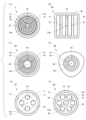
- 3 is a diagram showing the electrode arrangement of Example 1.
- FIG. (A) is a perspective view.
- (B) is a front view.
- (C) is a diagram showing the action area of the external shape reference (and the contact area of the external shape reference).
- FIG. (D) is a diagram showing the action area of the inner shape reference (and the contact area of the inner shape reference).
- (E) is a diagram showing an effective area.
- 3 is a diagram showing the electrode arrangement of Example 2.
- FIG. (A) is a perspective view.
- (B) is a front view.
- (C) is a diagram showing the action area of the outer shape reference (and the contact area of the outer shape reference).
- (D) is a diagram showing the action area of the inner shape reference (and the contact area of the inner shape reference).
- (E) is a diagram showing an effective area.
- 3 is a diagram showing the electrode arrangement of Comparative Example 1.
- FIG. (A) is a perspective view.
- (B) is a front view.
- FIG. (C) is a diagram showing the action area of the outer shape reference (and the contact area of the outer shape reference).
- (D) is a diagram showing the action area of the inner shape reference (and the contact area of the inner shape reference).
- (E) is a diagram showing an effective area.
- 3 is a diagram showing the electrode arrangement of Comparative Example 2.
- FIG. (A) is a perspective view.
- (B) is a front view.
- (C) is a diagram showing the action area of the outer shape reference (and the contact area of the outer shape reference).
- (D) is a diagram showing the action area of the inner shape reference (and the contact area of the inner shape reference).
- (E) is a diagram showing an effective area.
- 3 is a diagram showing the electrode arrangement of Comparative Example 3.
- FIG. (A) is a perspective view.
- FIG. 4 is a diagram showing the electrode arrangement of Comparative Example 4.
- A) is a perspective view.
- B) is a front view.
- C) is a diagram showing the action area of the outer shape reference (and the contact area of the outer shape reference).
- D) is a diagram showing the action area of the inner shape reference (and the contact area of the inner shape reference).
- E is a diagram showing an effective area corresponding to the contact area based on the external shape.
- FIG. 4 is a diagram showing the electrode arrangement of Comparative Example 4.
- A) is a perspective view.
- B) is a front view.
- C) is a diagram showing the action area of the outer shape reference (and the contact area of the outer shape reference).
- D) is a diagram showing the action area of the inner shape reference (and the contact area of the inner shape reference).
- FIG. 3 is a diagram showing the temperature distribution in plan view of the agar pseudo-skin for planar observation in Test 1.
- 13 is a histogram showing the frequency distribution for each temperature of the temperature distribution in FIG. 12 (Example 1, Example 2, and Comparative Example 1).
- 13 is a histogram showing the frequency distribution for each temperature of the temperature distribution in FIG. 12 (Comparative Examples 2 to 4).
- FIG. 13 is a diagram showing a temperature-based action area (outline) of the temperature distribution in FIG. 12; It is a figure which shows the example of the action area half division of each Example and each comparative example.
- FIG. 7 is a diagram showing the temperature distribution in a side view of the agar pseudo-skin for side observation in Test 2.
- FIG. 6 is a diagram showing the time course of temperature distribution on the surface of human skin in Test 3.
- FIG. 7 is a diagram showing the time course of the maximum temperature on the surface of human skin in Test 3.
- FIG. 7 is a diagram showing the temperature distribution in plan view of the agar pseudo-skin for planar observation in Test 4.
- FIG. 7 is a diagram showing the temperature distribution in a side view of the agar pseudo-skin for side observation in Test 5.
- FIG. 6 is a diagram showing the time course of temperature distribution on the surface of human skin in Test 6.
- FIG. 7 is an explanatory diagram showing an electrode arrangement according to a modified example.
- FIG. 7 is an explanatory diagram showing an electrode arrangement according to a modified example.
- FIG. 7 is an explanatory diagram showing an electrode arrangement according to another modification.
- FIG. 7 is an explanatory diagram (part 1) showing an electrode arrangement according to still another modification.
- FIG. 7 is an explanatory diagram (part 2) showing an electrode arrangement according to still another modification.
- FIG. 7 is an explanatory diagram (part 3) showing an electrode arrangement according to still another modification.
- FIG. 1 is a perspective view showing the appearance of the skin treatment device 1 of this embodiment
- FIG. 2 is an explanatory diagram of the head portion 3 of the skin treatment device 1, and is a front view showing the electrode arrangement.
- the skin treatment device 1 of this embodiment is in the form of a facial beauty device, and is configured to impart beauty-related effects to the skin of the user's face.
- the skin treatment device 1 may be configured to apply similar beauty-related effects to areas other than the user's face in addition to or instead of the user's face.
- the skin treatment device 1 may be used to provide effects different from beauty-related effects (for example, an effect of promoting transdermal absorption of pharmaceuticals).
- the beauty-related effect is optional and may include eliminating sagging, tightening, fat burning, lifting, making the face smaller, improving skin firmness, luster, and moisture, or any combination of one or more of the above. Moreover, the beauty-related effect may be an effect that can be quantified or may be an effect that cannot be quantified.
- the skin treatment device 1 of this embodiment is configured to impart beauty-related effects to the user's skin by applying various outputs via a plurality of electrodes that come into contact with the user's skin.
- the skin treatment device 1 of this embodiment is a portable type that can be held by the user's hand, but it may also be applied to a movable type that is movably supported by a fixed device via an arm or the like.
- the skin treatment device 1 includes a grip section 2 and a head section 3.
- the user holds the grip part 2 and applies the head part 3 to a desired part of his or her own face or the face of another person (for example, a patient), thereby applying the skin treatment device to the desired part.
- Various outputs can be given.
- the grip part 2 has a shape that is easily gripped by the user's hand.
- the grip 2 may include a user interface 20 that includes various buttons such as a power on/off button, a strength adjustment button, and the like. Note that the various buttons may be mechanical buttons or touch switches.
- the grip section 2 may be provided with a display section (not shown) that displays the status of the skin treatment device 1 and the like.
- the grip part 2 may be provided with an electrode (not shown) that touches the user's hand.
- the head part 3 is provided at the end of the grip part 2.
- the head part 3 may be fixed to the grip part 2, may be removable, or may be movable with respect to the grip part 2.
- the head portion 3 is capable of coming into contact with the user's skin, and has a form suitable for coming into contact with the user's skin.
- the head portion 3 may have a substantially planar contact surface 3a (including a curved surface with a relatively large radius of curvature).
- the contact surface 3a is a plane that can be approximated to a substantially straight line when viewed from the side.
- the shape of the abutment surface 3a when viewed from the front is arbitrary, such as a rectangle, a circle, an ellipse, a polygon, etc., and this embodiment As an example, as shown in FIG. 2, the shape is circular.
- the head part 3 has a plurality of electrodes 30 arranged on the contact surface 3a.
- the plurality of electrodes 30 may be in a form that slightly protrudes from the basic surface of the contact surface 3a of the head portion 3 so that they can easily contact the user's skin.
- the plurality of electrodes 30 are arranged in an annular shape centered on the center C of the contact surface 3a of the head portion 3.
- the terms related to the radial direction and the circumferential direction will be used with respect to the center C of the abutting surface 3a when the abutting surface 3a is viewed from the front (when viewed in a direction perpendicular to the abutting surface 3a).
- the radially inner side refers to the side closer to the center C of the contact surface 3a in the radial direction.
- the number of the plurality of electrodes 30 and the unit of one electrode are assumed to be one continuous form.
- the plurality of electrodes 30 include a first electrode 31 , a second electrode 32 , a third electrode 33 , a fourth electrode 34 , and a fifth electrode 35 .
- the first electrode 31, the second electrode 32, and the third electrode 33 are electrodes for applying a high-frequency output waveform having a warming effect (or a heating effect; the same applies hereinafter) to the user's skin, as described later. (hereinafter also referred to as "electrode group for high-frequency output waveform").
- the first electrode 31 may have a circular shape.
- the first electrode 31 may be arranged such that its center coincides with the center C.
- the second electrode 32 and the third electrode 33 may each have an annular shape.
- the second electrode 32 and the third electrode 33 may be arranged concentrically with respect to the center C.
- the second electrode 32 and the third electrode 33 each have a circular ring shape that is continuous in the circumferential direction, but have a circular ring shape that is locally divided in the circumferential direction (for example, It may be U-shaped.
- the second electrode 32 is arranged on the radial outer side of the first electrode 31, and the third electrode 33 is arranged on the radial outer side of the second electrode 32.
- the first electrode 31, the second electrode 32, and the third electrode 33 are arranged relative to the center C in order from the inside in the radial direction. They may be arranged concentrically.
- the difference between the distance d1 between the first electrode 31 and the second electrode 32 in the radial direction and the distance d2 between the third electrode 33 and the second electrode 32 in the radial direction is preferably the distance d1 less than 10% of In this embodiment, as a preferable example, the distance d1 between the first electrode 31 and the second electrode 32 in the radial direction is equal to the distance d2 between the third electrode 33 and the second electrode 32 in the radial direction ( In other words, the difference between distance d1 and distance d2 is 0).
- the distance d1 corresponds to the difference between the outer diameter of the first electrode 31 with the center C as a reference and the inner diameter of the second electrode 32 with the center C as a reference.
- the distance d2 corresponds to the difference between the outer diameter of the second electrode 32 with the center C as a reference and the inner diameter of the third electrode 33 with the center C as a reference.
- the fourth electrode 34 and the fifth electrode 35 are a pair of electrodes (hereinafter also referred to as "electrode group for low frequency output waveform") for applying a low frequency output waveform having a muscle electrical stimulation effect to the user's skin. ) to form.
- the fourth electrode 34 and the fifth electrode 35 may each have an annular shape.
- the fourth electrode 34 and the fifth electrode 35 may be arranged concentrically with respect to the center C.
- the fourth electrode 34 and the fifth electrode 35 each have a circular ring shape that is continuous in the circumferential direction, but they may have a circular ring shape that is locally divided in the circumferential direction. You can.
- the fourth electrode 34 is arranged radially outside the first electrode 31 and radially inside the second electrode 32. That is, the fourth electrode 34 is arranged between the first electrode 31 and the second electrode 32 in the radial direction.
- the fifth electrode 35 is arranged radially outside the second electrode 32 and inside the third electrode 33 in the radial direction. That is, the fifth electrode 35 is arranged between the second electrode 32 and the third electrode 33 in the radial direction.
- the distance d3 between the fourth electrode 34 and the fifth electrode 35 in the radial direction may be the same as the distance d1 and the distance d2 described above, or may be different from the distance d1 and the distance d2 described above. may be significantly different. Note that the distance d3 corresponds to the difference between the outer diameter of the fourth electrode 34 with the center C as a reference and the inner diameter of the fifth electrode 35 with the center C as a reference.
- FIG. 3 is a schematic configuration diagram of the control system 100 according to an example.
- FIG. 4 is a conceptual illustration of two types of output waveforms that act on the skin at different depths.
- FIG. 3 also shows the first to fifth electrodes 31 to 35 on the output side and the user interface 20 on the input side.
- FIG. 4 schematically shows a cross section of the head portion 3 as well as a cross section of the skin that contacts the head portion 3. Further, FIG. 4 schematically shows output waveforms (a low range RF waveform W1 and a high range RF waveform W2 to be described later) applied to the skin from the first electrode 31, the second electrode 32, and the third electrode 33. .
- the control system 100 includes a control device 110, a high frequency output generation section 112, and a low frequency output generation section 114.
- Control device 110 may be formed by a computer such as a microcomputer.
- the high frequency output generation section 112 and the low frequency output generation section 114 may be formed by an electric circuit (as an electric circuit section) electrically connected to a power source (not shown).
- the power source may be a power source built into the skin treatment device 1, or may be an external power source.
- the control device 110 generates various output waveforms via the first electrode 31 to the fifth electrode 35 by controlling the high frequency output generation section 112 and the low frequency output generation section 114 based on user input from the user interface 20. generate.
- the user interface 20 may include a user interface such as the various buttons described above.
- the user interface 20 may include an input device capable of gesture input and/or voice input as another user interface.
- the user interface 20 may include a user interface on a user terminal (eg, a smartphone).
- the control device 110 may acquire the user input via communication based on, for example, Bluetooth (registered trademark) or the like with the user terminal.
- the user can operate the skin treatment device 1 via the user terminal.
- the high frequency output generation section 112 is electrically connected to the first electrode 31, the second electrode 32, and the third electrode 33. Under the control of the control device 110, the high-frequency output generation unit 112 generates a high-frequency output waveform that has a warming effect and is applied to the user's skin via the first electrode 31, the second electrode 32, and the third electrode 33. An output waveform (hereinafter also simply referred to as a "high frequency output waveform") that can be applied is generated.
- the high frequency output generation unit 112 preferably generates the high frequency output waveform using the first electrode 31 and the second electrode 32 as a first pair, and the second electrode 32 and the third electrode 33 as a second pair. , generates a high frequency output waveform. That is, the high-frequency output generation unit 112 preferably uses two pairs that share the second electrode 32 and simultaneously generates high-frequency output waveforms via the respective pairs. In this case, the high frequency output waveform is formed in such a manner that the phase at each of the first electrode 31 and the third electrode 33 is inverted with respect to the phase at the second electrode 32. That is, the polarity of the high frequency output waveform at the second electrode 32 is opposite to the polarity at each of the first electrode 31 and the third electrode 33. As a result, it is possible to simultaneously exert a warming effect on a relatively wide range of the user's skin, corresponding to the relatively wide range in which the first electrode 31, second electrode 32, and third electrode 33 are arranged. .
- the distance d1 between the first electrode 31 and the second electrode 32 in the radial direction is the distance d2 between the third electrode 33 and the second electrode 32 in the radial direction. equal. Due to the symmetry of the distances from the second electrode 32 to the first electrode 31 and the third electrode 33, it is possible to uniformly apply a warming effect to a relatively wide range of the user's skin. can.
- the frequency of the high-frequency output waveform generated by the high-frequency output generation section 112 is not limited to a specific value. Note that in the case of a high-frequency output waveform in a frequency band higher than 20 kHz, the depth of the skin to which the warming effect is effectively applied tends to vary depending on the difference in frequency. Specifically, as schematically shown in waveform W1 (also referred to as "low range RF waveform W1". RF: Radio Frequency) in FIG. (for example, the dermis) tends to have a warming effect. On the other hand, as schematically shown in waveform W2 (also referred to as "high range RF waveform W2”) in FIG. There is a tendency for a warming effect to occur.
- the frequency of the high-frequency output waveform generated by the high-frequency output generation section 112 may be set, for example, between 100 kHz and 1.5 MHz. In this case, a warming effect can be effectively exerted on a relatively deep region of the skin (for example, the dermis).
- the frequency of the high-frequency output waveform generated by the high-frequency output generation section 112 may be set between 600 kHz and 5.0 MHz. In this case, a warming effect can be effectively exerted on a relatively shallow region of the skin (for example, the epidermis).
- the low frequency output generation section 114 is electrically connected to the fourth electrode 34 and the fifth electrode 35.
- the low-frequency output generation unit 114 generates a low-frequency output waveform having a muscle electrical stimulation effect that can be applied to the user's skin via the fourth electrode 34 and the fifth electrode 35 under the control of the control device 110.
- output waveform (hereinafter also simply referred to as "low frequency output waveform W3").
- the frequency of the low frequency output waveform (ie, low frequency output waveform W3) generated by the low frequency output generation section 114 is not limited to a specific value.
- the frequency of the low frequency output waveform (ie, low frequency output waveform W3) generated by the low frequency output generation section 114 is set lower than 20 kHz, for example.
- FIG. 5 shows high-frequency output waveforms applied to the skin from the first electrode 31, second electrode 32, and third electrode 33, as well as a low-frequency output waveform W3 applied to the skin from the fourth electrode 34 and the fifth electrode 35. is shown schematically. Similar to FIG. 4 described above, FIG. 5 schematically shows a cross section of the head portion 3 as well as a cross section of the skin that contacts the head portion 3. As schematically shown in FIG. 5, in addition to the heating effect described above with reference to FIG. can be affected.
- the fourth electrode 34 is arranged between the first electrode 31 and the second electrode 32, and the fifth electrode 35 is arranged between the second electrode 32 and the third electrode 33.
- the range of muscle electrical stimulation by the low-frequency output waveform W3 via the fourth electrode 34 and the fifth electrode 35 is changed by the high-frequency output waveform via the first electrode 31, the second electrode 32, and the third electrode 33. It is included within the range where the warming effect reaches the skin. Thereby, the muscle electrical stimulation effect and the warming effect can be more effectively exerted on the skin.
- the fifth electrode 35 may be arranged radially outward from the third electrode 33.
- the fourth electrode 34 may be arranged between the second electrode 32 and the third electrode 33.
- additional electrodes (not shown) forming an electrode group for low frequency output waveforms may be arranged radially outward from the third electrode 33.
- the skin treatment device 1 includes a plurality of electrodes (30) disposed in an action area that can come into contact with the user's skin, and a skin treatment device 1 that is connected to the inside of the skin via the plurality of electrodes (30).
- It includes an electric circuit section (112, 114) that generates a predetermined output waveform (for example, a low range RF waveform W1, a high range RF waveform W2; the same applies hereinafter) capable of imparting a heating effect, and the action area is a central portion;
- a predetermined output waveform for example, a low range RF waveform W1, a high range RF waveform W2; the same applies hereinafter
- the action area is a central portion
- the distribution of the values of a predetermined parameter related to the heating effect which includes a peripheral part surrounding the central part, is characterized in that the difference between the central part and the peripheral part is equal to or less than a predetermined ratio.
- the above predetermined ratio is preferably about 40%, more preferably about 35%, even more preferably about 30%, even more preferably about 25%, and even more preferably 20%. It is more preferably about 15%, and most preferably about 10%.
- the action area is, for example, an area where a plurality of electrodes are arranged when viewed from the front, and an area inside the outline of the outer electrode among the plurality of electrodes when viewed from the front, or an area inside the outer shape of the electrode located outside of the plurality of electrodes when viewed from the front. It may also be an area inside a section connecting the outlines.
- the action area in this case is particularly referred to as the "outline-based action area.”
- the action area is the area inside the internal shape of the electrode located on the outside of a plurality of electrodes in front view, the area inside the area connecting the internal shapes of the electrodes located on the outside, or the area on the outside. It may be a region inside a section connecting the center-side ends of the located electrodes (that is, the ends of the center-of-gravity position side in a front view of the range in which a plurality of electrodes are arranged).
- the action area in this case is particularly referred to as the "internal shape-based action area.”
- the action area may be an area surrounded by connecting the outer edges of a portion where the temperature distribution in front view is equal to or higher than a predetermined temperature with respect to the area where a heating effect is applied by a plurality of electrodes.
- the action area in this case is particularly referred to as a "temperature-based action area.”
- the predetermined temperature regarding the temperature distribution when defining the action area may be set to any temperature in the range of about 26° C. to 32° C., for example.
- the center of the action area is, for example, the area inside the outer or inner shape of the electrode that is paired with the electrode closest to the center of the action area (center of gravity in front view), or the center of the action area (center of gravity in front view).
- the inner region of the section connecting the outer or inner shape of the electrode that is paired with the electrode closest to The center of the electrode may be the inner region of the section connecting the range where the electrodes are arranged (the end on the center of gravity side when viewed from the front), or the center of the electrode closest to the center of the action area (the center of gravity when viewed from the front).
- the periphery of the action area is a range surrounding the center of the action area, and may be, for example, an area excluding the center of the action area.
- An example of the value of the predetermined parameter related to the above-mentioned heating effect is the temperature of the object to be heated when the action area is brought into contact with the object to be heated and a predetermined output waveform is generated.
- the temperature as the value of the predetermined parameter may be, for example, the temperature value for each pixel of an image obtained by capturing a planar heat distribution/temperature distribution by a heating effect with a thermo camera, or the temperature value for each pixel.
- the temperature may be an average value for the center of the action area and an average value for the periphery of the action area.
- Examples of the above-mentioned predetermined object to be heated include agar, human skin (that is, human skin; the same applies hereinafter), and other objects to be heated when measuring the characteristics of the warming effect of the skin treatment device 1.
- agar is agar for cell/bacterial culture media whose salinity is adjusted to a salinity close to that of humans.
- the salt concentration close to that of humans is, for example, 0.235%.
- the temperature at the center of the action area may be higher than or equal to the temperature at the periphery of the action area.
- the above-mentioned predetermined parameters related to the warming effect include the first parameter related to the surface temperature of the skin (e.g., temperature in the epidermis and dermis), and the first parameter related to the inner layer of the skin (e.g., temperature in the 2nd to 5th stratum corneum). At least one of the second parameters related to temperature may be included.
- the skin treatment device 1 includes a plurality of electrodes (30) arranged in an action area that can come into contact with the user's skin, and It is characterized in that it includes an electric circuit section (112, 114) that generates a predetermined output waveform capable of applying a heating effect to the inside, and that the standard deviation of the temperature distribution in the action area is less than or equal to a predetermined value.
- Examples of the standard deviation of the temperature distribution mentioned above include the standard deviation of the temperature for each pixel of an image obtained by capturing a planar heat distribution/temperature distribution due to a heating effect using a thermo camera.
- the above predetermined value is preferably about 12°C, more preferably about 10°C, more preferably about 8°C, even more preferably about 6°C, still more preferably about 4°C.
- the temperature is most preferably about 2°C.
- the skin treatment device 1 includes a plurality of electrodes (30) disposed in an action area that can come into contact with the user's skin, and It includes an electric circuit section (112, 114) that generates a predetermined output waveform capable of imparting a heating effect to the interior thereof, and provides a warming effect to a predetermined object to be heated, thereby increasing the temperature of the object to be heated.
- the ratio of the portion having a predetermined second temperature or higher is equal to or higher than a predetermined ratio.
- Examples of the above-mentioned predetermined object to be heated include agar, human skin, and other objects that can be heated when measuring the characteristics of the warming action of the skin treatment device 1.
- a specific example of agar is agar for cell/bacterial culture media whose salinity is adjusted to a salinity close to that of humans.
- the salt concentration close to that of humans is, for example, 0.235%.
- the above-mentioned predetermined first temperature may be, for example, any temperature in the range of about 32°C to 40°C, and specifically, for example, 34°C, 36°C, or 38°C. It is conceivable that it is one of the following.
- the above-mentioned predetermined second temperature may be, for example, any temperature in the range of about 29°C to 37°C, and specifically, for example, 31°C, 33°C, or 35°C. It is conceivable that it is one of the following. Note that the predetermined second temperature may be lower than the predetermined first temperature, for example, about 3 degrees lower than the predetermined first temperature.
- the above predetermined ratio is preferably about 20%, more preferably about 30%, still more preferably about 40%, and most preferably about 50%.
- the skin treatment device 1 includes a plurality of electrodes (30) disposed in a contact area that can come into contact with the user's skin, and a plurality of electrodes (30) that It includes an electric circuit section (112, 114) that generates a predetermined output waveform capable of imparting a warming effect to the inside of the skin, and the area of the effective area related to the warming effect that occupies the contact area is equal to or larger than the entire contact area. It is characterized in that it is at least a predetermined ratio.
- the contact area is, for example, a range where a plurality of electrodes are arranged when viewed from the front, and is an area inside the outer shape of the outer electrode among the plurality of electrodes when viewed from the front, or an electrode located outside. It may also be an area inside a section that connects the outlines of .
- the contact area in this case is particularly referred to as the "contact area based on external shape.” That is, the contact area of the outer shape reference is the same as the action area of the outer shape reference.
- the contact area is the area inside the internal shape of the electrode located on the outside of a plurality of electrodes in front view, the area inside the section connecting the internal shapes of the electrodes located on the outside, or the outside area. It may be a region inside a section connecting the ends of the electrodes located on the center side (that is, the ends on the center of gravity side in a front view of the range in which the plurality of electrodes are arranged).
- the contact area in this case is particularly referred to as the "internal shape-based contact area.” That is, the contact area of the inner shape reference is the same as the action area of the inner shape reference.
- the effective area may be, for example, a portion of the contact area excluding the surface portions (in other words, exposed portions) of each of the plurality of electrodes.
- the effective region may be a region defined as a portion between each of a pair of electrodes that can output a predetermined output waveform among a plurality of electrodes. Therefore, the area of the effective area is the area obtained by subtracting the total area of multiple electrodes from the area of the entire contact area, or the area between each pair of electrodes by subtracting the total area of multiple electrodes. Alternatively, the area may be calculated by subtracting the area of the area that is not in use (in other words, the area that is not an energized area).
- the effective area may be an area surrounded by connecting the outer edges of the portion of the contact area where the temperature distribution in front view is equal to or higher than a predetermined temperature.
- the predetermined temperature regarding the temperature distribution when defining the effective area may be set, for example, to any temperature in the range of about 26°C to 32°C. Therefore, the area of the effective area may be the area of the area of the contact area where the temperature distribution in front view is equal to or higher than a predetermined temperature.
- the above predetermined ratio is preferably about 45%, more preferably about 50%, even more preferably about 55%, and most preferably about 60%. Note that the above predetermined ratio is less than 100%.
- the skin treatment device 1 includes three or more annular electrodes arranged concentrically, and provides a warming effect to the inside of the skin via these three or more electrodes. and an electric circuit section that generates a possible predetermined output waveform, and regarding the value of the predetermined parameter related to the heating effect, the value in the center region corresponding to the centermost electrode among the three or more electrodes is the center It is characterized by being greater than or equal to the value in the area outside the area.
- An example of the value of the predetermined parameter related to the above-mentioned heating effect is the temperature of the object to be heated when the action area is brought into contact with the object to be heated and a predetermined output waveform is generated.
- the temperature as the value of the predetermined parameter may be, for example, the temperature value for each pixel of an image obtained by capturing a planar heat distribution/temperature distribution by a heating effect with a thermo camera, or the temperature value for each pixel. Examples include an average value of temperature related to the center region and an average value related to the region outside the center region, or a maximum value of temperature for each pixel related to the center region and a maximum value related to the region outside the center region.
- Examples of the above-mentioned predetermined object to be heated include agar, human skin, and other objects that can be heated when measuring the characteristics of the warming action of the skin treatment device 1.
- a specific example of agar is agar for cell/bacterial culture media whose salinity is adjusted to a salinity close to that of humans.
- the salt concentration close to that of humans is, for example, 0.235%.
- the central area is, for example, an area that is centered on the center of the central area of the active area (the position of the center of gravity in front view) and has an area that is about half of the entire central area of the active area, or an area that is the area of the entire central area of the active area.
- the area may be about one third of the area.
- the area outside the central area is, for example, the outer edge part of the above-mentioned periphery of the action area, which has an area of about half of the entire periphery of the action area, or about one-third of the entire periphery of the action area. It may also be the outer edge part of the area.
- the skin treatment device 1 includes a plurality of electrodes (30) arranged in an action area that can come into contact with the user's skin, and It includes an electric circuit section (112, 114) that generates a predetermined output waveform capable of imparting a heating effect to the interior thereof, and imparts a warming effect to a predetermined object to be heated, thereby increasing the temperature of the object to be heated.
- the ratio of the portion whose temperature is equal to or higher than a predetermined difference from the maximum temperature is equal to or higher than a predetermined ratio.
- Examples of the above-mentioned predetermined object to be heated include agar, human skin, and other objects that can be heated when measuring the characteristics of the warming action of the skin treatment device 1.
- a specific example of agar is agar for cell/bacterial culture media whose salinity is adjusted to a salinity close to that of humans.
- the salt concentration close to that of humans is, for example, 0.235%.
- the above-mentioned predetermined temperature may be, for example, any temperature in the range of about 32°C to 40°C, and specifically, for example, any one of 34°C, 36°C, and 38°C. It is possible that
- the above-mentioned predetermined difference may be, for example, a difference from the maximum temperature within a range of about 5% to 20% of the maximum temperature, and specifically, for example, a difference of 5% from the maximum temperature. , a difference of 10%, a difference of 15%, or a difference of 20%.
- the above predetermined ratio is preferably about 15%, more preferably about 20%, even more preferably about 25%, even more preferably about 30%, and even more preferably 35%. more preferably about 40%, more preferably about 45%, more preferably about 50%, more preferably about 55%, more preferably 60%. more preferably about 65%, more preferably about 70%, more preferably about 75%, more preferably about 80%, more preferably 85%. It is about 90%, more preferably about 90%, and most preferably about 95%.
- the action area may be the above-mentioned “action area based on external shape” or may be the “action area based on internal shape.”
- the temperature in the half-section of the action area is, for example, the temperature value for each pixel corresponding to the half-section of the action area in an image obtained by capturing a planar heat distribution/temperature distribution due to the heating effect by a thermo camera. Alternatively, it may be the average value of the temperature for each pixel corresponding to the half section of the active area.
- the skin treatment device 1 includes a plurality of electrodes (30) arranged in an action area that can come into contact with the user's skin, and It includes an electric circuit section (112, 114) that generates a predetermined output waveform capable of imparting a heating effect to the interior thereof, and imparts a warming effect to a predetermined object to be heated, thereby increasing the temperature of the object to be heated. It is characterized in that when the maximum temperature reaches a predetermined first temperature, the ratio of the portion of the action area that is at a predetermined second temperature or higher is equal to or higher than a predetermined ratio.
- Examples of the above-mentioned predetermined object to be heated include agar, human skin, and other objects that can be heated when measuring the characteristics of the warming action of the skin treatment device 1.
- a specific example of agar is agar for cell/bacterial culture media whose salinity is adjusted to a salinity close to that of humans.
- the salt concentration close to that of humans is, for example, 0.235%.
- the above-mentioned predetermined first temperature may be, for example, any temperature in the range of about 32°C to 40°C, and specifically, for example, 34°C, 36°C, or 38°C. It is conceivable that it is one of the following.
- the above-mentioned predetermined second temperature may be, for example, any temperature in the range of about 29°C to 37°C, and specifically, for example, 31°C, 33°C, or 35°C. It is conceivable that it is one of the following. Note that the predetermined second temperature may be lower than the predetermined first temperature, for example, about 3 degrees lower than the predetermined first temperature.
- the above predetermined ratio is preferably about 30%, more preferably about 35%, even more preferably about 40%, even more preferably about 45%, and even more preferably 50%. It is more preferably about 55%, and most preferably about 60%.
- FIGS. 6 to 11 do not strictly represent the mutual size relationships of the dimensions of each component (particularly the electrodes and the spaces between the electrodes).
- the heating effect was determined by the electrode devices (Example 1 and Example 2) having characteristics equivalent to the skin treatment device according to the present invention, and by the electrode devices not having characteristics equivalent to the skin treatment device according to the present invention.
- the heating effects of the electrode devices were compared.
- Example 1 is an electrode device (head part 3) having the same electrode 30 as the skin treatment device 1 of the above-described embodiment (see FIG. 6).
- the shaded area corresponds to the inner area of the outer shape of the third electrode 33, which is the outer electrode among the plurality of electrodes when viewed from the front.
- the part (reference numeral 90) is the action area of the outer shape reference and the contact area of the outer shape reference, and as shown in FIG.
- the shaded area (91) corresponding to the area inside the inner shape of the electrode 33 is the action area of the inner shape reference and the contact area of the inner shape reference.
- the part (numeral 92) is the effective area. Furthermore, as shown in FIG. 6(F), the inner shape of the second electrode 32, which is the electrode that is paired with the first electrode 31, which is the electrode closest to the center of the action area (center of gravity position in front view). The portion (numeral 93) is an example of the central portion of the action area.
- the ratio of the effective area to the contact area based on the external shape (the area of the effective area is calculated by subtracting the total area of the plurality of electrodes from the area of the entire contact area based on the external shape) area) is 64.0%.
- the area of the effective area is calculated by subtracting the total area of a plurality of electrodes from the area of the entire contact area based on the external shape, and calculating the area not between each pair of electrodes (in other words, The ratio of the effective area is also 64.0% when the area is calculated by subtracting the area of the area (and the area that is not an energized area).
- the electrode device 40 of Example 2 has a first electrode 41, a second electrode 42, a third electrode 43, and a fourth electrode 44, each of which is linear and parallel to each other when viewed from the front (FIG. 7(A), ( See B).
- the hanging part (reference numeral 91) is the action area of the inner shape reference and the contact area of the inner shape reference.
- the three shaded areas (represented by reference numeral 92) shown in FIG. 7(E) are effective areas. Furthermore, as shown in FIG.
- a second electrode 42 which is a region inside a section connecting the inner shape of the electrode that is paired with the electrode closest to the center of the action area (center of gravity position in front view),
- the part between the third electrode 43 (reference numeral 93) is an example of the central part of the action area.
- the ratio of the effective area to the contact area based on the external shape (the area of the effective area is calculated by subtracting the total area of a plurality of electrodes from the area of the entire contact area based on the external shape) area) is 31.0%.
- the area of the effective area is calculated by subtracting the total area of a plurality of electrodes from the area of the entire contact area based on the external shape, and calculating the area that is not between each pair of electrodes (in other words, The ratio of the effective area is also 31.0% when the area is calculated by subtracting the area of the area (and the area that is not an energized area).
- the outline of the electrode device as a comparative example is as follows. ⁇ Comparative Example 1> Circular + Annular Triple Ring
- the electrode device 50 of Comparative Example 1 includes a first electrode 51 that is circular in front view, and a second electrode 52 that is annular and arranged outward concentrically with the first electrode 51. , a third electrode 53 and a fourth electrode 54 (see FIGS. 8(A) and 8(B)).
- the hanging part (reference numeral 91) is the action area of the inner shape reference and the contact area of the inner shape reference.
- the two shaded areas (reference numeral 92) shown in FIG. 8(E) are effective areas.
- the inner shape of the third electrode 53 which is the electrode that is paired with the second electrode 52, which is the electrode closest to the center of the action area (center of gravity position in front view).
- the portion (numeral 93) is an example of the central portion of the action area.
- the ratio of the effective area to the contact area based on the external shape (the area of the effective area is calculated by subtracting the total area of multiple electrodes from the area of the entire contact area based on the external shape) area) is 52.7%.
- the area of the effective area is calculated by subtracting the total area of a plurality of electrodes from the area of the entire contact area and by subtracting the total area of the plurality of electrodes from the area of the entire contact area, and calculating the area that is not between each pair of electrodes (in other words, If the area is calculated by subtracting the area of the area that is not a current-carrying area (specifically, the inner part of the second electrode 52), the ratio of the effective area to the contact area based on the external shape is 23.7. %.
- the electrode device 60 of Comparative Example 2 has an annular first electrode 61 and a second electrode 62 that are arranged concentrically with each other in a front view (FIG. 9(A) , (see (B)).
- the shaded area (symbol 90) shown in FIG. 9(C) is the action area of the external shape reference as well as the contact area of the external shape standard
- the hanging part (reference numeral 91) is the action area of the inner shape reference and the contact area of the inner shape reference.
- the two shaded areas (reference numeral 92) shown in FIG. 9(E) are effective areas. Furthermore, as shown in FIG.
- the inner shape of the second electrode 62 which is the electrode that is paired with the first electrode 61, which is the electrode closest to the center of the action area (center of gravity position in front view).
- the portion (numeral 93) is an example of the central portion of the action area.
- the ratio of the effective area to the contact area based on the external shape (the area of the effective area is calculated by subtracting the total area of multiple electrodes from the area of the entire contact area based on the external shape) area) is 41.8%.
- the area of the effective area is calculated by subtracting the total area of a plurality of electrodes from the area of the entire contact area and by subtracting the area of the effective area from the area of the entire contact area and the area that is not between each pair of electrodes (in other words, If the area is calculated by subtracting the area of the part that is not an electrically conductive area (specifically, the inner part of the first electrode 61), the ratio of the effective area to the contact area based on the external shape is 29.1. %.
- the electrode device 70 of Comparative Example 3 has a short cylindrical shape in side view and a round shape in front view, and has a first electrode 71 and a second electrode arranged at each corner position of a square. It has an electrode 72, a third electrode 73, and a fourth electrode 74 (see FIGS. 10(A) and 10(B)).
- the shaded area represented by reference numeral 90
- the hanging part is the action area of the inner shape reference and the contact area of the inner shape reference.
- the example of the action area/contact area based on the internal shape is represented as a rectangle, but the action area/contact area based on the internal shape is the first electrode 71, the second electrode 72, The third electrode 73 and the fourth electrode 74 may each have a circular shape in contact with their center-side ends.
- the shaded area (reference numeral 92) shown in FIG. 10(E) is the effective area corresponding to the contact area based on the external shape. Furthermore, as shown in FIG.
- the ends of the center side of each of the first electrode 71, second electrode 72, third electrode 73, and fourth electrode 74 i.e., the area where the plurality of electrodes are arranged
- the inner part (reference numeral 93) of the section connecting the ends (ends on the center of gravity side in front view) is an example of the central part of the action area. Note that in FIG. 10(F), the central part of the action area is represented as a rectangle, but the central part of the action area is the first electrode 71, the second electrode 72, the third electrode 73, and the fourth electrode 74, respectively. It may also be a circular shape that touches the center end of the .
- the ratio of the effective area to the contact area based on the external shape (the area of the effective area is calculated by subtracting the total area of multiple electrodes from the area of the entire contact area based on the external shape) area) is 58.2%.
- the area of the effective area is calculated by subtracting the total area of a plurality of electrodes from the area of the entire contact area and by subtracting the total area of the plurality of electrodes, and calculating the area not between the pair of electrodes (in other words, If you subtract the area of the area that is not a current-carrying area; specifically, the area of the shaded area (code 93) in FIG.
- the electrode device 80 of Comparative Example 4 has a hemispherical shape in side view and a round shape in front view, and has 7 points arranged at each corner position and the center (center of gravity) of a regular hexagon. It has seven electrodes from the first electrode 81 to the seventh electrode 87 (see FIGS. 11(A) and 11(B)).
- the hanging part (reference numeral 91) is the action area of the inner shape reference and the contact area of the inner shape reference.
- the example of the action area/contact area based on the internal shape is expressed as a hexagon, but the action area/contact area based on the internal shape is the third electrode 83 to the seventh electrode 87. It may also be a circular shape that touches the center side end of each. Further, the shaded area (reference numeral 92) shown in FIG. 11(E) is the effective area corresponding to the contact area based on the external shape. Further, as shown in FIG. 11(F), each of the third electrode 83 to the seventh electrode 87, which are the electrodes located outside of the plurality of electrodes in front view, is located at the center side end (i.e., the plurality of electrodes are arranged).
- the inner part (reference numeral 93) of the section connecting the end of the range on the center of gravity side in front view is an example of the central part of the action area.
- the example of the central part of the action area is shown as a hexagon in FIG. There may be.
- the ratio of the effective area to the contact area based on the external shape (the area of the effective area is calculated by subtracting the total area of a plurality of electrodes from the area of the entire contact area based on the external shape) area) is 48.3%.
- the area of the effective area is calculated by subtracting the total area of a plurality of electrodes from the area of the entire contact area and by subtracting the total area of the plurality of electrodes, and calculating the area not between the pair of electrodes (in other words, The area of the part that is not an electricity-carrying area; specifically, the part between the first electrode 81 and the second electrode 82 and the part between the second electrode 82 and the third electrode 83)
- the ratio of the effective area to the contact area based on the external shape is 40.5%.
- agar for cell/bacteria culture medium (hereinafter also referred to as "agar pseudo skin") whose salinity concentration was adjusted to 0.235%, which is close to that of humans, was used as the object to be heated. Ta.
- Agar pseudo-skin was created using 250 mL of distilled water, 15 g of agar, and 0.625 g of sodium chloride. Specifically, first, all the ingredients (distilled water, agar, and sodium chloride) were placed in a heating container, stirred until they were mixed to some degree uniformly, and then heated through the heating container. Stirring was continued while heating and boiled for a minimum of 2.5 minutes to ensure uniform mixing. It was then poured into trays and allowed to cool and solidify at room temperature.
- energizing cosmetics distributed to the surface of the agar and spread to a thin and uniform thickness. All ingredients of the energizing cosmetics are water, BG, glycerin, pentylene glycol, diglycerin, maltitol, sorbitol, polysorbate 80, carbomer, 1,2-hexanediol, pullulan, potassium hydroxide, high fructose sugar, and citric acid.
- a waveform (1 MHz, 400 mV) formed by a sine wave forming generator (Waveform Generators 33521A, manufactured by Agilent) as the high frequency output generation section 112 is connected to the power source (
- the signal was amplified 100 times using a high-speed bipolar power supply (HSA4101) manufactured by NF Circuit Design Block Co., Ltd., and was output to the agar via an electrode.
- HSA4101 high-speed bipolar power supply
- the first electrode 31 and the second electrode 32 are used as a first pair, and the second electrode 32 and third electrode 33 are used as a second pair, that is, there are two pairs of electrodes. are used to simultaneously generate high frequency output waveforms through each pair of electrodes.
- the electrode device 40 of the second embodiment a total of four pairs of electrodes are used, each of the first electrode 41 and the third electrode 43 and each of the second electrode 42 and the fourth electrode 44. A high frequency output waveform is generated simultaneously through the pair of electrodes.
- a high frequency output waveform is generated through the pair of the second electrode 52 and the third electrode 53.
- a high frequency output waveform is generated through the pair of the first electrode 61 and the second electrode 62.
- the electrode device 70 of Comparative Example 3 a total of four pairs of electrodes are used, each of the first electrode 71 and the third electrode 73 and each of the second electrode 72 and the fourth electrode 74.
- a high frequency output waveform is generated simultaneously through the pair of electrodes.
- each of the three electrodes from the first electrode 81 to the third electrode 83 and each of the four electrodes from the fourth electrode 84 to the seventh electrode 87 are paired, and the total Twelve electrode pairs are utilized to simultaneously generate high frequency output waveforms through each electrode pair.
- Example 1 The head section 3 of Example 1, the electrode device 40 of Example 2, and the electrode devices 50, 60, 70, and 80 of Comparative Examples 1 to 4 (the electrode devices of Comparative Examples 1 to 4 are collectively referred to as "Each Comparative Example”).
- a warming effect was applied to the agar pseudo-skin using the electrode device 50-80, and the temperature of the agar pseudo-skin was measured using a thermo camera (InfReC R450Pro manufactured by Nippon Avionics Co., Ltd.; frame rate was 5 frames/sec). It was done.
- Test 1 In this test, the planar heat distribution/temperature distribution of the agar pseudo skin due to the heating effect provided by the head section 3 of Example 1, the electrode device 40 of Example 2, and the electrode devices 50-80 of each comparative example was measured. Verified.
- the agar pseudo skin for planar observation is 50 mm long x 50 mm wide in plan view (corresponding to the surface view of human skin) and the thickness in side view (corresponding to the cross-sectional view in the depth direction of human skin).
- Agar molded to 3 mm was used.
- the jig is set so that the contact surface 3a of the head part 3 of Example 1, the electrode side surface of the electrode device 40 of Example 2, and the electrode side surface of the electrode devices 50-80 of each comparative example are facing upward and horizontally.
- the head part 3 of Example 1, the electrode device 40 of Example 2, and the electrode devices 50-80 of each comparative example are fixed, and the surface coated with the energizing cosmetic is applied to the contact surface 3a or the electrode.
- An agar pseudo-skin for planar observation was placed on the contact surface 3a and the electrode-side surface so as to face the side surface.
- a planar temperature distribution (specifically, a thermo image) including the action area measured by a thermo camera at the time when the maximum temperature in a plan view of the agar pseudo-skin for planar observation is 36°C or higher at least in a part. The same applies hereafter) is shown in FIG.
- the + mark in the temperature distribution is a location where the temperature is the highest, that is, a location where the temperature is 36° C. or higher.
- the temperature distribution observed in Test 1 is based on the agar pseudo skin for planar observation, the contact surface 3a of the head part 3 of Example 1 coated with energizing cosmetics, and the electrode of the electrode device 40 of Example 2. This is the temperature distribution observed from the side surface or the surface opposite to the surface that is in contact with the electrode side surface of the electrode device 50-80 of each comparative example.
- the results shown in FIG. 12 confirm that the temperature distributions of Examples 1 and 2 have smaller variations than the temperature distributions of the electrode devices 50-80 of each comparative example. That is, according to Examples 1 and 2, a uniform temperature distribution is achieved in the plane direction, so that the desired amount of heat (in other words, a sufficient amount of heat; the same applies hereinafter) can be supplied to the skin in a short time. It has been confirmed that it is possible to prevent a local temperature rise when applying heat to the inside of the skin, and it is also possible to prevent pain and burns when applying a warming effect to the inside of the skin.
- FIGS. 13 and 14 show the frequency distribution of temperature for each pixel of an image captured and acquired by a thermo camera.
- the vertical solid line in the figure indicates the position where the temperature is 33°C.
- Example 1 and Example 2 are in the high temperature range of 33°C to 36°C compared to the temperature frequency distribution of the electrode devices 50-80 of each comparative example. It is confirmed that there is a peak in frequency and that the distribution is clustered.
- the proportion of the portion of the action area based on external shape (contact area based on external shape) that is 33°C or higher. is 48.0% for Example 1, 59.1% for Example 2, 34.1% for Comparative Example 1, 26.7% for Comparative Example 2, 16.1% for Comparative Example 3, and Example 4 was 11.1%.
- Example 2 was 69.1%
- Comparative Example 1 was 50.3%
- Comparative Example 2 was 38.7%
- Comparative Example 3 was 18.6%
- Comparative Example 4 was 17.8%. there were.
- the area surrounded by connecting the outer edges of the part where the temperature distribution in front view is 30°C or more was defined as the temperature-based action area (Fig. 14A (See.
- the black dashed line in the temperature distribution is the boundary of the temperature-based action area. However, it does not strictly represent the boundary of the temperature-based action area.
- the center of the action area 90 based on the external shape (center of gravity position in front view; code Cap)
- the inner region of the section ie, the half section of the action area
- a solid white line (numeral 94) is a boundary between half sections of the action area.
- the maximum temperature in the half section of the action area is 36.03°C in Example 1, 36.12°C in Example 2, 36.10°C in Comparative Example 1, 36.28°C in Comparative Example 2, and 36°C in Comparative Example 3. .03°C, and Comparative Example 4 was 36.06°C. Therefore, the temperatures that are 10% different from the maximum temperature are 32.427°C for Example 1, 32.508°C for Example 2, 32.49°C for Comparative Example 1, and 32.652°C for Comparative Example 2. Comparative Example 3 has a temperature of 32.427°C, and Comparative Example 4 has a temperature of 32.454°C.
- the proportion of temperatures within a range of 10% difference from the maximum temperature in half of the action area is 100% in Example 1, 100% in Example 2, 19.3% in Comparative Example 1, and 19.3% in Comparative Example 2. was 44.5%, Comparative Example 3 was 47.1%, and Comparative Example 4 was 44.5%.
- the temperatures that are 5% different from the maximum temperature are 34.2285°C for Example 1, 34.314°C for Example 2, 34.295°C for Comparative Example 1, and 34.466°C for Comparative Example 2.
- Comparative Example 3 has a temperature of 34.2285°C
- Comparative Example 4 has a temperature of 34.257°C.
- the percentage of temperatures within a 5% difference from the maximum temperature in half of the action area is 70.6% in Example 1, 79.1% in Example 2, and 0.0% in Comparative Example 1.
- Comparative Example 2 was 11.0%
- Comparative Example 3 was 5.9%
- Comparative Example 4 was 15.5%.
- Test 2 In this test, the lateral heat distribution/temperature distribution of the agar pseudo skin due to the heating effect provided by the head section 3 of Example 1, the electrode device 40 of Example 2, and the electrode devices 50-80 of each comparative example was investigated. Verified.
- the agar pseudo skin for side observation is 70 mm wide x 20 mm thick in side view (corresponding to a cross-sectional view in the depth direction of human skin) and has a depth in plan view (corresponding to surface view of human skin). Agar molded to a size of 10 mm was used.
- the jig is set so that the contact surface 3a of the head part 3 of Example 1, the electrode side surface of the electrode device 40 of Example 2, and the electrode side surface of the electrode devices 50-80 of each comparative example are facing downward and horizontally.
- the energizing cosmetic of the agar pseudo skin for side observation was applied.
- the mutual positional relationship was adjusted so that the surface of the electrode was brought into contact with the contact surface 3a or the surface on the electrode side.
- the contact surface 3a of the head part 3 of Example 1, the electrode side surface of the electrode device 40 of Example 2, and the surface of each comparative example are included in the depth plane in plan view of the agar pseudo skin for side observation. Adjustments were made so that the center of the electrode side surface of the electrode device 50-80 (center of gravity position in front view) was located, and both of at least one pair of electrodes were located. Then, a current is passed through the electrodes of the head section 3 of Example 1, the electrode device 40 of Example 2, or the electrode devices 50-80 of each comparative example to give a warming effect to the agar pseudo-skin for side observation. It was done.
- FIG. 15 shows the lateral temperature distribution measured by a thermo camera at the time when the maximum temperature in a side view of the agar pseudo-skin for lateral observation reached 36° C. or higher at least in part.
- the + mark in the temperature distribution is a location where the temperature is the highest, that is, a location where the temperature is 36° C. or higher.
- the solid white rectangle in the temperature distribution is the side surface of the agar pseudo-skin for side observation.
- Example 1 and 2 have smaller variations than the temperature distributions of the electrode devices 50-80 of each comparative example. That is, according to Examples 1 and 2, a uniform temperature distribution in the depth direction is achieved, thereby preventing a local temperature rise when trying to supply a desired amount of heat to the skin in a short time. It has been confirmed that it is possible to prevent pain and burns when applying a warming effect to the inside of the skin.
- a waveform (1 MHz, 900 mV) formed by a sine wave forming generator (Waveform Generators 33521A manufactured by Agilent) as the high frequency output generation section 112 was multiplied by 100 times by a power source (high speed bipolar power supply HSA4101 manufactured by NF Circuit Design Block Co., Ltd.).
- the amplified signal was output to human skin (human skin) using an electrode. Specifically, the skin on the inside of the forearm was used as the human skin.
- energizing cosmetics distributed to the surface of human skin, and then spread to a thin and uniform thickness of about 50 mm in diameter. Note that the room temperature was 27°C, and the initial surface temperature of human skin was 34.5°C.
- the contact surface 3a of the head part 3 of Example 1, the electrode side surface of the electrode device 40 of Example 2, and the electrode side surface of the electrode devices 50-80 of each comparative example face downward by hand.
- the head part 3 of Example 1, the electrode device 40 of Example 2, and the electrode devices 50-80 of each comparative example are held, and the contact surface 3a or the electrode side surface and the surface coated with energizing cosmetics are held. adjusted to make contact.
- a current was applied to the electrodes of the head section 3 of Example 1, the electrode device 40 of Example 2, or the electrode devices 50-80 of each comparative example to give a warming effect to the human skin.
- the temperature of the surface of the human skin was measured while applying the warming effect, and the heating effect was applied until the maximum temperature of the surface of the human skin reached 42°C or higher at least in part. After the application of the warming effect was completed, the time required for the maximum temperature on the surface of human skin to drop to 35°C or less was measured.
- the electrode device 40 of Example 2 and the electrode devices 50-80 of each comparative example when the maximum temperature of the surface of human skin reaches 42 ° C. or higher at least in part, and FIG. 16 shows the planar temperature distribution measured by a thermo camera at the time when the maximum temperature on the surface of human skin dropped to 35° C. or lower.
- the + marks in the temperature distribution are locations where the temperature is highest at each time point, that is, locations where the temperature is, for example, 42° C. or higher or 35° C. or lower.
- the number (°C) above the temperature distribution is the maximum temperature of the human skin surface at that point.
- FIG. 17 shows the change in the maximum temperature of the surface of human skin over time from the time when the application of the warming effect was completed.
- Example 2 the time required for the maximum temperature on the surface of human skin to fall from 42°C or higher to 35°C or lower in Example 1 was 35 seconds, whereas in Example 2, Comparative Examples 1 and 2 It is confirmed that the time is 25 seconds, and the time in Comparative Example 3 and Comparative Example 4 is 15 seconds.
- Example 1 From the results shown in FIGS. 16 and 17, it is confirmed that the heat generated by the heating effect of Example 1 is retained on human skin for a longer time than the heat generated by the heating effect of the electrode devices 50-80 of each comparative example. be done. This is because if there is a large variation in temperature distribution, that is, if there are hot spots and cold spots coexisting, heat will be dispersed by body fluids from the hot spot to the cold spot, but if the temperature distribution is small, heat will be dispersed. One of the factors is thought to be that heat dispersion is suppressed in the range where the warming effect is applied. According to Example 1, since the variation in temperature distribution is small, the heat storage property is improved and heat remains for a long time, making it possible to maintain the skin in a high energy state for a long time.
- Test 4 the planar heat distribution/temperature distribution of the agar pseudo skin due to the heating effect provided by the head section 3 of Example 1, the electrode device 40 of Example 2, and the electrode devices 50-80 of each comparative example was measured. Verified.
- the agar pseudo skin for planar observation is 50 mm long x 50 mm wide in plan view (corresponding to the surface view of human skin) and the thickness in side view (corresponding to the cross-sectional view in the depth direction of human skin).
- Agar molded to 3 mm was used.
- the jig is set so that the contact surface 3a of the head part 3 of Example 1, the electrode side surface of the electrode device 40 of Example 2, and the electrode side surface of the electrode devices 50-80 of each comparative example are facing upward and horizontally.
- the head part 3 of Example 1, the electrode device 40 of Example 2, and the electrode devices 50-80 of each comparative example are fixed, and the surface coated with the energizing cosmetic is applied to the contact surface 3a or the electrode.
- An agar pseudo-skin for planar observation was placed on the contact surface 3a and the electrode-side surface so as to face the side surface.
- a current is passed through the electrodes of the head section 3 of Example 1, the electrode device 40 of Example 2, or the electrode devices 50-80 of each comparative example for 60 seconds on the agar pseudo-skin for planar observation. Provided with a warming effect.
- FIG. 18 shows a planar temperature distribution including the action area, measured by a thermo camera 60 seconds after the heating action was applied.
- the + mark in the temperature distribution is the location where the temperature is highest.
- the temperature distribution observed in Test 4 is based on the agar pseudo skin for planar observation, the contact surface 3a of the head part 3 of Example 1 coated with energizing cosmetics, and the electrode of the electrode device 40 of Example 2. This is the temperature distribution observed from the side surface or the surface opposite to the surface that is in contact with the electrode side surface of the electrode device 50-80 of each comparative example.
- Example 1 the maximum temperature in Example 1 was 36.66°C 60 seconds after the heating effect was applied, which was higher than the maximum temperature of the electrode devices 50-80 of each comparative example. It is confirmed that the That is, it is confirmed that according to Example 1, it is possible to efficiently supply the desired amount of heat to the skin.
- Test 5 In this test, the lateral heat distribution/temperature distribution of the agar pseudo skin due to the heating effect provided by the head section 3 of Example 1, the electrode device 40 of Example 2, and the electrode devices 50-80 of each comparative example was investigated. Verified.
- the agar pseudo skin for side observation is 70 mm wide x 20 mm thick in side view (corresponding to a cross-sectional view in the depth direction of human skin) and has a depth in plan view (corresponding to surface view of human skin). Agar molded to a size of 10 mm was used.
- the jig is set so that the contact surface 3a of the head part 3 of Example 1, the electrode side surface of the electrode device 40 of Example 2, and the electrode side surface of the electrode devices 50-80 of each comparative example are facing downward and horizontally.
- the energizing cosmetic of the agar pseudo skin for side observation was applied.
- the mutual positional relationship was adjusted so that the surface of the electrode was brought into contact with the contact surface 3a or the surface on the electrode side.
- the contact surface 3a of the head part 3 of Example 1, the electrode side surface of the electrode device 40 of Example 2, and the surface of each comparative example are included in the depth plane in plan view of the agar pseudo skin for side observation. Adjustments were made so that the center of the electrode side surface of the electrode device 50-80 (center of gravity position in front view) was located, and both of at least one pair of electrodes were located. Then, a current is passed through the electrodes of the head section 3 of Example 1, the electrode device 40 of Example 2, or the electrode devices 50-80 of each comparative example for 60 seconds on the agar pseudo-skin for side observation. Provided with a warming effect.
- Figure 19 shows the lateral temperature distribution measured by a thermo camera 60 seconds after the heating action was applied.
- the + mark in the temperature distribution is the location where the temperature is highest.
- the solid white rectangle in the temperature distribution is the side surface of the agar pseudo-skin for side observation.
- Example 1 and 2 have smaller variations than the temperature distributions of the electrode devices 50-80 of each comparative example. That is, according to Examples 1 and 2, a uniform temperature distribution in the depth direction is achieved, thereby preventing a local temperature rise when trying to supply a desired amount of heat to the skin in a short time. It has been confirmed that it is possible to prevent pain and burns when applying a warming effect to the inside of the skin.
- Test 6 In this test, the head part 3 of Example 1, the electrode device 40 of Example 2, and the electrode devices 50-80 of each comparative example were moved at a predetermined speed to generate a flat surface of human skin. Heat distribution/temperature distribution was verified.
- a waveform (1 MHz, 900 mV) formed by a sine wave forming generator (Waveform Generators 33521A manufactured by Agilent) as the high frequency output generation section 112 was multiplied by 100 times by a power source (high speed bipolar power supply HSA4101 manufactured by NF Circuit Design Block Co., Ltd.).
- the amplified signal was output to human skin (human skin) using an electrode. Specifically, the skin on the inside of the forearm was used as the human skin.
- energizing cosmetics distributed to the surface of human skin, and then spread over a rectangular area of approximately 50 mm x 100 mm to a thin, uniform thickness. Note that the room temperature was 27°C, and the initial surface temperature of human skin was 34.5°C.
- the contact surface 3a of the head part 3 of Example 1, the electrode side surface of the electrode device 40 of Example 2, and the electrode side surface of the electrode devices 50-80 of each comparative example face downward by hand.
- the head part 3 of Example 1, the electrode device 40 of Example 2, and the electrode devices 50-80 of each comparative example are held, and the contact surface 3a or the electrode side surface and the surface coated with energizing cosmetics are held. adjusted to make contact.
- a current was applied to the electrodes of the head section 3 of Example 1, the electrode device 40 of Example 2, or the electrode devices 50 to 80 of each comparative example. It has a warming effect on human skin.
- the temperature of the surface of the human skin was measured while applying the warming effect, and the heating effect was applied until the maximum temperature of the surface of the human skin reached 42°C or higher at least in part. After the application of the warming effect was completed, the time required for the maximum temperature on the surface of human skin to drop to 35°C or less was measured.
- the point at which the maximum temperature of the surface of human skin reaches 42° C. or higher " This figure shows the planar temperature distribution measured by a thermo camera at the time when the maximum temperature of the human skin surface has fallen to 35°C or less (referred to as the "time at 35°C or lower"). 20.
- the + marks in the temperature distribution are locations where the temperature is highest at each time point, that is, locations where the temperature is, for example, 42° C. or higher or 35° C. or lower.
- the solid white rectangle in the temperature distribution is the range for which temperature data is to be obtained (specifically, the range roughly corresponds to the rectangular range of approximately 50 mm x 100 mm to which the energizing cosmetic is applied).
- the numerical value (%) above the temperature distribution at the time of 42°C or higher is the proportion of the portion of the temperature data acquisition target range of 39°C or higher at the time of 42°C or higher.
- the numerical value (in seconds) above the temperature distribution at 35°C or below is the time it takes for the maximum temperature on the surface of human skin to drop from 42°C or higher to 35°C or lower.
- Example 1 the ratio of the portion of the temperature data acquisition target range at 39° C. or higher at 42° C. or higher is the highest in Example 1 at 51.50%. Further, it is confirmed that the time required for the maximum temperature of the human skin surface to decrease from 42° C. or higher to 35° C. or lower is the longest in Example 1 at 79.6 seconds.
- the skin treatment device 1 it is possible to realize a heating effect with high uniformity in the plane direction and the depth direction and with high heat storage ability, and to supply a desired amount of heat to the skin in a short time. It is possible to prevent local temperature rise when applying heat to the inside of the skin, and it is possible to prevent pain and burns when applying a warming effect to the inside of the skin.
- the head section 3 has the fourth electrode 34 and the fifth electrode 35 (electrode group for low frequency output waveforms), but the head section 3 has the electrode group for low frequency output waveforms. It is also possible to have no. That is, the present invention provides a group of electrodes (in the above embodiment, the first electrode 31, the second electrode 32, and the third electrode 33; This invention focuses on the structure related to the electrode group (electrode group), and it is not an essential structure in the present invention that the head section 3 has an electrode group for low frequency output waveforms.
- first electrodes 31 to fifth electrodes 35 are used, but the number and arrangement of the electrodes can be changed in various ways.
- one or more additional annular electrodes may be arranged radially outward with respect to the third electrode 33.
- the one or more additional annular electrodes may be continuous in the circumferential direction, or may be locally divided in the circumferential direction.
- One or more additional annular electrodes may be arranged concentrically with respect to the first electrode 31, etc.
- One or more further annular electrodes may cooperate with the first electrode 31, the second electrode 32 and the third electrode 33 to form an electrode group for the high frequency output waveform described above.
- the polarity of the high frequency output waveform at the third electrode 33 is different from that at each of the second electrode 32 and the third electrode 33.
- the polarity may be reversed.
- one or more additional annular electrodes may be added radially outwardly.
- the fifth electrode 35 may be arranged radially outward from the outermost electrode of the one or more additional annular electrodes. In this case, the radial separation distance in the electrode group for low frequency output waveforms can be efficiently increased.
- the fifth electrode 35 may be arranged radially inward than the outermost electrode of the one or more further annular electrodes.
- each electrode forms an electrode group for low frequency output waveforms and an electrode group for high frequency output waveforms, similarly to the above embodiment.
- Each electrode may be arranged radially alternatingly.
- some of the electrodes forming the electrode group for the low-frequency output waveform may also form the electrode group for the high-frequency output waveform in other modes, or may form the electrode group for the high-frequency output waveform in other modes. etc. may be generated.
- some of the electrodes that form the electrode group for high-frequency output waveforms may form electrode groups for low-frequency output waveforms, or may generate other DC waveforms. good.
- the first electrode 31 to the fifth electrode 35 have an annular shape, but they may have other shapes such as an ellipse or a polygon, or a combination of various shapes. It may be.
- the first electrode 31 to the fifth electrode 35 may be realized as a first electrode 31A to a fifth electrode 35A arranged in a linear strip shape parallel to each other.
- FIG. 21 (and also FIG. 22, which will be described later) schematically shows the electrode configuration when viewed in a direction perpendicular to the contact surface 3a of the head portion 3.
- FIG. 21 (and also FIG. 22, which will be described later) schematically shows the electrode configuration when viewed in a direction perpendicular to the contact surface 3a of the head portion 3.
- FIG. 21 schematically shows the electrode configuration when viewed in a direction perpendicular to the contact surface 3a of the head portion 3.
- the first electrode 31, the second electrode 32, and the third electrode 33 forming the electrode group for high-frequency output waveforms are arranged in parallel to each other in a linear band shape. It may be realized as two electrodes 32B and a third electrode 33B. In the example shown in FIG. 22, the second electrode 32B and the third electrode 33B are arranged on both sides of the first electrode 31B (on both sides in the direction perpendicular to the longitudinal direction of the first electrode 31B). . Also in this case, one or more electrodes forming the electrode group for low frequency output waveforms, such as the fourth electrode 34 and the fifth electrode 35, are the first electrode 31B, the second electrode 32B, and the third electrode 33B. It may also be placed between the two. Also, in the case of the modification shown in FIG.
- some of the electrodes forming the electrode group for high-frequency output waveforms form the electrode group for low-frequency output waveforms in other modes. Alternatively, other DC waveforms or the like may be generated. Also, in other modes, some of the electrodes that form the electrode group for low-frequency output waveforms may form electrode groups for high-frequency output waveforms, or may generate other DC waveforms. good.
- the electrode 30A is formed from seven electrodes 30A-1 to 30A-7 and an outer electrode 39.
- Each of the seven electrodes 30A-1 to 30A-7 has a hexagonal shape, as shown by the hatched area in FIG.
- the seven electrodes 30A-1 to 30A-7 are arranged in such a manner that the hexagon of the six peripheral electrodes 30A-2 to 30A-7 is located around the hexagon of one center electrode 30A-1. be done.
- the seven hexagons are arranged in such a way that the six sides of the central hexagon are parallel to the corresponding sides of the six surrounding hexagons and are spaced by the same distance. .
- each of the seven electrodes 30A-1 to 30A-7 has the same form.
- the seven electrodes 30A-1 to 30A-7 may be different in size, etc. from the other electrodes. Further, instead of the seven electrodes 30A-1 to 30A-7, a larger number (for example, 16) of hexagonal electrodes may be used, and the number is arbitrary.
- the outer electrode 39 is formed offset outward by a certain distance from the electrode 30A-1 to the electrode 30A-7.
- the outer electrode 39 is continuous around the electrodes 30A-1 to 30A-7, but may be discontinuous. In the example shown in FIGS. 23 to 23B, as shown in FIGS. 23A and 23B, the area of the effective area related to the heating effect in the contact area (hatched area R23 in FIG. 23B) (the total area of the hatched area in FIG.
- each of the seven electrodes 30A-1 to 30A-7 has a hexagonal shape, but is not limited to a hexagonal shape, and may be circular, triangular, or other shapes other than hexagonal. It may also be configured in a rectangular shape. In this case, uniform temperature distribution can be achieved by configuring the area of the effective area related to the heating effect in the contact area to be 55% or more of the entire contact area. Thereby, it is possible to heat the skin while preventing a local temperature rise when trying to supply a desired amount of heat (in other words, a sufficient amount of heat) to the skin in a short time.
Landscapes
- Health & Medical Sciences (AREA)
- Engineering & Computer Science (AREA)
- Biomedical Technology (AREA)
- Nuclear Medicine, Radiotherapy & Molecular Imaging (AREA)
- Radiology & Medical Imaging (AREA)
- Life Sciences & Earth Sciences (AREA)
- Animal Behavior & Ethology (AREA)
- General Health & Medical Sciences (AREA)
- Public Health (AREA)
- Veterinary Medicine (AREA)
- Electrotherapy Devices (AREA)
- Radiation-Therapy Devices (AREA)
Priority Applications (2)
| Application Number | Priority Date | Filing Date | Title |
|---|---|---|---|
| CN202380011132.1A CN117677423A (zh) | 2022-07-08 | 2023-07-06 | 肌肤处理装置 |
| JP2023541841A JPWO2024010068A1 (https=) | 2022-07-08 | 2023-07-06 |
Applications Claiming Priority (4)
| Application Number | Priority Date | Filing Date | Title |
|---|---|---|---|
| JP2022-110621 | 2022-07-08 | ||
| JP2022110621 | 2022-07-08 | ||
| JP2022119647 | 2022-07-27 | ||
| JP2022-119647 | 2022-07-27 |
Publications (1)
| Publication Number | Publication Date |
|---|---|
| WO2024010068A1 true WO2024010068A1 (ja) | 2024-01-11 |
Family
ID=89453622
Family Applications (1)
| Application Number | Title | Priority Date | Filing Date |
|---|---|---|---|
| PCT/JP2023/025158 Ceased WO2024010068A1 (ja) | 2022-07-08 | 2023-07-06 | 肌処理装置 |
Country Status (2)
| Country | Link |
|---|---|
| JP (1) | JPWO2024010068A1 (https=) |
| WO (1) | WO2024010068A1 (https=) |
Citations (4)
| Publication number | Priority date | Publication date | Assignee | Title |
|---|---|---|---|---|
| JP2009544399A (ja) * | 2006-07-27 | 2009-12-17 | ポルロジェン リミテッド | 皮膚組織の非侵襲的治療のための装置及び方法 |
| US20140207217A1 (en) * | 2006-01-17 | 2014-07-24 | Endymed Medical Ltd. | Skin treatment devices and methods |
| WO2014196195A1 (ja) * | 2013-06-04 | 2014-12-11 | ヤーマン株式会社 | 高周波美容処理装置 |
| WO2021167109A1 (ja) * | 2020-04-27 | 2021-08-26 | ヤーマン株式会社 | 美容機器および電流制御方法 |
-
2023
- 2023-07-06 JP JP2023541841A patent/JPWO2024010068A1/ja active Pending
- 2023-07-06 WO PCT/JP2023/025158 patent/WO2024010068A1/ja not_active Ceased
Patent Citations (4)
| Publication number | Priority date | Publication date | Assignee | Title |
|---|---|---|---|---|
| US20140207217A1 (en) * | 2006-01-17 | 2014-07-24 | Endymed Medical Ltd. | Skin treatment devices and methods |
| JP2009544399A (ja) * | 2006-07-27 | 2009-12-17 | ポルロジェン リミテッド | 皮膚組織の非侵襲的治療のための装置及び方法 |
| WO2014196195A1 (ja) * | 2013-06-04 | 2014-12-11 | ヤーマン株式会社 | 高周波美容処理装置 |
| WO2021167109A1 (ja) * | 2020-04-27 | 2021-08-26 | ヤーマン株式会社 | 美容機器および電流制御方法 |
Also Published As
| Publication number | Publication date |
|---|---|
| JPWO2024010068A1 (https=) | 2024-01-11 |
Similar Documents
| Publication | Publication Date | Title |
|---|---|---|
| US11602629B2 (en) | Systems and methods for treatment of a patient including rf and electrical energy | |
| US20230031914A1 (en) | Device including rf source of energy and vacuum system | |
| US20220218987A1 (en) | Device and method for unattended treatment of a patient | |
| Weiss | Noninvasive radio frequency for skin tightening and body contouring | |
| CA2853291C (en) | Methods and systems for subcutaneous treatments | |
| KR101158009B1 (ko) | 고주파 치료장치 | |
| Levenberg | Clinical experience with a TriPollar™ radiofrequency system for facial and body aesthetic treatments | |
| EP4426414B1 (en) | Device for unattended treatment of the patient | |
| US20240024691A1 (en) | Device and method for unattended treatment of a patient | |
| KR20190114906A (ko) | 미용에 사용하는 복합 전극패드를 이용한 미용기기와 그 방법 | |
| CN109200463A (zh) | 一种感应微电流膜布及其制备方法和应用 | |
| Duncan et al. | A prospective study analyzing the application of radiofrequency energy and high-voltage, ultrashort pulse duration electrical fields on the quantitative reduction of adipose tissue | |
| Wu et al. | Microneedling radiofrequency enhances poly-L-lactic acid penetration that effectively improves facial skin laxity without lipolysis | |
| JP2025023877A (ja) | 肌処理装置、肌処理装置を作動させる作動方法、肌処理方法、プログラム | |
| JP7511292B1 (ja) | 美容器および美容システム | |
| US20240091547A1 (en) | Device and method for unattended treatment of a patient | |
| WO2024010068A1 (ja) | 肌処理装置 | |
| US20230191111A1 (en) | Device and method for unattended treatment of a patient | |
| JP2025104210A (ja) | 肌処理装置、肌処理方法及び出力制御プログラム | |
| Tanaka | Objective assessment of skin tightening using multisource, phase-controlled radiofrequency in Asians | |
| CN117677423A (zh) | 肌肤处理装置 | |
| CN206454116U (zh) | 适于面部美容的双极射频治疗头和射频美容装置 | |
| CN213758525U (zh) | 八极大功率射频手柄 | |
| WO2023078896A1 (en) | Device and method for unattended treatment of the patient | |
| CN223716199U (zh) | 肌肤处理装置以及控制装置 |
Legal Events
| Date | Code | Title | Description |
|---|---|---|---|
| WWE | Wipo information: entry into national phase |
Ref document number: 2023541841 Country of ref document: JP |
|
| WWE | Wipo information: entry into national phase |
Ref document number: 202380011132.1 Country of ref document: CN |
|
| 121 | Ep: the epo has been informed by wipo that ep was designated in this application |
Ref document number: 23835599 Country of ref document: EP Kind code of ref document: A1 |
|
| NENP | Non-entry into the national phase |
Ref country code: DE |
|
| 122 | Ep: pct application non-entry in european phase |
Ref document number: 23835599 Country of ref document: EP Kind code of ref document: A1 |