WO2024004158A1 - 無人航空機 - Google Patents
無人航空機 Download PDFInfo
- Publication number
- WO2024004158A1 WO2024004158A1 PCT/JP2022/026338 JP2022026338W WO2024004158A1 WO 2024004158 A1 WO2024004158 A1 WO 2024004158A1 JP 2022026338 W JP2022026338 W JP 2022026338W WO 2024004158 A1 WO2024004158 A1 WO 2024004158A1
- Authority
- WO
- WIPO (PCT)
- Prior art keywords
- unmanned aircraft
- wing body
- wing
- plan
- rotor
- Prior art date
- Legal status (The legal status is an assumption and is not a legal conclusion. Google has not performed a legal analysis and makes no representation as to the accuracy of the status listed.)
- Ceased
Links
Images




Classifications
-
- B—PERFORMING OPERATIONS; TRANSPORTING
- B64—AIRCRAFT; AVIATION; COSMONAUTICS
- B64U—UNMANNED AERIAL VEHICLES [UAV]; EQUIPMENT THEREFOR
- B64U10/00—Type of UAV
- B64U10/10—Rotorcrafts
- B64U10/13—Flying platforms
- B64U10/16—Flying platforms with five or more distinct rotor axes, e.g. octocopters
-
- B—PERFORMING OPERATIONS; TRANSPORTING
- B64—AIRCRAFT; AVIATION; COSMONAUTICS
- B64C—AEROPLANES; HELICOPTERS
- B64C27/00—Rotorcraft; Rotors peculiar thereto
- B64C27/04—Helicopters
- B64C27/08—Helicopters with two or more rotors
-
- B—PERFORMING OPERATIONS; TRANSPORTING
- B64—AIRCRAFT; AVIATION; COSMONAUTICS
- B64C—AEROPLANES; HELICOPTERS
- B64C27/00—Rotorcraft; Rotors peculiar thereto
- B64C27/22—Compound rotorcraft, i.e. aircraft using in flight the features of both aeroplane and rotorcraft
- B64C27/26—Compound rotorcraft, i.e. aircraft using in flight the features of both aeroplane and rotorcraft characterised by provision of fixed wings
-
- B—PERFORMING OPERATIONS; TRANSPORTING
- B64—AIRCRAFT; AVIATION; COSMONAUTICS
- B64C—AEROPLANES; HELICOPTERS
- B64C39/00—Aircraft not otherwise provided for
- B64C39/02—Aircraft not otherwise provided for characterised by special use
-
- B—PERFORMING OPERATIONS; TRANSPORTING
- B64—AIRCRAFT; AVIATION; COSMONAUTICS
- B64U—UNMANNED AERIAL VEHICLES [UAV]; EQUIPMENT THEREFOR
- B64U10/00—Type of UAV
- B64U10/25—Fixed-wing aircraft
-
- B—PERFORMING OPERATIONS; TRANSPORTING
- B64—AIRCRAFT; AVIATION; COSMONAUTICS
- B64U—UNMANNED AERIAL VEHICLES [UAV]; EQUIPMENT THEREFOR
- B64U10/00—Type of UAV
- B64U10/50—Glider-type UAVs, e.g. with parachute, parasail or kite
-
- B—PERFORMING OPERATIONS; TRANSPORTING
- B64—AIRCRAFT; AVIATION; COSMONAUTICS
- B64U—UNMANNED AERIAL VEHICLES [UAV]; EQUIPMENT THEREFOR
- B64U50/00—Propulsion; Power supply
- B64U50/10—Propulsion
- B64U50/13—Propulsion using external fans or propellers
-
- B—PERFORMING OPERATIONS; TRANSPORTING
- B64—AIRCRAFT; AVIATION; COSMONAUTICS
- B64U—UNMANNED AERIAL VEHICLES [UAV]; EQUIPMENT THEREFOR
- B64U50/00—Propulsion; Power supply
- B64U50/10—Propulsion
- B64U50/19—Propulsion using electrically powered motors
Definitions
- the present invention relates to an unmanned aircraft.
- An unmanned aerial vehicle so-called a drone, has a body that houses electronic components, etc., a plurality of arms extending radially from the body in a plan view, and a rotating shaft attached to the tip of the arm so as to extend vertically.
- Multicopter-type unmanned aircraft having multiple propellers are known.
- a multicopter-type unmanned aircraft performs horizontal movement by controlling the rotation speed of multiple propellers. When a multicopter-type unmanned aircraft moves horizontally at high speed, the propeller output must be increased because the aircraft body experiences air resistance.
- Patent Document 1 discloses an unmanned aircraft that includes horizontal wings and a plurality of propellers whose rotating shafts are attached to extend in the vertical direction.
- a VTOL type unmanned aircraft which has horizontal wings, a propeller with a rotating shaft extending in the vertical direction, and a propeller with a rotating shaft extending in the front-back direction. According to such an unmanned aircraft having horizontal wings, it is possible to generate lift using aerodynamic force, so that the output of the propeller can be reduced.
- the present invention was made in view of the above problems, and aims to provide an unmanned aircraft that has a wing body and is compact as a whole.
- One aspect of the present invention is an unmanned aircraft, which includes an unmanned aircraft main body and a plurality of rotary wings having a rotation axis extending in the vertical direction, and the unmanned aircraft can fly horizontally by controlling the rotation of the plurality of rotary wings.
- a wing body is provided above the unmanned aircraft main body and is arranged so as to overlap at least a portion of the rotation area of the plurality of rotors in a plan view. , which provides unmanned aerial vehicles.
- the total area where the blade body overlaps the rotation areas of the plurality of rotors is 50% or less of the area of the blade body.
- the blade body is located inside the rotation area of all the rotor blades in the width direction and longitudinal direction.
- the plurality of rotors include a rear rotor blade provided at the rear of the unmanned aircraft, and the wing body has a shape that does not overlap the rotating region of the rear rotor blade in plan view.
- the wing body is held above the unmanned aircraft body by a plurality of rods.
- the wing body is provided so that the direction connecting the leading edge and the trailing edge is inclined upward toward the front.
- the distance along the contour of the upper surface from the leading edge to the trailing edge is longer than the distance along the contour of the lower surface from the leading edge to the trailing edge. It is configured to be.
- FIG. 1 is a top perspective view showing a multicopter that is an example of an unmanned aircraft according to an embodiment of the present invention.
- 1 is a front view showing a multicopter that is an example of an unmanned aircraft according to an embodiment of the present invention.
- 1 is a side view showing a multicopter, which is an example of an unmanned aircraft according to an embodiment of the present invention.
- 1 is a plan view showing a multicopter, which is an example of an unmanned aircraft according to an embodiment of the present invention.
- FIG. 3 is a side view including the AA cross section in FIG. 2 showing a multicopter that is an example of an unmanned aircraft according to an embodiment of the present invention.
- FIG. 2 is a plan view showing a rotation area of a propeller in a circle in an unmanned aircraft according to an embodiment of the present invention.
- 2 is a diagram showing a hardware configuration for flight control of the unmanned aircraft shown in FIG. 1.
- FIG. The control command value and horizontal speed at each time in the comparative example are shown, with the upper graph showing the control command value and the lower graph showing the horizontal speed.
- the control command value and horizontal speed at each time in the example are shown, with the upper graph showing the control command value and the lower graph showing the horizontal speed.
- the system configuration of an unmanned aircraft is not limited to what is shown in the figure, but can be any configuration as long as it can perform similar operations.
- operations performed by multiple components may be performed by a single component, such as integrating the functions of a communication circuit into the flight control section, or distributing the functions of the main processing section to multiple processing sections.
- operations performed by a single component may be performed by multiple components.
- FIG. 1 to 6 show a multicopter that is an example of an unmanned aircraft according to an embodiment of the present invention.
- 1 is a top perspective view
- FIG. 2 is a front view
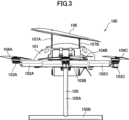
- FIG. 3 is a side view
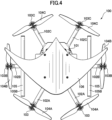
- FIG. 4 is a plan view
- FIG. 5 is a side view including the AA cross section in FIG. 2.
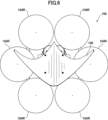
- FIG. 6 is a plan view showing the rotation area of the propeller as a circle.
- the unmanned aircraft 100 of this embodiment does not have a propeller with a horizontal rotation axis like a so-called VTOL, but controls the rotation of a plurality of rotors 104A, 104B, and 104C each having a rotation axis extending in the vertical direction. This is how we move forward.
- the arms 102A, 102B, and 102C include a pair of front arms 102A that extend forward from the unmanned aircraft main body 101 so as to spread left and right, respectively, and a pair of front arms 102A that extend from the unmanned aircraft main body 101 to the left and right, respectively. It includes a central arm 102B and a pair of rear arms 102C that extend rearward from the unmanned aircraft main body 101 so as to spread left and right, respectively.
- Each leg portion 105 has a hanging portion 105A extending laterally from the unmanned aircraft main body 101, and a grounding portion 105B attached perpendicularly to the hanging portion 105A.
- the pair of grounding parts 105B extend in parallel, and when the grounding parts 105B touch the ground on a horizontal surface, the unmanned aircraft 100 can land so that the arms 102A, 102B, and 102C become horizontal.
- the wing body 106 is supported above the unmanned aircraft main body 101 by a pair of front support rods 107A and a pair of rear support rods 107B that extend upward from the unmanned aircraft main body 101.
- the pair of front support rods 107A and the pair of rear support rods 107B are each made of a metal rod.
- the lateral spacing between the pair of front support rods 107A and the lateral spacing between the pair of rear support rods 107B are equal, and the pair of front support rods 107A and the pair of rear support rods 107B are aligned in the front-rear direction, respectively. ing.
- the front support rod 107A and the rear support rod 107B are each attached to the unmanned aircraft body 101 so as to extend in the vertical direction when the unmanned aircraft 100 is on the ground. Further, the upper ends of the front support rod 107A and the rear support rod 107B are screwed to the wing body 106. The length of the front support rod 107A is longer than that of the rear support rod 107B, so that the wing body 106 is tilted in the direction connecting the leading edge and the trailing edge so that the leading edge side is located upward. It is supported by the unmanned aircraft main body 101.
- the wing body 106 is provided on the unmanned aircraft main body 101 so that the inclination angle of the direction connecting the leading edge and the trailing edge with respect to the horizontal direction can be changed.
- the front support rod 107A may be lengthened and/or the rear support rod 107B may be shortened.
- the front support rod 107A may be shortened and/or the rear support rod 107B may be lengthened.
- the mechanism for changing the inclination angle is not limited to such a mechanism, and for example, a mechanism for changing the angle of the wing body using a link mechanism or the like may be adopted.
- a link mechanism it is also possible to change the inclination angle of the wing body 106 during flight by operating the link mechanism with an actuator. Note that the inclination angle of the wing body 106 may be changed depending on the speed during forward movement.
- the wing body 106 is made of a material that has a predetermined rigidity and is lightweight, such as resin or carbon fiber.
- the wing body 106 is formed in a symmetrical shape when viewed from the front.
- the wing body 106 has an upwardly convex curved shape such that the center is the highest point and extends diagonally downward toward both sides.
- the side ends of the wing body 106 extend above the tip of the central arm 102B, and terminate inside the rotation areas 104R of the rotors 104A, 104B, and 104C attached to the central arm 102B. That is, the wing body 106 is located inside the rotational region 104R of all the rotors 104A, 104B, and 104C in the width direction.
- the vertical cross-sectional shape of the blade body 106 in the front-rear direction has a so-called airfoil shape. That is, the vertical cross-sectional shape of the wing body 106 is such that the trailing edge is more pointed than the leading edge, and the bulge on the upper surface is larger than the bulge on the lower surface. In other words, the distance along the contour from the leading edge to the trailing edge on the upper surface of the wing body 106 is longer than the distance along the contour from the leading edge to the trailing edge on the lower surface of the wing body 106.
- the wing body 106 has a leading edge in a curved shape in a cross section in the longitudinal direction, and an upper surface and a lower surface have a streamlined shape.
- the front end of the center of the wing body 106 is located above near the front end of the unmanned aircraft body 101, and the rear end of the center of the wing body 106 is located above near the rear end of the unmanned aircraft main body 101 (the wing body 106 extends slightly further back than the rear end of the unmanned aircraft main body 101).
- the central front end of the wing body 106 is located further back than the tip of the front arm 102A, and the rear end of the wing body 106 is located more forward than the tip of the rear arm 102C. That is, the wing body 106 is located inside the rotational region 104R of all the rotors 104A, 104B, and 104C in the longitudinal direction.
- the leading edge of the wing body 106 has a curved shape (V-shaped shape) with the center protruding forward. Further, the trailing edge of the wing body 106 has a curved shape such that both left and right sides are respectively protruded toward the front. The central rear end and both side ends of the wing body 106 extend rearward.
- the wing body 106 is arranged so as to partially overlap the rotational region 104R of the rotors 104A, 104B, and 104C in a plan view.
- the wing body 106 overlaps, in plan view, a part of the rotation area of the rotor 104B attached to the front arm 102A and the center arm 102B.
- the trailing edge of the wing body 106 is symmetrically concave in an arc shape, the rotation area of the wing body 106 and the rotor 104C attached to the rear arm 102C is They don't overlap.
- the total area (horizontal projected area) where the rotation area 104R of the rotor 104B attached to the central arm 102B and the wing body 106 overlap is equal to It is larger than the sum of the area (horizontal projected area) where the rotation area 104R of the rotor 104C attached to the rear arm 102C overlaps with the wing body 106, and the area where the rotation area 104R of the rotor 104C attached to the rear arm 102C overlaps with the blade body 106.
- the total horizontal projected area of the overlapping region of the rotation areas of the rotors 104A, 104B, and 104C and the blade body 106 is preferably 50% or less of the horizontal projected area of the blade body 106.
- FIG. 7 is a diagram showing a hardware configuration for flight control of the unmanned aircraft shown in FIG. 1.
- the flight control system 200 of the unmanned aircraft 100 includes a control unit 201, motors 103A, 103B, 103C electrically connected to the control unit 201, and rotors 104A, 104B, 104C mechanically connected to the motors 103A, 103B, 103C. , a positioning device 221 , an altitude sensor 222 , a compass 223 , and an IMU 224 electrically connected to the control unit 201 .
- the control unit 201 is configured to process information for flight control of the unmanned aircraft 100 and control electrical signals for that purpose, and typically arranges and wires various electronic components on a board. This is a unit that includes the circuits necessary to realize such functions.
- the control unit 201 further includes an information processing unit 230, a communication circuit 231, a control signal generation section 232, a speed controller 233, and an interface 234.
- the information processing unit 230 includes a CPU 230a, a RAM 230b, a ROM 230c, and an external memory 230d.
- the RAM 230b, ROM 230c, external memory 230d, communication circuit 231, control signal generator 232, and interface 234 are connected to the CPU 230a via a system bus 230h.
- the positioning device 221 is a navigation sensor that senses the coordinates of the flight position of the unmanned aircraft 100, such as a GPS (Global Positioning System) sensor. Positioning device 221 preferably senses three-dimensional coordinates. Note that the coordinates acquired by the positioning device 221 include latitude, longitude, and altitude.
- GPS Global Positioning System
- the altitude sensor 222 includes, for example, a barometer, and estimates the altitude of the unmanned aircraft based on the atmospheric pressure.
- the compass 223 is a so-called compass and detects the angle in front of the unmanned aircraft 100 with respect to north.
- the IMU 224 is an inertial measurement unit that detects translational motion using an acceleration sensor and rotational motion using an angular velocity sensor (gyro). Further, the IMU 224 can calculate the speed by integrating the translational movement (acceleration) detected by the acceleration sensor, and can further calculate the moving distance (position) by integrating the speed. Similarly, the angle (posture) can be calculated by integrating the rotational movement (angular velocity) detected by the angular velocity sensor.
- the communication circuit 231 is connected to, for example, an antenna.
- the antenna receives radio signals including information and various data for operating and controlling the unmanned aircraft 100, and transmits radio signals including telemetry signals from the unmanned aircraft 100.
- the communication circuit 231 demodulates maneuver signals, control signals, various data, etc. for the unmanned aircraft 100 from radio signals received through the antenna, and inputs the demodulated signals to the information processing unit 230 and telemetry signals output from the unmanned aircraft 100. It is an electronic circuit for generating a wireless signal that conveys a signal, etc., and is typically a wireless signal processing IC. Note that, for example, communication of maneuver signals and communication of control signals and various data may be performed by different communication circuits in different frequency bands. For example, it communicates with the transmitter of a controller (propo) for manual operation using a frequency of 950 MHz band, and communicates data using a frequency of 2 GHz band/1.7 GHz band/1.5 GHz band/800 MHz band. It is also possible to adopt a similar configuration.
- the control signal generation unit 232 is configured to convert control command value data obtained by calculation by the information processing unit 230 into a pulse signal (PWM signal, etc.) representing voltage, and typically includes an oscillation circuit and a switching circuit. It is an IC that includes.
- the speed controller 233 is configured to convert a pulse signal from the control signal generation section 232 into a drive voltage for driving the motors 103A, 103B, and 103C, and is typically a smoothing circuit and an analog amplifier.
- the unmanned aircraft 100 includes a power supply system including a battery device such as a lithium polymer battery or a lithium ion battery, and a power distribution system for each element.
- the interface 234 electrically connects the information processing unit 230 and functional elements such as the positioning device 221, the altitude sensor 222, and the compass 223 by converting the format of the signals so that signals can be sent and received between them. It is the composition. Note that for convenience of explanation, the interface is shown as one configuration in the drawings, but different interfaces are usually used depending on the type of functional element to be connected. Furthermore, the interface 234 may not be necessary depending on the type of signal input/output by the functional element to be connected. Further, in FIG. 7, even if the information processing unit 230 is connected without an interface 234, an interface may be required depending on the type of signal input/output by the functional element to be connected.
- the information processing unit 230 stores flight plan route data, and based on this, the drive of the motors 103A, 103B, and 103C is controlled so that the unmanned aircraft 100 flies along a predetermined flight route. .
- the flight plan route data is data representing the flight plan route of the unmanned aircraft 100, and is typically data of a series of a plurality of waypoints existing on the flight plan route.
- the flight plan route is typically a set of straight lines connecting the plurality of waypoints in order, but it can also be a curved line with a predetermined curvature within a predetermined range of waypoints.
- the flight plan route data may include data defining flight speeds at multiple waypoints.
- Flight plan path data is typically used to define a flight plan path in autonomous flight, but can also be used for flight guidance in non-autonomous flight. Flight plan route data is typically entered and stored in unmanned aircraft 100 prior to flight.
- the control signal generation unit 232 converts the control command value into a pulse signal representing voltage and transmits it to each speed controller 233.
- Each speed controller 233 converts the pulse signal into a drive voltage and applies it to each motor 103A, 103B, 103C, thereby controlling the drive of each motor 103A, 103B, 103C to drive each rotor 104A, 104B, 104C.
- the flight of the unmanned aircraft 100 is controlled by controlling the rotation speed of the unmanned aircraft 100.
- the lift force generated by the rotors 104A, 104B, and 104C is directed forward and upward, and the unmanned aircraft 100 moves forward.
- the direction connecting the leading edge and the trailing edge of the wing body 106 becomes approximately horizontal.
- the attachment angle of the wing body 106 is adjusted so that the direction connecting the leading edge and the trailing edge of the wing body 106 is approximately horizontal when flying at a speed of 10 m/s or more.
- the average rotational speed (average output) of the rotors 104A, 104B, and 104C during forward movement is increased compared to when an aircraft not equipped with the wing body 106 flies at the same speed. becomes smaller.
- the blade body 106 is arranged so as to overlap at least a portion of the rotation region 104R of the plurality of rotors 104A, 104B, and 104C in plan view.
- the area where the wing body 106 overlaps can be suppressed, and stable flight can be achieved even when moving forward at high speed.
- the wing body 106 is held above the unmanned aircraft main body 101 by a plurality of pairs of front support rods 107A and a pair of rear support rods 107B.
- the horizontal wing is connected to the fuselage in a cantilevered manner. Therefore, it is necessary to firmly connect the horizontal wing and the fuselage so that the horizontal wing will not be damaged even if a large air resistance force acts on the horizontal wing.
- the wing body 106 since the wing body 106 is held above the unmanned aircraft main body 101, the wing body 106 is supported by a simple configuration of a pair of front support rods 107A and a pair of rear support rods 107B. This eliminates the need for a strong connection structure, making it possible to reduce the weight of the aircraft.
- FIG. 8 shows control command values for the front, center, and rear motors at each time in the comparative example.
- the vertical axis represents the average value of the control command values for the front, center, and rear motors for the left and right motors
- the horizontal axis represents time (seconds). In the graph of the comparative example, it hovers between 0 and 2 seconds, accelerates after 2 seconds, and flies at a constant horizontal speed of 10 m/s.
- the average value of the output of each motor 103A, 103B, and 103C when flying at a horizontal speed of 10 m/s is approximately 58%, and the output of the rear motor 103C is smaller than that of the intermediate motor 103B.
- the output of the front motor 103A is very small compared to the output of the intermediate motor 103B.
- the average value of the output of each motor 103A, 103B, and 103C when flying at a horizontal speed of 10 m/s is about 52%, compared to the comparative example without the wing body 106. small. Also, regarding the variation in the output of each motor 103A, 103B, and 103C when flying at a horizontal speed of 10 m/s, the output of the rear motor 103C and the front motor 103A in the example is smaller than that in the comparative example. ing.
Landscapes
- Engineering & Computer Science (AREA)
- Aviation & Aerospace Engineering (AREA)
- Mechanical Engineering (AREA)
- Remote Sensing (AREA)
- Chemical & Material Sciences (AREA)
- Combustion & Propulsion (AREA)
- Toys (AREA)
Priority Applications (3)
| Application Number | Priority Date | Filing Date | Title |
|---|---|---|---|
| JP2024530221A JPWO2024004158A1 (https=) | 2022-06-30 | 2022-06-30 | |
| PCT/JP2022/026338 WO2024004158A1 (ja) | 2022-06-30 | 2022-06-30 | 無人航空機 |
| US18/879,585 US20250388346A1 (en) | 2022-06-30 | 2022-06-30 | Unmanned Aircraft |
Applications Claiming Priority (1)
| Application Number | Priority Date | Filing Date | Title |
|---|---|---|---|
| PCT/JP2022/026338 WO2024004158A1 (ja) | 2022-06-30 | 2022-06-30 | 無人航空機 |
Publications (1)
| Publication Number | Publication Date |
|---|---|
| WO2024004158A1 true WO2024004158A1 (ja) | 2024-01-04 |
Family
ID=89382518
Family Applications (1)
| Application Number | Title | Priority Date | Filing Date |
|---|---|---|---|
| PCT/JP2022/026338 Ceased WO2024004158A1 (ja) | 2022-06-30 | 2022-06-30 | 無人航空機 |
Country Status (3)
| Country | Link |
|---|---|
| US (1) | US20250388346A1 (https=) |
| JP (1) | JPWO2024004158A1 (https=) |
| WO (1) | WO2024004158A1 (https=) |
Citations (4)
| Publication number | Priority date | Publication date | Assignee | Title |
|---|---|---|---|---|
| CN107089320A (zh) * | 2017-04-26 | 2017-08-25 | 浙江点辰航空科技有限公司 | 一种自适应翼桨一体化无人机 |
| JP2017532256A (ja) * | 2014-11-11 | 2017-11-02 | アマゾン テクノロジーズ インコーポレイテッド | 長期飛行のための無人航空機構成 |
| US20190127056A1 (en) * | 2017-10-27 | 2019-05-02 | Elroy Air, Inc. | Compound multi-copter aircraft |
| JP2021037935A (ja) * | 2019-08-28 | 2021-03-11 | 株式会社デンソー | 電動垂直離着陸機および電動垂直離着陸機の制御装置 |
Family Cites Families (16)
| Publication number | Priority date | Publication date | Assignee | Title |
|---|---|---|---|---|
| US9868524B2 (en) * | 2014-11-11 | 2018-01-16 | Amazon Technologies, Inc. | Unmanned aerial vehicle configuration for extended flight |
| US9889930B2 (en) * | 2014-11-24 | 2018-02-13 | Amazon Technologies, Inc. | Unmanned aerial vehicle protective frame configuration |
| US9623969B2 (en) * | 2015-01-17 | 2017-04-18 | Brian Dale Nelson | Multicopter with detachable wing |
| WO2017096478A1 (en) * | 2015-12-11 | 2017-06-15 | Coriolis Games Corporation | Hybrid multicopter and fixed wing aerial vehicle |
| IT201700022745A1 (it) * | 2017-03-01 | 2018-09-01 | Rps Aerospace S R L | Aeromobile provvisto di gruppo secondario di volo. |
| JP7046923B2 (ja) * | 2017-04-11 | 2022-04-04 | 日本化薬株式会社 | 飛行体および飛行体の制御方法 |
| JP7086083B2 (ja) * | 2017-08-24 | 2022-06-17 | 日本化薬株式会社 | 飛行体用安全装置および飛行体 |
| CN111263723B (zh) * | 2017-08-30 | 2023-05-23 | 日本化药株式会社 | 飞行体 |
| KR102683337B1 (ko) * | 2017-10-02 | 2024-07-08 | 캘리포니아 인스티튜트 오브 테크놀로지 | 자율 비행 앰뷸런스 |
| EP3858737A4 (en) * | 2018-09-28 | 2022-06-08 | Nipponkayaku Kabushikikaisha | MISSILE EQUIPPED WITH A DEPLOYABLE BODY |
| US11198506B2 (en) * | 2019-08-06 | 2021-12-14 | Copeland Wallace-Morrison | Aircraft with versatile aviation |
| CN119099858A (zh) * | 2019-08-28 | 2024-12-10 | 株式会社电装 | 电动航空器及电动航空器的控制装置 |
| US11427313B2 (en) * | 2019-10-15 | 2022-08-30 | Helmuth G. Bachmann | Universally attachable hinged wing and VLOS aid for mutirotor drones |
| USD1009696S1 (en) * | 2020-02-18 | 2024-01-02 | Aurora Flight Sciences Corporation, a subsidiary of The Boeing Company | Aircraft |
| KR102360641B1 (ko) * | 2020-06-29 | 2022-02-10 | 이상현 | 드론 |
| US11891170B2 (en) * | 2020-10-22 | 2024-02-06 | California Institute Of Technology | Autonomous multi-purpose heavy-lift VTOL |
-
2022
- 2022-06-30 JP JP2024530221A patent/JPWO2024004158A1/ja active Pending
- 2022-06-30 WO PCT/JP2022/026338 patent/WO2024004158A1/ja not_active Ceased
- 2022-06-30 US US18/879,585 patent/US20250388346A1/en active Pending
Patent Citations (4)
| Publication number | Priority date | Publication date | Assignee | Title |
|---|---|---|---|---|
| JP2017532256A (ja) * | 2014-11-11 | 2017-11-02 | アマゾン テクノロジーズ インコーポレイテッド | 長期飛行のための無人航空機構成 |
| CN107089320A (zh) * | 2017-04-26 | 2017-08-25 | 浙江点辰航空科技有限公司 | 一种自适应翼桨一体化无人机 |
| US20190127056A1 (en) * | 2017-10-27 | 2019-05-02 | Elroy Air, Inc. | Compound multi-copter aircraft |
| JP2021037935A (ja) * | 2019-08-28 | 2021-03-11 | 株式会社デンソー | 電動垂直離着陸機および電動垂直離着陸機の制御装置 |
Also Published As
| Publication number | Publication date |
|---|---|
| JPWO2024004158A1 (https=) | 2024-01-04 |
| US20250388346A1 (en) | 2025-12-25 |
Similar Documents
| Publication | Publication Date | Title |
|---|---|---|
| CN111605708B (zh) | 偏转翼飞行器 | |
| US10059442B2 (en) | Vertical takeoff and landing unmanned aircraft system | |
| KR101767943B1 (ko) | 추력의 방향 설정이 가능한 멀티로터 타입의 무인 비행체 | |
| JP2019518662A (ja) | 傾いたウイングの構成を有する垂直離着陸航空機 | |
| JP7089735B2 (ja) | 無人航空機 | |
| KR101827308B1 (ko) | 틸트로터 기반의 멀티콥터형 스마트 드론 | |
| KR102135285B1 (ko) | 수직 이착륙 고정익 무인기 | |
| US10967967B2 (en) | Systems and methods for winged drone platform | |
| CN111051196A (zh) | 采用被动机翼倾斜的垂直起降飞行器 | |
| Paulos et al. | Flight performance of a swashplateless micro air vehicle | |
| JP2021529695A (ja) | テールシッター | |
| US8104707B1 (en) | X-vane configuration in a ducted-fan aerial vehicle | |
| WO2017042291A1 (en) | Aircraft for transport and delivery of payloads | |
| KR20140125222A (ko) | 수직 이착륙이 가능한 무인 비행체 및 무인 비행체의 기동성 비행 방법 | |
| US12246828B2 (en) | Aerial vehicle having a first wing and a second wing that tilt and rotate to form an inverted V-shape | |
| GB2553604B (en) | Aerodynamically fully actuated drone (Sauceron) and drone chassis aerodynamic supporting trusses (Lings) | |
| JP2018134908A (ja) | 無人航空機 | |
| KR20160102826A (ko) | 다중회전익 무인비행체 | |
| JP7553943B2 (ja) | 飛行体 | |
| WO2024004158A1 (ja) | 無人航空機 | |
| JP2019064581A (ja) | 回転翼航空機 | |
| WO2023007910A1 (ja) | 無人航空機 | |
| JP2008094278A (ja) | 二重反転回転翼機 | |
| JP7048131B1 (ja) | 無人航空機 | |
| JP2008093204A (ja) | 二重反転回転翼機 |
Legal Events
| Date | Code | Title | Description |
|---|---|---|---|
| 121 | Ep: the epo has been informed by wipo that ep was designated in this application |
Ref document number: 22949431 Country of ref document: EP Kind code of ref document: A1 |
|
| WWE | Wipo information: entry into national phase |
Ref document number: 2024530221 Country of ref document: JP |
|
| NENP | Non-entry into the national phase |
Ref country code: DE |
|
| 122 | Ep: pct application non-entry in european phase |
Ref document number: 22949431 Country of ref document: EP Kind code of ref document: A1 |
|
| WWE | Wipo information: entry into national phase |
Ref document number: 18879585 Country of ref document: US |