WO2023286676A1 - 銅酸化物粒子、及びこれを含む抗菌組成物又は抗ウイルス組成物 - Google Patents
銅酸化物粒子、及びこれを含む抗菌組成物又は抗ウイルス組成物 Download PDFInfo
- Publication number
- WO2023286676A1 WO2023286676A1 PCT/JP2022/026861 JP2022026861W WO2023286676A1 WO 2023286676 A1 WO2023286676 A1 WO 2023286676A1 JP 2022026861 W JP2022026861 W JP 2022026861W WO 2023286676 A1 WO2023286676 A1 WO 2023286676A1
- Authority
- WO
- WIPO (PCT)
- Prior art keywords
- copper oxide
- oxide particles
- copper
- ratio
- particles
- Prior art date
- Legal status (The legal status is an assumption and is not a legal conclusion. Google has not performed a legal analysis and makes no representation as to the accuracy of the status listed.)
- Ceased
Links
Images



Classifications
-
- A—HUMAN NECESSITIES
- A01—AGRICULTURE; FORESTRY; ANIMAL HUSBANDRY; HUNTING; TRAPPING; FISHING
- A01N—PRESERVATION OF BODIES OF HUMANS OR ANIMALS OR PLANTS OR PARTS THEREOF; BIOCIDES, e.g. AS DISINFECTANTS, AS PESTICIDES OR AS HERBICIDES; PEST REPELLANTS OR ATTRACTANTS; PLANT GROWTH REGULATORS
- A01N59/00—Biocides, pest repellants or attractants, or plant growth regulators containing elements or inorganic compounds
- A01N59/16—Heavy metals; Compounds thereof
- A01N59/20—Copper
-
- A—HUMAN NECESSITIES
- A01—AGRICULTURE; FORESTRY; ANIMAL HUSBANDRY; HUNTING; TRAPPING; FISHING
- A01P—BIOCIDAL, PEST REPELLANT, PEST ATTRACTANT OR PLANT GROWTH REGULATORY ACTIVITY OF CHEMICAL COMPOUNDS OR PREPARATIONS
- A01P1/00—Disinfectants; Antimicrobial compounds or mixtures thereof
-
- C—CHEMISTRY; METALLURGY
- C01—INORGANIC CHEMISTRY
- C01G—COMPOUNDS CONTAINING METALS NOT COVERED BY SUBCLASSES C01D OR C01F
- C01G3/00—Compounds of copper
- C01G3/02—Oxides; Hydroxides
Definitions
- the present invention relates to copper oxide particles and antibacterial or antiviral compositions containing the same.
- Patent Document 1 contains cuprous oxide particles having a BET specific surface area of 5 to 100 m 2 /g and sugars having an aldehyde group, and the content of the sugars having an aldehyde group is 100 mass of the cuprous oxide particles.
- Antibacterial and antiviral compositions are disclosed that are 0.5 to 10 parts by weight per part.
- Patent Document 2 has a silica coating layer on at least part of the surface of the cuprous oxide particles, and the content of the silica coating layer is 5 to 20 parts by mass with respect to 100 parts by mass of the cuprous oxide particles. and an antibacterial and antiviral material in which silica-coated cuprous oxide particles have a BET specific surface area of 5 to 100 m 2 /g.
- Patent Document 3 describes an antiviral composition containing or immobilized on the outermost surface of an antiviral composition containing monovalent copper compound microparticles coated with fatty acids and a stabilizer. A sexually molded body is disclosed.
- Patent Document 4 discloses an antibacterial/antiviral agent comprising a resin, a monovalent copper compound fine particle coated with a dispersant, and a hydrophilic compound dispersed in the resin and incompatible with the resin.
- a viral composition is disclosed.
- Patent Documents 1 to 4 when the particles of Patent Documents 1 to 4 are exposed to bacteria and viruses for a short period of time or in a humid environment, the antibacterial activity takes time to develop the antiviral activity. cannot be ensured, or the particles themselves deteriorate, and the desired antibacterial activity and antiviral activity cannot be sufficiently expressed. In particular, as a measure to prevent the spread of infectious diseases that have occurred in recent years, further improvement in antiviral activity under the above conditions has been desired, and there is room for improvement in terms of improving antiviral activity.
- an object of the present invention is to provide copper oxide particles that are excellent in antibacterial activity and antiviral activity.
- the present invention provides copper oxide particles containing cuprous oxide,
- the ratio (S1/D50) of the BET specific surface area S1 (m 2 /g) to the volume cumulative particle diameter D50 ( ⁇ m) at a cumulative volume of 50% by volume measured by a laser diffraction scattering particle size distribution measurement method is 2.0 or more,
- the ratio (A2 /A1) is 1.2 or more and less than 2.0 in the surface region of the particle,
- copper oxide particles that are used as antibacterial or antiviral materials.
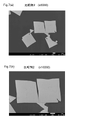
- FIG. 6(a) and 6(b) are elemental mapping images of copper element and oxygen element, respectively, for the cross section of the copper oxide particles of Comparative Example 1.
- FIG. 7(a) and 7(b) are scanning electron microscope images of the cross section of the copper oxide particles of Comparative Example 2.
- FIG. 8(a) and 8(b) are elemental mapping images of copper element and oxygen element, respectively, for the cross section of the copper oxide particles of Comparative Example 2.
- Antibacterial and antiviral refer to the function of inactivating bacteria and viruses.
- inactivation refers to the destruction or denaturation of the chemical structure or higher-order structure of proteins, nucleic acids, lipids, etc. that constitute the target bacteria or viruses, regardless of whether or not the bacteria and virus particles themselves are destroyed. However, it includes attenuating, inhibiting or eliminating the ability to infect or proliferate the host.
- antibacterial activity the degree of ability to inactivate bacteria
- antiviral activity the degree of ability to inactivate viruses
- the copper element content in the copper oxide particles is preferably 75% by mass or more and 95% by mass or less, more preferably 80% by mass or more and 95% by mass or less, still more preferably 85% by mass, when measured by ICP emission spectrometry. It is more than mass % and below 92 mass %. With such a range, antibacterial activity and antiviral activity can be enhanced.
- the oxygen element content in the copper oxide particles is preferably 5% by mass or more and 25% by mass or less, more preferably 5% by mass or more and 20% by mass or less, even more preferably when measured by a gas component analysis method. It is 8 mass % or more and 15 mass % or less. With such a range, it is possible to enhance the antibacterial activity and antiviral activity while enhancing the handleability of the particles.
- the nitrogen content in the copper oxide particles is preferably 0.4% by mass or more and 1.0% by mass or less, more preferably 0.5% by mass or more and 1.0% by mass when measured by a gas component analysis method. Below, it is more preferably 0.7 mass % or more and 0.8 mass % or less. Within such a range, excessive oxidative deterioration of the copper oxide particles can be suppressed, and the antibacterial activity and antiviral activity can be maintained for a long period of time.
- the content of cuprous oxide in the copper oxide particles is preferably 30% by mass or more and preferably 99.5% by mass or less. With such a range, it is possible to enhance the antibacterial activity and antiviral activity while enhancing the handleability of the particles.
- the cuprous oxide content can be measured, for example, by a method such as redox titration.
- the copper oxide particles have an S1/D50 ratio ( m 2 /g/ ⁇ m) is preferably within a predetermined range.
- the volume cumulative particle diameter D50 described above is preferably 0.1 ⁇ m or more and 5.0 ⁇ m or less, more preferably 1.0 ⁇ m or more and 3.0 ⁇ m or less, and still more preferably 1.5 ⁇ m or more and 2.2 ⁇ m or less.
- the handling properties of the particles and the powder containing the particles are excellent, and the particles are exposed to an environment in which deterioration such as a humid environment tends to occur early.
- the deterioration of the particles can be reduced, and the desired antibacterial and antiviral activities can be expressed for a long time.
- the copper oxide particles have an elemental oxygen content A1 (atomic % ) to the copper element content A2 (atomic %) (A2/A1) is within a predetermined range.
- this portion is located in a surface area extending from the outermost surface of the particle (outline of the particle in cross section) to 50 nm toward the center of the particle (inward).
- the surface zone is located in the region of the spherical shell that includes the particle surface if the particle is spherical.
- the ratio of the copper element content A2 (atomic %) to the oxygen element content A1 (atomic %) is preferably 1.2 or more and less than 2.0, more preferably 1.3 or more and 1.8 or less, still more preferably 1.5 or more and 1.8 or less. in the surface area of the particles.
- the site that satisfies the element abundance ratio E1 is also referred to as a "high Cu site”.
- the A2/A1 ratio represents the abundance ratio of copper element and oxygen element in the measurement target portion of the particle cross section. Considering the stoichiometric ratio, the portion containing a large amount of cuprous oxide (Cu 2 O) tends to have an A2/A1 ratio close to 2, and when containing copper alone, the A2/A1 ratio tends to increase. It is in. On the other hand, sites containing a large amount of copper oxide (CuO) tend to have an A2/A1 ratio close to 1, and sites containing a large amount of copper peroxide tend to have a low A2/A1 ratio.
- the copper oxide particles satisfying the above-mentioned A2/A1 ratio have a relatively high content of a copper element with a low degree of oxidation such as cuprous oxide. Therefore, by having a site where the surface area of the copper oxide particles satisfies the above-mentioned A2 / A1 ratio, bacteria and viruses to be inactivated and sites where copper ions such as cuprous oxide are relatively likely to occur. can be easily brought into contact, and as a result, antibacterial activity and antiviral activity can be expressed effectively in a short time. Copper oxide particles satisfying such an A2/A1 ratio can be produced, for example, by the production method described below.
- the high Cu portion may be formed continuously or discontinuously in a part of the surface area of the particle, or may be formed continuously over the entire surface area of the particle.
- the high-Cu portion may be exposed so as to include the surfaces of the copper oxide particles, or may be present so as not to be exposed on the surfaces of the copper oxide particles.
- the high Cu portion may be present only in the surface region of the particle, or in addition to the surface region of the particle, may be further present in a region closer to the center of the particle than the surface region of the particle. Even in this case, the high Cu portion may be formed continuously or discontinuously in a part of the region closer to the center of the particle than the surface region of the particle. may be formed continuously over the entire region on the center side of the grain.
- the oxygen element content A1 by SEM-EDS analysis is preferably 30 atomic % or more and 45 atomic % or less, more preferably 30 atomic % or more and 43 atomic % or less, still more preferably 35 atomic % or more. It is 40 atomic % or less.
- the copper element content A2 by SEM-EDS analysis is preferably 55 atomic % or more and 70 atomic % or less, more preferably 57 atomic % or more and 70 atomic % or less, still more preferably 60 atomic %. It is more than 65 atomic % or less.
- the copper oxide particles have a site where the A2/A1 ratio measured by elemental analysis by SEM-EDS is smaller than the A2/A1 ratio in the surface area of the particles when viewed from the surface toward the center of the particles. is preferred.
- the low-Cu site may be formed continuously or discontinuously in a partial region of the particle, and may be continuously formed in a region inside the particle rather than the surface region of the particle. . As long as the effect of the present invention is exhibited, the presence of the low Cu portion in the surface region of the particle is not prevented, but it is preferable that the low Cu portion does not exist in the surface region of the particle. Moreover, the low-Cu site may be present only in the central region of the particle, or may be formed in a region closer to the surface of the particle than the central region of the particle, in addition to the central region of the particle.
- the low Cu portion may be formed continuously or discontinuously in a part of the outer region of the particle than the central region of the particle, and may be formed more continuously than the surface region of the particle. It may be formed continuously over the entire region outside the grain from the central region.
- the low Cu portion existing in the central region of the particle and the low Cu portion existing in the region other than the central region of the particle are continuous with each other. It may exist or may exist discontinuously.
- the high-Cu portion and the low-Cu portion may be present adjacent to each other. may be interposed between the high Cu portion and the low Cu portion.
- the oxygen element content A1 by SEM-EDS analysis is preferably 35 atomic % or more and 60 atomic % or less, more preferably 40 atomic % or more and 60 atomic % or less, still more preferably 40 atomic % or more. It is 50 atomic % or less.
- the copper element content A2 by SEM-EDS analysis is preferably 40 atomic % or more and 65 atomic % or less, more preferably 40 atomic % or more and 60 atomic % or less, still more preferably 50 atomic %. It is more than 60 atomic % or less.
- the surface of the particle with respect to the element abundance ratio E2 in the central region of the particle is preferably 1.1 or more and 1.7 or less, more preferably 1.1 or more and 1.4 or less, still more preferably 1.2 or more and 1.3 or less. be.
- the copper oxide particles in this embodiment have a higher A2/A1 ratio in the surface area of the particles than in the central area of the particles when comparing the surface area and the central area of the particles. do.
- the region where the high Cu site exists is the region where the low Cu site exists.
- the copper oxide particles are composed of a low Cu portion that continuously exists so as to include the central region of the particle, and a low Cu portion that includes the surface region of the particle and the low Cu portion. It is preferable to have a core-shell-like structure in which a continuous Cu-rich portion is formed so as to cover the entire outer surface of the .
- the A2/A1 ratio changes stepwise so that the boundary between the low Cu portion and the high Cu portion is clear.
- the boundary between the region where the high Cu portion exists and the region where the Cu low portion exists is clear, that is, whether or not the A2/A1 ratio changes stepwise between the regions can be determined, for example, by the following method. can judge. Specifically, the particles to be measured are processed into a sample for cross-sectional observation by the method described later, and subjected to the above-described SEM-EDS observation. Then, in the line analysis mode attached to the EDS software, analysis is performed from the center of the particle toward the surface area, and by obtaining a line profile from the intensity of characteristic X-rays derived from copper and oxygen elements, A2 / A1 Determine that the ratio is changing in steps.
- the thickness of the region in which the high Cu portion exists is preferably 2 nm or more and 400 nm or less, more preferably 5 nm or more and 350 nm or less, and still more preferably 10 nm or more and 300 nm or less. . With such a configuration, desired antibacterial and antiviral performance can be exhibited.
- the copper oxide particles preferably have a predetermined amount of carbon element content.
- the content mass ratio W1 of the carbon element in the copper oxide particles is preferably 0.50% by mass or less, more preferably 0.40% by mass or less, and still more preferably 0.30% by mass or less. , 0.01% by mass or more is realistic.
- the content mass ratio of the carbon element can be measured, for example, by a method such as gas component analysis or combustion type carbon analysis.
- the volume cumulative particle diameter D10 at a cumulative volume of 10% by volume measured by a laser diffraction scattering particle size distribution measurement method is preferably 0.5 ⁇ m or more and 2.0 ⁇ m or less, more preferably 0.5 ⁇ m or more and 1.0 ⁇ m or less, still more preferably 0.5 ⁇ m or more and 1.0 ⁇ m or less. It is 5 ⁇ m or more and 0.8 ⁇ m or less. With such a range, the particles are excellent in handleability when processed into a composition.
- a copper compound is dissolved in a solvent such as pure water to prepare a solution containing the copper compound (hereinafter also referred to as a copper solution).
- a solution containing the copper compound hereinafter also referred to as a copper solution.
- the pH may be adjusted before or after dissolving the copper compound.
- the copper solution is preferably maintained in a temperature range of 20° C. or higher and 40° C. or lower during the process from the time of preparation until the addition of the reducing compound, and it is also preferable that the solution is continuously stirred. .
- the reducing compound is dissolved in a solvent such as pure water to prepare a solution containing the reducing compound (hereinafter also referred to as the reducing solution).
- the reducing compound used in the method is for reducing copper ions in the copper solution. In this step, no copper compound is contained in the reducing solution.
- reducing compounds include hydrazine compounds such as hydrazine, hydrazine hydrochloride, hydrazine sulfate and hydrazine hydrate, sodium borohydride, sodium sulfite, sodium hydrogen sulfite, sodium thiosulfate, sodium nitrite, sodium hyponitrite, Examples include organic compounds such as phosphorous acid, sodium phosphite, hypophosphorous acid, sodium hypophosphite, and glucose. These reducing compounds may be anhydrides or hydrates. These reducing compounds can be used singly or in combination of two or more. Among these, hydrazine is preferably used as the reducing compound because it has a strong reducing power and can reduce the generation of impurities after reduction and the contamination of the obtained particles with impurities. It is more preferable to use only
- the addition rate of the reducing solution depends on the content of the reducing compound in the reaction solution. Provided that the solution concentration is adjusted so that the amount falls within the range described above, it is preferably 400 mL/min or more and 1400 mL/min or less, more preferably 820 mL/min or more and 1370 mL/min or less. With such an addition rate, regardless of the production scale of copper particles, particles satisfying the above-described S1/D50 ratio and A2/A1 ratio can be obtained with high productivity.
- an aqueous solution of a base is simultaneously added separately from the reducing solution so that the pH of the reaction solution at 25° C. is maintained within a predetermined range until the end of the reaction.
- the pH of the reaction solution at 25° C. is preferably 6.0 or more and 8.5 or less, more preferably 7.0 or more and 8.5 or less, and still more preferably 7.5. It is prepared to be greater than or equal to 8.0 or less. In addition to this, it is also preferable to prepare so that the pH range described above is maintained even at the end of the reduction reaction. By adjusting the pH to such a range, it is easy to obtain particles having a uniform particle structure with little variation in particle size, and particles satisfying the above-described S1/D50 ratio and A2/A1 ratio are easily formed.
- the temperature of the reaction liquid is higher than 0 ° C. and 100 ° C. from the time of the start of mixing to the time of the end of the reaction. It is preferable to carry out the reduction reaction so as to maintain the following.
- the reaction liquid temperature can be maintained within the above-described range by setting the addition amount and addition rate of each compound within the above-described preferable range.
- a reducing solution and an aqueous solution of a base are added at the same time and aged for a predetermined time while stirring. may be further added to the reaction solution and aged for a predetermined period of time. If more base is added, it is preferably added sequentially and preferably a weakly basic liquid such as ammonia is used. Moreover, even when a base is further added, the pH in the reaction solution is preferably maintained within the above range.
- [2] The copper oxide particles according to [1], wherein the ratio (W1/S1) of the content mass ratio W1 (mass%) of the carbon element in the particles to the S1 (m 2 /g) is 0.3 or less.
- Example 2 Ammonia was used to adjust the pH of the copper solution to 5.45, and a reaction solution was prepared while the solution temperature was kept at 30° C., and a reduction reaction was carried out. The pH of the reaction solution was 7.62, and the solution temperature was not adjusted until the end of the reaction. The stirring speed of the reaction solution was 196 rpm. Other procedures were the same as in Example 1 to obtain a dry powder composed of copper oxide particles containing cuprous oxide.
- Example 1 Copper oxide particles were obtained by the method described in Example 1 of JP-A-2003-342621. SEM images of cross sections of the particles obtained in this comparative example are shown in FIGS. 5(a) and 5(b). In addition, the element mapping image of the region including the central region of the grain in the grain cross section based on FIG. 5(b) is shown in FIG. An elemental mapping image is shown in FIG.6(b).
- the BET specific surface area S1 was measured by the nitrogen adsorption method using "Macsorb” manufactured by Mountec Co., Ltd. based on the BET method. The amount of powder to be measured was 0.2 g, and the pre-degassing conditions were 80° C. for 30 minutes under vacuum.
- COMPASS software
- the infection titer is calculated by the following formula (A).
- the average number of measured plaques is used to calculate the infectivity titer. If plaques are not observed in 1.0 mL of the diluted solution, the arithmetic mean value of the number of plaques is taken as 1 to calculate the infection titer.
- the value of the infectivity titer calculated by the following formula (A) is 2 or more, and the larger the value, the higher the antiviral activity. The results are shown in Table 1 below.
Landscapes
- Life Sciences & Earth Sciences (AREA)
- Chemical & Material Sciences (AREA)
- Inorganic Chemistry (AREA)
- Engineering & Computer Science (AREA)
- Organic Chemistry (AREA)
- Pest Control & Pesticides (AREA)
- Plant Pathology (AREA)
- Wood Science & Technology (AREA)
- Zoology (AREA)
- Environmental Sciences (AREA)
- General Chemical & Material Sciences (AREA)
- Agronomy & Crop Science (AREA)
- Health & Medical Sciences (AREA)
- Dentistry (AREA)
- General Health & Medical Sciences (AREA)
- Chemical Kinetics & Catalysis (AREA)
- Agricultural Chemicals And Associated Chemicals (AREA)
- Pharmaceuticals Containing Other Organic And Inorganic Compounds (AREA)
Priority Applications (1)
| Application Number | Priority Date | Filing Date | Title |
|---|---|---|---|
| JP2022570581A JP7262687B1 (ja) | 2021-07-14 | 2022-07-06 | 銅酸化物粒子、及びこれを含む抗菌組成物又は抗ウイルス組成物 |
Applications Claiming Priority (2)
| Application Number | Priority Date | Filing Date | Title |
|---|---|---|---|
| JP2021116062 | 2021-07-14 | ||
| JP2021-116062 | 2021-07-14 |
Publications (1)
| Publication Number | Publication Date |
|---|---|
| WO2023286676A1 true WO2023286676A1 (ja) | 2023-01-19 |
Family
ID=84920239
Family Applications (1)
| Application Number | Title | Priority Date | Filing Date |
|---|---|---|---|
| PCT/JP2022/026861 Ceased WO2023286676A1 (ja) | 2021-07-14 | 2022-07-06 | 銅酸化物粒子、及びこれを含む抗菌組成物又は抗ウイルス組成物 |
Country Status (3)
| Country | Link |
|---|---|
| JP (1) | JP7262687B1 (https=) |
| TW (1) | TW202311167A (https=) |
| WO (1) | WO2023286676A1 (https=) |
Cited By (1)
| Publication number | Priority date | Publication date | Assignee | Title |
|---|---|---|---|---|
| CN119881259A (zh) * | 2025-03-26 | 2025-04-25 | 长春黄金研究院有限公司 | 金属硫化物含量的测定方法 |
Citations (5)
| Publication number | Priority date | Publication date | Assignee | Title |
|---|---|---|---|---|
| JP2013082654A (ja) * | 2011-10-12 | 2013-05-09 | Showa Denko Kk | 抗菌抗ウイルス性組成物及びその製造方法 |
| WO2014184989A1 (ja) * | 2013-05-13 | 2014-11-20 | パナソニックIpマネジメント株式会社 | コーティング剤組成物及び抗菌・抗ウイルス性部材 |
| JP2017087547A (ja) * | 2015-11-09 | 2017-05-25 | イビデン株式会社 | 機能性化粧板、機能性化粧板の機能回復方法及び機能性付与組成物 |
| JP2018100255A (ja) * | 2016-03-28 | 2018-06-28 | 東洋製罐グループホールディングス株式会社 | 分散液及びその製造方法並びに銅化合物粒子 |
| JP2020152831A (ja) * | 2019-03-20 | 2020-09-24 | 旭化成株式会社 | 抗菌坑カビ用塗料、抗菌坑カビ用部材 |
-
2022
- 2022-07-06 WO PCT/JP2022/026861 patent/WO2023286676A1/ja not_active Ceased
- 2022-07-06 JP JP2022570581A patent/JP7262687B1/ja active Active
- 2022-07-12 TW TW111126021A patent/TW202311167A/zh unknown
Patent Citations (5)
| Publication number | Priority date | Publication date | Assignee | Title |
|---|---|---|---|---|
| JP2013082654A (ja) * | 2011-10-12 | 2013-05-09 | Showa Denko Kk | 抗菌抗ウイルス性組成物及びその製造方法 |
| WO2014184989A1 (ja) * | 2013-05-13 | 2014-11-20 | パナソニックIpマネジメント株式会社 | コーティング剤組成物及び抗菌・抗ウイルス性部材 |
| JP2017087547A (ja) * | 2015-11-09 | 2017-05-25 | イビデン株式会社 | 機能性化粧板、機能性化粧板の機能回復方法及び機能性付与組成物 |
| JP2018100255A (ja) * | 2016-03-28 | 2018-06-28 | 東洋製罐グループホールディングス株式会社 | 分散液及びその製造方法並びに銅化合物粒子 |
| JP2020152831A (ja) * | 2019-03-20 | 2020-09-24 | 旭化成株式会社 | 抗菌坑カビ用塗料、抗菌坑カビ用部材 |
Cited By (1)
| Publication number | Priority date | Publication date | Assignee | Title |
|---|---|---|---|---|
| CN119881259A (zh) * | 2025-03-26 | 2025-04-25 | 长春黄金研究院有限公司 | 金属硫化物含量的测定方法 |
Also Published As
| Publication number | Publication date |
|---|---|
| JP7262687B1 (ja) | 2023-04-21 |
| TW202311167A (zh) | 2023-03-16 |
| JPWO2023286676A1 (https=) | 2023-01-19 |
Similar Documents
| Publication | Publication Date | Title |
|---|---|---|
| Sinulingga et al. | Synthesis and characterizations of natural limestone-derived nano-hydroxyapatite (HAp): a comparison study of different metals doped HAps on antibacterial activity | |
| Siddiqui et al. | Synthesis and characterization of silver oxide and silver chloride nanoparticles with high thermal stability | |
| Liu et al. | The potent antimicrobial properties of cell penetrating peptide-conjugated silver nanoparticles with excellent selectivity for Gram-positive bacteria over erythrocytes | |
| Singaravelan et al. | Electrochemical synthesis, characterisation and phytogenic properties of silver nanoparticles | |
| Tang et al. | Growth of silver nanocrystals on graphene by simultaneous reduction of graphene oxide and silver ions with a rapid and efficient one-step approach | |
| CN102548901B (zh) | 具有吸附在其上的银离子的二氧化硅颗粒的杀生的胶态分散体 | |
| KR102403998B1 (ko) | 구리 입자 및 그 제조 방법 | |
| JP7262687B1 (ja) | 銅酸化物粒子、及びこれを含む抗菌組成物又は抗ウイルス組成物 | |
| Shinde et al. | One-step synthesis and characterization of anisotropic silver nanoparticles: application for enhanced antibacterial activity of natural fabric | |
| CN111362296A (zh) | 金属氧化物半导体纳米材料的组合物 | |
| US11820672B2 (en) | Processes for preparing metal oxide semiconductor nanomaterials | |
| Chen et al. | Bismuth telluride functionalized bismuth oxychloride used for enhancing antibacterial activity and wound healing efficacy with sunlight irradiation | |
| WO2008056744A1 (fr) | Procédé de fabrication d'un agent de revêtement présentant une activité photocatalytique et agent de revêtement obtenu par ce procédé | |
| Holubnycha et al. | Effect of ultrasound treatment on chitosan-silver nanoparticles antimicrobial activity | |
| Pal et al. | Nanocrystalline silver supported on activated carbon matrix from hydrosol: antibacterial mechanism under prolonged incubation conditions | |
| CN118556714A (zh) | 一种单宁酸修饰的过氧化铜纳米复合材料的制备方法和应用 | |
| Liu et al. | Silica/ultrasmall Ag composite microspheres: facile synthesis, characterization and antibacterial and catalytic performance | |
| US10998467B2 (en) | Compositions of metal oxide semiconductor nanomaterials and hemostatic polymers | |
| Wang et al. | Research on synthesis and property of nano-textured Sc2O3-MgO efficient antibacterial agents | |
| US20070044590A1 (en) | Method for producing metal nanoparticle | |
| JP2018196854A (ja) | 白金触媒の製造方法 | |
| Ayame et al. | Preparation of silica-coated AgI nanoparticles by an amine-free process and their X-ray imaging properties | |
| JP7614381B2 (ja) | リン含有銀被覆銅粒子の製造方法、及びリン含有銀被覆銅粒子 | |
| JP3241872U (ja) | 抗菌処理が施された成形品 | |
| Chmielewska et al. | Radiation synthesis of silver nano-and microparticles in cellulose fibers |
Legal Events
| Date | Code | Title | Description |
|---|---|---|---|
| ENP | Entry into the national phase |
Ref document number: 2022570581 Country of ref document: JP Kind code of ref document: A |
|
| 121 | Ep: the epo has been informed by wipo that ep was designated in this application |
Ref document number: 22842020 Country of ref document: EP Kind code of ref document: A1 |
|
| NENP | Non-entry into the national phase |
Ref country code: DE |
|
| 122 | Ep: pct application non-entry in european phase |
Ref document number: 22842020 Country of ref document: EP Kind code of ref document: A1 |