WO2023243727A1 - 生体試料の保存剤組成物 - Google Patents
生体試料の保存剤組成物 Download PDFInfo
- Publication number
- WO2023243727A1 WO2023243727A1 PCT/JP2023/022488 JP2023022488W WO2023243727A1 WO 2023243727 A1 WO2023243727 A1 WO 2023243727A1 JP 2023022488 W JP2023022488 W JP 2023022488W WO 2023243727 A1 WO2023243727 A1 WO 2023243727A1
- Authority
- WO
- WIPO (PCT)
- Prior art keywords
- cells
- biological sample
- group
- zwitterionic polymer
- polymer
- Prior art date
- Legal status (The legal status is an assumption and is not a legal conclusion. Google has not performed a legal analysis and makes no representation as to the accuracy of the status listed.)
- Ceased
Links
Images


Classifications
-
- C—CHEMISTRY; METALLURGY
- C08—ORGANIC MACROMOLECULAR COMPOUNDS; THEIR PREPARATION OR CHEMICAL WORKING-UP; COMPOSITIONS BASED THEREON
- C08F—MACROMOLECULAR COMPOUNDS OBTAINED BY REACTIONS ONLY INVOLVING CARBON-TO-CARBON UNSATURATED BONDS
- C08F26/00—Homopolymers and copolymers of compounds having one or more unsaturated aliphatic radicals, each having only one carbon-to-carbon double bond, and at least one being terminated by a single or double bond to nitrogen or by a heterocyclic ring containing nitrogen
- C08F26/06—Homopolymers and copolymers of compounds having one or more unsaturated aliphatic radicals, each having only one carbon-to-carbon double bond, and at least one being terminated by a single or double bond to nitrogen or by a heterocyclic ring containing nitrogen by a heterocyclic ring containing nitrogen
-
- C—CHEMISTRY; METALLURGY
- C08—ORGANIC MACROMOLECULAR COMPOUNDS; THEIR PREPARATION OR CHEMICAL WORKING-UP; COMPOSITIONS BASED THEREON
- C08F—MACROMOLECULAR COMPOUNDS OBTAINED BY REACTIONS ONLY INVOLVING CARBON-TO-CARBON UNSATURATED BONDS
- C08F220/00—Copolymers of compounds having one or more unsaturated aliphatic radicals, each having only one carbon-to-carbon double bond, and only one being terminated by only one carboxyl radical or a salt, anhydride ester, amide, imide or nitrile thereof
- C08F220/02—Monocarboxylic acids having less than ten carbon atoms; Derivatives thereof
- C08F220/10—Esters
- C08F220/12—Esters of monohydric alcohols or phenols
- C08F220/16—Esters of monohydric alcohols or phenols of phenols or of alcohols containing two or more carbon atoms
- C08F220/18—Esters of monohydric alcohols or phenols of phenols or of alcohols containing two or more carbon atoms with acrylic or methacrylic acids
- C08F220/1804—C4-(meth)acrylate, e.g. butyl (meth)acrylate, isobutyl (meth)acrylate or tert-butyl (meth)acrylate
-
- A—HUMAN NECESSITIES
- A01—AGRICULTURE; FORESTRY; ANIMAL HUSBANDRY; HUNTING; TRAPPING; FISHING
- A01N—PRESERVATION OF BODIES OF HUMANS OR ANIMALS OR PLANTS OR PARTS THEREOF; BIOCIDES, e.g. AS DISINFECTANTS, AS PESTICIDES OR AS HERBICIDES; PEST REPELLANTS OR ATTRACTANTS; PLANT GROWTH REGULATORS
- A01N1/00—Preservation of bodies of humans or animals, or parts thereof
- A01N1/10—Preservation of living parts
-
- A—HUMAN NECESSITIES
- A61—MEDICAL OR VETERINARY SCIENCE; HYGIENE
- A61K—PREPARATIONS FOR MEDICAL, DENTAL OR TOILETRY PURPOSES
- A61K47/00—Medicinal preparations characterised by the non-active ingredients used, e.g. carriers or inert additives; Targeting or modifying agents chemically bound to the active ingredient
- A61K47/06—Organic compounds, e.g. natural or synthetic hydrocarbons, polyolefins, mineral oil, petrolatum or ozokerite
- A61K47/26—Carbohydrates, e.g. sugar alcohols, amino sugars, nucleic acids, mono-, di- or oligo-saccharides; Derivatives thereof, e.g. polysorbates, sorbitan fatty acid esters or glycyrrhizin
-
- A—HUMAN NECESSITIES
- A61—MEDICAL OR VETERINARY SCIENCE; HYGIENE
- A61K—PREPARATIONS FOR MEDICAL, DENTAL OR TOILETRY PURPOSES
- A61K9/00—Medicinal preparations characterised by special physical form
- A61K9/0012—Galenical forms characterised by the site of application
- A61K9/0019—Injectable compositions; Intramuscular, intravenous, arterial, subcutaneous administration; Compositions to be administered through the skin in an invasive manner
-
- C—CHEMISTRY; METALLURGY
- C08—ORGANIC MACROMOLECULAR COMPOUNDS; THEIR PREPARATION OR CHEMICAL WORKING-UP; COMPOSITIONS BASED THEREON
- C08F—MACROMOLECULAR COMPOUNDS OBTAINED BY REACTIONS ONLY INVOLVING CARBON-TO-CARBON UNSATURATED BONDS
- C08F220/00—Copolymers of compounds having one or more unsaturated aliphatic radicals, each having only one carbon-to-carbon double bond, and only one being terminated by only one carboxyl radical or a salt, anhydride ester, amide, imide or nitrile thereof
- C08F220/02—Monocarboxylic acids having less than ten carbon atoms; Derivatives thereof
- C08F220/52—Amides or imides
- C08F220/54—Amides, e.g. N,N-dimethylacrylamide or N-isopropylacrylamide
- C08F220/60—Amides, e.g. N,N-dimethylacrylamide or N-isopropylacrylamide containing nitrogen in addition to the carbonamido nitrogen
- C08F220/606—Amides, e.g. N,N-dimethylacrylamide or N-isopropylacrylamide containing nitrogen in addition to the carbonamido nitrogen and containing other heteroatoms
-
- C—CHEMISTRY; METALLURGY
- C08—ORGANIC MACROMOLECULAR COMPOUNDS; THEIR PREPARATION OR CHEMICAL WORKING-UP; COMPOSITIONS BASED THEREON
- C08F—MACROMOLECULAR COMPOUNDS OBTAINED BY REACTIONS ONLY INVOLVING CARBON-TO-CARBON UNSATURATED BONDS
- C08F226/00—Copolymers of compounds having one or more unsaturated aliphatic radicals, each having only one carbon-to-carbon double bond, and at least one being terminated by a single or double bond to nitrogen or by a heterocyclic ring containing nitrogen
- C08F226/06—Copolymers of compounds having one or more unsaturated aliphatic radicals, each having only one carbon-to-carbon double bond, and at least one being terminated by a single or double bond to nitrogen or by a heterocyclic ring containing nitrogen by a heterocyclic ring containing nitrogen
-
- C—CHEMISTRY; METALLURGY
- C08—ORGANIC MACROMOLECULAR COMPOUNDS; THEIR PREPARATION OR CHEMICAL WORKING-UP; COMPOSITIONS BASED THEREON
- C08K—Use of inorganic or non-macromolecular organic substances as compounding ingredients
- C08K3/00—Use of inorganic substances as compounding ingredients
- C08K3/01—Use of inorganic substances as compounding ingredients characterized by their specific function
-
- C—CHEMISTRY; METALLURGY
- C08—ORGANIC MACROMOLECULAR COMPOUNDS; THEIR PREPARATION OR CHEMICAL WORKING-UP; COMPOSITIONS BASED THEREON
- C08K—Use of inorganic or non-macromolecular organic substances as compounding ingredients
- C08K5/00—Use of organic ingredients
- C08K5/04—Oxygen-containing compounds
- C08K5/05—Alcohols; Metal alcoholates
- C08K5/053—Polyhydroxylic alcohols
-
- C—CHEMISTRY; METALLURGY
- C08—ORGANIC MACROMOLECULAR COMPOUNDS; THEIR PREPARATION OR CHEMICAL WORKING-UP; COMPOSITIONS BASED THEREON
- C08L—COMPOSITIONS OF MACROMOLECULAR COMPOUNDS
- C08L39/00—Compositions of homopolymers or copolymers of compounds having one or more unsaturated aliphatic radicals, each having only one carbon-to-carbon double bond, and at least one being terminated by a single or double bond to nitrogen or by a heterocyclic ring containing nitrogen; Compositions of derivatives of such polymers
- C08L39/04—Homopolymers or copolymers of monomers containing heterocyclic rings having nitrogen as ring member
-
- C—CHEMISTRY; METALLURGY
- C08—ORGANIC MACROMOLECULAR COMPOUNDS; THEIR PREPARATION OR CHEMICAL WORKING-UP; COMPOSITIONS BASED THEREON
- C08L—COMPOSITIONS OF MACROMOLECULAR COMPOUNDS
- C08L5/00—Compositions of polysaccharides or of their derivatives not provided for in groups C08L1/00 or C08L3/00
-
- C—CHEMISTRY; METALLURGY
- C12—BIOCHEMISTRY; BEER; SPIRITS; WINE; VINEGAR; MICROBIOLOGY; ENZYMOLOGY; MUTATION OR GENETIC ENGINEERING
- C12N—MICROORGANISMS OR ENZYMES; COMPOSITIONS THEREOF; PROPAGATING, PRESERVING, OR MAINTAINING MICROORGANISMS; MUTATION OR GENETIC ENGINEERING; CULTURE MEDIA
- C12N1/00—Microorganisms; Compositions thereof; Processes of propagating, maintaining or preserving microorganisms or compositions thereof; Processes of preparing or isolating a composition containing a microorganism; Culture media therefor
- C12N1/04—Preserving or maintaining viable microorganisms
-
- C—CHEMISTRY; METALLURGY
- C12—BIOCHEMISTRY; BEER; SPIRITS; WINE; VINEGAR; MICROBIOLOGY; ENZYMOLOGY; MUTATION OR GENETIC ENGINEERING
- C12N—MICROORGANISMS OR ENZYMES; COMPOSITIONS THEREOF; PROPAGATING, PRESERVING, OR MAINTAINING MICROORGANISMS; MUTATION OR GENETIC ENGINEERING; CULTURE MEDIA
- C12N5/00—Undifferentiated human, animal or plant cells, e.g. cell lines; Tissues; Cultivation or maintenance thereof; Culture media therefor
Definitions
- the present invention relates to a preservative composition for biological samples such as cells.
- Dimethyl sulfoxide (DMSO) and glycerol are widely used as cryopreservatives when cryopreserving cells, and are the most effective reagents for protecting cells and organelles. These cryopreservatives protect cells by suppressing the growth of ice crystals (ice crystals) formed inside cells when cells are frozen. DMSO and the like are permeable to cell membranes, slow down the growth rate of ice crystals inside and outside cells, and inhibit ice crystal formation. However, DMSO and glycerol are toxic and are known to cause hypertension, nausea and vomiting when infused with cells into recipients or when handled by personnel handling cells.
- fetal bovine serum FBS
- bovine serum albumin BSA
- the present inventors proposed an aprotic zwitterion as a substance that can be used in place of DMSO, which has been commonly used as an additive component to culture media, and proposed cryopreservation media (Patent Document 1). Furthermore, when adding a sparingly soluble substance that is difficult to dissolve in water to a medium in a chemical substance assay using cells, the sparingly soluble substance is dissolved in a solvent such as DMSO and then dispersed in the medium.
- a solvent such as DMSO
- Non-Patent Document 3 zwitterionic polymers are used for the purpose of surface modification of biocompatible polymers (Patent Document 3), and are also attracting attention as industrial materials.
- Patent Documents 1 to 3 Various studies have been conducted on the structure and physical properties of zwitterions from an academic perspective (Non-Patent Documents 1 to 3).
- the present inventors have produced an aprotic zwitterion as a substance that can be used in place of DMSO, which has been widely used as an additive component to culture media, and used it as a solubilizing agent for cryopreservation media and poorly soluble substances. Although it has been proposed that it can be used for such purposes, it has not yet shown sufficient effects.
- An object of the present invention is to provide a zwitterionic polymer that can be used as an additive to biological samples and in place of DMSO, which is used as a solubilizer for poorly soluble substances.
- the present inventors have investigated the effect of various compounds on the cryopreservation of biological samples such as cells, and found that if a zwitterionic polymer with a specific structure is used, water-soluble compounds such as electrolytes can be added.
- a zwitterionic polymer with a specific structure is used, water-soluble compounds such as electrolytes can be added.
- the present invention was completed by discovering that it can be dissolved.
- the present invention provides the following inventions [1] to [15].
- [1] A zwitterionic polymer represented by the following general formula (1) or a labeled substance thereof.
- Z is a hydrogen atom, an aromatic hydrocarbon group having 6 to 10 carbon atoms which may be substituted with an alkyl group, a 5 to 6-membered aromatic heterocyclic group which may be substituted with an alkyl group, an alkyl group optionally substituted nitrogen-containing heterocyclic ammonium salt, tetraalkylammonium salt, tetraphenylphosphonium salt, tetraalkylphosphonium salt, trialkylsulfonium salt, or having 1 to 3 oxygen atoms in the molecular chain.
- Z is an imidazolyl group, a pyridyl group, pyridinium chloride, C1-C22 alkylpyridinium chloride, imidazolinium chloride, C1-C22 alkylimidazolinium chloride, pyridinium bromide, C1-C22 alkylpyridinium bromide, imidazolinium bromide and the zwitterionic polymer or label thereof according to [1] or [2], which is a group selected from C1 to C22 alkylimidazolinium bromide.
- Z is a hydrogen atom, an aromatic hydrocarbon group having 6 to 10 carbon atoms which may be substituted with an alkyl group, a 5 to 6-membered aromatic heterocyclic group which may be substituted with an alkyl group, an alkyl group optionally substituted nitrogen-containing heterocyclic ammonium salt, tetraalkylammonium salt, tetraphenylphosphonium salt, tetraalkylphosphonium salt, trialkylsulfonium salt, or having 1 to 3 oxygen atoms in the molecular chain.
- Z is an imidazolyl group, a pyridyl group, pyridinium chloride, C1-C22 alkylpyridinium chloride, imidazolinium chloride, C1-C22 alkylimidazolinium chloride, pyridinium bromide, C1-C22 alkylpyridinium bromide, imidazolinium bromide.
- [7] Preservation of the biological sample according to any one of [4] to [6], further containing one or more water-soluble compounds selected from electrolytes, betaine, zwitterions, alcohols, polyhydric alcohols, and saccharides. agent composition.
- a poorly soluble substance dissolving agent comprising the zwitterionic polymer or its labeled substance according to any one of [1] to [3] above.
- a method for preserving a biological sample which comprises contacting the biological sample with a composition containing the zwitterionic polymer or its label according to any one of [1] to [3] above.
- the composition containing the zwitterionic polymer or label thereof according to any one of [1] to [3] above further comprises a composition selected from electrolytes, betaine, zwitterions, alcohols, polyhydric alcohols, and saccharides.
- the composition containing the zwitterionic polymer or labeled substance thereof according to any one of [1] to [3] above further contains a cell-permeable substance. How to store samples.
- Preservation of the biological sample is cryopreservation of the biological sample, culture of the biological sample, culture medium of the biological sample, maintenance of the function of the biological sample, or functional test of the biological sample in any of [11] to [13] Preservation method for biological samples as described.
- the survival rate is high even when cells and the like are thawed after cryopreservation, and biological samples such as cells can be protected. Furthermore, by using the preservative composition of the present invention, the preservability and maintainability of biomaterials will also be improved. Further, by using the zwitterionic polymer of the present invention, various poorly soluble substances can be dissolved.
- a 1 H-NMR chart of VimC 3 C (DMSO-) is shown.
- a 1 H-NMR chart of poly(VimC 3 C) (methanol) is shown.
- a 1 H-NMR chart of poly(VimC 3 C)+NaCl added is shown.
- a 1 H-NMR chart of Poly(VpyC 3 C) (methanol-d6) is shown.
- a 1 H-NMR chart of Poly(VpyC 3 S) (D 2 O) is shown.
- a 1 H-NMR chart of VimC 3 S (DMSO) is shown.
- a 1 H-NMR chart of Poly(VimC 3 S) (D 2 O) is shown.
- a 1 H-NMR chart of Poly(VpyC 3 C) 50 (CH 3 OH-d) is shown.
- a 1 H-NMR chart of Poly(VpyC 3 C) 40 is shown.
- a 1 H-NMR chart of Poly(VpyC 3 C) 30 is shown.
- a 1 H-NMR chart of Poly(VpyC 3 C) 20 is shown.
- a 1 H-NMR chart of Poly(VpyC 3 C) 10 (CH 3 OH-d) is shown.
- a 1 H-NMR chart of Poly(VpyC 3 S) 40 (methanol-NaCl) is shown.
- a 1 H-NMR chart of Poly(VimC 3 C-co-C 8 Vim) is shown.
- the relationship between the concentration of zwitterionic polymer and the survival rate of cells after cryopreservation is shown.
- the relationship between the concentration of an aqueous NaCl solution added to a zwitterionic polymer and the survival rate of cells after cryopreservation is shown.
- This figure shows the relationship between cell viability after cryopreservation depending on the type of solute added to the zwitterionic polymer. Demonstrates the toxicity of zwitterionic polymers to cells.
- Figure 3 shows a DLS chart of a zwitterionic polymer in NaCl solution. The GPC results of the zwitterionic polymer are shown.
- a substance having a betaine structure may be described as an aprotic zwitterion or an aprotic zwitterion polymer, but this is used synonymously with a zwitterion or a zwitterion polymer. .
- reproductive cells include gametes for sexual reproduction, ie, eggs, egg cells, sperm, sperm cells, and spores for asexual reproduction.
- the cells may be selected from the group consisting of sarcoma cells, established cell lines and transformed cells.
- Sparcoma is a cancer that occurs in connective tissue cells derived from non-epithelial cells such as bone, cartilage, fat, muscle, and blood, and includes soft tissue sarcoma, malignant bone tumors, and the like.
- Sarcoma cells are cells derived from sarcoma.
- Established cell line means a cultured cell that is maintained outside the body for a long period of time, has certain stable properties, and can be subcultured semi-permanently.
- Z is a hydrogen atom, an aromatic hydrocarbon group having 6 to 10 carbon atoms which may be substituted with an alkyl group, a 5 to 6-membered aromatic heterocyclic group which may be substituted with an alkyl group, an alkyl group optionally substituted nitrogen-containing heterocyclic ammonium salt, tetraalkylammonium salt, tetraphenylphosphonium salt, tetraalkylphosphonium salt, trialkylsulfonium salt, or having 1 to 3 oxygen atoms in the molecular chain.
- the polymer of the present invention can be associated with zwitterions in the side chains by adding one or more water-soluble compounds selected from electrolytes, betaines, zwitterions, alcohols, polyhydric alcohols, and saccharides. It is thought that it acts on cell membranes and exhibits a cryoprotective effect because it changes from an isolated state to a dispersed state.
- the general formula (1) has a repeating unit having a functional group with a zwitterion structure in its side chain and a repeating unit having Z in its side chain. It represents a random or block copolymer with When m and n represent numbers exceeding 0, the general formula (1) represents a ternary random or block copolymer.
- r and s each independently represent an integer of 0 to 6, preferably an integer of 1 to 6.
- This moiety is preferably a linear alkylene group having 1 to 6 carbon atoms, and specifically, a methylene group, ethylene group, trimethylene group, tetramethylene group, pentamethylene group, or hexamethylene group is preferable.
- r and s may be the same or different.
- X 1 and X 2 may be the same or different and represent a carbon atom or a nitrogen atom.
- Z is a hydrogen atom, an aromatic hydrocarbon group having 6 to 10 carbon atoms which may be substituted with an alkyl group, a 5 to 6-membered aromatic heterocyclic group which may be substituted with an alkyl group, an alkyl group optionally substituted nitrogen-containing heterocyclic ammonium salt, tetraalkylammonium salt, tetraphenylphosphonium salt, tetraalkylphosphonium salt, trialkylsulfonium salt, or having 1 to 3 oxygen atoms in the molecular chain. represents a straight-chain or branched alkyl group having 1 to 22 carbon atoms, which may have 1 to 22 carbon atoms.
- hydrogen atom phenyl group, naphthyl group, C1-22 alkyl-substituted phenyl group, C1-22 alkyl-substituted naphthyl group, imidazolyl group, triazolyl group, pyridyl group, pyrrolyl group, pyrazinyl group, furyl group, thienyl group.
- Z include a 5- to 6-membered aromatic heterocyclic group optionally substituted with an alkyl group or a nitrogen-containing heterocyclic ammonium salt optionally substituted with an alkyl group, and more preferably, Imidazolyl group, triazolyl group, pyridyl group, pyrrolyl group, pyrazinyl group, furyl group, thienyl group, oxazolyl group, thiazolyl group, pyridinium chloride, C1-C22 alkylpyridinium chloride, imidazolinium chloride, C1-C22 alkylimidazolinium chloride , pyridinium bromide, C1-C22 alkylpyridinium bromide, imidazolinium bromide, C1-C22 alkylimidazolinium bromide, pyrrolidinium chloride, C1-C22 alkylpyrrolidinium chloride, pyrrolidinium bromide, C1-C
- Examples of labels for the zwitterionic polymer of general formula (1) include radioisotope labels, enzyme labels, chemiluminescent substance labels, fluorescent substance labels, and the like. Among these, chemiluminescent labels and fluorescent labels are preferred.
- Examples of fluorescent labeling substances include fluorescein, cyanine, bodipy, dansyl, pyranine, coumarin, carbopyronin, and phycocyanin.
- a fluorescein label can be obtained by copolymerizing one or more monomers constituting the polymer represented by general formula (1) and fluorescein acrylate.
- the molecular weight of the polymer compound used in the present invention needs to be considered from the structure of the main chain, the structure of the side chain, the proportion of the whole, etc., and known measurement methods that reflect the characteristics of each can be used. Furthermore, in the case of zwitterion polymers, it is known that the conformation of the main chain changes depending on the type of zwitterion and the concentration of an electrolyte such as NaCl.
- the structure of the main chain of the zwitterionic polymer of the present invention can be star-shaped, comb-shaped, cross-linked structure, etc., and any structure can be used for the purpose of the present invention. The conformation of differs depending on the type of side chain.
- the zwitterionic polymer of the present invention has a zwitterionic structure present in the side chain, which is related to the structure of cell membranes and cell permeability, as well as the formation of ice crystals outside cells and the solubility of poorly soluble substances. Therefore, it is preferable that the molecular weight is a certain level.
- Mw is preferably 10,000 or more and Mn is 5,000 or more, more preferably Mw is 10,000 or more and 2,000,000 or less, and Mn is 5,000 or more and 1,500,000 or less, in terms of polyethylene oxide. Additionally, the molecular weight distribution of the polymer is also taken into account.
- the zwitterionic polymers of the present invention are preferably not permeable to cell membranes, as this promotes the formation of ice crystals outside the cells when the zwitterionic polymers are used as cryopreservatives for biological samples.
- the zwitterionic polymer of the present invention has excellent cryopreservation effects.
- the polymer of the present invention has a cryopreservation effect through a mechanism different from that of DMSO, which is conventionally used for cryopreservation.
- DMSO is thought to have cell permeability, but the zwitterionic polymer of the present invention does not penetrate into cells, so it forms a matrix on the outside of cells and forms a matrix around the cell membrane outside the cells. Accumulate.
- zwitterionic molecules have a betaine structure and therefore have a charge and cannot enter cell membranes as a zwitterionic polymer.
- the hydrophilic polymer When a hydrophobic functional group with high affinity for cell membranes is present in the polymer side chain, and the functional group is inserted into the cell membrane from the outside of the cell, the hydrophilic polymer is anchored to the cell membrane on the outside of the cell. It is conceivable that the polymer will accumulate around the cell membrane outside the cell.
- An example of a functional group that contributes to such accumulation is having an alkylene group between the cation and anion in general formula (1).
- Z has a C1 to C22 alkyl group, and further a C3 to C18 alkyl group. Further, the abundance ratio of such substituents is preferably 0.001 to 10 mol%, 0.01 to 1 mol%, more preferably 0.1 to 0.5 mol%, based on the entire polymer.
- the zwitterionic polymer of the present invention uses a monomer that is an ⁇ -olefin corresponding to the repeating unit.
- a monomer that is an ⁇ -olefin corresponding to the repeating unit For polymerization, it can be produced by radical polymerization, anionic polymerization, cationic polymerization, etc., and can be used appropriately depending on the characteristics of the monomer and the purpose and properties of the polymer to be produced.
- an azo compound such as 2,2'-azobisisobutyronitrile, a peroxide such as benzoyl peroxide, etc.
- the polymerization initiator is 0.001 mol% or more, preferably 0.01 mol%, more preferably 0.1 mol% or more, and 10 mol% or less, preferably is used in a proportion of 5 mol% or less, more preferably 1 mol%.
- the molecular weight of the produced polymer can be adjusted by adjusting the nature and presence or absence of solvent used, temperature, pressure, etc.
- the zwitterionic polymer of the present invention When the zwitterionic polymer of the present invention is used in a dispersion containing biological samples such as cells, electrolytes, betaine, zwitterions, alcohol, polyhydric alcohols, and sugars may be added to the dispersion to adjust the osmotic pressure. It is preferable to add one or more water-soluble compounds selected from the following. By adjusting the osmotic pressure, it is possible to further improve the effect of maintaining the survival and function of the biological sample when the biological sample is cryopreserved. Therefore, the composition containing the zwitterionic polymer of the present invention is useful as a preservative composition for biological samples, particularly as a cryopreservative composition for biological samples.
- a preferred electrolyte is a compound containing a combination of a cation selected from sodium ions, potassium ions, calcium ions, and magnesium ions, and an anion selected from chloride ions, phosphate ions, and bicarbonate ions.
- Specific examples include sodium chloride, potassium chloride, sodium phosphate, potassium phosphate, sodium hydrogen carbonate, potassium hydrogen carbonate, and the like.
- examples of the alcohol include alcohols having 1 to 6 carbon atoms such as methanol, ethanol, and isopropanol.
- the polyhydric alcohol include water-soluble polyhydric alcohols such as ethylene glycol and propylene glycol.
- sugars include monosaccharides and disaccharides such as glucose and sucrose.
- betaine include carnitine.
- Examples of the zwitterion include the zwitterion described in WO2020/230721.
- the zwitterionic polymer interacts with the biological sample to be stored, particularly the cell membrane, and a matrix-like substance is formed around the cells.
- Such interaction between the zwitterionic polymer and the cell membrane also affects the relationship between the cells, and it is observed that the cells are in an aggregated state (FIG. 27).
- the cells observed in the medium supplemented with the zwitterionic polymer of the present invention are observed to have several cells clustered together, whereas the cells in PBS are observed to be separated one by one. , in contrast. From this, it can be expected that the addition of the zwitterion of the present invention will bring about some effect, resulting in an adhesion effect between cells.
- the preservative composition of the present invention includes a composition containing an aprotic zwitterion and water, or a composition consisting of an aprotic zwitterion and water (also referred to as an aprotic zwitterion aqueous solution).
- a cell permeable substance can be added as an additive.
- the cell permeable substance is usually at least 1 part by weight, preferably 10 parts by weight or more, and the upper limit is usually 30 parts by weight or less, preferably 20 parts by weight or less, per 100 parts by weight of the aprotic zwitterionic aqueous solution. More preferably, it can be used in an amount of 15 parts by weight or less.
- 1% to the aprotic ion aqueous solution examples include dimethyl sulfoxide (DMSO), glycerol, ethylene glycol, propylene glycol, and the like.
- DMSO dimethyl sulfoxide
- glycerol ethylene glycol, propylene glycol, and the like.
- the amounts of these cell-permeable substances added can be lower or higher than the amounts normally used. For example, in the case of DMSO, it can be 3% by mass or more and 25% by mass or less. In the case of glycerol, it can be 3% by mass or more and 25% by mass or less.
- the preservative composition of the present invention can also contain components of a medium for culturing biological samples.
- the preservative composition of the present invention functions as a medium composition or a culture composition.
- Media components for biological sample culture include those for cell culture, specifically, inorganic salts, buffers, carbohydrates, vitamins, proteins, peptides, fatty acids, lipids, trace elements, serum, hormones, and growth factors. , signal transducers, antibiotics, etc.
- the composition of the present invention is used as a medium composition, it is preferable that it contains these medium components.
- thaw As a means for thawing cryopreserved cells, it is preferable to thaw, for example, by immediately transferring an ampoule containing frozen cells to a 37° C. water bath. Transfer the contents of the ampoule with a pipette to a sterile tube. Then gradually add prewarmed medium with appropriate supplements. Measure viable cell density using trypan blue. Transfer the appropriate amount of cell suspension to a flask and seed at the cell density recommended on the cell line data sheet.
- poorly soluble substances examples include substances that are active ingredients of pharmaceuticals, veterinary drugs, quasi-drugs, cosmetics, and agricultural chemicals (including candidate substances that can become active ingredients), food additives, biological substances, and It is a plant-derived substance, and includes low-molecular substances, oligomers such as oligopeptides, polypeptides, polysaccharides, DNA, and RNA, and high-molecular substances.
- “Poorly soluble drugs” are defined by the Japanese Pharmacopoeia as drugs that are “slightly soluble,””slightlysoluble,””extremelysoluble,” and “almost insoluble.”Specifically, they include antitumor drugs, antibiotics, Substances, antihyperlipidemic agents, antibacterial agents, allergic disease treatment agents, hypertension treatment agents, arteriosclerosis treatment agents, blood circulation promoters, hormones, fat-soluble vitamins, diabetes treatment agents, antiandrogen agents, cardiotonic agents , anti-arrhythmia agents, anti-inflammatory agents, sedative-hypnotics, tranquilizers, anti-epileptic agents, anti-depressants, agents for treating digestive system diseases, diuretic agents, local anesthetics, anticoagulants, antihistamines, antimuscarinics, anti-inflammatory agents Mycobacterial agents, immunosuppressants, antithyroid agents, antiviral agents, anxiolytic sedatives, astringents, ⁇ -adrenoceptor blockers
- poorly soluble substances include glycyrrhetinic acid and its salts, glycyrrhizic acid and its salts, coumarin, ononine, liquiritin, peptides, polypeptides such as collagen, polysaccharides such as xylan, lignin, and chloramphenicol. etc. can be mentioned.
- the solubility of these poorly soluble substances can be improved.
- a poorly soluble substance is dissolved in a solution containing the zwitterionic polymer of the present invention and one or more water-soluble compounds selected from electrolytes, betaines, zwitterions, alcohols, polyhydric alcohols, and sugars,
- the solubility of the poorly soluble substance is significantly improved.
- the particle size distribution was measured using a Horiba DLS device.
- the solution passed through a 3 ⁇ m filter was placed in a disposable cell, and the particle size was measured at a set temperature of 25°C.
- Measurement was performed using a vapor pressure type osmometer (VAPRO 5600; Wescor, Inc., Logan, UT, USA) in a 10 mL standard chamber (room temperature: 25 °C, device sensor temperature: 33 °C, sample volume: 10 ⁇ L).
- cryopreservation test (a) Cryopreservation of cells
- adherent cells the cells to be frozen were centrifuged and collected by trypsin treatment.
- floating cells the cells to be frozen were collected by centrifugation.
- Each cell concentration was measured by diluting with Dulbecco's modified Eagle's medium (DMEM).
- DMEM Dulbecco's modified Eagle's medium
- the DMEM solution may be simply referred to as medium.
- each 1 mL was dispensed into a 1.5 mL tube, centrifuged, suspended in cryopreservation solution containing 100 ⁇ L of zwitterionic polymer solution, and placed in a cell freezing container Mr.
- Freezing was performed using Frosty (registered trademark) at a cooling rate of -1°C/min and a cooling temperature of -85°C.
- CultureSure registered trademark, manufactured by Fujifilm Wako Pure Chemical Industries, Ltd.
- the tube was thawed at a temperature of 37°C and used for counting the number of living cells.
- Thawing cells and counting the number of living cells 1 mL of culture medium was added to a cryopreservation vial at 37°C, thawed, and centrifuged to remove the supernatant.
- the cells obtained by centrifugation were resuspended in a medium, and the number of viable cells was counted.
- Cytotoxicity test After the cells were allowed to stand in the polymer solution at room temperature for 60 minutes, the percentage of dead cells in the cells was measured by trypan blue staining.
- Cell proliferation test After the cells were cryopreserved according to the cryopreservation test described above, they were cultured in a medium (DMEM containing 10% FBS and 1% antibiotics) for a certain period of time, and the number of cell proliferation from before culturing was measured.
- Example 1 Production of VimC 3 C 15.69 g (0.167 mmol) of vinyl imidazole (Tokyo Kasei Kogyo Co., Ltd.) was added to 100 mL of tetrahydrofuran (Fuji Film Wako Pure Chemical Industries, Ltd.), and 32.48 g (0.1 mmol) of vinyl imidazole (Tokyo Kasei Kogyo Co., Ltd.) was added. 167 mmol) of 4-bromobutyric acid ethyl ester (Tokyo Kasei Kogyo Co., Ltd.) was added, and the mixture was refluxed at 70°C for 24 hours.
- VimC 3 C was obtained by distilling the eluate under reduced pressure.
- a 1 H-NMR chart of VimC 3 C (DMSO) is shown in FIG.
- VimC 3 C 3 g (0.014 mmol) of VimC 3 C was added to 10 mL of pure water, and 22.83 g (0.0014 mmol) of 2,2'-azobis(isobutyronitrile) (Tokyo Kasei Kogyo Co., Ltd.) was added as a polymerization initiator. company) and stirred at 80°C for 16 hours.
- Poly(VimC 3 C) was obtained by dialysis with pure water and drying under reduced pressure.
- 1 H-NMR of Poly(VimC 3 C) (methanol) is shown in FIG.
- FIG. 3 shows 1 H-NMR of a solution obtained by adding NaCl to a D 2 O solution of the polymer.
- the reaction was carried out by adding 0.01 to 10 mol % in terms of monomer ratio.
- a solution in which 10% by mass of a polymer produced by adding a polymerization initiator at a monomer ratio of 10% as in the present example was added to the entire solution was mixed with 10%10mol%Poly( It is written as VimC 3 C). Note that unless otherwise specified regarding the amount of the polymerization initiator, it is assumed that a polymer produced by adding 1 mol % of the polymerization initiator in terms of monomer ratio is used.
- VimC 3 S 3 g (0.017 mmol) of VimC 3 S was added to 10 mL of 2% NaCl aqueous solution (Nacalai Tesque Co., Ltd.), and 27.42 g (0.00017 mmol) of 2,2'-azobis(isobutyronitrile) ( Tokyo Chemical Industry Co., Ltd.) was added thereto, and the mixture was stirred at 80°C for 16 hours.
- Poly(VimC 3 S) was obtained by reprecipitating with pure water and drying under reduced pressure.
- a 1 H-NMR chart of the obtained Poly(VimC 3 S) (D 2 O) is shown in FIG.
- Poly(4-vinylpyridine) (Mw: 160000, Merck Co., Ltd.) (5.53 g, 0.01 mmol) was dissolved in dichloromethane, and 4-bromobutyric acid ethyl ester (2.31 g 0.01 mmol, Tokyo Chemical Industry Co., Ltd.) was dissolved in dichloromethane. ) and refluxed at 50°C for 17 hours. After refluxing, it was washed with ethyl acetate, purified using an ion exchange resin (named Amberlite IRN78 hydroyide dsm), and then dialyzed using Spwctra/por 7 Dialysis Membrane Pre-treated RC Tubing MWCO 1 kD.
- Amberlite IRN78 hydroyide dsm Amberlite IRN78 hydroyide dsm
- Example 5-3 Poly(VpyC 3 C) 30
- 4-bromobutyric acid ethyl ester (0.97g 0.005mmol, Tokyo Chemical Industry Co., Ltd.) was used instead of 4-bromobutyric acid ethyl ester (2.31g 0.01mmol, Tokyo Chemical Industry Co., Ltd.)
- the same operation as in Example 5-1 was carried out except that 2.79 g of Poly(VpyC 3 C) 30 was obtained.
- Example 5-4 Poly(VpyC 3 C) 20
- 4-bromobutyric acid ethyl ester (0.77g 0.003mmol, Tokyo Chemical Industry Co., Ltd.) was used instead of 4-bromobutyric acid ethyl ester (2.31g 0.01mmol, Tokyo Chemical Industry Co., Ltd.)
- the same operation as in Example 5-1 was performed except that 2.32 g of Poly(VpyC 3 C) 20 was obtained.
- Example 10 In order to examine the relationship between polymer concentration and cell survival rate after cell cryopreservation, Poly(VimC3C) polymer DMEM solutions (1% by mass, 5% by mass, 10% by mass, 20% by mass, 30% by mass) were used as cryopreservation solution. The survival rate of cells (BOSC, mNF) after cryopreservation was measured when used as The results are shown in FIG. Cell viability increased as the concentration of polymer increased, with maximum values obtained between 10 and 20% by mass. This indicates that there is an optimum value for the polymer concentration.
- Example 11 In order to examine the survival rate after cell cryopreservation when the osmotic pressure was adjusted by adding NaCl to the polymer, NaCl (0.1% by mass, 0.5% by mass, 0% by mass) was added to a 10% Poly(VimC3C) polymer aqueous solution. 8% by mass, 1% by mass, and 2% by mass) were used as cell cryopreservation solutions, and the survival rate of cells (BOSC, mNF) after cryopreservation was measured. The results are shown in FIG. 16. The optimal NaCl concentration is around 1% by mass, indicating that an isotonic solution is most effective for cells. This suggests the possibility that it can serve as both a cell culture medium and a storage medium.
- Example 12 To examine the types of solutes for adjusting osmotic pressure, we used sucrose (6% aqueous solution), trimethylglycine (2% aqueous solution), VimC 3 C (3% aqueous solution of monomer), and [C 2 mim]OAc (monomer A cryopreservation solution was prepared by adding a predetermined amount to a 10% Poly (VimC 3 C) solution, and the survival rate of cells (BOSC, mNF) after cryopreservation was measured. The relationship between osmotic pressure and cell survival rate is shown in Table 3 and FIG. 17. The cryopreservation solution containing the zwitterionic monomer had a low osmotic pressure, perhaps because the amount added was small, and it was not possible to increase the cell survival rate.
- Example 13 To examine the cytotoxicity of the polymer, cells (BOSC) were left standing in a medium containing the polymer. The results are shown in FIG. It has been found that the zwitterionic polymer-containing solutions of the present invention have lower cytotoxicity compared to solutions containing other substances. This suggested that cells could be cultured in this polymer-containing medium. Furthermore, the dead cell rate was lower than that in a medium without polymers, suggesting the possibility of culturing adherent cells in suspension. In addition, the cell death rate in the polymer solution was low because the cells were covered with a polymer matrix that was dispersed by electrolyte, or because the cells adhered to each other through the matrix during freezing and thawing. It is thought that cell death was prevented. This result also suggests that this polymer may also act as an adhesive for cells due to the matrix formed by the polymer dispersed by the electrolyte.
- Example 14 The polymer solution was measured by DSC to study the effect of adding electrolyte to the polymer on the formation of ice crystals in the solution.
- Table 4 shows the DSC of the NaCl solution of the polymer and the ice crystal ratio during cryopreservation. As a result, it was found that the NaCl solution of the polymer interacted with water.
- Example 15 In order to examine the effect of adding electrolyte to the polymer on aggregation, the polymer solution was measured by DLS. A DLS chart of the polymer in NaCl solution is shown in FIG. From FIG. 19, it was found that the peak of the polymer shifted to the left as the electrolyte concentration increased, and the addition of the electrolyte prevented the aggregation of the polymer. From the results in Table 4 and FIG. 19, it is considered that the zwitterionic polymer of the present invention is dispersed by the electrolyte and interacts with cell membranes, thereby preventing cells from dying due to freezing and thawing. It is thought that the cells were prevented from dying during freezing and thawing because they were covered with a polymer matrix dispersed by electrolyte, or because the cells adhered to each other through the matrix.
- Example 16 In order to examine the influence of differences in molecular weight of polymers on the survival rate of cells after cryopreservation, we investigated the effects of cell (BOSC, mNF) when using 10% Poly (VimC 3 C) solutions with different molecular weights as cryopreservation solutions. The survival rate after cryopreservation was measured. The GPC results of the polymer are shown in FIG. 20, and the relationship between the polymer and cell viability is shown in FIG. 21. As shown in FIG. 20, it was observed that as the amount of polymerization initiator was increased, the molecular weight of the polymer tended to decrease. Furthermore, as shown in FIG.
- the amount of the polymerization initiator when the amount of the polymerization initiator is between 0.1 mol% and 10 mol% of the monomer ratio, there is no effect on the survival rate of cells after cryopreservation, and the molecular weight of the polymer is at least 100,000 mol%. ⁇ 250,000, and that it can be used as a cryopreservation solution if the Mn is in the range of 50,000 to 200,000.
- Example 19 To observe the cells in the polymer solution, the cells were left standing in PBS or 10% Poly(VimC 3 C) 1% NaCl solution at room temperature for 60 minutes.
- FIG. 27 shows the results of observing the situation with a microscope. The results showed that (a) the cells in PBS were evenly dispersed, but (b) the cells in the polymer solution were adhered to each other. This suggested that the polymer formed a matrix around the cells.
- Example 20 The cryopreservation effect of poly(VimC3C-C16Vim) synthesized in Example 8 was investigated.
- the molar content of units derived from C16 monomer is 0.05 mol% (Example 8 (c)), 0.21 mol% (example 8 (b)), and 0.34 mol% (example 8 (a)).
- Cryopreservation was performed using 10 wt% of poly(ZI-C16), and the survival rates of BOSC cells, K562 cells, and OVMANA cells were examined.
- the polymer synthesized in Example 1 was used as the polymer containing 0 mol% of units derived from the C16 monomer. The results are shown in FIG. In all cell lines, the effect was good when the content of C16-derived units was 0.05 mol%.
- Example 21 The toxicity of poly(ZI-C16) synthesized in Example 8 to BOSC cells was investigated.
- the molar content of units derived from C16 monomer is 0.05 mol% (Example 8 (c)), 0.21 mol% (example 8 (b)), and 0.34 mol% (example 8 (a)).
- Using a medium containing 10 wt % of poly(ZI-C16) polymer 1 ⁇ 10 6 BOSC cells were incubated at 37° C. for 1 hour, and then live cells were counted to determine the survival rate.
- the polymer synthesized in Example 1 was used as the polymer containing 0 mol% of units derived from the C16 monomer. The results are shown in FIG. No C16 content-dependent toxicity was shown in (a) to (c).
- Example 22 The effect of salt concentration on the cryopreservation effect of poly(ZI-C16) synthesized in Example 8 was investigated.
- a 10 wt % medium of Example 8 (c) was prepared with NaCl at concentrations of 0.5 wt %, 1 wt %, and 2 wt %, K562 cells were cryopreserved, and the preservation rate was examined. The results are shown in FIG. 31. The best solution was when the concentration was 1 wt% NaCl.
- VimC3C, [C16Vim]Cl, and fluorescein o-acrylate were added to MeOH at a molar ratio of 1:1:1, and AIBN was added and reacted at 75°C for 17 hours. After cooling, dialysis was performed for 3 days to obtain poly(ZI -C16-Fluorescein was obtained as a fluorescent label compound.
Landscapes
- Chemical & Material Sciences (AREA)
- Health & Medical Sciences (AREA)
- Organic Chemistry (AREA)
- Medicinal Chemistry (AREA)
- Life Sciences & Earth Sciences (AREA)
- Chemical Kinetics & Catalysis (AREA)
- Polymers & Plastics (AREA)
- Engineering & Computer Science (AREA)
- General Health & Medical Sciences (AREA)
- Wood Science & Technology (AREA)
- Zoology (AREA)
- Bioinformatics & Cheminformatics (AREA)
- Biotechnology (AREA)
- Genetics & Genomics (AREA)
- Biochemistry (AREA)
- Biomedical Technology (AREA)
- Public Health (AREA)
- Pharmacology & Pharmacy (AREA)
- Veterinary Medicine (AREA)
- Animal Behavior & Ethology (AREA)
- Epidemiology (AREA)
- General Engineering & Computer Science (AREA)
- Microbiology (AREA)
- Dermatology (AREA)
- Molecular Biology (AREA)
- General Chemical & Material Sciences (AREA)
- Oil, Petroleum & Natural Gas (AREA)
- Cell Biology (AREA)
- Dentistry (AREA)
- Tropical Medicine & Parasitology (AREA)
- Environmental Sciences (AREA)
- Virology (AREA)
- Agricultural Chemicals And Associated Chemicals (AREA)
- Measuring Or Testing Involving Enzymes Or Micro-Organisms (AREA)
Abstract
Description
また、細胞を用いた化学物質のアッセイにおいて水に溶けにくい難溶性物質を培地に添加する場合には、その難溶性物質をDMSO等の溶媒に溶解してから培地に分散させている。DMSOは非常に溶解性の高い溶剤とされているが、一部の難溶性物質はDMSOにも溶解しないことが知られている。本発明者らは、これまでに難溶性物質を溶解する物質として非プロトン性双性イオンを用いることを提案した(特許文献2)。
本発明の課題は、生体試料への添加物質として、さらに難溶性物質の溶解剤として用いられているDMSOなどの代わりに利用できる双性イオンポリマーを提供することである。さらに、そのようなポリマーを細胞浸透性物質と併用することにより細胞浸透性物質の毒性を軽減し、さらに凍結保存効果を高める生体試料の保存剤組成物を提供することにある。
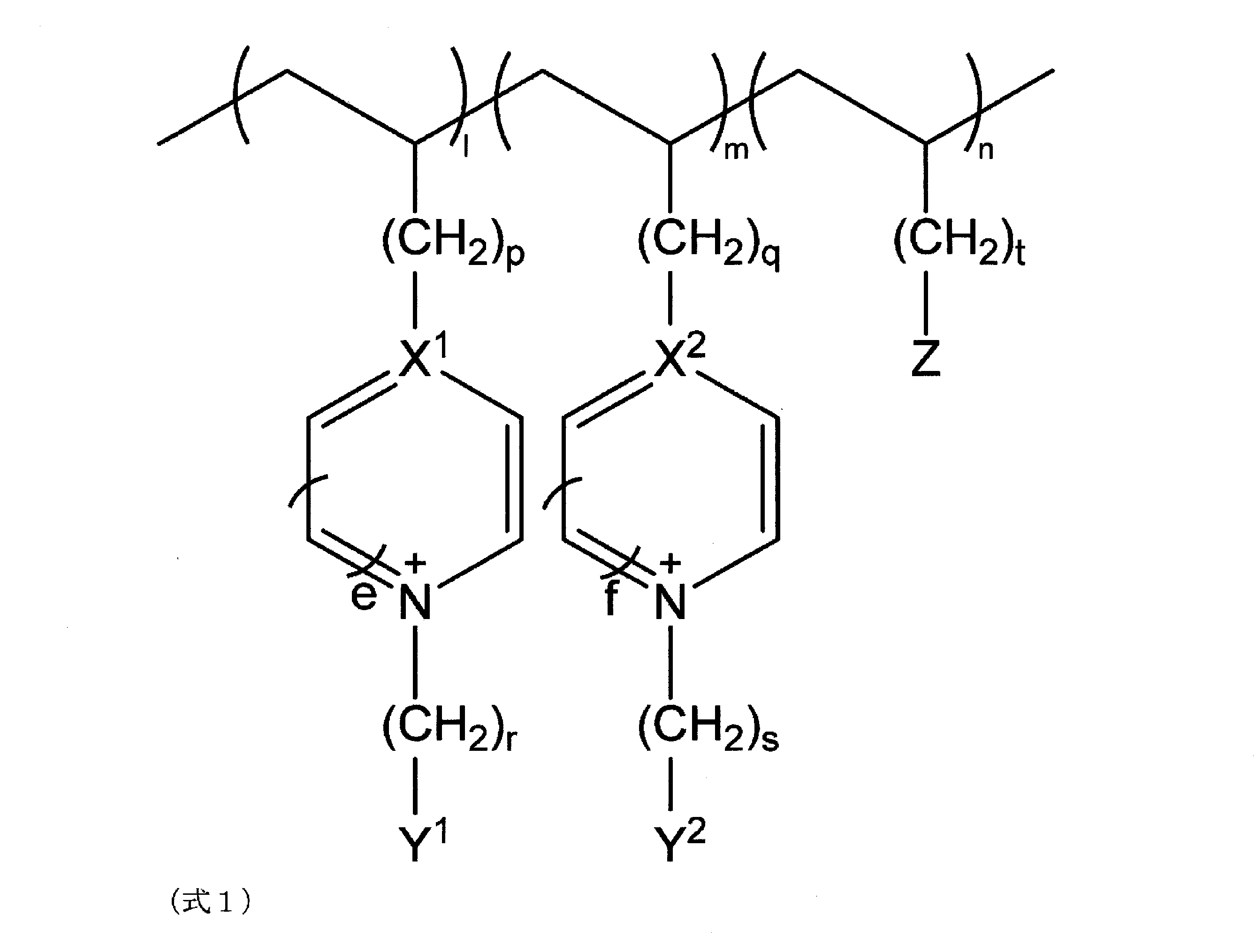
[1]次の一般式(1)で表される双性イオンポリマー又はその標識体。
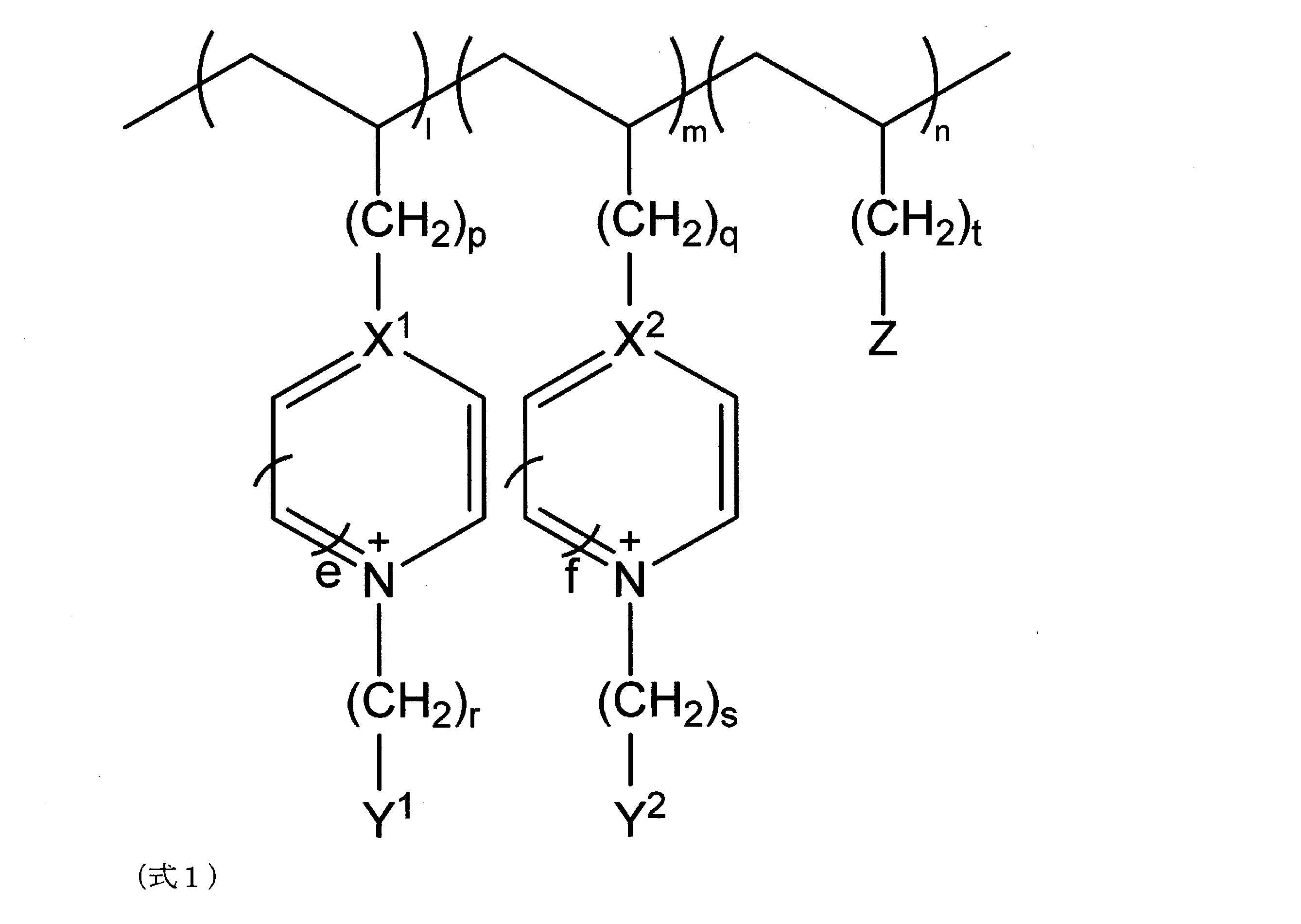
X1及びX2は、同一でも異なってもよく、炭素原子又は窒素原子を示し;
Y1及びY2は、同一でも異なってもよく、-COO-、-SO3 -、-OP=O(H)O-、-OP=O(CH3)O-及び-OP=O(OR1)O-から選ばれるアニオンを示し;
Zは、水素原子、アルキル基が置換していてもよい炭素数6~10の芳香族炭化水素基、アルキル基が置換していてもよい5~6員の芳香族複素環式基、アルキル基が置換していてもよい窒素含有複素環式アンモニウム塩、テトラアルキルアンモニウム塩、テトラフェニルホスホニウム塩、テトラアルキルホスホニウム塩、トリアルキルスルホニウム塩、又は分子鎖中に1~3個の酸素原子を有していてもよい炭素数1~22の直鎖又は分岐アルキル基を示し;
e及びfは、それぞれ0又は1の整数を示し;
l、m及びnは、それぞれ各繰り返し単位の含有比率を示す数であって、0<l≦1、0≦m<1、0≦n<1、l+m+n=1を満たす数を示し;
p、q、r、s及びtは、それぞれ0~6の整数を示す)
[2]Y1及びY2が、同一でも異なってもよく、-COO-及び-SO3 -から選ばれるアニオンである[1]記載の双性イオンポリマー又はその標識体。
[3]Zが、イミダゾリル基、ピリジル基、ピリジニウムクロリド、C1~C22アルキルピリジニウムクロリド、イミダゾリニウムクロリド、C1~C22アルキルイミダゾリニウムクロリド、ピリジニウムブロミド、C1~C22アルキルピリジニウムブロミド、イミダゾリニウムブロミド及びC1~C22アルキルイミダゾリニウムブロミドから選ばれる基である[1]又は[2]記載の双性イオンポリマー又はその標識体。
[4]次の一般式(1)で表される双性イオンポリマー又はその標識体を含有する生体試料の保存剤組成物。
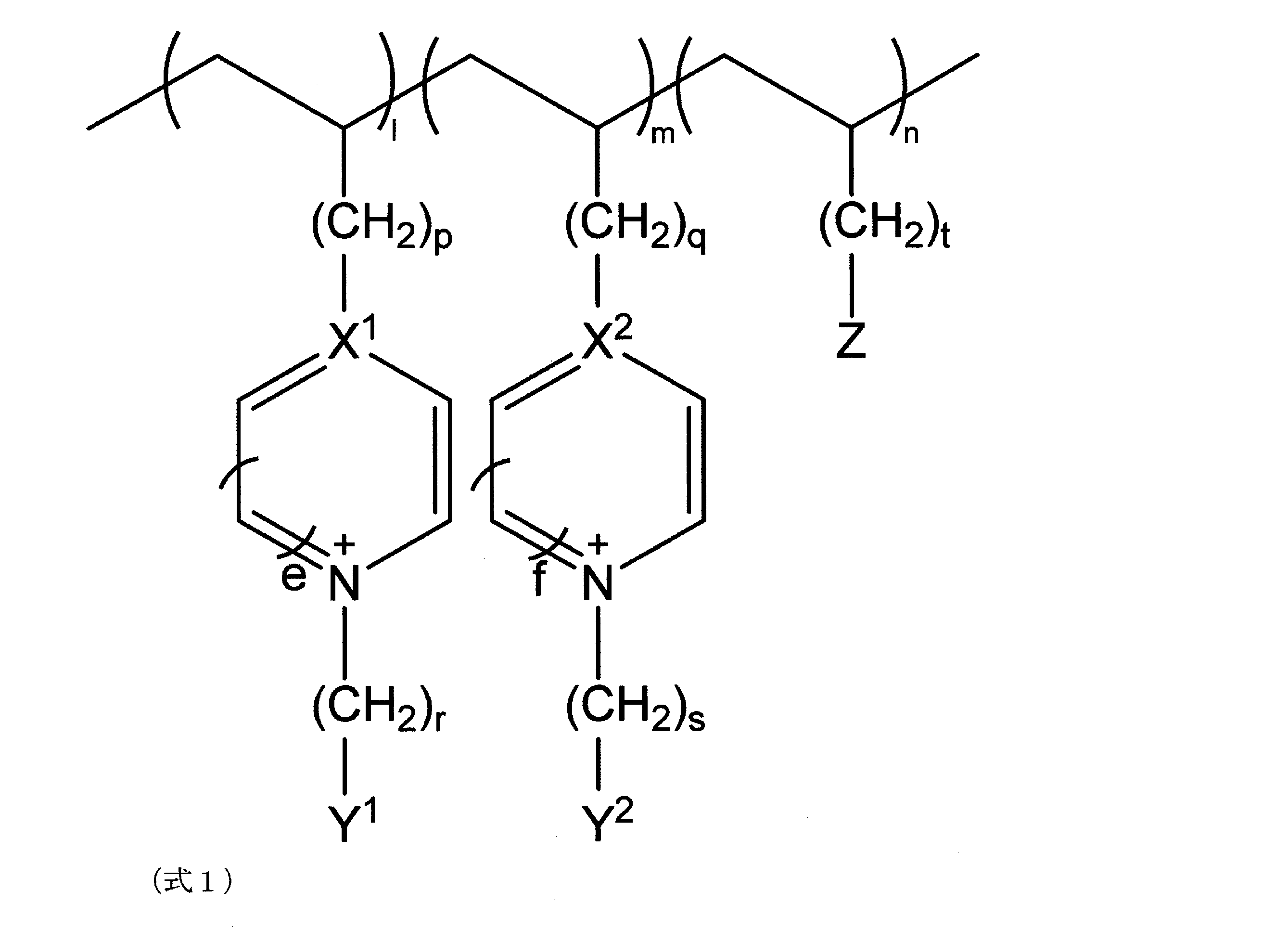
X1及びX2は、同一でも異なってもよく、炭素原子又は窒素原子を示し;
Y1及びY2は、同一でも異なってもよく、-COO-、-SO3 -、-OP=O(H)O-、-OP=O(CH3)O-及び-OP=O(OR1)O-から選ばれるアニオンを示し;
Zは、水素原子、アルキル基が置換していてもよい炭素数6~10の芳香族炭化水素基、アルキル基が置換していてもよい5~6員の芳香族複素環式基、アルキル基が置換していてもよい窒素含有複素環式アンモニウム塩、テトラアルキルアンモニウム塩、テトラフェニルホスホニウム塩、テトラアルキルホスホニウム塩、トリアルキルスルホニウム塩、又は分子鎖中に1~3個の酸素原子を有していてもよい炭素数1~22の直鎖又は分岐アルキル基を示し;
e及びfは、それぞれ0又は1の整数を示し;
l、m及びnは、それぞれ各繰り返し単位の含有比率を示す数であって、0<l≦1、0≦m<1、0≦n<1、l+m+n=1を満たす数を示し;
p、q、r、s及びtは、それぞれ0~6の整数を示す)
[5]Y1及びY2が、同一でも異なってもよく、-COO-及び-SO3 -から選ばれるアニオンである[4]記載の生体試料の保存剤組成物。
[6]Zが、イミダゾリル基、ピリジル基、ピリジニウムクロリド、C1~C22アルキルピリジニウムクロリド、イミダゾリニウムクロリド、C1~C22アルキルイミダゾリニウムクロリド、ピリジニウムブロミド、C1~C22アルキルピリジニウムブロミド、イミダゾリニウムブロミド及びC1~C22アルキルイミダゾリニウムブロミドから選ばれる基である[4]又は[5]記載の生体試料の保存剤組成物。
[7]さらに、電解質、ベタイン、双性イオン、アルコール、多価アルコール及び糖類から選ばれる1種以上の水溶性化合物を含有する[4]~[6]のいずれかに記載の生体試料の保存剤組成物。
[8]さらに、細胞浸透性物質を含有する[4]~[7]のいずれかに記載の生体試料の保存剤組成物。
[9]生体試料の凍結保存剤組成物、生体試料の培養用組成物、生体試料の培地組成物、生体試料の保存用組成物、生体試料の機能維持用組成物、又は生体試料の機能試験用組成物である[4]~[8]のいずれかに記載の生体試料の保存剤組成物。
[10]前記[1]~[3]のいずれかに記載の双性イオンポリマー又はその標識体を含む難溶性物質溶解剤。
[11]生体試料に、前記[1]~[3]のいずれかに記載の双性イオンポリマー又はその標識体を含有する組成物を接触させることを特徴とする、生体試料の保存方法。
[12]前記[1]~[3]のいずれかに記載の双性イオンポリマー又はその標識体を含有する組成物がさらに、電解質、ベタイン、双性イオン、アルコール、多価アルコール及び糖類から選ばれる1種以上の水溶性化合物を含有する[11]記載の生体試料の保存方法。
[13]前記[1]~[3]のいずれかに記載の双性イオンポリマー又はその標識体を含有する組成物がさらに、細胞浸透性物質を含有する[11]又は[12]記載の生体試料の保存方法。
[14]生体試料の保存が、生体試料の凍結保存、生体試料の培養、生体試料の培地、生体試料の機能維持、又は生体試料の機能試験である[11]~[13]のいずれかに記載の生体試料の保存方法。
[15]難溶性物質を、前記[1]~[3]のいずれかに記載の双性イオンポリマー又はその標識体を含有する組成物に溶解することを特徴とする、難溶解性物質の溶解方法。
本発明の保存剤組成物の対象となる生体試料としては、核酸、タンパク質、細胞小器官、細胞、組織、個体などが挙げられ、このうち細胞小器官、細胞、組織が好ましい。
使用できる細胞の由来は特に限定されず、例えば、動物細胞、昆虫細胞、植物細胞、酵母菌、細菌等の細胞が挙げられる。また、動物細胞としては、ヒト、マウス、ラット、サル、ブタ、イヌ、ヒツジ、ヤギ等の細胞が挙げられる。さらに、細菌としては、乳酸菌、大腸菌、枯草菌、シアノバクテリア等が挙げられる。
また、細胞の種類も特に限定されず、例えば、多能性幹細胞、組織幹細胞、体細胞及び生殖細胞からなる群から適宜選択される。ここで「多能性幹細胞」とは、あらゆる組織の細胞へと分化する能力(分化多能性)を有する幹細胞の総称であり、胚性幹細胞(ES細胞)、人工多能性幹細胞(iPS細胞)、胚性生殖幹細胞(EG細胞)、生殖幹細胞(GS細胞)等が挙げられる。好ましくは、ES細胞又はiPS細胞である。
また、「組織幹細胞」とは、分化可能な細胞系列が特定の組織に限定されているが、多様な細胞種へ分化可能な能力(分化多能性)を有する幹細胞を意味し、例えば、骨髄中の造血幹細胞、神経幹細胞、肝幹細胞、皮膚幹細胞等が挙げられる。
「体細胞」とは、多細胞生物を構成する細胞のうち生殖細胞以外の細胞をいう。好ましくは、破骨細胞、線維芽細胞、肝細胞、膵細胞、筋細胞、骨細胞、骨芽細胞、軟骨細胞、脂肪細胞、皮膚細胞、膵細胞、腎細胞、肺細胞、リンパ球、赤血球、白血球、単球、マクロファージ等が挙げられる。
「生殖細胞」としては、有性生殖のための配偶子、すなわち卵子、卵細胞、精子、精細胞、無性生殖のための胞子等が挙げられる。
細胞は、肉腫細胞、株化細胞及び形質転換細胞からなる群から選択しても良い。「肉腫」とは、骨、軟骨、脂肪、筋肉、血液等の非上皮性細胞由来の結合組織細胞に発生する癌であり、軟部肉腫、悪性骨腫瘍等を含む。肉腫細胞は、肉腫に由来する細胞である。「株化細胞」は、長期間にわたって体外で維持され、一定の安定した性質をもち、半永久的な継代培養が可能になった培養細胞を意味する。この例として、PC12細胞(ラット副腎髄質由来)、CHO細胞(チャイニーズハムスター卵巣由来)、HEK293細胞(ヒト胎児腎臓由来)、HL-60細胞(ヒト白血球細胞由来)、HeLa細胞(ヒト子宮頸癌由来)等が挙げられる。「形質転換細胞」は、細胞外部から核酸(DNA等)を導入し、遺伝的性質を変化させた細胞を意味する。動物細胞、植物細胞、細菌の形質転換は、従来知られた方法を用いて行われる。
また、ES細胞やiPS細胞を培養する際に、細胞の増殖や分化に必要な環境を整えるために補助的に用いられるフィーダー細胞を必要に応じて含んでいても良い。フィーダー細胞としては、マウスの線維芽細胞等が挙げられる。これらのフィーダー細胞は、予めガンマ線照射や抗生物質によって増殖しないように処理することができる。
本発明の双性イオンポリマーの一態様は、次の一般式(1)で表される双性イオンポリマー又はその標識体である。
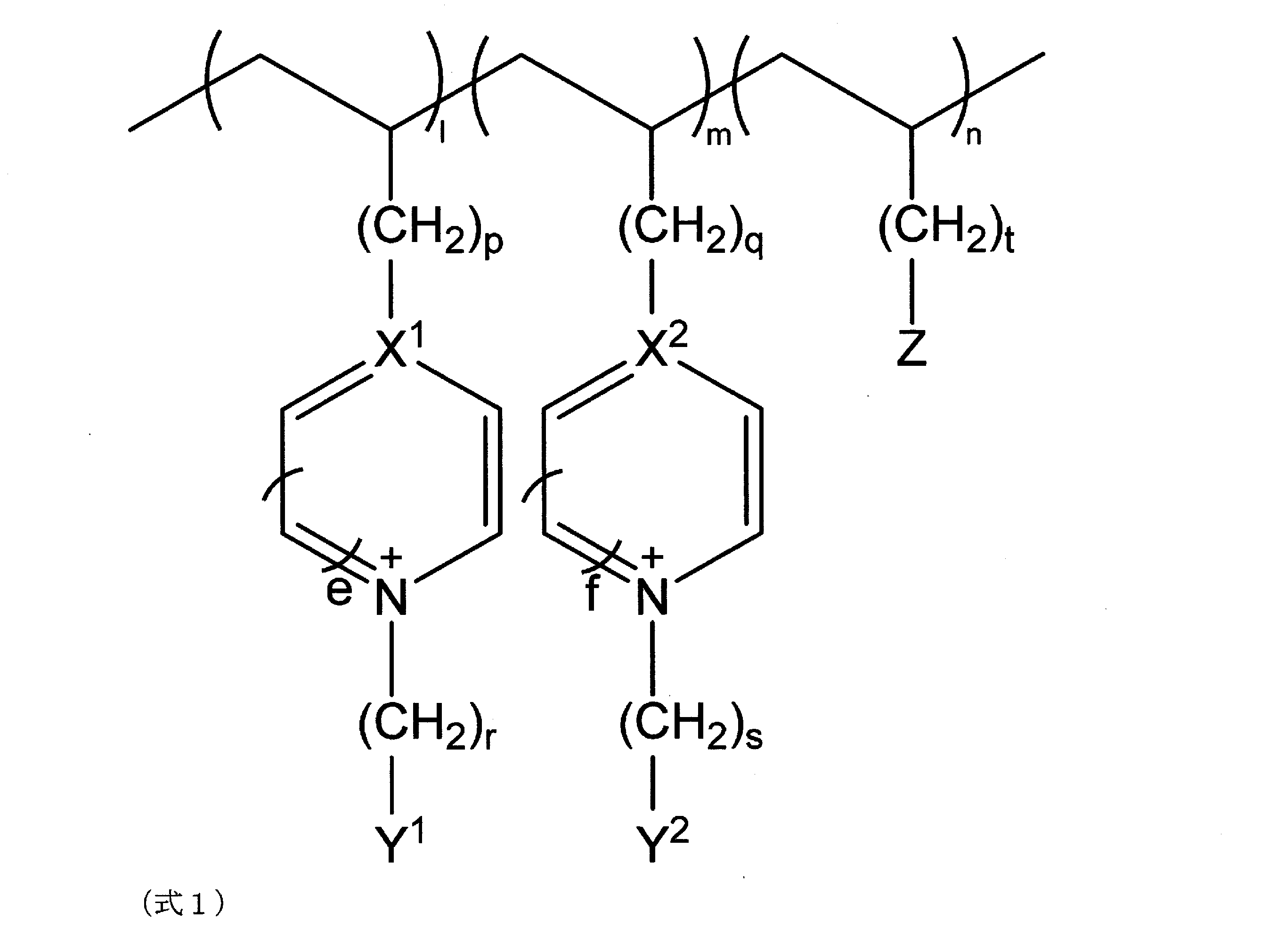
X1及びX2は、同一でも異なってもよく、炭素原子又は窒素原子を示し;
Y1及びY2は、同一でも異なってもよく、-COO-、-SO3 -、-OP=O(H)O-、-OP=O(CH3)O-及び-OP=O(OR1)O-から選ばれるアニオンを示し;
Zは、水素原子、アルキル基が置換していてもよい炭素数6~10の芳香族炭化水素基、アルキル基が置換していてもよい5~6員の芳香族複素環式基、アルキル基が置換していてもよい窒素含有複素環式アンモニウム塩、テトラアルキルアンモニウム塩、テトラフェニルホスホニウム塩、テトラアルキルホスホニウム塩、トリアルキルスルホニウム塩、又は分子鎖中に1~3個の酸素原子を有していてもよい炭素数1~22の直鎖又は分岐アルキル基を示し;
e及びfは、それぞれ0又は1の整数を示し;
l、m及びnは、それぞれ各繰り返し単位の含有比率を示す数であって、0<l≦1、0≦m<1、0≦n<1、l+m+n=1を満たす数を示し;
p、q、r、s及びtは、それぞれ0~6の整数を示す)
本発明において双性イオン構造とは、正電荷と負電荷を同一分子内の隣り合わない位置に持ち、正電荷を持つ原子に解離しうる水素が結合しておらず、分子全体としては電荷を持たない化合物(分子内塩)の総称である。
このように、本発明のポリマーの繰り返し単位の側鎖に双性イオンを有することにより、細胞膜に対する保護作用を示し、凍結保存剤として機能するもの考えられる。また、本発明のポリマーは、電解質、ベタイン、双性イオン、アルコール、多価アルコール及び糖類から選ばれる1種以上の水溶性化合物を添加することにより、前記側鎖の双性イオンにより会合していた状態から分散状態になるため、細胞膜に作用して凍結保護作用を示すものと考えられる。
m=n=0のときは、一般式(1)は側鎖に双性イオン構造の官能基を持つホモポリマーを表す。mが0を超える数を示し、n=0のときは、一般式(1)は2種類の双性イオン構造を有するランダム又はブロック共重合体であることを表す。m=0であり、nが0を超える数を示すときは、一般式(1)は、側鎖に双性イオン構造の官能基を持つ繰り返し単位と、側鎖にZを有する繰り返し単位とを有するランダム又はブロック共重合体であることを表す。m及びnが0を超える数を示すときは、一般式(1)は三元系のランダム又はブロック共重合体であることを表す。
一般式(1)中、X1及び窒素原子(N)を含む複素環式カチオンとしては、イミダゾリウムカチオン(X1=N、e=0)、ピリジニウムカチオン(X1=C、e=1)、ピロリニウムカチオン(X1=C、e=0)、ピラジニウムカチオン(X1=N、e=1)が挙げられる。このうち、イミダゾリウムカチオン(X1=N、e=0)、ピリジニウムカチオン(X1=C、e=1)が好ましい。
一般式(1)中、X2及び窒素原子(N)を含む複素環式カチオンとしては、イミダゾリウムカチオン(X2=N、f=0)、ピリジニウムカチオン(X2=C、f=1)、ピロリニウムカチオン(X2=C、f=0)、ピラジニウムカチオン(X2=N、f=1)が挙げられる。このうち、イミダゾリウムカチオン(X2=N、f=0)、ピリジニウムカチオン(X2=C、f=1)が好ましい。
具体的には、水素原子、フェニル基、ナフチル基、C1-22アルキル置換フェニル基、C1-22アルキル置換ナフチル基、イミダゾリル基、トリアゾリル基、ピリジル基、ピロリル基、ピラジニル基、フリル基、チエニル基、オキサゾリル基、チアゾリル基、ピリジニウムクロリド、C1~C22アルキルピリジニウムクロリド、イミダゾリニウムクロリド、C1~C22アルキルイミダゾリニウムクロリド、ピリジニウムブロミド、C1~C22アルキルピリジニウムブロミド、イミダゾリニウムブロミド、C1~C22アルキルイミダゾリニウムブロミド、ピロリジニウムクロリド、C1~C22アルキルピロリジニウムクロリド、ピロリジニウムブロミド、C1~C22アルキルピロリジニウムブロミド、テトラメチルアンモニウムクロリド、C2-22アルキルトリメチルアンモニウムクロリド、テトラメチルアンモニウムブロミド、C2-22アルキルトリメチルアンモニウムブロミド、テトラフェニルホスホニウムクロリド、テトラフェニルホスホニウムブロミド、トリメチルスルホニウムクロリド、トリメチルスルホニウムブロミド、C1-22直鎖又は分岐鎖アルキル基、エトキシエチル基、エトキシエトキシエチル基、エトキシエトキシエトキシエチル基等が挙げられる。
好ましいZとしては、アルキル基が置換していてもよい5~6員の芳香族複素環式基又はアルキル基が置換していてもよい窒素含有複素環式アンモニウム塩が挙げられ、より好ましくは、イミダゾリル基、トリアゾリル基、ピリジル基、ピロリル基、ピラジニル基、フリル基、チエニル基、オキサゾリル基、チアゾリル基、ピリジニウムクロリド、C1~C22アルキルピリジニウムクロリド、イミダゾリニウムクロリド、C1~C22アルキルイミダゾリニウムクロリド、ピリジニウムブロミド、C1~C22アルキルピリジニウムブロミド、イミダゾリニウムブロミド、C1~C22アルキルイミダゾリニウムブロミド、ピロリジニウムクロリド、C1~C22アルキルピロリジニウムクロリド、ピロリジニウムブロミド、C1~C22アルキルピロリジニウムブロミドが挙げられる。
さらに好ましくは、イミダゾリル基、ピリジル基、ピリジニウムクロリド、C1~C22アルキルピリジニウムクロリド、イミダゾリニウムクロリド、C1~C22アルキルイミダゾリニウムクロリド、ピリジニウムブロミド、C1~C22アルキルピリジニウムブロミド、イミダゾリニウムブロミド、C1~C22アルキルイミダゾリニウムブロミドが挙げられる。
これらの標識物質を用いて、双性イオンポリマーを標識するには、双性イオンポリマーの側鎖に標識物質を結合させる手段、標識物質を側鎖に結合したモノマーを共重合させる手段が挙げられる。例えば、一般式(1)で表されるポリマーを構成する1種又は2種以上のモノマーとフルオレセインアクリレートとを共重合させることにより、フルオレセイン標識体を得ることができる。
本発明の双性イオンポリマーの主鎖の構造は、星形、櫛形、架橋構造などが考えられ、いずれの構造のものであっても本発明の目的に用いることが可能であるが、主鎖のコンフォメーションは側鎖の種類によって異なる。主鎖が直鎖状のポリマーの場合には、NaClなどの電解質等の添加によりポリマーを広げることで、水への分散性を高めることができる。また、本発明の双性イオンポリマーは、側鎖に存在する双性イオン構造により、細胞膜の構造や細胞透過性の観点から、および細胞外における氷晶の形成、難溶性物質の溶解性に関係することから、その分子量は、一定程度の大きさであることが好ましい。分子鎖を電解質により広げた状態において、ポリエチレンオキサイド換算で、Mwが1万以上、Mnが5000以上が好ましく、Mwが1万以上200万以下、Mnが5000以上150万以下がより好ましい。さらに、ポリマーの分子量分布も考慮される。双性イオンポリマーを生体試料の凍結保存剤に使用した場合、氷晶が細胞外で形成することを促進することから、本発明の双性イオン性ポリマーは、細胞膜浸透性でないのが好ましい。
本発明の双性イオンポリマーは、前記繰り返し単位に相当するα-オレフィンであるモノマーを用いる。重合には、ラジカル重合、アニオン重合、カチオン重合などをさせることによって製造でき、モノマーの特性や製造するポリマーの目的や性質などによって適宜使い分けることもできる。ベタイン構造を有するα-オレフィンを1種類のみ用いて重合反応させる場合には、同じ側鎖をもつ双性イオンポリマーのホモ重合体(一般式(1)においてl=1,m=n=0、またはm=1、l=n=0)を製造することができる。また、2種類のベタイン構造を有するα-オレフィンを用いて重合反応させる場合には、2種類のベタイン構造の側鎖を有する双性イオンポリマーの共重合体(0<l<1、0<m<1、n=0)を製造することができる。1種類のベタイン構造のα-オレフィンと一般のαオレフィンを用いて重合反応させる場合には、ベタイン構造を側鎖に含むポリオレフィンの双性イオンポリマー(l=0、0<m<1、0<n<1、または0<l<1、m=0、0<n<1)を製造することができる。また、ベタイン構造を側鎖に含むポリオレフィンの双性イオンポリマー(l=0、0<m<1、0<n<1、または0<l<1、m=0、0<n<1)を製造する場合においては、前記一般式(1)中の(CH2)rY1及び(CH2)sY2を有しない構造のポリマーに対して側鎖中の窒素原子にY1及びY2中のアニオン基を導入して、窒素原子をカチオン化して側鎖に後からベタイン構造を構築する方法(「後修飾」ともいう)で製造してもよい。前記一般式(1)中の(CH2)rY1及び(CH2)sY2を有しない構造のポリマーは、公知のポリマーを用いてよいし、そのようなポリマーが知られていない場合には、前記一般式(1)中の(CH2)rY1及び(CH2)sY2を有しない構造のポリマーを重合により製造してもよい。
本発明の双性イオンポリマーのラジカル重合は、高温高圧で製造する方法もあるが、適切な重合開始剤を用いれば常圧で製造することが出来る。重合開始剤としては2,2’-アゾビスイソブチロニトリルなどのアゾ化合物、過酸化ベンゾイルなどの過酸化物などを開始剤として用いることができる。重合開始剤はベタイン構造を有するα-オレフィンに対して、0.001モル%以上、好ましくは0.01モル%、より好ましくは0.1モル%以上であり、かつ、10モル%以下、好ましくは5モル%以下、より好ましくは1モル%の割合の範囲で用いられる。重合開始剤の使用量のほかには溶媒使用の性質や有無や温度、圧力などにより生成するポリマーの分子量を調節することが出来る。
また、窒素原子をカチオン化しベタイン構造を構成するアニオン基の導入方法としては、側鎖部分に窒素原子を有するポリマーに、ハロゲン化脂肪酸エステル、アルキルスルトンなどを反応させる方法が挙げられる。側鎖部分に窒素原子を有するポリマーとしては、ポリピリジン、ポリイミダゾリンなどを挙げることができる。
後記実施例に示すように、本発明の双性イオンポリマーは、水溶性であるが、分子量が大きいためにその水溶液は浸透圧が低い場合がある。しかし、本発明の双性イオンポリマー水溶液に浸透圧に寄与する化合物を添加すると、浸透圧は向上し、生体試料の凍結保存後の生存率を顕著に向上させる作用を有している。
ここで電解質とは、溶媒中に溶解したときに陽イオンと陰イオンに電離する物質である。
好ましい陽イオンとしては、ナトリウムイオン、カリウムイオン、カルシウムイオン、マグネシウムイオンなどが挙げられ、陰イオンとしては、塩化物イオン、リン酸イオン、炭酸水素イオンなどが挙げられる。従って、好ましい電解質としては、ナトリウムイオン、カリウムイオン、カルシウムイオン及びマグネシウムイオンから選ばれる陽イオンと、塩化物イオン、リン酸イオン及び炭酸水素イオンから選ばれる陰イオンとを組み合わせた化合物である。具体的には、塩化ナトリウム、塩化カリウム、リン酸ナトリウム、リン酸カリウム、炭酸水素ナトリウム、炭酸水素カリウムなどが挙げられる。
また、アルコールとしては、メタノール、エタノール、イソプロパノールなどの炭素数1~6のアルコールが挙げられる。多価アルコールとしては、エチレングリコール、プロピレングリコールなどの水溶性多価アルコールが挙げられる。糖類としては、グルコース、スクロースなどの単糖類、二糖類が挙げられる。ベタインとしては、カルニチンなどが挙げられる。双性イオンとしては、WO2020/230721に記載の双性イオンが挙げられる。
また、本発明の双性イオンポリマー水溶液は、動的光散乱法(DLS)による粒度測定で100~1000nmのところに粒子が多く存在していることが観測された。電解質を添加するとその凝集の程度は弱くなり、なかには凝集がほとんど観察されなくなるものもあった。電解質添加後は、10nm付近に多くの粒子が存在していることが観測された(図19)。
本発明の双性イオンポリマーは、水溶液中においては、側鎖の密集具合によって凝集するが、電解質と側鎖が相互作用することで凝集していたポリマーが電解質とイオン対を形成して、ポリマー主鎖のコンフォメーションが変化して凝集していたポリマーの形状が広がり、分散状態となる。電解質を添加しているため浸透圧の上昇もあるが、それだけではなく双性イオンモノマーとしての双性イオン側鎖がより分散状態となり、保存性に寄与するものと考えられる。
DLSによる観測から、本発明の双性イオンポリマーは電解質を含有する水溶液中で、凝集されていたポリマーがより分散状態となることで保存性に寄与する。ポリマーが分散状態になることでポリマー主鎖が生体表面を覆うように広く分散し、側鎖が生体膜と相互作用したり、細胞膜に入り込んだりすることで生体膜との親和性が高まると考えられる。その結果、双性イオンポリマーと保存する生体試料、特に細胞膜との関係で、細胞膜と相互作用し、細胞周辺にマトリックス様のものが形成される。このような双性イオンポリマーと細胞膜の相互作用は、細胞同士の関係においても影響を与えており、細胞同士の凝集状態になっていることが観察される(図27)。本発明の双性イオンポリマーが添加された培地において観察される細胞は、いくつかの細胞が集まっている様子が観察され、PBS中の細胞が一細胞ずつ分離して観察されるのに対して、対照的である。このことから、本発明の双性イオンの添加によって何らかの効果を引き起こし細胞同士の接着効果を期待することができる。接着効果の大きさは明らかではないが、将来的には、臓器移植など手術などにより臓器を定着させる場合、組織や臓器を三次元プリンターなどで製造する場合などに有用になることが期待される。
DSCにより、急速凍結後室温まで戻す昇温工程における氷が溶解する温度の測定により、氷の溶解温度を高める作用を観測した。これらの結果から、双性イオンポリマーが電解質により分散状態になることにより細胞膜と相互作用をして何らかの構造変化が起こることで細胞を保護する作用が期待される。たとえば、そのような保護作用により細胞内への氷の流入を抑制し細胞の生存を維持しているものと考えられる。さらに、双性イオンポリマーの細胞外における保護作用により、動物細胞を培地中で浮遊細胞として1個1個を独立して培養することも可能である。
本発明の生体材料の保存剤組成物は、前記生体材料の凍結保存剤として機能するだけでなく、生体材料の保存維持用組成物としても機能する。具体的には、生体材料の凍結保存剤組成物、生体材料の培養用組成物、生体材料の培地組成物、生体材料の保存用組成物、生体材料の機能維持用組成物、生体材料の機能試験用組成物などが挙げられる。
本発明の生体試料の保存剤組成物の媒体は、水、水と有機溶媒との混合物が挙げられる。選択する媒体としては、電解質が陽イオンと陰イオンに電離する物質であるのが好ましい。ここで、有機溶媒としては、メタノール、エタノールなどの低級アルコール、ジメチルスルホキシド(DMSO)、ジメチルホルムアミド(DMF)などが挙げられる。
電解質、ベタイン、双性イオン、アルコール、多価アルコール及び糖類から選ばれる1種以上の水溶性化合物の濃度は、生体試料の生存に影響しない濃度であるのが好ましく、0.2質量%以上5質量%以下が好ましく、0.5質量%以上3質量%以下がより好ましく、0.5質量%以上2質量%以下がさらに好ましい。
これらの細胞浸透性物質の添加量は、通常使用される量よりも低減することも増大させることもできる。例えば、DMSOの場合は、3質量%以上25質量%以下とすることができる。グリセロールの場合は、3質量%以上25質量%以下とすることができる。
凍結保存された細胞の解凍手段は、例えば凍結細胞を含むアンプルを速やかに37℃のウォーターバスに移して解凍するのが好ましい。アンプルの内容物をピペットで滅菌チューブに移す。その後、適切なサプリメントを添加済みの予熱した培地を徐々に添加する。トリパンブルーを使用して生細胞密度を測定する。適切な量の細胞懸濁液をフラスコに移し、細胞株のデータシート上で推奨される細胞密度で播種する。
本発明において、「難溶性物質」とは、水にわずかしか溶けないという性質を有している物質をいい、水に対する溶解度(25℃)が、1重量%以下の物質であり、好ましくは、0.5重量%以下であり、特に好ましくは0.1重量%以下である。このような難溶性物質は、例えば、医薬品、動物用医薬品、医薬部外品、化粧料、農薬の有効成分である物質(有効成分となり得る候補物質も含む)、食品添加物、生物由来物質や植物由来物質であり、低分子物質、及びオリゴペプチド、ポリペプチド、多糖類、DNA、RNA等のオリゴマー及び高分子物質を含む。
「難溶性の医薬品」とは、日本薬局方に規定される「やや溶けにくい」「溶けにくい」「極めて溶けにくい」「ほとんど溶けない」薬物が該当し、具体的には、抗腫瘍剤、抗生物質、抗高脂血症剤、抗菌剤、アレルギー性疾患治療剤、高血圧治療剤、動脈硬化治療剤、血行促進剤、ホルモン剤、脂溶性ビタミン剤、糖尿病治療剤、抗アンドロゲン剤、強心用薬剤、不整脈用薬剤、消炎剤、催眠鎮静剤、精神安定剤、抗てんかん剤、抗うつ剤、消化器系疾患治療剤、利尿用薬剤、局所麻酔剤、抗凝固剤、抗ヒスタミン剤、抗ムスカリン剤、抗マイコバクテリア剤、免疫抑制剤、抗甲状腺薬、抗ウイルス剤、不安緩和性鎮静薬、収れん薬、β-アドレナリン受容体遮断薬、心筋変力作用剤、造影剤、コルチコステロイド、咳抑制剤、診断剤、診断用イメージング剤、利尿剤、ドパミン作用剤、脂質調整剤、筋肉弛緩薬、副交感神経作用薬、甲状腺カルシトニン、プロスタグラジン、放射性医薬、性ホルモン、刺激剤、食欲抑制剤、交感神経作用薬、甲状腺剤、血管拡張剤、イソフラボン、キサンテン等を例示することができる。
難溶性の物質としては、より具体的には、グリチルレチン酸およびその塩、グリチルリチン酸およびその塩、クマリン、オノニン、リクイリチン、ペプチド、コラーゲンなどのポリプチド、キシランなどの多糖類、リグニン、クロラムフェニコールなどを挙げることができる。
本発明の双性イオンポリマーを添加することで、これらの難溶性物質の溶解性を向上させることができる。さらに、本発明の双性イオンポリマーと、電解質、ベタイン、双性イオン、アルコール、多価アルコール及び糖類から選ばれる1種以上の水溶性化合物とを含有する溶液に難溶性物質を溶解すれば、当該難溶性物質の溶解度が顕著に向上する。
実施例において、水はザルトリウスの超純水製造装置を通したものを使用した。
(細胞)
マウス線維芽細胞(mNF)(Mouse Normal Fibroblaast)は、C57BL/6-EGFPマウスより樹立したものを用いた。ヒト腎臓細胞(BOSC)、ラットグリア細胞腫(C6細胞)は、金沢大学 平田研究室から入手した。ヒト慢性骨髄性白血病細胞(K562細胞)およびマウスグリア・神経細胞形質共発現細胞(Vn1919細胞)は、金沢大学 Wong研究室から入手した。OVMANA細胞は、医薬基盤・健康・栄養研究所JCRB細胞バンクで購入した。
(1H-NMR)
1H―NMRは日本電子株式会社製ECA400(外部磁場400MHz)を用いて測定した。
(GPC)
固定相は、TSKgel α-Mカラム(東ソー)を用いた。移動相に純水を用い、流速1.0mL/minとし、測定温度は40℃とし、屈折率検出器(RID-10A)により検出し、各種分子量はポリエチレンオキシドに換算して求めた。
(DSC)
島津製作所のDSC装置を用いた。
-150℃まで1℃/minで冷やし、その後、5℃/minで室温まで戻す昇温工程において氷が溶解する温度を測定した。
(DLS)
粒度分布は、堀場製作所製DLS装置を用いた。
3μmのフィルターに通した溶液をディスポセルに入れて、設定温度25℃で粒子径を測定した。
(浸透圧)
蒸気圧タイプの浸透圧計(VAPRO 5600; Wescor, Inc., Logan, UT, USA)を利用し、10mL標準チャンバーで測定した(室温:25℃、装置のセンサー温度:33℃、サンプル量:10μL)。
(a)細胞の凍結保存
接着細胞の場合は、凍結対象とする細胞をトリプシン処理にて遠沈回収した。浮遊細胞の場合は、凍結対象とする細胞を遠沈回収した。ダルベッコ改変イーグル培地(DMEM)にて希釈して細胞濃度をそれぞれ計測した。DMEM溶液を本明細書では単にmediumと記載する場合がある。
続いて、1.5mLチューブに1mLずつ分注して遠沈し、100μLの双性イオンポリマー溶液を含む凍結保存液にそれぞれ懸濁し、細胞凍結容器Mr.Frosty(登録商標)を用いて、冷却速度-1℃/分、冷却温度-85℃で凍結した。なお、本実施例において市販の凍結保存液としてはことわりの無い限り、CultureSure(登録商標 富士フイルム和光純薬製)を用いた。凍結保存時間は48時間とした後、チューブの温度を37℃で解凍して生細胞数のカウントに用いた。
(b)細胞の解凍と生細胞数の計測
凍結保存バイアルに37℃、1mLの培地を加えて融解し、遠沈して上清を除いた。続いて、遠沈により得られた細胞を培地に再懸濁し、生細胞数を計測した。
(細胞毒性試験)
細胞を、ポリマー溶液中で室温下にて60分間静置したのち、細胞中の死細胞割合をトリパンブルー染色によって測定した。
(細胞増殖試験)
細胞を前記凍結保存試験に従い凍結保存したのち、培地(10%FBS、1%抗生物質含有DMEM)で一定期間培養し、培養前からの細胞増殖数を計測した。
(1)VimC3Cの製造
100mLのテトラヒドロフラン(富士フイルム和光純薬株式会社)に、15.69g(0.167mmol)のビニルイミダゾール(東京化成工業株式会社)を添加し、32.48g(0.167mmol)の4-ブロモ酪酸エチルエステル(東京化成工業株式会社)を加え、70℃で24時間環流した。酢酸エチルで洗浄後、アニオン交換樹脂(Amberlite IRN 78A)のカラムに付した。溶出液を減圧留去することでVimC3Cを得た。VimC3C(DMSO)の1H-NMRチャートを図1に示す。
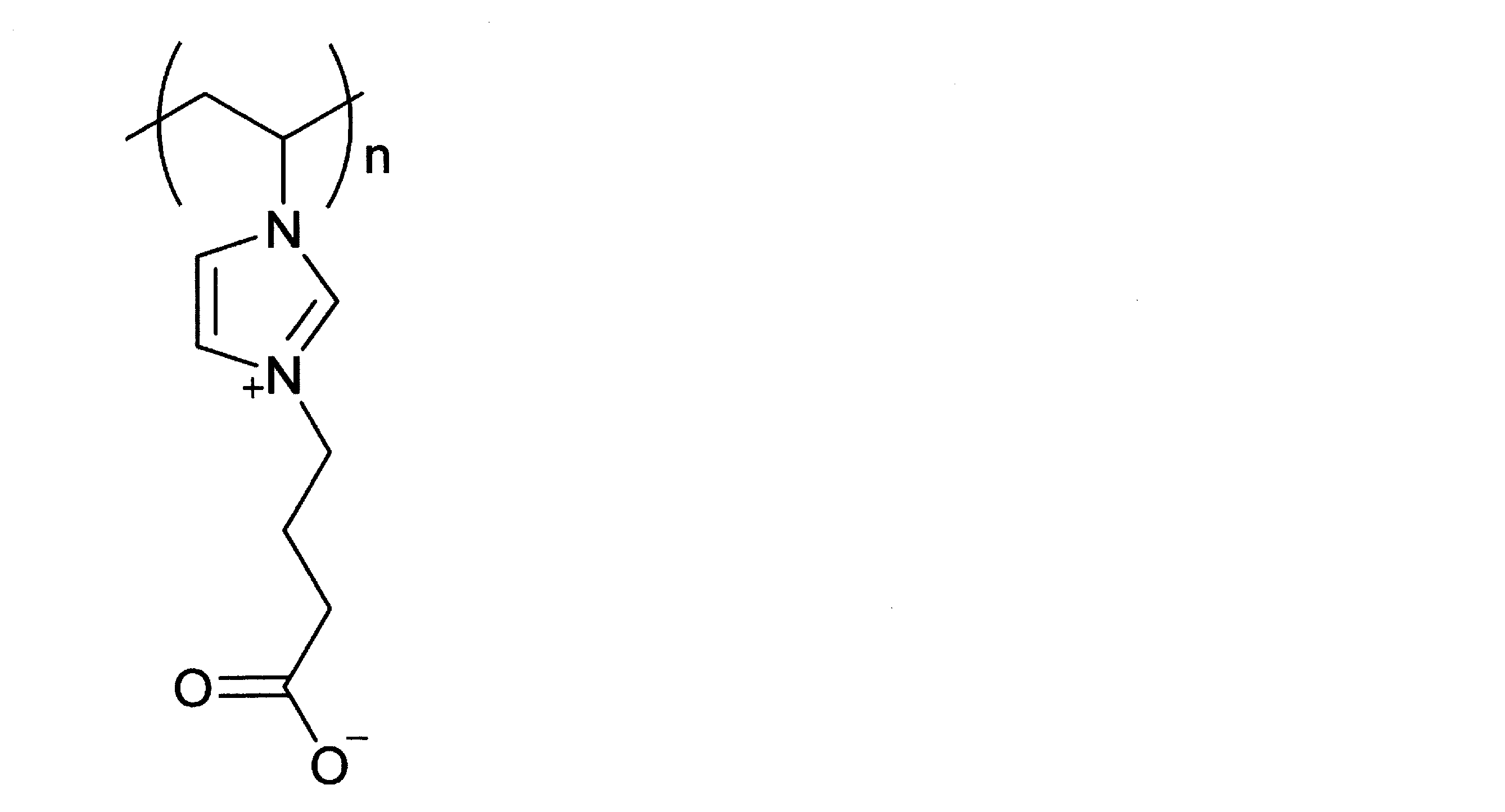
Poly(VimC3C)(methanol)の1H-NMRを図2に示す。ポリマーのD2O溶液にNaClを添加した溶液の1H-NMRを図3に示す。
重合開始剤の量について、モノマー比で0.01~10mol%を加えて反応を行った。本明細書の実施例において、たとえば、本実施例のように重合開始剤をモノマー比で10mol%を加えて製造したポリマーを溶液全体に対し10質量%加えた溶液を、10%10mol%Poly(VimC3C)と記載する。なお、重合開始剤の量について特に断りの無い場合は、モノマー比で1mol%の重合開始剤を加えて製造したポリマーが使用されているものとする。
Poly(VpyC3C)の製造法
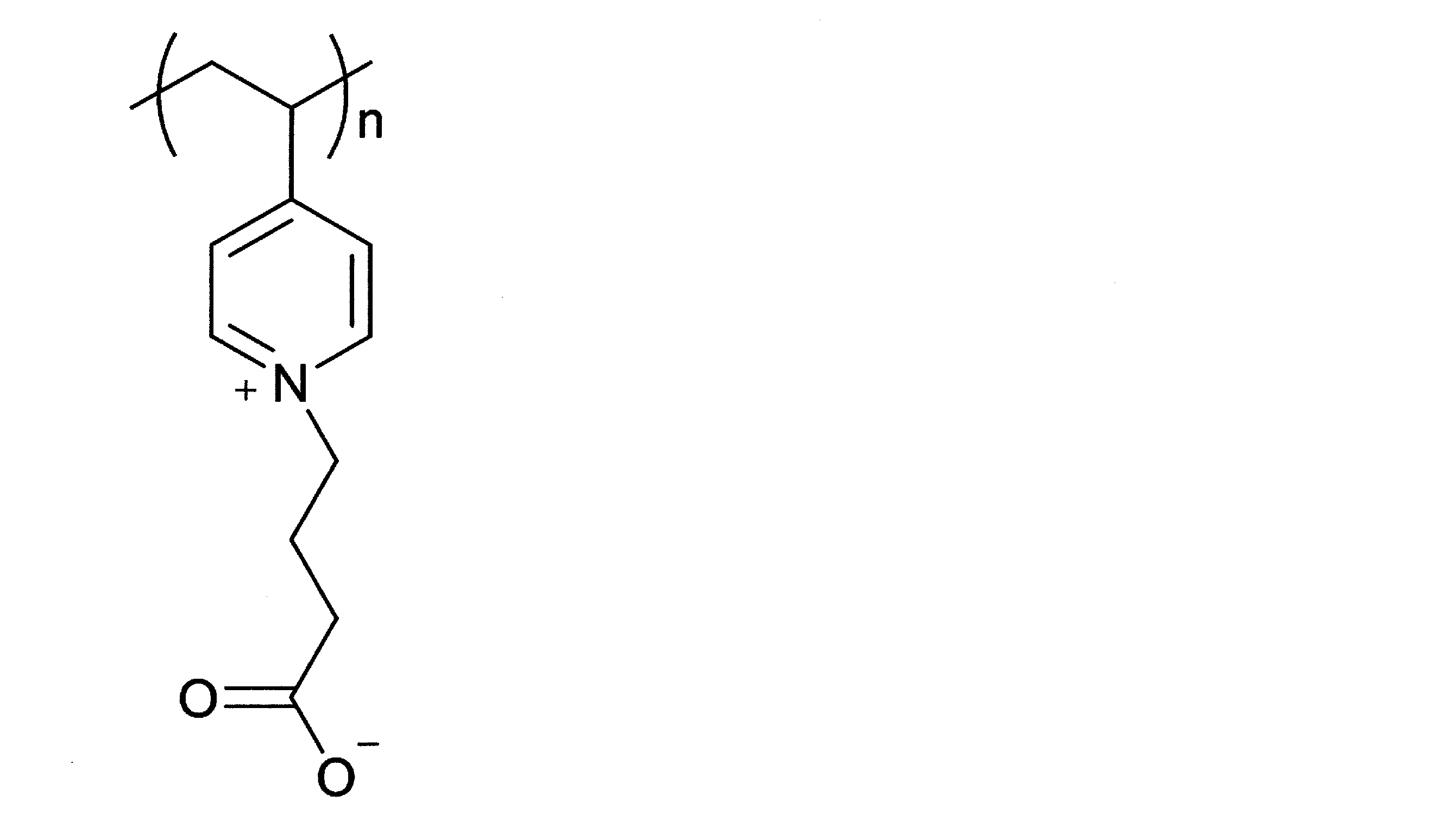
Poly(VpyC3S)の製造法
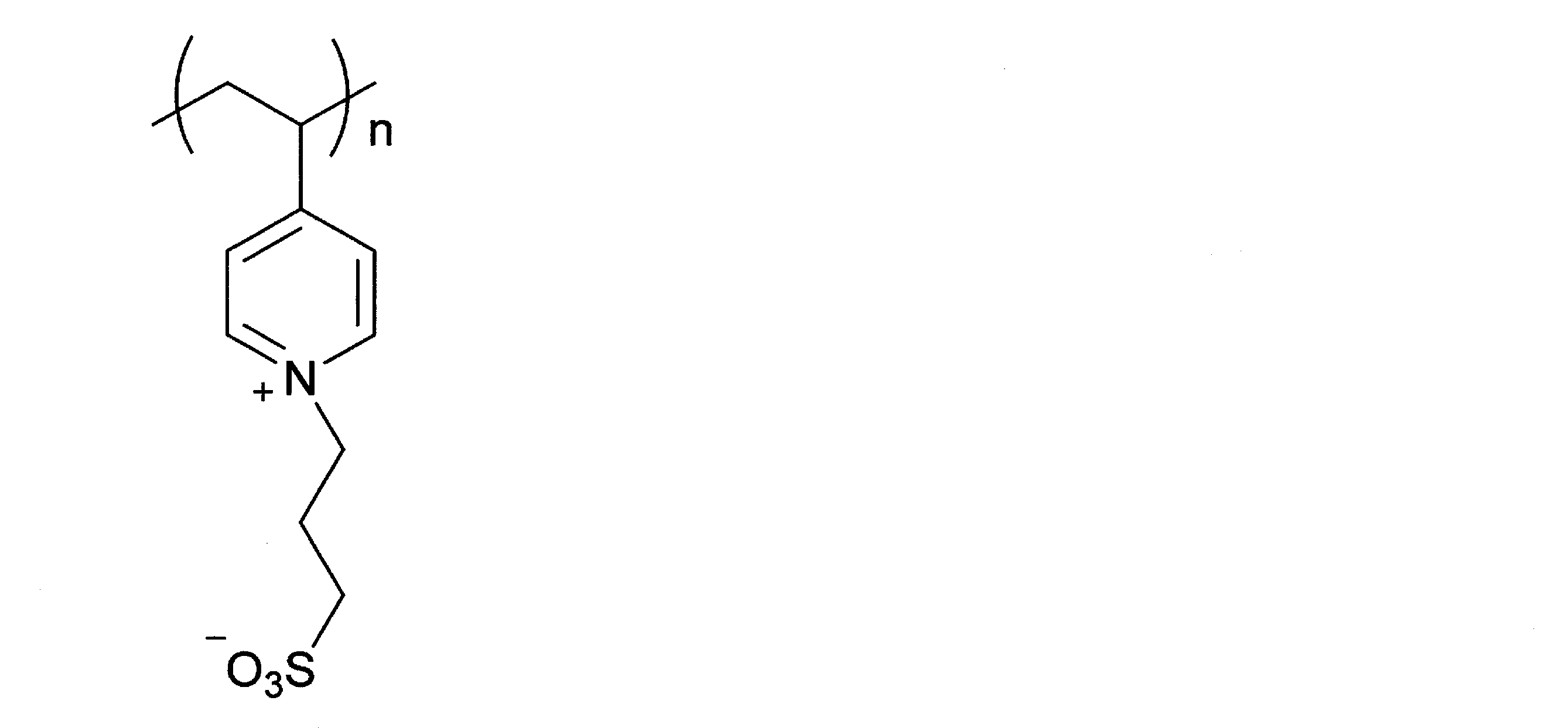
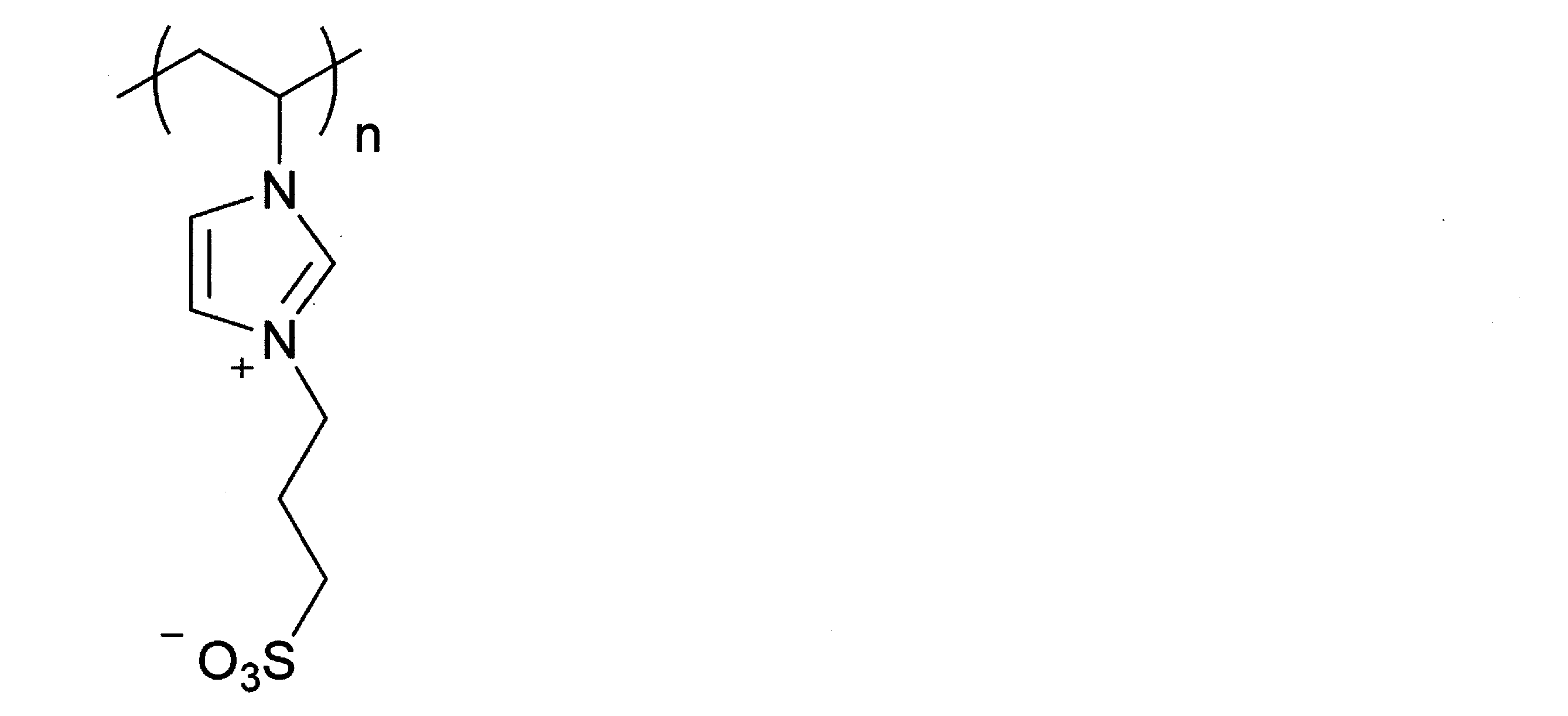
(1)VimC3Sの製造
150mLのテトラヒドロフラン(富士フイルム和光純薬株式会社)に、21.76g(0.23mmol)のビニルイミダゾール(東京化成工業株式会社)を添加し、28.24g(0.23mmol)の1,3-プロパンスルトン(東京化成工業株式会社)を加え、室温で24時間撹拌した。酢酸エチルで洗浄、減圧乾燥することでVimC3Sを得た。得られたVimC3S(D2O)の1H-NMRチャートを図6に示す。
Poly(VpyC3C)50の製造
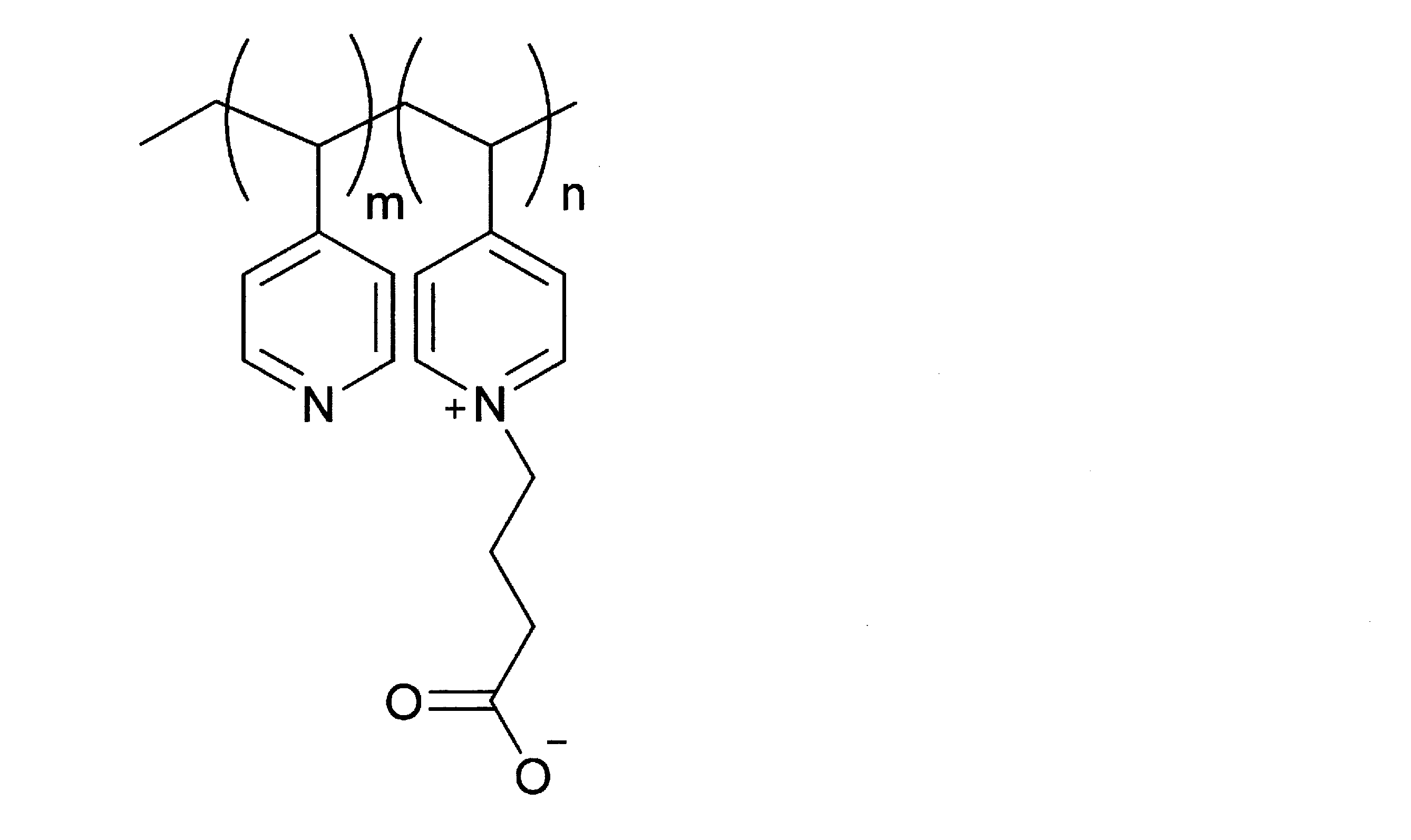
実施例5-1で、4-ブロモ酪酸エチルエステル(2.31g 0.01mmol、東京化成工業株式会社)の代わりに、4-ブロモ酪酸エチルエステル(1.91g 0.008mmol、東京化成工業株式会社)とした以外は、実施例5―1と同様に操作を行い、Poly(VpyC3C)40を3.59g得た。得られたPoly(VpyC3C)40の1H-NMR(CH3OH-d)チャートを図9に示す。NMRのシグナルより、m:n=3:2であった。
実施例5-1で、4-ブロモ酪酸エチルエステル(2.31g 0.01mmol、東京化成工業株式会社)の代わりに4-ブロモ酪酸エチルエステル(0.97g 0.005mmol、東京化成工業株式会社)とした以外は、実施例5-1と同様に操作を行い、Poly(VpyC3C)30を2.79g得た。得られたPoly(VpyC3C)30の1H-NMR(CH3OH-d)チャートを図10に示す。NMRのシグナルよりm:n=3.3:1であった。
実施例5-1で、4-ブロモ酪酸エチルエステル(2.31g 0.01mmol、東京化成工業株式会社)の代わりに4-ブロモ酪酸エチルエステル(0.77g 0.003mmol、東京化成工業株式会社)とした以外は、実施例5―1と同様に操作を行い、Poly(VpyC3C)20を2.32g得た。得られたPoly(VpyC3C)20の1H-NMR(CH3OH-d)チャートを図11に示す。1H-NMRのシグナルよりm:n=4:1であった。
実施例5-1で、4-ブロモ酪酸エチルエステル(2.31g 0.01mmol、東京化成工業株式会社)の代わりに4-ブロモ酪酸エチルエステル(0.48g 0.001mmol、東京化成工業株式会社)とした以外は、実施例5-1と同様に操作を行い、Poly(VpyC3C)20を1.95g得た。得られたPoly(VpyC3C)10の1H-NMR(CH3OH-d)チャートを図12に示す。1H-NMRのシグナルよりm:n=9:1であった。
Poly(VpyC3S)40の製造
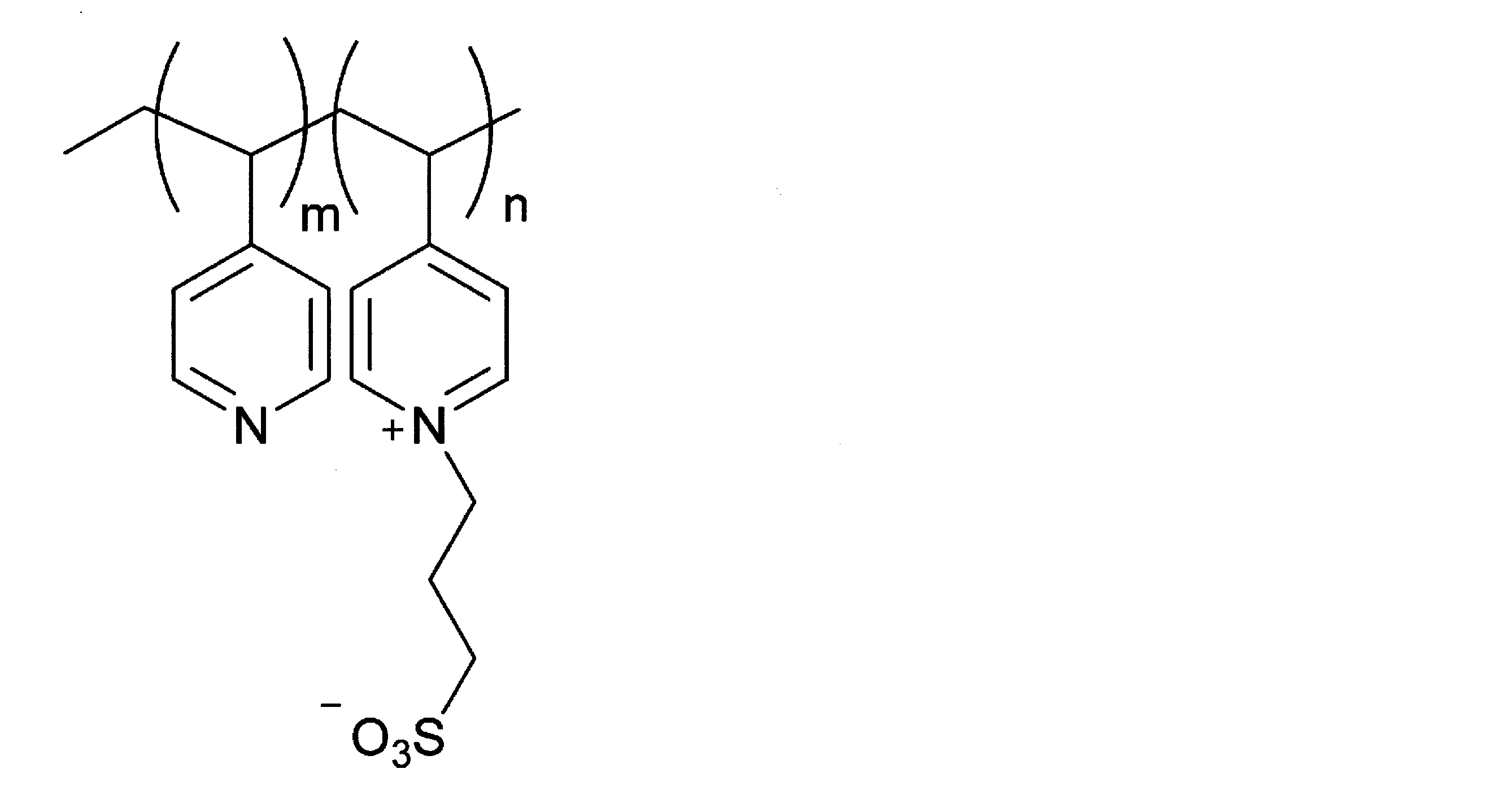
実施例6-1において、1,3-プロパンスルトン(0.84g 0.006mmol、東京化成工業株式会社)の代わりに1,3-プロパンスルトン(0.23g 0.002mmol、東京化成工業株式会社)を用いた以外は実施例6-1と同様に反応してPoly(VpyC3S)15を得た。1H-NMR(CH3OH-NaCl)のシグナルからm:n=17:3であった。
Poly(VimC3C-co-C8Vim)の製造
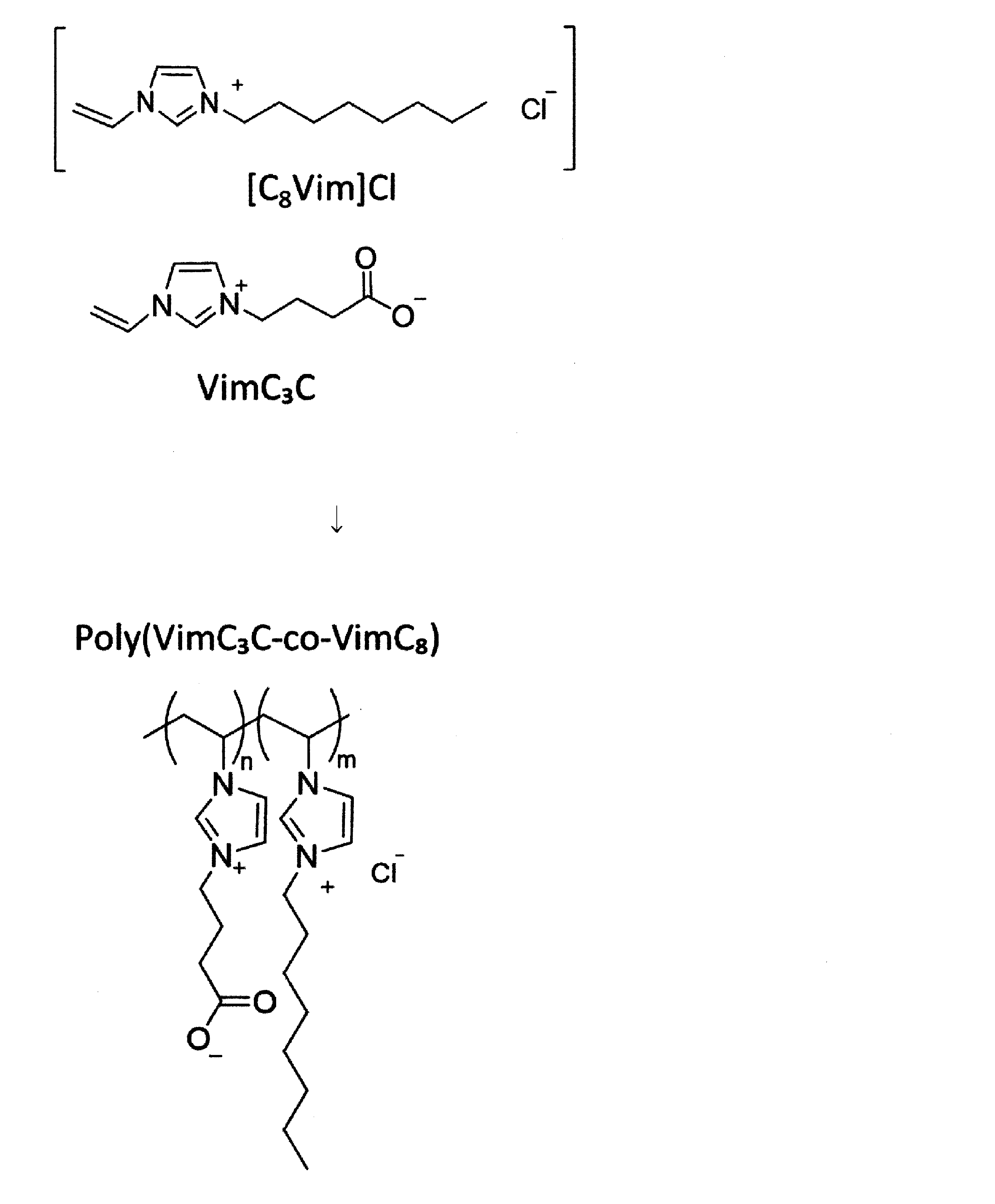
DMSO(貧溶媒)100mLを冷水に冷やしながら攪拌させ、そこにメタノールに溶かした前記重合反応液を1滴ずつ滴下した。前記重合反応液が貧溶媒中で固化するまで攪拌した。メンブレンフィルターを用いて減圧ろ過、最後アセトンでコポリマー中のDMSO、モノマーを洗い流し、メンブレンフィルターからコポリマーを回収した。回収したコポリマーを多量のクロロホルムにて攪拌することでDMSOを除去した。
得られたPoly(VimC3C-co-C8Vim)の1H-NMR(CD3OD)チャートを図14に示す。
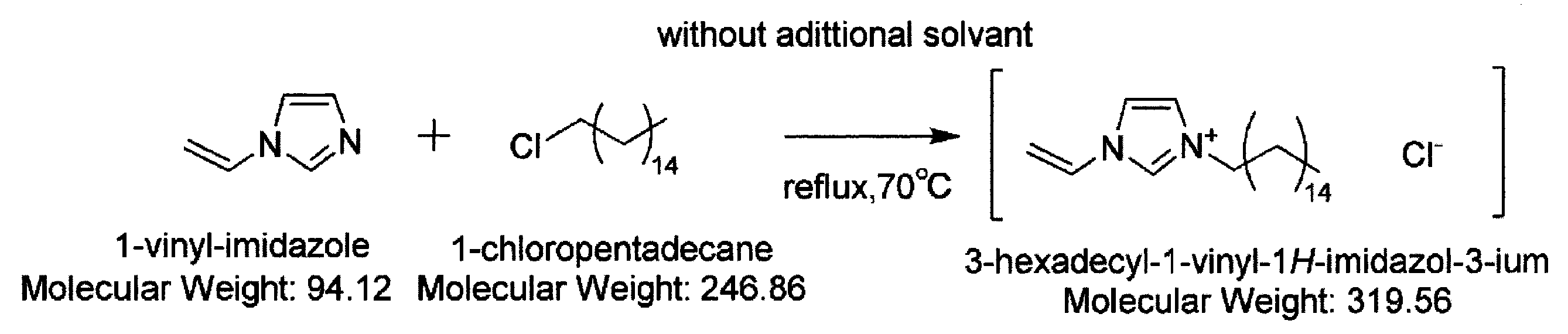
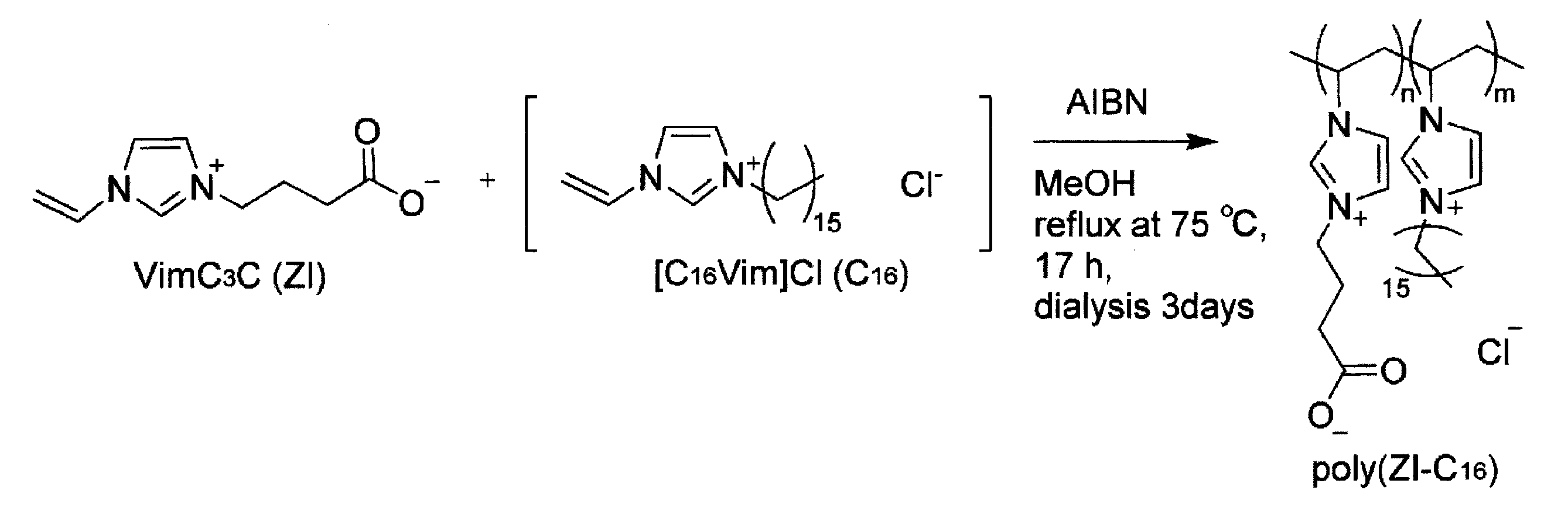
VimC3C及び[C16Vim]Cl(仕込み比m:n=1:1)(1.375M)1gに対して4mLのメタノールを加えて、これらのモノマーを溶解した。2,2’-アゾビス[2-(2-イミダゾリン-2-イル)プロパン]二塩酸塩10mol%を加えて、超音波処理180分、次いで窒素置換を行い、75℃オイルルバスで17時間還流した。その後3日間の透析を行い精製し、poly(ZI-C16)(これを、「(イ)C16P」と略す。)を得た。1H-NMRにより求めた精製したポリマーのC16Vim単位の占める割合は0.34モル%であり、分子量は84kDaだった。結果を表5に示す。
前記(イ)C16Pの合成において、仕込み比1を1:0.5とした以外は同様に操作を行い、poly(ZI-C16)(これを(ロ)C16Pと略す。)を得た。1H-NMRにより求めた精製したポリマーのC16Vim単位の占める割合は0.21モル%であり、分子量は374kDaだった。結果を表5に示す。
前記(イ)C16Pの合成において、仕込み比1を1:0.1とした以外は同様に操作を行い、poly(ZI-C16)(これを(ハ)C16Pと略す。)を得た。1H-NMRにより求めた精製したポリマーのC16Vim単位の占める割合は0.05モル%であり、分子量は178kDaだった。結果を表5に、1H-NMRチャートを図28示す。
実施例1で製造したVimC3C(双性イオンモノマー)とPoly(VimC3C)(双性イオンポリマー)を水に溶解してそれぞれの10質量%の保存液を作製し、BOSC細胞を用いて生存率を求めた。合わせてポリマーの浸透圧と凍結保存後の細胞の生存率を求め、結果を表1に示す。
双性イオンポリマー水溶液は双性イオンモノマー水溶液と比較して、生存率が悪かった。双性イオンポリマー水溶液で保存した細胞は水を吸って膨らんで死んでしまったことが観察された。このことは、ポリマー水溶液だけで細胞を凍結保存しようとしたところ、同じ重量であっても分子量が増大したことによって浸透圧が低く低張液になってしまったためだと考えられた。そこで、浸透圧を調節するためにポリマー水溶液にNaClを添加して浸透圧を測定した。結果を表2に示す。2%NaClを添加すると浸透圧は10質量%双性イオンモノマーと同程度の浸透圧が実現できることが分かった。後の実施例10に示すように、浸透圧を改善した培地を用いることで高い細胞生存率を得た。


ポリマーの濃度と細胞凍結保存後の生存率の関係を検討するため、Poly(VimC3C)ポリマーDMEM溶液(1質量%、5質量%、10質量%、20質量%、30質量%)を凍結保存液として用いたときの細胞(BOSC、mNF)の凍結保存後の生存率を測定した。結果を図15に示す。
ポリマーの濃度が上昇にするにつれて細胞生存率が上昇し、10~20質量%で最大値を得た。このことは、ポリマー濃度の最適値があることを示している。
ポリマーにNaClを添加して浸透圧を調整したときの細胞凍結保存後の生存率を検討するため、10%Poly(VimC3C)ポリマー水溶液にNaCl(0.1質量%、0.5質量%、0.8質量%、1質量%、2質量%)をそれぞれ添加した溶液を細胞凍結保存液として用い、細胞(BOSC、mNF)の凍結保存後の生存率を測定した。その結果を、図16に示す。
NaCl濃度は1質量%付近が最適値であり、細胞にとって等張の溶液がもっとも効果が高いことを示す。このことは細胞の培養液と保存液を兼ねられる可能性を示唆している。
浸透圧を調整するための溶質の種類を検討するため、スクロース(6%水溶液)、トリメチルグリシン(2%水溶液)、VimC3C(モノマーの3%水溶液)および[C2mim]OAc(モノマーの3%水溶液)を用意し、10%Poly(VimC3C)溶液に所定量を添加した凍結保存液を作成し、細胞(BOSC、mNF)の凍結保存後の生存率を測定した。浸透圧と細胞の生存率の関係を表3および図17に示した。双性イオンモノマーを添加した凍結保存液は添加量が少ないためか浸透圧が低く、細胞生存率を上げることはできなかった。

ポリマーの細胞毒性を検討するため、細胞(BOSC)を、ポリマーを含む培地で静置した。結果を図18に示す。本発明の双性イオンポリマー含有溶液は、他の物質を含有する溶液と比較して細胞毒性が低いことが判明した。このことから、このポリマー含有培地中で細胞が培養できることが示唆された。さらにその死細胞率は、ポリマーを混ぜていない培地中よりも低く、接着細胞を浮遊状態で培養できる可能性も示唆された。また、ポリマー溶液中で死細胞率が低かったのは、細胞が電解質により分散状態となったポリマーのマトリックスに覆われたこと、あるいはマトリックスを介して細胞同士が接着したことにより、凍結融解時の細胞の死滅が防がれたものと考えられる。また、この結果は、本ポリマーが電解質により分散状態となったポリマーによって形成されるマトリックスにより、それが細胞の接着剤としても作用する可能性を示唆している。
ポリマーへの電解質の添加による溶液の氷晶の形成への影響について検討するため、ポリマー溶液をDSCで測定した。ポリマーのNaCl溶液のDSCと凍結保存時の氷晶の割合を表4に示す。その結果、ポリマーのNaCl溶液は、水と相互作用していることが判明した。
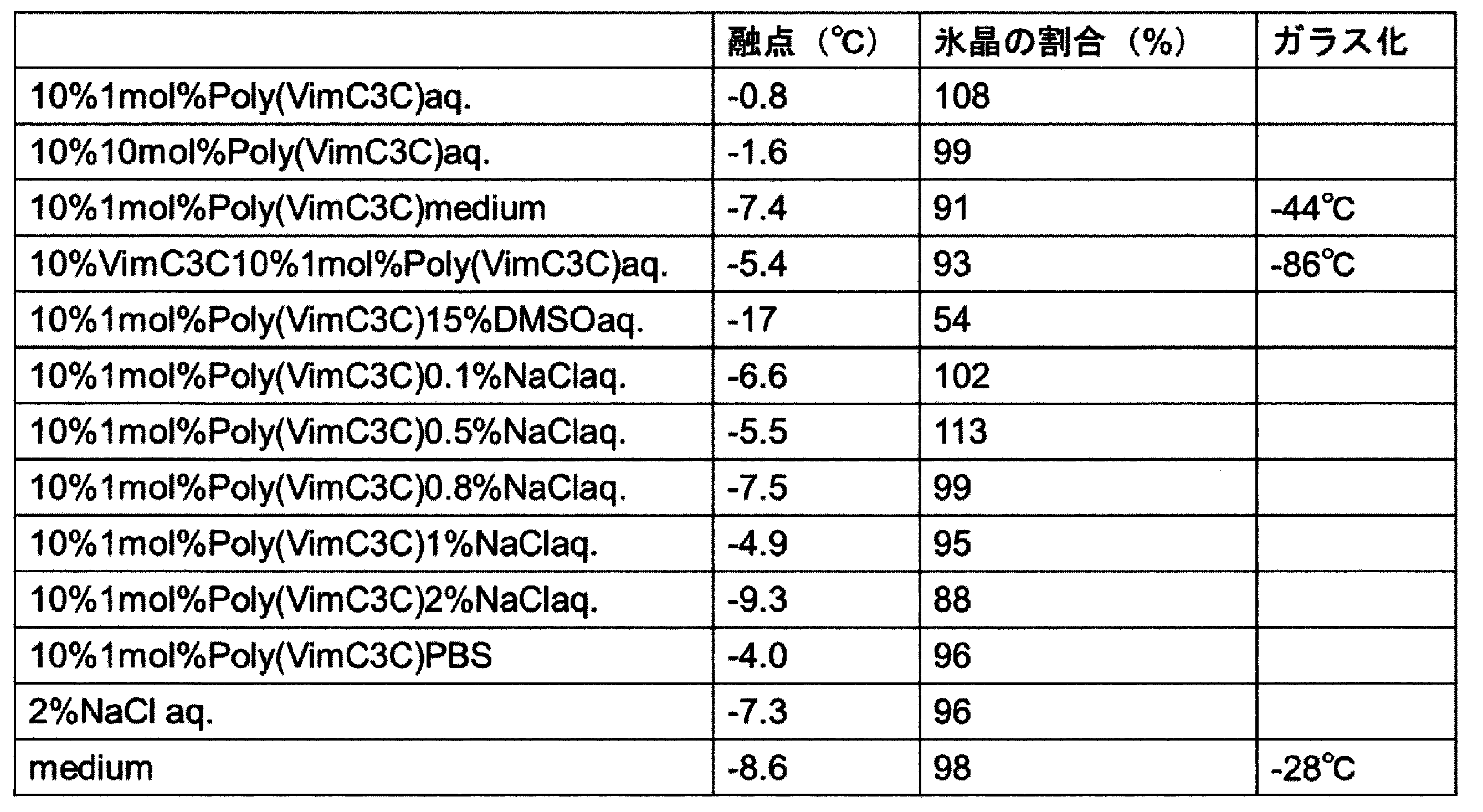
ポリマーへの電解質の添加による凝集への影響を検討するため、ポリマー溶液をDLSで測定した。
ポリマーのNaCl溶液のDLSチャートを図19に示す。図19より、ポリマーは、電解質濃度が高まると、ピークが左にシフトし、電解質の添加によりポリマーの凝集が妨げられることが判明した。
表4と図19の結果より、本発明の双性イオンポリマーは、電解質により分散状態となり細胞膜と相互作用をすることで、細胞が凍結融解によって死滅することを防止しているものと考えられる。細胞が電解質により分散状態となったポリマーのマトリックスに覆われたこと、あるいはマトリックスを介して細胞同士が接着したことによって、凍結融解時の細胞の死滅が防がれたものと考えられる。
ポリマーの分子量の相違による細胞の凍結保存後の生存率への影響を検討するため、分子量の異なる10%Poly(VimC3C)溶液を凍結保存液として用いたときの細胞(BOSC、mNF)の凍結保存後の生存率を測定した。
ポリマーのGPC結果を図20に、ポリマーと細胞の生存率の関係を図21に示す。図20の通り、重合開始剤の量を増加させると、ポリマーの分子量が小さくなる傾向が認められた。
また、図21に示すように、重合開始剤の量がモノマー比0.1mol%~10mol%の間においては、細胞の凍結保存後の生存率に影響なく、ポリマーの分子量が少なくともMwが10万~25万、Mnが5万~20万の範囲であれば凍結保存液として使用できることが分かった。
ポリマー溶液を凍結保存液として用いたときの他の細胞の凍結保存後の生存率への影響を検討するため、3種類の細胞(K562細胞、C6細胞、OVMANA細胞)を用いて凍結保存後の生存率を測定した。結果を図22、図23、及び図24に示す。本発明ポリマーを凍結保存液として用いると、市販品とそん色ない凍結保存後の細胞生存率が得られることが分かった。特に、凍結保存に弱いとされているK562細胞、OVMANA細胞では、市販の凍結保存液を用いた場合よりも高い生存率が得られた。
ポリマー溶液が細胞の増殖速度に与える影響を検討するため、細胞(C6細胞、OVMANA細胞)を凍結保存後、C6細胞は48時間、OVMANA細胞は18日間培養し細胞増殖数を計測した。結果を図25、及び図26に示す。本発明の双性イオンポリマー含有溶液を用いた凍結保存後の細胞については、増殖が確認された。OVMANA細胞に対しては、市販品よりも多い細胞数が確認された。C6細胞に対しては市販品にやや劣る結果となったものの増殖した。
ポリマー溶液中の細胞を観察するため、PBS又は、10%Poly(VimC3C)1%NaCl溶液中に細胞を常温で60分間静置した。顕微鏡で様子を観察した結果を図27に示す。その結果、(a)PBS中の細胞は均等に分散していたが、(b)ポリマー溶液中の細胞は細胞同士が接着していた。このことから、ポリマーは細胞周辺にマトリックスを形成していることが示唆された。
実施例8で合成したpoly(VimC3C-C16Vim)の冷凍保存効果を調べた。
C16モノマー由来の単位の含量がモル比で0.05mol%(実施例8(ハ)),0.21mol%(実施例8(ロ))、0.34mol%(実施例8(イ))のpoly(ZI-C16)のポリマーの10wt%により凍結保存を行い、BOSC細胞、K562細胞、OVMANA細胞の生存率を調べた。なお、C16モノマー由来の単位の含量が0mol%のポリマーとしては実施例1で合成したポリマーを用いた。結果を図29に示す。いずれの細胞系においてもC16由来のユニットの含量が0.05mol%の効果が良好であった。

実施例8で合成したpoly(ZI-C16)のBOSC細胞に対する毒性を調べた。C16モノマー由来の単位の含量がモル比で0.05mol%(実施例8(ハ)),0.21mol%(実施例8(ロ))、0.34mol%(実施例8(イ))のpoly(ZI-C16)のポリマーの10wt%の培地を用い、1×10⁶のBOSC細胞を、37℃で1時間インキュベートし、その後、生細胞をカウントし、生存率を求めた。なお、C16モノマー由来の単位の含量が0mol%のポリマーとしては実施例1で合成したポリマーを用いた。結果を図30に示した。(イ)~(ハ)のC16の含量依存的な毒性は示さなかった。
実施例8で合成したpoly(ZI-C16)冷凍保存効果に対する塩分濃度の影響を調べた。
NaClが0.5wt%、1wt%、2wt%の濃度で、実施例8(ハ)の10wt%の培地を作製し、K562細胞を冷凍保存し、保存率を調べた。結果を図31に示す。1wt%NaClとしたとき最も良好な溶液であった。
(蛍光ラベル化合物poly(ZI-C16-Fluoresceinの合成)
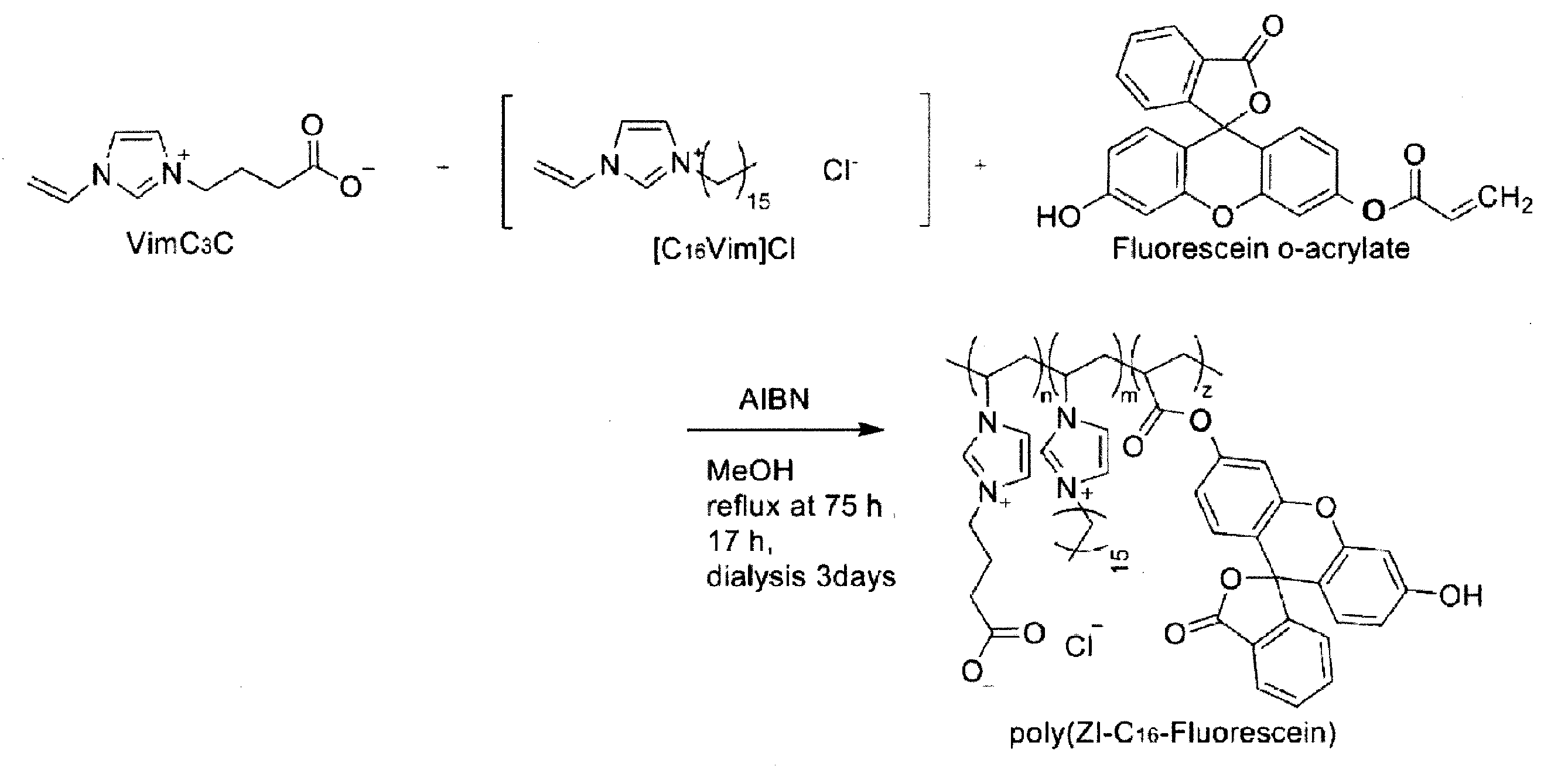
BOSC細胞の培地に合成した蛍光ラベルを添加し、20分後、PBSで洗浄し共焦点顕微鏡で観察した。その結果を図32に示す。図32より、poly(VimC3C-C16Vim)が細胞周辺、特に細胞膜に集積していることが明らかとなった。これは、poly(VimC3C-C16Vim)が細胞外でマトリックスを形成し、特に細胞膜上において細胞外からの氷晶の流入を防いでいることを示すものと考えることが出来る。さらに、poly(VimC3C-C16Vim)のアルキル側鎖が細胞膜に差し込まれて細胞膜の外側に繋留され、その結果、細胞膜を保護する形で氷晶の流入を防いでいることも考察することができたので、そのことを図33に模式的に説明した。
Claims (15)
- 次の一般式(1)で表される双性イオンポリマー又はその標識体。

X1及びX2は、同一でも異なってもよく、炭素原子又は窒素原子を示し;
Y1及びY2は、同一でも異なってもよく、-COO-、-SO3 -、-OP=O(H)O-、-OP=O(CH3)O-及び-OP=O(OR1)O-から選ばれるアニオンを示し;
Zは、水素原子、アルキル基が置換していてもよい炭素数6~10の芳香族炭化水素基、アルキル基が置換していてもよい5~6員の芳香族複素環式基、アルキル基が置換していてもよい窒素含有複素環式アンモニウム塩、テトラアルキルアンモニウム塩、テトラフェニルホスホニウム塩、テトラアルキルホスホニウム塩、トリアルキルスルホニウム塩、又は分子鎖中に1~3個の酸素原子を有していてもよい炭素数1~22の直鎖又は分岐アルキル基を示し;
e及びfは、それぞれ0又は1の整数を示し;
l、m及びnは、それぞれ各繰り返し単位の含有比率を示す数であって、0<l≦1、0≦m<1、0≦n<1、l+m+n=1を満たす数を示し;
p、q、r、s及びtは、それぞれ0~6の整数を示す) - Y1及びY2が、同一でも異なってもよく、-COO-及び-SO3 -から選ばれるアニオンである請求項1記載の双性イオンポリマー又はその標識体。
- Zが、イミダゾリル基、ピリジル基、ピリジニウムクロリド、C1~C22アルキルピリジニウムクロリド、イミダゾリニウムクロリド、C1~C22アルキルイミダゾリニウムクロリド、ピリジニウムブロミド、C1~C22アルキルピリジニウムブロミド、イミダゾリニウムブロミド及びC1~C22アルキルイミダゾリニウムブロミドから選ばれる基である請求項1又は2記載の双性イオンポリマー又はその標識体。
- 次の一般式(1)で表される双性イオンポリマー又はその標識体を含有する生体試料の保存剤組成物。
X1及びX2は、同一でも異なってもよく、炭素原子又は窒素原子を示し;
Y1及びY2は、同一でも異なってもよく、-COO-、-SO3 -、-OP=O(H)O-、-OP=O(CH3)O-及び-OP=O(OR1)O-から選ばれるアニオンを示し;
Zは、水素原子、アルキル基が置換していてもよい炭素数6~10の芳香族炭化水素基、アルキル基が置換していてもよい5~6員の芳香族複素環式基、アルキル基が置換していてもよい窒素含有複素環式アンモニウム塩、テトラアルキルアンモニウム塩、テトラフェニルホスホニウム塩、テトラアルキルホスホニウム塩、トリアルキルスルホニウム塩、又は分子鎖中に1~3個の酸素原子を有していてもよい炭素数1~22の直鎖又は分岐アルキル基を示し;
e及びfは、それぞれ0又は1の整数を示し;
l、m及びnは、それぞれ各繰り返し単位の含有比率を示す数であって、0<l≦1、0≦m<1、0≦n<1、l+m+n=1を満たす数を示し;
p、q、r、s及びtは、それぞれ0~6の整数を示す) - Y1及びY2が、同一でも異なってもよく、-COO-及び-SO3 -から選ばれるアニオンである請求項4記載の生体試料の保存剤組成物。
- Zが、イミダゾリル基、ピリジル基、ピリジニウムクロリド、C1~C22アルキルピリジニウムクロリド、イミダゾリニウムクロリド、C1~C22アルキルイミダゾリニウムクロリド、ピリジニウムブロミド、C1~C22アルキルピリジニウムブロミド、イミダゾリニウムブロミド及びC1~C22アルキルイミダゾリニウムブロミドから選ばれる基である請求項4又は5記載の生体試料の保存剤組成物。
- さらに、電解質、ベタイン、双性イオン、アルコール、多価アルコール及び糖類から選ばれる1種以上の水溶性化合物を含有する請求項4~6のいずれか1項に記載の生体試料の保存剤組成物。
- さらに、細胞浸透性物質を含有する請求項4~7のいずれか1項に記載の生体試料の保存剤組成物。
- 生体試料の凍結保存剤組成物、生体試料の培養用組成物、生体試料の培地組成物、生体試料の保存用組成物、生体試料の機能維持用組成物、又は生体試料の機能試験用組成物である請求項4~8のいずれか1項に記載の生体試料の保存剤組成物。
- 請求項1~3のいずれか1項に記載の双性イオンポリマー又はその標識体を含む難溶性物質溶解剤。
- 生体試料に、請求項1~3のいずれか1項に記載の双性イオンポリマー又はその標識体を含有する組成物を接触させることを特徴とする、生体試料の保存方法。
- 請求項1~3のいずれか1項に記載の双性イオンポリマー又はその標識体を含有する組成物がさらに、電解質、ベタイン、双性イオン、アルコール、多価アルコール及び糖類から選ばれる1種以上の水溶性化合物を含有する請求項11記載の生体試料の保存方法。
- 請求項1~3のいずれか1項に記載の双性イオンポリマー又はその標識体を含有する組成物がさらに、細胞浸透性物質を含有する請求項11又は12記載の生体試料の保存方法。
- 生体試料の保存が、生体試料の凍結保存、生体試料の培養、生体試料の培地、生体試料の機能維持、又は生体試料の機能試験である請求項11~13のいずれか1項に記載の生体試料の保存方法。
- 難溶性物質を、請求項1~3のいずれか1項に記載の双性イオンポリマー又はその標識体を含有する組成物に溶解することを特徴とする、難溶解性物質の溶解方法。
Priority Applications (2)
| Application Number | Priority Date | Filing Date | Title |
|---|---|---|---|
| US18/876,047 US20260176393A1 (en) | 2022-06-17 | 2023-06-16 | Preservative composition for biological samples |
| JP2024528989A JPWO2023243727A1 (ja) | 2022-06-17 | 2023-06-16 |
Applications Claiming Priority (4)
| Application Number | Priority Date | Filing Date | Title |
|---|---|---|---|
| JP2022-098339 | 2022-06-17 | ||
| JP2022098339 | 2022-06-17 | ||
| JP2023-034044 | 2023-03-06 | ||
| JP2023034044 | 2023-03-06 |
Publications (1)
| Publication Number | Publication Date |
|---|---|
| WO2023243727A1 true WO2023243727A1 (ja) | 2023-12-21 |
Family
ID=89191504
Family Applications (1)
| Application Number | Title | Priority Date | Filing Date |
|---|---|---|---|
| PCT/JP2023/022488 Ceased WO2023243727A1 (ja) | 2022-06-17 | 2023-06-16 | 生体試料の保存剤組成物 |
Country Status (3)
| Country | Link |
|---|---|
| US (1) | US20260176393A1 (ja) |
| JP (1) | JPWO2023243727A1 (ja) |
| WO (1) | WO2023243727A1 (ja) |
Cited By (1)
| Publication number | Priority date | Publication date | Assignee | Title |
|---|---|---|---|---|
| CN117867081A (zh) * | 2024-01-15 | 2024-04-12 | 上海碧云天生物技术股份有限公司 | 一种广谱的rna样品保存液及其应用 |
Citations (4)
| Publication number | Priority date | Publication date | Assignee | Title |
|---|---|---|---|---|
| JP2020019878A (ja) * | 2018-07-31 | 2020-02-06 | 東洋インキScホールディングス株式会社 | タンパク質安定化剤及びタンパク質の安定化方法 |
| WO2021131479A1 (ja) * | 2019-12-24 | 2021-07-01 | 東京応化工業株式会社 | 表面処理液、及び親水化処理方法 |
| JP2022008203A (ja) * | 2020-06-24 | 2022-01-13 | 東洋インキScホールディングス株式会社 | 細胞用培地添加剤およびその利用 |
| JP2022095009A (ja) * | 2020-12-16 | 2022-06-28 | 東洋インキScホールディングス株式会社 | 細胞凍結保存剤および細胞の凍結方法 |
-
2023
- 2023-06-16 WO PCT/JP2023/022488 patent/WO2023243727A1/ja not_active Ceased
- 2023-06-16 US US18/876,047 patent/US20260176393A1/en active Pending
- 2023-06-16 JP JP2024528989A patent/JPWO2023243727A1/ja active Pending
Patent Citations (4)
| Publication number | Priority date | Publication date | Assignee | Title |
|---|---|---|---|---|
| JP2020019878A (ja) * | 2018-07-31 | 2020-02-06 | 東洋インキScホールディングス株式会社 | タンパク質安定化剤及びタンパク質の安定化方法 |
| WO2021131479A1 (ja) * | 2019-12-24 | 2021-07-01 | 東京応化工業株式会社 | 表面処理液、及び親水化処理方法 |
| JP2022008203A (ja) * | 2020-06-24 | 2022-01-13 | 東洋インキScホールディングス株式会社 | 細胞用培地添加剤およびその利用 |
| JP2022095009A (ja) * | 2020-12-16 | 2022-06-28 | 東洋インキScホールディングス株式会社 | 細胞凍結保存剤および細胞の凍結方法 |
Cited By (2)
| Publication number | Priority date | Publication date | Assignee | Title |
|---|---|---|---|---|
| CN117867081A (zh) * | 2024-01-15 | 2024-04-12 | 上海碧云天生物技术股份有限公司 | 一种广谱的rna样品保存液及其应用 |
| CN117867081B (zh) * | 2024-01-15 | 2024-11-22 | 上海碧云天生物技术股份有限公司 | 一种广谱的rna样品保存液及其应用 |
Also Published As
| Publication number | Publication date |
|---|---|
| US20260176393A1 (en) | 2026-06-25 |
| JPWO2023243727A1 (ja) | 2023-12-21 |
Similar Documents
| Publication | Publication Date | Title |
|---|---|---|
| EP3829604B1 (en) | Cryopreserved platelet compositions and methods for making | |
| Murray et al. | Red blood cell cryopreservation with minimal post-thaw lysis enabled by a synergistic combination of a cryoprotecting polyampholyte with DMSO/trehalose | |
| Stolzing et al. | Hydroxyethylstarch in cryopreservation–Mechanisms, benefits and problems | |
| Park et al. | Size and shape control of ice crystals by amphiphilic block copolymers and their implication in the cryoprotection of mesenchymal stem cells | |
| Diaz-Dussan et al. | Trehalose-based polyethers for cryopreservation and three-dimensional cell scaffolds | |
| Chen et al. | Comb-like pseudopeptides enable very rapid and efficient intracellular trehalose delivery for enhanced cryopreservation of erythrocytes | |
| US20160130606A1 (en) | Freeze-dried polyelectrolyte complexes that maintain size and biological activity | |
| EP3007556A2 (en) | Cell stabilization | |
| Stubbs et al. | Multivalent presentation of ice recrystallization inhibiting polymers on nanoparticles retains activity | |
| HK1220225A1 (zh) | 含有海藻糖及葡聚糖的哺乳动物细胞移植用溶液 | |
| Huang et al. | Advanced nanomaterials-assisted cell cryopreservation: a mini review | |
| CN102124098A (zh) | 细胞及组织的冷冻保存用组合物 | |
| WO2014034884A1 (ja) | 凍結保存可能な細胞足場材料 | |
| Piao et al. | Poly (l-alanine-co-l-lysine)-g-trehalose as a biomimetic cryoprotectant for stem cells | |
| TW201821610A (zh) | 哺乳動物細胞凍結保存液 | |
| Matsumura et al. | Bridging polymer chemistry and cryobiology | |
| JP2024001207A (ja) | 凍結保存液 | |
| Tian et al. | Temperature and Redox Dual‐Responsive Biodegradable Nanogels for Optimizing Antitumor Drug Delivery | |
| Tian et al. | Zwitterionic-hydrogel-based sensing system enables real-time ROS monitoring for ultra-long hypothermic cell preservation | |
| JP2023123780A (ja) | 非プロトン性双性イオンを用いた未分化促進剤及び凍結保護剤 | |
| US10765110B2 (en) | Agent for preserving biological component | |
| Dissanayake et al. | Enhanced cryopreservation efficacies of ice recrystallization inhibiting nanogels | |
| Wang et al. | A modular approach for cytosolic protein delivery: metal ion-induced self-assembly of gold nanoclusters as a general platform | |
| Qin et al. | Unveiling cells’ local environment during cryopreservation by correlative in situ spatial and thermal analyses | |
| Sui et al. | Exploring novel cell cryoprotectants based on neutral amino acids |
Legal Events
| Date | Code | Title | Description |
|---|---|---|---|
| 121 | Ep: the epo has been informed by wipo that ep was designated in this application |
Ref document number: 23824017 Country of ref document: EP Kind code of ref document: A1 |
|
| WWE | Wipo information: entry into national phase |
Ref document number: 2024528989 Country of ref document: JP |
|
| WWE | Wipo information: entry into national phase |
Ref document number: 18876047 Country of ref document: US |
|
| NENP | Non-entry into the national phase |
Ref country code: DE |
|
| 122 | Ep: pct application non-entry in european phase |
Ref document number: 23824017 Country of ref document: EP Kind code of ref document: A1 |
|
| WWP | Wipo information: published in national office |
Ref document number: 18876047 Country of ref document: US |