WO2023243656A1 - 撮像システム、及び、それを備えた移動体 - Google Patents
撮像システム、及び、それを備えた移動体 Download PDFInfo
- Publication number
- WO2023243656A1 WO2023243656A1 PCT/JP2023/022059 JP2023022059W WO2023243656A1 WO 2023243656 A1 WO2023243656 A1 WO 2023243656A1 JP 2023022059 W JP2023022059 W JP 2023022059W WO 2023243656 A1 WO2023243656 A1 WO 2023243656A1
- Authority
- WO
- WIPO (PCT)
- Prior art keywords
- imaging
- blur correction
- blur
- imaging system
- mirror
- Prior art date
- Legal status (The legal status is an assumption and is not a legal conclusion. Google has not performed a legal analysis and makes no representation as to the accuracy of the status listed.)
- Ceased
Links
Images





Classifications
-
- G—PHYSICS
- G03—PHOTOGRAPHY; CINEMATOGRAPHY; ANALOGOUS TECHNIQUES USING WAVES OTHER THAN OPTICAL WAVES; ELECTROGRAPHY; HOLOGRAPHY
- G03B—APPARATUS OR ARRANGEMENTS FOR TAKING PHOTOGRAPHS OR FOR PROJECTING OR VIEWING THEM; APPARATUS OR ARRANGEMENTS EMPLOYING ANALOGOUS TECHNIQUES USING WAVES OTHER THAN OPTICAL WAVES; ACCESSORIES THEREFOR
- G03B17/00—Details of cameras or camera bodies; Accessories therefor
- G03B17/02—Bodies
- G03B17/17—Bodies with reflectors arranged in beam forming the photographic image, e.g. for reducing dimensions of camera
-
- G—PHYSICS
- G03—PHOTOGRAPHY; CINEMATOGRAPHY; ANALOGOUS TECHNIQUES USING WAVES OTHER THAN OPTICAL WAVES; ELECTROGRAPHY; HOLOGRAPHY
- G03B—APPARATUS OR ARRANGEMENTS FOR TAKING PHOTOGRAPHS OR FOR PROJECTING OR VIEWING THEM; APPARATUS OR ARRANGEMENTS EMPLOYING ANALOGOUS TECHNIQUES USING WAVES OTHER THAN OPTICAL WAVES; ACCESSORIES THEREFOR
- G03B15/00—Special procedures for taking photographs; Apparatus therefor
-
- G—PHYSICS
- G03—PHOTOGRAPHY; CINEMATOGRAPHY; ANALOGOUS TECHNIQUES USING WAVES OTHER THAN OPTICAL WAVES; ELECTROGRAPHY; HOLOGRAPHY
- G03B—APPARATUS OR ARRANGEMENTS FOR TAKING PHOTOGRAPHS OR FOR PROJECTING OR VIEWING THEM; APPARATUS OR ARRANGEMENTS EMPLOYING ANALOGOUS TECHNIQUES USING WAVES OTHER THAN OPTICAL WAVES; ACCESSORIES THEREFOR
- G03B19/00—Cameras
- G03B19/02—Still-picture cameras
- G03B19/12—Reflex cameras with single objective and a movable reflector or a partly-transmitting mirror
-
- G—PHYSICS
- G03—PHOTOGRAPHY; CINEMATOGRAPHY; ANALOGOUS TECHNIQUES USING WAVES OTHER THAN OPTICAL WAVES; ELECTROGRAPHY; HOLOGRAPHY
- G03B—APPARATUS OR ARRANGEMENTS FOR TAKING PHOTOGRAPHS OR FOR PROJECTING OR VIEWING THEM; APPARATUS OR ARRANGEMENTS EMPLOYING ANALOGOUS TECHNIQUES USING WAVES OTHER THAN OPTICAL WAVES; ACCESSORIES THEREFOR
- G03B5/00—Adjustment of optical system relative to image or object surface other than for focusing
-
- H—ELECTRICITY
- H04—ELECTRIC COMMUNICATION TECHNIQUE
- H04N—PICTORIAL COMMUNICATION, e.g. TELEVISION
- H04N23/00—Cameras or camera modules comprising electronic image sensors; Control thereof
- H04N23/60—Control of cameras or camera modules
-
- H—ELECTRICITY
- H04—ELECTRIC COMMUNICATION TECHNIQUE
- H04N—PICTORIAL COMMUNICATION, e.g. TELEVISION
- H04N23/00—Cameras or camera modules comprising electronic image sensors; Control thereof
- H04N23/60—Control of cameras or camera modules
- H04N23/68—Control of cameras or camera modules for stable pick-up of the scene, e.g. compensating for camera body vibrations
-
- H—ELECTRICITY
- H04—ELECTRIC COMMUNICATION TECHNIQUE
- H04N—PICTORIAL COMMUNICATION, e.g. TELEVISION
- H04N23/00—Cameras or camera modules comprising electronic image sensors; Control thereof
- H04N23/60—Control of cameras or camera modules
- H04N23/68—Control of cameras or camera modules for stable pick-up of the scene, e.g. compensating for camera body vibrations
- H04N23/681—Motion detection
- H04N23/6812—Motion detection based on additional sensors, e.g. acceleration sensors
-
- H—ELECTRICITY
- H04—ELECTRIC COMMUNICATION TECHNIQUE
- H04N—PICTORIAL COMMUNICATION, e.g. TELEVISION
- H04N23/00—Cameras or camera modules comprising electronic image sensors; Control thereof
- H04N23/60—Control of cameras or camera modules
- H04N23/68—Control of cameras or camera modules for stable pick-up of the scene, e.g. compensating for camera body vibrations
- H04N23/682—Vibration or motion blur correction
- H04N23/685—Vibration or motion blur correction performed by mechanical compensation
-
- H—ELECTRICITY
- H04—ELECTRIC COMMUNICATION TECHNIQUE
- H04N—PICTORIAL COMMUNICATION, e.g. TELEVISION
- H04N23/00—Cameras or camera modules comprising electronic image sensors; Control thereof
- H04N23/60—Control of cameras or camera modules
- H04N23/68—Control of cameras or camera modules for stable pick-up of the scene, e.g. compensating for camera body vibrations
- H04N23/682—Vibration or motion blur correction
- H04N23/685—Vibration or motion blur correction performed by mechanical compensation
- H04N23/687—Vibration or motion blur correction performed by mechanical compensation by shifting the lens or sensor position
Definitions
- the present disclosure relates to an imaging system that corrects blur in response to movement of a moving object, and a moving object equipped with the same.
- Patent Document 1 uses saccade mirror technology to correct blur caused by camera movement during exposure. Shake is reduced by irradiating light onto the object to be imaged and having the light reflected by the object be reflected by a mirror that rotates for a predetermined exposure time and then incident on the camera.
- imaging frame interval is fixed, imaging will be performed at different rotational positions of the mirror depending on the moving speed of the moving object, and the subject distance to the imaging target surface will vary, which may reduce the accuracy of blur correction. be.
- the present disclosure provides an imaging system that suppresses deterioration in accuracy of blur correction, and a moving object equipped with the same.
- the imaging system of the present disclosure includes an imaging device disposed on a moving body, and a camera shake that corrects blur in the moving direction of the moving body when the imaging device captures an image while the moving body is moving, based on a moving blur correction amount. It includes a correction mechanism and a control device that controls the imaging timing of the imaging device.
- the blur correction mechanism drives the blur correction section to correct blur in the moving direction.
- the blur correction section has a reference position where an axis perpendicular to the imaging target surface and an optical axis of light incident on the blur correction section are parallel.
- the control device causes the imaging device to start imaging in synchronization when the blur correction unit is located within a range in which the amount of displacement from the reference position is equal to or less than a threshold value while the blur correction unit is being driven.
- the mobile object of the present disclosure includes the above-described imaging system.
- the imaging system of the present disclosure and the moving body equipped with the same, it is possible to provide the imaging system and the moving body equipped with the same that suppress a decrease in the accuracy of blur correction.
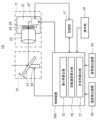
- a diagram for explaining a vehicle equipped with the imaging system of Embodiment 1 Block diagram showing the internal configuration of the imaging system of Embodiment 1 Explanatory diagram explaining image stabilization of the imaging system
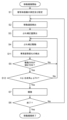
- Explanatory diagram illustrating the imaging device at ideal imaging timing Flowchart showing blurred imaging processing in Embodiment 1 Graph showing the relationship between exposure timing and mechanism swing angle in Embodiment 1
- Explanatory diagram showing the mirror at each mechanism swing angle Explanatory diagram showing captured images when captured continuously
- Block diagram showing the internal configuration of the imaging system of Embodiment 2 Explanatory diagram illustrating the imaging system when a change in attitude occurs in the vehicle Flowchart showing blurred imaging processing in Embodiment 2 Graph showing the relationship between exposure timing and mechanism swing angle in Embodiment 2
- Embodiment 1 will be described below with reference to the drawings.
- the moving object is a vehicle 3 such as a car
- the imaging system 1 is attached to the upper part of the vehicle 3.
- FIG. 1 is a diagram for explaining an imaging system 1.
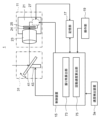
- FIG. 2 is a block diagram showing the internal configuration of the imaging system 1.
- a vehicle 3 is traveling in a tunnel 5, for example.
- holes 5b and cracks 5c are formed on the wall surface 5a within the tunnel 5.
- the imaging target of the imaging system 1 is at least a part of the structure around the vehicle 3, and is an object that moves relatively according to the moving speed of the vehicle 3 as the vehicle 3 moves.
- the imaging target area 9 is an area of this imaging target that is acquired as an image.
- the side and bottom surfaces of the overpass, telephone poles, and electric wires may also be imaged. With this, it is possible to detect holes, cracks, lifting, peeling, seams, inclinations of telephone poles, and deflections of electric wires in the imaged object through image processing from the acquired images.
- the vehicle 3 is provided with a speed detection device 3a that detects the moving speed of the vehicle 3.
- the speed detection device 3a is, for example, a vehicle speed sensor that detects the moving speed from the rotational speed of the axle of the vehicle 3.
- the vehicle 3 is also provided with a receiver for a GPS (Global Positioning System) system.
- GPS Global Positioning System
- An imaging system 1 is installed on the top surface of the vehicle 3.
- the imaging system 1 is fixed so as to capture an image of the wall surface 5a of the tunnel 5 above the vehicle 3 in FIG. may be installed so as to capture an image of.
- the imaging system 1 includes an imaging device 11, a blur correction mechanism 31, a control device 15, a storage section 17, an operation section 19, and a speed detection device 3a.
- the imaging device 11 captures an image of the surroundings of the vehicle 3, and captures an image of the wall surface 5a of the tunnel 5 when the vehicle 3 travels inside the tunnel 5, for example.
- the imaging device 11 includes a camera body 21, a lens 23, a shutter 24, an imaging element 25, and a camera control section 27.
- the camera body 21 has a replaceable lens 23 attached thereto, and houses an image sensor 25 and a camera control section 27.
- An image sensor 25 is arranged at a focal length F of the lens 23.
- the camera body 21 is arranged on the vehicle 3 so that the lens 23 is oriented parallel to the moving direction of the vehicle 3.
- the camera body 21 is arranged so that the lens 23 faces the front or rear of the vehicle 3.
- the camera body 21 and the lens 23 may be integrated, and in this case, the direction of the lens 23 and the direction of movement thereof may be perpendicular to each other.
- the camera control unit 27 opens the shutter 24 while receiving the exposure instruction signal from the control device 15.
- the shutter 24 may have a configuration in which a plurality of blade diaphragms open and close, or may be an electronic shutter.
- the image sensor 25 converts the received light into an electrical signal according to the intensity, and is, for example, a solid-state image sensor such as a CCD image sensor, a CMOS image sensor, or an inf
- the blur correction mechanism 31 corrects the optical path of light that enters the imaging system 1 so that even if the imaging device 11 captures an image while the vehicle 3 is moving, the blur in the image of the imaging target area 9 is reduced.
- the blur correction mechanism 31 corrects the optical path of the light L1, which is the environmental light reflected by the imaging target area 9, in accordance with the movement of the vehicle 3.
- the blur correction mechanism 31 aligns the direction of light L1, which is the ambient light reflected by the imaging target area 9, with the imaging direction of the imaging element 25.
- the blur correction mechanism 31 includes, for example, a mirror 41 as a blur correction section and a mirror drive section 43.
- the mirror 41 serving as a blur correction unit is rotated in response to the movement of the vehicle 3 while facing the imaging target surface 9a (see FIG. 3).
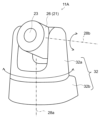
- An imaging device drive mechanism 32 may be provided that rotates around the moving axis, for example, in a panning direction or a tilting direction.
- the imaging device drive mechanism 32 includes, for example, an arm 32a that rotatably supports the lens barrel 26 in a tilt direction, which is a vertical direction, and a base 32b, which supports the arm 32a rotatably in a pan direction, which is a lateral direction. Be prepared.
- the arm 32a and the base 32b are equipped with a motor and gears as a drive mechanism.
- the imaging device 11A which also functions as a blur correction unit, is rotated in response to the movement of the vehicle 3 while the lens 23 faces the imaging target surface 9a.
- the imaging device 11A also includes a shutter 24, an imaging device 25, and a camera control section 27.
- the driving direction and driving amount of the imaging device driving mechanism 32 are controlled by the control device 15.
- the blur correction mechanism 31 may include a mechanism that drives the entire imaging device 11 in translation in parallel to the imaging target region 9.
- the mirror 41 is rotatably arranged to face the lens 23.
- the mirror 41 can be rotated, for example, in either a clockwise forward direction or a reverse direction, and the rotatable angular range may be less than 360 degrees or more than 360 degrees. Good too.
- the mirror 41 totally reflects the ambient light reflected by the imaging target toward the imaging device 11 .
- the mirror drive unit 43 rotates the mirror 41 from an initial angle, which is a rotation start position, to a specified angle, and after rotating the mirror 41 to the specified angle, returns the mirror 41 to the initial angle. Note that this initial angle varies depending on the moving speed.
- the mirror drive unit 43 is, for example, a motor.
- the rotation angle of the mirror 41 is limited by mechanical constraints of the mirror drive unit 43, and the mirror 41 can be rotated up to the maximum swing angle of the mirror 41 determined by this limitation.
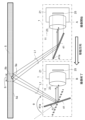
- FIG. 3 is an explanatory diagram illustrating blur correction of the imaging system 1.
- the imaging system 1 located at position A moves together with the vehicle 3 to position B during the exposure time. Imaging starts at position A, and the image that can be obtained at this timing includes, for example, the hole 5b in the imaging target area 9, but the exposure time is not sufficient, so the image is dark and not clear.
- the imaging target area 9 will move relatively in the opposite direction to the moving direction of the vehicle 3, resulting in an image in which the hole 5b has moved relatively.
- the amount of pixel movement is detected as the amount of blur. In this way, the image captured by the imaging device 11 while the vehicle 3 is moving becomes a blurred image.
- the end 41a of the mirror 41 on the moving direction side rotates the mirror 41 in a direction that offsets the relative movement of the imaging target during the exposure time.
- the imaging system 1 can capture the same imaging target region 9 in the captured image during the exposure time, and can obtain an image with significantly reduced blur.
- the mirror 41 is rotated clockwise by the shake correction swing angle ⁇ so that the end 41a of the mirror 41 on the moving direction side rotates toward the imaging target side during the exposure time. By rotating the mirror 41 by the shake correction swing angle ⁇ , the amount of pixel movement in the captured image is corrected to zero.
- the focal length F is a value determined by the lens 23.
- the subject magnification M is a value determined by the focal length F and the subject distance.
- the subject distance is the distance from the principal point of the lens 23 placed between the imaging target, which is the subject, and the image sensor 25 to the imaging target. As the subject distance, a known value measured in advance may be used, or a value measured by a rangefinder during imaging may be used.
- the control device 15 includes a swing angle calculation unit 73 that calculates a shake correction swing angle for rotating the mirror 41 as a shake correction unit to correct shake during imaging;
- a rotation speed calculation unit 75 is provided that calculates the rotation speed Vm of the mirror 41 based on the shake correction swing angle and exposure time calculated in .
- the control device 15 controls the blur correction operation of the blur correction mechanism 31 based on the rotation speed of the mirror 41 and the exposure time calculated by the rotation speed calculation unit 75.
- the control device 15 also controls the imaging timing of the imaging device 11, and when the mirror 41 is located within a range in which the amount of displacement from the reference position is equal to or less than a threshold value during the movement blur correction operation by the blur correction mechanism 31, the control device 15 controls the imaging timing of the imaging device 11. Imaging by the imaging device 11 is started in synchronization.
- the control device 15 may have a control device that controls the blur correction mechanism 31 and a control device that controls the imaging timing of the imaging device 11, which are configured separately.
- the swing angle calculation unit 73 calculates the shake correction swing angle of the mirror 41 during imaging based on the moving speed V of the vehicle 3, the set exposure time Tp, the subject magnification M, and the focal length F of the lens 23. Calculate ⁇ using the following flow.
- the exposure time Tp may be set manually by the user using the operation unit 19, or may be set automatically by the control device 15 according to the brightness of the surrounding environment of the imaging target.
- the moving amount L of the vehicle 3 that has moved between the time t1 when the image capturing starts and the time t2 when the image capturing ends is calculated from the moving speed V and the exposure time Tp using the following equation (1).
- L [mm] V [km/h] ⁇ 10 6 ⁇ Tp [ms] / (60 2 ⁇ 10 3 )...Equation (1)
- the optical path of the light incident on the lens 23 is changed by the movement blur correction angle ⁇ corresponding to the pixel movement amount P to prevent blurring.
- the movement blur correction angle ⁇ is calculated from the pixel movement amount P and the focal length F using the following equation (3).
- ⁇ [deg] arctan(P/F)...Equation (3)
- the subject magnification M is calculated from the focal length F[mm] and the subject distance D[m] using the following equation (4). be done.
- the shake correction swing angle ⁇ required for shake correction during exposure is half the moving shake correction angle ⁇ , it is calculated by the following equation (6).
- ⁇ ⁇ /k...Equation (6)
- k is the mirror swing angle ⁇ as the mechanical swing angle of the drive mechanism and the movement blur correction angle as the optical correction angle at which the light incident on the lens 23 is corrected.
- It is a conversion coefficient with ⁇ .
- the conversion coefficient k 2.
- the conversion coefficient k 1.
- the swing angle calculation unit 73 calculates the blur correction swing angle ⁇ of the mirror 41.
- the rotation speed calculation unit 75 calculates the rotation speed Vm of the mirror 41 from the blur correction swing angle ⁇ and the exposure time Tp using the following equation (7).
- Vm ⁇ /Tp...Equation (7)
- the imaging device 11 can control the light L1 from the same imaging target area 9 during the exposure time. can receive light, and can suppress the occurrence of movement blur in captured images.
- the storage unit 17 is a storage medium that stores programs and data necessary to realize the functions of the control device 15.
- the storage unit 17 can be realized by, for example, a hard disk (HDD), SSD, RAM, DRAM, ferroelectric memory, flash memory, magnetic disk, or a combination thereof.
- the operation unit 19 is an input device for a user to give instructions to the control device 15.
- the operation unit 19 may be an input device dedicated to the imaging system 1, or may be a mobile terminal such as a smartphone. When a mobile terminal is used as the operation unit 19, the operation unit 19 and the control device 15 transmit and receive data through wireless communication.
- the user may use the operation unit 19 to specify whether the imaging target area is an indoor dark area such as a tunnel or an outdoor bright area such as a mountain slope.
- the object distance of the light L1 from the imaging target area 9 changes depending on the angle of the mirror 41 with respect to the imaging target.
- the distances to each subject are not uniform, which reduces the accuracy of blur correction.
- exposure was performed at fixed moving distance intervals in synchronization with the acquisition of the vehicle speed pulse signal, or exposure was performed at fixed time intervals with a predetermined imaging frame cycle.
- the axis perpendicular to the object plane and the optical path from the imaging target area 9 to the mirror 41 are not parallel to each other, resulting in variations in the respective object distances within the imaging plane.
- the accuracy of movement blur correction decreases.
- the accuracy of blur correction decreases.
- the imaging surface of the imaging target area 9 is perpendicular to the imaging target surface 9a.
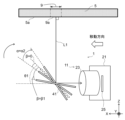
- the axis is parallel to the optical path from the imaging target area 9 to the mirror 41. Therefore, by imaging at a rotational position of the mirror 41 such that the axis perpendicular to the imaging target surface 9a of the imaging target area 9 is parallel to the optical path from the imaging target area 9 to the mirror 41, the imaging surface of the imaging element 25 is The distances between the objects in the image become uniform, and the accuracy of the movement blur correction, which sets the amount of movement blur correction according to the object distance, is improved.
- images are taken within a predetermined angular range including the rotational position of the mirror 41 such that the axis perpendicular to the imaging target surface 9a of the imaging target area 9 becomes parallel to the optical path from the imaging target area 9 to the mirror 41.
- exposure is performed in synchronization with the rotation of the shake correction swing angle ⁇ of the mirror 41 of the shake correction mechanism.
- FIG. 5 is a flowchart showing the imaging processing performed by the imaging system 1.
- FIG. 6 is a graph showing the relationship between the second mechanism swing angle ⁇ of the blur correction mechanism and exposure.
- FIG. 6(a) is a graph showing the moving speed of the vehicle 3 that changes over time.
- FIG. 6(b) is a graph showing the timing of exposure time.
- FIG. 6(c) is a graph showing fluctuations in the second mechanism swing angle ⁇ of the shake correction mechanism.
- the imaging process shown in FIG. 5 is started, for example, when an instruction to start imaging is received from the operation unit 19 while the vehicle 3 is moving.
- the second mechanism swing angle ⁇ of the mirror 41 is set to 0 degrees.
- this state is set as the reference position of the blur correction mechanism 31 (see FIG. 4).
- the second mechanism swing angle ⁇ indicates the displacement angle (displacement amount) of the mirror 41 from the reference position.
- the second mechanism swing angle ⁇ has, for example, a positive sign in the direction of rotation from the reference position to the direction in which the vehicle 3 is traveling, and a negative sign in the direction of rotation in the opposite direction to the direction of travel.
- the design may be reversed (see FIGS. 4 and 7).
- step S1 the user measures the object distance in advance from the image sensor 25 of the camera body 21 to the wall surface 5a of the tunnel 5 to be imaged, and sends the measured object distance to the control device 15 using the operation unit 19.
- the control device 15 can determine whether the vehicle has traveled on the road in the set section based on the acquired GPS information and travel distance. Note that the first image Im1 has already been captured, and the flow of capturing images from the second image Im2 onward will be explained using the following steps.
- step S2 the speed detection device 3a detects the moving speed V0 of the running vehicle 3.
- the detected moving speed is sent to the control device 15.
- FIG. 6(a) shows a change in the moving speed of the vehicle 3, and the moving speed of the vehicle 3 changes from the moving speed V0 at the time of capturing the first image Im1 to the time of capturing the second image Im2.
- the moving speed increases to V1, further increases to V2 when capturing the second image Im2, and decreases to V3 when capturing the third image Im3.
- step S3 the swing angle calculation unit 73 calculates the blur correction swing angle ⁇ 2 as the movement blur correction amount based on the moving speed V0 and the exposure time Tp2 of the next image Im2 (1) to (6). Calculated from the formula.
- Tp2 t4-t3.
- the exposure times Tp1, Tp2, and Tp3 of each of the images Im1 to Im3 may be the same time, or may be changed depending on the illuminance of the environmental light.
- the rotational speed calculation unit 75 calculates the rotational speed Vm2 of the mirror 41 based on the shake correction swing angle ⁇ 2. Further, the swing angle calculation unit 73 calculates the rotation start position ⁇ 1.
- step S4 the control device 15 rotates the mirror 41 in the opposite direction to the correction direction to determine the rotation start position in the correction direction of the swing angle ⁇ 2, as shown in FIGS. 6(c) and 7. Displace it to ⁇ 1.
- the drive cycle of the mirror 41 is from the timing when exposure ends until the end of exposure of the next image.
- the direction in which the mirror 41 is rotated in the correction direction is defined as the forward direction.
- the control device 15 causes the mirror drive unit 43 to rotate the mirror 41 at the calculated rotation speed Vm2, so that the rotation angle is lower than the calculated mirror swing angle ⁇ 2.
- the mirror 41 begins to rotate from the rotation start position ⁇ 1 in the correction direction of the large second mechanism swing angle ⁇ . In this way, blur correction of the imaging device 11 is performed.
- step S5 the control device 15 determines whether the driving direction of the blur correction mechanism 31 is the correction direction.
- the correction direction is the direction in which the mirror 41 is rotated for blur correction.
- the control device 15 determines that the drive direction of the blur correction mechanism 31 is not in the correction direction (No in step S5), it understands that the mirror 41 is rotating in the opposite direction to the rotation start position in the correction direction. , continue with step S4.
- the threshold value TH is greater than 0 degrees.
- the threshold value TH is a value indicating a predetermined range that can be imaged from the reference position.
- the threshold value TH is determined based on the shake correction swing angle ⁇ of the imaging device 11. For example, in order to set the exposure time at the center when the moving blur correction unit is at the origin (mechanical angle 0), it is only necessary to start exposure when it is located on the positive side of FIG. 6 by half of the moving blur correction amount.
- the threshold value TH is half of the movement blur correction amount. In other words, since the moving blur correction amount changes for each image capture, the threshold TH is determined based on the moving blur correction amount, and the moving blur correction amount is calculated based on the moving speed, exposure time, and subject distance. Therefore, the threshold value TH is also determined based on the moving speed, exposure time, and subject distance. Further, the threshold value TH may be changed depending on the moving speed of the vehicle 3. The control device 15 may increase the threshold value TH as the moving speed of the vehicle 3 becomes faster, and may decrease the threshold value TH as the moving speed of the vehicle 3 becomes slower. In FIG.
- the threshold value TH is a threshold value corresponding to the moving speed used when capturing the first image Im1.
- the threshold TH2 is a threshold corresponding to the moving speed V0 used when capturing the second image Im2
- the threshold TH3 is a threshold corresponding to the moving speed V2 used when capturing the third image Im3. It is. As the moving speed (vehicle speed) increases, the value increases from the threshold value TH1 to the threshold value TH3.
- control device 15 determines that the second mechanism swing angle ⁇ of the mirror 41 is not less than the threshold value TH2 (No in step S6), the second mechanism swing angle ⁇ of the mirror 41 has reached around 0 degrees (reference position). It is understood that there is no such thing, and steps S4 and S5 are continued.
- step S6 determines that the second mechanism swing angle ⁇ of the mirror 41 is less than or equal to the threshold value TH2 (Yes in step S6), it understands that the second mechanism swing angle ⁇ of the mirror 41 has reached around 0 degrees.
- step S7 continues to send a Hi signal instructing exposure as an exposure control signal to the camera control section 27 during the exposure time Tp. Thereby, an image can be captured when the second mechanism swing angle ⁇ of the mirror 41 is within the range of the blur correction swing angle ⁇ 2 including 0 degrees.
- the exposure timing based on the threshold TH exposure can be started before the mirror 41 reaches the reference position, and the position of the mirror 41 at the center of the exposure time can be brought closer to the reference position.
- the camera control unit 27 acquires an image by opening the shutter 24 and exposing it while receiving the Hi signal, and stores the acquired image in the storage unit 17.
- the control device 15 continues to send a Low signal to the camera control unit 27 as an OFF signal instructing to stop exposure.
- the camera control unit 27 closes the shutter 24 while receiving the Low signal.
- a Low signal may be used as an ON signal for instructing exposure
- a Hi signal may be used as an OFF signal for instructing to stop exposure.
- step S8 the control device 15 determines whether the vehicle 3 has finished traveling in the predetermined section. When the control device 15 determines that the vehicle 3 has finished traveling in the predetermined section, it has finished acquiring images of the road in this section, and thus ends the moving imaging. If the control device 15 determines that the vehicle 3 has not finished traveling in the predetermined section, it returns to step S2 and performs moving imaging again.
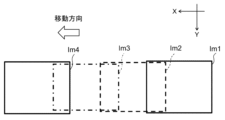
- FIGS. 6 and 6 When images are continuously captured, the flow of imaging from the first image Im1 to the third image Im3 is shown in FIGS. 6 and 6, including the operation of the imaging system 1 after returning to step S2. This will be further explained with reference to 8.
- FIG. 8 when capturing the second image Im2 in the continuous imaging mode, the end area on the opposite side to the movement direction of the second image Im2 and the first image captured The image is taken so that the end region of Im1 in the moving direction overlaps with the end region of Im1.
- the end region of the third image Im3 on the opposite side to the movement direction and the end region of the second image Im2 in the movement direction are different from each other. Capture images so that they overlap.
- the first image Im1 is captured at a shake correction swing angle ⁇ 1. Based on the moving speed V0 of the vehicle 3 at the time of capturing the first image Im1, the blur correction swing angle ⁇ 2 and rotation speed Vm2 of the second image Im2 are calculated.
- the mirror drive unit 43 rotates the mirror 41 in the opposite direction to the rotation start position ⁇ 1 in the correction direction.
- the rotation speed of the mirror 41 in the reverse direction after the exposure is completed may be the same as or different from the rotation speed in the forward direction. If the rotational speed is the same in the forward direction and the reverse direction, after the exposure of the first image Im1 is completed, the mirror drive unit 43 rotates the mirror 41 in the opposite direction at the rotational speed Vm2, and the mirror 41 makes corrections.
- the mirror drive section 43 rotates the mirror 41 in the forward direction at a rotation speed Vm2.
- the control device 15 instructs exposure, the shutter 24 is opened, and the second image Im2 is captured at the shake correction swing angle ⁇ 2.
- the threshold value TH2 may be a value in the range of TH2 ⁇ 2, for example.
- the blur correction swing angle ⁇ 3 of the third image Im3 is calculated based on the moving speed V2 of the vehicle 3 at the time of capturing the second image Im2.
- the mirror drive unit 43 rotates the mirror 41 in the opposite direction to the rotation start position ⁇ 2 in the correction direction.
- the mirror drive unit 43 rotates the mirror 41 in the forward direction at the calculated rotation speed Vm3.
- the control device 15 instructs exposure, the shutter 24 is opened, and the third image Im3 is captured.
- the shake correction swing angle ⁇ 2, rotation speed Vm2, and rotation start in the correction direction at the time of exposure of the second image Im2 are changed.
- a position ⁇ 1 is determined.
- the second image Im2 can be exposed at an optimal timing synchronized with movement blur correction by continuing exposure when the mirror 41 is located before and after the reference position.
- the imaging system 1 corrects blur in the moving direction of the vehicle 3 when the imaging device 11 disposed in the vehicle 3 and the imaging device 11 captures an image while the vehicle 3 is moving, based on the blur correction swing angle ⁇ .
- It includes a blur correction mechanism 31 and a control device 15 that controls the imaging timing of the imaging device 11.
- the blur correction mechanism 31 drives the mirror 41 to correct blur in the moving direction.
- the mirror 41 has a reference position where the axis perpendicular to the imaging target surface 9a and the optical axis of the light L1 incident on the mirror 41 are parallel.
- the control device 15 causes the imaging device 11 to start imaging in synchronization when the mirror 41 is located within a range in which the amount of displacement from the reference position is equal to or less than the threshold value TH.
- the imaging device 11 can reliably capture an image when the mirror 41 is located at the reference position, reducing variations in subject distance within the imaging plane, and adjusting the amount of motion blur correction according to the subject distance.
- the accuracy of movement blur correction for setting the correction swing angle ⁇ is improved.
- the mirror 41 is driven by an amount larger than the blur correction swing angle ⁇ for correcting the blur in the movement direction. As a result, the mirror 41 is driven by an amount larger than the blur correction swing angle ⁇ , so that the drive responsiveness necessary for blur correction in the moving direction can be ensured. Moreover, it becomes easier to determine the timing for starting imaging by the imaging device 11.
- the control device 15 updates the threshold TH based on the shake correction swing angle ⁇ of the imaging device 11. This makes it possible to set an accurate threshold TH for blur correction.
- control device 15 causes the imaging device 11 to start imaging when the mirror 41 is located at the reference position or before the mirror 41 reaches the reference position, and causes the imaging device 11 to end imaging after the mirror 41 passes the reference position. It's okay.
- the mirror 41 passes through the reference position during imaging by the imaging device 11, so the subject distance within the imaging plane becomes uniform, and the blur correction swing angle ⁇ as the moving blur correction amount is set according to the subject distance. The accuracy of movement blur correction is improved. Therefore, an image with reduced movement blur can be obtained.
- the blur correction mechanism 31 rotates the mirror 41 in the correction direction in order to correct the blur in the movement direction, and reverses the driving direction of the mirror 41 to the opposite direction to the correction direction based on the imaging end timing. If the blur correction mechanism 31 does not rotate the mirror 41 in the opposite direction to the correction direction, 360 degree rotation control is performed, which widens the drive range of the mirror 41 and reduces control resolution (angle command accuracy). By rotating the mirror 41 in the opposite direction to the correction direction, for example, the mirror 41 only needs to be rotated within a range of ⁇ 10 degrees or less, so that the rotation accuracy can be increased.
- the blur correction mechanism 31 rotates the mirror 41 in a correction direction for correcting blur in the moving direction
- the moving blur correction amount is the amount of movement of pixels on the image sensor of the imaging device 11 due to the movement of the vehicle 3.
- This is the blur correction swing angle ⁇ that rotates the mirror 41 in the correction direction, which corresponds to P. Since the blur correction swing angle ⁇ corresponds to the pixel movement amount P, it is possible to reduce movement blur in the captured image.
- the blur correction mechanism 31 rotates the mirror 41 in the correction direction in order to correct the blur in the moving direction
- the threshold value TH is smaller than the shake correction swing angle ⁇
- the control device 15 rotates the mirror 41 in the correction direction from the reference position.
- the threshold value TH is set in the opposite direction. Since the imaging device 11 takes an image while the mirror 41 is rotating by the shake correction swing angle ⁇ , the mirror 41 always passes through the reference position during imaging. Therefore, the accuracy of movement blur correction can be improved.
- the mirror 41 serves as a blur correction unit that reflects the light L1 from the imaging target surface 9a to the imaging device 11, and the blur correction mechanism 31 includes a mirror drive unit 43 that rotationally drives the mirror 41.
- the mirror 41 serves as the blur correction section, blur correction can be appropriately performed.
- the control device 15 causes the imaging device 11 to take an image every time the mirror 41 is located within a range where the amount of displacement from the reference position is equal to or less than the threshold value TH, and the control device 15 causes the imaging device 11 to take an image of the mirror 41, and determines the end region in each movement direction in the taken images Im1 to Im3. Images are continuously acquired in a line so that the end region on the opposite side to the moving direction in each of the next captured images Im2 to Im4 overlaps. Thereby, it is possible to prevent omission of images between captured images and to obtain continuous captured images.
- the blur correction mechanism 31 includes an imaging device drive mechanism 32 that rotationally drives the imaging device 11A, and the imaging device drive mechanism 32 may rotate using the imaging device 11A itself as a blur correction section.
- the imaging device 11A can reliably capture an image when the lens 23 is located at the reference position, reducing variations in subject distance within the imaging plane, and adjusting the amount of blur correction as a moving blur correction amount according to the subject distance.
- the accuracy of movement blur correction for setting the correction swing angle ⁇ is improved.
- the mirror rotation method for rotating the mirror 41 and the camera drive method for rotating the lens 23 and image sensor 25 have been described. Theoretically, both methods equalize the subject distance within the imaging plane by changing the tilt of the mirror 41 as a blur correction unit, or the lens 23 and image sensor according to the attitude of the vehicle 3. Can be done.
- the mirror rotation method as the inclination with respect to the imaging plane approaches parallel from 45 degrees, the reflection angle becomes acute, and the end of the mirror 41 enters the lens surface of the lens 23 on the optical path and is cut off. There are cases. As the inclination with respect to the imaging plane approaches perpendicular from 45 degrees, reflected light may deviate from the lens 23. In these cases, it may not be possible to image a desired range. This situation does not occur with the camera drive method.
- FIG. 9 is a block diagram showing the internal configuration of an imaging system 1A in the second embodiment.
- FIG. 10 is an explanatory diagram illustrating the imaging system 1A when a posture change occurs in the vehicle 3.
- the imaging timing is adjusted to an appropriate range of the swing angle ⁇ of the second mechanism of the shake correction mechanism 31, but when a change in attitude occurs in the vehicle 3, even in this case, the axis perpendicular to the imaging target surface 9a is adjusted.
- the object distance within the imaging plane may vary because the optical axis and the optical axis are not parallel to each other. For example, as shown in FIG. 10, when the vehicle 3 changes its attitude in the pitch direction, even if the first mechanism swing angle ⁇ 1, which is the mechanical angle of the mirror 41, is 45 degrees, the entire imaging system 1 tilts at the attitude change angle ⁇ . Therefore, variations occur in the subject distance of the light L1.
- the imaging timing is adjusted in response to changes in the posture of the vehicle 3.
- the control device 15A may correct the timing at which the imaging device 11 starts capturing an image by correcting the rotation angle of the mirror 41 corresponding to the reference position based on the amount of attitude change of the vehicle 3.
- an imaging system 1A according to the second embodiment has a configuration in which the imaging system 1 according to the first embodiment includes an attitude detection device 33 that detects the amount of change in attitude of the imaging device 11 and a composite angle calculation unit 77. be.
- the imaging system 1A in the second embodiment is common to the imaging system 1 in the first embodiment.
- the imaging device 11 is integrated with the vehicle 3 and can be regarded as one rigid body, so the attitude change angle of the imaging device 11 is the same as the attitude change angle of the vehicle 3.
- the attitude detection device 33 determines the amount of attitude change of the imaging device 11 by detecting the attitude change angle ⁇ (see FIG. 10) in the rotation direction in which the blur correction mechanism 31 corrects the blur with respect to the reference attitude of the vehicle 3. Detect.
- the posture detection device 33 is, for example, a gyro sensor or an acceleration sensor.
- the detected posture change angle ⁇ is output to the control device 15A.
- the attitude detection device 33 detects at least the attitude change angle ⁇ of the vehicle 3 in the pitch direction, with the horizontal state being the reference attitude.
- the attitude detection device 33 may detect attitude change angles in the yaw direction and the roll direction in addition to the pitch direction.
- the control device 15A includes a composite angle calculation unit 77 that calculates a composite angle ⁇ that is the sum of the attitude change angle ⁇ detected by the attitude detection device 33 and k ⁇ obtained by multiplying the second mechanism swing angle ⁇ by a conversion coefficient k. Be prepared.
- the positive and negative directions of the attitude change angle ⁇ are set to match the positive and negative directions of the second mechanism swing angle ⁇ .
- the composite angle calculation unit 77 does not need to calculate the composite angle ⁇ when the blur correction mechanism 31 is driving the mirror 41 in the opposite direction to the correction direction.
- the control device 15A determines whether the composite angle ⁇ is greater than or equal to 0 [deg], which is the reference position of the mirror 41, and less than or equal to the threshold value TH. When the control device 15A determines that the composite angle ⁇ is greater than or equal to 0 and less than or equal to the threshold value TH, the control device 15A transmits a Hi exposure control signal to the camera control unit 27 to cause the imaging device 11 to take an image.
- FIG. 11 is a flowchart showing the imaging process in the second embodiment.
- step S11 is added to the operation of the imaging system 1 in the first embodiment, and step S6 is replaced with step S12.
- FIG. 12 is a graph showing the relationship between the second mechanism swing angle ⁇ of the blur correction mechanism and exposure.
- FIG. 12(a) is a graph showing the moving speed of the vehicle 3 that changes over time.
- FIG. 12(b) is a graph showing the timing of exposure time.
- FIG. 12(c) is a graph showing fluctuations in the second mechanism swing angle ⁇ of the shake correction mechanism.
- FIG. 12(d) is a graph showing fluctuations in the attitude change angle ⁇ detected by the attitude detection device 33, and exemplifies the graph up to the exposure of the second image Im2.
- FIG. 12E is a graph showing variations in the composite angle ⁇ , and exemplifies the graph from the exposure of the first image Im2 to the exposure of the second image Im2.
- Steps S1 to S5, S7, and S8 are the same as the operations of the imaging system 1 of Embodiment 1, so the description thereof will be omitted.
- step S4 blur correction driving is performed.
- the attitude detection device 33 detects the attitude change angle of the vehicle 3. Detect ⁇ .
- the positive direction of the attitude change angle ⁇ and the positive rotation direction of the second mechanism swing angle ⁇ are the same direction.
- the composite angle ⁇ can also be said to be a correction position with respect to the imaging target surface 9a.
- step S12 the control device 15 determines whether the composite angle ⁇ is less than or equal to the threshold value TH.
- the threshold value TH is greater than 0 degrees. That is, the control device 15 determines whether the following equation (8) is satisfied or not. 0 ⁇ TH...Formula (8)
- step S12 When the control device 15 determines that the composite angle ⁇ is not equal to or less than the threshold value TH (No in step S12), it continues step S4. When the control device 15 determines that the composite angle ⁇ is greater than or equal to 0 and less than or equal to the threshold value TH (Yes in step S12), in step S7, the control device 15 continues to send a Hi signal instructing exposure to the camera control unit 27 for the exposure time Tp, Execute imaging.
- the mirror method In the case of the camera drive method, it is necessary to change the tilt by the same angle in order to offset the tilt of the lens 23 and the image sensor 25.
- the mirror method it can be offset by tilting in the opposite direction by half the camera tilt (optical angle), so the angle for canceling the vehicle attitude change may be half the vehicle attitude change angle. Therefore, the mirror method has better responsiveness.
- the imaging system 1A includes the attitude detection device 33 that detects the attitude change angle ⁇ of the vehicle 3, and the control device 15A corrects the position of the mirror 41 corresponding to the reference position based on the attitude change angle ⁇ . By doing so, the timing at which the imaging device 11 starts imaging is corrected.
- the rotating position of the mirror 41 corresponding to the reference position where the axis perpendicular to the imaging target surface 9a and the optical axis of the light incident on the mirror 41 are parallel to each other also changes depending on the vehicle. 3 different postures.
- the control device 15A sets the position where the composite angle ⁇ obtained by correcting the second mechanism swing angle ⁇ of the mirror 41, which corresponds to the reference position based on the attitude change angle ⁇ , as the reference position. Based on the timing at which the composite angle ⁇ becomes 0 after correction, the control device 15A corrects the timing at which the imaging device 11 starts imaging. Thereby, it is possible to reduce the influence on the subject distance due to a change in the posture of the vehicle 3, and to suppress a decrease in the accuracy of movement blur correction.
- the control device 15A also controls the timing at which the composite angle ⁇ as a correction position calculated based on the posture change angle ⁇ and the second mechanism swing angle ⁇ during the shake correction operation of the mirror 41 becomes equal to or less than the threshold value TH from the reference position. Then, the imaging device 11 starts imaging. Thereby, it is possible to reduce the influence on the subject distance due to a change in the posture of the vehicle 3, and to suppress a decrease in the accuracy of movement blur correction.
- the imaging device 11 and the blur correction mechanism 31 are separate bodies, but the present invention is not limited to this.
- the imaging device 11 may have a configuration in which the camera body 21, the lens 23, and an optical axis changing mechanism that replaces the shake correction mechanism 31 are integrated.
- the camera body 21 and the lens 23 may be rotated in the vertical direction. It may have a tilt function that moves and a pan function that rotates laterally.
- a mechanism may be provided that rotates the entire imaging device 11 in two orthogonal directions.
- the blur correction mechanism 31 may be configured with two mirrors whose rotation axes are perpendicular to each other and a motor.
- the imaging system 1 may include a speed detection device that detects the moving speed of the imaging system 1. Further, the speed detection device may utilize a GPS system.
- the imaging system 1 images the upper and side walls of the vehicle 3, but the invention is not limited thereto.
- the imaging system 1 may image the road surface below the vehicle 3. Potholes, cracks, ruts, etc. that occur on the road surface can be detected from the captured images through image processing.
- the moving object is a vehicle 3 such as a car
- the moving object is not limited to the vehicle 3, but may be a vehicle that runs on the ground such as a train or a motorcycle, a ship that moves on the sea, or a flying object such as an airplane or a drone that flies in the sky.
- the imaging system 1 images the bottom of a bridge pier or bridge girder, or a structure built along the shore.
- the position and wear of the overhead wire can be detected by imaging the overhead wire.
- an image is captured using the light that is reflected by the ambient light on the imaging target area 9, but the present invention is not limited to this.
- Light may be emitted from a moving object or an imaging system toward the imaging target area 9, and an image may be captured using reflected light of the emitted light.
- the imaging system of the present disclosure uses an imaging device disposed on a moving object and a motion blur correction amount to correct blur in the moving direction of the moving object when the imaging device captures an image while the moving object is moving. It includes a blur correction mechanism that performs blur correction, and a control device that controls image capture timing of an image capture device.
- the blur correction mechanism drives a blur correction unit to correct blur in the movement direction, and the blur correction unit uses a standard that the axis perpendicular to the imaging target surface and the optical axis of the light incident on the blur correction unit are parallel.
- the control device causes the image capturing device to start imaging in synchronization when the blur correcting unit is located within a range in which the amount of displacement from the reference position is equal to or less than a threshold value while the blur correcting unit is being driven.
- the blur correction section is driven by an amount larger than the movement blur correction amount for correcting blur in the moving direction.
- the control device updates the threshold based on the amount of motion blur correction of the imaging device.
- control device controls the imaging device when the blur correction section is located at the reference position or before the blur correction section reaches the reference position. Imaging is started, and is ended after the blur correction section passes the reference position.
- the blur correction mechanism rotates the blur correction unit in the correction direction in order to correct blur in the movement direction, and the threshold value is smaller than the movement blur correction amount;
- the control device sets the threshold value in a direction opposite to the correction direction from the reference position.
- the blur correction mechanism reverses the drive direction of the blur correction unit to a direction opposite to the correction direction based on the imaging end timing.
- the imaging system includes an attitude detection device that detects the amount of change in attitude of the moving body, and the control device performs blur correction corresponding to the reference position based on the amount of change in attitude. By correcting the position of the part, the timing at which the imaging device starts capturing an image is corrected.
- the imaging system includes an attitude detection device that detects the amount of change in attitude of the moving body, and the control device detects the amount of change in attitude and the amount of change in the attitude of the blur correction unit during blur correction operation.
- the imaging device is caused to start imaging at a timing when the corrected position calculated based on the position becomes less than or equal to the threshold value from the reference position.
- the blur correction unit is an imaging device
- the blur correction mechanism includes an imaging device drive mechanism that rotationally drives the imaging device.
- the blur correction unit is a mirror that reflects light from the imaging target surface to the imaging device, and the blur correction mechanism rotationally drives the mirror. Equipped with a mirror drive mechanism.
- the blur correction mechanism rotates the blur correction unit in a correction direction for correcting blur in the movement direction, and the movement blur correction amount is determined by This is the amount of rotation by which the blur correction unit is rotated in the correction direction, which corresponds to the amount of movement of pixels on the image sensor of the imaging device due to the movement of the body.
- the control device causes the imaging device to take an image each time the blur correction unit is located within a range in which the amount of displacement from the reference position is equal to or less than the threshold value. , images are continuously acquired in a line such that an end region in the moving direction in the captured image overlaps an end region on the opposite side to the moving direction in the next captured image.
- control device increases the threshold value as the moving speed of the moving object becomes faster, and decreases the threshold value as the moving speed of the moving object becomes slower.
- the imaging system includes a speed detection device that detects the moving speed of the moving object, and the control device calculates the amount of motion blur correction based on the detected moving speed. do.
- the mobile object of the present disclosure includes the imaging system of any one of (1) to (14). Thereby, while the moving object is moving, the imaging system can capture an image around the moving object while reducing blur.
- the present disclosure is applicable to an imaging system installed on a moving body.
Landscapes
- Engineering & Computer Science (AREA)
- Multimedia (AREA)
- Signal Processing (AREA)
- Physics & Mathematics (AREA)
- General Physics & Mathematics (AREA)
- Studio Devices (AREA)
Priority Applications (2)
| Application Number | Priority Date | Filing Date | Title |
|---|---|---|---|
| JP2024528907A JPWO2023243656A1 (https=) | 2022-06-16 | 2023-06-14 | |
| US18/977,235 US20250106511A1 (en) | 2022-06-16 | 2024-12-11 | Imaging system and mobile object having same |
Applications Claiming Priority (2)
| Application Number | Priority Date | Filing Date | Title |
|---|---|---|---|
| JP2022-097549 | 2022-06-16 | ||
| JP2022097549 | 2022-06-16 |
Related Child Applications (1)
| Application Number | Title | Priority Date | Filing Date |
|---|---|---|---|
| US18/977,235 Continuation US20250106511A1 (en) | 2022-06-16 | 2024-12-11 | Imaging system and mobile object having same |
Publications (1)
| Publication Number | Publication Date |
|---|---|
| WO2023243656A1 true WO2023243656A1 (ja) | 2023-12-21 |
Family
ID=89191371
Family Applications (1)
| Application Number | Title | Priority Date | Filing Date |
|---|---|---|---|
| PCT/JP2023/022059 Ceased WO2023243656A1 (ja) | 2022-06-16 | 2023-06-14 | 撮像システム、及び、それを備えた移動体 |
Country Status (3)
| Country | Link |
|---|---|
| US (1) | US20250106511A1 (https=) |
| JP (1) | JPWO2023243656A1 (https=) |
| WO (1) | WO2023243656A1 (https=) |
Citations (2)
| Publication number | Priority date | Publication date | Assignee | Title |
|---|---|---|---|---|
| JPH11252461A (ja) * | 1998-03-05 | 1999-09-17 | Fujitsu Ltd | 走査型撮像装置 |
| WO2017056943A1 (ja) * | 2015-09-30 | 2017-04-06 | 富士フイルム株式会社 | 撮像システム、画角調整方法、及び画角調整プログラム |
-
2023
- 2023-06-14 WO PCT/JP2023/022059 patent/WO2023243656A1/ja not_active Ceased
- 2023-06-14 JP JP2024528907A patent/JPWO2023243656A1/ja active Pending
-
2024
- 2024-12-11 US US18/977,235 patent/US20250106511A1/en active Pending
Patent Citations (2)
| Publication number | Priority date | Publication date | Assignee | Title |
|---|---|---|---|---|
| JPH11252461A (ja) * | 1998-03-05 | 1999-09-17 | Fujitsu Ltd | 走査型撮像装置 |
| WO2017056943A1 (ja) * | 2015-09-30 | 2017-04-06 | 富士フイルム株式会社 | 撮像システム、画角調整方法、及び画角調整プログラム |
Also Published As
| Publication number | Publication date |
|---|---|
| US20250106511A1 (en) | 2025-03-27 |
| JPWO2023243656A1 (https=) | 2023-12-21 |
Similar Documents
| Publication | Publication Date | Title |
|---|---|---|
| US8896697B2 (en) | Video motion compensation and stabilization gimbaled imaging system | |
| US12309493B2 (en) | Aerial camera system | |
| AU2010251376B2 (en) | Aerial camera system and method for correcting distortions in an aerial photograph | |
| US20100295961A1 (en) | Imaging apparatus and image composition method | |
| CN112204946A (zh) | 数据处理方法、装置、可移动平台及计算机可读存储介质 | |
| JP2015195569A (ja) | 移動体用撮影装置 | |
| CN103676405A (zh) | 光学成像装置、光学系统和移动终端 | |
| JP2017085551A (ja) | ドローンに搭載されたカメラの露出時間を決定する方法、および関連するドローン | |
| CN110291780B (zh) | 图像增稳控制方法、拍摄设备和可移动平台 | |
| US12432450B2 (en) | Imaging system and moving body provided with same | |
| US12581190B2 (en) | Imaging system and moving body provided with same | |
| WO2023243656A1 (ja) | 撮像システム、及び、それを備えた移動体 | |
| JP4134869B2 (ja) | 撮像装置 | |
| JP7468523B2 (ja) | 移動体、位置推定方法、およびプログラム | |
| JPWO2023243656A5 (https=) | ||
| WO2023234360A1 (ja) | 撮像システム、及び、それを備えた移動体 | |
| JPWO2023234360A5 (https=) | ||
| WO2026004723A1 (ja) | 撮像システム | |
| WO2023234356A1 (ja) | 撮像システム、及び、それを備えた移動体 | |
| JP4639278B2 (ja) | ジンバルを用いたディジタルカメラによる撮影方法 | |
| US20250350836A1 (en) | Imaging system | |
| JPWO2023234356A5 (https=) | ||
| CN213240781U (zh) | 一种可抗飞行干扰的镜头像移补偿装置 | |
| KR20190140723A (ko) | 패닝 및 틸팅 제어가 되는 카메라의 프라이버시 마스크 최적화방법 및 프라이버시 마스크 최적화가 적용된 촬상장치 | |
| JP7209107B2 (ja) | 撮像支援装置、撮像装置、撮像システム、撮像支援システム、撮像支援方法、及びプログラム |
Legal Events
| Date | Code | Title | Description |
|---|---|---|---|
| 121 | Ep: the epo has been informed by wipo that ep was designated in this application |
Ref document number: 23823946 Country of ref document: EP Kind code of ref document: A1 |
|
| WWE | Wipo information: entry into national phase |
Ref document number: 2024528907 Country of ref document: JP |
|
| NENP | Non-entry into the national phase |
Ref country code: DE |
|
| 122 | Ep: pct application non-entry in european phase |
Ref document number: 23823946 Country of ref document: EP Kind code of ref document: A1 |