WO2023234413A1 - 検索システム、検索用プログラム、及び、クライアント用プログラム - Google Patents
検索システム、検索用プログラム、及び、クライアント用プログラム Download PDFInfo
- Publication number
- WO2023234413A1 WO2023234413A1 PCT/JP2023/020694 JP2023020694W WO2023234413A1 WO 2023234413 A1 WO2023234413 A1 WO 2023234413A1 JP 2023020694 W JP2023020694 W JP 2023020694W WO 2023234413 A1 WO2023234413 A1 WO 2023234413A1
- Authority
- WO
- WIPO (PCT)
- Prior art keywords
- search
- word
- results
- client terminal
- information
- Prior art date
- Legal status (The legal status is an assumption and is not a legal conclusion. Google has not performed a legal analysis and makes no representation as to the accuracy of the status listed.)
- Ceased
Links
Images





Classifications
-
- G—PHYSICS
- G06—COMPUTING OR CALCULATING; COUNTING
- G06F—ELECTRIC DIGITAL DATA PROCESSING
- G06F16/00—Information retrieval; Database structures therefor; File system structures therefor
- G06F16/30—Information retrieval; Database structures therefor; File system structures therefor of unstructured textual data
- G06F16/33—Querying
- G06F16/332—Query formulation
-
- G—PHYSICS
- G06—COMPUTING OR CALCULATING; COUNTING
- G06F—ELECTRIC DIGITAL DATA PROCESSING
- G06F16/00—Information retrieval; Database structures therefor; File system structures therefor
- G06F16/30—Information retrieval; Database structures therefor; File system structures therefor of unstructured textual data
- G06F16/33—Querying
- G06F16/338—Presentation of query results
-
- G—PHYSICS
- G06—COMPUTING OR CALCULATING; COUNTING
- G06F—ELECTRIC DIGITAL DATA PROCESSING
- G06F16/00—Information retrieval; Database structures therefor; File system structures therefor
- G06F16/30—Information retrieval; Database structures therefor; File system structures therefor of unstructured textual data
- G06F16/34—Browsing; Visualisation therefor
-
- G—PHYSICS
- G06—COMPUTING OR CALCULATING; COUNTING
- G06F—ELECTRIC DIGITAL DATA PROCESSING
- G06F16/00—Information retrieval; Database structures therefor; File system structures therefor
- G06F16/30—Information retrieval; Database structures therefor; File system structures therefor of unstructured textual data
- G06F16/36—Creation of semantic tools, e.g. ontology or thesauri
-
- G—PHYSICS
- G06—COMPUTING OR CALCULATING; COUNTING
- G06F—ELECTRIC DIGITAL DATA PROCESSING
- G06F16/00—Information retrieval; Database structures therefor; File system structures therefor
- G06F16/90—Details of database functions independent of the retrieved data types
- G06F16/95—Retrieval from the web
- G06F16/953—Querying, e.g. by the use of web search engines
-
- G—PHYSICS
- G06—COMPUTING OR CALCULATING; COUNTING
- G06F—ELECTRIC DIGITAL DATA PROCESSING
- G06F16/00—Information retrieval; Database structures therefor; File system structures therefor
- G06F16/90—Details of database functions independent of the retrieved data types
- G06F16/95—Retrieval from the web
- G06F16/953—Querying, e.g. by the use of web search engines
- G06F16/9532—Query formulation
-
- G—PHYSICS
- G06—COMPUTING OR CALCULATING; COUNTING
- G06F—ELECTRIC DIGITAL DATA PROCESSING
- G06F16/00—Information retrieval; Database structures therefor; File system structures therefor
- G06F16/90—Details of database functions independent of the retrieved data types
- G06F16/95—Retrieval from the web
- G06F16/953—Querying, e.g. by the use of web search engines
- G06F16/9538—Presentation of query results
Definitions
- the present invention relates to a search system used to search for information on the Internet.
- Search systems are used by users to search for desired information from a large amount of information on the Internet.
- a search word search query
- a search engine operating in the server device.
- the results of the search by the search engine are then transmitted from the server device to the client terminal and displayed on the client terminal's browser (for example, Patent Document 1).
- the present invention has been made in view of the above circumstances, and an object of the present invention is to realize a search system that allows a user of a client terminal to find unexpected information.
- a first invention displays a search word input screen on a client terminal, and the search words input on the input screen are delivered to a server device connected to the client terminal via the Internet.
- a search engine running on a server device performs a search, and when the results of the search by the search engine arrive at a client terminal, the search system displays a search result display screen on the client terminal to display the search results. Therefore, search engines perform two types of searches: normal search, which searches for related information related to a search word, and alternative search, which searches for other side information related to another word that is derived from the search word and has a different meaning from the search word.
- the search system is configured to perform at least one search, and the results of the normal search and the results of the other aspect search are simultaneously displayed on the search result display screen.
- a second invention is that in the first invention, identification information is displayed on the search result display screen for the user of the client terminal to identify the results of the normal search and the results of the other aspect search.
- a third invention is a serendipity method in which a user of a client terminal searches for serendipity information that a user of a client terminal feels is coincidental, using a chance search word obtained by elemental decomposition of a search word as another word in the first invention. It's a search.
- the serendipity search is used as the first alternative search, and the search engine uses an opposite search word having the opposite meaning to the search word as the second alternative search.
- a reverse search is further performed to search for reverse information using another word, and the results of the normal search, the serendipity search, and the reverse search are displayed simultaneously on the search result display screen.
- a fifth invention is based on the third invention, wherein the serendipity search is used as the first alternative search, and the search engine uses the search word as the second alternative search to search a plurality of types of databases using objective information.
- the search is further performed, and the results of the normal search, the results of the serendipity search, and the results of the objective information search are displayed simultaneously on the search result display screen.
- a sixth aspect of the present invention is based on the first aspect, when a screen scrolling operation is performed on the search result display screen, the results of the normal search and the results of the other aspect search are scrolled at the same time.
- a seventh invention is based on the first invention, in which, on the search result display screen, narrowing down to one type of search results from multiple types of search results including normal search results and other aspect search results is performed.
- a selection operation is possible, and when the selection operation is performed, a narrowing viewing screen that displays only one type of search result selected by the selection operation out of multiple types of search results is displayed on the client terminal. .
- An eighth invention is a search program that implements a search engine in a server device connected to a client terminal via the Internet, and when a search word is received from the client terminal to the computer of the server device, the search engine is activated.
- a step of performing at least a normal search for searching for related information related to the search word and a different aspect search for searching for other aspect information related to another word derived from the search word and having a different meaning from the search word is a search program that causes a client terminal to which a search word is transmitted to execute the steps of transmitting information including the results of a normal search and the results of a different aspect search.
- a ninth invention is a client program for realizing browsing of search results by a search engine in a client terminal connected via the Internet to a server device on which a search engine operates, the program comprising: A step of transmitting the search word entered on the input screen displayed on the client terminal to the server device, a normal search for searching for related information related to the search word, and a step of searching for related information related to the search word, and a step of searching for a meaning derived from the search word and different from the search word.
- information including the results of the normal search and the results of the other aspect search is delivered to the client terminal from a server device running a search engine that performs at least another aspect search that searches for other aspect information related to another word having .
- This is a program for a client that executes the step of transitioning the screen display of a client terminal to a search result display screen that displays the results of a normal search and the results of a different aspect search at the same time.
- the search engine not only searches for related information related to a search word, but also searches for information on other aspects using another word that is derived from the search word and has a different meaning from the search word.
- a lateral search is performed.
- the results of the normal search and the results of the other aspect search are displayed simultaneously. This allows the user of the client terminal to view not only the results of the normal search but also the results of the other aspect search, allowing the user to arrive at information that the user had not expected.
- FIG. 1 is a schematic configuration diagram of a search system according to this embodiment.
- FIG. 2 is a diagram showing an input screen.
- FIG. 3 is a flowchart showing an example of the processing flow of the search unit.
- FIG. 4 is a flowchart showing an example of the processing flow of the viewing processing section.
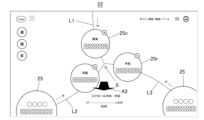
- FIG. 5 is a diagram showing a search result display screen.
- FIG. 6 is an explanatory diagram of a method of arranging search results.
- FIG. 7 is an explanatory diagram of scrolling in the advancing direction on the search result display screen.
- FIG. 8 is an explanatory diagram of scrolling in the backward direction on the search result display screen.
- FIG. 9 is a diagram showing a screen for narrowing down viewing.
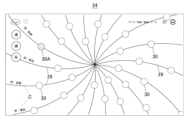
- FIG. 10 is a diagram showing a positioning map.
- FIG. 11 is a schematic configuration diagram of a search system according to a first modified example of this embodiment.
- FIG. 12 is a flowchart illustrating an example of the processing flow of the search unit
- the search system 10 is a web search system used to search for information (resources) such as web pages, documents (papers, articles, etc.), images, videos, etc. on the Internet 6.
- the search system 10 includes a server device 11 connected to a client terminal 5 via the Internet 6 (see FIG. 1).
- the server device 11 is installed with a search program that implements a search engine.
- a search engine operates as a CPU (processor) executes and interprets a search program
- a database creation section 11a and a search section 11b are realized as functional blocks.
- a crawler patrols the Internet 6 and collects resource information
- an indexer creates an index (database) 11c from the resource information.
- the search unit 11b receives a search word (search query) from the client terminal 5, it searches the index 11c and outputs the search result to the client terminal 5 to which the search word is transmitted.
- This search result (transmission information) includes list information such as web pages (resource list information) for each of the three types of search results described below.
- the client terminal 5 has installed therein a client program that allows input of search words, viewing of search results by a search engine, and the like.
- a CPU processor
- the search word processing unit 5a displays a search word input screen 21 (see FIG. 2) on the client terminal 5, and upon receiving an operation to execute a search by the user of the client terminal 5, inputs the search word into the search window 21a of the input screen 21.
- the search word is sent to the server device 11.
- the viewing processing unit 5b receives the above-mentioned transmission information from the server device 11, it displays a search result display screen 22 (see FIG. 5) on the screen of the client terminal 5 for displaying the search results.
- the client program may operate on the client terminal 5 or may operate on the cloud.
- the processing of the search unit 11b allows searching for things from multiple angles.
- the search unit 11b is configured to perform three types of searches when a search word is received from the client terminal 5.
- the search unit 11b provides bias-free search results in any of the three types of searches.
- the three types of searches are normal search, serendipity search (first alternative search), and opposite search (second alternative search).
- FIG. 3 is an example of the processing flow of the search unit 11b.
- the search unit 11b receives a search word from the client terminal 5, it starts a processing flow and performs a normal search process P1, a serendipity search process P2, and a reverse search process P3 in parallel.
- the normal search is to search for related information (related resources) related to the search word from the information stored in the index 11c.
- an index search S11 is performed in which the search word is used as it is as the search word in the index 11c.
- Serendipity search uses chance search words (another word) obtained based on related words related to the search word to search for serendipity information (another aspect resource ).
- an accidental search word acquisition S21 that acquires an accidental search word from a search word
- an index search S22 that uses the accidental search word as a search word in the index 11c are performed in this order.
- step S21 the search unit 11b acquires related words (primary related words) of the search word, and then uses secondary related words related to the primary related words as words for accidental search. Perform the processing to obtain as .
- the primary related word candidates include “dispute,” “politics,” “history,” “lifestyle,” and “history/journalism.”
- the secondary related word "photo” related to "history/journalism” is coincidentally acquired as a search word.
- the chance search word acquisition S21 the chance search word may be acquired through another process, such as directly acquiring a word related to the search word as the chance search word.
- the language dictionary database 15 is provided in the server device 11 in advance, and the search unit 11b acquires primary related words by searching the meaning of the search word in the language dictionary database 15. do. Then, the search unit 11b acquires secondary related words by searching the language dictionary database 15 for the meaning of the primary related words.
- the language dictionary database 15 includes the meanings of many words, the origin of words, classification of words, relationships between words (superordinate and subordinate relationships, synonymous relationships, similar meaning relationships, antonymous relationships, etc.), etc. It is a database that records information, and is made up of, for example, data from a thesaurus dictionary.
- one candidate can be randomly selected as the related word using random numbers or the like.
- one candidate may be selected as the related word using a predetermined algorithm.
- search target word search word, primary related word
- search target word search word, primary related word
- Words obtained by such methods are recorded as related words. For example, if the search target word is "apple,” related words include “fruit” and “nutrition.” When the search target word is “fruit,” “fertilizer” is one of the related words. When the search target word is “nutrition,” “vitamin” is one of the related words. When the search target word is "war”, “part of history” is one of the related words. When the search target word is "part of history,” "photo” is one of the related words. Note that these are just examples of related words.
- the opposite search is to search for opposite information (another aspect resource) from the information stored in the index 11c using an opposite search word (another word) that has the opposite (opposite) meaning to the search word.
- a reverse search word acquisition S31 in which a reverse search word is acquired from a search word, and an index search S32 using the reverse search word as a search word in the index 11c are performed in this order.
- the search unit 11b searches the language dictionary database 15 described above in step S31, and performs processing to acquire the opposite search word corresponding to the search word.
- the method for acquiring the opposite search word is not limited to this process. Note that if there is no opposite search word to the search word, no opposite search is performed.
- the screen display of the client terminal 5 changes depending on the processing of a program dedicated to the client or a program running on a web browser. Specifically, the screen display of the client terminal 5 starts from the input screen 21 shown in FIG. Then, when the user of the client terminal 5 inputs a search word and performs an operation to execute the search, transmission information including the results of the search by the search engine is received from the server device 11. Then, the viewing processing unit 5b performs processing according to the flowchart shown in FIG.
- the browsing processing unit 5b When the browsing processing unit 5b receives the search results from the search engine, it displays S41 on the search result display screen 22 shown in FIG. Further, when a predetermined operation (a selection operation described later) is performed on the search result display screen 22, the viewing processing unit 5b displays the narrowing viewing screen 23 shown in FIG. When another predetermined operation is performed in step 22, the positioning map 24 shown in FIG. 10 is displayed S43. Also on the narrow-down viewing screen 23, when a predetermined operation (map transfer operation described later) is performed, the positioning map 24 shown in FIG. 10 is displayed S43. In addition, when the user clicks on a link to a web page on the search result display screen 22, narrowed viewing screen 23, or positioning map 24, the viewing processing unit 5b transitions to the web page.
- a predetermined operation a selection operation described later
- search results from the three types of searches described above are displayed simultaneously.
- Each type of search result is composed of information (list information) of a large number of web pages, etc. (resources).
- list information information of a large number of web pages, etc. (resources).
- the above-mentioned list information includes ranking information based on the search.
- information on each web page is displayed inside display frames 25n, 25s, and 25r having a predetermined shape (such as a circle).
- the code 25n represents a display frame for web pages etc. included in the results of a normal search
- the code 25s represents a display frame for web pages etc. included in the results of a serendipity search
- the code 25r represents a display frame for web pages etc. included in the results of a serendipity search.
- identification information 26 indicating which of the three types of search results is the search result is added to each of the display frames 25n, 25s, and 25r.
- the results of the normal search are given the identification information 26 that is displayed as "Tru”
- the results of the serendipity search are given the identification information 26 that is shown as “Even”
- the results of the serendipity search are given the identification information 26 that is shown as "Even”.
- the result is attached with identification information 26 indicating "No".
- title information such as a web page and a portion of publication information such as a web page are displayed.
- the display frames 25n, 25s, and 25r have link information (for example, URL (Uniform Resource Locator)) to a web page or the like. A user can access a web page or the like by clicking within the display frames 25n, 25s, and 25r.
- search result display screen 22 On the search result display screen 22, three types of search results can be scrolled simultaneously.
- display frames (virtual display frames) 25n, 25s, and 25r for web pages, etc. that constitute the three types of search results transmitted from the server device 11 are arranged in three directions from the center S. They are arranged on lines L1, L2, and L3 that extend to .
- the search result display screen 22 When the search result display screen 22 is displayed, the area R on the center S side in FIG. 6 is displayed on the screen of the client terminal 5.
- the three lines L1, L2, and L3 are provided for the purpose of displaying screen design.
- Three types of search results are arranged in each line L1, L2, and L3. In other words, each line L1, L2, L3 is not associated with one type of search result. Note that the number of these lines may be other than three, or there is no need to provide any lines.
- the results of the normal search (virtual display frame 25n) and the results of the opposite search (virtual display frame 25r) are displayed according to the search in the scroll direction based on the above-mentioned list information. They are arranged in order according to the ranking. For each of the normal search results and the reverse search results, virtual display frames 25n and 25r of higher ranking are arranged closer to the center S.
- the serendipity search multiple web pages, etc. (virtual display frame 25s) included in the above list information are arranged in a random order using random numbers etc. in the scroll direction, regardless of the ranking by the search. be done.
- the virtual display frame 25r of the opposite search is It is preferable that both the ratio of the serendipity search virtual display frame 25s and the ratio of the virtual display frame 25s for the serendipity search be small, and the respective ratios can be arranged so as to be, for example, 20% or less.
- the screen of the client terminal 5 scrolls toward the front or back of the screen (in the vertical direction of the screen).
- the ranking of the search is written in parentheses in the display frames 25n and 25r for the results of the normal search and the reverse search.
- the display frame 25 displayed on the screen of the client terminal 5 is switched by scrolling so that the user moves through a tunnel in which three types of search results are arranged in order.
- the user can simultaneously view three types of search results in a bird's-eye view.
- the display frame 25 with the lowest search ranking is placed behind and adjacent to the display frame 25 with the first search ranking for the normal search results and the opposite search results, so the first place By scrolling backward from the display frame 25, the lowest display frame 25 is displayed.
- this screen operation is an operation of dragging and dropping the display frames 25n, 25s, and 25r displayed on the search result display screen 22 from above the lines L1, L2, and L3 to outside the lines.
- this screen operation is an operation of dragging and dropping the display frames 25n, 25s, and 25r displayed on the search result display screen 22 from above the lines L1, L2, and L3 to outside the lines.
- the display frame to be dragged and dropped is the normal search display frame 25n
- the screen will transition to the filtered viewing screen 23 where only the results of the normal search are displayed, and if the display frame is the serendipity search display frame 25s.
- the screen transitions to the screen for narrowing down viewing 23 where only the results of the serendipity search are displayed, and if it is the display frame 25r of the opposite search, the screen transitions to the screen for narrowing down viewing 23 where only the results of the opposite search are displayed.
- the filtered viewing screen 23 On the filtered viewing screen 23, only the search results of one type of search selected by the user from among the three types of search results (hereinafter referred to as "refined search results") are displayed.
- information on a large number of web pages and the like (resources) forming the filtered search results is displayed in a horizontal scrolling manner.
- part or all of the information published on each web page etc. is displayed inside the display frame 28.
- Part of the posted information such as the web page is displayed when, for example, the amount of posted information such as the web page exceeds the amount that can be displayed in the display frame 28.
- the display frame 28 also has link information to a web page or the like.
- the user By clicking within the display frame 28, the user can access a web page or the like.
- the display frame 28 with the lowest search ranking is placed behind and adjacent to the display frame 28 with the first search ranking, scrolling in the backward direction from the display frame 28 with the first place Then, the lowest display frame 28 is displayed.
- the display frame 28 of the filtered viewing screen 23 and the display frame 25 of the search result display screen 22 has a larger area and a larger amount of displayed information. Therefore, compared to the search result display screen 22, the user can select a web page that he/she wishes to access while grasping the contents of each web page in more detail.
- a positioning map 24 (see FIG. 10) that visualizes the nature of information about the web page, etc. (resource) being viewed is generated, and the positioning map 24 (see FIG. 10) is generated. displayed on the screen.
- the map transition operation is an operation of clicking on an area outside the display frame 28 on the screen or a blank area of the display frame 28.
- the positioning map 24 arranges web pages, etc. (resources) in a predetermined order (search order etc.) or randomly arranged.
- the positioning map 24 is provided with reference lines 29 for web page arrangement extending radially from the center, and each reference line 29 is assigned one of a plurality of information categories C.
- the published content of multiple web pages included in the three types of search results is determined by analyzing meta information (web page owner, article theme and text, article author, etc.) to determine which of multiple information categories C. It is determined whether it is compatible. Based on the determination result, the icon 30 representing each web page etc. is placed on the reference line 29 of the corresponding information category C. Note that the icon 30A representing the web page or the like that was being viewed at the time of the map transfer operation is displayed so as to be distinguishable from the other icons 30. In this embodiment, only the icon 30A is colored. Note that the positioning map 24 may be one in which web pages and the like are arranged separately for each information category C.
- the positioning map 24 is divided into a plurality of parts in the vertical direction, and the information categories to be arranged are arranged in each divided area. C may be assigned. A part of the positioning map 24 is displayed on the screen of the client terminal 5, and the screen display area (information category C) is switched by a horizontal scroll.
- the screen transitions to the search result display screen 22 (see FIG. 4).
- the WEB pages etc. 30 narrowed down to the information category C selected by the user (if the WEB page 30 is selected, the information category C corresponding to the WEB page 30) Only the display frame 25 is displayed.
- the search engine not only performs a normal search to search for related information related to a search word, but also searches for other side information using another word derived from the search word and having a different meaning from the search word.
- Two types of searches are performed as different aspect searches.
- the results of the normal search and the results of two types of different aspect searches are displayed simultaneously.
- the user of the client terminal can view not only the results of the normal search but also the results of the two types of different aspect searches, so that the user can arrive at information that the user had not expected.
- the search unit 11b performs a normal search, a serendipity search, and a reverse search, but it may also perform a normal search, a serendipity search, and a reflection search (objective information search). In other words, a reflection search may be performed instead of a reverse search.
- Reflection search is a search that encourages the user to think introspectively and thoughtfully about information, and provides the user with highly objective information regarding the search word.
- a plurality of types of databases 31 to 34 containing highly objective information are used for the reflection search.
- the multiple types of databases 31 to 34 include an encyclopedia/dictionary database 31 in which meanings are associated with individual words, a dissertation database 32 in which a large number of papers are collected, a book database 33 in which a large number of books are collected, A newspaper article database 34 in which a large number of newspaper articles are collected can be used (see FIG. 11).
- These databases 31 to 34 may be prepared by a business that provides a search service using the search system 10, or may be a database that is generally available or a database that is available only to contractors.
- FIG. 12 is an example of the processing flow of the search unit 11b.
- the search unit 11b receives a search word from the client terminal 5, it starts a processing flow and performs a normal search process P1, a serendipity search process P2, and a reflection search process P4 in parallel.
- a search S41 of each database 31 to 34 is performed using the search word.
- a collection of search results obtained from the plurality of databases 31 to 34 becomes the result of the reflection search.
- the results of the normal search, the results of the serendipity search, and the results of the reflection search are displayed simultaneously.
- the reference numeral 25r corresponds to the result of the reflection search.
- search unit 11b is configured to perform three types of searches: normal search, serendipity search, and reverse search, and may perform reflection search when no results are obtained from reverse search.
- the search result display screen 22 divides the screen area into three in the horizontal or vertical direction to provide three divided areas, and displays three types of search results separately in the three divided areas. There may be. In this case, the three types of search results may be scrollable simultaneously or individually.
- the results of the serendipity search may also be arranged in the virtual area shown in FIG. 6 in the order according to the ranking according to the search in the scroll direction based on the list information described above.
- the present invention is applicable to search systems used to search for information on the Internet.
Landscapes
- Engineering & Computer Science (AREA)
- Theoretical Computer Science (AREA)
- Databases & Information Systems (AREA)
- Physics & Mathematics (AREA)
- Data Mining & Analysis (AREA)
- General Engineering & Computer Science (AREA)
- General Physics & Mathematics (AREA)
- Computational Linguistics (AREA)
- Mathematical Physics (AREA)
- Information Retrieval, Db Structures And Fs Structures Therefor (AREA)
Priority Applications (1)
| Application Number | Priority Date | Filing Date | Title |
|---|---|---|---|
| JP2024524960A JP7701102B2 (ja) | 2022-06-03 | 2023-06-02 | 検索システム、検索用プログラム、及び、クライアント用プログラム |
Applications Claiming Priority (2)
| Application Number | Priority Date | Filing Date | Title |
|---|---|---|---|
| JP2022-090854 | 2022-06-03 | ||
| JP2022090854 | 2022-06-03 |
Publications (1)
| Publication Number | Publication Date |
|---|---|
| WO2023234413A1 true WO2023234413A1 (ja) | 2023-12-07 |
Family
ID=89025053
Family Applications (1)
| Application Number | Title | Priority Date | Filing Date |
|---|---|---|---|
| PCT/JP2023/020694 Ceased WO2023234413A1 (ja) | 2022-06-03 | 2023-06-02 | 検索システム、検索用プログラム、及び、クライアント用プログラム |
Country Status (2)
| Country | Link |
|---|---|
| JP (1) | JP7701102B2 (https=) |
| WO (1) | WO2023234413A1 (https=) |
Cited By (1)
| Publication number | Priority date | Publication date | Assignee | Title |
|---|---|---|---|---|
| WO2025116040A1 (ja) * | 2023-12-01 | 2025-06-05 | 株式会社ソシャリス | 検索システム、検索用プログラム、及び、クライアント用プログラム |
Citations (4)
| Publication number | Priority date | Publication date | Assignee | Title |
|---|---|---|---|---|
| JP2004094942A (ja) * | 2002-08-13 | 2004-03-25 | Tm System Kikaku:Kk | コミュニケーションシステムおよび単語・情報検索システム |
| JP2005234991A (ja) * | 2004-02-20 | 2005-09-02 | Pioneer Electronic Corp | 情報検索装置、情報検索方法および情報検索プログラム |
| JP2010055621A (ja) * | 2008-08-29 | 2010-03-11 | Ricoh Co Ltd | 検索方法及び検索システム |
| JP2014215826A (ja) * | 2013-04-25 | 2014-11-17 | 株式会社デンソー | 検索システム |
-
2023
- 2023-06-02 WO PCT/JP2023/020694 patent/WO2023234413A1/ja not_active Ceased
- 2023-06-02 JP JP2024524960A patent/JP7701102B2/ja active Active
Patent Citations (4)
| Publication number | Priority date | Publication date | Assignee | Title |
|---|---|---|---|---|
| JP2004094942A (ja) * | 2002-08-13 | 2004-03-25 | Tm System Kikaku:Kk | コミュニケーションシステムおよび単語・情報検索システム |
| JP2005234991A (ja) * | 2004-02-20 | 2005-09-02 | Pioneer Electronic Corp | 情報検索装置、情報検索方法および情報検索プログラム |
| JP2010055621A (ja) * | 2008-08-29 | 2010-03-11 | Ricoh Co Ltd | 検索方法及び検索システム |
| JP2014215826A (ja) * | 2013-04-25 | 2014-11-17 | 株式会社デンソー | 検索システム |
Cited By (1)
| Publication number | Priority date | Publication date | Assignee | Title |
|---|---|---|---|---|
| WO2025116040A1 (ja) * | 2023-12-01 | 2025-06-05 | 株式会社ソシャリス | 検索システム、検索用プログラム、及び、クライアント用プログラム |
Also Published As
| Publication number | Publication date |
|---|---|
| JP7701102B2 (ja) | 2025-07-01 |
| JPWO2023234413A1 (https=) | 2023-12-07 |
Similar Documents
| Publication | Publication Date | Title |
|---|---|---|
| US11531713B2 (en) | Suggested field extraction | |
| US9892196B2 (en) | Method and system for entering search queries | |
| US10896175B2 (en) | Extending data processing pipelines using dependent queries | |
| US11354308B2 (en) | Visually distinct display format for data portions from events | |
| JP5368100B2 (ja) | 概念ベースの検索および解析のためのシステム、方法、およびコンピュータプログラム製品 | |
| US9690831B2 (en) | Computer-implemented system and method for visual search construction, document triage, and coverage tracking | |
| US9069853B2 (en) | System and method of goal-oriented searching | |
| AU2010300317C1 (en) | System and method for block segmenting, identifying and indexing visual elements, and searching documents | |
| US20180150507A1 (en) | Command entry list for modifying a search query | |
| US20020055919A1 (en) | Method and system for gathering, organizing, and displaying information from data searches | |
| US20020152222A1 (en) | Apparatus and method for organizing and-or presenting data | |
| US20150178350A1 (en) | Automatic method and system for formulating and transforming representations of context used by information services | |
| US20140358883A1 (en) | Semantically associated text index and the population and use thereof | |
| US20080243799A1 (en) | System and method of generating a set of search results | |
| US10176173B1 (en) | Method and apparatus for hyperlink list navigation | |
| US20060242126A1 (en) | System and method for a context-sensitive extensible plug-in architecture | |
| US20080282187A1 (en) | Visualization of citation and coauthor traversal | |
| EP1938218A1 (en) | Simultaneously spawning multiple searches across multiple providers | |
| Mothe et al. | Combining mining and visualization tools to discover the geographic structure of a domain | |
| US7734622B1 (en) | Media-driven browsing | |
| WO2023234413A1 (ja) | 検索システム、検索用プログラム、及び、クライアント用プログラム | |
| Marshall et al. | In search of more meaningful search | |
| US20150286721A1 (en) | System and Method for Returning Precise Internet Search Results | |
| WO2010074655A1 (en) | System and method for providing an incentivized tagging system for electronic resources | |
| WO2025116040A1 (ja) | 検索システム、検索用プログラム、及び、クライアント用プログラム |
Legal Events
| Date | Code | Title | Description |
|---|---|---|---|
| 121 | Ep: the epo has been informed by wipo that ep was designated in this application |
Ref document number: 23816170 Country of ref document: EP Kind code of ref document: A1 |
|
| DPE1 | Request for preliminary examination filed after expiration of 19th month from priority date (pct application filed from 20040101) | ||
| WWE | Wipo information: entry into national phase |
Ref document number: 2024524960 Country of ref document: JP |
|
| NENP | Non-entry into the national phase |
Ref country code: DE |
|
| 122 | Ep: pct application non-entry in european phase |
Ref document number: 23816170 Country of ref document: EP Kind code of ref document: A1 |