WO2023214521A1 - プラズマ処理方法及びプラズマ処理装置 - Google Patents
プラズマ処理方法及びプラズマ処理装置 Download PDFInfo
- Publication number
- WO2023214521A1 WO2023214521A1 PCT/JP2023/016122 JP2023016122W WO2023214521A1 WO 2023214521 A1 WO2023214521 A1 WO 2023214521A1 JP 2023016122 W JP2023016122 W JP 2023016122W WO 2023214521 A1 WO2023214521 A1 WO 2023214521A1
- Authority
- WO
- WIPO (PCT)
- Prior art keywords
- gas
- plasma processing
- frequency power
- region
- carbon
- Prior art date
- Legal status (The legal status is an assumption and is not a legal conclusion. Google has not performed a legal analysis and makes no representation as to the accuracy of the status listed.)
- Ceased
Links
Images




Classifications
-
- H—ELECTRICITY
- H01—ELECTRIC ELEMENTS
- H01J—ELECTRIC DISCHARGE TUBES OR DISCHARGE LAMPS
- H01J37/00—Discharge tubes with provision for introducing objects or material to be exposed to the discharge, e.g. for the purpose of examination or processing thereof
- H01J37/32—Gas-filled discharge tubes
- H01J37/32431—Constructional details of the reactor
- H01J37/3244—Gas supply means
- H01J37/32449—Gas control, e.g. control of the gas flow
-
- C—CHEMISTRY; METALLURGY
- C23—COATING METALLIC MATERIAL; COATING MATERIAL WITH METALLIC MATERIAL; CHEMICAL SURFACE TREATMENT; DIFFUSION TREATMENT OF METALLIC MATERIAL; COATING BY VACUUM EVAPORATION, BY SPUTTERING, BY ION IMPLANTATION OR BY CHEMICAL VAPOUR DEPOSITION, IN GENERAL; INHIBITING CORROSION OF METALLIC MATERIAL OR INCRUSTATION IN GENERAL
- C23C—COATING METALLIC MATERIAL; COATING MATERIAL WITH METALLIC MATERIAL; SURFACE TREATMENT OF METALLIC MATERIAL BY DIFFUSION INTO THE SURFACE, BY CHEMICAL CONVERSION OR SUBSTITUTION; COATING BY VACUUM EVAPORATION, BY SPUTTERING, BY ION IMPLANTATION OR BY CHEMICAL VAPOUR DEPOSITION, IN GENERAL
- C23C16/00—Chemical coating by decomposition of gaseous compounds, without leaving reaction products of surface material in the coating, i.e. chemical vapour deposition [CVD] processes
- C23C16/44—Chemical coating by decomposition of gaseous compounds, without leaving reaction products of surface material in the coating, i.e. chemical vapour deposition [CVD] processes characterised by the method of coating
- C23C16/455—Chemical coating by decomposition of gaseous compounds, without leaving reaction products of surface material in the coating, i.e. chemical vapour deposition [CVD] processes characterised by the method of coating characterised by the method used for introducing gases into reaction chamber or for modifying gas flows in reaction chamber
- C23C16/45523—Pulsed gas flow or change of composition over time
- C23C16/45525—Atomic layer deposition [ALD]
- C23C16/45553—Atomic layer deposition [ALD] characterized by the use of precursors specially adapted for ALD
-
- H—ELECTRICITY
- H10—SEMICONDUCTOR DEVICES; ELECTRIC SOLID-STATE DEVICES NOT OTHERWISE PROVIDED FOR
- H10P—GENERIC PROCESSES OR APPARATUS FOR THE MANUFACTURE OR TREATMENT OF DEVICES COVERED BY CLASS H10
- H10P50/00—Etching of wafers, substrates or parts of devices
- H10P50/20—Dry etching; Plasma etching; Reactive-ion etching
- H10P50/26—Dry etching; Plasma etching; Reactive-ion etching of conductive or resistive materials
- H10P50/264—Dry etching; Plasma etching; Reactive-ion etching of conductive or resistive materials by chemical means
- H10P50/266—Dry etching; Plasma etching; Reactive-ion etching of conductive or resistive materials by chemical means by vapour etching only
- H10P50/267—Dry etching; Plasma etching; Reactive-ion etching of conductive or resistive materials by chemical means by vapour etching only using plasmas
-
- C—CHEMISTRY; METALLURGY
- C23—COATING METALLIC MATERIAL; COATING MATERIAL WITH METALLIC MATERIAL; CHEMICAL SURFACE TREATMENT; DIFFUSION TREATMENT OF METALLIC MATERIAL; COATING BY VACUUM EVAPORATION, BY SPUTTERING, BY ION IMPLANTATION OR BY CHEMICAL VAPOUR DEPOSITION, IN GENERAL; INHIBITING CORROSION OF METALLIC MATERIAL OR INCRUSTATION IN GENERAL
- C23C—COATING METALLIC MATERIAL; COATING MATERIAL WITH METALLIC MATERIAL; SURFACE TREATMENT OF METALLIC MATERIAL BY DIFFUSION INTO THE SURFACE, BY CHEMICAL CONVERSION OR SUBSTITUTION; COATING BY VACUUM EVAPORATION, BY SPUTTERING, BY ION IMPLANTATION OR BY CHEMICAL VAPOUR DEPOSITION, IN GENERAL
- C23C16/00—Chemical coating by decomposition of gaseous compounds, without leaving reaction products of surface material in the coating, i.e. chemical vapour deposition [CVD] processes
- C23C16/04—Coating on selected surface areas, e.g. using masks
-
- C—CHEMISTRY; METALLURGY
- C23—COATING METALLIC MATERIAL; COATING MATERIAL WITH METALLIC MATERIAL; CHEMICAL SURFACE TREATMENT; DIFFUSION TREATMENT OF METALLIC MATERIAL; COATING BY VACUUM EVAPORATION, BY SPUTTERING, BY ION IMPLANTATION OR BY CHEMICAL VAPOUR DEPOSITION, IN GENERAL; INHIBITING CORROSION OF METALLIC MATERIAL OR INCRUSTATION IN GENERAL
- C23C—COATING METALLIC MATERIAL; COATING MATERIAL WITH METALLIC MATERIAL; SURFACE TREATMENT OF METALLIC MATERIAL BY DIFFUSION INTO THE SURFACE, BY CHEMICAL CONVERSION OR SUBSTITUTION; COATING BY VACUUM EVAPORATION, BY SPUTTERING, BY ION IMPLANTATION OR BY CHEMICAL VAPOUR DEPOSITION, IN GENERAL
- C23C16/00—Chemical coating by decomposition of gaseous compounds, without leaving reaction products of surface material in the coating, i.e. chemical vapour deposition [CVD] processes
- C23C16/22—Chemical coating by decomposition of gaseous compounds, without leaving reaction products of surface material in the coating, i.e. chemical vapour deposition [CVD] processes characterised by the deposition of inorganic material, other than metallic material
- C23C16/30—Deposition of compounds, mixtures or solid solutions, e.g. borides, carbides, nitrides
- C23C16/32—Carbides
-
- C—CHEMISTRY; METALLURGY
- C23—COATING METALLIC MATERIAL; COATING MATERIAL WITH METALLIC MATERIAL; CHEMICAL SURFACE TREATMENT; DIFFUSION TREATMENT OF METALLIC MATERIAL; COATING BY VACUUM EVAPORATION, BY SPUTTERING, BY ION IMPLANTATION OR BY CHEMICAL VAPOUR DEPOSITION, IN GENERAL; INHIBITING CORROSION OF METALLIC MATERIAL OR INCRUSTATION IN GENERAL
- C23C—COATING METALLIC MATERIAL; COATING MATERIAL WITH METALLIC MATERIAL; SURFACE TREATMENT OF METALLIC MATERIAL BY DIFFUSION INTO THE SURFACE, BY CHEMICAL CONVERSION OR SUBSTITUTION; COATING BY VACUUM EVAPORATION, BY SPUTTERING, BY ION IMPLANTATION OR BY CHEMICAL VAPOUR DEPOSITION, IN GENERAL
- C23C16/00—Chemical coating by decomposition of gaseous compounds, without leaving reaction products of surface material in the coating, i.e. chemical vapour deposition [CVD] processes
- C23C16/22—Chemical coating by decomposition of gaseous compounds, without leaving reaction products of surface material in the coating, i.e. chemical vapour deposition [CVD] processes characterised by the deposition of inorganic material, other than metallic material
- C23C16/30—Deposition of compounds, mixtures or solid solutions, e.g. borides, carbides, nitrides
- C23C16/40—Oxides
-
- C—CHEMISTRY; METALLURGY
- C23—COATING METALLIC MATERIAL; COATING MATERIAL WITH METALLIC MATERIAL; CHEMICAL SURFACE TREATMENT; DIFFUSION TREATMENT OF METALLIC MATERIAL; COATING BY VACUUM EVAPORATION, BY SPUTTERING, BY ION IMPLANTATION OR BY CHEMICAL VAPOUR DEPOSITION, IN GENERAL; INHIBITING CORROSION OF METALLIC MATERIAL OR INCRUSTATION IN GENERAL
- C23C—COATING METALLIC MATERIAL; COATING MATERIAL WITH METALLIC MATERIAL; SURFACE TREATMENT OF METALLIC MATERIAL BY DIFFUSION INTO THE SURFACE, BY CHEMICAL CONVERSION OR SUBSTITUTION; COATING BY VACUUM EVAPORATION, BY SPUTTERING, BY ION IMPLANTATION OR BY CHEMICAL VAPOUR DEPOSITION, IN GENERAL
- C23C16/00—Chemical coating by decomposition of gaseous compounds, without leaving reaction products of surface material in the coating, i.e. chemical vapour deposition [CVD] processes
- C23C16/44—Chemical coating by decomposition of gaseous compounds, without leaving reaction products of surface material in the coating, i.e. chemical vapour deposition [CVD] processes characterised by the method of coating
- C23C16/455—Chemical coating by decomposition of gaseous compounds, without leaving reaction products of surface material in the coating, i.e. chemical vapour deposition [CVD] processes characterised by the method of coating characterised by the method used for introducing gases into reaction chamber or for modifying gas flows in reaction chamber
- C23C16/45523—Pulsed gas flow or change of composition over time
- C23C16/45525—Atomic layer deposition [ALD]
- C23C16/45527—Atomic layer deposition [ALD] characterized by the ALD cycle, e.g. different flows or temperatures during half-reactions, unusual pulsing sequence, use of precursor mixtures or auxiliary reactants or activations
- C23C16/45534—Use of auxiliary reactants other than used for contributing to the composition of the main film, e.g. catalysts, activators or scavengers
-
- C—CHEMISTRY; METALLURGY
- C23—COATING METALLIC MATERIAL; COATING MATERIAL WITH METALLIC MATERIAL; CHEMICAL SURFACE TREATMENT; DIFFUSION TREATMENT OF METALLIC MATERIAL; COATING BY VACUUM EVAPORATION, BY SPUTTERING, BY ION IMPLANTATION OR BY CHEMICAL VAPOUR DEPOSITION, IN GENERAL; INHIBITING CORROSION OF METALLIC MATERIAL OR INCRUSTATION IN GENERAL
- C23C—COATING METALLIC MATERIAL; COATING MATERIAL WITH METALLIC MATERIAL; SURFACE TREATMENT OF METALLIC MATERIAL BY DIFFUSION INTO THE SURFACE, BY CHEMICAL CONVERSION OR SUBSTITUTION; COATING BY VACUUM EVAPORATION, BY SPUTTERING, BY ION IMPLANTATION OR BY CHEMICAL VAPOUR DEPOSITION, IN GENERAL
- C23C16/00—Chemical coating by decomposition of gaseous compounds, without leaving reaction products of surface material in the coating, i.e. chemical vapour deposition [CVD] processes
- C23C16/44—Chemical coating by decomposition of gaseous compounds, without leaving reaction products of surface material in the coating, i.e. chemical vapour deposition [CVD] processes characterised by the method of coating
- C23C16/455—Chemical coating by decomposition of gaseous compounds, without leaving reaction products of surface material in the coating, i.e. chemical vapour deposition [CVD] processes characterised by the method of coating characterised by the method used for introducing gases into reaction chamber or for modifying gas flows in reaction chamber
- C23C16/45523—Pulsed gas flow or change of composition over time
- C23C16/45525—Atomic layer deposition [ALD]
- C23C16/45527—Atomic layer deposition [ALD] characterized by the ALD cycle, e.g. different flows or temperatures during half-reactions, unusual pulsing sequence, use of precursor mixtures or auxiliary reactants or activations
- C23C16/45536—Use of plasma, radiation or electromagnetic fields
-
- C—CHEMISTRY; METALLURGY
- C23—COATING METALLIC MATERIAL; COATING MATERIAL WITH METALLIC MATERIAL; CHEMICAL SURFACE TREATMENT; DIFFUSION TREATMENT OF METALLIC MATERIAL; COATING BY VACUUM EVAPORATION, BY SPUTTERING, BY ION IMPLANTATION OR BY CHEMICAL VAPOUR DEPOSITION, IN GENERAL; INHIBITING CORROSION OF METALLIC MATERIAL OR INCRUSTATION IN GENERAL
- C23C—COATING METALLIC MATERIAL; COATING MATERIAL WITH METALLIC MATERIAL; SURFACE TREATMENT OF METALLIC MATERIAL BY DIFFUSION INTO THE SURFACE, BY CHEMICAL CONVERSION OR SUBSTITUTION; COATING BY VACUUM EVAPORATION, BY SPUTTERING, BY ION IMPLANTATION OR BY CHEMICAL VAPOUR DEPOSITION, IN GENERAL
- C23C16/00—Chemical coating by decomposition of gaseous compounds, without leaving reaction products of surface material in the coating, i.e. chemical vapour deposition [CVD] processes
- C23C16/44—Chemical coating by decomposition of gaseous compounds, without leaving reaction products of surface material in the coating, i.e. chemical vapour deposition [CVD] processes characterised by the method of coating
- C23C16/455—Chemical coating by decomposition of gaseous compounds, without leaving reaction products of surface material in the coating, i.e. chemical vapour deposition [CVD] processes characterised by the method of coating characterised by the method used for introducing gases into reaction chamber or for modifying gas flows in reaction chamber
- C23C16/45523—Pulsed gas flow or change of composition over time
- C23C16/45525—Atomic layer deposition [ALD]
- C23C16/45527—Atomic layer deposition [ALD] characterized by the ALD cycle, e.g. different flows or temperatures during half-reactions, unusual pulsing sequence, use of precursor mixtures or auxiliary reactants or activations
- C23C16/45536—Use of plasma, radiation or electromagnetic fields
- C23C16/4554—Plasma being used non-continuously in between ALD reactions
-
- C—CHEMISTRY; METALLURGY
- C23—COATING METALLIC MATERIAL; COATING MATERIAL WITH METALLIC MATERIAL; CHEMICAL SURFACE TREATMENT; DIFFUSION TREATMENT OF METALLIC MATERIAL; COATING BY VACUUM EVAPORATION, BY SPUTTERING, BY ION IMPLANTATION OR BY CHEMICAL VAPOUR DEPOSITION, IN GENERAL; INHIBITING CORROSION OF METALLIC MATERIAL OR INCRUSTATION IN GENERAL
- C23C—COATING METALLIC MATERIAL; COATING MATERIAL WITH METALLIC MATERIAL; SURFACE TREATMENT OF METALLIC MATERIAL BY DIFFUSION INTO THE SURFACE, BY CHEMICAL CONVERSION OR SUBSTITUTION; COATING BY VACUUM EVAPORATION, BY SPUTTERING, BY ION IMPLANTATION OR BY CHEMICAL VAPOUR DEPOSITION, IN GENERAL
- C23C16/00—Chemical coating by decomposition of gaseous compounds, without leaving reaction products of surface material in the coating, i.e. chemical vapour deposition [CVD] processes
- C23C16/44—Chemical coating by decomposition of gaseous compounds, without leaving reaction products of surface material in the coating, i.e. chemical vapour deposition [CVD] processes characterised by the method of coating
- C23C16/455—Chemical coating by decomposition of gaseous compounds, without leaving reaction products of surface material in the coating, i.e. chemical vapour deposition [CVD] processes characterised by the method of coating characterised by the method used for introducing gases into reaction chamber or for modifying gas flows in reaction chamber
- C23C16/45523—Pulsed gas flow or change of composition over time
- C23C16/45525—Atomic layer deposition [ALD]
- C23C16/45527—Atomic layer deposition [ALD] characterized by the ALD cycle, e.g. different flows or temperatures during half-reactions, unusual pulsing sequence, use of precursor mixtures or auxiliary reactants or activations
- C23C16/45536—Use of plasma, radiation or electromagnetic fields
- C23C16/45542—Plasma being used non-continuously during the ALD reactions
-
- C—CHEMISTRY; METALLURGY
- C23—COATING METALLIC MATERIAL; COATING MATERIAL WITH METALLIC MATERIAL; CHEMICAL SURFACE TREATMENT; DIFFUSION TREATMENT OF METALLIC MATERIAL; COATING BY VACUUM EVAPORATION, BY SPUTTERING, BY ION IMPLANTATION OR BY CHEMICAL VAPOUR DEPOSITION, IN GENERAL; INHIBITING CORROSION OF METALLIC MATERIAL OR INCRUSTATION IN GENERAL
- C23C—COATING METALLIC MATERIAL; COATING MATERIAL WITH METALLIC MATERIAL; SURFACE TREATMENT OF METALLIC MATERIAL BY DIFFUSION INTO THE SURFACE, BY CHEMICAL CONVERSION OR SUBSTITUTION; COATING BY VACUUM EVAPORATION, BY SPUTTERING, BY ION IMPLANTATION OR BY CHEMICAL VAPOUR DEPOSITION, IN GENERAL
- C23C16/00—Chemical coating by decomposition of gaseous compounds, without leaving reaction products of surface material in the coating, i.e. chemical vapour deposition [CVD] processes
- C23C16/44—Chemical coating by decomposition of gaseous compounds, without leaving reaction products of surface material in the coating, i.e. chemical vapour deposition [CVD] processes characterised by the method of coating
- C23C16/50—Chemical coating by decomposition of gaseous compounds, without leaving reaction products of surface material in the coating, i.e. chemical vapour deposition [CVD] processes characterised by the method of coating using electric discharges
- C23C16/505—Chemical coating by decomposition of gaseous compounds, without leaving reaction products of surface material in the coating, i.e. chemical vapour deposition [CVD] processes characterised by the method of coating using electric discharges using radio frequency discharges
-
- C—CHEMISTRY; METALLURGY
- C23—COATING METALLIC MATERIAL; COATING MATERIAL WITH METALLIC MATERIAL; CHEMICAL SURFACE TREATMENT; DIFFUSION TREATMENT OF METALLIC MATERIAL; COATING BY VACUUM EVAPORATION, BY SPUTTERING, BY ION IMPLANTATION OR BY CHEMICAL VAPOUR DEPOSITION, IN GENERAL; INHIBITING CORROSION OF METALLIC MATERIAL OR INCRUSTATION IN GENERAL
- C23C—COATING METALLIC MATERIAL; COATING MATERIAL WITH METALLIC MATERIAL; SURFACE TREATMENT OF METALLIC MATERIAL BY DIFFUSION INTO THE SURFACE, BY CHEMICAL CONVERSION OR SUBSTITUTION; COATING BY VACUUM EVAPORATION, BY SPUTTERING, BY ION IMPLANTATION OR BY CHEMICAL VAPOUR DEPOSITION, IN GENERAL
- C23C16/00—Chemical coating by decomposition of gaseous compounds, without leaving reaction products of surface material in the coating, i.e. chemical vapour deposition [CVD] processes
- C23C16/44—Chemical coating by decomposition of gaseous compounds, without leaving reaction products of surface material in the coating, i.e. chemical vapour deposition [CVD] processes characterised by the method of coating
- C23C16/52—Controlling or regulating the coating process
-
- C—CHEMISTRY; METALLURGY
- C23—COATING METALLIC MATERIAL; COATING MATERIAL WITH METALLIC MATERIAL; CHEMICAL SURFACE TREATMENT; DIFFUSION TREATMENT OF METALLIC MATERIAL; COATING BY VACUUM EVAPORATION, BY SPUTTERING, BY ION IMPLANTATION OR BY CHEMICAL VAPOUR DEPOSITION, IN GENERAL; INHIBITING CORROSION OF METALLIC MATERIAL OR INCRUSTATION IN GENERAL
- C23C—COATING METALLIC MATERIAL; COATING MATERIAL WITH METALLIC MATERIAL; SURFACE TREATMENT OF METALLIC MATERIAL BY DIFFUSION INTO THE SURFACE, BY CHEMICAL CONVERSION OR SUBSTITUTION; COATING BY VACUUM EVAPORATION, BY SPUTTERING, BY ION IMPLANTATION OR BY CHEMICAL VAPOUR DEPOSITION, IN GENERAL
- C23C16/00—Chemical coating by decomposition of gaseous compounds, without leaving reaction products of surface material in the coating, i.e. chemical vapour deposition [CVD] processes
- C23C16/56—After-treatment
-
- H—ELECTRICITY
- H01—ELECTRIC ELEMENTS
- H01J—ELECTRIC DISCHARGE TUBES OR DISCHARGE LAMPS
- H01J37/00—Discharge tubes with provision for introducing objects or material to be exposed to the discharge, e.g. for the purpose of examination or processing thereof
- H01J37/32—Gas-filled discharge tubes
- H01J37/32009—Arrangements for generation of plasma specially adapted for examination or treatment of objects, e.g. plasma sources
- H01J37/32082—Radio frequency generated discharge
- H01J37/32174—Circuits specially adapted for controlling the RF discharge
-
- H—ELECTRICITY
- H01—ELECTRIC ELEMENTS
- H01J—ELECTRIC DISCHARGE TUBES OR DISCHARGE LAMPS
- H01J37/00—Discharge tubes with provision for introducing objects or material to be exposed to the discharge, e.g. for the purpose of examination or processing thereof
- H01J37/32—Gas-filled discharge tubes
- H01J37/32009—Arrangements for generation of plasma specially adapted for examination or treatment of objects, e.g. plasma sources
- H01J37/32082—Radio frequency generated discharge
- H01J37/32174—Circuits specially adapted for controlling the RF discharge
- H01J37/32183—Matching circuits
-
- H—ELECTRICITY
- H01—ELECTRIC ELEMENTS
- H01J—ELECTRIC DISCHARGE TUBES OR DISCHARGE LAMPS
- H01J37/00—Discharge tubes with provision for introducing objects or material to be exposed to the discharge, e.g. for the purpose of examination or processing thereof
- H01J37/32—Gas-filled discharge tubes
- H01J37/32431—Constructional details of the reactor
- H01J37/3244—Gas supply means
-
- H—ELECTRICITY
- H01—ELECTRIC ELEMENTS
- H01J—ELECTRIC DISCHARGE TUBES OR DISCHARGE LAMPS
- H01J37/00—Discharge tubes with provision for introducing objects or material to be exposed to the discharge, e.g. for the purpose of examination or processing thereof
- H01J37/32—Gas-filled discharge tubes
- H01J37/32431—Constructional details of the reactor
- H01J37/32715—Workpiece holder
-
- H—ELECTRICITY
- H10—SEMICONDUCTOR DEVICES; ELECTRIC SOLID-STATE DEVICES NOT OTHERWISE PROVIDED FOR
- H10P—GENERIC PROCESSES OR APPARATUS FOR THE MANUFACTURE OR TREATMENT OF DEVICES COVERED BY CLASS H10
- H10P50/00—Etching of wafers, substrates or parts of devices
- H10P50/20—Dry etching; Plasma etching; Reactive-ion etching
- H10P50/24—Dry etching; Plasma etching; Reactive-ion etching of semiconductor materials
- H10P50/242—Dry etching; Plasma etching; Reactive-ion etching of semiconductor materials of Group IV materials
-
- H—ELECTRICITY
- H10—SEMICONDUCTOR DEVICES; ELECTRIC SOLID-STATE DEVICES NOT OTHERWISE PROVIDED FOR
- H10P—GENERIC PROCESSES OR APPARATUS FOR THE MANUFACTURE OR TREATMENT OF DEVICES COVERED BY CLASS H10
- H10P50/00—Etching of wafers, substrates or parts of devices
- H10P50/71—Etching of wafers, substrates or parts of devices using masks for conductive or resistive materials
Definitions
- the exemplary embodiments of the present disclosure relate to a plasma processing method and a plasma processing apparatus.
- Patent Document 1 discloses a method of atomic layer etching (ALE). In this method, the substrate is exposed to hydrogen fluoride gas to form a fluorinated surface layer on the metal oxide film. The substrate is then exposed to a boron-containing gas to remove the fluorinated surface layer from the metal oxide film.
- ALE atomic layer etching
- the present disclosure provides a plasma processing method and a plasma processing apparatus that provide high productivity.
- a plasma processing method includes the steps of: (a) providing a substrate comprising a first region comprising a first material and a second region comprising a second material different from the first material. (b) supplying a reformed gas and a carbon-containing precursor to modify the surface of the first region; (c) supplying a first high-frequency power to modify the reformed gas and the carbon-containing precursor; modifying the surface of the first region to form a modified layer with plasma generated from a mixed gas containing; and (d) stopping the supply of the first high frequency power; The method includes a step of removing the modified layer by supplying a second high-frequency power smaller than the first high-frequency power to cause the modified layer and the carbon-containing precursor to react.
- a plasma processing method and a plasma processing apparatus that provide high productivity are provided.
- FIG. 1 is a diagram schematically illustrating a plasma processing apparatus according to one exemplary embodiment.
- FIG. 2 is a diagram schematically illustrating a plasma processing apparatus according to one exemplary embodiment.
- FIG. 3 is a flowchart of a plasma processing method according to one exemplary embodiment.
- FIG. 4 is a cross-sectional view of an example substrate to which the method of FIG. 3 may be applied.
- FIG. 5 is a cross-sectional view of an example substrate during a step in a plasma processing method according to an example embodiment.
- FIG. 6 is a cross-sectional view of an example substrate during a step in a plasma processing method according to an example embodiment.
- FIG. 7 is a cross-sectional view of an example substrate during a step in a plasma processing method according to an example embodiment.
- FIG. 1 is a diagram schematically illustrating a plasma processing apparatus according to one exemplary embodiment.
- FIG. 2 is a diagram schematically illustrating a plasma processing apparatus according to one exemplary embodiment.
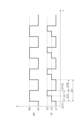
- FIG. 8 is a timing chart showing an example of temporal changes in high frequency power and bias power supplied to the plasma processing apparatus.
- FIG. 9 is a timing chart showing another example of temporal changes in the high frequency power and bias power supplied to the plasma processing apparatus.
- FIG. 10 is a timing chart showing another example of temporal changes in high frequency power and bias power supplied to the plasma processing apparatus.
- FIG. 11 is a cross-sectional view showing an etching device included in a plasma processing apparatus according to one exemplary embodiment.
- FIG. 12 is a diagram illustrating a plasma processing apparatus according to one exemplary embodiment.
- the plasma processing method includes the steps of: (a) providing a substrate comprising a first region containing a first material and a second region containing a second material different from the first material; a step of supplying a reformed gas and a carbon-containing precursor to modify the surface of the first region; (c) a mixed gas containing the reformed gas and the carbon-containing precursor by supplying a first high-frequency power; modifying the surface of the first region to form a modified layer with plasma generated from the plasma; and (d) stopping the supply of the first high frequency power or starting the first high frequency power. and a step of removing the modified layer by supplying a second high-frequency power with a lower level of power to cause the modified layer and the carbon-containing precursor to react.
- the first region may include a metal-containing film
- the second region may include a mask.
- the metal-containing film can be etched using a mask.
- the carbon-containing precursor does not need to contain metal.
- metal derived from the carbon-containing precursor is not generated, so metal contamination of the substrate can be suppressed.
- the carbon-containing precursor may include at least one of alcohol, ⁇ -diketone, amidine, acetamidine, and ⁇ -diketimine.
- the reformed gas and the carbon-containing precursor may be continuously supplied during the period including the above (c) and the above (d). .
- formation of the modified layer and removal of the modified layer can be performed continuously.
- the plasma processing method may further include the step of (e) repeating the above (c) and the above (d). In this case, the amount of etching in the first region can be increased.
- the substrate may be heated in (d). In this case, the reaction between the modified layer and the carbon-containing precursor can be promoted.
- the reformed gas may contain at least one of a halogen-containing gas and an oxygen-containing gas.
- the reformed gas may contain at least one of a fluorine-containing gas and a chlorine-containing gas.
- the reformed gas is fluorocarbon gas, HF gas, NF 3 gas, SF 6 gas, chlorocarbon gas, Cl 2 gas, NCl 3 gas, It may contain at least one selected from the group consisting of SCl 6 gas, O 2 gas, CO gas, and CO 2 gas.
- a carbon-containing deposit may be formed on the second region in (c). In this case, the second region can be protected by the carbon-containing deposit.
- bias power may be supplied to an electrode in a substrate supporter that supports the substrate.
- ions originating from the reformed gas in the plasma are drawn to the surface of the first region, thus promoting the formation of the modified layer.
- the period during which the bias power is supplied may be shorter than the period during which the first high frequency power is supplied. In this case, the formation of carbon-containing deposits on the second region is promoted during the period in which bias power is not supplied.
- the bias power may include a first bias power and a second bias power larger than the first bias power.
- formation of carbon-containing deposits on the second region is promoted during the period in which the first bias power is supplied.
- Formation of the modified layer is promoted during the period in which the second bias power is supplied.
- the plasma processing method includes (a) providing a substrate including a metal-containing film and a mask on the metal-containing film; and (b) using a modifying gas to modify the surface of the metal-containing film. and (c) the surface of the metal-containing film by plasma generated from a mixed gas containing the reformed gas and the carbon-containing precursor by supplying a first high-frequency power. (d) removing the modified layer by stopping the supply of the first high-frequency power and causing the modified layer to react with the carbon-containing precursor; and a step of doing so.
- the plasma processing method includes the steps of: (a) providing a substrate on a substrate support including an electrode, the substrate comprising a first region containing a metal and a second region containing a material other than the metal; ) supplying a gas containing at least one of halogen and oxygen and a carbon-containing precursor; and (c) removing the first region; (c2) a second period alternating with the first period in which the first high frequency power is not supplied or a second high frequency power smaller than the first high frequency power is supplied; a second period of supplying
- the first high frequency power and the second high frequency power may be high frequency power for plasma generation.
- the plasma processing apparatus includes a chamber and a substrate support for supporting a substrate in the chamber, and the substrate has a first region including a first material and a second region different from the first material.
- a substrate support comprising a second region containing a material; and a gas supply configured to supply a carbon-containing precursor and a reforming gas for modifying the surface of the first region into the chamber.
- a plasma generation unit configured to generate plasma from a mixed gas containing the reformed gas and the carbon-containing precursor by supplying a first high-frequency power in the chamber, and a control unit,
- the control unit modifies the surface of the first region using the plasma to form a modified layer, stops supplying the first high-frequency power, or modifies the surface of the first region using the plasma, or stops supplying the first high-frequency power to a second high-frequency power smaller than the first high-frequency power.
- the gas supply section and the plasma generation section are configured to be controlled so as to remove the modified layer by supplying high-frequency power and causing the modified layer and the carbon-containing precursor to react. .
- FIG. 1 is a diagram for explaining a configuration example of a plasma processing system.
- a plasma processing system includes a plasma processing apparatus 1 and a controller 2.
- the plasma processing system is an example of a substrate processing system
- the plasma processing apparatus 1 is an example of a substrate processing apparatus.
- the plasma processing apparatus 1 includes a plasma processing chamber 10, a substrate support section 11, and a plasma generation section 12.
- the plasma processing chamber 10 has a plasma processing space.
- the plasma processing chamber 10 also includes at least one gas supply port for supplying at least one processing gas to the plasma processing space, and at least one gas exhaust port for discharging gas from the plasma processing space.
- the gas supply port is connected to a gas supply section 20, which will be described later, and the gas discharge port is connected to an exhaust system 40, which will be described later.
- the substrate support section 11 is disposed within the plasma processing space and has a substrate support surface for supporting a substrate.
- the plasma generation unit 12 is configured to generate plasma from at least one processing gas supplied into the plasma processing space.
- the plasmas formed in the plasma processing space include capacitively coupled plasma (CCP), inductively coupled plasma (ICP), and ECR plasma (Electron-Cyclotron-resonance).
- CCP capacitively coupled plasma
- ICP inductively coupled plasma
- ECR plasma Electro-Cyclotron-resonance
- plasma helicon wave excited plasma
- SWP surface wave plasma
- various types of plasma generation units may be used, including an AC (Alternating Current) plasma generation unit and a DC (Direct Current) plasma generation unit.
- the AC signal (AC power) used in the AC plasma generator has a frequency in the range of 100 kHz to 10 GHz. Therefore, the AC signal includes an RF (Radio Frequency) signal and a microwave signal.
- the RF signal has a frequency within the range of 100kHz to 150MHz.
- the control unit 2 processes computer-executable instructions that cause the plasma processing apparatus 1 to perform various steps described in this disclosure.
- the control unit 2 may be configured to control each element of the plasma processing apparatus 1 to perform the various steps described herein. In one embodiment, part or all of the control unit 2 may be included in the plasma processing apparatus 1.
- the control unit 2 may include a processing unit 2a1, a storage unit 2a2, and a communication interface 2a3.
- the control unit 2 is realized by, for example, a computer 2a.
- the processing unit two a1 may be configured to read a program from the storage unit two a2 and perform various control operations by executing the read program. This program may be stored in the storage unit 2a2 in advance, or may be acquired via a medium when necessary.
- the acquired program is stored in the storage unit 2a2, and is read out from the storage unit 2a2 and executed by the processing unit 2a1.
- the medium may be various storage media readable by the computer 2a, or may be a communication line connected to the communication interface 2a3.
- the processing unit 2a1 may be a CPU (Central Processing Unit).
- the storage unit 2a2 includes a RAM (Random Access Memory), a ROM (Read Only Memory), an HDD (Hard Disk Drive), an SSD (Solid State Drive), or a combination thereof. You can.
- the communication interface 2a3 may communicate with the plasma processing apparatus 1 via a communication line such as a LAN (Local Area Network).
- FIG. 2 is a diagram for explaining a configuration example of a capacitively coupled plasma processing apparatus.
- the capacitively coupled plasma processing apparatus 1 includes a plasma processing chamber 10, a gas supply section 20, a power supply 30, and an exhaust system 40. Further, the plasma processing apparatus 1 includes a substrate support section 11 and a gas introduction section. The gas inlet is configured to introduce at least one processing gas into the plasma processing chamber 10 .
- the gas introduction section includes a shower head 13.
- Substrate support 11 is arranged within plasma processing chamber 10 .
- the shower head 13 is arranged above the substrate support section 11 . In one embodiment, showerhead 13 forms at least a portion of the ceiling of plasma processing chamber 10 .
- the plasma processing chamber 10 has a plasma processing space 10s defined by a shower head 13, a side wall 10a of the plasma processing chamber 10, and a substrate support 11. Plasma processing chamber 10 is grounded.
- the shower head 13 and the substrate support section 11 are electrically insulated from the casing of the plasma processing chamber 10.
- the substrate support section 11 includes a main body section 111 and a ring assembly 112.
- the main body portion 111 has a central region 111a for supporting the substrate W and an annular region 111b for supporting the ring assembly 112.
- a wafer is an example of a substrate W.
- the annular region 111b of the main body 111 surrounds the central region 111a of the main body 111 in plan view.
- the substrate W is placed on the central region 111a of the main body 111, and the ring assembly 112 is placed on the annular region 111b of the main body 111 so as to surround the substrate W on the central region 111a of the main body 111. Therefore, the central region 111a is also called a substrate support surface for supporting the substrate W, and the annular region 111b is also called a ring support surface for supporting the ring assembly 112.
- the main body 111 includes a base 1110 and an electrostatic chuck 1111.
- Base 1110 includes a conductive member.
- the conductive member of the base 1110 can function as a lower electrode.
- Electrostatic chuck 1111 is placed on base 1110.
- Electrostatic chuck 1111 includes a ceramic member 1111a and an electrostatic electrode 1111b disposed within ceramic member 1111a.
- Ceramic member 1111a has a central region 111a. In one embodiment, ceramic member 1111a also has an annular region 111b. Note that another member surrounding the electrostatic chuck 1111, such as an annular electrostatic chuck or an annular insulating member, may have the annular region 111b.
- ring assembly 112 may be placed on the annular electrostatic chuck or the annular insulation member, or may be placed on both the electrostatic chuck 1111 and the annular insulation member.
- at least one RF/DC electrode coupled to an RF power source 31 and/or a DC power source 32, which will be described later, may be disposed within the ceramic member 1111a.
- at least one RF/DC electrode functions as a bottom electrode.
- An RF/DC electrode is also referred to as a bias electrode if a bias RF signal and/or a DC signal, as described below, is supplied to at least one RF/DC electrode.
- the conductive member of the base 1110 and at least one RF/DC electrode may function as a plurality of lower electrodes.
- the electrostatic electrode 1111b may function as a lower electrode. Therefore, the substrate support 11 includes at least one lower electrode.
- Ring assembly 112 includes one or more annular members.
- the one or more annular members include one or more edge rings and at least one cover ring.
- the edge ring is made of a conductive or insulating material
- the cover ring is made of an insulating material.
- the substrate support unit 11 may include a temperature control module configured to adjust at least one of the electrostatic chuck 1111, the ring assembly 112, and the substrate to a target temperature.
- the temperature control module may include a heater, a heat transfer medium, a flow path 1110a, or a combination thereof.
- a heat transfer fluid such as brine or gas flows through the flow path 1110a.
- a channel 1110a is formed within the base 1110 and one or more heaters are disposed within the ceramic member 1111a of the electrostatic chuck 1111.
- the substrate support section 11 may include a heat transfer gas supply section configured to supply heat transfer gas to the gap between the back surface of the substrate W and the central region 111a.
- the shower head 13 is configured to introduce at least one processing gas from the gas supply section 20 into the plasma processing space 10s.
- the shower head 13 has at least one gas supply port 13a, at least one gas diffusion chamber 13b, and a plurality of gas introduction ports 13c.
- the processing gas supplied to the gas supply port 13a passes through the gas diffusion chamber 13b and is introduced into the plasma processing space 10s from the plurality of gas introduction ports 13c.
- the showerhead 13 also includes at least one upper electrode.
- the gas introduction section may include one or more side gas injectors (SGI) attached to one or more openings formed in the side wall 10a.
- SGI side gas injectors
- the gas supply section 20 may include at least one gas source 21 and at least one flow rate controller 22.
- the gas supply 20 is configured to supply at least one process gas from a respective gas source 21 to the showerhead 13 via a respective flow controller 22 .
- Each flow controller 22 may include, for example, a mass flow controller or a pressure-controlled flow controller.
- gas supply 20 may include at least one flow modulation device that modulates or pulses the flow rate of at least one process gas.
- Power supply 30 includes an RF power supply 31 coupled to plasma processing chamber 10 via at least one impedance matching circuit.
- RF power source 31 is configured to supply at least one RF signal (RF power) to at least one bottom electrode and/or at least one top electrode.
- RF power supply 31 can function as at least a part of the plasma generation section 12. Further, by supplying a bias RF signal to at least one lower electrode, a bias potential is generated in the substrate W, and ion components in the formed plasma can be drawn into the substrate W.
- the RF power supply 31 includes a first RF generation section 31a and a second RF generation section 31b.
- the first RF generation section 31a is coupled to at least one lower electrode and/or at least one upper electrode via at least one impedance matching circuit, and generates a source RF signal (source RF power) for plasma generation. It is configured as follows.
- the source RF signal has a frequency within the range of 10 MHz to 150 MHz.
- the first RF generator 31a may be configured to generate multiple source RF signals having different frequencies. The generated one or more source RF signals are provided to at least one bottom electrode and/or at least one top electrode.
- the second RF generating section 31b is coupled to at least one lower electrode via at least one impedance matching circuit, and is configured to generate a bias RF signal (bias RF power).
- the frequency of the bias RF signal may be the same or different than the frequency of the source RF signal.
- the bias RF signal has a lower frequency than the frequency of the source RF signal.
- the bias RF signal has a frequency within the range of 100kHz to 60MHz.
- the second RF generator 31b may be configured to generate multiple bias RF signals having different frequencies.
- the generated one or more bias RF signals are provided to at least one bottom electrode. Also, in various embodiments, at least one of the source RF signal and the bias RF signal may be pulsed.
- Power source 30 may also include a DC power source 32 coupled to plasma processing chamber 10 .
- the DC power supply 32 includes a first DC generation section 32a and a second DC generation section 32b.
- the first DC generator 32a is connected to at least one lower electrode and configured to generate a first DC signal.
- the generated first DC signal is applied to at least one bottom electrode.
- the second DC generator 32b is connected to the at least one upper electrode and configured to generate a second DC signal.
- the generated second DC signal is applied to the at least one top electrode.
- the first and second DC signals may be pulsed.
- a sequence of voltage pulses is applied to at least one lower electrode and/or at least one upper electrode.
- the voltage pulse may have a pulse waveform that is rectangular, trapezoidal, triangular, or a combination thereof.
- a waveform generator for generating a sequence of voltage pulses from a DC signal is connected between the first DC generator 32a and the at least one bottom electrode. Therefore, the first DC generation section 32a and the waveform generation section constitute a voltage pulse generation section.
- the voltage pulse generation section is connected to at least one upper electrode.
- the voltage pulse may have positive polarity or negative polarity.
- the sequence of voltage pulses may include one or more positive voltage pulses and one or more negative voltage pulses within one cycle.
- the first and second DC generation units 32a and 32b may be provided in addition to the RF power source 31, or the first DC generation unit 32a may be provided in place of the second RF generation unit 31b. good.
- the exhaust system 40 may be connected to a gas exhaust port 10e provided at the bottom of the plasma processing chamber 10, for example.
- Evacuation system 40 may include a pressure regulating valve and a vacuum pump. The pressure within the plasma processing space 10s is adjusted by the pressure regulating valve.
- the vacuum pump may include a turbomolecular pump, a dry pump, or a combination thereof.
- the plasma processing apparatus 1 may include a heating device for heating the surface of the substrate W.
- An etching apparatus 105 shown in FIG. 11, which will be described later, may include a heating device for heating the surface of the substrate W.
- the heating device may include, for example, an energy ray generator. Examples of energy ray generators include infrared ray generators, electromagnetic wave generators, and laser generators.
- the heating device may be provided outside the plasma processing chamber 10. In this case, the surface of the substrate W can be heated, for example, by irradiating the substrate W with energy rays through a window provided in the side wall 10a of the plasma processing chamber 10.
- the surface of the substrate W can be heated by irradiating the substrate W with energy rays through the shower head 13 made of a material that transmits energy rays.
- a heating device may be provided within the plasma processing chamber 10. In this case, the heating device may include a heater provided within the substrate support section 11.
- the plasma processing apparatus 1 may include a monitor device that monitors the amount of etching.
- the etching apparatus 105 shown in FIG. 11, which will be described later, may include a monitor device that monitors the amount of etching. The end point of etching can be detected by the monitor device.
- the monitor device may be an optical emission spectrometer (OES) that analyzes plasma emission.
- OES optical emission spectrometer
- the monitor device may be a film thickness meter that measures the thickness of the film to be etched. Examples of film thickness gauges include optical film thickness gauges.
- the film thickness gauge may be a line-shaped film thickness gauge.
- the film thickness meter may be provided outside the plasma processing chamber 10.
- the monitor device may be a mass measuring device that measures the mass of the substrate W. Examples of mass measuring devices include scales.
- the mass measuring device may be provided under the substrate support 11.
- FIG. 3 is a flowchart of a plasma processing method according to one exemplary embodiment.
- the plasma processing method MT shown in FIG. 3 (hereinafter referred to as "method MT") can be executed by the plasma processing apparatus 1 of the above embodiment.
- Method MT may be an etching method.
- Method MT may be an atomic layer etching (ALE) method.
- Method MT may be applied to substrate W.
- ALE atomic layer etching
- FIG. 4 is a cross-sectional view of an example substrate to which the method of FIG. 3 can be applied.
- the substrate W includes a first region R1 and a second region R2.
- the substrate W may include an underlying region UR.
- the first region R1 may be provided on the base region UR.
- the second region R2 may be provided on the first region R1.
- the first region R1 includes a first material.
- the first region R1 may include metal.
- the first region R1 may include a metal-containing film.
- the first region R1 may include at least one of a metal film and a metal compound film.
- the first region R1 may contain at least one of oxygen and nitrogen.
- the first region R1 may include at least one of a metal oxide and a metal nitride.
- the first region R1 includes Al, Hf, Zr, Fe, Ni, Co, Mn, Mg, Rh, Ru, Cr, Si, Ti, Ga, In, Zn, Pb, Ge, Ta, Cu, W, Mo, It may contain at least one of Pt, Cd, and Sn.
- the second region R2 includes a second material different from the first material.
- the second region R2 may contain an element (for example, metal, silicon, or carbon) other than the metal contained in the first region R1.
- the second region R2 may include silicon.
- the second region R2 may include at least one of silicon oxide and silicon nitride.
- the second region R2 may contain carbon.
- the second region R2 may include at least one of photoresist, spin-on carbon, amorphous carbon, and tungsten carbide.
- the second region R2 may include a mask.
- the second region R2 may have an opening OP.
- the base region UR may include a third material different from the first material and the second material.
- Base region UR may include at least one of silicon, carbon, and metal.
- FIGS. 3 to 7 are cross-sectional views of an example substrate during a step in a plasma processing method according to an example embodiment.
- the method MT can be executed in the plasma processing apparatus 1 by controlling each part of the plasma processing apparatus 1 by the control section 2.
- a substrate W on a substrate support 11 (substrate support) disposed within a plasma processing chamber 10 is processed.
- method MT may include steps ST1 to ST5. Steps ST1 to ST5 may be performed in order. Step ST5 may not be performed. Steps ST3 to ST5 can be performed while step ST2 has been performed. Steps ST1 to ST5 may be performed in-situ. That is, the method MT may be performed without taking the substrate W out of the plasma processing chamber 10.
- a substrate W shown in FIG. 4 is provided.
- a substrate W may be provided on a substrate support 11 within a plasma processing chamber 10, as shown in FIG.
- the base region UR may be arranged between the substrate support section 11 and the first region R1.
- a modified gas MD for modifying the surface Ra1 of the first region R1 and a carbon-containing precursor PR are supplied.
- the reformed gas MD and the carbon-containing precursor PR can be supplied into the plasma processing chamber 10 from a gas supply section 20, as shown in FIG.
- the reformed gas MD and the carbon-containing precursor PR may be mixed within the plasma processing chamber 10 or may be mixed before being supplied into the plasma processing chamber 10.
- the reformed gas MD and the carbon-containing precursor PR may be supplied into the plasma processing chamber 10 simultaneously or with a time difference.
- the reformed gas MD may contain at least one of a halogen-containing gas and an oxygen-containing gas.
- a halogen-containing gas may be used when the first region R1 includes at least one of a metal oxide film and a metal nitrogen film.
- the reformed gas MD may contain a fluorine-containing gas.
- the fluorine-containing gas may include at least one of hydrogen fluoride gas (HF gas), fluorocarbon gas, nitrogen-containing gas, and sulfur-containing gas.
- the fluorocarbon gas may include at least one of C 4 F 6 gas, C 4 F 8 gas, C 3 F 8 gas, and CF 4 gas.
- the nitrogen-containing gas may include NF3 gas.
- the sulfur-containing gas may include SF6 gas.
- the reformed gas MD may contain a chlorine-containing gas.
- the chlorine-containing gas may include at least one of Cl2 gas, chlorocarbon gas, nitrogen-containing gas, and sulfur-containing gas .
- the chlorocarbon gas may include at least one of C 4 Cl 6 gas, C 4 Cl 8 gas, C 3 Cl 8 gas, and CCl 4 gas.
- the nitrogen-containing gas may include NCl3 gas.
- the sulfur-containing gas may include SCl6 gas.
- An oxygen-containing gas may be used when the first region R1 includes a metal film.
- the oxygen-containing gas may include at least one of O 2 gas, CO gas, and CO 2 gas.
- the carbon-containing precursor PR does not need to contain metal.
- the carbon-containing precursor PR may contain at least one of alcohol, ⁇ -diketone, amidine, acetamidine, and ⁇ -diketimine.
- the ⁇ -diketone may include at least one of acac (acetylacetone), hfac (hexafluoroacetylacetone), tfac (trifluoroacetylacetone), and tmhd (tetramethylheptanedione).
- an inert gas may be further supplied.
- the inert gas may include at least one of a noble gas and N2 gas.
- step ST3 the surface R1a of the first region R1 is modified by plasma PL generated from a mixed gas containing a modified gas MD and a carbon-containing precursor PR to form a modified layer ML. form.
- Plasma PL is generated by supplying first high frequency power to plasma processing apparatus 1 .
- the reformed gas MD is dissociated to generate active species (ions or radicals).
- the modified layer ML may be formed by a reaction between active species generated from the modified gas MD and the first region R1.
- the reformed gas MD may include a halogen-containing gas
- the first region R1 may include at least one of a metal oxide film and a metal nitrogen film.
- the modified layer ML may be formed by a reaction between active species containing halogen generated from the modified gas MD and at least one of the metal oxide film and the metal nitrogen film.
- a carbon-containing deposit DP may be formed on the second region R2 in step ST3.
- the carbon-containing deposit DP may be formed from a carbon-containing precursor PR.
- the carbon-containing precursor PR dissociates to generate active species (ions or radicals).
- a carbon-containing deposit DP may be formed by depositing carbon-containing active species generated from the carbon-containing precursor PR on the second region R2. Since the second region R2 can be protected by the carbon-containing deposit DP, a high etching selectivity with respect to the second region R2 can be obtained in step ST4.
- bias power may be supplied to the electrodes in the substrate support section 11 that supports the substrate W.
- Bias power can be radio frequency power.
- the bias power draws ions originating from the modified gas MD in the plasma PL to the surface R1a of the first region R1, thereby promoting the formation of the modified layer ML.
- the substrate W may be heated.
- the temperature of the substrate support 11 may be 100°C or higher, 150°C or higher, or 200°C or higher.
- the temperature of the substrate support portion 11 may be 450° C. or lower. Heating may be performed by plasma PL generated within plasma processing chamber 10 or by a temperature control module within substrate support 11 . Heating may be performed using energy rays emitted from an energy ray generator. The heating promotes the reaction between the first region R1 and the reformed gas MD.
- step ST4 as shown in FIG. 7, the supply of the first high-frequency power is stopped and the modified layer ML is caused to react with the carbon-containing precursor PR, thereby removing the modified layer ML.
- the first region R1 may be removed by step ST3 and step ST4.
- Supply of the first high frequency power may be stopped so that plasma is not generated.
- a highly volatile byproduct BP may be generated by the reaction between the modified layer ML and the carbon-containing precursor PR.
- the modified layer ML can be removed by volatilization of the by-product BP.
- a recess RS may be formed in the first region R1.
- second high frequency power smaller than the first high frequency power may be supplied.
- a byproduct BP may be generated by the reaction between the modified layer ML and the carbon-containing precursor PR.
- Plasma may be generated by supplying the second high frequency power.
- a byproduct BP may be generated by the reaction between the undissociated carbon-containing precursor PR in the plasma and the modified layer ML.
- step ST4 a mixed gas containing the reformed gas MD and the carbon-containing precursor PR may be supplied.
- the supply of the reformed gas MD may be stopped, or the reformed gas MD may be supplied at a flow rate smaller than the flow rate of the reformed gas MD in step ST3.
- step ST4 the substrate W may be heated similarly to step ST3. Heating promotes the reaction between the modified layer ML and the carbon-containing precursor PR.
- the reformed gas MD and the carbon-containing precursor PR may be continuously supplied. That is, switching of gas type and purging of gas may not be performed between step ST3 and step ST4.
- the flow rates of the reformed gas MD and the carbon-containing precursor PR may be constant or may be changed over time.
- step ST5 step ST3 and step ST4 may be repeated. Step ST3 and step ST4 may be performed alternately. Step ST3 and step ST4 may be repeated multiple times. Step ST5 may be terminated when the number of executions of step ST3 and step ST4 reaches a threshold value. In step ST5, the etching amount of the first region R1 can be increased, so that a deep recess RS can be formed.
- step ST3 and step ST4 formation of the modified layer ML and removal of the modified layer ML can be switched by controlling the supply of high frequency power in steps ST3 and ST4.
- step ST3 and step ST4 there is no need to switch the gas type from the reformed gas MD to the carbon-containing precursor PR and to purge the gas (remove the reformed gas MD). Therefore, the total processing time of step ST3 and step ST4 can be shortened, resulting in high productivity.
- the carbon-containing precursor PR does not contain metal, even if the carbon-containing precursor PR in the plasma PL dissociates in step ST3, metal derived from the carbon-containing precursor PR is not generated. Therefore, metal contamination of the substrate W and the plasma processing chamber 10 can be suppressed.
- FIG. 8 is a timing chart showing an example of temporal changes in high frequency power and bias power supplied to the plasma processing apparatus.
- the horizontal axis indicates time t.
- the vertical axis shows the magnitude of electric power.
- the timing chart in FIG. 8 relates to steps S3 to S5 in method MT.
- the high frequency power for generating the plasma PL in step ST3 may be high frequency power HF given to an electrode in the main body 111 of the substrate support 11 or an electrode facing the substrate support 11.
- the frequency of the high frequency power HF may be 27 MHz or more and 100 MHz or less.
- the bias power may be high frequency power LF applied to an electrode in the main body 111 of the substrate support 11 .
- the frequency of high frequency power LF may be lower than the frequency of high frequency power HF.
- the frequency of the high frequency power LF may be 100 kHz or more and 40.68 MHz or less.
- the high frequency power HF and the high frequency power LF may be applied periodically with a period of CY. That is, each of the high frequency power HF and the high frequency power LF may be a pulse.
- the period CY may include a first period CY1 and a second period CY2.
- the second period CY2 is a period after the first period CY1.
- the second period CY2 may be an alternating period with the first period CY1.
- the first period CY1 corresponds to step ST3.
- high frequency power HF for generating plasma PL may be supplied.
- the second period CY2 corresponds to step ST4.
- high frequency power HF may not be supplied, or high frequency power HF for generating plasma PL may be supplied.
- the high frequency power HF that can be supplied in the second period CY2 is smaller than the high frequency power HF that can be supplied in the first period CY1.
- One cycle corresponding to the period CY may be repeated two or more times.
- the step of repeating the cycle CY corresponds to step ST5.
- the frequency that defines the period CY may be 0.1 Hz or more and 100 kHz or less, or 10 Hz or more and 100 kHz or less.
- the time length of the period CY is the reciprocal of the frequency that defines the period CY.
- high frequency power LF may be maintained at high power L2, and high frequency power HF may be maintained at high power H2.
- the modified layer ML and the carbon-containing deposit DP may be formed.
- the high frequency power LF may be maintained at a low power L1 (for example, 0 W) that is smaller than the high power L2
- the high frequency power HF may be maintained at a low power H1 (for example, 0 W) that is smaller than the high power H2.
- the modified layer ML and the carbon-containing deposit DP are not formed, and the modified layer ML can be removed.
- high frequency power HF and high frequency power LF may be synchronous pulses.
- FIG. 9 is a timing chart showing another example of temporal changes in the high frequency power and bias power supplied to the plasma processing apparatus.
- the timing chart in FIG. 9 is the same as the timing chart in FIG. 8 except that the power of the high frequency power LF in the first period CY1 is different.
- the first period CY1 of the cycle CY may include the third period CY11 and the fourth period CY12.
- the fourth period CY12 is a period after the third period CY11.
- high frequency power LF may be maintained at low power L1, and high frequency power HF may be maintained at high power H2.
- the formation of carbon-containing deposits DP is promoted.
- high frequency power LF may be maintained at high power L2, and high frequency power HF may be maintained at high power H2.
- formation of the modified layer ML is promoted. In this way, the fourth period CY12, which is the period in which the high frequency power LF is supplied, may be shorter than the first period CY1, which is the period in which the high frequency power HF is supplied.
- FIG. 10 is a timing chart showing another example of temporal changes in the high frequency power and bias power supplied to the plasma processing apparatus.
- the timing chart in FIG. 10 is the same as the timing chart in FIG. 9 except that the power of the high frequency power LF in the third period CY11 is different.
- high frequency power LF may be maintained at medium power L3 (first bias power)
- high frequency power HF may be maintained at high power H2.
- Medium power L3 may be between low power L1 and high power L2.
- the formation of carbon-containing deposits DP is promoted.
- high frequency power LF is maintained at high power L2 (second bias power).
- the timing charts in FIGS. 8 to 10 may be modified as follows.
- the high frequency power HF may be maintained at a high power H2 during a part of the first period CY1, and may be maintained at a power different from the high power H2 and higher than the low power L1 during another part of the first period CY1.
- the ratio of the period in which the high frequency power HF is maintained at the high power H2 (the duty ratio of the high frequency power HF) may be changed.
- the ratio of the period in which the high frequency power LF is maintained at the high power L2 (the duty ratio of the high frequency power LF) may be changed.
- the duty ratio of the high frequency power HF and the high frequency power LF may be adjusted so that almost all of the modified layer ML formed in step ST3 is removed in step ST4.
- the high power H2, the high power L2, the duty ratio of the high frequency power HF, the duty ratio of the high frequency power LF, the frequency that defines the cycle CY of the high frequency power HF, and the cycle CY of the high frequency power LF are defined. At least one of the frequencies may be changed. For example, as time passes, the high power L2 and the high power H2 may be increased, or the frequency that defines the period CY of the high frequency power LF may be reduced.
- FIG. 11 is a cross-sectional view showing an etching device included in a plasma processing apparatus according to one exemplary embodiment.
- the plasma processing apparatus may include an etching apparatus 105 shown in FIG.
- Etching apparatus 105 includes a chamber 140. No plasma is generated within chamber 140.
- a substrate support section 142 for supporting the substrate W is provided within the chamber 140 .
- the etching apparatus 105 includes a gas supply section 143 for supplying gas into the chamber 140 and an exhaust system 144 for reducing the pressure inside the chamber 140.
- the chamber 140 includes a chamber body 151 and a lid portion 152.
- the chamber body 151 has a side wall portion 151a and a bottom portion 151b.
- the upper part of the chamber body 151 has an opening.
- the opening is closed by a lid portion 152.
- the side wall portion 151a and the bottom portion 151b are sealed by a sealing member.
- the lid portion 152 includes a lid member 155 located on the outside, and a shower head 156 fitted inside the lid member 155.
- the shower head 156 is provided so as to face the substrate support section 142.
- shower head 156 has a main body 157 and a shower plate 158.
- the main body 157 has, for example, a cylindrical side wall 157a and an upper wall 157b.
- a shower plate 158 is provided at the bottom of the main body 157.
- a space 159 is formed between the main body 157 and the shower plate 158.
- a gas introduction path 161 that penetrates to the space 159 is formed in the lid member 155 and the upper wall 157b.
- a gas supply pipe 171 of the gas supply section 143 is connected to the gas introduction path 161 .
- a plurality of gas discharge holes 162 are formed in the shower plate 158.
- the gas introduced into the space 159 through the gas supply pipe 171 and the gas introduction path 161 is discharged from the gas discharge hole 162 into the space within the chamber 140 .
- a gate 153 for transporting the substrate W between the space inside the chamber 140 and the space outside the chamber 140 is provided on the side wall portion 151a.
- the gate 153 can be opened and closed by a gate valve 154.
- the substrate support part 142 is connected to the bottom part 151b of the chamber 140.
- a temperature regulator 165 is provided within the substrate support section 142 to adjust the temperature of the substrate support section 142 .
- the temperature regulator 165 includes a conduit through which a temperature regulating medium such as water flows. The temperature of the substrate support portion 142 is regulated by heat exchange between the temperature regulating medium flowing in the conduit and the outer portion of the conduit. Thereby, the temperature of the substrate W on the substrate support section 142 is controlled.
- the gas supply unit 143 includes a first gas supply source 175 that supplies a first gas, and a second gas supply source 176 that supplies a second gas.
- the first gas is, for example, reformed gas MD.
- the second gas is, for example, a carbon-containing precursor PR.
- One end of the first gas supply pipe 172 is connected to the first gas supply source 175 .
- the other end of the first gas supply pipe 172 is connected to the gas supply pipe 171.
- One end of the second gas supply pipe 173 is connected to the second gas supply source 176 .
- the other end of the second gas supply pipe 173 is connected to the gas supply pipe 171.
- Each of the first gas supply pipe 172 and the second gas supply pipe 173 is provided with a flow rate controller 179 that opens and closes the flow path and controls the flow rate.
- the first gas is supplied from the first gas supply source 175 to the shower head 156 via the first gas supply pipe 172.
- the second gas is supplied from the second gas supply source 176 to the shower head 156 via the second gas supply pipe 173. These gases are discharged toward the substrate W in the chamber 140 from the gas discharge hole 162 of the shower head 156.
- the exhaust system 144 has an exhaust pipe 182 connected to an exhaust port 181 formed in the bottom 151b of the chamber 140.
- the exhaust system 144 includes an automatic pressure control (APC) 183 provided in an exhaust pipe 182 and a vacuum pump 184.
- APC automatic pressure control
- Automatic pressure controller 183 can control the pressure within chamber 140 .
- Vacuum pump 184 can exhaust gas within chamber 140 out of chamber 140 .
- Two capacitance manometers 186a and 186b are provided on the side wall of the chamber 140 as pressure gauges for measuring the pressure inside the chamber 140. Capacitance manometers 186a, 186b pass through the sidewalls of chamber 140. Capacitance manometer 186a can measure high pressure. Capacitance manometer 186b can measure low pressure. A temperature sensor that detects the temperature of the substrate W may be provided near the substrate W on the substrate support part 142.
- the gate 153 of the chamber 140 of the etching apparatus 105 may be connected to a vacuum transfer module (VTM).
- VTM vacuum transfer module
- the plasma processing chamber 10 of the plasma processing apparatus 1 shown in FIG. 2 may be connected to the vacuum transfer module. Thereby, the substrate W can be transferred between the chamber 140 of the etching apparatus 105 and the plasma processing chamber 10 of the plasma processing apparatus 1 while maintaining the reduced pressure state.
- step ST3 may be performed in the plasma processing chamber 10 of the plasma processing apparatus 1 in FIG. 2. Thereafter, the substrate W may be transported by a vacuum transport module, and step ST4 may be performed in the chamber 140 of the etching apparatus 105 in FIG. 11.
- FIG. 12 is a diagram illustrating a plasma processing apparatus according to one exemplary embodiment.
- the plasma processing apparatus PS shown in FIG. 12 can be used for carrying out the method MT.
- the plasma processing apparatus PS includes tables 3a to 3d, containers 4a to 4d, a loader module LM, an aligner AN, load lock modules LL1 and LL2, process modules PM1 to PM6, a transfer module TF, and a control section 2.
- the number of units, containers, and load lock modules in the plasma processing apparatus PS may be any number greater than or equal to one.
- the number of process modules in the plasma processing apparatus PS may be any number greater than or equal to two.
- the stands 3a to 3d are arranged along one edge of the loader module LM.
- Containers 4a to 4d are mounted on stands 3a to 3d, respectively.
- Each of the containers 4a to 4d is, for example, a container called a FOUP (Front Opening Unified Pod).
- Each of the containers 4a to 4d is configured to accommodate a substrate W therein.
- the loader module LM has a chamber. The pressure within the chamber of the loader module LM is set to atmospheric pressure.
- the loader module LM has a transport device TU1.
- the transport device TU1 is, for example, an articulated robot, and is controlled by the control unit 2.
- the transport device TU1 is configured to transport the substrate W through the chamber of the loader module LM.
- the transport device TU1 is arranged between each of the containers 4a to 4d and the aligner AN, between the aligner AN and each of the load lock modules LL1 to LL2, and between each of the load lock modules LL1 to LL2 and each of the containers 4a to 4d.
- the substrate W can be transported between them.
- Aligner AN is connected to loader module LM.
- the aligner AN is configured to adjust the position of the substrate W (position calibration).
- Each of the load lock module LL1 and the load lock module LL2 is provided between the loader module LM and the transport module TF.
- Each of load lock module LL1 and load lock module LL2 provides a preliminary vacuum chamber.
- the transfer module TF is connected to each of the load lock module LL1 and the load lock module LL2 via gate valves.
- the transfer module TF has a transfer chamber TC that can be depressurized.
- the transport module TF has a transport device TU2.
- the transport device TU2 is, for example, an articulated robot, and is controlled by the control unit 2.
- the transport device TU2 is configured to transport the substrate W through the transport chamber TC.
- the transport device TU2 can transport the substrate W between each of the load lock modules LL1 to LL2 and each of the process modules PM1 to PM6, and between any two process modules among the process modules PM1 to PM6. .
- Each of the process modules PM1 to PM6 is a processing device configured to perform dedicated substrate processing.
- One of the process modules PM1 to PM6 may be the plasma processing chamber 10 of FIG. 2.
- Another one of the process modules PM1-PM6 may be the chamber 140 in FIG. 11.
- One of the process modules PM1 to PM6 may include a film thickness gauge as a monitoring device for monitoring the amount of etching.
- the transport module TF may include a film thickness gauge. In this case, the amount of etching can be measured while the substrate W is being transferred from one process module to another process module.
- control section 2 is configured to control each part of the plasma processing apparatus PS.
- the plasma processing apparatus PS can transport the substrate W between process modules without exposing it to the atmosphere.
- SYMBOLS 1 Plasma processing apparatus, 2... Control part, 10... Plasma processing chamber, 11... Substrate support part, 12... Plasma generation part, 20... Gas supply part, MD... Modified gas, ML... Modified layer, PR... Carbon Containing precursor, R1...first region, R1a...surface, R2...second region, W...substrate.
Landscapes
- Chemical & Material Sciences (AREA)
- Engineering & Computer Science (AREA)
- Plasma & Fusion (AREA)
- Physics & Mathematics (AREA)
- General Chemical & Material Sciences (AREA)
- Chemical Kinetics & Catalysis (AREA)
- Materials Engineering (AREA)
- Mechanical Engineering (AREA)
- Metallurgy (AREA)
- Organic Chemistry (AREA)
- Analytical Chemistry (AREA)
- Electromagnetism (AREA)
- Inorganic Chemistry (AREA)
- Plasma Technology (AREA)
- Drying Of Semiconductors (AREA)
- Carbon And Carbon Compounds (AREA)
Priority Applications (4)
| Application Number | Priority Date | Filing Date | Title |
|---|---|---|---|
| CN202380037658.7A CN119137713A (zh) | 2022-05-02 | 2023-04-24 | 等离子体处理方法和等离子体处理装置 |
| KR1020247038468A KR20250005333A (ko) | 2022-05-02 | 2023-04-24 | 플라즈마 처리 방법 및 플라즈마 처리 장치 |
| JP2024519198A JPWO2023214521A1 (https=) | 2022-05-02 | 2023-04-24 | |
| US18/933,255 US20250051915A1 (en) | 2022-05-02 | 2024-10-31 | Plasma processing method and plasma processing apparatus |
Applications Claiming Priority (2)
| Application Number | Priority Date | Filing Date | Title |
|---|---|---|---|
| JP2022-075745 | 2022-05-02 | ||
| JP2022075745 | 2022-05-02 |
Related Child Applications (1)
| Application Number | Title | Priority Date | Filing Date |
|---|---|---|---|
| US18/933,255 Continuation US20250051915A1 (en) | 2022-05-02 | 2024-10-31 | Plasma processing method and plasma processing apparatus |
Publications (1)
| Publication Number | Publication Date |
|---|---|
| WO2023214521A1 true WO2023214521A1 (ja) | 2023-11-09 |
Family
ID=88646432
Family Applications (1)
| Application Number | Title | Priority Date | Filing Date |
|---|---|---|---|
| PCT/JP2023/016122 Ceased WO2023214521A1 (ja) | 2022-05-02 | 2023-04-24 | プラズマ処理方法及びプラズマ処理装置 |
Country Status (6)
| Country | Link |
|---|---|
| US (1) | US20250051915A1 (https=) |
| JP (1) | JPWO2023214521A1 (https=) |
| KR (1) | KR20250005333A (https=) |
| CN (1) | CN119137713A (https=) |
| TW (1) | TW202407799A (https=) |
| WO (1) | WO2023214521A1 (https=) |
Citations (5)
| Publication number | Priority date | Publication date | Assignee | Title |
|---|---|---|---|---|
| JPH06268271A (ja) * | 1993-03-15 | 1994-09-22 | Mitsubishi Electric Corp | 超電導体試料のエッチング方法 |
| JPH11340213A (ja) * | 1998-03-12 | 1999-12-10 | Hitachi Ltd | 試料の表面加工方法 |
| JP2001160549A (ja) * | 1999-12-03 | 2001-06-12 | Matsushita Electronics Industry Corp | ドライエッチング方法 |
| JP2016082019A (ja) * | 2014-10-15 | 2016-05-16 | 東京エレクトロン株式会社 | 多層膜をエッチングする方法 |
| JP2022521232A (ja) * | 2019-02-25 | 2022-04-06 | アプライド マテリアルズ インコーポレイテッド | リソグラフィ応用のための膜積層体 |
Family Cites Families (1)
| Publication number | Priority date | Publication date | Assignee | Title |
|---|---|---|---|---|
| US10283369B2 (en) | 2016-08-10 | 2019-05-07 | Tokyo Electron Limited | Atomic layer etching using a boron-containing gas and hydrogen fluoride gas |
-
2023
- 2023-04-24 JP JP2024519198A patent/JPWO2023214521A1/ja active Pending
- 2023-04-24 WO PCT/JP2023/016122 patent/WO2023214521A1/ja not_active Ceased
- 2023-04-24 CN CN202380037658.7A patent/CN119137713A/zh active Pending
- 2023-04-24 KR KR1020247038468A patent/KR20250005333A/ko active Pending
- 2023-04-27 TW TW112115752A patent/TW202407799A/zh unknown
-
2024
- 2024-10-31 US US18/933,255 patent/US20250051915A1/en active Pending
Patent Citations (5)
| Publication number | Priority date | Publication date | Assignee | Title |
|---|---|---|---|---|
| JPH06268271A (ja) * | 1993-03-15 | 1994-09-22 | Mitsubishi Electric Corp | 超電導体試料のエッチング方法 |
| JPH11340213A (ja) * | 1998-03-12 | 1999-12-10 | Hitachi Ltd | 試料の表面加工方法 |
| JP2001160549A (ja) * | 1999-12-03 | 2001-06-12 | Matsushita Electronics Industry Corp | ドライエッチング方法 |
| JP2016082019A (ja) * | 2014-10-15 | 2016-05-16 | 東京エレクトロン株式会社 | 多層膜をエッチングする方法 |
| JP2022521232A (ja) * | 2019-02-25 | 2022-04-06 | アプライド マテリアルズ インコーポレイテッド | リソグラフィ応用のための膜積層体 |
Also Published As
| Publication number | Publication date |
|---|---|
| JPWO2023214521A1 (https=) | 2023-11-09 |
| TW202407799A (zh) | 2024-02-16 |
| KR20250005333A (ko) | 2025-01-09 |
| US20250051915A1 (en) | 2025-02-13 |
| CN119137713A (zh) | 2024-12-13 |
Similar Documents
| Publication | Publication Date | Title |
|---|---|---|
| US12154792B2 (en) | Plasma etching method | |
| JP7309799B2 (ja) | エッチング方法及びプラズマ処理装置 | |
| JP2022074000A5 (https=) | ||
| US11955333B2 (en) | Methods and apparatus for processing a substrate | |
| US12588447B2 (en) | Etching method and plasma processing apparatus | |
| TW202333226A (zh) | 蝕刻方法及電漿處理裝置 | |
| CN119234297A (zh) | 蚀刻方法和等离子体处理装置 | |
| US20230377851A1 (en) | Etching method and plasma processing apparatus | |
| WO2023214521A1 (ja) | プラズマ処理方法及びプラズマ処理装置 | |
| TW202437384A (zh) | 蝕刻方法及電漿處理裝置 | |
| JP2020177958A (ja) | 基板処理方法及び基板処理装置 | |
| JP2023551182A (ja) | 堆積残留物制御のためのシステム及び方法 | |
| JP2021190678A (ja) | エッチング方法及びプラズマ処理装置 | |
| US20240234097A1 (en) | Etching method and plasma processing apparatus | |
| TWI917421B (zh) | 基板處理方法及電漿處理裝置 | |
| JP7664139B2 (ja) | エッチング方法及びプラズマ処理装置 | |
| TWI920152B (zh) | 蝕刻方法及電漿處理裝置 | |
| KR102945934B1 (ko) | 기판 처리 방법 및 플라즈마 처리 장치 | |
| US20240071727A1 (en) | Substrate processing method and plasma processing apparatus | |
| JP2024035043A (ja) | 基板処理方法及びプラズマ処理装置 | |
| CN113745104A (zh) | 蚀刻方法及等离子体处理装置 | |
| WO2025173577A1 (ja) | エッチング方法、及び、プラズマ処理装置 | |
| WO2025150267A1 (ja) | プラズマ処理装置及びプラズマ処理方法 | |
| WO2025004625A1 (ja) | エッチング方法及びプラズマ処理装置 |
Legal Events
| Date | Code | Title | Description |
|---|---|---|---|
| 121 | Ep: the epo has been informed by wipo that ep was designated in this application |
Ref document number: 23799452 Country of ref document: EP Kind code of ref document: A1 |
|
| WWE | Wipo information: entry into national phase |
Ref document number: 2024519198 Country of ref document: JP |
|
| WWE | Wipo information: entry into national phase |
Ref document number: 202380037658.7 Country of ref document: CN |
|
| ENP | Entry into the national phase |
Ref document number: 20247038468 Country of ref document: KR Kind code of ref document: A |
|
| NENP | Non-entry into the national phase |
Ref country code: DE |
|
| 122 | Ep: pct application non-entry in european phase |
Ref document number: 23799452 Country of ref document: EP Kind code of ref document: A1 |