WO2023210706A1 - 通信制御方法 - Google Patents
通信制御方法 Download PDFInfo
- Publication number
- WO2023210706A1 WO2023210706A1 PCT/JP2023/016513 JP2023016513W WO2023210706A1 WO 2023210706 A1 WO2023210706 A1 WO 2023210706A1 JP 2023016513 W JP2023016513 W JP 2023016513W WO 2023210706 A1 WO2023210706 A1 WO 2023210706A1
- Authority
- WO
- WIPO (PCT)
- Prior art keywords
- monitoring
- pdsch
- predetermined period
- control method
- pusch
- Prior art date
- Legal status (The legal status is an assumption and is not a legal conclusion. Google has not performed a legal analysis and makes no representation as to the accuracy of the status listed.)
- Ceased
Links
Images



Classifications
-
- H—ELECTRICITY
- H04—ELECTRIC COMMUNICATION TECHNIQUE
- H04W—WIRELESS COMMUNICATION NETWORKS
- H04W72/00—Local resource management
- H04W72/04—Wireless resource allocation
- H04W72/11—Semi-persistent scheduling
-
- H—ELECTRICITY
- H04—ELECTRIC COMMUNICATION TECHNIQUE
- H04W—WIRELESS COMMUNICATION NETWORKS
- H04W72/00—Local resource management
- H04W72/04—Wireless resource allocation
- H04W72/115—Grant-free or autonomous transmission
-
- H—ELECTRICITY
- H04—ELECTRIC COMMUNICATION TECHNIQUE
- H04W—WIRELESS COMMUNICATION NETWORKS
- H04W72/00—Local resource management
- H04W72/20—Control channels or signalling for resource management
- H04W72/23—Control channels or signalling for resource management in the downlink direction of a wireless link, i.e. towards a terminal
-
- Y—GENERAL TAGGING OF NEW TECHNOLOGICAL DEVELOPMENTS; GENERAL TAGGING OF CROSS-SECTIONAL TECHNOLOGIES SPANNING OVER SEVERAL SECTIONS OF THE IPC; TECHNICAL SUBJECTS COVERED BY FORMER USPC CROSS-REFERENCE ART COLLECTIONS [XRACs] AND DIGESTS
- Y02—TECHNOLOGIES OR APPLICATIONS FOR MITIGATION OR ADAPTATION AGAINST CLIMATE CHANGE
- Y02D—CLIMATE CHANGE MITIGATION TECHNOLOGIES IN INFORMATION AND COMMUNICATION TECHNOLOGIES [ICT], I.E. INFORMATION AND COMMUNICATION TECHNOLOGIES AIMING AT THE REDUCTION OF THEIR OWN ENERGY USE
- Y02D30/00—Reducing energy consumption in communication networks
- Y02D30/70—Reducing energy consumption in communication networks in wireless communication networks
Definitions
- the present disclosure relates to a communication control method in a mobile communication system.
- XR Extended Reality
- 3GPP The Third Generation Partnership Project
- XR is a broad term that includes virtual reality (VR), augmented reality (AR), and mixed reality (MR), and refers to an environment that combines the real world and virtual space.
- XR represents a composite environment of real and virtual space generated by computer technology and wearable devices, and represents human-machine interaction.
- a communication control method is a communication control method in a mobile communication system.
- the communication control method includes monitoring of PDSCH or PDCCH when the user equipment does not receive PDSCH or PDCCH from the base station at SPS (Semi-Persistent Scheduling) periodic timing or DRX (Discontinuous Reception) periodic timing, respectively. and extending the monitoring for a predetermined period of time.
- SPS Semi-Persistent Scheduling
- DRX discontinuous Reception
- a communication control method is a communication control method in a mobile communication system.
- the communication control method includes the step of extending the transmission of the PUSCH for a predetermined period when the user equipment does not transmit the PUSCH to the base station at the periodic timing of a CG (Configured Grant).
- CG Configured Grant
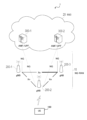
- FIG. 1 is a diagram illustrating a configuration example of a mobile communication system according to the first embodiment.
- FIG. 2 is a diagram illustrating a configuration example of a UE (user equipment) according to the first embodiment.
- FIG. 3 is a diagram illustrating a configuration example of a gNB (base station) according to the first embodiment.
- FIG. 4 is a diagram illustrating a configuration example of a protocol stack regarding the user plane according to the first embodiment.
- FIG. 5 is a diagram illustrating a configuration example of a protocol stack regarding the control plane according to the first embodiment.
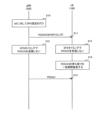
- FIG. 6 is a diagram illustrating an example of operation according to the first embodiment.
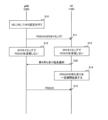
- FIG. 7 is a diagram illustrating an operation example according to the second embodiment.
- FIG. 8 is a diagram illustrating an operation example according to the third embodiment.
- One aspect of the present disclosure aims to provide a communication control method that can appropriately perform communication using XR.
- FIG. 1 is a diagram showing the configuration of a mobile communication system according to the first embodiment.
- the mobile communication system 1 complies with the 5th Generation System (5GS) of the 3GPP standard.
- 5GS will be described as an example below, an LTE (Long Term Evolution) system may be applied at least partially to the mobile communication system.
- LTE Long Term Evolution
- 6G 6th generation
- the mobile communication system 1 includes a user equipment (UE) 100, a 5G radio access network (NG-RAN) 10, and a 5G core network (5GC) 20.
- UE user equipment
- NG-RAN 5G radio access network
- 5GC 5G core network
- CN core network
- the UE 100 is a mobile wireless communication device.
- the UE 100 may be any device as long as it is used by a user.
- the UE 100 may be a mobile phone terminal (including a smartphone), a tablet terminal, a notebook PC, a communication module (including a communication card or chipset), a sensor or a device provided in the sensor, a vehicle or a device provided in the vehicle (Vehicle UE ), an aircraft or a device installed on an aircraft (Aerial UE).
- the UE 100 includes an XR device.
- An XR device is, for example, a device capable of processing XR.
- XR devices include head-mounted displays (HMDs) that can be attached to the human head, glasses-shaped AR glasses (or smart glasses), mobile handsets that can be held in the hand, and wristwatch-type devices (smart glasses). watches) or smartphones. These XR devices may be called wearable devices.
- the HMD includes a display, a lens, a tracking sensor, a camera, a control unit (CPU (Central Processing Unit) or GPU (Graphics Processing Unit), etc.) that performs processing related to XR, and a communication function.
- AR glasses have the ability to transmit images.
- Mobile handsets may include various sensors, such as tracking sensors.
- HMDs, AR glasses, wristwatch-type devices, and mobile handsets have communication capabilities that support 5G systems and the like. In the following, the UE 100 will be described as including such an XR device.
- the NG-RAN 10 includes a base station (called “gNB” in the 5G system) 200.
- gNB200 is mutually connected via the Xn interface which is an interface between base stations.
- gNB200 manages one or more cells.
- the gNB 200 performs wireless communication with the UE 100 that has established a connection with its own cell.
- the gNB 200 has a radio resource management (RRM) function, a routing function for user data (hereinafter simply referred to as "data”), a measurement control function for mobility control/scheduling, and the like.
- RRM radio resource management
- Cell is a term used to indicate the smallest unit of wireless communication area.
- Cell is also used as a term indicating a function or resource for performing wireless communication with the UE 100.
- One cell belongs to one carrier frequency (hereinafter simply referred to as "frequency").
- the gNB can also be connected to EPC (Evolved Packet Core), which is the core network of LTE.
- EPC Evolved Packet Core
- LTE base stations can also connect to 5GC.
- An LTE base station and a gNB can also be connected via an inter-base station interface.
- 5GC20 includes an AMF (Access and Mobility Management Function) and a UPF (User Plane Function) 300.
- the AMF performs various mobility controls for the UE 100.
- AMF manages the mobility of UE 100 by communicating with UE 100 using NAS (Non-Access Stratum) signaling.
- the UPF controls data transfer.
- AMF and UPF are connected to gNB 200 via an NG interface that is a base station-core network interface.
- FIG. 2 is a diagram showing the configuration of the UE 100 (user device) according to the first embodiment.
- UE 100 includes a receiving section 110, a transmitting section 120, and a control section 130.
- the receiving unit 110 and the transmitting unit 120 constitute a wireless communication unit that performs wireless communication with the gNB 200.
- the receiving unit 110 performs various types of reception under the control of the control unit 130.
- Receiving section 110 includes an antenna and a receiver.
- the receiver converts the radio signal received by the antenna into a baseband signal (received signal) and outputs the baseband signal (received signal) to the control unit 130.
- the transmitter 120 performs various transmissions under the control of the controller 130.
- Transmitter 120 includes an antenna and a transmitter.
- the transmitter converts the baseband signal (transmission signal) output by the control unit 130 into a wireless signal and transmits it from the antenna.
- Control unit 130 performs various controls and processes in the UE 100. Such processing includes processing for each layer, which will be described later.
- Control unit 130 includes at least one processor and at least one memory.
- the memory stores programs executed by the processor and information used in processing by the processor.
- the processor may include a baseband processor and a CPU (Central Processing Unit).
- the baseband processor performs modulation/demodulation, encoding/decoding, etc. of the baseband signal.
- the CPU executes programs stored in memory to perform various processes.
- the control part 130 may perform each process or each operation in UE100 in each embodiment shown below.
- FIG. 3 is a diagram showing the configuration of the gNB 200 (base station) according to the first embodiment.
- gNB 200 includes a transmitting section 210, a receiving section 220, a control section 230, and a backhaul communication section 240.
- the transmitter 210 and the receiver 220 constitute a wireless communication unit that performs wireless communication with the UE 100.
- the backhaul communication unit 240 constitutes a network communication unit that communicates with the CN 20.
- the transmitter 210 performs various transmissions under the control of the controller 230.
- Transmitter 210 includes an antenna and a transmitter.
- the transmitter converts the baseband signal (transmission signal) output by the control unit 230 into a wireless signal and transmits it from the antenna.
- the receiving unit 220 performs various types of reception under the control of the control unit 230.
- Receiving section 220 includes an antenna and a receiver. The receiver converts the radio signal received by the antenna into a baseband signal (received signal) and outputs it to the control unit 230.
- the control unit 230 performs various controls and processes in the gNB 200. Such processing includes processing for each layer, which will be described later.
- Control unit 230 includes at least one processor and at least one memory.
- the memory stores programs executed by the processor and information used in processing by the processor.
- the processor may include a baseband processor and a CPU.
- the baseband processor performs modulation/demodulation, encoding/decoding, etc. of the baseband signal.
- the CPU executes programs stored in memory to perform various processes. Note that the control unit 230 may perform each process or each operation in the gNB 200 in each embodiment described below.
- the backhaul communication unit 240 is connected to adjacent base stations via the Xn interface, which is an interface between base stations.
- Backhaul communication unit 240 is connected to AMF/UPF 300 via an NG interface that is a base station-core network interface.
- the gNB 200 may be configured of a CU (Central Unit) and a DU (Distributed Unit) (that is, functionally divided), and both units may be connected by an F1 interface that is a fronthaul interface.
- FIG. 4 is a diagram showing the configuration of a protocol stack of a user plane wireless interface that handles data.
- the user plane radio interface protocols include the physical (PHY) layer, MAC (Medium Access Control) layer, RLC (Radio Link Control) layer, PDCP (Packet Data Convergence Protocol) layer, and SDAP (Service Data Adaptation Protocol). It has a layer.
- PHY physical
- MAC Medium Access Control
- RLC Radio Link Control
- PDCP Packet Data Convergence Protocol
- SDAP Service Data Adaptation Protocol
- the PHY layer performs encoding/decoding, modulation/demodulation, antenna mapping/demapping, and resource mapping/demapping. Data and control information are transmitted between the PHY layer of the UE 100 and the PHY layer of the gNB 200 via a physical channel.
- the PHY layer of the UE 100 receives downlink control information (DCI) transmitted from the gNB 200 on the physical downlink control channel (PDCCH).
- DCI downlink control information
- the UE 100 performs blind decoding of the PDCCH using a radio network temporary identifier (RNTI), and acquires the successfully decoded DCI as the DCI addressed to its own UE.
- RNTI radio network temporary identifier
- a CRC parity bit scrambled by the RNTI is added to the DCI transmitted from the gNB 200.
- the MAC layer performs data priority control, retransmission processing using Hybrid ARQ (HARQ: Hybrid Automatic Repeat reQuest), random access procedure, etc.
- Data and control information are transmitted between the MAC layer of UE 100 and the MAC layer of gNB 200 via a transport channel.
- the MAC layer of gNB 200 includes a scheduler. The scheduler determines uplink and downlink transport formats (transport block size, modulation and coding scheme (MCS)) and resource blocks to be allocated to the UE 100.
- MCS modulation and coding scheme
- the RLC layer uses the functions of the MAC layer and PHY layer to transmit data to the RLC layer on the receiving side. Data and control information are transmitted between the RLC layer of UE 100 and the RLC layer of gNB 200 via logical channels.
- the PDCP layer performs header compression/expansion, encryption/decryption, etc.
- the SDAP layer performs mapping between an IP flow, which is a unit in which the core network performs QoS (Quality of Service) control, and a radio bearer, which is a unit in which an AS (Access Stratum) performs QoS control. Note that if the RAN is connected to the EPC, the SDAP may not be provided.
- QoS Quality of Service
- AS Access Stratum
- FIG. 5 is a diagram showing the configuration of a protocol stack of a control plane radio interface that handles signaling (control signals).
- the protocol stack of the control plane radio interface includes an RRC (Radio Resource Control) layer and NAS (Non-Access Stratum) instead of the SDAP layer shown in FIG.
- RRC Radio Resource Control
- NAS Non-Access Stratum
- RRC signaling for various settings is transmitted between the RRC layer of the UE 100 and the RRC layer of the gNB 200.
- the RRC layer controls logical, transport and physical channels according to the establishment, re-establishment and release of radio bearers.
- RRC connection connection between the RRC of the UE 100 and the RRC of the gNB 200
- the UE 100 is in an RRC connected state.
- RRC connection no connection between the RRC of the UE 100 and the RRC of the gNB 200
- the UE 100 is in an RRC idle state.
- the connection between the RRC of the UE 100 and the RRC of the gNB 200 is suspended, the UE 100 is in an RRC inactive state.
- the NAS located above the RRC layer performs session management, mobility management, etc.
- NAS signaling is transmitted between the NAS of the UE 100 and the NAS of the AMF 300.
- the UE 100 has an application layer and the like in addition to the wireless interface protocol.
- a layer lower than the NAS is called an AS (Access Stratum).
- XR is a broad term that includes, for example, virtual reality (VR), augmented reality (AR), and mixed reality (MR), and refers to an environment that combines the real world and virtual space.
- VR virtual reality
- AR augmented reality
- MR mixed reality
- XR is also a general term for these various types of realities.
- XR is also a general term for technologies that make it possible to perceive things that are not real, for example, by fusing the real world and virtual space.
- XR human-to-machine and human-to-human communication is performed with the assistance of a UE 100, which is a portable or wearable end-user device.
- UE 100 which is a portable or wearable end-user device.
- Such communication allows XR to be applied in various application areas such as entertainment, healthcare, or education.
- Cloud gaming is a general term for use cases in which a large portion of the computation associated with a game is offloaded to an edge or remote server.
- the UE 100 transmits information related to pose and/or control.
- the cloud side performs calculations regarding video data and the like based on this information, and provides video and the like related to the game to the UE 100.
- VR virtual reality
- a user typically wears an HMD, the user's field of view is replaced with simulated visual elements, and accompanying audio is provided to the user through headphones.
- the virtual space is designed to mimic the visual or auditory sensory stimuli of the real world as naturally as possible.
- Virtual reality (VR) may also include a metaverse, which is a virtual space (or service) that is constructed in a computer or computer network and is different from the real world.
- AR augmented reality
- AR is, for example, a technology that displays a virtual space superimposed on the real world.
- Augmented reality (AR) also refers to the provision of a user's real environment overlaid with additional information (artificially generated items or content). The additional information may be perceived directly without a sensor or the like, or indirectly via a sensor or the like.
- mixed reality for example, is a technology that combines and/or fuses the real world and virtual space to construct a space where they interact with each other in real time.
- Mixed reality is a development of augmented reality (AR), which inserts virtual elements into a physical scene with the intention of giving the illusion of being part of the real scene. It is constructed as follows.
- Typical forms of XR include virtual reality (VR), augmented reality (AR), and mixed reality (MR), but XR may also include areas that interpolate between these.
- VR virtual reality
- AR augmented reality
- MR mixed reality
- XR and cloud gaming (CG) use cases are characterized by video stream traffic in the DL direction and traffic that combines pose and/or control with the video stream in the UL direction.
- Video streams have a relatively high data rate, and data regarding attitude and/or control are frequently updated.
- XR and cloud gaming (CG) also have the characteristic that traffic in the DL direction and traffic in the UL direction are traffic that is sensitive to delays.
- XR traffic model The XR traffic model will be described below. There are two types of XR traffic models: (1) general traffic models and (2) specific traffic models. First, (1) a general traffic model will be explained.
- (1) General traffic models include (1.1) DL direction traffic model and (1.2) UL direction traffic model.
- the DL direction traffic model includes a single stream DL traffic model and a multistream DL traffic model.
- the two traffic models can be summarized as follows.
- Option #1 Two streams where the first stream is an I (Intra-coded) stream and the second stream is a P (Predicted) stream.
- Option #1 includes a slice-based traffic model (option #1A) and a GOP (Group-Of-Picture)-based traffic model (option #1B).
- Option #1A (slice base):
- the first stream is an I slice (I stream), and the second stream is a P slice (P stream).
- the I slice is, for example, a slice in which all macroblocks included in the I slice are encoded by intraframe prediction.
- a P slice is, for example, a slice in which all macroblocks included in the P slice are encoded by intraframe prediction or interframe prediction.
- Option #1B (GOP-based):
- the first stream is an I frame (I stream), and the second stream is a P slice (P stream).
- the I frame is a frame encoded with the video frame without using other video frames.
- a P frame is a frame encoded using a temporally previous video frame. If the size of the GOP is K frames, an I frame is transmitted every K frames.
- a GOP includes one I frame and (K-1) P frames.
- Option #2 A two-stream traffic model where the first stream is video and the second stream is audio and/or data.
- Option #3 A traffic model in which the first stream is an FOV (Field Of View) and the second stream is an omnidirectional view.
- FOV Field Of View
- the FOV is video data of the user's line of sight
- the omnidirectional viewpoint is omnidirectional video data centered on the user, including video data of the user's line of sight.
- Traffic model in the UL direction There is an attitude and/or control stream traffic model as a traffic model in the UL direction. This is a traffic model in which the UE 100 transmits data regarding attitude and/or control.
- Specific traffic models include (2.1) virtual reality (VR), (2.2) augmented reality (AR), and (2.3) cloud gaming (CG). There is a traffic model.
- AR Augmented Reality Traffic Model
- Model #1 One stream model
- Model #2 Two stream model: The first stream is attitude and/or control, the second stream is a collection of scenes (e.g. continuous video), video, data, and audio
- Model #3A 3-stream model A: One stream model in which the first stream is posture and/or control, the second stream is a single stream that combines a scene stream and a video stream, and the third stream is a single stream that combines audio and data.
- #3B 3-stream model B: 1st stream is posture and/or control, 2nd stream is video I stream, 3rd stream is video P stream
- SPS Semi-Persistent Scheduling
- PDCCH Physical Downlink. Control Channel
- SPS Semi-Persistent Scheduling
- DCI Downlink Control Information
- PDCCH Physical Downlink. Control Channel
- the period is notified from the gNB 200 to the UE 100 by SPS configuration (SPS-Config) included in an RRC message (for example, an RRC setup message or an RRC Reconfiguration message).
- SPS-Config SPS configuration
- the gNB 200 can also set multiple SPS settings with different cycles.
- CG Configured Grant
- the UE 100 can thereafter periodically communicate in the UL direction using the radio resource without using the DCI.
- This is the scheduling method.
- the period is notified from the gNB 200 to the UE 100 by CG settings (ConfiguredGrantConfig) included in an RRC message (for example, an RRC setup message or an RRC Reconfiguration message).
- CG settings ConfiguredGrantConfig
- RRC message for example, an RRC setup message or an RRC Reconfiguration message.
- Type 1 which allows UL transmission without using DCI
- Type 2 which allows UL transmission using DCI.
- radio resources are directly included in the CG settings.
- the gNB 200 can also set a plurality of CG settings with different cycles.
- Jitter is attracting attention in XR traffic.
- the average packet arrival time of a video stream is determined by the frame rate (for example, 60 fps (frames per second)).
- packet arrival time actually varies due to encoding delay and transmission delay. Such changes may become jitter and affect packet arrival time. Jitter thus refers to fluctuations in packet arrival time.
- jitter is modeled as a random variable added on top of periodic packet arrival times.
- the gNB 200 transmits XR traffic having such jitter using SPS. If a packet targeted for XR traffic arrives from the CN 20 to the gNB 200 earlier than the SPS timing, there is no particular problem because the gNB 200 can store the packet in a buffer or the like and transmit it at the SPS timing.
- the gNB 200 will wait until the next SPS timing to transmit the packet. In this case, a transmission delay corresponding to one SPS cycle will occur.
- the UE 100 is also unable to receive the packet at the SPS timing and has to wait until the next SPS cycle to receive the packet.
- Transmission delays may occur due to jitter. Transmission delays may affect user experience (UX) in use cases such as augmented reality (AR) or cloud gaming (CG). Therefore, in the mobile communication system 1, communication using XR traffic may not be able to be performed appropriately.
- UX user experience
- AR augmented reality
- CG cloud gaming
- the first embodiment aims to perform communication appropriately using XR traffic.
- the PDSCH standby period is extended.
- PDSCH monitoring is extended for a predetermined period.
- the PDSCH monitoring period at the SPS timing is extended, so the UE 100 can receive packets during the extended period without waiting for one SPS cycle. Therefore, transmission delay can be suppressed. Therefore, in the mobile communication system 1, it becomes possible to appropriately perform communication using XR traffic.
- the SPS timing refers to, for example, periodic timing in SPS.
- the periodic timing in SPS is, for example, the timing of the periodicity indicated in the SPS settings.
- the UE 100 monitors the PDSCH at SPS timing. Then, the UE 100 receives the packet transmitted using the PDSCH.
- an inactivity timer (drx-InactivityTimer) is specified in DRX (Discontinuous Reception) settings.
- the inactive timer is a timer for continuing monitoring of the PDCCH in consideration of receiving the PDCCH thereafter when the UE 100 receives the PDCCH during the on duration of DRX. That is, the inactive timer is a timer that is activated in the UE 100 when the PDCCH is received.
- the timer is different from the inactive timer in that it is activated when the UE 100 does not receive a PDSCH.
- PDSCH reception and “packet reception using PDSCH” may be used without distinction.
- PDSCH transmission and “packet transmission using PDSCH” may be used without distinction.
- transmission of PUSCH and “transmission of packet using PUSCH” may be used without distinction.
- FIG. 6 is a diagram illustrating an example of operation according to the first embodiment.
- the gNB 200 performs SPS settings for the UE 100.
- the SPS settings may include setting information indicating whether to extend PDSCH monitoring.
- the UE 100 can determine whether to extend PDSCH monitoring or to monitor PDSCH without extending it, based on the configuration information.
- the configuration information may include information indicating an extension period of PDSCH monitoring. Information indicating the extension period may be expressed as a timer value.
- the gNB 200 may include the SPS configuration including the configuration information in an RRC message, MAC CE, etc., and transmit it to the UE 100.
- step S11 the gNB 200 transmits the PDSCH at SPS timing.
- the UE 100 receives the PDSCH at the SPS timing and ends monitoring the PDSCH.
- step S12 the gNB 200 does not transmit PDSCH at SPS timing.
- step S13 the UE 100 does not receive the PDSCH at the SPS timing.
- the UE 100 extends PDSCH monitoring for a predetermined period after the SPS timing. That is, when the UE 100 does not receive the PDSCH from the gNB 200 at the SPS cycle timing (step S13), the UE 100 extends the monitoring of the PDSCH for a predetermined period.
- the UE 100 determines to extend PDSCH monitoring for a predetermined period based on the configuration information (step S10), and extends the monitoring.
- the predetermined period is, for example, a period indicated by information indicating an extension period included in the setting information.
- the UE 100 may count the period by activating a PDSCH standby extension timer.
- the PDSCH standby extension timer may be started at the end of the SPS timing.
- the PDSCH standby extension timer may be activated at the start of the SPS timing.
- the UE 100 may continue monitoring the PDSCH while the PDSCH standby extension timer is in operation, and may stop monitoring the PDSCH when the PDSCH extension timer expires.
- the UE 100 may continue monitoring the PDSCH while the PDSCH standby extension timer is in operation, and may stop the operation of the PDSCH standby extension timer when receiving the PDSCH.
- the information indicating the extension period included in the setting information may indicate a period during which the PDSCH standby extension timer is activated.
- step S15 the UE 100 monitors the PDSCH during a predetermined period after the SPS timing and receives the PDSCH. Note that if the UE 100 does not receive the PDSCH at the SPS timing, the UE 100 extends the period for monitoring the PDSCH at the SPS timing.
- the gNB 200 performs CG settings for the UE 100 that include setting information indicating whether to extend PUSCH transmission (or PUSCH radio resources) for a predetermined period of time (step S10).
- the configuration information may include information (for example, a timer value) indicating an extension period of PUSCH transmission (or PUSCH radio resources).
- the UE 100 extends the PUSCH transmission (or the PUSCH radio resource) for a predetermined period (step S14).
- the UE 100 determines to extend PUSCH transmission (or PUSCH radio resources) for a predetermined period based on the configuration information.
- the predetermined period may be counted by starting a PUSCH extension timer in the UE 100.
- the PUSCH extension timer may be activated at the start of CG timing. Alternatively, the PUSCH extension timer may be started at the end of the CG timing.
- the UE 100 may continue PUSCH transmission (or PUSCH radio resources) while the PUSCH extension timer is in operation, and may stop PUSCH transmission (or PUSCH radio resources) when the PUSCH extension timer expires. Alternatively, the UE 100 may continue PUSCH transmission (or PUSCH radio resources) while the PUSCH extension timer is in operation, and may stop the counting operation of the PUSCH extension timer when transmitting the PUSCH.
- the UE 100 when the UE 100 does not transmit the PUSCH to the gNB 200 at the periodic timing of the CG, the UE 100 extends the PUSCH transmission (or the PUSCH radio resource) for a predetermined period. Therefore, in modification 1, even if the UE 100 is unable to transmit the PUSCH at the CG timing, the PUSCH is transmitted during the extended period of PUSCH transmission (or PUSCH radio resources) without waiting until the next CG timing. be able to. Therefore, in Modification 1 as well, transmission delay can be suppressed. Therefore, in the mobile communication system 1, it becomes possible to appropriately perform communication using XR traffic.
- the first embodiment is also applicable to DRX.
- the gNB 200 performs DRX settings for the UE 100 including setting information indicating whether to extend PDCCH monitoring for a predetermined period in the DRX on duration (step S10).
- the configuration information may include information (for example, a timer value) indicating an extension period of monitoring of the PDCCH.
- the UE 100 extends monitoring of the PDCCH for a predetermined period (step S14).
- the UE 100 determines to extend monitoring of the PDCCH for a predetermined period based on the configuration information.
- a PDCCH standby extension timer may be used to count the predetermined period.
- the operation of the PDCCH standby extension timer may be the same as in the first embodiment.
- the UE 100 does not receive the PDCCH from the gNB 200 at the DRX cycle timing (i.e., on duration), the UE 100 extends PDCCH monitoring for a predetermined period. Therefore, in Modification 1, even if the PDCCH cannot be received during the DRX ON period, the PDCCH can be received during the PDCCH monitoring extension period without waiting until the next ON period. Therefore, in Modification 2 as well, transmission delay can be suppressed. Therefore, in the mobile communication system 1, it becomes possible to appropriately perform communication using XR traffic.
- the gNB 200 transmits configuration information to the UE 100, and the UE 100 extends PDSCH monitoring when the UE 100 does not receive the PDSCH at the SPS timing.
- the gNB 200 instructs the UE 100 to extend PDSCH monitoring.
- the base station (eg, gNB 200) transmits a first standby extension notification indicating that PDSCH monitoring will be extended for a predetermined period to the user device (eg, UE 100).
- the user device extends PDSCH monitoring for a predetermined period of time in response to receiving the first standby extension notification.
- the gNB 200 notifies (or instructs) the UE 100 of the extension of PDSCH monitoring at the SPS timing, so that the gNB 200 can take the initiative and control the extension of the PDSCH monitoring for the UE 100.
- FIG. 7 is a diagram illustrating an operation example according to the second embodiment. Below, differences from the first embodiment will be mainly explained.
- step S12 the gNB 200 does not transmit PDSCH at SPS timing.
- step S20 the gNB 200 transmits a first standby extension notification to the UE 100 indicating that PDSCH monitoring will be extended for a predetermined period.
- the gNB 200 may transmit the MAC CE or DCI including the first standby extension notification to the UE 100.
- step S14 the UE 100 extends monitoring of the PDSCH at the SPS timing for a predetermined period in response to receiving the first standby extension notification.
- the first standby extension notification may be a notification indicating that PUSCH transmission (or PUSCH radio resources) at CG timing is to be extended for a predetermined period, similarly to Modification 1 of the first embodiment.
- the first standby extension notification may be a notification indicating that monitoring of the PDCCH in the DRX on duration is extended for a predetermined period, similarly to the second modification of the first embodiment.
- the gNB 200 transmits the first standby extension notification to the UE 100.
- the UE 100 transmits a standby extension notification (referred to as a "second extended standby notification") to the gNB 200.
- the user device eg, UE 100 transmits a second standby extension notification indicating that PDSCH monitoring will be extended for a predetermined period to the base station (eg, gNB 200).
- the base station eg, gNB 200
- the gNB 200 can transmit the PDSCH triggered by the reception of the second standby extension notification.
- FIG. 8 is a diagram illustrating an operation example according to the third embodiment. Below, differences from the second embodiment will be mainly explained.
- the gNB 200 may set the UE 100 to send a second standby extension notification.
- the gNB 200 may transmit configuration information including information indicating the second standby extension notification to the UE 100.
- step S12 the gNB 200 does not transmit PDSCH at SPS timing.
- step S13 the UE 100 does not receive PDSCH at SPS timing.
- step S30 the UE 100 transmits to the gNB 200 a second standby extension notification indicating that PDSCH monitoring will be extended for a predetermined period.
- the UE 100 may transmit the MAC CE or DCI including the second standby extension notification to the gNB 200.
- step S14 the UE 100 extends monitoring of the PDSCH at the SPS timing for a predetermined period.
- the second standby extension notification may be a notification indicating that PUSCH transmission (or PUSCH radio resources) at CG timing is extended for a predetermined period.
- the second standby extension notification may be a notification indicating that monitoring of the PDCCH in the DRX on duration is extended for a predetermined period, similarly to the second modification of the first embodiment.
- a program that causes a computer to execute each process performed by the UE 100 or the gNB 200 may be provided.
- the program may be recorded on a computer readable medium.
- Computer-readable media allow programs to be installed on a computer.
- the computer-readable medium on which the program is recorded may be a non-transitory recording medium.
- the non-transitory recording medium is not particularly limited, and may be, for example, a recording medium such as a CD-ROM and/or a DVD-ROM.
- circuits that execute each process performed by the UE 100 or the gNB 200 may be integrated, and at least a portion of the UE 100 or the gNB 200 may be configured as a semiconductor integrated circuit (chip set, SoC: System on a chip).
- the terms “based on” and “depending on” refer to “based solely on” and “depending solely on,” unless expressly stated otherwise. ” does not mean. Reference to “based on” means both “based solely on” and “based at least in part on.” Similarly, the phrase “in accordance with” means both “in accordance with” and “in accordance with, at least in part.” Furthermore, “obtain/acquire” may mean obtaining information from among stored information, or may mean obtaining information from among information received from other nodes. Alternatively, it may mean obtaining the information by generating the information.
- any reference to elements using the designations "first,” “second,” etc. used in this disclosure does not generally limit the amount or order of those elements. These designations may be used herein as a convenient way of distinguishing between two or more elements. Thus, reference to a first and second element does not imply that only two elements may be employed therein or that the first element must precede the second element in any way.
- articles are added by translation, for example, a, an, and the in English, these articles are used in the plural unless the context clearly indicates otherwise. shall include things.
- (Additional Note 1) A communication control method in a mobile communication system, in which a user equipment receives PDSCH or PDCCH from a base station at periodic timing of SPS (Semi-Persistent Scheduling) or periodic timing of DRX (Discontinuous Reception). and extending the monitoring of the PDSCH or the monitoring of the PDCCH for a predetermined period.
- SPS Semi-Persistent Scheduling
- DRX discontinuous Reception
- the base station transmits configuration information indicating whether or not to extend monitoring of the PDSCH or monitoring of the PDCCH for the predetermined period to the user equipment.
- the user equipment may further include a step in which the user equipment extends monitoring of the PDSCH or monitoring of the PDCCH for the predetermined period based on the configuration information.
- the base station sends a first standby extension notification indicating that the PDSCH monitoring or the PDCCH monitoring is to be extended for the predetermined period. further comprising the step of transmitting to a user device, and the extending step includes extending the monitoring of the PDSCH or the monitoring of the PDCCH for the predetermined period in response to the user device receiving the first standby extension notification.
- the process may include the step of:
- (Appendix 4) In the communication control method according to any one of (Appendix 1) to (Appendix 3) above, a second standby extension indicating that the user equipment extends monitoring of the PDSCH or monitoring of the PDCCH for the predetermined period.
- the method may further include sending a notification to the base station.
- a communication control method in a mobile communication system when the user equipment does not transmit the PUSCH to the base station at the periodic timing of CG (Configured Grant), the transmission of the PUSCH may include the step of extending for a predetermined period of time.
- the base station further includes the step of transmitting setting information to the user equipment indicating whether or not to extend the transmission of the PUSCH for the predetermined period,
- the extending step may include a step in which the user equipment extends the transmission of the PUSCH for the predetermined period based on the configuration information.
- the base station transmits a first standby extension notification indicating that the transmission of the PUSCH is extended for the predetermined period to the user equipment.
- the method may further include the step of extending the transmission of the PUSCH for the predetermined period of time in accordance with the first standby extension notification.
- the user equipment transmits a second standby extension notification indicating that the transmission of the PUSCH is extended for the predetermined period to the base station.
- the method may further include steps.
- Mobile communication system 20 CN 100:UE 110: Receiving unit 120: Transmitting unit 130: Control unit 200: gNB 210: Transmitting section 220: Receiving section 230: Control unit 300: AMF
Landscapes
- Engineering & Computer Science (AREA)
- Computer Networks & Wireless Communication (AREA)
- Signal Processing (AREA)
- Mobile Radio Communication Systems (AREA)
Priority Applications (2)
| Application Number | Priority Date | Filing Date | Title |
|---|---|---|---|
| JP2024518002A JP7765618B2 (ja) | 2022-04-27 | 2023-04-26 | 通信制御方法 |
| US18/928,523 US20250056523A1 (en) | 2022-04-27 | 2024-10-28 | Communication control method |
Applications Claiming Priority (2)
| Application Number | Priority Date | Filing Date | Title |
|---|---|---|---|
| JP2022073807 | 2022-04-27 | ||
| JP2022-073807 | 2022-04-27 |
Related Child Applications (1)
| Application Number | Title | Priority Date | Filing Date |
|---|---|---|---|
| US18/928,523 Continuation US20250056523A1 (en) | 2022-04-27 | 2024-10-28 | Communication control method |
Publications (1)
| Publication Number | Publication Date |
|---|---|
| WO2023210706A1 true WO2023210706A1 (ja) | 2023-11-02 |
Family
ID=88519132
Family Applications (1)
| Application Number | Title | Priority Date | Filing Date |
|---|---|---|---|
| PCT/JP2023/016513 Ceased WO2023210706A1 (ja) | 2022-04-27 | 2023-04-26 | 通信制御方法 |
Country Status (3)
| Country | Link |
|---|---|
| US (1) | US20250056523A1 (https=) |
| JP (1) | JP7765618B2 (https=) |
| WO (1) | WO2023210706A1 (https=) |
Citations (3)
| Publication number | Priority date | Publication date | Assignee | Title |
|---|---|---|---|---|
| US20210352684A1 (en) * | 2020-05-08 | 2021-11-11 | Qualcomm Incorporated | Dynamic reallocation of periodic occasions for wireless communications |
| EP3937392A1 (en) * | 2020-07-06 | 2022-01-12 | Nokia Technologies Oy | Configured grant operations for use with beamforming |
| EP3944700A1 (en) * | 2019-03-22 | 2022-01-26 | Ntt Docomo, Inc. | User terminal and wireless communication method |
-
2023
- 2023-04-26 WO PCT/JP2023/016513 patent/WO2023210706A1/ja not_active Ceased
- 2023-04-26 JP JP2024518002A patent/JP7765618B2/ja active Active
-
2024
- 2024-10-28 US US18/928,523 patent/US20250056523A1/en active Pending
Patent Citations (3)
| Publication number | Priority date | Publication date | Assignee | Title |
|---|---|---|---|---|
| EP3944700A1 (en) * | 2019-03-22 | 2022-01-26 | Ntt Docomo, Inc. | User terminal and wireless communication method |
| US20210352684A1 (en) * | 2020-05-08 | 2021-11-11 | Qualcomm Incorporated | Dynamic reallocation of periodic occasions for wireless communications |
| EP3937392A1 (en) * | 2020-07-06 | 2022-01-12 | Nokia Technologies Oy | Configured grant operations for use with beamforming |
Also Published As
| Publication number | Publication date |
|---|---|
| JPWO2023210706A1 (https=) | 2023-11-02 |
| US20250056523A1 (en) | 2025-02-13 |
| JP7765618B2 (ja) | 2025-11-06 |
Similar Documents
| Publication | Publication Date | Title |
|---|---|---|
| US20240236765A1 (en) | Communication method and apparatus | |
| US20250048187A1 (en) | Communication control method | |
| US12587983B2 (en) | Base station device, terminal device, and communication method | |
| CN116114254B (zh) | 一种通信方法及装置 | |
| CN113766567A (zh) | 一种通信方法及装置 | |
| WO2021023044A1 (zh) | 一种通信方法和装置 | |
| US20240171522A1 (en) | Electronic device, communication method, and computer-readable storage medium | |
| WO2023045838A1 (zh) | 信息接收、信息上报方法、装置、设备及计算机存储介质 | |
| CN116233921A (zh) | 数据包的处理方法、装置及终端 | |
| CN115243320A (zh) | 一种数据传输的通信处理方法和相关设备 | |
| CN116830723A (zh) | 通信方法以及通信设备 | |
| US20250227244A1 (en) | Communication method and apparatus | |
| US20240357587A1 (en) | Methods and apparatuses for uplink transmission | |
| JP7765618B2 (ja) | 通信制御方法 | |
| JP7839270B2 (ja) | 通信制御方法 | |
| WO2024092733A1 (en) | Method of synchronization of multi-modal traffic flows and related devices | |
| US20250055605A1 (en) | Communication control method | |
| WO2023093696A1 (zh) | 一种通信方法及装置 | |
| CN115942297A (zh) | 信息接收、信息上报方法、装置、设备及计算机存储介质 | |
| US20260129645A1 (en) | Uplink enhancement for extended reality and cloud gaming services | |
| US20250274813A1 (en) | Method and apparatus for determining packet loss, communication device, and readable storage medium | |
| EP4443952A1 (en) | Information transmission method and apparatus, terminal, and network side device | |
| WO2025098319A1 (zh) | 用于无线通信系统中的设备和方法 | |
| CN121645354A (zh) | 通信方法及装置 | |
| WO2025246716A1 (zh) | 通信方法及相关装置 |
Legal Events
| Date | Code | Title | Description |
|---|---|---|---|
| 121 | Ep: the epo has been informed by wipo that ep was designated in this application |
Ref document number: 23796445 Country of ref document: EP Kind code of ref document: A1 |
|
| WWE | Wipo information: entry into national phase |
Ref document number: 2024518002 Country of ref document: JP |
|
| NENP | Non-entry into the national phase |
Ref country code: DE |
|
| 122 | Ep: pct application non-entry in european phase |
Ref document number: 23796445 Country of ref document: EP Kind code of ref document: A1 |