WO2023210603A1 - ゴルフのパッティング練習装置 - Google Patents
ゴルフのパッティング練習装置 Download PDFInfo
- Publication number
- WO2023210603A1 WO2023210603A1 PCT/JP2023/016169 JP2023016169W WO2023210603A1 WO 2023210603 A1 WO2023210603 A1 WO 2023210603A1 JP 2023016169 W JP2023016169 W JP 2023016169W WO 2023210603 A1 WO2023210603 A1 WO 2023210603A1
- Authority
- WO
- WIPO (PCT)
- Prior art keywords
- putting practice
- mirror
- half mirror
- mirror surface
- practice device
- Prior art date
- Legal status (The legal status is an assumption and is not a legal conclusion. Google has not performed a legal analysis and makes no representation as to the accuracy of the status listed.)
- Ceased
Links
Images





Classifications
-
- A—HUMAN NECESSITIES
- A63—SPORTS; GAMES; AMUSEMENTS
- A63B—APPARATUS FOR PHYSICAL TRAINING, GYMNASTICS, SWIMMING, CLIMBING, OR FENCING; BALL GAMES; TRAINING EQUIPMENT
- A63B69/00—Training appliances or apparatus for special sports
- A63B69/36—Training appliances or apparatus for special sports for golf
- A63B69/3676—Training appliances or apparatus for special sports for golf for putting
-
- A—HUMAN NECESSITIES
- A63—SPORTS; GAMES; AMUSEMENTS
- A63B—APPARATUS FOR PHYSICAL TRAINING, GYMNASTICS, SWIMMING, CLIMBING, OR FENCING; BALL GAMES; TRAINING EQUIPMENT
- A63B69/00—Training appliances or apparatus for special sports
- A63B69/36—Training appliances or apparatus for special sports for golf
- A63B69/3676—Training appliances or apparatus for special sports for golf for putting
- A63B69/3682—Visual means not attached to the body for aligning, positioning the trainee's head or for detecting head movement, e.g. by parallax
-
- A—HUMAN NECESSITIES
- A63—SPORTS; GAMES; AMUSEMENTS
- A63B—APPARATUS FOR PHYSICAL TRAINING, GYMNASTICS, SWIMMING, CLIMBING, OR FENCING; BALL GAMES; TRAINING EQUIPMENT
- A63B69/00—Training appliances or apparatus for special sports
- A63B69/36—Training appliances or apparatus for special sports for golf
- A63B69/3661—Mats for golf practice, e.g. mats having a simulated turf, a practice tee or a green area
-
- A—HUMAN NECESSITIES
- A63—SPORTS; GAMES; AMUSEMENTS
- A63B—APPARATUS FOR PHYSICAL TRAINING, GYMNASTICS, SWIMMING, CLIMBING, OR FENCING; BALL GAMES; TRAINING EQUIPMENT
- A63B71/00—Games or sports accessories not covered in groups A63B1/00 - A63B69/00
- A63B71/06—Indicating or scoring devices for games or players, or for other sports activities
- A63B2071/0694—Visual indication, e.g. Indicia
-
- A—HUMAN NECESSITIES
- A63—SPORTS; GAMES; AMUSEMENTS
- A63B—APPARATUS FOR PHYSICAL TRAINING, GYMNASTICS, SWIMMING, CLIMBING, OR FENCING; BALL GAMES; TRAINING EQUIPMENT
- A63B2220/00—Measuring of physical parameters relating to sporting activity
- A63B2220/10—Positions
- A63B2220/16—Angular positions
-
- A—HUMAN NECESSITIES
- A63—SPORTS; GAMES; AMUSEMENTS
- A63B—APPARATUS FOR PHYSICAL TRAINING, GYMNASTICS, SWIMMING, CLIMBING, OR FENCING; BALL GAMES; TRAINING EQUIPMENT
- A63B2220/00—Measuring of physical parameters relating to sporting activity
- A63B2220/80—Special sensors, transducers or devices therefor
- A63B2220/83—Special sensors, transducers or devices therefor characterised by the position of the sensor
- A63B2220/833—Sensors arranged on the exercise apparatus or sports implement
-
- A—HUMAN NECESSITIES
- A63—SPORTS; GAMES; AMUSEMENTS
- A63B—APPARATUS FOR PHYSICAL TRAINING, GYMNASTICS, SWIMMING, CLIMBING, OR FENCING; BALL GAMES; TRAINING EQUIPMENT
- A63B2225/00—Miscellaneous features of sport apparatus, devices or equipment
- A63B2225/09—Adjustable dimensions
-
- A—HUMAN NECESSITIES
- A63—SPORTS; GAMES; AMUSEMENTS
- A63B—APPARATUS FOR PHYSICAL TRAINING, GYMNASTICS, SWIMMING, CLIMBING, OR FENCING; BALL GAMES; TRAINING EQUIPMENT
- A63B2225/00—Miscellaneous features of sport apparatus, devices or equipment
- A63B2225/09—Adjustable dimensions
- A63B2225/093—Height
-
- A—HUMAN NECESSITIES
- A63—SPORTS; GAMES; AMUSEMENTS
- A63B—APPARATUS FOR PHYSICAL TRAINING, GYMNASTICS, SWIMMING, CLIMBING, OR FENCING; BALL GAMES; TRAINING EQUIPMENT
- A63B2225/00—Miscellaneous features of sport apparatus, devices or equipment
- A63B2225/12—Miscellaneous features of sport apparatus, devices or equipment with mirrors
-
- A—HUMAN NECESSITIES
- A63—SPORTS; GAMES; AMUSEMENTS
- A63B—APPARATUS FOR PHYSICAL TRAINING, GYMNASTICS, SWIMMING, CLIMBING, OR FENCING; BALL GAMES; TRAINING EQUIPMENT
- A63B71/00—Games or sports accessories not covered in groups A63B1/00 - A63B69/00
- A63B71/02—Games or sports accessories not covered in groups A63B1/00 - A63B69/00 for large-room or outdoor sporting games
- A63B71/023—Supports, e.g. poles
-
- A—HUMAN NECESSITIES
- A63—SPORTS; GAMES; AMUSEMENTS
- A63B—APPARATUS FOR PHYSICAL TRAINING, GYMNASTICS, SWIMMING, CLIMBING, OR FENCING; BALL GAMES; TRAINING EQUIPMENT
- A63B71/00—Games or sports accessories not covered in groups A63B1/00 - A63B69/00
- A63B71/06—Indicating or scoring devices for games or players, or for other sports activities
- A63B71/0619—Displays, user interfaces and indicating devices, specially adapted for sport equipment, e.g. display mounted on treadmills
- A63B71/0622—Visual, audio or audio-visual systems for entertaining, instructing or motivating the user
Definitions
- the present invention relates to a golf putting practice device, and more particularly to a golf putting practice device that includes a main body portion including at least a flat half mirror, and a support portion that holds the main body portion in the air.
- a device called a putter mat places a ball cup near the end of an artificial turf mat, draws a white straight line from the ball cup onto the mat, and guides the putted golf ball onto the white line.
- the artificial turf mat is provided with a slope.
- the plate for address checking in putting is characterized by a groove having a width of about 5 mm and a depth of about 9 mm between two plates, wherein the side surface of the plate groove is oriented at 90 degrees with respect to the plane of the plate. It is known that the bottom surface of the plate groove has a structure in which the bottom surface color is a bright color with high visibility (Patent Document 1).
- the purpose of the address check plate is to enable the user to accurately position both eyes directly above the ball and the putting line during golf putting. Furthermore, it is a mirror for checking the accuracy of posture and swing in golf, and includes a mirror member having predetermined vertical and horizontal dimensions, and several alignment checks performed on the mirror member. A straight line for use in golf, a scale placed on the mirror member for confirming the position of each part of the body, swing width, etc., and a ball trajectory cut out on the mirror member for golf putting practice.
- An alignment confirmation mirror that includes a confirmation tee peg insertion hole (Patent Document 2). This invention is an improvement on the invention described in Patent Document 1, and the plate is mirror-like so that the players themselves are reflected in the plate, thereby making it possible to practice more effectively.
- a putting practice device that includes a cylinder having an inner diameter that is approximately equal to or smaller than the diameter of a golf ball, and a mechanism that vertically supports the cylinder (Patent Document 3).
- the invention utilizes a play putter to accurately align the player's dominant eye with the position of the golf ball, then pulls the putter while maintaining that position, hits the golf ball, and maintains the position of the player's dominant eye even after hitting the ball.
- To provide a putting practice tool which allows confirmation of continued holding of a position with a simple structure and allows the body to memorize the correct posture through repeated practice.
- the present invention is a novel golf putting practice device that includes a main body that includes at least a flat half mirror, and a support that holds the main body in the air. Ensure that the face of the putter head hits the center of the golf ball from a 90-degree angle to the surface on which the putter is placed (e.g., the green surface), that is, directly above the golf ball. In addition to being able to do this, practice putting repeatedly while clearly checking the moment when the face of the putter head hits the golf ball and the subsequent flow of the golf ball (target line). Furthermore, since the player's own eyes, preferably his face and part of his body, can be seen reflected in the half mirror, the player's own eyes can be seen on the target line before and after putting.
- Players can also practice aligning their faces and bodies parallel to the target line, and preferably each player can find their own optimal angle with respect to the green surface when viewing the golf ball.
- the present invention provides a golf putting practice device that allows the user to repeatedly practice putting at that angle. According to the golf putting practice device of the present invention, the player's own putting form can be accurately reproduced even on the actual green through the above-described repeated putting practice, and the success rate of putting can be significantly increased.
- the basic principle is that the player putst the golf ball while looking at it at 90 degrees to the surface on which the golf ball is placed (the green surface), that is, from directly above the golf ball. has been done. Therefore, even in the above-mentioned conventional putter mats, putting address check plates, mirror-type golf putting practice devices, etc., the principle is to practice putting while looking at the golf ball from directly above.
- the reality is that even after a considerable amount of practice using these conventional devices, it is difficult to achieve good results in putting practice, and it is not possible to putt as expected on the actual green.
- the above-mentioned conventional putter mat is intended to improve the putting technique by repeatedly practicing so that the putted golf ball passes over the white line.
- players since there is no white line like the one drawn on the putter mat on the actual green, players often draw an imaginary white line between the ball and the cup on the green, and You will have to putt together. Therefore, players tend to be too focused on the direction of the cup, taking their eyes away from the ball, and tend to neglect the putt itself, which poses a problem in that it is easy to make mistakes.
- mirror type golf putting practice device basically, while looking at the golf ball from 90 degrees to the surface on which the golf ball is placed (green surface), that is, directly above the golf ball, By reflecting the alignment of the knees, hips, shoulders, and line of sight at address on a mirror when putting, players can check their alignment and set up correctly for the ball, thereby improving their putting technique. It is something to do.
- the basic principle is to view the golf ball from directly above it.
- the golf ball is viewed through a cylinder that is located vertically and has an inner diameter that is approximately equal to or smaller than the diameter of the golf ball, so the dominant eye is definitely located directly above the golf ball.
- the existence of the cylinder creates a blind spot, which means that the moment when the face of the putter head hits the golf ball, and the subsequent flow of the golf ball (target line), from the impact with the putter to the launch. There was a problem that the line could not be clearly confirmed.
- the cylinder separates the dominant eye from the other eyes, it is not possible to sufficiently confirm whether or not the other eyes are reliably located on the target line.
- the difference from the practice equipment causes a sense of discomfort, and there is also the problem that the results of practice cannot be fully demonstrated.
- the present inventor conducted various studies on how to make it possible to practice putting without creating a blind spot and feeling unnatural under the same conditions as possible on the actual green.
- the player can check the golf ball and the target line from the moment of impact through the half mirror when putting, while at the same time Since the player's own eyes, preferably also parts of the body such as the face and shoulders, can be seen, the player's effective eye reflected in the half mirror should be aligned with the golf ball seen through the half mirror.
- the present inventors have discovered that, by doing so, it is possible to easily putt while looking at the golf ball from directly above the golf ball, thereby solving the above-mentioned problems, and have completed the present invention.
- the present inventor has noticed that players who are not very tall often view the golf ball at an angle smaller than 90 degrees with respect to the green surface during actual play. Therefore, if the angle of the flat half mirror can be changed in various ways from the horizontal direction, the player can hold the golf ball at 90 degrees to the green surface, that is, directly above the golf ball.
- the present inventors have discovered that it is not only possible to practice putting while looking at the player from above, but also that it is possible to search for the optimal angle for each player and practice repeatedly at that angle, and have completed a preferred embodiment of the present invention.
- a golf putting practice device comprising a main body (A) including at least a flat half mirror (1), and a support part (B) that holds the main body (A) in the air
- the golf putting practice device is provided with a structure in which the support part (B) holds a mirror surface (4) of the half mirror (1) provided in the main body part (A) in a substantially horizontal direction.
- the support part (B) further has a structure in which the angle of the mirror surface (4) of the half mirror (1) provided in the main body part (A) can be changed within 20 degrees with respect to the horizontal direction.
- the golf putting practice device according to (1) above comprising: (3)
- the support part (B) further has a structure in which the angle of the mirror surface (4) of the half mirror (1) provided in the main body part (A) can be changed within 15 degrees with respect to the horizontal direction.
- the support portion (B) further includes a structure capable of changing the angle of the mirror surface (4) of the half mirror (1) provided in the main body portion (A) within 10 degrees with respect to the horizontal direction.
- the support portion (B) further includes a structure in which the angle of the mirror surface (4) of the half mirror (1) provided in the main body portion (A) can be changed within 7 degrees with respect to the horizontal direction.
- the main body part (A) further includes a holding part (2) that holds the half mirror (1), and the angle changeable structure of the support part (B) is and the holding part (2), and the mirror surface (4) of the half mirror (1) is connected to the coupling part (3) with the coupling part (3) as the center of rotation.
- any one of the above (2) to (5) which has a structure in which the end of the mirror surface (4) on the opposing side is moved in the vertical direction with respect to the installation surface of the support part (B) to change the angle.
- the golf putting practice device described in (7) The support portion (B) is configured to maintain a distance (height) (h) in the direction of gravity from the installation surface (g) of the golf putting practice device to the mirror surface (4) of the half mirror (1).
- the distance (height) (h) in the direction of gravity from the installation surface (g) of the golf putting practice device to the mirror surface (4) of the half mirror (1) is 10 to 160 cm.
- the golf putting practice device according to any one of (1) to (7), (9)
- the distance (height) (h) in the direction of gravity from the installation surface (g) of the golf putting practice device to the mirror surface (4) of the half mirror (1) is 20 to 100 cm.
- the golf putting practice device according to any one of (1) to (7), (10)
- the mirror surface (4) of the half mirror (1) is approximately rectangular, and its long side is 5 to 60 cm, and its short side is 2 to 30 cm, (1) to ( The golf putting practice device according to any one of 9), (11)
- the mirror surface (4) of the half mirror (1) is approximately rectangular, and its long side is 8 to 16 cm, and its short side is 2 to 6 cm.
- the golf putting practice device according to any one of 9), (12)
- the mirror surface (4) of the half mirror (1) is approximately rectangular, and its long side is 40 to 60 cm, and its short side is 15 to 25 cm, (1) to ( The golf putting practice device described in any one of 9) can be mentioned.
- the present inventor has used the golf putting practice device of the present invention to reproduce the proper putting form that the player has acquired through repeated putting practice on the actual green with more precision.
- you practice putting using the golf putting practice device of the present invention and a predetermined putter mat exclusively used for the putting practice device you can significantly increase your putting success rate even on the actual green. They have discovered this, and have also completed a preferred embodiment of the present invention.
- the present invention (13) includes a main body (A) including at least a flat half mirror (1), a support part (B) that holds the main body part (A) in the air, and the support part ( B) has a structure for holding the mirror surface (4) of the half mirror (1) provided in the main body (A) in a substantially horizontal direction, and the main body (A) ), the mirror surface (4) of the half mirror (1) is approximately rectangular, and the holding portion (2) is configured to hold the approximately rectangular mirror surface (4).
- the width of each rectangle corresponding to the upper surface (11) of the two flat plates (10) has an inner distance (d2) larger than the distance (d1) between the two long sides facing each other on the inside of the rectangles.
- Putting practice mat (II) comprising two parallel rectangular straight lines (12) having a width (d4, d4') greater than (d3, d3') This is a combination putting practice device.
- the support part (B) further has a structure in which the angle of the mirror surface (4) of the half mirror (1) provided in the main body part (A) can be changed within 20 degrees with respect to the horizontal direction.
- the distance (d1) between the two long sides facing each other on the inside of each rectangle of the upper surface (11) of the two flat plates (10) is 20 to 60 mm
- the putting practice mat (II) The combined putting practice according to (13) or (14) above, wherein the distance (d2) between the two long sides facing each other on the inside of the two parallel rectangular straight lines (12) is 50 to 70 mm.
- the distance (d1) between the two long sides facing each other on the inside of each rectangle of the upper surface (11) of the two flat plates (10) is 30 to 50 mmmm
- the putting practice mat (II) The combined putting practice according to (13) or (14) above, wherein the distance (d2) between the two long sides facing each other on the inside of the two parallel rectangular straight lines (12) is 50 to 70 mm.
- the distance (d1) between the two long sides facing each other on the inside of each rectangle of the upper surface (11) of the two flat plates (10) is 35 to 45 mm
- the putting practice mat (II) The combined putting practice according to (13) or (14) above, wherein the distance (d2) between the two long sides facing each other on the inside of the two parallel rectangular straight lines (12) is 55 to 65 mm.
- each rectangle (length of the short side of each rectangle) (d3, d3') of the upper surface (11) of the two flat plates (10) is 3 to 10 mm, and the putting practice mat
- the width (d4, d4') of each of the two parallel rectangular straight lines (12) of (II) is 8 to 12 mm, the above (13) to (17) ), a combination putting practice device as described in any one of (19)
- the width of each rectangle (short side length of each rectangle) on the upper surface (11) of the two flat plates (10) is 3 to 7 mm
- the putting practice mat (II) has two The combination type putting according to any one of (13) to (17) above, wherein the width of each of the parallel rectangular straight lines (12) (the length of the short side of each rectangle) is 9 to 11 mm.
- the golf putting practice device of the present invention when putting, a player can reliably view the golf ball from directly above, in a direction of 90 degrees with respect to the surface on which the golf ball is placed (green surface). , not only makes it possible to reliably hit the face of the putter head with the center of the golf ball from a 90 degree direction, but also the series of steps such as the moment when the face of the putter head hits the golf ball and the subsequent rolling of the golf ball. This allows the player to repeatedly practice putting while also checking the (target line), and furthermore, the player can visually check his own eyes, preferably his face, and a part of his body reflected in the half mirror.
- each player can find the optimal angle with respect to the green surface when viewing the golf ball, and can repeatedly practice putting at that angle, allowing each player to create their own unique putting style that is suitable for them. By learning postures and movements, it is possible to always reproduce them as constant.
- the combination type putting practice device of the present invention by repeating the above-mentioned putting practice, it is possible to reproduce the player's own putting form even more accurately on the actual green, thereby significantly increasing the success rate of putting. be able to. By doing so, it is possible to significantly improve the putting technique of each individual player.
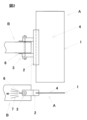
- FIG. 1 is a side view (I) and a plan view (II) schematically showing an embodiment of the golf putting practice device of the present invention.
- FIG. 2 is a schematic view showing an embodiment of the connecting part (3) between the support part (B) and the holding part (2) of the golf putting practice device of the present invention.
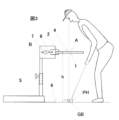
- FIG. 3 is a schematic diagram of the golf putting practice device of the present invention used in Example 1.
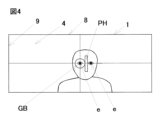
- FIG. 4 shows the golf ball (GB) and putter head (PH) seen through the half mirror (1), and the player's eyes (e) reflected on the mirror surface (4) of the half mirror (1) in Example 1. ), a schematic diagram showing parts of the body such as the face and shoulders.
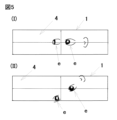
- FIG. 5 is a diagram schematically showing the movement of both eyes on the target line.
- FIG. 6 is a schematic diagram of the golf putting practice device of the present invention used in Example 4.
- FIG. 7 shows the golf ball (GB) and putter head (PH) seen through the half mirror (1), and the player's eyes (e) reflected on the mirror surface (4) of the half mirror (1) in Example 4.
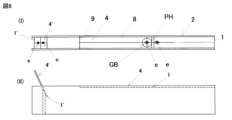
- FIG. 8 shows that the golf putting practice device used in Example 4 is further equipped with a half mirror (1') whose angle can be changed in the direction of movement of the golf ball (target line) of the mirror surface (4').
- 1 is a schematic plan view (I) and a side view (II) of a golf putting practice device of the present invention.
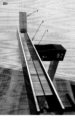
- FIG. FIG. 9 is a perspective view of the golf putting practice device of the present invention used in Example 5.
- FIG. 9 is a perspective view of the golf putting practice device of the present invention used in Example 5.
- FIG. 10 is an enlarged view of the half mirror (1') of the golf putting practice device of the present invention used in Example 5.
- FIG. 11 is a perspective view showing one embodiment of the combination type putting practice device of the present invention.
- FIG. 12 is a plan view (A ), and a schematic diagram showing a plan view (B) of an embodiment of the putting practice mat (II).
- FIG. 1 is a side view (I) and a plan view (II) schematically showing an embodiment of the golf putting practice device of the present invention.
- the golf putting practice device of the present invention shown in FIG. 1 includes a main body (A) and a support part (B), and the main body (A) includes at least a flat half mirror (1). , and is held in the air by the support part (B).
- the main body (A) is only equipped with a flat half mirror (1), but in order to prevent damage to the half mirror (1), etc.
- the support part (B) does not directly hold the half mirror (1), but the main body part (A) supports the half mirror (1) and the holding part (2) that holds it, for example, the above-mentioned half mirror.
- the support part (B) can also hold the holding part (2) by providing a protective frame or the like provided on the outer periphery of the mirror to prevent damage in (1).
- the mirror surface (4) of the half mirror (1) is held substantially horizontally at a predetermined height (h) from the installation surface (g) of the golf putting practice device.
- the structure for holding the main body part (A) in the air and holding the mirror surface (4) of the half mirror (1) in a substantially horizontal direction is not limited to the structure shown in FIG. 1, but may be any conventionally known structure. structure can be adopted.
- the height (h) from the installation surface (g) of the golf putting practice device to the mirror surface (4) of the half mirror (1), that is, the distance in the direction of gravity, is determined by the person using the putting practice device of the present invention. That is, the player can see the golf ball (GB) through the mirror surface (4) of the half mirror (1), and at the same time see his own eye (e) reflected on the mirror surface (4) of the half mirror (1).
- the player can also see the face and a part of the body, such as the shoulders, and furthermore, the golf ball (GB) can be hit without the putter touching the half mirror (1), There are no particular restrictions.
- the height of a typical player (human) is preferably 10 to 160 cm, more preferably 20 to 100 cm.
- the half mirror refers to a mirror that divides incident light into transmitted light and reflected light at a fixed ratio.
- the ratio of transmitted light and reflected light may be approximately 1:1, but the present invention , a player practicing golf putting can see the golf ball (GB) placed on the installation surface (g) of the golf putting practice device through the half mirror, and at the same time, the player practicing putting There is no particular restriction on the ratio as long as it is possible to see your own eyes (e), preferably your face, shoulders, etc. by being reflected.
- commercially available products can be used, such as acrylic mirror MS001 (trademark) manufactured by Mitsubishi Chemical Infratech Corporation.
- the shape and dimensions of the mirror surface (4) of the half mirror (1) are such that the shape and dimensions of the mirror surface (4) of the half mirror (1) are suitable for the eyes (e) of the player practicing putting using the device, and preferably for the face. , shoulders, etc., are not particularly limited as long as they can be reflected on the mirror surface (4). It is preferably square or substantially rectangular, more preferably substantially rectangular.
- its long side is preferably 5 to 60 cm
- its short side is preferably 2 to 30 cm.
- the long side is preferably 8 to 16 cm
- the short side is preferably 2 to 6 cm
- the long side is preferably 40 to 60 cm.
- a player plays golf by reflecting almost only the eye (e) on the mirror surface (4) of the half mirror (1) and overlapping the reflected eye (e) with the golf ball (GB) that can be seen through the half mirror (1).
- a mirror surface (4) with the former dimensions is sufficient; The latter size is preferable when practicing putting by reflecting the face, shoulders, etc. on the mirror surface (4) and checking the posture during putting.
- a straight line can be drawn on the mirror surface (4) of the half mirror (1) in the direction of launch of the golf ball to serve as a mark to make it easier to align both eyes on the target line. can.
- Other marking lines can also be drawn depending on other uses.
- the width of the straight line drawn is preferably 1 to 3 mm. If the width is too wide, it will be difficult to see the golf ball (GB) under the half mirror (1), while if it is too thin, it will be difficult for the player to see the line.
- a structure (5) for adjusting the directional distance (height) (h) is provided.
- the structure (5) a conventionally known structure can be adopted.
- the inner diameter of the lower part and the outer diameter of the upper part may be adjusted so that the upper part fits snugly into the heightwise part of the support part (B), preferably the lower part of the pipe;
- One example is a structure in which the outer diameter of the side part and the inner diameter of the upper part are adjusted, the height is adjusted by raising and lowering the upper part of the pipe, and the pipe is fixed with screws.
- the height (h) can be adjusted as long as it is possible, preferably within the range of 10 to 160 cm, more preferably within the range of 20 to 100 cm.
- the distance (height) (h) By changing the distance (height) (h), the size of the eyes (e) etc. reflected on the mirror surface (4) of the half mirror (1) can be adjusted, so the height can be adjusted to suit each player.
- the putting practice device of the present invention preferably, the height (h) of the mirror surface (4) of the half mirror (1) is increased so that both eyes of the player are reflected relatively largely on the mirror surface (4). Practicing putting allows you to more clearly see the movement of your eyes, making it a very effective practice. In some cases, you can also practice moving your eyes to the target line by turning your head without putting. This can also be very effective.
- the support part (B) holds the mirror surface (4) of the half mirror (1) provided in the main body part (A) within 20 degrees with respect to the horizontal direction. It further includes a structure that allows the angle to be changed preferably within 15 degrees, more preferably within 10 degrees, even more preferably within 7 degrees. This allows the player to find the optimal angle with respect to the green surface when viewing the golf ball, and also allows the player to repeatedly practice putting at that angle.
- the angle of the mirror surface (4) with respect to the horizontal direction means an angle in any direction above or below with respect to the horizontal direction, and usually from the horizontal direction to the installation surface of the support part (B) (where the golf ball is placed means the angle in the direction (downward).
- the optimal angle can be determined, for example, by finding the angle that allows the player to hit the ball most directly toward the target in the most comfortable posture. Furthermore, it is also preferable to ask a professional golfer for advice on whether the angle that the player has found is truly optimal.
- the angle-changeable structure provided in the support part (B) a known structure can usually be adopted.
- the angle changeable structure of the support part (B) includes a joint part (3) between the support part (B) and the holding part (2) of the half mirror (1), and With the portion (3) as the center of rotation, rotate the mirror surface (4) of the half mirror (1) to the mirror surface (4) on the side facing the joint portion (3) (the side away from the joint portion (3)).
- FIG. 2 shows a schematic diagram of an embodiment of the coupling portion mentioned as an example above.
- the connecting portion (3) shown in FIG. 2 is composed of a bolt and a nut, and is usually fixed with the angle indicator (6) aligned at 90 degrees (horizontal direction).
- the angle of the mirror surface (4) can be changed freely by loosening the nut, setting it to a predetermined angle, and then fixing it again.
- the changed angle can be confirmed by the angle scale (7) (fine scales and numerical values are not shown in FIG. 2).
- the combination putting practice device of the present invention includes a main body (A) including at least a flat half mirror (1), and a support part (B) that holds the main body (A) in the air,
- the part (B) has a structure for holding the mirror surface (4) of the half mirror (1) provided in the main body part (A) in a substantially horizontal direction, and the main body part (A) It further includes a holding part (2) that holds the half mirror (1), wherein the mirror surface (4) of the half mirror (1) is approximately rectangular, and the holding part (2) is configured to hold the approximately rectangular shape.
- the golf putting practice device (I) is a substantially parallel rectangle, and the upper surface (11) of the two flat plates (10) included in the holding portion (2) is substantially parallel to the long sides of each rectangle.
- the support portion (B) supports the mirror surface (4) of the half mirror (1) provided in the main body portion (A) in a horizontal direction. It further includes a structure capable of changing the angle within 20 degrees, preferably within 15 degrees, more preferably within 10 degrees, and even more preferably within 7 degrees.
- the golf putting practice device (I) used in the combination type putting practice device is basically the same as the golf putting practice device of the present invention described above.
- FIG. 11 is a perspective view showing one embodiment of the combination putting practice device of the present invention
- FIG. 12 shows the golf putting practice device (I) in the combination putting practice device shown in FIG.
- the half mirror (1) is held by a holding part (2), and the shape of the half mirror (1) is approximately rectangular.
- the dimensions of the long side and short side of the half mirror (1) are as described above, and the long side is preferably 8 to 16 cm, and the short side is preferably 2 to 6 cm.
- the two parallel flat plates (10) are usually perpendicular to the mirror surface (4).
- the shapes of the upper surfaces (11) of the two parallel flat plates (10) are both rectangular, and the two rectangular surfaces are on the same plane and approximately parallel to the mirror surface (4). (This includes the case where the two rectangular surfaces (11) and the mirror surface (4) are on the same plane.)
- the two rectangles are in a congruent relationship, and more preferably, the two flat plates (10) are in a congruent relationship.
- the widths (lengths of the short sides of the rectangles) (d3, d3') of these two substantially rectangular upper surfaces (11) are preferably 3 to 20 mm, more preferably 3 to 10 mm, and still more preferably 3 to 7 mm. be. Further, the length of the two substantially rectangular upper surfaces (11) (long side length of the rectangle) is preferably greater than or equal to the long side length of the half mirror (1) to be held, and preferably It is about 2 to 5 times the length of the long side.
- the distance (d1) between the two long sides facing each other on the inside of each rectangle of the upper surface (11) of the two flat plates (10) is 20 to 60 mm, preferably 35 to 45 mm, and the distance (d1) is 20 to 60 mm, preferably 35 to 45 mm. d1) is preferably equal to the length of the short side of the mirror surface (4) of the substantially rectangular half mirror (1).
- a putting practice mat (II) used in combination with the golf putting practice device of the present invention includes two parallel rectangular straight lines (12).
- the two straight lines (12) are both substantially parallel to the long sides of the rectangles of the upper surfaces (11) of the two flat plates (10) included in the holding part (2), and Each of the rectangles on the upper surface (11) of the flat plate (10) has an inner distance (d2) larger than the distance (d1) between the two opposing long sides.
- the distance (d2) between the two long sides facing each other on the inside of the two parallel rectangular straight lines (12) is preferably 50 to 70 mm, more preferably 55 to 65 mm.
- the widths (d4, d4') of each of the two parallel rectangular straight lines (12) are preferably 8 to 12 mm, more preferably 9 to 11 mm. be.
- the putting practice mat has a belt-like, substantially rectangular shape, and its length (long side length) is not particularly limited, and the length ( It may be at least 2 to 3 times the length of the long side of the rectangle, and at most about 50 times, and can be determined as appropriate depending on the method and place of use.
- the width (length of the short side of the rectangle) may be any size that can accommodate the two parallel rectangular straight lines (12) described above.
- the long sides of each rectangle of the upper surface (11) of the two flat plates (10) included in the holding part (2) of the golf putting practice device (I) and the putting practice mat There is no particular restriction on the method of combining the two parallel rectangular straight lines (12) provided in (II) so that they are substantially parallel, and the user can easily combine them in any way. can.
- An example is as follows.
- the mirror surface (4) of the half mirror (1) provided in the main body (A) of the golf putting practice device (I) is preferably rectangular, and the mirror surface (4) usually has a short Straight lines of the predetermined width are provided from the midpoints of the sides and the long sides in parallel to the long sides and the short sides, respectively, and these straight lines intersect at right angles to form a cross.
- the putting practice mat (II) has a distance (d2) between the two long sides (14) facing each other inside the two rectangular straight lines (12), that is, the distance between the two long sides (14).
- any dimension preferably 20 to 50 cm in length and width. is a straight line (13) of 2 to 10 mm, and any dimension perpendicular to the straight line (13) near its midpoint, preferably the length is inside the two rectangular straight lines (12).
- a straight line (13') is provided which exceeds the distance (d2) between the two opposing long sides (14) and is less than the width of the mat (II) and has a width of 2 to 10 mm. form a cross by intersecting at right angles.
- the user After setting the mirror surface (4) of the half mirror (1) so that it is horizontal, the user places his or her eyes reflected on the mirror surface (4) and the center of the cross drawn on the mirror surface (4).
- the golf putting practice device (I) so that the center of the cross drawn on the putting practice mat (II) and the center of the cross drawn on the putting practice mat (II) are in a straight line, and the corresponding straight lines forming the two crosses overlap each other. They can be easily combined by moving and installing them.
- FIG. 3 shows the golf putting practice device of the present invention used in Example 1.
- the putting practice device is similar to the device shown in FIG. 1, and employs the structure shown in FIG. 2 as the angle-changeable structure of the support portion (B).
- the main body (A) includes a flat half mirror (1) and a holding part (2) that holds it, and one of the long sides of the half mirror (1) is held between the holding parts (2). It is something to keep.
- the shape of the mirror surface (4) of the half mirror (1) was approximately rectangular, and its dimensions were 50 cm on the long side (8) and 20 cm on the short side (9).
- the mirror surface (4) has two straight lines approximately 2 mm wide that are perpendicular to each other at approximately the center and parallel to the long and short sides of the mirror surface (4), extending over the entire length in the long and short sides. It was drawn by printing.
- the structure (5) for adjusting the distance (height) (h) in the direction of gravity from the installation surface (g) of the putting practice device to the mirror surface (4) of the half mirror (1) allows ) could be adjusted in the range of 50 to 100 cm.
- the mirror surface (4) of the half mirror (1) is installed in a substantially horizontal direction, and is adjusted to match Player K's height (168 cm), and the player K's own eyes (e) are large and large on the mirror surface (4).
- the height (h) of the mirror surface (4) was adjusted to 70 cm to ensure a clear image.
- visually check the mirror surface (4 ) The putter mat was placed so that the ball cup was on an extension of the straight line drawn in the long side direction of the ball. In this example, since the practice was indoors at home, a putter mat was used as described above, but such a commercially available putter mat may or may not be used, and whether or not it is used has no bearing on the present invention. It has nothing to do with it.
- FIG. 4 shows the golf ball (GB) and putter head (PH) seen through the half mirror (1), as well as the player's eyes (e), face, shoulders, and other body parts reflected on the mirror surface (4). A part of it was shown.
- Player K used this state as his basic position and putted while maintaining this state, that is, without moving the position of his eyes (e). Putting practice was carried out by repeating this action.
- Example 2 In Example 2, the same apparatus as in Example 1 was used. Player K experienced that by using the putting practice device of Example 1 and practicing while taking the posture described in Example 1, the above effects could be obtained. However, since Player K is relatively short at 168 cm, he also realized that it is not easy to repeatedly maintain this posture when putting. Therefore, the same putting practice as in Example 1 was repeated by changing the angle of the mirror surface (4) of the half mirror (1) by 1 degree from the approximately horizontal direction (90 degrees) to 80 degrees. I searched for the angle that would allow me to hit the ball straight to the target in a comfortable position.
- the angle of the mirror surface (4) is set to 85 degrees, that is, the angle at which the golf ball is viewed (player K's left eye, the point where the two straight lines drawn on the mirror surface (4) intersect, and the angle of the golf ball
- the angle between the line connecting the approximate centers and the contact surface of the golf ball was set to 85 degrees, it became possible to continue the putting practice described in Example 1 without difficulty.
- Player K was able to acquire a putting form suitable for him and improve the reproducibility of the putting form through repeated practice.
- a putter with a lie angle suitable for this angle was custom-made for Player K, he was able to significantly improve his putting technique by practicing with the putting practice device.
- Example 3 In Example 3, the same player K as in Example 1 used the same device as in Example 1 to practice reliably identifying the target line before and after putting. However, the height (h) of the mirror surface (4) was adjusted to 100 cm so that Player K's own eyes (e) were reflected larger and more clearly on the mirror surface (4).
- the basic method of determining the target line is to turn the head so as to move both eyes (e) onto the target line, as shown in FIG. 5(I). However, it is very difficult to move both eyes in the basic manner, and even if the player himself thinks that he is moving both eyes (e) in the basic manner, in reality, as shown in Figure 5 (II), The reality is that both eyes (e) are moving. Player K practices rotating his neck to move both eyes (e) in line with the long side line drawn on the mirror surface (4) of the half mirror (1) without hitting the golf ball. repeated. Next, the angle of the mirror surface (4) was adjusted to 85 degrees and the same exercise was repeated.
- the golf putting practice device of the present invention since it is possible to display player K's own eyes (e) large and clearly on the mirror surface (4), the player K's own eyes (e) can be projected onto the target line. I was able to effectively practice moving. Furthermore, among the conventionally known golf putting practice devices, there is no device that can clearly display both eyes (e) in this way, and it is not possible to carry out such putting practice effectively. Ta.
- FIG. 6 shows the golf putting practice device of the present invention used in Example 4.
- the structure shown in FIG. 2 is adopted as the angle-changeable structure of the support part (B).
- the main body portion (A) includes a flat half mirror (1) and a holding portion (2) that holds the half mirror.
- the shape of the mirror surface (4) of the half mirror (1) was approximately rectangular, and its dimensions were 50 cm on the long side (8) and 5 cm on the short side (9).
- the mirror surface (4) has two straight lines about 2 mm wide that are perpendicular to each other at approximately the center and parallel to the long and short sides of the mirror surface (4), extending over the entire length in the long and short side directions. It was drawn by printing.
- the structure (5) for adjusting the distance (height) (h) in the direction of gravity from the installation surface (g) of the putting practice device to the mirror surface (4) of the half mirror (1) allows ) could be adjusted in the range of 20 to 50 cm.
- the mirror surface (4) of the half mirror (1) was installed in a substantially horizontal direction, and the height (h) of the mirror surface (4) was adjusted to 40 cm.
- the putting practice device used was relatively compact and lightweight, making it easy to carry, and it was actually set up on the green for putting practice.
- Putting practice was carried out in the same manner as in Example 1.
- FIG. 7 shows the golf ball (GB) and putter head (PH) seen through the half mirror (1) and the player K's eyes (e) reflected on the mirror surface (4) at rest. Player K used this state as his basic position and putted while maintaining this state, that is, without moving the position of his eyes (e). Putting practice was carried out by repeating this action.
- Player K putsts without moving his eyes (e) until the moment when the putter head (PH) hits the golf ball (GB), and then moves both eyes on the target line.
- the participants practiced putting by turning their heads to check whether the golf ball (GB) was moving reliably on the target line.
- the short side of the mirror surface (4) is as short as 5 cm, which is not much different from the golf ball's diameter of 43 mm, so it is difficult to see if the golf ball (GB) is moving on the target line after the putt. I was able to more clearly confirm whether or not this was the case.
- Player K adjusted the angle of the mirror surface (4) of the half mirror (1) to the angle found in Example 2 above, that is, 85 degrees, and performed the same practice as above.
- Example 5 In this example, putting practice was performed using the golf putting practice device of the present invention shown in FIG.
- the golf putting practice device of the present invention shown in FIG. 8 is the same as the golf putting practice device used in Example 4 shown in FIGS.
- This golf putting practice device further includes a half mirror (1') that can change the angle of the mirror surface (4').
- the shape and dimensions of the mirror surface (4') of the half mirror (1') were such that the long side (8') was 10 cm and the short side (9') was 5 cm.
- the mirror surface (4') has two straight lines about 2 mm wide that are perpendicular to each other at approximately the center and parallel to the long and short sides of the mirror surface (4'), extending along the entire length in the long and short sides.
- This putting practice device checks whether the player's eyes (e) are moving on the target line when the player looks at the target to hit the golf ball (GB) in advance or when the player hits the golf ball (GB). It is also a device for correcting the movement of one's neck so as to move on the target line and learning the correct putting form.
- FIG. 9 shows a perspective view of the golf putting practice device used here.
- FIG. 10 shows an enlarged view of the half mirror (1') of the golf putting practice device used here.
- the golf ball (GB) and putter head (PH) seen through the half mirror (1) and the player K's eyes (e) reflected on the mirror surface (4) are shown at rest. Indicated. Player K first putts based on this state, maintaining this state, that is, without moving the position of the eye (e). Putting practice was carried out by repeating this action. Following this, Player K putsts without moving his eyes (e) until the moment when the putter head (PH) hits the golf ball (GB), and then moves both eyes on the target line.
- the subject confirmed his/her own eyes reflected on the mirror surface (4') of the half mirror (1') having an angle (here, about 60 degrees with respect to the horizontal direction). At this time, it was confirmed whether or not their own eyes reflected on the mirror surface (4') were on the longitudinal center line (target line) of the mirror surface (4').
- the position where the putter head (PH) hits the golf ball (GB), that is, the right end of the golf ball (GB), is in contact with the point where the two straight lines drawn on the mirror surface (4) intersect. It occurred to me that by setting the ball (GB), it would be possible to more clearly and reliably confirm the moment when the putter head (PH) hits the golf ball (GB).
- the position to place the golf ball (GB) differs depending on each player and depending on whether the effect is on the left eye or the right eye
- the position to place the golf ball (GB) can be found for each player using the golf putting practice device of the present invention. is necessary, and can be easily found using the golf putting practice device of the present invention. If the golf putting practice device of the present invention is used, the player's own eyes will always be reflected on the mirror surface (4) of the half mirror (1) during putting. Therefore, regardless of the point where the two straight lines drawn on the mirror surface (4) intersect (the center of the cross), the player can place the golf ball on the mirror at the optimal position found as described above.
- FIG. 11 shows a combination putting practice device of the present invention used in Example 6, and FIG. 12 shows a half mirror (1) and a holding part (2 ) and a plan view (B) of a putting practice mat (II) used in combination with the putting practice device (I).
- the overall configuration of the golf putting practice device (I) used here is basically the same as the device shown in Fig. 6, but the angle can be changed using a so-called dial type, making it easier and more accurate.
- the structure was such that the angle could be changed and set.
- the shape of the mirror surface (4) of the half mirror (1) was approximately rectangular, and its dimensions were 12 cm on the long side (8) and 4 cm on the short side (9).
- the mirror surface (4) has two straight lines approximately 2 mm wide that are perpendicular to each other at approximately the center and parallel to the long and short sides of the mirror surface (4), extending over the entire length in the long and short sides. It was drawn by printing.
- the structure (5) for adjusting the distance (height) (h) in the direction of gravity from the installation surface (g) of the putting practice device to the mirror surface (4) of the half mirror (1) allows ) could be adjusted in the range of 20 to 100 cm.
- the main body part (A) of the golf putting practice device (I) further includes a holding part (2) that holds the half mirror (1), and the holding part (2) has a substantially rectangular mirror surface (4).
- two flat plates (10) that are substantially parallel to each other and are opposed to each other with the mirror surface (4) in between and are substantially perpendicular to the mirror surface (4) are placed.
- the upper surfaces (11) of the two flat plates (10) are both approximately rectangular, and the dimensions of both are 5 mm (d3, d3') on the short side (width) and 500 mm on the long side (length). there were.
- the upper surfaces (11) of the two flat plates (10) were on the same plane and approximately parallel to the mirror surface (4).
- the distance (d1) between the two long sides facing each other on the inside of each rectangle on the top surface (11) of the two flat plates (10) was 40 mm.
- the putting practice mat (II) used in combination with the putting practice device (I) had a substantially rectangular band shape, and had a width (short side) of about 20 cm and a length (long side) of about 5 m.
- the putting practice mat (II) is provided with two rectangular straight lines (12) parallel to each other over the entire length of the mat (II) and approximately parallel to the long sides of the mat (II). was.
- the two rectangular straight lines (12) parallel to each other have a width (short side of the rectangle) (d4, d4') of 10 mm, and the inside of the two rectangular straight lines (12) is 10 mm.
- the distance (d2) between the two opposing long sides was 60 mm.
- a straight line (13) with a width of about 4 mm and a length of about 35 cm is a straight line centered at a point half the distance (d2) between the two long sides facing each other inside the two rectangular straight lines (12).
- a straight line (13') with a width of about 4 mm and a length of about 35 cm is provided parallel to the straight line (12), and is perpendicular to the straight line (13) at approximately the center in the longitudinal direction of the straight line (13).
- the two straight lines (13, 13') formed a cross.
- the putting practice mat (II) used here has two crosses forming a total of three crosses, approximately in the longitudinal center of the mat, and the center of the cross approximately 60 cm apart from the center in the longitudinal direction. A straight line was provided.
- the putting practice mat (II) When using the combination putting practice device of the present invention, the putting practice mat (II) has two rectangular straight lines (12) parallel to each other provided on the mat (II).
- the two flat plates (10) included in the holding part (2) of the putting practice device (I) were combined so as to be substantially parallel to the long sides of the respective rectangles of the upper surfaces (11).
- the support part (B) of the putting practice device (I) supports the flat half mirror (1). Set the mirror surface (4) so that it is approximately horizontal, and place a cross made of two orthogonal straight lines drawn on the mirror surface (4) and the center of the three crosses provided on the mat (II).
- player K selects each rectangle on the upper surface (11) of the two flat plates (10) provided on the holding part (2) and two rectangular straight lines parallel to each other provided on the mat (II).
- the height (h) was approximately 49 cm.
- player K changes the angle of the mirror surface (4) of the half mirror (1) of the putting practice device (I) in a substantially horizontal direction in the same manner as in Example 2. (90 degrees) to find an angle that would allow Player K to hit the ball straight at the target in the most comfortable position. As a result, it was confirmed that putting practice could be continued without difficulty if the angle of the mirror surface (4) was set to 85 degrees as in Example 2.
- Player K sets the flat half mirror (1) of the putting practice device (I) so that the mirror surface (4) is at an angle of 85 degrees, and practices putting with the putting practice device (I) in the same manner as above.
- a combination putting practice device was created by combining the mat (II).
- the golf putting practice device of the present invention can significantly improve the golf player's putting technique, it is expected that it will be used by many golf players in the future, and as a result, it will bring great benefits to the golf industry. You are expected to make a contribution.
- a Main body of the golf putting practice device B Support part of the golf putting practice device GB Golf ball PH Putter head e Player's eyes g Installation surface h of the golf putting practice device From the installation surface (g) of the golf putting practice device Distance (height) in the direction of gravity to the mirror surface (4) of the half mirror (1) 1 Flat half mirror 2 Holding part 3 of half mirror (1) Connection part between support part (B) and holding part (2) of half mirror (1) 4 Mirror surface 5 of half mirror (1) Height adjustment Structure 6 Angle indicator 7 Angle scale 8 Long side 9 of the mirror surface (4) of the half mirror (1) Short side 10 of the mirror surface (4) of the half mirror (1) Holding part for holding the half mirror (1) 2) includes two flat plates 11; upper surfaces 12 of two flat plates included in the holding part (2) that holds the half mirror (1); two parallel rectangular straight lines 13 provided in the putting practice mat (II); 13' Straight line 14 forming a cross provided on the putting practice mat (II) Two long sides I facing each other on the inside of the two rectangular straight lines (12) provided on the
Landscapes
- Health & Medical Sciences (AREA)
- General Health & Medical Sciences (AREA)
- Physical Education & Sports Medicine (AREA)
- Golf Clubs (AREA)
Priority Applications (3)
| Application Number | Priority Date | Filing Date | Title |
|---|---|---|---|
| KR1020247035057A KR20250004679A (ko) | 2022-04-25 | 2023-04-24 | 골프 퍼팅 연습 장치 |
| JP2023568189A JP7412663B1 (ja) | 2022-04-25 | 2023-04-24 | ゴルフのパッティング練習装置 |
| US18/859,490 US20250262503A1 (en) | 2022-04-25 | 2023-04-24 | Golf putting practice device |
Applications Claiming Priority (2)
| Application Number | Priority Date | Filing Date | Title |
|---|---|---|---|
| JP2022071241 | 2022-04-25 | ||
| JP2022-071241 | 2022-04-25 |
Publications (1)
| Publication Number | Publication Date |
|---|---|
| WO2023210603A1 true WO2023210603A1 (ja) | 2023-11-02 |
Family
ID=88518996
Family Applications (1)
| Application Number | Title | Priority Date | Filing Date |
|---|---|---|---|
| PCT/JP2023/016169 Ceased WO2023210603A1 (ja) | 2022-04-25 | 2023-04-24 | ゴルフのパッティング練習装置 |
Country Status (4)
| Country | Link |
|---|---|
| US (1) | US20250262503A1 (https=) |
| JP (1) | JP7412663B1 (https=) |
| KR (1) | KR20250004679A (https=) |
| WO (1) | WO2023210603A1 (https=) |
Cited By (1)
| Publication number | Priority date | Publication date | Assignee | Title |
|---|---|---|---|---|
| US20240157219A1 (en) * | 2022-11-11 | 2024-05-16 | Eagle i Align LLC | Golf Practice Device |
Citations (3)
| Publication number | Priority date | Publication date | Assignee | Title |
|---|---|---|---|---|
| JPS60195066U (ja) * | 1984-06-06 | 1985-12-26 | 小笠原 長敬 | 照準器付パタ− |
| US5207429A (en) * | 1991-06-21 | 1993-05-04 | Taracan Pty Ltd. | Club aiming unit |
| WO2000040308A1 (en) * | 1999-01-07 | 2000-07-13 | Jonas Munterud | Golfers' practice device with signal to putter |
Family Cites Families (3)
| Publication number | Priority date | Publication date | Assignee | Title |
|---|---|---|---|---|
| JP6082970B2 (ja) | 2013-06-04 | 2017-02-22 | 美加子 清水 | パット練習具 |
| JP3196203U (ja) | 2014-12-12 | 2015-02-26 | 定義 早坂 | パッティングアドレスチェッカー |
| JP3200271U (ja) | 2015-07-13 | 2015-10-15 | 株式会社キッドコーポレーション | スポーツにおけるアドレス(構え)のアライメント確認・訓練用ミラー |
-
2023
- 2023-04-24 JP JP2023568189A patent/JP7412663B1/ja active Active
- 2023-04-24 WO PCT/JP2023/016169 patent/WO2023210603A1/ja not_active Ceased
- 2023-04-24 KR KR1020247035057A patent/KR20250004679A/ko active Pending
- 2023-04-24 US US18/859,490 patent/US20250262503A1/en active Pending
Patent Citations (3)
| Publication number | Priority date | Publication date | Assignee | Title |
|---|---|---|---|---|
| JPS60195066U (ja) * | 1984-06-06 | 1985-12-26 | 小笠原 長敬 | 照準器付パタ− |
| US5207429A (en) * | 1991-06-21 | 1993-05-04 | Taracan Pty Ltd. | Club aiming unit |
| WO2000040308A1 (en) * | 1999-01-07 | 2000-07-13 | Jonas Munterud | Golfers' practice device with signal to putter |
Cited By (2)
| Publication number | Priority date | Publication date | Assignee | Title |
|---|---|---|---|---|
| US20240157219A1 (en) * | 2022-11-11 | 2024-05-16 | Eagle i Align LLC | Golf Practice Device |
| US12576326B2 (en) * | 2022-11-11 | 2026-03-17 | Eagle i Align LLC | Golf practice device |
Also Published As
| Publication number | Publication date |
|---|---|
| JP7412663B1 (ja) | 2024-01-12 |
| US20250262503A1 (en) | 2025-08-21 |
| KR20250004679A (ko) | 2025-01-08 |
| JPWO2023210603A1 (https=) | 2023-11-02 |
Similar Documents
| Publication | Publication Date | Title |
|---|---|---|
| US4441716A (en) | Golf ball including alignment markings and golf ball marking device | |
| US4805913A (en) | Device for developing golf ball address stance | |
| US6152832A (en) | Golf putter and method of putting | |
| US5720668A (en) | Golf club visual alignment means | |
| US20080096686A1 (en) | Putter insert | |
| US8052541B2 (en) | Golf club for golfer alignment | |
| US20100130299A1 (en) | Visual Aid | |
| KR101980597B1 (ko) | 다기능 골프용 퍼터 | |
| WO2004039457A2 (en) | Golf ball marking system | |
| US20090118028A1 (en) | Golf planing putting stroke training device | |
| US7527562B1 (en) | Method and devices for aiming and aligning for a golf shot | |
| JP7412663B1 (ja) | ゴルフのパッティング練習装置 | |
| JPH06506620A (ja) | ゴルフクラブにおけるパターの構造 | |
| US7217198B2 (en) | Golf putting practice aid | |
| US6746339B1 (en) | Putting practice device and practice method using said device | |
| US4545581A (en) | Golf practice aid | |
| US20070243944A1 (en) | Putting Practice Device | |
| US20040053703A1 (en) | Golf putter and method of putting | |
| GB2118049A (en) | Golf swing training device for detecting head movement | |
| US20060183562A1 (en) | Portable putter teaching aid | |
| EP0250643B1 (en) | Muscle alignment mat for teaching, training and practicing the sport of golf | |
| US20040063512A1 (en) | Training device | |
| KR200369782Y1 (ko) | 퍼팅 연습용 눈금 매트 | |
| US20060258477A1 (en) | Putting practice device and its method of use | |
| US20100203985A1 (en) | Putting training device and method |
Legal Events
| Date | Code | Title | Description |
|---|---|---|---|
| WWE | Wipo information: entry into national phase |
Ref document number: 2023568189 Country of ref document: JP |
|
| 121 | Ep: the epo has been informed by wipo that ep was designated in this application |
Ref document number: 23796343 Country of ref document: EP Kind code of ref document: A1 |
|
| WWE | Wipo information: entry into national phase |
Ref document number: 1020247035057 Country of ref document: KR |
|
| WWE | Wipo information: entry into national phase |
Ref document number: 18859490 Country of ref document: US |
|
| NENP | Non-entry into the national phase |
Ref country code: DE |
|
| 122 | Ep: pct application non-entry in european phase |
Ref document number: 23796343 Country of ref document: EP Kind code of ref document: A1 |
|
| WWP | Wipo information: published in national office |
Ref document number: 18859490 Country of ref document: US |