WO2023209494A1 - 表示装置、表示モジュール、電子機器 - Google Patents
表示装置、表示モジュール、電子機器 Download PDFInfo
- Publication number
- WO2023209494A1 WO2023209494A1 PCT/IB2023/053900 IB2023053900W WO2023209494A1 WO 2023209494 A1 WO2023209494 A1 WO 2023209494A1 IB 2023053900 W IB2023053900 W IB 2023053900W WO 2023209494 A1 WO2023209494 A1 WO 2023209494A1
- Authority
- WO
- WIPO (PCT)
- Prior art keywords
- layer
- electrode
- light emitting
- emitting device
- light
- Prior art date
- Legal status (The legal status is an assumption and is not a legal conclusion. Google has not performed a legal analysis and makes no representation as to the accuracy of the status listed.)
- Ceased
Links
Images





























Classifications
-
- H—ELECTRICITY
- H10—SEMICONDUCTOR DEVICES; ELECTRIC SOLID-STATE DEVICES NOT OTHERWISE PROVIDED FOR
- H10K—ORGANIC ELECTRIC SOLID-STATE DEVICES
- H10K59/00—Integrated devices, or assemblies of multiple devices, comprising at least one organic light-emitting element covered by group H10K50/00
- H10K59/90—Assemblies of multiple devices comprising at least one organic light-emitting element
- H10K59/95—Assemblies of multiple devices comprising at least one organic light-emitting element wherein all light-emitting elements are organic, e.g. assembled OLED displays
-
- G—PHYSICS
- G09—EDUCATION; CRYPTOGRAPHY; DISPLAY; ADVERTISING; SEALS
- G09F—DISPLAYING; ADVERTISING; SIGNS; LABELS OR NAME-PLATES; SEALS
- G09F9/00—Indicating arrangements for variable information in which the information is built-up on a support by selection or combination of individual elements
- G09F9/30—Indicating arrangements for variable information in which the information is built-up on a support by selection or combination of individual elements in which the desired character or characters are formed by combining individual elements
-
- G—PHYSICS
- G09—EDUCATION; CRYPTOGRAPHY; DISPLAY; ADVERTISING; SEALS
- G09F—DISPLAYING; ADVERTISING; SIGNS; LABELS OR NAME-PLATES; SEALS
- G09F9/00—Indicating arrangements for variable information in which the information is built-up on a support by selection or combination of individual elements
- G09F9/30—Indicating arrangements for variable information in which the information is built-up on a support by selection or combination of individual elements in which the desired character or characters are formed by combining individual elements
- G09F9/302—Indicating arrangements for variable information in which the information is built-up on a support by selection or combination of individual elements in which the desired character or characters are formed by combining individual elements characterised by the form or geometrical disposition of the individual elements
-
- H—ELECTRICITY
- H10—SEMICONDUCTOR DEVICES; ELECTRIC SOLID-STATE DEVICES NOT OTHERWISE PROVIDED FOR
- H10K—ORGANIC ELECTRIC SOLID-STATE DEVICES
- H10K50/00—Organic light-emitting devices
-
- H—ELECTRICITY
- H10—SEMICONDUCTOR DEVICES; ELECTRIC SOLID-STATE DEVICES NOT OTHERWISE PROVIDED FOR
- H10K—ORGANIC ELECTRIC SOLID-STATE DEVICES
- H10K50/00—Organic light-emitting devices
- H10K50/10—OLEDs or polymer light-emitting diodes [PLED]
- H10K50/11—OLEDs or polymer light-emitting diodes [PLED] characterised by the electroluminescent [EL] layers
-
- H—ELECTRICITY
- H10—SEMICONDUCTOR DEVICES; ELECTRIC SOLID-STATE DEVICES NOT OTHERWISE PROVIDED FOR
- H10K—ORGANIC ELECTRIC SOLID-STATE DEVICES
- H10K50/00—Organic light-emitting devices
- H10K50/10—OLEDs or polymer light-emitting diodes [PLED]
- H10K50/19—Tandem OLEDs
-
- H—ELECTRICITY
- H10—SEMICONDUCTOR DEVICES; ELECTRIC SOLID-STATE DEVICES NOT OTHERWISE PROVIDED FOR
- H10K—ORGANIC ELECTRIC SOLID-STATE DEVICES
- H10K50/00—Organic light-emitting devices
- H10K50/80—Constructional details
- H10K50/85—Arrangements for extracting light from the devices
- H10K50/852—Arrangements for extracting light from the devices comprising a resonant cavity structure, e.g. Bragg reflector pair
-
- H—ELECTRICITY
- H10—SEMICONDUCTOR DEVICES; ELECTRIC SOLID-STATE DEVICES NOT OTHERWISE PROVIDED FOR
- H10K—ORGANIC ELECTRIC SOLID-STATE DEVICES
- H10K59/00—Integrated devices, or assemblies of multiple devices, comprising at least one organic light-emitting element covered by group H10K50/00
-
- H—ELECTRICITY
- H10—SEMICONDUCTOR DEVICES; ELECTRIC SOLID-STATE DEVICES NOT OTHERWISE PROVIDED FOR
- H10K—ORGANIC ELECTRIC SOLID-STATE DEVICES
- H10K59/00—Integrated devices, or assemblies of multiple devices, comprising at least one organic light-emitting element covered by group H10K50/00
- H10K59/10—OLED displays
- H10K59/12—Active-matrix OLED [AMOLED] displays
- H10K59/122—Pixel-defining structures or layers, e.g. banks
-
- H—ELECTRICITY
- H10—SEMICONDUCTOR DEVICES; ELECTRIC SOLID-STATE DEVICES NOT OTHERWISE PROVIDED FOR
- H10K—ORGANIC ELECTRIC SOLID-STATE DEVICES
- H10K59/00—Integrated devices, or assemblies of multiple devices, comprising at least one organic light-emitting element covered by group H10K50/00
- H10K59/10—OLED displays
- H10K59/12—Active-matrix OLED [AMOLED] displays
- H10K59/131—Interconnections, e.g. wiring lines or terminals
-
- H—ELECTRICITY
- H10—SEMICONDUCTOR DEVICES; ELECTRIC SOLID-STATE DEVICES NOT OTHERWISE PROVIDED FOR
- H10K—ORGANIC ELECTRIC SOLID-STATE DEVICES
- H10K59/00—Integrated devices, or assemblies of multiple devices, comprising at least one organic light-emitting element covered by group H10K50/00
- H10K59/30—Devices specially adapted for multicolour light emission
- H10K59/32—Stacked devices having two or more layers, each emitting at different wavelengths
-
- H—ELECTRICITY
- H10—SEMICONDUCTOR DEVICES; ELECTRIC SOLID-STATE DEVICES NOT OTHERWISE PROVIDED FOR
- H10K—ORGANIC ELECTRIC SOLID-STATE DEVICES
- H10K59/00—Integrated devices, or assemblies of multiple devices, comprising at least one organic light-emitting element covered by group H10K50/00
- H10K59/30—Devices specially adapted for multicolour light emission
- H10K59/35—Devices specially adapted for multicolour light emission comprising red-green-blue [RGB] subpixels
-
- H—ELECTRICITY
- H10—SEMICONDUCTOR DEVICES; ELECTRIC SOLID-STATE DEVICES NOT OTHERWISE PROVIDED FOR
- H10K—ORGANIC ELECTRIC SOLID-STATE DEVICES
- H10K59/00—Integrated devices, or assemblies of multiple devices, comprising at least one organic light-emitting element covered by group H10K50/00
- H10K59/80—Constructional details
- H10K59/875—Arrangements for extracting light from the devices
- H10K59/878—Arrangements for extracting light from the devices comprising reflective means
Definitions
- One embodiment of the present invention relates to a display device, a display module, an electronic device, or a semiconductor device.
- one embodiment of the present invention is not limited to the above technical field.
- the technical field of one embodiment of the invention disclosed in this specification and the like relates to products, methods, or manufacturing methods.
- one aspect of the present invention relates to a process, machine, manufacture, or composition of matter. Therefore, more specifically, the technical fields of one embodiment of the present invention disclosed in this specification include semiconductor devices, display devices, light-emitting devices, power storage devices, storage devices, driving methods thereof, or manufacturing methods thereof; can be cited as an example.
- Examples of devices that require high-definition display panels include smartphones, tablet terminals, and notebook computers. Further, even in stationary display devices such as television devices and monitor devices, higher definition is required as the resolution increases. Further, examples of devices that require the highest definition include, for example, devices for virtual reality (VR) or augmented reality (AR).
- VR virtual reality
- AR augmented reality
- display devices that can be applied to display panels are typically liquid crystal display devices, organic EL (Electro Luminescence) elements, light emitting devices including light emitting elements such as light emitting diodes (LEDs), and electrophoretic devices.
- Examples include electronic paper that performs display based on a method or the like.
- the basic structure of an organic EL element is such that a layer containing a luminescent organic compound is sandwiched between a pair of electrodes. By applying a voltage to this element, luminescence can be obtained from the luminescent organic compound.
- a display device to which such an organic EL element is applied does not require a backlight that is required in a liquid crystal display device or the like, so it is possible to realize a display device that is thin, lightweight, has high contrast, and has low power consumption.
- Patent Document 1 an example of a display device using an organic EL element is described in Patent Document 1.
- Patent Document 2 discloses a display device for VR using an organic EL device.
- An object of one embodiment of the present invention is to provide a novel display device that is excellent in convenience, usefulness, and reliability.
- Another object of the present invention is to provide a novel display module that is convenient, useful, or reliable.
- one of the challenges is to provide a new electronic device that is convenient, useful, or reliable.
- one of the objects is to provide a new display device, a new display module, a new electronic device, or a new semiconductor device.
- One embodiment of the present invention is a display device including a first light-emitting device, a second light-emitting device, a third light-emitting device, and a fourth light-emitting device.
- the first light emitting device includes a first electrode, a first layer, a second layer and a second electrode.
- a first layer is sandwiched between a first electrode and a second electrode, and the first layer includes a first emissive material.
- a second layer is sandwiched between the first layer and the first electrode.
- the second light emitting device includes a third electrode, a third layer, a fourth layer and a fourth electrode.
- the third electrode is adjacent to the first electrode, the third electrode has a first gap therebetween, and the third layer is adjacent to the third electrode and the fourth electrode.
- Sandwiched therebetween, a third layer includes a second emissive material.
- a fourth layer is sandwiched between the third layer and the third electrode, and the fourth layer is continuous with the second layer over the first gap.
- the third light emitting device includes a fifth electrode, a fifth layer, a sixth layer and a sixth electrode.
- the fifth electrode is adjacent to the third electrode, the fifth electrode has a second gap between the fifth electrode and the third electrode, and the fifth layer has a second gap between the fifth electrode and the sixth electrode.
- Sandwiched therebetween, a fifth layer includes a third emissive material.
- a sixth layer is sandwiched between the fifth layer and the fifth electrode, the sixth layer has a third gap between it and the fourth layer, and the third gap has a second gap. overlaps with
- the fourth light emitting device includes a seventh electrode, a seventh layer, an eighth layer and an eighth electrode.
- the seventh electrode is adjacent to the fifth electrode, the seventh electrode has a fourth gap between it and the fifth electrode, and the seventh layer is adjacent to the seventh electrode and the eighth electrode.
- Sandwiched therebetween, a seventh layer includes a fourth emissive material.
- the eighth layer is sandwiched between the seventh layer and the seventh electrode, the eighth layer has a fifth gap between it and the sixth layer, and the fifth gap has a fourth gap. overlaps with the gap.
- the first light-emitting device has a current efficiency of 1 cd/A or more and less than 10 cd/A
- the second light-emitting device has a current efficiency of 1 cd/A or more and less than 10 cd/A
- the third light emitting device has a current efficiency of 10 cd/A or more and less than 100 cd/A
- the fourth light emitting device has a current efficiency of 10 cd/A or more and less than 100 cd/A.
- the first light emitting device has a light emission starting voltage in a range of 3V or more and less than 4V
- the second light emitting device has a light emission starting voltage in a range of 3V or more and less than 4V
- the third light emitting device has a light emission starting voltage in a range of 2V or more and less than 3V
- the fourth light emitting device has a light emission starting voltage in a range of 2V or more and less than 3V.
- the first layer includes a first luminescent material that emits fluorescence
- the third layer includes a second luminescent material that emits fluorescence
- the fifth layer includes a second luminescent material that emits fluorescence.
- the seventh layer includes a third luminescent material that emits phosphorescence
- the seventh layer includes a fourth luminescent material that emits phosphorescence.
- the first luminescent material has an emission spectrum with a maximum peak in a range of 380 nm or more and 480 nm or less
- the second luminescent material has an emission spectrum in a range of 380 nm or more and 480 nm or less
- the third luminescent material has an emission spectrum with a maximum peak in a range of 500 nm or more and 550 nm or less
- the fourth luminescent material has an emission spectrum with a maximum peak in a range of 600 nm or more and 780 nm or less.
- the above display device has an emission spectrum with a peak.
- one embodiment of the present invention is the above display device, wherein each of the first gap, the second gap, and the fourth gap is 0.1 ⁇ m or more and 15 ⁇ m or less.
- the other light emitting devices emit light with unintended brightness.
- the first light emitting device, the second light emitting device, the third light emitting device, and the fourth light emitting device can each independently emit light.
- the color gamut that can be displayed by the display device can be expanded.
- the definition of the display device can be improved.
- the pixel aperture ratio of the display device can be increased.
- a phenomenon in which the first layer or the third layer peels off can be prevented.
- a novel display device with excellent convenience, usefulness, and reliability can be provided.
- one embodiment of the present invention is the above display device including a first insulating film, a conductive film, and a second insulating film.
- the first insulating film overlaps the conductive film, and the first insulating film and the conductive film sandwich the first electrode, the third electrode, and the fifth electrode. Further, the conductive film includes a second electrode, a fourth electrode, and a sixth electrode.
- the second insulating film is sandwiched between the conductive film and the first insulating film, the second insulating film overlaps the first gap, the second insulating film overlaps the second gap, and the second insulating film overlaps the second gap.
- the insulating film fills the third gap.
- the second insulating film includes a first opening, a second opening, and a third opening.
- the first opening overlaps the first electrode
- the second opening overlaps the third electrode
- the third opening overlaps the fifth electrode.
- the third gap can be filled using the second insulating film. Furthermore, the step caused by the third gap can be made nearly flat. Further, it is possible to suppress a phenomenon in which cuts or tears occur in the conductive film 552 due to the step. As a result, a novel display device with excellent convenience, usefulness, and reliability can be provided.
- one aspect of the present invention is a display module including the display device according to any one of the above, and at least one of a connector and an integrated circuit.
- one embodiment of the present invention is an electronic device including the display device according to any one of the above, and at least one of a battery, a camera, a speaker, and a microphone.
- the light-emitting device in this specification includes an image display device using a light-emitting device.
- a module in which a connector such as an anisotropic conductive film or TCP (Tape Carrier Package) is attached to a light emitting device a module in which a printed wiring board is provided at the end of TCP, or a COG (Chip On Glass) method in a light emitting device
- a light emitting device may also include a module on which an IC (integrated circuit) is directly mounted.
- lighting equipment and the like may include a light emitting device.
- a novel display device that is highly convenient, useful, and reliable can be provided. Further, one embodiment of the present invention can provide a novel display module that is highly convenient, useful, and reliable. Further, one embodiment of the present invention can provide a novel electronic device that is highly convenient, useful, and reliable. Furthermore, a new display device can be provided. Furthermore, a new display module can be provided. Moreover, a new electronic device can be provided.
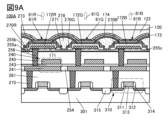
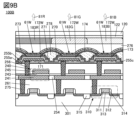
- 1A to 1C are diagrams illustrating the configuration of a display device according to an embodiment.
- 2A and 2B are diagrams illustrating the configuration of a display device according to an embodiment.
- 3A to 3D are diagrams illustrating the configuration of a display device according to an embodiment.
- 4A and 4B are diagrams illustrating the configuration of a light emitting device according to an embodiment.
- 5A and 5B are diagrams illustrating the configuration of a light emitting device according to an embodiment.
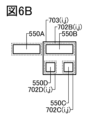
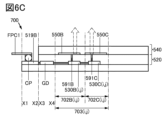
- 6A to 6C are diagrams illustrating the configuration of a display device according to an embodiment.
- FIG. 7 is a diagram illustrating the configuration of a display device according to an embodiment.
- FIG. 8 is a diagram illustrating the configuration of the display module according to the embodiment.
- FIG. 10 is a diagram illustrating the configuration of a display device according to an embodiment.
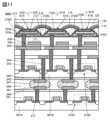
- FIG. 11 is a diagram illustrating the configuration of a display device according to an embodiment.
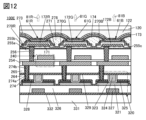
- FIG. 12 is a diagram illustrating the configuration of a display device according to an embodiment.
- FIG. 13 is a diagram illustrating the configuration of a display device according to an embodiment.
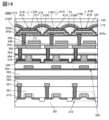
- FIG. 14 is a diagram illustrating the configuration of a display device according to an embodiment.
- FIG. 15 is a diagram illustrating the configuration of the display module according to the embodiment.
- 16A to 16C are diagrams illustrating the configuration of a display device according to an embodiment.
- FIG. 17 is a diagram illustrating the configuration of a display device according to an embodiment.
- FIG. 18 is a diagram illustrating the configuration of a display device according to an embodiment.
- FIG. 19 is a diagram illustrating the configuration of a display device according to an embodiment.
- FIG. 20 is a diagram illustrating the configuration of a display device according to an embodiment.
- FIG. 21 is a diagram illustrating the configuration of a display device according to an embodiment.
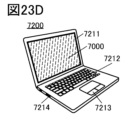
- 22A to 22D are diagrams illustrating an example of an electronic device according to an embodiment.
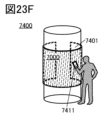
- 23A to 23F are diagrams illustrating an example of an electronic device according to an embodiment.
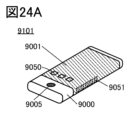
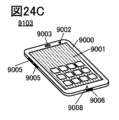
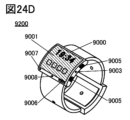
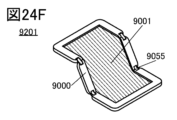
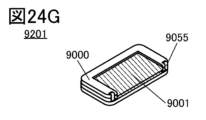
- 24A to 24G are diagrams illustrating an example of an electronic device according to an embodiment.
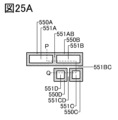
- 25A and 25B are diagrams illustrating the configuration of a display device according to an example.
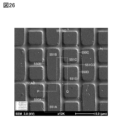
- FIG. 26 is an electron micrograph illustrating the configuration of the display device according to the example.
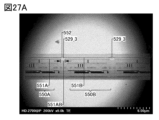
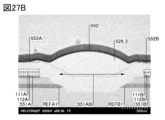
- FIG. 27A and 27B are electron micrographs illustrating the configuration of the display device according to the example.
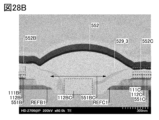
- 28A and 28B are electron micrographs illustrating the configuration of the display device according to the example.
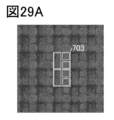
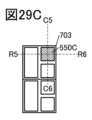
- 29A to 29D are diagrams illustrating the configuration of a display device according to an example.
- FIG. 30 is a diagram illustrating the luminance distribution of a minute area of the display device according to the example.
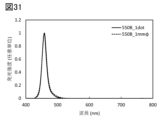
- FIG. 31 is a diagram illustrating the emission spectrum of the display device according to the example.
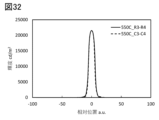
- FIG. 32 is a diagram illustrating the luminance distribution of a minute area of the display device according to the example.
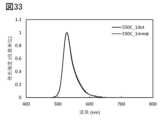
- FIG. 33 is a diagram illustrating the emission spectrum of the display device according to the example.
- FIG. 34 is a diagram illustrating the luminance distribution of a minute area of the display device according to the example.
- FIG. 35 is a diagram illustrating the emission spectrum of the display device according to the example.
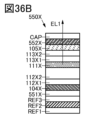
- 36A and 36B are diagrams illustrating the configuration of a display device according to an example.
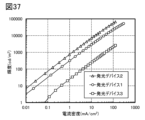
- FIG. 37 is a diagram illustrating current density-luminance characteristics of the light emitting device according to the example.
- FIG. 38 is a diagram illustrating the brightness-current efficiency characteristics of the light emitting device according to the example.
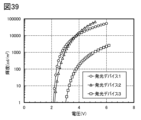
- FIG. 39 is a diagram illustrating voltage-luminance characteristics of the light emitting device according to the example.
- FIG. 40 is a diagram illustrating voltage-current characteristics of the light emitting device according to the example.
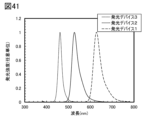
- FIG. 41 is a diagram illustrating the emission spectrum of the light emitting device according to the example.
- FIG. 42A is a photograph for explaining the display state of the display device according to the example, and FIG.
- FIG. 42B is a photograph for explaining the arrangement of pixels.
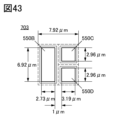
- FIG. 43 is a photograph illustrating the arrangement of pixels of the display device according to the example.
- FIG. 44 is a photograph illustrating the color gamut that can be displayed by the display device according to the example.
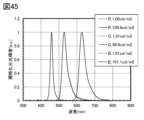
- FIG. 45 is a photograph illustrating the emission spectrum of the display device according to the example.
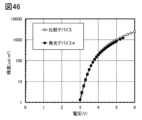
- FIG. 46 is a diagram illustrating voltage-luminance characteristics of the light emitting device according to the example.
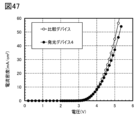
- FIG. 47 is a diagram illustrating voltage-current density characteristics of the light emitting device according to the example.
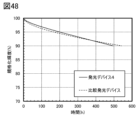
- FIG. 48 is a diagram illustrating the change over time in the normalized luminance of the light emitting device according to the example.
- a display device includes a first light-emitting device, a second light-emitting device, a third light-emitting device, and a fourth light-emitting device.
- the first light emitting device includes a first electrode, a first layer, a second layer and a second electrode.
- a first layer is sandwiched between a first electrode and a second electrode, and the first layer includes a first emissive material.
- a second layer is sandwiched between the first layer and the first electrode.
- the second light emitting device includes a third electrode, a third layer, a fourth layer and a fourth electrode.
- the third electrode is adjacent to the first electrode, the third electrode has a first gap therebetween, and the third layer is adjacent to the third electrode and the fourth electrode.
- a third layer includes a second emissive material.
- a fourth layer is sandwiched between the third layer and the third electrode, and the fourth layer is continuous with the second layer over the first gap.
- the third light emitting device includes a fifth electrode, a fifth layer, a sixth layer and a sixth electrode.
- the fifth electrode is adjacent to the third electrode, the fifth electrode has a second gap between the fifth electrode and the third electrode, and the fifth layer has a second gap between the fifth electrode and the sixth electrode.
- a fifth layer includes a third emissive material.
- a sixth layer is sandwiched between the fifth layer and the fifth electrode, the sixth layer has a third gap between it and the fourth layer, and the third gap has a second gap.
- the fourth light emitting device includes a seventh electrode, a seventh layer, an eighth layer and an eighth electrode.
- the seventh electrode is adjacent to the fifth electrode, the seventh electrode has a fourth gap between it and the fifth electrode, and the seventh layer is adjacent to the seventh electrode and the eighth electrode.
- Sandwiched therebetween, a seventh layer includes a fourth emissive material.
- the eighth layer is sandwiched between the seventh layer and the seventh electrode, the eighth layer has a fifth gap between it and the sixth layer, and the fifth gap has a fourth gap. overlaps with the gap.
- the other light emitting devices emit light with unintended brightness.
- the first light emitting device, the second light emitting device, the third light emitting device, and the fourth light emitting device can each independently emit light.
- the color gamut that can be displayed by the display device can be expanded.
- the definition of the display device can be improved.
- the pixel aperture ratio of the display device can be increased.
- a phenomenon in which the first layer or the third layer peels off can be prevented.
- a novel display device with excellent convenience, usefulness, and reliability can be provided.
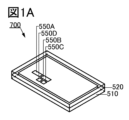
- FIG. 1A is a perspective view illustrating the structure of a display device 700 according to one embodiment of the present invention.
- FIG. 1B is a top view illustrating a part of the display device 700, and
- FIG. 1C is a cross-sectional view taken along the cutting line PQ shown in FIG. 1B.
- FIGS. 2A and 2B are top views illustrating part of a display device 700 of one embodiment of the present invention.
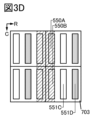
- 3A to 3D are top views illustrating part of a display device 700 of one embodiment of the present invention.
- a display device 700 described in this embodiment includes a substrate 510 and a functional layer 520 (see FIG. 1A).
- the display device 700 includes a light emitting device 550A, a light emitting device 550B, a light emitting device 550C, and a light emitting device 550D (see FIGS. 1A and 1B).
- the functional layer 520 includes an insulating film 521, and a light emitting device 550A, a light emitting device 550B, a light emitting device 550C, and a light emitting device 550D are formed on the insulating film 521 (see FIG. 1C). Functional layer 520 is sandwiched between substrate 510 and light emitting device 550A.
- Light emitting device 550A includes electrode 551A, layer 111A, layer 112A and electrode 552A.
- Light emitting device 550A also includes layer 113A. Note that details of the configuration that can be used for the light emitting device 550A will be described in Embodiments 2 to 6.
- a light emitting device with a current efficiency of 1 cd/A or more and less than 10 cd/A can be used as the light emitting device 550A.
- a light emitting device having a light emission start voltage in a range of 3 V or more and less than 4 V can be used as the light emitting device 550A.
- the minimum voltage for obtaining a luminance of 10 cd/m 2 or more is referred to as a light emission starting voltage.
- Layer 111A is sandwiched between electrode 551A and electrode 552A, and layer 111A includes a luminescent material EMA.
- a luminescent material EMA that emits fluorescence can be used for layer 111A.
- a luminescent material having an emission spectrum with a maximum peak in the range of 380 nm or more and 480 nm or less can be used for the luminescent material EMA.
- layer 112A is sandwiched between layer 111A and electrode 551A.
- Light emitting device 550B includes electrode 551B, layer 111B, layer 112B and electrode 552B.
- Light emitting device 550B also includes layer 113B. Note that details of the configuration that can be used for the light emitting device 550B will be described in Embodiments 2 to 6.
- Electrode 551B is adjacent to electrode 551A, and electrode 551B has a gap 551AB between electrode 551A and electrode 551A. Note that the gap 551AB is 0.1 ⁇ m or more and 15 ⁇ m or less.
- the distance between the part where the electrode 551B is closest to the electrode 551A is defined as the length of the gap 551AB.
- the lower end portion of electrode 551B is closest to the lower end portion of electrode 551A (see FIG. 1C).
- the distance between the lower end portion of the electrode 551B and the lower end portion of the electrode 551A is set as the length of the gap 551AB.
- the electrode 551B is formed on one conductive film to which the same potential as the electrode 551B is supplied, and the electrode 551A is formed on another conductive film to which the same potential as the electrode 551A is supplied.
- the distance between the portion where the electrode 551B or one conductive film is closest to the electrode 551A or the other conductive film is defined as the length of the gap 551AB.
- the electrode 551B is formed on one conductive film that functions as a wiring
- the electrode 551A is formed on another conductive film that functions as a wiring
- the distance between one conductive film and the other conductive film is The length is the gap 551AB.
- the electrode 551B is formed on one conductive film that functions as a reflective film and the electrode 551A is formed on another conductive film that functions as a reflective film, one conductive film and the other conductive film Let the distance be the length of the gap 551AB.
- a light emitting device with a current efficiency of 1 cd/A or more and less than 10 cd/A can be used as the light emitting device 550B.
- a light emitting device having a light emission start voltage in a range of 3 V or more and less than 4 V can be used as the light emitting device 550B.
- Layer 111B is sandwiched between electrode 551B and electrode 552B, and layer 111B includes a luminescent material EMB.
- a luminescent material EMB that emits fluorescence can be used for layer 111B.
- a luminescent material having an emission spectrum with a maximum peak in the range of 380 nm or more and 480 nm or less can be used as the luminescent material EMB.
- the light emitted by the light emitting device 550A and the light emitting device 550B is in a region with low visibility.
- one of the light emitting devices 550A and 550B emits light, it is difficult to recognize the light emitted by the other.
- layer 112B is sandwiched between layer 111B and electrode 551B, and layer 112B is continuous with layer 112A over gap 551AB.
- Light emitting device 550C includes electrode 551C, layer 111C, layer 112C and electrode 552C.
- Light emitting device 550C also includes layer 113C. Note that details of the configuration that can be used for the light emitting device 550C will be described in Embodiments 2 to 6.
- the electrode 551C is adjacent to the electrode 551B, and a gap 551BC is provided between the electrode 551C and the electrode 551B. Note that the gap 551BC is 0.1 ⁇ m or more and 15 ⁇ m or less.
- a light emitting device with a current efficiency of 10 cd/A or more and less than 100 cd/A can be used as the light emitting device 550C.
- a light emitting device having a light emission start voltage in a range of 2 V or more and less than 3 V can be used as the light emitting device 550C. This can suppress the occurrence of a phenomenon in which the light emitting device 550C emits light with unintended brightness when the light emitting device 550B emits light.
- Layer 111C is sandwiched between electrode 551C and electrode 552C, and layer 111C includes a luminescent material EMC.
- a luminescent material EMC can be used for layer 111C.
- a luminescent material having an emission spectrum with a maximum peak in the range of 500 nm or more and 550 nm or less can be used as the luminescent material EMC.
- the layer 112C is sandwiched between the layer 111C and the electrode 551C, and a gap 112BC is provided between the layer 112C and the layer 112B.
- the gap 112BC overlaps with the gap 551BC. This allows layer 112C to be separated from layer 112B.
- the light emitting device 550B emits light, it is possible to prevent carriers from flowing from the layer 112B to the layer 112C.
- the light emitting device 550B emits light, it is possible to suppress the occurrence of a phenomenon in which the light emitting device 550C emits light at an unintended brightness.
- a gap 112BC is provided between the layer 112C and the layer 112B.
- layer 112B is continuous with layer 112A without any gap therebetween.
- the gap 551AB can be made shorter than the gap 551BC that overlaps the gap 112BC.
- the distance between light emitting device A and light emitting device B can be shortened compared to the distance between light emitting device C and other adjacent light emitting devices.
- the aperture ratios of light-emitting device B and light-emitting device A can be made higher than those of other light-emitting devices.
- Light emitting device 550D includes electrode 551D, layer 111D, layer 112D and electrode 552D.
- Light emitting device 550D also includes layer 113D. Note that details of the configuration that can be used for the light emitting device 550D will be described in Embodiments 2 to 6.
- the electrode 551D is adjacent to the electrode 551C, and a gap 551CD is provided between the electrode 551D and the electrode 551C. Note that the gap 551CD is 0.1 ⁇ m or more and 15 ⁇ m or less.
- a light emitting device with a current efficiency of 10 cd/A or more and less than 100 cd/A can be used as the light emitting device 550D.
- a light emitting device having a light emission start voltage in a range of 2 V or more and less than 3 V can be used as the light emitting device 550D. This can suppress the occurrence of a phenomenon in which the light emitting device 550D emits light with unintended brightness when the light emitting device 550C emits light.
- Layer 111D is sandwiched between electrode 551D and electrode 552D, and layer 111D includes a luminescent material EMD.
- a luminescent material EMD can be used for layer 111D.
- a luminescent material having an emission spectrum with a maximum peak in the range of 600 nm or more and 780 nm or less can be used for luminescent material EMD.
- layer 112D is sandwiched between layer 111D and electrode 551D, and layer 112D has a gap 112CD between layer 112C and layer 112C.
- the gap 112CD overlaps with the gap 551CD. This allows layer 112D to be separated from layer 112C.
- the light emitting device 550C emits light, it is possible to prevent carriers from flowing from the layer 112C to the layer 112D. Further, when the light emitting device 550C emits light, it is possible to suppress the occurrence of a phenomenon in which the light emitting device 550D emits light with unintended brightness.
- any one of the light-emitting device 550A, the light-emitting device 550B, the light-emitting device 550C, and the light-emitting device 550D emits light, it is possible to suppress the occurrence of a phenomenon in which the others emit light with unintended brightness.
- the light emitting device 550A, the light emitting device 550B, the light emitting device 550C, and the light emitting device 550D can each independently emit light. Further, it is possible to suppress the occurrence of a crosstalk phenomenon between light emitting devices.
- the color gamut that can be displayed by the display device can be expanded. Further, the definition of the display device can be improved. Further, the pixel aperture ratio of the display device can be increased.
- the display device 700 described in this embodiment includes an insulating film 521, a conductive film 552, and an insulating film 529_3 (see FIG. 1C).
- the display device 700 also includes the layer 105, a film 529_1, and a film 529_2.
- insulating film 521 overlaps with the conductive film 552, and the insulating film 521 and the conductive film 552 sandwich electrodes 551A, 551B, and 551C.
- the conductive film 552 includes an electrode 552A, an electrode 552B, and an electrode 552C. Further, the conductive film 552 includes an electrode 552D.
- a conductive material can be used for the conductive film 552.
- a material containing a metal, an alloy, or a conductive compound can be used for the conductive film 552 in a single layer or a stacked layer. Note that a structural example that can be used for the conductive film 552 will be described in detail in Embodiment 4.
- Layer 105 includes layer 105A, layer 105B, layer 105C, and layer 105D.
- Materials that facilitate injection of carriers from electrodes 552A, 552B, and 552C can be used for layer 105.
- a material with electron injection properties can be used for layer 105. Note that a configuration example that can be used for the layer 105 will be described in detail in Embodiment 4.
- a device manufactured using a metal mask or an FMM may be referred to as a device with an MM (metal mask) structure.
- a device manufactured without using a metal mask or FMM may be referred to as a device with an MML (metal maskless) structure.
- MML metal maskless
- a device with an MML (metal maskless) structure can be manufactured without using a metal mask, it is possible to exceed the upper limit of the precision caused by the alignment accuracy of the metal mask. Further, equipment related to manufacturing the metal mask and a cleaning process for the metal mask can be made unnecessary. It is also suitable for mass production.
- the membrane 529_1 has a plurality of openings, one of which overlaps the electrode 551A and the electrode 551B, one of the openings overlaps the electrode 551C, and one of the openings overlaps the electrode 551D.
- the film 529_1 includes an opening that overlaps with the gap 551BC and an opening that overlaps with the gap 551CD.
- a film containing a metal, a metal oxide, an organic material, or an inorganic insulating material can be used for the film 529_1.
- a light-shielding metal film can be used. Thereby, it is possible to block the light irradiated during the processing process and suppress the occurrence of a phenomenon in which the characteristics of the light emitting device are impaired by the light.
- the membrane 529_2 has openings, one opening overlaps the electrode 551A and the electrode 551B, one opening overlaps the electrode 551C, and one opening overlaps the electrode 551D. Furthermore, the film 529_2 overlaps the gap 551BC and the gap 551CD.
- Membrane 529_2 includes regions in contact with layer 104A, layer 104B, layer 104C, and layer 104D. Note that the layer 104B is continuous with the layer 104A.
- Membrane 529_2 includes regions in contact with layer 112A, layer 112B, layer 112C, and layer 112D. Note that the layer 112B is continuous with the layer 112A.
- the film 529_2 includes regions in contact with the layer 111A, the layer 111B, the layer 111C, and the layer 111D. Note that the layer 111B is continuous with the layer 111A.
- Membrane 529_2 includes regions in contact with layer 113A, layer 113B, layer 113C, and layer 113D. Note that the layer 113B is continuous with the layer 113A.
- the film 529_2 includes a region in contact with the insulating film 521.
- the film 529_2 can be formed using an atomic layer deposition (ALD) method. Thereby, a film with good coverage can be formed.
- ALD atomic layer deposition
- a metal oxide film or the like can be used for the film 529_2.
- aluminum oxide can be used.
- insulating film 529_3 ⁇ Configuration example of insulating film 529_3>> The insulating film 529_3 is sandwiched between the conductive film 552 and the insulating film 521.
- the insulating film 529_3 overlaps with the gap 551AB, and the insulating film 529_3 overlaps with the gap 551BC. Further, the insulating film 529_3 overlaps with the gap 551CD.
- the insulating film 529_3 fills the gap 112BC. Further, the insulating film 529_3 fills the gap 112CD.
- the insulating film 529_3 includes an opening 529_3A, an opening 529_3B, and an opening 529_3C.
- the opening 529_3A overlaps with the electrode 551A
- the opening 529_3B overlaps with the electrode 551B
- the opening 529_3C overlaps with the electrode 551C.
- the insulating film 529_3 can be formed using photosensitive resin. Specifically, acrylic resin or the like can be used.
- the gap 112BC can be filled with the insulating film 529_3. Further, the step caused by the gap 112BC can be made nearly flat. Further, it is possible to suppress a phenomenon in which cuts or tears occur in the conductive film 552 due to the step. As a result, a novel display device with excellent convenience, usefulness, and reliability can be provided.
- part or all of the structure that can be used for the light emitting device 550D can be removed from the gap 551CD.
- a first laminated film each of which will later become layer 104D, layer 112D, layer 111D, and layer 113D, is formed over the gap 551CD.
- a second film which will later become film 529_1, is formed on the first stacked film.
- an opening overlapping the gap 551CD is formed in the second film using a photolithography method.
- a portion of the first laminated film is removed using the second film as a resist.
- the first laminated film is removed from the region overlapping the gap 551CD using a dry etching method.
- the first stacked film can be removed from the gap 551CD using a gas containing oxygen.
- a groove-like structure is formed in the first laminated film.
- layer 104D, layer 112D, layer 111D, and layer 113D are formed.
- a third film which will later become the film 529_2, is formed on the second film using, for example, atomic layer deposition (ALD).
- ALD atomic layer deposition
- an insulating film 529_3 is formed using, for example, a photosensitive polymer. As a result, the insulating film 529_3 fills the gap 551CD. Further, an opening 529_3A, an opening 529_3B, an opening 529_3C, and an opening 529_3D are formed in the insulating film 529_3.
- an opening that overlaps with the electrode 551A, an opening that overlaps with the electrode 551B, an opening that overlaps with the electrode 551C, and an opening that overlaps with the electrode 551C are etched into the third film and the second film.
- a film 529_2 and a film 529_1 are formed.
- a layer 105D is formed on the layer 113D, and an electrode 552D is formed on the layer 105D.
- a display device 700 described in this embodiment includes a set of pixels 703.
- One set of pixels 703 is adjacent to a plurality of other sets of pixels (see FIGS. 2A and 2B and 3A-3D).
- another set of pixels is arranged adjacent to one set of pixels 703 in the row direction (direction indicated by arrow R in the figure). Further, in the column direction of one set of pixels 703 (in the direction indicated by arrow C in the figure), another set of pixels is arranged adjacent to each other. Note that the column direction is a direction that intersects the row direction.
- a set of pixels 703 includes a light emitting device 550A, a light emitting device 550B, a light emitting device 550C, and a light emitting device 550D.
- light emitting device 550A comprises layer 112A and light emitting device 550B comprises layer 112B.
- Layer 112B is then continuous with layer 112A.
- Successive layers 112B are indicated in the figure using diagonal hatching (see FIG. 2A).
- two light emitting devices share a layer that is continuous with layer 112B. This makes it possible to prevent the film from peeling off during the manufacturing process of the display device.
- the light emitting device 550A can be used, for example, as a light emitting device of another set of pixels arranged adjacent to each other in the column direction. Further, layer 112C of light emitting device 550C adjacent to light emitting device 550B has a gap between layer 112B and layer 112B.
- light emitting device 550A comprises layer 112A and light emitting device 550B comprises layer 112B.
- Layer 112B is then continuous with layer 112A. Successive layers 112B are indicated in the figure using diagonal hatching (see FIG. 2B).
- the layer 112B is also continuous with layers of other light emitting devices arranged adjacent to each other in the row direction. In other words, four light emitting devices share a layer that is continuous with layer 112B. This makes it possible to prevent the film from peeling off during the manufacturing process of the display device.
- the light emitting device 550A can be used as a light emitting device for another set of pixels arranged adjacent to each other in the column direction. Further, layer 112C of light emitting device 550C adjacent to light emitting device 550B has a gap between layer 112B and layer 112B.
- light emitting device 550A comprises layer 112A and light emitting device 550B comprises layer 112B.
- Layer 112B is then continuous with layer 112A.
- Successive layers 112B are indicated in the figure using diagonal hatching (see FIGS. 3A and 3C).
- a layer in which three or more light emitting devices lined up in a row can be continuous with the layer 112B.
- three or more light emitting devices share a layer that is continuous with layer 112B. This makes it possible to prevent the film from peeling off during the manufacturing process of the display device.
- the light emitting device 550A can be used as a light emitting device for another set of pixels arranged adjacent to each other in the column direction. Further, layer 112C of light emitting device 550C adjacent to light emitting device 550B has a gap between layer 112B and layer 112B.
- light emitting device 550A comprises layer 112A and light emitting device 550B comprises layer 112B.
- Layer 112B is then continuous with layer 112A. Successive layers 112B are indicated in the figure using diagonal hatching (see FIGS. 3B and 3D). Further, a layer in which three or more light emitting devices lined up in a row can be continuous with the layer 112B.
- the layer 112B is also continuous with layers of other light emitting devices arranged adjacent to each other in the row direction. In other words, four or more light emitting devices share a layer contiguous with layer 112B. This makes it possible to prevent the film from peeling off during the manufacturing process of the display device.
- the light emitting device 550A can be used as a light emitting device for another set of pixels arranged adjacent to each other in the column direction. Further, layer 112C of light emitting device 550C adjacent to light emitting device 550B has a gap between layer 112B and layer 112B.
- FIG. 4A is a cross-sectional view illustrating the structure of a light-emitting device 550X according to one embodiment of the present invention
- FIG. 4B is a diagram illustrating energy levels of materials used in the light-emitting device 550X according to one embodiment of the present invention.
- the structure of the light-emitting device 550X described in this embodiment can be used in a display device of one embodiment of the present invention.
- the description regarding the configuration of the light emitting device 550X can be applied to the light emitting device 550A.
- the symbol "X" used in the configuration of the light emitting device 550X can be read as "A” and used in the description of the light emitting device 550A.
- the configuration of the light emitting device 550X can be applied to the light emitting device 550B, the light emitting device 550C, or the light emitting device 550D by replacing "X" with "B", "C", or "D".
- a light emitting device 550X described in this embodiment includes an electrode 551X, an electrode 552X, and a unit 103X. Electrode 552X overlaps electrode 551X, and unit 103X is sandwiched between electrode 552X and electrode 551X.
- the unit 103X has a single layer structure or a laminated structure.
- unit 103X includes layer 111X, layer 112X, and layer 113X (see FIG. 4A).
- the unit 103X has a function of emitting light ELX.
- Layer 111X is sandwiched between layer 113X and layer 112X, layer 113X is sandwiched between electrode 552X and layer 111X, and layer 112X is sandwiched between layer 111X and electrode 551X.
- a layer selected from functional layers such as a light emitting layer, a hole transport layer, an electron transport layer, a carrier block layer, etc. can be used for the unit 103X.
- a layer selected from functional layers such as a hole injection layer, an electron injection layer, an exciton blocking layer, and a charge generation layer can be used for the unit 103X.
- a material with hole transport properties can be used for layer 112X.
- the layer 112X can be called a hole transport layer.
- the layer 112X preferably uses a material having a larger band gap than the light-emitting material included in the layer 111X. Thereby, energy transfer from excitons generated in the layer 111X to the layer 112X can be suppressed.
- a material having a hole mobility of 1 ⁇ 10 ⁇ 6 cm 2 /Vs or more can be suitably used as a material having hole transport properties.
- an amine compound or an organic compound having a ⁇ -electron-excessive heteroaromatic ring skeleton can be used as the material having hole transport properties.
- a compound having an aromatic amine skeleton, a compound having a carbazole skeleton, a compound having a thiophene skeleton, a compound having a furan skeleton, etc. can be used.
- a compound having an aromatic amine skeleton or a compound having a carbazole skeleton is preferable because it has good reliability, high hole transportability, and contributes to reducing the driving voltage.
- Examples of compounds having an aromatic amine skeleton include 4,4'-bis[N-(1-naphthyl)-N-phenylamino]biphenyl (abbreviation: NPB), N,N'-diphenyl-N,N' -bis(3-methylphenyl)-4,4'-diaminobiphenyl (abbreviation: TPD), N,N'-bis(9,9'-spirobi[9H-fluoren]-2-yl)-N,N' -diphenyl-4,4'-diaminobiphenyl (abbreviation: BSPB), 4-phenyl-4'-(9-phenylfluoren-9-yl)triphenylamine (abbreviation: BPAFLP), 4-phenyl-3'-( 9-phenylfluoren-9-yl)triphenylamine (abbreviation: mBPAFLP), 4-phenyl-4'-(9-phenyl-9H-
- Examples of compounds having a carbazole skeleton include 1,3-bis(N-carbazolyl)benzene (abbreviation: mCP), 4,4'-di(N-carbazolyl)biphenyl (abbreviation: CBP), 3,6-bis (3,5-diphenylphenyl)-9-phenylcarbazole (abbreviation: CzTP), 3,3'-bis(9-phenyl-9H-carbazole) (abbreviation: PCCP), etc. can be used.
- mCP 1,3-bis(N-carbazolyl)benzene
- CBP 4,4'-di(N-carbazolyl)biphenyl
- CzTP 3,6-bis (3,5-diphenylphenyl)-9-phenylcarbazole
- PCCP 3,3'-bis(9-phenyl-9H-carbazole)
- Examples of compounds having a thiophene skeleton include 4,4',4''-(benzene-1,3,5-triyl)tri(dibenzothiophene) (abbreviation: DBT3P-II), 2,8-diphenyl-4 -[4-(9-phenyl-9H-fluoren-9-yl)phenyl]dibenzothiophene (abbreviation: DBTFLP-III), 4-[4-(9-phenyl-9H-fluoren-9-yl)phenyl]- 6-phenyldibenzothiophene (abbreviation: DBTFLP-IV), etc. can be used.
- DBT3P-II 4,4',4''-(benzene-1,3,5-triyl)tri(dibenzothiophene)
- DBTFLP-III 2,8-diphenyl-4 -[4-(9-phenyl-9H-fluoren-9-yl)pheny
- Examples of compounds having a furan skeleton include 4,4',4''-(benzene-1,3,5-triyl)tri(dibenzofuran) (abbreviation: DBF3P-II), 4- ⁇ 3-[3- (9-phenyl-9H-fluoren-9-yl)phenyl]phenyl ⁇ dibenzofuran (abbreviation: mmDBFFLBi-II), etc. can be used.
- DBF3P-II 4,4',4''-(benzene-1,3,5-triyl)tri(dibenzofuran)
- mmDBFFLBi-II 4- ⁇ 3-[3- (9-phenyl-9H-fluoren-9-yl)phenyl]phenyl ⁇ dibenzofuran
- ⁇ Configuration example of layer 113X>> For example, a material having an electron transporting property, a material having an anthracene skeleton, a mixed material, or the like can be used for the layer 113X. Further, the layer 113X can be called an electron transport layer. Note that a structure in which a material having a larger band gap than the light-emitting material included in the layer 111X is used for the layer 113X is preferable. Thereby, energy transfer from excitons generated in the layer 111X to the layer 113X can be suppressed.
- a material with an electron mobility of 1 ⁇ 10 ⁇ 7 cm 2 /Vs or more and 5 ⁇ 10 ⁇ 5 cm 2 /Vs or less is It can be suitably used for materials that have Thereby, the electron transportability in the electron transport layer can be suppressed.
- the amount of electrons injected into the light emitting layer can be controlled.
- a metal complex or an organic compound having a ⁇ -electron-deficient heteroaromatic ring skeleton can be used as the material having electron transport properties.
- metal complexes include bis(10-hydroxybenzo[h]quinolinato) beryllium(II) (abbreviation: BeBq 2 ), bis(2-methyl-8-quinolinolato)(4-phenylphenolato)aluminum(III) (abbreviation: BAlq), bis(8-quinolinolato)zinc(II) (abbreviation: Znq), bis[2-(2-benzooxazolyl)phenolato]zinc(II) (abbreviation: ZnPBO), bis[2- (2-benzothiazolyl)phenolato]zinc(II) (abbreviation: ZnBTZ), etc. can be used.
- Examples of the organic compound having a ⁇ electron-deficient heteroaromatic ring skeleton include a heterocyclic compound having a polyazole skeleton, a heterocyclic compound having a diazine skeleton, a heterocyclic compound having a pyridine skeleton, a heterocyclic compound having a triazine skeleton, etc. Can be used.
- a heterocyclic compound having a diazine skeleton or a heterocyclic compound having a pyridine skeleton is preferable because of its good reliability.
- a heterocyclic compound having a diazine (pyrimidine or pyrazine) skeleton has high electron transport properties and can reduce the driving voltage.
- heterocyclic compound having a polyazole skeleton examples include 2-(4-biphenylyl)-5-(4-tert-butylphenyl)-1,3,4-oxadiazole (abbreviation: PBD), 3-(4 -biphenylyl)-4-phenyl-5-(4-tert-butylphenyl)-1,2,4-triazole (abbreviation: TAZ), 1,3-bis[5-(p-tert-butylphenyl)-1 , 3,4-oxadiazol-2-yl]benzene (abbreviation: OXD-7), 9-[4-(5-phenyl-1,3,4-oxadiazol-2-yl)phenyl]-9H -Carbazole (abbreviation: CO11), 2,2',2''-(1,3,5-benzentriyl)tris(1-phenyl-1H-benzimidazole) (abbreviation: TPBI), 2-[3-
- heterocyclic compound having a diazine skeleton examples include 2-[3-(dibenzothiophen-4-yl)phenyl]dibenzo[f,h]quinoxaline (abbreviation: 2mDBTPDBq-II), 2-[3'-(dibenzothiophen-4-yl)phenyl] Thiophen-4-yl)biphenyl-3-yl]dibenzo[f,h]quinoxaline (abbreviation: 2mDBTBPDBq-II), 2-[3'-(9H-carbazol-9-yl)biphenyl-3-yl]dibenzo[ f, h] Quinoxaline (abbreviation: 2mCzBPDBq), 4,6-bis[3-(phenanthren-9-yl)phenyl]pyrimidine (abbreviation: 4,6mPnP2Pm), 4,6-bis[3-(4-dibenzothienyl) )
- heterocyclic compound having a pyridine skeleton examples include 3,5-bis[3-(9H-carbazol-9-yl)phenyl]pyridine (abbreviation: 35DCzPPy), 1,3,5-tri[3-(3 -pyridyl)phenyl]benzene (abbreviation: TmPyPB), etc. can be used.
- heterocyclic compound having a triazine skeleton examples include 2-[3'-(9,9-dimethyl-9H-fluoren-2-yl)biphenyl-3-yl]-4,6-diphenyl-1,3, 5-triazine (abbreviation: mFBPTzn), 2-(biphenyl-4-yl)-4-phenyl-6-(9,9'-spirobi[9H-fluoren]-2-yl)-1,3,5-triazine (abbreviation: BP-SFTzn), 2- ⁇ 3-[3-(benzo[b]naphtho[1,2-d]furan-8-yl)phenyl]phenyl ⁇ -4,6-diphenyl-1,3, 5-triazine (abbreviation: mBnfBPTzn), 2- ⁇ 3-[3-(benzo[b]naphtho[1,2-d]furan-6-yl)phenyl]phenyl ⁇
- An organic compound having an anthracene skeleton can be used for layer 113X.
- organic compounds containing both an anthracene skeleton and a heterocyclic skeleton can be suitably used.
- an organic compound containing both an anthracene skeleton and a nitrogen-containing five-membered ring skeleton can be used for the layer 113X.
- an organic compound containing both a nitrogen-containing five-membered ring skeleton containing two heteroatoms in the ring and an anthracene skeleton can be used for the layer 113X.
- a pyrazole ring, imidazole ring, oxazole ring, thiazole ring, etc. can be suitably used for the heterocyclic skeleton.
- an organic compound containing both an anthracene skeleton and a nitrogen-containing six-membered ring skeleton can be used for the layer 113X.
- an organic compound containing both a nitrogen-containing six-membered ring skeleton containing two heteroatoms in the ring and an anthracene skeleton can be used for the layer 113X.
- a pyrazine ring, a pyrimidine ring, a pyridazine ring, etc. can be suitably used for the heterocyclic skeleton.
- composition of mixed material Furthermore, a material that is a mixture of multiple types of substances can be used for the layer 113X. Specifically, a mixed material containing an alkali metal, an alkali metal compound, or an alkali metal complex, and a substance having electron transport properties can be used for the layer 113X. Note that it is more preferable that the HOMO level of the material having electron transporting properties is ⁇ 6.0 eV or higher.
- the mixed material can be suitably used for the layer 113X.
- a composite material of a substance having electron-accepting properties and a material having hole-transporting properties can be used for the layer 104X.
- a composite material of a substance having electron-accepting properties and a substance having a relatively deep HOMO level HM1 of ⁇ 5.7 eV or more and ⁇ 5.4 eV or less can be used for the layer 104X (FIG. 4B reference).
- the reliability of the light emitting device can be improved by using such a composite material in the layer 113X in combination with the configuration in which the composite material is used in the layer 104X.
- the configuration in which the mixed material is used for the layer 113X and the composite material is used in the layer 104X is preferable to combine with the configuration in which a material having hole transport properties is used in the layer 112X.
- a material having a HOMO level HM2 in the range of ⁇ 0.2 eV or more and 0 eV or less with respect to the relatively deep HOMO level HM1 can be used for the layer 112X (see FIG. 4B).
- the reliability of the light emitting device can be improved.
- the above light emitting device may be referred to as a Recombination-Site Tailoring Injection structure (ReSTI structure).
- a configuration in which the alkali metal, alkali metal compound, or alkali metal complex exists with a concentration difference (including the case of 0) in the thickness direction of the layer 113X is preferable.
- a metal complex containing an 8-hydroxyquinolinato structure can be used.
- a methyl substituted product for example, a 2-methyl substituted product or a 5-methyl substituted product
- a metal complex containing an 8-hydroxyquinolinato structure can also be used.
- 8-hydroxyquinolinato-lithium abbreviation: Liq
- 8-hydroxyquinolinato-sodium abbreviation: Naq
- monovalent metal ion complexes especially lithium complexes, are preferred, and Liq is more preferred.
- ⁇ Configuration example 1 of layer 111X>> For example, a luminescent material or a luminescent material and a host material can be used in layer 111X. Further, the layer 111X can be called a light emitting layer. Note that a configuration in which the layer 111X is arranged in a region where holes and electrons recombine is preferable. Thereby, energy generated by carrier recombination can be efficiently converted into light and emitted.
- the layer 111X is placed away from the metal used for the electrodes and the like. This makes it possible to suppress the quenching phenomenon caused by the metal used for the electrodes and the like.
- the distance from the reflective electrode or the like to the layer 111X is adjusted and the layer 111X is arranged at an appropriate position according to the emission wavelength.
- the light spectrum can be narrowed by intensifying the light of a predetermined wavelength.
- bright luminescent colors and strong intensity can be obtained.
- a microresonator structure microcavity
- a microresonator structure can be configured by arranging the layer 111X at an appropriate position between electrodes and the like.
- a fluorescent material for example, a fluorescent material, a phosphorescent material, or a material exhibiting thermally activated delayed fluorescence (TADF) (also referred to as a TADF material) can be used as the luminescent material.
- TADF thermally activated delayed fluorescence
- the energy generated by carrier recombination can be emitted from the luminescent material as light ELX (see FIG. 4A).
- Fluorescent materials can be used in layer 111X.
- the fluorescent materials listed below can be used for the layer 111X.
- the present invention is not limited thereto, and various known fluorescent light-emitting substances can be used for the layer 111X.
- fused aromatic diamine compounds represented by pyrene diamine compounds such as 1,6FLPAPrn, 1,6mMemFLPAPrn, and 1,6BnfAPrn-03 are preferable because they have high hole-trapping properties and excellent luminous efficiency or reliability.
- N-[4-(9,10-diphenyl-2-anthryl)phenyl]-N,N',N'-triphenyl-1,4-phenylenediamine abbreviation: 2DPAPPA
- N,N,N' , N', N'', N'', N''', N'''-octaphenyldibenzo[g,p]chrysene-2,7,10,15-tetraamine abbreviation: DBC1
- DBC1 N-(9,10-diphenyl-2-anthryl)-N,9-diphenyl-9H-carbazol-3-amine
- 2PCAPA 9,10-bis-(biphenyl-2-yl)-2-[ N-(9-phenyl-carbazol-3-yl)-N-phenyl-amino]-anthracene
- 2PCABPhA N-(9,10-diphenyl-2-anthrylphenyl]
- DCM1 2-(2- ⁇ 2-[4-(dimethylamino)phenyl]ethenyl ⁇ -6-methyl-4H-pyran-4-ylidene)propanedinitrile
- DCM2 2- ⁇ 2-methyl- 6-[2-(2,3,6,7-tetrahydro-1H,5H-benzo[ij]quinolidin-9-yl)ethenyl]-4H-pyran-4-ylidene ⁇ propanedinitrile
- DCM2 N,N,N',N'-tetrakis(4-methylphenyl)tetracene-5,11-diamine
- p-mPhTD 7,14-diphenyl-N,N,N',N'-tetrakis( 4-methylphenyl)acenaphtho[1,2-a]fluoranthene-3,10-diamine
- p-mPhAFD 2- ⁇ 2-is
- a phosphorescent material can be used in layer 111X.
- a phosphorescent material illustrated below can be used for the layer 111X. Note that the present invention is not limited thereto, and various known phosphorescent materials can be used for the layer 111X.
- organometallic iridium complexes having a 4H-triazole skeleton organometallic iridium complexes having a 1H-triazole skeleton
- organometallic iridium complexes having an imidazole skeleton organometallic iridium complexes having a phenylpyridine derivative having an electron-withdrawing group as a ligand.
- Iridium complexes organometallic iridium complexes having a pyrimidine skeleton, organometallic iridium complexes having a pyrazine skeleton, organometallic iridium complexes having a pyridine skeleton, rare earth metal complexes, platinum complexes, and the like can be used for the layer 111X.
- organometallic iridium complexes having a 4H-triazole skeleton include tris ⁇ 2-[5-(2-methylphenyl)-4-(2,6-dimethylphenyl)-4H-1,2,4-triazole -3-yl- ⁇ N2]phenyl- ⁇ C ⁇ iridium(III) (abbreviation: [Ir(mpptz-dmp) 3 ]), tris(5-methyl-3,4-diphenyl-4H-1,2,4-triazolato) ) Iridium(III) (abbreviation: [Ir(Mptz) 3 ]), Tris[4-(3-biphenyl)-5-isopropyl-3-phenyl-4H-1,2,4-triazolato]iridium(III) ( Abbreviation: [Ir(iPrptz-3b) 3 ]), etc. can be used.
- organometallic iridium complexes having a 1H-triazole skeleton examples include tris[3-methyl-1-(2-methylphenyl)-5-phenyl-1H-1,2,4-triazolato]iridium(III) ( Abbreviation: [Ir(Mptz1-mp) 3 ]), tris(1-methyl-5-phenyl-3-propyl-1H-1,2,4-triazolato)iridium(III) (abbreviation: [Ir(Prptz1-Me) ) 3 ]), etc. can be used.
- organometallic iridium complexes having an imidazole skeleton examples include fac-tris[1-(2,6-diisopropylphenyl)-2-phenyl-1H-imidazole]iridium(III) (abbreviation: [Ir(iPrpim) 3 ]), tris[3-(2,6-dimethylphenyl)-7-methylimidazo[1,2-f]phenanthridinato]iridium(III) (abbreviation: [Ir(dmpimpt-Me) 3 ]), etc. can be used.
- organometallic iridium complex having a phenylpyridine derivative having an electron-withdrawing group as a ligand for example, bis[2-(4',6'-difluorophenyl)pyridinato-N,C2 ' ]iridium(III ) tetrakis(1-pyrazolyl)borate (abbreviation: FIr6), bis[2-(4',6'-difluorophenyl)pyridinato-N,C2 ' ]iridium(III) picolinate (abbreviation: FIrpic), bis ⁇ 2 -[3',5'-bis(trifluoromethyl)phenyl]pyridinato-N,C2 ' ⁇ iridium(III) picolinate (abbreviation: [Ir( CF3ppy ) 2 (pic)]), bis[2- (4',6'-difluorophenyl)pyridinato-N, C
- organometallic iridium complexes having a pyrimidine skeleton examples include tris(4-methyl-6-phenylpyrimidinato)iridium(III) (abbreviation: [Ir(mppm) 3 ]), tris(4-t-butyl -6-phenylpyrimidinato)iridium(III) (abbreviation: [Ir(tBuppm) 3 ]), (acetylacetonato)bis(6-methyl-4-phenylpyrimidinato)iridium(III) (abbreviation: [ Ir(mppm) 2 (acac)]), (acetylacetonato)bis(6-tert-butyl-4-phenylpyrimidinato)iridium(III) (abbreviation: [Ir(tBuppm) 2 (acac)]), (acetylacetonato)bis[6-(2-norbornyl
- organometallic iridium complexes having a pyrazine skeleton examples include (acetylacetonato)bis(3,5-dimethyl-2-phenylpyrazinato)iridium(III) (abbreviation: [Ir(mppr-Me) 2 ( acac)]), (acetylacetonato)bis(5-isopropyl-3-methyl-2-phenylpyrazinato)iridium(III) (abbreviation: [Ir(mppr-iPr) 2 (acac)]), etc. Can be used.
- organometallic iridium complexes having a pyridine skeleton examples include tris(2-phenylpyridinato-N,C 2' )iridium(III) (abbreviation: [Ir(ppy) 3 ]), bis(2-phenylpyridinato-N,C 2' )iridium(III) (abbreviation: [Ir(ppy) 3 ]), Pyridinato-N,C 2' )iridium(III) acetylacetonate (abbreviation: [Ir(ppy) 2 (acac)]), bis(benzo[h]quinolinato)iridium(III) acetylacetonate (abbreviation: [Ir(bzz) 2 (acac)]), tris(benzo[h]quinolinato)iridium(III) (abbreviation: [Ir(bzz) 3 ]), tris(2-phenylquinolinato-N,C 2' ) Iridium
- rare earth metal complex examples include tris(acetylacetonato)(monophenanthroline)terbium(III) (abbreviation: [Tb(acac) 3 (Phen)]).
- organometallic iridium complexes having a pyrimidine skeleton are outstandingly superior in reliability or luminous efficiency.
- organometallic iridium complexes having a pyrimidine skeleton examples include (diisobutyrylmethanato)bis[4,6-bis(3-methylphenyl)pyrimidinato]iridium(III) (abbreviation: [Ir(5mdppm) 2 (dibm )]), bis[4,6-bis(3-methylphenyl)pyrimidinato](dipivaloylmethanato)iridium(III) (abbreviation: [Ir(5mdppm) 2 (dpm)]), bis[4,6 -di(naphthalen-1-yl)pyrimidinato](dipivaloylmethanato)iridium(III) (abbreviation: [Ir(d1npm) 2 (dpm)]), etc. can be used.
- organometallic iridium complexes having a pyrazine skeleton examples include (acetylacetonato)bis(2,3,5-triphenylpyrazinato)iridium(III) (abbreviation: [Ir(tppr) 2 (acac)]) ), bis(2,3,5-triphenylpyrazinato)(dipivaloylmethanato)iridium(III) (abbreviation: [Ir(tppr) 2 (dpm)]), (acetylacetonato)bis[2 , 3-bis(4-fluorophenyl)quinoxalinato]iridium(III) (abbreviation: [Ir(Fdpq) 2 (acac)]), etc. can be used.
- organometallic iridium complexes having a pyridine skeleton examples include tris(1-phenylisoquinolinato-N,C 2' )iridium(III) (abbreviation: [Ir(piq) 3 ]), bis(1-phenyl Isoquinolinato-N,C 2' ) iridium (III) acetylacetonate (abbreviation: [Ir(piq) 2 (acac)]), etc. can be used.
- rare earth metal complexes examples include tris(1,3-diphenyl-1,3-propanedionato) (monophenanthroline) europium(III) (abbreviation: [Eu(DBM) 3 (Phen)]), tris[ 1-(2-Thenoyl)-3,3,3-trifluoroacetonato] (monophenanthroline) europium (III) (abbreviation: [Eu(TTA) 3 (Phen)]), etc. can be used.
- platinum complex for example, 2,3,7,8,12,13,17,18-octaethyl-21H,23H-porphyrin platinum (II) (abbreviation: PtOEP), etc. can be used.
- an organometallic iridium complex having a pyrazine skeleton can emit red light with a chromaticity that can be used favorably in display devices.
- TADF material can be used for layer 111X.
- S1 level of the host material is preferably higher than the S1 level of the TADF material.
- T1 level of the host material is preferably higher than the T1 level of the TADF material.
- the TADF material illustrated below can be used as the luminescent material. Note that the material is not limited to this, and various known TADF materials can be used.
- the difference between the S1 level and the T1 level is small, and reverse intersystem crossing (upconversion) from a triplet excited state to a singlet excited state is possible with a small amount of thermal energy.
- a singlet excited state can be efficiently generated from a triplet excited state.
- triplet excitation energy can be converted into luminescence.
- exciplexes also called exciplexes, exciplexes, or exciplexes
- the difference between the S1 level and the T1 level is extremely small, and the triplet excitation energy is compared to the singlet excitation energy. It functions as a TADF material that can be converted into
- an index of the T1 level a phosphorescence spectrum observed at a low temperature (for example, 77K to 10K) may be used.
- draw a tangent at the short wavelength side of the fluorescence spectrum set the energy of the wavelength of the extrapolated line as the S1 level, draw a tangent at the short wavelength side of the phosphorescent spectrum, and use the extrapolation.
- the difference between the S1 level and the T1 level is preferably 0.3 eV or less, and more preferably 0.2 eV or less.
- fullerene and its derivatives, acridine and its derivatives, eosin derivatives, etc. can be used as the TADF material.
- metal-containing porphyrins containing magnesium (Mg), zinc (Zn), cadmium (Cd), tin (Sn), platinum (Pt), indium (In), or palladium (Pd) can be used in TADF materials. can.
- protoporphyrin-tin fluoride complex SnF 2 (Proto IX)
- mesoporphyrin-tin fluoride complex SnF 2 (Meso IX)
- hematoporphyrin-tin fluoride complex whose structural formula is shown below.
- a heterocyclic compound having one or both of a ⁇ -electron-rich heteroaromatic ring and a ⁇ -electron-deficient heteroaromatic ring can be used in the TADF material.
- the heterocyclic compound has a ⁇ -electron-rich heteroaromatic ring and a ⁇ -electron-deficient heteroaromatic ring, it has high electron-transporting properties and hole-transporting properties, and is therefore preferable.
- a pyridine skeleton, a diazine skeleton (pyrimidine skeleton, pyrazine skeleton, pyridazine skeleton), and a triazine skeleton are preferred because they are stable and have good reliability.
- a benzofuropyrimidine skeleton, a benzothienopyrimidine skeleton, a benzofuropyrazine skeleton, and a benzothienopyrazine skeleton are preferred because they have high electron-accepting properties and good reliability.
- the skeletons having a ⁇ -electron-rich heteroaromatic ring at least one of the acridine skeleton, phenoxazine skeleton, phenothiazine skeleton, furan skeleton, thiophene skeleton, and pyrrole skeleton is stable and reliable. It is preferable to have.
- the furan skeleton is preferably a dibenzofuran skeleton
- the thiophene skeleton is preferably a dibenzothiophene skeleton.
- an indole skeleton, a carbazole skeleton, an indolocarbazole skeleton, a bicarbazole skeleton, and a 3-(9-phenyl-9H-carbazol-3-yl)-9H-carbazole skeleton are particularly preferable.
- a substance in which a ⁇ -electron-rich heteroaromatic ring and a ⁇ -electron-deficient heteroaromatic ring are directly bonded has both the electron-donating property of the ⁇ -electron-rich heteroaromatic ring and the electron-accepting property of the ⁇ -electron-deficient heteroaromatic ring. This is particularly preferable because thermally activated delayed fluorescence can be efficiently obtained because the energy difference between the S1 level and the T1 level becomes small.
- an aromatic ring to which an electron-withdrawing group such as a cyano group is bonded may be used.
- an aromatic amine skeleton, a phenazine skeleton, etc. can be used.
- examples of the ⁇ -electron-deficient skeleton include a xanthene skeleton, a thioxanthene dioxide skeleton, an oxadiazole skeleton, a triazole skeleton, an imidazole skeleton, an anthraquinone skeleton, a boron-containing skeleton such as phenylborane or boranethrene, and a nitrile such as benzonitrile or cyanobenzene. or a cyano group, a carbonyl skeleton such as benzophenone, a phosphine oxide skeleton, a sulfone skeleton, etc. can be used.
- a ⁇ -electron-deficient skeleton and a ⁇ -electron-excessive skeleton can be used in place of at least one of the ⁇ -electron-deficient heteroaromatic ring and the ⁇ -electron-rich heteroaromatic ring.
- a material having carrier transport properties can be used as the host material.
- a material having a hole transporting property, a material having an electron transporting property, a substance exhibiting thermally activated delayed fluorescence (TADF), a material having an anthracene skeleton, a mixed material, etc. can be used as the host material.
- TADF thermally activated delayed fluorescence
- a material having an anthracene skeleton a mixed material, etc.
- a configuration in which a material having a larger band gap than the luminescent material included in the layer 111X is used as the host material is preferable. Thereby, energy transfer from excitons to the host material occurring in the layer 111X can be suppressed.
- a material having a hole mobility of 1 ⁇ 10 ⁇ 6 cm 2 /Vs or more can be suitably used as a material having hole transport properties.
- a material having hole transport properties that can be used for the layer 112X can be used for the layer 111X.
- a metal complex or an organic compound having a ⁇ -electron-deficient heteroaromatic ring skeleton can be used as a material having electron transport properties.
- a material having electron transporting properties that can be used for the layer 113X can be used for the layer 111X.
- An organic compound having an anthracene skeleton can be used as the host material.
- an organic compound having an anthracene skeleton is suitable. Thereby, a light emitting device with good luminous efficiency and durability can be realized.
- an organic compound having an anthracene skeleton an organic compound having a diphenylanthracene skeleton, particularly an organic compound having a 9,10-diphenylanthracene skeleton is preferable because it is chemically stable.
- the host material has a carbazole skeleton because hole injection and transport properties are enhanced.
- the HOMO level is about 0.1 eV shallower than that of carbazole, making it easier for holes to enter, and it is also preferable because it has excellent hole transportability and high heat resistance. It is.
- a benzofluorene skeleton or a dibenzofluorene skeleton may be used instead of the carbazole skeleton.
- 6-[3-(9,10-diphenyl-2-anthryl)phenyl]-benzo[b]naphtho[1,2-d]furan abbreviation: 2mBnfPPA
- 9-phenyl-10-[4'- (9-phenyl-9H-fluoren-9-yl)biphenyl-4-yl]anthracene abbreviation: FLPPA
- 9-(1-naphthyl)-10-[4-(2-naphthyl)phenyl]anthracene abbreviation: ⁇ N- ⁇ NPAnth
- PCzPA 9-phenyl-3-[4-(10-phenyl-9-anthryl)phenyl]-9H-carbazole
- CzPA 7-[4-(4-phenyl-9-anthracenyl)phenyl ]-9H-carbazole
- CzPA, cgDBCzPA, 2mBnfPPA, and PCzPA exhibit very good properties.
- TADF material can be used as the host material.
- triplet excitation energy generated in the TADF material can be converted into singlet excitation energy by reverse intersystem crossing. Additionally, excitation energy can be transferred to the luminescent material.
- the TADF material functions as an energy donor and the luminescent material functions as an energy acceptor. Thereby, the light emitting efficiency of the light emitting device can be increased.
- the S1 level of the TADF material is higher than the S1 level of the fluorescent material.
- the T1 level of the TADF material is preferably higher than the S1 level of the fluorescent material. Therefore, the T1 level of the TADF material is preferably higher than the T1 level of the fluorescent material.
- a TADF material that emits light that overlaps with the wavelength of the lowest energy absorption band of the fluorescent substance. This is preferable because the excitation energy can be smoothly transferred from the TADF material to the fluorescent substance, and luminescence can be efficiently obtained.
- the fluorescent substance has a protective group around the luminophore (skeleton that causes luminescence) of the fluorescent substance.
- the protecting group is preferably a substituent having no ⁇ bond, preferably a saturated hydrocarbon, specifically an alkyl group having 3 or more and 10 or less carbon atoms, a substituted or unsubstituted cyclo group having 3 or more and 10 or less carbon atoms.
- Examples include an alkyl group and a trialkylsilyl group having 3 to 10 carbon atoms, and it is more preferable to have a plurality of protecting groups. Since substituents that do not have a ⁇ bond have poor carrier transport function, the distance between the TADF material and the luminophore of the fluorescent substance can be increased with little effect on carrier transport or carrier recombination. .
- the term "luminophore” refers to an atomic group (skeleton) that causes luminescence in a fluorescent substance.
- the luminophore preferably has a skeleton having a ⁇ bond, preferably contains an aromatic ring, and preferably has a fused aromatic ring or a fused heteroaromatic ring.
- fused aromatic ring or fused heteroaromatic ring examples include a phenanthrene skeleton, a stilbene skeleton, an acridone skeleton, a phenoxazine skeleton, a phenothiazine skeleton, and the like.
- fluorescent substances having a naphthalene skeleton, anthracene skeleton, fluorene skeleton, chrysene skeleton, triphenylene skeleton, tetracene skeleton, pyrene skeleton, perylene skeleton, coumarin skeleton, quinacridone skeleton, or naphthobisbenzofuran skeleton are preferable because they have a high fluorescence quantum yield. .
- TADF material that can be used as a luminescent material can be used as the host material.
- a material that is a mixture of multiple types of substances can be used as the host material.
- a material having an electron transporting property and a material having a hole transporting property can be used as a mixed material.
- Example 2 of composition of mixed material A material mixed with a phosphorescent substance can be used as the host material.
- the phosphorescent substance can be used as an energy donor that provides excitation energy to the fluorescent substance when the fluorescent substance is used as the luminescent substance.
- a mixed material containing a material that forms an exciplex can be used for the host material.
- a material in which the emission spectrum of the exciplex formed overlaps with the wavelength of the lowest energy absorption band of the luminescent substance can be used as the host material. Thereby, energy transfer becomes smooth and luminous efficiency can be improved. Alternatively, the driving voltage can be suppressed. With such a configuration, it is possible to efficiently obtain light emission using ExTET (Exciplex-Triplet Energy Transfer), which is energy transfer from an exciplex to a light-emitting substance (phosphorescent material).
- ExTET Exciplex-Triplet Energy Transfer
- a phosphorescent substance can be used as at least one of the materials forming the exciplex. This makes it possible to utilize inverse intersystem crossing. Alternatively, triplet excitation energy can be efficiently converted to singlet excitation energy.
- the HOMO level of the material having hole transporting properties is higher than the HOMO level of the material having electron transporting properties.
- the LUMO level of the material having hole transporting properties is higher than the LUMO level of the material having electron transporting properties.
- the formation of an exciplex is determined by comparing, for example, the emission spectrum of a material with hole-transporting properties, the emission spectrum of a material with electron-transporting properties, and the emission spectrum of a mixed film made by mixing these materials. This can be confirmed by observing the phenomenon that the emission spectrum of each material shifts to longer wavelengths (or has a new peak on the longer wavelength side).
- the transient PL life of the mixed film is calculated as follows: This can be confirmed by observing differences in transient response, such as having a longer-life component than the transient PL life of each material, or having a larger proportion of delayed components.
- the above-mentioned transient PL may be read as transient electroluminescence (EL).
- the structure of the light-emitting device 550X described in this embodiment can be used in a display device of one embodiment of the present invention.
- the description regarding the configuration of the light emitting device 550X can be applied to the light emitting device 550A.
- the symbol "X" used in the configuration of the light emitting device 550X can be read as "A” and used in the description of the light emitting device 550A.
- the configuration of the light emitting device 550X can be applied to the light emitting device 550B, the light emitting device 550C, or the light emitting device 550D by replacing "X" with "B", "C", or "D".
- a light emitting device 550X described in this embodiment includes an electrode 551X, an electrode 552X, a unit 103X, and a layer 104X. Electrode 552X overlaps electrode 551X, and unit 103X is sandwiched between electrode 551X and electrode 552X. Further, layer 104X is sandwiched between electrode 551X and unit 103X. Note that, for example, the configuration described in Embodiment 2 can be used for the unit 103X.
- a conductive material can be used for electrode 551X.
- a film containing a metal, an alloy, or a conductive compound can be used for the electrode 551X in a single layer or a stacked layer.
- a film that efficiently reflects light can be used for the electrode 551X.
- an alloy containing silver and copper, an alloy containing silver and palladium, or a metal film such as aluminum can be used for the electrode 551X.
- a metal film that transmits part of the light and reflects the other part of the light can be used for the electrode 551X.
- a microresonator structure microwave cavity
- light of a predetermined wavelength can be extracted more efficiently than other light.
- light with a narrow half-value width of the spectrum can be extracted. Or you can extract brightly colored light.
- a film that transmits visible light can be used for the electrode 551X.
- a metal film, an alloy film, a conductive oxide film, or the like that is thin enough to transmit light can be used for the electrode 551X in a single layer or a stacked layer.
- a material having a work function of 4.0 eV or more can be suitably used for the electrode 551X.
- a conductive oxide containing indium can be used. Specifically, it contains indium oxide, indium oxide-tin oxide (abbreviation: ITO), indium oxide-tin oxide containing silicon or silicon oxide (abbreviation: ITSO), indium oxide-zinc oxide, tungsten oxide, and zinc oxide. Indium oxide (abbreviation: IWZO) or the like can be used.
- a conductive oxide containing zinc can be used.
- zinc oxide, zinc oxide added with gallium, zinc oxide added with aluminum, etc. can be used.
- gold Au
- platinum Pt
- nickel Ni
- tungsten W
- Cr chromium
- Mo molybdenum
- iron Fe
- Co cobalt
- Cu copper
- palladium Pd
- a nitride of a metal material for example, titanium nitride
- graphene can be used.
- ⁇ Configuration example 1 of layer 104X>> a material with hole injection properties can be used for the layer 104X. Further, the layer 104X can be called a hole injection layer.
- a material having a hole mobility of 1 ⁇ 10 ⁇ 3 cm 2 /Vs or less when the square root of the electric field strength V/cm is 600 can be used for the layer 104X.
- a film having an electrical resistivity of 1 ⁇ 10 4 ⁇ cm or more and 1 ⁇ 10 7 ⁇ cm or less can be used for the layer 104X.
- the layer 104X has an electrical resistivity of 5 ⁇ 10 4 ⁇ cm to 1 ⁇ 10 7 ⁇ cm, more preferably 1 ⁇ 10 5 ⁇ cm to 1 ⁇ 10 7 ⁇ cm. It has an electrical resistivity of cm or less.
- Organic and inorganic compounds can be used as materials with electron-accepting properties.
- a substance having electron-accepting properties can extract electrons from an adjacent hole-transporting layer or a material having hole-transporting properties by applying an electric field.
- a compound having an electron-withdrawing group (halogen group or cyano group) can be used as a substance having electron-accepting properties.
- an organic compound having electron-accepting properties is easily vapor-deposited and can be easily formed into a film. Thereby, the productivity of the light emitting device 550X can be increased.
- a compound such as HAT-CN in which an electron-withdrawing group is bonded to a condensed aromatic ring having a plurality of heteroatoms is thermally stable and is therefore preferable.
- [3]radialene derivatives having an electron-withdrawing group are preferable because they have very high electron-accepting properties.
- ⁇ , ⁇ ', ⁇ ''-1,2,3-cyclopropane triylidenetris [4-cyano-2,3,5,6-tetrafluorobenzeneacetonitrile]
- ⁇ , ⁇ ', ⁇ ''-1,2,3-cyclopropane triylidene tris [2,6-dichloro-3,5-difluoro-4-(trifluoromethyl)benzeneacetonitrile]
- ⁇ , ⁇ ', ⁇ ''-1,2 , 3-cyclopropane triylidene tris [2,3,4,5,6-pentafluorobenzeneacetonitrile], etc.
- transition metal oxides such as molybdenum oxide, vanadium oxide, ruthenium oxide, tungsten oxide, and manganese oxide can be used as the substance having electron-accepting properties.
- phthalocyanine compounds such as phthalocyanine (abbreviation: H 2 Pc), phthalocyanine complex compounds such as copper phthalocyanine (abbreviation: CuPc), 4,4'-bis[N-(4-diphenylaminophenyl)-N -phenylamino]biphenyl (abbreviation: DPAB), N,N'-bis[4-bis(3-methylphenyl)aminophenyl]-N,N'-diphenyl-4,4'-diaminobiphenyl (abbreviation: DNTPD)
- a compound having an aromatic amine skeleton can be used.
- PEDOT/PSS polystyrene sulfonic acid
- a composite material including a substance having electron-accepting properties and a material having hole-transporting properties can be used for the layer 104X.
- a material with a large work function but also a material with a small work function can be used for the electrode 551X.
- the material used for the electrode 551X can be selected from a wide range of materials regardless of the work function.
- compounds with aromatic amine skeletons, carbazole derivatives, aromatic hydrocarbons, aromatic hydrocarbons with vinyl groups, and polymer compounds (oligomers, dendrimers, polymers, etc.) are used to transport holes in composite materials. It can be used for materials with properties. Further, a material having a hole mobility of 1 ⁇ 10 ⁇ 6 cm 2 /Vs or more can be suitably used as a material having hole transport properties of a composite material. For example, a material having hole transport properties that can be used for the layer 112X can be used for the composite material.
- a substance having a relatively deep HOMO level can be suitably used as a material having hole transporting properties in a composite material.
- the HOMO level is preferably ⁇ 5.7 eV or more and ⁇ 5.4 eV or less.
- Examples of compounds having an aromatic amine skeleton include N,N'-di(p-tolyl)-N,N'-diphenyl-p-phenylenediamine (abbreviation: DTDPPA), 4,4'-bis[N- (4-diphenylaminophenyl)-N-phenylamino]biphenyl (abbreviation: DPAB), N,N'-bis[4-bis(3-methylphenyl)aminophenyl]-N,N'-diphenyl-4,4 '-diaminobiphenyl (abbreviation: DNTPD), 1,3,5-tris[N-(4-diphenylaminophenyl)-N-phenylamino]benzene (abbreviation: DPA3B), etc. can be used.
- DTDPPA 4,4'-bis[N- (4-diphenylaminophenyl)-N-phenylamino]biphenyl
- carbazole derivatives include 3-[N-(9-phenylcarbazol-3-yl)-N-phenylamino]-9-phenylcarbazole (abbreviation: PCzPCA1), 3,6-bis[N-(9- phenylcarbazol-3-yl)-N-phenylamino]-9-phenylcarbazole (abbreviation: PCzPCA2), 3-[N-(1-naphthyl)-N-(9-phenylcarbazol-3-yl)amino]- 9-phenylcarbazole (abbreviation: PCzPCN1), 4,4'-di(N-carbazolyl)biphenyl (abbreviation: CBP), 1,3,5-tris[4-(N-carbazolyl)phenyl]benzene (abbreviation: TCPB) ), 9-[4-(10-phenyl-9-anthracenyl)phenyl
- aromatic hydrocarbons examples include 2-tert-butyl-9,10-di(2-naphthyl)anthracene (abbreviation: t-BuDNA), 2-tert-butyl-9,10-di(1-naphthyl) Anthracene, 9,10-bis(3,5-diphenylphenyl)anthracene (abbreviation: DPPA), 2-tert-butyl-9,10-bis(4-phenylphenyl)anthracene (abbreviation: t-BuDBA), 9, 10-di(2-naphthyl)anthracene (abbreviation: DNA), 9,10-diphenylanthracene (abbreviation: DPAnth), 2-tert-butylanthracene (abbreviation: t-BuAnth), 9,10-bis(4-methyl -1-naphthyl)anthracene (abbreviation: DMNA
- aromatic hydrocarbons having a vinyl group examples include 4,4'-bis(2,2-diphenylvinyl)biphenyl (abbreviation: DPVBi), 9,10-bis[4-(2,2- diphenylvinyl)phenyl]anthracene (abbreviation: DPVPA), etc. can be used.
- DPVBi 4,4'-bis(2,2-diphenylvinyl)biphenyl
- DPVPA 9,10-bis[4-(2,2- diphenylvinyl)phenyl]anthracene
- polymer compounds include poly(N-vinylcarbazole) (abbreviation: PVK), poly(4-vinyltriphenylamine) (abbreviation: PVTPA), poly[N-(4- ⁇ N'-[4- (4-diphenylamino)phenyl]phenyl-N'-phenylamino ⁇ phenyl)methacrylamide] (abbreviation: PTPDMA), poly[N,N'-bis(4-butylphenyl)-N,N'-bis(phenyl) ) benzidine] (abbreviation: Poly-TPD), etc. can be used.
- PVK poly(N-vinylcarbazole)
- PVTPA poly(4-vinyltriphenylamine)
- PTPDMA poly[N-(4- ⁇ N'-[4- (4-diphenylamino)phenyl]phenyl-N'-phenylamino ⁇ phenyl)methacrylamide]
- a substance having any one of a carbazole skeleton, a dibenzofuran skeleton, a dibenzothiophene skeleton, and an anthracene skeleton can be suitably used as a material having a hole transporting property of a composite material.
- an aromatic amine having a substituent containing a dibenzofuran ring or a dibenzothiophene ring, an aromatic monoamine having a naphthalene ring, or a substance comprising an aromatic monoamine in which a 9-fluorenyl group is bonded to the nitrogen of the amine via an arylene group. it can be used for composite materials having hole transport properties. Note that by using a substance having an N,N-bis(4-biphenyl)amino group, the reliability of the light emitting device 550X can be improved.
- BnfABP N-(4-biphenyl)-6,N-diphenylbenzo[b]naphtho[1,2-d]furan-8-amine
- BnfABP N,N-bis( 4-biphenyl)-6-phenylbenzo[b]naphtho[1,2-d]furan-8-amine
- BBABnf 4,4'-bis(6-phenylbenzo[b]naphtho[1,2 -d]furan-8-yl)-4''-phenyltriphenylamine
- BnfBB1BP N,N-bis(4-biphenyl)benzo[b]naphtho[1,2-d]furan-6- Amine
- BBABnf (6) N,N-bis(4-biphenyl)benzo[b]naphtho[1,2-d]furan-8-amine
- a composite material containing a substance having electron-accepting properties, a material having hole-transporting properties, and an alkali metal fluoride or an alkaline earth metal fluoride may be used as a material having hole-injecting properties. I can do it.
- a composite material in which the atomic ratio of fluorine atoms is 20% or more can be suitably used. This allows the refractive index of the layer 104X to be lowered. Alternatively, a layer with a low refractive index can be formed inside the light emitting device 550X. Alternatively, the external quantum efficiency of the light emitting device 550X can be improved.
- the structure of the light-emitting device 550X described in this embodiment can be used in a display device of one embodiment of the present invention.
- the description regarding the configuration of the light emitting device 550X can be applied to the light emitting device 550A.
- the symbol "X" used in the configuration of the light emitting device 550X can be read as "A” and used in the description of the light emitting device 550A.
- the configuration of the light emitting device 550X can be applied to the light emitting device 550B, the light emitting device 550C, or the light emitting device 550D by replacing "X" with "B", "C", or "D".
- a light emitting device 550X described in this embodiment includes an electrode 551X, an electrode 552X, a unit 103X, and a layer 105X.
- the electrode 552X includes a region overlapping with the electrode 551X
- the unit 103X includes a region sandwiched between the electrode 551X and the electrode 552X.
- the layer 105X includes a region sandwiched between the unit 103X and the electrode 552X. Note that, for example, the configuration described in Embodiment 2 can be used for the unit 103X.
- a conductive material can be used for electrode 552X.
- a material containing a metal, an alloy, or a conductive compound can be used for the electrode 552X in a single layer or a laminated layer.
- the material that can be used for the electrode 551X described in Embodiment 3 can be used for the electrode 552X.
- a material having a smaller work function than the electrode 551X can be suitably used for the electrode 552X.
- a material having a work function of 3.8 eV or less is preferable.
- elements belonging to Group 1 of the Periodic Table of Elements elements belonging to Group 2 of the Periodic Table of Elements, rare earth metals, and alloys containing these can be used for the electrode 552X.
- An alloy of aluminum and silver or an alloy of aluminum and lithium can be used for electrode 552X.
- a material having electron injection properties can be used for the layer 105X.
- the layer 105X can be called an electron injection layer.
- a substance having electron-donating properties can be used for the layer 105X.
- a composite material of a substance having electron-donating properties and a material having electron-transporting properties can be used for the layer 105X.
- electride can be used for layer 105X.
- electrons can be easily injected from the electrode 552X.
- the material used for the electrode 552X can be selected from a wide range of materials regardless of the work function. Specifically, indium oxide-tin oxide containing Al, Ag, ITO, silicon, or silicon oxide can be used for the electrode 552X.
- the driving voltage of the light emitting device 550X can be reduced.
- Substance with electron donating property For example, alkali metals, alkaline earth metals, rare earth metals, or compounds thereof (oxides, halides, carbonates, etc.) can be used as the electron-donating substance.
- organic compounds such as tetrathianaphthacene (abbreviation: TTN), nickelocene, decamethylnickelocene, etc. can also be used as the electron-donating substance.
- Alkali metal compounds include lithium oxide, lithium fluoride (LiF), cesium fluoride (CsF), lithium carbonate, cesium carbonate, and 8-hydroxyquinolinate-lithium (abbreviation). :Liq), etc. can be used.
- Calcium fluoride (CaF 2 ), etc. can be used as the alkaline earth metal compound (including oxides, halides, and carbonates).
- a material that is a composite of multiple types of substances can be used as a material that has electron injection properties.
- a substance with electron-donating properties and a material with electron-transporting properties can be used in a composite material.
- a material with an electron mobility of 1 ⁇ 10 ⁇ 7 cm 2 /Vs or more and 5 ⁇ 10 ⁇ 5 cm 2 /Vs or less is It can be suitably used for materials that have Thereby, the amount of electrons injected into the light emitting layer can be controlled. Alternatively, it is possible to prevent the light-emitting layer from being in an electron-rich state.
- a metal complex or an organic compound having a ⁇ -electron-deficient heteroaromatic ring skeleton can be used as a material having electron transport properties.
- a material having an electron transporting property that can be used for the layer 113X can be used for the layer 105X.
- a material having an electron transporting property with a microcrystalline alkali metal fluoride can be used in a composite material.
- a material having an electron transporting property with a microcrystalline alkaline earth metal fluoride can be used in the composite material.
- a composite material containing 50 wt % or more of an alkali metal fluoride or an alkaline earth metal fluoride can be suitably used.
- a composite material containing an organic compound having a bipyridine skeleton can be suitably used. This allows the refractive index of the layer 105X to be lowered. Alternatively, the external quantum efficiency of the light emitting device 550X can be improved.
- a composite material including a first organic compound with a lone pair of electrons and a first metal can be used for layer 105X. Further, it is preferable that the total number of electrons of the first organic compound and the number of electrons of the first metal is an odd number.
- the molar ratio of the first metal to 1 mole of the first organic compound is preferably 0.1 or more and 10 or less, more preferably 0.2 or more and 2 or less, and even more preferably 0.2 or more and 0.8 or less. be.
- the first organic compound including the lone pair of electrons can interact with the first metal to form a single occupied molecular orbital (SOMO). Further, when electrons are injected from the electrode 552X to the layer 105X, a barrier between the two can be reduced.
- SOMO occupied molecular orbital
- the spin density measured using electron spin resonance (ESR) is preferably 1 ⁇ 10 16 spins/cm 3 or more, more preferably 5 ⁇ 10 16 spins/cm 3 or more, and even more preferably A composite material that is 1 ⁇ 10 17 spins/cm 3 or higher can be used for layer 105X.
- Organic compound with lone pair of electrons For example, a material having electron transporting properties can be used in an organic compound having a lone pair of electrons.
- a compound having an electron-deficient heteroaromatic ring can be used.
- a compound having at least one of a pyridine ring, a diazine ring (pyrimidine ring, pyrazine ring, pyridazine ring), and a triazine ring can be used. Thereby, the driving voltage of the light emitting device 550X can be reduced.
- the lowest unoccupied molecular orbital (LUMO) level of the organic compound having a lone pair of electrons is preferably ⁇ 3.6 eV or more and ⁇ 2.3 eV or less.
- the HOMO level and LUMO level of an organic compound can generally be estimated by CV (cyclic voltammetry), photoelectron spectroscopy, optical absorption spectroscopy, inverse photoelectron spectroscopy, or the like.
- BPhen 4,7-diphenyl-1,10-phenanthroline
- NBPhen 2,9-di(2-naphthyl)-4,7-diphenyl-1,10-phenanthroline
- HATNA diquinoxalino[2 ,3-a:2',3'-c]phenazine
- TmPPPyTz 2,4,6-tris[3'-(pyridin-3-yl)biphenyl-3-yl]-1,3,5 - Triazine
- TmPPPyTz 2,2'-(1,3-phenylene)bis(9-phenyl-1,10-phenanthroline)
- mPPhen2P 2,2'-(1,3-phenylene)bis(9-phenyl-1,10-phenanthroline
- mPPhen2P 2,2'-(1,3-phenylene)bis(9-phenyl-1,10-phenanthroline
- mPPhen2P 2,2'-(1,
- copper phthalocyanine can be used in organic compounds with lone pairs of electrons. Note that the number of electrons in copper phthalocyanine is an odd number.
- group metals aluminum (Al) and indium (In) are odd-numbered groups in the periodic table.
- the elements of Group 11 have a lower melting point than the elements of Group 7 or Group 9, and are suitable for vacuum evaporation.
- Ag is preferred because of its low melting point.
- the moisture resistance of the light emitting device 550X can be improved.
- a composite material of a first metal and a first organic compound that are in an even group in the periodic table may be used for the layer 105X. I can do it.
- iron (Fe) a Group 8 metal, is an even group in the periodic table.
- Electrode For example, a material obtained by adding a high concentration of electrons to a mixed oxide of calcium and aluminum can be used as a material having electron injection properties.
- FIG. 5A is a cross-sectional view illustrating the structure of a light-emitting device according to one embodiment of the present invention.
- the structure of the light-emitting device 550X described in this embodiment can be used in a display device of one embodiment of the present invention.
- the description regarding the configuration of the light emitting device 550X can be applied to the light emitting device 550A.
- the symbol "X" used in the configuration of the light emitting device 550X can be read as "A” and used in the description of the light emitting device 550A.
- the configuration of the light emitting device 550X can be applied to the light emitting device 550B, the light emitting device 550C, or the light emitting device 550D by replacing "X" with "B", "C", or "D".
- the light emitting device 550X described in this embodiment includes an electrode 551X, an electrode 552X, a unit 103X, and an intermediate layer 106X (see FIG. 5A).
- the electrode 552X includes a region overlapping with the electrode 551X
- the unit 103X includes a region sandwiched between the electrode 551X and the electrode 552X.
- the intermediate layer 106X includes a region sandwiched between the electrode 552X and the unit 103X.
- the intermediate layer 106X has a function of supplying electrons to the anode side and holes to the cathode side by applying a voltage. Further, the intermediate layer 106X can be called a charge generation layer.
- a material having hole injection properties that can be used for the layer 104X described in Embodiment 3 can be used for the intermediate layer 106X.
- a composite material can be used for the intermediate layer 106X.
- a laminated film in which a film containing the composite material and a film containing a material having hole transport properties are laminated can be used for the intermediate layer 106X. Note that the membrane containing the material having hole transport properties is sandwiched between the membrane containing the composite material and the cathode.
- ⁇ Configuration example 2 of intermediate layer 106X>> A laminated film in which the layer 106X1 and the layer 106X2 are laminated can be used for the intermediate layer 106X.
- Layer 106X1 includes a region sandwiched between unit 103X and electrode 552X
- layer 106X2 includes a region sandwiched between unit 103X and layer 106X1.
- ⁇ Configuration example of layer 106X1>> a material having hole injection properties that can be used for the layer 104X described in Embodiment 3 can be used for the layer 106X1. Specifically, composite materials can be used for layer 106X1. Further, a film having an electrical resistivity of 1 ⁇ 10 4 ⁇ cm or more and 1 ⁇ 10 7 ⁇ cm or less can be used for the layer 106X1. Preferably, the layer 106X1 has an electrical resistivity of 5 ⁇ 10 4 ⁇ cm to 1 ⁇ 10 7 ⁇ cm, more preferably 1 ⁇ 10 5 ⁇ cm to 1 ⁇ 10 7 ⁇ cm. It has an electrical resistivity of cm or less.
- Example of configuration of layer 106X2 ⁇ For example, the material that can be used for the layer 105X described in Embodiment 4 can be used for the layer 106X2.
- ⁇ Configuration example 3 of intermediate layer 106X>> A laminated film in which the layer 106X1, the layer 106X2, and the layer 106X3 are laminated can be used for the intermediate layer 106X.
- Layer 106X3 includes a region sandwiched between layer 106X1 and layer 106X2.
- layer 106X3 can be referred to as an electronic relay layer.
- layer 106X3 the layer adjacent to the anode side of layer 106X3 can be moved away from the layer adjacent to the cathode side of layer 106X3. The interaction between the layer in contact with the anode side of layer 106X3 and the layer in contact with the cathode side of layer 106X3 can be reduced. Electrons can be smoothly supplied to the layer in contact with the anode side of the layer 106X3.
- a substance having a LUMO level between the LUMO level of the substance having electron-accepting properties included in the layer 106X1 and the LUMO level of the substance included in the layer 106X2 can be suitably used for the layer 106X3.
- a material having a LUMO level in the range of ⁇ 5.0 eV or more, preferably ⁇ 5.0 eV or more and ⁇ 3.0 eV or less can be used for the layer 106X3.
- a phthalocyanine-based material can be used for the layer 106X3.
- a phthalocyanine-based material can be used for the layer 106X3.
- copper phthalocyanine (abbreviation: CuPc) or a metal complex having a metal-oxygen bond and an aromatic ligand can be used for layer 106X3.
- FIG. 5B is a cross-sectional view illustrating a structure of a light-emitting device according to one embodiment of the present invention, which has a different structure from the structure illustrated in FIG. 5A.
- the structure of the light-emitting device 550X described in this embodiment can be used in a display device of one embodiment of the present invention.
- the description regarding the configuration of the light emitting device 550X can be applied to the light emitting device 550A.
- the symbol "X" used in the configuration of the light emitting device 550X can be read as "A” and used in the description of the light emitting device 550A.
- the configuration of the light emitting device 550X can be applied to the light emitting device 550B, the light emitting device 550C, or the light emitting device 550D by replacing "X" with "B", "C", or "D".
- a light emitting device 550X described in this embodiment includes an electrode 551X, an electrode 552X, a unit 103X, an intermediate layer 106X, and a unit 103X2 (see FIG. 5B).
- Unit 103X is sandwiched between electrode 552X and electrode 551X, and intermediate layer 106X is sandwiched between electrode 552X and unit 103X.
- Unit 103X2 is sandwiched between electrode 552X and intermediate layer 106X. Note that the unit 103X2 has a function of emitting the light ELX2.
- the light emitting device 550X has a plurality of stacked units between the electrode 551X and the electrode 552X.
- the number of units to be stacked is not limited to two, and three or more units can be stacked.
- the configuration including a plurality of stacked units sandwiched between the electrode 551X and the electrode 552X and an intermediate layer 106X sandwiched between the plurality of units is referred to as a stacked light emitting device or a tandem light emitting device. Sometimes called a device.
- Unit 103X2 includes layer 111X2, layer 112X2, and layer 113X2. Layer 111X2 is sandwiched between layer 112X2 and layer 113X2.
- unit 103X The configuration that can be used for unit 103X can be used for unit 103X2.
- unit 103X2 the same configuration as unit 103X can be used for unit 103X2.
- a unit 103X that emits red light and green light and a unit 103X2 that emits blue light can be stacked and used. Thereby, it is possible to provide a light emitting device that emits light of a desired color. For example, a light emitting device that emits white light can be provided.
- the intermediate layer 106X has a function of supplying electrons to one of the unit 103X or the unit 103X2 and supplying holes to the other.
- the intermediate layer 106X described in Embodiment 5 can be used.
- each layer of the electrode 551X, the electrode 552X, the unit 103X, the intermediate layer 106X, and the unit 103X2 can be formed using a dry method, a wet method, a vapor deposition method, a droplet discharge method, a coating method, a printing method, or the like. . Also, different methods can be used to form each feature.
- the light emitting device 550X can be manufactured using a vacuum evaporation device, an inkjet device, a coating device such as a spin coater, a gravure printing device, an offset printing device, a screen printing device, or the like.
- the electrodes can be formed using a wet method or a sol-gel method using a paste of a metal material.
- an indium oxide-zinc oxide film can be formed by a sputtering method using a target in which 1 wt% or more and 20 wt% or less of zinc oxide is added to indium oxide.
- indium oxide containing tungsten oxide and zinc oxide (indium oxide) containing tungsten oxide and zinc oxide ( IWZO) film can be formed.
- FIG. 6 is a diagram illustrating the configuration of an apparatus according to one embodiment of the present invention.
- FIG. 6A is a top view of an apparatus according to one embodiment of the present invention
- FIG. 6B is a top view illustrating a portion of FIG. 6A.
- FIG. 6C is a cross-sectional view along cutting line X1-X2, cutting line X3-X4, and a pair of pixels 703 (i, j) shown in FIG. 6A.
- FIG. 7 is a circuit diagram illustrating the configuration of a device according to one embodiment of the present invention.
- a variable whose value is an integer of 1 or more may be used as a sign.
- (p) which includes a variable p that takes an integer value of 1 or more, may be used as part of a code that specifies any one of the maximum p components.
- (m, n) which includes a variable m and a variable n that take an integer value of 1 or more, may be used as a part of a code that specifies one of the maximum m ⁇ n components.
- a display device 700 according to one embodiment of the present invention has a region 731 (see FIG. 6A).
- Region 731 includes a set of pixels 703(i,j).
- the set of pixels 703(i,j) includes pixel 702B(i,j), pixel 702C(i,j), and pixel 702D(i,j) (see FIGS. 6B and 6C).
- Pixel 702B(i,j) includes a pixel circuit 530B(i,j) and a light emitting device 550B.
- Light emitting device 550B is electrically connected to pixel circuit 530B(i,j).
- the light-emitting devices described in Embodiments 2 to 6 can be used as the light-emitting device 550B.
- the pixel 702C(i,j) includes a pixel circuit 530B(i,j) and a light emitting device 550B, and the light emitting device 550B is electrically connected to the pixel circuit 530C(i,j).
- pixel 702D(i,j) includes light emitting device 550D.
- the display device 700 includes a light emitting device 550A, and the light emitting device 550A is adjacent to the light emitting device 550B (see FIG. 6B). Further, for example, the structure of the display device 700 described in Embodiment 1 can be used for the light-emitting device 550A, the light-emitting device 550B, the light-emitting device 550C, and the light-emitting device 550D.
- the display device 700 of one embodiment of the present invention includes a functional layer 540 and a functional layer 520 (see FIG. 6C).
- Functional layer 540 overlaps functional layer 520.
- Functional layer 540 includes a light emitting device 550B.
- the functional layer 520 includes a pixel circuit 530B(i,j) and wiring (see FIG. 6C).
- the pixel circuit 530B(i,j) is electrically connected to the wiring.
- a conductive film provided in the opening 591B of the functional layer 520 can be used as a wiring, and the wiring electrically connects the terminal 519B and the pixel circuit 530B(i,j).
- the conductive material CP electrically connects the terminal 519B and the flexible printed circuit board FPC1.
- a conductive film provided in the opening 591C of the functional layer 520 can be used as a wiring.
- the display device 700 of one embodiment of the present invention includes a driver circuit GD and a driver circuit SD (see FIG. 6A).
- the drive circuit GD supplies a first selection signal and a second selection signal.
- the drive circuit SD supplies a first control signal and a second control signal.
- the wiring includes a conductive film G1(i), a conductive film G2(i), a conductive film S1(j), a conductive film S2(j), a conductive film ANO, a conductive film VCOM2, and a conductive film V0 (see FIG. 7).
- the conductive film G1(i) is supplied with the first selection signal, and the conductive film G2(i) is supplied with the second selection signal.
- the conductive film S1(j) is supplied with the first control signal, and the conductive film S2(j) is supplied with the second control signal.
- Pixel circuit 530B(i,j) is electrically connected to conductive film G1(i) and conductive film S1(j).
- the conductive film G1(i) supplies a first selection signal
- the conductive film S1(j) supplies a first control signal.
- Pixel circuit 530B(i,j) drives light emitting device 550B based on the first selection signal and the first control signal. Furthermore, the light emitting device 550B emits light.
- the light emitting device 550B has one electrode electrically connected to the pixel circuit 530B(i,j), and the other electrode electrically connected to the conductive film VCOM2.
- the pixel circuit 530B(i,j) includes a switch SW21, a switch SW22, a transistor M21, a capacitor C21, and a node N21.
- Transistor M21 includes a gate electrode electrically connected to node N21, a first electrode electrically connected to light emitting device 550B, and a second electrode electrically connected to conductive film ANO. Be prepared.
- the switch SW21 has a first terminal electrically connected to the node N21, a second terminal electrically connected to the conductive film S1(j), and a potential of the conductive film G1(i).
- a gate electrode is provided that has a function of controlling a conductive state or a non-conductive state.
- the switch SW22 has a first terminal electrically connected to the conductive film S2(j) and a gate electrode having a function of controlling a conductive state or a non-conductive state based on the potential of the conductive film G2(i). Be prepared.
- Capacitor C21 includes a conductive film electrically connected to node N21 and a conductive film electrically connected to the second electrode of switch SW22.
- the image signal can be stored in the node N21.
- the potential of node N21 can be changed using switch SW22.
- the intensity of light emitted by light emitting device 550B can be controlled using the potential of node N21.
- the pixel circuit 530B(i,j) includes a switch SW23, a node N22, and a capacitor C22.
- the switch SW23 has a first terminal electrically connected to the conductive film V0, a second terminal electrically connected to the node N22, and a conductive state or a non-conductive state based on the potential of the conductive film G2(i). It includes a gate electrode that has a function of controlling the conduction state.
- Capacitor C22 includes a conductive film electrically connected to node N21 and a conductive film electrically connected to node N22.
- the first electrode of the transistor M21 is electrically connected to the node N22.
- FIG. 8 is a perspective view illustrating the configuration of the display module 280.
- the display module 280 includes a display device 100A and an FPC 290 or a connector.
- the FPC 290 is supplied with a data signal, a power supply potential, etc. from the outside, and supplies the data signal, power supply potential, etc. to the display device 100A.
- an IC may be mounted on the FPC 290.
- a connector is a mechanical component that electrically connects a conductor, and the conductor can electrically connect the display device 100 to a component to which it is coupled.
- FPC290 can be used as a conductor.
- the connector can separate the display device 100A from its coupling partner.
- FIG. 9A is a cross-sectional view illustrating the configuration of the display device 100A.
- the display device 100A can be used, for example, as the display device 100 of the display module 280.
- Substrate 301 corresponds to substrate 71 in FIG.
- the display device 100A includes a substrate 301, a transistor 310, an element isolation layer 315, an insulating layer 261, a capacitor 240, an insulating layer 255a, an insulating layer 255b, a light emitting device 61R, a light emitting device 61G, and a light emitting device 61B.
- Insulating layer 261 is provided on substrate 301A, and transistor 310 is located between substrate 301 and insulating layer 261.
- the insulating layer 255a is provided on the insulating layer 261, the capacitor 240 is located between the insulating layer 261 and the insulating layer 255a, and the insulating layer 255a connects the light emitting device 61R and the capacitor 240, the light emitting device 61G and the capacitor 240, and the light emitting device 61B. and capacity 240.
- the transistor 310 includes a conductive layer 311, a pair of low resistance regions 312, an insulating layer 313, and an insulating layer 314, and forms a channel in a portion of the substrate 301.
- the conductive layer 311 functions as a gate electrode.
- the insulating layer 313 is located between the substrate 301 and the conductive layer 311 and functions as a gate insulating layer.
- the substrate 301 includes a pair of low resistance regions 312 doped with impurities. Note that this region functions as a source and a drain.
- the side surfaces of the conductive layer 311 are covered with an insulating layer 314.
- the element isolation layer 315 is embedded in the substrate 301 and located between two adjacent transistors 310.
- Capacitor 240 includes conductive layer 241 , conductive layer 245 , and insulating layer 243 , and insulating layer 243 is located between conductive layer 241 and conductive layer 245 .
- the conductive layer 241 functions as one electrode of the capacitor 240
- the conductive layer 245 functions as the other electrode of the capacitor 240
- the insulating layer 243 functions as a dielectric of the capacitor 240.
- the conductive layer 241 is located on the insulating layer 261 and embedded in the insulating layer 254.
- the conductive layer 241 is electrically connected to one of the source and drain of the transistor 310 by a plug 275 embedded in the insulating layer 261.
- Insulating layer 243 covers conductive layer 241 .
- the conductive layer 245 overlaps the conductive layer 241 with the insulating layer 243 in between.
- the insulating layer 255 includes an insulating layer 255a, an insulating layer 255b, and an insulating layer 255c, and the insulating layer 255b is located between the insulating layer 255a and the insulating layer 255c.
- Light-emitting device 61R, light-emitting device 61G, light-emitting device 61B The light emitting device 61R, the light emitting device 61G, and the light emitting device 61B are provided on the insulating layer 255c.
- the light-emitting device described in Embodiment 1 can be applied to the light-emitting device 61R, the light-emitting device 61G, and the light-emitting device 61B.
- the light emitting device 61R has a conductive layer 171 and an EL layer 172R, and the EL layer 172R covers the top and side surfaces of the conductive layer 171. Further, the sacrificial layer 270R is located on the EL layer 172R.
- the light emitting device 61G has a conductive layer 171 and an EL layer 172G, and the EL layer 172G covers the top and side surfaces of the conductive layer 171. Further, the sacrificial layer 270G is located on the EL layer 172G.
- Light emitting device 61B has conductive layer 171 and EL layer 172B, and EL layer 172B covers the top and side surfaces of conductive layer 171. Further, the sacrificial layer 270B is located on the EL layer 172B.
- the conductive layer 171 includes plugs 256 embedded in the insulating layer 243, insulating layer 255a, insulating layer 255b, and insulating layer 255c, the conductive layer 241 embedded in the insulating layer 254, and the plug 275 embedded in the insulating layer 261. It is electrically connected to either the source or the drain of the transistor 310.
- the height of the top surface of the insulating layer 255c and the height of the top surface of the plug 256 match or approximately match.
- Various conductive materials can be used for the plug.
- the protective layer 271 and the insulating layer 278 are located between adjacent light emitting devices, for example, the light emitting device 61R and the light emitting device 61G, and the insulating layer 278 is provided on the protective layer 271. Further, a protective layer 273 is provided on the light emitting device 61R, the light emitting device 61G, and the light emitting device 61B.
- the adhesive layer 122 bonds the protective layer 273 and the substrate 120 together.
- Substrate 120 corresponds to substrate 73 in FIG. Note that, for example, a light shielding layer can be provided on the surface of the substrate 120 on the adhesive layer 122 side. Further, various optical members can be arranged outside the substrate 120.
- Films can be used as substrates.
- a film with a low water absorption rate can be suitably used.
- the water absorption rate is preferably 1% or less, more preferably 0.1% or less.
- polarizing plates for example, polarizing plates, retardation plates, light diffusion layers (for example, diffusion films), antireflection layers, light-condensing films, and the like can be used as optical members.
- light diffusion layers for example, diffusion films
- antireflection layers for example, antireflection layers
- light-condensing films and the like can be used as optical members.
- a circularly polarizing plate can be stacked on the display device by using a material with high optical isotropy, in other words, a material with a low birefringence for the substrate.
- a material whose absolute value of retardation (phase difference) value is 30 nm or less, more preferably 20 nm or less, still more preferably 10 nm or less can be used for the substrate.
- triacetyl cellulose (TAC, also referred to as cellulose triacetate) film, cycloolefin polymer (COP) film, cycloolefin copolymer (COC) film, acrylic resin film, etc. can be used as a film with high optical isotropy.
- a surface protection layer such as an antistatic film that suppresses the adhesion of dust, a water-repellent film that suppresses the adhesion of dirt, a hard coat film that suppresses the occurrence of scratches due to use, or a shock absorption layer is applied to the outside of the substrate 120. It may be placed in For example, a glass layer, a silica layer (SiO x layer), DLC (diamond-like carbon), aluminum oxide (AlO x ), a polyester material, a polycarbonate material, or the like can be used for the surface protective layer. Note that a material having high transmittance to visible light can be suitably used for the surface protective layer. Moreover, a material with high hardness can be suitably used for the surface protective layer.
- FIG. 9B is a cross-sectional view illustrating the configuration of the display device 100B.
- the display device 100B can be used, for example, as the display device 100 of the display module 280 (see FIG. 8).
- the display device 100B includes a substrate 301, a light emitting device 61W, a capacitor 240, and a transistor 310.
- the light emitting device 61W can emit white light, for example.
- the display device 100B includes a colored layer 183R, a colored layer 183G, and a colored layer 183B.
- the colored layer 183R overlaps with one light emitting device 61W
- the colored layer 183G overlaps with another light emitting device 61W
- the colored layer 183B has a region overlapping with another light emitting device 61W.
- the colored layer 183R can transmit red light
- the colored layer 183G can transmit green light
- the colored layer 183B can transmit blue light.
- FIG. 10 is a cross-sectional view illustrating the configuration of the display device 100C.
- the display device 100C can be used, for example, as the display device 100 of the display module 280 (see FIG. 8). Note that in the following description of the display device, description of parts similar to those of the display device described above may be omitted.
- the display device 100C includes a substrate 301B and a substrate 301A.
- the display device 100C includes a transistor 310B, a capacitor 240, a light emitting device 61R, a light emitting device 61G, a light emitting device 61B, and a transistor 310A.
- the transistor 310A forms a channel in a part of the substrate 301A
- the transistor 310B forms a channel in a part of the substrate 301B.
- Insulating layer 345, insulating layer 346 The insulating layer 345 is in contact with the lower surface of the substrate 301B, and the insulating layer 346 is located on the insulating layer 261.
- an inorganic insulating film that can be used for the protective layer 273 can be used for the insulating layer 345 and the insulating layer 346.
- the insulating layer 345 and the insulating layer 346 function as protective layers, and can suppress diffusion of impurities into the substrate 301B and the substrate 301A.
- Plug 343 penetrates substrate 301B and insulating layer 345.
- An insulating layer 344 covers the sides of the plug 343.
- an inorganic insulating film that can be used for the protective layer 273 can be used for the insulating layer 344.
- the insulating layer 344 functions as a protective layer and can suppress diffusion of impurities into the substrate 301B.
- Conductive layer 342 is located between insulating layer 345 and insulating layer 346. Further, it is preferable that the conductive layer 342 is embedded in the insulating layer 335, and a surface formed by the conductive layer 342 and the insulating layer 335 is flattened. Note that the conductive layer 342 is electrically connected to the plug 343.
- Conductive layer 341 is located between insulating layer 346 and insulating layer 335. Further, it is preferable that the conductive layer 341 is embedded in the insulating layer 336, and a surface formed by the conductive layer 341 and the insulating layer 336 is flattened. The conductive layer 341 is joined to the conductive layer 342. Thereby, the substrate 301A is electrically connected to the substrate 301B.
- the conductive layer 341 is preferably made of the same conductive material as the conductive layer 342.
- a metal film containing an element selected from Al, Cr, Cu, Ta, Ti, Mo, and W, or a metal nitride film containing the above-mentioned elements for example, a titanium nitride film, a molybdenum nitride film, or a tungsten nitride film) membrane
- copper for the conductive layer 341 and the conductive layer 342. This makes it possible to apply a Cu-Cu (copper-copper) direct bonding technique (a technique for achieving electrical continuity by connecting Cu (copper) pads).
- FIG. 11 is a cross-sectional view illustrating the configuration of the display device 100D.
- the display device 100D can be used, for example, as the display device 100 of the display module 280 (see FIG. 8).
- the display device 100D has a bump 347, and the bump 347 connects the conductive layer 341 and the conductive layer 342. Further, the bump 347 electrically connects the conductive layer 341 and the conductive layer 342.
- a conductive material containing gold (Au), nickel (Ni), indium (In), tin (Sn), or the like can be used for the bumps 347.
- solder can be used for the bumps 347.
- the display device 100D has an adhesive layer 348.
- Adhesive layer 348 bonds insulating layer 345 and insulating layer 346 together.
- FIG. 12 is a cross-sectional view illustrating the configuration of the display device 100E.
- the display device 100E can be used, for example, as the display device 100 of the display module 280 (see FIG. 8).
- the substrate 331 corresponds to the substrate 71 in FIG.
- An insulating substrate or a semiconductor substrate can be used as the substrate 331.
- the display device 100E includes a transistor 320. Note that the display device 100E is different from the display device 100A in that the transistor configuration is an OS transistor.
- An insulating layer 332 is provided on the substrate 331.
- a film in which hydrogen or oxygen is more difficult to diffuse than a silicon oxide film can be used for the insulating layer 332.
- an aluminum oxide film, a hafnium oxide film, a silicon nitride film, or the like can be used for the insulating layer 332.
- the insulating layer 332 can prevent impurities such as water or hydrogen from diffusing into the transistor 320 from the substrate 331. Furthermore, desorption of oxygen from the semiconductor layer 321 to the insulating layer 332 side can be prevented.
- the transistor 320 includes a semiconductor layer 321 , an insulating layer 323 , a conductive layer 324 , a pair of conductive layers 325 , an insulating layer 326 , and a conductive layer 327 .
- a conductive layer 327 is provided over the insulating layer 332, and the conductive layer 327 functions as a first gate electrode of the transistor 320.
- Insulating layer 326 covers conductive layer 327. A portion of the insulating layer 326 functions as a first gate insulating layer.
- the insulating layer 326 includes an oxide insulating film at least in a region in contact with the semiconductor layer 321. Specifically, it is preferable to use a silicon oxide film or the like. Insulating layer 326 also includes a planarized top surface.
- the semiconductor layer 321 is provided on the insulating layer 326.
- a metal oxide film having semiconductor properties can be used for the semiconductor layer 321.
- a pair of conductive layers 325 are provided on and in contact with the semiconductor layer 321, and function as a source electrode and a drain electrode.
- the insulating layer 328 covers the top and side surfaces of the pair of conductive layers 325, the side surfaces of the semiconductor layer 321, and the like.
- the insulating layer 264 is provided on the insulating layer 328 and functions as an interlayer insulating layer. Further, the insulating layer 328 and the insulating layer 264 have openings, and the openings reach the semiconductor layer 321.
- an insulating film similar to the insulating layer 332 can be used for the insulating layer 328.
- the insulating layer 328 can prevent impurities such as water or hydrogen from diffusing into the semiconductor layer 321 from the insulating layer 264, for example. Further, desorption of oxygen from the semiconductor layer 321 can be prevented.
- the insulating layer 323 contacts the side surfaces of the insulating layer 264, the insulating layer 328, and the conductive layer 325, and the top surface of the semiconductor layer 321 inside the opening.
- the conductive layer 324 is embedded inside the opening, in contact with the insulating layer 323.
- the conductive layer 324 has a planarized top surface, and the height matches or approximately matches the top surface of the insulating layer 323 and the top surface of the insulating layer 264.
- the conductive layer 324 functions as a second gate electrode, and the insulating layer 323 functions as a second gate insulating layer.
- the insulating layer 329 covers the conductive layer 324, the insulating layer 323, and the insulating layer 264.
- the insulating layer 265 is provided on the insulating layer 329 and functions as an interlayer insulating layer.
- the same insulating film as the insulating layer 328 and the insulating layer 332 can be used for the insulating layer 329. This can prevent impurities such as water or hydrogen from diffusing from the insulating layer 265 into the transistor 320, for example.
- Plug 274 The plug 274 is embedded in the insulating layer 265, the insulating layer 329, the insulating layer 264, and the insulating layer 328, and is electrically connected to one of the pair of conductive layers 325.
- Plug 274 has a conductive layer 274a and a conductive layer 274b.
- the conductive layer 274a is in contact with the side surface of each opening in the insulating layer 265, the insulating layer 329, the insulating layer 264, and the insulating layer 328. Further, a part of the upper surface of the conductive layer 325 is covered.
- the conductive layer 274b is in contact with the upper surface of the conductive layer 274a.
- a conductive material in which hydrogen and oxygen are difficult to diffuse can be suitably used for the conductive layer 274a.
- FIG. 13 is a cross-sectional view illustrating the configuration of the display device 100F.
- the display device 100F has a structure in which a transistor 320A and a transistor 320B are stacked. Both the transistor 320A and the transistor 320B include an oxide semiconductor, and a channel is formed in the oxide semiconductor. Note that the present invention is not limited to a structure in which two transistors are stacked, but may be a structure in which three or more transistors are stacked, for example.
- the structure of the transistor 320A and its surroundings is the same as the structure of the transistor 320 and its surroundings of the display device 100E. Further, the structure of the transistor 320B and its surroundings is the same as the structure of the transistor 320 and its surroundings of the display device 100E.
- FIG. 14 is a cross-sectional view illustrating the configuration of the display device 100G.
- the display device 100G has a structure in which a transistor 310 and a transistor 320 are stacked. A channel of transistor 310 is formed in substrate 301. Further, the transistor 320 includes an oxide semiconductor, and a channel is formed in the oxide semiconductor.
- An insulating layer 261 covers the transistor 310, and a conductive layer 251 is provided on the insulating layer 261.
- Insulating layer 262 covers conductive layer 251
- conductive layer 252 is provided on insulating layer 262 .
- the insulating layer 263 and the insulating layer 332 cover the conductive layer 252. Note that the conductive layer 251 and the conductive layer 252 each function as a wiring.
- Transistor 320 is provided on insulating layer 332 , and insulating layer 265 covers transistor 320 . Further, the capacitor 240 is provided on the insulating layer 265, and the capacitor 240 is electrically connected to the transistor 320 by a plug 274.
- the transistor 320 can be used as a transistor included in a pixel circuit.
- the transistor 310 can be used as a transistor included in a pixel circuit or a driver circuit (such as a gate driver circuit or a source driver circuit) for driving the pixel circuit.
- the transistor 310 and the transistor 320 can be used in various circuits such as an arithmetic circuit or a memory circuit.
- the display device can be made smaller compared to a configuration in which the drive circuit is provided around the display area.
- This embodiment mode can be implemented by appropriately combining at least a part of it with other embodiment modes described in this specification.
- FIG. 15 is a perspective view illustrating the configuration of the display module.
- the display module includes a display device 100H, an IC (integrated circuit) 176, and an FPC 177 or a connector.
- the display device 100H is electrically connected to the IC 176 and the FPC 177.
- the FPC 177 is supplied with signals and power from the outside, and supplies the signals and power to the display device 100H.
- the connector is a mechanical component that electrically connects a conductor, and the conductor can electrically connect the display device 100H to a component to which it is coupled.
- FPC177 can be used as the conductor.
- the connector can separate the display device 100H from its coupling partner.
- the display module has an IC176.
- the IC 176 can be provided on the substrate 14b using a COG (Chip On Glass) method or the like. Further, the IC 176 can be provided on the FPC using, for example, a COF (Chip On Film) method. Note that, for example, a gate driver circuit, a source driver circuit, or the like can be used for the IC 176.
- the display device 100H includes a display section 37b, a connection section 140, a circuit 164, wiring 165, and the like.
- FIG. 16A is a cross-sectional view illustrating the configuration of the display device 100H.
- the display device 100H has a substrate 16b and a substrate 14b, and the substrate 16b is bonded to the substrate 14b.
- the display device 100H has one or more connections 140.
- the connecting portion 140 can be provided outside the display portion 37b. For example, it can be provided along one side of the display section 37b. Alternatively, it can be provided so as to surround a plurality of sides, for example, four sides.
- the connection part 140 the common electrode of the light emitting device is electrically connected to the conductive layer, and the conductive layer supplies a predetermined potential to the common electrode.
- the wiring 165 is supplied with signals and power from the FPC 177 or IC 176.
- the wiring 165 supplies signals and power to the display section 37b and the circuit 164.
- a gate driver circuit can be used for circuit 164.
- the display device 100H includes a substrate 14b, a substrate 16b, a transistor 201, a transistor 205, a light emitting device 63R, a light emitting device 63G, a light emitting device 63B, and the like (see FIG. 16A).
- the light emitting device 63R emits red light 83R
- the light emitting device 63G emits green light 83G
- the light emitting device 63B emits blue light 83B.
- various optical members can be arranged outside the substrate 16b.
- a polarizing plate, a retardation plate, a light diffusion layer (for example, a diffusion film), an antireflection layer, a light collecting film, etc. can be arranged.
- the light-emitting device described in Embodiment 1 can be used as the light-emitting device 63R, the light-emitting device 63G, and the light-emitting device 63B.
- the light emitting device has a conductive layer 171, and the conductive layer 171 functions as a pixel electrode.
- the conductive layer 171 includes a recess, and the recess overlaps with the openings provided in the insulating layer 214, the insulating layer 215, and the insulating layer 213.
- the transistor 205 includes a conductive layer 222b, and the conductive layer 222b is electrically connected to the conductive layer 171.
- the display device 100H has an insulating layer 272.
- the insulating layer 272 covers the ends of the conductive layer 171 and fills the recesses in the conductive layer 171 (see FIG. 16A).
- the display device 100H has a protective layer 273 and an adhesive layer 142.
- the protective layer 273 covers the light emitting device 63R, the light emitting device 63G, and the light emitting device 63B.
- Adhesive layer 142 adheres protective layer 273 and substrate 16b.
- the adhesive layer 142 fills the space between the substrate 16b and the protective layer 273.
- the adhesive layer 142 may be formed in a frame shape so as not to overlap with the light emitting device, and the area surrounded by the adhesive layer 142, the substrate 16b, and the protective layer 273 may be filled with a resin different from that of the adhesive layer 142. .
- the region may be filled with an inert gas (nitrogen, argon, etc.) and a hollow sealing structure may be applied.
- materials that can be used for adhesive layer 122 can be applied to adhesive layer 142.
- the display device 100H has a connecting portion 140, and the connecting portion 140 includes a conductive layer 168.
- the conductive layer 168 is supplied with a power supply potential.
- the light emitting device has a conductive layer 173, the conductive layer 168 is electrically connected to the conductive layer 173, and the conductive layer 173 is supplied with a power supply potential.
- the conductive layer 173 functions as a common electrode.
- the conductive layer 171 and the conductive layer 168 can be formed by processing one conductive film.
- the display device 100H is a top emission type.
- the light emitting device emits light toward the substrate 16b.
- Conductive layer 171 includes a material that reflects visible light, and conductive layer 173 transmits visible light.
- Insulating layer 211, insulating layer 213, insulating layer 215, insulating layer 214 Insulating layer 211, insulating layer 213, insulating layer 215, and insulating layer 214 are provided on substrate 14b in this order. Note that the number of insulating layers is not limited, and each may be a single layer or two or more layers.
- an inorganic insulating film can be used for the insulating layer 211, the insulating layer 213, and the insulating layer 215.
- a silicon nitride film, a silicon oxynitride film, a silicon oxide film, a silicon nitride oxide film, an aluminum oxide film, an aluminum nitride film, or the like can be used.
- a hafnium oxide film, an yttrium oxide film, a zirconium oxide film, a gallium oxide film, a tantalum oxide film, a magnesium oxide film, a lanthanum oxide film, a cerium oxide film, a neodymium oxide film, or the like may be used.
- two or more of the above-mentioned insulating films may be stacked and used.
- Insulating layer 215 and insulating layer 214 cover the transistor.
- the insulating layer 214 has a function as a planarization layer.
- impurities such as water and hydrogen do not easily diffuse for the insulating layer 215 or the insulating layer 214. Thereby, it is possible to effectively suppress the phenomenon in which impurities diffuse into the transistor from the outside. Furthermore, the reliability of the display device can be improved.
- an organic insulating layer can be suitably used for the insulating layer 214.
- acrylic resin, polyimide resin, epoxy resin, polyamide resin, polyimide amide resin, siloxane resin, benzocyclobutene resin, phenol resin, precursors of these resins, etc. can be used for the organic insulating layer.
- a stacked structure of an organic insulating layer and an inorganic insulating layer can be used for the insulating layer 214.
- the outermost layer of the insulating layer 214 can be used as an etching protection layer. For example, when processing the conductive layer 171 into a predetermined shape, a phenomenon in which a recess is formed in the insulating layer 214 can be suppressed.
- Transistor 201, transistor 205 Both the transistor 201 and the transistor 205 are formed on the substrate 14b. These transistors can be manufactured using the same material and the same process.
- the transistor 201 and the transistor 205 include a conductive layer 221, an insulating layer 211, a conductive layer 222a, a conductive layer 222b, a semiconductor layer 231, an insulating layer 213, and a conductive layer 223.
- the insulating layer 211 is located between the conductive layer 221 and the semiconductor layer 231.
- the conductive layer 221 functions as a gate, and the insulating layer 211 functions as a first gate insulating layer.
- the conductive layer 222a and the conductive layer 222b function as a source and a drain.
- the insulating layer 213 is located between the conductive layer 223 and the semiconductor layer 231.
- the conductive layer 223 functions as a gate, and the insulating layer 213 functions as a second gate insulating layer.
- a plurality of layers obtained by processing the same conductive film are given the same hatching pattern.
- the structure of the transistor included in the display device of this embodiment is not particularly limited.
- a planar transistor, a staggered transistor, an inverted staggered transistor, or the like can be used.
- either a top gate type or a bottom gate type transistor structure may be used.
- gates may be provided above and below the semiconductor layer in which the channel is formed.
- the transistors 201 and 205 have a structure in which a semiconductor layer in which a channel is formed is sandwiched between two gates.
- the transistor may be driven by connecting the two gates and supplying them with the same signal.
- the threshold voltage of the transistor may be controlled by applying a potential for controlling the threshold voltage to one of the two gates and applying a driving potential to the other.
- the crystallinity of the semiconductor layer of the transistor is not particularly limited, and it may be either an amorphous semiconductor or a crystalline semiconductor (a microcrystalline semiconductor, a polycrystalline semiconductor, a single crystal semiconductor, or a semiconductor partially having a crystalline region). May be used. It is preferable to use a semiconductor having crystallinity because deterioration of transistor characteristics can be suppressed.
- the semiconductor layer of the transistor includes a metal oxide.
- an OS transistor as the transistor included in the display device of this embodiment.
- indium oxide, gallium oxide, and zinc oxide can be used in the semiconductor layer.
- the metal oxide has two or three selected from indium, element M, and zinc.
- element M is gallium, aluminum, silicon, boron, yttrium, tin, copper, vanadium, beryllium, titanium, iron, nickel, germanium, zirconium, molybdenum, lanthanum, cerium, neodymium, hafnium, tantalum, tungsten, cobalt, and magnesium.
- the element M is preferably one or more selected from aluminum, gallium, yttrium, and tin.
- an oxide containing indium (In), gallium (Ga), and zinc (Zn) also referred to as IGZO
- the atomic ratio of In in the In-M-Zn oxide is preferably equal to or higher than the atomic ratio of M.
- the semiconductor layer may have two or more metal oxide layers having different compositions.
- a first metal oxide layer having a composition of In:M:Zn 1:3:4 [atomic ratio] or a composition close to that, and In:M:Zn provided on the first metal oxide layer.
- a stacked structure including a second metal oxide layer having an atomic ratio of 1:1:1 or a composition close to this can be suitably used.
- the element M it is particularly preferable to use gallium or aluminum.
- a laminated structure of one selected from indium oxide, indium gallium oxide, and IGZO and one selected from IAZO, IAGZO, and ITZO (registered trademark), etc. May be used.
- oxide semiconductor having crystallinity examples include CAAC (c-axis-aligned crystalline)-OS, nc (nanocrystalline)-OS, and the like.
- a transistor using silicon for a channel formation region may be used.
- silicon examples include single crystal silicon, polycrystalline silicon, and amorphous silicon.
- a transistor also referred to as an LTPS transistor
- LTPS transistors have high field effect mobility and good frequency characteristics.
- circuits that need to be driven at high frequencies can be built on the same substrate as the display section.
- the external circuit mounted on the display device can be simplified, and component costs and mounting costs can be reduced.
- OS transistors have extremely high field effect mobility compared to transistors using amorphous silicon.
- OS transistors have extremely low source-drain leakage current (also referred to as off-state current) in the off state, making it possible to retain the charge accumulated in the capacitor connected in series with the transistor for a long period of time. It is. Further, by applying an OS transistor, power consumption of the display device can be reduced.
- the amount of current flowing through the light emitting device when increasing the luminance of light emitted by a light emitting device included in a pixel circuit, it is necessary to increase the amount of current flowing through the light emitting device. For this purpose, it is necessary to increase the source-drain voltage of the drive transistor included in the pixel circuit. Since an OS transistor has a higher breakdown voltage between the source and drain than a Si transistor, a high voltage can be applied between the source and drain of the OS transistor. Therefore, by using an OS transistor as the drive transistor included in the pixel circuit, the amount of current flowing through the light emitting device can be increased, and the luminance of the light emitting device can be increased.
- the OS transistor when the transistor is driven in the saturation region, the OS transistor can make the change in the source-drain current smaller than the Si transistor with respect to the change in the gate-source voltage. Therefore, by using an OS transistor as a drive transistor included in a pixel circuit, the current flowing between the source and the drain can be finely determined by controlling the voltage between the gate and the source. Therefore, the amount of current flowing through the light emitting device can be controlled. Therefore, the gradation in the pixel circuit can be increased.
- OS transistors allow a more stable current (saturation current) to flow than Si transistors even when the source-drain voltage gradually increases. be able to. Therefore, by using the OS transistor as a drive transistor, a stable current can be passed through the light-emitting device even if, for example, there are variations in the current-voltage characteristics of the light-emitting device. In other words, when the OS transistor is driven in the saturation region, the source-drain current does not substantially change even if the source-drain voltage is increased. Therefore, the luminance of the light emitting device can be stabilized.
- an OS transistor as a drive transistor included in a pixel circuit, it is possible to suppress black floating, increase luminance of light emission, provide multiple gradations, suppress variations in light emitting devices, and the like.
- the transistor included in the circuit 164 and the transistor included in the display portion 107 may have the same structure or may have different structures.
- the plurality of transistors included in the circuit 164 may all have the same structure, or may have two or more types.
- the plurality of transistors included in the display portion 107 may all have the same structure, or may have two or more types.
- All the transistors included in the display portion 107 may be OS transistors, or all the transistors included in the display portion 107 may be Si transistors. Alternatively, some of the transistors included in the display portion 107 may be OS transistors, and the rest may be Si transistors.
- an LTPS transistor for example, by using both an LTPS transistor and an OS transistor in the display portion 107, a display device with low power consumption and high driving ability can be realized. Furthermore, a configuration in which an LTPS transistor and an OS transistor are combined is sometimes referred to as an LTPO. Note that, for example, it is preferable to use an OS transistor as a transistor that functions as a switch for controlling conduction or non-conduction of a wiring, and to use an LTPS transistor as a transistor that controls current.
- one of the transistors included in the display portion 107 functions as a transistor for controlling current flowing to a light-emitting device, and can be called a drive transistor.
- One of the source or drain of the drive transistor is electrically connected to a pixel electrode of the light emitting device. It is preferable to use an LTPS transistor as the drive transistor. Thereby, the current flowing through the light emitting device can be increased.
- the other transistor included in the display portion 107 functions as a switch for controlling selection and non-selection of pixels, and can also be referred to as a selection transistor.
- the gate of the selection transistor is electrically connected to the gate line, and one of the source or drain is electrically connected to the signal line. It is preferable to use an OS transistor as the selection transistor. Thereby, even if the frame frequency is significantly reduced (for example, 1 fps or less), the gradation of pixels can be maintained, so power consumption can be reduced by stopping the driver when displaying a still image.
- the display device of one embodiment of the present invention can have a high aperture ratio, high definition, high display quality, and low power consumption.
- a display device of one embodiment of the present invention has a structure including an OS transistor and a light-emitting device with an MML structure. With this configuration, leakage current that may flow through the transistor and leakage current that may flow between adjacent light-emitting devices can be extremely reduced. Further, with the above configuration, when an image is displayed on a display device, an observer can observe one or more of image sharpness, image sharpness, high chroma, and high contrast ratio. Note that by adopting a configuration in which the leakage current that can flow through the transistors and the lateral leakage current between the light emitting devices are extremely low, it is possible to achieve a display in which, for example, light leakage that can occur during black display (so-called black floating) is minimized.
- a light emitting device with an MML structure can significantly reduce the amount of current flowing between adjacent light emitting devices.
- Transistor 209, transistor 210] 16B and 16C are cross-sectional views illustrating other examples of the cross-sectional structure of a transistor that can be used in the display device 100H.
- the transistor 209 and the transistor 210 each include a conductive layer 221, an insulating layer 211, a semiconductor layer 231, a conductive layer 222a, a conductive layer 222b, an insulating layer 225, a conductive layer 223, and an insulating layer 215.
- the semiconductor layer 231 has a channel forming region 231i and a pair of low resistance regions 231n.
- Insulating layer 211 is located between conductive layer 221 and channel formation region 231i.
- the conductive layer 221 functions as a gate, and the insulating layer 211 functions as a first gate insulating layer.
- the insulating layer 225 is located at least between the conductive layer 223 and the channel forming region 231i.
- the conductive layer 223 functions as a gate, and the insulating layer 225 functions as a second gate insulating layer.
- the conductive layer 222a is electrically connected to one of the pair of low resistance regions 231n, and the conductive layer 222b is electrically connected to the other of the pair of low resistance regions 231n.
- Insulating layer 215 covers conductive layer 223. Insulating layer 218 further covers the transistor.
- the insulating layer 225 covers the top and side surfaces of the semiconductor layer 231 (see FIG. 16B).
- the insulating layer 225 and the insulating layer 215 have an opening, and the conductive layer 222a and the conductive layer 222b are electrically connected to the low resistance region 231n, respectively, in the opening. Note that one of the conductive layers 222a and 222b functions as a source, and the other functions as a drain.
- the insulating layer 225 overlaps with the channel formation region 231i of the semiconductor layer 231, but does not overlap with the low resistance region 231n (see FIG. 16C).
- the insulating layer 225 can be processed into a predetermined shape using the conductive layer 223 as a mask.
- Insulating layer 215 covers insulating layer 225 and conductive layer 223. Further, the insulating layer 215 includes an opening, and the conductive layer 222a and the conductive layer 222b are each electrically connected to the low resistance region 231n.
- the connecting portion 204 is provided on the substrate 14b.
- the connection portion 204 includes a conductive layer 166, and the conductive layer 166 is electrically connected to the wiring 165. Note that the connection portion 204 does not overlap the substrate 16b, and the conductive layer 166 is exposed. Note that the conductive layer 166 and the conductive layer 171 can be formed by processing one conductive film. Further, the conductive layer 166 is electrically connected to the FPC 177 via the connection layer 242. For example, an anisotropic conductive film (ACF), an anisotropic conductive paste (ACP), or the like can be used for the connection layer 242.
- ACF anisotropic conductive film
- ACP anisotropic conductive paste
- FIG. 17 is a cross-sectional view illustrating the configuration of the display device 100I.
- the display device 100I differs from the display device 100H in that it has flexibility. In other words, the display device 100I is a flexible display.
- the display device 100I has a substrate 17 instead of the substrate 14b, and a substrate 18 instead of the substrate 16b. Both substrate 17 and substrate 18 have flexibility.
- the display device 100I has an adhesive layer 156 and an insulating layer 162.
- the adhesive layer 156 bonds the insulating layer 162 and the substrate 17 together.
- materials that can be used for adhesive layer 122 can be used for adhesive layer 156.
- a material that can be used for the insulating layer 211, the insulating layer 213, or the insulating layer 215 can be used for the insulating layer 162.
- the transistor 201 and the transistor 205 are provided over the insulating layer 162.
- an insulating layer 162 is formed over a manufacturing substrate, and transistors, light-emitting devices, and the like are formed over the insulating layer 162.
- an adhesive layer 142 is formed on the light emitting device, and the fabrication substrate and the substrate 18 are bonded together using the adhesive layer 142.
- the manufacturing substrate is separated from the insulating layer 162, and the surface of the insulating layer 162 is exposed.
- an adhesive layer 156 is formed on the exposed surface of the insulating layer 162, and the insulating layer 162 and the substrate 17 are bonded together using the adhesive layer 156.
- the display device 100I can be manufactured by transposing each component formed on the manufacturing substrate onto the substrate 17.
- FIG. 18 is a cross-sectional view illustrating the configuration of the display device 100J.
- the display device 100J differs from the display device 100H in that it includes a light-emitting device 63W instead of the light-emitting device 63R, light-emitting device 63G, and light-emitting device 63B, and that it includes a colored layer 183R, a colored layer 183G, and a colored layer 183B.
- the display device 100J includes a colored layer 183R, a colored layer 183G, and a colored layer 183B between the substrate 16b and the substrate 14b.
- the colored layer 183R overlaps with one light emitting device 63W
- the colored layer 183G overlaps with another light emitting device 63W
- the colored layer 183B overlaps with another light emitting device 63W.
- the display device 100J has a light shielding layer 117.
- the light shielding layer 117 is provided between the colored layer 183R and the colored layer 183G, between the colored layer 183G and the colored layer 183B, and between the colored layer 183B and the colored layer 183R. Further, the light shielding layer 117 includes a region overlapping with the connection portion 140 and a region overlapping with the circuit 164.
- the light emitting device 63W can emit white light, for example. Further, for example, the colored layer 183R can transmit red light, the colored layer 183G can transmit green light, and the colored layer 183B can transmit blue light. As described above, the display device 100J can perform full-color display by emitting, for example, red light 83R, green light 83G, and blue light 83B.
- FIG. 19 is a cross-sectional view illustrating the configuration of the display device 100K.
- the display device 100K differs from the display device 100H in that it is a bottom emission type.
- the light emitting device emits light 83R, light 83G, and light 83B to the substrate 14b side.
- a material that transmits visible light is used for the conductive layer 171. Further, a material that reflects visible light is used for the conductive layer 173.
- FIG. 20 is a cross-sectional view illustrating the configuration of the display device 100L.
- the display device 100L is different from the display device 100H in that it has flexibility and is a bottom emission type.
- the display device 100L has a substrate 17 instead of the substrate 14b, and a substrate 18 instead of the substrate 16b. Both substrate 17 and substrate 18 have flexibility.
- the light emitting device emits light 83R, light 83G, and light 83B to the substrate 14b side.
- the conductive layer 221 and the conductive layer 223 may be transparent to visible light or reflective to visible light.
- the transmittance of visible light in the display portion 107 can be increased.
- the conductive layer 221 and the conductive layer 223 have reflectivity with respect to visible light, visible light incident on the semiconductor layer 231 can be reduced. Further, damage to the semiconductor layer 231 can be reduced. Thereby, the reliability of the display device 100K or the display device 100L can be improved.
- the layer forming the transistor 205 may have a structure that transmits visible light.
- the conductive layer 171 is also configured to be transparent to visible light. As described above, the transmittance of visible light in the display section 107 can be increased.
- FIG. 21 is a cross-sectional view illustrating the configuration of the display device 100M.
- the display device 100M includes a light emitting device 63W instead of the light emitting device 63R, the light emitting device 63G, and the light emitting device 63B, has a colored layer 183R, a colored layer 183G, and a colored layer 183B, and is of a bottom emission type. This is different from the display device 100H.
- the display device 100M includes a colored layer 183R, a colored layer 183G, and a colored layer 183B. Furthermore, the display device 100M has a light shielding layer 117.
- the colored layer 183R is located between one light emitting device 63W and the substrate 14b
- the colored layer 183G is located between another light emitting device 63W and the substrate 14b
- the colored layer 183B is located between another light emitting device 63W and the substrate 14b. located in between.
- a colored layer 183R, a colored layer 183G, and a colored layer 183B can be provided between the insulating layer 215 and the insulating layer 214.
- the light shielding layer 117 is provided on the substrate 14b, and the light shielding layer 117 is located between the substrate 14b and the transistor 205. Note that the insulating layer 153 is located between the light blocking layer 117 and the transistor 205.
- the light shielding layer 117 does not overlap the light emitting region of the light emitting device 63W. Further, for example, the light shielding layer 117 overlaps with the connection portion 140 and the circuit 164.
- the light shielding layer 117 can also be provided in the display device 100K or the display device 100L.
- the light emitted by the light emitting device 63R, the light emitting device 63G, and the light emitting device 63B can be prevented from being reflected by, for example, the substrate 14b and being diffused inside the display device 100K or the display device 100L.
- the display device 100K and the display device 100L can have high display quality.
- by not providing the light shielding layer 117 it is possible to increase the light extraction efficiency of the light emitted by the light emitting device 63R, the light emitting device 63G, and the light emitting device 63B.
- This embodiment mode can be implemented by appropriately combining at least a part of it with other embodiment modes described in this specification.
- the electronic device of this embodiment includes the display device of one embodiment of the present invention in the display portion.
- the display device of one embodiment of the present invention has high reliability, and can easily achieve high definition and high resolution. Therefore, it can be used in display units of various electronic devices.
- Examples of electronic devices include television devices, desktop or notebook personal computers, computer monitors, digital signage, and electronic devices with relatively large screens such as large game machines such as pachinko machines, as well as digital Examples include cameras, digital video cameras, digital photo frames, mobile phones, portable game machines, personal digital assistants, and sound playback devices.
- the display device of one embodiment of the present invention can improve definition, so it can be suitably used for electronic devices having a relatively small display portion.
- electronic devices include wristwatch-type and bracelet-type information terminals (wearable devices), VR devices such as head-mounted displays, glasses-type AR devices, MR devices, etc.
- wearable devices that can be attached to
- the display device of one embodiment of the present invention includes HD (number of pixels 1280 x 720), FHD (number of pixels 1920 x 1080), WQHD (number of pixels 2560 x 1440), WQXGA (number of pixels 2560 x 1600), and 4K (number of pixels It is preferable to have an extremely high resolution such as 3840 ⁇ 2160) or 8K (pixel count 7680 ⁇ 4320). In particular, it is preferable to set the resolution to 4K, 8K, or higher.
- the pixel density (definition) in the display device of one embodiment of the present invention is preferably 100 ppi or more, preferably 300 ppi or more, more preferably 500 ppi or more, more preferably 1000 ppi or more, more preferably 2000 ppi or more, and 3000 ppi or more. More preferably, it is 5000 ppi or more, and even more preferably 7000 ppi or more.
- the display device can support various screen ratios such as 1:1 (square), 4:3, 16:9, and 16:10.
- the electronic device of this embodiment includes sensors (force, displacement, position, speed, acceleration, angular velocity, rotation speed, distance, light, liquid, magnetism, temperature, chemical substance, sound, time, hardness, electric field, current, voltage). , power, radiation, flow rate, humidity, tilt, vibration, odor, or infrared radiation).
- the electronic device of this embodiment can have various functions. For example, functions that display various information (still images, videos, text images, etc.) on the display unit, touch panel functions, functions that display calendars, dates, or times, etc., functions that execute various software (programs), It can have a wireless communication function, a function of reading a program or data recorded on a recording medium, etc.
- FIGS. 22A to 22D An example of a wearable device that can be worn on the head will be described with reference to FIGS. 22A to 22D.
- These wearable devices have at least one of a function of displaying AR content, a function of displaying VR content, a function of displaying SR content, and a function of displaying MR content.
- the electronic device has a function of displaying at least one content among AR, VR, SR, MR, etc., it becomes possible to enhance the user's immersive feeling.
- the electronic device 6700A shown in FIG. 22A and the electronic device 6700B shown in FIG. 22B each include a pair of display panels 6751, a pair of housings 6721, a communication unit (not shown), a pair of mounting units 6723, and a control (not shown), an imaging section (not shown), a pair of optical members 6753, a frame 6757, and a pair of nose pads 6758.
- a display device of one embodiment of the present invention can be applied to the display panel 6751. Therefore, it is possible to provide a highly reliable electronic device.
- the electronic device 6700A and the electronic device 6700B can each project the image displayed on the display panel 6751 onto the display area 6756 of the optical member 6753. Since the optical member 6753 has translucency, the user can see the image displayed in the display area superimposed on the transmitted image visually recognized through the optical member 6753. Therefore, the electronic device 6700A and the electronic device 6700B are each capable of performing AR display.
- the electronic device 6700A and the electronic device 6700B may be provided with a camera capable of capturing an image of the front as an imaging unit. Furthermore, each of the electronic devices 6700A and 6700B is equipped with an acceleration sensor such as a gyro sensor to detect the orientation of the user's head and display an image corresponding to the orientation in the display area 6756. You can also do that.
- an acceleration sensor such as a gyro sensor to detect the orientation of the user's head and display an image corresponding to the orientation in the display area 6756. You can also do that.
- the communication unit has a wireless communication device, and can supply, for example, a video signal by the wireless communication device.
- a connector to which a cable to which a video signal and a power supply potential are supplied may be connected may be provided.
- the electronic device 6700A and the electronic device 6700B are provided with batteries, and can be charged wirelessly and/or by wire.
- the housing 6721 may be provided with a touch sensor module.
- the touch sensor module has a function of detecting that the outer surface of the housing 6721 is touched.
- the touch sensor module can detect a user's tap operation, slide operation, etc., and execute various processes. For example, a tap operation can be used to pause or restart a video, and a slide operation can be used to fast-forward or rewind a video. Further, by providing a touch sensor module in each of the two housings 6721, the range of operations can be expanded.
- touch sensors can be used as the touch sensor module.
- various methods can be employed, such as a capacitance method, a resistive film method, an infrared method, an electromagnetic induction method, a surface acoustic wave method, or an optical method.
- a capacitive type or optical type sensor it is preferable to apply to the touch sensor module.
- a photoelectric conversion element (also referred to as a photoelectric conversion device) can be used as the light receiving element.
- a photoelectric conversion element also referred to as a photoelectric conversion device
- an inorganic semiconductor and an organic semiconductor can be used.
- a display device of one embodiment of the present invention can be applied to the display portion 6820. Therefore, it is possible to provide a highly reliable electronic device.
- the display section 6820 is provided inside the housing 6821 at a position where it can be viewed through a lens 6832. Furthermore, by displaying different images on the pair of display units 6820, three-dimensional display using parallax can be performed.
- the electronic device 6800A and the electronic device 6800B can each be said to be an electronic device for VR.
- a user wearing the electronic device 6800A or the electronic device 6800B can view the image displayed on the display portion 6820 through the lens 6832.
- the electronic device 6800A and the electronic device 6800B each have a mechanism that can adjust the left and right positions of the lens 6832 and the display section 6820 so that they are in optimal positions according to the position of the user's eyes. It is preferable that Further, it is preferable to have a mechanism for adjusting the focus by changing the distance between the lens 6832 and the display section 6820.
- the attachment portion 6823 allows the user to attach the electronic device 6800A or the electronic device 6800B to the head.
- the shape is illustrated as a temple (also referred to as a joint or temple) of glasses, but the shape is not limited to this.
- the mounting portion 6823 only needs to be able to be worn by the user, and may have a helmet-shaped or band-shaped shape, for example.
- the imaging unit 6825 has a function of acquiring external information.
- the data acquired by the imaging unit 6825 can be output to the display unit 6820.
- An image sensor can be used for the imaging unit 6825.
- a plurality of cameras may be provided so as to be able to handle a plurality of angles of view such as telephoto and wide angle.
- a distance measurement sensor also referred to as a detection unit
- the imaging unit 6825 is one aspect of a detection unit.
- the detection unit for example, an image sensor or a distance image sensor such as LIDAR (Light Detection and Ranging) can be used.
- LIDAR Light Detection and Ranging
- Electronic device 6800A may have a vibration mechanism that functions as a bone conduction earphone.
- a configuration having the vibration mechanism can be applied to one or more of the display section 6820, the housing 6821, and the mounting section 6823.
- the electronic device 6800A and the electronic device 6800B may each have an input terminal.
- a cable for supplying a video signal from a video output device or the like and power for charging a battery provided in the electronic device can be connected to the input terminal.
- An electronic device may have a function of wirelessly communicating with the earphone 6750.
- Earphone 6750 includes a communication unit (not shown) and has a wireless communication function.
- the earphone 6750 can receive information (eg, audio data) from an electronic device using a wireless communication function.
- electronic device 6700A shown in FIG. 22A has a function of transmitting information to earphone 6750 using a wireless communication function.
- electronic device 6800A shown in FIG. 22C has a function of transmitting information to earphone 6750 using a wireless communication function.
- the electronic device may include an earphone section.
- Electronic device 6700B shown in FIG. 22B includes an earphone section 6727.
- the earphone section 6727 and the control section can be configured to be connected to each other by wire.
- a part of the wiring connecting the earphone section 6727 and the control section may be arranged inside the housing 6721 or the mounting section 6723.
- electronic device 6800B shown in FIG. 22D includes an earphone section 6827.
- the earphone section 6827 and the control section 6824 can be configured to be connected to each other by wire.
- a part of the wiring connecting the earphone section 6827 and the control section 6824 may be arranged inside the housing 6821 or the mounting section 6823.
- the earphone portion 6827 and the mounting portion 6823 may include magnets. This is preferable because the earphone section 6827 can be fixed to the mounting section 6823 by magnetic force, making it easy to store.
- the electronic device may have an audio output terminal to which earphones, headphones, or the like can be connected. Further, the electronic device may have one or both of an audio input terminal and an audio input mechanism.
- the audio input mechanism for example, a sound collection device such as a microphone can be used.
- the electronic device may be provided with a function as a so-called headset.
- both glasses type (electronic device 6700A, electronic device 6700B, etc.) and goggle type (electronic device 6800A, electronic device 6800B, etc.) are suitable for the electronic device of one embodiment of the present invention. be.
- the electronic device can transmit information to the earphones by wire or wirelessly.
- Electronic device 6500 shown in FIG. 23A is a portable information terminal that can be used as a smartphone.
- the electronic device 6500 includes a housing 6501, a display portion 6502, a power button 6503, a button 6504, a speaker 6505, a microphone 6506, a camera 6507, a light source 6508, and the like.
- the display section 6502 has a touch panel function.
- a display device of one embodiment of the present invention can be applied to the display portion 6502. Therefore, it is possible to provide a highly reliable electronic device.
- FIG. 23B is a schematic cross-sectional view including the end of the housing 6501 on the microphone 6506 side.
- a light-transmitting protective member 6510 is provided on the display surface side of the housing 6501, and a display panel 6511, an optical member 6512, a touch sensor panel 6513, and a print are placed in a space surrounded by the housing 6501 and the protective member 6510.
- a board 6517, a battery 6518, and the like are arranged.
- a display panel 6511, an optical member 6512, and a touch sensor panel 6513 are fixed to the protective member 6510 with an adhesive layer (not shown).
- a part of the display panel 6511 is folded back in an area outside the display portion 6502, and an FPC 6515 is connected to the folded area.
- An IC6516 is mounted on the FPC6515.
- the FPC 6515 is connected to a terminal provided on a printed circuit board 6517.
- a flexible display of one embodiment of the present invention can be applied to the display panel 6511. Therefore, extremely lightweight electronic equipment can be realized. Furthermore, since the display panel 6511 is extremely thin, a large-capacity battery 6518 can be mounted while suppressing the thickness of the electronic device. Moreover, by folding back a part of the display panel 6511 and arranging the connection part with the FPC 6515 on the back side of the pixel part, an electronic device with a narrow frame can be realized.
- FIG. 23C shows an example of a television device.
- a television device 7100 has a display section 7000 built into a housing 7101. Here, a configuration in which a casing 7101 is supported by a stand 7103 is shown.
- a display device of one embodiment of the present invention can be applied to the display portion 7000. Therefore, it is possible to provide a highly reliable electronic device.
- the television device 7100 shown in FIG. 23C can be operated using an operation switch included in the housing 7101 and a separate remote controller 7111.
- the display section 7000 may include a touch sensor, and the television device 7100 may be operated by touching the display section 7000 with a finger or the like.
- the remote control device 7111 may have a display unit that displays information output from the remote control device 7111. Using operation keys or a touch panel included in the remote controller 7111, the channel and volume can be controlled, and the video displayed on the display section 7000 can be controlled.
- the television device 7100 is configured to include a receiver, a modem, and the like.
- the receiver can receive general television broadcasts. Also, by connecting to a wired or wireless communication network via a modem, information communication can be carried out in one direction (from the sender to the receiver) or in both directions (between the sender and the receiver, or between the receivers, etc.). is also possible.
- FIG. 23D shows an example of a notebook personal computer.
- the notebook personal computer 7200 includes a housing 7211, a keyboard 7212, a pointing device 7213, an external connection port 7214, and the like.
- a display unit 7000 is incorporated into the housing 7211.
- a display device of one embodiment of the present invention can be applied to the display portion 7000. Therefore, it is possible to provide a highly reliable electronic device.
- FIGS. 23E and 23F An example of digital signage is shown in FIGS. 23E and 23F.
- the digital signage 7300 shown in FIG. 23E includes a housing 7301, a display portion 7000, a speaker 7303, and the like. Furthermore, it can have an LED lamp, an operation key (including a power switch or an operation switch), a connection terminal, various sensors, a microphone, and the like.
- FIG. 23F shows a digital signage 7400 attached to a cylindrical pillar 7401.
- Digital signage 7400 has a display section 7000 provided along the curved surface of pillar 7401.
- the display device of one embodiment of the present invention can be applied to the display portion 7000. Therefore, it is possible to provide a highly reliable electronic device.
- the wider the display section 7000 is, the more information that can be provided at once can be increased. Furthermore, the wider the display section 7000 is, the easier it is to attract people's attention, and for example, the effectiveness of advertising can be increased.
- a touch panel to the display section 7000, not only images or videos can be displayed on the display section 7000, but also the user can operate the display section 7000 intuitively, which is preferable. Further, when used for providing information such as route information or traffic information, usability can be improved by intuitive operation.
- the digital signage 7300 or the digital signage 7400 can cooperate with an information terminal 7311 or an information terminal 7411 such as a smartphone owned by the user by wireless communication.
- advertisement information displayed on the display unit 7000 can be displayed on the screen of the information terminal 7311 or the information terminal 7411.
- the display on the display unit 7000 can be switched.
- the digital signage 7300 or the digital signage 7400 can execute a game using the screen of the information terminal 7311 or the information terminal 7411 as an operation means (controller). This allows an unspecified number of users to participate in and enjoy the game at the same time.
- the electronic device shown in FIGS. 24A to 24G includes a housing 9000, a display portion 9001, a speaker 9003, an operation key 9005 (including a power switch or an operation switch), a connection terminal 9006, and a sensor 9007 (force, displacement, position, speed). , acceleration, angular velocity, rotational speed, distance, light, liquid, magnetism, temperature, chemical substances, sound, time, hardness, electric field, current, voltage, power, radiation, flow rate, humidity, tilt, vibration, odor, or infrared rays. (including a measurement function), a microphone 9008, and the like.
- the electronic devices shown in FIGS. 24A to 24G have various functions. For example, functions that display various information (still images, videos, text images, etc.) on the display, touch panel functions, calendars, functions that display date or time, etc., functions that control processing using various software (programs). , a wireless communication function, or a function of reading and processing programs or data recorded on a recording medium. Note that the functions of the electronic device are not limited to these, and can have various functions.
- the electronic device may have multiple display units.
- the electronic device may be equipped with a camera, etc., and may have the function of taking still images or videos and saving them on a recording medium (external or built into the camera), and the function of displaying the taken images on a display unit. .
- FIG. 24A is a perspective view showing the mobile information terminal 9101.
- the mobile information terminal 9101 can be used as, for example, a smartphone.
- the mobile information terminal 9101 may be provided with a speaker 9003, a connection terminal 9006, a sensor 9007, or the like.
- the mobile information terminal 9101 can display text and image information on multiple surfaces thereof.
- FIG. 24A shows an example in which three icons 9050 are displayed.
- information 9051 indicated by a dashed rectangle can also be displayed on another surface of the display section 9001. Examples of the information 9051 include notification of incoming e-mail, SNS, telephone, etc., the title of the e-mail or SNS, sender's name, date and time, remaining battery level, radio field strength, and the like.
- an icon 9050 may be displayed at the position where the information 9051 is displayed.
- FIG. 24B is a perspective view showing the mobile information terminal 9102.
- the mobile information terminal 9102 has a function of displaying information on three or more sides of the display unit 9001.
- information 9052, information 9053, and information 9054 are displayed on different surfaces.
- the user can check the information 9053 displayed at a position visible from above the mobile information terminal 9102 while storing the mobile information terminal 9102 in the chest pocket of clothes. The user can check the display without taking out the mobile information terminal 9102 from his pocket and determine, for example, whether to accept a call.
- FIG. 24C is a perspective view showing the tablet terminal 9103.
- the tablet terminal 9103 is capable of executing various applications such as, for example, mobile telephone, e-mail, text viewing and creation, music reproduction, Internet communication, and computer games.
- the tablet terminal 9103 has a display section 9001, a camera 9002, a microphone 9008, and a speaker 9003 on the front of the housing 9000, an operation key 9005 as an operation button on the left side of the housing 9000, and a connection button on the bottom. It has a terminal 9006.
- FIG. 24D is a perspective view showing a wristwatch-type mobile information terminal 9200.
- the mobile information terminal 9200 can be used, for example, as a smart watch (registered trademark).
- the display portion 9001 is provided with a curved display surface, and can perform display along the curved display surface.
- the mobile information terminal 9200 can also make a hands-free call by mutually communicating with a headset capable of wireless communication, for example.
- the mobile information terminal 9200 can also perform data transmission and charging with other information terminals through the connection terminal 9006. Note that the charging operation may be performed by wireless power supply.
- FIGS. 24E to 24G are perspective views showing a foldable portable information terminal 9201. Further, FIG. 24E is a perspective view of the portable information terminal 9201 in an expanded state, FIG. 24G is a folded state, and FIG. 24F is a perspective view of a state in the middle of changing from one of FIGS. 24E and 24G to the other.
- the portable information terminal 9201 has excellent portability in the folded state, and has excellent display visibility due to its wide seamless display area in the unfolded state.
- a display portion 9001 included in a mobile information terminal 9201 is supported by three casings 9000 connected by hinges 9055. For example, the display portion 9001 can be bent with a radius of curvature of 0.1 mm or more and 150 mm or less.
- FIGS. 25 to 35 a display device of one embodiment of the present invention will be described with reference to FIGS. 25 to 35.
- FIG. 25A is a top view illustrating the configuration of the manufactured display device
- FIG. 25B is a sectional view illustrating the configuration of the cross section taken along cutting line PQ.
- FIG. 26 is a scanning electron micrograph illustrating the structure of the manufactured display device. Note that a focused ion beam/scanning electron microscope combined device (manufactured by Hitachi High-Technology) was used for the observation.
- FIG. 27A is a scanning transmission electron micrograph illustrating the cross-sectional configuration of the manufactured display device
- FIG. 27B is a scanning transmission electron micrograph illustrating the configuration of a part of FIG. 27A.
- FIG. 28A is a scanning transmission electron micrograph illustrating the cross-sectional configuration of the manufactured display device
- FIG. 28B is a scanning transmission electron micrograph illustrating the configuration of a part of FIG. 28A.
- FIG. 29A is a micrograph illustrating the structure of a pixel of the manufactured display device
- FIGS. 29B to 29D are diagrams illustrating a state in which a part of FIG. 29A is emitted.
- FIG. 30 is a diagram illustrating the relative position-luminance characteristics of the light emitting device 550B of the manufactured display device.
- FIG. 31 is a diagram illustrating the emission spectrum of the manufactured display device and light emitting device 550B.
- FIG. 32 is a diagram illustrating the relative position-luminance characteristics of the light emitting device 550C of the manufactured display device.
- FIG. 33 is a diagram illustrating the emission spectrum of the manufactured display device and light emitting device 550C.
- FIG. 34 is a diagram illustrating the relative position-luminance characteristics of the light emitting device 550D of the manufactured display device.
- FIG. 35 is a diagram illustrating the emission spectrum of the manufactured display device and light emitting device 550D.
- the manufactured display device 700 described in this example includes a light emitting device 550A, a light emitting device 550B, a light emitting device 550C, and a light emitting device 550D (see FIGS. 25 to 28).
- Light emitting device 550A includes electrode 551A, layer 111A, layer 112A, and electrode 552A (see FIGS. 25-28). Layer 111A is sandwiched between electrode 551A and electrode 552A, and layer 111A includes a luminescent material EMA. Layer 112A is sandwiched between layer 111A and electrode 551A.
- Light emitting device 550B includes electrode 551B, layer 111B, layer 112B and electrode 552B. Electrode 551B is adjacent to electrode 551A, and electrode 551B has a gap 551AB between electrode 551A and electrode 551A. Layer 111B is also sandwiched between electrode 551B and electrode 552B, and layer 111B includes a luminescent material EMB. Layer 112B is sandwiched between layer 111B and electrode 551B, and layer 112B is continuous with layer 112A over gap 551AB.
- the electrode 551B is formed on a conductive film functioning as a reflective film REFB1
- the electrode 551A is formed on a conductive film functioning as a reflective film REFA1.
- the distance between the reflective film REFB1 and the reflective film REFA1 was 0.68 ⁇ m (see FIG. 27B).
- Light emitting device 550C includes electrode 551C, layer 111C, layer 112C and electrode 552C (see FIGS. 25, 26 and 28).
- the electrode 551C is adjacent to the electrode 551B, and a gap 551BC is provided between the electrode 551C and the electrode 551B.
- layer 111C is sandwiched between electrode 551C and electrode 552C, and layer 111C includes a luminescent material EMC.
- Layer 112C is sandwiched between layer 111C and electrode 551C, layer 112C has a gap 112BC with layer 112B, and gap 112BC overlaps gap 551BC.
- the electrode 551C is formed on a conductive film functioning as a reflective film REFC1
- the electrode 551B is formed on a conductive film functioning as a reflective film REFB1.
- the distance between the reflective film REFC1 and the reflective film REFB1 was 0.65 ⁇ m (see FIG. 28B).
- Light emitting device 550D includes electrode 551D, layer 111D, layer 112D, and electrode 552D (see FIGS. 25 and 26).
- the electrode 551D is adjacent to the electrode 551C, and a gap 551CD is provided between the electrode 551D and the electrode 551C.
- Layer 111D is also sandwiched between electrode 551D and electrode 552D, and layer 111D includes a luminescent material EMD.
- Layer 112D is sandwiched between layer 111D and electrode 551D, layer 112D has a gap 112CD with layer 112C, and gap 112CD overlaps gap 551CD.
- ⁇ Operating characteristics of display device 1 ⁇ Upon supplying power and display signals, the display displayed an image. The operating characteristics of the display device were measured at room temperature. In addition, a two-dimensional spectroradiometer (manufactured by Topcon Corporation, SR-5000HM) connected to an optical microscope (manufactured by Olympus Corporation, MX50) was used to measure the brightness, CIE chromaticity, and emission spectrum.
- Table 1 shows the CIE chromaticity of a region with a radius of 1 ⁇ m in a state where only the light emitting device 550B, the light emitting device 550C, or the light emitting device 550D is emitting light (1 dot display). Also, a state in which a plurality of light emitting devices of the same color as the light emitting device 550B is emitted, a state in which a plurality of light emitting devices of the same color as the light emitting device 550C is caused to emit light, or a state in which a plurality of light emitting devices of the same color as the light emitting device 550D is caused to emit light.
- Table 1 shows the CIE chromaticity of an area with a radius of 1 mm in the state (full screen display).
- a signal was supplied to the manufactured display device to cause the blue light-emitting device, green light-emitting device, and red light-emitting device to emit light, thereby displaying white as a whole (see FIG. 29A).
- the emission spectrum of the color displayed by a plurality of light-emitting devices of the same color and the emission spectrum of the color displayed by one light-emitting device are different. It was a good match. As a result, it was confirmed that when one light emitting device emits light, it is possible to suppress the occurrence of a phenomenon in which other light emitting devices emit light with unintended brightness. Furthermore, the color gamut that can be displayed by the display device has been expanded. We were able to improve the definition of the display device. Furthermore, high definition (2731 ppi) could be achieved. Furthermore, a high pixel aperture ratio (43.3%) could be achieved. Furthermore, it was possible to prevent the phenomenon that the film would peel off during the manufacturing process of the display device. Further, in the manufacturing process of the display device, for example, a phenomenon in which the layer 111A or the layer 111B peels off can be prevented.
- a signal was supplied to the manufactured display device to cause only the light emitting devices 550B included in a set of pixels 703 to emit light, and the luminance distribution between R1 and R2 and the luminance distribution between C1 and C2 in the figure were measured ( Figure 29B and FIG. 30). Since the light emitting device 550B includes a rectangular light emitting region, the luminance distribution between C1 and C2 was wider than the luminance distribution between R1 and R2. Further, it was confirmed that other light emitting devices adjacent to the light emitting device 550B did not emit light.
- the light emitting device 550B Only the light emitting device 550B was allowed to emit light. In the emission spectrum (550B-1 dot) of light emitted from an area with a radius of 1 ⁇ m in this state, no light emission from other color light emitting devices could be confirmed (see FIG. 31). In addition, in a state in which a plurality of light emitting devices of the same color as the light emitting device 550B included in the entire display device are emitted, the emission spectrum (550B - 1 mm ⁇ ) of light emitted from a region with a radius of 1 mm includes light emission of other colors. It was not possible to confirm light emission from the device (see FIG. 31).
- a signal was supplied to the manufactured display device to cause only the light emitting device 550C included in a set of pixels 703 to emit light, and the luminance distribution between R3 and R4 and the luminance distribution between C3 and C4 in the figure were measured ( Figure 29C and FIG. 32). Since the light emitting device 550C has a square light emitting area, the luminance distribution between C3 and C4 was approximately the same as the luminance distribution between R3 and R4. Further, it was confirmed that other light emitting devices adjacent to the light emitting device 550C did not emit light.
- the light emitting device 550C Only the light emitting device 550C was allowed to emit light. In the emission spectrum (550C-1 dot) of light emitted from an area with a radius of 1 ⁇ m in this state, no light emission from other color light emitting devices could be confirmed (see FIG. 33). In addition, in a state in which a plurality of light emitting devices of the same color as the light emitting device 550C included in the entire display device are emitted, the emission spectrum (550C - 1 mm ⁇ ) of light emitted from a region with a radius of 1 mm includes light emission of other colors. It was not possible to confirm light emission from the device (see FIG. 33).
- a signal was supplied to the manufactured display device to cause only the light emitting devices 550D included in a set of pixels 703 to emit light, and the luminance distribution between R5 and R6 and the luminance distribution between C5 and C6 in the figure were measured ( Figure 29D and FIG. 34). Since the light emitting device 550D has a square light emitting area, the luminance distribution between C5 and C6 was approximately the same as the luminance distribution between R5 and R6. Further, it was confirmed that other light emitting devices adjacent to the light emitting device 550D did not emit light.
- the light emitting device 550D Only the light emitting device 550D was allowed to emit light. In the emission spectrum (550D-1 dot) of light emitted from an area with a radius of 1 ⁇ m in this state, no light emission from other color light emitting devices could be confirmed (see FIG. 35). In addition, in a state in which a plurality of light emitting devices of the same color as the light emitting device 550D included in the entire display device are emitted, the emission spectrum (550D - 1 mm ⁇ ) of light emitted from an area with a radius of 1 mm includes light emission of other colors. It was not possible to confirm light emission from the device (see FIG. 35).
- light-emitting devices 1 to 3 that can be used in a manufactured display device of one embodiment of the present invention will be described with reference to FIGS. 36 to 41.
- FIG. 36A is a diagram illustrating a configuration of a light emitting device 550X
- FIG. 36B is a diagram illustrating a configuration of a light emitting device 550X that is different from FIG. 36A.
- FIG. 37 is a diagram illustrating current density-luminance characteristics of light-emitting device 1, light-emitting device 2, and light-emitting device 3.
- FIG. 38 is a diagram illustrating the luminance-current efficiency characteristics of light-emitting device 1, light-emitting device 2, and light-emitting device 3.
- FIG. 39 is a diagram illustrating voltage-luminance characteristics of light-emitting device 1, light-emitting device 2, and light-emitting device 3.
- FIG. 40 is a diagram illustrating voltage-current characteristics of light-emitting device 1, light-emitting device 2, and light-emitting device 3.
- FIG. 41 is a diagram illustrating emission spectra when light emitting device 1, light emitting device 2, and light emitting device 3 emit light at a brightness of 1000 cd/m 2 .
- the manufactured light emitting device 1 described in this example has the same configuration as the light emitting device 550X (see FIG. 36A). Note that the light emitting device 1 can be used as the light emitting device 550C or the light emitting device 550D of the display device described in Example 1.
- Table 2 shows the configuration of the light emitting device 1. Further, the structural formula of the material used in the light emitting device described in this example is shown below. Note that in the tables of this example, subscripts and superscripts are written in standard size for convenience. For example, subscripts used in abbreviations and superscripts used in units are written in standard size in tables. These descriptions in the table can be read with reference to the description in the specification.
- the light emitting device 1 described in this example was manufactured using a method having the following steps.
- the reflective film REF1, the reflective film REF2, and the reflective film REF3 were laminated.
- the reflective film REF1 was formed by sputtering using titanium (Ti) as a target.
- the reflective film REF1 contains Ti and has a thickness of 50 nm.
- a reflective film REF2 was formed by a sputtering method using aluminum (Al) as a target.
- Al aluminum
- a reflective film REF3 was formed by sputtering using titanium (Ti) as a target. Note that the reflective film REF3 contains Ti and has a thickness of 6 nm.
- an electrode 551X was formed on the reflective film REF3. Specifically, it was formed by a sputtering method using indium oxide-tin oxide (abbreviation: ITSO) containing silicon or silicon oxide as a target. Note that the electrode 551X includes ITSO, has a thickness of 70 nm, and an area of 4 mm 2 (2 mm x 2 mm).
- ITSO indium oxide-tin oxide
- the workpiece on which the electrodes were formed was washed with water, baked at 200° C. for 1 hour, and then subjected to UV ozone treatment for 370 seconds. Thereafter, it was introduced into a vacuum evaporation apparatus whose internal pressure was reduced to about 10 ⁇ 4 Pa, and vacuum baking was performed at 170° C. for 30 minutes in a heating chamber within the vacuum evaporation apparatus. Thereafter, it was left to cool for about 30 minutes.
- PCBBiF N-(biphenyl-4-yl)-N-[4-(9-phenyl-9H-carbazol-3-yl)phenyl]-9,9-dimethyl-9H-fluoren-2-amine
- OCHD-003 electron-accepting material
- layer 112X was formed on layer 104X. Specifically, the material was deposited using a resistance heating method. Note that the layer 112X includes PCBBiF and has a thickness of 25 nm.
- 11mDBtBPPnfpr 11-[(3'-dibenzothiophen-4-yl)biphenyl-3-yl]phenanthro[9',10':4,5]furo[2,3-b]pyrazine
- OCPG-006 a phosphorescent
- layer 113X1 was formed on layer 111X. Specifically, the material was deposited using a resistance heating method. Note that the layer 113 and has a thickness of 20 nm.
- layer 113X2 was formed on layer 113X1. Specifically, the material was deposited using a resistance heating method. Note that the layer 113X2 contains 2,9-di(2-naphthyl)-4,7-diphenyl-1,10-phenanthroline (abbreviation: NBPhen) and has a thickness of 20 nm.
- NBPhen 2,9-di(2-naphthyl)-4,7-diphenyl-1,10-phenanthroline
- LiF lithium fluoride
- Yb ytterbium
- a layer CAP was formed on the electrode 552X. Specifically, it was formed by a sputtering method using indium oxide-tin oxide (abbreviation: ITO) as a target. Note that the layer CAP contains ITO and has a thickness of 70 nm.
- ITO indium oxide-tin oxide
- ⁇ Operating characteristics of light emitting device 1 ⁇ When power was supplied, the light emitting device 1 emitted light EL1 (see FIG. 36A). The operating characteristics of the light emitting device 1 were measured at room temperature (see FIGS. 37 to 41). Note that a spectroradiometer (manufactured by Topcon, SR-UL1R) was used to measure the brightness, CIE chromaticity, and emission spectrum.
- Table 3 shows the main initial characteristics when the manufactured light emitting device was caused to emit light at a luminance of about 1000 cd/m 2 . Table 3 also lists the characteristics of other light emitting devices whose configurations will be described later.
- the light emitting device 550C or the light emitting device 550D of the display device described in Example 1 is separated from other adjacent light emitting devices.
- light emitting devices exhibiting high current efficiency of 10 cd/A or more and less than 100 cd/A can be arranged with a gap of 0.1 ⁇ m or more and 15 ⁇ m or less.
- the light emitting device 1 can be used as the light emitting device 550C or the light emitting device 550D of the display device described in Example 1.
- the manufactured light emitting device 2 described in this example has the same configuration as the light emitting device 550X (see FIG. 36A). Furthermore, the light emitting device 2 can be used as the light emitting device 550C or the light emitting device 550D of the display device described in Example 1.
- the light emitting device 2 has a different emitted light color from the light emitting device 1. Further, the configuration of the light emitting device 2 is different from the light emitting device 1 in the layer 112X, the layer 111X, the layer 113X1, and the layer 113X2.
- the layer 112X has a thickness of 10 nm instead of 25 nm
- the layer 111X has 4,8-bis[3-(dibenzothiophene) instead of 11mDBtBPPnfpr, PCBBiF, and OCPG-006.
- Table 4 shows the configuration of the light emitting device 2. Further, the structural formula of the material used in the light emitting device described in this example is shown below.
- the method for manufacturing the light-emitting device 2 differs from the method for manufacturing the light-emitting device 1 in the fourth step, the fifth step, the sixth step, and the seventh step.
- different parts will be explained in detail, and the above explanation will be cited for parts using similar methods.
- layer 112X was formed on layer 104X. Specifically, the material was deposited using a resistance heating method. Note that the layer 112X includes PCBBiF and has a thickness of 10 nm.
- layer 113X1 was formed on layer 111X. Specifically, the material was deposited using a resistance heating method. Note that the layer 113 and has a thickness of 10 nm.
- layer 113X2 was formed on layer 113X1. Specifically, the material was deposited using a resistance heating method. Note that the layer 113X2 includes NBPhen and has a thickness of 15 nm.
- light emitting device 2 exhibited good characteristics. For example, the light emitting device 2 emitted green light with high current efficiency.
- the light emitting device 550C or the light emitting device 550D of the display device described in Example 1 is separated from other adjacent light emitting devices.
- light emitting devices exhibiting high current efficiency of 10 cd/A or more and less than 100 cd/A can be arranged with a gap of 0.1 ⁇ m or more and 15 ⁇ m or less.
- the light emitting device 2 can be used as the light emitting device 550C or the light emitting device 550D of the display device described in Example 1.
- the manufactured light emitting device 3 described in this example has the same configuration as the light emitting device 550X (see FIG. 36B). Further, the light emitting device 3 can be used for the light emitting device 550A and the light emitting device 550B of the display device described in Example 1.
- the light emitting device 3 has a different emitted light color from the light emitting device 1. Further, the configuration of the light emitting device 3 is different from the light emitting device 1 in the layer 112X1, the layer 112X2, the layer 111X, and the layer 113X2.
- layer 112X1 has a thickness of 96 nm instead of 25 nm
- layer 112X2 is provided between layer 112X1 and layer 111X
- layer 111X has a thickness of 40 nm and 11 mDBtBPPnfpr, PCBBiF.
- the light emitting device 1 is different from the light emitting device 1 in that the layer 113X2 has a thickness of 15 nm instead of 20 nm.
- Table 5 shows the configuration of the light emitting device 3. Further, the structural formula of the material used in the light emitting device described in this example is shown below.
- the method for manufacturing the light emitting device 2 is different from the method for manufacturing the light emitting device 1 in the fourth step, the 4-2 step, the fifth step, and the seventh step.
- different parts will be explained in detail, and the above explanation will be cited for parts using similar methods.
- layer 112X1 was formed on layer 104X. Specifically, the material was deposited using a resistance heating method. Note that the layer 112X1 includes PCBBiF and has a thickness of 96 nm.
- Step 4-2 In step 4-2 following the fourth step, a layer 112X2 was formed on the layer 112X1. Specifically, the material was deposited using a resistance heating method. Note that the layer 112X2 contains N,N-bis[4-(dibenzofuran-4-yl)phenyl]-4-amino-p-terphenyl (abbreviation: DBfBB1TP) and has a thickness of 10 nm.
- DBfBB1TP N,N-bis[4-(dibenzofuran-4-yl)phenyl]-4-amino-p-terphenyl
- layer 113X1 was formed on layer 111X. Specifically, the material was deposited using a resistance heating method. Note that the layer 113X1 includes 2mPCCzPDBq and has a thickness of 20nm.
- the light emitting device 550B of the display device described in Example 1 includes a layer continuous with the light emitting device 550A.
- light emitting devices exhibiting a current efficiency of 1 cd/A or more and less than 10 cd/A can be arranged with a gap of 0.1 ⁇ m or more and 15 ⁇ m or less between them without separating them.
- the light emitting device 3 can be used as the light emitting device 550A and the light emitting device 550B of the display device described in Example 1.
- FIGS. 42 to 48 a display device of one embodiment of the present invention will be described with reference to FIGS. 42 to 48.
- FIG. 42A is a photograph explaining the display state of the manufactured display device
- FIG. 42B is an optical microscope photograph of pixels in a state in which white is displayed.
- FIG. 43 is a top view illustrating the structure of a pixel of the manufactured display device.
- FIG. 44 is a diagram illustrating the color gamut that can be displayed using the manufactured display device.
- FIG. 45 is a diagram illustrating the emission spectrum of the manufactured display device.
- FIG. 46 is a diagram illustrating voltage-luminance characteristics of a blue light-emitting device included in the manufactured display device.
- FIG. 47 is a diagram illustrating voltage-current density characteristics of a blue light emitting device included in the manufactured display device.
- FIG. 48 is a diagram illustrating the change over time in the normalized luminance of a blue light-emitting device when emitting light at a constant current density (50 mA/cm 2 ).
- ⁇ Display device 700-2> The specifications of the manufactured display device described in this example are shown below. An OS transistor using an oxide semiconductor was used in the pixel circuit.
- FIG. 42A shows a photograph taken of the display device in a state where an image is displayed. Further, FIG. 42B shows an optical micrograph of the pixel in a state where white is displayed.
- the display device 700-2 manufactured in this example has a set of pixels 703, and the set of pixels 703 includes a light-emitting device 550A, a light-emitting device 550B, a light-emitting device 550C, and a light-emitting device 550D.
- the blue light-emitting device, the green light-emitting device, and the red light-emitting device are microfabricated using a photolithography method, and are arranged side by side (SBS) adjacent to each other.
- each light-emitting device includes a film containing a light-emitting organic compound that is microfabricated using a photolithography method.
- the emission spectrum when blue is displayed at a brightness of approximately 100 cd/m 2 and the emission spectrum when blue is displayed at a brightness of approximately 1 cd/m 2 is shown.
- the spectra were compared (see Figure 45). A spectrum having a peak around 460 nm was observed.
- the emission spectrum (dashed line) when blue is displayed at a brightness of approximately 1 cd/ m2 is the same as the emission spectrum when blue is displayed at a brightness of approximately 100 cd/ m2 . It matched the spectrum (solid line).
- the emission spectrum when green was displayed at a luminance of about 100 cd/m 2 was compared with the emission spectrum when green was displayed at a luminance of about 1 cd/m 2 (see FIG. 45).
- a spectrum having a peak around 530 nm was observed.
- the emission spectrum (dashed line) when green is displayed at a brightness of about 1 cd/ m2 is the same as the emission spectrum when green is displayed at a brightness of about 100 cd/ m2 . It roughly matched the spectrum (solid line).
- the emission spectrum when red was displayed at a luminance of about 100 cd/m 2 was compared with the emission spectrum when red was displayed at a luminance of about 1 cd/m 2 (see FIG. 45).
- a spectrum having a peak around 630 nm was observed.
- the emission spectrum (dashed line) when displaying red at a luminance of about 1 cd/m 2 is the emission spectrum when displaying red at a luminance of about 100 cd/m 2 It matched the spectrum (solid line).
- Light emitting device 550B displays blue light.
- a comparative device having the same configuration as the light emitting device 550B was manufactured and its operating characteristics were compared. Note that the comparative device has a size of 2 mm x 2 mm, an aperture ratio of 100%, and a film containing a luminescent organic compound is not processed using a photolithography method compared to light emitting device 4. It is different from.
- the operating characteristics of the light emitting device were measured at room temperature (see Figures 46 and 47). Note that a spectroradiometer (manufactured by Topcon, SR-UL1R) was used to measure the brightness, CIE chromaticity, and emission spectrum.
- the light emitting device was caused to emit light at a constant current density (50 mA/cm 2 ), and changes in luminance over time were observed (see FIG. 48).
- ANO conductive film, C21: capacitance, C22: capacitance, CAP: layer, CP: conductive material, EMA: material, EMB: material, EMC: material, EMD: material, GD: drive circuit, M21: transistor, N21: Node, N22: Node, SD: Drive circuit, SW21: Switch, SW22: Switch, SW23: Switch, 14b: Substrate, 16b: Substrate, 17: Substrate, 18: Substrate, 37b: Display section, 61B: Light emitting device, 61G : Light emitting device, 61R: Light emitting device, 61W: Light emitting device, 63B: Light emitting device, 63G: Light emitting device, 63R: Light emitting device, 63W: Light emitting device, 71: Substrate, 73: Substrate, 83B: Light, 83G: Light, 83R: Light, 100A: Display device, 100B: Display device, 100C: Display
Landscapes
- Physics & Mathematics (AREA)
- Engineering & Computer Science (AREA)
- Optics & Photonics (AREA)
- Microelectronics & Electronic Packaging (AREA)
- General Physics & Mathematics (AREA)
- Theoretical Computer Science (AREA)
- Electroluminescent Light Sources (AREA)
- Devices For Indicating Variable Information By Combining Individual Elements (AREA)
Priority Applications (4)
| Application Number | Priority Date | Filing Date | Title |
|---|---|---|---|
| JP2024517604A JPWO2023209494A1 (https=) | 2022-04-29 | 2023-04-17 | |
| KR1020247039025A KR20260049028A (ko) | 2022-04-29 | 2023-04-17 | 표시 장치, 표시 모듈, 전자 기기 |
| US18/859,393 US20250268090A1 (en) | 2022-04-29 | 2023-04-17 | Display Device, Display Module, and Electronic Device |
| CN202380034356.4A CN119032641A (zh) | 2022-04-29 | 2023-04-17 | 显示装置、显示模块、电子设备 |
Applications Claiming Priority (4)
| Application Number | Priority Date | Filing Date | Title |
|---|---|---|---|
| JP2022-075575 | 2022-04-29 | ||
| JP2022075575 | 2022-04-29 | ||
| JP2022191007 | 2022-11-30 | ||
| JP2022-191007 | 2022-11-30 |
Publications (1)
| Publication Number | Publication Date |
|---|---|
| WO2023209494A1 true WO2023209494A1 (ja) | 2023-11-02 |
Family
ID=88518017
Family Applications (1)
| Application Number | Title | Priority Date | Filing Date |
|---|---|---|---|
| PCT/IB2023/053900 Ceased WO2023209494A1 (ja) | 2022-04-29 | 2023-04-17 | 表示装置、表示モジュール、電子機器 |
Country Status (6)
| Country | Link |
|---|---|
| US (1) | US20250268090A1 (https=) |
| JP (1) | JPWO2023209494A1 (https=) |
| KR (1) | KR20260049028A (https=) |
| CN (1) | CN119032641A (https=) |
| TW (1) | TW202409995A (https=) |
| WO (1) | WO2023209494A1 (https=) |
Citations (9)
| Publication number | Priority date | Publication date | Assignee | Title |
|---|---|---|---|---|
| JP2010056016A (ja) * | 2008-08-29 | 2010-03-11 | Fujifilm Corp | カラー表示装置及びその製造方法 |
| JP2012195133A (ja) * | 2011-03-16 | 2012-10-11 | Sony Corp | 表示装置および電子機器 |
| JP2013524432A (ja) * | 2010-04-01 | 2013-06-17 | ユニバーサル ディスプレイ コーポレイション | 新規有機発光デバイスディスプレイアーキテクチャ |
| WO2013168365A1 (ja) * | 2012-05-09 | 2013-11-14 | パナソニック株式会社 | 発光装置 |
| WO2014136149A1 (ja) * | 2013-03-04 | 2014-09-12 | パナソニック株式会社 | El表示装置 |
| JP2018110118A (ja) * | 2016-12-28 | 2018-07-12 | エルジー ディスプレイ カンパニー リミテッド | 電界発光表示装置 |
| JP2019503049A (ja) * | 2016-03-25 | 2019-01-31 | 昆山工研院新型平板顕示技術中心有限公司Kunshan New Flat Panel Display Technology Center Co., Ltd. | 表示装置及びその製造方法 |
| JP2020096171A (ja) * | 2018-09-26 | 2020-06-18 | 株式会社半導体エネルギー研究所 | 発光デバイス、発光装置、電子機器および照明装置 |
| JP2023016026A (ja) * | 2021-07-20 | 2023-02-01 | 株式会社半導体エネルギー研究所 | 発光デバイス、発光装置、電子機器、および照明装置 |
-
2023
- 2023-04-17 JP JP2024517604A patent/JPWO2023209494A1/ja active Pending
- 2023-04-17 KR KR1020247039025A patent/KR20260049028A/ko active Pending
- 2023-04-17 WO PCT/IB2023/053900 patent/WO2023209494A1/ja not_active Ceased
- 2023-04-17 CN CN202380034356.4A patent/CN119032641A/zh active Pending
- 2023-04-17 US US18/859,393 patent/US20250268090A1/en active Pending
- 2023-04-24 TW TW112115093A patent/TW202409995A/zh unknown
Patent Citations (9)
| Publication number | Priority date | Publication date | Assignee | Title |
|---|---|---|---|---|
| JP2010056016A (ja) * | 2008-08-29 | 2010-03-11 | Fujifilm Corp | カラー表示装置及びその製造方法 |
| JP2013524432A (ja) * | 2010-04-01 | 2013-06-17 | ユニバーサル ディスプレイ コーポレイション | 新規有機発光デバイスディスプレイアーキテクチャ |
| JP2012195133A (ja) * | 2011-03-16 | 2012-10-11 | Sony Corp | 表示装置および電子機器 |
| WO2013168365A1 (ja) * | 2012-05-09 | 2013-11-14 | パナソニック株式会社 | 発光装置 |
| WO2014136149A1 (ja) * | 2013-03-04 | 2014-09-12 | パナソニック株式会社 | El表示装置 |
| JP2019503049A (ja) * | 2016-03-25 | 2019-01-31 | 昆山工研院新型平板顕示技術中心有限公司Kunshan New Flat Panel Display Technology Center Co., Ltd. | 表示装置及びその製造方法 |
| JP2018110118A (ja) * | 2016-12-28 | 2018-07-12 | エルジー ディスプレイ カンパニー リミテッド | 電界発光表示装置 |
| JP2020096171A (ja) * | 2018-09-26 | 2020-06-18 | 株式会社半導体エネルギー研究所 | 発光デバイス、発光装置、電子機器および照明装置 |
| JP2023016026A (ja) * | 2021-07-20 | 2023-02-01 | 株式会社半導体エネルギー研究所 | 発光デバイス、発光装置、電子機器、および照明装置 |
Also Published As
| Publication number | Publication date |
|---|---|
| TW202409995A (zh) | 2024-03-01 |
| CN119032641A (zh) | 2024-11-26 |
| US20250268090A1 (en) | 2025-08-21 |
| KR20260049028A (ko) | 2026-04-13 |
| JPWO2023209494A1 (https=) | 2023-11-02 |
Similar Documents
| Publication | Publication Date | Title |
|---|---|---|
| JP2024024619A (ja) | 発光デバイス | |
| KR20240081361A (ko) | 발광 디바이스, 표시 장치, 표시 모듈, 전자 기기 | |
| JP2024001886A (ja) | 発光デバイス、表示装置、表示モジュール、電子機器 | |
| US20250268090A1 (en) | Display Device, Display Module, and Electronic Device | |
| US20240244887A1 (en) | Method For Manufacturing Display Device, Display Device, Display Module, and Electronic Device | |
| US20240196663A1 (en) | Display apparatus, display module, and electronic device | |
| US20240114755A1 (en) | Display apparatus, display module, and electronic device | |
| US20240237527A1 (en) | Light-emitting device, display apparatus, display module, and electronic device | |
| US20240138183A1 (en) | Manufacturing method of display apparatus and display apparatus | |
| JP2024014816A (ja) | 表示装置、表示モジュールおよび電子機器 | |
| WO2023209490A1 (ja) | 表示装置、表示モジュール、電子機器 | |
| WO2024201258A1 (ja) | 発光デバイス、表示装置、表示モジュール、電子機器 | |
| JP2024106979A (ja) | 発光デバイス、表示装置、表示モジュール、電子機器 | |
| WO2024218625A1 (ja) | 発光デバイス、表示装置、表示モジュール、電子機器 | |
| WO2025040984A1 (ja) | 表示装置、表示モジュール、電子機器 | |
| WO2025017432A1 (ja) | 映像表示システム、光学装置 | |
| WO2025078926A1 (ja) | 表示装置、表示モジュール、電子機器 | |
| CN117651444A (zh) | 显示装置、显示模块、电子设备 | |
| KR20260013414A (ko) | 발광 디바이스 | |
| CN118119214A (zh) | 显示装置、显示模块、电子设备 |
Legal Events
| Date | Code | Title | Description |
|---|---|---|---|
| 121 | Ep: the epo has been informed by wipo that ep was designated in this application |
Ref document number: 23795733 Country of ref document: EP Kind code of ref document: A1 |
|
| ENP | Entry into the national phase |
Ref document number: 2024517604 Country of ref document: JP Kind code of ref document: A |
|
| WWE | Wipo information: entry into national phase |
Ref document number: 202380034356.4 Country of ref document: CN |
|
| WWE | Wipo information: entry into national phase |
Ref document number: 18859393 Country of ref document: US |
|
| NENP | Non-entry into the national phase |
Ref country code: DE |
|
| 122 | Ep: pct application non-entry in european phase |
Ref document number: 23795733 Country of ref document: EP Kind code of ref document: A1 |
|
| WWP | Wipo information: published in national office |
Ref document number: 18859393 Country of ref document: US |