WO2023189094A1 - 双極型蓄電池 - Google Patents
双極型蓄電池 Download PDFInfo
- Publication number
- WO2023189094A1 WO2023189094A1 PCT/JP2023/007098 JP2023007098W WO2023189094A1 WO 2023189094 A1 WO2023189094 A1 WO 2023189094A1 JP 2023007098 W JP2023007098 W JP 2023007098W WO 2023189094 A1 WO2023189094 A1 WO 2023189094A1
- Authority
- WO
- WIPO (PCT)
- Prior art keywords
- bipolar
- positive electrode
- reinforcing wall
- substrate
- negative electrode
- Prior art date
- Legal status (The legal status is an assumption and is not a legal conclusion. Google has not performed a legal analysis and makes no representation as to the accuracy of the status listed.)
- Ceased
Links
Images


Classifications
-
- H—ELECTRICITY
- H01—ELECTRIC ELEMENTS
- H01M—PROCESSES OR MEANS, e.g. BATTERIES, FOR THE DIRECT CONVERSION OF CHEMICAL ENERGY INTO ELECTRICAL ENERGY
- H01M10/00—Secondary cells; Manufacture thereof
- H01M10/06—Lead-acid accumulators
- H01M10/18—Lead-acid accumulators with bipolar electrodes
-
- H—ELECTRICITY
- H01—ELECTRIC ELEMENTS
- H01M—PROCESSES OR MEANS, e.g. BATTERIES, FOR THE DIRECT CONVERSION OF CHEMICAL ENERGY INTO ELECTRICAL ENERGY
- H01M10/00—Secondary cells; Manufacture thereof
- H01M10/04—Construction or manufacture in general
-
- H—ELECTRICITY
- H01—ELECTRIC ELEMENTS
- H01M—PROCESSES OR MEANS, e.g. BATTERIES, FOR THE DIRECT CONVERSION OF CHEMICAL ENERGY INTO ELECTRICAL ENERGY
- H01M10/00—Secondary cells; Manufacture thereof
- H01M10/04—Construction or manufacture in general
- H01M10/0413—Large-sized flat cells or batteries for motive or stationary systems with plate-like electrodes
- H01M10/0418—Large-sized flat cells or batteries for motive or stationary systems with plate-like electrodes with bipolar electrodes
-
- H—ELECTRICITY
- H01—ELECTRIC ELEMENTS
- H01M—PROCESSES OR MEANS, e.g. BATTERIES, FOR THE DIRECT CONVERSION OF CHEMICAL ENERGY INTO ELECTRICAL ENERGY
- H01M10/00—Secondary cells; Manufacture thereof
- H01M10/06—Lead-acid accumulators
- H01M10/12—Construction or manufacture
-
- H—ELECTRICITY
- H01—ELECTRIC ELEMENTS
- H01M—PROCESSES OR MEANS, e.g. BATTERIES, FOR THE DIRECT CONVERSION OF CHEMICAL ENERGY INTO ELECTRICAL ENERGY
- H01M4/00—Electrodes
- H01M4/02—Electrodes composed of, or comprising, active material
- H01M4/64—Carriers or collectors
- H01M4/66—Selection of materials
- H01M4/68—Selection of materials for use in lead-acid accumulators
-
- H—ELECTRICITY
- H01—ELECTRIC ELEMENTS
- H01M—PROCESSES OR MEANS, e.g. BATTERIES, FOR THE DIRECT CONVERSION OF CHEMICAL ENERGY INTO ELECTRICAL ENERGY
- H01M4/00—Electrodes
- H01M4/02—Electrodes composed of, or comprising, active material
- H01M4/64—Carriers or collectors
- H01M4/66—Selection of materials
- H01M4/68—Selection of materials for use in lead-acid accumulators
- H01M4/685—Lead alloys
-
- H—ELECTRICITY
- H01—ELECTRIC ELEMENTS
- H01M—PROCESSES OR MEANS, e.g. BATTERIES, FOR THE DIRECT CONVERSION OF CHEMICAL ENERGY INTO ELECTRICAL ENERGY
- H01M50/00—Constructional details or processes of manufacture of the non-active parts of electrochemical cells other than fuel cells, e.g. hybrid cells
- H01M50/10—Primary casings; Jackets or wrappings
- H01M50/102—Primary casings; Jackets or wrappings characterised by their shape or physical structure
- H01M50/103—Primary casings; Jackets or wrappings characterised by their shape or physical structure prismatic or rectangular
-
- H—ELECTRICITY
- H01—ELECTRIC ELEMENTS
- H01M—PROCESSES OR MEANS, e.g. BATTERIES, FOR THE DIRECT CONVERSION OF CHEMICAL ENERGY INTO ELECTRICAL ENERGY
- H01M50/00—Constructional details or processes of manufacture of the non-active parts of electrochemical cells other than fuel cells, e.g. hybrid cells
- H01M50/20—Mountings; Secondary casings or frames; Racks, modules or packs; Suspension devices; Shock absorbers; Transport or carrying devices; Holders
- H01M50/233—Mountings; Secondary casings or frames; Racks, modules or packs; Suspension devices; Shock absorbers; Transport or carrying devices; Holders characterised by physical properties of casings or racks, e.g. dimensions
- H01M50/24—Mountings; Secondary casings or frames; Racks, modules or packs; Suspension devices; Shock absorbers; Transport or carrying devices; Holders characterised by physical properties of casings or racks, e.g. dimensions adapted for protecting batteries from their environment, e.g. from corrosion
-
- H—ELECTRICITY
- H01—ELECTRIC ELEMENTS
- H01M—PROCESSES OR MEANS, e.g. BATTERIES, FOR THE DIRECT CONVERSION OF CHEMICAL ENERGY INTO ELECTRICAL ENERGY
- H01M50/00—Constructional details or processes of manufacture of the non-active parts of electrochemical cells other than fuel cells, e.g. hybrid cells
- H01M50/20—Mountings; Secondary casings or frames; Racks, modules or packs; Suspension devices; Shock absorbers; Transport or carrying devices; Holders
- H01M50/233—Mountings; Secondary casings or frames; Racks, modules or packs; Suspension devices; Shock absorbers; Transport or carrying devices; Holders characterised by physical properties of casings or racks, e.g. dimensions
- H01M50/242—Mountings; Secondary casings or frames; Racks, modules or packs; Suspension devices; Shock absorbers; Transport or carrying devices; Holders characterised by physical properties of casings or racks, e.g. dimensions adapted for protecting batteries against vibrations, collision impact or swelling
-
- H—ELECTRICITY
- H01—ELECTRIC ELEMENTS
- H01M—PROCESSES OR MEANS, e.g. BATTERIES, FOR THE DIRECT CONVERSION OF CHEMICAL ENERGY INTO ELECTRICAL ENERGY
- H01M50/00—Constructional details or processes of manufacture of the non-active parts of electrochemical cells other than fuel cells, e.g. hybrid cells
- H01M50/20—Mountings; Secondary casings or frames; Racks, modules or packs; Suspension devices; Shock absorbers; Transport or carrying devices; Holders
- H01M50/289—Mountings; Secondary casings or frames; Racks, modules or packs; Suspension devices; Shock absorbers; Transport or carrying devices; Holders characterised by spacing elements or positioning means within frames, racks or packs
- H01M50/291—Mountings; Secondary casings or frames; Racks, modules or packs; Suspension devices; Shock absorbers; Transport or carrying devices; Holders characterised by spacing elements or positioning means within frames, racks or packs characterised by their shape
-
- Y—GENERAL TAGGING OF NEW TECHNOLOGICAL DEVELOPMENTS; GENERAL TAGGING OF CROSS-SECTIONAL TECHNOLOGIES SPANNING OVER SEVERAL SECTIONS OF THE IPC; TECHNICAL SUBJECTS COVERED BY FORMER USPC CROSS-REFERENCE ART COLLECTIONS [XRACs] AND DIGESTS
- Y02—TECHNOLOGIES OR APPLICATIONS FOR MITIGATION OR ADAPTATION AGAINST CLIMATE CHANGE
- Y02E—REDUCTION OF GREENHOUSE GAS [GHG] EMISSIONS, RELATED TO ENERGY GENERATION, TRANSMISSION OR DISTRIBUTION
- Y02E60/00—Enabling technologies; Technologies with a potential or indirect contribution to GHG emissions mitigation
- Y02E60/10—Energy storage using batteries
-
- Y—GENERAL TAGGING OF NEW TECHNOLOGICAL DEVELOPMENTS; GENERAL TAGGING OF CROSS-SECTIONAL TECHNOLOGIES SPANNING OVER SEVERAL SECTIONS OF THE IPC; TECHNICAL SUBJECTS COVERED BY FORMER USPC CROSS-REFERENCE ART COLLECTIONS [XRACs] AND DIGESTS
- Y02—TECHNOLOGIES OR APPLICATIONS FOR MITIGATION OR ADAPTATION AGAINST CLIMATE CHANGE
- Y02P—CLIMATE CHANGE MITIGATION TECHNOLOGIES IN THE PRODUCTION OR PROCESSING OF GOODS
- Y02P70/00—Climate change mitigation technologies in the production process for final industrial or consumer products
- Y02P70/50—Manufacturing or production processes characterised by the final manufactured product
Definitions
- Embodiments of the present invention relate to bipolar storage batteries.
- a substrate (bipolar plate) made of resin is attached to the inside of a frame (rim) made of resin in the shape of a picture frame.
- a positive electrode lead layer and a negative electrode lead layer are provided on one side and the other side of the substrate.
- a positive electrode active material layer is adjacent to the positive electrode lead layer.
- a negative electrode active material layer is adjacent to the negative electrode lead layer.
- a glass mat (electrolytic layer) containing an electrolytic solution is disposed inside the frame-shaped spacer made of resin. A plurality of frames and spacers are alternately stacked and assembled.
- the lead layer for the positive electrode and the lead layer for the negative electrode are directly joined inside a plurality of perforations formed in the substrate. That is, the lead-acid battery described in Patent Document 1 is a bipolar lead-acid battery in which a plurality of cell members and a substrate having a perforation (communication hole) that communicates one side with the other side are alternately stacked. be.
- the cell member includes a positive electrode in which a positive electrode active material layer is provided on a positive electrode lead layer, a negative electrode in which a negative electrode active material layer is provided in a negative electrode lead layer, and an electrolytic layer interposed between the positive electrode and the negative electrode.
- the positive electrode lead layer of one cell member and the negative electrode lead layer of the other cell member are immersed inside the perforation of the substrate and joined, so that the cell members are connected in series. It has become.
- the positive electrode lead layer is corroded by the sulfuric acid contained in the electrolyte, resulting in a coating of corrosion products (lead dioxide and lead sulfate) on the surface of the positive electrode lead layer. may be generated.
- corrosion products lead dioxide and lead sulfate
- gas is generated, and this generated gas increases the pressure in the cell, which is a space in which the cell member is accommodated, and there is a possibility that the cell expands.
- bipolar lead-acid batteries There are two main ways to install bipolar lead-acid batteries: one where the cell members are stacked parallel to the vertical direction, and the other where they are stacked horizontally at a 90 degree angle. Separated. In either case, if the cell expands due to battery deterioration, for example, the positive electrode lead layer and the positive electrode active material layer will separate and the positive electrode active material layer will fall off from the positive electrode lead layer. There is a risk. In particular, when cell members are stacked horizontally, they are likely to be affected by gravity, and the positive electrode active material layer may easily fall off from the positive electrode lead layer.
- the fallen cathode active material layer accumulates at the bottom or bottom of the bipolar lead-acid battery, but in this state, normal voltage cannot be maintained, resulting in decreased battery performance and reliability. This could lead to
- Patent Document 1 shows that the bipolar plate and the frame can be joined by various methods. However, if, for example, a force caused by the expansion of the cells is applied to the bonded portion and the force is unexpected, the bonded portion may be damaged. Furthermore, if a bipolar lead-acid battery is subjected to an external impact, it is also possible that an unexpected force will be applied to the joint.
- the present invention is designed to prevent the cell from expanding due to corrosion caused by the sulfuric acid contained in the electrolytic solution and gas generated by the corrosion, or even when subjected to an external impact. It is an object of the present invention to provide a bipolar storage battery that has sufficient rigidity and also makes it possible to ensure airtightness and mechanical strength inside the cell.
- a bipolar storage battery includes a positive electrode having a positive electrode current collector and a positive electrode active material layer, a negative electrode having a negative electrode current collector and a negative electrode active material layer, and a negative electrode between the positive electrode and the negative electrode. Covers at least one of the positive electrode side and the negative electrode side of the cell member, including an intervening separator and forming a plurality of spaces for individually accommodating the cell member and the plurality of cell members stacked at intervals.
- a space forming member including a substrate and a frame surrounding the side surface of the cell member; and an outer reinforcing wall facing the outer wall surface of the frame and extending from the substrate in a stacking direction of the cell member and the space forming member. , an outer hollow portion is formed between the outer reinforcing wall and the outer wall surface.
- a positive electrode having a positive electrode current collector and a positive electrode active material layer, a negative electrode having a negative electrode current collector and a negative electrode active material layer, and a positive electrode and a negative electrode having a positive electrode current collector and a negative electrode active material layer.
- At least one of the positive electrode side and the negative electrode side of the cell member which includes a separator interposed between the cell members and is stacked at intervals, and forms a plurality of spaces that individually accommodate the plurality of cell members.
- a space forming member including a substrate that covers the cell member and a frame that surrounds the side surface of the cell member; an outer reinforcing wall that faces the outer wall surface of the frame and extends from the substrate in the stacking direction of the cell member and the space forming member; An outer hollow portion is formed between the outer reinforcing wall and the outer wall surface.
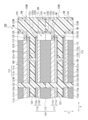
- FIG. 1 is a cross-sectional view showing the structure of a bipolar lead-acid battery according to an embodiment of the present invention.
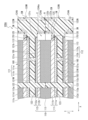
- FIG. 1 is an enlarged cross-sectional view showing the structure of a portion of a bipolar lead-acid battery according to an embodiment of the present invention. It is an explanatory view showing another structure of the outside reinforcing wall concerning an embodiment of the present invention. It is an explanatory view showing another structure of the outside reinforcing wall concerning an embodiment of the present invention.
- FIG. 1 is a cross-sectional view showing the structure of a bipolar lead-acid battery 100 according to an embodiment of the present invention.
- a bipolar lead-acid battery 100 includes a plurality of cell members 110, a plurality of bipolar plates (space forming members) 120, and a first end plate ( It has a space forming member) 130 and a second end plate (space forming member) 140.
- FIG. 1 shows a bipolar lead-acid battery 100 in which three cell members 110 are stacked
- the number of cell members 110 is determined by the battery design. Further, the number of bipolar plates 120 is determined according to the number of cell members 110.
- the direction that is parallel to the vertical direction and is the stacking direction of the cell members 110 is referred to as the Z direction (vertical direction in FIG. 1).
- the directions perpendicular to the Z direction and perpendicular to each other are defined as the X direction and the Y direction.
- the cell member 110 includes a positive electrode 111, a negative electrode 112, and an electrolytic layer (separator) 113.
- the positive electrode 111 includes a positive electrode lead foil 111a, which is a positive electrode current collector made of lead or a lead alloy, and a positive electrode active material layer 111b.
- the negative electrode 112 includes a negative electrode lead foil 112a, which is a negative electrode current collector made of lead or a lead alloy, and a negative electrode active material layer 112b.
- This positive electrode lead foil 111a is bipolarized by an adhesive 150, which will be described later, provided between one surface of the bipolar plate 120 (in the drawing of FIG. 1, the surface facing upward in the paper) and the positive electrode lead foil 111a. It is provided on one side of the plate 120. Therefore, on one surface of the bipolar plate 120, an adhesive layer (adhesive 150), a positive electrode lead foil 111a, and a positive electrode active material layer 111b are laminated in this order.
- the negative electrode lead foil 112a is attached to the bipolar plate by an adhesive 150, which will be described later, provided between the other surface of the bipolar plate 120 (in the drawing of FIG. 1, the surface facing downward in the paper) and the negative electrode lead foil 112a. 120 is provided on the other surface. Therefore, on the other surface of the bipolar plate 120, an adhesive layer (adhesive 150), a negative electrode lead foil 112a, and a negative electrode active material layer 112b are laminated in this order.
- the positive electrode 111 and the negative electrode 112 are electrically connected via a conductor 160, which will be described later.
- the separator 113 is made of, for example, a glass fiber mat impregnated with an electrolytic solution containing sulfuric acid.
- the separator 113 is provided so as to be sandwiched between a positive electrode active material layer 111b provided on one bipolar plate 120 facing each other and a negative electrode active material layer 112b provided on the other bipolar plate 120.
- a positive electrode lead foil 111a, a positive electrode active material layer 111b, a separator 113, a negative electrode active material layer 112b, and a negative electrode lead foil 112a are laminated in this order.
- the bipolar plate 120, the positive electrode lead foil 111a, the positive electrode active material layer 111b, the negative electrode lead foil 112a, and the negative electrode A bipolar electrode is configured by the active material layer 112b.
- a bipolar electrode is an electrode that has the functions of both a positive electrode and a negative electrode.
- the bipolar lead-acid battery 100 is provided in a pair with a cell member 110 having a separator 113 interposed between a positive electrode 111 and a negative electrode 112, with the cell member 110 sandwiched therebetween.
- a plurality of bipolar plates 120 are stacked.
- the dimensions of the positive electrode lead foil 111a in the X and Y directions are larger than the dimensions of the positive electrode active material layer 111b in the X and Y directions.
- the dimensions of the negative electrode lead foil 112a in the X and Y directions are larger than the dimensions of the negative electrode active material layer 112b in the X and Y directions.
- the dimension (thickness) in the Z direction is that the positive electrode lead foil 111a is larger (thicker) than the negative electrode lead foil 112a, and the positive electrode active material layer 111b is larger (thicker) than the negative electrode active material layer 112b. ).
- the plurality of cell members 110 are stacked at intervals in the Z direction, and the substrate 121 of the bipolar plate 120 is disposed at this interval. That is, the plurality of cell members 110 are stacked with the substrate 121 of the bipolar plate 120 sandwiched therebetween.
- the plurality of bipolar plates 120, the first end plate 130, and the second end plate 140 form spaces for forming a plurality of spaces (cells) C that individually accommodate the plurality of cell members 110. It is a member.
- the bipolar plate 120 covers both the positive electrode 111 side and the negative electrode 112 side of the cell member 110 and has a frame that surrounds the substrate 121 having a rectangular planar shape and the side surfaces of the cell member 110 and covers the four end faces of the substrate 121.
- the frame 122 has an outer wall surface 122a and an inner wall surface 122b, and the inner wall surface 122b faces the side surface of the cell member 110.
- a part of the space C that accommodates the cell member 110 is formed by the inner wall surface 122b.
- a part of the outer surface of the bipolar lead-acid battery 100 is formed by the outer wall surface 122a.
- the bipolar plate 120 further includes column parts 123 that protrude perpendicularly from both sides of the substrate 121.
- the number of pillar portions 123 protruding from each surface of the substrate 121 may be one or more.
- the dimensions of the frame 122 are larger than the dimensions (thickness) of the substrate 121, and the dimensions between the protruding end surfaces of the pillars 123 are the same as the dimensions of the frame 122.
- a space C is formed between the substrates 121 by stacking the plurality of bipolar plates 120 with their frame bodies 122 and columnar portions 123 in contact with each other. The dimension of the space C in the Z direction is maintained by the pillar portions 123 that are in contact with each other.
- FIG. 2 is an enlarged cross-sectional view showing the structure of a portion of the bipolar lead-acid battery 100 according to the embodiment of the present invention.
- the cell member 110 is shown sandwiched between two bipolar plates 120, 120 in the center thereof.
- bipolar plate 120M the bipolar plate drawn on the top in the drawing
- bipolar plate 120N the bipolar plate drawn on the bottom thereof
- an outer reinforcing wall 124 is provided at a position facing the outer wall surface 122a of the frame 122. That is, as shown in FIG. 2, the substrate 121N of the bipolar plate 120N is formed to extend beyond the frame 122N in the X direction. Further, the outer reinforcing wall 124 is formed to extend upward in the Z direction from the extended portion.
- the outer reinforcing wall 124 is formed to be longer than the upward length of the frame 122N in the Z direction when viewed from the extended portion of the substrate 121N. Specifically, it is formed to extend upward beyond the joining position of the frame 122M of the adjacent bipolar plate 120M and the frame 122N of the bipolar plate 120N.
- the end portion 124a of the outer reinforcing wall 124 extending upward in the Z direction is provided in the vicinity of the adjacent substrate 121M. In other words, the end portion 124a extends to the vicinity of the substrate 121M of the bipolar plate 120M.
- the bipolar plates 120M and 120N shown in FIG. 2 are joined to each other by vibration welding, which will be described later, and in this state, the end portions 124a are at opposite positions near the substrate 121M.
- it is formed to have a length that takes into consideration the welding depth in vibration welding, etc., and the length of the outer reinforcing wall 124 in the Z direction before welding is longer than the length of the outer reinforcing wall 124 in the Z direction after welding. It is formed to be long.
- “nearby” here refers to a case where the end portion 124a is located at a position separated from the opposing substrate 121M without contacting it. In addition, it also includes a state in which the end portion 124a contacts the opposing substrate 121M in a state in which the bipolar plates 120M and 120N are joined.
- an outer hollow portion EM is formed between the outer wall surfaces 122a of the frames 122M and 122N of the opposing bipolar plates 120M and 120N. . That is, the outer hollow portion EM refers to a space formed between the outer reinforcing wall 124 and the outer wall surface 122a of the frames 122M and 122N.
- the bipolar lead-acid battery 100 is provided with an inner reinforcing wall 125 having the same shape as the outer reinforcing wall 124. That is, as shown in FIG. 1 or 2, the inner reinforcing wall 125 is provided inside the space C between the inner wall surface 122b of the frame 122 and the cell member 110.
- the inner reinforcing wall 125 is formed between the frame 122N and the cover plate 170 in the substrate 121N of the bipolar plate 120N, and extends upward in the Z direction from the substrate 121N. .
- the inner reinforcing wall 125 is formed to be longer than the upward length of the frame 122N in the Z direction when viewed from the substrate 121N. Specifically, it is formed to extend upward beyond the joining position of the frame 122M of the adjacent bipolar plate 120M and the frame 122N of the bipolar plate 120N.
- the end portion 125a of the inner reinforcing wall 125 extending upward in the Z direction is provided in the vicinity of the adjacent substrate 121M. In other words, the end portion 125a extends to the vicinity of the substrate 121M of the bipolar plate 120M. Note that the meaning of "nearby" is as described above.
- the length of the inner reinforcing wall 125 in the Z direction is determined in consideration of the welding depth in vibration welding or the like. Further, the length of the outer reinforcing wall 124 in the Z direction before joining is longer than the length of the outer reinforcing wall 124 in the Z direction after joining.
- an inner hollow portion IM is formed between the inner wall surfaces 122b of the frames 122M and 122N of the opposing bipolar plates 120M and 120N.
- the size of the outer hollow part EM and the inner hollow part IM that is, the distance between the outer reinforcing wall 124 and the outer wall surface 122a, and the distance between the inner reinforcing wall 125 and the inner wall surface 122b, Whether to do so can be set arbitrarily. In FIGS. 1 and 2, these two distances are drawn to be approximately equal, but the distances may be different from each other.
- the frames 122 of adjacent bipolar plates 120 can be joined together, or the bipolar plate 120 and the first end plate 130 or the second end plate, which will be described later, can be joined together. It is possible to weaken the force applied from the inside and outside of the bipolar lead-acid battery 100 to the joint portion with the bipolar lead-acid battery 140. Therefore, it is possible to ensure the rigidity and impact resistance of the bipolar lead-acid battery 100.
- the heat insulation properties can also be improved, so that the bipolar lead-acid battery 100 is less susceptible to the influence of ambient temperature during operation. This contributes to stabilizing performance during battery operation.
- the inner hollow part IM plays a role as a buffer material against pressure changes inside the space C in which the cell member 110 is accommodated, so that robustness is increased. become.
- the frames are joined to each other by vibration welding, for example, but burrs are generated at the joining portions of each plate P during joining.
- the burrs caused by vibration welding or the like can be made invisible from the outside of the bipolar lead-acid battery 100.
- the outer surface of the bipolar lead-acid battery 100 can be made to look smooth, and a bipolar storage battery with excellent design can be provided.
- the bipolar lead-acid battery 100 shown in FIGS. 1 and 2 shows a state in which an outer hollow portion EM and an inner hollow portion IM are provided by forming an outer reinforcing wall 124 and an inner reinforcing wall 125.
- these do not necessarily have to have both hollow parts. That is, it is sufficient that the outer hollow part EM is provided at least between the outer reinforcing wall 124 and the outer wall surface 122a.
- an internal reinforcing body R is formed inside the outer hollow part EM or the inner hollow part IM at the joint portion between adjacent plates P.
- the internal reinforcing body R may be formed in both the outer hollow portion and the inner hollow portion, or may be formed in either one of the hollow portions.
- this internal reinforcing body R is considered to vary depending on each joint part. However, in any case, the internal reinforcing body R formed inside the outer hollow part EM or the inner hollow part IM grows from the joint portion toward the outer reinforcing wall 124 or the inner reinforcing wall 125.
- the internal reinforcing body R By forming the internal reinforcing body R at the joint between the plates P that are joined facing each other in this way, the tensile strength, that is, the force that opposes the force that tends to separate the plates P in the Z direction, is increased. will improve. Therefore, these plates P will be more firmly joined together.
- the internal reinforcing body R comes into contact with or is joined to both or one of the outer reinforcing wall 124 and the inner reinforcing wall 125.
- the force against the force is improved. . Therefore, even if such a force is applied to the bipolar lead-acid battery 100, the bipolar lead-acid battery 100 can absorb the impact or absorb the force due to expansion.
- the outer reinforcing wall 124 shown in FIGS. 1 and 2 is arranged so that the end portion 124a thereof is located near the substrate 121M of the bipolar plate 120M to be joined to the bipolar plate 120N. It was set up to extend from.
- the shape of the outer reinforcing wall 124 does not have to be the shape described above. Therefore, other shapes that can be adopted by the outer reinforcing wall 124 will be described below with reference to FIGS. 3 and 4.
- FIGS. 3 and 4 are explanatory diagrams showing another structure of the outer reinforcing wall 124 according to the embodiment of the present invention. Note that in FIGS. 3 and 4 as well, the description will be made assuming that the bipolar plates shown adjacent to each other are bipolar plates 120M and 120N, respectively.
- FIG. 3 shows an enlarged cross-sectional view of the structure of a portion of a bipolar lead-acid battery 100A according to an embodiment of the present invention.
- the shape of the outer reinforcing wall 124A is different from the outer reinforcing wall 124 described above.
- the outer reinforcing wall 124A shown in FIG. 3 is formed to extend upward in the Z direction from the substrate 121N of the bipolar plate 120N. Note that the end portion 124Aa faces the substrate 121M of the bipolar plate 120M, but has a length such that it is located away from the substrate 121M.
- the arrangement position of the end portion 124Aa is at least closer to the joint portion of the frames 122M and 122N of the bipolar plates 120M and 120N. It is formed to be at the top in the Z direction.
- FIG. 4 shows an enlarged cross-sectional view of the structure of a portion of a bipolar lead-acid battery 100B according to an embodiment of the present invention.
- the shape of the outer reinforcing wall 124B is different from the outer reinforcing walls 124 and 124A described above.
- the outer reinforcing wall 124B shown in FIG. 4 is formed to extend upward and downward in the Z direction centering on the substrate 121N.
- the position of the end portion 124Ba of the outer reinforcing wall 124B in the Z direction is set so as to cover the joint portion of the frames of adjacent plates P.
- the outer reinforcing walls 124B provided on the bipolar plates 120M and 120N do not extend upward in the Z direction and reach the above-mentioned joint portion. Further, an outer reinforcing wall 124B extending downward in the Z direction is formed to cover the joint portion.
- the substrate 121, frame 122, column portion 123, outer reinforcing wall 124, and inner reinforcing wall 125 that constitute the bipolar plate 120 are integrally formed of, for example, thermoplastic resin.
- thermoplastic resin forming the bipolar plate 120 include acrylonitrile-butadiene-styrene copolymer (ABS resin) and polypropylene. These thermoplastic resins have excellent moldability and sulfuric acid resistance. Therefore, even if the electrolytic solution comes into contact with the bipolar plate 120, the bipolar plate 120 is unlikely to be decomposed, deteriorated, corroded, or the like.
- the positive electrode lead foil 111a, the positive electrode active material layer 111b, the negative electrode lead foil 112a, the negative electrode active material layer 112b, and the separator 113 have through holes 111c, 111d, 112c, 112d, and 113a through which the column parts 123 penetrate. each formed.
- the substrate 121 of the bipolar plate 120 has a plurality of through holes 121a passing through the plate surface.
- a first recess 121b is formed on one surface of the substrate 121, and a second recess 121c is formed on the other surface.
- the depth of the first recess 121b is deeper than the depth of the second recess 121c.
- the dimensions of the first recess 121b and the second recess 121c in the X and Y directions correspond to the dimensions of the positive electrode lead foil 111a and the negative electrode lead foil 112a in the X and Y directions.
- the substrate 121 of the bipolar plate 120 is arranged between adjacent cell members 110 in the Z direction. Then, the positive electrode lead foil 111a of the cell member 110 is placed in the first recess 121b of the substrate 121 of the bipolar plate 120 via an adhesive 150. Further, the negative electrode lead foil 112a of the cell member 110 is placed in the second recess 121c of the substrate 121 of the bipolar plate 120 via an adhesive 150.
- a conductor 160 is arranged in the through hole 121a of the substrate 121 of the bipolar plate 120. Both end surfaces of the conductor 160 are in contact with and bonded to the positive electrode lead foil 111a and the negative electrode lead foil 112a. That is, the conductor 160 electrically connects the positive electrode lead foil 111a and the negative electrode lead foil 112a. As a result, all of the plurality of cell members 110 are electrically connected in series.
- a cover plate 170 is provided at the outer edge of the positive electrode lead foil 111a to cover the outer edge.
- This cover plate 170 is a thin plate-like frame and has rectangular inner and outer lines. The inner edge of the cover plate 170 overlaps with the outer edge of the positive electrode lead foil 111a, and the outer edge of the cover plate 170 overlaps with the peripheral edge of the first recess 121b on one surface of the substrate 121.
- the rectangle that forms the inner line of the cover plate 170 is smaller than the rectangle that forms the outer line of the positive electrode lead foil 111a, and the rectangle that forms the outer line of the cover plate 170 is the rectangle that forms the opening surface of the first recess 121b. bigger.
- the adhesive 150 extends from the end surface of the positive electrode lead foil 111a to the outer edge of the opening side of the first recess 121b, and is disposed between the inner edge of the cover plate 170 and the outer edge of the positive electrode lead foil 111a. Ru. The adhesive 150 is also placed between the outer edge of the cover plate 170 and one surface of the substrate 121.
- the cover plate 170 is fixed by the adhesive 150 across the peripheral edge of the first recess 121b on one surface of the substrate 121 and the outer edge of the positive electrode lead foil 111a. Thereby, the outer edge of the positive electrode lead foil 111a is covered with the cover plate 170 even at the boundary with the peripheral edge of the first recess 121b.
- the outer edge of the negative lead foil 112a may also be covered with a cover plate similar to the cover plate 170 covering the outer edge of the positive lead foil 111a.
- the cover plate has been explained using a thin plate-like frame as an example, it may also be a tape-like material, for example, as long as it is resistant to electrolytes (sulfuric acid). .
- the first end plate 130 is a space forming member that includes a substrate 131 that covers the positive electrode side of the cell member 110 and a frame 132 that surrounds the side surface of the cell member 110. Further, a column portion 133 is provided that projects perpendicularly from one surface of the substrate 131 (the surface of the bipolar plate 120 disposed closest to the positive electrode that faces the substrate 121).
- the planar shape of the substrate 131 is a rectangle, four end faces of the substrate 131 are covered with a frame 132, and the substrate 131, the frame 132, and the pillar portion 133 are integrally formed of, for example, the above-mentioned thermoplastic resin. .
- the number of pillar portions 133 protruding from one surface of the substrate 131 may be one or more. However, the number corresponds to the number of pillars 123 of the bipolar plate 120 that are brought into contact with the pillars 133.
- the dimensions of the frame 132 are larger than the dimensions (thickness) of the substrate 131, and the dimensions between the protruding end surfaces of the pillars 133 are the same as the dimensions of the frame 132.
- the first end plate 130 is stacked with the frame 132 and column 133 in contact with the frame 122 and column 123 of the bipolar plate 120 disposed at the outermost side (on the positive electrode side).
- a space C is formed between the substrate 121 of the bipolar plate 120 and the substrate 131 of the first end plate 130. Furthermore, the dimension of the space C in the Z direction is maintained by the pillar portions 123 of the bipolar plate 120 and the pillar portions 133 of the first end plate 130 that are in contact with each other.
- Through holes 111c, 111d, and 113a are formed in the positive electrode lead foil 111a, the positive electrode active material layer 111b, and the separator 113 of the cell member 110 disposed on the outermost side (positive electrode side), respectively. ing.
- a recess 131b is formed on one surface of the substrate 131 of the first end plate 130.
- the dimensions of the recess 131b in the X and Y directions correspond to the dimensions of the positive electrode lead foil 111a in the X and Y directions.
- the positive electrode lead foil 111a of the cell member 110 is placed in the recess 131b of the substrate 131 of the first end plate 130 with an adhesive 150 interposed therebetween. Further, like the substrate 121 of the bipolar plate 120, a cover plate 170 is fixed to one side of the substrate 131 with an adhesive 150. As a result, the outer edge of the positive electrode lead foil 111a is covered with the cover plate 170 even at the boundary with the peripheral edge of the recess 131b.
- the first end plate 130 includes a positive electrode terminal (not shown in FIG. 1) that is electrically connected to the positive electrode lead foil 111a in the recess 131b.
- the first end plate 130 is also provided with an outer reinforcing wall 134 and an inner reinforcing wall 135.
- the structures of the outer reinforcing wall 134 and the inner reinforcing wall 135 are the same as those of the outer reinforcing wall 124 and the inner reinforcing wall 125 described above.
- the structure of the outer reinforcing walls 124A and 124B described using FIGS. 3 and 4 may also be adopted.
- the second end plate 140 is a space forming member that includes a substrate 141 that covers the negative electrode side of the cell member 110 and a frame 142 that surrounds the side surface of the cell member 110. Furthermore, a column portion 143 is provided that projects perpendicularly from one surface of the substrate 141 (the surface of the bipolar plate 120 disposed closest to the negative electrode side that faces the substrate 121).
- the planar shape of the substrate 141 is a rectangle, four end faces of the substrate 141 are covered with a frame 142, and the substrate 141, the frame 142, and the pillar portion 143 are integrally formed of, for example, the above-mentioned thermoplastic resin. .
- the number of pillar portions 143 protruding from one surface of the substrate 141 may be one or more. However, the number corresponds to the number of pillars 123 of the bipolar plate 120 that are brought into contact with the pillars 143.
- the dimensions of the frame 142 are larger than the dimensions (thickness) of the substrate 131, and the dimensions between the protruding end surfaces of the two pillars 143 are the same as the dimensions of the frame 142.
- the second end plate 140 is stacked with the frame 142 and column 143 in contact with the frame 122 and column 123 of the bipolar plate 120 disposed at the outermost side (on the negative electrode side).
- a space C is formed between the substrate 121 of the bipolar plate 120 and the substrate 141 of the second end plate 140. Further, the dimension of the space C in the Z direction is maintained by the pillar portions 123 of the bipolar plate 120 and the pillar portions 143 of the second end plate 140 that are in contact with each other.
- Through holes 112c, 112d, and 113a are formed in the negative electrode lead foil 112a, the negative electrode active material layer 112b, and the separator 113 of the cell member 110 disposed on the outermost side (negative electrode side), respectively, through which the pillar portions 143 penetrate. ing.
- a recess 141b is formed on one surface of the substrate 141 of the second end plate 140.
- the dimensions of the recess 141b in the X and Y directions correspond to the dimensions of the negative electrode lead foil 112a in the X and Y directions.
- the negative electrode lead foil 112a of the cell member 110 is placed in the recess 141b of the substrate 141 of the second end plate 140 via an adhesive 150. Further, the second end plate 140 includes a negative electrode terminal (not shown in FIG. 1) that is electrically connected to the negative electrode lead foil 112a in the recess 141b.
- the second end plate 140 is not provided with an outer reinforcing wall or an inner reinforcing wall. This is because the overall structure of the bipolar lead-acid battery 100 makes it impossible to provide these reinforcing walls. As shown in FIG. 1, only the outer reinforcing wall 124 and the inner reinforcing wall 125 provided on the bipolar plate 120 that are joined adjacent to the substrate 141 are disposed.
- a substrate 141 is formed extending in the X direction at a position opposite to the end 124a of the outer reinforcing wall 124, and the end 124a of the outer reinforcing wall 124 is arranged in the vicinity thereof.
- outer reinforcing wall 124 and the inner reinforcing wall 125 have been described so far using FIGS. 1 to 3.
- the outer reinforcing wall 124 and the inner reinforcing wall 125 are formed to extend upward in the Z direction from the plate P stacked on the lower side in the Z direction.
- the extending direction of the outer reinforcing wall 124 and the inner reinforcing wall 125 in the Z direction may be formed so as to extend downward in the Z direction instead of upward in the Z direction as before. Even when the outer reinforcing wall 124 and the inner reinforcing wall 125 are provided in this way, the outer hollow part EM and the inner hollow part IM are formed, and the above-mentioned effects can be obtained.
- vibration welding when joining the opposing bipolar plates 120, the first end plate 130 and the opposing bipolar plate 120, or the second end plate 140 and the opposing bipolar plate 120, for example, vibration welding ( Various welding methods can be employed, such as vibration welding), ultrasonic welding, and hot plate welding. Among these, vibration welding is a method of welding by vibrating the surfaces to be joined while pressurizing them, and the welding cycle is quick and the reproducibility is good. Therefore, vibration welding is more preferably used.
- the objects to be welded include not only the frames disposed at opposing positions in the mutually opposing bipolar plates 120, first end plate 130, and second end plate 140, but also each column.
- the lengths of the outer reinforcing wall 124 and the inner reinforcing wall 125 in the Z direction are set as follows. That is, for example, as shown in FIGS. 1 and 2, the setting is such that when welding is completed, the end portions 124a and 125a are located near the substrate of the opposing plate P.
- the shapes, lengths, etc. of the outer reinforcing wall and the inner reinforcing wall have been explained above using FIGS. 1 to 4.
- the thickness of the outer reinforcing wall and the inner reinforcing wall is preferably about 1 mm to 3 mm, for example.
- the outer reinforcing wall is arranged so that the thickness of the outer hollow part EM, that is, the distance between the outer reinforcing wall and the outer wall surface of the frame in the X direction is, for example, about 0.5 mm to 2 mm. It is preferable.
- the inner reinforcing wall is arranged so that the thickness of the inner hollow part IM, that is, the distance between the inner reinforcing wall and the inner wall surface of the frame in the X direction, is, for example, about 0.5 mm to 2 mm. It is preferable.
- the opposing bipolar plates 120 are joined to each other using vibration welding.
- the width of the frame when the vibration welding is performed is, for example, between 35 mm and 55 mm.
- the bipolar lead-acid battery 100 of this embodiment can be manufactured, for example, by a method including the steps described below.
- a bipolar plate 120 is prepared. As described above, in the bipolar plate 120, the outer reinforcing wall 124 and the inner reinforcing wall 125 are formed on the substrate 121.
- the substrate 121 of the bipolar plate 120 Place the substrate 121 of the bipolar plate 120 on the workbench with the first recess 121b side facing upward. Then, adhesive 150 is applied to the first recess 121b, and the positive electrode lead foil 111a is placed in the first recess 121b. At that time, the pillar portion 123 of the bipolar plate 120 is passed through the through hole 111c of the positive electrode lead foil 111a. This adhesive 150 is cured, and a positive electrode lead foil 111a is attached to one surface of the substrate 121.
- the adhesive 150 is applied to the outer edge of the positive electrode lead foil 111a and the upper surface of the substrate 121 which becomes the edge of the first recess 121b, and the cover plate 170 is placed thereon, and the adhesive 150 is cured. Thereby, the cover plate 170 is fixed over the outer edge of the positive electrode lead foil 111a and over the portion of the substrate 121 (the periphery of the first recess 121b) that continues to the outside thereof.
- bipolar plate 120 with lead foil for positive and negative electrodes is obtained.
- a necessary number of bipolar plates 120 with lead foil for positive and negative electrodes are prepared.
- a first end plate 130 provided with an outer reinforcing wall 134 and an inner reinforcing wall 135 as shown in FIG. 1 and the like is prepared.
- the substrate 131 of the first end plate 130 is placed on a workbench with the concave portion 131b facing upward.
- the adhesive 150 is applied to the recess 131b, and the positive electrode lead foil 111a is placed in the recess 131b, and the adhesive 150 is cured. At that time, the pillar portion 133 of the end plate 130 is passed through the through hole 111c of the positive electrode lead foil 111a. This adhesive 150 is cured, and a positive electrode lead foil 111a is attached to one surface of the substrate 131.
- adhesive 150 is applied on the outer edge of the positive electrode lead foil 111a and on the upper surface of the substrate 131 that will become the edge of the recess 131b.
- a cover plate 170 is placed on top of this adhesive 150, and the adhesive 150 is cured. Thereby, the cover plate 170 is fixed over the outer edge of the positive electrode lead foil 111a and over the portion of the substrate 131 that continues outside of the outer edge. Thereby, an end plate with lead foil for the positive electrode is obtained. ⁇ Production process of end plate with lead foil for negative electrode>
- a second end plate 140 as shown in FIG. 1 etc. is prepared.
- the second end plate 140 does not have an outer reinforcing wall 124 or an inner reinforcing wall 125 formed therein.
- the substrate 141 extends outward in the X direction (toward the right side of the drawing in FIG. 1). It is formed by
- the adhesive 150 is applied to the recess 141b, and the negative electrode lead foil 112a is placed in the recess 141b, and the adhesive 150 is cured.
- the column portion 143 of the second end plate 140 is passed through the through hole 112c of the negative electrode lead foil 112a. This adhesive 150 is cured to obtain the second end plate 140 with the negative electrode lead foil 112a attached to one surface of the substrate 141.
- the first end plate 130 to which the positive electrode lead foil 111a and the cover plate 170 are fixed is placed on a workbench with the positive electrode lead foil 111a facing upward.
- the positive electrode active material layer 111b is placed in the cover plate 170 and placed on the positive electrode lead foil 111a.
- the column portion 133 of the first end plate 130 is passed through the through hole 111d of the positive electrode active material layer 111b.
- the separator 113 and the negative electrode active material layer 112b are placed on the positive electrode active material layer 111b.
- the bipolar plate 120 with lead foil for positive and negative electrodes is placed on the first end plate 130 in this state with the lead foil 112a side for negative electrode facing downward.
- the pillars 123 of the bipolar plate 120 are passed through the through holes 113a of the separator 113 and the through holes 112d of the negative electrode active material layer 112b, and placed on the pillars 133 of the first end plate 130.
- the frame 122 of the bipolar plate 120 is placed on the frame 132 of the first end plate 130.
- the first end plate 130 is fixed and vibration welding is performed while the bipolar plate 120 is vibrated in the diagonal direction of the substrate 121.
- the frame 122 of the bipolar plate 120 is joined onto the frame 132 of the first end plate 130.
- the column portion 123 of the bipolar plate 120 is joined onto the column portion 133 of the first end plate 130 .
- the bipolar plate 120 is joined onto the first end plate 130.
- the cell member 110 is placed in the space C formed by the first end plate 130 and the bipolar plate 120, and the positive electrode lead foil 111a is exposed on the upper surface of the bipolar plate 120.
- the positive electrode active material layer 111b, the separator 113, and the negative electrode active material layer are placed on the thus obtained composite body in which the bipolar plate 120 is joined onto the first end plate 130. 112b are placed in this order. Thereafter, another bipolar plate 120 with lead foil for positive and negative electrodes is placed with the lead foil 112a side for negative electrodes facing downward.
- this combined body is fixed, and vibration welding is performed while vibrating another bipolar plate 120 with lead foil for positive and negative electrodes in the diagonal direction of the substrate 121. This vibration welding process is continued until the required number of bipolar plates 120 are joined onto the first end plate 130.
- the positive electrode active material layer 111b, the separator 113, and the negative electrode active material layer 112b are placed in this order on the uppermost bipolar plate 120 of the combined body in which all the bipolar plates 120 are joined. Thereafter, the second end plate 140 is further placed with the negative electrode lead foil 112a side facing down.
- the combined body is fixed and vibration welding is performed while vibrating the second end plate 140 in the diagonal direction of the substrate 141.
- the second end plate 140 is joined onto the uppermost bipolar plate 120 of the combined body in which all the bipolar plates 120 are joined.
- the ends 124a and 125a of the outer reinforcing wall 124 and the inner reinforcing wall 125 face each other. It will be placed near the substrate that will be used. Then, an outer hollow part EM and an inner hollow part IM are formed.
- a joining structure is formed by vibration welding between opposing surfaces of the frames, and an injection port (not shown) is formed by a notch in the opposing frames. Further, a lid (not shown) is attached to cover the injection port of the bipolar lead-acid battery 100.
- the bipolar lead-acid battery 100 can be manufactured by chemically forming it under predetermined conditions.
- the outer reinforcing wall 124 and the inner reinforcing wall 125 of the bipolar plate 120, and the outer reinforcing wall 134 and the inner reinforcing wall 135 of the first end plate 130 are all It was provided so as to extend upward in the Z direction from the substrates 121, 131. Therefore, the second end plate 140 is not provided with an outer reinforcing wall or an inner reinforcing wall, and is only formed so that the substrate 141 extends in the X direction.
- the outer reinforcing wall 124 and the inner reinforcing wall 125 of the bipolar plate 120 may be formed facing downward in the Z direction instead of facing upward in the Z direction.
- the second end plate 140 is formed with an outer reinforcing wall and an inner reinforcing wall facing downward in the Z direction. Accordingly, while the substrate 131 of the first end plate 130 is formed to extend in the X direction, neither the outer reinforcing wall nor the inner reinforcing wall is formed.
- a space forming member including; an outer reinforcing wall that faces the outer wall surface of the frame and extends from the substrate in a stacking direction of the cell member and the space forming member; Equipped with A bipolar storage battery, wherein an outer hollow portion is formed between the outer reinforcing wall and the outer wall surface.
- the bipolar storage battery according to (1) above wherein an inner hollow portion is formed between the inner wall surface and the inner reinforcing wall.
- Bipolar storage battery (4) The bipolar storage battery according to (3) above, wherein the internal reinforcing body is in contact with or joined to both or one of the outer reinforcing wall and the inner reinforcing wall. (5) The outer reinforcing wall and the inner reinforcing wall are provided so that their ends in the stretching direction are located near the adjacent substrates, as described in (1) to (4) above. A bipolar storage battery according to any of the above. (6) According to any one of (1) to (4) above, the outer reinforcing walls provided on each of the adjacent substrates are formed such that their ends in the stretching direction face each other. The bipolar storage battery described. (7) The bipolar storage battery according to any one of (1) to (6) above, wherein the positive electrode current collector and the negative electrode current collector are made of lead or a lead alloy.
- Bipolar plate 121 Substrate of bipolar plate 121a ... Through hole of substrate 122 ... Frame of bipolar plate 122a ... Outer wall surface 122b...Inner wall surface 123...Column portion 124...Outer reinforcing wall 124a...End portion 125...Inner reinforcing wall 125a...End portion 130...First end plate 131...
- Substrate of the first end plate 132 Frame of the first end plate 133... Pillar part 134... Outer reinforcing wall 135... Inner reinforcing wall 140... Second end plate 141 ...Substrate of the second end plate 142...Frame of the second end plate 150...Adhesive 160...Conductor 170...Cover plate EM...Outer hollow part IM... ⁇ Inner hollow part C...Cell (space that accommodates cell members)
Landscapes
- Chemical & Material Sciences (AREA)
- Chemical Kinetics & Catalysis (AREA)
- Electrochemistry (AREA)
- General Chemical & Material Sciences (AREA)
- Engineering & Computer Science (AREA)
- Manufacturing & Machinery (AREA)
- Materials Engineering (AREA)
- Secondary Cells (AREA)
Priority Applications (2)
| Application Number | Priority Date | Filing Date | Title |
|---|---|---|---|
| JP2024511498A JPWO2023189094A1 (https=) | 2022-03-30 | 2023-02-27 | |
| US18/897,677 US20250015422A1 (en) | 2022-03-30 | 2024-09-26 | Bipolar Storage Battery |
Applications Claiming Priority (2)
| Application Number | Priority Date | Filing Date | Title |
|---|---|---|---|
| JP2022057592 | 2022-03-30 | ||
| JP2022-057592 | 2022-03-30 |
Related Child Applications (1)
| Application Number | Title | Priority Date | Filing Date |
|---|---|---|---|
| US18/897,677 Continuation US20250015422A1 (en) | 2022-03-30 | 2024-09-26 | Bipolar Storage Battery |
Publications (1)
| Publication Number | Publication Date |
|---|---|
| WO2023189094A1 true WO2023189094A1 (ja) | 2023-10-05 |
Family
ID=88200596
Family Applications (1)
| Application Number | Title | Priority Date | Filing Date |
|---|---|---|---|
| PCT/JP2023/007098 Ceased WO2023189094A1 (ja) | 2022-03-30 | 2023-02-27 | 双極型蓄電池 |
Country Status (3)
| Country | Link |
|---|---|
| US (1) | US20250015422A1 (https=) |
| JP (1) | JPWO2023189094A1 (https=) |
| WO (1) | WO2023189094A1 (https=) |
Citations (6)
| Publication number | Priority date | Publication date | Assignee | Title |
|---|---|---|---|---|
| JP2018120707A (ja) * | 2017-01-24 | 2018-08-02 | 株式会社豊田自動織機 | 蓄電モジュール |
| JP2019109989A (ja) * | 2017-12-15 | 2019-07-04 | 株式会社豊田自動織機 | 検査装置 |
| JP2020009632A (ja) * | 2018-07-09 | 2020-01-16 | 株式会社豊田自動織機 | 蓄電モジュール |
| JP2020031023A (ja) * | 2018-08-24 | 2020-02-27 | 株式会社豊田自動織機 | 蓄電モジュール、及び、蓄電モジュール製造方法 |
| WO2020138110A1 (ja) * | 2018-12-25 | 2020-07-02 | トヨタ自動車株式会社 | バイポーラ電池および蓄電装置 |
| JP2020102360A (ja) * | 2018-12-21 | 2020-07-02 | 株式会社豊田自動織機 | 圧力調整弁、電池モジュールの製造方法、及び電池モジュール |
-
2023
- 2023-02-27 JP JP2024511498A patent/JPWO2023189094A1/ja active Pending
- 2023-02-27 WO PCT/JP2023/007098 patent/WO2023189094A1/ja not_active Ceased
-
2024
- 2024-09-26 US US18/897,677 patent/US20250015422A1/en active Pending
Patent Citations (6)
| Publication number | Priority date | Publication date | Assignee | Title |
|---|---|---|---|---|
| JP2018120707A (ja) * | 2017-01-24 | 2018-08-02 | 株式会社豊田自動織機 | 蓄電モジュール |
| JP2019109989A (ja) * | 2017-12-15 | 2019-07-04 | 株式会社豊田自動織機 | 検査装置 |
| JP2020009632A (ja) * | 2018-07-09 | 2020-01-16 | 株式会社豊田自動織機 | 蓄電モジュール |
| JP2020031023A (ja) * | 2018-08-24 | 2020-02-27 | 株式会社豊田自動織機 | 蓄電モジュール、及び、蓄電モジュール製造方法 |
| JP2020102360A (ja) * | 2018-12-21 | 2020-07-02 | 株式会社豊田自動織機 | 圧力調整弁、電池モジュールの製造方法、及び電池モジュール |
| WO2020138110A1 (ja) * | 2018-12-25 | 2020-07-02 | トヨタ自動車株式会社 | バイポーラ電池および蓄電装置 |
Also Published As
| Publication number | Publication date |
|---|---|
| US20250015422A1 (en) | 2025-01-09 |
| JPWO2023189094A1 (https=) | 2023-10-05 |
Similar Documents
| Publication | Publication Date | Title |
|---|---|---|
| EP3109926B1 (en) | Rechargeable battery and rechargeable battery module | |
| JP5363404B2 (ja) | 二次電池 | |
| KR101108855B1 (ko) | 전기 화학 커패시터 | |
| KR101403692B1 (ko) | 전지용 파우치, 및 이를 포함하는 파우치형 전지 | |
| KR102425219B1 (ko) | 이차 전지 | |
| CN113394520A (zh) | 一种叠片型锂电池及装配方法 | |
| JP3686242B2 (ja) | 電池用積層電極の接続方法と電池 | |
| WO2023189094A1 (ja) | 双極型蓄電池 | |
| US20250015470A1 (en) | Bipolar Storage Battery | |
| WO2023085068A1 (ja) | 双極型蓄電池 | |
| JP2022112924A (ja) | 双極型鉛蓄電池 | |
| US20250015471A1 (en) | Bipolar Storage Battery | |
| JP2019106341A (ja) | 蓄電モジュール及び蓄電モジュールの製造方法 | |
| JP2023076861A (ja) | 双極型蓄電池 | |
| JP7572592B2 (ja) | 双極型蓄電池 | |
| JP7724279B2 (ja) | 双極型蓄電池 | |
| KR100522682B1 (ko) | 이차전지 | |
| WO2024004764A1 (ja) | 双極型蓄電池 | |
| JP2025150816A (ja) | 双極型蓄電池及び双極型蓄電池の製造方法 | |
| JP2025011536A (ja) | 双極型蓄電池 | |
| JP2023042804A (ja) | 双極型蓄電池 | |
| JP2025150622A (ja) | 双極型蓄電池 | |
| JP2022112925A (ja) | 双極型鉛蓄電池 | |
| JP2022122593A (ja) | バイポーラ電極、バイポーラ型鉛蓄電池、及びその製造方法 | |
| JP2025150833A (ja) | 双極型蓄電池用バイプレート、双極型蓄電池 |
Legal Events
| Date | Code | Title | Description |
|---|---|---|---|
| 121 | Ep: the epo has been informed by wipo that ep was designated in this application |
Ref document number: 23779124 Country of ref document: EP Kind code of ref document: A1 |
|
| ENP | Entry into the national phase |
Ref document number: 2024511498 Country of ref document: JP Kind code of ref document: A |
|
| WWE | Wipo information: entry into national phase |
Ref document number: 2401006294 Country of ref document: TH |
|
| WWE | Wipo information: entry into national phase |
Ref document number: 202417075134 Country of ref document: IN |
|
| NENP | Non-entry into the national phase |
Ref country code: DE |
|
| 122 | Ep: pct application non-entry in european phase |
Ref document number: 23779124 Country of ref document: EP Kind code of ref document: A1 |