WO2023188003A1 - 利用制御端末、システム及び方法、利用管理サーバ及び方法、並びに、コンピュータ可読媒体 - Google Patents
利用制御端末、システム及び方法、利用管理サーバ及び方法、並びに、コンピュータ可読媒体 Download PDFInfo
- Publication number
- WO2023188003A1 WO2023188003A1 PCT/JP2022/015506 JP2022015506W WO2023188003A1 WO 2023188003 A1 WO2023188003 A1 WO 2023188003A1 JP 2022015506 W JP2022015506 W JP 2022015506W WO 2023188003 A1 WO2023188003 A1 WO 2023188003A1
- Authority
- WO
- WIPO (PCT)
- Prior art keywords
- user
- information
- usage
- service
- biometric
- Prior art date
- Legal status (The legal status is an assumption and is not a legal conclusion. Google has not performed a legal analysis and makes no representation as to the accuracy of the status listed.)
- Ceased
Links
Images







Classifications
-
- G—PHYSICS
- G06—COMPUTING OR CALCULATING; COUNTING
- G06F—ELECTRIC DIGITAL DATA PROCESSING
- G06F21/00—Security arrangements for protecting computers, components thereof, programs or data against unauthorised activity
- G06F21/30—Authentication, i.e. establishing the identity or authorisation of security principals
- G06F21/31—User authentication
- G06F21/32—User authentication using biometric data, e.g. fingerprints, iris scans or voiceprints
Definitions
- the present disclosure relates to a usage control terminal, a system, a method, and a program, and a usage management server, a method, and a program.
- Patent Document 1 discloses a technology related to an automatic gate system for allowing users to pass through a gate using face authentication.
- Patent Document 2 discloses a technique for allowing users to pass through automatic ticket gates through facial recognition.
- biometric authentication it is necessary for a given person to have appropriate qualifications in order to receive various services including passage through the gate. At that time, by verifying the person's identity using biometric authentication, it is possible to accurately and easily determine that the person is qualified.
- biometric authentication has been hindered by the fact that many users are reluctant to have their biometric information used for biometric verification held by an external organization, or that it is difficult to convey the benefits of using biometric authentication. There is.
- the purpose of the present disclosure is to provide a usage control terminal, a system, a method, and a program, and a usage management server, a method, and a program for promoting the spread of service usage using biometric authentication.
- the usage control terminal is acquisition means for acquiring the user ID and the first biometric information by a predetermined method of short-range wireless communication from a storage medium carried by a predetermined user and storing the user ID and the first biometric information of the user; and, storage means for storing the user ID and the first biometric information in a storage device in association with each other; an authentication unit that performs biometric authentication based on second biometric information extracted from an image taken of the user and first biometric information stored in the storage device; identification means for identifying, from the storage device, a user ID associated with the first biometric information for which the biometric authentication was successful; Referring to a database registered by associating the user ID with the qualification information for use of the service by the user, and determining whether the service can be used by the user based on the qualification information associated with the specified user ID. a determination means for determining; output means for outputting information according to the determination result by the determination means; Equipped with
- the usage control system is a database in which a user ID of a predetermined user and qualification information for use of a service by the user are registered in association with each other; a usage control terminal capable of short-range wireless communication using one or more methods; Equipped with The usage control terminal is an acquisition unit that acquires the user ID and the first biometric information from a storage medium carried by the user and in which the user ID and the first biometric information are stored, using a predetermined method of short-range wireless communication; storage means for storing the user ID and the first biometric information in a storage device in association with each other; an authentication unit that performs biometric authentication based on second biometric information extracted from an image taken of the user and first biometric information stored in the storage device; identification means for identifying, from the storage device, a user ID associated with the first biometric information for which the biometric authentication was successful; a determination unit that refers to the database and determines whether the service can be used by the user based on qualification information associated with the specified user ID; output means for outputting information according
- the usage control method is The computer is acquiring the user ID and the first biometric information from a storage medium carried by a predetermined user and storing the user ID and the first biometric information of the user by a predetermined method of short-range wireless communication; storing the user ID and the first biometric information in a storage device in association with each other; Performing biometric authentication based on second biometric information extracted from an image taken of the user and first biometric information stored in the storage device, identifying from the storage device a user ID associated with the first biometric information for which the biometric authentication was successful; Referring to a database registered by associating the user ID with the qualification information for use of the service by the user, and determining whether the service can be used by the user based on the qualification information associated with the specified user ID. Determine, Information corresponding to the determination result by the determination means is output.
- the usage control program is acquisition processing of acquiring the user ID and the first biometric information from a storage medium carried by a predetermined user and storing the user ID and the first biometric information of the user by a predetermined method of short-range wireless communication; and, a storage process of associating the user ID and the first biometric information and storing them in a storage device; Authentication processing that performs biometric authentication based on second biometric information extracted from an image taken of the user and first biometric information stored in the storage device; identification processing for identifying, from the storage device, a user ID associated with the first biometric information for which the biometric authentication was successful; Referring to a database registered by associating the user ID with the qualification information for use of the service by the user, and determining whether the service can be used by the user based on the qualification information associated with the specified user ID. a determination process for determining the an output process that outputs information according to the determination result by the determination means; have the computer execute it.
- the usage management server is When an electronic application for use of a predetermined service including a user ID corresponding to the first biometric information of a predetermined user is received, a discounted usage fee for the service is calculated based on the attribute information of the user.
- calculation means a registration means for registering the user ID and the qualification information for using the service in a database in association with each other when the user makes a payment for the usage fee;
- a response means for sending a response to the usage control terminal based on the received qualification information; Equipped with
- the usage management method for this disclosure is as follows:
- the computer is When an electronic application for the use of a predetermined service that includes a user ID corresponding to the first biometric information of a predetermined user is received, a discounted usage fee for the service is calculated based on the attribute information of the user. , When the user makes a payment for the usage fee, registering the user ID and the qualification information for using the service in a database in association with each other;
- When receiving a user ID identified by the user successfully performing biometric authentication based on the first biometric information from the service usage control terminal refer to the database and associate the user ID with the received user ID.
- a response based on the received qualification information is sent to the usage control terminal.
- the usage management program related to this disclosure is When an electronic application for use of a predetermined service including a user ID corresponding to the first biometric information of a predetermined user is received, a discounted usage fee for the service is calculated based on the attribute information of the user. calculation process, When the user makes a payment for the usage fee, a registration process of associating the user ID with qualification information for using the service and registering it in a database; When receiving a user ID identified by the user successfully performing biometric authentication based on the first biometric information from the service usage control terminal, refer to the database and associate the user ID with the received user ID. a response process in which a response is sent to the usage control terminal based on the received qualification information; have the computer execute it.
- a usage control terminal system, method, and program, as well as a usage management server, method, and program for promoting the spread of service usage using biometric authentication.
- FIG. 2 is a block diagram showing the configuration of a usage control terminal according to the first embodiment.
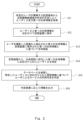
- 3 is a flowchart showing the flow of the usage control method according to the first embodiment.
- FIG. 2 is a block diagram showing the configuration of a usage management server according to the second embodiment.
- 7 is a flowchart showing the flow of the usage management method according to the second embodiment.
- FIG. 3 is a block diagram showing the configuration of a usage control system according to the third embodiment.
- FIG. 3 is a block diagram showing the configuration of a contactless IC card according to the third embodiment.
- FIG. 3 is a block diagram showing the configuration of a user terminal according to the third embodiment.
- 3 is a block diagram showing the configuration of a usage management server according to the third embodiment.
- FIG. 3 is a block diagram showing the configuration of an edge terminal according to the third embodiment.
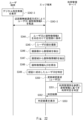
- FIG. 7 is a sequence diagram showing the flow of face information registration processing according to the third embodiment.
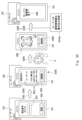
- FIG. 7 is a diagram showing an example of screen transitions of face information registration processing in a user terminal according to the third embodiment.
- FIG. 7 is a sequence diagram showing the flow of electronic application processing according to the third embodiment.
- FIG. 7 is a diagram showing an example of screen transitions of ticket purchase processing in the user terminal according to the third embodiment.
- FIG. 7 is a diagram for explaining the concept of entrance processing using a user terminal according to Example 3-1 of the third embodiment.
- FIG. 7 is a sequence diagram showing the flow of entrance processing using the user terminal according to Example 3-1 of the third embodiment.
- FIG. 7 is a sequence diagram showing the flow of entrance processing using the user terminal according to Example 3-1 of the third embodiment.
- FIG. 12 is a diagram showing an example of screen transitions of entrance processing in a user terminal according to Example 3-1 of Embodiment 3;
- FIG. 7 is a diagram for explaining the concept of entrance processing using a non-contact IC card according to Example 3-2 of the third embodiment.
- FIG. 7 is a sequence diagram showing the flow of entrance processing using a non-contact IC card according to Example 3-2 of the third embodiment.
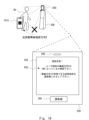
- 7 is a diagram illustrating a display example of guidance information for a short-range wireless communication method in an edge terminal according to Embodiment 3.
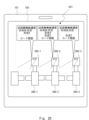
- FIG. 7 is a diagram illustrating a display example of short-range wireless communication methods that can be supported by each edge terminal according to the third embodiment.
- FIG. 7 is a diagram for explaining the concept of reserved seat ticket confirmation processing by the conductor according to the fourth embodiment.
- FIG. 7 is a sequence diagram showing the flow of reserved seat ticket confirmation processing by the conductor according to the fourth embodiment.
- FIG. 9 is a diagram showing an example of screen transitions in a process of writing characteristic information to a non-contact IC card according to the fifth embodiment.
- FIG. 1 is a block diagram showing the configuration of a usage control terminal 1 according to the first embodiment.
- the usage control terminal 1 is an information processing device that uses biometric authentication to determine whether a predetermined user is qualified to use a predetermined service, and when it is determined that the user is qualified, performs control according to the service. be.
- the use of a predetermined service includes, for example, entering a facility or floor where admission is restricted, or receiving a paid service such as watching a movie. Note that the predetermined service may be a free service.
- a predetermined user carries a storage medium.
- the user ID and first biometric information of the user are stored in the storage medium.
- the storage medium may be, for example, a storage device built into a portable information terminal such as a smartphone or a tablet terminal.
- the storage medium may be built into a non-contact IC (Integrated Circuit) card.
- the information terminal and the non-contact type IC card can communicate using a predetermined method of short-range wireless communication, and can transmit the user ID and first biometric information stored in the storage medium using the method.
- the information terminal and the non-contact IC card may be compatible with two or more short-range wireless communication methods.
- the first biometric information is associated with a user ID within the storage medium.
- "Biological information" is data that includes a plurality of feature points extracted from an image of at least a portion of the user's body, distances between the feature points, and the like.
- the usage control terminal 1 includes an acquisition section 11, a storage section 12, an authentication section 13, an identification section 14, a determination section 15, and an output section 16.
- the acquisition unit 11 acquires a user ID and first biometric information from a storage medium carried by a prescribed user using a prescribed method of short-range wireless communication.
- the storage unit 12 associates the user ID acquired by the acquisition unit 11 with the first biometric information and stores them in a storage device.
- the storage device may be either built into the usage control terminal 1 or an external storage device connected to the usage control terminal 1.
- the authentication unit 13 performs biometric authentication based on the second biometric information extracted from the image of the user and the first biometric information stored in the storage device. Specifically, the authentication unit 13 compares the second biometric information and the first biometric information to calculate the degree of matching, and determines that biometric authentication has been successful when the degree of matching is equal to or greater than a threshold value.
- the identification unit 14 identifies the user ID associated with the first biometric information that has been successfully biometrically authenticated by the authentication unit 13 from the storage device.
- the determining unit 15 determines whether the user can use the service based on the user's qualification information for using the service.
- the qualification information is information that proves whether or not the user is qualified to use the service, and that the usage fee for the paid service has been paid. Therefore, for example, the qualification information may be ticket information for a paid service.
- the usage control terminal 1 is connected to a database. In this database, user IDs and qualification information for use of services by users are registered in advance in association with each other. Then, the usage control terminal 1 refers to the database and determines whether the user can use the service based on the qualification information associated with the user ID identified by the identification unit 14.
- the determination unit 15 may determine that the service can be used by the user.
- the determination unit 15 may determine that the service by the user is available.
- the database may be managed by a predetermined server. Then, the determination unit 15 may transmit the user ID to the server and inquire as to whether the service can be used by the user.
- the server refers to the database, searches for the credential information associated with the received user ID, and determines whether the credential information is searched or not, or whether the credential information satisfies predetermined conditions. , the availability of the service may be determined. In that case, the server may send the determination result back to the usage control terminal 1. Then, the determining unit 15 determines whether the user can use the service based on the received determination result.
- the output unit 16 outputs information according to the determination result by the determination unit 15. For example, the output unit 16 may output the determination result itself. Further, the output unit 16 may output a control signal for other equipment according to the determination result. Further, the output unit 16 may output information according to the determination result to a user terminal or an administrator's terminal.
- FIG. 2 is a flowchart showing the flow of the usage control method according to the first embodiment.
- the acquisition unit 11 acquires a user ID and first biometric information from a storage medium carried by a predetermined user using a predetermined short-range wireless communication method (S11). That is, when a user carrying a storage medium comes within range of short-range wireless communication using a predetermined method of the usage control terminal 1, data in the storage medium is transferred to the usage control terminal 1 according to the predetermined method.
- S11 short-range wireless communication method
- the storage unit 12 associates the user ID and the first biometric information and stores them in the storage device (S12). Then, for a user who is within the range of short-range wireless communication using a predetermined method, an area including the face is photographed by a camera built into the usage control terminal 1 or a camera connected to the usage control terminal 1.
- the authentication unit 13 performs biometric authentication based on the second biometric information extracted from the image of the user and the first biometric information stored in the storage device (S13).
- the identifying unit 14 identifies the user ID associated with the first biometric information that has been successfully biometrically authenticated from the storage device (S14). Then, the determining unit 15 refers to the database and determines whether the service can be used by the user based on the qualification information associated with the user ID specified in step S14 (S15). Then, the output unit 16 outputs information according to the determination result in step S15 (S16).
- the user side holds at least the user ID and his or her own biometric information, and the user ID and qualification information are stored in advance in the database on the service provider side.
- the set of user ID and biometric information is transferred from the storage medium carried by the user to the usage control terminal 1 by short-range wireless communication, and the usage control terminal 1 at least temporarily stores the user ID and biometric information in the storage device. A combination of ID and biometric information is saved.
- the usage control terminal 1 then photographs the user's face image at the same timing.
- the usage control terminal 1 can perform biometric authentication based on the first biometric information stored in the storage device and the second biometric information extracted from the face image. If the biometric authentication is successful, it is possible to identify the qualification information associated with the user ID from the service provider's database and determine whether the service can be used. From the above, it is possible to ensure the security of storage of biometric information and eliminate concerns about an external organization retaining biometric information used for biometric verification. Therefore, the use of services using biometric authentication can be promoted.
- the usage control terminal 1 includes a processor, memory, and storage device as components not shown. Further, the storage device stores a computer program in which the processing of the usage control method according to the present embodiment is implemented. Then, the processor loads a computer program or the like from the storage device into the memory, and executes the computer program. Thereby, the processor realizes the functions of the acquisition section 11, the storage section 12, the authentication section 13, the identification section 14, the determination section 15, and the output section 16.
- each component of the usage control terminal 1 may be realized by dedicated hardware.
- a part or all of each component of each device may be realized by a general-purpose or dedicated circuit, a processor, etc., or a combination thereof. These may be configured by a single chip or multiple chips connected via a bus.
- a part or all of each component of each device may be realized by a combination of the circuits and the like described above and a program.
- the processor a CPU (Central Processing Unit), a GPU (Graphics Processing Unit), an FPGA (Field-Programmable Gate Array), a quantum processor (a quantum computer control chip), etc. can be used.
- FIG. 3 is a block diagram showing the configuration of the usage management server 2 according to the second embodiment.
- the usage management server 2 calculates the usage fee for using a predetermined service according to the attribute information of a predetermined user, registers the user's qualification information in the database, and refers to the database when requesting to use the service.
- This is an information processing device that responds.
- the attribute information includes the user's age (date of birth), gender, identification information, and the like.
- the identification information is, for example, information on disability or nursing care level certification by a public institution, information equivalent to a student ID card, and the like.
- the database is similar to that in the first embodiment described above, and is registered in advance in association with user IDs and qualification information for use of services by users. It is assumed that the usage management server 2 has a built-in database or is connected to an external database server or storage device that manages the database.
- the usage management server 2 includes a calculation section 21, a registration section 22, and a response section 23.
- the calculation unit 21 receives an electronic application for use of a predetermined service that includes a user ID corresponding to the first biometric information of a predetermined user, the calculation unit 21 calculates the use of the service discounted based on the attribute information of the user. Calculate the fee. For example, when the attribute information indicates an elderly person, a disabled person, a student, etc., the calculation unit 21 calculates a usage fee that takes into account discounts according to each attribute.
- the registration unit 22 registers the user ID and service usage qualification information in association with each other in the database.
- the response unit 23 When the response unit 23 receives a user ID from a service usage control terminal, it refers to the database and sends a response to the usage control terminal based on the qualification information associated with the received user ID.
- the usage control terminal may be, for example, the usage control terminal 1 of the first embodiment described above.
- the user ID received by the response unit 23 is identified by the user's successful biometric authentication based on the first biometric information at the usage control terminal.
- the response unit 23 may transmit the determination result of whether or not the user can use the service based on the qualification information to the usage control terminal as a response.
- the response unit 23 may read the qualification information associated with the user ID received from the database, and transmit the read qualification information to the usage control terminal as a response.
- FIG. 4 is a flowchart showing the flow of the usage management method according to the second embodiment.
- the calculation unit 21 calculates a discounted service based on the attribute information of the user.
- the usage fee is calculated (S21).
- the registration unit 22 associates the user ID with the qualification information for using the service and registers it in the database (S22).
- the response unit 23 receives from the usage control terminal the user ID identified by the user's successful biometric authentication based on the first biometric information.
- the response unit 23 receives the user ID from the service usage control terminal, it refers to the database and sends a response to the usage control terminal based on the qualification information associated with the received user ID (S23 ).
- the usage management server 2 includes a processor, memory, and storage device as components not shown. Further, the storage device stores a computer program in which the processing of the usage management method according to the present embodiment is implemented. Then, the processor loads a computer program or the like from the storage device into the memory, and executes the computer program. Thereby, the processor realizes the functions of the calculation section 21, the registration section 22, and the response section 23.
- each component of the usage management server 2 may be realized by dedicated hardware.
- a part or all of each component of each device may be realized by a general-purpose or dedicated circuit, a processor, etc., or a combination thereof. These may be configured by a single chip or multiple chips connected via a bus.
- a part or all of each component of each device may be realized by a combination of the circuits and the like described above and a program.
- the processor a CPU (Central Processing Unit), a GPU (Graphics Processing Unit), an FPGA (Field-Programmable Gate Array), a quantum processor (a quantum computer control chip), etc. can be used.
- each component of the usage management server 2 is realized by a plurality of information processing devices, circuits, etc.
- the plurality of information processing devices, circuits, etc. may be centrally arranged, It may also be distributed.
- information processing devices, circuits, etc. may be realized as a client server system, a cloud computing system, or the like, in which each is connected via a communication network.
- the functions of the usage management server 2 may be provided in a SaaS (Software as a Service) format.
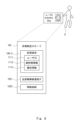
- FIG. 5 is a block diagram showing the configuration of a usage control system 1000 according to the third embodiment.
- the usage control system 1000 is an information system that allows a user U who has purchased a movie ticket in advance via a website to pass through the entrance gate of a movie theater using facial recognition and qualification information. Note that entering a movie theater and watching a movie after entering is an example of using a predetermined service. Use of other services includes, for example, checking in at the airport, leaving baggage, passing through the boarding gate, using transportation such as trains, buses, ships, etc., and using various services at preferential rates. , but not limited to.
- the user terminal 101 carries the user terminal 101.
- the user terminal 101 has a built-in storage medium 100-1 and can communicate using one or more short-range wireless communication methods.
- the storage medium 100-1 stores a user ID 1111 and facial feature information 1112. Note that the detailed configuration of the user terminal 101 will be described later.
- an edge terminal 200, an authentication infrastructure system 400, and a usage management server 500 are each connected via a network N so that they can communicate.
- the entrance control device 300 may also be communicably connected via the network N.
- the network N is a wired or wireless communication line or communication network, such as a LAN (Local Area Network), the Internet, a wireless communication network, a mobile phone network, or the like.
- the type of communication protocol used by the network N does not matter.
- the edge terminal 200 is an example of the usage control terminal 1 described above.
- the edge terminal 200 acquires a user ID 1111 and facial feature information 1112 from the user terminal 101 via a short-range wireless communication IF (InterFace) 231 using a predetermined short-range wireless communication method.
- the edge terminal 200 may acquire the user ID 1111 and facial feature information 1112 from the non-contact IC card 102, which will be described later.
- the edge terminal 200 stores the acquired user ID 2111 and facial feature information 2112 in association with each other as user information 211 in a built-in storage device.
- the edge terminal 200 photographs the user U with the camera 260, and performs face authentication by comparing the facial feature information extracted from the facial image with the facial feature information 2112.
- the edge terminal 200 transmits the user ID 2111 to the usage management server 500 via the network N, determines whether or not the user is qualified to enter the movie theater, and then sends the user ID 2111 to the admission control device 300 according to the determination result. control. For example, if the determination result indicates that the user U is qualified (can use the movie theater, can watch movies, etc.), the edge terminal 200 controls the admission control device 300 to open the gate 301. Note that the detailed configuration of the edge terminal 200 will be described later.
- the entrance control device 300 is a device for controlling the opening and closing of a gate 301, which is an entrance to a movie theater, in response to instructions from the edge terminal 200.
- the gate 301 is not limited to a flapper gate.
- the authentication infrastructure system 400 is an information system that extracts facial feature information from the facial image of the user U and issues a user ID corresponding to the facial feature information. Note that the authentication infrastructure system 400 may include a database that associates facial feature information with user IDs.
- the usage management server 500 is an example of the usage management server 2 described above.
- the usage management server 500 is an information processing device that includes a usage management DB 512 in which user U's user ID 5121 and qualification information 5122 are associated with each other.
- the usage management DB 512 may be managed outside the usage management server 500, that is, in a database server or storage device connected to the usage management server 500.
- FIG. 6 is a block diagram showing the configuration of the non-contact IC card 102 according to the third embodiment.
- the contactless IC card 102 corresponds to user U's digital identification card.
- the contactless IC card 102 includes a storage medium 100-2, a short-range wireless communication IF 1021, an RW (Reader-Writer) control unit 1022, and the like.
- the contactless IC card 102 includes a storage medium 100-2, a short-range wireless communication IF 1021, and an RW control unit 1022, and is an IC tag that has a built-in so-called IC chip and can communicate using a predetermined short-range wireless communication method. It can be considered.
- a user ID 1111 is identification information of the user U, and may be the same as the ID (my number, etc.) in the digital identification card. However, the user ID 1111 may be different from the ID in the digital identification card, and must be associated with at least the facial feature information 1112, and must be the same as or uniquely correspond to the user ID 5121 managed in the usage management DB 512. shall be.
- the facial feature information 1112 is data including a plurality of feature points extracted from the facial image of the user U by the authentication infrastructure system 400, distances between the feature points, etc., in other words, feature amounts calculated from the facial image.
- the storage medium 100-1 and the storage medium 100-2 described above may be collectively referred to as "storage medium 100."
- the short-range wireless communication IF 1021 establishes a connection using the short-range wireless communication method Y with an IF of another device using the same method within a predetermined range, and performs communication.
- the short-range wireless communication IF 1021 may be realized by an antenna, an interface circuit, or the like.
- the method Y may correspond to standards and methods such as NFC (Near Field Communication) and RFID (Radio Frequency IDentification), but is not limited thereto.
- the RW control unit 1022 performs wireless communication between the IC tag attached to the non-contact IC card 102 and a reader/writer device capable of short-range wireless communication using method Y. Specifically, when the contactless IC card 102 enters the communication range of the reader/writer of method Y of the edge terminal 200, the RW control unit 1022 communicates with the edge terminal 200 via the short-range wireless communication IF 1021. Communication is performed using method Y. That is, the RW control unit 1022 reads the user ID 1111 and facial feature information 1112 from the storage medium 100-2, and transmits the user ID 1111 and facial feature information 1112 to the edge terminal 200 via the short-range wireless communication IF 1021.
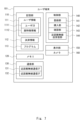
- FIG. 7 is a block diagram showing the configuration of the user terminal 101 according to the third embodiment.
- the user terminal 101 is a mobile information processing device such as a tablet terminal or a smartphone.
- the user terminal 101 includes a storage section 110, a memory 120, a communication section 130, a control section 140, a display section 150, and a camera 160.
- the storage unit 110 includes the storage medium 100-1 described above, and is an example of a storage device such as a flash memory.
- Storage unit 110 stores user information 111, payment information 112, and program 113.
- User information 111 is information in which user U's user ID 1111 and facial feature information 1112 are associated with each other.
- Payment information 112 is information for user U to perform electronic payment.
- the payment information 112 is, for example, bank account, credit card information, etc. Note that the payment information 112 does not necessarily need to be stored in the storage unit 110.
- the program 113 is a computer program in which facial information registration processing, electronic application processing (ticket purchase processing), various information
- the memory 120 is a volatile storage device such as a RAM (Random Access Memory), and is a storage area for temporarily holding information when the control unit 140 operates.
- the communication unit 130 is a wireless communication interface with the network N.
- the communication unit 130 may be connected to the Internet via a wireless communication network or a mobile phone network.
- the communication unit 130 is capable of wireless communication using a plurality of short-range wireless communication methods.
- the communication unit 130 includes short-range wireless communication IFs 131 and 132.
- the short-range wireless communication IF 131 establishes a connection using short-range wireless communication method X with an IF of another device using the same method within a predetermined range, and performs communication.
- the method X may correspond to standards and methods such as Bluetooth (registered trademark) and BLE (Bluetooth Low Energy), but is not limited to these.
- the short-range wireless communication IF 132 establishes a connection using short-range wireless communication method Y with an IF of another device using the same method within a predetermined range, and performs communication.
- Method Y is the same method as the short-range wireless communication IF 1021 described above.
- the display unit 150 is a screen such as a liquid crystal display or an organic electro-luminescence (EL) display.
- the display unit 150 displays information instructed by the control unit 140.
- the camera 160 is one or more photographing devices, which photographs the face of the user U and outputs the photographed image to the control section 140 in response to an operation by the user U or an instruction from the control section 140. The image is displayed at 150.
- the control unit 140 is a processor that controls each component of the user terminal 101, that is, a control device.
- the control unit 140 loads the program 113 from the storage unit 110 into the memory 120 and executes the program 113. Thereby, the control section 140 realizes the functions of the registration section 141, the purchase section 142, the confirmation section 143, and the short-range wireless transmission/reception section 144.
- the registration unit 141 performs user U's face information registration process.
- the registration unit 141 controls the camera 160 according to the user's U operation to photograph the user's U face.
- the registration unit 141 transmits the facial image of the user U to the authentication infrastructure system 400 via the network N, and receives the facial feature information extracted by the authentication infrastructure system 400 and the issued user ID.
- the registration unit 141 associates the received user ID 1111 and facial feature information 1112 and stores them as user information 111 in the storage unit 110. Further, the registration unit 141 transmits the attribute information read from the contactless IC card 102 by the short-range wireless transmission/reception unit 144 and the received user ID to the usage management server 500 via the network N, and Receive a registration completion notification.
- the purchase unit 142 performs electronic application processing (ticket purchase processing).
- the purchase unit 142 transmits reservation information for movie tickets, transmits payment information for usage fees, accepts reservation completion, and the like.
- the confirmation unit 143 receives the input of the PIN number of the contactless IC card 102 from the user U, and outputs the PIN number to the short-range wireless transmission/reception unit 144.
- the confirmation unit 143 also acquires attribute information from the non-contact IC card 102 via the short-range wireless transmission/reception unit 144 .
- the confirmation unit 143 may generate code information corresponding to the user ID 1111 and display it on the display unit 150.
- the confirmation unit 143 may acquire ticket information and the like corresponding to the reservation information from the usage management server 500 and display it on the display unit 150.
- the short-range wireless transmitter/receiver 144 performs wireless communication with a reader/writer device capable of short-range wireless communication using method X and method Y. Specifically, when the user terminal 101 with method X in the ON state enters the communication range of the reader/writer of method Communication is performed using method X via the wireless communication IF 131. That is, the short-range wireless transmission/reception unit 144 reads the user ID 1111 and facial feature information 1112 from the storage unit 110, and transmits the user ID 1111 and facial feature information 1112 to the edge terminal 200 via the short-range wireless communication IF 131.
- the short-range wireless transmitting/receiving unit 144 communicates with the edge terminal 200 via the short-range wireless communication IF 132. Communication is performed using method Y via .
- the short-range wireless transmission/reception unit 144 detects the contactless IC card 102 within the communication range of the short-range wireless communication IF 132. If the contactless IC card 102 is entered, communication with the contactless IC card 102 is performed.
- the short-range wireless transmitter/receiver 144 outputs a password to the non-contact IC card 102 via the short-range wireless communication IF 132, and causes the contactless IC card 102 to perform authentication.
- the short-range wireless transmitting/receiving unit 144 acquires the attribute information 1113 from the contactless IC card 102 when the PIN number is successfully authenticated by the contactless IC card 102 .
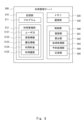
- FIG. 8 is a block diagram showing the configuration of the usage management server 500 according to the third embodiment.
- the usage management server 500 may be made redundant by a plurality of servers, and each functional block may be realized by a plurality of computers.
- the usage management server 500 includes a storage section 510, a memory 520, a communication section 530, and a control section 540.
- the storage unit 510 is an example of a storage device such as a hard disk or flash memory.
- the storage unit 510 stores a program 511 and a usage management DB 512.
- the program 511 is a computer program (usage management program) in which a usage management DB registration and update process, a search process, a process regarding service availability, and the like are implemented.
- the usage management DB 512 is a database that manages user IDs 5121, qualification information 5122, attribute information 5123, usage fees 5124, and usage history 5125 in association with each other. It is assumed that the user ID 5121 is the same as or uniquely corresponds to the user ID 1111 described above.
- the qualification information 5122 is information that proves whether the user corresponding to the user ID 5121 is qualified to use the service, and that the usage fee for the paid service has been paid. Qualification information 5122 is information issued based on attribute information 5123.
- the qualification information 5122 according to this embodiment is movie ticket information, but is not limited to this.
- Attribute information 5123 is information equivalent to attribute information 1113 described above.
- the usage fee 5124 is the amount calculated and paid in consideration of the attribute information 5123.
- the usage history 5125 is historical information regarding the usage of the service.
- the usage history 5125 includes, for example, the date and time of actual usage of the service, the location, the short-range wireless communication method by which the facial feature information was acquired by the edge terminal 200, and the like.
- the memory 520 is a volatile storage device such as a RAM, and is a storage area for temporarily holding information when the control unit 540 operates.
- Communication unit 530 is a communication interface with network N.
- the control unit 540 is a processor that controls each component of the usage management server 500, that is, a control device.
- the control unit 540 loads the program 511 from the storage unit 510 into the memory 520 and executes the program 511. Thereby, the control unit 540 realizes the functions of the registration unit 541, the calculation unit 542, the payment processing unit 543, the reservation processing unit 544, and the response unit 545.
- the registration unit 541 is an example of the registration unit 22 described above.
- the registration unit 541 receives the user ID and attribute information from the user terminal 101, associates the received user ID 5121 with the attribute information 5123, and registers them in the usage management DB 512.
- the user terminal 101 sends the attribute information 1113 to the usage management server 500.
- the user ID and attribute information shall be sent to.
- the registration unit 541 registers the user ID 5121 and the service usage qualification information 5122 in association with each other in the usage management DB 512. Further, when the user U uses the service, for example, if it is determined that the service is available, the registration unit 541 registers the user ID 5121 and the usage history 5125 in association with the usage management DB 512.
- the calculation unit 542 is an example of the calculation unit 21 described above.
- the calculation unit 542 calculates a discounted service usage fee based on user U's attribute information.
- the received user ID corresponds to the first biometric information 1112 of the user U, as described above.
- the calculation unit 542 may identify the attribute information 5123 associated with the user ID 5121 included in the electronic application from the usage management DB 512, and calculate the service usage fee based on the identified attribute information 5123.
- the payment processing unit 543 performs payment processing for usage fees based on the payment information received from the user terminal 101.
- the reservation processing unit 544 makes a provisional reservation based on the reservation information included in the electronic application. Furthermore, when the payment processing unit 543 performs payment processing for the usage fee, the reservation processing unit 544 issues qualification information as a reservation confirmation process.
- the response unit 545 is an example of the response unit 23 described above.
- the response unit 545 receives the user ID from the edge terminal 200, it refers to the usage management DB 512 and sends a response to the edge terminal 200 based on the qualification information 5122 associated with the received user ID 5121.
- the user ID received by the response unit 545 is identified by the user U having succeeded in biometric authentication based on the first biometric information at the edge terminal 200.
- the edge terminal 200 acquires the user ID and the first biometric information from the second storage medium using a predetermined method of short-range wireless communication, and the second biometric information extracted from the image of the user U. Biometric authentication is performed based on the first biometric information and the first biometric information.
- the second storage medium is carried by the user U and stores the user ID and first biometric information, and is, for example, the storage medium 100 described above.
- the response unit 545 may reply to the request source the short-range wireless communication methods that each of the plurality of edge terminals 200 can support. For example, when the response unit 545 receives the above request from the user terminal 101, it returns to the user terminal 101 the short-range wireless communication method that each edge terminal 200 can support.
- the response unit 545 may identify the qualification information 5122 associated with the received user ID 5121 from the usage management DB 512, and send the identified qualification information 5122 to the edge terminal 200 as a response.
- the response unit 545 refers to the usage management DB 512, determines whether or not the service can be used based on the qualification information 5122 associated with the received user ID 5121, and returns the determination result to the edge terminal 200 as a response. Good too.
- FIG. 9 is a block diagram showing the configuration of the edge terminal 200 according to the third embodiment.
- the edge terminal 200 is an information processing device connected to the admission control device 300.
- the edge terminal 200 may be a tablet terminal or the like.
- the edge terminal 200 includes a storage section 210, a memory 220, a communication section 230, a control section 240, a display section 250, a camera 260, a human sensor 270, and a reading section 280.
- the storage unit 210 is an example of a storage device such as a flash memory.
- the storage unit 210 stores user information 211, usage history 212, and programs 213.
- the user information 211 is information in which the user ID 2111 acquired from the storage medium 100 by a predetermined method of short-range wireless communication is associated with the facial feature information 2112.
- the usage history 212 is history information about the use of the edge terminal 200 and the admission control device 300.
- the usage history 212 is, for example, information in which a date and time 2121, a user ID 2122, a wireless system 2123, and a determination result 2124 are associated with each other.
- the date and time 2121 is the date and time when face authentication was successful.
- the user ID 2122 is a user ID identified by successful face authentication.
- the wireless method 2123 is a short-range wireless communication method in which the user ID 2111 and facial feature information 2112 are acquired.
- the determination result 2124 is the determination result of whether or not the service can be used.
- the program 213 is a computer program (usage control program) in which the usage control processing and the like according to the second embodiment are implemented.
- both or one of the user information 211 and the usage history 212 may be stored in an external storage device connected to the edge terminal 200. Further, the memory 220 may store both or one of the user information 211 and the usage history 212.
- the memory 220 is a volatile storage device such as a RAM, and is a storage area for temporarily holding information when the control unit 240 operates.
- the communication unit 230 is a communication interface with the network N. Further, the communication unit 230 may be connected to the network N by wired or wireless communication. Further, the communication unit 230 is also a communication interface with the admission control device 300.
- the communication unit 230 is capable of wireless communication using multiple short-range wireless communication methods.
- the communication unit 230 includes short-range wireless communication IFs 231 and 232.
- the short-range wireless communication IF 231 establishes a connection using short-range wireless communication method X with an IF of another device using the same method within a predetermined range, and performs communication.
- Method X is the same method as the short-range wireless communication IF 131 described above.
- the short-range wireless communication IF 232 establishes a connection using short-range wireless communication method Y with an IF of another device using the same method within a predetermined range, and performs communication.
- Method Y is the same method as the short-range wireless communication IF 1021 and the short-range wireless communication IF 132 described above.
- the display unit 250 is a screen such as a liquid crystal display or an organic electro-luminescence (EL) display.
- the display unit 250 displays information instructed by the control unit 240.
- the camera 260 is one or more photographing devices, and photographs the face of the user U in response to detection by the human sensor 270, outputs the photographed image to the control unit 240, and also displays the image on the display unit 250. indicate.
- the human sensor 270 is a sensor that detects a person within a predetermined range, and when detected, outputs a message to that effect to the camera 260.
- the reading unit 280 is a transmitting/receiving unit for wireless communication via the short-range wireless communication IF 132 using the short-range wireless communication method Y. For example, if the contactless IC card 102 is within the communication range of method Y, the reading unit 280 reads data from the contactless IC card 102 using method Y.
- the control unit 240 is a processor that controls each configuration of the edge terminal 200, that is, a control device.
- the control unit 240 loads the program 213 from the storage unit 210 into the memory 220 and executes the program 213. Thereby, the control unit 240 realizes the functions of the acquisition unit 241, the storage unit 242, the authentication unit 243, the identification unit 244, the determination unit 245, and the output unit 246.
- the acquisition unit 241 is an example of the acquisition unit 11 described above.
- the acquisition unit 241 acquires the user ID and first biometric information from the storage medium 100 carried by the user U using a predetermined short-range wireless communication method.
- the acquisition unit 241 stands by and enables acquisition using each of a plurality of short-range wireless communication methods.
- the acquisition unit 241 has short-range wireless communication methods X and Y turned ON, and is on standby in a state where wireless communication can be established and communicated with both the short-range wireless communication IFs 231 and 232. shall be. Therefore, when the user terminal 101 with method It is acquired via the wireless communication IF 231.
- the acquisition unit 241 acquires the user ID 1111 and facial feature information 1112 from the storage medium 100-1 using method Y. Acquired via the wireless communication IF 232. That is, the acquisition unit 241 acquires the user ID and the first biometric information through short-range wireless communication with the user terminal 101 using method X or Y. Furthermore, when the contactless IC card 102 enters the communication range of the short-range wireless communication IF 232, the acquisition unit 241 transmits the user ID 1111 and facial feature information 1112 from the storage medium 100-1 to the short-range wireless communication IF 232 using method Y. Get it through. That is, the acquisition unit 241 acquires the user ID and the first biometric information through short-range wireless communication with the non-contact IC card 102 using method Y.
- the storage unit 242 is an example of the storage unit 12 described above.
- the storage unit 242 associates the user ID 2111 acquired by the acquisition unit 241 with the first biometric information 2112 and stores them as user information 211 in the storage unit 210.
- the storage unit 242 stores the acquired user ID 2111 and first biometric information 2112.
- the information is stored in the storage unit 210 in association with each other.
- the storage unit 242 may delete the user information 211 after a certain period of time has passed after storing the user information 211. That is, the storage unit 242 may temporarily store the user information 211 in the storage unit 210.
- a plurality of pieces of user information 211 that is, two or more pieces of facial feature information 2112 may be temporarily stored. .
- the authentication unit 243 is an example of the authentication unit 13 described above.
- the authentication unit 243 performs biometric authentication based on the second biometric information extracted from the image taken of the user U by controlling the camera 260 and the first biometric information stored in the user information 211 of the storage unit 210. I do.
- the authentication section 243 includes a face detection section 2431, a feature information extraction section 2432, and an authentication processing section 2433.
- the face detection unit 2431 detects a face area from the image of the user U taken by the camera 260, and outputs a face image corresponding to the detected face area to the feature information extraction unit 2432.
- the feature information extraction unit 2432 extracts a plurality of feature points indicating the features of a person's face from the face area (face image) detected by the face detection unit 2431, and also calculates the distance between each feature point. . Then, the feature information extraction unit 2432 extracts a set of positions of the extracted plurality of feature points and a set of calculated distances between each feature point as facial feature information, and authenticates the extracted facial feature information. It is output to the processing unit 2433.
- the authentication processing unit 2433 compares the facial feature information extracted by the feature information extraction unit 2432 with each of the one or more pieces of facial feature information 2112 in the user information 211, and calculates the degree of matching. Then, the authentication processing unit 2433 determines that face authentication has been successful when the degree of matching is greater than or equal to the threshold value, and determines that face authentication has failed when the degree of matching is less than the threshold value.
- the identifying unit 244 is an example of the identifying unit 14 described above.
- the specifying unit 244 specifies, from the storage unit 210, the user ID 2111 associated with the facial feature information 2112 whose face has been successfully authenticated by the authentication processing unit 2433. Further, the identifying unit 244 may identify the short-range wireless communication method at the time of acquisition by the acquiring unit 241, and may register the identified method as being included in the acquisition history. For example, if the identification unit 244 identifies the short-range wireless communication method Register. Further, the identifying unit 244 may refer to the usage management DB 512 and identify attribute information resulting from the qualification information 5122 associated with the identified user ID 5121. Specifically, the identifying unit 244 identifies attribute information 5123 associated with the identified user ID 5121 from the usage management DB 512 via the network N.
- the determining unit 245 is an example of the determining unit 15 described above.
- the determining unit 245 refers to the usage management DB 512 and determines whether the service can be used by the user U based on the qualification information 5122 associated with the user ID 5121 identified by the identifying unit 244.
- the determination unit 245 may transmit the user ID to the usage management server 500 and receive the qualification information 5122 associated with the user ID 5121 in the usage management DB 512 from the usage management server 500.
- the determining unit 245 may determine whether the service can be used by determining whether the user U is qualified based on the received qualification information.
- the determination unit 245 may transmit the user ID to the usage management server 500 and receive the determination result of whether or not the service can be used from the usage management server 500. Then, the determining unit 245 may determine whether the service can be used based on the received determination result.
- the output unit 246 is an example of the output unit 16 described above.
- the output unit 246 outputs information according to the determination result by the determination unit 245. Specifically, when the determination result indicates that the service can be used, the output unit 246 outputs an admission permission notification to the admission control device 300. Further, when the determination result indicates that the service can be used, the output unit 246 may output display information indicating that. For example, the output unit 246 may output display information indicating that the user U is allowed to enter or watch a movie to the display unit 250 or the display device (not shown) of the admission control device 300 for display. Alternatively, the output unit 246 uses a predetermined method of short-range wireless communication from which the acquisition unit 241 has acquired the facial feature information, etc.
- the output unit 246 may output a message regarding service usage to the user terminal 101 within the communication range. Alternatively, the output unit 246 may transmit display information indicating that the user U is permitted to enter or view the movie to a terminal of a staff member of the movie theater via the network N.
- the output unit 246 may output the specified attribute information. Then, the output unit 246 outputs the attribute information to an output destination according to the attribute information. For example, when the attribute information indicates an elderly person or a person in need of care, the output unit 246 may output to a terminal of a staff member or the like. In addition, when the attribute information indicates that the child is an elementary school student or younger (children's rate applies), it is preferable to set the output to the admission control device 300 in order to turn on the lamp of the admission control device 300 or output an alarm sound from the speaker. .
- the output unit 246 may output guidance information on the short-range wireless communication method used to obtain the user ID and the first biometric information.
- the output unit 246 may display on the display unit 250 of the edge terminal 200 or the entrance control device 300 that short-range wireless communication will be performed using method Y.
- the output unit 246 may output guidance information.
- the user U in order to perform short-range wireless communication using method Y, the user U either holds the user terminal 101 over the short-range wireless communication IF 232 of the edge terminal 200 or takes out the contactless IC card 102 and connects it to the short-range wireless communication IF 232. You can hold it up.
- FIG. 10 is a sequence diagram showing the flow of face information registration processing according to the third embodiment.
- FIG. 11 is a diagram showing an example of screen transitions of face information registration processing in the user terminal according to the third embodiment. In the following description, FIG. 11 will be referred to as appropriate during the description of FIG. 10.
- the user U operates the user terminal 101 to register his or her face information as a pre-registration for using a predetermined service, for example, a movie theater. Further, it is assumed that the user U has the user terminal 101 and the non-contact IC card 102. It is assumed that the user information 111 (user ID 1111 and facial feature information 1112) is not registered in the storage medium 100-1 of the user terminal 101. In addition, attribute information 1113 is registered in the storage medium 100-2 of the contactless IC card 102, and the ID of user U's identification information is also registered, but the user ID 1111 and facial feature information used for face authentication are also registered. It is assumed that 1112 is not registered.
- the user U holds the non-contact IC card 102 over the reading section of the short-range wireless communication IF 132 (method Y) of the user terminal 101.
- the user terminal 101 displays the password input screen for the contactless IC card 102 on the display unit 150.
- the user terminal 101 accepts the input of the password from the user U into the password 601 and accepts the press of the authentication button 602.
- the user terminal 101 transmits the password to the contactless IC card 102 via the short-range wireless communication IF 132, and causes the contactless IC card 102 to perform authentication (S301).
- the user terminal 101 If the authentication using the contactless IC card 102 is successful, the user terminal 101 reads the attribute information 1113 from the contactless IC card 102 via the short-range wireless communication IF 132 (by method Y) (S302). Then, the user terminal 101 displays the attribute information 603 on the display unit 150 (S303). Then, the user terminal 101 receives a press of the face photographing button 604 from the user U, and controls the camera 160 to photograph the face of the user U (S304). For example, a face image of user U is photographed as shown in face area 605 in FIG. 11 . In response, the user terminal 101 accepts the press of the face registration button 606 from the user U, and transmits the photographed face image to the authentication infrastructure system 400 via the network N (S305).
- the authentication infrastructure system 400 receives a facial image from the user terminal 101 via the network N. Then, the authentication infrastructure system 400 detects a facial area from the received facial image (S306). Then, the authentication infrastructure system 400 extracts a plurality of feature points representing the features of the person's face from the detected face area, and calculates the distance between each feature point. Then, the authentication infrastructure system 400 collectively extracts a set of the positions of the plurality of extracted feature points and a set of calculated distances between the feature points as facial feature information (S307). Then, the authentication infrastructure system 400 issues a new user ID (S308). Thereafter, the authentication infrastructure system 400 returns the issued user ID and the extracted facial feature information to the user terminal 101 via the network N (S309).
- the user terminal 101 associates the user ID 1111 and facial feature information 1112 received from the authentication infrastructure system 400 and stores them in the storage unit 210 as user information 211 (S310). Subsequently, the user terminal 101 transmits the received user ID and the attribute information read in step S302 to the usage management server 500 via the network N (S311). Then, the usage management server 500 associates the received user ID 5121 and attribute information 5123 and registers them in the usage management DB 512 (S312). Thereafter, the usage management server 500 transmits a registration completion notification to the user terminal 101 via the network N (S313). The user terminal 101 displays the received registration completion information on the display unit 150 (S314). At this time, the user terminal 101 may generate two-dimensional code information 607 corresponding to the user ID 1111 and display it on the display unit 150. Further, FIG. 11 shows that wireless system X is available in the user terminal 101, that is, the setting is ON.
- FIG. 12 is a sequence diagram showing the flow of electronic application processing according to the third embodiment.
- FIG. 13 is a diagram showing an example of screen transitions of ticket purchase processing in the user terminal according to the third embodiment. In the following description, FIG. 13 will be referred to as appropriate during the description of FIG. 12. It is assumed that the user U has already executed the face information registration process shown in FIG. 10 described above.
- user U uses the user terminal 101 to make a reservation and electronic payment through an electronic application.
- the user terminal 101 receives reservation information input by user U (S321). For example, the user terminal 101 receives a selection of a movie and date and time from the user U, and displays the reservation information 611 on the display unit 150. The user terminal 101 then receives a press of the reservation button 612 from the user U. In response, the user terminal 101 transmits an electronic application including the user U's user ID 1111 and reservation information to the usage management server 500 via the network N.
- the reservation information includes the type of movie, date and time, movie theater, etc.
- the usage management server 500 receives an electronic application from the user terminal 101 via the network N, and makes a provisional reservation based on the reservation information (S323).
- the reservation processing unit 544 of the usage management server 500 cooperates with a reservation system (not shown) to issue a reservation ID and make a provisional reservation if a reservation is possible at the present time.
- the reservation processing unit 544 determines whether there are vacant seats based on the movie type, date and time, movie theater, etc. included in the reservation information, and issues a reservation ID if reservations are possible at this time. to secure seats as provisional reservations and to specify standard charges.
- the usage management server 500 identifies attribute information 5123 associated with the user ID 5121 included in the electronic application from the usage management server 500 (S324). Then, the usage management server 500 calculates a discounted usage fee based on the specified attribute information 5123 (S325). For example, when the attribute information indicates an elderly person, a person with a disability, a student, etc., the calculation unit 542 of the usage management server 500 applies a discount amount or discount rate according to each attribute information to the standard usage fee to charge the usage fee. Calculate.
- the usage fee for the movie theater should be the regular price (standard) in the case of ticket sales, or the discount amount or discount rate that is lower than that applied for electronic application in the case of vending machines installed in movie theaters, etc. This can contribute to promoting the use of services that utilize electronic applications and facial recognition.
- the usage management server 500 returns the temporary reservation information and usage fee to the user terminal 101 via the network N (S326). Then, the user terminal 101 displays the received provisional reservation information and usage fee 613 on the display unit 150 (S327). Then, the user terminal 101 receives a press of the payment button 614 from the user U (S328). In that case, the user terminal 101 transmits the reservation ID and payment information 112 to the usage management server 500 via the network N (S329). Note that if the payment information 112 is not stored in the storage unit 110, the user terminal 101 may accept input of payment information from the user U.
- the usage management server 500 receives the reservation ID and payment information from the user terminal 101 via the network N, and performs payment processing for the usage fee based on the payment information (S330).
- the usage management server 500 then performs a reservation confirmation process (S331). That is, the usage management server 500 issues the digital ticket information for the confirmed reservation ID to the user U as the qualification information.
- the usage management server 500 registers the user ID 5121 received in step S322 and the qualification information 5122 issued in step S331 in the usage management DB 512 in association with each other (S332). Thereafter, the usage management server 500 returns an application (reservation) completion notification to the user terminal 101 via the network N (S333).
- the user terminal 101 displays the received reservation completion information on the display unit 150 (S334).
- FIG. 13 shows that reservation confirmation information 615 is displayed on the display unit 150 of the user terminal 101.
- the reservation confirmation information 615 includes, for example, movie name, date and time, room (screen), seat number, etc., but is not limited thereto.
- Example 3-1 will be described in which a user terminal is used in the entrance process using face authentication.
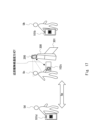
- FIG. 14 is a diagram for explaining the concept of entrance processing using a user terminal according to Example 3-1 of the third embodiment.
- the user Ua carrying the user terminal 101a indicates that the edge terminal 200 is allowed to enter through face authentication and qualification determination.
- the timing is such that the user Ub carrying the user terminal 101b enters using the short-range wireless communication method X, and then the user Uc carrying the contactless IC card 102c enters from a predetermined distance (for example, 5 meters) away. Indicates that it is waiting.
- the predetermined distance is not limited to 5 meters.
- FIG. 15 is a sequence diagram showing the flow of entrance processing using the user terminal according to Example 3-1 of the third embodiment.
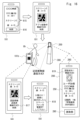
- FIG. 16 is a diagram illustrating an example of screen transitions of the entrance process in the user terminal according to Example 3-1 of the third embodiment. In the following description, FIG. 16 will be referred to as appropriate during the description of FIG. 15.
- the user terminal 101b displays reservation information in response to user Ub's operation (S341). Specifically, the user terminal 101b displays the above-mentioned reservation confirmation information 615 on the display unit 150. Then, the user terminal 101b accepts the press of the usage start button 616 from the user Ub, and displays the code information and the fact that the available short-range wireless communication is method X on the display unit 150. For example, the user terminal 101b may turn on method X in response to pressing the use start button 616. At least the user terminal 101b only needs to be in a state where short-range wireless communication is possible using method X at this point.
- the code information preferably includes the user ID and reservation ID of the user Ub. This is because, if short-range wireless communication does not work, the entrance process can be performed by having the edge terminal 200 read the code information.
- the user Ub moves to the entrance gate (edge terminal 200 and entrance control device 300) of the movie theater while carrying the user terminal 101b (S342). It is assumed that the user terminal 101b has entered the communication range of the short-range wireless communication IF 231 of the edge terminal 200 using method X. At this time, the user ID 1111 and facial feature information 1112 are transferred from the user terminal 101b to the edge terminal 200 by short-range wireless communication method X (S343). That is, the user terminal 101b transmits the user ID 1111 and facial feature information 1112 read from the storage medium 100-1 to the edge terminal 200 by short-range wireless communication method X. Note that the user terminal 101b may transmit the user ID 1111 and the facial feature information 1112 in response to a read request from the edge terminal 200 using the short-range wireless communication method X.
- the edge terminal 200 associates the received user ID 2111 and facial feature information 2112 (facial feature information A) and stores them in the storage unit 210 as user information 211 (S344). Furthermore, the edge terminal 200 detects the presence of the user Ub using the human sensor 270, and photographs the user Ub's face using the camera 260 (S345).
- the face detection unit 2431 detects a face area from the image of the user Ub captured by the camera 260 (S346). Then, the feature information extraction unit 2432 extracts facial feature information B of user Ub from the detected face area (S347). Then, the authentication processing unit 2433 compares the facial feature information A in the storage unit 210 with the facial feature information B extracted in step S347 (S348), and calculates the degree of matching. The authentication processing unit 2433 determines that face authentication has been successful when the degree of matching is greater than or equal to the threshold, and determines that face authentication has failed when the degree of matching is less than the threshold.
- the identifying unit 244 identifies the user ID 2111 (of the user Ub) associated with the facial feature information 2112 (facial feature information A) for which face authentication was successful from the storage unit 210 (S349).
- the determination unit 245 transmits a qualification confirmation request including the user ID specified in step S349 to the usage management server 500 via the network N (S350).
- the response unit 545 of the usage management server 500 identifies the user ID included in the received qualification confirmation request, and searches the usage management DB 512 for qualification information 5122 associated with the identified user ID 5121. Then, the response unit 545 determines availability based on the retrieved qualification information 5122 (S351). Then, the response unit 545 returns the usability determination result to the edge terminal 200 via the network N (S352). Note that the response unit 545 may return the searched qualification information 5122 to the edge terminal 200.
- the determination unit 245 of the edge terminal 200 uses the determination result received from the usage management server 500 as the determination result of service usage for the user Ub.
- the output unit 246 displays the determination result on the display unit 150 (S353).
- FIG. 16 shows an example in which a result message 619 is displayed on the display unit 250 of the edge terminal 200.
- the result message 619 includes information to the effect that the authentication was successful, the short-range wireless communication method by which the user ID and facial feature information were transferred, and other user attribute information (name, etc.), qualification information (ticket information, movie name, date and time, room , seat number, etc.), reason for discount on usage fee, and discount information are displayed.
- the reason for the discount may be the elderly, the disabled, multiple usage, etc.
- the discount information may be a discount amount, a discount rate (how many discounts), or the like.
- the output unit 246 outputs an admission permission notification to the admission control device 300 (S354).
- the entrance control device 300 opens the gate 301. Therefore, user Ub can enter.
- the output unit 246 transmits a message regarding the determination result and service usage to the user terminal 101b using short-range wireless communication method X (S355).
- the user terminal 101b displays the received determination result and message regarding service usage on the display unit 150 (S356).
- FIG. 16 shows an example in which result messages 617 and 618 are displayed on the display unit 150 of the user terminal 101b.
- the result message 617 shows an example in which the user ID and the short-range wireless communication method by which the facial feature information was transferred are displayed.
- the result message 618 shows an example in which authentication success, precautions to be taken after taking a seat, etc. are displayed.
- FIG. 17 is a diagram for explaining the concept of entrance processing using a non-contact IC card according to Example 3-2 of the third embodiment.
- the user Ub carrying the user terminal 101b indicates that he is permitted to enter through face authentication and qualification determination by the edge terminal 200.
- the timing is such that the user Uc carrying the contactless IC card 102c enters using the short-range wireless communication method Y, and after that, the user Ud carrying the user terminal 101d enters from a predetermined distance (for example, 5 meters) away. Indicates that it is waiting.
- the predetermined distance is not limited to 5 meters. It is assumed that a user ID 1111, facial feature information 1112, and attribute information 1113 are stored in the storage medium 100-2 of the non-contact IC card 102c. For example, assume that the contactless IC card 102 owned by the user Uc has written the user ID 1111 and facial feature information 1112 of the user Uc in the contactless IC card 102c using method Y in step S310 of FIG. 10 described above. do.
- FIG. 18 is a sequence diagram showing the flow of entrance processing using a non-contact IC card according to Example 3-2 of the third embodiment.
- the user Uc holds the non-contact IC card 102c over the reader of the short-range wireless communication IF 232 (method Y) of the edge terminal 200 (S342-2).
- the contactless IC card 102c enters the communication range of the short-range wireless communication IF 232 (method Y). Therefore, the user ID 1111 and facial feature information 1112 are transferred from the non-contact IC card 102c to the edge terminal 200 using the short-range wireless communication method Y (S343-2).
- the non-contact IC card 102c transmits the user ID 1111 and facial feature information 1112 read from the storage medium 100-2 to the edge terminal 200 using the short-range wireless communication method Y.
- the contactless IC card 102c may transmit the user ID 1111 and facial feature information 1112 read from the storage medium 100-2 in response to a read request from the edge terminal 200 using the short-range wireless communication method Y.
- steps S344 to S3554 are the same as those in FIG. 15 described above, and therefore, redundant explanation will be omitted.
- this embodiment provides the same effects as the first and second embodiments described above. Furthermore, in this embodiment, since the edge terminal 200 is compatible with a plurality of short-range wireless communication methods, it is possible to flexibly use facial authentication to determine whether or not a service can be used, depending on the user's circumstances. In addition, without using the database of facial feature information stored in the authentication infrastructure DB on the network, it is transferred from the storage medium carried by the user to the edge terminal by short-range wireless communication and stored in the edge terminal. It is used for matching with facial feature information extracted from facial images of users located at a distance. In other words, facial recognition is achieved using local authentication. Thereby, the authentication process can be continued even in the event of a communication failure with the authentication infrastructure DB. Additionally, by using biometric authentication for personal authentication, identity theft can be prevented with a high probability.
- the edge terminal 200 performs face authentication when the human sensor 270 detects a user, regardless of whether the user ID and facial feature information are acquired through short-range wireless communication. Therefore, if face authentication fails in step S348, the user whose face was photographed while trying to enter the room is different from the original holder of the user terminal 101 or contactless IC card 102 carried by the user. There are cases. Alternatively, if face authentication fails in step S348, transfer between the edge terminal 200 and the user terminal 101 or non-contact IC card 102 by short-range wireless communication may also fail. For example, if method , and the transfer may not be possible. Therefore, it is preferable that the edge terminal 200 outputs guidance information on the short-range wireless communication method when face authentication fails in step S348.
- FIG. 19 is a diagram illustrating a display example of guidance information for a short-range wireless communication method in the edge terminal 200 according to the third embodiment.
- the guidance information 620 includes a message to the effect that authentication has failed, a confirmation message to confirm whether method Including etc.
- the guide information 620 is not limited to these.
- the user U may be able to confirm the short-range wireless communication method supported by each edge terminal before entering.
- the usage management server 500 stores, in the storage unit 510, information on the corresponding short-range wireless communication method for each of the plurality of edge terminals 200-1 to 200-3 installed at the entrance gate of a movie theater. It is assumed that Then, the user terminal 101 transmits a request for a short-range wireless communication method that each edge terminal can support to the usage management server 500 via the network N in response to the user U's operation.
- the response unit 545 of the usage management server 500 When the response unit 545 of the usage management server 500 receives the above request from the user terminal 101, the response unit 545 identifies the short-range wireless communication method that each edge terminal 200 can support from the storage unit 510, and displays a display including the identified information. The information is generated and the display information is returned to the user terminal 101.
- FIG. 20 is a diagram showing a display example of short-range wireless communication methods compatible with each edge terminal according to the third embodiment.
- the user terminal 101 shows an example in which support method information 621 is displayed on the display unit 150.
- the correspondence method information 621 includes the combination of edge terminal 200-1 and admission control device 300-1, the combination of edge terminal 200-2 and admission control device 300-2, and the combination of edge terminal 200-3 and admission control device 300-3.
- the groups are arranged according to the installation location.
- the edge terminal 200-1 is compatible with method X and code authentication
- the edge terminal 200-2 is compatible with method X, method Y, and code authentication
- the edge terminal 200-3 is compatible with method Y and code authentication.
- edge terminal 200 is compatible with the short-range wireless communication method that he or she wants to use, and then use the edge terminal 200.
- code authentication is a method of having the camera 260 read the code information corresponding to the above-mentioned user ID, specifying the user ID, and performing qualification determination. Therefore, since code authentication does not use facial recognition, no discount is applied. Therefore, user U can be motivated to use method X or method Y that uses face recognition. On the other hand, by ensuring code authentication, it is possible to flexibly respond to unforeseen situations such as short-range wireless communication failures.
- the fourth embodiment is a modification of the third embodiment described above.
- the usage control terminal (edge terminal) according to the fourth embodiment is a mobile terminal. Therefore, for example, a staff member on the service provider side carries an edge terminal, and can confirm whether or not a user can use the service using short-range wireless communication with a storage medium carried by the user and facial recognition.
- a staff member on the service provider side carries an edge terminal, and can confirm whether or not a user can use the service using short-range wireless communication with a storage medium carried by the user and facial recognition.
- the service is a reserved seat on a train and the staff is the conductor.
- this fourth embodiment is also applicable to other services and staff.
- FIG. 21 is a diagram for explaining the concept of reserved seat ticket confirmation processing by the conductor U0 according to the fourth embodiment.
- the user Ue is using a certain reserved seat in a reserved seat car of a certain train. It is assumed that the user Ue carries the user terminal 101e or the non-contact IC card 102e. Further, it is assumed that the user Ue has previously performed the above-described face information registration process and reserved seat ticket purchase process on the usage management server 500 in order to purchase a reserved seat ticket.
- the usage management server 500 has registered in the usage management DB 512 the user ID 5121 of the user Ue, the qualification information 5122 which is the purchase information of the reserved seat ticket, and the attribute information 5123 of the user Ue in association with each other. Become.
- the conductor U0 patrols the train carrying the edge terminal 200e.
- the edge terminal 200e is a mobile terminal, and, unlike the edge terminal 200 described above, does not need to have the human sensor 270, and is not connected to the entrance control device 300. It is assumed that the edge terminal 200e is equivalent to the edge terminal 200 in other basic configurations.
- FIG. 22 is a sequence diagram showing the flow of reserved seat ticket confirmation processing by the conductor according to the fourth embodiment.
- FIG. 21 will be referred to as appropriate during the description of FIG. 22.
- the conductor U0 calls out to the user Ue in the reserved seat vehicle and confirms whether the user Ue has purchased a reserved seat ticket and is using the ticket legitimately.
- the user terminal 101e displays the digital reserved seat ticket 630 in response to the operation of the user Ue (S342-3).
- the conductor U0 approaches the user terminal 101e of the user Ue within the communication range of the method X of the edge terminal 200e, and presses the reserved seat ticket confirmation button 631 displayed on the screen of the edge terminal 200e.
- the user ID 1111 and facial feature information 1112 are transferred from the user terminal 101e to the edge terminal 200e by short-range wireless communication method X (S343-3).
- the edge terminal 200e acquires the user ID and facial feature information in the user terminal 101e using short-range wireless communication method X, associates the user ID 2111 with the facial feature information 2112, and stores them in the storage unit 210 (S344 ).
- the conductor U0 brings the contactless IC card 102e of the user Ue close to the communication range of the method Y of the edge terminal 200e (near the reading unit 280),
- the user presses the reserved seat ticket confirmation button 631 displayed on the screen of the edge terminal 200e.
- the user ID 1111 and the facial feature information 1112 are transferred from the user terminal 101e to the edge terminal 200e by the short-range wireless communication method Y.
- the edge terminal 200e photographs the face of the user Ue with the camera 260 (S345), and compares the facial feature information A stored in the storage unit 210 with the facial feature information B extracted from the face image. Face authentication is performed (S346 to S348). If the face authentication is successful, the edge terminal 200e identifies the user ID 2111 (of the user Ue) associated with the facial feature information 2112 for which the face authentication was successful from the storage unit 210 (S349). Then, the edge terminal 200e transmits a qualification confirmation request including the specified user ID to the usage management server 500 via the network N (S350), and confirms whether the user Ue has purchased a reserved seat ticket. .
- the edge terminal 200e acquires the qualification information 5122 associated with the user ID 5121 of the user Ue from the usage management DB 512 (S352), and displays it on the display unit 250 (S353). For example, the edge terminal 200e displays the reserved seat ticket information received from the usage management server 500 as the result message 632.
- the result message 632 includes information that the user Ue succeeded in face authentication, information on the reserved seat ticket purchased by the user Ue, and the like. However, the result message 632 is not limited to these.
- the edge terminal 200e may determine the validity of the reserved seat ticket from the qualification information received from the usage management server 500. Alternatively, the edge terminal 200e may receive the determination result determined by the usage management server 500. Through these, the conductor U0 can confirm that the user Ue has purchased a reserved seat ticket and is using it legitimately.
- the conductor U0 can guide the user Ue to the correct seat by looking at the result message 632. Further, in this case, when the edge terminal 200e receives the input of the reserved seat number from the conductor U0, the edge terminal 200e may display the result message 632 as a determination result that the seat position is different from the received qualification information.
- the edge terminal 200e receives from the usage management server 500 as a determination result that the qualification information has not been registered, and the reserved seat ticket has not been purchased. The purchase may be displayed as a result message 632. Furthermore, if the user Ue has not registered face information, the edge terminal 200e will fail in face authentication, and may display this fact in the result message 632.
- this embodiment also provides the same effects as the first and second embodiments described above. Further, in this embodiment, similarly to the third embodiment described above, the edge terminal 200e is compatible with a plurality of short-range wireless communication methods and realizes local authentication. Therefore, the same effects as those of the third embodiment can be achieved.
- the same effect as in the third embodiment can be achieved by providing a larger discount than when purchasing at a counter or ticket vending machine.
- the edge terminal 200e is a mobile terminal, staff members and the like can flexibly and easily determine qualifications for using various services without being restricted by location.
- facial information obtained through communication with the user's user terminal or contactless IC card can be used without the conductor asking the user to produce a ticket or reserved seat ticket.
- the conductor can easily grasp the user's qualification information (seat information) by performing facial recognition on the user's facial information (information) and the facial information (facial feature information) obtained by photographing the user. Therefore, the conductor can easily confirm whether he or she is sitting in an appropriate seat. Therefore, since an error occurs when the identity of a person who has boarded the vehicle with another person's user terminal or contactless IC card is verified through facial recognition, it is possible to suppress impersonation and unauthorized boarding.
- the fifth embodiment is an additional example of the third or fourth embodiment described above.
- the user terminal 101 may write the user ID and facial feature information issued to the non-contact IC card 102.
- FIG. 23 is a diagram showing an example of screen transitions in the process of writing characteristic information to the non-contact IC card 102 according to the fifth embodiment.
- face information registration processing has been performed in the same manner as steps S301 to S304 in FIG. 10 described above.
- the user U then presses the face registration button 606f on the user terminal 101.
- the user terminal 101 extracts facial feature information from the facial image in the authentication infrastructure system 400, similar to steps S305 to S309 described above, and the user terminal 101 extracts facial feature information from the facial image using the issued user ID and the extracted facial feature information. receive.
- the user terminal 101 continues to perform a process of writing facial feature information to the non-contact IC card 102 (S310a). Specifically, the user terminal 101 associates the received user ID 1111 and facial feature information 1112 and sends the data to the storage medium 100-2 of the contactless IC card 102 by method Y via the short-range wireless communication IF 132. Write. Then, the user terminal 101 displays a message indicating that the face registration to the card is completed (face registration completion message 608). Thereafter, the user terminal 101 executes the steps from step S311 described above.
- the user U can perform face authentication and determine eligibility for service use by holding the non-contact IC card 102 over the reading unit 280 of the edge terminal 200 or the like instead of using the user terminal 101.
- the user terminal 101 may write the qualification information in the storage medium 100.
- the user terminal 101 may receive the qualification information issued from the usage management server 500, and store the qualification information in the storage medium 100 in association with the user ID.
- the user terminal 101 or the non-contact type IC card 102 may transfer qualification information along with the user ID and facial feature information (biometric information) by short-range wireless communication with the edge terminal 200 or the like.
- a set of user ID and qualification information is registered in the database (usage management DB) of the usage management server at the time of registration or reservation. You don't have to.
- the user terminal 101 may register the qualification information in the storage medium 100 in association with the user ID.
- the edge terminal can acquire the facial feature information and user ID as well as the qualification information and attribute information from the user terminal or contactless IC card when the user uses the service.
- the edge terminal can output the determination result only through local communication between the user terminal and the edge terminal, without communicating with the usage management server.
- the payment process may be performed when it is confirmed that the user who has successfully passed facial authentication when using the service is a pre-registered discount target user (student, elderly person).
- a pre-registered discount target user project, elderly person.
- the user terminal may acquire attribute information from the digital identification card, and transmit the electronic application including the attribute information along with the user ID and reservation information. That is, attribute information recorded on a digital identification card such as a driver's license, passport, student ID card, or My Number card may be used to prove that the person making the reservation is eligible for the discount at the time of reservation. Furthermore, the user terminal may read facial feature information from the digital identification card and send an electronic application including the facial feature information along with the user ID, reservation information, and attribute information. Further, by comparing the facial feature information obtained from the digital identification card with the photographed facial information, it may be possible to prove that the person is eligible for the discount.
- attribute information recorded on a digital identification card such as a driver's license, passport, student ID card, or My Number card may be used to prove that the person making the reservation is eligible for the discount at the time of reservation.
- the user terminal may read facial feature information from the digital identification card and send an electronic application including the facial feature information along with the user ID, reservation information, and attribute information. Further, by comparing the
- biometric authentication identity verification authentication, person authentication, person identification processing, etc.
- biometric authentication and biometric information other techniques that use captured images of people can be applied.
- the biometric information may be data (feature amounts) calculated from physical characteristics unique to an individual, such as fingerprints, voiceprints, veins, retinas, iris of the eyes, and patterns on the palm of the hand.
- feature information indicating a person's physical characteristics is extracted from a photographed image of a part of the user's body, and the extracted feature information is compared with pre-registered feature information to determine the match.
- biometric authentication may be based on a person's external shape.
- the characteristic information is information regarding the external shape of the person, for example, information indicating characteristics such as body shape, height, clothing, etc.
- biometric authentication may also be other personal authentication information.
- personal authentication information includes a user ID, a combination of ID and password, information written on an identification card such as my number or driver's license (identification number, password, etc.), electronic certificate, code information, etc. , but not limited to.
- the code information may be a two-dimensional code, such as a QR code (registered trademark).
- the program includes instructions (or software code) that, when loaded into a computer, cause the computer to perform one or more of the functions described in the embodiments.
- the program may be stored on a non-transitory computer readable medium or a tangible storage medium.
- computer readable or tangible storage media may include random-access memory (RAM), read-only memory (ROM), flash memory, solid-state drive (SSD) or other memory technology, CD - Including ROM, digital versatile disc (DVD), Blu-ray disc or other optical disc storage, magnetic cassette, magnetic tape, magnetic disc storage or other magnetic storage device.
- the program may be transmitted on a transitory computer-readable medium or a communication medium.
- transitory computer-readable or communication media includes electrical, optical, acoustic, or other forms of propagating signals.
- the acquisition means stands by and enables acquisition by each of the plurality of short-range wireless communication methods
- the storage means when the acquisition means acquires the user ID and the first biometric information by any of the plurality of methods, associates the acquired user ID with the first biometric information.
- Appendix A3 The usage control terminal according to appendix A1 or A2, wherein the qualification information is information issued based on attribute information of the user.
- Appendix A4 The use control according to any one of appendices A1 to A3, wherein the identifying means identifies the short-range wireless communication method at the time of acquisition by the acquiring means, and registers the identified method as being included in the acquisition history. terminal.
- the output unit outputs an admission permission notification to an admission control device that controls admission of the user when the determination result indicates that the service can be used.
- Usage control terminal (Appendix A6) The usage control terminal according to any one of appendices A1 to A5, wherein, when the determination result indicates that the service can be used, the output means outputs display information indicating that.
- the identifying means refers to the database and identifies attribute information resulting from the qualification information associated with the identified user ID, The usage control terminal according to any one of appendices A1 to A6, wherein the output means outputs the specified attribute information.
- the storage medium is installed in a user terminal capable of short-range wireless communication using a predetermined method, The usage control terminal according to any one of appendices A1 to A10, wherein the acquisition means acquires the user ID and the first biometric information by short-range wireless communication with the user terminal according to the predetermined method. .
- the storage medium is a contactless IC (Integrated Circuit) card capable of short-range wireless communication according to a predetermined method
- the acquisition unit acquires the user ID and the first biometric information by short-range wireless communication with the contactless IC card according to the predetermined method, according to any one of appendices A1 to A10.
- Usage control terminal (Appendix A14) The usage control terminal according to any one of appendices A1 to A13, wherein the usage control terminal is a mobile terminal.
- (Appendix B1) a database in which a user ID of a predetermined user and qualification information for use of a service by the user are registered in association with each other; a usage control terminal capable of short-range wireless communication using one or more methods; Equipped with The usage control terminal is an acquisition unit that acquires the user ID and the first biometric information from a storage medium carried by the user and in which the user ID and the first biometric information are stored, using a predetermined method of short-range wireless communication; storage means for storing the user ID and the first biometric information in a storage device in association with each other; an authentication unit that performs biometric authentication based on second biometric information extracted from an image taken of the user and first biometric information stored in the storage device; identification means for identifying, from the storage device, a user ID associated with the first biometric information for which the biometric authentication was successful; a determination unit that refers to the database and determines whether the service can be used by the user based on qualification information associated with the specified user ID; output means for outputting information according to the determination
- the usage control system according to Appendix B1, wherein the usage control system is stored in the storage device.
- the computer is acquiring the user ID and the first biometric information from a storage medium carried by a predetermined user and storing the user ID and the first biometric information of the user by a predetermined method of short-range wireless communication; storing the user ID and the first biometric information in a storage device in association with each other; Performing biometric authentication based on second biometric information extracted from an image taken of the user and first biometric information stored in the storage device, identifying from the storage device a user ID associated with the first biometric information for which the biometric authentication was successful; Referring to a database registered by associating the user ID with the qualification information for use of the service by the user, and determining whether the service can be used by the user based on the qualification information associated with the specified user ID.
- a determination process for determining the an output process that outputs information according to the determination result of the determination process A non-transitory computer-readable medium that stores a usage control program that causes a computer to execute.
- Appendix E1 When an electronic application for use of a predetermined service including a user ID corresponding to the first biometric information of a predetermined user is received, a discounted usage fee for the service is calculated based on the attribute information of the user.
- a registration means for registering the user ID and the qualification information for using the service in a database in association with each other when the user makes a payment for the usage fee;
- a response means for sending a response to the usage control terminal based on the received qualification information;
- the registration means includes: receiving the user ID and the attribute information from a user terminal whose attribute information has been read from a first storage medium storing the attribute information of the user due to successful authentication; registering the received user ID and the attribute information in the database in association with each other;
- the calculation means is identifying attribute information associated with the user ID included in the electronic application from the database;
- the usage management server according to appendix E1, which calculates usage fees for the service based on the identified attribute information.
- the response means includes: The user ID and the first biometric information are acquired by a predetermined method of short-range wireless communication from a second storage medium carried by the user and in which the user ID and the first biometric information are stored; A user ID identified by the usage control terminal that has performed biometric authentication based on second biometric information extracted from an image taken of the user and the first biometric information, by successful biometric authentication; The usage management server described in Appendix E1 or E2. (Appendix E4) The usage management server according to any one of appendices E1 to E3, wherein the response means returns, in response to a request, a short-range wireless communication method that each of the plurality of usage control terminals can support to the request source. .
- the response means specifies the qualification information associated with the received user ID from the database, and returns the specified qualification information to the usage control terminal as the response. Any one of appendices E1 to E4.
- Usage management server described in section. The response means refers to the database, determines whether or not the service can be used based on the qualification information associated with the received user ID, and returns the determination result to the usage control terminal as the response.
- the usage management server according to any one of appendices E1 to E4.
- the computer is When an electronic application for the use of a predetermined service that includes a user ID corresponding to the first biometric information of a predetermined user is received, a discounted usage fee for the service is calculated based on the attribute information of the user. , When the user makes a payment for the usage fee, registering the user ID and the qualification information for using the service in a database in association with each other; When receiving a user ID identified by the user successfully performing biometric authentication based on the first biometric information from the service usage control terminal, refer to the database and associate the user ID with the received user ID. send a response to the usage control terminal based on the received qualification information; Usage management method.
- usage control terminal 11 acquisition unit 12 storage unit 13 authentication unit 14 identification unit 15 determination unit 16 output unit 2 usage management server 21 calculation unit 22 registration unit 23 response unit 1000 usage control system N network U user 101 user terminal 102 non-contact type IC card 100 Storage medium 100-1 Storage medium 100-2 Storage medium 1111 User ID 1112 Facial feature information 1113 Attribute information 1021 Near field wireless communication IF 1022 RW control unit 110 Storage unit 111 User information 112 Payment information 113 Program 120 Memory 130 Communication unit 131 Near field communication IF 132 Near field wireless communication IF 140 Control unit 141 Registration unit 142 Purchase unit 143 Confirmation unit 144 Short-range wireless transmission/reception unit 150 Display unit 160 Camera 200 Edge terminal 210 Storage unit 211 User information 2111 User ID 2112 Facial feature information 212 Usage history 2121 Date and time 2122 User ID 2123 Wireless method 2124 Judgment result 213 Program 220 Memory 230 Communication unit 231 Short-range wireless communication IF 232 Near field wireless communication IF 240 Control unit 241 Acquisition unit 242 Storage unit 243 Authentication unit
Landscapes
- Engineering & Computer Science (AREA)
- Computer Security & Cryptography (AREA)
- Theoretical Computer Science (AREA)
- Computer Hardware Design (AREA)
- Software Systems (AREA)
- Physics & Mathematics (AREA)
- General Engineering & Computer Science (AREA)
- General Physics & Mathematics (AREA)
- Financial Or Insurance-Related Operations Such As Payment And Settlement (AREA)
Priority Applications (3)
| Application Number | Priority Date | Filing Date | Title |
|---|---|---|---|
| PCT/JP2022/015506 WO2023188003A1 (ja) | 2022-03-29 | 2022-03-29 | 利用制御端末、システム及び方法、利用管理サーバ及び方法、並びに、コンピュータ可読媒体 |
| JP2024510803A JP7779377B2 (ja) | 2022-03-29 | 2022-03-29 | 利用制御端末、利用制御方法、及び、利用制御プログラムが格納された非一時的なコンピュータ可読媒体 |
| US18/849,643 US20250200158A1 (en) | 2022-03-29 | 2022-03-29 | Utilization control terminal, system and method, utilization management server and method, and computer readable medium |
Applications Claiming Priority (1)
| Application Number | Priority Date | Filing Date | Title |
|---|---|---|---|
| PCT/JP2022/015506 WO2023188003A1 (ja) | 2022-03-29 | 2022-03-29 | 利用制御端末、システム及び方法、利用管理サーバ及び方法、並びに、コンピュータ可読媒体 |
Publications (1)
| Publication Number | Publication Date |
|---|---|
| WO2023188003A1 true WO2023188003A1 (ja) | 2023-10-05 |
Family
ID=88200110
Family Applications (1)
| Application Number | Title | Priority Date | Filing Date |
|---|---|---|---|
| PCT/JP2022/015506 Ceased WO2023188003A1 (ja) | 2022-03-29 | 2022-03-29 | 利用制御端末、システム及び方法、利用管理サーバ及び方法、並びに、コンピュータ可読媒体 |
Country Status (3)
| Country | Link |
|---|---|
| US (1) | US20250200158A1 (https=) |
| JP (1) | JP7779377B2 (https=) |
| WO (1) | WO2023188003A1 (https=) |
Citations (4)
| Publication number | Priority date | Publication date | Assignee | Title |
|---|---|---|---|---|
| JPH10143683A (ja) * | 1996-09-13 | 1998-05-29 | Fujitsu Ltd | チケットレスシステム及び処理方法並びにチケットレス処理プログラムを記録したコンピュータで読み取り可能な記録媒体 |
| JP2006201997A (ja) * | 2005-01-20 | 2006-08-03 | Dainippon Printing Co Ltd | チケット発行システム |
| JP2020013525A (ja) * | 2018-07-04 | 2020-01-23 | 凸版印刷株式会社 | 認証装置、認証システム、および、認証方法 |
| JP2020038684A (ja) * | 2019-10-24 | 2020-03-12 | ナスクインターナショナル株式会社 | モバイル端末を用いた資格認証システム、資格認証用ツール、及び、資格認証方法 |
Family Cites Families (2)
| Publication number | Priority date | Publication date | Assignee | Title |
|---|---|---|---|---|
| JP2003151016A (ja) | 2001-11-08 | 2003-05-23 | Nippon Signal Co Ltd:The | 本人認証装置及びこれを備えた自動販売装置 |
| JP2020205001A (ja) | 2019-06-19 | 2020-12-24 | パナソニックIpマネジメント株式会社 | 入場者管理システムおよび入場者管理方法 |
-
2022
- 2022-03-29 US US18/849,643 patent/US20250200158A1/en active Pending
- 2022-03-29 WO PCT/JP2022/015506 patent/WO2023188003A1/ja not_active Ceased
- 2022-03-29 JP JP2024510803A patent/JP7779377B2/ja active Active
Patent Citations (4)
| Publication number | Priority date | Publication date | Assignee | Title |
|---|---|---|---|---|
| JPH10143683A (ja) * | 1996-09-13 | 1998-05-29 | Fujitsu Ltd | チケットレスシステム及び処理方法並びにチケットレス処理プログラムを記録したコンピュータで読み取り可能な記録媒体 |
| JP2006201997A (ja) * | 2005-01-20 | 2006-08-03 | Dainippon Printing Co Ltd | チケット発行システム |
| JP2020013525A (ja) * | 2018-07-04 | 2020-01-23 | 凸版印刷株式会社 | 認証装置、認証システム、および、認証方法 |
| JP2020038684A (ja) * | 2019-10-24 | 2020-03-12 | ナスクインターナショナル株式会社 | モバイル端末を用いた資格認証システム、資格認証用ツール、及び、資格認証方法 |
Also Published As
| Publication number | Publication date |
|---|---|
| JPWO2023188003A1 (https=) | 2023-10-05 |
| US20250200158A1 (en) | 2025-06-19 |
| JP7779377B2 (ja) | 2025-12-03 |
Similar Documents
| Publication | Publication Date | Title |
|---|---|---|
| JP6783430B2 (ja) | モバイル端末を用いた資格認証システム、資格認証用ツール、及び、資格認証方法 | |
| JP7298945B2 (ja) | 近接場情報認証方法、近接場情報認証装置、電子機器及びコンピュータ記憶媒体 | |
| US10515320B2 (en) | Biometric verification of ticket users | |
| US12554818B2 (en) | System, server apparatus, authentication method, and storage medium | |
| US20170169435A1 (en) | Method and system for authorizing a transaction | |
| JP2016157294A (ja) | 販売管理システム | |
| JP2019057004A (ja) | 認証システム、認証方法および情報処理装置 | |
| US20220270423A1 (en) | Identity-based enablement of event access control | |
| JP2025088095A (ja) | 端末、システム、端末の制御方法及びプログラム | |
| US12112613B2 (en) | Systems and methods for identification of a person using live audio and/or video interactions including local identification and remote identification of the person | |
| JP7779377B2 (ja) | 利用制御端末、利用制御方法、及び、利用制御プログラムが格納された非一時的なコンピュータ可読媒体 | |
| JP7363982B2 (ja) | 認証端末、認証端末の制御方法及びプログラム | |
| JP7806796B2 (ja) | カード情報管理装置、カード情報管理システム、カード情報管理方法、及びカード情報管理プログラム | |
| JP7754191B2 (ja) | 処理実行装置、認証システム、処理実行方法、及び、プログラム | |
| JPWO2018142605A1 (ja) | 携帯端末、サーバ、制御方法、ならびに、プログラム | |
| JP7643643B2 (ja) | サーバ装置、システム、サーバ装置の制御方法及びプログラム | |
| JP7589863B2 (ja) | サーバ装置、システム、サーバ装置の制御方法及びプログラム | |
| JP7838665B2 (ja) | 情報処理装置、情報処理システム、情報処理方法及びプログラム | |
| JP7589865B2 (ja) | サーバ装置、システム、サーバ装置の制御方法及びプログラム | |
| JP7589864B2 (ja) | サーバ装置、システム、サーバ装置の制御方法及びプログラム | |
| JP7764984B1 (ja) | 認証端末、システム、認証端末の制御方法及びプログラム | |
| JP7589829B2 (ja) | システム、認証端末、認証端末の制御方法及びプログラム | |
| JP2020038684A (ja) | モバイル端末を用いた資格認証システム、資格認証用ツール、及び、資格認証方法 | |
| WO2025027828A1 (ja) | サーバ装置、サーバ装置の制御方法、記憶媒体及びシステム | |
| WO2024053038A1 (ja) | 宿泊支援装置、システム及び方法、並びに、コンピュータ可読媒体 |
Legal Events
| Date | Code | Title | Description |
|---|---|---|---|
| 121 | Ep: the epo has been informed by wipo that ep was designated in this application |
Ref document number: 22933889 Country of ref document: EP Kind code of ref document: A1 |
|
| WWE | Wipo information: entry into national phase |
Ref document number: 18849643 Country of ref document: US |
|
| ENP | Entry into the national phase |
Ref document number: 2024510803 Country of ref document: JP Kind code of ref document: A |
|
| NENP | Non-entry into the national phase |
Ref country code: DE |
|
| 122 | Ep: pct application non-entry in european phase |
Ref document number: 22933889 Country of ref document: EP Kind code of ref document: A1 |
|
| WWP | Wipo information: published in national office |
Ref document number: 18849643 Country of ref document: US |