WO2023181660A1 - 駆動装置、スイッチング電源装置、及び車両 - Google Patents
駆動装置、スイッチング電源装置、及び車両 Download PDFInfo
- Publication number
- WO2023181660A1 WO2023181660A1 PCT/JP2023/003558 JP2023003558W WO2023181660A1 WO 2023181660 A1 WO2023181660 A1 WO 2023181660A1 JP 2023003558 W JP2023003558 W JP 2023003558W WO 2023181660 A1 WO2023181660 A1 WO 2023181660A1
- Authority
- WO
- WIPO (PCT)
- Prior art keywords
- current
- drive device
- switching element
- transistor
- control terminal
- Prior art date
- Legal status (The legal status is an assumption and is not a legal conclusion. Google has not performed a legal analysis and makes no representation as to the accuracy of the status listed.)
- Ceased
Links
Images




Classifications
-
- H—ELECTRICITY
- H02—GENERATION; CONVERSION OR DISTRIBUTION OF ELECTRIC POWER
- H02M—APPARATUS FOR CONVERSION BETWEEN AC AND AC, BETWEEN AC AND DC, OR BETWEEN DC AND DC, AND FOR USE WITH MAINS OR SIMILAR POWER SUPPLY SYSTEMS; CONVERSION OF DC OR AC INPUT POWER INTO SURGE OUTPUT POWER; CONTROL OR REGULATION THEREOF
- H02M1/00—Details of apparatus for conversion
- H02M1/08—Circuits specially adapted for the generation of control voltages for semiconductor devices incorporated in static converters
-
- B—PERFORMING OPERATIONS; TRANSPORTING
- B60—VEHICLES IN GENERAL
- B60R—VEHICLES, VEHICLE FITTINGS, OR VEHICLE PARTS, NOT OTHERWISE PROVIDED FOR
- B60R16/00—Electric or fluid circuits specially adapted for vehicles and not otherwise provided for; Arrangement of elements of electric or fluid circuits specially adapted for vehicles and not otherwise provided for
- B60R16/02—Electric or fluid circuits specially adapted for vehicles and not otherwise provided for; Arrangement of elements of electric or fluid circuits specially adapted for vehicles and not otherwise provided for electric constitutive elements
- B60R16/03—Electric or fluid circuits specially adapted for vehicles and not otherwise provided for; Arrangement of elements of electric or fluid circuits specially adapted for vehicles and not otherwise provided for electric constitutive elements for supply of electrical power to vehicle subsystems or for
-
- H—ELECTRICITY
- H02—GENERATION; CONVERSION OR DISTRIBUTION OF ELECTRIC POWER
- H02M—APPARATUS FOR CONVERSION BETWEEN AC AND AC, BETWEEN AC AND DC, OR BETWEEN DC AND DC, AND FOR USE WITH MAINS OR SIMILAR POWER SUPPLY SYSTEMS; CONVERSION OF DC OR AC INPUT POWER INTO SURGE OUTPUT POWER; CONTROL OR REGULATION THEREOF
- H02M1/00—Details of apparatus for conversion
- H02M1/0048—Circuits or arrangements for reducing losses
- H02M1/0054—Transistor switching losses
-
- H—ELECTRICITY
- H02—GENERATION; CONVERSION OR DISTRIBUTION OF ELECTRIC POWER
- H02M—APPARATUS FOR CONVERSION BETWEEN AC AND AC, BETWEEN AC AND DC, OR BETWEEN DC AND DC, AND FOR USE WITH MAINS OR SIMILAR POWER SUPPLY SYSTEMS; CONVERSION OF DC OR AC INPUT POWER INTO SURGE OUTPUT POWER; CONTROL OR REGULATION THEREOF
- H02M1/00—Details of apparatus for conversion
- H02M1/36—Means for starting or stopping converters
-
- H—ELECTRICITY
- H02—GENERATION; CONVERSION OR DISTRIBUTION OF ELECTRIC POWER
- H02M—APPARATUS FOR CONVERSION BETWEEN AC AND AC, BETWEEN AC AND DC, OR BETWEEN DC AND DC, AND FOR USE WITH MAINS OR SIMILAR POWER SUPPLY SYSTEMS; CONVERSION OF DC OR AC INPUT POWER INTO SURGE OUTPUT POWER; CONTROL OR REGULATION THEREOF
- H02M3/00—Conversion of DC power input into DC power output
- H02M3/22—Conversion of DC power input into DC power output with intermediate conversion into AC
- H02M3/24—Conversion of DC power input into DC power output with intermediate conversion into AC by static converters
- H02M3/28—Conversion of DC power input into DC power output with intermediate conversion into AC by static converters using discharge tubes with control electrode or semiconductor devices with control electrode to produce the intermediate AC
-
- H—ELECTRICITY
- H02—GENERATION; CONVERSION OR DISTRIBUTION OF ELECTRIC POWER
- H02M—APPARATUS FOR CONVERSION BETWEEN AC AND AC, BETWEEN AC AND DC, OR BETWEEN DC AND DC, AND FOR USE WITH MAINS OR SIMILAR POWER SUPPLY SYSTEMS; CONVERSION OF DC OR AC INPUT POWER INTO SURGE OUTPUT POWER; CONTROL OR REGULATION THEREOF
- H02M3/00—Conversion of DC power input into DC power output
- H02M3/22—Conversion of DC power input into DC power output with intermediate conversion into AC
- H02M3/24—Conversion of DC power input into DC power output with intermediate conversion into AC by static converters
- H02M3/28—Conversion of DC power input into DC power output with intermediate conversion into AC by static converters using discharge tubes with control electrode or semiconductor devices with control electrode to produce the intermediate AC
- H02M3/325—Conversion of DC power input into DC power output with intermediate conversion into AC by static converters using discharge tubes with control electrode or semiconductor devices with control electrode to produce the intermediate AC using devices of a triode or a transistor type requiring continuous application of a control signal
- H02M3/335—Conversion of DC power input into DC power output with intermediate conversion into AC by static converters using discharge tubes with control electrode or semiconductor devices with control electrode to produce the intermediate AC using devices of a triode or a transistor type requiring continuous application of a control signal using semiconductor devices only
- H02M3/33507—Conversion of DC power input into DC power output with intermediate conversion into AC by static converters using discharge tubes with control electrode or semiconductor devices with control electrode to produce the intermediate AC using devices of a triode or a transistor type requiring continuous application of a control signal using semiconductor devices only with automatic control of the output voltage or current, e.g. flyback converters
- H02M3/33523—Conversion of DC power input into DC power output with intermediate conversion into AC by static converters using discharge tubes with control electrode or semiconductor devices with control electrode to produce the intermediate AC using devices of a triode or a transistor type requiring continuous application of a control signal using semiconductor devices only with automatic control of the output voltage or current, e.g. flyback converters with galvanic isolation between input and output of both the power stage and the feedback loop
-
- H—ELECTRICITY
- H02—GENERATION; CONVERSION OR DISTRIBUTION OF ELECTRIC POWER
- H02M—APPARATUS FOR CONVERSION BETWEEN AC AND AC, BETWEEN AC AND DC, OR BETWEEN DC AND DC, AND FOR USE WITH MAINS OR SIMILAR POWER SUPPLY SYSTEMS; CONVERSION OF DC OR AC INPUT POWER INTO SURGE OUTPUT POWER; CONTROL OR REGULATION THEREOF
- H02M1/00—Details of apparatus for conversion
- H02M1/44—Circuits or arrangements for compensating for electromagnetic interference in converters or inverters
Definitions
- the invention disclosed herein relates to a drive device that drives a switching element, and a switching power supply device and vehicle that include the drive device.
- a peak may appear due to EMI (Electromagnetic Interference) noise of the switching power supply.
- EMI Electromagnetic Interference
- Noise peaks in the low frequency region can be suppressed by equipping the switching power supply with a function to spread the spectrum of the switching frequency (for example, see Patent Document 1).
- noise peaks in the high frequency range (frequency range of several tens of MHz or more) can be suppressed by suppressing the current capacity of the drive device that drives the switching elements and reducing the slew rate of the drain voltage of the switching elements. suppressed.
- the drive device disclosed herein is configured to drive a switching element.
- the drive device includes a variation unit configured to vary the current supply capability to the control terminal of the switching element during a period from startup to stop of the drive device.
- the switching power supply device disclosed herein includes the drive device having the above configuration and the switching element.
- the vehicle disclosed herein has a switching power supply device having the above configuration.
- FIG. 1 is a diagram showing the configuration of a switching power supply device according to a first embodiment.
- FIG. 2 is a diagram showing the ON/OFF slew rate of the switching element of the switching power supply shown in FIG.
- FIG. 3 is a diagram showing the configuration of a switching power supply device according to a comparative example.
- FIG. 4 is a diagram showing EMI noise.
- FIG. 5 is a diagram showing the configuration of a switching power supply device according to the second embodiment.
- FIG. 6 is a diagram showing an example of a configuration of a variable current source.
- FIG. 7 is a diagram showing the ON slew rate of the switching element of the switching power supply shown in FIG.
- FIG. 8 is a diagram showing the OFF slew rate of the switching element of the switching power supply shown in FIG.
- FIG. 9 is an external view of the vehicle.
- a MOSFET metal oxide semiconductor field effect transistor
- a gate whose structure is a "layer made of a conductor or a semiconductor such as polysilicon with a low resistance value," “insulating layer,” and "P-type, A field effect transistor consisting of at least three layers of "N-type or intrinsic semiconductor layers".
- the structure of the MOSFET gate is not limited to the three-layer structure of metal, oxide, and semiconductor.
- constant voltage means a voltage that is constant in an ideal state, and is actually a voltage that may vary slightly due to temperature changes and the like.
- constant current means a current that is constant in an ideal state, and is actually a current that may vary slightly due to temperature changes and the like.
- FIG. 1 is a diagram showing the configuration of a switching power supply device according to a first embodiment.
- the switching power supply device 100 includes a drive device 101, a switching element SW1, a resistor R1, a transformer T1, a diode D1, and an output capacitor C1.
- the drive device 101 is configured to drive the switching element SW1.
- the drive device 101 is a gate driver IC (Integrated Circuit). The internal configuration of the drive device 101 will be described later.
- the switching element SW1 is an N-channel MOSFET.
- the source of the switching element SW1 is connected to the ground potential via the resistor R1.
- the drain of switching element SW1 is connected to the first end of primary winding L1 of transformer T1.
- the second end of the primary winding L1 is connected to the positive pole of the voltage source VS1.
- the negative pole of voltage source VS1 is connected to ground potential.
- the first end of the secondary winding L2 of the transformer T1 is connected to the anode of the diode D1.
- a cathode of diode D1 is connected to a first end of output capacitor C1.
- the second end of the output capacitor C1 is connected to the second end of the secondary winding L2 and to ground potential.
- the drive device 101 includes a clamper 1, a gate signal generation section 2, pulse signal generation sections 11-14, AND gates 21-24 and 31-34, transistors P0-P4 and N0-N4, and a pull-down resistor R2. , has.
- the variable section provided in the drive device 101 is composed of pulse signal generating sections 11 to 14, AND gates 21 to 24 and 31 to 34, and transistors P1 to P4 and N1 to N4.
- the variation section varies the current supply capability to the control terminal (gate) of the switching element SW1 during the period from startup to shutdown of the drive device 101.
- transistors P0 to P4 are P-channel MOSFETs
- transistors N0 to N4 are N-channel MOSFETs.
- a constant voltage VCC is applied to the first end of the clamper 1.
- a second end of the clamper 1 is connected to the sources of the transistors P0 to P4.
- the drains of the transistors P0 to P4 are connected to the drains of the transistors N0 to N4, the first end of the pull-down resistor R2, and the control terminal (gate) of the switching element SW1.
- the sources of the transistors N0 to N4 are connected to the second end of the pull-down resistor R2 and the ground potential.
- the clamper 1 clamps each source of the transistors P0 to P4 to, for example, 10V.
- the gate signal generation section 2 generates gate signals G1 and G2. For example, the gate signal generation section 2 generates the gate signals G1 and G2 based on the output voltage VOUT or a divided voltage of the output voltage VOUT.
- Gate signal G2 is a complementary signal to gate signal G1. That is, when the gate signal G1 is at a high level, the gate signal G2 is at a low level, and when the gate signal G1 is at a low level, the gate signal G2 is at a high level.
- a gate signal G1 is supplied to the gate of the transistor P0.
- the output signal of the AND gate 21 is supplied to the gate of the transistor P1.
- the AND gate 21 outputs a signal that is the logical product of the gate signal G1 and the pulse signal VA output from the pulse signal generator 11.
- the output signal of the AND gate 22 is supplied to the gate of the transistor P2.
- the AND gate 22 outputs a signal that is the logical product of the gate signal G1 and the pulse signal VB output from the pulse signal generator 12.
- the output signal of the AND gate 23 is supplied to the gate of the transistor P3.
- the AND gate 23 outputs a signal that is the logical product of the gate signal G1 and the pulse signal VC output from the pulse signal generator 13.
- the output signal of the AND gate 24 is supplied to the gate of the transistor P4.
- the AND gate 24 outputs a signal that is the logical product of the gate signal G1 and the pulse signal VD output from the pulse signal generator 14.
- a gate signal G2 is supplied to the gate of the transistor N0.
- the output signal of the AND gate 31 is supplied to the gate of the transistor N1.
- the AND gate 31 outputs a signal that is the logical product of the gate signal G2 and the pulse signal VA output from the pulse signal generator 11.
- the output signal of the AND gate 22 is supplied to the gate of the transistor N2.
- the AND gate 22 outputs a signal that is the logical product of the gate signal G2 and the pulse signal VB output from the pulse signal generator 12.
- the output signal of the AND gate 23 is supplied to the gate of the transistor N3.
- the AND gate 23 outputs a signal that is the logical product of the gate signal G2 and the pulse signal VC output from the pulse signal generator 13.
- the output signal of the AND gate 24 is supplied to the gate of the transistor N4.
- the AND gate 24 outputs a signal that is the logical product of the gate signal G2 and the pulse signal VD output from the pulse signal generator 14.
- the transistors N1 to N4 are individually controlled to supply or not supply current to the control terminal (gate) of the switching element SW1 when the switching element SW1 is turned off.
- the slew rate of the drain voltage of the switching element SW1 when the switching element SW1 is turned on is repeats fluctuations in which it increases step by step and then decreases step by step. Furthermore, in the driving device 101, if the pulse signals VA to VD output from the pulse signal generation units 11 to 14 are set as shown in FIG. 2, the drain voltage of the switching element SW1 when the switching element SW1 is turned off is The slew rate repeats fluctuations in which it increases step by step and then decreases step by step.
- the current supply capability of the transistor P0 to the control terminal (gate) of the switching element SW1 is larger than the current supply capability to the control terminal (gate) of the switching element SW1 of each of the transistors P1 to P4.
- the drain current of transistor P0 is four times the drain current of transistors P1 to P4.
- the minimum current supply capacity is the current supply capacity of transistor P0
- the maximum current supply capacity is the current supply capacity of each transistor P0 to P4.
- the current supply capability of the transistor N0 to the control terminal (gate) of the switching element SW1 is greater than the current supply capability of each of the transistors N1 to N4 to the control terminal (gate) of the switching element SW1.
- the drain current of transistor N0 is four times the drain current of transistors N1 to N4.
- the minimum current supply capacity is the current supply capacity of transistor N0
- the maximum current supply capacity is the current supply capacity of each transistor N0 to N4.
- the drive device 101 repeats sections i to section Viii multiple times during the period from starting to stopping.
- the lengths of section i to section Viii are not particularly limited, for example, the lengths of section i to section Viii can be made to match the switching period of switching element SW1.
- pulse signals VA to VD are at low level.
- section ii which is the next section after section i, the pulse signal VA is at high level and the pulse signals VB to VD are at low level.
- pulse signals VA and VB are at high level
- pulse signals VC and VD are at low level.
- pulse signals VA to VC are at high level and pulse signal VD is at low level.
- section v which is the next section after section iv, the pulse signals VA to VD are at a high level.
- pulse signals VA to VC are at high level and pulse signal VD is at low level.
- pulse signals VA and VB are at high level
- pulse signals VC and VD are at low level.
- pulse signal VA is at high level and pulse signals VB to VD are at low level.
- the drive device 101 changes the current supply ability to the control terminal (gate) of the switching element SW1 during the period from startup to stop of the drive device 101.
- the switching loss of the switching element SW1 is determined by the average current supply capability of the drive device 101, while the switching noise level of the switching element SW1 is lower than when the current supply capability is fixed to the average current supply capability of the drive device 101. suppressed.
- the drive device 101 can suppress the loss and noise of the switching element SW1 more than the drive device 201 used in the switching power supply device 200 according to the comparative example shown in FIG.
- the drive device 201 has a configuration in which the variable part is removed from the drive device 101, and the current supply capacity of the transistors P0 and N0 is increased by 1.5 times compared to the drive device 101.
- the drive device 101 can suppress the switching loss of the switching element SW1 to the same level as the drive device 201, and can suppress the switching noise level of the switching element SW1 more than the drive device 201.
- FIG. 4 is a diagram showing EMI noise characteristics 102 of the switching power supply device 100 according to the present embodiment and EMI noise characteristics 202 of the switching power supply device 200 according to the comparative example.
- the drive device 101 can lower the peak level of EMI noise more than the drive device 201.
- the above-described drive device 101 regularly varies the current supply ability to the control terminal (gate) of the switching element SW1. This simplifies the circuit configuration of the drive device 101 because a random number generation circuit or the like is not required. Note that, unlike this embodiment, a configuration may be adopted in which the current supply ability to the control terminal (gate) of the switching element SW1 varies randomly.
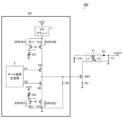
- FIG. 5 is a diagram showing the configuration of a switching power supply device according to the second embodiment. Note that in FIG. 5, the same parts as in FIG. 1 are given the same reference numerals and detailed explanations will be omitted.
- the switching power supply device 300 according to this embodiment includes a drive device 301, a switching element SW1, a resistor R1, a transformer T1, a diode D1, and an output capacitor C1.
- the drive device 301 is configured to drive the switching element SW1.
- the driving device 301 is a gate driver IC.
- the drive device 301 includes a clamper 1, a gate signal generation section 2, transistors P0, P11, P12, N0, N11, and N12, variable current sources IS1 and IS2, and a pull-down resistor R2.
- the variable section provided in the drive device 301 is composed of transistors P11, P12, N11, and N12, and variable current sources IS1 and IS2.
- the variation section varies the current supply capability to the control terminal (gate) of the switching element SW1 during a period from startup to shutdown of the drive device 301.
- transistors P0, P11, and P12 are P-channel MOSFETs
- transistors N0, N11, and N12 are N-channel MOSFETs.
- a constant voltage VCC is applied to the first end of the clamper 1.
- the second end of the clamper 1 is connected to the sources of transistors P11 and P12.
- the gate of transistor P11, the gate of transistor P12, and the drain of transistor P11 are connected to a first end of variable current source IS1.
- a second end of variable current source IS1 is connected to ground potential.
- the drain of transistor P12 is connected to the source of transistor P0.
- a current mirror circuit constituted by transistors P11 and P12 supplies a mirror current IDRIVEB obtained by mirroring the output current IDRIVEA of the variable current source IS1 to the transistor P0.
- the source of the transistor N0 is connected to the drain of the transistor N12.
- a constant voltage VCC is applied to the first end of the variable current source IS2.
- a second end of the variable current source IS2 is connected to the drain of the transistor N11, the gate of the transistor N11, and the gate of the transistor N12.
- the source of the transistor N11, the source of the transistor N12, and the second end of the pull-down resistor R2 are connected to the ground potential.
- a current mirror circuit constituted by transistors N11 and N12 supplies a mirror current IDRIVED obtained by mirroring the output current IDRIVEC of the variable current source IS2 to the transistor N0.
- the clamper 1 clamps each source of the transistors P11 and P12 to, for example, 10V.
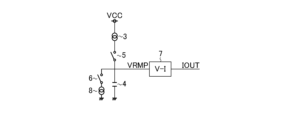
- variable current sources IS1 and IS2 can have the configuration shown in FIG. 6, for example.
- the variable current source of the configuration example shown in FIG. 6 includes a constant current source 3, a capacitor 4, switches 5 and 6, a voltage-current conversion circuit 7, and a constant current source 8.
- Switches 5 and 6 are complementary and periodically turned on and off. When the switch 5 is on, the capacitor 4 is charged by the constant current output from the constant current source 3. On the other hand, when the switch 6 is on, the capacitor 4 is discharged by the constant current output from the constant current source 8. With this configuration, the voltage VRMP output from the capacitor 4 repeats periodic increases and decreases.
- Voltage-current conversion circuit 7 converts voltage VRMP output from capacitor 4 into current IOUT. The current IOUT output from the voltage-current conversion circuit 7 becomes the output current of the variable current source.
- the slew rate of the drain voltage of the switching element SW1 when the switching element SW1 is turned on also changes periodically. do.
- the slew rate of the drain voltage of the switching element SW1 when the switching element SW1 is turned off also changes periodically. Changes to
- the drive device 301 repeats the section I and the section II multiple times during the period from starting to stopping.
- the lengths of section I and section II are not particularly limited, for example, the lengths of section I and section II can be made to match the switching period of switching element SW1.
- the drive device 301 repeats the section III and the section IV a plurality of times during the period from starting to stopping.
- the lengths of section III and section IV are not particularly limited, for example, the lengths of section III and section IV can be made to match the switching period of switching element SW1.
- section I current IDRIVEA increases, and if transistor P0 is on, mirror current IDRIVEB also increases.
- current IDRIVEA decreases, and if transistor P0 is on, mirror current IDRIVEB also decreases.
- section III current IDRIVEC increases, and if transistor N0 is on, mirror current IDRIVED also increases.
- current IDRIVEC decreases, and if transistor N0 is on, mirror current IDRIVED also decreases.
- the drive device 301 changes the current supply ability to the control terminal (gate) of the switching element SW1 during the period from startup to stop of the drive device 301.
- the switching loss of the switching element SW1 is determined by the average current supply capability of the drive device 301, while the switching noise level of the switching element SW1 is higher than when the current supply capability is fixed to the average current supply capability of the drive device 301. suppressed.
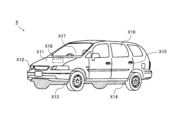
- FIG. 9 is an external view of vehicle X.
- the vehicle X shown in FIG. 9 is equipped with various electronic devices X11 to X18 that operate by receiving voltage output from a battery (not shown). Note that the mounting positions of the electronic devices X11 to X18 in this figure may differ from the actual positions for convenience of illustration.
- the electronic device X11 is an engine control unit that performs engine-related controls (injection control, electronic throttle control, idling control, oxygen sensor heater control, auto cruise control, etc.).
- the electronic device X12 is a lamp control unit that performs lighting/extinguishing control for HID [high intensity discharged lamp], DRL [daytime running lamp], and the like.
- the electronic device X13 is a transmission control unit that performs control related to the transmission.
- the electronic device X14 is a braking unit that performs control related to the movement of the vehicle X (ABS [anti-lock brake system] control, electronic suspension control, etc.).
- the electronic device X15 is a security control unit that controls the drive of door locks, security alarms, etc.
- Electronic equipment X16 is electronic equipment that is installed in vehicle It is.
- Electronic device X17 is an electronic device that is optionally installed in vehicle .
- the electronic device X18 is an electronic device equipped with a high-voltage motor, such as an EPS [Electric Power Steering], an on-board blower, an oil pump, a water pump, and a battery cooling fan.
- EPS Electrical Power Steering
- switching power supply device described above can be incorporated into any of the electronic devices X11 to X18.
- the first embodiment and the second embodiment may be implemented in combination. That is, in the driving device 101, a variable current source IS2, a transistor N11, and a transistor N12 may be provided instead of the AND gates 31 to 34 and the transistors N1 to N4. Further, in the driving device 101, a variable current source IS1, a transistor P11, and a transistor P12 may be provided instead of the AND gates 21 to 24 and the transistors P1 to P4.
- the switching power supply device described above has a configuration having a transformer
- the present invention can also be applied to a switching power supply device without a transformer.
- An example of a transformer-less switching power supply device is a step-up chopper type switching power supply device.
- the switching power supply device described above has a configuration in which the switching element is externally attached to the IC, the switching element may be built into the IC.
- the drive device (101, 301) described above is a drive device configured to drive a switching element (SW1), and the current supply ability to the control terminal of the switching element is controlled from the start of the drive device. It has a variable part (11 to 14, 21 to 24, 31 to 34, P1 to P4, N1 to N4, IS1, P11, P12, IS2, N11, N12) configured to vary during the period until stopping. configuration (first configuration).
- the drive device with the first configuration can suppress loss and noise of the switching element.
- the variable unit (101) includes a plurality of variable units configured such that supply and non-supply of current to the control terminal are individually controlled when turning on the switching element.
- N4 and a configuration (second configuration) having at least one of the following may be used.
- the drive device with the second configuration can easily vary the current supply capability to the control terminal of the switching element in stages.
- the drive device with the second configuration includes the plurality of first transistors, and a third transistor (P0) configured to supply current to the control terminal when turning on the switching element.
- the third transistor may have a current supply capability to the control terminal that is larger than the first transistor's current supply capability to the control terminal (third configuration).
- the third transistor when turning on the switching element, the third transistor can determine the base current supply capability, and the first transistor can determine the variation in the current supply capability.
- the fourth transistor (N0) includes the plurality of second transistors and is configured to supply current to the control terminal when turning off the switching element.
- the fourth transistor may have a current supply capability to the control terminal that is larger than the second transistor's current supply capability to the control terminal (fourth configuration).
- the fourth transistor when turning off the switching element, can determine the base current supply capability, and the second transistor can determine the variation in the current supply capability.
- the variation unit (301) is configured to supply current to the control terminal when turning on the first variable current source (IS1) and the switching element.
- a first current mirror circuit (P11, P12) configured to supply a mirror current obtained by mirroring the output current of the first variable current source to the turn-on transistor;
- a second variable current source IS2;
- a second current mirror configured to supply a mirror current obtained by mirroring the output current of the second variable current source to a turn-off transistor configured to supply current to the control terminal when turning off the switching element;
- the configuration (fifth configuration) may include at least one of the circuits (N11, N12).
- the drive device having the fifth configuration can easily and continuously vary the current supply capability to the control terminal of the switching element.
- the variation unit may be configured to regularly vary current supply capability to the control terminal (sixth configuration).
- the drive device with the sixth configuration does not require a random number generation circuit, so the circuit configuration is simplified.
- the switching power supply device (100, 300) described above has a configuration (seventh configuration) that includes the drive device of any one of the first to sixth configurations and the switching element.
- the switching power supply device having the seventh configuration can suppress the loss and noise of the switching elements.
- the vehicle (X) described above has a configuration (eighth configuration) that includes the switching power supply device of the seventh configuration.
- the vehicle with the eighth configuration can suppress switching element loss and noise.
Landscapes
- Engineering & Computer Science (AREA)
- Power Engineering (AREA)
- Mechanical Engineering (AREA)
- Dc-Dc Converters (AREA)
Priority Applications (3)
| Application Number | Priority Date | Filing Date | Title |
|---|---|---|---|
| JP2024509817A JPWO2023181660A1 (https=) | 2022-03-25 | 2023-02-03 | |
| CN202380029646.XA CN118947053A (zh) | 2022-03-25 | 2023-02-03 | 驱动装置、开关电源装置以及车辆 |
| US18/887,537 US12597849B2 (en) | 2022-03-25 | 2024-09-17 | Driving device, switching power supply apparatus, and vehicle |
Applications Claiming Priority (2)
| Application Number | Priority Date | Filing Date | Title |
|---|---|---|---|
| JP2022049897 | 2022-03-25 | ||
| JP2022-049897 | 2022-03-25 |
Related Child Applications (1)
| Application Number | Title | Priority Date | Filing Date |
|---|---|---|---|
| US18/887,537 Continuation US12597849B2 (en) | 2022-03-25 | 2024-09-17 | Driving device, switching power supply apparatus, and vehicle |
Publications (1)
| Publication Number | Publication Date |
|---|---|
| WO2023181660A1 true WO2023181660A1 (ja) | 2023-09-28 |
Family
ID=88101104
Family Applications (1)
| Application Number | Title | Priority Date | Filing Date |
|---|---|---|---|
| PCT/JP2023/003558 Ceased WO2023181660A1 (ja) | 2022-03-25 | 2023-02-03 | 駆動装置、スイッチング電源装置、及び車両 |
Country Status (4)
| Country | Link |
|---|---|
| US (1) | US12597849B2 (https=) |
| JP (1) | JPWO2023181660A1 (https=) |
| CN (1) | CN118947053A (https=) |
| WO (1) | WO2023181660A1 (https=) |
Citations (2)
| Publication number | Priority date | Publication date | Assignee | Title |
|---|---|---|---|---|
| US20130169322A1 (en) * | 2011-12-30 | 2013-07-04 | Stmicroelectronics R&D Co. Ltd. (Shanghai) | Efficient reduction of electromagnetic emission in lin driver |
| JP2015195700A (ja) * | 2014-03-27 | 2015-11-05 | 株式会社デンソー | 駆動装置 |
Family Cites Families (2)
| Publication number | Priority date | Publication date | Assignee | Title |
|---|---|---|---|---|
| JP6875873B2 (ja) | 2017-02-07 | 2021-05-26 | ローム株式会社 | Dc/dcコンバータおよびその制御回路、車載電装機器 |
| EP3651341B1 (en) * | 2017-09-20 | 2024-12-25 | Aisin Corporation | Driving power supply device |
-
2023
- 2023-02-03 JP JP2024509817A patent/JPWO2023181660A1/ja active Pending
- 2023-02-03 WO PCT/JP2023/003558 patent/WO2023181660A1/ja not_active Ceased
- 2023-02-03 CN CN202380029646.XA patent/CN118947053A/zh active Pending
-
2024
- 2024-09-17 US US18/887,537 patent/US12597849B2/en active Active
Patent Citations (2)
| Publication number | Priority date | Publication date | Assignee | Title |
|---|---|---|---|---|
| US20130169322A1 (en) * | 2011-12-30 | 2013-07-04 | Stmicroelectronics R&D Co. Ltd. (Shanghai) | Efficient reduction of electromagnetic emission in lin driver |
| JP2015195700A (ja) * | 2014-03-27 | 2015-11-05 | 株式会社デンソー | 駆動装置 |
Also Published As
| Publication number | Publication date |
|---|---|
| US12597849B2 (en) | 2026-04-07 |
| JPWO2023181660A1 (https=) | 2023-09-28 |
| US20250015704A1 (en) | 2025-01-09 |
| CN118947053A (zh) | 2024-11-12 |
Similar Documents
| Publication | Publication Date | Title |
|---|---|---|
| US11848611B2 (en) | Switching power supply device | |
| US12142910B2 (en) | Power control device | |
| US9966871B2 (en) | Rectification device, alternator, and power conversion device | |
| US20080013760A1 (en) | Switch element driver circuit and semiconductor device | |
| US20120098587A1 (en) | Power semiconductor device and operation method thereof | |
| JP2021150990A (ja) | 過電流保護回路 | |
| JPH10174310A (ja) | 誘導性負荷駆動装置 | |
| JP2020108142A (ja) | スイッチ装置 | |
| JP7385678B2 (ja) | 過電流保護回路 | |
| CN114041262B (zh) | 开关电源装置 | |
| WO2023181660A1 (ja) | 駆動装置、スイッチング電源装置、及び車両 | |
| US20240322690A1 (en) | Switching power supply device, switch control device, vehicle-mounted appliance, and vehicle | |
| JP2021005276A (ja) | スイッチ装置 | |
| US20230198397A1 (en) | Switching power supply device, switch control device, vehicle-mounted appliance, and vehicle | |
| JP2024060182A (ja) | 半導体装置、電子機器、車両 | |
| JP2023026822A (ja) | 発振回路、ハイサイドスイッチ、電子機器、車両 | |
| JP2024118052A (ja) | レベルシフタ、ドライブ回路、スイッチング電源装置、及び車両 | |
| US20240291481A1 (en) | Semiconductor device, switching power supply device, dc/dc converter, vehicle, and motor drive device | |
| US20240313652A1 (en) | Switching power supply device, switch control device, vehicle-mounted appliance, and vehicle | |
| JP2025042438A (ja) | ゲート駆動回路、電源制御装置、電源装置、及び車両 | |
| WO2023218988A1 (ja) | ブートストラップ回路、電源装置、及び車両 | |
| JP2023115986A (ja) | 電源回路及び車両 | |
| JP2023167152A (ja) | スイッチ回路、スイッチドキャパシタコンバータ、及び車両 | |
| JP2021097548A (ja) | 過電流保護回路 | |
| JP2005223989A (ja) | モータ駆動回路 |
Legal Events
| Date | Code | Title | Description |
|---|---|---|---|
| 121 | Ep: the epo has been informed by wipo that ep was designated in this application |
Ref document number: 23774259 Country of ref document: EP Kind code of ref document: A1 |
|
| ENP | Entry into the national phase |
Ref document number: 2024509817 Country of ref document: JP Kind code of ref document: A |
|
| WWE | Wipo information: entry into national phase |
Ref document number: 202380029646.X Country of ref document: CN |
|
| NENP | Non-entry into the national phase |
Ref country code: DE |
|
| 122 | Ep: pct application non-entry in european phase |
Ref document number: 23774259 Country of ref document: EP Kind code of ref document: A1 |