WO2023175687A1 - ロジックモデル作成支援装置、ロジックモデル作成支援方法、およびロジックモデル作成支援プログラム - Google Patents
ロジックモデル作成支援装置、ロジックモデル作成支援方法、およびロジックモデル作成支援プログラム Download PDFInfo
- Publication number
- WO2023175687A1 WO2023175687A1 PCT/JP2022/011422 JP2022011422W WO2023175687A1 WO 2023175687 A1 WO2023175687 A1 WO 2023175687A1 JP 2022011422 W JP2022011422 W JP 2022011422W WO 2023175687 A1 WO2023175687 A1 WO 2023175687A1
- Authority
- WO
- WIPO (PCT)
- Prior art keywords
- node
- logic model
- index
- edge
- unit
- Prior art date
- Legal status (The legal status is an assumption and is not a legal conclusion. Google has not performed a legal analysis and makes no representation as to the accuracy of the status listed.)
- Ceased
Links
Images





Classifications
-
- G—PHYSICS
- G06—COMPUTING OR CALCULATING; COUNTING
- G06N—COMPUTING ARRANGEMENTS BASED ON SPECIFIC COMPUTATIONAL MODELS
- G06N20/00—Machine learning
-
- G—PHYSICS
- G06—COMPUTING OR CALCULATING; COUNTING
- G06N—COMPUTING ARRANGEMENTS BASED ON SPECIFIC COMPUTATIONAL MODELS
- G06N5/00—Computing arrangements using knowledge-based models
- G06N5/04—Inference or reasoning models
-
- G—PHYSICS
- G06—COMPUTING OR CALCULATING; COUNTING
- G06F—ELECTRIC DIGITAL DATA PROCESSING
- G06F16/00—Information retrieval; Database structures therefor; File system structures therefor
- G06F16/90—Details of database functions independent of the retrieved data types
- G06F16/903—Querying
-
- G—PHYSICS
- G06—COMPUTING OR CALCULATING; COUNTING
- G06F—ELECTRIC DIGITAL DATA PROCESSING
- G06F16/00—Information retrieval; Database structures therefor; File system structures therefor
- G06F16/90—Details of database functions independent of the retrieved data types
- G06F16/904—Browsing; Visualisation therefor
Definitions
- the present invention relates to a logic model creation support device, a logic model creation support method, and a logic model creation support program that support logic model creation.
- Patent Document 1 discloses a communication support system using a communication network such as the Internet. This communication support system supports the convergence of online discussions, uses a server to classify the information entered in emails and text boxes during the discussions into problems and solutions, and generates a logic model. do.
- Patent Document 1 does not consider expressing the logic models that are the opinions of users with different values who are discussing the same topic. For this reason, the communication support system of Patent Document 1 cannot generate logic models for different values individually, and even if a difference of opinion occurs, it may be aggregated and presented as a logic model for a specific user. .
- the purpose of the present invention is to improve the efficiency of creating a logic model.
- a logic model creation support device which is one aspect of the invention disclosed in this application, stores a logic model that is a network structure constituted by a node having an index and an edge indicating a connection between the indexes indicated by the two nodes.
- a logic model that is a network structure constituted by a node having an index and an edge indicating a connection between the indexes indicated by the two nodes.
- an input unit that inputs a first node and a first edge
- a generation unit that generates a first logic model based on the first node and first edge input by the input unit; when the first node in the first logic model generated by the unit is specified, a identifying unit that identifies a similar index similar to a first index of the first node from the logic model; and an output unit that outputs the calculated similarity index.
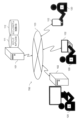
- FIG. 1 is an explanatory diagram showing an example of the system configuration of a logic model creation system.
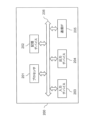
- FIG. 2 is a block diagram illustrating an example of the hardware configuration of a computer.
- FIG. 3 is an explanatory diagram showing an example of the logic model DB.
- FIG. 4 is an explanatory diagram showing an example of the logic model index DB.
- FIG. 5 is a block diagram showing an example of the functional configuration of the logic model creation support device.
- FIG. 6 is an explanatory diagram showing an example of a lobby screen when using the logic model creation support device.
- FIG. 7 is an explanatory diagram showing an example of an input screen of a terminal.
- FIG. 8 is an explanatory diagram showing example 1 of the logic model.
- FIG. 1 is an explanatory diagram showing an example of the system configuration of a logic model creation system.
- FIG. 2 is a block diagram illustrating an example of the hardware configuration of a computer.
- FIG. 3 is an explanatory diagram showing an example of the logic model DB
- FIG. 9 is an explanatory diagram showing a display example 1 of a logic model creation screen on a terminal.
- FIG. 10 is an explanatory diagram showing an example of a node candidate list.
- FIG. 11 is an explanatory diagram showing a second display example of a logic model creation screen on a terminal.
- FIG. 12 is an explanatory diagram showing example 2 of the logic model.
- FIG. 13 is an explanatory diagram showing example 3 of the logic model.
- FIG. 14 is an explanatory diagram showing example 4 of the logic model.
- FIG. 15 is an explanatory diagram showing example 5 of the logic model.
- a logic model is a model that shows a logical network structure for understanding a subject.
- the logic model is a model that shows a logical network structure of the measures that clearly shows the logical cause-and-effect relationship until a certain measure achieves its purpose.
- the nodes indicate, for example, indicators that are factors that influence social impact, such as resident satisfaction.
- Edges indicate connections between indicators.
- a logical network structure is layered by connections between nodes and edges.
- This hierarchy includes inputs, activities, outputs, outcomes, and impacts.
- Nodes belonging to input indicate indicators regarding physical resources such as people, goods, and money.
- a node belonging to an activity indicates an indicator regarding the content of the actual activity of the physical resource of the node belonging to the input.
- a node belonging to an output indicates an index related to the profit obtained from the activity of the node belonging to the activity, the goods produced, or the service.
- Nodes belonging to outcomes indicate indicators related to changes and effects caused by profits, produced goods, and services.
- Nodes belonging to impact are indicators related to social and environmental outcomes such as those proposed in SDGs caused by changes and effects. Note that each of input, activity, output, outcome, and impact may have multiple layers inside. In this embodiment, a logic model creation system for creating such a logic model will be described.
- FIG. 1 is an explanatory diagram showing an example of the system configuration of a logic model creation system.
- the logic model creation system 100 includes a logic model creation support device 101 that functions as a server, and a terminal 102 of a user 120.
- the logic model creation support device 101 and the terminal 102 are communicably connected via a network 103 such as the Internet, a LAN (Local Area Network), or a WAN (Wide Area Network).
- a network 103 such as the Internet, a LAN (Local Area Network), or a WAN (Wide Area Network).
- the logic model creation support device 101 is a computer that creates a logic model for the user 120 to logically consider the impact on society based on some kind of activity, such as local activities or corporate investment activities. There may be one user 120 or multiple users.
- the logic model creation support device 101 includes a logic model DB 111 that stores data of logic models created in the past, and a logic model index DB 112 that stores indices necessary for configuring the logic model.
- the logic model DB 111 and the logic model index DB 112 may be stored in another computer or a network hard disk that is communicably connected to the logic model creation support device 101 via the network 103.
- FIG. 2 is a block diagram illustrating an example of the hardware configuration of a computer.
- the computer 200 includes a processor 201, a storage device 202, an input device 203, an output device 204, and a communication interface (communication IF) 205.
- the processor 201, storage device 202, input device 203, output device 204, and communication IF 205 are connected by a bus 206.
- Processor 201 controls computer 200 .
- Storage device 202 serves as a work area for processor 201 .
- the storage device 202 is a non-temporary or temporary storage medium that stores various programs and data.
- Examples of the storage device 202 include ROM (Read Only Memory), RAM (Random Access Memory), HDD (Hard Disk Drive), flash memory, and SSD (Solid State Drive).
- Input device 203 inputs data. Examples of the input device 203 include a keyboard, mouse, touch panel, numeric keypad, scanner, and pen tablet.
- Output device 204 outputs data. Examples of the output device 204 include a display, printer, speaker, and projector.
- Communication IF 205 connects to network 103 and transmits and receives data.
- FIG. 3 is an explanatory diagram showing an example of the logic model DB 101.
- the logic model DB 101 stores logic models LM1 to LMn (n is an integer of 1 or more) created in the past by the logic model creation support device 101.
- the logic models LM1 to LMn are not distinguished, they are expressed as logic models LMi (i is an integer satisfying 1 ⁇ i ⁇ n).
- the logic model LMi is composed of a node table 310 and an edge table 320.
- the node table 310 has a node ID 311, an index name 312, and a hierarchy number 313 as fields.
- the node ID 311 is identification information that uniquely identifies a node.
- the index name 312 is the name of the index indicated by the node specified by the node ID 311.
- the hierarchy number 313 is a number indicating the hierarchy to which the node belongs; for example, "0" indicates input, “1" indicates activity, "2” indicates output, "3" indicates outcome, and "4" indicates impact. Note that when there is a hierarchy within a hierarchy, it is expressed using branch numbers such as "1-1" and "1-2". Each entry in node table 310 defines a node.
- the edge table 320 has a target ID 321 and a source ID as fields.
- the target ID 321 is the node ID 311 of the target node.
- the source ID 322 is the node ID 311 of the node serving as the source.
- the target layer number 313 is larger than the source layer number 313.
- Each entry in edge table 320 defines an edge.
- FIG. 4 is an explanatory diagram showing an example of the logic model index DB 122.
- the logic model index DB 122 is a database in which index names 312 of the logic model LMi are registered.
- the logic model index DB 122 has an index name 312 and a detailed description 400 as fields.
- Detailed explanation 400 is information related to index name 312.
- the detailed explanation 400 is a character string that describes the index name 312 in detail, and can be registered from the terminal 102 during or after the creation of the logic model LMi.
- FIG. 5 is a block diagram showing an example of the functional configuration of the logic model creation support device 101.
- the logic model creation support device 101 includes a storage section 500, an input section 501, a generation section 502, an output section 503, and a specification section 504.
- the storage unit 500 is a function realized by, for example, the storage device 202 shown in FIG. 2 or a storage device of another computer that can be accessed by the logic model creation support apparatus 101.
- the input unit 501, the generation unit 502, the output unit 503, and the identification unit 504 have functions realized by, for example, causing the processor 201 to execute a program stored in the storage device 202 shown in FIG. It is.
- the storage unit 500 stores the logic model DB 111 and logic model index DB 112 described above.
- the input unit 501 receives node and edge inputs from the input device 203.
- a node is an entry in node table 310.
- An edge is an entry in edge table 320.
- the input unit 501 outputs nodes and edges as input information 510 to the generation unit 502 and the identification unit 504.
- the generation unit 502 generates a logic model LM based on the input information 510 and outputs it to the output unit 503.
- the output unit 503 outputs the logic model LM generated by the generation unit 502 to the terminal 102 via the output device 204 or the communication IF 205. Further, the output unit 503 stores the logic model LM in the logic model DB 111, and stores the index name 312 and detailed description 400 of the nodes forming the logic model LM in the logic model index DB 112.
- the identifying unit 504 calculates the degree of similarity between the two index names 312.
- One of the two index names 312 is the index name 312 indicated by the input information 510 or a node in the logic model LM, and the other is the index name 312 indicated by the node of the logic model LMi in the logic model DB 102 or the index name 312 in the logic model index DB 112. This is the index name 312.
- the specifying unit 504 performs morphological analysis on each of the two index names 312 and generates a feature vector for each of the two index names 312 using TF-IDF. The identifying unit 504 then calculates the cosine similarity between both feature vectors. The specifying unit 504 determines that the two index names 312 are similar if the cosine similarity is equal to or greater than a threshold value greater than 0.
- the specifying unit 504 may calculate the cosine similarity between the index name 312 indicated by the node in the logic model LM and each of the index names 312 indicated by the node in the logic model LMi.
- the logic model LMi may be narrowed down prior to calculation.
- each of the logic models LM1 to LMn in the logic model DB 111 has an identifier that specifies a field, and can be grouped by field.
- the specifying unit 504 divides the logic models LM1 to LMn in the logic model DB 111 into fields, uses the logic model LMi belonging to the field as training data for each field, and determines whether or not the logic model LMi is used for the policy.
- a graph neural network is used to learn from the data, and a learning model is generated for each field.
- the learning model is stored in storage device 202.
- the specifying unit 504 inputs the generated logic model LM to the learning model of each field and outputs a predicted value. If the predicted value is data indicating that the logic model LM is used for the measure, the identification unit 504 uses the logic model LMi used for learning the learning model that outputs the predicted value to calculate the cosine similarity. Select as target.
- the specifying unit 504 outputs the similarity calculation result (index name 312) to the output unit 503. Thereby, the output unit 503 can output the similarity calculation result to the output device 204 together with the logic model LM.
- FIG. 6 is an explanatory diagram showing an example of a lobby screen when using the logic model creation support device 101.
- a participant name input field 601 when participating in the logic model creation support apparatus 101 and a participating room number input field 602.
- a room creation button 603 allows the user to create a new room
- a room join button 604 allows the user to join an already created room.
- FIG. 7 is an explanatory diagram showing an example of an input screen of the terminal 102.
- Input screen 700 is displayed on terminal 102.
- the input screen 700 displays node information 710, an add button 711, a delete button 712, edge information 720, an add button 721, and a delete button 722.
- the node information 710 includes entries for newly registered nodes (node ID 311, index name 312, layer number 313).
- the add button 711 is a user interface for adding an entry to the node information 710 by pressing it when an entry is created in the node information 710.
- the delete button 712 is a user interface for deleting the node information 710 entry specified by the cursor from the node information 710.
- the edge information 720 includes entries for newly registered edges (target ID 321, source ID 322).
- the add button 721 is a user interface for adding an entry to the edge information 720 by pressing it when an entry is created in the edge information 720.
- the delete button 712 is a user interface for deleting the edge information 720 entry specified by the cursor from the edge information 720.
- FIG. 8 is an explanatory diagram showing Example 1 of the logic model LM.
- Logic model LM is generated by generation unit 502 using node information 710 and edge information 720 input on input screen 700. Entries in the node information 710 are displayed in black circle shapes as nodes 801 indicating indicators. The node ID 311 and index name 312 are displayed near the corresponding node 701 as label information 803. Entries of edge information 720 are displayed as line segments as edges 802 indicating connections. Further, the hierarchy specified by the hierarchy number 313 is displayed as an ellipse with a black dashed line.
- FIG. 9 is an explanatory diagram showing a display example 1 of the logic model creation screen on the terminal 102.
- the logic model creation screen 900 has a first display area 901 and a second display area 902.
- a logic model LM generated by the generation unit 502 using input information 510 input by the user 120 is displayed.
- a logic model LMo generated by the generation unit 502 using input information 510 input by another user 120 is displayed.
- each user's own logic model LM and other users' logic models LMo are displayed on the logic model creation screen 900 of their own terminal 102. be done.
- FIG. 10 is an explanatory diagram showing an example of a node candidate list.
- the node candidate list 1000 is a list displayed when adding a new node 801 or changing the index name 312 of the created node 801.
- the node candidate list 1000 has an index name 312 and a detailed description 400.
- FIG. 10 is a node candidate list 1000 for the node 801 whose node ID 311 is “n1”.
- the identification unit 504 identifies the index name 312 of the designated node 801 and the logic model LMi in the logic model DB 102.
- the cosine similarity between the index name 312 indicated by the node 801 or the index name 312 in the logic model index DB 112 is calculated.
- the output unit 503 specifies the node 801 whose cosine similarity is equal to or higher than the threshold value or by using the index names 312 and their detailed descriptions 400 up to the m-th (m is an integer of 1 or more) as a node candidate list 1000.
- the information is output to the terminal 102 of the user 120 so that it can be displayed.
- the identification unit 504 determines the index name of at least one of the nodes 801 at both ends connected by the designated edge 802. 312 and the index name 312 indicated by the node 801 of the logic model LMi in the logic model DB 102 or the index name 312 in the logic model index DB 112. Then, the output unit 503 sets the index names 312 and their detailed descriptions 400 whose cosine similarity is equal to or higher than the threshold value or up to the m-th (m is an integer of 1 or more) and their detailed descriptions as a node candidate list 1000.
- the node 801 may be output to be displayed on the terminal 102 of the user 120 who has specified it.
- FIG. 11 is an explanatory diagram showing a second display example of the logic model creation screen 900 on the terminal 102.
- FIG. 11 shows an example in which a node candidate list 1000 is displayed when a node 801 is specified by a user operation on the logic model creation screen 900.
- FIG. 12 is an explanatory diagram showing example 2 of the logic model LM.
- FIG. 12 is an explanatory diagram showing a display example in which the color of the node 801 of the logic model LM is changed depending on the hierarchy. In this way, by changing the color of the nodes 801 for each hierarchy, visibility can be improved.
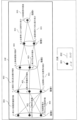
- FIG. 13 is an explanatory diagram showing example 3 of the logic model LM.
- FIG. 13 shows the logic model LM (hereinafter referred to as LMa) of a user 120 (user A as an example) and another user 120 (user B as an example) when a plurality of users 120 use the logic model creation support device 101.
- LMa logic model LM
- LMb logic model LM
- the identification unit 504 calculates the cosine similarity between each index name 312 of the node 801 of the logic model LMa created by the user A and the index name 312 of each node 801 of the logic model LMb created by the user B. do. For each index name 312 of the node 801 of the logic model LMa, the specifying unit 504 determines whether the logic model LMb has an index name 312 for which the cosine similarity is greater than or equal to a threshold value.
- the identifying unit 504 selects nodes 801 of the logic model LMa for which there is no index name 312 whose cosine similarity is equal to or higher than the threshold value in the logic model LMb among the nodes 801 of the logic model LMa as dissimilar display target nodes 801. decided on.
- the output unit 503 outputs the dissimilar display target node 801 to the user A's terminal 102 in a highlighted manner so that it can be distinguished from the node 801 that is not the dissimilar display target in the logic model LMa.
- the output unit 503 displays the dissimilar display target node 801 in a different color (hatched in FIG. 13) from the node 801 that is not the dissimilar display target (blacked out) in the logic model LMa.
- the output unit 503 may display the size of the dissimilar display target node 801 in a size different from the size of the node 801 that is not the dissimilar display target in the logic model LMa.
- the output unit 503 may display the dissimilar display target node 801 in a color and size different from the color and size of the node 801 that is not a dissimilar display target in the logic model LMa.
- the identifying unit 504 determines whether there is an index name 312 in the logic model LMa for which the cosine similarity is greater than or equal to the threshold for each index name 312 of the node 801 in the logic model LMb. Decide whether or not. The identifying unit 504 determines, among the nodes 801 of the logic model LMb, the nodes 801 of the logic model LMb for which the index name 312 whose cosine similarity is equal to or higher than the threshold does not exist in the logic model LMa, as the node 801 to be displayed as dissimilar. do.
- the output unit 503 outputs the dissimilar display target node 801 to the user B's terminal 102 in a highlighted manner so that it can be distinguished from the node 801 that is not the dissimilar display target.
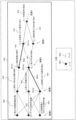
- FIG. 14 is an explanatory diagram showing example 4 of the logic model LM.
- FIG. 14 shows an example of highlighting dissimilar edges 802 between user A's logic model LMa and user B's logic model LMb when a plurality of users 120 use the logic model creation support device 101. be. Note that an example of dissimilar display on user A's terminal 102 will be described here.
- the identification unit 504 calculates the cosine similarity between each index name 312 of the node 801 of the logic model LMa created by the user A and the index name 312 of each node 801 of the logic model LMb created by the user B. do. For each index name 312 of the node 801 of the logic model LMa, the specifying unit 504 determines whether the logic model LMb has an index name 312 for which the cosine similarity is greater than or equal to a threshold value.
- the specifying unit 504 specifies the node 801 of the logic model LMa based on the cosine similarity among the nodes 801 of the logic model LMa.
- the node 801 of this logic model LMa is defined as a source node 801As.
- the specifying unit 504 specifies, among the nodes 801 of the logic model LMa, the node 801 indicated by the index name 312 whose cosine similarity is greater than or equal to the threshold.
- the identifying unit 504 identifies the node 801 of the logic model LMb whose cosine similarity with the index name 312 of the source node 801As is equal to or greater than the threshold value as the source node 801Bs.
- the specifying unit 504 specifies the node 801 indicated by the index name 312 whose cosine similarity is greater than or equal to the threshold, among the nodes 801 of the logic model LMa.
- the node 801 of this logic model LMa is defined as a source node 801As.
- the node 801 of the logic model LMb whose cosine similarity with the index name 312 of the source node 801As is equal to or greater than the threshold is defined as a source node 801Bs.
- the identifying unit 504 identifies the node 801 connected to the source node 801As in the logic model LMa. This node 801 is defined as a target node 801At. Similarly, the identifying unit 504 identifies the node 801 connected to the source node 801Bs in the logic model LMb. This node 801 is defined as a target node 801Bt.
- the identifying unit 504 calculates the cosine similarity between the index name 312 of the target node 801At and the index name 312 of the target node 801Bt, and determines whether the cosine similarity is greater than or equal to a threshold value. If the cosine similarity between the index name 312 of the target node 801At and the index name 312 of the target node 801Bt is not greater than or equal to the threshold, the identifying unit 504 identifies the edge 802 connecting the source node 801As and the target node 801At as The dissimilar display target edge 802 (hereinafter referred to as 802d) is determined.
- 802d The dissimilar display target edge 802
- the output unit 503 outputs the dissimilar display target edge 802d to the user A's terminal 102 in a highlighted manner so that it can be distinguished from the dissimilar display target edge 802 in the logic model LMa.
- the output unit 503 displays the thickness of the edge 802d to be displayed as dissimilar to that of the edge 802 that is not to be displayed as dissimilar.
- the output unit 503 may display the dissimilar display target edge 802d in a color different from the edge 802 that is not the dissimilar display target in the logic model LMa.
- the output unit 503 may display the dissimilar display target edge 802d in a color and thickness different from the color and size of the edge 802 that is not the dissimilar display target.
- the identifying unit 504 identifies the node 801 indicated by the index name 312 whose cosine similarity is greater than or equal to the threshold, among the nodes 801 of the logic model LMb.
- the node 801 of this logic model LMb is assumed to be a source node 801Bs. Further, the node 801 of the logic model LMa whose cosine similarity with the index name 312 of the source node 801Bs is greater than or equal to the threshold is defined as the source node 801As.
- the identifying unit 504 identifies the node 801 connected to the source node 801Bs in the logic model LMb. This node 801 is defined as a target node 801Bt. Similarly, the identifying unit 504 identifies the node 801 connected to the source node 801As in the logic model LMa. This node 801 is defined as a target node 801At.
- the specifying unit 504 calculates the cosine similarity between the index name 312 of the target node 801Bt and the index name 312 of the target node 801At, and determines whether the cosine similarity is greater than or equal to a threshold value. If the cosine similarity between the index name 312 of the target node 801Bt and the index name 312 of the target node 801At is not greater than or equal to the threshold, the identifying unit 504 identifies the edge 802 connecting the source node 801Bs and the target node 801Bt as The dissimilar display target edge 802d is determined.
- the output unit 503 outputs the dissimilar display target edge 802d to the user B's terminal 102 in a highlighted manner so that it can be distinguished from the dissimilar display target edge 802.
- the identifying unit 504 identifies the index name 312 of the target node 801At and the target When the cosine similarity between the node 801Bt and the index name 312 is not greater than or equal to the threshold, a dissimilar display target edge 802d connecting the source node 801As and the target node 801At is identified.
- the specifying unit 504 specifies the index name 312 of the source node 801As and the source node 801Bs. If the cosine similarity with the index name 312 is not greater than a threshold value, a dissimilar display target edge 802d connecting the target node 801At and the source node 801As may be identified.
- the identification unit 504 specifies that the cosine similarity is the threshold value among the nodes 801 of the logic model LMa.
- the node 801 indicated by the index name 312 above is specified as the source node 801As.
- the specifying unit 504 may specify, as the source node 801As, the node 801 indicated by the index name 312 whose cosine similarity is not equal to or greater than the threshold, among the nodes 801 of the logic model LMa.
- the identifying unit 504 identifies the node 801 of the logic model LMb whose cosine similarity with the index name 312 of the source node 801As is not equal to or greater than the threshold value as the source node 801Bs.
- the edge 802 connecting the target node 801At of LMa is specified as the dissimilar display target edge 802d, and is output to the user A's terminal 102 so that it can be displayed.
- the edge 802 connecting the target node 801Bt of LMb is specified as the dissimilar display target edge 802d, and is output to the user A's terminal 102 so that it can be displayed.
- FIG. 15 is an explanatory diagram showing example 5 of the logic model LM.
- FIG. 15 is a display example in which the dissimilar display example shown in FIG. 13 and the dissimilar display example shown in FIG. 14 are combined. Thereby, it is possible to easily see which node among the target node 801At and the source node 801As at both ends of the dissimilar display target edge 802d has dissimilarity in the logic model LMB of user B.
- the present embodiment it is possible to support the creation of the logic model LM and improve the efficiency of the logic model creation by the user 120. This makes it easier and faster to decide on measures. Furthermore, by comparing the logic models LM of each user 120, it is possible to clarify the differences in the indicators used for each user 120.
- logic model creation support device 101 described above can also be configured as shown in (1) to (8) below.
- the logic model creation support device 101 includes a storage unit 500 that stores a logic model that is a network structure constituted by a node having an index and an edge indicating a connection between the indexes indicated by the two nodes; an input unit 501 that inputs one node and a first edge; a generation unit 502 that generates a first logic model based on the first node and first edge input by the input unit 501; and a generation unit 502 that generates a first logic model.
- the identifying unit 504 identifies a similar index similar to the first index of the first node from the logic model; and an output unit 503 that outputs the calculated similarity index.
- the storage unit 500 stores related information related to the index
- the output unit 503 stores the similar index and related information related to the similar index. Outputs the information.
- the specifying unit 504 specifies the first edge connected to the first edge.
- the similarity index that is similar to the first index of an edge is identified from the logic model.
- the storage unit 500 stores a learning model that has been learned using the logic model as training data and whether or not the logic model is used as correct answer data; 504, when the output data output by inputting the first logic model to the learning model indicates the use of the first logic model, the similar Identify indicators.
- the input unit 501 inputs the second node and the second edge
- the generation unit 502 inputs the second node and the second edge input by the input unit 501.
- the identifying unit 504 determines that a second index similar to the first index of the first node in the first logic model is If the first node does not exist in any of the second nodes, the first node is determined to be a specific first node whose first index is not similar to the second index, and the output unit 503 outputs the first logic.
- the specific first node is output to the output destination (terminal 102) of the first logic model so that it can be displayed differently from other first nodes that are not the specific first node.
- the input unit 501 inputs the second node and the second edge
- the generation unit 502 generates the second node input by the input unit 501.
- the identifying unit 504 generates a similar second node having a second index similar to the first index of the first node in the first logic model. is specified from the second logic model, and the first index of the first node of the connection destination connected to the first node by the first edge is connected to the similar second node by the second edge.
- the first edge connecting the first node and the first node to be connected is determined to be a specific first edge, and the output unit 503 In the first logic model, the specific first edge is displayed on the output destination (terminal 102) of the first logic model in a manner that is different from other first edges that are not the specific first edge. Output possible.
- the specifying unit 504 determines the first node to be connected to a specific first node whose first index is not similar to the second index.
- the output unit 503 sets the specific first node in the first logic model as an output destination of the first logic model so that it is different from other first nodes other than the specific first node. (terminal 102) so that it can be displayed.
- the input unit 501 inputs the second node and the second edge
- the generation unit 502 generates the second node input by the input unit 501.
- the identifying unit 504 generates a second logic model having a second index dissimilar to the first index of the first node in the first logic model.
- a node is identified from the second logic model, and the first index of the first node connected to the first node and the first edge is connected to the similar second node and the second edge.
- the first edge connecting the first node and the first node to which the connection destination is connected is determined to be a specific first edge, and the output unit 503 outputs the specific first edge in the first logic model so that it can be displayed on the output destination of the first logic model in a manner that is different from other first edges that are not the specific first edge. do.
- the identifying unit 504 identifies the first node and the connected first node with a specific index in which the first index is not similar to the second index.
- the output unit 503 determines that the specific first node is the first node in the first logic model so that it is different from other first nodes that are not the specific first node. Output to the output destination of the logic model so that it can be displayed.
- the input unit 501 inputs the hierarchy of the first node
- the generation unit 502 inputs the first node, the first edge, and the hierarchy.
- the first logic model in which the first nodes are arranged according to the hierarchy is generated
- the output unit 503 outputs the first logic model in which the first nodes are arranged according to the hierarchy.
- the present invention is not limited to the embodiments described above, and includes various modifications and equivalent configurations within the scope of the appended claims.
- the embodiments described above have been described in detail to explain the present invention in an easy-to-understand manner, and the present invention is not necessarily limited to having all the configurations described.
- a part of the configuration of one embodiment may be replaced with the configuration of another embodiment.
- the configuration of one embodiment may be added to the configuration of another embodiment.
- other configurations may be added to, deleted from, or replaced with some of the configurations of each embodiment.
- each of the above-mentioned configurations, functions, processing units, processing means, etc. may be realized in part or in whole by hardware, for example by designing an integrated circuit, and a processor realizes each function. It may also be realized by software by interpreting and executing a program.
- Information such as programs, tables, files, etc. that realize each function is recorded in storage devices such as memory, hard disk, SSD (Solid State Drive), or IC (Integrated Circuit) card, SD card, and DVD (Digital Versatile Disc). It can be stored on a medium.
- storage devices such as memory, hard disk, SSD (Solid State Drive), or IC (Integrated Circuit) card, SD card, and DVD (Digital Versatile Disc). It can be stored on a medium.
- control lines and information lines shown are those considered necessary for explanation, and do not necessarily show all control lines and information lines necessary for implementation. In reality, almost all configurations can be considered interconnected.
Landscapes
- Engineering & Computer Science (AREA)
- Theoretical Computer Science (AREA)
- General Physics & Mathematics (AREA)
- Data Mining & Analysis (AREA)
- Physics & Mathematics (AREA)
- General Engineering & Computer Science (AREA)
- Databases & Information Systems (AREA)
- Software Systems (AREA)
- Evolutionary Computation (AREA)
- Mathematical Physics (AREA)
- Computing Systems (AREA)
- Computational Linguistics (AREA)
- Artificial Intelligence (AREA)
- Computer Vision & Pattern Recognition (AREA)
- Medical Informatics (AREA)
- Information Retrieval, Db Structures And Fs Structures Therefor (AREA)
- Stored Programmes (AREA)
Priority Applications (4)
| Application Number | Priority Date | Filing Date | Title |
|---|---|---|---|
| GB2411505.7A GB2630219A (en) | 2022-03-14 | 2022-03-14 | Logic model creation assistance device, logic model creation assistance method, and logic model creation assistance program |
| PCT/JP2022/011422 WO2023175687A1 (ja) | 2022-03-14 | 2022-03-14 | ロジックモデル作成支援装置、ロジックモデル作成支援方法、およびロジックモデル作成支援プログラム |
| JP2022551050A JP7412585B1 (ja) | 2022-03-14 | 2022-03-14 | ロジックモデル作成支援装置、ロジックモデル作成支援方法、およびロジックモデル作成支援プログラム |
| US18/834,497 US20250173588A1 (en) | 2022-03-14 | 2022-03-14 | Logic Model Preparation Support Device, Logic Model Preparation Support Method, and Logic Model Preparation Support Program |
Applications Claiming Priority (1)
| Application Number | Priority Date | Filing Date | Title |
|---|---|---|---|
| PCT/JP2022/011422 WO2023175687A1 (ja) | 2022-03-14 | 2022-03-14 | ロジックモデル作成支援装置、ロジックモデル作成支援方法、およびロジックモデル作成支援プログラム |
Publications (1)
| Publication Number | Publication Date |
|---|---|
| WO2023175687A1 true WO2023175687A1 (ja) | 2023-09-21 |
Family
ID=88022496
Family Applications (1)
| Application Number | Title | Priority Date | Filing Date |
|---|---|---|---|
| PCT/JP2022/011422 Ceased WO2023175687A1 (ja) | 2022-03-14 | 2022-03-14 | ロジックモデル作成支援装置、ロジックモデル作成支援方法、およびロジックモデル作成支援プログラム |
Country Status (4)
| Country | Link |
|---|---|
| US (1) | US20250173588A1 (https=) |
| JP (1) | JP7412585B1 (https=) |
| GB (1) | GB2630219A (https=) |
| WO (1) | WO2023175687A1 (https=) |
Families Citing this family (1)
| Publication number | Priority date | Publication date | Assignee | Title |
|---|---|---|---|---|
| JP7787254B1 (ja) | 2024-07-25 | 2025-12-16 | みずほリサーチ&テクノロジーズ株式会社 | 評価支援システム、評価支援方法及び評価支援プログラム |
Citations (3)
| Publication number | Priority date | Publication date | Assignee | Title |
|---|---|---|---|---|
| JP2008226168A (ja) * | 2007-03-15 | 2008-09-25 | Omron Corp | 因果推論装置、その制御プログラムおよび制御方法 |
| WO2017033448A1 (ja) * | 2015-08-27 | 2017-03-02 | 日本電気株式会社 | データ処理装置、データ処理方法、及びプログラム記録媒体 |
| JP2018181158A (ja) * | 2017-04-19 | 2018-11-15 | 株式会社日立製作所 | 因果関係モデルの検証方法およびシステム、および不良原因抽出システム |
-
2022
- 2022-03-14 US US18/834,497 patent/US20250173588A1/en active Pending
- 2022-03-14 JP JP2022551050A patent/JP7412585B1/ja active Active
- 2022-03-14 GB GB2411505.7A patent/GB2630219A/en active Pending
- 2022-03-14 WO PCT/JP2022/011422 patent/WO2023175687A1/ja not_active Ceased
Patent Citations (3)
| Publication number | Priority date | Publication date | Assignee | Title |
|---|---|---|---|---|
| JP2008226168A (ja) * | 2007-03-15 | 2008-09-25 | Omron Corp | 因果推論装置、その制御プログラムおよび制御方法 |
| WO2017033448A1 (ja) * | 2015-08-27 | 2017-03-02 | 日本電気株式会社 | データ処理装置、データ処理方法、及びプログラム記録媒体 |
| JP2018181158A (ja) * | 2017-04-19 | 2018-11-15 | 株式会社日立製作所 | 因果関係モデルの検証方法およびシステム、および不良原因抽出システム |
Non-Patent Citations (1)
| Title |
|---|
| TAKASHI KIYOHARA, HIROYUKI MATSUMOTO, NAOKI MORI : "266-6: Supporting Reuse of Activity Diagrams Using Model Corpus", PROCEEDINGS OF THE 57TH ANNUAL CONFERENCE OF THE INSTITUTE OF SYSTEMS, CONTROL AND INFORMATION ENGINEERS; MAY 15TH - 17TH, 2013, INSTITUTE OF SYSTEMS, CONTROL AND INFORMATION ENGINEERS, JP, 15 May 2013 (2013-05-15) - 17 May 2013 (2013-05-17), JP, pages 1 - 4, XP009549470 * |
Also Published As
| Publication number | Publication date |
|---|---|
| GB2630219A (en) | 2024-11-20 |
| US20250173588A1 (en) | 2025-05-29 |
| JP7412585B1 (ja) | 2024-01-12 |
| JPWO2023175687A1 (https=) | 2023-09-21 |
| GB202411505D0 (en) | 2024-09-18 |
Similar Documents
| Publication | Publication Date | Title |
|---|---|---|
| JP7000341B2 (ja) | 機械学習に基づくウェブインタフェース生成及びテストシステム | |
| US11551123B2 (en) | Automatic visualization and explanation of feature learning output from a relational database for predictive modelling | |
| Faber et al. | A systematic mapping study on business ecosystem types | |
| US11651233B2 (en) | Candidate visualization techniques for use with genetic algorithms | |
| US11748063B2 (en) | Intelligent user centric design platform | |
| US12061650B2 (en) | Systems, methods, computing platforms, and storage media for comparing non-adjacent data subsets | |
| CN113010255A (zh) | 基于捆绑会话组的交互方法、装置和计算机设备 | |
| CN115270923A (zh) | 一种基于场景的可视化智能决策方法及系统 | |
| US20240273384A1 (en) | Contextually relevant content sharing in high-dimensional conceptual content mapping | |
| Hannemann et al. | Applying a decision model based on multiple criteria decision making methods to evaluate the influence of digital transformation technologies on enterprise architecture principles | |
| CN115293291A (zh) | 排序模型的训练方法、排序方法、装置、电子设备及介质 | |
| JP7412585B1 (ja) | ロジックモデル作成支援装置、ロジックモデル作成支援方法、およびロジックモデル作成支援プログラム | |
| TWI746063B (zh) | 用於人機介導動作跟踪和管理的標籤方法和系統 | |
| US11645563B2 (en) | Data filtering with fuzzy attribute association | |
| CN107729424A (zh) | 一种数据可视化方法及设备 | |
| KR102581301B1 (ko) | 욕구/원인 키워드를 포함하는 사용자 키워드리스트의 운용에 따른 사용자 표출 구매 원인 및 욕구 통찰 방식의 소비 플랫폼 제공방법 | |
| US12481864B2 (en) | Generating hybrid quantum-classical neural network architectures | |
| WO2023103815A1 (en) | Contextual dialogue framework over dynamic tables | |
| CN115146140A (zh) | 一种基于融合影响力的群体推荐方法、装置 | |
| JP6280271B1 (ja) | データ変換装置、データ変換方法およびデータ変換プログラム | |
| US20240104158A1 (en) | Intelligent product sequencing for category trees | |
| US20220342931A1 (en) | Condition resolution system | |
| JP2025181575A (ja) | 論述支援装置、論述支援プログラム、及びユーザ端末 | |
| JP2025040162A (ja) | 情報処理装置および情報処理方法 | |
| WO2024257230A1 (ja) | 合意形成支援装置、合意形成支援方法、および合意形成支援プログラム |
Legal Events
| Date | Code | Title | Description |
|---|---|---|---|
| WWE | Wipo information: entry into national phase |
Ref document number: 2022551050 Country of ref document: JP |
|
| 121 | Ep: the epo has been informed by wipo that ep was designated in this application |
Ref document number: 22931972 Country of ref document: EP Kind code of ref document: A1 |
|
| WWE | Wipo information: entry into national phase |
Ref document number: 18834497 Country of ref document: US |
|
| ENP | Entry into the national phase |
Ref document number: 202411505 Country of ref document: GB Kind code of ref document: A Free format text: PCT FILING DATE = 20220314 |
|
| WWE | Wipo information: entry into national phase |
Ref document number: 2411505.7 Country of ref document: GB |
|
| NENP | Non-entry into the national phase |
Ref country code: DE |
|
| WWP | Wipo information: published in national office |
Ref document number: 2411505.7 Country of ref document: GB |
|
| 122 | Ep: pct application non-entry in european phase |
Ref document number: 22931972 Country of ref document: EP Kind code of ref document: A1 |
|
| WWP | Wipo information: published in national office |
Ref document number: 18834497 Country of ref document: US |