WO2023171438A1 - 窒化物半導体装置 - Google Patents
窒化物半導体装置 Download PDFInfo
- Publication number
- WO2023171438A1 WO2023171438A1 PCT/JP2023/006954 JP2023006954W WO2023171438A1 WO 2023171438 A1 WO2023171438 A1 WO 2023171438A1 JP 2023006954 W JP2023006954 W JP 2023006954W WO 2023171438 A1 WO2023171438 A1 WO 2023171438A1
- Authority
- WO
- WIPO (PCT)
- Prior art keywords
- gate
- layer
- opening
- main
- sub
- Prior art date
- Legal status (The legal status is an assumption and is not a legal conclusion. Google has not performed a legal analysis and makes no representation as to the accuracy of the status listed.)
- Ceased
Links
Images







Classifications
-
- H—ELECTRICITY
- H10—SEMICONDUCTOR DEVICES; ELECTRIC SOLID-STATE DEVICES NOT OTHERWISE PROVIDED FOR
- H10D—INORGANIC ELECTRIC SEMICONDUCTOR DEVICES
- H10D64/00—Electrodes of devices having potential barriers
- H10D64/20—Electrodes characterised by their shapes, relative sizes or dispositions
- H10D64/27—Electrodes not carrying the current to be rectified, amplified, oscillated or switched, e.g. gates
- H10D64/311—Gate electrodes for field-effect devices
- H10D64/411—Gate electrodes for field-effect devices for FETs
- H10D64/511—Gate electrodes for field-effect devices for FETs for IGFETs
- H10D64/517—Gate electrodes for field-effect devices for FETs for IGFETs characterised by the conducting layers
- H10D64/518—Gate electrodes for field-effect devices for FETs for IGFETs characterised by the conducting layers characterised by their lengths or sectional shapes
-
- H—ELECTRICITY
- H10—SEMICONDUCTOR DEVICES; ELECTRIC SOLID-STATE DEVICES NOT OTHERWISE PROVIDED FOR
- H10D—INORGANIC ELECTRIC SEMICONDUCTOR DEVICES
- H10D30/00—Field-effect transistors [FET]
- H10D30/40—FETs having zero-dimensional [0D], one-dimensional [1D] or two-dimensional [2D] charge carrier gas channels
- H10D30/47—FETs having zero-dimensional [0D], one-dimensional [1D] or two-dimensional [2D] charge carrier gas channels having two-dimensional [2D] charge carrier gas channels, e.g. nanoribbon FETs or high electron mobility transistors [HEMT]
- H10D30/471—High electron mobility transistors [HEMT] or high hole mobility transistors [HHMT]
- H10D30/475—High electron mobility transistors [HEMT] or high hole mobility transistors [HHMT] having wider bandgap layer formed on top of lower bandgap active layer, e.g. undoped barrier HEMTs such as i-AlGaN/GaN HEMTs
-
- H—ELECTRICITY
- H10—SEMICONDUCTOR DEVICES; ELECTRIC SOLID-STATE DEVICES NOT OTHERWISE PROVIDED FOR
- H10D—INORGANIC ELECTRIC SEMICONDUCTOR DEVICES
- H10D30/00—Field-effect transistors [FET]
- H10D30/01—Manufacture or treatment
- H10D30/061—Manufacture or treatment of FETs having Schottky gates
-
- H—ELECTRICITY
- H10—SEMICONDUCTOR DEVICES; ELECTRIC SOLID-STATE DEVICES NOT OTHERWISE PROVIDED FOR
- H10D—INORGANIC ELECTRIC SEMICONDUCTOR DEVICES
- H10D30/00—Field-effect transistors [FET]
- H10D30/40—FETs having zero-dimensional [0D], one-dimensional [1D] or two-dimensional [2D] charge carrier gas channels
- H10D30/47—FETs having zero-dimensional [0D], one-dimensional [1D] or two-dimensional [2D] charge carrier gas channels having two-dimensional [2D] charge carrier gas channels, e.g. nanoribbon FETs or high electron mobility transistors [HEMT]
- H10D30/471—High electron mobility transistors [HEMT] or high hole mobility transistors [HHMT]
-
- H—ELECTRICITY
- H10—SEMICONDUCTOR DEVICES; ELECTRIC SOLID-STATE DEVICES NOT OTHERWISE PROVIDED FOR
- H10D—INORGANIC ELECTRIC SEMICONDUCTOR DEVICES
- H10D62/00—Semiconductor bodies, or regions thereof, of devices having potential barriers
- H10D62/10—Shapes, relative sizes or dispositions of the regions of the semiconductor bodies; Shapes of the semiconductor bodies
- H10D62/124—Shapes, relative sizes or dispositions of the regions of semiconductor bodies or of junctions between the regions
- H10D62/126—Top-view geometrical layouts of the regions or the junctions
- H10D62/127—Top-view geometrical layouts of the regions or the junctions of cellular field-effect devices, e.g. multicellular DMOS transistors or IGBTs
-
- H—ELECTRICITY
- H10—SEMICONDUCTOR DEVICES; ELECTRIC SOLID-STATE DEVICES NOT OTHERWISE PROVIDED FOR
- H10D—INORGANIC ELECTRIC SEMICONDUCTOR DEVICES
- H10D62/00—Semiconductor bodies, or regions thereof, of devices having potential barriers
- H10D62/10—Shapes, relative sizes or dispositions of the regions of the semiconductor bodies; Shapes of the semiconductor bodies
- H10D62/17—Semiconductor regions connected to electrodes not carrying current to be rectified, amplified or switched, e.g. channel regions
- H10D62/343—Gate regions of field-effect devices having PN junction gates
-
- H—ELECTRICITY
- H10—SEMICONDUCTOR DEVICES; ELECTRIC SOLID-STATE DEVICES NOT OTHERWISE PROVIDED FOR
- H10D—INORGANIC ELECTRIC SEMICONDUCTOR DEVICES
- H10D64/00—Electrodes of devices having potential barriers
- H10D64/111—Field plates
-
- H—ELECTRICITY
- H10—SEMICONDUCTOR DEVICES; ELECTRIC SOLID-STATE DEVICES NOT OTHERWISE PROVIDED FOR
- H10D—INORGANIC ELECTRIC SEMICONDUCTOR DEVICES
- H10D64/00—Electrodes of devices having potential barriers
- H10D64/20—Electrodes characterised by their shapes, relative sizes or dispositions
- H10D64/23—Electrodes carrying the current to be rectified, amplified, oscillated or switched, e.g. sources, drains, anodes or cathodes
- H10D64/251—Source or drain electrodes for field-effect devices
- H10D64/258—Source or drain electrodes for field-effect devices characterised by the relative positions of the source or drain electrodes with respect to the gate electrode
-
- H—ELECTRICITY
- H10—SEMICONDUCTOR DEVICES; ELECTRIC SOLID-STATE DEVICES NOT OTHERWISE PROVIDED FOR
- H10D—INORGANIC ELECTRIC SEMICONDUCTOR DEVICES
- H10D64/00—Electrodes of devices having potential barriers
- H10D64/20—Electrodes characterised by their shapes, relative sizes or dispositions
- H10D64/27—Electrodes not carrying the current to be rectified, amplified, oscillated or switched, e.g. gates
- H10D64/311—Gate electrodes for field-effect devices
- H10D64/411—Gate electrodes for field-effect devices for FETs
- H10D64/511—Gate electrodes for field-effect devices for FETs for IGFETs
- H10D64/517—Gate electrodes for field-effect devices for FETs for IGFETs characterised by the conducting layers
- H10D64/519—Gate electrodes for field-effect devices for FETs for IGFETs characterised by the conducting layers characterised by their top-view geometrical layouts
-
- H—ELECTRICITY
- H10—SEMICONDUCTOR DEVICES; ELECTRIC SOLID-STATE DEVICES NOT OTHERWISE PROVIDED FOR
- H10D—INORGANIC ELECTRIC SEMICONDUCTOR DEVICES
- H10D30/00—Field-effect transistors [FET]
- H10D30/40—FETs having zero-dimensional [0D], one-dimensional [1D] or two-dimensional [2D] charge carrier gas channels
- H10D30/47—FETs having zero-dimensional [0D], one-dimensional [1D] or two-dimensional [2D] charge carrier gas channels having two-dimensional [2D] charge carrier gas channels, e.g. nanoribbon FETs or high electron mobility transistors [HEMT]
-
- H—ELECTRICITY
- H10—SEMICONDUCTOR DEVICES; ELECTRIC SOLID-STATE DEVICES NOT OTHERWISE PROVIDED FOR
- H10D—INORGANIC ELECTRIC SEMICONDUCTOR DEVICES
- H10D62/00—Semiconductor bodies, or regions thereof, of devices having potential barriers
- H10D62/80—Semiconductor bodies, or regions thereof, of devices having potential barriers characterised by the materials
- H10D62/83—Semiconductor bodies, or regions thereof, of devices having potential barriers characterised by the materials being Group IV materials, e.g. B-doped Si or undoped Ge
-
- H—ELECTRICITY
- H10—SEMICONDUCTOR DEVICES; ELECTRIC SOLID-STATE DEVICES NOT OTHERWISE PROVIDED FOR
- H10D—INORGANIC ELECTRIC SEMICONDUCTOR DEVICES
- H10D62/00—Semiconductor bodies, or regions thereof, of devices having potential barriers
- H10D62/80—Semiconductor bodies, or regions thereof, of devices having potential barriers characterised by the materials
- H10D62/85—Semiconductor bodies, or regions thereof, of devices having potential barriers characterised by the materials being Group III-V materials, e.g. GaAs
- H10D62/8503—Nitride Group III-V materials, e.g. AlN or GaN
Definitions
- the present disclosure relates to a nitride semiconductor device.
- HEMTs high electron mobility transistors
- Patent Document 1 nitride semiconductors
- local concentration of gate current at the gate electrode of a HEMT can be a factor that causes a decrease in reliability of the gate electrode.
- a nitride semiconductor device includes: an electron supply layer made of a nitride semiconductor; a gate layer formed on a portion of the electron supply layer made of a nitride semiconductor containing acceptor-type impurities; a source opening that covers a gate electrode formed on the gate layer, the electron supply layer, the gate layer, and the gate electrode, and that is provided on both sides of the gate layer in the first direction in plan view; a passivation layer having a drain opening, a source electrode in contact with the electron supply layer exposed by the source opening, a drain electrode in contact with the electron supply layer exposed by the drain opening, and extending in the first direction;
- the gate layer includes an active region including the source opening and the drain opening, and an inactive region adjacent to the active region in a second direction perpendicular to the first direction in plan view, and the gate layer includes: a main gate portion extending in the second direction in the active region; a sub-gate portion extending in the second direction so as to be continuous with the main
- concentration of gate current at the gate electrode can be alleviated.
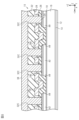
- FIG. 1 is a schematic cross-sectional view of an exemplary nitride semiconductor device according to the first embodiment.
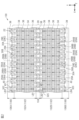
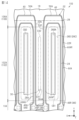
- FIG. 2 is a schematic plan view showing an exemplary formation pattern of the nitride semiconductor device of FIG.
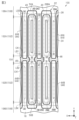
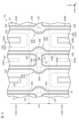
- FIG. 3 is an enlarged view of a portion of the nitride semiconductor device of FIG. 2.
- FIG. 4 is an enlarged view of a portion of the nitride semiconductor device of FIG. 3.
- FIG. 5 is an enlarged view of a portion of the nitride semiconductor device of FIG.
- FIG. 6 is an enlarged view of a portion of the nitride semiconductor device of FIG. 3.
- FIG. 7 is an enlarged view of a portion of the nitride semiconductor device of FIG. 3.
- FIG. 8 is a schematic cross-sectional view of the nitride semiconductor device of FIG. 7 taken along line F8-F8.
- FIG. 9 is a schematic cross-sectional view of an exemplary nitride semiconductor device according to the second embodiment.
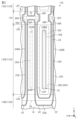
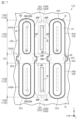
- FIG. 10 is a schematic plan view showing an exemplary formation pattern of the nitride semiconductor device of FIG. 9.
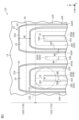
- FIG. 11 is an enlarged view of a portion of the nitride semiconductor device of FIG. 10.
- FIG. 12 is a schematic plan view showing a formation pattern of an exemplary nitride semiconductor device according to a modification.
- FIG. 13 is a schematic plan view showing an enlarged part of the formation pattern of an exemplary nitride semiconductor device according to a modification.
- FIG. 10 is a schematic plan view showing an exemplary formation pattern of the nitride semiconductor device of FIG. 9.
- FIG. 11 is an enlarged view of a portion of the nitride semiconductor device of FIG. 10.
- FIG. 12
- FIG. 14 is a schematic plan view showing an enlarged part of a formation pattern of an exemplary nitride semiconductor device according to a modification.
- FIG. 15 is a schematic plan view showing a formation pattern of an exemplary nitride semiconductor device according to a modification.
- FIG. 16 is a schematic plan view showing an enlarged part of a formation pattern of an exemplary nitride semiconductor device according to a modification.
- FIG. 17 is a schematic plan view showing a formation pattern of an exemplary nitride semiconductor device according to a modification.
- FIG. 18 is a schematic plan view showing a formation pattern of an exemplary nitride semiconductor device according to a modification.
- FIG. 1 is a schematic cross-sectional view of an exemplary nitride semiconductor device 10 according to the first embodiment.
- the term "planar view” used in the present disclosure refers to viewing the nitride semiconductor device 10 in the Z-axis direction of the mutually orthogonal XYZ axes shown in FIG. Further, in the nitride semiconductor device 10 shown in FIG. 1, for convenience, the +Z direction is defined as top, the -Z direction as bottom, the +X direction as right, and the -X direction as left. Unless explicitly stated otherwise, “planar view” refers to viewing nitride semiconductor device 10 from above along the Z-axis.
- the nitride semiconductor device 10 is a high electron mobility transistor (HEMT) using a nitride semiconductor.
- the nitride semiconductor device 10 includes a substrate 12, a buffer layer 14 formed on the substrate 12, an electron transit layer 16 formed on the buffer layer 14, and an electron supply layer 18 formed on the electron transit layer 16. and, including.
- a silicon (Si) substrate can be used.
- a silicon carbide (SiC) substrate, a gallium nitride (GaN) substrate, or a sapphire substrate can be used instead of the Si substrate.
- the thickness of the substrate 12 can be, for example, 200 ⁇ m or more and 1500 ⁇ m or less. In addition, in the following description, unless explicitly stated otherwise, thickness refers to the dimension along the Z direction in FIG. 1.
- the buffer layer 14 may be made of any material that can alleviate the lattice mismatch between the substrate 12 and the electron transport layer 16. Additionally, buffer layer 14 can include one or more nitride semiconductor layers. Buffer layer 14 may include, for example, at least one of an aluminum nitride (AlN) layer, an aluminum gallium nitride (AlGaN) layer, and a graded AlGaN layer with a different aluminum (Al) composition.
- AlN aluminum nitride
- AlGaN aluminum gallium nitride
- AlGaN graded AlGaN layer with a different aluminum
- the buffer layer 14 is made of a single film of AlN, a single film of AlGaN, a film having an AlGaN/GaN superlattice structure, a film having an AlN/AlGaN superlattice structure, a film having an AlN/GaN superlattice structure, or the like. may have been done.
- the buffer layer 14 may include a first buffer layer that is an AlN layer formed on the substrate 12 and a second buffer layer that is an AlGaN layer formed on the AlN layer (first buffer layer).
- the first buffer layer may be, for example, an AlN layer with a thickness of 200 nm
- the second buffer layer may be a graded AlGaN layer, for example, with a thickness of 300 nm.
- impurities may be introduced into a portion of the buffer layer 14 to make the buffer layer 14 semi-insulating except for the surface layer region.
- the impurity is, for example, carbon (C) or iron (Fe).
- the impurity concentration can be, for example, 4 ⁇ 10 16 cm ⁇ 3 or higher.
- the electron transit layer 16 is made of a nitride semiconductor.
- the electron transit layer 16 may be, for example, a GaN layer.
- the thickness of the electron transit layer 16 can be, for example, 0.5 ⁇ m or more and 2 ⁇ m or less.
- impurities may be introduced into a part of the electron transit layer 16 to make the region other than the surface layer of the electron transit layer 16 semi-insulating.
- the impurity is, for example, C.
- the concentration of impurities can be, for example, 4 ⁇ 10 16 cm ⁇ 3 or more.
- the electron transit layer 16 can include a plurality of GaN layers having different impurity concentrations, for example, a C-doped GaN layer and a non-doped GaN layer.
- a C-doped GaN layer is formed on the buffer layer 14.
- the C-doped GaN layer can have a thickness of 0.5 ⁇ m or more and 2 ⁇ m or less.
- the C concentration in the C-doped GaN layer can be set to 5 ⁇ 10 17 cm ⁇ 3 or more and 9 ⁇ 10 19 cm ⁇ 3 or less.
- the non-doped GaN layer is formed on the C-doped GaN layer.
- the undoped GaN layer can have a thickness of 0.05 ⁇ m or more and 0.4 ⁇ m or less.
- the non-doped GaN layer is in contact with the electron supply layer 18.
- the electron transit layer 16 includes a C-doped GaN layer with a thickness of 0.9 ⁇ m and a non-doped GaN layer with a thickness of 0.1 ⁇ m.
- the C concentration in the C-doped GaN layer is approximately 1 ⁇ 10 18 cm ⁇ 3 .
- the electron supply layer 18 is made of a nitride semiconductor having a larger band gap than the electron transit layer 16.
- the electron supply layer 18 may be, for example, an AlGaN layer.
- the electron supply layer 18, which is an AlGaN layer has a larger band gap than the electron transit layer 16, which is a GaN layer.
- the electron supply layer 18 is composed of Al x Ga 1-x N.
- the electron supply layer 18 can be said to be an Al x Ga 1-x N layer.
- x is 0 ⁇ x ⁇ 0.4, more preferably 0.1 ⁇ x ⁇ 0.3.
- the electron supply layer 18 can have a thickness of, for example, 5 nm or more and 20 nm or less.
- the electron transit layer 16 and the electron supply layer 18 have different lattice constants in the bulk region. Therefore, the electron transit layer 16 and the electron supply layer 18 are a lattice mismatched junction.
- the heterojunction interface between the electron transit layer 16 and the electron supply layer 18 is caused by the spontaneous polarization of the electron transit layer 16 and the electron supply layer 18 and the piezo polarization caused by the compressive stress that the heterojunction of the electron transit layer 16 receives.
- the energy level of the conduction band of the electron transport layer 16 in the vicinity is lower than the Fermi level.
- a two-dimensional electron gas (2DEG) 20 spreads within the electron transit layer 16 at a position close to the heterojunction interface between the electron transit layer 16 and the electron supply layer 18 (for example, at a distance of several nm from the interface). There is.
- Nitride semiconductor device 10 further includes a gate layer 22 formed on electron supply layer 18 and a gate electrode 24 formed on gate layer 22.
- Gate layer 22 is formed on electron supply layer 18 .
- the gate layer 22 has a smaller band gap than the electron supply layer 18 and is made of a nitride semiconductor containing acceptor type impurities.
- Gate layer 22 may be comprised of any material having a smaller bandgap than electron supply layer 18, for example an AlGaN layer.
- the gate layer 22 is a GaN layer doped with acceptor type impurities (p-type GaN layer).
- the acceptor type impurity can include at least one of zinc (Zn), magnesium (Mg), and C.
- the maximum concentration of acceptor type impurities in the gate layer 22 is, for example, 1 ⁇ 10 18 cm ⁇ 3 or more and 1 ⁇ 10 20 cm ⁇ 3 or less.
- the energy level of the electron transport layer 16 and the electron supply layer 18 is raised. Therefore, in the region immediately below the gate layer 22, the energy level of the conduction band of the electron transit layer 16 near the heterojunction interface between the electron transit layer 16 and the electron supply layer 18 is approximately the same as the Fermi level, or Or even bigger. Therefore, at zero bias when no voltage is applied to the gate electrode 24, the 2DEG 20 is not formed in the electron transit layer 16 in the region directly under the gate layer 22. On the other hand, a 2DEG 20 is formed in the electron transit layer 16 in a region other than the region immediately below the gate layer 22.
- the presence of the gate layer 22 doped with acceptor type impurities causes the 2DEG 20 to be depleted in the region immediately below the gate layer 22.
- normally-off operation of the nitride semiconductor device 10 is realized.
- an appropriate on-voltage is applied to the gate electrode 24, a channel is formed by the 2DEG 20 in the electron transit layer 16 in the region immediately below the gate electrode 24, so that conduction occurs between the source and the drain.
- the gate layer 22 includes a bottom surface 22A in contact with the electron supply layer 18 and a top surface 22B on the opposite side from the bottom surface 22A.
- the gate electrode 24 is formed on the upper surface 22B of the gate layer 22.
- the gate layer 22 can have a rectangular, trapezoidal, or ridge-shaped cross section in the ZX plane in FIG.
- the gate electrode 24 includes a bottom surface 24A in contact with the gate layer 22, a top surface 24B opposite to the bottom surface 24A, and a side surface 24C extending between the bottom surface 24A and the top surface 24B.
- Gate electrode 24 is composed of one or more metal layers.
- the gate electrode 24 is, for example, a titanium nitride (TiN) layer.
- the gate electrode 24 may include a first metal layer made of a material containing Ti, and a second metal layer laminated on the first metal layer and made of a material containing TiN.
- the thickness of the gate electrode 24 may be, for example, 50 nm or more and 200 nm or less.
- the gate electrode 24 can form a Schottky junction with the gate layer 22.
- Nitride semiconductor device 10 further includes a passivation layer 26, a source electrode 28, and a drain electrode 30.
- Passivation layer 26 covers electron supply layer 18, gate layer 22, and gate electrode 24, and has source opening 26A and drain opening 26B. Each of source opening 26A and drain opening 26B is spaced apart from gate layer 22.
- Gate layer 22 is located between source opening 26A and drain opening 26B.
- source electrode 28 is in contact with electron supply layer 18 via source opening 26A.
- the drain electrode 30 is in contact with the electron supply layer 18 via the drain opening 26B.
- the passivation layer 26 is made of, for example, one of silicon nitride (SiN), silicon dioxide (SiO 2 ), silicon oxynitride (SiON), alumina (Al 2 O 3 ), AlN, and aluminum oxynitride (AlON). It can be constructed from materials that include. In one example, passivation layer 26 is formed of a material containing SiN.
- the source electrode 28 and the drain electrode 30 are composed of one or more metal layers (eg, Ti, Al, AlCu, TiN, etc.). Source electrode 28 and drain electrode 30 are in ohmic contact with 2DEG 20 via source opening 26A and drain opening 26B, respectively.
- metal layers eg, Ti, Al, AlCu, TiN, etc.
- the source electrode 28 includes a source contact portion 28A and a source field plate portion 28B continuous with the source contact portion 28A.
- the source contact portion 28A corresponds to a portion filled in the source opening 26A.
- the source field plate portion 28B is formed integrally with the source contact portion 28A.
- Source field plate portion 28B covers passivation layer 26.
- Source field plate portion 28B includes an end portion 28C located between drain opening 26B and gate layer 22 in plan view. Therefore, the source field plate portion 28B is spaced apart from the drain electrode 30 formed in the drain opening 26B.
- the source field plate portion 28B extends along the surface of the passivation layer 26 from the source contact portion 28A to the end portion 28C toward the drain electrode 30.
- the passivation layer 26 covers the upper surface of the electron supply layer 18, the side surfaces and upper surface 22B of the gate layer 22, and the side surfaces 24C and upper surface 24B of the gate electrode 24. Therefore, the source field plate portion 28B extending along the surface of the passivation layer 26 has a non-flat surface.
- the source field plate portion 28B plays a role of alleviating electric field concentration near the end of the gate electrode 24 at zero bias when no gate voltage is applied to the gate electrode 24.
- the drain electrode 30 includes a drain contact portion 30A and a drain plate portion 30B continuous to the drain contact portion 30A.
- the drain contact portion 30A corresponds to a portion filled in the drain opening 26B.
- the drain plate portion 30B is formed integrally with the drain contact portion 30A. Drain plate portion 30B covers passivation layer 26.
- the drain plate portion 30B is formed at the periphery of the drain opening 26B in the passivation layer 26.
- Nitride semiconductor device 10 further includes an interlayer insulating layer 32, a source wiring 34, a drain wiring 36, and a gate wiring 38 (see FIG. 8).
- the interlayer insulating layer 32 covers the source electrode 28 and the drain electrode 30, and has a source wiring opening 32A and a drain wiring opening 32B.
- the source wiring opening 32A exposes the source electrode 28 from the interlayer insulating layer 32.
- the drain wiring opening 32B exposes the drain electrode 30 from the interlayer insulating layer 32.
- the interlayer insulating layer 32 may be made of a material containing, for example, any one of SiN, SiO 2 , SiON, Al 2 O 3 , AlN, and AlON. In one example, the interlayer insulating layer 32 is formed of a material containing SiO 2 .
- a gate wiring opening 32C (see FIG. 8) is formed in the interlayer insulating layer 32 and the passivation layer 26.
- the gate wiring opening 32C exposes the gate electrode 24 from both the interlayer insulating layer 32 and the passivation layer 26.
- the gate wiring opening 32C corresponds to a "gate opening".
- a source wiring 34, a drain wiring 36, and a gate wiring 38 are formed on the interlayer insulating layer 32 so as to be separated from each other.
- the source wiring 34 is in contact with the source electrode 28 via the source wiring opening 32A.
- the drain wiring 36 is in contact with the drain electrode 30 via the drain wiring opening 32B.
- the gate wiring 38 is in contact with the gate electrode 24 via the gate wiring opening 32C.
- Each of the source wiring 34, drain wiring 36, and gate wiring 38 is composed of one or more metal layers.
- the metal layer may be made of a material containing, for example, any one of copper (Cu), Al, Ti, and TiN.
- each of the source wiring 34, the drain wiring 36, and the gate wiring 38 is formed of a stacked structure of Ti, TiN, AlCu, and TiN.
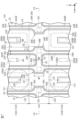
- FIG. 2 is a schematic plan view showing an exemplary formation pattern 100 of the nitride semiconductor device 10 of FIG. 3 to 6 are enlarged views of a portion of the formed pattern 100 in FIG. 2.
- Passivation layer 26, source electrode 28, and interlayer dielectric layer 32 are depicted as being transparent so that gate layer 22 is visible.
- a part of the source electrode 28 is drawn with a chain double-dashed line.
- the interlayer insulating layer 32 only the source wiring opening 32A, the drain wiring opening 32B, and the gate wiring opening 32C are drawn with broken lines.
- the source wiring 34, the drain wiring 36, and the gate wiring 38 are drawn with two-dot chain lines.
- the gate electrode 24 is omitted for convenience.
- a plurality of source openings 26A and a plurality of drain openings 26B are formed in the passivation layer 26 (see FIG. 1).
- the plurality of source openings 26A and the plurality of drain openings 26B are alternately formed one by one in the X-axis direction.
- the source opening 26A and drain opening 26B that are adjacent to each other in the X-axis direction are spaced apart from each other in the X-axis direction.
- Each source opening 26A and each drain opening 26B extends in the Y-axis direction in plan view.
- the X-axis direction corresponds to the "first direction”
- the Y-axis direction corresponds to the "second direction.” Therefore, the second direction is perpendicular to the first direction in plan view.
- each source opening 26A in the Y-axis direction and the length of each drain opening 26B in the Y-axis direction are equal to each other. Further, each source opening 26A and each drain opening 26B are arranged at the same position in the Y-axis direction. That is, as shown in FIG. 3, the first end CA1 of each source opening 26A and the first end CB1 of each drain opening 26B are formed at the same position in the Y-axis direction, and each source opening The second end CA2 of the portion 26A and the second end CB2 of each drain opening 26B are formed at positions that are aligned with each other in the Y-axis direction.
- first end CA1 of each source opening 26A is the end closer to the first inactive region 104 among both ends of each source opening 26A in the Y-axis direction
- second end CA2 is the end closer to the first inactive region 104.
- the first end CB1 of each drain opening 26B is the end closer to the first inactive region 104 among both ends of each drain opening 26B in the Y-axis direction
- the second end CB2 is the end of each drain opening 26B in the Y-axis direction. This is the end closer to the second inactive region 106A (second inactive region 106B) among both ends of the portion 26B in the Y-axis direction.
- the plurality of source openings 26A are formed in a row, two each, spaced apart from each other in the Y-axis direction. Further, the plurality of drain openings 26B are formed in a row, two each, spaced apart from each other in the Y-axis direction.
- each source opening 26A is filled with a source contact portion 28A
- the drain opening 26B is filled with a drain contact portion 30A
- the plurality of source contact portions 28A and the plurality of drain contact portions 30A are It can be said that they are formed alternately one by one in the axial direction. It can also be said that the source contact portion 28A and the drain contact portion 30A that are adjacent to each other in the X-axis direction are formed with an interval in the X-axis direction. It can also be said that the plurality of source contact parts 28A are formed in two rows, spaced apart from each other in the Y-axis direction. Furthermore, it can be said that the plurality of drain contact portions 30A are formed in a row, two each, spaced apart from each other in the Y-axis direction.
- Each source contact portion 28A and each drain contact portion 30A extends in the Y-axis direction in plan view.
- the source field plate portion 28B (see FIG. 1) is formed over almost the entire formed pattern 100.
- a plurality of drain electrode openings 28D forming an end portion 28C are formed in the source field plate portion 28B.
- a drain electrode 30 is formed in each drain electrode opening 28D.
- the source field plate portion 28B is formed so as to surround the drain electrode 30 in plan view.
- the drain plate portion 30B of the drain electrode 30 is formed at a distance from the end portion 28C forming each drain electrode opening 28D.
- the shape of the drain plate portion 30B in plan view is a band shape extending in the Y-axis direction.
- the formation pattern 100 includes an active region 102 that contributes to transistor operation, and a first inactive region 104 and a second inactive region 106 that do not contribute to transistor operation.
- the active region 102, the first inactive region 104, and the second inactive region 106 are partitioned in the Y-axis direction. That is, the active region 102, the first inactive region 104, and the second inactive region 106 are formed side by side in the Y-axis direction.
- the active region 102 is a region in which a source electrode 28, a drain electrode 30, and a gate electrode 24 are provided.
- the active region 102 refers to a region where current flows between the source and drain when a voltage is applied to the gate electrode 24.
- Active region 102 extends in the X-axis direction.
- Active region 102 includes a source opening 26A and a drain opening 26B.
- two active regions 102 are formed spaced apart from each other in the Y-axis direction. . That is, the number of active regions 102 is set according to the number of source openings 26A (drain openings 26B) arranged in the Y-axis direction.
- the two active regions 102 will be referred to as a first active region 102A and a second active region 102B.
- the drain opening in the first active region 102A is referred to as a "drain opening 26BA”
- the drain opening in the second active region 102B is referred to as a "drain opening 26BB”.
- the source opening in the first active region 102A is referred to as a "source opening 26AA”
- the source opening in the second active region 102B is referred to as a "source opening 26AB”.
- first active region 102A a plurality (14 in the example of FIG. 2) of the structure of the nitride semiconductor device of FIG. 1 are continuously formed along the X-axis direction.
- second active region 102B a plurality (14 in the example of FIG. 2) of the structure of the nitride semiconductor device of FIG. 1 is formed continuously along the X-axis direction. Therefore, the cross-sectional view shown in FIG. 1 corresponds to a partially enlarged cross-section of the formed pattern 100 in the active region 102.
- Both the first active region 102A and the second active region 102B are regions including a source opening 26A and a drain opening 26B in plan view.
- Both the first inactive region 104 and the second inactive region 106 are regions where the source electrode 28 and the gate electrode 24 (not shown in FIG. 2, see FIG. 1) are provided, but where the drain electrode 30 is not provided. be.
- the first inactive region 104 and the second inactive region 106 are regions that do not contribute to determining the amount of current flowing between the source and drain when a voltage is applied to the gate electrode 24.
- the first inactive region 104 is formed between the first active region 102A and the second active region 102B in the Y-axis direction. That is, in plan view, the first inactive region 104 is adjacent to both the first active region 102A and the second active region 102B in the Y-axis direction.
- the first inactive region 104 can also be said to be a region adjacent to the active region 102 in the Y-axis direction.
- the second inactive region 106 is formed on the opposite side of the active region 102 from the first inactive region 104 in the Y-axis direction. It can also be said that the second inactive region 106 is a region formed apart from the first inactive region 104 in the Y-axis direction via the source opening 26A and the drain opening 26BA.
- a second inactive region formed on the opposite side of the first inactive region 104 in the Y-axis direction with respect to the first active region 102A is referred to as a "second inactive region 106A".
- a second inactive region formed on the opposite side of the first inactive region 104 in the Y-axis direction with respect to the region 102B is referred to as a "second inactive region 106B."
- the second inactive region 106A is a region adjacent to the first active region 102A in the Y-axis direction, but is formed at a position separated from the second active region 102B.
- the second inactive region 106B is a region that is adjacent to the second active region 102B in the Y-axis direction and is spaced apart from the first active region 102A.
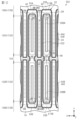
- FIG. 7 is an enlarged view of the first inactive region 104 and its surroundings.
- a virtual circle CV1 having a radius CR and centered on the first end CB1 of the drain opening 26BA is defined.
- the radius CR of the virtual circle CV1 is equal to the distance between the drain contact portion 30A and the gate layer 22 in the X-axis direction in plan view.
- a boundary line LB1 between the first inactive region 104 and the first active region 102A extends along the X-axis direction at a position separated from the first end CB1 of the drain opening 26BA by a radius CR in the Y-axis direction.
- the boundary line LB2 between the first inactive region 104 and the second active region 102B is also similar to the boundary line LB1. Therefore, the first inactive region 104 can be defined as a region between the boundary line LB1 and the boundary line LB2 in the Y-axis direction.
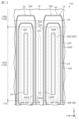
- FIG. 6 is an enlarged view of the second inactive region 106A and its surroundings.
- a virtual circle CV2 having a radius CR and centered on the second end CB2 of the drain opening 26BA is defined.
- the radius CR of the virtual circle CV2 is equal to the radius CR of the virtual circle CV1.
- the boundary line LB3 between the second inactive region 106A and the first active region 102A is located further away from the first active region 102A than at a position further away from the second end CB2 of the drain opening 26BA by the radius CR in the Y-axis direction. It extends along the X-axis direction at this position.
- the boundary line LB4 between the second inactive region 106B and the second active region 102B shown in FIG. 5 is also similar to the boundary line LB1.
- the first active region 102A can be defined as a region between boundary line LB1 and boundary line LB3 in the Y-axis direction.
- the second active region 102B can be defined as a region between boundary line LB2 and boundary line LB4 in the Y-axis direction.
- the gate layer 22 is continuous in the Y-axis direction over the first active region 102A, the second active region 102B, the first inactive region 104, and the second inactive regions 106A and 106B. It is formed by Although not shown, in this embodiment, the source electrode 28 extends over the first active region 102A, the second active region 102B, the first inactive region 104, and part of the second inactive regions 106A and 106B. It is formed continuously in the Y-axis direction.
- the source wiring 34 and the drain wiring 36 are arranged in the active region 102. More specifically, in the illustrated example, two source wirings 34 and two drain wirings 36 are alternately arranged in the Y-axis direction in the first active region 102A. The two source wirings 34 and the two drain wirings 36 are arranged at intervals in the Y-axis direction. Each source wiring 34 and each drain wiring 36 extends along the X-axis direction. Similarly, in the second active region 102B, two source wirings 34 and two drain wirings 36 are arranged alternately in the Y-axis direction. Note that the number of each of the source wiring 34 and the drain wiring 36 can be changed arbitrarily.
- the gate wiring 38 is arranged in each of the first inactive region 104 and the second inactive regions 106A and 106B. More specifically, one gate wiring 38 is arranged in the first inactive region 104. One gate wiring 38 is arranged in each of the second inactive regions 106A and 106B. Each gate wiring 38 extends along the X-axis direction. In the first inactive region 104 and the second inactive regions 106A and 106B, the gate wiring 38 is connected to the gate electrode 24 (see FIG. 1) on the gate layer 22 through the gate wiring opening 32C.
- the gate layer 22 includes a ring-shaped portion 40 formed in a ring shape surrounding two drain openings 26BA and 26BB arranged in a line along the Y-axis direction.
- a plurality of ring-shaped parts 40 are formed spaced apart from each other in the X-axis direction. Ring-shaped parts 40 adjacent in the X-axis direction are connected by a first connecting part 42 .
- the gate layer 22 includes a plurality of ring-shaped parts 40 and a plurality of first connection parts 42.
- the gate layer 22 includes a main gate part 44 extending in the Y-axis direction in the active region 102 and a sub-gate part 46 extending in the Y-axis direction so as to be continuous with the main gate part 44 in the first inactive region 104. . Both the main gate part 44 and the sub-gate part 46 are part of the ring-shaped part 40.
- the main gate section 44 is provided in both the first active region 102A and the second active region 102B.
- the main gate part in the first active region 102A is referred to as a "main gate part 44A”
- the main gate part in the second active region 102B is referred to as a "main gate part 44B".
- a plurality of main gate portions 44A are formed in the first active region 102A so as to be spaced apart from each other in the X-axis direction.
- One main gate section 44A is arranged between the source opening section 26AA and the drain opening section 26BA that are adjacent to each other in the X-axis direction. In plan view, the main gate portion 44A extends over the entire first active region 102A in the Y-axis direction.
- a plurality of main gate portions 44B are formed in the second active region 102B so as to be spaced apart from each other in the X-axis direction.
- One main gate section 44B is arranged between the source opening section 26AB and the drain opening section 26BA that are adjacent to each other in the X-axis direction.
- the main gate portion 44B extends over the entire second active region 102B in the Y-axis direction. In this way, it can be said that the source openings 26AA, 26AB and the drain openings 26BA, 26BB are provided on both sides of the gate layer 22 in the X-axis direction.
- the sub-gate section 46 is located between the main gate section 44A and the main gate section 44B in the Y-axis direction.
- the sub-gate section 46 connects the main gate section 44A and the main gate section 44B.
- a plurality of sub-gate sections 46 are formed spaced apart in the X-axis direction. The plurality of sub-gate sections 46 individually connect the plurality of main gate sections 44A and the plurality of main gate sections 44B.
- the gate layer 22 includes a protrusion 48 that protrudes from the sub-gate portion 46 toward the drain openings 26BA and 26BB in the X-axis direction.
- Gate layer 22 includes a plurality of protrusions 48 .
- the plurality of protruding parts 48 are individually formed in the plurality of sub-gate parts 46.
- Protrusions 48 that are adjacent to each other in the X-axis direction are spaced apart from each other in the X-axis direction.
- the two protrusions 48 formed on one ring-shaped portion 40 face each other in the X-axis direction.
- the passivation layer 26 and the source electrode 28 are located between the two protrusions 48 in the X-axis direction (see FIG. 8).
- Both the main gate portions 44A, 44B and the sub-gate portions 46 are arranged closer to the source openings 26AA, 26AB than the drain openings 26BA, 26BB in the X-axis direction in plan view. It can be said that the distance between the main gate section 44A and the drain opening 26BA in the X-axis direction is greater than the distance between the main gate section 44A and the source opening 26AA in the X-axis direction. It can be said that the distance between the main gate section 44B and the drain opening 26BB in the X-axis direction is greater than the distance between the main gate section 44B and the source opening 26AB in the X-axis direction. It can be said that the distance between the sub-gate section 46 and the drain openings 26BA, 26BB in the X-axis direction is greater than the distance between the sub-gate section 46 and the source openings 26AA, 26AB in the X-axis direction.
- the width WG of the main gate portion 44A is larger than the width WA of the source opening 26AA.
- the width WG of the main gate portion 44A is larger than the width WB of the drain opening 26BA.
- the width WG of the main gate portion 44A is defined by the size of the main gate portion 44A in the X-axis direction in the first active region 102A.
- the width WA of the source opening 26AA is defined, for example, by the size in the X-axis direction of the center portion of the source opening 26AA in the Y-axis direction.
- the width WB of the drain opening 26BA is defined, for example, by the size in the X-axis direction of the center portion of the drain opening 26BA in the Y-axis direction. Note that the width of the main gate portion 44B (see FIG. 5) is equal to the width WG of the main gate portion 44A.
- the width WG of the main gate portion 44A can be changed arbitrarily. In one example, the width WG of the main gate portion 44A may be less than or equal to the width WA of the source opening 26AA. The width WG of the main gate portion 44A may be less than or equal to the width WB of the drain opening 26BA.
- the gate layer 22 can be divided into a first gate layer 22P, a second gate layer 22Q, and a third gate layer 22R. Therefore, it can be said that the gate layer 22 includes the first gate layer 22P, the second gate layer 22Q, and the third gate layer 22R.
- the first gate layer 22P is arranged between a predetermined source opening 26AA (26AB) in the gate layer 22 and a drain opening 26BA (26BB) adjacent to the predetermined source opening 26AA in the X-axis direction. This is the part.
- the second gate layer 22Q is a portion of the gate layer 22 that is spaced apart from the first gate layer 22P in the X-axis direction via the predetermined source opening 26AA (26AB) in plan view.
- the third gate layer 22R is a portion of the gate layer 22 that is spaced apart from the first gate layer 22P in the X-axis direction via the drain opening 26BA (26BB) in plan view. That is, the first gate layer 22P is arranged between the second gate layer 22Q and the third gate layer 22R in the X-axis direction.
- the first gate layer 22P and the second gate layer 22Q constitute one ring-shaped part 40
- the third gate layer 22R constitutes another ring-shaped part 40.
- each of the first to third gate layers 22P to 22R extends across the first active region 102A, the first inactive region 104, and the second active region 102B in the Y-axis direction.
- the first gate layer 22P includes the first main gate parts 44AP and 44BP as the main gate parts 44A and 44B, the first sub-gate part 46P as the sub-gate part 46, and the first protrusion part 48P as the protrusion part 48. and has.
- the second gate layer 22Q includes second main gate parts 44AQ and 44BQ as main gate parts 44A and 44B, a second sub-gate part 46Q as a sub-gate part 46, and a second protrusion part 48Q as a protrusion part 48.
- the third gate layer 22R includes third main gate parts 44AR and 44BR as main gate parts 44A and 44B, a third sub-gate part 46R as a sub-gate part 46, and a third protrusion part 48R as a protrusion part 48.
- the gate layer 22 includes a second connecting portion 50A that connects the first main gate portion 44AP and the third main gate portion 44AR in the second inactive region 106A. Therefore, the drain opening 26BA is surrounded by the first main gate part 44AP, the third main gate part 44AR, and the second connecting part 50A. In this way, it can be said that the second connecting portion 50A connects the main gate portions 44A (44AP, 44AR) arranged on both sides of the drain opening 26BA in the X-axis direction in the second inactive region 106A.
- the gate layer 22 includes a second connecting portion 50B that connects the first main gate portion 44BP and the third main gate portion 44BR in the second inactive region 106B. Therefore, the drain opening 26BB is surrounded by the first main gate part 44BP, the third main gate part 44BR, and the second connecting part 50B. In this way, it can be said that the second connecting portion 50B connects the main gate portions 44B (44BP, 44BR) arranged on both sides of the drain opening 26BB in the X-axis direction in the second inactive region 106B.
- the second connecting portions 50A and 50B are part of the ring-shaped portion 40.
- the ring-shaped part 40 includes two main gate parts 44A arranged on both sides of the drain opening 26BA in the X-axis direction, and two main gate parts 44B arranged on both sides of the drain opening 26BB in the X-axis direction. It is formed by a sub-gate part 46 that connects each main gate part 44A, 44B, a second connecting part 50A that connects two main gate parts 44A, and a second connecting part 50B that connects two main gate parts 44B. There is.
- the width WE of the second connecting portion 50A is larger than the width WG of the main gate portion 44A.
- the width WE of the second connecting portion 50A is twice or more the width WG of the main gate portion 44A.
- the width WE of the second connecting portion 50A is three times or less the width WG of the main gate portion 44A.
- the width WE of the second connecting portion 50A is defined by the size in the Y-axis direction of the portion of the second connecting portion 50A that extends along the X-axis direction. Note that the width of the second connecting portion 50B is equal to the width WE of the second connecting portion 50A.
- the distance between the drain opening 26BA and the main gate section 44A in the X-axis direction is larger than the distance between the source opening 26AA and the main gate section 44A in the X-axis direction.
- the length of the second connecting portion 50A in the X-axis direction is longer than the length of the first connecting portion 42 in the X-axis direction. In other words, the length of the first connecting portion 42 in the X-axis direction is shorter than the length of the second connecting portion 50A in the X-axis direction.
- the length of the second connecting portion 50B in the X-axis direction is equal to the length of the second connecting portion 50A in the X-axis direction.
- the first connecting portion 42 connects the first sub-gate portion 46P and the second sub-gate portion 46Q in the first inactive region 104. Therefore, the ring-shaped part 40 including the first sub-gate part 46P and the ring-shaped part 40 including the second sub-gate part 46Q are formed at different positions and adjacent to each other in the X-axis direction. Note that the ring-shaped portion 40 including the first sub-gate portion 46P includes a third sub-gate portion 46R.
- the first connecting portions 42 are spaced apart from each other in the X-axis direction. Each first connecting portion 42 is formed in the first inactive region 104 . Each first connecting portion 42 extends in the X-axis direction.
- the first connecting portion 42 is disposed on the opposite side of both the protruding portions 48P and 48Q with respect to both the sub-gate portions 46P and 46Q in the X-axis direction. Both protrusions 48P and 48Q are formed at positions aligned with the first connecting portion 42 in the Y-axis direction among both sub-gate portions 46P and 46Q.
- the source opening 26AA is surrounded by a first main gate part 44AP, a second main gate part 44AQ, a first sub-gate part 46P, a second sub-gate part 46Q, and a first connecting part 42.
- the source opening 26AB is surrounded by the first main gate part 44BP, the second main gate part 44BQ, the first sub-gate part 46P, the second sub-gate part 46Q, and the first connecting part 42. .
- the width WM of the first connecting portion 42 is larger than the width WG of the main gate portion 44A.
- the width WM of the first connecting portion 42 is smaller than the width WE (see FIG. 6) of the second connecting portion 50A.
- the width WM of the first connecting portion 42 is less than twice the width WG of the main gate portion 44A.
- the width WM of the first connecting portion 42 is defined by the size of the first connecting portion 42 in the Y-axis direction.
- the gate electrode 24 is formed to have a shape that is one size smaller than the gate layer 22 in plan view. That is, in plan view, the gate electrode 24 has a shape similar to the gate layer 22.
- the first protrusion 48P protrudes from the first sub-gate portion 46P toward the third protrusion 48R in the X-axis direction.
- the third protrusion 48R protrudes from the third sub-gate portion 46R toward the first protrusion 48P in the X-axis direction. That is, the first protrusion 48P and the third protrusion 48R protrude so as to approach each other in the ring-shaped portion 40 including the first gate layer 22P and the third gate layer 22R.
- the first protrusion 48P and the third protrusion 48R are spaced apart from each other in the X-axis direction.
- the second protrusion 48Q protrudes from the second sub-gate portion 46Q toward the side opposite to the first protrusion 48P in the X-axis direction. Therefore, the direction in which the second protrusion 48Q protrudes from the second sub-gate part 46Q is the same as the direction in which the third protrusion 48R protrudes from the third sub-gate part 46R.
- each protrusion 48 In plan view, the plurality of protrusions 48 have the same shape.
- the shape of each protrusion 48 in plan view is approximately trapezoidal. More specifically, each protrusion 48 includes a pair of side surfaces 48A, a tip surface 48B, and a pair of connecting portions 48C that connect the pair of side surfaces 48A and the tip surface 48B.
- the pair of side surfaces 48A include curved portions. More specifically, the side surface 48A that is closer to the drain opening 26BA includes a portion that is curved and convex toward the distal end surface 48B and away from the drain opening 26BA. The side surface 48A that is closer to the drain opening 26BB includes a portion that is curved and convex toward the distal end surface 48B and away from the drain opening 26BB. In one example, the radius of curvature of each side surface 48A is smaller than the radius of curvature of the second connecting portion 50A (see FIG. 6).
- the distal end surface 48B extends along the Y-axis direction in plan view.
- the tip surface 48B is a flat surface along the YZ plane.
- the tip surface 48B may be an inclined surface that is inclined so that the protrusion length LX increases toward the electron supply layer 18.
- the protrusion length LX is defined by the distance between the sub-gate section 46 and the tip surface 48B of the protrusion section 48 in the X-axis direction.
- the connecting portion 48C is formed in a curved shape when viewed from above.
- the radius of curvature of the connecting portion 48C is smaller than the radius of curvature of each side surface 48A.
- the tip surface 48B of the protruding portion 48 is located closer to the sub-gate portion 46 in the X-axis direction than the center position between the sub-gate portion 46 and the drain opening 26BA in the X-axis direction. That is, the protrusion length LX of the protrusion 48 from the sub-gate section 46 is less than 1/2 of the distance DX between the sub-gate section 46 and the drain opening 26BA in the X-axis direction.
- the protrusion length LX is equal to or less than the width WG of the main gate portion 44A. In the illustrated example, the protrusion length LX is equal to the width WG of the main gate portion 44A.
- the width WP of the protruding portion 48 is larger than the width WG of the main gate portion 44A.
- the width WP of the protruding portion 48 is larger than the width WM of the first connecting portion 42 .
- the width WM of the first connecting portion 42 is smaller than the width WP of the protruding portion 48.
- the width WP of the protruding portion 48 is smaller than the width WE of the second connecting portion 50A.
- the width WP of the protrusion 48 is defined by the size of the tip of the protrusion 48 in the Y-axis direction.
- a connecting portion 52 of the sub-gate portion 46 that is connected to the first connecting portion 42 is formed in a curved shape.
- the connecting portion 52 is formed to have a curved convex shape toward the first connecting portion 42 and away from the source openings 26AA and 26AB.
- the radius of curvature of the connecting portion 52 is greater than the radius of curvature of each side surface 48A of the protrusion 48. In other words, the radius of curvature of each side surface 48A is smaller than the radius of curvature of the connecting portion 52.
- the gate wiring opening 32C is formed across both the protruding portion 48 and the sub-gate portion 46 in the X-axis direction when viewed from above.
- the gate wiring opening 32C is formed so as to straddle the boundary between the protruding portion 48 and the sub-gate portion 46 in plan view.
- the shape of the gate wiring opening 32C in plan view is rectangular.
- the length of the gate wiring opening 32C in the X-axis direction is larger than the width WA of the source opening 26AA.
- the length of the gate wiring opening 32C in the X-axis direction is larger than the width WB of the drain opening 26BA.
- the length of the gate wiring opening 32C in the X-axis direction is greater than or equal to the width WG of the main gate portion 44A.
- the length of the gate wiring opening 32C in the Y-axis direction is smaller than the width WP of the protrusion 48.
- the source electrode 28 includes a gate electrode opening 28E formed at a position corresponding to each gate wiring opening 32C.
- An interlayer insulating layer 32 is interposed between the gate electrode opening 28E and the gate wiring opening 32C.
- the gate wiring 38 filled in the gate wiring opening 32C also referred to as a contact of the gate wiring 38
- the source electrode 28 are electrically insulated.
- the gate current flows from, for example, an external control device to the gate electrode 24 via the gate wiring 38. Therefore, the connection portion between the gate wiring 38 and the gate electrode 24, that is, the portion of the gate electrode 24 that overlaps with the gate wiring opening 32C in plan view has a higher gate current than the other portion of the gate electrode 24. is easy to concentrate. In this way, local concentration of gate current in the gate electrode 24 may cause a decrease in reliability of the gate electrode 24.
- the protruding portion 48 is provided in the sub-gate portion 46, the area of the portion of the gate layer 22 that overlaps with the gate wiring opening 32C becomes large in plan view. This also increases the area of the portion of the gate electrode 24 on the gate layer 22 that is formed over the sub-gate portion 46 and the protrusion portion 48 . Therefore, when a gate current is supplied to the gate electrode 24 via the gate wiring 38, the gate current is easily dispersed and flows between the gate electrode 24 on the main gate portion 44A and the gate electrode 24 on the main gate portion 44B. Become. This alleviates local concentration of gate current in the gate electrode 24.
- the gate current flows through the gate wiring opening 32C.
- the current flows to two main gate sections 44A and two main gate sections 44B via contacts of gate wiring 38 provided therein.
- the gate current since the gate current is passed through one contact to the four main gate parts 44A and 44B, local concentration of gate current tends to occur in the gate electrode 24.
- the electrical resistance of the corresponding gate electrode 24 is added between the first connecting portion 42 and the main gate portions 44A and 44B, the electrical resistance between the gate wiring 38 and the gate electrode 24 increases.
- the gate wiring opening 32C is formed over both each sub-gate part 46 and each protruding part 48 in plan view, one contact of the gate wiring 38 can be connected to two main gate parts 44A. , 44B. Therefore, local concentration of gate current in the gate electrode 24 can be alleviated.
- the electrical resistance of the gate electrode 24 since there is no need to consider the electrical resistance of the gate electrode 24 corresponding to the area between the first connecting portion 42 and the main gate portions 44A and 44B, an increase in electrical resistance between the gate wiring 38 and the gate electrode 24 can be avoided. It can be suppressed.
- the length of the gate electrode 24 through which the gate current flows with respect to one contact of the gate wiring 38 is shorter than that in the comparative configuration, so that the time required to supply the gate current to the main gate portions 44A and 44B is shorter. Becomes shorter.
- the width WE of the second connecting portion 50A of the gate layer 22 is large, the width of the gate electrode 24 on the second connecting portion 50A also becomes large. Therefore, although the gate wiring 38 is connected to the gate electrode 24 on the second connection portion 50A through the gate wiring opening 32C, the concentration of gate current is alleviated. Note that concentration of gate current is similarly alleviated for the gate electrode 24 on the second connection portion 50B in the second inactive region 106B.
- the nitride semiconductor device 10 includes an electron supply layer 18 made of a nitride semiconductor, and a gate layer 22 formed on a part of the electron supply layer 18 using a nitride semiconductor containing acceptor type impurities. , a source covering the gate electrode 24 formed on the gate layer 22, the electron supply layer 18, the gate layer 22, and the gate electrode 24, and provided on both sides of the gate layer 22 in the X-axis direction in a plan view.
- a passivation layer 26 having an opening 26A and a drain opening 26B, a source electrode 28 in contact with the electron supply layer 18 exposed through the source opening 26A, and a drain electrode 30 in contact with the electron supply layer 18 exposed through the drain opening 26B.
- an active region 102 extending in the X-axis direction and including a source opening 26A and a drain opening 26B, and a first inactive region 104 adjacent to the active region 102 in the Y-axis direction orthogonal to the X-axis direction in plan view. and, including.
- the gate layer 22 includes a main gate section 44 extending in the Y-axis direction in the active region 102, a sub-gate section 46 extending in the Y-axis direction so as to be continuous with the main gate section 44 in the first inactive region 104, and a sub-gate section. 46 toward the drain opening 26B in the X-axis direction.
- the gate electrode 24 can be formed over both the sub-gate section 46 and the protrusion section 48 in the first inactive region 104. Therefore, when a gate current is supplied to the gate electrode 24 via the gate wiring 38, concentration of the gate current at the gate electrode 24 is alleviated. Therefore, since current concentration in the gate electrode 24 is less likely to occur, it is possible to suppress deterioration in gate reliability, such as the temperature of the gate electrode 24 becoming locally excessively high.
- the tip of the protruding portion 48 is located closer to the sub-gate portion 46 in the X-axis direction than the center position between the sub-gate portion 46 and the drain opening 26B in the X-axis direction.
- the protruding length LX of the protruding portion 48 is less than 1/2 of the distance DX between the main gate portion 44 and the drain opening 26B in the X-axis direction.
- the distance between the protrusion 48 and the drain opening 26B can be increased in plan view. Therefore, since the distance between the protrusion 48 and the drain electrode 30 can be increased, the parasitic capacitance between the protrusion 48 and the drain electrode 30 can be reduced. Therefore, it is possible to both alleviate concentration of gate current due to the protrusion 48 and reduce parasitic capacitance between the protrusion 48 and the drain electrode 30.
- the nitride semiconductor device 10 further includes an interlayer insulating layer 32 covering the source electrode 28 and the passivation layer 26.
- a gate wiring opening 32C serving as a gate opening exposing the gate electrode 24 is formed in both the interlayer insulating layer 32 and the passivation layer 26.
- the gate wiring opening 32C is formed across both the protruding portion 48 and the sub-gate portion 46 in the X-axis direction when viewed from above.
- the connection area between the gate wiring 38 and the gate electrode 24 can be increased. Therefore, the electrical resistance between the gate wiring 38 and the gate electrode 24 can be reduced.
- the gate current from the gate wiring 38 flows to the main gate section 44 via the sub-gate section 46. . Therefore, compared to, for example, a configuration in which the gate wiring opening 32C is formed in the first connecting part 42, the current path of the gate current flowing from the gate wiring 38 toward the main gate part 44 can be shortened. Therefore, the electrical resistance in the gate electrode 24 can be reduced.
- the width WP of the protruding portion 48 is larger than the width WG of the main gate portion 44. According to this configuration, since the total area of the protrusion 48 and the sub-gate part 46 in which the protrusion 48 is continuous in plan view is increased, the area of the gate electrode 24 on the protrusion part 48 and the sub-gate part 46 in plan view is increased. can do. Therefore, when a gate current is supplied to the gate electrode 24 via the gate wiring 38, concentration of the gate current at the gate electrode 24 can be easily alleviated.
- Both the main gate section 44 and the sub-gate section 46 are arranged closer to the source opening 26A than the drain opening 26B in the X-axis direction. According to this configuration, it is possible to increase the distance between the sub-gate section 46 and the drain opening 26B in the X-axis direction. As a result, even if the protruding length LX of the protruding part 48 from the sub-gate part 46 is increased, that is, even if the area of the gate electrode 24 on the protruding part 48 and the sub-gate part 46 is increased in plan view, the protruding part 48 and The distance between the drain opening 26B and the drain opening 26B can be increased. Therefore, it is possible to both alleviate concentration of gate current due to the protrusion 48 and reduce parasitic capacitance between the protrusion 48 and the drain electrode 30.
- the distance between the protruding portion 48 and the first end CB1 of the drain opening 26B in the Y-axis direction is greater than or equal to the distance DX between the drain opening 26B and the main gate portion 44 in the X-axis direction. It is. According to this configuration, since the distance between the protrusion 48 and the drain opening 26B can be increased, the parasitic capacitance between the protrusion 48 and the drain electrode 30 can be reduced.
- the width WM of the first connecting portion 42 is smaller than the width WP of the protruding portion 48. According to this configuration, it is possible to increase the distance between the source opening 26A and the first connecting portion 42 in the Y-axis direction. Therefore, the gate leakage current flowing through the surface of the electron supply layer 18 between the gate electrode 24 and the source electrode 28 can be reduced.
- the width WE of the second connecting portion 50A is larger than the width WG of the main gate portion 44. According to this configuration, the width of the gate electrode 24 on the second connecting portion 50A can be increased. Therefore, concentration of gate current can be alleviated.
- a nitride semiconductor device 200 according to the second embodiment will be described with reference to FIGS. 9 to 11.
- symbol is attached
- detailed descriptions of the same components as in the first embodiment will be omitted.
- FIG. 9 is a schematic cross-sectional view of an exemplary nitride semiconductor device 200 according to the second embodiment.
- the configuration of the gate layer 22 is different from that in the first embodiment. More specifically, as shown in FIG. 9, the main gate portion 44 of the gate layer 22 includes a main ridge portion 202, a first extending portion 204, and a second extending portion 206.
- the main ridge portion 202 includes a portion of the main gate portion 44 where the gate electrode 24 is located.
- the main ridge portion 202 corresponds to the main gate portion 44 of the first embodiment.
- the first extending portion 204 extends from the main ridge portion 202 toward the source opening 26A.
- the second extending portion 206 extends from the main ridge portion 202 toward the drain opening 26B.
- the main ridge portion 202 is a portion of the gate layer 22 that includes the upper surface 22B that is in contact with the gate electrode 24.
- the main ridge portion 202 includes a first ridge end portion 202A and a second ridge end portion 202B.
- the first ridge end 202A is the end of the main ridge 202 that is closer to the source opening 26A
- the second ridge end 202B is the end of the main ridge 202 that is closer to the drain opening 26B.
- the first extending portion 204 extends from the main ridge portion 202 toward the source opening 26A in plan view.
- the first extension 204 is adjacent to the first ridge end 202A. That is, the first extension portion 204 extends from the first ridge end portion 202A toward the source opening portion 26A in plan view.
- the first extension portion 204 is spaced apart from the source opening 26A.
- the second extending portion 206 extends from the main ridge portion 202 toward the drain opening 26B in plan view.
- the second extension 206 is adjacent to the second ridge end 202B. That is, the second extending portion 206 extends from the second ridge end portion 202B toward the drain opening 26B in plan view.
- the second extension 206 is spaced apart from the drain opening 26B.
- the main ridge portion 202 is located between the first extending portion 204 and the second extending portion 206.
- the main ridge portion 202 is integrally formed with a first extending portion 204 and a second extending portion 206. Due to the first extension part 204 and the second extension part 206, the bottom surface 22A of the gate layer 22 has a larger area than the top surface 22B.
- the main ridge portion 202 corresponds to a relatively thick portion of the gate layer 22.
- the main ridge portion 202 may have a thickness of 80 nm or more and 150 nm or less.
- the thickness of the gate layer 22 can be determined by considering parameters including the gate threshold voltage. In one example, gate layer 22 has a thickness greater than 100 nm.
- each of the first extending portion 204 and the second extending portion 206 is thinner than the main ridge portion 202.
- Each of the first extension part 204 and the second extension part 206 may have different thicknesses depending on the position.
- each of the first extending portion 204 and the second extending portion 206 includes a tapered portion having a thickness that gradually decreases as the distance from the main ridge portion 202 increases in a region adjacent to the main ridge portion 202; A flat portion having a substantially constant thickness in a region away from the main ridge portion 202 by more than a predetermined distance.
- each of the first extension portion 204 and the second extension portion 206 may include only a flat portion or only a tapered portion.
- substantially constant thickness refers to a thickness within a range of manufacturing variations (for example, 20%).
- Each of the first extending portion 204 and the second extending portion 206 may have a thickness of 5 nm or more and 100 nm or less.
- the flat portions of the first extending portion 204 and the second extending portion 206 excluding the tapered portion may have a thickness of 10 nm or more and 30 nm or less. In one example, the flat portions of the first extending portion 204 and the second extending portion 206 are approximately 15 nm.
- the length of the second extending portion 206 is greater than or equal to the length of the first extending portion 204 in plan view.
- the length of the first extending part 204 can be defined by the length from the first ridge end 202A of the main ridge part 202 to the tip surface of the first extending part 204 in plan view.
- the length of the second extending portion 206 can be defined by the length from the second ridge end 202B of the main ridge portion 202 to the distal end surface of the second extending portion 206 in plan view.
- the length of the first extending portion 204 can be set to 0.2 ⁇ m or more and 0.3 ⁇ m or less. In one example, the length of the first extending portion 204 is approximately 0.25 ⁇ m.
- the length of the second extending portion 206 is 0.2 ⁇ m or more and 0.6 ⁇ m or less. In one example, the length of the second extending portion 206 is approximately 0.4 ⁇ m.
- the second extending portion 206 extends longer toward the outside of the main ridge portion 202 than the first extending portion 204 in plan view.
- the flat part of the second extending part 206 is formed in a wider range than the flat part of the first extending part 204.
- FIG. 10 is a schematic plan view showing a part of an exemplary formation pattern 300 of the nitride semiconductor device 200 of FIG. 9.
- FIG. 11 is an enlarged view of the first inactive region 104 and its surroundings in the formed pattern 300 of FIG. 10.
- the gate layer 22 in the second inactive region 106A may have a different configuration from the gate layer 22 in the active region 102.
- the extending portion extending from the main ridge portion 202 (see FIG. 9) in plan view is formed over the entire circumference of the gate layer 22. The detailed configuration of the extension portion will be described below.
- the gate layer 22 in the second inactive region 106A that is, the second connection portion 50A, includes an end ridge portion 208 and a pair of end portion extension portions 210A and 210B.
- the end ridge 208 and the pair of end extensions 210A, 210B are integrally formed.
- the end ridge 208 is located between the pair of end extensions 210A and 210B.
- the end ridge portion 208 corresponds to the second connecting portion 50A of the first embodiment.
- the end ridge portion 208 is formed continuously with the main ridge portion 202 in the second inactive region 106A. In other words, the end ridge portion 208 connects the main ridge portions 202 of the main gate portion 44A disposed on both sides of the drain opening 26BA in the X-axis direction.
- the end extension portion 210A extends from the end ridge portion 208 toward the drain opening 26BA.
- the end extending portion 210A is formed continuously with the second extending portion 206 in the second inactive region 106A.
- the end extending portion 210A is formed integrally with the second extending portion 206.
- the shape of the end extending portion 210A in the YZ plane is the same as the shape of the second extending portion 206 in the XZ plane.
- the end extension portion 210B extends from the end ridge portion 208 toward the side opposite to the drain opening 26BA.
- the end extending portion 210B is formed continuously with the first extending portion 204 in the second inactive region 106A.
- the end extending portion 210B is formed integrally with the first extending portion 204.
- the shape of the end extending portion 210B in the YZ plane is the same as the shape of the first extending portion 204 in the XZ plane. Therefore, the end extending portion 210B extends longer toward the outside of the end ridge portion 208 in plan view than the end extending portion 210A.
- the width of the end ridge portion 208 is larger than the width of the main ridge portion 202.
- the width of the end ridge portion 208 is defined by the size in the Y-axis direction of the portion of the end ridge portion 208 that extends in the X-axis direction.
- the width of the main ridge portion 202 is defined by the size of the main ridge portion 202 in the X-axis direction.
- the second connection portion 50B which is the gate layer 22 in the second inactive region 106B, has the same configuration as the second connection portion 50A, so a detailed description thereof will be omitted.
- the sub-gate section 46 of the gate layer 22 in the first inactive region 104 includes a sub-bridge section 212 where the gate electrode 24 is located and a sub-bridge section 212 extending from the sub-bridge section 212 toward the source opening 26AA. 3 extending portion 214, and a fourth extending portion 216 extending from subbridge portion 212 toward drain opening 26BA.
- the subbridge portion 212, the third extending portion 214, and the fourth extending portion 216 are integrally formed.
- the subbridge portion 212 is located between the third extending portion 214 and the fourth extending portion 216 in the X-axis direction.
- the sub-bridge section 212 corresponds to the sub-gate section 46 of the first embodiment.
- the subbridge portion 212 is formed continuously with the main ridge portion 202 in the first inactive region 104 .
- the third extending portion 214 is formed in a portion closer to the main gate portion 44A than the first connecting portion 42 in the Y-axis direction and a portion closer to the main gate portion 44B than the first connecting portion 42 in the Y-axis direction. ing.
- the third extending portion 214 closer to the main gate portion 44A is formed in the first inactive region 104 so as to be continuous with the first extending portion 204 of the main gate portion 44A.
- the third extending portion 214 closer to the main gate portion 44B is formed continuously with the first extending portion 204 of the main gate portion 44B in the first inactive region 104.
- the third extending portion 214 is formed integrally with the first extending portion 204.
- the shape of the third extending portion 214 in the XZ plane is the same as the shape of the first extending portion 204 in the XZ plane.
- the fourth extending portion 216 is formed in a portion closer to the main gate portion 44A than the protruding portion 48 in the Y-axis direction, and in a portion closer to the main gate portion 44B than the protruding portion 48 in the Y-axis direction.
- the fourth extending portion 216 closer to the main gate portion 44A is formed continuously with the second extending portion 206 of the main gate portion 44A in the first inactive region 104.
- the fourth extending portion 216 closer to the main gate portion 44B is formed continuously with the second extending portion 206 of the main gate portion 44B in the first inactive region 104.
- the fourth extending portion 216 is formed integrally with the second extending portion 206.
- the shape of the fourth extending portion 216 in the XZ plane is the same as the shape of the second extending portion 206 in the XZ plane. Therefore, the fourth extending portion 216 extends longer than the third extending portion 214 toward the outside of the sub-bridge portion 212 in plan view.
- the first connecting portion 42 of the gate layer 22 in the first inactive region 104 includes an intermediate ridge portion 218 extending along the X-axis direction and a pair of intermediate extending portions 220A and 220B.
- the intermediate ridge portion 218 and the pair of intermediate extension portions 220A, 220B are integrally formed.
- the intermediate ridge portion 218 is located between the pair of intermediate extending portions 220A and 220B in the Y-axis direction.
- the intermediate ridge portion 218 is formed continuously with the subbridge portion 212 in the first inactive region 104 .
- the intermediate ridge portion 218 corresponds to the first connecting portion 42 of the first embodiment.
- the intermediate extension portion 220A extends from the intermediate ridge portion 218 toward the source opening 26AA in the first inactive region 104.
- the intermediate extending portion 220A is formed continuously with the first extending portion 204 of the main gate portion 44A.
- the intermediate extending portion 220A is formed integrally with the first extending portion 204 of the main gate portion 44A.
- the shape of the intermediate extending portion 220A in the YZ plane is the same as the shape of the first extending portion 204 in the XZ plane.
- the intermediate extension portion 220B extends from the intermediate ridge portion 218 toward the source opening 26AB in the first inactive region 104.
- the intermediate extending portion 220B is formed continuously with the first extending portion 204 of the main gate portion 44B.
- the intermediate extending portion 220B is formed integrally with the first extending portion 204 of the main gate portion 44B.
- the shape of the intermediate extending portion 220B in the YZ plane is the same as the shape of the first extending portion 204 in the XZ plane.
- the protruding portion 48 of the gate layer 22 in the first inactive region 104 has a protruding ridge portion 222 protruding from the subbridge portion 212 toward the drain opening 26BA in the X-axis direction, and a protruding ridge portion 222 in the shape of the protruding ridge portion 222 in plan view and a fifth extension part 224 extending from the protruding ridge part 222 along the ridge.
- the protruding ridge portion 222 and the fifth extension portion 224 are integrally formed.
- the protruding ridge portion 222 is formed continuously with the subbridge portion 212 in the first inactive region 104.
- the protruding ridge portion 222 is formed integrally with the subbridge portion 212.
- the protruding ridge portion 222 corresponds to the protruding portion 48 of the first embodiment.
- the width of the protruding ridge portion 222 is larger than the width of the main ridge portion 202.
- the width of the protruding ridge portion 222 is greater than the width of the intermediate ridge portion 218.
- the width of the protruding ridge portion 222 is smaller than the width of the end ridge portion 208.
- the width of the protruding ridge portion 222 is defined by the size of the tip of the protruding ridge portion 222 in the Y-axis direction.
- the fifth extending portion 224 extends from the protruding ridge portion 222 along the shape of the protruding ridge portion 222 in plan view. Therefore, it can be said that the fifth extending portion 224 includes a pair of side surfaces 48A, a tip end surface 48B, and a pair of connecting portions 48C.
- the fifth extending portion 224 extends longer than the first extending portion 204 toward the outside of the protruding ridge portion 222 in plan view.
- the length of the fifth extension 224 is equal to the length of the second extension 206. Note that the length of the fifth extending portion 224 may be longer than the length of the second extending portion 206.
- the fifth extending portion 224 is thinner than the protruding ridge portion 222.
- the fifth extension portion 224 may have a different thickness depending on its position.
- the fifth extending portion 224 includes a tapered portion having a thickness that gradually decreases as the distance from the protruding ridge portion 222 increases in a region adjacent to the protruding ridge portion 222, and a tapered portion that is separated from the protruding ridge portion 222 by more than a predetermined distance. and a flat portion having a substantially constant thickness in the region.
- the fifth extension portion 224 may include only a flat portion or only a tapered portion.
- the fifth extending portion 224 may have a thickness of 5 nm or more and 100 nm or less.
- the flat portion of the fifth extending portion 224 excluding the tapered portion may have a thickness of 10 nm or more and 30 nm or less. In one example, the flat portion of the fifth extension portion 224 has a thickness of about 15 nm
- the fifth extension part 224 includes a fourth extension part 216 connected to the second extension part 206 of the main gate part 44A, and a fourth extension part 216 connected to the second extension part 206 of the main gate part 44B. 216.
- the fifth extending portion 224 is formed continuously with the fourth extending portion 216 in the first inactive region 104 .
- the fifth extending portion 224 is integrally formed with the fourth extending portion 216.
- the main gate portion 44A includes a main ridge portion 202 where the gate electrode 24 is located, a first extending portion 204 extending from the main ridge portion 202 toward the source opening 26AA, and a main ridge portion 202. a second extending portion 206 extending from the drain opening 26BA toward the drain opening 26BA.
- the main gate section 44B also has the same configuration as the main gate section 44A. Therefore, the same effect can be obtained in the main gate portion 44B.
- the sub-gate section 46 includes a sub-bridge section 212 where the gate electrode 24 is located, a third extending section 214 extending from the sub-bridge section 212 toward the source opening 26AA, and a drain opening from the sub-bridge section 212. 26BA.
- a gate electrode 24 is located on the subbridge portion 212.
- the protruding portion 48 includes a protruding ridge portion 222 protruding from the sub-bridge portion 212 toward the drain opening 26BA in the X-axis direction, and a protruding ridge portion 222 extending from the protruding ridge portion 222 along the shape of the protruding ridge portion 222 in plan view. 5 extension part 224.
- the third extending portion 214 is formed continuously with the first extending portion 204.
- the fourth extending portion 216 is formed continuously with the second extending portion 206.
- the fifth extending portion 224 is formed continuously with the fourth extending portion 216.
- the shape of the source electrode 28 in plan view can be arbitrarily changed.
- the source electrodes 28 may be separated in the Y-axis direction via the first inactive region 104 in plan view. That is, the source electrode 28 includes a first source electrode 28P and a second source electrode 28Q that are spaced apart from each other in the Y-axis direction.
- the first source electrode 28P is formed over the first active region 102A, a part of the second inactive region 106A adjacent to the first active region 102A, and a part of the first inactive region 104 in plan view. ing. The first source electrode 28P is formed closer to the first active region 102A than the gate wiring opening 32C.
- the second source electrode 28Q is formed over the second active region 102B, a part of the second inactive region 106B adjacent to the second active region 102B, and a part of the first inactive region 104 in plan view. ing. The second source electrode 28Q is formed closer to the second active region 102B than the gate wiring opening 32C.
- the first inactive region 104 there is a region in the first inactive region 104 where the source electrode 28 is not formed. In this region, an interlayer insulating layer 32 and a source wiring 34 are arranged. For this reason, compared to a configuration in which the source electrode 28 is arranged in the first inactive region 104, there is a difference between the gate wiring 38 (see FIG. 2) arranged in the first inactive region 104 and the source electrode 28. The distance increases. Therefore, the parasitic capacitance between the gate wiring 38 and the source electrode 28 can be reduced.
- the size of each of the first source electrode 28P and the second source electrode 28Q in the Y-axis direction can be changed arbitrarily.
- the first source electrode 28P may not be formed in the first inactive region 104 in plan view. That is, the first source electrode 28P may be formed over a portion of the first active region 102A and the second inactive region 106A.
- the second source electrode 28Q does not need to be formed in the first inactive region 104 in plan view. That is, the second source electrode 28Q may be formed over a portion of the second active region 102B and the second inactive region 106B.
- the position of the second end CA2, which is the end closer to the second inactive region 106A (106B) among both ends of the source opening 26AA (26AB) in the Y-axis direction, can be arbitrarily changed. It is possible.
- the second end CA2 of the source opening 26AA is formed closer to the first inactive region 104 than the second end CB2 of the drain opening 26BA.
- the second end CA2 of the source opening 26AA is formed further away from the second inactive region 106A than the second end CB2 of the drain opening 26BA.
- the distance between the source contact portion 28A filled in the source opening 26AA and the second connection portion 50A of the gate layer 22 can be increased. Therefore, in plan view, the distance between the gate electrode 24 formed on the second connecting portion 50A and the source contact portion 28A can be increased. Thereby, the gate leakage current that propagates through the surface of the electron supply layer 18 between the gate electrode 24 and the source electrode 28 can be reduced.
- the second end CA2 of the source opening 26AB may also be formed closer to the first inactive region 104 than the second end CB2 of the drain opening 26BB. With this configuration, it is also possible to reduce the gate leakage current that passes through the surface of the electron supply layer 18 between the gate electrode 24 and the source electrode 28.
- the position of the first end CA1 which is the end closer to the first inactive region 104 of both ends of the source opening 26A in the Y-axis direction, can be arbitrarily changed.
- the first end CA1 of the source opening 26AA is formed at a position farther from the first inactive region 104 than the first end CB1 of the drain opening 26BA.
- the distance between the source contact portion 28A filled in the source opening 26AA and the first connecting portion 42 of the gate layer 22 can be increased. Therefore, in plan view, the distance between the gate electrode 24 formed on the first connecting portion 42 and the source contact portion 28A can be increased. Thereby, the gate leakage current that propagates through the surface of the electron supply layer 18 between the gate electrode 24 and the source electrode 28 can be reduced.
- the first end CA1 of the source opening 26AA is formed at a position farther from the first inactive region 104 than the first end CB1 of the drain opening 26BA, and the source opening 26AA
- the second end CA2 of the drain opening 26BA may be formed at a position farther from the second inactive region 106A than the second end CB2 of the drain opening 26BA.
- first end CA1 of the source opening 26AB may also be formed at a position further away from the first inactive region 104 than the first end CB1 of the drain opening 26BB. With this configuration, it is also possible to reduce the gate leakage current that passes through the surface of the electron supply layer 18 between the gate electrode 24 and the source electrode 28.
- the formed patterns 100, 300 may include a plurality of first inactive regions 104.
- the plurality of first inactive regions 104 may be formed apart from each other in the Y-axis direction via the source opening 26A and the drain opening 26B. good. That is, the formed pattern 100 may include three or more active regions 102.
- the positions of the boundary lines LB1 to LB4 between the active region 102, the first inactive region 104, and the second inactive region 106 in the Y-axis direction can be changed arbitrarily.
- the boundary line LB1 between the first active region 102A and the first inactive region 104 is the same as the edge of the drain opening 26B in the Y-axis direction that is closer to the first active region 102A. They may be aligned at the same position.
- the boundary line LB2 may also be changed in the same manner as the boundary line LB1.
- the boundary line LB3 between the first active region 102A and the first inactive region 104 is connected to the edge of the drain opening 26B that is closer to the second active region 102B among both edges of the drain opening 26B in the Y-axis direction.
- the positions may be aligned in the direction.
- the boundary line LB4 may also be changed in the same manner as the boundary line LB3.
- the shape of the protrusion 48 in plan view can be arbitrarily changed.
- the distal end surface 48B of the protrusion 48 may be formed to be curved and convex toward the protrusion 48 facing in the X-axis direction.
- the width WP of the protrusion 48 can be changed arbitrarily.
- the width WP of the protrusion 48 may be equal to the width WM of the first connecting portion 42 . Further, the width WP of the protruding portion 48 may be smaller than the width WM of the first connecting portion 42. Further, in one example, the width WP of the protruding portion 48 may be equal to the width WE of the second connecting portion 50A. Further, the width WP of the protruding portion 48 may be larger than the width WE of the second connecting portion 50A. Further, in one example, the width WP of the protruding portion 48 may be equal to the width WG of the main gate portion 44. Further, the width WP of the protruding portion 48 may be smaller than the width WG of the main gate portion 44.
- the position of the tip surface 48B of the protrusion 48 can be changed arbitrarily.
- the tip surface 48B of the protrusion 48 may be located closer to the drain opening 26BA in the X-axis direction than the center position between the main gate part 44 and the drain opening 26BA in the X-axis direction.
- the protrusion length LX of the protrusion 48 from the sub-gate section 46 may be equal to or more than 1/2 of the distance DX between the sub-gate section 46 and the drain opening 26BA in the X-axis direction.
- Each embodiment may include a sub-gate section 46 in which no protruding section 48 is formed.
- the gate wiring opening 32C is not formed in the sub-gate section 46 where the protrusion 48 is not formed.
- the shape of the gate wiring opening 32C in plan view can be arbitrarily changed.
- the shape of the gate wiring opening 32C in plan view may be circular.
- the gate wiring opening 32C may have a rectangular shape in which the X-axis direction is the longitudinal direction and the Y-axis direction is the lateral direction.
- the position of the gate wiring opening 32C can be changed arbitrarily.
- the gate wiring opening 32C may be formed at a position overlapping the first connecting portion 42 of the gate layer 22 in plan view. Further, in one example, the gate wiring opening 32C may be formed at a position overlapping the protrusion 48 in a plan view but not overlapping the sub-gate section 46. In one example, the gate wiring opening 32C may be formed at a position overlapping the sub-gate section 46 but not overlapping the protrusion 48 in plan view.
- the configuration of the main gate portion 44A of the gate layer 22 can be arbitrarily changed.
- the main gate portion 44A may include only one of the first extending portion 204 and the second extending portion 206 in addition to the main ridge portion 202.
- the main gate portion 44A may include the main ridge portion 202 and the first extending portion 204, but may not include the second extending portion 206.
- the main gate portion 44A may include the main ridge portion 202 and the second extension portion 206, but may not include the first extension portion 204.
- the main gate portion 44B may also be changed in the same manner.
- the configuration of the second connecting portion 50A of the gate layer 22 can be arbitrarily changed.
- the second connecting portion 50A may include, in addition to the end ridge portion 208, only one of the pair of end portion extension portions 210A and 210B.
- the pair of end extending portions 210A and 210B may be omitted from the second connecting portion 50A. In addition, you may change similarly about the 2nd connection part 50B.
- the configuration of the first connecting portion 42 of the gate layer 22 can be arbitrarily changed.
- the first connecting portion 42 may include, in addition to the intermediate ridge portion 218, only one of the pair of intermediate extending portions 220A and 220B. Further, in one example, the pair of intermediate extending portions 220A and 220B may be omitted from the first connecting portion 42.
- the configuration of the sub-gate section 46 of the gate layer 22 can be changed arbitrarily.
- the sub-gate section 46 may include only one of the third extending section 214 and the fourth extending section 216 in addition to the sub-bridge section 212.
- the sub-gate section 46 may include the sub-bridge section 212 and the third extension section 214, but may not include the fourth extension section 216.
- the sub-gate section 46 may include the sub-bridge section 212 and the fourth extension section 216, but may not include the third extension section 214.
- the third extending portion 214 and the fourth extending portion 216 may be omitted from the sub-gate portion 46.
- the configuration of the protruding portion 48 of the gate layer 22 can be arbitrarily changed.
- the fifth extending portion 224 may be omitted from the protrusion 48 .
- the length of the fifth extension part 224 from the protruding ridge part 222 can be changed arbitrarily.
- the length from the protruding ridge portion 222 of the portion of the fifth extending portion 224 corresponding to the distal end surface 48B of the protruding portion 48 is equal to It is longer than the length from the protruding ridge portion 222 of the corresponding portion.
- the length of the fifth extending portion 224 from the protruding ridge portion 222 is longer than the length of the fourth extending portion 216 from the sub-bridge portion 212.
- an extending portion extending from the ridge portion toward the source opening or the drain opening may be formed in at least a portion of the ridge portion of the gate layer 22 where the gate electrode 24 is located.
- the shape of the gate layer 22 in plan view can be arbitrarily changed.
- the gate layer 22 includes a first connecting portion 302 formed in the first inactive region 104 and a second connecting portion 304 formed in the second inactive region 106A (106B). including. More specifically, the first connecting portion 302 connects a first sub-gate portion 46P of the first gate layer 22P and a third sub-gate portion 46R of the third gate layer 22R, which are arranged on both sides of the source opening 26A in the X-axis direction. are connected.
- the second connecting portion 304 connects the first main gate portion 44AP of the first gate layer 22P and the third main gate portion 44AR of the third gate layer 22R in the second inactive regions 106A and 106B.
- the source opening 26AA is surrounded by the first main gate part 44AP of the first gate layer 22P, the third main gate part 44AR of the third gate layer 22R, the first connecting part 302, and the second connecting part 304.
- the source opening 26AB is surrounded by the first main gate part 44BP of the first gate layer 22P, the third main gate part 44BR of the third gate layer 22R, the first connecting part 302, and the second connecting part 304. .
- the gate layer 22 includes a protrusion 306 that protrudes from the sub-gate portion 46 toward the drain opening 26B in the X-axis direction in the first inactive region 104. More specifically, the first gate layer 22P includes the first protrusion 306P as the protrusion 306, the second gate layer 22Q includes the second protrusion 306Q as the protrusion 306, and the third gate layer 22R includes the protrusion 306. This includes the third protrusion 306R.
- the protruding portion 306 is formed at a position aligned with the first connecting portion 302 in the Y-axis direction. In one example, protrusion 306 is the same shape as protrusion 48 (see FIG. 4) of each embodiment.
- the configuration of the first connecting portion 302 can be changed arbitrarily.
- the first connecting portion 302 may connect the first main gate portion 44AP of the first gate layer 22P and the second main gate portion 44AQ of the second gate layer 22Q.
- the drain opening 26BA is surrounded by the first main gate part 44AP of the first gate layer 22P, the second main gate part 44AQ of the second gate layer 22Q, and the first connecting part 302.
- the first connecting portion 302 may connect the first main gate portion 44BP of the first gate layer 22P and the second main gate portion 44BQ of the second gate layer 22Q.
- the drain opening 26BB is surrounded by the first main gate part 44BP of the first gate layer 22P, the second main gate part 44BQ of the second gate layer 22Q, and the first connecting part 302.
- the source opening 26AA is surrounded by the first main gate section 44AP of the first gate layer 22P, the second main gate section 44AQ of the second gate layer 22Q, and the second connecting section 304.
- the source opening 26AB is surrounded by the first main gate part 44BP of the first gate layer 22P, the second main gate part 44BQ of the second gate layer 22Q, and the second connecting part 304.
- the protrusion 306 protrudes from the gate layer 22 toward the source opening 26A in the X-axis direction.
- first protrusion 306P protrudes from the first sub-gate section 46P toward the source opening 26AA.
- the second protruding portion 306Q protrudes from the second sub-gate portion 46Q toward the source opening 26AA.
- the third protruding portion 306R protrudes from the third sub-gate portion 46R toward the source opening 26AA.
- the term “on” includes the meanings of “on” and “above” unless the context clearly dictates otherwise.
- the phrase “the first layer is formed on the second layer” refers to the fact that in some embodiments the first layer may be directly disposed on the second layer in contact with the second layer, but in other embodiments. It is contemplated that the first layer may be placed above the second layer without contacting the second layer. That is, the term “on” does not exclude structures in which other layers are formed between the first layer and the second layer.
- the above embodiment in which the electron supply layer 18 is formed on the electron transit layer 16 may also have a structure in which an intermediate layer is located between the electron supply layer 18 and the electron transit layer 16 in order to stably form the 2DEG 20. include.
- the Z-axis direction used in the present disclosure does not necessarily need to be a vertical direction, nor does it need to completely coincide with the vertical direction. Accordingly, various structures according to the present disclosure (e.g., the structure shown in FIG. 1) are different from each other in that "upper” and “lower” in the Z-axis direction described herein are “upper” and “lower” in the vertical direction. Not limited to one thing.
- the X-axis direction may be a vertical direction
- the Y-axis direction may be a vertical direction.
- an electron supply layer (18) made of a nitride semiconductor made of a nitride semiconductor
- a gate layer (22) formed on a portion of the electron supply layer (18) using a nitride semiconductor containing acceptor-type impurities
- a gate electrode (24) formed on the gate layer (22); Covering the electron supply layer (18), the gate layer (22), and the gate electrode (24), and provided on both sides of the gate layer (22) in the first direction (X-axis direction) in plan view.
- a passivation layer (26) having a source opening (26A) and a drain opening (26B); a source electrode (28) in contact with the electron supply layer (18) exposed by the source opening (26A); a drain electrode (30) in contact with the electron supply layer (18) exposed by the drain opening (26B); an active region (102) extending in the first direction (X-axis direction) and including the source opening (26A) and the drain opening (26B); an inactive region (104) adjacent to the active region (102) in a second direction (Y-axis direction) orthogonal to the first direction (X-axis direction) in plan view;
- the gate layer (22) is a main gate portion (44) extending in the second direction in the active region (102); a sub-gate section (46) extending in the second direction (Y-axis direction) so as to be continuous with the main gate section (44) in the inactive region (104);
- a nitride semiconductor device (10) comprising: a protrusion (48) protruding from the sub-gate (4
- the tip of the protruding portion (48) is located at the center between the sub-gate portion (46) and the drain opening (26B) in the first direction (X-axis direction).
- a gate opening (32C) exposing the gate electrode (24) is formed in both the interlayer insulating layer (32) and the passivation layer (26), The gate opening (32C) is formed across both the protrusion (48) and the sub-gate (46) in the first direction (X-axis direction) in plan view.
- the width (WP) of the protruding portion (48) in the second direction (Y-axis direction) is larger than the width (WG) of the main gate portion (44) in the first direction (X-axis direction). Additional Note 1 3.
- Both the main gate section (44) and the sub-gate section (46) are arranged closer to the source opening (26A) than the drain opening (26B) in the first direction (X-axis direction).
- the nitride semiconductor device according to any one of Supplementary Notes 1 to 4.
- the distance between the protrusion (48) and the end (CB1) of the drain opening (26B) in the second direction (Y-axis direction) is equal to the distance between the drain opening in the first direction (X-axis direction).
- the gate layer (22) is A first main gate part (44AP) as the main gate part (44), a first sub-gate part (46P) as the sub-gate part (46), and a first protrusion part (48P) as the protrusion part (48).
- a first gate layer (22P) having The main gate portion (44) is arranged to be spaced apart from the first gate layer (22P) in the first direction (X-axis direction) via the source opening (26A) in plan view.
- a second gate layer (22Q) having a second main gate part (44AQ), a second sub-gate part (46Q) as the sub-gate part (46), and a second protrusion part (48Q) as the protrusion part (48);
- the first connecting portion (42) is arranged on the opposite side of both the sub-gate portions (46P, 46Q) from the protruding portions (48P, 48Q) in the first direction (X-axis direction),
- the source opening (26A) is surrounded by the first main gate part (44AP), the second main gate part (44AQ), and the first connecting part (42).
- the width (WM) of the first connecting portion (42) in the second direction (Y-axis direction) is smaller than the width (WP) of the protruding portion (48) in the second direction (Y-axis direction). 7.
- the inactive area is a first inactive area (104)
- the first inactive region (104) includes a second inactive region (106A) formed on the opposite side of the second direction (Y-axis direction) to the active region (102)
- the gate layer (22) is The main gate portion (44) is arranged to be spaced apart from the first gate layer (22P) in the first direction (X-axis direction) via the drain opening (26B) in plan view.
- the width (WE) of the second connecting portion (50A) in the second direction (Y-axis direction) is larger than the width (WG) of the main gate portion (44) in the first direction (X-axis direction).
- the end (CA2) that is closer to the second inactive region (106A) is connected to the drain opening (26B). It is formed closer to the first inactive region (104) than the end (CB2) that is closer to the second inactive region (106A) among both ends in the second direction (Y-axis direction). 11.
- the main gate part (44) is a main ridge portion (202) where the gate electrode (24) is located; a first extending portion (204) extending from the main ridge portion (202) toward the source opening (26A);
- the sub-gate section (46) includes: a subbridge part (212) where the gate electrode (24) is located and formed continuously with the main ridge part (202); a third extending portion (214) extending from the subbridge portion (212) toward the source opening (26A); a fourth extending portion (216) extending from the subbridge portion (212) toward the drain opening (26B);
- the protrusion (48) is a protruding ridge portion (222) protruding from the subbridge portion (212) toward the drain opening (26B) in the first direction (X-axis direction); a fifth extending portion (224) extending from the protruding ridge portion (222) along the shape of the protruding ridge portion (222) in plan view;
- the third extending portion (214) is formed continuously with the first extending portion (204),
- the fourth extending portion (216) is formed continuously with the second extending portion (206),
- the electron supply layer (18) is an Al x Ga 1-x N layer (0.1 ⁇ x ⁇ 0.3),
- an electron supply layer (18) made of a nitride semiconductor an electron supply layer (18) made of a nitride semiconductor; a gate layer (22) formed on a portion of the electron supply layer (18) using a nitride semiconductor containing acceptor-type impurities; a gate electrode (24) formed on the gate layer (22); Covering the electron supply layer (18), the gate layer (22), and the gate electrode (24), and provided on both sides of the gate layer (22) in the first direction (X-axis direction) in plan view.
- a passivation layer (26) having a source opening (26A) and a drain opening (26B); a source electrode (28) in contact with the electron supply layer (18) exposed by the source opening (26A); a drain electrode (30) in contact with the electron supply layer (18) exposed by the drain opening (26B); an active region (102) extending in the first direction (X-axis direction) and including the source opening (26A) and the drain opening (26B); an inactive region (104) adjacent to the active region (102) in a second direction (Y-axis direction) orthogonal to the first direction (X-axis direction) in plan view;
- the gate layer (22) is a main gate portion (44) extending in the second direction (Y-axis direction) in the active region (102); a sub-gate section (46) extending in the second direction (Y-axis direction) so as to be continuous with the main gate section (44) in the inactive region (104);
- a nitride semiconductor device (10) comprising: a protrusion (306) protruding
- the gate layer (22) is A first main gate part (44AP) as the main gate part (44), a first sub-gate part (46P) as the sub-gate part (46), and a first protrusion part (306P) as the protrusion part (306).
- a first gate layer (22P) having The main gate portion (44) is arranged to be spaced apart from the first gate layer (22P) in the first direction (X-axis direction) via the drain opening (26B) in plan view.
- a third gate layer (22R) having a third main gate part (44AR), a third sub-gate part (46R) as the sub-gate part (46), and a third protrusion part (306R) as the protrusion part (306);
- a first connecting portion (302) connecting the first sub-gate portion (46P) and the third sub-gate portion (46R) is disposed on the opposite side of both the sub-gate portions (46P, 46R) from the protruding portions (306P, 306R) in the first direction,
- the inactive area is a first inactive area (104),
- the first inactive region (104) includes a second inactive region (106A) formed on the opposite side of the second direction (Y-axis direction) to the active region (102),
- the gate layer (22) includes a second connecting portion (304) connecting the first main gate portion (44AP) and the third main gate portion (44AR) in the second inactive region (106A).
- the drain opening (26B) is surrounded by the first main gate part (44AP), the third main gate part (44AR), and the second connecting part (304).
- Nitride semiconductor device Nitride semiconductor device.
Landscapes
- Junction Field-Effect Transistors (AREA)
Priority Applications (3)
| Application Number | Priority Date | Filing Date | Title |
|---|---|---|---|
| JP2024506077A JPWO2023171438A1 (https=) | 2022-03-10 | 2023-02-27 | |
| CN202380025890.9A CN118830090A (zh) | 2022-03-10 | 2023-02-27 | 氮化物半导体装置 |
| US18/827,145 US20240429296A1 (en) | 2022-03-10 | 2024-09-06 | Nitride semiconductor device |
Applications Claiming Priority (2)
| Application Number | Priority Date | Filing Date | Title |
|---|---|---|---|
| JP2022-037326 | 2022-03-10 | ||
| JP2022037326 | 2022-03-10 |
Related Child Applications (1)
| Application Number | Title | Priority Date | Filing Date |
|---|---|---|---|
| US18/827,145 Continuation US20240429296A1 (en) | 2022-03-10 | 2024-09-06 | Nitride semiconductor device |
Publications (1)
| Publication Number | Publication Date |
|---|---|
| WO2023171438A1 true WO2023171438A1 (ja) | 2023-09-14 |
Family
ID=87935118
Family Applications (1)
| Application Number | Title | Priority Date | Filing Date |
|---|---|---|---|
| PCT/JP2023/006954 Ceased WO2023171438A1 (ja) | 2022-03-10 | 2023-02-27 | 窒化物半導体装置 |
Country Status (4)
| Country | Link |
|---|---|
| US (1) | US20240429296A1 (https=) |
| JP (1) | JPWO2023171438A1 (https=) |
| CN (1) | CN118830090A (https=) |
| WO (1) | WO2023171438A1 (https=) |
Cited By (1)
| Publication number | Priority date | Publication date | Assignee | Title |
|---|---|---|---|---|
| WO2026053841A1 (ja) * | 2024-09-06 | 2026-03-12 | ローム株式会社 | 半導体装置 |
Citations (3)
| Publication number | Priority date | Publication date | Assignee | Title |
|---|---|---|---|---|
| JP2019134041A (ja) * | 2018-01-30 | 2019-08-08 | ローム株式会社 | 窒化物半導体装置 |
| WO2020174956A1 (ja) * | 2019-02-28 | 2020-09-03 | ローム株式会社 | 窒化物半導体装置 |
| WO2020230434A1 (ja) * | 2019-05-10 | 2020-11-19 | ローム株式会社 | 窒化物半導体装置およびその製造方法 |
-
2023
- 2023-02-27 WO PCT/JP2023/006954 patent/WO2023171438A1/ja not_active Ceased
- 2023-02-27 CN CN202380025890.9A patent/CN118830090A/zh active Pending
- 2023-02-27 JP JP2024506077A patent/JPWO2023171438A1/ja active Pending
-
2024
- 2024-09-06 US US18/827,145 patent/US20240429296A1/en active Pending
Patent Citations (3)
| Publication number | Priority date | Publication date | Assignee | Title |
|---|---|---|---|---|
| JP2019134041A (ja) * | 2018-01-30 | 2019-08-08 | ローム株式会社 | 窒化物半導体装置 |
| WO2020174956A1 (ja) * | 2019-02-28 | 2020-09-03 | ローム株式会社 | 窒化物半導体装置 |
| WO2020230434A1 (ja) * | 2019-05-10 | 2020-11-19 | ローム株式会社 | 窒化物半導体装置およびその製造方法 |
Cited By (1)
| Publication number | Priority date | Publication date | Assignee | Title |
|---|---|---|---|---|
| WO2026053841A1 (ja) * | 2024-09-06 | 2026-03-12 | ローム株式会社 | 半導体装置 |
Also Published As
| Publication number | Publication date |
|---|---|
| JPWO2023171438A1 (https=) | 2023-09-14 |
| US20240429296A1 (en) | 2024-12-26 |
| CN118830090A (zh) | 2024-10-22 |
Similar Documents
| Publication | Publication Date | Title |
|---|---|---|
| US9911843B2 (en) | Semiconductor device | |
| US12166083B2 (en) | Nitride semiconductor device comprising layered structure of active region and method for manufacturing the same | |
| JP7195306B2 (ja) | 窒化物半導体装置 | |
| US10833185B2 (en) | Heterojunction semiconductor device having source and drain pads with improved current crowding | |
| JP2006086354A (ja) | 窒化物系半導体装置 | |
| JP7017579B2 (ja) | 窒化物半導体装置 | |
| JPWO2020174956A1 (ja) | 窒化物半導体装置 | |
| US20240429296A1 (en) | Nitride semiconductor device | |
| JP6145985B2 (ja) | 電界効果トランジスタ | |
| US20240421195A1 (en) | Nitride semiconductor device | |
| US20210005741A1 (en) | Nitride semiconductor apparatus and manufacturing method thereof | |
| JP7703616B2 (ja) | 半導体装置 | |
| WO2023224092A1 (ja) | 窒化物半導体装置 | |
| JP2011142182A (ja) | 電界効果トランジスタ | |
| JP2025017676A (ja) | 窒化物半導体装置 | |
| US20240405117A1 (en) | Nitride semiconductor device | |
| JP2024012856A (ja) | 窒化物半導体装置 | |
| US20240332370A1 (en) | Nitride semiconductor device | |
| US20240194759A1 (en) | Field effect transistor | |
| US20250072088A1 (en) | Nitride semiconductor device | |
| US20240266258A1 (en) | Semiconductor device | |
| WO2024203285A1 (ja) | 窒化物半導体装置 | |
| JP2024130891A (ja) | 窒化物半導体装置 | |
| JP2026036979A (ja) | 窒化物半導体装置 | |
| JP2023179139A (ja) | 窒化物半導体装置および半導体パッケージ |
Legal Events
| Date | Code | Title | Description |
|---|---|---|---|
| 121 | Ep: the epo has been informed by wipo that ep was designated in this application |
Ref document number: 23766616 Country of ref document: EP Kind code of ref document: A1 |
|
| ENP | Entry into the national phase |
Ref document number: 2024506077 Country of ref document: JP Kind code of ref document: A |
|
| WWE | Wipo information: entry into national phase |
Ref document number: 202380025890.9 Country of ref document: CN |
|
| NENP | Non-entry into the national phase |
Ref country code: DE |
|
| 122 | Ep: pct application non-entry in european phase |
Ref document number: 23766616 Country of ref document: EP Kind code of ref document: A1 |