WO2023153439A1 - ペット管理システム - Google Patents
ペット管理システム Download PDFInfo
- Publication number
- WO2023153439A1 WO2023153439A1 PCT/JP2023/004178 JP2023004178W WO2023153439A1 WO 2023153439 A1 WO2023153439 A1 WO 2023153439A1 JP 2023004178 W JP2023004178 W JP 2023004178W WO 2023153439 A1 WO2023153439 A1 WO 2023153439A1
- Authority
- WO
- WIPO (PCT)
- Prior art keywords
- data
- itching
- behavior
- pet
- management system
- Prior art date
- Legal status (The legal status is an assumption and is not a legal conclusion. Google has not performed a legal analysis and makes no representation as to the accuracy of the status listed.)
- Ceased
Links
Images



Classifications
-
- A—HUMAN NECESSITIES
- A01—AGRICULTURE; FORESTRY; ANIMAL HUSBANDRY; HUNTING; TRAPPING; FISHING
- A01K—ANIMAL HUSBANDRY; AVICULTURE; APICULTURE; PISCICULTURE; FISHING; REARING OR BREEDING ANIMALS, NOT OTHERWISE PROVIDED FOR; NEW BREEDS OF ANIMALS
- A01K29/00—Other apparatus for animal husbandry
Definitions
- the present invention relates to pet management systems.
- Patent Literature 1 describes monitoring a pet's behavior in a room in real time to understand normal behavior and abnormal behavior.
- Patent Literature 2 describes providing a remotely monitored pet with food according to the pet's health condition.
- Patent Literature 3 describes creating food determined based on pet obesity degree information and pet preferences.
- the owner can easily and quantitatively grasp the itching behavior of the pet. Then, the owner can grasp the feeling of the pet suffering from dermatitis, and can live close to the pet. Also, when the pet owner is examined by a veterinarian, if the owner can quantitatively grasp the itchy behavior of the pet, the veterinarian can appropriately inform the veterinarian of the pet's symptoms. Then, the pet can be treated more appropriately.
- the present invention has been made in view of this background, and aims to provide a pet management system that can easily and quantitatively grasp the itchy behavior of pets.
- One aspect of the present invention provides a wearable device attached to a pet, a management device configured to communicate with the wearable device; with The wearable device comprises a sensor that detects at least one of acceleration and angular velocity; The wearable device or the management device includes an itching behavior analysis unit that generates itching behavior data representing behavior associated with itching of the pet by analyzing data detected by the sensor, The management device is a management data storage unit that stores the itching behavior data; a display unit for displaying the itching behavior data stored in the management data storage unit; in a pet management system.
- the owner can grasp the itching behavior of the pet by viewing the display section of the management device.
- the itching behavior data displayed on the display unit is data obtained by analyzing at least one of acceleration and angular velocity detected by the sensor. Therefore, the owner can quantitatively grasp the itching behavior of the pet.
- the owner can grasp the itching behavior of the pet when the owner is not looking at the pet. Therefore, the owner can appropriately grasp the itchy state of the pet. As a result, the owner can live according to the itching symptoms of the pet. Furthermore, when receiving a medical examination by a veterinarian, the owner can appropriately inform the veterinarian of the symptoms of the pet. As a result, veterinarians can provide more appropriate treatment.
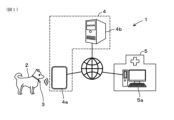
- FIG. 1 is a diagram showing the configuration of a pet management system according to Embodiment 1;
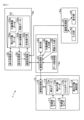
- FIG. 1 is a diagram showing a functional configuration of a pet management system according to Embodiment 1;
- FIG. 4 is a flow chart showing processing by an itching behavior analysis unit in Embodiment 1.
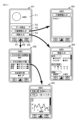
- FIG. It is a figure which shows the display screen in each operation of an owner terminal.
- FIG. 10 is a diagram showing the functional configuration of a pet management system in Embodiment 2;
- FIG. 13 is a diagram showing the functional configuration of a pet management system in Embodiment 3;
- 10 is a flow chart showing processing by an itching behavior analysis unit in Embodiment 3.
- FIG. It is a figure for demonstrating the living action data among candidate data.
- FIG. 20 is a diagram showing the configuration of a pet management system in Embodiment 5;
- FIG. 20 is a diagram showing the functional configuration of a pet management system in Embodiment 5;
- the pet management system is used to easily and quantitatively grasp the itchy behavior of pets such as dogs and cats.
- a pet management system includes at least a wearable device attached to a pet, and management equipment configured to communicate with the wearable device.
- the wearable device has a sensor that detects at least one of acceleration and angular velocity.
- the wearable device or management device includes an itching behavior analysis unit that generates itching behavior data representing the pet's itching behavior by analyzing data detected by the sensor.
- the management device includes a management data storage unit that stores the itching behavior data, and a display unit that displays the itching behavior data stored in the management data storage unit.
- the itching behavior analysis unit analyzes the data detected by the sensor, distinguishes itching behavior data from living behavior data including the pet's walking or running behavior, and generates itching behavior data that does not include living behavior data. It may be generated. By distinguishing between the itching behavior data and the living behavior data in this way, it is possible to reliably generate the desired itching behavior data.
- the sensor outputs the itching behavior data and the living behavior data as the same type of data, and the itching behavior analysis unit analyzes the data detected by the sensor to extract candidate data including the itching behavior data and the living behavior data.
- itching action data and living action data may be distinguished based on the duration of candidate data to generate itching action data that does not include living action data.
- the problem is how to distinguish between the two. While walking and running as daily activities are performed continuously, the itching behavior is performed momentarily, and is less continuous than walking and running. Therefore, the itching action analysis unit focuses on the duration of the candidate data including the itching action data and the living action data, and distinguishes between the itching action data and the living action data based on the duration of the candidate data. Therefore, itching behavior data can be appropriately extracted.
- the itching behavior analysis unit uses a machine learning model to generate candidate data based on the feature amount selected from the statistics of each frequency band divided into a plurality of frequency bands for the data detected by the sensor. You may make it extract. In this way, by using machine learning, it is possible to appropriately extract candidate data, which is target data, from a wide variety of data.
- the input data (explanatory variable data) used to extract the candidate data is important what the input data (explanatory variable data) used to extract the candidate data.
- the behavior associated with itching is, for example, a swinging behavior, a scratching behavior, a licking behavior, etc.
- it can be detected by acceleration, angular velocity, or the like.
- by dividing into multiple frequency bands, using the feature value selected from the statistics of each frequency band as explanatory variable data, and extracting candidate data using a machine learning model it is possible to candidate data can be extracted.
- the itching behavior analysis unit may generate itching behavior data using a machine learning model based on the data detected by the sensor.
- the data detected by the sensor includes various data from behavior other than the behavior associated with itching. By using machine learning, itching behavior data can be appropriately extracted from the data detected by the sensor.
- the itching behavior analysis unit may generate itching behavior data by comparing the data detected by the sensor with the master data. Accordingly, it is possible to appropriately determine whether or not itching behavior data is included in the data detected by the sensor.
- the master data is a waveform pattern
- the itching behavior analysis unit may generate itching behavior data based on the degree of similarity between the data detected by the sensor and the master data. Thereby, itching action data can be appropriately extracted.
- the itching behavior data can also include the number of times during the time or set period that the pet performed the behavior associated with itching.
- the itching behavior analysis unit can analyze when the pet performs the itching behavior by using the data detected by the sensor. In this case, by viewing the display unit, the owner can grasp the time or number of times the dog behaved in association with itching as the itching behavior data. As a result, the owner can appropriately grasp the itching behavior of the pet.
- the itching behavior data can also include the intensity level of the itching behavior performed by the pet. If the itching is strong, the pet will show intense itching behavior. Therefore, the itching behavior analysis unit can analyze the intensity level of the pet's itching behavior by using the data detected by the sensor. In this case, the owner can grasp the intensity level of behavior associated with itching as the itching behavior data by viewing the display unit. As a result, the owner can appropriately grasp the itching behavior of the pet.
- the itching behavior analysis unit generates a plurality of types of itching behavior data
- the management device further performs itching evaluation processing based on the plurality of types of itching behavior data, thereby obtaining an itching index value representing the degree of itching.
- the display unit can also display the itch behavior data stored in the management data storage unit and the itch index value generated by the itch evaluation unit. That is, the itching index value is a value obtained by comprehensively judging based on multiple types of itching behavior data. In this case, the owner can grasp the itch index value generated by the itch evaluation section by viewing the display section.
- the itch evaluation unit can also generate an itch index value by performing an itch evaluation process based on each transition of multiple types of itching behavior data.
- Transition of itching behavior data is a change in the itching behavior data over time. That is, the itching index value generated by the itching evaluation unit is a value that takes into consideration the transition of the itching behavior data, that is, the change in the itching behavior data over time. As a result, an appropriate desired value can be obtained as the itching index value.
- the itching evaluation unit performs itchiness evaluation processing based on the transition of each of the plurality of types of itching behavior data to generate the degree of progress of inflammation of dermatitis, and the display unit displays the itching behavior stored in the management data storage unit.
- the data, the itching index value generated by the itching evaluation unit, and the degree of progression of inflammation may be displayed. For example, when dermatitis progresses at an early stage, licking behavior tends to increase, while scratching behavior tends to increase gradually as inflammation progresses. Therefore, the progress of inflammation can be obtained based on changes in licking behavior and scratching behavior.
- the owner can grasp the degree of progress of the pet's dermatitis. The owner can grasp whether the degree of inflammation in the pet is improving or worsening, and can take appropriate measures.
- the management device is configured to communicate with the wearable device, includes the management data storage unit, is configured to acquire data stored in the wearable device, and is configured to communicate with the server, and includes the display unit. You may make it provide with the owner terminal provided.
- the management device further includes a bridge device configured to mediate communication between the wearable device and the server, and the server mediates the bridge device to acquire data stored in the wearable device. You can do it.
- the owner terminal is configured to be able to communicate with the wearable device
- the server is configured to be able to communicate with the owner terminal, and acquires data stored in the wearable device via the owner terminal. Also good.
- the owner's terminal mediates data transmission between the wearable device and the server.
- the wearable device does not need to be equipped with a sophisticated communication device capable of communicating with the server, and can be equipped with a simple communication device capable of communicating with the owner's terminal.
- the wearable device can be reduced in cost and miniaturized.
- data transmitted from the wearable device is stored on the server. Therefore, data can be centrally managed in the server, and a person other than the owner can browse the common data.
- the wearable device may include an itching behavior analysis unit, and the server may include a management data storage unit to acquire itching behavior data via the owner's terminal.
- the data transmitted by the wearable device is not the data detected by the sensor, but the itching behavior data generated by the itching behavior analysis unit.
- the data volume of the itching behavior data is remarkably small compared to the data detected by the sensor. Therefore, the amount of data transmitted by the wearable device can be reduced.
- the wearable device does not need to store the data detected by the sensor for a long period of time, and it is sufficient to store the itching behavior data. As a result, the wearable device can reduce the data storage capacity.
- the server may include a management data storage unit and an itching behavior analysis unit, and acquire data detected by the sensor through the owner's terminal.
- the wearable device does not need to have an itching behavior analysis unit. Therefore, the wearable device does not require a high-performance processing device, resulting in low cost.
- the server is capable of performing high performance arithmetic processing. Therefore, by having the server analyze the itching behavior, it is possible to perform high-performance arithmetic processing, for example, arithmetic processing using a machine learning model.
- the owner terminal further includes a behavior information input unit configured to input behavior information data of the pet in association with the itching behavior data displayed on the display unit, and the management data storage unit of the server includes the behavior information input unit.
- the action information data input by may be stored in association with the itching action data.
- the owner can input the behavior information data of the pet as his or her senses through the behavior information input unit.
- the management data storage unit of the server stores the itching behavior data generated from the sensor detection data and the behavior information data input by the owner. Therefore, the owner can grasp both the quantitative itching behavior data and the behavior information data input by the owner himself/herself by viewing the display section of the owner terminal.
- a veterinarian terminal configured to be able to communicate with the server and configured to view the itching behavior data stored in the management data storage unit may be provided.
- the veterinarian can easily grasp the state of the pet.
- the itching behavior data viewed by the veterinarian is common to the itching behavior data viewable by the owner. Therefore, information can be shared between the owner and the veterinarian, and appropriate communication can be achieved between them.
- the owner terminal includes an inquiry input unit configured to input inquiry data for consultation by a veterinarian, and a management data storage unit of the server stores the inquiry data input by the inquiry input unit, and the veterinarian
- the terminal may be configured to be able to view medical interview data.
- the owner can share the interview data with the veterinarian by inputting the interview data at the owner terminal.
- Itching-related behavior should include at least one of head-swinging behavior, scratching behavior, and licking behavior. Itching behavior can be grasped from these behaviors.
- Embodiment 1 The pet management system 1 of Embodiment 1 will be described below with reference to the drawings.
- the pet management system 1 includes a wearable device 3 attached to a pet 2 , management equipment 4 , and a veterinarian terminal 5 a in an animal hospital 5 .
- the pet 2 to be managed is, for example, a companion animal such as a dog or cat.
- the behavior associated with itching of the pet 2 includes, for example, a swinging behavior, a scratching behavior, and a licking behavior.
- the pet 2 tends to increase the frequency and intensity of behavior associated with itching. For example, when the pet 2 swings its head, the more itchy itches, the more times it swings its head, and the more violently it swings its head. The same is true for scratching behavior and licking behavior.
- pet 2's behavior associated with itching changes depending on the degree of progression of dermatitis inflammation. For example, when the degree of progression of dermatitis inflammation is early, licking behavior tends to increase, and as inflammation progresses, scratching behavior tends to increase gradually.
- the wearable device 3 is a device that can be attached to the pet 2.
- the wearable device 3 is, for example, a device provided in a pet attachment such as a collar, pet harness, or pet wear.
- the wearable device 3 may be built in the pet fitting, or may be a separate member attached to the pet fitting. In FIG. 1, the wearable device 3 is illustrated as a separate member attached to the collar.
- the wearable device 3 has a built-in sensor, and can detect physical quantities that occur as the pet 2 behaves. Furthermore, the wearable device 3 can perform simple analysis processing and communication with external devices. For example, as a simple analysis process, the wearable device 3 uses the data detected by the sensor to generate itching action data representing the pet's itching action. Also, the wearable device 3 can perform short-range wireless communication such as Bluetooth (registered trademark) and NFC (registered trademark).
- the management device 4 is configured to be able to communicate with the wearable device 3.
- the management device 4 includes an owner terminal 4a and a server 4b.
- the owner terminal 4a is owned by the owner and configured to communicate with the wearable device 3 .
- short-range wireless communication such as Bluetooth (registered trademark) or NFC (registered trademark).
- the wearable device 3 may be configured to be connectable to the Internet.
- the owner terminal 4a and the server 4b form a network via the Internet. Therefore, the owner terminal 4a and the server 4b are configured to be able to communicate via the Internet.
- the server 4b is configured to communicate with the wearable device 3 via the owner terminal 4a.
- the server 4b stores data transmitted from the wearable device 3 via the owner terminal 4a. Furthermore, the server 4b can also perform itching evaluation processing based on the acquired data. Moreover, the server 4b displays the display content on the owner terminal 4a by performing processing for displaying the display content that can be browsed on the owner terminal 4a.
- This display content includes itching action data, itching index values, and the like.
- the veterinarian terminal 5a is installed in the veterinary hospital 5 or configured to be portable by the veterinarian, and is a device for the veterinarian to operate.
- the veterinarian's terminal 5a and the server 4b form a network via the Internet, so that the veterinarian's terminal 5a and the server 4b are configured to communicate via the Internet.
- the veterinarian terminal 5a can display the display content processed by the server 4b.
- the contents displayed on the veterinarian terminal 5a and the contents displayed on the owner terminal 4a may be the same or different. Even if the display contents are different, only the display format is different, and the information source is common data stored in the server 4b.
- Pet Management System 1 A detailed configuration of the pet management system 1 will be described with reference to FIG. In particular, the wearable device 3, the owner terminal 4a, the server 4b, and the veterinarian terminal 5a that constitute the pet management system 1 will be described in detail.
- the wearable device 3 includes an acceleration sensor 11, an angular velocity sensor 12, a data storage section 13, an itching behavior analysis section 14, and a communication processing section 15.
- the acceleration sensor 11 is a sensor capable of detecting orthogonal three-axis acceleration.
- the angular velocity sensor 12 is a sensor capable of detecting angular velocity in rotation about each of three orthogonal axes.
- the case where the acceleration sensor 11 and the angular velocity sensor 12 are provided is taken as an example, but the acceleration sensor 11 may be provided and the angular velocity sensor 12 may not be provided, or the angular velocity sensor 12 may be provided, A configuration without the acceleration sensor 11 is also possible.
- the wearable device 3 may additionally include a sensor other than the acceleration sensor 11 and the angular velocity sensor 12, such as a geomagnetic sensor, for the purpose of more accurate detection.
- the data storage unit 13 stores detection data 13a, itching behavior data 13b, and master data 13c.
- the detection data 13 a is data detected by the acceleration sensor 11 and data detected by the angular velocity sensor 12 .
- the detection data 13a is acceleration data at each detection time and angular velocity data at each detection time.
- the detection data 13a stored in the data storage unit 13 can be deleted after being used for analysis processing by the itching behavior analysis unit 14, which will be described later.
- the data storage unit 13 is configured by a ring buffer or the like having a predetermined capacity for storing the detection data 13a, and when the predetermined capacity is reached, the new detection data 13a is overwritten.
- the itching behavior data 13b is data generated by the itching behavior analysis unit 14 analyzing using the detection data 13a.
- the itching behavior data 13b is data representing the behavior associated with the itching of the pet 2 .
- the itching action data 13b includes at least one of a swinging action, a scratching action, and a licking action as the action associated with itching.
- the itching behavior data 13b includes all three elements of the swinging behavior, the scratching behavior, and the licking behavior. More specifically, the itching action data 13b includes, for example, itching action data representing an itching action at predetermined time intervals (for example, 1 to 30 seconds), itching action data representing an itching action at an hourly rate, and daily itching. It includes itching behavior data representing behavior.
- the data volume of the itching behavior data 13b is smaller than the data volume of the detection data 13a when compared at the same time.
- the data storage unit 13 is configured by a ring buffer or the like having a predetermined capacity for storing the itching behavior data 13b, and when the predetermined capacity is reached, the new itching behavior data 13b is overwritten.
- the master data 13c is data used in analysis processing by the itching behavior analysis unit 14.
- the master data 13c are waveform patterns of the acceleration sensor 11 and the angular velocity sensor 12 when the pet 2 behaves with itching.
- the master data 13c is data of a predetermined time (for example, 1 to 30 seconds) equal to the minimum unit time of the itching action data 13b.
- one of the master data 13c is a waveform pattern representing acceleration with respect to time and a waveform pattern representing angular velocity with respect to time in a swinging action.
- the master data 13c representing the head-swinging action is set to different waveform patterns according to the direction of the head-swinging, the strength of the head-swinging, and the like. That is, the data storage unit 13 stores a plurality of pieces of master data 13c regarding the swinging action.
- the master data 13c is set with a waveform pattern representing acceleration with respect to time and a waveform pattern representing angular velocity with respect to time for the scratching behavior and the licking behavior as well as for the swinging behavior.
- the master data 13c are set to different waveform patterns according to the site and strength of the scratching behavior, the site and strength of the licking behavior, and the like.
- the waveform pattern representing the master data 13c is set by the amplitude and frequency of acceleration, the amplitude and frequency of angular velocity, and the like. These elements show different ranges depending on the swinging behavior, scratching behavior, and licking behavior, and different ranges depending on the intensity of each behavior.
- the itching behavior analysis unit 14 analyzes the detection data 13a stored in the data storage unit 13 to generate itching behavior data 13b representing the pet 2's itching behavior.
- the itching behavior analysis unit 14 analyzes the detection data 13a and generates itching behavior data 13b at predetermined time intervals (for example, 1 to 30 seconds).
- the itching behavior analysis unit 14 compares the detection data 13a for a predetermined time (for example, 1 to 30 seconds) with a plurality of master data 13c stored in the data storage unit 13, thereby determining the predetermined It is determined whether the time detection data 13a corresponds to the case where any one of a plurality of types of behavior associated with itching is performed, or whether it corresponds to the case where the behavior associated with itching is not performed.
- the degree of similarity in changes in data values is determined, and when the degree of similarity is equal to or greater than a predetermined value, it is determined that the two match. can.
- both data can be regarded as images, and when the degree of matching between the images is equal to or greater than a predetermined value using machine learning or the like, it can be determined that the two match.
- the itching behavior analysis unit 14 determines the type of behavior associated with itching by comparing the amplitude and frequency of acceleration, the amplitude and frequency of angular velocities, etc. for a set predetermined time period (eg, 1 to 30 seconds). and determine the intensity level of the behavior.
- the itching behavior analysis unit 14 performing an analysis using the detection data 13a for a predetermined time (for example, 1 to 30 seconds), it was found that the pet 2 was performing a scratching behavior during the predetermined time.
- a predetermined time for example, 1 to 30 seconds
- the maximum strength level of is "5".
- the itching behavior analysis unit 14 performs the scratching behavior at the intensity level "5" during the entire period of the predetermined time.
- the itching behavior analysis unit 14 continuously accumulates itching behavior data for a predetermined time (for example, 1 to 30 seconds), so that, for example, a plurality of types of behaviors associated with itching can be detected in one hour or one day. It is also possible to generate the time and number of times each of The itching behavior analysis unit 14 can set the set period to any time, not limited to one hour or one day.
- the itching behavior analysis unit 14 generates hourly itching behavior data and daily itching behavior data using the itching behavior data 13b obtained at predetermined time intervals (eg, 1 to 30 seconds).
- the itching behavior data for each hour may be data obtained by summarizing a predetermined time period (for example, 1 to 30 seconds) for one hour, or may be data having one value per hour. In the latter, the itching behavior data for each hour is taken as the behavior of the object of the institution, which is the most frequent behavior in the hour, and the maximum intensity level of the behavior is the intensity level of the institution. and After generating the itching behavior data 13b, the itching behavior analysis unit 14 stores the data in the data storage unit 13 .
- the communication processing unit 15 is configured to communicate with an external device, specifically the owner terminal 4a.
- the communication processing unit 15 performs short-range wireless communication such as Bluetooth (registered trademark) and NFC (registered trademark).
- the communication processing unit 15 transmits the itching behavior data 13b stored in the data storage unit 13 to the owner terminal 4a when a data transmission request is made from the owner terminal 4a.
- the owner terminal 4a includes a communication processing unit 21, a data acquisition unit 22, a display unit 23, a behavior information input unit 24, and an inquiry input unit 25.
- the communication processing unit 21 is configured to communicate with the communication processing unit 15 of the wearable device 3 .
- the communication processing unit 21 performs short-range wireless communication such as Bluetooth (registered trademark) and NFC (registered trademark).
- the communication processing unit 21 is configured to be able to communicate with a communication processing unit 31 of the server 4b, which will be described later, via the Internet.
- the data acquisition unit 22 performs a process of acquiring the itching behavior data 13b stored in the data storage unit 13 of the wearable device 3 by being operated by the owner.
- the owner terminal 4a does not store the data, but acts as an intermediary for transferring the itching behavior data 13b received from the wearable device 3 to the server 4b.
- the display unit 23 displays various display contents according to the owner's operation.
- the display unit 23 displays the itching behavior data, the itching index value, the degree of progression of inflammation, and the like stored in the server 4b.
- the display contents of the display unit 23 will be described later.
- the behavior information input unit 24 is configured to input behavior information data of the pet 2 in association with the itching behavior data 13b displayed on the display unit 23 and the like.
- the owner can freely input texts, photographs, illustrations, etc. about what the owner has seen and felt as behavioral information data to be input.
- the action information data input by the action information input unit 24 is stored in the server 4b via the communication processing unit 21.
- the inquiry input unit 25 is configured to input inquiry data for examination by a veterinarian.
- the inquiry data input by the inquiry input unit 25 is stored in the server 4b via the communication processing unit 21.
- the server 4b is, for example, a cloud server.
- the server 4b includes a communication processing unit 31, a management data storage unit 32, an itch evaluation unit 33, and a display processing unit .
- the communication processing unit 31 is configured to be able to communicate with the owner terminal 4a and the veterinarian terminal 5a via the Internet.
- the management data storage unit 32 stores itching behavior data 32a, itching index values 32b, inflammation progression degree 32c, behavior information data 32d, and interview data 32e.
- the itching behavior data 32 a is equal to the itching behavior data 13 b stored in the data storage unit 13 of the wearable device 3 .
- the itching behavior data 13b stored in the data storage unit 13 of the wearable device 3 is transferred to the management data storage unit 32 of the server 4b. 32a. That is, the server 4b acquires the itching behavior data 13b stored in the data storage unit 13 of the wearable device 3 through the owner terminal 4a, and stores it in the management data storage unit 32 as the itching behavior data 32a.
- the itching index value 32b is a value representing the degree of itching of the pet 2.
- the itching index value 32b is represented by, for example, "level 1" to "level 5".
- the itching index value is generated by the itching evaluation unit 33 performing an itching evaluation process based on a plurality of types of itching action data.
- the inflammation progression degree 32c represents the progression degree of dermatitis when the pet 2 is suffering from dermatitis.
- the degree of progression of inflammation 32c is generated by the itching evaluation unit 33 performing an itching evaluation process based on multiple types of itching action data.
- the behavior information data 32d is data input by the behavior information input unit 24 of the owner terminal 4a.
- the behavior information data 32d is stored in association with the itching behavior data and the like displayed on the display unit 23 of the owner terminal 4a by the input of the behavior information input unit 24 of the owner terminal 4a.
- the medical inquiry data 32e is data input by the medical inquiry input unit 25 of the owner terminal 4a.
- the itch evaluation unit 33 performs itch evaluation processing based on multiple types of itching action data 32 a stored in the management data storage unit 32 .
- the itching evaluation unit 33 performs the itching evaluation process based on the transition of each of the plurality of types of itching action data 32a.
- the transition of the itching action data 32a is the change of the itching action data 32a over time.
- the itching evaluation unit 33 generates an itching index value 32b representing the degree of itching by performing itching evaluation processing. Specifically, the itching evaluation unit 33 generates the itching index value 32b by comprehensively judging based on the transition of each of the plurality of types of itching action data 32a. For example, the itching evaluation unit 33 generates the itching index value 32b by applying machine learning, statistical methods, and the like. That is, the itching index value 32b generated by the itching evaluation unit 33 is a value that takes into consideration the transition of the itching action data, that is, the change over time of the itching action data 32a.
- the itch evaluation unit 33 stores the generated itch index value 32 b in the management data storage unit 32 . As a result, an appropriate desired value can be obtained as the itching index value.
- the itching evaluation unit 33 generates an inflammation progression degree 32c of dermatitis by performing itching evaluation processing. Specifically, the itching evaluation unit 33 generates the inflammation progression degree 32c by comprehensively judging based on the respective transitions of the plurality of types of itching behavior data 32a. For example, the itching evaluation unit 33 generates the inflammation progression degree 32c by applying machine learning, statistical methods, and the like. In other words, the itching evaluation unit 33 can grasp changes in the behavior of the pet 2 based on transitions in each of the plurality of types of itching behavior data 32a, and can obtain the inflammation progression degree 32c of dermatitis based on changes in the behavior of the pet 2. can.
- the itch evaluation unit 33 stores the generated inflammation progression degree 32 c in the management data storage unit 32 .
- the display processing unit 34 executes display processing in response to display requests from the owner terminal 4a and the veterinarian terminal 5a.
- the display processing unit 34 uses the itching action data 32a, the itching index value 32b, the inflammation progression level 32c, the action information data 32d, and the inquiry data 32e stored in the management data storage unit 32 to display display data in response to the display request. to generate
- the display processing unit 34 transmits display data to the owner terminal 4a and the veterinarian terminal 5a via the communication processing unit 31 .
- the veterinarian terminal 5a is configured with a communication processing unit 41, an input unit 42, and a display unit 43.
- the communication processing unit 41 is configured to be able to communicate with the server 4b via the Internet.
- the input unit 42 inputs various display requests by a veterinarian.
- the display unit 43 receives the display data according to the input of the input unit 42 from the server 4b and displays it. Therefore, the display unit 43 of the veterinarian terminal 5a is configured to be able to view pet 2's itching behavior data 32a, itching index value 32b, inflammation progression degree 32c, behavior information data 32d, and inquiry data 32e.
- the display content displayed on the display unit 43 may be the same as the display content displayed on the owner terminal 4a, or may have a different format.
- the itching behavior analysis unit 14 constitutes a part of the wearable device 3 as described above, and generates the itching behavior data 13b based on the detection data 13a. An example of processing by the itching behavior analysis unit 14 will be described with reference to FIG.
- the itching behavior analysis unit 14 first acquires the detection data 13a for a predetermined time (for example, 1 to 30 seconds, the same shall apply hereinafter) from the data storage unit 13 (S1). Subsequently, the itching behavior analysis unit 14 compares the acquired detection data 13a with the master data 13c stored in the data storage unit 13 to identify the itching behavior (S2). Specifically, the itching behavior analysis unit 14 selects the type of itching behavior from, for example, a swinging behavior, a scratching behavior, and a licking behavior. Further, the itching behavior analysis unit 14 identifies the intensity level of the corresponding behavior.
- a predetermined time for example, 1 to 30 seconds, the same shall apply hereinafter
- the itching behavior analysis unit 14 stores the itching behavior data 13b in the data storage unit 13 (S3).
- the itching behavior data 13b stored at this time includes the type of itching behavior, the start time and end time of the itching behavior, the intensity level of the itching behavior, and the like.
- the itching behavior analysis unit 14 determines whether or not each hour has reached 00 (S4). For example, 1:00, 2:00, and so on. When the time reaches 00:00 (S4: Yes), the itching behavior analysis unit 14 determines the strength level for the most recent hour and stores it in the data storage unit 13 as the itching behavior data 13b (S5). ). If the time has not reached 00 minutes past the hour (S4: No), the process proceeds to the next process without performing the process of S5.
- the itching behavior analysis unit 14 determines whether or not 24:00 has arrived (S6). When the time reaches 24:00 (S6: Yes), the itching behavior analysis unit 14 determines the strength level for the most recent day, and stores it in the data storage unit 13 as the itching behavior data 13b (S7). ). If the time has not reached 24:00 (S6: No), the process proceeds to the next process without performing the process of S7.
- the process returns to S1 and is repeated. That is, until one hour elapses, only the itching action data 13b for each predetermined time is generated. Then, itching behavior data 13b in units of hours is added every time one hour passes. Furthermore, itching behavior data 13b is added on a daily basis each time one day passes.
- the display screen of the owner terminal 4a will be described with reference to FIG.
- the owner terminal 4a is exemplified by a touch panel type mobile terminal such as a smart phone or a tablet terminal.
- the display screen of the owner terminal 4a functions as the display section 23 shown in FIG.
- a "home” icon 61, a "data viewing” icon 62, and a “setting” icon 63 are displayed in the lower column of the home screen 51 of the owner terminal 4a.
- the photo and name of the pet 2 are displayed in the upper area 71 of the home screen 51 .
- a "read data” button 72, a "behavior information input” button 73, and an “inquiry input” button 74 are displayed.
- the itching index value is the itching index value 32b stored in the management data storage unit 32 of the server 4b.
- the itching index value 32b is a value obtained by comprehensively judging based on multiple types of itching behavior data. The owner can grasp the itching index value by viewing the score of "today's itching index value”.
- the time spent (time per day) and the intensity level for each of a plurality of types of itching behavior are displayed as "today's itching behavior".
- a swinging behavior, a scratching behavior, and a licking behavior are displayed.
- the owner can grasp the time or the number of times the pet has performed the behavior associated with itching by viewing the time or number of times of "today's itching behavior”. As a result, the owner can appropriately grasp the itching behavior of the pet 2 .
- the owner can grasp the intensity level of the behavior associated with itching by viewing the intensity level section of "today's itching behavior”. As a result, the owner can appropriately grasp the itching behavior of the pet 2 .
- a score is displayed as the "progression of inflammation", and arrows indicating improvement, no change, and deterioration are displayed.
- the degree of progression of inflammation is the degree of progression of inflammation 32c stored in the management data storage unit 32 of the server 4b. Arrows indicate deterioration in the upward direction, no change in the horizontal direction, and improvement in the downward direction.
- the owner can comprehend the degree of progression of inflammation of dermatitis of the pet 2 by viewing the "degree of progression of inflammation”. Furthermore, the owner can grasp whether the degree of inflammation of the pet 2 is improving or worsening, and can take appropriate measures.
- a data viewing details screen 53 is displayed.
- the data viewing detail screen 53 displays a time-series graph of the itching behavior.
- the graph to be displayed can be selected by "amount (time)” and “intensity level”, and the period can be selected from “today", "one week", and "one month”.
- the data viewing detail screen 53 of FIG. 4 displays a graph of the time of today's swinging behavior. Scratching behavior and licking behavior are similarly displayed.
- numerical values corresponding to the graph are displayed by scrolling downward on the data viewing detail screen 53 .
- the owner taps the "read data” button 72 on the home screen 51 while the owner terminal 4a is brought close to the wearable device 3
- the itching behavior data 13b stored in the data storage unit 13 of the wearable device 3 is It is uploaded to the management data storage unit 32 of the server 4b through the owner terminal 4a.
- the object of communication between the wearable device 3 and the owner terminal 4a and the object of communication between the owner terminal 4a and the server 4b are the itching behavior data stored in the data storage unit 13 of the wearable device 3. is. That is, the itching behavior data to be communicated has a smaller data capacity than the detection data 13a detected by the acceleration sensor 11 and the angular velocity sensor 12. FIG. Therefore, communication capacity can be reduced.
- the behavior information input screen 54 is displayed.
- the owner can freely input text, photographs, illustrations, and the like. In this way, the owner can input behavior information data of the pet 2 as his/her senses.
- the owner can browse behavior information data that has been input in the past. Therefore, the owner can comprehend both the quantitative itching behavior data and the behavior information data input by the owner himself/herself.
- an inquiry input screen 55 is displayed. On the inquiry input screen 55, it is possible to input information necessary for examination by a veterinarian. The owner can share the interview data with the veterinarian by inputting the interview data at the owner terminal.
- the owner can grasp the itching behavior of the pet 2 by viewing the display section 23 of the owner terminal 4 a of the management device 4 .
- the itching behavior data displayed on the display unit 23 is data obtained by analyzing data detected by the acceleration sensor 11 and the angular velocity sensor 12 . Therefore, the owner can quantitatively grasp the itching behavior of the pet 2 .
- the owner can grasp the itching behavior of the pet 2 when the owner is not looking at the pet 2. Therefore, the owner can appropriately grasp the itchy state of the pet 2 . As a result, the owner can live according to the itchy symptoms of the pet 2 . Furthermore, when receiving a medical examination by a veterinarian, the owner can appropriately inform the veterinarian of the symptoms of the pet 2 . As a result, veterinarians can provide more appropriate treatment. Therefore, the itchy behavior of the pet 2 can be easily and quantitatively grasped.
- the veterinarian terminal 5a is configured to be able to communicate with the server 4b, and is configured to be able to browse itching behavior data 32a stored in the management data storage unit 32.
- the veterinarian can easily grasp the state of the pet 2 by viewing the veterinarian terminal 5a.
- the itching behavior data 32a viewed by the veterinarian is common to the itching behavior data 32a viewable by the owner. Therefore, information can be shared between the owner and the veterinarian, and appropriate communication can be achieved between them.
- Embodiment 2 A pet management system 100 of Embodiment 2 will be described with reference to FIG. Note that, of the reference numerals used in the second and subsequent embodiments, the same reference numerals as those used in the previous embodiments represent the same constituent elements as those in the previous embodiments, unless otherwise specified.
- the wearable device 3 is provided with the itching behavior analysis unit 14, and the data storage unit 13 of the wearable device 3 stores the itching behavior data 13b and the master data 13c.
- the server 4b that constitutes the management device 4 includes an itching behavior analysis unit 14.
- the management data storage unit 32 of the server 4b constituting the management device 4 stores the detection data 13a, the itching behavior data 13b and the master data 13c.
- the data storage unit 13 of the wearable device 3 stores detection data 13a, but does not store itching behavior data or master data.
- the wearable device 3 does not need to include the itching behavior analysis unit 14. Therefore, the wearable device 3 does not require a high-performance processing device, resulting in low cost.
- the server 4b can perform high-performance arithmetic processing. Therefore, by having the server 4b analyze the itching behavior, high-performance arithmetic processing can be performed.
- the owner terminal 4a that constitutes the management device 4 may be provided with the itching behavior analysis unit 14.
- the owner terminal 4a constituting the management device 4 stores the detection data 13a, the itching behavior data 13b and the master data 13c.
- FIG. 6 A pet management system 200 of Embodiment 3 will be described with reference to FIGS. 6 to 8.
- FIG. 6 in the pet management system 200 of this embodiment, detection data 13a is stored in the data storage unit 13 of the wearable device 3, as in the second embodiment.
- the server 4b acquires the detection data 13a through the owner terminal 4a. Therefore, the management data storage unit 232 of the server 4b stores the acquired detection data 232f.
- the detection data 232f is the same as the detection data 13a detected by the sensors 11 and 12.
- FIG. The management data storage unit 232 further stores a machine learning model 232g for use in itching behavior analysis.
- the machine learning model 232g is a model that outputs objective variable data when explanatory variable data is input.
- the explanatory variable data is the feature amount generated from the detection data 232f
- the objective variable data is the judgment score representing the behavior associated with itching.
- a feature amount as explanatory variable data is, for example, a feature amount selected from statistics of each frequency band divided into a plurality of frequency bands for the detection data 232f.
- a plurality of frequency bands can be arbitrarily divided, for example, the target frequency band is divided every 0.5 Hz to 3 Hz.
- Statistics include minimum, maximum, median, 1st quartile, 2nd quartile, mean (arithmetic mean, geometric mean, harmonic mean), difference between maximum and minimum values, variance , standard deviation, skewness, kurtosis, etc. can be used. However, it is preferable to use multiple statistics.
- the decision score can be set to any range of values.
- the machine learning model 232g is obtained by learning by applying a known machine learning method using training data prepared in advance.
- Arbitrary methods such as supervised learning, unsupervised learning, and reinforcement learning can be applied as machine learning methods.
- one class support vector machine can be applied as one of unsupervised learning as a machine learning method.
- other methods may be applied.
- types of itching behavior include, for example, shaking behavior, scratching behavior, and licking behavior. Therefore, the machine learning model 232g should be a different model for each type of itching behavior. For example, a model for swinging behavior, a model for scratching behavior, a model for licking behavior, etc. are stored. In this case, the feature amount may also be different for each type of itching behavior.
- the server 4 b also includes an itching behavior analysis unit 214 .
- the itchy behavior analysis unit 214 analyzes the detection data 232f stored in the management data storage unit 232 to generate the itchy behavior data 32a representing the itchy behavior of the pet 2 .
- the itching behavior analysis unit 214 extracts the itching behavior data 32a using a machine learning model based on the detection data 232f.
- the itching behavior analysis unit 214 first acquires the detection data 232f for a predetermined time (eg, 1 to 30 seconds, the same applies hereinafter) from the management data storage unit 232 (S11). Subsequently, the itching behavior analysis unit 214 generates feature amounts of the detection data 232f as explanatory variable data used in the inference phase of machine learning (S12). When there are multiple types of itching behavior, the itching behavior analysis unit 214 generates a feature quantity corresponding to the type of itching behavior.
- a predetermined time eg, 1 to 30 seconds, the same applies hereinafter
- the itching behavior analysis unit 214 uses the machine learning model 232g to determine whether or not it is the itching behavior data 32a based on the generated feature amount (S13).
- the judgment score is output by inputting the feature quantity into the machine learning model 232g. For example, as shown in FIG. 8, the determination score at each time is output. If the output determination score exceeds the threshold Th, it is determined to be the itching action data 32a, and if it is equal to or less than the threshold Th, it is determined not to be the itching action data 32a. In FIG. 8, there are three determination scores exceeding the threshold Th. These are determined to be behavioral data associated with itching.
- the itching behavior analysis unit 214 uses the determination score to specify the intensity level of the itching behavior.
- the itching behavior analysis unit 214 makes a determination for each type of itching behavior.
- the itching behavior analysis unit 214 stores the itching behavior data 32a in the data storage unit 13 (S14).
- the itching behavior data 32a stored at this time includes the type of itching behavior, the start time and end time of the itching behavior, the intensity level of the itching behavior, and the like.
- the itching behavior analysis unit 214 determines whether or not each hour has reached 00 (S15). For example, 1:00, 2:00, and so on.
- the itching behavior analysis unit 214 when reaching 00 minutes each hour (S15: Yes), determines the strength level for the most recent hour and stores it in the management data storage unit 232 as the itching behavior data 32a ( S16). If the time has not reached 00 minutes past the hour (S15: No), the process proceeds to the next process without performing the process of S16.
- the itching behavior analysis unit 214 determines whether or not 24:00 has arrived (S17). When the time reaches 24:00 (S17: Yes), the itching behavior analysis unit 214 determines the intensity level for the most recent day and stores it in the management data storage unit 232 as the itching behavior data 32a ( S18). If the time has not reached 24:00 (S17: No), the process proceeds to the next process without performing the process of S18.
- the process returns to S11 and is repeated. That is, until one hour elapses, only the itching action data 32a for each predetermined time period is generated. Then, itching behavior data 32a in units of time is added every time one hour passes. Furthermore, itching action data 32a for each day is added every time one day passes.
- the itching behavior analysis unit 214 uses a machine learning model to generate the itching behavior data 32a based on the detection data 232f.
- the detection data 232f includes various data on behavior other than the behavior associated with itching.
- the itching behavior data 32a can be appropriately extracted from the detection data 232f.
- Embodiment 4 A pet management system 200 of Embodiment 4 will be described.
- the functional configuration of the pet management system 200 of the fourth embodiment is the same as that of the third embodiment. However, the processing of the itching behavior analysis unit 214 is different.
- the itchy behavior analysis unit 214 in the present embodiment distinguishes the itchy behavior data 32a from the living behavior data including the behavior associated with walking or running of the pet 2, and does not include the living behavior data. Generate itching behavior data 32a.
- the sensors 11 and 12 output the itching behavior data 32a and the living behavior data as the same type of data. That is, the detection data 232f detected by the sensors 11 and 12 is a data type in which the itching behavior data 32a and the living behavior data cannot be distinguished.
- the itching behavior analysis unit 214 first extracts candidate data including itching behavior data and living behavior data by analyzing the detection data 232f. That is, since itching behavior data and living behavior data cannot be distinguished at this stage, the candidate data are data including itching behavior data and living behavior data.
- the itching behavior analysis unit 214 applies machine learning to extract candidate data.
- the itching behavior analysis unit 214 uses the machine learning model 232g based on the feature amount selected from the statistics of each frequency band divided into a plurality of frequency bands for the detection data 232f to generate the candidate data to extract
- the machine learning model 232g is substantially similar to the machine learning model 232g of the third embodiment.
- the itching behavior analysis unit 214 distinguishes between the itching behavior data 32a and the living behavior data from the candidate data, and generates the itching behavior data 32a that does not include the living behavior data. At this time, the itching behavior analysis unit 214 considers the duration of the candidate data. That is, the itching behavior analysis unit 214 distinguishes between the itching behavior data and the living behavior data based on the duration of the candidate data.
- the itching behavior is a behavior that is performed in a short time compared to walking and running. Therefore, if the duration of the candidate data is long, the itching behavior analysis unit 214 determines that it is living behavior data, and if it is short, it determines that it is itching behavior data.
- the itching behavior analysis unit 214 first acquires detection data 232f for a predetermined time period (for example, 1 to 30 seconds, the same shall apply hereinafter) from the management data storage unit 232 (S21). Subsequently, the itching behavior analysis unit 214 generates feature amounts of the detection data 232f as explanatory variable data used in the inference phase of machine learning (S22). When there are multiple types of itching behavior, the itching behavior analysis unit 214 generates a feature quantity corresponding to the type of itching behavior.
- a predetermined time period for example, 1 to 30 seconds, the same shall apply hereinafter
- the itching behavior analysis unit 214 uses the machine learning model 232g to determine whether or not it is candidate data (including itching behavior data and living behavior data) based on the generated feature amount (S23). .
- the judgment score is output by inputting the feature quantity into the machine learning model 232g. For example, when the pet 2 behaves with itching, the determination score at each time is output as shown in FIG. Also, when the pet 2 is walking or running, as shown in FIG. 10, the determination score at each time is output. As shown in FIGS. 8 and 10, the determination score exceeds the threshold value Th in both cases of behavior associated with itching and walking or running.
- the itching behavior analysis unit 214 distinguishes between the itching behavior data 32a and the living behavior data based on the duration of the candidate data, and extracts the itching behavior data 32a excluding the living behavior data (S24).
- FIG. 8 A comparison of FIG. 8 and FIG. 10 shows that the itching behavior data 32a has a short duration, and the living behavior data has a long duration. Therefore, when the duration of the candidate data exceeds a predetermined duration threshold, it is determined to be the itching action data 32a.
- the rest period may be regarded as the middle of the walk. In this case, behavior during rest is included in living behavior such as walking and running. That is, even if the determination score indicates a value exceeding the threshold value Th during a break, it is not determined as the itching behavior data 32a.
- the itching behavior analysis unit 214 uses the determination score extracted as the itching behavior data 32a to specify the intensity level of the itching behavior. When there are multiple types of itching behavior, the itching behavior analysis unit 214 makes a determination for each type of itching behavior.
- the itching behavior analysis unit 214 stores the itching behavior data 32a in the data storage unit 13 (S25).
- the itching behavior data 32a stored at this time includes the type of itching behavior, the start time and end time of the itching behavior, the intensity level of the itching behavior, and the like.
- the itching behavior analysis unit 214 determines whether or not each hour has reached 00 (S26). For example, 1:00, 2:00, and so on.
- the itching behavior analysis unit 214 when reaching 00 minutes each hour (S26: Yes), determines the intensity level for the most recent hour and stores it in the management data storage unit 232 as the itching behavior data 32a ( S27). If the time has not reached 00 minutes past the hour (S26: No), the process proceeds to the next process without performing the process of S27.
- the itching behavior analysis unit 214 determines whether or not 24:00 has arrived (S28). When the time reaches 24:00 (S28: Yes), the itching behavior analysis unit 214 determines the strength level for the most recent day and stores it in the management data storage unit 232 as the itching behavior data 32a ( S29). If the time has not reached 24:00 (S28: No), the process proceeds to the next process without performing the process of S29.
- the process returns to S21 and is repeated. That is, until one hour elapses, only the itching action data 32a for each predetermined time period is generated. Then, itching behavior data 32a in units of time is added every time one hour passes. Furthermore, itching action data 32a for each day is added every time one day passes.
- the problem is how to distinguish between the two.
- walking and running as daily activities are performed continuously, whereas the itching behavior is performed momentarily, and is less continuous than walking and running. Therefore, the itching behavior analysis unit 214 focuses on the duration of the candidate data including the itching behavior data 32a and the living behavior data, and distinguishes between the itching behavior data and the living behavior data based on the duration of the candidate data. Therefore, the itching action data 32a can be appropriately extracted.
- the same effects as in the third embodiment are obtained. That is, by using machine learning, it is possible to appropriately extract candidate data, which is target data, from a wide variety of data.
- FIG. 5 A pet management system 300 of Embodiment 5 will be described with reference to FIGS. 11 and 12.
- FIG. The functional configuration of the pet management system 300 of the fifth embodiment differs from that of the third embodiment in that a bridge device 4c is provided.
- the management device 4 is configured to be able to communicate with the wearable device 3.
- the management equipment 4 includes an owner terminal 4a, a server 4b, and a bridge device 4c.
- the bridge device 4c is installed, for example, in an owner's house or a veterinarian's facility, and is configured to mediate communication between the wearable device 3 and the server 4b.
- the bridge device 4c is configured to be able to communicate with the wearable device 3.
- the bridge device 4c can perform short-range wireless communication such as Bluetooth (registered trademark) or NFC (registered trademark) by getting closer to the wearable device 3 .
- the bridge device 4c is configured to be able to communicate with the server 4b via the Internet. Therefore, the server 4b is configured to be able to communicate with the wearable device 3 via the bridge device 4c.
- the owner terminal 4a is owned by the owner and is configured to be able to communicate with the server 4b.
- the owner terminal 4a may be configured to be unable to communicate with the wearable device 3, or may be configured to be communicable with the wearable device 3 as in the third embodiment.
- Each element of the wearable device 3, each element of the owner terminal 4a, each element of the server 4b, and each element of the veterinarian terminal 5a are the same as in the third embodiment.
- the bridge device 4c can also be applied to the configurations of the first and second embodiments.
- the pet management systems 1, 100, 200, and 300 of the above embodiments may be configured without the veterinarian terminal 5a.
- the management device 4 is provided with the owner terminal 4a and the server 4b. good.
- the owner terminal 4a is provided with the management data storage units 32 and 232, the itching evaluation unit 33, and the display processing unit 34 that constitute the server 4b.
- the server 4b may be composed of a plurality of servers separated for each function.
- the server 4b may include a first server that configures the itching behavior analysis units 14 and 214, and a second server that configures other elements. It can be arbitrarily set in consideration of the processing load.
- the wearable device 3 is configured to be able to communicate with the server 4b via the owner terminal 4a or the bridge device 4c.
- the server 4b may be configured to be able to directly communicate with the wearable device 3 and directly acquire data stored in the wearable device 3 .
Landscapes
- Life Sciences & Earth Sciences (AREA)
- Environmental Sciences (AREA)
- Animal Husbandry (AREA)
- Biodiversity & Conservation Biology (AREA)
- Measurement Of The Respiration, Hearing Ability, Form, And Blood Characteristics Of Living Organisms (AREA)
Priority Applications (1)
| Application Number | Priority Date | Filing Date | Title |
|---|---|---|---|
| JP2023580295A JP7741211B2 (ja) | 2022-02-11 | 2023-02-08 | ペット管理システム |
Applications Claiming Priority (2)
| Application Number | Priority Date | Filing Date | Title |
|---|---|---|---|
| JP2022020009 | 2022-02-11 | ||
| JP2022-020009 | 2022-02-11 |
Publications (1)
| Publication Number | Publication Date |
|---|---|
| WO2023153439A1 true WO2023153439A1 (ja) | 2023-08-17 |
Family
ID=87564447
Family Applications (1)
| Application Number | Title | Priority Date | Filing Date |
|---|---|---|---|
| PCT/JP2023/004178 Ceased WO2023153439A1 (ja) | 2022-02-11 | 2023-02-08 | ペット管理システム |
Country Status (2)
| Country | Link |
|---|---|
| JP (1) | JP7741211B2 (https=) |
| WO (1) | WO2023153439A1 (https=) |
Citations (7)
| Publication number | Priority date | Publication date | Assignee | Title |
|---|---|---|---|---|
| JP2002157340A (ja) * | 2000-11-17 | 2002-05-31 | Kyoritsu Seiyaku Kk | 動物医療支援システム及び記録媒体 |
| US20140046222A1 (en) * | 2012-08-09 | 2014-02-13 | The Regents Of The University Of California | Automated scratch detection system and signal processing algorithm for the study of pruritus in animals |
| JP2017153709A (ja) * | 2016-03-02 | 2017-09-07 | セイコーエプソン株式会社 | 検出装置および検出システム |
| JP6696967B2 (ja) * | 2015-03-05 | 2020-05-20 | 株式会社Nttドコモ | 監視装置及び動作検出方法 |
| JP2020201742A (ja) * | 2019-06-11 | 2020-12-17 | 国立大学法人滋賀医科大学 | モニタリング装置および方法 |
| WO2020264360A1 (en) * | 2019-06-26 | 2020-12-30 | Mars, Incorporated | System and method for wellness assessment of a pet |
| WO2021230316A1 (ja) * | 2020-05-13 | 2021-11-18 | 株式会社Rabo | 情報処理システムおよび方法 |
Family Cites Families (1)
| Publication number | Priority date | Publication date | Assignee | Title |
|---|---|---|---|---|
| EP1232690B1 (en) | 1999-11-11 | 2007-09-12 | Kowa Co., Ltd. | Method and device for measuring frequency of specific behavior of animal |
-
2023
- 2023-02-08 JP JP2023580295A patent/JP7741211B2/ja active Active
- 2023-02-08 WO PCT/JP2023/004178 patent/WO2023153439A1/ja not_active Ceased
Patent Citations (7)
| Publication number | Priority date | Publication date | Assignee | Title |
|---|---|---|---|---|
| JP2002157340A (ja) * | 2000-11-17 | 2002-05-31 | Kyoritsu Seiyaku Kk | 動物医療支援システム及び記録媒体 |
| US20140046222A1 (en) * | 2012-08-09 | 2014-02-13 | The Regents Of The University Of California | Automated scratch detection system and signal processing algorithm for the study of pruritus in animals |
| JP6696967B2 (ja) * | 2015-03-05 | 2020-05-20 | 株式会社Nttドコモ | 監視装置及び動作検出方法 |
| JP2017153709A (ja) * | 2016-03-02 | 2017-09-07 | セイコーエプソン株式会社 | 検出装置および検出システム |
| JP2020201742A (ja) * | 2019-06-11 | 2020-12-17 | 国立大学法人滋賀医科大学 | モニタリング装置および方法 |
| WO2020264360A1 (en) * | 2019-06-26 | 2020-12-30 | Mars, Incorporated | System and method for wellness assessment of a pet |
| WO2021230316A1 (ja) * | 2020-05-13 | 2021-11-18 | 株式会社Rabo | 情報処理システムおよび方法 |
Also Published As
| Publication number | Publication date |
|---|---|
| JPWO2023153439A1 (https=) | 2023-08-17 |
| JP7741211B2 (ja) | 2025-09-17 |
Similar Documents
| Publication | Publication Date | Title |
|---|---|---|
| KR102022893B1 (ko) | 반려동물 케어 방법 및 이를 이용하는 시스템 | |
| US11224380B2 (en) | Animal health system and method for monitoring performance | |
| US10736527B2 (en) | Workout management method and system using a wearable device | |
| JP6881687B2 (ja) | ユーザの精神/感情状態をモデリングする方法およびシステム | |
| EP3566231B1 (en) | Apparatus and method for triggering a fall risk alert to a person | |
| Rahman et al. | Predicting" about-to-eat" moments for just-in-time eating intervention | |
| JP6696967B2 (ja) | 監視装置及び動作検出方法 | |
| AU2025210812A1 (en) | A method and a processor for determining health of an individual | |
| KR102297367B1 (ko) | 생체정보 수집 및 온라인 문진을 이용한 건강관리케어 서비스 제공 서버 | |
| JP2019016235A (ja) | 疾病発症予測装置、疾病発症予測方法およびプログラム | |
| KR102022883B1 (ko) | 애완동물의 행태와 감정을 보여주는 그래픽 사용자 인터페이스 제공 방법 및 장치 | |
| US12165074B2 (en) | Device, system and method for estimating an external or intrinsic factor resulting in a state transition | |
| KR20210040590A (ko) | 블록체인 기반 반려동물 관리시스템 및 그것을 이용한 관리방법 | |
| WO2016189908A1 (ja) | 情報処理装置、情報処理方法、およびプログラム | |
| WO2019123726A1 (ja) | 指導支援システム、指導支援方法及び指導支援プログラム | |
| KR20180066561A (ko) | 애완동물 관리 및 구조 시스템 | |
| Mitek et al. | Wearable devices in veterinary health care | |
| Naveed et al. | IoT Based Health Monitoring with Diet, Exercise and Calories recommendation Using Machine Learning | |
| US10102769B2 (en) | Device, system and method for providing feedback to a user relating to a behavior of the user | |
| KR20100052951A (ko) | 일체형 헬스케어 장치 | |
| WO2020230257A1 (ja) | 臨床試験適格性判定システム、臨床試験適格性判定方法、臨床試験適格性判定装置および臨床試験適格性判定用プログラム | |
| JP2011044787A (ja) | 動物行動管理装置、動物行動管理方法及びそのプログラム | |
| JP2019058227A (ja) | IoT計測器、健康SNSプラットフォーム、および、健康サービスシステム | |
| WO2023153439A1 (ja) | ペット管理システム | |
| KR20210060193A (ko) | 반려동물 상태분석 서비스를 제공하는 방법 및 장치 |
Legal Events
| Date | Code | Title | Description |
|---|---|---|---|
| 121 | Ep: the epo has been informed by wipo that ep was designated in this application |
Ref document number: 23752903 Country of ref document: EP Kind code of ref document: A1 |
|
| DPE1 | Request for preliminary examination filed after expiration of 19th month from priority date (pct application filed from 20040101) | ||
| WWE | Wipo information: entry into national phase |
Ref document number: 2023580295 Country of ref document: JP |
|
| NENP | Non-entry into the national phase |
Ref country code: DE |
|
| 122 | Ep: pct application non-entry in european phase |
Ref document number: 23752903 Country of ref document: EP Kind code of ref document: A1 |