WO2023145233A1 - 測定装置および測定方法 - Google Patents
測定装置および測定方法 Download PDFInfo
- Publication number
- WO2023145233A1 WO2023145233A1 PCT/JP2022/043829 JP2022043829W WO2023145233A1 WO 2023145233 A1 WO2023145233 A1 WO 2023145233A1 JP 2022043829 W JP2022043829 W JP 2022043829W WO 2023145233 A1 WO2023145233 A1 WO 2023145233A1
- Authority
- WO
- WIPO (PCT)
- Prior art keywords
- signal
- signal line
- sensor
- substrate
- measuring device
- Prior art date
- Legal status (The legal status is an assumption and is not a legal conclusion. Google has not performed a legal analysis and makes no representation as to the accuracy of the status listed.)
- Ceased
Links
Images







Classifications
-
- A—HUMAN NECESSITIES
- A61—MEDICAL OR VETERINARY SCIENCE; HYGIENE
- A61B—DIAGNOSIS; SURGERY; IDENTIFICATION
- A61B5/00—Measuring for diagnostic purposes; Identification of persons
- A61B5/05—Detecting, measuring or recording for diagnosis by means of electric currents or magnetic fields; Measuring using microwaves or radio waves
- A61B5/053—Measuring electrical impedance or conductance of a portion of the body
- A61B5/0537—Measuring body composition by impedance, e.g. tissue hydration or fat content
-
- A—HUMAN NECESSITIES
- A61—MEDICAL OR VETERINARY SCIENCE; HYGIENE
- A61B—DIAGNOSIS; SURGERY; IDENTIFICATION
- A61B5/00—Measuring for diagnostic purposes; Identification of persons
- A61B5/05—Detecting, measuring or recording for diagnosis by means of electric currents or magnetic fields; Measuring using microwaves or radio waves
- A61B5/0507—Detecting, measuring or recording for diagnosis by means of electric currents or magnetic fields; Measuring using microwaves or radio waves using microwaves or terahertz waves
-
- A—HUMAN NECESSITIES
- A61—MEDICAL OR VETERINARY SCIENCE; HYGIENE
- A61B—DIAGNOSIS; SURGERY; IDENTIFICATION
- A61B5/00—Measuring for diagnostic purposes; Identification of persons
- A61B5/145—Measuring characteristics of blood in vivo, e.g. gas concentration or pH-value ; Measuring characteristics of body fluids or tissues, e.g. interstitial fluid or cerebral tissue
- A61B5/14532—Measuring characteristics of blood in vivo, e.g. gas concentration or pH-value ; Measuring characteristics of body fluids or tissues, e.g. interstitial fluid or cerebral tissue for measuring glucose, e.g. by tissue impedance measurement
-
- A—HUMAN NECESSITIES
- A61—MEDICAL OR VETERINARY SCIENCE; HYGIENE
- A61B—DIAGNOSIS; SURGERY; IDENTIFICATION
- A61B5/00—Measuring for diagnostic purposes; Identification of persons
- A61B5/145—Measuring characteristics of blood in vivo, e.g. gas concentration or pH-value ; Measuring characteristics of body fluids or tissues, e.g. interstitial fluid or cerebral tissue
- A61B5/14507—Measuring characteristics of blood in vivo, e.g. gas concentration or pH-value ; Measuring characteristics of body fluids or tissues, e.g. interstitial fluid or cerebral tissue specially adapted for measuring characteristics of body fluids other than blood
- A61B5/1451—Measuring characteristics of blood in vivo, e.g. gas concentration or pH-value ; Measuring characteristics of body fluids or tissues, e.g. interstitial fluid or cerebral tissue specially adapted for measuring characteristics of body fluids other than blood for interstitial fluid
Definitions
- This embodiment relates to a measuring device and a measuring method.
- Some biological information such as blood sugar levels are measured using methods that involve invasiveness to the body, such as blood sampling.
- blood sampling In recent years, in order to reduce the physical burden on subjects and the risk of infection with infectious diseases, there has been a demand for techniques that can measure biological information as noninvasively as possible.
- An object of the present invention is to provide a measuring device and a measuring method that can noninvasively measure biological information.
- the measuring device comprises: a dielectric first substrate provided with a first signal line against which a living body is pressed and a ground conductor; an oscillation circuit that oscillates a first AC signal; an arithmetic circuit that acquires biological information based on a comparison between a second signal that is the first signal that has passed through a line and a third signal that is the first signal that has not passed through the first signal line.
- the present invention it is possible to provide a measuring device and a measuring method that can noninvasively measure biological information.
- FIG. 1 is a diagram showing dielectric constants of a plurality of aqueous solutions with different glucose concentrations.
- FIG. 2 is a schematic diagram showing an example of the configuration of the blood sugar level measuring device of the first embodiment.
- FIG. 3 is a perspective view of the sensor of the first embodiment;
- FIG. 4 is a cross-sectional view of the sensor of the first embodiment taken along the YZ plane.
- FIG. 5 is a schematic diagram showing an electromagnetic field distribution when the subject's skin is pressed against the first signal line of the first embodiment.
- FIG. 6 illustrates changes in the wavelength of the AC signal passing through the first signal line of the sensor of the first embodiment when the subject's skin is pressed against the first signal line during fasting and after eating.
- 1 is a schematic diagram; FIG. FIG.
- FIG. 7 is a schematic diagram illustrating an example of temporal transition of change in wavelength of an AC signal flowing through the first signal line when the subject touches the first signal line of the sensor of the first embodiment; .
- FIG. 8 is a flow chart showing an example of the operation of the blood sugar level measuring device of the first embodiment.
- FIG. 9 is a diagram showing an example of the relationship between changes in phase and changes in frequency of sensor-passing signals according to the first and second embodiments.
- FIG. 10 is a schematic diagram showing an example of the configuration of the blood sugar level measuring device of the second embodiment.
- FIG. 11 is a cross-sectional view of the sensor of the first modified example cut along the YZ plane.
- FIG. 12 is a cross-sectional view of the sensor of the second modification taken along the YZ plane.
- FIG. 13 is a schematic diagram for explaining the shape of the first signal line of the third modification.
- FIG. 14 is a view of the sensor unit of the fourth modification as viewed from the positive side in the Z direction.
- FIG. 15 is a view of the sensor unit of the fourth modification as viewed from the negative side in the Z direction.
- FIG. 16 is a cross-sectional view of the sensor unit of the fourth modification taken along the XZ plane.
- FIG. 17 is a diagram for explaining transmission paths of sensor-passing signals and local signals when the fourth modification is applied to the first embodiment.
- the concentration of glucose contained in the interstitial fluid of the dermis layer correlates with the concentration of glucose in the blood, that is, the blood sugar level.
- the dielectric constant of the liquid varies depending on the concentration of glucose contained in the liquid.
- FIG. 1 is a diagram showing the dielectric constants of multiple aqueous solutions with different glucose concentrations.
- the vertical axis represents the imaginary part of the complex permittivity, and the vertical axis represents the frequency.
- the imaginary part of the complex permittivity has different frequency characteristics depending on the glucose concentration.
- the imaginary part of the complex permittivity decreases as the glucose concentration in the aqueous solution increases. Then, in a certain frequency range 310, the dependence of the imaginary part of the complex permittivity on the glucose concentration remarkably increases.
- the real part of the complex permittivity changes in the opposite direction to the imaginary part of the complex permittivity. That is, on the higher frequency side than the inflection point 300, the real part of the complex permittivity increases as the glucose concentration in the aqueous solution increases.
- the increasing dependence of the real part of the complex permittivity on glucose concentration in a certain frequency range 310 is similar to the imaginary part of the complex permittivity.
- the permittivity means the real part of the complex permittivity.
- the dielectric constant of the human skin has the same dependence as the glucose concentration dependence shown in FIG. 1 on the glucose concentration in the interstitial fluid of the dermis layer. Then, as described above, there is a correlation between the glucose concentration in the interstitial fluid of the dermis and the blood sugar level. Therefore, if a value related to the dielectric constant of the skin can be obtained, the blood glucose level can be estimated.
- the measuring device of the embodiment estimates the blood glucose level based on values related to the dielectric constant of the skin.
- a sensor having a transmission line structure with a signal line provided on a substrate is used as a sensor for obtaining a value related to the dielectric constant of the skin.
- An alternating signal is passed through the signal line, and when the subject touches the signal line, the wavelength of the alternating signal flowing through the signal line changes according to the dielectric constant of the skin touching the signal line. This wavelength change is related to the dielectric constant of the skin.
- the measuring device of the embodiment acquires a blood glucose level measurement value based on a change in wavelength of an AC signal flowing through a signal line. Since the blood sugar level can be measured only by the subject touching the signal line, non-invasive blood sugar level measurement can be realized.
- the measuring device of the embodiment can be implemented in any device. Since the measuring device of the embodiment can measure the blood glucose level non-invasively, it can be implemented in a wearable device such as a smart watch. Note that the measuring device of the embodiment may be configured as a stationary measuring device.
- the biological information to be measured by the measuring device of the embodiment is not limited to the blood sugar level. Variations of measurement targets will be described later.
- a blood sugar level measuring device and a blood sugar level measuring method as an example of a measuring device according to an embodiment will be described below with reference to the accompanying drawings.
- the present invention is not limited by these embodiments.
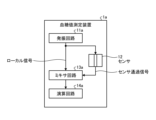
- FIG. 2 is a schematic diagram showing an example of the configuration of the blood sugar level measuring device 1 of the first embodiment.
- the blood sugar level measuring device 1 includes an oscillator circuit 11, a sensor 12, a phase detector 13, and an arithmetic circuit .
- the senor 12 has a structure similar to a microstrip line, which is a type of transmission line.
- a configuration example of the sensor 12 of the first embodiment will be described with reference to FIGS. 3 and 4.
- FIG. 1 A configuration example of the sensor 12 of the first embodiment will be described with reference to FIGS. 3 and 4.
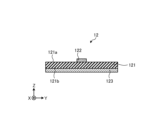
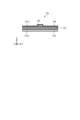
- FIG. 3 is a perspective view of the sensor 12 of the first embodiment.
- FIG. 4 is a cross-sectional view of the sensor 12 of the first embodiment taken along the YZ plane.
- the sensor 12 has a rectangular flat plate shape. 2, 3 and some subsequent figures, the thickness direction of the sensor 12 is the Z direction, the direction in which one side of the rectangular shape of the sensor 12 extends is the X direction, and the rectangular shape of the sensor 12 is perpendicular to the X direction. The positional relationship and orientation of the constituent elements of the sensor 12 will be described with the direction in which the other side extends as the Y direction. Note that the shape of the sensor 12 does not necessarily have to be rectangular.
- the sensor 12 includes a first substrate 121 made of a dielectric.
- the material constituting the first substrate 121 can be composed of common substrate materials such as polytetrafluoroethylene (PTFE) or polyimide, for example.
- an X-shaped electrode made of a conductor and having a certain thickness and width passes through substantially the center when the first substrate 121 is viewed from above.
- a first signal line 122 extending in the direction is provided.
- a ground conductor 123 is provided on the other surface 121b of the first substrate 121 and is formed over the entire surface 121b. It does not necessarily have to be formed on the entire surface.
- the first signal line 122 and the ground conductor 123 are made of a material with high electrical conductivity such as copper or gold.
- the surface 121a of the first substrate 121 is an example of the first surface.
- the surface 121b of the first substrate 121 is an example of the second surface.
- the first signal line 122 is pressed against the object to be measured, that is, the subject's skin in this case, from the positive side in the Z direction while an alternating electric signal is flowing.
- FIG. 5 is a schematic diagram showing the electromagnetic field distribution when the subject's skin 200 is pressed against the first signal line 122 of the first embodiment.
- a solid arrow E indicates an electric field vector, and a dotted line H indicates a magnetic field distribution.
- the wavelength shortening rate k is generally inversely proportional to the square root of the dielectric constant and is expressed by the following formula (1).
- the wavelength of the AC signal when the object is in contact with the first signal line 122 is different from that of the AC signal when the first signal line 122 is not in contact with anything. Vary from wavelength.
- the blood sugar level rises, and the glucose concentration in the interstitial fluid in the dermis layer rises. Then, in a specific frequency range (for example, a range on the high frequency side of the inflection point 300 in FIG. 1), the higher the glucose concentration, the higher the dielectric constant. Therefore, when the subject's blood sugar level rises, the shortening rate k decreases and the wavelength of the AC signal passing through the first signal line 122 shortens.
- a specific frequency range for example, a range on the high frequency side of the inflection point 300 in FIG. 1
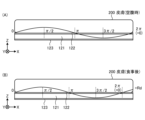
- FIG. 6 shows changes in the wavelength of the AC signal passing through the first signal line 122 of the sensor 12 of the first embodiment when the subject's skin is pressed against the first signal line 122 in the fasting state and after eating. It is a schematic diagram for explaining.
- the wavelength of the AC signal in the dielectric constant of the skin 200 when the subject is hungry is the length from the input end to the output end of the first signal line 122 (here, in the X direction length of ), and shall be equal to That is, when the subject touches the first signal line 122 on an empty stomach, an AC signal is transmitted with a wavelength equal to the length of the first signal line 122, as shown in FIG. 6(A). Therefore, when the phase of the AC signal at the input end of the first signal line 122 is 0 radian, the phase of the AC signal at the output end of the first signal line 122 is 0 radian.
- the wavelength is shortened as shown in FIG. 6(B). Therefore, when the phase of the AC signal input to one end of the first signal line 122 is 0 radian, the phase of the AC signal output from the other end of the first signal line 122 is shown in FIG.
- the phase is advanced by the amount by which the wavelength is shortened compared to the phase when the wavelength is shortened.
- the advance amount based on the phase in this fasting state is denoted as the phase advance amount Rd.
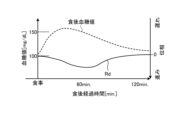
- FIG. 7 is a schematic diagram illustrating an example of temporal transition of change in wavelength of an AC signal flowing through the first signal line 122 when the subject touches the first signal line 122 of the sensor 12 of the first embodiment. It is a diagram. In this figure, the horizontal axis indicates the elapsed time after eating. The vertical axis on the left indicates the blood glucose level, and the vertical axis on the right indicates the phase.
- phase advance amount Rd increases according to the rise in the blood sugar level. Then, when the blood sugar level starts to fall, the phase lead amount Rd becomes smaller. In this way, the phase lead amount Rd changes in conjunction with the blood sugar level.
- the blood sugar level measuring device 1 calculates the phase advance amount Rd, and calculates the measured value of the blood sugar level based on the phase advance amount Rd.
- the oscillator circuit 11 oscillates a single-frequency AC signal.
- the frequency of the AC signal oscillated by the oscillation circuit 11 is a frequency selected from the range in which the dielectric constant of the skin can change according to the blood sugar level.
- the oscillator circuit 11 oscillates an AC signal with a frequency selected from the range 310 in FIG. 1, for example. Note that the frequency of the AC signal oscillated by the oscillation circuit 11 may be selected from a range other than the range 310 .
- the AC signal transmission line connected to the oscillation circuit 11 is branched into two, and one of the two branched transmission lines is connected to the input end of the first signal line 122 and branched into two.
- the other of the transmission lines that are connected are connected to the phase detector 13 .
- the output end of the first signal line 122 is connected to the phase detector 13 . Therefore, the AC signal that has passed through the first signal line 122 and the AC signal that has not passed through the first signal line 122 are input to the phase detector 13 .
- An AC signal that passes through the first signal line 122 and is input to the phase detector 13 is referred to as a sensor passing signal.
- An AC signal that is input to the phase detector 13 without passing through the first signal line 122 is referred to as a local signal.
- the AC signal oscillated by the oscillation circuit 11 is an example of the first signal.
- the AC signal that has passed through the first signal line 122, that is, the sensor passing signal is an example of the second signal.
- An AC signal that does not pass through the first signal line 122, that is, a local signal is an example of a third signal.
- the phase detector 13 detects the phase difference Rx between the sensor-passing signal and the local signal, and inputs the detected value of the phase difference to the arithmetic circuit 14 .
- Phase detector 13 may also be referred to as a phase comparator.
- the arithmetic circuit 14 is a processor that executes predetermined arithmetic processing.
- the arithmetic circuit 14 is, for example, a microcomputer unit that includes a CPU (Central Processing Unit) and a memory that stores a program, and the CPU executes arithmetic processing based on the program.
- the arithmetic circuit 14 may be configured by a hardware circuit such as FPGA (Field-Programmable Gate Array) or ASIC (Application Specific Integrated Circuit).
- Arithmetic circuit 14 acquires the measured blood sugar level of the subject based on phase difference Rx input from phase detector 13 .
- Arithmetic circuit 14 can output the measured value of the blood sugar level in any manner.
- the arithmetic circuit 14 may output the measured blood sugar level to the output device such as the display device or the speaker. If the blood sugar level measuring device 1 has a memory, the blood sugar level measurement value may be output to the memory.
- the arithmetic circuit 14 may output the measured blood sugar level to an external device via the communication device.
- FIG. 8 is a flow chart showing an example of the operation of the blood sugar level measuring device 1 of the first embodiment. A series of operations shown in this figure are executed while the subject is touching the first signal line 122 to measure the blood sugar level.
- the phase detector 13 acquires the phase difference Rx between the sensor passing signal and the local signal (S101).
- the phase difference Rx is input to the arithmetic circuit 14 .
- Arithmetic circuit 14 subtracts fasting phase difference Ri, which is the phase difference Rx between the sensor-passing signal and the local signal when the subject is in a hungry state, from the phase difference Rx obtained in S101, thereby obtaining phase lead amount Rd. (S102).
- the fasting phase difference Ri is measured in advance and stored in the arithmetic circuit 14 or a memory accessible by the arithmetic circuit 14 .
- the arithmetic circuit 14 stores the transition of the phase difference Rx during the wearing period. .
- the arithmetic circuit 14 stores the lowest value of the phase difference Rx as the fasting phase difference Ri. Note that the method of obtaining the fasting phase difference Ri is not limited to this.
- the fasting blood sugar level Bi which is the blood sugar level when the subject is in a fasting state, is measured in advance and stored in the arithmetic circuit 14 or a memory accessible by the arithmetic circuit 14. are stored in association with .
- a method for measuring the fasting blood sugar level Bi is not limited to a specific method.
- the fasting blood glucose level Bi can be measured, for example, by blood sampling.
- the arithmetic circuit 14 acquires the variation amount Bv of the blood sugar level from the fasting blood sugar level Bi based on the phase lead amount Rd (S103).
- a calibration curve (referred to as a first calibration curve) representing the relationship between the phase advance amount Rd and the variation amount Bv is obtained in advance by simulation or an experiment using one or more subjects.
- the first calibration curve may be a function or information in table format.
- the first calibration curve is stored in advance in the arithmetic circuit 14 or a memory accessible by the arithmetic circuit 14 .
- the arithmetic circuit 14 acquires the variation Bv at the time of execution of S103 based on the phase lead amount Rd acquired in S102 and the first calibration curve.
- the arithmetic circuit 14 acquires the measured value of the blood sugar level by adding the fluctuation amount Bv acquired in S103 to the fasting blood sugar level Bi (S104). Then, the operation of the blood sugar level measuring device 1 ends.
- the operation for obtaining the measured value of the blood sugar level shown in FIG. 8 is merely an example.
- the operation for obtaining the blood glucose level measurement may be modified in various ways.
- a calibration curve representing the relationship between the phase difference Rx and the blood glucose level (referred to as a second calibration curve) is obtained in advance by simulation or an experiment using one or more subjects, and the arithmetic circuit 14 or the arithmetic circuit 14 Pre-stored in accessible memory. Then, the arithmetic circuit 14 may acquire the measured value of the blood sugar level based on the phase difference Rx acquired in S101 and the second calibration curve.
- the arithmetic circuit 14 may calculate the dielectric constant ⁇ x of the skin based on the phase difference Rx, and obtain the measured blood glucose level based on the dielectric constant ⁇ x of the skin.
- the arithmetic circuit 14 converts the phase difference Rx into the dielectric constant ⁇ x of the skin based on the following equation (2), for example.
- a and b are coefficients obtained based on the relationship between the dielectric constant and the phase difference Rx obtained in advance by pressing a sample with a known dielectric constant against the first signal line 122 to obtain the phase difference Rx. be.
- Arithmetic circuit 14 then obtains the measured value of the blood glucose level based on the dielectric constant ⁇ x of the skin.
- a calibration curve (referred to as a third calibration curve) representing the relationship between the dielectric constant ⁇ x of the skin and the blood glucose level is obtained in advance by simulation or an experiment using one or more subjects, and the arithmetic circuit 14 or It is stored in advance in a memory accessible by the arithmetic circuit 14 .
- Arithmetic circuit 14 obtains a blood glucose level measurement value based on the dielectric constant ⁇ x of the skin obtained by Equation (2) and the third calibration curve.
- the calculation circuit 14 calculated the measured blood sugar level based on the fasting blood sugar level Bi of the subject because the blood sugar level of the subject was the same, but the race and gender of the subject were different. , individual differences in body composition, etc., the wavelength of the AC signal transmitted through the first signal line 122 may differ. Since the subject's fasting phase difference Ri and fasting blood glucose level Bi are obtained in advance and the measured value of the blood glucose level is calculated as these standards, the subject's race, gender, individual differences in body composition, etc. are different. It is possible to measure the blood glucose level with high accuracy even with high accuracy.
- the following action is possible.
- a glucose tolerance test is performed on a subject, and a calibration curve (No. 4 calibration curve) is created.
- the fourth calibration curve is stored in the arithmetic circuit 14 or a memory accessible by the arithmetic circuit 14 .
- the arithmetic circuit 14 obtains the measured value of the blood sugar level from the phase difference Rx and the fourth calibration curve.
- the fourth calibration curve created for each subject is used, accurate blood glucose measurement is possible even if the subject's race, sex, individual differences in body composition, etc. are different. be.
- the arithmetic circuit 14 calculates the dielectric constant ⁇ x of the skin based on the phase difference Rx, and calculates the dielectric constant ⁇ x of the skin based on the dielectric constant ⁇ x A blood glucose measurement may be obtained.
- the blood glucose level measuring device 1 is configured by the dielectric first substrate 121 provided with the ground conductor 123 and the first signal line 122 against which the living body is pressed.
- the phase difference between the sensor 12, the oscillation circuit 11 that oscillates an AC signal, the sensor passing signal that is an AC signal that has passed through the first signal line 122, and the local signal that is an AC signal that does not pass through the first signal line 122 is calculated.
- the senor 12 has a structure in which the first signal line 122 is provided on the surface 121a of the first substrate 121 and the ground conductor 123 is provided on the surface 121b opposite to the surface 121a.
- the example of the structure of the sensor 12 is not limited to this. Modifications regarding the sensor 12 will be described later.
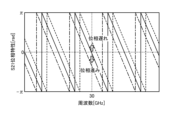
- FIG. 9 is a diagram showing an example of the relationship between changes in phase and changes in frequency of sensor-passing signals according to the first and second embodiments.
- the horizontal axis indicates the frequency
- the vertical axis indicates the S21 phase characteristic.
- the change can be observed not only as a change in phase but also as a change in frequency.
- the wavelength becomes shorter the phase advances and the frequency becomes lower.
- the blood sugar level measuring device 1a of the second embodiment observes changes in the wavelength of the signal passing through the sensor as changes in frequency, and acquires the measured value of the blood sugar level based on the change in frequency.
- the blood sugar level measuring device 1a of the second embodiment will be described below. Items that are the same or similar to those of the first embodiment will be omitted or will be briefly described.
- FIG. 10 is a schematic diagram showing an example of the configuration of the blood sugar level measuring device 1a of the second embodiment.
- the blood sugar level measuring device 1a includes an oscillation circuit 11a, a sensor 12, a mixer circuit 13a, and an arithmetic circuit 14a.
- the oscillation circuit 11a oscillates an AC signal whose frequency changes over time, that is, a chirp signal.
- the frequency band of the chirp signal oscillated by the oscillation circuit 11 is selected from a range in which the dielectric constant of the skin can change according to the blood sugar level.
- the oscillation circuit 11a oscillates a chirp signal whose frequency changes in a frequency band selected from the range 310 in FIG. 1, for example. Note that the frequency band of the chirp signal oscillated by the oscillation circuit 11a may be selected from a range other than the range 310.
- the chirp signal oscillated by the oscillation circuit 11a is input as a local signal to the mixer circuit 13a via one of the two branched transmission paths. Also, the chirp signal oscillated by the oscillation circuit 11a is input to the input terminal of the first signal line 122 provided in the sensor 12 via the other one of the two branched transmission paths. A chirp signal output from the output terminal of the first signal line 122 provided in the sensor 12 is input to the mixer circuit 13a as a sensor passing signal.
- the mixer circuit 13a generates a beat frequency signal indicating the frequency difference between the sensor passing signal and the local signal, and inputs it to the arithmetic circuit 14a.
- the arithmetic circuit 14a uses the beat frequency signal instead of the phase difference Rx used by the arithmetic circuit 14 of the first embodiment to acquire the measured blood sugar level. Similar to the arithmetic circuit 14 of the first embodiment, the arithmetic circuit 14a can output the obtained blood glucose level measurement value by any method.
- the blood sugar level measuring device 1a includes the mixer circuit 13a that outputs the beat frequency signal indicating the frequency difference between the sensor passing signal and the local signal. A blood glucose measurement is obtained based on the frequency signal.
- the sensor 12 of the first and second embodiments can be modified in various ways.
- a sensor 12a of a first modified example described below can be applied instead of the sensor 12 of the first and second embodiments.
- FIG. 11 is a cross-sectional view of the sensor 12a of the first modification taken along the YZ plane.
- the surface 121 a and the first signal line 122 of the sensor 12 a are covered with an insulating film 124 .
- the subject's skin 200 is pressed against the first signal line 122 via the coating 124 .
- the coating 124 can be made of any material as long as it has insulating properties.
- the coating 124 may consist of solder resist.
- coating 124 may be composed of an insulating ceramic such as silicon oxide.
- the senor 12a is configured such that the first signal line 122 is covered with the insulating film 124 and the subject's skin 200 is pressed through the film 124 .
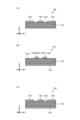
- the senor 12 had a microstripline structure. Sensors that may have transmission line structures other than microstripline may be applied to the first and second embodiments. As a second modified example, structures of sensors 12b to 12d that can be applied to the first and second embodiments in place of the sensor 12 will be described.
- FIG. 12 is a cross-sectional view of sensors 12b to 12d of the second modified example cut along the YZ plane.
- the sensor 12b has a structure in which a first signal line 122 and two ground conductors 123 are provided on the surface 121a of the first substrate 121 with a space therebetween.
- the point that the first signal line 122 is provided on a part of the surface 121a of the first substrate 121 is the same as the first embodiment.
- a ground conductor 123 having a constant thickness and width is formed extending in the X direction on a portion of the surface 121a of the first substrate 121, spaced apart on both sides of the first signal line 122.
- a transmission line structured like the sensor 12b shown in this figure is also referred to as a coplanar line.
- the senor 12c is provided with two first signal lines 122 spaced apart on the surface 121a of the first substrate 121, and on the other surface 121b of the first substrate 121, It has a structure in which a ground conductor 123 is provided and formed over the entire surface 121b.
- a differential signal that is, an AC signal whose phase is inverted is transmitted to the two first signal lines 122 .
- a transmission line structured like the sensor 12c shown in this figure is also referred to as a coplanar stripline.
- the sensor 12d has a structure in which a first signal line 122 and two ground conductors 123 are provided on the surface 121a of the first substrate 121 with a space therebetween.
- the point that the first signal line 122 is provided on a part of the surface 121a of the first substrate 121 is the same as the first embodiment.
- a ground conductor 123 having a constant thickness and width is formed extending in the X direction on a portion of the surface 121a of the first substrate 121, spaced apart on both sides of the first signal line 122.
- a ground conductor 123 is provided on the other surface 121b of the first substrate 121, and has a structure formed over the entire surface 121b.
- a transmission line structured like the sensor 12d is also called a grounded coplanar line.
- microstrip lines not only microstrip lines but also transmission line structures such as coplanar lines, coplanar strip lines, and grounded coplanar lines can be applied.
- the shape of the first signal line 122 is not limited to a straight line.
- a shape of the first signal line 122 that can be applied to the first and second embodiments other than the linear shape will be described.
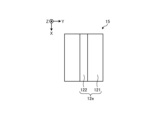
- FIG. 13 is a schematic diagram for explaining the shape of the first signal line 122 of the third modified example. Note that FIG. 13 depicts diagrams of the first signal lines 122 having various shapes as viewed from the positive side in the Z direction.
- the first signal line 122 may have a U-shape as shown in FIG. 13(A). Also, the first signal line 122 may have a folded shape as shown in FIG. 13(B). Also, the first signal line 122 may have a spiral shape as shown in FIG. 13(C).
- the shape of the first signal line 122 can be variously modified.
- the characteristics of the sensor-passing signal may vary depending on the temperature of sensor 12 . Therefore, when the subject's skin 200 touches the first signal line 122 of the sensor 12, the temperature of the sensor 12 changes according to the subject's body temperature, which may change the blood sugar level measurement result.
- a sensor 12e capable of canceling the influence of temperature change of the sensor 12 due to the subject's touch will be described. Note that the sensor 12e of the fourth modification can be applied to the first embodiment and the second embodiment.
- FIG. 14 is a diagram of the sensor unit 15 viewed from the positive side in the Z direction.
- FIG. 15 is a diagram of the sensor unit 15 viewed from the negative side in the Z direction.
- FIG. 16 is a cross-sectional view of the sensor unit 15 cut along the XZ plane.
- the sensor unit 15 includes a sensor 12e.
- Sensor 12 e has the same structure as sensor 12 . That is, a part of the surface 121a of the first substrate 121 is made of a conductor, and when the first substrate 121 is viewed from above, an X direction passing through substantially the center and having a constant thickness and width A ground conductor 123 is provided on the surface 121b of the first substrate 121 and is formed over the entire surface 121b.
- a second substrate 131 is provided on the Z-direction negative side of the sensor 12e. That is, the second substrate 131 is provided to face the surface 121b of the first substrate 121, sandwiching the ground conductor 123 therebetween.
- the shape of the second substrate 131 and the material forming the second substrate 131 are the same as those of the first substrate 121 .
- a second signal line 132 is provided on the surface of the second substrate 131 opposite to the ground conductor 123 .
- the second signal line 132 is provided behind the sensor unit 15 when viewed from the first signal line 121 .
- the subject cannot touch the second signal line 132 when measuring the blood sugar level, but the subject's body temperature is detected by the first substrate 121, the ground conductor 123, the second substrate 131, and the second signal line 132. Propagation to the signal line 132 is enabled.
- the shape of the second signal line 132 and the material forming the second signal line 132 are the same as those of the first signal line 122 . That is, the ground conductor 123, the second substrate 131, and the second signal line 132 have a microstripline structure, like the sensor 12e.
- FIG. 17 is a diagram for explaining transmission paths of sensor passing signals and local signals when the fourth modification is applied to the first embodiment.
- the AC signal that has passed through the first signal line 122 is input to the phase detector 13 as a sensor passing signal. Also, the AC signal that has passed through the second signal line 132 is input to the phase detector 13 as a local signal.
- the phase detector 13 inputs the phase difference Rx between the sensor passing signal and the local signal to the arithmetic circuit 14 as described in the first embodiment.
- the arithmetic circuit 14 performs the calculation of the blood glucose level measurement value based on the phase difference Rx by the operation described in the first embodiment.
- the subject's skin 200 When measuring the blood sugar level, the subject's skin 200 is pressed against the first signal line 122 . Then, the subject's heat propagates to the entire sensor unit 15, and the temperature of the entire sensor unit 15 becomes substantially uniform. Therefore, the temperature conditions can be made equal between the sensor passing signal and the local signal. Since the result of comparison between the sensor-passing signal and the local signal, which have passed through transmission lines of the same temperature, is used to calculate the blood sugar level measurement value, the influence of the subject's body temperature on the sensor-passing signal can be cancelled. That is, according to the fourth modified example, highly accurate blood sugar level measurement that suppresses the influence of the subject's body temperature on the sensor 12e is realized.
- FIG. 17 describes the case where the sensor 12e of the fourth modification is applied to the first embodiment.
- the sensor 12e of the fourth modification can also be applied to the second embodiment.
- the AC signal passing through the first signal line 122 is sent to the mixer circuit 13a as a sensor passing signal, as in the example shown in FIG.
- the AC signal that has been input and passed through the second signal line 132 is input to the mixer circuit 13a as a local signal.
- the measuring device that measures the blood sugar level as biological information has been described.
- Biological information other than the blood sugar level may be measured.
- the dielectric constant of the skin may be used as biological information to be measured.
- the measuring device of the embodiment may acquire the skin permittivity based on the phase difference or frequency difference between the sensor passing signal and the local signal, and output the acquired skin permittivity.
- the measurement apparatus of the embodiment may be configured with the amount of cancer cells as the biological information to be measured.
- the measuring device of the embodiment may acquire the amount of cancer cells based on the phase difference or frequency difference between the signal passing through the sensor and the local signal, and output the acquired amount of cancer cells.
- the measurement device includes a ground conductor (eg, the ground conductor 123) and a first signal line (eg, the first signal line) against which the living body is pressed.
- a dielectric first substrate e.g., first substrate 121) on which a signal line 122) is provided; an oscillator circuit (e.g., oscillator circuits 11 and 11a) that oscillates an AC signal; and an AC signal that has passed through the first signal line.
- an arithmetic circuit for example, arithmetic circuits 14 and 14a
- the comparison between the AC signal that has passed through the first signal line and the AC signal that has not passed through the first signal line is to detect the phase difference Rx in the first embodiment, and the frequency difference Rx in the second embodiment. is to detect
Landscapes
- Health & Medical Sciences (AREA)
- Life Sciences & Earth Sciences (AREA)
- Physics & Mathematics (AREA)
- Medical Informatics (AREA)
- Surgery (AREA)
- Biophysics (AREA)
- Pathology (AREA)
- Engineering & Computer Science (AREA)
- Biomedical Technology (AREA)
- Heart & Thoracic Surgery (AREA)
- Veterinary Medicine (AREA)
- Molecular Biology (AREA)
- Public Health (AREA)
- Animal Behavior & Ethology (AREA)
- General Health & Medical Sciences (AREA)
- Optics & Photonics (AREA)
- Emergency Medicine (AREA)
- Nuclear Medicine, Radiotherapy & Molecular Imaging (AREA)
- Radiology & Medical Imaging (AREA)
- Measurement Of The Respiration, Hearing Ability, Form, And Blood Characteristics Of Living Organisms (AREA)
Priority Applications (2)
| Application Number | Priority Date | Filing Date | Title |
|---|---|---|---|
| JP2023576655A JPWO2023145233A1 (https=) | 2022-01-31 | 2022-11-28 | |
| US18/787,793 US20240415402A1 (en) | 2022-01-31 | 2024-07-29 | Measuring apparatus and measuring method |
Applications Claiming Priority (2)
| Application Number | Priority Date | Filing Date | Title |
|---|---|---|---|
| JP2022-013622 | 2022-01-31 | ||
| JP2022013622 | 2022-01-31 |
Related Child Applications (1)
| Application Number | Title | Priority Date | Filing Date |
|---|---|---|---|
| US18/787,793 Continuation US20240415402A1 (en) | 2022-01-31 | 2024-07-29 | Measuring apparatus and measuring method |
Publications (1)
| Publication Number | Publication Date |
|---|---|
| WO2023145233A1 true WO2023145233A1 (ja) | 2023-08-03 |
Family
ID=87471446
Family Applications (1)
| Application Number | Title | Priority Date | Filing Date |
|---|---|---|---|
| PCT/JP2022/043829 Ceased WO2023145233A1 (ja) | 2022-01-31 | 2022-11-28 | 測定装置および測定方法 |
Country Status (3)
| Country | Link |
|---|---|
| US (1) | US20240415402A1 (https=) |
| JP (1) | JPWO2023145233A1 (https=) |
| WO (1) | WO2023145233A1 (https=) |
Cited By (1)
| Publication number | Priority date | Publication date | Assignee | Title |
|---|---|---|---|---|
| WO2025206370A1 (ja) * | 2024-03-29 | 2025-10-02 | 太陽誘電株式会社 | 測定装置 |
Citations (3)
| Publication number | Priority date | Publication date | Assignee | Title |
|---|---|---|---|---|
| JP2009500096A (ja) * | 2005-07-06 | 2009-01-08 | ファーリン メディカル リミテッド | 生物組織構造中の成分濃度を測定する装置及び方法 |
| US20170181658A1 (en) * | 2014-07-08 | 2017-06-29 | Infineon Technologies Ag | 300 MHz to 3 THz Electromagnetic Wave Sensor for Determining an Interstitial Fluid Parameter in Vivo |
| JP2021502880A (ja) * | 2017-11-15 | 2021-02-04 | シンガポール・ユニバーシティ・オブ・テクノロジー・アンド・デザインSingapore University of Technology and Design | 血糖を非侵襲的に監視するための装置および方法 |
-
2022
- 2022-11-28 WO PCT/JP2022/043829 patent/WO2023145233A1/ja not_active Ceased
- 2022-11-28 JP JP2023576655A patent/JPWO2023145233A1/ja active Pending
-
2024
- 2024-07-29 US US18/787,793 patent/US20240415402A1/en active Pending
Patent Citations (3)
| Publication number | Priority date | Publication date | Assignee | Title |
|---|---|---|---|---|
| JP2009500096A (ja) * | 2005-07-06 | 2009-01-08 | ファーリン メディカル リミテッド | 生物組織構造中の成分濃度を測定する装置及び方法 |
| US20170181658A1 (en) * | 2014-07-08 | 2017-06-29 | Infineon Technologies Ag | 300 MHz to 3 THz Electromagnetic Wave Sensor for Determining an Interstitial Fluid Parameter in Vivo |
| JP2021502880A (ja) * | 2017-11-15 | 2021-02-04 | シンガポール・ユニバーシティ・オブ・テクノロジー・アンド・デザインSingapore University of Technology and Design | 血糖を非侵襲的に監視するための装置および方法 |
Cited By (1)
| Publication number | Priority date | Publication date | Assignee | Title |
|---|---|---|---|---|
| WO2025206370A1 (ja) * | 2024-03-29 | 2025-10-02 | 太陽誘電株式会社 | 測定装置 |
Also Published As
| Publication number | Publication date |
|---|---|
| US20240415402A1 (en) | 2024-12-19 |
| JPWO2023145233A1 (https=) | 2023-08-03 |
Similar Documents
| Publication | Publication Date | Title |
|---|---|---|
| Jang et al. | Non-invasive fluidic glucose detection based on dual microwave complementary split ring resonators with a switching circuit for environmental effect elimination | |
| Kiani et al. | Dual-frequency microwave resonant sensor to detect noninvasive glucose-level changes through the fingertip | |
| Omer et al. | Non-invasive real-time monitoring of glucose level using novel microwave biosensor based on triple-pole CSRR | |
| Kandwal et al. | Highly sensitive closed loop enclosed split ring biosensor with high field confinement for aqueous and blood-glucose measurements | |
| US11839468B2 (en) | Component concentration measurement device and component concentration measurement method | |
| Park et al. | Noncontact RF vital sign sensor for continuous monitoring of driver status | |
| US20160073923A1 (en) | A Measuring System for a Probe | |
| US20200337610A1 (en) | Apparatus and method for non-invasively monitoring blood glucose | |
| Kandwal et al. | A novel method of using bifilar spiral resonator for designing thin robust flexible glucose sensors | |
| US20240415402A1 (en) | Measuring apparatus and measuring method | |
| Tlili et al. | Microwave resonant sensor for non-invasive characterization of biological tissues | |
| Marzouk et al. | Comprehensive system for noninvasive glucose monitoring utilizing a rectangular dielectric resonator microwave sensor | |
| Mansour et al. | A novel biosensor for non-invasive blood glucose measurement based on double square complimentary split ring resonator | |
| Souza et al. | Microwave glucose sensing using double circular split ring resonators for improved sensitivity: The role of artificial blood plasma and deionized water | |
| Patel et al. | Metamaterial-enabled microwave sensor for non-invasive continuous glucose monitoring | |
| KR100910034B1 (ko) | 다중 포트를 갖는 전파 혈당 측정장치 및 그 제어방법 | |
| Jeyakumar et al. | Non-invasive glucose monitoring using PCA-enhanced quadring resonator sensor: P. Jeyakumar et al. | |
| Qureshi et al. | Double-Layered metamaterial resonator operating at millimetre wave for detection of dengue virus | |
| Marzouk et al. | Circular DGS resonator for non-invasive sensing of diabetes | |
| CN115267347A (zh) | 一种测量低介电常数的高灵敏度双频带微波传感器 | |
| US20250288230A1 (en) | Measurement apparatus and dielectric constant measurement apparatus | |
| JP2019095398A (ja) | 成分濃度測定方法及び成分濃度測定装置 | |
| WO2025206370A1 (ja) | 測定装置 | |
| Potelon et al. | Solute concentration sensing in aqueous solutions with coupled microstrip resonators | |
| Bardhan et al. | Non-invasive glucose detection via dual sensitivity modified csrr sensor around 2.4 ghz |
Legal Events
| Date | Code | Title | Description |
|---|---|---|---|
| 121 | Ep: the epo has been informed by wipo that ep was designated in this application |
Ref document number: 22924085 Country of ref document: EP Kind code of ref document: A1 |
|
| ENP | Entry into the national phase |
Ref document number: 2023576655 Country of ref document: JP Kind code of ref document: A |
|
| NENP | Non-entry into the national phase |
Ref country code: DE |
|
| 122 | Ep: pct application non-entry in european phase |
Ref document number: 22924085 Country of ref document: EP Kind code of ref document: A1 |